UNIT
TOPIC AREAS
FUNCTIONS
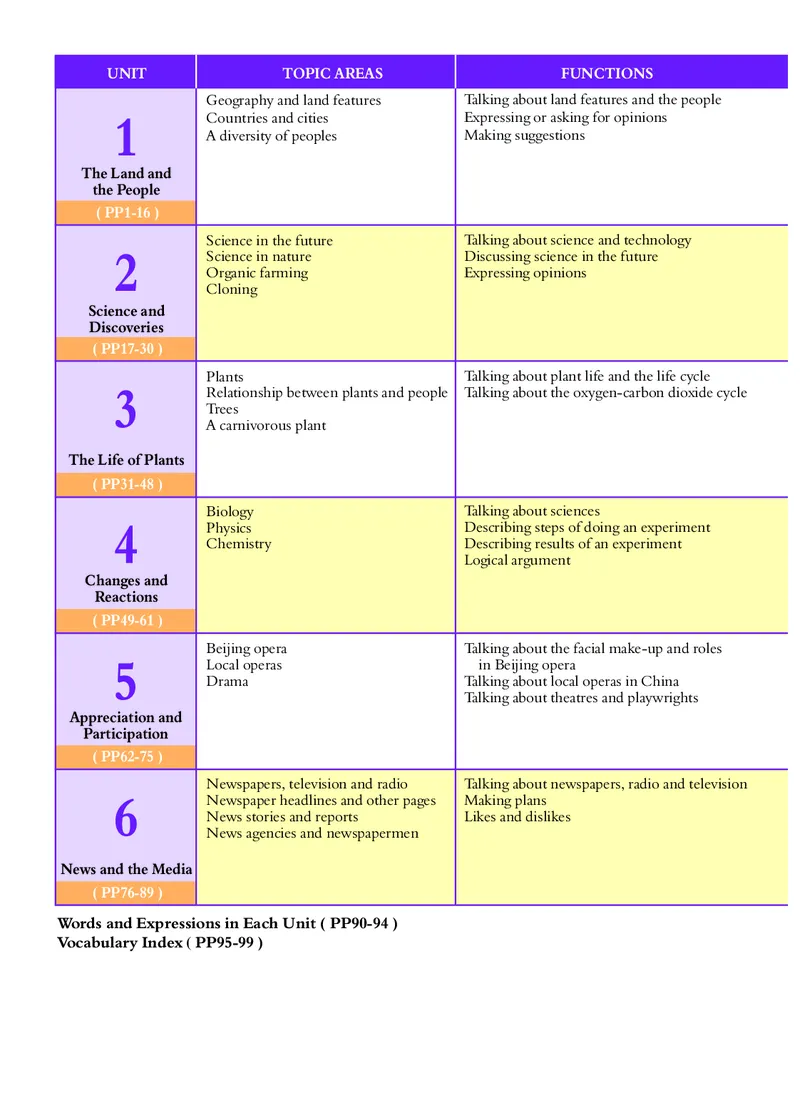
The Land and
the People
Changes and
Reactions
Appreciation and
Participation
Science and
Discoveries
The Life of Plants
News and the Media
Words and Expressions in Each Unit ( PP90-94 )
Vocabulary Index ��PP95-99 )
( PP1-16 )
( PP17-30 )
( PP31-48 )
( PP49-61 )
( PP62-75 )
( PP76-89 )
Geography and land features
Countries and cities
A diversity of peoples
Science in the future
Science in nature
Organic farming
Cloning
Plants
Relationship between plants and people
Trees
A carnivorous plant
Biology
Physics
Chemistry
Beijing opera
Local operas
Drama
Newspapers, television and radio
Newspaper headlines and other pages
News stories and reports
News agencies and newspapermen
Talking about land features and the people
Expressing or asking for opinions
Making suggestions
Talking about science and technology
Discussing science in the future
Expressing opinions
Talking about plant life and the life cycle
Talking about the oxygen-carbon dioxide cycle
Talking about sciences
Describing steps of doing an experiment
Describing results of an experiment
Logical argument
Talking about the facial make-up and roles
in Beijing opera
Talking about local operas in China
Talking about theatres and playwrights
Talking about newspapers, radio and television
Making plans
Likes and dislikes
1
2
3
4
5
6
STRUCTURES
CHAT ROOM
PROGRAMME
Noun clause (4)
Summaries
that-clauses
wh-clauses
who, what, where, when, why
yes-no-clauses
whether, if, whether… or not, if…or not
Attributive clause (1)
which as subject and object
who as subject
whom or who as object
whose as possessive
Attributive clause (2)
Relative pronoun that used as subject
and object
Relative adverbs when, where and why
Adverbial clause (Revision 1)
Clauses of time and reason
Conditional sentences
Gerund as subject
Adverbial clause (Revision 2)
Clauses of comparison, purpose, result and
concession
Gerund as object
it used to refer to time, weather and distance
it used as subject in form
it used as object in form
Agreement of subject and predicative verb
Dialogue 1
Canada Q&A
Dialogue 2
Beijing and Chicago
Dialogue 1
Copying a file
Dialogue 2
At an ATM
Dialogue 1
A beautiful garden
Dialogue 2
What’s so great about plants?
Dialogue 1
The butterfly and the moth
Dialogue 2
Fires in a graveyard
Dialogue 1
A family of Chinese opera fans
Dialogue 2
The Phantom of the Opera
is on stage
Dialogue 1
Do you often read a newspaper?
Dialogue 2
I listen to the radio a lot
Item 1 How much do you know
about Australia?
Item 2 New Zealand —
A beautiful and unspoilt
country
Item 1 Organic farming
Item 2 What exactly is cloning
and do we need to
worry about it?
Item 1 How much do you know
about a tree?
Item 2 Greedy green eaters
Item 1 The tests for three gases
Item 2 What a seed needs to
grow?
Item 1 Beijing opera
Item 2 What are musicals?
Item 1 The latest news
Item 2 News agencies
Unit
Unit 1
Topic Areas
Geography and land features
Countries and cities
A diversity of peoples
Functions
Talking about land features and the people
Expressing or asking for opinions
Making suggestions
Structures
Noun clause (4)
Summaries
that-clauses
wh-clauses
who, what, where, when, why
yes-no-clauses
whether, if, whether… or not, if… or not
Highlights
Highlights
Chat Room
Dialogue 1 Canada Q&A
Dialogue 2 Washington and Chicago
Programme
Item 1 How much do you know about Australia?
Item 2 New Zealand — A beautiful and unspoilt country
The Land
The Land
and the People
and the People
Getting Started
1
1 Listen and practise.
2 Listen and say.
Politically,
the country is
fifty states.
Geographically,
divided into
ten provinces and two territories.
Culturally,
three sections.
(1)
mineral deposits.
The country is rich in natural resources. It has
iron ore.
petroleum.
(2)
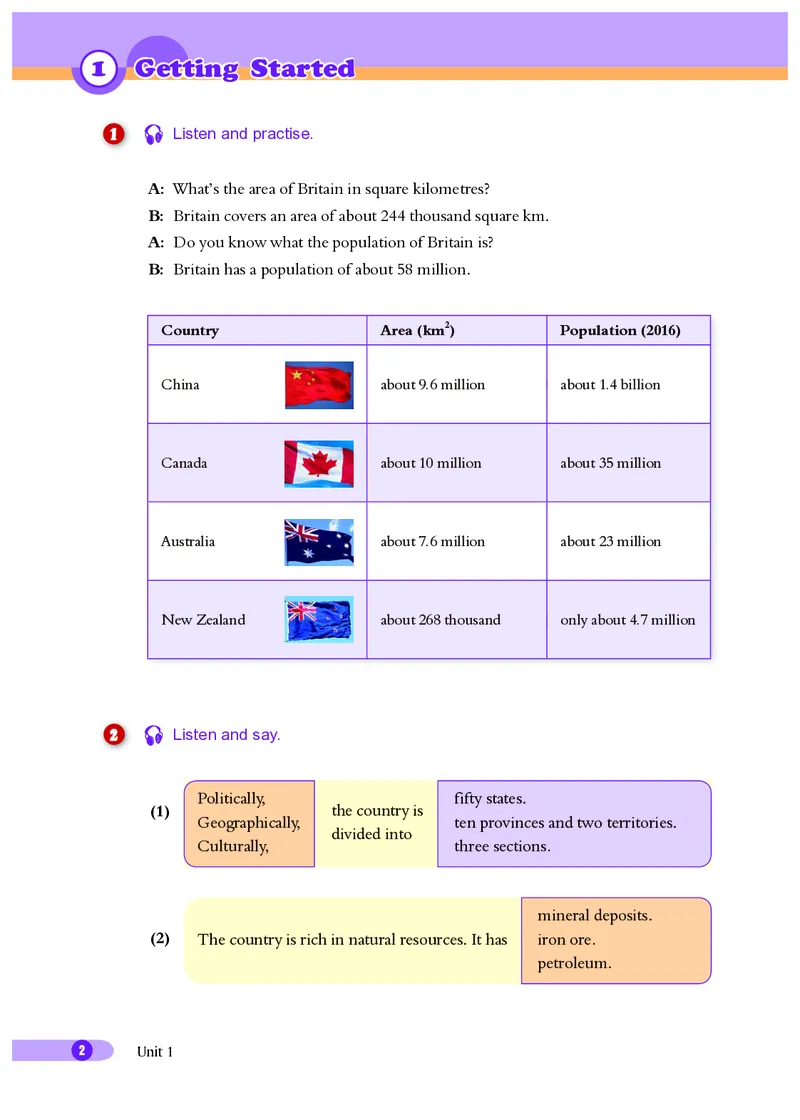
Country
Area (km
2)
Population (2016)
China
about 9.6 million
about 1.4 billion
Canada
about 10 million
about 35 million
Australia
about 7.6 million
about 23 million
New Zealand
about 268 thousand
only about 4.7 million
A: What’s the area of Britain in square kilometres?
B: Britain covers an area of about 244 thousand square km.
A: Do you know what the population of Britain is?
B: Britain has a population of about 58 million.
2
Unit 1
1
Getting Started
Getting Started
mild?
What kind of climate do you have? Is it
warm and dry?
cold and humid?
(4)
mountainous.
This part of the country is very
hilly.
flat.
(5)
forests
lumbering
There are
oil wells
here and
petroleum
is important.
streams
fishing
(3)
3
Begin each of the following questions with the words in brackets.
Example: Will you go to school tonight? (do you think)
→ Do you think you’ll go to school tonight?
(1) Is it going to rain tomorrow? (do you think)
_________________________________________________________________
(2) Will I enjoy the movie? (do you believe)
_________________________________________________________________
(3) Was Mr Cooper tired because he worked hard all day? (do you suppose)
_________________________________________________________________
(4) Are you mistaken about that? (don’t you think)
_________________________________________________________________
(5) Is Mr Cooper angry with the boy? (don’t you feel)
_________________________________________________________________
(6) Does Mr Cooper prefer warm weather? (don’t you suppose)
_________________________________________________________________
3
The Land and the People
Getting Started
Getting Started
1
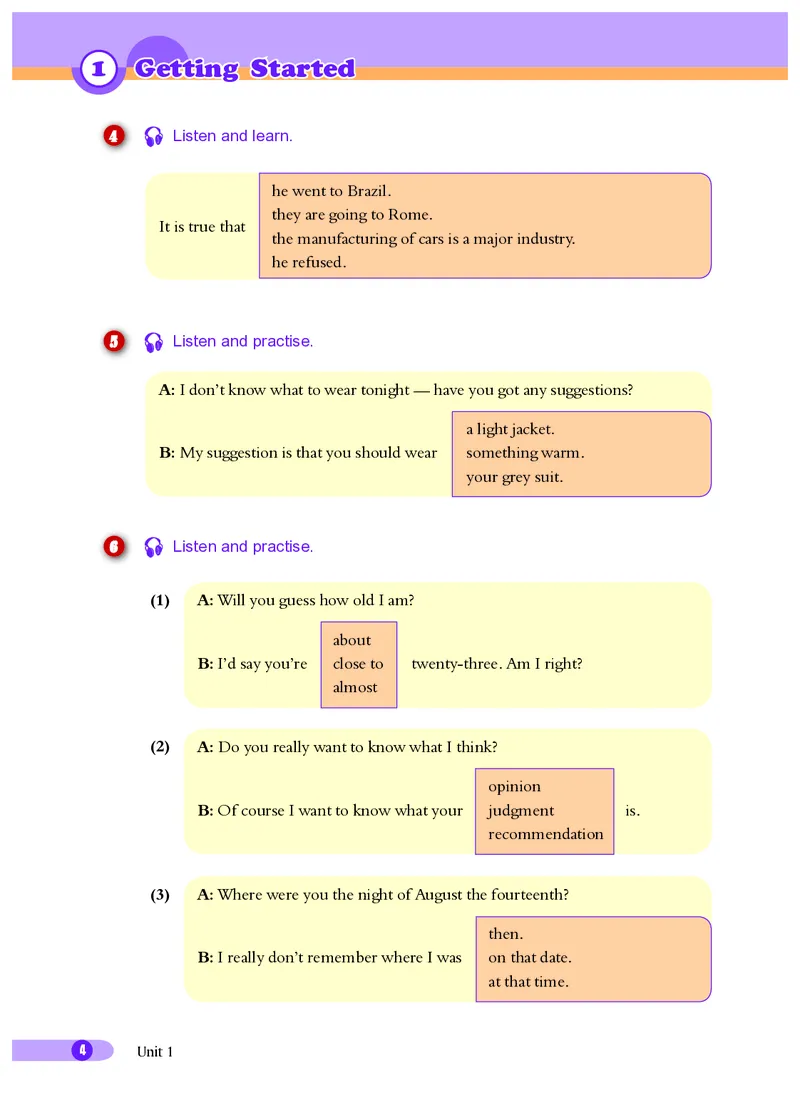
5 Listen and practise.
A: I don’t know what to wear tonight — have you got any suggestions?
a light jacket.
B: My suggestion is that you should wear
something warm.
your grey suit.
6 Listen and practise.
(2)
A: Do you really want to know what I think?
opinion
B: Of course I want to know what your
judgment
is.
recommendation
(3)
A: Where were you the night of August the fourteenth?
then.
B: I really don’t remember where I was
on that date.
at that time.
(1)
about
B: I’d say you’re
close to
twenty-three. Am I right?
almost
A: Will you guess how old I am?
4 Listen and learn.
he went to Brazil.
It is true that
they are going to Rome.
the manufacturing of cars is a major industry.
he refused.
4
Unit 1
1
Getting Started
Getting Started
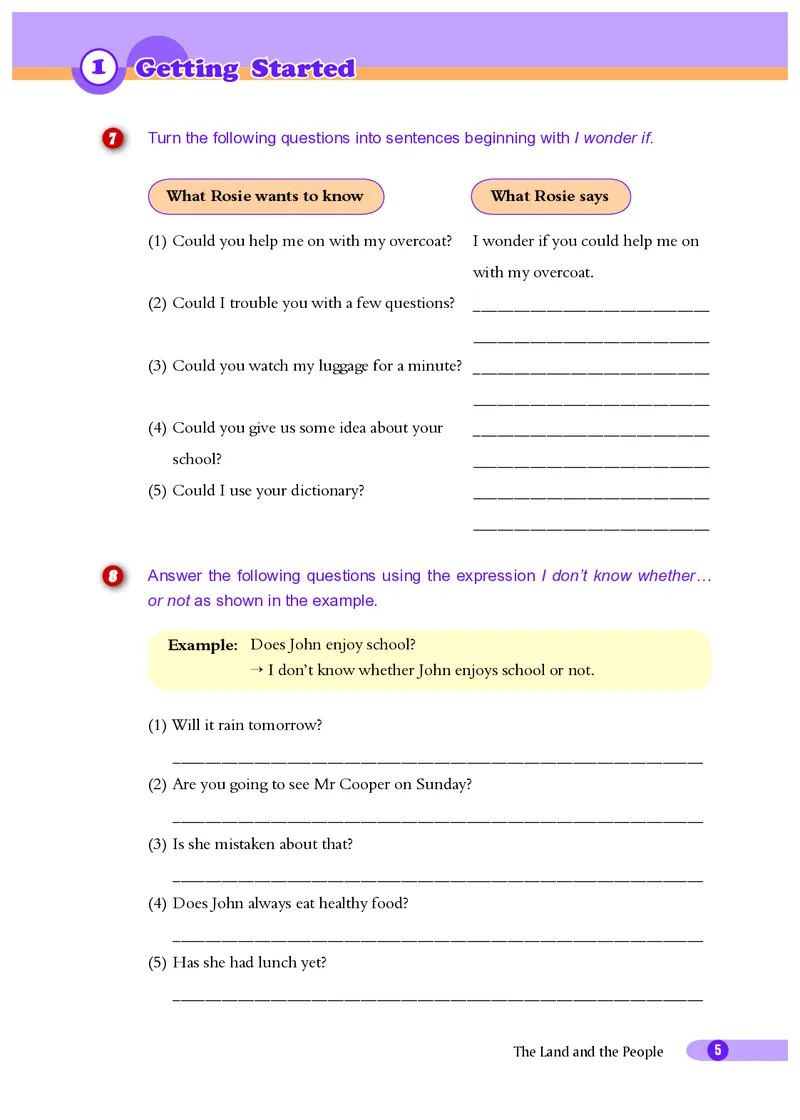
7
Turn the following questions into sentences beginning with I wonder if.
What Rosie wants to know
What Rosie says
(1) Could you help me on with my overcoat?
I wonder if you could help me on
with my overcoat.
(2) Could I trouble you with a few questions? _____________________________
_____________________________
(3) Could you watch my luggage for a minute? _____________________________
_____________________________
(4) Could you give us some idea about your
_____________________________
school?
_____________________________
(5) Could I use your dictionary?
_____________________________
_____________________________
8
Answer the following questions using the expression I don’t know whether…
or not as shown in the example.
Example: Does John enjoy school?
→ I don’t know whether John enjoys school or not.
(1) Will it rain tomorrow?
_________________________________________________________________
(2) Are you going to see Mr Cooper on Sunday?
_________________________________________________________________
(3) Is she mistaken about that?
_________________________________________________________________
(4) Does John always eat healthy food?
_________________________________________________________________
(5) Has she had lunch yet?
_________________________________________________________________
5
The Land and the People
Chat Room
2
Dialogue 1
Canada Q&A
Interviewer: Is Canada the largest country in the world?
Barry:
No, it is the second-largest country by territory.
Interviewer: Why is Canada called Canada? What is the origin of the name Canada?
Barry:
The name is derived from the aboriginal word for village, Kanata.
Interviewer: What is the population of Canada?
Barry:
Canada has a population of about 35 million. The majority of the
population is concentrated in the southern part, where the climate is
more favourable.
Interviewer: How many provinces make up Canada?
Barry:
Canada is a federation of ten provinces and three territories.
Interviewer: What is the capital of Canada?
Barry:
The country’s capital is Ottawa, while the largest city is Toronto fol-
lowed by Montreal and Vancouver.
Interviewer: What kind of climate does Canada have?
Barry:
The climate ranges from temperate and continental to arctic.
Interviewer: Is Canada an English-speaking country?
Barry:
Canada is a bilingual country. English is the mother tongue of about
60% of the population, and French of over 23%. About 18% of the
nationals are fluent in both languages.
Interviewer: I’ve learned a lot from you. Thank you very much.
Dialogue 2
Beijing and Chicago
A: I live in Beijing. Where do you live?
B: I’m now living in Chicago. I used to live in Sydney. Beijing is the capital of China,
isn’t it?
A: Yes, Beijing is the capital. It’s a historic city noted for its many famous buildings.
Is Chicago a historic city?
B: Chicago is also a historic city, but it’s mainly an industrial centre. Beijing isn’t an
industrial centre, is it?
A: No, it isn’t, but it is a large metropolitan area. Is Chicago as large as Beijing?
B: I don’t think so. Beijing is much larger than Chicago by both area and popula-
tion.
A: How many years have you lived in Chicago?
B: Five years. I’ve lived in Chicago ever since I came to the United States from
Australia. Have you lived in Beijing all your life?
A: Yes, I have. I’m a native of the city.
6
Unit 1
3
Programme
Programme
Item 1
How much do you know about Australia?
1
Do a general knowledge quiz about Australia.
2 Listen to the text and check your answers.
3 Listen again and write the correct numbers into the blanks.
(1) Australia is _____.
A. the smallest island and the largest continent
B. the largest island and the smallest continent
C. the largest island and the largest continent
D. the smallest island and the smallest continent
(2) It is 32 times greater than _____.
A. Great Britain
B. Brazil
C. Russia
D. Canada
(3) The population of Australia (2012) is about _____.
A. 314.8 million
B. 4.4 million
C. 35 million D. 22.8 million
(4) Australia has _____.
A. 6 states and 6 major mainland territories
B. 2 states and 6 territories
C. 6 states and 2 major mainland territories
D. 2 states and 2 territories
(5) Which of these can you NOT fi nd in Australia? _____
A. Harbour Bridge.
B. Opera House.
C. Glaciers.
D. The Great Barrier Reef.
(6) Thousands of years ago the fi rst Australians sailed here from _____.
A. Europe B. Americas C. Africa D. the Indonesian island of Java
(1) Australia, with an area of __________ million sq km, is the largest island and the small-
est continent on Earth. It stretches some __________ km from its most northern to its
most southern point, and about __________ km from east to west.
(2) In area, Australia is the sixth largest nation after Russia, Canada, China, the United
States of America and Brazil. It’s __________ times greater than the UK.
(3) In South Australia the Adelaide Festival, held in the capital every __________ years, is
an international cultural event.
(4) Western Australia is about the size of Western Europe. About __________ of the state’s
population live in its capital, Perth.
(5) The Northern Territory has more than __________ the land area of France but only a
population of about __________.
7
The Land and the People
3
Programme
Programme
4
Read the text and fi ll in the chart.
Australia, with an area of about 7.6 million sq km, is the largest island and
the smallest continent on Earth. It stretches some 3,700 km from its most
northern to its most southern point, and about 4,000 km from east to west.
In area, Australia is the sixth largest nation after Russia, Canada, China,
the United States of America and Brazil. It’s 32 times greater than the UK.
Australia has six states and two major mainland territories.
European settlement began in New South Wales in 1788, at Sydney, the na-
tion’s largest city. Sydney’s Harbour Bridge and Opera House are national icons.
Victoria is a very small state. Its capital, Melbourne, is famous for the
Melbourne Cup, Australia’s premier horse race.
Queensland stretches from the tropical rain forests into the temperate
zone. Its northeastern coastline is fringed by the Great Barrier Reef. Brisbane,
the capital of Queensland, is built around the beautiful Brisbane River.
In South Australia the Adelaide Festival, held in the capital every two
years, is an international cultural event.
Western Australia is about the size of Western Europe. About three-
quarters of the state’s population live in its capital, Perth.
Separated from the mainland by Bass Strait, Tasmania is the smallest
Australian state. Hobart is the capital.
The Northern Territory has more than twice the land area of France but
only a population of about 233,000. Darwin is the capital.
The Australia Capital Territory was established within New South Wales
as the site for the national capital, Canberra. It is home to the Federal Par-
liament, the National Library, the National Gallery of Australia, the National
Museum of Australia, the High Court and the Australian War Memorial.
Sydney Harbour Bridge and Opera House
The Parliament House
8
Unit 1
3
Programme
Programme
5
Discussion.
Why do we say Australia has a diverse population?
With a population of just over 22.8 million, Australia has a diversity of
peoples and cultures. All Australians are in some way migrants. Thousands of
years ago the fi rst Australians sailed here from the Indonesian island of Java.
The fi rst European settlers only arrived in 1788. Today about 24 per cent of
the population were born in another country, while a further 19 per cent
have at least one parent who was born overseas. People from more than 140
countries have become Australian citizens.
State or territory
Capital Geographical features
Tourist attractions or events
New South Wales
Sydney
Victoria
Queensland
South Australia
Western Australia
Tasmania
Northern Territory
Australia Capital Territory
The Great Barrier Reef
The koala
Australian War Memorial
9
The Land and the People
3
Programme
Programme
Item 2
New Zealand — A beautiful and unspoilt country
1 Listening comprehension.
(1) New Zealand is _____.
A. in the North Pacifi c
B. in the North Atlantic
C. in the South Pacifi c
D. in the South Atlantic
(2) New Zealand is 1,200 miles _____ of Australia.
A. southeast
B. northeast
C. southwest
D. northwest
(3) New Zealand is _____.
A. bigger than Great Britain but has a smaller population
B. smaller than Great Britain but has a larger population
C. the same size as Great Britain but has a larger population
D. the same size as Great Britain but has a smaller population
(4) New Zealand has _____ offi cial language(s).
A. one
B. two
C. many
D. fi ve
(5) Which is not true about New Zealand? _____
A. In the north there are beaches and a desert.
B. In the south there are glaciers and fjords.
C. In the north the scenery is like in Norway.
D. In the south there are snow-covered mountains.
(6) Which is true about New Zealand? _____
A. Most people live on North Island, and that’s where the two
biggest cities are, Christchurch and Queenstown.
B. Most people live on North Island, and that’s where the two
biggest cities are, Wellington and Auckland.
C. Most people live on South Island, and that’s where the two
biggest cities are, Wellington and Auckland.
D. Most people live on South Island, and that’s where the two
biggest cities are, Christchurch and Queenstown.
10
Unit 1
3
Programme
Programme
2
Read the text and fi ll in the chart about New Zealand.
New Zealand is in the south Pa-
cifi c, about 1,200 miles south-
east of Australia. It’s not a very
big country, about the same
size as Great Britain or Japan,
but it has a much smaller population, only 4.4 million. There are two of-
fi cial languages, English and Maori.
I suppose when most people think of New Zealand, they think of
New Zealand lamb or butter and it’s true that a lot of the country is
farmland. There are a lot of sheep and cows! But there’s a lot more to
it than that. There are people who say that it’s the most beautiful, un-
spoilt country in the world. I don’t know about that, but it’s certainly an
amazing place to visit. There are so many different types of scenery and
climates. We have almost everything. In the north there are fantastic
beaches, mountains, volcanoes, and even a small area of desert, and the
climate is pleasant and warm, usually around twenty-fi ve degrees in the
summer, while in the south of the country the temperatures are lower,
especially in winter, and the scenery is almost like in Norway or Canada.
There are glaciers, fjords, and lots of snow-covered mountains where you
can go skiing. There are so many different things to see and do.
New Zealand is divided into two main islands, North Island and
South Island. Most people live on North Island, and that’s where the two
biggest cities are, Wellington and Auckland. Wellington, the capital city,
is a very nice place with a beautiful harbour. Auckland is actually the big-
gest city in terms of a population of over 1.3 million. It is called “the city
of sails” because of all the sailing boats there.
Both North Island and South Island are very mountainous.
There are several volcanoes on North Island, and
South Island is really divided into two halves by
a big range of mountains that runs from north to
south, called the Southern Alps. They’re very,
very beautiful, with lots of lakes and fjords
in the south. That’s the area where most
people go skiing, or do other adventure
sport such as climbing or bungee jumping.
ntainous.
,
11
The Land and the People
Box 3
Do you know how snails breathe?
That’s why I left.
It depends on how you look at it.
Box 5
She can’t remember if she’s read that book or not.
I’m not interested in whether you like me or not.
I’m not sure whether we should take a bus or whether we should walk.
3
Programme
Programme
Box 2
Is it true that she has returned?
It’s not certain (that) she’ll come.
It’s a pity you don’t know Russian.
Box 4
I wonder whether (if) it will be big enough.
He doesn’t know if (whether) there is any left.
She wanted to know whether (if) I could speak any foreign languages.
4
Message Box
Message Box
3
Discussion.
In the north of the country the climate is pleasant and warm. In the south the
temperatures are low. It is just opposite to the case of China. Why?
About New Zealand
Location
Land area
Population
Languages
Box 1
Noun clause as subject
That cats can’t swim is true.
Noun clause as object
I informed her that I was unwell.
Noun clause as predicative
The problem is that we have no money.
12
Unit 1
5
Data Bank
The biggest city in China by population is
Shanghai. The city is certainly crowded!
Over 24 million people live here. And what’s
more, millions more people come here to
visit or work every day.
The Shanghai Library is the second largest
library in China after the National Library
in Beijing. The 24-storeyed building is 106
metres tall. It is the second tallest library in
the world, as well as one of the largest. The
building has a tower that looks like a giant
lighthouse.
6
DIY Lab
1 Oral Presentation
Play the role of a tour guide from Australia and tell a group of tourists about
the country in brief. Try to describe its geographical features, way of life and
environment.
3 Topic Discussion
Try to make a comparison between Australia and China.
4 Internet Surfing
Try to find out:
(1) Which is the largest country in the world, Russia or Canada?
(2) Which is the biggest city in the world, Tokyo or Mexico City?
(3) Which is a more popular country with foreign visitors in the world, France
or the USA?
2
Pair Work
Work in pairs, A and B. A tells B about North Island of New Zealand, including
the two biggest cities, Wellington and Auckland. B tells A about South Island,
including the Southern Alps, lakes and fjords.
13
The Land and the People
7
Culture Corner
Culture Corner
8
Game Zone
Game Zone
1
A game.
Across:
(1) I haven’t __________ been here. (never / often)
(2) __________ I arrived in Britain, I haven’t felt homesick. (since / while)
(3) I think I’ve been there __________. (never / twice)
(4) We first met six years __________. (now / ago)
Decide which word in the brackets completes each sentence. Then put each correct word
into the proper place in the puzzle to discover the “down” word hidden in the puzzle.
Maoritanga means “Maori culture,” and embraces the
language, customs and traditions.
1. Maori people today have adopted many as-
pects of Western life, while sustaining their own
unique culture.
2. Fairy tales: The Maori creation story tells
of Ranginui, the sky father, and Papatuanuku, the earth
mother, who were the parents of all the gods. Their son Tune, creator of the
bush and all its living creatures, also created the fi rst woman from the earth, and from
them all people are descended.
3. There are many legends about Maui. Stories of his cleverness, magic and trickery
explain elements of natural history such as the discovery of fi re. Children are taught how
Maui outwitted his brothers to join them on a fi shing trip, catching the mighty fi sh that
became the North Island of New Zealand.
4. The descent of Maori is traced from the gods, to their ancestors from Hawaiki who
sailed canoes across the Pacifi c Ocean and then down to their present tribal groupings
in Aotearoa. Tribal lands and kinship links are still key factors that bind Maori society.
5. The best known internationally of all Maori traditions is the haka, a dance per-
formed to daunt the enemy and to prepare warriors for battle.
he
-
earth
son Tune creator of the
14
Unit 1
8
Game Zone
Game Zone
1
2
3
4
5
6
7
8
9
10
11
12
→
(5) I’ve __________ realized what you said. (just / ever)
(6) I __________ used to come here and sit by the river.
(yesterday / sometimes)
(7) I promise to meet you __________ the end of the day. (before / during)
(8) I __________ saw a play by Shakespeare. (ever / once)
(9) By the age of twenty he had __________ finished university.
(usually / already)
(10) I’m afraid I’ll be busy __________ six o’clock. (since / until)
(11) I __________ see you these days. (weekly / rarely)
(12) I’m sorry but I haven’t had time to do it __________. (now / yet)
Down: __________
15
The Land and the People
8
Game Zone
Game Zone
Primer lesson
Carl Sandburg
Look out how you use proud words.
When you let proud words go,
It is not easy to call them back.
They wear long boots, hard boots;
They walk off proud;
They can’t hear you calling —
Look out how you use proud words.
2 A poem.
16
Unit 1
Unit
Unit 2
Topic Areas
Science in the future
Science in nature
Organic farming
Cloning
Functions
Talking about science and technology
Discussing science in the future
Expressing opinions
Structures
Attributive clause (1)
which as subject and object
who as subject
whom or who as object
whose as possessive
Highlights
Highlights
Chat Room
Dialogue 1 Copying a fi le
Dialogue 2 At an ATM
Programme
Item 1 Organic farming
Item 2 What exactly is cloning and do we need to worry about it?
Science and
Science and
Discoveries
Discoveries
1
Do you know?
Getting Started
Getting Started
1
2
For or against?
(1) There’s no escape. They seem to be ringing everywhere these days.
Nowhere is safe — restaurants, trains, pubs, even cinemas and theatres.
People never turn them off, and listening to other people’s conversa-
tions drives me mad.
(2) A recent US survey found that managers often receive over 200 mes-
sages a day. Many office workers switch off their computers so they can
get some work done.
(3) Lots of people don’t often need to use them. But imagine you’re driv-
ing along in the middle of nowhere and your car breaks down. You can
phone for help straight away, and save time, money, and worry.
(4) Surfing the Net is becoming a major free-time activity for millions of
people. The problem is 99% of what’s on it is rubbish. Some people say
it will replace books, newspapers, and magazines, but I don’t think so.
(5) All human knowledge is there. Want to know about French literature,
the US Space Programme, the love life of frogs? Just log on and learn.
It’s like being in the world’s biggest library, but with no librarians.
(6) It’s fantastic, and it’s so convenient. I can switch on my computer, press
a button, send a document, and seconds later someone can open it on
the other side of the world. I never use snail mail anymore!
Bicycles, mobile phones, cars, light bulbs, computers — all
these gadgets and machines are the results of scientific dis-
coveries. Houses, skyscrapers, bridges and rockets are based
on science. Our knowledge of medicine, nature, light and
sound comes from science. Scientists predict the weather,
investigate how stars shine, find out why carrots are orange ...
18
Unit 2
3 Listen and practise.
A: What’s a dictionary?
B: A dictionary is a book which explains the words of a language.
1
Getting Started
Getting Started
4
Combine the pairs of sentences below using which.
Example: The film is interesting.
I saw the film yesterday. →
The film (which) I saw yesterday is interesting.
(1) The car broke down after five kilometres.
I hired the car. →
_________________________________________________________________
(2) Last week I bought some books.
These are the books. →
_________________________________________________________________
(3) Is the book a novel?
You were reading the book. →
_________________________________________________________________
(4) Do you know the restaurant?
I mentioned the restaurant in my letter. →
_________________________________________________________________
a computer
a paper mill
a palm
an ambulance
see
know about
study in
work in
machine
factory
tree
a vehicle
store and process information
make paper
have no branches
carry people to a hospital
Canada
New Zealand
Britain
the United States
5 Listen and say.
A: What’s the country (which) you’re going to visit?
B: The country I’m going to visit is Australia.
19
Science and Discoveries
Getting Started
Getting Started
1
6 Listen and learn.
(1) Do you know the time at which he arrived?
(2) Do you remember the occasion on which he wore the hat?
(3) Is that the film in which the hero kills his boss?
(4) The death of his son was an experience from which he never fully recovered.
(5) The ladder which I was standing on began to slip.
9 Listen and learn.
(1) Is that the man whose house was burnt down last week?
(2) Is there anyone here whose name is John Lambert?
(3) I know somebody whose house is near yours.
(4) The film is about a spy whose wife betrays him.
7 Listen and practise.
A: Do you know anything about Edgar Snow?
B: Oh, yes. He was the American journalist who wrote Red Star Over China.
8
Listen and transform the sentences.
Example: The man has left the country.
I gave the money to him. →
The man whom I gave the money to has left the country.
(1) The man told me to come back today.
I phoned the man. →
_________________________________________________________________
(2) This is the boy.
Mr Lambert saved him yesterday. →
_________________________________________________________________
(3) The women are all former employees.
You mentioned them. →
_________________________________________________________________
(4) The girls are always complaining about working long hours.
He employs them. →
_________________________________________________________________
Isaac Newton
George Stephenson
Charles Darwin
English physicist
English engineer
British naturalist
discover the force of gravity
build the fi rst public railway line in
the world to use steam locomotives
put forward the theory of evolution
resulted from natural selection
20
Unit 2
2
Chat Room
Chat Room
Dialogue 1
Copying a file
Marc:
Pamela, can you show me how to back up a file onto this disk?
Pamela:
No problem, which file do you want to copy?
Marc:
This one, “English homework.”
Pamela:
OK. Have you got the disk? Right, first of all you put it into the drive,
here. That’s right. Now you can see that the icon has come up on the
screen here.
Marc:
Oh yeah.
Pamela:
Now, with the mouse, you move the cursor across and click on the file,
just once, and keep your finger down, now drag it over to the disk icon.
OK, great. Now if you let go, it should copy. There you are.
Marc:
Great, thanks.
Dialogue 2
At an ATM
Tourist:
Oh, excuse me, is this machine out of order? I can’t get it to accept my card.
Passer-by: I don’t think so. Would you like me to help you?
Tourist:
Thanks, that’s really kind of you.
Passer-by: OK, first of all, put your cash card in the slot, no, not that way, you
need to put it in the other way round, with the black stripe facing
downwards.
Tourist:
Oh I see.
Passer-by: And now key in your PIN number, you know, your personal code. I
promise you I’m not looking. And then press “Enter,” the green but-
ton. Fine, OK, now choose how much you want to withdraw with the
buttons on the side, and now press “Enter” again, and here comes your
cash.
Tourist:
Thank you very much.
Passer-by: You’re welcome.
21
Science and Discoveries
Programme
Programme
3
Item 1
Organic farming
1 Listen and tick out things which are not mentioned in the text.
(1) Organic farming ________.
A. uses no chemicals
B. improves nature’s health
C. causes destruction of the ozone layer D. needs a lot of human labour
(2) Organic farmers ________.
A. rotate crops
B. adopt fertilizer
C. put animal manure on the land
D. use plant compost
(3) ________ is/are avoided in organic farming.
A. Plant material
B. Pesticides
C. Fertilizers
D. Chemicals
(4) Pesticides ________.
A. kill bad insects or animals
B. kill good animals and insects
C. kill ladybugs that eat the bad insects
D. steal growing space from the plants
(5) Organic food ________.
A. costs more
B. improves the health of the earth
C. does the job of chemicals
D. is better for plants, animals and
the earth
2
Read the text and do the exercise.
The idea behind organic farming is
to use no chemicals. Farmers must use
natural means to make plants grow strong and protect them from insects.
It is believed that without chemicals, these plants will make better food for
humans. But the idea is bigger than that. Organic farming respects all plants
and animals in the environment. This kind of farming should improve na-
ture’s health.
use
22
Unit 2
3
Programme
Programme
3
Answer the questions.
(1) What is the idea behind organic farming?
_________________________________________________________________
(2) Do you believe plants make better food without chemicals?
_________________________________________________________________
Fertilizers are chemicals that give plants strength. If a farmer grows
the same plant over and over in the same place, the soil will lose its ability
to feed the plant. The farmer must add fertilizer to help the soil. Organic
farmers do not add fertilizer. They will rotate crops or use animal manure
and plant compost to make the soil rich again. Compost is made from plant
material that has broken down into soil. It has all the food a plant needs to
grow.
Pesticides are also avoided. These are chemicals that kill pests like bad
insects or animals. Organic farmers have other ways to deal with pests be-
cause pesticides kill good animals and insects that protect the plants. Foxes
and snakes eat the mice. Some insects like ladybirds eat the bad insects. And
of course there are weeds. These are the plants that farmers do not want be-
cause they steal growing space from the good plants. To stop weeds, organic
farmers can scrape the soil several times. Eventually, the weeds will die.
Organic farming usually needs a lot of human labour to do the job of
chemicals. This is one reason that organic food costs more. But when we
think about the health of the earth, its plants, and its animals, perhaps it is
worth it. In the end, a healthy planet means that we will be healthy, too.
(1) organic
a. a mixture of plant matter for making the soil richer
(2) insect
b. a chemical substance put on the land
(3) fertilizer
c. a small creature
(4) manure
d. waste matter from animals
(5) compost
e. using only natural means
(6) pesticide
f. a small bad animal or insect
(7) pest
g. a chemical used to kill insects
(8) scrape
h. to remove sth from the surface
Match the words with their meanings.
23
Science and Discoveries
3
Programme
Programme
(3) Why do we say organic farming improves nature’s health?
_________________________________________________________________
(4) Organic farmers do not use chemicals. What do they do to make the soil rich?
_________________________________________________________________
(5) Why are pesticides avoided in organic farming?
_________________________________________________________________
(6) How do organic farmers stop weeds?
_________________________________________________________________
4
Presentation.
Find something on the Internet about ecoagriculture. Talk about:
Item 2
What exactly is cloning and do we need to worry about it?
1 Listen and choose the best answers.
(1) Plants were cloned _____.
A. in ancient Egypt over 1,000 years ago
B. in ancient Greece over 2,000 years ago
C. in ancient Egypt over 2,000 years ago
D. in ancient Greece over 1,000 years ago
(2) Dr Ian Wilmut and his colleagues worked at _____.
A. Princeton University
B. Harvard University
C. King’s College
D. Edinburgh University
(3) Many people were worried that _____.
A. human organs are produced for transplant
B. endangered animal species are preserved by cloning
C. an evil dictator would produce hundreds of copies of himself
D. headless frogs are engineered
(1) What is ecoagriculture?
(2) How can ecoagriculture help feed the world and save wild biodiversity?
24
Unit 2
3
Programme
Programme
(4) The truth is that _____.
A. it’s impossible for a copy of a human to be identical to himself
B. it’s not impossible for children to be identical to their copies
C. it’s possible for children to be identical to their parents
D. it’s possible for a copy of a human to be identical to himself
(5) The possible benefi ts of cloning include _____.
A. reinventing some rich, elderly person
B. bringing grieving relatives’ loved ones back to life
C. producing copies of an evil dictator
D. producing human organs for transplant
2
Read the text and do the exercises.
Cloning is “making a copy of a plant or animal by taking a cell from it and
developing it artifi cially.” There is nothing new about this — plants were
cloned in ancient Greece over 2,000 years ago, and the fi rst cloned frog ap-
peared in 1968. But interest in cloning grew in 1997 when Dr Ian Wilmut and
his colleagues from Edinburgh University announced the birth of the world’s
fi rst cloned sheep, Dolly. However, many people were worried: what if the
same techniques were used for some rich, elderly person to reinvent him-
self; what if an evil dictator produced hundreds of copies of himself in order
to take over the world; what if grieving relatives used cloning to bring their
loved ones back to life?
The truth is that there is no chance that any copy of a human being
would be identical either physically or mentally, any more than children are
identical to their parents. The possible benefi ts of cloning, however, are nu-
merous, including artificially producing human organs for transplant, and
preserving endangered animal species. Biologists have already engineered
headless frogs so it may
be possible to clone
headless humans in fu-
ture. The organs could
be used for transplant.
But would we want to?
25
Science and Discoveries
3
Programme
Programme
B. Rewrite the following sentences beginning with What if.
(1) What will happen if aliens should invade the Earth?
_________________________________________________________________
(2) What’s to be done if the train’s late?
_________________________________________________________________
(3) What will be the result if not enough people want to come?
_________________________________________________________________
3
Answer the questions.
(1) What is cloning?
_________________________________________________________________
(2) Is cloning something new?
_________________________________________________________________
(3) When did interest in cloning grow?
_________________________________________________________________
(4) What were people worried about?
_________________________________________________________________
(5) What are the possible benefi ts of cloning?
_________________________________________________________________
4
Open a debate.
Should we clone humans?
A. Match the words with their meanings.
(1) artifi cial
a. a part of the body
(2) dictator
b. to feel great sadness
(3) grieve
c. operation of moving an organ, piece of skin etc
from one person’s body into another
(4) identical
d. made by people
(5) organ
e. sb with complete power in a country
(6) transplant
f. exactly the same
26
Unit 2
4
Message Box
Message Box
Box 1
This is a book which tells us about space rocket technology.
A tractor is a machine which we use for pulling farm machinery.
Box 3
This is the doctor who saved the boy’s life.
An old friend of mine who served in the army came to see me yesterday.
Box 5
I know a lady whose husband is a Nobel Prize winner.
Dr Bethune was a hero whose name is cherished by all Chinese.
Box 2
The house in which Lu Xun once lived is now the Lu Xun Museum.
The house which Lu Xun once lived in is now the Lu Xun Museum.
This is the magazine which you are looking for.
Box 4
The woman whom they wanted to visit is a scientist.
Who is the student whom Professor Andrich praised at the seminar?
5
Data Bank
Data Bank
Many modern machines can cause damage to our environment and our
health. The damage includes acid rain, destruction of the ozone layer and
the greenhouse effect, leading to climate changes and global warming. Sci-
ence can help to fi nd solutions. New fi lters and catalysts can reduce danger-
ous fumes from vehicle exhausts, power stations and factory waste pipes.
One very important area of science is recycling. Many materials and sub-
stances can be recycled — glass, paper, plastic, cans, scrap metals and rags.
Scientists are working to improve the process. Products should be designed
so that when they no longer work, they are easy to recycle. The recycling
process itself is also being made more effective.
We use vast amounts of energy, especially to make electricity. Much of
this energy comes from crude oil (petroleum), natural gas and coal. But these
energy sources will not last for ever. They also cause huge amounts of pol-
lution. Scientists are working to develop cleaner forms of energy, which will
produce less pollution and will not run out. These include wind power, solar
power, and hydroelectric and tidal power.
27
Science and Discoveries
6
DIY Lab
DIY Lab
1
Oral Presentation
If you become a scientist, which science would you like to study? Why?
2
An experiment of heat conduction.
3
Topic Discussion
How do animals such as birds or whales fi nd their way across the world?
4
Pair Work
Put the following in the correct order, so that a scientist can adopt it as the
scientifi c method in studying science. You may consult each other.
5
Internet Surfi ng
Find information about genes:
(1) What are genes? What’s their role?
(2) How do we make use of DNA?
wooden ruler
metal spoon
plastic spatula
heatproof jug
frozen peas
some butter
Find a wooden ruler, a metal spoon and a plastic
spatula, all of the same length. Fix a frozen pea to
one end of each with butter. Put the other ends in
a heatproof jug. Fill the jug with hot water. Heat is
conducted from the water, up the objects, and to
the butter. From which object does the pea slide
the fi rst? the second? the third? Which object is the
best conductor?
What you need
What you do
(1) Results
(2) Experiments
(3) Conclusions
(4) Theories
(5) Measurements
28
Unit 2
Have you ever heard of Silicon Valley? If not, don’t look for it on a
map because you may not fi nd it there. Ask anyone who lives in
California and they will direct you to a cluster of towns with Span-
ish names like Santa Clara and San Jose. These old towns are
high-tech today.
Do you know what silicon is? Silicon is used to make com-
puter chips, the tiny boards of transistors that are the brains of
computers. If you think that this is a big business these days,
you are right. Over one-third of what California sells to other countries is produced in
this little valley.
7
Culture Corner
Culture Corner
8
Game Zone
Game Zone
1
A game.
Across:
(1) Ted and I first met about three years _____.
(2) That was _____ we both lived in London.
(3) We’ve been working together _____ that time.
(4) I’ve _____ worked so closely with anyone else.
(5) We haven’t _____ had an argument.
(6) And we certainly haven’t got tired of each other _____.
Example: In fact we’ve already had quite a lot of success.
(7) I hope we can continue our partnership _____ many years to come.
(8) _____ we go on working together, I know things will go well.
(9) I’m sure I _____ have a lot to learn from Ted.
Ted is _______________ _______________.
A tennis champion is talking about his friend, Ted. Fill in the missing words and
then put them in the proper places in the puzzle to discover who Ted is.
n a
in
n-
e
29
Science and Discoveries
8
Game Zone
Game Zone
A trip to the sun
Would not be much fun,
For you would grow old
On the way.
The sun’s heat is white.
The sun sends a great light
To shine on our Earth
To make day.
A trip to the sun
The sun has no trees,
No cool gentle breeze,
No flowers, or streams,
Or green grass.
The sun has no frogs,
Or horses, — or dogs,
For everything on it
Is gas.
The sun is so hot,
Believe it or not,
You never could get
Near this star;
No, a trip to the sun
Would not be much fun.
It’s millions of miles
Too far.
6
2
8
9
7
1
3
4
5
Example A L R E A D Y
2 A rhyme.
30
Unit 2
Unit
Unit 3
Topic Areas
Plants
Relationship between plants and people
Trees
A carnivorous plant
Functions
Talking about plant life and the life cycle
Talking about the oxygen-carbon dioxide cycle
Structures
Attributive clause (2)
Relative pronoun that used as subject and object
Relative adverbs when, where and why
Highlights
Highlights
Chat Room
Dialogue 1 A beautiful garden
Dialogue 2 What’s so great about plants?
Programme
Item 1 How much do you know about a tree?
Item 2 Greedy green eaters
The Life of Plants
The Life of Plants
Getting Started
Getting Started
1
1
Look and learn.
2 Listen and learn.
People, animals and
plants breathe in oxy-
gen and breathe out
carbon dioxide.
Oxygen produced
by plants is released
into the air.
Plants use light to make their
own food. During the process,
they take in carbon dioxide and
give off oxygen. The process is
called photosynthesis.
Teacher:
Do you know all living things need food for energy and growth?
Student A: Yes, I do. Plants make their own food but animals can’t. Animals have
to get their food from elsewhere.
Teacher:
Plants serve as food for most animals, even if animals don’t eat plants
directly. For example, a worm eats leaves and other bits of plants; the
worm is eaten by a bird and the bird is eaten by a cat. Although the cat
and the bird don’t eat the plants themselves, they still depend on them
to survive. What is this called?
Student B: This is called a food chain. The food chain shows how food is passed
on from the leaf to the worm, and then to the bird and cat.
The Oxygen-Carbon Dioxide Cycle
32
Unit 3
3 Listen and learn.
1
Getting Started
Getting Started
4
Look and transform the sentences.
Who is Mary?
(1)
(3)
(5)
(2)
(4)
(6)
Who is your uncle?
The girl who / that is sitting
behind the thin boy.
The man who / that is
watering the flowers.
Who is Miss Green?
Who talked to you on the
telephone yesterday?
The woman who / that is
talking with the boy.
The man who / that is looking
out of the window.
Who rescued the little girl
this morning?
Who wants to buy an
ice-cream?
The soldier who / that is now
reading a book.
The children who / that are in
front of the counter.
(1) A girl was injured in the accident.
She is now in hospital. →
________________________________________________________________
(2) A man answered the phone.
He has a nice voice. →
________________________________________________________________
(3) I’ve got a friend.
He collects stamps. →
________________________________________________________________
A. Example:
He is the man. He lives next door. →
He is the man who / that lives next door.
33
The Life of Plants
Getting Started
Getting Started
1
(1) These are knives.
I bought them in Hong Kong. →
________________________________________________________________
(2) These are trees.
We planted them last month. →
________________________________________________________________
(3) There is a problem.
You don’t understand it. →
________________________________________________________________
(1) There is a problem.
It worries me. →
________________________________________________________________
(2) I want some plates.
They can go in the microwave. →
________________________________________________________________
(3) We’ve got some light bulbs.
They last for years. →
________________________________________________________________
(1) The people were very friendly.
We met them at the party. →
________________________________________________________________
(2) The girl likes roses very much.
My cousin talked to her this morning. →
________________________________________________________________
(3) Some of the people couldn’t come.
I invited people to the party. →
________________________________________________________________
D. Example:
This is a photo. I took it yesterday. →
This is a photo that I took yesterday.
C. Example:
Do you know a shop? It sells good coffee. →
Do you know a shop that sells good coffee?
B. Example:
Where’s the nurse? I saw her last time. →
Where’s the nurse who(m) / that I saw last time?
34
Unit 3
1
Getting Started
Getting Started
5
Make one sentence from two using who / that.
(1) We know a lot of people. They live in Beijing.
_________________________________________________________________
(2) The man lives next door. He is very friendly.
_________________________________________________________________
(3) Where is the cheese? It was in the fridge.
_________________________________________________________________
(4) I don’t like stories. They have unhappy endings.
_________________________________________________________________
(5) Barbara works for a company. It makes washing machines.
_________________________________________________________________
(6) The machine broke down. It has now been repaired.
_________________________________________________________________
6
Do you know how to join the beginnings to the endings?
BEGINNINGS
ENDINGS
All the poetry…
…that she said made any difference.
At school I learnt nothing…
…that he wrote was destroyed in a fire.
I’ve told you everything…
…that was useful to me.
Nothing…
…that you want.
You can have everything…
…that happened.
B.
BEGINNINGS
ENDINGS
It’s the best Western film…
…that I’ve ever seen.
The most useful thing…
…that has ever been made.
He’s the tallest man…
…that has ever happened to me.
It is the worst thing…
…that you can do is leave now.
A.
35
The Life of Plants
Getting Started
Getting Started
1
7
Match the questions with the answers. Then practise with your partner.
8
Study and learn.
(1) The hotel wasn’t very clean. We stayed there. →
The hotel where we stayed wasn’t very clean.
(2) I know a garden. You can find wild strawberries there. →
I know a garden where you can find wild strawberries.
I know a garden in which you can find wild strawberries.
(3) I would like to live in a country. There is plenty of sunshine. →
I would like to live in a country where there is plenty of sunshine.
(4) Glasgow is the largest city in Scotland. My brother lives there. →
Glasgow, where my brother lives, is the largest city in Scotland.
(5) The lab is not far from here. The chemist often does experiments there. →
The lab where the chemist often does experiments is not far from here.
(1) What’s a whale?
(2) What’s honey?
(3) What’s a spade?
(4) What’s a skyscraper?
(5) What’s a ruler?
(6) What’s a saucepan?
(7) What’s a camcorder?
(8) What’s a carpenter?
(9) What’s a peninsula?
(10) What’s a lipstick?
a. It’s a tool that you use in the garden.
b. It’s a large animal that lives in the sea.
c. It’s a type of camera that records pictures and
sound on videotape.
d. It’s something used for adding colour to
your lips.
e. It’s someone that makes things with wood.
f. It’s a kind of food that bees make.
g. It’s something that you draw straight lines with.
h. It’s a piece of land that’s almost completely
surrounded by water but joined to a large area
of land.
i. It’s a deep round container with a handle that is
used for cooking.
j. It’s a building that’s very tall.
36
Unit 3
1
Getting Started
Getting Started
9 Listen and learn.
10
10 Listen and practise.
(1)
A: Why are you so excited?
B: I met my idol Lin Shuhao at the airport.
A: When did you meet him?
B: Yesterday. I’ll never forget the day.
A: Oh, you’ll never forget the day when you met your idol Lin Shuhao.
(1)
A: Why are you late?
B: I came across a traffic jam.
A: Is this the reason why you are late?
B: Yes. I am sorry.
(2)
A: Susan is crying, Mr Green.
B: Do you know the reason why she is crying?
A: No, I don’t know. Maybe it is because she failed the exam.
B: Tell her not to worry about it. We’ll help her.
(2)
A: Where did you spend your summer holiday?
B: I went to the beach.
A: Did you have a good time?
B: Yes. I’ll always remember it.
A: You’ll always remember the summer holiday when you were on the beach.
(3)
A: I wish I could land on the moon.
B: Your dream will come true sooner or later.
A: I expect that the day will come sooner or later when I can land on the moon.
(3)
A: It’s very late. Tim is still studying his maths.
B: This is the reason why he has made such rapid progress.
A: I must learn from him.
37
The Life of Plants
Dialogue 2
What’s so great about plants?
A: What’s so great about plants?
B: They give us food!
A: Wait a minute: What about a hamburger?
B: Well, the lettuce, tomato, and pickle or cucumber
are from plants. And the bun is from flour that is
made from grinding wheat seeds. The mince may not
come from a plant, but it comes from a cow that feeds
on the grass. No grass, no cow, no burger!
A: What else is so great about plants?
B: They supply us with oxygen to breathe. When plants
get light, they can turn water and carbon dioxide
into sugar and oxygen. As you can see, plants are
pretty important to our survival.
A: What parts of the plant do we eat?
B: Roots, seeds, leaves, fruits, flowers and stems.
A large part of what people eat is made up of
plants or parts of plants. In fact, plants
contain many of the nutrients that
help us keep healthy.
A: Aha, you sound like a vegetarian.
Dialogue 1
A beautiful garden
A: Your garden is looking beautiful this summer. The flowers are really colourful.
B: Thank you. I have roses, tulips, and daffodils. Do you like the rockery with the
smaller flowers?
A: Yes, I do. Those are violets, aren’t they?
B: Yes, they are. And this afternoon, I’m going to prune the hedge.
A: Well, the lower branches on that tree are hanging very low. Would you like me to
cut them off for you?
B: Thank you! That would be very kind of you. I have a saw in the garden shed.
A: When the lower branches are removed, you’ll be able to sit under the tree.
B: That’s great! Tomorrow, I’ll mow the lawn. Then the garden will look perfect.
A: Just make sure the children don’t play in the flower beds and destroy the flowers.
Chat Room
Chat Room
2
nts
ROOTS
SEEDS
LEAVES
FRUIT
FLOWERS
STEMS
38
Unit 3
3
Programme
Programme
Item 1
How much do you know about a tree?
1
What’s the English for each part of a tree? Do you know?
2
Read the defi nitions and write the words in the blanks.
(1) the outer covering of a tree
__________
(2) the thick central wooden stem of a tree
__________
(3) a part of a tree that grows outwards from
the trunk and that has leaves
__________
(4) one of the fl at green parts of a plant that
are joined to their stems and branches
__________
(5) the part of a plant or tree that grows under
the ground and gets water from the soil
__________
3 Listen to the text and fi ll in the blanks.
________________
________________
________________
________________
________________
A.
D.
E.
B.
C.
Part
Trunk
branches
leaves
bark
Roots
Feature
________
stem of
wood
________
stems of
wood;
Grow out
from the
________
Usually
________
Like _______;
Old, rough and
________ at the
bottom, younger and
________ near the top
Under the ________;
Grow ________;
Main roots quite thick and
________
Can Do
Use energy
from the
sun to make
________
________ the tree
Take water and ________
from the earth up into the
trunk and the ________;
Help a tree to ________
39
The Life of Plants
Programme
Programme
3
4
Read the text and check your answers.
When you look at a tree, what do you see? The trunk, the branches, and the
leaves. What else do you see?
A tree is a tall plant with a single stem of wood — the trunk. Smaller
branches grow out from the trunk, and the leaves (usually green) grow on
these branches. When trees grow close together, their trunks are longer and
straighter.
On the outside of the trunk and branches of the tree, you can see the
bark. Like the skin on your body, this bark protects the tree. The bark at the
bottom of the trunk is old, and therefore it is rough and cracked. The bark
near the top of the tree is younger and smoother.
When you look at a tree, you see only half of it, because the other half
is under the ground — the roots. The roots are a very important part of the
tree. They help it to grow.
Many people think the roots of a tree grow downwards, but in fact most
of a tree’s roots grow outwards — and they can push outwards through the
thick earth as far as the tree is high. The roots take water and minerals from
the earth up into the trunk and the branches.
A tree can live longer than all other living things. In fact, some trees
can live for hundreds — even thousands — of years! The oldest trees in the
world today are in California, USA. But how does a tree grow so big and live
for such a long time?
A tree needs sunlight and water to grow. High above the ground, the
tree’s leaves use energy from the sun to make food. The green colour in the
leaves is called “chlorophyll.”
Below the ground, the roots of the tree move out to get water. The main
roots are quite thick and strong, and from these main roots, many small
roots (called rootlets) grow. If you look carefully at these rootlets, you can
see tiny root hairs. The hairs look small, but they are very important because
they take in water, which then goes into the rootlets, and fi nally into the
main roots to be carried up the tree.
Usually, the roots of a tree are under the ground, but there are some
strange trees! For example, the banyan tree in India has big, thick roots
which grow down from its branches and into the ground.
40
Unit 3
3
Programme
Programme
5
Read the sentences from this item and pay attention to the phrases in italics. What
do they mean? Look them up in your dictionary. Make sentences using them.
(1) The oldest trees in the world today are in California, USA.
in the world: ___________________________________________________
New Sentence: ________________________________________________
_____________________________________________________________
(2) In fact, some trees can live for hundreds — even thousands — of years!
in fact:_______________________________________________________
New Sentence: ________________________________________________
_____________________________________________________________
(3) The hairs look small, but they are very important because they take in
water, which then goes into the rootlets, and fi nally into the main roots
to be carried up the tree.
take in: ______________________________________________________
New Sentence: ________________________________________________
_____________________________________________________________
6
A play.
In the garden, the tree family — the trunk, branches, leaves, bark and roots
— are arguing over who is more important than the others. Each part boasts
about its own ability, saying, “I’m the most important and valuable part of a
tree, because … Without me, a tree would die of / from…”
Work in groups of fi ve. What would you say if you were one of them?
Item 2
Greedy green eaters
1
Look carefully at the pictures. Guess what’s happening.
41
The Life of Plants
3
Programme
Programme
At the side of the water, a beautiful blue fl y is moving around. It fl ies over
the flowers and grasses, and then sees an interesting plant with strange
leaves. The fl y hovers (fl ies without moving) above the plant and looks more
closely, and then it lands on the leaves. It is a big mistake. SNAP! The leaves
close together and catch the fl y. The sides of the leaves are like a comb, and
they lock together very tightly. The fl y is trapped and can’t move. Soon it
will be dead.
The name of the plant is the Venus fl ytrap, and it is one example of a
carnivorous plant — in other words, a plant that eats meat. These meat-
eating plants are quite unusual, and are a very interesting group to study.
When you read about a plant like this eating an insect, it all looks very
simple. But it is not very easy for a plant to catch an insect. The Venus fl y-
2 Listen and decide whether the following statements are true (T) or false (F).
____ (1) The fl y makes a big mistake because it lands on the leaves whose
sides are like a comb.
____ (2) The Venus fl ytrap is the name of the fl y.
____ (3) A carnivorous plant is a plant that eats meat.
____ (4) It is easy for a plant to catch an insect.
____ (5) A sweet, sugary liquid on the leaves attracts or invites the insects
to come near.
____ (6) The Venus fl ytrap will eat its dinner the moment it catches it.
3 Listen again and put the events in the right order.
A. The leaves close together as soon as the fl y lands on them.
B. The body of the insect dissolves over the next week or two.
C. A beautiful, blue fl y is moving around.
D. The fl y is trapped and can’t move because the sides of the leaves lock
together tightly.
E. The fl y hovers above a plant with strange leaves, and then it lands on the leaves.
F. The Venus fl ytrap drinks this liquid soup.
(1) _____ (2) _____ (3) _____ (4) _____ (5) _____ (6) _____
4
Read the text and match the words with their meanings.
42
Unit 3
3
Programme
Programme
trap can’t move around, and it has no eyes to see the fl ies
above or beside it. It can’t hear the noise of insects com-
ing near. So how does it catch something in its leaves
— especially something that can move fast, like a fl y?
The plant doesn’t have to move, it just waits for
the meal to come to it. Like all traps, the Venus fl ytrap
uses a special bait. This means it has something that will
attract or invite the insects to come near. The Venus
fl ytrap has a very sweet, sugary liquid on its leaves.
The insects can smell this, and they think it is deli-
cious — this is the bait. The sweet liquid smells like a
tasty meal, so the insects fl y nearer and land on the
leaves. Of course, they are right — it is a tasty meal,
but the delicious meal is them!
The plant has to work very fast to catch the insect, so when the insect
lands on the leaves, the trap starts to work immediately. There are three very
small hairs on each leaf. As soon as the insect touches these hairs, the trap
closes, like the teeth in a mouth. And this happens very quickly. In less than
a second, the sides of the leaves close, and the insect can’t get out. This is
enough to trap a large insect like the fl y. Now the Venus fl ytrap has caught
its dinner — but it takes a long time to eat it.
The leaves slowly move closer and closer together, and after about half an
hour, they are shut tight. Now the leaves are like a cup, and it fi lls with a spe-
cial liquid. In fact it is more like a stomach, and over the next week or two the
body of the insect dissolves (becomes liquid) inside this “stomach.” Now the
plant has a cup of “insect soup”! The Venus fl ytrap can drink this liquid soup
through its leaves, and in this way it takes in extra vitamins to help it grow.
(1) hover
(2) snap
(3) fl y
(4) trap
(5) Venus fl ytrap
(6) carnivorous
(7) bait
(8) dissolve
(9) vitamin
a. food used to attract fi sh, animals, or birds
so that you can catch them
b. a small fl ying insect with two wings
c. a natural substance found in food that is
necessary for good health
d. to remain in one place in the air
e. a sudden loud sound, especially made by
sth breaking or closing
f. a piece of equipment for catching animals
g. fl esh-eating
h. a plant that catches and eats insects
i. to make or become liquid
43
The Life of Plants
3
Programme
Programme
Box 2
that as object following a preposition or prepositional phrase in attributive clause
The bed (that) I slept in last night wasn’t very comfortable.
The man (that) I was sitting next to on the plane talked all the time.
4
Message Box
Message Box
Box 1
that as subject in attributive clause
The woman that lives next door is a doctor.
I know some people that could help you.
The waitress that served us was very impolite and impatient.
6
Talk with your partner about the process in which the Venus fl ytrap catches
and eats an insect.
5
Read the sentences from this item and pay attention to the phrases in italics. What
do they mean? Look them up in your dictionary. Make sentences using them.
(1) The name of the plant is the Venus fl ytrap, and it is one example of a
carnivorous plant — in other words, a plant that eats meat.
in other words: ________________________________________________
New Sentence: _______________________________________________
____________________________________________________________
(2) The Venus fl ytrap can drink this liquid soup through its leaves, and in
this way it takes in extra vitamins to help it grow.
in this (or that) way: ___________________________________________
New Sentence: _______________________________________________
___________________________________________________________
44
Unit 3
4
Message Box
Message Box
Box 3
that as object following a verb in attributive clause
Have you found the keys (that) you lost?
Is that the Frenchman that Alice is going to marry?
The woman (that) I wanted to see was away on holiday.
What have you done with the money (that) I gave you?
Box 5
that used with superlative forms
I won’t be able to do much but I’ll do the best that I can.
This is the most interesting fi lm that I’ve ever seen.
The car that he’s driving is the most expensive thing that he possesses.
Box 4
that used with indefi nite pronouns
Is there anything that I can do for you?
Everything that they said was true.
I can only lend you ten pounds. It’s all that I’ve got.
Box 6
I often think of the days
when
he was with us.
It reminds me of the years
we worked together.
Box 8
Will you please tell me the reason
why
you are late?
This is the reason
the sports meeting was put off.
Box 7
A laboratory is a place
where
we do experiments.
We visited the museum
his father works.
Box 9
I’ll never forget the day
(that)
we spent in London.
when
we stayed in London.
Box 10
This is the room
(that)
his father visited.
where
his father lived.
in which
his father worked.
45
The Life of Plants
5
Data Bank
Data Bank
6
DIY Lab
DIY Lab
1
A photosynthesis experiment: During photosynthesis, a plant converts the
light energy captured from the sun into chemical energy like glucose, a form
of sugar, that can be used to fuel its activities. And the plant will store the glu-
cose as starch once it has been made. We can test whether a leaf has photo-
synthesized or not by testing it for starch.
(1) Dip a leaf in boiling water for about a minute to soften it.
(2) Put the leaf in a test tube of ethanol and stand the test tube in hot water
for ten minutes. (This removes the colour.)
(3) Remove and wash the leaf.
(4) Lay the leaf fl at in a petri dish and add iodine.
(5) If starch is present, the leaf should go blue/black.
Apples, not caffeine or tea, are more effi cient at waking you up in the
morning.
A cluster of bananas is called a hand and consists of 10 to 20 banan-
as, which are known as fi ngers.
Bananas contain a natural chemical which can make
a person happy.
Because bananas are easy to digest and are very
nutritious, they are the fi rst fruit offered to babies.
Mango is called “king of the fruits.”
Tomatoes and potatoes are the two vegetables
which are grown in largest quantities in the world. But the
onion is the most widely used vegetable!
The onion is used in more dishes than any other vegetable. Eating a
lot of onions will make you sleepy.
Leaving skin on potatoes when they are cooked is healthier, as all vi-
tamins are in the skin.
make
y
s
But the
46
Unit 3
6
DIY Lab
DIY Lab
2
Internet Surfi ng
Go online to learn:
7
Culture Corner
Culture Corner
You can repeat the experiment on a plant that has been kept in the dark for
24 hours or a leaf that has been kept in a fl ask without carbon dioxide. You
should fi nd that the iodine stays brown in the two cases, which just proves
that light and carbon dioxide are needed for photosynthesis.
(1) one of the most important contributions of plants to the environment;
(2) how plants interact with their environment;
(3) how plants react to bad weather conditions such as heat, fl oods or drought;
(4) carnivorous plants.
People of all ages in every part of the world grow food and fl owers in gardens. Gar-
dening for some persons is a pleasant recreation, to others an absorbing hobby. To
millions it is the work by which they make their own daily bread and help to feed the
rest of the world.
One of the best things about home gardening is that it can be enjoyed by any-
one who loves nature and who has a few square feet of soil in which to work. From
the time children can fi rst toddle after their mothers, helping to pull weeds and plant
seeds, gardening can be exciting and interesting for them all their lives.
Gardening makes a person appreciate beauty, and gives him / her a realization
that plants, like all other living things, will be well and healthy only if they are given
good care, proper food, and enough water and sunshine. Anyone who plants a gar-
den must “follow through” if he wants success. A week’s
neglect of weed pulling or of watering in a dry spell may
result in a ruined garden. Plants are living things and
they deserve good care on the part of the gardeners.
Families who live on small or medium-sized
places are able and glad to do all the gardening
themselves. Sometimes an expert or a landscape
architect is called in to make the fi rst plans.
Perhaps he plans the trees, shrubs and hedges, and lays
out the driveways.
47
The Life of Plants
8
Game Zone
Game Zone
1
How to get to my house?
You are explaining to a foreign friend how to get to your house. Complete
the instructions using the words or phrases in the box. There is one more
than needed.
Come out of the station and turn left. You’ll come to some lights that tell the
cars to stop and go, which are called traffic lights. Turn right and cross the road.
Go past a (1) _____________ (a shop that sells medicines), and a place where
you get your clothes washed, that is, a (2) _____________. Take the next left.
You should pass a place where children play, called a (3) _____________, and
then you cross the road at the (4) _____________, which say if it’s safe to cross.
Go along and take the next right, past a shop that sells newspapers, that is, a
(5) _____________, and my house is the red one on your right hand without a
number. If you can’t find it, ask the (6) _____________; that’s the person who
works in the shop.
launderette
pelican crossing
chemist
traffic lights
playground
newsagent’s
shop assistant
If I ruled the world
If I ruled the world,
Everyone would have the same amount of money,
We would be safe in traffic,
No one would go hungry,
And everyone would be happy.
There would be more sport in school
And less crime in the country.
Telephone calls would be free
So that we could always talk to each other and
be more friendly,
And there would be no rubbish in the streets.
2 A poem.
48
Unit 3
Unit
Unit 4
Topic Areas
Biology
Physics
Chemistry
Functions
Talking about sciences
Describing steps of doing an experiment
Describing results of an experiment
Logical argument
Structures
Adverbial clause (Revision 1)
Clauses of time and reason
Conditional sentences
Gerund as subject
Highlights
Highlights
Chat Room
Dialogue 1 The butterfl y and the moth
Dialogue 2 Fires in a graveyard
Programme
Item 1 The tests for three gases
Item 2 What a seed needs to grow?
Changes and
Changes and
Reactions
Reactions
1 Look, listen and read.
2 Look, listen and repeat.
A: Peter!
B: Yes?
A: I missed the test for starch in class. Can you help me?
B: Certainly. Add one drop of iodine solution to the starch in water.
Getting Started
Getting Started
1
Student A: Why does the apple fall?
Student B: The ground must have a
force that attracts things,
such as apples, towards
it.
Student A: The stone also drops to
the ground.
Student B: That’s right. All things on
earth including us are
attracted by gravity. This
is my “theory.”
A
B
50
Unit 4
3
Read and think.
4 Listen, read and have a dialogue of your own.
1
Getting Started
Getting Started
A: How can we make the ball round again?
B: Put the ball into some hot water. The air in the
ball expands. This makes the ball round again.
A: I did an experiment at home.
B: Yes? What was it about?
A: An egg.
B: What did you do?
A: I put the egg in some white vinegar in a bowl.
A: What did you see then?
B: The egg sank into the vinegar, and bubbles began to form around the egg.
Then the egg went up a little, but soon it sank again. The up and down
movements repeated themselves for a while. And finally the eggshell
seemed to thin away.
B: That’s amazing!
Example:
A: Tony cannot open the container. What should he do?
B: He should put a hot towel around the top of the lid of
the container for a while. The lid expands when it gets
hot. Then he will be able to open the container.
(1)
(2)
A: What happens?
B: A blue colour is formed, that is, starch plus
iodine forms a blue colour.
A: I see.
B: Starch is found in many foods. You can test
foods like bread, rice, beans…
A: OK. I’ll try.
(2
51
Changes and Reactions
Getting Started
Getting Started
1
5
Underline the verb that happened fi rst.
(1) He did military service before he went to university.
(2) I phoned Sarah after I spoke to Bill.
(3) Before the rain stopped, he went out shopping.
(4) After she gave up her job at the bank, she left her husband.
(5) I felt really depressed before you turned up.
(6) Things were quite different after Susie left.
6
What does as mean in these sentences, because or at the same time?
(1) As they live near us, we see them quite often.
(2) Jill slipped as she was getting off the bus.
(3) As I was tired, I went to bed early.
(4) Unfortunately, as I was parking the car, I hit the car behind.
(5) As we climbed the hill, we got more and more tired.
(6) We decided to go out to eat as we had no food at home.
(7) As we don’t use the car very often, we’ve decided to sell it.
Put a handkerchief into some wine, take it out and burn it, and the
handkerchief will not be burned.
7
Join the beginnings to the endings with as long as / so long as.
BEGINNINGS
ENDINGS
I don’t mind your singing…
…you tell us where you’re going.
We’ll come back this afternoon…
…it doesn’t rain.
We’ll play tennis…
…that’s OK with you.
You can go out…
…you drive carefully.
You can use my car…
…you do it quietly.
A: I did an experiment at home.
B: __________________________
A: __________________________
B: What did you do?
A: __________________________
B: What happened?
A: __________________________
B: That’s amazing!
______________
______________
______________
______________
______________
______________
______________
52
Unit 4
1
Getting Started
Getting Started
9
Read and learn.
(1) Playing football is my favourite sport.
Seeing is believing.
Talking mends no holes.
(2) It’s no good waiting here.
It’s no use sending him over.
It’s a waste of time arguing about it.
8
Put the beginnings and endings together.
BEGINNINGS
ENDINGS
Although he was very bad-tempered…
…after you have a meal.
Always brush your teeth…
…and I’ll hit you.
Always wash your hands…
…before you have a meal.
As Liz told you…
…but everybody liked him.
Because I knew her family…
…he had lots of friends.
Talk to me like that again…
…I did what I could for her.
Don’t do that again…
…her mother left for Berlin last Friday.
He had a terrible temper…
…or I’ll hit you.
Liz explained to you…
…so I tried my hardest to help her.
I was sorry for her…
…that her mother went back home
last week.
If you do that again…
…unless you stop that.
There’ll be trouble…
…you’ll be sorry.
53
Changes and Reactions
2
Chat Room
Chat Room
Dialogue 2
Fires in a graveyard
A: Have you heard of green fires burning in a graveyard?
B: Yes. People call them ghost fires.
A: Actually, the fires may come from white phosphorus, a chemical substance that
is stored in people’s bones. Let me show you with a test.
B: OK.
A: We need a beaker, tweezers, white phosphorus, CS2 and a piece of filter paper.
B: A piece of filter paper?
A: That’s right. The paper is rough and it will be used to absorb the white
phosphorus liquid.
B: Then what are you going to do?
A: First, put some CS2 into a beaker and add a little white phosphorus into it.
B: Next?
A: Wait till the white phosphorus dissolves in the CS2, and then put the piece of
filter paper in the beaker for a minute.
B: And after that?
A: Pick up the piece of filter paper with the tweezers and hold it in the air.
B: What happens?
A: The paper burns itself.
B: Oh, I see.
Dialogue 1
The butterfly and the moth
A: Look at the butterfly and the moth in the pictures.
B: I think they look similar.
A: Yes. And their mouths look like…?
B: A tube.
A: Right. But how many pairs of legs does a butterfly have?
B: Three.
A: How many growing stages are there in the life cycle of a butterfly?
B: Four.
A: What are they?
B: Egg, larva, pupa and adult stages.
A: How about the life cycle of moths?
B: Four, too.
A: Are they different from each other?
B: No, their growing stages are the same.
54
Unit 4
Item 1
The tests for three gases
1
Think hard: When you dip a glowing splint into a tube fi lled with oxygen, what
happens?
(1) Does it go out?
(2) Does it relight?
3
Here is a dialogue about two tests for two gases. Act them out.
A: What did you do in your chemistry class?
B: We did two tests for two gases.
A: Two gases?
3
Programme
Programme
(1) When you add a little lime water to a sample gas in a test tube, put a
stopper in the tube and shake it, and if the lime water turns milky, it is
__________ (oxygen / nitrogen / carbon dioxide).
(2) When you add a bicarbonate indicator to a sample gas in a test tube, and
if the indicator turns yellow, it is __________ (carbon dioxide / oxygen).
(3) When you dip a burning splint into a sample gas in a test tube, the burn-
ing splint goes out. The gas is __________ (oxygen / carbon dioxide).
(4) When you dip a glowing splint into a sample gas in a test tube, the
glowing splint relights. The gas is __________ (oxygen / carbon dioxide).
2
Listen to the text and choose the proper answer to fi ll in the blanks. Then
read the text after the recording.
There are three common gases: nitrogen, oxygen and carbon dioxide. We can-
not feel or see the differences between them, but we can use tests to identify
them. Carbon dioxide turns lime water milky and a bicarbonate indicator yel-
low. These are good tests for the presence of carbon dioxide. Oxygen relights
a glowing splint. It is a good test for the presence of oxygen.
There is no good simple test for nitrogen. When you have only nitrogen,
oxygen and carbon dioxide, that does not matter too much. The test for nitro-
gen is whether it turns lime water milky or relights a glowing splint.
55
Changes and Reactions
3
Programme
Programme
B: Yes, oxygen and carbon dioxide.
A: How did you do the tests?
B: Well, fi rst we added a little lime water to a gas in a test tube. Then we put
a stopper in the tube and shake it.
A: What happened?
B: The lime water turned milky.
A: Which gas was in the tube?
B: Carbon dioxide. It makes lime water turn milky.
A: What about the other test?
B: We then lighted a splint and put it into a sample of the other gas.
A: Did it go out?
B: No. It stayed alight or even burned brighter.
A: That’s oxygen.
B: You’re right.
4
Discussion.
How do we tell nitrogen from oxygen and carbon dioxide?
Item 2
What a seed needs to grow?
1 Listen to the fi rst part of the text and put the events in sequence.
A. The seed gets larger and the seed coat gets softer.
B. The seed is in a resting state.
C. The seed is soaked in water.
D. The seed will begin to sprout.
2 Listen to the second part and decide whether the following statements
are true (T) or false (F).
_____ (1) The root pushing through the top part of the seed grows upwards.
_____ (2) The stem pushing through the top part of the seed grows downwards.
(1) __________ (2) __________ (3) __________ (4) __________
56
Unit 4
3
Read the text after the tape and do the exercises.
1st part
In a container we put a bean seed. The bean seed is hard and dry.
It is in a resting state, or is dormant. It can be dormant for a few
days, a few weeks, or a few years. It will remain dormant un-
til it gets water, oxygen, and a certain temperature, then it
will begin to grow.
Now we add some water to the container and the dry bean seed is
soaked in the water. After a certain period of time, the bean seed gets larger
and the seed coat gets softer. The seed changes because it absorbs or takes
in water. Then we drain the container and rinse the bean seed at regular in-
tervals. If the bean seed now has enough oxygen and the right temperature,
it will begin to sprout — or germinate — in a few days.
2nd part
After the bean seed takes in water and the seed coat gets softer, the con-
tainer is drained and the seed is rinsed at regular intervals. With enough
oxygen and the right temperature, a root pushes through the seed coat at
the bottom part of the seed and grows downwards. Later, a stem pushes
through the top part of the seed and grows upwards. The stem carries seed
leaves with it. The seed leaves provide food for the grow-
ing plant. Two small leaves start to grow between the seed
leaves. Soon, the plant uses up the stored food inside the
seed leaves. The seed leaves then dry up and drop off. Buds
on the stem form more leaves as the bean plant grows taller.
The new leaves will trap sunlight to get energy for the plant.
A. Match different ways of saying the same thing.
in a resting state
absorb
sprout
dormant
take in
germinate
B. Study the antonyms.
hard — soft bottom — top downwards — upwards
3
Programme
Programme
_____ (3) This stem carries seed leaves with it.
_____ (4) The seed leaves as well as the soil provide food for the growing plant.
_____ (5) Two small leaves grow between the seed leaves.
_____ (6) Buds on the stem form new leaves.
57
Changes and Reactions
where
It’s hot where I live.
Sit where you prefer.
after
I arrived after he left.
as soon as
He rang me as soon as he heard the news.
when
It was snowing when he arrived.
while
While my mum was cooking, I was doing my homework.
as
As time passed, things seemed to get worse.
until
They kept on working until it was dark.
He didn’t arrive until the game had begun.
before
Do it now before you forget.
Box 3
because
Because it was raining hard, we took a taxi.
as
As he was not feeling well, I decided to go by myself.
since
Since you are unable to answer our questions, perhaps
we should ask someone else.
for
Mary was late for class, for she got up late.
3
Programme
Programme
Box 1
Box 2
4
An experiment.
Plant a dry seed and a soaked seed. Be sure to water both of them the same
way. Do they both germinate? Do they germinate at the same time? Write a
report on the experiment.
4
Message Box
Message Box
C. Answer the questions.
(1) What does a seed need to grow?
________________________________________________________
(2) What happens when a soaked seed has enough oxygen and
the right temperature?
________________________________________________________
(3) Describe the growing process of a bean seed.
________________________________________________________
(4) How does a seed get food?
________________________________________________________
58
Unit 4
Box 5
Seeing is believing.
It’s no good talking to her.
It’s no use crying over spilt milk.
It’s a waste of time waiting any longer.
4
Message Box
Message Box
There are lots of things we can do to look after the environment. What do
you do? Your carbon footprint tells how green you are.
A carbon footprint is the total set of greenhouse gas (GHG) emissions
caused by an organization, event, product or person. The pie chart below
shows the main elements which make up the total of a typical person’s car-
bon footprint in the developed world.
5
Data Bank
Data Bank
if
If you don’t take my advice, you will be sorry.
unless
Milk quickly turns sour unless it’s refrigerated.
so long as
You may borrow the book so long as you keep it clean.
Box 4
Share of public
services
12%
Home – gas, oil
and coal
15%
Home – electricity
12%
Private transport
10%
Public transport
3%
Holiday fl ights
6%
Food & drink
5%
Clothes and
personal effects
4%
Car manufacture &
delivery
7%
House – buildings
and furnishings
9%
Recreation &
leisure
14%
Financial services
3%
59
Changes and Reactions
6
DIY Lab
DIY Lab
1
Perform the following experiments.
(1) When you put some hot water into a glass with a thermometer, does the
mercury in the thermometer rise or fall?
(2) When you put some iced water into the glass, does the mercury in the
thermometer rise or fall?
2
Pair Work
Girls seem to be more interested in the arts than the sciences. Boys are
contrary to girls. Have a dialogue about this with your partner.
4
Topic Discussion
Animals respire to stay alive. They need food and oxygen to keep them alive.
Plants are also living things. Do they respire? How?
5
Internet Surfi ng
Here are some important concepts in biology.
(1) Living things reproduce their own kind.
(2) Living things are adapted to their environment.
(3) Living things are part of their environment.
Get online and fi nd some examples to explain the concepts.
3
Problem Solving
Do the quick experiment.
First, get permission to use the kitchen equipment at your home.
(1) Pour the grape juice into the glass.
(2) Slowly mix the baking soda into the grape juice. The colour at the top of the juice
will change to blue.
(3) Now add the vinegar to the mixture, a drop at a time. The colour will change to pink
where the vinegar drips into the mixture.
(4) When you pour out the liquid into the sink, notice how dark it has become. Do you
know why the colour changes?
1/4 cup of grape juice
a small, clear glass
1 tablespoon of baking soda
1 tablespoon of white vinegar
What you do
What you need
60
Unit 4
Science and its effects are found all over the natural world. Scientists study animals,
plants, rocks and soil. They want to understand nature, and fi nd out how science
and technology affect wildlife.
One of the most complicated types of science is ecology. Ecologists try to un-
derstand how the natural world links together. They study how animals and plants
live, what animals eat, and why plants grow better in some soils than in others. They
count the numbers of animals and plants, and may trap animals briefly to study
them, or follow the growth of trees in a wood. When the balance of nature is dam-
aged, ecologists can help to fi nd out why.
7
Culture Corner
Culture Corner
8
Game Zone
Game Zone
1
A game: Three in a Row.
Divide students into groups of 4. Each group has two teams. One team is × and the
other is ○. Each team chooses a square in a bigger square to start (see the following
on the left). Finish a sentence in the box below (see the following on the right) so
that it’s grammatically correct and makes sense. If you did it right, put your × or ○
in the square. The first team to get “three in a row” is the winner.
Unless we hurry,…
I’ll give you the
money as soon as…
He’ll lose his job
if…
I’ll leave home
when…
If I see him,…
As soon as he
gets here,…
I won’t get married
until…
When I can speak
English fl uently,…
You’ll never be rich
unless ...
Not just for the ride
There was a young lady of Niger
Who smiled as she rode on a tiger:
They came back from the ride
With the lady inside
And the smile on the face of the tiger.
2 A rhyme.
61
Changes and Reactions
Getting Started
1
Unit
Unit 5
Topic Areas
Beijing opera
Local operas
Drama
Functions
Talking about the facial make-up and roles in Beijing opera
Talking about local operas in China
Talking about theatres and playwrights
Structures
Adverbial clause (Revision 2)
Clauses of comparison, purpose, result and concession
Gerund as object
Highlights
Highlights
Chat Room
Dialogue 1 A family of Chinese opera fans
Dialogue 2 Phantom of the Opera is on stage
Programme
Item 1 Beijing opera
Item 2 What are musicals?
Appreciation and
Appreciation and
Participation
Participation
1
Getting Started
Getting Started
1 Listen and try to fi ll in the blanks.
A: I wonder if you know anything about the facial make-up in Beijing opera?
B: I bet you there is nothing I don’t know.
A: Ha! Actions speak louder than words. Can you help me complete the
following chart?
B: No problem.
In Beijing opera, a red face goes to ______________________________________;
a reddish purple face goes to __________________________________________;
a black face goes to ___________________________________________________,
and a white face goes to _______________________________________________.
2 Listen and practise. Then check your answers in exercise 1.
A: Guan Yu has a red face. What does it show?
B: It shows a brave, upright and loyal character.
3 Listen and repeat.
Who
Lian Po
Zhang Fei / Bao Gong
Cao Cao
Make-up
a reddish purple face
a black face
a white face
Character
just and noble
rough and bold
powerful and cunning
A: Do you often go to the opera?
B: Yes. I go to the Beijing opera once a week.
A: You’re an opera fan!
B: Well, I prefer Beijing opera to other operas.
(1)
63
Appreciation and Participation
4 Listen and learn.
Getting Started
Getting Started
1
A: I’m reading Romeo and Juliet.
B: Yes, it was by the famous playwright Shakespeare.
A: Oh, you have read it before?
B: Sure. And I have watched the play as well.
A: Have you read A Midsummer Night’s Dream?
B: Yes. And Twelfth Night, too. What about you?
A: To tell you the truth, besides what we mentioned, I have also read
The Merchant of Venice, The Tempest, Hamlet and King Lear.
B: So that’s why your English is so good and you know so much about
drama.
A: I enjoy reading the works by Shakespeare.
B: So do I. But I like his comedies better than his tragedies.
A: I believe his tragedies have the same beauty as his comedies.
A: What’s on here in the theatre today?
B: I am not sure. There was a Shaoxing opera last night.
A: Shaoxing opera? My Chinese teacher recommended it in class.
B: Any specific operas were recommended?
A: The Butterfly Lovers and Madame White Snake.
B: Don’t be disappointed. They will be put on soon.
(A and B are looking at some posters of Chinese operas at the entrance
of a theatre.)
A: The Fairy and the Peasant — A Huangmei opera will be on here this
weekend.
B: Yeah! I heard of it, but is Huangmei opera as interesting as Beijing opera?
A: It is popular in Anhui Province. And The Fairy And the Peasant is widely
known.
B: I see. Any other operas worth knowing?
A: A Girl Joining the Army. It is a local opera in Henan Province.
(1)
(2)
(2)
(3)
64
Unit 5
1
Getting Started
Getting Started
5
Look and say.
Example:
A: Which is longer, the red pencil or the blue one?
B: The red pencil is longer than the blue one.
A: Which is shorter?
B: The blue pencil is shorter than the red one.
6 Listen and review.
(1) They set out early so that they may arrive at the station in good time.
Speak clearly so that they may understand you.
I’ll show you so that you can see how to do it.
(2) He was so young that you must excuse him.
My mother lives so far away that we hardly ever see her.
They were so tired that they couldn’t go any further.
(3) Although she was ill, she worked hard.
He decided to go although I asked him not to.
7 Listen and practise.
A: Jack, I hear that you’ve moved to the suburbs.
B: Yes, I have.
A: Why?
B: Well, I was bored with living in the city proper.
tired of
hear the city noise
sick of
get stuck in a traffi c jam
annoyed at
see crowds of people everywhere
thick / thin
big / small
fast / slow
early / late
65
Appreciation and Participation
Chat Room
Chat Room
2
Dialogue 2
The Phantom of the Opera is on stage
A: Paul, we haven’t gone out for over a month! Let’s go
somewhere this weekend.
B: Fine. We may see movies or go to the theatre.
A: Look in the newspaper to get some idea.
B: The Phantom of the Opera is on stage this week.
A: It is simply the best musical ever made. It’s been a long time since I last saw it.
B: Is it a romance?
A: Yes, the most “haunting romance” of all time. It’s written by the famous com-
poser Andrew Lloyd Webber. It is generally considered one of his greatest works
after Cats.
B: Really? Why not go and appreciate it a second time?
A: OK! I will call the box office right away.
Dialogue 1
A family of Chinese opera fans
A: Will you please do me a favour?
B: Sure.
A: My friend, Mr Smith, is keen on Beijing opera. And a performance of Beijing
opera, Picking Up a Jade Bracelet, is on at 8:00 pm in the Central Theatre tonight.
B: OK. What can I do for you then?
A: I wonder if you can accompany him there.
B: Oh! It’s my pleasure. I’m just looking forward to seeing the opera myself.
A: I know you’re an opera fan. You see, Mr Smith is an expert on Beijing opera.
B: Really?
A: Yes. But he wants to know more about other Chinese operas.
B: That’s where I am. You see, my granny is an expert on Henan opera; my grand-
pa is a Beijing opera singer; my uncle learned to sing Huangmei opera; and
what’s more, my wife used to be an actress in Shanghai Opera Troupe. Don’t
you think I’m from a family of Chinese opera fans?
A: That’s why I’ve singled you out to go to the theatre with Mr Smith. It’s a go
then?
B: It’s a deal.
age
66
Unit 5
3
Programme
Programme
Item 1
Beijing opera
1 Listen and do the spot dictation.
2 Listen again and answer the following questions.
(1) How many troupes from Anhui Province came to Beijing in 1790?
____________________________________________________________
(2) Was the performance tour successful?
____________________________________________________________
(3) Did the artists pick out the tunes of the Hubei local opera as the basis for
Beijing opera?
____________________________________________________________
(4) Do different colours stand for different characters in Beijing opera?
____________________________________________________________
3
Read the text and check your answers.
Beijing opera dates back to the year 1790. That year, four local opera
troupes of Anhui Province came to Beijing on a performance tour by or-
der of the imperial court. The tour was a hit, and the troupes stayed. The
artists picked out the tunes of the Hubei local opera and drew on the best
of Kun Qu, Qin Qiang, Bang Zi and other local operas.
The Facial Make-Up
The performers’ faces are painted like masks. The different colours of
faces represent different characters. Red is for loyalty and courage. A typi-
cal red face is Guan Yu, a general of the period of the Three Kingdoms
(1) Beijing opera dates back to the year __________.
(2) That year, __________ local opera troupes of Anhui Province came to Beijing.
(3) The tour was a hit, and the troupes __________.
(4) The artists picked out the tunes of the __________ local opera and drew
on the best of Kun Qu, Qin Qiang, __________ and other local operas.
(5) The different __________ of faces represent different characters.
(6) “Sheng, Dan, Jing, Chou” are the terms for four different types of
__________.
67
Appreciation and Participation
3
Programme
Programme
4
Pair work.
The following dialogue is based on the text. Practise it in pairs.
(Back from watching a performance of Beijing opera.)
A: How do you fi nd the opera today, Mr Taylor?
B: Absolutely good. I adore Beijing opera. I wonder when Beijing opera came
into being.
A: Beijing opera dates back to the year 1790. That year, four local opera
troupes of Anhui Province came to Beijing on a performance tour for Em-
peror Qianlong. The tour was quite a hit and the troupes stayed. The art-
ists picked out the tunes of the Hubei local opera, combined them with the
best of several other local operas and created a new opera—Beijing opera.
B: I see. But what are so-called “Sheng, Dan, Jing, Chou”?
A: “Sheng, Dan, Jing, Chou” are just terms for four different types of roles.
“Sheng” is a positive male role, “Dan” is a positive female role, “Jing” is a
supporting male role with a striking character and “Chou” is the clown.
Each type has its own facial make-up and costume.
B: In addition, what is special about the facial make-up?
A: The facial make-up is painted like masks; different colours of faces repre-
sent different characters. For example, yellow and white represent cunning,
(220–280). He is well-known for his faithfulness to his Emperor, Liu Bei.
The reddish purple face likewise shows a just and noble character — Lian
Po, for instance. In the well-known play Jiang Xiang He, General Lian was
proud and he quarrelled with the chief minister to whom he was fi nally
reconciled. The black face indicates a rough and bold character. A good
example is Bao Gong, a fearless and impartial judge of the Song Dynasty.
White is for a trickster. A typical character is Cao Cao, a powerful and
cruel prime minister in the time of the Three Kingdoms.
Four Types of Roles
“Sheng, Dan, Jing,
Chou” are the terms
for four different types
of roles. “Sheng” is
a positive male role,
“Dan” is a positive female role, “Jing” is a supporting male role with a
striking character and “Chou” is the clown. Every type has its facial make-
up and costume.
68
Unit 5
3
Programme
Programme
red stands for uprightness and loyalty, black means valour and wisdom,
and so on.
B: That’s interesting. I believe Beijing opera makes up an important part of
Chinese culture.
5
Discussion.
(1) Are you fond of Chinese local operas? How many local operas do you
know? What’s your favourite?
(2) How much do you know about Kun Qu, Qin Qiang, Bang Zi or any other
local operas?
Item 2
What are musicals?
1
Look and match.
A
B
C
D
E
(1) The Phantom of the Opera (ĖߤਗỦᆖė)
(2) Cats (Ėமė)
(3) Les Misérables (Ėԙ֚๘হė)
(4) A Chorus Line (Ėߤ၍ฉė)
(5) The Sound of Music (Ėᅼૂኮำė)
(1) _________ (2) _________ (3) _________ (4) _________ (5) _________
2 Listen and do the spot dictation.
(1) Musicals have a long and rich __________.
(2) The three main components of a musical are the __________, the lyrics,
and the book.
69
Appreciation and Participation
3
Read the text and answer the questions.
Musicals have a long and rich history. From local theaters to Broadway shows
to fi lms and TV musicals, there is plenty to enjoy. But if music and acting are
something you love, I’m sure you are already into musicals and have seen
several.
Musicals have always been a very important part of human culture, so
they are still a beautiful and important part of life today. The three main
components of a musical are the music, the lyrics, and the book.
The most famous musicals in the world are The Phantom of the Opera,
Cats, Les Misérables, A Chorus Line and The Sound of Music. Because of their
long runs on Broadway, most of them are still being performed today.
The lengths of most musicals are from one and a half hours to three
hours. Musicals today are typically presented in two acts, with one intermis-
sion of ten to twenty minutes.
Appreciating musicals is often something that takes time. Beginners
should learn the musical’s story before going to see the performance live.
The reason for this is that many musicals might seem disjointed or confusing
if someone does not know the story beforehand.
A musical often opens with a song that sets the tone of the show, introduc-
es some or all of the major characters, and shows the setting of the play. Music
provides a means of expressing emotion. However, typically, fewer words are
sung in a fi ve-minute song than are spoken in a fi ve-minute dialogue.
If you love music, and if you love acting, why not try musicals?
3
Programme
Programme
(3) Because of their long runs on Broadway, most of them are still being
__________ today.
(4) Musicals today are typically presented in two __________, with one inter-
mission of ten to twenty minutes.
(5) Beginners should learn the musical’s story before going to see the perfor-
mance __________.
(6) A musical often opens with a __________ that sets the tone of the show,
introduces some or all of the major __________, and shows the setting of
the play.
(1) Where can you appreciate musicals?
(2) What’s the length of most musicals?
(3) Why should beginners learn a musical’s story before seeing it?
70
Unit 5
3
Programme
Programme
…than…
Jim is smarter than John.
Jim goes fi shing more often than John.
as…as…
Tom is as tall as I (am).
Tom works as hard as Sue (does).
not as…as…
Peter is not as healthy as Tom (is).
Peter doesn’t run as fast as Tom (does).
not so…as…
Sue is not so active as Mary (is).
Sue doesn’t speak so fast as Mary (does).
Box 1
Box 2
A
B
(1) component
a. the place or time that the action of a book, fi lm
happens
(2) intermission
b. being not well connected or not arranged in a
reasonable order
(3) disjointed
c. one of several parts that together make up a
whole system
(4) setting
d. a short period of time between the parts of a
play, concert
4
Match the words with the defi nitions.
5
Discussion.
(1) Are you fond of musicals? How many musicals do you know? What’s your
favourite?
(2) If you have a chance to appreciate a musical on Broadway, which musical
do you want to see the most? What preparations should you make before
you see it?
4
Message Box
Message Box
71
Appreciation and Participation
Comedy
Tragedy
She went out although it was raining.
It was raining, but she still went out.
Box 3
Box 5
Let’s get ready now so that we can leave when Father comes.
They arrived early in order that they might get a good seat.
My train was late so that I could not come sooner.
He was so excited that he could not speak.
My dad goes cycling every day.
I enjoy playing music.
You can’t avoid breathing polluted air in big cities.
Have you fi nished brushing your teeth?
Stop talking to Mary, will you?
Would you mind opening the window?
I suggest going to the theatre.
4
Message Box
Message Box
Here are some of the best known comedies and tragedies by William Shake-
speare. Classify them in the right box and talk about them as much as pos-
sible.
(1) A Midsummer Night’s Dream
(2) King Lear (3) The Merchant of Venice
(4) All’s Well That Ends Well
(5) Hamlet
(6) Romeo and Juliet
(7) The Merry Wives of Windsor
(8) Othello
(9) Much Ado About Nothing
(10) Macbeth
Box 4
5
Data Bank
Data Bank
72
Unit 5
6
DIY Lab
DIY Lab
1
Oral Presentation
Introduce Beijing opera briefl y, including:
(1) its history;
(2) Sheng, Dan, Jing, Chou;
(3) The facial make-up.
2
Survey
Ask what different groups think of different art forms.
4
Topic Discussion
How can Beijing opera attract more and more young audiences?
3
Problem Solving
The ancient Chinese invented the compass and the wheelbarrow, as well as
silk, paper, porcelain, and currency. They also gave us gunpowder, fi reworks,
and kites. Look around your own home and fi nd things that you and your fam-
ily are now using and which can be traced back to ancient China. Explain
them to the class.
Boys (%)
Girls (%)
Old (%)
Young (%)
Beijing opera
Modern drama
Musicals
Opera
Ballet
Films
73
Appreciation and Participation
In ancient China, educated men and women practised many arts. The arts of paint-
ing, poetry and calligraphy were called the “Three Perfections.” All the three arts use
a brush, so they are often combined in one piece of art.
The ancient Chinese were also famous for porcelain making. Porcelain is thin
china made from clay. For hundreds of years, the Chinese kept how to make porce-
lain a secret. Today, many factories make porcelain plates and other objects to sell
throughout the world.
Today the arts are still popular in China. Two of the most popular art forms are
acrobatics and Beijing opera.
Opera often tells of famous events. In Beijing opera, the performers wear fancy
costumes and their faces are painted like masks. Different colours of faces stand for
different characters. Red denotes uprightness and loyalty, white represents evil or
crafty characters, and black is given to characters of soundness and integrity.
7
Culture Corner
Culture Corner
8
Game Zone
Game Zone
1
A matching game.
(1) It tastes like fire; it tastes as if it might burn your stomach away.
(2) It feels hard and cold; it feels like a wet stone.
(3) They smell horrible! They smell as if they had been used to keep
cheese in for twenty years.
(4) It sounds exciting. It sounds like waves on a beach. It sounds as
though it could lift you up and carry you away.
(5) He looks as if he has been running; he looks hot and sweaty.
(6) She looks old and weak. She looks as though a breath of wind
would blow her over.
_____
_____
_____
_____
_____
_____
A
B
C
C
D
E
F
C
74
Unit 5
8
Game Zone
Game Zone
The months
January brings the snow,
Makes our feet and fingers glow.
February brings the rain,
Thaws the frozen lake again.
March brings breezes loud and shrill,
Stirs the dancing daffodil.
April brings the primrose sweet,
Scatters daises at our feet.
May brings flocks of pretty lambs,
Skipping by their fleecy dams.
June brings tulips, lilies, roses,
Fills the children’s hands with posies.
Hot July brings cooling showers,
Apricots and gillyflowers.
August brings the sheaves of corn,
Then the harvest home is borne.
Warm September brings the fruit,
Sportsmen then begin to shoot.
Fresh October brings the pheasant,
Then to gather nuts is pleasant.
Dull November brings the blast,
Then the leaves are whirling fast.
Chill December brings the sleet,
Blazing fire, and Christmas treat.
2 A poem.
75
Appreciation and Participation
Getting Started
1
Unit
Unit 6
Topic Areas
Newspapers, television and radio
Newspaper headlines and other pages
News stories and reports
News agencies and newspapermen
Functions
Talking about newspapers, radio and television
Making plans
Likes and dislikes
Structures
it used to refer to time, weather and distance
it used as subject in form
it used as object in form
Agreement of subject and predicative verb
Highlights
Highlights
Chat Room
Dialogue 1 Do you often read a newspaper?
Dialogue 2 I listen to the radio a lot
Programme
Item 1 The latest news
Item 2 News agencies
News and the Media
News and the Media
1
Getting Started
Getting Started
1 Listen and say.
A: It is said that the Olympic Games will be held in Rio de Janeiro in 2016.
B: Where did you get the news?
A: I got it from China Daily.
A: Did you read the news carefully?
B: No, I didn’t read the whole paper. I just glanced at the headlines/front
page/sport page.
A: What’s your brother-in-law?
B: He is a reporter/an editor/a feature writer on the staff of The New York Times.
Read the headlines and guess what news stories they are about.
(1)
(2)
(3)
(4)
the radio
newspapers
TV
the Internet
a. hospital wards to be closed
A. _________________________
B. _________________________
C. _________________________
D. _________________________
E. _________________________
F. _________________________
osed
B. Scientists discover AIDS vaccine
C. 2,000 new homes to be built
D. Pop star mysteriously disappears
E. 1,000 HECTARES LOST IN FIRE
F. Car plant will create about 1,000 jobs
77
News and the Media
Getting Started
Getting Started
1
2 Listen and practise.
A: What are you reading?
B: I am reading a daily newspaper.
A: Do you like it?
B: Oh, yes. I find it interesting to read daily newspapers.
A: Do you like reading newspapers?
B: No, I don’t. I prefer magazines.
4 Listen and practise.
A: How long did it take you to look up the information on the Internet?
B: About two hours.
3 Listen and change the following into sentences beginning with it as shown
in the example.
Example:
Reading newspapers in English is difficult.
It is difficult to read newspapers in English.
to read news online
to read fashion magazines
to watch television news bulletins
to listen to weather reports on the radio
important to read magazines in English
interesting to listen to VOA
enjoyable to listen to BBC
a good idea to watch CCTV English channels
to finish reading that copy of The Times
to download the song
to set up the website
78
Unit 6
1
Getting Started
6 Listen and learn.
A: Who is coming to your birthday party?
B: Either my classmates or the teacher is coming.
7 Read and learn.
A: Tell me something about your class, please.
B: Well, my class is a big class…
5 Listen and say.
A: Will you come to our English party tomorrow?
B: I’m afraid I can’t.
A: It’s a pity that you can’t come to our English party.
register for English classes
come to fix my TV set
update your computer system
Either the teacher or my classmates are coming.
Both the teacher and my classmates are coming.
Not only my classmates but also the teacher is coming.
The teacher, as well as my classmates, is coming.
The teacher, together with the students, is coming.
The number of the students in my class is 50.
A number of students in my class are from abroad.
Half of the students in my class are from Shanghai.
A quarter of the class are girls.
79
News and the Media
Chat Room
Chat Room
2
Dialogue 2
I listen to the radio a lot
A: I just bought a new radio. Do you have one?
B: Oh yes, I’ve got one. Listening to the radio is very enjoyable, isn’t it?
A: Yes, it is enjoyable.
B: I listen to the radio a lot. What about you?
A: I often listen to it the moment the stations come on the air until they sign off.
Do you listen to the radio in the morning?
B: Yes, I turn it on first thing every morning. I have my breakfast while listening to
the news. I keep it on until I leave the house.
A: Do you listen to the radio in the evening?
B: Yes, I do. When I get home in the evening, I turn it on again. I find it so relaxing
to have that noise in the background. And then I hear the news at the end of the
day. So I don’t miss out on anything all day long.
A: Do you listen to the radio the whole evening, too?
B: Well, I turn it off at about ten past seven, because I’m not interested in the pro-
grammes after that.
A: By the way, what’s your job now?
B: I am a teacher, a teacher of politics.
A: So it’s very important for you to keep up with the news every day, isn’t it?
B: Yes, that’s right.
Dialogue 1
Do you often read a newspaper?
A: Do you often read a newspaper?
B: Yes, I do.
A: What kind of newspaper do you read regularly?
B: A daily newspaper. But the size of the daily paper surprises me.
A: Do you try to read the whole paper?
B: No, I don’t. I just read the parts that interest me.
A: What are you interested in?
B: I glance at the headlines, but I read the sport page and the business section care-
fully. Do you read those pages?
A: No, I’m not very interested in sport or business, but I read the editorials and the
news section.
B: So we can share a newspaper. You can look at the editorials and the news section
while I look at the sport page and the business section.
80
Unit 6
3
Programme
Programme
Item 1
The latest news
1 Listen to the news and match the following headlines with the news.
2
Read the news and check your answers for exercise 1.
(1) New research suggests that drinking coffee may increase the risk of
heart disease and strokes. Scientists at Sussex University have found
that both fi ltered and unfi ltered coffee can cause a risk to health, and
not simply unfi ltered coffee, as previously believed.
(3) According to a recent report on the website of The Wall Street Journal, a
growing number of research suggests that we should pay more atten-
tion to our body clock when we make daily plans. Our body clock, or
natural body rhythm, infl uences our energy and alertness. Paying atten-
tion to it can help us fi nd the different times of day when we best per-
form specifi c tasks — from thinking creatively to exercising.
(2) Armed robbers who broke into a footwear
shop in Manchester last night got away with
a haul of boxes containing only left shoes.
The owner of the shop explained that the
right shoes were out on display at the time.
a. Little Star may have a big future
( )
b. Overtime added by smartphones
( )
c. A cat survives after going through a washing machine cycle
( )
d. Listen to your body
( )
e. Drinking coffee may increase risk of heart disease
( )
f. A robbery of boxes of left shoes in a footwear shop
( )
81
News and the Media
3
Programme
Programme
(4) A pet cat has survived after going through a complete
washing cycle in an automatic washing machine. The
cat’s owner said he didn’t realize that the cat was in
the machine when he loaded it up before going to
work. It is reported that the cat was dazed but un-
harmed. According to the owner, it is now making a
full recovery and is cleaner than ever before.
3
Make up stories based on the news about the armed robbery and the pet cat.
4
Write a piece of news about international school life for your school newspaper.
e
a
(6) Bibobox’s 30-page interactive storybook Little Star won the Student De-
veloper Award at Apple’s Worldwide Developers Conference (WWDC),
held June 11–15 in San Francisco, US. The team behind Little Star is
made up of five students and two teachers from Dalian Nationalities
University. It’s the fi rst time that a Chinese team has won a prize at the
annual Apple Design Awards, since the awards began in 1996.
(5) Smartphones may allow you to surf the Internet, listen to music and snap
photos wherever you are, but they also turn you into a workaholic. A study
suggests that, by giving you access to e-mails at all times, the all-singing,
all-dancing mobile phone adds as much as two hours to your working day.
Item 2
News agencies
1 Listen and tick off things which are not mentioned in the text.
______ (1) A. radio
B. TV
C. magazine
D. newspaper
______ (2) A. Reuters
B. CNN
C. BBC
D. VOA
______ (3) A. journalists
B. politicians
C. sailors
D. farmers
______ (4) A. cell phone
B. website
C. the Internet
D. e-mail
82
Unit 6
3
Programme
Programme
2
Read the text and fi ll in the blanks.
How do you know what is happening in the world every day? Do you watch
news programmes on television? Or do you read a newspaper or listen to the
radio? There are organizations called news agencies that gather the news so that
we read and hear about events quickly.
News agencies usually have a main offi ce in a capital city and small offi ces
in other capital cities around the world. Many journalists are employed in each
offi ce and they gather information in the country, and in other countries nearby.
Then the journalists write out news stories and place them on the agency’s web-
site. You can log on to it if you have a computer and use the Internet.
News agencies try to be quick, fair and accurate when they gather news
stories. It is important that the news stories are accurate. If the news is not true,
it will be worthless. And people like to know about important news stories, es-
pecially those with pictures.
The oldest news agency in the world is Re-
uters — it was founded in 1851. Their work has
changed a lot, especially since e-mail and the
Internet began to be used. They also provide
news for people fl ying on airplanes, so even in
the air you can know what is happening many
thousands of metres below on the Earth! The
company has built a reputation for high qual-
ity financial information and for being first to
report on high-profi le world events. It became a public company in 1984 and in
2008, it merged with Canada’s Thomson Corp to become Thomson Reuters. Its
website says: “Reuters is the world’s leading source of intelligent information for
businesses and professionals.”
Another news organization CNN (Cable News Network) employs thousands
of journalists around the world and their website is updated many times every
day. This means that the latest news is always available. People can send their
comments on the news by e-mail to CNN. The CNN website also has detailed
weather news which is useful for sailors or farmers, for example.
The BBC (British Broadcasting Corporation) operates television and national
and local radio stations, as well as a content-based website. BBC ONE is the pri-
mary television channel of the BBC. It was launched on 2 November, 1936 as the
BBC Television Service, and was the world’s fi rst regular public television service
with a high level of image resolution.
Apart from the above world-famous newsgathering organizations, there are
many others in the world. Do you know the names of any different ones?
(1) Organizations that gather news are called ____________ _____________.
(2) People who gather news for a news agency are called __________.
(3) News agencies have to make sure their news is _________, __________
and __________.
83
News and the Media
3
Programme
Programme
3
Retell paragraphs 4, 5 and 6 with the help of the notes below.
4
Presentation.
A news agency is an organization which provides reports for newspapers,
magazines and broadcasters.
(4) Now we get to know what is happening in the world on TV, on the radio,
in newspapers or on the agency’s
.
(5) It is important for news agencies to give people
news. If the
news is not true, it will be
.
(6)
(whose main offi ce is in London) is the oldest news agency in
the world. It was founded in
.
(7) The journalists of CNN (whose main offi ce is in Atlanta)
their
website many times every day, so people can get the
news on
their news website at any time. You can also send your
on the
news by
to CNN.
(8) The BBC (British Broadcasting Corporation) owns
stations,
stations, and a
. It created the world’s first
public television service with a high
of image
resolution.
a. operates television and national and local radio stations,
as well as a content-based website;
b. started the world’s fi rst regular public television service with a high
level of image resolution.
a. was founded in 1851;
b. provides news for people on planes;
c. has built a reputation;
d. merged with Canada’s Thomson Corp in 2008.
(3)
(1)
(2)
a. employs thousands of journalists;
b. updates its website many times a day;
c. receives people’s comments by e-mail;
d. has detailed weather news.
84
Unit 6
4
Message Box
Message Box
It’s diffi cult for me to read English newspapers now.
It’s my job to clean the room.
It’s very kind of you to say so.
It’s of great importance to plant trees in cities.
It takes me two hours to do my homework every day.
It’s no use crying over spilt milk.
I fi nd it diffi cult to learn maths well.
I fi nd it a pleasure to work with him.
Do you think it easy to fi nish the work within one day?
I think it no use doing such work here.
It’s half past ten.
It’s Sunday today.
It’s October 1, 2004.
It’s a nice day.
It’s fi ne (sunny, cloudy, windy…) today.
It’s cold (hot, warm…) today.
It’s two kilometres from my home to the school.
It’s a two-hour drive from Tianjin to Beijing.
It’s clear that he won’t come today.
It seems that no one knows anything about the news.
It’s known to all that the Olympic Games were held in China in 2008.
Box 1
Box 3
Box 2
Box 4
85
News and the Media
Class One is larger than Class Two.
Class One are all out in the playground.
The school is very beautiful.
The whole school are all very excited at the news.
The police are discussing the case.
The policemen are discussing the case.
Every boy and every girl in my class is going to give me a birthday present.
Either the students or the teacher is coming to my birthday party.
Neither the students nor the teacher is coming to my birthday party.
Not only the students but also the teacher is coming to my birthday party.
Both the students and the teacher are coming to my birthday party.
The teacher, as well as the students, is coming to my birthday party.
Neither of the students is (or are) coming to the party.
Neither he nor I am going to his birthday party.
The number of students in my class is 50.
A number of students are coming to my birthday party.
Half of the students are coming to my birthday party.
Three quarters of the surface of the Earth is covered by sea.
Ten dollars is a big sum of money for me.
Ten minutes is given for a break between two classes.
Box 7
The news is very exciting.
Politics is my favourite subject.
Mathematics is very important.
4
Message Box
Message Box
Box 5
Box 6
Box 8
86
Unit 6
5
Data Bank
1
Some famous newspapers in the UK.
(1) Daily Express 《每日快报》
(2) Daily Mail 《每日邮报》
(3) The Mirror 《镜报》
(4) The Daily Telegraph 《每日电讯报》
(5) Financial Times 《金融时报》
(6) The Guardian 《卫报》
(7) The Independent 《独立报》
(8) The Observer 《观察家报》
(9) The Sun 《太阳报》
(10) The Times 《泰晤士报》
2
Some famous newspapers and magazines in the USA.
(1) The Wall Street Journal 《华尔街日报》
(2) The Washington Post 《华盛顿邮报》
(3) The New York Times 《纽约时报》
(4) USA Today 《今日美国》
(5) US News & World Report 《美国新闻与世界报道》
(6) The Boston Globe 《波士顿环球报》
(7) Los Angles Times 《洛杉矶时报》
(8) San Francisco Chronicle 《圣弗朗西斯科纪事报》
(9) Baltimore Sun 《巴尔的摩太阳报》
3
Some well-known radio and TV stations and news agencies in the world.
(1) China Radio International 中国国际广播电台
(2) CCTV 中国中央电视台
(3) Xinhua News Agency 新华通讯社
(4) BBC 英国广播公司
(5) AFP 法国新闻社
(6) Reuters 路透社
1
Oral Presentation
(1) Tell a news story. (The story may have happened at your school or in your city.)
(2) Make some comments on the news story.
6
DIY Lab
87
News and the Media
6
DIY Lab
DIY Lab
3
Topic Discussion
(1) How important is it for news agencies to give readers or listeners accu-
rate news stories?
(2) How do you get news, from TV, newspapers or the radio? Why?
5
Internet Surfi ng
Go online and fi nd information about Xinhua News Agency, including:
(1) when it started;
(2) its main offi ce;
(3) its offi ces around the world;
(4) its journalists, reporters and editors;
(5) the news it provides.
2
Pair Work—News Gathering
Student A acts as a journalist and Student B acts as a witness of a traffi c ac-
cident: Make a dialogue to give more information about the accident.
4
Role Play
Act out a news conference. One student plays the role of a government
spokesman and makes a statement. The other students are reporters. They
ask the spokesman questions. The latter answers.
7
Culture Corner
Culture Corner
The American humorist, Will Rogers, used to say, “All I know
is what I read in the newspapers.” This was an exaggeration
for humorous purposes, but it is true that newspapers are an
important source of information. Many people begin their day by reading
the paper. In this way they learn what is going on in the world. Sometimes, however,
they don’t have time to read the news carefully and must be satisfi ed with a quick
look at the front page; at other times they may be in such a hurry that they have time
only to glance at the headlines.
There are newspapers to satisfy every reader. In the big cities there are many
types of papers, with several sections, especially on Sundays when the edition is
larger than usual. There are, in addition to the front page with the most important
news, the sport section, the society page, the comics, the amusement section, a
business page, and the editorials.
an
ay by reading
88
Unit 6
8
Game Zone
Game Zone
(1) Two timid toads trying to tickle twelve trout
(2) Flesh of fresh frying fish
(3) Eleven enormous elephants elegantly eating Easter eggs
(4) Glen’s twin sisters sing tasteful tongue twisters.
(5) Who washed Washington’s woolen winter underwear when Washington’s
wonderful washerwomen went west?
The optimist
— D.H. Lawrence
The optimist builds himself safe inside a cell
And paints the inside walls sky-blue
And blocks up the door
And says he’s in heaven.
2 A poem.
1 Tongue twisters.
89
News and the Media
Words and Expressions in Each Unit
90
Words and Expressions in Each Unit
Words and Expressions in Each Unit
bilingual /bai�liŋ�wəl/ adj. େᇝნစ֭
� Dialogue 2
Chicago /ʃi�kɑ �əυ/ ᆬࡎ۪ĩ્ݛӴ൯Ī
Illinois /�ili�nɔi/ ၐ৮ၐᇤĩ્ݛᇤଈĪ
noted /�nəυtid/ adj. ᇿଈ֭
�industrial /in�d
striəl/ adj. ܅၄֭
metropolitan /�metrə�pɒlitən/ adj. վӴ൯
֭ĭվ൯֭
census /�sensəs/ n. ಮ९Ҹ
Programme
Item 1
�mainland /�meinlənd/ adj. վ੬֭
settlement /�setlmənt/ n. ၕ૾ĭᆺ૾ĭᆺ૾
ׁ֭िຑ
icon /�aikɒn/ n. அསļԔϰ؛ཨ
Melbourne /�melbən/ ଖقЯĩϗվ৮Ӵ
൯Ī
premier /�premiə/ adj. ׃၊֭ĭ൶္֭
Queensland /kwi nzl�nd/ ঘ൞যᇤĩϗվ
৮ᇤଈĪ
zone /zəυn/ n. ׁჟĭׁ౽
fringe /frind�/ v. ĩසĪᄥrrഐሕၣᄀ൭
Great Barrier /'b�riə/ Reef /ri f/ վЕ
Brisbane /'brizbən/ ҋৢබϳĩϗվ৮Ӵ
൯Ī
Adelaide /��dəleid/ ε֬֫ĩϗվ৮Ӵ
൯Ī
Perth /p� θ/ மබĩϗվ৮Ӵ൯Ī
Bass Strait /b�s streit/ Ϡබݢ༴
Tasmania /t�z�meiniə/ බજୌᇤĩϗվ
৮ᇤଈĪ
Hobart /�həυbɑ t/ ࠑϠำĩϗվ৮Ӵ൯Ī
Darwin /�dɑ win/ պقĩϗվ৮Ӵ൯Ī�
Canberra /�k�nbərə/ ॅனঠĩϗվ৮൶
Ī
federal /�fedərəl/ adj. ৻Ё֭
diversity /dai�v� siti/ n. اဪྦྷ
Unit 1
Getting Started
section /�sekʃən/ n. Ҏٻļ౽
deposit /di�pɒzit/ n. Ӯז༆ļঈҧ
ore /ɔ / n. ঈൎ
petroleum /pi�trυliəm/ n. ൎႺ
lumbering /�l
mbəriŋ/ n. y્zғ၄
mild /maild/ adj. ໙ތ֭
humid /�hju mid/ adj. Ӟ֭
�mountainous /�maυntinəs/ adj. ا֭
�hilly /�hili/ adj. ا௩֭
�mistaken /mi�steikən/ adj. ٝո֭ĭո༊֭
manufacturing /�m�njυ�f�ktʃəriŋ/ n. ᇍᄷ၄
judgement /�d�
d�mənt/ n. ॉٍĭ௧ࡖ
recommendation /�rekəmen�deiʃən/ n.
ࡱĭࢁၸ
Chat Room
Dialogue 1
� derive /di�raiv/ v. ሜේrr֭గჿĩࠏধႶĪ
aboriginal /��bə�rid�inəl/ adj. ᇿ֭
majority /mə�d�ɒriti/ n. اගĭվϾ
concentrate /�kɒnsəntreit/ v. ࠪᇗ
province /�prɒvins/ n. ീ
federation /�fedə�reiʃən/ n. ļ৻Ё
Ottawa /�ɒtəwə/ ฆ߇ĩࡎମվ൶Ī
Toronto /tə�rɒntəυ/ اઆاĩࡎମվӴ൯Ī
Montreal /�mɒntri�ɔ / ำ৮قĩࡎମվӴ
൯Ī
Vancouver /v�n�ku və/ ໙۪߇ĩࡎମվӴ
൯Ī
range /reind�/ v. ĩᄥ၊ׯٛĪѕߌ
temperate /�tempərit/ adj. ĩటޱֱĪ໙փ
֭ļ໙ތ֭
continental /�kɒnti�nentl/ adj. վ੬ྦྷĩట
ޱĪ
arctic /�ɑ ktik/ adj. ࠦৗ֭ĭကݭ֭
ŜሇĻћΔ֎Օແ{ၴ༈ࢥცႏნॣӹћሡ|ĩ����୕ϹĪu࠱Օࠀўvᇗ֭֎ՕŞ
Words and Expressions in Each Unit
91
migrant /�mai�rənt/ n. ၕ૾ᆈĭၕ૾
Indonesian /�indəυ�ni ziən/ adj. ႎ؏ୌ༎
֭
Java /�d�ɑ və/ ላດĩႎ؏ୌ༎֣კĪ
� Item 2
unspoilt /�
n�spɔilt/ adj. ໋ൻ෭ݥ֭ĭ໋ൻ
௭ߒ֭
Maori /�maυri/ n. ĩྕ༎যĪસ৮ಮ
�farmland /�fɑ m�l�nd/ n. ୲๊
amazing /ə�meiziŋ/ adj. ਿಮ࣡ၻ֭
glacier /��l�siə/ n. ѪޒĭѪԳ
fi ord /fjɔ d/ n. ༴ພ
Wellington /�weliŋtən/ ߺؠĩྕ༎য൶
Ī
Auckland /�ɔ klənd/ ϕॠযĩྕ༎যӴ൯Ī
Unit 2
Getting Started
�mobile /�məυbail/ phone ၕאߍļ൵ࠗ
gadget /���d�it/ n. ུఞखĭུࡹ
investigate /in�vesti�eit/ v. נҸĭခࣶ
log on yࡁzְ੫
palm /pɑ m/ n. ሽᢱඖ
recover /ri�k
və/ v. ߳ڷ
locomotive /�ləυkə�məυtiv/ n. ࠗӢ
Chat Room
Dialogue 1
�back up אିЩڂ
fi le /fail/ n. ࡹĭ֞ϋ
disk /disk/ n. ݃க
cursor /�k� sə/ n. yࡁz݃ћ
Dialogue 2
slot /slɒt/ n. ༶ӑ६ĭ༶ڑ
stripe /straip/ n. ༶ӑ๐ĭփሙ๐
�key in ࡷ
PIN (=personal identifi cation number) ۹ಮ૩
ચ
withdraw /wið�drɔ / v. ಄
Programme
Item 1
organic /ɔ ���nik/ adj. ൈႰႽࠗٯਠ֭
�chemical /�kemikəl/ n. ߌ࿘ᇍ
�means /mi nz/ n. ൵ؕĭ٢ٍ
fertilizer /�f� ti�laizə/ n. ٯਠĭߌٯ
manure /mə�njυə/ n. ĩ༆Īڅєĭٯਠ
compost /�kɒmpɒst/ n. ؘٯ
pesticide /�pestisaid/ n. ೲԓ࠼
pest /pest/ n. Ⴝݥུ֭༆ĭݥԓ
�ladybug /�leidib
�/ n. ௗԓ
scrape /skreip/ v. ܯĭҐĭຓ
Item 2
clone /kləυn/ v. ྦྷĩٖᆺĪļॠ
cell /sel/ n. ༭Ў
artifi cially /�ɑ ti�fiʃəli/ adv. ಮ܅ׁ
announce /ə�naυns/ v. ࿎ҋĭ۩
�reinvent /�ri in�vent/ v. ᄤᄷ
evil /�i vəl/ adj. ྃظ֭
dictator /dik�teitə/ n. ؇Ғᆈ
grieve /�ri v/ v. ĩႵᆿႁѡಮຯܫؿĪۓ֦
Р
identical /ai�dentikə l/ adj. ĩຣಎĪཕ
֭ĭ၊၊ဪ֭
�physically /�fizikli/ adv. മเഐׁ
mentally /�mentli/ adv. ലഐ
organ /�ɔ �ən/ n. ఞܺ
�transplant /tr�ns�plɑ nt/ n. ၕᆹ
preserve /pri�z� v/ v. Д߁ĭДಎ
species /�spi ʃi z/ n. ᇝ
�headless /�hedləs/ adj. ֭
Unit 3
Getting Started
carbon /�kɑ bən/ n. yߌzท
dioxide /dai�ɒksaid/ n. yߌzمဦߌ༆
process /�prəυses/ n. ݞӹĭቜႰ
photosynthesis /�fəυtəυ�sinθisis/ n. y഻ߌz
݃ގቜႰ
release /ri�li s/ v. ൬٪
�directly /di�rektli/ adv. ᆸࢬׁ
worm /w� m/ n. ԓĭೇԓ
�depend /di�pend/ v. ၏॔ĭ၏ন
survive /sə�vaiv/ v. ഻ձ༷ধļྥձ
Words and Expressions in Each Unit
92
counter /�kaυntə/ n. ݒฃ
injure /�ind�ə/ v. ෭ݥĭഌݥ
microwave /�maikrəυ�weiv/ n. ູѷ
bulb /b
lb/ n. א֯ļא֯
�fridge /frid�/ n. אѪཙ
�poetry /�pəυitri/ n. ŜቁӳŞൊĭൊ
�make -up /�meik-
p/ n. ߌሖ
saucepan /�sɔ spən/ n. ĩႽۊӑѫ֭Īയ
׀ݙ
camcorder /�k�m�kɔ də/ n. फ़ྂ൜തསࠗ
carpenter /�kɑ pintə/ n. ࢌ
peninsula /pi�ninsjυlə/ n. Ͼ֣
�lipstick /�lip�stik/ n. ९ޫĭՈۣ
�sunshine /�s
nʃain/ n. ဥ݃
Chat Room
Dialogue 1
�colourful /�k
ləfəl/ adj. ھჇ೬ҙ֭
tulip /�tju lip/ n. სࣉམ
daffodil /�d�fədil/ n. ණ༾߅
rockery /�rɒkəri/ n. ࡔ
violet /�vaiəlit/ n. ሴઍয
prune /pru n/ v. Ԫ
hedge /hed�/ n. ඖড়
saw /sɔ / n. ङ
shed /ʃed/ n. ஸĭུ
remove /ri�mu v/ v. ಈםĭԪಈ
�perfect /�p� fikt/ adj. ຣ્֭
� Dialogue 2
bun /b
n/ n. ུჽЏ
grind /�raind/ v. ଐĭୖ
mince /mins/ n. ࢣ෦֭ĭଔļౕ෦༆
survival /sə�vaivəl/ n. ഻ձ
root /ru t/ n. ۼĭۼҎ
seed /si d/ n. ᇝሸ
stem /stem/ n.�ࣜĭی
nutrient /�nju triənt/ n. ႗ဩĭሱဩ༆
Programme
Item 1
cracked /kr�kt/ adj. ෦֭ĭ௭ਢ֭
chlorophyll /�klɒrəfil/ n. ၅
rootlet /�ru tlit/ n. ུۼĭᆮۼ
banyan /�b�njən/ n. yᆹzႎ؏ᣁඖ
Item 2
�fl y /flai/ n. ң႙
hover /�hɒvə/ v. க࿐
snap /sn�p/ n. இഺ
tightly /taitli/ adv. ׁ࣍࣍
trap /tr�p/ v. ൘ذಉา
Venus fl ytrap /�vi nəs �flaitr�p/ ҅႙Ҭ
carnivorous /kɑ �nivərəs/ adj. ֭
�sugary /�ʃυ�əri/ adj. ݫย֭ĭ๋֭
�delicious /di�liʃəs/ adj. ્ໍ֭
bait /beit/ n. كĭჂࠐ༆
dissolve /di�zɒlv/ v. ಿࢻ
Unit 4
Getting Started
starch /stɑ tʃ/ n. זڀ
iodine /�aiədi n/ n. yߌz
solution /sə�lu ʃən/ n. yߌzಿ၉
expand /ik�sp�nd/ v. ѕվĭᅶ
container /kən�teinə/ n. ೀఞ
lid /lid/ n. ۊሸ
experiment /ik�sperimənt/ n. ൔယ
sink /siŋk/ v. ༷Ӯ
bubble /�b
bəl/ n. ట
�eggshell /�e�ʃel/ n. ֙ड़
�thin away ѕВĩᆸᇈെĪ
military service /�militəri �s� vis/ ѩၪ
depressed /di�prest/ adj.�ۓ֦ऑ೦֭
�turn up ԣཋ
Chat Room
Dialogue 1
moth /mɒθ/ n. ٮرļرሸ
larva /�lɑ və/ n. yzჄԓĭჄเ
pupa /�pju pə/ n. ŜঘŞႩ
adult /��d
lt/ n. ӑӶ֭༆
Dialogue 2
graveyard /��reivjɑ d/ n. ତׁ
beaker /�bi kə/ n. ഖО
tweezers /�twi zəz/ n. ŜڷŞୢሸ
white phosphorus /�fɒsfərəs/ Ϫਨ
fi lter /�filtə/ paper ᇄ
Words and Expressions in Each Unit
93
absorb /əb�sɔ b/ v. ༓൴
Programme
Item 1
nitrogen /�naitrəd�ən/ n. yߌz֓
identify /ai�dentifai/ v. ࡳѡĭൕѡ
lime /laim/ water ൎ߯ණ
�milky /�milki/ adj. ೌሙ֭ĭೌϪ೬֭
bicarbonate indicator /bai�kɑ bənit �indi�keitə/
yߌzᇟทෞᆿ൝࠼
indicator /�indikeitə/ n. yߌzᆿ൝࠼
�presence /�prezəns/ n. ձᄥ
�relight /ri �lait/ v. ᇟྕಟ
glowing /��ləυiŋ/ adj. Ϫಫ֭ļራԐ֭
splint /splint/ n. В๐
�stopper /�stɒpə/ n. ቍೞ༆ĭೞሸ
dip /dip/ v. ࣗĭĭᅣ
Item 2
�resting /�restiŋ/ adj. ྰ૬֭ĭࣩᇀ֭
dormant /�dɔ mənt/ adj. ྰ૬֭ļࣩᇀ֭
�remain /ri�mein/ v. Дԃĭໃԃ
soak /səυk/ v. ࣗļ
�take in ༓൴
drain /drein/ v. எಈrr֭ණ
rinse /rins/ v. Ⴐ౪ණԒ༩
interval /�intəvəl/ n. ĩg४ഐ֭Ī
۷
sprout /spraυt/ v. ه
germinate /�d�� mineit/ v. هļि൛هც
bud /b
d/ n. ĩᆹ༆֭Īᒁৌ
Unit 5
Getting Started
�(Beijing opera) facial make-up ĩ࣠ञĪ
upright /�
prait/ a. ᆦᆸ֭
loyal /�lɔiəl/ a. ᇙӼ֭
noble /�nəυbəl/ a. ۢݔ֭
cunning /�k
niŋ/ a. ࢟߈֭
playwright /�pleirait/ n. ञቜࡍ
�midsummer /�mid�s
mə/ n. ᇠ༹
merchant /�m� tʃənt/ n. ಮ
tempest /�tempist/ n. Кڌთĩࠏ࿚Ī
comedy /�kɒmidi/ n. ༧ञ
tragedy /�tr�d�idi/ n. Рञ
Chat Room
Dialogue 1
accompany /ə�k
mpəni/ v. ϼ
troupe /tru p/ n. ĩႵᆿႶߵဎԣ֭ဎჼg
۫൵ֱӶ֭Īgϳgؚ
�single out ๏࿒ԣধ
Dialogue 2
�musical /�mju zikəl/ n. ႃञ
haunting /�hɔ ntiŋ/ adj. ۻಮၣౄਣۓൻ֭ĭ
൘ಮҊυ֭
romance /rəυ�m�ns/ n. াભܫൡĭাભቜ
Programme
Item 1
�date back to फ़ሜේ֦ĭ൛ჇĩଞఁĪ
imperial court /im�piəriəl kɔ t/ ຮ൱
loyalty /�lɔiəlti/ n. ᇙӼ
�courage /�k
rid�/ n. Ⴏటĭ֑ਐ
reconcile /�rekənsail/ v. ൘ތࢻĭ൘ތނ
indicate /�indikeit/ v. ཨᆠļψ൝
impartial /im�pɑ ʃəl/ a. ܌ᆦ֭
trickster /�trikstə/ n. ሸĭ࢟߈֭ಮ
minister /�ministə/ n. վө
�supporting /sə�pɔ tiŋ/ a. ՙ္֭
striking /�straikiŋ/ a. ಪಮሇପ֭ĭԣ֭
adore /ə�dɔ / v. ޛ༧ߓ
�come into being ԣཋĭӉ഻
fancy costume /�f�nsi �kɒstju m/ ༬ሕ
valour /�v�lə/ n. ႏႯ
Item2
lyrics /�liriks/ n. ŜڷŞ۫Օ
�run /r
n/ n.�ĩ༬֭Ī৽ဎ
intermission /�intə�miʃən/ n. ଦྰ༗
disjointed /dis�d�ɔintid/ a. ຊࢳ֭ĭᄞઁ֭
confusing /kən�fju ziŋ/ a. ਿಮٶࢻ֭
�set the tone ׯ༷ࠖנ
�setting /�setiŋ/ n. Фࣧ
Unit 6
Getting Started
Words and Expressions in Each Unit
94
glance /�lɑ ns/ v. ၊ဌļ೩൲
�headline /�hedlain/ n. վሻћ
feature /�fi tʃə/ writer ልফቜࡍ
ward /wɔ d/ n. Ѱ٤
vaccine /�v�ksi n/ n. ၮ
mysteriously /mi�stiəriəsli/ adv. ലׁ
hectare /�hektɑ / n. ܌౯
news bulletin /�bυlitin/ ྕໜЙ
channel /�tʃ�nl/ n. א൲֩
register /�red�istə/ v. ሇҰ
Twitter /�twitə/ n. ำĩݛປ၊നັખࠫ
ູѸॢڣ༈֭ັᅧĪ
�update /
p�deit/ v. ۿྕ
Chat Room
Dialogue 1
�whole /həυl/ adj. ಎҎ֭ļᆤ۹֭
editorial /�edi�tɔ riəl/ n. നઊļ௧ઊ
� Dialogue 2
�sign off ĩאฃࠏא൲ฃĪᇀ݄Ѵĭ࿎ҋ
݄ѴࢺĩႵᆿಎ็݄ѴࢺĪ
�miss out on ոെrr֭ࠗ߾
Programme
Item 1
�suggest /sə�d�est/ v. ў
�risk /risk/ n. ڌཊ
stroke /strəυk/ n. ᇗڌ
fi lter /�filtə/ v. ݞ
previously /�pri viəsli/ adv. ༽వׁļၣາׁ
a haul /hɔ l/ of y९z၊ՙࠎ֬ĩࠏႛ֬g
ሑ֬gֱ֬Ī֭ගਐ
contain /kən�tein/ v. ЏݫļݫႽ
rhythm /�riðəm/ n. ࢳቅ
alertness /ə�l� tnis/ n. ٙ႓ଁࢶ؏
load up ሕഐļሕ
dazed /deizd/ adj. ࿔ᄙ֭ļરಞ֭
workaholic /�w� kə�hɒlik/ n. ܅ቜআ
interactive /�intər��ktiv/ adj. ߂֭ĭ߂֭
annual /��njυəl/ adj. ၊୕၊ՙ֭ĭ୕؏֭
award /ə�wɔ d/ n. ࢊĭࢊ
Item 2
news agency /�eid�ənsi/ ന
�fair /feə/ adj. ܌ᆦ֭
accurate /��kjυrət/ adj. ᆦಚ༊֭
�worthless /�w� θləs/ adj. ࡖᆼ֭
�provide /prə�vaid/ v. ܊
reputation /�repjυ�teiʃən/ n. ಼ძĭഺძ
merge /m� d�/ v. ĩ൘Īގѱ
available /ə�veiləbəl/ adj. फ़ࠎ֭֬
comment /�kɒment/ n. ௧ઊ
apart /ə�pɑ t/ from Ԫਜ
95
Vocabulary Index
Vocabulary Index
Vocabulary Index
bulb /b�lb/ n. א֯ļא֯ 3
bun /b�n/ n. ུჽЏ
C
camcorder /�k�m�kɔ�də/ n. फ़ྂ൜തསࠗ 3
Canberra /�k�nbərə/ ॅனঠĩϗվ৮൶
Ī 1
carbon /�kɑ�bən/ n. yߌzท 3
carnivorous /kɑ��nivərəs/ adj. ֭ 3
carpenter /�kɑ�pintə/ n. ࢌ 3
cell /sel/ n. ༭Ў 2
census /�sensəs/ n. ಮ९Ҹ 1
channel /�tʃ�nl/ n. א൲֩ 6
�chemical /�kemikəl/ n. ߌ࿘ᇍ 2
Chicago /ʃi�kɑ��əυ/ ᆬࡎ۪ĩ્ݛӴ൯Ī 1
chlorophyll /�klɒrəfil/ n. ၅ 3
clone /kləυn/ v. ྦྷĩٖᆺĪļॠ 2
�colourful /�k�ləfəl/ adj. ھჇ೬ҙ֭ 3
�come into being ԣཋĭӉ഻ 5
comedy /�kɒmidi/ n. ༧ञ 5
comment /�kɒment/ n. ௧ઊ 6
compost /�kɒmpɒst/ n. ؘٯ 2
concentrate /�kɒnsəntreit/ v. ࠪᇗ 1
confusing /kən�fju�ziŋ/ a. ਿಮٶࢻ֭ 5
container /kən�teinə/ n. ೀఞ 4
continental /�kɒnti�nentl/ adj. վ੬ྦྷĩట
ޱĪ 1
counter /�kaυntə/ n. ݒฃ 3
�courage /�k�rid�/ n. Ⴏటĭ֑ਐ 5
cracked /kr�kt/ adj. ෦֭ĭ௭ਢ֭ 3
cunning /�k�niŋ/ a. ࢟߈֭ 5
cursor /�k��sə/ n. yࡁz݃ћ 2
D
daffodil /�d�fədil/ n. ණ༾߅ 3
A
a haul /hɔ�l/ of y९z၊ՙࠎ֬ĩࠏႛ֬g
ሑ֬gֱ֬Ī֭ගਐ 6
aboriginal /��bə�rid�inəl/ adj. ᇿ֭ 1
absorb /əb�sɔ�b/ v. ༓൴ 4
accompany /ə�k�mpəni/ v. ϼ 5
accurate /��kjυrət/ adj. ᆦಚ༊֭ 6
Adelaide /��dəleid/ ε֬֫ĩϗվ৮Ӵ
൯Ī 1
adore /ə�dɔ�/ v. ޛ༧ߓ 5
adult /��d�lt/ n. ӑӶ֭༆ 4
alertness /ə�l��tnis/ n. ٙ႓ଁࢶ؏ 6
amazing /ə�meiziŋ/ adj. ਿಮ࣡ၻ֭ 1
announce /ə�naυns/ v. ࿎ҋĭ۩ 2
annual /��njυəl/ adj. ၊୕၊ՙ֭ĭ୕؏֭ 6
apart /ə�pɑ�t/ from Ԫਜ 6
arctic /�ɑ�ktik/ adj. ࠦৗ֭ĭကݭ֭ 1
artifi cially /�ɑ�ti�fiʃəli/ adv. ಮ܅ׁ 2
Auckland /�ɔ�klənd/ ϕॠযĩྕ༎যӴ൯Ī 1
available /ə�veiləbəl/ adj. फ़ࠎ֭֬ 6
award /ə�wɔ�d/ n. ࢊĭࢊ 6
B
�back up אିЩڂ 2
bait /beit/ n. كĭჂࠐ༆ 3
banyan /�b�njən/ n. yᆹzႎ؏ᣁඖ 3
Bass Strait /b�s streit/ Ϡබݢ༴ 1
beaker /�bi�kə/ n. ഖО 4
bicarbonate indicator /bai�kɑ�bənit �indi�keitə/
yߌzᇟทෞᆿ൝࠼ 4
bilingual /bai�liŋ�wəl/ adj. େᇝნစ֭ 1
Brisbane /’brizbən/ ҋৢබϳĩϗվ৮Ӵ
൯Ī 1
bubble /�b�bəl/ n. ట 4
bud /b�d/ n. ĩᆹ༆֭Īᒁৌ 4
ŜሇĻћΔ֎Օແ{ၴ༈ࢥცႏნॣӹћሡ|ĩ����୕ϹĪu࠱Օࠀўvᇗ֭֎ՕļՕ๐ଔ້
ගሻў൝ۆՕ๐ᄥ֭֎ჵගŞ
96
Vocabulary Index
Darwin /�dɑ�win/ պقĩϗվ৮Ӵ൯Ī
1
�date back to फ़ሜේ֦ĭ൛ჇĩଞఁĪ 5
dazed /deizd/ adj. ࿔ᄙ֭ļરಞ֭ 6
�delicious /di�liʃəs/ adj. ્ໍ֭ 3
�depend /di�pend/ v. ၏॔ĭ၏ন 3
deposit /di�pɒzit/ n. Ӯז༆ļঈҧ 1
depressed /di�prest/ adj.�ۓ֦ऑ೦֭ 4
derive /di�raiv/ v. ሜේrr֭గჿĩࠏধႶĪ 1
dictator /dik�teitə/ n. ؇Ғᆈ 2
dioxide /dai�ɒksaid/ n. yߌzمဦߌ༆ 3
dip /dip/ v. ࣗĭĭᅣ 4
�directly /di�rektli/ adv. ᆸࢬׁ 3
disjointed /dis�d�ɔintid/ a. ຊࢳ֭ĭᄞઁ֭ 5�
disk /disk/ n. ݃க 2
dissolve /di�zɒlv/ v. ಿࢻ 3
diversity /dai�v��siti/ n. اဪྦྷ 1
dormant /�dɔ�mənt/ adj. ྰ૬֭ļࣩᇀ֭ 4
drain /drein/ v. எಈrr֭ණ 4
E
editorial /�edi�tɔ�riəl/ n. നઊļ௧ઊ 6
�eggshell /�e�ʃel/ n. ֙ड़ 4
evil /�i�vəl/ adj. ྃظ֭ 2
expand /ik�sp�nd/ v. ѕվĭᅶ 4
experiment /ik�sperimənt/ n. ൔယ 4
F
�(Beijing opera) facial make-up ĩ࣠ञĪ 5
�fair /feə/ adj. ܌ᆦ֭ 6
fancy costume /�f�nsi �kɒstju�m/ ༬ሕ 5
�farmland /�fɑ�m�l�nd/ n. ୲๊ 1
feature /�fi�tʃə/ writer ልফቜࡍ 6
federal /�fedərəl/ adj. ৻Ё֭ 1
federation /�fedə�reiʃən/ n. ļ৻Ё 1
fertilizer /�f��ti�laizə/ n. ٯਠĭߌٯ 2
fi le /fail/ n. ࡹĭ֞ϋ 2
fi lter /�filtə/ paper ᇄ 4
fi lter /�filtə/ v. ݞ 6
fi ord /fjɔ�d/ n. ༴ພ 1
�fl y /flai/ n. ң႙ 3
�fridge /frid�/ n. אѪཙ 3
fringe /frind�/ v. ĩසĪᄥrrഐሕၣᄀ൭ 1
G
gadget /���d�it/ n. ུఞखĭུࡹ 2
germinate /�d���mineit/ v. هļि൛هც 4
glacier /��l�siə/ n. ѪޒĭѪԳ 1
glance /�lɑ�ns/ v. ၊ဌļ೩൲ 6
glowing /��ləυiŋ/ adj. Ϫಫ֭ļራԐ֭ 4
graveyard /��reivjɑ�d/ n. ତׁ 4
Great Barrier /’b�riə/ Reef /ri�f/ վЕ 1
grieve /�ri�v/ v. ĩႵᆿႁѡಮຯܫؿĪۓ֦
Р 2
grind /�raind/ v. ଐĭୖ 3
H
haunting /�hɔ�ntiŋ/ adj. ۻಮၣౄਣۓൻ֭ĭ
൘ಮҊυ֭ 5
�headless /�hedləs/ adj. ֭ 2
�headline /�hedlain/ n. վሻћ 6
hectare /�hektɑ�/ n. ܌౯ 6
hedge /hed�/ n. ඖড় 3
�hilly /�hili/ adj. ا௩֭ 1
Hobart /�həυbɑ�t/ ࠑϠำĩϗվ৮Ӵ൯Ī 1
hover /�hɒvə/ v. க࿐ 3
humid /�hju�mid/ adj. Ӟ֭ 1
I
icon /�aikɒn/ n. அསļԔϰ؛ཨ 1
identical /ai�dentikə l/ adj. ĩຣಎĪཕ
֭ĭ၊၊ဪ֭ 2
identify /ai�dentifai/ v. ࡳѡĭൕѡ 4
Illinois /�ili�nɔi/ ၐ৮ၐᇤĩ્ݛᇤଈĪ 1
impartial /im�pɑ�ʃəl/ a. ܌ᆦ֭ 5
imperial court /im�piəriəl kɔ�t/ ຮ൱ 5
indicate /�indikeit/ v. ཨᆠļψ൝ 5
indicator /�indikeitə/ n. yߌzᆿ൝࠼ 4
Indonesian /�indəυ�ni�ziən/ adj. ႎ؏ୌ༎
97
Vocabulary Index
֭ 1
�industrial /in�d�striəl/ adj. ܅၄֭ 1
injure /�ind�ə/ v. ෭ݥĭഌݥ 3
interactive /�intər��ktiv/ adj. ߂֭ĭ߂
֭ 6
intermission /�intə�miʃən/ n. ଦྰ༗ 5
interval /�intəvəl/ n. ĩg४ഐ֭Ī
۷ 4
investigate /in�vesti�eit/ v. נҸĭခࣶ 2
iodine /�aiədi�n/ n. yߌz 4
J
Java /�d�ɑ�və/ ላດĩႎ؏ୌ༎֣კĪ 1
judgement /�d��d�mənt/ n. ॉٍĭ௧ࡖ 1
K
�key in ࡷ 2
L
�ladybug /�leidib��/ n. ௗԓ 2
larva /�lɑ�və/ n. yzჄԓĭჄเ 4
lid /lid/ n. ۊሸ 4
lime /laim/ water ൎ߯ණ 4
�lipstick /�lip�stik/ n. ९ޫĭՈۣ 3
load up ሕഐļሕ 6
locomotive /�ləυkə�məυtiv/ n. ࠗӢ 2
log on yࡁzְ੫ 2
loyal /�lɔiəl/ a. ᇙӼ֭ 5
loyalty /�lɔiəlti/ n. ᇙӼ 5
lumbering /�l�mbəriŋ/ n. y્zғ၄ 1
lyrics /�liriks/ n. ŜڷŞ۫Օ 5
M
�mainland /�meinlənd/ adj. վ੬֭ 1
majority /mə�d�ɒriti/ n. اගĭվϾ 1
�make -up /�meik-�p/ n. ߌሖ 3
manufacturing /�m�njυ�f�ktʃəriŋ/ n. ᇍᄷ၄ 1
manure /mə�njυə/ n. ĩ༆Īڅєĭٯਠ 2
Maori /�maυri/ n. ĩྕ༎যĪસ৮ಮ 1
�means /mi�nz/ n. ൵ؕĭ٢ٍ 2
Melbourne /�melbən/ ଖقЯĩϗվ৮Ӵ
൯Ī 1
mentally /�mentli/ adv. ലഐ 2
merchant /�m��tʃənt/ n. ಮ 5
merge /m��d�/ v. ĩ൘Īގѱ 6
metropolitan /�metrə�pɒlitən/ adj. վӴ൯
֭ĭվ൯֭ 1
microwave /�maikrəυ�weiv/ n. ູѷ 3
�midsummer /�mid�s�mə/ n. ᇠ༹ 5
migrant /�mai�rənt/ n. ၕ૾ᆈĭၕ૾ 1
mild /maild/ adj. ໙ތ֭ 1
military service /�militəri �s��vis/ ѩၪ 4
�milky /�milki/ adj. ೌሙ֭ĭೌϪ೬֭ 4
mince /mins/ n. ࢣ෦֭ĭଔļౕ෦༆ 3
minister /�ministə/ n. վө 5
�miss out on ոെrr֭ࠗ߾ 6
�mistaken /mi�steikən/ adj. ٝո֭ĭո༊֭ 1
�mobile /�məυbail/ phone ၕאߍļ൵ࠗ 2
Montreal /�mɒntri�ɔ�/ ำ৮قĩࡎମվӴ
൯Ī 1
moth /mɒθ/ n. ٮرļرሸ 4
�mountainous /�maυntinəs/ adj. ا֭ 1
�musical /�mju�zikəl/ n. ႃञ 5
mysteriously /mi�stiəriəsli/ adv. ലׁ 6
N
news agency /�eid�ənsi/ ന 6
news bulletin /�bυlitin/ ྕໜЙ 6
nitrogen /�naitrəd�ən/ n. yߌz֓ 4
noble /�nəυbəl/ a. ۢݔ֭ 5
noted /�nəυtid/ adj. ᇿଈ֭ 1
nutrient /�nju�triənt/ n. ႗ဩĭሱဩ༆ 3
O
ore /ɔ�/ n. ঈൎ 1
organ /�ɔ��ən/ n. ఞܺ 2
organic /ɔ����nik/ adj. ൈႰႽࠗٯਠ֭ 2
Ottawa /�ɒtəwə/ ฆ߇ĩࡎମվ൶Ī 1
98
Vocabulary Index
P
palm /pɑ�m/ n. ሽᢱඖ 2
peninsula /pi�ninsjυlə/ n. Ͼ֣ 3
�perfect /�p��fikt/ adj. ຣ્֭ 3
Perth /p��θ/ மබĩϗվ৮Ӵ൯Ī 1
pest /pest/ n. Ⴝݥུ֭༆ĭݥԓ 2
pesticide /�pestisaid/ n. ೲԓ࠼ 2
petroleum /pi�trυliəm/ n. ൎႺ 1
photosynthesis /�fəυtəυ�sinθisis/ n. y഻ߌz
݃ގቜႰ 3
�physically /�fizikli/ adv. മเഐׁ 2
PIN (=personal identifi cation number) ۹ಮ૩
ચ 2
playwright /�pleirait/ n. ञቜࡍ 5
�poetry /�pəυitri/ n. ŜቁӳŞൊĭൊ 3
premier /�premiə/ adj. ׃၊֭ĭ൶္֭ 1
�presence /�prezəns/ n. ձᄥ 4
preserve /pri�z��v/ v. Д߁ĭДಎ 2
previously /�pri�viəsli/ adv. ༽వׁļၣາׁ 6
process /�prəυses/ n. ݞӹĭቜႰ 3
�provide /prə�vaid/ v. ܊ 6
province /�prɒvins/ n. ീ 1
prune /pru�n/ v. Ԫ 3
pupa /�pju�pə/ n. ŜঘŞႩ 4
Q
Queensland /kwi�nzl�nd/ ঘ൞যᇤĩϗվ
৮ᇤଈĪ 1
R
range /reind�/ v. ĩᄥ၊ׯٛĪѕߌ 1
recommendation /�rekəmen�deiʃən/ n.
ࡱĭࢁၸ 1
reconcile /�rekənsail/ v. ൘ތࢻĭ൘ތނ 5
recover /ri�k�və/ v. ߳ڷ 2
register /�red�istə/ v. ሇҰ 6
�reinvent /�ri�in�vent/ v. ᄤᄷ 2
release /ri�li�s/ v. ൬٪ 3
�relight /ri��lait/ v. ᇟྕಟ 4
�remain /ri�mein/ v. Дԃĭໃԃ 4
remove /ri�mu�v/ v. ಈםĭԪಈ 3
reputation /�repjυ�teiʃən/ n. ಼ძĭഺძ 6
�resting /�restiŋ/ adj. ྰ૬֭ĭࣩᇀ֭ 4
rhythm /�riðəm/ n. ࢳቅ 6
rinse /rins/ v. Ⴐ౪ණԒ༩ 4
�risk /risk/ n. ڌཊ 6
rockery /�rɒkəri/ n. ࡔ 3
romance /rəυ�m�ns/ n. াભܫൡĭাભቜ 5
root /ru�t/ n. ۼĭۼҎ 3
rootlet /�ru�tlit/ n. ུۼĭᆮۼ 3
�run /r�n/ n.�ĩ༬֭Ī৽ဎ 5
S
saucepan /�sɔ�spən/ n. ĩႽۊӑѫ֭Īയ
׀ݙ 3
saw /sɔ�/ n. ङ 3
scrape /skreip/ v. ܯĭҐĭຓ 2
section /�sekʃən/ n. Ҏٻļ౽ 1
seed /si�d/ n. ᇝሸ 3
�set the tone ׯ༷ࠖנ 5
�setting /�setiŋ/ n. Фࣧ 5
settlement /�setlmənt/ n. ၕ૾ĭᆺ૾ĭᆺ૾
ׁ֭िຑ 1
shed /ʃed/ n. ஸĭུ 3
�sign off ĩאฃࠏא൲ฃĪᇀ݄Ѵĭ࿎ҋ
݄ѴࢺĩႵᆿಎ็݄ѴࢺĪ 6
�single out ๏࿒ԣধ 5
sink /siŋk/ v. ༷Ӯ 4
slot /slɒt/ n. ༶ӑ६ĭ༶ڑ 2
snap /sn�p/ n. இഺ 3
soak /səυk/ v. ࣗļ 4
solution /sə�lu�ʃən/ n. yߌzಿ၉ 4
species /�spi�ʃi�z/ n. ᇝ 2
splint /splint/ n. В๐ 4
sprout /spraυt/ v. ه 4
starch /stɑ�tʃ/ n. זڀ 4
stem /stem/ n.�ࣜĭی 3
�stopper /�stɒpə/ n. ቍೞ༆ĭೞሸ 4
striking /�straikiŋ/ a. ಪಮሇପ֭ĭԣ֭ 5
stripe /straip/ n. ༶ӑ๐ĭփሙ๐ 2
99
Vocabulary Index
stroke /strəυk/ n. ᇗڌ 6
�sugary /�ʃυ�əri/ adj. ݫย֭ĭ๋֭ 3
�suggest /sə�d�est/ v. ў 6
�sunshine /�s�nʃain/ n. ဥ݃ 3
�supporting /sə�pɔ�tiŋ/ a. ՙ္֭ 5
survival /sə�vaivəl/ n. ഻ձ 3
survive /sə�vaiv/ v. ഻ձ༷ধļྥձ 3
T
�take in ༓൴ 4
Tasmania /t�z�meiniə/ බજୌᇤĩϗվ
৮ᇤଈĪ 1
temperate /�tempərit/ adj. ĩటޱֱĪ໙փ
֭ļ໙ތ֭ 1
tempest /�tempist/ n. Кڌთĩࠏ࿚Ī 5
�thin away ѕВĩᆸᇈെĪ 4
tightly /taitli/ adv. ׁ࣍࣍ 3
Toronto /tə�rɒntəυ/ اઆاĩࡎମվӴ൯Ī 1
tragedy /�tr�d�idi/ n. Рञ 5
�transplant /tr�ns�plɑ�nt/ n. ၕᆹ 2
trap /tr�p/ v. ൘ذಉา 3
trickster /�trikstə/ n. ሸĭ࢟߈֭ಮ 5
troupe /tru�p/ n. ĩႵᆿႶߵဎԣ֭ဎჼg
۫൵ֱӶ֭Īgϳgؚ 5
tulip /�tju�lip/ n. სࣉམ 3
�turn up ԣཋ 4
tweezers /�twi�zəz/ n. ŜڷŞୢሸ 4
Twitter /�twitə/ n. ำĩݛປ၊നັખࠫ
ູѸॢڣ༈֭ັᅧĪ 6
U
unspoilt /��n�spɔilt/ adj. ໋ൻ෭ݥ֭ĭ໋ൻ
௭ߒ֭ 1
�update /�p�deit/ v. ۿྕ 6
upright /��prait/ a. ᆦᆸ֭ 5
V
vaccine /�v�ksi�n/ n. ၮ 6
valour /�v�lə/ n. ႏႯ 5
Vancouver /v�n�ku�və/ ໙۪߇ĩࡎମվӴ
൯Ī 1
Venus fl ytrap /�vi�nəs �flaitr�p/ ҅႙Ҭ 3
violet /�vaiəlit/ n. ሴઍয 3
W
ward /wɔ�d/ n. Ѱ٤ 6
Wellington /�weliŋtən/ ߺؠĩྕ༎য൶
Ī 1
white phosphorus /�fɒsfərəs/ Ϫਨ 4
�whole /həυl/ adj. ಎҎ֭ļᆤ۹֭ 6
withdraw /wið�drɔ�/ v. ಄ 2
workaholic /�w��kə�hɒlik/ n. ܅ቜআ 6
worm /w��m/ n. ԓĭೇԓ 3
�worthless /�w��θləs/ adj. ࡖᆼ֭ 6
Z
zone /zəυn/ n. ׁჟĭׁ౽ 1
后 记
上海外语教育出版社《义务教育教科书 英语》(七年级上册~九年级下册)是本社出版的《英语(全
国外国语学校系列教材)综合教程》(1〜6)的修订本,根据国家教育部最新颁布的《义务教育英语课程
标准》(2011年版)修订而成。
本教材由全国外国语学校工作研究会、上海外国语大学组织编写,经教育部基础教育课程教材专家工
作委员会审查通过准予使用。
本册教材供九年义务教育九年级第二学期使用。本册教材的编写人员有:
总主编:吴友富
主 编:燕华兴
副主编:宋淑娟 刘 颖 张 越
编 者:(按姓氏笔画排列)
马 鑫 王 丽 王
甘 磊 李金凤
李婷婷 宋淑娟 张春蓉 燕华兴
本册书第一版编写人员为:
总主编:戴炜栋 吴友富
主 编:燕华兴
副主编:荣新民
编 者:(按姓氏笔画排列)
王丽英 冉绍康 李长进 宋淑娟 张春蓉
周金苓 黄盛贞 董遵祥 燕华兴
欢迎广大师生来电来函指出教材的差错和不足,提出宝贵意见。
上海外语教育出版社基础教育部
地址:上海市大连西路558号上海外语教育出版社716室
邮政编码:200083
联系电话:65425300转7081
声明 按照中华人民共和国“著作权法”第二十三条中关于“为实施九年制义务教育和国家教育规划而
编写出版教科书,除作者事先声明不许使用的外,可以不经著作权人许可,在教科书中汇编已经发表的作
品片段或者短小的文字作品、音乐作品或单幅的美术作品、摄影作品,但应当按照规定支付报酬,指明作
者姓名、作品名称”的有关规定,我们已尽量寻找原作者支付报酬。原作者如有关于支付报酬事宜可及时
与出版社联系。
ກሞӲՊణ!(CIP)!ຕ
ᆈᇕ/!৵प/!ူ֩Njᄊࣀ႗ዷՊ/!
Ċฉ࡛ǖฉ࡛ྔᇕঞᇣӲมLj2017
ᅭခঞᇣঞກ
ISBN 978-7-5446-5026-7
I. Ɨᆈč II. Ɨᄊč III. ƗᆈᇕੜĊ؛ዐĊঞ
IV. ƗG634.411
ዐࡔӲԨກ࠷CIPຕࢃጴDŽ2017Džڼ233614ࡽ
6.64
6.75
ISBN 978-7-5446-5026-7 G
2017
11
1
2017
11
1
159
߬�⩳
䰩㽓ⳕߎ⠜ॄࠋ݀ৌ