UNIT
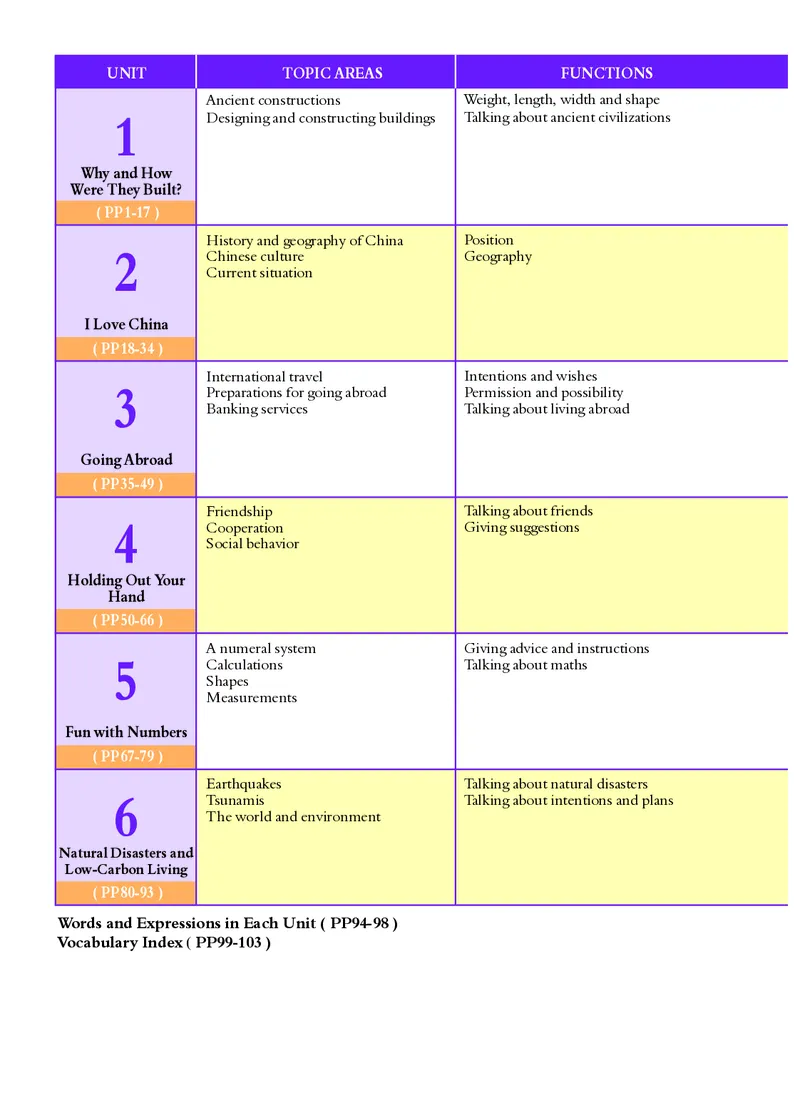
TOPIC AREAS
FUNCTIONS
Why and How
Were They Built?
Holding Out Your
Hand
Natural Disasters and
Low-Carbon Living
I Love China
Going Abroad
Fun with Numbers
Words and Expressions in Each Unit ( PP94-98 )
Vocabulary Index ��PP99-103 )
( PP1-17 )
( PP18-34 )
( PP35-49 )
( PP50-66 )
( PP67-79 )
( PP80-93 )
Ancient constructions
Designing and constructing buildings
History and geography of China
Chinese culture
Current situation
International travel
Preparations for going abroad
Banking services
Friendship
Cooperation
Social behavior
A numeral system
Calculations
Shapes
Measurements
Earthquakes
Tsunamis
The world and environment
Weight, length, width and shape
Talking about ancient civilizations
Position
Geography
Intentions and wishes
Permission and possibility
Talking about living abroad
Talking about friends
Giving suggestions
Giving advice and instructions
Talking about maths
Talking about natural disasters
Talking about intentions and plans
1
2
3
4
5
6
STRUCTURES
CHAT ROOM
PROGRAMME
The passive voice (4)
(verbs with two objects)
have sth done
Conjunctions:
neither…nor…
either…or…
both…and…
Simple, compound and complex sentences
Conditional clause (2): if, unless, so/as long as
wish + that clause
hope + that clause
Adverbial clauses of purpose and result:
so…that, such...that, so that
Object complement
Concessive clause:
although, though
The infinitive (summary)
Past perfect (2)
Past future (2)
Verbs (summery)
Dialogue 1
The Statue of Liberty
Dialogue 2
Stonehenge
Dialogue 1
Chinese calligraphy
Dialogue 2
Chinese food
Dialogue 1
Applying for a visa
Dialogue 2
Packing light
Dialogue 1
My friend Lisa
Dialogue 2
Making new friends
Dialogue 1
Trouble with maths
Dialogue 2
Maths problems can be tricky!
Dialogue 1
When does a volcano erupt?
Dialogue 2
It might be too late
Item 1 The Great Wall
Item 2 The Pyramids
*Item 3 London Bridge
Item 1 How large is China?
Item 2 Rivers in China
*Item 3 A Bite of China
Item 1 What do you need to
prepare for going abroad?
Item 2 Understanding
information
*Item 3 Banking information
Item 1 Just a little smile
Item 2 That was then, this
is now
*Item 3 Problems and suggestions
Item 1 How did the system of
counting begin?
Item 2 Subtraction
*Item 3 From squares to other
figures
Item 1 I shall never forget that day
Item 2 Typhoons
*Item 3 Volcanoes
Unit
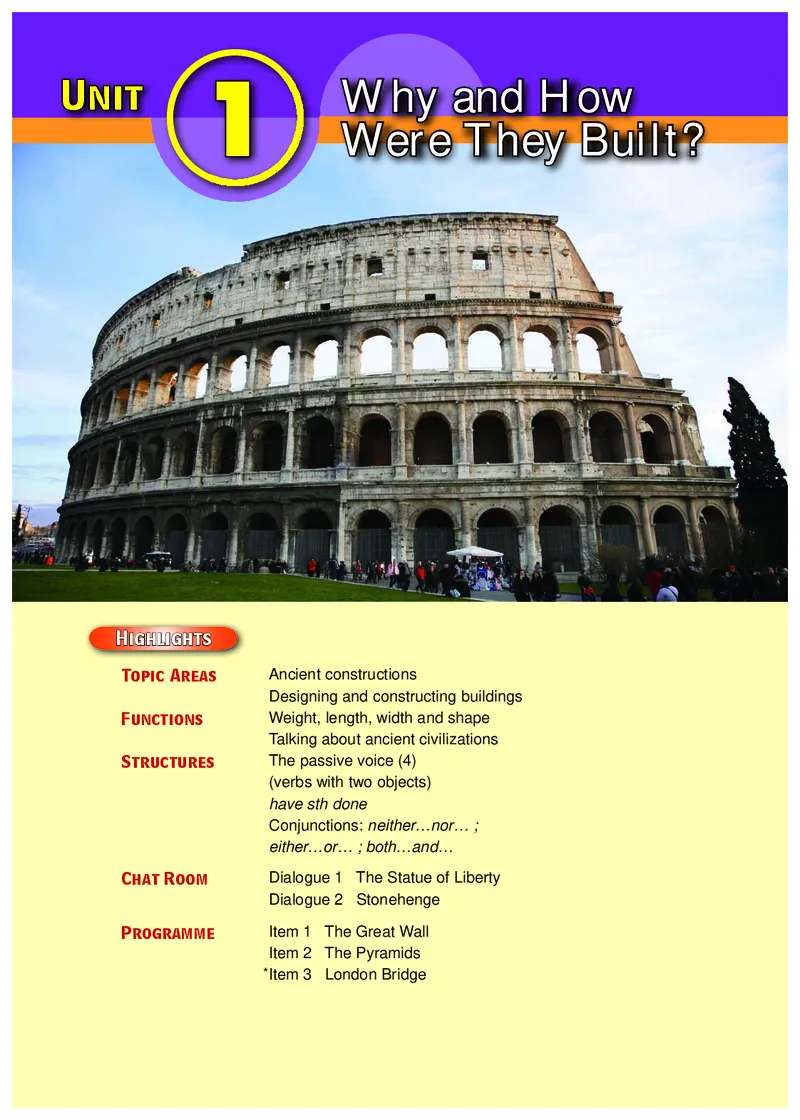
Unit 1
Topic Areas
Ancient constructions
Designing and constructing buildings
Functions
Weight, length, width and shape
Talking about ancient civilizations
Structures
The passive voice (4)
(verbs with two objects)
have sth done
Conjunctions: neither…nor… ;
either…or… ; both…and…
Highlights
Highlights
Chat Room
Dialogue 1 The Statue of Liberty
Dialogue 2 Stonehenge
Programme
Item 1 The Great Wall
Item 2 The Pyramids
Item 3 London Bridge
*
Why and How
Why and How
Were They Built?
Were They Built?
1
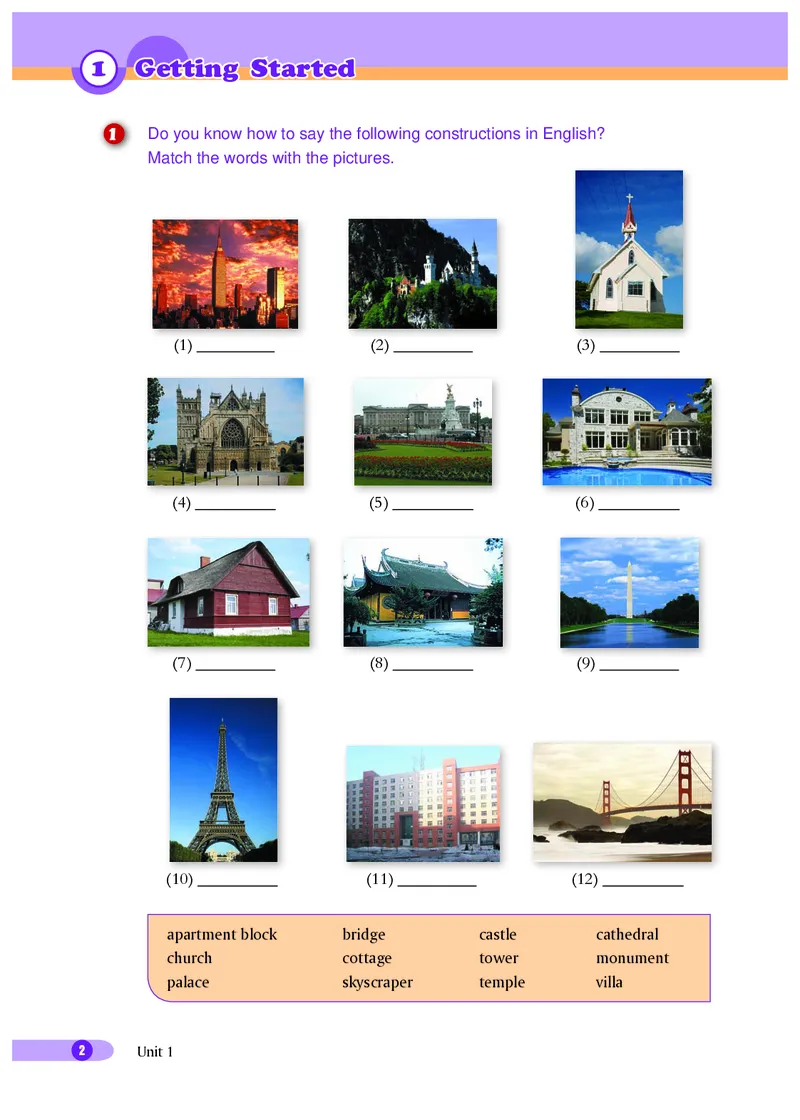
Do you know how to say the following constructions in English?
Match the words with the pictures.
Getting Started
Getting Started
1
apartment block
bridge
castle
cathedral
church
cottage
tower
monument
palace
skyscraper
temple
villa
(1)
(4)
(7)
(10)
(2)
(5)
(8)
(11)
(3)
(6)
(9)
(12)
(9)
(7)
(6)
(12)
2
Unit 1
typewriter
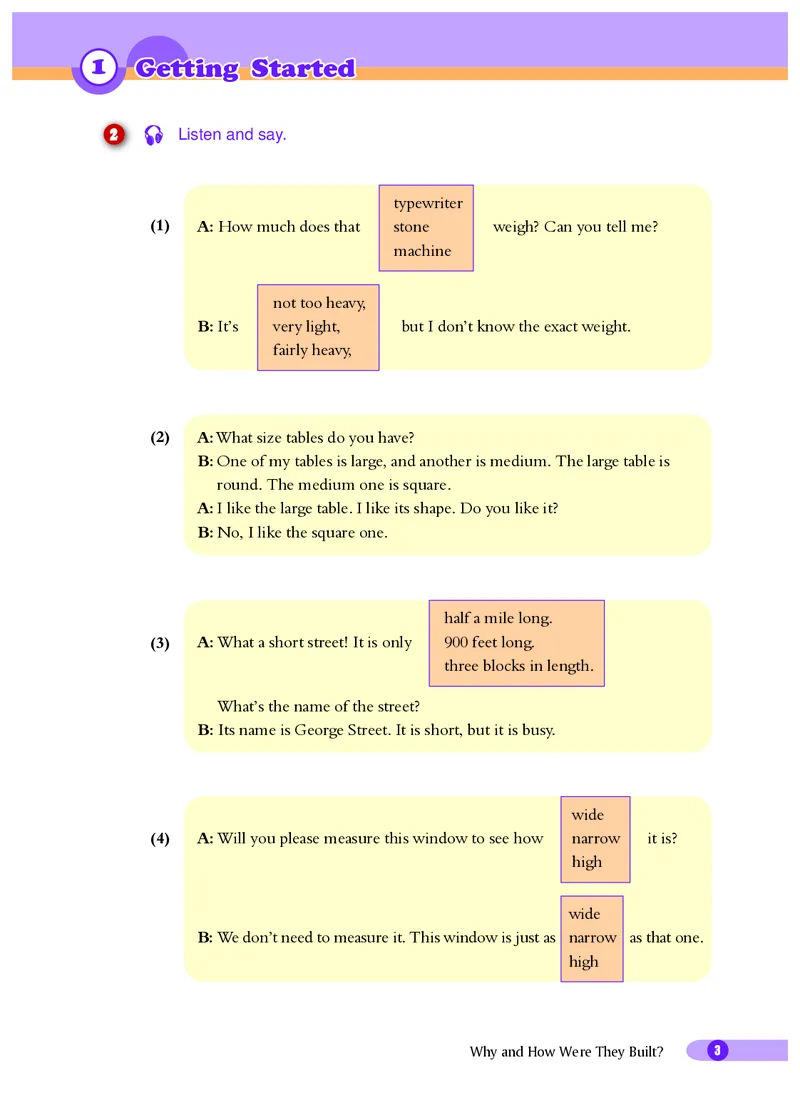
A: How much does that
stone
weigh? Can you tell me?
machine
not too heavy,
B: It’s
very light, but I don’t know the exact weight.
fairly heavy,
(1)
wide
A: Will you please measure this window to see how
narrow
it is?
high
wide
B: We don’t need to measure it. This window is just as narrow as that one.
high
(4)
A: What size tables do you have?
B: One of my tables is large, and another is medium. The large table is
round. The medium one is square.
A: I like the large table. I like its shape. Do you like it?
B: No, I like the square one.
(2)
2 Listen and say.
1
Getting Started
Getting Started
half a mile long.
A: What a short street! It is only
900 feet long.
three blocks in length.
(3)
What’s the name of the street?
B: Its name is George Street. It is short, but it is busy.
3
Why and How Were They Built?
3 Listen and learn. Then make similar dialogues with the information in the
chart.
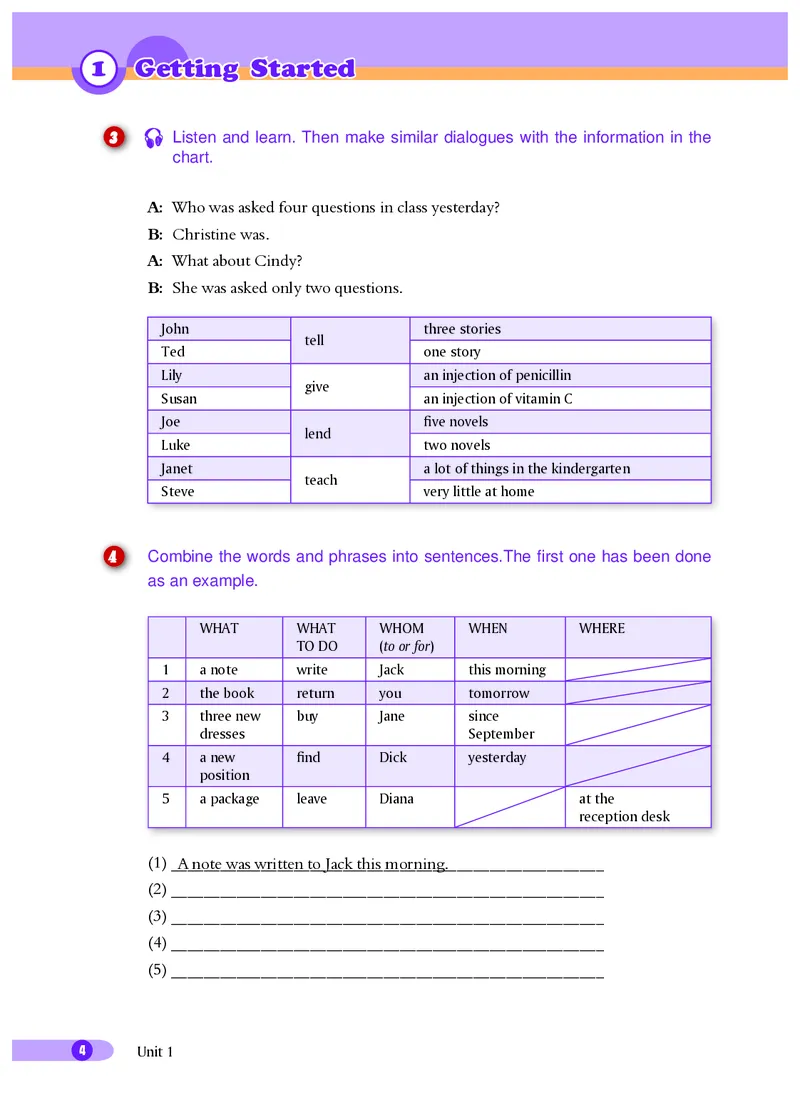
A: Who was asked four questions in class yesterday?
B: Christine was.
A: What about Cindy?
B: She was asked only two questions.
John
tell
three stories
Ted
one story
Lily
give
an injection of penicillin
Susan
an injection of vitamin C
Joe
lend
fi ve novels
Luke
two novels
Janet
teach
a lot of things in the kindergarten
Steve
very little at home
(1) _____________________________________________________
(2) _____________________________________________________
(3) _____________________________________________________
(4) _____________________________________________________
(5) _____________________________________________________
Getting Started
Getting Started
1
4
Combine the words and phrases into sentences.The fi rst one has been done
as an example.
WHAT
WHAT
TO DO
WHOM
(to or for)
WHEN
WHERE
1
a note
write
Jack
this morning
2
the book
return
you
tomorrow
3
three new
dresses
buy
Jane
since
September
4
a new
position
fi nd
Dick
yesterday
5
a package
leave
Diana
at the
reception desk
A note was written to Jack this morning.
4
Unit 1
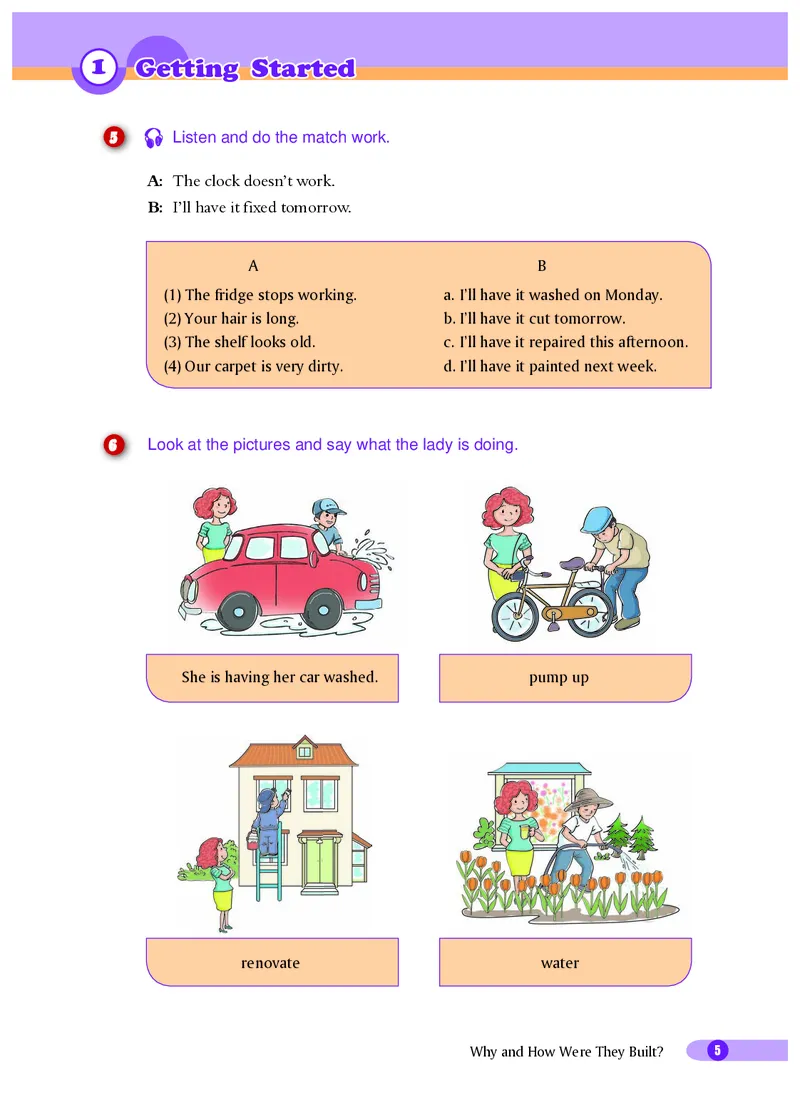
5 Listen and do the match work.
A: The clock doesn’t work.
B: I’ll have it fixed tomorrow.
1
Getting Started
Getting Started
6
Look at the pictures and say what the lady is doing.
A
B
(1) The fridge stops working.
a. I’ll have it washed on Monday.
(2) Your hair is long.
b. I’ll have it cut tomorrow.
(3) The shelf looks old.
c. I’ll have it repaired this afternoon.
(4) Our carpet is very dirty.
d. I’ll have it painted next week.
She is having her car washed.
pump up
renovate
water
5
Why and How Were They Built?
Getting Started
Getting Started
1
7 Listen, learn and answer.
A: Will John and Mary go to the aquarium with us?
B: No, neither John nor Mary will go. They will attend a lecture instead.
8 Listen and make dialogues after the example.
A: Both Edison and Bell are great inventors.
B: Yes, Edison invented light bulbs and Bell invented telephones.
(1) A: Do the bus and the underground train go to the theatre?
B: No, __________________________________________.
• Tom, Frank, doctors, surgeon, physician
• Michelle Yeoh, (Tomorrow Never Dies), Bruce Lee,
(Enter the Dragon), martial arts actors
(2) A: Can Richard and Christine fix the machine?
B: No, ________________________________.
theatre
fix the machine
Richard
Christine
6
Unit 1
1
Getting Started
Getting Started
9 Listen and complete the dialogues.
A: Did Tom speak English and French when he was young?
B: He spoke neither English nor French when he was young.
But now he speaks both English and French.
10
10 Listen and make dialogues after the example.
Example:
A: What can I do now?
B: You may either stay here or go with us.
A: Did Ben learn swimming and skating when he was ten years old?
B: _____________________________________________________.
A: Did Diana play the violin or the drums two years ago?
B: _____________________________________________________.
A: Could you ride a horse or a bicycle last year?
B: _____________________________________________________.
do some painting at home
go to the Shanghai Museum
go to the zoo
visit the botanical garden
(1)
(2)
7
Why and How Were They Built?
Dialogue 1
The Statue of Liberty
A: I went to an island at the entrance to New York
Harbour to see the Statue of Liberty yesterday.
B: As I know, the Statue of Liberty was a gift to
the USA from France.
A: Yes, it’s made of copper and it stands
about 93 metres high.
B: But why was it built?
A: Well, it was built to celebrate the American
Revolution. In 1776, the American Congress drew up
the Declaration of Independence and later in 1778, France joined the war to help
win the independence of the United States of America from Great Britain.
B: I see. The statue was set up to commemorate the victory. How was it transported?
A: It was reduced to individual pieces and was reassembled in four months’ time in
New York Harbour.
Dialogue 2
Stonehenge
A: Where did you go when you were in England?
B: I visited many famous sites, including Stonehenge.
A: Stonehenge in Wiltshire?
B: Yes. It is probably the most important prehistoric
monument in Britain. Look, here is the picture.
A: It looks mysterious. Why was it built?
B: No one really knows. Scientists used to guess it
was perhaps built for astronomical reasons.
A: Astronomical reasons?
B: Yeah, it might have been built to observe the sun,
the stars and astronomical events such as eclipses.
A: Was this the only theory?
B: Of course not. A new theory has just been put forward recently.
A British archeologist said that it could have been a place of healing.
Patients went there to see the doctor and get treatment.
A: That sounds interesting. Was Stonehenge built a very long time ago?
B: Yes. Investigations show that it was built in different times from 3000 BC to 2000 BC.
Chat Room
Chat Room
2
8
Unit 1
3
Programme
Programme
Item 1
The Great Wall
1 Listen to the tape and put the following events in order of time.
(1) China was united in 221 BC.
(2) The Great Wall has been repaired many times and it takes on a new look.
(3) More walls were put up.
(4) The fi rst emperor of the Qin Dynasty had the walls joined together.
(5) The fi rst part of the Great Wall was built.
(6) The Great Wall was rebuilt in the Ming Dynasty.
2
Read the text. Match the words to their defi nitions.
Actually, China is not the only country in history that built a wall along its bor-
ders. Athens, the Roman Empire, Denmark and Korea all did so at certain times
in the past.
Yet the Great Wall is unique. It runs across North China like a huge dragon.
It winds its way from west to east, across deserts, over mountains, through val-
leys, till fi nally it reaches the sea.
The fi rst part of the Great Wall was built in the 7th century BC, when China
was divided into several states. Later more walls were put up to defend the
borders of different states. After China was united in 221 BC., the fi rst emperor
of the Qin Dynasty had the walls joined together and formed the fi rst “Wan Li
Chang Cheng” (ten thousand li Great Wall, li being a Chinese length unit). The
walls were connected by a system of watchtowers. These were used not only to
stop the enemy’s attack but also to communicate with the then capital (Xianyang)
by signal (smoke by day; fi re at night).
Most of the Great Wall we see today was rebuilt in the Ming Dynasty. It is more
than 6,000 kilometres long, about 6 – 7 metres high and 4 – 5 metres wide. In most
places it is wide enough for fi ve horses or ten men to walk side by side along the
top. It has great gateways which connect the main roads of North China. With a his-
tory of more than 2,000 years, some parts of the
Great Wall were destroyed or even disappeared.
However, the Great Wall has been repaired many
times. Now it takes on a new look.
The Great Wall is one of the fantastic at-
tractions in the world. More and more people
have come to know the Chinese saying “He
who has not climbed the Great Wall is not a
true man.”
9
Why and How Were They Built?
3
Programme
Programme
3
Presentation.
Why was the Great Wall built? Could you tell any stories about the Great Wall?
4
Discussion.
Have a discussion about the following saying in groups of four.
“One cannot claim to be a true man until he has climbed the Great Wall.”
Item 2
2 Listen to the second part of the text and fi ll in the blanks with the numbers
you hear.
The Great Pyramid is the biggest of all the pyramids. It is about ________
metres high. It is made of ________ huge stones. Most of them are higher
than a man and weigh about ________ and a half tons each. Some weigh as
much as ________ tons. It took more than ________ men ________ years to
build the Great Pyramid.
_____ (1) The Great Pyramid was built over 4,500 years ago.
_____ (2) The pyramids were built only in Giza.
_____ (3) The pyramids were built for very important people.
_____ (4) People know why the pyramids were designed in such a shape.
_____ (5) Some people think the pyramids were built to point towards the sun
and stars.
1 Listen to the fi rst part of the text and decide whether the following
statements are true (T) or false (F).
The Pyramids
(1) state
a. to build again
(2) emperor
b. a country or a smaller area in a country
(3) connect
c. a sound or action to send a message
(4) communicate
d. the man who rules an empire
(5) signal
e. to give or send information
(6) rebuild
f. to join
(7) desert
g. the line that divides one country from another
(8) gateway
h. land covered with sand or rocks
(9) border
i. an entrance through a wall
10
Unit 1
3
Programme
Programme
3
Read the text and check your answers.
When you go to Giza, Egypt, you’ll defi nitely
visit the Great Pyramid. It was built more than
4,500 years ago. Besides the Great Pyramid,
there are many smaller pyramids at Giza and
other places in Egypt.
The pyramids were huge tombs for the kings of Egypt and other very
important people. They believed their bodies would be well kept in the pyra-
mids. No one really knows why the pyramids were designed in this shape.
Some people think the pyramids were built to point towards the sun and stars,
so that the dead person’s spirit could fl y to heaven like a rocket.
The Great Pyramid is the biggest of all the pyramids. It is about 137 me-
tres high. It is made of about 2,300,000 huge stones. Most of them are higher
than a man and weigh about two and a half tons each. Some weigh as much
as fi fteen tons. It took more than 100,000 men twenty years to build the Great
Pyramid.
It’s still a mystery how the pyramids were built so long ago. Each stone fi ts
so well. Did they have any machines? How did they cut, carry and lift the huge
stones? How did they make them all in the same shape? Scientists have stud-
ied the pyramids for hundreds of years, but no one can just tell how.
Inside the pyramids are rooms for dead bodies and treasures. Today, some
mummies and treasures are displayed in museums in different countries. On
Sept. 16, 2002, the Egyptian government’s robot explored in the Great Pyra-
mid and the door was open for the fi rst time in history. Yet the chamber was
plainly empty just like all the other chambers.
4 Group discussion.
(1) Why were the pyramids built?
(2) How were the pyramids built?
11
Why and How Were They Built?
*Item 3
London Bridge
1 Listen to the text about London Bridge and choose the best answers.
(1) London Bridge was originally in _____.
A. London
B. France
C. America
D. Arizona
(2) _____ bought the falling down bridge.
A. London offi cials
B. Albert McCulloch
C. Robert McCulloch D. Robert McDonald
(3) The bridge was _____ in London and then _____ in America.
A. disassembled…disassembled
B. reassembled…reassembled
C. reassembled…disassembled
D. disassembled…reassembled
(4) Lake Havasu City is _____.
A. near London
B. near America
C. in the Arizona desert
D. in a desert in England
3
Programme
Programme
2
Read the text and answer the questions.
Yes, this is the very old children’s nursery rhyme about London Bridge.
London Bridge was opened in 1831 and became the busiest point in
London. Though it was renovated later, it was sinking into the clay of the
Thames River in the late 1960’s.
London offi cials said they’d have to replace the bridge. But what to do
with the old one?
Robert McCulloch, an American businessman, purchased the falling
down bridge for about $2.4 million. For the next three years, the bridge was
“London Bridge is falling down,
Falling down, falling down.
London Bridge is falling down,
My fair lady.”
12
Unit 1
3
Imagine you are a tour guide. Tell the tourists about London Bridge in Arizona.
3
Programme
Programme
4
Message Box
Message Box
(1) When was London Bridge sinking?
(2) Why did it sink?
(3) How much did Robert McCulloch pay for the falling down bridge?
(4) Where was the bridge rebuilt in America?
(5) How is Lake Havasu City now? Why?
Box 2
Active
Passive
He gave me the book this morning.
I was given the book this morning.
The book was given to me this morning.
He gave the book to me this morning.
The book was given to me this morning.
Box 1
John admired Mary
Mary was admired (by John)
disassembled in London and its bricks were flown to America. They were
then reassembled alongside Lake Havasu in the Arizona desert.
Nowadays, London Bridge is one of Arizona’s biggest attractions. Lake
Havasu City is more developed because of it.
13
Why and How Were They Built?
Box 3
Active
Passive
She waters the fl owers every day.
The fl owers are watered every day.
She watered the fl owers yesterday.
The fl owers were watered yesterday.
She will water the fl owers tomorrow.
The fl owers will be watered tomorrow.
She says she will water the fl owers soon.
She says the fl owers will be watered soon.
She is watering the fl owers now.
The fl owers are being watered now.
She was watering the flowers this time
yesterday.
The flowers were being watered this time
yesterday.
She has watered the fl owers.
The fl owers have been watered.
She said she had watered the fl owers.
She said the fl owers had been watered.
Box 5
The baby can’t speak.
The baby can neither speak nor run.
The baby can’t run.
He isn’t clever.
He is neither clever nor active.
He isn’t active.
Cindy doesn’t live near school.
Neither Cindy nor Thomas lives near school.
Thomas doesn’t live near school.
She isn’t interested in the lecture.
Neither she nor I am interested in the lecture.
I am not interested in the lecture.
4
Message Box
Message Box
Box 4
let sb do sth
have sth done
I’ll let the barber cut my hair.
I’ll have my hair cut.
He let an engineer fi x his computer.
He had his computer fi xed.
Box 6
She’s both young and healthy.
They have both the skill and the opportunity.
The news both excited and worried me.
Box 7
We can come either this weekend or next.
Either do your homework or go to bed.
You can choose either red, green or yellow.
14
Unit 1
5
Data Bank
Data Bank
6
DIY Lab
DIY Lab
1
Oral Presentation
Choose a famous construction in your city and tell why and how it was built.
3
Topic Discussion
Is it necessary or wise to build more and more skyscrapers in our city?
2
Pair Work
Complete the dialogue. The adjectives given may help you.
brown
good
longer
narrower
new
short
yellow
Judy: I have bought something for our house.
Fred: Our house? What is it?
Judy: You’ll never guess. It’s a (1) _____ sofa. A yellow one.
Fred: We already have a sofa. A very (2) _____ one.
Judy: I don’t like it. It’s (3) _____ and our other pieces
of furniture are light blue. They don’t match.
The (4) _____ one will look good with our other things.
Fred: Very well. How big is the sofa?
Judy: It’s exactly the right size. The sofa we have now
is too (5) _____.
Fred: Is it wide or narrow?
Judy: It’s as wide as our old sofa, but it looks (6) _____
because it’s (7) _____.
4
Problem Solving
Design a statue for your school or your residential area. Describe and explain
your design.
height
base
angle
block
15
Why and How Were They Built?
7
Culture Corner
Culture Corner
The Seven Ancient Wonders of the World
• The Great Pyramid of Giza is the oldest of the Seven Ancient Wonders of the
World. It was built by the Egyptian pharaoh Khufu around the year 2560 BC to
serve as a tomb. The Great Pyramid covers an area of 13 acres and is made of
about 2.3 million stone blocks.
• The Hanging Gardens of Babylon were built by King Nebuchadnezzar in 562 BC
for his wife, Amytis, who longed for the trees and fragrant plants of her home land.
The gardens were destroyed by several earthquakes after the 2nd century.
• The Temple of Artemis was begun in around 550 BC at Ephesus (now a site in
Turkey) for the Greek goddess Artemis and was completed 220 years later. The
temple was 425 feet long and 220 feet wide with 127 marble columns, each 60
feet tall. The temple was destroyed by the Goths in 262 AD.
• The Statue of Zeus was located at the ancient town of Olympia, on the west coast of
modern Greece, about 150 km west of Athens. It was made by the Greek sculptor
Phidias. In honour of Zeus the Ancient Olympic Games were held.
• The Mausoleum at Halicarnassus, a 140-foot-high white marble structure, was
built in 352 BC at Halicarnassus (now a site in Turkey) in memory of King Mauso-
lus of Caria. It was destroyed in 1402.
• The Colossus of Rhodes, a 100-foot-tall bronze statue of the sun god Helios, was
built between 292 and 280 BC in the harbour at Rhodes. The statue was de-
stroyed by an earthquake in around 224 BC.
• The Lighthouse of Alexandria was built on the island of Pharos, at Alexandria,
Egypt, in 285 BC. It was 500 feet tall with a ramp leading to the top. Light was
produced with a fi re and refl ectors, and could be seen from a distance of over 40
miles.
6
DIY Lab
DIY Lab
5
Internet Surfi ng
You will fi nd “The Seven Ancient Wonders of the World” in the Culture
Corner. Choose one of them and fi nd some more information about it on the
Internet. Make a powerpoint presentation if possible.
16
Unit 1
1
Can you fi nd out the following ten words in the Word Search Puzzle below?
8
Game Zone
Game Zone
BRIDGE
DESERT
GIFT
HARBOUR
ISLAND
MONUMENT
MYSTERY
PYRAMID
STATUE
STONEHENGE
F
B
R
I
D
G
E
R
Z
S
T
N
E
M
U
N
O
M
T
Y
D
P
Y
C
K
P
I
O
R
R
D
I
L
P
F
S
N
U
S
E
I
E
M
S
L
E
O
N
T
T
N
L
S
A
H
B
O
U
A
S
Q
S
N
E
R
A
M
F
T
Y
B
D
N
A
R
Y
E
Y
U
M
O
G
H
H
X
T
P
P
E
F
E
Q
H
T
F
I
G
Q
U
A
2
A poem.
The early morning
Hilaire Belloc
The moon on the one hand, the dawn on the other:
The moon is my sister, the dawn is my brother.
The moon on my left and the dawn on my right.
My brother, good morning! My sister, good night!
17
Why and How Were They Built?
Getting Started
1
Unit
Unit 2
Topic Areas
History and geography of China
Chinese culture
Current situation
Functions
Position
Geography
Structures
Simple, compound and complex sentences
Highlights
Highlights
Chat Room
Dialogue 1 Chinese calligraphy
Dialogue 2 Chinese food
Programme
Item 1 How large is China?
Item 2 Rivers in China
Item 3 A Bite of China
*
I Love China
I Love China
1
Getting Started
Performers in Peking Opera (or Beijing Opera) are divided into four classes:
Sheng (emperors, gentlemen), Dan (female roles), Jing (villains, rebels) and
Chou (comic relief).
(1)
1
Do you know?
Xiangqi (also called Chinese chess) is a board game
for two players. It is one of the most popular board
games in China. People love to play it at home and
in parks.
(2)
As one of the most popular folk arts in China,
paper cuts are mostly used as decorations.
(4)
The bronze coin is circular to represent the heaven,
with a square hole to represent the earth.
(5)
Calculations were done in China with an abacus,
or a counting frame.
(3)
19
I Love China
2
Listen, read and answer the questions.
A: What did Tom do when he woke up late this morning?
B: He jumped out of bed, dressed hurriedly and ran downstairs.
Getting Started
Getting Started
1
Gunpowder was first used in fireworks during
the 7th century AD.
(6)
G
t
Jade is said to have magical power.
(8)
(1) What did you do when you lost your way yesterday?
stop
take out the map
try to fi nd the right way
Chinese medicine, such as herb-
alism and acupuncture, spreads
throughout the world.
(7)
20
Unit 2
1
Getting Started
Getting Started
3
Put the following affi rmative sentences into negative sentences.
(1) The Yangtze River is the longest river in the world.
_________________________________________.
(2) The rivers north of the Qinling Mountains have a large flow in winter.
_________________________________________________________.
(3) They have finished the project.
_________________________________________.
(4) They are building the road.
_________________________________________.
(5) It can be true.
_________________________________________.
(6) He may be right.
_________________________________________.
(7) The river keeps a strong current.
_________________________________________.
(8) The lake used to freeze in winter.
_________________________________________.
(2) What did Susan do when she got in the room?
(3) What did the students do when the bell rang?
unpack the suitcase
stop singing
take out some clothes
close the door
hang them in the wardrobe
start to study
21
I Love China
Getting Started
Getting Started
1
5
Add tags to the following sentences.
(1) It seldom rains in the dry season in Australia, __________?
(2) He can hardly solve this problem, __________?
(3) We know very little personal information about him, __________?
(4) There are very few unfamiliar words in this passage, __________?
(5) There are no volcanoes in China, __________?
(6) Diana said nothing about her family, __________?
4 Listen and practise.
never
I
hardly ever
overslept. I used to get up at 6:30.
rarely
6
Read the following sentences and fi ll in the blanks with the words in the box.
(1) Ricky is going to Emei Mountain next week, _____ you might as well go with
him.
(2) The living standards of the Chinese people have been improved quickly, _____
the tradition remains – fortunately.
(3) You’d better stay in China for some time, _____ you won’t be able to know
about this country well.
(4) Hong Kong was returned to China in 1997, _____ it was taken by the British af-
ter the Opium War.
(5) Western medicine has developed a lot, _____ Chinese traditional medicine is
still helpful to people’s health.
and but for or (or else) so
22
Unit 2
1
Getting Started
Getting Started
7 Listen and practise.
9 Listen and practise.
good
The new play was
funny
and everybody enjoyed it.
amusing
(1)
eating dinner.
When you called me, I was
studying my lesson.
sleeping soundly.
(1)
packed my suitcase
I’m leaving, but I haven’t
bought my ticket
yet.
said good-bye to my mum
(2)
elsewhere.
There was no room at the restaurant, so we decided to go to some other place.
somewhere else.
(4)
swimming
a play?
Which would you rather do—go dancing
or go to
a movie?
walking
a baseball game?
(3)
8
Fill in the blanks with because, so, though or but.
(1) _____ Lake Poyang is China’s biggest freshwater lake, it isn’t as famous as the
West Lake of Hangzhou.
(2) I hope I can go to Xinjiang some day _____ it has the biggest desert in China,
the Taklamakan Desert.
(3) I was born in Xi’an, _____ I know very little about this city.
(4) Her father is a history teacher, _____ she has a good knowledge of China’s an-
cient cities.
23
I Love China
Getting Started
Getting Started
1
10
10 Read and complete the sentences after the example.
Example:
We plan to go skiing tomorrow morning. We don’t want Frank to know this.
We’d better not tell Frank what we plan to do.
(1) He was drunk last night. But he still drove the car.
He shouldn’t _____________________ when ___________________________.
(2) You left the room late yesterday. You forgot to turn off the light.
Please ___________________________ before __________________________.
(3) How can he finish the work so fast? I can’t imagine.
I ________________________________ how ___________________________.
(4) When will the meeting be held? We haven’t been informed yet.
We ______________________________ when __________________________.
(5) They will be able to overcome the difficulties. I’m very sure of that.
I ________________________________ that ___________________________.
(6) I almost forgot I had a meeting that evening. Fortunately she reminded
me of the meeting.
She _____________________________ that ____________________________.
got up.
I don’t know when he
finished working.
went to bed.
(3)
telephone booth
Could you tell me where the nearest
shop is?
rest room
(4)
having lunch,
talking on the phone.
While we were
writing letters,
John was
watching television.
working,
reading a book.
(2)
24
Unit 2
2
Chat Room
Chat Room
Dialogue 1
Chinese calligraphy
Tom:
Mr Tang, I’m learning Chinese calligraphy
these days. How long is the history of Chinese calligraphy?
Mr Tang: The history of Chinese calligraphy is as long as that of China itself.
Calligraphy is one of the highest forms of Chinese art.
Tom:
Do I have to learn how Chinese characters were originally written?
Mr Tang: Yes, that will help you study the ancient art of beautiful handwriting. Chinese
writing uses thousands of characters. Each one stands for a thing or an idea.
Tom:
I’m studying kaishu now. How many categories are there in Chinese scripts?
Mr Tang: Kaishu is the regular script. Besides this, there are four more categories:
the seal character or the zhuan script, the official script or lishu,
the running hand or xingshu and the cursive hand or caoshu.
Tom:
There’s so much to learn about Chinese calligraphy. I’m getting more
interested in it now. Thank you, Mr Tang.
Dialogue 2
Chinese food
Mr Lee: How long have you been in China, Peter?
Peter:
More than three years.
Mr Lee: How do you like Chinese food?
Peter:
Oh, Chinese food always amazes me. You eat with chopsticks and soup
spoons. You use knives only in the kitchen. You’ve got so many different
dishes.
Mr Lee: You’re right. China has many different regions and each of them has its
own crops and dishes.
Peter:
And the distinctive styles of cooking?
Mr Lee: Mmm, you’ve become quite an expert on Chinese food. In South China,
Cantonese food is cooked quickly in a frying pan, or wok. In the far north,
sweet-and-sour sauces are more often used.
Peter:
I have tried some Tibetan and Inner Mongolian food. It seems they use a
lot of dairy products.
Mr Lee: If you go to Fujian, a coastal province, you may have more seafood.
Peter:
I like the spicy flavour of Sichuan cooking. It’s a bit like the Central
American chilli.
Mr Lee: By the way, do Westerners like spicy food?
Peter:
Not everyone, but some do. Oh, I love it.
lli
h ?
with chopsticks and soup
25
I Love China
3
Programme
Programme
Item 1
How large is China?
1 Listen to the text and fi ll in the blanks with proper numbers.
(1) China has a recorded history of over __________ years.
(2) China has an area of about __________ square kilometres. The distance
from east to west measures over __________ kilometres, and from north
to south, over __________ kilometres.
(3) China has a land border of over __________ kilometres long.
(4) The coastline extends more than __________ kilometres.
(5) There are over __________ islands larger than 500 square metres. The
largest is Taiwan, with a total area of about __________ square kilome-
tres, and the second largest is Hainan.
2
Read the text and check your answers.
China is situated in the eastern part of Asia, on the west coast of the Pacifi c
Ocean. It is one of the oldest civilizations with a recorded history of over 4,000
years.
China has an area of about 9.6 million square kilometres and is nearly as
large as the whole of Europe. The distance from east to west measures over
5,200 kilometres, and from north to south, over 5,500 kilometres. When the
sun shines brightly over Wusuli River in the east, the Pamirs in the west is in
the very early morning. China has a land border of over 22,000 kilometres
long and borders many countries.
Besides a vast land area, there are also extensive neighboring seas and
numerous islands. The coastline extends more than 18,000 kilometres. There
are over 6,500 islands larger than 500 square metres. The largest is Taiwan,
with a total area of about 36,000 square kilometres, and the second largest
is Hainan. The South China Sea Islands are the southernmost island group of
China.
26
Unit 2
3
Programme
Programme
Item 2
Rivers in China
1 Listen to the text and list the fi ve main rivers in China.
3
Answer the questions.
(1) Where is China?
(2) How old is China?
(3) How large is China? Give examples to show how large it is.
(4) How long is China’s coastline?
(5) What are the two largest islands in China?
4
Retell the text.
5
What else can you add to the text? What about China’s population, its geo-
graphical features, its rivers and mountains, its resources and its civilization?
location — history — area — border — coastline — islands
2
Read the text and answer the questions.
China has over 1,500 large rivers, including the Heilongjiang River, the Yellow
River, the Huaihe River, the Yangtze River, and the Zhujiang River. Most rivers
in China cover great distances. According to regional differences between
27
I Love China
3
Programme
Programme
3
Read the text again. What are the differences between rivers in the south and
in the north? Fill in the chart.
The rivers south of the
Qinling Mountains and
the Huaihe River
The rivers north of the
Qinling Mountains and the
Huaihe River
Do they have enough water?
Do they have a large fl ow all
year round?
Do they freeze in winter?
Do they provide
convenience for
shipping and irrigation?
(1) How many types are China’s rivers divided into? What are they?
(2) What is the line that separates the rivers in the south and in the north?
(3) What are the fi rst three longest rivers in the world?
the south and north, geographers have divided China’s rivers into two types,
southern and northern. The rivers south of the Qinling Mountains and the
Huaihe River have large quantities of water and keep a strong current all year
round. These rivers neither freeze nor stop fl owing, and the river valleys are
safe enough for growing crops. They provide convenience for shipping, as
well as irrigation and hydropower. The rivers north of the Qinling Mountains
and the Huaihe River have a large fl ow in summer but a small fl ow in winter.
These rivers have a large content of sand and clay and freeze in winter. This
has been inconvenient for shipping and the use of water resources.
Of China’s many long rivers the Yangtze River and the Yellow River are
the most famous throughout both Asia and the world. The length of the
Yangtze River is 6,300 km. It’s the third longest in the world after the Nile of
Africa and the Amazon of South America. The Yellow River, the fi fth longest
in the world, fl ows for 5,464 km, just a little longer than the Congo River.
28
Unit 2
3
Programme
Programme
4
Which sentences in the text have the same meaning as the sentences below?
Find them out from the text.
(1) Most rivers in China are very long.
(2) The rivers south of the Qinling Mountains and the Huaihe River have
enough water to keep a strong fl ow all the time in a year.
(3) It’s convenient for people not only to travel on these rivers but also to
water the crops and produce electricity.
(4) The river water carries a large amount of sand and clay.
(5) The Yellow River, with a total length of 5,464km, is the fi fth longest in the
world, a little longer than the Congo River.
*Item 3
A Bite of China
1 Listen to the text. Find the meaning of each expression.
(1) mouthwatering images
(2) refi ned process
(3) food buffs
(4) ethics of eating
(5) documentary producer
(6) a reminder of happy times
a. someone who controls how a fi lm or
television programme that gives facts
about a real situation or real people is
made
b. pictures of food that looks very
delicious
c. ideas or rules that infl uence the way
you eat
d. something that makes you remember
occasions where you feel happy
e. people who know a lot about food
and enjoy it
f. a series of complicated actions which
require great skills
29
I Love China
3
Programme
Programme
2
Read the text and answer the questions.
There are many TV programmes on Chinese cuisine, but few are like A Bite
of China. The latest seven-episode documentary offers insights into the geo-
graphical, historical and cultural aspects of Chinese food.
Filled with mouthwatering images of food ranging from fl avourful cuisine
to local delicacies, A Bite of China captures the beautiful and refi ned process
of food-making, which has attracted both food buffs and ordinary audiences.
“The programme tries to bring something new by presenting more cul-
tural elements related to dishes, such as eating habits and the ethics of eat-
ing,” said Chen Xiaoqing, the documentary producer.
An added bonus is that the show is not only about dishes. Every episode
highlights different people, who tell stories about their adventures with
food.
In addition, A Bite of China captures social transformations while present-
ing food culture, such as showing the spreading of extended families that
leave the elderly in their hometowns while other members work outside –
cases in which food serves as reminders of happy times of reunions.
“As a saying goes, ‘you are what you eat’,” Chen says. “Food is always
connected with people. Behind the documentary’s amazing and mouthwa-
tering images are personal stories that refl ect people’s living situations and
attitudes. That’s another component that makes it distinctive.”
3
Discussion.
What do you think is the most exciting theme in this documentary?
(1) What programme has attracted both food buffs and ordinary audiences?
(2) Does the programme try to bring something new? How?
(3) What is the real bonus of the programme?
(4) Could you explain “Food serves as reminders of happy times of reunions”?
(5) What is another component that makes the programme distinctive?
30
Unit 2
Box 1
He works at a news agency.
He jumped out of bed, dressed hurriedly and ran
downstairs.
Jenny and Gary visited the city together.
The teachers and the students all liked the place
and wanted to stay there a little longer.
Box 3
That was no accident.
She is no different.
No dogs are permitted here.
I see no clouds.
I will never make that mistake again.
Box 5
I came here in 1992 and have lived here ever since.
Tom can’t come but his brother will.
We must hurry, or we’ll miss the last train.
They were surprised, for it was almost ten o’clock.
I want to see the movie—however, I have no ticket.
The shop was closed, so I couldn’t buy any milk.
Box 7
Do it before you forget.
It’s hot in the city where I live.
The boy was absent because he was ill.
If you can’t solve the problem, he’ll help you.
She’s not so lazy as I am.
She went out although it was raining.
Let’s get ready now so that we can leave when Father comes.
He was so busy that he had no time to have lunch.
Box 2
He is not a student.
I have not fi nished.
The children are not playing.
He may not be working.
She does not work hard.
Box 4
She seldom goes out.
He hardly ever goes to bed before midnight.
I know few people in Boston.
There is little water in the bottle.
Box 6
It is true that cats can’t swim.
I informed her that I was unwell.
The problem is that we have no money.
4
Message Box
Message Box
31
I Love China
5
Data Bank
Data Bank
Do you know the following attractions in China? In which city or region are
they located respectively? Do the match work.
The Big Wild Goose Pagoda
Beijing
The Butterfl y Spring
Chengdu
The Forbidden City
Dali
The Jade Buddha Temple
Dunhuang
The Dr Sun Yat-sen’s Mausoleum
Hangzhou
The Du Fu’s Thatched Cottage
Lhasa
The Mogao Grottoes
Nanjing
The Potala Palace
Shanghai
The West Lake
Wuhan
The Yellow Crane Tower
Xi’an
32
Unit 2
Tea is drunk around the world. According to legend, tea was
discovered in China over 5,000 years ago by accident.
Tea has now become one of the daily necessities in China. Countless people like
to have a cup of tea after a meal. In a hot climate, tea seems to be able to drive out
the heat and bring on instant cool together with a feeling of relaxation.
By 1650, tea had been introduced to America by the Dutch. And not until 1652
did tea arrive in England. A formal English afternoon tea is often served at three in
the afternoon, with delicate small cakes and biscuits. The hostess will invite a few
friends to have tea together. The guests will be expected to dress as if going to an
important dinner.
Nowadays more and more people take tea as a healthy drink. The different
types of tea – mainly the green tea, black tea, oolong tea and scented tea – may not
only satisfy various people’s taste but also help them keep fi t.
6
DIY Lab
DIY Lab
1
Oral Presentation
Give a brief talk about your hometown: What you like most about it and what
you like the least.
3
Group Work
Work in groups. Prepare for a lesson to introduce China. It’ll be great if visual
aids such as pictures or slides can be used.
5
Internet Surfi ng
Get online to fi nd some more information about China, such as provinces
and cities, climate and geography, plants and animals, culture and arts, sports
and athletes, general history, politics, education, health, international relations,
economy, tourism, community life, trade and transportation.
4
Problem Solving
Your pen pal will come to China and you will be his/her tour guide. What will
you show him/her about China?
Make a list of the things about China that you think your pen pal will be
interested in.
2
Pair Work
What cities do you wish to visit in China? Make a dialogue with your partner.
7
Culture Corner
Culture Corner
a Countless people like
Tea
33
I Love China
2
A poem.
8
Game Zone
Game Zone
1
This is a word game called The Boggler Classic. It uses a 4 x 4 matrix. Try to ar-
range the letters to make up words. There is a 3 minute time limit. Valid words
must be at least three letters long.
V
S
E
T
R
Y
N
E
C
H Y
Y
P
A
X
L
The night has a thousand eyes,
And the day but one;
Yet the light of the bright world dies,
With the dying sun.
The mind has a thousand eyes,
And the heart but one;
Yet the light of a whole life dies,
When love is done.
The night has a thousand eyes
34
Unit 2
Unit
Unit 3
Topic Areas
International travel
Preparations for going abroad
Banking services
Functions
Intentions and wishes
Permission and possibility
Talking about living abroad
Structures
Conditional clause (2): if, unless, so/as long as
wish + that clause
hope + that clause
Highlights
Highlights
Chat Room
Dialogue 1 Applying for a visa
Dialogue 2 Packing light
Programme
Item 1 What do you need to prepare for going abroad?
Item 2 Understanding information
Item 3 Banking information
*
Going Abroad
Going Abroad
1
Where can you see the signs? What do they mean?
2
Here is a list of things you do before studying abroad. Put them in the right order.
Getting Started
Getting Started
1
A: What shall I do first if I want to study abroad?
B: You will have to apply for a school first.
Example:
A. Apply for a passport.
B. Book a ticket.
C. Choose a country, university and courses.
D. Exchange Renminbi for foreign money.
E. Have a checkup.
F. Obtain a visa.
(1) ______
(2) ______
(3) ______
(4) ______
(5) ______
(6) ______
OUT OF ORDER
BEWARE OF THE DOG
PLEASE QUEUE THIS SIDE
KEEP OFF
THE GRASS
3 Listen and make dialogues after the example.
What shall I do if I want to … ?
You will have to …
mail this bag
weigh it and pay the postage
sell out our products
advertise them
rent this room
pay the rent in advance
36
Unit 3
1
Getting Started
Getting Started
(1)
(2)
(3)
(4)
(1) A: May I open a credit account for $500 please?
B: Sorry, you can’t open a credit account
unless you have more than $2,000.
A: What can I do then?
B: You may have a debit card.
(2) A: May I open a credit account for $500 please?
B: Sorry, I’m afraid you can’t.
A: Then how much money should I have if I want to open a credit account?
B: You can open it as long as you have $2,000.
5 Listen and complete the dialogues.
4 Listen and read. Then make your own dialogues with the information given.
ask for a sick leave
not feel well
take the Underground as many times as
I want in a day
buy a day-ticket
have a discount on these goods
the total amount is over $50
go to that club
have a membership
rent this room
come back before 10pm every day
A: I’ll have my holidays in Hawaii next month.
B: Oh, terrific! I hope that you’ll have a great time.
A: George has a bad cold today.
A: It’s my birthday next Wednesday.
A: Wendy will take three tests tomorrow.
A: Mum will come home very late this evening.
B:
B:
B:
B:
37
Going Abroad
a stupid thing
nonsense
a hard time
a terrible noise
do
talk
have
make
Getting Started
Getting Started
1
A: Why don’t you drive a car to the town?
B: I wish I could. But I can’t afford to buy a car yet.
A: What a silly question Paul asked!
B: Yes. I wish he hadn’t asked such a silly question.
6 Listen and practise.
7 Listen and practise.
8 Listen and complete the following sentences.
(1) How strong you are! I wish I
_______________ as strong as you.
fi x the computer right now
talk to him tomorrow
turn on the heating
lend him the money
prepare for tomorrow’s test
leave for Beijing this evening
power cut
have no money
(
38
Unit 3
1
Getting Started
Getting Started
(2) We can go for a picnic tomorrow if it
doesn’t rain. I wish it _______________
tomorrow.
(3) He has failed several times. But I still
wish he _______________ again.
(4) The baby is crying. I wish she
_______________ so that her
mother could have a rest.
(5) She had a stomachache this morning. I wish
she _______________ so much yesterday.
2
Chat Room
Chat Room
Dialogue 1
Applying for a visa
Nathalie: I’m going to take some advanced courses in the U.S. Do you know any-
thing about applying for a visa, John?
John:
Yes. First of all, if you are a citizen of a foreign country, in most cases you
will need a visa to enter the U.S.
Nathalie: Of course.
39
Going Abroad
Dialogue 2
Packing light
George: Hi, Kenny. Haven’t seen you for long.
What have you been doing?
Kenny:
Oh, I’ve just been accepted by Michigan State
University and I’ll go to the U.S. very soon.
George: Congratulations!
Kenny:
I’m packing these days, but I’m not very sure what to take with me.
George: You’d better pack light. I mean packing as little as possible.
Kenny:
I found some weather information about Michigan and I’m afraid I’ll
need some thick winter clothes.
George: Right. But if you hope to pick up souvenirs when you return, you’d bet-
ter take some old clothes to wear while abroad. You can then leave them
behind to make extra room in your suitcase! I left a number of my shirts
with my host family in Bangladesh because there was no longer any
room in my suitcase. It was full of gifts for my family and friends.
Kenny:
I really want to take a camera.
George: A digital camera will be a good idea. If you take a digital camera and a
laptop computer on your trip, you will be able to take as many pictures
as you like. Plus, you can post the pictures on the Internet and let your
family and friends see what you are up to.
Kenny:
That’s a good idea. Thanks. Do you have any other suggestions?
George: Michigan State University provides a helpful checklist of necessary prep-
arations. You may check it out online.
Chat Room
Chat Room
2
John:
Before you apply for a visa, you should get your passport and all neces-
sary documents ready. And then make an appointment to have your in-
terview at the consulate.
Nathalie: For the purpose of studying in the U.S., what kind of visa should I apply
for?
John:
You should apply for a nonimmigrant visa, most probably F-1 visa.
Nathalie: Will I be asked to provide some documents such as my birth certificate
or college diploma?
John:
Of course you will. You should go to the website of the U.S. embassy or
consulate to find out exactly what documents you will need to apply for
a student visa.
Nathalie: Thank you for the tips, John. I have a much better sense of how to go
about it now.
John:
Oh, you’re quite welcome, and good luck!
ate
.
40
Unit 3
3
Programme
Programme
Item 1
What do you need to prepare for going abroad?
1 You will hear an interview with Teresa, a French student, talking about her
experience of going abroad. Listen to the tape and write down exactly the
questions you hear.
2
Match the above questions to the following answers.
A. A lot of things. First, you need to apply for a passport. Apply several months
before you leave, especially if you need a visa from a foreign embassy.
B. Consider the in-country costs before you go. You should develop a budget
and live by it. Consider the costs of optional excursions, gifts, school sup-
plies, Internet access, in-country transportation and general living costs.
Many students have lost their mind at the night clubs and have spent their
semester budgets in their fi rst week abroad.
C. The visa, of course. Find out what kind of visa you will need. Sixty per cent
of the world’s countries require visas for any length of stay. If you travel, you
may need visas for other countries.
D. You should relax and have fun when you’re studying abroad. You’re going to
experience culture shock, no matter how cool you are, and how good your
language ability is. Have realistic expectations. Read everything you can fi nd
about your future home. See and do what you can, and enjoy the experi-
ence.
E. You’ll fi rst get your shots at the clinic. This is very important for your health
insurance. Then get an international student ID. The international student
ID gives you discounts at museums for youth admission, on bus fares, and
others. The additional benefi t of an international student ID is the travel
insurance.
(1) What _______________________ before you go abroad?
(2) What do you __________________ after you get ____________?
(3) What documents ___________________ to be abroad?
(4) What is necessary _______________?
(5) What’s your ________________ those who will ______________?
41
Going Abroad
ƽ�Clear instructions sent to you before departure
ƽ�Airport pick-up service available
ƽ�Guided tour of the school
ƽ�Level placement test
There is an excellent coach transfer to Cambridge city center from each
of the three London airports. You will then fi nd taxis waiting at Cam-
bridge bus station which you can hire to reach your host family. How-
ever, if you prefer, we can order a taxi straight from the airport to your
host family. Prices for this are listed on the enclosed sheet.
Summer courses – If you are coming on any summer courses and you arrive
at Heathrow or Gatwick airports between 09:00 and 18:00 on Sunday before
the beginning of your course, staff from the school will be waiting for you at
the airport and will escort you on the transfer coach to Cambridge where a
school minibus will take you on to the host family. Transport is provided free
of charge to the airport on Saturday after the end of your course.
You will need to arrive at the school by 09:15 on your fi rst day (your
host family will tell you how to get to us from their house). Here you
will be met by our Director of Studies. He will give you all the informa-
tion you need and show you round the school.
3
Programme
Programme
Item 2
Understanding information
1 Read the following information from a language school brochure and
decide whether the statements are true (T) or false (F). Then listen to the
tape and read after it.
3
What do you think is necessary to prepare for going abroad? Make up a
similar dialogue.
WHAT HAPPENS WHEN I ARRIVE?
FROM THE AIRPORT TO YOUR HOST FAMILY
YOUR FIRST DAY AT THE SCHOOL
42
Unit 3
3
Programme
Programme
2
Guess the meaning of the highlighted words or phrases from their context.
Match them to the defi nitions.
3
Suppose your partner has just read this brochure and you haven’t. Ask him /
her a few questions so that you can get some details.
4
Your school will receive some foreign students. Work in pairs. Make up a bro-
chure of your school.
a. able to be obtained or used
b. a person who receives sb as a guest
c. put in an envelope or parcel
d. without payment
e. go with
f. go around a place with sb to show them what is
interesting
g. a kind of bus
h. people who work for an organization
i. an exam to decide your level
j. pay to use sth for a short time
(1) You will receive all the information you need from the
school before you leave your country.
(2) The best way to get from London airports to Cambridge is
by train.
(3) The school will pay for a taxi from the bus station to the
host family.
(4) There are special arrangements for people doing summer
courses.
(5) You will be taken back to the airport on Saturday after your
summer courses end.
(6) Your host family will take you to the school on the
fi rst day.
(7) The Director of Studies will meet you at the school.
(1) ___________
(2) ___________
(3) ___________
(4) ___________
(5) ___________
(6) ___________
(7) ___________
(8) ___________
(9) ___________
(10) ___________
________
________
________
________
________
________
________
43
Going Abroad
*Item 3
Banking information
1
The following is the front page of the website for the Star Bank. Which link do
you need to click if you …
(1) are considering buying a new apartment?
(2) would like to save an amount of money in the bank?
(3) are planning a trip abroad and you have some concern about your safety?
(4) want to buy an expensive car which you cannot afford?
(5) are interested in managing your wealth?
3
Programme
Programme
44
Unit 3
3
Programme
Programme
2
Match the words with their defi nitions.
3
Get online and fi nd the website of a well-known bank. Click the links to get
more information.
4
Message Box
Message Box
Box 1
I won’t go to the party if she doesn’t invite me.
They will stay longer if everyone is fi ne.
I won’t go to the party unless she invites me.
They won’t stay longer unless everyone is fi ne.
I will go to the party as long as she invites me.
They will stay longer as long as everyone is fi ne.
Box 2
I wish I could fl y.
I can’t fl y.
I wish I were a grown-up.
I’m not a grown-up.
I wish I had been to Alaska.
I haven’t been to Alaska before.
Box 3
I wish I knew what is happening.
She wishes she were rich.
I wish that I hadn’t spent so much money.
I wish that he would write more often.
a. a sum of money borrowed, especially to buy a house
b. something lent, especially money
c. the use of money to get a profi t
d. an agreement by contract to pay money in case of
damage, loss or accidents
e. a card which allows you to obtain goods and services
without using coins or notes
f. the business of a bank
(1) banking
(2) investment
(3) credit card
(4) loan
(5) mortgage
(6) insurance
45
Going Abroad
5
Data Bank
Data Bank
The following is an application form for the Design Summer School of the
Royal Academy of Dramatic Art. Read it carefully and try to fi ll in the form.
Personal Information
Surname ___________ First Name _____________
Date of Birth ___________ Age _______________
Address __________________________________
Postcode _________________________________
Tel (Day) ___________ Tel (Evening) ___________
Fax ___________ E-mail _____________________
Nationality ________________________________
Present Occupation _________________________
Summary of Education ______________________
NAME _______________ COURSE DATES _______________
The Design Summer School is not planned only for people with substan-
tial design experience, nor necessarily for those intending to make a
professional career in theatre design. Answers to the following questions
will nevertheless be helpful in planning the best possible programme to
benefi t all students in their work at the School.
Summary of design experience to date: _______________
Do you intend to make a professional career in design? (YES. / NO.)
_______________
Do you intend to make use of the techniques practised at the School in
any other professional capacity? (YES. / NO.) _______________
If YES, please give details: ______________________________________
____________________________________________________________
Do you have an academic qualifi cation in Art, e.g. GCSE, B TEC or equiva-
lent, or a degree or diploma?
Please specify. _______________________________________________
____________________________________________________________
Information Form
Design Summer School Additional Information and Sponsor Form
This application form
must be accompanied
by an Additional
Information and
Sponsor Form
Securely
attach
a small
photograph
46
Unit 3
5
Data Bank
Data Bank
Sponsor Form
NAME _______________ COURSE DATES _______________
Each applicant must be sponsored by a responsible adult who knows the
applicant well, either as a student or employee:
Name of Sponsor ______________________________
Address of Sponsor ______________________________
Position or Occupation of Sponsor ______________________________
Signature of Sponsor to recommend the applicant as a suitable person to
participate in the Design Summer School:
SIGNED ________________________ DATE ________________________
6
DIY Lab
DIY Lab
1
Oral Presentation
Which foreign city would you like to go? Why? What would you do there:
study, work or just travel?
3
Pair Work
You will go to Montreal, Canada as an exchange student. But you know little
about the city, such as its climate and transportation. A lot of preparation is
needed before your leaving. Your partner has been to Montreal. Talk the mat-
ter over with him / her.
2
Topic Discussion
It’s quite popular now for students to go abroad for advanced education. What
do you think of this trend?
4
Internet Surfi ng
Visit the British Embassy or American Embassy online. Find the digital form to
apply for a visa.
47
Going Abroad
Every year there are many people going abroad to work or study. One of
the most important things for them is to fi nd a place to live in. Some of
them will stay in a dormitory, some will rent a room, and others, especially
students, may choose a homestay programme.
The host family provides the student with room and board. They are
also responsible for the student’s transportation to and from school.
Host families are usually generous people. They enjoy learning about
other cultures and appreciate what hosting gives to their family life. Very
often host families include the students on trips to supermarkets, to
square dances, or to churches. Many have long conversations with the
students about education, politics, food, dating practices, philosophy, and
lifestyles. Host family children enjoy playing with them as their “adopted”
brothers or sisters.
7
Culture Corner
Culture Corner
Homestay
brothers or sisters.
48
Unit 3
8
Game Zone
Game Zone
2
A rhyme.
Across
Down
2. to notice
5. able to be got, obtained, used, etc.
6. a series of lessons about a particular
subject
7. people working for an organization
8. money you pay to live in a building
1. money you pay to send a letter or
parcel
3. to pay to use something
4. an offi cial document which you need to
leave your country and enter other
countries
1
A word puzzle.
Star light, star bright,
First star I see tonight.
I wish I may, I wish I might,
Have the wish I wish tonight.
Star light, star bright
6
1
2
5
4
7
8
3
49
Going Abroad
Getting Started
1
Unit
Unit 4
Topic Areas
Friendship
Cooperation
Social behavior
Functions
Talking about friends
Giving suggestions
Structures
Adverbial clauses of purpose and result:
so…that, such...that, so that
Object complement
Concessive clause:
although, though
Highlights
Highlights
Chat Room
Dialogue 1 My friend Lisa
Dialogue 2 Making new friends
Programme
Item 1 Just a little smile
Item 2 That was then, this is now
Item 3 Problems and suggestions
*
Holding Out
Holding Out
Your Hand
Your Hand
1
Getting Started
Getting Started
1 Listen and practise.
2 Listen and practise.
3 Listen and make dialogues of your own.
be friends
Do you want to
make friends
with Paul?
pal up
A:
B:
a kind neighbour
kindness.
Yes, I do. Paul is
an honest schoolboy and I like his
honesty.
a patient team-mate
patience.
a reliable colleague
reliability.
excited
sleep
angry
say a word
weak
stand up
busy
go home
A: Peter is very tired, isn’t he?
B: Yes. He is so tired that he can hardly go any further.
A: What are you doing?
B: I’m trying to lift the desk. But the desk is so heavy that
I can’t lift it.
A: Do you need help?
B: Yes. I’d appreciate it if you could give me a hand.
51
Holding Out Your Hand
4 Listen and say.
Getting Started
Getting Started
1
high/reach
the book
hard/work
the problem out
large/keep
the floor clean
ride a bicycle carelessly/
have accidents
jump high/take
part in sports
meetings
play the piano
well/win prizes
dance gracefully/
dance at parties
5 Listen and practise.
A: Jill studies very hard, doesn’t she?
B: Yes, she does. She studies so hard that she often
stays up late.
A: Jack is very lazy, isn’t he?
B: Yes. He is such a lazy boy that he never gets up early.
Rebecca
absent-minded
often
mix things up
Paul
forgetful
look for his things
Lisa
hard-working
get prizes
52
Unit 4
1
Getting Started
Getting Started
6 Listen and practise.
7 Listen and learn.
8 Listen and practise.
Harry Potter
a wonderful fi lm
Robinson Crusoe
an adventure novel
Love Story
a sweet song
We left early
we could catch the first train.
Explain clearly
so that
the children can understand you.
People exercise regularly
they can keep fit.
A: Is John hard-working?
B: Yes.
A: And very friendly towards all of you?
monitor of our class.
B: Yes. That’s why we made him
captain of our football team.
head of the English club.
A: Is Tom a nice fellow?
B: Yes. Why do you ask?
(1)
(2)
A: Sometimes
I find him
interesting,
bright,
easy-going,
but other times
I find him
rather boring.
very dull.
too serious.
A: What are you reading?
B: Reader. It is such an interesting magazine that all of my classmates
want to read it.
53
Holding Out Your Hand
Getting Started
Getting Started
1
9 Listen and practise.
A: Did John come to see you yesterday?
B: Yes, he did. He came to see me although he was very busy.
catch the train
leave home very late
pass the exam
miss a few lessons
finish the job
be tired
A: Mary sings very well but she wants to be a ballerina.
B: That’s true. Although she sings very well, Mary wants to be a ballerina.
A: Open the door please, John.
B: What did he say?
C: He asked John to open the door.
turn off the radio
put out the lights
What did he / she say?
come early tomorrow
A: Do you know him?
mop the floor
B: No, but in the past few weeks
water the flowers
every day.
I have seen him
play the piano
(1)
(2)
(3)
(4)
learn to dance together / not know each other
enjoy dancing / find it difficult to learn to dance
get to school on time / traffic, bad
manage to perform on the stage/ hurt her foot
54
Unit 4
2
Chat Room
Chat Room
Dialogue 2
Making new friends
Alice: Good morning. I’m Alice. I live in the house next door. Are you Linda?
Linda: Yes, I am. Glad to meet you, Alice.
Alice: How do you like California, Linda?
Linda: Well, I’ve only been here for a few days, but I think I’m going to like it. I
just hope I’ll be able to make friends here. It was very sad to leave all my
old friends in Canada.
Alice: I’ll be glad to introduce you to people here. I came here only two years ago,
and I know how you feel. Most of the people living in this neighbourhood
haven’t lived here very long, and they all try to be friendly to newcomers.
Linda: That’s good. You may be very lonely in a new place without any friends.
Dialogue 1
My friend Lisa
A: Did you have your dance class yesterday?
B: No, I went out with my friend Lisa last night. Well, actually, she’s my best
friend. Have you ever met her?
A: Er, I’m afraid not. Where’s she from?
B: She’s from Greece.
A: What does she look like?
B: She’s tall and slim with perfect skin, and she’s got long, dark hair. She is such a
lovely woman that we all like to be friends with her.
A: You’ve known each other for many years, haven’t you?
B: Yeah, we met when I was working for her dad. He had a clothing retail busi-
ness. We’ve known each other for about 15 years.
A: Oh, really? Do you have a lot in common?
B: Well, actually, we don’t have a lot in common. She doesn’t work. She’s a full-
time mum. She’s got a little boy.
A: Oh. How old is he?
B: He’s about 11 now…difficult age, but we still get together about once or twice a
month, and it’s good to see her.
55
Holding Out Your Hand
Item 1
Just a little smile
1
These words are from the following text. Match the words with their defi nitions.
2 Listen and put the following events in the right order.
A. Bill reminded Mark of the day when they had fi rst met.
B. Bill tripped and dropped the things he was carrying.
C. Mark helped Bill pick up the scattered articles.
D. Mark was invited in for a coke and to watch some television.
E. They ended up in the same senior high school.
2
Chat Room
Chat Room
Alice: I’ll be glad to help you in any way I can.
Linda: I’d like to know where the nearest mall is.
Alice: There’s a new mall not far off. It’s only about a mile from here. I can drive
you over there and show you around. You can buy almost everything there.
It’s very convenient.
Linda: That sounds wonderful. I’d like to go there with you this afternoon.
Alice: Fine. Shall I pick you up at about 2 o’clock? Oh, and why don’t you come
over for dinner tonight? I know how much work it is unpacking in a new
house.
Linda: Thank you, Alice. I’d love to. It’s very kind of you.
3
Programme
Programme
(1) trip
a. the act of killing oneself
(2) scatter
b. to cause (someone) to remember
(3) burden
c. to throw in various directions
(4) remind
d. heavy load
(5) suicide
e. to hit sth with your foot and fall
56
Unit 4
3
Programme
Programme
3
Read the text and decide whether each of the following statements is
true (T) or false (F).
Mark was walking home from school. A boy ahead of him tripped and
dropped all of the books he was carrying, along with two sweaters, a base-
ball bat, a glove and a small tape recorder. Mark knelt down and helped the
boy pick up the scattered articles. Since they were going the same way, he
helped to carry part of the burden. As they walked Mark discovered that the
boy’s name was Bill, that he loved video games, baseball and history, and
that he was having lots of trouble with his other subjects. Mark also learned
that Bill had just broken up with his girlfriend.
They arrived at Bill’s home fi rst and Mark was invited in for a coke and
to watch some television. The afternoon passed pleasantly with a few laughs
and some small talk, and then Mark went home. They continued to see each
other around school, had lunch together once or twice a week, and then
both graduated from junior high school. They ended up in the same senior
high school, where they had brief contacts over the years. Finally, the last
year came and three weeks before graduation, Bill asked Mark if they could
talk.
Bill reminded him of the day years ago when they had fi rst met. “Did you
ever wonder why I was carrying so many things home that day?” asked Bill.
“You see, I cleaned out my locker because I didn’t want to leave a mess for
anyone else. I had stored away some of my mother’s sleeping pills and I was
going home to commit suicide. But after we spent some time together talk-
ing and laughing, I realized that if I had killed myself, I would have missed
that time and so many things. So you see, Mark, when you picked up those
books that day, you did a lot more for me. You saved my life.”
(1) Mark met Bill on his way to school.
(2) Bill took a baseball bat because he wanted to go for a match.
(3) Mark helped Bill to get all the things back home.
(4) Bill studied very well at school.
(5) They met each other very often at senior high school.
(6) Bill told Mark what had happened that day after graduation.
(7) Mark saved Bill’s life in an accidental way.
57
Holding Out Your Hand
4
Dramatize the text.
Characters:
Narrator, Mark, Bill
Scenes:
(1) On the way home from school
(2) At Bill’s home
(3) On the campus, three weeks before graduation
5
Everyone sees what you look like, but few know what you are.
3
Programme
Programme
2
Read the text and see if you’ve got the correct answers.
Will and I got on very well together at university. When we first met, we
clicked straightaway and we ended up sharing a house for nearly three years.
Living with Will was fun. We soon found out that we had a lot in com-
mon and quickly became close friends. We always had really good discus-
sions about everything important at the time: politics, the environment, lit-
erature and other less important things like cooking. We also liked the same
music and that’s important when you’re sharing a house. We had the same
attitude to the important things in life and the only thing we argued about
was the housework. I’m very tidy whereas Will’s the opposite. He thinks
life’s too short to worry about things like that.
Item 2
That was then, this is now
1 Listen to the text and answer the questions.
(1) Did they become friends easily?
(2) What did they have in common?
(3) What did they argue about?
(4) Have their lives been the same or different since their graduation?
Kind hearts are the gardens; kind thoughts are the roots; kind words are the
fl owers; kind deeds are the fruits. When your friend is in trouble, are you
eager to help? How? Tell the class a story between you and your friend.
58
Unit 4
3
Programme
Programme
3
Read the text again and fi nd the sentences which have the similar meanings
to the following ones.
(1) We became friends immediately.
_______________________________________________
(2) I enjoyed living with Will.
_______________________________________________
(3) We had the same interests.
_______________________________________________
(4) We had disagreement only about the housework.
_______________________________________________
(5) I’m very tidy but Will is completely different.
_______________________________________________
(6) Now we are interested in different things and disagree with each other.
_______________________________________________
4
The following is a summary of Tina and Will’s friendship. Put the lines of the
summary in the correct order.
( ) met. They became close
( 2 ) off immediately when they fi rst
( ) separate ways and they’ve drifted
( ) out and they are still
( ) friends and got on
( ) there for one another
( 1 ) Tina and Will hit it
When we graduated three years ago, we went our separate ways and
since then our lives have been very different. I went back to my hometown
and got a job as a production assistant for art exhibitions. I like my job be-
cause I’m helping young people to get involved in the arts. I’m living with
my parents because I’m not earning very much. Will thinks I’m crazy because
money is very important to him now, but I get a lot of personal satisfaction
from my job. He’s earning a lot of money, but he doesn’t have time to spend
with his family and his friends. I don’t see him very often now. When he
comes down for the weekend we have a laugh, but our lifestyles are so dif-
ferent now that we don’t have very much to talk about.
59
Holding Out Your Hand
3
Programme
Programme
6
Discussion.
Tina and Will are close friends though they have different attitudes to life.
What do you think of their friendship?
5
Complete the sentences with the words or phrases in their proper forms.
attitude to
have …in common
argue about…
graduate from
separate…from
involve
satisfaction
whereas
(1) I __________ junior high school next year.
(2) He fi nds it diffi cult to __________ fact __________ fantasy.
(3) They spent a long time __________ which fi lm to go and see.
(4) We __________ a lot of interests __________ with each other.
(5) The difference between us lies in our __________ life.
(6) She was so __________ in the play that she cried in the fi nal act.
(7) She looked at the fi nished painting with __________.
(8) He is quite wealthy, __________ his brother is as poor as a church
mouse.
*Item 3
Problems and suggestions
1
Here are five teenagers’ problems and their parents’ suggestions. No.1 to
No.5 are the problems. A to E are the suggestions. Please match them.
(1) _______ (2) _______ (3) _______ (4) _______ (5) _______
(1) Mom, you know John is my best friend. But he is always getting angry
with others including me. He often quarrels with classmates. I dislike his
behavior but I don’t know whether I should give up such a friend.
( ) apart. They haven’t fallen
( ) in common. Now they have gone their
( ) well together. They had a lot
60
Unit 4
3
Programme
Programme
(2) Dad, I fi nd it impossible to make friends since I came to the new school.
When I was five, it was probably easy to make friends with the kids
on the playground. Unfortunately, as I get older, things seem to have
changed.
(3) Dad, I have an e-friend but our friendship has been ruined by some huge
confl ict and disagreement. I really regret being a friend of his. Ending a
friendship can be a problem. And I don’t know what to do and say. Can
you give me some advice?
(4) Mom, I have chosen a birthday gift for Lily. You know she is really a lovely
girl and is always willing to help others. I hope that I will become a life-
long true friend of her! But can we be lifelong true friends?
(5) Dad, I wronged a special friend and now I don’t know how to fi x it. I mis-
understood Bill and had a quarrel with him. I really regret what I did. Bill
is a good boy and I don’t want to lose the friend. But what should I do to
renew our friendship?
A.
There are ways to keep a friendship alive. Like a garden, friendship needs
tending, time and care. Stay in touch with your friend as often as you
can. Try to spend time with your friend in a special, meaningful, interest-
ing way. Friendship also means responsibility. If you are a true friend, you
will always make yourself available, especially during your friend’s hard-
est, most diffi cult times.
B.
Don’t give up a friend easily. Limit your interaction when your friend is
angry. Don’t try to fi ght back in words. Most angry people want an audi-
ence. You should talk with him when he calms down. Perhaps there are
some problems in his family that make him angry.
C.
Accepting the blame is the only answer! Admit the fact that you were
wrong and apologize for it. Beg his pardon. Hopefully, your friend is a
kind and forgiving boy. Let your friend know that he is important to you.
61
Holding Out Your Hand
3
Programme
Programme
2
Find the words or phrases from the text to replace the underlined parts of the
following sentences.
(1) Mr James often has arguments with his wife.
(2) The doctor told him to stop smoking.
(3) There’s an disagreement between the two countries.
(4) The bad weather spoiled our trip.
(5) If you don’t do it now, you’ll only feel sorry about it.
(6) Try to control your talk in ten minutes.
(7) Please remove my name from the list.
3
Discussion.
How to make friendship last long?
D.
It might be easier if the friendship is mainly an “online” one. Delete them
from your MySpace account. You may want to send an e-mail to your
friend explaining your change. Be polite and consider the effect that may
come from the e-mail. You can change your chat room address too.
E.
Dear, doing things for others is a great way to meet people in your class
and make friends with them. Introduce yourself and show confidence
when you come near to someone.
62
Unit 4
Box 5
They made him captain of the ship.
We must keep it a secret.
They found him a suitable person for the job.
I think the book interesting.
I found him clever.
Please keep your eyes closed.
I proved myself right.
Leave the keys here so that I will remember to take them with me.
We try to learn English well so that we can communicate with foreigners easily.
My father allowed me to go swimming.
My dad’s teaching me to drive.
Although she sings very well, Mary wants to be a ballerina.
Mary sings very well, but she wants to be a ballerina.
Box 7
I won’t have you speak to your father like that.
My mother won’t let me write to you.
What made you do it?
Box 3
Box 4
Box 6
Box 8
Box 1
I was so tired that I fell asleep on the sofa.
You speak so quickly that I can’t understand you.
The desk is so heavy that I can’t move it.
Box 2
We had such a good holiday that we all felt relaxed.
It really is such a diffi cult career that nobody wants to take it.
He is such a good student that we all love him.
4
Message Box
Message Box
63
Holding Out Your Hand
5
Data Bank
Data Bank
acquaintance
have a passing / slight / nodding acquaintance
acquaintance with sb (do not know very well)
make sb’s acquaintance / make the acquaintance of sb
(meet sb for the fi rst time)
an intimate acquaintance (close friend)
friendship
acquire the friendship of sb
break friendship with sb
build up / establish friendship
between
cultivate friendship with sb
treasure/value friendship
enduring/fi rm friendship
long-standing friendship
school friendship
friend
one’s best/oldest/closest friend
be (good) friends with sb
make a lot of friends
make friends with sb
assist/help a friend
betray one’s friend
choose one’s friend
entertain a friend
receive a friend
a great / an intimate friend
a childhood friend
a fair-weather friend
sworn friends
6
DIY Lab
DIY Lab
1
Oral Presentation
Talk about one of your friends.
(1) When and where did you fi rst meet?
(2) What were you doing?
(3) How did you become friends?
(4) Would you please describe him / her?
64
Unit 4
6
DIY Lab
DIY Lab
2
Problem Solving
Offer to help the people in the following situations.
3
Group Work
4
Topic Discussion
Why do we need friends?
Example: “I’m really tired.” “Take a rest. I’ll make the dinner.”
(1) “It’s so hot in here.”
(2) “I feel awful.”
(3) “I’d like to go out with you tonight, but I have to attend a wedding.”
(4) “Aren’t you cold? I’m freezing.”
(5) “There’s something wrong with my bike.”
Procedure: First, one student says a sentence to start a story about friend-
ship. The next student repeats the sentence and adds another one. The 3rd
student repeats the sentences and adds one more sentence. This continues
until a student fails to repeat all the sentences correctly. Typically, this will
make a funny story. The student who can repeat the whole story will win.
7
Culture Corner
Culture Corner
In some cultures friendship means a strong lifelong bond between two peo-
ple. In these cultures friendships develop slowly, since they are built to last.
Americans are living in a society of great change. Studies show that one out
of fi ve American families moves every year. Americans have school friends,
work friends, sports friends and neighbourhood friends. These friendships
are based on common interests. When the shared activity ends, the friend-
ship may fade. American friendships develop quickly, and they may change
just as quickly.
65
Holding Out Your Hand
1 A game.
2
Proverbs.
3
A poem.
8
Game Zone
Game Zone
A game.
Logic reasoning
A fourth-grade teacher was giving her pupils a lesson in logic.
“Here is the situation,” she said. “A man is standing up in
a boat in the middle of a river, fishing. He loses his balance,
falls in the river, and begins splashing and yelling for help.
His wife hears him. Knowing that he can’t swim, she runs
down to the bank. Why do you think she runs to the bank?”
A girl raised her hand and asked, “To draw out all of his
savings?”
Friends are like wine; the older, the better.
False friends are worse than open enemies.
Walking with a friend in the dark is better than walking alone in the light.
When you meet your friend, your face shines—you have found gold.
A life without a friend is a life without the sun.
A friend is a gift you give yourself.
True friendship is like sound health; the value of it is seldom known until it is lost.
Everyone hears what you say. Friends listen to what you say. Best friends listen to
what you don’t say.
Don’t walk in front of me,
I may not follow.
Don’t walk behind me,
I may not lead.
Walk beside me and
be my friend.
66
Unit 4
Unit
Unit 5
Topic Areas
A numeral system
Calculations
Shapes
Measurements
Functions
Giving advice and instructions
Talking about maths
Structures
The infi nitive (summary)
Highlights
Highlights
Chat Room
Dialogue 1 Trouble with maths
Dialogue 2 Maths problems can be tricky!
Programme
Item 1 How did the system of counting begin?
Item 2 Subtraction
Item 3 From squares to other fi gures
*
Fun with Numbers
Fun with Numbers
1
Do you know how to say numbers in English? This chart shows what the posi-
tion of a number means.
2
Can you read these sums? Have a try.
3
Do you know how to name these shapes?
Millions
Hundred Thousands
Ten Thousands
Thousands
1,000,000
100,000
10,000
1,000
Hundreds
Tens
Units
100
10
1
(1) 25+6=31
(2) 15−8=7
(3) 7×7=49
(4) 48÷6=8
(5) 4
2=16
(6) 4 = 2
triangle
polygon
square
circle
rectangle
parallelogram
trapezoid
rhombus
For the number 3,456,728, we can say: three million four hundred and
fifty-six thousand seven hundred and twenty-eight.
Getting Started
Getting Started
1
68
Unit 5
1
Getting Started
Getting Started
4 Listen and learn.
(1)
To study science well is very important.
To forget him is not easy.
To live in a town is quite different.
To clean one’s teeth regularly is a good habit.
(2)
I have a lot of homework to do.
Can I have something to eat?
I have something important to tell you.
(3)
I’m glad to see you.
I’m here to study English.
(4)
I don’t know what to say.
I can’t tell you where to go.
He doesn’t know how to do it.
(5)
That box is too heavy to lift.
The book is too boring to read.
(6)
Mother told us not to leave the room.
The doctor told him not to smoke.
69
Fun with Numbers
Dialogue 2
Maths problems can be tricky!
T: Good morning, class!
SS: Good morning, Mrs Smith.
T: Let’s get started. Today we’re going to learn how to solve maths problems.
S1: Why are they called “problems”?
T: They are called “maths problems” because they can be tricky.
S2: So what should we do first?
T: When you look at a maths problem, it’s important that you read the question
carefully first and then work out whether you need to add, subtract, multiply or
divide. Be organized and use four steps to solve each problem.
S3: What are the four steps?
T: First, read the problem. Try to picture the problem in your head. Second,
organize the calculation. Is it addition, subtraction, multiplication or division?
Third, do the calculation. Finally, write down your answer.
Dialogue 1
Trouble with maths
A: Oh my Gosh! I failed my maths test again! I don’t like maths!
B: Why? You are one of the best students in our class!
A: I am not sure what I am doing wrong. Can you help me figure out what
is going on?
B: Let’s take a look at your test paper. Maybe it will give us some clues as to why
you are struggling.
A: I agree. Here is my test paper.
B: Look, you made many careless mistakes. Perhaps you were writing your
answers too fast and didn’t check them.
A: I got so nervous during the test. It seemed I forgot everything we had
covered in class.
B: I think you should keep calm and be more careful during the test.
A: Thank you so much for your help. I know I will do much better in the next test.
B: You are welcome!
Chat Room
Chat Room
2
70
Unit 5
3
Programme
Programme
Item 1
How did the system of counting begin?
1 Listen to the text and put the following sentences in the right order.
(1) Man used fi ngers.
(2) Man put a stone or pebble into a bag.
(3) Man used nine digits and zero.
(4) Man used tally marks to count.
pebble
concept
tally
trader
ancient
decimal
invention
century
2
Fill in the blanks with the words in their proper forms.
3
Read the text and complete the table below.
(1) Can you keep a __________ of your own marks, please?
(2) In __________ Greece, a lot of buildings were built.
(3) The children enjoyed gathering the __________ on the beach.
(4) The __________ system began thousands of years ago.
(5) He has written a book about his __________ of an ideal society.
(6) The city has changed a lot over a __________.
(7) Her father is a market __________ selling fruit and vegetables.
(8) The __________ of TV has changed our life dramatically.
It seems very natural that if you have two pennies and add two pennies to them,
you have four pennies. But do you know it took man millions of years to be able
to think this way? In fact, one of the most diffi cult things to teach children is the
concept of numbers.
In ancient times, when a man wanted to tell how many animals he owned,
he had no system of numbers to use. He put a stone or pebble into a bag for each
animal. The more animals, the more stones or pebbles he had. It may explain why
the word “calculate” comes from the Latin word “calculus” which means “stone”.
Later on, man used tally marks to count. People would just scratch a line or
71
Fun with Numbers
4
Read the text again and answer the questions.
(1) Why does the word “calculate” come from the Latin word “calculus”?
(2) What did man use to count besides stones and pebbles?
(3) Where does the word “digit” come from?
(4) Who invented the number system we use today?
5
Retell the text with the help of the pictures.
tally mark for each object they wanted to count, but they had no word to tell the
number.
The next step in the development of the number system was probably to
use fi ngers. Again we have a word that goes back to this. The word “digit” comes
from the Latin word “digitus”. It means “fi nger”! And the fact that we have 10 fi n-
gers led to the general use of “10” in the system of numbers.
The number system we use today was invented by the Hindus in India thou-
sands of years ago and was brought to Europe during 8th to 11th century by Arab
traders. In this system all numbers are written with the nine digits 1, 2, 3, 4, 5, 6, 7,
8, 9 and zero. It is a decimal system, that is, it is built on the base of 10.
3
Programme
Programme
The four stages in the development of the counting system
When
What (used for counting)
Why
In ancient times
A line/ tally mark
The next step
It is built on the base of 10.
72
Unit 5
3
Programme
Programme
To fi nd the answer, we need to take 187 away from 232.
Start with the units: 2−7(2 take away 7) is not possible. Take 1 from the next
column and exchange it for 10 units.
3 tens−1 ten =2 tens, so cross out the 3 in the tens column and write a 2
above it. Having taken one of the tens, you have 2+10 in the units column, so
cross out the 2 and write 12 above it.
12−7=5, write a 5 under the units column.
Now the tens column: 2−8 (2 tens take away 8 tens) is not possible. Take 1
hundred from the next column and exchange it for 10 tens. Instead of 2 hundreds
in the hundreds column, there is now 1 hundred. Cross out the 2 and write a 1
above it.
In the tens column you now have 2 tens +10 tens. Cross out the 2 and write
12 above it.
12−8=4, write a 4 under the tens column.
Now the hundreds column: 1−1=0. As this is the last column, don’t write 0
at the bottom. We don’t start numbers with a zero.
(1) What do we do when “2−7” is not possible?
(2) How many tens do we have when we take 1 hundred from the next
column and exchange it for 10 tens?
(3) Do we write “0” under the hundreds column? Why?
Item 2
Subtraction
1
Read the text and answer the questions
You have cleaned 187 of the 232
windows. How many are left?
H T U
12
1 2 12
2 3
2
− 1 8
7
4
5
Subtraction means that we start with a number and take away a smaller number
from it so that we are left with less than we started with.
73
Fun with Numbers
2 Work out the problems and write your answers in the boxes. Explain your process
to the class.
(1) Miss White and her students have to measure the height of 5,000 plants.
They have fi nished 1,807. How many more do they have to do?
(2) Yesterday the parrot had 9,020 red feathers. Then it walked into a wind
tunnel by mistake and lost 359 of them. How many red feathers does it
have now?
(3) Between 9:30 am and 4:30 pm the customers in the café drank 307 cups
of coffee. They drank 149 cups in the morning. How many did they drink
in the afternoon?
3 Work out these sums in your head.
(1) 36 minus 9 is
( )
(2) 400 minus 37 is ( )
(3) 72 minus 38 is ( )
(4) 75 minus 29 is ( )
*Item 3
From squares to other figures
1
Do the following exercises.
In algebra, we can use letters to stand for, or represent, numbers. For exam-
ple, a could stand for the number 8 and c for the number 4.
We can use a and c just as we would use the numbers.
a+c=12 a−c=4 2a=16 a
2= 64
Sometimes we need to work out what a letter stands for.
Find out what these letters stand for.
(1) w+6=14 w =
(2) 21−u =15 u =
(3) 3t=27
t =
(4) 7+s=13
s =
(5) d
2=81
d =
(6) n
2−1=35
n =
If
d+4=9
If
5e = 30
then
d = 5
then
e = 6
because
5+4=9
because
5×6=30
3
Programme
Programme
74
Unit 5
3
Programme
Programme
2 Read the text and do the exercises.
The geometrical interpretation of the Pythagorean theorem actually shows the
relationship of the squares constructed on the sides of a right-angled triangle.
Construct equilateral triangles on the three
sides a, b, and c, of the right-angled triangle.
Since all equilateral triangles are similar,
the areas of the triangles in the fi gure are pro-
portional to the squares of the corresponding
sides. In other words,
It is interesting to note this fact: other
figures placed on the sides of a right-angled
triangle also have the same area relationship
as long as the three fi gures are similar to each
other. The reason for this is: when any two
fi gures are similar, their areas are proportional
to the squares of a corresponding dimension.
When we clear fractions, we obtain
Area A + Area B = Area C
Thus the area of the equilateral triangle on the hypotenuse of a right-
angled triangle is equal to the sum of the areas of the equilateral triangles
on the other two sides.
The same is true of semicircles constructed on the three sides of a right-
angled triangle.
a
2 + b
2 = 1
c
2 c
2
Area A
a
2
Area B
b
2
Area C = c
2 and Area C = c
2
Since we know this is a right-angled triangle, the relationship is a
2 + b
2 = c
2.
We can divide both sides of this equation by c, and obtain
Area A + Area B
Area C Area C = 1
But this is the same as
75
Fun with Numbers
Infi nitive used as
Examples
Subject
It is nice to be sitting here with you.
Predicative
My wish is to become an engineer.
Object
I’d like to lie down and go to sleep.
Object complement
The teacher told us to get ready for the coming exam.
Attribute
I have some homework to do.
Adverbial
Man used tally marks to count.
Exercise (3): Construct semicircles on the
three sides of the right-angled triangle and
prove:
Area A = a
2
Area C c
2
Exercise (1): When this is a right-angled triangle,
prove: a
2 + b
2 = c
2.
Exercise (2): Construct equi-
lateral triangles on the three
sides a, b, and c of the right-
angled triangle and prove:
Area A + Area B = Area C
4
Message Box
Message Box
3
Programme
Programme
76
Unit 5
5
Data Bank
Data Bank
positive number
negative number
four point eight six
5, 13, 41…
−5, −8, −62…
4.86
one third
two thirds
twenty-fi ve degrees centigrade
+25
0C
odd number
even number
8 squared
1, 3, 5…
2, 4, 6…
8
2
4 cubed
square root
cube root
4
3
rectangle
triangle
ellipse
6
DIY Lab
DIY Lab
1
Oral Presentation
Tell the class your measurements.
1__
3
2__
3
My measurements
Measurements
of
me!
The length
from my HIP
to my KNEE
is: ________
The length
from my KNEE
to my TOE
is: ________
I am ____
feet ____
inches
TALL!
Name:
The length
from my HIP
to my TOE
is: ________
Now for my
feet! One foot
measures:
___________
77
Fun with Numbers
2
Each of these caterpillars has a hidden secret. Find the missing numbers on
the caterpillars.
3
Topic Discussion
Using the pocket calculator is very popular in class. What are the advantages
and disadvantages of using it?
(3) my secret is:
(1) my secret is:
(2) my secret is:
(4) my secret is:
(5) my secret is:
(6) my secret is:
4
Problem Solving
(1) The car runs at the speed of 120 km per hour. How many miles would
that be by the mile?
(2) There are twelve students in Joshua’s swimming class. For every four girls
there are two boys. How many girls are there in the class? How many boys?
(3) Sarah ate twelve pretzels on Monday, thirteen on Tuesday, seventeen on
Wednesday, twenty-four on Thursday, and nine on Friday. How many pret-
zels did she eat?
Advantages
Disadvantages
It is convenient for the students.
The students get lazy.
6
DIY Lab
DIY Lab
78
Unit 5
A rhyme.
In the United States and Canada, “100” is used to mean “often” or “many”.
For example, a parent in the United States and Canada might say to a child,
“I’ve told you 100 times not to do that!” Does your culture use 100 in this
way? What are special numbers in your culture?
8
Game Zone
Game Zone
Circles go �round and �round,
Circles go �round and �round,
No corners, no sides,
Circles go �round and �round.
Squares have 4 corners.
Squares have 4 sides.
All corners are the same.
All sides are the same.
Rectangles have 4 corners and 4 sides.
Two sides are short.
Two sides are long.
Triangles have 3 corners and 3 sides.
Sides and corners
Can be any size.
7
Culture Corner
Culture Corner
79
Fun with Numbers
Getting Started
1
Unit
Unit 6
Topic Areas
Earthquakes
Tsunamis
The world and environment
Functions
Talking about natural disasters
Talking about intentions and plans
Structures
Past perfect (2)
Past future (2)
Verbs (summary)
Highlights
Highlights
Chat Room
Dialogue 1 When does a volcano erupt?
Dialogue 2 It might be too late
Programme
Item 1 I shall never forget that day
Item 2 Typhoons
Item 3 Volcanoes
*
Natural Disasters and
Natural Disasters and
Low-Carbon Living
Low-Carbon Living
1
Getting Started
Getting Started
1
Match the words with the pictures.
avalanche
drought
earthquake
fl ood
hurricane
tsunami
volcano
(1) _______________
(4) _______________
(6) _______________
(7) _______________
(5) _______________
(2) _______________
(3) _______________
(7)
(6)
(1)
2
Group Work
Look at the diagram and talk about what we can do.
Low-carbon lifestyle
What can we do?
Use energy saving light bulbs.
Drive less.
Use less heat or air conditioning.
More trees – more oxygen, and prevent soil erosion.
Eat food grown locally or grow your own food.
Buy less stuff ! $$$
[Each thing you buy needs a factory to produce it and energy to power the factory.]
E
81
Natural Disasters and Low-Carbon Living
Getting Started
Getting Started
1
3 Listen and practise.
A: What had happened before the earthquake destroyed the village?
B: All the villagers had rushed out of their homes.
tsunami hit
had heard a warning
typhoon arrived
had hidden in the basement
fl ood came
had left their houses
5 Listen and learn.
(1) She realized she would damage the environment.
(2) He said he would take a bus to work.
(3) He promised that he would drive a small car.
(4) The children said that they would recycle empty tins, bottles and jars.
6 Listen and learn.
(1) He said he was going to try.
(2) I didn’t know when they were coming again.
(3) We were about to get there when it began to rain.
4 Listen and say.
A: I hear they’ve returned home this year.
B: Right. In fact they had returned home by the end of last October.
carry the elderly to safety / by three o’clock
visit the refugee center / by last month
donate lots of blankets and tents / by Friday
82
Unit 6
2
Chat Room
Chat Room
Dialogue 2
It might be too late
Tracy: It’s rather cold this winter right now.
Jack:
Yes, but Australia is extremely hot right now.
Tracy: It seems like we have abnormal weather all over the world this year.
Jack:
Yes, and there have been so many natural disasters in recent years. Do you
remember the 2008 Wenchuan earthquake and the 2011 To-hoku earth-
quake and tsunami in Japan?
Tracy: Absolutely. It seems that natural disasters have become more widespread
and frequent. They have killed many people.
Jack:
I think it’s a wake-up call.
Tracy: I agree. Human activities are causing too much damage to the environ-
ment. We should pay more attention to environmental protection and try
our best to take good care of our unique earth.
Jack:
You’re right. If we don’t take action now, it might be too late.
Dialogue 1
When does a volcano erupt?
A: Why, after 600 years of no activity, did Mount Pinatubo in the Philippines erupt
in 1991?
B: Volcanoes have their own eruption styles. This volcano probably erupts in the
order of every 500 to 1,000 years, but a volcano in Hawaii seems to erupt every
year and some of Alaska’s volcanoes might erupt every 10 or 20 years.
A: So nothing caused it?
B: There is nothing out of the ordinary. About 50 to 80 volcanoes erupt around the
world every day. About 20 to 30 volcanoes show signs of unrest every month.
A: What is the greatest thing to fear?
B: When a volcano erupts explosively, it discharges very hot material. It carries
toxic gases and can move down slopes at 125 miles per hour.
83
Natural Disasters and Low-Carbon Living
3
Programme
Programme
Item 1
I shall never forget that day
1 Listen to the information about a tsunami and fi ll in the blanks.
The word tsunami comes from a Japanese word that means “harbor wave”.
A tsunami is a series of very long (1) ___________ waves created when a
(2) ______________ body of water is displaced. Some tsunamis may reach
(3) ____________ of 100 feet (30m) or more. They are giant waves that hit a
(4) ____________ area and create (5) ________ and usually loss of many lives.
A tsunami can be (6) ________ by a coastal or underwater (7) ________,
an underwater or shoreline landslide, an undersea volcanic eruption, or the
explosion of a volcano near shore.
There is an average of two tsunamis each year that cause (8) ________
somewhere in the world. The (9) ________ Ocean experiences more tsunamis
than anywhere else in the world. Tsunamis have also (10) ________ in the Ca-
ribbean and the Mediterranean Seas, and the Indian and the Atlantic Oceans.
2
Read the text and answer the questions. Then listen to the tape and
read after it.
A terrible earthquake and tsunami rocked northeastern Japan at 2:46 pm on
Friday, March 11. Thousands of people died and hundreds of thousands were af-
fected.
Jesse Johnson, a native of the US, who lived in Chiba, north of Tokyo was
eating at a sushi restaurant with his wife when the quake hit. “At fi rst everything
was OK, and it didn’t feel unusual, but then it went on and on. So I got myself and
my wife under the table,” he told the reporter from the press. “I’ve lived in Japan
for ten years and I had never felt anything like this before. The aftershocks kept
coming. I didn’t know whether it was me shaking or the earthquake. People had
rushed out of their houses before the earthquake struck. However, there were so
many people who were not that lucky. To my great relief, we were safe and sound.
It was the worst and the best moment of my life.”
Afterwards, the powerful earthquake began to strike the northeast coast,
triggering a massive tsunami. Near the city of Sendai, waves of muddy waters
fl owed over farmland, carrying houses, uprooted trees and upturned cars out to
84
Unit 6
3
Programme
Programme
3
Fill in the blanks with the phrases from the box in their proper forms.
4
Retell the text by using the key words.
(1) The Second World War __________ on September 1st,1939.
(2) Natural disasters __________ of thousands of people in the last three years.
(3) The little boy talked __________ until he was tired.
(4) The missing children were found __________.
(5) __________, her son arrived home safely.
(6) When the giant tsunami hit Japan, people had to __________.
earthquake and tsunami – rock – Japan – March 11 – Johnson – eat – at fi rst ...
but then ... – rush out – not that lucky – safe and sound – fl ow – carry – uproot
– upturn – roar – wash – fl ee – fi re – break out – damage – take away
Item 2
Typhoons
1
Listen to the text and do the exercise.
(1) Typhoon disasters are mainly caused by a _____.
A. breeze
B. gale
C. wind
sea. The tsunami roared, washing everything in its path. Thousands of people fl ed
their homes. Also in Miyazaki, a fi re broke out in a building of a nuclear power
plant. Several quakes had hit the same region. The tsunami damaged a lot of
property and took away lives of many people.
(1) How long had Jesse Johnson lived in Japan when the earthquake happened?
(2) How did Jesse react to the earthquake? What did he do?
(3) Why was it the worst and the best moment of Jesse’s life?
(4) What damage did the tsunami cause?
on and on
safe and sound
to one’s relief
break out
fl ee one’s home
take away lives
85
Natural Disasters and Low-Carbon Living
3
Programme
Programme
3
Read the text and answer the questions.
Typhoon disasters are mainly caused by
a gale, an extremely big rainstorm and
storm surge. A wind with a scale above
10 can uproot trees and destroy hous-
es, so a typhoon with the wind scale
no less than 12 can cause catastrophic
destruction. A gale could overturn a
10,000-ton ship and seriously destroy
ground buildings and communications
facilities. An extremely big rainstorm (rainfall in one day of 500–1,000 mm)
can make a river dike break, a reservoir collapse, and cause fl oods, which
would drown fields, towns and cities in a moment. The worst storm tide
can lead to catastrophic damage. It can destroy sea walls and drown islands.
Coastal areas around the world are usually the economically developed areas
with dense population, so typhoons cause very serious damage to the econ-
omy and property.
2 Can you tell the following from each other? You may consult a dictionary.
typhoon
gale
rainstorm
storm surge
storm tide
hurricane
whirlwind
tornado
turbulence
(2) A wind with a scale above _____ can uproot trees and destroy houses.
A. 10
B. 8
C. 12
(3) A typhoon could overturn 10,000-ton _____.
A. tank
B. train
C. ship
(4) Catastrophe means _____.
A. a sudden event that causes great trouble or destruction
B. a disease of the nose and throat
C. a list of questions and answers
(5) An extremely big rainstorm can make a _____ break, a _____ collapse, and
cause _____.
A. fl oods, reservoir, river dike
B. reservoir, river dike, fl oods
C. river dike, reservoir, fl oods
86
Unit 6
3
Programme
Programme
2
Read the text and decide whether the following statements are true (T) or
false (F).
A volcano is formed when great heat melts
the layers of rock below the earth. The molten
rock is called lava. Lava may cover the land for
miles around a volcano. It may come out of an
opening again and again.
During a volcanic eruption, people are killed
and houses are destroyed. Have you read about
4
Discussion.
(1) What trouble and destruction does a typhoon cause?
(2) How can we lighten typhoon damage?
*Item 3
Volcanoes
1
Look up the words in a dictionary.
Forecasting of a typhoon is an important way to lighten the damage.
The way to detect a typhoon is to use a satellite. On satellite cloud maps, the
existence and size of a typhoon can be clearly seen. So we can estimate the
centre of a typhoon and its intensity, and predict the direction and speed of
its movement with the help of satellite cloud images.
We can forecast typhoons, and give warnings through the media such as
television and the radio. This is an important way to reduce typhoon damage.
(1) What causes typhoon disasters?
(2) What can a gale do?
(3) What can an extremely big rainstorm do?
(4) How do we detect a typhoon?
(5) What can we see on satellite cloud maps?
melt layer lava archaeologists
87
Natural Disasters and Low-Carbon Living
3
Programme
Programme
the fi erce eruption of Mount Vesuvius in Italy?
The city of Pompeii was at the foot of Mt
Vesuvius. In the year 79 AD, a young Roman
boy who later became a very famous Roman
historian was visiting his uncle in Pompeii. The
boy’s name was Pliny the Younger. One day
Pliny was looking at the sky. He saw a frighten-
ing sight. It was a very large dark cloud. This black cloud rose high into the
sky. Rock and ash fl ew through the air. What Pliny saw was the eruption –
the explosion – of the volcano.
When the volcano fi rst erupted, many people were able to fl ee the city
and escape death. In fact, 18,000 people escaped the terrible disaster. Unfor-
tunately, there was not enough time for everyone to escape. More than 2,000
people died. These unlucky people were buried alive under the volcanic ash.
The eruption lasted for about three days. When the eruption was over, Pom-
peii was completely buried.
In the year 1748 an Italian farmer was digging on his farm. As he was
digging, he uncovered a part of a wall of the ancient city of Pompeii. Soon
archaeologists began to dig in the area. As time went by, much of the ancient
city of Pompeii was uncovered. Today tourists come from all over the world
to see the ruins of the famous city of Pompeii.
3
Read the text again and answer the questions.
(1) In what year did Pliny pay a visit to his uncle’s house in Pompeii?
(2) What did Pliny see when he was looking at the sky?
(3) How many people escaped the disaster?
(4) What did an Italian farmer discover in 1748?
(5) Who come from all over the world to see the ruins of the city of
Pompeii today?
_____ (1) Mt Vesuvius erupted in the year 79 AD.
_____ (2) Rome was located at the foot of Mt Vesuvius.
_____ (3) Most of the people of Pompeii were killed in the volcanic eruption.
_____ (4) Pompeii was buried after the eruption of the volcano.
_____ (5) An Italian archaeologist discovered a part of a wall of the ancient
city of Pompeii over 200 years ago.
_____ (6) Tourists come to dig the city of Pompeii.
88
Unit 6
Box 3
was/were going to do
was/were + doing
was/were to do
was/were about to do
Box 2
They said they would plant more trees.
She realized she would eat more fresh vegetables.
He promised that he would buy rechargeable batteries.
Box 1
The boy had injured his leg, and couldn’t walk.
By the time we got home, the house had been cleaned by my mum.
When I met my brother, he had lived in the tent for almost one year.
Before the rescue team found him, he had already been trapped in the building for 24 hours.
He had died in an earthquake before his son was born.
Box 4
Notional verbs
walk write read play
He walked up and down the station platform.
Please write your name in full.
Box 5
Link verbs
be look get become turn seem
The idea is simple.
You look tired.
We get wiser as we get older.
The globe becomes warmer and warmer.
The grass turns green.
The changes seem rewarding.
Auxiliary verbs
be
Ann is helping the survivors.
The weather has been improving.
Martin was awarded a prize.
have
What has happened to her?
I haven’t seen her since the terrible fl ood.
do
She doesn’t turn off the lights when she is not using them.
I didn’t use public transport.
Box 6
Box 7
Modal verbs
She can recycle some plastic bottles.
You may save some water.
Must you drive your car?
4
Message Box
Message Box
89
Natural Disasters and Low-Carbon Living
Low-carbon lifestyles are easy and fun. They are not only good for the envi-
ronment, but they also improve our quality of life. Changing your lifestyle
to be more environmentally friendly isn’t as diffi cult, expensive, or messy as
you think. In fact, once you get started, you may just fi nd that living green is
more fun and rewarding.
Here are some easy lifestyle changes for people who want to do some-
thing right now:
* Walk, ride your bike, or use public transport whenever you can. Chal-
lenge yourself to walk or ride your bike at least once a week.
* Refuse plastic bags when shopping. Buy reusable grocery bags at stores
or use a backpack.
* Use both sides of paper. If junk mail or letters from friends are blank on
the back, you may save them for phone messages or other notes.
* Recycle every can, glass bottle, and newspaper you use.
* Try to use energy saving light bulbs, because they use much less energy
and last longer.
* Don’t leave electronic equipment plugged in when it is not in use.
* Don’t buy bottled water. Purchase a reusable container and fi ll it with
water.
When you feel comfortable with these changes, you can look for other
places in your life where you can reduce, reuse, or recycle. You may be sur-
prised at how easy it is to adopt a low-carbon lifestyle. Remember, small
changes really make a big difference!
5
Data Bank
Data Bank
6
DIY Lab
DIY Lab
1
A poster design. The poster must be made out of reused items and/or items
that can be easily recycled (the back of an old poster, ads/pictures from
magazines, glue made out of fl our and water, etc). Here are some ideas.
90
Unit 6
6
DIY Lab
DIY Lab
3
Do you know?
Focus on
Charles Richter: A scientist studying earthquakes
In 1935 Charles Richter came up with a scale that compared the energy of
earthquakes. Using his scale, how much damage would you expect from an
earthquake with a magnitude of 7.0?
2
Oral Presentation
Did you ever wonder if a building can be made “earthquake proof”?
Some newer buildings have foundations that can absorb a great deal of
shock. The buildings may sway, but they’re built to remain standing even
when hit by very strong quakes.
What do you think of the buildings?
Richter Scale
Rating
Effect Near Epicentre
Less than 3.5
Not usually felt
3.5 – 5.4
Felt by many people; minor damage
5.5 – 6.0
Some damage
6.1 – 6.9
Much damage
7.0 – 7.9
Severe damage
8 – greater
Total destruction
Low-carbon lifestyle
Poster Design
• big titles
• lots of colour
• good graphics
• great message
• CREATIVITY!!!
buy less things!
turning
lights
and
screens
OFF!
We can...
Let’s start by...
plant trees!
We c
91
Natural Disasters and Low-Carbon Living
For more than two days in September 1974, the people of Honduras shut their win-
dows, locked their doors and stayed in their homes. Fifi was outside, and they were
frightened.
By the time Fifi had left, 8,000 people were dead. Fifi wasn’t a pet dog as the
name suggests. It was a hurricane, one of the most destructive natural phenomena
in the world.
Why do we give human names to storms and hurricanes?
We didn’t always. Two hundred years ago, many hurricanes in the Caribbean
were named after the saint’s day when the storm happened. Later, storms were
known by the name of the city where they came ashore.
Finally, in 1953, hurricanes started getting people’s names — specifically, fe-
male names. Male names were added in 1979.
Each list is used every six years and includes 21 names, starting with every let-
ter but Q, U, X, Y, and Z. The names alternate between male and female.
7
Culture Corner
Culture Corner
8
Game Zone
Game Zone
1
A game.
How Do Storms and Hurricanes Get Their Names?
Put the apple core in the trash.
92
Unit 6
2
A rhyme.
Three, it’s a magic number.
Yes it is, it’s a magic number,
Because two times three is six,
And three times six is eighteen,
And the eighteenth letter in the alphabet is R.
We’ve got three R’s we’re going to talk about today.
We’ve got to learn to
Reduce, Reuse, Recycle,
Reduce, Reuse, Recycle,
Reduce, Reuse, Recycle,
Reduce, Reuse, Recycle.
If you’re going to the market to buy some juice,
You’ve got to bring your own bags and you learn to reduce your waste.
And if your brother or your sister’s got some cool clothes,
You could try them on before you buy some more of those.
Reuse, we’ve got to learn to reuse,
And if the first two R’s don’t work out,
And if you’ve got to make some trash,
Don’t throw it out.
Recycle, we’ve got to learn to recycle,
We’ve got to learn to
Reduce, Reuse, Recycle,
Reduce, Reuse, Recycle,
Reduce, Reuse, Recycle,
Reduce, Reuse, Recycle,
Because three, it’s a magic number.
Yes it is, it’s a magic number.
The 3 R’s
By Jack Johnson
8
Game Zone
Game Zone
93
Natural Disasters and Low-Carbon Living
Words and Expressions in Each Unit
94
Words and Expressions in Each Unit
Words and Expressions in Each Unit
border /�bɔ�də/ n. ѐࣀĭѐ࣪
Athens /��θinz/
empire /�empaiə/ n. ຮݛĭׄݛ
Denmark /�denmɑ�k/ ֍ઢ
wind one’s way ຝ౿వ࣑
defend /di�fend/ v. Д໗
�connect /kə�nekt/ v. ৽ࢬ
system /�sistim/ n. ༪
�communicate /kə�mju�nikeit/ v. ੈ
signal /�si
nəl/ n. ބ
rebuild /ri��bild/ v. ᇟࢁ
�side by side ࡢѱࡢׁ
gateway /�
eitwei/ n. ߄
destroy /di�strɔi/ v. ௭ߒ
�take on a new look ӷཋྕિ
� Item 2
�huge /hju�d�/ adj. कվ֭
body /�bɒdi/ n. ോเ
heaven /�hevən/ n. ็พ
rocket /�rɒkit/ n. ࠍࡸ
�ton /t
n/ n. ؝
mystery /�mistəri/ n. ૢļല֭ൡ༆
�treasure /�tre�ə/ n. Зҧ
mummy /�m
mi/ n. ଶၐ
�government /�
vəmənt/ n. ᆧڱ
plainly /�pleinli/ adv. ཉׁļ౪ԫׁ
* Item 3
nursery rhyme ဴ
clay /klei/ n. ୋļᬲ
� Thames /temz/ ĩႏݛ֭Īค༅൞ޒ
purchase /�p��tʃis/ v. ܛડ
disassemble /�disə�sembl/ v. ҿྉĭٻࢻ
Unit 2
Getting Started
villain /�vilən/ n. ߒಮĭظݘ
Unit 1
Getting Started
temple /�tempəl/ n. ૺ
villa /�vilə/ n. ѡක
typewriter /�taip�raitə/ n. սሻࠗ
injection /in�d�ekʃən/ n. ሇഥ
� penicillin /�peni�silin/ n. ĩჃၺகୌ
༎ਧĪ
kindergarten /�kində
ɑ�tn/ n. Ⴤـ჻
�note /nəυt/ n. є๐
� pump up ۻrrսట
� renovate /�renəveit/ v. ᆤྱ
� aquarium /ə'kweəriəm/ n. ණቊܾ
�inventor /in�ventə/ n. هࡍ
drum /dr
m/ n. ܥ
botanical /bə�t�nikəl/ adj. ᆹ༆֭ļᆹ༆࿘֭
Chat Room
Dialogue 1
� Statue of Liberty�ሹႶ୷ലས
harbour�/�hɑ�bə/�n��۞९
copper /�kɒpə/ n.�
�draw up�గҬ
declaration�/�deklə�reiʃən/�n.�࿎စļഺ
the Declaration of Independence�{؇৳࿎စ|
commemorate�/kə�meməreit/�v.�ࡈ
�victory�/�viktəri/�n.�ൃ৮
reassemble�/�ri�ə�sembəl/�v.�ᇟྕގ
� Dialogue 2
Stonehenge�/stəυn�hend�/�n��कൎᆜ
�including /in�klu�diŋ/ prep.�Џছ
mysterious�/mi�stiəriəs/�adj.�ല֭
astronomical�/��strə�nɒmikəl/�adj.�็࿘ഐ֭
observe /əb�z��v/ v. ܼһĭܼұ
investigation /in�vesti�
eiʃən/ n.�נҸ
Programme
Item 1
ŜሇĻћΔ֎Օແ{ၴ༈ࢥცႏნॣӹћሡ|ĩ����୕ϹĪu࠱Օࠀўvᇗ֭֎ՕŞ
Words and Expressions in Each Unit
95
rebel /�rebəl/ n. ᄷٙᆈļٙசᆈ
� calculation /�k�lkjυ�leiʃən/ n. ࡁ
abacus /��bəkəs/ n. க
circular /�s��kjυlə/ adj. ჽྡ֭
represent /�repri�zent/ v. օў
gunpowder /�
n�paυdə/ n. ޙ೬ࠍး
herbalism /�h��bəlizəm/ n. းҬ࿘
acupuncture /��kjυ�p
ŋktʃə/ n. ᆔࣻਗٍ
jade /d�eid/ n. პൎ
�magical /�m�d�ikəl/ adj. ല֭
unpack /
n�p�k/ v. սिĩྣৡĪ
�hang /h�ŋ/ v. ܳļמ
fortunately /�fɔ�tʃənətli/ adv. ྥᄖׁ
elsewhere /els�weə/ adv. ѡԱ
soundly /�saυndli/ adv. ݧӖׁ
overcome /�əυvə�k
m/ v. ᅦൃļәᄈ
Chat Room
Dialogue 1
calligraphy /kə�li
rəfi/ n. ඈٍ
category /�k�ti
əri/ n. ᇝĭѡ
script /skript/ n. ൵ࠞļඈ྇เ
cursive /�k��siv/ adj. Ҭඈ֭ĭҬ྇เ֭
Dialogue 2
distinctive /di�stiŋktiv/ adj. ؇ำ֭ļიᇡҊ
֭
frying pan ࡠݙ
sauce /sɔ�s/ n. נໍᆴĭර
dairy /�deəri/ adj. ୬ଷ֭ļೌ֭
�product /�prɒd
kt/ n. Ӊ
�coastal /�kəυstl/ adj. ဉݢ֭
seafood /�si�fu�d/ n. ݢӉ
chilli /�tʃili/ n. ĩیĪত
Programme
Item 1
civilization /�sivilai�zeiʃən/ n. ļݛࡍ
� distance /�distəns/ n. ग
� vast /vɑ�st/ adj. ݄վ֭ļਚঞ֭
extensive /ik�stensiv/ adj. ݄ঞ֭ļ݄վ֭
neighboring /�neibəriŋ/ adj. ਫ֭ࣕ
numerous /�nju�mərəs/ adj. վਐ֭
� southernmost /�s
ðənməυst/ adj. ቓ֭ؒ
Item 2
regional /�ri�d�ənəl/ adj. ׁ౽֭ļ౽ჟྦྷ֭
irrigation /�iri�
eiʃən/ n. ݁ۋ
hydropower /�haidrəυ�paυə/ n. ණ৷ه֭א
content /�kɒntent/ n. ೀਐ
inconvenient /�inkən�vi�njənt/ adj. Ҋ٢є
֭ļਿಮແ଼֭
throughout /θru��aυt/ prep. њࠫ
* Item 3
episode /�episəυd/ n. ĩ৽࿋ञ֭Ī၊ࠪ
insight /�insait/ n. ༙ļയॡࡶࢻ
fl avourful /�fleivəfυl/ adj. फ़९֭
delicacy /�delikəsi/ n. ્ໍĭࡌᦀ
capture /�k�ptʃə/ v. ڢࠎļب֬
refi ned /ri�faind/ adj. ᇍ֭
buff /b
f/ n. ૡĭρނᆈ
ethics /�eθiks/ n. ֩֫݇ٛ
bonus /�bəυnəs/ n. صປ࣋๔ļصປਿಮۢྞ
֭ൡ
�elderly /�eldəli/ n. ূಮ
reunion /ri��ju�njən/ n. ჽ
component /kəm�pəυnənt/ n. Ӷٻļ္
Unit 3
Getting Started
�out of order ԣܫᅸĭҊᄖሏ
�keep off ᄁĭि
�checkup /�tʃek
p/ n. เ۴ࡧҸ
visa /�vi�zə/ n. మᆫ
�sell out Ϥrrൺຣ
advertise /��dvətaiz/ v. ແrrቛ݄۩
account /ə�kaυnt/ n. ᅴ߄
credit account Ⴐᅴ߄
debit card ࣁࡂऽ
�membership /�membəʃip/ n. ߾ჼሯ۴
�heating /�hi�tiŋ/ n. ܊༪
nonsense /�nɒnsəns/ n. ߡଊ֭စྣ
�several /�sevərəl/ adj. ࠳۹֭ĭග۹֭
Chat Room
Dialogue 1
advanced /əd�vɑ�nst/ adj. ۢ࠱֭ļ࣑၊Ҍ֭
citizen /�sitizən/ n. ܌૾
Words and Expressions in Each Unit
96
case /keis/ n. ౮ঋļ౮ྡ
nonimmigrant /nɒn�imi
rənt/ n. ٬ၕ૾࣪
֭ປݛಮ
document /�dɒkjυmənt/ n. ࡹ
certifi cate /sə�tifikət/ n. ᆫඈ
� Dialogue 2
pack /p�k/ v. սЏĭሕཙļঙᅅĩྣৡֱĪ
souvenir /�su�və�niə/ n. ࡈ
unlimited /
n�limitid/ adj. ནᇍ֭
�check sth out ࡧҸļһॉ
Programme
Item 1
budget /�b
d�it/ n. ჯĩঃĪļĩ܊ଞᇝ
Ⴐ֭Īልঃ
optional /�ɒpʃənəl/ adj. फ़࿒ᄼ֭
culture shock ߌԒࠔ
shot /ʃɒt/ n. ሇഥ
Item 2
placement /�pleismənt/ n. ёϳ
hire /haiə/ v. ቇࣁ
enclose /in�kləυz/ v. ϤrrሕڇļሕႽ
staff /stɑ�f/ n. ܅ቜಮჼ
escort /i�skɔ�t/ v. ߁්
�director of studies ࢥ༈ᇾಱ
* Item 3
�banking /�b�ŋkiŋ/ n. ႇྣ၄༈
investment /in�vestmənt/ n. ሯ
credit card Ⴐऽ�
loan /ləυn/ n.�ֆঃ
mortgage /�mɔ�
id�/ n. ֿֆঃ
Unit 4
Getting Started
reliable /ri�laiəbəl/ adj. फ़֭॔
colleague /�kɒli�
/ n. ൡ
reliability /ri�laiə�biliti/ n. फ़॔
gracefully /�
reisfəli/ adv. Ⴒׁ
�absent-minded /��bsənt�maindid/ adj. ྗҊ
ᄥ֭
mix up ୳ઁĭࠉི
easy-going /�i�zi�
əυiŋ/ adj. ތ֭
ballerina /�b�lə�ri�nə/ n. Ϙৌ୷ဎჼ
Chat Room
Dialogue 1
retail /�ri�teil/ n. ൺ
� have sth in common ႽܓᆵԱ
�full-time /'fυltaim/ adj. ಎᆷ֭ļಎಸᇍ֭
Dialogue 2
mall /mɔ�l/ n. ܛ༆ӎ
Programme
Item 1
scatter /�sk�tə/ v. ĩ൘Īٻೣĭĩ൘Īೣҋ
ᄥۺԱ
� burden /�b��dn/ n. ڽļڽވ
�break up (with) იrrय
�end up ၣrrࢺ
� commit suicide ሹೲ
Item 2
click /klik/ v. ၊ࡶೊܫ
� straightaway /�streitə�wei/ adv. ৳
� whereas /weər��z/ conj. ؿ
* Item 3
quarrel /�kwɒrəl/ n. & v. ᆢӠ
� ruin /�ru�in/ v. ĩ൘Ī߶૽ļĩ൘Ī߶෭
confl ict /�kɒnflikt/ n. Ԓ
wrong /rɒŋ/ v. Ҋ܌ᆦׁ؛ֈļჴະ
� interaction /�intər��kʃən/ n. ߂
blame /bleim/ n. ᄻЩ
apologize /ə�pɒləd�aiz/ v. ֩ఽ
� delete /di�li�t/ v.�Ԫ
Unit 5
Getting Started
rectangle /�rekt�ŋ
əl/ n. ӑ٢ྡ
parallelogram /�p�rə�lelə
r�m/ n. ྣශѐྡ
trapezoid /�tr�pizɔid/ n. Ҋ݇ᄽශѐྡ
rhombus /�rɒmbəs/ n. ਲ਼ྡ
polygon /�pɒli
ən/ n. اѐྡ
Chat Room
Dialogue 1
gosh /
ɒʃ/ int. ็ଯĭδĩў൝࣡Ī
fi gure /�fi
ə/ v. ࡁļϪĭৠࢻ
Words and Expressions in Each Unit
97
fi gure out འԣļࡁԣ
clue /klu�/ n. ൝ļཔ෴
� struggle /�str
əl/ v. ځĭ୵৷ļᆞᅅ
�cover /�k
və/ v. Џছĭധࠫ
Dialogue 2
tricky /�triki/ adj. ଼Ͽ֭ĭ଼؛ڹ֭
�add /�d/ v. ࡎ
� subtract /səb�tr�kt/ v. ࡰ
multiply /�m
ltiplai/ v. Ӹ
�divide /di�vaid/ v. Ԫ
�addition /ə'diʃən/ n. ࡎ
subtraction /səb�tr�kʃən/ n. ࡰ
multiplication /�m
ltipli�keiʃən/ n. Ӹ
�division /di�vi�ən/ n. ԪĩٍĪ
�picture /�piktʃə/ v. འཨ
Programme
Item 1
concept /�kɒnsept/ n. ۈ
pebble /�pebəl/ n. سൎ
Latin /�l�tin/ n. ঠרნ
tally /�t�li/ n. ࡂ੫ļࡁග
scratch /skr�tʃ/ v. ߋļሊ
�probably /�prɒbəbli/ adv. फ़େĭվۈ
decimal /�desiməl/ adj. ്࣑໒֭ļུග֭
Hindu /�hindu�/ n. ႎ؏ಮ
Item2
column /�kɒləm/ n. ফĭਡ
parrot /�p�rət/ n. ᭞᭒
tunnel /�t
nl/ n. ෪֩
�customer /�k
stəmə/ n. ܬॢ
* Item 3
algebra /��ld�ibrə/ n. օග࿘
geometrical /�d�i�ə�metrikəl/ adj. ࠳ލ࿘
֭ļ࠳ލ֭
interpretation /in�t��pri�teiʃən/ n. ࢻ൬ĭӊ
Pythagorean /pai�θ�
ə�ri�ən/ adj. рպ۪ঠ
බ֭
theorem /�θiərəm/ n. ŜගŞׯৠ��ٍᄽ
construct /kən�str
kt/ v. ࢁᄷĭܚህļӶ
right-angled /rait��ŋ
əl/ adj. ᆸࢠ֭
proportional /prə�pɔ�ʃənəl/ adj. йৰ֭ļӶ
йৰ֭
corresponding /�kɒri�spɒndiŋ/ adj. ཕ႓֭ļ
؛ֱ֭
dimension /dai�menʃə n/ n. ԌղļԌ؏ļ
ŜගŞໃ
equilateral /�i�kwi�l�tərəl/ adj. ֱѐ֭
equation /i�kwei�ən/ n. ٢ӹĭ٢ӹ൜ĭֱ൜
fraction /�fr�kʃən/ n. ٻග
hypotenuse /hai�pɒtinju�z/ n. ĩᆸࢠೠࢠྡ
֭Ī྄ѐ
semicircle /�semi�s��kəl/ n. Ͼჽྡ
prove /pru�v/ v. ᆫ
Unit 6
Getting Started
disaster /di�zɑ�stə/ n. ᄡ଼
low-carbon /ləυ �kɑ�bən/ n. ֶท
avalanche /��vəlɑ�ntʃ/ n. ࿚б
hurricane /'h
rikən/ n. ᧁڌ
tsunami /tsυ�nɑ�mi/ n. ݢླྀ
oxygen /�ɒksid�ən/ n. ဦļဦట
prevent /pri�vent/ v. ቍᇀ
erosion /i�rəυ�ən/ n.
stuff /st
f/ n. ײ༎ĭ༆
basement /�beismənt/ n. ׁ༷൱
refugee /�refjυ�d�i�/ n. ଼૾
Chat Room
Dialogue 1
Mount Pinatubo /pinə�tu�bυ/ ோѸ
ĩࠋࠍĪ
the Philippines /ðə �filipi�nz/ n. ٫ѧ
unrest /
n�rest/ n. ҊυĭҊࣩ
�fear /fiə/ v. ݥĭႴ
explosively /ik�spləυsivli/ adv.�НᅑĩྦྷĪׁ
discharge /dis�tʃɑ�d�/ v. ൬٪
toxic /�tɒksik/ adj. Ⴝ֭
slope /sləυp/ n. ྄௩ĭ྄
� Dialogue 2
extremely /ik�stri�mli/ adv. ࠦఋ
abnormal /�b�nɔ�məl/ adj. ҊᆦӐ֭
absolutely /��bsəlu�tli/ adv. य؛ׁĭຣಎׁ
frequent /�fri�kwənt/ adj. ٖ֭
Words and Expressions in Each Unit
98
�wake-up /'weik
p/ n. ྤĭߚྤ
�protection /prə�tekʃən/ n. Д߁
Programme
Item 1
eruption /i�r
pʃən/ n. Нه
�rock /rɒk/ v. ൘ञਣᆙ
Chiba /�tʃi�bə/ n. బ၅ĩಸЯĪ
sushi /�su�ʃi/ n. ൸ර
aftershock /�ɑ�ftəʃɒk/ n. Ⴭᆙ
strike /straik/ v. ༣ࠔ
relief /ri�li�f/ n. ྒྷ໖
Sendai /�sen�dai/ n. ༾ฃĩಸЯĪ
uproot /�
p�ru�t/ v. ৽ۼϡԪ
upturn /�
p�t��n/ v. ൘ْሏ
fl ee /fli�/ v. ฮļฮэ
Miyazaki /�mi�ja��za�ki�/ n. ܍ఐĩಸЯĪ
nuclear /�nju�kliə/ adj. ފେ֭ĭჸሸେ֭
property /�prɒpəti/ n. ҕӉĭႽ༆
react /ri��kt/ v. ٙ႓
Item 2
breeze /bri�z/ n. ູڌ
gale /
eil/ n. վڌĩႵᆿ�࠱ၣഐĪ
rainstorm /�reinstɔ�m/ n. վКთ
�storm surge ڌКӞ
scale /skeil/ n. ࠱ѡĭֱ࠱
catastrophic /�k�tə�strɒfik/ adj. ᄡ଼ྦྷ֭
dike /daik/ n. ֵϦ
reservoir /�rezəvwɑ�/ n. ණॷ
collapse /kə�l�ps/ v. ֢ĭбখ
storm tide ڌКӞ໒
economically /�ekə�nɒmikli/ adv. ᄥࣤ࠾ഐ
dense /dens/ adj. ૩֭ࠪ
� detect /di�tekt/ v. هཋĭҸ
existence /i
�zistəns/ n. ձᄥ
estimate /�estimit/ v. ܡࡁ
intensity /in�tensiti/ n. ౄ؏
* Item 3
layer /�leiə/ n. ҲļҲՙ
lava /�lɑ�və/ n. ಾဃļࠍဃ
archaeologist /�ɑ�ki�ɒləd�ist/ n. ॑ܦ࿘ࡍ
fi erce /fiəs/ adj. ਣ֭ļౄਣ֭ļআК֭
historian /hi�stɔ�riən/ n. ৭ൖ࿘ࡍ
explosion /ik�spləυ�ən/ n. Нᅑ
bury /�beri/ v. ઠļઠᄬ
ash /�ʃ/ n. ߯ĭ߯ࣖ
99
Vocabulary Index
Vocabulary Index
Vocabulary Index
budget /�b�d�it/ n. ჯĩঃĪļĩ܊ଞᇝ
Ⴐ֭Īልঃ 3
buff /b�f/ n. ૡĭρނᆈ 2
� burden /�b��dn/ n. ڽļڽވ 4
bury /�beri/ v. ઠļઠᄬ 6
C
calculation /�k lkjυ�leiʃən/ n. ࡁ 2
calligraphy /kə�li
rəfi/ n. ඈٍ 2�
capture /�k ptʃə/ v. ڢࠎļب֬ 2
case /keis/ n. ౮ঋļ౮ྡ 3
catastrophic /�k tə�strɒfik/ adj. ᄡ଼ྦྷ֭ 6
category /�k ti
əri/ n. ᇝĭѡ 2
certifi cate /sə�tifikət/ n. ᆫඈ 3
�check sth out ࡧҸļһॉ 3
�checkup /�tʃek�p/ n. เ۴ࡧҸ 3
Chiba /�tʃi�bə/ n. బ၅ĩಸЯĪ 6
chilli /�tʃili/ n. ĩیĪত 2
circular /�s��kjυlə/ adj. ჽྡ֭ 2
citizen /�sitizən/ n. ܌૾ 3
civilization /�sivilai�zeiʃən/ n. ļݛࡍ 2
clay /klei/ n. ୋļᬲ 1
click /klik/ v. ၊ࡶೊܫ 4
clue /klu�/ n. ൝ļཔ෴ 5
�coastal /�kəυstl/ adj. ဉݢ֭ 2
collapse /kə�l ps/ v. ֢ĭбখ 6
colleague /�kɒli�
/ n. ൡ 4
column /�kɒləm/ n. ফĭਡ 5
commemorate�/kə�meməreit/�v.�ࡈ 1
� commit suicide ሹೲ 4
�communicate /kə�mju�nikeit/ v. ੈ 1
component /kəm�pəυnənt/ n. Ӷٻļ္ 2
concept /�kɒnsept/ n. ۈ 5
confl ict /�kɒnflikt/ n. Ԓ 4
�connect /kə�nekt/ v. ৽ࢬ 1
A
abacus /� bəkəs/ n. க 2
abnormal / b�nɔ�məl/ adj. ҊᆦӐ֭ 6
�absent-minded /� bsənt�maindid/ adj. ྗҊ
ᄥ֭ 4
absolutely /� bsəlu�tli/ adv. य؛ׁĭຣಎׁ 6
account /ə�kaυnt/ n. ᅴ߄ 3
acupuncture /� kjυ�p�ŋktʃə/ n. ᆔࣻਗٍ 2
�add / d/ v. ࡎ 5
�addition /ə’diʃən/ n. ࡎ 5
advanced /əd�vɑ�nst/ adj. ۢ࠱֭ļ࣑၊Ҍ֭ 3
advertise /� dvətaiz/ v. ແrrቛ݄۩ 3
aftershock /�ɑ�ftəʃɒk/ n. Ⴭᆙ 6
algebra /� ld�ibrə/ n. օග࿘ 5
apologize /ə�pɒləd�aiz/ v. ֩ఽ 4
� aquarium /ə’kweəriəm/ n. ණቊܾ 1
archaeologist /�ɑ�ki�ɒləd�ist/ n. ॑ܦ࿘ࡍ 6
ash / ʃ/ n. ߯ĭ߯ࣖ 6
astronomical�/� strə�nɒmikəl/�adj.�็࿘ഐ֭ 1
Athens /� θinz/ 1
avalanche /� vəlɑ�ntʃ/ n. ࿚б 6
B
ballerina /�b lə�ri�nə/ n. Ϙৌ୷ဎჼ 4
�banking /�b ŋkiŋ/ n. ႇྣ၄༈ 3
basement /�beismənt/ n. ׁ༷൱ 6
blame /bleim/ n. ᄻЩ 4
body /�bɒdi/ n. ോเ 1
bonus /�bəυnəs/ n. صປ࣋๔ļصປਿಮۢྞ
֭ൡ 2
border /�bɔ�də/ n. ѐࣀĭѐ࣪ 1
botanical /bə�t nikəl/ adj. ᆹ༆֭ļᆹ༆࿘֭ 1
�break up (with) იrrय 4
breeze /bri�z/ n. ູڌ 6
ŜሇĻћΔ֎Օແ{ၴ༈ࢥცႏნॣӹћሡ|ĩ����୕ϹĪu࠱Օࠀўvᇗ֭֎ՕļՕ๐ଔ້
ගሻў൝ۆՕ๐ᄥ֭֎ჵගŞ
100
Vocabulary Index
construct /kən�str�kt/ v. ࢁᄷĭܚህļӶ 5
content /�kɒntent/ n. ೀਐ 2
copper /�kɒpə/ n.� 1
corresponding /�kɒri�spɒndiŋ/ adj. ཕ႓֭ļ
؛ֱ֭ 5
�cover /�k�və/ v. Џছĭധࠫ 5
credit account Ⴐᅴ߄ 3
credit card Ⴐऽ 3
culture shock ߌԒࠔ 3
cursive /�k��siv/ adj. Ҭඈ֭ĭҬ྇เ֭ 2
�customer /�k�stəmə/ n. ܬॢ 5
D
dairy /�deəri/ adj. ୬ଷ֭ļೌ֭ 2
debit card ࣁࡂऽ 3
decimal /�desiməl/ adj. ്࣑໒֭ļུග֭ 5
declaration�/�deklə�reiʃən/�n.�࿎စļഺ 1
defend /di�fend/ v. Д໗ 1
� delete /di�li�t/ v.�Ԫ 4
delicacy /�delikəsi/ n. ્ໍĭࡌᦀ 2
Denmark /�denmɑ�k/ ֍ઢ 1
dense /dens/ adj. ૩֭ࠪ 6
destroy /di�strɔi/ v. ௭ߒ 1
� detect /di�tekt/ v. هཋĭҸ 6
dike /daik/ n. ֵϦ 6
dimension /dai�menʃə n/ n. ԌղļԌ؏ļ
ŜගŞໃ 5
�director of studies ࢥ༈ᇾಱ 3
disassemble /�disə�sembl/ v. ٻࢻ 1
disaster /di�zɑ�stə/ n. ᄡ଼ 6
discharge /dis�tʃɑ�d�/ v. ൬٪ 6
� distance /�distəns/ n. ग 2
distinctive /di�stiŋktiv/ adj. ؇ำ֭ļიᇡҊ
֭ 2
�divide /di�vaid/ v. Ԫ 5
�division /di�vi�ən/ n. ԪĩٍĪ 5
document /�dɒkjυmənt/ n. ࡹ 3
�draw up�గҬ 1
drum /dr�m/ n. ܥ 1
E
easy-going /�i�zi�
əυiŋ/ adj. ތ֭ 4
economically /�ekə�nɒmikli/ adv. ᄥࣤ࠾ഐ 6
�elderly /�eldəli/ n. ূಮ 2
elsewhere /els�weə/ adv. ѡԱ 2
empire /�empaiə/ n. ຮݛĭׄݛ 1
enclose /in�kləυz/ v. ϤrrሕڇļሕႽ 3
�end up ၣrrࢺ 4
episode /�episəυd/ n. ĩ৽࿋ञ֭Ī၊ࠪ 2
equation /i�kwei�ən/ n. ٢ӹĭ٢ӹ൜ĭֱ
൜ 5
equilateral /�i�kwi�l tərəl/ adj. ֱѐ֭ 5
erosion /i�rəυ�ən/ n. 6
eruption /i�r�pʃən/ n. Нه 6
escort /i�skɔ�t/ v. ߁් 3
estimate /�estimit/ v. ܡࡁ 6
ethics /�eθiks/ n. ֩֫݇ٛ 2
existence /i
�zistəns/ n. ձᄥ 6
explosion /ik�spləυ�ən/ n. Нᅑ 6
explosively /ik�spləυsivli/ adv.�НᅑĩྦྷĪׁ 6
extensive /ik�stensiv/ adj. ݄ঞ֭ļ݄վ֭ 2
extremely /ik�stri�mli/ adv. ࠦఋ 6
F
�fear /fiə/ v. ݥĭႴ 6
fi erce /fiəs/ adj. ਣ֭ļౄਣ֭ļআК֭ 6
fi gure /�fi
ə/ v. ࡁļϪĭৠࢻ 5
fi gure out འԣļࡁԣ 5
fl avourful /�fleivəfυl/ adj. फ़९֭ 2
fl ee /fli�/ v. ฮļฮэ 6
fortunately /�fɔ�tʃənətli/ adv. ྥᄖׁ 2
fraction /�fr kʃən/ n. ٻග 5
frequent /�fri�kwənt/ adj. ٖ֭ 6
frying pan ࡠݙ 2
�full-time /’fυltaim/ adj. ಎᆷ֭ļಎಸᇍ֭ 4
G
gale /
eil/ n. վڌĩႵᆿ�࠱ၣഐĪ 6
gateway /�
eitwei/ n. ߄ 1
101
Vocabulary Index
geometrical /�d�i�ə�metrikəl/ adj. ࠳ލ࿘
֭ļ࠳ލ֭ 5
gosh /
ɒʃ/ int. ็ଯĭδĩў൝࣡Ī 5
�government /�
�vəmənt/ n. ᆧڱ 1
gracefully /�
reisfəli/ adv. Ⴒׁ 4
gunpowder /�
�n�paυdə/ n. ޙ೬ࠍး 2
H
�hang /h ŋ/ v. ܳļמ 2
harbour�/�hɑ�bə/�n��۞९ 1
� have sth in common ႽܓᆵԱ 4
�heating /�hi�tiŋ/ n. ܊༪ 3
heaven /�hevən/ n. ็พ 1
herbalism /�h��bəlizəm/ n. းҬ࿘ 2
Hindu /�hindu�/ n. ႎ؏ಮ 5
hire /haiə/ v. ቇࣁ 3
historian /hi�stɔ�riən/ n. ৭ൖ࿘ࡍ 6
�huge /hju�d�/ adj. कվ֭ 1
hurricane /’h�rikən/ n. ᧁڌ 6
hydropower /�haidrəυ�paυə/ n. ණ৷ه֭א 2
hypotenuse /hai�pɒtinju�z/ n. ĩᆸࢠೠࢠྡ
֭Ī྄ѐ 5
I
�including /in�klu�diŋ/ prep.�Џছ 1
inconvenient /�inkən�vi�njənt/ adj. Ҋ٢є
֭ļਿಮແ଼֭ 2
injection /in�d�ekʃən/ n. ሇഥ 1
insight /�insait/ n. ༙ļയॡࡶࢻ 2
intensity /in�tensiti/ n. ౄ؏ 6
� interaction /�intər� kʃən/ n. ߂ 4
interpretation /in�t��pri�teiʃən/ n. ࢻ൬ĭӊ 5
�inventor /in�ventə/ n. هࡍ 1
investigation /in�vesti�
eiʃən/ n.�נҸ 1
investment /in�vestmənt/ n. ሯ 3
irrigation /�iri�
eiʃən/ n. ݁ۋ 2
J
jade /d�eid/ n. პൎ 2
K
�keep off ᄁĭि 3
kindergarten /�kində
ɑ�tn/ n. Ⴤـ჻ 1
L
Latin /�l tin/ n. ঠרნ 5
lava /�lɑ�və/ n. ಾဃļࠍဃ 6
layer /�leiə/ n. ҲļҲՙ 6
loan /ləυn/ n.�ֆঃ 3
low-carbon /ləυ �kɑ�bən/ n. ֶท 6
M
�magical /�m d�ikəl/ adj. ല֭ 2
mall /mɔ�l/ n. ܛ༆ӎ 4
�membership /�membəʃip/ n. ߾ჼሯ۴ 3
mix up ୳ઁĭࠉི 4
Miyazaki /�mi�ja��za�ki�/ n. ܍ఐĩಸЯĪ 6
mortgage /�mɔ�
id�/ n. ֿֆঃ 3
Mount Pinatubo /pinə�tu�bυ/ ோѸ
ĩࠋࠍĪ 6
multiplication /�m�ltipli�keiʃən/ n. Ӹ 5
multiply /�m�ltiplai/ v. Ӹ 5
mummy /�m�mi/ n. ଶၐ 1
mysterious�/mi�stiəriəs/�adj.�ല֭ 1
mystery /�mistəri/ n. ૢļല֭ൡ༆ 1
N
neighboring /�neibəriŋ/ adj. ਫ֭ࣕ 2
nonimmigrant /nɒn�imi
rənt/ n. ٬ၕ૾࣪
֭ປݛಮ 3
nonsense /�nɒnsəns/ n. ߡଊ֭စྣ 3
�note /nəυt/ n. є๐ 1
nuclear /�nju�kliə/ adj. ފେ֭ĭჸሸେ֭ 6
numerous /�nju�mərəs/ adj. վਐ֭ 2
nursery rhyme ဴ 1
102
Vocabulary Index
O
observe /əb�z��v/ v. ܼһĭܼұ 1
optional /�ɒpʃənəl/ adj. फ़࿒ᄼ֭ 3
�out of order ԣܫᅸĭҊᄖሏ 3
overcome /�əυvə�k�m/ v. ᅦൃļәᄈ 2
oxygen /�ɒksid�ən/ n. ဦļဦట 6
P
pack /p k/ v. սЏĭሕཙļঙᅅĩྣৡֱĪ 3
parallelogram /�p rə�lelə
r m/ n. ྣශѐ
ྡ 5
parrot /�p rət/ n. ᭞᭒ 5
pebble /�pebəl/ n. سൎ 5
� penicillin /�peni�silin/ n. ĩჃၺகୌ
༎ਧĪ 1
�picture /�piktʃə/ v. འཨ 5
placement /�pleismənt/ n. ёϳ 3
plainly /�pleinli/ adv. ཉׁļ౪ԫׁ 1
polygon /�pɒli
ən/ n. اѐྡ 5
prevent /pri�vent/ v. ቍᇀ 6
�probably /�prɒbəbli/ adv. फ़େĭվۈ 5
�product /�prɒd�kt/ n. Ӊ 2
property /�prɒpəti/ n. ҕӉĭႽ༆ 6
proportional /prə�pɔ�ʃənəl/ adj. йৰ֭ļӶ
йৰ֭ 5
�protection /prə�tekʃən/ n. Д߁ 6
prove /pru�v/ v. ᆫ 5
� pump up ۻrrսట 1
purchase /�p��tʃis/ v. ܛડ 1
Pythagorean /pai�θ
ə�ri�ən/ adj. рպ۪ঠ
බ֭ 5
Q
quarrel /�kwɒrəl/ n. & v. ᆢӠ 4
R
rainstorm /�reinstɔ�m/ n. վКთ 6
react /ri� kt/ v. ٙ႓ 6
reassemble�/�ri�ə�sembəl/�v.�ᇟྕގ 1
rebel /�rebəl/ n. ᄷٙᆈļٙசᆈ 2
rebuild /ri��bild/ v. ᇟࢁ 1
rectangle /�rekt ŋ
əl/ n. ӑ٢ྡ 5
refi ned /ri�faind/ adj. ᇍ֭ 2
refugee /�refjυ�d�i�/ n. ଼૾ 6
regional /�ri�d�ənəl/ adj. ׁ౽֭ļ౽ჟྦྷ֭ 2
reliability /ri�laiə�biliti/ n. फ़॔ 4
reliable /ri�laiəbəl/ adj. फ़֭॔ 4
relief /ri�li�f/ n. ྒྷ໖ 6
� renovate /�renəveit/ v. ᆤྱ 1
represent /�repri�zent/ v. օў 2
reservoir /�rezəvwɑ�/ n. ණॷ 6
retail /�ri�teil/ n. ൺ 4
reunion /ri��ju�njən/ n. ჽ 2
rhombus /�rɒmbəs/ n. ਲ਼ྡ 5
right-angled /rait� ŋ
əl/ adj. ᆸࢠ֭ 5
�rock /rɒk/ v. ൘ञਣᆙ 6
rocket /�rɒkit/ n. ࠍࡸ 1
� ruin /�ru�in/ v. ĩ൘Ī߶૽ļĩ൘Ī߶෭ 4
S
sauce /sɔ�s/ n. נໍᆴĭර 2
scale /skeil/ n. ࠱ѡĭֱ࠱ 6
scatter /�sk tə/ v. ĩ൘Īٻೣĭĩ൘Īೣҋ
ᄥۺԱ 4
scratch /skr tʃ/ v. ߋļሊ 5
script /skript/ n. ൵ࠞļඈ྇เ 2
seafood /�si�fu�d/ n. ݢӉ 2
�sell out Ϥrrൺຣ 3
semicircle /�semi�s��kəl/ n. Ͼჽྡ 5
Sendai /�sen�dai/ n. ༾ฃĩಸЯĪ 6
�several /�sevərəl/ adj. ࠳۹֭ĭග۹֭ 3
shot /ʃɒt/ n. ሇഥ 3
�side by side ࡢѱࡢׁ 1
signal /�si
nəl/ n. ބ 1
slope /sləυp/ n. ྄௩ĭ྄ 6
soundly /�saυndli/ adv. ݧӖׁ 2
� southernmost /�s�ðənməυst/ adj. ቓ֭ؒ 2
souvenir /�su�və�niə/ n. ࡈ 3
staff /stɑ�f/ n. ܅ቜಮჼ 3
103
Vocabulary Index
� Statue of Liberty�ሹႶ୷ലས 1
Stonehenge�/stəυn�hend�/�n��कൎᆜ 1
�storm surge ڌКӞ 6
storm tide ڌКӞ໒ 6
� straightaway /�streitə�wei/ adv. ৳ 4
strike /straik/ v. ༣ࠔ 6
� struggle /�str�
əl/ v. ځĭ୵৷ļᆞᅅ 5
stuff /st�f/ n. ײ༎ĭ༆ 6
� subtract /səb�tr kt/ v. ࡰ 5
subtraction /səb�tr kʃən/ n. ࡰ 5
sushi /�su�ʃi/ n. ൸ර 6
system /�sistim/ n. ༪ 1
T
�take on a new look ӷཋྕિ 1
tally /�t li/ n. ࡂ੫ļࡁග 5
temple /�tempəl/ n. ૺ 1
� Thames /temz/ ĩႏݛ֭Īค༅൞ޒ 1
the Declaration of Independence�{؇৳࿎
စ| 1
the Philippines /ðə �filipi�nz/ n. ٫ѧ 6
theorem /�θiərəm/ n. ŜගŞׯৠ��ٍᄽ 5
throughout /θru��aυt/ prep. њࠫ 2
�ton /t�n/ n. ؝ 1
toxic /�tɒksik/ adj. Ⴝ֭ 6
trapezoid /�tr pizɔid/ n. Ҋ݇ᄽශѐྡ 5
�treasure /�tre�ə/ n. Зҧ 1
tricky /�triki/ adj. ଼Ͽ֭ĭ଼؛ڹ֭ 5
tsunami /tsυ�nɑ�mi/ n. ݢླྀ 6
tunnel /�t�nl/ n. ෪֩ 5
typewriter /�taip�raitə/ n. սሻࠗ 1
U
unlimited /�n�limitid/ adj. ནᇍ֭ 3
unpack /�n�p k/ v. սिĩྣৡĪ 2
unrest /�n�rest/ n. ҊυĭҊࣩ 6
uproot /��p�ru�t/ v. ৽ۼϡԪ 6
upturn /��p�t��n/ v. ൘ْሏ 6
V
� vast /vɑ�st/ adj. ݄վ֭ļਚঞ֭ 2
�victory /�viktəri/ n. ൃ৮ 1
villa /�vilə/ n. ѡක 1
villain /�vilən/ n. ߒಮĭظݘ 2
visa /�vi�zə/ n. మᆫ 3
W
�wake-up /’weik�p/ n. ྤĭߚྤ 6
� whereas /weər� z/ conj. ؿ 4
wind one’s way ຝ౿వ࣑ 1
wrong /rɒŋ/ v. Ҋ܌ᆦׁ؛ֈļჴະ 4
���ࡂ
ഐݢປნࢥცԣϹന{ၴ༈ࢥცࢥज़ඈ�ႏნ|ĩఆ୕࠱ഐҰeࣼ୕࠱༷ҰĪ൦ЯനԣϹ֭{ႏნĩಎ
ݛປݛნ࿘ྲྀ༪ਡࢥғĪቀގࢥӹ|ĩ�p�Ī֭ྱװЯĭۼऔݛࡍࢥცҎቓྕϷҋ֭{ၴ༈ࢥცႏნॣӹ
ћሡ|ĩ����୕ϹĪྱװؿӶh
ЯࢥғႶಎݛປݛნ࿘ྲྀ܅ቜခࣶ߾gഐݢປݛნվ࿘ᆶё྇ĭࣤࢥცҎࠖԬࢥცॣӹࢥғልࡍ܅
ቜໆჼ߾ഴҸݞሡვ൘Ⴐh
ЯҰࢥғ܊ࣼ୕ၴ༈ࢥცࣼ୕࠱׃၊࿘ఁ൘ႰhЯҰࢥғ֭ё྇ಮჼႽĻ
ቁᇾёĻႾھ����
ᇾ����ёĻထ߇ྞ�����
ڴᇾёĻᅽर୩����ܽ����
ё����ᆈĻĩχྨ൮лߊஎਡĪ
� �
����႞����ආड����ᅮ����ᄈ����ᇎ࣫ၹ����ܽ�����
ЯҰඈ׃၊Ϲё྇ಮჼແĻ
ቁᇾёĻւ᧕����Ⴞھ�����
ᇾ����ёĻထ߇ྞ�����
ڴᇾёĻ಼ྕ૾
ё����ᆈĻĩχྨ൮лߊஎਡĪ
� �
ຮྶѤ����ಱޫ��������႞����ආड����ᅮ����ᄈ����಼ྕ૾��
� �
କݛౚ����ஶུ৷����״ቖཞ����ܽ��������ထ߇ྞ
ߓႚ݄վ഻ধאধݮᆿԣࢥғ֭ҽոތҊቈĭԣЗݔၱࡶh
ഐݢປნࢥცԣϹനࠖԬࢥცҎ
ׁᆾĻഐݢ൯վ৽༎੦���ބഐݢປნࢥცԣϹന���൱
ႷᆧёચĻ������
৻༪אߍĻ��������ሏ����
ഺ��χᅾᇗ߇ಮ૾ܓތݛuᇿቜಋٍv׃م്ೠ๐ᇗܹჇuແൔൈࣼ୕ᇍၴ༈ࢥცތݛࡍࢥც݇ߋؿ
ё྇ԣϹࢥज़ඈĭԪቜᆈൡ༽ഺҊ࿀൘Ⴐ֭ປĭफ़ၣҊࣤᇿቜಋಮ࿀फ़ĭᄥࢥज़ඈᇗࠀёၠࣤهў֭ቜ
ؕࠏᆈུ֭ؓሻቜgႃቜࠏ֎ڞ્֭ඔቜgതႝቜĭ֔႓֚χᅾ݇ׯᆮڹЙԗĭᆿቜ
ᆈྨଈgቜଈӳv֭Ⴝܹ݇ׯĭၠࣘਐᅻჸቜᆈᆮڹЙԗhჸቜᆈೊႽܹჇᆮڹЙԗൡၚफ़ࠫ
იԣϹന৻༪h
ກሞӲՊణ!(CIP)!ຕ
ᆈᇕ/!৵प/!ฉ֩Njᄊࣀ႗ዷՊ/!
Ċฉ࡛ǖฉ࡛ྔᇕঞᇣӲมLj2018
ᅭခঞᇣঞກ
ISBN 978-7-5446-4969-8
I. Ɨᆈč II. Ɨᄊč III. ƗᆈᇕੜĊ؛ዐĊঞ
IV. ƗG634.411
ዐࡔӲԨກ࠷CIPຕࢃጴDŽ2017Džڼ138137ࡽ
6.58
7
ISBN 978-7-5446-4969-8 �*� 1618
2017
8
1
2018
8
2
165
ᒪ㑶䲕
䰩㽓ѨѠϝ᭛࣪Ӵ᪁᳝䰤݀ৌ