Unit 1
Fighting
Stress
Unit 2
Cherishing
Friendship
Unit 3
Exploring the
Unknown
Unit 4
Protecting
the
Environment
Understanding
Discovering
Reading, Listening and Viewing
Vocabulary Focus
Grammar in Use
Reading A: Stress (Explanation)
Expressions related
to dealing with
stress
Infinitives 2 —
used as subjects
and predicatives
Reading B: Anxiety and Teens (Explanation)
Culture Link: Taijiquan for Stress Relief
Listening: Dealing with School Stress (Radio
programme)
Viewing: How to Make Stress Your Friend (Talk)
Reading A: With One Small Gesture (Short
story)
Expressions related
to friendship
Complex
infinitives
Reading B: The Last Leaf (Short story)
Listening: Interview on Friendship (Interview)
Viewing: Peas and Carrots (Film clip)
Reading A: Stonehenge (Introductory text)
Culture Link: UNESCO World Heritage List (China)
Expressions related
to mysteries and
wonders
Appositive
clauses
Reading B: The Most Unknown and Mysterious
Places on Earth (Introductory text)
Listening: Living in the Land of the Giants
(Podcast)
Listening strategy: Note-taking: recording
numbers
Viewing: China’s Chang’e-4 Probe Makes Historic
Landing on Moon’s Far Side (News report)
Reading A: The Villain in the Atmosphere
(Explanation)
Reading strategy: Understanding the chain of
cause and effect
Expressions related
to environmental
protection
Emphatic
structures
Reading B: Together for Our Ocean (Explanation)
Listening: Interview with a Young
Environmentalist (Interview)
Viewing: Saving the World (Vodcast)
Unit
P2
P18
P34
P50
Appendices
* Literature Corner P66 * Words and Expressions P70
Reading P70
Listening and Viewing P79
* Grammar Terms P81
* Glossary P82
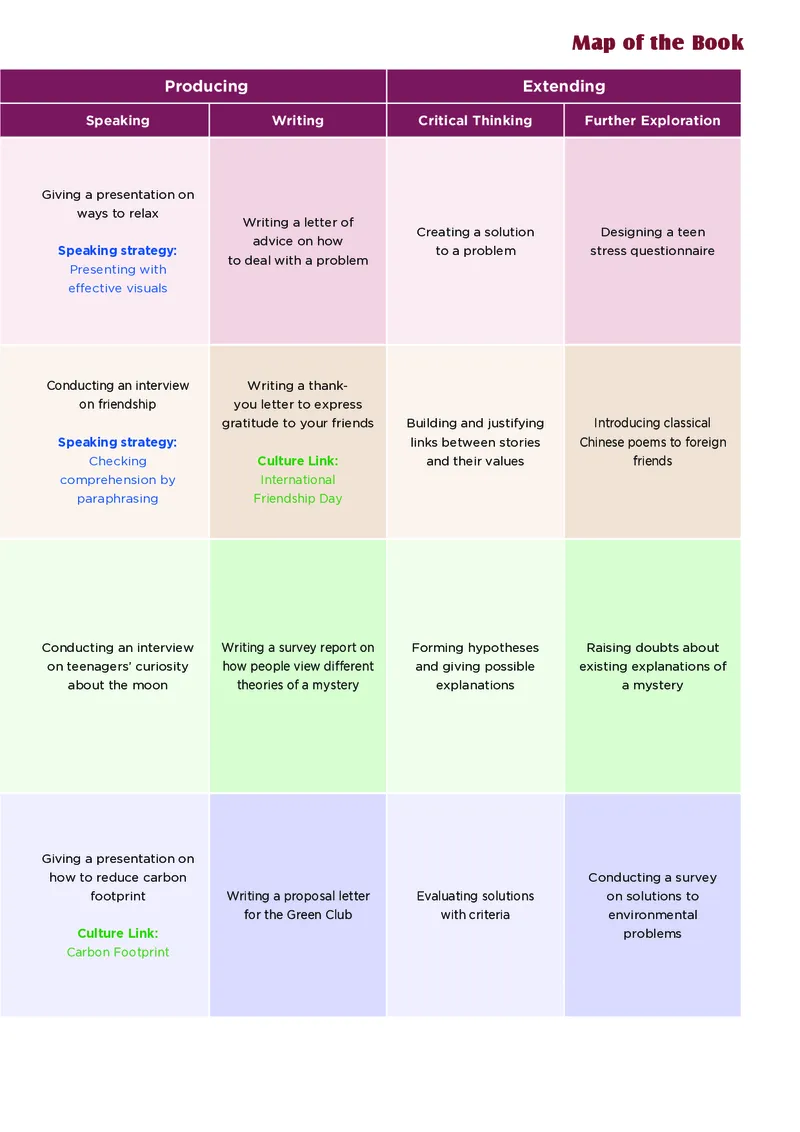
Producing
Extending
Speaking
Writing
Critical Thinking
Further Exploration
Giving a presentation on
ways to relax
Speaking strategy:
Presenting with
effective visuals
Writing a letter of
advice on how
to deal with a problem
Creating a solution
to a problem
Designing a teen
stress questionnaire
Conducting an interview
on friendship
Speaking strategy:
Checking
comprehension by
paraphrasing
Writing a thank-
you letter to express
gratitude to your friends
Culture Link:
International
Friendship Day
Building and justifying
links between stories
and their values
Introducing classical
Chinese poems to foreign
friends
Conducting an interview
on teenagers’ curiosity
about the moon
Writing a survey report on
how people view different
theories of a mystery
Forming hypotheses
and giving possible
explanations
Raising doubts about
existing explanations of
a mystery
Giving a presentation on
how to reduce carbon
footprint
Culture Link:
Carbon Footprint
Writing a proposal letter
for the Green Club
Evaluating solutions
with criteria
Conducting a survey
on solutions to
environmental
problems
Map of the Book
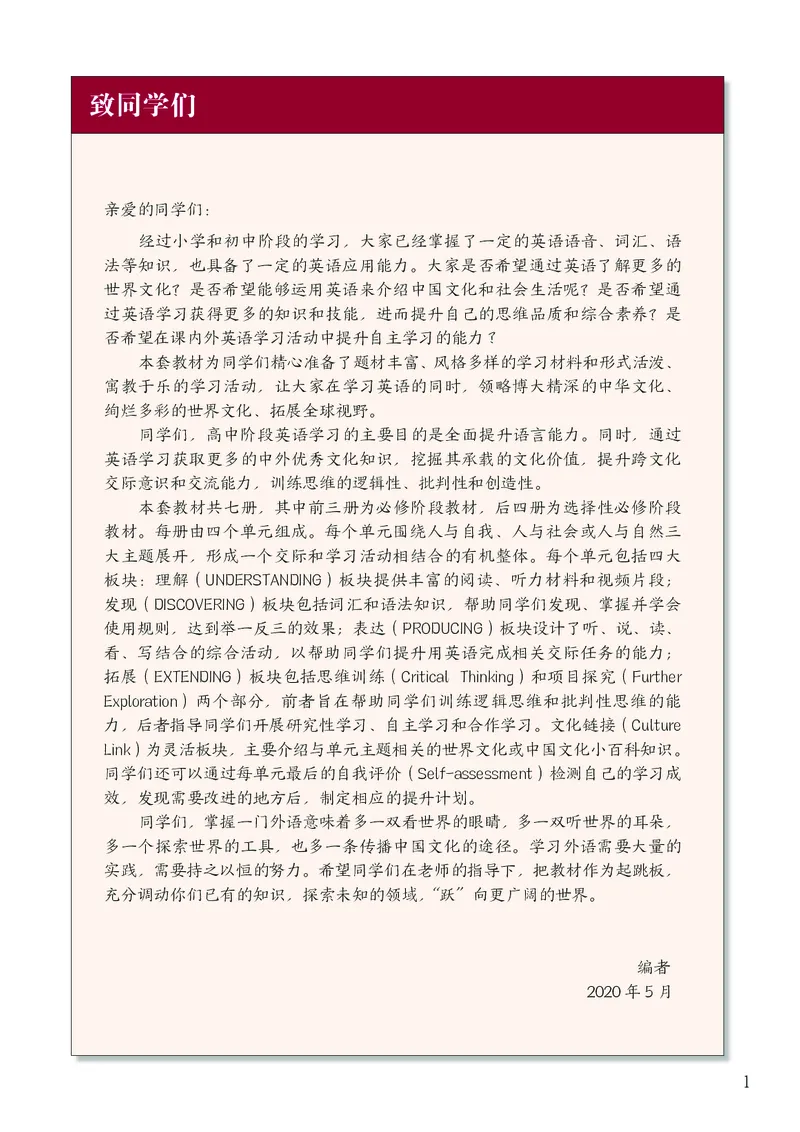
致同学们
亲爱的同学们:
经过小学和初中阶段的学习,大家已经掌握了一定的英语语音、词汇、语
法等知识,也具备了一定的英语应用能力。大家是否希望通过英语了解更多的
世界文化?是否希望能够运用英语来介绍中国文化和社会生活呢?是否希望通
过英语学习获得更多的知识和技能,进而提升自己的思维品质和综合素养?是
否希望在课内外英语学习活动中提升自主学习的能力?
本套教材为同学们精心准备了题材丰富、风格多样的学习材料和形式活泼、
寓教于乐的学习活动,让大家在学习英语的同时,领略博大精深的中华文化、
绚烂多彩的世界文化、拓展全球视野。
同学们,高中阶段英语学习的主要目的是全面提升语言能力。同时,通过
英语学习获取更多的中外优秀文化知识,挖掘其承载的文化价值,提升跨文化
交际意识和交流能力,训练思维的逻辑性、批判性和创造性。
本套教材共七册,其中前三册为必修阶段教材,后四册为选择性必修阶段
教材。每册由四个单元组成。每个单元围绕人与自我、人与社会或人与自然三
大主题展开,形成一个交际和学习活动相结合的有机整体。每个单元包括四大
板块:理解(UNDERSTANDING)板块提供丰富的阅读、听力材料和视频片段;
发现(DISCOVERING)板块包括词汇和语法知识,帮助同学们发现、掌握并学会
使用规则,达到举一反三的效果;表达(PRODUCING)板块设计了听、说、读、
看、写结合的综合活动,以帮助同学们提升用英语完成相关交际任务的能力;
拓展(EXTENDING)板块包括思维训练(Critical Thinking)和项目探究(Further
Exploration)两个部分,前者旨在帮助同学们训练逻辑思维和批判性思维的能
力,后者指导同学们开展研究性学习、自主学习和合作学习。文化链接(Culture
Link)为灵活板块,主要介绍与单元主题相关的世界文化或中国文化小百科知识。
同学们还可以通过每单元最后的自我评价(Self-assessment)检测自己的学习成
效,发现需要改进的地方后,制定相应的提升计划。
同学们,掌握一门外语意味着多一双看世界的眼睛,多一双听世界的耳朵,
多一个探索世界的工具,也多一条传播中国文化的途径。学习外语需要大量的
实践,需要持之以恒的努力。希望同学们在老师的指导下,把教材作为起跳板,
充分调动你们已有的知识,探索未知的领域,“跃”向更广阔的世界。
编者
2020 年5 月
1
2
Unit
Fighting Stress 1
2. Circle the symptom(s) of worry that you have
experienced:
The greatest weapon against stress is our ability
to choose one thought over another.
—William James
Getting Started
1. People have worries from time to time. What do
you often worry about? Circle your worries from
the lists below.
Family
School
Friends
Quarrels
Sick family member(s)
Financial problems
School rules
Presentations
Tests or grades
Fitting in
Making friends
Being teased or bullied
Fast heartbeat
Sweating
Feeling sick
Shaking
Feeling hot
3
READING A
Have you ever felt sick to your
stomach during a test? Have you had
days when you were so loaded down
with homework that you had trouble
sleeping? Have you ever been so
worried about something that you
ended up with a terrible headache?
If so, you know what it’s like to feel
stressed. You’ve probably heard people
say, “Wow, I’m really stressed out” or
“This is making me totally stressed.”
Maybe you hear adults talk like that all
the time. But teenagers have lots of
things going on in their lives that can
cause stress, too.
What is stress?
Stress is what you feel when you
5
10
15
20
25
30
are worried or uncomfortable about
something. This worry in your mind can
make you physically feel bad. You may
feel angry, frustrated, scared, or afraid
— which can give you a stomachache
or a headache.
When you’re stressed, you may not
feel like sleeping or eating, or you may
sleep or eat too much. You may also
have trouble paying attention at school
or remembering things at home.
What causes stress?
Plenty of things can cause stress,
and there are such things as good
stress and bad stress. Good or normal
stress might show up when you’re
called on in class or when you have
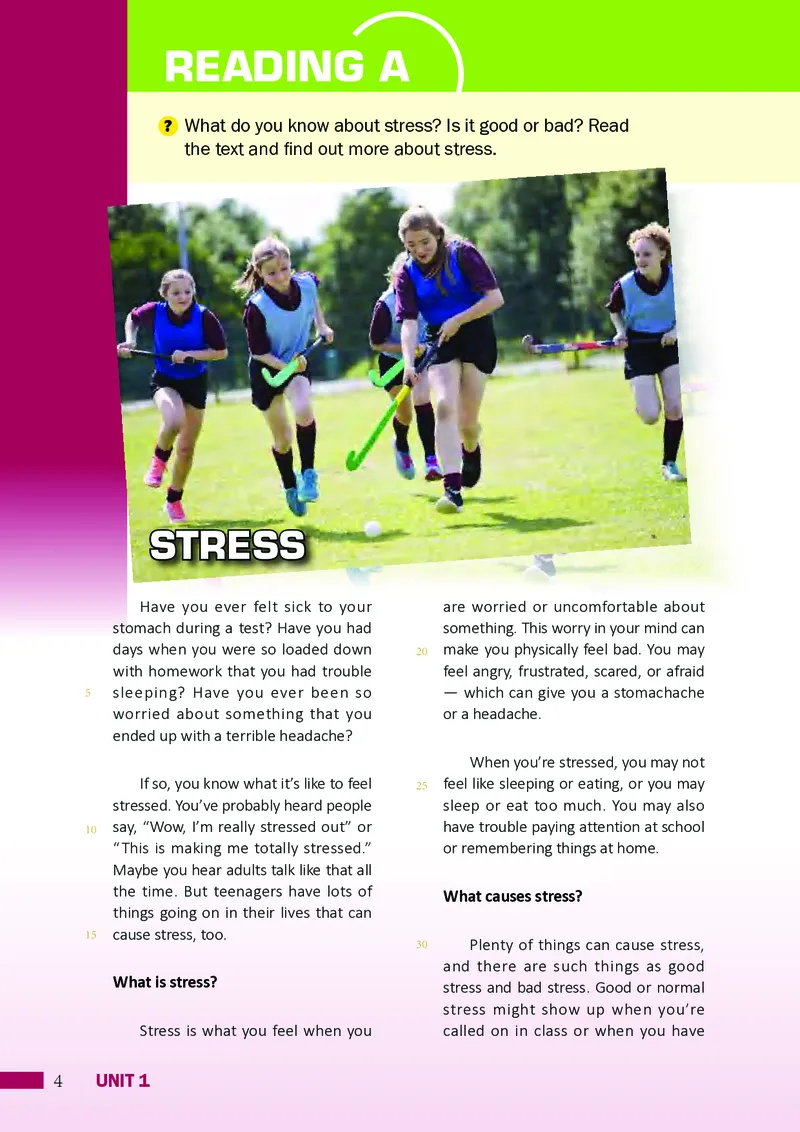
? What do you know about stress? Is it good or bad? Read
the text and find out more about stress.
STRESS
4
UNIT 1
Personal Touch
Have you ever consulted an adult about something bothering you? If yes,
what advice did you get?
35
40
45
50
55
60
65
70
75
80
to give a report. Have you ever had
butterflies in your stomach or sweaty
hands? These can be signs of good
stress — the kind of stress that can
help you get things done. For example,
you may do a better job on your book
report if the anxiety inspires you to
prepare well before reading it to the
class.
But bad stress can happen if
the stressful feelings last for a long
time. You may not feel well if a family
member is sick, if you’re having
problems at school, or if you’re going
through anything else that makes you
upset every day. That kind of stress
isn’t going to help you. It can actually
make you sick.
What to do when feeling stressed?
Once you recognise that you’re
feeling stressed, there are several
things you can do. You can try talking
about what’s bothering you with
an adult you trust, like a parent or
a teacher. Bring up what’s been on
your mind and how it makes you feel.
An adult may have ideas about how
to solve whatever is worrying you or
troubling you.
To have a balanced life is the
best way to avoid stress. That means
making good decisions about how to
spend your time. If you’re only dealing
with school stuff and have no time to
play, you can get stressed. Make sure
you keep your SELF in mind: Sleep,
Exercise, Leisure and Food. Getting
enough sleep and eating healthy food
are two great ways to help handle
stress. You can also turn to relaxation
exercises to get rid of stress. The
easiest one is to breathe in slowly
and deeply through your nose, and
then breathe out slowly through your
mouth. You can do exercises like this
anytime, without anyone noticing.
If you take care of yourself and
get enough sleep and food, and if you
exercise and leave time for fun stuff,
you’ll probably be less stressed out!
Fighting Stress
5
I. Complete the chart with information from the text.
II. Answer the questions.
III. Define “good stress” and “bad stress,” and discuss the possible causes of each
type. You may refer to the cues in the box.
1. How does the author introduce the topic?
2. What’s the author’s purpose in writing this essay? To inform, entertain, or
convince?
3. What are the common signs of stress?
4. How many types of stress are mentioned in the passage? Give an example of
each type.
5. What does “a balanced life” mean and how can we keep our life balanced?
Comprehension
Causes of stress
• suffering from a serious disease
• playing competitive sports
• taking tests
• adapting to new routines and cultures
• facing the death of a loved one
• losing one’s job
Digging In
Good stress
Definition: ______________________
_______________________________
Bad stress
Definition: ______________________
_______________________________
Introduction
Thesis statement: _______________________________________
______________________________ (Para. ___)
Conclusion
Closing statement: _______________________________________
______________________________________________ (Para. ___)
Body
• Definition of stress: ___________________________. (Para. ___)
• Causes of stress: ______________, _________________, ______
______________, __________________ (Paras. ______)
• Ways to cope with stress: ______________________, _________
___________________________________________ (Paras. 7–8)
6
UNIT 1
Vocabulary Focus
When I was 16, I was diagnosed with severe anxiety disorder. You don’t truly
know what anxiety 1 ___________ unless you’ve experienced it yourself. It’s something
that tears you apart. There is always a lot on your mind. I was 2 _________ homework
and was 3 ___________ about exams coming up. Fortunately, I met someone I could
4 ___________—my counsellor. She 5 ___________ me to stay positive and taught me
how to 6 __________ my fears.
stress out life or death end up with
keep sb alert
run away from one’s problems
react to an emergency key to survival
turn on stress response
keep worries away
handle a problem
I. Key Vocabulary
1. Match the words and expressions in Column A to the meanings in Column B.
II. Topic-Related Expressions
Complete the passage with the appropriate forms of the given expressions. Note
that there are two more options than you need.
Stress is the unpleasant feeling you get when you’re worried, scared, angry, frustrated,
or overwhelmed. Even though stress is unpleasant, it’s not always a bad thing. It is an
important survival tool and can 1 _________________ and focused. Ages ago, when
people lived in the jungle — where a tiger might leap out at any moment — the emergency
nervous system was 2 _________________. A lot of stress changes our bodies quickly and
helps us 3 _________________. In the modern world, our biggest worries aren’t usually
about 4 _________________. We don’t really have to 5 _________________, but we
all have problems and worries that 6 _________________, like that panicky feeling you
1. inspire
a. to annoy
2. handle
b. to make ... worried
3. call on
c. to fill sb with the urge to do sth
4. upset
d. to give sb/sth a lot of heavy things to carry
5. scared
e. to demand ... to do sth
6. trust
f. time when one is not working
7. bother
g. to want to have or do sth
8. load down with h. frightened
9. leisure
i. to manage (a problem)
10. feel like
j. to have confidence in sb
A
2. Complete the passage with the appropriate forms of the words and expressions
in Exercise 1.
B
Fighting Stress
7
I. Read the sentences and answer the questions below.
Grammar in Use
Infinitives 2— used as subjects and predicatives
sometimes get when you’re studying for a big test. If you feel 7 ______________,
you can practise some relaxation techniques. Do breathing exercise, listen to music,
write in a journal, play with a pet, go for a walk or a bike ride, or do whatever helps
8 _________________.
Grammar Highlights
1. Which infinitive clause in the above sentences is a subject? And which is a predicative?
2. What is the function of “it” in Sentence B?
A. To have a balanced life is the best way to keep stress away.
B. It is still necessary to share your feelings with others.
C. Your heart seems to stop, knees become weak, and you begin to sweat.
D. What they did was (to) collect data and analyse the problem.
Infinitives as Subjects
• In everyday speech, it is common to use it as the formal subject and the to-
infinitive clause at the end of the sentence for balance.
e.g. It is important to be honest with yourself at all times.
• In dictionary definitions, quotes and poetic speech, the to-infinitive is usually
placed at the beginning of a sentence.
e.g. To know what it is that you know, and to know what it is that you do
not know — that is understanding. — Confucius
Infinitives as Predicatives
• The infinitive follows a linking verb to describe, identify or rename the subject.
e.g. What is essential is to stick to a healthy diet.
Our top priority is to ensure the safety and well-being of our employees.
An infinitive clause has a meaning that is more hypothetical than
that of the -ing clause. It is commonly used to report intentions,
desires, efforts and perceptions.
Compare:
The best way to predict the future is to create it.
My favorite pastime is reading books.
8
UNIT 1
II. Make sentences with the same meaning by using it + infinitive. The first one has
been done for you.
III. Choose the appropriate form to complete the sentences.
IV. Fill in the blanks with the appropriate forms of the verbs given in brackets.
1. ______________ (To eat, Eating) too much sugar is not healthy.
2. John’s plan is _____________ (to do, doing) some volunteer work next weekend.
3. ______________(To read, Reading) books took up much of my leisure time.
4. Part of the problem is not _____________ (to know, knowing) proper ways to reduce
stress.
5. The mission of the institution is _____________ (to improve, improving) the well-being
of the people in distress.
6. Their goal is ____________ (to help, helping) those in trouble to develop a healthy
mindset.
1. Playing tennis is fun. It is fun to play tennis.
2. Doing physical exercise is important.
3. Learning about other cultures is interesting.
4. Visiting museums is educational.
5. Going fishing with your friends is relaxing.
6. Making new friends takes time.
Art therapy is one of the oldest effective
forms of self care and healing, and it helps to
develop personal awareness. It can also be used
1 _____________ (treat) issues and illnesses such
as anxiety, depression and stress disorder.
Art therapy is suitable for those who
are interested in 2 ______________ (express)
themselves through art. It can be difficult
3 _____________ (open) up to a complete stranger about one’s deepest and darkest
emotions. In art therapy, words are not always necessary. A simple act of a scribble on
paper can be a release for a depressing thought and bring light to darkness.
We offer a wide variety of art therapy courses, including Chinese calligraphy and
Chinese brush painting. It is our purpose 4 _____________ (help) people engage the creative
self in 5 ______________ (build) mind and body health and wellness. The main objectives
of our courses are 6 _________________ (connect) individuals through art and creativity,
7 _____________ (enhance) personality, and 8 _____________ (develop) team building and
interpersonal bonding.
Fighting Stress
9
Listening, Viewing and Speaking
This study tracked ______________ in the United States,
and they _______________________________.
They used public records for the next _____
years to find out who died.
II. Listen and answer the questions.
1. What is the recording mainly about?
2. Why is it important to take breaks?
3. How does Danielle relax?
1. If a student has hours of homework to complete, taking several ____-minute
breaks can reduce stress.
2. Danielle is a _____-year-old student. She likes to ______ before she ___________.
3. The APA survey finds that American students like to relax by:
• listening to music;
• ______________________;
• going online;
• spending time with ________ or friends;
• exercising or __________.
III. Listen again and complete the sentences.
Dealing with School Stress (Radio programme)
How to Make Stress Your Friend (Talk)
I. Work in pairs and discuss what “make stress your friend” means.
III. Watch the video clip again and complete the chart.
II. Watch the video clip and identify the main idea of the talk.
Every major stressful life experience increased the
risk of dying by _____%.
People who spent time __________ others showed
zero stress-related increase in dying.
I. Read the title of the recording. Brainstorm and list the words and expressions
related to the topic.
01
02
03
10
UNIT 1
People take in more visual information
than textual information. To make
your presentation more effective, you
could:
• use visuals such as photos, charts,
graphs and tables whenever
possible;
• reduce the number of words or
bullet points on your slides;
• use phrases or clauses instead of
sentences unless you are showing
a quotation.
Giving a presentation on ways to relax
Fill in the boxes with ways to relax and the reasons why they are effective. Give a
presentation with effective visuals on how you’d like to relax.
Presenting with effective visuals
Speaking Strategy
Types of visual aids
used in presentation
• Overhead projector
• PowerPoint presentations
• Blackboard or whiteboard
• Flip charts
Ways to Relax
Effective ways to relax:
• Running: takes mind off
problems
•
•
Running
Reasons
Knowing how to relax is vital for our health
and well-being. Here are some ways that I find
effective to help me calm down and stay composed.
Whenever I feel stressed out, I go for a run.
Running takes my mind off problems ...
Fighting Stress
11
While all teens feel anxious from
time to time, some feel it more than
others.
Say your best friend tells you she’s
going to the airport with her dad to
learn to skydive. She’s totally excited.
But just thinking of skydiving causes
you tremendous anxiety. Your stomach
churns, your heart races, and you feel
a lump in your throat when you try to
swallow. You can’t believe your friend
is actually doing this, and you think
about it all day long. When she calls
that evening, she says she can’t wait
to skydive again — “It was thrilling!”
While you and your friend are both
thinking about skydiving, you perceive
the situation in very different ways.
How much anxiety is too much?
Here are some of the signs of
excess anxiety.
• You feel anxious, worried, or
afraid for no reason at all. Normally,
teens feel anxiety because of
something specific — like taking a test
or going out on a date. But if there’s
no obvious reason for your feelings,
your anxiety level may be too high.
• You worry too much about
everyday events or activities. Some
worries are normal. But if you’re
5
10
15
20
25
30
35
40
45
50
55
constantly worrying about things that
are out of the ordinary, or if you worry
so much about those events that you
avoid them, your anxiety level is too
high.
• You continually check whether
you did something right. While it’s
normal to check something you did
to make sure it’s right, continuing to
check it again and again is a sign that
you have way too much anxiety.
• You’re so panicky that you are
unable to function in certain situations
— like taking tests or socialising with
friends.
How can teens cope with anxiety?
Many teens find ways to cope
with the high anxiety they feel. It’s
important to recognise your emotions,
to know what you’re feeling and
why you’re feeling that way. It’s also
important to find healthy ways of
coping with anxiety. Recognising the
types of situations that cause your
anxiety is helpful.
Sometimes just admitting that
a situation is stressful and being
ANXIETY AND TEENS
READING B
12
UNIT 1
prepared to deal with it can reduce
your anxiety. If you try these simple
measures and still have too much
anxiety, getting treatment from a
health care professional or therapist
is the next step.
Relaxation techniques can
help reduce anxiety and negative
thoughts and help you manage
60
70
75
65
stress. Common relaxation techniques
include deep abdominal breathing,
meditation, listening to calming music,
and activities like yoga and Taijiquan.
Some people find that chanting
(even a single word) or singing or
focusing their vision on an object also
helps them achieve a more relaxed
state of mind.
I. Answer the questions.
III. Discuss with your partner:
1. What is the text mainly about?
2. What is the function of the first paragraph?
What relaxation technique do you use most often? How effective is it?
II. Tick the right answers based on what you
have read.
1. Signs of excess anxiety:
□ worrying about a test
□ checking something again and again
□ inability to socialise with friends
□ feeling anxious for no reason
□ worrying about speaking in public
□ worrying about competing in sports
2. Ways to tackle anxiety:
□ taking deep breaths
□ admitting that a situation is stressful
□ hitting the wall
□ getting treatment
□ drinking alcohol
□ doing Taijiquan
□ recognising the cause of anxiety
□ consulting a professional
□ trying not to think of the problem
□ withdrawing from activities
Culture Link
Taijiquan for Stress Relief
Taijiquan, an ancient and distinctive
Chinese form of exercise, is the
application of the Taoist concept
of yin and yang in the human
body. It involves slow movement
that requires a high level of
concentration, which in turn
allows a profound calm to take
place. The consistent practice of
Taijiquan results in a decrease in
panic attacks, nervousness and
other symptoms.
Comprehension Plus
Fighting Stress
13
Critical Thinking
I. The following is a PPT slide of a talk about stress. Explain each point and provide
examples whenever possible. You may refer to the information you’ve learnt in this unit.
Case Study
Andy, who is going to participate in an English speech contest,
shows the following signs of stress:
• fatigue or loss of energy
• increased restlessness
• loss of appetite
• difficulty in sleeping
• loss of social interest
• difficulty in concentrating
Solutions: ?
• Definition of stress
• Differences between good stress and bad stress
• Body’s response to stress
• Emotions that stress may cause
• Unhealthy ways people try to handle their stress
II. The next slide of the talk presents a case study. Read the stress signs that Andy shows,
discuss in pairs and work out solutions to his problem.
Creating a solution to
a problem
14
UNIT 1
Tony, Sally, Mary, and Alan have worries over different issues. Write a letter of 110–
130 words to one of them, giving advice on how to deal with his/her problem.
Writing a letter of advice on how
to deal with a problem
Writing
Sally:
weight, appearance
• Follow the letter format:
– Heading (Date, Salutation)
– Opening (State the purpose of writing the letter)
– Body (Give advice)
– Closing
– Signature
• Give advice relevant to the specific issue, keeping your writing concise
and to the point.
• Write in a friendly tone. Do not criticise, and avoid discouraging language.
Letter of advice: format, content and tone
Writing Strategy
Step 1 Work in groups. Decide on one of the students to write to.
Step 2 Discuss and list ways to handle his/her problem.
Step 3 Write a letter of advice to him/her, using the letter format provided.
Alan:
study, grades
Tony:
relationship with classmates
Mary:
peer pressure
Guided Writing
Fighting Stress
15
Useful Words and Expressions
• If you keep on …
• You should …
• I think you need to …
• You need to …
• I would consider …
• Have you thought about …
• You could try …
• Your next step is …
• Let me know how it goes.
• I really hope this helps. • Good luck with everything.
Dear _________,
I am sorry to hear about _______________________
_______________________________(PROBLEM). I’d like
to share with you some tips that might help you out.
I suggest that ________________________________
______________________________________________
__________. I think ______________________________
________________. Besides, ______________________
______________________________________________
_________________________. I’m sure that _________
______________________________________________
___________________________________.
Hope some of the tips work for you. Write to me if
you have further problems.
Yours truly,
______________
Your name
______________
Your address
Date
______________
______________
Receiver’s address
Salutation
Clarify the purpose
of writing. State the
problem.
Provide advice and
explain why it is
suitable.
End with an expression
of confidence or
encouragement.
16
UNIT 1
Self-assessment
Further Exploration
The School Health Club is going to conduct a survey of teen stress in your school. You
are invited to design a questionnaire for the club.
Designing a teen stress questionnaire
Step 1 Work in groups. Discuss with your
team members what information
to collect. Decide what type(s)
of questions to use. You may use
multiple choice questions, rating
scale questions, etc.
5
4
3
2
1
Moderately stressful
Not at all
stressful
Extremely
stressful
Step 2 Write 10–15 questions that are relevant to teen stress. Make sure the questions
are clear, concise and direct. Arrange the questions in a logical order. Start from
easy, general to difficult, particular ones.
Step 3 Test the questionnaire and revise it if needed.
Step 4 Submit the questionnaire to the club.
Look at the expected learning outcomes of this unit.
Write a reflective note on the above items. You may include some or all of the
following points:
What you think you have done well and why
One strategy that really has helped your learning
One important thing you have learned about
What you need to improve in the future
What learning resources you find useful
A. Understanding causes and types of stress
B. Talking about different views about stress and ways to relieve stress
C. Identifying signs of excessive anxiety and proper ways to cope with stress
across cultures
D. Finding solutions to stress-related problems
E. Using effective visuals in a presentation
F. Writing a letter of advice about worries
Fighting Stress
17
18
Unit2
Read the following excerpt from a poem
on friendship. Do you agree with the poet?
What is your understanding of friendship?
Be slow to fall into friendship; but when you are
in, continue firm and constant.
— Socrates
Getting Started
Cherishing
Friendship
Your friend is your needs answered.
He is your field which you sow with love and reap
with thanksgiving.
And he is your board and your fireside.
For you come to him with your hunger, and you
seek him for peace.
— On Friendship by Kahlil Gibran
19
READING A
One day, when I was a freshman
in high school, I saw a kid from my
class walking home from school. He
seemed to be carrying all of his books.
His name was Kyle. I thought to myself,
“Why would anyone bring home all
his books on a Friday?” Then I saw a
bunch of kids running toward him,
knocking all his books out of his arms
and tripping him so he landed in the
dirt. His glasses went flying, landing
in the grass about ten feet from him.
He looked up and I saw this terrible
sadness in his eyes. I jogged over to
him. As he crawled around looking for
5
10
15
20
25
his glasses, I saw a tear in his eye.
As I handed him his glasses, he
looked at me and said, “Thanks!”
There was a big smile on his face,
showing real gratitude. I helped him
pick up his books and asked him where
he lived. He turned out to live near
me. We talked all the way home, and I
carried his books. He was a pretty cool
kid and I asked him if he wanted to
play football with me and my friends
on Saturday. He said yes. We hung out
all that weekend. The more I got to
? Do you remember the time when you first met one of
your best friends? How did your friendship start? Read
the text and find out how the author met his best friend.
WITH ONE SMALL GESTURE
20
UNIT 2
Personal Touch
If you saw one of your classmates being bullied, what would you do?
30
35
40
45
50
55
60
65
70
know Kyle, the more I liked him. And my
friends thought the same of him.
Monday morning came, and there
was Kyle with the huge stack of books
again. I stopped him and said, “You are
gonna really build some serious muscles
with this pile of books every day!” He
just laughed. Over the next four years,
Kyle and I became best friends. When
we began to think about college, Kyle
decided on Georgetown, and I was
going to Duke.
Graduation day came and Kyle
was selected as the speaker at the
graduation ceremony. I was so glad it
was he who got up there and spoke. I
could see that he was nervous about
his speech. So, I patted him on the back
and said, “Hey, big guy, you’ll be great!”
He looked at me with one of his really
grateful looks and smiled, “Thanks!”
When it came to his turn, he cleared
his throat and began. “Graduation is a
time to thank those who helped you
through those tough moments. Your
parents, your teachers, your siblings…
but mostly your friends. I am going
to tell you a story…” I just looked at
my friend in disbelief as he told the
story of the first day we met. He had
planned to drop out of school because
of loneliness and sadness at the new
place. He talked of how he had cleaned
out his locker so he would never come
back. He looked at me and gave me a
little smile. “Thankfully, it was my friend
who helped me out.” I heard the gasp
go through the crowd as this handsome,
popular boy told us all about his
weakest moment.
I saw his mom and dad looking at
me and smiling that same grateful smile.
Not until that moment did I realise its
depth. Never underestimate the power
of your actions. With one small gesture
you can change a person’s life.
Cherishing Friendship
21
I. Complete the events based on the text and number them to show the order in
which they occurred. The first one has been done for you.
II. Answer the questions.
III. Complete the paragraph in your own words to explain why Kyle decided not to
drop out of school.
____ I saw Kyle bringing home all of his _________.
____ I handed Kyle his _________ and helped him pick up his _________.
____ Kyle planned to _________ out of school.
____ Kyle showed his _________ to me in his graduation speech.
____ Kyle and I played football together that weekend.
____ A bunch of kids _________ Kyle’s books out of his arms and _________ him
onto the ground.
1. Why did Kyle attract the narrator’s attention that Friday?
2. How did Kyle feel after being tripped by a group of teenagers?
3. What did the narrator’s friends think of Kyle after spending time with him?
4. What story did Kyle tell on graduation day?
5. How did Kyle show his gratitude each time the narrator helped him?
6. What is your understanding of the statement “With one small gesture you
can change a person’s life”?
On a Sunday night, Kyle lay on his bed, having trouble falling asleep. He still felt
hurt thinking back on those difficult, lonely days at the new school. That loneliness had
almost made him decide to drop out. But now he couldn’t help recalling the terrific
weekend spent together with his new friends. _______________________________
____________________________________________________________________
____________________________________________________________________
Then he decided to go to school the next morning and have a new beginning.
Comprehension
Digging In
1
22
UNIT 2
Vocabulary Focus
Hello, everyone! I’m Kyle. I have been thinking about what I should say when it
1 _________ to give a graduation speech. Now I just want to tell you a story. On a Friday
afternoon, a sad freshman was carrying all his books back home from his new school.
He had planned to 2 _________ of school because of the loneliness and sadness at the
new place. He had 3 _________ his locker so he would never come back. And then, a(n)
4 _________ of kids ran towards him, 5 _________ all his books out of his arms and
tripped him so he landed in the dirt. His glasses went flying. While he was crawling
around looking for the glasses, a guy handed him the glasses. They had a talk and found
they lived quite near to each other. They 6 _________ all that weekend. From then on,
they became best friends.
Yes, the sad freshman is me and that guy is my best friend, who is now
looking at me in 7 _________. Every time he helped me through my 8 _________ moments,
I would look at him with a 9 _________ smile. However, I have never said “Thank you”
to him. Today I finally get the chance to express my gratitude to him. It was you who
10 _________. Thank you, my dear friend. Thank you all.
grateful
muscle
knock
clean out
help ... out
hang out
tough
think the same of
bunch
drop out
disbelief
come to one’s turn
I. Key Vocabulary
Fill in the blanks with the appropriate forms of the given words and expressions
to complete the passage. Note that there are two more options than you need.
II. Topic-Related Expressions
1. Read the expressions and add more expressions related to the topic of friendship.
become friends
strengthen the connection
with friends
Friends/Friendship
build a network of friends
destroy friendship
make new friends
break up with friends
support your friends
develop close friendship
maintain friendship
Cherishing Friendship
23
2. Fill in the blanks with the appropriate forms of the given expressions in Exercise 1 to
complete the passage.
A friend is someone you trust and with whom you share a deep level of
understanding. Whatever your age or gender, it’s never too late to 1 _________.
Meanwhile, it’s also important to keep in touch with old ones. 2 _________ can
have a powerful impact on your physical health. Lack of close friendship may be as
damaging as smoking or drinking too much. A recent study has found that, along
with physical activity, 3 _________ can add significant years to your lifespan. Friends
can also bring happiness into your life by reducing your stress and cheering you up.
4 _________ usually takes more time and effort than starting friendships. You need to do
something to 5 _________ your friends. If you always 6 _________ when they need you,
the friendships can be maintained for the long term even though you are unable to meet
them regularly.
I. Replace the underlined clauses in the sentences with the appropriate forms of
infinitives. The first one has been done for you.
Grammar in Use
Complex infinitives
1. It seemed that he was carrying all of his books.
He seemed to be carrying all of his books.
2. I am proud that I had completed this work by the first day of June.
______________________________________________________________________
3. I’m glad that I am sitting here.
______________________________________________________________________
4. It was reported that Vincent was staying in Paris at that time.
______________________________________________________________________
5. She was sorry that she had not met you.
______________________________________________________________________
6. I’m sorry that I kept you waiting for a long time last Friday.
______________________________________________________________________
7. I’m lucky that I have got my license._
8. They are not something that you should be ashamed of._
24
UNIT 2
II. Fill in the blanks with the appropriate forms of the verbs given in brackets.
1. There are some people who always seem __________(surround) by friends, and there are
others who always seem __________(stand) on the outside, looking in at the crowds of
friends.
2. I am truly glad __________(meet) Jessie. We have a lot in common. We seem __________
(know) each other for a long time.
3. Jimmy and Paul are thought __________(become) close friends when they were in high
school. They are known __________(inspire) each other ever since.
4. Tom looks so sad. I feel that something needs __________(do). I don’t want my best
friend __________(hurt) .
Grammar Highlights
An infinitive can be simple, continuous or perfect, active or
passive, positive or negative. For example:
Active
Passive
Positive
Simple
Continuous
Perfect
(to) do
(to) be doing
(to) have done
(to) be done
___________
(to) have been done
Negative
Simple
Continuous
Perfect
not (to) write
not (to) be writing
not (to) have written
not (to) be written
___________
not (to) have been written
We use the continuous infinitive for actions in progress and the perfect
infinitive for earlier actions. We use the passive infinitive for actions
happening to the subject.
EXAMPLES
I happened to be waiting for the bus when the accident happened.
He pretended to have forgiven his partner.
He decided not to go to the frontier.
The carpet in the living room needs to be washed.
1
Jim: Do you want to be a volunteer?
Ellen: Sure. I hope they choose me.
Ellen hopes _____________________
______________________________.
2
Erik: Is the petrol price declining?
Alice: The newspaper says so.
The petrol price is reported ________
______________________________.
3
Monica: Do you know who took these photos?
Phil: I only know they were not taken by Danny.
These photos are said ____________
______________________________.
III. Read the following short conversations and complete the table with the appropriate
forms of infinitives.
Cherishing Friendship
25
II. Before you listen, read the interview questions and guess the missing word or
words. Then listen and check.
I. If you are going to interview somebody on friendship, what questions will you ask?
Listening, Viewing and Speaking
1. What is your concept of _________?
2. Did you usually have _________ good friends or _________ close friends?
3. Did you _________ with your close friends?
4. Can you _________ to help your friends?
5. If you were someone else, would you like to _________?
6. Would you please _________ of FRIEND?
III. Listen again and answer the questions.
Interview on Friendship (Interview)
1. What’s the interviewee’s view on “true friendship”?
2. How does the interviewee understand the saying “A friend in need is a friend indeed”?
3. What does “FRIEND” stand for according to the interviewee?
Peas and Carrots (Film Clip)
III. Watch again and answer the questions.
1. What does Forrest Gump still remember?
2. What does Forrest teach Jenny?
3. What does Jenny teach Forrest?
4. What does Forrest’s mother mean by saying “stupid is as stupid does”?
□ Two vegetables mixed together.
□ Two people who are quite different.
□ Two people getting along very well.
I. Guess what the phrase “peas and carrots” possibly means.
II. Watch the film clip and summarise its main idea with no more than 15 words.
The film clip is mainly about
26
UNIT 2
e.g. How do you usually spend your time with friends?
Conducting an interview on friendship
The students’ union at your school is hosting a True Friends Project. Suppose you are
one of the volunteers to collect teenagers’ views on friendship. Complete the task by
following the steps below.
During an interview, you can paraphrase what your interviewee has said to make
sure that you have understood him or her accurately. You can repeat the ideas
expressed by your interviewee by
• changing the order of the ideas or the words;
• changing the word form or the grammatical form;
• using synonyms for some words or expressions.
EXAMPLE
A: How do you usually spend time with your friends?
B: Sometimes we meet, talk and play together. I like to listen to my friends, but I
don’t like to give them advice because I don’t want to change them.
A (paraphrasing): Do you mean that you are a good listener, and not bossy or
controlling?
B: I think so.
Checking comprehension by paraphrasing
Speaking Strategy
Useful Expressions
Repeating others’ opinions in different ways
• What you mean is …
• Do you mean … ?
• Let me put it in another way: …
• Is this what you’re trying to say?
• Let me explain what you’ve said again.
• In other words, …
Step 1
Make a list of interview questions by rewriting the questions in Listening Exercise II
or adding questions of your own.
Step 2
Find some classmates and interview them, making sure that you have understood
their views accurately by using the paraphrasing strategy.
Step 3
Sum up your interviewees’ views on friendship.
Cherishing Friendship
27
At the top of a three-storey
building in Greenwich Village lived Sue
and Johnsy. When they met for the first
time, the two young women painters
discovered that they liked the same
kind of art, the same kind of food,
and the same kind of clothes. So they
decided to live and work together.
Toward winter, a bad sickness —
pneumonia — visited the village and
touched many people, including
Johnsy. She lay on her bed almost
without moving.
One morning the busy doctor
spoke to Sue alone, “She has a chance,
if she wants to live. Yet your little lady
has decided not to get well.”
After the doctor had gone, Sue
went into the workroom to cry. Then
she walked into Johnsy’s room, smiling
and singing.
Johnsy lay there, very thin and
quiet, with her face toward the
window. Sue stopped singing, thinking
that Johnsy was asleep.
Then she heard a low sound, again
and again. She went quickly to the
bedside. Johnsy was looking out the
window and counting.
“Twelve,” she said; and a little later,
“Eleven”; and then, “Ten,” and, “Nine”;
and then, “Eight,” and, “Seven,” almost
together.
Sue looked out the window. There
was only the side wall of the next
house and an old tree against the wall.
“Six,” said Johnsy in a lower voice.
“There goes another one. There are
only five now.”
“Five what, dear?”
“Leaves. On the tree. When the
last one falls, I must go, too. I’ve known
5
10
15
20
25
30
35
40
45
50
55
60
65
70
75
80
that for three days. Didn’t the doctor
tell you?”
“Oh, I never heard of such a thing,”
said Sue. “What have old ivy leaves to
do with your getting well? The doctor
told me this morning that you had very
good chances. Try to eat a little now.
Then I will go back to work and sell my
picture to buy you something good to
eat to make you strong.”
“There goes another,” said Johnsy,
still looking out the window. “No, I
don’t want anything to eat. Now there
are four. I want to see the last one fall
before night. Then I’ll go, too.”
“Try to sleep,” said Sue. “I must call
Behrman up to be my model for the
picture. I’ll not be gone a minute.”
Old Behrman was a painter who
lived on the ground floor beneath
them. He was past sixty and had had no
success as a painter. He had been always
about to paint a masterpiece, but had
never begun it.
He earned a little by serving as
a model to those young artists. And
he believed that it was his duty to do
everything possible to help Sue and
Johnsy.
Sue found him in his dark room,
and told him about Johnsy and the
leaves. Old Behrman shouted his anger
over such an idea.
Johnsy was sleeping when they
went up. Sue covered the window,
and took Behrman into the workroom.
There they looked out the window
fearfully at the tree. A cold rain was
falling, with a little snow in it too.
Sue began to paint and worked
through most of the night after
Behrman left.
THE LAST LEAF
READING B
28
UNIT 2
In the morning, she went to
Johnsy’s bedside. With her eyes wide-
open, Johnsy was looking toward the
window. “I want to see,” she told Sue.
Sue took the cover from the
window.
But after the beating rain and the
wild wind through the whole night,
there yet stood out against the wall
one ivy leaf.
“It is the last one,” said Johnsy.
“It will fall today, and I shall die at the
same time.”
The day wore away. As it grew
dark, they could still see the leaf. And
then, as the night came, the north
wind began to blow again. The rain
still beat against the windows. The
next morning, the leaf was still there.
Johnsy lay for a long time looking
at it. And then she called to Sue,
“Something has made that last leaf
stay there to show me how bad I was.
It is wrong to want to die. I’ll try to eat
now.”
The doctor came in the afternoon,
and Sue had an excuse to go into the
hallway as he left.
“Even chances,” said the doctor.
115
120
125
130
85
90
95
100
105
110
“With good nursing you’ll win.”
The next day the doctor said to
Sue, “She’s out of danger. You’ve won.
Nutrition and care now — that’s all.”
And that afternoon Sue came to
Johnsy’s bed and put one arm around
her.
“I have something to tell you,” she
said. “Mr Behrman died of pneumonia
today. When people found him in his
room, his shoes and his clothes were
wet and as cold as ice.
“And then they also found a lantern
that he had taken outside and his
materials for painting. And —
“Look out the window, dear, at
the last leaf on the wall. Didn’t you
wonder why it never moved when
the wind blew? It is Behrman’s great
masterpiece.”
I. Fill in the blanks to complete the plot of The Last Leaf.
1. How did Sue and Johnsy become roommates?
2. What did the doctor recommend for Johnsy to recover?
3. Who was Mr Behrman?
4. Why did Sue go to find Mr Behrman?
5. How did Sue support Johnsy during her recovery from her disease?
6. What did Sue mean by telling Johnsy that the last leaf was Mr Behrman’s masterpiece?
II. Answer the questions.
Sue’s friend, Johnsy,
got ____________.
Johnsy learnt from _________
that she should not wait to die.
Sue told Johnsy Mr Behrman
______ the last leaf and died of
pneumonia.
Sue told their friend ____________
that Johnsy thought she would
_____ when the last leaf _____.
The doctor told Sue that
Johnsy was ___________.
The text is adapted from O. Henry’s short
story The Last Leaf, which was published
in 1907. O. Henry is the pen name of
William Sydney Porter (1862–1910), an
American short story writer. His stories are
well known for their surprise endings.
Note
Comprehension Plus
Cherishing Friendship
29
Critical Thinking
Stories
Sayings
Reading A
Reading B
Listening
Viewing
A friend can change your life with a small gesture.
A friend in need is a friend indeed.
Good friends help you find the important things
when you have lost them, your smile, your hope,
and your courage.
A real friend is one who walks in when the rest of
the world walks out.
A friend’s eye is a good mirror.
Friendship is born at the moment when one says
to another: What! You too? I thought I was the
only one.
A friend at hand is better than a relative at a
distance.
In hardship we see friendship.
I. Match the sayings about friendship with the stories in different sections of this unit
based on the common values they share. Each story can be matched with more
than one saying.
II. Explain why the sayings and the friendship stories share common values according
to your understanding.
Building and justifying links
between stories and their values
EXAMPLE
The saying, “A friend can change your life with a small gesture,” suggests that a
small help can have a big impact on others. In Reading A, the narrator helped Kyle
with his glasses and books when he was tripped by a group of teenagers. Then they
became good friends, which helped Kyle change his mind about dropping out of
school and encouraged him to become an excellent student. If Kyle had left school,
his life would have been different. Therefore, the author’s small act of kindness had
a big impact on Kyle.
30
UNIT 2
Writing
Celebrate this year’s Friendship Day by writing a thank-you letter to one of your friends.
Step 1 Introduce one of your friends and list one or two things between you and
him/her that touch you most.
Step 2 Write in the following sample format a thank-you letter with 110–130 words.
Writing a thank-you letter
Writing Strategy
A personal thank-you letter generally has
• the heading: the address, the date;
• the greeting: always ending with a comma;
• the body: expressing your gratitude and stating
the reasons why you are grateful;
• the closing: appropriate respectful words or
phrases;
• the signature line: signing your name.
The following is a Friendship Day poster.
Hello, everyone! Friendship
Day is coming soon. It is a
perfect occasion to let your
friends know how much they
are needed and loved. This year
let’s celebrate the Friendship
Day by sending your dear
friends thank-you letters.
Culture Link
International Friendship Day
Friendship Day was first created by
the greeting card industry in the 1920s.
In 2011, the General Assembly of the
United Nations declared 30 July as the
official International Friendship Day
to encourage governments, groups
and organisations to host activities
and events that promote dialogue,
acceptance and understanding
between people of different
backgrounds. Yet celebrations occur on
different dates in different countries.
Writing a thank-you letter to express
gratitude to your friends
“
Guided Writing
Cherishing Friendship
31
Further Exploration
Introducing classical Chinese poems to foreign friends
Read the English translation of the lines from two classical Chinese poems on
friendship and translate them back into Chinese.
Some foreign friends are visiting your school. Introduce to them classical Chinese poems on
friendship.
________________
________________
________________
________________
____________
__________________________________________________
__________________________________________________
__________________________________________________
__________________________________________________
__________________________________________________
__________________________________________________
__________________________________________________
______________
______________
Your address
Your name
Your friend’s address
Date
Greetings
Your gratitude and the reasons why
you are thankful to your friend
Formal
Informal
Dear Jane,
Hi Jane,
Hello Jane,
Formal
Informal
I really
appreciate …
Thank you for …
Closing
Formal
Informal
Best wishes,
Best regards,
Sincerely yours,
Love,
Your friend,
Yours,
English Translation
Back Translation into Chinese
If you have a friend who knows your
heart, distance cannot keep you two
apart.
— Wang Bo
However deep the Lake of Peach
Blossoms may be, it is not so deep, O
Wang Lun, as your love for me.
— Li Bai
Step
1
32
UNIT 2
Self-assessment
Find more classical Chinese poems on friendship and their English translation.
Write them down in the following table.
Introduce one of the poems
to the foreign friends.
Chinese Poem
English Translation
Step
2
Step
3
Look at the expected learning outcomes of this unit.
Write a reflective note on the above items. You may include some or all of the
following points:
What you think you have done well and why
One strategy that really has helped your learning
One important thing you have learned about
What you need to improve in the future
What learning resources you find useful
A. Recognising the power of friendship from stories, interviews and poems
B. Talking about how friendship may change a person
C. Reporting and designing interview questions to find out people’s understanding
of friendship
D. Introducing classical Chinese poems to foreign friends
E. Building and justifying links between friendship stories and proverbs or idioms
on friendship
F. Checking comprehension by paraphrasing others’ ideas in an interview
G. Writing a thank-you letter to express gratitude
Cherishing Friendship
33
34
Unit3
Answer the questions.
1. Have you ever seen something in nature you
couldn’t understand or explain? What is it?
2. What mysterious place or phenomenon are you
most curious about?
The more you know, the more you know you
don’t know.
— Aristotle
Getting Started
Exploring
the Unknown
35
One of prehistory’s most amazing
monuments is Stonehenge, on
Salisbury Plain in Wiltshire, England.
This huge monument is made of
enormous blocks of stone, and their
size is impressive — the largest stones
weigh about 50 tons and measure
more than 9 metres in length!
Thousands of years have passed
since the first blocks of stone were
brought to Salisbury Plain, but the
origins and the meaning of Stonehenge
remain a mystery. Through the
centuries no one has ever been able
to reveal the mysteries hidden in these
gigantic blocks of stone.
How old is Stonehenge? For cen-
5
10
15
25
30
turies no one knew its exact age, but
with the invention of radiocarbon
dating, scientists were able to tell us
that the oldest parts of Stonehenge
were built around 5,000 years ago.
This makes them older than the
pyramids of Egypt.
Historians and archaeologists now
think that Stonehenge was built in
three main phases, between about
3,000 BCE and 1,100 BCE. They refer
to these phases as Stonehenge I, II and
III.
At the start of the first phase, in
around 3,000 BCE, ancient people dug
a large hole in the form of a circle. In
the middle of the circle they made a
? What do you think are the most mysterious places on Earth?
Read the text and find out what some scientists think.
20
READING A
STONEHENGE
36
UNIT 3
Personal Touch
Which theory about the origin of Stonehenge do you think is most
acceptable? Why?
40
45
50
55
60
65
70
small hill with the earth from the hole.
But why was Stonehenge built? Some
historians think that it was used as a
cemetery because human bones have
been found there.
The second phase of Stonehenge
began in around 2,100 BCE — before
the wheel was invented. Stonehenge
was rebuilt using around 80 blocks of
stone, each weighing about 4 tons.
Archaeologists know that these stones
(called “bluestones”) came from the
mountains of South Wales, about
320 kilometres away. But how people
transported the bluestones to Salisbury
Plain remains a mystery.
The third phase of Stonehenge
began in around 2,000 BCE. For some
mysterious reason, the early Bronze
Age people decided to rearrange the
bluestones to form the circle we see
today. They added new, even larger
stones to form structures called
trilithons (two tall stones with a third
across the top). The new stones
weighed an incredible 50 tons each,
and they were pulled to Stonehenge
from an area over 30 kilometres away.
No one knows exactly how many
people were involved in this incredible
journey, or how they built the trilithons.
Today about half of the original
monument survives. Over the years
some stones have fallen and others
have been taken away and used for
building.
Why did these ancient people
devote so much time and energy to this
huge monument? What took place at
Stonehenge? There have been many
theories over the centuries.
Today many experts believe that
Stonehenge was built as an observatory
or a calendar. The British astronomer Sir
Norman Lockyer first suggested this in
1901, but many scholars did not agree
with him. In 1963 another astronomer,
Gerald Hawkins, discovered that the
important stones point to different
positions of the sun or the moon. He
concluded that Stonehenge was an
observatory and also a kind of primitive
computer. He said that it predicted
eclipses and the summer and winter
solstices.
But there are still many un-
certainties. How did the ancient people
who built Stonehenge know where
to put the stones? How could they
calculate the movements of the sun and
the moon without the knowledge we
have today?
Some people even hold the belief
that aliens from another world
were involved in the construction of
Stonehenge.
Will anyone ever find the right
answer to the mystery?
35
75
80
85
90
95
100
Exploring the Unknown
37
I. Answer the questions.
III. Complete the table about the different phases of the construction of Stonehenge.
IV. The author employs many questions in the text. Underline and number them.
Think about the functions of the questions and complete the table. The first one
has been done for you.
1. What is the main idea of the text?
2. The original text has three subheadings. Can you put them back to the text?
• A Prehistoric Monument (Before Para. 1)
• The Construction (Before _________)
• A Mystery Explained? (Before _________)
II. Below are the answers to some questions. Write the questions, as in the example
below.
1. About fifty tons. Q: How much do the largest stones weigh?
2. On Salisbury Plain in Wiltshire.
3. Almost five thousand years old.
4. About 320 kilometres.
5. The early Bronze Age people.
Comprehension
Time
Construction work
Phase I
Around 3,000 BCE
Phase II
They rebuilt Stonehenge using
about 80 blocks of stone.
Phase III
Question
The answer is obvious to the reader.
The answer is given.
Function
Q1 (Line 17)
Yes. No.
Yes. No.
B
Functions of the questions:
A. To illustrate a point.
B. To give information.
C. To set people thinking.
D. To bring to a conclusion.
E. Other(s): _________________________
ü
ü
Digging In
38
UNIT 3
Vocabulary Focus
I. Key Vocabulary
Fill in the blanks with the appropriate forms of the given words and expressions
to complete the passage. Note that there are two more options than you need.
II. Topic-Related Expressions
Complete the sentences with reference to the expressions given in the box.
I really enjoyed my visit to Stonehenge last year. Our guide gave us some really
interesting information about this historic site whose 1 _________ is still unknown to us.
It is a UNESCO World Heritage Site, and it is frequently 2 _________ as a British cultural
icon. Archaeologists believe that its 3 _________ began in around 3,000 BCE, and
tremendous planning and organisation of labour 4 ___________. It has been discovered
that some rocks are from wales. Those ancient people got them all the way to Southern
England. It’s pretty 5 _________, since most stones are 6 _________ and weigh up to
50 tons. It is still unknown why they 7 _________ so
much time and energy _________ this huge monument.
8 _________ about why Stonehenge was built range
from it being a cemetery or a site of healing, to an
observatory to mark the seasons. Stonehenge was
found to be built 9 ___________ a circle and in line
with some star positions to help ancient people
10 _________ the movements of the sun and the
moon with some long-lost wisdom. All in all, it’s quite
impressive.
historic / historical / ancient monument
to give / offer / provide an explanation
to trace / reveal / explain one’s origin
to confirm / prove / establish a theory
solid / scientific / strong evidence
Culture Link
UNESCO World Heritage List
(China)
Over 50 sites in China are on the UNESCO
World Heritage List. Among them are the
Mausoleum of Emperor Qin Shi Huang
(inscribed in 1987), Mogao Caves (1987),
the Great Wall (1987), Peking Man Site at
Zhoukoudian (1987), South China Karst
(2007), China Danxia (2010) and Hubei
Shennongjia (2016).
enormous
refer to
origin
devote ... to
incredible
in the form of
calculate
be involved (in)
theory
for some reason
construction
take place
Exploring the Unknown
39
I. Read the passage and discuss the functions of the underlined parts.
Grammar in Use
Appositive clauses*
Does an ancient monster live in Scotland’s Loch Ness? For centuries, many people
have argued that “Nessie,” the Loch Ness Monster, does exist. To date there have
been over 3,000 recorded sightings of the monster but no one has come up with any
solid evidence that it does exist.
Grammar Highlights
An appositive clause is a noun clause that sits next to a noun or a noun phrase to
identify or rename it. For example:
Columbus had a firm belief that the world is round.
Appositive Clauses
usually appear after abstract nouns: e.g., belief, discovery, evidence, fact, idea, news,
truth, suggestion, problem, question, etc.
follow the normal word order.
Appositive vs Relative Clauses
• The problem that air pollution is increasing seems quite serious. (appositive clause)
• The problem that now arises seems quite serious. (relative clause)
* 该语法点将在选修阶段继续修习。
1. Some 4.5 billion years ago, Earth was a dry rock. So, where did water come from?
Scientists think that it might have been “delivered” in the form of ice by an asteroid
from outer space. But this ___________ cannot yet be confirmed.
2. The only way to truly cherish an ancient ___________ is to leave it alone, avoid it and
plan around it.
3. Salt domes are found in Louisiana. Their origin can be ___________ back to the early
Gulf of Mexico, when the shallow ocean had high rates of evaporation.
4. The 1960s saw the introduction of a new form of radiocarbon dating and suddenly
archaeologists were confronted by strong ___________ that Stonehenge was much
older than previously thought.
5. Since 1945 the Bermuda Triangle has attracted the attention of the entire world.
Between 1947 and 1973 over 140 ships and planes, with more than 1,000 people
aboard in total, vanished in this area. Many ___________ were given; few people
were convinced by them.
40
UNIT 3
II. Use the keywords in brackets to form appositive clauses in the sentences.
1. The Pyramids of Giza in Egypt are really something special. We still don’t know exactly
how the Egyptians built them some 5,000 years ago. These structures are claimed
by some to possess the unexplained phenomenon of Pyramid Power. Despite such
claims, there is no scientific evidence ________________ (Pyramid Power; exist).
2. There’s no doubt ______________________________________________ (the story
of Nessie; draw huge tourist interest; famed Loch Ness). While some people believe
the monster is a living plesiosaur, New Scientist points out that such a creature could
not physically lift its head up out of the water like the photos and anecdotes suggest.
3. More recently, scientists have put forward the idea ________________________
_________________________________________ (the Easter Islanders; travel to
South America; make contact with the Native American people; long before; the first
Europeans; arrive on the continent).
III. Combine the sentences with the words in brackets. The first one has been done
for you.
1. An unknown animal exists in Loch Ness.
Scientists simply laugh it off in spite of many eye-witness stories and remarkable
photographs. (idea)
In spite of many eye-witness stories and remarkable photographs, scientists simply
laugh off the idea that an unknown animal exists in Loch Ness.
2. Nineteenth-century archaeologists uncovered evidence.
It shows that Troy existed and that the Trojan War was, at least in part, a real event.
(evidence)
_______________________________________________________________
3. The classical Greeks were not sure whether Homer had ever actually seen Troy, but
they had no doubt about the battles.
There is no doubt that the battles Homer described had taken place. (doubt)
_______________________________________________________________
4. Columbus believed that he’d found Paradise.
It in no way contradicted his claim to be en route to Asia. (belief)
_______________________________________________________________
5. The question has not yet been answered. Why did the ancient people build the
monument? (question)
_______________________________________________________________
Exploring the Unknown
41
II. Listen and find out: What is most mysterious about the land of the giants?
I. Can you name some famous stone statues? For what reasons do people make
stone statues?
Listening, Viewing and Speaking
III. Listen again and write down the numbers. Some of the sentences are
paraphrased from the original.
Living in the Land of the Giants (Podcast)
China’s Chang’e-4 Probe Makes Historic Landing on Moon’s Far Side (News report)
I. Share with your classmates what you know about China’s Chang’e-4 Mission with
the help of the video title and the pictures.
II. Watch the video and answer the question: Why is this landing “historic”
according to the report?
Note-taking: recording numbers
Listening Strategy
1. Some European explorers found and
named Easter Island on Easter Day
_______.
2. They found _________ natives and
around _________ giant stone statues
on the island.
3. The heaviest stone statues weigh
_________ tons and the tallest is over
_________ metres.
4. It is said that a small group of Asians
settled on Easter Island sometime
between 400 and _________ CE.
1
2
42
UNIT 3
III. Watch again. Choose from the items to complete the table. Note that there are
three extra choices.
• I guess ...
• I suppose ...
• Imagine ...
• may / might / can / could
• will possibly / probably
• It’s possible / likely that ...
Useful Expressions for Talking about Possibility
Conducting an interview on teenagers’ curiosity about the moon
Suppose you are reporters for a popular science magazine and you want to find out
what fascinates teenagers about the moon. Prepare for your interview by following the
steps below:
Step 1
Work with a partner. List some mysteries about the moon that make you curious.
e.g. Is there water on the moon?
Step 2
Think of the significance of knowing the answer(s) to the mysteries.
e.g. Finding water on the moon would be good news for research teams who
want to build future bases there because water is essential to human beings.
Step 3
Brainstorm ways for us to find out the answer(s).
e.g. We can probably bring soil samples from the moon to study.
Step 5
Find a new partner and conduct the interview. Note down the answers that are
relevant to your survey.
Step 4
Note down some questions you could ask in an interview.
e.g. Would you like to share some of your ideas about the moon with me?
Why are you so curious about this?
What do you think we can do to figure it out?
A. understanding the moon’s orbit
B. seeing the far side of the moon
C. launching Queqiao in space
D. landing Chang’e-3 on the moon
E. finding Chang’e, the goddess of the moon
F. sending humans to the moon
G. studying samples from the moon
H. building a research station on the
moon
I. discovering life on the moon
1. What is necessary for the success of this landing
2. What we are aiming for
Exploring the Unknown
43
Humans are born explorers and
adventurers. We have this “desire” to
explore new places and to go beyond.
We have already climbed the
highest mountain, explored the
vastness of the Antarctica and the
emptiness of Sahara. We have also
reached outer space, stepped on the
surface of our neighbour, the moon,
and one day might even explore the
vastness of our universe.
There seems to be no end to
humanity’s appetite for exploring
our surroundings and the unknown.
However, there are still some places on
Earth that have not yet been reached
or fully explored. And these places
are some of the most isolated and
mysterious places on this planet.
5
10
15
25
20
30
35
40
45
50
Mariana Trench, Pacific Ocean
Located in the western part of the
Pacific Ocean, the Mariana Trench is
the deepest part of the world’s oceans.
The trench measures around 2,550
km long and 70 km wide on average,
and reaches a depth of over 10,994
metres at one small part known as the
Challenger Deep.
The Mariana Trench is considered
one of the least explored parts of the
world due to its extreme depth. At this
depth, the water pressure can be very
dangerous. Still, life can be found in this
part of the ocean. Previous expeditions
to the trench have revealed a number
of organisms and sea creatures, living
in the deep sea.
Vale do Javari, Brazil
With an area of about 85,444.82
km2, Vale do Javari is one of the
largest indigenous territories in Brazil.
The rainforest was named after the
vast Javari River, which is the most
important river system in the region.
It is one of the most isolated places
on Earth and also one of the hardest
places to reach.
The isolation of this remote place
is largely due to the thick forest and
extreme geographic location. In spite
of its isolation, the tropical rainforest is
home to a great number of indigenous
THE MOST UNKNOWN AND
MYSTERIOUS PLACES ON EARTH
READING B
44
UNIT 3
people or Indian tribes. Those tribes,
believed to be as many as 200 to
3,300 people, were first discovered
through satellite images of the vast
rainforest.
Entering the region is prohibited
by Brazilian law and the Vale do Javari
is especially well-protected from
outsiders and explorers by a local
organisation dedicated to maintaining
its rich biodiversity and protecting the
forest from exploitation.
Tsingy de Bemaraha
Located near the western coast of
Madagascar, the Tsingy de Bemaraha
has been on the list of UNESCO World
Heritage Site since 1990 to protect its
unique geography and preserve the
mangrove forests. The place is also
home to huge numbers of animals
and even new species.
80
75
85
55
60
70
Some of the biggest attractions in
this protected reserve are the incredibly
needle-shaped limestone formations.
However, those formations pose great
dangers to explorers. In fact, the word
“Tsingy” is derived from a local word,
which means “the place where one
cannot walk barefoot.” The limestone
formations are terribly sharp and can
easily cut through flesh with deadly
effect, which makes exploring them
extremely difficult and dangerous.
Access to this nature reserve is limited,
although tourists can reach the area
either by road or plane.
65
Exploring the Unknown
45
Critical Thinking
I. Complete the table with information from the text.
I. Reflect on the mysteries mentioned in this unit. What is still unknown about them?
What hypotheses have been proposed to explain these mysteries? How do people
explain these hypotheses? Use a diagram to analyse one of these mysteries. An
example has been given.
II. Choose a mystery from this unit and state your hypotheses about it. Give possible
explanations to support your hypotheses.
1. According to the text, which place is the most accessible among the three? Which is
the least accessible? Why?
2. Suggest one or more superlatives to describe each of the three places.
3. Which of the three places do you want to explore most? Explain why.
II. Answer the questions.
Stonehenge
Puzzle 1:
Why was it
built?
Hypothesis 1-1:
It was built as
an observatory.
Explanations:
The important
stones point
to different
positions of
the sun or the
moon. It may be
used to predict
eclipses and the
summer and
winter solstices.
Hypothesis 1-2:
Puzzle 2:
What
happened at
Stonehenge?
Forming hypotheses and giving
possible explanations
Location
Difficulty with exploration
Inhabitants
Mariana Trench
its extreme depth
Vale do Javari
in Brazil
Tsingy de
Bemaraha
huge numbers of animals
and even new species
Comprehension Plus
46
UNIT 3
Your class is holding a read-and-share activity. Each
student is to introduce a mystery he or she has read about
and share what he or she has found about the existing
theories and explanations of the mystery. You want to find
out which theory has the largest number of supporters.
Conduct a survey and write a report based on the results.
Writing
Step 1 Work in groups. Decide on a mystery and search for
existing theories and explanations. Discuss and make
a list.
e.g. Mystery: How and why was Stonehenge built?
Existing theory 1: …
Step 2 Design some survey questions based on your discussion.
Step 3 Share what your group has prepared with your
classmates and conduct the survey to collect opinions.
Writing a survey report on how people
view different theories of a mystery
Survey
How and why was Stonehenge built? Select the theory you think
is most plausible. (Tick only one theory.)
Theory 1: Stonehenge was built with manual labour as an
observatory by ancient people of wisdom.
Theory 2: Stonehenge was built by aliens from another world
to demonstrate their extraordinary powers.
Theory 3: …
Guided Writing
Exploring the Unknown
47
Step 4 Analyse the survey results. Write a survey report of 110–130 words. Follow the tips
below.
Writing a survey report
Writing Strategy
• It is clear that …
• Overall, …
• In particular, …
• According to the survey, …
• … while / whereas / compared with ...
• Slightly under two thirds of the
respondents said …
• … A accounts for / makes up X% of B.
• … a greater percentage of A than B ...
Useful Expressions
Start by
introducing
the survey
and
paraphrasing
the survey
questions.
Present
the major
findings of
the survey.
Describe the
survey results
in more detail.
Use various
expressions
to describe
proportions,
fractions and
percentages.
Conclude the
report by
summarising the
bigger picture
and restate the
most significant
percentages.
1
1
2
2
3
3
4
4
A Survey Report
We conducted a survey to find out how opinions divide on the different
theories of a mystery. A total of _________ students took part in this survey.
The result shows ________________________________________ (e.g., my
classmates’ views on different theories and explanations of the Stonehenge
mystery: How and why was Stonehenge built?).
We find that ________________________________________ (e.g., over
two-thirds support the third theory ...) Among the rest, ___________________
___________ (e.g., about one fourth choose to believe the first theory ...)
and only a few ________________________________ (e.g., said they would
believe in aliens demonstrating their extraordinary powers.)
In conclusion, it is evident that _______________________________ (e.g.,
the majority of my classmates find the scientists’ explanations more plausible.)
However, _______________________________ (e.g., some of them are still
open to other possibilities.)
48
UNIT 3
Self-assessment
Further Exploration
Raising doubts about existing explanations of a mystery
Step 1 Decide on a mystery and
search for its existing
theories and explanations.
Step 2 Make a list of questions for
each of the explanations and
raise doubts about them.
Step 3 Give an oral presentation to
your class and share your
analysis. A sample handout
is given.
Work in groups. Conduct research on a mystery (Refer to the Critical Thinking
section) and its existing explanations. Raise your doubts about them and give an oral
presentation to your class.
Theory 1: Crete is a possible location.
My doubts:
Crete is very much still there, and doesn’t
really fit Plato’s description of Atlantis (that “violent
earthquakes and floods” destroyed Atlantis).
It is also known that the Minoan civilisation (a
Bronze Age civilisation based in Crete) survived
for around two centuries after the eruption of
Thera (a Greek volcano), and was well known
to the Greeks of Plato’s time.
The Minoans certainly did not date back to
9,000 BCE, so it would be safe to assume that
Plato got the date wrong.
Mystery: Could Atlantis have existed?
If so, where?
Look at the expected learning outcomes of this unit.
Write a reflective note on the above items. You may include some or all of the
following points:
What you think you have done well and why
One strategy that really has helped your learning
One important thing you have learned about
What you need to improve in the future
What learning resources you find useful
A. Discovering the mysteries of a mysterious site and its explanations
B. Discussing certain mysteries, their significance and possible ways to explain
them
C. Understanding human efforts to explore the unknown and appreciating the
natural wonders in some mysterious and unexplored places on Earth
D. Forming hypotheses about certain mysteries, giving possible explanations and
raising doubts about existing explanations of a mystery
E. Taking notes by recording important numbers while listening
F. Writing a survey report on how people view different theories of a mystery
Exploring the Unknown
49
50
Unit
Protecting the
Environment4
Look at the picture on the left and answer
the questions.
1. What is the possible relationship between the
two polar bears?
2. What might have separated them from each
other?
3. What could humans do to help solve their
problem?
Heaven does not speak in words. It speaks
through the rotation of four seasons and the
growth of all living things.
— Confucius
Getting Started
51
What do you know about carbon dioxide (CO2)? Is it harmful?
Read the text and learn about its impact on the environment.
The villain in the atmosphere is
carbon dioxide.
It does not seem to be a villain. It
is not very poisonous and it is present
in the atmosphere in so small a
quantity — only 0.034 percent — that
it does us no harm.
What’s more, that small quantity
of carbon dioxide in the air is essential
to life. Plants absorb carbon dioxide
and convert it into their own tissue,
which serves as the basic food supply
for all of animal life (including human
beings, of course). In the process
they release oxygen, which is also
necessary for all animal life.
But here is what this apparently
harmless and certainly essential gas is
5
25
20
30
35
10
15
doing to us:
The sea level is rising very slowly
from year to year. In all likelihood,
it will continue to rise and do so at
a greater rate in the course of the
next hundred years. Eventually the
sea will reach two hundred feet
above its present level, and will
be splashing against the windows
along the twentieth floors of
Manhattan’s skyscrapers. Naturally
the Manhattan streets will be deep
under water. Florida, too, will be
gone, as will much of the British
Isles, the crowded Nile valley, and
the low-lying areas of China, India,
and Russia.
Many cities will be drowned, and
?
READING A
THE VILLAIN
IN THE ATMOSPHERE
52
UNIT 4
This text is adapted from Isaac Asimov’s essay “The Villain in the Atmosphere.” It was written
in 1986 and selected from Isaac Asimov on the Past, Present and Future: 66 Essays published
by Barnes & Noble Books in 1992. Isaac Asimov (1920–1992), born in Russia, was an American
author and biochemist. He wrote or edited about 500 books, of which the most famous are The
Foundation Trilogy, The Currents of Space, and I, Robot.
40
45
65
70
75
80
85
50
55
60
much of the most productive farming
land of the world will be lost. As the
food supply drops, starvation will be
widespread.
And all because of carbon dioxide.
But how does that come about? What
is the connection?
It begins with sunlight. Sunlight
t rave l s t hro ug h m i l e s o f t he
atmosphere to reach the earth’s
surface, where it is absorbed. In this
way, the earth is warmed. At night,
the earth cools by radiating heat
into space in the form of infrared
radiation. As the earth gains heat by
day and loses it by night, it maintains
a balance. However, carbon dioxide
tends to block such radiation. This
is called the “greenhouse effect” of
carbon dioxide.
We can be thankful that carbon
dioxide is keeping us comfortably
warm, but the concentration of
carbon dioxide in the atmosphere is
going up steadily and that is where
the villainy comes in. In 1958, when
the carbon dioxide of the atmosphere
first began to be measured carefully,
it made up only 0.0316 percent of
the atmosphere. Each year since, the
concentration has moved upwards
and it now stands at 0.0340 percent.
It is estimated that by 2020 the
concentration will be about 0.0660
percent.
This means that in the coming
decades, the earth’s average
temperature will go up slightly. Winters
will grow a bit milder on the average
and summers a bit hotter. Little by
little, the glaciers will retreat, and the
polar ice caps will begin to melt.
It is the melting of the ice caps that
is the worst change and it is this that
demonstrates the villainy of carbon
dioxide. Something like 90 percent
of the ice in the world is to be found
in the huge Antarctica ice cap, and
another 8 percent is in the Greenland
ice cap. If these ice caps begin to melt,
the sea level will rise, with the result
that I have already described.
Personal Touch
What aspects of your daily life have been affected by the greenhouse effect?
Note
Protecting the Environment
53
Comprehension
a. greenhouse effect
b. carbon dioxide
c. oxygen
d. urban heat island effect
e. the rising sea level
f. increased temperature
g. the melting of ice caps
h. the flooding of low-lying areas
i. changeable weather
j. hydrogen
I. Answer the questions according to the text you have read.
1. Who is the “villain” in the atmosphere?
2. Why will Manhattan streets eventually be deep under water, according to the
author?
3. There are some short paragraphs (e.g. Paras. 1, 4, and 7) in the text.
What functions do they serve?
4. What do you think is the author’s purpose in writing this passage?
II. Tick what has been mentioned in the text, and then complete the chain of cause
and effect.
The chain of cause and effect
The greenhouse effect
1
2
3
III. Complete the sentences corresponding to the diagram with one word for each
blank.
1. In the daytime, __________ travels
through miles of the __________ to warm
the __________ __________.
2. At night, __________ __________ is sent
into space, which cools the earth.
3. Because of the existing carbon dioxide
in the atmosphere, the __________
tends to be blocked, and __________
__________ is lost at night.
cause
1._______
effect (cause)
2._______
effect (cause)
3._______
effect (cause)
4._______
effect (cause)
5._______
effect
6._______
Reading Strategy
Understanding the chain of cause and effect
b
g
Digging In
54
UNIT 4
Vocabulary Focus
A: Do you know anything about carbon dioxide?
B: Carbon dioxide is a gas. We breathe in oxygen and breathe out carbon dioxide.
And plants 1 __________ carbon dioxide.
A: So carbon dioxide is not really harmful?
B: Well, carbon dioxide itself does not 2 ________ the environment, but the
3 __________ of it in the atmosphere causes the “greenhouse effect.”
A: What is the “greenhouse effect”?
B: It is the process by which radiation from the sun is blocked by the greenhouse
gases and not reflected back into space. The 4 _________ retains more heat
than necessary.
A: How does that 5 __________?
B: In the last few centuries, coal, oil and natural gas have been burned for energy
at a rapidly increasing rate. The carbon contained in these fuels is being
6 _________ in the form of carbon dioxide and poured into the atmosphere.
A: And the forests, once 7 ________, have been disappearing rapidly in the last
couple of centuries.
B: Exactly. It is 8 _________ that tropical forests are now disappearing 9 _______
about 13 million hectares per year.
A: I see. The burning of fuel adds more carbon dioxide to the atmosphere, and as
the forests disappear, less carbon dioxide is being removed by plants.
B: As a result, the 10 ________ of the carbon dioxide in the atmosphere is going
up year by year.
widespread
atmosphere
estimate
quantity
release
do harm to
at a rate of
come about
absorb
concentration
I. Key Vocabulary
Fill in the blanks with the appropriate forms of the given words and expressions
to complete the dialogue.
e.g. absorb heat/carbon dioxide
absorb
climate
extreme
global
greenhouse
increased
radiate
release
carbon dioxide
change(s)
effect
gases
heat
temperature
warming
weather
II. Topic-Related Expressions
1. Use one word from each of the following boxes to form verb or noun phrases.
Protecting the Environment
55
I. Underline the sentences with emphatic structures in the dialogue. Explain why and
how they are used.
Grammar in Use
Emphatic structures
The globe is heating up. Both the land and oceans are warmer than before,
and the earth’s average temperature is going up steadily. The main driver of
1 __________ is the greenhouse effect. Simply put, solar radiation hits the earth’s
surface and warms the globe, while greenhouse gases such as carbon dioxide prevent
the earth from 2 __________. The existence of the natural greenhouse effect is
essential to life; however, too much of it can lead to 3 __________, harmful to
creatures.
It is human activities that have resulted in too many 4 ____________. Since
the Industrial Revolution, the burning of fossil fuels like coal, oil and gasoline have
5 ____________ and other greenhouse gases dramatically. Additionally, humans have
cut down forests, leaving fewer trees to 6 __________.
If global warming continues, it will cause significant 7 ____________. Perhaps the
most visible effect so far is the melting of the ice caps. As a result, glaciers will retreat
little by little and the sea level will rise bit by bit. Between the poles, many already-
dry areas are expected to experience severe droughts for longer periods of time.
Ultimately, the earth will suffer from 8 __________ more often, such as heat waves,
cold spells and hurricanes.
2. Fill in each of the blanks with the appropriate form of a phrase from Exercise 1.
We often emphasise a particular part of a sentence, perhaps to contradict
what someone else has said or to achieve a dramatic effect.
• We can use the structure “It is/was + the emphasised part + that …” to
highlight what we would like to emphasise.
• When the emphasised part is a person, we can use “who” instead of “that.”
• We can also use the auxiliary verb do (did/does) in front of the verb of
a sentence to emphasise the action.
Grammar Highlights
A: Is carbon dioxide harmful?
B: No. It makes up a very small percentage of the gases in the world. In fact, carbon dioxide
is essential for life. It is carbon dioxide that plants need to produce “food.”
A: In that case, why not just increase the amount of carbon dioxide?
56
UNIT 4
II. Information Gap Activity
Pair work. The following paragraphs contain some inaccurate information (marked in blue)
about the concept of “heaven-and-human oneness.”
B: Well, have you heard of the greenhouse effect?
A: No. What does it mean?
B: It means an increase in the concentration of carbon
dioxide in the atmosphere that leads to an increase in
the planet’s average temperature.
A: So, is the earth getting hotter?
B: Yes. The increased temperature does change our world for
the worse. The polar ice caps are melting, and our sea level is
rising.
A: How can we stop global warming?
B: All nations across the world need to work together. It is all of
us who should take the challenge.
Student A: Read the information for Student A. ①Ask your partner questions about
the blue parts. ②Listen to your partner’s questions and use the information to make
corrections. Use emphatic structures wherever possible.
Student B: Read the information for Student B. ①Listen to your partner’s questions and
use the information to make corrections. Use emphatic structures wherever possible.
②Ask your partner questions about the blue parts.
EXAMPLE
A: Did the concept of “heaven-and-human oneness” come into shape in the Han
Dynasty?
B: No, it was in the pre-Qin period that it came into shape.
The concept of “heaven-and-human oneness” came into shape in the Han Dynasty.
pre-Qin period
The concept of “heaven-and-human
oneness” came into shape in the
Han Dynasty. Generally speaking,
the concept was introduced by
Confucius, and further developed
by Dong Zhongshu. Today, against
the background of increased eco-
environmental pressures in China
and the world over, some thinkers
are proposing a new operation of
heaven-and-human oneness for eco-
environmental protection in terms of
“sustainable development.”
The concept of “heaven-and-human
oneness” came into shape in the
pre-Qin period. Generally speaking,
the concept was introduced by
Mencius and Zhuangzi, and further
developed by Liu Xie. Today, against
the background of increased
population in China and the world
over, some thinkers are proposing a
new operation of heaven-and-human
oneness for eco-environmental
protection in terms of “sustainable
development.”
Protecting the Environment
57
II. Listen and answer.
Listening, Viewing and Speaking
What are they mainly talking about in the interview?
A. The significance of setting up non-profit organisations.
B. The importance of rainforests to the earth.
C. The beauty of a country — Costa Rica.
D. The volunteers and their honourable task.
e.g. Who is the young environmentalist?
III. Listen again and fill in the blanks with the information you hear.
• The number of volunteers in the
organisation:
1. __________ at least.
• The name of the non-profit
organisation:
2. ____________________ in Costa Rica.
• The reason for their decision to save
the rainforest:
3. They saw people __________________
___________________.
• What Janine has learned in the work:
4. ________________________________
________________________.
Interview with a Young Environmentalist (Interview)
Saving the World (Vodcast)
I. Watch the video clip in silent mode and guess what it is about.
II. Watch the entire video and check whether your prediction is correct. Answer the
following questions.
1. What is the main idea of the video?
2. What is the speaker’s attitude towards saving the world:
optimistic, pessimistic or neutral?
3. Which of the following is/are mentioned in the video?
A. The possible consequences of climate change.
B. The specific causes of climate change and the results.
C. The possibility of saving the world when people work
together.
D. The reuse of many things in making other products.
I. Make predictions about what you are going to listen to. Ask questions about the
title.
58
UNIT 4
III. Watch the video again and fill in the blanks
with a verb or verbal phrase.
Work in groups. Give a presentation on how to
reduce your carbon footprint.
Giving a presentation on how to reduce carbon footprint
Don’t 2 ______
______ cans,
bottles, even
electrical goods.
Make sure you
3 _____ a
recycle bin
every time.
You can 1 _______ many items in
your home.
How to
reduce the
amount of
waste?
Step 1 Look at the pictures and think about what you would choose and why?
Step 2 Share your ideas with your group members on how to reduce your carbon footprint.
Step 3 Put your ideas together. Present them in class with the help of the useful
expressions below. Your presentation may begin with:
e.g., Good morning, … I’m pleased to make a speech about ...
• I would like to talk about ... in terms of the following aspects.
• … should be considered in terms of ...
• One good idea would be …
• Don’t you think it might be a good idea to …?
• To be specific, you can achieve ... in the following ways.
• Prompt measures should be taken ...
• This goal cannot be achieved without ...
Useful Words and Expressions
Culture Link
Carbon Footprint
“Footprint” is a metaphor for the
total impact that something has.
And “carbon” simply refers to all
the different greenhouse gases
that contribute to global warming.
The term “carbon footprint,”
therefore, is defined as a measure
of the total amount of emissions
of greenhouse gases directly
and indirectly caused by human
activities. Your carbon footprint
is a mark you leave upon the
environment with every action that
releases carbons. It is an indicator
of unsustainable energy use.
• garbage sorting
• green/clean energy
• public transport
• recycle
• local food
• shut off
• unplug electronics
Protecting the Environment
59
READING B
Every year a huge amount of waste
ends up in the world’s oceans and causes
problems for the animals living there.
This is why many volunteers all over the
world take part in International Coastal
Clean-up.
About 80% of all marine waste is
plastic from bottles and packaging. This
rubbish runs into rivers when it rains
and then flows into the sea. Most of
the rubbish sinks to the bottom of the
ocean but some stays on the surface
and collects in large areas like the Great
Pacific Garbage Patch. The rest ends up
on beaches. Rubbish causes problems
for the animals living in the ocean. Some
animals mistake rubbish for food. For
example, some turtles living on jellyfish
think that plastic bags are a type of food.
The plastic can block their stomachs so
that they starve, or it may poison the
turtles. A survey by the University of
Queensland showed that 50% of green
turtles eat rubbish, and that figure is
increasing. As six species of sea turtle are
already threatened with extinction, this
is a big problem.
With millions and millions of tons of
waste entering the ocean every year, it
is clear that we need to do something
to protect the animals living there. One
5
35
40
45
50
55
60
10
15
20
25
30
organisation that does this is Ocean
Conservancy, an organisation that
started in the USA. Since 1986, it has
organised International Coastal Clean-
up. The event grows every year and
now people are getting involved on
over 6,000 beaches in more than 100
countries.
So why is it so important to clean
up our oceans? Ocean Conservancy
is clear about this. On their website
you can read: “The ocean sustains us
with the basic elements of life — it
produces half of the oxygen in the air
we breathe, and it is an essential part
of the water cycle, helping to provide
the water we drink.” By cleaning up
rubbish you are protecting the ocean
environment and the animals that live
there.
What can each and every one
of us do about that rubbish in the
oceans? Perhaps the most important
thing is that you can think about how
much packaging is included with the
products you buy, and where you
throw away any rubbish you have. Less
packaging and fewer products are a
step on the way to more sustainable
TOGETHER
FOR OUR OCEAN
60
UNIT 4
development. You can also take part
in ocean clean-up day. If rubbish
is picked up from the beach, it will
not flow out to the ocean and cause
problems for animals that eat it or
become trapped in it.
65
70
Cleaning up the oceans seems like
an impossible task, but if everybody
reduces the amount of rubbish they
produce, and keeps rubbish off the
beaches, one day there may no longer
be a need for ocean clean-up day.
Problem: Waste in the ocean
Consequences of the problem:
Problem with the ocean
Solutions to the problem
For organisations:
Expected result:
Solution 1
For individuals:
1)
2)
Expected results:
1)
2)
Solution 2
Conclusion: ______________________________________________ if everyone reduces rubbish
and keeps it away from beaches.
I. Read the text and complete the following diagram.
II. Answer the questions.
1. Has the text made you more aware of how serious the problem is?
2. What other solutions can you think of to settle the issue?
3. Do you know other types of problems with the ocean?
Comprehension Plus
Protecting the Environment
61
Critical Thinking
I. Complete the diagram about the problem of global warming. You may refer to the
diagram in Comprehension Plus.
Problem: Global warming
Consequences of the problem:
Solutions to the problem
For organisations:
Solution 1
For individuals:
Solution 2
Conclusion:
II. Discuss your solutions with your group members and evaluate which solutions
are practical. Some sample questions are given below.
Can everyone do it?
Does it cost too much time,
money or energy?
Will it be effective?
Problem with the earth
Evaluating solutions
with criteria
62
UNIT 4
Dear teachers and fellow students,
I’m writing to call for your help in becoming
caretakers of the ocean.
Every year a large amount of waste ends up in the
ocean and causes a lot of problems to the animals
living there. For example, sea turtles die because they
mistake plastic bags for jellyfish and eat them.
To help fix these problems, our school can
organise activities to clean up our beaches. This will
contribute to clean water and healthy marine life.
We students can also change our lifestyles. For
example, we can reduce the amount of packaging we
use and we can carry reusable shopping bags. We are
the ones who should do something for our ocean.
If we all play our part, there will be less rubbish and
fewer problems for ocean animals.
I hope everyone will take action to protect our
ocean, and our Earth.
Sincerely,
Zhang Ming
After reading “Together for Our Ocean,” a student in
Qingdao feels we must do something to protect the
ocean. He writes the following proposal letter to call on
everyone to work together for the ocean:
Writing
Writing a proposal letter for the Green Club
Solution 1 &
expected
result
Purpose
Problem &
consequence
Solution 2 &
expected
result
Conclusion
Protecting the Environment
63
Guided Writing
Elements of a proposal letter
Writing Strategy
Stating your purpose
e.g. to call on everyone
to go green
Evaluating solutions /
Describing expected results
e.g. raising awareness of
environmental protection
Stating problems
e.g. using plastic
bags
Offering solutions
e.g. to develop a habit
of using reusable
shopping bags
Drawing a conclusion
e.g. We think … would be a
tremendous benefit to …
Work in groups. List some environmental problems around you.
Discuss the causes and consequences of these problems, and suggest possible
solutions. Present them in a diagram, as in the example below.
Write a proposal letter of 110–130 words to your schoolmates with the help of the
sample letter and your diagram.
e.g. using plastic bags, littering
The Green Club in your school is to launch a “Going Green” activity. As a member of
the club, you are expected to write a proposal letter to your schoolmates concerning
environmental protection.
Step
1
Step
2
Step
3
64
UNIT 4
Self-assessment
Further Exploration
We are faced with many environmental problems such as garbage disposal, acid
rain, air pollution, soil pollution, and plastic pollution. Conduct a survey on solutions
to environmental problems.
Conducting a survey on solutions to environmental problems
Environmental problem
Country
Solution
Garbage disposal
Japan
Garbage sorting
China
…
Look at the expected learning outcomes of this unit.
Write a reflective note on the above items. You may include some or all of the
following points:
What you think you have done well and why
One strategy that really has helped your learning
One important thing you have learned about
What you need to improve in the future
What learning resources you find useful
A. Identifying possible causes and effects of global warming and other
environmental problems
B. Describing environmental problems in our daily life and ways to protect the
environment
C. Appreciating the role of individuals and organisations in helping to solve
environmental problems
D. Evaluating solutions for environmental problems with some criteria
E. Understanding the chain of cause and effect while reading
F. Writing a proposal letter on environmental protection
Step 1 Work in groups. Choose one problem for your group and search the Internet to
find out how different countries take measures to cope with different
environmental problems.
Step 2 Put the information you have found in a table. An example is given below.
Step 3 Present your findings to the class.
Protecting the Environment
65
If by life you were deceived,
Don't be dismal, don't be wild!
In the day of grief, be mild
Merry days will come, believe.
Heart is living in tomorrow;
Present is dejected here;
In a moment, passes sorrow
3;
That which passes
4 will be dear.
(Translated by M. Kneller)
If by Life You Were Deceived ...1
iterature Corner
L
Alexander Pushkin
2
Notes:
1. If by Life You Were Deceived ... is an 8-line short
poem which reveals the poet’s optimistic
attitude toward failures or misfortunes in life.
There are many positive ideas expressed in
plain, simple language. It encourages readers
to be optimistic about life, and reveals the
poet's indifference to misfortune, his ambition
to pursue happiness in life, and his grit and
determination.
2. Alexander Pushkin (1799–1837) was a Russian
poet, novelist, dramatist, and short story
writer. He is often considered to be the
founder of modern Russian language and
literature. Pushkin was a close observer of
the Russian character, a poet whose insights
and sympathies toward the common people
deeply influenced later writers, such as Nikolai
Gogol and Leo Tolstoy. Because of his precise
use of language, he had the ability to create
vivid images with just two or three words in the
reader’s mind.
3. Inversion is used in this line. The regular word
order should be: Sorrow passes in a moment.
4. The first word “that” in this line is a pronoun
referring back to the noun “sorrow” in the
previous line, so we can replace “that” with
“sorrow”: The sorrow which passes will be dear.
66
Heart, my heart, let naught
3 o'ercome
4 you;
Bear your destiny and pain.
Spring will bring you back again
What the winter's taken from you.
And how much is left! The small things
And the whole of earth is fair!
5
Heart, you never need despair;
You can love, not one, but all things
6!
(Translated by Louis Untermeyer)
The Homecoming (XLVI)1
Heinrich Heine
2
Notes:
1. The Homecoming (XLVI) is a poem from the
lyric cycle Die Heimkehr (The Homecoming)
in the Buch der Lieder (Book of Songs). The
Homecoming collection shows a development
in the lyric form and frequently projects the
simplicity and directness of the folk song and
the folk ballad. Franz Schubert used six poems
from The Homecoming section in his famous
cycle Schwanengesang (Swan Song).
2. Heinrich Heine (1797–1856) was a German-
Jewish poet, journalist, essayist, and literary
critic. He was well known for his early lyric
poetry, which was set to music in the form of
Lieder (art songs) by composers such as Robert
Schumann and Franz Schubert. Heine’s poetic
reputation and international literary influence
were primarily established by Book of Songs.
Travel was a significantly important experience
for Heine, which provided material for his
poems.
3. naught: nothing
4. o’ercome: (Scotland or poetic) alternative form
of “overcome”
5. The original line in German is “Und wie schön ist
noch die Welt!” which literally means “And how
beautiful the world still is!”
6. The German version of the last two lines is “Und,
mein Herz, was dir gefällt, Alles, alles darfst
du lieben!” which can be literally translated as
“And, my heart, you are allowed to love all that
you are fond of!”
67
iterature Corner
L
Three passions, simple but overwhelmingly strong, have governed my life: the longing
for love, the search for knowledge, and unbearable pity for the suffering of mankind.
These passions, like great winds, have blown me hither and thither
3, in a wayward
course, over a great ocean of anguish, reaching to the very verge of despair.
I have sought love, first, because it brings ecstasy — ecstasy so great that I would
often have sacrificed all the rest of life for a few hours of this joy. I have sought it,
next, because it relieves loneliness — that terrible loneliness in which one shivering
consciousness looks over the rim of the world into the cold unfathomable lifeless abyss.
I have sought it, finally, because in the union of love I have seen, in a mystic
4 miniature,
the prefiguring vision of the heaven that saints and poets have imagined. This is what I
sought, and though it might seem too good for human life, this is what — at last — I have
found.
With equal passion I have sought knowledge. I have wished to understand the hearts
of men. I have wished to know why the stars shine. And I have tried to apprehend the
Pythagorean
5 power by which number holds sway
6 above the flux. A little of this, but not
much, I have achieved.
What I Have Lived for1
Bertrand Russell
2
68
Love and knowledge, so far as they were possible, led upward toward the heavens.
But always pity brought me back to earth. Echoes of cries of pain reverberate in my
heart. Children in famine, victims tortured by oppressors, helpless old people a hated
burden to their sons, and the whole world of loneliness, poverty, and pain make a
mockery of what human life should be. I long to alleviate this evil, but I cannot, and I too
suffer.
This has been my life. I have found it worth living, and would gladly live it again if the
chance were offered me.
Notes:
1. This short essay, written in 1956, is the prologue
to The Autobiography of Bertrand Russell, which
is regarded as one of the most important
books of Russell’s because of the vivid way in
which he expresses his beliefs and ideas. In the
prologue, the philosopher briefly and elegantly
explains what matters most to him in life. The
clear, logical and coherent structure of this text
makes it a perfect model for academic essays.
2. Bertrand Russell (1872–1970) was an influential
British philosopher, logician, mathematician,
essayist and social critic. Over the course of
a long career, Russell published more than
70 books and thousands of essays and letters
addressing a wide variety of topics in both
the humanities and the natural sciences, from
which generations of readers have greatly
benefited. In 1950, Russell was awarded the
Nobel Prize for Literature.
3. hither and thither: in many different directions
4. mystic: another term for “mystical”, which
means “having spiritual powers or qualities that
are difficult to understand or to explain”
5. Pythagorean: relating to Pythagoras, an
ancient Greek philosopher and mathematician
who believed that everything could be reduced
to numbers, and that the whole universe had
been built using mathematics
6. hold sway: have great power or influence over
a particular person, place, domain, etc.
69
70
call on 邀请,要求(某人讲话等)
butterflies in one’s stomach(做某事
前)心慌,紧张
bring up 提出(讨论等)
on one’s mind 挂在心上;惦念
keep ... in mind 将……记在心中;记
住;考虑到
turn to 求助于;求教于
get rid of 摆脱;丢弃;扔掉
breathe in 吸气
breathe out 呼气
take care of 照顾;照料;爱护
△ skydive /'skaI"daIv/ v. to jump from
an airplane and perform various
manoeuvres before opening one’s
parachute 延缓张伞跳伞,( 在打开降
落伞前的自由坠落阶段利用空气动
力) 作特技跳伞动作
△ tremendous /trI'mend@s/ adj. very
great 巨大的;极大的
△ churn /tS:n/ v. if your stomach churns
or if sth churns your stomach, you feel
a strong, unpleasant feeling of worry,
disgust or fear 反胃,恶心(忧虑、厌
恶或恐惧的强烈感觉)
△ swallow /'swɒl@U/ v. to make food,
drink, etc. go down your throat into
your stomach 吞下;咽下
△ thrilling /'TrIlIŋ/ adj. exciting and
enjoyable 惊险的;紧张的;扣人心
弦的;令人兴奋不已的
perceive /p@'si:v/ v. to understand or
think of sb/sth in a particular way
将 ……理解为;将……视为;认为
to notice or become aware of sth 注意
stress /stres/ v. to become or make sb
become too anxious or tired to be able
to relax(使)焦虑不安,疲惫不堪
△ physically /'fIzIklI/ adv. in a way
that is connected with a person’s body
rather than their mind 身体上;肉体上
scared /ske@d/ adj. frightened of sth or
afraid that sth bad might happen 害怕;
恐惧;畏惧;担心
normal /'nO:ml/ adj. typical, usual or
ordinary; what you would expect 典型
的;正常的;一般的
sweaty /'swetI/ adj. covered or damp
with sweat 满是汗的;汗津津的;汗
水湿透的
inspire /In'spaI@/ v. to give sb the
desire, confidence or enthusiasm to do
sth well 激励;鼓舞
bother /'bɒð@/ v. to annoy, worry or
upset sb; to cause sb trouble or pain 使
(某人)烦恼(或担忧、不安);给(某
人)造成麻烦(或痛苦)
stuff /stf/ n. (informal) used to refer
in a general way to things that people
do, say, think, etc.(泛指)活儿,话,
念头,东西
leisure /'leZ@/ n. time that is spent
doing what you enjoy when you are not
working or studying 闲暇;空闲;休闲
handle /'hndl/ v. to deal with a
situation, a person, an area of work or a
strong emotion 处理,应付(局势、人、
工作或感情)
load down with 给……加以重负
stressed out 焦虑不安;心力交瘁
feel like (informal) 想要某物;想做某
事
Unit 1
Reading
Words and Expressions
【注:标注△的为《普通高中英语课程标准(2017 年版2020 年修订)》词汇表中未作要求的词汇】
71
到;意识到;察觉到
△ obvious /'ɒbvI@s/ adj. easy to see or
understand 明显的;显然的;易理解的
△ continually /kən'tInjuəlI/ adv. in a way
that is repeated many times so that it is
annoying 不住地;老是,一再
panicky /'pnIkI/ adj. (informal)
anxious about sth; feeling or showing
panic 焦虑不安的;惊慌的
function /'fŋkS@n/ v. to work in the
correct way 起作用;正常工作;运转
emotion /I'm@US@n/ n. a strong feeling
such as love, fear or anger; the part of
a person’s character that consists of
feelings 强烈的感情;激情;情感;
情绪
admit /@d'mIt/ v. to agree, often
unwillingly, that sth is true (常指勉强)
承认
△ therapist /'Ter@pIst/ n. a specialist
who treats a particular type of illness or
problem, or who uses a particular type
of treatment(某治疗法的)治疗专家
negative /'neg@tIv/ adj. considering
only the bad side of sth/sb; lacking
enthusiasm or hope 消极的;负面的;
缺乏热情的
△ abdominal /b'dɒmInl/ adj.
(anatomy) relating to or connected with
the abdomen ( 解) 腹部的;肚子的
△ meditation /"medI'teIS@n/ n. the
practice of thinking deeply in silence,
especially for religious reasons or in
order to make your mind calm 冥想;
沉思;深思
yoga /'j@Ug@/ n. a system of exercises
for your body and for controlling your
breathing, used by people who want to
become fitter or to relax 瑜伽术(健体
和控制呼吸的锻炼)
△ chant /tSA:nt/ v. to sing or shout the
same words or phrases many times 反
复唱;反复呼喊
vision /'vIZ@n/ n. the ability to see; the
area that you can see from a particular
position 视力;视野
feel a lump in your throat(因愤怒或
情绪激动而)感到喉咙哽住,哽咽
out of the ordinary 不寻常;特殊;
超凡脱俗
state of mind 精神状态
Taijiquan 太极拳
△ cherish /'tSerIS/ v. to love sb/sth very
much and want to protect them or it 珍
爱;钟爱;爱护
△ gesture /'dZestS@/ n. something that
you do or say to show a particular
feeling or intention(表明感情或意图
的)姿态,表示
a movement that you make with your
hands, your head or your face to show a
particular meaning 手势;姿势;示意
动作
△ freshman /'freSm@n/ n. (NAmE) a
first-year student at high school or
junior high school 高中一年级学生;
初中一年级学生
(especially NAmE) a first-year student
at a university or college 大学一年级
新生
bunch /bntS/ n. (informal, especially
NAmE) a large amount of sth; a large
number of things or people 大量;大
批
a number of things of the same type
which are growing or fastened together
串;束;扎
△ sadness /'sdnIs/ n. the feeling of
Unit 2
72
being sad 悲伤;悲痛;难过
△ crawl /krO:l/ v. to move forward on your
hands and knees, with your body close to
the ground 爬;爬行;匍匐行进
tear /tIə/ n. a drop of liquid that comes
out of your eye when you cry 眼泪;
泪珠;泪水
△ stack /stk/ n. a pile of sth, usually
neatly arranged(通常指码放整齐的)
一叠,一摞,一堆
muscle /'ms@l/ n. a piece of body
tissue that you contract and relax in
order to move a particular part of the
body; the tissue that forms the muscles
of the body 肌肉;肌
graduation /"grdZu'eIS@n/ n. a
ceremony at which degrees, etc. are
officially given out 毕业典礼
the act of successfully completing
a university degree, or studies at an
American high school(大学或美国高
中的)毕业
pat /pt/ v. to touch sb/sth gently
several times with your hand flat,
especially as a sign of affection(喜爱
地)轻拍
△ sibling /'sIblIŋ/ n. (formal or
specialist) a brother or sister 兄;弟;
姐;妹
disbelief /"dIsbI'li:f/ n. the feeling of
not being able to believe sth 不信;怀
疑
gasp /gA:sp/ n. to take a quick deep
breath with your mouth open, especially
because you are surprised or in pain (尤
指由于惊讶或疼痛而)喘气,喘息,
倒抽气
depth /depT/ n. the strength and power
of feelings 深厚
underestimate /"ndər'estImeIt/ v. to
think or guess that the amount, cost or
size of sth is smaller than it really is 低
估;对……估计不足
clear one’s throat 清喉咙;清嗓子
drop out 退学;退出
clean out 把……打扫干净
help ... out 帮助……摆脱困境(或解
决问题)
Georgetown /'dZɔ:dZtaun/ 乔治城
(这里指乔治城大学Georgetown
University)
Duke /du:k/ 杜克(这里指杜克大学
Duke University)
△ storey /'stO:rI/ n. a level of a building;
a floor 楼层
△ painter /'peInt@/ n. an artist who
paints pictures 画家
a person whose job is painting
buildings, walls, etc. 油漆匠
△ pneumonia /nju:'m@UnI@/ n. a serious
illness affecting one or both lungs that
makes breathing difficult 肺炎
△ including /In'klu:dIŋ/ prep. having sth
as part of a group or set 包括……在内
△ workroom /'w:krUm/ n. a room in
which work is done, especially work
that involves making things 工作室;
工作间;作坊
△ bedside /'bedsaId/ n. the area beside a
bed 床边
△ ivy /'aIvI/ n. a climbing plant,
especially one with dark green shiny
leaves with five points 常春藤
anger /'ŋg@/ n. the strong feeling that
you have when sth has happened that
you think is bad and unfair 怒;怒火;
怒气
△ fearfully /'fI@f@lI/ adv. in a way that
shows somebody is nervous or afraid
害怕地,担心地
△ hallway /'hO:lweI/ n. a space or
passage inside the entrance or front door
of a building 门厅;过道,走廊
lantern /'l{nt@n/ n. a lamp in a
transparent case, often a metal case with
glass sides, that has a handle, so that you
can carry it outside 灯笼;提灯
call … up(给某人)打电话
73
Greenwich Village /'grInIdZ 'vIlIdZ/
格林尼治村( 美国纽约市曼哈顿区的
一部分, 是作家、艺术家等聚居的地
区, 以其豪放不羁的波希米亚气氛著
称)
Sue /su:/ 苏(人名)
Johnsy /'dZɒnsI/ 琼西(人名)
Behrman /'bεəmən/ 贝尔曼(人名)
△ prehistory /pri:'hIst@rI/ n. the period of
time in history before information was
written down 史前时期;远古时期
△ monument /'mɒnjUm@nt/ n. a
building that has special historical
importance 历史遗迹;有历史价值的
建筑
enormous /I'nO:m@s/ adj. extremely
large 巨大的;庞大的
measure /'meZ@/ v. to be a particular
size, length, amount, etc.(指尺寸、长
短、数量等)量度为
to find the size, quantity, etc. of sth in
standard units 测量;度量
length /leŋθ/ n. the size or measurement
of sth from one end to the other 长;长
度
origin /'ɒrIdZIn/ n. the point from
which sth starts; the cause of sth 起源;
源头;起因
△ mystery /'mIst@rI/ n. something that is
difficult to understand or to explain 神
秘的事物;不可理解之事;奥秘
△ radiocarbon dating /"reIdI@U'kA:b@n
'deItIŋ/ n. a method of calculating the
age of very old objects by measuring
the amounts of different forms of
carbon in them 碳定年法(根据测定
古物不同形态的碳含量以计算年代)
△ pyramid /'pIr@mId/ n. a large building
with a square or triangular base and
sloping sides that meet in a point at the
top. The ancient Egyptians built stone
pyramids as places to bury their kings
and queens.(古埃及的)金字塔
△ archaeologist /"ɑ:kI'ɒlədZIst/ n. a
person who studies archaeology 考古
学家
△ cemetery /'semItrI/ n. an area of
land used for burying dead people,
especially one that is not beside a
church(尤指不靠近教堂的)墓地,
坟地,公墓
bone /b@Un/ n. any of the hard parts
that form the skeleton of the body of a
human or an animal 骨头;骨
transport /'trnspɔ:t/ v. to take sth/sb
from one place to another in a vehicle
(用交通工具)运输,运送,输送
△ trilithon /'trIlIθɒn/ n. a prehistoric
structure consisting of two large stones
set upright to support a third on their
tops 三石塔:一种史前的建筑结构,
由两块竖立的巨石上架另一块巨石
构成
incredible /In'kred@bl/ adj. impossible
or very difficult to believe 不能相信
的;难以置信的
original /@'rIdZIn@l/ adj. [only before
noun] existing at the beginning of a
particular period, process or activity 原
来的;起初的;最早的
△ observatory /@b'z:v@t@rI/ n. a special
building from which scientists watch
the stars, the weather, etc. 天文台;天
文观测站;气象台
astronomer /@'strɒn@m@/ n. a scientist
who studies astronomy 天文学家
△ scholar /'skɒl@/ n. a person who knows
a lot about a particular subject because
they have studied it in detail 学者
conclude /k@n'klu:d/ v. to decide or
believe sth as a result of what you
have heard or seen 断定;推断出;作
Unit 3
74
出结论
primitive /'prIm@tIv/ adj. belonging to
a very simple society with no industry,
etc. 原始的;远古的
predict /prI'dIkt/ v. to say that sth will
happen in the future 预言;预告;预报
△ eclipse /I'klIps/ n. an occasion when
the moon passes between the earth and
the sun so that you cannot see all or
part of the sun for a time; an occasion
when the earth passes between the
moon and the sun so that you cannot
see all or part of the moon for a time 日
食;月食
△ solstice /'sɒlstIs/ n. either of the two
times of the year at which the sun
reaches its highest or lowest point
in the sky at midday, marked by the
longest and shortest days 至(点);(夏
或冬)至
△ uncertainty /n's:tntI/ n. something
that you cannot be sure about; a
situation that causes you to be or feel
uncertain 拿不定的事;令人无把握的
局面
calculate /'k{lkjUleIt/ v. to guess sth
or form an opinion by using all the
information available 预测;推测
to use numbers to find out a total
number, amount, distance, etc. 计算;
核算
refer to 描述;涉及;与……相关
devote … to 献身;致力;专心
take place 尤指根据安排或计划发
生,进行
Stonehenge /"stəυn'hend/ 巨石阵
( 英国南部索尔兹伯里附近的一处史
前巨石建筑遗址)
Salisbury Plain /'sɔ:lzbərI pleIn/ 索
尔兹伯里平原
Wiltshire /'wIltʃIə/ 威尔特郡[ 英国
英格兰郡名]
England /'Iŋglənd/ 英格兰( 在大不
列颠岛南部及中部)
Egypt /'i:dIpt/ 埃及[ 东北非国家]
BCE before the Common Era 公元前
(表示日期时用法同BC)
South Wales /saυθ weIlz/ 南威尔士
Bronze Age /brɒnz eId/ 青铜器时代
( 石器时代后、铁器时代前的一个时
代, 也叫铜器时代)
Sir Norman Lockyer /s: 'nɔ:mən
'lɒkj@/ 诺曼·洛克耶爵士(英国天
文学家)
Gerald Hawkins /'derəld 'hO:kInz/
杰拉尔德·霍金斯(美国天文学家)
△ unknown /"n'n@Un/ adj. not known
or identified 未知的;不详的;未被
确认的
desire /dI'zaI@/ n. a strong wish to
have or do sth 愿望;欲望;渴望
beyond /bI'jɒnd/ adv. on the other
side; further on 在另一边;在(或向)
更远处
universe /'ju:nIv:s/ n. the whole of
space and everything in it, including the
earth, the planets and the stars 宇宙;
天地万物;万象
△ humanity /hju:'mnItI/ n. people in
general(统称)人;人类
surroundings /s@'raUndIŋz/ n. [pl.]
everything that is around or near sb/sth
环境
△ isolate /'aIsəleIt/ adj. to separate sb/sth
physically or socially from other people
or things(使)隔离,孤立,脱离
△ trench /trentS/ n. a long deep hole dug
in the ground, for example for carrying
away water 沟;渠
previous /'pri:vI@s/ adj. happening or
existing before the event or object that
you are talking about 先前的;以往的
△ indigenous /In'dIdZ@n@s/ adj. (formal)
belonging to a particular place rather
than coming to it from somewhere else
本地的;当地的;土生土长的
territory /'terIt@rI/ n. land that is
under the control of a particular country
or ruler 领土;版图;领地
system /'sIst@m/ n. a group of things,
pieces of equipment, etc. that are
connected or work together 系统
75
an organised set of ideas or theories or
a particular way of doing sth(思想或
理论)体系;方法;制度;体制
△ tribe /traIb/ n. (sometimes offensive)
(in developing countries) a group of
people of the same race, and with the
same customs, language, religion, etc.,
living in a particular area and often led
by a chief 部落
satellite /'s{t@laIt/ n. an electronic
device that is sent into space and moves
around the earth or another planet 人造
卫星
prohibit /pr@'hIbIt/ v. [often passive]
to stop sth from being done or used
especially by law (尤指以法令)禁
止
△ dedicate /'dedIkeIt/ v. to give a lot
of your time and effort to a particular
activity or purpose because you think it
is important 把……奉献给
△ exploitation /"eksplOI'teIS@n/ n. the
use of land, oil, minerals, etc. 开发;
开采;开拓
(disapproving) a situation in which
sb treats sb else in an unfair way,
especially in order to make money from
their work 剥削;榨取
△ mangrove /'m{ŋgr@Uv/ n. a tropical
tree that grows in mud or at the edge
of rivers and has roots that are above
ground 红树林植物(生长在淤泥或
河边的热带树木,有支柱根暴露在
空气中)
reserve /rI'z:v/ n. a piece of land that
is a protected area for animals, plants,
etc.(动植物)保护区;自然保护区
a supply of sth that is available to be
used in the future or when it is needed
储备(量);贮藏(量)
needle /'ni:dl/ n. a small thin piece
of steel that you use for sewing, with
a point at one end and a hole for the
thread at the other 针;缝衣针
△ limestone /'laImst@Un/ n. a type of
white stone that contains calcium, used in
building and in making cement 石灰岩
pose /pəυz/ v. to create a threat,
problem, etc. that has to be dealt with
造成(威胁、问题等);引起;产生
△ derive /dI'raIv/ v. to come or develop
from sth 从……衍生出;起源于;来自
△ barefoot /'be@fUt/ adv. not wearing
anything on your feet 赤着脚(地)
sharp /ʃɑ:p/ adj. having a fine edge or
point, especially of sth that can cut or
make a hole in sth 锋利的;锐利的;
尖的
△ flesh /fleS/ n. the soft substance
between the skin and bones of animal
or human bodies(动物或人的)肉
in spite of 不管;尽管
pose dangers to 构成危险
in fact(补充细节)确切地说
derive from 从……衍生出;起源于;
来自
Sahara /sə'hɑ:rə/ 撒哈拉沙漠 [ 北非]
( 世界最大沙漠, 在阿特拉斯山脉同
苏丹草原以及大西洋同红海沿岸之
间)
Mariana Trench /"me@rI'nə trentʃ/
马里亚纳海沟 [ 西太平洋]
Challenger Deep /'tʃlIndə di:p/ 挑
战者深渊( 指太平洋马里亚纳海沟
[Mariana Trench] 的最深处, 达11034
米)
Vale do Javari /veIl d@ "a:və'ri:/ 查
瓦利河谷
Javari River /"a:və'ri: 'rIvə/ 查瓦利河
Tsingy de Bemaraha /'θIŋgI d@
"bem@'rA:h@/ 磬吉德贝马拉哈( 马达
加斯加岛)
Madagascar /"mdə'gskə/ 马达加
斯加 [ 非洲岛国]( 在印度洋西部, 由
马达加斯加岛及其沿岸的圣马里等
小岛组成)
UNESCO /ju:'neskəυ/ United Nations
Educational, Scientific and Cultural
Organisation 联合国教育、科学及文
化组织( 简称联合国教科文组织)
World Heritage Site /w:ld 'herItId
saIt/ 世界遗产地( 由世界遗产大会
[the World Heritage Convention] 指定
并受到保护的自然与文化遗迹)
76
△ villain /'vIl@n/ n. a person who is
morally bad or responsible for causing
trouble or harm 恶棍;坏蛋
the main bad character in a story, play,
etc.(小说、戏剧等中的)主要反面
人物,反派主角,坏人
atmosphere /'{tm@sfI@/ n. the mixture
of gases that surrounds the earth(围绕
地球的)大气,大气层,大气圈
carbon dioxide /"kA:b@n daI'ɒksaId/
n. (symb. CO
2) a gas breathed out by
people and animals from the lungs or
produced by burning carbon 二氧化碳
poisonous /'pOIz@n@s/ adj. causing
death or illness if swallowed or
absorbed into the body 引起中毒的;
有毒的
harm /hɑ:m/ n. damage or injury that
is caused by a person or an event 伤害;
损害
absorb /@b'sO:b/ v. to take in a liquid,
gas or other substance from the surface
or space around 吸收(液体、气体等)
△ convert /k@n'v:t/ v. to change or
make sth change from one form,
purpose, system, etc. to another(使)
转变,转换,转化
tissue /'tISu:/ n. a collection of cells
that form the different parts of humans,
animals and plants(人、动植物细胞的)
组织
being /'bi:Iŋ/ n. a living creature;
existence 生物
oxygen /'ɒksIdZ@n/ n. a chemical
element. Oxygen is a gas that is present
in air and water and is necessary for
people, animals and plants to live. 氧;
氧气
apparently /@'p{r@ntlI/ adv. according
to the way sth appears; according to
what you have heard or read 看来;显
然;据……所知
likelihood /'laIklIhUd/ n. the chance
of sth happening; how likely sth is to
happen 可能;可能性
△ splash /spl{S/ v. (of liquid) to fall
noisily onto a surface(液体)泼洒;
哗啦哗啦地溅;劈里啪啦地落
crowded /'kraUdId/ adj. having a lot
of people or too many people 人(太)
多的;拥挤的
valley /'v{lI/ n. an area of low land
between hills or mountains, often with
a river flowing through it; the land that
a river flows through 谷;山谷;溪谷;
流域
△ drown /draUn/ v. to make sth very
wet; to completely cover sth in water or
another liquid 浸透;淹没;浸泡
to die because you have been
underwater too long and you cannot
breathe; to kill sb in this way(使)淹
死,溺死
△ productive /pr@'dktIv/ adj. making
goods or growing crops, especially in
large quantities 生产的;(尤指)多
产的
△ infrared /"Infrə'red/ adj. (physics)
having or using electromagnetic waves
which are longer than those of red light
in the spectrum, and which cannot be
seen 红外线的;使用红外线的
radiation /"reIdI'eIS@n/ n. powerful
and very dangerous rays that are sent
out from radioactive substances 辐射;
放射线
greenhouse effect /'gri:nhaUs I'fekt/
n. the problem of the gradual rise in
temperature of the earth’s atmosphere,
caused by an increase of gases such as
carbon dioxide in the air surrounding
the earth, which trap the heat of the sun
温室效应
concentration /"kɒns@n'treIS@n/ n. the
amount of a substance in a liquid or in
another substance 浓度;含量
the ability to direct all your effort and
attention on one thing, without thinking
of other things 专心;专注
△ steadily /'sted@lI/ adv. gradually and
Unit 4
77
in an even and regular way 稳定地;
稳固地;有规则地
△ upwards /'pw@dz/ adv. towards a
higher amount or price(数量、价格)
上升,上涨,提高
towards a higher place or position 向
上;向高处
decade /'dekeId/ n. a period of ten
years, especially a continuous period,
such as 1910–1919 or 2000–2009 十
年,十年期(尤指一个年代)
mild /maIld/ adj. (of weather) not very
cold, and therefore pleasant(天气)
温和的;和煦的
not severe or strong 温和的;和善的;
不严厉的
△ glacier /'gl{sI@/ n. a large mass of ice,
formed by snow on mountains, that
moves very slowly down a valley 冰川
△ retreat /rI'tri:t/ v. to move away or
back 离开;离去;退去;后退
to move away from a place or an enemy
because you are in danger or because
you have been defeated 退却;撤退
polar /'p@Ul@/ adj. connected with, or
near the North or South Pole 极地的;
近地极的;南极(或北极)的
demonstrate /'dem@nstreIt/ v. to
show sth clearly by giving proof or
evidence 证明;证实;论证;说明
what’s more 更有甚者;更为重要的是
serve as 可用作,可当……使(尤指
别无选择时)
come about 发生
come in 在……中起作用;参与
make up 形成;构成
Manhattan /mn'htn/ 曼哈顿区
[ 美国纽约市行政区名]( 由曼哈顿岛
等构成)
Florida /'flɒrIdə/ 佛罗里达州 [ 美国
州名]
British Isles /'brItIʃ aIlz/ 不列颠群岛
[ 西欧]( 包括大不列颠和爱尔兰两个
大岛以及附近的5500 多个小岛; 群岛
上有英国和爱尔兰共和国两个国家)
Nile /naIl/ 尼罗河[ 非洲东北部]( 世
界最大河流之一, 流经坦桑尼亚、卢
旺达、布隆迪、乌干达、埃塞俄比亚、
苏丹和埃及等国)
Greenland /'gri:nlənd/ 格陵兰( 岛)
[ 北美洲东北]( 世界第一大岛,介于
北冰洋同大西洋之间,属丹麦,1979
年实行内部自治)
△ marine /m@'ri:n/ n. connected with the
sea and the creatures and plants that
live there 海的;海产的;海生的
packaging /'pkIdIŋ/ n. materials
used to wrap or protect goods that are
sold in shops/stores 包装材料;外包装
garbage /'gɑ:bId/ n. (especially
NAmE) waste food, paper, etc. that you
throw away(生活)垃圾;废物
△ turtle /'t:tl/ n. a large reptile with a
hard round shell, that lives in the sea
海龟
△ jellyfish /'dZelIfIS/ n. a sea creature
with a body like jelly and long thin
parts called tentacles that can give a
sharp sting 水母;海蜇
block /blɒk/ v. to stop sth from moving
or flowing through a pipe, a passage, a
road, etc. by putting sth in it or across it
堵塞;阻塞
poison /'pOIz@n/ v. to harm or kill a
person or an animal by giving them
poison 毒死;毒害
△ survey /'s:veI/ n. an investigation
of the opinions, behaviour, etc. of a
particular group of people, which is
usually done by asking them questions
民意调查;民意测验
threaten /'Tretn/ v. to be a danger to
sth 危及;对……构成威胁
sustain /s@'steIn/ v. to provide enough
of what sb/sth needs in order to live or
exist 维持(生命、生存)
element /'elIm@nt/ n. a necessary or
typical part of sth 要素;基本部分;
典型部分
cycle /'saIkl/ n. the fact of a series
of events being repeated many times,
78
always in the same order 循环
a bicycle or motorcycle 自行车;摩托
车
trap /tr{p/ v. to keep sb in a dangerous
place or bad situation that they want to
get out of but cannot 使落入险境;使
陷入困境
live on 仅以(一种食物)为主要食物
throw away 扔掉;丢弃;抛弃
take part in 参与某事
keep … off 使……不接近(或不接触、
远离)某人/事物
International Coastal Clean-up
/"Intə'nʃənəl 'kəυstl 'kli:np/ 国际
海岸清理活动
Great Pacific Garbage Patch /greIt
pə'sIfIk 'gɑ:bId ptʃ/ 大太平洋垃
圾带
University of Queensland
/"ju:nI'v:sItI əv 'kwi:nzlnd/ 昆士
兰大学(澳大利亚)
Ocean Conservancy /'əυʃən
k@n's:v@nsI/ 海洋保护协会
USA United States of America 美利坚
合众国, 美国
79
Listening and Viewing
航天器
a thorough and careful investigation of
sth 探究,详尽调查
orbit /'O:bIt/ n. a curved path followed
by a planet or an object as it moves
around another planet, star, moon, etc.
(天体等运行的)轨道
launch /lO:ntS/ v. to send sth such as a
spacecraft, weapon, etc. into space, into
the sky or through water 发射, 把(航
天器、武器等)发射上天, 水中发射
△ goddess /'gɒdIs/ n. a female god
女神
Easter Island /'i:st@ 'aIl@nd/ 复活节岛
Easter Day /'i:st@ deI/ 复活节(在三
月或四月的一个星期日)
Unit 4
△ environmentalist /In"vaIr@n'ment@lIst/
n. a person who is concerned about
the natural environment and wants to
improve and protect it 环境保护论者
significance /sIg'nIfIk@ns/ n. the
importance of sth, especially when this
has an effect on what happens in the
future (尤指对将来有影响的)重要
性,意义
profit /'prɒfIt/ n. the money that
you make in business or by selling
things, especially after paying the costs
involved 利润;收益;赢利
honourable /'ɒnərəbl/ adj. deserving
respect and admiration 可敬的;值得
钦佩的
optimistic /"ɒptI'mIstIk/ adj.
expecting good things to happen or sth
to be successful; showing this feeling
乐观的;抱乐观看法的
pessimistic /"pesI'mIstIk/ adj.
expecting bad things to happen or sth
not to be successful; showing this 悲观
的;悲观主义的
Unit 1
track /tr{k/ v. to follow the progress
or development of sb/sth 跟踪(进展
情况)
APA American Psychological
Association 美国心理学会
Unit 2
concept /'kɒnsept/ n. an idea or a
principle that is connected with sth
abstract 概念;观念
indeed /In'di:d/ adv. used to emphasise
a description, typically of a quality or
condition [ 用于强调描述,尤指对品
质或状况的描述] 真的,真是
Forrest Gump /"fɔrIst 'gmp/ 福雷斯
特· 甘普( 阿甘)
Unit 3
native /'neItIv/ n. a person who lives
in a particular place, especially sb who
has lived there a long time 本地人;当
地人
statue /'st{tSu:/ n. a figure of a person
or an animal in stone, metal, etc.,
usually the same size as in real life or
larger 雕塑,雕像,塑像(大小通常
等于或大于真人或实物)
settle /'setl/ v. to make a place your
permanent home 定居
to put an end to an argument or a
disagreement 结束(争论、争端等);
解决(分歧、纠纷等)
△ probe /pr@Ub/ n. a spacecraft without
people on board which obtains
information and sends it back to earth
(不载人)航天探测器,宇宙探测
80
△ neutral /'nju:tr@l/ adj. not supporting
or helping either side in a disagreement,
competition, etc. 中立的;持平的;无
倾向性的
consequence /'kɒnsIkw@ns/ n. a result
of sth that has happened 结果;后果
△ bin /bIn/ n. a container that you put
waste in 垃圾箱
Costa Rica /"kɒstə 'ri:kə/ 哥斯达黎
加[ 拉丁美洲国家] ( 在中美洲南部)
81
Unit 1
infinitive 不定式
subject 主语
predicative 表语
Unit 2
complex infinitive 不定式的复杂形式
positive 肯定的
negative 否定的
active infinitive 不定式主动式
passive infinitive 不定式被动式
simple infinitive 不定式一般式
continuous infinitive 不定式进行式
perfect infinitive 不定式完成式
Unit 3
appositive clause 同位语从句
noun clause 名词性从句
relative clause 关系从句
Unit 4
emphatic structure 强调结构
Grammar Terms
82
A
abdominal /b'dɒmInl/ adj. ( 解) 腹部的;肚子的 1
absorb /@b'sO:b/ v. 吸收(液体、气体等) 4
admit /@d'mIt/ v.(常指勉强)承认 1
anger /'ŋg@/ n. 怒;怒火;怒气 2
apparently /@'p{r@ntlI/ adv. 看来;显然;据……所知 4
archaeologist /"ɑ:kI'ɒlədZIst/ n. 考古学家 3
astronomer /@'strɒn@m@/ n. 天文学家 3
atmosphere /'{tm@sfI@/ n.(围绕地球的)大气,大气层,大气圈 4
B
barefoot /'be@fUt/ adv. 赤着脚(地) 3
bedside /'bedsaId/ n. 床边 2
being /'bi:Iŋ/ n. 生物 4
beyond /bI'jɒnd/ adv. 在另一边;在(或向)更远处 3
bin /bIn/ n. 垃圾箱 4
block /blɒk/ v. 堵塞;阻塞 4
bone /b@Un/ n. 骨头;骨 3
bother /'bɒð@/ v. 使(某人)烦恼(或担忧、不安);给(某人)造成麻烦(或痛苦) 1
bunch /bntS/ n. ①大量;大批 ②串;束;扎 2
C
calculate /'k{lkjUleIt/ v. ①预测;推测 ②计算;核算 3
carbon dioxide /"kA:b@n daI'ɒksaId/ n. 二氧化碳 4
cemetery /'semItrI/ n.(尤指不靠近教堂的)墓地,坟地,公墓 3
chant /tSA:nt/ v. 反复唱;反复呼喊 1
cherish /'tSerIS/ v. 珍爱;钟爱;爱护 2
churn /tS:n/ v. 反胃,恶心(忧虑、厌恶或恐惧的强烈感觉) 1
concentration /"kɒns@n'treIS@n/ n. ①浓度;含量 ②专心;专注 4
concept /'kɒnsept/ n. 概念;观念 2
conclude /k@n'klu:d/ v. 断定;推断出;作出结论 3
consequence /'kɒnsIkw@ns/ n. 结果;后果 4
continually /kən'tInjuəlI/ adv. 不住地;老是,一再 1
convert /k@n'v:t/ v.(使)转变,转换,转化 4
crawl /krO:l/ v. 爬;爬行;匍匐行进 2
crowded /'kraUdId/ adj. 人(太)多的;拥挤的 4
cycle /'saIkl/ n. ①循环 ②自行车;摩托车 4
Glossary
83
D
decade /'dekeId/ n. 十年,十年期(尤指一个年代) 4
dedicate /'dedIkeIt/ v. 把……奉献给 3
demonstrate /'dem@nstreIt/ v. 证明;证实;论证;说明 4
depth /depT/ n. 深厚 2
derive /dI'raIv/ v. 从……衍生出;起源于;来自 3
desire /dI'zaI@/ n. 愿望;欲望;渴望 3
disbelief /"dIsbI'li:f/ n. 不信;怀疑 2
drown /draUn/ v. ①浸透;淹没;浸泡 ②(使)淹死,溺死 4
E
eclipse /I'klIps/ n. 日食;月食 3
element /'elIm@nt/ n. 要素;基本部分;典型部分 4
emotion /I'm@US@n/ n. 强烈的感情;激情;情感;情绪 1
enormous /I'nO:m@s/ adj. 巨大的;庞大的 3
environmentalist /In"vaIr@n'ment@lIst/ n. 环境保护论者 4
exploitation /"eksplOI'teIS@n/ n. ①开发;开采;开拓 ②剥削;榨取 3
F
fearfully /'fI@f@lI/ adv. 害怕地,担心地 2
flesh /fleS/ n.(动物或人的)肉 3
freshman /'freSm@n/ n. ①高中一年级学生;初中一年级学生 ②大学一年级新生 2
function /'fŋkS@n/ v. 起作用;正常工作;运转 1
G
garbage /'gɑ:bId/ n.(生活)垃圾;废物 4
gasp /gA:sp/ n.(尤指由于惊讶或疼痛而)喘气,喘息,倒抽气 2
gesture /'dZestS@/ n. ①(表明感情或意图的)姿态,表示 ②手势;姿势;示意动作 2
glacier /'gl{sI@/ n. 冰川 4
goddess /'gɒdIs/ n. 女神 3
graduation /"grdZu'eIS@n/ n. ①毕业典礼 ②(大学或美国高中的)毕业 2
greenhouse effect /'gri:nhaUs I'fekt/ n. 温室效应 4
H
hallway /'hO:lweI/ n. 门厅;过道,走廊 2
handle /'hndl/ v. 处理,应付(局势、人、工作或感情) 1
harm /hɑ:m/ n. 伤害;损害 4
honourable /'ɒnərəbl/ adj. 可敬的;值得钦佩的 4
humanity /hju:'mnItI/ n.(统称)人;人类 3
84
I
including /In'klu:dIŋ/ prep. 包括……在内 2
incredible /In'kred@bl/ adj. 不能相信的;难以置信的 3
indeed /In'di:d/ adv. [ 用于强调描述,尤指对品质或状况的描述] 真的,真是 2
indigenous /In'dIdZ@n@s/ adj. 本地的;当地的;土生土长的 3
infrared /"Infrə'red/ adj. 红外线的;使用红外线的 4
inspire /In'spaI@/ v. 激励;鼓舞 1
isolate /'aIsəleIt/ adj.(使)隔离,孤立,脱离 3
ivy /'aIvI/ n. 常春藤 2
J
jellyfish /'dZelIfIS/ n. 水母;海蜇 4
L
lantern /'l{nt@n/ n. 灯笼;提灯 2
launch /lO:ntS/ v. 发射, 把(航天器、武器等)发射上天, 水中发射 3
leisure /'leZ@/ n. 闲暇;空闲;休闲 1
length /leŋθ/ n. 长;长度 3
likelihood /'laIklIhUd/ n. 可能;可能性 4
limestone /'laImst@Un/ n. 石灰岩 3
M
mangrove /'m{ŋgr@Uv/ n. 红树林植物(生长在淤泥或河边的热带树木,有支柱根暴露
在空气中) 3
marine /m@'ri:n/ n. 海的;海产的;海生的 4
measure /'meZ@/ v. ①(指尺寸、长短、数量等)量度为 ②测量;度量 3
meditation /"medI'teIS@n/ n. 冥想;沉思;深思 1
mild /maIld/ adj. ①(天气)温和的;和煦的 ②温和的;和善的;不严厉的 4
monument /'mɒnjUm@nt/ n. 历史遗迹;有历史价值的建筑 3
muscle /'ms@l/ n. 肌肉;肌 2
mystery /'mIst@rI/ n. 神秘的事物;不可理解之事;奥秘 3
N
native /'neItIv/ n. 本地人;当地人 3
needle /'ni:dl/ n. 针;缝衣针 3
negative /'neg@tIv/ adj. 消极的;负面的;缺乏热情的 1
neutral /'nju:tr@l/ adj. 中立的;持平的;无倾向性的 4
normal /'nO:ml/ adj. 典型的;正常的;一般的 1
O
observatory /@b'z:v@t@rI/ n. 天文台;天文观测站;气象台 3
85
obvious /'ɒbvI@s/ adj. 明显的;显然的;易理解的 1
optimistic /"ɒptI'mIstIk/ adj. 乐观的;抱乐观看法的 4
orbit /'O:bIt/ n.(天体等运行的)轨道 3
origin /'ɒrIdZIn/ n. 起源;源头;起因 3
original /@'rIdZIn@l/ adj. 原来的;起初的;最早的 3
oxygen /'ɒksIdZ@n/ n. 氧;氧气 4
P
packaging /'pkIdIŋ/ n. 包装材料;外包装 4
painter /'peInt@/ n. ①画家 ②油漆匠 2
panicky /'pnIkI/ adj. 焦虑不安的;惊慌的 1
pat /pt/ v.(喜爱地)轻拍 2
perceive /p@'si:v/ v. ①将……理解为;将……视为;认为 ②注意到;意识到;察觉到 1
pessimistic /"pesI'mIstIk/ adj. 悲观的;悲观主义的 4
physically /'fIzIklI/ adv. 身体上;肉体上 1
pneumonia /nju:'m@UnI@/ n. 肺炎 2
poison /'pOIz@n/ v. 毒死;毒害 4
poisonous /'pOIz@n@s/ adj. 引起中毒的;有毒的 4
polar /'p@Ul@/ adj. 极地的;近地极的;南极(或北极)的 4
pose /pəυz/ v. 造成(威胁、问题等);引起;产生 3
predict /prI'dIkt/ v. 预言;预告;预报 3
prehistory /pri:'hIst@rI/ n. 史前时期;远古时期 3
previous /'pri:vI@s/ adj. 先前的;以往的 3
primitive /'prIm@tIv/ adj. 原始的;远古的 3
probe /pr@Ub/ n. ①(不载人)航天探测器,宇宙探测航天器 ②探究,详尽调查 3
productive /pr@'dktIv/ adj. 生产的;(尤指)多产的 4
profit /'prɒfIt/ n. 利润;收益;赢利 4
prohibit /pr@'hIbIt/ v.(尤指以法令)禁止 3
pyramid /'pIr@mId/ n.(古埃及的)金字塔 3
R
radiation /"reIdI'eIS@n/ n. 辐射;放射线 4
radiocarbon dating /"reIdI@U'kA:b@n 'deItIŋ/ n. 碳定年法(根据测定古物不同形态的碳
含量以计算年代) 3
reserve /rI'z:v/ n. ①(动植物)保护区;自然保护区 ②储备(量);贮藏(量) 3
retreat /rI'tri:t/ v. ①离开;离去;退去;后退 ②退却;撤退 4
S
sadness /'sdnIs/ n. 悲伤;悲痛;难过 2
satellite /'s{t@laIt/ n. 人造卫星 3
scared /ske@d/ adj. 害怕;恐惧;畏惧;担心 1
scholar /'skɒl@/ n. 学者 3
86
settle /'setl/ v. ①定居 ②结束(争论、争端等);解决(分歧、纠纷等) 3
sharp /ʃɑ:p/ adj. 锋利的;锐利的;尖的 3
sibling /'sIblIŋ/ n. 兄;弟;姐;妹 2
significance /sIg'nIfIk@ns/ n.(尤指对将来有影响的)重要性,意义 4
skydive /'skaI"daIv/ v. 延缓张伞跳伞,( 在打开降落伞前的自由坠落阶段利用空气动力)
作特技跳伞动作 1
solstice /'sɒlstIs/ n. 至(点);(夏或冬)至 3
splash /spl{S/ v.(液体)泼洒;哗啦哗啦地溅;劈里啪啦地落 4
stack /stk/ n.(通常指码放整齐的)一叠,一摞,一堆 2
statue /'st{tSu:/ n. 雕塑,雕像,塑像(大小通常等于或大于真人或实物) 3
steadily /'sted@lI/ adv. 稳定地;稳固地;有规则地 4
storey /'stO:rI/ n. 楼层 2
stress /stres/ v.(使)焦虑不安,疲惫不堪 1
stuff /stf/ n.(泛指)活儿,话,念头,东西 1
surroundings /s@'raUndIŋz/ n. 环境 3
survey /'s:veI/ n. 民意调查;民意测验 4
sustain /s@'steIn/ v. 维持(生命、生存) 4
swallow /'swɒl@U/ v. 吞下;咽下 1
sweaty /'swetI/ adj. 满是汗的;汗津津的;汗水湿透的 1
system /'sIst@m/ n. ①系统 ②(思想或理论)体系;方法;制度;体制 3
T
tear /tIə/ n. 眼泪;泪珠;泪水 2
territory /'terIt@rI/ n. 领土;版图;领地 3
therapist /'Ter@pIst/ n.(某治疗法的)治疗专家 1
threaten /'Tretn/ v. 危及;对……构成威胁 4
thrilling /'TrIlIŋ/ adj. 惊险的;紧张的;扣人心弦的;令人兴奋不已的 1
tissue /'tISu:/ n.(人、动植物细胞的)组织 4
track /tr{k/ v. 跟踪(进展情况) 1
transport /'trnspɔ:t/ v. (用交通工具)运输,运送,输送 3
trap /tr{p/ v. 使落入险境;使陷入困境 4
tremendous /trI'mend@s/ adj. 巨大的;极大的 1
trench /trentS/ n. 沟;渠 3
tribe /traIb/ n. 部落 3
trilithon /'trIlIθɒn/ n. 三石塔:一种史前的建筑结构,由两块竖立的巨石上架另一块巨
石构成 3
turtle /'t:tl/ n. 海龟 4
U
uncertainty /n's:tntI/ n. 拿不定的事;令人无把握的局面 3
underestimate /"ndər'estImeIt/ v. 低估;对……估计不足 2
universe /'ju:nIv:s/ n. 宇宙;天地万物;万象 3
87
unknown /"n'n@Un/ adj. 未知的;不详的;未被确认的 3
upwards /'pw@dz/ adv. ①(数量、价格)上升,上涨,提高 ②向上;向高处 4
V
valley /'v{lI/ n. 谷;山谷;溪谷;流域 4
villain /'vIl@n/ n. ①恶棍;坏蛋 ②(小说、戏剧等中的)主要反面人物,反派主角,坏
人 4
vision /'vIZ@n/ n. 视力;视野 1
W
workroom /'w:krUm/ n. 工作室;工作间;作坊 2
Y
yoga /'j@Ug@/ n. 瑜伽术(健体和控制呼吸的锻炼) 1
后记
本套教材根据教育部颁布的《普通高中英语课程标准(2017 年版
2020 年修订)》编写,后经国家教材委员会专家委员会审核通过。
本套教材编写过程中,我们得到了多方面的指导与支持。国内外多位
语言教学专家,如梅德明、刘正光、程晓堂、Rod Ellis、Brian Tomlinson
等,对我们的教材编制方案、教材初稿和教材修订工作提出了宝贵的意见
和建议。
上海市英语特级教师何亚男、吴小英、汤青、陆跃勤等对我们的编
制方案、选材、活动设计、编写体例等提出了富有建设性的意见。教材编
写过程中,我们还多次听取了上海市各区高中教研员和优秀骨干教师的意
见和建议。
此外,来自加拿大、德国、英国、美国等国家的多位外籍专家,如
Marc Young,Stephanie Ashford,Catherine Watts 等,对本套教材进行了
审校,提出了许多有价值的修改意见。
上海市中小学(幼儿园)课程改革委员会、上海市教育委员会教学
研究室、上海市英语教育教学研究基地(上海市高校 “立德树人” 人文社
科重点研究基地)、基地所在单位上海外国语大学以及上海外语教育出版
社对教材的编写提供了有力的支持。各册责任编辑全程参与了教材的编写
工作,付出了辛勤的劳动。
我们在此一并表示衷心的感谢。
热忱欢迎广大专家、教师和同学们在使用过程中指出教材的不足之
处或问题,以便我们尽快修订改正。
编者
2020 年5 月