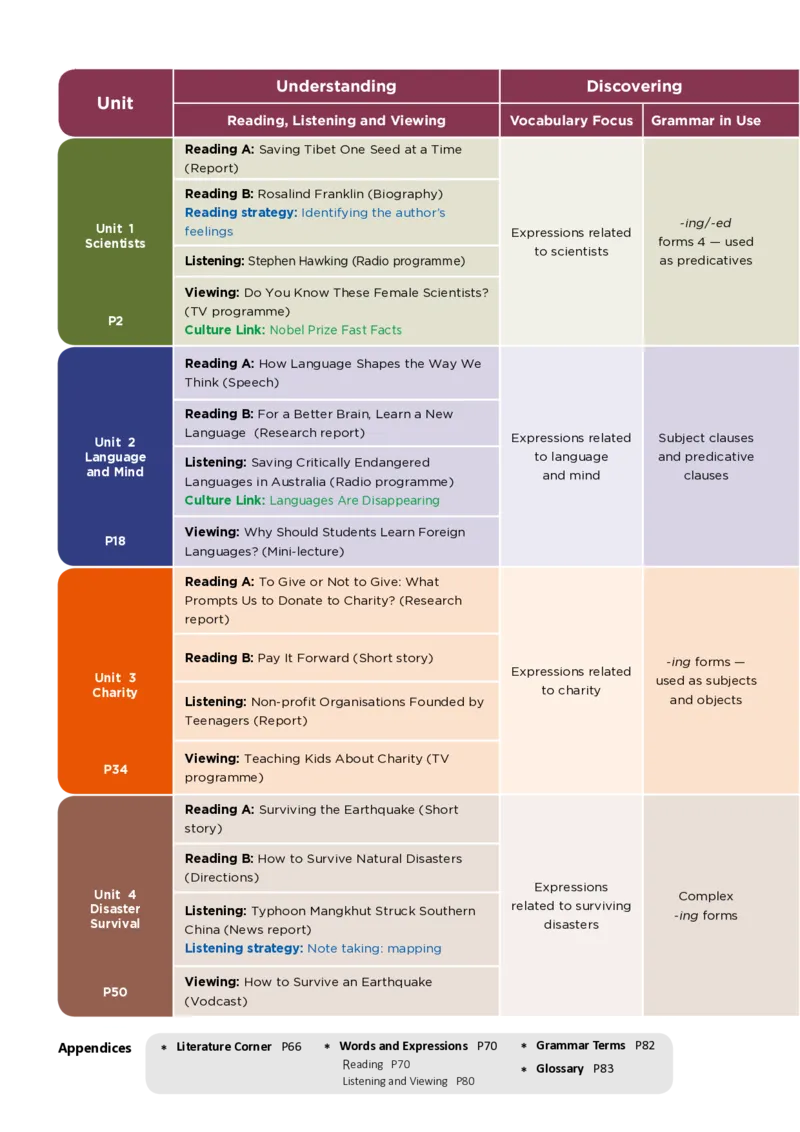
第二册Understanding Discovering Producing Extending
Unit
Reading, Listening and Viewing Vocabulary Focus Grammar in Use Speaking Writing Critical Thinking Further Exploration
Reading A: Saving Tibet One Seed at a Time
(Report)
Reading B: Rosalind Franklin (Biography)
Descriptive writing:
Reading strategy: Identifying the author’s
-ing/-ed Writing a descriptive Analysing and Creating a full-colour
Unit 1 feelings Expressions related Recommending stories
Scientists forms 4 — used essay to share your evaluating people’s booklet of a group of
to scientists of scientists
Listening: Stephen Hawking (Radio programme) as predicatives experience of exploring attitudes Chinese scientists
science
Viewing: Do You Know These Female Scientists?
(TV programme)
P2
Culture Link: Nobel Prize Fast Facts
Reading A: How Language Shapes the Way We
Think (Speech)
Giving a presentation
Reading B: For a Better Brain, Learn a New
on the possible effects of Argumentative writing:
Language (Research report)
Expressions related Subject clauses learning a foreign Writing an Collecting information
Unit 2
Analysing cause-effect
Language to language and predicative language argumentative essay about dialect protection
Listening: Saving Critically Endangered relationships
and Mind and mind clauses on an additional foreign in China
Languages in Australia (Radio programme)
Speaking strategy: language course
Culture Link: Languages Are Disappearing
Signalling a transition
Viewing: Why Should Students Learn Foreign
P18
Languages? (Mini-lecture)
Reading A: To Give or Not to Give: What
Suggesting
Prompts Us to Donate to Charity? (Research
a creative charity
report)
event for your school
Narrative writing:
Reading B: Pay It Forward (Short story)
-ing forms — Speaking strategy: Exploring charity
Expressions related Writing a narrative Evaluating from
Unit 3 used as subjects Expanding on traditions of ancient
Charity to charity to share your experience different perspectives
Listening: Non-profit Organisations Founded by and objects your ideas China
of helping others
Teenagers (Report)
Culture Link:
Viewing: Teaching Kids About Charity (TV Some Creative
P34
programme) Charity Events
Reading A: Surviving the Earthquake (Short
story)
Reading B: How to Survive Natural Disasters Creating a
Conducting a survey
(Directions) Expository writing: personalised plan
Expressions about residents’
Unit 4 Complex Writing an expository Role-playing in a disaster
Disaster Listening: Typhoon Mangkhut Struck Southern related to surviving awareness of self-
-ing forms essay on a natural Culture Link: scene
Survival disasters protection methods in
China (News report)
disaster China International Search
natural disasters
Listening strategy: Note taking: mapping
and Rescue Team (CISAR)
Viewing: How to Survive an Earthquake
P50
(Vodcast)
P50
Appendices * Literature Corner P66 * Words and Expressions P70 * Grammar Terms P82
Reading P70
* Glossary P83
Listening and Viewing P80Map of the Book
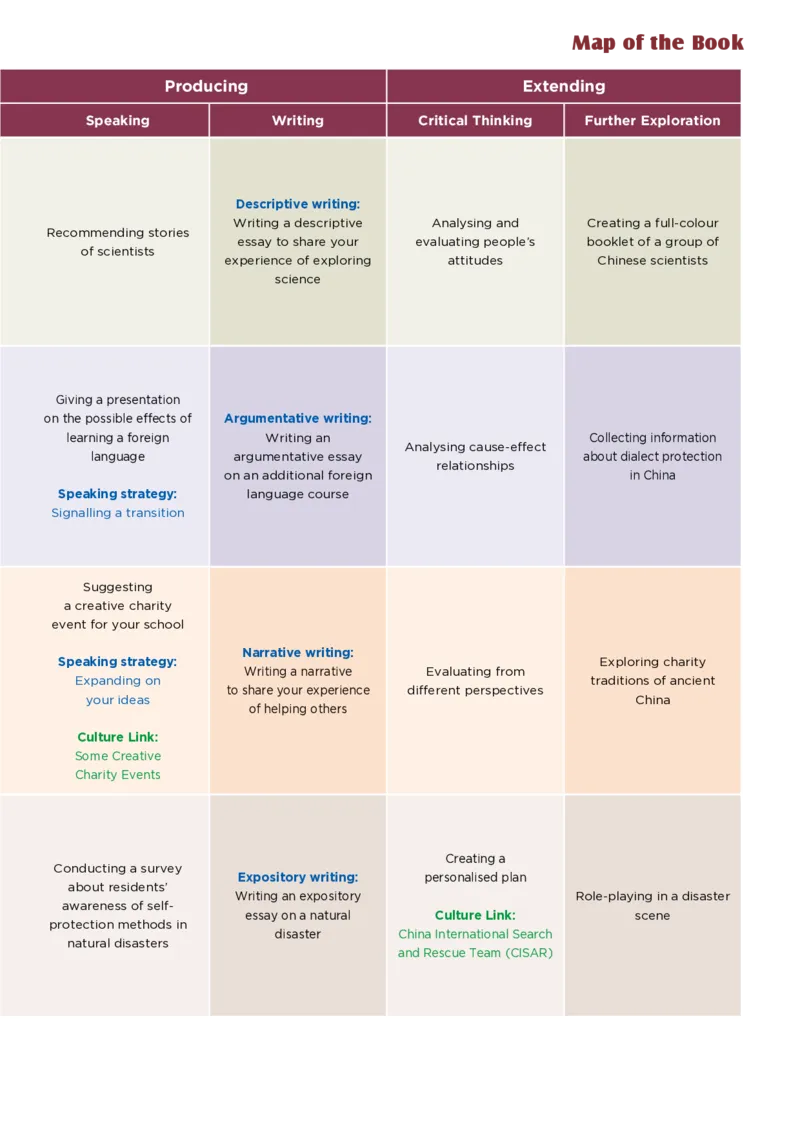
Understanding Discovering Producing Extending
Reading, Listening and Viewing Vocabulary Focus Grammar in Use Speaking Writing Critical Thinking Further Exploration
Reading A: Saving Tibet One Seed at a Time
(Report)
Reading B: Rosalind Franklin (Biography)
Descriptive writing:
Reading strategy: Identifying the author’s
-ing/-ed Writing a descriptive Analysing and Creating a full-colour
feelings Expressions related Recommending stories
forms 4 — used essay to share your evaluating people’s booklet of a group of
to scientists of scientists
Listening: Stephen Hawking (Radio programme) as predicatives experience of exploring attitudes Chinese scientists
science
Viewing: Do You Know These Female Scientists?
(TV programme)
Culture Link: Nobel Prize Fast Facts
Reading A: How Language Shapes the Way We
Think (Speech)
Giving a presentation
Reading B: For a Better Brain, Learn a New
on the possible effects of Argumentative writing:
Language (Research report)
Expressions related Subject clauses learning a foreign Writing an Collecting information
Analysing cause-effect
to language and predicative language argumentative essay about dialect protection
Listening: Saving Critically Endangered relationships
and mind clauses on an additional foreign in China
Languages in Australia (Radio programme)
Speaking strategy: language course
Culture Link: Languages Are Disappearing
Signalling a transition
Viewing: Why Should Students Learn Foreign
Languages? (Mini-lecture)
Reading A: To Give or Not to Give: What
Suggesting
Prompts Us to Donate to Charity? (Research
a creative charity
report)
event for your school
Narrative writing:
Reading B: Pay It Forward (Short story)
-ing forms — Speaking strategy: Exploring charity
Expressions related Writing a narrative Evaluating from
used as subjects Expanding on traditions of ancient
to charity to share your experience different perspectives
Listening: Non-profit Organisations Founded by and objects your ideas China
of helping others
Teenagers (Report)
Culture Link:
Viewing: Teaching Kids About Charity (TV Some Creative
programme) Charity Events
Reading A: Surviving the Earthquake (Short
story)
Reading B: How to Survive Natural Disasters Creating a
Conducting a survey
(Directions) Expository writing: personalised plan
Expressions about residents’
Complex Writing an expository Role-playing in a disaster
related to surviving awareness of self-
Listening: Typhoon Mangkhut Struck Southern
-ing forms essay on a natural Culture Link: scene
disasters protection methods in
China (News report)
disaster China International Search
natural disasters
Listening strategy: Note taking: mapping
and Rescue Team (CISAR)
Viewing: How to Survive an Earthquake
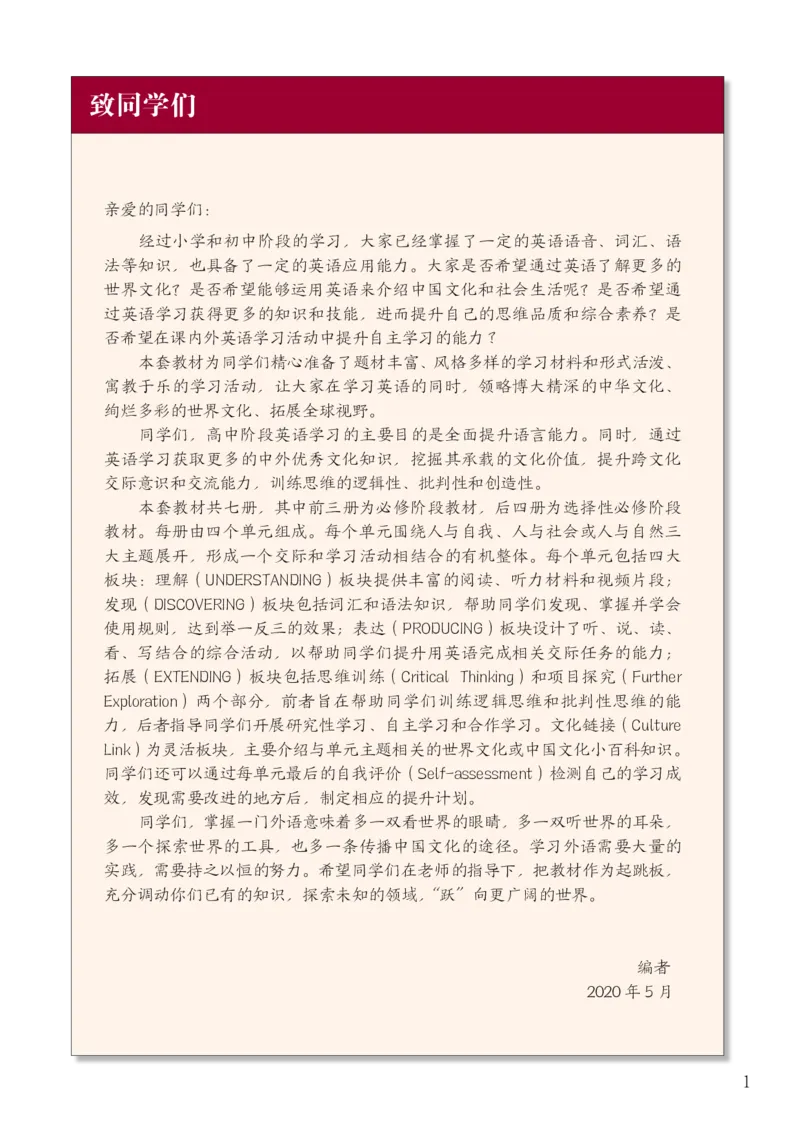
(Vodcast)致同学们
亲爱的同学们:
经过小学和初中阶段的学习,大家已经掌握了一定的英语语音、词汇、语
法等知识,也具备了一定的英语应用能力。大家是否希望通过英语了解更多的
世界文化?是否希望能够运用英语来介绍中国文化和社会生活呢?是否希望通
过英语学习获得更多的知识和技能,进而提升自己的思维品质和综合素养?是
否希望在课内外英语学习活动中提升自主学习的能力 ?
本套教材为同学们精心准备了题材丰富、风格多样的学习材料和形式活泼、
寓教于乐的学习活动,让大家在学习英语的同时,领略博大精深的中华文化、
绚烂多彩的世界文化、拓展全球视野。
同学们,高中阶段英语学习的主要目的是全面提升语言能力。同时,通过
英语学习获取更多的中外优秀文化知识,挖掘其承载的文化价值,提升跨文化
交际意识和交流能力,训练思维的逻辑性、批判性和创造性。
本套教材共七册,其中前三册为必修阶段教材,后四册为选择性必修阶段
教材。每册由四个单元组成。每个单元围绕人与自我、人与社会或人与自然三
大主题展开,形成一个交际和学习活动相结合的有机整体。每个单元包括四大
板块:理解(UNDERSTANDING)板块提供丰富的阅读、听力材料和视频片段;
发现(DISCOVERING)板块包括词汇和语法知识,帮助同学们发现、掌握并学会
使用规则,达到举一反三的效果;表达(PRODUCING)板块设计了听、说、读、
看、写结合的综合活动,以帮助同学们提升用英语完成相关交际任务的能力;
拓展(EXTENDING)板块包括思维训练(Critical Thinking)和项目探究(Further
Exploration)两个部分,前者旨在帮助同学们训练逻辑思维和批判性思维的能
力,后者指导同学们开展研究性学习、自主学习和合作学习。文化链接(Culture
Link)为灵活板块,主要介绍与单元主题相关的世界文化或中国文化小百科知识。
同学们还可以通过每单元最后的自我评价(Self-assessment)检测自己的学习成
效,发现需要改进的地方后,制定相应的提升计划。
同学们,掌握一门外语意味着多一双看世界的眼睛,多一双听世界的耳朵,
多一个探索世界的工具,也多一条传播中国文化的途径。学习外语需要大量的
实践,需要持之以恒的努力。希望同学们在老师的指导下,把教材作为起跳板,
充分调动你们已有的知识,探索未知的领域,“跃”向更广阔的世界。
编者
2020 年 5 月
121
Unit
Scientists
Look deep into nature, and then you will
understand everything better.
— Albert Einstein
Getting Started
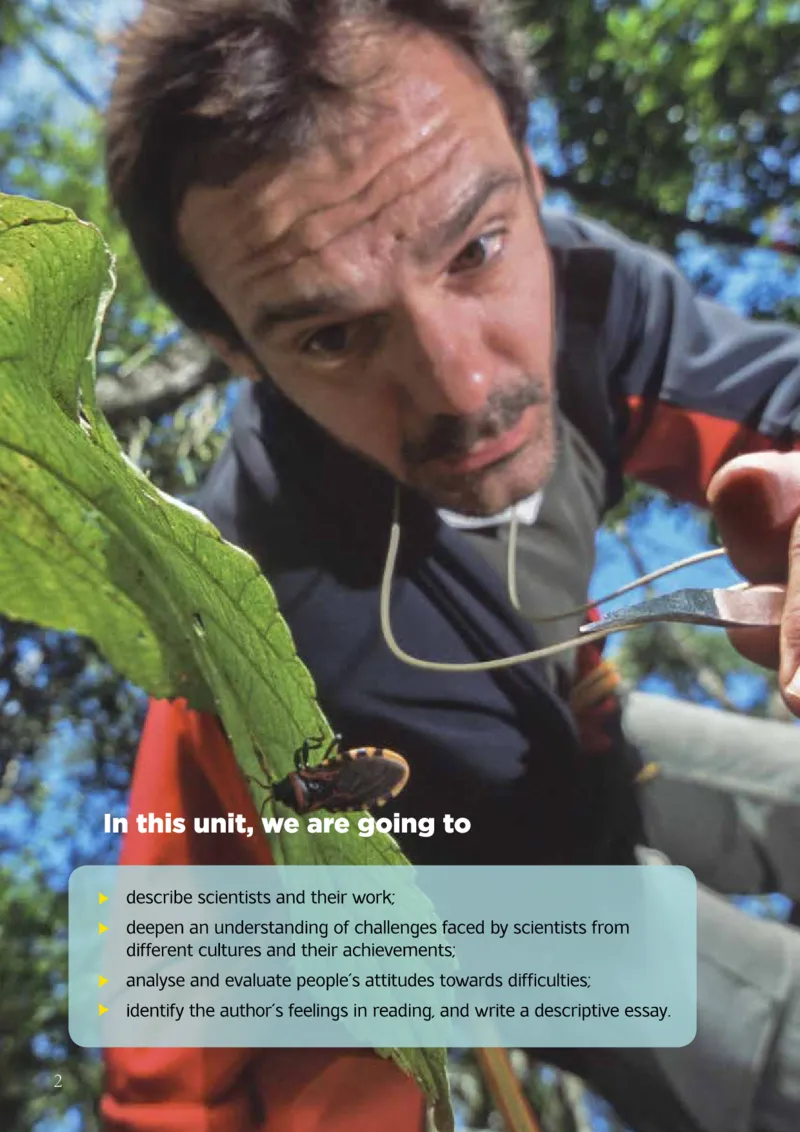
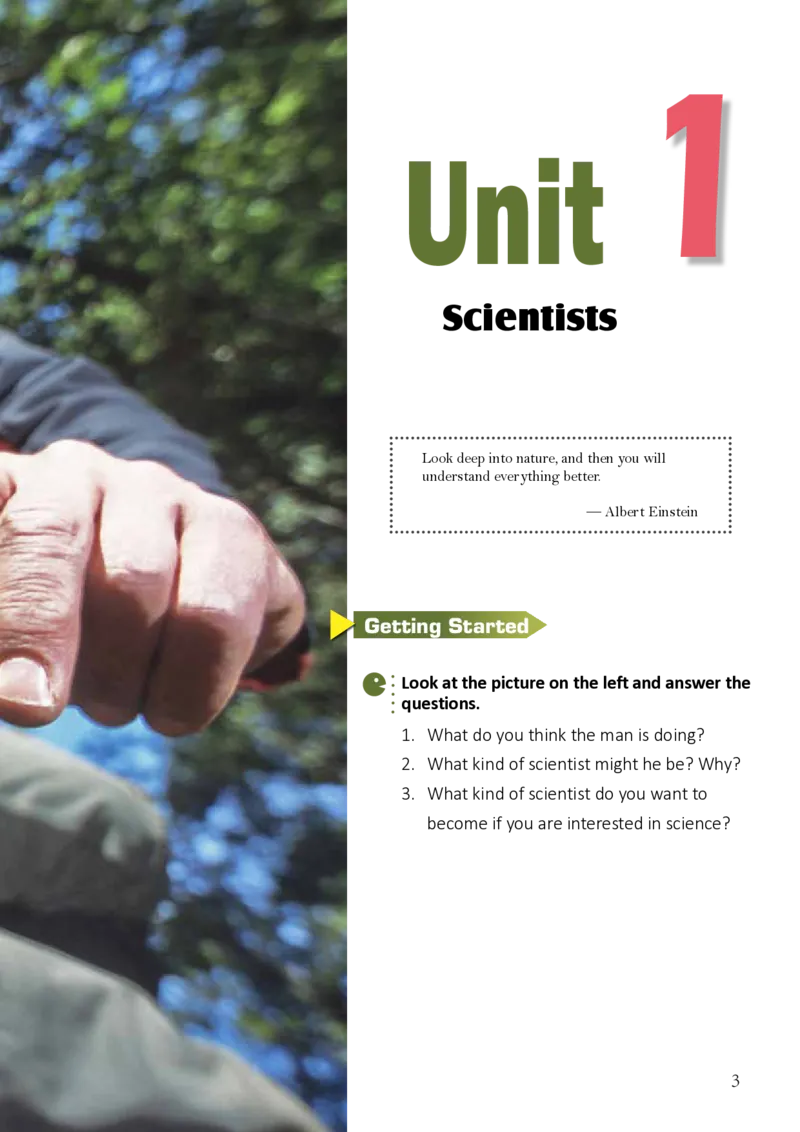
Look at the picture on the left and answer the
questions.
1. What do you think the man is doing?
2. What kind of scientist might he be? Why?
3. What kind of scientist do you want to
become if you are interested in science?
3READING A
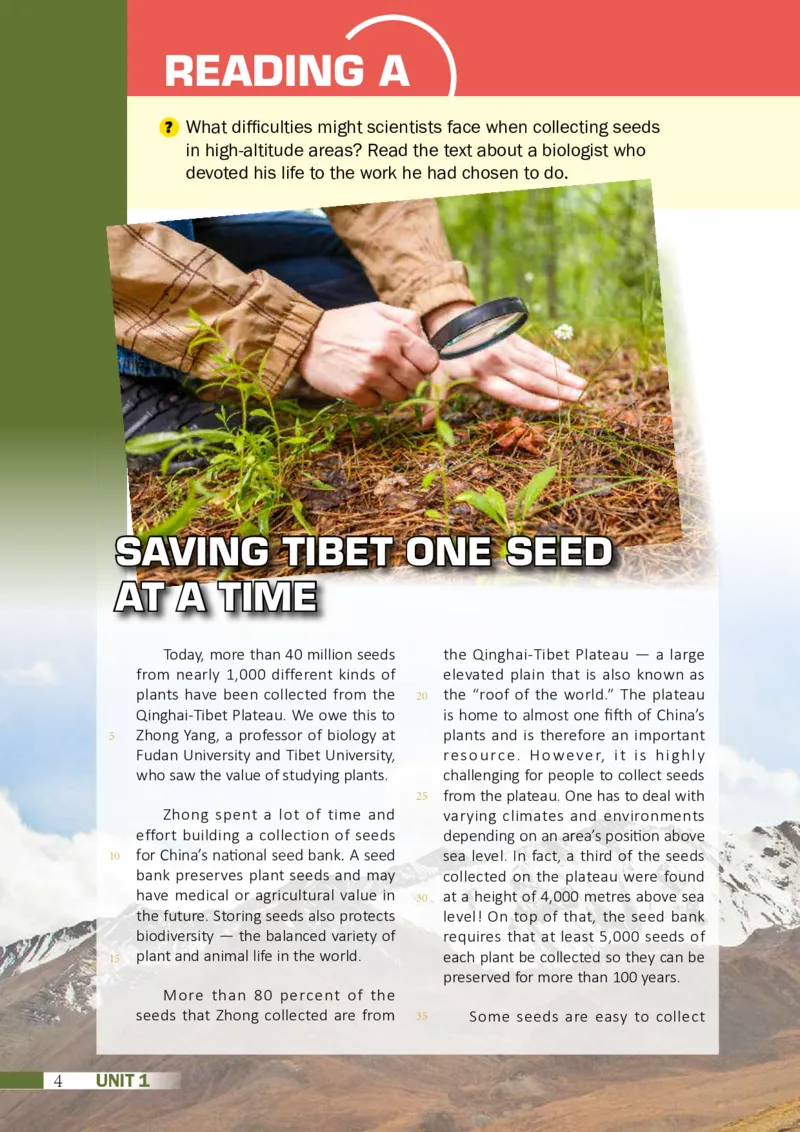
? What difficulties might scientists face when collecting seeds
in high-altitude areas? Read the text about a biologist who
devoted his life to the work he had chosen to do.
SAVING TIBET ONE SEED
AT A TIME
Today, more than 40 million seeds the Qinghai-Tibet Plateau — a large
from nearly 1,000 different kinds of elevated plain that is also known as
plants have been collected from the 20 the “roof of the world.” The plateau
Qinghai-Tibet Plateau. We owe this to is home to almost one fifth of China’s
5 Zhong Yang, a professor of biology at plants and is therefore an important
Fudan University and Tibet University, resource. However, it is highly
who saw the value of studying plants. challenging for people to collect seeds
25 from the plateau. One has to deal with
Zhong spent a lot of time and varying climates and environments
effort building a collection of seeds depending on an area’s position above
10 for China’s national seed bank. A seed sea level. In fact, a third of the seeds
bank preserves plant seeds and may collected on the plateau were found
have medical or agricultural value in 30 at a height of 4,000 metres above sea
the future. Storing seeds also protects level! On top of that, the seed bank
biodiversity — the balanced variety of requires that at least 5,000 seeds of
15 plant and animal life in the world. each plant be collected so they can be
15
preserved for more than 100 years.
More than 80 percent of the
seeds that Zhong collected are from 35 Some seeds are easy to collect
4 UNIT 1
45while others are more difficult. One also believed in improving education
seed that is hard to collect is from a there. “After staying some years in
special species of peach. In order to get Tibet, I have realised that Tibet needs
5,000 seeds, Zhong and his students 60 an educator more than a biologist,”
started eating the peaches, lots of the Zhong once said. As a biology professor
40
peaches. “Since there is no suitable at Tibet University, Zhong helped
machine available for collecting the pits, to develop programmes of study in
we have to eat the peaches, which taste biology and other sciences.
awful. But this is the safest way to get
45 the seeds,” Zhong said. 65 Zhong first started his work in Tibet
in 2001 and worked on his research
Every year, Zhong and his students until he died in an unfortunate car
walked at least 10,000 kilometres to accident in 2017. Zhong was aware that
collect seeds. They sometimes fell ill his research had touched only the “tip
because they had plant allergies. Also, 70 of the iceberg.” There was so much
50 to save time, Zhong and his students more to do.
ate only one meal a day while travelling
to the mountains. Despite all these “I have never regretted being a
hardships, they persisted. scientist,” Zhong once said. “Imagine
what you do today will benefit many
Zhong spent countless hours people, even after you die. Everything
75
55 collecting seeds in Tibet. While he difficult is worth the price.”
was deeply devoted to this work, he
Personal Touch
Do you find Zhong Yang’s story impressive? Why?
Scientists 5Digging In
Comprehension
I. Fill in the blanks according to the text.
More than 40 million seeds from nearly 1,000 different
Zhong Yang's major
kinds of plants have been collected from the
contribution as a scientist
(1) _______________.
Zhong spent a lot of time and effort (2) _______________.
Zhong's work in Tibet
Zhong was also devoted to (3) _______________
at Tibet University.
Zhong's attitude towards
Zhong never regretted (4) _______________.
science
II. Answer the questions.
1. Why is it important to build seed banks?
2. What challenges did Zhong Yang and his team face when collecting seeds in Tibet?
3. What did Zhong do as an educator in Tibet?
4. Why did Zhong never regret choosing his career?
III. Fill in the blanks with evidence from the text to support the statement about
Zhong Yang. An example is given.
Statement:
Zhong was very hard-working and tough.
Evidence:
● He had to deal with varying climates and environments depending on an area’s
position above sea level.
● __________________________________________________________________
● __________________________________________________________________
…
IV. What other qualities do you think Zhong Yang had as a scientist and educator?
Support your opinion with evidence from the text.
6 UNIT 1Vocabulary Focus
I. Key Vocabulary
Match the words or expressions with their definitions. Then fill in each blank with
one of the words or expressions in its appropriate form to complete the passage.
(1) plain a. the small hard part produced by a plant, from
which a new plant can grow
(2) (be) devoted to b. the study of the life and structure of plants and
animals
(3) challenging c. to do good to
(4) variety d. a large area of flat land
(5) biology e. marked by differences
(6) seed f. suddenly become ill
(7) varying g. to have sth because of the help or influence of sb
or sth
(8) benefit h. giving sb or sth a lot of love and attention
(9) fall ill i. difficult in a way that tests one's ability
(10) owe j. different kinds of sth
Today, more than 40 million seeds have been collected from the Qinghai-Tibet
Plateau. We 1 ______________ this to Zhong Yang, a professor of 2 ______________.
Zhong arrived in Tibet in 2001 to collect seeds for scientific purposes. His work provided
a great start to China’s national seed bank. A seed bank stores plant seeds and may have
medical or agricultural value in the future. It can also protect biodiversity — the balanced
3 _____________ of plants and animals.
Zhong and his students spent a lot of time and effort collecting seeds from the
Qinghai-Tibet Plateau — a large elevated 4 _______________ that is also known as the
“roof of the world.” The work was highly 5 _______________ for Zhong and his team.
They had to deal with 6 ______________ climates and environments there. Some
7 _____________ grow at high altitudes and Zhong and his students had to walk a long
way to collect them. They sometimes 8 ________________ because of plant allergies.
Despite all these difficulties, they continued their work.
While Zhong 9 _____________ collecting seeds in Tibet, he also spent a lot of time
improving education there. He worked as a biology professor at Tibet University and
helped to develop programmes of study in biology and other sciences.
Zhong never regretted being a scientist. He believed a scientist’s work could
10 _____________ all mankind.
Scientists 7II. Topic-Related Expressions
Fill in the blanks with the expressions given in the box to complete the passage.
Note that there are two more options than you need.
science fiction landing a spaceship online learning information age
scientific progress digital learning tools outside of labs outer space
scientific process computer technology
Science plays a major role in society. Because of science, human understanding of
the past, present, and future is continually changing. For example, decades ago the idea
of 1 _____________ on the moon would have seemed impossible. Today it is a mark of
2 _____________. Events once regarded as material for 3 _____________, such as landing
on Mars, now seem possible.
Science and technology can be found in nearly all aspects of everyday life. For example,
if electricity had never been discovered, telephones, lights, and televisions would not exist.
Advances in electronics have brought us into what is called the 4 _____________. Because
of 5 _____________, information can be processed in seconds.
At one time, computers were extremely expensive. They were rarely found
6 _____________ and large companies. But now computers can be found in many homes,
schools, stores and libraries. Computers are
also used in many places. They are used as
7 _____________ in schools, to monitor heating
systems at home and to guide satellites and space
research. In the future, computers may even have
microprocessors produced in 8 _____________.
Grammar in Use
-ing/-ed forms 4 — used as predicatives
I. Compare and tell the difference in the uses of the underlined parts in each pair of
sentences.
1. a. He spends a lot of time with animals every day. Studying animals is his job.
b. He spends a lot of time with animals every day. His job is studying animals.
2. a. The upcoming field trip got him worried.
b. He seemed worried about the upcoming field trip.
3. a. Zhong Yang was devoted to scientific work.
b. Zhong Yang was a devoted scientist.
4. a. It was frightening for him to carry out that dangerous experiment.
b. He felt frightened to carry out that dangerous experiment.
8 UNIT 1Grammar Highlights
The -ing and -ed forms of a verb can be used as
predicatives that provide specific information about the
subjects of the sentences. They usually come after linking
verbs: be, seem, get, look, become, appear, etc. For
example:
• His job is studying animals.
• The findings seemed amazing.
• All these mysteries remain unsolved.
II. Complete the dialogues with the -ing or -ed forms of the words given in brackets.
1. A: What’s wrong with our data?
B: I have no idea. The problem is quite _____________ (puzzle).
2. A: What’s your dream job?
B: My dream job is _____________ (explore) space. I always admire astronauts.
3. A: How did your parents react when they learned that you’d won the school
science prize?
B: They were _____________ (excite) at the news.
4. A: Why is Professor Chen upset?
B: Because he’s _____________ (disappoint) at the results of his patent application.
III. Complete the passage using the -ing or -ed forms of the given verbs.
travel let excite surprise know
The first living things to travel in space were not human beings. They were animals. It
sounds 1 _____________, doesn’t it?
In 1952, the United States sent two monkeys named Patricia and Mike into space.
Scientists wanted to see what would happen when the spaceship reached a height of
36 miles at a speed of 2,000 miles per hour. The findings seemed amazing. The monkeys
survived! The scientists were 2 _____________ to find out that living things could
survive the trip into space. Patricia and Mike landed safely and went to live at a park in
Washington, D.C.
A dog named Laika was 3 _____________ as the first living thing to travel
around the Earth in a spaceship. She was sent into space in 1957. Her job was
4 _____________ inside the spaceship and 5 _____________ scientists monitor her heart
rate, breathing, and blood pressure during the trip. In this way, the scientists were able to
learn about the effects of space travel on living things.
Animal astronauts helped pave the way for human astronauts. Thanks to these
animals, scientists learned that humans could survive space travel.
Scientists 9Listening, Viewing and Speaking
Stephen Hawking (Radio programme)
I. Answer the questions.
What do you know about Stephen Hawking? What is he famous for?
II. Listen and choose the best answer.
This passage mainly introduces Stephen Hawking’s ______________.
A. sufferings during his lifetime
B. sufferings and great achievements
C. attitudes towards science
D. best-selling books
III. Listen again and fill in each blank with what you hear.
He was diagnosed with a disease called amyotrophic lateral sclerosis, or ALS, at
the age of 21. At the time, doctors 1 _________ he would only live a few years. But
he proved them wrong by surviving for more than 50 years more and 2 _________
his scientific work.
The disease eventually put him in a wheelchair and took away his 3 _________ to
speak. For many years, Hawking 4 _________ by using a voice synthesizer.
In his 2013 book, My Brief History, Hawking wrote about first learning of the
illness: “I felt it was very 5 _________ — why should this happen to me?” He added: “At
the time, I thought my life was over and that I would never realise the potential I felt
I had.” “But now, 50 years later, I can be quietly 6 _________ with my life,” he wrote.
IV. Discuss the question.
What do you think is the relationship between suffering and success? Give your
reasons.
Do You Know These Female Scientists? (TV programme)
I. Answer the question.
Have you heard of any famous female scientists? Name a few.
II. Watch the video clip about four female scientists and match the scientists with
the descriptions.
1. one of the most important people in the
A. Marie Curie
development of modern computer software
2. one of the major contributors to the discovery of
B. Jane Goodall
the structure of DNA
3. a researcher on animal behaviour, especially
C. Grace Hopper
chimpanzee behaviour
D. Rosalind Franklin 4. a Nobel Prize winner for her achievements in two
different areas
10 UNIT 1III. Watch the video clip again and answer the questions.
1. Where did Marie Curie do most of her work?
2. What does Jane Goodall’s work show us?
3. Did Rosalind Franklin win a Nobel Prize? How does the speaker feel about this?
IV. Work in groups to discuss the questions.
Do you think scientific progress is always a good thing? Why or why not?
Culture Link
Nobel Prize Fast Facts
• Alfred Nobel, a notable Swedish chemist, established the prize in his will.
• Nobel Prizes are awarded for outstanding contributions in the areas of
physics, chemistry, physiology or medicine, literature, peace and economic
sciences. There is no Nobel Prize in Mathematics.
• Nobel Prize winners are called Nobel Laureates.
Recommending stories of scientists
Your school is going to hold a science festival. Your class is supposed to recommend
a list of stories about scientists. Talk with a partner and decide which stories to
recommend.
Step 1 Make a list of famous scientists and collect stories about them.
Step 2 Work in pairs. Share with your partner the basic information (main characters,
plots, writers, etc.) of the stories and make comments on them.
Step 3 Discuss which stories to recommend to the class. During the discussion, you may
give reasons for your recommendation.
EXAMPLE
A: What is your favourite story?
B: The story about Stephen Hawking.
A: Why do you like it?
B: I found it very engaging. I am quite impressed with his courage to face the
difficulties in life. I really think you should read it. Which story do you
recommend?
A: ...
Step 4 Each pair recommends stories of scientists to the class and explains why.
Useful Expressions
Asking for recommendations Giving recommendations
What do you recommend? Why don’t you ...?
Would you mind sharing your comments I highly recommend ...
on ...? You should ... when you have spare time.
What is your favourite ...? I really think you’ll like it.
Could you please make a recommendation You will find it interesting.
about what to ...?
Scientists 11READING B
ROSALIND FRANKLIN
Physical chemist Rosalind
Franklin discovered through an X-ray
photograph that the structure of DNA
was a double helix1. This discovery is
5 considered one of the most important
scientific advances in history. Over the
course of her career, Franklin had an
undying passion for science. Her work
eventually became the basis of many
10 other findings. Franklin returned to England
in 1951 to work as an X-ray
Rosalind Elsie Franklin was born 40 crystallography expert at King’s
in London, England on 25 July 1920. College London. She was assigned to
She came from an educated Jewish study the structure of DNA. However,
family. As a child, Franklin preferred her efforts often went unnoticed.
15 facts and reasons to stories and Women in the field of science were
make-believe. She knew she wanted to 45 not respected at that time. They could
be a scientist when she was 15. In 1941, not eat lunch in the same room with
Franklin graduated from university the male scientists and they were not
despite her father’s disapproval of invited to join in after-work discussions.
20 higher education for women. At the
young age of 26, Franklin had already As the only female on the DNA
published five papers on the physical 50 project, Franklin worked alone. She
structure of coal and carbon. Nothing was close to solving the DNA puzzle.
got in the way of her scientific research, Franklin’s skills in X-ray crystallography,
25 even though science was considered coupled with her “extreme clarity
a “man’s world.” During World War and perfection,” had resulted in the
II, Franklin continued to cycle to work 55 famous image — photograph 51.
while London was being bombed by But Franklin was very careful and
Germany. wanted more evidence. Without her
knowledge, Maurice Wilkins and two
30 In 1945, Franklin earned her other male scientists, James Watson
doctorate in physical chemistry from 60 and Francis Crick, got hold of her
Cambridge University. After that, she data. Soon after, Watson and Crick
worked in Paris. There, she mastered published their model of DNA based
a special X-ray technique called X-ray on Franklin’s photograph.
35 crystallography2, which eventually
became an important part of her Franklin eventually left King’s
research. 65 College in 1953 and began her most
12 UNIT 1famous work on viruses. Sadly, One of Franklin’s biggest problems
in 1956, Franklin found that she was gender inequality — the unfair
had cancer, but she continued to difference between the way men and
work until her death in 1958. Four women were treated. But she never
70 years later, in 1962, the three male 85 lost heart. She took up every challenge
scientists who took advantage of head-on so that she could do what
her data won a Nobel Prize for their she loved — and that was to be a
work on DNA. Franklin received no scientist.
credit even though she had provided
75 the crucial information that allowed
Watson and Crick to make their
breakthrough. If she were alive,
would Franklin have been recognised
for her work, alongside her fellow Notes
80 scientists?
1. double helix (see the picture above)
2. X-ray crystallography: a scientific
method used to see the three-
dimensional structure of crystals.
Comprehension Plus
I. Answer the questions.
1. What difficulties did Rosalind Franklin face?
2. Why was Franklin not awarded a Nobel Prize, despite the fact that she had
provided key data about DNA’s structure?
Reading Strategy Identifying the author’s feelings
3. How does the author feel about the difficulties Franklin faced as a female
scientist? Find evidence from the text to support your answer.
II. Fill in the table with key information about Rosalind Franklin’s life and career.
Time Event(s)
1920 Rosalind Franklin was born in London.
1941
1945
1951–1953
1956
1958
1958
Scientists 13Critical Thinking
Analysing and evaluating
people’s attitudes
I. Reflect on what you have learned about Zhong Yang, Stephen Hawking and Rosalind
Franklin in this unit. Fill in the table with the difficulties they faced, how they dealt
with these difficulties and their qualities as scientists.
What difficulties How they dealt with What qualities they
they faced the difficulties had as scientists
Zhong Yang
Stephen Hawking
Rosalind Franklin
II. What other qualities do you think are important for scientists? Give your reasons.
The following qualities are given as examples.
• brain power (intelligence/talent)
• curiosity
• creativity
• communication skills in writing and speaking
• courage in the face of hardship or prejudice
14 UNIT 1Writing
Writing a descriptive essay to share your
experience of exploring science
The science society in your school is celebrating its 4th
anniversary next month. You are asked to write about a
personal experience of exploring science. It could be a
scientific lecture you attended, an experiment you did
in school or at home, a visit to a science and technology
museum, a science game you played with friends, etc.
Here is a piece of descriptive writing about an
unforgettable experience. Note the detailed descriptions
used in this writing.
Our class visited a science fair last week. I was so excited
that I couldn’t sleep the night before! This experience still
remains fresh in my mind.
We arrived at the science fair in the morning. The place
was overcrowded with students from different schools. I
saw handmade models of motor cars, trains, ships, aircraft, Sensory
details
X-ray machines, etc. What interested me most was a model
of a human body powered by electricity. The workings of
the heart, lungs and other organs of the body were displayed
vividly before my eyes.
“That’s so cool!” I said excitedly.
The inventor glowed with pride. “I’m always fascinated
by how our body works. Our biology and physics classes
Dialogues
have really helped a lot!”
“That’s amazing! I hope I can come here with my model
train next year.”
We left the fair with a feeling of joy and wonder. I will
definitely visit the science fair again!
Scientists 15Guided Writing
Descriptive writing
The main purpose of descriptive writing is to describe a person, place or thing in
such a way that a picture is formed in the reader’s mind. The success of descriptive
writing lies in the details. There are two major ways to make detailed descriptions
— using dialogues and using five senses (sight, hearing, taste, touch and smell).
See the examples:
1. “Justin,” Mum shouted, “get in the room now!”
“Just a moment. I’ll be right there,” said Justin. (using dialogues)
2. Tall, slender, elegant, she was the picture of an African princess. (using the five
senses — sight)
3. She smelled of wet cigarettes and bacon. (using the five senses — smell)
4. The mother hugged the boy, breathing her hot breath onto his neck. (using the
five senses — touch)
5. Mr Jenkins was awakened by a sharp noise of a bat hitting a ball. (using the five
senses — hearing)
6. He could feel the taste of blood in his throat. (using the five senses — taste)
Step 1 Think of an experience you want to write about.
Step 2 List the details you want to describe in the table.
Sight
Smell
Sensory details Touch
Hearing
Taste
Dialogues
Other important
details
Step 3 Write a piece of descriptive writing in 100–120 words using the details suggested
above.
16 UNIT 1Further Exploration
Creating a full-colour booklet of a group of Chinese scientists
Work in groups to create a full-colour booklet of a certain group of Chinese
scientists. You may choose one of the following groups of scientists:
biologists, physicists, chemists, ecologists, geologists, psychologists, etc.
Key information to be included:
1. Title of the booklet
2. Name of the scientist
3. A picture of the scientist
4. Years living (examples: 1901–1959; 1973–?)
5. Birthplace
6. Three important facts about the scientist
7. A quote from the scientist
8. A paragraph introducing his/her contributions
(Note: one page for each scientist)
Self-assessment
Look at the expected learning outcomes of this unit. Tick the items you think you
have done well.
A. Understanding sufferings and great achievements of scientists
B. Talking about the life and work of some famous scientists
C. Creating a full-colour booklet of a group of scientists
D. Analysing and evaluating scientists’ attitudes towards difficulties
E. Identifying the author’s feelings in reading
F. Writing a descriptive essay about my personal experience of exploring science
Write a reflective note on what you think you need to improve. You may include
some or all of the following points:
What you still find difficult Possible cause(s) of the problem(s)
Your plan to solve the problem(s) Learning resources that you could use
Scientists 17182
Unit
Language and Mind
The limits of my language are the limits of my
universe.
— Johann Wolfgang von Goethe
Getting Started
Below are some benefits of learning a new
language. Based on your experience of
learning English, which of them do you find
to be true? Explain why.
1. improving your memory
2. improving your concentration
3. building your willpower
4. improving your learning ability
19READING A
? There are about 7,000 languages spoken around the
world — and they all have different sounds, words and
structures. But do they shape the way we think? Lera
Boroditsky suggests an answer.
HOW LANGUAGE SHAPES
THE WAY WE THINK
About 7,000 languages are Here are some of my favourite
spoken around the world. And all the 20 examples. I’ll start with one from an
languages differ from one another Aboriginal community in Australia,
in all kinds of ways. That begs this the earliest people who lived in the
5 ancient question: does the language country. The Kuuk Thaayorre people
we speak shape the way we think? don’t use words like “left” and “right.”
Charlemagne, Holy Roman emperor, 25 Instead, they use: north, south,
said, “To have a second language is east, and west. Thus, they would say
to have a second soul.” –– a strong something like, “Oh, there’s an ant on
10 statement that suggests that language your southwest leg.” Or, “Move your
affects reality. On the other hand, cup to the north-northeast a little bit.”
Shakespeare’s Juliet says, “What’s 30 In fact, people who speak languages
in a name? A rose by any other like this are more aware of where they
name would smell as sweet.” –– this are in the world.
15 suggests that language does not
shape reality. Whether language Languages differ in how they
shapes reality has been debatable for express colours. Some languages
thousands of years. 35 have lots of words for colours, while
20 UNIT 2some have only a couple of words –– how language can shape things
“light” and “dark.” For example, in that have personal significance for
English, there is a word for blue, but us — ideas like blame and pun-
in Russian, there isn’t just one word. 70 ishment.
40 Instead, Russian speakers have to tell
There is such a beautiful variety
the difference between light blue,
of language and it reveals just how
“goluboy,” and dark blue, “siniy.” When
brilliant and flexible the human mind
we test people’s ability to recognise
is. I want to leave you with this final
the differences between these colours,
75 thought. I’ve told you about how
45 we find that Russian speakers are
speakers of different languages think
faster.
differently. But, it’s not about how
Languages also differ in how they people elsewhere think. It’s about
describe accidents. In English, it’s how you think. And that gives you
fine to say, “He broke the vase.” In 80 the opportunity to ask, “Why do I
50 a language like Spanish, you might think the way that I do?”
be more likely to say, “The vase
broke,” or, “The vase broke itself.” If
it is an accident, you wouldn’t say
that “someone” did it. So, people
55 who speak different languages will Note
pay attention to different things, This text was selected and adapted from a
depending on what their language talk given by Lera Boroditsky in 2017.
usually requires them to do.
I’ve given you a few examples of
60 how language can significantly shape
the way we think. Language can have
big effects, as we saw with space.
Language can also have really early
effects, as we saw in the case of colour.
65 They have an impact on our simple,
basic decisions. And finally, we saw
Personal Touch
How long have you been learning English? Has learning and using
English changed the way you see the world?
Language and Mind 21Digging In
Comprehension
I. Answer the questions.
1. What is the speaker’s point of view regarding the relationship between the
language(s) we speak and the way we think? Do you agree?
2. According to a study by the speaker (Boroditsky 2010), Chinese speakers use more
up-down terms (e.g. shang ge yue, xia yi zhou) to talk about time than English
speakers, who often use left-right terms (e.g. the following week). Could you think of
such expressions in English or Chinese?
3. Do you think our way of thinking also influences the language(s) we use? Why or
why not?
II. Complete the table by writing down corresponding examples of the claims.
Claim Example
Language can influence the way we think
about space.
Language can influence the way we
express colours.
Language can influence the way we
describe accidents.
III. The speaker used two quotes in support of the opposing statements regarding
the relationship between language and mind. Read the quotes below and put
them into the corresponding category. Add a quote to support the statement
you agree with.
Statement 1: Statement 2:
Language shapes the way we think. Language doesn’t shape the way we think.
A B
A. To have a second language is to have a second soul. — Charlemagne
B. What’s in a name? A rose by any other name would smell as sweet.
— William Shakespeare
C. Knowledge of languages is the doorway to wisdom. ― Roger Bacon
D. Words are the clothes thoughts wear. ― Samuel Beckett
E. The ability to think for one’s self depends upon one’s mastery of the language.
― Joan Didion
F. One more quote: ________________________________________.
22 UNIT 2Vocabulary Focus
I. Key Vocabulary
Fill in the blanks with the appropriate forms of the given words to complete the
passage. Note that there are two more options than you need.
What was the most beautiful thing someone has ever said to
you? It could have been just one sentence — one single sentence
that influenced your 1 _________ for a moment, or maybe even
a lifetime. There is more to our language than strict grammar,
words, spelling and 2 _________. There is a real power to it. Our
language creates a 3 _________ range of emotions and feelings.
The words we speak to other people and the thoughts we hear in
our minds add up and create our personal stories. Those stories
eventually create and 4 _________ our 5 _________. This is the
power of language. If you spend some time focusing on the
specific words people use to praise, complain and 6 _________,
you will see how a language 7 _________ in the realities it
creates. You may also 8 _________ the power of language if you
replace negative sentences like “I don’t want to always feel like
such a failure” with “I do want to feel secure and successful.”
You will have similar findings if you pay attention to examples
9 _________. They all show how language can 10 _________ shape
the way we think.
II. Topic-Related Expressions
Fill in the blanks with the appropriate forms of the given expressions to complete
the sentences. Note that there are two more options than you need.
pattern(s) of thought language contact strong statement mental activity
have an impact on second language early effects human brain
a variety of words recognise the difference
1. How a language groups various things and concepts will guide an individual’s
______________, including categorisation, memory, reasoning and decision-making.
2. Scientists have found that unborn babies are able to ______________ between two
languages. The babies they observed were able to distinguish between English and
Japanese even a month before they were born.
significantly
recognise
differ
structure
reality
affect
blame
soul
elsewhere
brilliant
effect
impact
Language and Mind 233. The ______________ is the most complex object on Earth. It is the source of all
thought and behaviour.
4. There is an interdependence between the input and the output in ______________
acquisition.
5. As with the Anglo-Saxon and Norman settlers of centuries past, the languages spoken
by today’s ethnic communities have begun to ______________ the everyday spoken
English of other communities.
6. ______________ often leads to language change.
7. There is a common belief that Eskimos have ______________ for snow. Repeating
this idea over and over does not turn it into a fact.
8. The ancient Greeks believed that the structure of language mirrored ______________.
Grammar in Use
Subject clauses and predicative clauses
I. Study the sentences and underline the subordinate clauses. What functions do they
have in the sentences?
EXAMPLE
subject
What has been argued for thousands of years is whether or not people speaking different
languages think differently.
predicative
1. It is accepted that our language and thought are both influenced by culture.
2. What the researchers have found is how brilliant and flexible the human mind is.
3. Whether language shapes the way we think has been a question for centuries.
4. A common belief is that any language can be learned with enough practice.
5. How language learning can benefit young learners has attracted a lot of researchers’
interest recently.
24 UNIT 2Grammar Highlights
The underlined clauses in the example in Exercise I act as the
subject and the predicative respectively. Since they serve the same
function as nouns, they are called noun clauses.
A noun clause normally begins with words such as that, how,
whether, what, whatever, when, which, whichever, who, whoever,
whom, whomever and why.
II. Read the passage and answer the questions by using subject or predicative clauses.
One of the oldest questions in the study of language involves how it influences
our thought. According to a highly debatable response from Benjamin Whorf, a
student of the famous linguist Edward Sapir, “Language not only influences thought,
but it determines thought as well.” The Sapir-Whorf hypothesis, at least in its
strongest form, has been rejected by many psychologists. After all, it’s not difficult to
come up with examples of thought that does not involve language. But a weaker form
of the hypothesis has yet to be challenged: the idea that the language we speak does
to a certain extent affect our thought.
1. What is one of the oldest questions in the study of language?
One of the oldest questions in the study of language is _______________________.
2. What is suggested in the Sapir-Whorf hypothesis?
It is suggested _______________________________________________________.
3. What has been proved by examples according to the passage?
It has been proved ___________________________________________________.
4. What has yet to be challenged?
___________________________________ has yet to be challenged.
III. Answer the questions with information from the passage above, using subject or
predicative clauses.
1. What is the stronger form of the Sapir-Whorf hypothesis?
2. What is the weaker form of the Sapir-Whorf hypothesis?
3. What can be used as evidence to reject the stronger form?
Language and Mind 25Listening, Viewing and Speaking
Saving Critically Endangered Languages in Australia (Radio programme)
I. Answer the questions.
Do you know there are endangered languages in Australia?
Why should we save them?
Culture Link
II. Listen and answer.
Languages Are Disappearing
1. About how many languages
were spoken in Australia?
You probably know that much of the world’s environment
2. About how many languages is under threat, but you might not know that languages
are still spoken today in are disappearing alongside plants and animals. There are
Australia? around 7,000 living languages in the world, but UNESCO
3. When did Europeans arrive predicts more than half will have disappeared by the end
in Australia? of the century. If a language dies out, much knowledge
4. How many languages are goes with it. There are plenty of linguists who are studying
considered “alive” and in and trying to save the world’s dying languages.
daily use in Australia?
III. Listen again and complete the diagram.
Language is a central part of the (1) _________
of Australia’s Aboriginal communities.
Language helps them understand their Language also gives them
(2) _________, history and (3) _________. a strong (4) _________.
Why Should Students Learn Foreign Languages? (Mini-lecture)
I. Watch the video clip in silent mode and try to answer the questions.
1. What is the possible relationship between the two boys?
2. What were they busy doing?
II. Watch the video clip again with sound and answer the questions.
Did the boys both succeed in what they were doing? Why?
III. Watch the video clip once more and complete the table.
Name Similarities Differences
During his free time, John involved himself in
John (2) ______________ while he also managed to
Both of them like
learn (3) ______________ of his choice.
playing basketball.
They have similar
Matt is as (4) ______________, but he wasted
Matt (1) ______________. most of his time doing nothing, just
(5) ______________.
26 UNIT 2IV. Pick out the items that are the benefits of learning a foreign language based on
what you have watched.
□ 1. enhancing a global mindset
□ 2. getting high scores in exams
□ 3. developing the ability to appreciate other cultures
□ 4. improving thinking and life skills
□ 5. being employed by the best organisations
□ 6. getting into a good college
□ 7. studying in the best universities abroad
Giving a presentation on the possible effects of learning a foreign language
Work in groups. Give a presentation on the possible effects of learning a foreign
language on the human mind.
Step 1 Brainstorm and list the possible advantages and disadvantages of learning a foreign
language.
Step 2 Give a presentation based on your discussion. Make sure the audience can easily
follow your argument. You may use the underlined parts in the passage below.
Speaking Strategy Signalling a transition
During a presentation, the speaker should guide the audience so they can easily follow
the argument as the speaker moves from one idea to the next. Speakers do this by using
expressions to clearly signal what idea will come next. These expressions are called
transitions. Apart from the underlined parts in the passage below, you can also use the
following expressions:
• Now that I’ve told you about … I’m going to explain …
• I’d like to move on to …
• Let me turn to …
Before the 1960s, speaking two languages was considered a factor that slowed a
child’s brain development by forcing them to spend too much energy distinguishing
between languages. A new study did show that reaction times and errors increased
for some students who speak two languages in cross-language tests. However, the
study also showed that the effort and attention needed to switch between languages
caused more activity in, and possibly strengthened, a part of the brain that plays a
large role in decision-making, problem-solving, switching between tasks and focusing.
So, while speaking two languages may not always make you smarter, it does make
your brain healthier, more complex and actively engaged.
Language and Mind 27READING B
FOR A BETTER BRAIN,
LEARN A NEW LANGUAGE
resonance imaging) scans at
the beginning of their studies,
and again after three months.
The researchers discovered
that brain structure changed
only in the language learning
group. The results suggest
that language learning is a
Learning a new language can promising way to keep the brain in
feel like doing magic. Suddenly, a shape and offers enhanced cognitive
whole other world opens up and you benefits that outperform other forms
discover a completely new side of 35 of study.
5 life. Of course, learning a language
Many of us dream of being able to
doesn’t happen through magic, but
focus better and, according to a study
rather through study. But the effect
published in the journal Brain and
this studying has on our brain is
Language, learning a new language
nothing short of magical. Here are
40 could help make that dream come
10 some highlights about how the brain
true. Using a language comprehension
changes during language learning.
task, researchers from Northwestern
It sounds like something a child University tested individuals who
may ask: does learning new things speak one or two languages. The
make my brain grow bigger? It turns 45 task involved listening to a word and
15 out this is what language learning then selecting the corresponding
does to the brain. Researchers from image from a group of four. It sounds
Lund University in Sweden studied a simple, but the trick was that each
group of students who went through group had a distracting word added to
a demanding language learning 50 it, which is a word that sounds similar
20 programme. For a control group, the to the target word. For example,
researchers selected students who “candy” versus “candle.” Individuals
were studying medicine and science. who speak two languages were better
Both groups were given MRI (magnetic at filtering out the distracting words.
28 UNIT 255 The results revealed that people who by an average of four years. The
only speak one language had to work 65 reason for this delay, the researchers
harder to complete the task. believe, is that learning a language
challenges our grey cells, which helps
Just like exercising your body,
prevent them from becoming worse
providing your brain with a workout
as we age.
60 has considerable health benefits.
Several studies have shown a link 70 Ready to give your brain a
between being bilingual and delaying workout?
the beginning of Alzheimer’s disease
Comprehension Plus
Complete the cause and effect tree diagram using options from the box below
based on the text you have read. Read more about language and mind. Write
down one more effect and discuss it in groups.
Damaging brain cells Developing the brain
Tuning out distractions Processing more information
Delaying Alzheimer’s disease
Effect 2:
Effect 3:
______________
__________________
Effect 1:
______________
One more effect:
___________________
Cause:
Learning a new language
Language and Mind 29Critical Thinking
Analysing cause-effect
relationships
I. The following is a PPT slide of a talk about the benefits of learning a new language.
It shows several possible effects of language learning. Find evidence for these effects
based on what you have learned in this unit.
Learning a new language may:
• change the way one perceives the world;
• enhance one's global mindset;
• change one's brain structure with better cognitive
performance;
• help one tune out distractions;
• enable one to fulfill complex tasks;
• delay the aging of one's brain.
II. Learning a foreign language not only strengthens one's mind, but also leads to many
other benefits. Discuss how language learning gives rise to the following benefits by
analysing the cause-effect relationships.
• developing better relationships with others
• deepening one's understanding of other cultures
• forming a global perspective
30 UNIT 2Writing
Writing an argumentative essay on an
additional foreign language course
Chen Kai has been learning English for eight years. He
can read books in English and do very well in tests. Last
summer, he watched a French film and was attracted by
the French language and culture. This made him eager to
learn French. However, no French course was offered at his
school. Chen was disappointed and wondered why English
was the only foreign language taught at his school.
Later, he came across a short essay in a local magazine.
Is English the Only Foreign Language Worth Learning?
Nowadays English is used in almost all fields of
international communication: business, politics, science,
claim
culture, etc. For this reason one may think that English is
the only foreign language worth learning to feel confident
in society. But is that really so? I strongly believe that high
school students in today’s globalised world should have
the opportunity to learn languages other than English.
Every language is worth learning because it is a key that
unlocks a world for us. It doesn’t matter if it’s French,
German, Spanish, Japanese, Korean, Hebrew or any other
language. Learning other foreign languages greatly increases
the number of people on the globe with whom you can
counterclaim
communicate. In conclusion, I would recommend to my
friends that they learn as many foreign languages as possible.
The languages we have learned and are learning are our
treasure — the treasure that cannot be taken from us.
Language and Mind 31Guided Writing
Chen decides to write a letter to his headmaster to persuade him to offer a French
course at school. Can you help him?
Step 1 Work in groups. Discuss whether there should be an additional foreign language
course for high school students. Write down opinions of each group member.
Step 2 Choose the strongest claim and counterclaim from your notes.
Argumentative writing
claim and counterclaim
A claim is a statement that something is true or is a fact, although other people might
not believe it.
A counterclaim is a statement that someone makes in response to a different
statement made by someone else.
Step 3 Write a persuasive letter to the headmaster in 100–120 words. Use claim(s) and
counterclaim(s).
Dear __________,
_______________________________________________
_______________________________________________
_______________________________________________
_______________________________________________
_______________________________________________
_______________________________________________
Yours sincerely,
Chen Kai
32 UNIT 2Further Exploration
Collecting information about dialect protection in China
Nowadays, many Chinese dialects are spoken by a much smaller population
than decades ago. In different places in China, efforts are being made to protect
disappearing dialects. Collect information on this topic.
Step 1 Search the Internet for articles reporting on dialect protection in China. Download
one article and note down the main idea(s).
Step 2 Summarise the article in no more than three sentences.
Step 3 Discuss the articles in groups. Decide on the best example and report it to the
class. Present your notes in a table, as shown below.
Case Place Measures
1. In addition to Putonghua, the Shanghai dialect is also used in
announcements on buses in Shanghai.
Sample case Shanghai 2. Some radio and television programmes are launched in the Shanghai
dialect.
3. Research into the Shanghai dialect is carried out by linguists.
Your case
Your group’s case
Self-assessment
Look at the expected learning outcomes of this unit. Tick the items you think you
have done well.
A. Understanding and discussing the impact of the language we speak on the
way we think
B. Talking about the benefits of learning foreign languages
C. Collecting information about dialect protection in China
D. Analysing cause-effect relationships between language learning and its
possible effects
E. Giving a presentation on the possible effects of language learning using transitions
F. Writing an argumentative essay containing claim(s) and counterclaim(s)
Write a reflective note on what you think you need to improve. You may include
some or all of the following points:
What you still find difficult Possible cause(s) of the problem(s)
Your plan to solve the problem(s) Learning resources that you could use
Language and Mind 33343
Unit
Charity
When one is good to others, they will be
good to him too.
— Guan Zhong
Getting Started
Read the poem and answer the questions.
Charity
In charity lies happiness and bliss. If
you haven’t done charity, you may
miss the power to love and
share. Charity gives you
happiness beyond
compare.
What does “Charity gives you happiness
beyond compare” mean? Do you agree?
Give your reasons.
35READING A
? Why do people usually give to charity? Read
the text and find out some major factors that
affect people’s decisions.
TO GIVE OR NOT TO GIVE:
WHAT PROMPTS US TO DONATE TO
CHARITY?
You are looking at a website and According to a new study,
an advertisement jumps out, asking published in the Journal of Consumer
for donations to people in need of Research, a major factor that may
warm clothes. You pay for a few items 20 determine whether or not we
5 at a drugstore and the clerk asks if donate is where we stand on two
you’d like to donate school supplies to moral traits: empathy and a sense of
less fortunate children. You receive an justice. Although both are positive
email and find out you’ve been asked characteristics, they often appear to
to do the ALS Ice Bucket Challenge1. 25 pull us in two different directions. Trying
to keep a balance can be tricky and,
10 Opportunities to give money to depending on the situation, we often
people who need help are every- lean more towards one over the other.
where. But which situations prompt
you to reach for your wallet? Does it For example, if you believe that
depend on your mood? Your excess 30 a homeless man has caused his own
15 cash that month? Does it depend on misfortune and you are pretty sure
who’s watching? he could have made better choices
36 UNIT 3than he did, then you will probably 60 Although there are several factors
lean towards not giving any money. On we take into account before donating
35 the other hand, if you can relate to the to a charity, the research confirms
pain that would cause him to slip into the immense power of empathy. It’s
the hopeless situation — whether or empathy that connects us to one
not you actually had the same terrible 65 another and prompts us to reach out.
experiences as he did — then you Suffering is universal. In fact, any type of
40 would probably lean towards empathic suffering can help us relate to another
giving, even if he did play a role in his person’s unique form of suffering,
own problem. prompting us to reach out and help.
For the study, researchers asked 70 In fact, when researchers asked the
people to donate to charities in which participants to recall their own past
45 the donors believed the sufferers were immoral behaviours, then they seemed
responsible for their own situation (such able to empathise more with those who
as those who cannot keep a job due to were suffering. As a result, they were
alcohol use). Results showed that some 75 more likely to donate.
participants considered it immoral to
50 give a donation to people who were
“responsible” for their own situation.
Furthermore, the participants who
felt this way and also felt themselves to
be highly moral were even less likely to
55 donate money. In other words, if they
felt that they almost always make moral
choices, then they seemed to feel less
empathic towards the sufferers and
were less likely to donate. Note
1. The ALS Ice Bucket Challenge is an activity
involving the dumping of a bucket of ice
and water over a person’s head to promote
awareness of the disease “amyotrophic lateral
sclerosis (ALS)” and encourage donations to
research.
Personal Touch
If you meet homeless people, will you give money to them? Why or
why not?
Charity 37Digging In
Comprehension
I. Fill in the blanks with information from the text. Add further factors that may
influence the decision whether to donate.
What determines whether or not you donate to a homeless person?
Information from the text Your opinion
According to a study,
_____________ are also
______ and _______ are two
important factors.
major factors.
If people _____________________
If people lean more towards _______,
____________________________,
they will be more likely to donate.
they will be more likely to donate.
If people lean more towards _______,
If people _____________________
they will be less likely to donate.
____________________________,
they will be less likely to donate.
II. Judge whether the following statements are true or false. Write T for “true” and
F for “false” and then find evidence from the text to support your judgement.
____ 1. Empathy is the major factor that determines whether or not we donate.
____________________________________________________________
____ 2. Many people manage to keep a balance between empathy and a sense of
justice while donating to some sufferers.
____________________________________________________________
____ 3. People are less likely to donate to a homeless man if they think he could
have made better choices.
____________________________________________________________
____ 4. Some participants thought donating to people who were responsible for
their own situation was immoral.
____________________________________________________________
____ 5. Most participants in the study chose to donate out of empathy.
____________________________________________________________
38 UNIT 3Vocabulary Focus
I. Key Vocabulary
Fill in the blanks with the appropriate forms of the given words to complete the
passage. Note that there are two more options than you need.
characteristic supply justice empathise responsible confirm
moral relate determine alcohol recall slip
Have you ever hesitated to give money to those who need help? According to
a new study, whether you are willing to give money may 1 _________ by two moral
traits: empathy and a sense of 2 _________. These two 3 _________ may let you make
completely different decisions. For example, you will be more likely to give money
to a homeless person if you 4 __________ to the pain that has caused him or her
to 5 __________ into the hopeless situation. However, if you think that he or she should be
6 _________ for his or her own misfortune, you may not regard it as 7 _________ to make
a donation to him or her.
Of course, the study 8 _________ that empathy has immense power among all
factors that motivate us to donate. That’s why most people in our life choose to give.
When we 9 _________ our own past wrong behaviours, we seem to be more able to
10 _________ with the sufferers and more likely to donate. And thus empathy is
important to connect us to one another.
II. Topic-Related Expressions
1. Find appropriate verbs to fill in the blanks.
______ a cardboard sign ______ moral choices
______ money (to charity) ______ for (your wallet)
______ empathic (towards) ______ out (to someone) and help
Charity 392. Complete the passage with the appropriate forms of the expressions in Exercise 1.
One evening during last Christmas season, I went to a store to buy some gifts
for my children. After checking out I noticed a small girl standing outside the
window, 1 _________ with the word “Hungry.” She looked almost the same age
as my daughter Katie. 2 _________, I was eager to 3 _________ her. I went to her
and asked what she wanted Santa to bring her.
“I don’t want Santa to bring me anything,” she answered. I was shocked by her
words and continued to ask why.
“I just want him to bring Mama something nice. We have no money and
Mama often cries worrying about things.”
Struck by the idea of such a small child, I 4 _________ immediately and
5 _________ my wallet and took out a $50 note. I gave the money to her and told
her to get Mama something nice.
I watched the girl running to her mama with the money and then walked away
before the woman could see me. This was not my first time to 6 _________ to
others, but I still felt happy on that special Christmas evening. And I hoped that
would be a special Christmas for the girl and her mama.
Grammar in Use
-ing forms — used as subjects and objects
I. Scan the text in Reading A and pick out the sentences in which the -ing forms function
as a subject and an object to fill in the blanks.
1. -ing form used as a subject: ______________________________________________
____________________________________________________________________
2. -ing form used as an object: ______________________________________________
____________________________________________________________________
40 UNIT 3Grammar Highlights
Like infinitives, -ing forms can function like nouns and be used as subjects or
objects of verbs. They can also be used as objects of prepositions.
1. Some verbs are normally followed by -ing forms as objects, such as admit,
avoid, consider, deny, enjoy, finish, mind, quit and suggest. For example:
● Could you come to my office after you finish cleaning the classroom?
● He suggested participating in the charity sale at the school.
2. Some verbs, like forget, regret, remember, try and stop, can be
followed by either -ing forms or infinitives, but they have
different meanings. For example:
● Jennifer always takes her own bag with her and has stopped
using plastic bags in supermarkets.
● Having worked for two hours, Johnny stopped to drink a cup
of coffee.
II. Note down what you infer from each of the dialogues by completing the
sentence on the right with an appropriate -ing form.
What can you infer from
Dialogue
the dialogue?
Erik: Do you think it’s a good idea to hold a
_____________ is a good idea
1 charity sale this weekend?
for Erik.
Alice: Yes, it is.
Monica: There’s a mountain village where
some of the parents can’t afford school Phil suggests _____________
2 supplies for their children. How can we help ________________________
them? ________________________.
Phil: We could raise some money for them.
Jim: You’ve been doing volunteer work in the
Ellen enjoys ______________
3 nursing home, haven’t you?
________________________.
Ellen: Yes, I have. I’m happy to help the elderly.
Irene: Did you go to the charity party last
Mike remembers __________
4 month?
_________________________.
Mike: Yes, I did, and I donated fifty dollars.
Cathy: Do you mind if we add a “Donate Now”
button to your web page? Jerry doesn't mind _________
5
Jerry: Not at all. I love helping with charity _________________________.
events.
Ann: Have you signed up for the charity
Charlie is looking forward to
marathon next week?
6 ________________________
Charlie: Yes, I have. I’ve been training for it for
________________________.
a month. I can’t wait!
Charity 41Listening, Viewing and Speaking
Non-profit Organisations Founded by Teenagers (Report)
I. Answer the question.
What is a non-profit organisation? Give examples.
II. Listen and choose.
What is the report mainly about?
A. Volunteering activities aimed at helping teenagers.
B. Charitable activities started by teenagers.
C. Foundations that help those who have trouble affording tuition fees.
D. Non-profit organisations helping homeless people.
III. Listen again and fill in the blanks.
Name: Jonas
Organisation: (1) ____________
Motivation: Jonas was inspired by his experience of seeing not only
(2) ________ but also (3) ________ in need.
Service: (4) ____________ young people to make a difference through
their volunteer commitment of providing (5) ____________
youth and their families with basic necessities.
Name: Annie
Organisation: (6) ____________
Motivation: She discovered there were many kids in (7) ____________
situations who had to leave their homes with very few of their
own (8) ____________.
Service: Creating and (9) ____________ fabric care bags filled with
(10) __________ and comforting items for needy children from
babies to 18-year-olds.
Teaching Kids About Charity (TV programme)
I. Answer the questions.
1. Did you know about charity as a kid?
2. How did you learn about charity for the first time?
II. Watch the video clip and fill in each blank with one word to complete the summary.
Teaching kids about charity is not easy. The mother in this video clip managed to do
this by speaking in simple terms that the kids 1 _________, letting them be part of the
2 _________ process, asking them who they would like to 3 _________ and how they
could 4 _________, and of course, making it 5 _________.
42 UNIT 3III. Watch the video clip again and answer the questions.
1. Why is it difficult to teach kids about charity?
2. How does the mother understand charity?
3. Why did the mother get the whole community together?
4. What is important when teaching children to become good citizens?
Suggesting a creative charity event for your school
Imagine your school is holding a charity event next weekend, and the school office
has asked for creative ideas about suitable charity events. Follow the steps below to
prepare a proposal.
Step 1 Brainstorm with your classmates and make a list of some creative charity events.
e.g. Bring our used books to school and give them to those who need them.
Step 2 Vote for the three most creative charity events.
Culture Link
Step 3 Expand on your ideas by giving detailed
Some Creative Charity Events
information about these three creative ideas
based on the discussion with your classmates.
• Dublin hosts a Women’s Mini
Refer to the speaking strategy and make clear
Marathon annually as a charity
why these three charity events are creative,
event and men often dress as
what the details for organising these events
women to join in the race.
are, how these events can benefit others and
• France is the first country in the
so on.
world to ban supermarkets from
EXAMPLE
throwing away unsold food,
I think donating used books is a good idea. forcing them instead to donate it
Everyone must have some books that they to charities.
don’t need any more. We can bring those • In 2011, a dog from Maryland
books to school and give them to those who ran a half marathon and raised
need them. Or we can sell these second-hand $13,000 for charity.
books to raise money for those who need help.
Speaking Strategy Expanding on your ideas
To expand on your ideas is to give more details about the ideas you put forward. You
can describe them in a detailed and ordered way by making clear:
what your ideas are;
why you came up with them;
what benefits they offer;
...
Step 4 Report your ideas to the school office after summing up the details about the three
charity events.
Useful Expressions
Summing up the ideas
To summarise, the top three creative ideas in our group are ...
To be specific, we think … is a good idea because …
I’d like to summarise my group’s ideas on ...
Here is a quick review of the main points. We discussed …
The idea emphasises the importance of charity in that …
Charity 43READING B
PAY IT FORWARD
Every fast-food employee knows
that the drive-through window is the The lady laughed, her cheeks
worst position. A fierce wind spits turning red with cold. “No, but I’ll buy
in your face as you sit at the frost- them,” she said. “Pay it forward and all
5 covered glass. You press the headset that.”
closer to your ear and repeat the
40 Completely shocked, I charged
order perfectly only to be greeted
her as requested, and when the
with a harsh “That’s not what I want!”
next customer arrived at the
I glared at my supervisor every time
window I explained what had just
10 she handed me the headset. I loved
happened. I watched as his facial
my job. But I hated that drive-through
45 expression changed like a succession
window.
of photographs on a slideshow —
It was a freezing Tuesday first disturbed to be out in the cold,
afternoon when everything changed. then surprised at the random act of
15 Every once in a while, the sub-zero kindness and finally, delighted by his
temperatures of northern Alberta seal 50 luck.
a vehicle’s windows shut. Drivers don’t “I suppose I’ll pay for the next
exactly enjoy having to stand outside order then,” he replied, nodding and
in the cold and screaming their orders waving at the impatient driver behind
20 into a speaker box, when they had him. He handed over the cash and
expected to drive through on their 55 received his pre-paid drink.
heated leather seats. In such cases,
The trend continued throughout
most customers tend to take out their
the entire rush hour. Customers
annoyance on the employees.
arrived annoyed and stressed, only to
25 This woman was different. leave humbled and calm. No one had
“I’ll get the next car’s order as 60 any idea how many drinks they would
well,” she said as she came up to the have to purchase. Some customers
window to pay. She stood outside, spent much more than they had
gathering snowflakes on her hair and expected, while others ended up
30 eyelashes. Though she was obviously receiving their order for less than half
freezing, her bright smile lit up her 65 the price.
face like a fire. Five cars passed, and then ten,
“You can’t take their drinks,” I said, then twenty. No one refused to pay.
confused and tired. My breath turned Customers stood at my window
35 into a thick fog around my face. emptying a handful of change to buy
44 UNIT 370 coffee for a complete stranger. Cars constant ice, the roar of engines hurts
rounded the bend as they drove off, your ears and your words are lost in
honking and waving their gratitude, 80 the roaring wind. But it only takes one
knowing that they would be unlikely customer, one person, to change the
to see each other again. entire flow of traffic. It only takes one
moment, one smile, to warm up even
75 Every fast-food employee knows
the coldest days.
that the drive-through window is the
worst position. The window sticks with
Comprehension Plus
I. Fill in the blanks to trace the emotional changes that the characters experienced.
A fierce wind spat in my face as I sat at the
drive-through window.
As a fast-food employee, I used to
(1) ________ the drive-through
I repeated the order perfectly only to be
window.
greeted with a(n) (2) ________ reply.
Most customers tended to take out their
(3) ________ on me.
“You can’t take their drinks,” I said to the lady,
(5) ________.
On a freezing Tuesday afternoon,
I was (4) ________ by a lady’s The lady (6) ________, her cheeks turning red
random act of kindness. with cold.
I explained to the next customer what had just
happened. He got (7) ________ at the lady’s
kindness and then (8) ________ by his luck.
The trend of paying for the next order
continued. Customers arrived (10) ________,
I was (9) ________ by the
only to leave (11) ________.
practice of paying it forward.
As they were driving off, customers honked and
waved to show their (12) ________.
II. Answer the questions.
1. Why did the narrator think the woman was different?
2. What does the narrator mean by saying “a succession of photographs on a slideshow”?
3. What made the woman and the other customers pay for the next car’s order?
4. How might the narrator feel differently about working at the drive-through
window after that “freezing Tuesday afternoon”?
5. How do you understand “It only takes one moment, one smile, to warm up even
the coldest days”?
Charity 45Critical Thinking
Evaluating from different
perspectives
I. Charity benefits not only the receivers but also the givers. Think of some charity
events or acts of kindness in this unit and list their positive effects in the table.
Positive Effects
Charity Event
or Act of Kindness
Receiver Giver
Getting prepared for school Feeling fulfilled after helping
Donating school supplies life and having more interest pupils get new school
in learning supplies
Paying for the next order
at a drive-through window
II. Develop the table by adding further examples of charity events or acts of kindness
not mentioned in this unit, and list their positive effects.
III. Refer to the table and think about who finds more happiness through charity, the
giver or the receiver. Then write down what you think.
The receiver is happier because __________________
___________________________________________
___________________________________________
___________________________________________
___________________________________________
OR
The giver is happier because _____________________
___________________________________________
___________________________________________
___________________________________________
___________________________________________
___________________________________________
46 UNIT 3Writing
Writing a narrative to share your
experience of helping others
The following is a notice from your school’s Newspaper Club.
CALL FOR STORIES
Do you have any experience of helping others by doing charity work
or some other good deeds? Whether your story is big or small, we
are willing to hear it.
Please write your story in 100–120 words and send it to
touchingstory@club.com.
The Newspaper Club
Write the story as requested by the Newspaper Club. Refer to the
following tips on writing a narrative and follow the instructions on
the next page.
Narrative writing
Writing a narrative or story is telling true or imaginary events or a connected sequence of events.
A narrative usually includes elements such as setting (the time, place, environment, characters in
the story, etc.), plot (the main events), emotions or lessons that the writer wants to share with
the readers. The plot is the basis of a narrative, which is usually composed of beginning, body
(rising action, climax, falling action) and end. Not all narratives contain all these elements. Some
elements like emotions or lessons may be optional in a narrative.
The following is a plot diagram of the text in Reading B.
Climax:
Rising action: The next customer, surprised and delighted,
A woman wearing a bright smile offered decided to pay for the next order.
to get the next car’s order. I misunderstood
her at first. It turned out that she wanted
to pay for the next order. When the next
customer arrived, I explained what had
Falling action:
happened and witnessed the change in his
The trend continued throughout the
facial expressions.
entire rush hour. Customers honked
and waved their gratitude when driving
off.
Beginning:
End:
I hated working at the drive-through window,
The drive-through window was
especially on freezing days when most
warmed up by the random
customers got annoyed while queuing for
acts of kindness.
their orders and treated me rudely.
Charity 47Guided Writing
Step 1 List key words for the elements.
Setting
• Time __________________________________________________________________
• Place __________________________________________________________________
• Characters _____________________________________________________________
Plot
• Beginning ______________________________________________________________
• Rising action ____________________________________________________________
______________________________________________________________________
• Climax ___________________________________________________________________
______________________________________________________________________
• Falling action ___________________________________________________________
______________________________________________________________________
• End _____________________________________________________________________
______________________________________________________________________
Emotions or lessons (Optional)
________________________________________________________________________
________________________________________________________________________
Step 2 Organise the details listed above into a story of 100–120 words which covers all
the key elements.
_____________________________________________________________________
_____________________________________________________________________
_____________________________________________________________________
_____________________________________________________________________
_____________________________________________________________________
_____________________________________________________________________
_____________________________________________________________________
_____________________________________________________________________
_____________________________________________________________________
_____________________________________________________________________
48 UNIT 3Further Exploration
Exploring charity traditions of ancient China
The wisdom in charity and spirit of giving have been passed on from generation to
generation in Chinese culture for thousands of years.
Step 1 There are many stories about charity work of celebrities in ancient China. Search
the Internet and find useful information to help you match the people with their
stories of generous giving.
• offered free food to the poor and hungry.
Fan Li (the Spring and Autumn Period)
• gave all his fortune to the poor three
times in his life.
Fan Zhongyan (the Song Dynasty)
• donated his own house to make it a
Zhang Zhongjing (the Han Dynasty) school.
• offered free sugar to the people in need
Liu Zai (the Song Dynasty)
to help them fight a plague.
Li Wu (the Ming Dynasty) • made dumplings (jiaozi) to help heal the
frostbitten ears of poor people.
Step 2 Choose one of the stories and search for more details about it.
Step 3 Organise what you have found into a narrative and tell the story to your classmates.
Self-assessment
Look at the expected learning outcomes of this unit. Tick the items you think you
have done well.
A. Understanding and explaining the motives behind charity events
B. Suggesting a creative charity event
C. Exploring charity traditions of ancient China
D. Evaluating the benefits of charity events from different perspectives
E. Expanding on creative ideas with details
F. Writing a narrative to share my own experience of helping others
Write a reflective note on what you think you need to improve. You may include
some or all of the following points:
What you still find difficult Possible cause(s) of the problem(s)
Your plan to solve the problem(s) Learning resources that you could use
Charity 49504
Unit
Disaster Survival
There’s no harm in hoping for the best as long as
you’re prepared for the worst.
— Stephen King
Getting Started
Look at the picture on the left and answer
the questions.
1. What do you see in the picture? What
might have caused such a disaster?
2. Do you know how to stay safe in such a
situation?
3. Have you experienced a disaster before?
If so, did you notice how people helped
each other?
51READING A
READING A
? You are going to read a story about a boy
who survived an earthquake. Read the text
and find out what happened.
SURVIVING THE EARTHQUAKE
The sky was still dark when the thought it might be thunder. He had
ground began to shake. no idea that deep below the city, two
15 huge pieces of earth were pushing past
Most people in San Francisco were each other. Powerful shocks exploded
still sleeping. Just a few were awake. up through the underground layers of
5 Shopkeepers arranged their stores, dirt and rock. All across the city, streets
getting ready for the day. Carriage ripped open. Buildings swayed. Walls
drivers fed their horses. Newsboys ran 20 collapsed and houses came crashing
down the sidewalk to pick up their down. Broken glass, lumps of wood,
newspapers to sell. and piles of bricks tumbled into the
streets.
10 Eleven-year-old Leo Ross was in a
broken-down building, high on Rincon Leo stood in shock as the floor
Hill. When the rumbling started, Leo 25 beneath him rose and fell like ocean
52 UNIT 4waves. Lumps of plaster hit him on the Bricks, stones, and glass covered the
head. Windows shattered and glass sidewalks and spilled into the street.
fell all around him. He tried to scream, 55 Some of the unsteady houses had
but his throat was coated with dust. He collapsed. Others looked like a sneeze
30 wanted to run, but he couldn’t even would send them crashing down. People
stand. The shaking was too hard. And stood on the sidewalks, frightened.
then there was a sound like an explosion. Families gathered together. Babies broke
The ceiling above his head burst open. 60 the silence with screams. Some people
were stretched across the sidewalks, not
Suddenly he felt hands grabbing moving.
his arm. Someone was pulling him
35
forward. They rushed together, leaped Several days later, people in the
toward the door and landed hard on the tent city were already talking about
sidewalk. And then bricks poured down, 65 rebuilding. The mayor had stood in front
hundreds of them, spilling out the door. of a crowd, calling on the crowd not to
40 Had they been just a few steps slower, give up on San Francisco.
they both would have been buried.
“Our city is gone,” he said. “But its
The ground gave one last great spirit is here! We will rebuild!”
shake. And then it stopped. The earth
was still. The silence was almost as 70 Leo believed it. Grandpa had helped
45 frightening as the noise had been. Leo to build this shining city on the coast
lay on his stomach, afraid to move or the first time. Now it was Leo’s turn. He
even to take a breath. looked at his two friends, Morris and
Wilkie, who nodded at him. He stuck
After some time, Leo raised his head 75 his hand out, and they put their hands
and looked in shock at the scene around on top of his. Their fingers were cut up,
50 them. It looked like a furious giant had black with ash, scratched raw in spots.
marched through the city, jumping over But their hands looked strong, especially
some houses and stamping on others. put together.
Personal Touch
If you were Leo, would you stay and help build the city? Why or why not?
Disaster Survival 53Digging In
Comprehension
I. Complete the sentence based on the clues below.
Where Who What How
The text is mainly about ________________________________________
____________________________________________________________.
II. The story can be divided into four stages according to the time sequence. Fill in
the numbered blanks with sentences from the text that describe what happened
during and after the earthquake. Think about how Leo felt during and after the
earthquake and then write words in the circles to describe his mental states. An
example is given.
Most people in the city were still sleeping.
Shopkeepers arranged their stores.
Before
Carriage drivers fed their horses.
the
Newsboys picked up their newspapers.
earthquake
Walls collapsed and houses came crashing down.
1. _______________________________________.
During confused
2. _______________________________________.
the and scared
earthquake 3. _______________________________________.
Bricks, stones and glass spilled into the street.
________
Shortly
4. _______________________________________.
________
after the
5. _______________________________________.
earthquake
The mayor called on the crowd not to give up on ________
Days later San Francisco. ________
6. _______________________________________.
III. Answer the questions.
1. According to the text, what caused the earthquake?
2. What dangers did Leo face when the earthquake first struck the city?
3. How did Leo survive the earthquake?
4. Is the author’s comparison of the earthquake to a furious giant effective? Why or why
not?
5. What was the city of San Francisco like after the earthquake?
6. What do you think gave Leo and other people the courage to stay and rebuild the city?
54 UNIT 4Vocabulary Focus
I. Key Vocabulary
Fill in each blank with the appropriate form of a word from the text. The first letter is
given.
At 5.12 a.m., I was woken by a loud noise. I wondered whether it was t_________.
Then I saw the mirror falling from the wall and breaking into pieces immediately. I
suddenly realised that it was an earthquake. I wanted to s_________, but it seemed
like my throat was covered with d_________. The shaking was too hard for me to stand.
And then I heard a sound like an e_________. The c_________ above my head broke
open. Just at that moment, my roommate grasped my hands and p_________ me forward.
We ran out of the house quickly to the street just before the bricks fell down. We both
would have been b_________ if we had not rushed out in time. Finally, the shaking
came to a stop and the whole city was almost destroyed. Lying on the ground, I was too
frightened to move or take a b_________; then I felt grateful that I was still alive after
this f_________ experience. Several days later, people who had s_________ the earthquake
got together and discussed how to rebuild the city.
II. Topic-Related Expressions
Fill in the blanks with the appropriate forms of the given expressions to complete
the passage, using the pictures as clues. Note that there are two more options
than you need.
survival plan emergency kit rescue work first aid
turn off safe spots escape from dangerous objects
Earthquakes strike without warning and are among the most destructive natural
disasters. You can’t prevent an earthquake, but you can be prepared. Here is how.
Make a(n) 1 _________. Keep your supplies in an easily
accessible spot, such as a cupboard.
Disaster Survival 55Create a(n) 2 _________. You and anyone you live with
should have a plan to quickly get to safety in the event of an
emergency.
Identify 3 _________ and dangerous places in each room
of your home. Look for tall cabinets, televisions, dressers,
bookcases, hanging plants and other objects that could fall
and cause injury.
Store 4 _________ in a secure drawer or on lower shelves.
Avoid storing heavy objects high up and install brackets to
secure tall furniture to walls. Keep any dangerous items,
such as sharp objects, glass and flammable or poisonous
substances, in locked or low cabinets.
Take 5 _________ classes. If someone nearby is hurt in
an earthquake and ambulances are not available, basic
knowledge of first aid can be a lifesaver.
Learn how to 6 _________ the water, the electricity and the
gas. Earthquakes can damage utilities and cause flooding,
fires, or explosions.
Grammar in Use
Complex -ing forms
I. Underline the -ing forms in the passage. Are they the same or different?
After the earthquake, Chen Yan, a 36-year-old businessman, was one of the first
volunteers to reach the disaster area to do volunteer work. He made his way there like
thousands of other volunteers, donating money and blood, searching for survivors,
taking care of the injured, etc. Never expecting to be paid back for his efforts, he
believed that helping those in trouble was the most important and rewarding thing he
could do.
56 UNIT 4Grammar Highlights
Form Use Example(s)
• Leo felt very grateful to the
Perfect form: When one action
person for having pulled him
having done happens before
forward.
another, we use the
• Having helped rebuild the
perfect -ing form for
city, Leo was awarded the title
the first action.
“Hero of San Francisco.”
• Not knowing two pieces
Negative form: We put not before the
of earth were pushing past
not doing -ing form to create its
each other, Leo thought the
negative form.
rumbling was thunder.
• Eleven-year-old Leo Ross
Passive form: We use being done to
was afraid of being kept in
being done create its passive form.
a broken-down building on
Rincon Hill.
• Leo remembered people('s)
Doer(’s)+doing The doer of the action
talking about rebuilding
form: sb(’s) doing can be put before the
several days after the
-ing form to form its
earthquake.
complex structure.
II. Fill in the blanks with correct -ing forms, using the words given
in brackets.
1. Every summer, there is a lot of news about hurricanes, typhoons, tornadoes, and
other forces of nature, __________ (kill) people, ___________ (destroy) homes, and
___________ (ruin) entire towns or cities all over the world.
2. Lives can be turned upside down by natural disasters, from earthquakes and fires to
hurricanes and floods. Experts believe that the main reason for panic during natural
disasters is ________________ (not know) what to do. Therefore, our best defence
is emergency preparedness — ________________ (make) a family emergency
plan, __________________ (learn) evacuation routes and ____________ (build) an
emergency kit so that we and our family will be ready if a disaster strikes.
3. The heavy rain _____________ (accompany) hurricanes can cause flooding, which
may result in large numbers of people ____________ (lose) their homes, crops
___________ (ruin) or rivers ____________ (break) their banks.
4. __________________ (go) through dramatic changes in the past decade, technology
can now be effectively employed in the prediction of some natural disasters. For
example, off-shore cameras are famous for _______________ (use) in hurricane-
prone areas to recognise strong winds and waves.
Disaster Survival 57Listening, Viewing and Speaking
Typhoon Mangkhut Struck Southern China (News report)
I. Answer the question and complete the table.
When you think of a typhoon, what words come to mind? Brainstorm in groups and list
as many words as possible in the table below.
Adjectives
Verbs
Nouns
II. Listen and answer the question.
What places did Typhoon Mangkhut strike in southern China?
III. Listen again and complete the
Listening Strategy Note taking: mapping
diagram.
a. People had been warned of heavy rain and
Measures
winds.
taken before
b. More than (1) _______________ residents
the typhoon
in Guangdong province had been moved to
safety.
c. Fishing boats (2) ______________ to port.
Damage
d. The winds caused the skyscrapers to
caused by
sway and the windows were
Typhoon
the typhoon
(3) ________________.
Mangkhut
e. The water in some areas was up to
(4) ________________.
f. Cars were stranded as roads
How to Survive an Earthquake (5) ________________.
(Vodcast)
I. Answer the question.
What should people never do in an earthquake? Give examples.
II. Watch the video and answer the questions.
1. How many steps are mentioned in the video?
2. Which are the correct ways to survive an earthquake? Tick them.
(1) (2) (3) (4) (5)
58 UNIT 4III. Watch again and complete the table with one word for each blank.
Dos Don’ts
• (1) _________ all flames and • Get close to walls and trees.
cigarettes. • (3) _________ _________
During • (2) _________ _________ your _________ buildings.
the knees and curl up. • (4) _________ _________
earthquake • Ease off the accelerator and _________ the car until the
come to a stop slowly when shaking stops.
driving.
• Put on sturdy shoes before you • Light matches, a lighter or your
(5) _________ _________. (7) _________.
After
the • (6) _________ the building or car. • Open closet doors roughly
earthquake • Use a flashlight to check for because (8) _________ may have
broken pipes. shifted.
Conducting a survey about residents’ awareness of self-protection methods in
natural disasters
Suppose the local Disaster Relief Centre (DRC) is going to conduct a survey about the
extent to which residents are aware of self-protection methods in the event of a natural
disaster. Help the DRC with the survey and find out how prepared your classmates are.
Step 1 Work in pairs. Discuss with your partner the natural disasters which are likely to
occur in the area where you live. Make a list.
e.g. typhoon
Step 2 Think of what aspects you need to cover in your questions.
e.g. typhoon: season, cause, measures, prevention...
Step 3 Raise questions based on the first two steps. Focus on the ways to protect
oneself and the reason to do so.
e.g. 1. Do you know when the typhoon season is in our area?
2. What will you do if a typhoon strikes?
Step 4 Find a new partner and carry out an interview. Finish the following dialogue or
create your own.
EXAMPLE
Cathy (C) is the interviewer and Mark (M) is the interviewee.
C: Hi, I’m Cathy from ... Currently we’re carrying out a survey about …
May I ask you some questions?
M: OK. It’s my pleasure. Go ahead.
C: Do you know when the typhoon season is in our area?
M: Well, I think …
Step 5 Report your findings in class.
Useful Expressions
Interviewer Interviewee
Excuse me, can you do me a favour and ...? In case of …, don’t panic.
I’m sorry to interrupt you, but may I ask Try to minimise injuries by ...
you ...? In time of danger, it is important for us to …
What would you do if ... happened? When an emergency occurs, we need to …
What are the possible ways to ...?
Disaster Survival 59READING B
HOW TO SURVIVE NATURAL DISASTERS
Nobody expects a natural disaster An avalanche can hit when you are
to strike. Neither does anyone enjoying Alpine skiing in a dreamlike
know the impact it can have on life. 40 location. It is very fast and disastrous,
Whether you are hit by the terrifying burying everything in its way under
5 winds of a typhoon, the gushing tons of snow. When an avalanche
waters of a flood, the shocking impact starts, try to move to the side of the
of an avalanche, or the raging flames slope as fast as you can. There will
of a wildfire, the following measures 45 be more snow in the centre of the
can save your life in an emergency. flow. To move faster, drop any heavy
equipment you have on you. If you get
10 Typhoon buried in the snow, dig an air pocket
Typhoons occur in the northwestern to be able to keep breathing. Wait for
Pacific Ocean, particularly in exposed 50 the rescue team to find you and don’t
regions like the Caroline Islands, the waste your energy shouting or digging
Philippines, Japan and southern China. frantically. Call out when you hear the
15 The best place to hide during a typhoon team approaching.
is a secure basement or a bathroom
with no windows. It is also a good idea Wildfire
to get under a solid piece of furniture 55 Wildfires can be both natural and
to save yourself from a collapsing man-made. They spread at an amazing
20 roof. A must-have device is a battery- speed and destroy everything in their
powered weather radio, through which way. If you are caught in a wildfire,
you will hear evacuation orders or use a wet cloth to cover your nose
instructions on how to survive in your 60 and mouth to ensure that you can
shelter and learn about the weather breathe. Try to stay upwind of the fire
25 situation. at all times and get close to a pond or
river. If there is no water nearby, move
Flood to a place which has already burned
Floods occur more often than 65 out and is less likely to spark again.
any other natural disaster and change Stay low and cover yourself with wet
the landscape dramatically. They are clothing, a blanket, or soil until the fire
30 usually caused by intense rainfalls passes. Without any other options,
lasting for days. Don’t try to be the hide in any building you come across.
bravest person around and stay 70 Remember to close all the doors,
in your house. Once you hear the windows and vents in the building but
evacuation warning, leave for safer leave its doors unlocked so that the
35 higher grounds with your important firefighters can save you.
papers in a waterproof container.
Some rules are universal for
Avalanche 75 most natural disasters. Have a basic
60 UNIT 4survival kit to provide you with 85 a dust mask and personal sanitation
the most important things just in items such as damp towels, a can
case. Remember you will need to opener for food, maps of your area
have enough food, water and other and an emergency mobile phone with
80 supplies for at least 72 hours after backup batteries.
the disaster.
90 Once you have everything set,
Other supplies include a you are well-prepared for whatever
battery-powered weather radio, a disaster or emergency that hits.
flashlight, a first-aid kit, a whistle,
Comprehension Plus
I. Complete the disaster files. An example is given.
Disaster: Typhoon
Location: In the northwestern Pacific Ocean, particularly
in exposed regions like the Caroline Islands,
the Philippines, Japan and southern China
Cause: (Not mentioned)
Effect: (Not mentioned)
Action: • Hide in a secure basement or a bathroom
with no windows
• Get under a solid piece of furniture
• Have a battery-powered weather radio
Disaster:
Location: (Not mentioned)
Cause:
Effect:
Action:
Disaster:
Location:
Cause: (Not mentioned)
Effect:
Action:
Disaster:
Location: (Not mentioned)
Cause: (Not mentioned)
Effect:
Action:
II. Answer the questions.
1. What measures can be taken in most natural disasters?
2. What can be filled in the “Not mentioned” parts in the files above? Try to add
information based on your knowledge.
3. Which piece(s) of advice in the text might be difficult to follow? Explain why.
Disaster Survival 61Critical Thinking
Creating a personalised plan
I. Reflect on what you have learned about different disasters in this unit. What
measures to be taken before, during and after different disasters are mentioned?
Fill in the boxes with some measures mentioned in this unit. An example is given.
Measures
Disaster
Before the disaster During the disaster After the disaster
• get a flashlight
Earthquake
Typhoon (not mentioned)
Flood (not mentioned)
Avalanche (not mentioned)
Wildfire (not mentioned) (not mentioned)
II. What kind of disaster is most likely to hit the place where you are? Make disaster
preparedness a high priority, and create a personal emergency plan to be better
prepared for such a disaster. Explain why each item should be included.
Culture Link
China International Search and Rescue Team (CISAR)
CISAR was officially established on 27 April 2001. In just ten years, its membership
expanded from 222 to 450. It has completed post-disaster search and rescue
operations, including domestic and overseas missions. For instance, it sent experts
to Nepal after the 8.1-magnitude earthquake that occurred there in 2015.
62 UNIT 4Writing
Writing an expository essay
on a natural disaster
There is a disaster education week in your high school.
Participants in every class are required to write an essay to
introduce a certain natural disaster in English to raise students’
awareness of natural disasters. The following essay on tsunami
is an example.
Tsunami
A tsunami is a series of ocean waves that sends surges
Introduction:
of water, sometimes reaching heights of over 100 feet, onto
definition
land. It poses great danger to people near the sea.
The walls of water can cause widespread destruction when
Supporting detail 1:
they crash ashore. The disastrous effects include flooding, loss
harmful effects
of lives due to drowning and damage to property.
Tsunamis may be caused by an earthquake, a landslide,
or a violent volcanic eruption. Tsunamis occur when a major
Supporting detail 2:
fault under the ocean floor suddenly slips. The displaced rock
causes
pushes water above it like a giant paddle, producing powerful
waves on the ocean’s surface.
Most tsunamis — about 80 percent — happen within the
Supporting detail 3:
Pacific Ocean’s “Ring of Fire,” a geologically active area where
possible locations
structural shifts make volcanoes and earthquakes common.
Because of the great reach of this phenomenon and the
Conclusion: enormous amount of damage it can cause, people in coastal
action to take areas should always stay alert for tsunami warnings and plan
evacuation routes before one strikes.
Expository writing
Expository writing is used to convey information. Its primary purpose is to deliver
information about an issue, subject, method, or idea based on facts. For example:
A typhoon occurs in the northwestern Pacific Ocean (subject), … The best place to hide
during a typhoon is a secure basement or a bathroom with no windows (method).
Features:
Informative: Providing information about a topic.
Clear: Using words that clearly show the point.
Objective: Avoiding giving the author’s personal opinions or comments.
Disaster Survival 63Guided Writing
Work in groups. Each group is going to write an expository essay on a certain disaster.
Step 1 Decide on a certain disaster and brainstorm about its causes, harmful effects and
what measures to take. You may search for relevant information on the Internet if
necessary.
Step 2 Complete the outline, including an introduction, a body and a conclusion following
the given example about tsunami.
Introduction: ______________________________________________________
Body: Supporting detail 1 ________________________________________
Supporting detail 2 ________________________________________
Supporting detail 3 ________________________________________
Conclusion: ________________________________________________________
Step 3 Group the information under suitable headings. Make sure the introduction gives an
overview about the disaster, the body covers various aspects of the topic, and the
conclusion summarises or restates important points.
Step 4 Complete your essay in 100–120 words. Make sure it is informative, clear and
objective.
Further Exploration
Role-playing in a disaster scene
Work in groups. Act out a disaster story, following the steps below.
Step 1 Choose a disaster story. It can be from a short story, a novel, a documentary, a
TV play, a film, etc.
Step 2 Use the material you have found to create a story in dramatic or conversational
format, including one line to introduce the upcoming scene followed by the
characters’ conversation(s). The following is an example.
64 UNIT 4Film: Titanic
Scene: The ship sinks and both Jack and Rose are in the ice-cold sea.
ROSE: I’m so cold.
JACK: Listen, Rose. You’re going to get out of here. You’re going to go on and you’re
going to make lots of babies and you’re going to watch them grow and you’re
going to die an old, old lady, warm in your bed. Not here. Not this night. Not
like this. Do you understand me?
ROSE: I can’t feel my body.
JACK: Winning that ticket was the best thing that ever happened to me. It brought
me to you. And I’m thankful for that, Rose, I’m thankful. You must do me this
honour. You must promise me that you will survive ... that you won’t give up ...
no matter what happens ... no matter how hopeless. Promise me now, Rose,
and never let go of that promise.
ROSE: I promise.
JACK: Never let go.
ROSE: I will never let go, Jack. I’ll never let go.
Step 3 Assign each of your group members a role from your disaster story.
Step 4 Act out your story.
Step 5 Make brief comments on the role you have played. Imagine his/her feelings or
thoughts on helping others.
Self-assessment
Look at the expected learning outcomes of this unit. Tick the items you think you
have done well.
A. Understanding the feelings of survivors in natural disasters
B. Talking about different ways to survive natural disasters and acting out a
disaster story
C. Discussing humanity and human dignity in natural disasters
D. Making a personal emergency plan in case of natural disasters
E. “Mapping” notes while listening
F. Writing an expository essay to introduce a natural disaster
Write a reflective note on what you think you need to improve. You may include
some or all of the following points:
What you still find difficult Possible cause(s) of the problem(s)
Your plan to solve the problem(s) Learning resources that you could use
Disaster Survival 65L
iterature Corner
1
Excerpts from Stray Birds
Rabindranath Tagore2
1
Stray birds of summer come to my window to sing and fly away.
And yellow leaves of autumn, which have no songs, flutter and fall there with a sigh.
6
If you shed tears when you miss the sun, you also miss the stars.
35
The bird wishes it were a cloud. The cloud wishes it were a bird.
80
Your voice, my friend, wanders in my heart, like the muffled sound of the sea among these
listening pines.
81
What is this unseen flame of darkness whose sparks are the stars?
100
The cloud stood humbly in a corner of the sky.
The morning crowned it with splendour.
102
Do not linger to gather flowers to keep them, but walk on, for flowers will keep themselves
blooming all your way.
134
The roots below the earth claim no rewards for making the branches fruitful.
243
The stream of truth flows through its channels of mistakes.
3
Excerpts from Sand and Foam
Kahlil Gibran4
I AM FOREVER walking upon these shores,
Betwixt the sand and the foam,
The high tide will erase my foot-prints,
And the wind will blow away the foam.
But the sea and the shore will remain
Forever.
*
Remembrance is a form of meeting.
*
I AM IGNORANT of absolute truth. But I am humble before my ignorance and therein lies my
honor and my reward.
*
66The significance of man is not in what he attains, but rather in
what he longs to attain.
*
Every seed is a longing.
*
Poetry is not an opinion expressed. It is a song that rises from a
bleeding wound or a smiling mouth.
*
Friendship is always a sweet responsibility, never an opportunity.
*
You are indeed charitable when you give, and while giving,
turn your face away so that you may not see the shyness of the
receiver.
*
You cannot judge any man beyond your knowledge of him,
and how small is your knowledge.
*
Perhaps the sea’s definition of a shell is the pearl.
Perhaps time’s definition of coal is the diamond.
Notes:
1. Stray Birds is a collection of short, sometimes 3. Sand and Foam is a collection of wise and
merely one-line, poems which help express inspirational thoughts from the master of
Tagore’s love of nature. He uses the splendid timeless wisdom, Kahlil Gibran. Abstract
universe to offer inspiration and calmness to and specific, amusing and awe-inspiring,
the human spirit. this work provides advice and motivation to
2. Rabindranath Tagore (1861–1941) is one of enrich the mind, heart, soul and life of the
India’s greatest poets and the composer reader.
of independent India’s national anthem. 4. Kahlil Gibran (1883–1931) was a Lebanese-
He wrote successfully in all literary genres, American artist, poet, and writer. He is
especially poetry. He became the first non- chiefly known in the English-speaking world
European to win the Nobel Prize in Literature for his 1923 book The Prophet, an early
in 1913 for his masterpiece Gitanjali and its example of inspirational fiction including
extremely “sensitive, fresh and beautiful a series of philosophical essays written in
verse.” poetic English prose.
67L
iterature Corner
1
Excerpt from The Little Prince (Chapter XXIV)
Antoine de Saint-Exupéry2
When we had trudged along for several hours, in silence, the darkness fell, and the
stars began to come out. Thirst had made me a little feverish, and I looked at them as if I
were in a dream. The little prince’s last words came reeling back into my memory:
“Then you are thirsty, too?” I demanded.
But he did not reply to my question. He merely said to me:
“Water may also be good for the heart ...”
I did not understand this answer, but I said nothing. I knew very well that it was
impossible to cross-examine him.
He was tired. He sat down. I sat down beside him. And, after a little silence, he spoke
again:
“The stars are beautiful, because of a flower that cannot be seen.”
I replied, “Yes, that is so.” And, without saying anything more, I looked across the
ridges of sand that were stretched out before us in the moonlight.
“The desert is beautiful,” the little prince added.
And that was true. I have always loved the desert. One sits down on a desert sand
dune, sees nothing, hears nothing. Yet through the silence something throbs, and gleams ...
“What makes the desert beautiful,” said the little prince, “is that somewhere it hides a
well ...”
I was astonished by a sudden understanding of that mysterious radiation of the sands.
When I was a little boy I lived in an old house, and legend told us that a treasure was
buried there. To be sure, no one had ever known how to find it; perhaps no one had ever
even looked for it. But it cast an enchantment over that house. My home was hiding a
secret in the depths of its heart ...
68“Yes,” I said to the little prince. “The house, the stars, the desert — what gives them
their beauty is something that is invisible!”
“I am glad,” he said, “that you agree with my fox.”
As the little prince dropped off to sleep, I took him in my arms and set out walking
once more. I felt deeply moved, and stirred. It seemed to me that I was carrying a very
fragile treasure. It seemed to me, even, that there was nothing more fragile on all Earth.
In the moonlight I looked at his pale forehead, his closed eyes, his locks of hair3 that
trembled in the wind, and I said to myself: “What I see here is nothing but a shell. What is
most important is invisible ...”
As his lips opened slightly with the suspicion of a half-smile, I said to myself, again: “What
moves me so deeply, about this little prince who is sleeping here, is his loyalty to a flower —
the image of a rose that shines through his whole being like the flame of a lamp, even
when he is asleep ...” And I felt him to be more fragile still. I felt the need of protecting
him, as if he himself were a flame that might be extinguished by a little puff of wind ...
And, as I walked on so, I found the well, at daybreak.
(Translated by Katherine Woods)
Notes:
1. The Little Prince, a novella published in French 2. Antoine de Saint-Exupéry (1900–1944) was a
as Le Petit Prince in 1943, is both the most- French writer and pilot. When he was young,
read and most-translated book in the French he was filled with a passion for adventure,
language. Philosophical and appealing, this and began flying air mail between remote
small book tells the story of a child, the little settlements in the Sahara Desert at the age
prince, who leaves the safety of his own tiny of 26. He then drew on those experiences
planet and travels the universe in order to to write and illustrate The Little Prince in
understand life. Though styled as a children’s the United States during World War II. He
book, this modern classic makes several became a laureate of several of France’s
observations about life and human nature. highest literary awards and also won the U.S.
This excerpt is from Chapter 24 and it brings National Book Award.
us back to the desert in the Sahara where 3. locks of hair: small pieces of hair from
the narrator (i.e. the pilot) is stuck because someone’s head
of his plane’s accident. Both the narrator and
the little prince are extremely thirsty, so they
decide to hunt for a well in the desert.
69Words and Expressions
Reading
Unit 1
else might have happened to prevent it
即使,尽管
seed /si:d/ n. the small hard part △ hardship /'hA:dSIp/ n. a situation that
produced by a plant, from which a new is difficult and unpleasant because
plant can grow 种子;籽 you do not have enough money, food,
clothes, etc. 艰难;困苦
△ plateau /'plt@U/ n. an area of flat land
that is higher than the land around it 高原 △ countless /'kaUntl@s/ adj. very many;
too many to be counted or mentioned
owe /@U/ v. to have something because
无数的;数不尽的
of the help or influence of sb or sth 应
把……归功于 devoted /dI'v@UtId/ adj. having great
to feel that you ought to do sth for sb or love for sb/sth and being loyal to them
give them sth, especially because they 挚爱的;忠诚的;全心全意的
have done sth for you 欠(情) unfortunate /n'fO:tS@n@t/ adj. having
biology /baI'ɒl@dZI/ n. the scientific bad luck; caused by bad luck 不幸的;
study of the life and structure of plants 倒霉的
and animals 生物学 if you say that a situation is unfortunate,
you wish that it had not happened or
△ biodiversity /"baI@UdaI'v:sItI/ n. the
that it had been different 令人遗憾的;
existence of a large number of different
可惜的
kinds of animals and plants which
make a balanced environment 生态多 accident /'ksId@nt/ n. something
样性(大量各种生物的共存以维持 that happens unexpectedly and is not
生态环境平衡) planned in advance(交通)事故;意
外遭遇;不测事件
△ elevated /'elIveItId/ adj. higher than
the area around; above the level of the △ iceberg /'aIsb:g/ n. an extremely
ground 高的;升高的;高出地面的 large mass of ice floating in the sea 冰
山(浮在海上的巨大冰块)
plain /pleIn/ n. a large area of flat land
平原
position /p@'zIS@n/ n. the place where on top of sth 除……之外
sb/sth is located 位置;地方 the tip of the iceberg(问题的)冰山
available /@'veIl@b@l/ adj. that you can 一角
get, buy or find 可获得的;可购得的;
可找到的
Tibet /tI'bet/ 西藏
△ pit /pIt/ n. a hard shell containing the
Qinghai-Tibet Plateau /'tSIŋ'haI
nut or seed in the middle of some types
tI'bet 'plt@U/青藏高原
of fruit 果核
Tibet University /tI'bet "ju:nI'v:s@tI/
△ allergy /'l@dZI/ n. a medical condition
西藏大学
that causes you to react badly or feel ill/
sick when you eat or touch a particular
substance 过敏反应
despite /dI'spaIt/ prep. used to show
that sth happened or is true although sth chemist /'kemIst/ n. a scientist who
【注:标注△的为《普通高中课程标准(2017年版2020年修订)》词汇表中未作要求的词汇】
70studies chemistry 化学家 被忽视的
△ helix /'hi:lIks/ n. a shape like a spiral female /'fi:meIl/ adj. being a woman or
or a line curved around a cylinder or a girl女性的
cone 螺旋(形) △ puzzle /'pz@l/ n. something that is
scientific /"saI@n'tIfIk/ adj. involving difficult to understand or explain 不解
science; connected with science 科学 之谜;疑问;谜
(上)的;关于科学的 couple /'kp@l/ v. to join together two
advance /@d'vA:ns/ n. progress or a parts of sth 连接,结合
development in a particular activity or △ clarity /'klrItI/ n. the ability to think
area of understanding 进步,进展 about or understand sth clearly 清晰的
△ undying /n'daIIŋ/ adj. lasting for 思维(或理解)能力
ever 永恒的;永久的;不朽的 evidence /'evId@ns/ n. the facts, signs or
passion /'pS@n/ n. a very strong objects that make you believe that sth is
feeling of liking sth 酷爱 true 根据;证明;证据
△ make-believe /'meIk bI"li:v/ n. data /'deIt@/ n. facts or information,
imagining or pretending things to be especially when examined and used to
different or more exciting than they find out things or to make decisions 数
really are 虚构;想象 据,资料
△ disapproval /"dIs@'pru:v@l/ n. a feeling virus /'vaI@r@s/ n. a living thing, too
that you do not like an idea, an action small to be seen without a microscope,
or sb’s behaviour because you think it is that causes infectious disease in people,
bad, not suitable or going to have a bad animals and plants 病毒;滤过性病毒
effect on sb else 不赞成;反对 credit /'kredIt/ n. praise or approval
publish /'pblIS/ v. to have your work because you are responsible for sth
printed and sold to the public 发表 good that has happened 赞扬;称赞;
认可
cycle /'saIk@l/ v. to ride a bicycle; to
travel by bicycle 骑自行车;骑自行车 crucial /'kru:S@l/ adj. extremely
旅行 important, because it will affect other
things 至关重要的;关键性的
bomb /bɒm/ v. to attack sb/sth by
leaving a bomb in a place or by △ breakthrough /'breIkTru:/ n. an
dropping bombs from a plane 轰炸; important development that may lead to
对……投炸弹 an agreement or achievement 重大进
展;突破
earn /:n/ v. get sth that you deserve,
usually because of sth good you have fellow /'fel@U/ adj. used to describe sb
done or because of the good qualities who is the same as you in some way, or
you have 赢得,博得 in the same situation 同类的;同事的;
同伴的;同情况的
△ doctorate /'dɒkt@rIt/ n. the highest
university degree 博士学位 gender /'dZend@/ n. the fact of being
male or female, especially when
master /'mA:st@/ v. to learn or
considered with reference to social and
understand sth completely 掌握,精通
cultural differences, not differences in
△ crystallography /"krIst@'lɒgr@fI/ n.
biology 性别(尤指社会和文化差异,
the branch of science that deals with
而非生理差异)
crystals 晶体学
△ inequality /"InI'kwɒlItI/ n. the unfair
assign /@'saIn/ v. to give sb sth that they
difference between groups of people in
can use, or some work or responsibility
society, when some have more wealth,
分配(某物);分派,布置(工作、
status or opportunities than others 不平
任务等)
等;不平衡;不平均
unnoticed /n'n@UtIst/ adj. not seen or
unfair /"n'fe@/ adj. not right or fair
noticed 未被看见的;未受到注意的;
71according to a set of rules or principles; DNA /"di: en 'eI/脱氧核糖核酸
not treating people equally 不公正的; Cambridge University /'kmbrIdZ
不公平的;待人不平等的 "ju:nI'v:s@tI/ 剑桥大学
head-on /hed 'ɒn/ adv. if someone King’s College London /kIŋz 'kɒlIdZ
deals with a problem head-on, they do 'lnd@n/ 伦敦国王学院
not try to avoid it, but deal with it in a
Maurice Wilkins /mO:'ri:s 'wIlkInz/
direct and determined way 直接地;正
莫里斯·威尔金斯(1916 年12 月15
面地
日-2004年10月5日,生物物理学家)
James Watson /dZeImz 'wɒtsn/詹姆
get in the way of 挡……路;妨碍 斯·沃森(1928 年4月6日-,分子
get hold of 抓住;拿着;得到;获得 生物学家)
lose heart 丧失信心;泄气 Francis Crick /'frA:nsIs krIk/弗朗西
斯·克里克(1916 年 6 月 8 日-
2004 年7 月28 日,生物学家,物理
Rosalind Franklin /'rɒz@lInd
学家,神经科学家)
'frŋklIn/罗莎琳·富兰克林(1920
Nobel Prize /n@U'bel praIz/诺贝尔奖
年7月25 日-1958年4 月 16日,物
(1901 年开始每年在诺贝尔的逝世
理化学家、晶体学家)
日——12 月10 日颁发)
X-ray /'eks reI/ X 射线
Unit 2
intelligent or skilful 聪颖的;才华横
溢的
soul /s@Ul/ n. a person’s inner character, elsewhere /"els'we@/ adv. in, at or to
containing their true thoughts and another place 在(或去、到)别处
feelings 心性;内心;心灵
the spiritual part of a person, believed
beg the question 令人置疑;引起疑问
to exist after death 灵魂
on the other hand(引出不同的,
reality /rI'lItI/ n. the true situation and
尤指对立的观点、思想等)另一方
the problems that actually exist in life,
面……
in contrast to how you would like life
to be 现实;实际情况
Charlemagne /'SA:l@meIn/ 查理曼
△ Aboriginal /"b@'rIdZIn@l/ adj. relating
(742?-814,即查理大帝,法兰克
to the original people living in Australia
国王[768-814]、查理曼帝国皇帝
澳大利亚土著的
[800-814],称查理一世,扩展疆土,
impact /'Impkt/ n. the powerful
建成庞大帝国,加强集权统治,鼓
effect that sth has on sb/sth 巨大影响;
励学术,兴建文化设施,使其宫廷
强大作用
成为繁荣学术的中心)
blame /bleIm/ n. responsibility for
Juliet /'dZu:lj@t/ 朱丽叶(人名)
doing sth badly or wrongly; saying that
Kuuk Thaayorre /'ku:k 'TA:jUr@/ 库
sb is responsible for sth(坏事或错事
克·萨伊奥里(澳大利亚少数民族)
的)责任;责备;指责
brilliant /'brIlj@nt/ adj. extremely
72you have just mentioned 符合的;相
应的;相关的
trick /trIk/ n. something that confuses
highlight /'haIlaIt/ n. the best, most you so that you see, understand,
interesting or most exciting part of sth remember, etc. things in the wrong way
最好(或最精彩、最激动人心)的 引起错觉(或记忆紊乱)的事物
部分 △ distracting /dI'strktIŋ/ adj. making
△ magnetic /mg'netIk/ adj. connected someone stop giving their attention to
with or produced by magnetism 磁的; something 使分心的,干扰的
磁性的 target /'tA:gIt/ n. a result that you try to
△ resonance /'rez@n@ns/ n. the sound or achieve 目标
other vibration produced in an object △ versus /'v:s@s/ prep. used to compare
by sound or vibrations of a similar two different ideas, choices, etc. (比较
frequency from another object 共鸣; 两种不同想法、选择等)与……相对,
共振 与……相比
imaging /'ImIdZIŋ/ n. the process of △ filter /'fIlt@/ v. to remove sb/sth that you
capturing, storing and showing an do not want from a large number of
image on a computer screen成像 people or things using a special system,
△ scan /skn/ n. a medical test in which device, etc.(用专门的系统、装置等)
a machine produces a picture of the 过滤掉,筛除
inside of a person’s body on a computer △ considerable /k@n'sId@r@b@l/ adj. great
screen after taking X-rays 扫描检查 in amount, size, importance, etc. 相当
△ promising /'prɒmIsIŋ/ adj. showing 多(或大、重要等)的
signs of being good or successful 有希 △ bilingual /baI'lIŋgw@l/ adj. able to
望的;有前途的;有出息的 speak two languages equally well 会说
enhanced /In'hA:nst/ adj. improved or 两种语言的
better 提高的;增强的 cell /sel/ n. the smallest unit of living
△ cognitive /'kɒgnItIv/ adj. connected matter that can exist on its own 细胞
with mental processes of understanding
认知的;感知的;认识的
open up 拓展;打开
△ outperform /"aUtp@'fO:m/ v. to do well nothing short of 可以说是;无异于;
in a particular job or activity compared
近乎
to others of a similar type 超过;胜过
journal /'dZ:rnl/ n. a newspaper or
Lund University /lUnt "ju:nI'v:s@tI/
magazine that deals with a particular
隆德大学
subject or profession(某学科或行业
的)报纸,刊物,杂志
Sweden /'swi:dn/ 瑞典(北欧国家)
comprehension /"kɒmprI'henS@n/ MRI /'em 'eɾe 'aI/ 磁共振成像
n. an exercise that trains students to Northwestern University /"nO:T'west@n
understand a language (语言学习中 "ju:nI'v:s@tI/ 西北大学(美国)
的)理解练习(或训练) Alzheimer’s /'ltshaIm@z/ disease 阿
the ability to understand 理解力;领悟 尔茨海默病,早老性痴呆病(Alois
能力 Alzheimer [1864-1915],率先确诊此
corresponding /"kɒrI'spɒndIŋ/ adj. 病的德国精神病学家)
matching or connected with sth that
73Unit 3
relating to empathy 共鸣的;同情的
△ donor /'d@Un@/ n. a person or an
organisation that makes a gift of money,
△ prompt /prɒmpt/ v. to make sb decide
clothes, food, etc. to a charity, etc. 捐赠
to do sth; to cause sth to happen 促使;
者;捐赠机构
导致
sufferer /'sf@r@/ n. a person who
△ drugstore /'drgstO:/ n. a shop/store
suffers, especially sb who is suffering
that sells medicines and also other types
from a disease 患病者;受苦者
of goods, for example cosmetics(兼售
化妆品等的)药房 △ furthermore /"f:ð@'mO:/ adv. in
addition to what has just been stated.
clerk /klA:k/ n. a person whose job is
Furthermore is used especially to add a
to serve customers in a shop/store 店
point to an argument. 此外;而且;
员;售货员
再者
supply /s@'plaI/ n. [pl.] the things such as
△ immense /I'mens/ adj. extremely large
food, medicines, fuel, etc. that are needed
or great 极大的;巨大的
by a group of people 补给,补给品
an amount of sth that is provided or △ universal /"ju:nI'v:s@l/ adj. done by
available to be used 供应量;供给量; or involving all the people in the world
储备 or in a particular group 普遍的;全世
界的;全体的;共同的
△ excess /'ekses/ adj. in addition to an
amount that is necessary, usual or legal △ empathise /'emp@TaIz/ v. to
额外的;超额的;过度的 understand another person's feelings
and experiences, especially because
cash /kS/ n. money in the form of
you have been in a similar situation 有
coins or notes/bills 现金
同感;产生共鸣;同情
moral /'mɒr@l/ adj. concerned with
principles of right and wrong behaviour
道德的 lean towards 倾向,偏向(尤指某意
见或利益)
△ empathy /'emp@TI/ n. the ability to
take sth into account 考虑到;顾及
understand another person’s feelings,
experience, etc. 同感;同情
△ tricky /'trIkI/ adj. difficult to do or ALS Ice Bucket Challenge /'eIles aIs
deal with 难办的;难对付的 'bkIt 'tSlIndZ/ 肌萎缩性(脊髓)
侧索硬化症冰桶挑战
△ lean /li:n/ v. to have a tendency to
prefer sth, especially a particular Journal of Consumer Research
opinion or interest 倾向,偏向(尤指 /'dZ:rnl @v k@n'sju:m@ rI's:tS/ 《消
某意见或利益) 费者研究杂志》
homeless /'h@Uml@s/ adj. having no
home 无家的
△ misfortune /mIs'fO:tS@n/ n. bad luck
厄运;不幸
△ employee /Im'plOIi:/ n. a person who
slip /slIp/ v. to pass into a particular
is paid to work for sb 受雇者;雇工;
state or situation, especially a difficult
雇员
or unpleasant one 陷入,进入(困难
或不愉快的处境) △ drive-through /'draIv Tru:/ n. a
to slide a short distance by accident so restaurant, bank, etc. where you can
that you fall or nearly fall 滑倒;滑跤 be served without having to get out of
your car 不必下车即可得到服务的餐
△ empathic /em'pTIk/ adj. of or
74馆(或银行等) skins and preserving the skins using
△ fierce /fI@s/ adj. (of weather conditions special processes 皮革
or temperatures) very strong in a way annoyance /@'nOI@ns/ n. the feeling of
that could cause damage( 天气或温度) being slightly angry 恼怒;生气;烦
狂暴的;恶劣的 恼
(especially of people or animals) angry △ snowflake /'sn@UfleIk/ n. a small soft
and aggressive in a way that is frightening piece of frozen water that falls from the
(尤指人或动物)凶猛的;凶狠的; sky as snow 雪花;雪片
凶残的
△ eyelash /'aIlS/ n. one of the hairs
△ spit /spIt/ v. to force saliva (= the liquid growing on the edge of the eyelids 睫;
that is produced in the mouth) out of 睫毛
your mouth, often as a sign of anger or
confused /k@n'fju:zd/ adj. unable to
lack of respect 啐唾沫(常表示愤怒
think clearly or to understand what is
或鄙视)
happening or what sb is saying 糊涂的;
to force liquid, food, etc. out of your
迷惑的
mouth 吐,唾(唾沫、食物等)
fog /fɒg/ n. a thick cloud of very small
frost /frɒst/ n. the thin white layer of
drops of water in the air close to the
ice that forms when the temperature
land or sea, that is very difficult to see
drops below 0°C 霜
through 雾
a weather condition in which the
cheek /tSi:k/ n. either side of the face
temperature drops below 0°C (=
below the eyes 面颊;脸颊
freezing point) so that a thin white layer
of ice forms on the ground and other △ facial /'feIS@l/ adj. connected with a
surfaces, especially at night 霜冻 person's face; on a person’s face 面部的
△ headset /'hedset/ n. a pair of expression /Ik'spreS@n/ n. a look on a
headphones, especially one with a person’s face that shows their thoughts
microphone attached to it(尤指带麦 or feelings 表情;神色
克风的)头戴式受话器,耳机 △ succession /s@k'seS@n/ n. a number of
greet /gri:t/ v. to react to sb/sth in a people or things that follow each other
particular way(以某种方式)对…… in time or order 一连串;一系列;连
作出反应 续的人(或事物)
to say hello to sb or to welcome them the regular pattern of one thing
和(某人)打招呼(或问好);欢迎; following another thing 交替;更迭
迎接 △ slideshow /slaId'S@U/ n. a number of
△ glare /gle@/ v. to look at sb/sth in an slides (= small pieces of film held in
angry way 怒目而视 frames) shown to an audience using a
slide projector, often during a lecture
△ supervisor /'sju:p@vaIz@/ n. a person
(常指讲演中的)幻灯片放映
who supervises sb/sth 监督人,指导
者;主管人 disturbed /dI'st:bd/ adj. very anxious
and unhappy about sth 心神不安的;
△ sub-zero /"sb'zI@r@U/ adj. below zero
心烦意乱的;烦恼的
零下的;零度以下的
random /'rnd@m/ adj. (informal)
△ seal /si:l/ v. to close a container tightly
a thing or person that is random is
or fill a crack, etc., especially so that
strange and does not make sense, often
air, liquid, etc. cannot get in or out 密
in a way that amuses or interests you
封(容器)
(人或物)与众不同的,出人意料的,
to close an envelope, etc. by sticking
不可思议的
the edges of the opening together 封上
done, chosen, etc. without sb deciding
(信封)
in advance what is going to happen, or
leather /'leð@/ n. material made by
without any regular pattern 随机的,
removing the hair or fur from animal
随意的
75△ delighted /dI'laItId/ adj. very pleased of being grateful and wanting to
高兴的;愉快的 express your thanks 感激之情;感谢
impatient /Im'peIS@nt/ adj. annoyed engine /'endZIn/ n. the part of a
or irritated by sb/sth, especially because vehicle that produces power to make
you have to wait for a long time 不耐 the vehicle move 发动机;引擎
烦的;没有耐心的
flow /fl@U/ n. the steady and continuous
humble /'hmb@l/ v. to make sb feel movement of sth/sb in one direction 流;
that they are not as good or important 流动
as they thought they were 使感到卑微 v. (of liquid, gas or eletricity) to move
handful /'hndfUl/ n. the amount of steadily and continuously in one direction
sth that can be held in one hand 一把 (液体、气体或电)流;流动
(的量);用手抓起的数量
bend /bend/ n. a curve or turn, light up(使)光亮,放光彩
especially in a road or river(尤指道路
end up 最终成为;最后处于
或河流的)拐弯,弯道
△ honk /hɒŋk/ v. to make a loud noise
Alberta /l'b:t@/ 阿尔伯塔省(加拿
using a horn, especially the horn of a
大省名)
car(使汽车喇叭)鸣响
△ gratitude /'grtItju:d/ n. the feeling
Unit 4
of sth that lies over a surface or
between surfaces 层;表层
shopkeeper /'Sɒp"ki:p@/ n. a person △ rip /rIp/ v. to tear sth or to become torn,
who owns or manages a shop/store, often suddenly or violently (突然或
usually a small one( 通常指小商店的) 猛烈地)撕破,裂开
店主 △ sway /sweI/ v. to move slowly from
arrange /@'reIndZ/ v. to put sth in a side to side; to move sth in this way
particular order; to make sth neat or (使)摇摆,(使)摇动
attractive 整理;排列;布置 collapse /k@'lps/ v. to fall down or
to plan or organise sth in advance 安 fall in suddenly, often after breaking
排;筹备 apart (突然)倒塌,坍塌
△ sidewalk /'saIdwO:k/ n. a flat part at △ lump /lmp/ n. a piece of sth hard or
the side of a road for people to walk on solid, usually without a particular shape
(马路边的)人行道 (通常为无定形的)块
△ rumbling /'rmblIŋ/ n. a long deep △ pile /paIl/ n. a number of things that
sound or series of sounds 低沉而持续 have been placed on top of each other
的声音 摞;垛;沓
thunder /'Tnd@/ n. the loud noise △ tumble /'tmb@l/ v. to fall suddenly
that you hear after a flash of lightning, and in a dramatic way 倒塌;坍塌
during a storm 雷;雷声 to fall downwards, often hitting the
ground several times, but usually
explode /Ik'spl@Ud/ v. to burst or make
without serious injury; to make sb/sth
sth burst loudly and violently, causing
fall in this way 滚落,翻滚下来;(使)
damage 爆炸;爆破;爆裂
跌倒,(使)摔倒
△ layer /'leI@/ n. a quantity or thickness
76△ plaster /'plA:st@/ n. a substance made government of a town or city, etc.,
of lime, water and sand, that is put elected by the public (民选的)市长,
on walls and ceilings to give them a 镇长
smooth hard surface 灰泥 △ ash /S/ n. the grey or black powder
△ shatter /'St@/ v. to suddenly break that is left after sth, especially tobacco,
into small pieces; to make sth suddenly wood or coal, has burnt 灰;灰烬
break into small pieces (使)破碎, raw /rO:/ adj. red and painful because
(使)碎裂 the skin has been damaged 红肿疼痛
△ throat /Tr@Ut/ n. a passage in the neck 的;皮肤破损的;擦伤的
through which food and air pass on not cooked 生的;未烹制的;未煮的
their way into the body 咽喉;喉咙 spot /spɒt/ n. a small dirty mark on sth
coat /k@Ut/ v. to cover sth with a layer 污迹;污渍
of a substance 给……涂上一层; a small round area that has a different
用……覆盖 colour or feels different from the
△ burst /b:st/ v. to break open or apart, surface it is on 斑点
especially because of pressure from
inside; to make sth break in this way burst open(使)猛然打开
(使)爆裂,(使)胀开
call on 请求,要求,要(某人做某事)
△ leap /li:p/ v. to move suddenly and
stick ... out(使从某物中)伸出,探
quickly 猛冲
出,突出
to jump high or a long way 跳;跳跃;
跳越
San Francisco /"s:n frn'sIsk@U/ 旧
pour /pO:/ v. to (cause to) flow quickly
金山(美国加利福尼亚州西部港市)
and in large amounts 倾泻;喷发
Rincon Hill /'rIŋkɒn hIl/ 林孔山
△ spill /spIl/ v. to come out of a place
(旧金山境内)
in large numbers and spread out;
(especially of liquid) 涌出;蜂拥而出
to flow over the edge of a container by
accident;to make liquid do this (使)
洒出,(使)泼出,(使)溢出
strike /straIk/ v. to happen suddenly
bury /'berI/ v. to cover sb/sth with soil,
and have a harmful or damaging effect
rocks, leaves, etc.( 以土、石、树叶等)
on sb/sth 侵袭;爆发
覆盖
to place a dead body in a grave 埋葬; to hit sb/sth hard or with force击打;
安葬 碰撞
△ furious /'fjU@rI@s/ adj. with great typhoon /"taI'fu:n/ n. a violent tropical
energy, speed or anger 激烈的;猛烈 storm with very strong winds 台风
的;盛怒的 △ gush /gS/ v. to flow or pour suddenly
very angry 狂怒的;暴怒的 and quickly out of a hole in large
△ unsteady /n'stedI/ adj. shaking or amounts (从……中)喷出,涌出,
冒出
moving in a way that is not controlled
抖动的;摇晃的 △ avalanche /'v@lA:ntS/ n. a mass of
sneeze /sni:z/ n. the act of sneezing or snow, ice and rock that falls down the
the noise you make when you sneeze side of a mountain 雪崩;山崩
喷嚏;喷嚏声 △ raging /'reIdZIŋ/ adj. very powerful 极
其强大的;猛烈的
stretch /stretS/ v. to put your arms
or legs out straight and contract your △ flame /fleIm/ n. a hot bright stream of
muscles伸展 burning gas that comes from sth that is
△ mayor /me@/ n. the head of the on fire 火焰;火舌
77emergency /I'm:dZ@nsI/ n. a sudden △ slope /sl@Up/ n. a surface or piece of
serious and dangerous event or situation land that slopes (= is higher at one end
which needs immediate action to deal than the other) 斜坡;坡地
with it 突发事件;紧急情况 equipment /I'kwIpm@nt/ n. things that
secure /sI'kjU@/ adj. not likely to are needed for a particular purpose or
move, fall down, etc. 牢固的;稳固的; activity 设备;器材
坚固的
frantically /'frntIklI/ adv. quickly
feeling happy and confident about and with a lot of activity, but in a way
yourself or a particular situation 安心 that is not very well organised 紧张忙
的;有把握的 乱地;手忙脚乱地
△ basement /'beIsm@nt/ n. a room ensure /In'SU@/ v. to make sure that sth
or rooms in a building, partly or happens or is definite 保证;担保;确
completely below the level of the 保
ground 地下室;地库
△ upwind /p'wInd/ adv. in the opposite
solid /'sɒlId/ adj. strong and made well direction to the way in which the wind
结实的;坚固的;牢固的 is blowing 逆风;顶风
hard or firm; not in the form of a liquid
pond /pɒnd/ n. a small area of still
or gas 坚硬的;固体的
water, especially one that is artificial
furniture /'f:nItS@/ n. objects that 池塘;人工池
can be moved, such as tables, chairs
△ spark /spA:k/ v. to produce small
and beds, that are put into a house or an
flashes of fire or electricity 冒火花;飞
office to make it suitable for living or
火星;产生电火花
working in (可移动的)家具
to cause sth to start or develop,
battery /'bt@rI/ n. a device that is especially suddenly 引发;触发
placed inside a car engine, clock, radio,
blanket /'blŋkIt/ n. a large cover,
etc. and that produces the electricity
often made of wool, used especially on
that makes it work 电池
beds to keep people warm 毯子;毛毯
△ evacuation /I"vkjU'eISn/ n. the
△ vent /vent/ n. an opening that allows
process of moving people from a
air, gas or liquid to pass out of or into a
dangerous place to somewhere safe 疏
room, building, container, etc.( 空气、
散;撤离;撤出
气体、液体的)出口,进口,漏孔
intense /In'tens/ adj. very great; very
△ firefighter /'faI@"faIt@/ n. a person
strong 很大的;十分强烈的
whose job is to put out fires 消防队员
warning /'wO:nIŋ/ n. a statement, an
kit /kIt/ n. a set of tools or equipment
event, etc. telling sb that sth bad or
that you use for a particular purpose 成
unpleasant may happen in the future so
套工具;成套设备
that they can try to avoid it(就可能发
△ flashlight /'flSlaIt/ n. a small electric
生的意外等提出的)警告,警示
lamp that uses batteries and that you
△ waterproof /'wO:t@pru:f/ adj. that
can hold in your hand 手电筒
does not let water through or that
cannot be damaged by water 不透水 △ first-aid /"f:st'eId/ n. simple medical
treatment that is given to sb before a
的;防水的;耐水的
doctor comes or before the person can
△ container /k@n'teIn@/ n. a box, bottle,
be taken to a hospital 急救
etc. in which sth can be stored or
transported 容器 △ mask /mA:sk/ n. a covering for part or
all of the face, worn to hide or protect it
△ Alpine /'l"paIn/ adj. existing in
面具;面罩
or connected with high mountains,
especially the Alps in Central Europe
△ sanitation /"snI'teIS@n/ n. the
equipment and systems that keep places
高山的;(尤指中欧)阿尔卑斯山
clean, especially by removing human
的
78waste 卫生设备;卫生设施体系 burn out 烧尽;熄灭
damp /dmp/ adj. slightly wet, often
in a way that is unpleasant 潮湿的;微 the Pacific Ocean /ð@ p@'sIfIk @USn/
湿的;湿气重的 太平洋
towel /'taU@l/ n. a piece of cloth or the Caroline Islands /ð@ 'kr@laIn
paper used for drying things, especially 'aIl@ndz/ 加罗林群岛(西太平洋)
your body 毛巾;手巾;抹布;纸巾
the Philippines /ð@ 'fIlI"pi:nz/ 菲律宾
△ opener /'@Up@n@/ n. a tool that is used [东南亚岛国](在菲律宾群岛)
to open things 开启的工具
△ backup /'bkp/ n. extra help or
support that you can get if necessary 增
援;后援
79Listening and Viewing
Unit 1 Grace Hopper /greIs 'hɒp@r/ 格蕾
丝·霍珀(1906–1992,计算机科学家、
数学家)
suffering /'sf@rIŋ/ n. physical or
mental pain 疼痛;痛苦
△ lifetime /'laIftaIm/ n. the length of Unit 2
time that sb lives or that sth lasts 一生;
终身;有生之年
global /'gl@Ub@l/ adj. covering or
best-selling /best 'selIŋ/ adj. affecting the whole world 全球的;全
extremely popular and selling in very 世界的
large numbers 畅销的 △ mindset /'maIndset/ n. a set of
prove /pru:v/ v. to use facts, evidence, attitudes or fixed ideas that sb has and
etc. to show that sth is true 证明;证实 that are often difficult to change 观念
模式;思维倾向
△ wheelchair /'wi:ltSe@/ n. a special
chair with wheels, used by people who employ /Im'plOI/ v. to give sb a job to
cannot walk because of illness, an do for payment 雇用
accident, etc. 轮椅
△ synthesizer /'sInTIsaIz@/ n. an Unit 3
electronic machine for producing
different sounds 音响合成器
non-profit /"nɒn 'prɒfIt/ adj. (of
brief /bri:f/ adj. using few words 简洁 an organisation) without the aim of
的;简单的 making a profit (机构)不以营利为目
potential /p@'tenS@l/ n. the possibility 的的;非营利的
of sth happening or being developed or found /faUnd/ v. to start sth, such as an
used 可能性;潜在性 organisation or an institution, especially
software /'sɒftwe@/ n. the programs, by providing money 创建,创办(组
etc. used to operate a computer 软件 织或机构,尤指提供资金)
contributor /k@n'trIbjUt@/ n. someone aim /eIm/ v. to try or plan to achieve
or something that helps to cause sth 力求达到;力争做到
something to happen 作出贡献者 charitable /'tSrIt@b@l/ adj. connected
△ chimpanzee /"tSImpn'zi:/ n. a small with a charity or charities 慈善团体的;
intelligent African ape 黑猩猩 慈善事业的
foundation /faUn'deIS@n/ n. an
Stephen Hawking /'sti:v@n 'hO:kIŋ/ organisation that is established to
斯蒂芬·霍金( [1942-2018] 物理学 provide money for a particular purpose,
家、宇宙学家、数学家、思想家、 for example for scientific research or
哲学家,著有《时间简史》《果核 charity 基金会
中的宇宙》等) motivation /"m@UtI'veIS@n/ n. the
ALS /'eIles/ 肌萎缩性(脊髓)侧索 reason why sb does sth or behaves in a
硬化症 particular way 动机
inspire /In'spaI@/ v. to give sb the idea
for sth, especially sth artistic or that
Jane Goodall /dZeIn 'gu:d@l/ 珍妮·古
shows imagination 赋予灵感;引起联
道尔(1934年4月3日–,动物学家)
想;启发思考
80△ necessity /n@'sesItI/ n. a thing that you and unable to move from the place 使
must have and cannot manage without 滞留;使搁浅
必需的事物;必需品
cigarette /"sIg@'ret/ n. a thin tube of
comforting /'kmf@tIŋ/ adj. making paper filled with tobacco, for smoking
you feel calmer and less worried or 香烟;纸烟;卷烟
unhappy 令人安慰的 ease /i:z/ v. to move, or to move sb/sth,
△ needy /'ni:dI/ adj. not having enough slowly and carefully(使)小心缓缓
money, food, clothes, etc. 缺乏生活必 地移动
需品的;贫困的
△ accelerator /@k'sel@reIt@/ n. the pedal
in a car or other vehicle that you press
with your foot to control the speed of
Unit 4
the engine(汽车等的)加速装置,
油门
measure /'meZ@/ n. an action that is
done in order to achieve a particular △ sturdy /'st:dI/ adj. strong and not
aim 措施;方法 easily damaged 结实的;坚固的
resident /'rezId@nt/ n. a person who pipe /paIp/ n. a tube through which
lives in a particular place or who has liquids and gases can flow 管子;管道
their home there 居民;住户 △ roughly /'rflI/ adv. not gently or
port /pO:t/ n. a place where ships carefully 粗暴地
load and unload goods or shelter from shift /SIft/ v. to move, or move sth,
storms 港口;避风港 from one position or place to another
a town or city with a harbour, especially 转移;挪动
one where ships load and unload goods
港口城市;口岸城市
Typhoon Mangkhut /taI'fu:n
△ strand /strnd/ v. to make a person or 'mŋkUt/ 台风山竹,为2018 年太平
vehicle be left in an unfavorable place 洋台风季第22 个被命名的热带气旋
81Grammar Terms
Unit 1
-ing/-ed forms -ing/-ed 形式
predicative 表语
linking verb 系动词
Unit 2
subject clause 主语从句
predicative clause 表语从句
subordinate clause 从句
noun clause 名词性从句
Unit 3
-ing forms -ing 形式
infinitive 不定式
object of preposition 介词宾语
Unit 4
complex -ing forms 复杂的-ing 形式
perfect -ing form -ing 形式的完成式
negative -ing form -ing 形式的否定式
passive -ing form -ing 形式的被动式
doer + doing form doer + doing 形式
82Glossary
A
Aboriginal /"b@'rIdZIn@l/ adj. 澳大利亚土著的 2
accelerator /@k'sel@reIt@/ n.(汽车等的)加速装置,油门 4
accident /'ksId@nt/ n.(交通)事故;意外遭遇;不测事件 1
advance /@d'vA:ns/ n. 进步,进展 1
aim /eIm/ v. 力求达到;力争做到 3
allergy /'l@dZI/ n. 过敏反应 1
Alpine /'l"paIn/ adj. 高山的;(尤指中欧)阿尔卑斯山的 4
annoyance /@'nOI@ns/ n. 恼怒;生气;烦恼 3
arrange /@'reIndZ/ v. ①整理;排列;布置 ②安排;筹备 4
ash /S/ n. 灰;灰烬 4
assign /@'saIn/ v. 分配(某物);分派,布置(工作、任务等) 1
available /@'veIl@b@l/ adj. 可获得的;可购得的;可找到的 1
avalanche /'v@lA:ntS/ n. 雪崩;山崩 4
B
backup /'bkp/ n. 增援;后援 4
basement /'beIsm@nt/ n. 地下室;地库 4
battery /'bt@rI/ n. 电池 4
bend /bend/ n.(尤指道路或河流的)拐弯,弯道 3
best-selling /best 'selIŋ/ adj. 畅销的 1
bilingual /baI'lIŋgw@l/ adj.会说两种语言的 2
biodiversity /"baI@UdaI'v:sItI/ n. 生态多样性(大量各种生物的共存以维持生态环境平
衡) 1
biology /baI'ɒl@dZI/ n. 生物学 1
blame /bleIm/ n.(坏事或错事的)责任;责备;指责 2
blanket /'blŋkIt/ n. 毯子;毛毯 4
bomb /bɒm/ v. 轰炸;对……投炸弹 1
breakthrough /'breIkTru:/ n. 重大进展;突破 1
brief /bri:f/ adj. 简洁的;简单的 1
brilliant /'brIlj@nt/ adj. 聪颖的;才华横溢的 2
burst /b:st/ v.(使)爆裂,(使)胀开 4
bury /'berI/ v.①(以土、石、树叶等)覆盖 ② 埋葬;安葬 4
C
cash /kS/ n. 现金 3
cell /sel/ n. 细胞 2
charitable /'tSrIt@b@l/ adj. 慈善团体的;慈善事业的 3
83cheek /tSi:k/ n. 面颊;脸颊 3
chemist /'kemIst/ n.化学家 1
chimpanzee /"tSImpn'zi:/ n. 黑猩猩 1
cigarette /"sIg@'ret/ n. 香烟;纸烟;卷烟 4
clarity /'klrItI/ n. 清晰的思维(或理解)能力 1
clerk /klA:k/ n. 店员;售货员 3
coat /k@Ut/ v. 给……涂上一层;用……覆盖 4
cognitive /'kɒgnItIv/ adj. 认知的;感知的;认识的 2
collapse /k@'lps/ v.(突然)倒塌,坍塌 4
comforting /'kmf@tIŋ/ adj. 令人安慰的 3
comprehension /"kɒmprI'henS@n/ n. ①(语言学习中的)理解练习(或训练) ②理解力;
领悟能力 2
confused /k@n'fju:zd/ adj. 糊涂的;迷惑的 3
considerable /k@n'sId@r@b@l/ adj. 相当多(或大、重要等)的 2
container /k@n'teIn@/ n. 容器 4
contributor /k@n'trIbjUt@/ n. 作出贡献者 1
corresponding /"kɒrI'spɒndIŋ/ adj. 符合的;相应的;相关的 2
countless /'kaUntl@s/ adj. 无数的;数不尽的 1
couple /'kp@l/ v. 连接,结合 1
credit /'kredIt/ n. 赞扬;称赞;认可 1
crucial /'kru:S@l/ adj. 至关重要的;关键性的 1
crystallography /"krIst@'lɒgr@fI/ n. 晶体学 1
cycle /'saIk@l/ v. 骑自行车;骑自行车旅行 1
D
damp /dmp/ adj. 潮湿的;微湿的;湿气重的 4
data /'deIt@/ n. 数据,资料 1
delighted /dI'laItId/ adj. 高兴的;愉快的 3
despite /dI'spaIt/ prep. 即使,尽管 1
devoted /dI'v@UtId/ adj. 挚爱的;忠诚的;全心全意的 1
disapproval /"dIs@'pru:v@l/ n. 不赞成;反对 1
distracting /dI'strktIŋ/ adj. 使分心的,干扰的 2
disturbed /dI'st:bd/ adj. 心神不安的;心烦意乱的;烦恼的 3
doctorate /'dɒkt@rIt/ n. 博士学位 1
donor /'d@Un@/ n. 捐赠者;捐赠机构 3
drive-through /'draIv Tru:/ n. 不必下车即可得到服务的餐馆(或银行等) 3
drugstore /'drgstO:/ n.(兼售化妆品等的)药房 3
E
earn /:n/ v. 赢得,博得 1
ease /i:z/ v.(使)小心缓缓地移动 4
elevated /'elIveItId/ adj. 高的;升高的;高出地面的 1
elsewhere /"els'we@/ adv. 在(或去、到)别处 2
84emergency /I'm:dZ@nsI/ n. 突发事件;紧急情况 4
empathic /em'pTIk/ adj. 共鸣的;同情的 3
empathise /'emp@TaIz/ v. 有同感;产生共鸣;同情 3
empathy /'emp@TI/ n. 同感;同情 3
employ /Im'plOI/ v. 雇用 2
employee /Im'plOIi:/ n. 受雇者;雇工;雇员 3
engine /'endZIn/ n. 发动机;引擎 3
enhanced /In'hA:nst/ adj. 提高的;增强的 2
ensure /In'SU@/ v. 保证;担保;确保 4
equipment /I'kwIpm@nt/ n. 设备;器材 4
evacuation /I"vkjU'eISn/ n. 疏散;撤离;撤出 4
evidence /'evId@ns/ n. 根据;证明;证据 1
excess /'ekses/ adj. 额外的;超额的;过度的 3
explode /Ik'spl@Ud/ v. 爆炸;爆破;爆裂 4
expression /Ik'spreS@n/ n. 表情;神色 3
eyelash /'aIlS/ n. 睫;睫毛 3
F
facial /'feIS@l/ adj. 面部的 3
fellow /'fel@U/ adj. 同类的;同事的;同伴的;同情况的 1
female /'fi:meIl/ adj. 女性的 1
fierce /fI@s/ adj. ①(天气或温度)狂暴的;恶劣的 ②(尤指人或动物)凶猛的;凶狠的;
凶残的 3
filter /'fIlt@/ v.(用专门的系统、装置等)过滤掉,筛除 2
firefighter /'faI@"faIt@/ n. 消防队员 4
first-aid /"f:st'eId/ n. 急救 4
flame /fleIm/ n. 火焰;火舌 4
flashlight /'flSlaIt/ n. 手电筒 4
flow /fl@U/ n. 流;流动 v. (液体、气体或电)流;流动 3
fog /fɒg/ n. 雾 3
found /faUnd/ v. 创建,创办(组织或机构,尤指提供资金) 3
foundation /faUn'deIS@n/ n. 基金会 3
frantically /'frntIklI/ adv. 紧张忙乱地;手忙脚乱地 4
frost /frɒst/ n. ①霜 ②霜冻 3
furious /'fjU@rI@s/ adj. ①激烈的;猛烈的;盛怒的 ②狂怒的;暴怒的 4
furniture /'f:nItS@/ n.(可移动的)家具 4
furthermore /"f:ð@'mO:/ adv. 此外;而且;再者 3
G
gender /'dZend@/ n. 性别(尤指社会和文化差异,而非生理差异) 1
glare /gle@/ v. 怒目而视 3
global /'gl@Ub@l/ adj. 全球的;全世界的 2
gratitude /'grtItju:d/ n. 感激之情;感谢 3
85greet /gri:t/ v.①(以某种方式)对…… 作出反应 ②和(某人)打招呼(或问好);欢迎;
迎接 3
gush /gS/ v.(从……中)喷出,涌出,冒出 4
H
handful /'hndfUl/ n. 一把(的量);用手抓起的数量 3
hardship /'hA:dSIp/ n. 艰难;困苦 1
head-on /hed 'ɒn/ adv. 直接地;正面地 1
headset /'hedset/ n.(尤指带麦克风的)头戴式受话器,耳机 3
helix /'hi:lIks/ n. 螺旋(形) 1
highlight /'haIlaIt/ n. 最好(或最精彩、最激动人心)的部分 2
homeless /'h@Uml@s/ adj. 无家的 3
honk /hɒŋk/ v.(使汽车喇叭)鸣响 3
humble /'hmb@l/ v. 使感到卑微 3
I
iceberg /'aIsb:g/ n. 冰山(浮在海上的巨大冰块) 1
imaging /'ImIdZIŋ/ n. 成像 2
immense /I'mens/ adj. 极大的;巨大的 3
impact /'Impkt/ n. 巨大影响;强大作用 2
impatient /Im'peIS@nt/ adj. 不耐烦的;没有耐心的 3
inequality /"InI'kwɒlItI/ n. 不平等;不平衡;不平均 1
inspire /In'spaI@/ v. 赋予灵感;引起联想;启发思考 3
intense /In'tens/ adj. 很大的;十分强烈的 4
J
journal /'dZ:rnl/ n.(某学科或行业的)报纸,刊物,杂志 2
K
kit /kIt/ n. 成套工具;成套设备 4
L
layer /'leI@/ n. 层;表层 4
lean /li:n/ v. 倾向,偏向(尤指某意见或利益) 3
leap /li:p/ v. ①猛冲 ②跳;跳跃;跳越 4
leather /'leð@/ n. 皮革 3
lifetime /'laIftaIm/ n. 一生;终身;有生之年 1
lump /lmp/ n. (通常为无定形的)块 4
M
magnetic /mg'netIk/ adj. 磁的;磁性的 2
86make-believe /'meIk bI"li:v/ n. 虚构;想象 1
mask /mA:sk/ n. 面具;面罩 4
master /'mA:st@/ v. 掌握,精通 1
mayor /me@/ n.(民选的)市长,镇长 4
measure /'meZ@/ n. 措施;方法 4
mindset /'maIndset/ n. 观念模式;思维倾向 2
misfortune /mIs'fO:tS@n/ n. 厄运;不幸 3
moral /'mɒr@l/ adj. 道德的 3
motivation /"m@UtI'veIS@n/ n. 动机 3
N
necessity /n@'sesItI/ n. 必需的事物;必需品 3
needy /'ni:dI/ adj. 缺乏生活必需品的;贫困的 3
non-profit /"nɒn 'prɒfIt/ adj. (机构)不以营利为目的的;非营利的 3
O
opener /'@Up@n@/ n. 开启的工具 4
outperform /"aUtp@'fO:m/ v. 超过;胜过 2
owe /@U/ v. ①应把……归功于 ②欠(情) 1
P
passion /'pS@n/ n. 酷爱 1
pile /paIl/ n. 摞;垛;沓 4
pipe /paIp/ n. 管子;管道 4
pit /pIt/ n. 果核 1
plain /pleIn/ n. 平原 1
plaster /'plA:st@/ n. 灰泥 4
plateau /'plt@U/ n. 高原 1
pond /pɒnd/ n. 池塘;人工池 4
port /pO:t/ n. ①港口;避风港 ②港口城市;口岸城市 4
position /p@'zIS@n/ n. 位置 1
potential /p@'tenS@l/ n. 可能性;潜在性 1
pour /pO:/ v. 倾泻;喷发 4
promising /'prɒmIsIŋ/ adj. 有希望的;有前途的;有出息的 2
prompt /prɒmpt/ v. 促使;导致 3
prove /pru:v/ v. 证明;证实 1
publish /'pblIS/ v. 发表 1
puzzle /'pz@l/ n. 不解之谜;疑问;谜 1
R
raging /'reIdZIŋ/ adj. 极其强大的;猛烈的 4
87random /'rnd@m/ adj. ①(人或物)与众不同的,出人意料的,不可思议的 ②随机的,
随意的 3
raw /rO:/ adj. ①红肿疼痛的;皮肤破损的;擦伤的 ②生的;未烹制的;未煮的 4
reality /rI'lItI/ n. 现实;实际情况 2
resident /'rezId@nt/ n. 居民;住户 4
resonance /'rez@n@ns/ n. 共鸣;共振 2
rip /rIp/ v.(突然或猛烈地)撕破,裂开 4
roughly /'rflI/ adv. 粗暴地 4
rumbling /'rmblIŋ/ n. 低沉而持续的声音 4
S
sanitation /"snI'teIS@n/ n. 卫生设备;卫生设施体系 4
scan /skn/ n. 扫描检查 2
scientific /"saI@n'tIfIk/ adj. 科学(上)的;关于科学的 1
seal /si:l/ v. ①密封(容器) ②封上(信封) 3
secure /sI'kjU@/ adj. ①牢固的;稳固的;坚固的 ②安心的;有把握的 4
seed /si:d/ n. 种子;籽 1
shatter /'St@/ v.(使)破碎, (使)碎裂 4
shift /SIft/ v. 转移;挪动 4
shopkeeper /'Sɒp"ki:p@/ n.(通常指小商店的)店主 4
sidewalk /'saIdwO:k/ n.(马路边的)人行道 4
slideshow /slaId'S@U/ n.(常指讲演中的)幻灯片放映 3
slip /slIp/ v. ①陷入,进入(困难或不愉快的处境) ②滑倒;滑跤 3
slope /sl@Up/ n. 斜坡;坡地 4
sneeze /sni:z/ n. 喷嚏;喷嚏声 4
snowflake /'sn@UfleIk/ n. 雪花;雪片 3
software /'sɒftwe@/ n. 软件 1
solid /'sɒlId/ adj. ①结实的;坚固的;牢固的 ②坚硬的;固体的 4
soul /s@Ul/ n. ① 心性;内心;心灵 ② 灵魂 2
spark /spA:k/ v.①冒火花;飞火星;产生电火花 ②引发;触发 4
spill /spIl/ v. ①涌出;蜂拥而出 ②(使)洒出,(使)泼出,(使)溢出 4
spit /spIt/ v. ①啐唾沫(常表示愤怒或鄙视) ②吐,唾(唾沫、食物等) 3
spot /spɒt/ n. ①污迹;污渍 ②斑点 4
strand /strnd/ v. 使滞留;使搁浅 4
stretch /stretS/ v. 伸展 4
strike /straIk/ v. ①侵袭;爆发 ②击打;碰撞 4
sturdy /'st:dI/ adj. 结实的;坚固的 4
sub-zero /"sb'zI@r@U/ adj. 零下的;零度以下的 3
succession /s@k'seS@n/ n. ①一连串;一系列;连续的人(或事物) ②交替;更迭 3
sufferer /'sf@r@/ n. 患病者;受苦者 3
suffering /'sf@rIŋ/ n. 疼痛;痛苦 1
supervisor /'sju:p@vaIz@/ n. 监督人,指导者;主管人 3
supply /s@'plaI/ n. ①补给,补给品 ②供应量;供给量;储备 3
88sway /sweI/ v.(使)摇摆,(使)摇动 4
synthesizer /'sInTIsaIz@/ n. 音响合成器 1
T
target /'tA:gIt/ n. 目标 2
throat /Tr@Ut/ n. 咽喉;喉咙 4
thunder /'Tnd@/ n. 雷;雷声 4
towel /'taU@l/ n. 毛巾;手巾;抹布;纸巾 4
trick /trIk/ n. 引起错觉(或记忆紊乱)的事物 2
tricky /'trIkI/ adj. 难办的;难对付的 3
tumble /'tmb@l/ v. ①倒塌;坍塌 ②滚落,翻滚下来;(使)跌倒,(使)摔倒 4
typhoon /"taI'fu:n/ n. 台风 4
U
undying /n'daIIŋ/ adj. 永恒的;永久的;不朽的 1
unfair /"n'fe@/ adj.不公正的;不公平的;待人不平等的 1
unfortunate /n'fO:tS@n@t/ adj. ①不幸的;倒霉的 ②令人遗憾的;可惜的 1
universal /"ju:nI'v:s@l/ adj. 普遍的;全世界的;全体的;共同的 3
unnoticed /n'n@UtIst/ adj. 未被看见的;未受到注意的;被忽视的 1
unsteady /n'stedI/ adj. 抖动的;摇晃的 4
upwind /p'wInd/ adv. 逆风;顶风 4
V
vent /vent/ n.(空气、气体、液体的)出口,进口,漏孔 4
versus /'v:s@s/ prep. (比较两种不同想法、选择等)与……相对,与……相比 2
virus /'vaI@r@s/ n. 病毒;滤过性病毒 1
W
warning /'wO:nIŋ/ n.(就可能发生的意外等提出的)警告,警示 4
waterproof /'wO:t@pru:f/ adj. 不透水的;防水的;耐水的 4
wheelchair /'wi:ltSe@/ n. 轮椅 1
89后记
本套教材根据教育部颁布的《普通高中英语课程标准(2017 年版
2020年修订)》编写,后经国家教材委员会专家委员会审核通过。
本套教材编写过程中,我们得到了多方面的指导与支持。国内外多位
语言教学专家,如梅德明、刘正光、程晓堂、Rod Ellis、Brian Tomlinson
等,对我们的教材编制方案、教材初稿和教材修订工作提出了宝贵的意见
和建议。
上海市英语特级教师何亚男、吴小英、汤青、陆跃勤等对我们的编
制方案、选材、活动设计、编写体例等提出了富有建设性的意见。教材编
写过程中,我们还多次听取了上海市各区高中教研员和优秀骨干教师的意
见和建议。
此外,来自加拿大、德国、英国、美国等国家的多位外籍专家,如
Marc Young,Stephanie Ashford,Catherine Watts 等,对本套教材进行了
审校,提出了许多有价值的修改意见。
上海市中小学(幼儿园)课程改革委员会、上海市教育委员会教学
研究室、上海市英语教育教学研究基地(上海市高校 “立德树人” 人文社
科重点研究基地)、基地所在单位上海外国语大学以及上海外语教育出版
社对教材的编写提供了有力的支持。各册责任编辑全程参与了教材的编写
工作,付出了辛勤的劳动。
我们在此一并表示衷心的感谢。
热忱欢迎广大专家、教师和同学们在使用过程中指出教材的不足之
处或问题,以便我们尽快修订改正。
编者
2020年5 月