普普通通高高中中教教科科书书
选选择择性性必必修修
第第四一册册普通高中教科书
选择性必修
第一册
主 编:陈 琳
北京主 编:陈 琳
副 主 编:张连仲
编 者:刘 晓 李陆桂 张京生 钱建源 徐 浩 雷传利
(按照姓氏笔画排序)
项目策划:王 芳 王 勇
项目负责:张黎新 郎 崧 张 涛
基础教育出版分社:
地 址:北京市西三环北路19号 外研社大厦 基础教育出版分社(100089)
咨询电话:(010)88819117/88819688
传 真:(010)88819423前 言
本教材是外语教学与研究出版社根据教育部制定的《普通高中英语课程标准(2017年版)》,在充分
调研和科学论证的基础上推出的中小学“一条龙”英语教材——《英语》(新标准)的高中部分。
本教材的主编为北京外国语大学陈琳教授,副主编为张连仲教授,编写团队包括国内高校的知名专家
学者、教研人员和一线教师。陈琳教授秉承周恩来总理提出的“一条龙”外语教学理念,总结自己从事
外语教育工作70年的经验,提出了符合中国外语教育实践的教育理论——辩证实践外语教育途径,并在
《英语》(新标准)教材中贯彻实施。
根据教育部2017年新课程标准的精神,我们启动了《英语》(新标准)高中教材的修订工作。本次
修订全面依托新课程标准要求,坚持陈琳教授的特色理论,由陈琳教授、张连仲教授指导编写团队,在充
分考虑我国英语教育实际学情和教情的前提下,进行了全面的框架重建和内容设计,保证了理论与实践的
紧密结合。
《英语》(新标准)高中教材共分10册:1—3册为必修课程教材,4—7册为选择性必修课程教材,
8—10册为选修课程中的提高类教材。
选择性必修课程教材与必修课程教材形成递进关系,进一步夯实基础,为学生的深度发展与进阶做好
准备,既适应今后高考的普遍要求,也能够适应学生今后人生和职业发展的语言需求。《英语》(新标准)
选择性必修课程教材的主要特色如下:
一、坚持立德树人根本任务。在教材的选材、内容、语言等各个方面突出学科的育人本质,帮助学生更好
地培育中国情怀,坚定文化自信,拓展国际视野,形成正确的世界观、人生观和价值观。
二、突出学科核心素养的重要性,全面培养学生的语言能力、文化意识、思维品质和学习能力,帮助学生
逐步形成正确的价值观念、必备品格和关键能力。
三、坚持理论与实践的辩证关系。从语言实践的角度设计教材的主题架构、内容结构直至每一项具体活
动,确保有实践、可实践,并通过实践促进提升,帮助学生形成素养,发展素养。
四、遵循“理解—发展—实践”的原则,以“主题”为纲设计单元任务,重要题材在各册教材中均得到体
现,且内容逐步扩展加深、螺旋式上升,符合语言教学规律。
五、语篇题材多样、体裁丰富,语言地道鲜活、难度适中,符合学生的兴趣特点,同时能够提升学生的语
篇意识,丰富语言感知与学习体验。
六、活动设计紧密围绕主题语境,更加突出综合技能的整合训练,充分体现了英语学习活动观;同时强调
交际情境的真实性和丰富性,帮助学生掌握语言技能、建构完善的知识基础,在实践中逐步形成交际
能力,培养在获取信息、处理信息、重构信息过程中的逻辑思维、多元思维和批判性思维。
七、强调学习策略的培养,鼓励学生通过体验、实践、讨论、合作、探究等方式,利用各种学习资源完成
学习任务、解决学习中的困难;同时鼓励学生在学习过程中及时进行自我反思和评价,进一步提升自
主学习能力。
八、突出文化意识(尤其是跨文化意识)的建构与发展。通过介绍及比较中外文化,帮助学生更好地理解
文化异同,学会理解和包容不同文化,提升道路自信、文化自信,将文化知识内化为正确的文化价值
观和有利于国家和个人发展的跨文化态度与意识。
九、为教师编写了流程清晰、内容丰富的教师用书,帮助教师快速理解教材内容和相关背景知识,明确教
学目标,掌握教学节奏;同时开发了配套的网络教材和其他多媒体配套资源,丰富课程资源,拓展教
学模式。
我们希望,《英语》(新标准)高中选择性必修课程教材能够进一步培养学生的语言能力、文化意识、
思维品质和学习能力等英语学科核心素养,为他们继续学习英语和终身发展打下坚实的基础。
《英语》(新标准)系列教材
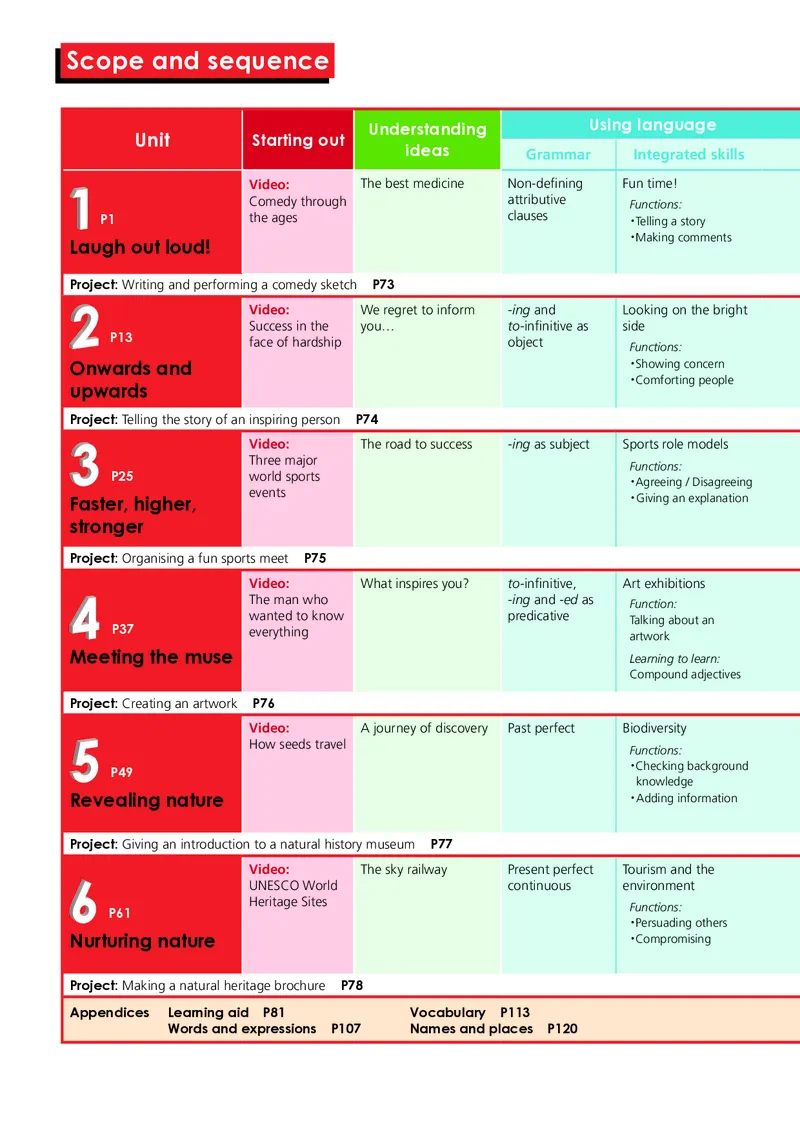
高中阶段编委会Scope and sequence
Using language
Understanding
Unit Starting out
ideas
Grammar Integrated skills
Video: The best medicine Non-defining Fun time!
Comedy through attributive Functions:
P1 the ages clauses ・Telling a story
・Making comments
Laugh out loud!
Project: Writing and performing a comedy sketch P73
Video: We regret to inform -ing and Looking on the bright
Success in the you… to-infinitive as side
P13
face of hardship object
Functions:
Onwards and ・Showing concern
・Comforting people
upwards
Project: Telling the story of an inspiring person P74
Video: The road to success -ing as subject Sports role models
Three major
Functions:
P25 world sports
・Agreeing / Disagreeing
events
Faster, higher, ・ Giving an explanation
stronger
Project: Organising a fun sports meet P75
Video: What inspires you? to-infinitive, Art exhibitions
The man who -ing and -ed as
Function:
wanted to know predicative
Talking about an
P37 everything
artwork
Meeting the muse
Learning to learn:
Compound adjectives
Project: Creating an artwork P76
Video: A journey of discovery Past perfect Biodiversity
How seeds travel
Functions:
・Checking background
P49
knowledge
Revealing nature ・ Adding information
Project: Giving an introduction to a natural history museum P77
Video: The sky railway Present perfect Tourism and the
UNESCO World continuous environment
Heritage Sites
Functions:
P61
・Persuading others
Nurturing nature ・Compromising
Project: Making a natural heritage brochure P78
Appendices Learning aid P81 Vocabulary P113
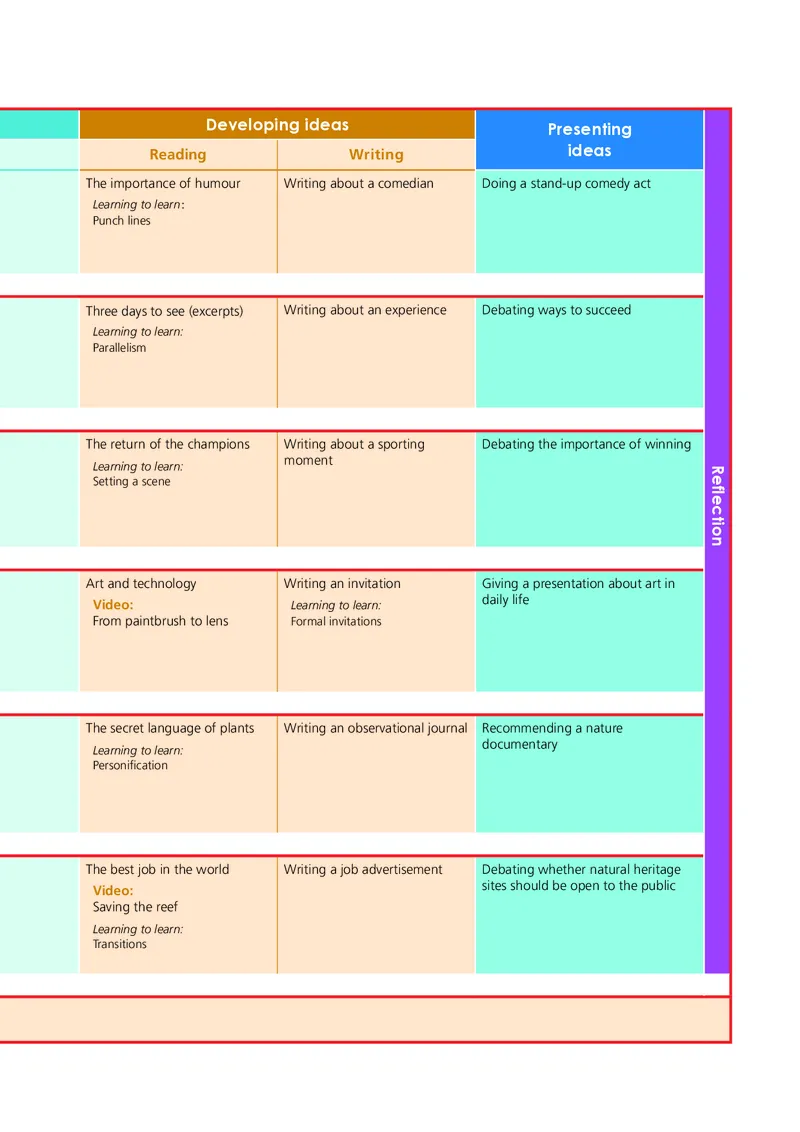
Words and expressions P107 Names and places P120Developing ideas
Presenting
ideas
Reading Writing
The importance of humour Writing about a comedian Doing a stand-up comedy act
Learning to learn:
Punch lines
Three days to see (excerpts) Writing about an experience Debating ways to succeed
Learning to learn:
Parallelism
The return of the champions Writing about a sporting Debating the importance of winning
moment
Learning to learn:
Setting a scene
Art and technology Writing an invitation Giving a presentation about art in
daily life
Video: Learning to learn:
From paintbrush to lens Formal invitations
The secret language of plants Writing an observational journal Recommending a nature
documentary
Learning to learn:
Personification
The best job in the world Writing a job advertisement Debating whether natural heritage
sites should be open to the public
Video:
Saving the reef
Learning to learn:
Transitions
Reflection致 同 学
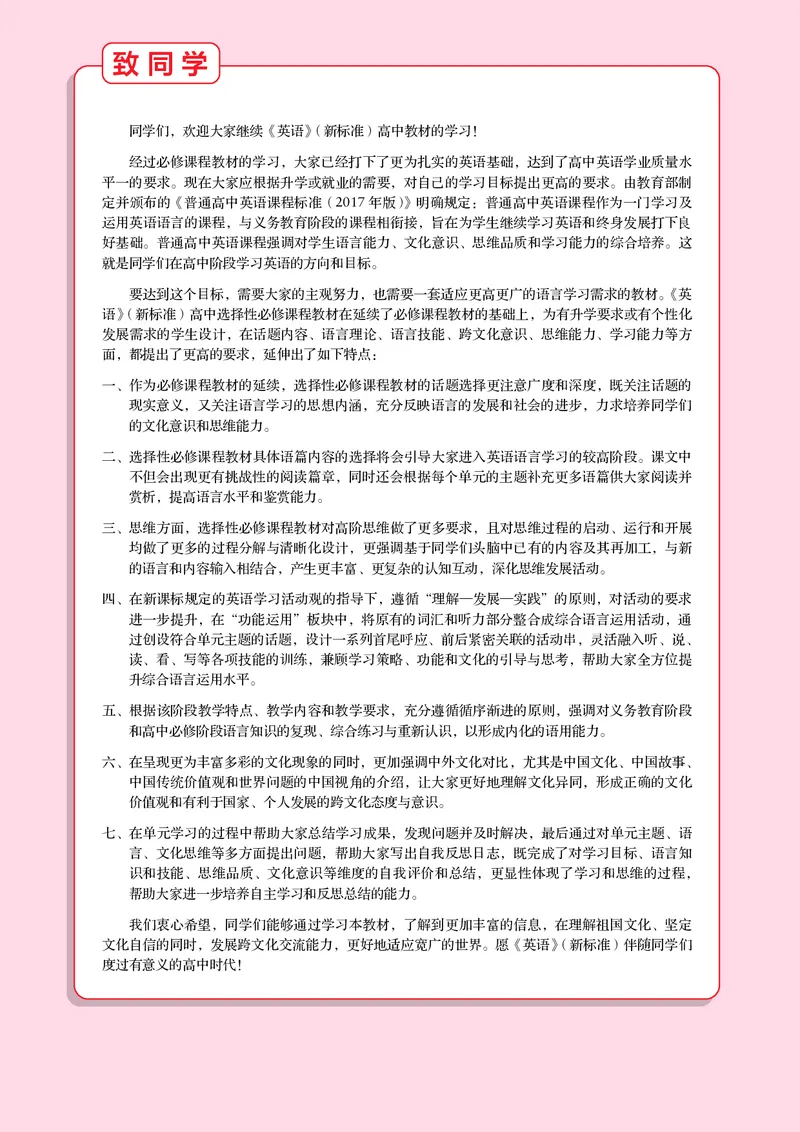
同学们,欢迎大家继续《英语》(新标准)高中教材的学习!
经过必修课程教材的学习,大家已经打下了更为扎实的英语基础,达到了高中英语学业质量水
平一的要求。现在大家应根据升学或就业的需要,对自己的学习目标提出更高的要求。由教育部制
定并颁布的《普通高中英语课程标准(2017年版)》明确规定:普通高中英语课程作为一门学习及
运用英语语言的课程,与义务教育阶段的课程相衔接,旨在为学生继续学习英语和终身发展打下良
好基础。普通高中英语课程强调对学生语言能力、文化意识、思维品质和学习能力的综合培养。这
就是同学们在高中阶段学习英语的方向和目标。
要达到这个目标,需要大家的主观努力,也需要一套适应更高更广的语言学习需求的教材。《英
语》(新标准)高中选择性必修课程教材在延续了必修课程教材的基础上,为有升学要求或有个性化
发展需求的学生设计,在话题内容、语言理论、语言技能、跨文化意识、思维能力、学习能力等方
面,都提出了更高的要求,延伸出了如下特点:
一、作为必修课程教材的延续,选择性必修课程教材的话题选择更注意广度和深度,既关注话题的
现实意义,又关注语言学习的思想内涵,充分反映语言的发展和社会的进步,力求培养同学们
的文化意识和思维能力。
二、选择性必修课程教材具体语篇内容的选择将会引导大家进入英语语言学习的较高阶段。课文中
不但会出现更有挑战性的阅读篇章,同时还会根据每个单元的主题补充更多语篇供大家阅读并
赏析,提高语言水平和鉴赏能力。
三、思维方面,选择性必修课程教材对高阶思维做了更多要求,且对思维过程的启动、运行和开展
均做了更多的过程分解与清晰化设计,更强调基于同学们头脑中已有的内容及其再加工,与新
的语言和内容输入相结合,产生更丰富、更复杂的认知互动,深化思维发展活动。
四、在新课标规定的英语学习活动观的指导下,遵循“理解—发展—实践”的原则,对活动的要求
进一步提升,在“功能运用”板块中,将原有的词汇和听力部分整合成综合语言运用活动,通
过创设符合单元主题的话题,设计一系列首尾呼应、前后紧密关联的活动串,灵活融入听、说、
读、看、写等各项技能的训练,兼顾学习策略、功能和文化的引导与思考,帮助大家全方位提
升综合语言运用水平。
五、根据该阶段教学特点、教学内容和教学要求,充分遵循循序渐进的原则,强调对义务教育阶段
和高中必修阶段语言知识的复现、综合练习与重新认识,以形成内化的语用能力。
六、在呈现更为丰富多彩的文化现象的同时,更加强调中外文化对比,尤其是中国文化、中国故事、
中国传统价值观和世界问题的中国视角的介绍,让大家更好地理解文化异同,形成正确的文化
价值观和有利于国家、个人发展的跨文化态度与意识。
七、在单元学习的过程中帮助大家总结学习成果,发现问题并及时解决,最后通过对单元主题、语
言、文化思维等多方面提出问题,帮助大家写出自我反思日志,既完成了对学习目标、语言知
识和技能、思维品质、文化意识等维度的自我评价和总结,更显性体现了学习和思维的过程,
帮助大家进一步培养自主学习和反思总结的能力。
我们衷心希望,同学们能够通过学习本教材,了解到更加丰富的信息,在理解祖国文化、坚定
文化自信的同时,发展跨文化交流能力,更好地适应宽广的世界。愿《英语》(新标准)伴随同学们
度过有意义的高中时代!Laugh out loud!
U
N
I
T
are you fun to be with?
Starting out
1 You tell a joke, which none of your friends find funny.
How do you react?
1 Watch the video and answer the a Laugh anyway and apologise for your sense of humour.
questions. b Tell the joke again, but louder and more slowly.
1 What forms of comedy are c Criticise your friends’ sense of humour and walk off.
mentioned in the video?
2 It’s a Saturday afternoon and you’re not doing much.
2 Have you ever been to a comedy
A friend calls and invites you on an adventure to explore
show? Share your experience with
a new town. What do you say?
the class.
a “Of course! I’ll be ready in fifteen minutes!”
b “Sounds interesting. Tell me more about it.”
2 Complete the questionnaire and
c “No, thanks. Maybe next time.”
find out if you are fun to be with.
3 You and some friends get lost in an area you’ve never
been to before. What do you do?
a Lift the mood with a joke and explore the area.
b Stay positive and try to find your way back.
c Show everyone you are worried and complain.
4 You receive a birthday present from a friend, but when
you open the box it’s empty. How do you feel?
a Think it is a good joke and laugh about it.
b Feel hurt, but try to laugh about it.
c Get angry and tell your friend it is a silly joke.
5 You’re skateboarding with a friend and he falls over in
a dramatic way. What do you do?
a Laugh loudly non-stop because it’s so funny!
b Check if he’s OK and make him feel better with a joke.
c Help him get back up and avoid mentioning his fall.
Turn to Page 84 to find out your result.
1Understanding ideas
1 Look at the pictures and tick the places where
you would expect to see a clown.
1 As I approach the hospital wearing my white
coat, I look just like any other doctor. That is
until I put on my curly rainbow wig, big red
nose, and add my name badge “Doctor Larry
Laugh-Out-Loud”. I walk through the doors
into the waiting area, where there’s a familiar
atmosphere of boredom and tension. People
a private garden a circus
sit uncomfortably on plastic chairs, looking
through old magazines, all of which have been
read hundreds of times previously. Anxious
parents do what they can to comfort nervous
and crying children.
2 In the middle of this particular scene
I spot a small girl whose ankle is twice
its normal size. I speak with the
a busy street a hospital on-duty nurse, who tells me that
Lara’s parents rushed her to the
hospital after she fell off her
bicycle. Since getting here,
Lara has spent her time
crying in pain. Although
it’s the doctors and
nurses who will treat
her injury, it’s my job to
make her feel better.
an amusement park a theatre
3 Scientific studies show
that laughter produces
Now share what you know about clowns with
chemicals to make people
the class.
feel better, which means
clown doctors can be
2 Read the passage and find out what is special
helpful. We are specially
about this clown’s job.
trained clowns who
222 UNIT 1work as part of a programme known as 5 And my magic medicine does indeed seem to
“hospital clowning”. I chose this career do the trick. While the doctor concentrates
because of my experience of going to hospital on examining Lara’s ankle, I get her attention
when I was a kid. Although the doctors and by doing a magic trick. Although she is
nurses did a great job, hospitals weren’t clearly still in some pain, her scared and
really designed for children. I spent much anxious look has been replaced – first by a
of the time when I was there feeling small smile, and then by loud laughter as I
frightened and more than a “magically” produce her sock from out of
little bored! Being a my pocket. Seeing their daughter so much
clown doctor means happier has in turn made Lara’s parents
I can help people by more relaxed.
entertaining them.
6 And as for me? Well, when I take off my wig
4 Visiting and my red nose, I’m still wearing a big smile,
hospitals and other as I remember all the fun and laughter of
health care facilities, the day. While there might be more hospital
we clown doctors visits ahead for Lara and others, I hope that
work together with medical clown doctors help make it a friendlier place
professionals. On a typical to visit. After all, it really is true that “laughter
day, we spend our time cheering up is the best medicine”.
patients, their families, and more often
than not, the hospital staff, too! We do
this by doing magic tricks, singing songs,
telling stories and, of course, telling silly
jokes. Some children, though, don’t feel
like laughing, especially if they’re in pain.
We have to be very sensitive and work
closely with the doctors and nurses, who
keep us updated on each patient.
Laugh out loud! 33 Match the questions to the paragraphs and find out the answers.
a Which patient is in need of the clown doctor’s attention and why?
b What is a clown doctor and why did the author choose to be one?
c How does the author feel after a day’s work?
d What are the responsibilities of a clown doctor?
e How does the clown doctor help the patient?
f What does this clown doctor wear and what is his working environment like?
4 Organise information from the passage and complete the job advertisement.
Clown Doctors Wanted!
Employer The Healthy Humour Foundation
Job Clown Doctor (part-time)
Responsibilities
• v isit hospitals and other 1_____________________ on a weekly basis
• entertain young patients who are feeling 2_____________________
• c heer up the patients, their families and 3_____________________
• sing songs, tell stories and jokes, and do 4_____________________
• h elp make the hospital 5_____________________
Send your CV to: healthyhumourfoundation@email.com
5 Complete the diagram comparing clown doctors and medical doctors.
Cl wn Medical
doctors
Similarities
doctors
train as actors wear white coats need medical training
Think & Share
1 How important do you think clown doctors are?
2 What is your understanding of the saying “laughter is the best medicine”? Do you
agree with it? Why?
3 Would you like to work as a clown doctor? Why or why not?
4 How does the diagram in Activity 5 help you to better understand the passage?
444 UNIT 1Using language
Non-defining attributive clauses
1 Look at the sentences from the reading passage and 3 Complete the joke with the sentence
answer the questions. parts in the box using who / which and
put commas in the correct position.
a I walk through the doors into the waiting area,
where there’s a familiar atmosphere of boredom has lost his patience by now
and tension. he thinks will impress Holmes
b … laughter produces chemicals to make people feel is lying next to him
better, which means clown doctors can be helpful. he finds annoying
c I spent much of the time when I was there feeling
frightened…
1 What do “where”, “which” and “when” refer to in One day, Sherlock Holmes and
each sentence? Dr Watson go camping. They put
2 Which sentences contain a clause with essential up their tent under the stars and
information and which with extra information?
go to sleep. Suddenly, in the middle
If you take away the clauses, do the sentences still
of the night, Watson is woken up
make sense? by Holmes 1_________________.
3 Which clauses are separated by a comma, the ones
“Watson,” Holmes says, “look up
with essential information or the ones with extra
at the stars, and tell me what they
information?
tell you.” Not quite sure what he
Now look for more sentences with non-defining means, Watson thinks Holmes is
attributive clauses in the reading passage, and joking 2_________________ at this
summarise their uses in your own words. time of night. Even so, he replies,
“I see millions of stars and it’s quite
2 Read the passage and rewrite the tips using
likely there are some planets like
non-defining attributive clauses. Add more tips
Earth. And if so, this means that
to the list if you can.
there might also be life on other
SECRETS TO HAPPINESS planets.” Watson is pleased with his
answer 3_________________. But
Achieving a positive state of mind isn’t easy
Holmes 4_________________ shouts,
for everyone. But there are ways to maintain a
healthy mind even during times of difficulty. “Watson, look around you! Use your
eyes! Somebody’s stolen our tent!”
• Go for a walk in the countryside. There you
can enjoy the beautiful views and a peaceful
atmosphere.
• Spend time with your family and friends. This will
4 Think of a joke you find funny and
activate chemicals in your brain to make you feel
write it down using non-defining
happier.
attributive clauses where appropriate.
• Try to accept your mistakes. You can learn a lot
Then share your joke with the class.
through them.
• Close your eyes and picture the future. You’ve
made your dreams come true.
Laugh out loud! 5Fun time!
5 Listen and complete the conversations.
Why are you grinning from 1_________?
I’ve won a free cinema ticket.
Cool! What are you going to watch?
My Crazy Family. Have you seen it?
Yes! I laughed my 2_________. You’ll enjoy it!
I really don’t get Harry.
Why? Is he still not talking to you?
No. Today, he was all 3_________...
He asked me to help him with that website of his.
Really? What did you say?
Well, I said yes. We all deserve a second chance, I guess.
What’s the matter? Why the long face?
Yesterday, I stepped on a banana skin and fell
over in front of the whole class.
That’s so funny!
I was the 4_________ stock of the class.
Even my teacher cracked 5_________!
6 Match the expressions you have completed in Activity 5 to their meanings.
: a person that : to look extremely
everyone laughs at because they have done happy because you are very pleased about
something funny or silly something
: to look friendly : to smile slightly
and happy, especially when other people : to laugh very loudly
are not expecting you to and for a long time
Now work in groups and think of more expressions about laughter.
7 Work in pairs. Discuss other situations in which you could use these expressions.
666 UNIT 19 Listen again and complete the notes.
April Fool’s Day is on 1 April. It’s the one day of the
year when people in many parts of the world play Joke 1
practical jokes on each other. Even newspapers, • Year: 1698
radio and TV stations play tricks on their readers and • Main story: A newsletter reported people going to
audiences. The jokes traditionally watch 1______________________ at the Tower
last until noon in the UK. But in of London. The joke was played on visitors
some other countries, such as the throughout the 2______________________.
US, they can last all day!
Joke 2
Did You Know ? • Year: 3______________________
• Main story: The 4______________________
8 Listen to the radio programme and choose introduced an invention called "Smellovision".
the pictures mentioned. It allowed 5___________________ over
the airwaves.
a
Joke 3
• Year: 6______________________
• Main story: A news programme told viewers that
the spaghetti trees in Switzerland were having
7______________________.
Now work in pairs. Discuss which of the
b
practical jokes you think is funny.
10 Complete the boxes with expressions from the
radio programme.
• Let’s start with… • It’s a good one!
• I don’t get it. • That’s so funny!
• Now, my favourite • I can imagine!
c
one...
Telling a story Making comments
d
11 Work in pairs. Tell each other a funny story
and make comments using the expressions in
this section.
Now give feedback on each other’s stories
and help your partner to improve theirs.
Laugh out loud! 7Developing ideas
1 Read the short introductions to Mark Twain
and Lin Yutang and share what else you 1 Humour has been an essential part of human
know about them with the class. behaviour for thousands of years. There is
comedy in the texts of Ancient Greece, and
medieval writings are filled with jokes. While
these same jokes might not be as funny to us
now as they were then, their authors understood
that humour could not only entertain but also
throw new light on sensitive or emotive issues.
2 Closer to modern times, someone who is
Mark Twain (1835–1910) was an American remembered for his ability to combine humour
writer, humorist, lecturer and adventurer, with more serious messages is American
who acquired international fame for his writer, Mark Twain. Twain’s particular style
of writing is funny and often mischievous. For
travel narratives, in particular The Innocents
example, in his classic novel The Adventures
Abroad, and for his adventure stories of
of Tom Sawyer, he famously says, “Writing is
boyhood, such as The Adventures of Tom
easy. All you have to do is cross out the wrong
Sawyer and Adventures of Huckleberry
words.” But he is equally well known for his
Finn. He is regarded as one of North
witty remarks in his everyday interactions with
America’s best and most beloved writers
people. For instance, while on a lecturing tour
due to his wit and satire. of the United States, Twain went into a barber’s
shop to get a haircut and a shave. The barber,
not recognising him, asked if he had a ticket to
the lecture. When Twain replied that he didn’t,
the barber told him that if he wanted to go to
the event he would have to stand, as there were
no seats left in the theatre. Twain’s response
was, “That’s just my luck. I always have to
stand when that fellow lectures!”
Lin Yutang (1895–1976) was a Chinese
3 Like Twain, but on the other side of the world,
writer, translator, linguist, philosopher and
Lin Yutang was soon to become famous for
inventor. His informal but sophisticated style
his unique brand of humour. A well-known
of writing, in both Chinese and English,
bilingual writer, Lin brought the concept of
made him one of the most influential writers
humour to modern Chinese literature. In 1924,
of his generation. His most famous works he creatively borrowed “youmo” from Ancient
include My Country and My People and Chinese as the translation for the English word
The Importance of Living. He’s also known “humour”. “Youmo” is still being used in this
as a wise and witty populariser of Chinese way today.
philosophy and the Chinese way of life.
2 Read the passage and find out Mark Twain
and Lin’s attitude towards humour.
888 UNIT 1he
T
Importance
of
Humour
4 Lin’s quick wit helped make him famous as a 5 Both Twain and Lin understood that humour
master of humour. Once, having been invited to isn’t just about laughter, but is a way of life
dinner at a university, he was put on the spot and a tool that can be used to illuminate the
when the president suddenly asked him to give world. Lin even created an equation to explain
a speech. Thinking on his feet, Lin started to this concept: Reality + Dreams + Humour =
tell a story about a cruel Roman emperor who Wisdom. Living and working with others can
tried to feed a man to wild animals. First came sometimes be complicated, and humour makes
a lion. The man whispered something in the this easier. Sharing jokes and laughing together
lion’s ear, after which the lion shook its head can bring individuals and even communities
and walked away unhappily. Then along came together. Indeed, some may argue that our need
a tiger. Again, the man whispered in the tiger’s for humour is almost as great as our need for
ear. The tiger looked shocked and hurried away. water and air. In the words of Mark Twain,
“What did you say to my animals?” said the “Humor is mankind’s greatest blessing”.
emperor, astonished. “I told them they had to
make a speech after eating me for dinner.” Lin’s
audience roared with laughter. With this little
joke, Lin was able to make people laugh, while
gently telling off the president.
Laugh out loud! 93 Organise information from the passage and complete the diagram.
Introduction
Humour is an essential part of
1________________. Authors have
Mark Twain
used it to 2________________,
Remembered for: ability to
Lin Yutang
and throw new light on
4________________ with more
3________________. Famous for his unique brand
5________________
of humour
Writing style: 6________________
Evidence:
Example:
9________________________
7________________________
Quick wit helped make him
Also well known for his witty
famous as 10________________
remarks
Example:
Conclusion
Example:
11________________________
Humour is a 12________________
8________________________
and a tool that can be used to
13________________.
Learning to learn
1 Why is Lin Yutang’s joke about the man and Think & Share
wild animals funny? A punch line concludes a
joke and is intended to make
2 Do you agree with Mark Twain’s remark on humour at the end of the
people laugh. In a broader
passage? Give your reasons.
sense, a punch line can also
3 How can a sense of humour help you in your daily life? Give an example.
refer to the unexpected
4 In what ways do the two reading passages in this unit help you to better
and funny conclusion of any
understand the meaning of having a light-hearted attitude towards life? performance, situation or story.
4 Work in groups. Discuss and present your opinion of the equation from the passage.
Reality + Dreams + Humour = Wisdom
1 Work out the meaning of this equation. Consider the following:
• What is your understanding of “reality” and “dreams”?
• What is the function of “humour” in this equation?
• What is your understanding of “wisdom”?
2 Decide whether you agree with Lin’s definition of wisdom. Think of examples to
support your opinion and make notes.
3 Share your opinion with the class.
Now think about your performance in this activity. What contribution did you
make to your group? How could you improve your performance?
111000 UNIT 1Writing about a comedian
5 Read the blog post and match the headings to the paragraphs. 6 Read the blog post again.
Find the information:
• an example of the
actor’s works
• a reason why the actor is
Charlie Chaplin’s
one of the best
• a funny scene
• a famous character played
by the actor
Legacy
• the author’s comments on
the actor
1 Charlie Chaplin was a British actor, filmmaker and composer. 7 Choose a comedian who
makes you laugh. Think of
He became famous in the 1910s, when films were silent and
in black and white. the information you want
to include and complete the
2 Charlie Chaplin was one of the best comedy actors of his time notes below.
because he knew how to use his body and facial features to
make people laugh. In my opinion, the funniest thing about General introduction:
Charlie Chaplin was the way he walked when he was acting
as the Tramp, who is his most famous character. The Tramp is
Why I like him / her:
a poor man with a kind heart who has unexpected adventures.
These adventures, often involving the police, are usually the
funniest scenes.
His / Her funniest work:
3 My favourite Charlie Chaplin film is Modern Times and my
favourite scene is in the factory where Charlie Chaplin is
My comments:
working on a production line. When a bee starts circling
around Charlie’s face, he falls behind with his work. It’s so
funny to watch him trying to keep up!
4 I think the power of Charlie Chaplin’s works is not only in his Now write an introduction
acting, but also in the stories and characters he created. The to this comedian.
Tramp is a symbol of the silent cinema and even after so many
years, he is still able to make people laugh. 8 Work in pairs. Make
improvements to each
Charlie Chaplin’s Unique Acting Style other’s introductions and
The Power of Charlie Chaplin’s Works share them with the class.
My Favourite Charlie Chaplin Film Post your writing on your
General Introduction to Charlie Chaplin social media.
Laugh out loud! 11Presenting ideas
1 Work in groups. Think about the stand-up comedy acts 3 Write the script for your act and
you have seen and answer the questions. complete the table. Add useful
1 What were the main topics of these acts? expressions and structures you can
2 How many people were there on the stage? think of.
3 How did they make the audience laugh?
Opening
4 Were any props used?
2 Prepare your own comedy act. Consider the following:
• the topic of your comedy act: personal Main body
experience / social event / popular culture...
Closing
4 Choose a group member to be a
• way(s) of presenting: storytelling / joke
stand-up comedian and help them
telling / audience interaction / mime...
to perform the comedy act you
have written. Think of actions or
• the punch line(s) of your stories / jokes
props to include.
• the opening and closing: make it surprising /
5 Perform in front of the whole class
exciting / funny...
and vote for the best act.
Reflection
Write a reflection after completing this unit. Consider the following:
1 What is your understanding of a good sense of humour?
2 What text types have you learnt about? What are their features?
3 What words, expressions and structures have you learnt?
4 What improvement have you made in understanding different cultures?
5 What improvement have you made in using learning strategies and exploring effective ways
of learning?
6 What improvement have you made in analysing and solving problems?
111222 UNIT 1Onwards and upwards
DDoonn’’tt qquuiitt
1 Watch the video and answer the questions.
1 Who are the people mentioned in the video
When things go wrong as they sometimes will,
and what are their achievements?
When the road you’re trudging seems all uphill,
2 What made them successful?
When the funds are low and the debts are high,
And you want to smile, but you have to sigh,
2 Listen and read the poem. Answer the
When care is pressing you down a bit,
questions.
Rest if you must, but don’t you quit.
1 What is the key message of the poem?
2 Which of life’s difficulties are mentioned in
Life is queer with its twists and turns,
the poem? What is your understanding of the
As every one of us sometimes learns,
line “Success is failure turned inside out”?
And many a failure turns about,
3 Do you like the poem? Give your reasons.
When he might have won had he stuck it out;
Don’t give up though the pace seems slow –
You may succeed with another blow.
Success is failure turned inside out –
The silver tint of the clouds of doubt,
And you never can tell just how close you are,
It may be near when it seems so far;
So stick to the fight when you’re hardest hit –
It’s when things seem worst that you must not quit.
(Excerpts from “Don’t quit” by Edgar Albert Guest)
U
N
I
T
Starting out
13Understanding ideas
1 Research these writers online and match
them to the information.
1 “We regret to inform you...” These
are the words that every writer dreads
J.D. Salinger
receiving, but words every writer
knows well. The response from a
publisher comes back and the writer
eagerly opens and reads it, their hearts
sinking when they reach that final
sentence. You may have spent years
giving up your weekends and free time
to write your life’s work, yet still this
is often not enough. Everyone knows
Emily Brontë
that success rarely happens overnight,
but perhaps not many know that a
lot of highly successful writers have
previously faced rejection.
2 Take for example J.K. Rowling. When
she received her first rejection letter,
she decided that it meant she now
had something in common with her
favourite writers, and stuck it on her
J.K. Rowling
kitchen wall. Rowling had spent years
surviving on little money, spending
1 has the same birthday as his /
all her time writing. When she finally
her most famous character: 31 July.
finished her first book, she received
2 may have written and hidden
comments from publishers along the
several unpublished works. lines of “too difficult for children”,
3 had to pay to have his / her “too long”, “Children would not be
poetry published. interested in it”. Nevertheless, she
persevered. “I wasn’t going to give
up until every single publisher turned
Now share anything else you know about
these writers with the class.
2 Read the passage and find out what problems
the writers overcame.
14 UNIT 2me down, but I often feared that would happen,” she later posted. After a total
of twelve rejections, one publisher eventually agreed to print 500 copies of her
first book, and as we know, Harry Potter became a global success, with over 400
million books sold and translated into more than seventy different languages.
3 All too often writers of great works have had to face criticism along with rejection.
J.D. Salinger started writing short stories in high school, but later struggled to
get his works published. “We feel that we don’t know the central character well
enough” was the criticism he received on his manuscript for The Catcher in the
Rye. Despite rejections from several publishers, J.D. Salinger refused to give up.
Even when serving in the US Army during the Second World War, he carried six
chapters of The Catcher in the Rye with him and worked on the novel throughout
his war service. When it was eventually published, the book became an immediate
best-seller and went on to sell millions and millions of copies.
4 Perhaps the overall prize for perseverance should go to three sisters from Victorian
England who dreamt of seeing their words in print. This, however, was a time when
women were not encouraged to become writers. As the then Poet Laureate, Robert
Southey, wrote to one of them: “Literature cannot be the business of a woman’s
life, and it ought not to be.” Nevertheless, the sisters didn’t stop trying. Their
response was to write a book of poems under male names. Even when the book
sold only two copies, the sisters still didn’t give up. They started writing novels, and
today Charlotte Brontë’s Jane Eyre, Emily Brontë’s
Wuthering Heights and Anne Brontë’s Agnes Grey
are regarded as classics of world literature. In fact,
it is within the pages of Jane Eyre that we can find
these words: “I honour endurance, perseverance,
industry, talent; because these are the means by
which men achieve great ends…”
5 So, it seems that talent alone isn’t enough to
guarantee success. While a lot of hard work and a
touch of luck play a part, perseverance is the key.
Keep trying and eventually you will read the words
“We are delighted to inform you…”
Onwards and upwards 153 Choose another suitable title for the passage and give your reasons.
1 Life Is Hard for Female Writers
2 Good Things Come to Those Who Wait
3 Never Give Up on Your Dreams
4 Successful Writers
4 Organise information from the passage and complete the diagram.
Introduction
Example 1 Example 2 Example 3
Writer: Writer: Writers:
Best known for: Best known for: Best known for:
Experience of rejection: Experience of rejection: Experience of rejection:
Eventual outcome: Eventual outcome: Eventual outcome:
Conclusion
Now read the sentences from the passage and answer the questions.
“We regret to inform you…”
“We are delighted to inform you…”
1 What might come next in each sentence?
2 Which paragraph does each of the sentences come from? Why does the author use
them like this within the passage?
Think & Share
1 What can you learn from these writers?
2 Have you read any books by these writers? Recommend one to your classmates.
3 Do you know of any other writer who had similar experiences? Share their stories
with the class.
4 What words and expressions from the passage have you used to tell these stories?
16 UNIT 2Using language
-ing and to-infinitive as object
1 Look at the sentences and answer the questions. 3 Write a report based on the interview
Sentences (a), (c) and (e) are from the reading passage. with the words in the box.
a J.D. Salinger started writing short stories in high
admit decide enjoy fail
school, …
regret want
b J.D. Salinger started to write short stories in high
school, …
Many students choose to take
a camping programme during
c Nevertheless, the sisters didn’t stop trying.
the summer holiday, aiming
d Nevertheless, the sisters didn’t stop to try.
at building character and
developing physical fitness.
e These are the words that every writer dreads
Today, we’re with camper Jamie
receiving, …
Wells. Hi, Jamie. Could you
1 Do sentences (a) and (b) have the same meaning? share your experience with us?
2 Do sentences (c) and (d) have the same meaning?
3 Can “receiving” in sentence (e) be changed into
Sure. I joined the sports camp
“to receive”?
because I like to challenge
Now look for more sentences with these structures myself. I also like to meet new
in the reading passage, and summarise their uses in friends. The camp was fun, but
your own words. not without its challenges! Each
day began with a 5-kilometer
2 Complete the passage with the correct form of the
cross-country run – at 6 am! At
verbs in brackets.
first I couldn’t finish the whole
At the age of ten, Liu Wei lost route. On the fourth day, I was
both his arms in an accident. so tired that I even didn’t want
Despite this, he wanted to get out of bed. I felt homesick
1 (live) life and almost phoned my dad to
to the full. He learnt take me home. But I didn’t give
2 (use) his feet for everyday activities, up. Things soon got better. I felt
such as eating and brushing his teeth. He also started I had become stronger and more
3 (swim) and won two gold medals at confident and had made new
the National Games for People with Disabilities. When friends. Even though being a
he had to stop 4 (swim) due to health camper has its challenges, I feel
problems, he decided 5 (learn) how to it is worthwhile.
play the piano with his toes. It was difficult, but he
kept 6 (practise) until he had achieved
4 Work in pairs. Share a story of your
his goal. In 2010, he won in China’s Got Talent and
own about overcoming challenges
became famous nationwide. Today, Liu Wei still enjoys
using the words and structures in this
7 (play) music, and his positive attitude is
section where appropriate.
an inspiration to us all.
Onwards and upwards 17Looking on the bright side
5 Listen to the conversations and match the expressions to their meanings.
a b c
not lift a finger a wet blanket an eager beaver
d
e f
drag one’s feet turn over a new leaf cool as a cucumber
1 ____________ to change your life by starting to be a better person or stopping a bad habit
2 ____________ someone who is extremely enthusiastic and enjoys working extremely hard
3 ____________ to not make any effort
4 ____________ very calm and relaxed, especially in a difficult situation
5 ____________ to do something very slowly because you do not really want to do it
6 ____________ someone who refuses to join in, or wants to stop other people having fun
6 Put the expressions in Activity 5 into the boxes. Add any more you can think of.
Positive Negative
7 Read the passage and answer the questions.
With life being made up of ups and downs, it is not always easy to maintain a good and
enthusiastic attitude. Nevertheless, looking on the bright side is the best thing that we can do
for ourselves as well as for others. A good attitude can have a positive effect on other people.
So if someone you know is feeling low, lend them an ear and try to cheer them up. Remember,
your attitude is contagious, so make sure you pass on a good one!
1 Why is it important to “look on the bright side”?
2 How can our attitude affect others?
18 UNIT 28 Listen to the conversation and number the pictures 10 Complete the boxes with the
according to the sequence of events. expressions from the conversation.
• Are you OK?
• I don’t mean to be nosy, but are
you sure?
• Why don’t you tell me what’s up?
• I’m sure you did your best.
• You should be proud of yourself.
• Why are you so upset?
• I know this is hard for you, but
you should cheer up.
Showing concern
9 Listen again and complete the journal entry.
Comforting people
Friday 10 May
Today I came across my friend Dawei. He looked
sad, so I asked him what was wrong. He said that
he failed in a 1_____________ contest. Before the
contest, he competed against a girl at school. He
won, but he said it was because 2_____________.
11 Work in pairs. Choose one situation
He thought the girl should have gone to
and act out a conversation to show
3_____________ instead. If she had, the school would
concern for people and comfort
have been 4_____________. I tried to make him look
them. Use the expressions in this
on the bright side, and he admitted that he had a
section.
good time at the national contest. He met some 1 You ran for Head of the Student
5_____________ and he liked the city. He also said Committee but weren’t elected.
his parents felt 6_____________. I think I made him 2 You feel annoyed because a group
feel better. member doesn’t want to contribute
to your group’s work.
Now act out a conversation between Dawei and
Now think about what language
Jack, and think about how you would comfort
in this section you used to show
Dawei if you were Jack.
concern and comfort others.
Onwards and upwards 19Developing ideas
1 Look at the charts and answer the
questions.
1 I have often thought it would be a blessing if each
Percentage of adults with a human being were stricken blind and deaf for a
disability in the US
few days at some time during his early adult life.
People with a disability
Darkness would make him more appreciative of
People without a disability
sight; silence would teach him the joys of sound.
74% 2 Now and then I have tested my seeing friends
to discover what they see. Recently, I asked a
friend who had just returned from a long walk in
the woods what she had observed. “Nothing in
particular,” she replied.
3 How was it possible, I asked myself, to walk
26% for an hour through the woods and see nothing
worthy of note? I who cannot see find hundreds
of things to interest me through mere touch. If I
can get so much pleasure from touch, how much
13.7% 10.8% 4.6%
more beauty must be revealed by sight? And I
Mobility have imagined what I should most like to see if
Cognition I were given the use of my eyes, say for just
three days.
Vision
4 On the first day, I should want to see the
people whose kindness and gentleness and
companionship have made my life worth living.
Percentage of adults with common I do not know what it is to see into the heart of
functional disability
a friend through that “window of the soul”, the
eye. I can only “see” through my fingertips the
1 Are the numbers different from
outline of a face. I should like to see the books
what you expected? In what way?
which have been read to me, and which have
2 What special assistance can people
revealed to me the deepest channels of human life
with disabilities make use of in their and the human spirit. In the afternoon I should
daily lives? take a long walk in the woods and intoxicate my
eyes on the beauties of the world of nature. That
2 Read the passage and find out night, I should not be able to sleep.
what the author would do if she
5 On my second day, I should like to see the
could see.
pageant of man’s progress, and I should go to the
museums. I should try to probe into the soul of
man through his art. The things I knew through
touch I should now see. The evening of my second
day I should spend at a theater or at the movies.
20 UNIT 2Three Days
to See
6 The following morning, I should again greet the dawn, anxious to discover new delights, new
revelations of beauty. Today I shall spend in the workaday world, amid the haunts of men
going about the business of life.
7 At midnight permanent night would close in on me again. Only when darkness had again
descended upon me should I realize how much I had left unseen.
8 I who am blind can give one hint to those who see: Use your eyes as if tomorrow you would
be stricken blind. And the same method can be applied to the other senses. Hear the music of
voices, the song of a bird, the mighty strains of an orchestra, as if you would be stricken deaf
tomorrow. Touch each object you want to touch as if tomorrow your tactile sense would fail.
Smell the perfume of flowers, taste with relish each morsel, as if tomorrow you could never
smell and taste again. But of all the senses, I am sure that sight must be the most delightful.
(Excerpts from “Three Days to See” by Helen Keller)
Onwards and upwards 213 Choose the author’s purpose in writing the passage and give your reasons.
1 To help readers understand what it is like to be blind.
2 To make readers without disabilities appreciate what they have.
3 To persuade readers to care about the blind.
Think & Share
1 What are the main wishes of the author? Give an example.
2 Do you know of any stories about people with disabilities? Share one with the class.
3 How should we interact with people with disabilities?
4 What qualities do both reading passages in this unit convey?
4 Read the sentences from the passage and answer the questions.
Use your eyes as if tomorrow you would be stricken blind. And the same method can
be applied to the other senses. Hear the music of voices, the song of a bird, the mighty
strains of an orchestra, as if you would be stricken deaf tomorrow. Touch each object
you want to touch as if tomorrow your tactile sense would fail.
1 What sentence structure is used
Learning to learn
repeatedly? What figure of speech is it?
Parallelism as a literary device is the use of
2 How does this technique help to express
expressions, clauses or sentences that are
the author’s emotions?
similar in their structure. It can make the
content more rhythmic, engaging and easier
Now make your own sentences using
to remember. It is commonly used in literary
this technique. works and speeches.
5 Work in groups. Give a talk about your opinion on the sentence from the passage.
… it would be a blessing if each human being were stricken blind and deaf for a few
days at some time during his early adult life.
1 Read and discuss the meaning of the sentence and decide whether you agree or
disagree with it.
2 Organise your talk and make notes.
Point of view
Arguments
Supporting examples
3 Give your talk to the class.
Now think about your performance during group discussion. Did you actively
participate and contribute ideas?
22 UNIT 2Writing about an experience
6 Read the passage and answer the questions.
Dining
in the Dark
Recently I accompanied a friend to dine at a “dark After failing to pick up any food with a fork for
restaurant”, where people eat in complete darkness, five minutes, I decided to use my hands. I reached
served by blind staff. We wanted to understand the down, expecting rice and vegetables, but instead
experience of being blind, and we thought eating stuck my hand into a bowl of warm, thick soup.
would be the most difficult activity. “It’s best to use a spoon for this course,” the waiter
said into my ear, helpfully but much too late. Even
It was a difficult meal. Because we couldn’t see using a spoon, I spilled most of the soup on my
where anything was, my friend and I knocked over shirt. I felt embarrassed, even though no one could
glasses and dropped food. My senses of taste and see me.
smell became more sensitive, and I ate much more
slowly, trying to guess what I was eating. Pouring Our waiter advised us to lift the plates and bowls
water was very difficult, plus I kept drinking from close to our faces. However, I still left the restaurant
my friend’s glass. feeling hungry, though I was much more aware of
the challenges that blind people face.
1 Why did the author go to the “dark restaurant”?
2 What difficulties did the author have during the meal?
3 How did the author feel after finishing the meal?
7 Try to experience what it is like to have a disability and make notes.
1 What kind of experience you had 3 How you overcame the difficulty
2 What the most difficult thing was and why 4 What you have learnt
Now write a short passage to describe your experience.
8 Work in pairs. Make improvements to each other’s passages and share them with the class.
Onwards and upwards 23Presenting ideas
1 Read the two points of view and explain their meanings in your own words.
v
If at first you don’t succeed, s If at first you don’t succeed, set
try, try on and on. yourself another goal.
2 Work in groups and decide which opinion you agree with more. Think of
arguments to support your point of view and make notes.
Point of view:
Arguments:
Supporting examples:
3 Prepare for a debate. Consider the following:
1 the roles and responsibilities for each member of your group
2 your arguments, opening and summary
3 the opposing arguments you might face and how you can respond to them
4 useful words, expressions and structures
4 Team up with a group with the opposite point of view and hold the debate.
Reflection
Write a reflection after completing this unit. Consider the following:
1 What is your understanding of positive ways of facing frustration?
2 What text types have you learnt about? What are their features?
3 What words, expressions and structures have you learnt?
4 What improvement have you made in understanding different cultures?
5 What improvement have you made in using learning strategies and exploring effective ways
of learning?
6 What improvement have you made in analysing and solving problems?
24 UNIT 2Faster, higher, stronger
1 Watch the video and answer
the questions.
1 What major sports events are
mentioned in the video?
2 What are the features of these
sports events?
2 Look at the pictures and answer
the questions.
1 What do you know about these
sportspeople?
2 What can you learn from them?
3 Are there any other sportspeople
who inspire you? Who are they
and why do they inspire you?
U
N
I
T
Xu Haifeng
Starting out
• Chinese former shooter born
in 1957
• First athlete to win an Olympic
gold medal for China
• Coach of two Chinese Olympic
gold medalists
Wayne Gretzky
• Canadian former ice hockey player
born in 1961
• One of the greatest players in the
history of the National Hockey
League (NHL) in Canada
• Over 100 official and unofficial
NHL records
Yelena Isinbayeva
• Russian former pole-vaulter born
in 1982
• Two-time Olympic gold medalist
• First woman to jump over five metres
25Understanding ideas
1 Research online and match the five
basketball positions to their descriptions. THE ROAD
D
C
power center
forward B
E
small
forward
A shooting guard
point guard
1 usually the best ball handler and /
or best passer 1 Near the small town of Grottoes, Virginia, a
2 usually the main shooter playing narrow dirt road goes from the house of Stephen
Curry’s grandfather to the woods nearby. A far
on the wing
cry from the bright lights and shiny courts of
3 usually the most athletic player on
the National Basketball Association (NBA), it
the team who can play inside and
was along this road that Stephen’s grandfather
outside the key
built a simple basket by attaching a piece of
4 usually a taller player who catches
plastic to a telephone pole.
the ball after a player has tried
but failed to get a point 2 Like his father, basketball star Dell Curry,
5 usually the tallest player on the Stephen spent many childhood hours playing
team who plays inside the key on this muddy basketball court. He probably
and should be a good scorer didn’t realise it at the time, but it was where he
learnt to be creative and flexible as a player. You
see, with every shot, the weak plastic backboard
2 Read the passage and find out what
gave way. The bumps and rocks that lined the
Stephen Curry has achieved.
road under the basket caused the ball to bounce
in all directions. Knowing where the ball would
go wasn’t easy. He had to adjust his own
playing style as a result. Shooting with great
accuracy was another thing he learnt. Only
shots perfectly aimed at its centre went into the
heavy, thick basket. In this way, practising day
in and day out helped Stephen sharpen his skills.
3 Despite his father’s successful career, Stephen
was thought by many people, including his
high school teammates and coaches, to be
too short, too thin and too weak to follow in
his father’s footsteps. But Stephen carried on.
Playing basketball was his dream. He would
26 UNIT 3TO SUCCESS
not give up. He finally ended up playing
college ball at a small, little-known school,
Davidson College, not too far from where he
lived. His creativity and perseverance made
him Davidson’s star player.
4 Selected for the NBA in 2009, Stephen joined the
Golden State Warriors. He performed beyond
everyone’s expectations with his accurate
shooting and continuous efforts. In 2015,
Stephen won his first NBA championship, and
he led the Warriors to their first championship
since 1975.
5 After receiving the Most Valuable Player award
for two years in a row, Stephen explained his
philosophy, “I never really set out to change
the game… What I wanted to do was just be
myself… I know it inspires a lot of the next
generation, a lot of people who love the game of
basketball to value the skill of it, value the fact
that you can work every single day to get better.
You’ve got to be able to put in the time and
the work. That’s how I got here. That’s how I
continue to get better every single day.” Inspiring
others to believe in themselves, Stephen Curry is
living proof that what other people think of you
does not have to influence what you become.
Through self-belief, hard work, perseverance
and some help from an old hoop, he has shown
that anything is possible.
Faster, higher, stronger 273 Choose the author’s purpose in writing the passage and give your reasons.
1 To explain why Stephen Curry was doubted by many people.
2 To inform people about Stephen Curry’s basketball skills.
3 To inspire people with Stephen Curry’s determination to succeed.
4 Organise information from the passage and complete the profile of Stephen Curry.
Stephen Curry is the son of the famous basketballer Dell
Stephen Curry
Curry. He spent his childhood years practising basketball
on 1 . The poor conditions helped him
develop his own playing style. He also learnt to
2 . Despite this, it seemed unlikely to
many people that Stephen would be a great basketball
player, as he was 3 . Nonetheless, Stephen
refused to 4 , and ended up playing
college ball for Davidson College. In 2009, he joined the
NBA’s Golden State Warriors. In 2015, he led them to their
first NBA championship since 1975. Stephen achieved his
dream through 5 .
Nationality: 6
Occupation: 7
Awards: 8
5 Complete the mind map with supporting details.
Self-belief
Hard work
Perseverance
Think & Share
1 Why does the author mention the “simple basket” at the start of the passage?
2 Can you think of any other famous basketball players? Which of their qualities inspires you?
3 What have you learnt from doing sport? Share your experiences with the class.
4 How can you use the language in this passage to talk about sportspeople? Give examples.
28 UNIT 3Using language
-ing as subject
1 Look at the sentences from the reading passage and 3 Complete the passage with the
answer the question. correct form of the words in the box.
a Knowing where the ball would go wasn’t easy.
wear let miss make use
b Shooting with great accuracy was another thing
he learnt.
1 What are the subjects in sentences (a) and (b)?
Compare them with the following sentences and
answer the questions.
c Stephen Curry knew where the ball would go. It
wasn’t easy.
d Stephen Curry shot with great accuracy. It was
another thing he learnt.
2 What does “it” refer to in sentences (c) and (d)?
3 Why does the author choose to use sentences (a) and (b)
in the reading passage?
Now look for more sentences with -ing as subject in I like how technology is changing
the reading passage, and summarise its use in your sports. 1 the latest
own words. equipment, such as smart
earphones, allows people to get
2 Rewrite the underlined sentences with the -ing form
the best out of their training.
as subject. 2 video technology
to help judge our sporting
Etenesh Diro had almost completed two thirds of the
competitions can 3
3000m steeplechase, when disaster struck. She got
sure that no one cheats. Best of
tangled up with some other competitors. It made her
all, instant replay facilities
fall. Her right shoe started to come off. She tried to pull
4 us see all the
the shoe back on, but it cost her precious time. One
action all over again.
after the other, the runners overtook her. She threw the
5 our favourite
shoe away. This meant she could get up
sporting moments is now a
quickly and fight for her position in the race.
thing of the past!
She ran the rest of the race with just one
shoe on and her right foot bare. It raised
4 Think about whether you agree
a big cheer for her. Luckily, she was
with the point of view in Activity 3
later given a chance to compete in
and share your opinion with the
the final. She lost a shoe. But it didn’t
class. Use the -ing form as subject
keep her from taking part. This is the
where appropriate.
true spirit of sport.
Faster, higher, stronger 29Sports role models
5 Complete the voicemail messages with the correct form of do, play and go.
SSeenniioorr CCiittiizzeenns S’ Sppoortrst sC Clulubb
Hi Ellen, it’s Todd here. I’ve just finished my first day volunteering at the Senior
Citizens’ Sports Club! It’s made me see life as an older person with fresh eyes!
Some members like to 1 yoga because it helps them keep their muscles
toned, while others love to 2 aerobics – one elderly man says the energy
of it makes him feel young again! Ball games are also popular. Many enjoy
3 table tennis or 4 bowling, while there were lots of people
5 badminton, and many like to 6 golf. I even encountered a
man who, at the age of 68, was brave enough to 7 roller skating! Not
only did he have guts, he was much faster than me!
I must say, it was really inspiring to see the people there 8 sports, even
at such advanced ages. It made me think about going to the Central Stadium
this Saturday. The sports club there doesn’t ask for membership. We can 9
tennis or 10 rock climbing. It would do us a lot more good than
11 computer games.
Now listen to the voicemail and check your answers.
6 Underline the sports with do, play and go in Activity 5 and put them into the
boxes. Add any more you can think of.
Do Play Go
30 UNIT 37 Read the passage and answer the 9 Listen again and complete the table.
questions. Nominees Michelle’s opinion Sam’s opinion
A sports role model is a sportsperson He has won it three
He should win it
who inspires other people in a certain Usain times and other
because he
way. In this spirit, the Laureus World Bolt people should
deserves it.
Sports Awards is an annual ceremony 1 , too.
to honour remarkable sportspeople. Hopefully, he will win. He could have
The first ceremony was held in 2000 He has won two 4 ,
in Monaco, where Pelé was given the Andy 2 and but the winner
Lifetime Achievement Award. In 2003, Murray more importantly, he should not be
Yao Ming became the first Chinese is a spokesperson for chosen based on
sportsperson to win the award, and in 3 . 5 .
Shanghai in 2015 Yao Ming and Li Na
LeBron is world-
both won awards. These sports role
famous. He is an
models show us what sporting spirit He will not win
LeBron excellent
really means – that is, faster, higher because he is
James 7
and stronger! 6 .
and a great
8 .
Now work in pairs. Act out a similar conversation
based on the table.
10 Complete the boxes with the expressions from the
conversation.
• I don’t think it should be… • Besides, …
• Are you serious?! • That’s why…
1 Who do the Laureus World Sports • Well, I just think… • I mean, …
Awards honour?
Agreeing / Disagreeing Giving an explanation
2 What other sports role models do you
know? Share some examples with
the class.
8 Listen to the conversation and choose 11 Work in pairs. Nominate three Chinese sportspeople
a topic for it. for the next Laureus World Sports Awards. Give your
reasons and share your ideas using the expressions in
1 The history of the Laureus World
this section.
Sports Awards.
2 Laureus World Team of the Year.
Now talk about whether you have actively
3 Laureus World Sportsman of
participated in the group discussion. Were you able
the Year.
to express yourself clearly and understand what your
4 The childhood of LeBron James.
partner was saying?
Faster, higher, stronger 31Developing ideas
1 Look at the pictures and answer the 1 “The atmosphere here at Rio de Janeiro is
questions. electric! If China wins this point, they will
walk out of the stadium with an Olympic
gold medal. Zhang Changning serves. Over
the net, Popovic dives for the ball. She only
just reaches it… and it’s sent straight back to
her by the Chinese spiker Hui Ruoqi. Popovic
can’t get the ball back this time… and that’s
it! It’s over! It’s gold for China! Look how the
crowd has gone wild. You can see the joy and
pride on the faces of the Chinese fans. And
there we see the Chinese players embracing,
with tears of happiness in their eyes… It’s
a dream come true for China! The Chinese
women’s volleyball team is Olympic champion
once again!”
2 The Chinese women’s volleyball team holds a
1 What are the key differences between very special place in the nation’s heart. In the
team sports and individual sports? 1980s, the team burst onto the international
2 Can you think of any famous sports volleyball scene with several major world
teams? Why are they so well-known? titles, and an amazing three-set victory over
the United States in the final of the 1984 Los
2 Read the passage and find out about Angeles Olympics. They became national
the events mentioned. heroes overnight. There was gold once more
at Athens in 2004. But winning gold in Rio
Learning to learn
Setting a scene involves establishing the
time and place where events take place
and describing any main sights and sounds.
The scene you set at the beginning of The Return
The Return
your writing – whether it is fiction or
non-fiction – will engage your readers
and help set the right atmosphere for the
remainder of your writing.
32 UNIT 3paints the most vivid portrait of the team’s 5 But fighting spirit alone was not enough
competitive spirit. to guarantee victory. Strong team spirit
also contributed greatly to their success.
3 In Rio, the Chinese women’s volleyball team Cooperation between team members is
needed all of its fighting spirit after it was essential. If each individual does her job and
assigned to the “group of death”, where it works well with others, then the end goal can
faced several strong opponents in the group be achieved. In fact, strong team spirit is more
stage matches. Despite reaching the quarter- important than the skills of individual players.
finals as the fourth team in the group, with Zhu Ting, named Most Valuable Player at the
just two wins in preliminary matches, they Rio Olympics, also identified this as the special
were not going to give up. Every single ingredient in the team’s success: “Teamwork
member of the team gave their all to the fight, is the key to China’s victory. Thanks to my
including Hui Ruoqi who had had heart teammates’ hard efforts, I had the opportunity
surgery less than five months previously. to show my spiking skills.”
4 Their perseverance paid off with an epic 6 Together, the Chinese women’s volleyball team
comeback against the defending champion has fought their way through ups and downs.
Brazil in the quarter-finals. Next, the Chinese Led by well-known Chinese volleyball player
team defeated the Netherlands in the semi- and coach Lang Ping, they have continued to
final matches, having lost to them in the aim high. Lang is only too aware that as soon
preliminaries. At last, showing a strong will as a team steps off the victory podium, they
and the steeliest nerves, they played a close need to start from zero to prepare for new
match against Serbia to seize gold in the final. challenges ahead. In this way, the team begins
its journey to the next Olympics.
of the Champions
of the Champions
Faster, higher, stronger 333 Read the sentences and decide if they are facts (F) or opinions (O).
1 The Chinese women’s volleyball team won a three-set victory in the final of the 1984
Los Angeles Olympics. _____
2 Facing several strong competitors in Rio, the Chinese women’s volleyball team
eventually won in the final. _____
3 Fighting spirit alone was not enough for victory. _____
4 Strong team spirit is more important than the skills of individual players. _____
5 Zhu Ting was voted Most Valuable Player at the Rio Olympics. _____
Think & Share
1 How does the author start the passage? What effect does it achieve?
2 What do you think of the opinion that a team needs to start from zero after winning a
gold medal?
3 What achievements by other Chinese sports teams have made the greatest impression on
you? Give an example of their sporting spirit.
4 What kind of sporting spirit does each of the reading passages in this unit reflect? Talk about
their similarities and differences.
4 Work in groups. Give a talk about the spirit of the Chinese women’s volleyball team.
1 Discuss the questions below.
• What spirit does the Chinese women’s volleyball team show in the passage?
• What else do you think has contributed to their success?
• What are the examples that support your ideas?
2 Complete the mind map with your ideas and the examples that support them.
Example: Cooperation between team members allows
Teamwork
individuals to demonstrate their own skills.
Example:
The spirit of the Chinese
women's volleyball team
Example(s):
Example(s):
3 Give a talk to the class.
Now talk about how well you have contributed to your group discussion and help
each other to make improvements.
34 UNIT 3Writing about a sporting moment
5 Read the passage and answer the questions.
Last Saturday, I went to the school playground to
watch the final of the 4×100-metre relay at our
annual sports tournament. It was an extraordinary
experience and something I will never forget.
Before the race, everyone was quiet and still. I had
never imagined that the atmosphere at a sports
event could be so intense. When the runners set
off, everyone went wild! We all stood up and
started cheering and shouting. It was like being hit
by a huge wave of excitement. I could see the runners straining to run as fast as they
could, while trying not to drop their batons at the change. The race was all over in just one
minute. It was Li Chong, the fastest student in our school, who first crossed the finish line.
Everyone was on their feet, cheering. I was also caught up in the excitement and cheered
so hard that I thought my lungs would burst! It was so wonderful to be part of this sporting
moment and enjoy its speed and passion.
1 What event is described?
2 When and where did the event take place?
3 What did the author see?
4 What did the author hear?
5 How did the author feel?
6 Think about a sporting moment you have experienced and complete the table.
General introduction
before the event
What you
saw and during the event
heard
after the event
How you felt
Now write a passage about the sporting moment.
7 Work in pairs. Make improvements to each other’s passages and share them with the class.
Faster, higher, stronger 35Presenting ideas
1 Work in groups. Read the two points of view about winning and take sides.
The person that said
The most important thing in
winning isn’t everything,
the Olympic Games is not
never won anything.
to win but to take part, just
as the most important thing
in life is not the triumph but
the struggle.
Pierre de Coubertin
Mia Hamm
Founder of the modern Olympic Games
US soccer player
2 Think of arguments to support your point of view and make notes.
Point of view:
Arguments:
Supporting examples:
3 Prepare for a debate. Consider the following:
1 the roles and responsibilities for each member of your group
2 your arguments, opening and summary
3 the opposing arguments you might face and how you can respond to them
4 useful words, expressions and structures
4 Team up with a group with the opposite point of view and hold the debate.
Reflection
Write a reflection after completing this unit. Consider the following:
1 What is your understanding of sporting spirit?
2 What text types have you learnt about? What are their features?
3 What words, expressions and structures have you learnt?
4 What improvement have you made in understanding different cultures?
5 What improvement have you made in using learning strategies and exploring effective ways
of learning?
6 What improvement have you made in analysing and solving problems?
36 UNIT 3Meeting the muse
U
N
I
T
1 Watch the video and answer the
questions.
1 Which artist is the video
about? Which of his works
are mentioned?
Imagination creates reality.
2 What inspired the artist?
2 Look at the pictures and read the
quotes. Answer the questions.
1 What do you know about these
people?
2 What is your understanding
of the words “imagination”,
“inspiration” and “rediscover”? Inspiration exists, but it has
How do they help your to find you working.
understanding of the quotes? Pablo Picasso
3 Which quote do you most or least
agree with? Give your reasons.
R ci h a r d W a g n e r
Starting out
If we want to be struck by
inspiration, we must go
deep into our lives.
Mo Yan
I invent nothing. I rediscover.
Auguste Rodin
37Understanding ideas
1 Tick what you think are the most
What
important sources of inspiration
for artists.
childhood
family and friends
books and films
inspires
other artists
history
travel
nature
social issues
private feelings you?
culture and traditions
imagination
Now work in pairs to compare and
explain your choices.
Every artist’s wish is to create
something that expresses an idea. But
2 Read the passage and find out
where do artists get their ideas from?
what inspires each artist. Who or what inspires them? Here we
find out more about the influences
behind the successes of three very
different artists.
38 UNIT 4Florentijn Hofman, visual artist
1 Florentijn Hofman is a Dutch artist, whose large sculptures are on display all over
the world. One way for him to find inspiration is turning to his children’s toys. These
objects have given him ideas for his animal sculptures, such as the famous Rubber
Duck. A more recent work of his is the huge Floating Fish, which was set among the
beautiful landscape of Wuzhen West Scenic Zone.
2 Hofman’s inspiration for Floating Fish came from Chinese folk tales passed down
through the generations. He was particularly interested in the old story
about a fish jumping through the “Dragon Gate”. This story came to
life for Hofman when he visited Wuzhen and saw how people lived
there.
3 “During the walk and my stay here in the town, I saw the fish
being fed by people. You see also some fish sculpted on the wall.”
These sights set Hofman’s idea for Floating Fish in motion.
Tan Dun, composer
4 “There is no territory in the world of music.” These are the words of Chinese
composer Tan Dun. He is most widely known for composing music for the film
Crouching Tiger, Hidden Dragon and the 2008 Beijing Olympics.
5 To listen to Tan’s music is to experience a mix of Chinese musical
traditions and Western influences. Since his first opera, Nine
Songs, Tan Dun has been using a combination of Chinese music
and sounds from all over the world to tell stories. As Tan once
said, Chinese music should carry “universal expression” of the
human spirit so as to be recognised by the whole world.
Yang Liping, dancer
6 Yang Liping’s passion is dancing. After winning a national competition in 1986
with her Spirit of the Peacock dance, she has been known as the “Peacock Princess”.
The inspiration for her famous dances has come from the time she spent in
Xishuangbanna, Yunnan Province.
7 “I feel very grateful for the years in Xishuangbanna,” says Yang.
“It gave me a chance to go deeper into the lives of various ethnic
groups… Our ethnic groups, especially the Dai people, admire the
peacock. They think the peacock represents the beauty of nature.
I especially like the dance style of the Dai people and it gives me
lots of inspiration. My dance comes from their traditional belief and
aims to bring out the Dai women’s beauty.”
Meeting the muse 393 Choose where you would most likely find the passage and give your reasons.
1 An art magazine.
2 An artist biography.
3 An online art forum.
4 A poster for an art festival.
4 Organise information from the passage and complete the diagram.
Artists
and
their inspiration
Florentijn Hofman Tan Dun Yang Liping
Well-known works: Well-known works: Well-known work:
• Rubber Duck • 4_______________________ • 7_______________________
• 1_______________________ • 5_______________________
Sources of inspiration: Sources of inspiration: Sources of inspiration:
• his children’s toys • 6_______________________ • her life in Xishuangbanna
• 2_______________________ • Western influences • 8_____________________
• 3_______________________ • 9_____________________
Now work in pairs. Read the quotes from the passage and answer the questions.
“During the walk and my stay here in the town, I saw the fish being fed by people. …”
“There is no territory in the world of music.”
“I feel very grateful for the years in Xishuangbanna, …”
1 Can you use reported speech to rewrite the quotes?
2 Why do you think the author chose to use quotes instead of reported speech in
the passage?
1 What does the three artists’ inspiration have in common? Think & Share
2 What do you think is the “universal expression”of the
human spirit?
3 What might inspire you to create an artwork?
4 What difficulties have you encountered in understanding this passage?
Share them with the class and ask for their advice.
40 UNIT 4Using language
to-infinitive, -ing and -ed as predicative
1 Look at the sentences from the reading 3 Complete the passage with the correct form
passage and answer the questions. of the verbs in brackets.
a Every artist’s wish is to create something
Chinese artist Wu Guanzhong
that expresses an idea.
b He was particularly interested in the old
is 1____________ (know)
for his paintings using oils
story about a fish jumping through the
“Dragon Gate”. and also for those using the
c Yang Liping’s passion is dancing. more traditional Chinese
Wu Guanzhong
method of ink. According
1 Apart from nouns and adjectives, what other to Wu Guanzhong, his goal as an artist was
word forms can serve as predicative? 2____________ (combine) Western principles
2 Can “interested” in sentence (b) be replaced of art with Chinese spirit, and his passion is
by “interesting”? Why or why not? 3____________ (seek) a point at which the
two could meet. To him, the important value
Now look for more sentences with these
structures in the reading passage, and
of an artwork was 4____________ (reflect)
the art within the life of Chinese people,
summarise their uses in your own words.
and 5____________ (express) love of and
2 Read the passage and underline the responsibility to his motherland. Wu Guanzhong
predicatives. remained 6____________ (interest) in exploring
ways of expression, with his style changing and
One of my biggest dreams had always been to
developing throughout his career. His life’s work
see the painting Girl with a Pearl Earring, by
is now 7____________ (inspire) artists not only in
the Dutch artist, Vermeer. It wasn’t until we
China but across the world.
went on a trip to The Hague last year that this
dream came true! There were lots of people
waiting to enter the Mauritshuis. Although my
legs were tired from walking around the city,
I was determined to see the painting, which
is often called the “Mona Lisa of the North”.
Nobody is sure of the identity of the girl in it.
And there she was. It was amazing
to be standing in front
of her at last! The girl is
looking over her shoulder.
Her eyes are wide and her
mouth is parted, just as if
she were about to speak.
4 Think of an artist you admire and talk about
I would love to know what
his or her inspiration and artworks using to-
she was going to say!
infinitive, -ing and -ed as predicative where
appropriate.
Meeting the muse 41Art exhibitions
5 Read the comments and answer the questions on
the right. Pay attention to the compound adjectives 1 What is the exhibition about? What
in bold. artworks might you see in it?
15:55 PM 80% 2 Which comment makes the greatest
Modern Art Museum impression on you? Give your reasons.
MAM
@modernartmuseum 3 Do you want to go to this exhibition
A new exhibition on abstract art is on from 10 am to 6 pm,
after reading the comments? Why or
Tuesday to Sunday. Come and spend the day at MAM!
why not?
6 Match the compound adjectives in
Activity 5 to their meanings. Think of
other words and expressions that can
express the same meanings.
1 ____________: extremely impressive
TICKETS
so as to take one’s breath away
Adults £18
Students £12 2 ____________: known by a lot of
Children under 16 Free
people
3 ____________: making you feel
498 889 1920 great respect and admiration, and
sometimes fear
Amy @amyheart 9 Nov 4 ____________: very good at doing
What an exhibition! There are many well-known something
artists exhibiting their awe-inspiring works. I’m
5 ____________: innovative, using new
totally amazed by Storm. I think the artist got that
methods or achieving new results
idea from trees and fallen leaves after a storm.
6 ____________: very expensive
Richard @richard77 9 Nov
Now work in groups and think of
Replying to @amyheart
more compound adjectives to describe
Indeed the exhibition is worth visiting, despite the
an art exhibition or an artwork.
over-priced tickets. But personally, I think the
inspiration for Storm might be the overwhelming
amount of information in the digital age. The
highly-skilled artist is voicing her attitude through
the natural form of a storm.
Learning to learn
Meimei @meimei01 8 Nov
In English, you can create compound
Check out the ground-breaking installations. The
adjectives by joining two or more words
one named Superhighway is breathtaking! It is
together. You can guess the meaning of
absolutely astonishing to see a superhighway world
compound adjectives by looking at the
map made entirely of wires and cables. Like Storm,
individual words that make them up. You
I think the artist is trying to state his attitude towards
can even try creating your own compound
the digital age.
adjectives!
42 UNIT 47 Read the passage and answer the questions. 9 Listen again and complete the notes.
Since the earliest cave paintings, humans have , by Pablo Picasso
been exhibiting art on walls. There has always • Painted after 1 of Guernica
been a connection between artists and their • Size: 2
works, their points of view, and the viewers. • Images: a bull, a horse, a light bulb and a(n)
Bringing artworks together into an exhibition 3 lying on the ground
enables all of us to experience the works, to • Using only three colours for 4
respond to, to enjoy and to connect with them.
, by Feng Zikai
Art exhibitions can have many themes, such • Painted 5 Japanese
as a historical period, a location or a trend. Of aggression against China
them all, one everlasting source of inspiration • Images: sandbags, an army cap, a wire fence
is war and peace. Countless artists have been and 6
protesting wars and promoting peace via their • Contrast achieved with 7
works, including Spanish artist Pablo Picasso and • Showing Feng Zikai’s 8
Chinese artist Feng Zikai, to name just a couple.
Now work in pairs. Discuss which artwork
1 What else do you know about Pablo Picasso makes the greater impression on you and why.
and Feng Zikai?
2 What other artists are famous for representing 10 Complete the table with the expressions from
war and peace? What are their best-known the audio guide.
artworks?
• ... by the well-known...
• It measures...
8 Listen to the audio guide and find out the
• In the centre of the painting, we can see...
main message of each artwork.
• Through…, I can see / feel…
• In my opinion, this makes…
• ... create a strong contrast.
• I personally think...
• It is widely believed…
About an artwork
Basic
➊ What you see How you feel
information
11 Choose an art exhibition, or an artwork from
an exhibition you like, and write about it using
the words and expressions in this section.
➊ Guernica Now work in pairs. Make improvements to each
➋ The Battlefield other’s writings and share them with the class.
in Spring
➋
Meeting the muse 43Developing ideas
1 Watch the video and answer the
questions.
1 How many artworks did you see?
2 What methods did they use to
create the artworks?
3 Do you think technology can be
considered a form of art?
2 Read the passage and compare
your ideas with those of the author.
1 Think “art”. What comes to your mind? Is it Greek or
Roman sculptures in the Louvre, or Chinese paintings in
the Palace Museum? Or maybe, just maybe, it’s a dancing
pattern of lights?
2 The artworks by American artist Janet Echelman look like
colourful floating clouds when they are lit up at night.
Visitors to one of her artworks in Vancouver could not
only enjoy looking at it, they could also interact with it –
literally. They did this by using their phones to change its
colours and patterns. Exhibits such as these are certainly
new and exciting, but are they really art?
3 Whatever your opinion, people have been expressing their
thoughts and ideas through art for thousands of years. To
do this, they have used a variety of tools and technologies.
Yet Michelangelo and others have been labelled as “artists”
rather than “technicians”. This means that art and
technology have always been seen as two very separate
things.
4 Today, however, technological advances have led to a
combination of art and technology. As a result, the art
world is changing greatly. Now art is more accessible to
us than ever before. Take for example one of China’s most
famous paintings from the Song Dynasty, Along the River
During the Qingming Festival. As this artwork is rarely
on display, people have sometimes queued up to six hours
for a chance to see it. Once in front of the painting, they
44 UNIT 4ART
&
TECHNOLOGY
only have limited time to spend taking in its five metres of scenes along the Bian
River in Bianjing. Thanks to technology however, millions more people have
been able to experience a digital version of this painting. Three-dimensional (3D)
animation means that viewers can see the characters move around and interact
with their surroundings. They can also watch as the different scenes change from
daylight into nighttime.
5 The art-tech combination is also changing our concepts of “art” and the “artist”.
Not only can we interact with art, but also take part in its creation. With new
technological tools at our fingertips, more and more people are exploring
their creative sides. The result has been exciting new art forms, such as digital
paintings and videos.
6 However, the increase in the amount and variety of art produced has also raised
questions over its overall quality. Can a video of someone slicing a tomato
played in slow motion really be called “art”?
7 Similarly, such developments are making the line between art and technology
less distinct. Can someone unfamiliar with traditional artists’ tools really call
themselves an “artist”? And is the artist the creator of the art itself, or the maker
of the technology behind it? A recent project used technology and data in the
same way that Rembrandt used his paints and brushes. The end result, printed in
3D, was a new “Rembrandt painting” created 347 years after the artist’s death.
These advances are perhaps bringing us closer to a time when computers rather
than humans create art.
8 Where technology will take art next is anyone’s guess. But one thing is for
sure – with so many artists exploring new possibilities, we can definitely expect
the unexpected.
Meeting the muse 453 Organise information from the passage and complete the diagram.
Argument 1:
Art is more accessible to us than ever before.
Example(s):
2__________________________________________________
Positive
effects
Argument 2:
We can take part in 3_________________________________.
Example(s):
4__________________________________________________
Today, technological advances We don’t know 9_________________________,
1_________________________. but we can 10____________________________.
Argument 3:
It has raised questions over 5___________________________.
Example(s):
6__________________________________________________
Possible
problems
Argument 4:
Such developments are 7______________________________.
Example(s):
8__________________________________________________
Think & Share
1 What effect do you think technology will have on art in the future?
2 Do you know of any artworks created mainly by technology? Share an example with the class.
3 What work of art can you create with the help of technology?
4 Which of the two reading passages in this unit, both about the artists’ inspiration, do you
prefer? Why?
4 Work in groups. Hold a debate on whether technology has had a positive effect
on art.
1 Divide each group in half. Each half takes a side in the debate.
2 Do further research to find more arguments and supporting examples besides those
in the passage.
3 Organise your ideas from the most important to the least important.
4 Hold the debate.
Now think about your performance in the debate. Vote for a group member who
performs the best. Ask them to share their experience.
46 UNIT 4Writing an invitation
Woods High School
5 Read the invitation to an art festival and answer the
Student Art Festival
questions.
5 November 2019
TECH
ART
Mr John Smith
Williams Sports Centre
14 New Road
4 12 – 16 November
Surrey TH
9 am – 8 pm
TW14 2EH
Dear Mr Smith,
Woods High School requests the honour of your
presence at the opening of Tech Art Festival on the
Opening night
twelfth of November. The event will begin at Williams 12 November 6 pm – 8 pm
Sports Centre at 6 pm with a welcome address
followed by awards ceremony, with the evening
closing at 8 pm.
Learning to learn
An invitation should give clear details about
Tech Art will run from the twelfth to the sixteenth
the name, place and time of the event, and
of November and will feature the works of over
details about how to reply. A formal invitation
one hundred of our students. Visitors will be able to
letter may use either the third person or first
see and experience a wide variety of artworks from
person “we” with the place and date often
3D sculptures to artworks made out of phone and spelt out. The wording and tone should be
computer parts. formal rather than conversational.
We do hope you are able to join us at this event.
6 Imagine you are helping to prepare
Please reply to confirm your attendance.
an art festival in your school. Answer
the questions to help you write the
Yours sincerely,
invitation.
1 What is the topic of the art festival?
Jane Brown
2 When and where will it be held?
Woods High School
3 What artworks will be included?
4 What style will you use for the
1 What is the topic of each paragraph? invitation?
2 Is the invitation written in formal or informal style? Now write your invitation.
Give three examples.
7 Work in pairs. Make improvements
to each other’s invitations and share
them with the class.
Meeting the muse 47Presenting ideas
tree hole painting glass harp playing yarn bombing manhole cover painting
1 Work in groups. Look at the pictures and 3 Talk about these artworks and complete the
answer the questions. table. Do further research if necessary.
1 What form of art does each picture show?
2 Have you ever come across them? Inspiration for
these artworks
2 Think of other forms of art in daily life and
make notes.
Innovation behind
Examples of artworks: these artworks
Importance of art
in our lives
Detailed description:
4 Prepare a short presentation. Consider the
following:
1 the structure of your presentation
2 useful words, expressions and structures
5 Give your presentation to the class.
Reflection
Write a reflection after completing this unit. Consider the following:
1 What is your understanding of art and artists’ inspiration?
2 What text types have you learnt about? What are their features?
3 What words, expressions and structures have you learnt?
4 What improvement have you made in understanding different cultures?
5 What improvement have you made in using learning strategies and exploring effective ways
of learning?
6 What improvement have you made in analysing and solving problems?
48 UNIT 4Revealing nature
49
U
N
I
T
Starting out
UNUSUAL ANIMALS TODAY 36
Duck-billed platypus:
K K en o o c m o m u o n d o t o d e r d o e r d a d g b r o y n a s W g w o e n e s r t : e e r f n ir st T e p x l h a a e t m y fi i p r n u s e t s a s b c o p ie d r n e y s t e i j s u r t v d s e g d t e o d it
researchers in 1910. a fake in the late 18th
1 Look at the page from a science The researchers said the century.
1 m a W
W
g h
h
a a
a
z t
t
i n d
m
e o
a
a
k
y n
e
o d
s
u
t
a k
h
n n
e
o s
m
w w
s
e
p
a r b
e
t
c
o h
i
u
a
e t
l ?
q t h u e e s s e t i a o n n i s m . als? a d i
w I
n n
n
r
e
a c
d
A
s
e g
o t
s o u
w n
t n s o
e a
t
s
r
r
r m
i d
a
a
o o l
, n
f i s a
r
t t
i e
h
s
a
a
l
l
e i n
a c
k
h
d
n
K e
i d
l
n
o s y p
g
m
o
e r
f t
o e v
h F
a d o
e
d
l
o l
o
v
r
e
e
d
s
T f p
a
o l
b
h s a
o
s e t i
u
y l o
t
p l o d u
1
f e s
0
t s
0
h d t
,
e a
0
d t
0
m i e
0
s s c o
y
o d b v
e
e a
a
e r c
r
r n k
s
e d t
a
o
g o.
2 What other similar animals do you know 900,000 years ago.
about? Share your knowledge with Nautilus:
the class. Fossil records indicate that the
nautilus has survived relatively
unchanged for around 500 million
2 Watch the video and answer the years. It is often considered a
“living fossil”.
questions.
1 How can seeds travel? How can this
benefit plants?
2 Can you think of another example of
seeds travelling? Share it with the class.Understanding ideas
1 Look at the evolutionary tree and answer
the questions.
A Journey of
Discovery
1 The captain of the ship, the Beagle, wanted
someone who would “profit by the opportunity
of visiting distant countries yet little known”.
The person who answered the call was not the
captain’s first choice. It was a young man who
had left medical school without completing his
degree. What’s more, he had recently received
evolutionary a letter from his father predicting that he
tree
would be “a disgrace to yourself and all your
family”. Despite all this, his adventures on this
1 What species do you recognise in the ship would lead to one of the most important
picture? scientific discoveries of all time.
2 What factors can cause the process of
evolution? 2 The young man in question, Charles Darwin,
was a geologist and naturalist, fascinated by
2 Read the passage and talk about your rocks, plants and animals. He left England on
understanding of the title. the ship, the Beagle, in 1831. The journey gave
him the chance to study various living things in
50 UNIT 5their natural environments. After Darwin had 5 Darwin suspected that the finches had evolved
spent some time in South America, his room on from a common ancestor, which had arrived on
the ship was crowded with samples of the plants the islands a long time before. Over time, it had
and animals he had collected. As he studied slowly evolved into many new species. And that
these, he asked himself the question: how did was the answer to how new species of plants
different species come to exist? and animals came to exist: they evolved from
earlier ancestors.
3 At that time, people believed that all species
had appeared on Earth at the same time, and 6 It was a completely new idea – a theory of
had not changed since. But Darwin began to evolution. Darwin explained this theory in his
think differently. He noticed that some species book, On the Origin of Species. It was not
of animals were very similar to each other. published until 1859 and immediately caused
Maybe animals evolved as they adapted to their a storm. Many people refused to believe that
changing environments? It was just an idea, but living things, including humans, had evolved
enough to inspire Darwin to look for from lower forms of life. They were shocked.
more evidence. But Darwin’s scientific studies were so
convincing that more and more people started
4 When the Beagle reached the Galápagos to believe his theory.
Islands in 1835, Darwin saw a variety of new
species, but it was the birds that interested 7 Today, On the Origin of Species is regarded as
him the most. Darwin noticed that there was one of the most important works ever written.
a difference between the finches on each of It has changed ideas about life on Earth forever.
the islands. It seemed their beaks had evolved And it all began with the journey on the Beagle.
according to what food was available on that
particular island.
Revealing nature 513 Choose the main idea of the passage and give your reasons.
1 Darwin’s interest in various living things made him a great naturalist.
2 Darwin’s journey on the Beagle inspired his Theory of Evolution.
3 Darwin went on a journey to confirm his theory that humans had evolved over time.
4 Number the puzzle pieces in order. Organise information from the passage and
complete them.
• Darwin studied .
•O HNe n HotiIcSed JtOhaUt sRomNe EspYecies of animals were
.
The Theory of Evolution: living
Darwin suspected that
thPinRgsO, inPcOluSdiEng A hu TmaHnsE, ORY
thDe fiEnVchEesL O P I D E AS .
and it had
.
Darwin asked the questions: On the Galápagos Islands:
• GHEowN dEidR dAiffTereEn tI DspeEcAiesS • LHOe OnoKtic FedO R M O R E E V I D. ENCE
? • It seemed the beaks
• .
Now discuss why Darwin did not publish his Theory of Evolution until 1859, about
twenty years after his discovery. Do further research if necessary.
Think & Share
1 Why were many people “shocked” by Darwin’s theory?
2 What kind of person was Darwin according to the passage?
3 How do you think the human species will evolve in the future?
4 What have you learnt about the spirit of scientific exploration? How can this
spirit help you in your life and studies?
52 UNIT 5Using language
Past perfect
1 Look at the sentences from the reading passage and 3 Complete the online encyclopaedia
answer the questions. entry with the correct form of the
words in the box.
a Darwin suspected that the finches had evolved from
a common ancestor, … compete decline eat
b Many people refused to believe that living things, live introduce arrive
including humans, had evolved from lower forms
of life.
Lonesome George
1 In sentence (a), which action happened first, “suspected” Lonesome
or “evolved from a common ancestor”? George
2 In sentence (b), which action happened first, “refused to was the
believe” or “evolved from lower forms of life”? last Pinta
3 What does the structure had done indicate? Island tortoise. He died in 2012.
After George’s death, the Pinta
Now look for more sentences with the past perfect
Island tortoise was declared extinct.
tense in the reading passage, and summarise its use
in your own words.
The extinction of the Pinta Island
2 Complete the paragraphs with the information from tortoise is blamed on humans.
the given sentences. The sentences are in the order in Before humans 1 on the
which they happened. They can help you to decide the island, the species 2 in
use of tenses. isolation and 3 the plants
that naturally grew there. George
1 a Natural disasters led to food shortages in the 1960s.
was discovered many years after
b Yuan Longping began to do research on hybrid rice.
their arrival, and by then humans
c Yuan Longping developed a better type of rice.
4 new species that
Yuan Longping 1 to do research on hybrid 5 for the food the
rice because natural disasters 2 food tortoises ate. After goats in
shortages in the 1960s. In the end, he 3 a particular had been brought to
better type of rice. the island, the Pinta Island tortoise
population 6 . Eventually,
2 a Gregor Mendel chose to study pea plants because only George remained.
their characteristics were easy to control.
b Gregor Mendel made important discoveries about 4 Work in pairs. Act out a role-play
genetics. using the information in Activity 3.
c Gregor Mendel died in 1884. One of you will play the keeper of
Lonesome George, and the other
Gregor Mendel 4 study pea plants because
will play the reporter asking about
their characteristics were easy to control. By the
George. Use the past perfect tense
time of his death in 1884, he 5 important
where appropriate.
discoveries about genetics.
Revealing nature 53Biodiversity
5 Listen to the podcast and choose the statements that 8 Read the passage and answer the
are made. questions.
1 Biodiversity is important.
2 Bacteria are always harmful to humans. Earth is home to millions of different
3 Some species of bacteria are used in food production. species. Some can be very small, like
4 Many species of bacteria recycle dead organic matter. bacteria and viruses, which are so
5 Our immune systems are able to fight off all germs. small that we cannot see them with
only our eyes. By contrast, the largest
6 Listen again and complete the fact sheet.
animal species so far found on our
planet is the blue whale, which can
Cells
grow up to almost 30 metres in
• Every living thing is 1 .
length and weigh over
They are like 2 .
130,000 kilos. The
• In the human body there are about
toughest species
3 human cells and around
is probably the
4 bacteria cells.
water bear. This tiny
organism can survive temperatures
Bacteria
from 150 °C to a below freezing
• Most bacteria in the human body can 5 .
−272 °C. To best survive in their
• In the food production process, bacteria can
environment, each species has
6 dead organic matter.
developed its own unique physical
characteristics.
Now work in pairs. Discuss what you know about cells
and bacteria. Each year, scientists identify around
15,000 new species. However,
7 Complete the boxes with the expressions from the diversity on our planet is such, that
podcast. there are still millions of species on
Earth remaining to be discovered.
• Do you know about…? • Have you heard of…?
• By the way, ... • In fact, ...
1 What species are mentioned and
• Actually, ... • Speaking of which, ...
what is special about them?
2 What other unusual life forms do
Checking background knowledge
you know of?
Adding information
54 UNIT 59 Complete the paragraphs with the correct form of the words and expressions
in the box.
1 The Galápagos Islands are renowned
ancestor scientific be native to primitive
worldwide for their unique biodiversity.
habitat appearance be home to ecosystem
The Giant Tortoise Reserve on Santa Cruz
1 several species of giant
tortoise that 2 the Galápagos
Islands. The island is also home to the
Charles Darwin Research Station, where
3 studies are carried out.
2 Mangroves are one of the coastal plants
that grow on Isabela. They serve as the
4 for various birds and fish,
and are very important to the
5 .
3 Iguanas can be found on San Cristóbal.
They have a very special 6 , with
comb-like spines on their back. There is
evidence that all the different iguanas have
developed from more 7 ones
and share a common 8 .
10 Work in pairs. Look at the pictures of the species native to different regions of
China. Talk about biodiversity in China using the words and expressions in this
section. Do online research to find more information.
Diversiform-leaved poplar
Yak
Siberian tiger
Now talk about what
methods you used to
collect the information
required. Compare your
methods with your partner’s
Dawn redwood
and think about which
methods are more efficient. Peacock
Revealing nature 55Developing ideas
1 Look at the pictures and tick what 1 Talking plants have long been a thing of myths
plants can do. and legends. Many cultures have stories of talking
trees that give advice as well as warnings to people.
Alexander the Great and Marco Polo were said
to have visited such a tree in India. And in some
modern stories, such as the film Avatar, trees can
communicate with animals and people.
2 With us long believing that talking plants are
fantasy, new research has revealed something
amazing: it appears that plants can communicate
after all.
3 It has been known for some time that plants
use chemicals to communicate with each other.
This happens when a plant, say a bean plant, gets
attacked by insects. The plant releases tiny amounts
of chemicals from the leaves that are being eaten.
This is like a warning, or a call for help: “I’m being
attacked!” When another bean plant detects the
chemicals from its injured neighbour, it starts to
release its own, different chemicals. Some of these
chemicals drive insects away. Others attract insects –
the wasps! The wasps kill the insects that are eating
the bean plants. Scientists hope to learn more about
this plant warning system, so that we can use it to
grow crops without pesticides.
4 More surprisingly, plants also use sound to
communicate. People can’t hear these sounds, but
plants are making them. Some plants make noises
attack move with their roots. Corn and chilli plants do this.
breathe speak They also “listen” to the noises from other plants.
eat steal A chilli plant can tell if a neighbouring plant is
sleep think helpful, or unfriendly. Some trees make clicking
noises when there is not enough water, indicating
drought is arriving.
Now talk about what else you think
plants can do and give examples.
5 Most surprisingly of all, plants have an amazing
system of communication that can link nearly
2 Read the passage and find out the every plant in a forest. Scientists call this system
ways in which plants communicate. the “wood wide web”. It is in some ways similar
to the Internet we use. While the Internet is a
worldwide network of computers linked by cables
56 UNIT 5The
Secret Language
of Plants
and satellites, the wood wide web is linked to attack other plants. Perhaps one day
underground by fungi. This fungal network scientists will learn how to create a “firewall”
links the roots of different plants to each other. to help prevent these attacks within the wood
Using the wood wide web, plants can share wide web.
information and even food with each other.
For example, some pine trees can send food 6 Scientists are learning more every day about
to smaller pine trees to help them grow. But the secret ways in which plants talk to each
just like our own Internet, the wood wide other. Who knows? Maybe one day we
web has its own version will know enough about plant
of “cybercrime”. communication to be able
Plants can steal to “talk” with them
food from ourselves.
each other, or
spread poisons
Revealing nature 573 Organise information from the passage and complete the diagram.
Modern research is showing that plants can 1 .
Using chemicals Using sound Using the “wood wide web”
• The plant releases • Some plants make noises • This fungal network links
chemicals 2 4 . 7 .
that are being eaten. • A chilli plant can • Plants can 8
• When another plant 5 . with each other.
detects the chemicals, it • Some trees make • Plants can 9
starts to 3 . 6 . to attack other plants.
Maybe one day we will be able to “talk” with plants.
Learning to learn
Think & Share
1 What figure of speech is being used when the
Personification means
plants are described as calling for help? What is its function?
giving human characteristics
2 What does “wood wide web” mean?
to something that is not
human. By using human 3 What do you think are the benefits of studying plant
characteristics to describe an communication?
object, animal or even a place, 4 What discoveries are described in the two reading passages in
personification can make
this unit and what do their meanings have in common?
descriptions more vivid.
4 Work in groups. Give a talk about communication between living things.
1 Read the passage again and talk about how plants communicate.
2 Think about and discuss the following ways of communication in the animal world.
• Bees “dance” to signal to other bees that they have found food.
• Ants communicate with each other through touch, chemical signals, moving their
bodies and even using their legs to make sounds.
What other ways can you think of?
3 Organise your ideas following the steps below.
• Begin with what living things you have chosen to talk about.
• Explain how they communicate and give examples.
• Conclude by explaining what we have learnt from their behaviour.
4 Give a talk to the class about communication between living things.
Now talk about how well you contributed to your group discussion and help each
other to make improvements.
58 UNIT 5Writing an observational journal
5 Read the observational journal and answer the questions.
Week 1
The daffodil bulbs have been planted side by side
in soil, with the pointed ends facing up. Water has
been added and the container was put in a cool, dark
place. The bulbs are being watered regularly.
Week 3
A single stem has sprouted from each of the bulbs. On
each stem are two leaves, which are long and narrow
with a waxy texture. The container has been moved to
a sunny, but cool place.
Week 6
The stems have grown to around 20 centimetres tall
and each has produced a single flower. The flowers are
yellow and white, and shaped like trumpets.
1 How were the daffodil bulbs planted?
2 In what environment did the leaves grow?
3 What do the flowers look like?
6 Work in pairs. Look at the pictures and talk about how the
sunflower grows.
1 June 6 July 26 July
Now write your observational journal about the sunflower.
7 Work in pairs. Make improvements to each other’s observational journals and
share them with the class.
Revealing nature 59Presenting ideas
1 Work in groups. Look at the information about the nature documentaries
and answer the questions.
Life Born in China The Private Life of Plants Big Cats
(2009, UK) (2016, China, US & UK) (1995, UK) (2018, UK)
1 Can you guess what secrets of nature are revealed in these documentaries?
2 What other nature documentaries have you watched? Which one do you like most?
Give your reasons.
2 Choose one nature documentary you like and complete the notes.
Title:
Main theme:
Reasons you recommend it:
3 Practise presenting information about your documentary. Consider the following:
1 the structure of your presentation
2 useful words, expressions and structures
4 Give your presentation to the class.
Reflection
Write a reflection after completing this unit. Consider the following:
1 What is your understanding of the importance of revealing nature’s secrets?
2 What text types have you learnt about? What are their features?
3 What words, expressions and structures have you learnt?
4 What improvement have you made in understanding different cultures?
5 What improvement have you made in using learning strategies and exploring effective ways
of learning?
6 What improvement have you made in analysing and solving problems?
60 UNIT 5Nurturing nature
Huanglong,
China
Starting out
1 Look at the pictures and answer the questions.
1 What do you know about these places?
2 What do these places have in common?
2 Watch the video and answer the questions.
1 What are the three types of World
Heritage Sites? Iguazú Falls, Argentina and Brazil
2 What other natural heritage sites in China
do you know of?
Mount Kilimanjaro,
Tanzania
Uluru,
Australia
U
N
I
T
61Understanding ideas
1 Work in pairs and complete the quiz.
Try to guess if you are not sure of the
Sky
answers.
Quiz The
1 Which is the highest railway in the
world?
Railway
a The Trans-Siberian Railway.
b The Qinghai-Tibet Railway.
c The Chengdu-Kunming Railway.
2 In which year was the completed
Qinghai-Tibet Railway put into
operation? 1 Sitting back in my seat, I can’t quite believe that I’m
a 1984. about to travel along the railway that many foreign
b 2001. experts claimed was “impossible”. The train has been
racing along steadily since it left Xining. All this time,
c 2006.
the song “Sky Railway” has been playing inside my
head. The words “railways like massive dragons are
3 Which of these stations is not on
winding among the mountains” seem particularly
the Qinghai-Tibet Railway?
vivid as I travel across the “roof of the world”.
a Lhasa.
b Golmud.
2 I was one of the people who came from all parts
c Lanzhou. of China to work on this railway. Taking years to
complete, the Qinghai-Tibet Railway is a record
4 Which of these natural World of all of our efforts to overcome the most difficult
Heritage Sites does the Qinghai-
Tibet Railway pass by?
a Xinjiang Tianshan.
b Qinghai Hoh Xil.
c South China Karst.
2 Read the passage and find out why
the railway is particularly special to
the author.
0050 0050
62 UNIT 6engineering challenges. How to protect this is the highest railway station in the world.
the delicate ecosystem was among the In locations such as this, the thin air, changeable
top concerns. weather and high levels of UV radiation
presented perhaps the greatest challenge for
3 The first landmark to catch my eye is the railway workers. To make sure we stayed
splendid Qingshuihe Bridge, the world’s longest healthy, several oxygen-making stations were
bridge built over permafrost. Look! A group of constructed. We were also able to enjoy regular
Tibetan antelopes is moving under the bridge, breaks in lower areas.
with some stopping to eat grass at their leisure.
Thirty-three passages have been built under 6 As we pass Cuona Lake, I feel a sense of
the railway to allow the animals to move safely pride and achievement. Using thousands and
and freely in their natural habitat. Wild animals thousands of sandbags, we built a twenty-
such as these Tibetan antelopes have now kilometre wall along the lake to protect it
been using these passages for years. They seem from construction waste. Cuona Lake is so
totally unaware that we are speeding past at close to the railway that I want to reach out
over 100 kilometres an hour. and touch its pale blue mirror-like surface.
Water birds playing in the lake, and cattle
4 To prevent damage to wetlands and grasslands, and sheep wandering the grasslands bring the
675 bridges with a total length of about 160 scenery to life.
kilometres were built between Golmud and
Lhasa. We even moved 140,000 square metres 7 The Qinghai-Tibet Plateau has been attracting
of wetland to a new area in order to protect its people’s admiration for centuries. Now, thanks
distinct ecosystem. to our efforts, passengers from all over the
country have been enjoying these magical
5 The journey has been flying by, and before I landscapes. I am proud that we built our
know it, we have reached Tanggula Station. “impossible” railway, and did so with the care
Located at over 5,000 metres above sea level, that the environment deserves. It truly is an
extraordinary “Sky Railway”.
Nurturing nature 633 Choose the author‘s purpose in writing the passage and give your reasons.
1 To prove that humans can conquer nature.
2 To highlight the amount of work required to build the Qinghai-Tibet Railway.
3 To praise the workers’ efforts in building the Qinghai-Tibet Railway.
4 Organise information from the passage and complete the table.
Challenges Solutions
• 1 have been built
under the railway to allow the animals to
To protect wild animals.
2 .
• 675 bridges with 4
were built between Golmud and Lhasa.
To 3 . • 140,000 square metres of wetland were
5 in order to protect
its distinct ecosystem.
• 6 were constructed.
To make sure the workers stayed
• The workers also enjoyed 7
healthy.
in lower areas.
• Thousands and thousands of sandbags were used to
To 8 . 9 along the lake to
10 .
The above table explains how the “impossible” railway was built. Now
do some online research to find out what other challenges were met and
overcome by the railway workers.
Think & Share
1 Which of the solutions are you most impressed by? Why?
2 Which words in the passage are used to describe the Qinghai-Tibet Railway?
What other words could you think of to describe it?
3 What changes do you think the Qinghai-Tibet Railway has brought to the people
living along the railway?
4 What method did you use to collect information? How did the information help
you to better understand the passage?
64 UNIT 6Using language
Present perfect continuous
1 Look at the sentences from the reading passage and answer 3 Look at the charts and make
the questions. sentences using the present
perfect continuous tense.
a Wild animals such as these Tibetan antelopes have now been
using these passages for years.
Wooded areas
b … before I know it, we have reached Tanggula Station.
1 Which of these statements are true about sentence (a)?
(1) Wild animals started using these passages in the past. Now
(2) Wild animals used these passages only once.
(3) Wild animals still use these passages now.
10 years ago
2 What is the difference between the expressions in bold in
sentences (a) and (b)?
20 years ago
Now look for more sentences with the present perfect
continuous tense in the reading passage, and summarise
Desert areas
its use in your own words.
2 Complete the passage with the correct form of the verbs in
brackets. Now
10 years ago
20 years ago
Butterfly population
I 1 (hear) a strange sound for a while. It’s a deep,
loud roar, like a lion’s. But there aren’t any lions here… Or are
there? Soon I see what 2 (make) the noise: a howler
Now
monkey. Now I feel less worried. Realising that something
3 (move) on my shoulder, I turn my head to look
at it. Oh no! It’s a giant spider! I brush it off and it runs under
10 years ago
some leaves. I try to bat away the huge insects, which
4 (fly) around my head in a black cloud for quite
a while. 20 years ago
I pull off the headset and I’m back in my living room. Thank 4 Work in pairs. Talk about
goodness! I 5 (give) the latest virtual reality headset how the environment
and, for the last twenty minutes, I 6 (use) it to where you live has changed.
explore the Amazon. This is an amazing experience and a Use the present perfect
reminder of how many species there are in the rain forest. We continuous tense where
must do all we can to protect it. appropriate.
Nurturing nature 65Tourism and the environment
6 Listen again and complete the notes.
The first option
Rachel wants to
• 1 and plant trees.
• also 2 rhinos, which will help protect them.
• eat local food.
Rachel’s dad thinks
• he can eat that kind of food at home.
Ecotourism is a type of tourism that
• the activities sound like 3 .
conserves the environment. It encourages
people to be responsible travellers and The second option
involves educating them about the natural Rachel wants to
world. For countries such as Costa • look after 4 .
Rica, Kenya and Nepal, ecotourism is an • sleep in a treehouse.
important part of the economy. Some Rachel’s dad wants to
ecotourism holidays involve voluntary • 5 and read a book.
work, such as planting trees or counting
Compromise
endangered animals.
They will stay in 6 .
Did You Know ?
Rachel can do ecotourism activities while her dad does
what he likes.
They will go on 7 of the jungle.
5 Listen to the conversation and choose
the places mentioned.
Now work in pairs. Discuss what type of travel
a
you prefer.
7 Complete the boxes with the expressions from
b the conversation.
Australia • The fact is that… • Let’s meet in the
• Wouldn’t you agree middle.
that…? • As a compromise, …
• Let’s find a compromise. • I agree, but…
c
Nepal
Persuading others Compromising
d
Thailand
South
Africa
66 UNIT 68 Complete the passage with the expressions in the box.
not eco-friendly create opportunities for new businesses
disturb the wildlife help the local economy
higher carbon emissions provide more jobs use up natural resources
As tourism develops, people are becoming increasingly concerned about the
environment. Here in our city, there is a heated discussion about whether a hotel
should be built at White Beach. The owner of the company thinks the hotel would
attract more tourists, which will 1__________________ and 2__________________.
However, the local people worry that building the hotel is 3__________________ and
will 4__________________, in particular the turtles which lay their eggs on White
Beach. But they also admit that building the hotel will 5__________________ for
people living in the area. Even though the owner of the company guarantees that
the design will be in harmony with its beautiful surroundings, the local people are still
concerned that the hotel may 6__________________. Increased tourist numbers will
also mean more cars and aeroplanes, which in turn means 7__________________.
Now listen to the passage and check your answers.
9 Complete the boxes with the expressions in Activity 8. 10 Work in pairs. Role-play a discussion
Advantages to reach an agreement that is
satisfactory for everyone. Use the
expressions in this section.
Student A: You are a hotel operator
who wants to build a hotel
on some forested land.
Disadvantages Student B: You are a conservationist
who wants to protect the
wildlife there.
Now think about how well you
approached the problem from
different perspectives and reached
an agreement.
Now think about more advantages and disadvantages
of building the hotel at White Beach.
Nurturing nature 67Developing ideas
1 Watch the video and answer the questions.
1 Which natural heritage site is introduced
in the video?
2 What kind of threat is it facing?
2 Look at the title of the passage and the
pictures. Predict what the passage is
1 How would you like to spend six months
about.
living on an island and looking after the
Great Barrier Reef? The working hours are
flexible and accommodation is provided.
Key duties include exploring the islands
of the reef and finding out what the area
has to offer. You’ll need to report back
via weekly blogs, photo diaries and video
updates. You’ll also be asked to promote the
islands through newspapers, magazines and
TV interviews.
2
It was actually a very clever means to
highlight the importance of the Great
Barrier Reef and the need to protect it.
3
About the size of Japan, it even can be seen
from outer space. More than 25 million
years old, the Great Barrier Reef is made
up of living coral growing on dead coral.
It is host to many species of birds and sea
creatures. But this unique and delicate place
is now under threat from pollution and
Now read the passage and check your
climate change.
prediction.
4 To get this job, the candidates had to make
a short video showing how much they
knew about the reef. They also needed to
prove why they were the best person to do
the job. Out of the thousands of applicants,
eleven were selected, including a young
woman from China. Eventually, the job was
offered to Ben Southall from the UK.
68 UNIT 6THE BEST
JOB IN THE
WORLD
5 6
In addition to blogging, taking photos and The most important thing was that people all
writing articles about the reef, he made over the world became aware of the beauty
a number of appearances on television of the ocean in the area. What’s more, they
to argue in favour of its defence. He also came to understand the delicate balance that
worked as a presenter for the National the environment exists in and what can, and
Geographic Channel, before going on to must, be done to protect the reef. That way, it
write a book about his experiences. Ben will remain a safe habitat for wildlife, as well
later joked that the job should have been as a dream destination for the millions of
advertised not as the “best”, but the “busiest tourists who visit it each year.
job in the world”!
Nurturing nature 693 Choose the appropriate sentences and write them on the lines to complete
the passage.
a Located off the coast of North-east Australia, the Great Barrier Reef is the largest
living thing on the planet.
b Whether it was a genuine job offer or an eye-catching marketing event isn’t really
important.
c This call for an island caretaker attracted interest from all over the world.
d Ben did a lot during his time as an island caretaker.
Learning to learn
Think & Share
1 What are the requirements of the job?
Good transitions highlight the
2 Why is the position described as “the best job in the world”?
ideas that connect different
paragraphs and bring the text Do you agree with this description? Why?
together as a whole. Transitions 3 Can you think of some other creative ways of raising
can help readers understand how awareness of protecting the reef?
paragraphs work together, how
4 How is the theme of nurturing nature presented differently in
they relate to one another, and
the two reading passages of this unit?
how they build to a larger point.
4 Work in groups. Imagine you are an applicant for the job of island caretaker.
Discuss and present your ideas for the short video required.
1 Think about what you would present in the video.
2 Organise your ideas by considering the following points.
Why I think environmental
2
1 What I know about the reef protection is important
4 What I will do if I get the job
3 Why I should get the job
My
video
3 Share your ideas within the group.
4 Choose a group member to present their ideas to the class.
Now think about how you could use the language you have learnt from
the passages in your presentation and what you have learnt from others’
presentations.
70 UNIT 6Taihu, China’s
third-largest
freshwater lake, needs you!
Writing a job advertisement
• Environmental worker, full-time from 1 June to 30 September
5 Read the job advertisement and answer • Taihu Lake, Wuxi, Jiangsu Province
the questions. • Monitoring the area for algae; working on ships removing
1 How long will the job last?
algae from water
2 What are the responsibilities of the job? • Salary negotiable; accommodation and meals provided
3 What benefits does it offer? All applications welcome, but preference will be given to
t * h V o is s it e o w ur i t w h e d b iv si i t n e g f o q r u a a l d if e ic ta a il t e io d n jo s. b description.
6 Read what the three people say about their
jobs. Choose one of the jobs and complete
the notes. Do research if necessary.
I’m lucky enough to call My name’s Li Wei, but When people ask me
myself the “Guardian of I’m also known as the what I do, I tell them that
the Pine Tree”! I work on “Panda Nanny of Wolong”. I’m a “spiderman”. For
Mount Huangshan in Anhui As you can probably guess, me, a day at work involves
Province, which is home I take care of the pandas climbing up and down the
to the famous Welcoming- living in Sichuan’s Wolong cliffs of Mount Yuntai’s Red
Guest Pine. I make sure that National Nature Reserve. As Stone Gorge. With a rope
nothing harms the tree. well as looking after these tied around my waist, I clear
I check it several times a day incredible animals, I talk to rubbish left by tourists. The
and take notes recording my visitors and post updates job isn’t without its risks,
observations. I occasionally on social media. I hope that but I enjoy it. I’m very proud
feel lonely, but overall, it’s a one day, more people can that I can help conserve the
hugely rewarding job. join me in taking care of environment.
the pandas.
Job Location
Responsibilities
Benefits
Now write a job advertisement. Do further research if necessary.
7 Work in pairs. Make improvements to each other’s job advertisements and share
them with the class.
Nurturing nature 71Presenting ideas
1 Work in groups. Read the two points of view about whether natural heritage sites
should be open to the public and take sides.
Opening natural heritage sites to Natural heritage sites should not
the public would mean people be open to the public because
could get to know more about crowds of visitors can cause
them... damage to them…
2 Think of arguments to support your point of view and 3 Prepare for a debate. Consider the
make notes. following:
1 the roles and responsibilities for
Point of view
each member of your group
2 your arguments, opening and
Arguments
summary
3 the opposing arguments you
might face and how you can
respond to them
4 useful words, expressions
Supporting examples
and structures
4 Team up with a group with the
opposite point of view and hold
the debate.
Reflection
Write a reflection after completing this unit. Consider the following:
1 What is your understanding of protecting nature?
2 What text types have you learnt about? What are their features?
3 What words, expressions and structures have you learnt?
4 What improvement have you made in understanding different cultures?
5 What improvement have you made in using learning strategies and exploring effective ways
of learning?
6 What improvement have you made in analysing and solving problems?
72 UNIT 6Writing and performing a comedy sketch
UNIT 1 Comedy isn’t just about having a good laugh – it’s also about sharing ideas, seeing
Project
the funny side of things and improving our overall well-being. There are many
different forms of comedy, among which comedy sketches are very popular. A
comedy sketch is a short comic play or performance which typically consists of
one scene.
Investigate Work in groups. Go online to find out more about comedy sketches:
• Describe the sketches you saw.
• How long does each last?
• What do you find funniest about them?
• What messages do they try to convey?
Plan 1 Work together to brainstorm the subject and setting of your own comedy
sketch. Think about what message you want to convey and how you can best
do this.
2 Assign roles to each member of the group:
• director • actor(s)
• scriptwriter(s) • costume and set designer(s)
3 Consider how you might present the sketch on stage. Think about:
• the characters • the setting
• the key actions
Create 1 Write your script and prepare the costumes and any props you will need.
2 Work together to practise saying the lines. Decide when and where the
actor(s) should appear on stage.
3 Rehearse with everyone together. You might need to do this more than once.
Present 1 Perform your comedy sketch for the class.
2 Vote for the best sketch.
Project 73Telling the story of an inspiring person
As we face life’s challenges, stories of courage and determination can help us face
UNIT 2
Project our fears and overcome them. We can draw strength and inspiration from these
stories, and they’re often closer than you think. After all, the most extraordinary
stories often happen in the most ordinary places.
Investigate 1 Go online to find inspiring stories. What challenges have the people overcome
and how? Why are the stories inspiring?
2 Work in groups. Tell your group about someone who you think is inspiring.
It could be a family member, a classmate, a neighbour, or someone else you
know.
Plan 1 Decide whose story you want to tell and what information you will include.
For example:
• their personal information and background
• photos and other visuals
• what happened to them and how they overcame their challenges
• why they are a good role model and what we can learn from them
2 If possible, interview the person.
3 Decide who will be responsible for each aspect of the storytelling, including:
• who will write the text
• who will look for photos and other visuals
• who will create the slide presentation
• who will present the story
Create 1 Write the text for your story.
2 Look for photos and other visuals to bring the person and their story to life.
3 Set up the presentation and add your content to tell the story slide by slide.
Present Tell the story to the class. Find out what aspect they think is the most inspiring.
74Organising a fun sports meet
UNIT 3 “Faster, higher, stronger.” So goes the Olympic motto, encouraging athletes to
Project
continuously push their limits. This doesn’t mean, of course, that sports can’t be
fun. A fun sports meet is a way to try out new and exciting activities in a relaxing
and enjoyable environment. You don’t need to worry about being “not good at
sports”. It’s about taking part, being active and feeling a sense of achievement.
Investigate 1 Go online to research fun races or activities you could include in your fun
sports meet. Make a list.
2 For each race or activity on your list, find out:
• what are the rules
• how many people take part
• where it takes place
• how long it takes
• what objects or materials it requires
Plan 1 Work in small groups. Discuss and decide which races and activities to
include in your fun sports meet.
2 Choose a date, time and location.
3 Decide how to advertise your fun sports meet, for example, on a poster
or via email.
Create Make an advertisement for your fun sports meet. You may want to include
details about:
• the races and activities
• the date, time and location
• how to sign up to participate
• prizes to be won
Present 1 Present the advertisement of your fun sports meet to the class. Vote for the
best races and activities.
2 Choose the most suitable date, time and location, and hold your fun sports
meet!
Project 75Creating an artwork
UNIT 4 Art is much more than something nice to look at – it’s a way of communicating
Project
ideas. For some, it inspires; for others, it’s a form of meditation. Art can make us see
ourselves clearly. It can also help us see the world from a new perspective.
Investigate 1 Work in groups. Find inspiration from your life and discuss:
• What inspires you most?
• How could you make an artwork based on this inspiration?
2 Go online or to the library to get ideas for the forms of your artwork. Make
sure that your research includes interactive as well as more traditional forms
of art.
Plan 1 Decide what message you want your artwork to give and make notes.
2 Decide what form this artwork will take.
3 Find out what skills and materials you will need to create your work.
Create 1 Get creative! Make sure you have a large enough space to create your work.
2 Draw a draft picture or make a draft model of your work, based on the
chosen form.
3 Further develop your work.
4 Write a short introduction to your work, explaining:
• its main message
• the inspiration behind it
• the material(s) used
• what you found most challenging about the creative process
• what you enjoyed most about the creative process
Present 1 Display your artwork and present it to the class. Find out what they think of
your work and answer any questions they have about it.
2 Vote for the most inspiring artwork.
76Giving an introduction to a natural history museum
A natural history museum can both keep and reveal nature’s secrets. Its
UNIT 5
Project collections and exhibits tell us about our own history as well as that of the world
long before humans appeared on Earth. By combining research with learning
experiences, a natural history museum can arouse our interest in the world and
help us understand it better.
Investigate 1 Work in groups. Find information about some of the most important natural
history museums in the world.
2 Visit a natural history museum. If it isn’t possible for you to do this, visit its
website. Here are some options:
• Beijing Museum of Natural History
• National Museum of Natural History, Washington, DC
• Natural History Museum, London
Plan 1 Work in groups. Discuss and decide which natural history museum you will
give a presentation about and make notes:
• history of the museum
• its collections and permanent exhibitions
• its contribution to society
2 Do further research on the museum’s collections. Take notes of the important
information, including:
• any special collections or items on exhibit
• facilities available to visitors and suggested routes around the exhibitions
3 Do more research into temporary exhibitions and special events at the
museum if necessary.
Create 1 Organise the information from your research.
2 Search for photos and other pictures related to the museum.
3 Add your content to your presentation. Pay attention to the design and
layout, and carefully check all text.
Present 1 Give your introduction to the natural history museum to the class.
2 Vote for the museum the class would most like to visit.
Project 77Making a natural heritage brochure
UNIT 6 From ocean reefs to mountain peaks, there are many natural heritage sites all over
Project
the world. UNESCO – the United Nations Educational, Scientific and Cultural
Organisation – maintains a list of sites of outstanding natural importance, so as to
protect, conserve and promote awareness of them.
Investigate 1 Visit UNESCO’s official website to find out what natural heritage sites there
are in China. Write down the names of the three sites that you would most
like to visit.
2 Work in groups. Share the three sites you have chosen with your group
members.
3 Choose the top three sites that your group wants to visit and do further
research online or in the library to find out:
• their locations
• how many visitors each of them receives each day / month / year
• what the key features of each site are
• why they are significant
• what is being done to protect them
• any interesting facts and figures
Plan 1 Decide what information about the natural heritage sites to include in your
brochure.
2 Make a list of visuals, such as photos, diagrams and maps.
3 Draft the layout of your brochure.
Create 1 Write the text for your brochure.
2 Select or create suitable visuals.
3 Set up the layout of your brochure.
4 Insert your content.
Present Present your brochure to the class. Find out which place they would most like
to visit and why.
78Appendices
• Learning aid
• Words and expressions
• Vocabulary
• Names and places1 I walk through the doors into the waiting area, where
there’s a familiar atmosphere of boredom and tension.
People sit uncomfortably on plastic chairs, looking
through old magazines, all of which have been read
hundreds of times previously.
We could also say
I walk through the doors and get to the waiting
area. There is a familiar atmosphere of boredom
and tension here. People sit uncomfortably on
plastic chairs and look through old magazines. All
of the magazines have been read many times before.
2 Scientific studies show that laughter produces chemicals
to make people feel better, which means clown doctors
can be helpful. We are specially trained clowns who work
as part of a programme known as “hospital clowning”.
U
N
I
T
Learning aid
Key expressions
in pain
do a great job
more often than not
work closely with
do the trick
throw light on
brand of
put… on the spot
think on one’s feet
I walk through the doors into the waiting area,
hurry away
where there’s a familiar atmosphere of boredom
roar with laughter
and tension. → I walk through the doors into the
tell off waiting area. There’s a familiar atmosphere of
boredom and tension here.
这句里的where there’s a familiar atmosphere of
boredom and tension是非限制性定语从句,修饰前面
的the waiting area。
Q: 什么是非限制性定语从句?
A: 非限制性定语从句是指对先行词加以描述、解
释或补充说明的定语从句。它不是句中不可或
缺的部分,如果去掉它,不会影响主句意思的
完整性。在形式上,非限制性定语从句同主句
之间一般用逗号隔开。
Q: 能够引导非限制性定语从句的关系词有哪些?
A: 能够引导非限制性定语从句的关系词包括关系
代词which,who,whom,whose和关系副词
when,where。
Learning aid 81Learning aid
Background information
Hospital clowning is also known as “clown care”. Specially trained clowns visit
health care facilities and use magic tricks, music, storytelling and other clowning
skills to entertain children and make the hospital feel more welcoming.
Professional clown doctors began working in hospitals in 1986 in the US and
now there are clown doctor programmes in many countries.
3 On a typical day, we spend our time cheering up patients, their families, and more
often than not, the hospital staff, too!
more often than not: most of the time
eg More often than not, I can get the right answers.
4 And my magic medicine does indeed seem to do the trick.
We could also say
And my magic is like medicine. It does indeed seem to be effective.
do the trick: if something does the trick, it solves a problem or provides what is
needed to get a good result
eg The surgery on my knee seemed to do the trick.
5 While these same jokes might not be as funny to us now as they were then, their
authors understood that humour could not only entertain but also throw new light
on sensitive or emotive issues.
We could also say
We might not enjoy these jokes as much as the people who first heard them did,
but the authors understood that humour could help people understand sensitive
or emotional issues as well as make them laugh.
throw light on: to provide new information that helps you understand something
eg I had hoped that he would be able to throw some light on the problem.
826 Like Twain, but on the other side of the world, Lin Yutang was soon to become
famous for his unique brand of humour.
We could also say
Similar to Mark Twain, the Chinese writer Lin Yutang was soon to become
famous for his unique style of humour.
brand of: a particular style of something
eg Churchill’s brand of politics was not suited to the mood of post-war
Britain, and he lost the general election of 1945.
7 Once, having been invited to dinner at a university, he was put on the spot when the
president suddenly asked him to give a speech. Thinking on his feet, Lin started to
tell a story about a cruel Roman emperor who tried to feed a man to wild animals.
put… on the spot: if you put someone on the spot, you cause them
embarrassment or difficulty by forcing them at that moment to answer a
difficult question or make an important decision
eg I don’t want to put you on the spot, but I’m really curious about how you
know Tim.
think on one’s feet: to have good ideas and make decisions quickly in a difficult
situation
eg You have to think on your feet in this job.
8 Lin’s audience roared with laughter. With this little joke, Lin was able to make people
laugh, while gently telling off the president.
We could also say
Lin’s audience burst into laughter. With this little joke, Lin was able to make
people laugh and to criticise the president in a subtle way.
tell off: to criticise someone angrily for doing something wrong
eg The teacher told me off for talking in class today.
Learning aid 83Learning aid
Results of the questionnaire on Page 1
Mostly “a”
You’re fun to be with, which means most people like you. However, make sure you’re not the
type of person who does things only to please other people. It’s also important to make time
for the things that you enjoy, otherwise you might end up feeling miserable.
Mostly “b”
Your close friends probably think you’re fun to be with, which is great, but what about other
people? Try making an effort to understand others and accept that not everyone has the same
sense of humour or fun.
Mostly “c”
You’re probably really happy to spend time by yourself, but try sharing your time and
interests with others. Finding people you can laugh with and have adventures with is what
lifelong friendships are all about.
Supplementary reading
The Fable of the Chicken
Some stories have universal appeal: they go beyond the boundaries of individual
countries and cultures. Sometimes they achieve this by using animal characters with
human faults and weaknesses. By doing this, the storyteller does not have to make
references to a specific culture. Such stories that include animals and focus on what is
right and what is wrong are called “fables”. Fables can be found all over the world, part
of their appeal being how they add humour to a more serious message. Some fables are
very old, for example those said to be written by Aesop.
Although we often do not know who first told the fables, they are passed down
through the generations from storyteller to storyteller, as is the case with The Fable of
the Chicken from Africa.
Once upon a time, all the animals were called to an early morning
meeting. As they gathered in the public square, one of them, the chicken,
was seen by her neighbours going in the opposite direction. “Hey,
Chicken! Why are you going away from the square?” they asked. “Didn’t
you receive the invitation?”
84“Yes, I did,” replied the chicken. “And I would of course come to the
meeting. The thing is, I have some very important personal business that I
must attend to. Now, if you’ll excuse me, I really must go home. Please let
everyone at the meeting know how sorry I am. Tell them that although
I won’t be there in body, I’ll certainly be there in spirit! Whatever you
decide, you can count on my complete support. Bye!”
The question that the animals were due to debate was what to do with
the issue of humans making frequent animal sacrifices. After a lively but
surprisingly short debate, they decided that they would offer the humans
just one animal to sacrifice on a regular basis. All they asked in exchange
was that the humans left the other animals in peace. The decision about
which animal to offer was reached without any disagreement. They chose
the chicken.
Learning aid 85Learning aid
1 “We regret to inform you…” These are the words that
every writer dreads receiving, but words every writer
knows well. The response from a publisher comes back
and the writer eagerly opens and reads it, their hearts
sinking when they reach that final sentence.
We could also say
“We are sorry to tell you…” Every writer is afraid
of receiving these words, but they are familiar
with them. The writer receives the response from a
publisher, and opens it with excitement and starts
to read it. And they feel very disappointed when
they come to that final sentence.
这句中的receiving是动词的-ing形式作dread的宾语。
Q: 后接动词的-ing形式作宾语的动词有哪些?
A: 有些动词后面通常用动词的-ing形式作宾语,
如avoid,enjoy,mind等。
Q: 哪些动词后面既可以用动词的-ing形式,又可
以用动词不定式作宾语?
A: 有些动词后面可以用这两种形式作宾语,且两
种用法意思通常相同,如like,love,prefer,
hate,start等。但有些动词后接这两种形式时
意思不同,如forget,remember,stop等。
Q: 动词的-ing形式和动词不定式作宾语时,其否
定形式是什么?
A: 动词的-ing形式作宾语的否定形式是not +
-ing。例如:When I’m on holiday, I enjoy not
having to get up early. 动词不定式作宾语的否
定形式是not + to do。例如:We decided not
to go out because of the weather.
U
N
I
T
Key expressions
regret to do
take for example
have… in common
stick… on
along the lines of
turn… down
a total of
within the pages of
play a part
be stricken blind and
deaf
appreciative of
worthy of note
probe into
go about
close in on
descend upon
give one hint to
2 Take for example J.K. Rowling. When she received her
first rejection letter, she decided that it meant she now
had something in common with her favourite writers,
and stuck it on her kitchen wall.
86have… in common: to share the same interests or to have similar characteristics
eg I found I had a lot in common with these people.
Background information
J.K. Rowling, born in 1965, is a British author and screenwriter, best known for
her Harry Potter series of books. Before her first novel was published, Rowling
was working as a teacher in Edinburgh and using every spare moment to work
on its manuscript. Now she is one of the world’s best-selling authors.
3 J.D. Salinger started writing short stories in high school, but later struggled to get his
works published.
Background information
Born on New Year’s Day 1919, J.D. Salinger was raised in Manhattan. He
attended night school at Columbia University, where his professor recognised
his talent as a writer and helped him get some of his stories published. After
achieving literary fame from the publication of The Catcher in the Rye in 1951,
Salinger lived a very private life until his death in 2010.
4 Perhaps the overall prize for perseverance should go to three sisters from Victorian
England who dreamt of seeing their words in print. This, however, was a time when
women were not encouraged to become writers. As the then Poet Laureate, Robert
Southey, wrote to one of them: “Literature cannot be the business of a woman’s
life, and it ought not to be.”
Background information
• The Brontë sisters, Charlotte (1816–1855), Emily (1818–1848) and Anne
(1820–1849), lived in nineteenth-century Yorkshire, England. In 1846,
they paid to publish their own poetry, and like many of their female
contemporaries they used male names to do this. In 1847, Wuthering
Heights by Emily, Agnes Grey by Anne and Jane Eyre by Charlotte were
published, and Jane Eyre became one of the best-sellers of that year.
• Robert Southey (1774–1843) was an English poet. He was Poet Laureate
for 30 years. A Poet Laureate is a person who has been officially chosen to
write poetry for the country’s important occasions.
Learning aid 87Learning aid
5 I have often thought it would be a blessing if each human being were stricken blind
and deaf for a few days at some time during his early adult life.
We could also say
I have often thought that if everyone became blind and deaf for a few days at
some time when they are young, it would be a good thing.
Background information
This passage was excerpted from Helen Keller’s essay “Three Days to See”. Helen
Keller (1880–1968) was an American writer, lecturer and social activist. She was
born with the ability to see and hear. Aged just 19 months old, she lost her hearing
and sight as the result of an illness. With the help of her teacher, Anne Sullivan,
she overcame her disabilities and went on to earn a Bachelor of Arts degree.
6 How was it possible, I asked myself, to walk for an hour through the woods and
see nothing worthy of note? I who cannot see find hundreds of things to interest me
through mere touch.
worthy of note: important or interesting and deserving particular attention
eg These are the recent books that are especially worthy of note.
7 Today I shall spend in the workaday world, amid the haunts of men going about the
business of life.
go about: to do something that you usually do
eg The villagers were going about their business as usual.
8 At midnight permanent night would close in on me again.
close in on: to move closer to someone or something, especially in order to
attack them
eg Enemy soldiers closed in on them from all sides.
88Supplementary reading
A Story of Survival
On 5 December 1914, the ship Endurance left the remote island of South Georgia in the
South Atlantic Ocean. On board the ship were twenty-seven men and their leader, the
Irish explorer Ernest Shackleton.
Shackleton’s goal was to become the first person to cross the frozen continent of
Antarctica. Despite warnings of bad ice conditions at sea, Shackleton thought this
journey of almost 3,000 kilometres would take just six months.
Early in 1915, with land of Antarctica in sight, the Endurance became trapped in the
ice. Shackleton and his men lived on the ship for ten months while they waited for the
ice to melt. When the ice did begin to melt, it started to destroy the ship, leaving the
men with no other choice but to set up camp on the ice. It was from this cold, wet and
uncomfortable camp that they watched the Endurance sink into the icy sea.
In April 1916, Shackleton and his men eventually left the ice in three small boats that
had been on the Endurance. After seven long and difficult days, they reached Elephant
Island, an uninhabited island little more than a large rock in the sea.
Once there, Shackleton realised that their only hope was to sail back to South
Georgia. This meant crossing the Weddell Sea, one of the roughest waters in the world.
Shackleton and his men had crossed the Weddell Sea in the Endurance, but doing so in
a small boat was considered deadly.
With no other alternative, Shackleton and five other men set sail in a small boat across
the Weddell Sea. After more than two terrible weeks of strong winds and monster
waves, the boat reached South Georgia Island. But the journey was not yet over for the
exhausted men – they then had to endure thirty-six hours of walking and climbing over
mountains to reach the whale hunters’ camp. The whale hunters couldn’t believe their
eyes when they saw the six men approaching.
More than three months later, Shackleton returned to Elephant Island to rescue the
men that he had been forced to leave there. He might have failed in his goal to cross
Antarctica, but he had ensured that everyone on board the Endurance survived.
Learning aid 89Learning aid
1 A far cry from the bright lights and shiny courts of the
National Basketball Association (NBA), it was along this
road that Stephen’s grandfather built a simple basket by
Key expressions
attaching a piece of plastic to a telephone pole.
a far cry from
attach… to
We could also say
sharpen one’s skills
Along this road, Stephen’s grandfather built a
follow in one’s
simple basket by fixing a piece of plastic to a
footsteps
telephone pole. It was very different from the bright
set out to do
lights and shiny courts of the National Basketball
living proof
Association (NBA).
go wild
burst onto a far cry from: very different from
eg This place was a far cry from the village where
be assigned to
she grew up.
ups and downs
Background information
The National Basketball Association (NBA) is the
main professional basketball league in the United
States. It was formed in 1946 as the Basketball
Association of America and renamed as the
National Basketball Association when it merged
with the National Basketball League in 1949. The
NBA originated with eleven teams, and currently
consists of thirty teams; twenty-nine of these teams
are located in the US, and one in Canada.
2 The bumps and rocks that lined the road under the
basket caused the ball to bounce in all directions.
Knowing where the ball would go wasn’t easy. He had
to adjust his own playing style as a result.
90Knowing where the ball would go wasn’t easy. → It wasn’t easy knowing where
the ball would go.
Knowing where the ball would go是动词的-ing形式作句子主语。也可用it作形式主
语,把动词的-ing形式放到句子后部去。
Q: 动词的-ing形式在句中作主语有哪些形式?
A: 一般而言,有三种形式,(1)在句首直接作主语;(2)it在句首作形式主语,
动词的-ing形式在句子后部作真正的主语;(3) There be + no + 动词的-ing形式。
例如:There was no telling when this might happen again. 意为“没法预料这样
的事什么时候会再发生”。
Q: 动词的-ing形式作主语时,句子的谓语动词要用单数吗?
A: 是的。动词的-ing形式作主语通常表示抽象性、经常性以及习惯性动作,谓
语动词要用单数。
Q:动词的-ing形式作主语和动词不定式作主语有何区别?
A: 动词的-ing形式作主语通常表示抽象动作,往往是普通的、一般的行为;动
词不定式作主语通常表示某次具体动作或行为。前者表示已知的事情或经验,
后者通常表示一件未完成的事情或未达成的目的。例如:Reading French is
easier than speaking it. 意为“读法语比讲法语容易”;To stop the work now
seems impossible. 意为“现在把工作停下来似乎已不可能”。
3 Shooting with great accuracy was another thing he learnt. Only shots perfectly aimed
at its centre went into the heavy, thick basket. In this way, practising day in and day
out helped Stephen sharpen his skills.
We could also say
Another thing he learnt was shooting accurately. The ball could go into the
heavy, thick basket only when he shot perfectly at its centre. In this way, Stephen
improved his skills day after day.
4 Despite his father’s successful career, Stephen was thought by many people, including
his high school teammates and coaches, to be too short, too thin and too weak to
follow in his father’s footsteps.
Learning aid 91Learning aid
We could also say
Many people, including his high school teammates and coaches, thought
Stephen was too short, too thin and too weak to have a basketball career as
successful as his father’s.
follow in one’s footsteps: to do the same job or to work or live in the same way
as someone else before you, especially someone in your family
eg He is a doctor and expects his son to follow in his footsteps.
5 Inspiring others to believe in themselves, Stephen Curry is living proof that what
other people think of you does not have to influence what you become. Through self-
belief, hard work, perseverance and some help from an old hoop, he has shown that
anything is possible.
We could also say
Stephen Curry has motivated others to believe in themselves. He is a good
example to show that the opinions of others do not have to affect who you are
and what you achieve. With self-belief, hard work, determination and some help
from the simple basket his grandfather built, Stephen has proved that nothing is
impossible.
living proof: a good example of how true a particular fact is
eg He is living proof that people can make their dreams come true.
6 The atmosphere here at Rio de Janeiro is electric! If China wins this point, they will
walk out of the stadium with an Olympic gold medal. Zhang Changning serves.
Over the net, Popovic dives for the ball.
We could also say
The atmosphere here at Rio de Janeiro is exciting! If China gets this point, they
will win an Olympic gold medal. Zhang Changning hits the ball over the net.
On the other side, Popovic moves quickly to save the ball.
927 In the 1980s, the team burst onto the international volleyball scene with several
major world titles, and an amazing three-set victory over the United States in the
final of the 1984 Los Angeles Olympics. They became national heroes overnight.
There was gold once more at Athens in 2004. But winning gold in Rio paints the
most vivid portrait of the team’s competitive spirit.
We could also say
In the 1980s, the team suddenly became famous in the international volleyball
scene with several major world titles, and they beat the United States three to
zero in the final of the 1984 Los Angeles Olympics. They became national
heroes quickly. They won gold once more at Athens in 2004. But it is the team’s
victory in Rio that best represents their competitive spirit.
burst onto: to suddenly appear and become very successful
eg The band burst onto the music scene in 1997.
8 Their perseverance paid off with an epic comeback against the defending champion
Brazil in the quarter-finals. Next, the Chinese team defeated the Netherlands in the
semi-final matches, having lost to them in the preliminaries. At last, showing a strong
will and the steeliest nerves, they played a close match against Serbia to seize gold in
the final.
We could also say
The Chinese team was rewarded for their perseverance. They defeated the
defending champion Brazil in the quarter-finals. Next, in the semi-final matches,
they played against the Netherlands, who had previously beaten them. This
time, the Chinese team won. The final saw them in a fierce fight against Serbia,
and they won gold with a strong will and determination.
9 Lang is only too aware that as soon as a team steps off the victory podium, they need
to start from zero to prepare for new challenges ahead.
We could also say
Lang knows only too well that a team needs to start from zero to prepare for
new challenges ahead after ranking at the top.
Learning aid 93Learning aid
Supplementary reading
The Cloud Runners
Today, the first thing you see when you drive into the small town of McFarland,
California, is a welcome poster. “Home of the State Champions,” it says proudly.
Written across the bottom are the names of the members of the running teams that have
brought McFarland nine state championships over the past twenty years. Today, this
little farming town is the “home of champions”, but things weren’t always like this.
It all began with a group of seven young men, who were McFarland High School’s
first running team. They were called “cloud runners” because it looked like they were
floating on a brown cloud of dust as they carved paths through the surrounding fields.
They weren’t a very good team. But the turning point came one hot summer afternoon
when the young men were doing hill practice. As there were no hills in McFarland, their
coach, Jim White, made them run up and down large piles of nut shells covered in white
plastic sheets.
“Enough!” one of the young men cried. The sound of breaking shells could be heard as
he beat his fists on the sheet. The plastic tore and a river of nut shells poured out. “Do
you know what these are, Mr White? They’re almond shells. Do you know where they
come from? My family has been working on farms picking almonds for forty years.
You and your family, living in your big comfortable home, eat these without giving a
single thought to where they came from. And now you are making us run on them! I’ve
had enough!”
“We’re losers, Mr White, not winners,” another young man continued, his face wet with
tears and sweat. “Nothing has changed here for forty years and nothing’s ever going
to change! Running is for rich kids in private schools in the big city, not for us poor
farm boys. We can’t even afford real shoes for running. We belong in the fields, picking.
We’re ‘pickers’. I’m going home!”
Something in Jim White’s heart changed that day. He went into the fields and worked
with the “pickers”. He bought running shoes for the boys. He spent evenings having
dinner with the boys’ families. His wife baked and sold cookies to raise money. One
small act of kindness led to another. Other families began to take notice, and slowly, the
entire town came to support Mr White as he helped these young men change from farm
workers to champions.
94U
N
I
T
1 Every artist’s wish is to create something that expresses
an idea.
Key expressions
to create something是动词不定式作表语。
on display
come to life Q: 动词不定式作表语有何功能?
so as to do A: 动词不定式作表语可以说明主语的具体内容,
go deeper into 还可以表示目的、结果、安排、命令、决定、劝告、
意愿等。
bring out
Q: 动词不定式作表语时to能否省略?
label… as
A: 一般情况下,不定式作表语to不能省略。但也
unfamiliar with
有特殊情况,即其前面的主语从句中含有do时,
expect the unexpected
可以省略to。例如:All I could do was wait.
此外,由and或or等连接并列的动词不定式时,
第二个(和后面的)不定式可以省略to。
2 One way for him to find inspiration is turning to his
children’s toys.
turning to his children’s toys在句中作表语,对主语进
行解释、说明。
Q: 动词的-ing形式作表语有何功能?
A: 动词的-ing形式作表语用来说明主语的内容,表
示主语的某种性质或状态。当与主语是同一概念
的时候,主语与表语的位置可以互换。例如本句
也可以改为:Turning to his children’s toys is one
way for him to find inspiration.
3 He was particularly interested in the old story about
a fish jumping through the “Dragon Gate”. This story
came to life for Hofman when he visited Wuzhen and
saw how people lived there.
Learning aid 95Learning aid
interested in the old story在句中作表语,表示一种状态。
Q: 动词的-ed形式作表语和被动语态有何区别?
A: 动词的-ed形式作表语通常用来描写情景、叙述人或事物的特征及所处的状态,
而被动语态强调动作,重点说明动作由谁完成、怎样完成。试比较以下两个
句子:(1)The shop is closed now.(2)It was closed by the manager. 此外,
过去分词用作表语时,在功能上更接近形容词,它不仅可用于系动词be之后,
也可根据需要用于其他系动词(如seem)之后,而被动语态中的过去分词动
作意味较强,它只能与助动词be(有时可能是get)构成被动结构,不宜用
于其他动词之后。
4 To listen to Tan’s music is to experience a mix of Chinese musical traditions and
Western influences. Since his first opera, Nine Songs, Tan Dun has been using a
combination of Chinese music and sounds from all over the world to tell stories.
We could also say
Tan Dun’s music combines Chinese musical traditions and Western influences.
You can experience it when listening to his music. Nine Songs was Tan Dun’s
first opera. From then on, he has been using a combination of Chinese music
and sounds from all over the world to tell stories.
Background information
Tan Dun is a Chinese contemporary classical composer and conductor. His works
often incorporate audiovisual elements (achieved using instruments constructed
from materials such as paper, water and stone) and are often inspired by
traditional Chinese theatrical and ritual performances. In 2013, he was named a
UNESCO Goodwill Ambassador. He has won numerous awards for his works,
including an Academy Award, a Grammy Award and a BAFTA Award.
5 Yang Liping’s passion is dancing. After winning a national competition in 1986 with
her Spirit of the Peacock dance, she has been known as the “Peacock Princess”.
We could also say
Yang Liping loves dancing. She won a national dance competition in 1986 with
her Spirit of the Peacock. After that, she became famous as the “Peacock Princess”.
966 Yet Michelangelo and others have been labelled as “artists” rather than “technicians”.
This means that art and technology have always been seen as two very separate things.
We could also say
Yet Michelangelo and others have been categorised as “artists” instead of
“technicians”. This shows that art and technology have always been seen as two
very different things.
label… as: to use a word or phrase to describe someone or something as
belonging to a particular category
eg The newspapers had unjustly labelled him as a troublemaker.
7 A recent project used technology and data in the same way that Rembrandt used his
paints and brushes. The end result, printed in 3D, was a new “Rembrandt painting”
created 347 years after the artist’s death. These advances are perhaps bringing us
closer to a time when computers rather than humans create art.
We could also say
A recent project used technology and data just like Rembrandt used his paints
and brushes. The result was that a new “Rembrandt painting” was created by
using 3D technology 347 years after the artist’s death. The development shows
that computers could soon take the place of humans in creating art.
Background information
Rembrandt van Rijn (1606–1669) was a Dutch painter and printmaker and
is one of the most important figures in European art. He is also known as a
painter of light and shade and as an artist who favoured a realism that leads
some critics to claim that he preferred ugliness to beauty. His many self-portraits
provide us with a visual autobiography.
Learning aid 97Learning aid
Supplementary reading
The Hidden Letter
At the height of his fame as a musician and composer, Ludwig van Beethoven slowly
began to lose his hearing. Beethoven did everything he possibly could to keep his
disability a secret from everyone. As his hearing got worse and worse, doctors sent him
to the village of Heiligenstadt, near Vienna, in the hope that he would recover.
It was there, after realising the awful truth that his disability was permanent, that
Beethoven wrote a letter to his two brothers, confessing his terrible secret. Beethoven,
however, never sent them the letter. He kept it hidden in a drawer in his desk. It was
found years after his death. Now known as the Heiligenstadt Testament, this letter
reveals much about the heart and soul of this great artist.
Oh you men who think or say that I am bitter, stubborn, or unfriendly, how greatly do
you wrong me. You do not know the secret reason which makes me seem that way to
you. From childhood on my heart and soul have been full of kindness, but for six years
now, I have been forced to remove myself from society, to live life alone.
Ah, how could I possibly admit an illness in the one sense, the sense of hearing, which
should be more perfect in me than others, a sense which I once possessed in the highest
perfection, a perfection that few in my profession enjoy or ever have enjoyed. Oh I
cannot do it; therefore forgive me when you see me withdraw when I would have gladly
joined you in conversation. If I approach near to people, a hot terror seizes upon me,
and I fear being exposed to the danger that my weakness might be noticed.
Thus it has been during the last six months which I have spent in the country. How
shameful it is for me when someone standing next to me heard a flute or person singing
in the distance and I heard nothing. Such events drove me almost to hopelessness; a
little more of that and I would have ended my life – it was only my art that held me
back. Ah, it seemed impossible for me to leave the world until I had expressed all that
I felt was within me. Patience, they say, is what I must now choose for my guide, and I
have done so – I hope my courage will remain firm to continue until the bitter end.
Perhaps I shall get better, perhaps not; I am ready. … you know well that deep within
me lives the love of mankind and the desire to do good. Oh fellow men, when some day
you read these words, reflect that you have done me no justice. Farewell and love each
other. With joy I race towards death.
(Adaptation from “Heiligenstadt Testament” by Ludwig van Beethoven)
981 The captain of the ship, the Beagle, wanted someone
who would “profit by the opportunity of visiting distant
countries yet little known”. The person who answered
Key expressions
the call was not the captain’s first choice.
first choice
of all time
We could also say
in question
The captain of the ship, the Beagle, needed someone
be crowded with
who would benefit from the chance to visit
come to exist countries that were far away and then unknown.
adapt to One person applied for the job, but he was not the
a variety of person that the captain would have chosen first.
tiny amounts of
first choice: the thing or person you like best
drive… away
eg Acting wasn’t her first choice of vocation.
2 The young man in question, Charles Darwin, was a
geologist and naturalist, fascinated by rocks, plants and
animals.
We could also say
The young man we are talking about here is Charles
Darwin. He was a geologist and naturalist and he
was very interested in rocks, plants and animals.
in question: being discussed or considered
eg The photograph in question was taken long
before I met you.
Background information
Charles Darwin (1809–1882) was an English
geologist and naturalist. He is known for his Theory
of Evolution by natural selection. His father wanted
him to study medicine, but he was more interested
in natural science. After achieving a Bachelor of Arts
degree in 1831, he started his five-year voyage on
the Beagle, which led to his important discoveries
and his famous work On the Origin of Species.
Learning aid 99Learning aid
3 When the Beagle reached the Galápagos Islands in 1835, Darwin saw a variety of
new species, but it was the birds that interested him the most.
a variety of: a lot of things of the same type that are different from each other in
some way
eg The island offers such a wide variety of scenery and wildlife.
Background information
The Galápagos Islands are situated in the Pacific Ocean around 1,000
kilometres off the west coast of South America. This remote location is in part
responsible for the islands’ diverse wildlife, such as the giant tortoise. The
unusual development of the wildlife on the islands, notably the many types of
finches, was the inspiration for Charles Darwin’s Theory of Evolution. Today,
scientists as well as tourists visit the Galápagos Islands to experience the variety
of flora and fauna.
4 Darwin explained this theory in his book, On the Origin of Species. It was not
published until 1859 and immediately caused a storm. Many people refused to
believe that living things, including humans, had evolved from lower forms of life.
had evolved是过去完成时,其结构是“had + 过去分词”,意为“had evolved”这个
动作发生在“refused”之前。
Q: 过去完成时的功能是什么?
A: 过去完成时表示过去某一时刻或某一动作之前已完成的动作或状态,也可以
说是“过去的过去”。
Q: 过去完成时和现在完成时有什么区别?
A: 现在完成时以“现在”作为时间参照来谈论过去,而过去完成时则以“过去”
作为时间参照来谈论更远的过去。例如:I have lived in Beijing for one year.
表示到现在为止,“我已经在北京住了一年了”;I had lived in Shanghai for
three years before I went to Beijing.则表示在“去北京”这个过去的动作发生
之前,“我曾在上海住了三年”。
1005 Alexander the Great and Marco Polo were said to have visited such a tree in India.
And in some modern stories, such as the film Avatar, trees can communicate with
animals and people.
Background information
• Alexander the Great (356–323 BC) was a Macedonian ruler and one of
history’s greatest military leaders. As king of Macedonia, he established the
largest empire the ancient world had ever seen.
• Marco Polo (1254–1324) was a Venetian merchant and explorer believed
to have journeyed from Europe to Asia from 1271 to 1295 and have
remained in China for 17 of those years. He was known for his book
The Travels of Marco Polo, which describes his voyage to and experiences
in Asia.
• Avatar is a 2009 American science fiction film directed by James Cameron.
It tells the story of a marine who is sent to the moon Pandora and becomes
torn between following his orders and protecting the world he feels is
his home.
6 With us long believing that talking plants are fantasy, new research has revealed
something amazing: it appears that plants can communicate after all.
We could also say
While we have believed for a long time that talking plants are unreal, new
research has found out something amazing: it seems that plants can talk to each
other after all.
Supplementary reading
Antarctica: the Last Continent
Antarctica is the coldest place on Earth. It’s also the driest. With very little rainfall,
Antarctica is technically a desert. Covering about 14 million square kilometres around
the South Pole, it is the fifth largest continent in the world. Antarctica holds about 90
per cent of the world’s ice, with most of its fresh water in a frozen state. Almost all of
Learning aid 101Learning aid
its surface is covered by a vast ice sheet. Strong winds driven by gravity blow from the
pole to the coastline, while other winds blow round the coast. It is difficult to imagine a
more unwelcoming place.
Yet Antarctica is home to a variety of wildlife that has adapted to its extreme
conditions. There are different types of penguins, flying birds, seals and whales. Most
animals survive thanks to their fat, which protects them from the cold. But the long
Antarctic winter night, as well as the extreme cold and lack of rainfall, means that only
a few primitive plants can grow.
Most of the ice in Antarctica has been there for thousands of years. As a result, it has
become a window to the past, and can give researchers lots of useful information. Gases
and minerals, in the form of volcanic dust trapped in the ice, can tell us a lot about the
history of our planet’s climate. Likewise, the rocks are also very important for scientific
research. Incredibly, Antarctica is the best place in the world to find meteorites, meaning
that not only is it a window to the past, but also to the solar system.
Antarctica was the last continent to be discovered. But more than 2,000 years ago
Greek geographers believed that there was a large land mass in the south which
balanced the frozen land in the north. They called it Anti-Arktikos, or Antarctica:
the opposite of the Arctic. It wasn’t until 1895 that the first confirmed landing was
conducted by a team of Norwegians.
Today, scientists from many countries travel to Antarctica to study its resources. In
1959, an agreement was signed by twelve countries, and since then many more countries
have joined. The countries discuss topics together, such as scientific cooperation and
protecting the environment. They are committed to making sure that Antarctica should
not become the scene or object of international conflict.
1021 Wild animals such as these Tibetan antelopes have
now been using these passages for years. They seem
totally unaware that we are speeding past at over 100
Key expressions
kilometres an hour.
overcome the
challenges
among the top have been using…,其结构是“have / has + been + 现
concerns 在分词”,意为“(类似藏羚羊等野生动物)已经使用
catch one’s eye (通道有好几年了)”。
at one’s leisure
Q: 现在完成进行时的用法是什么?
bring… to life A: 现在完成进行时表示从过去开始一直延续到现
highlight the 在的动作,该动作在说话时仍在继续进行,而
importance of
且可能还要继续下去。这个时态常和recently,
be made up of all day,this week等状语或for,since引导的
under threat 时间状语连用。例如:It has been raining all
day.意为“雨已经下了一整天”,表示下雨这
in favour of
个动作从过去一直延续到现在,很有可能继续
下雨。
Q: 现在完成进行时和现在完成时有什么区别?
A: 首先,现在完成时更多地体现动作的完成,而
现在完成进行时则更强调动作的延续。例如:
I have knocked at the door twice. 意为“我敲
了两次门”;I have been knocking at the door
for five minutes. 意为“我不断敲门已经敲了
五分钟了”,强调现在还在敲门,很有可能接
着敲门。其次,现在完成进行时有时带有感情
色彩,而现在完成时则是平铺直叙,说明一个
事实、一种影响或结果。例如:Who has been
shouting outside? 意为“谁一直在外面大喊
大叫呢?”,带有某种不满的情绪;Who has
shouted outside? 意为“谁在外面大喊大叫来
着?”,则只是询问一件事情。
2 To prevent damage to wetlands and grasslands, 675
bridges with a total length of about 160 kilometres were
built between Golmud and Lhasa.
Learning aid 103Learning aid
Background information
Golmud is a city on the Qinghai-Tibet Railway, to the west of Xining, in
Qinghai Province. The area holds large resources of natural minerals, such as
gold, copper, jade and precious stones.
3 As we pass Cuona Lake, I feel a sense of pride and achievement.
Background information
Cuona Lake is located in China’s Tibet Autonomous Region. It is the source
lake of Nu River and is also the highest fresh water lake in the world. It can be
seen on the right (west) as the train passes Cuona Lake Railway Station towards
Lhasa.
4 The Qinghai-Tibet Plateau has been attracting people’s admiration for centuries.
Background information
The Qinghai-Tibet Plateau in South-west China is the highest plateau in the
world. With an average elevation of about 4,000 to 5,000 metres, the Plateau is
surrounded by massive mountain ranges. It is home to over one hundred nature
reserves and many rare species of animals and plants.
5 How would you like to spend six months living on an island and looking after the
Great Barrier Reef?
Background information
The Great Barrier Reef is located off the coast of Queensland, Australia. It is the
world’s largest reef system and comprises around 3,000 individual reefs. Because
of its natural beauty, the Great Barrier Reef has become one of the world’s most
popular destinations, attracting about two million visitors each year.
1046 More than 25 million years old, the Great Barrier Reef is made up of living coral
growing on dead coral. It is host to many species of birds and sea creatures. But this
unique and delicate place is now under threat from pollution and climate change.
be made up of: to be composed of
eg The committee is made up of six women.
under threat: if a person or thing is under threat, there is a danger that
something bad might be done to them, or that they might cease to exist
eg The ecosystem is under threat.
7 In addition to blogging, taking photos and writing articles about the Reef, he made
a number of appearances on television to argue in favour of its defence. He also
worked as a presenter for the National Geographic Channel, before going on to
write a book about his experiences.
in favour of: if you are in favour of something, you support it and think that it
is a good thing
eg I am all in favour of trying to find ways to save money.
Background information
The National Geographic Channel is an American digital cable and satellite
television network. The channel features documentaries with factual content
involving nature, science, culture and history, plus some reality and pseudo-
scientific programmes.
Supplementary reading
Is Wildlife Ecotourism Eco-friendly?
“Join our exciting wildlife watching tours and experience the holiday of a lifetime!”
Eco-wildlife tours like this are becoming more and more popular with tourists. The
opportunity to see whales and dolphins swimming in their natural habitat is so much
better than seeing these great mammals in zoos and aquariums. As your boat edges out
into the blue water, a group of dolphins come to greet you and swim around the boat,
Learning aid 105Learning aid
jumping playfully around you. In some places, tour companies even encourage tourists
to go swimming with the dolphins. These intelligent mammals seem to enjoy our
company, and interact with us. But is it possible that this kind of human activity is
putting their survival at risk?
A recent study has shown that the behaviour of whales and dolphins changes greatly
when they are close to boats. Interpreting the boats as a possible danger, they start to
breathe more quickly. The boats drive them away from the places where they feed and
interrupt their routine of resting and taking care of their young. All of these factors
could have a very negative effect on their general health.
Another factor that should be taken into account is the effect of human attention on the
animals. As they become more used to interacting with humans, they become less afraid
of them. There have been several cases of tour boats running into dolphins or whales
and causing their deaths. As dolphins live within close communities, events like these
cause a lot of stress.
Perhaps the best way to protect these animals is to reduce our interaction with them.
This we could do by keeping a minimum distance between the animals and the boats,
and by limiting the number of boats out on the water at one time. Most importantly,
instead of disrupting these animals’ routines, we should try to adapt to them. In this
way, we could learn to exist in harmony with these wild animals and ensure our
continued co-existence on the planet that we all share.
106Words and expressions
UNIT 1 practical joke 恶作剧 7
mood / muːd / n. 心情 1 * fame / feɪm / n. 名声,名誉 8
circus / ˈsɜːkəs / n. 马戏团 2 * linguist / ˈlɪŋɡwɪst / n. 语言学家 8
amusement / əˈmjuːzmənt / n. 娱乐,消遣 2 * witty / ˈwɪti / adj. 说话风趣的;妙趣横生的 8
amusement park 游乐场 2 * medieval / ˌmediˈiːv(ə)l / adj. 中世纪的,
* curly / ˈkɜːli / adj. 卷曲的 2 中古时期的 8
* wig / wɪɡ / n. 假发 2 * emotive / ɪˈməʊtɪv / adj. 使情绪激动的 8
* badge / bædʒ / n. 徽章 2 * mischievous / ˈmɪstʃɪvəs / adj. 调皮的,淘气的 8
ankle / ˈæŋk(ə)l / n. 脚踝 2 * remark / rɪˈmɑːk / n. 言论;意见,评论 8
* clown / klaʊn / n. 小丑 2 interaction / ˌɪntərˈækʃ(ə)n / n. 交流 8
entertain / ˌentəˈteɪn / v. 使快乐 3 * barber / ˈbɑːbə / n. 男理发师 8
health care 医疗保健 3 shave / / n. 刮脸,刮胡子 8
ʃeɪv
cheer up ( 使)高兴起来,(使)振作起来 3 fellow / / n. 男人;家伙 8
ˈfeləʊ
do the trick 奏效,达到预期效果 3 * brand / brænd / n. 品牌,牌子 8
examine / / v. 检查(身体) 3 brand of humour 某种类型的幽默 8
ɪɡˈzæmɪn
advertisement / / n. 广告 4 concept / / n. 概念,观念 8
ədˈvɜːtɪsmənt ˈkɒnsept
employer / / n. 雇用者,雇主 4 spot / / n. 地点,处所 9
ɪmˈplɔɪə spɒt
essential / / adj. 极其重要的, put sb on the spot ( 故意提出难以回答或尴尬的
ɪˈsenʃ(ə)l
必不可少的 5 问题)使某人难堪 9
impress / / v. 使钦佩,使留下深刻印象 5 cruel / / adj. 残忍的 9
ɪmˈpres ˈkruːəl
* grin / ɡrɪn / v. 露齿而笑,咧着嘴笑 6 whisper / ˈwɪspə / v. 悄声说,低语 9
deserve / dɪˈzɜːv / v. 应得,应受到 6 * roar / rɔː / v. 哄笑,大笑 9
long face 愁眉苦脸 6 * gently / ˈdʒentli / adv. 温和地;轻柔地 9
laughing stock 笑料,笑柄 6 tell off 斥责,责骂 9
crack a smile 笑了起来 6 * illuminate / ɪˈluːmɪneɪt / v. 照亮,照明 9
注:词汇表中,未加符号的单词为选择性必修单词;加*的为未做要求的单词。
Words and expressions 107Words and expressions
* equation / ɪˈkweɪʒ(ə)n / n. 等式,方程式 9 * endurance / ɪnˈdjʊərəns / n. ( 忍)耐力 15
complicated / / adj. 难处理的; guarantee / / v. 保证;确保 15
ˈkɒmplɪkeɪtɪd ˌɡærənˈtiː
难懂的 9 * delighted / dɪˈlaɪtɪd / adj. 愉快的,高兴的 15
conclude / / v. 结束,终止 10 outcome / / n. 结果,后果 16
kənˈkluːd ˈaʊtkʌm
composer / / n. 作曲家 11 worthwhile / / adj. 重要的;值得做的 17
kəmˈpəʊzə ˌwɜːθˈwaɪl
fall behind 不能按时完成(工作) 11 blanket / / n. 毯子,毛毯 18
ˈblæŋkɪt
* beaver / ˈbiːvə / n. 河狸,海狸 18
UNIT 2 * cucumber / ˈkjuːkʌmbə / n. 黄瓜 18
debt / / n. 债务,欠款 13 enthusiastic / / adj. 热心的,
det ɪnˌθjuːziˈæstɪk
pace / / n. 速度;进度 13 热衷的 18
peɪs
* inform / ɪnˈfɔːm / v. 通知,告知 14 contest / ˈkɒntest / n. 比赛,竞赛 19
* dread / dred / v. 畏惧,惧怕 14 upset / ˌʌpˈset / adj. 心烦意乱的,烦恼的 19
rarely / / adv. 很少,难得 14 elect / / v. 选举,推选 19
ˈreəli ɪˈlekt
* overnight / ˌəʊvəˈnaɪt / adv. 突然,一下子 14 blessing / ˈblesɪŋ / n. 幸事,幸运 20
rejection / / n. 拒绝,否决 14 appreciative / / adj. 感激的 20
rɪˈdʒekʃ(ə)n əˈpriːʃətɪv
nevertheless / / adv. 然而,不过 14 worthy / / adj. 值得尊敬的;值得赞赏的 20
ˌnevəðəˈles ˈwɜːði
* persevere / ˌpɜːsɪˈvɪə / v. 锲而不舍,坚持不懈 14 worthy of 值得……的 20
criticism / / n. 批评;指责 15 mere / / adj. 仅仅,只不过 20
ˈkrɪtɪsɪz(ə)m mɪə
* manuscript / ˈmænjʊskrɪpt / n. 手稿,底稿 15 gentleness / ˈdʒentlnɪs / n. 和蔼,温和 20
* rye / raɪ / n. 黑麦 15 * companionship / kəmˈpænjənʃɪp / n. 友谊;
* best-seller / ˌbestˈselə / n. 畅销书;畅销产品 15 友好交往 20
* Victorian / vɪkˈtɔːriən / adj. 英国维多利亚 * fingertip / ˈfɪŋɡəˌtɪp / n. 指尖 20
(女王)时代的 15 outline / / n. 外形,轮廓 20
ˈaʊtlaɪn
* laureate / ˈlɔːriət / n. 重要奖项获得者 15 * intoxicate / ɪnˈtɒksɪkeɪt / v. 使兴奋,使陶醉 20
Poet Laureate 桂冠诗人 15 * pageant / ˈpædʒ(ə)nt / n. 盛大的(露天)演出 20
classic / / n. 名著;经典作品 15 the pageant of ( 历史事件的)缤纷场景 20
ˈklæsɪk
108* probe / prəʊb / v. 调查;探究 20 muddy / ˈmʌdi / adj. 沾满泥的,泥泞的 26
* dawn / dɔːn / n. 黎明,破晓 21 * shot / ʃɒt / n. 投球,射球,击球 26
* delight / dɪˈlaɪt / n. 使人高兴的事 21 * backboard / ˈbækbɔːd / n. 篮板 26
* revelation / ˌrevəˈleɪʃ(ə)n / n. 展现,显示 21 give way 倒塌,向下垮 26
* workaday / ˈwɜːkədeɪ / adj. 平凡的;平淡的 21 * bump / bʌmp / n. 隆起之处 26
* amid / əˈmɪd / prep. 在……之中 21 bounce / baʊns / v. ( 使)弹起,(使)反弹 26
* haunt / hɔːnt / n. ( 某人)常去的地方 21 * sharpen / ˈʃɑːpən / v. 使提高,使改进 26
permanent / ˈpɜːmənənt / adj. 长久的;永久的 21 * teammate / ˈtiːmmeɪt / n. 队友 26
* descend / dɪˈsend / v. 降临;来临 21 * footstep / ˈfʊtstep / n. 脚步声;足迹 26
* mighty / ˈmaɪti / adj. 强有力的;雄伟的 21 follow in one’s footsteps 仿效某人;继承某人
strains of 音乐的曲调或旋律 21 (尤指家人)的事业 26
* orchestra / ˈɔːkɪstrə / n. ( 大型的)管弦乐队 21 carry on 继续 26
* tactile / ˈtæktaɪl / adj. 触觉的 21 * warrior / ˈwɒriə / n. 武士,战士 27
* perfume / ˈpɜːfjuːm / n. 香味 21 expectation / ˌekspekˈteɪʃ(ə)n / n. 预料,预期 27
* relish / ˈrelɪʃ / n. 享受,乐趣 21 beyond one’s expectations 超出某人的预期 27
* morsel / ˈmɔːs(ə)l / n. ( 尤指食物的)一小片, in a row 连续地 27
一小块 21 philosophy / / n. 人生哲学 27
fɪˈlɒsəfi
* delightful / dɪˈlaɪtf(ə)l / adj. 令人愉快的, * self-belief / ˌselfbɪˈliːf / n. 自信 27
讨人喜欢的 21 * hoop / huːp / n. ( 篮球中的)篮圈 27
literary / / adj. 文学的 22 cheat / / v. 欺骗,作弊 29
ˈlɪt(ə)rəri tʃiːt
embarrassed / ɪmˈbærəst / adj. 难堪的,尴尬的 23 * yoga / ˈjəʊɡə / n. 瑜伽 30
roller skating 滑旱冰 30
UNIT 3 remarkable / / adj. 非凡的;
rɪˈmɑːkəb(ə)l
a far cry from 与……大不相同 26 不寻常的 31
* shiny / ˈʃaɪni / adj. 光滑发亮的,闪光的 26 net / net / n. 球网 32
association / / n. 协会,社团 26
əˌsəʊsiˈeɪʃ(ə)n
Words and expressions 109Words and expressions
* spiker / ˈspaɪkə / n. ( 排球队的)扣球队员, UNIT 4
主攻手 32 quote / / n. 引文,引语 37
kwəʊt
* burst / bɜːst / v. 突然出现 32 * Dutch / dʌtʃ / adj. 荷兰的 39
burst onto 突然出现在……(指突然成功) 32 * float / fləʊt / v. 浮,漂 39
vivid / / adj. 生动的,逼真的 33 folk / / adj. 民间的,民俗的 39
ˈvɪvɪd fəʊk
assign / / v. 分配,分派 33 tale / / n. 故事 39
əˈsaɪn teɪl
opponent / / n. ( 竞争、比赛等的) folk tale 民间故事 39
əˈpəʊnənt
对手 33 motion / / n. 动,运动 39
ˈməʊʃ(ə)n
* quarter-final / ˌkwɔːtəˈfaɪnl / n. 四分之一决赛 33 set… in motion 使……开始 39
* preliminary / prɪˈlɪmɪn(ə)ri / adj. 初步的; compose / kəmˈpəʊz / v. 作(曲) 39
预备的 33 * crouch / kraʊtʃ / v. 蹲下;蹲伏 39
surgery / ˈsɜːdʒ(ə)ri / n. 外科手术 33 * peacock / ˈpiːkɒk / n. ( 雄)孔雀 39
pay off 取得成功 33 * princess / ˌprɪnˈses / n. 公主 39
* comeback / ˈkʌmbæk / n. 东山再起 33 * ethnic / ˈeθnɪk / adj. 民族的 39
defeat / / v. 战胜,打败 33 abstract / / adj. 抽象(派)的 42
dɪˈfiːt ˈæbstrækt
* semi-final / ˌsemiˈfaɪnl / n. 半决赛 33 * awe-inspiring / ˈɔːɪnˌspaɪərɪŋ / adj. 令人起敬的,
steely / / adj. 钢铁般的;坚定的 33 令人钦佩的 42
ˈstiːli
* nerve / nɜːv / n. 意志力 33 * installation / ˌɪnstəˈleɪʃ(ə)n / n. 现代雕塑装置
seize / / v. 夺取 33 (除物体外还包括光、声等) 42
siːz
cooperation / / n. 合作,协作 33 wire / / n. 金属丝;电线 42
kəʊˌɒpəˈreɪʃ(ə)n waɪə
* ingredient / ɪnˈɡriːdiənt / n. ( 完成某事的)要素, * cable / ˈkeɪb(ə)l / n. 电缆 42
因素 33 innovative / / adj. 新颖的,创新的 42
ˈɪnəvətɪv
* teamwork / ˈtiːmwɜːk / n. 合作,协作 33 trend / trend / n. 趋势,动向 43
* podium / ˈpəʊdiəm / n. 表演台,讲台 33 wire fence 铁丝网,铁丝栅栏 43
tournament / / n. 锦标赛 35 contrast / / n. 反差,对比 43
ˈtʊənəmənt ˈkɒntrɑːst
intense / ɪnˈtens / adj. 紧张的,激烈的 35 * Greek / ɡriːk / adj. 希腊的 44
110literally / / adv. 根据字面意思 44 goat / / n. 山羊 53
ˈlɪt(ə)rəli ɡəʊt
* technician / tekˈnɪʃ(ə)n / n. 巧匠 44 be native to 源于……的,原产于…… 55
* animation / ˌænɪˈmeɪʃ(ə)n / n. 动画片 45 primitive / ˈprɪmɪtɪv / adj. 原始的,低等的 55
distinct / dɪˈstɪŋkt / adj. 清晰的;明显不同的 45 * worldwide / ˌwɜːldˈwaɪd / adv. 遍及全世界 55
innovation / ˌɪnəˈveɪʃ(ə)n / n. 革新,创新 48 * giant / ˈdʒaɪənt / adj. 巨大的,特大的 55
giant tortoise 巨型陆龟 55
UNIT 5 * mangrove / ˈmæŋɡrəʊv / n. 红树(一种热带树木,
seed / / n. 种子,籽 49 生于水中或水边,并从树枝上长出新根须) 55
siːd
distant / ˈdɪstənt / adj. 遥远的 50 * iguana / ɪˈɡwɑːnə / n. 鬣蜥(一种大型热带美洲
answer the call 响应号召 50 蜥蜴) 55
* disgrace / dɪsˈɡreɪs / n. 丢脸,耻辱 50 * comb-like / ˈkəʊmlaɪk / adj. 梳状的 55
be a disgrace 是耻辱,是丢脸的事 50 * spine / spaɪn / n. ( 动植物的)刺,刺毛 55
* geologist / dʒiˈɒlədʒɪst / n. 地质学家 50 * myth / mɪθ / n. ( 古代的)神话 56
sample / ˈsɑːmp(ə)l / n. 样本 51 * legend / ˈledʒ(ə)nd / n. 传说,传奇(故事) 56
* evolve / ɪˈvɒlv / v. 进化 51 detect / dɪˈtekt / v. 发现,察觉(尤指不易觉察到
* finch / fɪntʃ / n. 雀科鸣禽 51 的事物) 56
* beak / biːk / n. 鸟嘴,喙 51 * wasp / wɒsp / n. 黄蜂 56
suspect / səˈspekt / v. 猜想,怀疑,觉得 51 * pesticide / ˈpestɪsaɪd / n. 杀虫剂,农药 56
ancestor / / n. ( 动物的)原种,祖先 51 root / / n. 根 56
ˈænsəstə ruːt
* evolution / ˌiːvəˈluːʃ(ə)n / n. 进化(论) 51 * chilli / ˈtʃɪli / n. 辣椒 56
generate / / v. 产生,创造 52 link / / v. 把……联系起来;连接 56
ˈdʒenəreɪt lɪŋk
characteristic / ˌkærɪktəˈrɪstɪk / n. 特征,特性 53 * fungus / ˈfʌŋɡəs / n. 真菌(复数fungi) 57
decline / dɪˈklaɪn / v. 减少 53 * fungal / ˈfʌŋɡ(ə)l / adj. 真菌的 57
* tortoise / ˈtɔːtəs / n. 陆龟 53 * cybercrime / ˈsaɪbəkraɪm / n. 网络犯罪 57
blame / / v. 责怪,指责;把……归咎于 53 centimetre / / n. 厘米 59
bleɪm ˈsentɪˌmiːtə
Words and expressions 111Words and expressions
UNIT 6 disturb / / v. 干扰,扰乱 67
dɪˈstɜːb
* steadily / ˈstedɪli / adv. 平稳地 62 * emission / ɪˈmɪʃ(ə)n / n. 散发物,排放物 67
massive / / adj. 巨大的 62 operator / / n. 经营者 67
ˈmæsɪv ˈɒpəreɪtə
delicate / / adj. 脆弱的 63 conservationist / / n. ( 动植物
ˈdelɪkɪt ˌkɒnsəˈveɪʃ(ə)nɪst
* landmark / ˈlændmɑːk / n. 地标 63 或古旧建筑的)保护工作者;环境保护主义者 67
splendid / ˈsplendɪd / adj. 壮丽的 63 * via / ˈvaɪə / prep. 通过(某人、某机器等)传送
* permafrost / ˈpɜːməfrɒst / n. 永久冻土层 63 (某物);借助于 68
* Tibetan / tɪˈbet(ə)n / adj. 西藏的 63 candidate / ˈkændɪdɪt / n. 申请者 68
* antelope / ˈæntɪləʊp / n. 羚羊 63 applicant / ˈæplɪkənt / n. 申请人 68
leisure / / n. 空闲,闲暇 63 favour / / n. 支持,赞同 69
ˈleʒə ˈfeɪvə
at one’s leisure 空闲时 63 in favour of 支持,赞同 69
* wetland / ˈwetlənd / n. 湿地 63 advertise / ˈædvətaɪz / v. ( 为……)做广告
* grassland / ˈɡrɑːslænd / n. 草原 63 (宣传) 69
radiation / / n. 辐射 63 genuine / / adj. 真的,真正的 70
ˌreɪdiˈeɪʃ(ə)n ˈdʒenjuɪn
mirror-like / / adj. 如镜面般的 63 salary / / n. 薪金,工资 71
ˈmɪrəˌlaɪk ˈsæləri
wander / / v. 徘徊 63 negotiable / / adj. 可协商的 71
ˈwɒndə nɪˈɡəʊʃiəb(ə)l
* scenery / ˈsiːnəri / n. 风景,景色 63 preference / ˈpref(ə)rəns / n. 优先(权) 71
* plateau / ˈplætəʊ / n. 高原 63 qualification / ˌkwɒlɪfɪˈkeɪʃ(ə)n / n. 技能条件,
economy / / n. 经济 66 资格 71
ɪˈkɒnəmi
jungle / / n. ( 热带)丛林 66 waist / / n. 腰,腰部 71
ˈdʒʌŋɡ(ə)l weɪst
112Vocabulary
A be a disgrace 是耻辱,是丢脸的事 50
a far cry from 与……大不相同 26 be native to 源于……的,原产于…… 55
abstract / ˈæbstrækt / adj. 抽象(派)的 42 * beak / biːk / n. 鸟嘴,喙 51
advertise / ˈædvətaɪz / v. ( 为……)做广告 * beaver / ˈbiːvə / n. 河狸,海狸 18
(宣传) 69 * best-seller / ˌbestˈselə / n. 畅销书;畅销产品 15
advertisement / / n. 广告 4 beyond one’s expectations 超出某人的预期 27
ədˈvɜːtɪsmənt
* amid / əˈmɪd / prep. 在……之中 21 blame / bleɪm / v. 责怪,指责;把……归咎于 53
amusement / / n. 娱乐,消遣 2 blanket / / n. 毯子,毛毯 18
əˈmjuːzmənt ˈblæŋkɪt
amusement park 游乐场 2 blessing / / n. 幸事,幸运 20
ˈblesɪŋ
ancestor / / n. ( 动物的)原种,祖先 51 bounce / / v. ( 使)弹起,(使)反弹 26
ˈænsəstə baʊns
* animation / ˌænɪˈmeɪʃ(ə)n / n. 动画片 45 * brand / brænd / n. 品牌,牌子 8
ankle / / n. 脚踝 2 brand of humour 某种类型的幽默 8
ˈæŋk(ə)l
answer the call 响应号召 50 * bump / bʌmp / n. 隆起之处 26
* antelope / ˈæntɪləʊp / n. 羚羊 63 * burst / bɜːst / v. 突然出现 32
applicant / / n. 申请人 68 burst onto 突然出现在……(指突然成功) 32
ˈæplɪkənt
appreciative / / adj. 感激的 20
əˈpriːʃətɪv
assign / / v. 分配,分派 33 C
əˈsaɪn
association / əˌsəʊsiˈeɪʃ(ə)n / n. 协会,社团 26 * cable / ˈkeɪb(ə)l / n. 电缆 42
at one’s leisure 空闲时 63 candidate / / n. 申请者 68
ˈkændɪdɪt
* awe-inspiring / ˈɔːɪnˌspaɪərɪŋ / adj. 令人起敬的, carry on 继续 26
令人钦佩的 42 centimetre / / n. 厘米 59
ˈsentɪˌmiːtə
characteristic / / n. 特征,特性 53
ˌkærɪktəˈrɪstɪk
B cheat / / v. 欺骗,作弊 29
tʃiːt
* backboard / ˈbækbɔːd / n. 篮板 26 cheer up ( 使)高兴起来,(使)振作起来 3
* badge / bædʒ / n. 徽章 2 * chilli / ˈtʃɪli / n. 辣椒 56
* barber / ˈbɑːbə / n. 男理发师 8 circus / ˈsɜːkəs / n. 马戏团 2
Vocabulary 113Vocabulary
classic / / n. 名著;经典作品 15 D
ˈklæsɪk
* clown / klaʊn / n. 小丑 2 * dawn / dɔːn / n. 黎明,破晓 21
* comb-like / ˈkəʊmlaɪk / adj. 梳状的 55 debt / det / n. 债务,欠款 13
* comeback / ˈkʌmbæk / n. 东山再起 33 decline / dɪˈklaɪn / v. 减少 53
* companionship / kəmˈpænjənʃɪp / n. 友谊; defeat / dɪˈfiːt / v. 战胜,打败 33
友好交往 20 delicate / / adj. 脆弱的 63
ˈdelɪkɪt
complicated / ˈkɒmplɪkeɪtɪd / adj. 难处理的; * delight / dɪˈlaɪt / n. 使人高兴的事 21
难懂的 9 * delighted / dɪˈlaɪtɪd / adj. 愉快的,高兴的 15
compose / kəmˈpəʊz / v. 作(曲) 39 * delightful / dɪˈlaɪtf(ə)l / adj. 令人愉快的,
composer / / n. 作曲家 11 讨人喜欢的 21
kəmˈpəʊzə
concept / ˈkɒnsept / n. 概念,观念 8 * descend / dɪˈsend / v. 降临;来临 21
conclude / / v. 结束,终止 10 deserve / / v. 应得,应受到 6
kənˈkluːd dɪˈzɜːv
conservationist / / n. ( 动植物 detect / / v. 发现,察觉(尤指不易觉察到
ˌkɒnsəˈveɪʃ(ə)nɪst dɪˈtekt
或古旧建筑的)保护工作者;环境保护主义者 67 的事物) 56
contest / ˈkɒntest / n. 比赛,竞赛 19 * disgrace / dɪsˈɡreɪs / n. 丢脸,耻辱 50
contrast / / n. 反差,对比 43 distant / / adj. 遥远的 50
ˈkɒntrɑːst ˈdɪstənt
cooperation / / n. 合作,协作 33 distinct / / adj. 清晰的;明显不同的 45
kəʊˌɒpəˈreɪʃ(ə)n dɪˈstɪŋkt
crack a smile 笑了起来 6 disturb / / v. 干扰,扰乱 67
dɪˈstɜːb
criticism / / n. 批评;指责 15 do the trick 奏效,达到预期效果 3
ˈkrɪtɪsɪz(ə)m
* crouch / kraʊtʃ / v. 蹲下;蹲伏 39 * dread / dred / v. 畏惧,惧怕 14
cruel / ˈkruːəl / adj. 残忍的 9 * Dutch / dʌtʃ / adj. 荷兰的 39
* cucumber / ˈkjuːkʌmbə / n. 黄瓜 18
* curly / ˈkɜːli / adj. 卷曲的 2 E
* cybercrime / ˈsaɪbəkraɪm / n. 网络犯罪 57 economy / ɪˈkɒnəmi / n. 经济 66
elect / / v. 选举,推选 19
ɪˈlekt
embarrassed / / adj. 难堪的,尴尬的 23
ɪmˈbærəst
114* emission / ɪˈmɪʃ(ə)n / n. 散发物,排放物 67 follow in one’s footsteps 仿效某人;继承某人
* emotive / ɪˈməʊtɪv / adj. 使情绪激动的 8 (尤指家人)的事业 26
employer / ɪmˈplɔɪə / n. 雇用者,雇主 4 * footstep / ˈfʊtstep / n. 脚步声;足迹 26
* endurance / ɪnˈdjʊərəns / n. ( 忍)耐力 15 * fungal / ˈfʌŋɡ(ə)l / adj. 真菌的 57
entertain / ˌentəˈteɪn / v. 使快乐 3 * fungus / ˈfʌŋɡəs / n. 真菌(复数fungi) 57
enthusiastic / / adj. 热心的,
ɪnˌθjuːziˈæstɪk
热衷的 18 G
* equation / ɪˈkweɪʒ(ə)n / n. 等式,方程式 9 generate / ˈdʒenəreɪt / v. 产生,创造 52
essential / / adj. 极其重要的, gentleness / / n. 和蔼,温和 20
ɪˈsenʃ(ə)l ˈdʒentlnɪs
必不可少的 5 * gently / ˈdʒentli / adv. 温和地;轻柔地 9
* ethnic / ˈeθnɪk / adj. 民族的 39 genuine / ˈdʒenjuɪn / adj. 真的,真正的 70
* evolution / ˌiːvəˈluːʃ(ə)n / n. 进化(论) 51 * geologist / dʒiˈɒlədʒɪst / n. 地质学家 50
* evolve / ɪˈvɒlv / v. 进化 51 * giant / ˈdʒaɪənt / adj. 巨大的,特大的 55
examine / / v. 检查(身体) 3 giant tortoise 巨型陆龟 55
ɪɡˈzæmɪn
expectation / / n. 预料,预期 27 give way 倒塌,向下垮 26
ˌekspekˈteɪʃ(ə)n
goat / / n. 山羊 53
ɡəʊt
F * grassland / ˈɡrɑːslænd / n. 草原 63
fall behind 不能按时完成(工作) 11 * Greek / ɡriːk / adj. 希腊的 44
* fame / feɪm / n. 名声,名誉 8 * grin / ɡrɪn / v. 露齿而笑,咧着嘴笑 6
favour / / n. 支持,赞同 69 guarantee / / v. 保证;确保 15
ˈfeɪvə ˌɡærənˈtiː
fellow / / n. 男人;家伙 8
ˈfeləʊ
* finch / fɪntʃ / n. 雀科鸣禽 51 H
* fingertip / ˈfɪŋɡəˌtɪp / n. 指尖 20 * haunt / hɔːnt / n. ( 某人)常去的地方 21
* float / fləʊt / v. 浮,漂 39 health care 医疗保健 3
folk / fəʊk / adj. 民间的,民俗的 39 * hoop / huːp / n. ( 篮球中的)篮圈 27
folk tale 民间故事 39
Vocabulary 115Vocabulary
I * legend / ˈledʒ(ə)nd / n. 传说,传奇(故事) 56
* iguana / ɪˈɡwɑːnə / n. 鬣蜥(一种大型热带美洲 leisure / ˈleʒə / n. 空闲,闲暇 63
蜥蜴) 55 * linguist / ˈlɪŋɡwɪst / n. 语言学家 8
* illuminate / ɪˈluːmɪneɪt / v. 照亮,照明 9 link / lɪŋk / v. 把……联系起来;连接 56
impress / / v. 使钦佩,使留下深刻印象 5 literally / / adv. 根据字面意思 44
ɪmˈpres ˈlɪt(ə)rəli
in a row 连续地 27 literary / / adj. 文学的 22
ˈlɪt(ə)rəri
in favour of 支持,赞同 69 long face 愁眉苦脸 6
* inform / ɪnˈfɔːm / v. 通知,告知 14
* ingredient / ɪnˈɡriːdiənt / n. ( 完成某事的)要素, M
因素 33 * mangrove / ˈmæŋɡrəʊv / n. 红树(一种热带树木,
innovation / / n. 革新,创新 48 生于水中或水边,并从树枝上长出新根须) 55
ˌɪnəˈveɪʃ(ə)n
innovative / ˈɪnəvətɪv / adj. 新颖的,创新的 42 * manuscript / ˈmænjʊskrɪpt / n. 手稿,底稿 15
* installation / ˌɪnstəˈleɪʃ(ə)n / n. 现代雕塑装置 massive / ˈmæsɪv / adj. 巨大的 62
(除物体外还包括光、声等) 42 * medieval / ˌmediˈiːv(ə)l / adj. 中世纪的,
intense / / adj. 紧张的,激烈的 35 中古时期的 8
ɪnˈtens
interaction / / n. 交流 8 mere / / adj. 仅仅,只不过 20
ˌɪntərˈækʃ(ə)n mɪə
* intoxicate / ɪnˈtɒksɪkeɪt / v. 使兴奋,使陶醉 20 * mighty / ˈmaɪti / adj. 强有力的;雄伟的 21
mirror-like / / adj. 如镜面般的 63
ˈmɪrəˌlaɪk
J * mischievous / ˈmɪstʃɪvəs / adj. 调皮的,淘气的 8
jungle / / n. ( 热带)丛林 66 mood / / n. 心情 1
ˈdʒʌŋɡ(ə)l muːd
* morsel / ˈmɔːs(ə)l / n. ( 尤指食物的)一小片,
L 一小块 21
* landmark / ˈlændmɑːk / n. 地标 63 motion / ˈməʊʃ(ə)n / n. 动,运动 39
laughing stock 笑料,笑柄 6 muddy / / adj. 沾满泥的,泥泞的 26
ˈmʌdi
* laureate / ˈlɔːriət / n. 重要奖项获得者 15 * myth / mɪθ / n. ( 古代的)神话 56
116N * plateau / ˈplætəʊ / n. 高原 63
negotiable / nɪˈɡəʊʃiəb(ə)l / adj. 可协商的 71 * podium / ˈpəʊdiəm / n. 表演台,讲台 33
* nerve / nɜːv / n. 意志力 33 Poet Laureate 桂冠诗人 15
net / / n. 球网 32 practical joke 恶作剧 7
net
nevertheless / / adv. 然而,不过 14 preference / / n. 优先(权) 71
ˌnevəðəˈles ˈpref(ə)rəns
* preliminary / prɪˈlɪmɪn(ə)ri / adj. 初步的;
O 预备的 33
operator / / n. 经营者 67 primitive / / adj. 原始的,低等的 55
ˈɒpəreɪtə ˈprɪmɪtɪv
opponent / əˈpəʊnənt / n. ( 竞争、比赛等的) * princess / ˌprɪnˈses / n. 公主 39
对手 33 * probe / prəʊb / v. 调查;探究 20
* orchestra / ˈɔːkɪstrə / n. ( 大型的)管弦乐队 21 put sb on the spot ( 故意提出难以回答或尴尬的
outcome / / n. 结果,后果 16 问题)使某人难堪 9
ˈaʊtkʌm
outline / / n. 外形,轮廓 20
ˈaʊtlaɪn
* overnight / ˌəʊvəˈnaɪt / adv. 突然,一下子 14 Q
qualification / / n. 技能条件,
ˌkwɒlɪfɪˈkeɪʃ(ə)n
P 资格 71
pace / peɪs / n. 速度;进度 13 * quarter-final / ˌkwɔːtəˈfaɪnl / n. 四分之一决赛 33
* pageant / ˈpædʒ(ə)nt / n. 盛大的(露天)演出 20 quote / kwəʊt / n. 引文,引语 37
pay off 取得成功 33
* peacock / ˈpiːkɒk / n. ( 雄)孔雀 39 R
* perfume / ˈpɜːfjuːm / n. 香味 21 radiation / ˌreɪdiˈeɪʃ(ə)n / n. 辐射 63
* permafrost / ˈpɜːməfrɒst / n. 永久冻土层 63 rarely / ˈreəli / adv. 很少,难得 14
permanent / / adj. 长久的;永久的 21 rejection / / n. 拒绝,否决 14
ˈpɜːmənənt rɪˈdʒekʃ(ə)n
* persevere / ˌpɜːsɪˈvɪə / v. 锲而不舍,坚持不懈 14 * relish / ˈrelɪʃ / n. 享受,乐趣 21
* pesticide / ˈpestɪsaɪd / n. 杀虫剂,农药 56 * remark / rɪˈmɑːk / n. 言论;意见,评论 8
philosophy / / n. 人生哲学 27
fɪˈlɒsəfi
Vocabulary 117Vocabulary
remarkable / rɪˈmɑːkəb(ə)l / adj. 非凡的; * steadily / ˈstedɪli / adv. 平稳地 62
不寻常的 31 steely / / adj. 钢铁般的;坚定的 33
ˈstiːli
* revelation / ˌrevəˈleɪʃ(ə)n / n. 展现,显示 21 strains of 音乐的曲调或旋律 21
* roar / rɔː / v. 哄笑,大笑 9 surgery / ˈsɜːdʒ(ə)ri / n. 外科手术 33
roller skating 滑旱冰 30 suspect / / v. 猜想,怀疑,觉得 51
səˈspekt
root / / n. 根 56
ruːt
* rye / raɪ / n. 黑麦 15 T
* tactile / ˈtæktaɪl / adj. 触觉的 21
S tale / / n. 故事 39
teɪl
salary / ˈsæləri / n. 薪金,工资 71 * teammate / ˈtiːmmeɪt / n. 队友 26
sample / ˈsɑːmp(ə)l / n. 样本 51 * teamwork / ˈtiːmwɜːk / n. 合作,协作 33
* scenery / ˈsiːnəri / n. 风景,景色 63 * technician / tekˈnɪʃ(ə)n / n. 巧匠 44
seed / / n. 种子,籽 49 tell off 斥责,责骂 9
siːd
seize / / v. 夺取 33 the pageant of ( 历史事件的)缤纷场景 20
siːz
* self-belief / ˌselfbɪˈliːf / n. 自信 27 * Tibetan / tɪˈbet(ə)n / adj. 西藏的 63
* semi-final / ˌsemiˈfaɪnl / n. 半决赛 33 * tortoise / ˈtɔːtəs / n. 陆龟 53
set… in motion 使……开始 39 tournament / / n. 锦标赛 35
ˈtʊənəmənt
* sharpen / ˈʃɑːpən / v. 使提高,使改进 26 trend / trend / n. 趋势,动向 43
shave / / n. 刮脸,刮胡子 8
ʃeɪv
* shiny / ˈʃaɪni / adj. 光滑发亮的,闪光的 26 U
* shot / ʃɒt / n. 投球,射球,击球 26 upset / ˌʌpˈset / adj. 心烦意乱的,烦恼的 19
* spiker / ˈspaɪkə / n. ( 排球队的)扣球队员,
主攻手 32 V
* spine / spaɪn / n. ( 动植物的)刺,刺毛 55 * via / ˈvaɪə / prep. 通过(某人、某机器等)传送
splendid / / adj. 壮丽的 63 (某物);借助于 68
ˈsplendɪd
spot / / n. 地点,处所 9
spɒt
118* Victorian / vɪkˈtɔːriən / adj. 英国维多利亚 wire / waɪə / n. 金属丝;电线 42
(女王)时代的 15 wire fence 铁丝网,铁丝栅栏 43
vivid / ˈvɪvɪd / adj. 生动的,逼真的 33 * witty / ˈwɪti / adj. 说话风趣的;妙趣横生的 8
* workaday / ˈwɜːkədeɪ / adj. 平凡的;平淡的 21
W * worldwide / ˌwɜːldˈwaɪd / adv. 遍及全世界 55
waist / / n. 腰,腰部 71 worthwhile / / adj. 重要的;值得做的 17
weɪst ˌwɜːθˈwaɪl
wander / / v. 徘徊 63 worthy / / adj. 值得尊敬的;值得赞赏的 20
ˈwɒndə ˈwɜːði
* warrior / ˈwɒriə / n. 武士,战士 27 worthy of 值得……的 20
* wasp / wɒsp / n. 黄蜂 56
* wetland / ˈwetlənd / n. 湿地 63 Y
whisper / ˈwɪspə / v. 悄声说,低语 9 * yoga / ˈjəʊɡə / n. 瑜伽 30
* wig / wɪɡ / n. 假发 2
Vocabulary 119Names and places
NAMES Pierre de Coubertin / / 皮埃尔·德·
də kubətɪn
Larry / / 拉里 2 顾拜旦 36
ˈlæri
Lara / / 拉拉 2 Mia Hamm / / 米娅·哈姆 36
ˈlɑːrə ˈmiːə hæm
Sherlock Holmes / / 夏洛克· Richard Wagner / / 理查德·
ˈʃɜːlɒk həʊmz ˈrɪtʃəd ˈvaːɡnə(r)
福尔摩斯 5 瓦格纳 37
Dr Watson / / 华生医生 5 Pablo Picasso / / 巴勃罗·
ˈwɒts(ə)n ˈpæbləʊ pɪˈkæsəʊ
Charlie Chaplin / / 查理·卓别林 11 毕加索 37
ˈtʃɑːli ˈtʃæplɪn
J.D. Salinger / / J.D. 塞林格 14 Florentijn Hofman / / 弗洛伦
ˈsælɪndʒə(r) ˈflɒrəntɪn ˈhɒfmən
Emily Brontë / / 艾米莉·勃朗特 14 泰因·霍夫曼 39
ˈemɪli ˈbrɒnteɪ
J.K. Rowling / / J.K. 罗琳 14 Vermeer / / 维米尔 41
ˈrəʊlɪŋ vəˈmɪə(r)
Robert Southey / / 罗伯特·骚塞 15 Janet Echelman / / 珍妮特·
ˈrɒbət ˈsaʊði ˈdʒænɪt ˈekəʊmən
Charlotte / / Brontë 夏洛蒂·勃朗特 15 艾克曼 44
ˈʃɑːlət
Anne / / Brontë 安妮·勃朗特 15 Michelangelo / / 米开朗基罗 44
æn ˌmaɪk(ə)lˈændʒələʊ
Jamie / / Wells 杰米·韦尔斯 17 Smith / / 史密斯 47
ˈdʒeɪmi smɪθ
Jack / / 杰克 19 Williams / / 威廉斯 47
dʒæk wɪljəmz
Helen Keller / / 海伦·凯勒 21 Gregor Mendel / / 格雷戈尔·
ˈkelə(r) ˈɡreɡə(r) ˈmend(ə)l
Wayne Gretzky / / 韦恩·格雷茨基 25 孟德尔 53
weɪn ˈɡretski
Yelena Isinbayeva / / 叶莲娜· Alexander / / the Great 亚历山大
ɪˈlenə ɪsɪnˈbajɪvə ˌælɪɡˈzɑːndə(r)
伊辛巴耶娃 25 大帝 56
Stephen Curry / / 斯蒂芬·库里 26 Marco Polo / / 马可·波罗 56
ˈstiːv(ə)n ˈkʌri ˈmɑːkəʊ ˈpəʊləʊ
Etenesh Diro / / 埃特内什·迪罗 29 Rachel / / 蕾切尔 66
ˈeteneʃ ˈdɪrəʊ ˈreɪtʃ(ə)l
Ellen / / 埃伦 30 Ben Southall / / 本·索撒尔 68
ˈelən ben ˈsaʊθɔːl
Todd / / 托德 30
tɒd
LeBron James / / 勒布朗·詹姆斯 31 PLACES
leˈbrən dʒeɪmz
Usain Bolt / / 尤塞恩·博尔特 31 Monaco / / 摩纳哥(国家) 31
ʊˈseɪn bəʊlt ˈmɒnəkəʊ
Andy Murray / / 安迪·穆雷 31
ˈmʌri
120Rio de Janeiro / / 里约热内卢 San Cristóbal / / 圣克里斯托瓦尔岛 55
ˌriːəʊ də dʒəˈnɪərəʊ krɪˈstəʊbæl
(巴西城市) 32 Iguazú / / Falls 伊瓜苏瀑布 61
ˌɪːɡwɑːˈsuː
The Hague / / 海牙(荷兰城市) 41 Argentina / / 阿根廷(国家) 61
heɪɡ ˌɑːdʒ(ə)nˈtiːnə
Guernica / / 格尔尼卡(西班牙城镇) 43 Mount Kilimanjaro / / 乞力马
ˈɡɛːnikə ˌkɪlɪmənˈdʒɑːrəʊ
Surrey / / 萨里(英国郡名) 47 扎罗山(坦桑尼亚) 61
ˈsʌri
Galápagos / / Islands 加拉帕戈斯 Tanzania / / 坦桑尼亚(国家) 61
ɡəˈlæpəɡəs ˌtænzəˈniːə
群岛(厄瓜多尔) 51 Uluru / / 乌卢鲁巨石(即艾尔斯岩石) 61
uːˈluːruː
Pinta / / Island 平塔岛 53 Amazon / / 亚马孙 65
ˈpɪntə ˈæməz(ə)n
Santa Cruz / / 圣克鲁斯岛 55 Costa Rica / / 哥斯达黎加(国家) 66
ˈsæntə kruːz ˌkɒstə ˈriːkə
Isabela / / 伊莎贝拉岛 55 Kenya / / 肯尼亚(国家) 66
ˌɪzəˈbelə ˈkenjə
Names and places 121后 记
为了在高中英语学科教育中全面贯彻党的教育方针,落实立德树人根
本任务,外语教学与研究出版社以党的十九大精神为指引,组织专业团队,
在深入领会《普通高中英语课程标准(2017年版)》精神的基础上,对
本套教材进行了全面修订。
在主编陈琳教授的指导下,副主编张连仲教授带领作者团队、编辑团
队和设计团队精心设计、反复打磨,确保全面落实党的教育方针,实现从
学科角度培养学生的核心素养,提升高中学生的英语应用能力和学习能力。
我们对整个团队的艰辛努力表示由衷的感谢。
本套教材在修订过程中得到了广大教研员和一线教师的无私帮助。他
们丰富细致的意见和建议,确保修订后的教材具有更为合理的内容和结构
设计,更加贴合一线教学需求。我们向各位可敬的教研员和老师致以诚挚
的谢意。
本套教材的修订也得到了英方编审专家和中外社会各界人士及组织的
大力支持。本册的英方编审专家是:Simon Greenall,Ingrid Wisniewska,
Carmel Reilly,Chris Rose,Robert Gott,Sharon Dalgleish,Melanie
Guile,Andrew Einspruch。本册第四单元课后活动8的第一幅图由毕加索
遗产管理机构Picasso Administration提供,第二幅图由丰子恺先生的外孙
杨子耘先生提供。他们的支持保证了本套教材的语言真实地道、内容鲜活
多样。在此,我们一并向他们表示真诚的感谢。
教材是学生学习与教师教学的重要内容和手段,是落实学科课程标准
的重要介质。时代在前进,教材的建设也将持续发展,教材编写工作是永
无止境的。我们热切期待《英语》(新标准)高中教材得到业内专家持续
指正,在未来的实践中亦将广泛征求使用者的意见,使之更加完善,适应
我国高中英语教育的不断发展,为学生继续学习英语和终身发展打下良好
基础,为培养具有中国情怀、国际视野和跨文化沟通能力的社会主义建设
者和接班人做出应有的贡献。
外语教学与研究出版社
2019年3月NN ee ww SS tt aa nn dd aa rr dd