定价: 9.74元
审批号:苏费核(2021年)0229号 举报电话:12315© Writing Group of English, Yilin Press and Oxford University Press (China) Limited 2019
“Oxford” is a registered trademark of Oxford University Press
©《普通高中教科书·英语》编写组、译林出版社和牛津大学出版社( 中国) 有限公司2019
Oxford 为牛津大学出版社的注册商标。
版权所有。未经版权所有人书面许可,不得在任何地区以任何形式、任何媒介、任何文字
翻印、仿制或转载本书的内容、文字或图片。
普通高中教科书·英语[必修 第一册]
主 编 王守仁 何 锋
副 主 编 顾爱彬 范红升
编 写 Jo Kent Michelle Kaeser 邢文骏 胡 明 吴 宁 陈素萍 李 娜 夏 苇
责任编辑 丁晓红 梁 健 马绯璠 潘志娟 朱静亚 高睿君
装帧设计 译林出版社 韦 枫 胡 苨 黄 晨
牛津大学出版社( 中国) 有限公司 设计部
出 版 译林出版社
地 址 南京市湖南路1号A楼
邮 箱 jiaocai@yilin.com
购买热线 400—928—9069
教材热线 025—83658349, 83672889
重 印 江苏凤凰出版传媒股份有限公司
发 行 江苏凤凰出版传媒股份有限公司
印 刷 江苏凤凰新华印务集团有限公司
开 本 890毫米×1240毫米 1/16
印 张 8
版 次 2020年7月第1版
印 次 2021年11月第4次印刷
标准书号 ISBN 978—7—5447—8132—9
定 价 9.74元
版权所有· 侵权必究
如发现印、 装质量问题, 请与凤凰传媒联系。电话:400—828—1132前 言
同学们:
欢迎使用《普通高中教科书·英语》!本册教材围绕“人与自我”的主题语境,
依托话题丰富、文体多样的语篇,引领你通过一系列英语学习活动,发展英语学科核
心素养。现在,让我们走进教材,开启一段有趣的英语学习之旅。
每个单元首页的 Welcome to the unit 板块是你单元学习的起点,借助视频、
图示、文字等形式多样的语篇激发你的学习兴趣,帮助你初步了解单元主题,为单元
学习做好热身准备。随后,你将进入一个非常重要的学习环节——Reading 板块。
在这里,你将有机会阅读关于高中学习生活、父母与子女关系、友谊以及身心健康等
话题的语篇,感受真实、地道、优美的英语,了解青少年生活的方方面面。你可以通
过一系列多维度、分层次的阅读活动,深入探究主题意义,提升语言能力、文化意识
和思维品质。来到 Grammar and usage 板块,你将在语篇中观察、探究语法现象,
自主归纳语法规则,并在新的语境和活动中正确使用语法。接下来,在 Integrated
skills 板块,你将综合运用听、说、读、看、写的技能,完成语言技能融合的活动。随
后,在 Extended reading 板块,你将进行拓展阅读,通过观点表达等活动,进一步
探究主题意义,获得对青少年成长经历的新认识。在 Project 板块,你将和同学一
起开展合作学习、探究学习,完成一项综合性、实践性活动。Assessment 板块以列
表的形式提供自评、互评等多种评价方式,促使你及时反思并调整学习行为,提升学
习能力,使学习更有成效。在 Further study 板块,你可以根据自身的学习情况来
选择教材推荐的资源在课后进行自主学习、拓展学习,继续体验英语学习的快乐。
祝你在这段英语学习之旅中,带着梦想,快乐而自信地前行!
《普通高中教科书·英语》编写组
2020年6月Grammar
Welcome to Integrated
Unit Reading and Extended reading Project Assessment Further study Workbook
the unit skills
usage
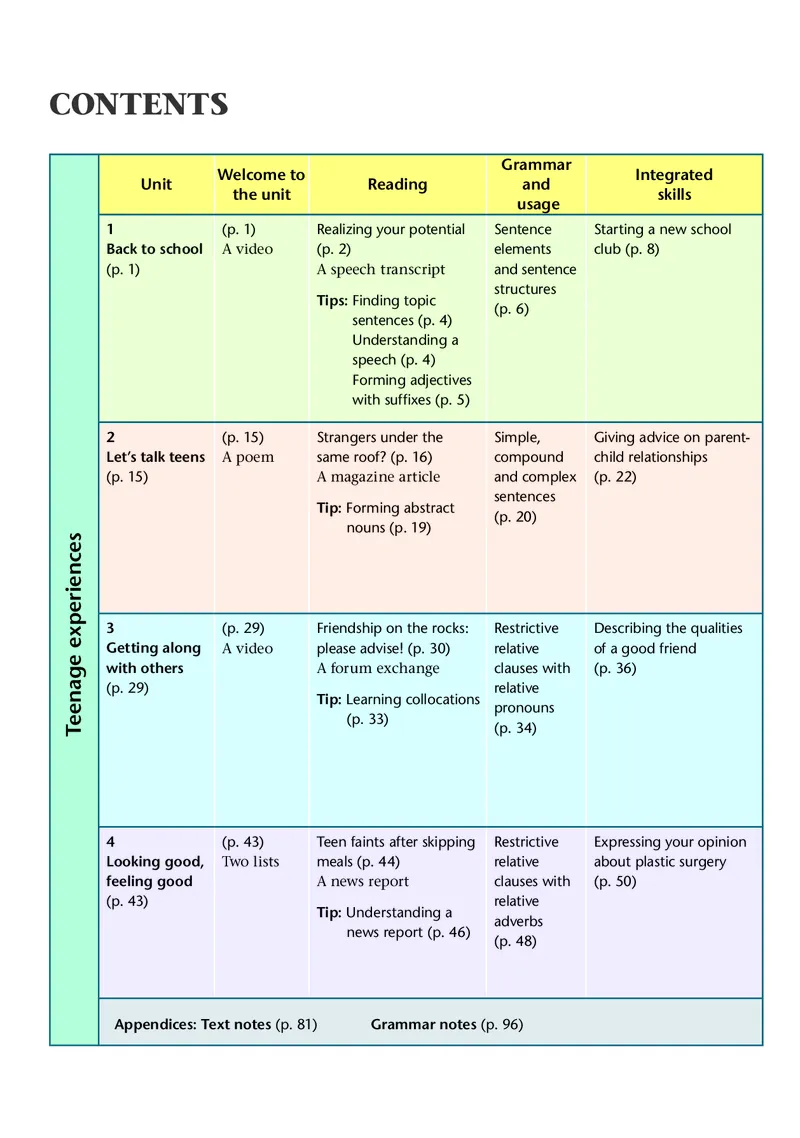
1 (p. 1) Realizing your potential Sentence Starting a new school School life in the UK Making a booklet (p. 14) (p. 14) Exploring language
Back to school A video (p. 2) elements club (p. 8) (p. 11) about your school (p. 57)
(p. 1) A speech transcript and sentence A school magazine (p. 13)
Building skills (p. 59)
structures article
Tips: Finding topic
(p. 6) Appreciating
sentences (p. 4)
language (p. 62)
Understanding a
speech (p. 4)
Forming adjectives
with suffixes (p. 5)
2 (p. 15) Strangers under the Simple, Giving advice on parent- Mama and Her Bank Creating a short play (p. 28) (p. 28) Exploring language
Let’s talk teens A poem same roof? (p. 16) compound child relationships Account (p. 25) about parent-child (p. 63)
(p. 15) A magazine article and complex (p. 22) A short story relationships (p. 27)
Building skills (p. 65)
sentences
Tip: Forming abstract Tip: Understanding a Tip: Performing a play
(p. 20) Appreciating
nouns (p. 19) short story (p. 26) (p. 27)
language (p. 68)
3 (p. 29) Friendship on the rocks: Restrictive Describing the qualities Of Friendship (p. 39) Making a scrapbook (p. 42) (p. 42) Exploring language
Getting along A video please advise! (p. 30) relative of a good friend An essay about friendship (p. 41) (p. 69)
with others A forum exchange clauses with (p. 36)
Tip: Writing a summary Tip: Searching for Building skills (p. 71)
(p. 29) relative
Tip: Learning collocations (p. 40) information from
pronouns Appreciating
(p. 33) different sources
(p. 34) language (p. 74)
(p. 41)
4 (p. 43) Teen faints after skipping Restrictive Expressing your opinion Don’t judge a book by Designing an app (p. 56) (p. 56) Exploring language
Looking good, Two lists meals (p. 44) relative about plastic surgery its cover (p. 53) about a healthy lifestyle (p. 75)
feeling good A news report clauses with (p. 50) A magazine article (p. 55)
Building skills (p. 77)
(p. 43) relative
Tip: Understanding a
adverbs Appreciating
news report (p. 46)
(p. 48) language (p. 80)
Appendices: Text notes (p. 81) Grammar notes (p. 96) Wordlists (p. 101) Irregular verbs (p. 119)
secneirepxe
eganeeT
CONTENTSGrammar
Welcome to Integrated
Unit Reading and Extended reading Project Assessment Further study Workbook
the unit skills
usage
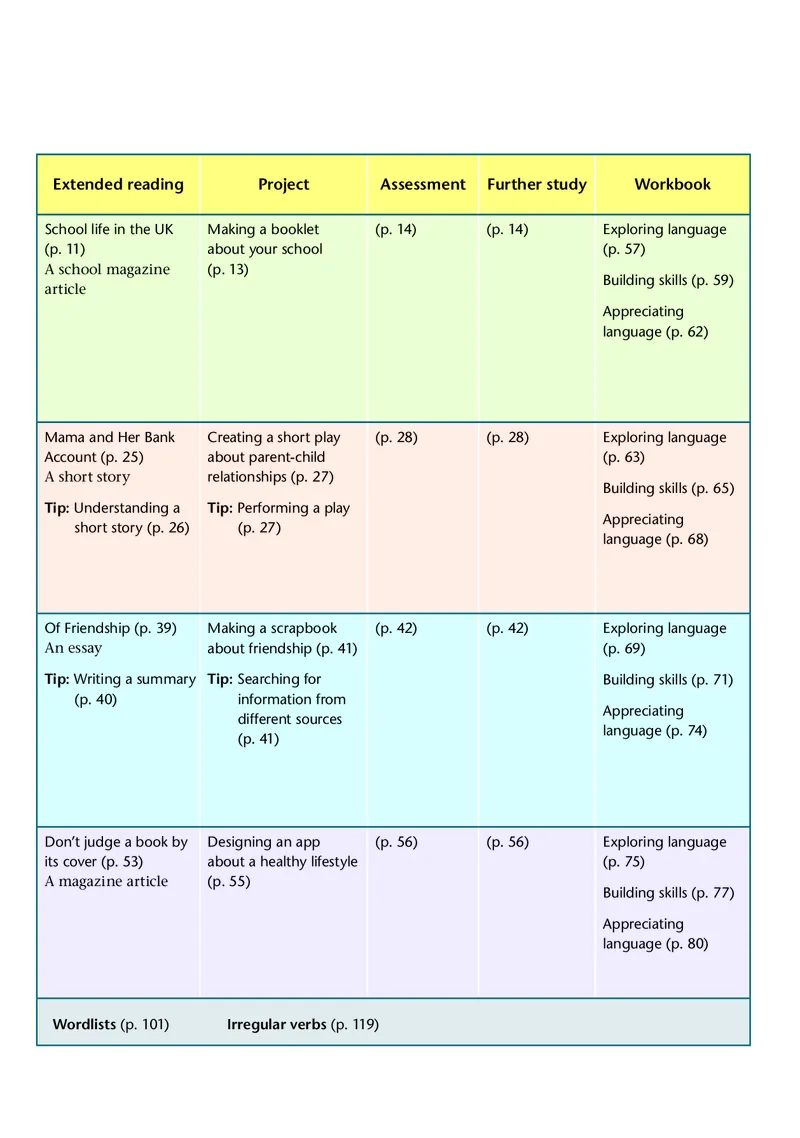
1 (p. 1) Realizing your potential Sentence Starting a new school School life in the UK Making a booklet (p. 14) (p. 14) Exploring language
Back to school A video (p. 2) elements club (p. 8) (p. 11) about your school (p. 57)
(p. 1) A speech transcript and sentence A school magazine (p. 13)
Building skills (p. 59)
structures article
Tips: Finding topic
(p. 6) Appreciating
sentences (p. 4)
language (p. 62)
Understanding a
speech (p. 4)
Forming adjectives
with suffixes (p. 5)
2 (p. 15) Strangers under the Simple, Giving advice on parent- Mama and Her Bank Creating a short play (p. 28) (p. 28) Exploring language
Let’s talk teens A poem same roof? (p. 16) compound child relationships Account (p. 25) about parent-child (p. 63)
(p. 15) A magazine article and complex (p. 22) A short story relationships (p. 27)
Building skills (p. 65)
sentences
Tip: Forming abstract Tip: Understanding a Tip: Performing a play
(p. 20) Appreciating
nouns (p. 19) short story (p. 26) (p. 27)
language (p. 68)
3 (p. 29) Friendship on the rocks: Restrictive Describing the qualities Of Friendship (p. 39) Making a scrapbook (p. 42) (p. 42) Exploring language
Getting along A video please advise! (p. 30) relative of a good friend An essay about friendship (p. 41) (p. 69)
with others A forum exchange clauses with (p. 36)
Tip: Writing a summary Tip: Searching for Building skills (p. 71)
(p. 29) relative
Tip: Learning collocations (p. 40) information from
pronouns Appreciating
(p. 33) different sources
(p. 34) language (p. 74)
(p. 41)
4 (p. 43) Teen faints after skipping Restrictive Expressing your opinion Don’t judge a book by Designing an app (p. 56) (p. 56) Exploring language
Looking good, Two lists meals (p. 44) relative about plastic surgery its cover (p. 53) about a healthy lifestyle (p. 75)
feeling good A news report clauses with (p. 50) A magazine article (p. 55)
Building skills (p. 77)
(p. 43) relative
Tip: Understanding a
adverbs Appreciating
news report (p. 46)
(p. 48) language (p. 80)
Appendices: Text notes (p. 81) Grammar notes (p. 96) Wordlists (p. 101) Irregular verbs (p. 119)UNIT Back to school
1
Study without thinking leads to confusion; thinking without study ends in
puzzlement.
—Confucius
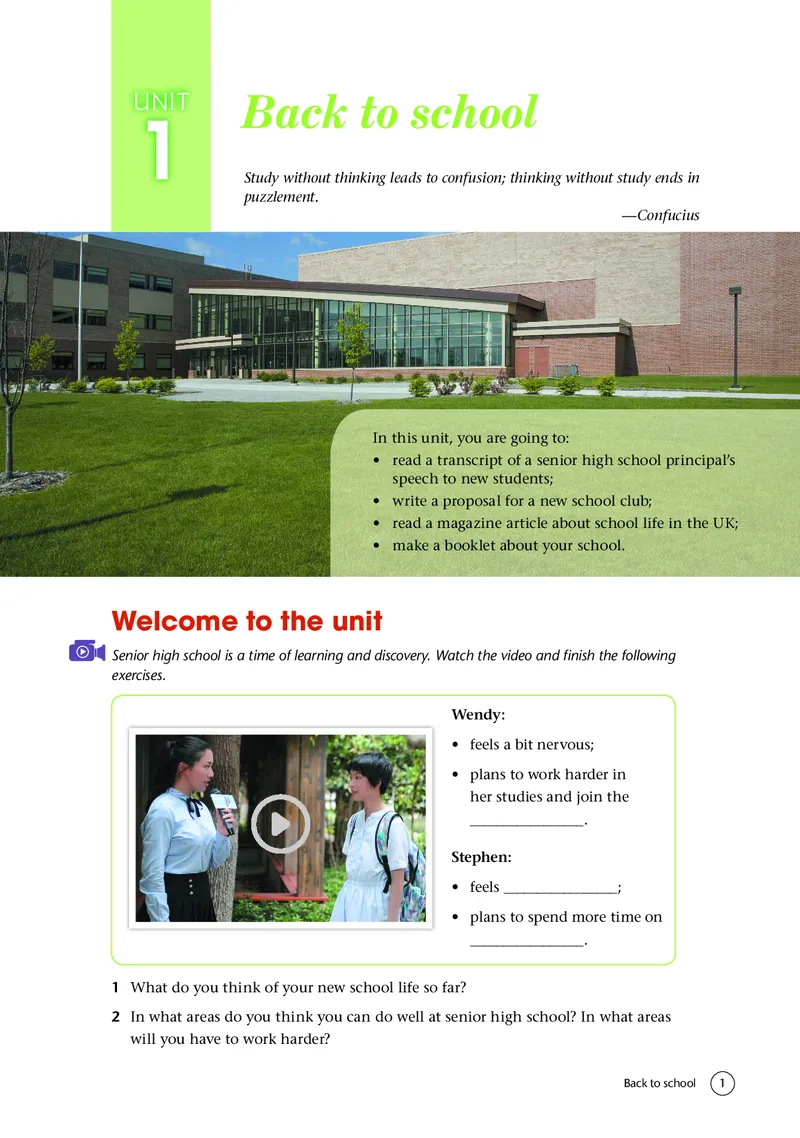
In this unit, you are going to:
• read a transcript of a senior high school principal’s
speech to new students;
• write a proposal for a new school club;
• read a magazine article about school life in the UK;
• make a booklet about your school.
Welcome to the unit
Senior high school is a time of learning and discovery. Watch the video and finish the following
exercises.
Wendy:
• feels a bit nervous;
• plans to work harder in
her studies and join the
_________________.
Stephen:
• feels _________________;
• plans to spend more time on
_________________.
1 What do you think of your new school life so far?
2 In what areas do you think you can do well at senior high school? In what areas
will you have to work harder?
Back to school 1Reading
Senior high school brings a lot of new experiences to everyone. The speech below was given to
new senior high school students by their principal, Mr Xu, on the first day of term. Before you
read the speech transcript, think about the following questions:
• How do you think senior high school will be different from junior high school?
• What do you think the principal will talk about in his speech?
Hello, everyone! Welcome to senior high school! Today
is the start of a new term, the start of a three-year
journey and the start of a promising future.
I can’t wait to describe to you what senior high school
5 life is like. The path before you leads to a world full
of challenges: a new environment, new knowledge
and new ways of thinking. However, for those of
you with a positive mind, opportunity lies in each
challenge. When you rise to the challenges, you will
10 have the opportunity to acquire great knowledge and
enjoy personal growth. Most importantly, your time
and effort at senior high school will open the door to
your potential.
2 Unit 1“What is potential?” you may ask. Put simply, potential is your natural ability that
15 can be developed when you try hard enough. Who knows what beautiful works
of art you will create, what medical advances you will make or what amazing
technologies you will develop! The possibilities are endless, and I have confidence
in your ability to make a difference to your family, to your community and to
our country. Over the next three years, you will discover your potential while you
20 develop as a student and as a person.
To fully realize your potential, it is important for you to make the most of our
school resources. Take advantage of your classes, learn from your teachers and
classmates, and make use of our school facilities. There are also a lot of school
activities for you. Join a club or two, and take an active part in different sports.
25 Of equal importance are good study habits, useful skills and a positive attitude.
Carefully plan your study, set clear goals and balance your schoolwork with other
activities. As a senior high school student, you must make efforts to improve your
communication and problem-solving skills. Last but not least, always look on the
bright side and never lose hope, even in difficult situations. In time you will find
30 yourself growing into a well-rounded individual.
As Lao-Tzu wisely said, “A journey of a thousand miles begins with a single
step.” You need to make a continuous effort to train your mind and develop your
character. Senior high school will help you learn and grow, yet you alone are
responsible for realizing your great potential. Be confident, do your best and make
35 us proud!
Back to school 3A Understanding the text
A1 Read the speech transcript and find the topic sentence for each paragraph.
Tip
Para. 1: Welcome to senior high school!
Finding topic sentences
A topic sentence tells the
Para. 2: __________________________________________________ reader the main idea of a
paragraph. It is usually at the
beginning of a paragraph,
but it may also be in the
Para. 3: __________________________________________________ middle or at the end of a
paragraph.
Para. 4: _____________________________________________________________________
Para. 5: _____________________________________________________________________
Para. 6: _____________________________________________________________________
A2 Read the speech transcript again carefully and answer the following questions.
1 What challenges will students face at senior high school?
____________________________________________________________________________
2 What does the principal have confidence in?
____________________________________________________________________________
3 What school resources are mentioned in the speech?
____________________________________________________________________________
4 What positive attitude should students develop?
____________________________________________________________________________
A3 In pairs, discuss the following questions.
Tip
1 How does the principal try to keep his audience
Understanding a speech
interested? What rhetorical devices does he use?
A speech is a formal talk that a person gives
Find examples from the speech. to an audience. A good speech keeps the
audience interested all the time. To achieve
this, the speaker may tell interesting stories
2 How are you going to realize your potential?
or ask questions. A good speech also uses
quotations and such rhetorical devices as
metaphor, repetition and parallelism.
4 Unit 1B Building your language
B1 Maggie, a new student, wrote about her first day at senior high school. Complete the
passage with the correct forms of the words and phrases in the box below.
challenge confidence acquire rise to
effort responsible balance take advantage of
I’ve just finished my first day of senior high school and I really enjoyed it. I’ve been
told that schoolwork will present more of a(n) (1) _________________ in the years
ahead, and that the teachers will hold us to higher standards. This means I’ll have
to put a lot of (2) _________________ into my studies. I’ll also need to be very careful
about (3) _________________ my schoolwork and hobbies. This is all quite new and
different from my life at junior high school, but I’m sure I’ll (4) _________________
all these challenges. In fact, I’m looking forward to being more independent and
(5) _________________ for my own learning. There is so much knowledge I need to
(6) _________________, so I’ll work harder than ever. I also plan to (7) _________________
every opportunity to improve my communication skills. I’ll make more friends by
joining some clubs. I have (8) _________________ in my ability to do well at senior
high school!
B2 The speech uses some adjectives. Note the following suffixes and think of more adjectives
formed with them. Then fill in the table below with as many words as you can.
Tip
Parts of speech Suffixes Words
Forming adjectives
with suffixes
-ful useful We can form adjectives
by adding suffixes to
nouns or verbs.
Nouns -less endless Sometimes we need to
leave out or change
the final letter(s) of a
-al natural
word before adding a
suffix, e.g.
centrecentral,
-ive active
decidedecisive.
Verbs
-ous continuous
B3 The speech uses a number of parallel structures. Find them in the speech and use a
similar structure to encourage someone who is unhappy.
Learn this Parallel structures use the same pattern of words or sentences. They can
add balance to sentences and make the language more powerful and effective.
Back to school 5Grammar and usage
Sentence elements and sentence structures
A Exploring the rules
On the first day of school, Miss Yan gave a short speech about the importance of setting
goals. Pay attention to the underlined sentences and fill in the table below. The first one has
been done for you.
Albert Einstein said, “If you want to live a happy life, tie it to a goal.” (1) I agree.
Goals are important in many ways. (2) Setting goals gives you a focus in life. By
setting goals now, you are deciding what you want to achieve in the future. Then
you know where you are going in life and can work hard to get there. Setting
goals also helps you develop good habits. To realize your goals, you need to have
a good plan, manage your time well and pay attention to details. (3) These habits
will be helpful. Finally, (4) setting goals makes you more confident. When
you achieve a goal, you see the result of your hard work and know how much
progress you have made. A goal is a dream that needs action. As a result of your
action, your dream will come true and hopefully (5) you will live a happy life.
Subject Verb
I agree.
Subject Verb Predicative
Subject Verb Object
Subject Verb Indirect object Direct object
Subject Verb Object Object complement
Working out the rules
• The subject and the (1) _________________ are necessary parts of a sentence.
• A transitive verb is always followed by a(n) (2) _________________.
• Some verbs can have two objects. The indirect object usually refers to a person
and the direct object a thing.
• The object complement adds more information about the object.
Grammar notes pages 96–97
6 Unit 1B Applying the rules
B1 Mark the different elements of each sentence with different symbols. Use the example
below to help you.
Subject: ___ Example
Verb: === Y_o_u_ w == i = ll = e = n = j = o = y ( ~ p ~ e ~~ rs ~ o ~~ n ~ a ~ l) ~ ~ g ~ r ~ o ~ w ~~ t ~ h [at (high) school].
Object: ~~~~
1 You will find senior high school different from junior
Predicative: ~ ~ ~ ~ ~ ~ ~ ~
high school.
Object complement:~_~_~_~_
2 Your schoolwork will be more challenging.
Adverbial: [ ]
3 We will give you more independence.
Attributive: ( )
4 You should listen more carefully.
5 You can join a club.
6 Your teachers will help you in many ways.
7 You will succeed!
B2 Below are some tips about setting goals. Match the underlined sentences with the correct
structures. Write the letters in the boxes.
a SV c SVO e SVOC g SVOA
b SVP d SVOO f SVA
Setting goals is the first step in achieving them. (1) The tips below may help you.
Set goals that can be achieved. Don’t push yourself to achieve more than what
is possible. Instead, you should set goals based on your abilities and skills.
Break big goals down into small ones. When you do so, (2) they will seem
easier to reach. You will be proud of yourself when you realize each small goal.
(3) This will also give you the encouragement to achieve your long-term goal.
Write your goals on paper. It is a good idea to put your goals where you can
see them. (4) You can place the list on your bedside table. Or you can stick it on
your bedroom wall. This will remind you of what you are working for and keep you
focused.
After you set a goal, it is important to stick to it and work hard towards it. (5) You
may find achieving goals difficult. But (6) you should not give up. Instead,
stay positive and confident. (7) You will succeed in the end.
B3 What is your goal for the new term? How are you going to achieve your goal? Write
about it using different sentence structures. Use the example below to help you.
Example
I will try to improve my English in the new term. There are a lot of things I need to do to
achieve this goal. I will read two English novels this term. I will also try to find a language
partner. Joining the English Club will be helpful to me too. All my efforts will pay off!
Back to school 7Integrated skills
Starting a new school club
A Maggie is talking to Mr Zhou about starting a new school club. Listen and finish the
exercises below.
A1 Listen to Maggie and Mr Zhou’s conversation and put the steps it takes to start a new
school club in the correct order. Write the letters in the boxes.
a Give the signed proposal to Mr Zhou.
b With Mr Zhou’s help, find a place for the club and set up the first meeting.
c Write a proposal for the new club.
d Wait for the proposal to be accepted by the principal.
e Find at least five students to sign up for the first meeting.
A2 Listen to Maggie and Mr Zhou’s conversation again and complete the notes below.
Maggie’s new school club
• Purpose of starting a new club
To help students (1) ___________________
• Type of club Maggie wants to start
A (2) ___________________ club
• Information the proposal must contain
The name of the club
The name of the (3) ___________________
The aims of the club
The time the club will meet every week
The (4) ___________________ Maggie plans to organize
What materials she will need
How she is going to (5) ___________________
8 Unit 1B After her conversation with Mr Zhou, Maggie wrote a proposal for a new school club.
Read her proposal below and try to understand its structure.
Proposal for a new club
Club name: Short Story Writing Club
Club leader: Maggie Zhang
Meeting time: Friday afternoon from 4:30 to 5:30
Club aim: To improve short story writing skills
Club activities:
• Read short stories in different styles;
• Write short stories using different techniques;
• Hold workshops to discuss the short stories that club members
read and write;
• Invite professional writers to give talks on short story writing.
Materials needed: Paper and pen for each student
Plan for finding new members:
• Make posters and put them up around the school;
• Put a notice in the school newspaper and on the school
website;
• Put a video on the school website.
Signed:
Maggie Zhang
Back to school 9C In pairs, talk about starting a new school club. Use the following ideas and expressions to
help you.
• The type of club you want to
start Expressions
• The aims of the club Talking about plans
We’d like to start a ... club in order to .../so that ...
• The activities you plan to do at We plan/intend to ... by ...
the club Our plan for a ... club calls for ...
Our club aims to/is intended to ...
• The materials you will need
• The ways to find new members
D Write your proposal for a new school club. Use your ideas from part C and the
information in parts A and B to help you.
Planning your writing
• Learning about the text type
A proposal is a formal suggestion or plan. Its purpose is to get the reader to agree
to your suggestion or plan.
• Learning about the structure
It is important to separate different types of information to make your proposal
easy to read. Refer to page 9 to see how you should structure your proposal.
• Learning about the language
The target reader of your proposal is your school principal. Use formal language
and provide important and brief information about your suggestion or plan.
Checking your writing
It is important to check your writing after you finish. You should especially check if
there are any mistakes in terms of:
Punctuation Spelling Grammar
Choice of words Style (formal/informal) Structure
It is a good idea to work in pairs to read and edit each other’s writing. You should
give different types of comments, including praise, suggestions and corrections.
Self-review Peer review
• What mistakes do you find in your • What comments does your partner give
writing? on your writing?
• How can you correct them? • How can you improve your writing?
10 Unit 1Extended reading
John Li, a Chinese senior high school student, has spent a year studying in the UK. Read his
article in the school magazine about his school life abroad.
Last year, I had the chance to study at a British secondary school as an exchange
student. I stayed with a lovely host family and went to school with their son,
Daniel. We were both in year ten and we got on well. He is learning Chinese and
will come to stay with me this year in China!
5 The British school day commonly begins around 9 a.m. and ends around 4 p.m.
Every secondary school student in the UK must study English, Maths and the
Science subjects: Biology, Chemistry and Physics. In year ten, students usually have
to learn nine subjects and they can also choose to study other subjects, such as
History, Art and Business.
10 The classes are different from those in China. Each teacher has their own classroom
and the students move around for every lesson. In most of my classes, there were
only about 20 students. In the beginning, however, it was still tough for me to
remember everyone’s name!
I enjoyed most of the classes, but some of them were quite challenging. Technology
15 classes were fun. I made a clock to take home. The teacher helped me put the parts
together. I like it so much that I still use it as my alarm! I found Maths quite easy
and enjoyable because the material was less advanced in the UK than in China.
However, learning in English was a great challenge for me. There were a lot of
difficult English words, especially in Geography and Biology. Class discussion
20 is very important in the UK, but I could not make a great contribution because
sometimes I wasn’t able to express myself clearly in English. Although there was
not as much homework as I was used to, it was still challenging. Fortunately, my
Back to school 11teachers and classmates were always helpful and gave me lots of encouragement.
My language skills improved over time.
25 During the hour-long lunchtime, I ate in the school dining hall. There were lots of
options including bread and butter, chicken pie and puddings, but I still missed my
mum’s cooking! After lunch, I often played on the school’s huge sports field with
Daniel and his friends. Sometimes we just relaxed under a tree or sat on the grass.
After school, there were many clubs to join. The
30 one that attracted me most was the Rugby
Club. We played once a week, and it was
great fun. Also, I enjoyed acting in the
Theatre Club. I still have photos of myself
acting in William Shakespeare’s A Midsummer
35 Night’s Dream. Joining clubs was a great way to
meet British students and make friends with them.
I am glad to have the opportunity to experience this different way of life. I met
some great people and learnt a lot about school life in the UK. Daniel and his
family were fantastic hosts, and his friends were very nice as well. I can’t wait for
40 Daniel to visit China!
A What is school life in the UK like? Look at the mind map below and find information from
the passage. Then think about what school life in China is like.
School timetable
Clubs Subjects
School life in the UK
School lunch Class size
Homework Class discussion
B What is your dream school like? Write about it and give reasons.
12 Unit 1Projectchure about your new school
Making a booklet about your school
A As a class, discuss different aspects about your school. You can use the ideas below or
think of other ideas. Then in groups, pick one aspect to research.
lessons teachers school history school events
clubs teaching buildings labs library
computer room ...
B As a group, research your chosen aspect. Use the ideas below to help you.
• Where can you find the information you need?
You can visit the school website or interview your teachers to find out more about
your school.
• What kind of questions should you ask when interviewing a teacher?
It is a good idea to start with general questions and then move on to specific
ones, e.g.
Can you tell me something about the history of our school? (general)
When was the main teaching building built? (specific)
• What else do you need for your booklet?
Besides words, you also need pictures for your booklet. You can take photos or
download pictures from your school website. Make sure all words and pictures
are laid out neatly and beautifully.
C As a group, put together your information to make your part of the booklet. Use the
example below to help you. Present your part to the rest of the class. Then as a class, put all
the parts together to make the booklet.
Room and enjoy this traditional
Chinese
art form. From 13:00 to 14:00,
Calligraphy
students learn about the basics of
Chinese calligraphy from their
Chinese Calligraphy is one of the teacher. From 14:00 to 15:00, they
many optional courses offered practise writing calligraphy.
to students who are interested in
traditional art. This course has At the end of each
been very popular since it started term, students put on
two years ago. a calligraphy show,
attracting more
Every Friday afternoon, about students to Chinese
forty students meet in the Art calligraphy.
Back to school 13Assessment
A In pairs, rank your performance level in the following areas from 1 to 5. Write down your
own assessment in the column “Me” and ask your partner to write down his/her assessment
of your performance in the column “Partner”.
How well can you: Me Partner
5 = Excellent
understand the principal’s speech and find
4 = Good
topic sentences?
3 = Satisfactory
write a proposal for your new school club?
2 = Fair
1 = I mprovement
understand what school life in the UK is
required
like?
make a booklet about your school?
use the new vocabulary from this unit and
form adjectives with suffixes? *
identify and use different sentence elements
and sentence structures? *
* Assess your learning of vocabulary and grammar by doing language practice on
pages 57–58.
B If improvement is required for some of the areas above, make an action plan.
_____________________________________________________________________________________
_____________________________________________________________________________________
Further study
UNESCO believes education is important for everyone. Visit the
education page on UNESCO’s official website and learn about
the theme “Education”.
The film Front of the Class tells the true story of a man with
disability who fights to realize his dream of becoming a teacher.
Watch the film to enjoy this heart-warming story.
14 Unit 1UNIT Let’s talk teens
2
I don’t know what “home” is, but unhappiness and worries melt away
once there.
—Bing Xin
In this unit, you are going to:
• read a magazine article about relationships between
teenagers and their parents;
• write a letter of advice on parent-child tensions;
• read a short story of a mother’s love for her
children;
• create a short play about parent-child relationships.
Welcome to the unit
Parents often give their children unconditional love. Read the poem below and discuss the following
questions in pairs.
Morning and night, Mother Bird is there
Until her baby’s old enough to leave the nest.
Mother Bird, with all her love and care,
Longs to provide her baby with the best.
Often, she worries, from day to day—
Very soon her baby will be full-grown.
Excitedly, it will jump away,
Spread its wings and fly alone.
Yet, she knows, she must let it fly
Over the hills and across the sky,
Under her careful, watching eye.
1 How would you describe Mother Bird’s feelings in the poem?
2 What Chinese poems about parents’ love for their children can you think of?
3 How do you think your parents feel about you? How can you tell?
Let’s talk teens 15Reading
When teenagers’ bodies and minds go through a period of rapid development, every part of
their lives can be influenced. The magazine article below is about teenagers’ relationships with
their parents. Before you read the article, think about the following questions:
• What physical and mental changes do you experience as you become a teenager?
How do you deal with them?
• What do you think “strangers under the same roof” means?
Does every dinner with your parents seem to turn into
a battle? Have your once warm and open conversations
become cold and guarded? Do you feel that you just
cannot see eye to eye with them on anything? You
5 are not alone. Heated arguments and cold silences are
common between teenagers and their parents.
Teenagers’ physical changes may result in such family
tensions. You may feel anxious that you are developing
at a different rate to your friends, shooting up in height
10 or getting left far behind. You might worry about your
changing voice, weight problems or spots. When it all
gets too much, your parents are often the first targets
of your anger.
It can be a big headache to balance your developing
15 mental needs too. You enter a strange middle ground—
16 Unit 2no longer a small child but not quite an adult. You have both a new desire for
independence and a continued need for your parents’ love and support. You feel
ready to be more responsible and make decisions on your own. Unfortunately, your
parents do not always agree and that makes you feel unhappy. “Why can’t they
20 just let me go?” you may wonder. On the other hand, when you are struggling to
control your feelings, you wish they could be more caring and patient—sometimes
they forget that growing up is a rough ride. It can be difficult when your parents
treat you like a child but expect you to act like an adult. All of this can lead to a
breakdown in your relationship.
25 Although sometimes it may seem impossible to get along as a family, you can take
action to improve the situation. The key to keeping the peace is regular and honest
communication. When you disagree with your parents, take a minute to calm down
and try to understand the situation from their point of view. Perhaps they have
experienced something similar and do not want you to go through the same pain.
30 After you have thought it through, explain your actions and feelings calmly, listen
carefully, and address their concerns. Through this kind of healthy discussion, you
will learn when to back down and when to ask your parents to relax their control.
Just remember that it is completely normal to struggle with the stress that parent-
child tensions create, and that you and your parents can work together to improve
35 your relationship. The good news is that this stormy period will not last. Everything
will turn out all right in the end, and the changes and challenges of your teenage
years will prepare you for adulthood.
Let’s talk teens 17A Understanding the text
A1 Read the magazine article and complete the chart below.
Introduction
It is common for teenagers to have difficult relationships
with their parents.
Cause 1 Cause 2
____________________________________ ____________________________________
Solution
____________________________________
Conclusion
______________________________________________
A2 Read the magazine article again carefully and answer the following questions.
1 What physical changes might teenagers worry about?
____________________________________________________________________________
2 What does “middle ground” in line 15 mean?
____________________________________________________________________________
3 What does “that” in “that makes you feel unhappy” in line 19 refer to?
____________________________________________________________________________
4 How can teenagers have a healthy discussion with their parents?
____________________________________________________________________________
A3 In pairs, discuss the following questions.
1 What is the author’s attitude to parent-child tensions? Use information in the
magazine article to support your idea.
2 The magazine article suggests that teenagers want both independence and their
parents’ love and support. Do you feel the same way or not? Give an example.
3 What stresses do the parents of a teenager have to deal with? How do they
influence the parent-child relationship?
18 Unit 2B Building your language
B1 Mrs Zhao wrote an email to a teen magazine. Complete the email with the correct forms
of the words and phrases in the box below.
anxious argument concern calm down
normal stress struggle go through
Dear Editor,
I am writing to ask for advice on my relationship with my teenage son. To tell
the truth, I often (1) _________________ to get along with him. Recently we have
argued with each other a great deal. He is (2) _________________ about his skin
because it has started to become very oily, with lots of red spots. He is always angry
these days and seems less confident. I keep telling him that these changes are
(3) _________________, and that things will turn out just fine. Of course, I wanted
to show my (4) _________________ for his condition, so I asked him to see a doctor.
But then he became angry and we had a big (5) _________________. He told me that
I was putting even more (6) _________________ on him by talking about his spots all
the time. In the end, I sent him to his room. He finally (7) _________________, but
it took some time. The whole experience was really terrible and I do not want to
(8) _________________ the same thing again. What should I do?
Best wishes,
Mrs Zhao
B2 The article uses some abstract nouns. Note the following suffixes and think of more
abstract nouns formed with them. Then fill in the table below with as many words as you
can.
Tip
Parts of speech Suffixes Words
Forming abstract nouns
-ce independence
Abstract nouns refer to
Adjectives ideas or qualities. They
-ty/-ity honesty cannot be physically
touched, for example,
-hood adulthood ability, silence and tension.
Nouns We can form abstract
-ship relationship nouns using certain
suffixes. Sometimes the
-ment argument final letter(s) of a word
should be left out or
Verbs -tion/-sion communication changed when we add a
suffix, e.g. silentsilence,
-th growth decidedecision.
B3 The magazine article uses a group of questions to introduce the topic of parent-child
tensions. Read the first paragraph of the magazine article and introduce the topic of parents’
love for their children by asking questions.
Learn this When a group of questions are used to introduce a topic, they are
usually not meant to be answered. Rather, the author intends to draw readers’
attention to the topic and make them think about and take an interest in it.
Let’s talk teens 19Grammar and usage
Simple, compound and complex sentences
A Exploring the rules
Below is an introduction on the home page of a website for teenagers. Match each sentence
with the correct type in the table below. Write down the numbers.
(1) We know that being a teenager is sometimes difficult. (2) So, we have designed
TeenHealthWeb to help you along the journey to adulthood. (3) Our website
has many articles about teenagers’ physical and mental health. (4) You can look
through these articles to find advice on your problem. (5) It may not have been
addressed before, but don’t worry. (6) You can visit the “teen health” forum on
our website instead. (7) We are proud to say this forum is the heart of our website.
(8) Users are encouraged to post their problems, and they will get advice from our
health experts and other forum users. (9) Before you write your post, however, take
a look at other users’ posts first. (10) It is likely that the matter has already been
discussed on our forum. (11) If your problem is a new one, write a post about it.
(12) Our health experts will be glad to tell you what steps you can take to improve
your situation. (13) There is a lot to see, so take some time to look around our
website!
Simple sentences
Compound sentences
Complex sentences
Working out the rules
• A simple sentence is made up of one independent clause which has one
subject-verb combination.
• A compound sentence contains two or more main clauses. We use linking
words such as (1) _________________, or, (2) _________________, so or for to link
the clauses.
• A complex sentence contains one main clause and at least one subordinate
clause. A subordinate clause can be the subject, predicative, object,
attributive or adverbial of the sentence.
Grammar notes pages 97–98
20 Unit 2B Applying the rules
B1 Below are some tips on how to use TeenHealthWeb. Join each pair of sentences to form a
compound or complex sentence.
1 Your password should be at least eight characters long. This makes it difficult to
guess.
____________________________________________________________________________
2 Posts should not give out personal information. They should not include
advertisements.
____________________________________________________________________________
3 Describe your problems clearly. Other people can understand them easily.
____________________________________________________________________________
4 The experts will reply to you. They see your posts.
____________________________________________________________________________
5 What do you think of our forum? Let us know.
____________________________________________________________________________
B2 Teresa is talking to her friend Jack about her parents. Complete the conversation with the
correct linking words in the box below.
and because but how if that unless why
Teresa: I’m under a lot of stress these days (1) _________________ my parents
are always comparing me with my friends. They’re never satisfied
(2) _________________ I do better than all my friends—in schoolwork, in
hobbies, in everything!
Jack: That’s terrible. I can see (3) _________________ you’re anxious. You should tell
your parents (4) _________________ you’re trying your best. There’s no point
in comparing you with others all the time. Everyone is unique.
Teresa: I know, (5) _________________ my parents don’t seem to understand that.
(6) _________________ they continue like this, I’ll lose confidence in myself.
Jack: I think your parents are too strict with you. Don’t take a passive role in
the relationship. Talk to them. Let them know (7) _________________ you
feel. Sometimes, competition can push you to do better. Right now, it’s just
making you anxious and having a bad influence on your performance.
Teresa: Thank you, Jack. I’ll try talking to my parents.
Jack: Cheer up, Teresa. They’ll understand (8) _________________ everything will
turn out all right!
B3 In pairs or groups, role-play a conversation between Teresa and her parent(s) using
simple, compound and complex sentences. The beginning has been given.
Teresa: Hi Mum! Can we please talk?
Mother: Sure, dear. What’s the matter?
...
Let’s talk teens 21Integrated skills
Giving advice on parent-child relationships
A Some teenagers write to Cynthia, the host of a radio programme called Teen Time,
about their problems with their parents. Read the parts of their emails below and describe
each problem in one sentence.
My mum keeps a notebook of my grades in every exam. She asks my teachers
how I’m doing at school whenever she can. It seems as if my grades are the
most important thing in her life. When we’re at home, she keeps
pressing me to study all the time. I do as she says, but she is
never happy with my grades. Why can’t she leave me alone?
I want to take a break once in a while. I want to listen to music
or go out with my friends. Is that too much to ask for?
—Rebecca
I’m eager for my parents’ love. They’re always busy at work. I hardly ever
see them during the week because they don’t get home until late at night.
I tell them that I’m stressed about schoolwork, but neither of them show any
concern. Sometimes I feel quite lonely at home. When was the last
time we had a family outing at the weekend? When was the last
time we had a long talk? How can parents not care about
their children?
—Simon
Everyone says that youth is a time for adventure, but my parents disagree.
I spend most of my spare time at home, because they hardly ever let me go out
with my friends. When I do go out, they always ask, “Where are you going?”
“Who are you going with?” “What are you going to do?” “When will you be
back?” They’re always on my back about something.
I understand that they’re trying to protect me from getting hurt. However, just
as a baby kangaroo must learn to protect itself when it leaves its mother’s pocket,
I will have to learn to protect myself when I grow up. I wish
they could be more flexible so that I can make my own choices
about what to do in my spare time.
—Laura
Rebecca’s problem
Simon’s problem
Laura’s problem
22 Unit 2B Cynthia is replying to Rebecca’s email on the radio programme. Listen and finish the
exercises below.
B1 Listen to Cynthia’s reply and circle the correct words to complete the sentences below.
1 According to Cynthia, Rebecca feels unhappy because her mother does not
understand her/value her effort.
2 Cynthia thinks that every parent has too much control over/high hopes for
their children.
3 According to Cynthia, school and friendship/relaxation are both important.
4 Cynthia says Rebecca should be patient/calm enough to understand what her
mother does.
5 Cynthia describes her senior high school life as exciting/tiring.
B2 Listen to Cynthia’s reply again and complete the notes below.
Advice for Rebecca
• (1) _________________ your mother. Make sure she understands
(2) _________________.
Remember to choose (3) _________________ and start the
conversation politely.
Example: “I know that you expect me to (4) _________________,
but I’m struggling sometimes. Can we please talk?”
Try to (5) _________________. Let your mother know about
(6) _________________ and ask for more free time.
Example: Try to make a deal with your mother by explaining
why you (7) _________________ and how it helps you.
• (8) _________________ in your mother’s shoes and try to understand
what she does.
Example: When your mother doesn’t let you (9) _________________,
think about why she does so.
Let’s talk teens 23C In pairs, role-play a conversation between Simon/Laura and Cynthia. Try to ask for and
give advice. Use the following ideas and expressions to help you.
• Problem Simon/Laura has • Advice Cynthia gives
Expressions
Asking for and giving advice
• Asking for advice • Giving advice
What shall I do? I suggest that you (should) ...
What do you think I should do? I think/feel you can try ...
Do you think that I should ...? It might be a good idea to ...
Do you have any ideas/suggestions? How about/What about ...?
D Write a reply to Simon’s or Laura’s email. Use your ideas from part C and the information
in parts A and B to help you.
Planning your writing
• Learning about the text type
A letter of advice is written to someone who has a problem and does not know
how to solve it. In a letter of advice, you try to help solve the problem by offering
useful advice.
• Learning about the structure
When you write a letter of advice, you can follow the structure below:
Start by showing your understanding.
Offer several pieces of advice to help solve the problem. You can include
personal experiences or stories about someone who has had a similar problem.
End the letter with a positive message. It is a good idea to try to cheer up the
person you are writing to.
• Learning about the language
The following expressions might be helpful when you write a letter of advice:
I understand your feelings.
Try these pieces of advice and see if they help.
I hope ... I wish you all the best.
Checking your writing
Remember to check your writing after you finish and exchange drafts between you
and your partner. Pay attention to the following aspects:
Punctuation Spelling Grammar
Choice of words Style (formal/informal) Structure
Self-review Peer review
• Do the examples support the advice you • What does your partner think of the
give? advice and examples you give?
• What is the sentence you are most • How can you improve your writing?
satisfied with?
24 Unit 2Extended reading
Read the short story about a mother’s love for her children.
Every Saturday night Mama would sit down by the kitchen table and count out the
money Papa had brought home.
“For the rent.” Mama would count out the big silver pieces.
“For the groceries.” Another group of coins.
5 “I’ll need a notebook.” That would be my sister Christine, my brother Nels or me.
Mama would put one or two coins to the side. We would watch with anxious
interest. At last, Papa would ask, “Is that all?” And when Mama nodded, we could
relax a little. Mama would look up and smile, “Good. We do not have to go to the
Bank.” We were all so proud of Mama’s Bank Account. It gave us such a warm,
10 secure feeling.
When Nels graduated from grammar school, he wanted to go on to high school. “It
will cost a little money,” he said.
Eagerly we gathered around the table. I took down a box and laid it carefully in
front of Mama. This was the “Little Bank”. It was used for sudden emergencies, such
15 as the time when Christine broke her arm and had to be taken to a doctor.
Nels listed the costs of the things he would need. Mama counted out the money
in the Little Bank. There was not enough. “We do not want to go to the Bank,” she
reminded. We all shook our heads.
“I will work in Dillon’s grocery after school,” Nels volunteered.
20 Mama gave him a bright smile and wrote down a number. “That’s not enough,”
Papa said. Then he took his pipe out of his mouth and looked at it for a long time.
“I will give up smoking,” he said suddenly.
Mama reached across the table and touched Papa’s arm. Then she wrote down
another figure.
25 “I will look after the Elvington children every Friday night,” I said. “Christine can
help me.”
Let’s talk teens 25Now there was enough money. We all felt very
good because we did not have to go downtown
and draw money out of Mama’s Bank Account.
30 So many things came out of the Little Bank
that year: Christine’s dress for the school play,
my little sister Dagmar’s operation ... Whatever
happened, we always knew we still had the Bank
to depend upon.
35 That was twenty years ago.
Last year I sold my first story. When the check came, I hurried over to Mama’s and
put it in her lap. “For you,” I said, “to put in your Bank Account.”
I noticed for the first time how old Mama and Papa looked. Papa seemed shorter,
and Mama’s hair was silver now.
40 “Tomorrow,” I told Mama, “you must take it to the Bank.”
“You will go with me, Katrin?”
“That won’t be necessary. Just hand it to the teller. He’ll pay it into your account.”
Mama looked at me. “There is no account,” she said. “In all my life, I’ve never been
inside a bank.”
45 And when I didn’t—couldn’t—answer, Mama said seriously, “It is not good for little
ones to be afraid—to not feel secure.”
(Adapted from Kathryn Forbes’s Mama’s Bank Account, which has 17 short stories and
describes the struggles and dreams of a family in San Francisco in the early 1900s)
A In pairs, find information about each of the following elements of the short story and
complete the table below.
Tip
Setting
Understanding a short story
A short story has some basic
Characters
elements: setting, characters,
plot and theme. To understand
Plot
a short story well, the reader
needs to analyse all these
Theme
elements.
B Have your parents done something that has moved you greatly? What was it? Share
your story.
26 Unit 2Project
Creating a short play about parent-child relationships
A As a class, discuss what topics should be presented for a play about parent-child
relationships. You can use the ideas below or think of other ideas. Then in groups, pick one
topic for your play.
friends goals/dreams hobbies housework
personal habits pocket money schoolwork ...
B As a group, watch a video and then discuss how to write a short play about your chosen
topic. Use the table below to help you.
Elements of a play The play you watch Your own play
Setting
Characters
Plot
Theme
C As a group, write your play. Use the example below, which is the beginning of a short
play, to help you. Then perform your play in front of the class.
Act 1, Scene 1
Tip
Stage directions, written in
italics, are often given at the Performing a play
Friday evening. The living room of a flat. A teenage
start of a new act/scene to tell
the reader when and where the girl, Eve, is sitting on the sofa and texting on her To perform a play well, you
should:
play is set. mobile phone when her dad enters.
• learn how to say your
Dad: I’m home! (He waits for a response but doesn’t lines: try speaking in
different ways, e.g. softly,
get one. He puts his bag on the table.) Eve, how
Dialogue includes characters angrily, to see which way
and lines. Names of characters was your day? works best;
appear before new lines. • perform with confidence
Eve: Fine. (She gets up and starts to walk to her
and make sure that you
room.) can be heard clearly;
• use body language to
Dad: Who are you texting?
show your feelings.
Eve: No one. (She continues to text without looking
up.)
Dad: Are you all right? Stage directions in the dialogue
give instructions on what actions
Eve walks into her room.
to perform. They are italicized
and put in brackets.
Eve: Yeah. (She shuts the door.)
Let’s talk teens 27Assessment
A In pairs, rank your performance level in the following areas from 1 to 5. Write down your
own assessment in the column “Me” and ask your partner to write down his/her assessment
of your performance in the column “Partner”.
How well can you: Me Partner
5 = Excellent
understand the magazine article about
4 = Good
relationships between teenagers and their
3 = Satisfactory parents?
2 = Fair
write a letter of advice on parent-child
1 = Improvement
tensions?
required
understand the short story of a mother’s
love for her children?
write and perform a play about parent-child
relationships?
use the new vocabulary from this unit and
form abstract nouns with suffixes? *
identify and use simple, compound and
complex sentences? *
* Assess your learning of vocabulary and grammar by doing language practice on
pages 63–64.
B If improvement is required for some of the areas above, make an action plan.
_____________________________________________________________________________________
_____________________________________________________________________________________
Further study
In the animated film Despicable Me (2010), a supervillain named
Gru is trying to steal the moon. As he prepares his secret plan, he
adopts three orphan girls. What will happen when Gru takes on
the role of father? Watch the film to find out.
Little Women is a novel by the American author Louisa May Alcott.
It tells the story of four sisters and their parents, and how the
experiences they have strengthen their relationships. Read the
novel to be inspired by this family’s support for one another and
their determination to overcome all difficulties.
28 Unit 2UNIT Getting along with others
3
The glory of friendship is not the outstretched hand, nor the kindly smile, nor
the joy of companionship; it is the spiritual inspiration that comes to one when
he discovers that someone else believes in him and is willing to trust him.
—Ralph Waldo Emerson
In this unit, you are going to:
• read a forum exchange about a friendship in
trouble;
• write a diary entry about the qualities of a good
friend;
• read an essay on friendship;
• make a scrapbook about friendship.
Welcome to the unit
Teenagers may have difficulty maintaining their friendships. Watch the video and finish the
following exercises.
Bill’s problem:
______________________________
Jane’s problem:
______________________________
Harry’s problem:
______________________________
1 What advice can you give these teenagers?
2 What friendship problems have you had? Share your experience.
Getting along with others 29Reading
It is often difficult to start a friendship and even more difficult to keep one. The forum
exchange below includes a post written by Amy, a teenage girl who had a problem with
her best friend Jenny, and two replies. Before you read the forum exchange, think about the
following questions:
• Do you think there are “friends for life”? Why or why not?
• Would you turn to online communities for advice about maintaining
friendships? Why or why not?
Amy
Monday 12/10 9:13 p.m.
My best friend and I have been close for eight years. When I was an awkward
primary school student, she was the popular girl who was willing to make friends
with me. Since then, a close friendship has grown between us and she’s been
almost like a sister to me. Whether we’re walking to school, doing homework or
5 just hanging out at the weekend, we’re hardly out of each other’s sight. But last
Saturday, she broke my heart, and I’m still picking up the pieces.
Our original plan was to see a film at the cinema that afternoon. But in the morning ,
my friend posted a message on social media saying she had a cold. When I called
her, she said she might not be able to make it to the cinema. “Don’t worry,” I said.
10 “Get some rest. We can wait till you get better.”
Today, however, I received a horrible surprise. A classmate told me she had seen
my friend chatting with another girl in a café on Saturday afternoon. How stupid
I was! My friend’s “illness” was a complete lie! Instead of recovering at home, she
was out having fun with someone else.
15 I was so angry that I avoided her during school all day, and I still don’t feel like
responding to any of her online messages. The stress of this situation is killing me,
and I’m at a loss what to do next.
2 13
30 Unit 3Cindy
Monday 12/10 9:52 p.m.
I’m so sorry! But this friendship is worth saving: eight years is a long time! Don’t
be so quick to judge your friend. Perhaps she knows she’s in the wrong and wants
20 to apologize, or maybe she has a simple explanation for her behaviour. In any case,
find an opportunity to have a full and frank talk with her. Listen to what she has
to say, and be sure to explain how you feel. I’m sure you can solve this problem
together.
0 3
David
Tuesday 13/10 8:11 p.m.
I definitely understand how you feel. I also had a friend whom I trusted a lot.
25 When I found out that I was tricked by him, I was really hurt and let go of our
friendship. I know you value your friendship and want your friend to value it
equally. However, if your friend ignores your feelings or makes you suffer, it’s time
to rethink your relationship. Talk to her and decide whether this friendship is still
important to you. It’s sad to move on, but you have to accept that friends come and
30 go in life.
0 3
Getting along with others 31A Understanding the text
A1 Read the forum exchange and complete the chart below.
Amy’s problem Advice given
Saturday morning: Cindy:
Amy’s friend said she was (3) _________________________
ill and might not be able to
make it to the cinema.
David:
Saturday afternoon: (4) _________________________
(1) _________________________
Monday:
(2) _________________________
A2 Read the forum exchange again carefully and answer the following questions.
1 How did Amy view her friend before?
__________________________________________________________________________________
2 What did Amy and her friend plan to do last Saturday afternoon?
__________________________________________________________________________________
3 How did Amy learn that her friend went to a café?
__________________________________________________________________________________
4 What does Cindy mean by “her behaviour” in line 20?
__________________________________________________________________________________
5 In what case is it time to rethink a friendship, according to David?
__________________________________________________________________________________
A3 In pairs, discuss the following questions.
1 What are the similarities and differences between Cindy’s and David’s advice?
2 What helpful advice can you offer Amy? Draw on your own experiences to give
a reply to her post.
3 Imagine your friend has lied to you. How would you respond?
32 Unit 3B Building your language
B1 Jenny is talking to her classmate Carl about Amy. Complete the conversation with the
correct forms of the words and phrases in the box below.
apologize ignore horrible in the wrong
recover respond let go of at a loss
Carl: Hi, Jenny! It looks like you’re under a lot of stress. What’s wrong?
Jenny: I feel (1) _________________. Amy misunderstood me. She is really angry and
I’m (2) _________________ what to do.
Carl: What happened between you two?
Jenny: Amy felt like watching a film last Saturday but the plan was cancelled
because I was ill. I spent the morning (3) _________________ at home. Then
I got a call from a friend whom I hadn’t contacted for a long time. She asked
me out for coffee.
Carl: So you went to meet her?
Jenny: Yes, I did. When Amy found out, she exploded with anger. I wanted to
explain, but she just kept (4) _________________ me. I sent her several messages,
but she never (5) _________________. I really don’t want to (6) _________________
our friendship. Do you think I should (7) _________________?
Carl: No, you aren’t (8) _________________. But you should talk to her face to face.
Amy is a generous person. She’ll understand.
B2 “Friend” and “friendship” appear in the forum exchange as part of different collocations.
Read the examples below and add more collocations.
Tip
v. + friendship
save a friendship Learning collocations
friendship + v. A collocation is a group of
friendship a friendship grows words which commonly
appear together. Using
adj. + friendship a close friendship collocations will make your
speech or writing more
natural. Read English books,
adj. + friend
my best friend watch English films or listen
to English news, and you
friend
will learn more collocations.
v. + friend
make friends
B3 The forum exchange uses contrastive linking words to join sentences. Find the sentences
in the exchange and improve the short paragraph below using proper linking words.
Learn this We use linking words like instead and however to show contrast. This
way, sentences become more structured. Here are more common contrastive
linking words: on the other hand, yet, but, while, though, although, still, etc.
There are many important things in life. Not everyone agrees on which is the most
important. Some people say health. Others say things like a good job. For me, the
most important thing in life is friendship. I cannot imagine living without it.
Getting along with others 33Grammar and usage
Restrictive relative clauses with relative pronouns
A Exploring the rules
Below is a magazine article on friendship in the modern age. Find the sentences with restrictive
relative clauses in the article and fill in the box below. The first one has been done for you.
A real friend is someone who walks in when the rest of the world walks out. A real
friend is someone whose support we can count on. A real friend is someone who
sees our true self, not just the face that we show to the world. Yet these days, the
modern tools that keep us connected are eating away at the meaning of friendship.
We may be able to make many friends online, but these friendships can be quite
shallow. Social media like blogs has come between us and the friends whom
we love. Texting and messaging cannot take the place of face-to-face chatting.
“Sharing” our experiences on social media is not enough to express the values
which matter most to us. “Liking” our friends’ photos online does not develop the
connection which we share. To make friends a real part of our lives, we should put
down our smartphones and meet them in person.
A real friend is someone who walks in ...
Working out the rules
• A restrictive relative clause modifies a noun, pronoun or noun phrase
before it. We use relative pronouns or relative adverbs to introduce
restrictive relative clauses.
• We use (1) _________________ for things, and (2) _________________ and whom
for people. We can use (3) _________________ for both things and people.
We use (4) _________________ to show possession.
Grammar notes pages 98–99
34 Unit 3B Applying the rules
B1 Rewrite the following sentences using restrictive relative clauses.
1 Common interests provide rich ground. Many friendships grow from rich
ground.
Common interests provide rich ground _______________________________.
2 When friends’ communication is warm and open, friendships grow best.
Friendships grow best between friends _______________________________.
3 Friendships are like flowers. These flowers need to be taken good care of.
Friendships are like flowers _______________________________.
4 A relationship with a true friend will surely produce fruit. You can count on a
true friend.
A relationship with a true friend _______________________________ will surely
produce fruit.
5 You have been helped by others. To make friends, you should help others in the
same way.
To make friends, you should help others the way _______________________________.
B2 The passage below is about friendship in a great novel. Complete the passage with
correct relative pronouns where necessary.
In Mark Twain’s Adventures of Huckleberry Finn, the friendship (1) _________________
forms between Huck Finn and Jim is an important theme of the book, though they
appear to be an unlikely pair. Huck is a poor white boy (2) _________________ father
often beats him, while Jim is a black slave (3) _________________ longs to be free.
One day, Huck runs away from home to an island. There he meets Jim and makes
friends with him. Then they leave the island together on a raft (4) _________________
they find on the Mississippi River. They head north to Illinois, a state in
(5) _________________ Jim can become free. The high point of the story comes when
Huck is faced with the decision of whether to hand Jim over to some slave catchers.
In the end, Huck decides that Jim is a friend (6) _________________ he needs and
values, and refuses to give him up. From this story we can see that friends are
people (7) _________________ support you through thick and thin.
B3 In pairs, describe a friend of yours using restrictive relative clauses. Use the example
below to help you.
Example
My best friend is Owen. I met him at a Reading Club meeting (which/that) we both
attended. We have the same taste in books, and we often spend hours discussing novels
(which/that) we’ve both read. I must say, he’s one of the smartest people (that) I have
ever met.
Getting along with others 35Integrated skills
Describing the qualities of a good friend
A Tim is talking to his friend Patrick about his problems. Listen and finish the exercises
below.
A1 Listen to Patrick and Tim’s conversation and tick Tim’s problems in the boxes below.
1 Tim does not have enough time for his schoolwork.
2 Tim is not sure what he wants to be in the future.
3 Tim has found his Maths homework quite difficult recently.
4 Tim is unhappy because he has no friends who can help him.
5 Tim does not understand some key points in his Chinese classes.
6 Tim is having difficulty with the reading task his Chinese teacher has
given him.
A2 Listen to Patrick and Tim’s conversation again and complete the notes below.
How Patrick helps Tim
• Cheering Tim up by using positive language
Ask him not to (1) ___________________.
Express his confidence in him.
• Offering to (2) ___________________ together with Tim
Find out how much time Tim should spend on
(3) ___________________.
Find out how much time Tim should spend on Maths and
Chinese.
• Planning to help Tim with his (4) ___________________
Meet after school and go over (5) ___________________ together.
(6) ___________________ to make sure Tim doesn’t miss anything
important.
Do some reading together (7) ___________________.
36 Unit 3B Read Patrick’s diary entry below and try to understand his idea of what makes a good
friend.
4 November
Dear Diary,
Tim and I talked a lot about his problems today, and I’m
so glad that I could help my best friend. It also left me
thinking about what it really means to be a “good friend”.
In my opinion, the following qualities form the basis of
a friendship.
A good friend needs to be supportive. I can see that Tim is
having trouble balancing his project and his schoolwork,
and I can see that both are important to him. I must respect
and support the choices he makes. I should also encourage
him to take action to get over these difficulties.
A good friend also needs to be selfless. Tim is someone
whom I should try my best to help, even if it means more
work for me. When he’s struggling with his schoolwork,
I should do all I can to help him become a more efficient
learner. It’ll take up some of my spare time, but this
friendship is worth my extra time and effort. I’m sure that
Tim would do the same for me.
To me, a good friend brings out the best in a person. And
I think Tim is the one who brings out the best in me.
Through our conversation today, I know that our friendship
will grow stronger than ever. I’ll always value these qualities
of a good friend and try to measure myself by these
standards as our friendship develops.
Getting along with others 37C In pairs, discuss what qualities are important to you in a friend. Use the following ideas
and expressions to help you. Include examples from your personal experience.
Qualities of a good friend
honest humorous
Selfless Patient Supportive helpful ...
and open and fun
Expressions
Giving examples
For example/For instance, ...
Take my experience as an example.
Let me give you a few examples of ...
... is/provides a good example.
Once, I read a news story about/heard about ...
D Write a diary entry about what makes a good friend. Use your ideas from part C and the
information in parts A and B to help you.
Planning your writing
• Learning about the text type
A diary entry is a record of a person’s experiences, thoughts, feelings or plans.
As a personal form of writing, a diary entry is generally not meant to be read by
anyone else.
• Learning about the format
When you write a diary entry, you can write the date in the top left-hand corner
of the page and begin with “Dear Diary”.
• Learning about the language
Try to use informal English, as if you were talking to a close friend. The first
person “I” is often used in a diary entry.
Checking your writing
Remember to check your writing after you finish and exchange drafts between you
and your partner. Pay attention to the following aspects:
Punctuation Spelling Grammar
Choice of words Style (formal/informal) Structure
Self-review Peer review
• What qualities of a good friend do you • What suggestions does your partner
mention in your writing? give?
• Do the examples support your opinion? • What changes can you make
accordingly?
38 Unit 3Extended reading
Read the essay about the importance of friendship.
As we walk the “path of life”, we may sometimes wish to be alone with
our own thoughts, for quiet periods of reflection can lead to personal
improvement. However, when we seek to be alone, we must be careful that we
do not always escape into our own world. Social life is also important to us.
5 More often than not, close friendships will help smooth out the sometimes
rocky road that we are all meant to travel.
As we live in social groups, there are many benefits of friendship that we
can enjoy. Generally speaking, close friendships have three “fruits”: they
may comfort the heart, advise the head and help us achieve the goals we set
10 for ourselves. Through friendship, we can become happier, wiser and more
satisfied humans.
The first fruit of friendship is the peace that comes from sharing with
friends our joy, sadness, success and failure. Here, friendship has a double
advantage—happiness takes on a greater meaning and a trouble shared
15 becomes a trouble halved! Naturally, this kind of openness results from a close
friendship. With true friends, we feel free to share our joy and sadness in full
measure. We know that our friends will both respect our feelings and treasure
these moments of closeness. Indeed, the human heart depends on such
opportunities for comfort and protection.
20 The second fruit of friendship is the better understanding and judgement that
may be achieved through conversations with well-meaning and wise friends.
We often find it easier to recognize other people’s weaknesses than our own.
As a result, if we are guided only by our own feelings, our judgements might
be one-sided. On the other hand, our friends are better able to offer advice
Getting along with others 3925 on important decisions that we all have to make. Also, when we want to talk
our problems over with a friend, we have to put our thoughts into words first.
This alone helps make our thoughts clearer and brings us a more thorough
understanding of our problems.
The third fruit of friendship is the help that a friend may offer in many
30 different ways. Sometimes a friend is even known as our “second self”. There
are so many things in life that can only be achieved with the help of friends.
Friends may have many different ideas and skills. They can help us achieve
what we want during life and, perhaps, even after death.
Finally, it should be pointed out that enjoying the company of a crowd is
35 not the same as being with friends. Friends should be carefully chosen and
relationships carefully developed. In this way, we can better walk the “path of
life” with the comfort, advice and help from our trusted friends.
(Adapted from “Of Friendship”, an essay written by Francis Bacon, a great English
writer, scientist and philosopher)
A Write a summary of the essay. Use the
Tip
following questions to help you.
Writing a summary
• What are the three “fruits” of friendship?
To write a good summary of a text, you should:
• Why are they important? • circle the main points and key ideas in a text;
• express these ideas in your own words;
• not include supporting details or background
knowledge;
• not include your personal opinion.
B How do you know when to be independent and when to ask for the help of friends?
Explain and support your opinion.
40 Unit 3Project
Making a scrapbook about friendship
A As a class, discuss what aspects should be included in a scrapbook about friendship. You
can use the ideas below or think of other ideas. Then in groups, pick one aspect to research.
songs stories poems films books ...
B As a group, research your Tip
chosen aspect. You should also
Searching for information from different sources
explain what you think of the
You can use the library, the Internet and other sources to search for
stories, poems, etc.
the information you need. Remember to:
• check the date of the information you find, whether printed or
online;
• check the source of the information you find: generally speaking,
information from official sources can be trusted.
C As a group, put together your information to make your part of the scrapbook. Use the
example below to help you. Present your part to the rest of the class. Then as a class, put all
the parts together to make the scrapbook.
Li Bai and Du Fu, two of the greatest poets in Chinese history, formed a lasting
friendship. Stories of their friendship have come down to this very day.
The two poets first met in the year 744, when Li Bai, already a well-known poet,
was 43 years of age and Du Fu was 32. They admired each other and quickly
became friends. Though the two poets met only a couple of times during their
lives, their shared love of poems kept them close together. They wrote many
poems to and about each other. In one poem, Du Fu wrote:
When can we again hold a cup of wine,
And chat about poem-writing line by line?
(From “Missing Li Bai on a Spring Day”)
The relationship between Li Bai and Du Fu shows
that shared interests form the basis of true
friendship, which ties one heart to the other no
matter how far away they are from each other.
Getting along with others 41Assessment
A In pairs, rank your performance level in the following areas from 1 to 5. Write down your
own assessment in the column “Me” and ask your partner to write down his/her assessment
of your performance in the column “Partner”.
How well can you: Me Partner
5 = Excellent
understand the online forum exchange?
4 = Good
discuss and write about the qualities of a
3 = Satisfactory
good friend?
2 = Fair
understand the adaptation of Francis
1 = Improvement
Bacon’s essay “Of Friendship” and write a
required
summary of it?
make a scrapbook about friendship and
search for information from different
sources?
use the new vocabulary from this unit and
make use of collocations? *
identify and use restrictive relative clauses
introduced by relative pronouns? *
* Assess your learning of vocabulary and grammar by doing language practice on
pages 69–70.
B If improvement is required for some of the areas above, make an action plan.
_____________________________________________________________________________________
_____________________________________________________________________________________
Further study
Heidi is a classic novel by the Swiss author Johanna Spyri. It
tells a heart-warming story about a girl named Heidi and her
friendship with a wheelchair-bound girl. Read the novel to find
out about Heidi’s adventures with her friend.
The film The Sisterhood of the Traveling Pants is about friendships
between four girls, who try to stay connected during the
summer by sharing a pair of jeans. Watch the film to find out
what happens to them.
42 Unit 3UNIT Looking good, feeling good
4
Beauty is being the best possible version of yourself on the inside and
out.
—Audrey Hepburn
In this unit, you are going to:
• read a news report about a girl who tried to lose
weight;
• write an argument essay expressing your opinion
about plastic surgery;
• read a magazine article about teenagers’ negative
thoughts on their physical appearance;
• design an app about a healthy lifestyle.
Welcome to the unit
Carol and Tom are two senior high school students who have very different lifestyles. Read
their lists of habits below and discuss the following questions in pairs.
Tom
Ca r g g o o e l e ts s u to p s a le t e 6 p :3 a 0 t a 1 . 0 m p . .m. and h a st n a a s d y b s g r u e e p t a s k u u fa n p s t t i a l e t 1 v 1 6 e : : 3 r 3 y 0 0 d p a a . . m m y . .
often skips
breakfast
likes eating hamburgers
likes eating fruit and likes drinking fresh juice
vegetables and yogurt
l d ik o e e s s d n ri o n t k l i i n k g e o m u i t lk d o te o a r s e p n a jo re y s t i p m la e ying sport in his
activities
1 What good habits do Carol and Tom have? Tick the boxes above.
2 How can Carol and Tom improve their lifestyles?
3 What is your lifestyle like? How can you improve it?
Looking good, feeling good 43Reading
There is growing concern about weight problems among senior high school students. The
news report below is about a teenage girl who tried to lose weight by skipping meals. Before
you read the news report, think about the following questions:
• Do you think senior high school students should pay much attention to their
weight? Why or why not?
• What do you think are healthy ways of losing weight?
27 October
Teen faints after
skipping meals
STONECHESTER—A teenage girl
fainted yesterday at Stonechester High
School after skipping meals.
Jennifer Jones, 15, told friends in her
5 class that she was feeling unwell. She
then passed out in her morning PE
lesson and was rushed to hospital.
Jennifer was found to have dangerously low blood sugar levels and was
treated immediately. Her worried parents told the doctor that their
10 daughter missed breakfast that day and hardly touched her dinner the
night before. Fortunately, she is now out of danger. Her doctor says that
she will make a full recovery in a day or two.
Jennifer’s classmates hope to see her back at school soon. They say that
she has struggled with eating problems for a long time. “Jennifer though t
15 that skipping meals would be a simple way to reach her target weight,”
44 Unit 4her friend Laura Williams told our reporter. “She has not eaten breakfast
for the last few months. She told me she had trouble concentrating in class.
I warned her that skipping meals was unhealthy, but she wouldn’t listen.”
Jennifer’s case is a reminder of the dangers of the unhealthy weight-loss
20 habits that have become common among teenagers of both sexes. In
a society where being thin is often seen as being beautiful, teenagers
sometimes turn to extreme methods to slim down quickly. According to a
recent survey of senior high school students’ lifestyles, almost one fifth of
teenagers regularly skip meals, one in ten over-exercise and four per cent
25 even take weight-loss medicine. Health experts are concerned about these
figures. They are increasing their efforts to educate teenagers about the side
effects of losing weight too quickly. They have also warned them against
using such extreme methods.
“These so-called ‘quick-fix methods’ prove to be harmful to teenagers. It
30 is normal for teenagers to be slightly overweight and there is no reason
why they should be worried. However, for those who are dangerously
overweight, it is very important that they try to lose weight properly,” said
an expert.
She pointed out that it is important to have a healthy balanced diet since
35 teenagers are still growing and their bodies need a lot of nutrition to
function well. If they do not take in enough food, they may feel weak
and get ill easily. She added, “What’s more, they
should keep regular hours and get
plenty of exercise to stay energetic and
40 fit. We strongly encourage all teenagers
to follow these lifestyle tips, because
living well is the safest and most
effective way to get into shape.”
Looking good, feeling good 45Tip
A Understanding the text
Understanding a news
report
A1 Read the news report and complete the chart below.
A news report usually
starts with a lead. It gives
the most important
information about an
Para. 1: A teenage girl fainted event. Then the following
Part 1 paragraphs give more
at school yesterday after
The lead detailed information
skipping meals. about the event. Some
news reports go on to
provide background or
supporting information.
Part 2
Paras. __________: ______________
More detailed information
_________________________________
about the event
Para. __________: ________________
Part 3 _________________________________
Background or
supporting information
Paras. __________: _______________
_________________________________
A2 Read the news report again carefully and answer the following questions.
1 Why was Jennifer rushed to hospital?
__________________________________________________________________________________
2 What did Laura do when she found out Jennifer was skipping meals?
__________________________________________________________________________________
3 What are some of the dangerous methods teenagers use to lose weight?
__________________________________________________________________________________
4 What lifestyle tips did the expert give?
__________________________________________________________________________________
A3 In pairs, discuss the following questions.
1 A news report headline should tell the reader what happened and draw their
attention. Can you think of another headline for this report?
2 Jennifer is now in hospital. Suppose you are Jennifer’s best friend. What would
you say to her?
3 What are the possible causes of weight problems? Make a list.
46 Unit 4B Building your language
B1 After Jennifer returned home from hospital, she wrote a diary entry about her experience.
Complete the diary entry with the correct forms of the words and phrases in the box below.
energetic concentrate diet get into shape
immediately prove side effect make a full recovery
30 October
Dear Diary,
I was very frightened when I woke up in hospital last Thursday. Then my mum told
me what happened. She said I fainted in my PE class because of low blood sugar
levels. Fortunately, I was rushed to hospital (1) _________________. The doctor helped
me and I (2) _________________ within two days. My experience (3) _________________
what a bad idea it is to try to lose weight by skipping meals. Now I know this
extreme weight-loss method has serious (4) _________________. I also understand
that being healthy and (5) _________________ is more important than being slim.
From now on, I’ll pay more attention to my health rather than my weight. I’ll eat
a balanced (6) _________________ to make sure I have enough nutrition. Exercising
regularly is also an important aspect of a healthy lifestyle. My doctor tells me
that it’ll help me (7) _________________ better in class. So, I’ll play sport with my
friends every other day after school. I hope these lifestyle changes can help me
(8) _________________.
B2 “Weight” appears in the news report as part of different collocations. Read the examples
below and add more collocations.
lose weight weight loss
v. + weight weight + n.
weight
target weight low weight
n. + weight adj. + weight
B3 Read the lead of the news report, think of a recent event and write your own lead.
Learn this An effective lead tells the reader the most important information about
an event, like who, what, when, where and why. Remember to use as few words as
possible in a lead.
who what when where why
A teenage girl fainted yesterday at Stonechester High School after skipping meals.
Looking good, feeling good 47Grammar and usage
Restrictive relative clauses with relative adverbs
A Exploring the rules
Below is part of a magazine article about sleep problems. Find the sentences with restrictive
relative clauses in the article and fill in the box below. The first one has been done for you.
Do you remember a time when you had no worries stopping you from getting a
good night’s rest? Unfortunately, your happy childhood is probably a thing of the
past.
A recent survey has found that many people suffer from sleep problems. Some are
unable to fall asleep, some wake up in the middle of the night, and others simply do
not get enough sleep. One of the reasons why people fail to get a good night’s sleep
is pressure from school or work. Noise pollution and light pollution in big cities may
also contribute to sleep problems. In the short term, people with sleep problems
often feel tired and have trouble concentrating. In the long term, they may be at
increased risk of having a poor memory, being overweight and suffering a heart
attack. Sleep problems are especially dangerous for teenagers. They are still growing,
and night is the time when their bodies grow faster. Teenagers who do not sleep well
may experience situations where body development slows down, and their health
suffers.
So, if you have trouble getting a good night’s sleep, it might be time to make some
changes in your lifestyle.
... a time when you had no worries stopping you from getting a good night’s rest?
Working out the rules
• The relative adverb where refers to a place, the relative adverb when refers to
(1) _________________, and the relative adverb why refers to (2) _________________.
• In more formal English, the relative adverbs where, when and why can be
replaced by “preposition + (3) _________________”.
Grammar notes pages 99–100
48 Unit 4B Applying the rules
B1 Rewrite the following sentences using relative adverbs or “preposition + which”.
1 I did not perform well at school last week. The reason was my poor-quality sleep.
___________________________________________________________________________________
2 I miss those days. I used to sleep really well in those days.
___________________________________________________________________________________
3 The hospital is near my home. I visited a doctor for advice on sleep problems in
that hospital.
___________________________________________________________________________________
4 I still remember that afternoon. That afternoon I fell asleep on the bus and went
past my stop.
___________________________________________________________________________________
B2 The last part of the magazine article about sleep problems gives tips on how to sleep
better. Complete the passage with correct relative pronouns, relative adverbs or “preposition +
which” where necessary.
Everyone knows that the amount of quality sleep (1) _________________ we get is
important to us. How can we get a better night’s sleep? Here are some tips for you.
Tip 1: Try to go to bed and wake up around the same time each day. This helps set
the body’s “clock”. Try to stick to your sleep schedule at the weekend too,
even though weekends are probably the time (2) _________________ you feel
like a lie-in.
Tip 2: Make your bedroom a place (3) _________________ you feel comfortable. Your
bedroom needs to be cool, dark and quiet so you can sleep soundly.
Tip 3: Avoid drinks (4) _________________ may keep you from sleeping, such as coffee
and tea.
Tip 4: Clear your head of stress and worry from your day before bedtime. These
negative thoughts are one reason (5) _________________ you stay awake after
the light goes off.
B3 Read the information below about World Sleep Day. Then write a short paragraph using
restrictive relative clauses where necessary. The beginning has been written for you.
World Sleep Day
Time The Friday of the second full week of March
• To make people understand the importance of good and healthy sleep
Aims
• To draw society’s attention to sleep problems
Activities Discussions and talks about the importance of healthy sleep
In a society where people are under a lot of pressure, sleep problems have become very
common. ...
Looking good, feeling good 49Integrated skills
Expressing your opinion about plastic surgery
A Read two news stories below about plastic surgery and answer the following questions.
Plastic surgery helps man with burn marks
By Helen Brown
2 January
A man received plastic surgery at King’s Hospital last month to treat burn
marks he got one year ago.
John Wilson had plastic surgery to repair some of his burnt skin. Doctors
worked on several problem areas, including his face and neck. The operation
was a great success.
Last January, Mr Wilson was caught in a horrible campus fire, and his skin
was badly burnt. For the past year, he had to live with terrible burn marks
on his face and body. He decided to have surgery to help him feel more
confident about his appearance.
Mr Wilson is very happy with the treatment. He is especially pleased with
the results on his face. “Now I can go out just like a normal guy!” he said.
Woman regrets plastic surgery
By Tom Smith
15 April
A woman who has recently had plastic surgery on her face now regrets the
decision.
The surgery took place more than a month ago, but Ella Edwards still suffers
from daily pain. This is stopping her from returning to a normal life. She
has been to several hospitals and all the doctors say that the pain is unlikely
to stop any time soon. She may need to take painkillers for a long time. In
addition, Miss Edwards says the surgery makes her look unnatural and that
she is unable to make certain facial expressions.
Miss Edwards is unhappy with the results of the surgery. “I wanted to
become more beautiful, but it hasn’t turned out well at all. I really regret
having the surgery,” she said. “I’m very anxious about it.”
1 How did the plastic surgery help Mr Wilson?
___________________________________________________________________________________
2 What problems did the plastic surgery bring to Miss Edwards?
___________________________________________________________________________________
50 Unit 4B Alice, a news reporter, is reporting on plastic surgery. Listen and finish the exercises
below.
B1 Listen to the report and decide whether the following statements are true (T) or false (F).
If the information is not mentioned in the report, just circle NG (not given).
1 The plastic surgery industry is very popular now. T / F / NG
2 These days, the number of men who have plastic surgery
is almost the same as that of women. T / F / NG
3 Most actresses have had plastic surgery on their faces. T / F / NG
4 One of the advantages of plastic surgery is that it can treat
burn marks. T / F / NG
5 Plastic surgery patients may suffer from terrible pain. T / F / NG
6 People under 18 should never have plastic surgery. T / F / NG
B2 Listen to the report again and complete the notes below.
Plastic surgery
• Results of recent research on plastic surgery
About (1) ___________________ of all patients are men.
The average age of patients is (2) ___________________.
Experts believe the industry will (3) ___________________ in the
future.
• Advantages of plastic surgery
It is the easiest way to help people improve their
(4) ___________________.
It helps people (5) ___________________.
• Disadvantages of plastic surgery
It is very (6) ___________________.
It carries serious (7) ___________________. Patients may
(8) ___________________ after failed plastic surgery operations or even
die during operations.
The results of plastic surgery might be different from what people
expect. This is especially true for (9) ___________________.
Looking good, feeling good 51C In pairs, have a discussion about plastic surgery. Use the following questions and
expressions to help you.
• Are you for or against plastic surgery? Why?
• What examples can you think of to support your opinion?
Expressions
Voicing your opinion
In general/On the whole, I think/believe/feel ...
To be honest, I’m against/for ... because ...
Once again/As I said, I’d support/oppose the idea of ...
I’ve changed my mind. I (don’t) believe/agree/think that ...
D Write an argument essay expressing your opinion about plastic surgery. Use your ideas
from part C and the information in parts A and B to help you.
Planning your writing
• Learning about the text type
An argument essay is a piece of writing in which you express an opinion and
support that opinion with facts and examples.
• Learning about the structure
When writing an argument essay, you can use the PRE structure:
Provide your main point (P) in the opening paragraph for your readers.
Support your main point with reasons (R) and personal experiences or
evidence (E) in the supporting paragraph(s).
Give a short but powerful summary in the closing paragraph.
• Learning about the language
To make your argument more convincing, you often need to write in a formal
and factual way. You can also quote an expert.
Checking your writing
Remember to check your writing after you finish and exchange drafts between you
and your partner. Pay attention to the following aspects:
Punctuation Spelling Grammar
Choice of words Style (formal/informal) Structure
Self-review Peer review
• Do you use the PRE structure effectively • What does your partner think of the
in your writing? opinion and reasons you give?
• What is the hardest part when you write • How can you improve your writing?
the argument essay?
52 Unit 4Extended reading
Read the magazine article about teenagers’ negative thoughts on their physical appearance.
Don’t judge a book
by its cover
“Don’t judge a book by its cover,” the old saying goes. Unfortunately, as a teenager,
that is often exactly what you do to yourself. Dark thoughts about your physical
appearance can hang over you all the time like a rain cloud. Do I look fat in these
jeans? Do others think I am too short? Is everyone laughing at my new hairstyle
5 behind my back? These thoughts can have a negative effect on people of any shape
or size, both male and female, and it is important to guard against the causes
behind them.
Standards of beauty in the media can have a big influence on what you think of
your physical appearance. Teens who try to copy the looks of their favourite stars
10 are fighting a losing battle—these standards are simply impossible for most of the
population to live up to. They will only end up feeling worse about themselves.
Your friends also influence the way you view your physical appearance. If you have
friends who are good-looking or have a great fashion sense, it can feel like you
are living in their shadow. For children of the digital age, social media makes this
15 problem even worse. Your friends may post a never-ending series of photos online
to show off their beautiful dresses or strong bodies, and it becomes easier for you to
compare yourself to them. This has proved to have a negative effect on what you
think of your physical appearance.
Looking good, feeling good 53These external influences are always present, but there are certainly ways to deal
20 with them. First of all, be careful not to follow popular beauty standards blindly.
They are out of reach for 99% of us, so it is better to just forget about them.
Another tip is to remind yourself that you are unique. Keep in mind that your
family and friends love you just the way you are. Talk about your feelings with
someone you trust. Hearing how much they value you can help you feel comfortable
25 in your own skin. Focusing on your strengths also helps you build your confidence.
Everyone has their own talents—you may be good at painting or playing the piano,
so take pride in things you do well instead of worrying about things you cannot
change.
Finally, it is a good idea to try to direct your attention away from negative thoughts.
30 To achieve this, you should do something you enjoy. Read a book you like, or take
part in a social activity, like playing a ball game with your friends. These things can
help you take your mind off matters that worry you and make you feel good about
yourself.
You may often judge yourself by what is on the outside, not on the inside. However,
35 like a book, your contents are much more important than your cover. If you can
learn to see the good things about yourself—your individuality, your value to
others, your achievements—you will soon begin to love yourself just the way you
are.
A Complete the chart below with information from the magazine article.
Where do they come from?
• From (1) ________________________________________
• From (2) ________________________________________
Teenagers’
negative
thoughts on How can you deal with them?
their physical
appearance • (3) ______________________________________________
• Remind yourself that you are unique.
(4) ___________________________________________
(5) ___________________________________________
• (6) ______________________________________________
B Can you think of other causes of teenagers’ negative thoughts on their physical
appearance and other effective ways to deal with them? Make a list and explain briefly.
C “Don’t judge a book by its cover” is an English saying. What are some Chinese sayings
about one’s physical appearance? Choose one that you agree with and explain why.
54 Unit 4Project
Designing an app about a healthy lifestyle
A As a class, discuss different aspects of a healthy lifestyle. You can use the ideas below or
think of other ideas. Then in groups, pick one aspect to research.
doing physical exercise regularly having a positive attitude towards life
eating a healthy diet having good relationships with others
avoiding bad habits managing stress
B As a group, research your chosen aspect. Use the ideas below to help you.
• Name of the app • Functions
• Purpose • Contents
• Target users • Design
C As a group, put together your information to design your app. Use the example below to
help you. Then present your plan to the rest of the class.
Our app is called “Easy
Healthy Eating”. Its
Easy
purpose is to help Search
Healthy Eating
people eat healthily
by making all aspects
of planning meals
easier. The target users
will be people who do
not know much about Nutrition class Meal plan
nutrition or who are at!
t
t
o
im
o
e
b
p
u
l
s
a
y
n
t
n
o
i n
sp
g
e
h
n
e
d
a lthy
You
are
what
yo u
e
meals. The app will
Food diary
provide articles and
videos about nutrition,
suggest meal plans
and record what you
eat each day. It will
be your personal
nutrition expert!
Looking good, feeling good 55Assessment
A In pairs, rank your performance level in the following areas from 1 to 5. Write down your
own assessment in the column “Me” and ask your partner to write down his/her assessment
of your performance in the column “Partner”.
How well can you: Me Partner
5 = Excellent
4 = Good understand the news report about a girl
who tried to lose weight by skipping meals?
3 = Satisfactory
2 = Fair
write an argument essay expressing your
1 = Improvement
opinion about plastic surgery?
required
understand the causes of teenagers’ negative
thoughts about their physical appearance
and ways to deal with them?
design an app about a healthy lifestyle?
use the new vocabulary from this unit? *
identify and use restrictive relative clauses
introduced by relative adverbs? *
* Assess your learning of vocabulary and grammar by doing language practice on
pages 75–76.
B If improvement is required for some of the areas above, make an action plan.
_____________________________________________________________________________________
_____________________________________________________________________________________
Further study
The World Health Organization (WHO) is concerned that many
people have weight problems. Visit its official website and learn
more about this health problem.
The documentary 10 Things You Need to Know About Losing
Weight explores the science behind weight loss and discusses
different tips on exercise and healthier eating. Watch the
documentary to find out what suggestions are given, and decide
for yourself whether they work.
56 Unit 4Workbook
Unit 1
Back to school
Exploring language
A Fill in the blanks with proper words. The first letter of some words has been given.
1 —He is very sure of himself.
— So he is. We all have c_________________ in him. He is the perfect director for
the project.
2 — Much time and e_________________ has gone into making this film.
—I believe it will sell well.
3 —Successful people usually have a positive a_________________ to life.
—Indeed. They are also hard-working and willing to help others.
4 —What do you think good teachers should do?
— They should try to find ways to help students realize their p_________________.
5 —What a_________________ you most to the job?
—The chance of travelling abroad.
6 —Who is in charge here?
—Peter. He is _________________ for running the office.
7 —It’s getting more and more difficult, isn’t it?
—That’s right. But you know me—I’m always looking for new _________________.
8 —How can I achieve my _________________?
—First of all, make a plan and try to carry it out.
9 —Is he getting better?
—Yes. The doctor says his health is _________________.
10 —She has changed a lot, hasn’t she?
—Yes, living away from her parents has made her much more _________________.
B Fill in the blanks with the correct forms of the phrases in the box below.
make the most of stick to can’t wait to lie in
make a difference take part in rise to look forward to
1 I ______________________ tell them the good news. It’s really exciting.
2 Her advantage ______________________ her ability to communicate with others
effectively.
3 Whatever happens, we will work together and ______________________ this
challenge.
4 Exercise can ______________________ to your state of health.
5 Could you give us some advice on how to ______________________ the Internet?
6 Many students enjoy ______________________ after-school activities.
7 I really ______________________ hearing from you as soon as possible.
8 If you make a promise, you should ______________________ it.
Back to school 57C Match the sentences below with the correct structures. Write the letters in the brackets.
a SV c SVO e SVOC g SVOA
b SVP d SVOO f SVA
1 Weather matters a great deal. ( )
2 School meals are fresh and healthy. ( )
3 Our school offers students a balanced diet. ( )
4 A balanced diet keeps the body healthy. ( )
5 Students have fresh fruit and vegetables. ( )
6 Amy likes watching English films very much. ( )
7 English learning is interesting, meaningful and practical. ( )
8 Focusing on using English makes English learning more effective. ( )
9 The speech began. ( )
10 She acquires a good knowledge of English. ( )
D Translate the following sentences into English. Use the words and phrases in the brackets.
1 高中是学生发展独立思维的重要阶段。(thinking)
2 经过一段时间后,你会对自己更有信心。(in time)
3 你应该尽量利用每一个学习机会。(take advantage of)
4 令人惊讶的是技术进步如此迅猛。(amazing; advance)
5 简而言之,学生要培养良好的学习习惯。(put simply)
6 确立明确的目标是同等重要的。(of equal importance)
7 这张照片让我想起了那场比赛的具体情况。(remind ... of; detail)
8 最后但同样重要的是,尽量多锻炼,保持健康。(last but not least)
58 Unit 1Building skills
A Listening and speaking
A1 Carrie will go on a short-term study trip to China. She is talking to her friend Sam on the
phone. Listen to the conversation and answer the questions below.
1 When will Carrie go to China?
__________________________________________________________________________________
2 How long will Carrie stay there?
__________________________________________________________________________________
3 When will the morning classes end?
__________________________________________________________________________________
4 How long will the cultural activities last?
__________________________________________________________________________________
5 What class will be included in the cultural activities?
__________________________________________________________________________________
6 What is Carrie really interested in knowing?
__________________________________________________________________________________
A2 Sam has left Carrie a message, telling her more about the language course he took.
Listen to the message and complete the notes below.
Sam’s message
About the language course
(1)
• It lasted ____________________________.
• Students practised listening, speaking, reading and writing in class.
• It offered cultural activities like learning Chinese calligraphy,
(2)
____________________________ and Peking Opera.
(3)
• Students could stay in a dorm room with ____________________________ or
stay with a host family.
About Sam’s experience
(4)
• Sam’s ____________________________ improved most.
(5)
• Sam found ____________________________ the most difficult to him.
• He chose to learn Peking Opera because he was a music lover.
• He chose to stay with a host family because he wanted to
(6)
____________________________ and have more opportunities to speak
Chinese.
Back to school 59A3 In pairs, discuss the advantages and disadvantages of going on short-term study trips
abroad. Use the example below to help you and pay attention to the expressions in bold.
A: I believe it’s good for high school students to go on short-term study trips
abroad. At that age, they learn a foreign language more easily.
B: I see exactly what you mean. However, I wonder whether it’s really safe for
high school students to travel to another country.
A: That’s a good point. But most exchange programmes provide a safe study
environment. The students always travel in a group.
B: Perhaps you’re right. Anyway, I also believe they’ll feel lonely, since they’ll be
far away from their family.
A: I see what you mean. On the other hand, it’s actually easier to make friends
on trips like that, since everyone is away from their family and classmates.
B: Yes, I agree. I guess it’s a great opportunity for them to see the world.
B Reading, viewing and writing
B1 Greenland High School will go through redevelopment this summer. Read the principal’s
announcement and answer the questions below.
Redevelopment announcement
Dear Students,
We have recently finished planning the redevelopment of our school. It is our
sincere hope that our students can be educated in a better environment with
excellent facilities. To this end, we have decided to:
• turn Canteen B into an IT Centre to offer students and teachers modern
learning and teaching facilities, and then connect it with the Library;
• redevelop part of the existing Sports Centre to create a multi-use game area—
a dedicated and secure space for students to play and have fun;
• plant more trees inside the school to reduce traffic noise and give students a
greener study environment.
For more details, please refer to the following school maps.
N
School map (before)
North Gate
Dormitories Sports Centre
Canteen B Library
Playground
Science Labs
Canteen A Teaching Building C
Teaching Building B
Offices
Theatre Teaching Building A Medical Centre
South Gate
60 Unit 1N
School map (after)
North Gate
Sports Centre
Dormitories Game Area
Library and IT Centre
Playground
Science Labs
Canteen A Teaching Building C
Teaching Building B
Offices
Theatre Teaching Building A Medical Centre
South Gate
Redevelopment will start this summer. We will try our best to make sure that
most of the work is done outside of term so as to minimize the effect on school
life. We will keep you informed as the project progresses. Please feel free to write
to me if you have any suggestions on our redevelopment plan.
Yours faithfully,
William Robinson
Principal
1 What does the underlined word “minimize” in the last paragraph mean?
2 After having lunch at Canteen A, a student needs to go to the Library and then
to the Science Labs. Look at “School map (before)” and describe the quickest way.
B2 What do you think of Greenland High School’s redevelopment plan? Write an email to
the principal about your ideas on the redevelopment plan and other changes that can be
made.
Dear Principal,
I am writing to ________________________________________________________
Purpose of
_______________________________________________________________________ the email
_______________________________________________________________________
_______________________________________________________________________
_______________________________________________________________________
Ideas and
_______________________________________________________________________ suggestions
_______________________________________________________________________
_______________________________________________________________________
_______________________________________________________________________
Conclusion
_______________________________________________________________________
Yours sincerely,
___________________
Back to school 61Appreciating language
When we are no longer young, we look back on what we could have done better, and we
think about the things we did not do. Read aloud the passage below about an old man’s
advice.
If I Were a Boy Again
If I were a boy again, I would try hard to know about and then deal honestly
with myself, to study up my own weaknesses and strengths, and I would
begin early enough, before faults had time to become habits.
If I were a boy again, I would practise perseverance, and never give up
because it was hard to do something. If we want light, we must conquer
darkness. There is nothing more valuable than a determination to persevere
when the right thing needs to be done. It can sometimes equal genius in its
results.
If I were a boy again, I would build a habit of attention, and I would let
nothing come between me and the subject at hand: an ice skater never
tries to skate in two directions at once. One of our great mistakes, while
we are young, is that we do not focus strictly on what we are doing at that
particular moment. It is easy to learn how to pay attention, if we begin early
enough.
If I were a boy again, I would try to become a fearless person. I would
consider courage as one of the highest achievements of life. Dangers will
arise in any place, at any time, but presence of mind will often conquer the
worst of them. Be prepared for any fate, and there is no harm to be feared.
If I were a boy again, I would look on the cheerful side of everything. Life
is like a mirror; if you smile upon it, it smiles back again on you, but if
you frown, you will be sure to get a similar look in return. Inner sunshine
warms not only the heart of the owner, but all who come in contact with it.
(Adapted from “If I Were a Boy Again: A Plain Talk with My Nephews”, by
James Thomas Fields)
62 Unit 1Unit 2
Let’s talk teens
EExxpplloorriinngg llaanngguuaaggee
A Fill in the blanks with proper words. The first letter of some words has been given.
1 People under a lot of s_________________ may experience sleep problems.
2 After a heated a_________________, we finally reached agreement.
3 There is growing c_________________ over high house prices.
4 Parents are a bit a_________________ about their children’s safety when they first
leave home.
5 The poor artist s_________________ to bring up a family on very little money.
6 Jack drew some money out of his _________________ to pay the rent.
7 —Are they really doing this without being paid?
—Yes. All the people taking part in the activity are _________________.
8 Many websites are aimed at providing information or suggestions on teenagers’
physical and _________________ health.
B Fill in the blanks with the correct forms of the phrases in the box below.
back down cheer up depend upon get along
go through result in shoot up turn out
1 I feel pity for what you had to ______________________.
2 They ______________________ quite well. Their friendship is based on common
hobbies.
3 The heavy flood ______________________ the loss of most of the harvest.
4 If we ______________________ on this issue now, they will assume we are weak.
5 It ______________________ that we made a right decision to leave early.
6 You can ______________________ Tim—he’s the most reliable man I know.
7 Peter ______________________ since I saw him last time. He is now much taller
than me.
8 ______________________—there must be a way of working out the problem.
Let’s talk teens 63C Join each pair of sentences to form a compound or complex sentence.
1 Mary was ill. She was absent from school.
__________________________________________________________________________________
2 He graduated from college. He set up a company of his own.
__________________________________________________________________________________
3 I grew older. I became interested in designing clothes.
__________________________________________________________________________________
4 Why did he make the decision? I struggled to understand the reason.
__________________________________________________________________________________
5 You don’t hurry up. We will miss the train.
__________________________________________________________________________________
6 You take action immediately. You are likely to succeed.
__________________________________________________________________________________
7 I am on a diet. I find it hard to completely stay away from chocolate.
__________________________________________________________________________________
8 It turned out to be a lovely day. We decided to go out for a walk.
__________________________________________________________________________________
D Fill in the blanks with proper words or the correct forms of the words in the brackets.
Dear Dr Wang,
I am writing to ask for some advice about my 15-year-old son. He is our only
child and we treat him very well, but we can never see eye to eye with him
(1)
_________________ anything. Recently, he has refused to do his homework. His
(2)
teacher also told me that his _________________ (perform) at school was poor. We
(3)
were very _________________ (concern) for him.
(4)
Yesterday, we asked him to finish his homework first, _________________ he asked
(5)
us to leave him alone. He just shut the door in _________________ (angry). His
(6)
mother struggled to calm down instead of getting into an _________________
(argue) with him.
(7)
What can we do? We are eager _________________ (improve) the situation. We
(8)
look forward to _________________ (hear) from you.
Best wishes,
An anxious father
64 Unit 2Building skills
A Reading and speaking
A1 The story is about a girl going through a difficult time in life. Read the story and answer
the questions below.
“Nothing will ever be the same again,” Ally said to herself.
Ally’s father died last summer. It wasn’t fair, Ally thought. Dad was young and
had never been sick. Why had his heart suddenly stopped? Ally sank slowly
into her father’s favorite chair and looked at his picture on the bookcase. Ally
smiled. “I miss you, Dad,” she said softly.
She felt a hand smoothing her hair and looked up. “Why don’t you come
outside with me, Ally?” her mother asked. “The birds are nesting in the woods.
By this time last year you’d already taken dozens of pictures.”
But her mother must know birdwatching wouldn’t be the same this year. How
could it be? Ally wondered. Ever since she could remember she and Dad had
been a team, searching the woods for the special wood warbler. “I’ll be out in a
while, I promise,” she answered.
After her mother left, Ally reached for the photo album she and Dad had put
together. On the cover was a photo of a tiny yellow bird with blue-gray wings
and black eyes. Dad cut it from a local newspaper. Ally smiled, remembering
the excited look on Dad’s face when he showed her the pretty bird.
“I can’t believe someone spotted this little guy way up here in New Jersey,” he
said. “Wood warblers are usually found in the south, not this far north. I bet if
we search real hard, Ally, we’ll see this little guy together someday.”
Ally closed her eyes. She loved thinking about the times she and Dad had
spent searching the woods for the little bird. They’d never spotted the warbler,
but her father had an amazing way of making each outing seem special. He
was her best friend, and when they were together Ally felt comfortable, as she
did when she had her favorite blue sweatshirt on.
If only I could get that good feeling back, she thought, sighing.
1 What does the underlined phrase “wood warbler” in the fourth paragraph
mean?
2 Why is birdwatching so important in this story?
Let’s talk teens 65A2 Ally is struggling with the loss of a loved one. In pairs, role-play a conversation between
Ally and her friend, who is offering support. Use the example below to help you and pay
attention to the expressions in bold. Switch roles after you finish.
Friend: I understand how you must feel, but cheer up, Ally.
Ally: I’d like to, but I can’t help thinking of the time Dad and I spent together.
I really miss him.
Friend: That must be the sweetest memories you’ve ever had.
Ally: That’s true … Dad was a very positive person and loved nature. We used
to go birdwatching a lot.
Friend: Why don’t you write about the days when you went birdwatching with
your dad? I’m sure it’ll make you feel better.
Ally: I will. Thank you!
Friend: I think it’s also a good idea to talk to your mother, friends or teachers
about your feelings. We all care about you. It’s no good keeping all the
pain to yourself.
Ally: I’ll try. I know you all care about me.
Friend: Exactly. We are all ready to help you move forward with your life. Your
father would also want you to be happy.
Ally: Thank you. I feel much better now.
B Listening and writing
B1 Leo is talking about the problems he has with his mum. Listen to the talk and tick the
things he says his mum wants him to do in the boxes below.
1 study for exams 7 do homework
2 go to university 8 do housework
3 be famous 9 read sports magazines
4 find a good job 10 go to bed
5 play sport 11 get up early
6 watch TV 12 use the mobile phone
66 Unit 2B2 The next day, Leo’s mum and dad discussed what to do with Leo. Listen to their
conversation and complete the notes below.
Main problems Solutions
(3)
Leo is not doing that well at school. Make a _______________ to
(1) strike a balance between sport
• His latest _______________ aren’t good,
and schoolwork.
though not terrible.
(2)
• He is having too much _______________.
(6)
Leo is spending too much time on his Have _______________ for
smartphone. phone use at home.
• He is always looking down at his phone.
One day, he was chatting with his friend
(4)
on the phone after _______________.
(5)
• He always looks _______________.
B3 Have you had a problem with your parent(s)? Write an email to your parent(s) to explain
what the problem is and suggest a way you think you could solve it.
Dear _________________,
As you know, we recently had an argument about ________________________
___________________________________________________________________________
Describing
___________________________________________________________________________ the problem
___________________________________________________________________________
I think we can solve the problem together. _______________________________
___________________________________________________________________________ Suggesting
solutions
___________________________________________________________________________
I hope that _______________________________________________________________
Stating the
___________________________________________________________________________
result you
wish to see
___________________________________________________________________________
Love from,
_________________
Let’s talk teens 67Appreciating language
Our childhood, when we are cared for by our parents, may be one of the happiest moments
in our lives. Read aloud the excerpt below about such a happy moment.
There were three of them. Roberta was the eldest. Of course, mothers
never have favourites, but if their mother HAD had a favourite, it might
have been Roberta. Next came Peter, who wished to be an engineer
when he grew up; and the youngest was Phyllis, who meant extremely
well.
Mother did not spend all her time in paying dull calls to dull ladies, and
sitting dully at home waiting for dull ladies to pay calls to her. She was
almost always there, ready to play with the children, and read to them,
and help them to do their home-lessons. Besides this she used to write
stories for them while they were at school, and read them aloud after
tea, and she always made up funny pieces of poetry for their birthdays
and for other occasions, such as the refurnishing of the doll’s house, or
the time when they were ill.
These three lucky children always had everything they needed: pretty
clothes, good fires, a lovely nursery with heaps of toys, and a Mother
Goose wallpaper. They had a kind and merry nursemaid, and a dog
who was called James, and who was their very own. They also had a
father who was just perfect—never cross, never unjust, and always ready
for a game—at least, if at any time he was NOT ready, he always had
an excellent reason for it, and explained the reason to the children so
interestingly and funnily that they felt sure he couldn’t help himself.
You will think that they ought to have been very happy. And so they
were, but they did not know HOW happy till the pretty life in the Red
Villa was over and done with, and they had to live a very different life
indeed.
The terrible change came quite suddenly.
(Adapted from The Railway Children, by Edith Nesbit)
68 Unit 2Unit 3
Getting along with others
EExxpplloorriinngg llaanngguuaaggee
A Fill in the blanks with proper words. The first letter of some words has been given.
1 I deeply r_________________ David for what he has achieved in the field of AI.
2 His mother is a g_________________ woman. She is willing to offer help.
3 I should a_________________ for failing to keep my promise.
4 We spent a pleasant holiday in the c_________________ of good friends.
5 Living in the countryside is one of the happiest m_________________ in my life.
6 We should never _________________ a person when we meet them for the first
time.
7 I wrote her an email, but she didn’t _________________.
8 —I haven’t seen John for ten years. He has changed a lot.
—Yes. I didn’t _________________ him when I saw him yesterday.
9 They managed to _________________ from the burning building.
10 —How can I _________________ you?
—You can call me or leave a comment on social media.
B Fill in the blanks with the correct forms of the phrases in the box below.
bring out count on move on make it
result from in any case at a loss in person
1 We will make an apology for not being able to ______________________ to the
meeting on Sunday.
2 I know it isn’t easy but ______________________, we will get over the difficulties.
3 The serious car accident ______________________ the driver’s careless driving.
4 You should give a letter of invitation to the director ______________________.
5 I’ve done the same job for over ten years—it’s time to ______________________.
6 It is believed that a difficult situation can always ______________________ the best
and the worst in a person.
7 You can always ______________________ Mary when you are in trouble. She is very
reliable.
8 She was completely ______________________ when she learnt her son had left
home.
Getting along with others 69C Fill in the blanks with proper relative pronouns or “preposition + which” where necessary.
1 All my classmates enjoyed the cake _________________ I made.
2 She has a brother _________________ name I can’t remember.
3 It is believed by many people that the man _________________ makes no
mistakes does not usually make anything.
4 My sister Tina likes reading novels _________________ were written by Charles
Dickens.
5 It is an Australian company _________________ logo looks like a red kangaroo.
6 The book _________________ I borrowed from the library yesterday is very
interesting.
7 This is the best film _________________ we have ever made about friendship.
8 I really admire people _________________ can work in such difficult conditions.
9 The man _________________ we met in the street just now used to be my English
teacher.
10 I admire the way _________________ he solves the problem.
D Translate the following sentences into English. Use the words and phrases in the brackets.
1 她很累,想要好好睡一觉。(feel like)
2 多次失败使他逐渐丧失了信心。(failure; eat away at)
3 在主题公园里,她从来不让女儿走出她的视线。(out of one’s sight)
4 依我看,这两部小说有很多共同之处。(in one’s opinion)
5 坦白说,昨天晚上的会议并不成功。(frank)
6 旅游的众多好处之一就是了解当地的文化。(benefit)
7 他有许多良好的品质,比如诚实和独立。(quality)
8 如果你有心理健康方面的问题,请咨询专家。(seek)
70 Unit 3Building skills
A Listening and speaking
A1 The president and the secretary of the school Adventure Club are deciding whether a
student can be vice-president of the club. Listen to the conversation and complete the notes
describing the student below.
Liu Dong:
(1)
• enjoys ____________________________;
(2)
• has experience of ____________________________;
(3)
• knows a lot about ____________________________;
(4)
• is a little too ____________________________;
(5)
• does not ____________________________ much;
(6)
• is very ____________________________ of himself;
• may be unfriendly.
A2 The president and the secretary later came up with an idea. Then the secretary called
Liu Dong to tell him their decision. Listen to the voicemail and complete the notes below.
Secretary’s message
• Decision
Accepted as vice-president of the club with a trial period lasting
(1)
____________________________
• Reasons
(2)
Always wanting to have ____________________________
(3)
Being good at ____________________________
• Requirements
(4)
Working in a ____________________________ and listening to others’
ideas
(5)
Trying to be ____________________________
Getting along with others 71A3 In pairs, role-play a conversation between Liu Dong and his friend, asking for and
giving advice on how to get on well with others. Use the example below to help you and pay
attention to the expressions in bold. Switch roles after you finish.
Liu Dong: The secretary of the Adventure Club said I should be friendlier and get
on better with others. What can I do?
Friend: I think it’s a good idea to always smile at others. It makes them think
you’re friendly and they’ll be willing to make friends with you.
Liu Dong: I will! You know, sometimes I feel nervous when talking to other
people, especially those I don’t know well. Is there anything else
I should do?
Friend: Always be a good listener and remember to make eye contact. This
shows you’re interested in what they say.
Liu Dong: Good idea. And what if I don’t agree with them?
Friend: It’s natural that people disagree with others, but you need to respect
different opinions. Instead of trying to change others’ opinions,
accept that they’re different. I hope you’ll find these ideas helpful.
B Reading and writing
B1 The magazine article describes the great lengths one boy went to when his friend was in
danger. Read the article and answer the questions below.
How far would you go to help a friend? Jeremy Savage, aged 17, and Ian
Marshall, aged 16, both from Canada, had their friendship tested to the limit
on a recent trip to the Rocky Mountains with their parents.
On Saturday morning, the two boys decided to climb Cathedral Mountain by
themselves while their parents relaxed at the campsite. After three hours, they
reached the top and enjoyed the beautiful view from the mountaintop.
However, trouble began when they started the climb down. On one very
dangerous part of the mountain, Ian fell three metres off the side of the path.
Jeremy climbed down to where Ian was and found him badly injured and not
able to move. Jeremy had to decide what to do. He needed help but he did not
want to leave his friend. He cleaned the dirt and blood from Ian’s face and
hands, and then tried to help Ian stand up, but Ian’s right leg was hurting too
much. They had to wait and hope that help would come.
Meanwhile, as darkness started to fall, their parents back at the campsite
became very worried that the boys had not returned. They got in touch with
park workers and began searching for the boys. Soon more than 20 people
were looking for them on Cathedral Mountain.
While they waited for help, Jeremy gave Ian his food and water and let him
lie on his jacket. As the evening grew darker and the temperature dropped,
72 Unit 3Ian told Jeremy to leave him and go back to their parents but Jeremy still did
not leave. He thought it was too dangerous for Ian to be alone on such a cold,
windy night. Jeremy used his jacket and an extra shirt to keep Ian warm and
they rested together through the night.
At sunrise, Jeremy decided that the only way to help his friend was to carry
him down the mountain. So, they started the long climb back to the campsite.
Sometimes Jeremy carried Ian on his back. Sometimes he carried him in his
arms. Finally, after four long and tiring hours, they came across their parents,
who were relieved to see them. “I will always remember what Jeremy did for
me,” said Ian afterwards. “He saved my life. That is the greatest thing that a
person can do for his friend.”
1 What does the underlined word “relieved” in the last paragraph mean? Find its
antonym (a word with an opposite meaning) in the magazine article.
2 Complete the timeline of the main events that happened in the article below.
• On Saturday morning: The boys _______________________________________________.
• Three hours later: The boys _______________________________________________.
• While climbing down: Ian ____________________________________________________.
• As darkness fell: People started __________________________________________.
• At night: The boys _______________________________________________.
• At sunrise: _____________________________________ down the mountain.
Four hours later: The boys _______________________________________________.
B2 What Jeremy and Ian experienced was a test of their friendship. Rewrite the story from
Jeremy’s or Ian’s point of view. Add details about what happened and how you felt.
It all happened one weekend when we went camping in the Rocky Mountains.
__________________________________________________________________________________
__________________________________________________________________________________
__________________________________________________________________________________
__________________________________________________________________________________
__________________________________________________________________________________
__________________________________________________________________________________
__________________________________________________________________________________
__________________________________________________________________________________
__________________________________________________________________________________
__________________________________________________________________________________
__________________________________________________________________________________
Getting along with others 73Appreciating language
Poets from around the world have written about friendship. Read aloud the two poems
below about friendship.
Parting
By Wang Wei
Morning rain at Weicheng settles dust light,
The country inn is green with fresh willows around.
Drink one more cup at this moment, I invite,
For west of Yangguan Pass, no friends will be found.
(Translated by Gu Danke)
The Arrow and the Song
By Henry Wadsworth Longfellow
I shot an arrow into the air,
It fell to earth I knew not where;
For so swiftly it flew the sight
Could not follow it in its flight.
I breathed a song into the air,
It fell to earth I knew not where;
For who has sight so keen and strong,
That it can follow the flight of a song?
Long, long afterwards in an oak,
I found the arrow still unbroke;
And the song, from beginning to end,
I found again in the heart of a friend.
74 Unit 3Unit 4
Looking good, feeling good
EExxpplloorriinngg llaanngguuaaggee
A Fill in the blanks with proper words. The first letter of some words has been given.
1 —How was the operation?
—It p_________________ a complete success.
2 —What’s your s_________________ for this morning?
—I’ll have a meeting at 10 and a working lunch with Jane at 12.
3 —Why is this kind of exercise helpful?
—Because it can help the brain f_________________ better.
4 —Does the new medicine work?
—Yes. It’s an extremely e_________________ cure for this illness.
5 —We really ought to leave _________________, or we will be in great danger.
—You leave with Mary right now. I will catch up with you in a minute.
6 —I can’t _________________ on my work. There’s so much noise going on.
—Me neither.
7 —We all feel the _________________ to perform well in school.
—Exactly. We need to learn how to deal with it.
8 —Do you like children?
— Yes. I’m a primary school teacher and dealing with children is the most
important _________________ of my work.
B Fill in the blanks with the correct forms of the phrases in the box below.
end up focus on take pride in guard against contribute to
live up to slow down go off show off stay up
1 You will be tired tomorrow if you ______________________ late tonight.
2 She ______________________ her sons’ achievements, both of whom are aircraft
engineers.
3 It was said that smoking ______________________ his early death.
4 The car ______________________ because there was ice on the road.
5 The lights suddenly ______________________ and we were left in the dark.
6 Regular exercise helps ______________________ a lot of illnesses.
7 The concert was fantastic—it ______________________ all our expectations.
8 The report ______________________ some of the most serious problems facing the
country.
9 Tom ______________________ his new digital watch to his classmates right now.
10 Many girls skip meals to lose weight but most of them ______________________
putting on weight again.
Looking good, feeling good 75C Fill in the blanks with proper relative pronouns or adverbs where necessary.
1 This is the house _________________ Shakespeare was born.
2 This is the film _________________ I talked about last time.
3 I don’t know the reason _________________ he looks unhappy these days.
4 She is the person _________________ you can turn to for help.
5 I’ll never forget the moment _________________ our team won the match.
6 Give me a reason _________________ is different from the one you gave last time.
7 Do you remember those days _________________ we spent in that poor wooden
house?
8 This is the park in _________________ we had a picnic last Sunday.
9 I still remember the day _________________ I travelled by plane for the first time
in my life.
10 This is the museum _________________ we visited during our class trip.
11 They all lent a helping hand to the man _________________ house had been
burnt down.
12 They finally arrived at a place _________________ a high tower stood.
D Translate the following sentences into English. Use the words and phrases in the brackets.
1 医生们对她康复的速度感到惊讶。(recovery)
2 你应该记住它,更重要的是,你应该理解它。(what’s more)
3 她的英语很好。此外,她还在学习德语。(in addition)
4 那时,留学对我来说似乎还是遥不可及的。(out of reach)
5 这一措施短期内可能不会有明显的效果,但长远来看会有积极的结果。(in the short/
long term)
6 他从小就表现出了惊人的绘画天赋。(talent)
7 我总是早早开始,而不是把一切留到最后。(rather than)
8 电话里她听上去非常害怕。(frightened)
76 Unit 4Building skills
A Reading and speaking
A1 Scientists have been working hard to understand and control weight gain. Read the
magazine article about some scientific developments in this field and answer the questions
below.
Have you ever noticed that some people can eat what they want and stay in
shape, while others carefully watch what they eat and still put on weight? How
frustrating! However, scientists are beginning to believe that some people get
the ability to stay thin from their parents.
Scientists say that when some people eat, their bodies will naturally store the
excess energy from food as fat. These people gain weight if they eat more than
they need each day. Meanwhile, other people eat more than they need but
their bodies are able to “burn off” the extra food without making fat, so they
rarely have weight problems.
To show that this is true, scientists have experimented on laboratory mice.
They gave the mice a special diet with a lot of fat. Some mice gained weight
while the other mice stayed thin, even though both groups of mice ate
the same amount of food and got the same amount of exercise. Scientists
concluded that weight gain seemed to be influenced by genetic factors. They
also believe they have now identified the genes that may cause this tendency.
These genes, according to the scientists, get passed down the generations.
Armed with this knowledge, they believe it may be possible to develop
medicines that can target the genes and stop people from gaining weight.
The study of weight gain is becoming more important as the number of people
who are overweight continues to grow. In the United States, over seventy per
cent of the population have weight problems. This means they are at risk of
illnesses such as high blood pressure and heart disease.
Current medicines for weight control do not work very well because they can
have serious side effects, such as heart problems. However, it takes a long time
to develop and thoroughly test new drugs. Therefore, despite this breakthrough
in the study of weight-loss drugs, scientists and health professionals all
agree that currently the best way to control weight gain is to have a healthy,
balanced diet and an active lifestyle with daily exercise. This will not only
help people avoid becoming overweight, but also help them stay healthy and
energetic.
1 What does the underlined phrase “the excess energy” in the second paragraph
mean?
2 What experiment did scientists do and what did they learn from it?
Looking good, feeling good 77A2 In turns, describe what happens to the boy in the pictures below. You may give a name
to the boy and add details. You should talk about the changes in the boy’s lifestyle and body
shape. Use the example below to help you and pay attention to the expressions in bold.
Before After
In the first picture, we see Charley is overweight. So he makes up his mind to lose
weight. Instead of eating junk food and sitting around, Charley starts exercising.
He goes running nearly every day. He has also changed to a balanced diet. He eats
fruit and vegetables rather than chips and fried chicken. He starts eating a bowl
of low-fat yogurt after meals. He is gradually losing weight and looks thinner as
compared with what he looks like in the first picture. The second picture shows
Charley has really slimmed down and looks much healthier.
B Listening and writing
B1 James and Laura are talking about their lifestyles and plans. Listen to the conversation
and decide whether the following statements are true (T) or false (F). Circle your answers.
1 James can’t go cycling with Laura because he doesn’t have a bike. T / F
2 James wants to play computer games tomorrow. T / F
3 Laura wants to watch the end of a new TV series. T / F
4 James eats too much junk food. T / F
5 Laura invites James to come to a camp with her. T / F
6 James is interested in the activity camp. T / F
78 Unit 4B2 The next day James left Laura a voicemail. Listen to the voicemail and complete the notes
below.
(1)
• James’s problem: having a pretty ____________________________ lifestyle
Spending too much time in front of the computer and the TV;
(2)
Eating too much ____________________________;
Putting on weight.
(3)
• James’s action plan: trying to ____________________________ a bit
Learning more about nutrition;
(4)
Eating fewer chips and more ____________________________;
(5)
Going to an ____________________________ with Laura;
Spending less time on computer games and watching less TV;
(6)
Getting ____________________________ more.
B3 It is important to think about one’s health. Write an article calling for a healthy lifestyle.
Nowadays, many people have unhealthy lifestyles, often without realizing
it. For example, _______________________________________________________
______________________________________________________________________ Describing
the problem
______________________________________________________________________
______________________________________________________________________
Living healthily is very important. _____________________________________
______________________________________________________________________ Stating the
importance
______________________________________________________________________ of a healthy
lifestyle
______________________________________________________________________
To improve our lifestyle, ______________________________________________
______________________________________________________________________
______________________________________________________________________ Giving
advice on
______________________________________________________________________ how to live
healthily
______________________________________________________________________
______________________________________________________________________
Having a healthy lifestyle is not hard or expensive. Let’s make a change
Calling for
right now! action
Looking good, feeling good 79Appreciating language
Every one of us is unique. Read aloud the poem below about self-confidence.
I Am Me
By Virginia Satir
In all the world, there is no one else exactly like me
Everything that comes out of me is authentically me
Because I alone chose it—I own everything about me
My body, my feelings, my mouth, my voice, all my actions,
Whether they be to others or to myself—I own my fantasies,
My dreams, my hopes, my fears—I own all my triumphs and successes,
All my failures and mistakes because I own all of me
I can become intimately acquainted with me
By so doing, I can love me and be friendly with me in all my parts
I know there are aspects about myself that puzzle me,
And other aspects that I do not know
But as long as I am friendly and loving to myself,
I can courageously and hopefully look for solutions to the puzzles
And for ways to find out more about me
However I look and sound, whatever I say and do, and
Whatever I think and feel at a given moment in time
Is authentically me
If later some parts of how I looked, sounded, thought and felt
Turn out to be unfitting, I can discard that which is unfitting,
Keep the rest, and invent something new for that which I discarded—
I can see, hear, feel, think, say, and do
I have the tools to survive, to be close to others, to be productive,
And to make sense and order out of the world of people
And things outside of me
I own me, and therefore I can engineer me
I am me and I AM OKAY
80 Unit 4Appendices
Text notes
Unit 1
1 Study without thinking leads to confusion; thinking without study ends in
puzzlement. —Confucius (page 1)
学而不思则罔,思而不学则殆。——孔子
本句出自《论语》。《论语》是记录中国古代伟大思想家、教育家孔子及其弟子思想和
言行的一部重要典籍。这句话论述了学与思的辩证关系,指出学与思要结合起来。
2 I can’t wait to describe to you what senior high school life is like. (page 2, lines 4–5)
我迫不及待地要向你们描述一下高中生活是什么样子的。
句中can’t wait to do sth意为“迫不及待地要去做某事”,强调心情非常兴奋和急切。
类似的表达还有can hardly wait to do sth。如:
Jamie could hardly wait to get started.
杰米迫不及待地想开始。
3 However, for those of you with a positive mind, opportunity lies in each challenge.
(page 2, lines 7–9)
但是,对你们当中思维积极的人来说,机会存在于每一个挑战中。
句中lie in意为“在于”,主语常为抽象名词。如:
The problem lies in how to find the right people to do the job.
问题在于怎么找到合适的人来做这个工作。
4 Put simply, potential is your natural ability that can be developed when you try
hard enough. (page 3, lines 14–15)
简而言之,潜能是你与生俱来的能力,当你足够努力时,潜能就能得到开发。
句中put意为“表达,叙述,说明”。put simply表示“简单地说,简而言之”。类似的
表达还有 to put it simply。如:
To put it simply, the meeting is a waste of time.
简而言之,这次会议就是浪费时间。
5 Over the next three years, you will discover your potential while you develop as a
student and as a person. (page 3, lines 19–20)
在今后的三年里,你们作为学生和个体成长的同时,将会发现自己的潜能。
81句中over意为“在……期间”。如:
Over the next few days, they got to know each other well.
在随后的几天里,他们就彼此很熟悉了。
6 Of equal importance are good study habits, useful skills and a positive attitude.
(page 3, line 25)
同样重要的还有良好的学习习惯、实用的技能和积极的态度。
本句为倒装句,主语为good study habits, useful skills and a positive attitude,因主
语较长,使用倒装结构可以使句子更为平衡。如:
In the classroom are forty Chinese students, twenty American students and
two teachers.
教室里有四十名中国学生、二十名美国学生和两位老师。
7 In time you will find yourself growing into a well-rounded individual. (page 3,
lines 29–30)
最后,你们会发现自己逐渐全面成长。
(1) 句中in time意为“终于,最后”。如:
I am sure in time you will understand why she made that choice.
我相信最终你会理解她为何会做那个选择。
(2) 句中well-rounded是复合形容词,意为“全面的”。复合形容词通常由两个或两
个以上的单词构成,词与词之间常加连字符“-”。“副词+动词的过去分词”是
构成复合形容词的方式之一。如:
well-known 著名的 highly-developed 高度发达的
8 This will remind you of what you are working for and keep you focused. (page 7)
这会提醒你为了什么而努力并且让你精力集中。
句中remind sb of ...意为“提醒某人……,使某人想起……”,后面可以加疑问词引导
的从句,也可以加名词。如:
This song reminds me of my hometown.
这首歌让我想起了我的家乡。
此外,remind sb 后接动词不定式或从句,可表示“提醒某人……”。如:
My father reminded me to write an email.
我父亲提醒我写封电子邮件。
He reminded me that I should finish reading the book today.
他提醒我今天应该要读完这本书。
9 Last year, I had the chance to study at a British secondary school as an exchange
student. (page 11, lines 1–2)
去年,我有机会作为交换生在英国的一所中学学习。
英美“初、高中”表达法分别如下:
82英国: secondary school 中学(包括初中和高中)
美国: high school 中学 junior high school 初中 senior high school 高中
10 We were both in year ten and we got on well. (page 11, line 3)
我们俩都在十年级,并且相处得很好。
英美学校年级表达法有所不同,英国用year,美国用grade。例如,表达“十年级”,英
国常用year ten,美国常用tenth grade。
11 Each teacher has their own classroom and the students move around for every
lesson. (page 11, lines 10–11)
每位老师有各自的教室,学生每节课去不同的教室。
英国学校实施“走班制”,每位教师有自己的教室,而学生并没有固定的场所,每一位
学生每天按照自己的课表穿梭于各个教室之间。
12 I found Maths quite easy and enjoyable because the material was less advanced in
the UK than in China. (page 11, lines 16–17)
我觉得数学相当容易、令人愉快,因为英国的教材难度没有中国的高。
本句为主从复合句,主句I found Maths quite easy and enjoyable 为“主语 + 谓语 +
宾语 + 宾补”的结构;because引导一个原因状语从句,说明原因;在原因状语从句中,
than引导一个省略了it was的比较状语从句。
13 Class discussion is very important in the UK, but I could not make a great
contribution because sometimes I wasn’t able to express myself clearly in English.
(page 11, lines 19–21)
在英国,课堂讨论很重要,但是我做不了多大的贡献,因为有时我无法清晰地用英语
表达自己的看法。
句中contribution意为“贡献”,常用于make contributions/a contribution to的短语
中。如:
He made a great contribution to the development of the new medicine.
他对这种新药的研发做出了很大贡献。
14 The one that attracted me most was the Rugby Club. (page 12, lines 29–31)
最吸引我的是橄榄球俱乐部。
rugby指橄榄球运动,在英国非常流行。球员不穿护具,比赛用球为椭圆形,状似橄
榄。橄榄球运动分为两大阵营:联合会橄榄球(Rugby Union)和联盟橄榄球(Rugby
League),两者规则稍有区别,前者每队有15名球员,后者每队有13名球员。
15 I still have photos of myself acting in William Shakespeare’s A Midsummer Night’s
Dream. (page 12, lines 33–35)
我至今还留着自己在威廉·莎士比亚的《仲夏夜之梦》中的剧照。
83《仲夏夜之梦》是英国剧作家威廉·莎士比亚创作的一部富有浪漫色彩的喜剧,讲述
了一对有情人终成眷属的爱情故事。《仲夏夜之梦》被公认为莎士比亚的杰作,是莎
士比亚作品中演出次数最多、最受观众喜爱的喜剧之一。
Unit 2
1 I don’t know what “home” is, but unhappiness and worries melt away once there.
—Bing Xin (page 15)
“家”是什么,我不知道;但烦闷——忧愁,都在此中融化消灭。——冰心
本句出自中国著名诗人、翻译家、儿童文学家冰心的诗集《繁星》。这句话描绘了家的
温馨,体现了诗人对家的向往。
2 Teenagers’ physical changes may result in such family tensions. (page 16, lines 7–8)
青少年的身体变化可能会导致这样的家庭关系紧张。
(1) 句中result in 意为“导致,造成”。如:
His carelessness resulted in a terrible mistake.
他的粗心大意导致了重大失误。
(2) 句中tension意为“心情紧张的状态,关系紧张的状态”,可用作可数名词或不可
数名词,作可数名词时常用复数形式。如:
The event resulted in international tensions.
该事件导致了国际局势紧张。
3 When it all gets too much, your parents are often the first targets of your anger.
(page 16, lines 11–13)
当这一切让你不堪重负时,父母常常会成为你发泄愤怒的首选目标。
句中target意为“(攻击的)目标,对象”,此外它还可以表示“目标,指标”。如:
Open windows are an easy target for the thief.
开着的窗户很容易成为小偷的目标。
The city reached its target of recycling 50% of its waste.
该市实现了回收50%垃圾的目标。
4 You enter a strange middle ground—no longer a small child but not quite an adult.
(pages 16–17, lines 15–16)
你进入到一个陌生的中间地带:不再是个小孩子但也还算不上是个成年人。
句中middle ground意为“中间地带,中间立场”。如:
The dancer now occupies the middle ground between ballet and folk dance.
这位舞者现在的风格介于芭蕾和民族舞之间。
845 You have both a new desire for independence and a continued need for your
parents’ love and support. (page 17, lines 16–17)
你既对独立充满新的渴望,又对父母的爱与支持抱有不断的需求。
句中both ... and ...连接两个并列的名词短语,a new desire和a continued need形
成对比,表现出青春期孩子既想独立又离不开父母支持的矛盾心理。
6 On the other hand, when you are struggling to control your feelings, you wish they
could be more caring and patient—sometimes they forget that growing up is a
rough ride. (page 17, lines 20–22)
另一方面,当你努力想控制自己的情感时,你希望他们能更加体贴,更有耐心——有
时候他们忘记了成长是一个艰难的过程。
句中a rough ride意为“艰难时期,艰难行程”。如:
If the worst comes to the worst, our company could face a rough ride.
如果出现最糟糕的情况,我们公司可能会面临艰难的局面。
7 Perhaps they have experienced something similar and do not want you to go
through the same pain. (page 17, lines 28–29)
或许他们经历过类似的事情,不想让你经受同样的痛苦。
句中go through意为“经历,经受(尤指苦难或艰难时期)”,go through还可以表示“检
查,翻找”。如:
He is going through a very difficult time.
他正在经历一段非常艰难的时期。
I went through my pocket for some coins.
我翻口袋找几个硬币。
8 After you have thought it through, explain your actions and feelings calmly, listen
carefully, and address their concerns. (page 17, lines 30–31)
在你全面考虑之后,冷静地解释你的行为和感受,仔细倾听,并设法消除他们的顾虑。
(1) 句中think sth through意为“全面地考虑”。如:
You have to think through what might happen before you make a decision.
在做决定之前你必须全面考虑各种可能性。
(2) 句中动词address意为“设法解决,处理,对付”。如:
Your article does not address the real problem.
你的文章没有试着解决实质问题。
(3) 名词concern意为“担心,忧虑”。如:
At the meeting, many people raised concerns about the water quality.
会上许多人对水质表示了担忧。
859 Just remember that it is completely normal to struggle with the stress that parent-
child tensions create, and that you and your parents can work together to improve
your relationship. (page 17, lines 33–35)
只要记住,无法轻松应对亲子关系紧张带来的压力是完全正常的,并且你和父母可以
共同努力,改善关系。
本句为祈使句,动词remember后接两个that引导的宾语从句,此时引导第一个宾语
从句的that可以省略,而引导第二个宾语从句的that不可以省略。该句中,第一个宾
语从句中有一个that引导的定语从句,修饰先行项the stress。
10 Everything will turn out all right in the end, and the changes and challenges of your
teenage years will prepare you for adulthood. (page 17, lines 35–37)
最后一切都会好起来的。青少年时期遇到的变化和挑战会让你为成年做好准备。
句中turn out意为“结果是,原来是”,常用于It turns/turned out that ...的结构。如:
The meeting yesterday turned out very well.
昨天的会议非常顺利。
To my surprise, it turned out that I was wrong.
令我吃惊的是,原来是我错了。
11 There’s no point in comparing you with others all the time. (page 21)
总是将你和其他人做比较是没有意义的。
句中There is no point in ... 意为“……是没有意义的”。如:
There is no point in pushing them unless they really enjoy it.
除非他们真的喜欢它,否则逼迫他们是没有意义的。
12 When I do go out, they always ask, “Where are you going?” (page 22)
当我真的出去的时候,他们总是问:“你要去哪里?”
助动词do在此处用于对go out进行强调,后面的动词要用原形。如:
She did win first prize in the writing competition.
她确实获得了写作比赛的第一名。
13 “Mama and Her Bank Account” (page 25)
《妈妈的银行账户》(Mama’s Bank Account)是美国作家凯瑟琳·福布斯(Kathryn
Forbes)的自传体短篇小说集。作者从孩子的视角叙述了17个温馨感人的小故事。
这部短篇小说集回顾了20世纪初一个移居美国旧金山的挪威家庭的生活历程。移
民生活远非家人想象的那般甜蜜美好,但一家人在妈妈的影响下,始终以智慧和坚毅
面对着每天的挫折和挑战。只要有妈妈在,家人就充满了战胜困难、共渡难关的勇气。
本文改写自书中的第一个故事。故事的内容是妈妈用一个不存在的银行账户,一个
美丽的谎言,来确保孩子们生活无忧,快乐地长大成人。
8614 Mama reached across the table and touched Papa’s arm. (page 25, line 23)
妈妈将手伸到餐桌对面,碰了下爸爸的胳膊。
句中reach意为“(伸手)触及,去拿,去碰”,介词across意为“从一边到另一边”,这
里reach across the table表示“伸长手臂去够桌子另一端的东西”。如:
Do not reach across the table in front of others to get something.
不要当别人面伸手到桌对面拿东西。
15 Whatever happened, we always knew we still had the Bank to depend upon.
(page 26, lines 32–34)
无论发生什么事,我们总是知道我们还有“银行”可以依靠。
(1) 句中从属连词whatever意为“无论什么”,引导让步状语从句。如:
We shall love you whatever happens.
不管发生什么,我们都爱你。
(2) 句中depend upon意为“依赖,依靠”,upon可以换成on。本短语还可以表示“取
决于”。如:
Your success will largely depend upon/on your will to win.
你的成功很大程度上取决于你求胜的意志。
16 And when I didn’t—couldn’t—answer, Mama said seriously,“ It is not good for
little ones to be afraid—to not feel secure.” (page 26, lines 45–46)
那一刻,我没有说什么,也什么都说不出来,妈妈认真地说:“让小孩子感到害怕,没有
安全感,不是一件好事。”
4 4
句中good用了斜体,表示强调。如:
Women’s placew as in the home; it certainly isn’t today.
妇女的位置过去是在家里,现在当然不是了。
4 4
Unit 3
1 The glory of friendship is not the outstretched hand, nor the kindly smile, nor the
joy of companionship; it is the spiritual inspiration that comes to one when he
discovers that someone else believes in him and is willing to trust him.
—Ralph Waldo Emerson (page 29)
友谊的光辉并不在于伸出的援手或者善意的微笑,也不在于陪伴之时的快乐。它是
当一个人发现有人相信他并愿意信任他时得到的精神鼓舞。
——拉尔夫·沃尔多·爱默生
本句出自美国著名散文家、诗人、思想家拉尔夫·沃尔多·爱默生的一首诗歌,阐释
了他的友谊观。
872 Our original plan was to see a film at the cinema that afternoon. (page 30, line 7)
那天下午,我们的原计划是在电影院看电影。
句中original为形容词,意为“原始的,最初的”。original还可以表示“独创的”。如:
His paintings are highly original.
他的绘画作品很有创意。
3 When I called her, she said she might not be able to make it to the cinema. (page 30,
lines 8–9)
当我打电话给她时,她说她可能去不了电影院了。
句中make it意为“能够出席”,此外它还可表示“成功到达,准时赶上”。如:
The train leaves in 30 minutes. I think we shall make it.
火车三十分钟后开,我想我们能赶上。
4 But this friendship is worth saving: eight years is a long time! (page 31, line 18)
但是这段友谊值得挽回:八年时间可不短!
(1) 句中sth is worth doing意为“某事值得做”,worth 后面也可接名词。如:
This proposal is worth careful consideration.
这个提议值得仔细考虑。
(2) eight years is a long time中,主语eight years是持续的一段时间,表示一个整体数
量,谓语动词用单数形式。表示整体数量的还有金钱、距离等。如:
Ten thousand dollars has been spent on this project.
已经有一万美元花在了这个项目上。
5 In any case, find an opportunity to have a full and frank talk with her. (page 31,
lines 20–21)
无论如何,找个机会和她深入、坦诚地谈一谈。
(1) 句 中in any case意为“无论如何,不管怎样”。其他含有case的常用短语还有:in
case(以防)、in this case(既然这样)、in that case(如果是那样的话)。如:
All these rules must be followed in any case.
无论如何,所有的条例都必须遵守。
Take an umbrella, in case it rains.
带把伞吧,以防下雨。
(2) 句中frank意为“坦诚的,坦白的”。如:
To be frank, nobody likes you talking like that.
老实说,没人喜欢你那么说话。
6 However, if your friend ignores your feelings or makes you suffer, it’s time to
rethink your relationship. (page 31, lines 27–28)
然而,如果你的朋友忽视你的感受或者让你痛苦,那就要重新考虑你们的关系了。
88(1) 句中ignore意为“不理会,无视”。如:
She made a suggestion but they ignored it.
她提了个建议,但他们不予理会。
(2) 句中suffer为不及物动词,意为“受苦”。suffer还可用作及物动词,意为“遭受,
忍受”。如:
I can’t stand by and see him suffer so much pain.
我不能袖手旁观,看他遭受这么多痛苦。
7 Yet these days, the modern tools that keep us connected are eating away at the
meaning of friendship. (page 34)
然而如今,使我们保持联系的现代工具正在侵蚀友谊的真义。
句中eat away at意为“侵蚀,腐蚀,逐渐破坏”。如:
No matter how hard he tries, his parents are never satisfied with him. This is
eating away at his self-confidence.
无论他怎么努力,父母都对他不满意,这使他逐渐丧失自信。
8 Social media like blogs has come between us and the friends whom we love.
(page 34)
博客等社交媒体损害了我们和我们所爱的朋友之间的关系。
句中come between ... and ...意为“损害……之间的关系,离间”,它还可以表示“妨
碍”。如:
Never let anything come between you and your work.
绝不要让任何事情妨碍你的工作。
9 In Mark Twain’s Adventures of Huckleberry Finn, the friendship which/that forms
between Huck Finn and Jim is an important theme of the book, though they appear
to be an unlikely pair. (page 35)
在马克· 吐温的《哈克贝利·费恩历险记》中,哈克·费恩和吉姆的友谊是本书的重
要主题,虽然他们看起来不太会成为一对朋友。
(1) 《 哈克贝利·费恩历险记》是美国作家马克·吐温创作的长篇小说。故事的主人
公是哈克贝利·费恩,他为了追求自由的生活,逃亡到密西西比河上。在逃亡途中,
他遇到了黑奴吉姆,两个人历经了种种奇遇。小说赞扬了男孩哈克贝利的机智和
善良,同时塑造了一位富有尊严的黑奴形象。
(2) 句 中unlikely是形容词,意为“(地点、人或者事情)非心目中的,非想象中的”。
unlikely还可以表示“未必会发生的,不大可能的”,常用结构有be unlikely to
do sth、it is unlikely that ...。如:
The quiet, beautiful village was an unlikely place for such a terrible thing.
难以相信在这个宁静而美丽的村庄会发生这样可怕的事情。
89The weather is unlikely to clear up in a few days.
= It is unlikely that the weather will clear up in a few days.
几天内天气可能都不会放晴。
10 It’ll take up some of my spare time, but this friendship is worth my extra time and
effort. (page 37)
这会占用我的一部分空闲时间,但是这段友谊值得我付出额外的时间和努力。
(1) 句中take up 意为“占用(时间、空间)”。如:
The desk takes up too much space.
这书桌太占地方了。
(2) 句中形容词extra意为“额外的,另外的”。如:
Guests at this hotel can use the swimming pool at no extra cost.
这家旅店的客人们无需额外付费即可使用游泳池。
11 “Of Friendship” (page 39)
本文改写自弗朗西斯·培根的散文《论友谊》,该文收在《培根随笔集》中。弗朗西斯·
培根是英国文艺复兴时期著名散文家、思想家、科学家、经验主义哲学家,被誉为“英
国唯物主义的创始人”“整个实验科学的真正始祖”。《培根随笔集》由五十余篇美妙
而富有哲理的文章构成,书中许多发人深思的语句成为指导后人思想言行的名句箴
言。书的内容涉及人类生活的方方面面,语言简洁,文笔优美,说理透彻,警句迭出,
几百年来深受各国读者喜爱。
12 However, when we seek to be alone, we must be careful that we do not always
escape into our own world. (page 39, lines 3–4)
然而,当我们试图独处的时候,我们必须小心,不要总是逃避到自己的世界里去。
(1) 句中seek意为“试图,设法”,后面可以接动词不定式。如:
The school is seeking to cut down on the dropout rate.
学校正在设法降低辍学率。
(2) 句中escape into意为“逃进”。如:
As a child he would often escape into a dreamworld of his own.
小时候他常常躲进自己的梦幻世界中。
13 Here, friendship has a double advantage—happiness takes on a greater meaning
and a trouble shared becomes a trouble halved! (page 39, lines 13–15)
在这里,友谊有双重优势——幸福有更大的意义,分担的烦恼减半!
句中take on 意为“呈现,具有(特征、外观等)”。如:
This kind of animal can take on the colours of its environment to protect itself.
这种动物能变成周围环境的颜色来保护自己。
9014 As a result, if we are guided only by our own feelings, our judgements might be
one-sided. (page 39, lines 23–24)
因此,如果我们纯粹被自己的感情所支配,我们的判断就可能是片面的。
句中one-sided为复合形容词,意为“片面的”。如:
Be careful to avoid being one-sided when thinking about a problem.
考虑问题的时候切忌片面。
15 Finally, it should be pointed out that enjoying the company of a crowd is not the
same as being with friends. (page 40, lines 34–35)
最后,应该指出,与一群人在一起和与朋友在一起,不是一回事。
(1) 句中point out意为“指出”。如:
We all too easily point out others’ mistakes.
我们都太过轻易地指出别人的错误。
(2) 句中company意为“陪伴”,为不可数名词。如:
The two girls enjoyed each other’s company.
这两个女孩喜欢在一起。
16 Friends should be carefully chosen and relationships carefully developed. (page 40,
lines 35–36)
选择朋友须谨慎,经营友情须用心。
本句为并列句的省略现象,and连接的两个分句结构相同,谓语部分都有should be,
那么可以省略第二个分句中的should be。本句完整的形式应该是:Friends should
be carefully chosen and relationships should be carefully developed.
17 “Missing Li Bai on a Spring Day” (page 41)
《春日忆李白》是唐代诗人杜甫怀念李白的诗作。课文中翻译了该诗的最后两句:“何
时一樽酒,重与细论文。”这首诗高度评价了李白的诗歌创作,同时表达了杜甫对李白
的怀念之情,见证了两位伟大诗人的友情。
Unit 4
1 Beauty is being the best possible version of yourself on the inside and out.
—Audrey Hepburn (page 43)
美是从内到外做最好的自己。——奥黛丽·赫本
本句出自英国演员、慈善家奥黛丽·赫本。赫本外表优雅美丽,内心仁爱善良,这句
话不仅阐释了赫本对美的理解,也是她本人的真实写照。
2 She then passed out in her morning PE lesson and was rushed to hospital. (page 44,
lines 5–7)
然后她在早上的体育课上晕倒了,被迅速送往医院。
91(1) 句中pass out意为“昏迷,失去知觉”。如:
She nearly passed out when she heard the news.
听到那则消息时她差点晕过去。
(2) 句中rush为及物动词,意为“急忙运送”。如:
The Red Cross rushed medicine to the war area.
红十字会将药品火速送往战区。
3 Her doctor says that she will make a full recovery in a day or two. (page 44,
lines 11–12)
她的医生说她会在一两天内完全康复。
句中名词recovery意为“康复”,其动词为recover,make a full recovery等于
recover fully。如:
The doctors are confident that he’ll make a full recovery. It’s just a question of
time.
医生们确信他会完全康复,这只是个时间问题。
After a few days of high fever, he began to recover.
高烧几天后,他开始恢复。
4 Jennifer’s case is a reminder of the dangers of the unhealthy weight-loss habits that
have become common among teenagers of both sexes. (page 45, lines 19–20)
珍妮弗的例子提醒人们,青少年男女中普遍存在的不健康的减肥习惯具有危险性。
(1) 句中reminder意为“引起回忆的事物,提醒人的事物”。如:
This accident is a reminder of just how dangerous extreme sports can be.
这个事故提醒人们极限运动可能会有多危险。
(2) 句中sex意为“性别”,of both sexes常用作后置定语修饰人,类似的表达还有
of the opposite sex。如:
He is too shy to talk to members of the opposite sex.
他很害羞 ,不敢和异性说话。
5 In a society where being thin is often seen as being beautiful, teenagers sometimes
turn to extreme methods to slim down quickly. (page 45, lines 20–22)
在一个往往以瘦为美的社会里,青少年有时会借助极端的方法来快速减肥。
(1) 句中turn to意为“求助于”。如:
She doesn’t know whom she could turn to.
她不知道能向谁求助。
(2) 句中形容词extreme意为“极端的,过激的”。副词extremely意为“非常,极其”。如:
She found it extremely hard to find a good job in a foreign country.
她发现在外国找一份好工作极其困难。
92(3) 句中slim down意为“减肥,变苗条”。如:
She slimmed down to 50 kilos in ten months.
她在十个月内把体重减到了50公斤。
6 Health experts are concerned about these figures. (page 45, lines 25–26)
健康专家对这些数字表示担忧。
句中be concerned about sth意为“为某事担心,为某事感到忧虑”。如:
The principal is deeply concerned about this change.
校长对这一变化深感担忧。
7 These so-called“ quick-fix methods” prove to be harmful to teenagers. (page 45,
line 29)
这些所谓的“速效法”被证明对青少年有害。
句中prove为连系动词,意为“后来被发现是,最终显现为”,此外prove还可以用作
及物动词,表示“证明”。如:
The success of the book proved to be a turning point in his life.
这本书的成功最终成了他人生的一个转折点。
Just give me some time and I’ll prove it to you.
给我点时间,我会证明给你看。
8 What’s more, they should keep regular hours and get plenty of exercise to stay
energetic and fit. (page 45, lines 37–40)
更重要的是,他们应该作息规律,多做运动,以保持精力充沛、身体健康。
(1) 句中what’s more意为“更为重要的是,更有甚者”。如:
You should remember the rules, and what’s more, you should follow them.
你应该记住这些规则,更重要的是,你应该遵守这些规则。
(2) 句中keep regular hours意为“作息有规律”。如:
When I was young I never smoked or drank and always kept regular hours.
我年轻时烟酒不沾,作息规律。
9 From now on, I’ll pay more attention to my health rather than my weight. (page 47)
从现在开始,我会更注重我的健康而不是体重。
句中rather than意为“而不是”。如:
I’ll have a cold drink rather than water.
我要喝冷饮,不喝水。
10 Noise pollution and light pollution in big cities may also contribute to sleep
problems. (page 48)
大城市的噪声污染和光污染也可能导致睡眠问题。
93句中contribute to意为“促成,造成”,contribute to还可以表示“给……捐献(尤指
金钱或物品),捐助”。如:
He regularly contributes to Project Hope.
他定期给希望工程捐款。
11 In addition, Miss Edwards says the surgery makes her look unnatural and that she
is unable to make certain facial expressions. (page 50)
此外,爱德华兹小姐说,手术使她看起来不自然,而且她无法做出某些面部表情。
句中in addition意为“此外”,表示递进。如:
The job is well paid; in addition, the office is near his home.
这份工作报酬丰厚,而且办公地点离他家很近。
12 Dark thoughts about your physical appearance can hang over you all the time like a
rain cloud. (page 53, lines 2–3)
关于你外表的负面想法可能会像雨云一样一直笼罩着你。
句中hang over意为“(不愉快的事)萦绕着,使担心”。如:
The possibility of losing her job is still hanging over her.
可能失业的阴影依然笼罩在她心头。
13 Teens who try to copy the looks of their favourite stars are fighting a losing
battle—these standards are simply impossible for most of the population to live up
to. (page 53, lines 9–11)
那些试图模仿他们最喜爱的明星形象的青少年们正在打一场无望取胜的仗,因为这
些标准对于大多数人来说是根本不可能达到的。
句中live up to 意为“达到,符合,不辜负(他人的期望)”。如:
She was sad that she failed to live up to her parents’ expectations.
她辜负了父母的期望,感到很难过。
14 They will only end up feeling worse about themselves. (page 53, line 11)
他们到头来只会觉得自己更糟。
句中end up意为“最终成为,最后处于”,后面常接动词的-ing形式或介词短语。如:
It seems that I always end up doing all the work myself.
到头来,所有的工作似乎都是我自己在干。
If you go on like this, you’ll end up in hospital.
这样下去,你早晚得进医院。
9415 Everyone has their own talents—you may be good at painting or playing the piano,
so take pride in things you do well instead of worrying about things you cannot
change. (page 54, lines 26–28)
每个人都有自己的天赋——你可能擅长画画或弹钢琴,所以要为自己擅长的事情感
到自豪,而不要为你不能改变的事情而烦恼。
(1) 句中talent意为“天才,天资,天赋”。如:
He showed a talent for music when he was very young.
他在很小的时候就显示出了音乐天赋。
(2) 句中take pride in意为“为……骄傲”,同义短语为be proud of。如:
We take great pride in our work.
我们为自己的工作感到非常自豪。
95Grammar notes
Unit 1
句子成分
句子是表达思想的基本单位,主要的句子成分(sentence elements)有主语(S)、谓语(V)、
宾语(O)、补语(C)、状语(A)、表语(P)、定语(Attr.)等。具体如下:
1 主语(subject):指句子所谈论的主体。如:
The teacher gave a speech.
Beijing is the capital of China.
2 谓语(verb):谓语又称为“谓词”,指谓语部分的主要动词,通常说明主语所做的动作
或主语的特征和状态。如:
Many students join school clubs.
The weather is nice.
3 宾语(object):通常指动作的对象。有的动词后面可以接两个宾语,通常把其中表
示人的宾语称为间接宾语(indirect object),把表示物的宾语称为直接宾语(direct
object)。如:
We should develop good study habits.
Jack offered me some helpful advice.
4 补语(complement):补语分为主语补语(subject complement)和宾语补语(object
complement),用来补充说明主语或宾语的特征或情况。如:
He is made chairman of the club.
Listening to music makes me relaxed.
5 状语(adverbial):修饰动词、形容词、副词或整个句子。如:
Maggie plans her study carefully.
Clearly, talking to him is a mistake.
6 表语(predicative):指连系动词后面的成分,通常说明主语的身份、特征和状态。常
见的连系动词有be、become、feel、get、look、seem等。如:
It’s a lovely day.
I feel happy.
967 定语(attributive):修饰名词或代词。如:
I went to a large library yesterday.
He doesn’t have anything to do at the moment.
句子结构
常见的句子结构(sentence structures)有以下八种:
1 主谓:主语 + 谓语(SV)。如:
The car stopped.
2 主系表:主语 + 连系动词 + 表语(SVP),也作主(系)表(SP)。如:
Mary seemed pleased.
3 主谓宾:主语 + 谓语 + 宾语(SVO)。如:
I love ice cream.
4 主谓宾宾:主语 +谓语 + 间接宾语 + 直接宾语(SVOO)。如:
Tom gave me a present.
5 主谓宾补:主语 + 谓语 + 宾语 + 宾语补语(SVOC)。如:
We consider the work challenging.
6 主谓状:主语 + 谓语 + 状语(SVA)。如:
They work hard.
7 主谓宾状:主语 + 谓语 + 宾语 + 状语(SVOA)。如:
We like the film very much.
8 存现句:引导词there引导的句子。如:
There is a sports centre in our school.
Unit 2
简单句、并列句和主从复合句
1 简单句(simple sentence):只含有一个主谓结构。如:
My uncle works in a factory.
I enjoy playing football.
2 并列句(compound sentence):由并列连词连接的两个或两个以上的简单句构成。
常见的连接词有and、but、or、so、for等。如:
97The Internet is useful and we use it a lot.
I have travelled to many places, but I still want to visit more.
Shall I send the book to you, or will you come to get it?
They have different ideas, so they have solved the problem in different ways.
I cannot tell Mary’s appearance, for I have never seen her.
3 主从复合句(complex sentence):由一个主句和一个或一个以上的从句构成。主句
为句子的主体部分;从句无法独立,可充当句子的主语、表语、宾语、定语、状语等。如:
I hope that high school will be more exciting(. that引导宾语从句)
As I grew older, I became more interested in poems.( as引导状语从句)
Unit 3
由关系代词引导的限制性定语从句
1 限制性定语从句(restrictive relative clause)指修饰名词、代词或名词短语的从句,对所修
饰的对象加以限制,表示“……的(人)”或“……的(物)”。从句不可去掉,一旦去掉主句
的意思则不完整。被修饰的名词、代词或名词短语称为先行项或先行词(antecedent)。如:
Do you know the man who is waiting outside?
He showed me the photos which he took on his trip to Xi’an.
2 定语从句可由关系代词(relative pronouns) that、which、who、whom、whose引导。如:
The trees which are behind the office building have lost their leaves.
Simon is the poor man whose car has been stolen.
3 关系代词在定语从句中通常作主语或宾语,作宾语时常可以省略。如:
The boy who is running on the playground is the best runner in our school(. who
作主语,不可省略)
The subject (which) I like best is English(. which作宾语,可省略)
4 关系代词who、whom、which、that、whose的主要用法如下:
(1) who引导的定语从句修饰人,who在从句中作主语或宾语;whom引导的定语
从句修饰人,whom在从句中作宾语;who和whom都可以由that代替。如:
They are looking for people who/that want to join the Reading Club.
The girl (who/whom/that) you saw in the park is my cousin.
(2) w hich引导的定语从句修饰物,which在从句中作主语或宾语,可以由that代
替。如:
98This is the book (which/that) I want to read.
(3) whose引导的定语从句,既可修饰人,也可修饰物,whose在从句中作定语。如:
I sat next to a girl whose name is Diana.
The club whose members are music fans meet in the school garden every
Saturday.
5 关系代词也可以用作介词的宾语。在正式场合,介词可以置于关系代词前,这种情况
下关系代词不可省略,也不可以用that代替。如:
Is this the magazine (which/that) you were talking about just now?
= Is this the magazine about which you were talking just now?
但是要注意的是,固定短语中的介词不能前置到关系代词前。如:
You are the very person (whom/that) we are looking for.
6 当先行项是way并且定语从句要表示“以……的方式”时,定语从句常用that或in
which引导,that或in which也可以省略。如:
I like the way (that/in which) she smiles.
Unit 4
由关系副词引导的限制性定语从句
1 定语从句也可以由关系副词(relative adverbs)when、where、why引导,关系副词在
定语从句中作状语。如:
He enjoyed the four years when he studied in Suzhou.
That’s the cinema where we often go and see films.
2 关系副词when引导的定语从句修饰time、moment、day、month、year、period等表
示时间的先行项。如:
I often think of the moment when I first saw her.
I still remember the day when I entered junior high school.
3 关系副词where引导的定语从句修饰place、house、city、country、world等表示地点
的先行项。如:
Is Shanghai the city where he was born?
Mike wants to work in a country where there are a lot of forests.
4 关系副词why引导的定语从句修饰reason等表示原因的先行项。如:
Do you know the reason why the sky is blue?
995 在正式场合,关系副词when、where、why可以用“介词 + which”代替。如:
He will always remember the day when/on which he left his hometown.
The study is the place where/in which I often have talks with my father.
Is that the reason why/for which you decided to learn the piano?
100Wordlist 1
(by unit)
说明:本表收录各单元阅读文章和语篇练习中所包含的生词和短语,不收录指示语和讲解
文字中所包含的生词和短语。带*的词条为《普通高中英语课程标准( 2017年版2020年
修订 )》规定之外的词汇。
Unit 1 make the most of 充分利用,尽情享受 (3)
resource n.资源;资料;谋略 (3)
/rɪˈsɔːs/
potential n.潜力;可能性 take advantage of 利用 (3)
/pəˈtenʃl/
adj.潜在的,可能的 (2) facility n.设施,设备;场所 (3)
/fəˈsɪləti/
senior adj.中学的(招收11或 equal adj.相等的;平等的;相当的
/ˈsiːniə(r)/ /ˈiːkwəl/
13岁以上学生);级别高的;高级水平 n.同等的人(物)
的;老年的 linking v.与…相等
n.级别(或地位)较高者;较…年长的人; vt.比得上 (3)
高水平运动员 (2) attitude n.态度,看法 (3)
/ˈætɪtjuːd/
path n.道路;小路;成功的途径 (2) goal n.目标;进球得分 (3)
/pɑːθ/ /ɡəʊl/
challenge n. & vt. 挑战;质疑 (2) balance vt.同等重视;(使)保
/ˈtʃælɪndʒ/ /ˈbæləns/
thinking n.思维,思想;想法 (2) 持平衡;权衡重要性
/ˈθɪŋkɪŋ/
positive adj.积极乐观的; n.均衡,平衡;平衡能力 (3)
/ˈpɒzətɪv/
良好的,正面的 (2) improve vt. & vi.改进,改善 (3)
/ɪmˈpruːv/
opportunity n.机会,时机 (2) last but not least 最后但同样重要的 (3)
/ˌɒpəˈtjuːnəti/
lie in 存在于,在于 (2) well-rounded adj.全面发
/ˌwel ˈraʊndɪd/
rise to 能够处理 (2) 展的;面面俱到的 (3)
acquire vt.获得,得到 (2) individual n.个人
/əˈkwaɪə(r)/ /ˌɪndɪˈvɪdʒuəl/
effort n.努力,费力的事;试图 (2) adj.单独的,个别的 (3)
/ˈefət/
advance n. 进步,进展;前进,行进 character n.品质,性格;
/ədˈvɑːns/ /ˈkærəktə(r)/
vt. & vi.发展,进步 (3) 特点;人物,角色;文字 (3)
amazing adj.令人大为惊奇的, responsible adj.有责任,
/əˈmeɪzɪŋ/ /rɪˈspɒnsəbl/
令人惊喜的 (3) 负责;可靠的 (3)
confidence n.信心,信任; ahead adv.(时间、空间)向前;
/ˈkɒnfɪdəns/ /əˈhed/
把握 (3) 提前 (5)
make a difference 起作用,有影响 (3) junior adj.( 学校)为11或13
/ˈdʒuːniə(r)/
101岁以下儿童设立的;地位(或级别)低的; vt.主办;主持 (11)
青少年的 a.m. 上午,午前 (11)
/ˌeɪ ˈem/
n. 职位较低者;青少年运动员 (5) p.m. 下午,午后 (11)
/ˌpiː ˈem/
forward adv.向将来;向前;进展, biology n. 生物学 (11)
/ˈfɔːwəd/ /baɪˈɒlədʒi/
前进 (5) tough adj.艰难的;严厉的;坚强的;
/tʌf/
look forward to 盼望,期待 (5) 坚固的 (11)
independent adj.自主的, alarm n.闹钟;恐慌;警报;警报器
/ˌɪndɪˈpendənt/ /əˈlɑːm/
有主见的;自立的 (5) vt.使惊恐,使害怕 (11)
focus n. 焦点,重点 contribution n.贡献;
/ˈfəʊkəs/ /ˌkɒntrɪˈbjuːʃn/
vt. & vi.集中 (6) 捐款;捐赠 (11)
detail n.细节;具体情况 (6) fortunately adv. 幸运地,
/ˈdiːteɪl/ /ˈfɔːtʃənətli/
as a result of 由于 (6) 幸亏 (11)
tip n.指点,实用的提示;尖端;小费 (7) over time 随着时间流逝,久而久之 (12)
/tɪp/
base vt.以…为基础(依据) option n.可选择的事物,选择;
/beɪs/ /ˈɒpʃn/
n.根据;基础;基底;总部,大本营 (7) 选修课 (12)
remind vt.提醒,使想起 (7) butter n.黄油 (12)
/rɪˈmaɪnd/ /ˈbʌtə(r)/
stick to 坚持;固守,维持 (7) pudding n.甜点;布丁 (12)
/ˈpʊdɪŋ/
proposal n.提议,建议,动议 (9) attract vt. 吸引,使喜爱;招引;
/prəˈpəʊzl/ /əˈtrækt/
aim n.目的,目标 引起(反应) (12)
/eɪm/
vi. & vt.力争做到;目的是;针对 (9) rugby n.橄榄球运动 (12)
/ˈrʌɡbi/
style n.风格;方式;样式 (9) calligraphy n.书法,书法艺术 (13)
/staɪl/ /kəˈlɪɡrəfi/
technique n.技巧,技艺;技能 (9)
/tekˈniːk/
workshop n. 研讨会,讲习班; Unit 2
/ˈwɜːkʃɒp/
车间,作坊 (9)
professional adj. 职业的,专业的; nest n.鸟窝;巢穴,窝 (15)
/prəˈfeʃənl/ /nest/
有职业的;娴熟的,精通业务的 roof n.屋顶,顶部 (16)
/ruːf/
n. 专门人员,专业人士 (9) battle n. & vt. & vi.争论;战斗,搏斗;
/ˈbætl/
material n.材料;素材 斗争 (16)
/məˈtɪəriəl/
adj.物质的,实际的;客观存在的 (9) see eye to eye with sb (on sth)( 在某
poster n.海报;(在网络留言 事上)与某人看法一致 (16)
/ˈpəʊstə(r)/
板上)发布消息的人 (9) argument n.争吵,争论;论点 (16)
/ˈɑːɡjumənt/
secondary adj.中学的;次要的 (11) teenager n.青少年 (16)
/ˈsekəndri/ /ˈtiːneɪdʒə(r)/
exchange n. & vt. 交换; tension n.紧张关系;紧张;拉伸 (16)
/ɪksˈtʃeɪndʒ/ /ˈtenʃn/
交流;兑换 (11) anxious adj.忧虑的,担心的;
/ˈæŋkʃəs/
host n.主人;东道主;主持人 令人焦虑的;渴望的 (16)
/həʊst/
102rate n.速度;率 argue vi.争吵,争辩,争论
/reɪt/ /ˈɑːɡjuː/
vi. & vt.评价,评估 (16) vt.说理,论证 (19)
shoot vi. & vt. (shot, shot)( 使朝某 skin n.皮肤;(兽)皮,毛皮 (19)
/ʃuːt/ /skɪn/
方向)冲,奔;射击;射杀;摄影 (16) design vt.设计;制订
/dɪˈzaɪn/
shoot up 快速长高,蹿个儿 (16) n.设计;设计艺术 (20)
spot n.粉刺;斑点;污渍;地点,场所 (16) *forum n.论坛,讨论会;公共集会
/spɒt/ /ˈfɔːrəm/
target n(. 攻击的)目标,对象;靶子 场所 (20)
/ˈtɑːɡɪt/
vt. 把…作为攻击目标;面向 (16) expert n.专家,行家
/ˈekspɜːt/
anger n.怒气,怒火 (16) adj.熟练的,内行的,专家的 (20)
/ˈæŋɡə(r)/
mental adj.思想的,精神的, likely adj.可能的,预料的,
/ˈmentl/ /ˈlaɪkli/
智力的 (16) 有希望的 (20)
adult n.成年人 (17) unique adj.独一无二的;独特的;
/ˈædʌlt/ /juˈniːk/
desire n. & vt.渴望,希望 (17) 独具的,特有的 (21)
/dɪˈzaɪə(r)/
struggle vi. & n.奋斗;斗争;搏斗 (17) passive adj. 消极的,被动的 (21)
/ˈstrʌɡl/ /ˈpæsɪv/
*rough adj.艰难的;粗糙的;不确切的 (17) performance n.表现;表演;
/rʌf/ /pəˈfɔːməns/
breakdown n.(关系)破裂; 执行,履行 (21)
/ˈbreɪkdaʊn/
故障 (17) cheer up( 使)变得高兴,振奋起来 (21)
regular adj.频繁的;有规律的 (17) press vt. & vi. 催促,逼迫;按,压;挤,推
/ˈreɡjələ(r)/ /pres/
calm vt.使平静,使镇静 n. 报章杂志,报刊;(the press)
/kɑːm/
adj.镇静的,沉着的 (17) 新闻工作者,新闻界 (22)
calm down 平静,镇静,安静 (17) eager adj. 热切的,渴望的,
/ˈiːɡə(r)/
view n.看法;视线;景色 渴求的 (22)
/vjuː/
vt.把…视为;观看 (17) youth n.青年时期;青春;(the youth)
/juːθ/
from one’s point of view 从某人的 年轻人 (22)
角度、观点出发 (17) adventure n.冒险,冒险
/ədˈventʃə(r)/
think sth through 充分考虑,全盘考虑, 经历,奇遇 (22)
想透 (17) be on sb’s back about sth 缠磨,烦扰 (22)
concern n.担心,忧虑;关心 kangaroo n. 袋鼠 (22)
/kənˈsɜːn/ /ˌkæŋɡəˈruː/
vt. 涉及;让(某人)担忧 (17) flexible adj.灵活的,可变动的;
/ˈfleksəbl/
back down 承认错误,认输 (17) 柔韧的 (22)
normal adj.正常的,一般的 account n.账户;描述;解释
/ˈnɔːml/ /əˈkaʊnt/
n.常态,通常标准 (17) vt.认为是,视为 (25)
stress n.精神压力,紧张;强调 rent n.租金
/stres/ /rent/
vt.强调,着重 (17) vi. & vt.租用;出租 (25)
editor n. 主编,编辑;剪辑师 (19) grocery n.食品杂货;
/ˈedɪtə(r)/ /ˈɡrəʊsəri/
103食品杂货店 (25) medium n. (pl. media)传播信息
/ˈmiːdiəm/
secure adj.安心的;可靠的; 的媒介,方法;手段,工具
/sɪˈkjʊə(r)/
牢固的 (25) adj.中等的,中号的 (30)
graduate vi. & vt.毕业 social media 社交媒体 (30)
/ˈɡrædʒueɪt/
n.毕业生 (25) make it 能够出席;准时到达;获得成功 (30)
/ˈɡrædʒuət/
gather vi.聚集,集合 horrible adj.令人震惊的;可恶的,
/ˈɡæðə(r)/ /ˈhɒrəbl/
vt. 收拢;搜集,收集;聚集(25) 极坏的 (30)
emergency n.突发事件,紧急 chat vi. & n.聊天,闲聊 (30)
/iˈmɜːdʒənsi/ /tʃæt/
情况 (25) café n.咖啡馆,小餐馆 (30)
/ˈkæfeɪ/
volunteer vt. & vi. 主动建议 recover vi.恢复健康;恢复常态
/ˌvɒlənˈtɪə(r)/ /rɪˈkʌvə(r)/
(或告诉);自愿做,义务做 vt.全额收回;寻回;
n.志愿者 (25) 重新获得;恢复,重新控制 (30)
pipe n.烟斗;管子;管乐器 (25) respond vi. & vt.回答,回应;
/paɪp/ /rɪˈspɒnd/
figure n.数字;人物;体形,身材 (25) 作出反应,响应 (30)
/ˈfɪɡə(r)/
downtown adv.在市中心, loss n. 失去,丧失;亏损;去世;损失 (30)
/ˌdaʊnˈtaʊn/ /lɒs/
往市中心 (26) at a loss 不知所措,困惑 (30)
draw sth out of sth 提取,支取 (26) judge vt. & vi.评价,(尤指)批评;
/dʒʌdʒ/
operation n.手术;运转,操作 (26) 判断,认为
/ˌɒpəˈreɪʃn/
lap n.大腿部 (26) n. 法官;裁判员 (31)
/læp/
teller n.出纳员;叙述者 (26) in the wrong 有错,应承担责任 (31)
/ˈtelə(r)/
scene n.(戏剧等)场;场面,片段; apologize vi.道歉,谢罪 (31)
/siːn/ /əˈpɒlədʒaɪz/
地点,现场;景象,风光 (27) behaviour AmE behavior
/bɪˈheɪvjə(r)/ ( )
flat n.公寓 n.行为,举止,态度 (31)
/flæt/
adj.平坦的;瘪了的 (27) case n.具体情况,事例;案件;容器 (31)
/keɪs/
response n.回复;反应,响应 (27) in any case无论如何,不管怎样 (31)
/rɪˈspɒns/
frank adj.坦率的,直率的 (31)
/fræŋk/
Unit 3 definitely adv.肯定,确实;
/ˈdefɪnətli/
确切地 (31)
on the rocks( 关系)陷于困境,濒临崩溃 (30) trick vt. 欺骗,欺诈
/trɪk/
awkward adj.局促不安的;令人 n. 诡计,花招;戏法 (31)
/ˈɔːkwəd/
尴尬的;难对付的;笨拙的 (30) let go of 放弃,摒弃;松手,放开 (31)
sight n.视野;视力;看见 (30) ignore vt.忽视,对…不予理会 (31)
/saɪt/ /ɪɡˈnɔː(r)/
out of one’s sight 脱离某人的视线 (30) suffer vi.受苦,受折磨;变差
/ˈsʌfə(r)/
original adj.起初的;独创的; vt.遭受,蒙受 (31)
/əˈrɪdʒənl/
原作的 (30) misunderstand vt. & vi.
/ˌmɪsʌndəˈstænd/
104(misunderstood, misunderstood) adv. 额外,另外;特别,格外 (37)
误解,误会 (33) bring out 使显现,使表现出 (37)
contact vt. & n.联系,联络 (33) measure vt.估量,判定;测量
/ˈkɒntækt/ /ˈmeʒə(r)/
explode vi.( 愤怒等感情)爆发, n.措施;衡量 (37)
/ɪkˈspləʊd/
迸发;爆炸 reflection n.沉思;反射;映像;
/rɪˈflekʃn/
vt. 使爆炸 (33) 反映 (39)
generous adj.宽宏大量的, seek (sought, sought) vi.试图;寻找;争取
/ˈdʒenərəs/ /siːk/
仁慈的;慷慨的 (33) vt.寻求;寻找(39)
count on 依赖,依靠,指望 (34) escape vi. & vt. 逃脱,躲避;逃跑;
/ɪˈskeɪp/
eat away at 腐蚀,侵蚀,逐渐破坏 (34) 避开,避免;被遗忘
shallow adj. 肤浅的,浅薄的; n. 逃离,逃脱 (39)
/ˈʃæləʊ/
浅的 (34) smooth out 消除(问题),克服(困难) (39)
blog n.博客,网志 (34) be meant to do sth 注定要做某事,应做
/blɒɡ/
come between ... and ... 损害…之间的 某事 (39)
关系,离间;妨碍 (34) benefit n.优势,益处,成效
/ˈbenɪfɪt/
in person 亲自,亲身 (34) vt. 使受益
theme n. 主题;主旋律 (35) vi. 得益于 (39)
/θiːm/
*slave n.奴隶 (35) comfort vt.宽慰,抚慰
/sleɪv/ /ˈkʌmfət/
*raft n.木排,筏 (35) n.舒服;安慰 (39)
/rɑːft/
high point 最有意思(或最令人愉快、 joy n.高兴,愉快;令人高兴的人(或
/dʒɔɪ/
最好)的部分 (35) 事),乐趣 (39)
through thick and thin 不顾艰难险阻, failure n.失败;失败的人
/ˈfeɪljə(r)/
同甘共苦 (35) (或事);未履行;故障 (39)
opinion n.意见,看法;(群体的) take on 呈现,具有 (39)
/əˈpɪnjən/
观点,信仰 (37) in full measure 最大程度地,最大限度地 (39)
in one’s opinion 在某人看来 (37) moment n.时光,时机;瞬间;
/ˈməʊmənt/
quality n.品德,素质;质量;特征 某个时刻 (39)
/ˈkwɒləti/
adj. 优质的,高质量的 (37) indeed adv.其实,实际上;的确;
/ɪnˈdiːd/
basis n. (pl. bases)基础;原因; 真正地 (39)
/ˈbeɪsɪs/
基准 (37) well-meaning adj.出于好
/ˌwel ˈmiːnɪŋ/
respect vt.尊重,尊敬 心的,善意的 (39)
/rɪˈspekt/
n.尊敬,敬意;重视 (37) recognize vt.承认,意识到;
/ˈrekəɡnaɪz/
get over克服;恢复常态 (37) 认出,辨别出 (39)
efficient adj.效率高的,有功效的 (37) thorough adj. 彻底的,全面的;
/ɪˈfɪʃnt/ /ˈθʌrə/
extra adj.额外的,分外的,附加的 仔细的 (40)
/ˈekstrə/
105death n.死,死亡;死亡状态 (40) slightly adv.稍微,略微 (45)
/deθ/ /ˈslaɪtli/
company n.陪伴,作伴;公司 (40) diet n.日常饮食;节食
/ˈkʌmpəni/ /ˈdaɪət/
crowd n.一伙人,一帮人;人群 vi.节食,进行规定饮食 (45)
/kraʊd/
vt.挤满,使拥挤 nutrition n.营养 (45)
/njuˈtrɪʃn/
vi. 聚集;挤,涌 (40) function vi.起作用,正常工作,
/ˈfʌŋkʃn/
poet n.诗人 (41) 运转
/ˈpəʊɪt/
admire vt.钦佩;欣赏 (41) n.作用,功能,职能 (45)
/ədˈmaɪə(r)/
wine n.葡萄酒;果酒 (41) take in 摄入,吸收 (45)
/waɪn/
energetic adj.精力充沛的,
/ˌenəˈdʒetɪk/
Unit 4 充满活力的 (45)
effective adj.有效的;生效的 (45)
/ɪˈfektɪv/
skip vt.不做(应做的事情等);跳过 get into shape 强身健体 (45)
/skɪp/
vi.蹦蹦跳跳地走;略过 (43) frightened adj. 害怕的,惊吓的,
/ˈfraɪtnd/
yogurt n. 酸奶 (43) 受惊的 (47)
/ˈjɒɡət/
*faint vi.昏厥 within prep.在(某段时间)之内;
/feɪnt/ /wɪˈðɪn/
adj.昏眩的;微弱的;可能性不大的 (44) 在(某段距离、范围)之内;在…里 (47)
pass out 昏迷,失去知觉 (44) rather adv.相反,而是;相当;
/ˈrɑːðə(r)/
immediately adv.立即,马上 更准确地说 (47)
/ɪˈmiːdiətli/
conj.一…就 (44) aspect n.方面,层面 (47)
/ˈæspekt/
concentrate vi. & vt.集中 pressure n.心理压力,紧张;压力;
/ˈkɒnsntreɪt/ /ˈpreʃə(r)/
(注意力、思想等);全神贯注 (45) 要求,催促 (48)
sex n. 性别 (45) contribute vi. & vt.是…的
/seks/ /kənˈtrɪbjuːt/
extreme adj.极端的;严重的 原因之一;捐赠,捐献;增加,添加 (48)
/ɪkˈstriːm/
n. 极端不同的感情( 或境况、 contribute to 促成,造成 (48)
行为方式等) (45) in the short/long term 从短期/长期看 (48)
slim vi.变苗条,减肥 memory n. 记忆力,记性;记忆,
/slɪm/ /ˈmeməri/
adj.苗条的;微薄的,小的 (45) 回忆 (48)
slim down 变苗条,减肥 (45) attack n.发作;攻击;抨击
/əˈtæk/
per cent n.百分之… (45) vt. & vi. 攻击;侵袭;抨击 (48)
/pə ˈsent/
concerned adj.担心的,忧虑的; amount n.数量 (49)
/kənˈsɜːnd/ /əˈmaʊnt/
关注的,关切的 (45) schedule n.日程安排,
/ˈʃedʒuːl; ˈskedʒuːl/
effect n.效果,作用;影响 (45) 工作计划;时间表 (49)
/ɪˈfekt/
side effect 副作用 (45) negative adj.消极的,负面的;
/ˈneɡətɪv/
prove linking v. 后来被发现是 坏的,有害的;否定的 (49)
/pruːv/
vt.证明,证实 (45) plastic adj.可塑的;塑料的
/ˈplæstɪk/
106n.塑料 (50) live up to 达到,符合,不辜负 (53)
surgery n.外科手术 (50) end up 最终成为,最终处于 (53)
/ˈsɜːdʒəri/
plastic surgery 整形手术;整形外科 (50) fashion n.时尚,时兴;流行款式 (53)
/ˈfæʃn/
campus n(. 大学、学院的)校园, shadow n.阴影,影子;昏暗处,
/ˈkæmpəs/ /ˈʃædəʊ/
校区 (50) 阴暗处 (53)
treatment n.治疗;对待,待遇; digital adj.数码的,数字的 (53)
/ˈtriːtmənt/ /ˈdɪdʒɪtl/
处理 (50) series n. (pl. series) 一系列,连续 (53)
/ˈsɪəriːz/
guy n.小伙子,家伙 (50) show off 显示,展示;炫耀,卖弄 (53)
/ɡaɪ/
addition n.增加,添加;加法 (50) external adj. 外来的,外在的;
/əˈdɪʃn/ /ɪkˈstɜːnl/
in addition 此外 (50) 外面的,外部的 (54)
saying n.格言,谚语,警句 (53) strength n. 优势;力气,力量;实力 (54)
/ˈseɪɪŋ/ /streŋθ/
hang over 使忧心忡忡,担心可能发生 (53) talent n.天资,天赋;人才,天才 (54)
/ˈtælənt/
jeans n. 牛仔裤 (53) piano n. 钢琴 (54)
/dʒiːnz/ /piˈænəʊ/
male adj. 男性的;雄性的 take pride in 为…自豪,为…骄傲 (54)
/meɪl/
n. 男性,雄性 (53) content n.内容;目录 (54)
/ˈkɒntent/
female adj. 女性的;雌性的 individuality n.个性,
/ˈfiːmeɪl/ /ˌɪndɪˌvɪdʒuˈæləti/
n. 女性,雌性 (53) 个人特征 (54)
guard against 防范,防止,提防 (53) achievement n. 成就,成绩;
/əˈtʃiːvmənt/
beauty n.美,美丽;美人,美好的 达到,完成 (54)
/ˈbjuːti/
东西 (53) app n. 应用程序,应用软件
/æp/
fight a losing battle 打一场无望取胜的仗 (53) (application的缩写) (55)
107Wordlist 2
(in alphabetical order)
说明:本表收录各单元阅读文章和语篇练习中所包含的生词和短语,不收录指示语和讲解
文字中所包含的生词和短语。带*的词条为《普通高中英语课程标准( 2017年版2020年
修订 )》规定之外的词汇。
A anxious adj.忧虑的,担心的;
/ˈæŋkʃəs/
令人焦虑的;渴望的 (16)
account n.账户;描述;解释 apologize vi.道歉,谢罪 (31)
/əˈkaʊnt/ /əˈpɒlədʒaɪz/
vt.认为是,视为 (25) app n. 应用程序,应用软件
/æp/
achievement n. 成就,成绩; (application的缩写) (55)
/əˈtʃiːvmənt/
达到,完成 (54) argue vi.争吵,争辩,争论
/ˈɑːɡjuː/
acquire vt.获得,得到 (2) vt.说理,论证 (19)
/əˈkwaɪə(r)/
addition n.增加,添加;加法 (50) argument n.争吵,争论;论点 (16)
/əˈdɪʃn/ /ˈɑːɡjumənt/
in addition 此外 (50) as a result of 由于 (6)
admire vt.钦佩;欣赏 (41) aspect n.方面,层面 (47)
/ədˈmaɪə(r)/ /ˈæspekt/
adult n.成年人 (17) attack n.发作;攻击;抨击
/ˈædʌlt/ /əˈtæk/
advance n. 进步,进展;前进,行进 vt. & vi. 攻击;侵袭;抨击 (48)
/ədˈvɑːns/
vt. & vi.发展,进步 (3) attitude n.态度,看法 (3)
/ˈætɪtjuːd/
adventure n.冒险,冒险 attract vt. 吸引,使喜爱;招引;
/ədˈventʃə(r)/ /əˈtrækt/
经历,奇遇 (22) 引起(反应) (12)
ahead adv.(时间、空间)向前; awkward adj.局促不安的;令人
/əˈhed/ /ˈɔːkwəd/
提前 (5) 尴尬的;难对付的;笨拙的 (30)
aim n.目的,目标
/eɪm/
vi. & vt.力争做到;目的是;针对 (9) B
alarm n.闹钟;恐慌;警报;警报器
/əˈlɑːm/
vt.使惊恐,使害怕 (11) back down 承认错误,认输 (17)
a.m. 上午,午前 (11) balance vt.同等重视;(使)保
/ˌeɪ ˈem/ /ˈbæləns/
amazing adj.令人大为惊奇的, 持平衡;权衡重要性
/əˈmeɪzɪŋ/
令人惊喜的 (3) n.均衡,平衡;平衡能力 (3)
amount n.数量 (49) base vt.以…为基础(依据)
/əˈmaʊnt/ /beɪs/
anger n.怒气,怒火 (16) n.根据;基础;基底;总部,大本营 (7)
/ˈæŋɡə(r)/
108basis n. (pl. bases)基础;原因; chat vi. & n.聊天,闲聊 (30)
/ˈbeɪsɪs/ /tʃæt/
基准 (37) cheer up( 使)变得高兴,振奋起来 (21)
battle n. & vt. & vi.争论;战斗,搏斗; come between ... and ... 损害…之间的
/ˈbætl/
斗争 (16) 关系,离间;妨碍 (34)
be meant to do sth 注定要做某事,应做 comfort vt.宽慰,抚慰
/ˈkʌmfət/
某事 (39) n.舒服;安慰 (39)
be on sb’s back about sth 缠磨,烦扰 (22) company n.陪伴,作伴;公司 (40)
/ˈkʌmpəni/
beauty n.美,美丽;美人,美好的 concentrate vi. & vt.集中
/ˈbjuːti/ /ˈkɒnsntreɪt/
东西 (53) (注意力、思想等);全神贯注 (45)
behaviour AmE behavior concern n.担心,忧虑;关心
/bɪˈheɪvjə(r)/ ( ) /kənˈsɜːn/
n.行为,举止,态度 (31) vt. 涉及;让(某人)担忧 (17)
benefit n.优势,益处,成效 concerned adj.担心的,忧虑的;
/ˈbenɪfɪt/ /kənˈsɜːnd/
vt. 使受益 关注的,关切的 (45)
vi. 得益于 (39) confidence n.信心,信任;
/ˈkɒnfɪdəns/
biology n. 生物学 (11) 把握 (3)
/baɪˈɒlədʒi/
blog n.博客,网志 (34) contact vt. & n.联系,联络 (33)
/blɒɡ/ /ˈkɒntækt/
breakdown n.(关系)破裂; content n.内容;目录 (54)
/ˈbreɪkdaʊn/ /ˈkɒntent/
故障 (17) contribute vi. & vt.是…的
/kənˈtrɪbjuːt/
bring out 使显现,使表现出 (37) 原因之一;捐赠,捐献;增加,添加 (48)
butter n.黄油 (12) contribute to 促成,造成 (48)
/ˈbʌtə(r)/
contribution n.贡献;
/ˌkɒntrɪˈbjuːʃn/
C 捐款;捐赠 (11)
count on 依赖,依靠,指望 (34)
café n.咖啡馆,小餐馆 (30) crowd n.一伙人,一帮人;人群
/ˈkæfeɪ/ /kraʊd/
calligraphy n.书法,书法艺术 (13) vt.挤满,使拥挤
/kəˈlɪɡrəfi/
calm vt.使平静,使镇静 vi. 聚集;挤,涌 (40)
/kɑːm/
adj.镇静的,沉着的 (17)
calm down 平静,镇静,安静 (17) D
campus n(. 大学、学院的)校园,
/ˈkæmpəs/
校区 (50) death n.死,死亡;死亡状态 (40)
/deθ/
case n.具体情况,事例;案件;容器 (31) definitely adv.肯定,确实;
/keɪs/ /ˈdefɪnətli/
in any case无论如何,不管怎样 (31) 确切地 (31)
challenge n. & vt. 挑战;质疑 (2) design vt.设计;制订
/ˈtʃælɪndʒ/ /dɪˈzaɪn/
character n.品质,性格; n.设计;设计艺术 (20)
/ˈkærəktə(r)/
特点;人物,角色;文字 (3) desire n. & vt.渴望,希望 (17)
/dɪˈzaɪə(r)/
109detail n.细节;具体情况 (6) explode vi.( 愤怒等感情)爆发,
/ˈdiːteɪl/ /ɪkˈspləʊd/
diet n.日常饮食;节食 迸发;爆炸
/ˈdaɪət/
vi.进行规定饮食,节食 (45) vt. 使爆炸 (33)
digital adj.数码的,数字的 (53) external adj. 外来的,外在的;
/ˈdɪdʒɪtl/ /ɪkˈstɜːnl/
downtown adv.在市中心, 外面的,外部的 (54)
/ˌdaʊnˈtaʊn/
往市中心 (26) extra adj.额外的,分外的,附加的
/ˈekstrə/
draw sth out of sth 提取,支取 (26) adv. 额外,另外;特别,格外 (37)
extreme adj.极端的;严重的
/ɪkˈstriːm/
E n. 极端不同的感情( 或境况、
行为方式等) (45)
eager adj. 热切的,渴望的,
/ˈiːɡə(r)/
渴求的 (22) F
eat away at 腐蚀,侵蚀,逐渐破坏 (34)
editor n. 主编,编辑;剪辑师 (19) facility n.设施,设备;场所 (3)
/ˈedɪtə(r)/ /fəˈsɪləti/
effect n.效果,作用;影响 (45) failure n.失败;失败的人
/ɪˈfekt/ /ˈfeɪljə(r)/
side effect 副作用 (45) (或事);未履行;故障 (39)
effective adj.有效的;生效的 (45) *faint vi.昏厥
/ɪˈfektɪv/ /feɪnt/
efficient adj.效率高的,有功效的 (37) adj.昏眩的;微弱的;可能性不大的 (44)
/ɪˈfɪʃnt/
effort n.努力,费力的事;试图 (2) fashion n.时尚,时兴;流行款式 (53)
/ˈefət/ /ˈfæʃn/
emergency n.突发事件,紧急 female adj. 女性的;雌性的
/iˈmɜːdʒənsi/ /ˈfiːmeɪl/
情况 (25) n. 女性,雌性 (53)
end up 最终成为,最终处于 (53) fight a losing battle 打一场无望取胜的仗 (53)
energetic adj.精力充沛的, figure n.数字;人物;体形,身材 (25)
/ˌenəˈdʒetɪk/ /ˈfɪɡə(r)/
充满活力的 (45) flat n.公寓
/flæt/
equal adj.相等的;平等的;相当的 adj.平坦的;瘪了的 (27)
/ˈiːkwəl/
n.同等的人(物) flexible adj.灵活的,可变动的;
/ˈfleksəbl/
linking v.与…相等 柔韧的 (22)
vt.比得上 (3) focus n. 焦点,重点
/ˈfəʊkəs/
escape vi. & vt. 逃脱,躲避;逃跑; vt. & vi.集中 (6)
/ɪˈskeɪp/
避开,避免;被遗忘 fortunately adv. 幸运地,
/ˈfɔːtʃənətli/
n. 逃离,逃脱 (39) 幸亏 (11)
exchange n. & vt. 交换; *forum n.论坛,讨论会;公共集会
/ɪksˈtʃeɪndʒ/ /ˈfɔːrəm/
交流;兑换 (11) 场所 (20)
expert n.专家,行家 forward adv.向将来;向前;进展,
/ˈekspɜːt/ /ˈfɔːwəd/
adj.熟练的,内行的,专家的 (20) 前进 (5)
110look forward to 盼望,期待 (5) I
frank adj.坦率的,直率的 (31)
/fræŋk/
frightened adj. 害怕的,惊吓的, ignore vt.忽视,对…不予理会 (31)
/ˈfraɪtnd/ /ɪɡˈnɔː(r)/
受惊的 (47) immediately adv.立即,马上
/ɪˈmiːdiətli/
function vi.起作用,正常工作, conj.一…就 (44)
/ˈfʌŋkʃn/
运转 improve vt. & vi.改进,改善 (3)
/ɪmˈpruːv/
n.作用,功能,职能 (45) in full measure 最大程度地,最大限度地 (39)
in person 亲自,亲身 (34)
G in the short/long term 从短期/长期看 (48)
in the wrong 有错,应承担责任 (31)
gather vi.聚集,集合 indeed adv.其实,实际上;的确;
/ˈɡæðə(r)/ /ɪnˈdiːd/
vt. 收拢;搜集,收集;聚集(25) 真正地 (39)
generous adj.宽宏大量的, independent adj.自主的,
/ˈdʒenərəs/ /ˌɪndɪˈpendənt/
仁慈的;慷慨的 (33) 有主见的;自立的 (5)
get into shape 强身健体 (45) individual n.个人
/ˌɪndɪˈvɪdʒuəl/
get over 克服;恢复常态 (37) adj.单独的,个别的 (3)
goal n.目标;进球得分 (3) individuality n.个性,
/ɡəʊl/ /ˌɪndɪˌvɪdʒuˈæləti/
graduate vi. & vt.毕业 个人特征 (54)
/ˈɡrædʒueɪt/
n.毕业生 (25)
/ˈɡrædʒuət/
grocery n.食品杂货; J
/ˈɡrəʊsəri/
食品杂货店 (25)
guard against 防范,防止,提防 (53) jeans n. 牛仔裤 (53)
/dʒiːnz/
guy n.小伙子,家伙 (50) joy n.高兴,愉快;令人高兴的人(或
/ɡaɪ/ /dʒɔɪ/
事),乐趣 (39)
H judge vt. & vi.评价,(尤指)批评;
/dʒʌdʒ/
判断,认为
hang over 使忧心忡忡,担心可能发生 (53) n. 法官;裁判员 (31)
high point 最有意思(或最令人愉快、 junior adj.( 学校)为11或13
/ˈdʒuːniə(r)/
最好)的部分 (35) 岁以下儿童设立的;地位(或级别)低的;
horrible adj.令人震惊的;可恶的, 青少年的
/ˈhɒrəbl/
极坏的 (30) n. 职位较低者;青少年运动员 (5)
host n.主人;东道主;主持人
/həʊst/
vt.主办;主持 (11) K
kangaroo n. 袋鼠 (22)
/ˌkæŋɡəˈruː/
111L 某个时刻 (39)
lap n.大腿部 (26) N
/læp/
last but not least 最后但同样重要的 (3)
let go of 放弃,摒弃;松手,放开 (31) negative adj.消极的,负面的;
/ˈneɡətɪv/
lie in 存在于,在于 (2) 坏的,有害的;否定的 (49)
likely adj.可能的,预料的, nest n.鸟窝;巢穴,窝 (15)
/ˈlaɪkli/ /nest/
有希望的 (20) normal adj.正常的,一般的
/ˈnɔːml/
live up to 达到,符合,不辜负 (53) n.常态,通常标准 (17)
loss n. 失去,丧失;亏损;去世;损失 (30) nutrition n.营养 (45)
/lɒs/ /njuˈtrɪʃn/
at a loss 不知所措,困惑 (30)
O
M
on the rocks( 关系)陷于困境,濒临崩溃 (30)
make a difference 起作用,有影响 (3) operation n.手术;运转,操作 (26)
/ˌɒpəˈreɪʃn/
make it 能够出席;准时到达;获得成功 (30) opinion n.意见,看法;(群体的)
/əˈpɪnjən/
make the most of 充分利用,尽情享受 (3) 观点,信仰 (37)
male adj. 男性的;雄性的 in one’s opinion 在某人看来 (37)
/meɪl/
n. 男性,雄性 (53) opportunity n.机会,时机 (2)
/ˌɒpəˈtjuːnəti/
material n.材料;素材 option n.可选择的事物,选择;
/məˈtɪəriəl/ /ˈɒpʃn/
adj.物质的,实际的;客观存在的 (9) 选修课 (12)
measure vt.估量,判定;测量 original adj.起初的;独创的;
/ˈmeʒə(r)/ /əˈrɪdʒənl/
n.措施;衡量 (37) 原作的 (30)
medium n. (pl. media)传播信息 over time 随着时间流逝,久而久之 (12)
/ˈmiːdiəm/
的媒介,方法;手段,工具
adj.中等的,中号的 (30) P
social media 社交媒体 (30)
memory n. 记忆力,记性;记忆, pass out 昏迷,失去知觉 (44)
/ˈmeməri/
回忆 (48) passive /ˈpæsɪv/ adj. 消极的,被动的 (21)
mental adj.思想的,精神的, path /pɑːθ/ n.道路;小路;成功的途径 (2)
/ˈmentl/
智力的 (16) per cent /pə ˈsent/ n.百分之… (45)
performance n.表现;表演;
misunderstand vt. & vi. /pəˈfɔːməns/
/ˌmɪsʌndəˈstænd/
执行,履行 (21)
(misunderstood, misunderstood)
误解,误会 (33) piano /piˈænəʊ/ n. 钢琴 (54)
moment n.时光,时机;瞬间; pipe /paɪp/ n.烟斗;管子;管乐器 (25)
/ˈməʊmənt/
112plastic adj.可塑的;塑料的 recognize vt.承认,意识到;
/ˈplæstɪk/ /ˈrekəɡnaɪz/
n.塑料 (50) 认出,辨别出 (39)
p.m. 下午,午后 (11) recover vi.恢复健康;恢复常态
/ˌpiː ˈem/ /rɪˈkʌvə(r)/
poet n.诗人 (41) vt.全额收回;寻回;
/ˈpəʊɪt/
positive adj.积极乐观的; 重新获得;恢复,重新控制 (30)
/ˈpɒzətɪv/
良好的,正面的 (2) reflection n.沉思;反射;映像;
/rɪˈflekʃn/
poster n.海报;(在网络留言 反映 (39)
/ˈpəʊstə(r)/
板上)发布消息的人 (9) regular adj.频繁的;有规律的 (17)
/ˈreɡjələ(r)/
potential n.潜力;可能性 remind vt.提醒,使想起 (7)
/pəˈtenʃl/ /rɪˈmaɪnd/
adj.潜在的,可能的 (2) rent n.租金
/rent/
press vt. & vi. 催促,逼迫;按,压;挤,推 vi. & vt.租用;出租 (25)
/pres/
n. 报章杂志,报刊;(the press) resource n.资源;资料;谋略 (3)
/rɪˈsɔːs/
新闻工作者,新闻界 (22) respect vt.尊重,尊敬
/rɪˈspekt/
pressure n.心理压力,紧张;压力; n.尊敬,敬意;重视 (37)
/ˈpreʃə(r)/
要求,催促 (48) respond vi. & vt.回答,回应;
/rɪˈspɒnd/
professional adj. 职业的,专业的; 作出反应,响应 (30)
/prəˈfeʃənl/
有职业的;娴熟的,精通业务的 response n.回复;反应,响应 (27)
/rɪˈspɒns/
n. 专门人员,专业人士 (9) responsible adj.有责任,
/rɪˈspɒnsəbl/
proposal n.提议,建议,动议 (9) 负责;可靠的 (3)
/prəˈpəʊzl/
prove linking v. 后来被发现是 rise to 能够处理 (2)
/pruːv/
vt.证明,证实 (45) roof n.屋顶,顶部 (16)
/ruːf/
pudding n.甜点;布丁 (12) *rough adj.艰难的;粗糙的;不确切的 (17)
/ˈpʊdɪŋ/ /rʌf/
rugby n.橄榄球运动 (12)
/ˈrʌɡbi/
Q
S
quality n.品德,素质;质量;特征
/ˈkwɒləti/
adj. 优质的,高质量的 (37) saying n.格言,谚语,警句 (53)
/ˈseɪɪŋ/
scene n.(戏剧等)场;场面,片段;
/siːn/
R 地点,现场;景象,风光 (27)
schedule n.日程安排,
/ˈʃedʒuːl; ˈskedʒuːl/
*raft n.木排,筏 (35) 工作计划;时间表 (49)
/rɑːft/
rate n.速度;率 secondary adj.中学的;次要的 (11)
/reɪt/ /ˈsekəndri/
vi. & vt.评价,评估 (16) secure adj.安心的;可靠的;
/sɪˈkjʊə(r)/
rather adv.相反,而是;相当; 牢固的 (25)
/ˈrɑːðə(r)/
更准确地说 (47) see eye to eye with sb (on sth)( 在某
113事上)与某人看法一致 (16) style n.风格;方式;样式 (9)
/staɪl/
seek (sought, sought) vi.试图;寻找;争取 suffer vi.受苦,受折磨;变差
/siːk/ /ˈsʌfə(r)/
vt.寻求;寻找(39) vt.遭受,蒙受 (31)
senior adj.中学的(招收11或 surgery n.外科手术 (50)
/ˈsiːniə(r)/ /ˈsɜːdʒəri/
13岁以上学生);级别高的;高级水平 plastic surgery 整形手术;整形外科 (50)
的;老年的
n.级别(或地位)较高者;较…年长的人; T
高水平运动员 (2)
series n. (pl. series) 一系列,连续 (53) take advantage of 利用 (3)
/ˈsɪəriːz/
sex n. 性别 (45) take in 摄入,吸收 (45)
/seks/
shadow n.阴影,影子;昏暗处, take on 呈现,具有 (39)
/ˈʃædəʊ/
阴暗处 (53) take pride in 为…自豪,为…骄傲 (54)
shallow adj. 肤浅的,浅薄的; talent n.天资,天赋;人才,天才 (54)
/ˈʃæləʊ/ /ˈtælənt/
浅的 (34) target n(. 攻击的)目标,对象;靶子
/ˈtɑːɡɪt/
shoot vi. & vt. (shot, shot)( 使朝某 vt. 把…作为攻击目标;面向 (16)
/ʃuːt/
方向)冲,奔;射击;射杀;摄影 (16) technique n.技巧,技艺;技能 (9)
/tekˈniːk/
shoot up 快速长高,蹿个儿 (16) teenager n.青少年 (16)
/ˈtiːneɪdʒə(r)/
show off 显示,展示;炫耀,卖弄 (53) teller n.出纳员;叙述者 (26)
/ˈtelə(r)/
sight n.视野;视力;看见 (30) tension n.紧张关系;紧张;拉伸 (16)
/saɪt/ /ˈtenʃn/
out of one’s sight 脱离某人的视线 (30) theme n. 主题;主旋律 (35)
/θiːm/
skin n.皮肤;(兽)皮,毛皮 (19) think sth through 充分考虑,全盘考虑,
/skɪn/
skip vt.不做(应做的事情等);跳过 想透 (17)
/skɪp/
vi.蹦蹦跳跳地走;略过 (43) thinking n.思维,思想;想法 (2)
/ˈθɪŋkɪŋ/
*slave n.奴隶 (35) thorough adj. 彻底的,全面的;
/sleɪv/ /ˈθʌrə/
slightly adv.稍微,略微 (45) 仔细的 (40)
/ˈslaɪtli/
slim vi.变苗条,减肥 through thick and thin 不顾艰难险阻,
/slɪm/
adj.苗条的;微薄的,小的 (45) 同甘共苦 (35)
slim down 变苗条,减肥 (45) tip n.指点,实用的提示;尖端;小费 (7)
/tɪp/
smooth out 消除(问题),克服(困难) (39) tough adj.艰难的;严厉的;坚强的;
/tʌf/
spot n.粉刺;斑点;污渍;地点,场所 (16) 坚固的 (11)
/spɒt/
stick to 坚持;固守,维持 (7) treatment n.治疗;对待,待遇;
/ˈtriːtmənt/
strength n. 优势;力气,力量;实力 (54) 处理 (50)
/streŋθ/
stress n.精神压力,紧张;强调 trick vt. 欺骗,欺诈
/stres/ /trɪk/
vt.强调,着重 (17) n. 诡计,花招;戏法 (31)
struggle vi. & n.奋斗;斗争;搏斗 (17)
/ˈstrʌɡl/
114U 心的,善意的 (39)
well-rounded adj.全面发
/ˌwel ˈraʊndɪd/
unique adj.独一无二的;独特的; 展的;面面俱到的 (3)
/juˈniːk/
独具的,特有的 (21) wine n.葡萄酒;果酒 (41)
/waɪn/
within prep.在(某段时间)之内;
/wɪˈðɪn/
V 在(某段距离、范围)之内;在…里 (47)
workshop n. 研讨会,讲习班;
/ˈwɜːkʃɒp/
view n.看法;视线;景色 车间,作坊 (9)
/vjuː/
vt.把…视为;观看 (17)
from one’s point of view 从某人的 Y
角度、观点出发 (17)
volunteer /ˌvɒlənˈtɪə(r)/ vt. & vi. 主动建议 yogurt n. 酸奶 (43)
/ˈjɒɡət/
(或告诉);自愿做,义务做 youth n.青年时期;青春;(the youth)
/juːθ/
n.志愿者 (25) 年轻人 (22)
W
well-meaning adj.出于好
/ˌwel ˈmiːnɪŋ/
115Wordlist 3
(proper nouns)
说明:本表收录教科书中出现的人名、国名、地名、节日名称等专有名词。本表按页码排序。
Confucius 孔子(中国古代思想家、教育家) (1)
/kənˈfjuːʃəs/
the UK 英国(the United Kingdom的缩写) (1)
Wendy 温迪(女子名) (1)
/ˈwendi/
Stephen 斯蒂芬(男子名) (1)
/ˈstiːvn/
Lao-Tzu 老子(中国古代思想家) (3)
/laʊ ˈtsuː/
Maggie 玛吉(女子名) (5)
/ˈmæɡi/
Albert Einstein 阿尔伯特·爱因斯坦(著名物理学家) (6)
/ˌælbət ˈaɪnstaɪn/
John 约翰(男子名) (11)
/dʒɒn/
Daniel 丹尼尔(男子名) (11)
/ˈdænjəl/
William Shakespeare 威廉·莎士比亚(英国剧作家、诗人) (12)
/ˌwɪljəm ˈʃeɪkspɪə(r)/
A Midsummer Night’s Dream 《仲夏夜之梦》(莎士比亚的喜剧作品) (12)
UNESCO 联合国教育、科学及文化组织(简称联合国教科文组织,
/juːˈneskəʊ/
United Nations Educational, Scientific and Cultural
Organization的缩写) (14)
Front of the Class 《叫我第一名》(电影名) (14)
Bing Xin 冰心(中国著名诗人、翻译家、儿童文学家) (15)
TeenHealthWeb 青少年健康网(虚构网站名) (20)
Teresa 特蕾莎(女子名) (21)
/təˈriːzə/
Jack 杰克(男子名) (21)
/dʒæk/
Cynthia 辛西娅(女子名) (22)
/ˈsɪnθiə/
Rebecca 丽贝卡(女子名) (22)
/rɪˈbekə/
Simon 西蒙(男子名) (22)
/ˈsaɪmən/
Laura 劳拉(女子名) (22)
/ˈlɔːrə/
Christine 克里斯蒂娜(《妈妈的银行账户》中的人物) (25)
/ˈkrɪstiːn/
Nels 内尔斯(《妈妈的银行账户》中的人物) (25)
/nels/
Dillon 狄龙(《妈妈的银行账户》中的人物) (25)
/ˈdɪlən/
Elvington 埃尔温顿(《妈妈的银行账户》中的人物姓氏) (25)
/ˈelvɪŋtən/
Dagmar 达格玛(《妈妈的银行账户》中的人物) (26)
/ˈdæɡmɑː(r)/
Katrin 凯特琳(《妈妈的银行账户》中的人物) (26)
/ˈkætrɪn/
Kathryn Forbes 凯瑟琳·福布斯(美国作家) (26)
/ˌkæθrɪn ˈfɔːbz/
Mama’s Bank Account 《妈妈的银行账户》(凯瑟琳·福布斯的作品) (26)
116San Francisco 圣弗朗西斯科(美国城市,又称“旧金山”) (26)
/ˌsæn frənˈsɪskəʊ/
Eve 伊芙(女子名) (27)
/iːv/
Despicable Me 《神偷奶爸》(电影名) (28)
/dɪˈspɪkəbl/
Gru 格鲁(《神偷奶爸》中的人物) (28)
/ɡruː/
Little Women 《小妇人》(路易莎·梅·奥尔科特的作品) (28)
Louisa May Alcott 路易莎·梅·奥尔科特(美国作家) (28)
/luˌiːzə meɪ ˈɔːlkɒt/
Ralph Waldo Emerson 拉尔夫·沃尔多·爱默生(美国散文家、诗人、思想家) (29)
/ˌrælf ˌwɔːldəʊ ˈeməsən/
Bill 比尔(男子名) (29)
/bɪl/
Jane 简(女子名) (29)
/dʒeɪn/
Harry 哈里(男子名) (29)
/ˈhæri/
Amy 埃米(女子名) (30)
/ˈeɪmi/
Jenny 珍妮(女子名) (30)
/ˈdʒeni/
Cindy 辛迪(女子名) (31)
/ˈsɪndi/
David 戴维(男子名) (31)
/ˈdeɪvɪd/
Carl 卡尔(男子名) (33)
/kɑːl/
Mark Twain 马克·吐温(美国作家) (35)
/ˌmɑːk ˈtweɪn/
Adventures of Huckleberry 《哈克贝利·费恩历险记》(马克·吐温的小说) (35)
Finn
/ˌhʌklbəri ˈfɪn/
Huck Finn 哈克·费恩(《哈克贝利·费恩历险记》中的主人公) (35)
/ˌhʌk ˈfɪn/
Jim 吉姆(《哈克贝利·费恩历险记》中的人物) (35)
/dʒɪm/
Mississippi River (美国)密西西比河 (35)
/ˌmɪsɪˈsɪpi/
Illinois (美国)伊利诺伊州 (35)
/ˌɪləˈnɔɪ/
Owen 欧文(男子名) (35)
/ˈəʊən/
Tim 蒂姆(男子名) (36)
/tɪm/
Patrick 帕特里克(男子名) (36)
/ˈpætrɪk/
“Of Friendship” 《论友谊》(弗朗西斯·培根的散文) (40)
Francis Bacon 弗朗西斯·培根(英国散文家、科学家、哲学家) (40)
/ˌfrɑːnsɪs ˈbeɪkən/
Li Bai 李白(中国唐代诗人) (41)
Du Fu 杜甫(中国唐代诗人) (41)
“Missing Li Bai on a Spring Day” 《春日忆李白》(杜甫的诗) (41)
Heidi 《海蒂》(约翰娜·斯比丽的小说) (42)
/ˈhaɪdi/
Johanna Spyri 约翰娜·斯比丽(瑞士儿童文学作家) (42)
/jəʊˈhɑːnɑː ˈʃpiːri/
Heidi 海蒂(《海蒂》中的主人公) (42)
/ˈhaɪdi/
The Sisterhood of the Traveling 《牛仔裤的夏天》(电影名) (42)
Pants
/pænts/
Audrey Hepburn 奥黛丽·赫本(英国演员、慈善家) (43)
/ˌɔːdri ˈhepbɜːn/
Carol 卡萝尔(女子名) (43)
/ˈkærəl/
117Tom 汤姆(男子名) (43)
/tɒm/
Stonechester 斯通彻斯特(虚构地名) (44)
/ˌstəʊnˈtʃestə(r)/
Jennifer Jones 珍妮弗·琼斯(女子名) (44)
/ˌdʒenɪfə(r) ˈdʒəʊnz/
Laura Williams 劳拉·威廉姆斯(女子名) (45)
/ˌlɔːrə ˈwɪljəmz/
World Sleep Day 世界睡眠日 (49)
Helen Brown 海伦·布朗(女子名) (50)
/ˌhelən ˈbraʊn/
King’s Hospital 国王医院(虚构医院名) (50)
John Wilson 约翰·威尔逊(男子名) (50)
/ˌdʒɒn ˈwɪlsn/
Tom Smith 汤姆·史密斯(男子名) (50)
/ˌtɒm ˈsmɪθ/
Ella Edwards 埃拉·爱德华兹(女子名) (50)
/ˌelə ˈedwədz/
Alice 艾丽斯(女子名) (51)
/ˈælɪs/
World Health Organization (WHO) 世界卫生组织 (56)
10 Things You Need to Know About 《关于减肥你应该知道的十件事》(纪录片名) (56)
Losing Weight
118Irregular verbs
Base form Simple past Past participle Base form Simple past Past participle
arise arose arisen eat ate eaten
awake awoke awoken fall fell fallen
be was/were been feed fed fed
bear bore borne feel felt felt
beat beat beaten fight fought fought
become became become find found found
begin began begun fly flew flown
bend bent bent forecast forecast/ forecast/
bet bet bet forecasted forecasted
bite bit bitten forget forgot forgotten
bleed bled bled forgive forgave forgiven
blow blew blown freeze froze frozen
break broke broken get got got
bring brought brought give gave given
broadcast broadcast broadcast go went gone
build built built grow grew grown
burn burnt/burned burnt/burned hang hung/hanged hung/hanged
buy bought bought have had had
cast cast cast hear heard heard
catch caught caught hide hid hidden
choose chose chosen hit hit hit
come came come hold held held
cost cost cost hurt hurt hurt
cut cut cut keep kept kept
deal dealt dealt know knew known
dig dug dug lay laid laid
do did done lead led led
draw drew drawn learn learnt/learned learnt/learned
dream dreamt/dreamed dreamt/dreamed leave left left
drink drank drunk lend lent lent
drive drove driven let let let
119Base form Simple past Past participle Base form Simple past Past participle
lie lied/lay lied/lain sleep slept slept
light lit/lighted lit/lighted slide slid slid
lose lost lost smell smelt/smelled smelt/smelled
make made made sow sowed sown/sowed
mean meant meant speak spoke spoken
meet met met speed sped/speeded sped/speeded
mistake mistook mistaken spell spelt/spelled spelt/spelled
misunderstand misunderstood misunderstood spend spent spent
overcome overcame overcome spread spread spread
panic panicked panicked spring sprang sprung
pay paid paid stand stood stood
prove proved proved/proven steal stole stolen
put put put stick stuck stuck
quit quit/quitted quit/quitted strike struck struck/stricken
read read read string strung strung
ride rode ridden sweep swept swept
ring rang rung swim swam swum
rise rose risen swing swung swung
run ran run take took taken
say said said teach taught taught
see saw seen tell told told
seek sought sought think thought thought
sell sold sold throw threw thrown
send sent sent understand understood understood
set set set upset upset upset
sew sewed sewn/sewed wake woke woken
shake shook shaken wear wore worn
shine shone shone weep wept wept
shoot shot shot wet wet/wetted wet/wetted
show showed shown win won won
shut shut shut wind wound wound
sing sang sung withdraw withdrew withdrawn
sink sank sunk write wrote written
sit sat sat
120后 记
《普通高中教科书·英语》是集体智慧的结晶,感谢所有参与教材设计和编写
的人员,感谢使用教材的师生。
特别鸣谢:
牛津大学出版社(中国)有限公司魏亚晖、戴思泉、Johan Uusitalo 参与编辑、审
读本册教材。
周宁之、赵杰、包文敏、李宇、季钰、石小刚、Leigh Smith审读本册教材。
Cricket Media 授权部分语篇在本册教材中使用。
顾丹柯翻译王维《渭城曲》。
Virginia Satir Global Network授权“I Am Me”在本册教材中使用。
笪贞子、刘雨珊、沈克菲为本册教材绘制部分插图。
我们竭尽所能取得作品权利人的授权许可。如无意中侵犯作品权利人的权益,
相关权利人可随时与我们联系。
如果您在使用教材过程中有任何问题、意见、建议,欢迎与我们联系。
教材邮箱:jiaocai@yilin.com
教材热线:025—83658349, 83672889
通信地址: 南京市湖南路1号A楼
译林出版社《普通高中教科书·英语》编写组
210009
《普通高中教科书·英语》编写组
2020年6月定价: 9.74元
审批号:苏费核(2021年)0229号 举报电话:12315