普
®
通 普 通 高 中 教 科 书
高
中
教
科
书
英语
英
语
选择性必修
PUTONG GAOZHONG JIAOKESHU
选
择
YINGYU 第一册
性
必
修
第
一
册
绿绿色色印印刷刷产产品品
定价: 元
高高中中英英语语选选择择性性必必修修第第一一册册封封面面..iinndddd 11 22002200//88//1133 上上午午1100::5544英语
普 通 高 中 教 科 书
ENGLISH
选择性必修
第一册
人民教育出版社 课程教材研究所
(中国)
英语课程教材研究开发中心 编著
(美国)圣 智 学 习 集 团
·北京·主 编:刘道义 郑旺全
副 主 编:吴 欣 张献臣
编写人员: Patrick Wallace Simon McCue Jacqueline Eu
辜翔宇 陆锡钦 葛炳芳 郭砚冰 王焕蒲
责任编辑:辜翔宇 陆锡钦
美术编辑:胡白珂
普通高中教科书 英语 选择性必修 第一册
人民教育出版社 课程教材研究所
(中国)
英语课程教材研究开发中心 编著
(美国)圣 智 学 习 集 团
出 版
(北京市海淀区中关村南大街17号院1号楼 邮编:100081)
网 址 http://www.pep.com.cn
重 印 ×××出版社
发 行 ×××新华书店
印 刷 ×××印刷厂
版 次 2019年12月第1版
印 次 年 月第 次印刷
开 本 890毫米×1240毫米 1/16
印 张 8
字 数 221千字
印 数 册
书 号 ISBN 978-7-107-34502-9
定 价 元
定价批号:××号
版权所有·未经许可不得采用任何方式擅自复制或使用本产品任何部分·违者必究
如发现内容质量问题,请登录中小学教材意见反馈平台:jcyjfk.pep.com.cn
如发现印、装质量问题,影响阅读,请与×××联系调换。电话:×××-××××××××前 言
《普通高中教科书 英语》是为了适应新时代的发展需要,依据《普通高中英语课程标
准(2017年版)》的精神,充分征求广大师生的反馈意见,在《普通高中课程标准实验教科
书 英语》的基础上精心修订而成。此次教材修订的主要目的是:全面落实立德树人根本任
务,培育社会主义核心价值观,弘扬中华优秀文化,充分体现英语课程工具性和人文性的统
一,发展学生的语言能力、文化意识、思维品质和学习能力等英语学科核心素养,充分体现
英语学科特殊的育人价值,培养具有中国情怀、国际视野和跨文化沟通能力的社会主义建设
者和接班人。
修订后的教材主要具有以下特点:
注重思想引领 教材融入了社会主义核心价值观的基本内容和要求,注重培养学生良好
的政治素质、道德品质和健全人格,弘扬中华优秀文化,增强文化自信,引导学生形成正确
的世界观、人生观和价值观。
反映时代要求 教材充分反映当代社会发展新变化、科技进步新成果,展示新时代中国
特色社会主义新成就,将先进的教育思想和理念融入教材之中,同时紧密结合学生的学习和
生活实际,关注信息化环境下学生的发展需求。
强调语言实践 教材以英语学习活动观为指导,以主题为引领,以语篇为依托,通过板
块式设计将语言知识与听、说、读、看、写等技能有机整合,强调学习过程和学习策略,突
出活动目标,让学生用语言做事情,在实践中培养语言运用能力和创新思维。
突出文化意识 教材通过展示多姿多彩的中外文化来培养学生对中华文化的认同和传承,
加深对人类优秀文化的学习和鉴赏;通过让学生分析中外文化异同,发展其多元思维和批判
性思维,增强学生跨文化理解和跨文化沟通能力,构建人类命运共同体意识。
激发学习动机 教材以真实性、趣味性、规范性和经典性作为内容选编原则,主题覆盖
面广,语篇题材和体裁丰富,活动呈现形式多样,版式设计生动活泼且富有美感,力求激发
学生的学习兴趣和动机,引发他们积极思考、主动参与语言实践活动,提升英语学习效率。
满足不同需求 教材编排内容和活动设计既充分考虑学生的共同基础,又兼顾学生不同
的能力水平和学习需求,提供了拓展性的教学内容,为教师灵活使用教材进行教学提供了便利,
也切实促进学生的个性发展。
本套教材为高中英语教学提供了丰富的教学资源。希望教材能够帮助同学们打下坚实的
语言基础,提高英语水平,获得全面发展;同时也希望老师们能够充分利用教材,在实践中
不断完善教学,取得良好的教学效果。
编者
2019年4月CONTENTS
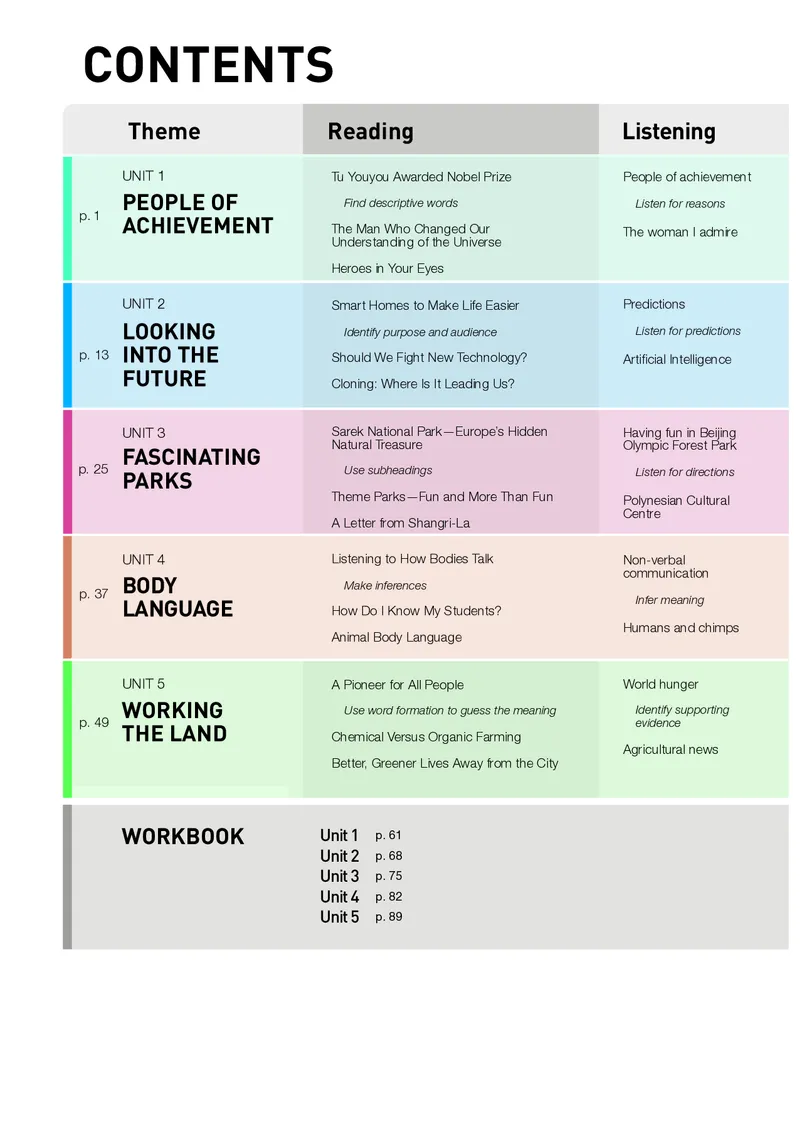
Theme Reading Listening
UNIT 1 Tu Youyou Awarded Nobel Prize People of achievement
PEOPLE OF
Find descriptive words Listen for reasons
p. 1
ACHIEVEMENT
The Man Who Changed Our The woman I admire
Understanding of the Universe
Heroes in Your Eyes
UNIT 2 Smart Homes to Make Life Easier Predictions
LOOKING
Identify purpose and audience Listen for predictions
INTO THE
p. 13 Should We Fight New Technology? Artificial Intelligence
FUTURE
Cloning: Where Is It Leading Us?
UNIT 3 Sarek National Park—Europe’s Hidden Having fun in Beijing
Natural Treasure Olympic Forest Park
FASCINATING
p. 25 PARKS Use subheadings Listen for directions
Theme Parks—Fun and More Than Fun Polynesian Cultural
Centre
A Letter from Shangri-La
UNIT 4 Listening to How Bodies Talk Non-verbal
communication
BODY
Make inferences
p. 37
LANGUAGE Infer meaning
How Do I Know My Students?
Humans and chimps
Animal Body Language
UNIT 5 A Pioneer for All People World hunger
WORKING
Use word formation to guess the meaning Identify supporting
p. 49 evidence
THE LAND
Chemical Versus Organic Farming
Agricultural news
Better, Greener Lives Away from the City
WORKBOOK Unit 1
p. 61
Unit 2
p. 68
Unit 3
p. 75
Unit 4
p. 82
Unit 5
p. 89Speaking Writing Structure *Project *Video Time
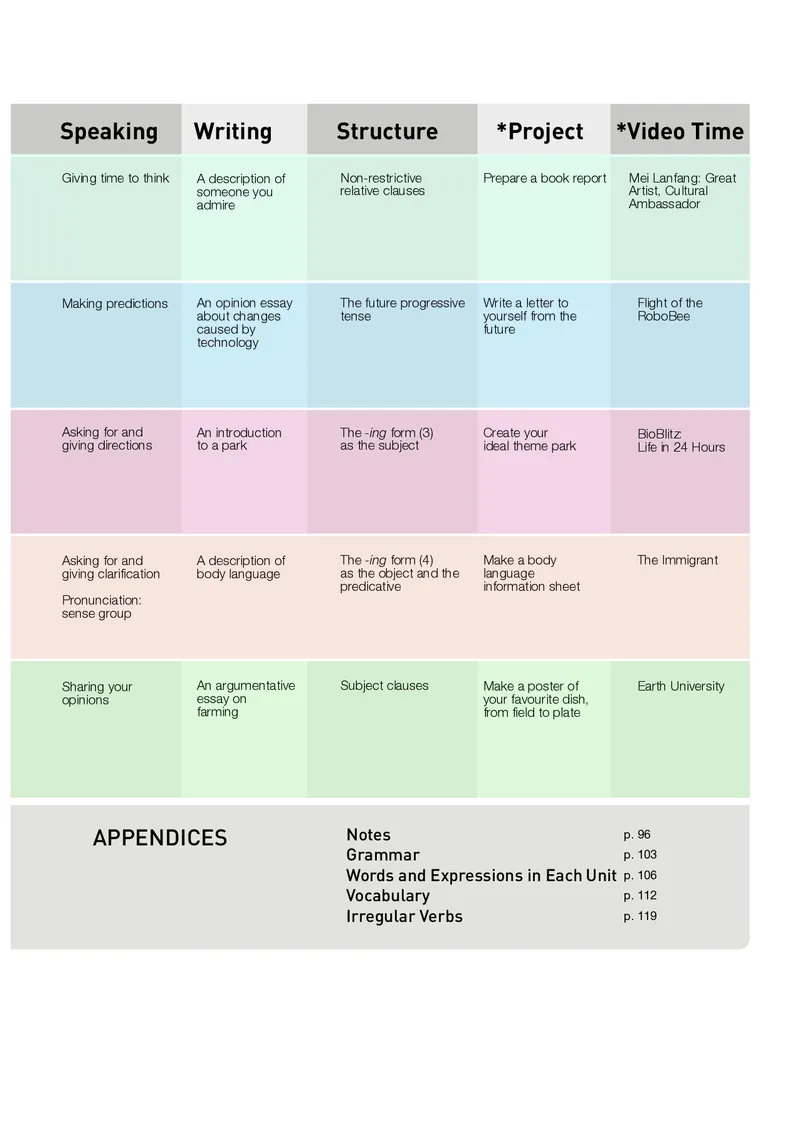
Giving time to think A description of Non-restrictive Prepare a book report Mei Lanfang: Great
someone you relative clauses Artist, Cultural
admire Ambassador
Predictions Making predictions An opinion essay The future progressive Write a letter to Flight of the
about changes tense yourself from the RoboBee
Listen for predictions caused by future
technology
Artificial Intelligence
Having fun in Beijing Asking for and An introduction The -ing form (3) Create your BioBlitz:
Olympic Forest Park giving directions to a park as the subject ideal theme park Life in 24 Hours
Listen for directions
Polynesian Cultural
Centre
Non-verbal Asking for and A description of The -ing form (4) Make a body The Immigrant
communication giving clarification body language as the object and the language
predicative information sheet
Infer meaning Pronunciation:
sense group
Humans and chimps
Sharing your An argumentative Subject clauses Make a poster of Earth University
opinions essay on your favourite dish,
farming from field to plate
APPENDICES Notes
p. 96
Grammar
p. 103
Words and Expressions in EachUnit
p. 106
Vocabulary
p. 112
Irregular Verbs
p. 119UNIT 1
PEOPLE OF ACHIEVEMENT
1 PEOPLE OF
ACHIEVEMENT
UNIT
Try to become not a man of
success, but try rather to become
a man of value.
—Albert Einstein
In this unit, you will Look and discuss
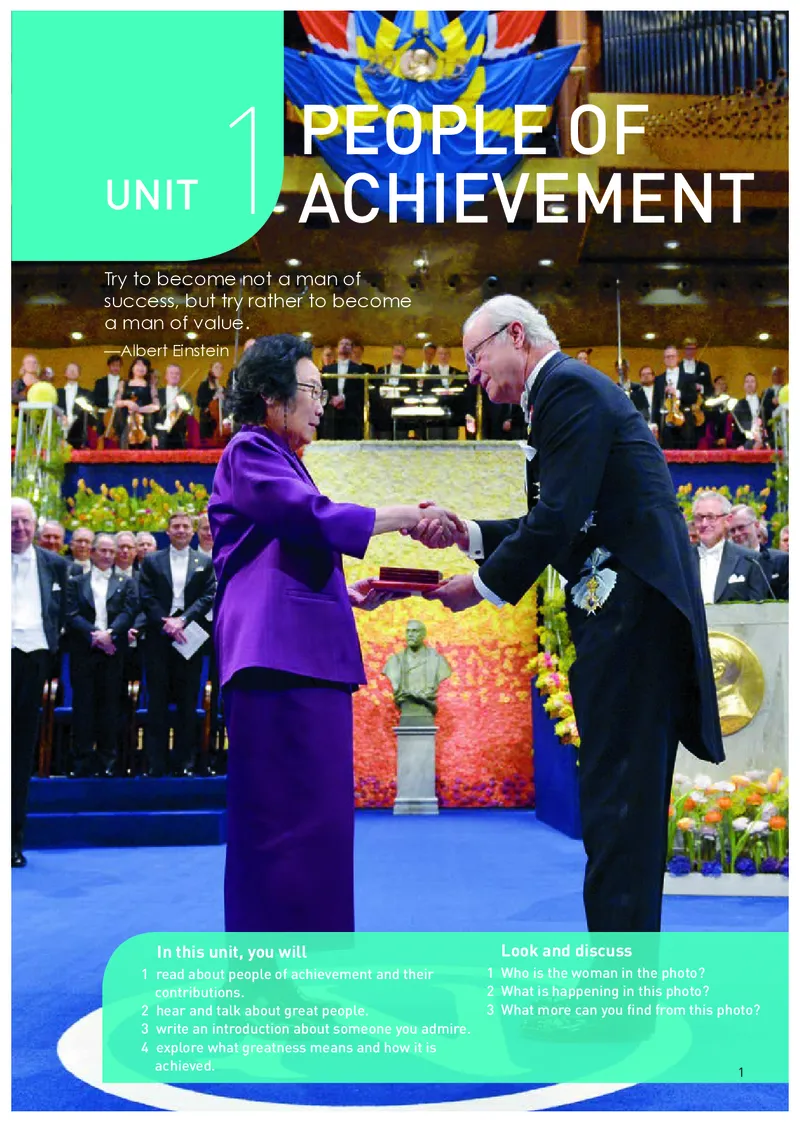
1 read about people of achievement and their 1 Who is the woman in the photo?
contributions. 2 What is happening in this photo?
2 hear and talk about great people. 3 What more can you find from this photo?
3 write an introduction about someone you admire.
4 explore what greatness means and how it is
achieved.
UNIT 1 PEOPLE OF ACHIEVEMENT 1Reading and Thinking
Describe people of achievement
1 Before you read, discuss these questions in groups.
1 What kind of person makes great discoveries?
Find descriptive words
2 Which is more important for making a great
discovery, talent or effort? Pay attention to the descriptive
words in a passage. These will
help you form a better impression
2 Scan the text and find descriptive words about of the subject described in the
passage.
Tu Youyou.
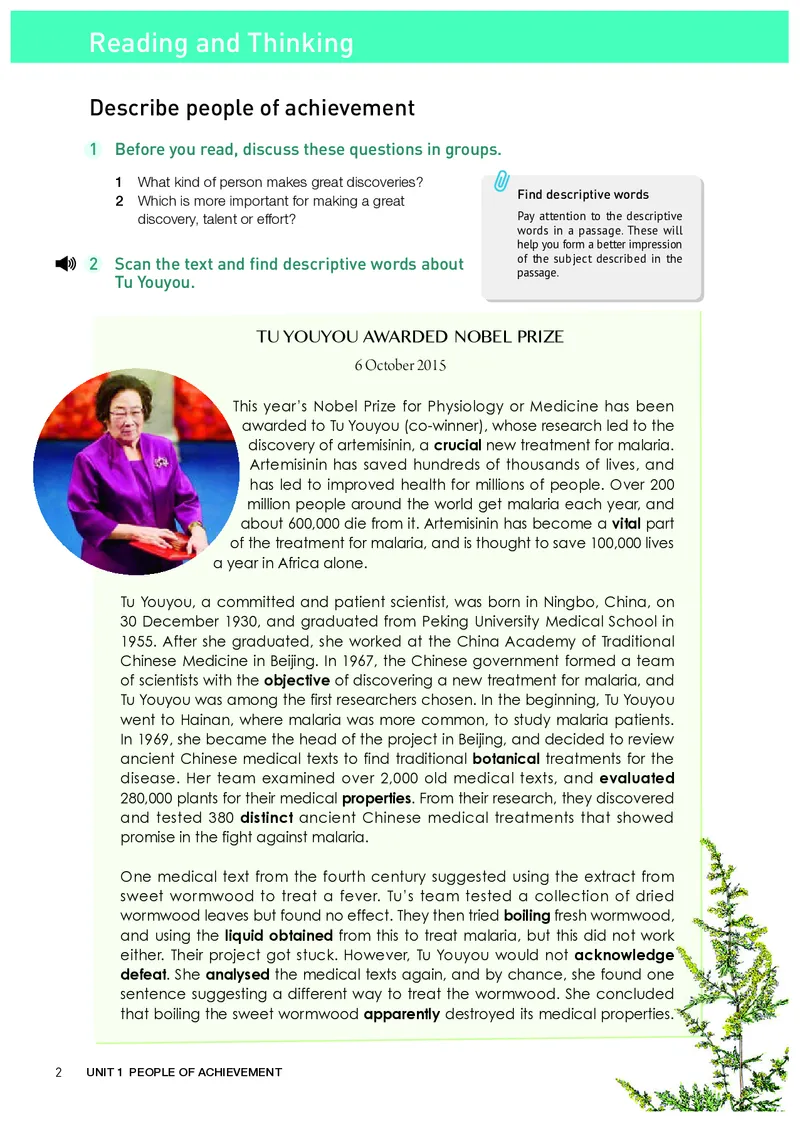
TU YOUYOU AWARDED NOBEL PRIZE
6 October 2015
This year’s Nobel Prize for Physiology or Medicine has been
awarded to Tu Youyou (co-winner), whose research led to the
discovery of artemisinin, a crucial new treatment for malaria.
Artemisinin has saved hundreds of thousands of lives, and
has led to improved health for millions of people. Over 200
million people around the world get malaria each year, and
about 600,000 die from it. Artemisinin has become a vital part
of the treatment for malaria, and is thought to save 100,000 lives
a year in Africa alone.
Tu Youyou, a committed and patient scientist, was born in Ningbo, China, on
30 December 1930, and graduated from Peking University Medical School in
1955. After she graduated, she worked at the China Academy of Traditional
Chinese Medicine in Beijing. In 1967, the Chinese government formed a team
of scientists with the objective of discovering a new treatment for malaria, and
Tu Youyou was among the first researchers chosen. In the beginning, Tu Youyou
went to Hainan, where malaria was more common, to study malaria patients.
In 1969, she became the head of the project in Beijing, and decided to review
ancient Chinese medical texts to find traditional botanical treatments for the
disease. Her team examined over 2,000 old medical texts, and evaluated
280,000 plants for their medical properties. From their research, they discovered
and tested 380 distinct ancient Chinese medical treatments that showed
promise in the fight against malaria.
One medical text from the fourth century suggested using the extract from
sweet wormwood to treat a fever. Tu’s team tested a collection of dried
wormwood leaves but found no effect. They then tried boiling fresh wormwood,
and using the liquid obtained from this to treat malaria, but this did not work
either. Their project got stuck. However, Tu Youyou would not acknowledge
defeat. She analysed the medical texts again, and by chance, she found one
sentence suggesting a different way to treat the wormwood. She concluded
that boiling the sweet wormwood apparently destroyed its medical properties.
2 UNIT 1 PEOPLE OF ACHIEVEMENTUsing a lower temperature to draw out the extract, she found a substance that
worked. After failing more than 190 times, the team finally succeeded in 1971.
Tu Youyou and her team members even insisted on testing the medicine on
themselves to make sure that it was safe. Later, the medicine was tested on
malaria patients, most of whom recovered. This medicine, which was called
artemisinin, soon became a standard treatment for malaria.
According to Tu Youyou, the discovery of artemisinin was a team effort. Upon
hearing that she had been awarded the Nobel Prize, she said, “The honour is
not just mine. There is a team behind me, and all the people of my country.
This success proves the great value of traditional Chinese medicine. It is indeed
an honour for China’s scientific research and Chinese medicine to be spread
around the world.”
3 Circle the answers to the questions below.
1 Where would you most likely find this passage?
A In a blog. B In a book. C In a letter. D In a newspaper.
2 Passages like this are most often written in and .
A the active voice/offer many opinions B the first person/talk about feelings
C both active and passive voices/mostly contain facts
3 Which two pieces of information were not included in the passage?
A A quote from Tu Youyou.
B The details of how artemisinin was discovered.
C Tu Youyou’s important contributions other than the discovery of artemisinin.
D Tu Youyou’s personal life.
E Tu Youyou’s road to discovering artemisinin.
F What Tu Youyou was awarded.
G Why artemisinin is an important discovery.
4 Read the text again and answer the questions.
1 Why is the discovery of artemisinin important?
2 What was the key to getting a good extract from the wormwood?
3 What numbers are mentioned in the text? What do they suggest?
4 Why is Tu Youyou considered a great person?
5 Complete the flow chart. Then tell the story of how artemisinin was discovered.
Tu Youyou’s team examined They found a medical text They tested They tried
, and suggesting . . ,
evaluated . but .
The medicine became They tested the They tested the
They used a the
for medicine on medicine
sweet wormwood extract.
malaria. . to see if safe.
UNIT 1 PEOPLE OF ACHIEVEMENT 3Learning About Language
Build up your vocabulary
1 Write down the word that matches each definition. Then find the sentences
containing these words in the text.
1 cook something in very hot water
2 relating to plants
3 qualities or characteristics of something
4 a kind of substance that flows freely, such as water or milk
5 physical material that exists
2 Guess the meaning of the underlined words. Then fill in the blanks with
words that have the same roots.
1 The two flowers are quite distinct from one another, so it is easy to make a
between them.
2 Scientists need to how the new material stands up to wear and tear to prove
how valuable it is.
3 A talented scientist well known for his to his country, Huang Danian
committed himself to his research in geophysics.
4 A: Did you come to any conclusions?
B: Yes, we that by drawing out the extract at a low temperature, we could
find the substance that we needed to complete the experiment.
5 She spends a lot of time her patients’ dreams. This analysis is very helpful,
explaining their daily behaviour very well.
3 Read the passage about Lu Xun. Fill in the blanks with the correct forms of
the words in the box.
insist obtain objective acknowledge apparently crucial
Lu Xun, as one of the greatest modern writers in China, was born in Shaoxing,
Zhejiang Province in 1881. In 1904, he went to Japan and became a medical student, with
the of improving people’s health and saving lives. However, he changed his
mind when he saw in a photo a Chinese man about to be killed by a Japanese soldier. It
struck him that the other Chinese men in the photo did not care about what
was happening to their fellow countrymen. From this, he concluded that the
problem in China was not physical illness, but the spiritual illness of people at that time.
Following this, he quit medical school. When he returned to China in 1908, he
a teaching job. In 1917, a friend that he help write for a magazine called New
Youth. That was how his first famous short story A Madman’s Diary got published.
4 In pairs, discuss how people can achieve success, using words and expressions
you have learnt in this unit.
4 UNIT 1 PEOPLE OF ACHIEVEMENTDiscover useful structures
1 Read the following sentences and underline the relative clauses. Then name
the two types of clauses and state their functions.
• They tested hundreds of Chinese medical treatments that showed promise in the fight
against the disease.
• Tu Youyou was awarded the Nobel Prize, which is considered one of the highest
international honours a person can receive.
• Tu Youyou went to Hainan, where malaria was more common, to study malaria patients.
• Later, the medicine was tested on malaria patients, most of whom recovered.
2 Rewrite the sentences using non-restrictive relative clauses. How do the
sentences flow differently?
EXAMPLE
The book tells us about Alexander Fleming. He discovered penicillin.
The book tells us about Alexander Fleming, who discovered penicillin.
1 We were very impressed by the old man. He was not willing to acknowledge defeat.
2 Afterwards, Einstein had to flee Germany. Hitler was in power there.
3 There is nothing we can do to help Linda. Her circumstances are beyond our control.
4 The teacher asked us to listen to a speech by his favourite novelist, J.K. Rowling. It inspired
us a lot.
5 The building under construction was designed by I.M. Pei—a famous Chinese-American
architect. He was born in Guangzhou, China.
6 I was asked to explain the project with the help of a flow chart. It was a big challenge
for me.
3 Work in groups. Complete the sentences using non-restrictive relative clauses
to give extra information. Then share them with your group members.
EXAMPLE
I’d like to try …, …
I’d like to try that Chinese herbal medicine again, which seems to work best for my cough.
1 I would like to travel around …, …
2 What impressed me most …, …
3 My favourite scientist is …, …
4 Finally we arrived at …, …
5 My grandparents like …, …
6 I wish to obtain …, …
7 My best friend …, …
UNIT 1 PEOPLE OF ACHIEVEMENT 5Using Language
Explore the meaning of greatness
1 Match the people with their achievements. Then listen to a conversation between
Dr Wang, his daughter Wang Lin, and his daughter’s friend Anna, and check your
answers.
1 Elon Musk A founder of modern nursing
2 Bill Gates B founded high-tech and futuristic companies
3 Jack Ma (Ma Yun) C managed the SARS outbreak
4 Alexander Fleming D made great advancement in online shopping
5 Florence Nightingale E made home computing accessible
6 Zhong Nanshan F discovered penicillin
2 Listen to the conversation again. Who does each speaker admire? Tick in the
table below.
Name Dr Wang Wang Lin Anna Smith
Elon Musk
Bill Gates
Jack Ma
Zhong Nanshan
Florence Nightingale
Alexander Fleming
Dr Wang
3 Listen again and answer the questions.
Listen for reasons
1 Why does Dr Wang say “money isn’t everything”? When people give their opinions
or decisions on a matter, they often
2 What is the real reason Anna admires the famous people, give reasons for them. Sometimes,
and what examples does she give? the reason is introduced by words
such as because or due to. At other
3 What kind of person do you think Wang Lin admires? times, the reason is given right
after the opinion or decision, and
Why?
the link can be inferred.
6 UNIT 1 PEOPLE OF ACHIEVEMENTListening and Speaking
4 Work in groups. Brainstorm the names of some great people and write them
in the table below.
Ordinary people Scientists
Environmentalists Explorers
Inventors Politicians
5 Discuss what makes these people great. Try to use the following language fillers
to give yourself time to think.
Giving time to think
(Er/Oh/Um,) let me see/think … Right./Sure.
Well, er, … Really?
Yeah, I mean, I understand what you’re saying … Well, I guess …
Anyway, ... You see/know, …
Just a moment. So, ...
Hang on a second. Well, it’s on the tip of my tongue.
May I think about that for a moment? I’ve nearly got it, er, …
How can/shall/should I put this/it? What I want to say is ...
Let me think about this/that for a moment.
6 Use your discussion to draw conclusions about the meaning of greatness.
The following expressions may help you. Then report back to the class.
The greatest person I know of is ..., who ... has achieved financial success
To be great, a person should ... has invented new products
To me, greatness means ... has made great discoveries
Why do you think that? serves as a good role model
That’s true, but ... brings happiness to other people
I want to be like because he/she … makes great contributions to society
UNIT 1 PEOPLE OF ACHIEVEMENT 7Using Language
Introduce someone you admire
1 What do you know about Albert Einstein? Read the text and complete the timeline.
Then introduce Einstein’s life story and achievements in your own words.
THE MAN WHO CHANGED OUR UNDERSTANDING OF THE UNIVERSE
Albert Einstein, who is perhaps the greatest scientist in modern physics,
is often considered one of the smartest men who ever lived. He made
numerous contributions to the world, the most well-known being
the general theory of relativity and the famous formula E=mc2.
Einstein was not only a genius; he was a courageous and kind
figure loved by many people.
This gentle genius was born in Germany on 14 March 1879.
When he was 16, he tried to enter university in Switzerland, but
failed due to his low scores in the general part of the entrance
exam, despite obtaining exceptional scores in maths and physics.
After studying for another year, he managed to pass the exam,
entering university in 1896 and graduating in 1900.
After two years of looking for work as a teacher, Einstein took a job
as a clerk in the Swiss patent office. While working there, out of a strong
passion for knowledge, he continued to study, earning a doctorate in physics
in 1905. That same year, which was later recorded as a miracle year in science, he
published four extraordinary physics papers. Following this, he gradually became
famous throughout the world as the new Isaac Newton. After four years, he was able to
quit his job at the patent office and enter research full-time at a university. In 1922, he
was awarded the 1921 Nobel Prize for Physics for his explanation of the photoelectric
effect.
Circumstances changed in 1933, when Hitler came to power in Germany. Einstein, who
was Jewish, found the doors of academic institutions closed to him. As a consequence,
he had to flee Germany. After spending time in Europe, he finally took up a position as
a researcher at the Institute for Advanced Study in Princeton, USA. Following that, he
continued to make great achievements in physics and mathematics.
To the public, he was seen as a slightly odd-looking but kind and funny man. He had a
thick moustache and long white hair, which sometimes stood on end as though he had
just received an electric shock. Although he was a genius, he sometimes forgot things,
like his friends’ birthdays. But despite his peculiarities, he was loved by his friends and
neighbours. There is even a story about how he helped a little girl who knocked on his
door and asked for help with her homework. In fact, Einstein often encountered people
on the street who would stop him and ask him to help explain things. After many such
88 UNIT 1 PEOPLE OF ACHIEVEMENToccasions, he finally started saying, “Pardon me! Sorry! Always I am mistaken for
Professor Einstein!”
On 18 April 1955, it was reported that Einstein had passed away, and the whole world
mourned the great loss of a brilliant scientist.
Born in Germany
1900 1905 1922 1955
1879 1896 1933
2 In pairs, discuss the following questions.
1 Apart from his remarkable achievements, what does the passage tell us about Einstein’s life?
2 What impressed you most about Einstein? State your reasons.
3 Study the organisation and language features.
1 What type of writing is this text? How does the writer develop the text?
2 Find the descriptions that tell us what Einstein looked like and what kind of person he was.
3 What rhetorical devices are used in the passage? Give examples.
4 Write an introduction about someone you admire.
1 Choose the person you are going to write about. It should be someone you think is great in
some way. It can be an ordinary person, such as a parent, a relative, or a friend.
2 Make a list of things that need to be included in your introduction.
3 Use your notes to write your introduction and sum up how you feel about this person.
5 Exchange your draft with a partner.
1 Use the checklist to help you review your partner’s draft.
Does the writer describe the person’s appearance and personality?
Does the writer tell an impressive story of the person’s life?
Does the writer say why the person is great?
Does the writer sum up how he/she feels about this person?
2 Take your draft back and revise it.
6 Share your introduction with the rest of the class.
UNIT 1 PEOPLE OF ACHIEVEMENT 9Assessing Your Progress
1 Complete the sentences with the correct forms of the words in the box.
gentle sum up circumstance encounter novelist patent
1 To our surprise, he was actually the and caring father of three children.
2 To , his fame and wealth were gained through hard work and his in-depth
knowledge of his business.
3 A genius for invention, Thomas Edison obtained scores of .
4 Under no should we do terrible things to other people.
5 As a botanist, he takes notes on the properties of any plant he .
6 The first-person narrator is a stylistic device that has been used by many and
poets throughout the ages.
2 What do you know about Sun Yat-sen? Read the passage, and then fill in the
blanks with relative pronouns or adverbs.
Sun Yat-sen (1866-1925) was widely considered to be the founder and forerunner of
modern China. He was only in power for a short time, when he was president of the country
in 1912. So it may seem odd to some people knowledge of China may be
limited that he is such an important figure. However, his influence is not based on his time
in office, but on his continuous struggle for a better society and his concern for all Chinese
people. He also put forward many advanced ideas brought the Chinese
people together, in particular, the Three Principles of the People. These principles were
inspired by Lincoln, he admired, and were developed when he was travelling
overseas, he went to find support for his country. The first principle is about
nationalism, indicates that China should never be divided and should not be
under any foreign control. The second is about people’s rights. It means that all people have
great value and should also have the same rights. The third is about people’s livelihood,
means that the government should create opportunities for people to make a
good living.
REFLECTING
Did this unit cause you to change your thoughts about greatness? If so, how?
Will what you have learnt in this unit inspire you to improve yourself? If so, how?
What was the most important idea that you learnt in this unit?
Overall, I thought this unit was inspiring useful so-so difficult.
10 UNIT 1 PEOPLE OF ACHIEVEMENT*Project: Prepare a book report
1 Discuss these questions in groups.
1 Have you ever read a biography or an autobiography of a great person? Would you
recommend this book? Why or why not?
2 Which great person would you like to read more about?
3 Where can you find recommendations for good biographies or autobiographies?
Cao Xueqin Biography
The Story of My Life Steve Jobs
by Li Jianshu, 2009
by Helen Keller, 1903 by Walter Isaacson, 2011
(Chinese edition)
The book tells the life story Even though Keller wrote Isaacson interviewed Steve
of the novelist Cao Xueqin, this autobiography when Jobs over forty times, and
author of The Dream of the she was only 22 years old, it interviewed hundreds of
Red Mansions. Cao was is considered a great book Jobs’ friends, relatives,
born to a rich family but in American literature. It and rivals to sum up Jobs’
suffered great poverty for tells about her dark and remarkable life. The result is
most of his life. He drew on silent childhood, and how an interesting story of a man
his life experiences to write her teacher, Anne Sullivan, driven to succeed and driven
this famous novel, which opened up a new world to to make perfect products.
was published after his her by teaching her how to
death. communicate.
2 Choose a biography or autobiography of a great person. Read the book, and then
write a book report. Keep these points in mind:
• Use the examples above to help you.
• Write about how the book makes you feel or think about that person.
• Write about your overall feelings about the book and its quality.
• Give your opinion: Should others read this book as well? Why or why not?
3 Present your book report to your group. Answer any questions about the book.
UNIT 1 PEOPLE OF ACHIEVEMENT 11* Video Time
Mei Lanfang: Great Artist, Cultural
Ambassador
Mei Lanfang is still known today as one of the masters
of Beijing Opera. He played a key role in bringing
Beijing Opera to the world, leading to the international
status and recognition that it has today. Mei Lanfang
is still widely remembered for his skill, his kindness,
and his deep love for his country.
BEFORE YOU WATCH
Try to match the time phrases with the events in Mei Lanfang’s life.
1 at age 8 A born in Beijing
2 in his 20s B succeeded in taking Beijing Opera to the USA
3 in 1919 C died of heart disease
4 after eight years of attempts D developed a style called the “Mei Lanfang School”
5 over 50 years on stage E began to travel and perform abroad
6 in 1961 F started to learn Beijing Opera
7 in 1894 G became known internationally for his acting skill
WHILE YOU WATCH
1 Check your answers in Before You Watch.
2 Complete the sentences.
1 The great Indian author Rabindranath Tagore about
Mei Lanfang.
2 In the USA, many fans after the performances to
shake his hand.
3 Mei Lanfang brought Beijing Opera abroad so that more people could
of Chinese culture and art.
4 When Japanese troops invaded China, Mei Lanfang .
AFTER YOU WATCH
Discuss these questions in groups.
1 How did Mei Lanfang become a legend in the art of Beijing Opera?
2 Why is Mei Lanfang greatly loved by so many people?
3 Who else can you think of that has committed himself/herself to the development of China’s
art or music culture?
12 UNIT 1 PEOPLE OF ACHIEVEMENTUNIT 2
LOOKING INTO THE FUTURE
2 LOOKING INTO
THE FUTURE
UNIT
The best way to predict the
future is to create it.
—Peter Drucker
In this unit, you will Look and discuss
1 read about living in a smart house. 1 What might the picture be about?
2 listen to and talk about predictions. 2 What are your predictions about the future?
3 read about the pros and cons of advances in 3 What might be some of the advantages and
technology, and write your opinions. disadvantages of life in the future?
4 explore the future of technology.
UNIT 2 LOOKING INTO THE FUTURE 13Reading and Thinking
Exchange views on smart homes
1 Before you read, discuss these questions in groups.
1 What does it mean when we say that
Identify purpose and audience
something such as a phone is “smart”?
The types of phrases used in a passage help identify
2 What do you think a “smart” house can do its purpose. For example, the phrase in my opinion
that other houses cannot? tells us that the passage is likely meant to persuade.
And a text that uses imperatives is likely meant
to instruct. A passage’s content helps identify its
2 Skim the text and answer these
audience. For example, a passage that gives tips
questions.
on looking after pets would have pet owners as its
audience.
1 What is the purpose of the text?
2 Who is the intended audience of this text?
SMART HOMES TO MAKE LIFE EASIER
Have you ever forgotten to lock the door you leave home each morning, and then
of your house? Or, have you ever forgotten go into an energy-efficient mode all by
to switch off the TV or computer? These itself. You will no longer have to think
kinds of things happen to us all the time, about turning switches on and off yourself.
waste resources, and can sometimes Your home will also learn your daily
lead to problems. However, in the not- routine and preferences, so everything
too-distant future, we will be living in will be ready for you when you get home
smart homes that will lock the door for each evening. Your lights will come on the
us when we are away and remember to instant you enter the door along with your
switch off the TV when we forget. These favourite music or TV programmes, and
smart homes will keep us secure, save us you will find your dinner already prepared
energy, and provide a more comfortable for you. All controls will respond to voice
environment to live in. commands, so if you want to change your
routine, you just say aloud what you want
Intelligent Controls and the home system will obey.
Today, we have to use switches for our
lights, knobs for our appliances, and Regular Health Checks
remote controls for our TVs and air In addition, your smart home will be
conditioners. In the future, we will be monitoring your health for you every day.
using advanced technology every day Your bed, for example, will record how
for automatic control of just about well you sleep every night. It will also be
everything in our home. The future home checking your body weight. If you start
will use integrated sensors to tell when to have sleep or weight problems, it will
1144 UNIT 2 LOOKING INTO THE FUTUREsend a warning to your phone. It will also there is a short in the electrical wiring, your
give you suggestions on a healthier diet smart home will detect it and provide you
and how to sleep better. Smart toilets will with the relevant information. This way,
be keeping constant track of your health you will be able to fix the problem before
as well. They can warn you early on if your home becomes flooded or catches fire.
there is something abnormal or if you
have a critical illness, such as cancer, and This smart technology is not a fantasy.
potentially save your life. Many of these new innovations are already
available and being used in some homes. In
No More Disasters this sense, the home of tomorrow is already
Smart homes will be able to prevent the home of today. Nevertheless, it will
serious damage from accidents. For take some years before most new homes
example, if a water pipe starts leaking, or if begin to use this new technology.
3 Read the text again and fill in the table below.
In the future, what will smart homes do about …?
doors dinners
TVs, computers beds
water pipes,
toilets
electrical wires
lights, favourite music, or TV programmes
4 Complete the summary using the correct forms of the words from the text.
A smart home is one that i computers into the structure of the building itself. In this
way, many of the things that we now do ourselves will become a . For example, the
smart home could control the air conditioning and lights so that you would no longer have to
turn s on and off, making your home more energy-e . The smart home
could also m itself to make sure that everything is working as it should, and send
you w if there is a problem. Such smart homes could even be programmed to
d your health problems, and then give you r advice as to the food you
should eat or if you should see a doctor. So, in a sense, smart homes will lead us to living smarter
lives.
5 Work in groups. Discuss these questions.
1 In what way is the home of tomorrow already the home of today?
2 What might be some of the disadvantages of smart homes?
UNIT 2 LOOKING INTO THE FUTURE 15Learning About Language
Build up your vocabulary
1 Write as many correct pairs of “verb + noun” phrases as possible.
Verbs:detect, integrate, leak, switch Nouns:a preference, routine, a warning, cancer,
on/off, monitor, cure, have, become, learning, the heater, air quality, potential dangers,
issue, encourage, repair, reject oil, innovation, the electrical wiring, fantasies
EXAMPLE detect potential dangers, have fantasies, …
2 Complete the sentences with the adjectives in the box.
abnormal automatic available constant critical
efficient distant instant relevant secure
1 Big data will become much more in solving crimes in the future.
2 Many smart watches can provide fitness data.
3 It is possible that this technological fantasy will come true in the future.
4 After the accident, both drivers are in condition.
5 The fridge keeps food at a low temperature.
6 The air conditioner works in mode.
7 It is important to make food and water to the survivors.
8 Houses with advanced appliances will keep us and healthy.
9 We find the German transport system to be one of the most in Europe.
10 The sensors can detect anything and automatically call someone to come and
fix it.
3 Paraphrase the sentences using the words and phrases in brackets.
1 Care will also be taken to combine the building and surrounding architecture together to
form an effective system. (integrate)
2 We will probably benefit from remote-controlled houses. (potentially)
3 He insisted that everything in the smart home would be all right. However, I could not help
but feel anxious. (nevertheless)
4 It is a good habit to make certain that you know what is happening with your blood
pressure. (keep track of)
5 The monitoring system sends out warnings as soon as the car begins to leak oil. (the instant)
4 Add more elements in the mind map to build up your vocabulary.
Future life
Houses Transport Health Security Work
integrated driverless health machines to
sensors, … cars, … monitoring, detect
… disasters, …
16 UNIT 2 LOOKING INTO THE FUTUREDiscover useful structures
1 Look at the sentences below. One is in the simple future tense. The other is
in the future progressive tense. What different impressions do they make?
• In the future, we will use advanced technology every day for automatic control of just about
everything in our home.
• In the future, we will be using advanced technology every day for automatic control of just
about everything in our home.
Find more sentences using the future progressive tense from the unit.
Rewrite them using the simple future tense. Try to feel the different
impressions they make.
2 Read the passage and complete the following sentences.
Jack goes to school every weekday. He leaves home at 6:45 and arrives at school at about 7:30.
His morning classes begin at 8:00 and continue until 12:15. Then he has lunch, which takes
about half an hour. His classes begin again at 1:30 in the afternoon and end at 3:50. He goes
to the school’s football club at 4:30 and finishes practice at 6:00. He arrives home at about 6:45.
Every day he follows the same routine and tomorrow will be no exception.
1 At 6:30 a.m. tomorrow, ... A he’ll be leaving the house. B he’ll be at home.
2 At 8:10 a.m. tomorrow, ... A he’ll be having a class. B he’ll have a class.
3 At 12:30 tomorrow, ... A he’ll be having lunch. B he’ll have lunch.
4 At 5:00 p.m. tomorrow, ... A he’ll be practising football. B he’ll practise football.
5 At 6:45 p.m. tomorrow, ... A he’ll be arriving home. B he’ll arrive home.
3 Fill in the blanks with the proper forms of the verbs in brackets.
1 You can call me then. I (not sleep).
2 They set off at 9:00 a.m. and thought they (reach) the airport an hour later.
3 Will you (wait) for me until I find the electrical wires?
4 Better not hang out with Sam then. He (work) on his article on critical
thinking.
5 I guess most parents (support) the new plan at the meeting tomorrow.
4 Work in pairs. Read the travel plan and make up a conversation using the
future progressive tense.
Fly to Beijing from Melbourne, arrive at 10:00 a.m.; Visit the Summer Palace in the
Monday
afternoon
Tuesday Morning: visit the Palace Museum; Afternoon: go to Wangfujing Street
Wednesday Go to the Great Wall, three hours' drive there and back
Thursday Go sightseeing in Shichahai; Visit National Museum of China
Friday Trip to Zhangjiakou
Saturday Back to Beijing in the afternoon; Watch Beijing Opera at the Mei Lanfang Theatre.
Sunday Return to Melbourne
UNIT 2 LOOKING INTO THE FUTURE 17Using Language
Make predictions about future changes
1 What do these pictures show? Match the words with the pictures.
automation
nanobots
global warming
artificial
intelligence (AI)
cloning
① ②
③ ④
⑤
Listen for predictions
2 Discuss these questions in groups.
When listening for predictions, you
1 How do you think these events or such should listen for the use of the future
tense, in particular the future tense
technology might develop in the future?
with will or will be doing. Words such
2 What challenges might they bring? as predict, prediction, and forecast, are
also used quite often when making
3 What opportunities might they bring?
predictions.
18 UNIT 2 LOOKING INTO THE FUTUREListening and Speaking
3 Listen to a radio interview with Dr Han and Vincent Black giving their predictions
about the future, and then fill in the table below.
Name Occupation Prediction
Dr Han
Vincent Black
4 Work in pairs. Discuss whether you think Dr Han and Vincent Black’s predictions
are possible. Why or why not?
5 In groups, brainstorm about the future. Discuss these points.
• future events or problems the world might face
• future technologies
• how these things will change the way we live
• the challenges and opportunities these things might bring
6 Imagine that you have a job that makes you an expert in the future. In pairs,
interview each other about your jobs and predictions. Use the expressions in the
box to help you.
Making predictions
I think/believe/predict that in the future … My prediction is that …
By 2030, we will … In the (distant) future there will …
I can imagine/forecast … I doubt/don’t think that …
One challenge will be … We will have the opportunity to …
We will be doing … We are going to …
UNIT 2 LOOKING INTO THE FUTURE 19Using Language
Welcome or reject future changes
1 Read the text and then decide whether the statements on page 21 are true (T) or
false (F).
SHOULD WE FIGHT NEW TECHNOLOGY?
This morning, I saw the shocking headline: “Passenger Dies When Car Crashes in Driverless
Mode”. In the article, various people said that the public should oppose the idea of developing
driverless cars. They said that some advances in technology were unnecessary and could
even be dangerous. Hence, we should cease accepting technology just because it is new. The
newspaper reported that the car company had already apologised for the accident, but the
families of the deceased said it was not enough. Nevertheless, the company still claimed that
most people would be travelling in driverless cars one day soon.
On the one hand, there are many different groups of people around the world who live happily
in the absence of new technology. Probably the most well-known are the Amish, a group
of Christians living in rural America. They do not own or drive cars, watch TV, or use the
Internet. They have lived mainly as farmers since the 18th century, and they will probably
be living the same way in the distant future. They advocate a simple life with an emphasis
on hard work, family, and community. They think that is better than caring about luxuries or
following the lives of the rich and famous. It could even be argued that the Amish’s quality
of life is better since they live in and appreciate the natural environment rather than living in
large, polluted cities.
On the other hand, new technology has provided people everywhere with many benefits over
the years. For example, the latest weather-tracking computer programmes give people lots of
warnings about potential natural disasters, which saves many lives. Moreover, the Internet has
made it possible for friends and family to keep in touch easily even if they are on opposite
sides of the world. It has also made finding opportunities in life much easier, as it allows
people to make larger networks of friends through using social media.
Personally, I have benefited quite a lot from technological advances. I found my career as an
AI designer through a social media network. My health monitor, which I wear all the time, has
also helped me get into the best shape of my life. Of course, when new technology changes
the way we live, it can be a scary prospect. Nevertheless, I will always look on the positive
side of change and accept it rather than resist it.
20 UNIT 2 LOOKING INTO THE FUTURE1 A person died in an accident while driving a car. T F
2 The Amish avoid new technology because they do not want to have good lives. T F
3 Many disasters have been prevented by weather-tracking computer programmes. T F
4 Building large networks through social media helps us find new opportunities. T F
5 The author uses a health monitor to know how much exercise he/she needs. T F
2 Answer the following questions about the text.
1 In which paragraphs does the author:
Signposts
• describe the issue?
Some words and phrases are used as
• give an opinion? signposts to help show a paragraph’s
purpose. These usually come at the
• discuss the advantages?
beginning or end of a paragraph.
• discuss the disadvantages?
2 Underline the signpost words or phrases in the text. How do they help tell us the purpose of the
paragraphs?
3 Why did the author decide to write about this topic?
3 Use what you have learnt to express your opinion in an essay about the changes
that could be caused by advances in technology.
1 Work in groups. Brainstorm some future advances in technology, and their possible advantages
and disadvantages.
Advance in technology Advantage Disadvantage
2 Choose one of these advances in technology and answer the questions.
• Why do you want to write about this topic?
• What is your own opinion on the topic?
3 Write your opinion in an essay.
4 Exchange your draft with a partner.
1 Use the checklist to help you review your partner’s draft.
Does the essay say what the writer thinks about the topic?
Does the body discuss the advantages and disadvantages of the advance?
Are signposts used to help the reader understand the purpose of each paragraph?
Does the conclusion state the writer’s position?
2 Take your draft back and revise it.
5 Share your essay with the rest of the class.
UNIT 2 LOOKING INTO THE FUTURE 21Assessing Your Progress
1 Complete the dialogues with the correct forms of the words in the box.
luxury prospect rural absence
prediction essay network emphasis
1 A: Why are you so concerned?
B: We can’t win the case in the of relevant evidence.
2 A: It’s difficult to make accurate about the effects on the environment.
B: I couldn’t agree more. We should place more on environmental protection.
3 A: What are you working on?
B: I’m writing an on how to integrate individuals’ values and society’s needs.
4 A: How do you find working in your new office?
B: It’s great! The office allows users to share files and software, and to use a
central printer.
5 A: I don’t quite understand your choice. What might be the advantages of living in remote
areas?
B: The of getting a high-paying job is low, but I find it more meaningful to help
people there. In addition, I have the of breathing fresh air every day.
2 Read an introduction to the Future Library project. Fill in the blanks using the correct
forms of the words in the box.
The Future Library is a project by the artist Katie Paterson. It began with the cutting
down of trees in a forest north of Oslo, Norway, in 2014. The Future Library Trust
cut down
wood from these trees to build a special room—the Silent Room—in the
keep Oslo Public Library. In place of the trees that had been cleared, 1,000 new trees were
planted. Every year from 2014 until 2114, a different popular author one
use
original story, and the librarians all the stories in the Silent Room, where
visitors can look at them but not read them. In 2114, the organisers the
write
1,000 trees that were planted back in 2014. They will then use the wood for publishing
read the 100 books in the Silent Room. So, in 2114, people books that were
made from trees that are growing right now.
REFLECTING
What new advances in technology introduced in this unit interested you?
How have your opinions about advances in technology changed because of this unit?
What advances in technology would you like to learn more about?
Overall, I thought this unit was cool useful so-so difficult.
22 UNIT 2 LOOKING INTO THE FUTURE*Project: Write a letter to yourself from the future
1 Imagine that your 50-year-old future self has sent you a letter about your future
career. What would that letter contain? Work in groups. Discuss the questions.
1 Which careers are you interested in?
2 How might future advances in technology change those careers?
3 What are the advantages and disadvantages of these future careers?
4 How might you best prepare for your future careers?
2 Choose the most interesting future career, and write a personal letter to yourself
from the future about that career. Your letter may include:
• a description of the future career
• the advantages and disadvantages of the career
• the preparations that are (or are not) needed for the career
• drawings or photos illustrating the career
• a greeting and closing
Use the letter below to help you.
Dear Past Bingbing,
Hi! I’m Bingbing, your future self! I know that you are really worried about your future
career, so I wanted to write this letter to put your mind at rest.
I’m sorry to say that you won’t become a pilot as you wanted. In the future, large
passenger airplanes will fly themselves and won’t need pilots. But there is a big problem
in the future that you don't have now: no one uses cars anymore—they use personal jet
packs. As you can imagine, the skies over the city get pretty busy! Someone needs to
control all these people so they don’t have accidents. And that’s what you do: you’re a jet
pack air traffic controller.
One really good point about your job is that you don’t have to leave home. Instead, you’ll
use a virtual reality headset and microphone to do your job while you are sitting on the sofa
drinking tea. But you will have to work on your people skills, as you will be talking to
people all day. The bad point? Too many jet packs in the sky! Sometimes it can be kind of
tense, and some people don't like to obey the rules or be told what to do.
All in all, I think you’ll be happy with this job. But of course you will, because you’re me!
Stop worrying! Your future is going to be great. Trust me.
Best regards,
Future Bingbing
3 Take turns presenting your letters
in class. Then vote on the most
interesting letter.
UNIT 2 LOOKING INTO THE FUTURE 2233* Video Time
Flight of the RoboBee
RoboBees are small flying robots that are
being developed at the Wyss Institute of
Harvard University by a team headed by
Robert Wood.
BEFORE YOU WATCH
Predict what you are going to see. Think and circle the correct word(s) for
each sentence.
1 RoboBees are like bees in that they fly independently/together, but all work independently/
together.
2 Robert Wood is an explorer/a roboticist.
3 In the future, RoboBees could help explorers/policemen and doctors/photographers.
4 All of the RoboBees have crashed/flown successfully.
5 Like bees, every RoboBee has a job to do/obeys a queen bee.
WHILE YOU WATCH
1 Check your answers in Before You Watch.
2 Complete the quotes by Robert Wood with words you hear in the video.
1 … robotics is the . It’s the next big thing to in
areas from medicine to even things like .
2 We use nature to that we build.
3 … they can be quite useful for applications where you wouldn’t or
an animal …
4 If you don’t fail, you .
5 If you want to make something fly, in nature.
AFTER YOU WATCH
Discuss these questions in groups.
1 What might be some advantages of having many small robots that work together rather
than one large robot?
2 Specifically, how might RoboBees be used in a future application?
3 What other kinds of robots can be created from nature (e.g., a robotic lion or snake)? How
might these robots be used?
24 UNIT 2 LOOKING INTO THE FUTUREUNIT 3
FASCINATING PARKS
3 FASCINATING
UNIT PARKS
A national park is not a
playground. It’s a sanctuary
for nature and for humans
who will accept nature on
nature’s own terms.
—Michael Frome
In this unit, you will Look and discuss
1 read about Sarek National Park and some 1 Where do you think the photo was
theme parks. taken?
2 listen to and talk about how to get to different 2 Would you like to go there? Why?
places in a park. 3 Should a place like this be developed?
3 write an introduction to a park. If so, how?
4 learn about national parks around the world.
UNIT 3 FASCINATING PARKS 25Reading and Thinking
Experience a national park
Use subheadings
1 Before you read, discuss these questions in groups.
Good subheadings catch
1 What kinds of parks have you been to? What were they like? the reader’s eye and
make him or her want
2 When you think of national parks, what comes to mind first?
to read more. Working
out the idea behind the
2 Skim the text. Match the subheadings with the paragraphs. subheadings can help
you better understand
A Land of Mountains and Ice Man at Peace with Nature the structure and the key
points of the text.
A Land of Adventure A Summer Where the Sun Never Sleeps
SAREK NATIONAL PARK
—EUROPE’S HIDDEN NATURAL TREASURE
1
I wake up to the sound of the wind buffeting the cloth of my tent. Even though the sun is brightly
shining, telling whether it is morning or night is impossible. Iʼm above the Arctic Circle, where in summer
the sun never sets. Checking my watch, I see that it is 7:30 a.m. I leave my tent and walk over to the
mountain edge. Spreading out before me, branches of the Rapa River flow through the valley below. I’m
in the remote far north of Sweden in Sarek National Park, a place with no roads or towns.
2
Sarek’s mountains used to be covered by vast sheets of ice. Around 9,000 years ago, this ice
melted, leaving behind about 100 glaciers. Soon after, reindeer began to arrive. Following the
reindeer were the Sami people, who made this territory their home. Getting here is quite difficult,
so apart from the Sami very few people have ever seen Sarek. In 1909, Sarek was made a national
park in order to keep the land in its natural state. Though the Sami are allowed to continue their
traditional way of life in the park, no one else can live here, and all new development is banned
within park boundaries. At the far side of the valley, an ancient Sami cottage is visible. Close by,
there are a few reindeer feeding on grass.
3
For hundreds of years, looking after reindeer was
a way of life for the Sami. They used the reindeer’s
meat for food, their bones for tools, and their skin for
making clothes and tents. Since reindeer were always
on the move, the Sami would pick up their tents and
accompany them. Today, most Sami have houses in
villages near Sarek and live a modern life just like their
neighbours. But every spring, a small number of Sami
still follow their reindeer into the valleys of Sarek, living
26 UNIT 3 FASCINATING PARKSin tents or old cottages and enjoying their traditions. I am not a Sami, but in Sarek I’ve adopted
some of their habits. For example, this morning my breakfast is flat bread warmed over a fire, dried
reindeer meat, and some sweet and sour berries that I found growing near my tent.
4
After breakfast, I pack my bag and set out again. Since I must carry all of my food and supplies
with me, my bag weighs about 30 kilograms. If today is anything like yesterday, it will be full of
sweat and hard work as I hike over this difficult land to my destination on the other side of the
valley. However, I cannot complain. Being in such a beautiful and wild place makes me feel blessed
to be alive. Here I am, alone under this broad sky, breathing the fresh air, and enjoying this great
adventure. What could be better?
3 Read the text again and answer these questions.
1 How many hours a day does the sun shine in summer in Sarek?
2 What steps has the Swedish government taken to keep Sarek in its natural state?
3 How has life changed for the Sami? Why might so few Sami want to live in Sarek?
4 Why does the writer think the sweat and hard work is worth it?
5 Would you like to visit Sarek? Why or why not?
4 Are these senses used to describe Sarek in the text? If so, explain how.
Sight Touch Smell Taste Sound
5 Complete the passage using the correct forms of the words from the text.
In the remote far north of Sweden, in Sarek National Park above the Arctic Circle, I wake
up to the sound of the wind b the cloth of my tent. Standing at the e
of the mountain, watching the Rapa River f through the valley below, I feel so
b to be alive and have this rare opportunity to explore this unique t ,
which is almost unknown to the outside world.
Once covered by v sheets of ice, Sarek’s mountains are home to the Sami, the
native residents of the park. The Sami lived off reindeer, moved with them, and a
them for hundreds of years. Today, most Sami have left their ancient c in the
mountain valleys and live a modern life in villages near Sarek instead.
To keep its natural state, except for the Sami, no one is allowed to live in Sarek, and all new
development is b within the park b . It is hoped that Sarek National Park
will always remain as it is, natural and beautiful.
6 Work in groups. Discuss these questions.
1 Is it worth making a place like Sarek a national park? Give your reasons.
2 Do you think setting up national parks is an effective way to balance development and the
protection of nature? Why or why not?
UNIT 3 FASCINATING PARKS 27Learning About Language
Build up your vocabulary
1 Match each word with its proper meaning and make a sentence with it.
( ) 1 buffet v. A the outer limit of an object
( ) 2 buffet n. B an official or legal prohibition
( ) 3 edge v. C a meal with several dishes from which people serve themselves
( ) 4 edge n. D move carefully towards something
( ) 5 ban v. E far from, not close
( ) 6 ban n. F officially or legally prohibit
( ) 7 remote adj. G (especially of wind or wave) strike repeatedly with a lot of force
( ) 8 remote n. H (informal) a device for controlling something else from a distance
2 Work out the meanings of the underlined words in the sentences below and
state whether they are compounds or derivatives.
1 I believe that a journalist should be completely objective.
2 Whenever I sneeze, my English teacher says, “Bless you!”
3 We are impressed by the vastness and breathtaking beauty of the oceans.
4 He bought a traditional tea set at the airport: a nice teapot and four teacups.
5 He ordered the dish labelled “Pumpkin Pie and Ice Cream”.
3 Complete the passage below with the correct forms of the words in the box.
boundary visible remote vast on the move ban set up
The Northeast Tiger and Leopard National Park was in Jilin and Heilongjiang, with
stretching all the way to the border and joining with Russia’s wildlife reserves.
This new park is nearly four times larger than the old wildlife park protecting
Siberian tigers in Northeast China. Over the years, increased development in the area affected
the tigers’ habitat, and it was thought that by 1998 there were only six to nine wild Siberian
tigers living in the region. However, a on development put in place
in 2015 resulted in a population increase of the species, and now the area is
thought to have about 35 tigers and 70 leopards. The problem, however, was that the old
park was too small to support further population increases. Always , Siberian
tigers and leopards need large areas to hunt for food. This larger park, with a connection to
Russia’s wildlife reserves across the border, should give these species the natural space they
need to live in.
28 UNIT 3 FASCINATING PARKSDiscover useful structures
1 Identify the function of the -ing form in the sentences below. Then find more
sentences with the -ing form from the reading passage and state their functions.
Getting here is quite difficult.
Being in such a beautiful and wild place makes me feel blessed to be alive.
2 Rewrite each of the following sentences using the -ing form as the subject. How
does the sentence focus change?
EXAMPLE
It is challenging yet really fascinating to hike through the mountains in the pathless Sarek.
Hiking through the mountains in the pathless Sarek is challenging yet really fascinating.
1 It is both challenging and rewarding to study abroad.
2 It would hardly be possible to go on a hiking tour in Sarek in winter due to the extreme cold.
3 Honestly, it can be both exciting and terrifying to explore a vast unknown land.
4 It is good to adopt a positive attitude, even when things are difficult.
5 It is strongly advised to hire local guides, because they can offer accurate knowledge of
Sarek culture and history.
3 Fill in each blank using the -ing form of a verb from the box and state its
function. One word will be used twice.
combine cover grow take limit walk experience
Xixi National Wetland Park, 10 square kilometres in western Hangzhou, is the
first national wetland park in China. city life, nature, and wetlands makes the park
a popular destination both for tourists and local residents. At Xixi, a boat tour,
along paths, and local customs and traditions of the villages in this park
are at the top of the list of people’s favourite activities. With trees, bushes, and colourful flowers
along the riversides, the park shows different sides of beauty in different seasons.
In order to better develop as well as preserve this
place, human impact on Xixi Wetland
was considered by the park designers. All the
new buildings were designed in a traditional way
to fit into the natural environment. This green,
watery world is home to many birds and fishes.
With trees in the shallows, the
wetland is a natural system for providing clean
water and producing oxygen, which makes it the
“green lungs of Hangzhou”.
4 Choose a place in your city or town as a destination for a school trip. Use the
passage above as an example and write about your choice.
UNIT 3 FASCINATING PARKS 29Using Language
Visit a city park
1 Look at the photos taken in Beijing Olympic Forest Park. Match them with the
activities below. Write the correct letter in each circle.
A rent a cycle B walk through an underwater corridor
C rent a pedal boat D watch a fountain performance
E go on a children’s ride F look at flowers
2 Linlin and Yuhui are taking Jake to Beijing Olympic Forest Park. Listen to their
conversation. Tick which activities they are going to do above.
3 Look at the map. Listen to the conversation
Listen for directions
again and finish the activities below.
Listening for directions can be difficult,
as often a lot of information is given in a
1 Draw the route that Jake, Linlin, and Yuhui
short time. You could listen for sequence
will take.
words and direction words. You can also
2 Mark the places they will visit on the map below.
try to form a mental map of where you are
going while the other person is talking.
30 UNIT 3 FASCINATING PARKS4 Work in pairs. Role-play visiting the park. Take turns giving directions to different
places in the park. Use the words and phrases below to help you.
Asking for and giving directions
Excuse/Pardon me. Do you happen to know where ... is?
How do I get to ...? How far is ...?
Is … nearby? Is ... close to ...?
Is ... far from ...? It’s on the north/south/east/west side of the park.
It’s about ... metres north of ... Go through …
Walk/Go along the river/path ... Follow the (main) path to ...
When you see the ..., you are close to ... It’s ... metres from here.
Go straight ahead (until you come to ...).
Explore theme parks and write about a park
1 Read the text and then fill in the table on page 32.
THEME PARKS
F U N A N D M O R E T H A N F U N
Which theme park would you like to visit? There are various kinds of theme
parks, with different parks for almost everything: food, culture, science, cartoons,
movies, history, and so on. Some parks are famous for having the biggest or
longest roller coasters, others for showing famous sights and sounds. Whichever
and whatever you like, there is an incredible theme park that will appeal to you!
The theme park you are probably most familiar with is Disneyland,
which can be found in several parts of the world. Disneyland will
bring you into a magical world and make your childhood dreams
come true. Travelling through space, visiting a pirate ship, or
meeting an adorable fairytale or cartoon character are all possible
at Disneyland. As you wander around the fantasy amusement
park, you may see Snow White or Mickey Mouse in a parade or
even on the street. Of course, Disneyland also has many exciting
rides to amuse you, from enormous swinging ships to scary free-
fall drops. If you want to have fun and more than fun, come to
Disneyland!
UNIT 3 FASCINATING PARKS 31Using Language
Dollywood, in the beautiful Smoky Mountains in
southeastern USA, is unique because it shows and
celebrates America’s traditional southeastern culture.
Famous country music groups put on performances there
all year round, indoors and outdoors. People come from
all over America to see skilled workers make wood, glass,
and iron objects in the old-fashioned way. Visiting the
candy shop and trying some of the same kind of candy
that American southerners made 150 years ago is a rare
experience. Riding on the only steam engine still working in the southeastern United States is a
special treat. And for those who like rides, Dollywood has a superb old wooden roller coaster,
Thunderhead. It is world-famous for having the longest track in the smallest space. Come to
Dollywood to have fun learning all about America’s historical southeastern culture!
Chimelong Ocean Kingdom in Zhuhai, China, is one of the leading ocean-themed parks in the
world. Here you can walk under the Whale Shark Aquarium—the world’s largest—and see
up to 20,000 fish, in addition to a whale shark 68 metres in length. Watching the dolphin and
sea lion shows is both educational and fun. Of course, you can also see all kinds of interesting
animals, including polar bears. The park has more rides than you can imagine: join a water fight
against pirates, get turned upside down by an exciting roller coaster, or get wet in one of the
water rides! Then at night, see the splendid Journey of Lights Parade and fireworks display.
Hungry? The park has plenty of restaurants with tasty food for every appetite—you can even
eat while watching the fish swim by. If it is ocean entertainment that you are looking for, come
to Chimelong Ocean Kingdom!
A B C D
Disneyland Travel through space; A parade of
(various locations) visit a ;
;
Dollywood in put on
Thunderhead performances there
Water fight against Whale Shark Plenty of restaurants
Chimelong Ocean
pirates; exciting roller Aquarium; with
Kingdom in
coaster; water rides ;
polar bears
32 UNIT 3 FASCINATING PARKS2 Study the language features.
1 The table on page 32 shows the introductions to each theme park. What headers would
you give for columns A to D?
A Name and location B
C D
2 Find the following items in the text, and then discuss in groups how they are used and what
they add to the text.
A adjectives B if-clauses C imperatives
3 Use what you have learnt to write an introduction to a park.
1 Choose the park you wish to write about.
2 Make a mind map about the park.
3 Use your notes to write your draft.
Shows
Food Rides
Attractions Other
(Name of park) in (place)
4 Exchange your draft with a partner.
1 Use the checklist to help you review your partnerʼs draft.
Is the introduction clear?
Does the writer include all the important points about the park?
Does the writer provide any additional information about the park?
Does the writer use -ing forms?
Does the writer use correct grammar, punctuation, and spelling?
2 Take your draft back and revise it.
5 Post your introduction in the classroom or read it to your class.
UNIT 3 FASCINATING PARKS 33Assessing Your Progress
1 Read the passage and fill in the blanks with the correct forms of the words in
the box.
vast remote fascinating territory bless accompany appeal to
My name is Svetlana and I have worked as a guide at Lake Baikal (贝加尔湖) for more than
10 years. Lying in a pretty location in Siberia, the deep and lake with
more than 300 rivers flowing into it is one of the world’s greatest natural wonders.
Every season, I and guide tourists. Baikal is a with unique wildlife,
breathtaking beauty, and local culture.
Ancient, inspiring, mysterious, and beautiful, Lake Baikal visitors like no other place
on the earth. I feel to have been born here, and I am looking forward to many more
years of welcoming visitors to an unforgettable experience at Baikal.
2 Answer these questions using the -ing form of the verb phrases in brackets.
Then write down at least two more questions and answers of your own.
1 What impressed you most when visiting Zhangye Danxia Geopark? (see the colourful
mountains and rocky landscape)
2 What tops the list of tourists’ favourite activities in Zhangjiajie? (admire the magnificent
peaks/landscape, take a raft ride, experience the local customs of the Tujia people and the
Miao people)
3 What do tourists like to do at Guilinʼs Li River? (take a boat tour, admire the karst landscape)
4 What activities would appeal to adventurous tourists in Lijiang, Yunnan Province? (view
glaciers at Yulong Snow Mountain, listen to the sound of rushing water at Tiger Leaping
Gorge)
REFLECTING
What did you learn about parks that you did not know before?
What else would you like to learn about parks?
Of the parks in this unit, which would you like to visit most? Why?
What problems did you or your friends have in studying this unit? How did you solve
them? What advice did you give each other?
Overall, I thought this unit was interesting useful so-so difficult.
34 UNIT 3 FASCINATING PARKS*Project: Create your ideal theme park
1 Discuss these questions in groups.
1 What kind of theme park do you want to create? You can choose one of the ideas below,
or one of your own.
life in space ocean adventure food
life in the future local culture science birds and fish
history stories dinosaurs climbing
2 What will your park offer visitors? Come up with at least three things for each category
below, and give them interesting names.
Rides and attractions Shows and events Restaurants and food stands
2 Assign group members to prepare the following:
a short introduction to the park.
a large and colourful map of the park showing where everything is located.
small pictures of the things discussed.
3 Put your introduction, map, and pictures together to make a poster.
Use the poster below to help you.
CHANG’E LUNAR WONDERLAND
Looking for excitement and adventure?
Welcome to the fantastic Chang’e Lunar Wonderland,
where past dreams become future reality!
Pigsy’s Restaurant Chang’e Theatre
Giant
Roller Coaster
Magical Mooncakes
Houyi’s Suns
Moon Palace
Taikonaut Space Bar Jade Emperor’s
Music Show
The White Rabbit
Light Show
4 Present your poster to the class, and give an introduction to your theme park.
UNIT 3 FASCINATING PARKS 35* Video Time
BioBlitz: Life in 24 Hours
This video shows a BioBlitz in Rock Creek
Park, which runs through Washington, DC.
“Bio” means life, while “blitz” means a quick,
energetic effort to do something.
BEFORE YOU WATCH
Work in groups. Use the phrases in the box to describe what is going on in the
photos, and then discuss what you think a BioBlitz is.
park ranger
people wearing orange
vests
a person holding a frog
a woman showing how to
use a butterfly net
an insect trying to escape
a Petri dish(培养皿)
a man taking photos
WHILE YOU WATCH
Decide if the following statements are true (T) or false (F).
1 Dr Pimm says, “The extraordinary thing about this BioBlitz is just how
little stuff there is here! There really aren’t many wild animals here.” T F
2 Park rangers show a group how to catch frogs. T F
3 David Littschwager is taking photos of insects. He says, “I don’t like
spiders.” T F
4 Even at the end, there were a lot of plants and creatures that they
couldn’t identify. T F
5 The real purpose of the BioBlitz is to get people interested in the
biodiversity that’s all around them, even in their own backyards. T F
AFTER YOU WATCH
Discuss these questions in groups.
1 This BioBlitz was conducted in the middle of a large city. Do you think there is as much
biodiversity in your city or town? Why or why not?
2 Are there any parks in your city or town where you can find many different kinds of plants
and animals? What activities can you do there?
36 UNIT 3 FASCINATING PARKSUNIT 4
BODY LANGUAGE
4 BODY
LANGUAGE
UNIT
What I hide by my language,
my body utters.
—Roland Barthes
In this unit, you will Look and discuss
1 read about the function of body language 1 What might the people be doing in the
and its implications in different cultures. photos?
2 hear and talk about how people use and 2 What do you think they might be feeling?
understand body language. 3 When and how do you use body
3 describe how people use body language to language to convey meanings?
express meaning.
4 appreciate the art of non-verbal humour.
UNIT 4 BODY LANGUAGE 37Reading and Thinking
Understand body language
1 Choose five sentences and act them out without speaking. Can your partner
guess what you are trying to communicate?
Hello! Goodbye! Come here! Go away! Too expensive!
I’m surprised! I’m tired. I’m confused. OK! Good luck!
I’m happy! I’m upset! I’m sad! I forgot! You’re great!
2 Read the text and fill in the table on page 39.
LISTENING TO HOW BODIES TALK
We use both words and body language to express our thoughts and opinions in our
interactions with other people. We can learn a lot about what people are thinking by
watching their body language. Words are important, but the way people stand, hold
their arms, and move their hands can also give us information about their feelings.
Just like spoken language, body language varies from culture to culture. The crucial
thing is using body language in a way that is appropriate to the culture you are in.
For example, making eye contact—looking into someone’s eyes—in some countries
is a way to display interest. In other countries, by contrast, eye contact is not always
approved of. For example, in many Middle Eastern countries, men and women are
not socially permitted to make eye contact. In Japan, it
may demonstrate respect to look down when talking to an
older person.
The gesture for “OK” has different meanings in different
cultures. In Japan, someone who witnesses another person
employing the gesture might think it means money. In
France, a person encountering an identical gesture may
interpret it as meaning zero. However, you should avoid
making this gesture in Brazil and Germany, as it is not
considered polite.
Even the gestures we use for “yes” and “no” differ around the
world. In many countries, shaking one’s head means “no”,
and nodding means “yes”. By comparison, in Bulgaria and
southern Albania, the gestures have the opposite meaning. There are also differences in
how we touch each other, how close we stand to someone
we are talking to, and how we act when we meet or part. In Make inferences
countries like France and Russia, people may kiss their friends Sometimes a passage does
on the cheek when they meet. Elsewhere, people favour
not say something directly.
However, you can figure it
shaking hands, bowing from the waist, or nodding the head out by looking at the clues
in the passage.
when they meet someone else.
38 UNIT 4 BODY LANGUAGESome gestures seem to have the same meaning everywhere. Placing your hands
together and resting them on the side of your head while closing your eyes means
“sleep”. A good way of saying “I am full” is moving your hand in circles over your
stomach after a meal.
Some body language has many different uses. Perhaps the best example is smiling.
A smile can help us get through difficult situations and find friends in a world of
strangers. A smile can break down barriers. We can use a smile to apologise, to
greet someone, to ask for help, or to start a conversation. Experts suggest smiling
at yourself in the mirror to make yourself feel happier and stronger. And if we are
feeling down or lonely, there is nothing better than seeing the smiling face of a
good friend.
Body language/Gesture Meaning Country/Region
Eye contact between men and women Not polite Middle East
Looking down when talking to someone
OK sign
Kissing on the cheek
Placing your hands together and resting them
on the side of your head while closing your
eyes
Moving your hand in circles over your stomach
after a meal
3 Read the text again, and then discuss these questions.
1 How is the body language mentioned in the text interpreted in China?
2 Can you think of an example of body language that is appropriate in China but might be
misunderstood in another culture?
3 What advice on body language can you give a foreign friend on his/her first trip to China?
4 Watch the video Smile Trial, and then discuss the questions in groups.
1 Smiles can be used to hide feelings like anger, fear, or worry. Can you describe a situation
where you might smile when you don’t mean it?
2 Apart from fake smiles, is there any other kind of body language that can sometimes be
fake?
3 Which is a more reliable guide for understanding someone’s feelings, their body language
or the words they speak?
UNIT 4 BODY LANGUAGE 39Learning About Language
Build up your vocabulary
1 Fill in the table with different forms of the words. Refer to a dictionary
if necessary.
Noun Verb Adjective Adverb
differ
vary
rely
interact
approve
embarrass
2 Work out the meanings of the underlined words in the sentences below. In
pairs, list more words of the same kind.
1 I rest my head on the desk to get some rest.
2 The child displayed great interest in the huge fireworks display.
3 Most students favour the plan, while their teachers are not in favour of it.
4 Jeremy witnessed the whole incident and was expected to be the key witness at the trial.
5 His lack of eye contact when talking with people shows that he lacks confidence.
6 When he noticed a slight frown on his twin sisterʼs face, he frowned as well.
3 Read the passage about body language. Fill in the blanks with the correct
forms of the words and phrases in the box.
by contrast by comparison break down interaction
demonstrate approve of clue gesture
When we think about nonverbal behaviour, or body language, we think about communication.
When we think about communication, we think about . So what is our body
language to others? Social scientists have spent a lot of time looking at the
effects of our body language. We make assessments and inferences from body language.
And according to those judgements we one person and dislike another. So body
language provides external that are influenced by internal thoughts and feelings.
Scientists have found that when we feel proud and powerful, we usually straighten up to make
ourselves bigger. , when we feel powerless, we tend to slump, making ourselves
smaller. It is obvious that our minds can influence our bodies. But is it also true that our bodies
can affect our minds? Scientific experiments show that if we make powerful long
enough, we may actually feel more powerful. People who remember to use positive body
language are more likely to feel positive , so some scientists suggest that we use
our bodies to try power posing to help our feelings of shyness and powerlessness.
40 UNIT 4 BODY LANGUAGEDiscover useful structures
1 Look at the examples below, paying attention to the italicised parts. Find
other examples from the reading text.
She enjoys learning about body language in different cultures. (object)
The crucial thing is using body language in a way … (predicative)
2 Complete the sentences using the -ing form of the words and phrases in the
box. Two are extra. Then state their functions.
amuse teach break down call on bow get through assess
1 Bill’s job is sign language.
2 The theme of his presentation is barriers between groups.
3 By , we mean “bending our head or body forward as a sign of respect or
shame”.
4 three kilometres of heavy traffic took me almost 25 minutes.
5 We intended to visit the theme park but ended up Professor Zhang.
3 Complete the passage with the correct forms of the words and phrases in the
box. Can you add more examples to explain how you read body language?
lie challenge consider individual differences maintain
consider the whole picture evaluate a patientʼs condition
Reading body language is not an easy task. It can be because
interpreting the signs that another person shows requires . In this
sense, it can be compared to a doctor .
is also key to reading people’s body language accurately. For
example, when , some people avoid eye contact. By contrast,
others may eye contact even longer than usual.
4 Talk about the body language you can read from the following pictures. Use
at least one -ing form for each picture.
① ② ③
UNIT 4 BODY LANGUAGE 41Using Language
Explore body language
1 Look at these photos and discuss what you think each person is communicating.
②
① ③ ④
2 Discuss when and where people need to use body language to communicate
effectively.
3 Listen to a conversation about body language. Then answer the following
questions.
1 How did the man get the idea of using gestures to communicate?
2 What did the police leader tell his team by using gestures?
3 What did the woman say about the acting classes that she’s been taking?
4 What did the man mean by saying “It’s good you tried” at the end of the conversation?
4 Listen to the conversation again. Are the
following statements correct inferences
Infer meaning
from the conversation?
Sometimes things are not said directly,
and so you must guess the meaning,
1 The two speakers are married.
relationship of the people, or context.
2 Making too many gestures in communication
You can do this by:
is not polite.
drawing conclusions from the
3 The police team were probably successful in background information you already
catching the criminals. have.
looking at clues that tell you the
4 Both speakers think body language is useful.
context.
5 The woman is not very confident about her using logic to work out the meaning.
silent acting ability.
5 Act out a scene using only body language to communicate. You may follow these
steps to complete your performance.
1 Form into groups of four. One of you is the performer, and the others are observers.
2 The performer writes down a situation and some messages to convey through body
language.
42 UNIT 4 BODY LANGUAGEListening and Speaking
3 The performer acts out the scene and the observers individually write down their thoughts
without talking to anyone else.
4 The actor reveals the situation and messages, and the group compares notes. Use the
table below to clarify any misunderstandings or different answers.
Asking for and giving clarification
What did you mean by …? In other words …
So you mean …? What I meant was …
So did that mean …? What I was trying to say was …
What I don’t quite understand is … Does that make sense?
Could you explain …? Is that clear?
Could you give me an example? I can tell that …
Pronunciation
1 Read the quotes and notice the pause after each sense group.
1 There are four ways, | and only four ways, | in which we have contact with the world. |
We are evaluated and classified | by these four contacts: | what we do, | how we look, |
what we say, | and how we say it. Dale Carnegie
2 If language was given to men | to conceal their thoughts, | then gesture’s purpose |
was to disclose them. John Napier
3 Body language is a powerful tool. | We had body language | before we had speech, |
and apparently, | 80% of what you understand in a conversation | is read through the
body, | not the words. Deborah Bull
2 Read this passage. Then mark “|” where it needs a pause.
Life is a stage, and we are all actors. This is also true when you are in a foreign land.
Acting can help you communicate even if you do not know the language. For instance,
one day a Chinese lady who was babysitting her grandchild in America went to a
supermarket to buy some beef. She was confused to see all kinds of meat there and did
not know which ones were beef. She asked a clerk by putting both hands up and saying
“Moo! Moo!” The lady got what she wanted even without saying a word of English.
3 Listen to the texts above and see how well you read.
Describe classroom body language
1 Look at the questions. Then read the text on page 44 and try to answer them.
1 How does the teacher know what students are thinking?
2 According to the teacher, what is some students’ favourite activity?
3 What does the phrase “who knows what” mean?
4 Why does the teacher think body language is important?
UNIT 4 BODY LANGUAGE 43Using Language
HOW DO I KNOW MY STUDENTS?
As an educator, people often ask me how I know what is going on in the minds of my
students. Many students are quite shy and don’t speak all that much. At the same time, in a
classroom of more than forty students, it is hard to have many one-on-one conversations with
each person. So, how can I really know what makes each student tick?
My answer? I look at their body language.
It is easy to recognise when students are interested in a lesson. Most tend to look up and make
eye contact. When I make a joke, they smile. When I talk about something difficult, they look
confused. I know when students are really interested, however, because they lean forward and
look at me. People have a tendency to lean towards whatever they are interested in. So if a
student has his head lowered to look at his watch, it implies he is bored and just counting the
minutes for the class to end. If two friends are leaning their heads together, they are probably
writing notes to each other. Of course, not everyone who looks up is paying attention in class.
Some students look up, but there is an absence of eye contact. Their eyes barely move, and
they always have the same distant expression on their faces. It is as though they are asleep
with their eyes open.
Some students are amused by something else. They spend all their time looking anywhere but
at me. Then again, some students’ favourite activity is daydreaming. With their chins on their
hands, they occupy themselves by staring out of the window or up at the ceiling. They are
certainly interested in something, but who knows what. The main thing is reminding distracted
students that they need to pay attention in class.
While it is easy to perceive when students are interested, bored, or distracted, it is sometimes
much harder to distinguish when students are troubled. Students who are angry, afraid, or
experiencing anxiety may have their arms crossed in front of their chests and their legs closed
or crossed, like they are guarding their bodies. Students who are sad or worried will nearly
always wear a frown. They may also hide their faces in their hands like they are embarrassed
or ashamed. Some students act this way merely because they are afraid of being called on by
the teacher. However, if a student does not bother to brush her hair and her eyes are red from
weeping, then I can infer that there are deeper issues at work. It could be that she is having
serious conflicts with other students or at home.
Whatever it is, I know I need to inquire and
assess what is going on.
Ultimately, my duty is helping every student to
learn. Their body language lets me know when
to adjust class activities, when to intervene, and
when to talk to students individually, so they can
all get the most out of school. Reacting to body
language is an important component of being a
teacher.
44 UNIT 4 BODY LANGUAGE2 Match the body language with the meanings. Write the letters A-J on the lines.
1 Looking up and making eye contact A very interested
2 Leaning over to look at one’s watch B bored
3 Two friends leaning heads together C interested
4 Leaning forward and looking at the teacher D sad or worried
5 Looking up, but no eye contact, no expression E distracted
6 Looking away F writing notes
7 Chin on hand, looking out the window G serious problems
8 Looking down, arms or legs crossed H like they are asleep
9 Frowning I daydreaming
10 Hair not brushed, red eyes J angry, afraid, or
experiencing anxiety
3 Look at the following photos. In groups, discuss what these people are doing and
what their body language is telling you.
① ② ③
4 Draw someone you know. Show his/her body language in your drawing.
5 Write a passage to describe the body language of the person in your drawing, and
explain what his/her body language tells us.
6 Exchange your draft with a partner.
1 Use the checklist to help you review your partnerʼs draft.
Is the person properly identified?
Is the description clear?
Does the writer give his/her impressions of the feelings and personality of the
person in the drawing, and also explain why he/she has these impressions?
Does the writer use correct grammar, punctuation, and spelling?
2 Take your draft back and revise it.
7 Share your drawing and description with the rest of the class.
UNIT 4 BODY LANGUAGE 45Assessing Your Progress
1 How important is body language? Complete the passage with the correct forms
of the words in the box to find out.
crucial perceive lack component
demonstrate interact stare at embarrassment
There are three in any face-to-face communication: words, tone of voice, and
body language. It is said that most of what we communicate with others is nonverbal. So when
with people, the message conveyed by body language is .
You cannot succeed in business and social encounters if you employ inappropriate body
language. For example, someone too long can be interpreted as a threat, standing
too close may cause and uneasiness, and touching your neck when talking to
others probably that you feel nervous and confidence. Sometimes
body language speaks louder than words.
2 Decide whether each verb in its -ing form functions as a subject (S), object (O),
predicative (P), or attribute (A).
1 Seeing is believing.
2 A man cannot be robbed of his learning.
3 Living without an aim is like sailing without a compass.
4 After staying in the sleeping bag the whole night, I really needed to stretch my legs.
5 You should have been more careful. She started coughing and sneezing yesterday.
6 One may agree that in a conversation, listening is as powerful as loving.
7 After a long day she looked forward to putting her feet up with a nice cup of tea.
8 Isabella really put her back into learning Chinese. She wants to start living in China in two
or three months.
9 Fishing in troubled waters may cause even more problems.
REFLECTING
Which body language in this unit do you use most often? Does it have the same
meaning as in the text?
What do you think you could do to communicate better with other people?
Do you think you will be able to tell more from reading others’ body language from
now on?
What problems did you or your friends have in studying this unit? How did you
solve them? What advice did you give each other?
Overall, I thought this unit was interesting useful so-so difficult.
46 UNIT 4 BODY LANGUAGE*Project: Make a body language information sheet
1 In groups, brainstorm a list of different kinds of body language. Use the
information from this unit, your own experience and knowledge, and/or
the website excerpt below.
Standing with one’s hands on one’s hips shows that a person is angry in many
cultures, such as Malaysia, Argentina, and Mexico.
Many Mexicans like to touch people on the arm. This shows that they want to be
friendly.
When communicating with someone from Tanzania or Kenya, do not use your left
hand when giving or receiving things like a business card or gift.
In Vietnamese culture, the head is considered the most important part of the body.
Only parents or an important person can touch your head.
If a Lebanese person stands close to you, do not feel that they are entering your
personal space. Personal space is relatively smaller in Lebanon and many other
places.
In Korean culture, one must be careful not to show too much emotion through facial
expressions, except in very casual situations. Koreans may tend to distrust people
who use exaggerated facial expressions, or may misunderstand what those facial
expressions mean.
People of Puerto Rico move their noses to say, “What’s going on here?”
2 Based on your list, research online to discover what the same kinds of body
language mean in different cultures.
3 Each group should come up with its own body language information sheet like
the example below. Drawings and/or photos can be added to show what the
different forms of body language look like.
Body Language Information Sheet
Body language Meaning
Moving the hand in circles over the stomach Almost everywhere: I’m full.
after a meal.
The “OK” sign. Japan: money
France: zero
Brazil and Germany: not polite
China: …
4 Present your information sheet to the class, and then vote on the best one.
UNIT 4 BODY LANGUAGE 47* Video Time
The Immigrant
In the film The Immigrant, Charlie
Chaplin acts as an immigrant who is
unused to life in a different country.
BEFORE YOU WATCH
Look at the photos from the film The Immigrant and discuss the questions.
1 What do you think these characters’ body language and expressions mean?
① ② ③
④ ⑤ ⑥
2 In groups, discuss what you think the story of this film is.
WHILE YOU WATCH
Think about the answers to these questions.
1 Why does Chaplin keep putting money into the woman’s pocket and taking it out?
2 Where does Chaplin get the money to eat at the restaurant?
3 Why does the waiter become angry with Chaplin?
4 Why does the man sitting next to Chaplin become angry with him?
5 Can Chaplin pay the restaurant bill in the end?
AFTER YOU WATCH
Work in groups. Finish the following activities.
1 Write a script, assign roles, and “dub” the scene.
2 Discuss if the film is better dubbed or silent.
3 Discuss what you think will happen next in the film.
48 UNIT 4 BODY LANGUAGEUNIT 5
WORKING THE LAND
5 WORKING
THE LAND
UNIT
My lifelong pursuit is to
keep all the people
away from hunger.
—Yuan Longping
In this unit, you will Look and discuss
1 read about agricultural scientist Yuan Longping. 1 Where do you think the photo was taken,
2 listen to and talk about the problem of world and what is it of?
hunger. 2 Have you ever been to a place like this?
3 write about your opinion on organic farming or What was it like?
chemical farming.
4 learn about farming industries in other
countries.
UNIT 5 WORKING THE LAND 49Reading and Thinking
Get to know an agricultural scientist
1 Before you read, look at the photo and the title of the text. Discuss these
questions in groups.
1 Who is the man in the photo? What crop is he holding in his hands?
2 What do you know about the man? What else do you want to know about him?
2 Read the text. Match the main idea with each paragraph.
Paragraph 1 A Yuan conducted research and developed hybrid rice.
Paragraph 2 B Yuan is old but still working hard to fulfil his dreams.
Paragraph 3 C Yuan considers himself a farmer.
Paragraph 4 D Yuan decided to study agriculture.
Paragraph 5 E Yuan’s innovation has helped to feed more people.
Paragraph 6 F Yuan cares little for fame or wealth.
A PIONEER FOR ALL PEOPLE
Yuan Longping, known as the “father of hybrid rice”, is one of China’s most famous
scientists. Yet, he considers himself a farmer because he continually works the land in his
research. Indeed, his slim but strong body is just like that of millions of Chinese farmers, to
whom he has devoted his life.
Yuan Longping was born in 1930 in Beijing. His parents
wanted him to pursue a career in science or medicine.
However, what concerned him most was that farmers
often had poor harvests and sometimes even had a
serious shortage of food to eat. To tackle this crisis, he
chose to study agriculture and received an education at
Southwest Agricultural College in Chongqing.
After graduating in 1953, he worked as a researcher. Yuan
Longping realised that larger fields were not the solution.
Instead, farmers needed to boost yields in the fields they
had. How this could be done was a challenging question
at the time. Yuan was convinced that the answer could
be found in the creation of hybrid rice. A hybrid is a
cross between two or more varieties of a species. One
characteristic of hybrids is that they usually attain a higher yield than conventional crops.
However, whether it was possible to develop a hybrid of self-pollinating plants such as rice
was a matter of great debate. The common assumption then was that it could not be
done. Through intense effort, Yuan overcame enormous technical difficulties to develop
the first hybrid rice that could be used for farming in 1974. This hybrid enabled farmers to
expand their output greatly.
Today, it is estimated that about 60 percent of domestic rice consumption in China is
50 UNIT 5 WORKING THE LANDcomprised of crops generated from Yuan’s hybrid strains, and his strains have allowed
China’s farmers to produce around 200 million tons of rice per year. Yuan’s innovation has
helped feed not just China, but many other countries that depend on rice as well, such as
India and Vietnam. Because of his invaluable contributions, Yuan Longping has received
numerous awards both in China and abroad.
Given that Yuan’s hybrids have made him quite wealthy, one might think he would retire
to a life of leisure. However, this is far from the case. Deep down, Yuan is still very much
a farmer at heart. As a man of the soil, he cares little for celebrity or money. Instead, he
makes large donations to support agricultural research.
What impresses people most about Yuan Longping is his ongoing ability to fulfil his dreams.
Long ago, he envisioned rice plants as tall as sorghum, with each ear of rice as big as a
broom, and each grain of rice as huge as a peanut. He succeeded in producing a kind
of rice that could feed more people at home and abroad. His latest vision for “seawater
rice” has also become a reality, and potentially opened up nearly one million square
kilometres of salty land in China for rice production. Despite his advanced years, Yuan
Longping is still young at heart and full of vision, and everyone is waiting to see what he
will dream up next.
3 Read the text again and answer the questions.
1 Why does Yuan Longping consider himself a farmer?
2 Why did Yuan decide to study agriculture?
3 What is the main advantage of hybrid crops?
4 How has Yuan’s work helped China and other countries?
5 What is Yuan’s latest vision?
4 Complete the sentences with the
Use word formation to guess the meaning
correct forms of the words in the
Often, new words are not really “new”—
box.
they are just different forms of words that
you may already know. For instance, a word
ending with -ate is often a verb, while a word
create estimation education ending in -tion is often a noun. Thus, we have
communicate (verb) and communication (noun).
generation graduate
English has many word patterns like this.
1 This school has thousands of bright young students over the years.
2 Most students look for jobs after university .
3 Because of the of new strains of hybrid crops, people in many parts of the
world now have more food to eat.
4 Last year, this new electric power plant enough energy to power the whole city.
5 It was difficult to calculate exactly how many trees had been cut down. However, a general
was possible.
5 Discuss these questions in groups.
1 Apart from rice, what are some other important crops in China? What do you know about
them?
2 Other than hybrid rice, what other hybrid products do you know? Can you think of new
hybrid ideas?
UNIT 5 WORKING THE LAND 51Learning About Language
Build up your vocabulary
1 Replace the underlined words with the correct forms of the words from the text.
1 To deal with this crisis, he chose to study agriculture.
2 He is a very good actor and he commits himself to every role that he takes on.
3 Yuan Longping strongly believed that the answer could be found in the
creation of hybrid rice.
4 Yuan Longping, through intense effort, solved enormous difficulties and
developed the first hybrid rice that could be used for farming.
5 This hybrid enabled farmers to increase their output greatly.
6 Students are encouraged to try a variety of free-time activities to reduce the
intense stress from studying.
2 Complete the sentences with the correct forms of the words from the text.
Then use these words to make your own sentences.
1 The c of a person are the special qualities that make him or her different from
others.
2 Scientists from different countries have been pursuing various possibilities to overcome
food s .
3 Many of us a that earthquakes would never happen in our area.
4 With more and more farm machines being used in the fields, the c of fuel has
been increasing.
5 Newspapers should pay less attention to media c and more attention to our
national heroes.
6 Our general manager tried his best to help overcome the difficulties we were facing during
the financial c .
7 My mother is very c and finds it hard to accept the modern lifestyle that I enjoy.
8 The government has decided to boost the programme to g more new jobs.
3 Complete the news report below with the correct forms of the words and
phrases in the box.
tackle vision conventional deep down be comprised of reality consumption
A vast underground shelter built during World War Ⅱ has been turned into an urban farm,
supplying supermarkets and restaurants in London. The shelter, which could protect up to
8,000 people from wartime bombs, two large tunnels that were intended to one
day become an extension of the London Underground. But that never became and
the shelter was left for 70 years. Then businessmen decided to make use of it to grow green
vegetables to meet increasing demands.
The tunnels are lit with pink LEDs as there is no natural light below the ground. The
vegetables are grown in special liquids instead of the earth that is used as in farming.
Many experts share a that this kind of urban farming could help not only
in the problem of population growth, but also in adapting to climate change.
52 UNIT 5 WORKING THE LANDDiscover useful structures
1 Look at the complex sentences below and state the functions of the noun
clauses italicised. Then find similar complex sentences from the text.
• What Yuan Longping really cared about was not money or celebrity.
• That Yuan Longping had realised his dream of seawater rice surprised the whole world.
• It surprised the whole world that Yuan Longping had realised his dream of developing
seawater rice.
2 Match the sentence parts, and then translate the completed sentences into
Chinese. Pay attention to how the subjects are introduced differently.
1 remains an unanswered question. A What worries many people
2 is an important topic for us to
B That the lifestyle is slower and
research.
healthier
3 is that these chemicals may
even cause cancer. C How we can find a suitable
4 these vegetables can even be solution to produce sufficient food
planted without any soil through this new while keeping the environment safe
technology.
D When these wheat farmers will join
5 is the reason why some people this pilot experiment
prefer to live in the country rather than in the
E It amazed all of us that
city.
3 Read the passage and underline all the subject clauses. Then in pairs,
discuss whether the sentences with subject clauses can be paraphrased.
Grandma has been complaining about the vegetables sold in the supermarket, which have been
grown using chemical fertilisers. To her, that they look beautiful on the outside is obvious. However,
what she is unhappy about is the lower nutritional value and reduced flavour. Now that both of my
grandparents have retired from their jobs in the city, how they are going to spend their retirement is
an important decision for them. Whether they can live a healthy life is the first thing they are
considering. So they have made up their minds to move to the countryside, where they can live a
green life.
4 What qualities do you think make a person like Yuan Longping so successful?
Work in groups. Have a discussion and prepare a presentation. The following
points and expressions may help you.
• his/her determination to tackle the crisis of …
What impresses me most is that …
• his/her intense effort to overcome …
What makes him/her a great … is that …
• his/her dream to develop …
It is important that …
• his/her love and care for …
Whether … depends on …
• he/she succeeded in …
That … is his/her most important quality.
• he/she never gave up …
• he/she is devoted to …
UNIT 5 WORKING THE LAND 53Using Language
Explore the world hunger problem
1 In pairs, discuss what you can see in the photos and how you think each photo
relates to world hunger.
① ② ③
2 Listen to a radio interview and take notes. Then answer the following questions.
1 What is the FAO? What is its mission?
2 What can seriously affect crop production?
Identify supporting evidence
3 What does the FAO think about nutritious food?
When people present important
4 What is the FAO doing to alleviate world hunger? facts, they usually give some
5 What does the FAO suggest countries do? evidence to support their claims.
The evidence is usually mentioned
3 Listen again and identify how the at the start of a sentence. Listen out
for key words like report, research,
speaker supports his facts. Match the
studies, figures, findings, etc.
supporting evidence with the facts.
1 According to our latest figures, … A wars can heavily affect food production
and transportation.
2 There is strong evidence to suggest B (world hunger) stands at around 11% of
that … the world’s population.
3 Our research indicates that … C many people just can’t afford to eat
well.
4 Work in pairs. Discuss the following questions and then share your answers in
class. Use a table like the one below to help you organise your thoughts.
1 What are all the possible causes of world hunger that you can think of?
2 What can people and countries do to help alleviate these causes?
Possible cause Possible solution
5 Work in groups to brainstorm ideas for
World Food Day (WFD) was
some school activities that celebrate
created by the FAO in 1979. It
World Food Day. Use the expressions to
is celebrated in more than 150
help you communicate with your group countries, raising awareness and
members. knowledge of the problems and
causes behind world hunger and
poverty.
54 UNIT 5 WORKING THE LANDListening and Speaking
Sharing your opinions
I’d rather … In my eyes ... In my opinion ...
Without a doubt ... The advantages are … I have a feeling that ...
It’s a pity that … I’d prefer … because … My impression is that ...
I think/guess/believe ... From my point of view, ... My view/opinion/belief is that ...
Evaluate chemical farming and organic farming
1 Read the text, and then answer the questions on page 56.
CHEMICAL VERSUS ORGANIC FARMING
Chemical pesticides and artificial fertilisers have been in widespread use in farming since the
middle of the 20th century. When they were first introduced, many farmers welcomed them
as a great way to fight crop disease and increase production. Over time, however, what some
scientists have found is that their long-term use can sometimes harm both the land and people’s
health.
For example, pesticides can damage the land by
killing not only harmful bacteria and insects, but
also helpful ones. In addition, these chemicals can
stay in the soil and underground water sources for a
long time. This affects the crops grown on the land
and, in turn, the animals and humans who digest
them. Many people worry that these chemicals
may make them ill and even cause cancer. In fact,
some pesticides like DDT have been prohibited in
most countries because of the damage they cause
to people and the environment. As for chemical
fertilisers, crops grown with them usually grow too fast to be rich in nutrition. They may look
beautiful on the outside, but inside there is usually more water than essential minerals, and they
often have less flavour as well.
As an alternative, some farmers have switched to organic farming, and many customers have turned
to organic food when they shop at the local grocery. Organic farming is simply farming without using
any chemicals. Organic farmers focus on keeping their soil rich and free of disease through natural
means. For example, many organic farmers use natural waste from animals as fertiliser. This makes
the soil in their fields richer in minerals. It also keeps the air, soil, water, and crops free of chemicals.
Organic farmers also use many other methods to produce rich soil. They often change the kind of
UNIT 5 WORKING THE LAND 55Using Language
crop grown in each field every year. For instance, they
may grow corn or wheat in a field one year, and then
grow beans there the next. Why different crops are
grown is because they put important minerals back into
the ground, making it ready for the next batch of crops.
Organic farmers also plant diverse crops that use different
depths of soil to help keep it rich. For example, peanuts
grow on the ground’s surface, but many other vegetables
put down deep roots. The goal of using different organic
farming methods is to grow good food while avoiding
damage to the environment or to people’s health.
Some people would prefer to stop the use of man-made chemicals in agriculture entirely.
What keeps them from doing so is the fact that chemical farming serves the high demand for
food around the world. Organic farming is nowhere near able to meet that need. Therefore,
there is still a long way to find a suitable solution that puts sufficient food on the dinner table
while keeping people and the environment as healthy as possible.
1 Why did many farmers welcome the introduction of chemical farming?
2 What concerns many people about the use of pesticides?
3 What is one problem with the use of chemical fertilisers?
4 How is organic farming different from chemical farming?
5 Why do organic farmers change the kind of crop grown in a field every year?
6 What is the goal of using organic farming methods? Do you think it can be reached? Why or
why not?
2 Match the main ideas (A-D) below with the paragraphs. Then complete the
sentences in the table.
A What organic farming is B Why man-made chemicals are still used in farming
C Organic methods for producing rich soil D The problems with chemical farming
Paragraph Main Idea Detail
1 2 • Pesticides can kill helpful .
• Some pesticides have been because of the
.
• Crops grown with chemical fertilisers usually to be
full of .
3 • Many organic farmers use as fertiliser.
4 • They often grown in each field .
• They also plant crops that use of the soil to help
keep it rich.
5 • Organic farming is nowhere near able to meet the high
.
56 UNIT 5 WORKING THE LAND3 Write an argumentative essay giving your opinion on chemical or organic farming.
1 Discuss these questions in groups.
• Is the author of the passage for or against organic farming? How do you know?
• What other disadvantages of chemical farming did the author not list?
• How might the following items be problems and how important are they for organic farming?
natural animal waste used as fertiliser
higher cost of producing food
greater effort required to farm
• What other disadvantages of organic farming can you think of?
2 Decide whether your group supports chemical farming or organic farming. Come up with
three main points to support your opinion, and then add at least one detail to support each
main point. Complete the outline below.
Topic sentence: In my opinion, farming is preferable to farming because
Point 1:
(Detail)
Point 2:
(Detail)
Point 3:
(Detail)
Conclusion:
3 Use your outline to write a short essay giving your opinion on the topic.
4 Exchange your draft with a partner.
1 Use this checklist to help you review your partnerʼs draft.
Does the writer do a good job of expressing his/her opinion?
Does each paragraph have one main idea?
Does each paragraph have at least one detail to support its main idea?
Does the writer sequence the points in a logical order?
Does the writer do a good job persuading you to accept his/her opinion?
2 Take your draft back and revise it.
5 Share your essay with the rest of the class.
UNIT 5 WORKING THE LAND 57Assessing Your Progress
1 Read and complete the passage with the correct forms of the words and
phrases in the box. Then answer the questions.
attain be comprised of depth diverse
essential for instance output soil
Jia Sixie was a government official from Shandong Province who conducted a lot of agricultural
research in the sixth century. In his travels, he observed that some farmers had much better
than others, so he decided to investigate the best ways of good harvests.
After retiring, he wrote a book, Qi Min Yao Shu, which sound advice and practices for
people doing agricultural work. In one piece of advice, , he told farmers to clear weeds
from the ground before planting crops. They could either let the animals eat the weeds or turn the
over so that the weeds were covered. Then he gave advice on ploughing, suggesting
that the autumn ploughing should be at a greater than the spring ploughing. He also
suggested changing crops to get better harvests every year. Finally, he suggested that farmers grow
a range of crops next to each other in the fields. Although it has been centuries since Jia
Sixie died, Qi Min Yao Shu is still considered a(n) book in Chinaʼs agricultural history.
1 Why did Jia Sixie investigate good ways of farming?
2 What makes Qi Min Yao Shu an important book in Chinaʼs agricultural history?
2 Fill in the blanks with that, whether, or wh- question words to complete the
sentences.
1 the research centre is to be set up has not been decided.
2 many countries still face food shortages remains a big problem.
3 impressed me most was that the hybrid rice enabled farmers to expand their
output greatly.
4 the plan is to be carried out still needs discussing.
5 the new chemical pesticide is effective remains to be seen.
6 will join in the research team will be announced tomorrow.
7 he quit his high-paying job is not difficult to understand. He wanted to start up
his own business.
REFLECTING
What did you learn about agriculture that you did not know before?
What interested you most about agriculture in this unit? Give your reasons.
What other important aspects of agriculture do you want to know about?
Overall, I thought this unit was interesting useful so-so difficult.
58 UNIT 5 WORKING THE LAND*Project: Make a poster of your favourite dish, from field to plate
1 In groups, discuss this line of poetry, “Every single grain on your plate is the
result of hard work.”
• What does this line mean to you?
• How should this knowledge affect your daily life?
2 Brainstorm a list of your favourite dishes. Each dish should be comprised of five
or more ingredients.
3 Choose one dish from your list that everyone in your group likes. Find a list of its
ingredients from a recipe or a product label.
EXAMPLE: Kung Pao Chicken is made with chicken, peanuts,
onions, red peppers, Sichuan peppercorns, ginger, garlic, oil,
cooking wine, salt, soy sauce, vinegar, etc.
4 Assign team members to research where and how
each of these ingredients is produced.
EXAMPLE: Peanuts are planted in April or May. It takes around 120 to 160 days for them to be
ready for harvesting. This is usually done by hand. The farmer pulls the peanut plants out of the
ground and leaves them in the field to dry. The peanuts are then collected and separated from
their vines. They are dried for some more time and then taken to the market for sale.
5 Work together to make a poster about your favourite dish. Each team member
should explain where at least one ingredient comes from and how it is produced.
6 Present your poster to the class.
UNIT 5 WORKING THE LAND 59* Video Time
Earth University
Earth University is a special university
in Costa Rica, where students learn
sustainable farming methods that can
protect the environment.
BEFORE YOU WATCH
Complete the passage with the words in the box.
agricultural ecology methods profit
scholarships sustainable typical unique
Earth University is located in Guacimo, Costa Rica. It is not a(n) university. What is
about it is that students study both in classrooms and in the fields. That is because
Earth University is a(n) school where students learn about farming. The kind of farming
taught here is called farming. The farming they learn have little or no
negative impact on the environment. In class, they also learn about , which is the study
of how to protect the natural balance of the environment. The students grow bananas on the farm
for . The money they get from these bananas goes towards for students
from poor areas.
WHILE YOU WATCH
Circle the best answers.
1 Which is not a goal of Earth University?
A To teach poor students. B To teach students how to make food with bananas.
C To give students skills to protect the environment.
2 Most of the students are from .
A Africa B Latin America C Costa Rica
3 Students have to work six days a week for .
A half of the year B most of the year C the entire year
4 Earth University students also learn about .
A chemical farming B leadership C economics
AFTER YOU WATCH
Discuss these questions in groups.
1 What do you like about Earth University?
2 Would you like to study at Earth University? Why or why not?
60 UNIT 5 WORKING THE LANDWORKBO OUNITK 1 PEOPLE OF ACHIEVEMENT
UNIT 1 PEOPLE OF ACHIEVEMENT
Using Words and Expressions
1 Choose words from the box to 7 If you on doing so, you’ll
make phrases. Some words can
have to suffer the !
be used more than once.
8 Banks have acknowledged that they need to
pay more attention to customers’ financial
acknowledge objective gradually
when evaluating loan
remarkable scientific apparently
applications.
distinct committed gentle
3 Translate the sentences into
1 a wind English using the words and
phrases in brackets.
2 a supporter
3 a research institute 1 在递交申请六个月之后,他终于获得了
4 a southern accent 发明专利。(obtain, patent)
5 an successful career 2 当评估这个研究项目的时候,他们遇到了许
6 facts 多数据上的困难。(evaluate, encounter)
7 achievements 3 她被新上任的总统邀请出任大使。(take
up a position, come to power)
8 accepted the change
4 他在科学研究方面不但有天赋而且很努
9 their contributions
力,21岁时就已经在学术领域非常有名
了。 (genius, academic field)
2 Complete the sentences with the
5 考虑到非常危险,他坚持认为他们不应该在
correct forms of the words in the
台风天气冒生命危险外出。(extraordinary,
box.
insist)
circumstance objective collection 4 Find words and phrases from
appearance insist consequence the unit to put into the following
property device substance groups.
To describe the To describe Related to
1 Apparently, the two plants have quite appearance the character the process
of a person of a person of doing
similar physical .
scientific
2 Professor Stephen Hawking used a special research
vocal .
pretty gentle analyse
3 Afterwards, the company filed a patent for
a new chemical .
4 Everyone was amazed at his grandfather’s
youthful .
5 The researchers the
questionnaires back from the patients.
6 I will try my best and work hard to
achieve my of studying
economics at a top university.
61WORKBOOK
Using Structures
1 Choose the words in the box to 5 Have you done all what you can to help the
complete the sentences. people in need?
6 Is this the botanical institute where you
who whom which visited last week?
whose when where
in/of/for which of whom
3 Write a few sentences about some
great people with the information
given below. Use relative clauses.
1 Some people always talk loudly in public,
is really annoying.
NAME INFORMATION
2 Mr Smith, you spoke to,
is our new professor.
Dr Sun Yat-sen’s wife; one
3 Please come back at four o’clock,
of the top leaders in modern
your herbal medicine will be ready. Chinese history; devoted her
life to improving the welfare of
4 What do you want to write about these
women and children
people, stories I have just Song Qingling
told you?
5 Have you been to the Louvre Museum,
you can see the Mona The first man to land on the
moon in July 1969; “That’s a
Lisa on display?
small step for (a) man, one
6 There are 45 students in our class, out giant leap for mankind.”
only 10 are taking an
Neil Armstrong
optional art course.
7 Her mother works in a company,
employees are all women. Came to China in World War II;
8 It is vital to learn to use these software worked selflessly in China as a
doctor and saved many Chinese
programmes, both can
people
help you with collection and evaluation.
Norman Bethune
2 Decide whether the sentences are
right or wrong. Correct them where A leading figure of modern
necessary. Chinese literature; Lu Xun
Literary Prize— one of China’s
top four literary prizes,
1 Please write down these phrases, all of them
awarded every three years
will be useful in your writing. Lu Xun
2 As a consequence of sending in his application
late, he did not get a patent for his invention,
that was not surprising at all. A girl dressed as a man; went
to fight for her country; helped
3 The researchers are evaluating thousands
drive the English invaders out
of plants, which have distinct medical of France
properties. Joan of Arc
4 The gentle old man is the only person,
whom I can trust.
62UNIT 1 PEOPLE OF ACHIEVEMENT
Listening and Speaking
1 Discuss these questions with a partner.
1 Do you think it is easy for a person to live alone in a forest observing wild animals? What
might this person need and what difficulties might he/she face?
2 Look at the photos above. What do you know about Jane Goodall and her achievements?
2 Listen to a speech about Jane Goodall and answer the questions below.
1 How was Goodall’s research method different, and how did it benefit her study?
2 In what ways did Goodall’s work change the way people thought about chimps?
3 What does the Roots and Shoots programme do?
4 Why is Goodall an inspiration to the speaker?
3 Talk about your heroes in groups. The following questions may help you.
1 Who is your hero?
2 What do you know about the person’s life?
3 What are one or two stories that can help your audience form an impression of your hero?
4 Why do you like or admire this person?
5 How does this person inspire you?
4 Give a speech about your hero.The following tips can help you give a well-
rounded speech.
Greet the audience.
Use the points from your discussion.
Use a quote where necessary.
Form an emotional connection through stories about the person.
Make eye contact with different people in the audience.
Provide a clear and concise conclusion.
63WORKBOOK
Reading and Writing
1 Read the text and decide whether the statements on page 65 are true (T) or false (F).
HEROES IN YOUR EYES
Everyone knows the people who have helped to change the face of the world in recent years.
From Bill Gates to Steve Jobs to Jack Ma, few would not recognise their names. However,
those who work tirelessly behind the scenes often go unnoticed, in spite of their great
achievements. If you know anyone who deserves to have their contributions recognised, we
would love to hear from you! Let us know how these people have helped to make a difference
in your eyes.
The person I respect most is the geophysicist Huang
Danian, who helped China to make many technological
advances.
Huang was a remarkable scientist. He had studied and
worked in Britain for 18 years, but when he felt that his
country needed him, he gave up his well-paid job and
returned to China. Over the next seven years, Huang
worked to develop many devices needed for deep-Earth
exploration.
Unfortunately, such achievements didn’t come cheap.
Due to the frantic pace of his research, Huang was absent from his father’s funeral, and even his
own cancer went undetected as he had no time to see a doctor. To sum up, Huang sacrificed
everything for his research, and I think more people should honour him.
(Zhang Keyu, Hubei)
I want to tell everyone about two teachers on Changyu Island, Wang
Kaiquan and Lin Zhujin.
Few people know about this hometown of mine. The island is beautiful,
but it’s quite isolated, and there aren’t many modern conveniences. In
bad weather, even our water and power supplies are unstable. People
who have never been to our island are often surprised by this and find
it hard to adjust. Many who live on the island dream of leaving. These
two primary school teachers, however, have stayed on for 23 long years!
They are the only teachers here, and they plan to stay for as long as
there are children who need to attend school.
I want to thank them, and let the world know about these teachers who
work tirelessly every day for the sake of the children.
(Chen Xueyin, Fujian)
64UNIT 1 PEOPLE OF ACHIEVEMENT
My mother, Liu Shurong, is my greatest inspiration. She is 47 years
old and works as a cashier at a neighbourhood supermarket.
I used to think her job was pretty easy, but now that I am older, I
realise that my mother deserves respect for doing an amazing job
all these years. She works long hours every day for the sake of our
family, and she still finds the time to help with household chores
and spend time with me.
My mother takes pride in her work. She faces customers with a
smile and works hard even when she is tired. Because of her, I
have learnt to stay positive even when times are hard.
(Luo Tengfei, Jilin)
1 The magazine wants readers to send in stories about famous people. T F
2 Huang Danian returned to China because he wanted to work on deep-Earth
exploration. T F
3 The people who live on Changyu Island must be prepared to put up with
difficulties when storms arise. T F
4 The teachers on Changyu Island want to live there for as long as there are
children on the island. T F
5 Luo Tengfei respects his mother for being a cashier because he admires
the job. T F
6 Luo Tengfei has learnt to look at life in a positive way. T F
2 Read the text again and fill in the table with your notes.
Question Zhang Keyu Chen Xueyin Luo Tengfei
Who are heroes The Huang The at a His
in their eyes? Danian on Changyu
Island
What do they He for his Their willingness to Her
admire about research for the sake attitude
these people?
of the children
What difficulties He was very busy and They had to She has to work
do/did their had no to the lack of hours and
heroes face? focus on anything other also at
while .
than his work. home.
3 Imagine you are writing to the magazine about someone who is a hero in your
eyes. Provide examples of this person’s achievement(s), and explain how you have
changed due to his/her influence.
65WORKBOOK
*Expanding Your World
THREE DAYS TO SEE
(Adapted)
Helen Keller
I have often thought it would be a blessing if each human being were stricken blind and deaf for a
few days at some time during his early adult life. Darkness would make him more appreciative of
sight; silence would teach him the joys of sound.
Now and then I have tested my seeing friends to discover what they see. Recently I asked a
friend, who had just returned from a long walk in the woods, what she had observed. “Nothing in
particular,” she replied.
How was it possible, I asked myself, to walk for an hour through the woods and see nothing worthy
of note? I who cannot see find hundreds of things to interest me through mere touch. I feel the
delicate symmetry of a leaf. I pass my hands lovingly about the smooth skin of a silver birch, or the
rough, shaggy bark of a pine. In spring I touch
the branches of trees hopefully in search of a
bud, the first sign of awakening Nature after her
winter’s sleep. Occasionally, if I am very fortunate,
I place my hand gently on a small tree and feel
the happy quiver of a bird in full song.
At times my heart cries out with longing to see
all these things. If I can get so much pleasure
from mere touch, how much more beauty must
be revealed by sight. And I have imagined what I
should most like to see if I were given the use of
my eyes, say for just three days.
On the first day, I should want to see the people
whose kindness and companionship have made
my life worth living. I do not know what it is to see
into the heart of a friend through that “window of the
soul”, the eye. I can only “see” through my fingertips
the outline of a face. I can detect laughter, sorrow,
and many other obvious emotions. I know my
friends from the feel of their faces.
66UNIT 1 PEOPLE OF ACHIEVEMENT
For instance, can you describe accurately the faces of
five different friends? As an experiment, I have questioned
husbands about the colour of their wives’ eyes, and often
they express embarrassed confusion and admit that they do
not know.
I should like to see the books which have been read to me,
and which have revealed to me the deepest channels of
human life. In the afternoon I should take a long walk in the
woods and intoxicate my eyes on the beauties of the world
of Nature. And I should pray for the glory of a colourful
sunset. That night, I should not be able to sleep.
On my second day, I should like to see the pageant of
man’s progress, and I should go to the museums. I should
try to probe into the soul of man through his art. The things I knew through touch I should now see.
The evening of my second day I should spend at a theatre or at the movies.
The following morning, I should again greet the dawn, anxious to discover new delights, new
revelations of beauty. Today, this third day, I shall spend in the workaday world, amid the haunts of
men going about the business of life.
At midnight permanent night would close on me again. Only when darkness had again descended
upon me should I realise how much I had left unseen.
I am sure that if you faced the fate of blindness you would use your eyes as never before.
Everything you saw would become dear to you. Your eyes would touch and embrace every object
that came within your range of vision. Then, at least, you would really see, and a new world of
beauty would open itself before you.
I who am blind can give one hint to those who see: Use your eyes as if tomorrow you would be
stricken blind. And the same method can be applied to the other senses. Hear the music of voices,
the song of a bird, the mighty strains of an orchestra, as if you would be stricken deaf tomorrow.
Touch each object as if tomorrow your tactile sense would fail. Smell the perfume of flowers, taste
with relish each morsel, as if tomorrow you could never smell and taste again. Make the most of
every sense; glory in all the facets of pleasure and beauty, which the world reveals to you through
the several means of contact which Nature provides. But of all the senses, I am sure that sight
must be the most delightful.
67WORKUBONOKIT 2
Using Words and Expressions
1 Cross out the options that are 2 I met her when I was studying in Wuhan,
incorrect. and I (保持联系)
with her ever since.
1 Health monitors detect/cause/identify 3 We were sorry to find out that
potential dangers to our health.
(我们所有的建议都被回绝了).
2 Smart houses can be operated from far/ 4 It is very difficult to
from a distance/remotely.
(将你自己融入一个社会) whose culture is
3 Pay attention to all the switches/knobs/ so different from your own.
appliances of the electrical equipment.
5 Some people (反对
4 They invented potentially/possibly/greatly 记录体重) without specific aims.
the most efficient way of heating.
5 Some monitoring devices are designed to 4 Fill in the blanks with the correct
warn people of certain critical/serious/ forms of the words in the box.
difficult illnesses. What do you think of the problem
mentioned in the passage?
2 Complete the sentences with the
correct forms of the words and available critical innovation
phrases in the box. integrate potential prediction
prospect remote
in this sense potential
nevertheless keep track of There are many about what the
in addition the instant
future will be like, but no one really knows for
sure. We do know that there will be many new
1 I tried phoning Lily I got home.
in technology, though. These
2 The hotel is equipped with air conditioners.
new advances will make thousands of new
, electric fans are available in case
products that no one has yet even
some guests are not used to air conditioning.
thought about. With this, however, there is a
3 My parents come from this area, so
new problem which we do not
it’s like coming home.
have now: the gap between the technologically
4 Scientists say that this technology is also
rich and the technologically poor. Not
useful for developing electronic
everyone may have the money to
devices.
new technology into their lives, and some
5 The monitoring system what is
people living in areas may not have
going on in the house.
access to new technology. In light
6 I’m sorry to say that we can’t afford any new
of such , many people are already
equipment. , we can still keep
working hard to make new technology cheaper
ahead of our competitors by developing new
and easier to buy so that everyone might benefit
innovations.
from it.
3 Complete the sentences by
translating the words in brackets
into English.
1 People in poor rural areas are being educated
to (停止抵制变化).
68UNIT 2 LOOKING INTO THE FUTURE
Using Structures
that the computer technology in your time
must (be) so much better than
1 Complete the sentences using the it is now. The way things are going right
appropriate forms of the verbs in now, people will no longer
brackets.
(drive) cars one day because computers
(operate) them completely.
1 Don’t call me between 12:30 and 13:00. I
Moreover, companies will probably
a nap. (take)
(try) to do the same thing with
2 After the training, the farmers decided that they
planes soon afterwards. I think it would be
tomatoes the next year. (grow)
quite dangerous if all the cars on the road
3 The engineer was sure that the medical tests
were driverless. However, I think the idea of
that he was healthy. (show)
(have) any pilots on a plane is
4 The day after tomorrow they are going to play
much more dangerous. This is because any big
football from 4:00 to 6:00 p.m. So at 4:30 ,
computer problem could cause one or more
they soccer. (play)
planes full of people to crash!
5 Do you think you the same job
in ten years’ time? (still do) I hope I’m right about planes still
6 If you need to contact me, I at (need) pilots, but if I’m wrong, I look forward
the Waterfall Hotel until this Saturday. (stay) to (find) out what other job you
7 A: If you see David, can you ask him to call me? chose for your career.
B: Sure. I him this afternoon.
Your friend,
I will tell him then. (see)
Present Me
8 A: Is it all right if I come at about 7:00?
B: Not really. I the news and
having dinner with my family. (watch)
3 Write down as many possible
sentences as you can for the
2 Below is a letter from the
following situations, using the
present you to the future you.
future progressive tense.
Try to complete it with the most
appropriate verb forms.
EXAMPLE
Next month I’ll go on holiday to a coastal
Dear Future Me, city. I …
Next month I’ll go on holiday to a coastal
How are you? If you’re still very hard-
city. I will be lying on the beach, sunbathing,
working, then I’m sure you’re
or swimming in the sea.
(keep) yourself busy! I do
(hope) you’re healthier though. I know I love
1 You’d better not call me this afternoon. I …
eating too much junk food and far too many
2 Sam is injured. He …
sweets. I hope you’re stronger than me and
3 You won’t see me again. I will …
(give up) these bad habits.
4 A: What does the forecast say about the
How’s everything going with work? Do you weather next week?
remember that you (want) B: It will be very wet, and …
to be a pilot? If you do, then I hope you’re 5 A: Are you travelling somewhere this
flying around the world to fun places and summer holiday?
(do) a lot of sightseeing. I think B: No, I …
69WORKBOOK
Listening and Speaking
1 Look at the photos and the captions. Discuss what you think is happening.
A Garry Kasparov B “Checkmate!” C Ke Jie versus AlphaGo
versus Deep Blue
2 Listen to this conversation from the future between Yueyue and Huimin, an
android that uses AI (artificial intelligence). Order the pictures above (A-C)
according to when the events occurred by writing 1-3 in the blanks.
A B C
3 Listen to the conversation again and write down the dates when the following
events occur. They are having this conversation in the year 2310.
1 AI research begins
2 Garry Kasparov defeated by Deep Blue
3 Ke Jie defeated by AlphaGo
4 AI computers put into androids
5 First novel written by an android
6 First android president of a country
4 Listen to the conversation again and answer the questions.
1 What are Yueyue and Huimin doing while they are talking?
2 What does Yueyue want Huimin to do differently?
3 What does Huimin offer to do for Yueyue while she is thinking?
4 What happens in the end?
5 What does Yueyue ask Huimin to do when they are finished?
5 What do you think AI will be able to do in the future? How will it affect
humans? Discuss your predictions about AI and other future technologies.
70UNIT 2 LOOKING INTO THE FUTURE
Reading and Writing
1 Read the text. Where do you think this text might come from? Identify its
purpose and possible audience.
CLONING: WHERE IS IT LEADING US?
When it was announced in 2018 that the Chinese Academy of Sciences in Shanghai had created
the world’s first cloned monkeys, Zhongzhong and Huahua, heated discussions followed online.
In fact, cloning has always been with us. It is a way of making an exact copy of another animal
or plant. It happens in plants when gardeners take cuttings from growing plants to make new
ones. It also happens in animals when identical twins are produced from the same egg. These
are both examples of natural clones.
Cloning has two major uses. First, gardeners use it to produce large quantities of plants
for sale. Second, it is valuable for research on new plant species and for medical research
on animals. Cloning plants is fairly straightforward, while cloning animals is much more
complicated and difficult. Over the years, many scientists failed in their attempts to clone
animals, but their determination and patience paid off in 1996 with a breakthrough—the
cloning of Dolly the sheep.
The sheep cloning procedure works like this:
• Female sheep A provides an egg cell.
• The nucleus is removed from the egg
cell.
• The egg cell is ready for a new
nucleus.
• Female sheep B provides a somatic
cell( 体细胞) for the clone. The nucleus
of this cell contains all the genes
needed to produce a new sheep.
• The nucleus is taken out of the
somatic cell.
• The somatic cell nucleus from sheep B and the egg cell from sheep A are joined.
• The cell divides and grows into an embryo.
• The embryo is put into female sheep C, who becomes the carrier of the clone.
• The lamb which is born is the clone of sheep B. It is in every way identical to sheep B,
but younger.
71WORKBOOK
With the advances of scientific research, cloning will have several major uses in the future. For
one thing, it could be used to breed animal species which are endangered, or even bring back
species which are now extinct. For another, it could be used to grow human organs or tissue in
animals, which could be used for human organ transplants or medical treatments. Finally, cloning
could be used to breed animals that will provide us with higher quality meat, milk, or eggs.
While there are technical issues that need to be worked through to make widespread cloning
possible, the biggest concerns are moral. For example, if scientists brought an extinct animal
back into existence, it would probably end up living in a zoo. That is not very good for the
animal. Even worse for the animal is using it as a source of organ transplants—because it
will be injured or even die. In addition, many people worry that eating animal products that
result from cloning might be harmful to our health over time. The possibility of using cloning
to produce human beings is an even bigger concern. What would happen if such knowledge
ended up in the wrong hands?
When it comes to cloning, we wonder, ultimately, whether cloning will help or harm the world.
No doubt, we will be talking about this question for a long time to come.
2 Answer the questions using information from the text.
1 What are the two examples of natural clones?
2 What are the two main uses for clones today?
3 What future medical uses does cloning have?
4 Why might cloning an extinct animal be a bad idea?
5 Why do many people worry about cloned food?
3 Match the topics with the paragraphs.
Paragraph 1 A Possible uses of cloning in the future
Paragraph 2 B Whether cloning is good or bad
Paragraph 3 C Current uses of cloning
Paragraph 4 D What cloning is
Paragraph 5 E How cloning a sheep works
Paragraph 6 F Moral and ethical concerns about cloning
4 Discuss the following questions in groups.
1 What are the moral issues involved with cloning?
2 What does the author mean by “What would happen if such knowledge ended up in the
wrong hands?”
3 What moral concerns—if any—do you have regarding cloning? How important are these
issues to you? Why?
5 Imagine that you are a scientist and that you have the choice to clone or not to
clone a particular animal species. Write a report about your choice.
72UNIT 2 LOOKING INTO THE FUTURE
*Expanding Your World
OUR GREATEST ADVENTURE
In the 1960s and 1970s, some writers and
university professors called themselves “futurists”.
These futurists tried to predict the future. Only a
few of their predictions were right, and all of them
missed something that was just around the corner:
the revolution in computers and information
technology. The problem was that none of these
futurists were scientists or engineers. So, while
they knew the future would have more powerful
computers, they had no clue what these computers would look like, what they could do, or
what impact they would have on our lives.
This should make us hesitate before we try to predict the future. Having said that, we can
make some good guesses about future technology by looking at current scientific and
technological advances. We can also ask the real experts: the scientists and engineers who
are bringing us these advances.
According to experts, in the future computers will be so common that we may no longer even
notice them. Forget smartphones and smart watches—we will have smart clothes that adjust
to the weather and our body temperature, and change size to fit our body shape. We will
also have smart contact lenses. Using these smart contact lenses, we can
access the information and power of computers in a way that far
exceeds anything currently possible.
Because so much of our daily life will be
integrated with computers, virtual reality will
become an actual, real reality for many of us.
Technology will not just allow us to see a world
that is thousands of
kilometres away—or
which only exists in
73WORKBOOK
a computer—but will also allow us
to touch and smell that world. This
virtual world will at times seem as real
as—if not more real than—the actual
world around us. Without leaving
home, you will be able to take tours
of foreign countries, or even get a
medical exam by a doctor in another
city.
Speaking of medicine, through new technology, people who have brain or spinal injuries will be
able to find new hope. There is already, for example, technology which will allow blind people
to see using cameras and deaf people to hear using microphones that are connected to their
brains. Future technology will allow people to overcome all sorts of physical disabilities.
Much research is being done to unlock the human mind. Using technology that is being
developed now, people in the future may be able to not just read someone else’s mind, but
also record their thoughts like one would record a movie. Some other research involves using
robotic technology to replace human functions. For example, robot hands are being developed
for people who have no hands. These artificial hands are connected to a person’s nerves so
that the person’s brain tells the hands what to do. In the future they will work just as well as real
human hands. Indeed, they may even be better. Not only can they be made stronger and faster
than human hands, but also sturdier so they will not break or get injured as easily.
As a result of such advances, in the future, some people who are badly injured may become
more robot than human. That is, their brains will control their robotic body parts so they can
live their lives fully without being handicapped. Many new parts will be made to replace human
body parts that break down, meaning it may be possible to use this technology to extend our
lives long past the time of normal death by old age.
These are just a few of the things that are already being explored in science and technology.
There will also be advances in transportation and space travel. Of course, there is a lot that
we still do not know about the future. Science and technology may provide a road map for the
future, but they cannot tell us what we will find along the way. But if we knew everything about
the future, then where would the mystery and excitement be? We should all eagerly view the
future as a great adventure—a new world waiting to be explored. Who knows exactly what we
will find?
74UNIT 3 UN IT F3A SFCAINSCATININAGTI PNAGR PKASRKS
Using Words and Expressions
1 Complete the sentences with the
B: The way the light shines through the water is
correct forms of the words in
simply ! I wonder where it was
brackets.
taken.
1 The price varies depending on A: Oh … But this photo’s not so interesting. It
looks just like a big hole in the ground.
where the wine was produced. (enormous)
2 The shop assistant carefully B: It says that it’s a huge mine in the
United States … and this photo is interesting:
each item with the price and the date, as if he
a girl playing on a . I wonder if it’s
were handling a valuable piece of art. (label)
Gran when she was young.
3 At the age of 24, I became a ,
writing for a local newspaper. (journal)
4 Jane started a special about
3 Paraphrase the sentences using
gap-year travelling in the school magazine.
the words and phrases in brackets.
(column)
5 Parents prefer taking their children to some 1 He was suffering a high fever and didn’t feel
places that combine with
like eating anything. (appetite)
education. (entertain)
2 Jack never wanted to stay in one place for
very long, so he always found himself going
2 Complete the conversation with the
to different places. (on the move)
correct forms of the words in the
3 The hungry little girl imagined being in a
box.
warm house, enjoying a big cake, and her
mother keeping her company. (fantasise)
cloth cottage fountain
incredible iron polar 4 He was daydreaming and totally lost track of
superb swing what the teacher was saying. (wander)
5 Hundreds of delicate works of paper-cutting
will be shown at the city’s gallery. (on
A: What do you have there? display)
B: Oh, these are some old photos I found
while I was looking through some things 4 Translate the sentences into
at Gran’s . She said that I English using the words and
phrases in brackets.
could keep them. I didn’t know it, but her
grandfather travelled around the world. He
1 非洲广袤的草原,迷人的景色吸引了世
was even a(n) explorer in the
界各地的自然爱好者。(vast, fascinating,
Antarctic! This is his album.
appeal to)
A: That’s ! I didn’t know that
2 在这个偏远的小村庄里,只有一条很窄
either. Who are the women in this photo?
的公路可以通往外面的世界。(remote,
The pattern on the they are
route)
making is interesting.
3 湖水清澈,可以清晰地看见水中倒映的雪山。
B: I don’t know. It looks like somewhere in
(upside down, snow-covered mountain)
India maybe.
4 蒸汽机的发明给现代世界带来了巨大的
A: And this photo! I’ve never seen a more
变化。(steam engine)
beautiful !
75WORKBOOK
Using Structures 5 should be treated as one of the
most important events in their lives.
1 Complete the sentences with the —Thomas Berry
-ing form of the verbs in the box. 6 as it passes; breathe the air,
Then answer the questions.
drink the drink, taste the fruit, and resign
yourself to the influence of the earth.
cry finish talk learn ski get —Henry David Thoreau
1 is a very popular sport in 3 Translate the Chinese in brackets
into English to complete the
northern China. What other winter sports
passage. Use the -ing form where
do you know?
possible.
2 over spilled milk will not help
you much. What helps, though?
Travelling to cold, dark, and remote Arctic
3 English is quite interesting for Norway in mid-winter (在隆冬季节去寒冷、
me. What is interesting for you?
黑暗而偏远的北极圈内的挪威旅游) can be
4 Just homework is not enough (激动人心的) especially
to get a good grade. What else do you need
for those (寻求
to do?
完全不一样的体验). (意
5 a high GPA (grade point 识到) the lack of daylight and difficulties in
average) will make it easier for you to enter a
transport is extremely important. Last January,
university. What else will also help?
we found a few mountain passes were closed, so
6 on a phone while driving is (走动) was not easy, but (欣
illegal. What else is prohibited?
赏) the northern lights was
an incredible experience.
2 Find the proper beginnings for the
quotes below. (在线订交通和宾
馆) did help a lot.
A Adopt the pace of nature (想出如何拍照) in low light actually took us
B Teaching children about the
quite some time during our
natural world
(筹划) stage. Finally,
C Live in each season
(雇一位当地的导游) was necessary and helpful
D Avoiding danger
for this trip.
E Losing your sense of wonder
F Walking
1 robs you of the excitement of
life. —Unknown
2 : her secret is patience.
—Ralph Waldo Emerson
3 would teach people the quality
that youngsters find so hard to learn—
patience. —Edward P. Weston
4 In groups, choose a national park in
4 is no safer in the long run than China and discuss why it was set up
outright exposure. Life is either a daring as a national park and how people
adventure or nothing. —Helen Keller should protect it.
76UNIT 3 FASCINATING PARKS
Listening and Speaking
1 David Evans and Li Yang are visiting the Polynesian Cultural Centre in Hawaii.
Listen to their conversation and answer the questions below.
1 How many different Polynesian cultures are represented at the park?
2 What are canoes, and why are they important to the Polynesians?
3 What did the Samoans use to make fire?
4 Where do the Maori put their tattoos?
5 Why does David tell Li Yang not to worry about getting a tattoo?
2 Listen to the conversation again, and mark David and Li Yang’s route through
the park on the map below. They are starting at the main entrance.
3 In pairs, imagine that you are visiting the park. Where would you like to go
and what would you like to do? Take turns giving directions to the different
places in the park, using the map above.
4 In pairs, draw a map of your school campus. Imagine that a foreign student
has come to your school. Take turns giving directions to the following places
in your school, starting from your classroom.
classroom library
dining hall playground
school hall student centre
convenience store toilets/restrooms
dormitory school clinic
headmaster’s office staffroom
77WORKBOOK
Reading and Writing
1 Skim this email and find the reason why Chris went to Shangri-La.
Dear Sis,
How have you been? I’m having a good time on my holiday. Do you remember how it
was our dream to find Shangri-La some day? You know that place in James Hilton’s Lost
Horizon. Well, now I can safely say that I’ve been there!
Before you get too excited, I must admit that this Shangri-La is the name of a city in
Yunnan, China, and not the place in the book! I decided to come here because I wanted to
experience the real Shangri-La for myself, even if it’s different from the paradise we read
about. So far, I really like it here.
On Monday, I left Lhasa at noon, and after changing flights once, I reached Shangri-La—
also called “Zhongdian”—at eight in the evening. The airport is not far from the city, so my
taxi ride to the hotel was very short. That night, I was so exhausted that I had a quick bite
to eat and then crashed.
Yesterday, I went to the Potatso National Park. The park covers such a wide area that the
admission ticket for the park includes a bus tour, as it is the only way to see all the major
sites in one day. Just to give you an idea of how large the place is, imagine a park that
spans across vast forests, wetlands, lakes, meadows, and several villages! On the bus, I
made friends with the passengers around me, and they said that I had definitely picked the
right season to visit the park. The autumn scenery, they said, would be absolutely picture-
perfect.
On top of its beautiful scenery, the park is also famous for its rich biological diversity. Did
you know that Potatso makes up less than one percent of China’s total land area, but it
contains more than 20 percent of the country’s plant and animal species? The black-necked
cranes were my favourites. I saw two of them at the picturesque Bita Lake!
At Shudu Lake, the first stop on the bus tour, we saw horses, cows, and yaks enjoying the
sunlight and eating grass contentedly. As a nature lover like me, I’m sure you can imagine
how delighted I was by this sight.
Bita Lake, however, is absolutely my favourite place in Potatso. Just imagine, a beautiful
lake, blue skies, majestic mountains, and golden trees all around me. In such tranquil
surroundings, I could easily believe myself to be standing in James Hilton’s Shangri-
La. For those who live in cities like we do, spending time in nature can be an incredibly
rejuvenating experience.
Tomorrow, I am going hiking at the Tiger Leaping Gorge. Fingers crossed that there will be
good weather! Anyway, I need to get some sleep now since tomorrow’s going to be a long
day, but I’ll tell you all about it when I get back!
Love,
Chris
78UNIT 3 FASCINATING PARKS
2 Read the text again, and choose the correct answers.
1 When Chris said that he “crashed”, it means that he .
A got into an accident in the taxi
B fell asleep quickly
C bumped into something by mistake
2 “Picture-perfect” scenery is scenery that is .
A often photographed or painted
B perfect and has no flaws
C beautiful in pictures but not in real life
3 The mentioning of “forests, wetlands, lakes, meadows, and several villages” is helpful in
understanding the size of Potatso because .
A most people know the sizes of such places
B only a large park can include so many different types of places
C such places are usually not found inside parks
4 When Chris said “fingers crossed that there will be good weather”, it means that he
.
A knew that there would be good weather
B saw on the news that there would be good weather
C hoped that there would be good weather
3 Chris also wrote a postcard to a friend. Complete the card using the
information from the text.
Hi Max,
I’m having a great time in Shangri-La! The city is
in Hilton’sL ost Horizon but . Yesterday, I went
on a in the Potatso National Park. I saw lots of
beautiful scenery and even spotted .
Wish you were here with me!
Cheers,
Chris
4 Think about these questions and note down your ideas.
1 What is included in both the email and the postcard?
2 What is in the email, but not in the postcard?
5 Write a postcard to a friend or relative about a trip you have taken.
6 Write an email about your trip and include more details.
79WORKBOOK
Expanding Your World
*
While city life may be exciting, all of us need to escape into nature now and again. Some of the
best family holidays involve things like picnics, camping, hikes, and forest walks. Exploring nature
allows us to catch sight of rare animals and come across special places of beauty. Of course,
none of this would be possible without protected nature areas. This is why national parks are so
important. They are places to be treasured—places where the country locks away the very best it
has to offer for everyone to enjoy. To protect this heritage, governments allow very little development
inside most national parks. A few national parks allow things like hotels and recreation areas to be
constructed within them, but most parks do not allow any development at all. Visitors have to bring
in their own food and drink, and then be sure to carry out all their waste when they leave.
The very first national park is also one of the most famous in the world—Yellowstone, in the
western USA. Nineteenth-century explorers were amazed by what they saw in Yellowstone.
Apart from the beautiful mountains, rushing rivers, and tall waterfalls, there were geysers,
which sent boiling water as high as 91 metres into the air. Then there were the hot springs, as
colourful as rainbows. These explorers wanted to protect the natural features of the area from
development so that future generations could enjoy the area. And so, in 1872, Yellowstone
was established as a national park. Today, around four million people a year visit it. Many
come hoping to see wildlife, which is no longer as common in the American West as it once
was. Everyone comes to see the geysers, especially Old Faithful, which sits near the centre of
the park, and sends 95.6°C water up to 56 metres into the air every 44 to 125 minutes.
While Yellowstone was made a national park in order to protect its natural features, many
others were set up to protect wildlife. A good example is the Serengeti National Park in
Tanzania. In the local African language, “Serengeti” means “the place where the land runs
on forever”. It is a wide plain covered in tall grass, and dotted with trees. When foreigners
began killing the Serengeti lions for sport, the government decided to take action, eventually
turning the area into a national park in 1951. Even then, it was a challenge to protect the
park’s wildlife. In 1959, a film was made of the great wildebeest migration which occurs every
8800UNIT 3 FASCINATING PARKS
year in the park. This film, Serengeti Shall Not Die, helped people around the world understand
the need for wildlife protection. Today, the Serengeti is one of the top tourist attractions in the
world. Nowhere else can you see such great herds of wildebeests and zebras, in addition to lions,
rhinoceroses, elephants, and many other rare creatures.
Not all famous national parks are on land. Some national
parks are marine parks. One good example of this is the
Great Barrier Reef Marine Park in Australia. Stretching over
2,300 kilometres, the Great Barrier Reef is considered
one of the natural wonders of the world. It is the largest
structure in the world made by living creatures. A wide
variety of tropical wildlife also makes the reef its home.
Since the Great Barrier Reef is just below the surface of the
water, it is an excellent place to see nature, and millions
of people travel there every year. The park was created in
1975 to protect the reef from overdevelopment and fishing.
Unfortunately, the biggest danger to the Great Barrier
Reef is something park management cannot stop—global
warming. Rising ocean temperatures are causing some
coral to die and the colourful reefs to turn grey. Hundreds
of years ago, people could not imagine that there would
ever be a time when forests would be cut down, oceans
would become polluted, and wildlife would face extinction.
Facing the problems of environment pollution and overdevelopment, some national parks
have been set aside to protect both natural features and wildlife. A good example of this is the
Sanjiangyuan National Park, which was set up in the south of China’s Qinghai Province in 2000.
The park is at a very high altitude and contains
the source of the Yangtze River (Changjiang),
Lancang River, and Yellow River. It is also home
to many species of plants and birds, along with
animals like Tibetan antelopes, snow leopards,
wolves, foxes, bears, yaks, and sheep. In most
areas of the reserve, development is strictly
forbidden, and any permitted development is
closely monitored.
The protection of natural areas has attracted
much media attention, and now more and more
people are supporting the idea of eco-friendly development. Today, people understand that national
parks are not just for one generation; they should be protected for every generation to come.
81WORKUBONOKIT 4
Using Words and Expressions
1 Complete the sentences with the season. (vary from …to)
correct forms of the words in the
6 I believe whatever you say and will always
box.
take your side. (favour)
reliable difference low 3 Complete the passage with the correct
assessment inquiry adjust forms of the words from this unit.
compare angry
Educators can p what students are
thinking by observing their body language.
1 The teacher should make some
Students tend to l forward and
so that the students will not get bored.
make eye contact with teachers when they are
2 The twin brothers are alike in appearance
interested in the lesson. By c ,
but greatly in personality.
if they have their heads l or look
3 Seeing the boy so upset, the mother called
e , they are probably bored, or
the teacher to what was going
a by something else. By looking at
on at school.
a student’s body language, an educator can also
4 In with big cities, these places
i whether the student is troubled or
are less modern but more natural.
having personal problems. Observing students’
5 People heavily on the Internet
body language helps teachers a
to keep in touch with one another.
students’ behaviour and thus take effective
6 The test was to the level of
measures to help them learn better.
students’ self-respect rather than their
academic achievement.
7 The young man managed to hold back 4 Translate the sentences into English
his and avoid a serious conflict. using the words and phrases in brackets.
8 In class, students tend to their
1 有些学生回避与老师的眼神交流,只
heads when the question is too hard for them.
是因为担心被老师叫起来回答问题。
(merely, call on)
2 Paraphrase the sentences using
the correct forms of the words and 2 他忙着写毕业论文,几乎没有时间好好
phrases in brackets. 吃饭。(barely, bother, occupy)
3 小孩子们会盯着一件他们喜欢的东西
1 When I married my husband, my parents 来表达他们的兴趣。(tend to, stare at,
were very upset. (approve of)
display)
2 I have been busy preparing for the birthday 4 最终他们赢了这场比赛,向所有的球迷
party, shopping and decorating the house.
证明了他们是一支实力强大的足球队。
(occupy oneself with)
(ultimately, demonstrate)
3 There were three factors playing roles in her 5 我亲眼见证了这对年轻的夫妻如何熬过
quick recovery from the illness: appropriate
了他们人生中最困难的时期。(witness,
medical advice, the right medicine, and
get through)
enough rest. (at work)
6 恰当地利用肢体语言可以帮助你克服与
4 When problems occur, people usually find 人交流的障碍。(employ, appropriately,
excuses to avoid responsibility. (tendency)
break down, barrier)
5 The colours of the forest change with the
82UNIT 4 BODY LANGUAGE
Using Structures
1 Read the passage. Underline and R: What does it mean if someone looks at me
correct the mistakes.
all the time?
C: That may mean the person likes you or is
interested in (逐
Body language is as important as words
步认识你). That type of look usually means
in communicate with other people. The
(请你接着说下去).
crucial factor is recognise the fact that body
R: What does it mean if a person stretches
language differs in various cultures, but
their neck?
it is also important to “do in Rome as the
C: It could just mean that their neck needs
Romans do”. For example, show the gesture
(伸展). On
for “OK” in many cultures can meaning
the other hand, it could also be a sign of
“money” in Japan or “zero” in France. By
(感到不舒
contrast, make such a gesture in Brazil or
服) with the current situation. A person
Germany can being offensive!
(经历焦躁) can
also act similarly.
Of course, some body language is sharing by
R: What sort of body language can show that
all cultures. For instance, waved one’s hand
someone is lying?
while see your friend off is like to say “Good-
C: This may vary from person to
bye”, and smile often gets people through
person. Some people would avoid
difficult situations.
(凝视你的双眼) .
Others would also shift their bodies, adjust
their clothing, or play with their hair.
2 Complete the conversation by
translating the Chinese words
into English. Use the -ing form 3 Make up at least two sentences
if possible. using the -ing form in each
function.
Rose (R) is asking school counsellor Casey
(C) about body language. - ing form as the subject
R: How will I know if someone isn’t interested
in what I’m saying?
- ing form as the object
C: Although body language is not the same
for everyone, there are a few general signs
- ing form as the predicative
you can look for, such as lack of eye contact,
being distracted,
(看天花板) or other things like a cell - ing form as the attribute
phone, their body and feet turning away
from you, or
- ing form as the adverbial
(突然改变主意). You could also simply ask
if the topic isn’t interesting or change the
- ing form as the object complement
subject by (问
一个问题). For example, “Anyway, that’s
enough about my trip; what did you end up
doing this weekend?”
83WORKBOOK
Listening and Speaking
1 Listen to a radio interview with Max Snelling and complete the sentences.
1 Max Snelling wrote a book about in the animal world.
2 His book talks about how animals use body language .
3 In this interview, Max mostly talks about how use body language.
4 When we are angry, we want to look .
5 Humans to show that we love and accept each other.
2 Listen to the interview again and answer the questions.
1 When a chimp smiles, how does he likely feel?
2 Why does Max think a chimp smiles when faced with an enemy?
3 How are humans and chimps alike in the way they express anger?
4 What do chimps do to show they love their babies?
5 What does a bigger chimp do to make a smaller chimp feel safe?
3 In groups, choose at least three
emotions, such as fear, joy, and
sadness. Then discuss these
questions.
1 Are animals different from or
similar to each other in how they
show their emotions with their
body language?
2 How should you react when you
see certain kinds of body language
from animals?
4 After your discussion, give a short presentation on animal body language to
the class.
EXAMPLE
Animals often use body language to show their emotions. For example, when it wants to show
fear and tell you to stay away, a bear will slap the ground. This is very different from a dog,
which will put its tail between its legs to show fear …
84UNIT 4 BODY LANGUAGE
Reading and Writing
1 Read the text. Match the emotions with the body language and animals on page 86.
ANIMAL BODY LANGUAGE
Human beings are not the only ones who communicate. Animals use body language to tell
each other how they feel and what they think. Here is a quick look at how some of our animal
friends send messages to us and to each other.
Dogs use sounds, body movements, and their tails to
communicate. When a dog is happy, its ears will stand up and
its eyes will be wide open. The dog will start barking, moving
its tail, and running around in circles or jumping up and down
to show you that it wants to play. A dog that is afraid will lie on
its back and close its eyes. The dog may show its teeth and
lower its body so that it is close to the ground. The dog may
also shake, and it will put its tail between its legs. When a
dog is angry, its main body language is showing its teeth and
growling. The dog will try making itself look as big as possible.
The tail will stand straight out from the body.
Elephants also use noises and body language to express
themselves. An elephant’s sense of smell is highly developed. An
elephant can smell how another elephant is feeling and even tell
if it is sick. The elephant’s nose, or trunk, is also used to make
noises and to welcome other elephants. Different noises have a
variety of meanings: they can mean “I am hungry”, “I am angry”,
or “Good to see you!” An elephant’s body language includes ear
signals and gestures. If an elephant spreads its ears, it means
“Watch out!” To show friendship, elephants will touch each other
with their trunks and stand close to each other, putting their
heads together.
Dolphins are social animals. They live in groups and love
showing each other their feelings. An angry dolphin will
sometimes hit its tail on the surface of the water. The
movement and noise let other dolphins know that something
is wrong. If a dolphin wants to send a message over a long
distance, or if it wants to show how strong it is, it will jump
high out of the water and land on its side, making a loud
noise. A dolphin’s favourite activity is leaping into the air while
playing with its friends. When dolphins are tired and need to
rest, they will swim in small groups close to the surface. If you
see dolphins doing this, you should not disturb them.
85WORKBOOK
1 happiness shows teeth and growls elephant
ears stand up and eyes wide open
2 fear
shows teeth and lowers body
dog
3 anger spreads ears
puts its head against another’s
4 warning
hits its tail down to make noise
dolphin
5 affection leaps into the air
2 What is the cat’s body language communicating in each picture? Here are some
words and expressions you can use. Use a dictionary to help you.
purr meow stretch swish its tail nuzzle its head against her face
① ②
③ ④
⑤ ⑥
3 Give the cat and the girl names. Use these names and the pictures above to write
a story about the cat.
86UNIT 4 BODY LANGUAGE
*Expanding Your World
BEING FUNNY WITHOUT
SAYING A WORD
Victor Hugo once said, “Laughter is the sun
that drives winter from the human face.” Up to
now, nobody has been able to create laughter
like Charlie Chaplin. He brightened the lives of
millions through two world wars and the hard
years in between. He made people laugh at a
time when they felt depressed, so they could
forget their difficulties.
Not that Charlie’s own life was easy. He was
born to a poor family in 1889. His parents were
both poor music hall performers. To make
money, Charlie learnt to sing as soon as he could speak, and dance as soon as
he could walk. Such training was common in stage families at that time. Every
member of the family performed to help make money. Then his father died, and
so Charlie spent his youth looking after his sick mother and his brother. By his
teens, Charlie had, through his humour, become one of the most popular
child actors in England. No one was bored watching him—he made
everything funny.
As time went by, Chaplin began making silent films, where the
story was told only through body language and gestures. Usually,
Chaplin appeared in these films as the Little Tramp, a poor man with
a moustache, large trousers, worn-out shoes, and a small, round hat.
He walked around stiffly, carrying a walking stick. Even though the Little
Tramp was considered a failure in life, he was still full of kindness and
hope. Like Chaplin, the Little Tramp always tried to turn his sadness into
joy. Chaplin once said, “My pain may be the reason for somebody’s laugh.
But my laugh must never be the reason for somebody’s pain.” He also
said, “To truly laugh, you must be able to take your pain, and play with it!”
87WORKBOOK
In 1914 and 1915, Chaplin worked almost
constantly, making nearly 50 short films. Though
short films were in high demand, Chaplin’s
popularity allowed him to take more time and
make longer films. One of these films, The Kid
(1921), is considered to be among the greatest
films ever made. In the film, the Little Tramp finds
a baby that has been abandoned, and raises the
child as his own. While the film has many funny
moments, it also has times of great sadness. As
Chaplin said, it was “a picture with a smile, and
perhaps a tear”.
How did the Little Tramp make a sad situation
funny? Here is an example from one of his most
famous films, The Gold Rush (1925). It is around
1900, and gold has just been discovered in
Alaska. The Little Tramp has rushed there in
search of gold, but without success. Instead, he
is hiding in a small house on a mountain during a
snowstorm, with nothing to eat. He is so hungry that he has cooked one of his boots for dinner.
The Little Tramp first cuts off the laces and eats them as if they were noodles. Then he cuts up
the boot and shares it with Big Jim, another fortune-hunter. The Little Tramp chews on the lower
part of the boot, treating it like something good to eat and making you believe that this is one of
the best meals he has ever tasted.
When the silent era ended in 1929, Chaplin continued to make films, but these films had little or no
dialogue. They had just music and sound effects. Unfortunately, his style of visual humour had gone
out of style and so his films were not as successful as before. Finally, in 1940, Chaplin gave up silent
films to make The Great Dictator. This became Chaplin’s most successful movie. It was also his last
great success. Essentially, Chaplin went into retirement afterwards, though he made a handful of
films later on.
Charlie Chaplin wrote, directed, and produced the films he starred in. In 1972, he was given a
special Academy Award, which became known as an Oscar in later years, for his contributions to
the film industry. He lived in England and the USA, but spent his last years in Switzerland, where he
died in 1977. He is loved and remembered as a great actor who inspired people during dark times.
88UNIT 5 UNIT 5 WWOORRKKIINNGG TTHHEE LLAANNDD
Using Words and Expressions
1 Choose the correct words to 3 Translate the sentences into
complete the sentences. English using the words and
phrases in brackets.
1 He managed to the judge
of his innocence. (convince, convinced) 1 我们需要通过大量的调研来验证这个假
2 If you are that something 设是否成立。(assumption)
is true, you feel sure that it is true. 2 妈妈困惑的问题是小宝宝消化不良。(why,
(convince, convinced) digest)
3 A hundred years ago, several writers 3 严格禁止考试作弊。(prohibit)
a future in which robots 4 我们需要找到实现目标的最佳途径,所
would do more work. (vision, envisioned) 以向王教授寻求建议。(attain, turn to)
4 Although his has not 5 在大城市,自行车正在成为替代私家车
come true yet, he will continue working 出行的短途交通工具。(alternative, means
hard to achieve it. (vision, envision) of transport)
5 The whole food chain has been affected
4 Use the correct forms of the
by the overuse of in
expressions in the box to complete
agriculture. (chemistry, chemicals)
the passage. What other agricultural
6 Organic is considered to
changes do you know about?
have originated in the early 19th century.
(chemistry, chemicals) a diversity of it is estimated
7 Government support will be the need for increase output
widespread use boost the development
if the project is to succeed.
(essential, essentials)
8 She packed a few and
By around 3000 BCE, the Egyptians had begun
headed for the countryside. (essential,
to use oxen to pull ploughs. The use of animals
essentials)
greatly improved agricultural production and
reduced humans to perform
2 Complete the sentences with the
the heavy labour. Horses, donkeys, mules, and
correct forms of the words in the
water buffaloes were all used for farm work.
box.
With today’s technological developments,
expand overcome estimate
the of machines has largely
generate extension
replaced animals in farm work. These machines
can carry out tasks such
1 The school board plans to have a(n)
as ploughing and planting, fertilising and
built to the library.
irrigating, harvesting, and managing pest,
2 The new film a lot of
weed, and disease control. Farm machinery
excitement, and ticket sales were way
has of agriculture, and
beyond our expectations.
greatly. For example,
3 Unable to his shyness, he
that one farmer on a cotton-
stood there without saying anything.
picking machine can harvest as much in a day
4 Foreign trade greatly in the
as 100 people working by hand.
past few years.
5 It that the project will last
more than ten years.
89WORKBOOK
Using Structures
4 you have recovered from your illness / a
great relief to us
1 Rewrite the sentences using
subject clauses. 5 he has become distant recently / my concern
EXAMPLE
I’d like you to find out how new technologies
3 Circle and correct the mistake in
can increase grape production in Binchuan each sentence.
county.
What I’d like you to find out is how new 1 What have I forgotten is that I have a test
technologies can increase grape production in today.
Binchuan county. 2 Who left me these flowers are not clear to
1 We wanted to know where he had lost the me.
laptop. 3 This is obvious that students should prepare
well for their future.
Where
was what we wanted to know. 4 Who’s ticket this is has not been confirmed.
2 The way in which he did the experiment 5 When the test will be given have not been
was puzzling to other people. decided.
How
4 Combine each pair of sentences
was puzzling to other people.
using the word in brackets.
3 Do they use too many chemical pesticides?
I worry about this most.
1 Can we control pests without causing any
Whether
ill effects? This still remains a question.
is what I worry about most.
(Whether)
4 People are happy to see that the living
2 Agriculture is the foundation of our country.
conditions and income of the farmers have
This is well known. (It)
improved a lot.
3 Some less-developed countries are suffering
That
from food shortages. It is a serious problem
makes people happy.
in the world. (That)
5 We have not decided on the date for the
4 Some herdsmen in Inner Mongolia fix
sports meet yet.
electronic sensors to their cattle to monitor
When
their movements. It is true that they are
has not been decided on yet.
doing this. (It)
2 Make sentences using subject
5 The overuse of chemicals in farming
clauses with the help of the cues.
has caused serious pollution in
EXAMPLE nature. Prepare a speech about
he thought / completely wrong what worries you most and how to
deal with the problem.
What he thought was completely wrong.
1 he said / reasonable
It is quite common/important/necessary that …
Whether… depends on …
2 she will accept the invitation / not clear yet
That … is what …
What matters most is that …
3 the animals are moving to / not exactly
known
90UNIT 5 WORKING THE LAND
Listening and Speaking
1 Each of the photos below represents an innovation in agriculture. In pairs,
discuss what you think these innovations might be.
A B C
2 Listen to three news reports about agriculture. Match each report with one of
the photos above.
News report 1: News report 2: News report 3:
3 Listen to the news reports again and take notes. Then fill in the table below.
Question News report 1 News report 2 News report 3
Who Intelligent Growth Gerald Kibugi
Solutions
What The well-respected the UK’s first Won an award for creating
and commercial vertical farm. Green House Do It Yourself
agricultural software.
died of .
When He died on .
Where His work was at Hebei Near Dundee.
Agricultural University Fair, Kenya.
and .
Why He wanted Farmland has become Farmers do not have
. Meanwhile, the time to read and
. many countries lack learnt from
enough to books on greenhouse
grow the crops they need. farming.
How He helped farmers to in a This software allows
and escape greenhouse in large trays, farmers to on
. stacked one above the other. .
4 In groups, discuss a news story about agriculture that you have heard about
recently.
• Answer questions about your story: who, what, when, where, why, and how.
• Use the answers to report your story. You can include quotes in your talk.
91WORKBOOK
Reading and Writing
1 Look at the title and the picture. What do you expect to read in the text?
2 Read the text and then answer the questions on page 93.
BETTER, GREENER LIVES AWAY FROM THE CITY
While the dream of most university graduates is to start a successful career in a big city, more
and more young people are choosing to stay in their own hometowns so they can stay with
their family and friends. For some young people, it is also a matter of making the quality of life
for other people in their hometowns better. They also have a desire to improve and maintain
the natural and economic environments in these places for generations to come.
Li Dan is a woman who has discovered that returning home to work in the field of agriculture
could offer her both a meaningful challenge and a good standard of living. Born in a small
village in Southwest China, she decided not to follow many of her former classmates to the city
after getting her degree at university. Instead, she returned to her village and started her own
fruit-growing business. Working hard over the last several years, and taking advantage of new
technology and the Internet, she has expanded her business to include agritourism. Moreover,
her company’s annual income has reached six million yuan and more than 50 new jobs have
been created. As a result, her decision has also helped to alleviate poverty and improve the
lives of many people in her village.
With China’s population expected to continue rising in the coming years, the government
understands the importance of agriculture. It also understands that university graduates can
help come up with better ways to grow crops, and develop new, creative ways of farming
using modern technology. To help these young people with their bright and innovative ideas,
the government is providing financial help. Business development loans are becoming easier
for these young people to obtain, too. Government policies that aim to eliminate poverty are
also having a beneficial effect.
“Life in big cities is not all it’s cracked up to be,” said Zhang Tao, from Binchuan county in Yunnan
Province, adding that the air was bad, transport was terrible, and it was hard to make a decent
living. What life in one’s hometown offers is a strong support network. More importantly, this
network is also a good one for getting new agribusinesses up and running quite quickly. Thus, it
is no surprise that more new graduates are now attracted to life in the country, where they can
fulfil personal goals and contribute to their local communities rather than just being white-collar
professionals in big cities.
92UNIT 5 WORKING THE LAND
1 What do some young people hope to achieve by living in their hometowns?
2 How has Li Dan’s decision to work in her hometown contributed to her community?
3 Why does the government support people who want to stay and work in their hometowns?
4 Based on the context, what do you think the sentence “Life in big cities is not all it’s
cracked up to be” means?
5 What is meant by “a strong support network”?
3 Discuss the following questions in groups.
1 Which would you prefer: living in a big city or living in the country? Why?
2 How can you best contribute to your hometown?
4 Make a list of three advantages and three disadvantages of working in the city and
working in the country. Write your notes in the table below.
Choice Advantage Disadvantage
Working in the city 1 1
2 2
3 3
Working in the country 1 1
2 2
3 3
5 Use the table above to decide which choice you prefer. For each advantage, add
one detail. For the disadvantages, add a reason why they do not matter a lot to
you. Use the outline below to help you write an essay.
In my opinion, working in the city/country is better.
First, (Advantage 1)
(Detail)
Second, (Advantage 2)
(Detail)
Finally, (Advantage 3)
(Detail)
Of course, there are some disadvantages to working in the city/country.
For example, (disadvantage)
In addition, (disadvantage)
However, (reasons they do not bother you)
All in all, I would prefer to work in the city/country.
93WORKBOOK
*Expanding Your World
AMAZING METHODS OF
AGRICULTURE
Agriculture has come a long way from its ancient beginnings. Long ago, farmers would
work hard on their individual plots of land, using simple tools or even their bare hands.
They tended to their crops for many hours each day so that the crops grew well and
did not suffer from pests or disease. Luck played a great part in farming. For example, a
single storm could destroy a whole year’s work, while a summer of good weather could
ensure a good harvest. Where farms were located was often critical to success, too. In
hilly countries, some lucky farmers would have land in the lowlands—full of deep, rich
soil, while other unlucky farmers would have land on the hills with hard soil full of stones.
In addition, some areas would simply be too dry or too wet to grow much of value.
Modern science and technology have helped to greatly reduce the back-breaking labour
involved in farming, along with the reliance on luck and guesswork. These advances
have enabled people in various countries to benefit from exceptional innovations in crop
production.
Probably one of the most beneficial innovations is drip irrigation,
which has made it possible to develop big, green farms in the
middle of the desert. While there have been experiments in
different places in the past to make drip irrigation a reality, it is
in the Middle Eastern country of Israel that drip irrigation has
become a modern success.
How Simcha Blass, a scientist, discovered this new way of
irrigation is rather interesting. He was visiting a friend in the
Israeli desert in the 1930s when he noticed something unusual. There was a row of
trees near his friend’s house, and one of them was much taller than the others. When
Blass dug around the roots to find out what the secret was, he discovered that the
house’s water pipe had a small leak at the base of the tree. The pipe’s steady drip onto
the tree’s roots was giving it just enough water at the perfect rate to grow strong and
quickly.
Through this discovery, farmers can now produce crops on arid land without needing
much water. This irrigation method uses far less water than other methods. The limited
9944UNIT 5 WORKING THE LAND
and focused use of just the right amount of water also denies moisture to weeds and
pests, keeping them from harming the crops.
Drip irrigation deals with a lack of water in an area. However, what if an area has plenty
of water, but little usable soil? As it turns out, it is possible to grow plants without using
soil at all. With hydroponics, plant roots are supported by rocks, glass beads, or a
fibre mat. Nutrient-rich water is then provided so that
the plants can grow. Given that China has many areas
where soil conditions are poor, Chinese researchers
have been experimenting with hydroponics since
the 1970s. Recent research has centred on vertical
hydroponics farming. With a vertical farm, the crops are
planted in trays that are stacked into plant skyscrapers.
Furthermore, nearly all hydroponic farms and vertical
farms are either partially or fully automated.
Besides drip irrigation and hydroponics, scientists have made impressive innovations
in agricultural machinery. Of course, the most important and useful agricultural
machines, such as tractors and harvesters, were invented long ago. However, many
such machines are now self-driving. They use cameras and a positioning system to
see where they are and where they are going, and their
routes can be planned by a computer. Depending upon
the crop, some farms hundreds or thousands of hectares
in size can be managed by just a handful of workers
using machines such as these. For fruit cultivation,
robots are now being employed in some countries. For
instance, in Japan, robots are used to spray individual
grape clusters with insecticide, trim them so they are
all of equal size, bag them so that they can be further
protected from pests and the elements, and then harvest
them when they are ripe. In other countries, robots are being used to harvest oranges
and strawberries, plant rice, and spray pesticides. The field of agricultural robotics is still
in its infancy, so there is still a need for human labour to harvest many crops. To help
ease this burden, there are also robots that can help workers carry fruit and vegetables
to storage areas.
With such technological advances, the image of a farmer pushing a plough will
eventually become a thing of the past. Farmers of the future are more likely to be
technicians working in control rooms, surrounded by computers and monitors. Indeed,
some farmers already are.
9955Appendices Appendices 附录
Notes 注释
Unit 1
1 TU YOUYOU AWARDED NOBEL PRIZE 屠呦呦获诺贝尔奖
这是英文报刊上新闻报道的标题。新闻标题通常具有用词精准、主题明确、简明扼要等特征。在英
文新闻标题中可以省略虚词,使标题更加简洁。本文标题就省略了助动词和冠词。英语中使用全大写的
情况并不多见,一般只在正标题、广告等中使用。报刊标题的呈现形式一般首字母大写,尤其是实词首
字母大写。如:
Missing Boy Found Dead 失踪男孩遇难
诺贝尔奖(Nobel Prize)是世界公认的最具影响力的国际性奖项之一。该奖项是依据瑞典化学家、
企业家、发明家阿尔弗雷德·伯纳德·诺贝尔(Alfred Bernhard Nobel, 1833—1896)遗嘱,将其遗产
(3,100万瑞典克朗)作为基金设立的奖项,旨在奖励在多个领域为人类社会作出卓越贡献的杰出人士。
该奖项最初设物理学、化学、生理学或医学、文学、和平等五个领域分项,后来增设经济学奖。
2 In 1967, the Chinese government formed a team of scientists with the objective
of discovering a new treatment for malaria, and Tu Youyou was among the first
researchers chosen. 1967年,中国政府组建了一支以探索治疗疟疾新方法为目的的科学家队伍,
屠呦呦是其中首批入选的研究人员。
这是一个由and连接而成的并列复合句。介词短语with the objective ...作第一个分句的状语,表示
目的。短语中的objective也可用aim、 purpose、 goal等替换。如:
He tried a second time with the aim of being chosen. 他又试了第二回,希望能被选上。
He came here with the purpose of carrying out an important task. 他来这里是为了执行一项重要的任务。
第二个分句中chosen是过去分词用作定语,修饰the first researchers。分词或分词短语作定语经常
后置。如:
the trees newly planted by the river 河边新种的树木
the book bought yesterday 昨天买的书
3 One medical text from the fourth century suggested using the extract from sweet
wormwood to treat a fever. 一本四世纪的医药文献推荐使用青蒿提取物来治疗发烧。
文中提到的医学文献源自我国东晋名医、医药学家葛洪(公元284—364年)所著的《肘后备急
方》,书中收集了大量救急用的实用诊疗良方。“肘后”是“带在身边”的意思,书名表示它是一本常
备实用手册。
4 Upon hearing that she had been awarded the Nobel Prize, … 当听到自己被授予诺贝尔奖
时,……
在本句中,“ 介词upon +动词-ing形式”构成介词短语,用作时间状语。upon还可换为介词on,表
示一件事紧接着另一件事而发生。这种用法常见于正式的文体,依据语境,可译作“在……的时候;
当……时;一……就……”。如:
Upon graduating, he joined a small law firm. 一毕业他就加入了一个小型律师事务所。
Upon finishing it, I was struck by the feeling that it was the best composition I had ever written. 我写
完这篇作文时,就感到这是我写过的最好的作文。
Upon their return to the country, the girls volleyball team received praise and flowers. 女排姑娘们一
回国,就收到了赞誉和鲜花。
96Notes
5 Alexander Fleming亚历山大·弗莱明(1881—1955)
英国细菌学家,1945年诺贝尔生理学或医学奖获奖者之一。他于1928年从绿霉中发现并提纯了青
霉素,后与同行进一步研究并成功用于临床医治。这一成果结束了细菌性传染病无药可医的历史,使医
学取得了划时代的进步。
6 Florence Nightingale弗洛伦斯·南丁格尔(1820—1910)
英国著名护士,近代护理学和护士教育的创始人。她通过自己的辛勤奉献和毕生努力,使得医疗护
理工作受到尊重,极大地提高了护士的社会地位及形象。南丁格尔的成功不仅在于她带领的队伍拯救了
许多伤员,她还在护理和医院管理上带来了世界范围的改革。因为她常在深夜提着灯在医院里探望病
人,受伤的士兵亲切地称她为“提灯女士”“提灯天使”。国际护士节设在5月12日南丁格尔生日这一
天,就是为了纪念这位近代护理事业的创始人。
7 He had a thick moustache and long white hair, which sometimes stood on end as
though he had just received an electric shock. 他胡须浓密,头发又长又白,有时会像刚遭了
电击似的竖起来。
stand on end 是竖立起来的意思。英语中有一句俚语make one’s hair stand on end 意思是“令人毛骨
悚然”。
Unit 2
1 In the future, we will be using advanced technology every day for automatic control
of just about everything in our home. 在未来,我们每天都会使用先进技术对家中几乎所有东西
进行自动化控制。
just about在句中意为“几乎;近乎;差不多”,相当于almost。如:
You’ve met just about everyone. 你几乎每个人都见到了。
A: Have you finished your work? 你的工作完成了吗?
B: Just about. 差不多了。
just about还可以表示“大概;大约”,相当于approximately。如:
They should be arriving just about now. 他们现在大概该到了。
2 Your lights will come on the instant you enter the door along with your favourite
music or TV programmes, and you will find your dinner already prepared for you. 你
一进家门,灯就会亮起,还有你最喜欢的音乐或电视节目(会自动播放),而且你会发现晚餐已为你准
备好了。
句中的the instant (that) 起连词作用,表示时间,意思是“一……就……”,that常省略。如:
I recognised her the instant (= as soon as) I saw her. 我一眼就认出她了。
The instant he finished transferring the payment, he started having second thoughts.完成转账付款
那一刻,他就开始有了不同的想法。
意义和用法近似的短语还有the moment (that)。如:
He said he’d phone you the moment he got home. 他说他一到家就给你打电话。
The moment we get the money, we’ll send the ticket. 我们一收到钱就会把票寄出。
instant单独作名词时,表示“瞬间;片刻”,相当于moment。如:
I’ll be back in an instant. 我马上就回来。
At that very instant, the queen entered the hall. 就在那个时刻,女王走进了大厅。
【思考】 instant 还可用作形容词,你能猜出它在下列短语中的意思吗?
instant coffee an instant success
97Appendices
3 For example, if a water pipe starts leaking, or if there is a short in the electrical wiring,
your smart home will detect it and provide you with the relevant information. 例如,如果水
管漏水或发生电线短路,你的智能家居将会探测出来,并给你提供相关的信息。
short在句中是名词,相当于short circuit,意为“(电线)短路”。如:
The fire was caused by a short in the neighbour’s house. 这次火灾是由邻居家的电线短路引起的。
Unit 3
1 I wake up to the sound of the wind buffeting the cloth of my tent. 风噼里啪啦地拍打着我
的帐篷的布,我在这声响中醒来。
wake up to 在句中指因为听到风拍打帐篷发出的声响而醒来。wake up to 还可指“意识到或认识
到”的意思。如:
We must wake up to the fact that we have to depend on ourselves. 我们应该认识到必须依靠自己
这一现实。
buffet在句中作动词,指风势猛烈,噼里啪啦地拍打着帐篷的布。buffet作动词时,意为“(风、雨
或浪) 用力反复敲打;连续猛击”。 如:
The rain buffeted the window. I couldn’t fall asleep at all. 大雨拍打着窗户,我根本无法入睡。
buffet 还可作名词,意为“自助餐”。如:
a buffet lunch 自助午餐
【思考】 buffet作名词和作动词时,发音一样吗?你知道还有哪些英语单词有类似的发音变化?请列
出三个类似的单词,并举例说明它们的意思。
2 I’m in the remote far north of Sweden in Sarek National Park, a place with no roads
or towns. 我身处瑞典北端偏远的萨勒克国家公园,一个既没有公路也没有城镇的地方。
萨勒克国家公园,位于瑞典北部,设立于1909—1910年,是欧洲最古老的国家公园之一,也是
萨米人生活的家园。萨勒克国家公园地貌丰富,包括冰川、河流、峡谷、山峰等。公园内野生动物有
狗熊、狼獾、驼鹿、猞猁等,野生植物在高山地区以地衣苔藓和灌木为主,著名景观包括拉帕山谷
(Rapa Valley)。萨勒克国家公园风景壮美奇绝,吸引了世界各地的众多登山爱好者和徒步爱好者。
3 Following the reindeer were the Sami people, who made this territory their home. 在
驯鹿之后来的是萨米人,他们在这片土地上安家落户。
驯鹿reindeer的复数形式可以是reindeer或reindeers。这种鹿生活在北极圈附近,成年雄性和雌性
头部都能长出像树枝一样的巨大鹿角。
萨米人the Sami,也作the Saami。他们是生活在斯堪的纳维亚北部地区的游牧民族,是北欧原住
民,以放牧驯鹿为生。
Following the reindeer were the Sami people是主谓语倒装,主语the Sami people后置,以便与后面
的定语从句更好地衔接,语义上也更连贯。同样的信息用常规的语句表达就成了“People were following
the reindeer. They were the Sami people and they made this territory their home.”,但这会显得句式单调,
语言平淡。
【思考】 你知道的倒装句还有哪些?请再写出两个倒装句。
4 If today is anything like yesterday, it will be full of sweat and hard work as I hike
over this difficult land to my destination on the other side of the valley. 如果今天和昨
天差不多,那将会充满汗水和艰辛,因为我要徒步跨越这片地形艰险的土地,到达山谷另一端的目的地。
98Notes
anything like 后面可以接人或物:anything like somebody/something,意思是“与……相像;多少
有点像”。如:
He isn’t anything like his twin sister. He is very outgoing and talkative. 他和他双胞胎姐姐(或妹妹)
可不太像。他特别外向而且健谈。
Is this teapot anything like what your grandpa needs? 这个茶壶多少还符合你祖父的需要吧?
5 Theme Park 主题公园
主题公园和一般娱乐公园的不同之处在于,它提供的各种活动都和主题互相关联。主题公园的主题
包罗万象,例如星际旅行、历史传奇、民俗文化等。主题公园一般只需要购买一次性门票,便可畅玩园中
各种设施。主题公园内有多种游乐设施和娱乐活动,例如:过山车、摩天轮、花车游行、节目表演等。
迪士尼乐园(Disneyland),也叫作迪士尼主题公园。迪士尼乐园是世界上最早开业的主题公园。
第一个迪士尼乐园于1955年在美国加利福尼亚州阿纳海姆开放营业,之后在美国奥兰多、法国巴黎、
日本东京、中国香港等地陆续建成和开放迪士尼乐园,2016年开放的迪士尼乐园位于中国上海。
多莉山主题公园(Dollywood),位于美国田纳西州大烟山,是展现美国东南部传统文化的主题公
园。园内有与伐木相关的游乐设施和娱乐项目,常年举办乡村音乐表演和传统工艺展示,非常适合对美
国传统文化感兴趣的游客。该公园还拥有独特的木结构过山车。
长隆海洋王国(Chimelong Ocean Kingdom),位于中国珠海,2014年开放,是亚洲最大的以海洋为
主题的超大型主题乐园。公园占地上万平方千米,有八大园区。园内有不同的珍稀海洋动物和极地动物
展馆,还有各种现代化游乐设施和表演,自开园之日起,就吸引了众多中外游客。该乐园的海洋鱼类展
馆还创下了最大水族馆、最大水族箱、最大亚克力板、最大水底观景窗、最大水底观景穹顶等五个吉尼
斯世界纪录。
6 Whichever and whatever you like, there is an incredible theme park that will appeal
to you! 无论你喜欢哪一个,无论你喜欢什么,总会有一个奇妙无比的主题公园让你流连忘返!
whichever是由“which + ever”构成的复合词,意思是“任何一个;无论哪个;无论哪些 ”。如:
You can use whichever colour you like. 你可以用任何一种颜色。
Whichever route you take, it takes almost the same amount of time. 不管你走哪一条路,花的时间
都差不多。
【思考】 英语中“wh-疑问词 + ever”构成的复合词还有whatever、whenever、wherever、whoever
等。你能说出这些词的意思,并分别造句吗?
appeal to 在句子中意为“吸引;对……有感染力”。appeal to还可以用来表示“呼吁;要求;诉
诸;求助于”的意思。如:
The idea of teaching Chinese abroad really appeals to me. 去国外教汉语这个想法特别吸引我。
The mayor went on TV to appeal to the public to stay calm. 市长在电视上呼吁公众保持冷静。
In order to solve the desertification problem, the farmers appealed to scientists for help. 为了解决土
地沙化的问题,农民们向科学家求助。
Unit 4
1 In other countries, by contrast, eye contact is not always approved of. 相反,在另一些
国家,眼神交流并不总是被认可。
这个句子的着眼点在行为,而非行为的实施者,所以使用被动语态。同时,被动语态的使用还表现
出行文的客观和正式,这也是被动语态的一种重要的语用功能。如:
It is usually considered rude to talk at the dinner table with your mouth full. 在餐桌上,满嘴食物与人
交谈通常会被视为无礼的表现。
99Appendices
2 In France, a person encountering an identical gesture may interpret it as meaning
zero. 在法国,看到同一个手势的人可能会将其解读为“零”。
句中的两个-ing短语功能不同。第一个-ing短语encountering the identical gesture作定语,修饰名
词person。-ing短语作定语时通常后置,而单个的-ing用作定语则大多前置。如:
children playing soccer on the playground 操场上踢球的孩子们
flowing water 流水
另外一个-ing短语meaning zero作介词as的宾语。如:
Without providing the required personal information, you’d be considered as having given up on the
test. 若未完整填写所要求的个人信息,你将被视为弃考。
3 Many students are quite shy and don’t speak all that much. 许多学生生性腼腆,沉默寡言。
“not (all) that + 形容词或副词”是一种较为口语化的表达方式,意为“不那么……;并不多
么……”,all有加强语气的作用。表达时如果再加上肢体语言,这一结构就会具有更强的描述性和画面
感。如:
The car is not (all) that easy to drive. 这辆车并不那么好开。
The project wasn’t (all) that successful. 这个项目并非那么成功。
4 So, how can I really know what makes each student tick? 那么,我是如何搞清楚每个学生
为何会这样的呢?
what makes somebody tick表示“形成某人性格(影响某人行为)的思想(情感、见解);使某人
这样做的原因”,翻译时要酌情考虑措辞。如:
I’ve never really understood what makes her tick. 我一直没搞清楚她为何会是这样一个人。
People are curious to know what makes firefighters tick. 人们很好奇,想知道那些消防员们工作的
动力所在。
5 Their eyes barely move, and they always have the same distant expression on their
faces. It is as though they are asleep with their eyes open. 他们的眼睛几乎不动,脸上表
情疏远呆滞,好像睁着眼睛在睡觉。
在It’s as though ... 这句话中,it指代前一句描述的行为表现(眼睛几乎不动,表情疏远呆滞)。连
词as though相当于as if,意为“就像;好比”。作者认为那些“眼睛几乎不动,表情疏远呆滞”的学生
就是“睁着眼睛在睡觉”。如:
It seems as though/if everyone else has finished their homework.好像其他人都已经把作业做完了。
(事实就是自己落后了)
【思考】 请把下面句子译成汉语,并说明说话者的含义。
It looks as though it’s going to rain.
All of a sudden, Jack jumped as though he had been struck by lightning.
6 While it is easy to perceive when students are interested, bored, or distracted, it is
sometimes much harder to distinguish when students are troubled. 尽管学生们何时(对
讲课)感兴趣、何时感到无聊或精力不集中是容易察觉的,但要发现学生何时有困扰有时会难得多。
句中连词while表示让步关系,意为“虽然;尽管”,相当于though、although。如:
While l like Ronald personally, I do not approve of what he has done this time. 尽管我自己喜欢罗纳
德,但我并不支持他这次所做的事。
7 However, if a student does not bother to brush her hair and her eyes are red from
weeping, then I can infer that there are deeper issues at work. 但是,要是学生都懒得梳
100Notes
头,并且两眼因哭泣而发红,那么我能够推断她遇到了更严重的问题 。
bother在句中意为“费心;因……操心”等。这种用法常见于否定句和疑问句,形成 (not) bother
to do或doing结构。如:
Gwen jutted her chin forward, nose in the air, and did not bother to answer the teacher. 格温把下巴
翘得老高,鼻子朝天,不屑回答老师的提问。
He didn’t bother to complain about the matter. 他都懒得就这件事抱怨。
at work这一短语的基本意思是“在上班;在工作”,但是在课文这个句子中,表示“起着某一特定
影响或作用”。如:
You can’t find my parents at home now. They’re at work. 你现在在家找不着我爸妈的,因为他们上
班去了。
With your antivirus software at work, your computer is well protected. 有杀毒软件发挥作用,你的电
脑受到了很好的保护。
Unit 5
1 Indeed, his slim but strong body is just like that of millions of Chinese farmers, to
whom he has devoted his life. 确实,他瘦削但结实的身躯看起来和他为之奉献了一生的千千万万
的中国农民一样。
devote ... to 是个动词短语,表示“把(时间、精力或注意力)投入,用于”,也可以搭配反身代词
devote oneself to, 表示“致力于;专心于”,注意这里to用作介词。如:
She decided to quit her job and devote more time to painting. 她决定辞掉工作,把更多的时间用在
画画上。
They devoted themselves to helping these homeless people. 他们全身心地帮助这些无家可归的人。
2 Yuan Longping realised that larger fields were not the solution. Instead, farmers
needed to boost yields in the fields they had. 袁隆平意识到,解决问题的办法并不是扩大农田
面积,而是农民们需要提高他们已有土地上农作物的产量。
yield在句中作名词,表示“产量;收益”。如:
high yield高产 low yield低产
It will bring you a 6% yield on your investment. 它会给你的投资带来6%的利润 。
yield还可以作动词,除了表示“生产;产出”之外,还可以表示“屈服;放弃”之意。如:
The fruit trees in his orchards yield a large amount of apples and pears every year. 他果园的果树每
年产出大量的苹果和梨。
These experiments yielded important data for the research. 这些实验为研究提供了重要的数据。
We shall never yield to the difficulties. 我们绝不会向困难低头。
【思考】 你知道a yield sign里的yield是什么意思吗?
3 Today, it is estimated that about 60 percent of domestic rice consumption in China
is comprised of crops generated from Yuan’s hybrid strains, and his strains have
allowed China’s farmers to produce around 200 million tons of rice per year. 据估算,
现在中国国内消费的稻米有大约60%来自袁隆平的杂交水稻品种形成的作物,这些品种(形成的作物)
让中国农民每年能够生产出大约两亿吨稻米。
这个句子的真正主语是从句that about 60 ... per year。因为真正的主语太长,为了避免句子头重脚轻,
所以用形式主语it。 英语中还有许多类似It is estimated that ... 这样的结构,用来将真正主语后置。如:
It is said/believed/reported that ...
domestic在句中作形容词,表示“国内的”。如:
101Appendices
domestic flights 国内航班 domestic policy 国内政策 GDP (gross domestic product) 国内生产总值
domestic 作形容词还可以表示“家庭的;家务事的”。如:
domestic violence家庭暴力
4 Given that Yuan’s hybrids have made him quite wealthy, one might think he would
retire to a life of leisure. However, this is far from the case. 考虑到杂交水稻使袁隆平变得
相当富有,人们可能认为他会退休享受闲适的生活。然而,事实远非如此。
given that在句中作连词,意思是“考虑到”。如:
Given that the students need more exercise, the head teacher has decided to add more PE classes.
考虑到学生们需要更多的锻炼,校长已决定增加更多体育课。
given可用作介词,表示“只要是;考虑到;假定;已知”等意思。如:
Given his age, he is very strong and healthy. 考虑到他的年龄,他可以说是非常健康强壮了。
far from the case表示“远非如此”,也可以说far from being the case。其中,case表示“情况;
情形”。
far from sth表示“远远不;绝非”。如:
His work is far from (being) satisfactory.他的工作一点也不令人满意。
【思考】 give和case在词典里有很多义项,你能查阅词典和相关资料,了解它们的其他词义和常用
搭配吗?
5 Deep down, Yuan is still very much a farmer at heart. 实际上,袁隆平在内心深处仍然是一
位农民。
deep down表示“实际上;在心底”的意思。如:
He tried to behave as an adult, but deep down he was still a child.他试图表现得像一个大人,但是
内心深处他还是一个孩子。
very much 副词短语,表示“非常;确实是”。在文中表示程度,起强调作用,可以不用翻译出来。如:
Kindness is very much a part of her character. 善良是她性格中一个重要部分。
Learning English is very much a step-by-step process. 学习英语在很大程度上是一个循序渐进的过程。
A: Are you serious? 你是认真的吗?
B: Very much so. 再认真不过了。
6 Organic farming is nowhere near able to meet that need. 有机耕作完全不能满足那样的需求。
nowhere near在句中是“完全没有;远不及”的意思。如:
He is nowhere near full recovery. 他远没有完全康复。
This project has been going on for years, and is still nowhere near being finished. 这个项目已经开始
了数年,但何时结束依然遥遥无期。
nowhere作名词是“无处;任何地方;无名之地”的意思,例如表达身处偏僻荒凉的地方,可以说
in the middle of nowhere。如:
She came out of nowhere. 她突然出现。
nowhere作副词是“无处;任何地方都不”的意思。如:
He is going nowhere. 他哪儿也不去。
102Grammar
Grammar 语法
I Non-Restrictive Relative Clauses
非限制性定语从句
1 定语从句可以分为限制性定语从句和非限制性定语从句。非限制性定语从句由关系代词和关系副词引导,
但不能用that引导。如:
Tu Youyou was awarded the Nobel Prize, which is considered one of the highest international
honours a person can receive. 屠呦呦获得了诺贝尔奖,这个奖项被认为是个人能获得的最高国际荣誉
之一。
Later, the medicine was tested on malaria patients, most of whom recovered. 后来,这种药用在疟
疾病人身上,大部分病人都痊愈了。
I’m above the Arctic Circle, where in summer the sun never sets. 我在北极圈以内,这里的夏季永
远没有日落。
2 限制性定语从句与其所修饰的先行词关系紧密;非限制性定语从句和主句的关系并不十分密切。限制性
定语从句在意义上是先行词不可缺少的定语,如果省略,主句意义往往不完整,这种定语从句前面一般
不用逗号。非限制性定语从句往往是对先行词或整个主句的附加说明,它与主句之间通常用逗号隔开。
试比较:
Davis wanted to visit the farm where the seawater rice was grown. 戴维斯想参观种植海水稻的农
场。(所含的限制性定语从句不能省略,否则句子的意义就不完整)
Davis wanted to visit Dr Yuan’s new farm, where the seawater rice was grown. 戴维斯想参观袁博
士的新农场,那里种了海水稻。(所含的非限制性定语从句是对农场的附加说明,可以省略)
3 非限制性定语从句也可以位于句中,这时前后都需要用逗号隔开。如:
Tu Youyou went to Hainan, where malaria was more common, to study malaria patients. 屠呦呦去
海南研究疟疾病人的情况,那里是疟疾病更为普遍的地方。
Einstein, who was Jewish, found the doors of academic institutions closed to him. 作为一名犹太人,
爱因斯坦发现学术机构的大门已对他关闭。
Disneyland, which consists of several theme areas, is a popular tourist destination. 迪士尼乐园包
含好几个主题园区,是颇受欢迎的旅游目的地。
4 除了用于对具体事物补充信息,非限制性定语从句还可以是针对整个句子内容的说明。如:
Ms Liu decided that we could have a class trip to the park this Sunday, which was exciting. 刘老师
决定我们班本周日可以去公园郊游,这真让人激动。
Laura couldn’t come to our party, which was a pity. 劳拉不能来参加我们的聚会,这真遗憾。
II Tenses
时态(3)
将来进行时(The Future Progressive Tense)
1 将来进行时的形式
陈述式 一般疑问式
I/We will/shall (not) be doing ... Will/Shall I/we (not) be doing …?
You/They will (not) be doing ... Will you/they (not) be doing ...?
He/She/It will (not) be doing ... Will he/she/it (not) be doing ...?
103Appendices
2 将来进行时的基本用法
(1)将来进行时通常用于表示最近或较远的将来正在进行的动作。如:
The train will be leaving in a minute. 火车很快就要开了。
In the future, we will be using advanced technology every day for automatic control of just about
everything in our home. 在未来,我们将每天使用先进技术对家中几乎一切东西进行自动化控制。
In addition, your smart home will be monitoring your health for you. 此外,你的智能房屋还将监控你的
健康。
(2)将来进行时像现在进行时一样,可以表示已计划好的事。如:
We will be taking a test at this time tomorrow. 明天这时我们将在考试。
Don’t call me between 12:30 and 13:00. I will be taking a nap. 中午12点半到1点之间不要给我打
电话,我那时在午休。
Sorry, I can’t meet you at five o’clock tomorrow afternoon, because I will be playing soccer then.抱歉,
明天下午五点我不能和你见面,因为那时我在踢球。
说明:
1 将来进行时有时也用来委婉地提出请求或者表达其他含义。试体会:
A: Will you be passing the post office? 你将会经过邮局吗?
B: Probably. Why? 可能吧。怎么了?
A: I need some stamps. 我需要些邮票。
B: OK. I’ll get some for you. 好吧,我给你买回来。
2 将来进行时有时只单纯表示将来或按计划进行的事,而一般将来时则具有其他的意味。试比较:
I’ll be working on this tomorrow. 明天我将做这件事。(表示将来,意思是按计划进行)
I’ll work on this tomorrow. 明天我要做这件事。(表示意愿,也可能表示许诺)
Will you be joining us for dinner? 你会和我们一起吃饭吗?(表示将来,询问计划)
Will you join us for dinner? 你来和我们一起吃饭好吗?(发出邀请)
III The -ing Form
动词-ing形式(3)(4)
动词-ing形式由“动词原形 + -ing”构成。在必修阶段,已经学习了动词-ing形式在句中用作定语、
状语和(宾语)补(足)语,现在继续学习该结构用作主语、宾语和表语。
成分 例句
Getting here is quite difficult, so apart from the Sami very few people have ever seen Sarek.
Being in such a beautiful and wild place makes me feel blessed to be alive.
主语 Riding on the only steam engine still working in the southeastern United States is a
special treat.
Watching the dolphin and sea lion shows is both educational and fun.
However, you should avoid making this gesture in Brazil and Germany, as it is not considered polite.
Elsewhere, people favour shaking hands, bowing from the waist, or nodding the head when they
宾语 meet someone else.
Experts suggest smiling at yourself in the mirror to make yourself feel happier and stronger.
If we are feeling down or lonely, there is nothing better than seeing the smiling face of a good friend.
Perhaps the best example is smiling.
Some students’ favourite activity is daydreaming.
表语
The main thing is reminding distracted students that they need to pay attention in class.
Ultimately, my duty is helping every student to learn.
104Grammar
IV Subject Clauses
主语从句
在英语中,有的从句在复合句中的作用相当于名词,称作名词性从句。复合句中用作主语的从句叫
作主语从句。引导主语从句的词有连词that、whether(不能用if); 连接代词who、what、which; 连接
副词when、where、how、why 等。主语从句要用陈述句语序。如:
That the earth is round is a fact. 地球是圆的,这是个事实。
Whether she will win the prize is still unknown. 还不知道她是否能够获奖。
Whoever is the last to leave should turn off the lights.不管谁最后离开都应该关灯。
How this could be done was a good question. 这如何实现是个值得研究的问题。
Why she didn’t show up remains a puzzle. 她为什么没来依然是个谜。
What some scientists have found is that their long-term use can sometimes harm both the land and
people’s health. 有科学家发现长期使用(化肥和杀虫剂)有时会对土地和人体健康都造成损害。
说明:
为了避免主语显得过长,尤其是陈述句作主语从句时,可以用it 作句子的形式主语,把主语从句移到
句子的末尾。如:
It is a fact that the earth is round. 地球是圆的,这是个事实。
It is unknown whether she will win the prize. 还不知道她是否会获奖。
It is believed by some scientists that the long-term use can sometimes harm both the land and people’s
health. 有科学家认为长期使用(化肥和杀虫剂)有时会对土地和人体健康都造成损害。
105Appendices
Words and Expressions in Each Unit
各单元生词和习惯用语
注:黑体部分为课标词和短语;白体部分为非课标词;专有名词在每单元词表后面单独列出。
Unit 1 analyse (NAmE -ze) /nlaz/ vt. 分析
apparently /prntli/ adv. 显而易见;看来;
physiology /fzildi/ n. 生理学;生理机能 显然
artemisinin /tmisnn/ n. [药]青蒿素 substance /sbstns/ n. 物质;物品;事实根据
crucial /krul/ adj. 至关重要的;关键性的 insist /nsst/ vi. & vt. 坚持;坚决要求
malaria /mleri/ n. 疟疾 insist on 坚决要求
vital /vatl/ adj. 必不可少的;极其重要的; 充满生机的 scientific /santfk/ adj. 科学(上)的;
committed /kmtd/ adj. 尽心尽力的;坚定的; 关于科学的
坚信的 mostly /mstli/ adv. 主要地;一般地
commit /kmt/ wear and tear( 正常使用造成的)磨损;损耗
vt. 承诺;保证 conclusion /knklun/ n. 结论;推论
vi. 忠于;全心全意投入(工作、活动等) penicillin /pensln/ n. 青霉素;盘尼西林
commit oneself to (sth/doing sth/do sth) flee /fli/ vi. & vt.( fled, fled) 迅速离开;逃跑
承诺;保证(做某事、遵守协议或安排等) circumstance /skmstns/ n.[ usually pl.]条件;
academy /kdmi/ n.( 艺术、文学、科学等的) 环境;状况
研究院;学会;专科院校 novelist /nvlst/ n. 小说家
academic /kdemk/ adj. 学业的;学术的 novel /nvl/ n.( 长篇)小说
objective /bdektv/ n. 目标;目的 flow /fl/ n. 流;流动;流畅;供应
adj. 客观的 vi. 流;流动
botanical /btnkl/ adj. 植物学的 chart /tt/ n. 图表
evaluate /vljuet/ vt. 评价;评估 vt. 记录;制订计划
property /prpti/ n. 性质;特征;财产 flow chart 流程图
distinct /dstkt/ adj. 清晰的;清楚的;有区别的 found /fand/ vt. 创建;建立;把……建立在
extract /ekstrkt/ n. 提取物;摘录 infer /nf(r)/ vt. 推断;推定
/kstrkt/ vt. 提取;提炼;摘录;(用力)拔出 politician /pltn/ n. 从政者;政治家;政客
wormwood /wmwd/ n. 蒿;洋艾 numerous /njumrs/ adj. 众多的;许多的
boil /bl/ vt. & vi.( 使)沸腾;煮开;烧开 theory /ri/ n. 理论;学说
n. 沸腾;沸点 relativity /reltvti/ n. 相对论;相对性
liquid /lkwd/ n. 液体 formula /fmjl/ n. 公式;方程式;配方
adj. 液体的;液态的 genius /dinis/ n.( pl. geniuses) 天才;天资; 天赋
obtain /bten/ vt.( 尤指经努力)获得;赢得 gentle /dentl/ adj. 温柔的;文静的
vi.( 规章、习俗等)存在;流行 patent /petnt; ptnt/
acknowledge /knld/ v t. 承认(属实、权威等); n. 专利;专利证书;获得专利
(公开)感谢 adj. 有专利的;受专利保护的
defeat /dfit/ n. 失败;挫败 passion /pn/ n. 酷爱;激情
vt. 击败;战胜 doctorate /dktrt/ n. 博士学位
106Words and Expressions in Each Unit
extraordinary /kstrdnri; NAmE kstrdneri/ switch /swt/ vt. 转换;交换
adj. 不一般的;非凡的;意想不到的 vi. & vt.( 使)改变;转变
gradually /rduli/ adv. 逐渐地;逐步地 n. 开关;转换器;改变
photoelectric /ftlektrk/ adj. 光电的 switch off/on 关 / 开(电灯、机器等)
come to power( 开始)掌权;上台 distant /dstnt/ adj. 遥远的;远处的;疏远的;
institution /nsttjun/ n. 社会公共机构;制度;习俗 心不在焉的
institute /nsttjut/ n.( 教育、专业等)机构; secure /skj(r)/
机构建筑 adj. 安全的;安心的;可靠的;牢固的
consequence /knskwns/ n. 结果;后果 vt. 获得;拴牢;保护
take up a position 担任;任职 knob /nb/ n. 旋钮;球形把手
moustache (especially US mustache) appliance /plans/ n. 电器;器具
/mst; NAmE mst/ n. 上唇的胡子;髭 remote /rmt/ adj. 远程的;偏远的
peculiarity /pkjulirti/ n. 个性;特点; remote control 遥控器;遥控
怪异的性质 air conditioner /kndn(r)/ 空调机;
encounter /nkant(r)/ vt. 偶然碰到;遇到 空调设备
n. 邂逅;遭遇 automatic /tmtk/ adj. 自动的
professor /prfes(r)/ n. 教授 integrated /ntretd/ adj. 各部分密切协调的;
mourn /mn/ vt. &. vi. 哀悼;忧伤 综合的
remarkable /rmkbl/ adj. 非凡的;显著的 integrate /ntret/ vi. & vt.( 使)合并;
device /dvas/ n. 方法;技巧;装置;仪器 成为一体
sum /sm/ vi. 总结;概括 sensor /sens(r)/ n. 传感器;敏感元件
n. 金额;款项;总数;总和 efficient /fnt/ adj. 效率高的;有功效的
sum up 总结;概括 mode /md/ n. 模式;方式;风格
draft /drft/ n. 草稿;草案 routine /rutin/ n. 常规;正常顺序
vt. 起草;草拟 adj. 常规的;日常的
daily routine 日常生活
Nobel Prize /nbel praz/ 诺贝尔奖 preference /prefrns/ n. 爱好;偏爱
Alexander Fleming /lznd flem/ instant /nstnt/ n. 瞬间;片刻
亚历山大·弗莱明 adj. 立即的;速食的;速溶的
Albert Einstein /lbt anstan/ command /kmnd/ n. 指令;命令;控制
阿尔伯特·爱因斯坦 vt. 命令;控制
Hitler /htl/ 希特勒 obey /be/ vi. & vt. 服从;遵守
Elon Musk /ln msk/ 埃隆·马斯克 warning /wn/ n. 警告;警示;先兆
Florence Nightingale /flrns natel/ constant /knstnt/ adj. 不断的;重复的;不变的
弗洛伦斯·南丁格尔 n. 常数;常量
SARS /sz/ abbr. 严重急性呼吸综合征 early on 在初期;早先
Switzerland /swtslnd/ 瑞士(国家名) abnormal /bnml/ adj. 不正常的;反常的
Swiss /sws/ adj. 瑞士的 n.( pl. Swiss)瑞士人 critical /krtkl/ adj. 严重的;关键的;批判性的
Isaac Newton /azk njutn/ 艾萨克·牛顿 cancer /kns(r)/ n. 癌;癌症;毒瘤
Jewish /du/ adj. 犹太人的;犹太教的 potentially /ptenli/ adv. 潜在地;可能地
Princeton /prnstn/ 普林斯顿(美国城市) potential /ptenl/ adj. 可能的;潜在的
n. 潜力;可能性
Unit 2 leak /lik/ vi. & vt. 漏;渗漏;透露
n. 漏洞;裂缝;透露
phrase /frez/ n. 短语;词组 electrical /lektrkl/ adj. 电的;用电的
persuade /pswed/ vt. 劝说;说服 wiring /war/ n. 电线线路;线路系统
107Appendices
wire /wa(r)/ n. 电线;金属丝(或线) librarian /labrerin/ n. 图书管理员;图书馆馆长
vt. 接通电源;将……连接到
detect /dtekt/ vt. 发现;查明 Melbourne /melbn/ 墨尔本(澳大利亚城市)
relevant /relvnt/ adj. 有关的;有意义的 Christian /krstn/ n. 基督教徒
catch fire 着火 adj. 基督教的
fantasy /fntsi/ n. 幻想;想象 the Amish /m/ n. 阿曼门诺派
innovation /nven/ n. 创新;创造
available /velbl/ adj. 可获得的;可购得的; Unit 3
(人)有空的
in this sense (in … sense) buffet /bft/ vt. 连续猛击;打来打去
从这种(某种)意义上来讲 /bfe; bfe/ n. 自助餐
nevertheless /nevles/ adv. 尽管如此;不过;然而 cloth /kl/ n. ( 一块)布;织物;布料
structure /strkt(r)/ n. 结构;体系 edge /ed/ n. 边;边缘;边线;刀刃
vt. 系统安排;精心组织 vt. & vi. ( 使)徐徐移动;给……加边
security /skjrti/ n. 保护措施;安全工作 valley /vli/ n. 谷;山谷;溪谷
crime /kram/ n. 犯罪活动;不法行为 vast /vst/ adj. 辽阔的;巨大的;庞大的
combine /kmban/ vt. & vi. ( 使)结合;混合 glacier /lsi(r); lesi(r); NAmE ler/
nanobot /nnbt/ n. 纳米机器人 n. 冰川
artificial /tfl/ adj. 人工的;人造的;假的 reindeer /rend(r)/ n. 驯鹿
artificial intelligence (AI) 人工智能 territory /tertri; tertri/ n. 领土;版图;领域;地盘
clone /kln/ vt. 克隆;以无性繁殖技术复制 ban /bn/ vt. 明令禁止;取缔
n. 禁令
n. 克隆动物(或植物)
predict /prdkt/ vt. 预测;预言;预料 boundary /bandri/ n. 边界;界限;分界线
cottage /ktd/ n. 小屋;(尤指)村舍;小别墅
prediction /prdkn/ n. 预测;预言
visible /vzbl/ adj. 看得见的;可见的
forecast /fkst/ vt. & n. 预测;预报
on the move 在行进中;在移动中
occupation /kjupen/ n. 职业;占领
accompany /kmpni/ vt. 陪同;陪伴;伴随;
oppose /pz/ vt. 反对;抵制;阻挠
(尤指用钢琴)为……伴奏
hence /hens/ adv. 因此;由此
adopt /dpt/ vt. 采用;采取;采纳
cease /sis/ vi. & vt. ( 使)停止;终止
vt. & vi. 领养
deceased /dsist/ adj. 已死的;亡故的
sour /sa(r)/ adj. 酸的;有酸味的
absence /bsns/ n. 不存在;缺乏;缺席
set out 出发;启程;(怀着目标)开始工作
rural /rrl/ adj. 乡村的;农村的
bless /bles/ vt. 祝福
advocate /dvket/ vt. 提倡;支持;拥护
live off 依靠……生活;以吃……为生
n. 提倡者;支持者;拥护者
prohibition /prbn/ n. 禁止;阻止;禁令
emphasis /emfss/ n. 强调;重视;重要性
prohibit /prhbt/ vt.( 尤指以法令)禁止;阻止
luxury /lkri/ n. 奢华
journalist /dnlst/ n. 新闻记者;新闻工作者
keep in touch (with …) ( 与……)保持联系;
sneeze /sniz/ vi. 打喷嚏
了解(某课题或领域的情况)
n. 喷嚏;喷嚏声
career /kr(r)/ n. 职业;事业 teapot /tipt/ n. 茶壶
prospect /prspekt / n. 可能性;前景 label /lebl/ vt. 用标签标明;贴标签
resist /rzst/ vi. & vt. 抵制;反抗;抵挡
n. 标签;标记
resistance /rzstns/ n. 抵制;反对;抗拒 cream /krim/ n. 奶油;乳脂;护肤霜
paragraph /prrf/ n. 段;段落
adj. 奶油色的;淡黄色的
signpost /sanpst/ n. 路标 leopard /lepd/ n. 豹
essay /ese/ n. 文章 stretch /stret/ vi. 延伸;延续
accurate /kjrt/ adj. 精确的;准确的 vi. & vt. 伸展;舒展
108Words and Expressions in Each Unit
rewarding /rwd/ adj. 值得做的;有益的 upside down 颠倒;倒转;翻转
bush /b/ n. 灌木 splendid /splendd/ adj. 壮丽的;雄伟的;极佳的;
lung /l/ n. 肺 非常好的
cycle /sakl/ n. 自行车;摩托车;循环 display /dsple/ n. 展览;陈列;展览品
vi. 骑自行车 vt. 显示;陈列
corridor /krd(r)/ appetite /ptat/ n. 食欲;胃口;强烈欲望
n. 狭长地带;走廊;过道;通道 entertainment /enttenmnt/ n. 娱乐;招待;
pedal /pedl/ n.( 自行车等的)脚镫子;踏板 娱乐活动;文娱节目
vt. & vi. 骑自行车;踩踏板 column /klm/ n.( 书、报纸印刷页上的)栏;
fountain /fantn/ n. 喷泉;人工喷泉;喷水池 专栏;柱(形物)
route /rut/ n. 路线;路途;途径
ahead /hed/ adv. 向前;在前面;提前 Sami /smi/ 萨米人
theme /im/ adj. 有特定主题的 (居住在斯堪的纳维亚北部的拉普人)
n. 主题;主题思想
Sarek National Park 萨勒克国家公园
theme park 主题公园;主题乐园 Sweden /swidn/ 瑞典(国家名)
roller coaster /rlkst(r)/ n. 过山车 the Arctic /ktk/ Circle 北极圈
incredible /nkredbl/ adj. 极好的;极大的; Rapa /rp/ River 拉帕河
难以置信的
Siberian /sabrn/ adj. 西伯利亚(人)的
appeal /pil/ vi. 有吸引力;呼吁;恳求;上诉 n. 西伯利亚人
Dollywood /dliwd/ 多莉山主题公园
n. 吸引力;呼吁;上诉;请求
appeal to 有吸引力;有感染力;呼吁;上诉;打动
Unit 4
pirate /part/ n. 海盗;盗版者
vt. 盗印;窃用
interaction /ntrkn/ n. 交流;相互影响
adorable /drbl/ adj. 可爱的;讨人喜爱的
vary /veri/ vi. ( 根据情况)变化;改变
wander /wnd(r)/ n. 游荡;闲逛;流浪
appropriate / prprit/ adj. 合适的;恰当的
vt. & vi. 闲逛;漫游
by contrast 相比之下
vi. 走失;离散;走神
approve /pruv/ vi. 赞成; 同意
amusement /mjuzmnt/ n. 娱乐(活动);愉悦
vt. 批准;通过
amuse /mjuz/ vt.( 提供)消遣;(使)娱乐
demonstrate /demnstret/
enormous /nms/ adj. 巨大的;极大的
vt. 表现;表达;说明;证明
swing /sw/ vt. & vi.( swung, swung)(使)摆动;
gesture /dest(r)/ n. 手势;姿势;姿态
摇摆;转弯;(使)突然转向
witness /wtns/ vt. 当场看到;目击;见证
iron /an/ n. 铁;铁器;铸铁;熨斗
n. 目击者;证人
vt. & vi.( 用熨斗)熨;烫平 employ /mpl/ vt. 使用;应用;雇用
fashion /fn/ n. 时尚;时兴;流行款式 identical /adentkl/ adj. 相同的
rare /re(r)/ adj. 稀少的;珍贵的;(肉)半熟的 interpret /ntprt/ vt. 把……理解(解释)为
steam /stim/ n. 蒸汽;水蒸气;蒸汽动力
vi. & vt. 口译
vi. 蒸发;散发蒸汽;冒水汽 differ /df(r)/ vi. 相异;不同于
superb /supb; sjupb/ adj. 极佳的;卓越的 by comparison ( 与……)相比较
aquarium /kwerim/ cheek /tik/ n. 面颊;脸颊
n.( pl. aquariums or aquaria /-ri/) favour /fev(r)/ vt. 较喜欢;选择;有利于
水族馆;水族玻璃槽;养鱼缸 n. 帮助;恩惠;赞同
up to 达到(某数量、程度等);直到;不多于; bow /ba/ vi. 鞠躬;点头
(体力或智力上)能胜任 vt. 低(头)
polar /pl(r)/ adj.( 近)极地的;南极(或北极)的; /b/ n. 弓;蝴蝶结
磁极的 waist /west/ n. 腰;腰部
109Appendices
make inferences 推理;推断 embarrassed /mbrst/ adj. 难堪的;尴尬的
break down 消除;分解;打破 ashamed /emd/ adj. 羞愧;惭愧
barrier /bri(r)/ n. 隔阂;障碍 merely /mli/ adv. 只是;仅仅;只不过
fake /fek/ adj. 假装的;假的;冒充的 call on( 短暂地)访问;要求(某人讲话等);
anger /(r)/ n. 愤怒;怒气 正式邀请
vt. 使生气;激怒 bother /b(r)/ vi. & vt. 费心;麻烦;因……操心
reliable /rlabl/ adj. 可靠的;可信赖的 n. 麻烦;不便
incident /nsdnt/ n. 发生的事情;严重事件;冲突 weep /wip/ vi. & vt. 哭泣;流泪
trial /tral/ n. & v. 审讯;审判;试验;试用 at work 有某种影响;在工作
slight /slat/ adj. 轻微的;略微的;细小的 conflict /knflkt/ n. 矛盾;冲突
slightly /slatli/ adv. 略微;稍微 /knflkt/ vi. 冲突;抵触
twin /twn/ adj. 双胞胎之一的;孪生之一的 inquire /nkwa(r)/ (= enquire)
n. 孪生之一;双胞胎之一 vi. & vt. 询问;打听
nonverbal /nnvbl/ adj. 不涉及言语的; 非言语的 ultimately /ltmtli/ adv. 最终;最后
assessment /sesmnt/ n. 评价;评定 adjust /dst/ vt. 调整;调节
assess /ses/ vt. 评估;评价 vi. & vt. 适应;(使)习惯
internal /ntnl/ adj. 内部的;里面的 intervene /ntvin/ vi. 干预;介入
straighten up 直起来;整理;收拾整齐 react /rkt/ vi.( 对……)起反应;回应;
slump /slmp/ vi. 垂头弯腰地走(或坐等) (对食物等)有不良反应
pose /pz/ n. 故作姿态;(为画像、拍照等摆的) 姿势 component /kmpnnt/ n. 组成部分;零件
vi. 摆好姿势 tone /tn/ n. 语气;腔调;口吻
vt. 造成(威胁、问题等)
bend /bend/ vt. & vi.( bent, bent)(使)弯曲; Brazil /brzl/ 巴西(国家名)
倾斜;偏向 Bulgaria /bleri/ 保加利亚(国家名)
reveal /rvil/ vt. 揭示;显示;露出 Albania /lbeni/ 阿尔巴尼亚(国家名)
clarify /klrfa/ vt. 使更清晰易懂;阐明;澄清
in other words 换句话说;也就是说 Unit 5
educator /eduket(r)/ n. 教师;教育工作者;教育家
tick /tk/ vt. 给(试卷、问题等)打钩号 hybrid /habrd/ n. 杂交植(动)物;合成物;
vi. ( 钟表)发出嘀嗒声 混合动力车
n. 钩号 devote /dvt/ vt. 把……献(给);把……专用于;
tendency /tendnsi/ n. 趋势;倾向 专心于
lower /l(r)/ vt. 把……放低;降低;减少 devote ... to 把……用于;献身;致力;专心
adj. 下面的;下方的;较小的 shortage /td/ n. 不足;缺少;短缺
imply /mpla/ vt. 意味着;暗示 tackle /tkl/ vt. 解决(难题);应付(局面);处理
barely /beli/ adv. 几乎不;勉强才能;刚刚 crisis /krass/ n.( pl. crises /-siz/)危机;
chin /tn/ n. 下巴 危急关头
occupy /kjupa/ vt. 占据;占用 boost /bust/ vt. 使增长;使兴旺
stare /ste(r)/ vi. 盯着看;凝视 n. 增长;提高;激励
n. 凝视 yield /jild/ n. 产量;产出
ceiling /sil/ n. 天花板;上限 vt. 出产(作物);产生(收益、效益等)
distract /dstrkt/ vt. 分散(注意力);使分心 vi. 屈服;让步
perceive /psiv/ vt. 察觉;看待;理解 convince /knvns/ vt. 使相信;使确信;说服
distinguish /dstw/ vi. & vt. 区分;辨别 characteristic /krktrstk/
anxiety /zati/ n. 焦虑;担心;害怕 n. 特征;特点;品质
chest /test/ n. 胸部;胸膛 adj. 典型的;独特的
110Words and Expressions in Each Unit
attain /ten/ vt. ( 通常经过努力)获得;得到 extension /kstenn/ n. 扩建部分;扩大;电话分机
conventional /knvennl/ adj. 传统的;习惯的 chemical /kemkl/ adj. 与化学有关的;化学的
pollinate /plnet/ vt. 授粉;传粉 n. 化学制品;化学品
assumption /smpn/ n. 假定;设定;(责任的) wheat /wit/ n. 小麦;小麦籽
承担;(权力的)获得 flavour(NAmE -vor) /flev/
intense /ntens/ adj. 热切的;十分强烈的;激烈的 n. 味道; 特点;特色
overcome /vkm/ vt. fertiliser(NAmE -izer) /ftlaz(r)/ n. 肥料
(overcame, overcome)克服;解决;战胜 nutritional /njutrnl/ adj. 营养(物)的
expand /kspnd/ vt. & vi. 扩大;增加 nutritious /njutrs/ adj. 有营养的;营养丰富的
vt. 扩展;发展(业务) nutrition /njutrn/ n. 营养;滋养
output /atpt/ n. 产量;输出;输出量 alleviate /liviet/ vt. 减轻;缓解
vt.( output, output)输出 poverty /pvti/ n. 贫穷;贫困
estimate /estmt/ vt. 估计;估价; 估算 organic /nk/ adj. 有机的;不使用化肥的;
n. 估计;估算 有机物的
domestic /dmestk/ adj. 本国的;国内的;家用的; pesticide /pestsad/ n. 杀虫剂;除害药物
家庭的 widespread /wadspred/ adj. 分布广的;普遍的;
consumption /knsmpn/ n. 消耗;消耗量;消费 广泛的
comprise /kmpraz/ vt. 包括;包含;由……组成 bacterium /bktrim/ n.( pl. -ria /-ri/)细菌
be comprised of 包括;包含; in turn 相应地; 转而;依次;轮流
由……组成(或构成) digest /dadest/ vt. & vi. 消化
generate /denret/ vt. 产生;引起 vt. 领会;领悟
strain /stren/ n. ( 动、植物的)系;品种;拉伤; /dadest/ n. 摘要;文摘
压力 essential /senl/ adj. 完全必要的;极其重要的
leisure /le(r)/ n. 闲暇;休闲;空闲 mineral /mnrl/ n. 矿物;矿物质
deep down 在内心深处;本质上;实际上 alternative /ltntv/ n. 可供选择的事物
soil /sl/ n. 泥土;土壤;国土;领土 adj. 可供替代的;非传统的
celebrity /slebrti/ n. 名望;名誉;名人;名流 grocery /rsri/ n. 食品杂货店;[pl.] 食品杂货
envision /nvn/ vt. 展望;想象 instance /nstns/ n. 例子;实例;事例
sorghum /sm/ n. 高粱;高粱米 for instance 例如;比如
broom /brum/ n. 扫把;扫帚;金雀花 depth /dep/ n. 向下(或向里)的距离;深(度)
grain /ren/ n. 谷物;谷粒;颗粒 root /rut/ n. 根;根茎; 根部;根源
vision /vn/ n. 想象; 视力;视野;影像 entirely /ntali/ adv. 全部地;完整地;完全地
reality /rilti/ n. 现实;实际情况;事实 aspect /spekt/ n. 方面;层面
salty /slti/ adj. 含盐的;咸的
urban /bn/ adj. 城市的;都市的;城镇的 Vietnam /vjetnm/ 越南(国家名)
bomb /bm/ n. 炸弹 LED abbr.( liht-emittin diode)发光二极管
vt. 轰炸;对……投炸弹 DDT n. 滴滴涕(旧时尤用作农业杀虫剂)
tunnel /tnl/ n. 地下通道;地道;隧道
111Appendices
Vocabulary
词汇表
注:黑体部分为课标词和短语;白体部分为非课标词;带△符号的词汇为专有名词。
A anxiety /zati/ n. 焦虑;担心;害怕 (4)
apparently /prntli/ adv. 显而易见;看来;显然 (1)
abnormal /bnml/ adj. 不正常的;反常的 (2) appeal /pil/ vi. 有吸引力;呼吁;恳求;上诉
absence /bsns/ n. 不存在;缺乏;缺席 (2) n. 吸引力;呼吁;上诉;请求 (3)
academic /kdemk/ adj. 学业的;学术的 (1) appeal to 有吸引力;有感染力;呼吁;
academy /kdmi/ n. (艺术、文学、 上诉;打动 (3)
科学等的)研究院;学会;专科院校 (1) appetite /ptat/ n. 食欲;胃口;强烈欲望 (3)
accompany /kmpni/ vt. 陪同;陪伴;伴随; appliance /plans/ n. 电器;器具 (2)
(尤指用钢琴)为……伴奏 (3) appropriate / prprit/ adj. 合适的;恰当的 (4)
accurate /kjrt/ adj. 精确的;准确的 (2) approve /pruv/ vi. 赞成; 同意
acknowledge /knld/ vt. 批准;通过 (4)
vt. 承认(属实、权威等);(公开)感谢 (1) aquarium /kwerim/
adjust /dst/ vt. 调整;调节 n.( pl. aquariums or aquaria /-ri/)
vi. & vt. 适应;(使)习惯 (4) 水族馆;水族玻璃槽;养鱼缸 (3)
adopt /dpt/ vt. 采用;采取;采纳 artemisinin /tmisnn/ n. [药]青蒿素 (1)
vt. & vi. 领养 (3) artificial /tfl/ adj. 人工的;人造的;假的 (2)
adorable /drbl/ adj. 可爱的;讨人喜爱的 (3) artificial intelligence (AI) 人工智能 (2)
advocate /dvket/ vt. 提倡;支持;拥护 ashamed /emd/ adj. 羞愧;惭愧 (4)
n. 提倡者;支持者;拥护者 (2) aspect /spekt/ n. 方面;层面 (5)
ahead /hed/ adv. 向前;在前面;提前 (3) assess /ses/ vt. 评估;评价 (4)
air conditioner /kndn(r)/ assessment /sesmnt/ n. 评价;评定 (4)
空调机;空调设备 (2) assumption /smpn/ n. 假定;设定;(责任的)
Albania /lbeni/ 阿尔巴尼亚(国家名) (4) 承担;(权力的)获得 (5)
△ Albert Einstein /lbt anstan/ at work 有某种影响;在工作 (4)
阿尔伯特·爱因斯坦 (1) attain /ten/ vt. ( 通常经过努力)获得;得到 (5)
△ Alexander Fleming /lznd flem/ automatic /tmtk/ adj. 自动的 (2)
亚历山大·弗莱明 (1) available /velbl/ adj. 可获得的;可购得的;
alleviate /liviet/ vt. 减轻;缓解 (5) (人)有空的 (2)
alternative /ltntv/ n. 可供选择的事物
adj. 可供替代的;非传统的 (5) B
amuse /mjuz/ vt.( 提供)消遣;(使)娱乐 (3)
amusement /mjuzmnt/ bacterium /bktrim/ n(. pl. -ria /-ri/)细菌 (5)
n. 娱乐(活动);愉悦 (3) ban /bn/ vt. 明令禁止;取缔
analyse (NAmE -ze) /nlaz/ vt. 分析 (1) n. 禁令 (3)
anger /(r)/ n. 愤怒;怒气 barely /beli/ adv. 几乎不;勉强才能;刚刚 (4)
vt. 使生气;激怒 (4) barrier /bri(r)/ n. 隔阂;障碍 (4)
112Vocabulary
bend /bend/ vt. & vi.( bent, bent)(使)弯曲; △ Christian /krstn/ n. 基督教徒
倾斜;偏向 (4) adj. 基督教的 (2)
bless /bles/ vt. 祝福 (3) circumstance /skmstns/
boil /bl/ vt. & vi.( 使)沸腾;煮开;烧开 n. [usually pl.]条件;环境;状况 (1)
n. 沸腾;沸点 (1) clarify /klrfa/ vt. 使更清晰易懂;阐明;澄清 (4)
bomb /bm/ n. 炸弹 clone /kln/ vt. 克隆;以无性繁殖技术复制
vt. 轰炸;对……投炸弹 (5) n. 克隆动物(或植物) (2)
boost /bust/ vt. 使增长;使兴旺 cloth /kl/ n. ( 一块)布;织物;布料 (3)
n. 增长;提高;激励 (5) column /klm/ n.( 书、报纸印刷页上的)栏;
botanical /btnkl/ adj. 植物学的 (1) 专栏;柱(形物) (3)
bother /b(r)/ vi. & vt. 费心;麻烦;因……操心 combine /kmban/ vt. & vi. ( 使)结合;混合 (2)
n. 麻烦;不便 (4) come to power( 开始)掌权;上台 (1)
boundary /bandri/ n. 边界;界限;分界线 (3) command /kmnd/ n. 指令;命令;控制
bow /ba/ vi. 鞠躬;点头 vt. 命令;控制 (2)
vt. 低(头) commit /kmt/
/b/ n. 弓;蝴蝶结 (4) vt. 承诺;保证
△ Brazil /brzl/ 巴西(国家名) (4) vi. 忠于;全心全意投入(工作、活动等) (1)
break down 消除;分解;打破 (4) commit oneself to (sth/doing sth/do sth)
broom /brum/ n. 扫把;扫帚;金雀花 (5) 承诺;保证(做某事、遵守协议或安排等) (1)
buffet /bft/ vt. 连续猛击;打来打去 committed /kmtd/
/bfe bfe/ n. 自助餐 (3) adj. 尽心尽力的;坚定的;坚信的 (1)
△ Bulgaria /bleri/ 保加利亚(国家名) (4) component /kmpnnt/ n. 组成部分;零件 (4)
bush /b/ n. 灌木 (3) comprise /kmpraz/ vt. 包括;包含;由……组成 (5)
by comparison( 与……)相比较 (4) be comprised of 包括;包含;
by contrast 相比之下 (4) 由……组成(或构成) (5)
conclusion /knklun/ n. 结论;推论 (1)
C conflict /knflkt/ n. 矛盾;冲突
/knflkt/ vi. 冲突;抵触 (4)
call on( 短暂地)访问;要求(某人讲话等); consequence /knskwns/ n. 结果;后果 (1)
正式邀请 (4) constant /knstnt/
cancer /kns(r)/ n. 癌;癌症;毒瘤 (2) adj. 不断的;重复的;不变的
career /kr(r)/ n. 职业;事业 (2) n. 常数;常量 (2)
catch fire 着火 (2) consumption /knsmpn/
cease /sis/ vi. & vt. ( 使)停止;终止 (2) n. 消耗;消耗量;消费 (5)
ceiling /sil/ n. 天花板;上限 (4) conventional /knvennl/
celebrity /slebrti/ n. 名望;名誉;名人;名流 (5) adj. 传统的;习惯的 (5)
characteristic /krktrstk/ convince /knvns/ vt. 使相信;使确信;说服 (5)
n. 特征;特点;品质 corridor /krd(r)/
adj. 典型的;独特的 (5) n. 狭长地带;走廊;过道;通道 (3)
chart /tt/ n. 图表 cottage /ktd/ n. 小屋;(尤指)村舍;小别墅 (3)
vt. 记录;制订计划 (1) cream /krim/ n. 奶油;乳脂;护肤霜
flow chart 流程图 (1) adj. 奶油色的;淡黄色的 (3)
cheek /tik/ n. 面颊;脸颊 (4) crime /kram/ n. 犯罪活动;不法行为 (2)
chemical /kemkl/ adj. 与化学有关的;化学的 crisis /krass/
n. 化学制品;化学品 (5) n.( pl. crises /-siz/)危机;危急关头 (5)
chest /test/ n. 胸部;胸膛 (4) critical /krtkl/ adj. 严重的;关键的;批判性的 (2)
chin /tn/ n. 下巴 (4) crucial /krul/ adj. 至关重要的;关键性的 (1)
113Appendices
cycle /sakl/ n. 自行车;摩托车;循环 △ Elon Musk /ln msk/ 埃隆·马斯克 (1)
vi. 骑自行车 (3) embarrassed /mbrst/
adj. 难堪的;尴尬的 (4)
D emphasis /emfss/ n. 强调;重视;重要性 (2)
employ /mpl/ vt. 使用;应用;雇用 (4)
deceased /dsist/ adj. 已死的;亡故的 (2) encounter /nkant(r)/ vt. 偶然碰到;遇到
△ DDT n. 滴滴涕(旧时尤用作农业杀虫剂) (5) n. 邂逅;遭遇 (1)
deep down 在内心深处;本质上;实际上 (5) enormous /nms/ adj. 巨大的;极大的 (3)
defeat /dfit/ vt. 击败;战胜 entertainment /enttenmnt/
n. 失败;挫败 (1)
n. 娱乐;招待;娱乐活动;文娱节目 (3)
demonstrate /demnstret/ entirely /ntali/ adv. 全部地;完整地;完全地 (5)
vt. 表现;表达;说明;证明 (4) envision /nvn/ vt. 展望;想象 (5)
depth /dep/ n. 向下(或向里)的距离;深(度) (5) essay /ese/ n. 文章 (2)
detect /dtekt/ vt. 发现;查明 (2) essential /senl/
device /dvas/ n. 方法;技巧;装置;仪器 (1)
adj. 完全必要的;极其重要的 (5)
devote /dvt/
estimate /estmt/ vt. 估计;估价; 估算
vt. 把……献(给);把……专用于;专心于 (5)
n. 估计;估算 (5)
devote ... to 把……用于;献身;致力;专心 (5)
evaluate /vljuet/ vt. 评价;评估 (1)
differ /df(r)/ vi. 相异;不同于 (4)
expand /kspnd/ vt. & vi. 扩大;增加
digest /dadest/ vt. & vi. 消化
vt. 扩展;发展(业务) (5)
vt. 领会;领悟
extension /kstenn/
/dadest/ n. 摘要;文摘 (5)
n. 扩建部分;扩大;电话分机 (5)
display /dsple/ n. 展览;陈列;展览品
extract /ekstrkt/ n. 提取物;摘录
vt. 显示;陈列 (3)
/kstrkt/ vt. 提取;提炼;摘录;
distant /dstnt/
(用力)拔出 (1)
adj. 遥远的;远处的;疏远的;心不在焉的 (2)
extraordinary
distinct /dstkt/
/kstrdnri; NAmE kstrdneri/
adj. 清晰的;清楚的;有区别的 (1)
adj. 不一般的;非凡的;意想不到的 (1)
distinguish /dstw/ vi. & vt. 区分;辨别 (4)
distract /dstrkt/
vt. 分散(注意力);使分心 (4)
F
doctorate /dktrt/ n. 博士学位 (1)
fake /fek/ adj. 假装的;假的;冒充的 (4)
△ Dollywood /dliwd/ 多莉山主题公园 (3)
fantasy /fntsi/ n. 幻想;想象 (2)
domestic /dmestk/
fashion /fn/ n. 时尚;时兴;流行款式 (3)
adj. 本国的;国内的;家用的;家庭的 (5)
favour /fev(r)/ vt. 较喜欢;选择;有利于
draft /drft/ n. 草稿;草案
n. 帮助;恩惠;赞同 (4)
vt. 起草;草拟 (1)
fertiliser(NAmE -izer) /ftlaz(r)/
n. 肥料 (5)
E
flavour(NAmE -vor) /flev/
early on 在初期;早先 (2) n. 味道; 特点;特色 (5)
edge /ed/ n. 边;边缘;边线;刀刃 flee /fli/ vi. & vt.( fled, fled) 迅速离开;逃跑 (1)
vt. & vi. ( 使)徐徐移动;给……加边 (3) △ Florence Nightingale /flrns natel/
educator /eduket(r)/ 弗洛伦斯·南丁格尔 (1)
n. 教师;教育工作者;教育家 (4) flow /fl/ n. 流;流动;流畅;供应
efficient /fnt/ adj. 效率高的;有功效的 (2) vi. 流;流动 (1)
electrical /lektrkl/ adj. 电的;用电的 (2) forecast /fkst/ vt. & n. 预测;预报 (2)
114Vocabulary
formula /fmjl/ n. 公式;方程式;配方 (1) instant /nstnt/ n. 瞬间;片刻
found /fand/ vt. 创建;建立;把 …… 建立在 (1) adj. 立即的;速食的;速溶的 (2)
fountain /fantn/ n. 喷泉;人工喷泉;喷水池 (3) institute /nsttjut/ n.( 教育、专业等)机构;
机构建筑 (1)
G institution /nsttjun/ n. 社会公共机构;
制度;习俗 (1)
generate /denret/ vt. 产生;引起 (5) integrate /ntret/
genius /dinis/ vi. & vt.( 使)合并;成为一体 (2)
n.( pl. geniuses) 天才;天资;天赋 (1) integrated /ntretd/
gentle /dentl/ adj. 温柔的;文静的 (1) adj. 各部分密切协调的;综合的 (2)
gesture /dest(r)/ n. 手势;姿势;姿态 (4) intense /ntens/
glacier /lsi(r); lesi(r); NAmE ler/
adj. 热切的;十分强烈的;激烈的 (5)
n. 冰川 (3) interaction /ntrkn/ n. 交流;相互影响 (4)
gradually /rduli/ adv. 逐渐地;逐步地 (1) internal /ntnl/ adj. 内部的;里面的 (4)
grain /ren/ n. 谷物;谷粒;颗粒 (5) interpret /ntprt/ vt. 把……理解(解释)为
grocery /rsri/ n. 食品杂货店;[pl.] 食品杂货 (5)
vi. & vt. 口译 (4)
intervene /ntvin/ vi. 干预;介入 (4)
H iron /an/ n. 铁;铁器;铸铁;熨斗
vt. & vi.( 用熨斗)熨;烫平 (3)
hence /hens/ adv. 因此;由此 (2)
△ Isaac Newton /azk njutn/ 艾萨克·牛顿 (1)
△ Hitler /htl/ 希特勒 (1)
hybrid /habrd/ n. 杂交植(动)物;合成物;
J
混合动力车 (5)
△ Jewish /du/ adj. 犹太人的;犹太教的 (1)
I journalist /dnlst/
n. 新闻记者;新闻工作者 (3)
identical /adentkl/ adj. 相同的 (4)
imply /mpla/ vt. 意味着;暗示 (4)
K
in other words 换句话说;也就是说 (4)
in this sense (in … sense)
keep in touch (with …) ( 与……)保持联系;
从这种(某种)意义上来讲 (2)
了解(某课题或领域的情况) (2)
in turn 相应地; 转而;依次;轮流 (5)
knob /nb/ n. 旋钮;球形把手 (2)
incident /nsdnt/ n. 发生的事情;严重事件;
冲突 (4)
L
incredible /nkredbl/ adj. 极好的;极大的;
难以置信的 (3)
label /lebl/ vt. 用标签标明;贴标签
infer /nf(r)/ vt. 推断;推定 (1)
n. 标签;标记 (3)
inference /nfrns/
leak /lik/ vi. & vt. 漏;渗漏;透露
n. 推断的结果;结论;推论 (4)
n. 漏洞;裂缝;透露 (2)
make inferences 推理;推断 (4)
△ LED abbr.( liht-emittin diode) 发光二极管 (5)
innovation /nven/ n. 创新;创造 (2)
leisure /le(r)/ n. 闲暇;休闲;空闲 (5)
inquire /nkwa(r)/ (= enquire)
leopard /lepd/ n. 豹 (3)
vi. & vt. 询问;打听 (4)
librarian /labrerin/ n. 图书管理员;
insist /nsst/ vi. & vt. 坚持;坚决要求 (1)
insist on 坚决要求 (1) 图书馆馆长 (2)
instance /nstns/ n. 例子;实例;事例 (5) liquid /lkwd/ n. 液体
for instance 例如;比如 (5) adj. 液体的;液态的 (1)
115Appendices
live off 依靠……生活;以吃……为生 (3) organic /nk/ adj. 有机的;不使用化肥的;
lower /l(r)/ vt. 把……放低;降低;减少 有机物的 (5)
adj. 下面的;下方的;较小的 (4) output /atpt/ n. 产量;输出;输出量
lung /l/ n. 肺 (3) vt.( output, output)输出 (5)
luxury /lkri/ n. 奢华 (2) overcome /vkm/ vt.
(overcame, overcome) 克服;解决;战胜 (5)
M
P
△ malaria /mleri/ n. 疟疾 (1)
△ Melbourne /melbn/ paragraph /prrf/ n. 段;段落 (2)
墨尔本(澳大利亚城市) (2) passion /pn/ n. 酷爱;激情 (1)
merely /mli/ adv. 只是;仅仅;只不过 (4) patent /petnt; ptnt/
mineral /mnrl/ n. 矿物;矿物质 (5) n. 专利;专利证书;获得专利
mode /md/ n. 模式;方式;风格 (2) adj. 有专利的;受专利保护的 (1)
mostly /mstli/ adv. 主要地;一般地 (1) peculiarity /pkjulirti/ n. 个性;特点;
mourn /mn/ vt. &. vi. 哀悼;忧伤 (1) 怪异的性质 (1)
moustache (especially US mustache) pedal /pedl/ n.( 自行车等的)脚镫子;踏板
/mst; NAmE mst/ n. 上唇的胡子;髭 (1) vt. & vi. 骑自行车;踩踏板 (3)
penicillin /pensln/ n. 青霉素;盘尼西林 (1)
N perceive /psiv/ vt. 察觉;看待;理解 (4)
persuade /pswed/ vt. 劝说;说服 (2)
nanobot /nnbt/ n. 纳米机器人 (2) pesticide /pestsad/ n. 杀虫剂;除害药物 (5)
nevertheless /nevles/ photoelectric /ftlektrk/ adj. 光电的 (1)
adv. 尽管如此;不过;然而 (2) phrase /frez/ n. 短语;词组 (2)
△ Nobel Prize /nbel praz/ 诺贝尔奖 (1) physiology /fzildi/ n. 生理学;生理机能 (1)
nonverbal /nnvbl/ pirate /part/ n. 海盗;盗版者
adj. 不涉及言语的;非言语的 (4) vt. 盗印;窃用 (3)
novel /nvl/ n.( 长篇)小说 (1) polar /pl(r)/ adj.( 近)极地的;
novelist /nvlst/ n. 小说家 (1) 南极(或北极)的;磁极的 (3)
numerous /njumrs/ adj. 众多的;许多的 (1) politician /pltn/ n. 从政者;政治家;政客 (1)
nutrition /njutrn/ n. 营养;滋养 (5) pollinate /plnet/ vt. 授粉;传粉 (5)
nutritional /njutrnl/ adj. 营养(物)的 (5) pose /pz/ n. 故作姿态;(为画像、拍照等摆的)姿势
nutritious /njutrs/ vi. 摆好姿势
adj. 有营养的;营养丰富的 (5) vt. 造成(威胁、问题等) (4)
potential /ptenl/ adj. 可能的;潜在的
O n. 潜力;可能性 (2)
potentially /ptenli/ adv. 潜在地;可能地 (2)
obey /be/ vi. & vt. 服从;遵守 (2) poverty /pvti/ n. 贫穷;贫困 (5)
objective /bdektv/ n. 目标;目的 predict /prdkt/ vt. 预测;预言;预料 (2)
adj. 客观的 (1) prediction /prdkn/ n. 预测;预言 (2)
obtain /bten/ vt.( 尤指经努力)获得;赢得 preference /prefrns/ n. 爱好;偏爱 (2)
vi.( 规章、习俗等)存在;流行 (1) △ Princeton /prnstn/ 普林斯顿(美国城市) (1)
occupation /kjupen/ n. 职业;占领 (2) professor /prfes(r)/ n. 教授 (1)
occupy /kjupa/ vt. 占据;占用 (4) prohibit /prhbt/ vt. ( 尤指以法令)禁止;阻止 (3)
on the move 在行进中;在移动中 (3) prohibition /prbn/ n. 禁止;阻止;禁令 (3)
oppose /pz/ vt. 反对;抵制;阻挠 (2) property /prpti/ n. 性质;特征;财产 (1)
116Vocabulary
prospect /prspekt / n. 可能性;前景 (2) signpost /sanpst/ n. 路标 (2)
slight /slat/ adj. 轻微的;略微的;细小的 (4)
R slightly /slatli/ adv. 略微;稍微 (4)
slump /slmp/ vi. 垂头弯腰地走(或坐等) (4)
△ Rapa /rp/ River 拉帕河 (3) sneeze /sniz/ vi. 打喷嚏
rare /re(r)/ adj. 稀少的;珍贵的;(肉)半熟的 (3) n. 喷嚏;喷嚏声 (3)
react /rkt/ vi.( 对……)起反应;回应; soil /sl/ n. 泥土;土壤;国土;领土 (5)
(对食物等)有不良反应 (4) sorghum /sm/ n. 高粱;高粱米 (5)
reality /rilti/ n. 现实;实际情况;事实 (5) sour /sa(r)/ adj. 酸的;有酸味的 (3)
reindeer /rend(r)/ n. 驯鹿 (3) splendid /splendd/
relativity /reltvti/ n. 相对论;相对性 (1) adj. 壮丽的;雄伟的;极佳的;非常好的 (3)
relevant /relvnt/ adj. 有关的;有意义的 (2) stare /ste(r)/ vi. 盯着看;凝视
reliable /rlabl/ adj. 可靠的;可信赖的 (4) n. 凝视 (4)
remarkable /rmkbl/ adj. 非凡的;显著的 (1) steam /stim/ n. 蒸汽;水蒸气;蒸汽动力
remote /rmt/ adj. 远程的;偏远的 (2) vi. 蒸发;散发蒸汽;冒水汽 (3)
remote control 遥控器;遥控 (2) straighten up 直起来;整理;收拾整齐 (4)
resist /rzst/ vi. & vt. 抵制;反抗;抵挡 (2) strain /stren/
resistance /rzstns/ n. 抵制;反对;抗拒 (2) n. ( 动、植物的)系;品种;拉伤;压力 (5)
reveal /rvil/ vt. 揭示;显示;露出 (4) stretch /stret/ vi. 延伸;延续
rewarding /rwd/ adj. 值得做的;有益的 (3) vi. & vt. 伸展;舒展 (3)
roller coaster /rlkst(r)/ n. 过山车 (3) structure /strkt(r)/ n. 结构;体系
root /rut/ n. 根;根茎; 根部;根源 (5) vt. 系统安排;精心组织 (2)
route /rut/ n. 路线;路途;途径 (3) substance /sbstns/
routine /rutin/ n. 常规;正常顺序 n. 物质;物品;事实根据 (1)
adj. 常规的;日常的 (2) sum /sm/ vi. 总结;概括
daily routine 日常生活 (2) n. 金额;款项;总数;总和 (1)
rural /rrl/ adj. 乡村的;农村的 (2) sum up 总结;概括 (1)
superb /supb; sjupb/ adj. 极佳的;卓越的 (3)
S △ Sweden /swidn/ 瑞典(国家名) (3)
swing /sw/ vt. & vi.( swung, swung)
salty /slti/ adj. 含盐的;咸的 (5) (使)摆动;摇摆;转弯;(使)突然转向 (3)
△ Sami /smi/萨米人 △ Swiss /sws/ adj. 瑞士的
(居住在斯堪的纳维亚北部的拉普人) (3) n.( pl. Swiss)瑞士人 (1)
△ Sarek National Park 萨勒克国家公园 (3) switch /swt/ vt. 转换;交换
△ SARS /sz/ abbr. 严重急性呼吸综合征 (1) vi. & vt.( 使)改变;转变
scientific /santfk/
n. 开关;转换器;改变 (2)
adj. 科学(上)的;关于科学的 (1) switch off/on 关 / 开(电灯、机器等) (2)
secure /skj(r)/ △ Switzerland /swtslnd/ 瑞士(国家名) (1)
adj. 安全的;安心的;可靠的;牢固的
vt. 获得;拴牢;保护 (2)
T
security /skjrti/ n. 保护措施;安全工作 (2)
sensor /sens(r)/ n. 传感器;敏感元件 (2) tackle /tkl/ vt. 解决(难题);应付(局面);
set out 出发;启程;(怀着目标)开始工作 (3) 处理 (5)
shortage /td/ n. 不足;缺少;短缺 (5) take up a position 担任;任职 (1)
△ Siberian /sabrn/ adj. 西伯利亚(人)的 teapot /tipt/ n. 茶壶 (3)
n. 西伯利亚人 (3) tendency /tendnsi/ n. 趋势;倾向 (4)
117Appendices
territory /tertri tertri/ visible /vzbl/ adj. 看得见的;可见的 (3)
n. 领土;版图;领域;地盘 (3) vision /vn/ n. 想象; 视力;视野;影像 (5)
△ the Amish /m m/ vital /vatl/
n. 阿曼门诺派 (2) adj. 必不可少的;极其重要的;充满生机的 (1)
△ the Arctic /ktk/ Circle 北极圈 (3) △ Vietnam /vjetnm/ 越南(国家名) (5)
theme /im/ adj. 有特定主题的
n. 主题;主题思想 (3) W
theme park 主题公园;主题乐园 (3)
theory /ri/ n. 理论;学说 (1) waist /west/ n. 腰;腰部 (4)
tick /tk/ vt. 给(试卷、问题等)打钩号 wander /wnd(r)/ n. 游荡;闲逛;流浪
vi. ( 钟表)发出嘀嗒声 vt. & vi. 闲逛;漫游
n. 钩号 (4) vi. 走失;离散;走神 (3)
tone /tn/ n. 语气;腔调;口吻 (4) warning /wn/ n. 警告;警示;先兆 (2)
trial /tral/ n. & v. 审讯;审判;试验;试用 (4) wear and tear( 正常使用造成的)磨损;损耗 (1)
tunnel /tnl/ n. 地下通道;地道;隧道 (5) weep /wip/ vi. & vt. 哭泣;流泪 (4)
twin /twn/ adj. 双胞胎之一的;孪生之一的 wheat /wit/ n. 小麦;小麦籽 (5)
n. 孪生之一;双胞胎之一 (4) widespread /wadspred/
adj. 分布广的;普遍的;广泛的 (5)
U wire /wa(r)/ n. 电线;金属丝(或线)
vt. 接通电源;将……连接到 (2)
ultimately /ltmtli/ adv. 最终;最后 (4) wiring /war/ n. 电线线路;线路系统 (2)
up to 达到(某数量、程度等);直到;不多于; witness /wtns/ vt. 当场看到;目击;见证
(体力或智力上)能胜任 (3) n. 目击者;证人 (4)
upside down 颠倒;倒转;翻转 (3) wormwood /wmwd/ n. 蒿;洋艾 (1)
urban /bn/ adj. 城市的;都市的;城镇的 (5)
Y
V
yield /jild/ n. 产量;产出
valley /vli/ n. 谷;山谷;溪谷 (3) vt. 出产(作物);产生(收益、效益等)
vary /veri/ vi. ( 根据情况)变化;改变 (4) vi. 屈服;让步 (5)
vast /vst/ adj. 辽阔的;巨大的;庞大的 (3)
118Irregular Verbs
Irregular Verbs 不规则动词
Verb Past tense Past participle Verb Past tense Past participle
be (am,is, are) was, were been fly flew flown
bear bore born, borne forget forgot forgotten
beat beat beaten get got got/gotten
become became become give gave given
begin began begun go went gone
bend bent bent grow grew grown
bet bet bet hang (悬挂) hung hung
bite bit bitten have (has) had had
blow blew blown hear heard heard
break broke broken hide hid hidden
bring brought brought hit hit hit
build built built hold held held
burn burnt/burned burnt/burned hurt hurt hurt
buy bought bought keep kept kept
catch caught caught know knew known
choose chose chosen lay laid laid
come came come lead led led
cost cost cost lean leant/leaned leant/leaned
cut cut cut learn learnt/learned learnt/learned
deal dealt dealt leap leapt/leaped leapt/leaped
dig dug dug leave left left
do (does) did done lend lent lent
draw drew drawn let let let
dream dreamt/dreamed dreamt/dreamed lie (躺) lay lain
drink drank drunk light lit/lighted lit/lighted
drive drove driven lose lost lost
eat ate eaten make made made
fall fell fallen mean meant meant
feed fed fed meet met met
feel felt felt mistake mistook mistaken
fight fought fought output output output
find found found overcome overcame overcome
flee fled fled oversleep overslept overslept
119Appendices
Verb Past tense Past participle Verb Past tense Past participle
pay paid paid speak spoke spoken
put put put speed sped/speeded sped/speeded
quit quit/quitted quit/quitted spell spelt/spelled spelt/spelled
read /rid/ read /red/ read /red/ spend spent spent
ride rode ridden spread spread spread
ring rang rung stand stood stood
rise rose risen steal stole stolen
run ran run stick stuck stuck
say said said strike struck struck/stricken
see saw seen sweep swept swept
seek sought sought swim swam swum
sell sold sold swing swung swung
send sent sent take took taken
set set set teach taught taught
shake shook shaken tell told told
shine shone shone think thought thought
shoot shot shot throw threw thrown
show showed shown understand understood understood
shut shut shut upset upset upset
sing sang sung wake woke woken
sit sat sat wear wore worn
sleep slept slept win won won
slide slid slid write wrote written
smell smelt/smelled smelt/smelled
120后 记
本册教科书是人民教育出版社课程教材研究所英语课程教材研究开发中心与美国圣智
学习集团合作,依据教育部《普通高中英语课程标准(2017 年版)》编写的,经国家教材
委员会2019年审查通过。
本册教科书的编写,集中反映了我国十余年来普通高中课程改革的成果,吸取了
2004 年版《普通高中课程标准实验教科书 英语》的编写经验,凝聚了参与课改实验的
教育专家、学科专家、教材编写专家、教研人员和一线教师,以及教材设计装帧专家的集
体智慧。本册教科书的执笔者还有 Edward Yoshioka、Ravin Daswani、Rayne Ngoi、熊金霞、
马晓蕾、贵丽萍、赵静宜、麻晓蓉、庄力。为本册书提供整体设计的是吕旻、胡白珂,绘
制插图的是怡彩艺术设计、王国栋。为本册书摄影的是朱京。
我们感谢 2004 年版《普通高中课程标准实验教科书 英语》的副主编龚亚夫和编写
人员 Sarah H. Miller、Dodie Brooks、Nora Allingham、Rick Sjoquist 等。我们感谢为本册
书提供专业支持的中国科技馆。我们感谢所有对教科书的编写、出版、试教等提供过帮助
与支持的同仁和社会各界朋友。
本册教科书出版之前,我们通过多种渠道与教科书选用作品(包括照片、画作)的作
者进行了联系,得到了他们的大力支持。对此,我们表示衷心的感谢!
我们真诚地希望广大教师、学生及家长在使用本册教科书的过程中提出宝贵意见。我
们将集思广益,不断修订,使教科书趋于完善。
联系方式
电话:010-58758866
电子邮箱:jcfk@pep.com.cn
人民教育出版社 课程教材研究所
英 语 课 程 教 材 研 究 开 发 中 心
2019年4月谨向为本书提供照片的单位和人士致谢
东方IC图片网 (P45一张图,P50一张图);
新华社图片库 (P64两张图,P81一张图);
Getty Images (P6 一张图,P11 一张图,P59 五张图,P63 两
张图,P66 一张图,P67 一张图,P70 一张图,P87 一张图,P88
一张图,P91 两张图,P92一张图,P94一张图);
iStock (P32 一张图);
Thinkstock (P38一张图);
谷占元(P91一张图)。普
®
通 普 通 高 中 教 科 书
高
中
教
科
书
英语
英
语
选择性必修
PUTONG GAOZHONG JIAOKESHU
选
择
YINGYU 第一册
性
必
修
第
一
册
绿绿色色印印刷刷产产品品
定价: 元
高高中中英英语语选选择择性性必必修修第第一一册册封封面面..iinndddd 11 22002200//88//1133 上上午午1100::5544