普
通
高
普通高中教科书
中
教
科
书
英 语
必修
第二册
英
语
必
修
第
二
册
定价:9.95元普通高中教科书
英 语
必修
第二册
[中 国] 河 北 教 育 出 版 社
合作编写
[加拿大] DC加拿大国际交流中心出版者的话
亲爱的同学们:
欢迎使用冀教版高中英语教科书。这套教材由国内外富有英语教育经验的学者、科研人员
及一线教师根据2017版《普通高中英语课程标准》编写。
本套教材必修阶段共3册,满足高中毕业基本要求;选择性必修阶段有4册,满足高考升
学要求;提高类阶段有3册,满足有意继续提高英语能力的发展需求。
让我们了解一下教材的结构。每册教材有5个单元,每个单元包括4个板块。第1板块
(Reading for Meaning)为同学们提供了地道、优美的语篇,文章体裁丰富多样、内容有趣且
富有时代特色;第2板块(Learning through Practice)提供了有意义的语言探究和语言实践活动,
同学们通过完成任务可以体验语言并归纳知识,提高语言运用能力;第3板块(Using English
in Context)设计有专题调查、访问纪实、讨论汇总、活动设计等多种形式的项目活动,帮助同
学们发展听、说、读、看、写等语言技能,为真实语言交际打下基础。第4板块(Expanding
Our Horizons)为同学们提供了更多与单元主题相关的经典、有趣的文章。
另外,教材中的评价部分(Evaluate yourself)可以帮助同学们积极反思学习过程,及时调
整学习策略,提高学习效率;单元反思(Unit Reflection)帮助同学们对整个单元进行回顾;链
接部分(More Connection)便于同学们拓展相关主题知识。
本套教材内容涉及人文、社会、自然、科学等多个领域,注重中外文化的介绍与比较。通
过学习本套教材,同学们会在提高语言能力的同时,增强对中华优秀传统文化和社会主义先进
文化的认识,成长为新时代有文明素养和社会责任感的人。
同学们,中学时代是人生美好的一段时光,相信在使用这套教材的过程中,你们通过自
己不懈的努力和老师的正确引导,能够顺利完成教科书中的学习任务,为终身学习打下良好
基础。
愿同学们在英语学海中徜徉,感受英语学习带给你们的新奇、充实与快乐。Contents
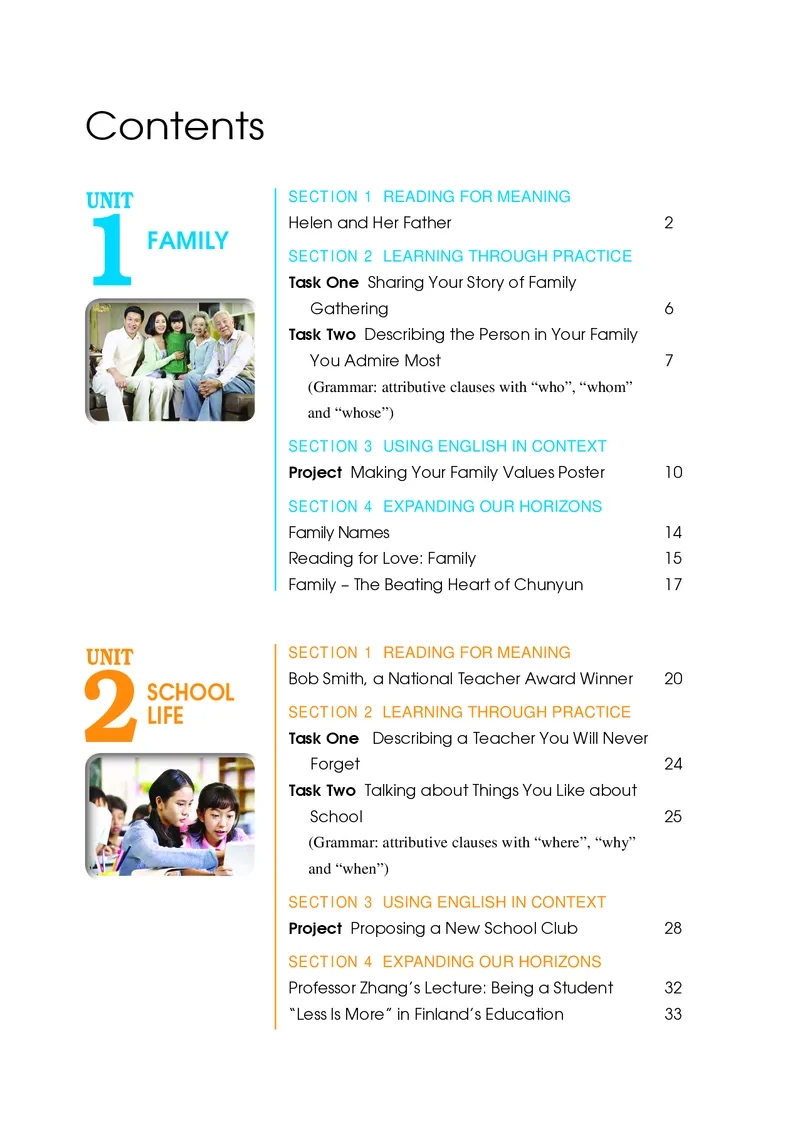
UNIT SECTION 1 READING FOR MEANING
1
Helen and Her Father 2
FAMILY
SECTION 2 LEARNING THROUGH PRACTICE
Task One Sharing Your Story of Family
Gathering 6
Task Two Describing the Person in Your Family
You Admire Most 7
(Grammar: attributive clauses with “who”, “whom”
and “whose”)
SECTION 3 USING ENGLISH IN CONTEXT
Project Making Your Family Values Poster 10
SECTION 4 EXPANDING OUR HORIZONS
Family Names 14
Reading for Love: Family 15
Family – The Beating Heart of Chunyun 17
UNIT SECTION 1 READING FOR MEANING
2
Bob Smith, a National Teacher Award Winner 20
SCHOOL
LIFE SECTION 2 LEARNING THROUGH PRACTICE
Task One Describing a Teacher You Will Never
Forget 24
Task Two Talking about Things You Like about
School 25
(Grammar: attributive clauses with “where”, “why”
and “when”)
SECTION 3 USING ENGLISH IN CONTEXT
Project Proposing a New School Club 28
SECTION 4 EXPANDING OUR HORIZONS
Professor Zhang’s Lecture: Being a Student 32
“Less Is More” in Finland’s Education 33UNIT SECTION 1 READING FOR MEANING
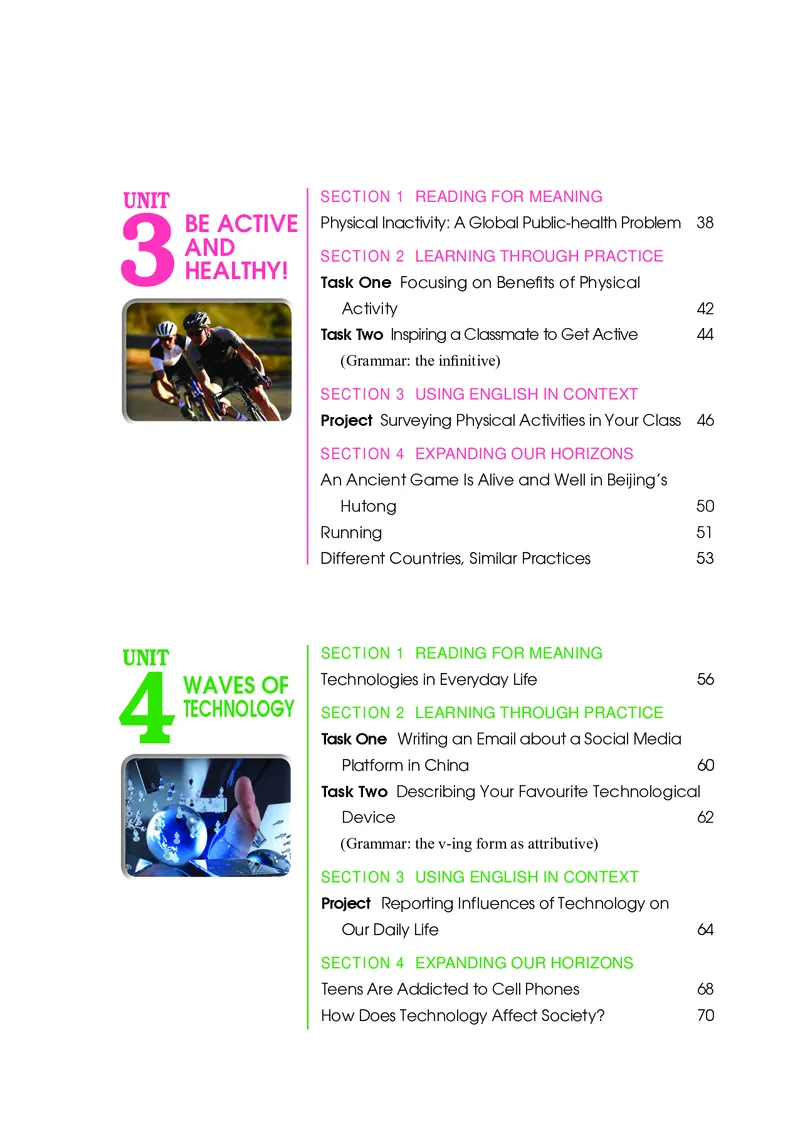
3
BE ACTIVE Physical Inactivity: A Global Public-health Problem 38
AND
SECTION 2 LEARNING THROUGH PRACTICE
HEALTHY!
Task One Focusing on Benefits of Physical
Activity 42
Task Two Inspiring a Classmate to Get Active 44
(Grammar: the infinitive)
SECTION 3 USING ENGLISH IN CONTEXT
Project Surveying Physical Activities in Your Class 46
SECTION 4 EXPANDING OUR HORIZONS
An Ancient Game Is Alive and Well in Beijing’s
Hutong 50
Running 51
Different Countries, Similar Practices 53
UNIT SECTION 1 READING FOR MEANING
4
WAVES OF Technologies in Everyday Life 56
TECHNOLOGY
SECTION 2 LEARNING THROUGH PRACTICE
Task One Writing an Email about a Social Media
Platform in China 60
Task Two Describing Your Favourite Technological
Device 62
(Grammar: the v-ing form as attributive)
SECTION 3 USING ENGLISH IN CONTEXT
Project Reporting Influences of Technology on
Our Daily Life 64
SECTION 4 EXPANDING OUR HORIZONS
Teens Are Addicted to Cell Phones 68
How Does Technology Affect Society? 70UNIT SECTION 1 READING FOR MEANING
5
We Have Only One Planet 74
SAVE THE
PLANET
SECTION 2 LEARNING THROUGH PRACTICE
Task One Making a “Green-home Card” 78
Task Two Writing a Suggestion Letter about
Clean Energy 79
(Grammar: the v-ing form as adverbial)
SECTION 3 USING ENGLISH IN CONTEXT
Project Making a Design of Earth Day Activities 82
SECTION 4 EXPANDING OUR HORIZONS
Top 6 Things You Can Do to Help 86
Talking about Recycling 87
The Unity of Man and Nature 89
WRAP IT UP! 93
APPENDICES
PRONUNCIATION 103
VOCABULARY (I) 105
VOCABULARY (II) 110
LIST OF PROPER NAMES 116
GRAMMAR 118
IRREGULAR VERBS 123UNIT
1
FAMILY
If the family lives in harmony, all affairs will prosper.
– Chinese proverb
In time of test, home is best.
– Burmese proverb
One father is more than a hundred schoolmasters.
– George Herbert, English poet
11
READING FOR MEANING
Helen and Her Father
BEFORE YOU READ
1 Have you read about Helen Keller before? What do you know about her?
2 Have you had an experience of communicating with blind or deaf people? What was it like?
3 Based on the title, what would you expect to read about in this text?
I was born on June 27, 1880, in a little town of northern
DO YOU KNOW?
Alabama. My father, Arthur H. Keller, was an officer in the
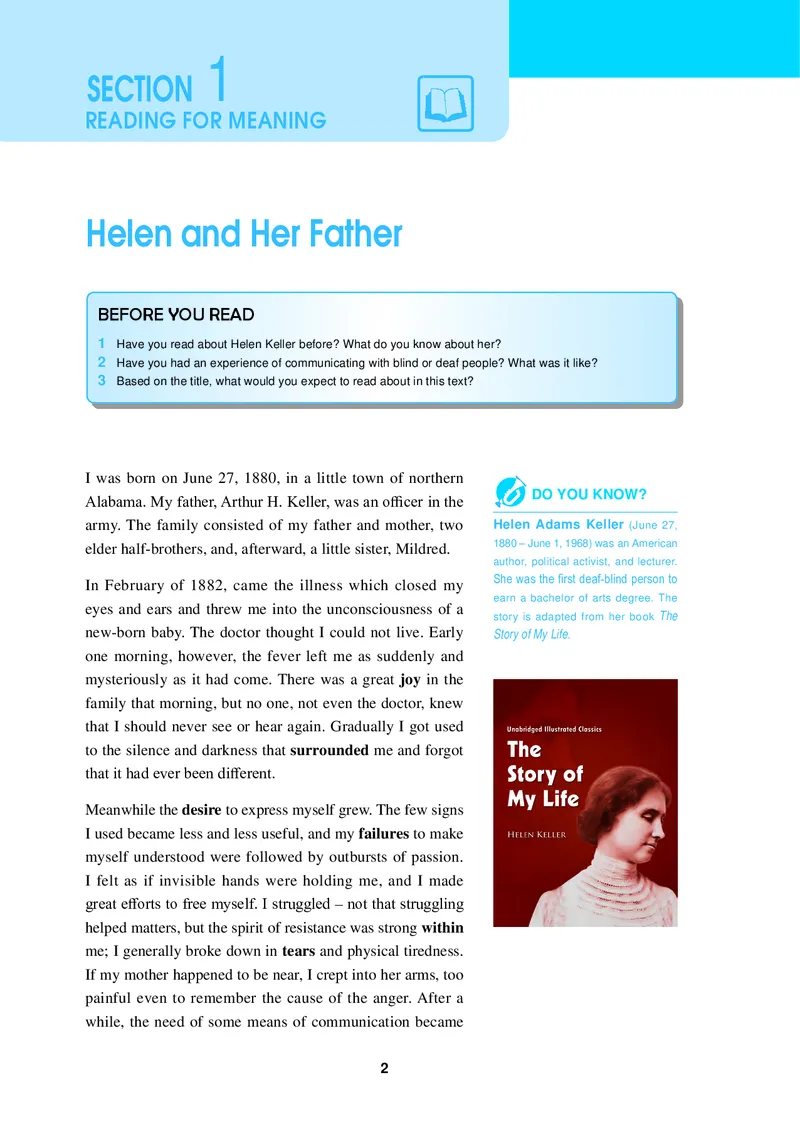
army. The family consisted of my father and mother, two Helen Adams Keller (June 27,
1880 – June 1, 1968) was an American
elder half-brothers, and, afterward, a little sister, Mildred.
author, political activist, and lecturer.
She was the first deaf-blind person to
In February of 1882, came the illness which closed my
earn a bachelor of arts degree. The
eyes and ears and threw me into the unconsciousness of a
story is adapted from her book The
new-born baby. The doctor thought I could not live. Early Story of My Life.
one morning, however, the fever left me as suddenly and
mysteriously as it had come. There was a great joy in the
family that morning, but no one, not even the doctor, knew
that I should never see or hear again. Gradually I got used
to the silence and darkness that surrounded me and forgot
that it had ever been different.
Meanwhile the desire to express myself grew. The few signs
I used became less and less useful, and my failures to make
myself understood were followed by outbursts of passion.
I felt as if invisible hands were holding me, and I made
great efforts to free myself. I struggled – not that struggling
helped matters, but the spirit of resistance was strong within
me; I generally broke down in tears and physical tiredness.
If my mother happened to be near, I crept into her arms, too
painful even to remember the cause of the anger. After a
while, the need of some means of communication became
2UNIT 1 FAMILY
so strong that these outbursts occurred
daily, sometimes hourly.
My parents were deeply sad and puzzled.
We lived a long way from any school
for the blind or the deaf, and it seemed
unlikely that any one would come to teach
a child who was both deaf and blind.
Indeed, my friends and relatives sometimes
doubted whether I could be taught.
My father was most loving to his home.
His special pride was the big garden
where, it was said, he raised the finest
watermelons and strawberries in the
county; and to me he brought the first ripe
grapes and the best berries. I remember
his gentle touch as he led me from tree to
tree, and his eager joy in whatever pleased
QUICK CHECK!
me. He was a famous story-teller; after I had acquired
language, he used to spell his cleverest stories in a very If you move in a very awkward
way, you are not moving in an easy
awkward way into my hand, and nothing pleased him more
way. It is not comfortable.
than to have me repeat them at a right moment.
When I was about six years old, my father heard of a doctor
in Baltimore, who had been successful in many cases that
had seemed hopeless. My parents at once determined to
take me to Baltimore to see if anything could be done for
my eyes.
The journey, which I remember well, was very pleasant.
I made friends with many people on the train. One lady
gave me a box of shells. My father made holes in these
so that I could string them, and for a long time they kept
me happy. The conductor, too, was kind. Often when he
went his rounds, I held his coat tails while he collected and
checked the tickets. His tool, with which he let me play,
was an interesting toy. Curled up in a corner of the seat, I
enjoyed myself for hours making funny little holes in bits
of cardboard. During the whole trip I did not have one fit
3UNIT 1 FAMILY
of temper. There were so many things to keep my mind and
fingers busy.
When we arrived in Baltimore, Dr. Chisholm received us
kindly, but he could do nothing. He said, however, that
I could be educated, and advised my father to consult
Dr. Bell of Washington, who would be able to give
him information about schools and teachers of deaf or
blind children. Acting on the doctor’s advice, we went
immediately to Washington to see Dr. Bell, my father with
a sad heart, I wholly unconscious of his worry, finding
QUICK CHECK!
pleasure in the excitement of moving from place to place.
Child as I was, I at once felt the kindness which endeared If something endears you to
Dr. Bell to so many hearts, as his wonderful achievements someone or if you endear yourself
to them, you become popular with
enlisted their admiration. He held me on his knee while
them and well liked by them.
I examined his watch, and he made it strike for me. He
understood my signs, and I knew it and loved him at once.
But I did not dream that that interview would be the door
through which I should pass from darkness into light, from
loneliness to friendship, knowledge, and love.
Dr. Bell advised my father to write to Mr. Anagnos, and ask
him if he had a teacher able to begin my education. This
my father did at once, and in a few weeks there came a
kind letter from Mr. Anagnos telling that a teacher had been
found. This was in the summer of 1886. But Miss Sullivan
did not arrive until the following March.
The most important day I remember in all my life is
the one on which my teacher, Anne Mansfield Sullivan,
came to me. I am filled with wonder when I consider the
immeasurable contrast between the two lives which it
connects. It was the third of March, 1887, three months
before I was seven years old.
4UNIT 1 FAMILY
AFTER YOU READ
Reading Comprehension
1 How old was Helen when she became blind and deaf? What
caused the loss of her sight and hearing?
2 What was the main cause of Helen’s frustration? Why did Helen’s
outbursts keep on increasing?
3 Who were the members of Helen’s immediate family? Can you list
the qualities of Helen’s father?
4 Helen writes: “During the whole trip I did not have one fit of temper…” Explain the reason.
5 How was Helen’s excitement at travelling on their way to Washington in sharp contrast to her
father’s distress?
6 What was Helen’s reaction to Dr. Bell? How did Helen’s father manage to find a teacher for her?
Post-reading Activities
1 Helen said that she has two elder half-brothers. Half-brother is a kinship term. Please compare and
contrast similarities and differences of kinship systems in Chinese and English with examples.
2 In the text, Helen described a family trip that she would never forget. Have you ever gone on a
memorable family trip? Share a family trip with a partner. Include where you went on your trip and
what things you enjoyed most during the trip.
3 Helen’s father managed to find a teacher, Miss Anne Mansfield Sullivan. Helen and her teacher
found a learning style that worked for her. Her success has served to inspire thousands of people
around the world. When you look back at your own schooling or education in general, is there one
person, teacher, relative or friend who has helped to inspire you and develop your learning? Share
your experiences with your group members.
4 There are two sayings in English, “Blood is thicker than water” and “You can choose your friends,
but you can’t choose your family”. Discuss the subject of family relations as it applies to you and
your family in groups.
52
LEARNING THROUGH PRACTICE
Task One Sharing Your Story of Family Gathering
A family gathering is an event where family members get together. Read about Pat’s happy
family gathering and share your family’s story in your group.
Step 1 Pre-task Resources
Read the passage and learn about Pat’s family gathering.
I love long weekends because they are usually a time when my family gets together.
I get the chance to see not only my immediate family, but also my aunts, uncles,
cousins and grandparents. I always feel happy when I’m surrounded by family.
Dad and I were busy all week getting ready for the weekend, because Mom was busy
at work. We had to make up the spare beds and pull out the sleeping bags for all the
young cousins who always sleep on the floor in the family room downstairs. After
we completed the sleeping arrangements, Dad and I went shopping for groceries. It
sounds like a lot of work, but with my dad, everything is fun.
Everyone arrived on Saturday morning. My aunt Donna made her famous treat –
cookies with honey and spring rolls. They were so delicious! My other aunts
brought food as well. I helped Mom organize all the food and prepare the vegetables
and snacks.
My cousin Michael is 16 years old and
a very good musician. He brought his
guitar this time. We sat around singing
with him for several hours. He played
some current hits and many old songs.
I am very lucky to have such a wonderful
family. We all had a good time on the
weekend and now it’s time to get back to
our regular routines.
6UNIT 1 FAMILY
Step 2 Exploring the Language
Read the following sentences and pay attention to how the qualifiers in red modify the nouns.
● I am very lucky to have such a wonderful family.
● It’s time to get back to our regular routines.
Now read the same sentences with the qualifiers removed. What do you notice about the
meaning of the sentence? How does it change?
● I am very lucky to have such a family.
● It’s time to get back to our routines.
As we can see through comparison, qualifiers can limit or enhance another word’s meaning.
They add more specific information and vividness to a sentence. Here are some of the
major types of qualifiers:
Quality: big, great, really, regular Quantity: all, few, most, none
Time: often, occasionally Certainty: completely, particularly
Step 3 Task Cycle
1 Read Pat’s story in Step 1 again. Make sure you understand every word.
2 Recall a happy family gathering experience and focus on the following questions:
● How often do you have a family gathering?
● Who usually organizes the family gathering?
● What activities do you usually do in a family gathering?
● Did you enjoy your recent family gathering? What made you feel that way?
3 Report your experience to your group. Share your story and hear others’ stories. Remember
to properly use qualifiers to describe your thoughts.
Task Two Describing the Person in Your Family You Admire Most
In a family, each member can be different from the others in many ways. But in almost every
family, there is a KEY person who plays the important role of managing the family. Read the
passage, and write your own to describe the person in your family you admire most.
7UNIT 1 FAMILY
Step 1 Pre-task Resources
Read the passage below and pay attention to the words and sentence structures that the
author uses to describe his father.
My Father, the Person in My Family Whom I Admire Most
A family is made up of people who will
do anything for you without expecting
something in return. To me, a family refers
to the people who are always with me and
give me a sense of belonging. In my family,
my father is the person whom I admire most.
He is the key person in my family who
always keeps us close. He is my hero.
My family has four members: my parents, my sister, and me. My father is about 50
years old. He graduated from college at a time when getting a formal education was
not people’s first choice in my hometown. At that time, most people would rather start
working to earn money than go to school. However, my father always believed that
getting an education was the most important part of a person’s life.
Now that we’re older, both my sister and I have learned to appreciate and see all
the things my father has done to ensure we get a good education. My father always
thinks of us before he thinks of himself. He knows how to make us feel better and
guide us in the right direction. He teaches us how to be better people and better
citizens. He teaches us right from wrong. He also teaches us that sacrifice and hard
work are things that must be done for those you love. He is truly an admirable person
whose advice is always worth following. I benefit a lot from my father – he is the
KEY person in my family.
Step 2 Task Cycle
1 What is the author’s father like? Review the passage above and write down relevant sentences.
● He is the key person in my family who always keeps us close.
● ____________________________________________________________
● ____________________________________________________________
● ____________________________________________________________
8UNIT 1 FAMILY
2 Write your own passage about a person in your family that you admire. Try to include the
following items in your passage.
● What is your relation to this person (your
father, mother, aunt, uncle, etc.)?
Introducing a person
● How has he (she) helped you?
● What is your relationship like now (Are you
● He/She is... years old.
close)?
● He/She always...
● How often do you see each other?
● He/She is the person who...
● Why do you think of him (her) as an important
person or someone you admire?
Step 3 Language Focus
Attributive clauses are often used to describe someone, something, some time or some
place. An attributive clause often seems like a sentence that can stand alone, but it is part of
the main clause.
● He is the key person in my family who always keeps us close.
The red part of the sentence is an attributive clause. It is part of the main clause “He is the
key person in my family...” and describes “which person it is or what the person is like”. The
whole sentence can be considered a combination of two separate sentences.
● Sentence 1: He is the key person in my family.
● Sentence 2: He always keeps us close.
Both sentences have the same subject “he”, referring to the same person. Sentence 2 adds
more information about “the person” in Sentence 1.
● To me, a family refers to the people who are always with me and give me a
sense of belonging.
● In my family, my father is the person whom I admire most.
● He is truly an admirable person whose advice is always worth following.
In these sentences, the attributive clauses are introduced by relative pronouns like “who”,
“whom” or “whose”. You can change a sentence with an attributive clause into two separate
sentences and then put them together to see how the two clauses are combined.
93
USING ENGLISH IN CONTEXT
Project Making Your Family Values Poster
Families keep going mainly by passing down their own traditional values. Different families
may have different values. Ask your parents about your family values and make a poster.
Then compare your poster with those of your classmates.
Step 1 Read and Discover
Read the following passage and discover the author’s ideas on defining one’s family values.
Defining Your Family Values
A family is defined as a social unit consisting of parents and the children they raise.
Value is defined as the quality or worth of a thing. To combine the words together
yields a definition of a traditional set of social standards defined by the family and a
history of customs that provide the emotional and physical basis for raising a family.
Do you have traditional family values? How do you determine your family values?
Traditional family values usually include topics such as marriage, communication,
traditions, morals, holidays, interactions with relatives and how time is spent together.
The values a family develops prepare children to learn, grow and function in
the world. Your family values consist of ideas passed down from generation to
generation. They contain the thought of how you want to live your life. The three
10UNIT 1 FAMILY
traditional basic tasks in life are work, play and love. However, we often focus too
much on work and other activities and not enough on play and love. Yet, without
a balanced life of enjoying play and having loving relationships, our lives become
stressful and unsatisfying.
We need to spend time having family meals, working in the garden, relaxing, and
having fun with our family members to better understand our family values.
● The author thinks family values refer to ____________________________________
____________________________________________________________________.
● Traditional family values include _________________________________________
____________________________________________________________________.
● Factors in determining family values ________________________________________
_____________________________________________________________________.
Step 2 Listen and Match
Family values change with time. Listen to Jack, Ketty and Xiaohua talking about family
values in today’s society. Match the names with their views about family values. Jack’s first
view is shown as an example.
The concept of traditional values is different from today’s.
Family values hold the society together.
Jack
Family values keep us going.
Ketty
Family values are what people can depend on.
Xiaohua
Equality makes a family harmonious.
Family values are more important than ever before.
11UNIT 1 FAMILY
Step 3 Read, Discuss and Write
Different families have different family values. Read the following examples and discuss their
meanings.
● If you don’t study the Odes, you won’t know how to speak
properly! If you don’t study the rites, you won’t have any basis
to stand on. (bu xue shi, wu yi yan; bu xue li, wu yi li)
– Confucius
● Cultivate one’s moral character in peace and frugality. (jing yi
xiu shen, jian yi yang de)
– Zhuge Liang
● Keep your eyes on the stars, and your feet on the ground.
– Theodore Roosevelt
What are some of your family values? Make a poster of your family values. If your
family doesn’t have any in place, know that it is never too late to make a list. Use Frank
Sonnenberg’s poster to help you get started.
Frank Sonnenberg’s Poster
Make your poster
once, love your
family more.
Poster title Family
V
r a
u l
O u
e
s
Family logo
Rules of the House Subtitle
Tell the truth Play fair Remember your manners
Keep your promises Do your best Kiss and make up
Value each other’s opinion Share Help each other
Pull your weight Practice what you preach Family values
Show kindness and respect Stick together
Listen before you talk Clean up your own mess
Have each other's back Put family first
Frank Sonnenberg Your name
12UNIT 1 FAMILY
Step 4 Compare, Discuss and Reflect
In groups, present your poster. Compare your family values with those of your
classmates, and find similarities and differences. Use the list below as a starting point
for a discussion. Take a moment to reflect on your family values. What do they mean to
you? Do you actually live by those values?
Responsibility Harmony Variety Communication
Support Enthusiasm Family unity Fairness Nurturing
Fun Family time Organization Affection Enjoyment
Problem solving Patience Education Arts Literature
Fitness Sports Integrity
Other aspects ________________________________________________
Evaluate yourself!
Can you view and then explain family value posters in English?
Can you use the words you have just learned to describe your family gathering?
How well have you done with the following? Tick the circles that best reflect your performance.
Excellent Very Good Good Needs Improvement
Describing our family gathering in English
with the help of pictures and gestures
Making a poster of my family values
Selecting appropriate language when
introducing family members to others
134
EXPANDING OUR HORIZONS
Family Names
Different cultures have different family names. In many
DO YOU KNOW?
parts of Asia, the family name is written first, followed by
the given name. Some people, such as the Burmese, do Learning a language is also learning a
culture. By learning about the culture
not use a family name at all. Think of U Thant, the former
in which a language has grown, we
United Nations leader, who was from Burma. The Chinese
can learn the language better. An
people adopt their father’s names as their family names. important part of any culture is the
The name is passed down through the father and son from family name.
generation to generation.
People who come from North America mostly get their
names from their families. Parents often pick a first name,
such as Peter or Sally. The last name, though, is usually the
same name the parents share. It is the family name.
Long ago, English-speaking people only had one name.
A man could be called simply James. A woman could be
Martha. Second names became necessary when too many
people had the same first name. To solve the problem, a child
would take his or her father’s name as a last name or family
name. For example, children of John were called Peter
Johnson or Mary Johnson. Names such as Wilson (Will’s
son), Jackson, Anderson and Davidson came into use.
“Mac” or “Mc” means “son of”. There are many “Macs”
and “Mcs” among British people. The name MacGregory,
for example, means son of Gregory. MacDonald means son
of Donald. Fitzpatrick and Fitzgerald mean son, or child, of
Patrick or Gerald.
Some people got their names from the places they lived in.
A family that lived in a village where plants grew thickly
might be called Green.
14UNIT 1 FAMILY
Sometimes people got their names from the way they looked. A tall person might be called Long.
If people in a family had dark hair, the family was sometimes called the Blacks or the Browns.
People also got their names from their work. A person who baked bread was called Baker. A
person who had a very good voice was named Singer.
These familiar names stayed with people and became family names that are still used today.
POST-READING QUESTIONS
1 Where did family names in English-speaking countries come from?
2 If the family name Long meant a tall person and Baker was someone who baked bread, what do you
think the following family names mean?
Barber Clay Gates Hill Nightingale
3 Do Chinese family names have the same origins as English names do? What does your family name
mean?
Reading for Love: Family
I ran into a stranger as he passed by.
“Oh, excuse me please,” was my reply.
He said, “Please, excuse me too;
I wasn’t watching out for you.”
We were very polite, this stranger and I.
We went our separate ways and said good-bye.
But at home a different story is told,
How we treat our loved ones, young and old.
Later that day, while I was cooking the evening meal,
My son stood beside me very still.
When I turned, I nearly knocked him down.
“Move out of the way,” I said with a frown.
He walked away, his little heart broken.
I didn’t realize how sharply I’d spoken.
15UNIT 1 FAMILY
While I lay awake in bed,
A voice came to me and said,
“While dealing with a stranger, common manners you use,
But the children you love, you seem to abuse.
Go and look on the kitchen floor,
You’ll find some flowers there by the door.
Those are the flowers he brought for you.
He picked them himself: pink, yellow and blue.
He stood very quietly not to spoil the surprise,
And you never saw the tears that filled his little eyes.”
By this time, I felt very small,
And now my tears began to fall.
I quietly went and knelt by his bed;
“Wake up, little one, wake up,” I said.
“Are these the flowers you picked for me?”
He smiled, “I found’em, out by the tree.
I picked’em because they’re pretty like you.
I know you’d like’em, especially the blue.”
I said, “Son, I’m very sorry for the way I acted today;
I shouldn’t have yelled at you that way.”
He said, “Oh, Mom, that’s okay.
I love you anyway.”
I said, “Son, I love you too,
And I do like the flowers, especially the blue.”
POST-READING QUESTIONS
1 The last word of the first line “by”, rhymes with that of the second line “reply”. The last word of the third
line “too”, rhymes with that of the fourth line “you”. Please explain how the other word pairs rhyme with
each other.
2 Retell the story in the poem using your own words.
3 Are you also polite towards others but sometimes rude to your family members? Why or why not?
16UNIT 1 FAMILY
Family – The Beating Heart of Chunyun
Chunyun refers to the Spring Festival travel season, a period in China with extremely heavy
traffic around the time of this festival. It is a long-held tradition for Chinese people to reunite
with their families. Family members, no matter how far away they are, travel back home for a
highly anticipated family reunion on the eve of the Spring Festival. Hanging up red lanterns,
enjoying dinner together or taking a family photo becomes the happiest event in the world.
To many Chinese, home is more than apartments or houses. Family relation and values are
extremely important for them. There are many emotional connections in family gatherings
and reunion dinners. Though some old Spring Festival traditions have become less popular,
such as worshiping the kitchen god and kowtowing to elders, the most important part of the
Spring Festival is still and has always been family.
Known as the planet’s extra large human migration, Chunyun lasted for 40 days and saw
nearly three billion trips in 2019, which is more than four times of European population. Here
is a picture to show Chunyun in 2019.
2019 Spring Festival Travel Rush
Road trips Railway trips Air trips Boat trips
2.46 billion 413 million 73 million 43 million
down 0.8 percent up 8.3 percent up 12 percent flat year-on-year
from 2018 from 2018 from 2018
According to this data, the road trips take up a lion’s share as they total 2.46 billion among the
three billion trips. Meanwhile, both the railway trips and air trips have clearly grown since 2018.
17UNIT 1 FAMILY
In recent years, there has been an increasingly popular phenomenon called “reverse Spring
Festival travel rush” – young dream-seekers in urban areas invite their parents to travel from
their hometowns to the big cities to spend the Spring Festival with them. Zhang Hua, a young
IT engineer from Hunan Province, is now working in Shenzhen. Instead of travelling back to
his hometown, he invited his parents to Shenzhen to celebrate the 2019 Spring Festival.
To Zhang Hua and many other people, wherever they are, the beating heart of Chunyun is the
reunion and emotional connection of FAMILY.
POST-READING QUESTIONS
1 What is the main purpose of Chunyun? What is the new trend?
2 Why is FAMILY considered “the beating heart of Chunyun”?
3 Examine the text and explain the changing patterns of trips in 2019 compared with those in 2018.
Unit Reflection
Review the whole unit and reflect on what you have learned.
1 Family gatherings play an important role in promoting relationships between family
members. What are the major functions or roles of family gatherings?
2 Does your family have any family values? What did you learn from family values in this
unit?
3 What do attributive clauses with “who”, “whom” or “whose” mean? What have you learned
about the function and use of these attributive clauses?
More Connections
● Do you want to know more about family values? For answers to where they come from,
how people establish good values in a family, and how family values help make a family
happy and strong, you can surf the Internet to help enrich your understanding. You can
also surf with the following key words: family values, family morals, family beliefs,
family attitudes, and family ideals.
● Family Values: The Ethics of Parent-Child Relationships is a popular book written by
Harry Brighouse and Adam Swift. It gives an account of why families are valuable,
including family liberty and equality. The book also addresses parents’ limited rights in
shaping their children’s values and duties towards their children’s upbringing.
18UNIT
2
SCHOOL LIFE
Whoever cares to learn will always find a teacher.
– German proverb
What is learned in youth is carved in stone.
– Arabian proverb
The principal goal of education in the schools should be creating men and
women who are capable of doing new things, not simply repeating what
other generations have done.
– Jean Piaget, Swiss psychologist
191
READING FOR MEANING
Bob Smith, a National Teacher
Award Winner
BEFORE YOU READ
1 What do you think of your high-school life? Which part do you like best?
2 Who is your favourite teacher? Why?
3 What is an ideal school life like in your opinion?
What does it take to win the hearts and
minds of Grade 10 students? Ask Jenny
Fitchette, Grade 10 student at Lester
Pearson High, and you will get a warm
reply: “To win the hearts and minds of
today’s students, the number one thing is
a good teacher. School is a place where
we get knowledge. No matter how fancy
the school is, or how many computers
there are, without a good, capable teacher,
learning is definitely difficult and not at
all interesting.”
Jenny should know this well. She is at the head of her class – DO YOU KNOW?
a class for gifted students – and is taking four subjects per In some countries, a school year is
semester. Look at her timetable and you will find that she is divided into two periods, known as
semesters.
studying the usual subjects of mathematics, English, biology
and art this semester. It’s not so much the subjects that keep
her coming to school each day, eager and ready to work
and to learn. It’s her biology teacher, Mr. Smith, who keeps
her coming back. Although the classes are long and the
QUICK CHECK!
materials difficult, Jenny recently still found time to finish
To nominate someone for something
a 1000-word paper in which she nominated her teacher,
is to formally propose that someone
Mr. Bob Smith, for the Teacher of the Year Award. This
should be chosen for something.
20UNIT 2 SCHOOL LIFE
annual award is given to a teacher who shows excellence
in teaching. Only students may nominate someone for the
award. If the nominating essay is good, the committee visits
the school and spends a day watching the teacher in action.
“I can’t really say why Mr. Smith is such a good teacher,”
says Jenny, sitting in the bright and open classroom, which
she shares with 20 other gifted learners. “I know that the
classroom itself is a nice place to be. We always enjoy
the time when Mr. Smith stays with
us. I mean, the tropical fish really
help us in our biology studies. We
can actually watch the fish growing
and study them right there in the
classroom. Same thing with the small
garden we keep in the summer. It’s
hands-on. Mr. Smith always tells us
that we learn best when we get in
there and work with things.”
Mr. Smith says he was entirely surprised and honoured
when he heard that Jenny had nominated him for the
award. “It’s really the students who should be getting the
award,” he says. “It’s my job to bring meaningful and
interesting things for them to study, revise, and then to ‘get
out of the way’, so to speak. It’s not I, but the students who
are showing excellence.”
QUICK CHECK!
Hearing the committee announce the award winner If you announce something, you tell
“Bob Smith”, the students jump up and clap their hands people about it publicly or officially.
excitedly. When asked what makes his students love
school so much, Mr. Smith pauses and thinks deeply.
“I think it comes down to respect. The kids know that I
respect them and that I see my job as serving them in a
way. I work for them to help them open up their minds and
discover things that matter to them. That’s the main reason
why they like school.”
Jenny says that you never know what to expect from day to
day in her biology class. One day, Mr. Smith might bring
21UNIT 2 SCHOOL LIFE
his electric guitar, and for the entire class, explain and show the effects of music on plant
growth. He never allows anyone any time to be lazy.
“It’s the variety for sure – that’s part of it,” explains Jenny. “But mostly it’s because we know
that Mr. Smith truly cares about us and about teaching us. You just feel it. He tells us every
day that we are the most important aspect of any school’s life.”
AFTER YOU READ
Reading Comprehension
1 What are the four subjects that Jenny is taking this semester? Which is her favourite and why?
2 How can a teacher win the “Teacher of the Year Award”?
3 How is Mr. Bob Smith’s class unique?
4 How does Mr. Bob Smith make his students love school so much?
5 What does Jenny mean when she says “To win the hearts and minds of today’s students, the
number one thing is a good teacher”?
6 What is the most important aspect of your school life? What do you expect from your teachers?
Post-reading Activities
1 Work in pairs and build a mind map related to the theme “school life”.
peer study
explore
teachers friends
school life subjects
rules activities
22UNIT 2 SCHOOL LIFE
2 Think, pair up, and share. Think of five do’s and five don’ts in a class and write them down. Make a
list of your class rules.
Do’s Don’ts
3 Work in groups. Discuss what a good lesson is supposed to be like and how it benefits the students.
Share your ideas with the class and give reasons.
4 There is an old Chinese saying: “Trust your master and follow his way.” How do you interpret this?
Nowadays, there are different ways to learn, for instance, going to school or studying online at
home. Discuss in groups what way you prefer and explain its advantages and disadvantages.
POEM
A High School Poem
A high school education
Provides a unique situation
It values much more
Than a student’s test score
To those attending high school
Do grow
Be yourself
And stand tall
The ultimate test
Is to be your BEST!
232
LEARNING THROUGH PRACTICE
Task One Describing a Teacher You Will Never Forget
A teacher is someone who passes on knowledge and helps develop our skills. Great
teachers motivate, inspire and facilitate. In this task, think of a teacher you will never forget
and describe how he/she helped shape you and your life.
Step 1 Pre-task Resources
Read the following responses to the question “How has your teacher influenced you?”
How Has Your Teacher Influenced You?
I have been a high-school photography Kristine Hansen, my writing teacher,
teacher for 34 years all because of my did several things to teach me the
high-school photography teacher, Mr. art of writing. First, she enjoyed
H. Warren King. He encouraged me to my stories even if they were poorly
become a teacher and got me my first written. Second, her suggestions were
teaching job. He taught us to see, not aimed at keeping my voice instead of
just with our eyes, but with our hearts. replacing it with hers. Third, I finally
learned some basic grammar!
– Jo Leigh Porter
– Christy Haggard
My favourite teacher was Mr. Liu, my history teacher in high school, because he
taught me about the world through current events. He encouraged us to read the
newspaper and then to present and discuss the events. He helped us understand
how these events tied into history, culture, and government. He taught me not only
the dates and places of important events, but also why and how these events shaped
the world today.
– Wang Lin
24UNIT 2 SCHOOL LIFE
Step 2 Exploring the Language
Brainstorm words and expressions you can use to describe an unforgettable teacher.
encourage
e
h w o i w th t o o t h g e e r t s on h o
a
w t o
n
b
c o n fi d e
nt
ho
th
w
e
t o
w o
s
r
e ld e
unforgettable
how to
solve teacher
problems
h
o
s w
tu
d to
y
Step 3 Task Cycle
Recall your own education, thinking of a teacher that made a difference in your life. Write a
passage about your unforgettable teacher.
1 Give the passage a proper title.
2 Reflect on why this teacher was so unforgettable for you in your life.
3 Be sure to mention which grade and subject you had this teacher for.
Task Two Talking about Things You Like about School
We spend a lot of time in school; thus we cannot help liking some of its aspects and disliking
others. Sometimes, we have mixed feelings about certain school activities. In this task, you
will read an email from a teacher and then talk about things you like about school.
Step 1 Pre-task Resources
This is an email sent by a teacher to answer his student’s question. Read and explain what
he wants to tell his student. Pay attention to the functions of the words in blue.
25UNIT 2 SCHOOL LIFE
A Metaphor about School Life
Let’s say you go to a gym, a place where you work hard. At
the end of the workout, you are sweating and your muscles are
aching a lot. If we compare a school to a gym, that sweat is
the marks that you received.
What is important is not the sweat itself, which is just salt water,
but what you did to achieve the sweat. If you are exercising the
right way, the sweat indicates that you are developing strength
in your body. This strength, which cannot be seen, is what matters
most at the gym. It is measured by our sweat. In the same way,
it is the knowledge and reasoning skills that you acquire in
school that matter most. Unluckily, we don’t have an easy way of
measuring that. That’s the reason why we use examinations and
grades to mark progress. We are slowly developing better means
of measuring success both at the gym and at school.
Just as you can fake sweat by standing near the heater, spraying
water on yourself, or being afraid of something, you can
absolutely fake marks without building mental strength. Many
people do so. However, sooner or later, they end up in courses and
jobs that they hate. At the time when the gym is cool, you might
not sweat at all, but you can still be building strength.
Think of the sweat as your marks. They are useless by themselves,
but if you are honest with yourself, they indicate that you are
developing the knowledge and skills you need to inhabit the world.
School should be a place where you explore yourself. You should
do both the things that you like and the things that you dislike
because they will help
you in the future.
26UNIT 2 SCHOOL LIFE
Step 2 Task Cycle
1 View the chart and explain the metaphor from the teacher’s email in groups.
Expressing opinions
strength
● According to…
gym sweat ● In my opinion…
● It seems to me that…
● From my point of view…
knowledge
● As far as I’m concerned…
school marks
skills ● Personally, I think…
● What I mean is…
● I hold the view that…
● I’m of the opinion that…
2 In groups, pick a school event or activity (e.g. tests and exams, after-school activities) and
discuss aspects of it that you like.
3 Write a short passage and talk about what you like about school. You may use some
attributive clauses.
Step 3 Language Focus
Study the following sentences and pay attention to the use of “where”, “why” and “when”.
● School is a place where we get knowledge.
● That’s the main reason why they like school.
● We always enjoy the time when Mr. Smith stays with us.
We can see that relative adverbs “where”, “why” and “when” are used in these sentences
to introduce attributive clauses indicating places, reasons and time. The relative adverbs
“where”, “why” and “when” function as adverbials in the attributive clauses.
Try to find another three attributive clauses in the passage in Step 1 and explain the structure.
● where ________________________________________________________
● why __________________________________________________________
● when _________________________________________________________
273
USING ENGLISH IN CONTEXT
Project Proposing a New School Club
A new school year has begun! Many students are looking forward to joining a school club,
where they can learn more skills outside of the classroom. You may also want to start a
school club of your own. In this project, you’ll first read, listen to, and learn more about school
clubs, and then you’ll write a proposal.
Step 1 Read and Discuss
Read the passage and discuss with your partner what school clubs you like.
School Clubs in My High School
My name is Lily. I am studying at Woodland High School. I would like to tell you
something about after-school clubs at my school. Let me start with my personal
experience. At the beginning of Grade 10, when I was still new to my high school,
I used to watch TV or play games on my phone after finishing my homework.
My parents encouraged me to join the Blueprint Club when they found out I was
interested in it. I quickly began to enjoy the club because I wasn’t glued to a screen all
afternoon. So far, I’ve met plenty of great people, and I get to create anything I want. I
also get to develop my design and technology skills. I’m having so much fun too!
I have learned that education does not take place only in the classroom during
regular school hours. The home, playground and school library, in general, can all be
very important settings for our personal and educational growth. One way to enrich
our school experience is through extra activities such as clubs. In my school, there are
many different school clubs. You will see them in the following table.
Categories Clubs
● Shakespeare Club
Each semester, read stories based on different Shakespeare plays,
Subject area perform one of them, and hold a Shakespeare festival.
clubs ● Future Scientists Club
Invite scientists to discuss their research, plan trips to local labs, and
discuss the latest scientific research at meetings.
28UNIT 2 SCHOOL LIFE
Categories Clubs
● Chess Club
Host a chess competition between members, invite chess masters to
discuss chess strategy, and watch famous chess movies.
Hobby clubs ● Adventure Club
Plan weekly or monthly outdoor activities (biking, camping, fishing,
etc.), volunteer to plant trees in local parks, and invite a conservationist
to discuss his/her job.
● Children’s Hospital Volunteer Club
Host a book donation drive to collect books and organize a bake sale
to raise money for the Children’s Hospital.
Charity clubs
● Save Endangered Species Club
Visit wildlife rescue centres and plan a spring break trip to see
endangered species.
In my high school, we are all encouraged to join one or two school clubs of our choice.
If we don’t like any of them, we can propose a new school club of our own interest.
Step 2 Listen and Complete Steps
Listen to the passage about how to start a school club and choose the instructions to
complete the steps.
Step Step Step
Make a decision
1 2 3
Step
Plan club activities Find a place Advertise your club 4
Get support Write a proposal Make a decision
Decide when to meet
Step Step Step
7 6 5
29UNIT 2 SCHOOL LIFE
Step 3 Read and Learn
The following sample is a proposal letter proposing a high school chemistry club. Read and
pay attention to the structure of the proposal.
Dear Mr./Mrs./Dr. __________,
Based on the interest in science and particularly in chemistry among
the students, this letter is a proposal to start a high school chemistry
club. The main goal of this club is to provide an opportunity for
students to broaden their knowledge of chemistry and to interact with
other students who share their interests. As such, the proposed club’s
members would like to take part in this club.
There are several reasons why the starting of a high school chemistry
club is important. A chemistry club can allow students to develop their
interest in chemistry in an informal environment, without the pressure
of being graded. It can also introduce students to the possibility of
future studies or employment in chemistry and develop students’
leadership skills by conducting lab activities, or community events.
It is our hope that this proposal will be accepted. Please feel free to
contact me with any questions you may have. Thank you for your
consideration.
Regards,
(name and title)
Learning tips
A proposal is a plan that puts forward or suggests an idea for consideration.
It is usually written to an official organization or a person to gain support
for the suggested plan. It could be a simple letter or a formal document.
30UNIT 2 SCHOOL LIFE
Step 4 Work Together, Design and Write a Proposal
Knowing how to write a proposal is an essential skill in many fields, from school to
business management. Your ideas or suggestions are more likely to be accepted if you
can communicate them in a clear and engaging manner. Work in groups and discuss the
following questions. Then write your own proposal for a new school club of your interest.
● What is the name of your club and what is it about?
● What are the major benefits of the club?
● What are the main activities of the club?
● Where will the club meet?
● How often will this club meet and how long will each meeting last?
● Who can be invited as an advisor of the club?
Evaluate yourself!
Can you get the key information while listening to an introduction about starting a school club?
Can you understand the major contents when reading proposals?
How well have you done with the following? Tick the circles that best reflect your performance.
Excellent Very Good Good Needs Improvement
Building a mind map about school life
Having interest in proposing a school club
Collecting information by using dictionaries
314
EXPANDING OUR HORIZONS
Professor Zhang’s Lecture: Being a Student
At the beginning of this semester, Professor Zhang was invited to Li Ming’s school to give a
lecture about what it means to be a good student. Here are some of her key points.
Hello, everyone,
I’m very happy to be here with you today to share some of my ideas about being a
student. I was a student just like you many years ago.
I remember one of my junior-high teachers used to remind us that to be a student
meant more than just being a pupil. Times change. The definition of “student”
used to be “one who studies something”. Today it just means “one who attends a
school, college or university”. This modern definition doesn’t even suggest that
the person does more than “attend”.
What makes a student stand out from the rest of the class? The four A’s – attitude,
academic skills, awareness and accomplishment – certainly are a large part of it,
and a student who has these skills is very likely to earn A’s.
Attitude is a desire to learn, and the
willingness to work hard. It is reflected
in how well you apply yourself, even
when you have little interest in a
subject. It is also reflected in how much
you can achieve when you don’t like a
teacher’s style.
Academic skills include reading
and understanding of subject matter,
use of resources, mathematical skills,
good study habits, and the ability to
communicate clearly and smoothly in
speaking and writing.
32UNIT 2 SCHOOL LIFE
Awareness refers to being aware of what’s going on in the world around you
and being able to relate it to your academic courses. For example, when taking
a science course, you go out of your way to find applications and examples of
science in the real world.
Accomplishment is shown by how well you apply your understanding of the
subject matter to new problems and challenges and how you use your speaking
and writing skills to communicate this understanding. Your accomplishments will
grow by continuing your education outside of the classroom throughout your life.
All of these add up to ability. The goal of education is to achieve the ability to
apply one’s knowledge in new ways. Many abilities can be earned through hard
work.
Work to be educated, not just trained!
Thanks for listening.
POST-READING QUESTIONS
1 What are the four A’s suggested in the text?
2 With a group member, discuss what qualities make a good student.
3 How do you understand the sentence “Work to be educated, not just trained”?
“Less Is More” in Finland’s Education
When I arrived in the Republic of Finland, I did not find students who were better at
mathematics or knew more math. In fact, the junior-high and high-school math classes were
rather typical of what I had experienced in the U.S. And most of the struggles (like students
not remembering their basic math facts) were the same. The teaching style of a math class
in Finland follows the basic way that has been performed by math teachers for centuries:
33UNIT 2 SCHOOL LIFE
The teachers go over homework, they present a lesson (some of the kids listen and some
don’t), and then they give the kids more homework.
So, what is the difference? Why are Finnish students succeeding while ours are failing?
The answer is that Finland truly believes “Less is more”, which is the basic guideline
to Finland’s education. I hope I can import this way of thinking when I return home to
the U.S.
Fewer Instruction Hours = More Planning Time
Teachers have shorter days. According to the OECD (Organization for Economic
Cooperation and Development), an average Finnish teacher teaches 600 hours
annually, which works out to about four lessons daily. An average U.S. teacher almost
doubles that teaching time, with an average of over 1,080 hours of in-class instruction
annually. This equals an average of six lessons daily. Also, teachers and students in
Finland are not expected to be at school when they do not have a class. For example,
if they don’t have any afternoon classes on Thursdays, they (both teachers and
students) can simply leave. This system allows the Finnish teachers more time to plan
and think about each lesson. It allows them to create inspiring lessons.
Fewer Accepted Applicants = More Confidence in Teachers
Finland works very hard to make sure there are no “bad teachers”. Primary education
sections in Finland accept only 10% of all applicants and turn down thousands of
students annually. A person not only has to be the best and the brightest to become a
primary-school teacher, but they also have to pass a series of interviews to get in. So, it
34UNIT 2 SCHOOL LIFE
isn’t enough to be the smartest in your class – you also have to have the natural ability
and drive to teach.
Less Testing = More Learning
Although it still exists, there is less pressure on teachers in Finland to get through the
curriculum. Teachers are simply trusted to do a good job and therefore have more
control over their classroom and its contents. Teachers are able to take more risks,
try new things, and create an exciting, engaging curriculum that allows students to
become skilled individuals ready for the real world. They have time to teach skills
that allow students to develop into individuals who know how to start a project and
work. They have time to teach hands-on lessons where students get to learn real-
life skills like cooking, cleaning, woodworking and more! And while students are
learning these amazing skills, they are also learning math, problem solving and how
to follow directions!
Less Structure = More Trust
Trust, not structure, is the key to this whole system. Instead of being doubtful of one
another and creating tons of structures, rules, diagrams, and tests to see if the system
is working, they simply trust the system. Society trusts the schools and their teachers.
The schools trust the teachers to be highly trained individuals and therefore give
them the freedom to create the type of classroom environment that is best for their
individual students. The parents trust the teachers to make decisions that will help
their children learn and develop. The teachers trust the students to do the work and
learn for the sake of learning. The students trust the teachers to give them the tools
they need to be successful.
It works, and it isn’t complex. Finland has
it figured out. Less is more.
35UNIT 2 SCHOOL LIFE
POST-READING QUESTIONS
1 What is the writer’s math class in the U.S. like?
2 What makes Finland’s education system unique?
3 What do you think “Less is more” means? Do you agree with this principle? Why?
Unit Reflection
Review the whole unit and reflect on what you have learned.
1 What have you learned about qualities of good teachers?
2 What new information did you get about school life in this unit? What kind of school life
do you think can help students learn and develop?
3 How can you prepare yourself for your future responsibilities in your study at high school
now?
More Connections
● Confucius was a great teacher, writer and scholar as well with a set of philosophical
teachings named after him. His teachings continue to inspire people today. But just what
did he teach? What is Confucianism? And how can we better understand Chinese society
with a knowledge of it? Try to surf websites. Here are some key words for your reference:
Confucius, Confucianism, and Confucius’ teaching.
● Rita F. Pierson, a professional American educator since 1972, taught elementary school,
junior high and special education. As a teacher for 40 years, she believes in her students
and actually connects with them on a real, human, and personal level. She once gave a
lecture Every Kid Needs a Champion, which can be viewed online. Find and watch it to
get to know her thoughts on education.
● View the video about the Model United Nations (MUN), a club in which you can
improve your skills in research, communication, critical thinking and creativity.
36UNIT
3
BE ACTIVE AND HEALTHY!
A sound mind is in a sound body.
– German proverb
He who has no health has nothing.
– French proverb
Walking is the best possible exercise.
– Thomas Jefferson, American politician
371
READING FOR MEANING
Physical Inactivity:
A Global Public–health Problem
BEFORE YOU READ
1 What comes to mind when you read the title?
2 How would you feel if others described you as “physically inactive”?
3 Are you satisfied with your current state of health? If not, explain why.
QUICK CHECK!
Nowadays, a sedentary lifestyle is common in both the
developed and the developing world. Sedentary activities sedentary: (1) (of work, activities,
etc.) in which you spend a lot of time
include sitting, reading, watching television, playing video
sitting down (2) (of people) spending
games, drinking beer or coffee, and using the computer for
a lot of time sitting down and not
much of the day with little or no active physical exercise. moving
Such a sedentary lifestyle is harmful to our health due to
the lack of sufficient physical activity.
Physical inactivity is believed to cause millions of deaths a
year – almost as many as smoking. Researchers have found
that inactivity has obvious links to many diseases.
In Britain, “couch-potato” lifestyles cost the health service
more than £1 billion a year. In the U.S., things are no
better. Physical inactivity is killing millions of Americans.
A study of Chinese people’s habits illustrates that many
urban adults are overweight, and that many middle-aged
people suffer from heart conditions.
One day, Indian housewife Sujata Budarapu was shocked
when she was told that her two sons were on the edge of
developing Type 2 diabetes. “I have heard that outside
India this happens to other people’s kids, but I never
38UNIT 3 BE ACTIVE AND HEALTHY!
thought it would happen to my own,” the 38-year-old
DO YOU KNOW?
woman from Mumbai told AFP. Actually, Sujata’s children
AFP (Agence France-Presse)
are not unexpected cases at all.
is an international news agency
headquartered in Paris, France.
Sedentary lifestyles are linked to increased risks of heart
disease, diabetes and cancer. Most people move far less
than their grandparents did. According to a study of over
70,000 teens in 34 nations, nearly one third of teens are
spending three or more hours a day watching TV or using
the computer. From Argentina to Zambia, teens aren’t getting
enough exercise and it doesn’t matter if they are living in a
rich or a poor country.
It is no different in China. In
cities, the problem of physical
inactivity is serious. As physical
labour is often replaced by office
work, computers and robots are
commonly used. People do not
have to move a lot but they have
to sit more hours working. They
are used to pressing the button
to start the engine and drive to
work because they don’t want
to walk or ride a bicycle to their
office. They want to save time
and achieve the goal as soon
as possible. In rural areas, things aren’t any better. With
more and more people getting richer and richer, modern
transportation is replacing walking.
Not everyone knows the benefits of easy daily activities.
QUICK CHECK!
You do not need to become a boxing champion in order to
get the benefits of exercise. Short bursts of activity can be champion: a person, team, etc.
a welcome escape from the boredom of sedentary work. that has won a competition, especially
in a sport
Walking home, cleaning the house, dancing or climbing
the stairs every day will help your lungs take in more
oxygen, and may help you avoid illnesses such as cancer
or diabetes. Unfortunately, such simple and easy ways to
39UNIT 3 BE ACTIVE AND HEALTHY!
keep fit seem to be ignored by many people who prefer
QUICK CHECK!
products that save time and require little work.
ignore: (1) to pay no attention to
As the World Health Organization observes, physical
sth. (2) to pretend that you have not
inactivity has already become a global risk to people’s seen sb. or that sb. is not there
health all over the world. In the years to come, more efforts
need to be made to deal with the situation.
AFTER YOU READ
Reading Comprehension
1 Is physical inactivity a serious problem all over the world these days? In what degree?
2 What does a sedentary lifestyle include?
3 What does the expression “couch-potato” mean? Is there a difference between a “couch-potato”
lifestyle and a sedentary lifestyle?
4 Why was the Indian housewife Sujata shocked?
5 At the very beginning of Paragraph 6, what does “It” refer to?
6 What attitude does the word “Unfortunately” in Paragraph 7 convey?
Post-reading Activities
1 Do more research about the negative effects of
“sedentary behaviour”. Use the Internet, library, or any
other resources. Write a summary of your findings. Share
and compare.
2 Compare your daily physical activities with those of your
parents and grandparents. Which activities do you have
in common?
3 Imagine what life would be like if everyone adopted the
sedentary lifestyle. How might our lives be different, as
individuals and as a society? Share and discuss your
point of view in groups.
40UNIT 3 BE ACTIVE AND HEALTHY!
4 Design a “Reminder Card” to warn about the seriousness of physical inactivity. You may send
the card as a small gift to your parents or friends.
Reminder
● Physical inactivity is dangerous!
●
●
SONG
To Your Good Health
I knew a man who was rich in gold,
Enough to last till he was old.
He lived his life and finally learned,
It’s how you feel that matters, not how much you earn.
When you are young you don’t realize,
The precious gift of arms and legs and ears and eyes.
They help you do the things you want to do,
Like walking with your friends down the crowded avenue.
Chorus
To your good health, my friend,
To your good health.
I don’t have to tell you it’s only real wealth,
You can take all the money in the world for yourself,
But it doesn’t matter if you do not have your health.
A child is a child. A man is a man.
But they both fit into nature’s plan.
We all get older and come to the end,
But to look back upon a healthy life is your best friend.
Repeat Chorus
412
LEARNING THROUGH PRACTICE
Task One Focusing on Benefits of Physical Activity
Read the passage below about physical activity. Then summarize the benefits of your
favourite sport or physical activity.
Step 1 Pre-task Resources
Read the passage below and pay close attention to the use of the infinitive.
As we know, good health is the
most valuable thing that a person
can have. But one can’t take health
for granted. Getting plenty of
exercise is very important to good
health. In fact, all adults should aim
to get about 30 minutes of physical
activity at least five days a week. It
can be enjoyable, cheap and easy
to fit into everyday life. Regular
physical activity can do you a lot
of good. Human body tissue makes up organs and other body parts. The benefits
of physical exercise are as follows: it helps to build healthy bones and muscles;
it helps to control weight, to keep slim and to reduce fat; it helps to prevent the
development of high blood pressure; and it helps to reduce feelings of worry.
Physical activity can take many forms, such as aerobics, strength training and
flexibility exercises. Examples of aerobic activities include quick walking, skiing,
gymnastics, playing badminton, jogging, cycling, jumping rope and swimming.
Muscle strength refers to how hard or how far you can move your body or an object,
such as kicking a ball. Flexibility is how well you can move the different muscles in
your body, like when you are dancing.
All in all, physical activity benefits people – especially those who are young – in
many ways. Physical activity plays an important role in a child’s happiness. In
addition, it improves learning by developing a young person’s ability to communicate
well with others.
42UNIT 3 BE ACTIVE AND HEALTHY!
Step 2 Exploring the Language
1 Based on the passage in Step 1, list the benefits of physical activity.
● to build healthy bones and muscles
● to control weight
● _________________________________________________________________
● _________________________________________________________________
● _________________________________________________________________
2 Match the physical activities in the left column with their benefits in the right.
You learn the importance of discipline and competition;
Cycling
it helps build friendship; it promotes teamwork.
It improves handling and spacial awareness; it improves
Flying a kite
navigational skills; it promotes weight loss; it helps grow
your social circle.
Weight lifting
It connects to nature; it is relaxing; you will do a lot of
neck & shoulder exercises.
Playing football
It requires a great amount of flexibility; it enhances your
well-being; it can improve your balance.
Dancing
It builds stronger bones; it helps calorie burn.
Step 3 Task Cycle
Share your notes and Decide on your Share your report in
ideas about the benefits favourite physical groups.
of physical activity in activity and write
groups of four. about it.
The following sentences may help you get started.
Physical activity is very important because ____________________________________.
My favourite physical activity (sport) is ______________________________________.
So far, I have benefited from ________________________________________________.
43UNIT 3 BE ACTIVE AND HEALTHY!
Task Two Inspiring a Classmate to Get Active
Imagine one of your classmates is unwilling to do any physical activity, and consequently,
he/she is facing some health problems. Inspire him/her to get active by explaining the
benefits of physical activity. In your explanation, use infinitive verbs as attributives or
adverbials of result.
Step 1 Pre-task Resources
Read the dialogue below. Kate, a TV hostess, is interviewing Dr. William, a famous doctor.
Thanks for your question. I try to remind
people that our health is mostly in our own
Dr. William, what are hands. Though we are lucky to have access to
the key messages you the wonders of modern day medicine, this is
try to get across to the not equal to a healthy lifestyle. Both diet and
public ear? exercise are very important when it comes to
prevention and cure of disease.
Personally, I think sometimes it’s as simple as
How do you inspire
“allowing them” to do so. Some patients just need
your own patients to
to hear that being active is safe and a good thing to
get active?
do. It may seem obvious to some of us, but some
people lack the confidence to get started and others
are concerned that exercise may not be safe. It can
have a very positive impact to explain that physical
activity is safe and can increase confidence.
44UNIT 3 BE ACTIVE AND HEALTHY!
Step 2 Task Cycle
■ Work independently. Read this unit over again and pay close attention to the use of the infinitive.
■ Work with a partner to make up a dialogue about the benefits of being physically active.
■ Role play your dialogue.
Expressing opinions politely
● It might be a good idea to...
● If I were you, I would...
● Personally, I think...
● I mean, it seems to me...
● Well, in my opinion, ...
Step 3 Language Focus
In English, a sentence usually has one main verb. Sometimes, it’s not enough to use only
one verb in a sentence when the speaker or writer has more to express. In this case, the
infinitive is used to give more information.
The infinitive is sometimes used after abstract nouns such as ability, desire, opportunity, wish.
● I have no desire to be rich.
● They gave him an opportunity to escape.
Sometimes, the infinitive is used after an indefinite pronoun such as something,
anything.
● When I travel, I always take something to read.
● I was all alone. I had no one to talk to.
The infinitive can be used to express result; however, this use is more common in
literary styles.
● Do you want to live to be a hundred?
● She arrived home to receive a letter from her bank.
“Only + the infinitive” can express a disappointing result of an action.
● I went back to the shop only to find that it had closed for good.
● He got his car fixed only to damage it again.
453
USING ENGLISH IN CONTEXT
Project Surveying Physical Activities in Your Class
Suppose your school is collecting data about the average student’s exercise habits. Design a
questionnaire to get accurate information about your classmates’ exercise habits and report
the findings to your group.
Step 1 Listen, Read and Fill in Blanks
Here is a survey report about physical activities among American middle school students.
Listen carefully and fill in the blanks.
The national Youth Risk Behaviour
Survey (YRBS) monitors chief health
risk behaviours. The national YRBS is
conducted every two years. It provides
a mass of data of 9th through 12th-grade
students in public and private schools
throughout the United States.
Results from the (1)_________________
national YRBS revealed that many high
school students are engaged in health-
risk behaviours. (2)_______________ had
played video or computer games for 3 or
more hours per day on an average school day. (3)_______________ had not taken part in
at least 60 minutes of any kind of physical activity. The rate of not having taken part in
at least (4)_______________ minutes of physical activity on at least one day was higher
among 11th-grade (15.5%) and 12th-grade (16.9%) than 9th-grade (12.0%). Further,
13.9% had obesity and (5)_______________ were overweight.
Step 2 Read and Interview
The three questions below are part of a questionnaire by the World Health Organization.
Interview a partner to learn more about his/her exercise habits. Then switch roles.
46UNIT 3 BE ACTIVE AND HEALTHY!
1 During the past seven days, how many days were you physically active for
a total of at least 30 minutes per day?
A One B Two
C Three D More than three
2 During the past seven days, how many days did you walk or ride a bike to
and from school?
A Zero B One
C Two D More than two
3 How much time do you spend during your holiday, sitting and watching
TV, playing computer games, or doing other sitting activities?
A Less than 1 hour per day B 1 – 2 hours per day
C 3 – 4 hours per day D More than 4 hours per day
Step 3 Make Questionnaire and Investigate
Group work. Use the survey above to help you design your
own questionnaire of ten Yes/No/Not sure questions. Some
questions are already written out as examples for you. Use
your questionnaire to investigate your classmates about their
exercise habits.
Questionnaire
Dear fellow classmate,
In this questionnaire, we ask simple questions about your exercise habits both in
and out of school. Choose the option that best suits you.
Part I: General Questions about Exercise Habits
1 Is physical exercise important to you in your daily life?
A Yes B No C Not sure
47UNIT 3 BE ACTIVE AND HEALTHY!
2 Do you enjoy physical activity (playing sports, dancing, etc.)?
A Yes B No C Not sure
Part II: Questions about Physical Exercise at School
3 Do you enjoy your P.E. class at school?
A Yes B No C Not sure
4 _______________________________________________________?
A Yes B No C Not sure
5 _______________________________________________________?
A Yes B No C Not sure
6 _______________________________________________________?
A Yes B No C Not sure
Part III: Questions about Physical Exercise after School
7 Do your parents encourage you to play sports?
A Yes B No C Not sure
8 _______________________________________________________?
A Yes B No C Not sure
9 _______________________________________________________?
A Yes B No C Not sure
10 _______________________________________________________?
A Yes B No C Not sure
END OF THE QUESTIONNAIRE
THANK YOU FOR YOUR PARTICIPATION!
48UNIT 3 BE ACTIVE AND HEALTHY!
Step 4 Summarize, Analyze and Write
Now it is time to write a short survey report. In this report, you will summarize the findings
from your questionnaire. You may interpret and analyze the survey data in a few different
ways. You can organize your report into three paragraphs.
Survey Report
The survey of exercise habits is aimed at _______________________________
________________________________________________________________.
Ten questions were asked to _________________________________________
________________________________________________________________.
The data shows that ________________________________________________
________________________________________________________________.
Evaluate yourself!
Can you investigate and collect opinions from your classmates about their exercise habits?
Can you present the results of your survey in English using diagrams and tables?
How well have you done with the following? Tick the circles that best reflect your performance.
Excellent Very Good Good Needs Improvement
Learning the infinitive by understanding its
structure, meaning and use
Making some preparations before reading
Enjoying cooperating with others
494
EXPANDING OUR HORIZONS
An Ancient Game Is Alive and Well
in Beijing’s Hutong
Though he is 75 years old, Chai Tixian is able
to play Jianzi with surprising speed and skill.
With his foot, he can send the Jianzi high up
and have it land exactly on his head.
QUICK CHECK!
Jianzi is a game that dates back to the Han date back: If something dates back to a particular
Dynasty. The game is simple: players must time, it started or was made at that time.
keep the Jianzi up in the air. This is done
mainly by kicking it, but all parts of the body
except the hands are allowed to keep the Jianzi
up. Despite its simple rules, the game is quite
challenging and requires a large amount of
flexibility.
Although Jianzi is played throughout China,
Chai Tixian describes it as an important part
of hutong culture. The ancient game is popular
within the narrow hutongs of Beijing’s inner
50UNIT 3 BE ACTIVE AND HEALTHY!
city. Every morning, Chai Tixian and his friends from the neighbourhood gather in the park
near their hutong and practice the sport. They often draw a small audience of people who
enjoy watching the game.
Chai Tixian, who has retired from work, is the captain of his Jianzi team. Playing Jianzi
with other hutong residents, Chai Tixian said, helps keep him energetic, physically
flexible and young.
POST-READING QUESTIONS
1 Where does Mr. Chai play Jianzi every day?
2 Why is playing Jianzi challenging?
3 What does Chai Tixian benefit from playing Jianzi?
Running
The text below is an excerpt from the book Running & Being: The Total Experience, written
by George Sheehan and Kenny Moore. The book was published in 2013. It is the 35th
anniversary edition of the classic bestseller.
Every mile I run is my first. Every hour on the roads
a new beginning. Every day I put on my running
clothes, I am born again. Seeing things as if for
the first time, seeing the familiar as unfamiliar, the
common as uncommon. Doing what Goethe said was
the hardest thing of all, seeing with my own eyes that
which is spread before me. Bringing to that running,
that play, the attitude of the child, the feeling of a
poet. Being a beginner with a beginner’s mind, a
beginner’s heart, a beginner’s body.
There is no other way to run, no other way to live.
Each day I discover how to breathe. Taste the air.
Feel it move through my lungs. Each day I search
out how to run. Letting the foot drop below the knee.
51UNIT 3 BE ACTIVE AND HEALTHY!
Arriving at the form the child adopts naturally. The body,
QUICK CHECK!
a little stronger perhaps, must come upon these ideas
as fresh as if newly thought. And concentrate on this concentrate: If you concentrate on
something, or concentrate your mind
beginning and bring to it the beginner’s joy in doing this
on it, you give all your attention to it.
simple yet complex thing so well.
The best most of us can do is to be a poet an hour a day.
Take the hour when we run or tennis or golf or garden;
take the hour away from being a serious adult and
become serious beginners. Take an hour away from what
Shelley called a life of error, ignorance and trouble,
and introduce love and beauty and joy. Those good
things began in my beginning. When I was not afraid to
respond to my feeling. Before I was taught not to cry.
Before I learned that humour had a time and a place and
deep feelings had best be hidden, that passion be left
unfelt.
When I run, I go back to those better days. Now no
emotion is foreign to me. I express myself totally. My body
and heart and mind interact and open me to the infinite
possibilities only a beginner can imagine.
POST-READING QUESTIONS
1 How does the author feel about running?
2 What are the benefits of running?
3 What uncommon sentence structures did you notice in the text?
52UNIT 3 BE ACTIVE AND HEALTHY!
Different Countries, Similar Practices
The table is part of the document titled Global Recommendations on Physical Activity for
Health, issued by the World Health Organization.
Country Age group Messages
● Walk to school, friend’s house, shops or other places in your
neighbourhood.
● Try to limit time spent watching TV, videos or DVDs, surfing
12 – 18
Australia the net, or playing computer games, especially during the
years of age
day and on weekends.
● Try a new sport or go back to one you have played before.
● Put on some music and dance.
● Be active your way.
● Choose a variety of activities. Getting started is easier than
Adults
you think.
Canada 55 years
● Do the activities you are doing now more often.
and above
● Walk wherever and whenever you can.
● Find activities that you enjoy.
● Be active your way.
Adults ● Pick an activity you like and one that fits into your lifestyle.
USA 18 – 64 ● Start by doing what you can, and then look for ways to do
years old more.
● Walking is one way to add physical activity to your life.
53UNIT 3 BE ACTIVE AND HEALTHY!
POST-READING QUESTIONS
1 What are the similarities between the messages oriented towards teenagers in Australia and towards
adults in Canada?
2 Why is walking recommended as a good physical activity?
3 How do you understand “Walk wherever and whenever you can”?
Unit Reflection
Review the whole unit and reflect on what you have learned.
1 What are some of the dangers that come from being physically inactive? What could you
do to prevent those dangers?
2 If you were asked to give a lecture about the benefits of physical activity in your
community, how would you prepare for it?
3 What is the infinitive? What have you learned about the meaning and use of infinitives in
English?
More Connections
● Did you know that the 9th Global Conference on Health Promotion was held in Shanghai
in November of 2016? It was a big event for people all over the world. If you are
interested in it, search the Internet for the PDF version of the Report on the 9th Global
Conference on Health Promotion. Do not set high expectations of complete understanding
of the text. You may ignore or skip the words and phrases that you have not learned
before. Just take the authentic English text as an eye-opener and enjoy it!
● Have you ever heard about the International Physical Literacy Association? The concept
of physical literacy was first proposed in 1993 at the International Association of Physical
Education in Melbourne, Australia. Physical literacy can be described as the motivation,
confidence, physical competence, knowledge and understanding to value and take
responsibility for engagement in physical activities for life. If you want to learn more
about it, try to find online resources. Here are some key words for your reference: physical
literacy, sport for life, physical literacy video. Do not forget to read the blogs that tell
interesting personal stories!
54UNIT
4
WAVES OF TECHNOLOGY
Science and technology are revolutionary forces which promote the
advancement of human history.
– Karl Marx, German philosopher
In the 21st century, technology has changed the ways in which we
communicate and go about our lives. It has also dramatically changed the
teaching and learning process.
– Katherine McKnight, American educator
551
READING FOR MEANING
Technologies in Everyday Life
BEFORE YOU READ
1 View a video clip about the development of technology in China and discuss how technology has
changed our lives.
2 How is technology changing the way we communicate?
3 Based on the title of each section, what would you expect to read?
We are surrounded by technologies, some of which have
become so popular that they appear normal and part of
everyday life. People do not even realize that they are using
them. You might have one of these little metal devices
on your lap right now. Most technologies have made life
easier and more convenient as well.
QUICK CHECK!
Smart Mobile Devices
Tablets here refer to small computers
Tablets and smart phones allow you to surf the Internet that can work with a battery and be
from any place offering Wi-Fi. They have successfully easily carried.
replaced a lot of instruments used in the past and have led to
the introduction of many other devices. Phone applications
allow you to check your emails, download movies, update
blogs, play games, and create text documents. They are
devices that can act as GPS devices, digital cameras, music
players, e-readers and video viewers. They have built-in
calendars and to-do lists making it easy for people to stay
organized. Surely you will agree that if your smart phone
were taken away from you or were running out of battery
power, you could feel incomplete.
Mobile Payment
Mobile payment generally refers to payment services
performed by a mobile device. Instead of paying in cash
56UNIT 4 WAVES OF TECHNOLOGY
or by credit cards, a consumer can use a mobile device to
pay for a wide range of services and goods. By scanning
a QR code, short for “Quick Response” code, with a
mobile phone, people can pay immediately in restaurants,
supermarkets and convenient stores. The technology
supporting such systems has become widely available. It
makes operations efficient and convenient, resulting in an
increase in business.
Wearable Devices
Lifestyle and fitness devices have become very popular
in recent years. There are many wearable devices on the
QUICK CHECK!
market for you to choose from. Wearable devices track
your steps, workout time, calories burned and distance you Workout is the physical exercises
cover. In addition, they are in a position to measure the you do to make yourself fit and
strong.
rate of your heart beat and monitor how you sleep. Some
are worn on the ankle or wrist, while others are clipped
onto clothes or put around the chest.
Some wearable devices have LED status lights and small
screens while others don’t have these at all. Scientists are
doing more experiments in this field and future wearable
tech devices are expected to be even more advanced.
57UNIT 4 WAVES OF TECHNOLOGY
Smart Street Lights
Despite its wide range of features, the main task of the
smart street light is to light the street at night. The smart
street light does not rely on traditional lamps, but on LEDs.
First, LEDs use less electricity. Second, they last up to six
times longer than traditional lamps, making less waste. This
allows cities or towns to cut three-quarters of their costs for
street lighting directly.
The smart street light takes it even one step further and
QUICK CHECK!
adapts the lighting to its surrounding conditions within a
radius of up to 150 metres, saving more energy. The radar The radius is a straight line between
chip built into the light detects how fast an object, such as the centre of a circle and any point on
its outer edge.
a car, is approaching the light. The evaluation of the data is
controlled by the microcontroller. All the procedures are
radius
carried out automatically.
AFTER YOU READ
Reading Comprehension
1 Why are smart mobile devices considered “smart”?
2 What does the author mean by “…if your smart
phone were taken away from you…, you could feel
incomplete” in Paragraph 2?
3 What are the benefits of mobile payment? Are there
any risks?
4 What are wearable devices mainly used for at present?
5 What advantages do smart street lights have?
6 What kind of technology do you think will be developed
in the coming years? Why?
Post-reading Activities
1 In pairs, discuss what type of technology has benefited you most? How does it help you? Does it
have any disadvantages? If so, what are they?
58UNIT 4 WAVES OF TECHNOLOGY
2 In groups of four, imagine or design a new technology or a new device to solve a daily life problem.
Give this device a name and present it to the class. Explain what it is used for and how it works.
3 Some students think a smart mobile phone is a must-have in high school. Others think it will do harm
to their studies. What’s your opinion? Discuss in groups and present your ideas to the class.
4 There are various usages of technology in our daily lives. Look at the two pictures below and discuss
with your classmates. What are these technologies? Where would you see them? What are they
used for? How do they influence people’s lives?
showing the way scanning for safety
SONG
New Waves of Technology
First it was fire What will be the newest thing
And then bronze and steel To change our world for good?
Then it was the wheat that was Will it be a flying car
Cut from the fields. Or a stronger form of wood?
Technology has changed us New computers coming soon
And we cannot go back Medicine to cure disease
From the wheel to the car Jets and rockets to the moon
And trains upon the track. Come from new technologies.
Chorus Repeat Chorus
It is new technology
That comes to change our life.
It can make things so much better
And rid our world of strife.
592
LEARNING THROUGH PRACTICE
Task One Writing an Email about a Social Media Platform in China
Suppose George, a British high school student, is researching social media in various
countries. He wants to know more about popular social media in China. Write him an email
to explain what form of social media you think is the most popular in China and why.
Step 1 Pre-task Resources
Listen to the passage about one of the popular social media platforms in China and
complete the information sheet.
The name of the social media platform: _________________
Company: Tencent
Function: allows people to _________________ online, _________________ files and
_________________ other services
A must for its functioning: connect to the _________________
Step2 Task Cycle
1 What social media platform do you want to write about? Discuss the following questions with
your classmates and refer to the mind map below as a guide.
● What is it? ● What is it used for?
● How does it work? ● How does it influence people?
● What are the advantages and disadvantages?
advantages and
name
disadvantages
social media
platform
functions influence
60UNIT 4 WAVES OF TECHNOLOGY
2 Write about 10 sentences to describe the social media platform you’ve chosen with the help
of the mind map.
3 Share your passage with the class and then write it as an email to send to George.
Step 3 Language Focus
In a sentence written in an active voice, the subject plays an active role
of performing an action expressed by the verb.
1 ● Tencent, a well-known Internet company, developed QQ in 1998.
This sentence focuses on the role of the subject, Tencent. The information
given in the sentence describes what Tencent has done.
In a sentence written in the passive voice, something is being done to
the subject.
2 ● QQ was developed by Tencent, a well-known Internet company.
This sentence does not focus on the role of the agent, Tencent. Instead, our
attention is drawn to QQ.
If the sentence is written in the agentless passive
voice, something is being done on the subject.
However, the agent is not stated, so we do not
know who or what performed the action.
3
● QQ is also used as a telephone service.
This sentence does not tell who the agent of the
action is, but focuses on QQ again to highlight
the function of QQ.
61UNIT 4 WAVES OF TECHNOLOGY
Task Two Describing Your Favourite Technological Device
In this task, you’ll read a passage about desktop computers, laptops and smart phones. Do
you use any of these technological devices in your life? Which is your favourite? Describe
your favourite technological device in groups and explain why it is your favourite.
Step 1 Pre-task Resources
Read the following passage and see how the author describes the technological devices.
Desktop, Laptop and Smart Phone
As far as I know, desktop computers are not easy to move around.
Laptops are portable and easy to place in a backpack. However, laptops with larger
screens, weighing up to about seven pounds, can be difficult to carry.
Smart phones, measuring a bit bigger than standard cell phones, are more portable than
any computers. They are very light and can fit in a purse or pocket with ease. They are
designed to be taken with you everywhere.
However, I’m not satisfied with the performance of a smart phone compared to a PC.
My speed for typing on a real keyboard is about 80 words per minute. But my speed on
a mobile phone is probably only 20 to 30.
Smart phones have not yet begun replacing laptops and desktops though they are
quickly becoming more and more advanced. Perhaps one day in the future our smart
phones will be able to replace our laptops and desktops, but until then we’re stuck with
those devices.
If you need a device to help you at
work, I suggest having a desktop
computer at home or in your office.
Someone travelling often on business
trips usually carries a laptop. A smart
phone may be the best device for
someone simply communicating with
others or having fun.
62UNIT 4 WAVES OF TECHNOLOGY
Step 2 Exploring the Language
The v-ing form can serve as an attributive to describe a noun.
● However, laptops with larger screens, weighing up to about seven pounds, can
be difficult to carry. w h i c h weigh
● Smart phones, measuring a bit bigger than standard cell phones,…
which measure
The verb ending in -ing can be used as an adjective to modify a noun. As an adjective, the
v-ing usually comes before a noun. Here are two examples:
● Nobody can stop the running horse.
● We should prepare ourselves for the future in a rapidly changing world.
The major functions of v-ing form as an adjective are as follows:
a. It tells us that something is still going on.
● Some people believe the disappearing rain forest contributes to global
warming.
b. It shows how something can affect us.
● It was a very tiring day at the workplace.
Step 3 Task Cycle
Make a short speech in the class to describe your favourite technological device that you use
in your daily life. Try using the v-ing form in your description.
1 Think about the following questions before your speech. Share your ideas in groups.
● What is your favourite technological device?
● Why do you like it best of all?
● How does it help you in your studies and in life?
● Is there anything you dislike about it?
● How do you think it can be improved?
2 Review the text in Section 1 and Step 1. Take notes of what’s useful for your speech.
3 Write an outline or a draft of your speech.
4 Deliver your short speech briefly to the class.
633
USING ENGLISH IN CONTEXT
Project Reporting Influences of Technology on Our Daily Life
In this project, you will read about and listen to how technology has changed people’s lives.
Then you will report how technology has changed our life in class.
Step 1 Read and Discuss
Read Kara’s story about how technology has influenced her life and discuss the questions.
How Technology Has Changed My Life
When it comes to technology, I think of laptops, phones and TVs. For me,
technology refers to man-made devices that help make everyday life easier.
The first type of technology I ever used was a camera. My mum bought it for me
when I was eight years old. I used it to take pictures of the kitten I had gotten for
my birthday. We bought our first computer in 2007, and I was allowed to get a
phone when I turned 16.
Thanks to our school, we had the opportunity to use the most recent technology.
Students as well as teachers use technology almost every day. At school, we learned
how to search the Internet and how to use certain programs.
64UNIT 4 WAVES OF TECHNOLOGY
I use my phone the most. It is small and easy to take with me everywhere I go. I
use many different types of technology to complete tasks. When it comes to doing
assignments for school, many are online. I use my phone to check my emails,
and I use my laptop to search for information online and complete my homework
assignments. Other technologies that I use are printers and photocopiers.
Technology makes me feel connected to the world. All the information is right at
my fingertips. All I have to do is to turn on my phone and open a browser to find out
almost anything. I think technology is wonderful.
1 According to Kara, what does technology refer to?
2 What was the first kind of technology that Kara ever used?
3 What is the technology she enjoys using most?
4 What technologies does she frequently use for school? How do they help her?
5 What does Kara think of technology?
Step 2 Listen and Discuss
Listen to the story “A Mobile Phone” and discuss the following questions.
1 What did Alex notice on the floor?
2 Why did he scroll through the address book?
3 When did the phone ring?
4 Where did they arrange to meet?
5 What did Alex and Olga eventually do?
Learning tips
People may have different listening skills. Here are some suggestions for you:
● Get prepared before listening and try to predict what you’re going to hear.
● Listen attentively and stay focused while listening.
● Pay attention to the rise and fall of the speaker’s tone, which means different
feelings in a story. Repetition and stress are usually used to express something
important or certain feelings.
● Take some notes of the basic facts about who, what, when, where, how…
65UNIT 4 WAVES OF TECHNOLOGY
Step 3 Discuss and Share
In groups, take turns telling a story that is related to technology. If you do not have a
story of your own, you can surf the Internet for a story. You may also ask your parents,
grandparents or friends if they have a story that is related to technology. Do not make up
a story. Try to think of or find a story that is true. You can use the questions below to help
you get started.
1 What sort of technology is your story about?
2 Did anything interesting happen? What was it?
3 When and where did your story happen?
4 Who was involved? What exactly happened to the people?
5 How did people feel? Was it a good or a bad experience?
Step 4 View and Write
In groups, write a passage about how technology has influenced people’s lives. Remember
to use your stories as arguments to support your views. You can use the chart as a guide.
your general view
on technology
Paragraph
disadvantages and
1
harm of technology to
people’s lives and your
arguments
Paragraph Paragraph
2 3
advantages
and benefits of
technology and
Paragraph
your arguments
4
your conclusion
66UNIT 4 WAVES OF TECHNOLOGY
Step 5 Revise and Report
Read your writing when you finish and see if it is well-organized. Revise and proofread it
before you report it in class.
Learning tips
● Speak clearly, and do not talk too fast;
● Talk to your audience, and do not read your report;
● Use a confident tone and express your emotions and attitudes;
● Stress your key words and emphasize your major points.
Evaluate yourself!
Can you surf the Internet to collect more information about technology?
Can you predict the main content of a text based on its title, key words and figures?
How well have you done with the following? Tick the circles that best reflect your performance.
Excellent Very Good Good Needs Improvement
Understanding implicit relations between
sentences and paragraphs based on key words
Describing the major changes of society caused
by technology
Telling a story about a new technology with the
help of pictures and gestures
674
EXPANDING OUR HORIZONS
Teens Are Addicted to Cell Phones
Teens can’t put their phones down, according to a new
study. New research confirms what most common observers
already know: Kids are becoming phone addicts.
DO YOU KNOW?
According to a survey and report from Common Sense
Common Sense Media (CSM)
Media that involved 1,240 interviews with parents and their is a San Francisco-based non-profit
organization that provides education
children aged 12 to 18, 50 percent of teens feel addicted to
and advocacy to families to promote
their mobile devices, and 59 percent of their parents agree
safe technology and media for
that their kids have a problem putting their devices down. children.
This technology addiction “is causing daily conflict in
homes,” Common Sense Media CEO James Steyer said
in a statement, adding that “families are concerned about
the results”. “We also know that problematic media use
can negatively affect children’s development and that
68UNIT 4 WAVES OF TECHNOLOGY
multitasking can harm learning and performance,” Steyer said. “In a society we all have
a responsibility to take media use and addiction seriously and make sure parents have the
information to help them make smart choices for their families.”
The wish to stay connected on mobile devices leads 78 percent of teens and 69 percent of
parents to check their mobile devices at least hourly. Arguments about device use break
out on a daily basis for 36 percent of parents and 32 percent of teens. And according to
Common Sense Media’s existing research, while multitasking between screens and people is
common for homework or communication, it may be harmful to a teen’s memory, learning
and work abilities.
The study says “taking a balanced approach to media and technology” – one that “recognizes
the importance of face-to-face communication, in addition to online communication, in
supporting rich social relationships” – is recommended to prevent “problematic media use”.
Uncontrolled device use can cause other problems as well. Fifty-six percent of parents surveyed
said they check their mobile devices while driving – which can cause an accident – while 51
percent of teens said they had noticed their parents doing so.
Ellen Wartella, a teacher at Northwestern University who studies the role of media in child
development, said, “From attention disorders and multitasking to basic social interaction and
interpersonal skills, we need to give more time to understanding the impact of media use on
our kids and then change our behaviour accordingly.”
POST-READING QUESTIONS
1 How is cell phone addiction affecting teens, adults and families?
2 What is multitasking? What negative effects does it have on teens?
3 How often do you check your cell phone? What’s your opinion on getting rid of cell phone addiction?
69UNIT 4 WAVES OF TECHNOLOGY
How Does Technology Affect Society?
People are discussing the close relationship between technology and society on an online forum.
The main source of change for the human species is technology. One
example is giving up old professions and taking on new ones. We
went from hunting to farming since farming caused a quick population
growth. We weren’t able to survive on hunting even if we wanted to.
As farming developed and not everyone had to spend their life getting
food, towns formed.
Without complex technology developed in towns, we would be still
hunting and following large animal flocks. More complex technology
allowed our population to grow around 30,000 years ago. Similar
forces are responsible for the current population growth.
David
The solution to every problem is the source of the next problem.
For the most part, technology improves life. Otherwise, we would
return to whatever we used before the latest technology. Almost
everything was a new technology at some point, the wheel, the pen, the
car and so on.
Frank
70UNIT 4 WAVES OF TECHNOLOGY
Usually technology allows the society to get more done in less time
with less effort. And new technology allows for breakthroughs to
develop the next technology. Obviously, technology is like a pyramid.
The more it develops, the more it expands.
Look back to your first computer or cell phone. The change in the last
20 years is surprising; the last 100 years, amazing.
It may be said that technology is as basic a need as eating and sleeping.
Technology strengthens intelligence, allowing humans to run faster,
go farther, and basically do the impossible. Technology is used to
feed people, save lives, educate, entertain and so much more. But it
separates us from humanity.
Technology is starting to impact the job market. Fewer people are
required to perform most jobs, resulting in growing unemployment.
While the working automation is good since fewer people means less
costs and more benefits, the social cost of unemployment needs to be
Steven
considered.
Technology relieves humanity of hard work. It may also leave people
nothing to do. It could create a world where people lose the ability to
get along.
71UNIT 4 WAVES OF TECHNOLOGY
POST-READING QUESTIONS
1 Why did farming come into being as a means of new technology?
2 Why does Frank say “The solution to every problem is the source of the next problem”?
3 What aspect of technology does Steven think should be taken into consideration?
Unit Reflection
Review the whole unit and reflect on what you have learned.
1 What are the major benefits of technology? Is technology always beneficial to human
beings?
2 What new technology can you think of to improve our life? How do you think smart
phones will change in 10 years?
3 What have you learned about the meaning and use of v-ing forms in English? Do you
know how to use the v-ing form and its function when describing a noun?
More Connections
● To learn more about technologies in China, you can find more information by searching
online with such key words as science and technology in China.
● To discover how China is developing its manned-spacecraft flights, you can search online
with such key words as China launches manned-spacecraft.
● What are Big Data and Artificial Intelligence? They are said to be the most important
technologies of the future. To know how they will influence our lives, surf the Internet for
more information.
72UNIT
5
SAVE THE PLANET
We do not inherit the Earth from our ancestors; we borrow it from our children.
– American proverb
Earth provides enough to satisfy every man’s needs, but not every
man’s greed.
– Mohandas K. Gandhi, Indian politician
Our environment, the world in which we live and work, is a mirror of our
attitudes and expectations.
– Earl Nightingale, American writer
731
READING FOR MEANING
We Have Only One Planet
BEFORE YOU READ
1 What occurs to you when you look at this picture?
2 Do you think that the Earth and our environment are facing serious problems? If so, what are they?
3 Looking at the title, what would you expect to read from the text?
Our Demands Go beyond What Our Planet Can Provide
We need 1.5 Earths to meet the demands we currently make of our planet. Caring for
the Earth is not just a romantic idea. People from all walks of life are now gathering to
protest developments that poison the Earth, and declare their support for ideas that put
the well-being of our planet first. Many fear that without change, we will one day turn
our planet into a desert where not even an insect can survive.
Environmental Changes Affect
All of Us WATER IS FOOD PRODUCTION
NEEDED FOR AFFECTS WATER
The way we meet our needs today PRODUCTION AVAILABILITY
is the very opposite of long-term
development. Humans’ well-being –
indeed, our very existence – depends
on healthy ecosystems and the
FOOD PRODUCTION WATER IS NEEDED
resources they supply: clean water, a
USES A LOT OF FOR ENERGY
ENERGY PRODUCTION
livable climate, food, fuel, and rich
earth. The challenge of providing ENERGY CAN ENERGY IS USED
BE PRODUCED FOR STORING,
FROM FOOD CLEANING AND
everyone with the food, water, CROPS TRANSPORTING
WATER
and energy is already a worrying
74UNIT 5 SAVE THE PLANET
future, and the human population is projected to increase
to over 9 billion by 2050. Therefore, protecting nature and
using its resources responsibly are necessities for human
development and well-being, and for building healthy
communities.
Our Demands on Nature Keep Increasing
We cut down trees faster than they can grow, we catch
more fish than the ocean can supply, and we release more
carbon into the air than the forests and oceans can take in.
In 2014, we used more natural resources in 8 months than
the planet can produce in 12 months. For the rest of the
year, we borrowed resources from future generations.
Due to the links between food, water, and energy safety,
overusing one resource will cause a chain reaction. This
interdependence means that efforts to protect one resource
QUICK CHECK!
can weaken others. Attempts to improve agricultural
productivity, for example, may lead to an increased ecosystem: all the plants and
living creatures in a particular area
demand for water and energy, affecting the ecosystem.
considered in relation to their physical
environment
It’s a cycle: The way we meet our needs affects the health of
ecosystems, and the health of ecosystems affects our ability
to meet these needs in turn. This
applies equally to the poorest
rural communities, which often
rely directly on nature for their
livelihoods, and the world’s
great cities, which are easily
threatened by problems like
flood and pollution resulting
from environmental damage.
This rings the alarm for human
beings.
75UNIT 5 SAVE THE PLANET
Better Choices Can Be Made and Practical Solutions Do Exist
With so many people living in poor conditions at present, it may appear as though protecting
nature is a luxury. But it is quite the opposite. For many of the world’s poorest people, nature
is a lifeline. More importantly though, we are all in this together. The problem is not external
to anyone. We all need nutritious food, fresh water, and clean air – no matter where in the
world we live.
Fortunately, technology is advancing
BETTER CHOICES
rapidly nowadays. Progress has
been made in recent years in FROM A ONE-PLANET
PERSPECTIVE
measuring the financial value of the
natural capital that strengthens our
KEEP
economies and societies. Meanwhile,
NATURAL CAPITAL
WWF’s “One-Planet Perspective”
REDIRECT
gives better choices for managing, EQUITABLE
FINANCIAL PRODUCE BETTER
RESOURCE
using, and sharing natural resources FLOWS
GOVERNANCE
within the planet’s limits.
CONSUME
The task is difficult, certainly, but MORE WISELY
not impossible – because it is in
ECOSYSTEM FOOD, WATER AND
ourselves, who have caused the
INTEGRITY ENERGY SAFETY
BIODIVERSITY
problem, that we can find the solution
CONSERVATION
and start a new chapter in our long-
term development.
AFTER YOU READ
Reading Comprehension
1 What does “long-term development” mean?
2 What kinds of human activities are harmful to natural environment?
3 What is the effect of overburdening one resource?
4 Does protecting nature mean the same thing for the poor and the
rich areas? Why or why not?
5 What is the function of WWF’s “One-Planet Perspective”?
6 How do you interpret the title of this text “We Have Only One
Planet”?
76UNIT 5 SAVE THE PLANET
Post-reading Activities
1 Work in pairs and list two or three major problems the Earth is facing now. Try to identify possible
causes of these problems.
Problems Causes
2 Surf the Internet to make a list of things humankind can do to save and protect our planet. Share
your findings in groups.
3 Think about what you can do, as high-school students, in your daily life to help protect the environment.
4 In groups, discuss whether you think we should make recycling compulsory for all households.
POEM
Save Our Earth
Have you ever taken the time In a way
To see what is around you? We are all selfish murderers
Taken the opportunity Killing the soil we walk upon
To gaze at every little detail of your surroundings? With our trash and disgrace, our
Or have you closed your eyes stubbornly ungratefulness
Because you prefer to be blind? Slowly
The truth is Slowly it shall fade
You don’t want to admit that our precious Earth Slowly we shall perish
Is falling apart Save the Earth
Its beautiful skirts of grass Save our hearts and souls
Are dying Or forever be lost
Its garden of stunning plants In a pit of death and regret
Is running out of air Save our home
And us, Save our air
Us, the ones who made it this way Save our lives
Will one day perish into a dark hole Save our Earth
772
LEARNING THROUGH PRACTICE
Task One Making a “Green-home Card”
Being environmentally friendly means having a lifestyle that helps the planet more than hurts
it. Saving water, driving less often, gardening, and protecting animals are all good ways to
start helping. In this task, you are to work together in a group to make a “Green-home Card”.
Your card will encourage people to do something so as to make their home green.
Step 1 Pre-task Resources
Read the following example and discuss the idea it suggests to keep your home green.
Green-home Card
Idea: Reusing plastic bags
Plastic bags can be reused in the following ways:
● Use them as trash bags in your home or office.
● Protect your hands when cleaning, cooking, or gardening.
● Put them around plants to protect them from frost.
…
The idea in this card suggests that instead of just throwing plastic bags away, we use
them again. If we reuse something, we will reduce waste. There are many other things
we can do to make our home green. For example, we can repair things and use them for
a longer time and share or donate things we don’t use very often.
Step 2 Task Cycle
■ Brainstorm ideas for a “Green-home Card” and choose one to focus on for your card.
■ Complete your card. You may refer to the card in Step 1 as a guide.
■ Decorate your card and make it beautiful.
■ Explain the reasons for your idea. You can refer to the text in Section 1 for language support.
■ Put it up on the classroom wall.
78UNIT 5 SAVE THE PLANET
Green-home Card
Idea: ________________________________________
It can be reused in the following ways:
● ____________________________________________
● ____________________________________________
Step 3 Language Focus
We have learned that imperatives are sentences that begin with an action verb. Imperatives
can be used to give advice.
● Make recycling part of your daily routine.
● Use them as trash bags in your home or office.
● Walk or bike whenever possible.
● Listen to what your parents have to say.
● Rather than recycling clothing and household goods, give them a chance at a
second life.
We put “do not (don’t)” or “never” before the infinitives to form a negative imperative.
● Don’t leave water running while you brush your teeth.
● Don’t walk or drive through floodwater.
● When you recognize a root word in a new vocabulary word, don’t be afraid to
guess its meaning based on your understanding of the root.
● Don’t cut down trees unless it’s completely necessary.
● Never do it again.
Task Two Writing a Suggestion Letter about Clean Energy
In this task, you will read a passage about fossil fuels and clean energy. Read the passage
first and pay attention to the functions of the v-ing structure. Then, write a suggestion letter to
advocate the use of clean energy.
79UNIT 5 SAVE THE PLANET
Step 1 Pre-task Resources
Read the following passage to learn about fossil fuels and clean energy.
Fossil fuels – namely, petrol, coal, and natural gas – are today’s major sources of
energy. However, the consumption of fossil fuels is alarmingly high, causing serious
environmental issues such as air pollution, smog and global warming. As fossil fuels
quickly run out, the global energy markets are turning to clean energy.
Clean energy, refers to the energy produced by renewable resources. The three most
common types of clean energy are solar power, wind power and water power.
Solar power is an important source of energy. In fact, the sunlight that shines on the
Earth for just one hour can meet the world’s energy demand for an entire year! It is
renewable, sustainable, free of charge, and environmentally friendly.
Wind power is considered a renewable energy source because there is and always
will be wind on the Earth. We aren’t “using it up” when making energy from it.
Being one of the oldest methods of
producing power, water energy helped
people throughout history in their work.
These days, we make great use of moving
water to produce electricity.
However, by depending too much on the
weather, lacking much-needed efficiency,
and requiring huge financial support, clean
energy is not that perfect.
Step 2 Exploring the Language
Examine the words in red. Can you find anything in common?
● However, the consumption of fossil fuels is alarmingly high, causing serious
environmental issues such as air pollution, smog, and global warming.
● Being one of the oldest methods of producing power, water energy helped
people throughout history in their work.
80UNIT 5 SAVE THE PLANET
These two words in red are v-ing forms. The v-ing phrases act as adverbials.
● While I was walking down the beach, I saw a dolphin stranded.
Walking down the beach, I saw a dolphin stranded.
● Because she is a mother now, she has more responsibilities.
Being a mother now, she has more responsibilities.
The v-ing phrase can serve as an adverbial to indicate result, time, reason, etc. in a
sentence.
● A plane crashed near New York, killing 21 passengers on board.
● Hearing the news, Mary jumped with joy.
● Feeling a bit tired, I didn’t go to work yesterday.
Step 3 Task Cycle
It is believed that the use of fossil fuels leads to air pollution. Read the following example, and
write a suggestion letter to the local government to advocate the use of clean energy. You
may use the information and language you have learned in the first two steps of this task.
Dear Sir/Madam,
I am a high-school student. I am writing to advocate the use of clean energy.
As we all know, fossil fuels can be very harmful to the environment.
_________________________________________________________________________________________
Compared with fossil fuels, clean energy has many advantages.
_________________________________________________________________________________________
In conclusion, I strongly advocate using clean energy. I sincerely hope you
can consider my suggestion. Looking forward to your reply!
Yours,
Li Hua
Learning tips
A suggestion letter will lead to the action if it is written in a clear and
persuading manner. Here are some tips on writing a suggestion letter:
● Use simple and straightforward words.
● Talk about positives.
● Always be polite.
813
USING ENGLISH IN CONTEXT
Project Making a Design of Earth Day Activities
Suppose Earth Day is coming soon. The major aim of Earth Day each year is to raise
people’s awareness of environmental protection. You and your group members are to
design some activities for its celebration and present your design to your classmates.
Step 1 View and Discuss
Look at the following pictures, and discuss with your group members to learn more
about Earth Day.
Step 2 Read and Review
Read the passage and fill in the table.
Earth Day
It is very clear that we are facing a global climate problem that threatens every
person and nation on the Earth. The rate of climate change has been increasing
or rising over the past few years, causing pollution, desertification, and drought in
many places.
Falling on April 22 of each year, Earth Day is celebrated to raise awareness about the
dangers facing our planet and how we can protect it from damage. After having
seen the destruction caused by oil spill in California in 1969, American Senator
Gaylord Nelson worked tirelessly, uniting people from all levels of society. They chose
82UNIT 5 SAVE THE PLANET
to express their views to the government on April 22, and it was a great success.
Following the establishment of the United States Environmental Protection Agency
(EPA), three environmental acts about clean water, air, and endangered species went
through, which are used as a defence against pollution.
Since then, Earth Day has appeared on the
world stage. At present, over 190 countries
take part in Earth Day activities, making
it the largest celebration in the world.
Every year, the event is celebrated under
a different theme, such as “The Face of
Climate Change”, “It’s Our Turn to Lead”
and “Trees for the Earth”.
As humans, we must come together not as
citizens of different nations, but as citizens
of the Earth, to protect our home for the
present and for the future. Let’s start now.
Earth Day
date
purpose
origin
previous themes
Step 3 Listen and Discuss
Listen to a passage about Earth Day 2016 and discuss the following questions.
1 What was the theme for Earth Day 2016?
2 How many trees are supposed to be planted by 2020?
3 List the activities mentioned in the passage.
4 How can you cut down on junk mail?
5 What is the simplest way to celebrate Earth Day?
83UNIT 5 SAVE THE PLANET
Step 4 Read, Discuss and Design
Read the following sample and learn how to design Earth Day activities.
Earth Day 20__ __
Theme: How to Live a Green Life
Learning tips
Activities and reasons:
1 Drink less bottled water. Bottled water produces Here are some tips
up to 1.5 million tons of plastic waste per year. on designing an Earth
Transporting and recycling plastic bottles is Day theme:
● The theme can be
wasteful and harmful to the environment. There’s
an expression or a
a simple alternative to bottled water: buy a
short sentence.
stainless steel thermos and use it.
● The theme should
2 Use less fuel for transport. Walk or ride
be clear and
your bike whenever you have to travel a short
appealing.
distance. If your destination is too far for a ● The theme should
bicycle, take public transportation. reflect the purpose
of Earth Day.
Step 5 Discuss, Write and Present
Discuss with your group members and choose a theme for the upcoming Earth Day. Design
your Earth Day activities in the form below. You may refer to the previous themes of Earth Day.
Then present your Earth Day activities to your class.
Earth Day 20__ __
Theme: ____________________________
Activities and reasons:
1 _________________________________________________________________________
2 _________________________________________________________________________
3 _________________________________________________________________________
4 _________________________________________________________________________
84UNIT 5 SAVE THE PLANET
Useful expressions
With Earth Day approaching, our group has designed some activities to celebrate it.
The theme of our Earth Day activities is...
The activities are as follows...
With the activities above, we are sure...
Thank you for listening!
Evaluate yourself!
Can you understand the details and expressions used in the text about Earth Day?
Can you use appropriate words to explain the pictures and signs of Earth Day activities?
How well have you done with the following? Tick the circles that best reflect your performance.
Excellent Very Good Good Needs Improvement
Knowing how to select words when
designing Earth Day activities
Understanding the main idea of the text
by speed reading
Having confidence in making greater
progress in learning English
854
EXPANDING OUR HORIZONS
Top 6 Things You Can Do to Help
Acting on climate change is everyone’s responsibility. Here’s how you can do your part.
Reduce Energy Use Change the Way You Go out
Develop energy-saving habits. Make Put on your boots. Walk or bike
it a habit to turn off the lights as you whenever possible. Not only will you
leave a room. Turn off your computer reduce your carbon footprint, but your
and electronic equipment when they overall health will improve, and you
are not in use. will save money on gas.
Make Every Drop Count Recycle
Save water by fixing leaks and using Make recycling part of your daily
low-flow shower heads and toilets. Try routine. Recycle all packaging and
to take a speed shower. Turn off water consumer goods that you can. Aim to
while brushing teeth or shaving. buy things with recyclable packaging.
For certain things with large amounts
of packaging, ask sellers if they can
recycle or reuse it.
86UNIT 5 SAVE THE PLANET
Repurpose Plant
Rather than recycling clothing and household When gardening, select
goods, give them a chance at a second life. plants that are well suited to
Gently used clothing can be donated to your climate and require less
charity or exchanged with friends and family. watering and attention. Better
Old T-shirts can be repurposed into rags for yet, plant a tree, and it will
cleaning. An old boot can be repurposed as a provide shade and take in
lovely garden planter. Household goods can be carbon from the air.
donated to charity or sold at a garage sale. By
repurposing, the amount of waste being sent to
landfill sites is reduced, energy is saved because
there is no need for recycling, and others benefit
from your used things.
POST-READING QUESTIONS
1 In your opinion, what is the most practical way of saving energy? How can you put it into practice?
2 According to the text, how can you repurpose your used belongings?
3 Can you think of more ways to help? What are they?
Talking about Recycling
Mark’s father is a teacher in Bristol Creek High School. His school launches a new
program with a focus on environmental protection. He thinks that everyone ought
to do something to help protect the planet. At home we can recycle things made of
paper, plastic, metal, or glass, such as cans and bottles. Here is a dialogue between
Mark and his father about recycling.
87UNIT 5 SAVE THE PLANET
Father: Time to wake up, Mark. No sleeping in this
morning!
Mark: But Dad, it’s Saturday. I always like to sleep in on
Saturday.
Father: Not today. I need you to help me do the recycling.
Mark: All right. Can I grab a quick bite to eat first? I’m
starving.
Father: Of course.
Mark: Dad, why do we bother with recycling? It seems
like a lot of work… separating the cardboard from the
cans, washing the glass containers, putting plastics in
a separate container. Then we have to drive them all to
the special blue boxes.
Father: That’s taking care of our environment. Nowadays
there are so many people throwing away so much QUICK CHECK!
rubbish that our landfills have a hard time keeping up. landfill: an area of land where large
We have to cut down in order to protect the planet. amounts of waste material are buried
under the earth
Recycling changes rubbish into products that can be
used again.
Mark: Like what?
Father: Well, cardboard is recycled into paper products,
plastics are made into tires. And you know that the
jacket you’re wearing right now… it’s made from
recycled plastic pop bottles!
Mark: Yuck! Anyway, taking back the bottles is the best
part of recycling.
Father: How come?
Mark: Because I get to keep the deposit money!
POST-READING QUESTIONS
1 It is much easier to throw away waste than to sort it out into various bins for recycling, but the effort is
worthwhile. Do you agree or disagree with this statement? Why or why not?
2 What does it mean when Mark says “… why do we bother with recycling”? What is his father’s opinion?
3 Some people suggest that we make recycling a must for all households. Do you agree? What are the
benefits? What are the problems?
88UNIT 5 SAVE THE PLANET
The Unity of Man and Nature
The Chinese believe in the unity of man and nature, a basic
approach to their philosophy of life. In the cultural tradition
of China, Taoism, Confucianism, and Buddhism all have
the “unity of man and nature” as their foundation. Most
of the popular festivals in China are joyous celebrations
of nature while also working to build a right order of
relationships among humans.
The ancients never placed themselves above nature.
Zhuangzi, for example, claimed “Heaven and earth are
parents to all things in the world”. The beauty of nature is
to “give birth to all things” and “let all things grow”, while
the duty of humans is to “perfect all things”. Heaven, earth,
and humans should be one in unity. Each of the three has
its own way. They are complementary to each other, and
should therefore treat each other with kindness. Zhuangzi was an influential Chinese
philosopher who lived during the
This idea of oneness of man and nature has been rooted Warring States Period.
in the heart of the Chinese people and inspires modern
Chinese to take actions to protect the natural environment.
In most provinces of China, some policies have been
made to reduce greenhouse gas emissions. A smart,
clean-electricity system that aims to deliver reliable and
affordable power has been built. A large amount of power
89UNIT 5 SAVE THE PLANET
from water, wind, and sunlight are produced and exported to various neighbourhoods.
The majority of the Chinese, especially the youth, have developed their environmental
awareness and are willing to take part in environmental protection initiatives. China is now
working with all other countries to make the Earth a better place to live.
POST-READING QUESTIONS
1 According to the text, what is the basic approach of the Chinese in their philosophy of life?
2 Can you give an example of the festival in China that is a joyous celebration of nature?
3 What actions do the Chinese take to protect the natural environment?
Unit Reflection
Review the whole unit and reflect on what you have learned.
1 What are the major problems our planet is facing? What are the main causes of these
problems? Can you list some man-made decisions that are harmful to the Earth? What can
we do to stop them?
2 What have you learned about Earth Day? Do you think Earth Day will help save and
protect our planet? What have you learned about clean energy? Do you think it will
completely replace fossil fuels? Why or why not?
3 We have only one planet to call home – the Earth. What contribution can you, as high-
school students, make to protect the environment and save the Earth?
More Connections
● The Earth Day Network now coordinates more than 190 countries globally in
demonstrating the annual celebration. You can surf the Internet for more information, such
as different themes and activities for the past years.
● Nature is suffering, and it needs a person that cares. But what can we do now to fix the
damage that has been done? Laura Dalton’s The Earth is Dying and You Can Help to Save
It provides more information on this topic.
90APPENDICES
91My Notes
92WRAP IT UP!
UNIT 1 FAMILY
Build Your Vocabulary
A Replace the blue part in each sentence with a proper word or phrase.
1 Only by reaching the goal can people gain lasting peace. ( )
2 I have a big wish to teach after I graduate from college. ( )
3 The kid wanted to tell her friends about her trip by air. ( )
4 At the sound of the door bell, the dog rushed out for its master at once. ( )
5 The sports fans soon got around the champion. ( )
6 The children were playing inside the house. ( )
B Match the words with their explanations.
1 graduate a. something eaten between meals
2 refer b. make certain
3 snack c. complete a degree course successfully
4 surround d. gain
5 earn e. indicate
6 ensure f. get around
C Complete the dialogue with the proper words in the box.
define generation marriage topic former tears extra
A: The (1)__________ that grew up in the 1990s depend on their parents too much financially.
By the way, how do you (2)__________ them?
B: Well, we call them the Boomerang Kids. Actually this is also a hot (3)__________ in the U.S.
I think it’s a big shame.
A: Is that true? My neighbour’s son graduated from high school a few years ago and
he refuses to get a job even after his (4)__________ with a girl. They have not been
independent for a few years. His mother has to do (5)__________ work to support the
family. She works seven days a week. She always tells my parents that she misses her
(6)__________ relaxing days when her son was at school. She occasionally says with
(7)__________ that she can hardly bear the burden.
93WRAP IT UP!
Grammar Grammar Makes Sense
A Read the following sentences and identify what “who”, “whom” and “whose” refer to.
1 On New Year’s Eve, my grandparents are the ones whose health we always toast to.
_______________________________________________________________________
2 To me, the family are the people who are always with me and give me a sense of
belonging.
_______________________________________________________________________
3 Every afternoon, my mother is the one whom we entrust with a good meal.
_______________________________________________________________________
B Write descriptions for the people in Column A by combining information from both
Column B and C. Use the relative pronouns “who”, “whom” and “whose” to link
the information. See the example below to help you get started.
A B C
1 Madam Curie physicist She first discovered radium.
2 Zhou Youguang language expert He was named “Father of Chinese Pinyin”.
3 Nan Rendong engineer The world’s largest telescope was founded by him.
4 Shakespeare writer He wrote A Midsummer Night’s Dream.
The Nobel Prize for Literature was awarded to him
5 Mo Yan writer
in 2012.
Her discovery saved millions of people from
6 Tu Youyou scientist
malaria.
1 M__a_d_a_m__ C_u_r_i_e _i_s _th_e_ _p_h_y_s_ic_i_st_ w__h_o_ fi_r_s_t_ d_i_sc_o_v_e_r_e_d_ r_a_d_iu_m__________________.
2 _______________________________________________________________.
3 _______________________________________________________________.
4 _______________________________________________________________.
5 _______________________________________________________________.
6 _______________________________________________________________.
94WRAP IT UP!
UNIT 2 SCHOOL LIFE
Build Your Vocabulary
A Write the corresponding adjective or adverb forms of the given words.
adj. adv.
definite
capably
entire
strongly
amazing
B Replace the blue part in each sentence with a proper word.
1 Research shows that eating habits are changing fast. ( )
2 It has recently been broadcast that a new high school will be built in our community.
( )
3 Their goal is to produce as much milk as possible. ( )
4 I really had to stay on the farm for a whole summer. ( )
5 It rained heavily and thus the football match was put off. ( )
C Fill in the blanks with the words you’ve learned in this unit. The first letter is given.
1 I deleted many secret files from my computer s_ _ _ _ _.
2 She’s a lot like her friends; she is a t_ _ _ _ _ _ high school girl.
3 In this program, students v_ _ _ _ _ _ _ _ to take two years off after they graduate from
university to go to the poorest schools to help teach young students.
4 With the holiday drawing near, I would like to take this time to r_ _ _ _ _ _ on my life so
far, and the direction I’m heading in.
5 The a_ _ _ _ _ _ _ _ _ _ for scholarship and student loan is usually a bit complicated.
95WRAP IT UP!
Grammar Grammar Makes Sense
A Match the statements with the correct descriptions.
1 I am going to travel in Ireland a. whose name I have forgotten.
2 My favourite book is Three Days to See b. why I didn’t go to school.
3 I had a fever and that was the reason c. where I can find beautiful beaches.
4 That is Helen’s cousin d. when clean energy is widely used.
5 Harry Potter is the character e. which I have read several times.
6 Perhaps the day will come f. whom many young people like.
B Join the two sentences to make one sentence by using attributive clauses.
1 This is a pretty good school. I am studying in this school now.
____________________________________________________________________.
2 The day was September 1st. I came to this school on that day.
____________________________________________________________________.
3 The school has the most advanced teaching equipment. I came here for this reason.
____________________________________________________________________.
4 There are many kind and responsible teachers. They have helped me a lot with my study.
____________________________________________________________________.
C Describe each picture by adding an attributive clause. The first one is done for
you.
1 2 3 4
1 The reason is that we can share our stories with each other.
The reason why we come to the club is that we can share our stories with each other.
2 That old man is his grandfather.
That old man _____________________________________________ is his grandfather.
3 This is our new library.
This is our new library ____________________________________________________.
4 I like Sundays.
I like Sundays ___________________________________________________________.
96WRAP IT UP!
UNIT 3 BE ACTIVE AND HEALTHY!
Build Your Vocabulary
A Freddie is writing an email, but he is not sure about the words he is using. Help
him circle the correct words in brackets.
Dear Alice,
How are things going?
Recently, I read a book on physical (sports; activity) and health. I never realized how
dangerous it could be to have a(n) (inactive; lazy) lifestyle. Now I know how important
sufficient physical activity is:
● The heart is a (muscle; part).
● The heart is about as big as my fist. Its job is to pump blood throughout my body.
● Blood carries (energy; oxygen) for my body to use.
● The more I move or exercise, the more oxygen my body needs, which makes my heart pump
(sooner; faster).
● To keep my heart strong, I must exercise (usually; regularly) and eat healthy foods.
I wanted to share this with you because I think it’s important to know. Always wishing you
good health and happiness!
All the best,
Freddie
B Match the words with their explanations.
1 sufficient a. to get away
2 concentrate b. enough to meet the needs of a situation
3 concern c. a group of listeners or spectators
4 boxing d. a person, team, etc. that has won a competition, especially in a sport
5 champion e. able to bend easily without breaking
6 escape f. to focus one’s attention or mental effort on a particular object or activity
7 audience g. the sport or practice of fighting with the fists
8 flexible h. to be about sth.; to worry sb.
97WRAP IT UP!
Grammar Grammar Makes Sense
A Fill in the blanks with the correct forms of the words in brackets.
1 The park is a good place __________ (go) on weekends.
2 I have some jeans __________ (wash).
3 The flowers __________ (plant) in this garden this afternoon are perennials.
4 Do you mind __________ (close) the window? It’s too cold today.
5 He is always the first __________ (arrive) for a meeting.
6 He hurried to the station, only __________ (find) the train had left.
B Combine the two sentences into one by using the infinitive.
1 She was brave. She spent the night in the old house alone.
___________________________________________________________________.
2 They got there. They only found nothing left.
___________________________________________________________________.
3 He studies very hard. He wants to make rapid progress.
___________________________________________________________________.
4 The middle-aged man does a lot of exercise every day. He wants to reduce weight.
___________________________________________________________________.
5 Keep your wallet in a safe place. Avoid losing it.
___________________________________________________________________.
C Match the clauses with the infinitive phrases.
It made me angry to quit smoking.
I have lot of homework to make himself heard.
He doesn’t know how to wait for her for a long time.
He raised his voice to get sufficient physical activity.
He has made up his mind to fix the machine.
One important thing for our health is to do.
98WRAP IT UP!
UNIT 4 WAVES OF TECHNOLOGY
Build Your Vocabulary
A Circle the proper word for each blank and complete the sentences.
q p o s i t i o n
w e d e s p i t e
d i g i t a l g n
f m a c z m a d e
h p e r c e n t r
j r k e p t t p g
o o u d l a e t y
p v b i h l r i f
r e v t r a n g e
Across
1 The population shows an increase of 10 ____________ over last year.
2 When did people actually begin to read the news on ____________ devices?
3 She was good at physics ____________ the fact that she found it boring.
4 From his ____________ on the mountain top, he had a good view of the city.
Down
5 Sorry, I left my ____________ card at home. Can I pay in cash?
6 How to ____________ the quality of products was a difficult problem to him.
7 The problem with nuclear ____________ is dealing with the waste.
8 It was a cold autumn night and the rain drummed loudly on the ____________ roof.
B Read the passage about mobile phone applications and complete it with the
correct forms of the words in the box. There are two words you don’t need.
accident adapt addicted application argument company confirm feature
performance position recommend laptop
A smart phone is almost a must nowadays in one’s daily life. (1)____________ on a smart
mobile phone are much like the software on a (2)____________ computer. Some are
(3)____________ to be installed by the (4)____________ that produces the phone. Their
(5)____________ depend on whether the mobile phone is powerful and wise enough to
99WRAP IT UP!
prevent (6)____________ like breaking down while functioning.
Some people (7)____________ that some recommended apps make kids (8)____________
to some kinds of games. They prefer mobile phones that (9)____________ a clean system,
without any other apps. If apps are recommended, the user should have the access to
confirming or canceling the installation. Normally, popular and widely-used apps are wise
enough to (10)____________ to the habit of the users, putting themselves in a very strong
position to win the customers’ favour.
Grammar Grammar Makes Sense
Give definitions for the items in Column A by combining information from Column B and
C. The first one is done for you.
A B C
a computer store information and use programs to help
computer
system people find, organize, or change the information
an electronic move and do some of the work in place of a
spaceship
machine person, usually controlled by a computer
mobile fly in outer space and carry people or goods
a machine
phone through space
make and receive telephone calls over a radio
Internet a vehicle
link while moving around
allow millions of computer users around the
robot a device
world to exchange information
mobile a payment allow a consumer to use a mobile phone to pay
payment card instead of paying in cash or with credit cards
the payment allow the holder to pay on the holder’s promise
credit card
service to pay later.
1 A computer is an electronic machine storing information and using programs to help
people find, organize, or change the information.
2 _______________________________________________________________________
3 _______________________________________________________________________
4 _______________________________________________________________________
5 _______________________________________________________________________
6 _______________________________________________________________________
7 _______________________________________________________________________
100WRAP IT UP!
UNIT 5 SAVE THE PLANET
Build Your Vocabulary
A Match the words with their explanations.
a. dirty air that looks like a mixture of smoke and fog
flood
b. a long period of dry weather when there is not enough
insect attack
water for plants and animals to live on
smog
c. if a place floods or sth. floods it, it becomes filled or
covered with water
drought
d. the release of carbon
carbon emission
e. a disaster of too many insects, threatening or damaging crops
B Replace the blue part in each sentence with a proper word or phrase.
1 Speaking outside Ten Downing Street, she officially stated that she would fight on.
( )
2 Though he is not very rich, he frequently gives away large sums to charity. ( )
3 He made many young people have the desire to take up the sport. ( )
4 Six popular bands have been chosen to take part in the music festival. ( )
C Fill in the blanks with the correct forms of the words in the box. There is one word
you don’t need.
climate drought alarm solution attempt stage policy admit greenhouse
The extreme weather around the world recently worries people a lot, such as hurricanes,
floods, (1)____________ and other natural disasters. It is an (2)____________ set by nature.
So we should (3)____________ the fact that the Earth is being polluted and we should try to
find the (4)____________ to the problems. More and more studies prove that global warming
is the result of (5)____________ gas emissions. However, not everyone is aware of the change
in the (6)____________ and some still attempt to destroy the Earth. Perhaps we have gotten to
a (7)____________ where we need government (8)____________ to protect the environment.
Facing such a case of urgency, all of us should join hands to take action before it’s too late to act.
101WRAP IT UP!
Grammar Grammar Makes Sense
A Fill in the blanks with the correct forms of the verbs.
1 However, the consumption of fossil fuels is alarmingly high, ____________ (cause)
serious environmental issues such as air pollution and global warming.
2 Each year, the theme of Earth Day will vary ____________ (depend) on the most
pressing environmental issues of the time.
3 When ____________ (burn) fossil fuels for energy, humans add more carbon dioxide
into greenhouse gases.
4 With more and more forests ____________ (disappear), more animals are becoming
endangered.
B Describe the pictures with the v-ing form.
1 2
(sit, watch) (jog, listen)
3 4
(walk, telephone) (take, read)
C Complete the passage with the correct forms of the verbs.
We live on planet Earth. The planet provides us with everything we need to live. We should
save our planet (1)____________ (ensure) that future generations will have a chance to enjoy
this planet too. There are many things we can do (2)____________ (save) our planet.
Save electricity. We all know natural resources are (3)____________ (limit). We can save
electricity by (4)____________ (turn) off the lights when they are not in use. Or we can
switch to fans instead of air conditioners in the summer.
Save water. Water is life. Every (5)____________ (live) thing on the planet needs water.
(6)____________ (save) water means not wasting it. Only use the amount you need,
(7)____________ (keep) the rest of the water clean and unpolluted. When we save water, we
do so both for our generation and future generations.
Stop global warming. One of the biggest issues (8)____________ (face) us right now is global
warming. Its effects on animals are (9)____________ (frighten), but the effects on human
being are even scarier.
102PRONUNCIATION
单词重音 word stress
音节是读音的基本单位,是含有一个响亮音素的声音片段。一个元音音素可构成一个音
节,一个元音音素和一个或几个辅音音素结合也可以构成一个音节。一般说来,辅音发音不响
亮,不能单独构成音节(/m/、/n/、/l/例外)。
1 由一个音节构成的单词称为单音节词。单音节词总是重读,音标中不标出重音符号。
例如:
2 由两个音节构成的单词称为双音节词。由三个及三个以上音节构成的单词称为多音节
词,在双音节或多音节词中,总有一个音节读得重而强(重读音节),其余的音节读得轻而
弱。重读音节用符号/ ' /表示。例如:
3 有的单词有两个重读音节,包括一个重读音节,一个次重读音节,次重读音节用符号
/ /表示。例如:
'
句子重音 sentence stress
在英语口语中,除了单词中有重音外,英语的句子中也存在重音。句子中重音的功能一
般有两种:第一种是为了强调说话人意在强调的内容,突出所要表达的重点。第二种是为句子
的节奏感和韵律感服务。句子重音一般遵循实词重读、虚词弱读的原则。实词包括名词、动
词、形容词、副词、指示代词、感叹词、疑问词、数词和多音节介词和连词等。虚词包括人称
代词、系动词、助动词、情态动词、单音节的介词和连词、冠词等。例如:
语调 tone
说话或朗读时声音的抑扬称为语调,英语句子的语调通常分为升调和降调两种。升调或
降调都从句子中最后一个重读元音开始。 一般遵循以下规则:
103PRONUNCIATION
● 一般疑问句用升调。
● 省略句表示疑问用升调。
● 陈述句用降调。
● 特殊疑问句用降调。
● 选择疑问句中,or前面的部分用升调,后面的部分用降调。
● 列举事物时,and前面的部分用升调,后面的部分用降调。
节奏 rhythm
英语是一种节奏感较强的语言,其节奏是由重音与轻音的组合与重复来体现的。英语的
节奏就是句子的重音在句子中有规律地出现。一个重音与其他轻音构成一个节奏群,每个节奏
群需用大致相同的时间来完成。所以为了真正取得节奏效果,碰到轻音较少的节奏时,就可以
说慢些,非重读音较多的节奏群则必须说快一些。例如:以下句子都包含三个重音,所以它们
说出来所需要的时间应该大致相等。
朗读诗歌时也要注意突出节奏感。例如:
104VOCABULARY
Unit 1
105VOCABULARY
Unit 2
106VOCABULARY
Unit 3
Unit 4
107VOCABULARY
Unit 5
108VOCABULARY
109VOCABULARY
110VOCABULARY
111VOCABULARY
112VOCABULARY
113VOCABULARY
114VOCABULARY
115LIST OF PROPER NAMES
116LIST OF PROPER NAMES
117GRAMMAR
who、whom、whose引导的定语从句
attributive clauses with “who”, “whom” and “whose”
一、概念
英语中,用作定语修饰名词(或代词)的从句称为定语从句,被修饰的词称为先行词。
引导定语从句的关系词分为关系代词和关系副词。
常见的关系代词除了that和which外,还有who、whom和whose。关系代词who、whom和
whose在定语从句中一般作主语、宾语、表语或定语。
二、用法
1 关系代词who引导定语从句,先行词一般是“人”,who在定语从句中常作主语;非正
式文体中,who也可以作宾语或表语。例如:
She was the one who did most of the talking.
He laughs best who laughs last.
He is my family’s key person who always keeps us close.
To me, a family refers to the people who are always with me and give me a sense of belonging.
2 关系代词whom引导定语从句,先行词一般是“人”,whom在定语从句中作宾语或表
语,常常可以省略。例如:
In my family, my father is the person (whom) I admire most.
The boy (whom/who) we saw yesterday was one of John’s classmates.
Peter is no longer the person (whom/that) he used to be.
3 关系代词whose引导定语从句,先行词可以是 “人”,也可以是“物”;whose在从句
中作定语,相当于一个物主代词,意为“……的”。例如:
My father is truly an admirable person whose advice is always worth following.
They rushed over to help the man whose car had broken down.
Can you show me the classroom whose window is broken?
The other day, I borrowed a novel from the library whose cover was worn out.
4 当主句中已有特殊疑问词who,意为“谁”时,先行词是“人”,经常用关系代词that
代替who引导的定语从句,以免发生混淆。例如:
Who is the person that is standing over there?
when、where、why引导的定语从句
attributive clauses with “when”, “where” and “why”
一、概念
英语中,用作定语修饰名词(或代词)的从句称为定语从句,被修饰的词称为先行词。
118GRAMMAR
定语从句一般放在先行词的后面。
引导定语从句的关系词分为关系代词和关系副词。常见的关系副词包括where、when、
why等。关系副词在定语从句中作状语,一般不可省略。
二、用法
1 先行词为表示“地点”的名词,关系词在定语从句中作地点状语,常用关系副词where
引导定语从句。例如:
Is there a supermarket around where we can get fruit?
This is the town where I was born.
2 先行词为表示“时间”的名词,关系词在定语从句中作时间状语,常用关系副词when
引导定语从句。例如:
October 1st, 1949 was the day when the People’s Republic of China was founded.
I still remember the days when we worked together.
3 先行词是reason,关系词在定语从句中作原因状语,常用关系副词why引导定语从句。
例如:
Give me one good reason why I should help you.
These are the reasons why we do it.
4 当先行词是表示“地点、时间或原因”的名词,但关系词在从句中作主语、宾语或表
语,不作“状语”时,用关系代词that或which。例如:
April 1st is the day that/which is called April Fool’s Day in the West.
Is this the factory (that/which) we visited last week?
This is the reason (that/which) he told me when he was late.
动词不定式
the infinitive
一、概念
动词不定式是“非谓语动词”形式之一,其构成一般为“to + 动词原形”,在句中起名
词、形容词或副词的作用,同时也保留着动词的一些特征,可以有自己的宾语或状语。
二、用法
1 不定式作定语
● 不定式作定语一般与被修饰词之间构成动宾关系。因此,如果这个不定式是不及物动
词,它后面应有必要的介词。例如:
He has a lot of work to do today.
She is a nice person to work with.
● 有些抽象名词后常可用不定式作定语。如:ability、desire、need、wish、attempt、
failure、opportunity、chance、intention等名词。例如:
119GRAMMAR
She was unhappy because of her failure to answer the question correctly.
Physical activities can develop a young person’s ability to interact socially.
● 不定式修饰something、noting、someone、no one、anyone等不定代词。例如:
When I travel, I always take something to read.
He was alone. He had no one to talk to.
● 不定式作定语多表示将来的动作。例如:
In the lecture to follow, she will give us some information about the situation in Africa.
2 不定式作状语
● 不定式作状语多表示目的,也表示结果、原因等。例如:
I stopped the car to take a short break as I was feeling tired.(目的)
He woke up later, only to find everybody gone.(结果)
I am so excited to be here!(原因)
● 不定式可用在作表语用的形容词(或过去分词)后面作状语,说明产生这种情绪的
原因或是在哪方面存在谓语表示的情况等。能用在这类结构中的形容词和过去分词很多,例
如:happy、lucky、surprised、frightened、sorry、glad、proud、disappointed、angry、right、
anxious、clever、wrong等。
动词的-ing形式
the v-ing form
一、概念
动词的-ing形式是非谓语动词形式之一,相当于形容词和副词时,在句子中可以作定语、
表语、补语和状语;相当于名词时,表示一项活动或动作,可以作主语、宾语、表语或定语。
动词的-ing形式由“动词原形 + ing”构成。
二、用法
1 相当于形容词,在句子中作表语、宾语补足语或主语补足语,说明主语或宾语的性质
和状态;作定语,说明被修饰词的性质或状态。例如:
The film they saw yesterday was very moving and interesting.(表语)
They’re sorry to find the speech boring.(宾语补足语)
We were all shocked by the surprising news.(定语)
2 相当于名词,在句子中作主语、宾语或表语,表示一项活动;作定语,说明被修饰词
的用途或目的。例如:
Teaching is more than giving students a lesson.(主语和表语)
Seeing is believing.(主语和表语)
Do you like swimming or skating?(宾语)
Instead of paying in cash, a consumer can use a mobile device to pay for a wide range of
services and goods.(宾语)
120GRAMMAR
The travellers are expecting their flight patiently in the waiting room. (定语)
3 保留自身“动词”特征,表示相关名词(或代词)所做的“动作”,与被修饰词是主
动关系,常与谓语动词同时发生,在句子中可以作定语、状语、宾语补足语或主语补足语等。
例如:
A smart phone may be the best device for someone simply communicating with others or
having fun.(定语)
Smart phones have not yet turned into devices replacing laptops and desktops.(定语)
He kept us waiting at the gate.(宾语补足语)
A group of children went out of the school, singing and laughing.(状语)
The missing boy was last seen playing on the riverbank.(主语补足语)
动词的-ing形式作状语
the v-ing form as adverbial
一、概念
动词的-ing形式短语作状语时,通常表示主语正在进行的另一个动作,来对谓语表示的主
要动作加以修饰或作为陪衬。动词的-ing形式作状语,通常相当于一个状语从句,或者一个并
列分句,动词的-ing形式的逻辑主语与句子的主语相同。
二、用法
1 动词的-ing形式可以用作状语来修饰句子的谓语动词,表示谓语动词发生的时间、原
因、条件、结果、方式或伴随情况等。例如:
Seeing those photos, she remembered her former classmates. (时间状语)
Being so poor in those days, my parents couldn’t afford to buy a house. (原因状语)
Taking the shortest route, we may come across a traffic jam. (条件状语)
He came running all the way.(方式状语)
His father died, leaving him a lot of money. (结果状语)
2 动词的-ing形式的一般式表示其动作正在进行或与谓语动词的动作同时发生;动词
的-ing形式的完成式表示其动作发生在谓语动词的动作之前。例如:
Walking down the street, he heard someone calling him.
Having arrived at the company, they immediately set to work.
动词的-ing形式的主动式表示其逻辑主语是动词的-ing形式动作的执行者;动词的-ing形
式的被动式表示其逻辑主语是动词的-ing形式动作的承受者。例如:
Hearing the news, they all jumped with joy.
Having been warned again and again, he finally made up his mind to give up smoking.
3 动词的-ing形式的否定式,一般在其前面加not。例如:
Not knowing how to pronounce the word correctly, I went to my English teacher for help.
121GRAMMAR
Not having received a reply, he decided to write to the company once again.
4 动词的-ing形式短语作状语时,其逻辑主语一般与句子主语一致。但是,有时动词
的-ing形式有自己的主语(逻辑主语),或者动词的-ing形式的动作与句子的主语无关,此种
结构称为“独立结构”,有逻辑主语的称为“独立主格结构”,用来加强语气,表示时间、条
件、原因等。
So many people living in poverty at present, it may appear as though protecting nature is a
luxury.
Weather permitting, we’ll go to the park this weekend.
Generally speaking, kids are curious about the world.
122IRREGULAR VERBS
Irregular verbs 不规则动词
Infinitive Past tense Past participle
arise arose arisen
awake awoke awoken
be (am/is/are) was/were been
beat beat beaten
become became become
begin began begun
bend bent bent
bet bet bet
bite bit bitten
blow blew blown
break broke broken
bring brought brought
build built built
burn burnt/burned burnt/burned
buy bought bought
can could
cast cast cast
catch caught caught
choose chose chosen
come came come
cost cost cost
cut cut cut
deal dealt dealt
dig dug dug
do did done
draw drew drawn
123IRREGULAR VERBS
Infinitive Past tense Past participle
dream dreamt/dreamed dreamt/dreamed
drink drank drunk
drive drove driven
eat ate eaten
fall fell fallen
feed fed fed
feel felt felt
fight fought fought
find found found
fly flew flown
forbid forbade forbidden
foresee foresaw foreseen
forget forgot forgotten
forgive forgave forgiven
freeze froze frozen
get got got
give gave given
go went gone
grow grew grown
hang hung/hanged hung/hanged
have/has had had
hear heard heard
hide hid hidden
hit hit hit
hold held held
hurt hurt hurt
keep kept kept
know knew known
lay laid laid
lead led led
124IRREGULAR VERBS
Infinitive Past tense Past participle
learn learnt/learned learnt/learned
leave left left
lend lent lent
let let let
lie lay lain
light lit/lighted lit/lighted
lose lost lost
make made made
may might
mean meant meant
meet met met
mistake mistook mistaken
misunderstand misunderstood misunderstood
pay paid paid
prove proved proved/proven
put put put
quit quit/quitted quit/quitted
read read read
rebuild rebuilt rebuilt
retell retold retold
rid rid rid
ride rode ridden
rise rose risen
run ran run
say said said
see saw seen
seek sought sought
sell sold sold
send sent sent
set set set
125IRREGULAR VERBS
Infinitive Past tense Past participle
sew sewed sewn/sewed
shake shook shaken
shall should
shine shone/shined shone/shined
shoot shot shot
show showed shown
shut shut shut
sing sang sung
sink sank sunk
sit sat sat
sleep slept slept
slide slid slid
smell smelt/smelled smelt/smelled
sow sowed sown/sowed
speak spoke spoken
spell spelt/spelled spelt/spelled
spend spent spent
spin spun spun
spit spat/spit spat/spit
spread spread spread
stand stood stood
steal stole stolen
stick stuck stuck
strike struck struck/stricken
sweep swept swept
swell swelled swollen
swim swam swum
swing swung swung
take took taken
teach taught taught
126IRREGULAR VERBS
Infinitive Past tense Past participle
tear tore torn
tell told told
think thought thought
throw threw thrown
understand understood understood
wake woke woken
wear wore worn
weave wove woven
will would
win won won
write wrote written
127