物 流 码 定价:9.15元
批准文号:渝发改价格 [2021] 832号 举报电话:12315副主编 黄学军 褚修伟
参 编 郑加明 吴华军 应 斌
普通高中教科书
英 语
(选择性必修第二册)
主编 杨晓钰
责任编辑:罗 亚 版式设计:罗 亚
责任校对:邹 忌 责任印制:赵 晟
*
重庆大学出版社出版发行
出版人:饶帮华
社址:重庆市沙坪坝区大学城西路21号
邮编:401331
电话:(023)88617190 88617185(中小学)
传真:(023)88617186 88617166
网址:http://www.cqup.com.cn
邮箱:fxk@cqup.com.cn(营销中心)
全国新华书店经销
重庆俊蒲印务有限公司印刷
*
开本:890mm×1240mm 1/16 印张:8.25 字数:356千
2021年8月第1版 2021年8月第1次印刷
ISBN 978-7-5689-2507-5 定价:9.15元
本书如有印刷、装订等质量问题,本社负责调换
版权所有,请勿擅自翻印和用本书
制作各类出版物及配套用书,违者必究To the student
To the student
亲爱的同学,欢迎你随本书一起继续高中阶段的英语学习。我们希望充
满求知欲的你,能喜欢书中所提供的学习材料,喜欢各种鼓励探究和发展思
维、注重学习能力和学习习惯培养的教学设计。
高中英语学习是初中英语学习的延伸,同时也是新的英语学习生活的开
始。在这一阶段,提高基本语言运用能力极其重要,但提高用英语获取信
息、处理信息、分析和解决问题的能力,用英语进行思考和表达的能力,以
及跨文化交际的意识和基本的跨文化交际能力也必不可少;而掌握有效的英
语学习策略,提高自主学习能力,会帮助你更有效地学习,形成具有个性的
学习方法和风格,为将来进一步学习英语和终身发展打下良好基础。
关于本教材的使用,我们有以下建议:
1. 请仔细阅读每个主题前的 Guiding Page,它会帮助你熟悉该部分的主要
学习内容,激发你思考与之相关的问题,为本主题的学习做好必要的准备。
2. 只有充分了解了学习目标,你才能在学习中处于主动地位,发挥主体
作用,才能使自己的“学”与教师的“教”形成协调发展的合力,从而取得
最佳的学习效果。因此,各单元的学习从研读 Looking Ahead 开始,并在每
个单元学习后根据 Self-assessing 帮助自己反思学习效果,调整自己的学习目
标、学习方式和学习进程。
3. Activating and Predicting 旨在最大限度地激活你与所学内容相关的背景
知识,激发你学习的兴趣和动机,为进入下一步学习做好准备。在本板块的
学习中一定要勤于思考,积极参与,勇于表达。
4.“学而不思则罔,思而不学则殆”,没有思考、缺乏创造性的学习收
获甚少。建议你在进行 Reading,Thinking and Analysing 部分课文的学习
时,不要忽略了 Margin Notes 和 TIP,一定要边学边思,学思结合,掌握
策略,举一反三,这样你才能真正提高阅读能力,逐渐成长为高效的英语
阅读者。
5. Exploring and Using 将为你轻松化解阅读课文中的语言知识,引导你通
过观察和分析,了解语法形式,理解语法意义,发现语法规则。这将帮助你
1在真实语境中运用所学语言知识来理解和表达意义,加强准确、得体地使用语言的意
识,深化对语言的理解。
6. 在进行了大量的听说和阅读后,你一定记住了许多优美的词句、漂亮的段落,
一定发现了英语文章与汉语文章在风格和组织结构上的异同,也一定跃跃欲试地想用
英语表达自己的所感所想。这的确是一件值得高兴的事!那么,请一定经常读一读、
听一听、说一说、记一记一些好的句子和美文,并认真完成每课的写作任务,这样,
你的英语写作就会不断进步,逐步达到“行文如流水,落笔如有神”的境界。
7. 在必修教材的 Recycling Time 和 Word Builder 板块,你已经学习了归纳所学内
容、在语境下猜测词义等策略,在选择性必修教材学习阶段,请主动应用和积极调试
所学策略,不断提高自主学习能力。Learning Individually 部分鼓励你主动做好阅读课
的预习,在 Question Corner 中提出自学中存在的疑惑,在 Learning Cooperatively 部
分,与同学和老师一起互动、探究、应用,并且在 Learning Reflectively 板块应用必修
教材的多维评价方式,提高反思的意识和能力。
8. 附录中的 Word Learning Booster 会引导你在学习新词汇的同时,注重对已学词
汇的定期复习,逐步养成良好的词汇学习习惯,记忆词汇也将不再是一件难事。
“学而时习之,不亦说乎?”古人告诉我们,学习要采取积极的态度,既要时
时、处处、事事地“学”,又要时时、处处、事事地“习”;于“学”中积累、丰
富、提高,于“习”中求巩固、受启发、得效益;争取日有所新,日有所获。这样你
的内心就能充满掌握英语学习真谛的愉悦。
我们衷心希望通过本教材的学习,能进一步激发你学习英语的热情和用英语交流
的欲望,最终能用英语了解、学习他国优秀文化,同时向世界介绍祖国灿烂的文化。
作为学习者,获取知识是一种乐趣,不断克服困难、不断创新也是一种乐趣。记
住永远对自己说:“I can do it!”。
愿你快乐地度过英语学习的每一阶段,享受克服困难的快乐,享受创新的快乐,
享受成功的快乐!
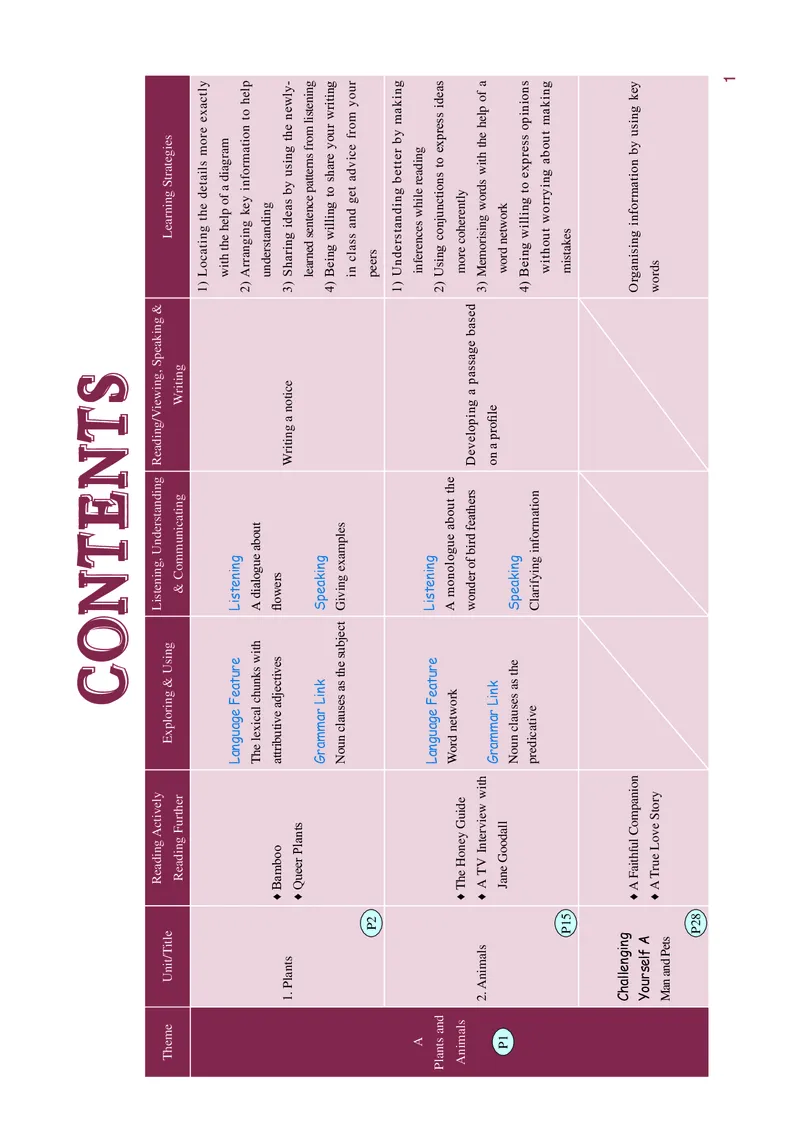
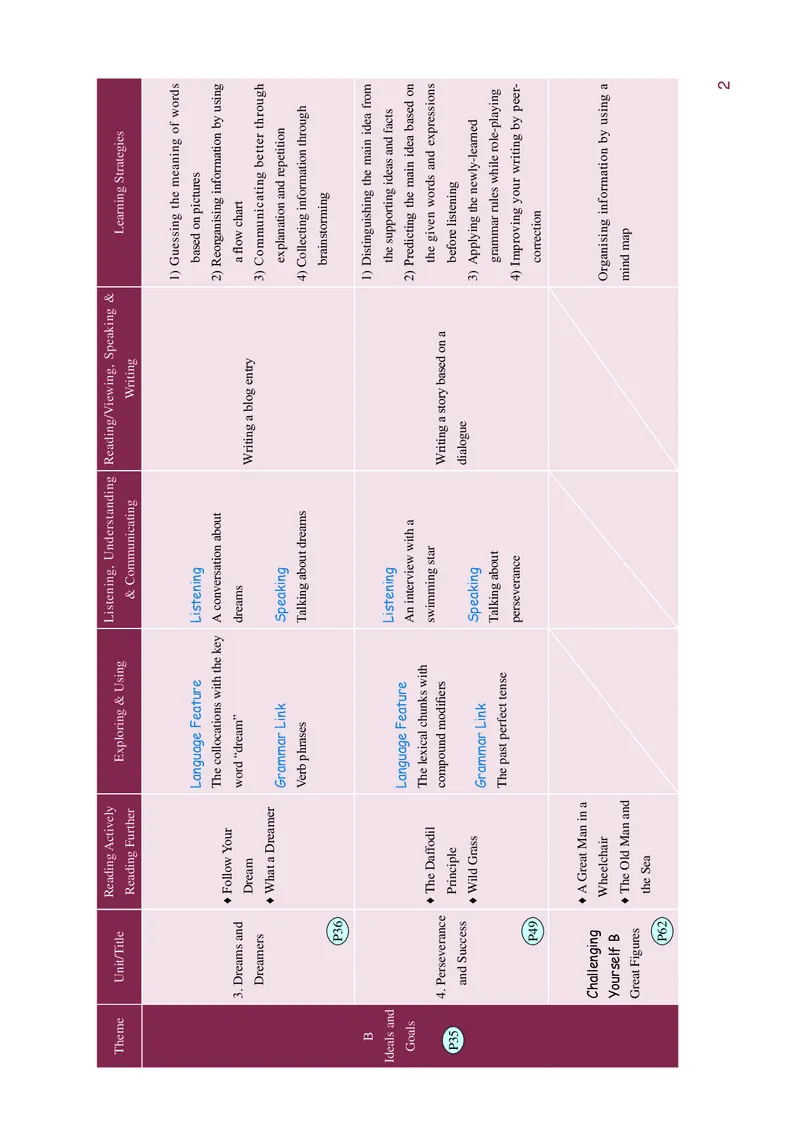
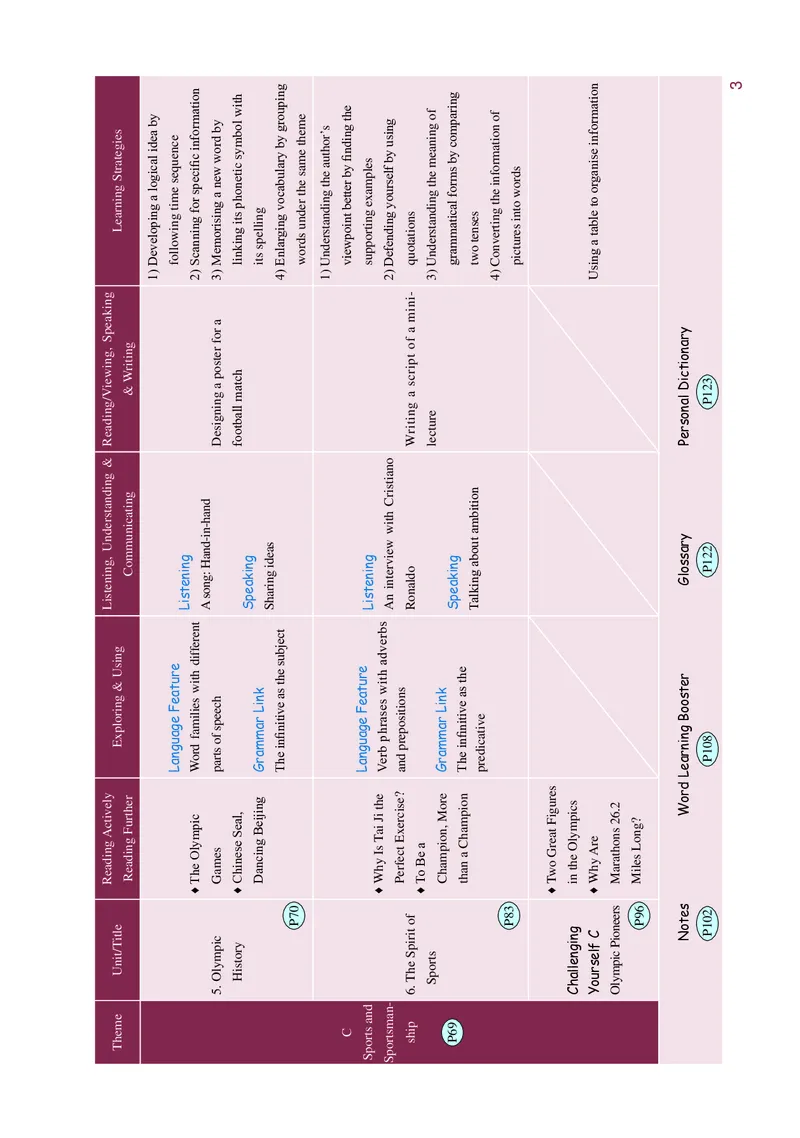
2STNETNOC
&
gnikaepS
,gniweiV/gnidaeR
gnidnatsrednU
,gninetsiL
ylevitcA
gnidaeR
seigetartS
gninraeL
gnisU
&
gnirolpxE
eltiT/tinU
emehT
gnitirW
gnitacinummoC
&
rehtruF
gnidaeR
yltcaxe
erom sliated
eht
gnitacoL
)1
margaid
a fo
pleh
eht
htiw
gninetsiL
erutaeF
egaugnaL
pleh
ot
noitamrofni
yek
gnignarrA
)2
tuoba
eugolaid
A
htiw
sknuhc
lacixel
ehT
gnidnatsrednu
srewofl
sevitcejda
evitubirtta
oobmaB
♦
-ylwen
eht gnisu
yb saedi
gnirahS
)3
eciton
a
gnitirW
stnalP
.1
stnalP
reeuQ
♦
gninetsil
morf snrettap
ecnetnes
denrael
gnikaepS
kniL
rammarG
gnitirw
ruoy erahs
ot gnilliw
gnieB
)4
selpmaxe
gniviG
tcejbus
eht
sa
sesualc
nuoN
ruoy
morf
ecivda
teg
dna
ssalc
ni
sreep
2P
gnikam
yb retteb
gnidnatsrednU
)1
gnidaer
elihw
secnerefni
A
gninetsiL
erutaeF
egaugnaL
saedi
sserpxe
ot
snoitcnujnoc
gnisU
)2
dna
stnalP
eht
tuoba
eugolonom
A
krowten
droW
yltnerehoc
erom
ediuG
yenoH
ehT
♦
slaminA
desab
egassap
a
gnipoleveD
srehtaef
drib
fo
rednow
a
fo
pleh
eht htiw
sdrow
gnisiromeM
)3
htiw
weivretnI
VT
A
♦
slaminA
.2
elfiorp
a
no
kniL
rammarG
krowten
drow
lladooG
enaJ
11PP
gnikaepS
eht
sa
sesualc
nuoN
snoinipo
sserpxe
ot gnilliw
gnieB
)4
noitamrofni
gniyfiralC
evitaciderp
gnikam
tuoba
gniyrrow
tuohtiw sekatsim
51P
gnignellahC
yek
gnisu
yb noitamrofni
gnisinagrO
noinapmoC
lufhtiaF
A
♦
A
flesruoY
sdrow
yrotS
evoL
eurT
A
♦
steP
dna
naM
82P
1&
gnikaepS
,gniweiV/gnidaeR
gnidnatsrednU
,gninetsiL
ylevitcA
gnidaeR
seigetartS
gninraeL
gnisU
&
gnirolpxE
eltiT/tinU
emehT
gnitirW
gnitacinummoC
&
rehtruF
gnidaeR
sdrow
fo
gninaem
eht
gnisseuG
)1
serutcip
no
desab
gninetsiL
erutaeF
egaugnaL
gnisu
yb
noitamrofni
gnisinagroeR
)2
tuoba
noitasrevnoc
A
yek
eht
htiw
snoitacolloc
ehT
ruoY
wolloF
♦
trahc
wofl
a
smaerd
”maerd“
drow
dna
smaerD
.3
yrtne
golb
a
gnitirW
maerD
hguorht
retteb
gnitacinummoC
)3
sremaerD
remaerD
a
tahW
♦
noititeper
dna
noitanalpxe
gnikaepS
kniL
rammarG
hguorht
noitamrofni
gnitcelloC
)4
smaerd
tuoba
gniklaT
sesarhp
breV
gnimrotsniarb
63P
morf
aedi
niam
eht
gnihsiugnitsiD
)1
B
stcaf
dna
saedi
gnitroppus
eht
gninetsiL
dna
slaedI
erutaeF
egaugnaL
no
desab
aedi
niam
eht
gnitciderP
)2
a
htiw
weivretni
nA
slaoG
htiw
sknuhc
lacixel
ehT
snoisserpxe
dna
sdrow
nevig
eht
rats
gnimmiws
lidoffaD
ehT
♦
a
no
desab
yrots
a
gnitirW
srefiidom
dnuopmoc
ecnarevesreP
.4
gninetsil
erofeb
elpicnirP
3533PP
eugolaid
sseccuS
dna
denrael-ylwen
eht
gniylppA
)3
gnikaepS
ssarG
dliW
♦
kniL
rammarG
gniyalp-elor
elihw
selur
rammarg
tuoba
gniklaT
esnet
tcefrep
tsap
ehT
-reep
yb
gnitirw
ruoy
gnivorpmI
)4
ecnarevesrep
noitcerroc
94P
a ni
naM
taerG
A
♦
gnignellahC
a
gnisu
yb
noitamrofni
gnisinagrO
riahcleehW
B
flesruoY
pam
dnim
dna
naM
dlO
ehT
♦
serugiF
taerG
aeS
eht
26P
2gnikaepS
,gniweiV/gnidaeR
&
gnidnatsrednU
,gninetsiL
ylevitcA
gnidaeR
seigetartS
gninraeL
gnisU
&
gnirolpxE
eltiT/tinU
emehT
gnitirW
&
gnitacinummoC
rehtruF
gnidaeR
yb
aedi
lacigol
a gnipoleveD
)1
ecneuqes
emit gniwollof
erutaeF
egaugnaL
gninetsiL
noitamrofni
cfiiceps
rof gninnacS
)2
tnereffid
htiw
seilimaf
droW
cipmylO
ehT
♦
dnah-ni-dnaH
:gnos
A
yb
drow
wen
a gnisiromeM
)3
a
rof
retsop
a
gningiseD
hceeps
fo
strap
semaG
cipmylO
.5
htiw
lobmys
citenohp
sti
gniknil
hctam
llabtoof
,laeS
esenihC
♦
yrotsiH
gnikaepS
gnilleps
sti
kniL
rammarG
gnijieB
gnicnaD
saedi
gnirahS
gnipuorg
yb
yralubacov
gnigralnE
)4
tcejbus
eht
sa
evitinfini
ehT
07P
emeht
emas
eht rednu
sdrow
s’rohtua
eht
gnidnatsrednU
)1
eht
gnidnfi
yb
retteb tniopweiv
C
erutaeF
egaugnaL
selpmaxe
gnitroppus
gninetsiL
dna
stropS
sbrevda
htiw
sesarhp
breV
eht
iJ
iaT
sI
yhW
♦
gnisu
yb
flesruoy
gnidnefeD
)2
onaitsirC
htiw
weivretni
nA
-namstropS
snoitisoperp
dna
?esicrexE
tcefreP
snoitatouq
-inim
a
fo
tpircs
a
gnitirW
odlanoR
fo
tiripS
ehT
.6
pihs
a
eB
oT
♦
fo
gninaem
eht
gnidnatsrednU
)3
erutcel
stropS
kniL
rammarG
eroM
,noipmahC
gnirapmoc
yb
smrof
lacitammarg
gnikaepS
5966PP
eht
sa
evitinfini
ehT
noipmahC
a naht
sesnet
owt
noitibma
tuoba
gniklaT
evitaciderp
fo
noitamrofni
eht gnitrevnoC
)4
38P
sdrow
otni
serutcip
serugiF
taerG
owT
♦
scipmylO
eht
ni
gnignellahC
noitamrofni
esinagro
ot elbat
a
gnisU
erA
yhW
♦
C
flesruoY
2.62
snohtaraM
sreenoiP
cipmylO
?gnoL
seliM
69P
yranoitciD
lanosreP
yrassolG
retsooB
gninraeL
droW
setoN
321P
221P
801P
201P
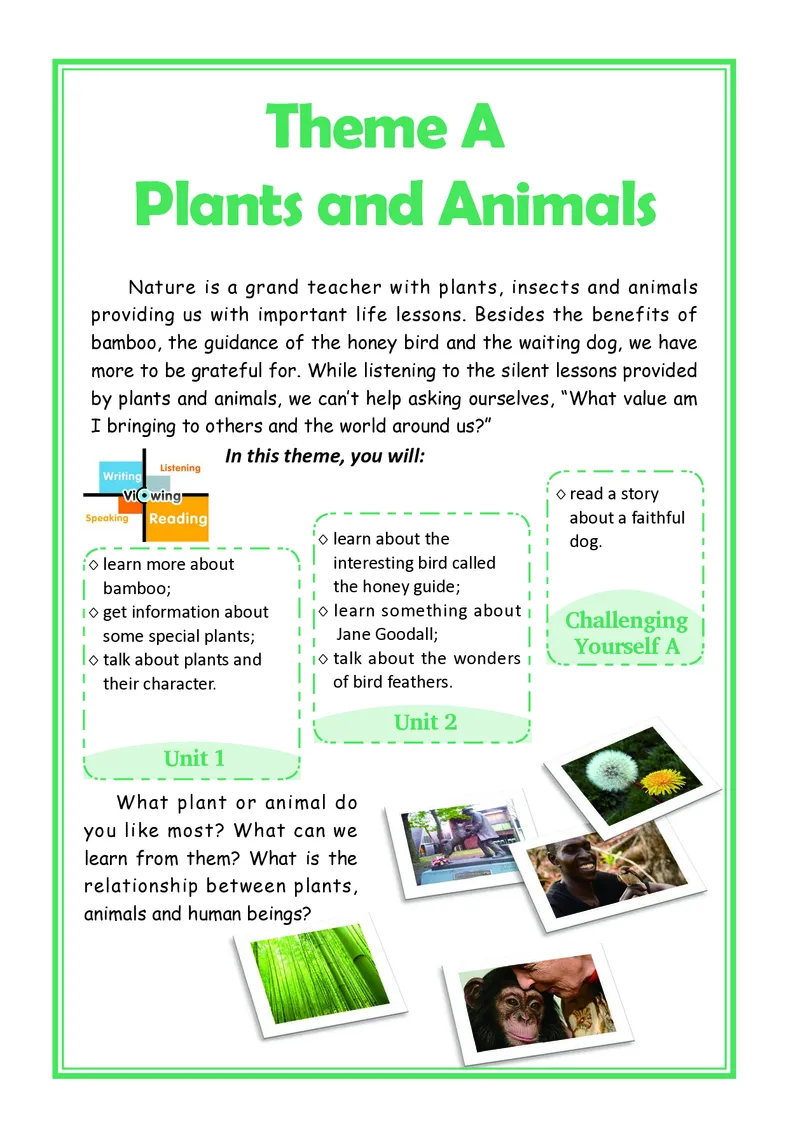
3Theme A
Plants and Animals
Nature is a grand teacher with plants, insects and animals
providing us with important life lessons. Besides the benefits of
bamboo, the guidance of the honey bird and the waiting dog, we have
more to be grateful for. While listening to the silent lessons provided
by plants and animals, we can‛t help asking ourselves, “What value am
I bringing to others and the world around us?”
In this theme, you will:
◊ read a story
about a faithful
◊ learn about the dog.
◊ learn more about interesting bird called
bamboo; the honey guide;
◊ get information about ◊ learn something about
Challenging
some special plants; Jane Goodall;
Yourself A
◊ talk about plants and ◊ talk about the wonders
their character. of bird feathers.
Unit 2
Unit 1
What plant or animal do
you like most? What can we
learn from them? What is the
relationship between plants,
animals and human beings?Theme A Plants and Animals
Unit 1
Plants
Knowing trees, I understand the meaning of patience.
Knowing grass, I can appreciate persistence.
—Hal Borland
Lo���n� A�ea�
By the end of this unit, you will be able to:
illustrate bamboo’s symbolic meanings in different cultures;
describe plants using simile and personifi cation;
use noun clauses as the subject in context;
give examples in different ways in a conversation;
write a notice about a fl ower show;
introduce an interesting or a curious plant.
Reading Actively
► Activating and Predicting
Read the following statements and predict what plant they are describing, guessing the
meanings of the words in bold type.
1) Although it is really a kind of grass, it looks more like a tree.
2) It grows up straight and thin, with branches at the top.
3) It has long leaves that sway in the wind like slim fi ngers reaching to touch something.
4) Chinese and Japanese poets write poems and songs about it, and artists paint it in
pictures.
5) It grows best in places where it is warm and rains often.
6) Some bloom and have seeds every year. Some never bloom at all.
7) But the most interesting thing about this remarkable plant is what people do with it
after it is cut down.
According to the descriptions, the plant might/may/must be .
Based on the above statements, predict which aspects of this plant will be talked about
and then skim to check your prediction.
22Unit 1 Plants
1) species 2) cultivation 3) habitat/distribution 4) symbolic meaning
5) use 6) fl owering 7) appearance 8) commercial value
► Reading, Thinking and Analysing
Bamboo
Have you ever seen grass growing as high as a tree—even a tall tree?
Bamboo is this kind of grass. It grows up straight and thin, with branches
at the top.
Although bamboo is really a kind of grass, it looks more like a
tree. It has long leaves that sway in the wind like slim fi ngers reaching sway (vi.): move
to touch something. Chinese and Japanese poets write poems and songs slowly from side to
side
about bamboo, and artists paint it in pictures.
Not all bamboo grows tall. There are more than 500 different kinds
of bamboo in all, and some grow no higher than your ankles. Bamboo
can survive with minimum light exposure. It grows best in places where
ankle
it is warm and rains often. Some kinds of bamboo grow very fast. If they
grow near a house, their slim leaves brush the roof gently and cool the
house with their shade.
Some bloom and have seeds every year. Some never bloom at all.
Some bloom only once, after living about 40 years, and then die, although
new shoots of bamboo will come up from around the roots of the old ones.
What does ones refer
But the most interesting thing about this remarkable plant is what to?
people do with it after it is cut down. Bamboo probably has more uses
than any other plant in the world.
Bamboo is not a tree, so the long straight stems of bamboo are not
like tree wood. They are hollow, which makes them very light. You could hollow [ɒ] (adj.)
lift a big piece of bamboo with one hand. At the same time, bamboo is so Guess its meaning
strong that it is often used to build houses and bridges. from the context.
In warm countries, many people have their houses made almost
entirely of bamboo—the
walls, the roof, and the
floor. Nearly everything
inside their houses is made
of bamboo, too. The chairs,
tables, beds, flower vases,
drinking cups, birdcages
3Theme A Plants and Animals
and many other things are all made of bamboo. And the fence around
their garden is made of bamboo, as well.
Because bamboo is hollow, it can be fi tted together and used as pipes
to carry water brought from a river or lake.
Bamboo is used for more than building. People eat it. The tender
young shoots of bamboo are crisp and tasty. They are often found in Ship here is a ____.
A. noun B. verb
Chinese or Japanese dishes. Some are put into cans and shipped to all
What does it mean?
corners of the world.
Bamboo is also made into paper. The soft pulp inside the hard
stems is taken out and sent to a factory. There it is made into fi ne paper.
Bamboo can also be made into good
walking sticks and fi shing poles.
Who can tell what new use someone
may fi nd for this special kind of grass—
bamboo?
► Comprehending, Integrating and Creating
Read the text and complete the information about bamboo.
Appearance features Growth characteristics
• like a tree rather than • survive with light exposure
• grow best in and places
• being straight and • may grow very
• bloom and have seeds , bloom
• with at , or bloom
the top • grow with new coming up from
• with long leaves around the roots of the old ones
• with long,
and stems
Wide uses
• stems for building , making furniture and , and made into
• tender young shoots used as
• pulp made into
Work in groups to discuss the questions below and then share your ideas in class.
1) What features make bamboo different from any other grass?
2) How does the author illustrate his viewpoint that bamboo probably has more uses than
any other plant in the world?
4Unit 1 Plants
3) How does the author arouse the readers’ interest at the beginning of the text? What do
you think of the method?
4) According to the text, Chinese and Japanese poets write poems and songs about
bamboo, and artists paint it in pictures. Can you give some examples?
5) The author thinks that the most interesting thing about bamboo is what people do with
it after it is cut down. Do you agree? Why or why not?
Work in groups to fi nd out more uses of bamboo at present and imagine how it might be
creatively used in the future. Then share your ideas in class.
More uses at present New uses in the future
Based on Activity 1 and your discussion, work in groups of three to retell the text. Then
discuss what you can learn from bamboo.
Student A Student B Student C
Describe what Explain how bamboo Introduce how bamboo
bamboo is like. grows. is and will be used.
What we can learn from bamboo:
• •
• •
Do the activity by following the steps below.
Step 1 Read the following passage and then work in groups to fi nd out the symbolic
meanings of bamboo in Chinese culture.
Possessing more bamboo than any other country in the world, China
is well known as the Kingdom of Bamboo. The Chinese love bamboo, and
bamboo culture has already been rooted in their minds throughout their long
history. To the Chinese people, bamboo is the symbol of virtue. It refl ects
people’s soul and emotion.
Bamboo has the title of “the gentleman of plants”. It is always closely
related to people of positive spirit. For example, its deep root symbolises
determination and its straight and hollow stem represents straightness
and modesty. Bamboo culture always plays a positive role in encouraging
Chinese people to hold on when facing tough situations.
5Theme A Plants and Animals
The symbolic meanings of bamboo
●
●
●
●
Step 2 With the help of the Internet or other sources, investigate how bamboo is used in
different countries and what symbolic meanings it has in various cultures.
Step 3 Note down your fi ndings.
Countries Uses Symbolic meanings
• • •
• • •
Step 4 Share your fi ndings in class.
Exploring and Using
► Language Feature
Match the adjectives with the nouns to form lexical chunks based on the text. Then use the
same adjectives to create your own chunks. The fi rst one has been done as an example.
Adjectives Nouns Your lexical chunks
1) tender leaves 1) tender grass
2) slim places 2)
3) soft plants 3)
4) warm shoots 4)
5) remarkable stems 5)
6) tasty paper 6)
7) fi ne pulp 7)
8) hollow dishes 8)
P
I
T
In English, an attributive adjective usually comes before the noun in a simple
phrase. It describes the thing, the person, the state or the action the noun refers to.
Study the examples to fi nd out the fi gures of speech used in them. Then describe bamboo
or other plants in the same way.
6Unit 1 Plants
· Example ·
What is its function?
1)It has long leaves that sway in the wind like slim fi ngers reaching to touch something.
What do they have in common?
2)Their slim leaves brush the roof gently and cool the house with their shade.
Can the subject “slim leaves” behave like a person?
P
I
T
A figure of speech is also called a stylistic device or rhetorical device. It is the use of
a variety of techniques to provide emphasis, freshness of expression or clarity.
My description:
♦
♦
► GGrraammmmaarr LLiinnkk
Noun Clauses as the Subject
Understanding the meaning
Read the following dialogue and pay special attention to the coloured parts. Think
whether the structures of the red parts are the same as those of the blue ones.
A: Hi, Jimmy. What are you doing?
B: I am reading an article about bamboo.
A: Bamboo? Yes, I know that it grows up very straight and thin.
B: Do you know that it is a kind of grass?
A: Grass? You’re kidding me! It looks more like a tree.
B: But it is a kind of grass.
A: Really? Er... It is said that bamboo will die after it blooms. Is it
true?
B: You know, there are more than 500 different kinds of bamboo in all, and only some
of them will die after blooming. However, new shoots of bamboo will come up from
around the roots of the old ones.
A: That’s amazing.
B: How people make use of it is really amazing. It has more uses
than any other plant in the world. In warm countries, people
have their houses made almost entirely of bamboo—the walls,
the roof, the fl oor, and the furniture in the house.
A: What a wonderful plant!
7Theme A Plants and Animals
Discovering the rule
Study the following examples to fi nd out what a subject clause is with the help of the TIP.
Then share your ideas with a partner.
· Example ·
P
I
T
1)Yes, I know that it grows up very straight and thin.
When a noun clause plays
the role of an object, it is
a clause used as the object
called an object clause.
2)How people make use of it is really amazing.
a clause used as the subject A subject clause is .
Work in groups to discuss and to complete the table below. Then ask and answer questions
about the subject clauses in order to know them better.
Place Example Form
1) That the earth travels around the sun is known to all.
+ clause
2) That we lost the football match was a pity.
at the
1) When we should start the meeting has not been decided
yet.
wh- word + clause
2) Who cleaned the classroom is not known yet.
3) What you said frightened all of us.
at the 1) It is quite clear that money is not everything. + predicative
end 2) It doesn’t matter whether we will go together or separately. + clause
Applying the rule
Analyse the other noun clauses in the dialogue in Understanding the meaning by
following the example in Activity 1, Discovering the rule.
Read the following dialogue to identify both the subject clauses (SC) and the object
clauses (OC). Then mark them out.
Sandy: Hello, Joe. The speech contest is around the corner. Are you ready for it?
Joe: Not yet. I can’t fi gure out what I should talk about in the contest.
Sandy: Oh, come on! Didn’t they give you a topic? I heard that it was about environmental
protection.
Joe: You are right. But it’s still such a big issue.
Sandy: Why don’t you talk about endangered plants? I found them really interesting.
Joe: Yes. But I’m afraid many contestants will choose this topic.
Sandy: You know, what you say is important in the contest, but how you say it also
8Unit 1 Plants
matters. If you can persuade other people into taking action to protect endangered
plants, I bet you’ll be the winner.
Joe: Sounds good! Yet I am not sure whether I can persuade the judges.
Sandy: Keep this word in mind: “KISSER”. It means “Keep It Simple, Short, Engaging,
and Real”. Remember: whoever can attract the attention of the audience will win
the prize.
Joe: Thank you so much.
Sandy: You’re welcome. Wish you success.
Put back in the passage the choices (A-G) which contain subject clauses.
Orange Trees
1) . People love them because
they are sweet. Besides, 2) makes
them easy to eat. And some oranges even do not
have any seeds.
Orange trees are very beautiful with a
lot of bright green leaves. They have small
white fl owers in the spring and give fruit in the
autumn. However, 3) is their long history. 4) . They probably came
from China. It is believed that Chinese people started to plant orange trees around 2400
B.C.E.
5) . Then they taught Europeans, and the Europeans then planted
orange trees in North and South America. 6) is not so certain. However,
7) is known. They took them to Florida fi rst. Today, oranges are a very
important crop in Florida.
A. It is also thought that farmers in other parts of Asia and the Middle East learned to
grow oranges from the Chinese
B. When the Europeans began to grow orange trees
C. what really impresses me about orange trees
D. It seems that everybody loves oranges
E. where they began to grow them
F. It is said that there were orange trees twenty million years ago
G. that they are in parts
Listening, Understanding and Communicating
Giving Examples
Match the names with the fl owers. Then tell a partner which you like best and why.
9Theme A Plants and Animals
lily sunfl ower daisy rose
Listen to a dialogue, and choose the best answer to each question.
1) What are the two speakers talking about?
A. Their favourite fl owers. B. Their favourite proverbs.
C. Their favourite roses. D. Their favourite colours.
2) What is the most probable relationship between the two speakers?
A. Shopkeeper and customer. B. Teacher and student.
C. Friends. D. Customers.
3) What are their attitudes towards fl owers?
A. Both of them like fl owers. B. Only Jenny likes fl owers.
C. Only Daisy likes fl owers. D. They don’t express their attitudes directly.
Listen again and decide whether the following statements are true (T) or false (F).
1) Daisy likes fl owers in bright colours.
2) Daisy has called herself Daisy because she likes daisies best.
3) Jenny loves fl owers like lilies because they are very sweet.
4) Both Jenny and Daisy like roses because they have different colours.
5) Angela is the rose of the party, which means that Angela is the one who can bring
you love.
6) The proverb “no rose without a thorn” suggests that nothing is perfect in the world.
Listen for a third time and complete the following sentences. Then look at the words or
sentence patterns you have fi lled in and work out when you will use them.
1) Flowers sunfl owers, roses and daisies are my favourites because they have
bright colours.
2) I would say I like fl owers with a sweet smell, roses, lilies and the like.
3) roses . They can always make me feel happy and comfortable.
4) , roses come in different colours: red, pink, yellow, white... and
even purple.
5) That sounds interesting! ?
Work in pairs to talk about your favourite fl owers by using some sentence structures in
Activity 4.
10Unit 1 Plants
Reading, Speaking and Writing
Writing a Notice
Read the following two notices and the TIP to understand what a notice is.
A B
Dec. 5th, 2018 Dec. 5th, 2018
Notice Notice
Speaker: Prof. John Smith of Oxford Professor John Smith from Oxford
University University of the U.K. will give a lecture
Subject: The Magical Plant World on “The Magical Plant World” in the
Time: Friday, Dec. 16, at 3: 00 pm Lecture Hall at 3:00 pm on Friday,
Place: Lecture Hall December 16. All the teachers and
All are warmly welcome. students are warmly welcome.
The Students’ Union The Students’ Union
P
I
T
A notice is a short written statement of information or direction to the public. There
could be a notice for a lecture, a sports event, a lost item, a meeting, a fi lm, etc.
Tick the statements you agree with, and then fi nd the corresponding examples in the above
notices.
( ) 1) The purpose of a notice is to inform the public.
( ) 2) A notice is made up of four basic parts: heading, body, signature and date.
( ) 3) A brief notice is usually written in either notice form or letter form.
( ) 4) The language in a notice should be brief and clear.
( ) 5) Passive voice is usually used in a notice.
Suppose a fl ower show will be held in your school. Write a notice for it. The following
sentence structures may help you.
… will/is going to be held… There will/is going to be…
Please attend it on time. Do be present on time.
Everyone is expected. All are welcome to attend.
Post your notice on the wall of your classroom and then let your classmates proofread it
and give some suggestions.
Improve your notice according to the suggestions from your classmates.
11Theme A Plants and Animals
Reading Further
► Getting Ready
Look up the word “queer” in a dictionary and then defi ne “a queer plant” by yourself.
“Queer” means .
A queer plant refers to .
Decide whether the following plants are queer or not and give your reasons. Then read
the passage to check.
Name dandelion sunfl ower pitcher plants bamboo
Queer or not?
Why
► Reading
Queer Plants
Have you ever seen a seed fl ying Most plants have roots that grow in the
along like a bird or an airplane? You ground or in the water. But there are some
may know that when the dandelion plants that grow in the air. Some people think
blossom becomes white and light, that such plants have no food except the air, but
seeds are getting ready to fl y away. that is not true. The plants also get food that is
On the end of every dandelion seed carried on the dust and the fog.
is a tiny umbrella that helps it to In the warm, moist, southern part of our
float off on the wind. Watch the country many of the trees have a great deal of
dandelion blossom as it turns white hanging moss. This is really not moss, but just a
and gets light, and one day you will great many air plants growing close together.
see the fl y-away seeds go travelling The young air plants grow from leaves. Put
on the wind. one of the leaves of an air plant on the ground,
or hang it up in a room, and you will fi nd that a
lot of little baby plants will soon grow from the
edges of the leaf.
Have you ever heard of plants that eat insects? That may sound strange, but there are
some plants that really feed on fl ies and bugs.
Among these are the pitcher plants. Some pitcher plants have leaves in the shape of a
12Unit 1 Plants
pitcher. Others have pitcher-like growths at the ends of the leaves. The pitcher is green with
spots of purple. The lid and mouth of the pitcher are brighter in colour than the other parts.
This pitcher is really a trap. There is water in the bottom of the pitcher, and the lid
and the inside wall of the pitcher is juicy. It is sweet and sticky and fl ies and bugs like it.
On the inside there are little hair-like growths pointing down. When the insect gets down
to the water, it is unable to go back because of the hair-like growths and it falls into the
water and drowns. The insect soon becomes good food for the plants, so we say these
plants eat insects.
► Comprehending
Read the fi rst two passages and complete the following diagrams.
When it fl ies:
Its queerness Why it fl ies:
How it fl ies:
What it eats:
Its queerness Where we see it:
How it grows:
Read the last passage and complete the fl ow chart with the missing information.
How a pitcher plant eats insects
A pitcher plant has
The pitcher is
In the pitcher, there is
On the inside, there are also
When an insect gets down inside the pitcher,
After the insect dies,
13Theme A Plants and Animals
Do the activity by following the steps below.
Step 1 Work in groups to fi nd out one plant which you think is interesting or queer.
Step 2 Surf the Internet to fi nd more information about it.
Checking list:
name looks places to grow uses symbolic meanings
poems about the plant special stories about the plant songs about the plant
pictures of the plant
Step 3 Draw a mind map or diagram to help yourself to get a clear idea about the plant.
Step 4 Write a passage based on your mind map or diagram.
Step 5 Introduce the plant to your class.
S�l�-a� es��n�
Refl ect on your learning in this unit and rate each of the items according to the following
rating scales. Then decide what you should do for further progress.
5=Exceeding expectations 4=Meeting expectations 3=Approaching expectations
2=Partially meeting expectations 1=Not meeting expectations
Item Rating Improvement
● I can illustrate the symbolic meanings of some plants in
different countries.
● I can use the noun clauses as the subject in context.
● I can use simile and personification to describe plants and
other things.
● I can use examples to support my ideas while I am having
a conversation.
● I can write a notice about a fl ower show.
● I can introduce an interesting plant in my own words.
14Unit 2
Animals
Every animal knows more than you do.
—Anonymous
Lo���n� A�ea�
By the end of this unit, you will be able to:
describe how the honey guide gets beeswax;
use conjunctions to link ideas logically;
introduce bats using noun clauses as the predicative;
clarify information by using newly-learned structures while talking;
write a passage about the Yangtze River dolphin based on its profi le;
write a report about Jane Goodall based on an interview with her.
Reading Actively
► Activating and Predicting
Look at the following pictures and the words below them and try to work out the
relationship between the pictures.
a bees’ nest hidden a honeycomb with a honey bird
in a tall tree wax inside
Look at the title of the text and predict which information is true about it. Tick the best
choice and read the text to check your prediction.
1) It is a bird that honey.
A. loves B. helps people or animals to get
15Theme A Plants and Animals
C. hates D. prevents people or animals from getting
2) It lives on .
A. honey B. honeycomb C. bees D. beeswax
► Reading, Thinking and Analysing
The Honey Guide
Honey is not only a good source of natural sugar; it is also
delicious. Most people and many animals like eating it. Unless people
build beehives, however, the only way for them to get honey is to fi nd Do beehives and bees’
nests have the same
a wild bees’ nest and take the honey from it. Often, these nests are high
meaning here?
up in trees, and it is diffi cult to fi nd them. In parts of Africa, though,
people and animals looking for honey have a strange and unexpected
helper—a little bird called a honey guide.
The honey guide does not actually like honey, but it does like the
wax in the bees’ honeycomb. The little bird cannot reach this wax,
which is deep inside the bees’ nest. So when it fi nds a suitable nest,
it looks for someone to help it. The honey guide gives a loud cry that
attracts the attention of both passing animals and people. Once it has
their attention, it flies through the forest, constantly waiting for the
curious animals or people as it leads them to the nest. When they
fi nally arrive at the nest, the followers reach in to get at the delicious
honey as the bird patiently waits and watches. Some of the honey and
the wax always falls to the ground, and this is when the honey guide
takes its share. What does share mean?
Scientists do not know how the honey guide digests the wax,
but it is very determined in its efforts to get it. The birds seem to be
able to smell wax from a long distance away. They will quickly arrive
whenever a local beekeeper is taking honey from his beehives, and
will even enter churches when beeswax candles are being lit.
If a person follows a
honey guide to a nest, the
bird is especially sure of
getting a good share of the
honeycomb. Tribesmen in tribesman (n.) = +
Africa are very grateful to
the honey guide for leading It means in
them to good sources of Chinese.
16Unit 2 Animals
honey, but they are also afraid of the little bird. They believe that if
they do not open a bees’ nest and leave some honeycomb for the honey Guess the meaning of
guide, the next time the bird cries to them through the forest, it will in revenge from the
context.
lead them to a snake or a leopard in revenge.
► Comprehending, Integrating and Creating
Read the text and complete the following fl ow chart.
How does a honey guide get beeswax?
looks for by
A honey guide fi nds a/an .
.
waits and while the leads the animals or people
animals or people . through to .
takes its share when ; takes revenge if .
Read the text carefully and infer whether the following statements are true (T) or false (F).
Then work in pairs to tell your partner why you think so.
1) Honey can be found in both beehives and bees’ nests.
2) Not all wild bees’ nests are high up in trees.
3) A honey bird is patient and ready to help people.
4) A honey guide is always willing to share the honey it fi nds with other animals
and people.
5) The mystery of how a honey guide digests the wax hasn’t been solved yet.
6) A honey guide can be regarded as a determined bird.
7) A honey guide fi nds the wax inside a bees’ honeycomb most probably by using
its sense of smell.
8) A honey guide must be a bird that will pay you back blow for blow.
P
I
T
While you are making an inference, you should hunt for the clues or the supporting details.
Your conclusion should be reasonably and logically arrived at based on those clues.
Work in groups to discuss the following questions and briefl y note down your answers. Then
share your ideas in class.
1) What do you think of the way a honey guide fi nds the wax it wants?
17Theme A Plants and Animals
2) How do you understand the word “share” after reading the text?
3) In your opinion, what should the tribesmen in Africa do if they are grateful to the
honey guide?
4) Do you think human beings and wild animals can co-exist in perfect harmony in the
world? Why or why not?
5) If you could communicate with a honey guide, what would you say to it?
Work in groups to fi nish drawing the fl ow chart below. Then retell how people get honey
with the help of a honey guide.
How do people get honey?
people look
for honey
Do the activity by following the steps below.
Step 1 Look at the following pictures and try to understand the given information. Then
fi nd out the common feature of the three animals.
to eat various insects, including to help predict climate to clean up the oceans and
mosquitoes, which can carry change trends fi ght climate change
diseases
The common feature:
Step 2 Choose one which you are most interested in and find out more information
about it. Note down the key information.
Step 3 Share your fi ndings in groups and then write a short passage to introduce it.
Step 4 Report your fi ndings in class and then discuss how humans should live together
harmoniously with animals on the earth.
Exploring and Using
► Language Feature
Study the following word network and design your own centring around “animal”.
18Unit 2 Animals
beekeeper bee honey guide
P
I
T
We can memorise a new word
beehive
better by associating it with
others which are closely related
to each other.
honey honeycomb beeswax
Read the text again carefully and complete the following table by following the example.
Then write a passage to introduce the honey guide by using some of the conjunctions
below.
Para. Conj. Sentence from the text Meaning
1 and Most people and many animals like eating it. as well as
1 if… not
1 despite the fact that
2 at the time that
2 as soon as
2 during that time
4 on condition that
P
The Honey Guide T I
Conjunctions are words
or groups of words which
can join parts of sentences
or phrases.
► Grammar Link
Noun Clauses as the Predicative
Understanding the meaning
Read the following dialogue and pay special attention to the coloured parts. Think
whether the structures of the red parts are the same as the blue ones.
A: Hi, guys. Have you ever heard of a honey guide?
B: Yes, I know that a honey guide is a good helper for people to look for honey.
C: And the truth is that it is a kind of little bird. And what a honey guide likes is not honey.
B: Yes. The fact is that it likes the wax in the bees’ honeycomb.
A: But it is well known that the wax is deep inside the bees’ nest. How can a honey guide
get it?
C: That’s a good question. That is why it is called a honey guide. When it fi nds a suitable
nest, it gives a loud cry to attract the attention of the passing animals and people.
19Theme A Plants and Animals
Once they are attracted, it will guide them to the nest. When they reach in to get at
the delicious honey, some of the honey and the wax may fall to the ground, and this is
when the honey guide takes its share.
A: What a smart and lovely bird it is!
Discovering the rule
Study the following examples to fi nd out how the predicative clause is used. Then share
your ideas with a partner.
· Example ·
1) I know that a honey guide is a good helper for people to look for honey.
verb
a clause as the object
2)And the truth is that it is a kind of little bird.
linking verb
a clause as the predicative
Work in groups to discuss and complete the table below. Then ask and answer questions
about the predicative clauses so as to understand them better.
Type Example Form
1) The truth is that he has never been to New York.
A 2) The good news is that we have enough food for all be + + clause
the guests.
The question is whether people will take action to save
B be + + clause
these endangered animals.
1) The question is how you can persuade your parents.
C be + wh- word + clause
2) Our problem was when the meeting would start.
D It sounds as if/though someone is knocking at the door. sound + + clause
E That’s because he didn’t understand me. be + + clause
The basic sentence pattern: subject + + the predicative clause
Applying the rule
Rewrite each of the following sentences by using a predicative clause and then decide on
its type. The fi rst one has been done as an example.
1) Whether the fi lm is worth seeing is still a question.
( B ) The question is whether the fi lm is worth seeing.
2) That is the place where I met Diana for the fi rst time.
( )
3) Who will chair the meeting is a problem.
20Unit 2 Animals
( )
4) He talked as if he had known Jenny for years.
( )
5) That they are short of both money and hands is the truth.
( )
6) I suggest that we should start earlier tomorrow morning.
( )
7) The reason why I was sad was very clear.
( )
Underline at least two facts about the honey guide in the text and rewrite the facts by
using predicative clauses on the following lines.
Write a paragraph to introduce bats based on the pictures below and the given information
in the box, using at least fi ve predicative clauses.
the only fl ying mammals in the world hang in some dark places in the daytime
go out to look for food at night look on them as bad animals
have no trouble fl ying in the darkest night fl y by radar
make a sound when fl ying come back when the sound hits a thing
receive the message like the radar system in a plane the way to tell a bat where something is
Listening, Understanding and Communicating
Clarifying Information
Read to understand the following expressions, guessing the meanings of the words in bold
type. Then predict what the coming monologue is mainly about.
the most noticeable features be unique to birds have feathers
perform a number of functions the primary force to drive the evolution
ancestral birds refi ne the structure the opposite sex
21Theme A Plants and Animals
The most probable title of the monologue should be .
A. The Wonder of Bird Feathers
B. The Wonderful Feathers of Birds
C. The Mystery of Bird Feathers
Listen to check your prediction and fi ll in the blanks with the information you’ve gained.
Feathers: one of the most features of birds
Functions of feathers:
1) protecting birds from
2) allowing birds to
3) helping birds to and the birds of the opposite sex
Listen again and decide whether the following statements are true (T) or false (F).
1) Feathers can help to keep a bird’s temperature at around 40℃.
2) Most scientists think ancestral birds developed feathers to keep themselves warm.
3) According to scientists, it is the feathers that allow birds to fl y.
4) Birds became larger and stronger through evolution.
5) Birds can make use of the colours of their feathers to avoid being killed.
6) Birds that have feathers in bright colours use them to attract birds of the opposite sex.
Listen for a third time and complete the following sentences by fi lling in the blanks.
1) , they are unique to birds.
2) , ancestral birds developed feathers to keep themselves warm.
3) , feathers made birds larger and stronger, and refi ned their structure
during the process of evolution.
4) Thirdly, colourful feathers can help birds in other ways, helping them
to hide, and helping them to attract birds of the opposite sex.
5) , he says “Here I am!” to the female peacock by spreading his
colourful tail feathers.
P
I
T
All the expressions in the blanks are used to clarify what you mean by saying
things in a different way.
Read a brief introduction to the white-tailed eagle and then talk about it in pairs, using
the expressions and structures in Activity 4.
The white-tailed eagle could be found in huge numbers across the globe, before
humans started to pollute its wetland habitats with insecticides and other chemical
sprays. The bird fl ies long distances in search of its food, fi sh. Feeding on poisoned fi sh,
however, has led to the bird laying thin-shelled eggs that break apart easily. Furthermore,
22Unit 2 Animals
their nesting places have also been destroyed by modern
forestry techniques. Although the bird became completely
extinct in Britain during the 1900s, it is now present again
in Scotland after it was reintroduced in the year 1975.
You may begin your dialogue like this:
A: Look at the picture. Do you know what it is called?
B: Yes. It is the white-tailed eagle.
A: The white-tailed eagle?
B: Yes. That is to say, the eagle has a white tail.
...
Reading, Speaking and Writing
Developing a Passage Based on a Profile
Read to understand the profile of the Yangtze River dolphin, one of the world’s rarest
mammals, in the chart below.
Name the Yangtze River dolphin
Distribution lower and middle reaches of the Yangtze River down to the river’s mouth
Size weigh 135~230 kg (300~510 lb) and measure 2.5 m (8.2 ft) in length
Diet feed on various species of small fi sh
200 in 1990
21 in 1997
recorded
Data 7 in 1998
number
last confi rmed sighting in 2004
none found in survey, declared “extinct” in 2006
Threat will become completely extinct in the near future
The Yangtze River has been degraded in many ways, including
Causes chemical and noise pollution, physical damage due to oil leaks and so
on.
Make an outline for your passage by writing down the topic sentence of each paragraph
according to the given key words. Then share your ideas with a partner.
Para. 1: (brief introduction)
Para. 2: (threat)
23Theme A Plants and Animals
Para. 3: (causes)
Para. 4: (measures)
Work in pairs to ask and answer questions based on the chart in Activity 1. Some
questions have been given as examples.
Para. 1: 1) Where does the Yangtze River dolphin live?
2) What is the size of this animal?
3) …
Para. 2: 1) What can we learn from the recorded data?
2) …
Para. 3: 1) What are the reasons for the Yangtze River dolphin to become extinct?
2) …
Para. 4: 1) What can we do to help the Yangtze River dolphin?
2) …
Write your passage based on your outline in Activity 2 and the answers to the questions in
Activity 3.
Proofread your own passage and then exchange your passage with your partner to peer-
edit. Polish it before you hand it in.
Reading Further
► Getting Ready
Look at the picture and the given words, and predict what stories may have happened
between them. Then share your ideas with a partner.
Jane Goodall chimpanzee
behaviour observe
in East Africa 40 years
a part of the forest an institute
Suppose that you have the opportunity to interview Jane. Write down some questions
you would like to ask and read the coming passage to check whether you can fi nd the
answers.
24Unit 2 Animals
The questions I would like to ask:
•
•
•
P
I
T
When you are asking questions, you should 1) ask in a polite way; 2) consider
not taking too much of the interviewee’s time.
► Reading
A TV Interview with Jane Goodall
Interviewer: I’d like to welcome someone
special to our programme
this evening to tell us
about chimpanzees. We’ve
discovered a lot about
chimpanzees over the last
30 years, and this is mostly
because of the work of one
person, Jane Goodall. Good
evening, Jane.
Jane Goodall: Good evening, Steve, and thank you for inviting me to your show.
Interviewer: When did you fi rst become interested in chimpanzees, Jane?
Jane Goodall: I began studying their behaviour in 1960 when I was only 26. I’d always wanted
to work with animals, although I didn’t have any special training or knowledge.
Interviewer: Where did you go to study their way of life?
Jane Goodall: I went to Tanzania in East Africa and worked in the Gombe Stream Chimpanzee
Reserve. It’s now called the Gombe National Park.
Interviewer: That must have been quite an adventure. Did you go there alone?
Jane Goodall: No. I took my mother and we had an African cook.
Interviewer: Did the chimpanzees accept you immediately?
Jane Goodall: No, it took a long time. I used to spend all day with them, observing them and
learning about their way of life. I found them fascinating and wanted to know as
much as I could about them. It was a long time before they accepted me and let
me get very close to them, however. It was after 18 months of waiting that the
chimpanzees fi nally decided I wasn’t going to hurt them. Eventually, they took
me as a part of the forest.
Interviewer: And how did you feel about that?
Jane Goodall: I t was one of the proudest and most exciting moments of my life.
25Theme A Plants and Animals
Interviewer: And now, 40 years later, you’re still studying the chimpanzees in Tanzania?
Jane Goodall: Yes, I believe it’s the longest continual study of any animal in the wild ever
conducted.
Interviewer: I understand you’ve also set up centres in other African countries to look after
chimpanzees which have been mistreated by people.
Jane Goodall: Yes, that’s right. These centres take care of many baby chimpanzees whose
parents have been killed by hunters. They give these little orphans the chance to
live in peace and safety.
Interviewer: Now, if anyone would like to help Jane in her work, they can join the Jane
Goodall Institute, which raises money to help chimpanzees.
Jane Goodall: I ’d just like to add, Steve, that the Institute now has a branch specially for young
people called Roots and Shoots. The aim of Roots and Shoots is to help young
people learn more about their environment and to show that everyone, no matter
who they are, can help to bring about change in the world.
Interviewer: So, if you want more information on
the Jane Goodall Institute and Roots
and Shoots, you can write to:
The Jane Goodall Institute (US)
1595 Spring Hill Rd
Suite 550
Vienna, VA 22182
► Comprehending
Read the script of the interview and choose the best answer to each of the following
questions.
1) What is mainly talked about in the interview?
A. The life and work of Jane Goodall.
B. Stories of chimpanzees in Africa.
C. The Jane Goodall Institute.
D. The Gombe Stream Chimpanzee Reserve.
2) Why was Jane Goodall invited to the interview?
A. Because she is an expert on chimpanzees.
B. Because she is famous for studying chimpanzees in the past 40 years.
C. Because she is special for her work on chimpanzees.
D. Because she cares for baby chimpanzees patiently in the centre.
3) Why do you think Jane Goodall went to the TV interview?
A. To make herself known to more people.
B. To make her institute well known.
C. To call upon more young people to join her institute.
D. To introduce the stories of chimpanzees to more people.
26Unit 2 Animals
Scan the script of the interview again and complete the following fl ow chart.
In the early years In East Africa 40 years later
When she was only She spent all day She still her
, she them and their study on them, which is
began way of life. the continual
. months later, the study of any animal
chimpanzees accepted ever conducted.
her and took her as She has set up
. in other African countries
to look after chimpanzees
by people.
Based on the flow chart and the information in the passage in Reading Box, work in
groups to talk about what happened between Jane and the chimpanzees.
Write a report about Jane Goodall by following the steps below.
Step 1 Add to the following list which will be included in your writing.
life experience, achievements, personality...
Step 2 Find the relevant information from the passage and note down the key information.
Step 3 Search for more information by surfi ng the Internet.
Step 4 Write your report and then share it with your group members.
S�l�-a� es��n�
Refl ect on your learning in this unit and rate each of the items according to the following
rating scales. Then decide what you should do for further progress.
5=Exceeding expectations 4=Meeting expectations 3=Approaching expectations
2=Partially meeting expectations 1=Not meeting expectations
Item Rating Improvement
● I can introduce the wonderful features of the honey guide.
● I can use conjunctions to link ideas logically.
● I can use the noun clauses as the predicative to introduce bats
and other animals.
● I can use newly-learned structures from this unit to clarify
information while talking.
● I can write a passage about the Yangtze River dolphin
based on its profi le.
● I can write a report about Jane Goodall by referring to an
interview with her.
27d
e t
t c
c e
e j
r o
d i r
P
-
f g
e l n
S n i Challenging Yourself A
r
a
e
L
Man and Pets
SSSuuuccchhh ssshhhooorrrttt llliiittttttllleee llliiivvveeesss ooouuurrr pppeeetttsss hhhaaavvveee tttooo ssspppeeennnddd wwwiiittthhh uuusss,,, aaannnddd ttthhheeeyyy
spend most of their time waiting for us to come home each day.
—Anonymous
Lo���n� A�ea�
After completing this project, you should be able to:
interpret the dog’s faithfulness based on its action and behaviour;
deepen your understanding of the relationship between humans and animals;
understand the meanings of some idioms related to dogs by surfi ng the Internet;
strengthen awareness of cooperation with others in learning English;
refl ect on the learning of the whole theme from the aspect of applying various charts and
diagrams to learning.
Learning Individually
Look at the following picture and complete the paragraph with the help of the given
questions.
1) What can you see in the picture?
2) What may be the relationship between them?
3) Where may the statue be located and why?
There are in the picture. The dog is . Their relation
may be and , because . The
statue is located in because .
Look at the title of the story and predict what it is mainly about. Then read to check your
prediction.
The story is mainly about .
28Challenging Yourself A Man and Pets
► Reading and Thinking
A Faithful Companion
Imagine walking to the same place
every day to meet your friend. Imagine
watching hundreds of people pass by
every morning and every afternoon.
Imagine waiting, and waiting, and
waiting for almost ten years. This is what
Hachikō did.
Akita (n.): a large
Hachikō, a golden brown Akita,
Japanese powerfully-
was born on a farm in Japan. Hidesaburō
built dog
Ueno, a professor in the Agriculture
Department at the University of Tokyo,
took Hachikō as a pet and brought him to live in Tokyo. Hachikō’s
new owner soon became his best friend, and Ueno loved his dog above
all and treated him as his son. Over the next year or so, they became
close partners. They played, bathed and slept together.
As Hachikō grew older, he started to see his owner off to work in
the morning at the nearby train station and went to meet him up in the
afternoon when he returned from work. The pair continued the daily
routine until May 21, 1925, only two years after Hachikō was born.
Hachikō was as usual sitting by the exit at the station waiting for his
dear master, but his owner never showed up. The professor had been
struck by a very serious illness while he was giving a lecture, and died
without ever returning to the train station at which Hachikō waited.
Each day, for the next nine years, nine months and fi fteen days,
Hachikō kept going to the train station every morning and afternoon,
appearing precisely when the train was due at the station and waiting
in vain for the return of his beloved owner who sadly never came. Guess the meaning of
Hachikō attracted the attention of other commuters. People working at commuter from the
context.
the station offered Hachikō treats and food to nourish him during his
wait. Nourish here means .
A. drive B. feed
Ten years having passed, Hachikō became a dirty and rather old
dog. Over these years, everything had changed but Hachikō’s endless
waiting and loyalty had never changed. Maybe ten years’ time is just
one-eighth of a human life, but for a dog that means its whole life.
Hachikō passed away peacefully and alone on the street near the
station at the age of 11. This is Hachikō’s whole life. He spent almost
all his life only doing one thing—waiting for his friend Ueno, waiting
29Theme A Plants and Animals
to complete the uncompleted engagement. faithfulness (n.) = faith+
-ful + -ness
Hachikō became a national sensation. His legendary faithfulness
It means in
became a national symbol of loyalty. After his death, Hachikō was
Chinese.
cremated and his ashes were buried beside those of his beloved master.
cremate []
A bronze statue based on his likeness was erected at the station. Today
(v.): burn something to
it still stands and is a popular attraction with hundreds of people every
ashes
day having their photographs taken with it.
It is said that humans take a long, long time to learn how to love, unconditional (adj.) =
but dogs are born that way and thus do not need to live as long as man. un- + condition + -al
It means in
A dog’s love and loyalty are truly unconditional and Hachikō’s story is
Chinese.
perhaps the perfect example of that.
► Analysing and Questioning
Read the article and complete the fl ow chart. Then retell the story based on it.
After he passed away,
P
I
T
Use the adverbials of time
consciously when you are Ten years having
retelling the story. passed,
After his master
,
When he
grew older,
When Hachikō
was a puppy,
he was taken as a pet and then became a close partner with his master.
Answer the following questions based on your understanding of the article.
1) Why did people erect a bronze statue at the station?
2) What’s your understanding of the title A Faithful Companion?
3) Have you ever met a faithful companion? If yes, share your story with your classmates.
30Challenging Yourself A Man and Pets
Choose one situation and write a letter.
Situation 1 Situation 2
Write a letter to the Write a letter to Hachikō
professor in heaven. from heaven.
P
I
T
We use the past tense to tell a story that happened in the past.
Reflect on how well you have learned about the article and write down questions or
problems for further discussion in class.
·Question Corner·
1)
2)
…
Learning Cooperatively
Phase 1 Sharing the individual work
1) Check and discuss your answers in Learning Individually and improve
them.
2) Come up with your questions and work on them with your group members.
Phase 2 Exploring further
1) Do the following activities and share your understanding.
Activity 1: Retell the story according to the flow chart in Analysing and
Questioning.
Activity 2: Discuss whether Hachikō’s waiting for his master is meaningful
or not and state your reasons.
2) Listen to your teacher for his/her comments and suggestions.
Phase 3 Utilising resources
1) Watch the video Dog’s Idioms in Video Bank and try to understand the
meanings of the following idioms.
31Theme A Plants and Animals
to be in the dog house
the hair of the dog
to make a dog’s dinner of something
Add more idioms related to dogs:
2) Read the story Amazing Pet in Reading Box between people and animals,
and tell your classmates how you understand the relationship between man
and pets.
Learning Creatively
Look at the title of the story and the pictures inserted in it, and then predict what the story
is mainly about. Read it to check your prediction.
A True Love Story
This is not another version of Romeo and
Juliet. This is a beautiful story about Croatia’s
most famous animal couple, storks Malena and
Klepetan. It is a story of longing, waiting and
overcoming one of the hardest obstacles in any
relationship—distance.
The tale of Klepetan and Malena started
15 years ago on a red rooftop in Brodski Varoš, a
small village in Croatia and they have been together ever since. Even though Klepetan migrates
to the warm south at the end of August and Malena cannot join him because a hunter broke her
wing 22 years ago and she hasn’t fl own since, each spring around March 24, they are reunited
despite the 13,000 km journey Klepetan has to make to get home to his beloved one.
One man, a former school caretaker
Stjepan Vokić has been taking care of Malena
ever since she was injured and, of course, her
beloved Klepetan. Each year he prepares a
bucket of fi sh to greet Klepetan upon his return
so he can recover from the long journey and
take his place in the nest next to Malena.
The faithful couple’s long-distance
relationship has made them celebrities in
Croatia. Each year the media travels to the small village of Brodski Varoš to see whether
Klepetan will return to the stork of his life. No one is questioning his fi delity, but everyone is
anxious to see whether he will survive yet another dangerous journey from South Africa to the
32Challenging Yourself A Man and Pets
Horn of Africa, Somalia, Sinai and the Iraqi deserts, all
the way to Croatia. And for the last 15 years, he always
managed to find his way home, proving that true love
really does return in spring. Over the years, the lovers have
reared dozens of chicks.
But comes the winter. Klepetan fl ies south to Africa
with the other storks, leaving his fl ightless partner behind.
Migratory birds brave numerous threats every time they
embark on their epic travels—from storms to starvation,
predators to power lines. But there’s one particular stretch of Klepetan’s journey that has his
supporters particularly concerned—a 161 km stretch that takes Klepetan over Lebanon.
The African-Eurasian Flyway—one of the most important migratory routes in the entire
world—runs straight through Lebanon, and it is here that the journey ends for around 2.6
million birds as they are felled from the sky by irresponsible hunters.
As one of the larger migratory birds, storks are an obvious target for poachers. Vokić is so
concerned about Klepetan’s welfare that he has taken the extraordinary step of writing a letter
to the President of Lebanon, Michel Aoun—using a pen fashioned from one of Klepetan’s own
feathers—a symbolic gesture that the feather is mightier than the sword. The heartfelt letter was
delivered to Aoun in a box containing the very same feather—which Vokić urges Aoun should
use to pen a law offering stronger protection for birds during the critical migration seasons.
An excerpt from the letter says: “In my country, there is a belief that storks bring children
and that they bring new life. These two storks are my whole life. You do not have to believe in
stories for little children, but you can believe in the fact that in Croatia every spring, via live
stream camera, over a million people await Klepetan’s return and that the moment of his return
brings happiness and joy reminding many of what love means and what it means to love.”
Fortunately, there is every chance that Vokić’s emotional plea will tug at Aoun’s
heartstrings—just last month, the Lebanese Prime Minister himself pledged to stop the annual
slaughter in his country, stating: “There should be a peace treaty between Man and the tree as
well as Man and birds, because we continue to transgress upon them”.
It follows a letter by BirdLife CEO Patricia
Zurita, addressed to Claudine Aoun Roukoz, the
president’s special advisor, thanking Aoun for his
commitment and urging for closer collaboration
with the BirdLife Partnership on this matter.
It is only a matter of months until Klepetan
will begin eyeing the long journey south once more.
For the lovestruck stork who returns to his partner’s
nest every year like clockwork, the clock is ticking.
33Theme A Plants and Animals
Do the following activities.
1) Work in groups to discuss why Klepetan and Malena are considered the most famous animal
couple.
2) Share what you know about the story of Romeo and Juliet, and then discuss how you
understand the fi rst sentence in this story.
Learning Reflectively
Refer back to Guiding Page and Looking Ahead in Theme A to refl ect on your learning.
Write down your discoveries.
1) Did you use different charts, diagrams or mind maps in your learning?
2) How do they work?
3) How will you make better use of them in your future study?
How I am using them:
How I will use them better:
34Theme B
Ideals and Goals
Success is the progressive realisation of a worthy goal or ideal.
All successful people, men and women, are big dreamers: they set
their goals high and then they work every day towards their distant
vision. The future belongs to those who believe in their dreams and
pursue those dreams with perseverance, no matter how unattainable
others think they are.
In this theme, you will:
◊ learn about
◊ understand the daffodil
a great man,
principle in a story;
Stephen Hawking.
◊ learn about the power
◊ get to know the of wild grass;
importance of keeping ◊ talk about how to
dreams; overcome difficulties
Challenging
◊ learn about how to be a with perseverance.
Yourself B
dreamer and doer;
◊ talk about dreams.
UUUnnniiittt 444
UUUnnniiittt 333
What is your greatest
dream? How do you plan to
realise it? What difficulties
might you meet with?Unit 3
Dreams and Dreamers
Every great dream begins with a dreamer.
—Harriet Tubman
Lo���n� A�ea�
By the end of this unit, you will be able to:
interpret the power of a dream and explain how to realise it;
expand your vocabulary by using collocations and prefi xes;
write about a picture by using verb phrases appropriately;
talk about your dreams with your classmates;
write a blog entry by following a format;
explain your understanding of a dreamer.
Reading Actively
► Activating and Predicting
Study the pictures, try to fi gure out in what way they are related to “dreams” and then fi ll
in the blanks. Then work in pairs to share your ideas and defi ne “dream”.
A B C
As far as “dreams” are concerned,
A. fi sh and submarines are closely related because .
B. birds and planes are closely related because .
C. the moon and space exploration are closely related because .
Dream:
36Unit 3 Dreams and Dreamers
Look at the picture to predict what Monty Roberts’ dream was. Then skim the text to check
your prediction.
A Horse Ranch
A ranch refers to a large farm, where
cattle or other animals are bred, especially
in the Western U.S. and Canada.
► Reading, Thinking and Analysing
Follow Your Dream
I have a friend named Monty Roberts who owns a horse ranch in
Guess the meaning
San Isidro. Once when I was there, he told me a story about a young
of itinerant
man who was the son of an itinerant horse trainer who would go from
[] from the
stable to stable, farm to farm and ranch to ranch, training horses. As a context.
result, the boy’s high school life was continually interrupted. When he
was a senior, he was asked to write a paper about what he wanted to be
when he grew up.
That night he wrote a seven-page paper describing his goal of
someday owning a horse ranch. He wrote about his dream in great
detail and he even drew a diagram of a ranch. He put a great deal
of his heart into the project and the next day he handed it in to his Guess what a red F
means.
teacher. Two days later he received his paper back. On the front page
was a large red F with a note that read, “See me after class.” The boy
What does read mean
with the dream went to see the teacher after class and asked, “Why did I
here?
receive an F?” The teacher said, “This is an unrealistic dream for a young
boy like you. You have no money. Owning a horse ranch requires
a lot of money. There’s no way you could ever do it.” Then the
teacher added, “If you will rewrite this paper with a more realistic Do these two words
mean the same?
goal, I will reconsider your grade.”
The boy went home and thought about it long and hard. He asked Are the two words
his father what he should do. (long, hard) adjectives
here?
His father said, “Look, son,
you have to make up your own
mind. It is a very important
decision for you.”
Finally, after a week, the
boy turned in the same paper,
37Theme B Ideals and Goals
making no changes at all. He said, “You can keep the F and I’ll keep
my dream.”
Monty then said, “I tell you this story because you are sitting in
my horse ranch. I still have that school paper over the fi replace.” He
added, “The best part of the story is that two summers ago that same
schoolteacher brought 30 kids to camp out on my ranch. When the
teacher was leaving, he said, ‘Look, Monty, I can tell you this now. Stealer means
When I was your teacher, I was something of a dream stealer. During in Chinese.
those years I stole a lot of kids’ dreams. Fortunately you had enough How do you understand
the underlined
courage not to give up yours.’ ”
sentences?
No matter what, follow your heart and don’t let anyone steal your
dreams.
► Comprehending, Integrating and Creating
Read the text and complete the following diagram. Then check the information with a
partner.
A dreamer A dream stealer
Monty’s dream: • gave a large
• wrote a/an paper • wrote a/an to ask Monty to
• drew a/an about it see him after class
• considered the dream
• didn’t know he got an F
• agreed to reconsider the boy’s if
• went to the teacher
he the paper with a realistic goal
• turned in the paper
kept the
• decided to his dream
succeeded in owning realised he was a/an
Follow your and don’t let anyone your dreams.
Work out the different attitudes towards Monty’s dream and complete the following diagram.
38Unit 3 Dreams and Dreamers
Attitudes toward Monty’s Dream
Monty’s father
Monty Roberts Monty’s teacher
Monty’s Dream
The author
Now work in groups of four to retell the story about Monty’s dream from different points
of view.
Read the following sentences from the text, paying special attention to the coloured words.
Then write down what each of the pronouns refers to on the line.
1) He put a great deal of his heart into the project and the next day he handed it in to his
teacher.
2) On the front page was a large red F with a note that read, “See me after class.”
3) This is an unrealistic dream for a young boy like you.
4) The boy went home and thought about it long and hard.
5) The best part of the story is that two summers ago that same schoolteacher brought 30
kids to camp out on my ranch.
6) Fortunately, you had enough courage not to give up yours.
P
I
T
It is necessary to understand the meanings of pronouns while reading. This may help
you to get the author’s coherent ideas.
Work in groups to discuss the following questions and share your answers in class.
1) What would you do if you were in Monty’s situation?
2) Did you have any dreams? Have you made them come true? Why or why not?
3) Have you ever come across any “dream stealers”? If yes, share your stories.
4) Have you ever been a “dream stealer”? Why do you think so?
Do the activity by following the steps below.
Step 1 Read the following sayings about dreams and try to understand them with the
help of your dictionary.
1) Dreams are whispers from your soul.
2) Laughter is timeless. Imagination has no age. And dreams are forever.
39Theme B Ideals and Goals
3) When you wake up in the morning, you have two choices: to sleep and
continue to dream or to wake up and chase your dreams.
4) Dream it. Believe it. Achieve it.
5) Don’t let today’s disappointments cast a shadow on tomorrow’s dreams.
6) You are never too old to set another goal or to dream a new dream.
Step 2 Share your understanding in groups and discuss what a dream can do and how
you can achieve your dreams.
A dream can… We can realise our dreams by…
• •
• •
• •
Step 3 Based on your discussion, write a draft of a speech on “Being a Dreamer”.
Step 4 Give your speech in groups.
Exploring and Using
► Language Feature
Complete the following table and check your answers in groups. Then use some of the
words to complete the sentences on Page 41. Change the forms if necessary.
The original word The word with a prefi x More examples
realistic unrealistic unimportant, unhappy
legal
regular
disadvantage
dependent
impossible
smoker
anti-hero
P
I
T
The prefi xes un-, im-, in-, il-, ir-, dis-, non-, or anti- can be added to a word
to form a new word that is opposite in meaning (called an antonym in English).
40Unit 3 Dreams and Dreamers
1) is the state of being in a better position than others who are competing with you.
2) A/An is someone, especially a man, who has done something brave, new or
good, and who is therefore greatly admired by a lot of people.
3) He has been charged with membership of a/an organisation.
4) If one thing or person is of another, they are separate and not connected, so
the f irst one is not affected or infl uenced by the second.
5) She was taken to hospital suffering from a/an heartbeat.
6) “Live as you like; leave home if you want” —was never when I was young.
7) Nobody will be allowed to smoke in an off ice if there are present.
8) It’s only to acknowledge that something, some time, will go wrong.
Select words from the boxes to make collocations with the word “dream”. Then improve
your speech draft in Activity 5, Comprehending, Integrating and Creating.
Verb/Verb phrase
write about steal achieve give up follow
+ one’s dream
awake from keep hold on to realise fulfi l
Adjective
lifelong distant big vivid great
a/an + + dream
unrealistic fond great awful impossible
You may work in pairs to talk about your dreams by using some of the collocations.
► Grammar Link
Verb Phrases
Understanding the meaning
Read the passage below and pay special attention to the coloured parts.
Monty Roberts had a dream when he was young. He wanted to own a horse ranch.
After he had written about his dream in his school assignment and handed it in, however,
the teacher thought that it was too unrealistic a dream for a young boy. The teacher
asked Monty to rewrite his paper with a more realistic goal, saying that he would then
reconsider his grade. Monty thought about it long and hard. He fi nally decided that he
must keep his dream. In the following years, Monty didn’t stop following his dream. And
fi nally, Monty had his dream come true. So, no matter what, follow your heart and don’t
let anyone steal your dreams.
Discovering the rule
Study the following examples to fi nd out how a verb phrase is used. Then share your ideas
with a partner.
41Theme B Ideals and Goals
·Example·
the main verb
1)In the following years, Monty didn’t stop following his dream.
a verb phrase in a simple sentence
the main verb
2) He fi nally decided that he must keep his dream.
a verb phrase in a main clause a verb phrase in a subordinate clause
P
I
T
A verb phrase is the main verb plus its dependent(s). It can function as the
predicate of a sentence or a clause.
Work in groups to match the verb phrases with their forms.
1) had a dream when he was A. v. + -ing form
2) wanted to own a horse ranch B. v. + noun phrase
3) stop following his dream C. v. + preposition phrase + adverb phrase
4) thought about it long and hard D. v. + to-v.
5) had written about his dream E. modal verb + v.
6) must keep his dream F. auxiliary verb + v.
Applying the rule
Reread the second paragraph of the text carefully, underline the verb phrases in it and
analyse their forms.
Use the words given in brackets to form appropriate verb phrases and then complete the
following passage.
If you feel limited and tired, you (begin, may, realise) your
dreams. You can ask yourself what you really wish for and then go for the biggest thing
you have (want, ever). Certainly, you (believe,
must, in) yourself and (yourself, encourage, move) in the direction
of your goals. Though barriers (stand, sometimes, may) in the
way of your dreams, remember that your destiny (hide, be, behind)
them. Accept the fact that not everyone is going to approve of the choices you’ve
made, have faith in your judgment, catch the star that twinkles in your heart, and it
(lead, will, you) your destiny’s path. Follow that pathway and
uncover the sweet sunrises that await you.
42Unit 3 Dreams and Dreamers
Look at the following picture carefully and write a short passage on the topic “Dream and
Light”, paying attention to the verb phrases you use. Then read your passage in groups
and share your ideas about “dream”.
Listening, Understanding and Communicating
Talking about Dreams
Read the following short passage and guess the meanings of the coloured parts according to
the context.
Mary’s parents would like her to study in the Department of Economics. She
doesn’t like studying economics, however. She likes kids very much and her childhood
dream was to become a teacher. She decided to major in Preschool Education when she
was accepted by a university. She is planning to become a teacher in a kindergarten after
she graduates from college. She hopes that she can realise her dream soon.
Predict the answers to the following questions based on the coloured parts in the above
passage. Then listen and check your prediction.
1) Who may the speakers be in the conversation?
A. Undergraduate students. B. New graduates. C. New college students.
2) What are they talking about?
A. Choosing majors. B. Fulfi lling dreams. C. Finding a good job.
Listen again and complete the following table with the information you have gained.
Name Major Dream Intention
to do some work his
Jack becoming a/an major in a/an or to
to further his study
to do to become a very good
Mary becoming a/an
teacher
to New York fi rst and then to
Sam to the world
Tokyo
43Theme B Ideals and Goals
Listen for a third time and complete the sentences by fi lling in the blanks.
1) When I was young, I becoming a teacher.
2) I hope I can soon after my graduation.
3) You may soon .
4) I becoming a CEO of a big company when I was a little boy.
5) Ha, travel around the world. And I expect I’ll go to
New York fi rst and then to Tokyo.
6) I am sure your dream someday.
Write down your dreams and talk about them with your partner by using some of the
sentence structures in Activity 4.
My dreams in the past:
My dreams at present:
Reading, Speaking and Writing
Writing a Blog Entry
Read the following short passage and try to understand what a blog entry is.
A blog is a webpage with short entries on a specifi c topic such as fashion, politics,
and sport. It is a regularly updated journal or diary made up of individual posts shown in
reversed chronological order. Some blogs are like diaries, with entries about the writer’s
daily activities and thoughts. They are different from diaries, however, because they are
meant to be shared with an audience.
Blogs may work like stories. They have a title and body. Anyone can view them and
comment on them. Be aware that anyone can comment on what you might say. Some
blog entries might be promoted to the front page by the editor if the editor feels it has
particular insights or instructions that might benefi t the whole community.
Read to understand the following blog entry, paying attention to its format.
Oct. 9th Date
A Special Day Title
It is a very special day today. I’ve decided to write blog entries Opening
in English to improve my English. paragraph
This morning, my English teacher had a talk with me. She
advised me to do more practice in English writing since I am
poor at it. Oh, yes! She is right. Can I fi nd a good way? An idea
came into my mind. Practice makes perfect. So I should practise
writing in English every day.
44Unit 3 Dreams and Dreamers
So, from now on, I’ll keep an English diary here every day. You Body
know, I’m eager and excited to read the comments from others. paragraphs
These comments may encourage me to keep going.
After all, I’m a girl with a strong will. I won’t give up easily. I
Closing
hope that I’m one step closer to my dream every day—being a
paragraph
successful lawyer. Fighting!!!
Read the blog entry carefully and fi nd one example of each of the following language
styles, and then mark them in the blog entry.
1) It is written from the writer’s point of view.
2) Vivid adjectives or adverbs are often used to express the writer’s feelings.
3) Interjections are sometimes used.
4) Short statements are easily found.
5) Conversational questions can also be found.
6) Punctuation is sometimes used instead of words.
7) Contractions can usually be found.
Do the activity by following the steps below.
Step 1 Select an unforgettable or exciting day in your life and then note down the reasons
why you think so.
Why the day is unforgettable/exciting:
Step 2 Write a blog entry by following the format given in Activity 2.
Step 3 Post your blog entry or put it on the classroom wall.
Step 4 Invite your classmates to give their comments.
Step 5 Have the best blog entry promoted to the front page or select the best blog entry.
Reading Further
► Getting Ready
Read to understand the explanations of “dreamer” and share your comprehension with a partner.
A dreamer is someone who .
A. is dreaming in his sleep
B. has ideas or plans that are not practical or realistic
C. does not pay attention to what is happening around him, but thinks about other things
instead
Look at the following words from the coming passage and predict what it is mainly about.
Then skim to check your prediction.
45Theme B Ideals and Goals
salesperson motivational income risk secure
position career payment tough incredible
► Reading
What a Dreamer
When I was nine years old and was living in a small town in North Carolina, I found an ad
for selling greeting cards in the back of a children’s magazine.
I thought to myself, “I can do this.” I begged my mother to let me send for the cards. When
the cards arrived two weeks later, I tore off the brown paper, and dashed from the house. Three
hours later, I returned home with no cards but a pocket full of money, shouting, “Mama, all the
people couldn’t wait to buy my cards!” A salesperson was born.
When I was twelve years old, my father took me to see Zig Ziegler. I remember Mr.
Ziegler raised everyone’s spirits up to the ceiling. I left there feeling like I could do anything.
When we got to the car, I turned to my father and said, “Dad, I want to make people feel like
that. I want to be a motivational speaker just like Mr. Ziegler.” A dreamer was born.
Recently, I began following my dream of motivating others. After a four-year relationship
with a major company beginning as a sales trainer and ending as a regional sales manager, I
left the company at the height of my career. Many people were surprised that I would leave
after earning a six-fi gure income, and they asked why I would risk everything for a dream.
I made my decision to start my own company and leave my secure position after attending
a regional sales meeting. I realised that everything I had accomplished—the graduate degree,
the successful sales career, speaking engagements, training and managing for a company
—had prepared me for this moment.
When I tearfully told my boss my plans, this incredible leader whom I respected so
much replied, “Stick to it and you will be successful.”
Having made that decision, I was immediately tested. One week after I gave my notice,
my husband was laid off from his job. We had recently bought a new house and needed both
incomes to make the monthly payment and now we both had no income. It was tempting to turn
back to my former company, knowing they wanted me to stay. But I was certain that if I went
back, I would never leave. I decided I still wanted to move forward rather than end up with a
mouthful of “if onlys” later on. A motivational speaker was born.
When I held fast to my dream, even during the tough times, the wonders really began to
happen. In a short period of time my husband found a better job. We didn’t miss a payment.
And I was able to book several speaking engagements with new clients. I discovered the
unbelievable power of dreams. I loved my old job, my fellow workers and the company I left,
but it was time to get on with my dream. To celebrate my success I had a local artist paint my
new offi ce as a garden. At the top of one wall she painted, “The world always makes way for
the dreamer.”
46Unit 3 Dreams and Dreamers
► Comprehending
Read the passage and complete the diagram. Then work in pairs to check your ideas.
Time Her dream How to fulfi l
Nine years old
Twelve years
old
Resigning as a
regional sales
manager
One week after
her resignation
A short period of
time after that
Dreams may bring us power.
The world always makes way for .
Read the passage carefully and decide whether each of the following statements is true (T)
or false (F). Correct the false one(s).
1) I begged my mother to let me send for the cards because I loved those cards
very much.
2) When the cards arrived, I took them and dashed out of the house so as to share
them with my friends.
3) Zig Ziegler was a motivational speaker who made people feel cheerful.
4) I had been doing very well in the company.
5) As I started to follow my dream of becoming a motivational speaker, I felt I was
well prepared for it.
6) My boss did not agree with my decision because he just couldn’t believe it was true.
7) The way to the realisation of my dream was not tough at all.
8) I felt a little bit regretful about the decision to leave my former company
when I fi nally realised my dream of being a motivational speaker.
47Theme B Ideals and Goals
Do the activity by following the given steps.
The world needs dreamers and the world needs doers. But above all,
the world needs dreamers who do.
—Sarah Ban Breathnach
Step 1 Read the following saying to understand what a dreamer, a doer, or a dreamer
and doer is.
Step 2 Discuss the possible strengths and weaknesses of a dreamer, a doer and a
dreamer and doer.
A dreamer A doer A dreamer and doer
Strengths
Weaknesses
Step 3 Decide what kind of person the author is and give your reasons.
Step 4 Work in groups to share your stories about being a dreamer, a doer, or a
dreamer and doer.
Step 5 Tell your group members what kind of person you are.
S�l�-a� es��n�
Refl ect on your learning in this unit and rate each of the items according to the following
rating scales. Then decide what you should do for further progress.
5=Exceeding expectations 4=Meeting expectations 3=Approaching expectations
2=Partially meeting expectations 1=Not meeting expectations
Item Rating Improvement
● I can introduce the power of a dream and illustrate how to
realise it.
● I can use collocations and prefi xes to expand my vocabulary.
● I can talk about my dream with my classmates.
● I can write about a picture with appropriate verb phrases.
● I can write a blog entry in a proper format and language
patterns.
● I can introduce how to be a dreamer and doer.
48Unit 4
Perseverance and Success
There are but two roads that lead to an important goal and to the doing of
great things: strength and perseverance.
—Goethe
Lo���n� A�ea�
By the end of this unit, you will be able to:
interpret the daffodil principle and apply it in your daily life;
form compound modifi ers by using hyphens;
make up a story based on a picture by using the past perfect tense appropriately;
talk about how to overcome diffi culties with perseverance;
write a story based on a dialogue;
exchange your understanding of perseverance.
Reading Actively
► Activating and Predicting
Look at the picture and try to understand the given words. Then check your understanding
with a partner and describe the garden with these words and the given information.
A Daffodil Garden peak
slope
☆ in the mist of all that
ribbon
glory
☆ pour it down over the
mountain peak and
slopes
daffodil
☆ swirling patterns
☆ great ribbons of colours
49Theme B Ideals and Goals
Write down some questions about this daffodil garden. Then read the text to check whether
you can fi nd the answers to your questions.
Question 1:
Question 2:
Question 3:
…
► Reading, Thinking and Analysing
The Daffodil Principle
Several times my daughter had telephoned to say, “Mother, you
must come to see the daffodils before they are over.” I wanted to go,
but it was a two-hour drive to her home. “I will come next Tuesday,” I
promised, a little unwillingly, on her third call.
On here means _____.
The next Tuesday, when I fi nally walked into Carolyn’s house and
A. at the time of
hugged and greeted my grandchildren, I said, “Forget the daffodils, B. being engaged in
Carolyn! The road is invisible in the fog, and there is nothing in the
world except you and these children that I want to see badly enough
to drive another inch! And then I’m heading for home as soon as it
clears.”
My daughter smiled calmly and said, “Oh, Mother, I promise.
You will never forgive yourself if you miss this experience.”
After about twenty minutes, we turned onto a path and I saw a
Gasp here means take
small church. On the far side of the church, I saw a hand-lettered sign
a quick deep breath for
that read, “Daffodil Garden”.
being ____.
We got out of the car. I followed Carolyn down the path. Then, A. surprised
we turned a corner of the path, and I looked up and gasped. Before me B. exhausted
lay the most splendid sight.
It looked as though someone had taken a great barrel of gold and
poured it down over the mountain peak and slopes. The fl owers were
planted in grand, swirling patterns—great ribbons of deep orange,
barrel
white, lemon yellow, pink, and butter yellow. Each different-coloured
variety was planted as a group so that it swirled and fl owed like its
own river with its own unique colour. There were fi ve acres of fl owers.
“But who has done this?” I asked Carolyn. swirling
“It’s just one woman,” Carolyn answered. “That’s her home.”
Glory here means ____.
Carolyn pointed to a small house in the midst of all that glory. We A. great beauty
walked up to the house. On the door, we saw a poster. “Answers to the B. great achievement
50Unit 4 Perseverance and Success
Questions I Know You Are Asking” was the headline.
The fi rst answer was a simple one. “50,000 bulbs,” it read.
The second answer was, “One at a time, by one woman. Two
hands, two feet, and very little brain.”
The third answer was, “Began in 1958.”
bulb
There it was. The Daffodil Principle. For me, that moment was a
life-changing experience. I thought of this woman whom I had never
met, who, more than thirty-fi ve years before, had begun—one bulb at
a time—to bring her vision of beauty to a remote mountain top.
Just planting one bulb at a time, year after year, this unknown
inspiration (n.) = ____ +
woman had forever changed the world in which she lived. She had
____
created something of unbelievable beauty and inspiration.
Here it means ______ in
The principle her daffodil garden taught, is, learning to move
Chinese.
toward our goals and desires one step at a time—often just one baby-
Baby-step here means
step at a time—and learning to love the doing, learning to use the
_____ in Chinese.
accumulation of time. If we follow this principle, we, too, will fi nd we
can accomplish splendid things. We can change the world. Guess the meaning of
accumulation here.
“It makes me sad in a way,” I admitted to Carolyn. “What might
I have accomplished if I had thought of a wonderful goal thirty-fi ve
years ago and had worked away at it ‘one bulb at a time’ through all
those years? Just think what I might have been able to achieve!”
My daughter summed up the message of the day in her direct
way. “Start tomorrow,” she said.
► Comprehending, Integrating and Creating
Skim the text and complete the following diagram. Then check your ideas with a partner.
Part 1: Part 2: Part 3:
Paragraphs Paragraphs Paragraphs
seeing the seeing the seeing the
daffodils, I felt daffodils, I felt daffodils, I felt
51Theme B Ideals and Goals
Read the fi rst two parts and complete the following table.
Main idea Supporting ideas/facts
I was unwilling to 1) I promised to .
go to see the 2) I told Carolyn to .
daffodils. 3) I told Carolyn .
1) It looked as though someone down over
the mountain peak and slopes.
I was really moved 2) The daffodils were planted .
and shocked by the 3) Each ribbon like a river with its own unique colour.
splendid sight. 4) There were daffodils, bulbs.
5) The beginning of planting the daffodils was ,
at a time, by .
P
I
T
It’s very important to tell the main ideas from supporting ideas and facts.
Sentences containing supporting ideas and facts explain or give more
information about the main idea.
Read the last part carefully and write down “the daffodil principle” which the author has
found out. Then work in groups to work out your own principle based on the experiences
of the author.
The author’s daffodil principle Our daffodil principle
● ●
● ●
● ●
Discuss with your group members how you can apply the daffodil principle to your
own life and complete the following diagram. Then share your ideas in class.
English vocabulary
learning
The Daffodil Principle
52Unit 4 Perseverance and Success
Do the activity by following the steps below.
Step 1 Share your experience of doing something with great perseverance in groups.
Step 2 Work in groups to discuss the correlation between perseverance and success.
Step 3 Draw a diagram to summarise your own ideas.
Step 4 Add some supporting evidence after searching for more relevant stories on the
Internet.
Step 5 Share your ideas in groups.
Exploring and Using
► Language Feature
Read to understand each of the sentences from the text and choose the best choice that
can replace the underlined part.
1) Mother, you must come to see the daffodils before they are over.
A. die B. wither C. end
2) I saw a hand-lettered sign that read, “Daffodil Garden”.
A. said B. wrote C. looked
3) More than thirty-fi ve years before, she had begun to bring her vision of beauty to a
remote mountain top.
A. dream B. imagination C. sight
4) What might I have accomplished if I had thought of a wonderful goal thirty-fi ve years
ago and had worked away at it “one bulb at a time” through all those years?
A. worked hard at B. continued to work at C. stopped to work at
5) My daughter summed up the message of the day in her direct way.
A. calculated B. concluded C. expressed briefl y
Study the following example and then join the words in the two boxes to complete the
following lexical chunks based on the text. Then work in groups to create your own
lexical chunks with such compound modifi ers.
53Theme B Ideals and Goals
·Example·
a compound modifi er before a noun
a two-hour drive
hyphen noun
baby changing 1) a sign
hand lettered 2) each variety
different step 3) a experience
life coloured 4) years
thirty fi ve 5) a effort
P
I
T
A hyphen is a punctuation sign which is often used to join words together to
make a compound modifier.
► Grammar Link
The Past Perfect Tense
Understanding the meaning
Read the following passage and pay special attention to the coloured parts.
We got out of the car and walked down the path. Then, we turned a corner of the
path, and I looked up and gasped. Before me lay the most splendid sight. I stood there and
enjoyed the sight. It looked as though someone had taken a great barrel of gold and then
had poured it down over the mountain peak and slopes. The fl owers were planted in grand,
swirling patterns. Each different-coloured variety was planted as a group so that it swirled
and fl owed like its own river with its own unique colour. I couldn’t help asking myself
who had done this, and how he/she had changed the remote mountain top into something
of such unbelievable beauty and inspiration.
Discovering the rule
Study the following timeline to understand what the past perfect tense means.
The past perfect tense
Someone had taken a great The simple past tense
barrel of gold and then had
poured it down over the I stood there and
mountain peak and slopes. enjoyed the sight.
now
future
past
54Unit 4 Perseverance and Success
Work in groups to match the examples with the meanings they suggest. Then fi ll in the
blanks.
Example Meaning
1) When we arrived, the film had A. An event occurred before a past
already begun. time point.
2) We had been in the classroom for B. An action started and then the state
half an hour when he fi nally came. lasted for a period of time in the past.
3) By the time I got home, A Bite of C. Two actions happened in the past,
China had already fi nished. one before/after the other.
4) She said (that) she had never been D. The action in the dependent clause
to Paris. happened before the action in the
main clause.
The basic form:
The common meaning:
Applying the rule
Reread the text and underline all the sentences with the past perfect tense. Then analyse
them by following the example in Activity 1, Discovering the rule.
Complete the following passage by using the appropriate tense of each given verb.
James Stoker was fi fteen years old when he (become) the youngest fully
qualifi ed doctor in the United States. James was a genius. By the age of two he
(learn) to read and write. Before his sixth birthday his father (teach) him to
speak three languages fl uently and he could play the violin and the piano perfectly. James
(spend) all his time reading and studying. After he (pass) his school-
leaving exams at the age of nine, he went to college. When he (fi nish) his study
at college, only one year and a half (pass). By the age of twelve, he
(further) his study at a medical school. Nobody (expect) that he would become
a doctor when he (be) only fi fteen years old.
Role-play based on the given situation. Then
write a story based on your role play, using the
past perfect tense appropriately.
Situation: Mr. Black found that his house had
been broken into when he arrived
home after work.
Place: at a police station
55Theme B Ideals and Goals
Roles: a policeman and Mr. Black
You may begin like this:
Policeman: Hello! Can I help you?
Mr. Black: Yes. I come to report on a burglary. When I got home from work, I...
...
P
I
T
You should try to use the past perfect tense as much as possible.
Listening, Understanding and Communicating
Talking about Perseverance
Look at the words and expressions from the interview between Sally, a swimming star, and
Tom, a reporter. Predict what they will mainly talk about.
an international competition wonderful memories
harden or shame sb. into inaction annoying keep on trying
whether you choose to persevere hold on to the last award cups
Listen to check your prediction and then tick the best choice in each statement.
1) The interview is mainly about Sally’s (most wonderful memories/being too old to
swim any more/keeping on swimming and enjoying it).
2) Sally is basically expressing her (excitement/complaint/discouragement/hope).
3) Tom, the reporter, is basically expressing his (understanding/surprise/sympathy/
encouragement).
Listen again and choose the best answer to each of the following questions.
1) What is the most probable reason for Sally not to swim any longer?
A. She is too old. B. She is already 20. C. She may not win.
2) Did Sally use to enjoy swimming?
A. Yes. B. No. C. Not mentioned.
3) When did Sally use to be trained?
A. After getting up at 6:00 a.m.
B. After 5:30 p.m. after school.
C. At weekends.
4) What cannot be inferred from the dialogue?
A. Sally has been famous for quite a few years.
B. Sally has visited many other countries.
56Unit 4 Perseverance and Success
C. Sally has won medals at the Olympics.
5) According to Sally, which of the following statements is true?
A. She did have some wonderful memories.
B. She did miss some more important things.
C. Growing up like other girls is more important than swimming.
Listen for a third time and complete the following sentences.
Sally Tom
1) That’s old for 1) If I were you, I’d keep on !
a swimmer. 2) It would be a/an idea for you to…
2) So I’d swim at 3) You know, making your mark on the world is . If
all. it were easy, everybody do it.
3) But gradually I was 4) It takes patience, it takes commitment, and it comes
totally ! with sweats, failure and discouragement along
4) I getting up at the way.
6 a.m. to go to the pool. 5) The real test is whether you let it or shame you
5) That was very ! into inaction, or whether you choose to persevere.
6) It was ! 6) So if I were you, I would hold on .
List out the current diffi culties you have come across in your study. Then work in pairs to
talk about how to overcome them with perseverance and note down the ideas from your
partner.
My current diffi culties in my study:
•
•
•
The ideas from my partner:
•
•
•
P
I
T
While you are talking, it is wise to use the information and sentences you
have just learned from listening.
57Theme B Ideals and Goals
Viewing, Speaking and Writing
Writing a Story Based on a Dialogue
Look at the picture and try to understand the following dialogue. Then work in pairs to role-
play.
Girl: Hello! What are you doing?
Old woman: I am making this iron into a needle.
Girl: But the piece of iron is so big and a needle is so tiny.
Old woman: Yes, I know.
Girl: Then how long will it take you to f inish making
the needle?
Old woman: I don’t know. But if I die before I f inish, I will
leave this work to my son. And if my son dies
before it is fi nished, he will leave this work to my
grandchildren. Someday, this piece of iron will be a needle.
Based on the above dialogue, note down the key words after each item. Share your ideas
with a partner and then improve your plot.
Title:
Beginning:
Rising Action:
Plot Climax:
Falling Action:
Ending:
Write a story based on your plot outline.
You may begin your story like this:
A long time ago, there lived an old woman who was very determined. Every day,
she sat in front of her house doing the same job, patiently sharpening a piece of iron.
...
Discuss what you can learn from the story, and then write a paragraph of your comments on
the story.
Share your story with a partner and improve it by checking the following aspects.
□ grammar □ spelling
□ vocabulary □ sentence structures
□ punctuation □ tenses
58Unit 4 Perseverance and Success
Reading Further
► Getting Ready
Decide what the most powerful thing in the world is. Then share your ideas in pairs and
explain the reasons.
A. elephant B. tiger C. ant D. water
E. the Internet F. grass G. seed H. habit
My ideas:
My partner’s ideas:
Look at the title and the picture, guessing what the coming passage is about. Then read to
check.
► Reading
Wild Grass
There is a story that goes like this.
Someone asked: “What is the most powerful thing in the
world?” There were a variety of answers. “Elephant,” someone
said. “Lion,” another one said. “The Buddha’s guardian
warrior,” still another said half-jokingly. As to how powerful
the Buddha’s guardian warrior was, no one could tell, of Young grass grows out from
under debris and rubble.
course.
In fact, none of the answers is correct. The most powerful thing in the world is the seed of
a plant. The force displayed by a seed is incredible. Here goes another story:
The bones of a human skull are so tightly and firmly joined that no physiologist or
anatomist has succeeded in taking them apart whatever means they try. Then someone invented
a method. He put some seeds of a plant in the skull to be studied closely and provided the
necessary temperature and moisture to make them grow. Once the seeds started to grow, they
showed a terrible force that succeeded in opening up the human skull that had failed to be
opened even by mechanical force. This story tells how powerful the seeds of plants can be.
You may think this is too unusual a story to be grasped by the common mind. Well, have
you ever seen how bamboo shoots grow? Have you ever seen how frail young grass grows out
from under debris and rubble? In order to get sunshine and grow, it will wind its way up, no
matter how heavy the rocks above or how narrow the space between the rocks. Its roots will drill
downward and its sprouts (new leaves or buds) will shoot upward. This is an irresistible force.
Any rock lying in its way will be overturned. This further shows how powerful a seed can be.
Though the little grass has never been said to be Herculean, the power it shows is
matchless in the world. It is an invisible force of life. So long as there is life, the force will
show itself. The rock above it is not heavy enough to prevent the seed from growing, because it
59Theme B Ideals and Goals
is a force that keeps growing over a period of time, because it is an elastic force that can shrink
and expand, and because it is a tenacious force that will not stop growing until it is grown.
The seed does not choose to fall on fertile land but in debris, instead. The seed with life is
never pessimistic or sad, for it has undergone resistance and pressure. The grass that begins to
fi ght its way out right after its birth is strong and tenacious, and only that grass has the right to
smile with pride at the potted plants in glassed greenhouses.
► Comprehending
Read the passage and complete the diagram below. Then work in pairs to check your
ideas.
What is the most powerful thing in the world?
, , or the Buddha’s guardian warrior are not the most poweful.
The most powerful thing in the world is .
The growing seeds showed a terrible
To get sunshine and grow,
force that opened up the
will wind its way up, no matter how
which had failed to be opened even by
the rocks above or how
.
the space between the rocks.
The power of the grass is in the world.
Guess the meanings of the following words in context and support your answers by
offering the clues. The fi rst one has been given as an example.
Word Meaning Clue
frail not strongly made or built young grass
elastic
tenacious
fertile
pessimistic
60Unit 4 Perseverance and Success
Do the activity by following the steps below.
Step 1 Work in groups to discuss the following questions and note down your key ideas.
1) What kind of power does a seed or young grass have?
2) What does wild grass symbolise?
3) How does the writer describe the power of a seed or young grass?
4) How do you understand the last sentence of the passage?
5) As for the most powerful thing in the world, do you agree with the writer
after reading the passage? If not, what are your ideas?
Step 2 Surf the Internet and find out a story about somebody who can succeed or
something that can survive in unfavourable situations.
Step 3 Share your story in groups and tell your group members what you can learn
from the story.
Step 4 Write a passage entitled “The Power of Perseverance”.
Step 5 Share your writing in class and give comments on your classmates’ writing.
S�l�-a� es��n�
Refl ect on your learning in this unit and rate each of the items according to the following
rating scales. Then decide what you should do for further progress.
5=Exceeding expectations 4=Meeting expectations 3=Approaching expectations
2=Partially meeting expectations 1=Not meeting expectations
Item Rating Improvement
● I can interpret the daffodil principle and apply it in my
daily life.
● I can use hyphens to form compound modifi ers.
● I can make up a story based on a picture by using the past
perfect tense appropriately.
● I can talk about how to overcome diffi culties with a partner.
● I can write a story based on a dialogue.
● I can exchange my understanding of perseverance with my
classmates.
61d
e t
t c
c e
e j
r o
d i r
P
-
f g
e l n Challenging Yourself B
S n i
r
a
e
L
Great Figures
TTThhhooossseee wwwhhhooo llliiivvveee iiinnn ttthhheee ssshhhaaadddooowww ooofff dddeeeaaattthhh aaarrreee ooofffttteeennn ttthhhooossseee wwwhhhooo llliiivvveee mmmooosssttt...
—Anonymous
Lo���n� A�ea�
After completing this project, you should be able to:
predict the theme based on the key words provided;
analyse the factors for Hawking’s survival and success;
put forth good questions based on what has been learnt;
overcome the diffi culties in learning English with your perseverance;
refl ect on the learning of the whole theme from the aspect of overcoming anxiety.
Learning Individually
Discuss with your partner what may bring success. The following words and expressions
may be of help.
hardship diffi culty ups and downs willpower
success failure perseverance effort
According to our understanding, may bring success due to the
following reasons: fi rstly,
Tick the statements that may be true about the person in the picture. Then read to check.
A. He is a world-famous scientist.
B. He wrote A Brief History of Time.
C. He is considered to be the most famous theoretical
physicist after Albert Einstein.
D. He is an expert of computer science.
E. He is a great man of science in a wheelchair.
62Challenging Yourself B Great Figures
► Reading and Thinking
Challenging Yourself B
A Great Man in a Wheelchair
On March 14, 2018, sadly, the world lost a great mind and great
Icon here means .
icon, Stephen Hawking, the most well-known physicist since Einstein.
A. image
He was remembered as a “renowned physicist and ambassador of
B. idol
science”.
Stephen Hawking was born in Oxford on January 8, 1942. He had cosmology
studied both in Oxford and Cambridge University. In 1962, he went to [kɒzˈmɒlədʒɪ] (n.):
the scientific study of
Cambridge University to pursue a PhD in cosmology. Life threw a big
the universe and its
challenge at this genius, however. At the age of 21, he was diagnosed
origin and development
with motor neurone disease and was given two years to live. But
motor neurone disease:
Hawking refused to give up hope of living and went on studying.
运动神经元病
The disease continually progressed as he grew older. He became
clumsier and fell over several times for no reason. By the late 1960s,
he had to use a wheelchair to move around and had trouble in writing.
By 1974, he was unable to get out of bed or even feed himself and his
Deteriorate here means
speech ability began to deteriorate. With three fi ngers left to move, he .
could only manage up to 15 words a minute with a special computer A. get better
B. become worse
program by pressing a switch. Life continued to throw harder challenges
to this genius one after another. In 1985, he caught pneumonia and had
an operation, which took away his ability to speak altogether. From then
voice synthesiser:
on, he spoke through a computer-controlled voice synthesiser, which he
语音合成器
operated with his right cheek. It would take 10 minutes for Hawking to
make a single sentence, sometimes even longer.
In spite of all the diffi culties, the disease still did not stop him
from continuing on the path of scientific exploration. Since 1979,
Stephen has held the post of Professor of Mathematics, a position
that in 1663 was held by Isaac Newton. In 1988, he wrote his first
important book, A Brief History of Time, which has sold more than 10
million copies in dozens of languages. During his lifetime, Hawking
shook up the world of cosmology with more than 150 scientifi c papers,
and had written or co-written 17 books. Moreover, he continued to
travel the world giving many scientifi c and inspiring public speeches.
Over the years, he had received thirteen honorary degrees and was Guess the meaning of
a fellow of the Royal Society and a Member of the US National fellow from the context.
Academy of Sciences.
Apart from his tremendous contribution to science, he embraced
popular culture with enthusiasm and humour, appearing in the TV
63Theme B Ideals and Goals
cartoon, The Simpsons, starring in Star Trek, Conan O’Brien, The Big
Bang Theory, and more. At the age of 65, he fulfi lled a lifelong dream weightlessness (n.) =
of experiencing weightlessness in zero gravity, tasting the wonderful + +
It means in
moment of freeing from his wheelchair. What’s more, Hawking even
Chinese.
opened a Weibo account in April 2016, attracting 1.3 million followers
in 8 hours and growing to over 4.6 million followers.
Although bound to a wheelchair for most of his life, Hawking
composed his extraordinary life with a strong spirit. He interpreted that
“however bad life may seem, there is always something you can do,
and succeed at.” He was a man who pushed the limits and showed the
world the truth that physical
defects could never prevent Defect means ______ in
Chinese.
the achievement of great
souls. He had also inspired
manifestation (n.) =
millions by a manifestation +
of amazing willpower and It means a clear
appearance.
determination.
► Analysing and Questioning
Read Paragraphs 1 to 3 and complete the following table about the development of
Hawking’s disease.
Time Situations
1)
At 21
2)
1) He had to use a wheelchair to move around.
2) He had trouble in writing.
1)
1974 2)
3)
1) He had an operation for pneumonia, which took away his ability to
speak altogether.
2)
64Challenging Yourself B Great Figures
Read the last three paragraphs to complete the following mind map about Stephen
Hawking’s success.
Stephen Hawking’s Success
Science Other aspects
Professor of Mathematics
First important Appearing in many
Fellow of the Royal Society one: TV
Book
Member of the USNAS Total number:
Position
papers
honorary degrees
and books
Weibo: attracting
Giving speeches Speech over
worldwide
He is remembered as He embraced life with
. .
He is a great icon with a great mind.
Read the article again and decide whether the following statements are true (T) or false (F).
Correct the false one(s).
1) With the help of medicine, Stephen Hawking could spell out at least 15 words
in a minute.
2) Isaac Newton had held the post of Professor of Mathematics since 1979.
3) Over the years, Stephen Hawking had received 12 honorary degrees.
4) Experiencing weightlessness in zero gravity was Hawking’s lifelong dream,
because it could enable him to taste the wonderful moment of freeing himself
from his wheelchair.
5) Stephen Hawking showed the world that physical defects could infl uence the
achievement of great souls.
Refl ect how well you have learned about the article and write down questions or problems
for further discussion in class.
·Question Corner·
1)
2)
…
65Theme B Ideals and Goals
Learning Cooperatively
Phase 1 Sharing the individual work
1) Cooperate with a partner. Check and discuss your answers in Learning
Individually.
2) Put forward your questions and work on them with your group members.
Phase 2 Exploring further
1) Do the following activities and share your understanding in groups.
Activity 1: Discuss why Hawking could survive for over 50 years and
become such a successful man, despite his disease.
Activity 2: Imagine that you have travelled back in time to have an interview
with Professor Hawking. As a reporter from the school
newspaper, write down the questions you would ask him. Then
role-play with a partner, who will play the role of Hawking.
2) Ask your teacher for advice.
Phase 3 Utilising resources
1) Watch the following movies in Video Bank and get inspiration from them.
● The Theory of Everything
● Into the Universe with Stephen Hawking
2) Read an excerpt from A Brief History of Time in Reading Box to learn more
about Hawking’s theory.
Learning Creatively
Tell a partner what you know about Ernest Hemingway and his writing style, and then
read the following excerpt to check your ideas.
The Old Man and the Sea
There were high cumulus clouds and enough cirrus above them so that the old man knew
the breeze would last all night. The old man looked at the fi sh constantly to make sure it was
true. It was an hour before the fi rst shark hit him. The shark was not an accident. He had come
up from deep down in the water as the dark cloud of blood had settled and dispersed in the
mile deep sea. He had come up so fast and absolutely without
caution that he broke the surface of the blue water and was in
the sun.
Then he fell back into the sea and picked up the scent
and started swimming on the course the skiff and the fi sh had
taken. Sometimes he lost the scent. But he would pick it up
again, or have just a trace of it, and he swam fast and hard on
66Challenging Yourself B Great Figures
the course. He was a very big Mako shark built to swim as fast as the fastest fi sh in the sea and
everything about him was beautiful except his jaws. His back was as blue as a swordfi sh’s and
his belly was silver and his hide was smooth and handsome.
This was a fi sh built to feed on all the fi shes in the sea, that were so fast and strong and
well-armed that they had no other enemy. Now he speeded up as he smelled the fresher scent
and his blue dorsal fi n cut the water. When the old man
saw him coming he knew that this was a shark that had
no fear at all and would do exactly what he wished. He
prepared the harpoon and made the rope fast while he
watched the shark come on. The rope was short as it
lacked what he had cut away to lash the fi sh.
The old man’s head was clear and good now and
he was full of resolution but he had little hope. It was too
good to last, he thought. He took one look at the great fi sh as he watched the shark close in. It
might as well have been a dream, he thought. I cannot keep him from hitting me but maybe I
can get him. Dentuso, he thought. Bad luck to your mother. The shark closed fast astern and
when he hit the fi sh the old man saw his mouth open and his strange eyes and the clicking chop
of the teeth as he drove forward in the meat just above the tail.
The shark’s head was out of water and his back was coming out and the old man could
hear the noise of skin and flesh ripping on the big fish when he rammed the harpoon down
onto the shark’s head at a spot where the line between his eyes intersected with the line that
ran straight back from his nose. There were no such lines. There was only the heavy sharp blue
head and the big eyes and the clicking, thrusting all-wallowing jaws. But that was the location
of the brain and the old man hit it. He hit it with his blood-mashed hands driving a good
harpoon with all his strength.
He hit it without hope but with resolution and
complete malignancy. The shark swung over and the old
man saw his eye was not alive and then he swung over
once again, wrapping himself in two loops of the rope.
The old man knew that he was dead but the shark would
not accept it. Then, on his back, with his tail lashing and
his jaws clicking, the shark plowed over the water as a
speedboat does. The water was white where his tail beat
it and three quarters of his body was clear above the water when the rope came taut, shivered,
and then snapped.
The shark lay quietly for a little while on the surface and the old man watched him. Then
he went down very slowly. “He took about forty pounds,” the old man said aloud. He took my
harpoon too and all the rope, he thought, and now my fi sh bleeds again and there will be others.
He did not like to look at the fi sh anymore since he had been mutilated. When the fi sh had been
67Theme B Ideals and Goals
hit it was as though he himself were hit. But I killed the shark that hit my fi sh, he thought. And
he was the biggest dentuso that I have ever seen. And God knows that I have seen big ones.
It was too good to last, he thought. I wish it had been a dream now and that I had never
hooked the fi sh and was alone in bed on the newspapers. “But man is not made for defeat,” he
said. “A man can be destroyed but not defeated.” I am sorry that I killed the fi sh though, he
thought. Now the bad time is coming and I do not even have the harpoon. The dentuso is cruel
and able and strong and intelligent. But I was more intelligent than he was. Perhaps not, he
thought. Perhaps I was only better armed.
Do the following activities.
1) Work in groups to discuss what you can learn from the old man in the novel.
2) Watch the fi lm The Old Man and the Sea and write a fi lm review. Then share your ideas with
your classmates.
Learning Reflectively
Refer back to Guiding Page and Looking Ahead in Theme B to refl ect on your learning.
Write down your discoveries.
1) What may usually cause your anxiety in your learning?
2) Have you ever used some strategies to deal with it?
The causes of my anxiety:
Strategies to deal with it:
68Theme C
Sports and Sportsmanship
We love sports because we love life and sports are one of the basic
joys of life. With speed, with skill and with spirit, we cooperate, we
compete, and we challenge in the games full of friendship, health and
glory. Sports shape our character and teach us to play by rules.
In this theme, you will:
◊ learn about two
great figures in the
◊ learn about the perfect
Olympics.
exercise Tai Ji;
◊ learn about the ◊ learn about the spirit of
history of the Olympic the Chinese women’s
Games; volleyball team; CChhaalllleennggiinngg
◊ understand the cultural ◊ talk about Cristiano YYoouurrsseellff CC
meaning of “Chinese Ronaldo’s ambition.
Seal, Dancing Beijing”;
UUnniitt 66
◊ share ideas about
sportsmanship.
UUnniitt 55
How much do you know
about the Olympics? Which
sport do you like most? What
have you learned from playing
sports?Theme C Sports and Sportsmanship
Unit 5
Olympic History
The Olympic values are participation, equality, cooperation and fair play.
—Anonymous
Lo���n� A�ea�
By the end of this unit, you will be able to:
introduce the history of the Olympic Games based on the mind map you have drawn;
memorise words with strategies and use them in context;
describe pictures by using the infi nitive as the subject;
share your ideas about good sportsmanship with the given sentence patterns;
design a poster for a football match;
introduce an emblem of the Olympics.
Reading Actively
► Activating and Predicting
Look at the following pictures and tell your partner what they remind you of.
Work in groups to discuss the following questions about the Olympic Games. Then read
the coming text to check your answers.
1) When were the fi rst ancient Olympic Games and modern Olympic Games held?
2) Why did the ancient Olympic Games arise?
3) What are the differences between the ancient and the modern Olympic Games?
4) How much do you know about the Summer Youth Olympics?
7700Unit 5 Olympic History
► Reading, Thinking and Analysing
The Olympic Games
Ancient Olympic Games
The first recorded ancient Olympic Games were held in 776
B.C.E. in ancient Greece and were closely connected to the worship
Olympiad
of the gods and heroes. From 776 B.C.E. the Greeks began to keep
[] (n.)
their calendar by Olympiads, or four-year periods between games. The It means
ancient Greeks believed strongly in the concept of competition. The according to the words
after it.
ultimate Greek goal was to be the best. All aspects of life, especially
athletics, were centred round this concept. It was therefore considered
Olympia [] (n.)
one of the greatest honours to win a victory at Olympia. The fact that It means
an olive wreath was the only prize given at Olympia suggested that the in Chinese.
athletes competed for honour, not for material goods.
There were a lot of games in the ancient Olympics. Many of those
games are the ancestors of our modern Olympic Games and had rules
and playing conditions modern athletes would not be unfamiliar with. olive wreath [ɒ]
The ancient Olympic Games were held every four years without
Olympics []
a break for more than a thousand years. They continued even after
(n.)
Greece had come under the rule of the Romans. In 393 C.E., a Roman
It means
emperor stopped the Games. But the symbolic power of the Games in Chinese.
lived on and came to life again in modern times.
Modern Olympic Games
The Olympics started again in 1896 when the first modern
Olympic Games were held in Athens, Greece, with 245 athletes from Athens [] (n.):
the capital of Greece
14 nations.
But the fi rst modern Olympics were just for men. Women had to
wait until the second Olympics to participate. At the Paris Games of
1900, women were allowed to compete, but only in tennis and golf.
The early part of the 20th century was an important time for women
throughout the world. Now, women’s sports are more popular than ever.
For the fi rst time in the history of the Games, women and men compete
in the same number of events.
Winter sports were added to the Olympic Games as early as 1908
with fi gure skating. In 1924 the fi rst
separate Winter Olympic Games were
held in France. Beginning in 1994,
the Winter Olympic Games were
decided to be held in different years
fi gure skating
from those of the Summer Games. So
71Theme C Sports and Sportsmanship
there are the Olympic Games every two years, alternating winter and Guess the meaning
of alternate in the
summer.
context.
In 1948, Sir Ludwig Guttmann organised a sports competition
involving World War II disabled soldiers in England. Four years later,
competitors from Holland joined in the games, and the international
Guess the meaning
movement, now known as the Paralympics, was born. Olympic-style
of Paralympics in the
games for athletes with a disability were organised for the fi rst time
context.
in Rome in 1960. In Toronto, in 1976, other disability groups were
added and the idea of having different disability groups together for
international sports competitions was born. In the same year, the fi rst
Paralympic Winter Games took place in Sweden.
On February 21, 2008, the decision for Singapore to host the
2010 Summer Youth Olympics was announced. The Games are an
international multi-sport event held every four years, consistent
with the current Olympic Games format. They aim to bring together
talented athletes between the ages of 14 and 18 from all over the world
to participate in high-level competitions, learn about the Olympic
values and the benefi ts of sport, and share their experiences with other
communities around the globe.
► Comprehending, Integrating and Creating
Read the part “Ancient Olympic Games” and then complete the diagram below.
Time being held from
being the worship of the gods and heroes
Features
Ancient competing for honour, not for
Olympic believing in the concept of
Reasons
Games considering it to win a victory
Prize a/an
Frequency once every years
Read the part “Modern Olympic Games” and then complete the table below.
The Development of Modern Olympic Games
Year Event Place
The fi rst Modern Olympic Games started with ,
1896
but only .
1900 Women participate, but only in .
1908 Winter sports the Olympic Games with .
72Unit 5 Olympic History
Year Event Place
The fi rst Winter Olympic Games were held.
1948 The fi rst sports competition was held for .
The competitors joined in the games for the disabled.
The fi rst games for athletes with were
1960
held.
The international sports competitions with were born
1976
and the fi rst winter took place.
The Winter Olympic Games began to be held from
those of the Summer Games.
The to host the 2010 Summer Youth Olympics was
2008
announced.
The fi rst Summer Youth Olympics were held with
2010
for athletes .
P
I
T
Arranging events in chronological order helps readers to have a better understanding
of the text in a logical way.
Based on Activities 1 and 2, work in groups to retell the history of the Olympic Games and
complete the diagram below. Then discuss why the developments have been made.
The
Ancient Olympic Games The Modern Olympic
Gam
es
Things in
Common
Work in groups to discuss how you understand the following statements about the Olympic
Games. Then note the key words down and share your ideas in class.
Statement Your opinion
The Summer Youth Olympics Games are
held for young people to learn about the
Olympic values and the benefi ts of sports.
Olympism is a philosophy of life, honouring
and combining in a balanced manner the
qualities of body, will and mind.
73Theme C Sports and Sportsmanship
“Swifter, Higher and Stronger” is the
Olympic Motto.
The eternal fl ame of the torch symbolises
“the light of spirit, knowledge and life”.
Do the activity by following the steps below.
Step 1 Draw a mind map about the Summer Olympic Games after you have searched
for more information about them.
Step 2 Share your mind map in groups, and then P
I
T
improve it.
A slogan is a short phrase
Step 3 Suppose China will bid for another Summer
that is easy to remember and
Olympic Games, work in groups to invent a
is used in advertisements, or
slogan based on your mind maps.
by organisations, etc.
Step 4 Share your slogan in class and illustrate it.
Exploring and Using
► Language Feature
Find in the text the related form of each word listed below and then write it on the
corresponding line. Then analyse the formation of the words by following the example in
brackets and fi nd out the common rule.
·Example·
connection connect (connect + -ion)
1) suggestion ( ) 2) familiarity ( )
3) consideration ( ) 4) continuation ( )
5) disability ( ) 6) popularity ( )
The common rule:
P
I
T
Revising the learnt vocabulary on a regular basis can help you take the “ownership”
of these words and start using them confi dently.
Spell the words in the box according to their phonetic symbols and then use their
appropriate forms to complete the paragraph below.
1) [] 2) [ɒ] 3) []
4) [] 5) [] 6) []
7) [] 8) []
9) [] 10) []
74Unit 5 Olympic History
The Olympic Games, the multi-sport events, should be traced back to
the ancient times. The ancient Olympic Games differed from the ones in
some . For example, ancient athletes competed as individuals, not on national
teams. The emphasis on individual athletic achievement through public was
to the Greek ideal of excellence. So those who won a/an through
their outstanding deeds would win a prize, an olive wreath. Today, the Olympic Games
are the greatest festival of sport in the world. Every four years, a hundred or more nations
send their best to compete for the highest in sport. As many as
6,000 people in over 20 sports. For the winners, there are both gold medals
and glory. But there is honour, too, for all who compete, win or lose. That is in the
spirit of the Olympics—to take part is what matters.
P
I
T
It is of great help to memorise a new word by linking its phonetic symbol with its spelling.
► Grammar Link
The Infinitive as the Subject
Understanding the meaning
Read the passage below and pay special attention to the coloured parts. Think what the
infi nitive can function as.
The ancient Greeks were highly competitive and believed strongly in the concept
of competition. To be the best was their fi nal goal. Therefore, it was one of the greatest
honours to win a victory at Olympia. The athletes competed just to win glory, so they
thought it good to be given an olive wreath as the only prize.
While there were a lot of games for men to participate in, women were not allowed
to take part. Women had to wait for so many years to enjoy equal rights. They were
fi nally allowed to participate in the games at the Paris Games in 1900, but only in tennis
and golf. The early part of the 20th century was an important time for women throughout
the world. Now, women and men compete in the same number of events. It is also the
aim for the women athletes to become swifter, higher and stronger.
Discovering the rule
Study the following examples to understand how the infi nitive functions as the subject.
Then work in pairs to share your understanding.
·Example·
the subject
1) To be the best was their fi nal goal.
the infi nitive (to be)
75Theme C Sports and Sportsmanship
the formal subject the real subject
2) It was one of the greatest honours to win a victory at Olympia.
the infi nitive (to do)
Study the following examples and complete the table below. Then share your ideas in
groups.
Example Structure Feature
1) To say something is one thing,
• at the of the sentence
and to do it is quite another. + predicate
• usually short
2) To hesitate means failure.
• at the of the sentence
1) It takes two hours to walk to
the bus station. + predicate + • usually
2) It is impossible to make up for • with It at the of the
the lost time.
sentence
Applying the rule
Underline the infinitive structures in the following sentences and write down their
sentence elements. An example has been given.
·Example·
I hope to see you soon. ( object )
1) Dr. Bush wants to have a sound sleep. ( )
2) To climb the high mountain seems an impossible task to my grandparents.
( )
3) It is possible to fi nish the work in a week’s time. ( )
4) What do you think is the right thing to do? ( )
5) My wish is to become a physicist. ( )
6) Tom found it easy to master a foreign language. ( )
7) He often goes to the cyber café to chat with his online friends. ( )
Complete the following sentences with the infi nitives as subjects, using the key words in
brackets.
Olympic Games Mascots
Look at the following pictures. 1) (easy, you, guess)
the meaning of the word “mascot”. The first mascot in Olympic history made its
appearance at the 1968 Winter Olympics in Grenoble, France, though it was not an
official mascot. The idea of an Olympic mascot was officially approved at the 73rd
Session of the International Olympic Committee in Munich 1972. Since then, mascots
have become a major element of the Olympic brand. 2) (easy,
us, find out) that most Olympic mascots were created based on an animal unique
to the host country. Since 1992, human or invented figures began to be used, and
76Unit 5 Olympic History
3) (smart, designers, use) more than one mascot each time
since then. The fi ve mascots Fuwa in Beijing, 2008 may be our most familiar example.
As is known to all of us, 4) (necessary, mascots,
act as) a vehicle for communicating the Olympic spirit to the general public,
especially children and young people. Mascots have come in many shapes and
sizes, but 5) (convey, the same theme) of the Olympic Games is
their mutual aim. We love these mascots because they have the distinctive geographical
features, history and culture of the host city.
Beijing, 2008 Rio, 2016 Tokyo, 2020
Write a few sentences to describe each of the following pictures, using the infi nitive as the
subject.
Listening, Understanding and Communicating
Sharing Ideas
Look at the following pictures and tell your partner what each of them reminds you of.
Then listen to a song to see which picture is closely related to it.
Listen again and fi ll in the blanks with the information which you have gained.
We see the in the sky.
We feel the beating of our together.
This is our time to above.
We know the is here to live forever, for all time.
we stand,
All the land,
77Theme C Sports and Sportsmanship
We can make this world a better place in which .
Hand in hand we can start to ,
down the walls
That come between us for all time. A-ri-rang!
Every time we give it all,
We feel the fl ame eternally us.
Lift our hands up to the sky.
The morning calm helps us to live in harmony, for all time.
Listen for a third time and choose the correct answer(s) to each question. There may be
more than one correct answer to one question.
1) What is this song mainly about?
A. Encouragement. B. Equal rights. C. The Olympic Games.
2) What does “fi re” stand for?
A. Effort for perfection. B. Struggle for victory.
C. The light of spirit, knowledge and life.
3) What does “walls” mean in the song?
A. The sides of a room or building.
B. The upright structures made of stone or brick, which separate one area from another.
C. The barriers to communication and understanding between people metaphorically.
4) What can we do by standing “hand in hand” according to the song?
A. Light the fi re together. B. Understand each other better.
C. Help make a better world.
5) Which Olympic Games is this song for?
A. Seoul 1988 Olympic Games. B. Barcelona 1992 Olympic Games.
C. Sydney 2000 Olympic Games.
Complete the bubble map by using some of the words in the box. You may add your own. Use
a dictionary if necessary.
selfi sh generous persevering honest tough courageous
confi dent hateful cheating cooperative modest optimistic
unfair sincere peaceful violent equal understanding
Good sportsmanship
78Unit 5 Olympic History
Work in groups to share your ideas about good sportsmanship with the help of the given
sentence structures.
Let’s talk about… It is quite/entirely clear that…
It’s rather/extremely hard to say. I couldn’t agree with you more.
I think you’re absolutely right. Yes, you are dead/exactly right, but…
Don’t you agree with…? It is beyond all doubt that…
You may begin like this:
A: Let’s talk about what good sportsmanship means.
B: OK. In my opinion, good sportsmanship means cooperation fi rst...
C: ...
D: ...
Viewing, Speaking and Writing
Designing a Poster for a Football Match
Look at the poster for a sports meeting below. Think about its function and what elements
are included.
Olympic Stadium
Location: Sydney Olympic Park, Homebush Bay
Distance from Sydney City: 14 km P
I
T
Olympic Games Events and Sports
A poster is a bill or placard usually
Opening and closing ceremonies, athletics, football
displayed in a public place. It is often
Dates
decorated with designs or illustrations.
Opening ceremony: 15 September
Here are some reasons why posters are
Athletics: 22 September—1 October
used:
Football: 30 September • To advertise events or products.
Closing ceremony: 1 October • To display information or instructions.
Love-sports Association • To deliver some kinds of information.
Tick the attributes which you think are important for a good poster based on the given
example. Then share your ideas with your partner and discuss why.
A. Layout B. Subject line C. Text D. Visual aids
E. Signature of the sponsor F. Colour G. Design
Read the following dialogue carefully and mark out the important information in it.
A: You know, there will be a football match next weekend.
B: Oh, really?
A: Yeah, I saw the poster by City Football Association. It is on June 25th.
B: Which teams?
A: Tigers and Youths.
79Theme C Sports and Sportsmanship
B: Well, I like Tigers. They’ve won six games this season. I think Tigers have a good chance.
A: But, you know, they’ve seldom beaten Youths. And they’ve never played in Galaxy
Stadium.
B: So it should be an exciting game. By the way, what time will it be?
A: Seven in the evening.
Work in groups to design a poster for the football match mentioned in Activity 3 by
following the steps below.
Step 1 Write the text based on the important information you have gained in Activity 3.
Step 2 Proofread it.
Step 3 Work in groups to discuss the layout of your poster.
Step 4 Make the poster with drawings and decorations.
Step 5 Put up your poster on the classroom wall.
Step 6 Read the posters by other groups and select the one that you think is the best.
Reading Further
► Getting Ready
Choose the proper meaning of the underlined word in each sentence.
1) The Beijing 2008 Olympic Games emblem “Chinese Seal, Dancing Beijing” adopts a
special form of traditional Chinese art.
A. 会徽 B. 印章
2) The government made a commitment to public services.
A. instruction B. promise
3) His skills as a player don’t quite match his passion for the game.
A. special need B. strong feeling
4) He worked with renewed vigour.
A. energy B. speed
5) Future generations will be left with a legacy of pollution.
A. money or property that is given to you by people when they die
B. situation that exists because of events, actions, etc. that took place in the past
Look at the emblem of the Beijing 2008 Olympic Games called “Chinese Seal,
Dancing Beijing” and talk about it with the expressions given in the box.
Then read the passage to check your ideas.
art of handwriting seal carving people-oriented
a running/dancing human Chinese character “Jing”
the colour most favoured by the Chinese people
► Reading
Chinese Seal, Dancing Beijing
Every emblem of the Olympics tells a story. The Beijing 2008 Olympic Games emblem
80Unit 5 Olympic History
“Chinese Seal, Dancing Beijing” tells about Beijing’s understanding of and commitment to the
Olympic Movement.
“Chinese Seal, Dancing Beijing” adopts a special form of traditional Chinese art. It
combines the arts of Chinese characters, seal carving and the art of handwriting, and has the
rich and great cultural content of the East in the form of a seal. The Chinese character “Jing” on
the seal looks like a human fi gure who is running, dancing, chanting and embracing triumph.
The Chinese character in the emblem is unique. Its natural appearance, simplicity,
smoothness and easiness are in total harmony with the emblem and the Olympic rings, thus
forming a unique style.
“Chinese Seal, Dancing Beijing” uses the colour most favoured by the Chinese people̶
red̶as the basic colour of the design. The red colour expresses the Chinese people’s passion
for life and the Olympics. Red symbolises the sun in the east, the fi re of life, an ode to luck
and beauty, the joy and hospitality of the Chinese people to the world, and is a symbol of the
happiness, passion and vigour of Beijing.
“Chinese Seal, Dancing Beijing” follows the tradition of the design of the Olympic emblems.
It exemplifi es the Olympic spirit of challenging the limits, winning glory and being “Swifter,
Higher and Stronger”. The emblem uses a human fi gure as its major subject and stresses the
people-oriented and athlete-centred concept of the Olympic Games. It combines the themes of
sports, peace, friendship and happiness, and carries the highest ideals of the Olympics. It is a
witness to the Chinese nation’s admiration for the Olympic spirit, and of Beijing’s strong desire
for the Olympic ideals. The emblem is a symbol of faith, a show of confi dence and a solemn
commitment that the host city Beijing has made to the world and human beings.
“Chinese Seal, Dancing Beijing” belongs not only to China, but also to the world. It uses
traditional art forms to express the concept of “New Beijing, Great Olympics”. It is dynamic,
straightforward and rich in content, deep-rooted in cultural background yet open to modern
ideas. As a perfectly designed piece of Olympic art, it will become a precious cultural legacy of
the 2008 Olympic Games and fi nd a place in the history of Olympic art design.
► Comprehending
Read the passage and complete the table below.
Structure of the text Supporting idea Paragraph
The name of the emblem is .
Introduction The emblem suggests
.
The main part of the text includes:
1)
Body
2)
3) Concept of the design
It will become a cultural legacy because
Conclusion
.
81Theme C Sports and Sportsmanship
Work in pairs to ask and answer the following questions.
1) What is the cultural content of the emblem?
2) What does the colour red symbolise?
3) What spirit does the emblem of the Olympic Games exemplify?
4) What concept does the Beijing 2008 Olympic Games emblem express?
5) What theme does the emblem combine?
Do the activity by following the steps below.
Step 1 Look at the following Olympic emblems and talk about how you understand them.
Step 2 Surf the Internet to fi nd the stories behind them and share your fi ndings in groups.
Step 3 Select one emblem among the three which impresses you most and write a passage
to explain it by using some lexical chunks from the passage you have just read.
adopt a special form of... combine A and B look like a fi gure
be in harmony with... be a symbol of... exemplify the Olympic spirit of...
stress the concept of... be dynamic, straightforward and rich in content
be deep-rooted in cultural background
Step 4 Share your writing with your group members and do the peer-correction.
Step 5 Improve your writing.
S�l�-a� es��n�
Refl ect on your learning in this unit and rate each of the items according to the following
rating scales. Then decide what you should do for further progress.
5=Exceeding expectations 4=Meeting expectations 3=Approaching expectations
2=Partially meeting expectations 1=Not meeting expectations
Item Rating Improvement
● I can draw a mind map about the history of the Olympic
Games and introduce it based on the map.
● I can memorise words with different strategies and use
those words in context.
● I can use the infi nitive as the subject to describe pictures.
● I can use the given sentence patterns to talk about my ideas
about good sportsmanship.
● I can design a poster for a football match.
● I can describe the features and symbolic meanings of an
Olympic emblem.
82Unit 6
The Spirit of Sports
Sports serve society by providing vivid examples of excellence.
—George F. Will
Lo���n� A�ea�
By the end of this unit, you will be able to:
illustrate the reasons why Tai Ji is the perfect exercise;
support your argument by using quotations;
describe a picture by using the infi nitive as the predicative;
talk about your ambitions;
write a script of a mini-lecture on healthy lifestyle;
share ideas on the spirit of the Chinese women’s volleyball team.
Reading Actively
► Activating and Predicting
Look at the following picture and try to imitate the actions of the fi gures in it. Then discuss
with a partner what these fi gures stand for.
83Theme C Sports and Its Spirit
Work in groups to list the reasons why people practise Tai Ji. Then read the coming text to
check your ideas.
People prefer to practise Tai Ji because:
1)
2)
3)
…
► Reading, Thinking and Analysing
Why Is Tai Ji the Perfect Exercise?
While it is easy to tell people to make exercise part of their daily
routine, it is not so easy to tell them what to do. Some people like to
run marathons or climb mountains, but if you would rather care for
your body without risking life or limbs or increasingly creaky joints,
creaky adj.
the best choice is to practise Tai Ji. This is the ancient martial art that
嘎吱作响的
looks like a cross between shadow boxing and slow-motion ballet.
Martial art means
Tai Ji combines intense mental focus with deliberate and graceful
in Chinese.
movements. Its aim is to improve strength and balance.
There are several styles of Tai Ji, but most of them start with a What is shadow boxing?
series of controlled movements, or forms, with names like Grasping the
Sparrow’s Tail and Repulse the Monkey. There are many good how-to
books to get you started, or you can choose from among the growing
number of classes offered at health clubs in the U.S. and around the
world. Either way, the goal is to move at your own pace. As the Tai Ji
Cultural Center in Los Altos, California puts it, “Pain is no gain.”
Practitioners praise Tai Ji’s
Guess the meaning
spiritual and psychological benefi ts,
of practitioner in the
but what has attracted the attention context.
of Western scientists lately is what
Tai Ji does for the body. In many
ways, researchers are just catching
up to tens of millions of people in China and Chinatowns around the
rest of the world, who have already known about Tai Ji. Scientists at
the Oregon Research Institute in Eugene reported that Tai Ji offers
Oregon [ɒ]:
the greatest benefit to older men and women who are healthy but a state in the north-
relatively inactive. Previous studies have shown that practising Tai Ji western U.S.
regularly helps reduce falls among healthy seniors. The next step, from
a scientifi c point of view, is to determine whether Tai Ji can help those
who are already weak.
84Unit 6 The Spirit of Sports
It can take a few months for the effects of Tai Ji to kick in, but Guess the meaning of
kick in in the context.
when they do they can act as a gateway to a new lifestyle. “Once
people start feeling better, they often become more active in their daily
life,” says Dr. Karim Khan, a family-practice and sports physician at
the University of British Columbia.
Any form of exercise, of course, can do only so much. “For older
individuals, Tai Ji will not be the end-all,” says William Haskell, an
expert in chronic-disease prevention at Stanford University. “But a Chronic means lasting
very good mixture is to practise Tai Ji plus walking.” Younger people for a long time.
Chronic-disease means
probably need more of an aerobic challenge, but they can benefi t from
in Chinese.
Tai Ji to reduce stress.
aero-: relating to air
The best thing about Tai Ji is that people enjoy it, so they tend to
Aerobic means
stick with it long enough to get some benefi ts. It helps when something in Chinese.
that’s good for you is also fun.
► Comprehending, Integrating and Creating
Read the fi rst two paragraphs and complete the following mind map.
Defi nition
Combination Popularity
Tai Ji
Aim Styles/Forms
Read the other parts of the text and complete the diagram below.
Tai Ji is the perfect exercise.
Physically Psychologically
Especially for the but healthy people, it For people
● helps them to become more ; who need more aerobic
● helps to reduce ; challenges, it helps to
● can act as a/an to a new lifestyle; reduce their .
● may help to chronic disease.
It is the perfect exercise because people fi nd in it, and
then may stick with it long enough to get some .
85Theme C Sports and Its Spirit
Tick the supporting details from the text which can illustrate the following viewpoint of
the author. Then discuss in groups why they are persuasive.
Viewpoint: Tai Ji does good to our bodies.
□1) Practising Tai Ji will not risk life or limbs or creaky joints.
□2) Practising Tai Ji improves both strength and balance.
□3) Researchers have found that tens of millions of people in China and Chinatowns around
the rest of the world know about Tai Ji.
□4) Scientists reported about the great benefi ts of Tai Ji.
□5) Previous studies have shown that it helps reduce falls among healthy seniors.
□6) Tai Ji can help those who are already weak.
□7) Dr. Karim Khan, a family-practice and sports physician, said that once people started
feeling better after practising Tai Ji, they often become more active in their daily life.
□8) An expert in chronic-disease prevention at Stanford University said that Tai Ji would
not be the end-all for older individuals.
Work in groups to discuss the following questions.
1) How do you understand “Tai Ji combines intense mental focus with deliberate and
graceful movements”?
2) Do you know why the forms of Tai Ji have such names as Grasping the Sparrow’s Tail
and Repulse the Monkey?
3) We usually believe in “No pain, no gain.” How do you understand “Pain is no gain”?
4) Do you agree with the author’s opinion that Tai Ji is the perfect exercise? Why or why
not?
5) Do you plan to learn and practise Tai Ji after reading the text? Why or why not?
Do the activity by following the steps below.
Step 1 Work in groups to discuss what the best exercise is in your mind.
Step 2 Surf the Internet to fi nd more information about the exercise and note down the key
words. The following list can help you.
name history style category
benefi t legend cultural background popularity
rule famous fi gure infl uence interesting story
Step 3 Write a passage based on the following topic and the information you have
collected, using details to support your viewpoint.
Viewpoint: is the best exercise in our mind.
Step 4 Select a reporter to introduce in class the best exercise you have chosen.
86Unit 6 The Spirit of Sports
Exploring and Using
► Language Feature
Complete the passage below with some of the verb phrases from the text. Change the
form if necessary.
kick in start with combine with act as
catch up with stick with benefi t from care for
Jogging is running at a gentle pace. It may also
a warm-up or cool-down for runners.
According to a study by Stanford University School
of Medicine, jogging does for increasing human
lifespan and decreasing the effects of aging. A
series of studies by the National Cancer Institute
suggest that jogging and other types of aerobic
exercise can reduce the risk of some cancers such
as lung cancer. Besides, if you your weight, you may jogging for
it is useful for fighting obesity and staying healthy. Some people may think that the
effects of jogging are too slow to . If you jog for at least 30 minutes fi ve
days a week outdoors and it, however, you can fi nd yourself a lot
it.
Study the following examples to learn how the author makes his writing more believable
and persuasive. Then fi nd more examples from the text and analyse them by following the
examples.
·Example·
direct quotation with quotation marks a marker
1) “Once people start feeling better, they often become more active in their daily life,” says
Dr. Karim Khan, a family-practice and sports physician at the University of British Columbia.
an expert with authority
a marker
2) Previous studies have shown that Tai Ji practised regularly helps reduce falls among
healthy seniors.
the results of other
indirect quotation without quotation marks
relevant studies
P
I
T
When writing a research paper or a report, it is common to include experts’ ideas
and the results of previous studies in support of your argument.
87Theme C Sports and Its Spirit
Now write a short passage to introduce one sport or exercise which is the most suitable
for senior school students, supporting your argument by following the TIP.
► Grammar Link
The Infinitive as the Predicative
Understanding the meaning
Read the fi rst paragraph from the text again and pay special attention to the coloured parts.
While it is easy to tell people to make exercise part of their daily routine, it is not so
easy to tell them what to do. Some people like to run marathons or climb mountains, but
if you would rather care for your body without risking life or limbs or increasingly creaky
joints, the best choice is to practise Tai Ji. This is the ancient martial art that looks like a
cross between shadow boxing and slow-motion ballet. Tai Ji combines intense mental fo-
cus with deliberate and graceful movements. Its aim is to improve strength and balance.
Discovering the rule
Study the following examples to understand how the infi nitive functions as the predicative.
Then work in pairs to share your understanding.
·Example·
the formal subject the real subject
1)It’s easy to tell people to make exercise part of their daily routine.
the infi nitive (to-v.)
linking verb the predicative
2)Its aim is to improve strength and balance.
the infi nitive (to-v.)
Study more examples and match them with the meanings they suggest. Then share your
ideas in groups.
1) I think the purpose of learning a foreign A. To express a purpose or wish.
language is to broaden our views. B. To show an expected result
2) Their plan is to build a primary school in or bad fortune.
the neighbourhood. C. To ask for advice.
3) What am I to do if I can’t arrive in time? D. To express the meaning of a
4) You are to be scolded by your parents. modal verb.
5) You are to fail the exam if you don’t E. To express a decision or an
prepare for it. order.
88Unit 6 The Spirit of Sports
Applying the rule
Underline the infinitive in the following sentences from the text. Then decide their
functions by putting the corresponding letters on the lines.
A. Object B. Adverbial C. Attributive D. Subject E. Predicative
1) Some people like to run marathons or climb mountains.
2) There are many good how-to books to get you started.
3) Either way, the goal is to move at your own pace.
4) The next step, from a scientifi c point of view, is to determine whether Tai Ji can
help those who are already weak.
5) It can take a few months for the effects of Tai Ji to kick in, but when they do they
can act as a gateway to a new lifestyle.
6) But a very good mixture is to practise Tai Ji plus walking.
7) Younger people probably need more of an aerobic challenge, but they can benefi t
from Tai Ji to reduce stress.
8) The best thing about Tai Ji is that people enjoy it, so they tend to stick with it
long enough to get some benefi ts.
Complete the following passage by using the proper forms of the given verbs in brackets.
Walt Disney
Millions of people have seen Disney
films and TV programmes or visited Disney
Parks. They have made friends with Mickey
Mouse, Donald Duck, Snow White, Peter
Pan, etc. which were produced by the Walt
Disney Company. It is impossible for any other
fi lm company 1) (please) so many
children around the world. It is also not surprising 2) (call) it a dream factory.
The creator of Disneyland, Walt Disney, was born in Chicago. At the age of 16,
Disney began 3) (study) art in Chicago. Four years later, he joined the
Kansas City Film Ad. Company. He made cartoon advertisements 4) (show)
in cinemas. In 1923, Walt Disney moved to Hollywood, California 5) (join)
his brother Roy. His dream was 6) (become) a fi lm producer or director, but
he failed 7) (fi nd) such a job. So he decided 8) (make) animated
fi lms. In these fi lms, Disney wanted 9) (bring) his pictures to life and make
the drawings 10) (move) in a lifelike way. We call them cartoons. In 1928,
the public fi rst saw Mickey Mouse in a movie called Steamboat Willy. Walt Disney
himself provided the voice for Mickey Mouse. Since then, Walt Disney has become
89Theme C Sports and Its Spirit
known all over the world. He won 22 Academy Awards during his lifetime, and was the
founder of the theme parks: Disneyland and Walt Disney World.
Write a few sentences to describe the picture, using the infi nitive as the predicative.
Listening, Understanding and Communicating
Talking about Ambition
Look at the following pictures and discuss with your partner what you know about him.
Then predict what the coming interview with him will be mainly about based on the given
lexical chunks.
a man of driving ambition achieve one’s ambition with a lot of energy
one’s key to success score hundreds of goals harbour the ambition
Listen to the interview to check your prediction. Then complete its summary.
In the interview, Cristiano Ronaldo admits that he is a person with great .
He thinks that both and are very important factors for one to
succeed. Besides, having the ambition to is the key to his success. Since he
started playing football, he has never his ambition and his for
football.
90Unit 6 The Spirit of Sports
Listen again and briefl y answer the following questions according to the information you
have gained.
1) In Cristiano Ronaldo’s opinion, what may make everything easier?
2) When does he feel full of energy?
3) How many goals has he scored in his career?
4) Which goal is the most important one in his opinion?
5) What is motivating him to carry on?
Listen for a third time and complete the following sentences with the words from the
interview.
1) We know you’re a man of ambition.
2) What are the necessary factors for you to your ambition?
3) My is to try to be better than last year.
4) We can also say that you are a person with the ambition to win.
5) We have to ambitions.
6) So, what’s the next step? Still the ambition?
7) Of course, my ambition would always be the , since I started to play football.
Work together with your partner to underline the sentence structures in Activity 4 for
talking about ambition. Then list your ambitions in the past and at present and talk about
them by using these sentence structures.
My ambitions in the past My ambitions at present
Viewing, Speaking and Writing
Writing a Script of a Mini-lecture
Read to understand the following passage with the help of the given chart, and then share
your understanding with a partner.
It seems that everything, cellphones, microwaves, X-rays and so on, causes cancer
these days. But how about sitting too long?
Yes. Sitting too long increases your risk of getting cancer in a very big way. The
American Institute for Cancer Research held its annual conference early in 2012 and
highlighted at that conference were specifi c research fi ndings showing that 49,000 cases of
breast cancer and 43,000 cases of colon cancer in the U.S. could be linked to inactivity.
91Theme C Sports and Its Spirit
Work in groups to discuss the following questions and note down the answers.
1) What is the problem?
2) What serious effects may it bring?
3) Does this problem exist among your schoolmates? How serious is it?
4) Do you have any fun sports or exercises to recommend to your schoolmates?
5) Why would you like to recommend them?
Suppose there is a “Let’s move!” movement in your school and you will give a mini-
lecture to encourage your schoolmates to take outdoor activities after school. Work out
the outline by following the tips below.
Outline
1) Introducing the phenomenon (a story, familiar examples, fi gures etc.)
2) Using facts and evidence to trace back to the core problem (statistics, reports, etc.)
3) Suggesting a solution and explaining why
4) Using a strong call-to-action to motivate the audience to join in the movement
Write the draft of the mini-lecture and then give the mini-lecture in class. The following
sentence structures from the text may help you a lot.
Dear schoolmates,
According to the American Institute for Cancer Research held in 2012, …
Thank you for listening!
Sentence structures
1) It’s easy to…, while it’s not so easy to…
2) But if you would rather care for your body without risking…, the best choice is to…
92Unit 6 The Spirit of Sports
3) Its aim is to…
4) There are many good how-to books to get you started, or you can…
5) Scientists at… reported that… offers the greatest benefi t to…
6) Previous studies have shown that… helps…
7) They can benefi t from… to…
8) The best thing about… that…
Reading Further
► Getting Ready
Look at the following pictures and share what you know about them with a partner.
Look at the title of the coming passage and predict what it is mainly about. Then read to
check your prediction.
It mainly tells us that .
► Reading
To Be a Champion, More than a Champion
The Chinese women’s volleyball team once achieved a great honour in the last century and
their spirit of never giving up inspired so many people. During the last decade, however, as the
old volleyball players retired and the new ones were not strong enough, the team experienced
diffi culties, but winning an important match announced their return.
Last night, the Chinese women’s volleyball team had a very important match against
Brazilian team in the Rio Olympic Games. The expectation of success was very low because
Brazilian team was so strong. They had been the champions in the last two Olympic Games
while the Chinese team only won one match in their last 18 attempts. What’s more, almost the
whole of the audience was supporting the Brazilian team.
Winning the match seemed to be impossible for the Chinese team, but the girls held a fi rm
belief and persisted in fi ghting until the last minute. During the fi nal, both teams fought hard
in each set of the match which lasted one hour and 37 minutes. China started slowly, losing the
opening set at 19-25, but the girls made a comeback to take the next three sets at 25-17, 25-22,
and 25-23 with coach Lang Ping’s encouragement. Even though they lost the fi rst game, they
never gave up. Especially for the last two points, they were so brave and fi nally won the match.
We saw these girls fi ght to the last minute.
At the end of the day, as Lang Ping said at a news conference after the game, “women’s
93Theme C Sports and Its Spirit
volleyball team spirit” is not the fi nal result, but a process. It has been passing on.
This women’s volleyball team spirit, which inspires a lot of people, is the reason for the
team being full of positive energy. The spirit has become a symbol of the athletes’ hard struggle
and motto. It has been tightly linked to their gain and loss, and ups and downs.
Today, the Chinese need the fi ghting spirit of the women’s volleyball team more than ever.
As individuals, living in a time of drastic change with both opportunities and challenges, one
needs the spirit to go sure-footed and step-by-step to reach afar.
For a big nation, walking forward to achieve development in an increasingly complicated
domestic and international environment is never an easy job, and that makes the spirit of
perseverance and the determination to fi ght on more necessary than ever.
To be a champion, more than a champion! May the fi ghting spirit of the Chinese women’s
volleyball team be always with us.
► Comprehending
Read the passage and choose the best answers.
1) This passage is .
A. a news story B. a news commentary C. a piece of news D. a news report
2) You may most probably read it in a .
A. journal B. magazine C. news network on the Internet D. brochure
3) The main purpose of the writer is to .
A. inform us of the good news
B. express his opinions on the event
C. express his admiration for the girls on the women’s volleyball team
D. call on the readers to learn the women’s volleyball team spirit
Read the passage again and complete the following diagram.
How did the women’s volleyball team win the match?
Before the match During the match
Low expectation to win Fighting and insisting
1) 1) Holding
2) Losing
2) 3) Making a comeback
4) Being by the coach
Winning the match because they fought .
94Unit 6 The Spirit of Sports
Do the activity by following the steps below.
Step 1 Work in groups to discuss what the women’s volleyball team spirit means
according to your understanding.
The women’s volleyball team spirit means
*
*
*
Step 2 Read the last three paragraphs again and fi ll in the blanks.
In the writer’s opinion, we can learn a lot from the women’s volleyball team spirit.
For individuals,
For our nation,
Step 3 Discuss how you can learn from the girls on the women’s volleyball team.
●
●
●
Step 4 Hold a class meeting to share your ideas.
S�l�-a� es��n�
Refl ect on your learning in this unit and rate each of the items according to the following
rating scales. Then decide what you should do for further progress.
5=Exceeding expectations 4=Meeting expectations 3=Approaching expectations
2=Partially meeting expectations 1=Not meeting expectations
Item Rating Improvement
● I can illustrate the reasons why Tai Ji is the perfect
exercise.
● I can use quotations to support my argument.
● I can use the infi nitive as the predicative to describe a picture.
● I can talk about my ambitions with my classmates.
● I can write a script of a mini-lecture to encourage my
schoolmates to take outdoor activities.
● I can share ideas on the spirit of the Chinese women’s
volleyball team with my classmates.
95d
e t
t c
c e
e j
r o
d i r
P
-
f g
e l n
S n i Challenging Yourself C
r
a
e
L
Olympic Pioneers
TTThhheee mmmooosssttt iiimmmpppooorrrtttaaannnttt ttthhhiiinnnggg iiinnn ttthhheee OOOlllyyymmmpppiiiccc GGGaaammmeeesss iiisss nnnooottt wwwiiinnnnnniiinnnggg bbbuuuttt tttaaakkkiiinnnggg pppaaarrrttt;;; ttthhheee
essential thing in life is not conquering but fi ghting well.
—Pierre de Coubertin
Lo���n� A�ea�
After completing this project, you should be able to:
gather relevant information from different sources;
predict the structure and the main idea of the article based on the title;
make comparisons and contrasts with the help of a chart;
keep your interest in learning English consciously;
refl ect on the learning of the whole theme from the aspect of taking notes in self-learning and
communication.
Learning Individually
Complete the information about two great fi gures in the development of the Olympics. You
may search for the information if necessary.
Name: Name:
Nationality: Nationality:
Occupation: Occupation:
If you are going to write a passage Two Great Figures in the Olympics to introduce them,
what aspects are you going to cover?
96Challenging Yourself C Olympic Pioneers
► Reading and Thinking
Two Great Figures in the Olympics
Pierre de Coubertin was born to a French family in 1863.
Infl uenced by the events of the late 19th century and his education,
young Coubertin developed a firm belief that sports possessed the
power to benefit human beings and encourage peace among the
nations of the world.
Coubertin got his idea from the ancient Olympic Games, and
began to revive the Games in 1892. Two years later, people meeting revive (vt.): bring back
to life
in Paris voted to hold the fi rst modern Olympic Games in Athens in
1896, and every four years afterwards. As the driving force behind
the new Olympic Movement, Coubertin was made president of the
International Olympic Committee (IOC) in 1896 and held that post for
29 years. Over that time, Coubertin devoted his life and wealth to the
establishment and growth of the modern Olympic Games. He created
the Olympic Charters, the Creed, the athlete’s Oath, and the opening charter [] (n.)
章程
and the closing ceremonies. His great contribution to the modern
creed [] (n.)
Olympic Games won him the title “Father of the Modern Olympics”.
信条
Thanks to Coubertin’s determination and untiring efforts, more and more
athletes and nations of the world are united in this peaceful celebration
and competition.
Juan Antonio Samaranch, the seventh president of the IOC,
was born in Barcelona, Spain, on July 7, 1920. In 1956, he became a
member of the Spanish Olympic Committee and then was appointed
vice president in 1967. His great infl uence in the Olympic Movement executive board
[]
led him into the IOC’s executive board in 1970. Four years later, he was
执行委员会
elected vice president.
Since he became the president in 1980, the IOC has undergone
vast changes. As the fi rst IOC president to work full time at the job,
he worked hard to push the IOC into the realities of the political and
economic life of the late twentieth century. He made frequent trips
around the world and increased
the IOC’s cooperation with the
UN as well as with many non-
governmental organisations.
Between 1983 and 1992, the
IOC aid committee distributed
97Theme C Sports and Its Spirit
$95.7 million to humanitarian causes such as drug education and Humanitarian
AIDS prevention worldwide. In order to keep the Olympic fl ame alive
[]
means in
in the modern world, Samaranch reformed the tradition of Olympic
Chinese.
amateurism practised ever since the start of the modern Olympic
Movement. Today, professional athletes as well as amateurs are
allowed to compete in this grand sports gathering.
He also made great efforts to promote women’s rights for equal
participation in the Olympic family, bringing the women’s marathon,
women’s football and baseball into the Games.
Juan Antonio Samaranch is a truly shining giant in Olympic
history, as he greatly promoted the Olympic Games and made the
sports accessible to billions of people across the world.
► Analysing and Questioning
Read the articles and complete the following table.
Coubertin Samaranch
Nationality
1863 1920
1892 1956
Personal
joining the IOC’s executive
1896
experiences board
leaving the post of president 1974
of the IOC 1980
Achievement
Read the articles again and describe the personality of Coubertin and Samaranch with the help
of the adjectives in the box.
warm-hearted hardworking enthusiastic kind creative
energetic patient fl exible friendly knowledgeable
upright strong-minded outstanding ambitious
devoted sociable peace-loving open-minded
Coubertin:
Samaranch:
98Challenging Yourself C Olympic Pioneers
Figure out the similarities and differences between the two fi gures based on Activity 1 and
Activity 2.
Similarities:
Differences:
Refl ect on what you have learned from the article and write down questions or problems for
further discussion in class.
·Question Corner·
1)
2)
…
Learning Cooperatively
Phase 1 Sharing the individual work
1) Check and discuss your answers in Learning Individually and improve them.
2) Put forth your questions and work on them with your group members.
Phase 2 Exploring further
1) Do the following activities and share your understanding in groups.
Activity 1: Use another method to compare the two fi gures, e.g. a double-
bubble diagram.
revived the promoted
president of IOC
Olympics women’s rights
Coubertin Samaranch
made great
contributions
Activity 2: Select another great Olympic fi gure that has made great contributions
to the development or reform of the Olympic Games by surfi ng
the Internet or refer to the books in your school library. Then
introduce the fi gure to the rest of the class.
2) Turn to your teacher for his/her comments and suggestions.
Phase 3 Utilising resources
Watch the following movies in Video Bank and get inspiration from them.
99Theme C Sports and Its Spirit
● Kobe Bryant’s retirement speech
● London 2012—Countdown to the Olympics
Learning Creatively
Work in pairs to talk about what you know about a marathon race, and then look at the
title of the article to see whether you can answer the question. Read the article to check
your answer.
Why Are Marathons 26.2 Miles Long?
So, you want to have a really long race that
eventually will attract the best runners from around the
world. Unlike other races with boring names like the
“mile” and the “400-metres,” with their well-defined
distances, your race commemorates an ancient Greek
town with an unusual route totaling somewhere around
24 to 26 miles.
Well, if you’re Pierre de Coubertin, the founder of
the International Olympic Committee and the Modern
Olympics, that was exactly the plan for the marathon
at the 1896 Olympics in Athens. In Greek history, the
fi rst marathon commemorated the run of the soldier Pheidippides from a battlefi eld near the
town of Marathon, Greece, to Athens in 490 B.C.E. According to legend, Pheidippides ran
approximately 25 miles to announce the defeat of the Persians to some anxious Athenians.
He ran without stopping. When he arrived at Athens, he exclaimed, “We have won.” Then he
dropped to the ground and died from exhaustion.
So, de Coubertin organised the first official race from the Marathon Bridge to the
Olympic Stadium in Athens, a distance of about 24.85 miles or 40,000 metres. Spiridon Louis,
a Greek postal worker, won that fi rst race in 2 hours, 58 minutes, 50 seconds, fi nishing seven
minutes ahead of the pack. Of the 25 participants, only 9 runners hit the fi nish line.
In 1896, when the fi rst of the modern Olympics were held in Athens, it was decided to
recall the ancient glory of Greece by running a marathon race. Ever since then, it has been
a tradition for the Men’s Marathon to be the last event of the games and have the fi nish line
inside the Olympic stadium.
After 1896, the next few Olympic marathons varied in distance with the idea that as long
as all runners ran the same course, there was no need to keep the distance exactly the same.
For the 1908 London Olympics, the course was laid out from Windsor Castle to White
City stadium, about 26 miles. However, to locate the fi nish line in front of the royal family’s
viewing box, an extra 385 yards was added inside the stadium.
100Challenging Yourself C Olympic Pioneers
Despite the success of that first race, it took 13 more years of arguing before the
International Amateur Athletic Federation (IAAF) adopted the 1908 distance as the official
marathon. In fact, of the fi rst seven modern Olympics, there were six different distances.
Today, there are more than 800 organised marathons in 64 countries around the world
each year, with more than 425,000 marathon fi nishers in the United States alone. Some of these
belong to the Association of International Marathons and Distance Races (AIMS), which has
grown since its foundation in 1982 to embrace over 300 member events in 83 countries and
territories. The marathons of Berlin, Boston, Chicago, London, New York City and Tokyo form
the biennial World Marathon Majors series, awarding $500,000 annually to the best overall
male and female performers in the series. Many big cities now have marathons, which are
very popular as tourist attractions. Thousands
of people travel every year from all over the
world to watch or compete in the marathons. Of
course, hardly any modern marathon runners die
from exhaustion like Pheidippides, because they
prepare properly and drink enough water while
they are running. As many of these veterans will
tell you, the fi rst 26 miles are easy, but it is that
last quarter mile that will kill you.
Do the following activities.
1) Work in pairs to discuss what messages you can get from the last sentence in the article.
Then share your ideas in class.
2) Discuss with your group members whether you’d like to run the full marathon if you are
offered a chance, and why.
Learning Reflectively
Refer back to Guiding Page and Looking Ahead in Theme C to refl ect on your learning.
Write down your discoveries.
1) When and why do you usually take notes?
2) How do you do it?
When and why:
How:
101Notes
Unit 1 Plants
Reading Actively
1. It has long leaves that sway in the wind like slim fi ngers reaching to touch something.
它那细长的叶子在风中摇动,好像纤细的手指正伸出去触摸什么东西似的。
此句中that从句为定语从句,修饰先行词leaves; reaching to touch something为分词短语作后置
定语,修饰fi ngers。
2. Not all bamboo grows tall. 并不是所有的竹子都长得高。
此句为部分否定。“Not all…”,意为“并非……都”。例如:
Not all birds can fl y. 并非所有的鸟都能飞。
3. … although new shoots of bamboo will come up from around the roots of the old ones.
尽管新笋总会从老朽的竹根的四周发芽。
come up 发芽;发生;出现;(问题等)被提出。例如:
The problem came up at the meeting. 会上提出了这一问题。
Reading Further
1. On the end of every dandelion seed is a tiny umbrella that helps it to fl oat off on the wind.
在每粒蒲公英种子的末端都长着一把小伞,帮助种子随风飘荡。
表地点的介词短语在句首,句子要进行完全倒装。
2. In the warm, moist, southern part of our country many of the trees have a great deal of
hanging moss. 在我国温暖湿润的南方,很多树全身都爬满了苔藓。
此句中a great deal of 表示“许多”,后面接不可数名词。修饰不可数名词的还有:much, a
large amount of。其后的谓语动词用单数形式。
Unit 2 Animals
Reading Actively
1. Once it has their attention, it flies through the forest, constantly waiting for the curious
102Notes
animal or person as it leads them to the nest.
一旦成功地引起了他们的注意,它便展翅往森林深处飞去。一路上它飞飞停停,引着那些被挑起
了好奇心的动物或路人来到蜂巢前。
此句中once = as soon as/when, “一旦,一……就……”; constantly = continually“经常地”。
2. Scientists do not know how the honey guide digests the wax, but it is very determined in its
efforts to get it. 科学家们目前还不知道导蜜鸟是怎么消化这些蜡的,但它那种想要吃到蜡的决
心十分坚定。句首的it指代the honey guide, 句末的it指代the wax。
Reading Further
1. Jane Goodall: 珍·古道尔博士,以研究大猩猩著名。她1960年开始在坦桑尼亚的冈比国家公园工
作,在那里生活了近40年。
2. No, it took a long time. 没有,花了很长一段时间(它们才接纳我)。
此句为省略句。完整的句子应为: It took a long time before the chimpanzees accepted me.
Challenging Yourself A Man and Pets
1. A bronze statue based on his likeness was erected at the station.
以八公肖像为原型的铜像被立放在车站。
likeness n. 相象;肖像
2. Today it still stands and is a popular attraction with hundreds of people every day having their
photographs taken with it.
今天它仍然屹立不倒,成了一个受欢迎的景点,每天都有成百上千的人和它合影留念。
it 在这里指的是八公的雕塑。
have sth. done 让/找人做某事;让某事发生
Unit 3 Dreams and Dreamers
Reading Actively
1. On the front page was a large red F with a note that read“See me after class.”
在首页上是一个大大的、红色的“不及格”,还有一张纸条写着:“下课后来见我。”
这是一个倒装句。正常的语序是 A large red F with a note that read“See me after class.”was
on the front page. 因为 note 后有 that 引导的从句,为了句子结构的平衡而进行了倒装。
F 指 fail 或 failure,意为“不及格”。
2. The boy went home and thought about it long and hard. 男孩回到家里,苦思良久。
本句中 long 和 hard 都是副词。long 的意思是“长时间地;长久地;长期地”;hard 的意思是“努
力地;辛苦地;费劲地”。
103Notes
3. No matter what, follow your heart. 不管发生什么,跟着你的心走。
本句在汉语中相类似的说法是:走自己的路,让别人说去吧。
Reading Further
1. One week after I gave my notice, my husband was laid off from his job.
在我提出辞呈一个星期后,我丈夫被解雇了。
give notice: 指在辞职前提前通知自己的工作单位。
lay sb. off 解雇某人
2. I decided I still wanted to move forward rather than end up with a mouthful of “if onlys”
later on. 我决定我仍然要继续向前,而不要“老来空悲切”。
if onlys: 是将连接词if only转化为名词用,意思是经常假设“要是……就好了”, 却不采取实际行动。
3. The world always makes way for the dreamer. 世界总是为梦想者让路。
make way for sb./sth. 让(某人/ 某事物)通过;给(某人/ 某事物)让路
Unit 4 Perseverance and Success
Reading Actively
1. ... I said, “Forget the daffodils, Carolyn! The road is invisible in the fog, and there is nothing
in the world except you and these children that I want to see badly enough to drive another
inch! And then I’m heading for home as soon as it clears.” ……我说:“别提什么水仙花了,
卡罗琳!在大雾里,根本就看不清路。再说,除了我最想看到的你和孩子们,这世界上没有什么
能让我再开上哪怕是一英寸的路。雾一散开,我就马上开车回去。”
注意:that引导的部分是一个定语从句。I’m heading for home... 中的正在进行时态表将来。
2. Each different-coloured variety was planted as a group so that it swirled and fl owed like its
own river with its own unique colour. 相同颜色的花被种在了一起,它们就像一条条小河,打
着漩涡流淌着,闪烁着自己独一无二的色彩。
3. I thought of this woman whom I had never met, who, more than thirty-fi ve years before, had
begun—one bulb at a time—to bring her vision of beauty to a remote mountain top. 我想到
我从未谋面的那位妇人。她在至少35年前就已经开始每次一株地种植水仙花,把她关于美的想象
带到了这个偏僻的山顶上。
句中 whom I had never met 和 who had begun to bring her vision of beauty to a remote
mountain top 是两个并列的定语从句,先行词都是 this woman。另外,在后一个定语从句中
more than thirty-fi ve years before 是时间状语前置,突出这一时间,也使句子语义层次更清晰。
4. The principle her daffodil garden taught, is, learning to move toward our goals and desires
one step at a time—often just one baby-step at a time—and learning to love the doing,
104Notes
learning to use the accumulation of time. 她的水仙花园教会我们一个原则:学会每次朝着自
己的目标和愿望前进一步——通常每次都只是一小步——还要学会热爱自己所做的事,学会利用
时间的累积。
句中 her daffodil garden taught 是一个定语从句,先行词是 the principle;is 后面的 learning to
move... learning to love... learning to use... 部分是三个并列的表语成分。
Reading Further
1. Have you ever seen how frail young grass grows out from under debris and rubble? 你看见过
被压在瓦砾和石块下面的一棵小草的生成吗?
how young grass grows out from under debris and rubble 是宾语从句。
debris [] n. 碎片;残骸
rubble [] n. 碎石;碎砖
2. So long as there is life, the force will show itself. 只要生命存在,这种力就要显现。
so long as 意为“只要;如果”,show itself 意为“呈现”。
Challenging Yourself B Great Figures
1. Apart from his tremendous contribution to science, he embraced popular culture with
enthusiasm and humour, appearing in the TV cartoon, The Simpsons, starring in Star Trek,
Conan O’Brien, The Big Bang Theory, and more.
除了他对科学的巨大贡献之外,霍金还以热情和幽默的态度拥抱流行文化。他出演过电视动画片
《辛普森一家》,在《星际迷航》《柯南脱口秀》《生活大爆炸》等中都有出镜。
2. He was a man who pushed the limits and showed the world the truth that physical defects
could never prevent the achievement of great souls.
不断挑战极限的霍金向世人展示了这样一个真理:身体的缺陷永远无法阻止伟大灵魂的成就。
Unit 5 Olympic History
Reading Actively
1. For the fi rst time in the history of the Games, women and men compete in the same number
of events. 在奥运会历史上,女子和男子首次在同样数量的体育项目中展开角逐。
2. Winter sports were added to the Olympic Games as early as 1908 with fi gure skating.
早在1908年,冬季奥运会成为奥运会的一部分,花样滑冰成为冬季奥运会的一个项目。
3. So there are the Olympic Games every two years, alternating winter and summer.
因此,每两年就有一次奥运会,冬季奥运会与夏季奥运会交替举行。
105Notes
Reading Further
1. It combines the arts of Chinese characters, seal carving and the art of handwriting, and has
the rich and great cultural content of the East in the form of a seal. 它结合了汉字艺术、印章
雕刻、书法的艺术性,以印章的形式体现出丰富的东方文化的内涵。
combine… and… 把……和……结合起来
2. Its natural appearance, simplicity, smoothness and easiness are in total harmony with the
emblem and the Olympic rings, thus forming a unique style. 字体自然、简约、流畅、从容,
与会徽和奥运五环融为一体,别具风格。
be in harmony with 与……和睦相处
3. It is a witness to the Chinese nation’s admiration for the Olympic spirit, ...
它是中华民族对奥运精神的崇拜的见证……
be (a) witness to sth. 目击;看见
4. The emblem is a symbol of faith, a show of confi dence and a solemn commitment that the
host city Beijing has made to the world and human beings.
会徽是信念的象征、信心的展示以及主办城市北京向世界和人类做出的庄严承诺。
a symbol (of sth.) ……的象征。例如:
White has always been a symbol of purity in Western cultures. 在西方文化中,白色一向象征
着纯洁。
a symbol (for sth.) 象征;符号;记号。例如:
What is the chemical symbol for copper? 铜的化学符号是什么?
Unit 6 Th e Spirit of Sports
Reading Actively
1. … but if you would rather care for your body without risking life or limbs or increasingly
creaky joints, the best choice is to practise Tai Ji.
但如果你爱惜身体,不愿意让关节磨损、四肢受伤甚至搭上性命,那么最好的选择便是练习
太极。
risk在此处用作及物动词,意思是“使……冒风险”;creaky是动词creak的形容词,意思是“嘎
吱作响的”;limb作复数指“四肢”。本句是指上文提到的马拉松等极限运动有可能会损伤身体
甚至危及生命。
2. There are several styles of Tai Ji, but most of them start with a series of controlled
movements, or forms, with names like Grasping the Sparrow’s Tail and Repulse the Monkey.
太极拳分为很多门派,但它们大多以一系列固定的动作或者招式开始。招式的名称包括揽雀尾、
倒撵猴等。
106Notes
本句的style翻译为“门派;流派”。传统太极拳门派众多,常见的太极拳流派有陈式、杨式、武
式、吴式、孙式、和式等派别,各派既有传承关系,相互借鉴,也各有自己的特点。
3. It can take a few months for the effects of Tai Ji to kick in, but when they do they can act as
a gateway to a new lifestyle.
练太极的效果要几个月后才能显现,但一旦起效,它们将带你进入一种全新的生活方式。
kick in这里是固定词组,修饰句子前面的effects,意思是“发挥作用”。例如:
You may suffer an intense pain before the effects of pain killer kick in.
在止痛药发挥药效之前,你可能会遭受剧痛。
Reading Further
1.Winning the match seemed to be impossible for the Chinese team, but the girls held a fi rm
belief and persisted in fi ghting until the last minute.
虽然这场比赛中国队似乎没有胜算,但姑娘们还是抱着坚定的信念,坚持战斗到最后一刻。
hold a belief: to have a belief about sb./sth. 怀有、持有(信念)
the last minute,意为“最后时刻;最后关头”。
2. During the fi nal, both teams fought hard in each set of the match which lasted one hour and
37 minutes.
决赛共耗时1小时37分钟,双方在每一局中都拼尽了全力。
fi nal: the last of a series of games or competitions in which the winner is decided 决赛
set: one section of a match in games such as tennis or volleyball (网球、排球比赛等的)盘;局
Challenging Yourself C Olympic Pioneers
1. Influenced by the events of the late 19th century and his education, young Coubertin
developed a fi rm belief that sports possessed the power to benefi t human beings and encourage
peace among the nations of the world. 在19 世纪末所发生的事件和所受教育的影响下,年轻的
顾拜旦渐渐形成了一种强烈的观念:体育运动有益于人类,有促进各国间和平的力量。
此句中Infl uenced by the events of the late 19th century and his education是过去分词短语作
状语,that sports possessed the power to benefi t human beings and encourage peace among
the nations of the world是同位语从句,与belief是同位关系。其中encourage peace among the
nations of the world与benefi t human beings是并列关系。
2. Two years later, people meeting in Paris voted to hold the fi rst modern Olympic Games in
Athens in 1896, and every four years afterwards. 两年后人们在巴黎召开会议,投票决定于
1896年在雅典举行第一届现代奥林匹克运动会,之后每四年举行一次。
此句中meeting in Paris是现在分词短语作定语, 可用定语从句who met in Paris替代。
every four years: 每四年,还可以说:every fourth year。
107Word Learning Booster
n. 选手 n. 蒲公英
contestant [kənˈtestənt] (8) dandelion [ˈdændIlaIən] (12)
vt./vi. 说服 劝说 vt./vi. 浮动 飘浮 n. 漂浮物
persuade [pəˈsweId] ; (9) float [fləʊt] ;
采取行动
take action (9) (12)
vt./vi. 从事 使 订 adj. 潮湿的 湿润的
engage [InˈeIdʒ] ; …… moist [mɔIst] ; (12)
婚 聘用 n. 苔藓
; (9) moss [mɒs] (12)
猪笼草
Listening Understanding &Communicating
pitcher plant (12)
,
n. 虫子 小病 机器 故障
n. 向日葵 bug [bʌ] ; ;( ) (13)
sunflower [ˈsʌnˌflaʊə] (10)
n. 美丽 迷人 Phrases and Expressions
loveliness [ˈlʌvlInəs] ; (10) Ⅲ
adj. 可爱的 迷人的 准备好做
lovely [ˈlʌvli] ; get ready to do …… (12)
n.刺 荆棘 飞走 飞开
thorn [ɔːn] ; (10) fly away ; (12)
n. 谚语 格言 搁浅的船等 浮起
proverb [ˈprɒvɜːb] ; (10) float off ( ) (12)
大量 许多 后面接不可数
Reading Speaking &Writing
a great deal of ; (
,
名词
) (12)
学生会
Students’ Union (11) 许多 后面接可数名词
a great many ( ) (12)
n. 陈述 声明
statement [ˈsteItmənt] ; (11) 把 挂起来 挂断电话
hang up …… ; (12)
Reading Further
听说
hear of (12)
落入 陷入
Words for Production
fall into ; (13)
Ⅰ
n. 飞机
airplane [ˈeəpleIn] (12)
Unit 2
n. 尘土 灰尘
dust [dʌst] ; (12)
adj. 满是灰尘的 灰尘覆盖的
dusty [ˈdʌstI] ;
Reading Actively
adj. 悬垂的 垂下的
hanging [ˈhæI] ; (12)
n. 生长物 赘生物 Words for Production
growth [rəʊ] ; (12) Ⅰ
n. 盖子
lid [lId] (12) n. 来源 水源
source [sɔːs] ; (16)
n. 陷阱 vt. 困住
trap [træp] (12) n. 巢 窝
nest [nest] ; (16)
adj. 粘的 黏性的
sticky [ˈstIki] ; (12) n. 蜂房 蜂巢
honeycomb [ˈhʌnIkəʊm] ;
n. 苍蝇 蝇 vt./vi. 驾驶飞机
fly [flaI] ; ;
(16)
飞行
(12) n. 梳子 毛刷
comb [kəʊm] ;
adj. 不会的 无能力的
unable [ʌnˈeIbl] ; ; adv. 不变地 经常地
constantly [ˈkɒnstəntli] ;
不能胜任的
(12)
(16)
adj. 有能力的 能干的
able [ˈeIbl] ; adj. 经常的 不断发生的
constant [ˈkɒnstənt] ;
vt./vi. 淹死 淹没 声音
drown [draʊn] ; ( ) adv. 有耐性地 有毅力地
patiently [ˈpeIʃntli] ;
(12)
(16)
Words for Recognition adj. 耐心的 n. 病人
Ⅱ patient [ˈpeIʃnt]
adj. 奇怪的 可疑的 n. 怪人 n. 耐心 忍耐 毅力
queer [kwIə] ; patience [ˈpeIʃns] ; ;
n. 养蜂人
(12) beekeeper [ˈbiːˌkiːpə] (16)
2
109Word Learning Booster
n. 饲养员 看守人 n. 湿地 沼泽地
keeper [ˈkiːpə] ; wetland [ˈwetlənd] ; (22)
n. 结合 连词 n. 栖息地
conjunction [kənˈdʒʌkʃn] ; habitat [ˈhæbItæt] (22)
n. 林业 林学
(16) forestry [ˈfɒrIstri] ; (23)
vt 再引入
Words for Recognition reintroduce [ˌriːIntrəˈdjuːs] .
Ⅱ
n. 蜡 蜡状物 (23)
wax [wæks] ; (16)
Reading Speaking &Writing
n. 蜂窝 蜂箱 ,
beehive (also hive) [ˈbiːhaIv] ;
vt./vi. 计量 估计 判断
(16) measure [ˈmeʒə] ; ;
n. 部落成员
tribesman [ˈtraIbzmən] (16) (23)
n. 豹 美洲豹 vt./vi. 降低
leopard [ˈlepəd] ; (17) degrade [dIˈreId] (23)
n./vt. 报仇 复仇 adj. 确认的
revenge [rIˈvendʒ] ; (17) confirmed [kənˈfɜːmd] (23)
由于
Phrases and Expressions due to (23)
Ⅲ
Reading Further
从 中取出
take from …… (16)
吸引 的注意 Words for Production
attract the attention of ……
Ⅰ
(16) n. 训练 培训
training [treInI] ; (25)
取 的份额
take one’s share …… (16) vt. 训练 教育 n. 火车
train [treIn] ;
决定做
be determined to …… (16) vt. 储备 保留 预约
reserve [rIˈzɜːv] ; ; (25)
确信
be sure of (16) adj. 连续的 频繁的
continual [kənˈtInjʊəl] ;
感激
be grateful to …… (16)
(26)
害怕
be afraid of …… (16) vt. 实施 处理
conduct [kənˈdʌkt] ; (26)
通往 引向
lead to ……; …… (17) n. 管理人 指挥 导体
conductor [kənˈdʌktə] ; ;
报复
in revenge (17) vt. 虐待
mistreat [ˌmIsˈtrIt] (26)
Exploring &Using vt. 对待 治疗 n. 款待
treat [triːt] ;
n. 哺乳动物 Words for Recognition
mammal [ˈmæml] (21) Ⅱ
n. 雷达 n. 黑猩猩
radar [ˈreIdː] (21) chimpanzee [ˌtʃImpənˈziː] (25)
Listening Understanding &Communicating adj. 迷人的
fascinating [ˈfæsIneItI] (25)
,
n. 孤儿
换句话说 orphan [ˈɔːfn] (26)
in other words (21)
n. 羽毛 Phrases and Expressions
feather [ˈfeðə] (21) Ⅲ
vt. 执行 表演 过去 常常做
perform [pəˈfɔːm] ; (21) used to ( ) …… (25)
vt. 推动 驱使 接近
drive [draIv](drove,driven) ; get close to (25)
把 当成
(21) take as …… (25)
原始鸟类 建立 建造
ancestral bird (21) set up ; (26)
vt. 精炼 改善 使高雅 照顾 照看
refine [rIˈfaIn] ; ; (22) look after/take care of ; (26)
n. 孔雀 不管
peacock [ˈpiːkɒk] (22) no matter (26)
换句话说 导致 引起 造成
to put it in another way (22) bring about ; ; (26)
3
110Word Learning Booster
vt. 滋养 抚养
nourish [ˈnʌrIʃ] ; (29)
n. 忠心 忠诚
Challenging Yourself A loyalty [ˈlɔIəlti] ; (29)
adj. 传奇的 极其著
legendary [ˈledʒəndri] ;
名的
(30)
Words for Production vt. 火葬
Ⅰ cremate [krəˈmeIt] (30)
n. 灰 灰烬 骨灰 复数时
n. 成语 习语 ash [æʃ] ; ; ( ) (30)
idiom [ˈIdIəm] ; (28)
adj. 青铜制的 青铜色的
n. 常规 例行程序 bronze [brɒnz] ;
routine [ruːˈtiːn] ; (29)
n. 青铜
adv. 精确地 恰好地 (30)
precisely [prIˈsaIsli] ;
vt. 建造 使竖立
erect [Iˈrekt] ; (30)
(29)
adj. 精确的 准确的 Phrases and Expressions
precise [prIˈsaIs] ;
Ⅲ
adj. 车 船 预定应到的 由于
due [djuː] ( 、 ) ; 成百上千的
hundreds of (29)
(29) 经过 走过
pass by ; (29)
n. 款待 vt. 对待 治疗
treat [triːt] ; (29) 把 当作宠物
take as a pet …… (29)
adv. 平静地 安宁地
peacefully [ˈpiːsfəli] ; 首先 尤其是
above all ; (29)
(29) 对待 把 看作
vt. 完成 adj. 完全的 treat as ; …… (29)
complete [kəmˈpliːt] ; 在接下来的一年左右
完整的 over the next year or so
(30)
adj. 未完成的 (29)
uncompleted [ˌʌnkəmˈpliːtId] 送行 送别
see sb. off ; (29)
(30) 在附近的火车站
adj. 完整的 建成的 at the nearby train station
completed [kəmˈpliːtId] ;
n. 约定 约会 (29)
engagement [InˈeIdʒmənt] ; ; 接某人 捡起
订婚 pick up ; …… (29)
(30) 下班回家
vt./vi. 从事 参与 return from work (29)
engage [InˈeIdʒ] ; 像往常一样 照例
n. 感觉 知觉 轰动 as usual ; (29)
sensation [senˈseIʃn] ; ; 出现 露面
show up ; (29)
(30)
做讲座
vt. 感觉到 n. 感觉 give a lecture (29)
sense [sens]
徒劳
n. 忠诚 in vain (29)
faithfulness [ˈfeIflnəs] (30)
去世
adj. 忠诚的 pass away (29)
faithful [ˈfeIfl]
基于他的肖像
n. 信念 信仰 based on his likeness (30)
faith [feI] ;
adj. 无条件的 have one’s photograph taken with
unconditional [ˌʌnkənˈdIʃənl]
与 一起拍照片
…… (30)
(30)
据说
adj. 有条件的 It is said that (30)
conditional [kənˈdIʃənl]
n. 条件 状态
condition [kənˈdIʃn] ;
Words for Recognition
Ⅱ
n. 远距离 上下
commuter [kəˈmjuːtə] ( )
班往返的人
(29)
4
111Word Learning Booster
野营
camp out (38)
Unit 3 多少有点
something of (38)
Exploring &Using
Reading Actively
n. 障碍物
barrier [ˈbærIə] (42)
Words for Production
n. 命运
Ⅰ
destiny [ˈdestəni] (42)
n. 培训者 培训师 vi. 赞成 vt. 批准
trainer [ˈtreInə] ; (37) approve [əˈpruːv] (42)
adv. 不停地 一 n. 路
continually [kənˈtInjʊəli] ; pathway [ˈpːweI] (42)
再地 vt. 发现 揭开
(37) uncover [ʌnˈkʌvə] ; (42)
adj. 不断的 连续的 vt. 等候 等待
continual [kənˈtInjʊəl] ; await [əˈweIt] ; (42)
vi. 继续 连续
continue [kənˈtInjuː] ; Listening Understanding &Communicating
vt. 使 继续 ,
……
n. 系 科 部门
n. 毕业班学生 adj. 较年长 department [dIˈpːtmənt] ; ;
senior [ˈsiːnIə]
的 年资较深的 (43)
; (37)
n. 经济学
adj. 不现实的 economics [ˌiːkəˈnɒmIks] (43)
unrealistic [ˌʌnrIəˈlIstIk] ;
adj. 经济的 经济
不切实际的
economic [ˌiːkəˈnɒmIk] ;
(37)
学的
adj. 现实的 实际的
realistic [ˌrIəˈlIstIk] ;
主修
vt. 重写 major in (43)
rewrite [riːˈraIt](rewrote;rewritten)
学前教育
Preschool Education (43)
(37)
梦想
vt. 重新考虑
dream of (43)
reconsider [ˌriːkənˈsIdə] (37)
n. 幼儿园
vt. 考虑
kindergarten [ˈkIndəːtn] (43)
consider [kənˈsIdə]
vt 处理 应付
vi. 露营 n. 营地
handle [ˈhændl] . ; (43)
camp [kæmp] (38)
与 有关
related to …… (43)
Words for Recognition
Ⅱ 去国外深造
go abroad to further one’s study
n. 马厩
stable [ˈsteIbl] (37)
(43)
n. 牧场 大农场
n. 目的 意图
ranch [rːntʃ] ; (37)
intention [Inˈtenʃn] ; (43)
adj. 巡回的 巡游的 n. 东京
itinerant [aIˈtInərənt] ;
Tokyo [ˈtəʊkiəʊ] (43)
(37) Reading Speaking &Writing
n. 壁炉 ,
fireplace [ˈfaIəpleIs] (38)
n. 网页
Phrases and Expressions webpage [ˈwebpeIdʒ] (44)
Ⅲ 评论
comment on (44)
非常详细地
in great detail (37) adj. 颠倒的 相反的
reversed [rIˈvɜːst] ; (44)
用心于 在 上
put one’s heart into ……; …… 时间顺序
chronological order (44)
花心血
(37) n. 编辑 编者
editor [ˈedItə] ; (44)
做出决定 下定决心
make up one’s mind ; n. 洞察力 领悟 了解
insight [ˈInsaIt] ; ; (44)
(37)
上交 作业 报告等 与 同义
turn in ( 、 ; hand in )
(37)
5
112Word Learning Booster
Reading Further Phrases and Expressions
Ⅲ
撕开 撕烂
Words for Production
tear off ; (46)
Ⅰ
使
n. 售货员 raise one’s spirits up to the ceiling ……
salesperson [ˈseIlzpɜːsn] (46)
精神振奋
n. 女店员 (46)
salesgirl [ˈseIlzɜːl]
在 的高峰 在 的
at the height of …… ; ……
salesman/woman [ˈseIlzmən]/ 顶点
n. 售货员 推销员 (46)
[ˈseIlzwʊmən] ; 做出决定
adj. 激励信 make one’s decision (46)
motivational [ˌməʊtIˈveIʃənl] 坚持 不放弃
心的 激发兴趣的 stick to sth. ; (46)
; (46)
解雇
n. 动力 动机 lay sb. off (46)
motivation [ˌməʊtIˈveIʃn] ;
而不是
vt. 激发 成为 的 rather than (46)
motivate [ˈməʊtIveIt] ; ……
以 为结束
动机 end up with sth. …… (46)
以后
n. 关系 later on (46)
relationship [rIˈleIʃnʃIp] (46)
坚持 不放弃
n. 关系 hold fast to ; (46)
relation [rIˈleIʃn]
继续
adj. 安全的 有把握的 get on with sth. …… (46)
secure [sIˈkjʊə] ;
在 顶上
at the top of …… (46)
(46)
n. 安全 保证
security [sIˈkjʊərəti] ;
Unit 4
n. 职位 位置 姿态
position [pəˈzIʃn] ; ; (46)
n. 学位 程度
degree [dIˈriː] ; (46)
Reading Actively
adj. 每月的
monthly [ˈmʌnli] (46)
n. 付账 付款 支付 Words for Production
payment [ˈpeImənt] ; ; Ⅰ
adv. 勉强地 不情
(46)
unwillingly [ʌnˈwIlIli] ;
n. 一口 满口 愿地
mouthful [ˈmaʊfʊl] ; (46) (50)
adj. 地区的 区域的 vt. 原
regional [ˈriːdʒənl] ; forgive [fəˈIv](forgave,forgiven)
谅 饶恕
(46) ; (50)
adv. 眼泪汪汪地 adj. 盛大的 豪华的 重大的
tearfully [ˈtIəfəli] (46) grand [rænd] ; ; ;
adj. 诱人的 动人的 主要的
tempting [ˈtemptI] ; (50)
n. 中间 prep. 在 中间
(46) midst [mIdst] ……
n. 顾客 主顾
client [ˈklaIənt] ; (46) (50)
n. 幻想 幻影 视力 视野
Words for Recognition vision [ˈvIʒn] ; ; ;
Ⅱ
vt. 想象 幻想
n. 销售培训人员 ; (51)
sales⁃trainer (46) n. 灵感 鼓舞人
销售经理 inspiration [ˌInspəˈreIʃn] ;
sales manager (46) 心的人或事
(51)
adj. 了不起的 令人
incredible [Inˈkredəbl] ; n. 积聚
惊异的 难以置信的 accumulation [əˌkjuːmjəˈleIʃn] ;
; (46) 堆积物
(51)
adj. 可靠的 可信的
credible [ˈkredəbl] ; vt./vi. 堆积
accumulate [əˈkjuːmjəleIt] ;
积累 积聚 逐渐增加
; ;
6
113Word Learning Booster
vi. 共计 n. 总数 和 金额 成长 长大
sum [sʌm] ; ; (51) grow up ; (57)
Words for Recognition Viewing Speaking &Writing
Ⅱ ,
n. 水仙花 adj. 水仙花 n. 针
daffodil [ˈdæfədIl] needle [ˈniːdl] (58)
色的
(50) grandchild [ˈræntʃaIld]
vi. 喘息 气喘 屏息 pl. n. 孙子 女
gasp [ːsp] ; ; ( grandchildren) / (58)
vt. 气喘吁吁地说 adv. 有一天
(50) someday [ˈsʌmdeI] (58)
n. 桶 vt.装入桶内 vt./vi. 变锋利 使锐利
barrel [ˈbærəl] (50) sharpen [ˈʃːpən] ;
n. 斜坡 斜面 山坡 vt./vi.
slope [sləʊp] ; ; (58)
使 倾斜
( ) (50) Reading Further
n. 漩涡vt. 使成漩涡vi. 打漩
swirl [swɜːl] ;
Words for Production
盘绕 头晕 Ⅰ
; (50)
n. 植 球茎 球形物 电灯泡 n. 护卫者 保护人
bulb [bʌlb] ( ) ; ; guardian [ˈːdIən] ; ;
监护人
(59)
(51)
vt. 保卫 监视 n. 警卫
Phrases and Expressions guard [ːd] ;
Ⅲ adv. 开玩笑地 打趣地
jokingly [ˈdʒəʊkIli] ;
出发前往 动身前往
head for ……; ……
(59)
(50) vt. 显示 表现 n. 展览
display [dIˈspleI] ;
在 之中
in the midst of …… (50)
(59)
每次 在某时 adv. 紧紧地 坚固地 牢固地
at a time ; (51) tightly [ˈtaItli] ; ;
在某种程度上 稍稍
in a way ; (51) (59)
概括 总结 计算 的总数 adj. 机械的 力学的
sum up ; ; …… (51) mechanical [məˈkænIkl] ;
Listening Understanding &Communicating (59)
,
n. 机械师 技工
mechanic [məˈkænIk] ;
n. 记者
reporter [rIˈpɔːtə] (56) vi. 钻 孔 打 眼 操练
drill [drIl] ( ); ( ); (59)
adj 讨厌的 恼人的
annoying [əˈnɔII] . ; adv. 向下
downward [ˈdaʊnwəd] [⁃(s)]
(56) 地 下行地
; (59)
n. 游泳运动员
swimmer [ˈswImə] (57) adv. 向上地 上升地
upward [ˈʌpwəd] ; (59)
宁愿 宁可
would rather ; (57) adj. 不可抗拒的
irresistible [ˌIrIˈzIstəbl]
继续
keep on doing sth. …… (57)
(59)
adv. 逐渐地 渐渐地 vt./vi. 抵 反 抗 抵制
gradually [ˈrædʒuəli] ;
resist [rIˈzIst] ( ) ;
(57) n. 反抗 抵抗 抵抗力
resistance [rIˈzIstəns] ; ;
adv. 完全地 绝对地
totally [ˈtəʊtəli] ; (57) vt./vi. 使 翻转 倾
overturn [ˌəʊvəˈtɜːn] ( ) (
adj. 总的 完全的 覆 倒下 颠覆 推翻
total [ˈtəʊtl] ; ; ); ; (60)
adj. 不快乐的 不幸福的 adj. 无可匹敌的 无双
unhappy [ʌnˈhæpi] ; matchless [ˈmætʃləs] ;
的 无与伦比的
(57) ; (60)
在周末 周末时光 adj 无形的 看不见的
at weekends ; (57) invisible [InˈvIzəbl] . ;
奖杯
award cup (57) (60)
7
114Word Learning Booster
adj. 看得见的 明显的
visible [ˈvIzəbl] ;
adj. 悲观的 厌 Challenging Yourself B
pessimistic [ˌpesIˈmIstIk] ;
世的
(60)
vt. 经受 经历 Words for Production
undergo [ˌʌndəˈəʊ] ; (60) Ⅰ
adj. 盆栽的 罐装的 n. 轮椅
potted [ˈpɒtId] ; (60) wheelchair [ˈwiːltʃeə] (63)
温室 adv. 悲哀地 悲伤地
green house (60) sorrowfully [ˈsɒrəʊfəli] ;
Words for Recognition (63)
Ⅱ adj. 理论的
theoretical [ˌIəˈretIkl] (63)
n. 佛 佛像
Buddha [ˈbʊdə] ; (59) n. 理论
theory [ˈIəri]
n. 武士
warrior [ˈwɒrIə] (59) n. 物理学家
physicist [ˈfIzIsIst] (63)
n 头盖骨
skull [skʌl] . (59) n. 物理学
physics [ˈfIzIks]
n. 生理学家
physiologist [ˌfIzIˈɒlədʒIst] vt./vi. 追求 致力于 执行
pursue [pəˈsjuː] ; ;
(59)
(63)
n. 解剖学家
anatomist [əˈnætəmIst] (59) n. 天才
genius [ˈdʒiːnIəs] (63)
n. 潮湿 湿气
moisture [ˈmɔIstʃə] ; (59) n. 挑战 vt. 向 挑战
challenge [ˈtʃæləndʒ] ……
adj. 虚弱的 脆弱的
frail [freIl] ; (59) (63)
n. 芽 adj. 运动神经的
sprout [spraʊt] (59) motor [ˈməʊtə] (63)
n. 蓓蕾 vi. 进步 前进
bud [bʌd] (59) progress [prəˈres] ;
adj 有弹性的 灵活的 n. 进步 进程
elastic [IˈlæstIk] . ; [ˈprəʊres] ; (63)
n.开关 转变 vt./vi. 使 改
(59) switch [swItʃ] ; ( )
变 转换
shrink [ʃrIk](shrank/shrunk,shrunk) ; (63)
vi 收缩 缩水 vt. 使缩小 adv. 完全地
. ; (59) altogether [ˌɔːltəˈeðə] (63)
adj. 顽强的 坚韧的 n. 脸颊
tenacious [təˈneIʃəs] ; cheek [tʃiːk] (63)
vi. 机器 运转 动手术
(59) operate [ˈɒpəreIt] ( ) ; ;
adj. 肥沃的 丰饶的 操纵 经营
fertile [ˈfɜːtaIl] ; (59) ; (63)
n. 操作者 经营者
Phrases and Expressions operator [ˈɒpəreItə] ;
Ⅲ n. 百万
million [ˈmIljən] (63)
在 方面成功
succeed in …… (59) adj. 科学的
scientific [ˌsaIənˈtIfIk] (63)
拆开 剖析
take apart ; (59) n. 科学
science [ˈsaIəns]
打开
open up (59) n. 论文 试卷 复数 文献
paper [ˈpeIpə] ; ;( )
蜿蜒前进 逶迤前进
wind one’s way ; (59)
(63)
防止 预防 n. 探测 勘探
prevent from ; …… (59) exploration [ˌekspləˈreIʃn] ; ;
保持 继续不断 探险
keep doing ; …… (59) (63)
停止做 vt./vi. 探索
stop doing …… (59) explore [Ikˈsplɔː]
寻找解决方法 vt. 激励 鼓舞
fight one’s way out (60) inspire [InˈspaIə] ; (63)
一笑置之 对 微笑 adj. 荣誉的 光荣的 名
smile at ; …… (60) honorary [ˈɒnərəri] ; ;
8
115Word Learning Booster
誉的 被诊断出
(63) be diagnosed with (63)
n. 热情 热忱 跌倒 摔倒
enthusiasm [Inˈjuːziæzəm] ; fall over ; (63)
做 有困难
(63) have trouble in (doing) sth. ……
adj. 热情的
enthusiastic [InˌjuːziˈæstIk] ; (63)
热心的
不能下床
be unable to get out of bed (63)
n. 失重 无重
接连地 先后 相继地
weightlessness [ˈweItləsnəs] ; one after another ; ; (63)
状态
(64) 染上肺炎
catch pneumonia (63)
vt. 捆绑 约束
bind [baInd] ; (64) 动手术
have an operation (63)
n. 限制 界限 vt. 限定
limit [ˈlImIt] ; (64) 剥夺
take away one’s ability to do sth.
vt. 组成 构成 作曲
某人做某事的能力
compose [kəmˈpəʊz] ; ; ;
(63)
创作
(64) 从此 从那时起
from then on ; (63)
n 意志力 毅力
willpower [ˈwIlpaʊə] . ; (64) 尽管
in spite of (63)
Words for Recognition 摇匀 重组
Ⅱ shake up ; (63)
除此之外
n. 偶像 apart from (63)
icon [ˈaIkɒn] (63)
在失重状态下
adj. 有名的 享有声 in zero gravity (64)
renowned [rIˈnaʊnd] ;
使摆脱 没有
誉的
free from ; (64)
(63)
n. 大使 另外
ambassador [æmˈbæsədə] (63) what’s more (64)
n. 宇宙学
cosmology [kɒzˈmɒlədʒi] (63)
Unit 5
adj. 笨拙的 不得体的
clumsy [ˈklʌmzi] ;
(63)
vi. 恶化 变坏 Reading Actively
deteriorate [dIˈtIəriəreIt] ;
(63) Words for Production
Ⅰ
conj. 然而 鉴于
whereas [ˌweərˈæz] ; (63) n. 平等
合作编写的 equality [Iˈkwɒləti] (70)
co⁃written (63) adj. 同样的 平等的n. 相等物
n. 合成器 equal [ˈiːkwəl] ;
synthesiser [ˈsInəsaIzə] (63) adj. 有记录的
n. 专科学校 通常作 recorded [rIˈkɔːdId] (71)
academy [əˈkædəmi] ;( vt./vi. 记录 录制
学会 record [rIˈkɔːd] ;
Academy) (63) n. 纪录 唱片
adj. 极大的 巨 [ˈrekɔːd] ;
tremendous [trəˈmendəs] ; 纪录保持者
大的 record⁃holder
(63) n. 竞争 比赛
vt./vi. 拥抱 competition [ˌkɒmpəˈtIʃn] ;
embrace [ImˈbreIs] (63)
vt. 履行 实现 (71)
fulfil [fʊlˈfIl] ; (64) adj. 竞争的
n. 缺点 缺陷 competitive [kəmˈpetətIv]
defect [ˈdiːfekt] ; (64) vi. 竞争 比赛 参加比赛
n. 表示 显 compete [kəmˈpiːt] ; ;
manifestation [ˌmænIfeˈsteIʃn] ; n. 竞争者 参赛者
示 示威 competitor [kəmˈpetItə] ;
; (64) n. 观念 概念
concept [ˈkɒnsept] ; (71)
Phrases and Expressions
n. 体育运动 尤指跑
Ⅲ
athletics [æˈletIks] (
向 投去 和跳
throw at …… (63) ) (71)
9
116Word Learning Booster
adj. 运动员的 运动的 Phrases and Expressions
athletic [æˈletIk] ; Ⅲ
n. 运动员
与 有密切关联
athlete [ˈæliːt]
be closely connected to ……
n. 古罗马人 罗马人
Roman [ˈrəʊmən] ; (71)
adj. 古罗马的 现代罗马的 坚信
; (71) believe strongly in (71)
n. 皇帝 君主 把 当作中心或
emperor [ˈempərə] ; (71) centre round/on/upon ……
adj. 象征的 符号的 重点
symbolic [sImˈbɒlIk] ; (71)
为 竞争
(71) compete for …… (71)
n. 象征 符号 对 不了解或不熟悉
symbol [ˈsImbl] ; be unfamiliar with ……
vt. 象征 代表
symbolise [ˈsImbəlaIz] ; (71)
adj. 分开的 单独的 在 的统治下
separate [ˈseprət] ; under the rule of …… (71)
vt./vi. 使 分开 复活 复苏 变得活跃
[ˈsepəreIt] ( ) (72) come to life ; ; (71)
adj. 残障的 有缺陷的 被准许做
disabled [dIsˈeIbld] ; be allowed to do sth. …… (71)
比任何时候都更
(72) more than ever ……
vt. 使残废 使失去能力
disable [dIsˈeIbl] ; ; (71)
使丧失能力 被增加到
be added to …… (71)
n. 残疾 无能 使交替发生或出
disability [ˌdIsəˈbIləti] ; alternate and/with
n. 荷兰 现 轮流安排
Holland [ˈhɒlənd] (72) ; (72)
n. 瑞典 被称为
Sweden [ˈswiːdn] (72) (be) known as sth. …… (72)
adj.一致的 符合的 符合 与 一致
consistent [kənˈsIstənt] ; consistent with ; …… (72)
(72) Exploring &Using
n. 安排 格式 设计 形式
format [ˈfɔːmæt] ; ; ;
adv 高度地
highly [ˈhaIlI] . (76)
(72)
adj 基本的 网吧
cyber café (76)
fundamental [ˌfʌndəˈmentl] . ;
根本的 n. 吉祥物
(72) mascot [ˈmæskət] (77)
adj. 迅速的 快的 敏捷的 被正式批准
swift [swIft] ; ; be officially approved (77)
n. 雨燕 n. 会议 一场 一节
(74) session [ˈseʃn] ; ; (77)
n. 箴言 格言 座右铭 n. 烙印 商标
motto [ˈmɒtəʊ] ; ; (74) brand [brænd] ; (77)
adj. 共同的 相互的
Words for Recognition mutual [ˈmjuːtʃʊəl] ;
Ⅱ
(77)
n. 合作 协作
cooperation [kəʊˌɒpəˈreIʃn] ; adj. 与众不同的
distinctive [dIˈstIktIv] ;
(70) 有特色的
(77)
n. 崇拜 尊敬 vt./vi. 爱
worship [ˈwɜːʃIp] ; adj. 区域的
geographical [ˌdʒiːəˈræfIkl] ;
慕 崇拜
; (70) 地理的
(77)
vt./vi. 交替 轮流
alternate [ˈɔːltəneIt] ; ;
Listening Understanding &Communicating
adj. 交替的 轮流的 ,
[ɔːlˈtɜːnət] ; (72)
n. 运动精神 手拉手
sportsmanship [ˈspɔːtsmənʃIp] hand in hand (78)
n. 火焰
(72) flame [fleIm] (78)
10
117Word Learning Booster
adv. 永恒地 无休止地 n. 理想 adj. 理想的 完美的
eternally [Iˈtɜːnəli] ; ideal [aIˈdiːəl] ;
(78) (81)
和谐 n. 证明 证人 目击者
in harmony (78) witness [ˈwItnəs] ; ; ;
证据
Viewing Speaking &Writing (81)
,
n.主人 主办方 vt. 主持
host [həʊst] ; (81)
n. 体育场
stadium [ˈsteIdIəm] (79) adj. 有生气的 精力
dynamic [daIˈnæmIk] ;
n. 广告
bill [bIl] (79) 充沛的 动力的
; (81)
n. 海报 招贴 广告牌
placard [ˈplækːd] ; ; adj. 正直
straightforward [ˌstreItˈfɔːwəd]
(79) 的 坦率的 adv.坦率地
; (81)
n. 插图 图解
illustration [ˌIləˈstreIʃn] ; ; adj. 根深蒂固
deep⁃rooted [ˌdiːp⁃ˈruːtId]
示例
(79) 的 强烈的
; (81)
n. 赞助者 主办者 发起
sponsor [ˈspɒnsə] ; ; n. 根 根源 起因
root [ruːt] ; ;
人 vt. 赞助 主办
; (80) n. 文章 艺术品 音乐作品等
piece [piːs] ( 、 、
Reading Further 的 一支 一件
) ; (81)
adj. 珍贵的 贵重的
Words for Production precious [ˈpreʃəs] ; (81)
Ⅰ
n. 一代 一代人 Words for Recognition
generation [ˌdʒenəˈreIʃn] ; Ⅱ
n. 象征 徽章 符号
(81) emblem [ˈembləm] ; ;
n. 印 图章
seal [siːl] ; (81) (81)
n. 理解 vt./vi. 拥抱 互相拥抱
understanding [ˌʌndəˈstændI] ; embrace [ImˈbreIs] ;
谅解
n. 拥抱
(81)
(81)
n. 承担义务 许
n. 激情 热情
commitment [kəˈmItmənt] ;
passion [ˈpæʃn] ; (81)
诺 奉献
; (81) n. 颂诗 赋
ode [əʊd] ; (81)
vt. 使 承担义务 犯
commit [kəˈmIt] …… ; n. 精力 活力
vigour [ˈvIə] ; (81)
罪 承诺 vi. 忠于
( ); vt. 以 为榜样
exemplify [IˈzemplIfaI] …… ;
n. 雕刻品 雕刻
carving [ˈkːvI] ; (81) 举例证明
(81)
vt./vi. 雕刻
carve [kːv] adj. 以 为方向的
oriented [ˈɔːrIəntId] ……
vt./vi. 唱歌 歌颂 n. 吟唱
chant [tʃːnt] ;
(81)
(81) adj. 庄严的 隆重的
solemn [ˈsɒləm] ; (81)
n. 胜利
triumph [ˈtraIʌmf] (81) n. 遗赠 物 遗产
legacy [ˈleəsi] ( ); (81)
adj. 唯一的 独一无二的
unique [jʊˈniːk] ; ;
Phrases and Expressions
独特的 Ⅲ
(81)
n. 简单 简易 朴 使 结合或混合形成
simplicity [sImˈplIsəti] ; ; combine and ……
素 直率 一个整体 合并 联合
; (81) ; ; (81)
n. 平坦 平滑 以 的形式
smoothness [ˈsmuːðnəs] ; (81) in the form of …… (81)
n. 容易 轻松 看起来像
easiness [ˈiːzInəs] ; (81) look like …… (81)
n. 好客 盛情 与 协调 融洽
hospitality [ˌhɒspIˈtæləti] ; in harmony with …… ; (81)
属于
(81) belong to (81)
11
118Word Learning Booster
富于 在 方面很富有 n 慢跑
(be) rich in ; …… (81) jogging [ˈdʒɒI] . (85)
vt./vi. 慢跑
jog [dʒɒ]
Unit 6
Words for Recognition
Ⅱ
adj 老朽的
Reading Actively creaky [ˈkriːki] . (84)
武术
martial art (84)
Words for Production adj. 深思熟虑的
Ⅰ deliberate [dIˈlIbərət]
n. 马拉松 vt. 仔细考虑
marathon [ˈmærəən] (84) (84)
n. 人们 adj. 民俗的 流传民间的 adj. 优雅的 优美的
folk [fəʊk] ; graceful [ˈreIsfl] ; (84)
n 敏捷 灵活
(84) agility [əˈdʒIləti] . ; (84)
adv 渐增地 n 麻雀
increasingly [InˈkriːsIli] . sparrow [ˈspærəʊ] . (84)
vt 驱逐 使厌恶 拒绝
(84) repulse [rIˈpʌls] . ; ;
n 关节 接点 adj. 联合的 共
joint [dʒɔInt] . ; ; (84)
同的 慢性病
(84) chronic⁃disease (85)
n 动作 adj. 有氧的
motion [ˈməʊʃn] . (84) aerobic [eəˈrəʊbIk] (85)
adj 强烈的 紧张的
intense [Inˈtens] . ; (84) Phrases and Expressions
vt 抓住 控制 领悟 n. 紧抓 Ⅲ
grasp [rːsp] . ; ; ;
跑马拉松
领会 run marathons (84)
(84)
宁愿 宁可
n 从业人员 would rather ; (84)
practitioner [prækˈtIʃənə] . ;
关心
习艺者
care for (84)
(84)
玩命
adj 精神的 心灵的 risk life (84)
spiritual [ˈspIrItʃʊəl] . ;
空拳攻防练习
(84) shadow boxing (84)
adj 心理 从 开始
psychological [ˌsaIkəˈlɒdʒIkl] . start with …… (84)
的 精神上的 一系列的
; (84) a series of (84)
n 心理学 按你自己的速度移动
psychology [saIˈkɒlədʒi] . move at your own pace
adj 近来 不久前
lately [ˈleItli] . ; (84) (84)
adv 相当地 相对地 赶上
relatively [ˈrelətIvli] . ; catch up to (84)
数以千万计的
(84) tens of millions of (84)
adj 不活动的 不活跃
inactive [InˈæktIv] . ; Previous studies have shown that
的 无效的 前人的研究已经表明
; (84) …… (84)
adj. 以前的 早先的 从科学的角
previous [ˈpriːvIəs] ; from a scientific point of view
度来看
(84) (84)
n 途径 通道 开始生效
gateway [ˈeItweI] . ; (85) kick in (85)
n 内科医生 充当
physician [fIˈzIʃn] . (85) act as (85)
n 个人 变得更加活跃
individual [ˌIndIˌvIdʒʊəl] . (85) become more active in (85)
n 预防 阻止 受益于
prevention [prIˈvenʃn] . ; (85) benefit from (85)
vt 预防 防止 阻止 减轻压力
prevent [prIˈvent] . ; ; reduce stress (85)
12
119Word Learning Booster
更可能 n. 失败 损失 丢失
be more likely to (85) loss [lɒs] ; ; (94)
坚持 adj. 复杂的
stick with (85) complicated [ˈkɒmplIkeItId]
有益于
be good for (85) (94)
adj. 国内的 家庭的
Exploring &Using domestic [dəˈmestIk] ;
(94)
n. 广
advertisement [ədˈvɜːtIsmənt] (ad) n. 毅力 坚持
perseverance [ˌpɜːsIˈvIərəns] ;
告 宣传
; (89) 不懈
(94)
Listening Understanding &Communicating adj. 锲而不舍的
, perseverant [ˌpəsIˈvIərənt]
n 采访者 Words for Recognition
interviewer [ˈIntəvjuːə] . (90) Ⅱ
n 雄心 抱负 adj. 猛烈的
ambition [æmˈbIʃn] . ; (90) drastic [ˈdræstIk] (94)
adj. 杰出的
outstanding [aʊtˈstændI] (90) Phrases and Expressions
n 因素 要素 Ⅲ
factor [ˈfæktə] . ; (90)
有一场对 的
进球得分 have a match against ……
score goals (90)
比赛
n. 生涯 职业 (93)
career [kəˈrIə] ; (90)
对 似乎不
n. 时机 机会 seem to be impossible for ……
opportunity [ˌɒpəˈtjuːnəti] ; (90) 可能
年复一年 (93)
year after year (90) 具有坚定的信念
逐年地 hold a firm belief (93)
year by year (90) 坚持做
persist in …… (93)
Viewing Speaking &Writing
到了最后
,
at the end of the day (93)
n. 草稿 vt. 起草 与 有关联
draft [drːft] (91) be linked to …… (94)
n. 癌症 恶性肿瘤 沉浮 盛衰
cancer [ˈkænsə] ; (91) ups and downs ; (94)
adj. 明确的 详细的 更加 尤其
specific [spəˈsIfIk] ; (91) more than ever ; (94)
n. 调查的结果
finding [ˈfaIndI] (91)
Challenging Yourself C
n. 乳房 胸部
breast [brest] ; (91)
n. 结肠 冒号
colon [ˈkəʊlən] ; (91)
Words for Production
与 有关联
be linked to …… (91) Ⅰ
n. 不活动 vt. 影响 改变 n. 影响
inactivity [ˌInækˈtIvəti] (91) influence [ˈInflʊəns] ;
Reading Further (97)
人类
human being (97)
Words for Production
Ⅰ n. 存在 生命
being [ˈbiːI] ; (97)
n. 十年 vi. 投票 选举 n. 选票 投票
decade [ˈdekeId] (93) vote [vəʊt] ; ;
vt. 宣布
announce [əˈnaʊns] (93) (97)
adj. 巴西的 巴西人的 n. 建立
Brazilian [brəˈzIlIən] ; establishment [IˈstæblIʃmənt] ;
确立 制定
(93) ; (97)
n. 巴西 vt. 建立 创办
Brazil [brəˈzIl] (93) establish [IˈstæblIʃ] ;
n. 决赛 期末考试 adj. 坚持不懈的 不屈
final [ˈfaInl] ; (93) untiring [ʌnˈtaIərI] ;
13
120Word Learning Booster
不挠的 n. 业余爱好者 业余
(97) amateur [ˈæmətə] ;
vt. 任命 委任 安排 运动员
appoint [əˈpɔInt] ; ; (97)
n. 任命 委派 vi. 比赛 竞争
appointment [əˈpɔIntmənt] ; ; compete [kəmˈpiːt] ; (98)
约会 vt. 促进 提升
promote [prəˈməʊt] ; (98)
n. 西班牙 n. 参与 分享
Spain [speIn] (97) participation [pːˌtIsIˈpeIʃn] ;
adj. 西班牙的 n. 西班
Spanish [ˈspænIʃ] (98)
牙人 西班牙语 vt./vi. 分享 参
; (97) participate [pːˈtIsIpeIt] ;
vt./vi. 选举 加 参与
elect [Iˈlekt] (97) ;
n. 选举 当选 adj. 可进入的 可使
election [Iˈlekʃn] ; accessible [əkˈsesəbl] ;
adj 政治的 用的
political [pəˈlItIkl] . (97) (98)
n. 政治 num. 十亿 大量
politics [ˈpɒlətIks] billion [ˈbIljən] ; (98)
n 政治家 政客
politician [ˌpɒləˈtIʃn] . ; Words for Recognition
Ⅱ
adj. 经济的
economic [ˌiːkəˈnɒmIk] (97) vt./vi. 使 苏醒 使 复兴
revive [rIˈvaIv] ( ) ;( )
adj. 惯常的 时常发
frequent [ˈfriːkwənt] ;
(97)
生的
(97) adj. 副的 代理的
vice [vaIs] ; (97)
n 频繁 频率
frequency [ˈfriːkwənsi] . ; (97) n. 巨人 伟人 adj. 巨大的
giant [ˈdʒaIənt] ; ;
vt 分配 分发 使
distribute [dIˈstrIbjuːt] . ; ; 伟大的
(98)
分布
(97)
Phrases and Expressions
n. 分配 发布 Ⅲ
distribution [ˌdIstrIˈbjuːʃn] ; ;
分发 出生于 的家庭
be born into …… (97)
n. 改革 感化 vt./vi. 改革
reform [rIˈfɔːm] ; ; devote one’s life and wealth to
革新 把自己的生命和财富贡献给
(98) …… (97)
n. 业余性 非职 被允许做某事
amateurism [ˈæmətərIzəm] ; be allowed to (98)
业的作为 积极努力做好
(98) make great efforts to (98)
14
121Glossary
The following list of special words from the tips, directions and Grammar Link are helpful
for your learning. They are arranged in alphabetic order and their Chinese meanings are given
for your reference.
attributive adjective 定语形容词 phonetic symbol 音标
blog entry 博客文章 predicative clause 表语从句
bold type 粗体字 profi le 简介;概况
dependent 从属的 quotation mark 引号
formal subject 形式主语 real subject 真正主语
illustrate 阐明 rhetoric device 修辞手法
layout 版面布局;设计 signature of the sponsor 发起人的签名
modifi er 修饰语 simile 明喻
noun clause 名词性从句 stylistic device 文体表现手法
object clause 宾语从句 subject clause 主语从句
the past perfect tense 过去完成时 subject line 标题行
personifi cation 拟人 symbolic meaning 象征意义
122Personal Dictionary
123后 记
根据教育部制订的《普通高中英语课程标准》(2017版)、由重庆大学
出版社组织编写的普通高中教科书《英语》,得到了教育界诸多前辈、专家
和学者的热情帮助和大力支持。在高中英语教科书出版之际,我们衷心感谢
从教材修订工作伊始就一直支持我们的各位前辈、专家和学者,感谢各省市
的高中英语教研员及一线教师,感谢所有对本套教材提出修改意见、提供帮
助和支持的朋友们。
希望教师和同学们在使用本套教材的过程中与我们保持联系,及时反馈
在使用中发现的问题,提出宝贵的意见和建议,以利我们更好地完善教材。
让我们携手同行,为我国高中英语教材建设做出积极的贡献。
联系方式:
电话: 023-88617134
023-88617133
版权所有。未经许可,本书的任何部分
不得以任何方式在世界任何地区以任何
文字翻印、拷贝、仿制或转载。