英
语
(cid:709)(cid:3674)教(cid:5178)(cid:1131)(cid:4008)(cid:4595)
(cid:1)(cid:1)
上海教育出版社
普
通 普通高中教科书
高
中
教
科
书
英语
必 修
必
修 E n g lish
第
二
册
第二 册
定价:20.75 元
绿色印刷产品 (含音频和视频)
(cid:709)(cid:3674)教(cid:5178)(cid:1131)(cid:4008)(cid:4595)
(cid:4231)(cid:4308)(cid:1)(cid:1089)(cid:4009)(cid:1467)(cid:1597)(cid:1192).(cid:74)(cid:79)(cid:69)(cid:69)(cid:1)(cid:1)(cid:1)(cid:18) (cid:19)(cid:17)(cid:19)(cid:17)(cid:16)(cid:24)(cid:16)(cid:18)(cid:23)(cid:1)(cid:1)(cid:1)(cid:3336)(cid:3830)(cid:18)(cid:18)(cid:27)(cid:19)(cid:18)上海教育出版社
普 通 高 中 教 科 书
英语
必 修
E n g lish
第二 册
(cid:709)(cid:3674)教(cid:5178)(cid:1131)(cid:4008)(cid:4595)上海教育出版社
主 编:邹为诚
副 主 编:李伟英
编写人员:陈德江 詹 玲 董亚男
本套教材项目编辑团队
总 编 辑:程 林
责任编辑:黄 艳 吕 晔
特约编辑:戴思泉 陈峤琦 Johan Uusitalo
装帧设计:赵志文 张淇萌
美术编辑:朱博
普通高中教科书 英语 必修 第二册
上海市中小学(幼儿园)课程改革委员会组织编写
出 版 发 行 上海教育出版社有限公司
地 址 上海永福路123号
邮 编 200031
印 刷 上海中华印刷有限公司
开 本 890毫米×1240毫米 1/16
印 张 6
字 数 216千字
版 次 2020年8月第1版
印 次 2021年8月第2次印刷
书 号 ISBN 978-7-5720-0078-2/G·0061
电子出版物号 ISBN 978-7-900841-68-1(音频和视频)
定 价 20.70元(含音频和视频)
版权所有·未经许可不得采用任何方式擅自复制或使用本产品任何部分·违者必究
如发现内容质量问题,请拨打电话021-64319241,或发送邮件至 jcjy@seph.com.cn
如发现印、装质量问题,影响阅读,请与上海教育出版社联系。电话:021-64377165
全国物价举报电话:12315
声明 按照《中华人民共和国著作权法》第二十五条有关规定,我们已尽量寻找著作
权人支付报酬。著作权人如有关于支付报酬事宜可及时与出版社联系。上海教育出版社
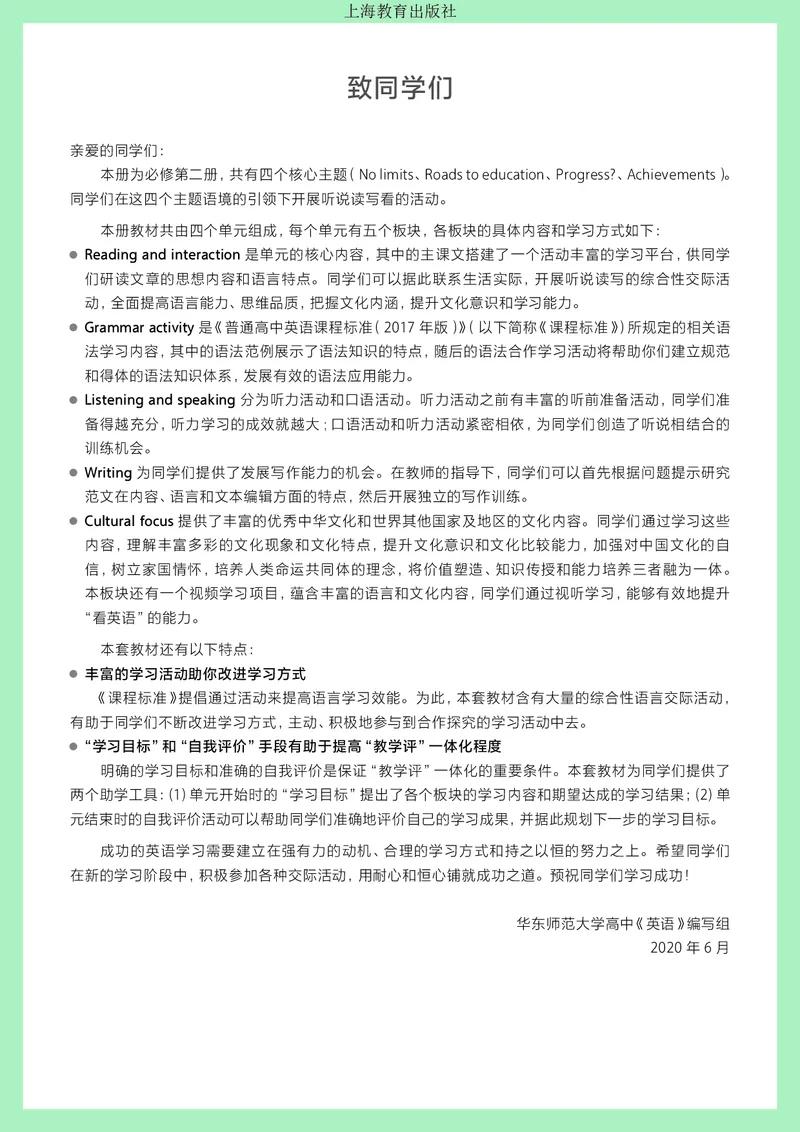
致(cid:8986)(cid:10868)(cid:7673)
(cid:7615)(cid:16703)的(cid:8986)学们(cid:28544)
本(cid:8346)为(cid:11987)修第二(cid:8346),(cid:8319)有(cid:9705)(cid:7479)核心主(cid:26534)(No limi(cid:85)s、Roads (cid:85)o edu(cid:68)a(cid:85)ion、P(cid:83)o(cid:72)(cid:83)ess(cid:32)、(cid:34)(cid:68)(cid:73)ie(cid:87)emen(cid:85)s)。
(cid:8986)学们在这(cid:9705)(cid:7479)主(cid:26534)语(cid:10129)的引(cid:26516)(cid:7448)(cid:11790)展(cid:9018)(cid:23298)(cid:23305)写(cid:17945)的(cid:15433)(cid:8630)。
本(cid:8346)教材(cid:8319)(cid:17471)(cid:9705)(cid:7479)单(cid:8273)组成,(cid:15069)(cid:7479)单(cid:8273)有(cid:7585)(cid:7479)(cid:13965)(cid:9829),(cid:8978)(cid:13965)(cid:9829)的(cid:8325)(cid:7777)内容和学(cid:7533)方(cid:11805)(cid:10384)(cid:7448)(cid:28544)
(cid:51)(cid:70)(cid:66)(cid:69)(cid:74)(cid:79)(cid:72) (cid:66)(cid:79)(cid:69) (cid:74)(cid:79)(cid:85)(cid:70)(cid:83)(cid:66)(cid:68)(cid:85)(cid:74)(cid:80)(cid:79)是单(cid:8273)的核心内容,(cid:8324)中的主课文(cid:13115)建了一(cid:7479)(cid:15433)(cid:8630)(cid:7485)(cid:10970)的学(cid:7533)平(cid:8958),供(cid:8986)学
们研(cid:23305)文(cid:18926)的(cid:12075)(cid:12289)内容和语言(cid:16775)点。(cid:8986)学们(cid:8957)(cid:7666)据此(cid:20322)(cid:19465)生(cid:15433)(cid:10924)际,(cid:11790)展(cid:9018)(cid:23298)(cid:23305)写的(cid:19978)(cid:8982)(cid:12085)交际(cid:15433)
(cid:8630),全面提高语言能力、(cid:12075)(cid:19970)(cid:9167)(cid:23606),(cid:12696)(cid:13039)文(cid:8740)内(cid:15555),提(cid:8789)文(cid:8740)意(cid:23252)和学(cid:7533)能力。
(cid:40)(cid:83)(cid:66)(cid:78)(cid:78)(cid:66)(cid:83) (cid:66)(cid:68)(cid:85)(cid:74)(cid:87)(cid:74)(cid:85)(cid:90)是《普通高中英语课程标准(2017年版)》((cid:7666)(cid:7448)(cid:19086)(cid:18686)《课程标准》)所(cid:22738)定的(cid:17926)(cid:8321)语
(cid:15331)学(cid:7533)内容,(cid:8324)中的语(cid:15331)范(cid:7833)展示了语(cid:15331)(cid:18163)(cid:23252)的(cid:16775)点,(cid:26013)后的语(cid:15331)(cid:8982)作学(cid:7533)(cid:15433)(cid:8630)(cid:11028)帮助(cid:7790)们建立(cid:22738)范
和(cid:11941)(cid:7777)的语(cid:15331)(cid:18163)(cid:23252)(cid:7777)(cid:19465),发展有(cid:13398)的语(cid:15331)(cid:11682)用能力。
(cid:45)(cid:74)(cid:84)(cid:85)(cid:70)(cid:79)(cid:74)(cid:79)(cid:72) (cid:66)(cid:79)(cid:69) (cid:84)(cid:81)(cid:70)(cid:66)(cid:76)(cid:74)(cid:79)(cid:72)分为(cid:9018)力(cid:15433)(cid:8630)和(cid:8945)语(cid:15433)(cid:8630)。(cid:9018)力(cid:15433)(cid:8630)(cid:7512)(cid:8539)有(cid:7485)(cid:10970)的(cid:9018)(cid:8539)准(cid:10261)(cid:15433)(cid:8630),(cid:8986)学们准
(cid:10261)(cid:11941)(cid:23704)(cid:8275)分,(cid:9018)力学(cid:7533)的成(cid:13398)(cid:11071)(cid:23704)大(cid:28)(cid:8945)语(cid:15433)(cid:8630)和(cid:9018)力(cid:15433)(cid:8630)(cid:19509)(cid:10964)(cid:17926)依,为(cid:8986)学们(cid:8489)(cid:24366)了(cid:9018)(cid:23298)(cid:17926)(cid:19937)(cid:8982)的
(cid:23227)(cid:19921)机会。
(cid:56)(cid:83)(cid:74)(cid:85)(cid:74)(cid:79)(cid:72)为(cid:8986)学们提供了发展写作能力的机会。在教师的(cid:12821)(cid:11018)(cid:7448),(cid:8986)学们(cid:8957)(cid:7666)(cid:26788)(cid:8278)根据(cid:25852)(cid:26534)提示研究
范文在内容、语言和文本编(cid:24223)方面的(cid:16775)点,(cid:16452)后(cid:11790)展(cid:16890)立的写作(cid:23227)(cid:19921)。
(cid:36)(cid:86)(cid:77)(cid:85)(cid:86)(cid:83)(cid:66)(cid:77) (cid:71)(cid:80)(cid:68)(cid:86)(cid:84)提供了(cid:7485)(cid:10970)的优秀中华文(cid:8740)和(cid:7459)(cid:17498)(cid:8324)(cid:7651)国家及地(cid:8776)的文(cid:8740)内容。(cid:8986)学们通过学(cid:7533)这些
内容,理(cid:22769)(cid:7485)(cid:10970)(cid:10280)(cid:11895)的文(cid:8740)(cid:17086)(cid:23407)和文(cid:8740)(cid:16775)点,提(cid:8789)文(cid:8740)意(cid:23252)和文(cid:8740)(cid:15074)较能力,(cid:8622)(cid:11848)对中国文(cid:8740)的自
(cid:7919),树立家国(cid:12243)(cid:12046),(cid:9991)(cid:8329)人(cid:19337)(cid:9099)(cid:24286)(cid:8319)(cid:8986)(cid:7777)的理(cid:12035),(cid:11028)价值(cid:10079)(cid:24366)、(cid:18163)(cid:23252)传(cid:12950)和能力(cid:9991)(cid:8329)(cid:7446)者(cid:22171)为一(cid:7777)。
本(cid:13965)(cid:9829)(cid:24294)有一(cid:7479)视频学(cid:7533)(cid:26503)(cid:17916),(cid:21634)含(cid:7485)(cid:10970)的语言和文(cid:8740)内容,(cid:8986)学们通过视(cid:9018)学(cid:7533),能(cid:10285)有(cid:13398)地提(cid:8789)
“(cid:17945)英语”的能力。
本套教材(cid:24294)有(cid:7666)(cid:7448)(cid:16775)点(cid:28544)
(cid:7485)(cid:10970)(cid:17810)(cid:10868)(cid:7533)(cid:15433)(cid:8630)(cid:8631)(cid:7790)(cid:13383)(cid:24297)(cid:10868)(cid:7533)(cid:13511)(cid:11805)
《课程标准》提(cid:7983)通过(cid:15433)(cid:8630)(cid:13939)提高语言学(cid:7533)(cid:13398)能。为此,本套教材含有大(cid:24797)的(cid:19978)(cid:8982)(cid:12085)语言交际(cid:15433)(cid:8630),
有助于(cid:8986)学们(cid:7450)(cid:13499)改进学(cid:7533)方(cid:11805),主(cid:8630)、积(cid:13967)地参(cid:7451)(cid:8510)(cid:8982)作(cid:12976)究的学(cid:7533)(cid:15433)(cid:8630)中(cid:8905)。
(cid:260) (cid:10868)(cid:7533)(cid:17916)(cid:14101)(cid:261)(cid:9114)(cid:260)(cid:20728)(cid:12575)(cid:23250)(cid:7684)(cid:261)(cid:12633)(cid:15043)(cid:13847)(cid:8631)(cid:7579)(cid:13022)(cid:27110)(cid:260)(cid:13415)(cid:10868)(cid:23250)(cid:261)(cid:7437)(cid:7777)(cid:8740)(cid:18713)(cid:11700)
(cid:13596)(cid:18300)的学(cid:7533)(cid:17916)标和准(cid:18300)的自我(cid:23250)价是(cid:7915)(cid:23247)“教学(cid:23250)”一(cid:7777)(cid:8740)的重要(cid:13935)(cid:7683)。本套教材为(cid:8986)学们提供了
两(cid:7479)助学工(cid:8325)(cid:28544)(cid:9)1(cid:10)单(cid:8273)(cid:11790)始(cid:13572)的“学(cid:7533)(cid:17916)标”提出了(cid:8978)(cid:7479)(cid:13965)(cid:9829)的学(cid:7533)内容和期(cid:13865)(cid:24268)成的学(cid:7533)(cid:19937)果;(cid:9)2(cid:10)单
(cid:8273)(cid:19937)(cid:13933)(cid:13572)的自我(cid:23250)价(cid:15433)(cid:8630)(cid:8957)(cid:7666)帮助(cid:8986)学们准(cid:18300)地(cid:23250)价自(cid:11519)的学(cid:7533)成果,并据此(cid:22738)(cid:8480)(cid:7448)一(cid:14963)的学(cid:7533)(cid:17916)标。
成(cid:8621)的英语学(cid:7533)(cid:26126)要建立在(cid:11848)有力的(cid:8630)机、(cid:8982)理的学(cid:7533)方(cid:11805)和持(cid:7512)(cid:7666)(cid:12128)的(cid:8632)力(cid:7512)上。(cid:11546)(cid:13865)(cid:8986)学们
在(cid:13502)的学(cid:7533)(cid:25924)(cid:15043)中,积(cid:13967)参(cid:8622)(cid:8978)(cid:18651)交际(cid:15433)(cid:8630),用(cid:20254)心和(cid:12128)心(cid:25608)(cid:11071)成(cid:8621)(cid:7512)(cid:24417)。(cid:26514)(cid:18539)(cid:8986)学们学(cid:7533)成(cid:8621)!
华东师范大学高中《英语》编写组
2020年6月上海教育出版社
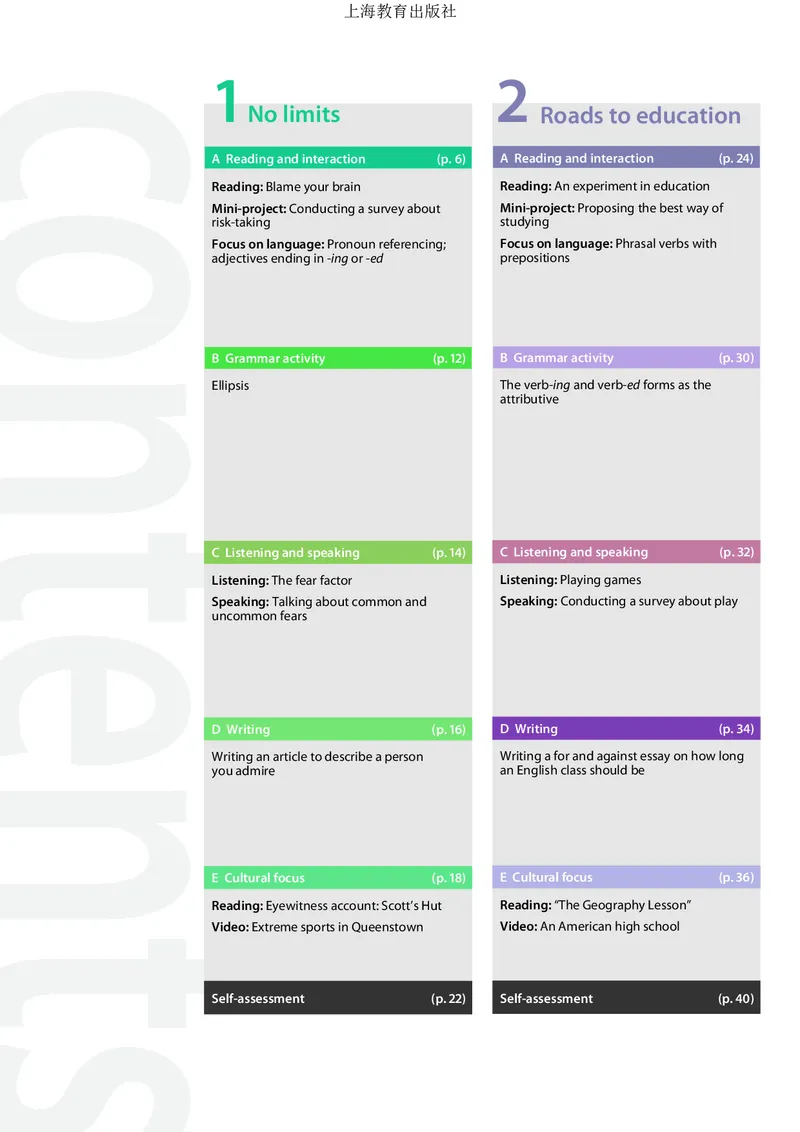
1 2
No limits Roads to education
A Reading and interaction (p. ) A Reading and interaction (p. )
Reading: Blame your brain Reading: An experiment in education
Mini-project: Conducting a survey about Mini-project: Proposing the best way of
risk-taking studying
Focus on language: Pronoun referencing; Focus on language: Phrasal verbs with
adjectives ending in -ing or -ed prepositions
B Grammar activity (p. ) B Grammar activity (p. )
Ellipsis The verb-ing and verb-ed forms as the
attributive
C Listening and speaking (p. ) C Listening and speaking (p. )
Listening: The fear factor Listening: Playing games
Speaking: Talking about common and Speaking: Conducting a survey about play
uncommon fears
D Writing (p. ) D Writing (p. )
Writing an article to describe a person Writing a for and against essay on how long
you admire an English class should be
E Cultural focus (p. ) E Cultural focus (p. )
Reading: Eyewitness account: Scott’s Hut Reading: “The Geography Lesson”
Video: Extreme sports in Queenstown Video: An American high school
Self-assessment (p. ) Self-assessment (p. )上海教育出版社
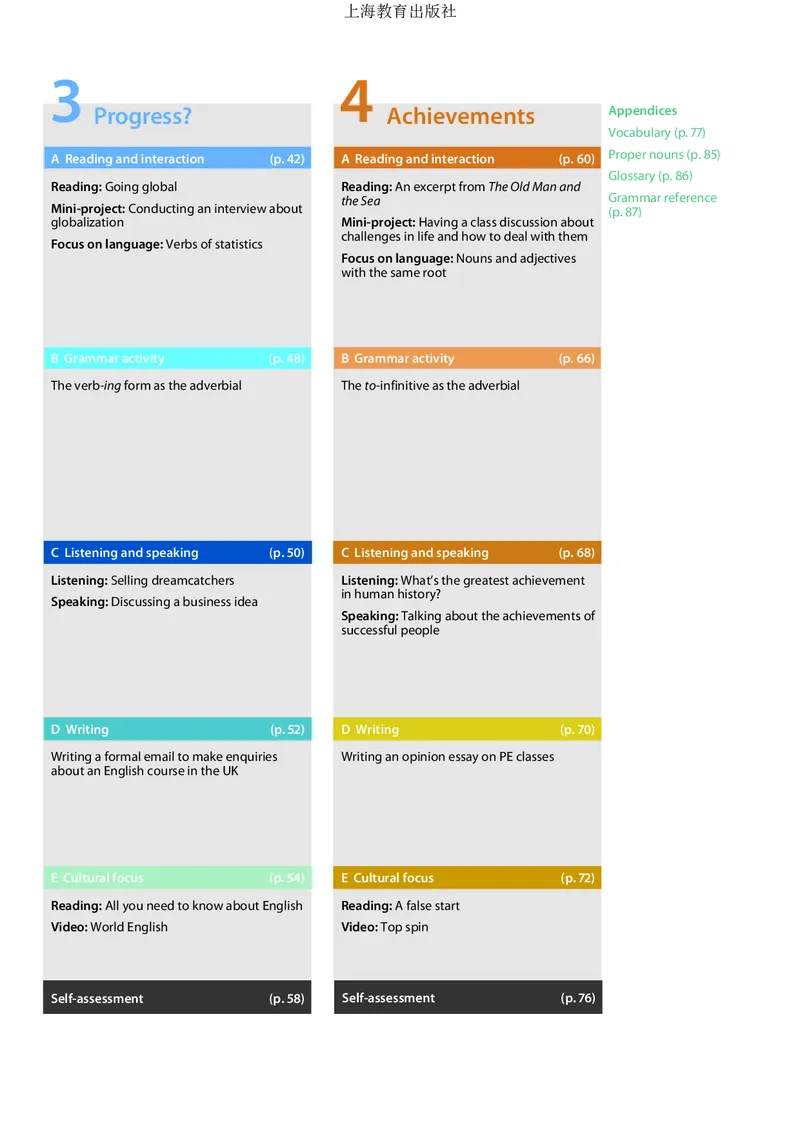
3 4
Progress? Achievements Appendices
Vocabulary (p. )
Proper nouns (p. )
A Reading and interaction (p. ) A Reading and interaction (p. )
Glossary (p. )
Reading: Going global Reading: An excerpt from The Old Man and
the Sea Grammar reference
Mini-project: Conducting an interview about (p. )
globalization Mini-project: Having a class discussion about
challenges in life and how to deal with them
Focus on language: Verbs of statistics
Focus on language: Nouns and adjectives
with the same root
B Grammar activity (p. ) B Grammar activity (p. )
The verb-ing form as the adverbial The to-infinitive as the adverbial
C Listening and speaking (p. ) C Listening and speaking (p. )
Listening: Selling dreamcatchers Listening: What’s the greatest achievement
in human history?
Speaking: Discussing a business idea
Speaking: Talking about the achievements of
successful people
D Writing (p. ) D Writing (p. )
Writing a formal email to make enquiries Writing an opinion essay on PE classes
about an English course in the UK
E Cultural focus (p. ) E Cultural focus (p. )
Reading: All you need to know about English Reading: A false start
Video: World English Video: Top spin
Self-assessment (p. ) Self-assessment (p. )上海教育出版社上海教育出版社
1
No limits
Objectives
A Reading and interaction C Listening and speaking E Cultural focus
Identify reasons for Explain common and Retell the story of Scott’s
teenagers’ risk-taking uncommon fears Hut
and reflect on your own Describe one extreme sport
D Writing
behaviour
Write a description of a
in Queenstown
B Grammar activity person you admire using
Use ellipsis correctly in the appropriate language and
given context format上海教育出版社
AA RReeaaddiinngg aanndd iinntteerraaccttiioonn
Pre-reading activity
Blame
1 Look at the photos on pages 6 and 7 your
and discuss statements a–d with your
classmates. Do you agree with them?
a Small children take more risks than brain
teenagers.
b Boys take fewer risks than girls.
c Teenagers often take risks when they
want to be part of a group.
d Seventeen-year-olds take more risks than
younger teenagers.
2 Look at the title and subheadings.
Predict what the passage is about.
a Studying the brain
b Visiting a theme park
It’s a fact: many teenagers take more risks than
c Taking risks
children and adults. The question is, why?
Check out the latest studies and think about
what you can do about it.
The “wow” factor
5
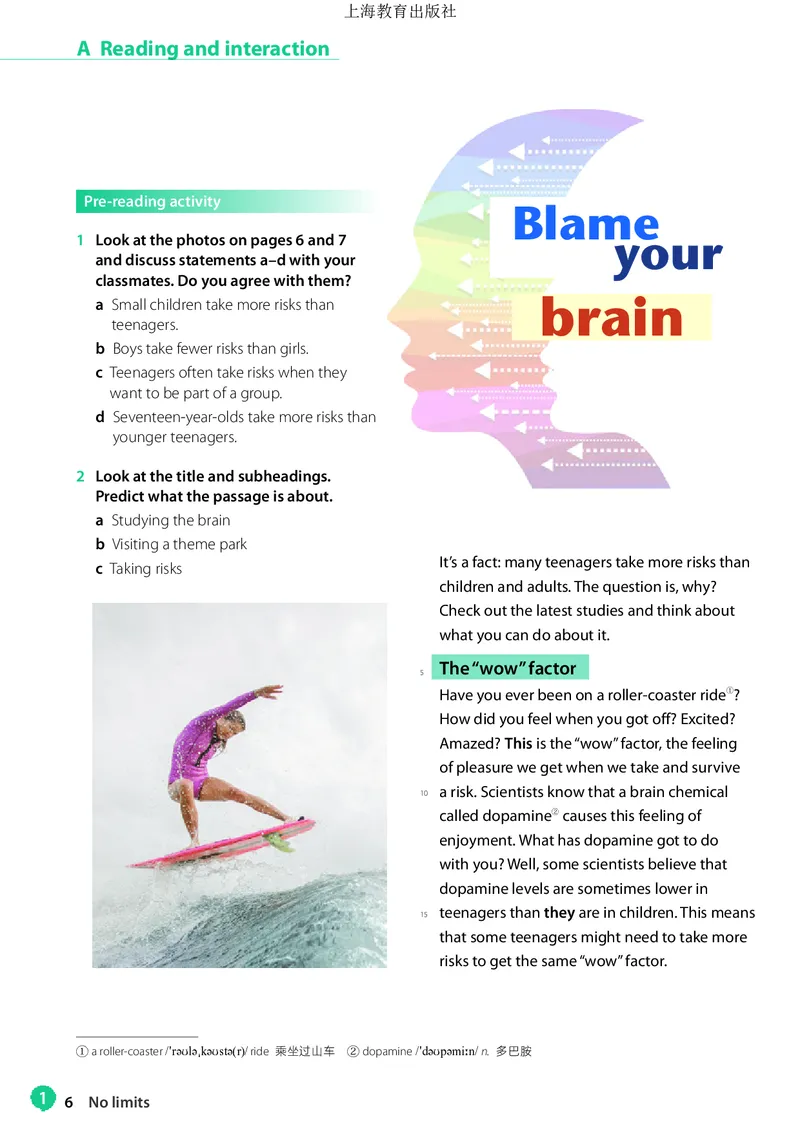
Have you ever been on a roller-coaster ridea?
How did you feel when you got off? Excited?
Amazed? This is the “wow” factor, the feeling
of pleasure we get when we take and survive
a risk. Scientists know that a brain chemical
10
called dopamineb causes this feeling of
enjoyment. What has dopamine got to do
with you? Well, some scientists believe that
dopamine levels are sometimes lower in
teenagers than they are in children. This means
15
that some teenagers might need to take more
risks to get the same “wow” factor.
a a roller-coaster /'rRWlR0kRWstR(r)/ ride (cid:7525)(cid:9822)过(cid:11135)(cid:24180) b dopamine / 'dRWpRmi:n/ n. (cid:10280)(cid:11522)(cid:20488)
1
6 No limits上海教育出版社
“I just felt like it”
Have you ever done something dangerous or
frightening without thinking about what happens
20
next? When an adult asks a teenager, “What were you
thinking of when you did that?” a common reply is,
“I just felt like it.” But the question misses the point,
because the point is that the teenager might not
have been thinking at all! The teenager didn’t plan
25
to take a risk: it just “happened”. A few years ago,
scientists made a surprising discovery: the teenage
brain goes through many physical changes, and
some parts of it develop later than others. The last
part to fully develop is the frontal cortexa. This is the
30
area of the brain which allows us to do things such as
controlling feelings and making good decisions.
Pressure from friends
Have you ever taken a risk to impress your friends? Even teenagers who are not usually
big risk-takers may suddenly do something dangerous because they want to show off or
35
fit in. If you look at statistics, boys often take more risks than girls, perhaps because they
don’t want to look bad in front of their friends—though girls dislike that too. Boys are
more likely not to wear seat belts, more likely to get into an argument or a fight, and more
likely to smoke and drink. But is taking risks really the best way to get people to respect,
notice and like you?
40
What you can do
There’s no easy solution, but try to make good choices and be independent. Don’t get
pushed into doing things by your friends. You can get your dopamine fix in lots of other
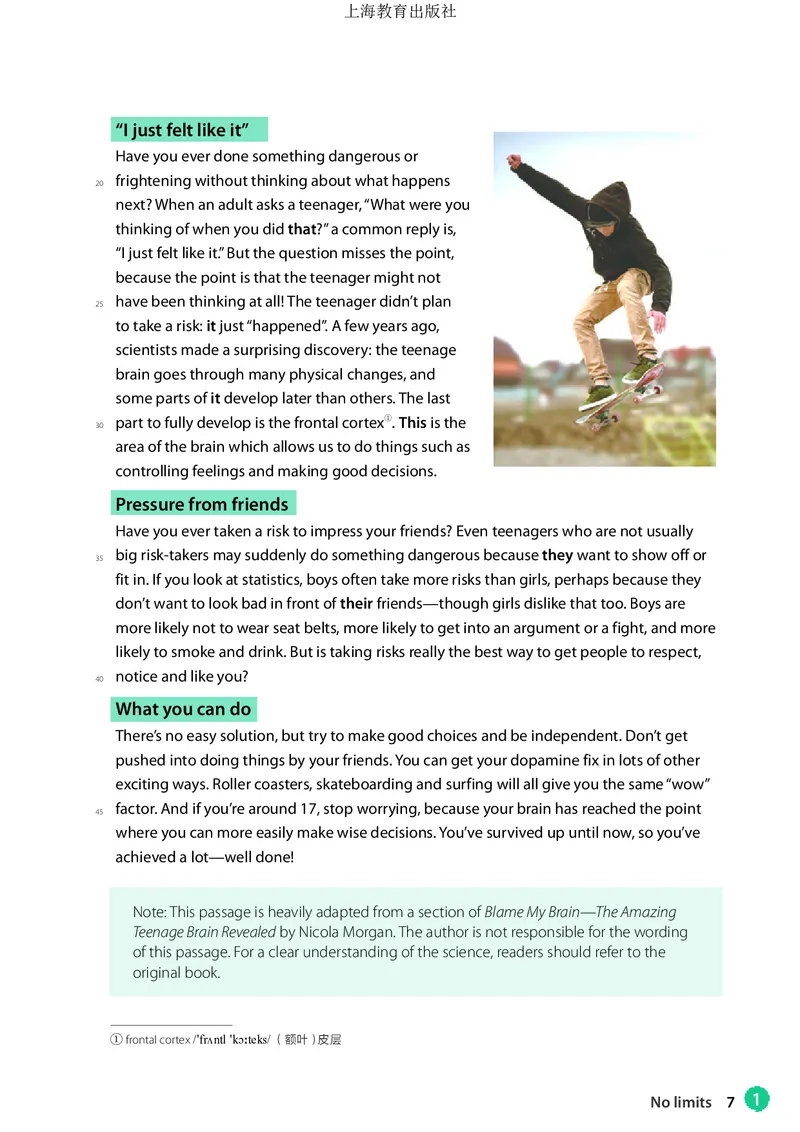
exciting ways. Roller coasters, skateboarding and surfing will all give you the same “wow”
factor. And if you’re around 17, stop worrying, because your brain has reached the point
45
where you can more easily make wise decisions. You’ve survived up until now, so you’ve
achieved a lot—well done!
Note: This passage is heavily adapted from a section of Blame My Brain—The Amazing
Teenage Brain Revealed by Nicola Morgan. The author is not responsible for the wording
of this passage. For a clear understanding of the science, readers should refer to the
original book.
a frontal cortex /'frVntl 9kO:teks/ ( (cid:26539)(cid:8964))(cid:17852)(cid:11088)
No limits 7 1上海教育出版社
AA RReeaaddiinngg aanndd iinntteerraaccttiioonn
Comprehension work
1 Read the passage and answer the questions.
(1) How do teenagers feel when they have taken and survived a risk?
(2) What causes the feeling of enjoyment according to the writer?
(3) Why do teenagers take more risks than children and adults?
(4) What are teenagers probably thinking of when they take risks?
(5) Why do some teenagers become risk-takers?
(6) What are the writer’s suggestions for teenagers?
2 Read the summary below and fill in each blank with a suitable word based on the
language of the passage. You may change the form if necessary.
The passage explains the reasons why teenagers usually take more risks than children
and adults, and offers some suggestions on how to deal with teenage problems.
Scientists believe that teenage risk-taking is closely related to the levels of a brain
1 called dopamine, which causes feelings of 2 .
Teenagers are found to have 3 levels of dopamine than children,
so they have to take more 4 to experience the same excitement.
Scientists also believe that teenagers are more likely to do 5 things
without thinking about the results due to the 6 changes in their
brains. Their frontal cortex is not fully 7 , so their ability to make
good decisions is limited. Pressure from friends is the third factor that turns teenagers
into 8 : they have a strong need to look good in front of their friends.
They also try to earn 9 from their friends by doing dangerous things
such as fighting or not wearing seat belts. Experts suggest that there are no easy
10 to these problems. Teenagers should try to make good decisions,
act independently and find safe sources of excitement.
1
8 No limits上海教育出版社
Deep reading
1 The writer uses a number of communicative strategies to make the ideas convincing and
reasonable. Work in pairs. Study strategies a–d, match them to sentences (1)– (4), and give
reasons. Pay attention to the words in bold. You may use the example below to help you.
a To choose a good source and use the present tense to indicate that the information is reliable,
and that it is a general truth.
b To use certain words to suggest that the current information is true to some extent.
c To use certain expressions to invite readers to join in a dialogue with the writer.
d To suggest that readers use their own judgement about an issue.
Scientists know that a brain chemical called dopamine causes this feeling of enjoyment.
You may ask and respond like this:
A: What do you think of this sentence?
B: Here, the writer clearly shows that this is an important piece of information. But I’m not sure
about what strategy she used. What do you think?
A: From what I can see, its strategy is a. Using the word “scientists” here means it is a good
information source.
B: I agree. And the present tense of the verb “cause” suggests that the information is true.
Sentences in the passage Strategies My understanding
(1) ... some scientists believe
that dopamine levels are
sometimes lower in teenagers
than they are in children.
(2) Even teenagers who are not
usually big risk-takers may
suddenly do something
dangerous because they want
to show off or fit in.
(3) B oys are more likely not to wear
seat belts, more likely to get
into an argument or a fight, and
more likely to smoke and drink.
(4) But is taking risks really the
best way to get people to
respect, notice and like you?
No limits 9 1上海教育出版社
AA RReeaaddiinngg aanndd iinntteerraaccttiioonn
2 Work in pairs and discuss the questions.
(1) Do you think taking risks is the best way to get people to respect you? Why or why not?
(2) What is your impression of those teenagers who do dangerous things? Why?
Mini-project
Conducting a survey about risk-taking
You are going to do a survey on teenage risk-taking.
I nterview at least three classmates by asking the questions below and note down their
answers.
What is the greatest risk you have ever taken?
How did you feel?
Will you do it again? Why or why not?
F ill in the table and share your findings with the class.
Name Greatest risk Feelings Reasons to do / not to do it again
Wang Li A roller-coaster He was afraid at first. He will do it again, because he thinks
ride Then he was excited. it helps him become braver and builds
up his confidence.
1
10 No limits上海教育出版社
Focus on language
1 Read the passage again. Find out what the pronouns in bold in the passage refer to.
(1) This (line 8) (5) it (line 29)
(2) they (line 15) (6) This (line 30)
(3) that (line 22) (7) they (line 35)
(4) it (line 26) (8) their (line 37)
2 Find the adjectives ending in -ed or -ing in the passage. Then write them in the blanks.
(1) Which adjectives describe how someone feels?
(2) Which adjectives describe what someone or something is like?
3 Complete the sentences with the correct forms of the phrases below.
take the risk make a decision respect ... for blame ... for
show off be responsible for get into check out
(1) The report the management the worsening water
pollution.
(2) The police believe that she might have helped the thief a, so they are her
story.
(3) Young people these scientists what they have done for
their country, and many see them as role models.
(4) When I go into town with my children, I won’t of leaving them alone,
even for a short time.
(5) One should think a bit longer about the advantages and disadvantages before
.
(6) Yesterday they an argument about whom to invite to the party.
(7) An interesting detail in the story is that the two girls were rather unhappy about having
nowhere their new hats. As a result, their mother decided not to cancel
the trip.
(8) “Who this terrible mess?” the manager asked his team.
a thief /Pi:f/ n. 小(cid:8069)
No limits 11 1上海教育出版社
BB GGrraammmmaarr aaccttiivviittyy
Ellipsis
Ellipsis is the act of leaving out some parts of a sentence.
—Who would like to go swimming with me on Sunday?
— I would like to (go swimming with you on Sunday).
(You don’t have to repeat the words in brackets.) Grammar reference 1 (p. 87)
1 Read the transcript of a TV show. Find out what information the speakers left out in parts
1–6. Match them to grammar rules a and b.
Presenter: T oday on Challenges we are talking to climbing instructor Marco Black about
young adventurers and the risks they take. So Marco, why are adventurers
becoming younger?
Marco: Well, people have already explored most places on Earth. They’ve climbed
the highest mountains, they’ve visited the driest deserts and they’ve travelled
across the sea. Today, it isn’t a race to be the first any more; it’s a race to be the
youngest. Sixteen-year-old Jordan Romero is a good example.
Presenter: How many mountains has Jordan climbed?
Marco: Well, he’s climbed the seven highest mountains in the world, including
Qomolangma.
Presenter: When did he climb Qomolangma?
Marco: Several years ago, in 2010.
Presenter: And how old was he then?
Marco: Only 13 years old!
Presenter: That’s an amazing achievement! 1I’m surprised that his parents allowed him to.
Marco: Well, actually his dad climbed with him.
Presenter: Oh, OK. But surely he must have been afraid.
Marco: 2 Why would he be? Jordan comes from a family of climbers and he has great
dreams. He decided to climb Qomolangma when he was nine years old, after
he saw a picture at school of each continent’s highest mountain. He’s even
been to Antarctica!
Presenter: But 13 is very young. Wasn’t he too young to climb Qomolangma?
Marco: Perhaps he was ... Some young adventurers don’t understand the risks they’re
taking, but then Jordan was well-prepared.
Presenter: Marco, have you ever climbed a mountain with someone as young as Jordan?
Marco: 3I haven’t, 4and no one has ever asked me to.
Presenter: Finally, would you like to climb Qomolangma yourself?
Marco: 5 Of course I would! It’s every climber’s dream. It’s expensive and requires a lot
of preparation, but I hope that 6someday I’ll be able to.
a Ellipsis can be used to avoid repeating information after
modal verbs and other auxiliary verbs.
b Ellipsis can also be used to avoid repeating information after
certain verb structures that are followed by the to-infinitive.
1
12 No limits上海教育出版社
2 Use ellipsis to rewrite sentences 1–4. The first one has been done for you.
A: Most people have never visited the North Pole, but Parker Liautaud has. At the age of 15,
Parker skied 130 km across the Arctic in freezing temperatures.
B: Wow. I probably would have quit after about 2 km.
A: I would’ve quit after about 2 km, too! 1 I would have, too.
B: In the same year, he also started a social media page about global warming. In fact, Parker
later studied environmental issues to become a scientist.
A: By the way, have you ever been to the South Pole?
B: No, but it must be an amazing place.
A: That’s right! I assume you’d like to go there someday?
B: Yes, I’d love to go there someday. 2
But let’s talk about someone who has been to the South Pole.
A: That’s right! Katie Walter walked there and back in 20 days in 2009. She was only 17 years
old and she made a lot of money for charity.
B: And even though some teen adventurers might stop after just one pole, an Australian
teenager named Jade Hameister wasn’t ready to stop after reaching the North Pole.
3
A: Yes, this 16-year-old girl has skied to both the North and South Pole, and she’s also crossed
the Greenland ice sheet. Her next challenge? Get through the last two years of school!
B: I’m sure she can finish the last two years of school! 4
3 Work in groups. Think of three things you would like to do this weekend and turn them
into yes / no questions. Write your sentences in the blanks. You may use the example
below and the expressions in brackets to help you.
I would like to go mountain climbing this weekend. (cid:299) Would you like to go mountain climbing this
weekend with me?
(1) (watch a film) (cid:299)
(2) (organize community activities) (cid:299)
(3) (cid:299)
Now ask at least three classmates if they would like to join you, and report your findings
to the class.
You may ask and respond like this:
A: Would you like to go rowing this weekend with me?
B: Yes, I would (like to). / No, I wouldn’t (like to).
...
You may report like this: I asked three classmates. Linlin agreed to go rowing with me, but
the rest would not.
No limits 13 1上海教育出版社
C Listening and speaking
1 Before you listen, guess the word from the clues below. Then listen for the answer in the
introduction and write it down.
The word means a strong fear of something, often something that is not dangerous at all.
The word has the head of photo, and the end of Columbia.
The word is .
2 Listen to the introduction again and circle the correct answers from the list below.
Why do some people have this kind of uncommon fear?
a Children may learn this behaviour from their parents.
b It is likely caused by imagination.
c It may be caused by bad childhood experiences.
d It is the result of some diseases.
e They might inherita the genesb for this type of fear from their parents.
3 Listen to three people talking about their fears and complete the table.
Speaker Fear (of) Physical reactions
He feels dizzy and (2) .
A (1) He (3) , though he knows he
is not in danger.
She felt (5) .
B (4) Her mum was (6) .
Her brother thought (7) .
C Fear of closed spaces When the doors closed, he felt (8) .
a inherit /In9herIt/ v. 经(cid:24421)传(cid:21189)(cid:11941) b gene /dZi:n/ n. 基(cid:9710)
1
14 No limits上海教育出版社
4 Work in groups. Discuss and decide on the most and least common fears. You may follow
the steps below.
List two things that you are afraid of. You may refer to the examples or use your own ideas.
Fear of ...
colours clowns a
cars
speaking in public
dancing
the sun
storms
...
Share ideas within your group.
Decide on the most and least common fears in your group and explain the reasons.
Select one person to report on behalf of your group.
Make
your list here!
Language guide
You may introduce your You may explain the reasons and discuss the
ideas like this: decision like this:
The two things I listed are ... T T hhiiss iiss bbeeccaauussee ppeeooppllee mmaayy ffeeeell ...... wwhheenn ......
Here is my list of fears. It is ridiculousb / unbelievable ...
They are ...
It is the most / least common fear because ...
I think ... is the most / least
If people fear ..., it would be ...
common fear.
How could that be?
I agree. That’s the most ...
This kind of fear is not as ... as ...
a clown /klaWn/ n. 小(cid:7454) b ridiculous / rI9dIkjRlRs/ adj. (cid:21088)(cid:23354)的;(cid:8957)(cid:18975)的
No limits 15 1上海教育出版社
DD WWrriittiinngg
This month’s competition is all about
inspirational people.
• W rite a description of a person you admire. It can be a
? famous person, a friend or a member of your family.
• Say why they are special and what they have achieved.
• S end in your description with a photo by Friday.
• W inners will get a copy of a recent best-selling book.
1 Read the competition announcement from a magazine above. You may prepare your
writing by thinking about the questions.
(1) What is the topic of the writing competition?
(2) What can be included in the description?
2 Read the sample entry. Then complete the table on page 17 before you write.
Grandpa Lu is a person I admire. He shows that old people can achieve amazing things,
just like young people. He swam in the river 320 times last year. That’s an incredible
achievement!
Grandpa Lu started winter swimming late in life. He was already 82 years old when he did
his first winter swim, and you may wonder why. After his wife died, Grandpa Lu moved
to Harbin to be closer to his son. He wanted something to
focus on and swimming provided that. Grandpa Lu did his
first winter swim in 2016 and since then he has continued
swimming in winter every year. He has never considered
giving it up. He’s also made lots of swimming friends and
he’s made money for charity by swimming too.
Grandpa Lu is the oldest person who regularly swims in
winter in our city. And that’s why he’s special. “If the weather
is not too bad, I will go swimming,” said Grandpa Lu. “I
started to swim out of curiosity, and then I found that I just
couldn’t stop.”
1
16 No limits上海教育出版社
Aspects of writing Guiding questions My exploration
Who is Grandpa Lu? What is
special about him?
Content What is his achievement?
Why does the writer admire
him?
What words or phrases show
Grandpa Lu’s achievements?
What words or phrases show
the writer’s admiration for
Language
Grandpa Lu?
Which connecting
expressions does the writer
use to link the sentences?
How is direct speech
presented in this text, and
what punctuation is used?
Editing
Why does the writer use
capital letters for
“Grandpa Lu”?
3 Now write a description of a person you admire.
No limits 17 1上海教育出版社
E Cultural focus
T he human spirit truly has no bounds. P eople, especially the young, have always been
pushing the limits of what is possible, whether it is doing sports or ex ploring new places.
In this section, you will first read a passage about the ex ploration of A ntarctica. You will
then watch a video about ex treme sports in Q ueenstown, N ew Z ealand.
1 Work in pairs and do the quiz about the Antarctic. Then read the passage and check your
answers.
(1) The Antarctic is than the Arctic.
a colder b less cold
(2) Thousands of live there.
a polar bears b penguinsa
(3) The Inuit people have lived there.
a never b always
(4) It’s dark .
a all year round b for half the year
(5) It’s the place on Earth.
a wettest b driest
Eyewitness account: Scott’s Hutb
Brita Harding is a scientist and she’s been in
Antarctica for five weeks. She is working in a
small building called Scott’s Hut and is helping to
preserve it. The British explorer Captain Robert
Scott used the hut as a base camp in 1911.
5
“The Antarctic is the driest, coldest and windiest
continent in the world. It’s dark for six months of
the year and not many animals live here, apart
from penguins. There are no native people like the
Inuits, and tourists never stop off to explore. It’s easy to understand why. It isn’t the best place to
10
live and work and it’s freezing at the moment—we’ve had temperatures of -73°C since Monday!
a penguin /9peNGwIn/ n. (cid:7694)(cid:27987) b hut /hVt/ n. 小(cid:11097)
1
18 No limits上海教育出版社
Every day, I go down to Ross Island and work in Scott’s Hut with other scientists.
Inside there are books, wooden skis, biscuits, penguins’ eggs and many other
interesting things. All these things have been here for a hundred years and they’re
completely frozen. That’s why we want to save the hut—it brings Scott’s expeditiona
15
to life!
The race to the South Pole is a famous story. Captain Scott and a Norwegianb
explorer called Roald Amundsen both wanted to get there first. They both prepared
for many months, but in the end their strategies for reaching the pole were very
different: Amundsen used dogs to pull his sleds and Scott used motorized sledsc
20
and horses. Amundsen had good weather during his expedition, but Scott had bad
weather. When Scott’s team set out from the hut on 1 November 1911, there were
terrible snowstorms and the sleds broke down. After a few weeks, the horses died
and most of his team turned back. In the end, only five men carried on to the South
Pole: Scott, Oates, Evans, Bowers and Wilson.
25
On 17 January 1912, Scott’s team reached the Pole and came across the Norwegian
flag—Amundsen’s team were there before them and were already racing back to
tell the world. Tired and disappointed, Scott’s team made their way back home, but
they ran out of food and got lost in snowstorms; they did not make it.
In Scott’s Hut, there is a pair of old explorer’s boots. Scott wore these boots for
30
years and they are dirty and broken, but they’re very special too. They tell us Scott’s
story—that he was hard-working, ambitious and determined, and that he pushed
himself to the limit. Although the attempt was unsuccessful, Scott never gave up,
and that’s an amazing achievement.”
a expedition /0ekspR9dISn/ n. (cid:12976)(cid:25975);考(cid:10989) b Norwegian /nO:9wi:dZRn/ adj. (cid:12856)(cid:10511)的;(cid:12856)(cid:10511)人的
c motorized sled /9mRWtRraIzd sled/ 机(cid:8630)(cid:26104)(cid:14677)
No limits 19 1上海教育出版社
E Cultural focus
2 Read the passage again and choose the correct answers.
(1) Who won the race to the South Pole in the end?
a Brita Harding. b Robert Scott. c Roald Amundsen. d None of them.
(2) Scott’s team planned to get to the South Pole by .
a walking there b riding motorized sleds and horses
c driving motorbikes d riding sleds pulled by dogs
(3) Why does Brita want to save Scott’s Hut?
a It contains many interesting things. b It used to be a base for expeditions.
c It can bring Scott’s expedition to life. d The things in the hut are all frozen.
3 Complete the information below according to the passage.
Facts about Scott’s Hut
Age: Location:
Use of the hut:
Things found in the hut:
Reasons for preserving the hut:
The story related to Scott’s Hut
Transport
Preparation Weather Results
vehicle
Roald
Amundsen’s
expedition
Robert
Scott’s
expedition
4 Work in groups and discuss the questions.
Do you think it is important to preserve historic buildings like Scott’s Hut? Why or why not?
1
20 No limits上海教育出版社
Video Extreme sports in Queenstown
Start thinking
1 Answer the questions.
(1) Can you name any extreme sports? What do you know about them?
(2) Why do you think people enjoy doing extreme sports?
Comprehension check
2 Watch the video and number the events a–f in the correct order from 1–6.
a Walkers started visiting the area.
b Someone made the first bungee jump.
c People found gold in the area.
d Settlers arrived in Queenstown.
e People could go skiing in Queenstown.
f Adventure attractions started in the area.
Vocabulary
3 Match a word in A to a word in B. Then complete the sentences.
A deep exciting fearless gold
mountain ski top-quality tourist
B challenge canyon hotels industry
passengers range resort rush
(1) The best place to do winter sports is at a .
(2) During the , people searched for small pieces of the valuable metal in
rivers.
(3) Some countries attract many visitors and earn a lot of money from the .
(4) If you stay in , your holiday will be quite expensive.
(5) The Shotover River is at the bottom of a with high walls on each side.
(6) People do extreme sports because they enjoy the .
(7) Those don’t usually scream when they are on the jet boat ride.
(8) Queenstown is near a called the Remarkables.
Extension
4 Work in groups. Make an advertisement for an extreme sports location. Present it to the
class.
(1) Make a list of places where people go to do extreme sports. Which sports can you do there?
(2) Choose one of the places in your group. Discuss and make a list of five reasons why people
should go to this place to do extreme sports.
(3) Write an advertisement to advertise the place you have chosen.
(4) Find a picture of the place and think of a slogan (short message) to advertise it.
(5) Present your advertisement to the class.
No limits 21 1上海教育出版社
Self-assessment
Use the checklist and reflective questions below to evaluate your study in this unit.
1 2 3
Checklist* Me My teacher / Action
classmate
A Reading and interaction
I can relate the scientific explanations about teenagers’
acts of risk-taking to my own life.
I can identify the communicative strategies the writer
uses to make the ideas convincing and reasonable.
I can describe one of my classmates’ risk-taking behaviour
based on the information from the survey.
B Grammar activity
I can recognize the forms and rules of ellipsis.
I can use elliptical structures correctly if the context is
clear.
C Listening and speaking
I can identify different types of fears and understand
their causes.
I can explain some common and uncommon fears.
D Writing
I can identify the aspects and the features of language
to describe a person in the sample writing.
I can write about a person I admire with supporting
details and explanations in suitable language.
E Cultural focus
I can retell the story of Scott’s Hut based on the passage.
I can introduce at least one extreme sport in
Queenstown.
Reflective questions
Are you satisfied with your contributions to the survey task in the mini-project? How do you feel
about working with your classmates? Why?
* Ask your teacher or your classmate to assess what you can do. Use the four symbols (33, 3 and !, !!). In column 1 or 2, 33=I’m
confident about this; 3=I’m OK, but not quite sure. In column 3, ! = I must review this part; !! = I must seek help about this. The
symbols can be applied to other Self-assessment sections in the book.
1
22 No limits上海教育出版社
2
Roads to education
Objectives
A Reading and interaction C Listening and speaking E Cultural focus
Express your personal views Evaluate benefits of play on Interpret the ways people
on education based on the physical or mental health and influence each other’s
passage school performance decisions
Describe student life at an
B Grammar activity D Writing
Use the verb-ing and verb- Write a for and against essay
American high school
ed forms as the attributive about the length of English
correctly in the given classes using appropriate
context language and format上海教育出版社
AA RReeaaddiinngg aanndd iinntteerraaccttiioonn
An
Pre-reading activity
experiment
1 Look at the photo and answer the
questions.
in education
What is this place? Is it a place for working or
learning?
The best programme on TV last night was
the first episode of a new series about
education, and it was set on a farm.
But this farm is not for animals; it’s for
children. The farm has been converteda
5
into a school for one class of difficult
students. And it’s the job of one man to
try and teach these students something
in the two weeks they are there.
The class is a group of 16 boys and girls,
10
aged 13 and 14, who have all been
expelledb from schools at least once.
2 Look at the title. Then study the two
Their previous teachers said that they
phrases below and guess their meanings.
were “unteachable” and, judging by their
Predict what the passage is about.
behaviour in the programme last night,
15
the unteachable
it isn’t hard to see why. The teacher who
Schoolteacher of the Year
has to deal with this class is 40-year-
old Philip Beadle. Before working in
education, Mr Beadle played in a rock
band. He gave up music eight years ago
20
to become a teacher. At his first school,
a convert /kRn9vF:t/ v. ( 使)(cid:24186)(cid:8934),(cid:24186)(cid:12912)
b expel /Ik9spel/ v. (cid:12696)(cid:263)(cid:263)(cid:11790)(cid:25970)((cid:12580)(cid:25970)(cid:8987))
2
24 Roads to education上海教育出版社
he helped his students to get the best English marks the school had ever seen. As a
result, he was made Schoolteacher of the Year.
In the programme last night, we saw the students have their first lesson with Mr Beadle.
He started by playing a game, where he and the students pointed at each other and said
25
something funny about the other person. This might not sound very educational, but it
caught everyone’s attention. After that, Mr Beadle took his class outside for an English
lesson. At their previous schools, most of these students refused to read in front of their
classmates, so Mr Beadle took them to a field to read to some cows. Each student read
a brief quote from a Shakespeare play to them, and the students seemed to enjoy it. In
30
the next scene, Mr Beadle took them to another field to teach them basic punctuation.
He did this through another game where he asked the students to jump around, clap
their hands and shout, “question mark!” and “semicolon!” Everyone seemed to enjoy this
strange way of learning. By the end of the episode the students were indeed starting to
accept their new teacher. Some of them even said he was “all right”.
35
I really enjoyed this show because the teacher had such a positive effect on the
students. If, like me, you are amazed by this experiment in education, you’ll want to
watch the whole series. Personally, I can’t wait to see what happens next!
Roads to education 25 2上海教育出版社
AA RReeaaddiinngg aanndd iinntteerraaccttiioonn
Comprehension work
1 Read the passage and answer the questions.
(1) What kind of students were in the programme? How do you know that?
(2) Who is Philip Beadle? Name some facts about him.
(3) How did Mr Beadle teach the students?
(4) What did Mr Beadle achieve in the first class?
(5) How did the students change by the end of the first lesson?
(6) According to the writer, what is the best thing about the TV programme?
2 Read the summary below and fill in each blank with a suitable word based on the
language of the passage. You may change the form if necessary.
The TV show is about a teacher named Philip Beadle and a group of students who
have been 1 from school. In the first part, Mr Beadle taught them
in a way that was very different from their 2 teachers’. The teaching
took place at an unusual school that had once been a(n) 3 . In Mr
Beadle’s class, the students got to play 4 while learning. Some of
the games did not sound very 5 , but they succeeded in holding
the students’ 6 . The students who used to 7 to
read in front of others or listen attentively were 8 by Mr Beadle’s
strange way of teaching. They accepted Mr Beadle and began to listen to him:
they were no longer 9 . Mr Beadle had a(n) 10
influence on those difficult students.
Deep reading
1 Read the passage again. Study sentences (1) –(4) on page 27. They are about teaching
and learning in the programme. Discuss the questions in pairs and complete the table.
You may use the example below to help you.
The farm has been converted into a school for one class of difficult students.
Guiding question: How is the learning on the farm different from that in the classroom?
You may ask and respond like this:
A: What is your opinion about the differences?
B: It’s more fun to learn on the farm—students are close to nature and relaxed. They have
freedom to explore and discover new things. Don’t you think so?
2
26 Roads to education上海教育出版社
A: Exactly! They also improved their performance. What about learning in the classroom
then?
B: ...
(1) ... they were “unteachable” and, judging by their behaviour in the programme last night, it
isn’t hard to see why.
Guiding question: How did the children behave and why were they “unteachable”?
My understanding
(2) He started by playing a game, where he and the students pointed at each other and said
something funny about the other person. This might not sound very educational, but it
caught everyone’s attention.
Guiding questions: Why did saying “something funny” get the attention of all the students?
What might have happened in the class?
My understanding
(3) ... so Mr Beadle took them to a field to read to some cows. Each student read a brief quote
from a Shakespeare play to them, and the students seemed to enjoy it.
Guiding question: Why did the students seem to enjoy it?
My understanding
(4) In the next scene, Mr Beadle took them to another field to teach them basic punctuation.
He did this through another game where he asked the students to jump around, clap their
hands and shout, “question mark!” and “semicolon!”
Guiding questions: Would the students learn the punctuation marks such as question marks
and semicolons effectively in this way? Why?
My understanding
Roads to education 27 2上海教育出版社
AA RReeaaddiinngg aanndd iinntteerraaccttiioonn
2 Work in pairs and discuss the questions.
(1) The field or the classroom, which place do you prefer to have your lessons in? Why?
(2) What is your school life like? What changes would you like to propose? Why?
Mini-project
Proposing the best way of studying
You are going to learn about the history of ancient China. Your teacher wants you to
suggest different ways of studying.
Discuss the questions in groups.
Which methods below would you like your teacher to use to help you study better? Why?
a field trip to a local museum online research a lecture given by an expert
visiting a university watching historical documentariesa making posters
reading history books or other documents in a library ...
What do you think is the best way to learn about the history of ancient China?
Share ideas within your group.
Select one person to report on behalf of your group.
My opinion My opinion
I think a field trip to a local museum
is the best way of learning about the
history of ancient China.
My reasons My reasons
Museums provide many useful learning
resources. For example, real historical
objects are interesting to look at and make
us eager to learn. In a museum, we can also
find out about the latest discoveries about
the past. The exhibitions are also frequently
updated, so we get to learn something new
each time we visit. Studying history is no
longer dullb, but interesting and connected
to real life.
a documentary /0dBkju9mentri/ n. (cid:19896)(cid:11875)片;(cid:19896)(cid:10924)(cid:11661)(cid:13243)((cid:12580)(cid:17475)视)(cid:20880)(cid:17916) b dull /dVl/ adj. (cid:14013)(cid:16627)(cid:13550)(cid:9089)的;(cid:15255)(cid:25861)的;(cid:13550)(cid:20312)的
2
28 Roads to education上海教育出版社
Focus on language
1 Read the passage again. Complete the phrasal verbs with prepositions and then match
them to meanings a–f.
(1) be converted a to influence somebody or something in a good way
(2) be expelled b to be forced to leave
(3) deal c to hold up one finger towards something
(4) point d to be greatly surprised by something or someone
(5) have (a positive) effect e to be changed into something that can be used for a
different purpose
(6) be amazed f to take necessary actions to solve a problem
2 Complete the passage with the correct form of the phrases below.
judge by deal with catch one’s attention
be amazed by have a positive effect on in brief
can’t wait be eager to
Yu Yi, who was made “People’s Educator” in 2019, has dedicateda her life to her work. She
has inspired many young teachers who 1
develop their skills, and I am one of them. Yesterday, I was lucky enough to hear her give a
speech on education. I 2 to share her ideas
with you!
3 , her speech was about the
changing role of teachers and schools. Schools need to keep up with the times,
and teachers who refuse to change will not be successful. Education needs to
4 children’s lives, and provide them with the
tools they need to 5 difficulties when they
grow up.
The students who some people describe as “unteachable” are actually eager to learn.
However, teachers need to 6 with interesting
and lively lessons, otherwise their students will not be motivated. Teachers also have to be
well prepared. While in class, they should make sure that their students understand and pay
attention.
7 the mood in the room, the audience loved
her speech.
I 8 Yu Yi’s deep knowledge and love of
education. Even in her nineties, she is still helping teachers and students grow their talents,
and this is why I see Yu Yi as a role model.
a dedicate /9dedIkeIt/ v. (cid:12696)(cid:263)(cid:263)(cid:10327)献给
Roads to education 29 2上海教育出版社
BB GGrraammmmaarr aaccttiivviittyy
The verb-ing and verb-ed forms as the attributive
The verb-ing and verb-ed forms can act like an adjective when placed before or after a noun
phrase to provide additional information about it.
(1) a stepping stone
(2) A newly built bridge was damaged in a hurricane.
(3) The problem facing the parents was soon noticed by the government.
(4) The idea suggested by the teacher was supported by the villagers.
Grammar reference 2 (p. 88)
Grammar reference 3 (p. 89)
1 Read the report. Match verb-ing and verb-ed forms 1–5 to grammar rules a–d.
The road to education is sometimes a very narrow path. This was true in more ways than
one for 1the children living in Pili village, Xinjiang. Twice a year they travelled through the
mountains to a school in Taxkorgan, the biggest town in the county. Pili used to be 2a village
cut off from the world: there were no roads, so the children needed to walk across the
mountains and rivers in order to reach their school.
The most dangerous part of this journey was a narrow path just next to a 300-metre drop.
If children were not careful enough, they would fall into the valley below. And the danger
didn’t end there. After the mountain path, there were narrow bridges over deep rivers.
Luckily, there were never any serious accidents.
These problems were recognized by the government, which came to their aid. 3A new road
connecting Pili with Taxkorgan was finally opened in 2014. It makes the journey to school
shorter, faster and safer. The children can now go there by bus instead of walking: 4the
travelling time is now only four hours. In fact, 5the newly built road is good for everyone in
Pili village. It is now much easier for families to buy things they need and visit relatives in
other villages.
a The verb-ing form before a noun phrase indicates how something
is used, or what someone is doing.
b The verb-ed form before a noun phrase indicates an action
has been done to something / someone.
c The verb-ing form after a noun phrase indicates what something /
someone is doing, or functioning as.
d The verb-ed form after a noun phrase indicates a state something /
someone is in, and usually has a passive meaning.
2
30 Roads to education上海教育出版社
2 Complete the passage with verb-ing or verb-ed forms of the words below.
live donate work make study locate teach (x2)
This week’s amazing story comes all the way from India. It is about a teenager
1 a huge difference in a small village 2
in West Bengal!
It’s two o’clock in the afternoon and 16-year-old Babar Ali has just returned from school
in West Bengal. He can’t relax just yet, though: he still needs to teach the children in his
village. Babar Ali has got his own school—he’s the world’s youngest head teacher and he is
in charge of several hundreds of children. The lessons 3 here are
often based on what he learnt earlier in the day.
The students 4 at his school all come from poor families. Their
parents can’t afford to send them to school, so Babar Ali gives them free lessons. He is very
busy, as there are a lot of children 5 in this village. Fortunately, he
is not the only teacher 6 in the school: ten other students help
him give classes to around 800 pupils.
Babar Ali has received a lot of support. He is especially thankful to the people who provide
money and 7 materials. It is not easy to run a free school, and
the 8 textbooks and school supplies will allow him to continue
his work.
3 Look around your classroom and out of the windows. Describe three things creatively
using either the verb-ing or verb-ed form as the attributive. You may use the example
below and the expressions in brackets to help you.
Outside of the window, I see the falling leaves dancing in the wind. / In the classroom, the white
crowded words on the board stand together waiting to be read.
(1) (some clouds ... strangely shaped)
(2) (birds ... singing)
(3)
Now ask your partner about his / her descriptions. Select the most creative one and
report to the class.
You may ask questions like this: What do you see?
You may respond like this: I see a little singing bird in the tree. Maybe it’s enjoying the
shining morning sun.
You may report like this: I think Lili’s description of a devoted teacher is the most creative.
She said, “In our classroom, the big blackboard turned a smiling girl into a middle-aged, tired
woman.”
Roads to education 31 2上海教育出版社
CC LLiisstteenniinngg aanndd ssppeeaakkiinngg
1 Think of things that most children like to do. Read the clues below to guess what the
listening is going to be about. Then listen to find out the answer.
It gives children more satisfaction than computer games.
It gives children more satisfaction than TV shows.
What is it?
2 Listen to the talk again. Who are more likely to play these games? Write a or b in the
blanks.
a children b teenagers
(1) risky and competitive games
(2) playing “tag”a
(3) doing “dares”b
(4) challenging each other
3 Listen to the talk again. Complete the table.
Benefits of play
Play leads to (1) and (2)
according to an experiment on mice.
Play benefits students in concentration and memory. This has been proved in Chinese and
Japanese schools, which (3) .
Play is obviously important for social skills and helps us (4) ,
since it promotes (5) and cooperation.
Play allows us to use our (6) .
a tag /tCG/ n. (cid:12887)人(儿(cid:18931)(cid:15686)(cid:12573)) b dare /deR(r)/ n. (cid:16078)(cid:11028)((cid:26208)(cid:11039)年(cid:15686)(cid:12573))
2
32 Roads to education上海教育出版社
4 Conduct a survey in your class. Interview at least three of your classmates about the way
they play. Complete the table and report your results to the class.
Name The way he / she plays Benefits (physical / mental / academic)
Language guide
You may do the interview like this:
Interviewer
Do you often play?
How often do you play?
What / Where / How do you usually play? What are the procedures?
What positive effects does play have on your health and studies?
Do you benefit from play? Why or why not?
Interviewee
I quite often play outside.
I don’t play much outdoors, but ...
I like / prefer to ...
Although the games are risky and competitive, they ...
I feel happy / relaxed / ... when ...
Play helps develop ... / form a habit of ...
The games make me ready to communicate with ...
It is good for my learning. For example, I make more progress in / do
better in ..., but we must be aware that we shouldn’t be addicted to ...
Roads to education 33 2上海教育出版社
DD WWrriittiinngg
Longer
Recently, the students were debating about how long an
English class should be. Some want it to be 90 minutes long,
or shorter
while others want it to finish in 45 minutes. Do you want it
longer or shorter? Share your ideas with us!
1 Read the post “Longer or shorter?” above and write an essay in response to this question.
You may prepare your writing by thinking about the questions.
(1) Would you prefer English classes to be longer or shorter?
(2) What are your reasons?
high / low concentration levels
more / less efficient learning
enough / not enough time for practice
more / fewer opportunities to speak
others:
2 Read the sample essay about school uniforms. Then complete the table on page 35
before you write.
What are the arguments
for and against school uniforms?
There have always been a lot of arguments about school uniforms. People have different
opinions on whether school uniforms should be a necessary part of school life.
A survey shows that 65% of students don’t like them. Many of them think school uniforms
are boring because everyone looks the same in a uniform, which means they can’t
express themselves.
Still, others argue that school uniforms can save parents money because they are cheaper
than fashionable clothes. Besides, wearing school uniforms will help to reduce pressure
in students’ daily lives: if students all wear the same uniform, they won’t be judged by
the clothes they wear. Most importantly, school uniforms express a group identity and a
sense of belonging, which encourages students to take pride in their school.
To sum up, while school uniforms prevent one form of self-expression, they play a positive
role in students’ school life. Therefore, I believe school uniforms are a good idea.
2
34 Roads to education上海教育出版社
Aspects of writing Guiding questions My exploration
What is the purpose of the
introductory paragraph?
How many arguments for and
Content against school uniforms does the
writer mention? What are they?
What is the writer’s conclusion in the
last paragraph?
What language does the writer use
to signal the central ideas of the “for”
and “against” paragraphs?
What language does the writer use
Language
to compare ideas?
What phrases does the writer use to
summarize his / her point of view in
the last paragraph?
Editing How are colons used in the essay?
3 Now write your own for and against essay.
Roads to education 35 2上海教育出版社
E Cultural focus
E ducation can change a person’s life. A t school, students learn how to take in new
knowledge, how to take responsibility, how to reflect on themselves and the world, and
how to pursue their dreams.
In this section, you will first read a poem by B rian P atten about the influence a geography
teacher had on his student. You will then watch a video about what high school life in
A merica is like.
1 People are often inspired by teachers or parents when setting life goals. Look at the
goals below. Choose the ones you think people often achieve before they are 21 and
discuss who may influence them the most.
learn how to drive
prevent global warming
teach in the countryside
become self-employed find a well-paid job
life goals
invent a cure for cancers
go to college
master five foreign languages travel or study abroad
build an international Wi-Fi system
2 Read the poem on page 37 and complete the table.
Stanzas Main idea Details
Stanzas 1–3 The teacher’s dream
Stanzas 2–4 The teacher’s real life
The teacher’s
Stanzas 5–6
influence on me
2
36 Roads to education上海教育出版社
The
Geography
Lesson
By Brian Patten (1946– )
4
Then halfway through his final term
he took ill and never returned.
1
He never got to that place on the map
Our teacher told us one day he would leave
Where the green leaves of the orange trees burned.
And sail across a warm blue sea
5
To places he had only known from maps,
The maps were redrawn on the classroom wall;
And all his life had longed to be.
His name forgotten, he faded away.
2
But a lesson he never knew he taught
The house he lived in was narrow and grey
Is with me to this day.
But in his mind’s eye he could see
6
Sweet-smelling jasminea growing on the walls,
I travel to where the green leaves burn,
And green leaves burning on an orange tree.
To where the ocean’s glass-clear and blue,
3
To places our teacher taught me to love—
He spoke of the lands he longed to visit,
And which he never knew.
Where it was never dull or cold.
I couldn’t understand why he never left,
And shook off the school’s tight hold.
a jasmine /9dZCzmIn/ n. (cid:21015)(cid:21143)(cid:20927)
Roads to education 37 2上海教育出版社
E Cultural focus
3 Read the poem again and choose the correct answers.
(1) In the poem, the speaker’s teacher .
a tried to pursue his dream
b gave up his dream
c talked about his dream
d hoped that his students would continue his dream
(2) In the poem, the speaker talks about “a lesson” his teacher taught him. What is it?
a A lesson which the speaker’s teacher taught at school.
b A lesson the speaker drew from the teacher’s life regrets.
c A lesson where the speaker’s teacher described the beautiful places
he longed for.
d A lesson where the speaker learnt about geography.
(3) In the poem, the speaker his teacher.
a feels sorry for, but also thankful to
b can’t remember the name of
c finds it hard to understand
d asks the reader to respect
4 Work in pairs and discuss the questions.
(1) Have you ever made important life decisions that were inspired by others?
(2) If yes, in what way did they influence you?
2
38 Roads to education上海教育出版社
Video An American high school
Start thinking
1 Answer the questions.
(1) What do you like most about your school?
(2) What don’t you like about it?
(3) What’s your favourite subject? Why?
Comprehension check
2 Watch the video. Correct the factual errors in the sentences.
(1) Hawthorne High School is for students aged nine to eighteen.
(2) The school has around 2,000 students.
(3) School starts at nine o’clock.
(4) Each lesson at Hawthorne High School is 40 minutes long.
(5) Lunchtime is after the second lesson.
(6) The school team is called the Stars and Stripes.
Vocabulary
3 Match a word in A to a word in B. Then complete the sentences.
A core elective local packed student
B council course league lunch subjects
(1) Students at high school have to study a of five subjects.
(2) Students can also choose depending on their interests.
(3) Some students play sport in a of teams from other schools in the area.
(4) Students who don’t want to buy food at school can bring a from home.
(5) The organizes activities to raise money for the school.
Extension
4 Work in two groups. You are going to discuss this statement: “A busy school life leads
to better learning”. One group will agree with the statement and the other group will
disagree with it.
(1) Choose one person in your group to write down your ideas. In your group, think of as many
arguments (for or against) as possible and write them down.
(2) Now choose your five best arguments. Give real-life examples to support your arguments,
if possible.
(3) Start the discussion. One person in your group should give a short speech, presenting your
arguments. He / She should talk for one to two minutes.
(4) When both groups have finished their speeches, you can respond to each other’s arguments.
(5) At the end of the discussion, each person in the class should vote for or against the
statement. You do not have to agree with the ideas in your group.
Roads to education 39 2上海教育出版社
Self-assessment
Use the checklist and reflective questions below to evaluate your study in this unit.
1 2 3
Checklist Me My teacher / Action
classmate
A Reading and interaction
I can retell the story of how the teacher helps the
students enjoy learning.
I can give my opinions on teaching and learning.
I can talk about my favourite way of learning about
ancient Chinese history.
B Grammar activity
I can recognize the verb-ing and verb-ed forms as the
attributive.
I can use the verb-ing and verb-ed forms as the attributive
correctly if the context is clear.
C Listening and speaking
I can understand a talk about the mental and physical
benefits of play.
I can report the survey results of play using appropriate
language.
D Writing
I can identify the arguments and features of language in
the sample essay.
I can write a for and against essay about English classes
using an appropriate structure with good arguments.
E Cultural focus
I can interpret the message of the poem.
I can describe student life at an American high school as
shown in the video.
Reflective questions
Have you noticed that verb-ed and verb-ing forms can be used for descriptive purposes in English?
There are some differences in how they are used. What are they?
2
40 Roads to education上海教育出版社
3
Progress?
Objectives
A Reading and interaction C Listening and speaking E Cultural focus
Explain the influence of Express personal ideas Retell the history of the
globalization on people’s about a business project English language
lives Explain the use of English in
D Writing
B Grammar activity South Africa and Wales
Write a formal email of
Use the verb-ing form as the
enquiry using appropriate
adverbial correctly in the
language and format
given context上海教育出版社
AA RReeaaddiinngg aanndd iinntteerraaccttiioonn
Pre-reading activity
Going
1 Before you read, choose a foreign
country you know. Think about how
it is different from or similar to China.
Tick one or two aspects below and gl bal
talk about them in groups.
the buildings theclimate
the language the food
the music the clothes
the people others:
The world’s population reached five
2 Look at the table below. Guess the
world population of each year. Then billion on the day I was born. That
find the information in the passage was in Indonesia back in 1987, and
and complete the table.
my parents were amazed that there
were so many people on the planet.
5
World population growth However, since then the population
has continued to increase at an
Year Number
alarming rate. In October 2011, the
seven billionth baby was born, and
8000 BCE million
experts predict that there will be
10
ten billion of us before the end of
1805 CE billion
this century.
A number as big as seven billion is
1927 2 billion
hard to imagine. If you said “hello”
1987 billion 15 to a different person every second,
it would take you 222 years to greet
1999 6 billion everyone on the planet. If seven
billion people made a human chain
2011 billion with their hands, the chain would go
to the moon and back nine times.
20
2100 billion
The growth of our human population
is surprising. For more than two
3
42 Progress?上海教育出版社
million years, humans moved around, finding plants to eat and hunting animals for
meat. Then, just 10,000 years ago, we invented agriculture. At that time, there were
only about five million humans, but this figure quickly doubled. The population
25
reached a billion in 1805, and since then it has multiplieda seven times. Experts
believe that about 6% of all the humans that have ever lived are alive right now.
The human population has never been bigger, but in some ways the planet seems
to be getting significantly smaller. In the past, travellers from Europe to Indonesia
spent months at sea. Now you just have to sit on a plane for a few hours. When you
30
arrived in another country a hundred years ago, you saw unfamiliar styles of clothing
and buildings and discovered a completely different culture. In many places today,
clothing and new buildings are very similar, and people enjoy the same sports, music,
films and TV shows. We also buy the same products—smartphones, big burgers and
T-shirts—from huge, global companies. Although we are on different continents, we
35
are to a large extent starting to live the same lives.
Even the languages that we use are becoming more global. There are around seven
thousand languages in use today, but the number is decreasing fast. I grew up in
a small village where everyone spoke Baras, one of Indonesia’s local languages.
Today, like most of the youth from my village, I live in the capital, Jakarta, and speak
40
Indonesian there. The only regular Baras speakers at present are the older people
who have stayed in the country, so the language is threatened with extinction. The
same thing is happening around the world. Experts think that the number of different
languages will halve to just 3,500 by the end of this century.
Where will it stop? Will there be a time in the future when Earth’s billions all speak
45
just one language, and there are no cultural differences to divide us? Perhaps the
planet would be more peaceful if this happened, but I must admit that the idea is
quite disappointing, somehow. I prefer to think that, as our population grows, we can
celebrate not the similarity but the wonderful differences of the human race.
a multiply /9mVltIplaI/ v . 成(cid:7963)(cid:10156)(cid:8622)
Progress? 43 3上海教育出版社
AA RReeaaddiinngg aanndd iinntteerraaccttiioonn
Comprehension work
1 Read the passage and answer the questions.
(1) By how much did the population increase from 1987 to 2011?
(2) Why did the population start growing quickly after 8000 BCE?
(3) Why does the writer say “the planet seems to be getting significantly smaller”?
(4) How many languages does the writer probably speak?
(5) Why are languages disappearing around the world?
(6) Does the writer prefer to live in a world with no cultural differences? Why?
2 Read the summary below and fill in each blank with a suitable word based on the
language of the passage. You may change the form if necessary.
The writer of the passage points out that with the rising number of
people on our planet, the world seems to be getting smaller. Thanks to
globalization, different places around the world are becoming increasingly
similar. The world’s 1 reached five billion in 1987, and it
has been increasing at a(n) 2 rate ever since then. The
past 10,000 years have witnessed not only the surprising 3
of the human population, but also a great change in our way of living.
4 has become more convenient with the invention
of planes. People from different 5 can enjoy the same
products—smartphones, big burgers and T-shirts—made by large,
6 companies. Meanwhilea, the number of languages
is 7 fast. As a result, many local languages that used to
be spoken in many small villages or towns are 8 with
extinction. Experts predict that by the end of this century, the 7,000
languages in use today will 9 to just about 3,500. The
writer finally argues that human beings should not only 10
similarity but also take measures to protect our wonderful differences.
a meanwhile /9mi:nwaIl/ adv. (cid:7451)此(cid:8986)(cid:13572)
3
44 Progress?上海教育出版社
Deep reading
1 Read the passage again. Study sentences (1)–(4) and think about how the writer makes
his argument. Complete the table in pairs. Pay attention to the words in bold. You may
use the example below to help you.
In October 2011, the seven billionth baby was born, and experts predict that there will be ten billion
of us before the end of this century.
Guiding question: Why does the writer mention these figures?
You may ask and respond like this:
A: Why does the writer mention those figures in the passage?
B: Which figures?
A: “Seven billionth” and “ten billion”.
B: I think the writer wants to say something about the growth of the population.
A: I think you’re absolutely right. These figures will make it easier for us to understand the
alarming rate of increase.
B: Yes. And they also make the writer’s argument stronger.
Sentences in the passage My explanations
(1) If you said “hello” to a different person
every second, it would take you 222 years
to greet everyone on the planet.
Guiding question: Why does the writer
mention the imagined situation?
(2) In the past, travellers from Europe to
Indonesia spent months at sea. Now you
just have to sit on a plane for a few hours.
Guiding question: What is the writer’s purpose
of contrasting travel in the past with that in
modern times?
(3) I grew up in a small village where everyone
spoke Baras, one of Indonesia’s local
languages. ...(cid:1)The only regular Baras
speakers at present are the older people
who have stayed in the country, ...
Guiding question: What does the writer imply
about the Baras language?
(4) Where will it stop? Will there be a time in
the future when Earth’s billions all speak
just one language, and there are no
cultural differences to divide us?
Guiding question: What is the writer’s purpose
for raising these questions?
Progress? 45 3上海教育出版社
AA RReeaaddiinngg aanndd iinntteerraaccttiioonn
2 Work in pairs and discuss the questions.
(1) Why is globalization unavoidable and what are the major challenges?
(2) What would you prefer: a world with fewer or more cultural differences? Why?
Mini-project
Conducting an interview about globalization
Work in groups. Refer to your own experience and conduct an interview on the topic “How
has globalization changed our lives?”
Select one or two aspects from the list below.
food local language festivals technology transport housing
Each member interviews two or three students regarding the selected aspects.
B ring together the findings of your group.
S elect one person to report on behalf of your group.
My report My report
Globalization has made a great
impact on food in our city, and
many changes have taken place. In
the past, we ate lots of traditional
food, such as xiaolongbao and
spring rolls. Today, food from all
over the world is available in the
supermarket and online, which
makes it easier for us to enjoy
a rich variety of meal options.
However, international fast food is
becoming more and more popular.
Many teenagers often feel the
desire to eat quick meals in fast
food restaurants.
3
46 Progress?上海教育出版社
Focus on language
1 Some verbs are used to talk about statistics. Find these verbs in the passage with the
help of the definitions below and write them in the blanks.
(1) to reduce something by a half
(2) to become twice as much or as many as
(3) to become smaller in number or size
(4) to increase by a large number or amount
(5) to become or make something greater in number, amount, value, etc.
2 Replace the words and phrases in italics with the correct form of the words below.
divide increase extinction double
decrease halve rate extent
During the 21st century, the world population has grown at an average 1speed of around 1.2%
per year. To some 2degree, all countries will see changes in population over the coming decades.
However, these changes will be different from country to country.
There are some countries that population experts are especially interested in, and these can
be 3separated into two groups: those where the population is rapidly getting bigger, and those
where it is getting smaller. Many of the world’s countries are in the first group. The population
has 4become a bigger number most rapidly in Africa and parts of Asia. For example, in Myanmar,
there were 27.9 million people in 1971, but now there are 56.5 million: the population has
5become twice as big.
Japan and several countries in Eastern Europe are in the second group. The population of
Ukraine 6became a smaller number from 52 million in 1990 to 43.9 million in 2020. Experts have
calculated that, in Europe as a whole, the number of births per woman 7became twice as small
from about 2.8 in 1950 to 1.4 in 2005.
High population growth can have a negative impact on the environment: for example, some
wild animals may be threatened with 8dying out completely. Countries with falling populations
may face different problems. They will have a larger share of elderly people and fewer people
of working age, and this may be bad for the economy. However, if governments start preparing
for the future, these problems will be less serious.
(1) (2) (3) (4)
(5) (6) (7) (8)
Progress? 47 3上海教育出版社
BB GGrraammmmaarr aaccttiivviittyy
The verb-ing form as the adverbial
A clause with verb-ing can be used as an adverbial after the main clause.
The girl sat on the beach, watching the sunset.
Grammar reference 2 (p. 88)
1 Read the passage. Match clauses 1–4 to grammar rules a and b and complete rule a.
a
The young entrepreneur’s guide
Lots of people dream of having their own business, but what do
they have to do to become entrepreneurs?
Have a cool business idea
You’ll enjoy your business more if it does something that really interests you, so use your
hobbies for ideas. Sixteen-year-old Michelle Coakley from Ireland loved jewelleryb and her
friend Jade Kearney was interested in environmental issues. 1Sharing a creative spirit, Michelle
and Jade decided to start their own fashion company. Together they designed and sold eco-
friendly jewellery, but they faced many difficult challenges and had trouble finding customers
at first. 2Not wanting to give up, the two girls worked incredibly hard and managed to sell
€1,500 of jewellery in a short time!
Balance work and study
You have to work hard to build a business, but you mustn’t forget your schoolwork either. Even
if your business is successful, it’s a good idea to graduate first, as you’ll probably need some
skills and knowledge in the future. There are exceptions, but they are not common. 3Being a
skilled programmer, Bill Gates was able to start his own company and later became the world’s
richest man. However, he was already one of the best in his field when he gave up his studies.
The lesson from this is that you need skills and knowledge, otherwise it will be hard to succeed!
Ask for help
You don’t have to do all the work yourself. Family members are often happy to help, and school
friends too. Plus, you don’t have to limit yourself to people in your town. 4Having started out
by writing a blog, Monik Pamecha ended up running a technology website in India with 26
writers from all around the world at the age of 13.
a Clauses with verb-ing forms can be used to indicate the cause or reason for the action in the
main clause. The negative form is + verb-ing.
b Clauses with having + verb-ed form can be used to show that the action happened before
the one in the main clause.
a entrepreneur /0BntrRprR9nF:(r)/ n. (cid:8489)业者,(cid:7694)业家 b jewellery /9dZu:Rlri/ n. (cid:17134)宝;(cid:26788)(cid:26750)
3
48 Progress?上海教育出版社
2 Complete the passage with the correct form of the verbs below.
b e (x2) g raduate s tart off t est w ant (x2)
The Santa Clara Valley, south-east of San Francisco, in California, is world-famous, but under a
different name. 1 a centre for electronics since the 1950s, the area was the natural
start of a technological revolutiona based around silicon chips. This led to the birth of the name
Silicon Valley.
In the 1970s, a number of small tech companies were set up. 2 as hobby companies,
they eventually became incredibly successful. This success encouraged rich people to put
money in more and more new technology companies.
3 one of the best universities in the world, Stanford has been able to provide Silicon
Valley with skilled graduates. Many of them go on to start technology companies.
Arun Sharma is an example of a Silicon Valley entrepreneur. 4 to find a job in an
American tech company, Arun applied for a master’s degree at Stanford. However, he quickly
realized that he wanted to do something different after finishing his studies. 5 from
Stanford, he instead decided to start a company with a friend.
Arun and his partner were both concerned about global issues. 6 to focus on the
rich world, the two entrepreneurs chose to develop solar-power batteries for poor people in
India. 7 this idea with a small number of customers, Arun believed that his idea
would work. He is now looking for money to fund his idea and hopes to put his products into
the market sometime next year.
3 Look around the classroom and out of the window. Describe a thing / person creatively
in two sentences. Then put them together, changing one of them into a verb-ing clause.
You may use the example below and the expressions in brackets to help you.
The pictures sit on the wall. They watch us grow day in and day out. (cid:299) Sitting on the wall, the pictures
watch us grow day in and day out.
(1) (window ... look at the sky ... dream of places in the distance)
(cid:299)
(2) (desk ... best friend ... stand ...)
(cid:299)
(3) (cid:299)
Now ask three classmates about their descriptions. Select the most creative one to
report.
You may ask questions like this: What did you describe?
You may respond like this: I described my best friend, Liping: “Looking at his history book,
Liping dreamt about the world two thousand years ago.”
You may report like this: The best description is Linlin’s. She said, “I had a bad result in the
exam, but my little mirror smiled, wipingb the tears off my face.”
a revolution /0revR9lu:Sn/ n. (cid:11510)(cid:8934);大(cid:8934)革 b wipe /waIp/ v. (cid:13300);(cid:12795)
Progress? 49 3上海教育出版社
CC LLiisstteenniinngg aanndd ssppeeaakkiinngg
1 It is said the Siouxa, a group of Native Americans in North America like to put a thing
above their bed at night to help them sleep well. Guess what it is. Listen and check your
answer.
a dream killer
a dreamcatcher
a dream keeper
a dream creator
2 Listen to the interview again. Tick what are connected to the making of the thing in
exercise 1.
net string bamboo nightmaresb circle
wood mud cloth ribbonsc feathersd
3 Listen again. Take notes and complete the table.
Function
What is it used for?
Production process
What are the steps to make it?
Place
Where do they make this product? What
are the rules for using this place?
Sales
How do they sell the product?
a the Sioux /su:/ (cid:20957)人((cid:20124)(cid:15424)(cid:9773)(cid:21349)) b nightmare (cid:16)9naItmeR(r)(cid:16) n. (cid:9591)(cid:14260) c ribbon /9rIbRn/ n(cid:15) (cid:11572)(cid:10846);(cid:7466)(cid:11572)
d feather /9feQR(r)/ n . (cid:20171)(cid:15081)
3
50 Progress?上海教育出版社
4 Imagine that you are going to take part in the Innovation Competition “Flying Your
Dreams” . Think of an ideal product and create a business plan for designing and selling
it. Work in groups. You may follow the steps below.
Brainstorma different product ideas on your own.
Share ideas within your group.
Decide on the best idea and make a business plan.
Select one person to report on behalf of your group.
Write
your
ideas here!
Language guide
You may ask your group members like this: You may respond to your
What product would you like to create? group members like this:
Why would you like to produce it? I would like to ...
What’s special about it? I have to ...
What can we use it for / do with it? I can use ... to make it.
Where and how do you plan to make it? First ... Then ...
How long does it take to make it? Each takes about ... to make.
How will you sell it? We mustn’t ...
Will it sell well? How can you be sure? We don’t have to ...
a brainstorm /9breInstO:m/ v. (cid:10306)(cid:20511)(cid:26588)(cid:13762)
Progress? 51 3上海教育出版社
DD WWrriittiinngg
Come and study English this summer in the lovely
seaside town of Morsham.
Four-week courses start on 14 July and 10 August.
Cost: £900 including room and board, and fun
evening and weekend activities
Contact Morsham College for more details.
1 Study the advertisement above. Imagine that you want to take an English course in the
UK. You need to write a formal email to Morsham College. You may prepare your writing
by thinking about the enquiriesa below. Select three enquiries for your email.
friend lives in Brighton—how far? weekend visit?
never do sport—other evening activities?
don’t want to share a bedroom—cost more?
want to have familiar food—Chinese food provided?
2 Read sample emails A and B. Then complete the table on page before you write.
Email A Email B
From: Li Ming From: Zhang Hui
Date: 21 May Date: 19 May
To: Morsham College To: Morsham College
Subject: English course this summer Subject: English course
Hi there, Dear Sir or Madam,
I saw your advert in English Now. Your courses I am writing to find out more about the English
sound cool. Please tell me more about room and language courses advertised in English Now.
board. Since my friend lives in Morsham, I have the
choice of staying at her house. If I did not stay
The advert says that you’ll find me somewhere
in the college, would the course cost less? How
to stay. Will this be with an English family, or with
much would I have to pay for four weeks?
other international students? It would be cool
to stay with an English family because I could My school examinations have a lot of writing
practise my English with them. tasks. Therefore, I would like to work on my
writing skills. Will your course give much help
What’s the food like? I’m not used to milk and
with writing?
ice cream. Are there any milk-free options at the
café? The advertisement mentions fun evening and
weekend activities. Please could you give me
As I’m on holiday from 20 July to 3 September
some information about these, including any
and I mustn’t miss any days of school, I can’t do
trips that you organize?
either of your four-week courses. If I did the 10
August course for just three weeks, would it be I have to book my flight to England by the end of
cheaper? this month. As a result, I would be very grateful if
you could reply as soon as possible.
Thanks a lot for your help. Please write soon!
I look forward to hearing from you.
Love,
Yours faithfully,
Li Ming
Zhang Hui
a enquiry /In9kwaIRri/ n. (cid:23280)(cid:25852);(cid:12641)(cid:9018)
3
52 Progress?上海教育出版社
Aspects of
Guiding questions My exploration
writing
What is the purpose of each email?
Content What are the enquiries in each email about?
What are the reasons for the enquiries?
Which email is formal and which informal?
What language is used to make one email
Language
more formal than the other?
How do the two writers show politeness in
their own way?
Why do the emails need a subject heading?
Editing
Where did the writers put it?
3 Now write your own formal email of enquiry.
From:
Date:
To:
Subject:
Progress? 53 3上海教育出版社
E Cultural focus
G lobaliz ation has a huge influence on all aspects of life, including language. S ome languages
spread across the world, while others become ex tinct. F or decades, people across the globe
have worked hard to protect the diversity of the world’s languages and cultures.
In this section, you will first read a passage about the history of the E nglish language. You
will then watch a video about the role of E nglish in different countries.
1 Study subheadings a–e, and match them to the paragraphs. Write the letters in the
blanks.
a What’s next for English?
b How did it become a world language?
c Why English?
d What is English, anyway?
e How many English speakers are there altogether?
2 Complete the timeline according to the passage.
The development of the English language
5t h
ce nt
ury
11t h
ce nt
ury
21st
ce nt
ury
Anglo-Saxons
arrived in
England
and English
developed from
different types
of Germanic
languages.
All you need to know
about English
If you were travelling around the world and had time to learn only one language in
addition to your mother tongue, which language would you choose? English, of course!
1
If you were only interested in talking to native speakers, Chinese would definitely be a better
choice. Over 1.2 billion people speak Chinese as their first language, compared with less
5 than 400 million who speak English. However, English would be very helpful if you weren’t
3
54 Progress?上海教育出版社
in China. You can usually find English translations at major tourist sites and airports all around
the world. If you needed information from the Internet, English would be useful too. About 56%
of all web pages are in English. What’s more, English is an official language in over 50 different
countries, which together cover more than 28% of all the land on our planet.
2
10 About 1.5 billion, about 20% of the world’s population. That includes native speakers, people
who are fluent speakers in countries where English is an official language, like India, Nigeria and
Singapore, and all the people who have learnt it as a foreign language at school.
3
Several groups of people arrived in England in the fifth century CE, from Germany and Denmark.
We now call them the Anglo-Saxons. English developed from different types of Germanic
15 languages that they spoke. Later, in the 11th century, the Normansa from northern France took
control of England, and about 10,000 French words became part of the English language. English
also took lots of words from Latin, and some words from ancient Greekb and other languages.
4
It started to spread around the world when the British went to live in North America in the
17th century, and later in Australia, New Zealand and South Africa. The British also took control
20 of parts of Asia, the Caribbean and Africa, and people there had to learn English. In the 20th
century, the spread of English continued because people from all over the world wanted to
exchange ideas with each other, in a wide range of areas such as trade, education and science.
5
Today, English is becoming the main language for lessons in more and more schools and
universities around the world, because many believe that fluent English is very important for
people. It will help them communicate and make friends with people from other countries, and
25
it will also give them more opportunities to learn and further develop their skills. In this century,
at least, English as a global language is here to stay.
a Norman /9nO:mRn/ n. (cid:23304)(cid:13834)人 b Greek /Gri:k/ n. (cid:11546)(cid:20568)语
Progress? 55 3上海教育出版社
E Cultural focus
3 Read the passage again and choose the correct answers.
(1) English is believed to be very helpful because .
a more and more people use English
b it is easier to use English with the translations in public places
c English is an international language
d about 56% of all web pages are in English
(2) According to this passage, there are three types of English speakers. They are .
a American English speakers, British English speakers and the speakers of
other English varieties
b British English speakers, Indian, Nigerian and Singaporean English speakers, and
American, Australian, and New Zealand English speakers
c British and American English speakers, Indian, Nigerian and Singaporean English
speakers, and Asian English speakers
d native English speakers, fluent English speakers using English as a second
language, and people learning English as a foreign language
(3) From paragraphs 2–5, what can we finally conclude about the English language?
a English, being influenced by many other languages, is changing all the time.
b Some people were forced to use English after the 17th century.
c English plays a limited role in international communication.
d British and American English have different spellings.
4 Discuss the questions in groups and share your ideas with the class.
Do you know any dying dialectsa? What are they? What can we do to protect them?
a dialect /9daIRlekt/ n. 方言
3
56 Progress?上海教育出版社
Video World English
Start thinking
1 Answer the questions.
(1) What foreign languages can you learn at school?
(2) What other languages would you like to learn? Why?
Comprehension check
2 Watch the video. Which sentences are about South Africa (SA) and which ones are about
Wales (W)? Write SA or W next to each sentence.
(1) English isn’t the first language of most of the population.
(2) Only 8% of the population speaks English as a first language.
(3) Most students usually speak English together outside school.
(4) In some schools, students mustn’t speak English in class.
(5) All the road signs are in two languages.
(6) The country has got 11 official languages.
(7) Most people speak English as a second, third or fourth language.
Vocabulary
3 Complete the sentences with the words below.
capital first foreign multilingual official Afrikaans
(1) Zulu, Xhosa and are all South African languages.
(2) Cardiff is the city of Wales.
(3) People who work abroad often have to speak a language.
(4) English is not the language of most people in South Africa.
(5) People in a country, such as Switzerland, speak several different languages.
(6) People usually have to use the language of a country for politics.
Extension
4 Work in two groups. You are going to discuss this statement: “Putonghua should be used
more than local dialects”. One group will agree with the statement and the other group
will disagree with it.
(1) Choose one person in your group to write down your ideas. In your group, think of as many
arguments (for or against) as possible and write them down.
(2) Now choose your five best arguments. Give real-life examples to support your arguments, if
possible.
(3) Start the discussion. One person in your group should give a short speech, presenting your
arguments. He / She should talk for one to two minutes.
(4) When both groups have finished their speeches, you can respond to each other’s arguments.
(5) At the end of the discussion, each person in the class should vote for or against the
statement. You do not have to agree with the ideas in your group.
Progress? 57 3上海教育出版社
Self-assessment
Use the checklist and reflective questions below to evaluate your study in this unit.
1 2 3
Checklist Me My teacher / Action
classmate
A Reading and interaction
I can describe some of the effects and
consequences of globalization.
I can explain the writer’s intention based on his /
her arguments and use of language.
I can explain some effects of globalization on our
lives by taking part in an interview.
B Grammar activity
I can recognize the verb-ing form as the adverbial
in the passage.
I can use the verb-ing form as the adverbial
correctly if the context is clear.
C Listening and speaking
I can summarize the function, materials, making
process, etc. of the dreamcatcher mentioned in
the radio programme.
I can describe the process of making a product
and the way to sell it using appropriate language.
D Writing
I can distinguish a formal email from an informal
one based on the language features.
I can write a formal email to make enquiries
about an English course with enough
explanations in a correct format.
E Cultural focus
I can retell the history of the English language.
I can give a brief account about the use of English
in South Africa and Wales.
Reflective questions
Have you noticed that the verb-ing as the adverbial usually requires its subject to be the same
as that of the sentence? Is this easy for you to understand? If not, how do you plan to solve this
problem?
3
58 Progress?上海教育出版社
4
Achievements
Objectives
A Reading and interaction C Listening and speaking E Cultural focus
Describe challenges in life, Express ideas about Interpret the definition of
and how to deal with them successful people in success as reflected in the
as reflected in the passage different areas success stories
Describe the experiences of
B Grammar activity D Writing
Use the to-infinitive as the Write an opinion essay on
three teenagers pursuing
their goals
adverbial correctly in the PE classes with arguments
given context and examples using
appropriate language and
format上海教育出版社
AA RReeaaddiinngg aanndd iinntteerraaccttiioonn
excerpta
from
n
A
The
Old
Man
and the Sea
Pre-reading activity
1 Beeffoorree yyoouu rreeaadd,, ddiissccuussss tthheessee qquuootteess
aabboouutt ssuucccceessss.. WWhhiicchh qquuoottee ddoo yyoouu lliikkee
most? Why?
The Old Man and
Success the Sea is one of
is falling nine times,
Hemingway’s most
and getting up ten.
famous works. It tells
the story of an old
Success 5
is being able to
man called Santiago
live your life in your own way.
who goes out on the
sea to fish. At this
Luck point in the story,
is the best way to
explain the success of people 10 he has finally caught Ernest Hemingway
that you don’t like. a huge fish after 84 (1899 –1961)
days of catching
nothing. As the fish is too large to be
successful
A person
carried on his little boat, he ties it along
is someone who can build
the side of it. However, he knows that he
15
something with bricks that others
will face many dangers on the way home,
have thrown at him.
because the blood from the wounds of
the big fish could attract sharks. The fish
pain gain
No , no .
is likely to become the target of attack.
This passage begins at the moment when
20
a large shark approaches the fish. Can
2 Have you ever heard of Ernest
the old man survive a shark attack? Will
Hemingway and his works? How much
he be able to fight off the bloodthirsty
do you know about his novel The Old
shark? Read and find out.
Man and the Sea?
The old man took one look at the great fish
25
as he watched the shark close in. I cannot
keep him from hitting me, he thought, but
maybe I can get him.
The shark closed fast on the boat and
when he hit the fish the old man saw his
30
mouth open and his strange eyes and his
a excerpt /9eksF:pt/ n. (cid:13158)(cid:11875);(cid:20880)(cid:24343)
4
60 Achievements上海教育出版社
sharp teeth as he drove forward in the meat just above the tail. The old man could hear
the noise of skin and flesha rippingb on the big fish when he threw the fishing spearc into
the shark’s head at a place where the line between his eyes crossed with the line that ran
straight back from his nose. There were no such lines. There was only the heavy sharp blue
35
head and the big eyes and the powerful teeth. But that was the location of the brain and
the old man hit it. He hit it with his wet, bloody hands driving a good spear with all his
strength. He hit it without hope but with determination and complete hatred.
The shark turned over and the old man saw his eye was not alive and then he turned over
once again, wrapping himself in the rope. The old man knew that he was dead but the shark
40
would not accept it. Then, on his back, with his tail still moving and his mouth opening and
closing, the shark swam over the water as fast as a speedboat. The water was white where
his tail beat it and three quarters of his body was clear above the water when the rope
broke. The shark lay quietly for a little while on the surface and the old man watched him.
Then he went down very slowly. “He took about forty pounds,” the old man said aloud. He
45
took my spear too and all the rope, he thought, and now my fish bleeds again and there will
be others. He did not like to look at the fish any longer since the shark had bitten it. When
the shark had hit the fish, it was as though he himself were hit. But I killed the shark that hit
my fish, he thought. And that was the biggest shark that he had ever seen. And he had seen
big ones in his lifetime. It was too good to last, he thought. I wish it had been a dream now
50
and that I had never caught the fish.
“But man is not made for defeat,” he said. “A man can be destroyed but not defeated.” I am
sorry that I killed the fish though, he thought. Now the bad time is coming and I do not
even have the spear. The shark is terrible and able and strong and intelligent. But I was more
intelligent than
55
he was. Perhaps
not, he thought.
Perhaps I was only
better armed.
a flesh /fleS/ n. (cid:20375)
b rip /rIp/ v. (cid:13219)(cid:22480)
c fishing spear /spIR(r)/ (cid:27530)(cid:8919)
Achievements 61 4上海教育出版社
AA RReeaaddiinngg aanndd iinntteerraaccttiioonn
Comprehension work
1 Read the passage and answer the questions.
(1) How did the shark attack the big fish? Describe how you imagine the scene in terms of
action, colour, and sound. (lines 29–33)
(2) How did the old man fight the shark? Describe how you imagine the scene in terms of
action, colour, and sound. What did the old man think and feel when it happened? (lines
33–38)
(3) How did the shark struggle before he died? Describe how you imagine the scene in terms
of action, colour, and sound. (lines 39–45)
(4) How did the old man feel when his fish was attacked by the shark? (lines 45–48)
(5) How did the old man feel after he killed the shark? What did he mean by “I wish it had been
a dream now and that I had never caught the fish”? (lines 45–51)
(6) What do you think the old man meant by “A man can be destroyed but not defeated”? (line 52)
2 Read the summary below and fill in each blank with a suitable word based on the
language of the passage. You may change the form if necessary.
The passage from The Old Man and the Sea is an exciting story about how an
old man 1 a shark. At the beginning of the passage, the old
man was trying to bring back home his huge fish—his first after 84 days of
catching 2 . 3 by the fish’s blood, a huge
shark appeared and began to 4 the big fish tied to the side
of the little boat. The old man took his spear and 5 it deep
into the shark’s head. After that hit, the shark struggled hard to get away,
6 itself in the rope on the spear, and then jumped out of
water with over three 7 of its body over the white waves.
It was finally killed, sinking into the sea with the old man’s spear and the
broken rope. The old man was very tired after the 8 and
became a little worried about the journey ahead: he had lost his only spear,
and the fish was 9 again. He was certain that there would
be more sharks to come. However, he was trying to tell himself that a man
could be 10 but never be defeated. With this in mind, he
was ready to face more challenges.
4
62 Achievements上海教育出版社
Deep reading
1 Read the passage again. Study sentences (1)–(4). They are simple in language but rich
in meaning. Discuss the questions in pairs and complete the table. You may use the
example below to help you.
He hit it without hope but with determination and complete hatred.
Guiding question: What did the writer mean by “without hope but with determination and complete
hatred”?
You may ask and respond like this:
A: What do you think these simple phrases mean?
B: Which phrases?
A: “Without hope”, and “with determination and complete hatred”.
B: To me, “without hope” shows the old man was not confident that he would win against the
shark.
A: I agree. What about “but with determination and complete hatred”?
B: Those tell us he continued fighting anyway because he hated the shark so much!
Sentences in the passage My interpretations
(1) The old man knew that he was dead but
the shark would not accept it.
Guiding questions: What does “it” refer to?
Why does Hemingway use “would” when he
talks about the shark?
(2) ... my fish bleeds again and there will be
others.
Guiding question: What is the relationship
between “my fish bleeds again” and “there will
be others”?
(3) But man is not made for defeat.
Guiding questions: What does it say about
the old man’s attitude towards life? What
does it say about humanitya in general?
(4) But I was more intelligent than he was.
Perhaps not, he thought. Perhaps I was
only better armed.
Guiding questions: What did the old man
mean by “perhaps not”? Do you agree that he
won only because he was better armed?
a humanity /hju:9mCnRti/ n. 人(cid:19337)
Achievements 63 4上海教育出版社
AA RReeaaddiinngg aanndd iinntteerraaccttiioonn
2 Work in pairs and discuss the question.
What will happen to the old man during the rest of his journey home? Add an ending to it and
explain the reasons.
Mini-project
Having a class discussion about challenges in life and how to deal with them
Imagine that your teacher is organizing a class discussion. The topic is “Deal with challenges
in life”.
Discuss the questions in groups.
Have you ever found yourself in a difficult situation?
How did you deal with it?
How did you feel about it?
Share ideas within your group.
Select one person to report on behalf of your group.
My experience My experience
When I learnt to ride a bicycle,
I had a problem. I didn’t know how
to maintain my balance. I thought
it was easy as long as I could hold
it straight. But when I practised, it
seemed too difficult to control. It
required all of my strength to keep
it moving, but soon I fell off my bike.
I failed, but it was hard to accept it.
Later on, I carefully watched how my
father kept his balance with his feet
and hands. With more practice,
I was finally able to ride a bicycle.
I felt quite proud of myself.
4
64 Achievements上海教育出版社
Focus on language
1 Some nouns and adjectives have the same root: when you know one form, you can
recognize the other easily. Study the words below, read the passage again and find the
other forms of them in the passage.
(1) hopeful (5) arm
(2) strong (6) hateful
(3) ability (7) intelligence
(4) blood (8) determine
2 Many words in English can be used either as a verb or as a noun. Look up the words
below in a dictionary. Write down their meanings in Chinese as a noun and as a verb in
the table. Then use the correct form of the words to complete the sentences.
gain n. (cid:21189)(cid:11941) v. (cid:21189)(cid:11941)
target
approach
attack
defeat
struggle
wound
beat
bite
(1) Don’t aim at success—the more you aim at it and make it a , the more you are
going to miss it.
(2) Flowers never smell so sweet and strong as before a storm. So when storms
you, be as sweet and strong as a flower.
(3) The life of a successful businessman is similar to other people’s lives. Some days are amazing.
Some days are . It’s the same for all of us.
(4) Take it easy. Snakes will only if they feel threatened.
(5) Do you agree with the famous saying, “If you can’t them, join them”?
(6) Laughter heals all . No matter what you’re going through, it makes you forget
about your problems.
(7) A man is not finished when he is . He is finished when he quits.
(8) My father taught us the famous saying, “You should not the hand that feeds
you.”
Achievements 65 4上海教育出版社
BB GGrraammmmaarr aaccttiivviittyy
The to-infinitive as the adverbial
To talk about a purpose or a result, we can use a to-infinitive.
(1) He ran to catch the train.
(2) He arrived at the airport in a hurry, only to find that the flight was cancelled.
Grammar reference 4 (p. 90)
1 Read the passage. Match to-infinitives 1–7 to grammar rules a and b. Then complete rule c.
In 2004, Yuan Longping received the World Food Prize. Thanks to his work, China’s rice
production has increased dramatically. How did he do it?
Yuan Longping was born in 1930 in Hubei. As a child, he was very interested in plants and
other living things. He grew up 1 to be a curious and hard-working plant scientist. Yuan wanted
to solve the problem of food shortages, so he began conducting experiments 2 to improve rice
yieldsa per hectareb (10,000 m2).
Plants come in many different varieties: for example, some types of rice have long grains, while
others have short grains. For centuries, people have been crossing different plant varieties
3 to create hybridsc. Such plants proved to have desirable qualities from both parents. Yuan
believed that it was possible to do the same with rice. He tried different ways of creating rice
hybrids,4 only to discover that his attempts were unsuccessful.
Even though it often seemed too difficult 5 to complete this task, Yuan
didn’t give up. After many years of hard work, his experiments finally
bore fruit. This was a major discovery since no one had previously
been able to cross two different kinds of rice. It had a huge impact:
the first hybrid rice variety increased China’s rice production by 100
million tonnes in little over a decade.
Yuan didn’t stop there—instead, he continued experimenting and
created super hybrid rice with yields over 15 tonnes of rice per
hectare. Thanks to Yuan’s work, China became self-sufficient in rice.
Our country continued to increase its rice yields 6 to become one
of the biggest food donorsd in the world. In 2019, he received the
Medal of the Republic for his outstanding contributions. At the age
of 90, Yuan Longping still hasn’t retired. With a growing global population, the world needs to
produce enough food 7 to feed everyone, and Yuan is working to make this happen.
a The to-infinitive can be used to show the purpose of an action.
b The to-infinitive can also be used to show a result.
c If the result is negative, it is common to put the adverb immediately before
the infinitive.
a yield /ji:ld/ n. (cid:7604)(cid:24797);(cid:7604)出 b hectare /9hekteR(r)/ n. (cid:8314)(cid:26501)((cid:9773)地(cid:7445)(cid:24797)单位,等于1(cid:7444)平方(cid:19329))
c hybrid /9haIbrId/ n. (cid:13904)交(cid:14363)(cid:16759);(cid:13904)(cid:18651)(cid:8630)(cid:16759) d donor /9dRWnR(r)/ n. (cid:12894)(cid:23662)者;(cid:12894)(cid:23662)机(cid:13970)
4
66 Achievements上海教育出版社
2 Rewrite the numbered parts using to-infinitives of purpose or result.
1 In 1962, an Archaeologya student named Fan Jinshi travelled the 2,400 km from Beijing to
Dunhuang so that she could do an internshipb. She returned to Dunhuang after graduating and
began working at the institute that would later become the Dunhuang Research Academy.
In those days, life in Dunhuang wasn’t easy. 2 When Fan arrived at the institute, she discovered that
there was no electricity or running water. It was worth it, though. 3 With 46,000 square metres of
wall paintings, there was so much art in the caves that archaeologists like her would be busy for years
to come. Fan decided to make the academy her mission in life.
4 For over half a century, Fan studied the site, researched its history and worked tirelessly, making
sure that it was protected. 5 She has also cooperated with international experts with the aim of
encouraging further archaeological research. In 1998, she became the head of the Dunhuang
Research Academy. 6 The Mogao caves are too far away from large cities, so they are not convenient
for many tourists to visit. Luckily, one of Fan’s initiatives has opened up the caves to a completely
new audience online: the paintings have been digitized to give more people a chance to see
them. In recognition of her great achievements, Fan received the national honorary title of
Outstanding Contributor to Cultural Relics Protection in 2019.
(1)
(2)
(3)
(4)
(5)
(6)
3 Work in groups of four. Think about what your group members did today and guess
why they did that. Write down three descriptions. Use the to-infinitive form to express a
result or purpose in each of your descriptions. You may use the example below and the
expressions in brackets to help you.
Li Ming took a taxi to school this morning to avoid being late.
(1) (write ... take notes)
(2) (close the window ... keep warm)
(3)
Now check with your group members to see whether your guesses are correct or not,
and report to the class.
Y ou may make a request like this: Li Ming, please check if my description is correct: Li Ming
opened his school backpack to check if his cell phone was turned off.
Y ou may respond like this: You can’t say that. I was just daydreaming. I didn’t have any
purpose when I opened my school backpack.
Y ou may report like this: I read my sentences to three classmates. None of them are correct.
That means all my writing was based on my fancy imagination.
a archaeology / 0A:ki9BlRdZi/ n. 考(cid:8946)学 b internship /9IntF:nSIp/ n. (学生(cid:12580)(cid:15075)业生的)(cid:10924)(cid:7533)期
Achievements 67 4上海教育出版社
CC LLiisstteenniinngg aanndd ssppeeaakkiinngg
1 Four speakers are talking about the greatest achievements in human history. Look at the
list below and tick the things that you think might be mentioned by the speakers. Then
listen and check your answers.
printing paper-making writing spaceships
the moon landing planes medicine hamburgers
pizza telephones computers the Internet
fire farming animal-raising
2 Listen again and judge whether the following statements are true (T) or false (F).
(1) To land on the moon, the most difficult problem is to get a heavy spaceship out of the
Earth’s atmosphere.
(2) Thanks to writing, the mathematicians could take advantage of Archimedes’ work
hundreds of years later.
(3) Today’s clever technologies have developed because of writing.
(4) In the 19th century, 50% of babies in England died before they were one year old
from lack of food.
(5) Computer technology has changed our world the most.
3 Listen again for details. Complete the table.
Speaker Achievements mentioned Comments
To achieve this, people had to:
(2)
(3)
Speaker A (1) (4)
(5)
The success proves that (6)
.
With this achievement, we are able to:
(8)
Speaker B (7)
(9)
(10)
Without this achievement, most of the people
Speaker C (11) would probably (12)
.
To invent it, people should:
(14)
Speaker D (13)
(15)
(16)
4
68 Achievements上海教育出版社
4 Play a game of “Guess Who”. Prepare clues in groups of four and have the class guess
who you are describing. You may follow the steps below.
Each member first thinks about someone who has achieved something important.
Share ideas within your group.
Decide on which person to present and prepare some statements as clues.
Select one group member to share your clues with the class.
Invite the class to guess who it is.
The group with the most correct guesses wins.
Areas of achievements My comments / descriptions
Sports
Literature
Science
Business
Education
My community
Brainstorm
your
ideas here!
Language guide
You may talk about the most successful person in your mind like this:
The most successful person, for me, is / has to be ...
In my view / opinion ...
It proves that ...
The reason is ...
I say that because ...
TTTaakkee ...... aass aann eexxaammppllee,, ......
Without ..., ... would ...
Most difficult of all, ...
Achievements 69 4上海教育出版社
DD WWrriittiinngg
Students’ voices
Nowadays more and more people stress the importance of sports. Some students suggest
having one more PE class every day. Write an essay to your school newspaper and express your
opinions on the topic “Should students have one more PE class every day?”
1 Before you write, brainstorm some ideas and write them down. Think about the
questions below.
(1) Are they closely connected with the topic?
(2) Are they the most interesting ideas?
(3) Are there strong arguments and examples to support these ideas?
2 Read the sample essay on the topic “The most important thing isn’t winning a
competition. It’s taking part.” Which conclusion from A–C best summarizes the writer’s
arguments? Why? Then complete the table on page 71 before you write.
“The most important thing isn’t winning a competition.
A To conclude, it
It’s taking part.” Do you agree?
is clear that taking
by Liu Tiantian
part and winning are
In every competition, there are winners and losers. Some people equally important. If
think that anything except first place is a failure. Others believe that you don’t take part in
we should celebrate everyone’s achievements equally. Which is more a competition, you can
never win.
important, winning or taking part?
In my view, winning isn’t the only way to be successful. Of course,
you should always try to do your best, but you must be realistic. For
instance, if you aren’t very fit and have never taken part in a race before,
B In summary,
then you probably won’t win this time. You can’t win every race, but you
I think that winning is
can always aim to be better than last time. If you arrived in 20th place
not important. Having
last year, then finishing in fifth place this year is a great result.
fun in a competition
In addition, not everyone wants to be the winner. People have different is the only thing that
matters.
reasons for entering a competition. For example, in a big marathon race
there are often professional athletes at the front and ordinary people
at the back. The professional athletes’ goal is to win, but for many
ordinary people just finishing a marathon is a huge achievement.
C To sum up, I believe
On the other hand, it would be wrong if we didn’t praise the winner’s
that people should
achievement more than everyone else’s. Winning an important
be praised for winning
competition such as the Olympic Games often takes years of a competition, but
determination and hard work. However, there can only be one winner and taking part and doing
the other people who take part in the competition are just as important your best are more
important.
to its success.
4
70 Achievements上海教育出版社
Aspects of writing Guiding questions My exploration
How does the writer introduce
the topic in the opening
paragraph?
Content
What are the arguments? What
examples does the writer use to
support her opinion?
What language structures does
the writer use to introduce the
topic at the beginning of the
essay?
Language
What phrases does the writer use
to introduce examples?
What phrases can be used to
signal a conclusion?
Where does the writer put her
name?
Editing
How does the writer use
punctuation marks to show
possessives?
3 Now write your own opinion essay.
Achievements 71 4上海教育出版社
E Cultural focus
It’s not easy to attain success. In order to be successful and achieve important things, we
need to hold firm to our beliefs and never give up.
In this section, you will first read a passage about people who accomplished great things
despite enormous difficulties at the beginning. You will then watch a video about three
table tennis champions who are working hard to reach the top.
1 Work in pairs. Discuss the questions.
(1) Who do you think has had a big impact on our country?
(2) Was it surprising that they were able to achieve what they did? Why or why not?
2 Read the passage on pages 73 and find the key information in the success stories. Then
complete the table.
A false start A successful end
Albert Einstein: He is one of the most important
He started speaking at 4. physicists of the 20th century.
He couldn’t read until 7. He received a Nobel Prize in
He had learning difficulties. 1921.
He was expelled from school.
4
72 Achievements上海教育出版社
A false start
Many who have achieved success started out as
failures. Below are three of the most famous.
A late developer with a curious mind
Albert Einstein is perhaps one of the most intelligent men that
have ever lived. However, people thought differently in the past.
Einstein didn’t start speaking until he was four years old and he
couldn’t read until he was seven. His teachers said he had learning
5
difficulties and eventually he was expelled from school. Einstein
went on to become one of the most important physicists of the
20th century and received a Nobel Prize in 1921.
He never knew success
One of the unluckiest artists in the world is the Dutcha painter
10
Vincent van Gogh. Only one person bought a painting from him
during his life, and that person was a friend who paid very little
money for it. However, the painter continued with his work and
completed over eight hundred pictures before he died. Today, you
can see his beautiful paintings in the most famous art museums in
15
the world and they sell for a huge amount of money.
Hard work counts
Hua Luogeng (1910–1985) was one of the greatest
mathematicians in China, but he didn’t get an easy start: his family
didn’t have much money, so he couldn’t afford to complete his
20
education. However, Hua did receive the support of a dedicated
teacher while he was at school. He loved maths and studied so
hard that he managed to win a national abacusb competition.
Then something terrible happened: because of a serious illness,
his left leg became permanently paralysedc. Despite this terrible
25
setback, Hua continued to study on his own and develop his
talents. When Hua discovered a mistake in an important maths
paper, he was invited to work at Tsinghua University, and the rest
is historyd.
a Dutch /dVtS/ adj. (cid:21125)(cid:8318)的 b abacus /9CbRkRs/ n. (cid:19109)(cid:17894) c paralyse /9pCrRlaIz/ v. 使(cid:28105)(cid:17671);使(cid:17721)(cid:17656)
d the rest is history 后(cid:13939)发生的(cid:7576)(cid:12243)(cid:7717)所(cid:9078)(cid:18163)
Achievements 73 4上海教育出版社
E Cultural focus
3 Read the passage again and choose the correct answers.
(1) The title of this passage “A false start” refers to a person that .
a is second time lucky
b never knows success
c has a curious mind but is a late developer
d finds success after failing
(2) The stories of Einstein and Vincent van Gogh tell us that .
a people achieve great things even if others do not believe they can
b great minds usually have learning difficulties when they were young
c scientists and artists are very much alike
d if one wants to be successful, one must learn how to overcome one’s
own shortcomingsa
(3) Which sentence can best summarize Hua Luogeng’s story?
a If you don’t start well, don’t give up.
b A grateful heart is a beginning of greatness.
c Giving back involves a certain amount of giving up.
d It is not enough to have a good mind; the main thing is to use it well.
4 Discuss the questions in groups.
How do you understand “success” in these stories? What are the important factors needed to
achieve it?
a shortcoming /9SO:tkVmIN/ n. (cid:20040)点
4
74 Achievements上海教育出版社
Video Top spin
Start thinking
1 Answer the questions.
(1) Do you think table tennis is a lonely sport? Why or why not?
(2) What do you think it takes to become a top table tennis player?
Comprehension check
2 Watch the video. Correct the factual errors in the sentences.
(1) It is really fun to watch Michael play table tennis even though his style is very ordinary.
(2) Ariel’s father has quit his job in order to take care of his family.
(3) Lily’s friends thought it was quite common to play table tennis.
(4) Since she is often away from school, Lily gets worse grades than her friend Emily.
(5) Michael only does his table tennis practice in his home country.
(6) Michael plays table tennis so well that he can compete with the best Chinese players.
Vocabulary
3 Complete the sentences with the correct form of the words or phrases below.
coach compare impress practise keep improving give up
(1) The whole family have to make sacrifices so that Ariel can playing table tennis.
(2) Ariel’s dad his daughter full-time.
(3) to the top Chinese players, they still have a long way to go.
(4) The idea of never enters the minds of these young table tennis players.
(5) If they want to be able to win a medal at the Olympic Games, they must
their skills.
(6) Lily all her friends with her dedication to table tennis.
Extension
4 Work in groups of four. You are going to role-play an interview with the three table tennis
players. The interview should include the following parts: basic personal information,
playing styles, experiences or challenges, and what other people have said about them.
(1) In your group, decide on the roles each member takes, Lily, Ariel, Michael and an interviewer.
(2) Work together to write as many questions as possible based on the video and prepare the
best answers to the questions.
(3) Start your interviews. The interviewer should open and close each interview in a suitable way.
(4) Present your interviews in class.
(5) W hen all interviews are done, the whole class should vote on the best interview and explain why.
Achievements 75 4上海教育出版社
Self-assessment
Use the checklist and reflective questions below to evaluate your study in this unit.
1 2 3
Checklist Me My teacher / Action
classmate
A Reading and interaction
I can describe how the old man defeated the shark.
I can interpret the rich meanings expressed by the simple
words used by Hemingway.
I can share my story about challenges in life.
B Grammar activity
I can identify the to-infinitive as the adverbial of result or
purpose in the passage.
I can express a purpose or a result with a to-infinitive
form.
C Listening and speaking
I can summarize the four achievements presented in the
radio programme.
I can talk about successful people and describe their
achievements.
D Writing
I can decide on the purpose of an opinion essay and
select ideas before I start writing.
I can write about PE classes with enough arguments and
examples.
E Cultural focus
I can retell the stories of success against all odds and
comment on them in my own words.
I can retell the stories of three teenagers’ achievements in
table tennis.
Reflective questions
How did the excerpt from Hemingway’s The Old Man and the Sea enable you to discover how
English is used to achieve the communicative effect?
4
76 Achievements上海教育出版社
Appendices
Appendices
Vocabulary
词汇等级说明:
1(cid:15) (cid:7450)标(cid:13613)的(cid:23259)(cid:15189)为高中英语(cid:11987)修课程要(cid:15184)。
2(cid:15) 标一(cid:26533)(cid:13613)的(cid:23259)(cid:15189)为高中英语(cid:24343)(cid:12791)(cid:12085)(cid:11987)修课程要(cid:15184)。
Words and phrases by unit
Unit 1
*blame /bleIm/ v. to think or say that somebody / something is responsible for something bad (cid:12696)(cid:263)(cid:263)(cid:11872)(cid:9116)(cid:7579)(cid:28545)(cid:12821)(cid:23601)
n. responsibility for doing something badly or wrongly (cid:28526)(cid:9821)(cid:7576)(cid:12580)(cid:25639)(cid:7576)(cid:17810)(cid:28527)(cid:23601)(cid:7688)(cid:28545)(cid:12821)(cid:23601)
theme /Pi:m/ n. the subject of a talk or a piece of writing, etc. (cid:7496)(cid:26534)
factor /9fæktR(r)/ n. one of several things that cause or influence something (cid:9710)(cid:19502)(cid:28545)(cid:22671)(cid:19502)
*chemical /9kemIkl/ n. a substance obtained by or used in a chemical process (cid:8740)(cid:10868)(cid:8516)(cid:9167)(cid:28545)(cid:8740)(cid:10868)(cid:9167)
adj. connected with chemistry (cid:7451)(cid:8740)(cid:10868)(cid:13847)(cid:8321)(cid:17810)(cid:28545)(cid:8740)(cid:10868)(cid:17810)
frightening /9fraItnIN/ adj. making you feel afraid (cid:7821)(cid:12248)(cid:12126)(cid:17810)(cid:28545)(cid:27029)(cid:7623)(cid:17810)
pressure /9preSR(r)/ n. feelings of anxiety that are caused by the need to achieve something (cid:11985)(cid:17172)(cid:8857)(cid:8617)(cid:28545)(cid:19509)(cid:11822)
*impress /Im9pres/ v. to make somebody feel admiration and respect (cid:7821)(cid:25524)(cid:7799)(cid:28545)(cid:19943)(cid:263)(cid:263)(cid:17511)(cid:7448)(cid:15615)(cid:8521)(cid:17810)(cid:10379)(cid:8830)(cid:23407)
*statistic /stR9tIstIk/ n. (pl. statistics) a collection of information shown in numbers (cid:19949)(cid:23215)(cid:13438)(cid:10853)(cid:28545)(cid:19949)(cid:23215)(cid:23634)(cid:13479)
seatbelt /9si:tbelt/ n. a belt in a car or a plane that you fasten around yourself for safety(cid:28526) (cid:15243)(cid:24180)(cid:12580)(cid:26604)(cid:13896)(cid:7447)(cid:17810)(cid:28527)(cid:10903)(cid:8310)(cid:11572)
solution /sR9lu:Sn/ n. a way of solving a problem or dealing with a difficult situation (cid:22769)(cid:8385)(cid:8620)(cid:15331)(cid:28545)(cid:10258)(cid:17172)(cid:12633)(cid:15043)(cid:1)
an answer to a puzzle or to a problem in mathematics (cid:19042)(cid:14166)(cid:28545)(cid:22769)(cid:28545)(cid:23338)(cid:11683)
independent /0IndI'pendRnt/ adj. not depending on others for help or support (cid:16890)(cid:18905)(cid:17810)(cid:28545)(cid:20728)(cid:7496)(cid:17810)
surfing /9sF:fIN/ n. the sport of riding on waves while standing on a narrow board (cid:8384)(cid:15480)(cid:24286)(cid:8630)
adapt /R9dæpt/ v. to change a book or play so that it can be made into a play, film, television programme, etc. (cid:13383)(cid:20004)(cid:28545)
(cid:13383)(cid:8359)
to change something in order to make it suitable for a new use or situation (cid:7821)(cid:24336)(cid:11682)(cid:28530)(cid:7821)(cid:24336)(cid:8982)(cid:28526)(cid:13502)(cid:17462)(cid:24354)(cid:544)(cid:13502)(cid:12243)(cid:8387)(cid:28527)
section /9sekSn/ n. a separate part of a document, book, etc. (cid:20880)(cid:28545)(cid:24566)(cid:8468)
any of the parts into which something is divided (cid:24566)(cid:8468)(cid:28545)(cid:24566)(cid:25846)(cid:1)
reveal /rI9vi:l/ v. to make something known to somebody (cid:13051)(cid:18504)(cid:28545)(cid:13644)(cid:18504)(cid:28545)(cid:24349)(cid:26176)
author /9O:PR(r)/ n. a person who writes books or the person who wrote a particular book (cid:21349)(cid:20243)(cid:28545)(cid:7786)(cid:20243)
responsible /rI9spBnsRbl/ adj. having the job or duty of doing something or taking care of somebody / something,
so that you may be blamed if something goes wrong (cid:23597)(cid:23601)(cid:28545)(cid:12685)(cid:12755)(cid:7510)(cid:8623)(cid:1)(cid:1)
being able to be blamed for something (cid:11682)(cid:8933)(cid:23601)(cid:10261)(cid:28545)(cid:13847)(cid:23601)(cid:7688)
limited /9lImItId/ adj. not very great in amount or extent (cid:13847)(cid:25950)(cid:17810)
*reliable /rI9laIRbl/ adj. that is likely to be correct or true (cid:17965)(cid:10924)(cid:8957)(cid:7919)(cid:17810)
extent /Ik9stent/ n. how large, important, serious, etc. something is (cid:18713)(cid:11700)(cid:28545)(cid:25950)(cid:11700)
judgement /9dZVdZmRnt/ n. an opinion one gives about something or the act of making this opinion known to
others (cid:17945)(cid:15331)(cid:28545)(cid:23250)(cid:7684)
the ability to make sensible decisions (cid:8498)(cid:13499)(cid:8617)(cid:28545)(cid:23252)(cid:8505)(cid:8617)
77上海教育出版社
issue /9ISu:/ n. an important topic that people are discussing or arguing about (cid:24795)(cid:22671)(cid:23228)(cid:26534)(cid:28545)(cid:7574)(cid:23240)(cid:17810)(cid:25852)(cid:26534)(cid:1)(cid:1)
a problem or worry that somebody has with something (cid:25852)(cid:26534)(cid:28545)(cid:12755)(cid:12021)
strategy /9strætRdZi/ n. a plan that is intended to achieve a particular purpose (cid:19044)(cid:17523)(cid:28545)(cid:23215)(cid:19044)(cid:28545)(cid:22362)(cid:8630)(cid:23215)(cid:8480)
conduct /kRn9dVkt/ v. to organize and / or do a particular activity (cid:19922)(cid:19925)(cid:28545)(cid:10903)(cid:12960)(cid:28545)(cid:10924)(cid:13515)
confidence /9kBnfIdRns/ n. a belief in your own ability to do things and be successful (cid:20728)(cid:7919)(cid:11985)
adventurer /Rd9ventSRrR(r)/ n. a person who enjoys exciting new experiences, especially going to unusual
places (cid:8352)(cid:25975)(cid:20243)(cid:28545)(cid:8352)(cid:25975)(cid:10948)
achievement /R9tSi:vmRnt/ n. a thing that somebody has done successfully, especially using their own effort and
skill (cid:12574)(cid:11071)(cid:28545)(cid:12574)(cid:19959)(cid:28545)(cid:8621)(cid:19959)
ski /ski:/ v. to move over snow on skis, especially as a sport (cid:15839)(cid:26104)(cid:28526)(cid:24286)(cid:8630)(cid:28527)
n. one of a pair of long narrow pieces of wood, metal or plastic for skiing (cid:15839)(cid:26104)(cid:13965)(cid:1)(cid:1)(cid:1)
quit /kwIt/ v. (quit, quit) to stop doing something (cid:8042)(cid:14960)(cid:28545)(cid:12576)(cid:12951)
to leave your job, school, etc. (cid:18633)(cid:11790)(cid:28526)(cid:11507)(cid:7786)(cid:20314)(cid:7771)(cid:544)(cid:10868)(cid:14127)(cid:19031)(cid:28527)(cid:28545)(cid:18633)(cid:7688)
charity /9tSærRti/ n. the aim of giving money, food, help, etc. to those who are in need (cid:12374)(cid:9362)(cid:28545)(cid:23638)(cid:15452)(cid:1)(cid:1)
an organization for helping people in need (cid:12374)(cid:9362)(cid:13896)(cid:13970)(cid:28545)(cid:12374)(cid:9362)(cid:7576)(cid:7463)(cid:1)(cid:1)
disease /dI9zi:z/ n. an illness affecting humans, animals or plants (cid:17612)(cid:17619)
reaction /ri9CkSn/ n. what one does, says and thinks as a result of something that has happened (cid:8923)(cid:11682)(cid:28545)(cid:9708)(cid:11682)(cid:1)
a response by the body, usually a bad one, to a drug, chemical or other things (cid:17453)(cid:17172)(cid:8923)(cid:11682)(cid:28545)(cid:8573)(cid:7786)(cid:17462)
*dizzy /9dIzi/ adj. feeling as if everything is spinning around you and you are not able to balance (cid:10306)(cid:13667)(cid:17916)(cid:17975)(cid:17810)(cid:28545)
(cid:17975)(cid:13667)(cid:17810)
*incredible /In9kredRbl/ adj. extremely good or extremely large (cid:13967)(cid:10379)(cid:17810)(cid:28545)(cid:13967)(cid:10293)(cid:17810)
impossible or very difficult to believe (cid:26060)(cid:7666)(cid:20092)(cid:7919)(cid:17810)
curiosity /0kjWRri9BsRti/ n. a strong desire to know about something (cid:10379)(cid:10325)(cid:11985)(cid:28545)(cid:15184)(cid:18163)(cid:14912)
*eyewitness /9aIwItnRs/ n. a person who has seen a crime, accident, etc. and can describe it afterwards (cid:17916)(cid:8457)(cid:20243)(cid:28545)
(cid:22735)(cid:23247)(cid:7623)
account /R9kaWnt/ n. a written or spoken description of something that has happened (cid:13021)(cid:24318)(cid:28545)(cid:8935)(cid:24318)(cid:28545)(cid:12723)(cid:9048)
an arrangement that somebody has with a bank, etc. to keep money there, take some out, etc. (cid:23604)(cid:12613)
*preserve /prI9zF:v/ v. to keep a particular quality, feature, etc.; to make sure that something is kept (cid:7915)(cid:12722)(cid:28545)(cid:19970)(cid:12722)(cid:28545)
(cid:7915)(cid:17511)(cid:1)
to prevent something, especially food, from decaying by treating it in a particular way (cid:23612)(cid:10854)(cid:28545)(cid:7915)(cid:27562)
base /beIs/ n. the main place where you live or stay or where a business operates from (cid:12924)(cid:16327)(cid:28545)(cid:12105)(cid:24566)
the bottom or the lowest part of something (cid:14151)(cid:9992)(cid:28545)(cid:9992)(cid:11683)(cid:28545)(cid:11683)(cid:11701)(cid:1)(cid:1)
continent /9kBntInRnt/ n. one of the large land masses of the Earth such as Europe, Asia or Africa (cid:10293)(cid:25940)(cid:28545)(cid:25940)(cid:9790)(cid:28545)(cid:15424)
*native /9neItIv/ adj. connected with the place where you have always lived or have lived for a long time (cid:13882)(cid:9790)(cid:17810)(cid:28545)
(cid:11873)(cid:9790)(cid:17810)
connected with the place where you were born and lived for the first years of your life (cid:8456)(cid:17453)(cid:9790)(cid:17810)(cid:1)(cid:1)
boot /bu:t/ n. a strong shoe that covers the foot and ankle and often the lower part of the leg (cid:26242)(cid:10846)
*ambitious /Cm9bISRs/ adj. determined to be successful, rich, powerful, etc. (cid:13847)(cid:24796)(cid:11985)(cid:17810)(cid:28545)(cid:13847)(cid:26066)(cid:11985)(cid:17810)
*limit /9lImIt/ n. a point at which something stops being possible (cid:25950)(cid:11700)(cid:28545)(cid:25950)(cid:8516)(cid:1)
v. to stop something from increasing beyond a particular amount or level (cid:25950)(cid:8516)(cid:28545)(cid:25950)(cid:10920)
attempt /R9tempt/ n. an act of trying to do something (especially something difficult) (cid:7694)(cid:9740)(cid:28545)(cid:23267)(cid:9740)(cid:28545)(cid:11051)(cid:23267)
v. to make an effort or try to do something, especially something difficult (cid:8632)(cid:8617)(cid:28545)(cid:11051)(cid:23267)(cid:28545)(cid:23267)(cid:9740)
contain /kRn9teIn/ v. if something contains something else, it has that thing inside it or as part of it (cid:8723)(cid:9017)(cid:28545)(cid:9017)(cid:13847)(cid:28545)
(cid:10951)(cid:19905)
78上海教育出版社
Appendices
vehicle /9vi:Rkl/ n. a thing that is used for transporting people or goods from one place to another, such as a car or
truck (cid:7601)(cid:24360)(cid:11507)(cid:8325)(cid:28545)(cid:24180)(cid:24212)
Phrases
check out to look at or examine a person or thing that seems interesting or attractive (cid:10989)(cid:17945)(cid:28530)(cid:22736)(cid:10989)(cid:28526)(cid:13847)(cid:23729)(cid:12580)(cid:13847)(cid:9030)
(cid:11811)(cid:8617)(cid:17810)(cid:7623)(cid:12580)(cid:7576)(cid:16759)(cid:28527)
to find out if something is correct, or if somebody is acceptable (cid:23313)(cid:14067)(cid:28545)(cid:14150)(cid:10924)
be likely to be probable or expected to (cid:8957)(cid:20491)(cid:8040)(cid:28545)(cid:8957)(cid:20491)(cid:12574)(cid:7495)
due to caused by; because of (cid:17471)(cid:7579)(cid:28545)(cid:9710)(cid:7495)
social media websites and software programmes used for social network (cid:18508)(cid:7601)(cid:10656)(cid:7777)
ice sheet a layer of ice that covers a large area of land for a long period of time (cid:8382)(cid:8877)(cid:28545)(cid:8382)(cid:17892)
polar bear a white bear that lives near the North Pole (cid:8741)(cid:13967)(cid:16536)
apart from except for (cid:25970)(cid:263)(cid:263)(cid:7512)(cid:10276)(cid:28526)(cid:24587)(cid:28527)
Unit 2
*episode /9epIsRWd/ n. one part of a story that is broadcast on television or radio in several parts(cid:28526) (cid:17475)(cid:22740)(cid:24300)(cid:19963)(cid:8565)(cid:12580)
(cid:11661)(cid:13243)(cid:8565)(cid:17810)(cid:28527)(cid:7437)(cid:26068)
series /9sIRri:z/ n. a set of radio or television programmes that deal with the same subject or that have the same
characters (cid:28526)(cid:11661)(cid:13243)(cid:12580)(cid:17475)(cid:22740)(cid:7447)(cid:26534)(cid:13918)(cid:12580)(cid:22752)(cid:20864)(cid:17926)(cid:8986)(cid:17810)(cid:28527)(cid:19465)(cid:8485)(cid:20880)(cid:17916)
previous /9pri:viRs/ adj. happening or existing before the event or object that you are talking about (cid:8278)(cid:8539)(cid:17810)(cid:28545)(cid:7666)(cid:11918)(cid:17810)
brief /bri:f/ adj. using few words (cid:19086)(cid:15375)(cid:17810)(cid:28545)(cid:19086)(cid:8803)(cid:17810)
lasting only a short time; short (cid:18171)(cid:13572)(cid:25858)(cid:17810)(cid:28545)(cid:18171)(cid:13712)(cid:17810)
*quote /kwRWt/ n. a group of words or a short piece of writing taken from a book, play, speech, etc. (cid:11811)(cid:23291)(cid:28545)(cid:11811)(cid:13461)
v. to repeat the exact words that another person has said or written (cid:11811)(cid:17462)(cid:28545)(cid:11811)(cid:24318)
clap /klCp/ v. to hit your open hands together (cid:12763)(cid:12633)(cid:28545)(cid:8457)(cid:12954)
to hit your open hands together several times to show that you approve of or have enjoyed something (cid:28193)(cid:12954)(cid:28530)
(cid:12763)(cid:12633)(cid:28526)(cid:22390)(cid:18504)(cid:23660)(cid:23238)(cid:12580)(cid:14897)(cid:23645)(cid:28527)
indeed /In9di:d/ adv. used to emphasize a positive statement or answer (cid:28526)(cid:11848)(cid:23313)(cid:20413)(cid:10920)(cid:17810)(cid:25942)(cid:24318)(cid:12580)(cid:19042)(cid:10267)(cid:28527)(cid:1)
used to add information to a statement (cid:8324)(cid:10924)(cid:28545)(cid:10924)(cid:25939)(cid:7447)
positive /9pBzRtIv/ adj. directed at dealing with something or producing a successful result (cid:18685)(cid:13967)(cid:17810)(cid:28545)(cid:11784)(cid:23244)(cid:12085)(cid:17810)(cid:28545)
(cid:13867)(cid:17998)(cid:12574)(cid:8621)(cid:17810)
effect /I9fekt/ n. a change that somebody / something causes in somebody / something else (cid:13398)(cid:11682)(cid:28545)(cid:11903)(cid:9179)(cid:28545)(cid:19937)(cid:13994)
performance /pR9fO:mRns/ n. how well or badly you do something (cid:22390)(cid:17086)
the act of performing a play, concert or some other form of entertainment (cid:22390)(cid:15906)(cid:28545)(cid:15906)(cid:8456)(cid:1)
*propose /prR9pRWz/ v. to suggest a plan, an idea, etc. for people to think about and decide on (cid:13022)(cid:23228)(cid:28545)(cid:11784)(cid:23228)
lecture /9lektSR(r)/ n. a talk or a lesson in schools (cid:28526)(cid:24360)(cid:11590)(cid:12821)(cid:10293)(cid:10868)(cid:24794)(cid:17810)(cid:28527)(cid:23232)(cid:11701)(cid:28530)(cid:23232)(cid:23308)(cid:28530)(cid:15906)(cid:23232)
document /'dBkjumRnt/ n. an official paper or book that gives information about something, or that can be used
as evidence or proof of something (cid:13461)(cid:7683)(cid:28545)(cid:8314)(cid:13461)(cid:28545)(cid:13461)(cid:16956)(cid:28545)(cid:23247)(cid:7683)
resource /rI9sO:s/ n. something, especially a book, equipment, etc. that provides information (cid:23634)(cid:13479)
eager /9i:GR(r)/ adj. very interested and excited by something that is going to happen or about something that
you want to do (cid:16379)(cid:8469)(cid:17810)(cid:28545)(cid:15682)(cid:13865)(cid:17810)(cid:28545)(cid:15682)(cid:15184)(cid:17810)
frequently /9fri:kwRntli/ adv. often (cid:26527)(cid:19791)(cid:9790)(cid:28545)(cid:19933)(cid:11590)
update /0Vp9deIt/ v. to make something more modern by adding new parts, etc. (cid:13826)(cid:13502)
otherwise /9VQRwaIz/ adv. used to state what the result would be if something did not happen or if the situation
were different (cid:9012)(cid:8487)(cid:28545)(cid:7450)(cid:16452)
79上海教育出版社
*motivate /9mRWtIveIt/ v. to make somebody want to do something, especially something that involves hard work
and effort (cid:16078)(cid:8639)(cid:28545)(cid:16078)(cid:8927)
*mood /mu:d/ n. the way a group of people feel about something; the atmosphere in a place or among a group of
people (cid:15138)(cid:15145)(cid:28545)(cid:15145)(cid:9730)
audience /9O:diRns/ n. the group of people who have gathered to watch or listen to something (a play, a concert,
somebody speaking, etc.) (cid:28526)(cid:12573)(cid:8565)(cid:544)(cid:26369)(cid:7517)(cid:7720)(cid:12580)(cid:15906)(cid:23232)(cid:19031)(cid:17810)(cid:28527)(cid:22736)(cid:7717)(cid:28530)(cid:9018)(cid:7717)
hurricane /9hVrIkRn/ n. a violent storm with very strong winds, especially in the western Atlantic Ocean(cid:28526) (cid:11058)(cid:12821)(cid:22669)
(cid:10293)(cid:22669)(cid:15385)(cid:17810)(cid:28527)(cid:26593)(cid:26588)
path /pA:P/ n. a way or track (cid:11037)(cid:23805)(cid:28545)(cid:11037)(cid:11922)
county /9kaWnti/ n. an area of Britain, Ireland or the US that has its own government (cid:28526)(cid:20991)(cid:9739)(cid:544)(cid:16703)(cid:11042)(cid:8318)(cid:17810)(cid:28527)(cid:24559)(cid:28545)(cid:28526)(cid:20124)(cid:9739)
(cid:17810)(cid:28527)(cid:8909)
*valley /9vCli/ n. an area of low land between hills or mountains, often with a river flowing through it; the land
that a river flows through (cid:23365)(cid:28545)(cid:11135)(cid:23365)(cid:28545)(cid:15800)(cid:23365)
accident /9CksIdRnt/ n. an unpleasant event, especially in a vehicle, that happens unexpectedly and causes injury
or damage(cid:28526) (cid:7601)(cid:24360)(cid:28527)(cid:7576)(cid:13395)(cid:28545)(cid:12317)(cid:10276)(cid:24443)(cid:24405)(cid:28545)(cid:7450)(cid:15449)(cid:7576)(cid:7683)
recognize /9rekRGnaIz/ v. to admit or to be aware that something exists or is true (cid:12685)(cid:23218)(cid:28545)(cid:12317)(cid:23252)(cid:8510)
to know who somebody is or what something is when you see or hear them or it, because you have seen or
heard them or it before (cid:23218)(cid:23252)(cid:28545)(cid:23218)(cid:8456)(cid:28545)(cid:24246)(cid:8505)(cid:8456)
aid /eId/ n. help that is given to a person (cid:11580)(cid:8631)(cid:28545)(cid:13058)(cid:8631)
function /9fVNkSn/ v. to work in the correct way (cid:23685)(cid:7786)(cid:17462)
donate /dRW9neIt/ v. to give money, food, clothes, etc. to somebody / something, especially a charity(cid:28526) (cid:11058)(cid:12821)(cid:8991)(cid:12374)(cid:9362)
(cid:13896)(cid:13970)(cid:28527)(cid:12894)(cid:23662)(cid:28530)(cid:23662)(cid:24335)
supply /sR9plaI/ n. an amount of something that is provided or available to be used (cid:7849)(cid:11682)(cid:24797)(cid:28545)(cid:7849)(cid:19943)(cid:24797)(cid:28545)(cid:8118)(cid:10261)
*devoted /dI9vRWtId/ adj. having great love for somebody / something and being loyal to them (cid:12840)(cid:16703)(cid:17810)(cid:28545)(cid:12014)(cid:23272)(cid:17810)(cid:28545)
(cid:8310)(cid:11985)(cid:8310)(cid:12317)(cid:17810)
creative /kri9eItIv/ adj. involving the use of skill and the imagination to produce something new or a work of
art (cid:8489)(cid:24366)(cid:28526)(cid:12085)(cid:28527)(cid:17810)(cid:28545)(cid:8489)(cid:7786)(cid:17810)
satisfaction /0sCtIs9fCkSn/ n. the good feeling that you have when you have achieved something (cid:15855)(cid:23745)(cid:28545)(cid:15855)(cid:12317)(cid:28545)(cid:14897)(cid:12414)
benefit /9benIfIt/ n. an advantage or profit gained from something (cid:7718)(cid:8653)(cid:28545)(cid:17880)(cid:10258)
concentration /0kBnsn9treISn/ n. the ability to direct all your effort and attention on one thing, without thinking of
other things (cid:7456)(cid:11985)(cid:28545)(cid:7456)(cid:15350)
obviously /9BbviRsli/ adv. used to say that a particular situation or fact is easy to see or understand(cid:28526) (cid:17462)(cid:7579)(cid:23298)(cid:13596)(cid:14046)
(cid:18651)(cid:12243)(cid:8387)(cid:12580)(cid:7576)(cid:10924)(cid:28527)(cid:13596)(cid:13644)(cid:28530)(cid:13644)(cid:20250)(cid:13601)(cid:22735)(cid:28530)(cid:7450)(cid:22798)(cid:20250)(cid:9417)
*promote /prR9mRWt/ v. to help something to happen or develop (cid:7889)(cid:24297)(cid:28545)(cid:12982)(cid:8630)
*cooperation /kRW0BpR9reISn/ n. the act of doing something together or working together towards a shared
aim (cid:8982)(cid:7786)(cid:28545)(cid:8797)(cid:7786)
mental /9mentl/ adj. connected with or happening in mind; involving the process of thinking (cid:12075)(cid:12289)(cid:17810)(cid:28545)(cid:19404)(cid:18540)(cid:17810)(cid:28545)
(cid:12075)(cid:20241)(cid:17810)(cid:28545)(cid:13704)(cid:8617)(cid:17810)
*academic /0CkR9demIk/ adj. connected with education, especially studying in schools and universities (cid:10868)(cid:7463)(cid:17810)
procedure /prR9si:dZR(r)/ n. a way of doing something, especially the usual or correct way (cid:14963)(cid:27058)
aware /R9weR(r)/ adj. knowing or realizing something (cid:18163)(cid:24417)(cid:28545)(cid:12317)(cid:23252)(cid:8510)(cid:28545)(cid:13596)(cid:17803)
addicted /R9dIktId/ adj. spending all your free time doing something because you are so interested in it (cid:8307)(cid:24325)
*debate /dI9beIt/ v. to discuss something, especially formally, before making a decision or finding a solution(cid:28526) (cid:11058)(cid:12821)
(cid:14961)(cid:11805)(cid:28527)(cid:23222)(cid:23240)(cid:28530)(cid:24247)(cid:23240)
80上海教育出版社
Appendices
n. an argument or discussion expressing different opinions (cid:28526)(cid:8978)(cid:20728)(cid:8927)(cid:22390)(cid:7450)(cid:8986)(cid:12317)(cid:22735)(cid:17810)(cid:28527)(cid:7574)(cid:23240)(cid:28530)(cid:24247)(cid:23240)
*uniform /9ju:nIfO:m/ n. the special set of clothes worn by all members of an organization or a group at work, or by
children at school (cid:8516)(cid:13851)(cid:28545)(cid:14127)(cid:13851)
identity /aI9dentRti/ n. the characteristics, feelings or beliefs that distinguish people from others (cid:16775)(cid:11919)
who or what somebody / something is (cid:23993)(cid:7690)
signal /9sIGnRl/ v. to be a sign that something exists or is likely to happen (cid:14101)(cid:12005)(cid:28545)(cid:22390)(cid:13596)(cid:28545)(cid:26514)(cid:18504)
summarize /'sVmRraIz/ v. to give a summary of something (= a statement of the main points) (cid:12105)(cid:19937)(cid:28545)(cid:14480)(cid:12794)
master /9mA:stR(r)/ v. to learn or understand something completely (cid:19404)(cid:24360)(cid:28545)(cid:12954)(cid:13039)
prevent /prI9vent/ v. to stop somebody from doing something; to stop something from happening (cid:25929)(cid:14960)(cid:28545)(cid:25929)(cid:18331)
cure /kjWR(r)/ n. a medicine or medical treatment that cures an illness (cid:21117)(cid:28545)(cid:21117)(cid:16759)(cid:28545)(cid:17573)(cid:15331)
*cancer /9kCnsR(r)/ n. a serious disease in which growths of cells, also called cancers, form in the body and kill
normal body cells (cid:17754)(cid:28545)(cid:17754)(cid:17621)
Wi-Fi /9waIfaI/ n. a system for sending data over computer networks using radio waves instead of wires (cid:13550)(cid:19917)(cid:7915)(cid:17965)
*sail /seIl/ v. (of a boat or ship or the people on it) to travel on water using sails or an engine(cid:28526) (cid:20807)(cid:28527)(cid:20792)(cid:22362)(cid:28545)(cid:28526)(cid:7623)(cid:28527)(cid:7525)
(cid:20807)(cid:20792)(cid:22362)
*tight /taIt/ adj. very strict and firm (cid:7474)(cid:10964)(cid:17810)(cid:28545)(cid:7474)(cid:14154)(cid:17810)
held or fixed in position firmly; difficult to move or undo (cid:16752)(cid:9736)(cid:17810)(cid:28545)(cid:19509)(cid:17810)
ocean /9RWSn/ n. sea (cid:10293)(cid:15493)(cid:28545)(cid:15493)(cid:15385)
*pursue /pR9sju:/ v. to do something or try to achieve something over a period of time (cid:24331)(cid:15184)(cid:28545)(cid:20738)(cid:8617)(cid:7579)
Phrases
rock band a small group of musicians who play rock music together, often with a singer or singers (cid:13141)(cid:15848)(cid:7517)(cid:25901)
in charge of having control over somebody / something; being responsible for somebody / something (cid:7496)(cid:19119)(cid:28545)
(cid:16501)(cid:19119)(cid:28545)(cid:19119)(cid:17172)
sum up to summarize (cid:12105)(cid:19937)(cid:28545)(cid:14480)(cid:12794)
fade away (of a person) to become very weak or ill and die (cid:28526)(cid:7623)(cid:28527)(cid:22398)(cid:11839)(cid:28545)(cid:17619)(cid:24795)(cid:14985)(cid:7598)
Unit 3
climate /9klaImRt/ n. the regular pattern of weather conditions of a particular place (cid:15138)(cid:7975)
*billion /9bIljRn/ n. one thousand million (cid:8783)(cid:7628)
alarming /R9lA:mIN/ adj. causing worry and fear (cid:7821)(cid:7623)(cid:12248)(cid:12126)(cid:17810)(cid:28545)(cid:7665)(cid:7623)(cid:12248)(cid:12378)(cid:17810)
rate /reIt/ n. a measurement of the speed (cid:24365)(cid:11700)(cid:28)(cid:24297)(cid:11700)
*predict /prI9dIkt/ v. to say that something will happen in the future (cid:26514)(cid:22798)(cid:28545)(cid:26514)(cid:9048)(cid:28545)(cid:26514)(cid:12723)
chain /tSeIn/ n. a series of connected things or people (cid:7437)(cid:19465)(cid:8485)(cid:28530)(cid:1)(cid:7437)(cid:24300)(cid:7487)(cid:28526)(cid:7623)(cid:12580)(cid:7576)(cid:28527)
a series of connected metal rings, used for pulling or fastening things (cid:25612)(cid:10846)(cid:28545)(cid:25615)(cid:25612)
*hunt /hVnt/ v. to chase wild animals or birds in order to catch or kill them for food, sport or to make money (cid:12641)(cid:16924)(cid:28545)
(cid:16924)(cid:13902)
agriculture /9æGrIkVltSR(r)/ n. the science or practice of farming (cid:8362)(cid:7463)(cid:28545)(cid:8362)(cid:10868)
figure /9fIGR(r)/ n. a number representing a particular amount, especially one given in official information(cid:28526) (cid:7664)(cid:22390)
(cid:13438)(cid:24797)(cid:28530)(cid:11058)(cid:12821)(cid:10918)(cid:13511)(cid:23634)(cid:13479)(cid:7482)(cid:17810)(cid:28527)(cid:13438)(cid:10853)
significantly /sIG9nIfIkRntli/ adv. being important enough to have an effect on something or to be noticed (cid:13847)(cid:24795)(cid:10293)
(cid:12317)(cid:7510)(cid:9790)(cid:28545)(cid:13644)(cid:21349)(cid:9790)(cid:28545)(cid:13596)(cid:13644)(cid:9790)
unfamiliar /0VnfR'mIliR(r)/ adj. strange (cid:25946)(cid:17453)(cid:17810)(cid:28)(cid:7450)(cid:16557)(cid:12183)(cid:17810)
youth /ju:P/ n. young people considered as a group (cid:28526)(cid:19949)(cid:18686)(cid:28527)(cid:26208)(cid:11650)(cid:28530)(cid:11650)(cid:24201)(cid:7623)
81上海教育出版社
the time of life when a person is young, especially the time before a child becomes an adult (cid:26208)(cid:11650)(cid:13572)(cid:13869)(cid:28526)(cid:11058)(cid:12821)
(cid:12574)(cid:11650)(cid:7666)(cid:8539)(cid:28527)
*threaten /9Pretn/ v. to be a danger to something (cid:8831)(cid:8920)(cid:28545)(cid:11015)(cid:263)(cid:263)(cid:13970)(cid:12574)(cid:10511)(cid:20431)
extinction /Ik9stINkSn/ n. a situation where a plant, an animal, a way of life, etc. no longer exists (cid:16251)(cid:19947)(cid:28530)(cid:19947)(cid:18651)
admit /Rd9mIt/ v. to agree, often unwillingly, that something is true(cid:28526) (cid:11590)(cid:12821)(cid:8663)(cid:11848)(cid:28527)(cid:12685)(cid:23218)
somehow /9sVmhaW/ adv. for a reason that you don’t know or understand (cid:7450)(cid:18163)(cid:7495)(cid:7629)(cid:7509)
in a way that is not known or certain (cid:7666)(cid:14046)(cid:18651)(cid:13511)(cid:11805)
measure /9meZR(r)/ n. an official action that is done in order to achieve a particular aim (cid:12984)(cid:13515)(cid:28545)(cid:13511)(cid:15331)
absolutely /9CbsRlu:tli/ adv. used to emphasize that something is completely true(cid:28526) (cid:11848)(cid:23313)(cid:17965)(cid:10924)(cid:13550)(cid:23293)(cid:28527)(cid:19947)(cid:11015)(cid:9790)(cid:28530)(cid:10906)(cid:8310)(cid:9790)
*contrast /kRn9trA:st/ v. to compare two things in order to show the differences between them (cid:11015)(cid:15074)(cid:28545)(cid:11015)(cid:16501)
imply /Im9plaI/ v. to suggest that something is true or that you feel or think something, without saying so
directly (cid:13733)(cid:18504)(cid:28545)(cid:13733)(cid:12821)
major /9meIdZR(r)/ adj. very large or important (cid:7496)(cid:22671)(cid:17810)(cid:28545)(cid:24795)(cid:22671)(cid:17810)
*available /R9veIlRbl/ adj. that you can get, buy or find easily (cid:8957)(cid:21189)(cid:11941)(cid:17810)(cid:28545)(cid:8957)(cid:23611)(cid:11941)(cid:17810)(cid:28545)(cid:8957)(cid:12684)(cid:8510)(cid:17810)
option /9BpSn/ n. choice (cid:24343)(cid:12791)(cid:28545)(cid:8957)(cid:24343)(cid:12791)(cid:17810)(cid:7576)(cid:16759)
desire /dI9zaIR(r)/ n. a strong wish to have or do something (cid:12365)(cid:13865)(cid:28545)(cid:14912)(cid:13865)(cid:28545)(cid:15682)(cid:13865)
reduce /rI9dju:s/ v. to make something less or smaller in size, quantity, price, etc. (cid:8413)(cid:11039)(cid:28530)(cid:20023)(cid:11037)(cid:28526)(cid:11080)(cid:11014)(cid:544)(cid:13438)(cid:24797)(cid:544)(cid:7684)(cid:14154)(cid:19031)(cid:28527)
design /dI9zaIn/ v. to decide how something will look, work, etc., especially by drawing plans or making models (cid:23244)
(cid:23215)(cid:28545)(cid:8516)(cid:9740)(cid:28545)(cid:1)(cid:13970)(cid:12075)
balance /9bClRns/ v. to give equal importance to two contrasting things or parts of something (cid:8986)(cid:19031)(cid:24795)(cid:22740)(cid:28526)(cid:17926)(cid:11015)(cid:17810)
(cid:7473)(cid:7479)(cid:7576)(cid:16759)(cid:12580)(cid:13511)(cid:26224)(cid:28527)
graduate /9GrCdZueIt/ v. to get a degree from a university or college (cid:10293)(cid:10868)(cid:15075)(cid:7463)
/9GrCdZuRt/ n. a person who has a university degree (cid:10293)(cid:10868)(cid:15075)(cid:7463)(cid:17453)
plus /plVs/ conj. used to add more information (cid:20250)(cid:7457)(cid:28545)(cid:14962)(cid:10276)(cid:28545)(cid:8387)(cid:7457)
eventually /I9ventSuRli/ adv. at the end of a period of time (cid:13838)后(cid:28545)(cid:19926)(cid:7579)
concerned /kRn9sF:nd/ adj. interested in something (cid:12333)(cid:8322)(cid:23729)(cid:17810)(cid:28545)(cid:8321)(cid:8469)(cid:17810)(cid:28545)(cid:8321)(cid:15350)(cid:17810)
fund /fVnd/ v. to provide money for something, usually something official (cid:7495)(cid:263)(cid:263)(cid:13022)(cid:7849)(cid:23634)(cid:24799)(cid:28545)(cid:12790)(cid:14924)(cid:19943)
*mirror /9mIrR(r)/ n. a piece of special flat glass that reflects images (cid:25706)(cid:10846)
tear /tIR(r)/ n. a drop of liquid that comes out of your eye when you cry (cid:17994)(cid:15352)(cid:28545)(cid:15352)(cid:17134)(cid:28545)(cid:15352)(cid:15170)
*net /net/ n. a type of material that is made of string, thread or wire tied together, with small spaces in
between (cid:20063)(cid:28545)(cid:20063)(cid:16836)(cid:16759)
*string /strIN/ n. material made of several threads twisted together, used for tying things together (cid:19924)(cid:19969)(cid:28545)(cid:19917)(cid:28545)(cid:11572)(cid:10846)
*mud /mVd/ n. wet earth that is soft and sticky (cid:15347)(cid:28545)(cid:15602)(cid:15347)
*cloth /klBP/ n. material made by weaving or knitting cotton, wool, silk, etc. (cid:19925)(cid:16759)(cid:28545)(cid:11537)(cid:13479)
process /9prRWses/ n. a series of things that are done in order to achieve a particular result (cid:28526)(cid:7495)(cid:24268)(cid:8510)(cid:14046)(cid:7437)(cid:17916)(cid:14101)(cid:17810)(cid:28527)
(cid:24277)(cid:18713)(cid:28545)(cid:24297)(cid:18713)
contact /9kBntCkt/ v. to communicate with somebody, for example by telephone or letter (cid:20322)(cid:19465)(cid:28530)(cid:20322)(cid:19946)(cid:28526)(cid:10384)(cid:17462)(cid:17475)(cid:23275)
(cid:12580)(cid:7919)(cid:7683)(cid:28527)(cid:1)
*madam /9mædRm/ n. a formal way of speaking or writing to a woman (cid:10297)(cid:7623)(cid:28545)(cid:10369)(cid:10233)
*advertise /9CdvRtaIz/ v. to make something known to the public in order to encourage people to buy or to use
it (cid:8040)(cid:11661)(cid:9048)(cid:28545)(cid:17801)(cid:11661)(cid:9048)
therefore /9ðeRfO:(r)/ adv. used to introduce the logical result of something that has just been mentioned (cid:9710)(cid:14962)(cid:28545)
(cid:12622)(cid:7666)(cid:28545)(cid:9710)(cid:20250)
*advertisement /Rd9vF:tIsmRnt/ n. a notice, picture or film telling people about a product, job or service (cid:11661)(cid:9048)(cid:28545)(cid:9021)(cid:7576)
82上海教育出版社
Appendices
flight /flaIt/ n. a plane making a particular journey (cid:20792)(cid:17147)(cid:26604)(cid:13896)(cid:28545)(cid:17147)(cid:13896)
a journey made by air, especially in a plane (cid:18824)(cid:7482)(cid:20792)(cid:22362)(cid:28530)(cid:20792)(cid:18713)
*grateful /9GreItfl/ adj. feeling or showing thanks because somebody has done something kind for you (cid:12333)(cid:16078)(cid:17810)(cid:28545)
(cid:22390)(cid:18504)(cid:12333)(cid:23344)(cid:17810)
*faithfully /9feIPfRli/ adv. in a loyal way (cid:12014)(cid:10924)(cid:9790)(cid:28545)(cid:12014)(cid:23272)(cid:9790)
accurately; carefully (cid:8404)(cid:18300)(cid:9790)(cid:28545)(cid:10384)(cid:10924)(cid:9790)
formal /9fO:ml/ adj. (of a style of dress, speech, writing, behaviour, etc.) very correct and suitable for official or
important occasions (cid:28526)(cid:18829)(cid:17998)(cid:544)(cid:22798)(cid:23291)(cid:544)(cid:22362)(cid:7495)(cid:19031)(cid:28527)(cid:24336)(cid:8982)(cid:14961)(cid:11805)(cid:9800)(cid:8982)(cid:17810)(cid:28545)(cid:14961)(cid:22738)(cid:17810)(cid:28545)(cid:11666)(cid:24795)(cid:17810)
official /R9fISl/ adj. agreed to, said, done, etc. by somebody who is in a position of authority (cid:14961)(cid:11805)(cid:17810)(cid:28545)(cid:10918)(cid:13511)(cid:17810)(cid:28545)(cid:10918)
(cid:13511)(cid:12950)(cid:13905)(cid:17810)(cid:1)
*fluent /9flu:Rnt/ adj. able to speak, read or write a language, especially a foreign language, easily and well(cid:28526) (cid:11058)(cid:12821)
(cid:10276)(cid:23291)(cid:28527)(cid:15439)(cid:8503)(cid:17810)(cid:28530)(cid:15439)(cid:17491)(cid:17810)(cid:28545)(cid:16557)(cid:19921)(cid:17810)
exchange /Iks9tSeIndZ/ v. to give something to somebody and at the same time receive the same type of thing
from them (cid:7601)(cid:12912)(cid:28545)(cid:7601)(cid:15439)
range /reIndZ/ n. a variety of things of a particular type (cid:7437)(cid:19465)(cid:8485)
Phrases
spring roll a type of Chinese fried food consisting of a tube of thin pastry, filled with vegetables or meat (cid:13619)(cid:8837)
silicon chip a very small piece of silicon used to carry a complicated electronic circuit (cid:18259)(cid:16725)
solar-power battery a kind of battery using the sun’s energy (cid:10296)(cid:25921)(cid:20491)(cid:17475)(cid:15214)
look forward to to be thinking with pleasure about something that is going to happen (cid:17930)(cid:13865)(cid:28545)(cid:13869)(cid:11923)
mother tongue one’s first language (cid:15067)(cid:23291)
Unit 4
*brick /brIk/ n. something used for building walls, houses and other buildings (cid:18212)(cid:28545)(cid:18212)(cid:9829)
*gain /GeIn/ n. an advantage or improvement (cid:10379)(cid:10258)(cid:28545)(cid:8503)(cid:17880)(cid:28545)(cid:13383)(cid:24297)
attract /R9trCkt/ v. to interest you and make you want it (cid:9030)(cid:11811)(cid:28545)(cid:7821)(cid:9386)(cid:16703)
*shark /SA:k/ n. a large sea fish with very sharp teeth and a pointed fin on its back (cid:27574)(cid:27530)
target /9tA:GIt/ n. an object, a person or a place that people aim at when attacking(cid:28526) (cid:13385)(cid:8457)(cid:17810)(cid:28527)(cid:17916)(cid:14101)(cid:28530)(cid:11015)(cid:23407)
a result that you try to achieve (cid:17916)(cid:14101)(cid:28545)(cid:12821)(cid:14101)
approach /R9prRWtS/ v. to come near to somebody / something in distance or time(cid:28526) (cid:9782)(cid:23787)(cid:18633)(cid:12580)(cid:13572)(cid:25858)(cid:7447)(cid:28527)(cid:26222)(cid:24287)(cid:28530)(cid:12979)(cid:24287)
attack /R9tCk/ n. an act of using violence to try to hurt or kill somebody (cid:22459)(cid:8457)(cid:28545)(cid:13385)(cid:8457)
v. to use violence to try to hurt or kill somebody (cid:22459)(cid:8457)(cid:28545)(cid:13385)(cid:8457)
sharp /SA:p/ adj. having a fine edge or point, especially of something that can cut or make a hole in something (cid:1)
(cid:25625)(cid:8503)(cid:17810)(cid:28545)(cid:11044)(cid:17810)
skin /skIn/ n. the layer of tissue that covers the body (cid:17852)(cid:28545)(cid:17852)(cid:20402)
strength /streNP/ n. the quality of being physically strong (cid:7777)(cid:8617)(cid:28545)(cid:8617)(cid:15138)(cid:28545)(cid:8617)(cid:24797)
*wrap /rCp/ v. to put something firmly around something /somebody (cid:17462)(cid:263)(cid:263)(cid:20014)(cid:19939)(cid:28526)(cid:12580)(cid:9730)(cid:19509)(cid:28527)
to cover something completely in paper or other material (cid:8723)(cid:28530)(cid:22535)(cid:28526)(cid:18506)(cid:16759)(cid:19031)(cid:28527)
*bleed /bli:d/ v. (bled, bled) to lose blood, especially from a wound or an injury (cid:15439)(cid:22350)(cid:28545)(cid:10303)(cid:22350)
bite /baIt/ v. (bit, bitten) to use your teeth to cut into or through something (cid:9146)
*defeat /dI9fi:t/ n. failure to win or to be successful (cid:10303)(cid:23603)
v. to win against somebody in a war, competition, sports game, etc. (cid:8457)(cid:23603)(cid:28530)(cid:12582)(cid:20458)
destroy /dI9strOI/ v. to damage something so badly that it no longer exists, works, etc. (cid:13173)(cid:15055)
83上海教育出版社
intelligent /In9telIdZRnt/ adj. (of an animal, a being, etc.) able to understand and learn things (cid:9)(cid:8630)(cid:16759)(cid:544)(cid:17453)(cid:16759)(cid:19031)(cid:10)(cid:13847)
(cid:13704)(cid:8617)(cid:17810)(cid:28545)(cid:13847)(cid:17172)(cid:22769)(cid:9114)(cid:10868)(cid:7533)(cid:20491)(cid:8617)(cid:17810)
good at learning, understanding (cid:13847)(cid:12635)(cid:13704)(cid:17810)(cid:28545)(cid:20344)(cid:13596)(cid:17810)
struggle /9strVGl/ v. to fight somebody or try to get away from them (cid:13085)(cid:13477)(cid:28545)(cid:12667)(cid:12641)(cid:28545)(cid:12849)(cid:12636)(cid:20543)(cid:23993)
to try very hard to do something when it is difficult (cid:10329)(cid:13477)(cid:28545)(cid:8632)(cid:8617)
*sink /sINk/ v. (sank, sunk) to go down below the surface or towards the bottom of a liquid or soft substance (cid:7448)(cid:15255)
ahead /R9hed/ adv. further forward in space or time; in front (cid:9)(cid:1)(cid:13572)(cid:25858)(cid:544)(cid:18824)(cid:25858)(cid:28527)(cid:8991)(cid:8539)(cid:26224)(cid:28530)(cid:9782)(cid:8539)(cid:26224)
maintain /meIn9teIn/ v. to make something continue at the same level, standard, etc. (cid:19970)(cid:12815)(cid:28545)(cid:7915)(cid:12815)(cid:1)
to keep stating that something is true, even though other people do not agree (cid:9832)(cid:12815)(cid:28526)(cid:12317)(cid:22735)(cid:28527)(cid:28530)(cid:9736)(cid:12661)(cid:11519)(cid:22735)
*dramatically /drR3mætIkli/ adv. by a strikingly large amount or to a strikingly large extent; greatly (cid:11510)(cid:10293)(cid:9790)
curious /9kjWRriRs/ adj. having a strong desire to know about something (cid:15184)(cid:18163)(cid:14912)(cid:11848)(cid:17810)(cid:28545)(cid:10379)(cid:10325)(cid:17810)
*shortage /9SO:tIdZ/ n. a situation when there is not enough of the people or things that are needed (cid:7450)(cid:23745)(cid:28545)(cid:20040)(cid:11039)(cid:28545)(cid:1)
(cid:18171)(cid:20040)
*grain /GreIn/ n. the small hard seeds of food plants such as wheat, rice, etc.; a single seed of such a plant (cid:23365)(cid:16759)(cid:28545)
(cid:23365)(cid:19360)
*decade /9dekeId/ n. a period of ten years (cid:8783)(cid:11650)(cid:28530)(cid:8783)(cid:11650)(cid:13869)(cid:28526)(cid:11058)(cid:12821)(cid:7437)(cid:7479)(cid:11650)(cid:7664)(cid:28527)
self-sufficient /0self sR9fISnt/ adj. able to do or produce everything that you need without the help of other
people (cid:20728)(cid:19943)(cid:20728)(cid:23745)(cid:28545)(cid:20728)(cid:18905)(cid:17810)
medal /9medl/ n. a flat piece of metal, usually shaped like a coin, that is given to the winner of a competition (cid:10340)(cid:18926)(cid:28545)
(cid:8665)(cid:18926)
*outstanding /aWt9stændIN/ adj. extremely good; excellent (cid:7718)(cid:18638)(cid:17810)(cid:28545)(cid:13950)(cid:8456)(cid:17810)(cid:28545)(cid:8456)(cid:20864)(cid:17810)
*institute /9InstItju:t/ n. an organization that has a particular purpose, especially one that is connected with
education or a particular profession (cid:28526)(cid:13415)(cid:20416)(cid:544)(cid:7456)(cid:7463)(cid:19031)(cid:28527)(cid:13896)(cid:13970)
request /rI9kwest/ n. the action of asking for something formally and politely (cid:28526)(cid:14961)(cid:11805)(cid:12580)(cid:18506)(cid:23450)(cid:17810)(cid:28527)(cid:22671)(cid:15184)(cid:28530)(cid:23301)(cid:15184)
*atmosphere /9CtmRsfIR(r)/ n. the mixture of gases that surrounds the Earth (cid:28526)(cid:9730)(cid:19939)(cid:9790)(cid:17169)(cid:17810)(cid:28527)(cid:10293)(cid:15138)(cid:28530)(cid:10293)(cid:15138)(cid:11088)
*lack /lCk/ n. the state of not having something or not having enough of something (cid:20040)(cid:7516)(cid:28545)(cid:8764)(cid:7516)(cid:28545)(cid:18171)(cid:20040)
*clue /klu:/ n. some words or a piece of information that helps you find the answers to a game or a question (cid:13022)(cid:18504)
(cid:23259)(cid:23291)(cid:28530)(cid:22769)(cid:19042)(cid:13022)(cid:18504)
literature /9lItrRtSR(r)/ n. pieces of writing that are valued as works of art (cid:13461)(cid:10868)(cid:28545)(cid:13461)(cid:10868)(cid:7786)(cid:9167)
failure /9feIljR(r)/ n. a person or thing that is not successful (cid:10303)(cid:23603)(cid:17810)(cid:7623)(cid:28526)(cid:12580)(cid:7576)(cid:16759)(cid:28527)
lack of success in doing or achieving something (cid:10303)(cid:23603)
*realistic /0ri:R9lIstIk/ adj. accepting in a sensible way what it is actually possible to do or achieve in a particular
situation (cid:17086)(cid:10924)(cid:17810)(cid:28545)(cid:10924)(cid:25939)(cid:17810)(cid:28545)(cid:10924)(cid:7576)(cid:15184)(cid:13629)(cid:17810)
professional /prR9feSRnl/ adj. doing something as a paid job rather than as a hobby (cid:7456)(cid:7463)(cid:17810)(cid:28545)(cid:20314)(cid:7463)(cid:17810)
*false /fO:ls/ adj. wrong; not correct or true (cid:25639)(cid:23293)(cid:17810)(cid:28545)(cid:7450)(cid:14961)(cid:18300)(cid:17810)
*permanently /9pF:mRnRntli/ adv. lasting for a long time or for all time in the future (cid:15174)(cid:7506)(cid:9790)(cid:28545)(cid:15174)(cid:12128)(cid:9790)
setback /9setbCk/ n. a difficulty or problem that delays or prevents something or makes a situation worse (cid:12857)(cid:12710)(cid:28545)
(cid:25929)(cid:18331)
title /9taItl/ n. the name of a book, poem, painting, piece of music, etc. (cid:28526)(cid:7539)(cid:544)(cid:23269)(cid:14938)(cid:544)(cid:9740)(cid:17481)(cid:544)(cid:7517)(cid:13824)(cid:19031)(cid:17810)(cid:28527)(cid:8987)(cid:18686)(cid:28530)(cid:14101)(cid:26534)(cid:28530)
(cid:26534)(cid:17916)
Phrases
cell phone (American English) a mobile phone (cid:18697)(cid:8630)(cid:17475)(cid:23275)(cid:28545)(cid:12633)(cid:13896)
in addition used when you want to mention another person or thing after something else (cid:25970)(cid:263)(cid:263)(cid:7666)(cid:10276)(cid:28526)(cid:24294)(cid:28527)
84上海教育出版社
Appendices
Proper nouns
说明:
专有(cid:8987)(cid:23259)表(cid:8723)(cid:12794)人(cid:8987)、地(cid:8987)、机(cid:13970)(cid:8987)、作(cid:9167)(cid:8987)和专有(cid:14480)(cid:12035)(cid:8987)。
Unit 1 Baras (cid:11522)(cid:12759)(cid:13501)(cid:23291)
Nicola Morgan (cid:10428)(cid:8957)(cid:12759)(cid:101)(cid:13175)(cid:14151) Jakarta (cid:26067)(cid:8622)(cid:24268)
Marco Black (cid:27002)(cid:8957)(cid:101)(cid:11537)(cid:21183)(cid:8281) Myanmar (cid:19987)(cid:17478)(cid:1)(cid:1)(cid:1)
Jordan Romero (cid:7521)(cid:7494)(cid:101)(cid:20069)(cid:14227)(cid:20069) Ukraine (cid:7513)(cid:8281)(cid:8318)
Qomolangma (cid:17134)(cid:18772)(cid:13861)(cid:17065)(cid:11262) Michelle Coakley (cid:19329)(cid:14933)(cid:11042)(cid:101)(cid:10965)(cid:8281)(cid:21143)
the North Pole (cid:8741)(cid:13967) Ireland (cid:16703)(cid:11042)(cid:8318)
Parker Liautaud (cid:11555)(cid:8281)(cid:101)(cid:8503)(cid:10355)(cid:12646) Jade Kearney (cid:13950)(cid:11973)(cid:101)(cid:18655)(cid:11042)(cid:11082)
the Arctic (cid:8741)(cid:13967)(cid:9790)(cid:8776) Bill Gates (cid:15074)(cid:11042)(cid:101)(cid:17892)(cid:21046)
the South Pole (cid:8805)(cid:13967) Monik Pamecha (cid:21177)(cid:11082)(cid:8815)(cid:101)(cid:11555)(cid:14227)(cid:14067)
Katie Walter (cid:8815)(cid:21392)(cid:101)(cid:15249)(cid:11042)(cid:16775) Santa Clara Valley (cid:9777)(cid:10082)(cid:8281)(cid:12759)(cid:12759)(cid:23365)
Jade Hameister (cid:13950)(cid:11973)(cid:101)(cid:9174)(cid:24278)(cid:13501)(cid:16775) San Francisco (cid:13557)(cid:24799)(cid:11135)
Greenland (cid:14154)(cid:25987)(cid:8318)(cid:28526)(cid:11177)(cid:28527) California (cid:8622)(cid:8503)(cid:18589)(cid:11082)(cid:7591)(cid:11500)
Columbia (cid:9203)(cid:7732)(cid:15074)(cid:7591) Silicon Valley (cid:18259)(cid:23365)
Harbin (cid:9174)(cid:11042)(cid:15862) Stanford (cid:13501)(cid:9844)(cid:18589)(cid:10293)(cid:10868)
the Antarctic (cid:8805)(cid:13967)(cid:9790)(cid:8776) Arun Sharma (cid:25933)(cid:7732)(cid:101)(cid:10269)(cid:11042)(cid:27002)
Brita Harding (cid:11537)(cid:24794)(cid:16775)(cid:101)(cid:9174)(cid:7438) Brighton (cid:11537)(cid:21183)(cid:26509)
Captain Robert Scott (cid:20069)(cid:7741)(cid:16775)(cid:101)(cid:13501)(cid:18655)(cid:16775)(cid:25901)(cid:25741) Anglo-Saxon (cid:17884)(cid:14154)(cid:27535)(cid:14)(cid:13216)(cid:8281)(cid:24344)(cid:7623)
Inuit (cid:9710)(cid:19915)(cid:16775)(cid:7623) Nigeria (cid:11082)(cid:13555)(cid:8503)(cid:7591)
Ross Island (cid:20069)(cid:13501)(cid:11177) Singapore (cid:13502)(cid:8622)(cid:9839)
Roald Amundsen (cid:20069)(cid:25933)(cid:11042)(cid:11973)(cid:101)(cid:25933)(cid:13834)(cid:11973)(cid:14332) Denmark (cid:7494)(cid:28084)
Oates (cid:10355)(cid:21046) the Caribbean (cid:8622)(cid:8672)(cid:15074)(cid:15493)(cid:9790)(cid:8776)
Evans (cid:9937)(cid:13461)(cid:13501)(cid:1)
Unit 4
Bowers (cid:27547)(cid:11042)(cid:13501)
Ernest Hemingway (cid:14901)(cid:8339)(cid:13501)(cid:16775)(cid:101)(cid:15493)(cid:13596)(cid:10511)
Wilson (cid:10511)(cid:11042)(cid:24344)
Santiago (cid:9777)(cid:9790)(cid:7591)(cid:9203)
Unit 2 World Food Prize (cid:7459)(cid:17498)(cid:19388)(cid:26605)(cid:10340)
Philip Beadle (cid:21248)(cid:8503)(cid:13692)(cid:101)(cid:15074)(cid:11973)(cid:11042) Medal of the Republic (cid:8319)(cid:9114)(cid:9739)(cid:8665)(cid:18926)
Pili village (cid:17852)(cid:8672)(cid:13919) Dunhuang Research Academy (cid:13428)(cid:16474)(cid:18210)(cid:18820)(cid:25968)
Taxkorgan (cid:10082)(cid:7629)(cid:11681)(cid:11042)(cid:11648) Mogao Caves (cid:21177)(cid:27110)(cid:18861)
West Bengal (cid:22669)(cid:10861)(cid:8622)(cid:12759)(cid:24500) Outstanding Contributor to Cultural Relics
Babar Ali (cid:11522)(cid:11522)(cid:101)(cid:25933)(cid:24794)(cid:1) Protection (cid:13461)(cid:16759)(cid:7915)(cid:12722)(cid:13950)(cid:8456)(cid:23599)(cid:16956)(cid:20243)
Brian Patten (cid:11537)(cid:23652)(cid:12151)(cid:101)(cid:11555)(cid:26509) Archimedes (cid:25933)(cid:9992)(cid:19329)(cid:11973)
Albert Einstein (cid:25933)(cid:11042)(cid:7741)(cid:16775)(cid:101)(cid:16703)(cid:9710)(cid:13501)(cid:9844)
Unit 3
Nobel Prize (cid:23304)(cid:23595)(cid:11042)(cid:10340)
BCE (Before the Common Era) (cid:8314)(cid:8273)(cid:8539)
Vincent van Gogh (cid:13461)(cid:14332)(cid:16775)(cid:101)(cid:14275)(cid:27110)
CE (Common Era) (cid:8314)(cid:8273)
Tsinghua University (cid:15635)(cid:8796)(cid:10293)(cid:10868)
Indonesia (cid:8830)(cid:11700)(cid:11082)(cid:22669)(cid:7591)
85上海教育出版社
Glossary
说明:
专业(cid:13885)语表(cid:12823)书中出(cid:17086)(cid:26504)(cid:11677)(cid:12960)(cid:8485),(cid:7450)分单(cid:8273)。
ellipsis (cid:17935)(cid:17523) attributive (cid:10920)(cid:23291)
bracket (cid:12794)(cid:8965) noun phrase (cid:8987)(cid:23259)(cid:18171)(cid:23291)
modal verb (cid:12243)(cid:12047)(cid:8630)(cid:23259) stanza (cid:28526)(cid:23269)(cid:17810)(cid:28527)(cid:20880)(cid:28530)(cid:15043)
auxiliary verb (cid:8631)(cid:8630)(cid:23259) adverbial (cid:16836)(cid:23291)
to-infinitive (cid:11572)(cid:85)(cid:80)(cid:7450)(cid:10920)(cid:11805) negative form (cid:9012)(cid:10920)(cid:11888)(cid:11805)
direct speech (cid:17922)(cid:12979)(cid:11811)(cid:23291) present participle (cid:17086)(cid:9782)(cid:8468)(cid:23259)
question mark (cid:25852)(cid:8965) adverbial clause (cid:16836)(cid:23291)(cid:7643)(cid:8947)
semicolon (cid:8468)(cid:8965) bare infinitive (cid:7450)(cid:11572)(cid:85)(cid:80)(cid:17810)(cid:7450)(cid:10920)(cid:11805)
verb-ing (cid:8630)(cid:23259)(cid:17810)(cid:74)(cid:79)(cid:72)(cid:11888)(cid:11805) infinitive phrase (cid:7450)(cid:10920)(cid:11805)(cid:18171)(cid:23291)
verb-ed (cid:8630)(cid:23259)(cid:17810)(cid:70)(cid:69)(cid:11888)(cid:11805)
86上海教育出版社
Appendices
Grammar reference
1 Ellipsis
Ellipsis is leaving out one or more words in a sentence. This section will only discuss leaving out certain words from
verb phrases.
1 Leaving out certain words from verb phrases after auxiliary verbs
We can leave out a verb phrase after auxiliary verbs (be, have, can, will, would, etc.) to avoid repeating words from a
previous clause or sentence.
—Are you doing your homework?
—Yes, I am.
—Would any of you like to go shopping with me?
—I would.
A form of do is used if there is no auxiliary verb in the previous clause or sentence, or if the auxiliary is a form of do.
She plays the piano as well as her teacher does.
A form of the verb be is used if the main verb in the previous clause or sentence is be.
—Uncle Tom is kind to your children.
—He always is.
2 Leaving out the verb phrase from the to-infinitive
We can leave out a repeated verb phrase after the infinitive to or not to when it is clear from the context what we
are talking about.
—I can’t help you right now.
—I’m not asking you to.
If be is in the previous sentence or clause, the infinitive form of the verb be is repeated after to.
She was friendly to me, or at least she pretended to be.
After some verbs such as agree, ask, expect, forget, promise, refuse, try, wish, etc., we can leave out to.
My sister will come to visit me. She promised (to).
They asked me to help them and I agreed (to).
However, after negative forms of expect and wish, we don’t leave out to.
I met Mary at the party, although I didn’t expect to.
In clauses introduced by if and wh-words, we can also leave out to after want, like and would like.
You can go if you want (to).
You can do whatever you would like (to).
However, after negative forms of want, would like, and like, we don’t leave out to.
—Let’s go swimming.
—I don’t really want to.
87上海教育出版社
I had enough money to buy a new car, but I didn’t like to.
After some verbs we don’t leave out to. Words like this include be able, choose, deserve, fail, hate, hope, need, mean,
prefer, advise, etc.
I’m sorry that I hurt you, but I didn’t mean to.
2 The verb-ing form as the attributive and the adverbial
The verb-ing form is also called verb-ing participle or present participle.
He is singing.
Walking in the park yesterday, I saw a bird building a nest.
1 The verb-ing form is used as an attributive, which can usually be replaced by a relative clause.
I know two boys having the same name. (=I know two boys who have the same name.)
The verb-ing form is used to indicate what somebody (or something) is doing (or was doing) at the time of
speaking.
Do you know the girl drinking coffee over there? (The girl is drinking coffee.)
Look at the crowd waiting outside the city hall. (The crowd is waiting outside.)
The verb-ing form is used to say what something does all the time, not just at a particular time.
They are building a bridge connecting the two islands. (The bridge links the two islands.)
Can you think of a word beginning with the letter “C”? (The word begins with the letter “C”.)
The verb-ing form is often used after there is (are) / there was (were) + noun phrase, etc.
There are some children playing football in the court.
There was a man waiting outside just now.
2 The verb-ing form is used as an adverbial, which can usually be replaced by an adverbial clause.
Walking down the street, Tom was hit by a motorcycle. (= When Tom was walking down the street, he was hit by a
motorcycle.)
Being ill, Mrs Smith won’t come today. (= Since Mrs Smith is ill, she won’t come today.)
(1) The verb-ing form is used as an adverbial to indicate that the action in the adverbial and the main clause is
carried out by the same subject, and is happening at the same time.
Feeling a little tired, he put down the book.
They sat in the corner, talking happily.
The verb-ing form can also be used directly after a verb.
The child stood shivering in the rain.
Notice that the verb-ing form always describes an action performed by the subject of the main clause.
Walking to school, it started to rain. (7)
Walking to school, I noticed that it started to rain. (3)
The verb-ing form can be used to say one action happens during another action. We usually use the verb-ing form
for the longer action in the second part of the sentence.
88上海教育出版社
Appendices
Tom hurt his leg playing football.
Be careful riding a motorcycle.
The verb-ing form is also used after while or when.
Tom hurt his leg while playing football.
Be careful when riding a motorcycle.
(2) If we want to say that someone did one thing immediately after another, we mention the earlier action with
the verb-ing form and the later action in the main clause.
Jumping out of bed, he dressed quickly and rushed to the door.
If we want to say one action happens before another action, having (done) is used for the earlier action.
Having located the hotel, we looked for a restaurant to have supper.
Having checked the letter twice, she sent it off.
We can also use after verb-ing.
After locating the hotel, we looked for a restaurant to have supper.
(3) If we want to explain the reason for a certain event, we say what happens in the main clause and give the
reason with the verb-ing form.
The boy hid behind the closet, not wanting to be found by his mother.
(4) Preposition + verb-ing form is often used to avoid repeating the subject.
Since moving to Shanghai, Linda has made quite a few good friends. (Since she moved to Shanghai, Linda has made
quite a few good friends.)
A passive form with being + verb-ed can also be used in this pattern.
After being caught cheating in the exam, he was required to see the head teacher.
Words commonly used in this pattern include:
after against before besides by in
on since through with without
Before going out, remember to turn off all the lights.
You can improve your oral English by talking more with native speakers.
He made the decision without consulting his parents.
3 The verb-ed form as the attributive
The verb-ed form is also known as verb-ed participle or past participle.
It can be used as an attributive before or after a noun phrase to give information about someone or something. These
forms are like defining relative clauses. It often has a passive meaning.
The newly painted room looks nice.
The car used by the president during the war is on display. (the car which was used by the president)
I have read a lot of dramas written by William Shakespeare. (dramas which were written by William Shakespeare)
89上海教育出版社
The verb-ed form is often used after there is / was + noun phrase.
There is a red sports car parked outside.
4 The infinitive as the adverbial
An infinitive is the base form of a verb. The infinitive is most often used with to, such as to go, though sometimes we
use the bare infinitive (infinitive without to).
An infinitive can be used as an adverbial.
(1) Infinitives can be used as adverbials to express purposes.
The prizes are given to honour those who have been devoted to their teaching careers.
A to-infinitive can follow in order or so as, to express a purpose.
In order to catch the train, he left the school in a hurry.
He left the school in a hurry in order to / so as to catch the train.
Some idiomatic infinitive phrases are used independently as an adverbial at the beginning or end of a sentence. These
infinitive phrases include:
to be fair to be frank (with you) to begin with
to conclude to cut a long story short to tell you the truth
To tell you the truth, I hate this movie.
(2) Infinitives can be used as adverbials to express reasons. They are usually used after adjectives that express feelings
to explain the reason for the feelings. These adjectives include:
able afraid amazed angry anxious astonished
careful certain clever comfortable cruel delighted
difficult disappointed determined eager easy fit
foolish fortunate free frightened glad good
happy hard lucky overjoyed pleased possible
proud ready relieved right sad shocked
sorry sure surprised unable useless willing
worthy wrong
He was angry to hear the news.
They were afraid to enter the old house.
(3) Infinitives can be used as adverbials to express results.
Tom came back to find everybody gone.
Infinitives are usually used to express results in these structures: so ... as to, such ... as to, enough to, only to, too ... to, etc.
Would you be so kind as to lend me 100 dollars?
Don’t worry. Kitty is old enough to take care of herself.
She returned only to find that all the people had already left.
90上海教育出版社
后 记
本教材根据教育部颁布的《普通高中英语课程标准(2017 年版)》编写并
经国家教材委员会专家委员会审核通过。
1997年底,上海市教委和课改委决定在“二期课改”中引进牛津英语教材
进行改编并试验用。2005年原教材编写组依据课标对教材作成套修订,送审通
过后于 2006 年始在全市范围内试用。该套教材对上海市英语教育教学水平、
教师专业发展、学生英语语言能力和交际能力的提高作出了较大贡献,在这些
方面所积累的宝贵经验是此次修订的主要基础和重要参考。本次修订也是对上
海市“二期课改”重要成果的传承和发展。
本次教材修订使用了牛津大学出版社语料库中的部分优秀素材,在修订过
程中牛津大学出版社的外籍专家帮助修改语篇、润色语言,在此表示衷心感谢。
修订过程中,上海市中小学(幼儿园)课程改革委员会专家工作委员会,上
海市教育委员会教学研究室,上海市课程方案教育教学研究基地、上海市心理教
育教学研究基地、上海市基础教育教材建设研究基地、上海市英语教育教学研究
基地(上海高校“立德树人”人文社会科学重点研究基地)及基地所在单位上海外
国语大学,编写组所在单位华东师范大学等单位给予了大力支持。此外,全市数
十位高中英语教师、教研员和专家给我们提供了良好的教学试验机会和有价值的
意见。在此表示衷心的感谢!
华东师范大学高中《英语》编写组
上海教育出版社
2020年5月上海教育出版社上海教育出版社
致 谢
本书含有改编自牛津大学出版社2013 年出版的Insight: Pre-Intermediate Student’s Book的
内容,在此谨向原作者Jayne Wildman、Fiona Beddall 表示真挚的感谢!
另外,向为本书提供图片和视频的单位致谢!
壹图网(第 5 页一张图,第 16 页一张图,第 18 页一张图,第 19 页一张图,第 23 页
一张图,第 24 页一张图,第 25 页一张图,第 54 页一张图,第 55 页一张图,第 61 页一张
图);
图虫网(第7 页一张图,第41页一张图,第66页一张图,第73页一张图);
123RF(第 6 页两张图,第 24 页一张图,第 43 页一张图,第 52 页一张图,第 59 页一
张图,第70页一张图);
Pixabay(第60 页一张图,第73 页一张图);
ITNEdu(第75页视频Top spin)。上海教育出版社上海教育出版社