定价: 9.74元
审批号:苏费核(2021年)0227号 举报电话:12315© Writing Group of English, Yilin Press and Oxford University Press (China) Limited 2019
“Oxford” is a registered trademark of Oxford University Press
©《普通高中教科书·英语》编写组、译林出版社和牛津大学出版社( 中国) 有限公司2019
Oxford 为牛津大学出版社的注册商标。
版权所有。未经版权所有人书面许可,不得在任何地区以任何形式、任何媒介、任何文字
翻印、仿制或转载本书的内容、文字或图片。
普通高中教科书·英语[必修 第二册]
主 编 王守仁 何 锋
副 主 编 顾爱彬 范红升
编 写 Jo Cummins Julie Kniveton 张 淳 连 凯 丁晓红 谢 平 魏 惠 宋德龙
责任编辑 丁晓红 梁 健 马绯璠 潘志娟 高睿君 朱静亚
装帧设计 译林出版社 韦 枫 胡 苨 黄 晨
牛津大学出版社( 中国) 有限公司 设计部
出 版 译林出版社
地 址 南京市湖南路1号A楼
邮 箱 jiaocai@yilin.com
购买热线 400—928—9069
教材热线 025—83658349, 83672889
重 印 江苏凤凰出版传媒股份有限公司
发 行 江苏凤凰出版传媒股份有限公司
印 刷 江苏凤凰盐城印刷有限公司
开 本 890毫米×1240毫米 1/16
印 张 8
版 次 2020年7月第1版
印 次 2021年11月第4次印刷
标准书号 ISBN 978—7—5447—8131—2
定 价 9.74元
版权所有· 侵权必究
如发现印、 装质量问题, 请与凤凰传媒联系。电话:400—828—1132前 言
同学们:
欢迎使用《普通高中教科书·英语》!本册教材围绕“人与社会”的主题语境,
依托话题丰富、文体多样的语篇,引领你通过一系列英语学习活动,发展英语学科核
心素养。现在,让我们走进教材,开启一段有趣的英语学习之旅。
每个单元首页的 Welcome to the unit 板块是你单元学习的起点,借助视频、
图示、文字等形式多样的语篇激发你的学习兴趣,帮助你初步了解单元主题,为单元
学习做好热身准备。随后,你将进入一个非常重要的学习环节——Reading 板块。
在这里,你将有机会阅读关于电影制作、体育锻炼、不同国家的节日和风俗习惯以及
文学赏析等话题的语篇,感受真实、地道、优美的英语,了解多元文化。你可以通过
一系列多维度、分层次的阅读活动,深入探究主题意义,提升语言能力、文化意识和
思维品质。来到 Grammar and usage 板块,你将在语篇中观察、探究语法现象,
自主归纳语法规则,并在新的语境和活动中正确使用语法。接下来,在 Integrated
skills 板块,你将综合运用听、说、读、看、写的技能,完成语言技能融合的活动。随
后,在 Extended reading 板块,你将进行拓展阅读,通过观点表达等活动,进一步
探究主题意义,获得对传统节日、文学经典等中外优秀文化的新认识。在 Project
板块,你将和同学一起开展合作学习、探究学习,完成一项综合性、实践性活动。
Assessment 板块以列表的形式提供自评、互评等多种评价方式,促使你及时反思
并调整学习行为,提升学习能力,使学习更有成效。在 Further study 板块,你可
以根据自身的学习情况来选择教材推荐的资源在课后进行自主学习、拓展学习,继
续体验英语学习的快乐。
祝你在这段英语学习之旅中,带着梦想,快乐而自信地前行!
《普通高中教科书·英语》编写组
2020年6月Grammar
Welcome to Integrated
Unit Reading and Extended reading Project Assessment Further study Workbook
the unit skills
usage
1 (p. 1) Behind the scenes Subject-verb Reviewing a film Forrest Gump Dubbing a film scene (p. 14) (p. 14) Exploring language
Lights, camera, Four posters (p. 2) agreement (p. 8) (p. 11) (p. 13) (p. 57)
action! A lecture transcript (p. 6) An excerpt from a
Tip: Voice acting (p. 13) Building skills (p. 59)
(p. 1) film script
Tip: Learning topic-
Appreciating
related words (p. 5)
language (p. 62)
2 (p. 15) A beginner’s guide to Passive voice Encouraging a friend to Finding a balance: my Doing a survey on (p. 28) (p. 28) Exploring language
Be sporty, be Five jokes exercise (p. 16) in the present work out regularly tai chi experience students’ exercise habits (p. 63)
healthy A guide continuous (p. 22) (p. 25) (p. 27)
Building skills (p. 65)
(p. 15) and present A magazine article
Tip: Predicting the main Tips: Listening for Tip: Designing a
perfect tenses Appreciating
idea of a text (p. 16) suggestions (p. 22) questionnaire
(p. 20) language (p. 68)
Starting a discussion (p. 27)
(p. 24)
3 (p. 29) Alex around the world Future in the Promoting traditional A precious family dinner Making PPT slides about (p. 42) (p. 42) Exploring language
Festivals and A video (p. 30) past (p. 34) Chinese festivals (p. 36) (p. 39) a festival (p. 41) (p. 69)
customs A travel journal A feature article
Tip: Making PPT slides Building skills (p. 71)
(p. 29)
(p. 41)
Appreciating
language (p. 74)
4 (p. 43) The wonder of literature Modal verbs Recommending books to The Old Man and the Making a poster about (p. 56) (p. 56) Exploring language
Exploring Two excerpts (p. 44) (p. 48) the school library Sea (p. 53) a writer (p. 55) (p. 75)
literature An article (p. 50) An excerpt from a
Tip: Giving a Building skills (p. 77)
(p. 43) novel
Tip: Learning synonyms presentation (p. 55)
Appreciating
and antonyms
language (p. 80)
(p. 47)
Appendices: Text notes (p. 81) Grammar notes (p. 97) Wordlists (p. 102) Irregular verbs (p. 120)
dlrow
eht
gnicarbmE
CONTENTSGrammar
Welcome to Integrated
Unit Reading and Extended reading Project Assessment Further study Workbook
the unit skills
usage
1 (p. 1) Behind the scenes Subject-verb Reviewing a film Forrest Gump Dubbing a film scene (p. 14) (p. 14) Exploring language
Lights, camera, Four posters (p. 2) agreement (p. 8) (p. 11) (p. 13) (p. 57)
action! A lecture transcript (p. 6) An excerpt from a
Tip: Voice acting (p. 13) Building skills (p. 59)
(p. 1) film script
Tip: Learning topic-
Appreciating
related words (p. 5)
language (p. 62)
2 (p. 15) A beginner’s guide to Passive voice Encouraging a friend to Finding a balance: my Doing a survey on (p. 28) (p. 28) Exploring language
Be sporty, be Five jokes exercise (p. 16) in the present work out regularly tai chi experience students’ exercise habits (p. 63)
healthy A guide continuous (p. 22) (p. 25) (p. 27)
Building skills (p. 65)
(p. 15) and present A magazine article
Tip: Predicting the main Tips: Listening for Tip: Designing a
perfect tenses Appreciating
idea of a text (p. 16) suggestions (p. 22) questionnaire
(p. 20) language (p. 68)
Starting a discussion (p. 27)
(p. 24)
3 (p. 29) Alex around the world Future in the Promoting traditional A precious family dinner Making PPT slides about (p. 42) (p. 42) Exploring language
Festivals and A video (p. 30) past (p. 34) Chinese festivals (p. 36) (p. 39) a festival (p. 41) (p. 69)
customs A travel journal A feature article
Tip: Making PPT slides Building skills (p. 71)
(p. 29)
(p. 41)
Appreciating
language (p. 74)
4 (p. 43) The wonder of literature Modal verbs Recommending books to The Old Man and the Making a poster about (p. 56) (p. 56) Exploring language
Exploring Two excerpts (p. 44) (p. 48) the school library Sea (p. 53) a writer (p. 55) (p. 75)
literature An article (p. 50) An excerpt from a
Tip: Giving a Building skills (p. 77)
(p. 43) novel
Tip: Learning synonyms presentation (p. 55)
Appreciating
and antonyms
language (p. 80)
(p. 47)
Appendices: Text notes (p. 81) Grammar notes (p. 97) Wordlists (p. 102) Irregular verbs (p. 120)UNIT Lights, camera, action!
1
A film is—or should be—more like music than like fiction. It should
be a progression of moods and feelings.
—Stanley Kubrick
In this unit, you are going to:
• read a lecture transcript about some aspects of
film-making behind the scenes;
• write a film review;
• read an excerpt from the script of a classic film;
• dub a film scene.
Welcome to the unit
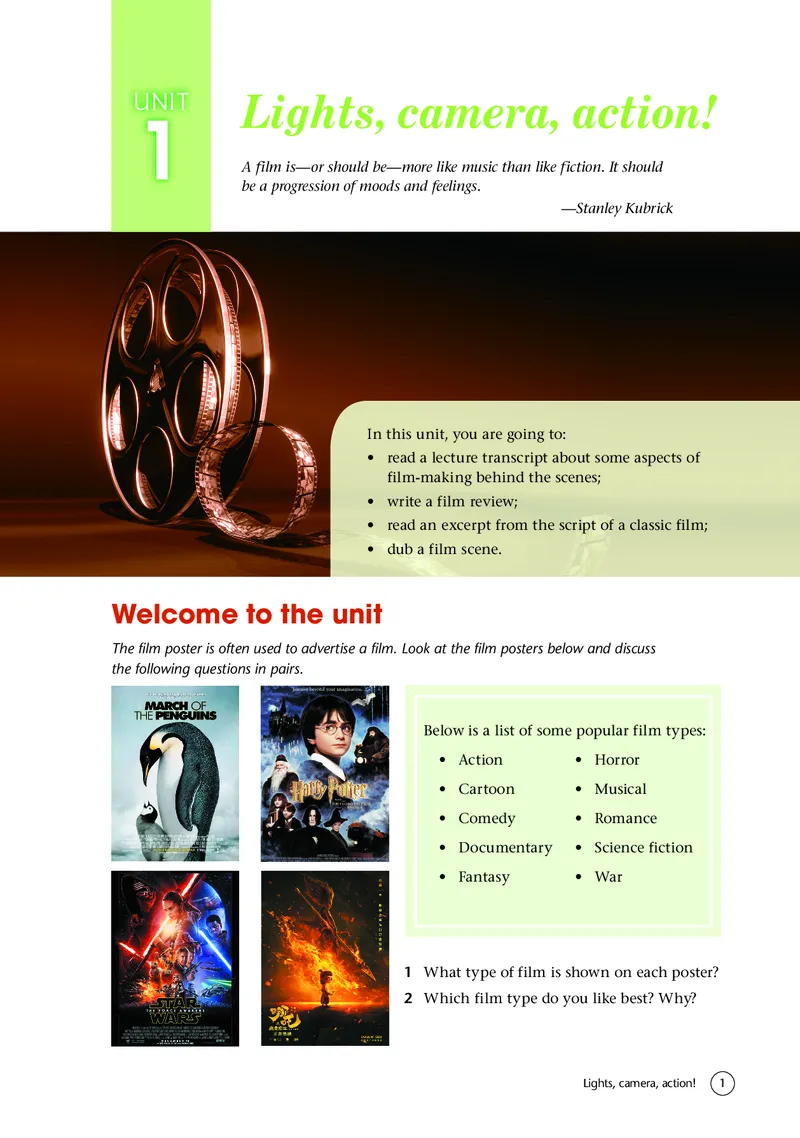
The film poster is often used to advertise a film. Look at the film posters below and discuss
the following questions in pairs.
Below is a list of some popular film types:
• Action • Horror
• Cartoon • Musical
• Comedy • Romance
• Documentary • Science fiction
• Fantasy • War
1 What type of film is shown on each poster?
2 Which film type do you like best? Why?
Lights, camera, action! 1Reading
Many different elements go into making a film. The lecture below was given by a film critic
at the school Film Festival. Before you read the lecture transcript, think about the following
questions:
• What elements of a film can you think of?
• Which element do you think is the most important in making a successful film?
Hello, everyone! Let me start by asking you a question: what’s the first thing you
notice about a film? The acting? The music? Maybe the amazing sets? Whatever
your answer is, there’s always a lot more to it than first meets the eye. Actually,
the film you see on the screen is the product of a huge amount of hard work, most
5 of which takes place behind the scenes. Today, I’ll give you a brief introduction to
some aspects of film-making you might not be familiar with.
To begin with, I’d like to draw your attention to an important factor of a film—
sound effects. These are often added after a scene has been shot and might not
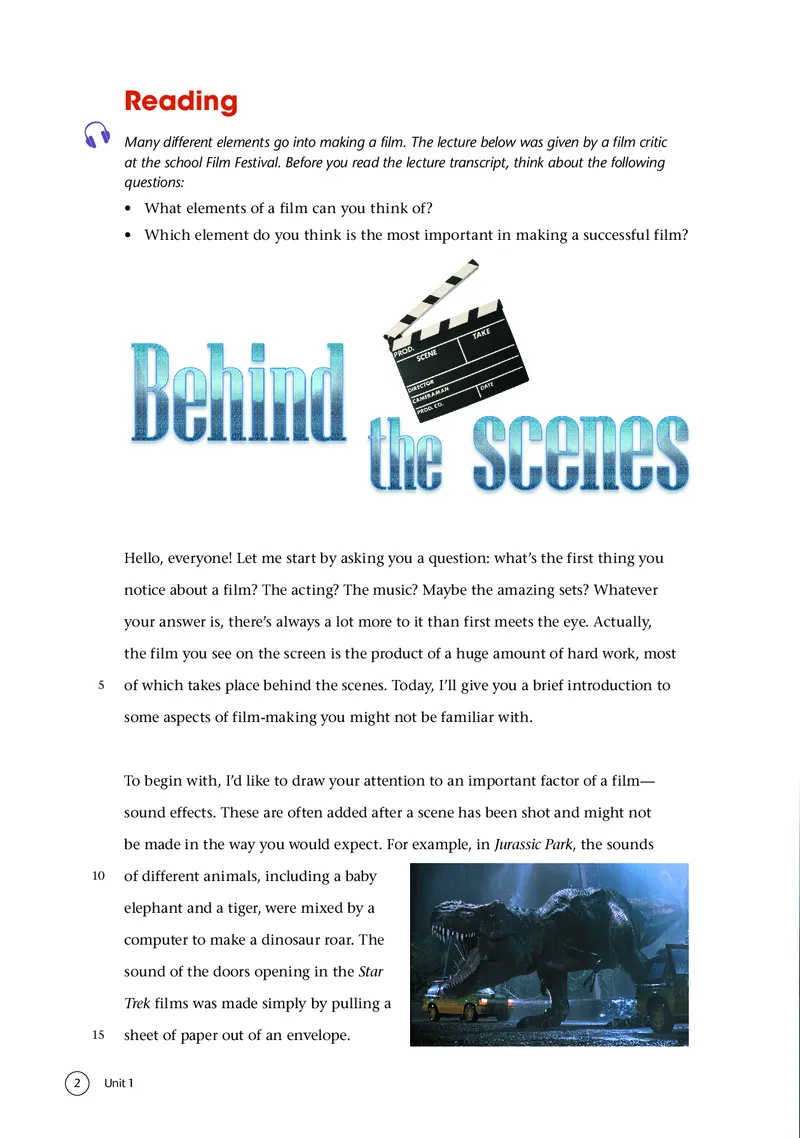
be made in the way you would expect. For example, in Jurassic Park, the sounds
10 of different animals, including a baby
elephant and a tiger, were mixed by a
computer to make a dinosaur roar. The
sound of the doors opening in the Star
Trek films was made simply by pulling a
15 sheet of paper out of an envelope.
2 Unit 1Another aspect I attach great importance to is visual special effects. CGI has been
frequently used in film-making as a special effects technology. Generally, scenes
requiring CGI are filmed in front of a green screen in the studio. As green doesn’t
match any natural hair or skin colour, actors can be easily separated from the
20 background. This enables CGI effects to be added later. The Quidditch scenes in the
Harry Potter films were made in this way with the actors jumping up and down in
front of a green screen. However, the aid of computers isn’t always preferred. Peter
Jackson, director of The Lord of the Rings films, took a creative approach—he used
clever camera angles to make characters seem bigger or smaller than they really were.
25 Props also contribute to a film’s success. To make a film look real, great effort must
sometimes be made to research, find and build objects. Director James Cameron
spent six months looking at and revising plans of the Titanic in order to build a
full-sized model for his 1997 film. He talked to historians to ensure that the details
were correct and even went down to the bottom of the Atlantic Ocean to see what
30 was left of the ship for himself. It took 500 workers 100 days to build the fine
model, not to mention the thousands of props inside.
My lecture today may not be able to do justice to all the work people have done
behind the scenes. Just as the poor passengers on the real Titanic saw the tip of the
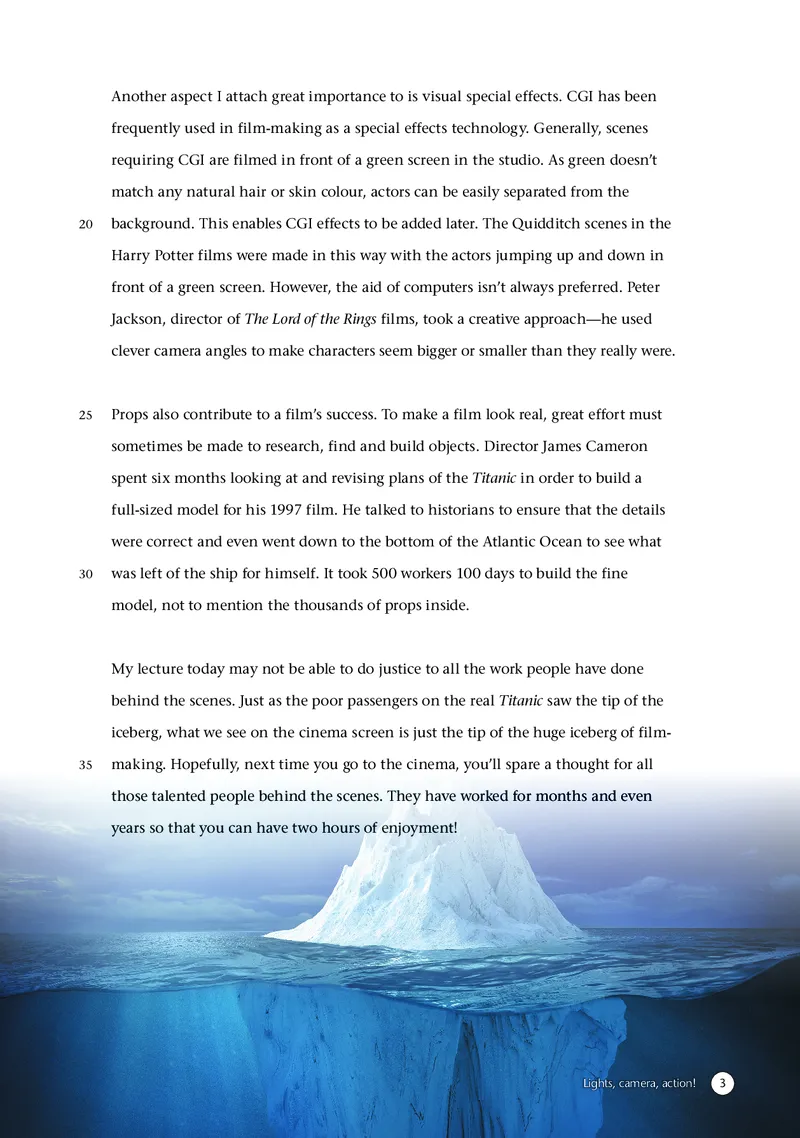
iceberg, what we see on the cinema screen is just the tip of the huge iceberg of film-
35 making. Hopefully, next time you go to the cinema, you’ll spare a thought for all
those talented people behind the scenes. They have worked for months and even
years so that you can have two hours of enjoyment!
Lights, camera, action! 3A Understanding the text
A1 Read the lecture transcript and complete the chart below with the main idea of each
paragraph.
Introduction (Para. 1): Some aspects of film-making behind the scenes require a
lot of hard work.
Aspect 1 (Para. 2): (1) ___________________________________________
___________________________________________
Aspect 2 (Para. 3): (2) ___________________________________________
Main body:
___________________________________________
Aspect 3 (Para. 4): (3) ___________________________________________
___________________________________________
Conclusion (Para. 5): (4) _________________________________________________________
A2 Read the lecture transcript again carefully and complete the table below.
Main points Examples
Many sound effects might not be made (1) __________________________________
in the way you would expect. __________________________________
The Quidditch scenes in the Harry
(2) __________________________________
Potter films were made with the actors
__________________________________
jumping in front of a green screen.
The aid of computers isn’t always (3) __________________________________
preferred. __________________________________
(4) __________________________________
Props contribute to a film’s success.
__________________________________
A3 In pairs, discuss the following questions.
1 Why do you think the film critic asks a question at the beginning of his lecture?
2 What conclusion can you draw from the lecture?
3 Do you support the use of CGI in films? Why or why not?
4 Unit 1B Building your language
B1 Simon is talking about his favourite film at the school Film Festival. Complete what he
says with the correct forms of the words and phrase in the box below.
prefer factor aid actually
enable approach frequently be familiar with
To the (1) _________________ asked question, “What’s your favourite film?”, my answer
is Crouching Tiger, Hidden Dragon. It has won many awards, including an Academy
Award for Best Foreign Language Film. It has also (2) _________________ Western
audiences to have a better understanding of Chinese culture.
You must (3) _________________ the exciting fighting scene on top of a bamboo forest
in Crouching Tiger, Hidden Dragon. With the (4) _________________ of the computer,
scenes like this could have been made in the studio. However, the film’s director,
Ang Lee, (5) _________________ to have actors perform on location. He believed this
(6) _________________ to film-making would create a “human connection” which
could not be achieved with CGI special effects.
In addition to the amazing martial arts, the film also took advantage of China’s
beautiful mountains, forests and deserts. (7) _________________, it was shot in
different locations all around the country. All these (8) _________________ contributed
to the film’s success.
B2 There are a lot of people working in the film industry. Fill in the flow chart below with
different film-related jobs from the box. Then add more film-related jobs to the flow chart.
actor cameraman costume designer director
film critic make-up artist production designer set designer
sound engineer special effects engineer stuntman voice actor
Tip
Learning topic-
Preparation Shooting Post-production Release
related words
Learning vocabulary
by topic helps you
scriptwriter lighting engineer film cutter distributor see the connection
between words and
phrases. This enables
you to remember
them more
effectively. You can
producer
create different lists
of words according to
different topics.
B3 The film critic uses a metaphor in his lecture to describe the fact that a lot of work is
done behind the scenes in film-making. Find the metaphor in the lecture and write a
metaphor of your own to describe the film-making process.
Learn this A metaphor compares one thing to another without using “as” or “like”.
It draws the reader’s attention to the similarities between two things. This way,
unfamiliar things can be explained with something people are more familiar with.
Lights, camera, action! 5Grammar and usage
Subject-verb agreement
A Exploring the rules
Below is an introduction Laura gave to her class about The Jungle Book. Pay attention to the
underlined subjects and verbs and fill in the table below. The first two have been done for you.
Everyone was surprised when Disney said its film team members were remaking The
Jungle Book. Based on Rudyard Kipling’s book of the same title, it describes the story
of a boy named Mowgli. Mowgli and his animal friends live happily in the jungle
until one day Shere Khan the tiger returns and tries to drive him out of the jungle.
In 1967, Disney adapted the book into a cartoon film, which is widely regarded
as a classic. However, its old age shows. The new film uses much more advanced
technology—not only the animals but also the jungle is digitally created. Building
the jungle environment on the computer was no easy job. It took more than 800
artists over a year to work on the project. The Jungle Book lasts for about two hours
but there is enough tension and humour to hold your attention during the whole
film. Two hours seems very short when you’re having so much fun!
Subject + Singular verb Subject + Plural verb
Everyone was its film team members were
Working out the rules
• Subject-verb agreement means choosing the correct singular or plural verb
according to the (1) _________________.
• The verb should be singular if the subject is (2) _________________; the verb should
be plural if the subject is (3) _________________.
*You can choose more than one answer for each blank.
a a singular noun f a phrase of two or more words linked by and,
b a plural noun referring to two or more objects or people
c an uncountable noun g a pronoun like everyone
d a book/film title h a phrase of measurement like two hours
e a verb-ing form
• When not only … but also … is used as the subject of a sentence, or there be is
followed by two or more nouns as the subject of a sentence, the verb agrees with
the noun closest to it.
Grammar notes pages 97–98
6 Unit 1B Applying the rules
B1 Circle the correct words to complete the following sentences.
1 Is/Are five million dollars enough to make a good film?
2 I think Mowgli and Shere Khan is/are the most interesting characters in The
Jungle Book.
3 Drinking cola often makes/make the cinema experience more enjoyable.
4 There is/are one tree and three children on the film poster.
5 Fantastic Beasts and Where to Find Them was/were directed by David Yates.
6 If anyone is/are interested in the film, please let me know.
B2 After the talk, Laura chatted with Simon. Complete the conversation with the correct
forms of the verbs in the box below. Some verbs can be used more than once.
be look make require
Simon: The Jungle Book sounds great. But what (1) _________________ the new film so
much better than the original?
Laura: The picture quality, as well as the special effects, (2) _________________ far
better. Not only the animals but also the forest (3) _________________ so real!
While you watch, you feel like reaching out your hand to touch the leaves.
Simon: Sounds super! Believe it or not, there (4) _________________ only one real
human character in the film.
Laura: That’s Mowgli, played by a child actor named Neel Sethi. The rest
(5) _________________ all digitally created.
Simon: Does that mean he had to act alone?
Laura: Yes. When he acted alone in front of a green screen, a lot of imagination
(6) _________________. There was another problem: the digitally created
animals had no shadows, but the film team (7) _________________ able to
find a solution.
Simon: How was the problem solved?
Laura: Light and shadows (8) _________________ thrown onto Mowgli with the aid
of a system they developed, showing that animals were moving near him.
Simon: That’s really interesting and creative!
B3 Write a short paragraph about 3-D films. Use the following information to help you. Pay
attention to subject-verb agreement.
3-D films
History Were first made in 1915
Advantage Make things look like they are coming out of the screen
• Sometimes cause headaches and sickness for viewers
Disadvantages
• Need a special cinema and 3-D glasses
Examples Avatar, Life of Pi, Titanic (changed to a 3-D film after filming)
Lights, camera, action! 7Integrated skills
Reviewing a film
A At the school Film Festival, Miss Li, the organizer, is talking about how to write a film
review. Listen and finish the exercises below.
A1 Listen to Miss Li’s introduction and complete the chart below.
Film review
Whether you
(1) ______________ Information about (3) ______________
about the film (2) ______________ of the film recommend the
film or not
A2 Listen to Miss Li’s introduction again and complete the notes below.
Writing a film review
Dos
• Give the name of the film, the director’s name and the
names of (1) _________________.
• Give information about when and where the film is set and
what happens in the film.
• Include details about the acting, characters, music or
(2) _________________.
• Use lots of interesting adjectives.
• Describe (3) _________________ that you think might enjoy
the film.
Don’ts
• Don’t say what happens (4) _________________ of the film.
• Don’t make the reader (5) _________________ what you think.
• Don’t give your opinion without (6) _________________.
8 Unit 1B Read the film review of The King’s Speech below and try to understand its structure.
The King’s Speech
The King’s Speech is a 2010 British film directed
by Tom Hooper. The film stars Colin Firth as
King George VI, Geoffrey Rush as Lionel Logue
and Helena Bonham Carter as Queen Elizabeth.
At the 83rd Academy Awards (the Oscars), the
film won Best Picture and Colin Firth won Best
Actor in a Leading Role.
Based on a true story, the film is set in London in the 1930s. Prince Albert,
second son of King George V, suffers from a terrible speech problem. The
Prince has given up hope of a cure but his wife, Elizabeth, takes him to
see Lionel Logue, an Australian speech doctor living in London. Although
the two men have very different backgrounds and do not get along at first,
they eventually become friends. After the Prince’s elder brother gives up
being King, Prince Albert becomes King George VI.
The film looks like a fairly typical historical film without fancy special
effects, and it is made enjoyable by the performances of the main actors.
Firth is successful in showing us the King’s struggles as well as his courage.
He has great chemistry with Rush and Bonham Carter, whose characters
are both very believable. In the meantime, Hooper skilfully creates
uncertainty and tension with narrow indoor sets and dark lighting.
All in all, I highly recommend this film. If you enjoy true stories or films
about history, you will love The King’s Speech.
Lights, camera, action! 9C In pairs, discuss the film you are going to review. Use the following questions and
expressions to help you.
• What type of film is it?
• Who are the director and the main actors?
• When and where is the film set?
• What is the storyline of the film?
• What is your opinion of the film? (Consider the storyline, acting, characters,
music and special effects.)
• Who do you think would like the film?
Expressions
Talking about feelings
I felt inspired/excited/frightened after I couldn’t stand …
watching … I was especially pleased with …
I was really confused about the plot of … I wasn’t happy about …
I was absolutely fed up with the special … appealed to me/didn’t appeal to me
effects of … because …
D Write a film review. Use your ideas from part C and the information in parts A and B to
help you.
Planning your writing
• Learning about the text type
A film review is a report that expresses an opinion about a film. The purpose of
a film review is to give information to the potential audience so that they can
decide whether or not they want to watch the film.
• Learning about the structure
When writing a film review, you can follow the structure below:
Start by giving basic information about the film.
Provide information about the storyline.
Give your opinion of the film.
State clearly whether you recommend the film or not.
• Learning about the language
Use adjectives, either positive or negative, to make your description more vivid
and interesting, e.g. amazing/terrible, exciting/boring, original/unoriginal.
Checking your writing
Remember to check your writing after you finish and exchange drafts between you
and your partner. Pay attention to the following aspects:
Punctuation Spelling Grammar
Choice of words Style (formal/informal) Structure
Self-review Peer review
• Does your film review contain all the • What does your partner think of the
necessary parts? Is your opinion of the information and the opinion you give?
film supported by enough evidence? • How can you improve your writing?
• How can you improve your writing?
10 Unit 1Extended reading
Read the introduction to the film Forrest Gump and the excerpt from its script.
Forrest Gump
(Excerpt)
Forrest Gump is a 1994 film starring Tom Hanks. It tells the story of Forrest
Gump, a simple man with a warm personality. Despite an IQ of 75, he lives a
truly amazing life. He sees, and sometimes influences, some of the major events
of the United States in the second half of the 20th century.
5 Mrs Gump and Forrest wait for the school bus. The bus pulls up as Mrs Gump prepares
Forrest for his first day of school.
MRS GUMP: You do your very best now, Forrest.
FORREST: I sure will, Momma.
FORREST (Voice-overa): I remember the bus ride on the first day of school very
10 well.
The bus driver opens the door and looks down. Forrest walks to the steps of the bus and
looks at the bus driver.
BUS DRIVER: Are you coming along?
FORREST: Momma said not to be taking rides from strangers.
15 BUS DRIVER: This is the bus to school.
FORREST: I’m Forrest. Forrest Gump.
BUS DRIVER: I’m Dorothy Harris.
FORREST: Well, now we aren’t strangers anymore.
The bus driver smiles as Forrest steps up into the bus.
20 Mrs Gump waves to Forrest as the bus drives away. Forrest
begins to walk down the bus.
Two young boys look up from the seat.
BOY 1: This seat’s taken.
BOY 2: It’s taken!
25 Forrest looks around. A larger girl moves over so Forrest
can’t sit next to her. She shakes her head. Forrest looks to
the other side where a boy sits alone on a larger seat. The
boy looks angrily at Forrest.
a Voice-over: Voice-over refers to the lines in a film that are spoken by a person not seen on the screen. In this
scene the grown-up Forrest is remembering a story from his childhood.
Lights, camera, action! 11BOY 3: You can’t sit here.
30 FORREST (Voice-over): You know, it’s funny what a young man recollects.
Because I don’t remember being born. I, I … don’t recall
what I got for my first Christmas and I don’t know when
I went on my first outdoor picnic. But, I do remember the
first time I heard the sweetest voice in the wide world.
35 GIRL: You can sit here if you want.
Forrest looks back at Jenny Curran, a young girl about Forrest’s age.
FORREST (Voice-over): I had never seen anything so beautiful in my life. She
was like an angel.
JENNY: Well, are you going to sit down, or aren’t you?
40 Forrest sits down next to Jenny.
JENNY: What’s wrong with your legs?
FORREST: Um, nothing at all, thank you. My legs are just fine and
dandy.
FORREST (Voice-over): I just sat next to her on that bus and had a conversation
45 all the way to school.
JENNY: Then why do you have those shoes on?
FORREST: My momma said my back’s crooked like a question mark.
These are going to make me as straight as an arrow.
They’re my magic shoes.
50 FORREST (Voice-over): And next to Momma, no one ever talked to me or asked
me questions.
JENNY: Are you stupid or something?
FORREST: Momma says stupid is as stupid does.
Jenny puts her hand out toward Forrest. Forrest reaches over and shakes her hand.
55 JENNY: I’m Jenny.
FORREST: I’m Forrest. Forrest Gump.
FORREST (Voice-over): From that day on, we was always together. Jenny and me
was like peas and carrots.
A In pairs, find information about each of the following aspects of the film excerpt and
complete the table.
Setting
Characters
(relationships between them,
their personalities, etc.)
Plot
B What are your favourite lines from films? Explain why you like them.
12 Unit 1Project
Dubbing a film scene
A As a class, discuss some film scenes that you like. Use the ideas below to help you. Then in
groups, choose a film scene you are going to dub.
Are there enough characters in the Are the words clear to understand?
scene for everyone in your group?
Try not to choose a scene where
It does not matter if there are more characters are talking too quickly
characters than group members: or using language that is too
one person can play more than difficult.
one character.
Do the characters speak more or How long does the scene last?
less the same amount?
A scene that lasts two or three
Try not to choose a scene where minutes is preferred.
one person will have to do most of
the speaking.
B As a group, practise dubbing the chosen film
Tip
scene together.
Voice acting
• Speak clearly and try to stay in time with the
character speaking in the film.
• Use your body language to get into character
and help the feelings come naturally. Even
though only your voice will be heard, you
need to act with your whole body.
C As a group, present your dubbing to the rest of the class.
You can present your dubbing in different ways:
• Record both your dubbing and the film scene, and present the video in class.
• Record your dubbing and present the audio in class.
• Perform your dubbing in class, without recording in advance.
Lights, camera, action! 13Assessment
A In pairs, rank your performance level in the following areas from 1 to 5. Write down your
own assessment in the column “Me” and ask your partner to write down his/her assessment
of your performance in the column “Partner”.
How well can you: Me Partner
5 = Excellent
understand the lecture transcript about the
4 = Good
behind-the-scenes aspects of film-making?
3 = Satisfactory
2 = Fair write a film review?
1 = Improvement
understand the excerpt from the film script
required
of Forrest Gump?
dub a film scene?
use the new vocabulary from this unit and
learn topic-related words? *
identify and use subject-verb agreement? *
* Assess your learning of vocabulary and grammar by doing language practice on
pages 57–58.
B If improvement is required for some of the areas above, make an action plan.
_______________________________________________________________________________
_______________________________________________________________________________
Further study
The Jungle Book (2016) is an adventure film about an orphan boy
who grows up with his animal friends. They teach him many life
lessons to help him survive the dangers in their world. Besides
its interesting story, the film is known for its amazing lifelike
computer animation effects. Watch it to meet the brave young
boy and experience a make-believe world that feels very real.
The Academy Awards, more popularly known as the Oscars, are
a set of awards for artistic and technical excellence in the film
industry. Visit the official website of the Academy Awards to learn
about the history and see the list of past winners.
14 Unit 1UNIT Be sporty, be healthy
2
A sound mind starts from a sound body. How can a weak body
develop a sound mind?
—Cai Yuanpei
In this unit, you are going to:
• read a beginner’s guide to exercise;
• write an email to encourage your friend to work
out regularly;
• read a magazine article about a Chinese high
school student’s tai chi experience;
• do a survey on students’ exercise habits.
Welcome to the unit
Sport is fun in different ways. Read the jokes below about different sports and discuss the
following questions in pairs.
Q: What do soccer players and Q: What is the hardest part
magicians have in common? about skydiving?
A: Both do hat-tricks! A: The ground!
Q: What animal is best at
hitting baseballs?
A: A bat!
Q: Why can’t Cinderella play soccer? Q: How do basketball players
A: Because she’s always running stay cool during the game?
away from the ball. A: They stand close to the fans.
1 What do you think is funny about these jokes?
2 What is your favourite sport? Why do you like it?
Be sporty, be healthy 15Reading
Many people are interested in getting into shape but are uncertain about how to start. The
guide below gives information on exercise for beginners. Before you read the guide, think
about the following questions:
Tip
• What might prevent people from starting
exercise? Predicting the main idea of a text
Before reading a text, take a brief look at the title,
• What kind of information do you think
subheadings or pictures in it. Then try to guess
this guide will give? what important information the text is going to
give. By making predictions, you connect the text
you are going to read with your background
knowledge and become a more active reader.
You want to start doing exercise? Congratulations! You have just taken your first
step towards a new and improved you!
Understanding the benefits of exercise
Most people assume that regular exercise does wonders for the body and mind—
5 but what exactly are its health benefits? To start with, physical activity increases
the efficiency of your heart and lungs. During exercise, your heart and lungs must
work harder. This extra effort makes them grow stronger over the long term. It has
also been proven that active people tend to have better immune systems and are at
lower risk of diseases. Moreover, exercise is good for your mental health. Working
10 out can help you reduce stress and get over negative feelings. Some studies even
show that exercise improves certain brain functions, meaning you could actually
exercise your way to better performance at school!
16 Unit 2Planning your exercise routine
When you plan an exercise routine, the first thing to consider is
15 what you expect to improve: heart and lung efficiency, muscle
strength or flexibility. Aerobic activities, like jogging, swimming and
skiing, develop your heart and lungs. Strength training, such as
pull-ups and weightlifting, increases muscle strength and encourages
bone development. Flexibility training, including gymnastics and
20 tai chi, helps stretch your muscles and improve your body’s range
of movement. These types of exercise all play a role in a healthy
routine. Above all, choose activities you enjoy because, in this way,
you’re more likely to stick with them.
Eating and drinking right
25 Like cars that run on petrol, your body burns carbohydrates for
energy. Foods like noodles, rice, fruit and vegetables give your
body plenty of carbohydrates to keep up your energy during a long
workout. To help your muscles recover and repair themselves after
exercise, you need to eat foods rich in protein, such as fish, eggs and
30 milk products. When to eat is also of great importance. In general,
you should have your meal an average of 1.5 to 2.5 hours before
exercising. Do not eat immediately after exercise; instead, wait at
least 30 minutes after a typical routine, or as much as an hour after
a hard workout. Remember to drink throughout exercise to make up
35 for water lost to sweat.
Avoiding injury
To prevent soft tissue injury, make sure that you wear proper clothes
and equipment when exercising. You should also start small and
slowly work your way to a longer and harder exercise routine to
avoid getting hurt. Finally, remember to warm up before exercising
40
and stretch at the end of your workout.
So, now you know the benefits of exercise and how to do it safely
and effectively. What are you waiting for?
Be sporty, be healthy 17A Understanding the text
A1 The guide can be divided into four parts. Read the guide and complete the chart below
with the main idea of each part.
Understanding Eating and
the benefits of exercise drinking right
• Physical benefits • What to eat
• (1) _________________ • (3) _________________
• Drinking water
Planning your Avoiding
exercise routine injury
• (2) _________________ • (4) _________________
• What types of exercise you enjoy • Starting small
• (5) _________________
A2 Read the guide again carefully and answer the following questions.
1 Why is regular exercise good for the heart and lungs?
_______________________________________________________________________________________
2 How does flexibility training help you?
_______________________________________________________________________________________
3 Why do you need to eat foods rich in protein?
_______________________________________________________________________________________
4 How long should you wait after exercise to have your meal?
_______________________________________________________________________________________
A3 In pairs, discuss the following questions.
1 What are the purposes of this guide? What techniques does the guide use for
these purposes? Support your answer with examples from the guide.
2 Do you agree with the guide that exercise can help you get over negative
feelings? Back up your opinion with examples from your experience.
3 What other information do you think could be included in the guide?
18 Unit 2B Building your language
B1 The passage below deals with a common false idea about exercise. Complete the passage
with the correct forms of the words and phrases in the box below.
moreover assume average over the long term
jogging prevent tend to make up for
Exercise has a range of health benefits. However, some people (1) _________________
that if some exercise is good, more is always better, so they (2) _________________
exercise for a long time without stopping. For example, some people go
(3) _________________ for several hours at a time because of the step-counting
smartphone apps. Others work out for hours at the weekend (4) _________________
their lack of exercise during the weekdays. Habits like these put stress on the body,
and if they are maintained (5) _________________, can become a serious health risk.
Generally speaking, aerobic routines that last over 100 minutes have a certain
health risk. On the other hand, they should not be shorter than 10 minutes. If you
do exercise for only a few minutes, you may not be working out long enough to
see any benefits from it. When you exercise, aim for the daily (6) _________________
of 30 to 60 minutes. This will (7) _________________ you from getting hurt.
(8) _________________, it will ensure that the exercise you do has a positive effect on
your physical health.
B2 “Exercise” and “health” appear in the guide as part of different collocations. Read the
examples below and add more collocations.
adj. + exercise
regular exercise
v. + exercise
exercise do exercise
exercise + n.
an exercise routine
adj. + health
mental health
v. + health
health improve health
health + n.
health benefits
B3 The guide uses cautious language to describe something that may not be true in every
case. Find the sentences using cautious language in the guide and revise the sentences below
using cautious language.
Learn this Cautious language is used to avoid overgeneralizing. Pay attention to
the following words and phrases:
Modal verbs: can, could, may, might, should, would
Verbs and verb phrases: appear, look like, seem, tend to
Adverbs and adverbial phrases: probably, usually, sometimes, mainly, in general
Adjectives: likely, possible, probable, unlikely
People do not like getting up early for morning exercise in cold weather. They
want to get as much sleep as they can. However, truly healthy people get their
workout done anyway. They know they will feel great afterwards.
Be sporty, be healthy 19Grammar and usage
Passive voice in the present continuous and present perfect tenses
A Exploring the rules
Frances is reading a leaflet about a sports centre. Find the sentences in the leaflet that use the
passive voice in the present continuous and present perfect tenses and fill in the table below.
The first two have been done for you.
Are you ready to get fit? We are happy to announce that the Community Sports
Centre will soon be open to the public once again! Our facilities have been
enlarged and redone, and our centre is now bigger and better than ever before. The
finishing touches are now being put to a new swimming pool and our workout
rooms have been updated with modern equipment. Come by and check them out!
There are a lot of fitness courses for you to choose from. In response to public
interest, our aerobics class has been replaced with several fun options, including
modern dance. You can find more details about all our courses on our website.
Better still, we will update our fitness courses every few months so that more
popular courses can be included. Weight training classes, for example, are being
designed and will be added to our programme soon. We will invite professional
athletes to be our coaches. We are confident that we have something for everyone.
We look forward to seeing you here!
The finishing touches are now being put to a new swimming pool ...
Passive voice
in the present
continuous
tense
Our facilities have been enlarged and redone ...
Passive voice
in the present
perfect tense
Working out the rules
• We use the passive voice in the present continuous tense to talk
about something that is being done right now. The verb form is
“(1) _________________”.
• We use the passive voice in the present perfect tense to talk about
something that has been done. The verb form is “(2) _________________”.
Grammar notes page 98
20 Unit 2B Applying the rules
B1 Rewrite the following sentences using the passive voice.
1 The city government is building a new community sports centre.
_______________________________________________________________________________________
2 Some workers are painting the walls in the workout rooms.
_______________________________________________________________________________________
3 People have told me the new workout rooms are very modern.
_______________________________________________________________________________________
4 Jenny’s PE teacher has asked her to make an exercise plan.
_______________________________________________________________________________________
5 The teachers are testing students on their knowledge of fitness.
_______________________________________________________________________________________
B2 Frances has written a review of the sports centre. Complete the review with the correct
forms of the verbs in the brackets.
I visited the new and improved Community Sports Centre. It looks amazing! It is
not open to the public yet, but preparations (1) _________________ (make) presently
for the reopening.
Lots of new and modern facilities (2) _________________ (put) in place. Some of the
exercise machines (3) _________________ (test) by a group of energetic young people
now. A whole new range of courses (4) _________________ (design) for people of all
ages, including tai chi and boxing! I tried out the boxing class and I loved it! The
coach, who was a boxing champion, was patient and professional. At the end of the
one-hour class, I was sweating all over but felt relaxed.
Despite all these improvements, I have also found something that still needs to
be done: so far no basketball court (5) _________________ (build). I love playing
basketball and I hope a basketball court will be built in the near future. I am sure it
will make the sports centre more popular.
B3 A school news reporter is interviewing Mr Lin, a PE teacher, about the preparations for
the school sports meeting. In pairs, use the checklist below to role-play the interview.
Reporter: Mr Lin, thank you for agreeing to this interview. May I ask what has
been prepared for the sports meeting?
Mr Lin: Well, the date of the sports meeting has been decided: 14 May.
…
Reporter: Thank you for your time, Mr Lin. I hope the school sports meeting will
be a great success!
Checklist
Date ______√______ Rules ____________
Location ______√______ Equipment ____________
Events ____________
Note: A tick “√” means that the work has been completed.
Be sporty, be healthy 21Integrated skills
Encouraging a friend to work out regularly
A Leo is talking to Dr Chen about some problems with his health. Watch the video and finish
the exercises below.
A1 Watch the video and tick the problems Leo mentions in the boxes below.
a Always gets a cold
b Has a bad memory
c Has sleep problems
d Is overweight
e Cannot concentrate at school
f Feels tired at night
A2 Watch the video again and complete the table below.
Tip
Dr Chen’s suggestions Benefits Listening for
suggestions
When making
Try a (1) _______________________ It will help your body suggestions, speakers
often use expressions
diet. (2) _______________________. like why not try …, it
would be good to … and
it’ll be even better if you
can … Pay attention to
these expressions and
listen for the suggestions
that follow.
Be more active. Do some • It will strengthen your immune system
aerobic exercise such as so you can (4) _______________________.
(3) _______________________ twice • It will (5) _______________________,
a week.
making you feel tired and sleep better
at night.
• It will help (6) _______________________,
which may help you concentrate.
22 Unit 2B After his conversation with Dr Chen, Leo wrote an email to his friend Rachel. Read
the email below and make a list of the reasons why Leo is unwilling to begin working out
regularly.
Hi Rachel,
Hope you’re doing well. I’ve been feeling a bit under the weather recently:
generally tired and not myself. Today I went to see the doctor. She offered
me some advice on my diet. She also said I needed to do more exercise.
I know that I’ll have a better immune system and higher energy levels if I
exercise. To be honest though, I don’t know how to make exercise a regular
part of my life. You know, it’s really difficult to fit exercise into my busy
schedule. I have so much schoolwork. Plus I take part in a lot of after-school
activities. During the weekend, I often hang out with my friends. I simply
have no time for exercise!
It isn’t just about the time, though. I’m also concerned about money. I
just can’t afford to sign up for classes in the nearby gym. I do want to try
swimming but the swimming classes are so expensive. So you see, I don’t
think I’d be able to work out in the gym.
Last but not least, I think it’s hard for me to stick with an exercise routine.
How boring it is to exercise alone! Imagine jogging along the same path
every morning, repeating the same movement day after day and having no
one to talk to! I’m pretty sure I would soon give up without a partner.
What would you do in my position? Look forward to hearing from you soon.
Best wishes,
Leo
Reasons why Leo is unwilling to take up exercise:
1 _____________________________________________________________________________
2 _____________________________________________________________________________
3 _____________________________________________________________________________
Be sporty, be healthy 23C In pairs, role-play a conversation between Rachel and Tip
Leo about how Leo can make exercise a regular part of his
Starting a discussion
life. Use the following ideas to help you.
To start a discussion, you can:
• state the purpose directly, e.g.
I have this idea/problem to discuss with you.
• Exercise can be fitted into one’s schedule.
I’d like to discuss something/my problem/
• Exercise does not necessarily require money. my situation with you.
• invite your partner to give his/her opinion
• Exercise can be done with one’s family or friends. by asking questions. Try to ask open-
ended questions rather than yes-no
questions, e.g.
What do you think of …?
How do you feel about …?
D Help Rachel write a reply to Leo to encourage him to work out regularly. Use your ideas
from part C and the information in parts A and B to help you.
Planning your writing
• Learning about the structure
When writing an email of encouragement, you can follow the structure below:
Start by showing your understanding of the situation.
Give suggestions with reasons.
End the email by offering encouragement.
• Learning about writing techniques
Read the instructions carefully to fully understand the topic and brainstorm
ideas.
Use diagrams, such as a mind map or a flow chart, to organize your ideas. You
can also make a list of the points you want to cover.
• Learning about the language
Consider the purpose of your writing and your reader, which determine your
language style, formal or informal. An email to encourage a friend is usually
informal.
Show your understanding with expressions such as “I’m sorry to hear that …”
and end your email with “I hope you’ll find these suggestions helpful and I’m
sure you’ll …”.
Checking your writing
Remember to check your writing after you finish and exchange drafts between you
and your partner. Pay attention to the following aspects:
Punctuation Spelling Grammar
Choice of words Style (formal/informal) Structure
Self-review Peer review
• Are the reasons you give convincing? • What does your partner think of the
Do you use proper language to express suggestions and reasons you give?
understanding and encouragement? • How can you improve your writing?
• How can you improve your writing?
24 Unit 2Extended reading
Read the sports magazine article about a Chinese high school student’s experience of
practising tai chi.
Fi
nding a balance:
my
tai chi experience
When my friend first suggested that we join the new Tai Chi Club at school,
I hesitated. I always believed tai chi was for old people. After the first class, however,
I had to admit that I had been wrong about tai chi. It was amazing! One year later,
I can honestly say it has had a huge effect on me physically and mentally. Just
5 as importantly, practising tai chi has inspired me to explore the Chinese culture
behind it.
The first few tai chi classes were fun and easy, and the moves really caught my
imagination, with descriptive names like “white crane spreading its wings”
and “golden rooster standing on one leg”. When I asked my coach where these
10 interesting names came from, he told me about the history of tai chi. Zhang
Sanfeng, a 13th-century Taoist, was said to have invented tai chi after drawing
inspiration from a fight between a snake and a bird. However, nowadays people
tend to believe that Chen Wangting, a 17th-century master of Chinese martial
arts, developed tai chi based on martial arts skills. No wonder some tai chi moves
15 are named after animals—Chinese martial arts have a long-standing practice of
imitating animals. Chen Wangting’s original set of moves is called Chen-style tai
chi, but other styles of tai chi have since been developed, including Yang-style,
Wu-style and Sun-style.
Be sporty, be healthy 25After learning the basics of tai chi in those first few
20 classes, I found myself bored and aching from doing the
same moves over and over again. Luckily, my coach
taught me how to relax my muscles and focus on
peace of mind while performing the routine. With
these requirements of tai chi in mind, I found to my
25 satisfaction that my balance and flexibility slowly
improved, that I was able to do more difficult
moves, and that my love for tai chi returned
stronger than ever.
In time, I began to look into the ancient Chinese culture behind tai chi.
30 I discovered that tai chi is deeply rooted in the Chinese philosophy of yin and yang,
which are believed to form the unity of opposites. Neither can exist independent
of the other; for example, there is no shadow without light. The practice of tai
chi aims to maintain the balance of yin and yang in the body through opposite
movements: forwards and backwards, up and down, left and right, breathing in
35 and breathing out. Eventually, tai chi brings about a state of physical balance and
mental peace.
A year of practising tai chi has had a positive effect on my everyday life. I sleep
better at night, and I am more energetic during the day. I feel happier and more
confident. Tai chi has taught me to relax my mind, enabling me to stay cool in
40 stressful situations. I am sure I will continue to practise tai chi and enjoy the
benefits it has brought me.
A What was the author’s tai chi experience like? Write about it in your own words using the
information from the article.
B Do you think tai chi will get more popular among teenagers? Why or why not?
26 Unit 2Project
Doing a survey on students’ exercise habits
A As a class, discuss what to ask on your questionnaire about the exercise habits of the
students in your school. Use the ideas below to help you and think of more ideas for your
questionnaire.
• How often do you exercise?
• How long do you exercise?
• What type of exercise do you do?
• Where do you exercise?
B As a group, design your questionnaire and Tip
use it to survey the exercise habits of the students
Designing a questionnaire
in your school.
Think carefully about what you want to find out from
the survey and design your questionnaire accordingly.
Moreover, use a mixture of closed-ended questions and
open-ended questions. Last but not least, keep your
questionnaire short and easy to understand.
C As a group, write a report about the survey data you have gathered and make suggestions
on how students can improve their exercise habits. Use the example below, which is part of a
report, to help you. Then present your report to the rest of the class.
How often do students exercise?
4%
8% five times or more a week
24% three or four times a week
32% once or twice a week
less than once a week
never
32%
Most students need to do a lot more exercise if they wish to remain
healthy. Experts recommend exercising at least three times a week, but
only 28% of students manage that. From the diagram, we can also see that
40% of students exercise less than once a week or never exercise. It can be
seen that most students need to exercise more frequently.
Be sporty, be healthy 27Assessment
A In pairs, rank your performance level in the following areas from 1 to 5. Write down your
own assessment in the column “Me” and ask your partner to write down his/her assessment
of your performance in the column “Partner”.
How well can you: Me Partner
5 = Excellent
understand the beginner’s guide to exercise
4 = Good
and predict the main idea of a text?
3 = Satisfactory
listen for suggestions, start a discussion and
2 = Fair
write an email of encouragement?
1 = I mprovement
understand the magazine article about a
required
high school student’s tai chi experience?
design a questionnaire and do a survey on
students’ exercise habits?
use the new vocabulary from this unit? *
identify and use the passive voice in the
present continuous and present perfect
tenses? *
* Assess your learning of vocabulary and grammar by doing language practice on
pages 63–64.
B If improvement is required for some of the areas above, make an action plan.
_______________________________________________________________________________
_______________________________________________________________________________
Further study
“The Brain-changing Benefits of Exercise” is a video talk given by
brain scientist Wendy Suzuki in 2017. In this talk, she shares her
research on the effects of exercise on the human brain. Watch
her talk and find out more about the amazing changes that occur
in our brain when we exercise.
McFarland, USA is a sports drama film based on a true story. It
is about a high school cross-country running team that won an
important championship against all the odds. The coach and
team use running to overcome their hardships and to rebuild
their hopes for a better future. Watch it and experience the
power that sport has for not only building a strong body, but also
a strong mind.
28 Unit 2UNIT Festivals and customs
3
Customs tell a man who he is, where he belongs, what he must do.
—Robert A. Heinlein
In this unit, you are going to:
• read a travel journal about a traveller’s experiences in
two different countries;
• write an article to promote traditional Chinese festivals;
• read a feature article about a family dinner on the
Chinese New Year’s Eve;
• make PPT slides about a festival.
Welcome to the unit
Festivals can tell us a lot about the cultures of different countries. Watch the video and finish
the following exercises.
• Yi Peng Lantern Festival
is celebrated in Chiang
Mai, Thailand as a way to
________________.
• Midsummer’s Day is
celebrated in Sweden for
people to ________________.
• The Day of the Dead, which
lasts ________________, is a
festival in Mexico for people
to ________________.
1 What Chinese festivals are similar to each of the three festivals in the video?
2 What other festivals around the world do you know about?
Festivals and customs 29Reading
Travelling is a way to learn about other cultures. The travel journal below was written by Alex
Zhang, a travel writer. He shares his experiences of attending an Indian wedding and the Rio
Carnival. Before you read the travel journal, think about the following questions:
• How can you learn about foreign customs and traditions?
• Describe a festival you have experienced. What happened? What was it like?
e
x
around
Al
the
world
10 January, a wedding ceremony, India
When Nadim invited me to his sister’s wedding, I knew it would be the opportunity of
a lifetime. I was definitely not wrong!
The wedding ceremony took place in a brightly decorated hotel room. There were
5 hundreds of guests, all dressed up in formal, colourful clothes. According to tradition,
the bride was wearing an eye-catching red silk sari.
I did not understand all of the traditional customs, but a few made a deep impression
on me. One was the bridegroom’s entrance on a beautiful white horse. I had never seen
that back home! Another was the part when Nadim’s father proudly led his daughter
10 through the rows of seats to her husband. It reminded me of my sister’s wedding.
Although our cultures are so different, the smiling faces are the same.
The customs that followed were anything but ordinary. The couple joined hands and
walked around a small fire four times. Then they took seven steps together by the fire,
and with each step made a different promise about how they were going to support
15 each other and live together happily. It was very
romantic!
After the ceremony, it was time for the celebrations .
That is a story for another day, but let’s just say
there was a lot of dancing. Now I know I have two
20 left feet … and both of them hurt!
30 Unit 326 February, Rio Carnival, Brazil
The summer heat hit me as soon as I got off the flight. No wonder people from Rio take
a week off for this happy occasion. I could feel it already—the Carnival was in the air!
To experience the spirit of the Carnival for myself, I went to a street party. Luckily,
25 I arrived just in time—the show was about to begin as I took my place in the merry
crowd. I could see a group of around 20 Brazilian dancers and a band in fancy
costumes standing in the street. Some of them carried flags, which blew in the wind.
The crowd waited with excitement.
Then there was an explosion of bright colours and lively music, and the group jumped
30 into action. The band started playing an energetic samba beat, the dancers twisted
and turned, and the crowd began to cheer, clap and sing. The whole group started
marching down the street. The Carnival current carried us through the ever-growing
sea of people, dancing all the way. Iceboxes of soft drinks and beer lined the narrow
streets, and the smell of roasted meat filled the air as we passed wave after wave of street
35 stands. I was so caught up in the party fever that I hardly noticed five hours fly by!
Even as I lay in bed that evening, the bright colours and lively music were still
swimming all around me. What an amazing first day in Rio!
Festivals and customs 31A Understanding the text
A1 Read the travel journal and put the events at the Indian wedding and the Rio Carnival in
the correct order. Write the letters in the flow charts.
The Indian wedding
a The bride’s father led her to the
bridegroom.
b The couple took seven steps.
c The celebrations began.
d The bridegroom arrived on a horse.
e The couple joined hands and
walked around a fire.
The Rio Carnival
a The group started marching down
the street.
b Alex saw dancers and musicians
standing in the street.
c Alex took his place in the crowd.
d The group jumped into action.
e The crowd passed many street stands.
A2 Read the travel journal again carefully and answer the following questions.
1 What was the bride wearing at the Indian wedding?
______________________________________________________________________________________
2 What were the Indian couple’s promises about?
______________________________________________________________________________________
3 Why did Alex go to a street party?
______________________________________________________________________________________
4 What did Alex see and smell as he passed the street stands?
______________________________________________________________________________________
A3 In pairs, discuss the following questions.
1 How is the Indian wedding different from and similar to Chinese weddings you
have been to?
2 What does Alex think of the Rio Carnival? Use details in the travel journal to
support your opinion.
3 Besides weddings and festivals, what other elements are an important part of a
country’s customs and traditions? Make a list and describe them.
32 Unit 3B Building your language
B1 Alex is going to visit Spain soon. He is reading an introduction to La Tomatina online.
Complete the introduction with the correct forms of the words and phrases in the box below.
occasion impression decorate in the air
tradition entrance merry be caught up in
La Tomatina is an annual tomato fight festival celebrated in the small town of
Buñol in eastern Spain, where it has been a(n) (1) _________________ since the
1940s. On the last Wednesday of August, people from all over the world fill this
small town for this special (2) _________________. In the morning, thousands of
(3) _________________ tourists start to line the narrow streets. There is a sense of
excitement (4) _________________. At around 11 a.m., the tomato trucks make their
(5) _________________ and stop in the town centre. Once the fight begins, the crowd
rush to the trucks to pick up tomatoes and throw them at each other. People
(6) _________________ the fight for about an hour, and by the time it finishes, around
150,000 kilograms of tomatoes cover Buñol. No wonder fire engines are needed to
wash the streets after the fight—the town looks like it has been (7) _________________
with red paint! Luckily, the acid in the tomato helps make everything really clean.
If you plan to visit Spain in August, you should definitely take the opportunity to
join in this crazy festival. It is sure to leave a deep (8) _________________ on you. Keep
your stuff close and stay away from vehicles. Also, be sure to wear old clothes—let’s
just say you will not wear them again!
B2 The travel journal uses some country names and related adjectives. Look at the examples
and complete the table below. Then think of more words of this type.
Related Related Related
Countries Countries Countries
adjectives adjectives adjectives
Australia Egypt Russia
Brazil Brazilian Greece Spain
Canada India Indian Sweden
B3 The travel journal about Alex’s experience at the Rio Carnival uses the method of contrast
to describe the scenes before and during the street party. Find the sentences in the travel
journal and use contrast to describe the scenes before and during a dragon boat race.
Learn this Contrast is a method of organization with which a writer highlights the
differences between two people, places, things or ideas. Using contrast often draws
the reader’s attention and makes the description more vivid and interesting to read.
Festivals and customs 33Grammar and usage
Future in the past
A Exploring the rules
Below is a story about how Della prepared a gift for her husband Jim during the Christmas
season. Find the sentences that use future in the past and fill in the box below. The first one
has been done for you.
ONE DOLLAR AND EIGHTY-SEVEN CENTS. That was all she had. Della counted
it three times. One dollar and eighty-seven cents. And the next day would be
Christmas. If she was to buy a nice gift for her husband Jim, she would need more
money. But how could she earn some? Della stood in front of the mirror in her
apartment. She looked at her reflection, brushed her long, brown hair, and made
up her mind: she was going to sell her hair. With the money she received for it, she
would buy Jim a perfect gift.
Della had her hair cut off and sold it for twenty dollars. She spent the next two
hours hunting for Jim’s gift. She found it at last: a simple but beautiful watch chain
for his gold watch, which had been passed down to him from his grandfather. Della
paid twenty-one dollars for the watch chain, and hurried home with the remaining
eighty-seven cents. She looked at her reflection in the mirror carefully again. She
felt nervous. Did she look like a little schoolboy without her beautiful long hair?
Would Jim still think she was pretty? She was about to find out.
And the next day would be Christmas.
Working out the rules
• We use future in the past to describe an action (1) _________________ (in the
future/in the past) from the perspective of some point (2) _________________
(in the future/in the past).
• We form future in the past in statements by using (3) _________________,
was/were to, (4) _________________ or was/were about to with the base form of
a verb.
Grammar notes page 99
34 Unit 3B Applying the rules
B1 Complete the conversations with the correct expressions in the brackets.
1 Paul: I (a) _________________ (visited/was about to visit) the museum with my
friends last weekend. What about you?
Emily: I (b) _________________ (saw/was going to see) a documentary film about
the Spring Festival with Joanna on Saturday, but she didn’t feel well. So
I just stayed at home.
2 Alex: We (a) _________________ (are going to hand in/were going to hand in)
our report on festivals around the world next Monday.
Colin: Yes, but I (b) _________________ (wasn’t to start/haven’t started) it yet.
Alex: You told me you (c) _________________ (would work on/worked on) it all
day yesterday.
Colin: Oh, I (d) _________________ (was about to start/would start) when my
cousin (e) _________________ (would come/came) over.
B2 Below is a story about Jim’s gift for Della. Complete the story with the correct verbs in the
box below, using future in the past. Some verbs can be used more than once.
make think be sell
Jim was shopping for a gift for his wife Della. The next day (1) _________________
Christmas. With an income of twenty dollars per week, life was hard for the
couple, but Jim wanted to buy a perfect gift for Della. He thought of the beautiful
set of combs on show in one of the shop windows on Broadway. Della had wanted
those combs for so long. Tomorrow, Jim decided, he (2) _________________ Della’s
dream come true.
Jim looked at the gold watch that had been his father’s and his grandfather’s. He
and Della owned two things which they were both very proud of. One was Jim’s
gold watch, and the other was Della’s beautiful hair. Jim already knew what he
had to do: he (3) _________________ his watch.
That afternoon, Jim sold the watch, went to the shop for the combs and returned
home with a package in his pocket. He was sure that they (4) _________________ the
most wonderful gift for Della. Jim was excited about what she (5) _________________
when she saw her gift the next day.
B3 What do you think Della and Jim would do when they found out what had happened?
Write an ending for the story using future in the past.
Festivals and customs 35Integrated skills
Promoting traditional Chinese festivals
A Alice is reading a website article about the importance of traditional Chinese festivals.
Read the article below and make a list of the reasons why we should promote traditional
festivals.
Importance of promoting traditional
Chinese festivals in modern society
The Double Ninth Festival (the Chongyang Festival), which has a history of
over 2,000 years, falls on the ninth day of the ninth month in the Chinese
lunar calendar. According to tradition, we should celebrate the festival by
going mountain climbing, but how many people today still observe this
tradition? In modern society, many traditional Chinese festivals are becoming
less and less popular. However, they are an important part of Chinese culture,
and we must protect and maintain them.
Traditional festivals teach us a lot about our nation’s history. The Dragon Boat
Festival, for example, is celebrated in honour of Qu Yuan, a great poet living
in the Warring States period of ancient China. By celebrating the Dragon Boat
Festival with rice dumplings and dragon boat races, the story of Qu Yuan is
passed down from generation to generation. Promoting traditional festivals
helps spread knowledge about our national history.
Moreover, traditional festivals enable us to learn more about fine Chinese
values. Many festivals, such as the Mid-Autumn Festival, have a caring, family-
centred message at their heart. The full moon on the festival is considered to
stand for family togetherness and family members will come back home even
if they live very far away. With the celebrations of these festivals, younger
generations learn to honour fine Chinese values.
Finally, traditional festivals are a source of national pride and help shape our
national identity. For example, we celebrate the Hanshi Festival and the Laba
Festival with unique customs, and these shared experiences bring us together
as a people. Traditional festivals tell us who we are and fill us with pride in
being Chinese.
Traditional festivals have been passed down to us from previous generations. It
is the duty of every one of us to protect them for generations to come.
Reasons why we should promote traditional Chinese festivals:
1 _______________________________________________________________________________
2 _______________________________________________________________________________
3 _______________________________________________________________________________
36 Unit 3B Alice is listening to a school radio report about what her school has done to promote
traditional Chinese festivals. Listen and finish the exercises below.
B1 Listen to the report and answer the following questions.
1 When did the course Traditional Chinese Festivals start?
______________________________________________________________________________
2 Who was the winner of the poster design competition?
______________________________________________________________________________
3 How many students took part in the poetry writing competition?
______________________________________________________________________________
4 How long did the play about the Qingming Festival last?
______________________________________________________________________________
B2 Listen to the report again and complete the table below.
• The course is called Traditional Chinese
Festivals.
An optional
• The number of students who have signed
course
up for the course has increased from 50 to
(1) _________________.
Poster design
• The winning design was about the
Mid-Autumn Festival, showing
Different
Several (2) _________________ with Chang’e on it.
ways to
competitions
promote
Poetry writing
traditional
Chinese • The winner wrote about his experience
festivals with his grandpa on (3) _________________.
(4) _________________
• They put on a play about the Qingming
Festival.
Events organized
by school clubs
The Cooking Club
• They taught students how to make
(5) _________________.
Festivals and customs 37C In pairs, discuss how to promote traditional Chinese festivals. Use the following questions
and expressions to help you.
• Why should we promote traditional Chinese festivals?
• How can we promote traditional Chinese festivals? (The government, the media,
schools, individuals, ...)
Expressions
Talking people into action
There are clearly many ways to promote … such as …
… should promote/encourage/support … by …
… is surely a good/an effective way to promote …
… is very popular with …
… is important for … because …
D Write an article promoting traditional Chinese festivals. Use your ideas from part C and
the information in parts A and B to help you.
Planning your writing
• Learning about the structure
When writing an article to promote traditional Chinese festivals, you can follow
the structure below:
State the importance of traditional Chinese festivals.
Offer ways to promote traditional Chinese festivals.
Make a call for action and describe a positive result you would like to see.
• Learning about the language
Organize your points with first of all, moreover, finally/last but not least, etc. if
you give more than one way to promote traditional Chinese festivals.
Use imperative sentences to call for action. Make them short and powerful.
Checking your writing
Remember to check your writing after you finish and exchange drafts between you
and your partner. Pay attention to the following aspects:
Punctuation Spelling Grammar
Choice of words Style (formal/informal) Structure
Self-review Peer review
• What mistakes can you find in your • What comments does your partner give
writing? on your writing?
• How can you improve your writing? • How can you improve your writing?
38 Unit 3Extended reading
Read the feature article about a family dinner on the Chinese New Year’s Eve.
A precious
family dinner
It is just past five o’clock on the Chinese New Year’s Eve, and the dinner table
is already covered with white china plates and bowls, full of all sorts of dishes:
chicken, duck, pork, fish and vegetables. Luo Yan, 29, lifts the cover of a large bowl
to breathe in the rich smell of the soup his wife and mother have prepared. Luo
5 Yan’s son, Bofeng, happily takes a bite of the chicken his grandfather has selected
for him.
Six-year-old Bofeng has not seen his grandparents for almost a year, and he is full of
joy and excitement. Indeed, the whole family could not be happier to be together.
Despite the cold outside, their happy faces fill the air with warmth while merry
10 laughter rings throughout the house. Luo Yan and his wife and son have settled
in the big city, far away from their hometown. Every year, they travel back for the
Spring Festival, for their dream of “three generations under the same roof”.
The Luo family’s journey back to their hometown was a long and tiring one just a
few years ago. However, the high-speed train has made it much more convenient for
15 them to go back home. During the five-hour trip, they chatted excitedly with each
other, their minds full of thoughts about their sweet home.
On their arrival, they find Luo’s parents eagerly waiting for them. Their home has
been specially decorated for the joyous occasion. From the neat designs of the paper-
cuttings on the windows, to the Spring Festival couplets on the door, and to the
20 New Year paintings on the wall, everything represents joy, luck and happiness. Even
the fish on the plate expresses a hope for nian nian you yu—yu means both “fish”
Festivals and customs 39and “plenty” in Chinese—“May you get
more than you wish for every year”.
After dinner, the hours until midnight
25 go slowly by. The whole family are
going to stay up late on the Chinese
New Year’s Eve. They gather around the
television to watch the Spring Festival
Gala, while eating snacks, chatting with each other and making dumplings that
30 they will eat at the very start of the new year. In the warmth and comfort of the
room, Luo Yan talks about his plan for the future. “I hope we won’t have to be
separated again,” he says, looking at his ageing parents. “My parents are getting
old, and we should spend more time with them. We’ll come back more frequently
and we’re also considering taking them to the city to live with us. After all, home is
35 where all family members are together.”
As midnight approaches, Luo Yan takes his parents, wife and son outside to set
off firecrackers. The whole village is lit up with colourful fireworks. All over the
country, people are celebrating their good fortune, celebrating their family’s
togetherness, and celebrating their nation’s strength.
A Write a summary of the feature article. Use the chart below to help you.
On the way During the Close to
Time After dinner
back home dinner midnight
Outside the
Place On the train In the house
house
Worried and
Feeling Excited Happy
hopeful
B What Spring Festival traditions do you observe? What are their meanings?
C Why do the Chinese people attach so much importance to reunion during the Spring
Festival?
40 Unit 3Project
Making PPT slides about a festival
A As a class, discuss different festivals around the world. Then in groups, choose a festival
to research.
B As a group, research your chosen festival. Use the ideas below to help you.
Food
Origins Festival Activities
Description in literature …
C As a group, put together your information to make your PPT slides. Use the example
below to help you. Then present your PPT slides to the rest of the class.
Tip
Making PPT slides
To make good PPT slides, you
should:
The Lantern Festival • highlight the most important
content and not put too much
Date: On the fifteenth day of the first month in information on one slide;
the Chinese lunar calendar
• use letters of proper sizes and
colours to bring your slides to
Activities: life;
• Carry or hang up paper lanterns, and • include pictures, charts, sound
solve riddles written on them; effects and videos where
necessary.
• Eat rice balls (also known as yuanxiao);
• Enjoy a family get-together.
At the Lantern Festival
By Ouyang Xiu
Last year on the Lantern Festival night,
The colourful lanterns shone as daylight.
On top of the willows the moon crept,
With my lover, the evening date I kept.
This year again the Lantern Festival night,
The moon’s as high; the lanterns as bright.
But I see not my lover last year I met,
Tears fall, and make my sleeves wet.
(Translated by Gu Danke)
Festivals and customs 41Assessment
A In pairs, rank your performance level in the following areas from 1 to 5. Write down your
own assessment in the column “Me” and ask your partner to write down his/her assessment
of your performance in the column “Partner”.
How well can you: Me Partner
5 = Excellent
understand the travel journal about an
4 = Good
Indian wedding and the Rio Carnival?
3 = Satisfactory
2 = Fair write an article to promote traditional
1 = Improvement Chinese festivals?
required
understand the feature article about the
Luo family’s dinner on the Chinese New
Year’s Eve?
make PPT slides about a festival?
use the new vocabulary from this unit? *
identify and use future in the past? *
* Assess your learning of vocabulary and grammar by doing language practice on
pages 69–70.
B If improvement is required for some of the areas above, make an action plan.
_______________________________________________________________________________
_______________________________________________________________________________
Further study
Truman Capote’s A Christmas Memory is about the story of a
seven-year-old narrator and an elderly woman. It focuses on
country life, friendship and the joy of giving during the
Christmas season, and has become a holiday classic. Read the
book to learn more about the story.
The documentary Chinese New Year: The Biggest Celebration
on Earth is about five TV show hosts who come to China to
celebrate the Chinese New Year. Watch this documentary to
follow their journeys as they experience different Chinese New
Year celebrations and traditions around the country.
42 Unit 3UNIT Exploring literature
4
Great literature is simply language charged with meaning to the
utmost possible degree.
—Ezra Pound
In this unit, you are going to:
• read an article about the wonder of literature;
• write a letter to recommend books to the school
library;
• read an excerpt from a classic work of literature;
• make a poster about a famous writer.
Welcome to the unit
Classics can stand the test of time. Read the excerpts below from two famous works of
literature and discuss the following questions in pairs.
My meaning simply is, that whatever I have tried to do in life, I have tried with
all my heart to do well; that whatever I have devoted myself to, I have devoted
myself to completely; that in great aims and in small, I have always been
thoroughly in earnest.
—David Copperfield, by Charles Dickens
You can never have too much sky. You can fall asleep and wake up drunk on
sky, and sky can keep you safe when you are sad. Here there is too much sadness
and not enough sky. Butterflies too are few and so are flowers and most things
that are beautiful. Still, we take what we can get and make the best of it.
—The House on Mango Street, by Sandra Cisneros
1 Which of the excerpts makes you feel like reading the whole book? Why?
2 What is your favourite work of literature? Why?
Exploring literature 43Reading
Literature leads us into a new world full of imagination. The article below describes the
wonder of literature. Before you read the article, think about the following questions:
• What qualities do you think a great work of literature should have?
• What are some of the benefits of reading literature?
A child and a man were walking on the beach when the child found a shell and
held it to his ear. Suddenly he heard strange, low, musical sounds. These sounds
seemed to be from another world and the child listened to them with wonder.
Then the man explained that the child heard nothing strange, and that the shell
5 caught a range of sounds too faint for human ears. What amazed the child was not
a new world, but the unnoticed music of the old.
Some such experience as this lies in store for us when we begin the study of
literature. Let a little song appeal to the ear, or a great book to the heart, and we
discover a new world, a world of dreams and magic. To enter and enjoy this new
10 world, we need to love literature, and make an effort to explain it. Behind every
book is a man, behind the man is the race, and behind the race are the natural
and social environments. We must know all these, if the book is to speak its whole
message. In a word, we have now reached a point where we wish to enjoy and
understand literature. The first step is to determine some of its significant qualities.
44 Unit 415 The first quality of literature is its description of truth and beauty. Some truth
and beauty remain unnoticed until a sensitive human soul brings them to our
attention, just as the shell reflects the unnoticed sounds. A hundred men may
pass a field and see only dead grass; but a poet stops, looks deeper, sees truth and
beauty, and writes, “Yesterday’s flowers am I.” One who reads it is capable of seeing
20 the beauty that was hidden from his eyes before.
The second quality of literature is its appeal to our feelings and imagination. Its
attraction lies more in what it awakens in us than what it says. When Christopher
Marlowe’s Doctor Faustus asks in the presence of Helen, “Was this the face that
launched a thousand ships?” he opens a door through which our imagination
25 enters a new world, a world of love, beauty and heroism.
The third quality of literature, coming out of the other two, is its permanence. To
achieve this, it should contain two elements: universal interest and personal style.
Good literature reflects the most basic of human nature—love and hate, joy and
sadness, fear and hope. It also takes on a personal style—no writer can describe
30 human life without reflecting his own life and experiences.
In summary, literature is the expression of life in forms of truth and beauty, the
written record of man’s thoughts and feelings, and the history of the human soul.
(Adapted from William J. Long’s English Literature: Its History and Its Significance for
the Life of the English-Speaking World)
Exploring literature 45A Understanding the text
A1 Read the article and complete the chart below about the three qualities of literature.
Qualities of literature
(1) _________________ (2) _________________
Permanence
____________________ ____________________
(3) _________________ (4) _________________
A2 Read the article again carefully and answer the following questions.
1 What does “them” in line 3 refer to?
___________________________________________________________________________________
2 What do we need to do in order to enter and enjoy the new world mentioned in
the second paragraph?
___________________________________________________________________________________
3 Why does the author give the example of a poet?
___________________________________________________________________________________
4 What is universal about good literature according to the author?
___________________________________________________________________________________
A3 In pairs, discuss the following questions.
1 How is the story of the child and the man related to the topic of literature?
2 Judge your favourite Chinese work of literature by the three qualities in the article.
How does it measure up?
46 Unit 4B Building your language
B1 The passage below is about a classic work of literature. Complete the passage with the
correct forms of the words and phrases in the box below.
description contain significant be capable of
element reflect in summary appeal to
One important feature of classic literature is that it often (1) _________________ an
author’s own experiences and can therefore help us understand the important
issues of his or her time. This is one reason why the best works of literature still
(2) _________________ readers long after they were written. Cao Xueqin’s A Dream of
Red Mansions, one of the most (3) _________________ novels in Chinese literature, is
a good example of this. Its storyline follows the fall of a large wealthy family much
like the author’s own. No doubt drawing on his own experiences, Cao Xueqin
gives a detailed (4) _________________ of what life was like at that time. The novel
(5) _________________ a great number of details such as what the upper class wore and
ate. It also describes the social relations in 18th-century China. As a result, readers
(6) _________________ better understanding the gap between rich and poor, men and
women, the learned and the uneducated in the historical context. Cultural and
historical (7) _________________ like these make A Dream of Red Mansions a timeless
classic. (8) _________________, we can learn much about a specific period in history
from classic literature.
B2 The article uses several synonyms (words with the same or nearly the same meaning)
and antonyms (words with opposite meanings). Find more pairs of synonyms and antonyms
in the article and think of more on your own.
Tip
attraction—appeal
Learning synonyms and
Synonyms antonyms
Learning synonyms and antonyms is
very useful for your English study. It
joy—sadness can help remember the words you
are trying to learn. It can also help
Antonyms you express yourself better by
making your speech or writing richer
and more colourful.
B3 The article gives examples to explain ideas more clearly to the reader. Find the examples
in the article and give an example to support the idea below.
Learn this Examples are useful in that they support your argument or help explain
an idea that may be difficult for the reader to understand. Try to give proper
examples when you express an opinion.
Some people believe that classics are old and boring and have nothing to do with
life today. However, this is not true.
Exploring literature 47Grammar and usage
Modal verbs
A Exploring the rules
Below is a website article about how to choose books. Find the sentences that use modal verbs
and fill in the table below. The first one has been done for you.
“What shall I read?” You might have asked yourself this question more than once. If
you are not sure what to read, you can get ideas from different sources, but it is also
important to develop your own taste.
To start with, ask your friends, parents and teachers to recommend what books you
ought to read. Most people will be happy to share their favourite books with others.
Teachers in particular can provide suggestions for interesting reading materials that
can be found in the library or bookshop easily. You could also read book reviews
in newspapers, in magazines or online. A book review can often tell you whether a
book is worth reading or not.
These ideas should point you in the right direction. However, you must also decide
for yourself what kind of books to read. You do not have to read a book just because
everyone recommends it. Instead, look for books on topics that interest you. Take
time to look through the collections in different sections of your local library,
and you are likely to come across books you love to read. Over time, you may find
yourself better able to seek out books to your taste and enjoy reading all the more.
Suggestion What shall I read?
Ability
Necessity
Possibility
Working out the rules
• Moda l verbs can express ability or necessity. They can also make suggestions
or describe the probability of an event. The same modal verb can have
different functions.
• Modal verbs can be followed by _________________.
*You can choose more than one answer for the blank.
a do (the base form) d be done (the passive voice)
b doing (the verb-ing form) e be doing (the continuous form)
c did (the past form) f have done (the perfect form)
Grammar notes pages 99–101
48 Unit 4B Applying the rules
B1 For the following groups of three sentences, tick the sentence which uses the modal verb
differently from the other two.
1 a Can I keep the book for more than two weeks?
b Nick can read more in an afternoon than I can in a week!
c Can Mary finish War and Peace in a month?
2 a I am afraid I may be unable to finish this novel today.
b It may be difficult for people to agree on what good literature is.
c You may go to the library tomorrow afternoon, if you have time.
3 a I must finish writing the book review and hand it in before Wednesday.
b You must be tired after three hours’ reading.
c Students must develop the habit of reading classic literature.
4 a Henry should be reading books in the library.
b I have fifty dollars—that should be enough for three books.
c Reading English novels has greatly increased my vocabulary—you
should try it too.
B2 Below is an entry in a student’s reading journal. Complete the entry with the correct
modal verbs in the brackets.
When my English teacher suggested that I read Charles Dickens’s A Christmas Carol,
I thought, “I (1) _________________ (can’t/shouldn’t) read this! It (2) _________________
(has to/must) be very boring!” Surprisingly, it turned out the exact opposite.
I (3) _________________ (could/might) not stop turning the pages!
The book’s main character is Scrooge, a rich but mean old man. He hates all kinds
of celebrations. On Christmas Eve, he is transported to different points in his life
by three spirits. In the end, he reflects on these moments and realizes his mistakes.
Then he decides that he (4) _________________ (might/must) change himself. On
Christmas morning, he sends a large turkey to a poor man for Christmas dinner.
He also tries to make his family and friends happy by spending time with them.
There is something that (5) _________________ (can/must) be learnt from
A Christmas Carol: we (6) _________________ (should/may) treat others with kindness,
generosity and love. I think everyone (7) _________________ (would/ought to) read
this book.
B3 In pairs, make rules for your school library using modal verbs. Use the following examples
to help you.
You must not bring food or drinks.
Examples
You cannot take the books out of the reading room.
Exploring literature 49Integrated skills
Recommending books to the school library
A The president of the school Book Club, Gary, is introducing some popular types of
literature. Read the PPT slides below and try to understand the features of each type.
Novel Short story
• A long, detailed story with many characters
• Usually divided into several chapters
Robinson
Crusoe
The Best
Daniel Defoe
Short Stories
of O. Henry
Romance of
the Three • A short piece of writing
Kingdoms with a few characters
Poetry Play
• A story written for performance on
the stage
• Usually made up of dialogues between
characters and stage directions
The Book of
The Complete Teahouse
Songs
Poems of
Percy Bysshe Shelley Lao She
• Using beautiful, artistic language to
express feelings or describe situations
King Lear
• Often written in separate lines William Shakespeare
Autobiography Biography
• The story of the writer’s own life
Vie de Beethoven
Romain Rolland
The Autobiography
of Benjamin Franklin
• The story of a person’s life
written by someone else
50 Unit 4B After Gary’s introduction, the school librarian asked the Book Club members to
recommend some books. Watch the video and finish the exercises below.
B1 Watch the video and complete the chart below. You may write more than one type in
each blank.
a autobiographies and biographies c short story collections e poetry collections
b novels d plays
Least popular Most popular
(1) _________________ (2) _________________ (3) _________________
B2 Watch the video again and complete the notes below.
The library’s new books
(1) _________________ new books to be added next month
Books added to the library in the past year
• (2) _________________ autobiographies and biographies
• 20 poetry collections
• 20 plays
• (3) _________________ short story collections
• 100 modern novels and (4) _________________ classic novels
More than 50 adventure stories
Nearly (5) _________________ romances
About 60 historical novels
Around (6) _________________ science fiction novels
Exploring literature 51C In pairs, talk about the types of books that you think the school library should buy. Use
the following ideas and expressions to help you.
• Types of books you want the library to buy
• Reasons for recommending each type
• Examples of each type of book
Expressions
Making recommendations
I’d recommend/suggest …
If you ask me, I’d pick/choose/go for …
I believe … would be a better choice.
I think … would be better/more effective than …
My favourite books are …, to name a few.
D Write a letter to the school library to recommend books. Use your ideas from part C and
the information in parts A and B to help you.
Planning your writing
• Learning about the structure
When writing a formal letter to recommend books, you can follow the structure
below:
Begin by clearly stating the purpose of the letter.
Explain what types of books you want to recommend and the reasons.
End the letter by stating the result you wish to see.
• Learning about the format
When you write a formal letter, you should begin with Dear Sir/Madam or Dear
Mr/Miss/Mrs/Ms ... and end with Yours faithfully or Yours sincerely.
• Learning about the language
Use formal language instead of spoken language.
Avoid using contracted forms like I’m and he’s.
Checking your writing
Remember to check your writing after you finish and exchange drafts between you
and your partner. Pay attention to the following aspects:
Punctuation Spelling Grammar
Choice of words Style (formal/informal) Structure
Self-review Peer review
• Is your writing complete in structure? • What suggestions does your partner
Does your writing use formal language? give?
• How can you improve your writing? • How can you improve your writing?
52 Unit 4Extended reading
Read the introduction to Ernest Hemingway and his novel The Old Man and the Sea. Then
read the excerpt from the novel.
The Old Man and the Sea
(Excerpt)
Ernest Hemingway (1899–1961), an American writer of novels and short stories,
is well thought of for his unique writing style. He is extremely good at describing
the adventures of tough men who he believes “can be destroyed but not defeated”.
The Old Man and the Sea, one of his most important novels, tells the story of a
5 fisherman named Santiago. After coming in empty-handed for eighty-four days,
Santiago attempts to catch a huge fish.
The fish was coming in on his circle now calm and beautiful looking and only his
great tail moving. The old man pulled on him all that he could to bring him closer.
For just a moment the fish turned a little on his side. Then he straightened himself
10 and began another circle.
“I moved him,” the old man said. “I moved him then.”
He felt faint again now but he held on the great fish all the strain that he could.
I moved him, he thought. Maybe this time I can get him over. Pull, hands, he
thought. Hold up, legs. Last for me, head. Last for me. You never went. This time I’ll
15 pull him over.
But when he put all of his effort on, starting it well out before the fish came
alongside and pulling with all his strength, the fish pulled part way over and then
righted himself and swam away.
“Fish,” the old man said. “Fish, you are going to have to die anyway. Do you have
20 to kill me too?”
That way nothing is accomplished, he thought. His mouth was too dry to speak
but he could not reach for the water now. I must get him alongside this time, he
Exploring literature 53thought. I am not good for many more turns. Yes you are, he told himself. You’re
good for ever.
25 On the next turn, he nearly had him. But again the fish righted himself and swam
slowly away.
You are killing me, fish, the old man thought. But you have a right to. Never have
I seen a greater, or more beautiful, or a calmer or more noble thing than you,
brother. Come on and kill me. I do not care who kills who.
30 Now you are getting confused in the head, he thought. You must keep your head
clear. Keep your head clear and know how to suffer like a man. Or a fish, he
thought.
“Clear up, head,” he said in a voice he could hardly hear. “Clear up.”
Twice more it was the same on the turns.
35 I do not know, the old man thought. He had been on the point of feeling himself
go each time. I do not know. But I will try it once more.
He tried it once more and he felt himself going when he turned the fish. The fish
righted himself and swam off again slowly with the great tail weaving in the air.
I’ll try it again, the old man promised, although his hands were mushy now and he
40 could only see well in flashes.
He tried it again and it was the same. So he thought, and he felt himself going
before he started; I will try it once again.
A In pairs, discuss the following questions.
1 How would you describe the old man’s character? Support your view with details
from the excerpt.
2 What do you think of Hemingway’s writing style? Use examples from the
excerpt to support your view.
B Hemingway writes in The Old Man and the Sea, “A man can be destroyed but not
defeated.” How do you understand this sentence?
54 Unit 4Project
Making a poster about a writer
A As a class, discuss some ancient or modern Chinese writers and writers of other countries.
Then in groups, choose a writer to research.
B As a group, research your chosen writer. Use the ideas below to help you.
• Life story • Most popular works
• Achievements • Famous sayings
C As a group, put together your information to make your poster. Use the example below
to help you. Then present your poster to the class.
Tip
Giving a presentation
Pearl S. Buck When giving a presentation,
you need to:
• speak clearly and
(1892–1973)
confidently;
• make eye contact with
your audience;
• talk at a proper speed and
“All things are possible until
pause when it is necessary
they are proved impossible to give your audience
time to think about what
and even the impossible may
you have said;
• keep your facial
only be so, as of now.”
expressions relaxed and
friendly.
“Many people lose the small joys in
the hope for the big happiness.”
Life story Achievements
• Lived in Zhenjiang during her early life • won the Pulitzer Prize in 1932
• Started writing in 1922 • won the Nobel Prize in Literature in
• taught English literature in Nanjing 1938 (the first American woman to win
• returned to the USA in 1935 the prize)
Most popular works
The Good Earth
• The Good Earth (1931) Pearl S. Buck
• Sons (1932)
• A House Divided (1935)
• All Men Are Brothers (1933)
all men are
brothers
(a translation of the Chinese classic novel Shuihuzhuan)
Exploring literature 55Assessment
A In pairs, rank your performance level in the following areas from 1 to 5. Write down your
own assessment in the column “Me” and ask your partner to write down his/her assessment
of your performance in the column “Partner”.
How well can you: Me Partner
5 = Excellent
understand the article about the wonder of
4 = Good
literature?
3 = Satisfactory
2 = Fair write a formal letter to recommend books
1 = I mprovement to the school library?
required
understand the excerpt from The Old Man
and the Sea?
make a poster about a writer?
use the new vocabulary from this unit and
learn synonyms and antonyms? *
identify and use modal verbs? *
* Assess your learning of vocabulary and grammar by doing language practice on
pages 75–76.
B If improvement is required for some of the areas above, make an action plan.
_______________________________________________________________________________
_______________________________________________________________________________
Further study
The Nobel Prize in Literature has been awarded to an excellent
author from any country almost every year since 1901. Browse
the official website of the Nobel Prize and learn more about past
winners and their works.
William Shakespeare is known as one of the greatest writers
in English literature, whose many plays appeal to a variety of
readers to this day. Adaptations of his classic plays can be found
in easy-to-read English for anyone to enjoy. Find and read your
favourite Shakespeare comedies or tragedies to learn about the
stories and develop your interest in English literature.
56 Unit 4Workbook
Unit 1
Lights, camera, action!
Exploring language
A Translate the following sentences into Chinese. Pay attention to the underlined words.
1 a The school took a new approach to teaching music.
b The birds fly south with the approach of winter.
c Jen straightened herself, determined to approach the problem bravely.
2 a I’m revising for my English exam at the moment.
b The business plan has been revised to appeal to different age groups.
3 a I will attach a copy of our report for your information.
b As a news reporter, he attached much importance to the interview.
4 a With the advance of medicine, I’m sure there will be a cure for cancer.
b After two weeks’ treatment, the doctor cured me of sleeping disorder.
5 a The film is adapted from one of J. K. Rowling’s novels.
b He found it difficult to adapt himself to the new environment.
6 a A set designer is responsible for building and painting the set.
b John set a new record in the 400-metre race.
c The play Thunderstorm is set in the 1920s.
B Fill in the blanks with the correct forms of the phrases in the box below.
not to mention pull up believe it or not behind the scenes
on location in addition to draw attention to be familiar with
1 This is a great opportunity to see what is going on ______________________.
2 Smoking is a bad habit because of the terrible smell, ______________________ its
negative health effect.
3 The online article is aimed at ______________________ the importance of
protecting the environment.
4 Most of the scenes in the film were shot ______________________ in New Zealand.
5 ______________________ the required courses, our school provides optional
courses such as Drama and Poetry.
6 You might not ______________________ all aspects of film-making.
7 His car ______________________ in front of the school gate.
8 ______________________, traditional Chinese customs are observed in many
countries outside China.
Lights, camera, action! 57C Fill in the blanks with the correct forms of the verbs in the brackets.
1 The football coach as well as his team members _________________ (interview)
for their performance shortly after the match.
2 According to the law, every man and woman _________________ (enjoy) equal
rights.
3 Not only I but also David and Matt _________________ (be) interested in robots.
4 I thought three hours _________________ (be) enough for us to finish the task.
5 Some background information about this event _________________ (obtain) on
the Internet.
6 The majority of students in our class _________________ (want) to choose science
or technology as a major at university.
7 Early to bed and early to rise _________________ (make) one healthy, happy and
wise.
8 The young _________________ (be) determined to make a significant contribution
to our nation.
9 To keep the business going _________________ (be) our short-term goal.
10 These sorts of problems _________________ (become) common among teenagers
nowadays.
D Fill in the blanks with proper words or the correct forms of the words in the brackets.
(1)
The 3-D _________________ (fantastic) film Coco won 11 awards at the 45th Annie
Awards. The theme song, “Remember Me”, won Best Original Song at the 90th
(2)
Academy Awards. The idea of this film _________________ (base) on a Mexican
holiday, the Day of the Dead. Mexicans believe the dead spirits have a chance to
visit their living family members and friends on that day.
(3)
The film describes the story of a 12-year-old boy _________________ (name)
(4)
Miguel. He dreams of _________________ (become) a famous musician. Then
(5)
he tries to enter a talent show for the Day of the Dead, _________________
the fact that music is not allowed in the family. Accidentally he is transported
(6)
_________________ the Land of the Dead. There Miguel makes friends with Héctor,
who turns out to be his great-great-grandfather. Together, they set out to find the
true story behind their family’s ban on music.
(7)
In summary, not only the story but also the music _________________ (be)
(8)
amazing. This film _________________ (regard) as a great treat for all animation
lovers.
58 Unit 1Building skills
A Reading and speaking
A1 Hollywood has long been the world’s film-making centre, but film-makers are moving
north. Read the magazine article and answer the questions below.
Hollywood North
What do Jessica Alba, Eddie Murphy and Winona Ryder have to do with British
Columbia? All these stars have filmed movies or television shows there.
Why has Vancouver, British Columbia, become “Hollywood North”?
“Film-makers have been shooting in British Columbia since at least 1897,”
notes Mike Gasher at Concordia University. Besides entertainment films, the
province produces many educational, travel and industrial films. In 1978,
film-makers spent around 12 million Canadian dollars there.
In the 1980s, British Columbia’s film industry took off. By 2000, the industry
had spent more than 1.18 billion Canadian dollars. The British Columbia Film
Commission now ranks the province’s film industry as the third-largest in
North America, right behind those of Los Angeles and New York City.
Film-makers especially like the favourable exchange rates for US and Canadian
dollars. “They could come here and basically make more of a movie for less
money,” says Gordon Hardwick of the British Columbia Film Commission.
British Columbia offers great locations too. “It is a very geographically diverse
province,” Sharon McGowan of the University of British Columbia explains. “It
has many different ecosystems, from rainforest to desert, and it has mountains
and oceans too. Thus, British Columbia provides ‘location lookalikes’ for
Midwestern America, San Francisco, Hong Kong and many other places. All lie
within a reasonable distance from Vancouver.”
British Columbia has talent too. “The longer Hollywood stays in Vancouver,
the more trained workers there are, the more actors there are and the more
city businesses cater to film-makers,” Mike Gasher notes. Highly trained
technicians and craftspeople work on feature-length films.
Film-making has a huge economic impact. It creates many interesting and
well-paid jobs. Plus, the industry creates little or no pollution. “The industry is
environmentally friendly,” Gordon Hardwick says.
Take a good look the next time you watch a film or TV show. It may well have
come from “Hollywood North”.
1 What does the underlined phrase “took off” in the third paragraph mean?
2 What are the reasons why British Columbia is becoming more and more popular
among film-makers?
Lights, camera, action! 59A2 Would you like to see your hometown develop into a film-making centre? Why or why
not? In pairs, discuss the reasons why you are for or against the idea. Use the example below
to help you and pay attention to the expressions in bold.
A: Hi, what if your hometown became a film-making centre, just like Vancouver?
B: In my opinion, it’ll bring lots of job opportunities to my hometown. I’m sure
it’ll develop more quickly if it becomes a film-making centre. What about you?
A: Frankly, I’m not interested in the idea. You see, I come from a small town
and I prefer things to be peaceful and quiet. A film-making centre means the
town will get very noisy and crowded. Personally speaking, I’m fine with my
hometown as it is.
B: I see what you mean. However, if my hometown develops into a film-making
centre, I’ll have the chance to see many famous film stars.
A: That’s true, but I’m afraid a film-making centre will attract a lot of visitors as
well. This may have an impact on the environment over the long term.
B: Good point. Every coin has two sides, right?
B Listening and writing
B1 The announcer is advertising a new film called Sarah’s Secret. Listen to the
advertisement and answer the questions below.
1 When will the film be shown?
__________________________________________________________________________________
2 Where is the film set in the beginning?
__________________________________________________________________________________
3 What happens when Sarah thinks life is very boring?
__________________________________________________________________________________
4 What type of film is it?
__________________________________________________________________________________
5 What does the announcer think of the acting and special effects?
__________________________________________________________________________________
6 Where will the film be shown?
__________________________________________________________________________________
60 Unit 1B2 Listen to the conversation between Jane and her dad about the film Sarah’s Secret.
Complete the table below about the film.
Jane’s opinion of Sarah’s Secret
(1)
Opinion This is ____________________________ Jane has ever seen.
• The leading actress who plays Sarah is terrible.
(2)
She really ____________________________.
(3)
She always looks ____________________________ and her
Acting
performance is dry.
• John West is a bit better, but he’s not very
(4)
____________________________.
(5)
• The spaceship looks like ____________________________.
Special
• The spacesuit is very strange and looks like it could easily
effects
(6)
____________________________.
(7)
• Todd is an alien who has come to ____________________________
from evil aliens. The idea is clever.
Plot
(8)
• It’s easy to guess ____________________________: Sarah and Todd
save the world and fall in love.
B3 Different people pay attention to different things in a film, for example, great acting,
an interesting plot or amazing special effects. Write an essay giving your opinion on what
elements make a great film.
Title: __________________________________
Thousands of films are made every year but only a very small number can
really be called great. There are some elements that I believe are necessary in
order to make a great film.
First, __________________________________________________________________________
________________________________________________________________________________
Second, ________________________________________________________________________
________________________________________________________________________________
________________________________________________________________________________
________________________________________________________________________________
Finally, ________________________________________________________________________
________________________________________________________________________________
Of course, there are many other elements of a great film, but I believe these
ones are the most important.
Lights, camera, action! 61Appreciating language
Film is a unique art form. Read aloud the article below about whether an actor should allow
his thoughts into his acting.
Inside the brain of a movie star
By John Emerson and Anita Loos
Every movie actor is at one time or another faced with a difficult problem: just
how much thought he should allow to go into his work. That is, whether his
acting should be controlled by his emotions or his thoughts. The question can
be broken down into this: Does an actor feel? Should he feel?
Views are divided.
First are those who say that an actor must feel the part he is playing. The
greatest actors, they say, have always been those who wore themselves out in
an hour’s time, because they felt the emotions they were acting out. They tell
stories such as that of Mrs Kendall who lost her own child. When she later
played a mother in a similar situation, the audience was amazed. Some women
in the audience even jumped up, shouting, “No more, no more.” These people
also claim that the great stars are able to act out the three reactions which are
quite beyond the control of the will—pallor, blushing, and the sudden sweat
which comes with great terror or pain.
The second group declares that all this is nonsense and that if an actor really
felt his part, he would lose control of himself, and perhaps actually murder
some other actor in a fight scene. Acting, they say, is an art where the artist,
by the use of his brain, is able to express things that he does not feel—using
his face as the painter uses his canvas. The moment an actor begins to enter
into his part, his acting will either be too much or too little, and the scene
is ruined. The whole trick of it, they add, is to keep perfectly cool and know
exactly what you are doing, no matter how strange the scene is.
Still a third school declares that both these views are wrong, and that acting
is neither a matter of thought nor of emotion, but is purely imitative. An actor
observes his own emotions as he experiences them in each crisis of his real life,
they say, and remembers them so well that he is afterward able to reproduce
them before the camera.
The truth of it seems to be that all of them are partly right and partly wrong.
The great stars of the movies today, when one is able to draw them out on the
subject, say that when they are acting they are thinking not about one thing
but about several things. The brain is divided into different sections, and while
one section is thinking about the part, another section is entering into it,
while still a third section is busying itself with questions about the cameraman
and the director.
62 Unit 1Unit 2
Be sporty, be healthy
EExxpplloorriinngg llaanngguuaaggee
A Fill in the blanks with the correct forms of the words in the brackets.
1 John was extremely excited to pass the driving test, and I sent him my
_________________ (congratulate).
2 People tend to get great _________________ (satisfy) from helping others.
3 Snow provides _________________ (inspire) for many poets and artists who
produce great masterpieces.
4 We have access to the _________________ (equip) in the school labs.
5 I went to see my uncle in hospital yesterday. He suffered a back _________________
(injure) when he fell off his bike.
6 My brother got _________________ (admit) to his dream university last year.
7 Troy made a sudden _________________ (move) and scared the dog away.
8 One of the selling points of this table is its _________________ (flexible): you can
easily fold it to save space.
B Fill in the blanks with the correct forms of the phrases in the box below.
play a role in bring about make up for in response to under the weather
try out keep up sign up for no wonder work one’s way to
1 You should ______________________ your spirits. If you continue to make an
effort, you’ll surely do well in the next exam.
2 In order to make good preparations for the party next month, I’m considering
______________________ a cooking course.
3 We spent half an hour waiting for the bus and now we have to move fast
______________________ the lost time.
4 The engineers developed the new software ______________________ the growing
demand from customers.
5 The Internet ______________________ maintaining long-distance relationships.
6 I started as an assistant in the company, and eventually I ______________________
a high position.
7 Before a new product is put on the market, the company usually invites some
potential customers ______________________ the samples.
8 Alice has been feeling ______________________ these days, so she wants to sleep
late this morning and have a good rest.
9 ______________________ the exchange students are excited—this is the first time
they’ve been to China.
10 Mike had agreed to our plan but changed his mind at the last minute. I wonder
what ______________________ his change in attitude.
Be sporty, be healthy 63C Fill in the blanks with the correct forms of the verbs in the brackets, using the passive
voice.
1 —Is there anyone in the next room?
—Yes, a new applicant _________________ (interview) there.
2 —What preparations have you made for the party?
— Invitation cards _________________ (send) to our friends and a big cake
_________________ (order).
3 —Why so slow?
—The road ahead _________________ (widen) and only one lane is available.
4 —Can I use your bike?
—Sorry, I had a flat tyre five minutes ago and it _________________ (repair) now.
5 —Are you still working on your project?
—No. Actually, it _________________ (complete).
6 —Having a haircut is really boring.
—I usually read a magazine while my hair _________________ (cut).
D Translate the following sentences into English. Use the words and phrases in the brackets.
1 经常锻炼的人往往要比不锻炼的人健康。(tend to)
2 我和朋友保持联系,让他们了解我们家乡的最新发展。(maintain; update)
3 他们没有听从我们的建议,而是坚持自己原先的计划。(stick with)
4 如果有什么问题,尽管问我。(hesitate)
5 下了整夜的雪,现在是堆雪人的最佳时机。(throughout)
6 人们担心机器人未来会取代人类。(replace)
7 我们不缺机遇,缺的是把握机遇的能力。(lack)
8 尽管日程安排很紧,我还是把运动当作每天的常规活动的一部分。(routine)
64 Unit 2Building skills
A Listening and speaking
A1 The principal of a Chinese high school is making an announcement about a coming
sports meeting. Listen to the announcement and answer the questions below.
1 When will the sports meeting take place?
__________________________________________________________________________________
2 What has been done to the sports centre?
__________________________________________________________________________________
3 How many events will there be this year?
__________________________________________________________________________________
4 When will the students know the schedules?
__________________________________________________________________________________
5 What should each class do?
__________________________________________________________________________________
A2 Linda is preparing for the five-kilometre race. She is now seeking some advice from her PE
teacher, Mr Wu. Listen to their conversation and complete the notes below.
Training for the five-kilometre race
Tips
• It is important to build one’s aerobic base. Exercise like a 20-minute
(1)
____________________________ would work.
• Don’t aim for five kilometres at first. Gradually and steadily increase the
running distance.
(2)
• Start with a mix of ____________________________.
(3)
• ____________________________ before and after each training.
(4)
A ____________________________
• Week One: run for 15 seconds and walk for 45 seconds. Repeat this cycle for
(5)
____________________________.
• After Week One: gradually increase the amount of running and reduce the
amount of walking.
(6)
• Rest for ____________________________ to let the muscles recover.
Be sporty, be healthy 65A3 Have you taken part in or watched a sports meeting? In pairs, talk about your
experiences. Use the example below to help you and pay attention to the expressions in bold.
A: Did you participate in the sports meeting?
B: Yes, I did. I took part in the Year One football match.
A: Wow, I missed that match. How did it go?
B: Well, I was a little nervous: one of our players hurt her knees two days before
the match, so she couldn’t play.
A: Ah, that was bad.
B: Besides, our opponents played really well. Soon after the match began, they
scored a goal. But we didn’t give up. At the beginning of the second half,
I scored our first goal! And finally we won by two goals to one. The second
goal happened towards the end of the game.
A: What an exciting match!
B Reading and writing
B1 All over the world, new and creative sports are being invented all the time. Read the
magazine article about real or imaginary sports and answer the questions below.
Real or imaginary?
Maybe you have worse luck than Charlie Brown when it comes to kicking a
football. You’re ready to try a new sport and you’re looking for something
really different. Which of these unusual sports could you actually play, and
which are imaginary?
Canine Freestyle Watermelon Football Outhouse Races
real imaginary real imaginary real imaginary
If you and your dog do If a regular football Everyone goes to
everything together, feels too light under the bathroom, but
maybe it is time to your arm, pick up a spectators at these
enter a Canine Freestyle watermelon. Watermelon events might see the
competition, a dance quarterbacks are widely bathroom coming
contest for dog-and-person admired for their strong their way! In several
pairs. Let the dance or muscles, though they American cities, people
music inspire your cannot pass the ball decorate outhouses,
costumes—matching quite as far as regular give them fun names
Hawaiian shirts for hula or quarterbacks. Officials and drag them down
cowboy hats for country. have to bring in the fruit the street on wheels
Star doggie dancers can by the truckload, because or skis. The owner of
spin, dance on their hind few pieces survive a field the speediest outhouse
legs, jump through hoops, goal attempt. could take home a
and even moonwalk. golden toilet seat trophy.
66 Unit 2TAKE THE QUIZ AND THEN CHECK YOUR ANSWERS:
Canine Freestyle: REAL
Finalists at one recent event included a dog and his owner dressed as cat and
mouse, a human soldier defeated in battle by his dog, and a dog bank robber
plus human detective.
Watermelon Football: IMAGINARY
But if you enjoy playing with your food, try Oregon’s West Coast Giant
Pumpkin Regatta, where people hollow out thousand-pound pumpkins to sit
inside and paddle them down the river.
Outhouse Races: REAL
At the Iowa State Fair, the first prize winners will be awarded the golden toilet
seat.
1 What does the underlined word “hula” in the magazine article probably mean?
2 How are the three sports different from and similar to each other?
B2 People enjoy playing unusual sports because they are exciting and interesting. Write an
article about an unusual sport you would like to invent. Introduce where and how it can be
played, what the rules are, etc.
Title: __________________________________
The sport I would like to invent is _________________________________________
____________________________________________________________________________
____________________________________________________________________________
Describing
____________________________________________________________________________ the unusual
sport
____________________________________________________________________________
____________________________________________________________________________
____________________________________________________________________________
I believe many people will take an interest in playing this sport. ___________
____________________________________________________________________________
____________________________________________________________________________ Explaining
why it is fun
____________________________________________________________________________
____________________________________________________________________________
In my judgement, _________________________________________________________
____________________________________________________________________________
Drawing a
____________________________________________________________________________ conclusion
____________________________________________________________________________
Be sporty, be healthy 67Appreciating language
Sport is an important part of our daily lives. Read aloud the essay below about the benefits
of sport.
Benefits of sport
Whether you simply go for a long walk in the park, ride your bicycle through
the countryside or go to the gym, getting your body moving will not only
make you feel more energized, but will also improve your overall health.
Involving yourself in an activity that makes you breathe a little more heavily
will improve the development of your heart and lungs and help them work
more effectively and efficiently. Additionally, regular exercise will tone your
body by contributing to the development of your muscles, bones and joints
and will also help you maintain a healthy body weight. Another benefit of
exercise is that it will improve your body’s immune system, making you better
prepared to fight off infection.
Every sport has its own specific health benefits. Swimming, for example, is
an excellent physical activity as nearly all muscles are used when you swim.
As a result, it provides a terrific full-body workout, improving coordination,
flexibility, balance and muscle strength. Of course, swimming is also a great
way to cool down on a hot day!
Sport, as well as being a physical activity, has a mental aspect too. It can help
define who you are and who you can become. Sport builds character and
promotes the development of a number of qualities that are essential for a
successful and fulfilling life. Included here are three qualities worthy of special
consideration. Firstly, sport requires self-discipline, without which there will
always be the temptation to simply give up. In order to excel in sport, you will
have to set goals, make plans and persevere with thoughts and actions, even
without immediate rewards. Secondly, sport will encourage you to maintain
a positive and balanced outlook. Everyone has their ups and downs, their
triumphs and their tragedies and, therefore, a big part of life means having
to deal with success and failure. Engaging in competitive sport will help
you understand that winning a competition does not make you superior to
everyone else and that losing is only a temporary setback, from which you can
learn and progress. Finally, sport will help you understand the importance
of teamwork. It will show you that you often need to rely on others for your
success and, similarly, that you also have a responsibility to contribute to the
success of others.
The world of sport is a fairground of exciting opportunities where you can
discover who you really are. Time, I think, to lace up your sports shoes and go
play!
68 Unit 2Unit 3
Festivals and customs
EExxpplloorriinngg llaanngguuaaggee
A Translate the following sentences into Chinese. Pay attention to the underlined words.
1 a Some people would like to settle in warmer places when they get old.
b When an argument occurs, we should learn to settle it.
c It has been settled that we will have a day off.
2 a Thanks to his hard work, Tom was promoted to manager two years ago.
b T he government should play a significant role in promoting cultural
exchanges.
3 a As students, we should observe the school rules.
b M y younger brother is good at observing things and can notice details that
others miss.
c How do people observe Christmas in your country?
4 a In her email, Kate told me about her current situation.
b It takes much energy to swim against the current.
5 a There are all sorts of activities for exchange students.
b W hen I arrived home yesterday, my room was in a mess. I need to sort things
out today.
6 a I have had the good fortune to do business with such a hard-working and
honest man.
b Building such high-rises must cost a fortune.
B Fill in the blanks with the correct forms of the phrases in the box below.
in the air pass down in honour of be caught up in
set off anything but let’s just say make up one’s mind
1 The physics lab is named _________________ a scientist who used to study at this
school.
2 All my friends learn French with no difficulty, but I find it _________________ easy.
3 There is anxiety _________________ when an exam is approaching.
4 In some cities, it’s not allowed _________________ fireworks because they might
cause accidents.
5 I don’t want _________________ the heated argument between you and the waiter.
6 The title _________________ from father to son for several generations.
7 _________________ I feel a little uncomfortable about it.
8 I _________________ that this year I will try my very best to win the competition.
Festivals and customs 69C Fill in the blanks with the correct forms of the verbs in the brackets, using future in the
past.
1 When we arrived at the foot of the mountain, we were warned that it
_________________ (snow) during the night.
2 We never expected that self-driving cars _________________ (run) in the street in
the near future.
3 Sorry I’m late. I didn’t realize there _________________ (be) so much traffic at this
time of the day.
4 —Hi, Dad!
— Betty! You are back early. I thought you _________________ (not come) back
until the day after tomorrow!
5 I never dreamed that the professor’s lecture _________________ (change) my life
for good.
6 Mike admitted his mistake and promised that he _________________ (never do)
that again.
7 I _________________ (go) out and play football when it began to rain.
8 It was announced that the principal _________________ (speak) on the school
radio in the afternoon.
D Fill in the blanks with the correct forms of the words in the box below.
decorate impression romantic annual
select ordinary occasion band
(1)
The _________________ Arts Festival is usually held in October. It is a great
(2)
_________________ for students to develop and show off their artistic talents.
(3)
This year’s festival was a great success. Photos and paintings _________________
(4)
the walls of the classrooms. Singers and _________________ performed on the
stage so as to attract more music lovers. Their performances were anything but
(5) (6)
_________________! Six theatre plays _________________ for this year’s festival.
The most amazing one was Thunderstorm, which is adapted from Cao Yu’s play of
(7)
the same title. It’s a tragedy with some _________________ scenes.
Like the Arts Festival in previous years, this year’s festival left a deep
(8)
_________________ on everyone and earned high praise.
70 Unit 3Building skills
A Listening and speaking
A1 Tan Lei, an exchange student in London, is talking to his mum on the phone about his
experience of watching the New Year fireworks display. Listen to the conversation and decide
whether the following statements are true (T) or false (F). Circle the incorrect information in
the false statements and correct it in the blanks.
1 Tan Lei went to see the show by himself. T / F
__________________________________________________________________________________
2 The fireworks display started at midnight on 31 December. T / F
__________________________________________________________________________________
3 The show only lasted ten minutes. T / F
__________________________________________________________________________________
4 People from over 100 different countries came to see the fireworks display. T / F
__________________________________________________________________________________
5 People sang an old Irish song in the end. T / F
__________________________________________________________________________________
A2 A radio host is talking about interesting New Year celebrations. Listen to the programme
and complete the notes below.
New Year celebrations
People in different countries welcome the New Year in different ways to forget
(1)
_________________________ and have good luck in the coming year.
Spain
• Spanish people eat one grape each time the bell rings at
(2)
_________________________.
(3)
• One grape stands for _________________________ of the coming year.
(4)
• Being able to _________________________ all the grapes before the bell stops
ringing means you will be lucky in the coming year.
Denmark
(5)
• Danish people believe that broken plates can _________________________.
They come out and throw plates on their friends’ doors on New Year’s Eve.
• The more broken plates you have on your doorstep, the
(6)
_________________________you have.
Festivals and customs 71A3 New Year’s Eve is a great time for parties. In pairs, plan a New Year’s Eve party. Use the
example below to help you and pay attention to the expressions in bold.
A: Hi, Tim. Do you have any plans for New Year’s Eve?
B: No, not yet. Are you thinking of anything in particular?
A: Yeah, how about having a party at my place? My parents say it’s OK for me to
have friends over.
B: Sounds great. Who else do you want to invite?
A: Let’s ask Kate, Michael and Robin. I think Sally and Tania might be interested
as well.
B: Perfect! We could make pizza. It’s the most convenient party food.
A: That’s a really cool idea! I can prepare some snacks. Shall we make milkshakes
as well?
B: Sure! What else could we do?
A: Well, we could play board games. There are also some fun party games we
could play.
B: Wow, cool! I’m really looking forward to the party.
B Reading and writing
B1 Mother’s Day is celebrated around the world every year, but it did not become a national
holiday overnight. Read the article about the origins of this celebration and answer the
questions below.
The mothers of Mother’s Day
How do you celebrate Mother’s Day? Do you give your mother flowers, make
her a card or take her to her favourite restaurant? Nowadays, Mother’s Day is
about gift-giving but the origins of this celebration are quite different.
Julia Ward Howe was the first person to propose a national mother’s day in
the United States. In 1870, she wrote an article calling on mothers from all
nations to work together for peace. Two years later, she organized Mother’s
Peace Day in Boston, which became a yearly celebration in a number of cities.
But Mother’s Peace Day never became a national holiday. Mother’s Day, as we
now know it, instead owes its origin to the efforts of Ann and Anna Jarvis.
Like Julia Ward Howe, Ann Jarvis wanted to improve health care and help
the poor. In 1858, Ann began a tradition of Mother’s Work Days. Ann asked
doctors to teach her and her neighbours how to improve the health of their
families. On Mother’s Work Days, these women helped and taught other
mothers. Ann also organized women’s clubs that provided medicine for the
poor and helped families where the mother was sick.
Ann wished that there could be a national holiday celebrating mothers. When
72 Unit 3she died on 9 May 1905, her daughter Anna wanted to fulfil her mother’s
wish. On the third anniversary of her mother’s death, Anna gave a speech,
asking people of all ages to remember their mothers by words, gifts and acts of
affection. The idea spread quickly throughout the country. In 1914, President
Woodrow Wilson decided that the second Sunday in May would be celebrated
as Mother’s Day.
While few today think of Mother’s Day as a day to help the community, you
can still celebrate in a way that would please Julia Ward Howe, as well as Ann
and Anna Jarvis. You can tell your mother why you love her and thank her for
something she did to make you happy.
1 What does the underlined word “propose” in the second paragraph mean?
2 How did Julia Ward Howe, Ann and Anna Jarvis contribute to Mother’s Day?
B2 Your American friend, Jennifer, has sent you an email and expressed interest in the
Dragon Boat Festival. Write back to introduce the festival.
Dear Jennifer,
I am happy you would like to learn about the Dragon Boat Festival as it is
one of my favourite festivals. ____________________________________________
Giving the
_______________________________________________________________________
general
information
_______________________________________________________________________
_______________________________________________________________________
The Dragon Boat Festival has a long history. _____________________________
_______________________________________________________________________
_______________________________________________________________________ Introducing
the history
_______________________________________________________________________
_______________________________________________________________________
Nowadays, we celebrate the festival in many different ways. ______________
_______________________________________________________________________
Explaining
_______________________________________________________________________
how it is
celebrated
_______________________________________________________________________
_______________________________________________________________________
Best wishes,
_________________
Festivals and customs 73Appreciating language
There are countless poems about traditional Chinese festivals. Read aloud the poem below
about the Mid-Autumn Festival.
The Mid-Autumn Festival
Tune: Prelude to Water Melody
By Su Shi
How long will the full moon appear?
Wine cup in hand, I ask the sky.
I do not know what time of year
It would be tonight in the palace on high.
Riding the wind, there I would fly,
Yet I’m afraid the crystalline palace would be
Too high and cold for me.
I rise and dance, with my shadow I play.
On high as on earth, would it be as gay?
The moon goes round the mansions red
Through gauze-draped windows to shed
Her light upon the sleepless bed.
Against man she should have no spite.
Why then when people part, is she oft full and bright?
Men have sorrow and joy, they meet or part again;
The moon is bright or dim and she may wax or wane.
There has been nothing perfect since the olden days,
So let us wish that man
May live long as he can!
Though miles apart, we’ll share the beauty she displays.
(Translated by Xu Yuanchong)
74 Unit 3Unit 4
Exploring literature
Exploring language
A Fill in the blanks with the correct forms of the words in the box below.
issue significant feature attempt literature
confuse destroy launch reflect topic
1 Many people held the same opinion on the environmental _________________
discussed at the meeting.
2 The main _________________ of the artist’s paintings is the use of bright colours.
3 I spent quite some time _________________ on my performance on the stage.
4 Jack succeeded in the high jump at the first _________________.
5 Over the years we have gone through _________________ changes in our lives.
6 I often get _________________ when I have to choose between two words that
have similar meanings.
7 We were filled with pride when China _________________ the space lab
Tiangong-2.
8 This course is designed to help students know more about modern Chinese
_________________.
9 When we cut down too many trees, we are in fact _________________ our Earth.
10 The only _________________ of conversation is how to deal with family stress.
B Fill in the blanks with the correct forms of the phrases in the box below.
in store draw on with wonder on the point of
in particular clear up appeal to in the presence of
1 When I was a boy, I often looked up ______________________ at the twinkling
stars in the night sky.
2 You never know what lies ______________________ for you.
3 I like reading all types of novels, history novels ______________________.
4 Good writers usually ______________________ their personal experiences in their
writing.
5 I used to be too shy to speak ______________________ a large group of people.
6 My teacher gave me great encouragement just when I was ______________________
giving up.
7 The programme is designed to ______________________ high school students.
8 I’m afraid you need to ______________________ all this mess right now.
Exploring literature 75C Fill in the blanks with the correct forms of the verbs in the brackets, using proper modal
verbs.
1 —What’s the weather like in your hometown? Is it cold in winter?
—Yes, it _________________ (be) as cold as − 30°C in winter.
2 —I want to invite Tom to see a film tonight. Has he arrived yet?
— Yes, he just arrived. But after four hours’ ride, he _________________ (be) tired
now and he _________________ (prefer) to stay in tonight.
3 —Is Betty still playing the piano?
—Yes. I asked her to stop and take a rest, but she _________________ (not listen).
4 —What does the rule say about using the reading room?
—No one _________________ (talk) loudly.
5 —Your car looks great. It _________________ (cost) you a lot of money.
—Yes, it’s quite expensive.
6 —How long can I keep the book?
— The books that students borrow _________________ (return) to the library within
two weeks.
D Translate the following sentences into English. Use the words and phrases in the brackets.
1 我不明白为何两次测试成绩之间差距很大。(gap)
2 该小说被认为是这位作家在文学上的主要成就。(achievement)
3 他才十七岁,不应该开车。(therefore)
4 她致力于保护妇女权利。(devote oneself to)
5 我们公司完全有能力开发更多新产品。(be capable of)
6 你比你想象的要更强大,这是一个普遍的真理。(universal)
7 我们要确定哪些因素对社会有利,哪些因素有害。(determine; element)
8 我们永远不要害怕挑战和失败,否则我们就会被打败。(defeat)
76 Unit 4Building skills
A Listening and speaking
A1 A radio host is talking about J. R. R. Tolkien, author of The Lord of the Rings. Listen to
the programme and number the events in his life in the correct order. The first one has been
done for you.
______ He started writing fantasy stories.
1
______ He graduated from Oxford University.
______ He worked on the Oxford English Dictionary.
______ He became a professor at the University of Leeds.
______ He went to France to serve as a soldier in the First World War.
______ He started working on The Lord of the Rings.
______ The Hobbit was published.
______ The first part of The Lord of the Rings was published.
A2 Michele and Peter are talking about J. R. R. Tolkien. Listen to their conversation and
complete the short passage below.
J. R. R. Tolkien
J. R. R. Tolkien, author of The Hobbit and The Lord of the Rings, created a
fantasy world called Middle-earth. He started working on Middle-earth
(1)
during ____________________________. He was interested in languages and
even invented several new languages for his fantasy world.
Tolkien got the idea of The Hobbit when he was checking his students’
(2)
____________________________. At that time, he had no idea what
a hobbit was. The novel turned out a huge success. However, he is
(3)
____________________________ for the series of The Lord of the Rings. The
(4)
three books have been translated into about ____________________________
(5)
languages and over ____________________________ copies were sold.
Tolkien’s books have been made into popular films. They are a bit too
(6)
long, though—it takes more than ____________________________ to watch
all three of The Lord of the Rings films.
Exploring literature 77A3 Many books have been made into films. In pairs, discuss whether you prefer reading
books or watching films based on books. Use the example below to help you and pay
attention to the expressions in bold.
A: Have you watched The Lord of the Rings films?
B: No. Compared to watching the films, I prefer the books. A film can never be
as good as a book. When a book is made into a film, the storyline is often
changed and sometimes even the best part of the book is taken out!
A: But books are much less exciting. I really like the music in The Lord of the Rings,
and the special effects are so cool! And my favourite actor is in the films!
B: Well, that’s true, but I prefer to use my imagination. Reading a book is like
having a conversation with the author. It makes me think.
B Reading and writing
B1 The novel Les Misérables is considered to be a timeless classic. Read a student’s book
report and answer the questions below.
Les Misérables
Victor Hugo’s novel Les Misérables was first published in France in 1862 and has
been a popular novel ever since. It has been adapted for the stage and screen
many times. It is a comment on society and on the nature of people through
the tale of a man whose life is changed by an act of forgiveness. Forgiveness is
a theme repeated throughout the novel.
Set in the early 19th century in France, the novel records the ups and downs
of the prisoner Jean Valjean, a man who has spent nineteen years in prison for
stealing a piece of bread to feed his hungry sister and many attempted escapes.
After being allowed to come out of prison, Valjean cannot get a job because
nobody wants to give a job to a former prisoner. However, his life changes
when a priest forgives him for stealing from a church. After the priest forgives
him, he goes out and steals some money from a child. He soon remembers the
priest’s forgiveness and regrets what he has done. He searches for the child to
return the money but now it is too late—the police are searching for him. If
they catch him, he will spend the rest of his life in prison. To avoid the police,
he changes his name from Valjean to Madeleine and eventually becomes a
successful man and even mayor of a town. In his role as mayor, he helps a
woman called Fantine and promises to take care of her daughter, Cosette. He
treats Cosette like his own daughter and risks his safety for her happiness.
Valjean’s new life becomes difficult when a policeman guesses who Valjean
really is and wants to send him back to prison. What follows is a long game
of cat and mouse which eventually takes Valjean into the dangerous streets of
Paris during the 1832 Revolution.
78 Unit 4Les Misérables is a long, complex novel. There are many themes in it which are
central to life, such as destiny, sacrifice, truth and survival. I think the plot is a
bit unbelievable at times. However, this is not the most important thing about
the novel. The writing and the important ideas Hugo focuses on are what
makes this book such a classic. This book is not easy to read because there
are a lot of details and characters. I really have to concentrate when reading.
However, I am drawn into Valjean’s world and cannot wait to find out what is
in store for him in the future.
1 What does the underlined phrase “a long game of cat and mouse” in the second
paragraph mean?
2 What are the main ideas of the three paragraphs?
B2 What is your favourite book? Write a report of the book. Plan your writing based on the
structure of the passage in B1.
Title: __________________________________
My favourite book is ___________________________________________________
_______________________________________________________________________ Giving the
general
_______________________________________________________________________ information
_______________________________________________________________________
The book tells a story about ____________________________________________
_______________________________________________________________________
_______________________________________________________________________
_______________________________________________________________________
_______________________________________________________________________ Introducing
the book in
_______________________________________________________________________ detail
_______________________________________________________________________
_______________________________________________________________________
_______________________________________________________________________
_______________________________________________________________________
In my opinion, ________________________________________________________
_______________________________________________________________________ Making
some
_______________________________________________________________________
comments
_______________________________________________________________________
Exploring literature 79Appreciating language
Reading brings a lot of joy to us. Read aloud the essay below about the pleasures of reading.
The pleasures of reading
By Bennett Cerf
All the wisdom of the ages, all the stories that have delighted mankind for
centuries, are easily and cheaply available to all of us within the covers of
books—but we must know how to avail ourselves of this treasure and how to
get the most from it.
I am most interested in people, in meeting them and finding out about
them. Some of the most remarkable people I’ve met existed only in a
writer’s imagination, then on the pages of his book, and then, again, in my
imagination. I’ve found in books new friends, new societies, new worlds.
If I am interested in people, others are interested not so much in “who” as in
“how”. “Who” in the books includes everybody from science-fiction superman
two hundred centuries in the future all the way back to the first figures in
history. “How” covers everything from the explanations of Sherlock Holmes to
the discoveries of science and ways of teaching manners to children.
Reading is a pleasure of the mind, which means that it is a little like a sport:
your eagerness and knowledge and quickness make you a good reader. Reading
is fun, not because the writer is telling you something, but because it makes
your mind work. Your own imagination works along with the author’s or even
goes beyond his. Your experience, compared with his, brings you to the same
or different conclusions, and your ideas develop as you understand his.
Every book stands by itself, like a one-family house, but books in a library
are like houses in a city. Although they are separate, together they all add up
to something; they are connected with each other and with other cities. The
same ideas, or related ones, turn up in different places; the human problems
that repeat themselves in life repeat themselves in literature, but with different
solutions according to different writings at different times.
Reading can only be fun if you expect it to be. If you concentrate on books
somebody tells you you “ought to” read, you probably won’t have fun. But
if you put down a book you don’t like and try another till you find one that
means something to you, and then relax with it, you will almost certainly
have a good time—and if you become, as a result of reading, better, wiser,
kinder, or gentler, you won’t have suffered during the process.
80 Unit 4Appendices
Text notes
Unit 1
1 A film is—or should be—more like music than like fiction. It should be a
progression of moods and feelings. —Stanley Kubrick (page 1)
电影是——或者说应该是——更像音乐而非小说。它应该是一个情绪和情感的逐步
发展过程。——斯坦利·库布里克
该句出自美国电影导演、编剧、制片人斯坦利·库布里克(1928—1999),他的代表作
有《2001太空漫游》(2001: A Space Odyssey)等。这句话说明了在欣赏电影时要
用心体会电影中情感的变化和发展。
2 Whatever your answer is, there’s always a lot more to it than first meets the eye.
(page 2, lines 2–3)
无论你的答案是什么,它(电影)都远比你最初表面看到的更为复杂。
本句使用的句型是there is more to sb/sth than meets the eye,意为“某人或某物比
表面看到的更加复杂或有趣”。如:
There is more to that problem than meets the eye.
那个问题比看上去更复杂。
3 Today, I’ll give you a brief introduction to some aspects of film-making you might
not be familiar with. (page 2, lines 5–6)
今天,我将就电影制作中你们可能不太熟悉的一些方面做一个简单的介绍。
(1) 句中brief意为“简洁的,扼要的”。如:
This article gives a brief introduction to the history of the computer.
本文简要介绍了计算机的历史。
(2) 句中familiar意为“熟悉的”,后面常接介词with。如:
I’m not familiar with French literature.
我对法国文学不熟悉。
4 Another aspect I attach great importance to is visual special effects. (page 3, line 16)
另一个我认为很重要的方面就是视觉特效。
句中attach great importance to意为“认为……十分重要”;attach还可以表示
“把……固定,把……附(在……上)”的意思,常用于attach sth to sth的结构中。如:
Sometimes people attach too much importance to economic development.
有时人们把经济发展看得太重要了。
81I attached a recent photo of myself to the letter.
我随信附上了自己的一张近照。
5 Peter Jackson, director of The Lord of the Rings films, took a creative approach—
he used clever camera angles to make characters seem bigger or smaller than they
really were. (page 3, lines 22–24)
《指环王》系列电影的导演彼得·杰克逊采用了一种创造性的方法——他巧妙地利用
摄像机的角度让剧中角色看上去比实际大或小。
(1) 句 中approach作名词,意为“方法,手段”;approach 还可以用作动词,意为“处
理”。如:
The young teacher decided to take a new approach and teach children English by
storytelling.
这位年轻的教师决定采用新办法,通过讲故事来教孩子们学英语。
We believe it is the best way of approaching this problem.
我们相信这是处理该问题的最佳方式。
(2) 句中angle意为“角,角度”;angle还可以引申为看待问题的角度,意为“视角,
观点,立场”。如:
The photo was taken from a special angle.
这张照片是从特殊的角度拍摄的。
You need to consider the present situation from many different angles before
you make the final decision.
做最后的决定之前,你需要从很多不同的角度考虑当前形势。
6 Just as the poor passengers on the real Titanic saw the tip of the iceberg, what we
see on the cinema screen is just the tip of the huge iceberg of film-making. (page 3,
lines 33–35)
正如真正的“泰坦尼克号”上那些可怜的乘客们所看到的冰山一角一样,我们在影院
银幕上看到的也只是电影制作这座巨大冰山的一角而已。
句中the tip of the iceberg的本意是“冰山一角”,喻指所暴露出来的只是事物的一小
部分。这里采用了隐喻的写作手法,把整个电影制作比作冰山,把人们平时在银幕上
看到的比作冰山一角,即很小的一部分,以此来强调电影制作中其实还隐藏着许多不
为人知的辛勤劳动。如:
I am afraid that these few reported cases of theft are only the tip of the
iceberg.
恐怕报道的这几起盗窃案只是冰山一角。
7 Hopefully, next time you go to the cinema, you’ll spare a thought for all those
talented people behind the scenes. (page 3, lines 35–36)
希望下次你们去看电影时,能想一想所有幕后那些才华出众的人们。
(1) 句 中next time用于引导时间状语从句,意为“下次……”;类似的还有every/
82each time(每当……)、the last time(上次……)等。如:
Next time you come to Nanjing, do remember to drop in on me.
下次你来南京,一定记得顺道过来看看我。
The last time I saw you, you were a college freshman.
上次我见到你时,你还是个大一新生。
(2) 句中spare作动词,意为“拨出,匀出,分出”。如:
We can spare a room for you.
我们可以给你腾出一个房间。
8 Based on Rudyard Kipling’s book of the same title, it describes the story of a boy
named Mowgli. (page 6)
它(电影)根据拉迪亚德·吉卜林的同名作品改编,讲述了一个名叫毛克利的男孩的
故事。
(1) 拉 迪亚德·吉卜林(Rudyard Kipling,1865—1936),英国小说家、诗人,1907
年获得诺贝尔文学奖。电影《奇幻森林》(The Jungle Book)改编自他的同名
短篇故事集,讲述了在丛林中长大的男孩毛克利的故事。在故事中,动物是他的
朋友,还教会他如何成长。
(2) 句中(be) based on意为“以……为基础,以……为根据”。如:
The film is based on a novel by Charles Dickens.
这部电影是根据查尔斯·狄更斯的一部小说改编的。
9 The film stars Colin Firth as King George VI, Geoffrey Rush as Lionel Logue and
Helena Bonham Carter as Queen Elizabeth. (page 9)
该电影由科林·费斯饰演国王乔治六世,杰弗里·拉什饰演莱昂内尔·洛格,海伦娜·
博纳姆·卡特饰演伊丽莎白王后。
(1) 《 国王的演讲》(The King’s Speech)讲述了这样一个故事:1936年英国国王乔
治五世逝世,王位传给了患严重口吃的艾伯特亲王(Prince Albert),即乔治六
世。他在语言治疗师莱昂内尔·洛格(Lionel Logue)的治疗下,终于克服障碍,
发表了鼓舞人心的演讲,激励了英国人民反抗法西斯的斗志。
(2) 句 中star作及物动词,意为“使主演,由……担任主角”,不用于被动语态。此外
star也可以作不及物动词,意为“主演,担任主角”。如:
This film stars Neel Sethi as Mowgli.
这部电影由尼尔·塞西饰演毛克利。
She is to star in a new film.
她将主演一部新影片。
10 The Prince has given up hope of a cure but his wife, Elizabeth, takes him to see
Lionel Logue, an Australian speech doctor living in London. (page 9)
亲王已经放弃了治疗的希望,但他的妻子伊丽莎白还是带他去见了莱昂内尔·洛格,
这是一位澳大利亚语言治疗师,当时住在伦敦。
83句中cure作名词,意为“药物,疗法”;cure还可以用作动词,意为“治愈,治好”。如:
There is still no cure for this kind of disease.
这种病现在仍然无法治愈。
After a year, his cancer was cured.
一年后他的癌症治好了。
11 The film looks like a fairly typical historical film without fancy special effects, and
it is made enjoyable by the performances of the main actors. (page 9)
这部电影看上去像一部颇为典型的历史剧,没有复杂的特效,而几位主演的出色演技
令这部电影十分精彩。
(1) 句中typical意为“典型的,有代表性的”,常用于be typical of的结构中。如:
This poem is typical of modern poetry.
这首诗是典型的现代诗歌。
(2) 句中fancy意为“复杂的,花哨的”。如:
There is no fancy footwork in the dance, but it is still very impressive.
这个舞蹈没有什么复杂的舞步,却仍然让人印象深刻。
12 All in all, I highly recommend this film. (page 9)
总之,我强烈推荐这部电影。
句中recommend 意为“推荐”,可用于recommend sth to sb 的结构中。如:
I recommend this book to anyone with an interest in modern literature.
我把这本书推荐给所有对现代文学感兴趣的人。
13 The bus pulls up as Mrs Gump prepares Forrest for his first day of school. (page 11,
lines 5–6)
在甘太太帮阿甘为第一天上学做准备时,校车停了下来。
句中pull up意为“停车,停止”。如:
The car pulled up when the lights turned red.
红灯亮了,汽车停了下来。
14 I, I … don’t recall what I got for my first Christmas and I don’t know when I went
on my first outdoor picnic. (page 12, lines 31–33)
我,我……不记得收到的第一份圣诞礼物是什么,也不记得第一次户外野餐是什么时候。
句中recall意为“记起,回想,回忆起”,后接名词、动词-ing形式、从句等作宾语。如:
I can’t recall having a high school classmate named Susan.
我不记得有一个叫苏珊的中学同学。
15 My momma said my back’s crooked like a question mark. These are going to make
me as straight as an arrow. (page 12, lines 47–48)
我妈妈说我的背弯得像个问号。它们会让我像箭一样直。
这里两句都用了明喻(simile)的修辞方法,即借助as ... as或like,将具有某种共同
84特征的两个不同事物联系起来,表明两者之间的相似关系。本句把脊背分别比作弯
曲的问号和笔直的箭,让前后对比更加鲜明。如:
Her hair is so soft that it is like silk.
她的头发像丝绸一样柔软。
Though he looked little, he was as brave as a lion.
虽然他看上去弱小, 却像狮子一样勇敢。
Unit 2
1 A sound mind starts from a sound body. How can a weak body develop a sound mind?
—Cai Yuanpei (page 15)
有健全之身体,始有健全之精神;若身体柔弱,则思想精神何由发达?——蔡元培
该句出自中国教育家、革命家、政治家蔡元培(1868—1940)《在南开学校全校欢迎
会上的演说词》(1917年5月23日)。这句话说明了身体健康的重要性,强健的身体
是健全的精神之前提和保障。
2 Q: What do soccer players and magicians have in common?
A: Both do hat-tricks! (page 15)
问:足球运动员和魔术师有什么共通之处?
答:他们都会“帽子戏法”!
句中hat-trick意为“帽子戏法”。帽子戏法既指一种魔术,也指足球比赛中,一名队员
踢进对方球门三个球,但不包括在决定比赛胜负的点球大战中的进球。该表达的应用
范围不只限于魔术和体育领域,人们还用它形容连续三次的成功。此处hat-trick使用
了双关(pun)的手法,既有一名队员三次将球踢进对方球门的含义,又有魔术师用帽
子变戏法的含义。双关是一种常见的修辞手法,指在一定的语言环境中,利用词的多
义和同音的条件,有意使语句具有双重意义,言在此而意在彼。双关可使语言表达含
蓄、幽默,而且能加深语意,给人以深刻印象。
3 Most people assume that regular exercise does wonders for the body and mind—
but what exactly are its health benefits? (page 16, lines 4–5)
大多数人认为定期锻炼对身心有奇效,但它对健康究竟有什么好处呢?
(1) 句中assume意为“假定,认为”,这种假定通常没有证据作为支撑。如:
It is reasonable to assume that he was the last person to see the old man.
有理由认为他是最后一个见到老人的人。
(2) 句中do wonders意为“创造奇迹,产生神奇作用”。如:
Sometimes a bit of give-and-take would do wonders.
有时彼此迁就一下就会有奇效。
4 It has also been proven that active people tend to have better immune systems and
are at lower risk of diseases. (page 16, lines 7–9)
85事实也证明,定期运动的人往往会有更好的免疫系统,患病的风险较低。
句中tend意为“往往会”,后面常接动词不定式。如:
People tend to make mistakes when they are tired.
人们劳累的时候往往会犯错误。
Women tend to be more careful with language use than men.
在语言使用上女性往往比男性更加细心。
5 Some studies even show that exercise improves certain brain functions, meaning
you could actually exercise your way to better performance at school! (page 16,
lines 10–12)
一些研究甚至表明锻炼会改善大脑的某些功能,这意味着你确实可以通过锻炼来提
高学业成绩!
句中exercise one’s way意为“通过锻炼来……”,与way相关的常见短语还有push
one’s way、fight one’s way、pick one’s way等。如:
He pushed his way through the crowd.
他推开人群挤了出去。
The soldiers finally fought their way out.
士兵们终于杀出了一条生路。
He had to pick his way along the muddy path.
他只得小心翼翼地在泥泞的小路上行走。
6 When you plan an exercise routine, the first thing to consider is what you expect
to improve: heart and lung efficiency, muscle strength or flexibility. (page 17,
lines 14–16)
制订锻炼计划时,首先要考虑的是你期望在哪些方面有所改善:心肺功能,肌肉力量
还是柔韧性。
句中routine意为“常规,惯例”。如:
We take exercise as part of our daily routine.
我们把锻炼当成日常生活的一部分。
7 Flexibility training, including gymnastics and tai chi, helps stretch your muscles
and improve your body’s range of movement. (page 17, lines 19–21)
体操和太极拳等柔韧性训练有助于伸展肌肉,加大身体活动范围。
句中range意为“(变化或活动的)范围,界限,区间”等;range还可以意为“一系列”,
常用于a range of这个短语中。如:
Your weight is well within the normal range.
你的体重完全在正常范围内。
There are a full range of activities for young people.
这里有给年轻人提供的各种活动。
868 Above all, choose activities you enjoy because, in this way, you’re more likely to
stick with them. (page 17, lines 22–23)
最重要的是,选择你喜欢的活动,因为这样你更有可能坚持下去。
句中stick with意为“持续,坚持”。如:
We will stick with our original plan, whatever happens.
无论发生什么,我们都会坚持原来的计划。
9 Remember to drink throughout exercise to make up for water lost to sweat. (page 17,
lines 34–35)
记住运动时全程都要喝水,以弥补流汗所造成的水分流失。
(1) 句 中throughout意为“自始至终,贯穿(整个时期)”;throughout还可以表示空
间,意为“各处,遍及”。如:
Our shopping mall is open throughout the year.
我们购物广场全年开放。
This is happening in every school throughout the country.
全国各地每所学校都在发生这样的事情。
(2) 句中make up for意为“补偿,弥补”。如:
Hard work can make up for a lack of natural talent.
勤能补拙。
(3) 句中sweat作名词,意为“汗水”。如:
He breaks out in a cold sweat just at the thought of the entrance exam.
他一想到要参加入学考试,就浑身冒冷汗。
10 Our facilities have been enlarged and redone, and our centre is now bigger and
better than ever before. (page 20)
我们的设施都已经扩建和重修,我们中心现在比之前任何时候都更大、更好。
(1) 句中facility意为“设施,设备”,通常用复数形式。如:
The hotel has special facilities for children.
这家旅店有儿童专用的设施。
(2) 句中enlarge 意为“扩大,放大,扩展,扩充”。如:
We need to enlarge the farm buildings.
我们需要扩建农场建筑。
11 In response to public interest, our aerobics class has been replaced with several fun
options, including modern dance. (page 20)
为了满足公众的喜好,我们的有氧运动课程已经停开,取而代之的是一些有趣的课
程,包括现代舞。
句中replace意为“代替,取代”,常用于replace A with B的结构中;replace相当于
take the place of。如:
87In most shops, cashiers will be replaced with robots.
在大部分商店中,收银员将会被机器人取代。
12 I’ve been feeling a bit under the weather recently: generally tired and not myself.
(page 23)
我最近感觉有点不舒服:全身疲惫而且不在状态。
(1) 句中under the weather意为“略有不适,不舒服”。如:
I was still feeling a bit under the weather.
我还是觉得身体有些不舒服。
(2) 句中not oneself意为“身体不好,不在状态”。如:
She was not herself because she stayed up very late last night.
因为昨晚熬夜,她整个人不在状态。
13 You know, it’s really difficult to fit exercise into my busy schedule. (page 23)
你知道,我很忙,很难有时间锻炼身体。
句中fit ... into one’s schedule意为“将……列入某人日程中”。如:
I wonder how you can fit everything into your busy schedule.
我真想知道你怎么能把所有事情都排进自己满满的时间表。
14 The first few tai chi classes were fun and easy, and the moves really caught my
imagination, with descriptive names like“ white crane spreading its wings” and
“golden rooster standing on one leg”. (page 25, lines 7–9)
前几堂太极拳课很好玩,也不难学,这些动作有着像“白鹤亮翅”“金鸡独立”这样画
面感很强的名称,实在令我着迷。
句中white crane spreading its wings意为“白鹤亮翅”,golden rooster standing on
one leg意为“金鸡独立”,均为太极中的典型招式。
15 However, nowadays people tend to believe that Chen Wangting, a 17th-century
master of Chinese martial arts, developed tai chi based on martial arts skills.
(page 25, lines 12–14)
不过,现在人们往往认为,太极拳是由17世纪的中国武术大师陈王廷在武术套路的
基础上创编的。
(1) 句中nowadays意为“现在,当今”。如:
Nowadays parents attach great importance to the education of their children.
当今父母非常重视子女的教育。
(2) 句中master作名词,意为“大师,能手”;master还可以用作动词,意为“掌握,
精通”。如:
O. Henry was a master of the short story.
欧·亨利是短篇小说大师。
88It didn’t take him long to master the local language and make some friends.
没过多久他就掌握了当地的语言,还交了一些朋友。
16 With these requirements of tai chi in mind, I found to my satisfaction that my
balance and flexibility slowly improved, that I was able to do more difficult moves,
and that my love for tai chi returned stronger than ever. (page 26, lines 23–28)
让我欣慰的是,记住太极拳的这些要求后,我发现自己的平衡性和柔韧性慢慢有所改
善,我能完成难度更大的动作,而且我比以前更喜爱太极拳了。
(1) 本 句为主从复合句,“with + 名词 + 介词短语”作状语,found后接三个由that
引导的宾语从句,to my satisfaction是一个插入成分。
(2) 句中to one’s satisfaction意为“使某人满意”。如:
The problem was solved to the complete satisfaction of everybody.
这件事情解决了,所有人都非常满意。
17 I discovered that tai chi is deeply rooted in the Chinese philosophy of yin and yang,
which are believed to form the unity of opposites. (page 26, lines 30–31)
我发现太极拳深深植根于中国的阴阳哲学,中国哲学认为阴和阳是既对立又统一的。
句中be rooted in意为“根源在于,由……产生”。如:
The feeling of insecurity is often deeply rooted in childhood.
这种不安全感常常起源于童年,根深蒂固。
18 Eventually, tai chi brings about a state of physical balance and mental peace.
(page 26, lines 35–36)
最终,太极拳带来了身体平衡和心态平和的状态。
句中bring about意为“造成,引起”。如:
Even small changes in diet can bring about significant health benefits.
即使只是饮食上的些许改变,也会明显有益健康。
Unit 3
1 Customs tell a man who he is, where he belongs, what he must do.
—Robert A. Heinlein (page 29)
风俗习惯告诉一个人他是谁,属于哪里,必须做什么。——罗伯特·A.海因莱因
该句出自美国现代科幻小说家罗伯特·A.海因莱因(1907—1988)的科幻小说《银
河系公民》(Citizen of the Galaxy)。小说中,人类学家马德博士告诉主人公索比这
句话,说明了风俗习惯在社会中发挥的重要作用。
2 I did not understand all of the traditional customs, but a few made a deep
impression on me. (page 30, lines 7–8)
不是所有的传统习俗我都了解,但有一些给我留下了深刻的印象。
89(1) 句 中custom意为“风俗,习俗”;customs还可以表示“海关”的意思,这时只用
复数形式。如:
It is the custom in that country for women to marry young.
女子早婚是那个国家的风俗。
It took me ages to go through customs.
我花了很长时间才通过海关。
(2) 句中impression意为“印象”,常与动词make、give、get等连用。如:
We got the impression that Robin was not very happy to see us.
我们觉得罗宾不太乐意看到我们。
3 The customs that followed were anything but ordinary. (page 30, line 12)
接下来的风俗绝对不寻常。
(1) 句中anything but意为“决不,根本不”,用于强调。如:
He was anything but a fool.
他绝对不是个傻瓜。
(2) 句中ordinary意为“普通的,平常的,一般的,平凡的”。如:
I’m looking for something a little more out of the ordinary.
我正在寻找一些不太寻常的东西。
4 That is a story for another day, but let’s just say there was a lot of dancing. (page 30,
lines 18–19)
这个话题改日再聊,但是先这么说吧,(那天)舞跳了不少。
句中let’s just say意为“这么说吧,大致说来”,用于不想说具体细节时。如:
Let’s just say she isn’t very pleased about her present job.
这么说吧,她对现在的工作不是十分满意。
5 Now I know I have two left feet … and both of them hurt! (page 30, lines 19–20)
现在我只知道我有两只左脚……而且两只都疼得不行!
句中have two left feet意为“笨手笨脚”。作者用非常幽默的方式告诉读者他不擅长
跳舞,而婚礼庆祝仪式上跳舞持续了很长时间。
6 The Carnival current carried us through the ever-growing sea of people, dancing all
the way. (page 31, lines 32–33)
狂欢节的人潮带着我们穿过不断扩张的人海,一路上跳舞不停。
句中current原意指“水流,潮流,气流”,本句中喻为“人流,人潮”。如:
The bird can use warm air currents to help it fly.
这种鸟可以用热气流帮助自己飞行。
7 Iceboxes of soft drinks and beer lined the narrow streets, and the smell of roasted
meat filled the air as we passed wave after wave of street stands. (page 31,
lines 33–35)
90我们经过一波又一波街头小摊时,装着汽水和啤酒的保冷箱排列在狭窄的街道两边,
空气中弥漫着烤肉的味道。
(1) 句中line作动词,意为“沿……形成行(或列、排)”。如:
The street was lined with small shops and restaurants.
街道两旁小店铺和小饭店鳞次栉比。
(2) 句中stand作名词,意为“摊位,(展示或推介物品的)桌或台”。如:
He used to run a newspaper stand in downtown.
他曾在市区经营一个报摊。
8 ONE DOLLAR AND EIGHTY-SEVEN CENTS. (page 34)
一美元八十七美分。
作为开篇的第一句,每个字母大写具有强调的效果,突出了一美元八十七美分是女主
人公德拉(Della)仅有的全部的钱。本文改编自欧·亨利(O. Henry,1862—1910)
的短篇小说《麦琪的礼物》(The Gift of the Magi),讲述了圣诞节里发生在一个社会
底层小家庭中的故事。男主人公吉姆(Jim)是一名薪金仅够维持生活的小职员,女
主人公德拉是一位贤惠善良的主妇。他们虽然贫穷,却度过了一个难忘的圣诞节。
欧·亨利原名威廉·西德尼·波特(William Sydney Porter),是美国著名的批判现
实主义作家,被誉为“美国现代短篇小说之父”。
9 She found it at last: a simple but beautiful watch chain for his gold watch, which
had been passed down to him from his grandfather. (page 34)
她终于找到了:一条简洁又美丽的表链,和他的金表很配,那只金表是他的祖父传给
他的。
句中pass down意为“把……传给”。如:
The Chinese painting was passed down to him from his grandmother.
这幅国画是他奶奶传给他的。
10 With an income of twenty dollars per week, life was hard for the couple, but Jim
wanted to buy a perfect gift for Della. (page 35)
这对夫妇每周收入只有二十美元,生活得很艰难,但吉姆想给德拉买一份完美的礼物。
句中income意为“收入,收益,所得”。如:
Tourism has become a major source of income for the nation.
旅游业已经成为这个国家的主要收入来源。
11 According to tradition, we should celebrate the festival by going mountain
climbing, but how many people today still observe this tradition? (page 36)
依照传统,我们应该爬山来庆祝这个节日,但是如今还有多少人仍然遵循这个传
统呢?
句中observe意为“遵守,奉行(宗教、习俗、法律、协议等)”;observe还可以表示“观
察,注视”的意思。如:
91The judge has warned them that they must observe the law.
法官已经警告过他们必须遵纪守法。
The teacher performed the experiment while his students observed.
老师做实验,学生观察。
12 The Dragon Boat Festival, for example, is celebrated in honour of Qu Yuan, a great
poet living in the Warring States period of ancient China. (page 36)
例如,端午节是为了纪念中国古代战国时期的伟大诗人屈原。
句中in honour of意为“纪念,向……表示敬意”。如:
A few days ago, a ceremony was held here in honour of those killed in the war.
几天前这里举行了一个仪式,以纪念战争中的遇难者。
13 Luo Yan’s son, Bofeng, happily takes a bite of the chicken his grandfather has
selected for him. (page 39, lines 4–6)
罗言的儿子博峰高兴地咬了一口爷爷为他挑选的鸡肉。
(1) 句 中bite作名词,意为“咬,咬下的一口”;bite还可以用作动词,意为“咬”,过去
式和过去分词分别为bit和bitten。如:
He had a bite of the sandwich.
他咬了一口三明治。
She was bitten by a wild dog.
她被一只野狗咬伤了。
(2) 句中select意为“选择,挑选”,后面常接for或from。如:
He hasn’t been selected for the national team.
他未能入选国家队。
They selected the best one from a list of sixteen students.
他们从十六个学生的名单中选出了最好的一个。
14 During the five-hour trip, they chatted excitedly with each other, their minds full of
thoughts about their sweet home. (page 39, lines 15–16)
在五个小时的旅程中,他们兴奋地聊着天,心中想的都是温暖的家。
their minds full of thoughts about their sweet home为独立主格结构。独立主格结
构在句中作状语,由两部分组成,前后两部分通常具有逻辑主谓关系。如:
He entered the house, his nose red with cold.
他走进房子,鼻子冻得通红。
He lay on the grass, his head resting upon his arms.
他躺在草地上,头枕在胳膊上。
15 Even the fish on the plate expresses a hope for nian nian you yu—yu means both
“fish” and“ plenty” in Chinese—“ May you get more than you wish for every
year”. (pages 39–40, lines 20–23)
92甚至连盘子里的那条鱼也传达出“年年有余”的愿望——愿你年年得到的比你想要的
更多。(“余”在汉语中和“鱼”同音,意思是“富足”。)
May you get more than you wish for every year是倒装句,表示祝愿。如:
May we never forget each other.
愿我们永不相忘。
16 “At the Lantern Festival” (page 41)
该作品翻译自北宋文学家欧阳修(1007—1072)的词《生查子·元夕》。作品原文是:
“去年元夜时,花市灯如昼。月上柳梢头,人约黄昏后。今年元夜时,月与灯依旧。不
见去年人,泪湿春衫袖。”
Unit 4
1 Great literature is simply language charged with meaning to the utmost possible
degree. —Ezra Pound (page 43)
伟大的文学只不过是在最大程度上承载意义的语言。——埃兹拉·庞德
该句出自美国诗人和文学评论家埃兹拉·庞德(1885—1972)的《如何阅读》(How
to Read)。这句话说明了文学语言承载着丰富的内涵,阅读文学作品时我们要认真揣
摩和体会。
2 David Copperfield, by Charles Dickens (page 43)
《大卫·科波菲尔》(David Copperfield)是19世纪英国现实主义文学代表作家查尔
斯·狄更斯(Charles Dickens, 1812—1870)创作的长篇小说。作品以第一人称视角,
通过主人公大卫·科波菲尔从童年屡遭不幸到自学成才,直至成为著名作家的经历,
描绘了19世纪维多利亚时代英国社会的广阔图景,展示了当时各个阶层的人物形象,
反映了作者的生活哲学和道德理想。
3 The House on Mango Street, by Sandra Cisneros (page 43)
《芒果街上的小屋》(The House on Mango Street)是墨西哥裔美国作家桑德拉·希
斯内罗丝(Sandra Cisneros,1954—)的成名作。小说通过一个小女孩童真的眼光观
察周遭的世界,描述了芒果街上的生活。
4 Then the man explained that the child heard nothing strange, and that the shell
caught a range of sounds too faint for human ears. (page 44, lines 4–5)
随后男子解释说其实孩子听到的声音并没有什么奇怪的,只不过是贝壳捕捉到了各
种对人的耳朵来说太微弱的声音而已。
句中faint 意为“(光、声、味)微弱的,不清楚的”。如:
Their laughter grew fainter as they walked down the road.
他们沿路走远时,笑声也越来越模糊。
935 Some such experience as this lies in store for us when we begin the study of
literature. (page 44, lines 7–8)
当我们开始学习文学时,我们可能就会有一些像这样的体验。
句中in store for sb意为“即将发生在某人身上,等待着某人”。如:
We never know what life holds in store for us.
我们永远不知道等待我们的将是怎样的生活。
6 Let a little song appeal to the ear, or a great book to the heart, and we discover a
new world, a world of dreams and magic. (page 44, lines 8–9)
让一首小曲娱悦我们的耳朵,让一部巨著触动我们的心灵,这样我们便会发现一个全
新的世界,一个充满梦想和魔力的世界。
(1) 句 中or a great book to the heart是省略句,完整的表述为or let a great book
appeal to the heart。使用省略的目的是避免重复,使语言精练。如:
Some tourists spoke English; others German.
有些游客讲英语,其他的讲德语。
(2) 句中appeal to 意为“有吸引力,有感染力,引起兴趣”。如:
The idea of starting my own business really appeals to me.
创业这个主意对我很有吸引力。
7 We must know all these, if the book is to speak its whole message. (page 44,
lines 12–13)
如果一本书要传递完整的信息,我们就必须理解所有这些内容。
句中is to speak是将来时be to do的用法,表示按计划将要发生的事。如:
We are to meet at the school gate.
我们约在学校门口见。
8 Some truth and beauty remain unnoticed until a sensitive human soul brings them to
our attention, just as the shell reflects the unnoticed sounds. (page 45, lines 15–17)
有些真与美一直不为人所察觉,直到一个敏锐的人类灵魂让它们引起我们的注意,这
就正如贝壳把那些被人忽视的声音呈现出来一样。
句中reflect意为“反映,显示”。如:
The drop in plastic bag use reflects concern about the environment.
塑料袋使用量的减少反映了人们对环境的关注。
9 A hundred men may pass a field and see only dead grass; but a poet stops, looks
deeper, sees truth and beauty, and writes,“ Yesterday’s flowers am I.” (page 45,
lines 17–19)
一百个人路过一片田野时,眼中所见的可能都只是枯草,而一位诗人则会停下脚步,
看得更透,他看到真与美,并且写下这样的诗句:“昨日我曾是鲜花。”
诗人看到枯草而想到昨日它活着时候的美好,于是从枯草的视角以第一人称写下了
94这首诗,通过自然界的草木枯荣来反映生死这个永恒的话题。本文作者通过引用这
首诗的诗句来说明文学作品能够把生活中常被人忽视的真与美展现在人们眼前。
10 One who reads it is capable of seeing the beauty that was hidden from his eyes
before. (page 45, lines 19–20)
读到这句诗的人可以发现曾视而不见的美。
句中be capable of 意为“有能力”。如:
I am perfectly capable of looking after myself.
我完全有能力照顾自己。
11 When Christopher Marlowe’s Doctor Faustus asks in the presence of Helen,“ Was
this the face that launched a thousand ships?” he opens a door through which our
imagination enters a new world, a world of love, beauty and heroism. (page 45,
lines 22–25)
当克里斯托弗·马洛笔下的浮士德博士当着海伦的面问道,“这就是让一千艘战船起
航的那张面孔吗?”他便打开了一扇门,通过这扇门,我们的想象力抵达了一个充满
爱、美和英雄主义的新世界。
《浮士德博士的悲剧》(Doctor Faustus)是英国剧作家克里斯托弗·马洛(Christopher
Marlowe,1564—1593)的代表作。它是根据德国民间故事写成的。在这部作品中,
浮士德把灵魂卖给魔鬼,交换条件是魔鬼要在此后的24年里满足浮士德所有求知的
愿望。在魔鬼的帮助下,浮士德见到了绝代佳人海伦(Helen)。海伦是传说中最美丽
的女人,历时十年的特洛伊战争即因她而爆发,句中的a thousand ships指代特洛伊
战争。本文作者通过这个例子来说明文学作品能够激发读者无尽的想象。
12 Pull, hands, he thought. Hold up, legs. Last for me, head. Last for me. You never
went. This time I’ll pull him over. (page 53, lines 13–15)
手,快点拉,他想。腿,挺住。脑袋,拜托坚持住。拜托。你从来没有误过事。这次我
要把它拉过来。
(1) 这 是一段典型的海明威式的心理活动描写,反映了老人的自信、勇敢和强悍。海
明威擅长对人物进行深刻的心理剖析,并善于运用简短朴实的语言和重复的写
作手法,让人物内心世界得到充分体现,从而增强作品的感染力。
(2) 句中go意为“变坏,损坏,不起作用”。如:
His hearing is starting to go.
他的听力开始下降。
13 But when he put all of his effort on, starting it well out before the fish came
alongside and pulling with all his strength, the fish pulled part way over and then
righted himself and swam away. (page 53, lines 16–18)
但是,大鱼还不曾游到船边,他便使尽平生力气,拼命拉扯,大鱼被拉歪了一点,不久
又浮正,游开。
95(1) 句中part way意为“半途,部分地”。如:
They were part way through the meeting when she arrived.
她到达的时候会议已经进行一段时间了。
(2) 句中right作动词,意为“使……回到正常位置,把……扶正”。如:
At last the plane righted itself and everyone was safe and sound.
最后,飞机终于恢复了平稳,大家都平安无事。
14 He had been on the point of feeling himself go each time. (page 54, lines 35–36)
每次他都感觉自己快要垮了。
句中on the point of 意为“即将……之时,正要……的时候”。如:
As we were on the point of giving up hope, he turned up.
就在我们快要放弃希望的时候,他出现了。
96Grammar notes
Unit 1
主谓一致
主谓一致是指句子主语和谓语在“人称”和“数”方面保持一致。
1 谓语动词常用单数形式的情况
(1) 可数名词单数或不可数名词作主语。如:
My brother likes sports.
Water boils at 100°C.
(2) 非谓语动词或从句作主语。如:
Learning English is fun.
What I want is an interesting book.
(3) 表示时间、金钱、度量等概念的名词作主语。如:
Three days is enough.
One hundred dollars is a lot of money to me.
2 谓语动词常用复数形式的情况
(1) 可数名词复数作主语。如:
Libraries are important places.
(2) 具有复数意义的名词(如police等)作主语。如:
Many people like pets.
The police are there to keep order.
(3) “the + 形容词”结构作主语,表示某个群体。如:
The rich often help the poor.
3 其他情况
(1) 集 体名词(collective noun)作主语,谓语动词的单复数要视集体名词表达的
概念而定。集体名词是表示“一群人”或“一些事物”的名词,如family、team、
group等。集体名词表示一个整体时,谓语动词用单数形式;表示组成集体的成
员时,谓语动词常用复数形式。如:
My family is a happy one.
My family love music.
(2) and 连接两个名词作主语,谓语动词的单复数视具体情况而定。由and连接的
并列结构作主语时,谓语动词通常用复数形式。如:
Chinese and Mathematics are two important subjects.
如果and连接的结构表示一个人或物,则谓语动词用单数形式。如:
The speaker and writer is a former graduate of our school.
Bread and butter is my usual breakfast.
97如 果and连接两个“every/each + 名词”的结构时,谓语动词常用单数形式。如:
Every boy and every girl in our class has made great progress.
(3) 由or、not only ... but also ... 等连接的并列名词作主语时,谓语动词的单复数形
式取决于靠近谓语动词的名词,即就近原则。there be结构中,be动词的单复
数形式也遵循就近原则。如:
Paul or his classmates are to write a report.
There is a dictionary, two notebooks and a pen on the desk.
(4) 主语后跟有with、together with、as well as、along with、except、in addition to
等引导的短语时,谓语动词与前面的主语保持“数”的一致。如:
Bill, together with his friends, was present at the lecture.
No one except two boys was hurt.
(5) 如果主语中的名词或代词由分数、百分数或all of、some of、most of等短语限
定,谓语动词的单复数形式取决于名词的类别。如:
Two thirds of the students are interested in films.
Most of the money has been collected.
(6) 如果主语由“... kind(s)/sort(s)/type(s) of + 名词”构成,谓语动词常与kind、
sort或type保持“数”的一致。如:
This kind of flower is most beautiful.
These types of car are sold to other countries.
Unit 2
现在进行时和现在完成时的被动语态
1 现在进行时的被动语态表示某动作正在被执行。如:
A new library is being built in our city.
Some of the buildings are being repaired.
2 现在进行时的被动语态结构为is/am/are being done,可用by引出动作的发出者。如:
Living conditions are being improved.
An experiment is being done by the students in the lab.
3 现在完成时的被动语态表示动作已经被完成。如:
All possible answers have been considered.
What can be done has been done.
4 现在完成时的被动语态结构为has/have been done,可用by引出动作的发出者。如:
My homework has been completed.
The rooms have been cleaned by the children.
98Unit 3
过去将来时
1 过去将来时常用于以下几种情况:
(1) 就过去某一时间而言,以后将要发生的事情。如:
John said he would come.
(2) 过去安排好要做的事情。如:
I left my office early because I was going to see Jen later that afternoon.
(3) 后来真实发生的事情。如:
That journey was to change Toby’s life.
2 过去将来时的构成有以下几种形式:
(1) would do。如:
They said they would meet us at 9:30 at the airport.
(2) was/were going to do。如:
I was going to visit my aunt, but then it began to rain.
(3) was/were to do。如:
It was his last day at school—he was to leave the next morning.
(4) was/were about to do。如:
I was about to leave when the telephone rang.
Unit 4
情态动词
1 情态动词本身有一定的词义,通常与动词原形一起构成谓语,表示说话人的看法或
主观设想。常见的情态动词有:can、could、may、might、must、ought to、shall、
should、will和would。另外,dare、need、have to和used to也具有情态动词的某些
特性。
2 can与could
表示能力(ability),意思相当于be able to。如:
Jack can swim.
My father could stand on his hands when he was young.
注意:在一般过去时中,was/were able to通常表示能做并且已经做了的事,could仅
表示能力。如:
I was able to swim to the bank when the ship sank.
I could lift the heavy box.
3 must与need
表示必要性(necessity)。must意为“必须”,否定式mustn’t 意为“不许”;need意为
99“需要”,否定式needn’t意为“不必”。如:
I must go now.
You mustn’t forget your ticket.
Need we go right now?
You needn’t do it if you don’t want to.
注意:have to也有“必须”的含义,但侧重客观需求,有时态的变化,否定式是don’t/
doesn’t have to,意为“不必”,意思相当于needn’t。如:
We will have to think of a new plan.
You don’t have to run.
4 can、could、may与might
表示许可(permission)。表示许可时,may多用于正式场合,could和might的语气
更委婉些。如:
You can use my pen if you like.
Students may not bring their pets to school.
Could/Might I borrow your bike?
5 can、could、may、might与must
表示可能性(possibility)。may、might和could常用于肯定句,意为“可能”,must
用于肯定句,意为“一定”;否定式may/might not意为“可能不”,can’t/couldn’t意为
“不可能,肯定不”。如:
That may/might/could be a good idea.
You must be tired after the long journey.
There may not be enough money to pay for a new car.
Your story can’t/couldn’t be true.
注意:can表示可能性时,含“有时会”的意思。如:
The temperature here can be as high as 37°C.
6 should与ought to
表示义务(obligation)或建议(suggestion),意为“应该”。如:
They should/ought to build more libraries.
注意:should与ought to也可以表示主观判断,意思是“可能会,应该会”,相当于
will probably。如:
The rain should/ought to stop soon.
7 will与would
(1) 表示习惯性动作(habit)。will表示现在的习惯,would表示过去的习惯。如:
Mary will listen to music for hours in her room.
I would take a walk after supper when I was young.
(2) 表示意愿(willingness)。如:
The baby won’t go to sleep.
(3) 表示请求(request),would比will更委婉些。如:
Would you give me some advice?
100注意:used to 也表示过去的习惯性动作,多用于非正式场合,往往指后来停止了的动
作。否定形式是didn’t use to 或used not to。如:
I used to have a bicycle, but I sold it.
John didn’t use to come here.
Did Mike use to read newspapers?
8 shall
(1) 在疑问句中,表示建议或征求意见。如:
Shall I help you with the box?
(2) 表示承诺或要求。如:
You shall have the magazine.
He shall do as I tell him.
(3) 用于正式文件、法律、规章制度等,表示规定。如:
Students shall not use calculators during exams.
9 dare与need
dare和need作为情态动词,常用于疑问句和否定句中。这两个词也可以用作实义动
词。如:
I dare not go there alone.
I didn’t dare to say a word.
Nobody dared to ask any questions.
Need we finish the work today?
You needn’t worry about it.
You don’t need to come yourself.
10 情态动词的进行式、完成式和被动式
(1) 情态动词可以与主动词的进行式合用,表示某动作正在进行。如:
Jack may be reading in the library.
(2) 情态动词可以与主动词的完成式合用,表示过去发生的动作。如:
Tom must have arrived home by now.
You can’t have seen Henry yesterday because he was in London.
(3) 情态动词可以与主动词的被动式合用。如:
The road may be blocked.
101Wordlist 1
(by unit)
说明:本表收录各单元阅读文章和语篇练习中所包含的生词和短语,不收录指示语和讲解
文字中所包含的生词和短语。带*的词条为《普通高中英语课程标准( 2017年版2020年
修订 )》规定之外的词汇。
Unit 1 studio n.电影摄影棚;录音室 (3)
/ˈstjuːdiəʊ/
enable vt.使能够,使可行 (3)
/ɪˈneɪbl/
type n.类型,种类 aid n., vt. & vi.帮助;援助 (3)
/taɪp/ /eɪd/
vt. & vi.打字 (1) prefer vt.较喜欢,更喜欢 (3)
/prɪˈfɜː(r)/
comedy n.喜剧片,喜剧 (1) creative adj.创造性的,创作的;
/ˈkɒmədi/ /kriˈeɪtɪv/
*documentary 有创造力的 (3)
/ˌdɒkjuˈmentri/
n.纪录片,纪实节目 approach n.方法;接近,靠近
/əˈprəʊtʃ/
adj.文件的;纪录的 (1) vt.接近,靠近;处理 (3)
fantasy n.幻想作品;幻想, angle n.角度;立场,观点 (3)
/ˈfæntəsi/ /ˈæŋɡl/
想象 (1) *prop n.道具;支柱,支撑物 (3)
/prɒp/
horror n.恐怖电影(或故事等); revise vt. 改变,修改;修订;复习 (3)
/ˈhɒrə(r)/ /rɪˈvaɪz/
震惊,恐惧 (1) historian n.史学工作者,
/hɪˈstɔːriən/
romance n.爱情故事; 历史学家 (3)
/rəʊˈmæns; ˈrəʊmæns/
浪漫史;爱情 (1) ensure vt.保证,确保 (3)
/ɪnˈʃʊə(r); ɪnˈʃɔː(r)/
fiction n.小说;虚构的事 (1) Atlantic adj.大西洋的 (3)
/ˈfɪkʃn/ /ətˈlæntɪk/
science fiction (informal sci-fi; abbr. ocean n.大洋,海洋 (3)
/ˈəʊʃn/
SF) 科幻电影(或小说等) (1) not to mention 更不用说,且不说 (3)
behind the scenes 在后台,在幕后 (2) lecture n.讲座,演讲;教训,训斥
/ˈlektʃə(r)/
actually adv.实际上,事实上 (2) vi.开讲座,讲课
/ˈæktʃuəli/
brief adj.简洁的,简单的;短时间的 (2) vt.指责,训斥 (3)
/briːf/
familiar adj.熟悉的,常见的 (2) justice n.公平,公正;公道,合理 (3)
/fəˈmɪliə(r)/ /ˈdʒʌstɪs/
factor n.因素,要素 (2) do justice to 恰当处理(某人或某事);公
/ˈfæktə(r)/
dinosaur n.恐龙 (2) 平对待(某人或某事),给予公正的评价 (3)
/ˈdaɪnəsɔː(r)/
*roar n. & vi.咆哮,吼叫 (2) *iceberg n.冰山 (3)
/rɔː(r)/ /ˈaɪsbɜːɡ/
sheet n.一张(纸);床单,被单;薄片 (2) dragon n.龙 (5)
/ʃiːt/ /ˈdræɡən/
envelope n.信封 (2) award n.奖,奖品,奖金
/ˈenvələʊp/ /əˈwɔːd/
attach vt.认为有重要性,重视; vt.授予,给予 (5)
/əˈtætʃ/
把…固定,附上 (3) audience n.观众,听众 (5)
/ˈɔːdiəns/
visual adj.视力的,视觉的 (3) perform vi.表演;工作,运转
/ˈvɪʒuəl/ /pəˈfɔːm/
frequently adv.频繁地,经常 (3) vt.表演;做,履行 (5)
/ˈfriːkwəntli/
102location n.外景拍摄地;地方, *angel n.天使;善人 (12)
/ləʊˈkeɪʃn/ /ˈeɪndʒl/
地点 (5) *dandy adj.非常好的,极佳的 (12)
/ˈdændi/
in addition to 除…以外(还) (5) *crooked adj.不直的,弯曲的 (12)
/ˈkrʊkɪd/
*martial adj.战争的,军事的 (5) arrow n.箭;箭头 (12)
/ˈmɑːʃl/ /ˈærəʊ/
martial art 武术 (5) *pea n.豌豆 (12)
/piː/
desert n. 沙漠,荒漠 (5)
/ˈdezət/
jungle n.丛林,密林 (6) Unit 2
/ˈdʒʌŋɡl/
title n.名称,标题;称号;职位名称 (6)
/ˈtaɪtl/
adapt vt.改编,改写;使适应 soccer n.〈 美〉足球运动 (15)
/əˈdæpt/ /ˈsɒkə(r)/
vi.适应 (6) bat n.蝙蝠;球棒,球板
/bæt/
regard vt. 将…认为,看待;注视 (6) vt. & vi. 用球棒(板)击球 (15)
/rɪˈɡɑːd/
classic n.经典作品,名著 skydiving n.跳伞运动 (15)
/ˈklæsɪk/ /ˈskaɪdaɪvɪŋ/
adj.经典的;古典的 (6) congratulation n. 祝贺,
/kənˌɡrætʃuˈleɪʃn/
super adj. 极好的, 恭喜;贺辞;恭贺 (16)
/ˈsuːpə(r); ˈsjuːpə(r)/
了不起的,超级的 (7) assume vt.假定,认为;承担(责任),
/əˈsjuːm/
solution n.解决方法,处理手段; 就(职);呈现,显露 (16)
/səˈluːʃn/
答案 (7) do wonders 创造奇迹,产生神奇作用 (16)
onto prep.向,朝 (7) lung n.肺 (16)
/ˈɒntə; ˈɒntu/ /lʌŋ/
system n.系统;制度,体制 (7) over the long term 长期 (16)
/ˈsɪstəm/
cure n.药物,疗法;治疗 tend vi.往往会;趋向
/kjʊə(r)/ /tend/
vt.治好 (9) vt. 照看 (16)
eventually adv.最后,终于 (9) *immune adj.有免疫力;不受
/ɪˈventʃuəli/ /ɪˈmjuːn/
typical adj.典型的,有代表性的 (9) 影响的;免除的 (16)
/ˈtɪpɪkl/
fancy adj.复杂的;花哨的;昂贵的 disease n.病,疾病 (16)
/ˈfænsi/ /dɪˈziːz/
vt.想要,想做;倾慕 (9) moreover adv.此外,而且 (16)
/mɔːrˈəʊvə(r)/
narrow adj.狭窄的;勉强的;狭隘的 reduce vt.减少,缩小 (16)
/ˈnærəʊ/ /rɪˈdjuːs/
vt. & vi.(使)窄小,缩小 (9) routine n.常规,惯例
/ruːˈtiːn/
recommend vt.推荐,举荐; adj.常规的,例行的;乏味的 (17)
/ˌrekəˈmend/
劝告,建议 (9) muscle n.肌肉,肌 (17)
/ˈmʌsl/
personality n.性格,个性; *aerobic adj.有氧的;需氧的 (17)
/ˌpɜːsəˈnæləti/ /eəˈrəʊbɪk/
气质 (11) jogging n.慢跑锻炼 (17)
/ˈdʒɒɡɪŋ/
despite prep.即使,尽管 (11) skiing n.滑雪(运动) (17)
/dɪˈspaɪt/ /ˈskiːɪŋ/
major adj.主要的,重要的 (11) pull-up n.引体向上 (17)
/ˈmeɪdʒə(r)/ /ˈpʊl ʌp/
event n.事件;活动 (11) bone n.骨头,骨 (17)
/ɪˈvent/ /bəʊn/
pull up 停车,停止 (11) gymnastics n.体操,体操
/dʒɪmˈnæstɪks/
wave vi. & vt.挥手,招手;挥舞 训练 (17)
/weɪv/
n.海浪;大量涌现 (11) *tai chi n.太极拳,太极 (17)
/ˌtaɪ ˈtʃiː/
*recollect vt. & vi.记起,回忆起 (12) stretch vt. & vi.伸展,舒展;拉长;
/ˌrekəˈlekt/ /stretʃ/
recall vt. & vi.回想,回忆起 (12) 伸出;(使)延伸 (17)
/rɪˈkɔːl/
103range n(. 变动或浮动的)范围,界限, court n. 球场;法院,法庭;宫廷 (21)
/reɪndʒ/ /kɔːt/
区间;一系列 (17) under the weather 略有不适,不舒服 (23)
movement n.活动,转动; plus conj.而且,此外
/ˈmuːvmənt/ /plʌs/
移动;运动 (17) prep.加;和 (23)
stick with 持续,坚持 (17) nearby adj.附近的, 邻近的
/ˌnɪəˈbaɪ/
petrol n.汽油 (17) adv.在附近,不远 (23)
/ˈpetrəl/
*carbohydrate n.碳水 gym n.健身房,体育馆 (23)
/ˌkɑːbəʊˈhaɪdreɪt/ /dʒɪm/
化合物,糖类 (17) partner n.搭档,同伴;伙伴;
/ˈpɑːtnə(r)/
energy n.能,能量;精力;能源 (17) 合伙人 (23)
/ˈenədʒi/
protein n.蛋白质 (17) position n.处境;位置;姿势;
/ˈprəʊtiːn/ /pəˈzɪʃn/
average n.平均水平,一般水准 观点;地位 (23)
/ˈævərɪdʒ/
adj.平均的;典型的 (17) hesitate vi.犹豫,迟疑 (25)
/ˈhezɪteɪt/
throughout prep.自始至终; admit vt. & vi.承认;招认;准许
/θruːˈaʊt/ /ədˈmɪt/
各处,遍及 (17) 进入;准许加入 (25)
make up for 弥补,补偿 (17) inspire vt.激励,鼓舞;启发思
/ɪnˈspaɪə(r)/
sweat n.汗水 考;使产生(感觉或情感) (25)
/swet/
vt. & vi.出汗,流汗 (17) explore vt. & vi.探究,探索;
/ɪkˈsplɔː(r)/
injury n.伤害,损伤 (17) 勘探,勘察 (25)
/ˈɪndʒəri/
prevent vt.阻止,阻碍 (17) *crane n.鹤 (25)
/prɪˈvent/ /kreɪn/
tissue n.(人、动植物细胞的)组织; *rooster n.雄鸡 (25)
/ˈtɪʃuː/ /ˈruːstə(r)/
(尤指用作手帕的)纸巾,手巾纸 (17) inspiration n.灵感;鼓舞人
/ˌɪnspəˈreɪʃn/
equipment n.设备;配备, 心的人(或事物) (25)
/ɪˈkwɪpmənt/
装备 (17) nowadays adv.现今,现在 (25)
/ˈnaʊədeɪz/
lack n.缺乏,匮乏,短缺 master n.大师,能手;主人
/læk/ /ˈmɑːstə(r)/
vt. & vi.没有,缺乏,不足,短缺 (19) vt.精通,掌握;控制 (25)
maintain vt.维持;维修,保养 (19) no wonder 不足为奇,并不奇怪 (25)
/meɪnˈteɪn/
announce vt.宣布,宣告;通知 (20) *imitate vt.模仿;仿效 (25)
/əˈnaʊns/ /ˈɪmɪteɪt/
put the finishing touches to 对…进行最后 ache vi. & n.疼痛,隐痛 (26)
/eɪk/
的润色或修饰 (20) satisfaction n.满意;满足,
/ˌsætɪsˈfækʃn/
update vt.使现代化,更新;向…提 达到 (26)
/ˌʌpˈdeɪt/
供最新信息 root vt. & vi.(使)生根
/ruːt/
n.最新消息 (20) n.根,根茎;根源,起因 (26)
/ˈʌpdeɪt/
in response to 对…作出反应;作为对… be rooted in 起源于 (26)
的回复 (20) philosophy n.哲学 (26)
/fəˈlɒsəfi/
replace vt.用…替换;代替, *unity n.统一体,联合体,整体;团结
/rɪˈpleɪs/ /ˈjuːnəti/
取代;更换,更新 (20) 一致,联合,统一 (26)
athlete n.运动员 (20) exist vi.存在;生活,生存 (26)
/ˈæθliːt/ /ɪɡˈzɪst/
boxing n.拳击运动 (21) backwards also backward
/ˈbɒksɪŋ/ /ˈbækwədz/ ( )
champion n.冠军,第一名 (21) adv.向后;朝反方向 (26)
/ˈtʃæmpiən/
104breathe vi. & vt. 呼吸;呼出 (26) *samba n.桑巴舞,桑巴舞曲 (31)
/briːð/ /ˈsæmbə/
diagram n.简图,图解,图表, *twist vi. & vt.扭转,转动;使弯曲;曲折
/ˈdaɪəɡræm/ /twɪst/
示意图 (27) n.转动;转折;曲折处 (31)
clap vi. & vt. 鼓掌,拍手
/klæp/
Unit 3 n.鼓掌,拍手 (31)
march vi.齐步走,前进;游行示威
/mɑːtʃ/
wedding n.婚礼,结婚庆典 (30) n.游行示威;行进 (31)
/ˈwedɪŋ/
*ceremony n.典礼,仪式 (30) current n.水流,潮流;电流;思潮
/ˈserəməni/ /ˈkʌrənt/
decorate vt. & vi.装饰;点缀; adj.当前的;通用的 (31)
/ˈdekəreɪt/
粉刷,油漆 (30) beer n.啤酒 (31)
/bɪə(r)/
formal adj.(穿着、言语、行为等)适 roast vt. & vi.烘,烤,焙(肉等) (31)
/ˈfɔːml/ /rəʊst/
合正式场合的,正规的,庄重的 (30) be caught up in 被卷入,陷入 (31)
tradition n.传统,传统的信仰 annual adj.每年的,年度的;
/trəˈdɪʃn/ /ˈænjuəl/
(或风俗) (30) 一年的 (33)
bride n.新娘 (30) engine n.发动机,引擎 (33)
/braɪd/ /ˈendʒɪn/
eye-catching adj.惹人注意的, fire engine 消防车 (33)
/ˈaɪ kætʃɪŋ/
引人注目的 (30) acid n.酸
/ˈæsɪd/
*sari n.莎丽(南亚妇女裹在身上 adj.酸性的;酸味的 (33)
/ˈsɑːri/
的长巾) (30) stuff n. 东西,物品;活儿,话
/stʌf/
custom n.风俗,习俗;个人习 vt. 填满,装满;把…塞进 (33)
/ˈkʌstəm/
惯;光顾 (30) vehicle n. 交通工具,车辆;手段,
/ˈviːəkl/
impression n.印象,感想; 工具 (33)
/ɪmˈpreʃn/
影响,效果 (30) earn vt. & vi.赚得;获利;赢得 (34)
/ɜːn/
bridegroom n.新郎 (30) mirror n.镜子 (34)
/ˈbraɪdɡruːm/ /ˈmɪrə(r)/
entrance n.进入,出场;入口; apartment n.公寓套房 (34)
/ˈentrəns/ /əˈpɑːtmənt/
进入权;准许加入 (30) hunt vi. & vt. 寻找,搜寻;打猎,
/hʌnt/
anything but 决不,根本不 (30) 猎杀;追捕 (34)
ordinary adj.普通的,平常的; chain n.链子,链条;一系列;连锁店
/ˈɔːdnri/ /tʃeɪn/
平庸的 (30) vt.用锁链拴住 (34)
romantic adj.浪漫的;爱情的; pass down 使世代相传,流传 (34)
/rəʊˈmæntɪk/
(Romantic) 浪漫主义的 (30) income n.收入,收益 (35)
/ˈɪnkʌm; ˈɪnkəm/
flight n.班机,航班;航程;飞行 (31) per prep.每,每一 (35)
/flaɪt/ /pə(r); pɜː(r)/
occasion n.特殊场合,盛会;时刻; *comb n.梳子;梳理(头发)
/əˈkeɪʒn/ /kəʊm/
时机 (31) vt.梳,梳理;搜寻 (35)
in the air 可感觉到;在传播中 (31) package n.包,盒;包裹;一套,
/ˈpækɪdʒ/
merry adj.愉快的,高兴的 (31) 一揽子
/ˈmeri/
band n.乐队,乐团;一伙,一帮; vt.将…包装好;包装 (35)
/bænd/
带,箍 (31) promote vt.促进,推动;促销;
/prəˈməʊt/
costume n.戏装,装扮用服装 (31) 提升,晋升 (36)
/ˈkɒstjuːm/
105fall on 适逢,正当 (36) *firecracker n.鞭炮,爆竹 (40)
/ˈfaɪəkrækə(r)/
lunar adj.月亮的,月球的 (36) firework n.烟火,烟花 (40)
/ˈluːnə(r)/ /ˈfaɪəwɜːk/
observe vt.遵守;注意到;观察; fortune n.机会,运气;巨款;命运 (40)
/əbˈzɜːv/ /ˈfɔːtʃuːn/
庆祝 (36) lantern n.灯笼,提灯 (41)
/ˈlæntən/
nation n.民族,国家;国民 (36) riddle n.谜,谜语 (41)
/ˈneɪʃn/ /ˈrɪdl/
honour AmE honor *willow n.柳,柳树 (41)
/ˈɒnə(r)/ ( ) /ˈwɪləʊ/
n.尊敬,尊重;荣幸;荣誉 *creep vi. (crept, crept)渐渐出现 (41)
/kriːp/
vt.尊重,尊敬;给予表扬;信守 (36) tear n.眼泪,泪珠
/tɪə(r)/
in honour of 为向…表示敬意 (36) vt. & vi. (tore, torn)撕裂,
/teə(r)/
generation n.一代人; 撕碎 (41)
/ˌdʒenəˈreɪʃn/
代,一代;产生 (36) *sleeve n.袖子 (41)
/sliːv/
source n.来源;起源;源头 (36)
/sɔːs/
identity n.特性;身份 (36) Unit 4
/aɪˈdentəti/
previous adj.先前的,以往的;
/ˈpriːviəs/
稍前的 (36) devote oneself to 致力,专心,献身 (43)
/dɪˈvəʊt/
duty n.责任,义务;上班,值班; *earnest adj.非常认真的;诚实的,
/ˈdjuːti/ /ˈɜːnɪst/
职责;税 (36) 真诚的 (43)
precious adj.宝贵的,珍贵的;珍奇 *butterfly n.蝴蝶 (43)
/ˈpreʃəs/ /ˈbʌtəflaɪ/
的,珍稀的 (39) literature n.文学,文学作品 (44)
/ˈlɪtrətʃə(r)/
eve n.前夜,前夕 (39) *shell n.贝壳;壳 (44)
/iːv/ /ʃel/
china n.瓷;瓷器 (39) in store (for sb) 即将发生(在某人身上),等
/ˈtʃaɪnə/
plate n.盘子,碟子;板块;车牌 (39) 待着(某人) (44)
/pleɪt/
sort n.种类,类别 appeal vi.有吸引力;申诉;呼吁
/sɔːt/ /əˈpiːl/
vt.整理,分类;妥善处理 (39) n.吸引力;申诉;呼吁 (44)
pork n.猪肉 (39) determine vt.确定;支配;决心
/pɔːk/ /dɪˈtɜːmɪn/
bite n.(咬下的)一口;咬;咬伤 vi.决心 (44)
/baɪt/
vt. & vi. (bit, bitten)咬,叮 (39) significant adj.有重要意义的,
/sɪɡˈnɪfɪkənt/
select vt.选择,挑选 (39) 显著的 (44)
/sɪˈlekt/
settle vi. & vt.定居;结束;解决; description n.描述,形容,说明 (45)
/ˈsetl/ /dɪˈskrɪpʃn/
决定;使处于舒适的位置 (39) sensitive adj.感觉敏锐的;
/ˈsensətɪv/
convenient adj.方便的,省事 体贴的;敏感的;灵敏的 (45)
/kənˈviːniənt/
的,便利的,实用的 (39) soul n.灵魂;心性,内心 (45)
/səʊl/
neat adj.整洁的,整齐的;有条理的 (39) reflect vt. & vi.反映,显示;映出(影
/niːt/ /rɪˈflekt/
*couplet n.对联,对句 (39) 像);反射(声、光、热等);沉思 (45)
/ˈkʌplət/
represent vt.代表;为…代言; capable adj.有能力,有才能;能力
/ˌreprɪˈzent/ /ˈkeɪpəbl/
体现 (39) 强的 (45)
midnight n.午夜,子夜 (40) awaken vt. & vi.唤起,被唤起;
/ˈmɪdnaɪt/ /əˈweɪkən/
snack n.点心,小吃 (40) (使)醒来 (45)
/snæk/
set off 使爆炸 (40) launch vt.使(船)下水;开始从事,
/lɔːntʃ/
106发动 (45) n.交通运输系统;
/ˈtrænspɔːt/
permanence n.永久,持久性 (45) 交通车辆;运输 (49)
/ˈpɜːmənəns/
contain vt.包含,含有,容纳 (45) turkey n. 火鸡;火鸡肉 (49)
/kənˈteɪn/ /ˈtɜːki/
element n.要素,基本部分 (45) generosity n.慷慨,大方,
/ˈelɪmənt/ /ˌdʒenəˈrɒsəti/
universal adj.普遍的,共同 宽宏大量 (49)
/ˌjuːnɪˈvɜːsl/
的;普遍存在的 (45) chapter n.章节;篇章 (50)
/ˈtʃæptə(r)/
summary n. 总结,概括,概要 (45) poetry n.诗集,诗歌 (50)
/ˈsʌməri/ /ˈpəʊətri/
in summary 总的来说 (45) stage n.舞台;阶段;步骤
/steɪdʒ/
feature n.特色,特征 vt.上演,举办 (50)
/ˈfiːtʃə(r)/
vt.以…为特色,是… *autobiography n.自传 (50)
/ˌɔːtəbaɪˈɒɡrəfi/
的特征 (47) *biography n.传记,传记作品(50)
/baɪˈɒɡrəfi/
author n.作者,作家 (47) extremely adv. 极其,非常,
/ˈɔːθə(r)/ /ɪkˈstriːmli/
therefore adv.因此,所以 (47) 极端 (53)
/ˈðeəfɔː(r)/
issue n.重要议题,争论的 destroy vt.摧毁,毁灭,破坏 (53)
/ˈɪʃuː; ˈɪsjuː/ /dɪˈstrɔɪ/
问题;问题,担忧;(报刊)一期 defeat vt.击败,战胜
/dɪˈfiːt/
vt.宣布,公布 (47) n.失败,战败;击败 (53)
novel n.(长篇)小说 (47) attempt vt. & n.努力,尝试,
/ˈnɒvl/ /əˈtempt/
draw on 凭借,利用 (47) 试图 (53)
upper adj.上部的;上面的 (47) straighten vt.挺直;(使)变直,
/ˈʌpə(r)/ /ˈstreɪtn/
gap n.差距;间隙 (47) 变正 (53)
/ɡæp/
context n.(事情发生的)背景, *strain n.用劲,使力;压力,拉力;
/ˈkɒntekst/ /streɪn/
环境,来龙去脉;上下文,语境 (47) 重负 (53)
specific adj.特定的;明确的, alongside adv.在…旁边;
/spəˈsɪfɪk/ /əˌlɒŋˈsaɪd/
具体的 (47) 与…一起 (53)
ought to modal v.应该, *accomplish vt.完成 (53)
/ˈɔːt tə; ˈɔːt tu/ /əˈkʌmplɪʃ/
应当 (48) noble adj.贵族的,高贵的;崇高的;
/ˈnəʊbl/
particular adj.特别的,格外 宏伟的 (54)
/pəˈtɪkjələ(r)/
的;特指的;挑剔的 (48) confused adj.糊涂的,迷惑的;
/kənˈfjuːzd/
in particular 尤其,特别 (48) 不清楚的,混乱的 (54)
topic n.话题;题目;标题 (48) clear up( 头脑)清醒;使整洁,清理 (54)
/ˈtɒpɪk/
collection n.(同类)收藏品; be on the point of doing sth 正要做某事 (54)
/kəˈlekʃn/
作品集;募捐 (48) *weave vi. & vt. (weaved, weaved)
/wiːv/
section n.部分,部门;部件,散件 (48) 迂回行进,穿行;(wove, woven)编 (54)
/ˈsekʃn/
mean adj.吝啬的,小气的;不善良的, *mushy adj.糊状的,软而稠的 (54)
/miːn/ /ˈmʌʃi/
刻薄的 (49) flash n.闪光;闪现
/flæʃ/
transport vt.运输,运送 vt. & vi(. 使)闪光;(使)闪现 (54)
/trænˈspɔːt/
107Wordlist 2
(in alphabetical order)
说明:本表收录各单元阅读文章和语篇练习中所包含的生词和短语,不收录指示语和讲解
文字中所包含的生词和短语。带*的词条为《普通高中英语课程标准( 2017年版2020年
修订 )》规定之外的词汇。
A athlete n.运动员 (20)
/ˈæθliːt/
Atlantic adj.大西洋的 (3)
/ətˈlæntɪk/
*accomplish vt.完成 (53) attach vt.认为有重要性,重视;
/əˈkʌmplɪʃ/ /əˈtætʃ/
ache vi. & n.疼痛,隐痛 (26) 把…固定,附上 (3)
/eɪk/
acid n.酸 attempt vt. & n.努力,尝试,
/ˈæsɪd/ /əˈtempt/
adj.酸性的;酸味的 (33) 试图 (53)
actually adv.实际上,事实上 (2) audience n.观众,听众 (5)
/ˈæktʃuəli/ /ˈɔːdiəns/
adapt vt.改编,改写;使适应 author n.作者,作家 (47)
/əˈdæpt/ /ˈɔːθə(r)/
vi.适应 (6) *autobiography n.自传 (50)
/ˌɔːtəbaɪˈɒɡrəfi/
admit vt. & vi.承认;招认;准许 average n.平均水平,一般水准
/ədˈmɪt/ /ˈævərɪdʒ/
进入;准许加入 (25) adj.平均的;典型的 (17)
*aerobic adj.有氧的;需氧的 (17) awaken vt. & vi.唤起,被唤起;
/eəˈrəʊbɪk/ /əˈweɪkən/
aid n., vt. & vi.帮助;援助 (3) (使)醒来 (45)
/eɪd/
alongside adv.在…旁边; award n.奖,奖品,奖金
/əˌlɒŋˈsaɪd/ /əˈwɔːd/
与…一起 (53) vt.授予,给予 (5)
*angel n.天使;善人 (12)
/ˈeɪndʒl/
angle n.角度;立场,观点 (3) B
/ˈæŋɡl/
announce vt.宣布,宣告;通知 (20)
/əˈnaʊns/
annual adj.每年的,年度的; backwards also backward
/ˈænjuəl/ /ˈbækwədz/ ( )
一年的 (33) adv.向后;朝反方向 (26)
anything but 决不,根本不 (30) band n.乐队,乐团;一伙,一帮;
/bænd/
apartment n.公寓套房 (34) 带,箍 (31)
/əˈpɑːtmənt/
appeal vi.有吸引力;申诉;呼吁 bat n.蝙蝠;球棒,球板
/əˈpiːl/ /bæt/
n.吸引力;申诉;呼吁 (44) vt. & vi. 用球棒(板)击球 (15)
approach n.方法;接近,靠近 be caught up in 被卷入,陷入 (31)
/əˈprəʊtʃ/
vt.接近,靠近;处理 (3) be on the point of doing sth 正要做某事 (54)
arrow n.箭;箭头 (12) beer n.啤酒 (31)
/ˈærəʊ/ /bɪə(r)/
assume vt.假定,认为;承担(责任), behind the scenes 在后台,在幕后 (2)
/əˈsjuːm/
就(职);呈现,显露 (16) *biography n.传记,传记作品(50)
/baɪˈɒɡrəfi/
108bite n.(咬下的)一口;咬;咬伤 环境,来龙去脉;上下文,语境 (47)
/baɪt/
vt. & vi. (bit, bitten)咬,叮 (39) convenient adj.方便的,省事
/kənˈviːniənt/
bone n.骨头,骨 (17) 的,便利的,实用的 (39)
/bəʊn/
boxing n.拳击运动 (21) costume n.戏装,装扮用服装 (31)
/ˈbɒksɪŋ/ /ˈkɒstjuːm/
breathe vi. & vt. 呼吸;呼出 (26) *couplet n.对联,对句 (39)
/briːð/ /ˈkʌplət/
bride n.新娘 (30) court n. 球场;法院,法庭;宫廷 (21)
/braɪd/ /kɔːt/
bridegroom n.新郎 (30) *crane n.鹤 (25)
/ˈbraɪdɡruːm/ /kreɪn/
brief adj.简洁的,简单的;短时间的 (2) creative adj.创造性的,创作的;
/briːf/ /kriˈeɪtɪv/
*butterfly n.蝴蝶 (43) 有创造力的 (3)
/ˈbʌtəflaɪ/
*creep vi. (crept, crept)渐渐出现 (41)
/kriːp/
C *crooked adj.不直的,弯曲的 (12)
/ˈkrʊkɪd/
cure n.药物,疗法;治疗
/kjʊə(r)/
capable adj.有能力,有才能;能力 vt.治好 (9)
/ˈkeɪpəbl/
强的 (45) current n.水流,潮流;电流;思潮
/ˈkʌrənt/
*carbohydrate n.碳水 adj.当前的;通用的 (31)
/ˌkɑːbəʊˈhaɪdreɪt/
化合物,糖类 (17) custom n.风俗,习俗;个人习
/ˈkʌstəm/
*ceremony n.典礼,仪式 (30) 惯;光顾 (30)
/ˈserəməni/
chain n.链子,链条;一系列;连锁店
/tʃeɪn/
vt.用锁链拴住 (34) D
champion n.冠军,第一名 (21)
/ˈtʃæmpiən/
chapter n.章节;篇章 (50) *dandy adj.非常好的,极佳的 (12)
/ˈtʃæptə(r)/ /ˈdændi/
china n.瓷;瓷器 (39) decorate vt. & vi.装饰;点缀;
/ˈtʃaɪnə/ /ˈdekəreɪt/
clap vi. & vt. 鼓掌,拍手 粉刷,油漆 (30)
/klæp/
n.鼓掌,拍手 (31) defeat vt.击败,战胜
/dɪˈfiːt/
classic n.经典作品,名著 n.失败,战败;击败 (53)
/ˈklæsɪk/
adj.经典的;古典的 (6) description n.描述,形容,说明 (45)
/dɪˈskrɪpʃn/
clear up( 头脑)清醒;使整洁,清理 (54) desert n. 沙漠,荒漠 (5)
/ˈdezət/
collection n.(同类)收藏品; despite prep.即使,尽管 (11)
/kəˈlekʃn/ /dɪˈspaɪt/
作品集;募捐 (48) destroy vt.摧毁,毁灭,破坏 (53)
/dɪˈstrɔɪ/
*comb n.梳子;梳理(头发) determine vt.确定;支配;决心
/kəʊm/ /dɪˈtɜːmɪn/
vt.梳,梳理;搜寻 (35) vi.决心 (44)
comedy n.喜剧片,喜剧 (1) devote oneself to 致力,专心,献身 (43)
/ˈkɒmədi/ /dɪˈvəʊt/
confused adj.糊涂的,迷惑的; diagram n.简图,图解,图表,
/kənˈfjuːzd/ /ˈdaɪəɡræm/
不清楚的,混乱的 (54) 示意图 (27)
congratulation n. 祝贺, dinosaur n.恐龙 (2)
/kənˌɡrætʃuˈleɪʃn/ /ˈdaɪnəsɔː(r)/
恭喜;贺辞;恭贺 (16) disease n.病,疾病 (16)
/dɪˈziːz/
contain vt.包含,含有,容纳 (45) do wonders 创造奇迹,产生神奇作用 (16)
/kənˈteɪn/
context n.(事情发生的)背景, *documentary
/ˈkɒntekst/ /ˌdɒkjuˈmentri/
109n.纪录片,纪实节目 familiar adj.熟悉的,常见的 (2)
/fəˈmɪliə(r)/
adj.文件的;纪录的 (1) fancy adj.复杂的;花哨的;昂贵的
/ˈfænsi/
dragon n.龙 (5) vt.想要,想做;倾慕 (9)
/ˈdræɡən/
draw on 凭借,利用 (47) fantasy n.幻想作品;幻想,
/ˈfæntəsi/
duty n.责任,义务;上班,值班; 想象 (1)
/ˈdjuːti/
职责;税 (36) feature n.特色,特征
/ˈfiːtʃə(r)/
vt.以…为特色,是…
E 的特征 (47)
fiction n.小说;虚构的事 (1)
/ˈfɪkʃn/
earn vt. & vi.赚得;获利;赢得 (34) science fiction (informal sci-fi; abbr.
/ɜːn/
*earnest adj.非常认真的;诚实的, SF) 科幻电影(或小说等) (1)
/ˈɜːnɪst/
真诚的 (43) *firecracker n.鞭炮,爆竹 (40)
/ˈfaɪəkrækə(r)/
element n.要素,基本部分 (45) firework n.烟火,烟花 (40)
/ˈelɪmənt/ /ˈfaɪəwɜːk/
enable vt.使能够,使可行 (3) flash n.闪光;闪现
/ɪˈneɪbl/ /flæʃ/
energy n.能,能量;精力;能源 (17) vt. & vi(. 使)闪光;(使)闪现 (54)
/ˈenədʒi/
engine n.发动机,引擎 (33) flight n.班机,航班;航程;飞行 (31)
/ˈendʒɪn/ /flaɪt/
fire engine 消防车 (33) formal adj.(穿着、言语、行为等)适
/ˈfɔːml/
ensure vt.保证,确保 (3) 合正式场合的,正规的,庄重的 (30)
/ɪnˈʃʊə(r); ɪnˈʃɔː(r)/
entrance n.进入,出场;入口; fortune n.机会,运气;巨款;命运 (40)
/ˈentrəns/ /ˈfɔːtʃuːn/
进入权;准许加入 (30) frequently adv.频繁地,经常 (3)
/ˈfriːkwəntli/
envelope n.信封 (2)
/ˈenvələʊp/
equipment n.设备;配备, G
/ɪˈkwɪpmənt/
装备 (17)
eve n.前夜,前夕 (39) gap n.差距;间隙 (47)
/iːv/ /ɡæp/
event n.事件;活动 (11) generation n.一代人;
/ɪˈvent/ /ˌdʒenəˈreɪʃn/
eventually adv.最后,终于 (9) 代,一代;产生 (36)
/ɪˈventʃuəli/
exist vi.存在;生活,生存 (26) generosity n.慷慨,大方,
/ɪɡˈzɪst/ /ˌdʒenəˈrɒsəti/
explore vt. & vi.探究,探索; 宽宏大量 (49)
/ɪkˈsplɔː(r)/
勘探,勘察 (25) gym n.健身房,体育馆 (23)
/dʒɪm/
extremely adv. 极其,非常, gymnastics n.体操,体操
/ɪkˈstriːmli/ /dʒɪmˈnæstɪks/
极端 (53) 训练 (17)
eye-catching adj.惹人注意的,
/ˈaɪ kætʃɪŋ/
引人注目的 (30) H
F hesitate vi.犹豫,迟疑 (25)
/ˈhezɪteɪt/
historian n.史学工作者,
/hɪˈstɔːriən/
factor n.因素,要素 (2) 历史学家 (3)
/ˈfæktə(r)/
fall on 适逢,正当 (36) honour AmE honor
/ˈɒnə(r)/ ( )
110n.尊敬,尊重;荣幸;荣誉 do justice to 恰当处理(某人或某事);公
vt.尊重,尊敬;给予表扬;信守 (36) 平对待(某人或某事),给予公正的评价 (3)
in honour of 为向…表示敬意 (36)
horror n.恐怖电影(或故事等); L
/ˈhɒrə(r)/
震惊,恐惧 (1)
hunt vi. & vt. 寻找,搜寻;打猎, lack n.缺乏,匮乏,短缺
/hʌnt/ /læk/
猎杀;追捕 (34) vt. & vi.没有,缺乏,不足,短缺 (19)
lantern n.灯笼,提灯 (41)
/ˈlæntən/
I launch vt.使(船)下水;开始从事,
/lɔːntʃ/
发动 (45)
*iceberg n.冰山 (3) lecture n.讲座,演讲;教训,训斥
/ˈaɪsbɜːɡ/ /ˈlektʃə(r)/
identity n.特性;身份 (36) vi.开讲座,讲课
/aɪˈdentəti/
*imitate vt.模仿;仿效 (25) vt.指责,训斥 (3)
/ˈɪmɪteɪt/
*immune adj.有免疫力;不受 literature n.文学,文学作品 (44)
/ɪˈmjuːn/ /ˈlɪtrətʃə(r)/
影响的;免除的 (16) location n.外景拍摄地;地方,
/ləʊˈkeɪʃn/
impression n.印象,感想; 地点 (5)
/ɪmˈpreʃn/
影响,效果 (30) lunar adj.月亮的,月球的 (36)
/ˈluːnə(r)/
in addition to 除…以外(还) (5) lung n.肺 (16)
/lʌŋ/
in response to 对…作出反应;作为对…
的回复 (20) M
in store (for sb) 即将发生(在某人身上),等
待着(某人) (44) maintain vt.维持;维修,保养 (19)
/meɪnˈteɪn/
in the air 可感觉到;在传播中 (31) major adj.主要的,重要的 (11)
/ˈmeɪdʒə(r)/
income n.收入,收益 (35) make up for 弥补,补偿 (17)
/ˈɪnkʌm; ˈɪnkəm/
injury n.伤害,损伤 (17) march vi.齐步走,前进;游行示威
/ˈɪndʒəri/ /mɑːtʃ/
inspiration n.灵感;鼓舞人 n.游行示威;行进 (31)
/ˌɪnspəˈreɪʃn/
心的人(或事物) (25) *martial adj.战争的,军事的 (5)
/ˈmɑːʃl/
inspire vt.激励,鼓舞;启发思 martial art 武术 (5)
/ɪnˈspaɪə(r)/
考;使产生(感觉或情感) (25) master n.大师,能手;主人
/ˈmɑːstə(r)/
issue n.重要议题,争论的 vt.精通,掌握;控制 (25)
/ˈɪʃuː; ˈɪsjuː/
问题;问题,担忧;(报刊)一期 mean adj.吝啬的,小气的;不善良的,
/miːn/
vt.宣布,公布 (47) 刻薄的 (49)
merry adj.愉快的,高兴的 (31)
/ˈmeri/
J midnight n.午夜,子夜 (40)
/ˈmɪdnaɪt/
mirror n.镜子 (34)
/ˈmɪrə(r)/
jogging n.慢跑锻炼 (17) moreover adv.此外,而且 (16)
/ˈdʒɒɡɪŋ/ /mɔːrˈəʊvə(r)/
jungle n.丛林,密林 (6) movement n.活动,转动;
/ˈdʒʌŋɡl/ /ˈmuːvmənt/
justice n.公平,公正;公道,合理 (3) 移动;运动 (17)
/ˈdʒʌstɪs/
111muscle n.肌肉,肌 (17) 的;特指的;挑剔的 (48)
/ˈmʌsl/
*mushy adj.糊状的,软而稠的 (54) in particular 尤其,特别 (48)
/ˈmʌʃi/
partner n.搭档,同伴;伙伴;
/ˈpɑːtnə(r)/
N 合伙人 (23)
pass down 使世代相传,流传 (34)
narrow adj.狭窄的;勉强的;狭隘的 *pea n.豌豆 (12)
/ˈnærəʊ/ /piː/
vt. & vi.(使)窄小,缩小 (9) per prep.每,每一 (35)
/pə(r); pɜː(r)/
nation n.民族,国家;国民 (36) perform vi.表演;工作,运转
/ˈneɪʃn/ /pəˈfɔːm/
nearby adj.附近的, 邻近的 vt.表演;做,履行 (5)
/ˌnɪəˈbaɪ/
adv.在附近,不远 (23) permanence n.永久,持久性 (45)
/ˈpɜːmənəns/
neat adj.整洁的,整齐的;有条理的 (39) personality n.性格,个性;
/niːt/ /ˌpɜːsəˈnæləti/
no wonder 不足为奇,并不奇怪 (25) 气质 (11)
noble adj.贵族的,高贵的;崇高的; petrol n.汽油 (17)
/ˈnəʊbl/ /ˈpetrəl/
宏伟的 (54) philosophy n.哲学 (26)
/fəˈlɒsəfi/
not to mention 更不用说,且不说 (3) plate n.盘子,碟子;板块;车牌 (39)
/pleɪt/
novel n.(长篇)小说 (47) plus conj.而且,此外
/ˈnɒvl/ /plʌs/
nowadays adv.现今,现在 (25) prep.加;和 (23)
/ˈnaʊədeɪz/
poetry n.诗集,诗歌 (50)
/ˈpəʊətri/
O pork n.猪肉 (39)
/pɔːk/
position n.处境;位置;姿势;
/pəˈzɪʃn/
observe vt.遵守;注意到;观察; 观点;地位 (23)
/əbˈzɜːv/
庆祝 (36) precious adj.宝贵的,珍贵的;珍奇
/ˈpreʃəs/
occasion n.特殊场合,盛会;时刻; 的,珍稀的 (39)
/əˈkeɪʒn/
时机 (31) prefer vt.较喜欢,更喜欢 (3)
/prɪˈfɜː(r)/
ocean n.大洋,海洋 (3) prevent vt.阻止,阻碍 (17)
/ˈəʊʃn/ /prɪˈvent/
onto prep.向,朝 (7) previous adj.先前的,以往的;
/ˈɒntə; ˈɒntu/ /ˈpriːviəs/
ordinary adj.普通的,平常的; 稍前的 (36)
/ˈɔːdnri/
平庸的 (30) promote vt.促进,推动;促销;
/prəˈməʊt/
ought to modal v.应该, 提升,晋升 (36)
/ˈɔːt tə; ˈɔːt tu/
应当 (48) *prop n.道具;支柱,支撑物 (3)
/prɒp/
over the long term 长期 (16) protein n.蛋白质 (17)
/ˈprəʊtiːn/
pull up 停车,停止 (11)
P pull-up n.引体向上 (17)
/ˈpʊl ʌp/
put the finishing touches to 对…进行最后
package n.包,盒;包裹;一套, 的润色或修饰 (20)
/ˈpækɪdʒ/
一揽子
vt.将…包装好;包装 (35)
particular adj.特别的,格外
/pəˈtɪkjələ(r)/
112R section n.部分,部门;部件,散件 (48)
/ˈsekʃn/
select vt.选择,挑选 (39)
/sɪˈlekt/
range n(. 变动或浮动的)范围,界限, sensitive adj.感觉敏锐的;
/reɪndʒ/ /ˈsensətɪv/
区间;一系列 (17) 体贴的;敏感的;灵敏的 (45)
recall vt. & vi.回想,回忆起 (12) set off 使爆炸 (40)
/rɪˈkɔːl/
*recollect vt. & vi.记起,回忆起 (12) settle vi. & vt.定居;结束;解决;
/ˌrekəˈlekt/ /ˈsetl/
recommend vt.推荐,举荐; 决定;使处于舒适的位置 (39)
/ˌrekəˈmend/
劝告,建议 (9) sheet n.一张(纸);床单,被单;薄片 (2)
/ʃiːt/
reduce vt.减少,缩小 (16) *shell n.贝壳;壳 (44)
/rɪˈdjuːs/ /ʃel/
reflect vt. & vi.反映,显示;映出(影 significant adj.有重要意义的,
/rɪˈflekt/ /sɪɡˈnɪfɪkənt/
像);反射(声、光、热等);沉思 (45) 显著的 (44)
regard vt. 将…认为,看待;注视 (6) skiing n.滑雪(运动) (17)
/rɪˈɡɑːd/ /ˈskiːɪŋ/
replace vt.用…替换;代替, skydiving n.跳伞运动 (15)
/rɪˈpleɪs/ /ˈskaɪdaɪvɪŋ/
取代;更换,更新 (20) *sleeve n.袖子 (41)
/sliːv/
represent vt.代表;为…代言; snack n.点心,小吃 (40)
/ˌreprɪˈzent/ /snæk/
体现 (39) soccer n.〈 美〉足球运动 (15)
/ˈsɒkə(r)/
revise vt. 改变,修改;修订;复习 (3) solution n.解决方法,处理手段;
/rɪˈvaɪz/ /səˈluːʃn/
riddle n.谜,谜语 (41) 答案 (7)
/ˈrɪdl/
*roar n. & vi.咆哮,吼叫 (2) sort n.种类,类别
/rɔː(r)/ /sɔːt/
roast vt. & vi.烘,烤,焙(肉等) (31) vt.整理,分类;妥善处理 (39)
/rəʊst/
romance n.爱情故事; soul n.灵魂;心性,内心 (45)
/rəʊˈmæns; ˈrəʊmæns/ /səʊl/
浪漫史;爱情 (1) source n.来源;起源;源头 (36)
/sɔːs/
romantic adj.浪漫的;爱情的; specific adj.特定的;明确的,
/rəʊˈmæntɪk/ /spəˈsɪfɪk/
(Romantic) 浪漫主义的 (30) 具体的 (47)
*rooster n.雄鸡 (25) stage n.舞台;阶段;步骤
/ˈruːstə(r)/ /steɪdʒ/
root vt. & vi.(使)生根 vt.上演,举办 (50)
/ruːt/
n.根,根茎;根源,起因 (26) stick with 持续,坚持 (17)
be rooted in 起源于 (26) straighten vt.挺直;(使)变直,
/ˈstreɪtn/
routine n.常规,惯例 变正 (53)
/ruːˈtiːn/
adj.常规的,例行的;乏味的 (17) *strain n.用劲,使力;压力,拉力;
/streɪn/
重负 (53)
S stretch vt. & vi.伸展,舒展;拉长;
/stretʃ/
伸出;(使)延伸 (17)
*samba n.桑巴舞,桑巴舞曲 (31) studio n.电影摄影棚;录音室 (3)
/ˈsæmbə/ /ˈstjuːdiəʊ/
*sari n.莎丽(南亚妇女裹在身上 stuff n. 东西,物品;活儿,话
/ˈsɑːri/ /stʌf/
的长巾) (30) vt. 填满,装满;把…塞进 (33)
satisfaction n.满意;满足, summary n. 总结,概括,概要 (45)
/ˌsætɪsˈfækʃn/ /ˈsʌməri/
达到 (26) in summary 总的来说 (45)
113super adj. 极好的, vt. & vi.打字 (1)
/ˈsuːpə(r); ˈsjuːpə(r)/
了不起的,超级的 (7) typical adj.典型的,有代表性的 (9)
/ˈtɪpɪkl/
sweat n.汗水
/swet/
vt. & vi.出汗,流汗 (17) U
system n.系统;制度,体制 (7)
/ˈsɪstəm/
under the weather 略有不适,不舒服 (23)
T *unity n.统一体,联合体,整体;团结
/ˈjuːnəti/
一致,联合,统一 (26)
*tai chi n.太极拳,太极 (17) universal adj.普遍的,共同
/ˌtaɪ ˈtʃiː/ /ˌjuːnɪˈvɜːsl/
tear n.眼泪,泪珠 的;普遍存在的 (45)
/tɪə(r)/
vt. & vi. (tore, torn)撕裂, update vt.使现代化,更新;向…提
/teə(r)/ /ˌʌpˈdeɪt/
撕碎 (41) 供最新信息
tend vi.往往会;趋向 n.最新消息 (20)
/tend/ /ˈʌpdeɪt/
vt. 照看 (16) upper adj.上部的;上面的 (47)
/ˈʌpə(r)/
therefore adv.因此,所以 (47)
/ˈðeəfɔː(r)/
throughout prep.自始至终; V
/θruːˈaʊt/
各处,遍及 (17)
tissue n.(人、动植物细胞的)组织; vehicle n. 交通工具,车辆;手段,
/ˈtɪʃuː/ /ˈviːəkl/
(尤指用作手帕的)纸巾,手巾纸 (17) 工具 (33)
title n.名称,标题;称号;职位名称 (6) visual adj.视力的,视觉的 (3)
/ˈtaɪtl/ /ˈvɪʒuəl/
topic n.话题;题目;标题 (48)
/ˈtɒpɪk/
tradition n.传统,传统的信仰 W
/trəˈdɪʃn/
(或风俗) (30)
transport vt.运输,运送 wave vi. & vt.挥手,招手;挥舞
/trænˈspɔːt/ /weɪv/
n.交通运输系统; n.海浪;大量涌现 (11)
/ˈtrænspɔːt/
交通车辆;运输 (49) *weave vi. & vt. (weaved, weaved)
/wiːv/
turkey n. 火鸡;火鸡肉 (49) 迂回行进,穿行;(wove, woven)编 (54)
/ˈtɜːki/
*twist vi. & vt.扭转,转动;使弯曲;曲折 wedding n.婚礼,结婚庆典 (30)
/twɪst/ /ˈwedɪŋ/
n.转动;转折;曲折处 (31) *willow n.柳,柳树 (41)
/ˈwɪləʊ/
type n.类型,种类
/taɪp/
114Wordlist 3
(proper nouns)
说明:本表收录教科书中出现的人名、国名、地名、节日名称等专有名词。本表按页码排序。
Stanley Kubrick 斯坦利·库布里克(美国电影导演) (1)
/ˌstænli ˈkuːbrɪk/
Jurassic Park 《侏罗纪公园》(电影名) (2)
/dʒʊˈræsɪk/
Star Trek 《星际迷航》(电影名) (2)
/trek/
CGI 计算机生成影像(computer-generated imagery的
/ˌsiː dʒiː ˈaɪ/
缩写) (3)
Quidditch 魁地奇(哈利·波特系列电影中一种球类比赛) (3)
/ˈkwɪdɪtʃ/
Harry Potter 哈利·波特(哈利·波特系列电影中的主人公) (3)
/ˌhæri ˈpɒtə(r)/
Peter Jackson 彼得·杰克逊(新西兰电影导演) (3)
/ˌpiːtə ˈdʒæksən/
The Lord of the Rings 《指环王》(电影名) (3)
/lɔːd/
James Cameron 詹姆斯·卡梅隆(加拿大电影导演) (3)
/ˌdʒeɪmz ˈkæmərən/
the Titanic “泰坦尼克号”(邮轮名) (3)
/taɪˈtænɪk/
the Atlantic Ocean 大西洋 (3)
Simon 西蒙(男子名) (5)
/ˈsaɪmən/
Crouching Tiger, 《卧虎藏龙》(电影名) (5)
/ˈkraʊtʃɪŋ/
Hidden Dragon
Academy Award for 奥斯卡最佳外语片奖 (5)
/əˈkædəmi/
Best Foreign Language Film
Ang Lee 李安(著名电影导演) (5)
/ˌæŋ ˈliː/
Laura 劳拉(女子名) (6)
/ˈlɔːrə/
The Jungle Book 《奇幻森林》(电影名) (6)
Disney 迪士尼公司 (6)
/ˈdɪzni/
Rudyard Kipling 拉迪亚德·吉卜林(英国小说家、诗人) (6)
/ˌrʌdjɑːd ˈkɪplɪŋ/
Mowgli 毛克利(《奇幻森林》中的人物) (6)
/ˈməʊɡli/
Shere Khan 谢利·可汗(《奇幻森林》中的老虎) (6)
/ˌʃɪə(r) ˈkɑːn/
Fantastic Beasts and Where 《神奇动物在哪里》(电影名) (7)
/biːsts/
to Find Them
David Yates 大卫·叶茨(英国导演) (7)
/ˌdeɪvɪd ˈjeɪts/
Neel Sethi 尼尔·塞西(美国演员) (7)
/ˌniːl ˈseθi/
Avatar 《阿凡达》(电影名) (7)
/ˈævətɑː(r)/
Life of Pi 《少年派的奇幻漂流》(电影名) (7)
/paɪ/
Titanic 《泰坦尼克号》(电影名) (7)
The King’s Speech 《国王的演讲》(电影名) (9)
115Tom Hooper 汤姆·胡珀(英国、澳大利亚导演) (9)
/ˌtɒm ˈhuːpə(r)/
Colin Firth 科林·费斯(英国演员) (9)
/ˌkɒlɪn ˈfɜːθ/
King George VI 乔治六世(《国王的演讲》中的人物) (9)
/dʒɔːdʒ/
Geoffrey Rush 杰弗里·拉什(澳大利亚演员) (9)
/ˌdʒefri ˈrʌʃ/
Lionel Logue 莱昂内尔·洛格(《国王的演讲》中的人物) (9)
/ˌlaɪənl ˈlɒɡ/
Helena Bonham Carter 海伦娜·博纳姆·卡特(英国演员) (9)
/ˈhelənə ˌbɒnəm ˈkɑːtə(r)/
Queen Elizabeth 伊丽莎白王后(《国王的演讲》中的人物) (9)
/ɪˈlɪzəbəθ/
the Academy Awards (the Oscars 学院奖(即奥斯卡金像奖) (9)
)
/ˈɒskəz/
Best Picture (奥斯卡)最佳影片奖 (9)
Best Actor in a Leading Role (奥斯卡)最佳男主角奖 (9)
London 伦敦(英国首都) (9)
/ˈlʌndən/
Prince Albert 艾伯特亲王(《国王的演讲》中的人物) (9)
/ˌprɪns ˈælbət/
King George V 乔治五世(《国王的演讲》中的人物) (9)
Forrest Gump 《阿甘正传》(电影名) (11)
/ˌfɒrɪst ˈɡʌmp/
Tom Hanks 汤姆·汉克斯(美国演员) (11)
/hæŋks/
Forrest Gump 福雷斯特·冈普(《阿甘正传》中的主人公) (11)
the United States 美国 (11)
Dorothy Harris 多萝西·哈里斯(《阿甘正传》中的人物) (11)
/ˌdɒrəθi ˈhærɪs/
Jenny Curran 珍妮·柯伦(《阿甘正传》中的人物) (12)
/ˌdʒeni ˈkɜːrən/
Cai Yuanpei 蔡元培(中国教育家、革命家、政治家) (15)
Cinderella 灰姑娘(欧洲童话里的人物) (15)
/ˌsɪndəˈrelə/
Frances 弗朗西丝(女子名) (20)
/ˈfrɑːnsɪs/
Leo 利奥(男子名) (22)
/ˈliːəʊ/
Rachel 雷切尔(女子名) (23)
/ˈreɪtʃəl/
Taoist 道士 (25)
/ˈtaʊɪst/
“The Brain-changing Benefits of 《运动改变你的大脑》(演讲名) (28)
Exercise”
Wendy Suzuki 温蒂·铃木(美国神经科学家) (28)
/sʊˈzuːki/
McFarland , USA 《麦克法兰》(电影名) (28)
/məkˈfɑːlənd/
Robert A. Heinlein 罗伯特·A.海因莱因(美国现代科幻小说家) (29)
/ˈhaɪnlaɪn/
the Chinese New Year’s Eve 除夕 (29)
Yi Peng Lantern Festival 义蓬灯节 (29)
Chiang Mai 清迈(泰国西北部城市) (29)
/ˈtʃæŋ ˈmaɪ/
Thailand 泰国 (29)
/ˈtaɪlænd/
Midsummer’s Day 仲夏节 (29)
/ˌmɪdˈsʌməz/
Sweden 瑞典 (29)
/ˈswiːdn/
116the Day of the Dead 亡灵节 (29)
Mexico 墨西哥 (29)
/ˈmeksɪkəʊ/
Alex 亚历克斯(男子名) (30)
/ˈælɪks/
Rio Carnival 里约狂欢节 (30)
/ˌriːəʊ ˈkɑːnɪvl/
India 印度 (30)
/ˈɪndiə/
Nadim 纳迪姆(男子名) (30)
/ˈnædɪm; ˈnɑːdɪm/
Brazil 巴西 (31)
/brəˈzɪl/
Spain 西班牙 (33)
/speɪn/
La Tomatina 西红柿节 (33)
/lɑː təʊmæˈtiːnə/
Buñol 布尼奥尔(西班牙城镇) (33)
/ˈbuːnɒl/
Della 德拉(女子名) (34)
/ˈdelə/
Jim 吉姆(男子名) (34)
/dʒɪm/
Paul 保罗(男子名) (35)
/pɔːl/
Emily 埃米莉(女子名) (35)
/ˈeməli/
the Spring Festival 春节 (35)
Joanna 乔安娜(女子名) (35)
/dʒəʊˈænə/
Broadway 百老汇(美国纽约街道) (35)
/ˈbrɔːdweɪ/
Alice 艾丽斯(女子名) (36)
/ˈælɪs/
the Double Ninth Festival (the 重阳节 (36)
Chongyang Festival)
the Dragon Boat Festival 端午节 (36)
Qu Yuan 屈原(中国战国时期诗人) (36)
Warring States 战国(中国历史时期) (36)
the Mid-Autumn Festival 中秋节 (36)
the Hanshi Festival 寒食节 (36)
the Laba Festival 腊八节 (36)
the Qingming Festival 清明节 (37)
the Spring Festival Gala 春节联欢晚会 (40)
/ˈɡɑːlə/
the Lantern Festival 元宵节 (41)
“At the Lantern Festival” 《生查子·元夕》(欧阳修的词) (41)
Ouyang Xiu 欧阳修(中国北宋政治家、文学家) (41)
Truman Capote 杜鲁门·卡波特(美国小说家) (42)
/ˌtruːmən kəˈpəʊti/
A Christmas Memory 《圣诞忆旧集》(杜鲁门·卡波特的小说) (42)
Chinese New Year: The Biggest 《中国春节:全球最大的盛会》(纪录片名) (42)
Celebration on Earth
Ezra Pound 埃兹拉·庞德(美国诗人) (43)
/ˌezrə ˈpaʊnd/
David Copperfield 《大卫·科波菲尔》(查尔斯·狄更斯的小说) (43)
/ˌdeɪvɪd ˈkɒpəfiːld/
Charles Dickens 查尔斯·狄更斯(英国作家) (43)
/ˌtʃɑːlz ˈdɪkɪnz/
117The House on Mango Street 《芒果街上的小屋》(桑德拉·希斯内罗丝的小说) (43)
/ˈmæŋɡəʊ/
Sandra Cisneros 桑德拉·希斯内罗丝(美国作家) (43)
/ˈsændrə ˌsɪsˈnerəʊs/
Christopher Marlowe 克里斯托弗·马洛(英国诗人、剧作家) (45)
/ˌkrɪstəfə ˈmɑːləʊ/
Doctor Faustus 浮士德博士(《浮士德博士的悲剧》中的主人公) (45)
/ˈfaʊstəs/
Helen 海伦(《浮士德博士的悲剧》中的人物) (45)
/ˈhelən/
William J. Long 威廉·J.朗恩(美国作家) (45)
/ˈwɪljəm/ /lɒŋ/
English Literature: Its History and Its 《英语文学:历史及其对英语世界生活的意义》(威 (45)
Significance for the Life of the 廉·J.朗恩的作品)
English-Speaking World
Cao Xueqin 曹雪芹(中国清代小说家) (47)
A Dream of Red Mansions 《红楼梦》(中国古典名著) (47)
/ˈmænʃnz/
War and Peace 《战争与和平》(俄国作家列夫·托尔斯泰的小说) (49)
A Christmas Carol 《圣诞颂歌》(查尔斯·狄更斯的小说) (49)
/ˈkærəl/
Scrooge 斯克鲁奇(《圣诞颂歌》中的人物) (49)
/skruːdʒ/
Christmas Eve 圣诞节前夜 (49)
Gary 加里(男子名) (50)
/ˈɡæri/
Romance of the Three Kingdoms 《三国演义》(中国古典名著) (50)
/ˈkɪŋdəmz/
Robinson Crusoe 《鲁滨逊漂流记》(丹尼尔·笛福的小说) (50)
/ˌrɒbɪnsən ˈkruːsəʊ/
Daniel Defoe 丹尼尔·笛福(英国作家) (50)
/ˌdænjəl dəˈfəʊ/
The Best Short Stories of O. Henry 《欧·亨利短篇小说精选》(美国短篇小说家欧·亨 (50)
利的作品集)
The Book of Songs 《诗经》(中国最早的一部诗歌总集) (50)
The Complete Poems of Percy Bysshe 《珀西·比希·雪莱诗集》(英国诗人雪莱的作品集) (50)
Shelley
/ˈpɜːsi bɪʃ ˈʃeli/
Teahouse 《茶馆》(老舍的话剧) (50)
Lao She 老舍(中国作家) (50)
King Lear 《李尔王》(威廉·莎士比亚的四大悲剧之一) (50)
/lɪə(r)/
William Shakespeare 威廉·莎士比亚(英国剧作家、诗人) (50)
/ˌwɪljəm ˈʃeɪkspɪə(r)/
The Autobiography of Benjamin 《富兰克林自传》(美国政治家、作家本杰明·富 (50)
Franklin 兰克林的作品)
/ˌbendʒəmɪn ˈfræŋklɪn/
Vie de Beethoven 《贝多芬传》(罗曼·罗兰的作品) (50)
/ˈbeɪˌtəʊvən/
Romain Rolland 罗曼·罗兰(法国作家) (50)
/rɒˈmæŋ rɒˈlɒŋ/
Ernest Hemingway 欧内斯特·海明威(美国作家、记者) (53)
/ˌɜːnɪst ˈhemɪŋweɪ/
The Old Man and the Sea 《老人与海》(欧内斯特·海明威的作品) (53)
118Santiago 圣地亚哥(《老人与海》中的人物) (53)
/ˌsæntɪˈɑːɡəʊ/
Pearl S. Buck 赛珍珠(美国作家) (55)
/pɜːl/ /bʌk/
The Good Earth 《大地》(赛珍珠的小说) (55)
Sons 《儿子们》(赛珍珠的小说) (55)
A House Divided 《分家》(赛珍珠的小说) (55)
All Men Are Brothers 《四海之内皆兄弟》(赛珍珠的翻译作品,即《水浒传》) (55)
the Pulitzer Prize 普利策奖 (55)
/ˈpʊlɪtzə(r)/
the Nobel Prize in Literature 诺贝尔文学奖 (55)
/nəʊˈbel/
119Irregular verbs
Base form Simple past Past participle Base form Simple past Past participle
arise arose arisen eat ate eaten
awake awoke awoken fall fell fallen
be was/were been feed fed fed
bear bore borne feel felt felt
beat beat beaten fight fought fought
become became become find found found
begin began begun fly flew flown
bend bent bent forecast forecast/ forecast/
bet bet bet forecasted forecasted
bite bit bitten forget forgot forgotten
bleed bled bled forgive forgave forgiven
blow blew blown freeze froze frozen
break broke broken get got got
bring brought brought give gave given
broadcast broadcast broadcast go went gone
build built built grow grew grown
burn burnt/burned burnt/burned hang hung/hanged hung/hanged
buy bought bought have had had
cast cast cast hear heard heard
catch caught caught hide hid hidden
choose chose chosen hit hit hit
come came come hold held held
cost cost cost hurt hurt hurt
cut cut cut keep kept kept
deal dealt dealt know knew known
dig dug dug lay laid laid
do did done lead led led
draw drew drawn learn learnt/learned learnt/learned
dream dreamt/dreamed dreamt/dreamed leave left left
drink drank drunk lend lent lent
drive drove driven let let let
120Base form Simple past Past participle Base form Simple past Past participle
lie lied/lay lied/lain sleep slept slept
light lit/lighted lit/lighted slide slid slid
lose lost lost smell smelt/smelled smelt/smelled
make made made sow sowed sown/sowed
mean meant meant speak spoke spoken
meet met met speed sped/speeded sped/speeded
mistake mistook mistaken spell spelt/spelled spelt/spelled
misunderstand misunderstood misunderstood spend spent spent
overcome overcame overcome spread spread spread
panic panicked panicked spring sprang sprung
pay paid paid stand stood stood
prove proved proved/proven steal stole stolen
put put put stick stuck stuck
quit quit/quitted quit/quitted strike struck struck/stricken
read read read string strung strung
ride rode ridden sweep swept swept
ring rang rung swim swam swum
rise rose risen swing swung swung
run ran run take took taken
say said said teach taught taught
see saw seen tell told told
seek sought sought think thought thought
sell sold sold throw threw thrown
send sent sent understand understood understood
set set set upset upset upset
sew sewed sewn/sewed wake woke woken
shake shook shaken wear wore worn
shine shone shone weep wept wept
shoot shot shot wet wet/wetted wet/wetted
show showed shown win won won
shut shut shut wind wound wound
sing sang sung withdraw withdrew withdrawn
sink sank sunk write wrote written
sit sat sat
121后 记
《普通高中教科书·英语》是集体智慧的结晶,感谢所有参与教材设计和编写
的人员,感谢使用教材的师生。
特别鸣谢:
牛津大学出版社(中国)有限公司魏亚晖、戴思泉、Johan Uusitalo 参与编辑、审
读本册教材。
张光明、周文新、熊献武、杨行胜、石小刚、季钰、Charlotte Hayes、Leigh Smith审
读本册教材。
北京光线影业有限公司授权《哪吒之魔童降世》电影海报在本册教材中使用。
Cricket Media 授权部分语篇在本册教材中使用。
Paramount Pictures授权《阿甘正传》电影台词节选及相关视频资源在本册教材
中使用。
顾丹柯翻译欧阳修《生查子·元夕》。
许渊冲翻译苏轼《水调歌头》。
笪贞子、沈克菲为本册教材绘制部分插图。
我们竭尽所能取得作品权利人的授权许可。如无意中侵犯作品权利人的权益,
相关权利人可随时与我们联系。
如果您在使用教材过程中有任何问题、意见、建议,欢迎与我们联系。
教材邮箱:jiaocai@yilin.com
教材热线:025—83658349, 83672889
通信地址: 南京市湖南路1号A楼
译林出版社《普通高中教科书·英语》编写组
210009
《普通高中教科书·英语》编写组
2020年6月定价: 9.74元
审批号:苏费核(2021年)0227号 举报电话:12315