普
通
高
普通高中教科书
中
教
科
书
英 语
必修
第三册
英
语
必
修
第
三
册
定价:9.95元普通高中教科书
英 语
必修
第三册
[中 国] 河 北 教 育 出 版 社
合作编写
[加拿大] DC加拿大国际交流中心出版者的话
亲爱的同学们:
欢迎使用冀教版高中英语教科书。这套教材由国内外富有英语教育经验的学者、科研人员
及一线教师根据2017版《普通高中英语课程标准》编写。
本套教材必修阶段共3册,满足高中毕业基本要求;选择性必修阶段有4册,满足高考升
学要求;提高类阶段有3册,满足有意继续提高英语能力的发展需求。
让我们了解一下教材的结构。每册教材有5个单元,每个单元包括4个板块。第1板块
(Reading for Meaning)为同学们提供了地道、优美的语篇,文章体裁丰富多样、内容有趣且
富有时代特色;第2板块(Learning through Practice)提供了有意义的语言探究和语言实践活动,
同学们通过完成任务可以体验语言并归纳知识,提高语言运用能力;第3板块(Using English
in Context)设计有专题调查、访问纪实、讨论汇总、活动设计等多种形式的项目活动,帮助同
学们发展听、说、读、看、写等语言技能,为真实语言交际打下基础。第4板块(Expanding
Our Horizons)为同学们提供了更多与单元主题相关的经典、有趣的文章。
另外,教材中的评价部分(Evaluate yourself)可以帮助同学们积极反思学习过程,及时调
整学习策略,提高学习效率;单元反思(Unit Reflection)帮助同学们对整个单元进行回顾;链
接部分(More Connection)便于同学们拓展相关主题知识。
本套教材内容涉及人文、社会、自然、科学等多个领域,注重中外文化的介绍与比较。通
过学习本套教材,同学们会在提高语言能力的同时,增强对中华优秀传统文化和社会主义先进
文化的认识,成长为新时代有文明素养和社会责任感的人。
同学们,中学时代是人生美好的一段时光,相信在使用这套教材的过程中,你们通过自
己不懈的努力和老师的正确引导,能够顺利完成教科书中的学习任务,为终身学习打下良好
基础。
愿同学们在英语学海中徜徉,感受英语学习带给你们的新奇、充实与快乐。Contents
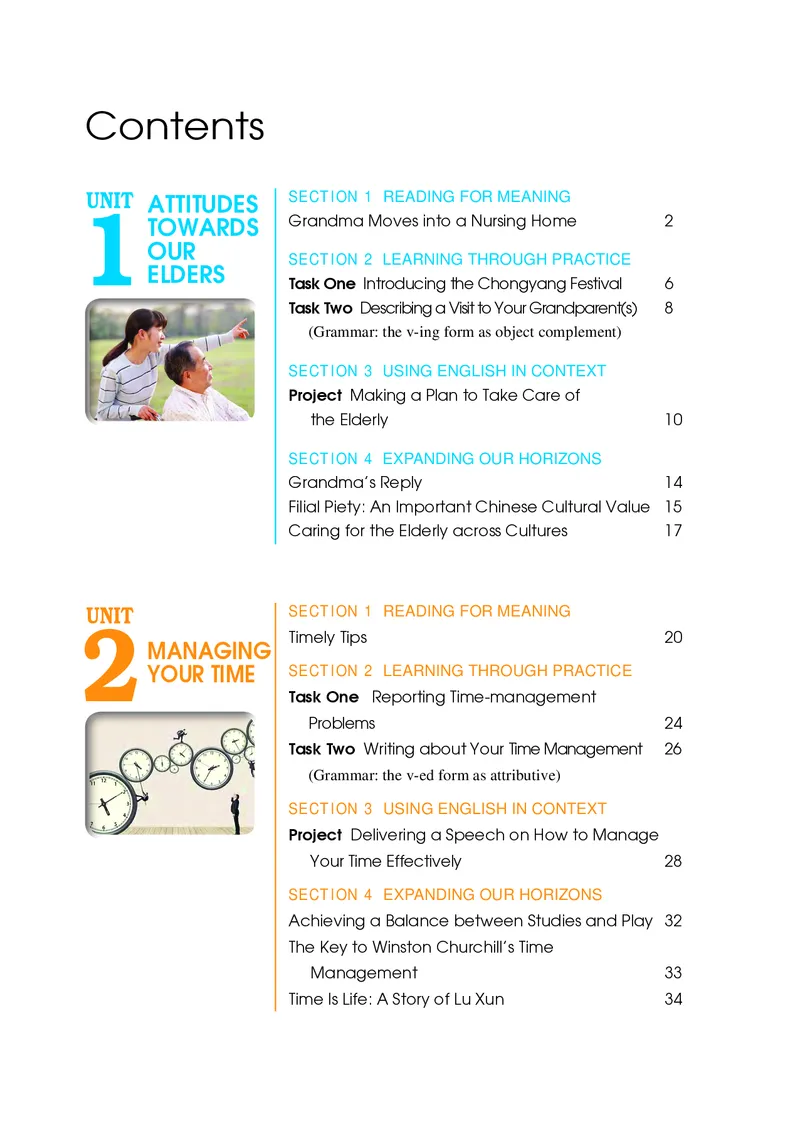
UNIT SECTION 1 READING FOR MEANING
ATTITUDES
1 Grandma Moves into a Nursing Home 2
TOWARDS
OUR
SECTION 2 LEARNING THROUGH PRACTICE
ELDERS
Task One Introducing the Chongyang Festival 6
Task Two Describing a Visit to Your Grandparent(s) 8
(Grammar: the v-ing form as object complement)
SECTION 3 USING ENGLISH IN CONTEXT
Project Making a Plan to Take Care of
the Elderly 10
SECTION 4 EXPANDING OUR HORIZONS
Grandma’s Reply 14
Filial Piety: An Important Chinese Cultural Value 15
Caring for the Elderly across Cultures 17
UNIT SECTION 1 READING FOR MEANING
2
Timely Tips 20
MANAGING
YOUR TIME SECTION 2 LEARNING THROUGH PRACTICE
Task One Reporting Time-management
Problems 24
Task Two Writing about Your Time Management 26
(Grammar: the v-ed form as attributive)
SECTION 3 USING ENGLISH IN CONTEXT
Project Delivering a Speech on How to Manage
Your Time Effectively 28
SECTION 4 EXPANDING OUR HORIZONS
Achieving a Balance between Studies and Play 32
The Key to Winston Churchill’s Time
Management 33
Time Is Life: A Story of Lu Xun 34UNIT SECTION 1 READING FOR MEANING
3
THE A Story of Success: Stephen William Hawking 38
STORY OF
SECTION 2 LEARNING THROUGH PRACTICE
SUCCESS
Task One Creating a Dream Tree 42
(Grammar: the v-ed form as adverbial)
Task Two Writing Your Own Story of Success 44
SECTION 3 USING ENGLISH IN CONTEXT
Project Exploring the Qualities of Successful People 46
SECTION 4 EXPANDING OUR HORIZONS
Meet the Celebrities 50
On Achieving Success 52
UNIT SECTION 1 READING FOR MEANING
4 LITERATURE
The Last Lesson 56
FOR
IDENTITY SECTION 2 LEARNING THROUGH PRACTICE
Task One Writing a Character Sketch 60
(Grammar: the v-ed form as complement)
Task Two Summarizing a Narrative 62
SECTION 3 USING ENGLISH IN CONTEXT
Project Writing a Book Report 64
SECTION 4 EXPANDING OUR HORIZONS
The Last Lesson (continued) 68
An Interview with a Poet 69
Return the Complete Jade to Zhao 71UNIT SECTION 1 READING FOR MEANING
5 ANIMALS
An Elephant Never Forgets 74
AROUND
US SECTION 2 LEARNING THROUGH PRACTICE
Task One Describing an Amazing Animal 78
Task Two Making a Dialogue to Ask for Help 80
(Grammar: ellipsis)
SECTION 3 USING ENGLISH IN CONTEXT
Project Writing a Proposal to Protect Endangered
Animals 82
SECTION 4 EXPANDING OUR HORIZONS
How Do Animals Communicate? 86
Giant Panda, Featured Animal in China 87
The Conservation of Koalas in Australia 89
WRAP IT UP! 93
APPENDICES
PRONUNCIATION 103
VOCABULARY (I) 106
VOCABULARY (II) 111
LIST OF PROPER NAMES 117
GRAMMAR 119
IRREGULAR VERBS 123UNIT
1
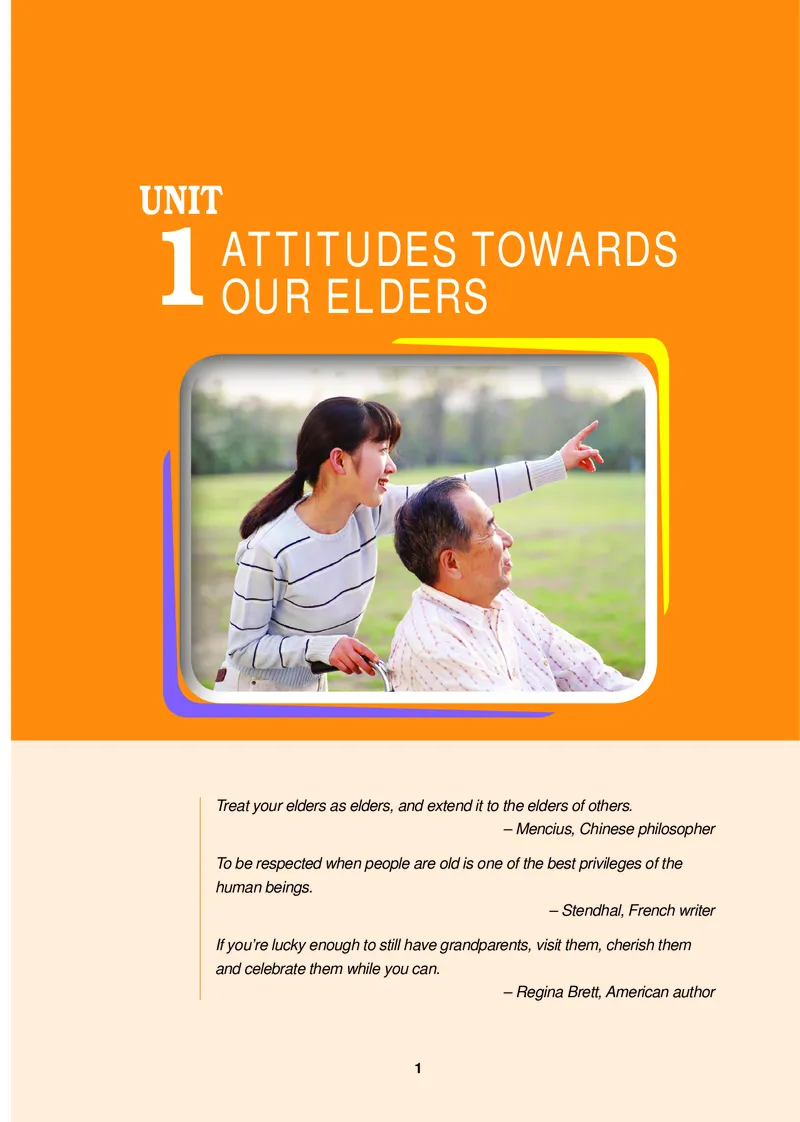
ATTITUDES TOWARDS
OUR ELDERS
Treat your elders as elders, and extend it to the elders of others.
– Mencius, Chinese philosopher
To be respected when people are old is one of the best privileges of the
human beings.
– Stendhal, French writer
If you’re lucky enough to still have grandparents, visit them, cherish them
and celebrate them while you can.
– Regina Brett, American author
11
READING FOR MEANING
Grandma Moves into a Nursing Home
BEFORE YOU READ
1 How often do you see your grandparent(s)? How do you spend time with them?
2 What is a nursing home? Have you visited one?
3 What do you expect the story to be about based on its title?
“What do you mean you want to send Grandma to a
nursing home?” Mary cried. It was Sunday evening. Mary DO YOU KNOW?
and her mother had just returned from visiting Mary’s
A nursing home is a hospital
grandmother. Grandma Thomas is 92 years old and she for old people, whereas a seniors’
lives in a seniors’ lodge. lodge is an apartment for old
people.
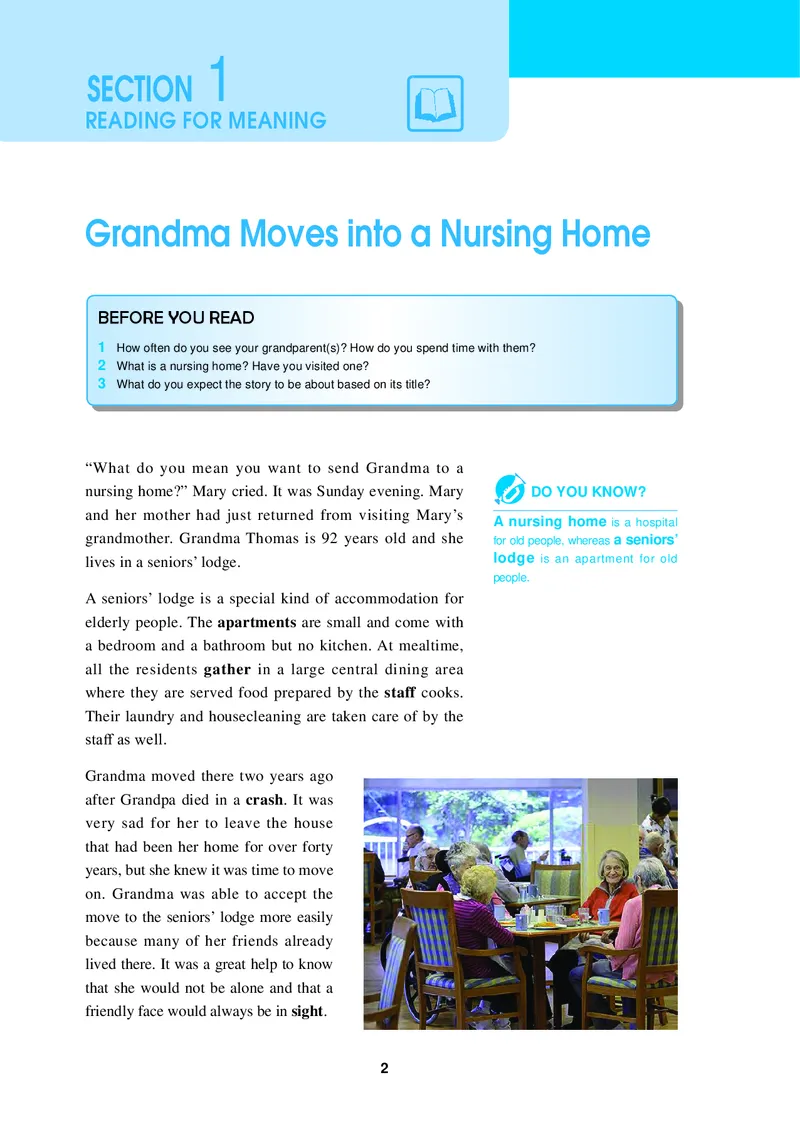
A seniors’ lodge is a special kind of accommodation for
elderly people. The apartments are small and come with
a bedroom and a bathroom but no kitchen. At mealtime,
all the residents gather in a large central dining area
where they are served food prepared by the staff cooks.
Their laundry and housecleaning are taken care of by the
staff as well.
Grandma moved there two years ago
after Grandpa died in a crash. It was
very sad for her to leave the house
that had been her home for over forty
years, but she knew it was time to move
on. Grandma was able to accept the
move to the seniors’ lodge more easily
because many of her friends already
lived there. It was a great help to know
that she would not be alone and that a
friendly face would always be in sight.
2UNIT 1 ATTITUDES TOWARDS OUR ELDERS
Back at Mary’s house, Mary was not thinking about that.
She was worried about her grandma. The thought of her
grandma spending her last days in a nursing home made
Mary feel sad and sick. “There’s no justice. Why does it
have to be this way?” thought Mary. “It seems so unfair.”
To Mary it seemed so obvious. Her grandma was the
most loving and giving person she knew, and it was her
family’s duty to take care of her. How could her mom
send Grandma to a nursing home where she would spend
the last months, maybe only weeks or days of her life in
a hospital bed? She had to find a way to make her mom
understand.
“Mom, I hate to see Grandma living in a hospital bed for
the rest of her life. She’s not so ill. I know she needs a lot
of help with daily things like washing and getting dressed,
but she can still do many things. Remember, only two years
ago she was organizing the town gathering and telling
everyone what to do and how to do it.” Mary had warm
memories of her grandmother as a strong and independent
woman. It was hard for her to believe that she was that ill.
“Mary, I know you love your grandma,” Mom said
calmly. “We all do. We have to think of what is best for
her. She’ll be happy at the nursing home. Everything
there is neat and tidy. She will get the care and attention
QUICK CHECK!
that she needs there. They will make sure that she gets her
medications on time, and if anything happens, there are Medication means both medical
treatment and medicine.
nurses and doctors to help her right away. Plus, there are
so many recreational activities for her. I think she’s going
to be very comfortable there.”
Mary was so confused and sad that she found it hard to
speak. She went to her room and shut the door. She needed
some quiet time to think.
No matter how many different ways she thought about it,
Mary could see no way that Grandma could be happy there.
Mary was angry at her parents for not inviting Grandma
to live with them. She doubted that her parents were being
3UNIT 1 ATTITUDES TOWARDS OUR ELDERS
selfish. They had a big house and a spare bedroom where
Grandma could sleep. It was not as though they were QUICK CHECK!
struggling to make ends meet and needed to tighten their To make ends meet means to
belt. They could learn how to give her the medication that earn just enough money to be able to
buy the things you need.
she needed, and Mary and her mother could help Grandma
bathe. In the evening, when all her homework was finished,
Mary could sit with Grandma and play cards or just talk
for a while. She remembered the times when she was a
little girl, she would go to Grandma’s house for summer
holidays. She had such sweet memories of the time she
spent with Grandma, baking buns, taking care of the garden
and playing cards in the evening.
She sat down at the computer and wrote a long letter to
Grandma inviting her to come to live with them.
AFTER YOU READ
Reading Comprehension
1 What made it easier for Grandma to accept the move to the
seniors’ lodge?
2 Why does Mary think that it is unfair to send Grandma to a
nursing home?
3 In Paragraph 5, Mary said, “Remember, only two years ago she
was organizing the town gathering and telling everyone what to
do and how to do it.” What can we infer from the sentence?
4 What do Mary’s parents believe is best for Grandma?
5 Do you think Mary’s parents are selfish? Why or why not?
6 Why does Mary think that it would be better for her grandma to live with her family in their house?
Post-reading Activities
1 Mary wrote a long letter to her grandma to ask her to come and live with her and her parents.
Besides asking her grandma to live with them, what else do you think Mary would have said in her
letter? How do you think her grandma would respond to this letter?
4UNIT 1 ATTITUDES TOWARDS OUR ELDERS
2 Mary couldn’t stand the idea of her grandma living in a nursing house. It made her feel sad and sick.
Imagine that your grandparent(s) had to move into a nursing home. How would you feel about it?
3 Grandparents love their grandchildren very much. In groups, share some stories about your
grandparents, and discuss what you can do for your grandparents if they need help.
4 The aging population is rapidly increasing in China. There are now different ways of taking care of
elderly people who need help. Investigate how elderly people are taken care of in your community.
Bring your investigation to class and present it to your group.
SONG
Our Ancestors
Your ancestors are special. They worked very hard,
We all feel the same. To try to get ahead.
It’s a connection to the past. They got up very early,
They give to you your name. And didn’t lie in bed.
It’s important that we remember, In every single culture,
The things we learn from them. From Egypt to Peru,
About honour and duty, In the tree of life,
Their wisdom is a gem. Ancestors are the roots.
Chorus Repeat Chorus
Let’s remember our ancestors.
They have done so very much.
Let’s remember our ancestors.
It’s the way we keep in touch.
52
LEARNING THROUGH PRACTICE
Task One Introducing the Chongyang Festival
Suppose a group of foreign students is going to visit your school on the Chongyang Festival.
Please get ready to introduce the festival to them with the help of a poster.
Step 1 Pre-task Resources
Listen to an introduction about the Chongyang Festival. Write down key information such as
the time, food and activities that take place during the festival.
food
activities
time
the Chongyang
Festival
Step 2 Task Cycle
1 Read the poster for the Mid-Autumn Festival. Observe the layout of the poster and pay
attention to the title, keywords and pictures.
The Mid-Autumn Festival, Join Us!
The Mid-Autumn Festival is coming.
Come and join us!
There are many interesting activities waiting for you.
Time: 7:00 p.m., September 29
Place: playground
Activities: a. enjoying mooncakes
b. admiring the beautiful moon
c. singing and dancing
d. playing interesting games
e. making I-Miss-You cards for your parents
6UNIT 1 ATTITUDES TOWARDS OUR ELDERS
2 Listen to the introduction in Step 1 again and pay special attention to the information you
wrote down about the Chongyang Festival.
3 Make a poster with the information you have learned about the Chongyang Festival so far.
Remember to use v-ing forms to describe activities in general.
4 Share your work with a partner. Together, revise the language used in the poster to make
it clear.
Title:
CHONGYANG
Time:
Place:
Activities:
Learning tips
An impressive poster should include a short but interesting
title as well as bold and colourful words with attractive
pictures that are related to the theme.
Step 3 Language Focus
V-ing forms have a verb base, so they give us a sense of action. The v-ing form is often used
as a noun or an adjective in the sentence. Examine how v-ing forms function in the following
sentences.
● Running is a great sport.
● The emphasis was on teaching rather than learning.
● There are indoor swimming pools on campus.
7UNIT 1 ATTITUDES TOWARDS OUR ELDERS
If we want to describe and list some activities we are going to do, we often use v-ing forms.
Look at the following examples used to describe festival activities.
● enjoying mooncakes
● playing interesting games
● climbing heights
Task Two Describing a Visit to Your Grandparent(s)
Have you ever spent a lot of time with your grandparent(s)? What are your favourite
memories with them? In this task, you will write a passage about it.
Step 1 Pre-task Resources
The following passage is about a visit to a nursing home.
I arrived at a nursing home at 8:00 on Sunday morning. Miss Wang, a caretaker at
the nursing home, showed me around and gave me instructions on how I could
help out. I saw her combing a woman’s hair gently. She told me that she is fond of
working there, and she treats the seniors as if they were her own family. I watched
her talking and playing memory games with them, as well as making sure they were
clean. Overall, she treated them with a lot of respect.
I attended to John, a 79-year-old man. He sat on his chair and showed me some of
his pictures. I listened to him telling stories
about his pictures for nearly half an hour. He
told me about his son, who lives abroad.
He said he didn’t want to end up here with
someone else wiping his body.
On the way home, I thought of my own
grandparents and what it would be like for me
when I’m old. I realized how important it is to
help elderly people enjoy a comfortable life.
Step 2 Exploring the Language
Look at the sentences and identify the structure they have in common. Discuss with a partner.
8UNIT 1 ATTITUDES TOWARDS OUR ELDERS
Here are four interesting sentences from Step 1. Notice the expressions in red.
Can you identify the structure that these sentences have in common?
1. I saw her combing a woman’s hair gently.
2. I watched her talking and playing memory games with them.
3. I listened to him telling stories about his pictures for nearly half an hour.
4. He said he didn’t want to end up here with someone else wiping his body.
There are two types of v-ing structures in the four sentences above.
Sentences 1 to 3 share the following structure:
a. see/watch/listen to somebody/something doing
Sentence 4 has the following structure:
b. with somebody/something doing
In both structures, v-ing forms act as object complements.
Please look for sentences that have the same structure in the text of Section 1 and
write them down here. Share your findings with your partner.
_________________________________________________________________
Step 3 Task Cycle
Read the passage in Step 1 again.
Make sure you understand it
completely. If not, use a dictionary
or turn to your classmates for help.
Write a short passage to describe a time you
visited your grandparent(s) (or a visit you ever
paid to an elderly man/lady). Remember to use
the “see/hear somebody doing” structure.
Share your work with a partner. Revise
and improve it together.
93
USING ENGLISH IN CONTEXT
Project Making a Plan to Take Care of the Elderly
The aging problem is more and more prominent across the world, and it has attracted
people’s attention. In this project, you will explore different care systems and develop a plan
to help care for the elderly in your neighbourhood.
Step 1 Read and Discuss
Read the following passage about senior care in Norway and then discuss the questions
in groups.
Norway presents a perfect case
of social care to its population,
particularly with the elderly. Various
levels of elderly care services are
provided based on the different
needs of individuals.
Home visit: Healthcare workers
visit elderly people in their own
homes to provide them with some
basic aid and to educate them about how they can be responsible for their own
health.
Homecare system: In this system, healthcare workers help the elderly with basic
daily activities. This level of care is largely for those who need the least help with
ordinary tasks.
Day care system: When seniors require more than just occasional homecare
visits, day care systems offer help with things like cooking, cleaning and bathing.
Nursing homes: Nursing homes have existed in Norway in various forms for over
a hundred years. They provide medical and nursing care for long-term and short-
term residents.
10UNIT 1 ATTITUDES TOWARDS OUR ELDERS
Residential flats: Norway offers specially constructed flats that take into
consideration the special needs of the elderly and make it easier for them to live
independently.
Community hospitals: These facilities provide the care that elderly patients need
after they get out of the hospital. The main goal is to help them move back to their
home without any need for further advanced hospital care.
1 What are the differences between homecare and day care systems?
2 If an elderly person can live independently, which care service is most suitable for him/her?
Step 2 View, Listen and Fill in Blanks
View the pictures. Listen to the stories of the elderly people and fill in the blanks.
Pinto Contreras
Age _________ Age _________
He has been living He is living in a
Country _________ Country ___C_u_b_a___
________, but now local ________
he hopes to live with ________. The
________ ________. government helps
him.
She prefers to He is living with his
________ ________, ________ ________,
because she doesn’t but he hopes to
Sagaram want to ________ her live in a ________ Hussein
Age _________ children. ________. Age _________
Country _________ Country __E__g_y_p_t__
11UNIT 1 ATTITUDES TOWARDS OUR ELDERS
Step 3 Compare, Discuss and Brainstorm
In groups, discuss the major advantages and disadvantages of the three different ways of
living. Then brainstorm some other ways we can provide elderly people with assistance.
Complete the form below.
● Advantages:
● Disadvantages:
Living with
family
● Advantages:
● Disadvantages:
Living alone
● Advantages:
● Disadvantages:
Living in a
nursing home
12UNIT 1 ATTITUDES TOWARDS OUR ELDERS
Step 4 Interview and Write
A suitable elderly-care plan depends on knowing the needs of the elderly and the family’s
economic status. Develop a plan to take care of the elderly in your neighbourhood.
1 Interview some elders in your neighbourhood. You can use some of the questions below to
help you get started.
● Would you prefer to live on your own or with other people?
● What can family members do for you?
● What would you do during the day when you are alone at home?
● Do you have any friends in a home for the elderly?
● How would you feel about moving into a home for the elderly?
● What do you usually do with your friends?
● What are your favourite activities?
Learning tips
● While interviewing the elders, focus on their
needs and requirements.
● Take the family economic status into account.
2 Make a well-organized plan to take good care of the elderly.
Evaluate yourself!
Can you start and maintain a conversation in English on elderly care?
Can you understand and explain the implicit logical relations between sentences in the text?
How well have you done with the following? Tick the circles that best reflect your performance.
Excellent Very Good Good Needs Improvement
Taking notes of the useful information when
listening, reading and viewing
Using strategies of “repetition”, “explanation”
and “clarification” to overcome language
problems
Understanding the intention of the elderly
people according to their mood and intonation
in listening and interviewing
134
EXPANDING OUR HORIZONS
Grandma’s Reply
In Section 1, we learned that Mary wrote a letter to her grandma to ask her to come and live
with her and her parents. The letter below is her grandma’s response.
Dearest Mary,
Thank you for the lovely letter and your kind
Expressing
invitation. You are truly special to me. But, my dear, I
thanks
cannot come to live with you. Moving into the nursing
home is what I want to do. It is the best thing for me. ● Thank you (for...).
● Thanks a million.
I’m very proud of you, Mary, and everything you do. ● Words cannot
You play basketball, take music lessons, and you work express how
hard at school. You are a very busy girl, and I think thankful I am.
that’s wonderful. Your parents are good people, and ● All I could say is...
thanks.
they work hard to give you a good life. I know you all
love me, but you and your parents don’t have the time
to take care of me.
An old lady like me needs more than a soft pillow to
lay my head on. I need help preparing my meals, and
it’s important for me to have companionship during
the days. How can I feel at peace when I am either
alone all day or causing my loving family to give up
important things in their lives to stay home with me?
And besides, moving to your house would mean that
I have to leave my hometown and move to a new city
where I don’t have any friends. I think I would feel
very lonely without my friends to keep me company
during the day. Do you remember my friends Linda and
14UNIT 1 ATTITUDES TOWARDS OUR ELDERS
Len? They come over every Wednesday to take me to the store if I need something.
My friend Ruth Norton comes over every Friday to take me to play games at the
seniors’ recreation centre, where smiling faces always welcome us at the entrance.
I do feel sorry for some of the old people in the senior’s lodge who have no family
to visit them. I am so happy when you come to visit, and I love hearing about all of
your adventures, your studies and your friends. I hope you continue to visit me and
share your life with me when I move into the nursing home. I hope your young and
loving heart can understand an old lady like me.
Much love,
Grandma Thomas
POST-READING QUESTIONS
1 Why does Grandma think living in the nursing home would be better for her than living with Mary and
her parents?
2 What does Grandma hope Mary will continue to do when she moves into the nursing home?
3 Mary thought her parents were being selfish to send Grandma to a nursing home. After reading
Grandma’s letter, do you think Mary will change her mind? Why or why not?
Filial Piety:
An Important Chinese Cultural Value
For centuries, Chinese people have taken pride in the way
they have treated their parents, which is called xiaodao, QUICK CHECK!
or filial piety. Filial piety was an important virtue in early virtue: (1) the quality of being morally
Confucianism and is still recognized as an unavoidable part good (2) a quality that is good or
admirable (3) a good quality or habit
of human life.
that a person has
Nowadays, authorities in rural areas have even turned to a
filial piety fund to help maintain China’s most treasured
virtue. Luoning, a less developed county in Central China,
15UNIT 1 ATTITUDES TOWARDS OUR ELDERS
started the voluntary fund program in 2017 to encourage grown-up children to support their
elderly parents. Luoning is home to more than 16,000 residents over 70. All its villages have
set up filial piety funds and every elderly villager has an account. The funds received nearly
4 million yuan and most of the money was contributed by the 40,000-plus grown-up children
of the county’s elderly.
An 80-year-old woman in Gaowan Village is satisfied as she no longer has to worry about
her income. Her grown-up children are regular contributors to the piety fund, through
which she receives a certain amount of money each month. Her daughter-in-law said, “We
are not well-off, but it is not an excuse for failing to carry out filial duties. We should set a
good example for our children and pass down our traditional beliefs to the next generation.”
It is an ancient Chinese custom to rely on their grown-up children to take care of them, or
gongyang them in their old age. The term gongyang means the special feeding of elders. The
basic meaning of gong is “to provide” or “to supply”, but it also includes the definition “to
offer respectfully”. Yang generally signifies “to feed”, but also extends to the verb “to raise”.
Thus, gongyang means something like “care with respect”. The grown-up children’s kind
and respectful treatment of their parents would gain them a good name for being filial.
The Chinese saying, “Of all virtues, filial piety is the first” demonstrates the cultural
importance of respecting one’s elders. According to the Classic of Filial Piety (xiaojing),
only when the grown-ups do well in the following five aspects, can they meet the standards
of truly filial person:
● show parents real respect by tending to
their needs and desires;
● bring parents enjoyment while caring for
them;
● express worries when parents are in
sickness;
● convey deep sorrow for parents’ passing;
● show the late parents true respect when
giving them the offerings.
POST-READING QUESTIONS
1 According to the text, what does xiaodao mean in Chinese culture?
2 What’s your opinion about the daughter-in-law’s words in the text?
3 How can a person be recognized as filial according to the Classic of Filial Piety?
16UNIT 1 ATTITUDES TOWARDS OUR ELDERS
Caring for the Elderly across Cultures
How different cultures care for the elderly is closely linked
to their most prized values and qualities.
China
China’s population has been aging at a historically
high rate in recent years, and elderly care has been
attracting people’s attention lately.
The majority of seniors spend their remaining
years at home. Many communities in cities
have established service centres for the elderly
to provide them with food, medical care and
housekeeping services. The monthly cost is
affordable for most people, which is making this
kind of community care more and more popular.
The percentage of elderly people using the
DO YOU KNOW?
community care is increasing every year.
We can sometimes guess the meaning
Australia of a word by referring to its prefix or
suffix.
Independence, well-being and quality of life for every
Afford means “to be able to buy
older person are promoted in Australia through health and
or to do something”. If you cannot
elderly-care support systems. The country continues to afford something, you do not have
develop the model of care intended to achieve the goal – enough money to pay for it. Now can
you explain the word affordable?
ensuring people get the right care, at the right time, by the
right team and in the right place.
17UNIT 1 ATTITUDES TOWARDS OUR ELDERS
America
One relatively new service in the United States that can
help keep the elderly in their homes longer is respite care.
This type of care allows care givers the opportunity to go
on vacation or a business trip and know that their elders
have good-quality care. Without this help, the elderly
would have to move to an outside facility for a long time.
Another unique type of care in American hospitals is
called acute care of elder units (ACE units). It provides “a
homelike setting” within a medical centre specifically for
the elderly.
POST-READING QUESTIONS
1 Do you think that community care is becoming more and more popular in China? Why or why not?
2 What is the intended goal of Australia’s model of care?
3 What are the two types of elderly care that are being implemented in the U.S.?
Unit Reflection
Review the whole unit and reflect on what you have learned.
1 Respecting the elderly and protecting the young is a traditional virtue in Chinese culture.
What have you learned in this unit about elderly people and the meaning of taking care of
elderly people?
2 What does respecting your grandparents mean to you? What can you learn from your
parents in terms of respecting your elders and ancestors?
3 Explain your understanding of the sentence “Treat others as you would like to be treated”.
More Connections
● How are the elderly treated around the world? Are they viewed and treated in the same
way in spite of different cultures? What kind of support do the elderly really need? Try to
surf the Internet. Here are some key words for your reference: aging, elderly care, filial
piety, homecare system, and nursing home.
● Have you seen the movie Full Circle? It’s a Chinese film about some elderly people who
try to achieve the value and significance of their lives. Watch the movie and tell what you
think of it.
18UNIT
2
MANAGING YOUR TIME
If you do not study hard when young, you’ll end up bewailing your failures as
you grow up.
– Chinese proverb
To choose time is to save time.
– Francis Bacon, British philosopher
We always have time enough, if we will but use it aright.
– Johann Wolfgang von Goethe, German writer and poet
191
READING FOR MEANING
Timely Tips
BEFORE YOU READ
1 Do you ever feel like you are pressed for time? What are the possible causes of this pressure?
2 Do you wish to manage your time in a way that makes you feel like you have control over your life?
3 What do you expect to read when you see the title “Timely Tips”?
Jenny was in trouble. “I feel as though I am sinking beneath the waves,” she told her friend
Alex. “It seems to get worse every day. The water just keeps getting deeper. It’s up to my
nose. Help!”
“What’s going on, Jenny?” asked Alex.
20UNIT 2 MANAGING YOUR TIME
Jenny took a deep breath and began to explain, “First I
decided to try out for the track team, so I’ve been waking
up at 5 a.m. almost every day this week to train and
prepare for try-outs. Then I joined the choir because I love
to sing. Choir practice is two nights a week. I also found
a part-time job at the mall, so I could earn some spending QUICK CHECK!
money. I work three times a week. Now it’s exam time, and Spending money is money
I can’t find the time to study. I have too much on my plate, that you have or are given to spend
on personal things for pleasure,
and I don’t know how I’m going to do it all. Sometimes I
especially on holiday.
feel like I can’t breathe.”
Jenny and Alex were walking from the
subway exit to the mall where Jenny
worked. She has a job working at a pet store.
It was her job to feed the puppies, talk to the
birds and make sure that all of the animals
were happy.
She loved working with animals. “If only
they could help me with my homework!” she
thought.
When they arrived at the pet store, Jenny
turned to Alex and said, “What should I do?
I am sinking fast.”
Alex was about to leave for his part-time job at the library,
across the street from the shopping mall. He was just as
busy as Jenny. Besides his job at the library, he had joined
a chess club. He also played soccer twice a week, and
every Thursday night he took a baking class where he
learned how to make all kinds of desserts, from chocolate
cake to cookies decorated with small candies and nuts. He
would eat most of the goodies he made while he watched
television for two hours in a row. Yet even with all of these
activities he usually found a way to finish his homework on
time.
“Check your email when you get home,” Alex told Jenny.
“I’ll send you my secrets for living a well-managed life.”
21UNIT 2 MANAGING YOUR TIME
Then he went on his way to his job at the library across the street.
...
When Jenny returned home that night, there was an email
from Alex waiting for her. “Follow these tips,” Alex wrote,
“and you will reduce your anxiety and bring some order to
your messy life.”
Alex’s secrets for living a well-managed life
● Change your attitude. You are not drowning. You are learning to swim.
Be positive!
● Get organized. Make a list of all the things you do each week. Then
organize your to-do list with your schedule. Put your “must-do” jobs at the
top of your schedule, so you can see what you must do each day.
● Restructure and reconsider. Is it practical for you to get up at five
o’clock in the morning for track practice and then work late at the mall? If
not, you have to make some different choices and reconsider what’s really
important to you. You can’t do everything.
● Prioritize. Plan your schedule based on what needs to get done first and
postpone the rest. What is important and what is less important? If you
have to make more time for studying, think about what you can drop from
your schedule.
● Set future goals. Write down all the things you intend to achieve in the
next year. This will help you stay on track. You need to have a target. You
have to have an idea of where you’re going if you want to get there. When
you set your long-term goals, you can judge whether your daily and weekly
activities are working to help you achieve those goals.
“He’s right,” Jenny thought. “But I don’t have time for this. I’ll go crazy writing lists
and making schedules that I don’t even have time to follow.” Then she noticed the final
tip from Alex.
● Make time to make schedules. A small amount of planning will permit
you to organize and structure your life so that you can do the things you
need to do and make the time to do the things you want to do.
22UNIT 2 MANAGING YOUR TIME
AFTER YOU READ
Reading Comprehension
1 Jenny was so busy that she felt she was sinking beneath the waves. Why?
2 List THREE things Alex did with his time when he was not at school.
3 What does “it” mean in “It seems to get worse every day” in Paragraph 1?
4 What does “they” mean in “If only they could help me with my homework!” in Paragraph 5?
5 What are Alex’s tips for living a well-managed life? Can you think of other tips for managing time
wisely?
6 What’s the writer’s purpose in writing the text?
Post-reading Activities
1 Work with a partner or in groups to decide which of Alex’s tips to Jenny are equally useful and
helpful to you and explain how.
2 Share your experience of time management, and find out who is the person that manages his/her
time best in your group.
3 A Chinese saying goes, “Never put off till
tomorrow what you can do today.” How do you
understand this? Do you agree?
4 Good time management can help us not only
save time but also achieve more and feel more
confident. In groups, discuss other benefits of
good time management.
232
LEARNING THROUGH PRACTICE
Task One Reporting Time-management Problems
In this task, you will listen to a short passage about time management. You will collect your
problems in your group and give a brief oral report in the class.
Step 1 Pre-task Resources
Listen carefully and rearrange the headings in the order you hear them. Then match the
headings with the detailed information.
Taking on too much emails, WeChat, or phone calls
Not taking breaks having a hard time saying “No”
Failing to focus studying 8 – 10 hours straight
Others worrying about unimportant things
Step 2 Task Cycle
1 Think of the time-management problems in your daily life and put them into different
categories.
Taking on too Failing to
Not taking breaks Others
much focus
24UNIT 2 MANAGING YOUR TIME
2 Work in groups of four or five, and discuss your problems with managing time. What do you
think is the biggest problem right now? Explain why.
The biggest time-management problem Why
3 Present your group’s time-management problem to the class. Remember to use the new
words and phrases whenever possible.
Step 3 Language Focus
In Step 1, you heard the noun phrase time-management problems. In this pattern, the
compound time-management is used to modify the noun, problems. Here are more examples
from the text in Section 1:
compounds that
part-time job
function
as adjectives
to-do list
long-term goals
must-do work/jobs
nouns
This is an easy way to build new concepts that function as adjectives.
Compounds specify particular aspects or features of the noun, such as the type
or material.
Compounds as modifying adjectives are singular in form even when their
meaning is plural. They are normally hyphenated.
25UNIT 2 MANAGING YOUR TIME
Task Two Writing about Your Time Management
In this task, you will learn how Jenny improved her management of time and then write a
short paragraph to share your story of time use.
Step 1 Pre-task Resources
1 View the video about using time wisely and try to grasp the key points.
2 Read the following passage and learn how Jenny gets organized this time.
Jenny accepted the advice given by Alex and
managed to use her time more wisely.
First, she considered all her daily activities listed on
the schedule and estimated their importance.
Then she gave up some less important tasks. She
quit her try-outs for the track team so that she could
get enough sleep. As to singing in the choir, Jenny
believed it was important. However, she also realized
that compared with her homework, singing in the choir was less important. So, she
decided to go to the choir only once a week. She would make up for the missed
practice during her summer vacation.
Besides, Jenny decided to ignore some unwanted emails because reading them
was not that important.
Step 2 Exploring the Language
Here are two noun phrases from Step 1. Can you find the features they
have in common?
● missed practice (practice that was missed)
● unwanted emails (emails that are not wanted)
26UNIT 2 MANAGING YOUR TIME
The -ed forms of regular and irregular verbs are used as attributive adjectives.
The v-ed forms may occur before or after the modified nouns. Here are some
examples:
● an advertised product
● A burnt child dreads fire.
● a man called Tom
● the clothes bought online
Look for the v-ed forms as attributive adjectives in Section 1 and 2.
Share your analysis in your group.
● v-ed forms in Section 1
_____________________________
● v-ed forms in Section 2
_____________________________
Step 3 Task Cycle
1 Read Jenny’s story in Step 1 again. Make sure you understand every word. If not, look up the
words you don’t know in the dictionary.
2 Recall a successful time-management experience and report it to a partner. Focus on two
questions:
● What did you do?
● How did you do it?
3 Write a short paragraph describing how you managed your time efficiently. Remember
to use v-ed forms as attributes. Revise the paragraph with a partner to make it clear and
concise.
273
USING ENGLISH IN CONTEXT
Project Delivering a Speech on How to Manage Your Time
Effectively
Time management is of vital importance in one’s daily life. In this project, you will research
time-management skills and deliver a speech on the topic.
Step 1 Review and Reflect
Remind yourself of the speech-making tips you learned in Unit 1, Module 1. A complete
speech should include greetings, purpose, main arguments and an ending.
My fellow students,
T oday I’d like to make a speech on...
...
In one word, ...
Thank you for...
Step 2 Listen, Fill in Blanks and Discuss
Listen to a mini-talk by Mr. Smart, a time-management expert, fill in the blanks, and then discuss
in groups about the common mistakes people usually make in terms of time management.
● The purpose of this talk is to ________________________________________.
● We may learn from the talk that time management is about _____________________
_____________________.
● Use the following table to write down the common mistakes people make in terms of
time management.
Number Mistakes
1
2
3
4
28UNIT 2 MANAGING YOUR TIME
Step 3 Read, Reflect and Extend
Li Ming, one of the top learners in class, wrote some tips on time management. Please read
his suggestions and reflect on your own time management.
Suggestions on Time Management
Follow these tips, and you will effectively manage your time and simplify your life.
A. Record class times in day/hour blocks on a time schedule sheet.
B. Record meal times.
C. Record all regularly scheduled personal activities.
D. Insert any special activities you need to do or want to do on a regular basis.
E. Schedule a preview time (5 – 20 minutes) the evening before your classes
whenever possible. During the preview, review all or some of your notes in
preparation for the next class.
F. Schedule a review time immediately after your classes (10 – 20 minutes)
whenever possible. Use this time to write a summary of your notes.
G. Schedule a study/review time for each class. Try to schedule some study time
each day for each class.
H. Schedule a weekly review for each subject. Do it at the end of the week if
possible.
I. Keep open some day or evening time to go outside for some physical activity!
J. Be selfish and give yourself some relief! Schedule some time on Friday,
Saturday and Sunday to play, relax or do whatever you want to do.
29UNIT 2 MANAGING YOUR TIME
1 Read Li Ming’s tips for time management again. Think and classify them into three groups.
It is very helpful It is a good idea, but I’m not sure if it
for me. not very practical. works for me.
2 Add more secrets for managing time effectively based on your own knowledge and experience.
Step 4 Search and Select
Search for the time-management tips for high school students on the Internet and select 5 to
fill in the following table.
Number Tips
1
2
3
4
5
30UNIT 2 MANAGING YOUR TIME
Step 5 Prepare and Present
3 Present your
1 Collect and summarize all the
speech in class.
tips on time management in
this unit.
2 Remind yourself of what a
speech includes and prepare
your speech.
Learning tips
When you deliver your speech on time management to your group or class,
pay attention to your language and body language. Keep your gestures
natural and comfortable. Practice helps a lot. If you are speaking with real
conviction, your gestures will be real.
Evaluate yourself!
Can you evaluate and comment in English on a text about time management?
Can you understand and analyze the structure of a text and characteristics of its language?
How well have you done with the following? Tick the circles that best reflect your performance.
Excellent Very Good Good Needs Improvement
Identifying the coherence and cohesive
relationship in the text
Getting more information about time management
through reading, and online resources
Using gestures, stress, facial expressions,
intonation and rhythm to make my points of view
and attitude clearer when delivering a speech
314
EXPANDING OUR HORIZONS
Achieving a Balance between
Studies and Play
Perhaps you have heard the English saying, “All work and no play makes Jack a dull boy.” It
means that without some time off from work, a person can become very bored or boring.
Today’s students tend to experience a great deal of stress. For them, the best way to relax is
to take part in physical activities. This does not necessarily mean that you need to spend a
large amount of time and money.
For example, you could play basketball, swim or dance in a studio. In fact, swimming is
a good choice of exercise or sport. It increases your desire for food and helps you burn
fat/calories while helping you stay in shape. Some research states that swimming can
also make you grow taller, although there is not enough scientific evidence to prove this
is true.
Sports and games also contribute to the development of one’s mind. For example, they
teach you to be calm in all kinds of situations. You learn to become a good observer of things
32UNIT 2 MANAGING YOUR TIME
around you. You also learn to be accurate and to make good choices. Games help you to
develop a sense of confidence, something we could all use more of. Sports and games are
also great for helping you develop team-building skills. Knowing how to work well with
others is an important life skill. Above all, sports and games can teach you that it doesn’t
matter if you win or lose. What matters is how you play the game.
Don’t forget to give yourself a break. Don’t overwork yourself or you are likely to get
too tired or fall ill. Play carefully to avoid getting hurt. Moreover, make sure you do not
drink water immediately after playing sports or games. Drink water only after your body
temperature has returned to normal.
It is important to bear in mind that your teen years are important for your studies and future
career. Therefore, a balance needs to be struck between your studies and physical activities.
POST-READING QUESTIONS
1 Do you believe “All work and no play makes Jack a dull boy”? Why or why not?
2 In what ways would “all play and no work/studies” be disastrous?
3 Have you ever met someone who achieved a balance between studies and play? Interview this person
to learn how he/she manages time.
The Key to Winston Churchill’s Time
Management
It is interesting that when you study the most effective
individuals throughout history, you see the same theme
again and again in how they managed their time. The key is
DO YOU KNOW?
to focus on a few very significant priorities, and to keep in
Winston Leonard Spencer-
mind what is centrally important at the moment.
Churchill was a British statesman,
army officer and writer, who served as
We see this especially in Winston Churchill. Here’s
Prime Minister of the United Kingdom
how Steven Hayward summarizes Churchill’s approach
from 1940 to 1945 and again from
in Churchill on Leadership: 1951 to 1955.
33UNIT 2 MANAGING YOUR TIME
Despite his wide-ranging attention and
interests, he always kept in mind what was
centrally important to the moment. He was
always able to focus on the immediate task
at hand, and he sent clear signals to his
subordinates when a directive was of special
importance. “When his mind was occupied
with any particular problem,” Sir Ian Jacob
wrote, “it was always focused upon it and
would not be turned aside.” This served as the
key to his time-management system.
His general method of work was to concentrate
his personal attention on the two or three things
that mattered most at any given moment, and
to give each of these all the time and attention
that it needed.
Effective people put first things first, and do
one thing at a time. This is the key.
POST-READING QUESTIONS
1 Which sentence(s) in the text can best explain Churchill’s method of work?
2 Do you think Churchill’s method might work for you? Why or why not?
3 In groups, find a famous figure in China who manages his/her time effectively.
Time Is Life: A Story of Lu Xun
Lu Xun is generally regarded as a great writer, thinker and revolutionary of the 20th
century.
Some people said that Lu was a talent, but he said, “I am far from a talent, only doing my work
while others drinking coffee.” Lu Xun always wanted to do more for the Chinese revolution in a
34UNIT 2 MANAGING YOUR TIME
limited period of time. He once said, “To save
QUICK CHECK!
time is to prolong the life of a human being.”
So he worked hard as if he never felt tired, To prolong something means to make it last a
doing his work during the day, writing at night longer period of time.
and staying up all night long. He always sat in
front of the desk and worked without a break.
Sometimes he would lean on the couch reading
books, which he took as his rest.
In his later years, he worked even harder than
before in order to lose no time. Even when he
was seriously ill, he was thinking about what
he was going to do after he recovered.
He began to work as soon as he was able to
sit up. Shortly before his death, he suffered
high body temperature and weighed less
than 40 kilograms. But he never dropped his
weapon – his pen, which he used to fight with
the enemies for years. Even in his last few
days, he still kept writing a preface for a novel.
He fought to the last day of his life and never
wasted one second of his time.
Lu Xun valued not only his own time, but
also the time of others. He was very punctual,
never being late or making others wait. In Lu
Xun’s eyes, time is life. “Americans say time
is money, but I think time is life. If one wastes
others’ time, he is killing others.” Lu Xun
felt that gossip was one of the greatest wastes
of time, and so he hated those who always
gossiped with others.
35UNIT 2 MANAGING YOUR TIME
POST-READING QUESTIONS
1 According to the text, what can you learn from Lu Xun?
2 Some people believe Lu Xun is the greatest writer in contemporary China. Do you agree? Why or why not?
3 Do you agree with Lu Xun when he says “Americans say time is money, but I think time is life”?
Unit Reflection
Review the whole unit and reflect on what you have learned.
1 Throughout human history, many famous figures have come up with their own set of “tips”
for time management. What have you learned about time management in this unit? What
tips do you think will be the most helpful and important to you in the future?
2 What have you learned in this unit about the major benefits of time management? What
are the major mistakes people make with managing time? How can these mistakes affect
one’s life? What advice would you give to a new student in your school about time
management?
3 What does the v-ed form mean? What have you learned about the function and use of v-ed
forms in English?
More Connections
● If you would like to know more about time management, then take a look at Getting
Things Done written by David Allen. The book can transform the way we work by
showing us how to manage our time without wearing ourselves down. It has been
translated into Chinese and published in China.
● There is an electronic encyclopedia, offering a detailed explanation and exploration in the
area of time management. Here are some key words for the access: time management,
setting priorities and goals.
36UNIT
3
THE STORY OF SUCCESS
No road of flowers leads to glory.
– English proverb
If your mind is strong, all difficult things will become easy; if your mind is
weak, all easy things will become difficult.
– Chinese proverb
Success is no accident. It is hard work, perseverance, learning,
studying, sacrifice and most of all, love of what you are doing or learning
to do.
– Pelé, Brazilian football player
371
READING FOR MEANING
A Story of Success:
Stephen William Hawking
BEFORE YOU READ
1 What do you think it means to be successful?
2 Who is Stephen Hawking? What do you know about him?
3 Based on the title “A Story of Success: Stephen William Hawking”, what do you expect to read in this
text?
It matters if you just don’t give up.
– Stephen William Hawking
Professor Stephen W. Hawking is one of those people who
combine great academic success with the ability to face
and overcome all kinds of difficulties, and finally succeed
in both their personal and professional life. He has become
a symbol of not only what it means to be successful, but
also of courage, struggle and determination.
Stephen W. Hawking was born on January 8, 1942 in
Stephen William Hawking
Oxford, England. As a child, he was curious, always
(1942 – 2018)
asking questions about the world around him. However,
Hawking was not the brightest child in his class. Most
people did not consider him a talent.
Inspired by his mathematics teacher in high school,
DO YOU KNOW?
Hawking began to find his love for mathematics. Hawking
Bertrand Russell (1872 – 1970),
admired Bertrand Russell, a man known not only for his
was a British philosopher, mathematician
work in mathematics, but also for his writings on freedom and social reformer. He studied at
Cambridge University from 1890 to
of thought. Later, like Russell, Hawking didn’t limit his
1894, where later he was a fellow and
satisfaction only to understanding certain parts of the
lecturer (1910 – 1916). During this time,
universe. He also wanted to know how the universe as a he published his most important works in
whole came to, and continues to, exist. philosophy and mathematics.
38UNIT 3 THE STORY OF SUCCESS
When studying in Oxford University, Hawking
spent the majority of his time in studies, as he was
overcome by a desire to understand the world and
to uncover the mysteries of the universe. After
three years, he graduated with first-class honours.
In 1963, Hawking’s life changed when he learned
that he had been attacked by Lou Gehrig’s
disease. His doctors told him that he would see,
hear and taste as before, but soon he would not
be able to walk, write or even feed himself. As
a result, he would probably die before he earned
his degree. However, he found both comfort and
a reason to live in his future wife Jane Wilde. He
became even more determined to finish his PhD
studies so that he would be able to marry her.
Struggling to overcome his illness, Hawking moved
on to study cosmology, successfully earning his PhD QUICK CHECK!
at Cambridge in 1966. After that, he became a research
Cosmology is a theory about the
fellow, then a professor. At the young age of 32, he was origin and nature of the universe.
named a fellow of the Royal Society. He later received the
Albert Einstein Award, the most famous in physics.
In 1982, Hawking decided to write a popular book on
cosmology. However, when he started the book, he suffered
another illness and had trouble breathing. Hawking was
rushed to hospital and had an operation on his neck. The
operation helped him recover from the illness, but it left
him without his voice. Still, Hawking was not ready
to quit. His friends in England and America joined to
help him. They developed a special computer software
program and attached the system to his wheelchair. What
Hawking needed to do was to press a button to operate his
computer which enabled him to have an electronic voice.
This technology made it possible for him to finish A Brief
History of Time. The book was published in 1988 and soon
became one of the top-selling books.
39UNIT 3 THE STORY OF SUCCESS
Hawking earned many honourary degrees, and received numerous awards, medals
and prizes. His positive view of the world, his life, and his modest sense of humour
influenced the world. Hawking’s success is not only the result of strength of mind, but
also the result of great strength of spirit.
AFTER YOU READ
Reading Comprehension
1 Who was Stephen Hawking inspired by when he was in high school?
2 The text states: “When studying in Oxford University, Hawking spent the majority of his time in
studies, as he was overcome by a desire to understand the world and to uncover the mysteries of
the universe.” What does “was overcome by” mean in this sentence?
3 While struggling with Lou Gehrig’s disease and losing his voice, how did Stephen Hawking manage
to finish his book A Brief History of Time?
4 The text is a brief summary of Stephen Hawking’s life story. What parts of his life does this text
focus on?
5 What is Stephen Hawking’s attitude towards life and how has it helped him succeed?
6 What can we learn from a scientist like Stephen Hawking?
Post-reading Activities
1 Life is a journey of growth and self-development. In groups, complete the table below by examining
Stephen Hawking’s life and work. Use “O” if no relevant information can be found in the text.
Stage Hawking’s experience Hawking’s attitudes/achievements
Childhood
High School
University
Career
40UNIT 3 THE STORY OF SUCCESS
2 It is said that struggles enter our lives as unwelcome guests, but they also bring valuable gifts. What
“gifts” can struggles bring? Brainstorm in groups and complete the chart below.
struggles
gifts
strong will
3 There are many well-known stories of figures who have achieved greatness throughout history. Who
do you look up to or admire? Do some research on this person and share his/her story in groups.
4 What are some of the challenges or difficulties you have had to face in your life? Were you able to
overcome these difficulties? Share your experiences in groups.
SONG
Success
Success is more than money, big houses and fast cars.
Success is helping others and reaching for the stars.
Success is knowing who you are – hard work will pull you through.
It’s the story of a peasant girl who made her dream come true.
It’s the story of a young boy who’s looking at the night.
But that’s too hard – he tells himself – I’ll never get it right.
Remember Stephen Hawking when you think you can’t go far.
412
LEARNING THROUGH PRACTICE
Task One Creating a Dream Tree
It is said that “Success occurs when your dreams get bigger than your excuses.” In this
task, you’ll read a passage about dream trees. Then you’ll create your own dream tree and
present it.
Step 1 Pre-task Resources
Read the passage below about dream trees.
What Is a Dream Tree?
Dreams are about goals – and more. Having a dream or a goal gives us a purpose
and direction, and it shapes our lives as well as the choices we make. Working
towards a dream or a goal can make us happy and give us a sense of achievement
by inspiring us to express who we are and what’s important to us. Happy and
inspired people can also make the world a better place. But making a dream come
true takes time, work, patience and care. You can’t expect quick results. You need a
strong base and a plan with step-by-step actions. Trying to achieve a dream can be
like growing a big, strong tree.
Motivated by the ideas, students at Mapleton School in Maine began to create their
own images of dreams growing like trees. In the picture, there are: the seed (the idea,
or the start of the dream), the roots from the seed (the base of the dream), the stem of
the tree, tree branches (steps along the way to achieving the dream) and the top (the
kind of person he/she would like to be, and how he/she will feel when he/she achieves
his/her dream). In the picture, there are also things, with which trees need to grow,
such as water, care and sunlight.
At the beginning of the school
year, students are encouraged
to make their dream trees.
Then, they will post and share
the dreams to inspire the entire
class. All these dream trees help
make the school a better place.
42UNIT 3 THE STORY OF SUCCESS
Step 2 Exploring the Language
Study the following sentences and try to understand the usage of the words “motivated” and
“inspired”.
● Motivated by the ideas (a v-ed form phrase used as an adverbial), students at
Mapleton School in Maine began to create their own images of dreams growing
like trees.
Students at Mapleton School in Maine were motivated by the ideas. They
began to create their own images of dreams growing like trees.
● Inspired by his mathematics teacher in high school (a v-ed form phrase used as an
adverbial), Hawking began to find his love for mathematics.
Hawking was inspired by his mathematics teacher in high school. He began
to find his love for mathematics.
V-ed form phrases as adverbials give information about condition, reason, manner, etc.
● Looked after carefully, this coat will keep you warm through many winters.
If you look after it carefully, this coat will keep you warm through many
winters.
● Having been told the bad news, Susan sat down and cried.
Someone had told Susan the bad news, so she sat down and cried.
● A bit frightened, I handed it to her.
I handed it to her, and I felt a bit frightened.
A v-ed form can play a role in sentences similar to that of an adjective. It indicates the state
of somebody or something and the state is a result of a passive action.
● The burned bread tasted awful.
The bread was burned. It tasted awful.
● We need to repair the broken window.
The window is broken. We need to repair it.
43UNIT 3 THE STORY OF SUCCESS
Step 3 Task Cycle
■ In groups, share what your dreams are. What inspires or motivates you to go after your
dreams?
■ Draw your own dream tree. Include a passage describing the goal, steps and crown of
your dream to go with the dream tree you have drawn.
■ Present your dream tree to the class.
Task Two Writing Your Own Story of Success
From time to time, life gives us a sweet taste of achievement, however small it may be. In
this task, reflect on your own experience of doing something successfully and write a story
about it. Were you able to succeed right away? What challenges did you face before you
succeeded?
Step 1 Pre-task Resources
Read the passage and follow the instruction.
Rubik’s Cube
I carry a Rubik’s Cube in my bag. Solving it quickly is a terrific conversation starter. It
has made me believe that sometimes you have to take a few steps back to move
forward. This was like my own life when I had to leave public school after the fourth
grade. It’s embarrassing to admit, but I still couldn’t spell my full name correctly back
then. I had difficulty learning to read and write.
As a fifth-grader at a new school that majored in what’s called language-processing
disorder, I had to start over. I spent the next four years learning how to learn and
finding ways that allowed me to return to my area’s high school with the ability to
express my ideas.
It took me four weeks to teach myself to solve the Rubik’s Cube. I discovered that,
just before it’s solved, a problem can look hard, and then suddenly you can find the
solution. I learned that it’s important to spend a lot of time thinking to try to find
connections and patterns. Often there are surprises waiting for you around the corner.
Like reading a difficult text or sometimes like life itself, the Rubik’s Cube can be a
difficult puzzle. So I carry one in my bag to remind me that I can achieve my goals,
no matter what troubles I face.
44UNIT 3 THE STORY OF SUCCESS
Fill in the notepads below with the blue words from the passage. Organize the words according
to the descriptions (“sense of success” or “sense of failure”).
sense of success sense of failure
terrific embarrassing
Step 2 Task Cycle
■ Reflect on some of the experiences you have had
with overcoming difficulties and challenges before
you were able to succeed at something. Choose one
experience and talk about it.
■ Draw an outline for your story and make a note
of some words and expressions you think will be
useful. Use a dictionary if necessary. Then write
your story of success.
■ Present your stories in groups.
Step 3 Language Focus
In English, some words express feelings. We call this “emotive language” (or emotional
language). Words like “sad” or “happy” are examples of “emotive language”. Emotive
language is used in newspapers, speeches, advertisements, literature and conversations to
create a desired emotional response to the listener or reader.
Compare the words in the two notepads, and you will see that the words in the first notepad
give you a positive or good feeling and those in the second one give you a negative or bad
feeling. In our study of the English language, it is important for us to learn how to use words
that describe different types of feelings. If we can choose words carefully, our readers or
listeners will be better able to understand our feelings.
453
USING ENGLISH IN CONTEXT
Project Exploring the Qualities of Successful People
The qualities and character of a person are revealed through what he/she does and says. In
this project, you will first explore personal qualities of successful people, and then investigate
what contributes to academic success in high school.
Step 1 Listen, Fill in Blanks and Discuss
Listen to the story, fill in the blanks, and then discuss the meaning of the story in groups.
When I was growing up poor in the south Bronx, one of four boys raised by a single
mom, I probably looked like I was heading __________, hanging out on the street
with my friends and getting into fights and __________. I would have ended up dead
or in prison like many of my friends if it had not been for a couple of __________
and family members who saw something underneath my teenage tough-guy act. They
noticed my desire for reading, and they made sure I had great books to read.
Back in 1975, when I was coming out of the Harvard Graduate School of Education,
I worked in a summer camp in Ossipee, N.H., for kids with the absolute toughest
__________, kids that everyone – even their parents – had given up on.
One of the things that I and the staff would do is __________ with the kids. These
children didn’t know baking powder from table salt, but once they tried a warm
biscuit out of the oven, covered with melted butter, they were eager to __________
how to make some more.
Suddenly, kids who couldn’t sit still or focus were __________ looking at kinds of
material as we measured them out, learning
the simple math and __________ lessons. By
the end of the summer, I remembered parents
breaking down and crying when they saw the
__________ their children had made.
Today, I run two __________ and a series of
educational programs, and we work with over
10,000 kids a year.
46UNIT 3 THE STORY OF SUCCESS
Learning tips
Did you know there are three types of listening?
● Listening for gist. You listen in order to understand the main idea of the text.
● Listening for specific information. You want to find out specific details, such as
keywords.
● Listening for detailed understanding. You want to understand all the information
the text provides.
Step 2 View, Read and Discuss
1 A global leadership consulting firm summed up the top 10 qualities of highly successful
people, as is shown in the graph. View and read. Learn more about the 10 qualities listed.
Top 10 Qualities of
Highly Successful
People
1 Self-confidence
Trust yourself. When you have trust in yourself, you’re already one
step closer to success.
2 Self-reliance
Depend on yourself. You make hard decisions and stand by them. To
think for yourself is to know yourself.
47UNIT 3 THE STORY OF SUCCESS
3 Willpower
When you want it, you make it happen. The world’s greatest achievers
are those who have stayed focused on their goals and been consistent
in their efforts.
4 Integrity
Honesty is the best policy for everything you do. Integrity creates
character and defines who you are.
5 Drive
You have the determination to work harder. You drive yourself with
purpose and align yourself with excellence.
6 Communication
You hear what is being said. When communication is present, trust
and respect follow.
7 Connection
You have the ability to relate to others. Connection makes everything
reach further and deepen in importance.
8 Optimism
You know there is much to achieve and much good in this world,
and you know what’s worth fighting for. Optimism is a strategy for
making a better future.
9 Patience
You are willing to be patient, and you understand that, in everything,
there are failures. Don’t take them personally.
10 Passion
If you want to succeed, passion will get you there. Life is 10 percent
what you experience and 90 percent how you respond to it.
2 In groups, share some success stories you have read about in books or on the Internet.
Discuss what qualities contributed to the person’s success and how these qualities can
contribute to your own success.
48UNIT 3 THE STORY OF SUCCESS
Step 3 Survey, Interview and Summarize
Conduct a survey with the top students in your grade about what qualities they think
contribute to their excellent academic performance.
1 Choose five to eight students who you think have achieved academic success in overall
learning or in a certain subject. Develop a survey that will assess what qualities they believe
contribute to a person’s success.
2 Interview these students about what qualities they think contribute to their excellence in
academics and why. Take notes during your interviews.
3 Summarize the results of your surveys/interviews by drawing a graph or diagram.
Step 4 Write and Report
Write a report based on the results you summarized in your survey. Title the report “What
Contributes to Academic Success in High School” and present it to the class.
Learning tips
When writing a report, start by including when, where, why and how
you did the report. Then state the results of your report using numbers
whenever necessary. Finally, end your report by summarizing your findings
and drawing a final conclusion.
Evaluate yourself!
Can you state and explain the meaning and function of “repetition”, “pause”, and “explanation” in oral discourse?
Can you plan, monitor, and evaluate your learning activities?
How well have you done with the following? Tick the circles that best reflect your performance.
Excellent Very Good Good Needs Improvement
Identifying the key vocabulary and concept to
find out the target information
Being active in cooperative learning in groups,
and willing to share learning resources with
others
Understanding the meaning and its development
of the key issues in the passage
494
EXPANDING OUR HORIZONS
Meet the Celebrities
The Landmark Success of Expert
Tu Youyou
Tu Youyou, born in 1930, joined a
medicine discovery project in developing
a malaria treatment in 1967. Before that,
scientists worldwide had examined over
240,000 compounds without success.
In 1969, Tu, then 39 years old, had an
idea of testing Chinese plants. She first
examined the historical Chinese medical
classics, visiting experts of traditional
Chinese medicine all over the country
on her own. Her team also tested over
2,000 traditional Chinese recipes. Tu
Youyou discovered that a low-temperature process could
be used to get an effective matter from sweet wormwood.
The animal tests showed it was completely effective on
mice and monkeys. Furthermore, Tu volunteered to be
the first human subject. It was safe, so she did successful
experiments with human patients.
DO YOU KNOW?
Tu Youyou won the 2015 Nobel Prize for discovering the Nobel Prize: It is one of the
medicine that has significantly reduced the death rates six international prizes given each
year for excellent work in physics,
for patients suffering from malaria.
chemistry, medicine, literature,
economics and work towards world
“The discovery is a successful example of collective
peace. The Nobel prizes were
research on traditional Chinese medicine. The prize
established by Alfred Nobel and are
winning is an honour for China’s scientific cause and given in Sweden.
traditional Chinese medicine in their course of reaching out
to the world,” she said.
50UNIT 3 THE STORY OF SUCCESS
Dr. Glenn Cunningham – A Sports Star
Once, a young school boy was caught in a fire
accident in his school and his mother was told
that he was sure to die, for the terrible fire had
damaged the lower half of his body. Even if he
were to survive, he would be disabled throughout
his life.
But the brave boy did not want to die, nor did he
want to be a cripple. Much to the surprise of the
doctor, he did survive.
At home, when he was not in bed, he was limited
to a wheelchair. One day, he threw himself from
the chair and pulled himself across the grass,
dragging his legs behind him. He reached the
wall, raised himself up and then step by step, he
began pulling himself along the wall, determined
to walk. He did this every day, with belief in
himself that he would be able to walk. With his strong will,
he did develop the ability to stand up, then to walk, and
then to run. He began to walk to school, then to run to
school, and finally to run for the joy of running. Later in
college he made the track team.
This young man, who was not expected to survive, who
would surely never walk, who could never hope to run –
this determined young man, Dr. Glenn Cunningham – made
an outstanding athlete who ran the world’s fastest mile.
J.K. Rowling – A Best-selling Author DO YOU KNOW?
J.K. Rowling is the author of the Harry Potter series.
Harry Potter is a series of fantasy
Her books have sold more than 400 million copies novels. The main character is a
worldwide. But there was a time in her life when she young wizard, Harry Potter. He and his
friends Hermione Granger and Ron
suffered from serious depression. Her marriage had failed,
Weasley fight against Lord Voldemort,
and she was jobless with a small child. She signed up
a dark wizard. The stories are about
for government aid (she was so poor and she could not growth, friendship and courage.
afford to support herself and her daughter), describing her
economic state as “poor as it is possible to be in modern
Britain, without being homeless”.
51UNIT 3 THE STORY OF SUCCESS
In 1990, while she was on a train ride from
Manchester to London, the idea for a story
about a young boy attending a school of
wizardry flashed into her mind. In 1995, she
finished her first book on an old typewriter. The
book was sent to twelve publishing houses, all
of which refused it. Editor Barry Cunningham
from Bloomsbury advised her to get a day job
since it was unlikely that she would profit from
writing children’s books. But he never expected
her books would be popular in the U.K. and
become bestsellers in the overseas market. Nor
did he expect she would progress from living
on state benefits to becoming a wealthy lady in
the upper ranks of society within five years.
POST-READING QUESTIONS
1 For what did Tu Youyou win the 2015 Nobel Prize?
2 In what sense was Dr. Glenn Cunningham a determined man?
3 What was J.K. Rowling’s life like when she decided to write her first book?
4 What new understanding can the stories above give you of the word “impossible”?
On Achieving Success
We cannot travel every path. Success must be won along
DO YOU KNOW?
one line. We must make our business the one life purpose
The text is adapted from Hemingway’s
to which every other must be subordinate.
work “On Achieving Success”. Ernest
Miller Hemingway (1899 – 1961) was
I hate a thing done by halves. If it be right, do it bravely. If
an American novelist, short-story
it be wrong, leave it undone.
writer and journalist. He won the
Nobel Prize for Literature in 1954.
The men of history were not repeatedly looking into the
Many of his works are considered
mirror to make sure of their own size. Attracted by their classics of American literature.
work they did it. They did it so well that the wondering
52UNIT 3 THE STORY OF SUCCESS
world sees them to be great, and labelled them.
To live with a high ideal is a successful life. It is not what
one does, but what one tries to do, that makes a man strong.
“Lasting effort is the price of success.” If we do not work
with our power, others will; and they will go ahead of us
in the race, and take away the prize from us.
Success grows less and less dependent on luck and chance.
Self-distrust is the cause of most of our failures.
The great and necessary help to success is character.
Character is a long developed habit, the result of training
and strong belief. Every character is influenced by family
and education. But these apart, if every man were not, to a
great extent, the designer of his own character, he would
be an irresponsible person of situation.
Instead of saying that man is a person of situation, it
would be nearer the mark to say that man is the designer of
situation. From the same materials one man builds palaces,
another hut. Materials are only materials, until the designer
can make them something else.
The true way to gain much is never to desire to gain too
much.
Wise men don’t care for what they can’t have.
53UNIT 3 THE STORY OF SUCCESS
POST-READING QUESTIONS
1 What advice does the writer give for achieving success?
2 Is it right for one to blame his/her failure on character? Why or why not?
3 Should we aim to be “a person of situation” or “the designer of situation”? Why?
Unit Reflection
Review the whole unit and reflect on what you have learned.
1 What did you learn from reading Hawking’s story of success? What does Hawking’s story
mean to you? What lessons can you take from this story to help you in your life and in
your studies?
2 Based on what you have learned in this unit, what is success? What is the secret to
success?
3 According to the stories of success you have read in this unit, how do people succeed?
What do the successful people in the stories have in common? Have you been inspired by
these stories? If yes, how?
More Connections
● Do you find it hard to achieve your life goals effectively? There is a best-selling book
called The 7 Habits of Highly Effective People, published in 1989 by Stephen Covey, an
American educator, author, businessman, and keynote speaker. It has sold more than 25
million copies worldwide since its first publication. The audio version became the first
non-fiction audio-book in U.S. publishing history to sell more than one million copies.
● Do you need motivation and inspiration from time to time? Watch the movie The Pursuit
of Happiness and learn how Chris Gardner survived the Great Depression and started his
career in Wall Street.
54UNIT
4
LITERATURE FOR
IDENTITY
Literature adds to reality, it does not simply describe it.
– C. S. Lewis, British writer
The answers you get from literature depend on the questions you pose.
– Margaret Atwood, Canadian poet and novelist
Great literature is simply language charged with meaning to the utmost
possible degree.
– Ezra Pound, American poet and critic
551
READING FOR MEANING
The Last Lesson
(adapted)
BEFORE YOU READ
1 What is literature? This unit is entitled “Literature for Identity”. What do you think it’s about?
2 What does “identity” mean to you? How does a language contribute to a country’s identity?
3 Based on the title “The Last Lesson”, what would you guess this story is about?
Alphonse Daudet (1840 – 1897) was a French writer. He
was born in Nimes, and grew up in Lyon, France. He moved
to Paris when he was 17 and worked for newspapers as a
writer. He joined the army during the Franco-Prussian War
(1870 – 1871).
Daudet’s first book of poetry, “Women in Love”, was
published when he was 18. He had written his first
novel at 14. He achieved literary success with the 1874
publication of “Fromont the Younger and Risler the
Elder”, for which he won an award from the French
Academy.
In the following adaptation of Daudet’s short story, “The
Last Lesson”, we will learn of a time during the Franco-
Prussian War when parts of France were under German
occupation. It was a tense time in the history of France.
Read this moving short story and enjoy Alphonse Daudet’s
great skill as a writer.
I started for school very late that morning and was
fearful of being scolded, especially because M. Hamel
had said that he would question us on verbs, and I did
not know a thing yet. For a moment I thought of running
away and spending the day outdoors. It was so warm,
so bright! The birds were singing their beautiful songs
at the edge of the woods. It was all much more tempting
56UNIT 4 LITERATURE FOR IDENTITY
than the rules for verbs, but I had the strength to resist,
and hurried off to school. QUICK CHECK!
When I passed the town hall there was a crowd in front of resist: to refuse to accept sth. and
try to stop it from happening
the bulletin board. For the last two years they had all our
bad news put there – the lost battles, the draft, the orders –
and I thought to myself, without stopping: “What can be the
matter now?”
I reached M. Hamel’s little garden all out of breath. Usually,
when school began, there was a great noise which could be
heard out in the street: the opening and closing of desks,
lessons repeated all together, very loud, with our hands
over our ears to understand better, and the teacher’s great
ruler hitting on the table. But that day everything was as
quiet as Sunday morning. Through the window I saw my
classmates, already in their places. I had to open the door
and go in before everybody. But M. Hamel saw me and
said very kindly: “Go to your place quickly, little Franz. We
were beginning without you.”
I jumped over the bench and sat down at my desk. Not till
then did I see that our teacher had on his beautiful green
coat, which he never wore except on inspection and prize
days. But the thing that surprised me most was to see, on
the back benches that were always empty, the village people
sitting quietly like ourselves. Everybody looked sad.
While I was wondering about it all, M. Hamel said: “My
children, this is the last lesson I shall give you. The order
DO YOU KNOW?
has come from Berlin to teach only German in the schools
of Alsace and Lorraine. The new master comes tomorrow. Alsace and Lorraine were two
provinces of France that were occupied
This is your last French lesson. I want you to be very
by Germany.
attentive.”
What a thunderclap these words were to me!
Oh, the fools; that was what they had put up at the town
hall! My last French lesson! Why, I hardly knew how to
write! I should never learn any more! I must stop there,
then! Oh, how sorry I was for not learning my lessons!
57UNIT 4 LITERATURE FOR IDENTITY
My books, that had seemed such a hardship a while ago, my grammar, and my history
books, were now old friends that I couldn’t give up. And M. Hamel, too; the idea that he
was going away, that I should never see him again, made me forget all about his ruler and
how strict he was.
Poor man! It was in honour of this last lesson that he had put on his fine Sunday clothes, and
now I understood why the old men of the village were sitting in the room. It was because they
were sorry, too. It was their way of thanking our master for his forty years’ service and of
showing their respect for the country that was theirs no more.
(to be continued)
AFTER YOU READ
Reading Comprehension
1 Why was little Franz afraid of going to school that day? What temptations did he resist when he
finally chose to go to school?
2 What is a bulletin board? What unusual differences did Franz notice when he arrived at school?
3 Franz said, “What a thunderclap these words were to me!” What were the words that shocked and
surprised him?
4 What was the order from Berlin and how did it affect the class, Franz and M. Hamel?
58UNIT 4 LITERATURE FOR IDENTITY
5 What does Alphonse Daudet hope to tell the readers through this story about the social situation in
France at that time?
6 What is the writer’s attitude towards the subject matter in this story?
Post-reading Activities
1 There are many different forms of literature, such as short stories, novels, poems and plays. Major
elements of a short story include setting, character, plot, conflict and theme. Can you recognize the
important elements of the short story The Last Lesson? Discuss in groups and fill in the table below.
Elements in The Last Lesson
Setting
Character
Plot
Conflict
Theme
2 Franz did not like to study because he didn’t feel it was important. Then he felt sorry that day
because he would not have a chance to study with his wonderful teacher anymore. He realized
then how important it is to do the necessary things when you have the opportunity to do them.
How does the quote “Never put off until tomorrow what you can do today” relate to Franz’s
situation? In groups, share an experience from your own life when you “put something off” and
how it affected you.
3 People have a strong connection to their native language or mother
tongue. Why do you think that is? How is it related to one’s national
identity?
4 M. Hamel dressed himself differently that day to express his respect
for his country and his love of the French language. What are some
occasions that people dress up for? Can you think of a time when
you dressed up? What was the occasion? Share in groups.
592
LEARNING THROUGH PRACTICE
Task One Writing a Character Sketch
A character sketch is a way to bring someone alive on paper. It goes beyond just describing
a person’s physical characteristics. It is most effective when character sketches reveal “telling”
details that capture the essence of someone’s personality. In this task you are going to write
a character sketch. You will first read one sketch about Franz in The Last Lesson.
Step 1 Pre-task Resources
Read the following passage and pay attention to the words in blue.
Character Sketch of Franz in The Last Lesson
Franz was a very young boy living in Alsace. He did not like to go to school because
he didn’t feel it was important. He did not like his teacher, M. Hamel, who was
very strict and often raised his voice to make himself heard in the classroom. At the
beginning, we find Franz tempted to run away from his school. However, we also
learn about his inner strength of character when he overcame that temptation.
We come to know his patriotism and love for his teacher after he learned about the sad
news. The bulletin from Berlin ordered that the teaching of French be replaced with
German. He was shocked and his feelings about
M. Hamel and the school changed. Franz came to
know that it was the last lesson in French that M.
Hamel would give them. From the next day, they
would be taught only German.
Then he felt sorry that he had lots of school time
spent in seeking birds’ eggs, and not learning
his lessons properly. His books, which seemed a
burden earlier, were now old friends. He forgot all
about M. Hamel’s ruler and how strict he was.
Step 2 Task Cycle
1 Read the passage in Step 1 again. Notice the words and expressions used to describe Franz.
Pay particular attention to strong visual words and quality adjectives.
60UNIT 4 LITERATURE FOR IDENTITY
2 Select a figure you will write about. The figure can be a fictional hero in a novel or a non-
fictional character in a real story. You may share your decision with your partner.
3 Write a character sketch with your partner’s help. Remember to use v-ed forms as
complements in your writing. The following information should be included in your writing:
● opening – introduction to your character
● a physical description – appearance, habits, likes and dislikes, etc.
● personality traits and supporting evidence
● closing comment
4 Present your character sketch in groups and see what you can learn from your classmates
about their character sketches.
Step 3 Language Focus
The sentences in the box below are what you have learned from Step 1. Read them carefully
and examine the words in blue.
● He did not like his teacher, M. Hamel, who was very strict and often raised his
voice to make himself heard in the classroom.
● At the beginning, we find Franz tempted to run away from his school.
● Then he felt sorry that he had lots of school time spent in seeking birds’ eggs,
and not learning his lessons properly.
You will find that the words in blue are v-ed forms which act as complements. This is a simple
way of expressing passive action performed by the object.
● Don’t leave such an important thing undone.
V-ed forms may act as object complements when they occur after these verbs “have”, “get”
and “make”.
● She had her hair cut yesterday.
● I will get my bike repaired tomorrow.
● How can I make myself understood?
V-ed forms provide additional information about the object of the clause when they occur
after the sensory verbs like “look”, “see”, “hear” and “feel”, etc.
● Mr. Yang felt his face lost in front of his colleagues.
● When we got there, we saw the door locked.
61UNIT 4 LITERATURE FOR IDENTITY
Task Two Summarizing a Narrative
In this task, you will read a short extract from a novel and write a plot summary of it.
Step 1 Pre-task Resources
Below is a passage adapted from Sophie’s World. The novel follows the events of Sophie
Amundsen, a teenage girl living in Norway in 1990. Read this passage carefully and pay
attention to the expressions in red.
One day, Sophie Amundsen went back home after school.
As Sophie opened her garden gate, she looked in the mailbox. There was
usually a lot of junk mail and a few big envelopes for her mother, a pile
to dump on the kitchen table before she went up to her room to start her
homework.
There was only one letter in the mailbox – and it was for Sophie. The white
envelope read: “Sophie Amundsen, 3 Clover Close.” That was all; it did not
say who it was from. There was no stamp on it either.
As soon as Sophie had closed the gate behind her she opened the envelope. It
contained only a slip of paper no bigger than the envelope. It read: Who are you?
Nothing else, only the three words, written by hand, and followed by a large
question mark.
She looked at the envelope again. The letter was definitely for her. Who could
have dropped it in the mailbox?
Sophie stepped quickly into her house. She sat down on a kitchen chair with
the strange letter in her hand.
Who are you?
She had no idea. She was Sophie Amundsen, of course, but who was that? She
had not really figured that out – yet.
What if she had been given a different name? Anne Knutsen, for instance.
Would she then have been someone else?
62UNIT 4 LITERATURE FOR IDENTITY
Step 2 Exploring the Language
1 Match the items on the left with the related information on the right.
(1) Sophie a.Anne Knutsen
b. written by hand, and followed by
(2) Sophie’s mother
a large question mark
c. a housewife who often receives a
(3) a girl’s name Sophie imagined
lot of mail
(4) the strange letter d. a teenage girl coming back home
e. a white envelope read: “Sophie
(5) Who are you?
Amundsen, 3 Clover Close.”
2 Fill in the blanks. Use the information from the words and expressions in red from the
passage. Reformulate as necessary. The first one is done.
At the beginning, Sophie Amundsen went back home after school.
After she looked in the mailbox, ________________________________.
Then, ________________________________.
Next, ________________________________.
The narrative ended when ________________________________.
Step 3 Task Cycle
1 Read the passage in Step 1 again and make sure you understand what happened to
Sophie and how she felt. How would you feel and respond if you were asked the question
“Who are you”?
2 Discuss with your partner the main idea of the passage. Focus on “Who is Sophie?” “What
happened to her?” and “How did she feel?” .
3 Write a short paragraph of three to five sentences to summarize the passage. Try to make
it clear and concise.
4 Share your summary with your partner. Revise it together to make sure that there are no
spelling mistakes or grammatical errors.
633
USING ENGLISH IN CONTEXT
Project Writing a Book Report
The Last Lesson is a short story. It has a recognizable patriotic theme. Try to appreciate the
theme, organization, characterization and language in it. Then go and read another short
story either from school library or the Internet. After your reading, you are going to write a
book report about the story and share it with your classmates.
Step 1 Read and Learn
Read the passage and get to know the major elements of a short story.
Understanding Elements That Make Up
a Short Story
The most basic elements of a short story are the setting, characters, plot, conflict and
theme. Understanding how these elements work together also gives the reader an
appreciation for the purpose of the story.
Setting
The setting is the time and the place in which a short story takes place. The setting
puts boundaries and expectations in place for the reader.
Characters
A character is a person, or sometimes even an animal, who takes part in the action of
a short story or other literary work.
In understanding a character, it is important to discover what kind of character the
author has created.
Plot
The plot is the events that happen within a story. In a successful
short story, a plot should build suspense, becoming more
exciting as the story moves
through the events until it
reaches the climax, or the most
exciting part of the story.
64UNIT 4 LITERATURE FOR IDENTITY
Conflict
The conflict is the problem that the characters meet within the plot of the story. This
problem is an important part of storytelling, because without a conflict, a story lacks
excitement. A conflict is usually introduced near the beginning of the story and
continues to build until it is finally dealt with in the climax.
Theme
The theme is the main idea of a story or a lesson the author wants the reader to learn.
Themes can be implied or they can be a central belief clearly expressed by the author
about one or more of life’s issues.
Step 2 Listen and Choose
Listen to a short passage about how we examine and appreciate the major elements in The
Last Lesson, and then choose the correct answer.
1 What do you think is the major theme of the story The Last Lesson?
A French people’s deep love of their nation.
B French people’s deep love for food.
2 What did the leading character feel early in the story?
A Pitiful and angry.
B Anxious and angry.
3 How many days does the plot of The Last Lesson span?
A Two days.
B One day.
4 Who is the leading character?
A The teacher.
B The little boy.
5 What was NOT included in the detailed
description in the story?
A The teacher’s psychological activities.
B The teacher’s words.
65UNIT 4 LITERATURE FOR IDENTITY
Step 3 Read and Reflect
Read the guidelines for writing a book report.
How to Write a Book Report
Writing a book report can be a lot of fun. It gives you a chance to
read a new book or a new story and then tell your partner what
you thought about it.
Here are some of the things you need to include in your book
report:
The Book Details
List the name of the book and who wrote it. Why did you choose
this book? Describe what made you pick this book.
The Setting
Where did the story take place? Give a good description of the
place with as much detail as possible.
The Characters
Who was the story about? Was there just one main character or
were there a few? When you write about the characters, include
their names and what they look like.
The Story
What happened in the book? Was there a problem the characters
were trying to solve? Describe what happened in the beginning,
the middle and at the end of the book.
Your Thoughts
Did you like the book? Write a little bit about why you liked or didn’t
like the book. Talk about how the book made you feel – happy, sad
or excited. Would you recommend this book to your friends?
When you have finished writing the report, read it over carefully
to make sure everything is spelled correctly. You can ask a grown-
up to help look for spelling mistakes too.
66UNIT 4 LITERATURE FOR IDENTITY
Step 4 Recall, Write and Present
You have read the story, The Last Lesson, and many other stories in English and Chinese.
It is now your turn to recall and think how you can talk about these stories. Writing a book
report is a great way of sharing the stories you have read and your thoughts on the stories
with your classmates. Here, a book report could be a report on a book or it could also be a
report on a short story like The Last Lesson. Below is what you should do:
● Do a quick review of all the stories you have read.
● Choose one that impresses you most or you may choose to read a new story.
● Read the story again and use the major elements of a short story from Step 1 for your
reference.
● Discuss your story and your thoughts about the story with your classmates.
● Follow the instructions in Step 3, and write your book report.
● Present your book report to the class and share your thoughts on your story – give all
the supporting details in terms of theme, plot, characters, setting and moral lesson, etc.
Evaluate yourself!
Can you write a book report about short stories using vocabulary for literature?
Can you analyze the causes of your learning difficulties and try to overcome them?
How well have you done with the following? Tick the circles that best reflect your performance.
Excellent Very Good Good Needs Improvement
Grasping the key concepts and important details
when reading a text
Appreciating the theme, organization,
characterization and the language in the story
Having after-school activities of reading, listening
to or viewing videos in English every week
674
EXPANDING OUR HORIZONS
The Last Lesson
(continued)
While I was thinking of all this, I heard my name called.
It was my turn to recite. But I got mixed up on the first QUICK CHECK!
words, hesitated and stood there, and not daring to look hesitate: to be slow to speak or
up. I heard M. Hamel say to me: “I won’t scold you, little act because you feel uncertain or
nervous
Franz; you must feel bad enough. See how it is! Every day
we have said to ourselves: ‘Bah! I’ve plenty of time. I’ll
learn it tomorrow.’ And now you see where we’ve come
out. Ah, that’s the great trouble with Alsace; she puts off
learning till tomorrow. Now those fellows out there will
have the right to say to you: ‘How is it; you pretend to be
Frenchmen, and yet you can neither speak nor write your
own language?’ We all have a great deal to answer for.”
Then M. Hamel went on to talk of the French language,
saying that it was the most beautiful language in the world;
that we must guard it among us and never forget it. Then
he opened the grammar book and read us our lesson. I was
amazed to see how well I understood it. Then, we had a
lesson in writing. The copies were written in a beautiful
round hand: France, Alsace, France, Alsace. Somehow,
they looked like little flags to me. On the roof the pigeons
cooed very low, and I thought to myself: “Will they make
them sing in German, even the pigeons?”
Whenever I looked up from my writing, I saw M. Hamel
sitting motionless. How it must have broken his heart to
leave the country. Poor man! But he had the courage to hear
every lesson to the very last. After the writing, we had a
lesson in history, and then the babies chanted their ba, be, bi,
bo, bu. Down there at the back of the room old Hauser, too,
was crying. Ah, how well I remember it, that last lesson!
68UNIT 4 LITERATURE FOR IDENTITY
All at once the church-clock struck twelve. The trumpets of the Prussians, returning from
drill, sounded under our windows. M. Hamel stood up, very pale, from his chair. I never saw
him look so tall.
“My friends,” said he, “I – I –” But something choked him. He could not go on.
Then he turned to the blackboard, took a piece of chalk, and, bearing on with all his might,
he wrote as large as he could: “Vive La France!”
Then he stopped and leaned his head against the wall, and, without a word, he made a gesture
to us with his hand: “School is dismissed – you may go.”
POST-READING QUESTIONS
1 “Will they make them sing in German, even the pigeons?” What does the author mean?
2 “I never saw him (M. Hamel) look so tall.” What does the author mean?
3 “Then” was used many times in this text. What role does “Then” play in this personal narrative?
An Interview with a Poet
What an exciting day! A famous poet from
North America was visiting Li Ming’s school.
Li Ming was chosen to interview the poet.
Here is the interview he had with the poet,
Amy Nelson.
Li Ming: Hello, Ms. Nelson. Welcome to our
school. We are very honoured to have
you visit us. Do you mind if I ask you a few questions?
Ms. Nelson: Not at all. What would you like to know?
Li Ming: You produced your first book of poems when you were only seven years old.
Why did you start writing poetry?
Ms. Nelson: Because I was writing everything at that time. I started my first novel about
then, too. The central character was an ant. Don’t ask me why. I never finished that
book, but I started writing cartoon books.
69UNIT 4 LITERATURE FOR IDENTITY
Li Ming: When did you really start to write poetry?
Ms. Nelson: I started when I was sixteen, in high school. It was all pretty bad though. It
all rhymed, but it just said something shallow in ideas. It’s full of sadness, the sort
of stuff that teenagers often write.
Li Ming: Yes, I know what you mean, especially in nineteenth century poetry.
Ms. Nelson: Yes, I read a lot of the older works, but I got really excited when I discovered
modern poetry. I loved it! I loved it because you could put rubbish in your poetry.
Li Ming: Sorry for interrupting you, but what do you mean
Interrupting
by rubbish? What kind of rubbish?
people
Ms. Nelson: Rubbish, you know, rubbish blowing around
●Sorry for interrupting
in the streets, the kind you have in rubbish cans. So
you, but...
I put some of that in my early poems, and leaves,
●Can I interrupt a
dried leaves, not spring leaves.
moment?
Li Ming: So you like your poetry to be realistic, and yet ●I’d just like to say...
●May I jump in?
you are very distant in your poetry.
Ms. Nelson: I’m not sure. I suppose when people write
poetry they often write roles for themselves, which
they then play in the poems. But what people recognize
in the poems is not me, but themselves! That’s what we
do when we read literature – poetry or stories. We enter
those worlds. And in some way the story is always
about us.
Li Ming: Well, Ms. Nelson, I want to thank you so much
for speaking with me today. I have certainly learned
a lot about what it’s like to be a poet.
Ms. Nelson: You’re welcome. Thank you for inviting
me to your lovely school. I hope we will have the
chance to meet again one day.
POST-READING QUESTIONS
1 When did Ms. Nelson start writing? What does she think about the content of her early writing?
2 What does Ms. Nelson mean when she says she could put rubbish in her poetry? How do you
understand the word “rubbish” here?
3 Have you ever talked to a writer or a poet? What do you know about being a poet or writer?
70UNIT 4 LITERATURE FOR IDENTITY
Return the Complete Jade to Zhao
Zhao and Qin were states during the Warring States Period. The King of Zhao got the
invaluable jade of Bian He. When the King of Qin, keen on jade collection, knew about it, he
offered Zhao fifteen cities for the jade.
The King of Zhao and his ministers hesitated. They feared that they might be tricked and get
nothing in return, yet if they refused the deal, Qin might attack Zhao.
Lin Xiangru, who was frank, brave, and intelligent, was recommended to the King of Zhao
for advice.
“Should I accept the King of Qin’s offer?” the King of Zhao asked.
“Qin is strong, while we are weak,” replied Lin. “We cannot refuse.”
“What if he will not give me the cities?” the King of Zhao continued.
“If we refuse Qin’s offer, that puts us in the wrong; but if we give up the jade and get no
cities, that puts Qin in the wrong. Of these two courses, the better one is to agree and put Qin
in the wrong.”
The King of Zhao finally agreed and sent Lin
with the jade to Qin.
The King of Qin received Lin, who presented
the jade to him. He was very pleased, and had
it shown everyone around him. But he did not
mention the exchange. Lin said, “Your Majesty,
observe the jade carefully and you can find a
tiny flaw on it. Could I show it to you?”
After he got the jade, Lin stepped backward.
With his back to a pillar, he said, “I can see
you have no intention of giving us those cities,
so I’ve taken back the jade. If you use force
against me, I’ll smash my head and the jade
against this pillar.”
71UNIT 4 LITERATURE FOR IDENTITY
To save the jade, the King of Qin apologized, and then showed Lin the cities on the map.
But Lin would not believe the King of Qin anymore. He ordered his man to take the jade
secretly back to Zhao. He himself would stay there and face the King of Qin.
Although the King of Qin was very angry, he had no better choice but set Lin free. Lin
Xiangru returned to Zhao safely.
POST-READING QUESTIONS
1 Why did the King of Zhao hesitate to accept the offer of the King of Qin?
2 How did Lin Xiangru see the King of Qin would not keep his promise?
3 What can you learn from Lin Xiangru?
Unit Reflection
Review the whole unit and reflect on what you have learned.
1 What do you think of Alphonse Daudet’s story? What have you learned about the
functions of great literature? What have you learned from Daudet’s success in his story?
2 In the story, The Last Lesson, the teacher told the students that they should hold fast to
their language, which was a part of their national identity. What have you learned about
the significance of a national identity? What role does language play in shaping and
maintaining a nation’s identity?
3 What do you think of the teacher, M. Hamel, as a patriotic character? What have you
learned from his actions and behaviours in the story? And what have you learned from his
attitude towards his native language (French)?
More Connections
● If you want to learn more about the literature for identity, you may surf the Internet. Here
are some key words for your reference: identity in literature, cultural identity, literary
identity, identity in Chinese literature, and identity in English literature.
● American high-school students are supposed to read classic works and contemplate
the major themes in literature. Their reading list may include world-famous novels and
plays such as The Great Gatsby, The Bluest Eye, The Scarlet Letter, Othello, The Divine
Comedy, The Decameron, The Prince, Macbeth and A Separate Peace.
72UNIT
5
ANIMALS AROUND US
Our task must be to free ourselves by widening our circle of compassion
to embrace all living creatures and the whole of nature and its beauty.
― Albert Einstein, German-born physicist
The greatness of a nation and its moral progress can be judged by the way
its animals are treated.
― Mohandas K. Gandhi, Indian politician
Each species is a masterpiece, a creation assembled with extreme care and
genius.
― Edward O. Wilson, American biologist
731
READING FOR MEANING
An Elephant Never Forgets
BEFORE YOU READ
1 Have you seen an elephant in real life? If so, when and where?
2 What do you know about elephants? Where did you get the knowledge?
3 What would you expect to read based on the title “An Elephant Never Forgets”?
Scientists estimate that there are fewer than 550,000 wild elephants in Africa and as few as
39,000 in Asia, where they are considered in danger of extinction. A century ago, there were
at least twice as many wild elephants on our planet.
The first thing people notice about elephants is that they’re big – really big. Blue whales are
the largest animals on Earth and the elephant is the planet’s largest land animal and can stand
up to 10 feet tall and weigh up to 13,200 pounds. But there’s much more to these huge animals
than their size and power.
Elephants have impressive brains. One thing their brains
help them do is work well together in groups. Elephants live
in family groups that include female elephants from several
generations, along with young elephants of various ages.
Members of the female stay in their groups for life. Males
differ, and usually leave between the ages of 12 and 17 to
QUICK CHECK!
live alone or together in small groups. Elephants recognize
one specific female elephant as a matriarch in each family A matriarch is a woman who is the
group, and she is clearly the leader who is in control of her head of a family or social group.
group. The group profits from this arrangement in many
ways. She keeps her group together, ensures its safety, and
helps group members find food and water.
Thanks to their brains, elephants have remarkable
memories. They remember other elephants even after years
of separation. When reunited, they turn in circles, raise their
heads high, and shout loudly. Elephants also remember
74UNIT 5 ANIMALS AROUND US
places to find food and water. A group might well survive a
drought because the matriarch remembers the location of a
faraway water hole she visited in previous time.
These large animals, which can live as long as you and me,
are a fascinating mix of strength and gentleness. Elephants
have various emotions, and the females in a group share
strong connections. They may take turns protecting a
wounded young elephant from bright sunlight or circle
around it when a lion is near. When spotting friends, they
often show affection by wrapping their trunks together
or resting them on each other’s foreheads. They play
games, such as throwing around objects, either alone or in
groups. Elephants may bury dead relatives with leaves and
branches, and people have seen them visit the bones even
years after the death.
Elephants are unusual not only for their brains, but also
for their unique features. Among these, their tusks may be
the most noticeable. Elephants have tusks and back teeth
QUICK CHECK!
the size of small bricks. They use tusks to carry things,
pull bark off trees, clear paths, dig for roots and water, bark: (1) the outer covering of a tree
fight enemies and impress other elephants. Unfortunately, (2) the short loud sound made by dogs
and some other animals
it’s those amazing tusks that put elephants’ lives at risk.
75UNIT 5 ANIMALS AROUND US
Elephant numbers were greatly reduced during the 20th
century, largely due to a great deal of ivory trade. From the
days of ancient Egypt and Rome, ivory has been considered
valuable. Today, in many parts of the world, ivory or “white
gold” remains a symbol of wealth and status, especially in
Asia. It’s been used to make piano keys and decorations.
But it’s still unknown to many people that the only way to
get ivory is from a dead elephant. The killing of elephants
for their ivory is putting the survival of the elephant species
in danger of going the way of the dinosaur.
If the ivory trade is allowed to carry on, elephants will
continue to be in serious danger and eventually become
extinct. If so, it would be a terrible loss of one of the wisest
and most beloved of all animals.
AFTER YOU READ
Reading Comprehension
1 According to the text, how many elephants were there on our planet a century ago?
2 What is the topic sentence of the second paragraph?
3 What attitude does the author convey by using “fascinating” in the first sentence of the fourth
paragraph?
4 What do elephants do with their tusks? Why do those tusks put elephants in danger?
5 At the end of the text, the author writes, “If so, it would be a terrible loss of one of the wisest and
most beloved of all animals.” What is the author referring to? Do you agree with this statement?
Why or why not?
6 How good is an elephant’s memory? What does the saying “An elephant never forgets” imply?
76UNIT 5 ANIMALS AROUND US
Post-reading Activities
1 Every language uses sayings or idioms to express or explain something more vividly. The English
language has many different kinds of idioms, including animal idioms. For example:
fox as cunning as a fox
dog You can’t teach an old dog new tricks.
elephant An elephant never forgets.
pig sweat like a pig
What do these idioms mean? Do you know any other animal idioms in English? Share and discuss
in groups.
2 Humans have used animals for different purposes, like food, transportation and clothing throughout
history. In groups, discuss some of the ways we use animals today and how these have changed
over time.
3 Human activities can affect the survival of endangered animals on Earth. In groups, discuss some
of the major causes of animal endangerment, and what we can do to help stop those animals from
becoming endangered.
4 Some parents like to bring their children to see wild animals in circuses, while some people believe
it’s unfair for animals. Global awareness of animal rights and wildlife conservation efforts are
changing the situation. Some countries have banned animal circuses. What is your opinion on the
issue? Discuss in groups and share your points of view.
772
LEARNING THROUGH PRACTICE
Task One Describing an Amazing Animal
There are many animals that are cute and intelligent. In this task, you will read a passage
about dolphins, one of the smartest animals in the world. Then you will write a short passage
describing an animal which impressed and amazed you.
Step 1 Pre-task Resources
Read the following passage and pay attention to the adjectives.
Dolphins are cute, brilliant creatures that always amaze humans. Their admirable
looks make them the most popular of all the sea animals.
Dolphins’ ability to understand human language is remarkable. Not only do dolphins
understand the meaning of individual words, but they also understand the significance
of word order in a sentence.
People have been interested in the dolphins’ attractive sound for centuries. Ancient
Greek sailors listened to the sounds of dolphins through the bodies of their ships. The
dolphin makes a click which travels through the water, bounces off an object like a
fish, thus creating an echo. Yet we still don’t know what they are talking about.
Dolphins use a variety of sounds to keep in touch. Each dolphin has a unique sound,
which, like a name, allows other dolphins to identify it.
78UNIT 5 ANIMALS AROUND US
Dolphins are really cute. However, they are now at risk of becoming extinct.
Hector’s dolphins, for example, are the smallest and rarest dolphins in the sea.
It is unfortunate that they are critically endangered and estimated to have a
population of only 55.
Step 2 Exploring the Language
In the previous passages, many adjectives are used to describe the characteristics of
dolphins as well as elephants. Adjectives are traditionally defined as “words that describe
nouns”. Examine how adjectives function in the following sentences.
● Elephants have impressive brains.
● Dolphins’ ability to understand human language is remarkable.
Adjectives describe nouns. We can use adjectives before nouns or after the verbs be,
become, look, seem, and other sense-perception verbs.
Some -ed words are adjectives: married, excited, frustrated, worried, tired, crowded, etc.
● They may take turns protecting a wounded young elephant from bright
sunlight or circle around it when a lion is near.
● People have been interested in the dolphins’ attractive sound for centuries.
Step 3 Task Cycle
Read the passages in this unit. Get familiar with
the new words and expressions you have learned.
1
2 3
Write your own passage in about 50 Pair work. Share your passage and revise
words to describe an animal you will it with the help of your partner.
never forget. Remember to use adjectives
to show how the animal impressed and
amazed you.
79UNIT 5 ANIMALS AROUND US
Task Two Making a Dialogue to Ask for Help
Suppose you have a pet dog. You are leaving for a two-week vacation, but you cannot travel
with it. Make a dialogue with your partner to ask him/her for help.
Step 1 Pre-task Resources
Read a dialogue between two neighbours, Cathy and Neil. Cathy is going on holiday and she
wants Neil to feed her cats while she’s away.
Neil: Oh Cathy, how are you doing?
Cathy: Hi Neil, I’m fine. Have you got a minute?
Neil: Yeah, sure.
Cathy: I’m not disturbing you, am I?
Neil: No, no.
Cathy: OK, well, I don’t know if I told you that I’m going on holiday next week for
a couple of weeks…
Neil: Oh right, cool. Very nice!
Cathy: Yes, and I was wondering if I could ask you a big favour. Would you mind
feeding the cats while I’m away?
Neil: Yeah, that’s fine. Sure, I mean. How often should I feed your cats? You know,
sometimes, I get home very late.
Cathy: Once or twice a day. Don’t worry. Just give
me a call when you are not sure what to do.
Neil: Yeah, that’s fine. No problem.
Cathy: Thank you so much Neil! I’ll bring you
something nice back!
Neil: You don’t have to do that. Where are you
going?
Cathy: An island in the Atlantic Ocean.
Neil: Oh, fantastic!
Cathy: I can’t wait!
80UNIT 5 ANIMALS AROUND US
Step 2 Task Cycle
1 Read the dialogue again. Pay attention to how a casual talk differs from a formal written text.
2 Working in pairs, make a dialogue asking for your partner’s help. Remember to follow the
conversational style of the dialogue in Step 1.
3 Change roles and rehearse the dialogue. Revise and improve it with your partner. Present the
dialogue to your class.
Making polite requests
● Would you mind...
● Could you possibly...
● I wonder if you...
● I would be extremely grateful if you...
● I wonder if I could...
● I would be happy if you...
Step 3 Language Focus
In the dialogue, we have observed several sentences using ellipsis. Ellipsis means leaving
out a word or words from a sentence, but the meaning can still be understood. Here are
three examples:
Cathy: OK, well, I don’t know if I told you that I’m going on holiday next week
for a couple of weeks…
Neil: Oh right, [It is] cool. [It is] Very nice!
Neil: Yeah, that’s fine. Sure, I mean. How often should I feed your cats? You
know, sometimes, I get home very late.
Cathy: [You should feed my cats] Once or twice a day. Don’t worry. Just give me
a call when you are not sure what to do.
Neil: You don’t have to do that. Where are you going?
Cathy: [I am going to] An island in the Atlantic Ocean.
It is clear from the examples above that using ellipsis in conversation will make the
communication more efficient. The ellipsis is also used in writing. The form of an ellipsis in
English usually is “...”.
813
USING ENGLISH IN CONTEXT
Project Writing a Proposal to Protect Endangered Animals
A proposal writing competition will be held in your grade. The topic of the proposal is
endangered animals and you are interested in it. You want to take part in the competition. In
this project, you will learn how to write a proposal to protect an endangered animal.
Step 1 Read, View and Discuss
Read the passage, view the pictures, and discuss the following questions in groups.
Endangered Species
In the last 20 years the number of animals on the endangered species list has more
than doubled. An endangered species is a type of animal that is threatened by
extinction. Extinction is most often caused by extreme changes to the environment.
Previous human activities are largely responsible for animals becoming extinct or
endangered. One of the main reasons animals become endangered is the destruction
of their habitats. As human populations continue to grow, so does their need to
develop more land. That means the destruction of more forests to build areas for
people to live in. Trees are cut down to make room for homes and businesses.
Wetlands are filled in so that neighbourhoods can expand. When a habitat is
destroyed, it means the animals’ homes are also destroyed. With nowhere to go
and nothing to eat, the animals die. If enough of one species dies, then it becomes
endangered and possibly extinct. Extinction reduces the planet’s biodiversity and can
have very negative consequences for all life on Earth.
82UNIT 5 ANIMALS AROUND US
Humans must prevent the extinction of animals due to the loss of habitats. We
have to become more aware of animal populations when considering building and
expansion projects. Other options may not be as convenient, but the survival of the
animals needs to be taken into consideration. Better planning and awareness of how
human actions affect animals can make a difference. It is still possible to maintain a
diverse animal population for future generations to enjoy.
Another major cause of animal endangerment is overhunting by humans. The
practice of shooting animals for sport can quickly harm animal populations. This is a
worldwide problem. Laws have been passed all around the world that work to restrict
hunting as a sport and protect our animals. These laws have helped a great deal in
the protection and the increase of animal populations. It has been proven that we can
stop an endangered species from becoming extinct. Some organizations are working
hard to raise funds and recreate habitats for endangered species. Breeding programs
are also helping animal populations grow. More awareness, compassion and action
are needed from all of us if we are to save our planet’s wildlife. We are not the only
living things on this planet, and we must never forget that.
1 Which statement supports the idea that animals need to be protected?
2 Based on the passage, what does extinction mean?
3 What would happen if worldwide laws were passed to protect animals’ habitats?
4 Give an example of something that can be done to stop endangered animals from
becoming extinct.
5 How do human activities affect animal populations?
Step 2 Listen and Judge
Listen to the short passage about wildlife protection. Judge the following statements as true or
false according to what you hear.
Wildlife protection and the balance of nature are very important to human development.
According to the passage, we cannot make any changes even if we work together.
Fire as well as overcutting of trees should be avoided to protect the habitats of wild
animals.
Detailed laws in China have been already made to protect the wild animals.
Heavy punishment shouldn’t be used to punish the wild animal smuggling.
Reasonable use of wild animals is helpful to the development of Man and Nature.
83UNIT 5 ANIMALS AROUND US
Step 3 Read, Surf and Learn
Complete the passage with the phrases in the box. Then surf the Internet for more
information on how to develop and write a proposal.
In our action proposal for protecting endangered animals, we suggest including
the following three measures. (1)_________, its main features, change of numbers,
current situation or conditions, major problems or challenges and causes of their
problems; (2)_________, and try to make them clear, specific, and easy to follow.
Indicate who will do what and how, when and where. (3)_________ that will support
your suggested actions.
A. Provide persuading and convincing arguments
and viewpoints
B. Give a detailed introduction to the endangered
species
C. Describe your suggested actions
Step 4 Focus and Discuss
Focus on your topic. Work in groups and discuss the following questions. They are key
information for your proposal.
Which animal has your
group chosen to protect? What is the current situation
of this endangered animal?
What are the major features of the
What are the
endangered animal? Where does it
major causes of its
live? What is its main food source?
endangerment?
What can we do to help protect it? Who
else can help? What specific measures What are the benefits
or actions can be taken? of protecting this
endangered animal?
84UNIT 5 ANIMALS AROUND US
Step 5 Review, Reflect and Write
Using the answers you came up with in Step 4, write
your animal protection proposal. Your proposal is
more likely to be accepted and supported if you
can provide a detailed description of the current
situation of the selected animal, with clear and
easy-to-follow suggestions for protection. Your
proposal should be written in a clear, concise and
engaging style.
Evaluate yourself!
Can you use gestures and facial expressions to enhance your language communication in English?
Can you find and choose key words when you try to find information about endangered animals on
the Internet?
How well have you done with the following? Tick the circles that best reflect your performance.
Excellent Very Good Good Needs Improvement
Learning about the purpose and content of
the text according to its genre and feature
Reflecting and improving my learning
strategies
Choosing formal or informal language in
communication according to context
854
EXPANDING OUR HORIZONS
How Do Animals Communicate?
Many kinds of animals live in groups, and it is important for them to be able to
communicate with each other. Each kind of animal has its own separate language. Even
cats and dogs that share a home do not share a language. Certain warning noises may be
understood by some species, while these same sounds or signals may hold no significance
for other species. The ability to communicate is important for animals’ survival because it
helps them warn each other of danger, attract a mate, defend territories and work together
with others to find food and places to live.
Animals communicate in many different ways. One way
some animals can give and receive information is through
smell. Smell, like a written message, has the advantage of
remaining even after the animal has gone. Many species
use smell to mark their territory. Many others use body
language, often displaying specially coloured areas, such
as the heads of roosters and tails of cattle, to put across a
simple message. Body language works only if the animals
can see each other, but it enables them to communicate
from a distance.
When animals are close together, they may use facial
expressions or other forms of physical expression to
communicate. For example, when you watch dogs play, you
can see how they open and narrow their eyes or how they
alter the position of their ears and lips to express meanings.
Some animals communicate through sounds. In a group,
dolphins can talk to others with sounds. Apes and some
species of birds are known to make at least 25 different
sounds that express specific meanings. Unlike human QUICK CHECK!
language, message sounds (in birds at least) seem to be innate An innate quality or ability is something
you are born with.
and unchangeable, though the loud territory-proclaiming
songs of birds have to be learned and may be altered.
86UNIT 5 ANIMALS AROUND US
POST-READING QUESTIONS
1 Do all species of animals understand the same warning signs
and signals?
2 What are some of the ways animals communicate?
3 In what way are human language and message sounds of birds
different?
Giant Panda, Featured Animal in China
China’s vast and diverse landscape is home to a great variety of wildlife and different types
of animals. When we think of giant pandas, we think of lovely black-and-white bears. They
are cute and have many fans all over the world. But what do you really know about giant
pandas? Here are some amazing facts about this beautiful animal.
The panda looks cute, but it’s much bigger than you might think. An adult panda weighs
more than 45 kilograms, and its length can reach 1.5 metres! Giant pandas are very good
at climbing trees and can start climbing at 7 months. Giant pandas are bears, and like other
bears, they can swim. Giant pandas are born furless, pink and blind. One to two weeks after
birth, the baby panda’s skin turns gray where its hair will eventually become black. Did you
know that not all giant pandas are black and white? A few are brown and white, but these are
very rare.
87UNIT 5 ANIMALS AROUND US
Although giant pandas have sharp teeth like tigers,
they feed on plants like deer. Pandas’ favourite food is
bamboo shoots, but they like to eat certain fruits too. A
45-kilogram adult panda spends as many as 14 hours a
day eating and can eat 12 to 38 kilograms of bamboo a
day. Pandas are “lazy” – their days are mostly made up
of eating and sleeping.
Pandas are now mainly living in Sichuan Province of
China. One reason for pandas being so rare is that breeding
of young panda is not high on their list of priorities. Pandas
are usually born in August. Females mainly produce two
babies, but only the stronger one survives in the wild.
China protects giant pandas’ habitats by returning farmland
back to forested areas. On September 5, 2016, the giant
panda was removed from the endangered species list.
POST-READING QUESTIONS
1 What have you learned about giant pandas in this passage?
2 Give one reason why pandas are rare. Is the panda still an endangered animal in China? Explain why.
3 Do you know or have you seen any other animals native to China? What are they? Do you know
anything about China’s Golden Monkey, Baiji, Tibetan Antelope or Chinese Pheasant?
8888UNIT 5 ANIMALS AROUND US
The Conservation of Koalas in Australia
Koalas or koala-like animals probably first developed on the Australian continent during the
period when Australia began to move slowly towards the north, separating from the Antarctic
land 45 million years ago.
Aborigines are thought to have arrived in Australia 60,000 or more years ago. Koalas, like
the other well-known Australian animal – the kangaroo – are an important part of Aboriginal
culture, featuring in many myths and legends. They were a readily available source of food for
the Aborigines, but the koalas remained in a large amount until the arrival of Europeans with
the First Fleet in 1788.
As the new colony progressed, the clearing
of forests for farmland began, and with it the
beginning of habitat loss for the native animals.
European settlers considered the koala a source
of fur to trade until the 1930s. Millions of
koalas were shot for their fur. Koalas became
so rare that animal experts believed the species
would disappear altogether.
Then, the government made new laws to protect them.
Large-scale hunting was completely banned. Koalas in
South Australia had already been driven out. Conservation
workers started projects to bring them back to areas where
they once lived. Koalas living farther north were caught
and released into suitable woodlands in the south. These re-
introductions worked well and the koalas bred successfully.
The loss of their habitat is a serious problem, so protecting DO YOU KNOW?
koala habitats is the most important thing people can do to
The Australian Koala Foundation
help these animals. Groups such as the Australian Koala (AKF) is an international not-for-
profit scientific organization that aims
Foundation (AKF) help protect koalas by working with
to diminish the threats to the survival
governments to make laws that conserve koalas’ homes.
of koalas and, in doing so, to raise
They have set aside special areas with plenty of trees where awareness of the global community to
help save endangered fauna and flora.
the koalas can live. These special areas are called reserves.
89UNIT 5 ANIMALS AROUND US
In some parts of Australia, governments have built parks where koalas can live undisturbed
by people. Many koalas are rescued and taken to parks and refuges. These protected areas are
safe places for them to live. Others are placed in zoos, so more people can learn about them.
Although koala breeding in zoos is successful, it cannot help the long-term conservation of
these animals. The only real future for koalas lies in protecting wild koalas and their natural
surroundings. There are good reasons to be hopeful about the future of koalas. They are now
Australia’s most loved animals and are recognized worldwide as a symbol of the country.
POST-READING QUESTIONS
1 What measures did the government take to protect koalas?
2 Where does the real future of koalas lie?
3 Why were koalas important to the Aborigines?
Unit Reflection
Review the whole unit and reflect on what you have learned.
1 What new information about animals did you get from this unit? What have you learned
about the importance of relationships between human beings and animals? What are the
major benefits and functions of animals in our lives?
2 What are the major causes that endanger animals? What should we do? What are the
major problems or difficulties in protecting an endangered species?
3 Do you use ellipsis in daily conversation? What have you learned about the function and
use of ellipsis in English from this unit?
More Connections
● Do you want to know more about animals, especially their inner world? There is a
book written by Virginia Morell titled Animal Wise: How We Know Animals Think and
Feel. The book explores animal minds through the stories and findings of the field’s top
scientists. Using the sharp pen of an investigative reporter, Morell exposes the expected
brilliance of apes, dolphins, and parrots, but also surprises us with simple discoveries of
intelligence among fishes and ants, and even laughter among rats. The book will certainly
lead you to a consideration of how we treat other species and what they think about us.
● If you want to learn more about the current situation of various endangered species and
the human efforts to protect them, surf the Internet. Here are some key words for your
reference: endangered species, endangered species list, top 20 endangered animals,
endangered species protection, endangered species protection programs.
90APPENDICES
91My Notes
92WRAP IT UP!
UNIT 1 ATTITUDES TOWARDS OUR ELDERS
Build Your Vocabulary
A Describe each of the following pictures with a proper word in this unit.
1 2 3 4 5
SIGH IN
a_ _ _t_ _ _ _ s_ _ _ _ only b_ _ _ e_ _ _ _ _c_ a_ _ _ _ _t
B Complete the passage with the correct forms of the words in the box. There are
two words you don’t need.
gather various duty advanced tough responsible honour establish prefer exist
With the development of the nationwide experiment on building the beautiful countryside
which forms the core of beautiful China dreams, many villages have been (1)____________
as the “beautiful countryside”.
Fanjiafang is one of the examples. You can see many (2)____________ facilities for livelihood
and (3)____________ cultural activities in the village. Old people often (4)____________ together,
drinking tea and chatting. The person (5)____________ for cultural activities is a retired teacher,
Mr. Chen, who (6)____________ to live here after retiring as a teacher in a big city.
Villagers say Mr. Chen is a person of great (7)____________ and he considers it a great
(8)____________ to work for his fellow villagers.
C Discuss with your partner and complete the following conversations.
1 — In what way is living alone an adventure for elderly people?
— ____________________________________________________________________
2 — What facilities are now available for old people and children in your community?
— ____________________________________________________________________
3 — Are there any opportunities for old people to get free treatment in the future? Why?
— ____________________________________________________________________
93WRAP IT UP!
Grammar Grammar Makes Sense
A Match the sentences in the left column with those in the right column. Then write
complete sentences using the v-ing form.
1 I heard Lucy. a. He was helping an old lady cross the street.
2 He saw a dog in the garden. b. Her daughter was sleeping in the bedroom.
3 He noticed a young man. c. It was chasing a cat.
4 She prepared lunch. d. She was singing a song.
1 ___________________________________________________________________
2 ___________________________________________________________________
3 ___________________________________________________________________
4 ___________________________________________________________________
B Describe the picture with the v-ing form.
This weekend, I went to the park with my friend
to take some photos. The park was newly built
and full of people. We heard some students
____________ songs. We also found several kids
____________ on the swings. Beside the lake
we saw many old people ____________ to the
music. They looked so happy and energetic. We couldn’t help taking a lot of photos of them.
C Tom went to a nursing home to visit John. Complete the dialogue using the correct
forms of the words in brackets.
Tom: In which country is your son now?
John: He has been (1)____________ (live) in China since he graduated from Peking University
20 years ago. I’m so proud of him. He found a job as soon as he (2)____________ (leave)
school and now he is a (3)____________ (manage) in his company.
Tom: It seems that he likes China a lot.
John: Sure, so do I. Whenever I went to Beijing, I found Chinese people (4)____________ (work)
so hard. I experienced Chinese culture and made some friends. I enjoyed the time in China.
Tom: Then why don’t you live with your son?
John: I cannot live without my friends here. With so many old friends (5)____________ (share)
feelings and stories, I think my life here is rather good. However, I feel a little lonely
when I think of my son’s family. Anyway, I have the pictures and we can often see each
other online. My grandson kept me (6)____________ (laugh) for a couple of minutes last
Sunday when he told me a story about his school.
94WRAP IT UP!
UNIT 2 MANAGING YOUR TIME
Build Your Vocabulary
A Replace the blue part in each sentence with a proper word.
1 Could you put off your departure for five minutes? ( )
2 The underground railway plays a key role in the city’s transportation system. ( )
3 Your support and interest are important to your child. ( )
4 Each passenger is allowed 20 kilograms of baggage. ( )
5 I found the lost toy dog under a pile of leaves. ( )
B Complete the sentences with proper words. The first letter is given.
1 When you r_ _ _ _ _ _ from an illness or an injury, you become well again.
2 Children’s pictures are used to d_ _ _ _ _ _ _ the walls of the classroom.
3 How can he fit everything into his busy s_ _ _ _ _ _ _?
4 Football, or s_ _ _ _ _ has been played in Europe for more than one hundred years, thus
making it rather popular.
5 The volunteers c_ _ _ _ _ _ _ _ _d their own time to the project.
C Match the questions with the answers and paraphrase the blue part in English.
Yes, it is a relief for me to
1 Why do you quit the job? a.
talk with my friend.
2 How many parts is the article divided into? b. For almost five years.
Yes, that’s why we are in a
3 Do we have limited time? c.
hurry.
Because I don’t like the
4 Can you share everything with your close friend? d.
working conditions.
Three parts: introduction,
5 How long has he suffered from mental illness? e.
discussion and summary.
95WRAP IT UP!
Grammar Grammar Makes Sense
A Replace the blue parts with the correct forms of the verbs in brackets.
Example: I offered to pay for any damage that was the result (cause).
I offered to pay for any caused damage.
1 Steps are being taken by telephone engineers to solve the problems which have been
noticed (identify).
_______________________________________________________________________
2 Visitors who want to find out more (interest) can buy a booklet with further information.
_______________________________________________________________________
3 Please answer the questions on the sheet that has been given to you (provide).
_______________________________________________________________________
4 The holiday cost $1,200, with flights which were part of the total (include).
_______________________________________________________________________
B Describe each picture with a sentence using that or those followed by the words
given. The first one is done for you.
July June July
June
2002
egarevA erutarepmet
(recorded)
25
Average temperatures in June and July 2012 were
20
1 15
10 higher than those recorded in June and July 2002.
2012
(found)
White
2 ch D 5 o % a c a r o d k l d a e t d e s ugar ch 20 o % c a o dd l e a d t su e gar
Organic
(grown)
30% more
conventionally
3 vitamin C
1990
ycneicfife
leuF
srac
fo
(manufactured)
4
Today
(earned)
average president:
5 citizen salary×25
96WRAP IT UP!
UNIT 3 THE STORY OF SUCCESS
Build Your Vocabulary
A Rewrite the following sentences using the words given in brackets.
1 The Old Man and the Sea is a short novel written by Ernest Hemingway. (author)
_______________________________________________________________________
2 The school thinks it very important for the students to have all-around development. (attach)
_______________________________________________________________________
3 With the help of a poverty-relief project, the farmer was able to build a chicken farm of
his own. (enable)
_______________________________________________________________________
4 When you said the “waiter rule” works perfectly, you didn’t consider all situations. (absolute)
_______________________________________________________________________
5 I feel the movie must be a success in foreign countries. (overseas)
_______________________________________________________________________
B Fill in the blanks with the correct forms of the words in the box.
butter failure disease image branch medal path
joy athlete satisfaction
Li Yun is my aunt. She has a perfect (1)____________ in my mind. She graduated
from Beijing University ten years ago and now she works as a (2)____________
manager of a big company. She is talented and devoted to her career. Once she had
an operation for a serious (3)____________, but she was back to her working post
the day she got out of hospital. She was awarded in many ways for her outstanding
performance. Her career does not only mean bread and (4)____________ but also
a sense of achievement and (5)____________. She often says, “There is no easy
(6)____________ to success. (7)____________ is a necessary part of being successful.
We must strive like an (8)____________ for the (9)____________ of the game and for
the honour of the (10)____________.”
97WRAP IT UP!
Grammar Grammar Makes Sense
A Fill in the blanks with the correct forms of the words in brackets.
1 ___________ (encourage) by her teacher, Lily decided to try out for the speech contest.
2 ___________ (lose) in thought, the teacher didn’t notice what the students were doing.
3 ___________ (interest) in science fiction, Li Dong read all the books of this category
that he could put his hands on.
4 ___________ (praise) by his parents, Jonny is in high spirits.
5 ___________ (drive) by the demand for shared bicycles, large companies have invested
a huge fund in the business.
B Complete the sentences with the v-ed form. Make sure your sentences make sense.
1 The ___________ fans cheered loudly when Messi scored a goal.
2 After working out for fifteen minutes, the students feel ___________.
3 After a whole day’s climbing in the Taihang mountains, the ___________ team returned
to their camp.
4 Getting the warning message of the approaching danger, the ___________ antelopes
started running for their lives.
5 The passengers felt ___________ when the announcement came that their plane was
delayed due to bad weather.
C Study the example and talk about the pictures using the same sentence structure.
Use your imagination and be creative.
You're great!
1 2 3 4
1 Worried about the coming exam, Li Lin can’t focus on his homework.
2 _______________________________________________________________________
3 _______________________________________________________________________
4 _______________________________________________________________________
98WRAP IT UP!
UNIT 4 LITERATURE FOR IDENTITY
Build Your Vocabulary
A Match the words with their explanations.
1 literature a. the small facts or features of sth.
2 detail b. a group of objects
3 observe c. written artistic works
4 collection d. to watch sb./sth. carefully
5 battle e. a subject or problem
6 issue f. a fight between armed forces
B Fill in the blanks with the correct forms of the words in the box.
identity observe shock shallow hesitate element
detail poetry sort frank
1 It’s too general. Please tell me the ____________.
2 Plot is a very important ____________ in literature.
3 It was quite a ____________ to see the face of the thief on the TV screen.
4 He made a telescope through which he could ____________ the stars.
5 You need to be special so as to acquire your ____________.
6 ____________ developed very well in the Tang Dynasty in China. Li Bai and Du Fu are
two of the most famous masters.
7 To be ____________, whether you like it or not, you have no other choice.
8 It is not easy to know which ____________ of mushrooms is poisonous.
9 He doesn’t ____________ to laugh at anything he finds amusing.
10 That dish is too ____________ to serve soup.
99WRAP IT UP!
Grammar Grammar Makes Sense
A Read the following sentences. Tick (√) the right sentences and correct the wrong
ones.
1 He had his arm break in a car crash. (broken)
2 Grandma is aging and always leaves the door unlocking. ( )
3 The people here are in the habit of getting their houses painted. ( )
4 The problem is so hard to explain that I can hardly make myself understand. ( )
5 Returning from abroad, the old man found his hometown greatly changing. ( )
6 May I have a photo taken with you? ( )
7 I want to know when you will have the heater installed. ( )
B Rewrite the following sentences. The first one is done for you.
1 His hair was cut yesterday. He had his hair cut yesterday.
2 He gave me advice on how to do car repairs right away after an accident.
___________________________________________________________________.
3 The newly-built high-speed rail will connect two cities.
___________________________________________________________________.
4 When Mom came back, she found her daughter had done all the housework.
___________________________________________________________________.
5 The managers wanted them to carry out the plan the next year.
___________________________________________________________________.
C Complete the passage with the correct forms of the words in brackets.
Last summer, I went to Scotland. Thanks to the right moment, I attended an
important ceremony, where I saw men (1)____________ (wear) kilts. Meanwhile, I
heard bagpipe (2)____________ (play). At night, I stayed in a hotel. The hotel owner
had it (3)____________ (build) like a castle, but he got it (4)____________ (decorate)
in a modern way, leaving the style (5)____________ (mix). Two days later, I travelled
to Northern Ireland. I was eager (6)____________ (see) the place where Bernard
Shaw once lived. As far as I knew, the local government ordered it untouched,
because they expected it to be left as it was. With a lot of work (7)____________
(prepare) in advance, my journey went well.
100WRAP IT UP!
UNIT 5 ANIMALS AROUND US
Build Your Vocabulary
A Circle the odd word in each group and explain why.
1 review reunite respect rewrite regain
2 memory boundary dictionary factory imaginary
3 largely friendly specially actually especially
4 unusual survival natural official eventual
B Complete the sentences with the correct forms of the phrases in the box.
cut down fall down go down roll down
break down tear down
1 The colour of the sky deepened as the sun _______________.
2 Too much fat in the diet increases the risk of heart disease. Yet it’s easy to _______________
on fat without changing your diet completely or giving up all your favourite foods.
3 You probably _______________ many times before you finally learn to skate.
4 She stood there, a big tear beginning to _______________ her face and the corners of
her mouth shaking, trying not to cry.
5 They _______________ the old building and built a new one.
6 Write a to-do list for every project. It’s easier to work if you _______________ each one
into small parts.
C Fill in the blanks with the correct forms of the words in brackets.
1 We know of several mass _______________ in the earth’s history. (extinct)
2 Ideas on childcare may _______________ between the parents. (different)
3 The movie was shot entirely on _______________ in Italy. (locate)
4 What’s the _______________ between New York City and Boston? (distant)
5 The snake usually reaches a _______________ of 100 cm. (long)
6 I will do everything in my _______________ to help you. (powerful)
101WRAP IT UP!
Grammar Grammar Makes Sense
A Compare and decide which one is more concise and explain why.
1 A. Cats use their sharp claws to grip when they are climbing trees.
B. Cats use their sharp claws to grip when climbing trees.
2 A. Don’t touch the dog until the owner allows you to touch it.
B. Don’t touch the dog until the owner allows you to.
3 A. Birds often make nests in the trees where they want to lay their eggs.
B. Birds often make nests in the trees where to lay their eggs.
4 A. Monkeys use facial expressions and they also use body movements to communicate
with each other.
B. Monkeys use facial expressions and body movements to communicate with each other.
B Rewrite the responses to make them brief.
1 A: Have you heard of Wolong Nature Reserve?
B: Yes, Wolong Nature Reserve is a well-known nature reserve.
_______________________________________________________________________
2 A: When did dinosaurs die out?
B: Sorry, I don’t know when dinosaurs died out.
_______________________________________________________________________
3 A: I would rather we didn’t hear about the news of endangered animals.
B: I would rather we didn’t hear about the news of endangered animals, either.
_______________________________________________________________________
4 A: Do you think measures should be taken to protect these elephants?
B: Yes, I think measures should be taken to protect these elephants.
_______________________________________________________________________
C Discuss when and how to use these expressions. In pairs make a dialogue with
one of them.
Example: A: Let’s go to the zoo together.
B: Sounds like a good idea.
● Pardon? ● Sounds good. ● Terrible weather!
● More tea? ● Doesn’t matter. ● Haven’t seen you for ages.
● Sorry to hear that. ● Anything you want?
102PRONUNCIATION
连音 liaison
句子根据要表达的意思和内在的结构关系分为若干部分,每一部分称为一个意群。意群
可以是一个词、一个词组或短语,甚至是一个句子。例如:
I / was happy / to see my classmates / after such a long holiday.
Lisa and I / are going to work on / our basketball project / together.
We / learn about / famous mountains and rivers / in geography.
My mum / shops / at the grocery store / in the shopping centre.
在连贯地说话或朗读时,同一个意群中有些相邻的两个词可以连起来读,即前者词尾和
后者词首可以连读。例如:
What are you good at?
What are your interests?
连读一般分为以下三种情况:
1 辅音结尾的单词与元音开头的单词相连,这两个词可以连读。例如:
Look at this plant.
Sara is very good at math.
a good job and a nice family
an old lady
an interesting one
a lot of homework
She told us to use English.
注意
“以辅音结尾”指的是单词中最后一个音素是辅音,而不是指单词结尾的字母是辅
音字母。如:star就不是以辅音结尾的单词。
2 以r或re结尾的单词和元音开头的单词相连,可以连读,r或re读作/r/。例如:
a pair of pants
After you master it, it will become easier.
Mine was a picture of the ocean.
There are many Chinese restaurants in our city.
3 以元音结尾的单词和以元音开头的单词相连,可以连读。例如:
They are now at risk of being extinct.
He is ready to give his report to the class.
103PRONUNCIATION
That is very interesting.
Some of them are very old.
不完全爆破 incomplete plosion
在朗读一些单词和句子时,如果爆破音(/p/、/b/、/t/、/d/、/k/、/g/)后紧跟某些辅音,
这些爆破音只作出发音状,气流在口腔中稍作停顿,马上过渡到后面的辅音,不发生或不完
全发生爆破,这种现象称为不完全爆破或者失爆。不完全爆破不仅可以发生在某一单词内部
的某一音节内,还可以发生于两个相邻的音节之间或是相邻的单词之间。不完全爆破分为五
种情况:
1 爆破音+爆破音
任意两个爆破音相遇时,第一个爆破音不发生爆破,而第二个爆破音完全爆破。例如:
basketball activity September first time a good game
2 爆破音+摩擦音
当爆破音后面出现摩擦音(/f/、/v/、/s/、/z/、/θ/、/ð/、/ʃ/、/h/)中的任意一个时,该爆
破音发生不完全爆破。例如:
best friend loud voice white shirt a big zoo
that thing look at this broad shoulder at home
3 爆破音+破擦音
当爆破音遇到破擦音(/tʃ/、/dʒ/、/tr/、/dr/)中的任意一个时,该爆破音发生不完全爆
破。例如:
picture great changes good job
big tree a fast train cold drink
4 爆破音+鼻音
当爆破音遇到鼻音(/m/或者/n/)时,该爆破音发生不完全爆破。例如:
good morning lightning hope not
5 爆破音+舌侧音
当爆破音遇到舌侧音(/l/)时,该爆破音发生不完全爆破。例如:
candle at last look like
弱读 reduction
在用英语讲话或朗读句子时,为了节奏的需要,有些单词相对要弱读。这些单词大都是
单音节的冠词、连词、介词、系动词、助动词等,在句子中不能独立担当成分。弱读单词中的
元音多数会缩短音的长度或者弱化为/ə/音。例如:
an /ən/ but /bət/ or /ə/ than /ðən/ to /tə/
at /ət/ for /fə/ of /əv/ are /ə/ from /frəm/
同化 assimilation
英语辅音同化现象指的是前一音节的结尾辅音与后一音节的开头辅音相邻时,前一个辅
音的发音受到影响而发生变化,或者两者相互影响发成了这两个音以外的第三个音。辅音的同
104PRONUNCIATION
化使得音与音之间过渡更加自然。辅音同化属于较高级的读音技巧,我们可以简单了解一下:
1 在/ t /、/ p /、/ d /前,/ z /浊音清化为/ s/ 。例如:
在used to中的used单独存在时读作/ju:zd/,但在used to这一词组中,先是/d/受到后面清辅
音/t/的影响而变成了/t/,而它前面的浊辅音/z/又受到了影响而被同化变成了清音/s/,故used to
读作 。
2 在非重读音节中,/tj/和/dj/分别被同化成/tʃ/ 和/dʒ/。例如:
英语语音同化现象属于语音音变,多发生在口语和方言中,和说话者的背景和个人风格
有很大关系。
105VOCABULARY
Unit 1
106VOCABULARY
Unit 2
107VOCABULARY
Unit 3
Unit 4
108VOCABULARY
Unit 5
109VOCABULARY
110VOCABULARY
111VOCABULARY
112VOCABULARY
113VOCABULARY
114VOCABULARY
115VOCABULARY
116LIST OF PROPER NAMES
117LIST OF PROPER NAMES
118GRAMMAR
动词的-ing形式作宾语补足语
the v-ing form as object complement
一、概念
动词的-ing形式作宾语补足语,可以相当于形容词,表示宾语的性质或状态等,或者
保留“动词”特征,是宾语做出的“动作”,与宾语是主动关系,此动作常与谓语动词同
时发生。
二、用法
1 动词的-ing形式作宾语补足语,表示宾语的性质或状态。例如:
They’re sorry to find the speech boring.
They think this news very encouraging.
2 动词的-ing形式作宾语补足语,表示宾语做出的“动作”与谓语动词同时发生。例如:
While doing some shopping, he heard someone calling him from behind.
The police found a man climbing the wall.
I left him talking to Tom.
3 感官动词feel、find、notice、observe、hear、listen to、see、watch、smell、look at等和
leave、keep、have、get、set、catch等动词后常跟动词的-ing形式作宾语补足语。例如:
She smelt something burning.
I caught them stealing my pears.
She felt her heart beating wildly.
People often see her working in the fields.
Have you heard him singing that song?
Can you get the computer working?
She soon had them all laughing.
4 with常跟动词的-ing形式构成“with结构”,动词的-ing形式说明with所跟宾语的状态或
动作。例如:
She can’t go on a holiday with her father being ill.
With prices going up so fast, I can’t afford a house.
With the crowds cheering, he walked onto the stage.
He fell asleep with the lamp burning.
119GRAMMAR
动词的-ed形式
the v-ed form
一、概念
动词的-ed形式是非谓语动词形式之一。及物动词的-ed形式,一般表示与相关名词(或代
词)的被动关系;不及物动词的-ed形式,表示该动作“已发生”。动词的-ed形式由“动词原
形 + ed” 构成,部分动词的-ed形式特殊。
二、用法
动词的-ed形式既具有动词特征,可以有自己的宾语和状语,又具有形容词和副词的特
征,可以充当表语、定语、宾语补足语和状语等句子成分。
1 作表语
动词的-ed形式作表语时与句子主语有“被动关系”,说明主语的状态或情况。一些表示
人的情绪变化的动词的-ed形式,如exhausted、surprised、delighted、disappointed、frightened、
pleased、puzzled、satisfied、worried等,常用作表语。例如:
The door remained locked.
He seemed quite delighted.
It seems that he’ll never be satisfied!
She felt confused, even frightened.
2 作定语
动词的-ed形式作定语,常置于所修饰的名词之前;动词的-ed形式短语作定语,一般置于
被修饰词之后。及物动词的-ed形式与被修饰名词有“被动关系”,不及物动词的-ed形式,表
示该动作“已发生”。例如:
The polluted air and water are harmful to people’s health.
He took the letter written last night to the post.
Suddenly there appeared a young girl dressed in red.
My parents are both retired teachers.
3 作宾语补足语
动词的-ed形式作宾语补足语时与宾语有“被动关系”,是宾语承受的动作,或者表示宾
语存在的状态或特征。例如:
My family heard my article broadcast on the radio.
She had her house repaired.
I found all the windows broken.
He felt a great weight taken off his mind.
4 作状语
动词的-ed形式作状语时与句子主语有“被动关系”,通常表示伴随、条件、原因等。
例如:
120GRAMMAR
Given more time, we could do it better.(条件)
United, we stand; divided, we fall.(条件)
Injured in the leg, he couldn’t walk any farther. (原因)
Well designed and built, the building lasted long.(原因)
The teacher stood there, surrounded by many students.(伴随)
He hurried to the hall, followed by two guards.(方式)
The girl met with an accident when crossing the road, wounded in the head. (结果)
省略
ellipsis
一、概念
一个句子中有时会有一个或多个成分被省略,这种现象称为省略,存在这种现象的句
子,称为省略句。省略的目的是为了使句子言简意赅。
二、用法
1 简单句中的省略
● 口语交际中,答语承接上一句问话,省略重复的部分。例如:
— When are we due to arrive?
— (We are due to arrive) In about two hours.
— I hope I am not disturbing you too much.
— (You’re) Certainly not (disturbing me too much).
● 在陈述意见、提出问题或要求的句子中或感叹句中,使用省略。例如:
(Is) Anybody against it?
What a magnificent building (it is)!
How nice (it is)!
2 并列句中的省略
在并列句中,省略后一分句与前一分句相同的部分,避免重复。例如:
His mother is a teacher and his father (is) a writer.
We tried to persuade her but (we tried) in vain.
3 复合句中的省略
● 状语从句
在时间、地点、条件、方式和让步状语从句中,如果谓语动词为系动词be,其主语与主
句主语一致或为it,常将从句主语和系动词一起省略。例如:
Although (he was) young, he won all the prizes.
If (it is) possible, I’ll go outing.
He told me not to use more material than (it is) necessary.
比较状语从句中,常常只保留比较的对象,而把其余部分省略。例如:
121GRAMMAR
They worked with as much enthusiasm as young people (did).
● 宾语从句
在which、when、where、how和why引导的宾语从句中,常可省略与主句相同的部分,仅
保留一个连词。例如:
She will go to Beijing, but I don’t know when (she will go to Beijing).
She can’t come, but I don’t know why (she can’t come).
注意
很多谚语使用省略结构,使句子精炼,韵律和谐,朗朗上口。
(It is) Never too late to mend.
(It is) Better (to be) untaught than (to be) ill taught.
(If you want to) Grasp all, (you would) lose all.
(If you make) More haste, (you would gain) less speed.
(Those who) Love me, (will) love my dog.
(Whether) East or west, home is best.
122IRREGULAR VERBS
Irregular verbs 不规则动词
Infinitive Past tense Past participle
arise arose arisen
awake awoke awoken
be (am/is/are) was/were been
beat beat beaten
become became become
begin began begun
bend bent bent
bet bet bet
bite bit bitten
blow blew blown
break broke broken
bring brought brought
build built built
burn burnt/burned burnt/burned
buy bought bought
can could
cast cast cast
catch caught caught
choose chose chosen
come came come
cost cost cost
cut cut cut
deal dealt dealt
dig dug dug
do did done
draw drew drawn
123IRREGULAR VERBS
Infinitive Past tense Past participle
dream dreamt/dreamed dreamt/dreamed
drink drank drunk
drive drove driven
eat ate eaten
fall fell fallen
feed fed fed
feel felt felt
fight fought fought
find found found
fly flew flown
forbid forbade forbidden
foresee foresaw foreseen
forget forgot forgotten
forgive forgave forgiven
freeze froze frozen
get got got
give gave given
go went gone
grow grew grown
hang hung/hanged hung/hanged
have/has had had
hear heard heard
hide hid hidden
hit hit hit
hold held held
hurt hurt hurt
keep kept kept
know knew known
lay laid laid
lead led led
124IRREGULAR VERBS
Infinitive Past tense Past participle
learn learnt/learned learnt/learned
leave left left
lend lent lent
let let let
lie lay lain
light lit/lighted lit/lighted
lose lost lost
make made made
may might
mean meant meant
meet met met
mistake mistook mistaken
misunderstand misunderstood misunderstood
pay paid paid
prove proved proved/proven
put put put
quit quit/quitted quit/quitted
read read read
rebuild rebuilt rebuilt
retell retold retold
rid rid rid
ride rode ridden
rise rose risen
run ran run
say said said
see saw seen
seek sought sought
sell sold sold
send sent sent
set set set
125IRREGULAR VERBS
Infinitive Past tense Past participle
sew sewed sewn/sewed
shake shook shaken
shall should
shine shone/shined shone/shined
shoot shot shot
show showed shown
shut shut shut
sing sang sung
sink sank sunk
sit sat sat
sleep slept slept
slide slid slid
smell smelt/smelled smelt/smelled
sow sowed sown/sowed
speak spoke spoken
spell spelt/spelled spelt/spelled
spend spent spent
spin spun spun
spit spat/spit spat/spit
spread spread spread
stand stood stood
steal stole stolen
stick stuck stuck
strike struck struck/stricken
sweep swept swept
swell swelled swollen
swim swam swum
swing swung swung
take took taken
teach taught taught
126IRREGULAR VERBS
Infinitive Past tense Past participle
tear tore torn
tell told told
think thought thought
throw threw thrown
understand understood understood
wake woke woken
wear wore worn
weave wove woven
will would
win won won
write wrote written
127