责任编辑:钱 锋
王金洲
王 希
封面设计:武 斌
王 琦
丽 子
绿色印刷产品
义务教育教科书(五·四学制) 英语 七年级 上册
定价:7.63元
价格批准文号:鲁发改价格核(2021)607004
举报电话:12345人民教育出版社
圣智学习出版公司 编著
山东教育出版社YIWU JIAOYU JIAOKESHU (WU·SI XUEZHI)
YINGYU
QI NIANJI SHANG CE
义务教育教科书(五·四学制)
英语
七年级 上册
人民教育出版社
圣智学习出版公司 编著
山东教育出版社
*
山东出版传媒股份有限公司
山东教育出版社出版
(济南市市中区二环南路 2066 号 4 区 1 号)
山东新华书店集团有限公司发行
山东新华印刷厂潍坊厂印装
*
开本:787 毫米×1092 毫米 1/16
印张:8 字数:128 千
定价:7.63 元(上光)
ISBN 978-7-5328-7775-1
2013 年 7 月第 1 版 2019 年 7 月第 2 版 2021 年 7 月第 9 次印刷
著作权所有·请勿擅用本书制作各类出版物·违者必究
山东出版传媒股份有限公司教材中心售后服务电话:(0531)82098188出 版 说 明
为了更好地满足五四学制实验区义务教育教学的需要,2003年山东省教
育厅决定以全国中小学教材审定委员会初审通过的义务教育课程标准实验教科
书为基础,委托山东教育出版社等单位改编、出版一套五四学制的义务教育课
程标准实验教科书。该套实验教科书经全国中小学教材审定委员会初审通过后
供山东省的烟台、威海、淄博、莱芜等五四学制实验区选用,受到了广大师生
的欢迎和肯定。
2011年7月,教育部启动了义务教育课程标准实验教科书的修订送审工
作,为了做好五四学制实验教科书的修订送审工作,山东出版集团与人民教育
出版社签署了合作协议。五四学制教科书的修订、编写依据教育部制定的义务
教育课程标准(2011年版),以人教版六三学制教科书为基础,吸取了五四学
制实验区多年来在教学实践中探索、积累的丰硕成果。
义务教育教科书(五四学制)《英语》(6〜9年级)是在刘道义、郑旺
全、David Nunan主编的人教版六三学制《英语(新目标)》(7〜9年级)的基
础上改编而成的,参加此次改编的人员有刘道义、吴欣、刘倩、高钧、宋纯
杰、曹凤华、肖宁、周飞宇、林常青、常晶晶、岳建梅,由刘道义任主编、刘
倩任副主编。本套教科书经教育部审定通过,供五四学制地区选用。
本书的改编、出版得到了山东省教育厅、山东出版集团、山东省教学研
究室、烟台市教育科学研究院、威海市教育教学研究中心、淄博市教研室、莱
芜市教研室以及泰安、青岛、济宁等教研单位,特别是人民教育出版社的领导
和学科专家的大力帮助和支持,在此表示由衷的感谢。
欢迎广大师生在使用过程中提出修改意见和建议,以利于教科书的不断
改进和完善。
山东教育出版社致同学
亲爱的同学:
你好!欢迎学习我们精心为你编写的这套英语教材,希望它能成为你初中阶段
英语学习的好帮手。
作为中学生的你,一定希望进一步提高你的英语运用能力——能阅读英语读
物,能看懂英语电影,能用英语跟外国人交流⋯⋯那么你需要怎样做呢?让我们给
你一些建议吧。
● 首先要有信心,相信自己一定能学好英语。其次还要有热情,积极参与语言
实践。教材中设计了各种各样的练习活动,目的就是帮助你培养英语表达能力。只
要你带着热情去练习、去实践,你就会感受到成功的喜悦。
● 要养成良好的英语学习习惯,多听、多说、多读、多写。听的时候除了捕
捉信息,还要善于模仿。如果语音语调不正确,就不能有效地表达思想和情感。要
大胆地说,不要怕犯错误。要养成爱读英文的习惯,因为阅读是获取信息的主要渠
道。写能够巩固和强化你的语言知识,所以你还要重视写。
● 你是否发现,英语是有规律可循的?语音与拼法之间是有联系的。看到新单
词时,如果知道哪些字母发什么音,你就会比较容易地读出这个单词。并且,听到
某个单词的发音你就能比较容易地拼写出这个单词。所以,学英语一定要善于发现
规律。教材中的拼读规则练习你可不要忽视啊。
● 词汇学习非常重要,没有词汇的积累就无法进行言语表达。学单词时,要知
道它的意义,观察它的拼写,看它由哪些字母组成,试着按规则拼读出来,更重要
的是要看它是怎样使用的。
● 学习语法规则能帮助你说出和写出正确的句子。除了听老师讲解和看课本附
录中的语法说明外,你还要尝试自己归纳语法规则。但是,只知道语法规则是远远
不够的,只有在听说读写中练习运用这些规则,才能真正掌握语法。
● 学习语言离不开学习文化。从教材中你可以看到,不同国家的人们有着不同
的生活方式和行为习惯,有着不同的文化成就和遗产。了解中外文化知识会开阔你
的视野,会提高你跟外国人交际的能力。
● 英语学习不仅仅限于课堂,也不仅仅限于教材。如果你能把电视、报刊、图
书、互联网都当做英语学习的渠道,你的英语世界将是多么丰富多彩啊!
● 学习英语是一项艰辛的劳动,是与无数困难作斗争的过程,这好比攀登险
峰,无坦途可循,失败和挫折常与成功伴行。这就要求你具有良好的心理素质,善
于自我调控、改善学法、自我激励、磨练意志、树立信心。这样,你一定会成功!
祝你在英语学习中不断取得进步!
编 者
2014年5月Contents
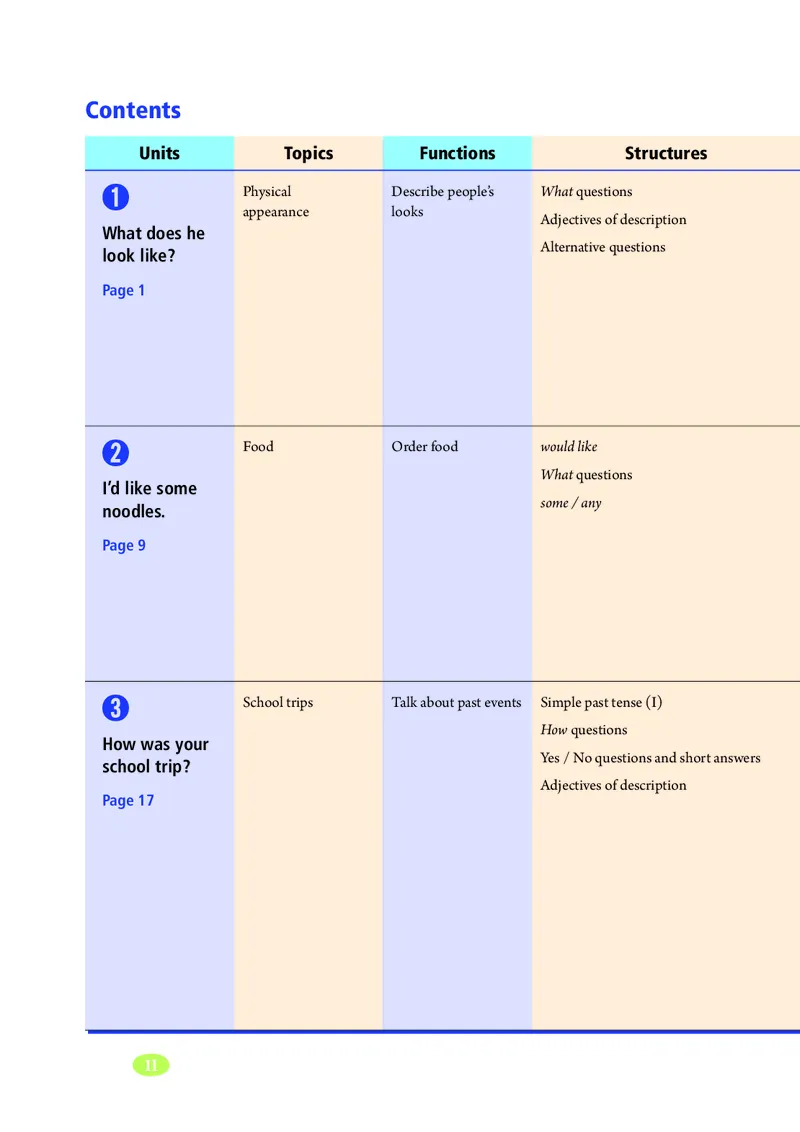
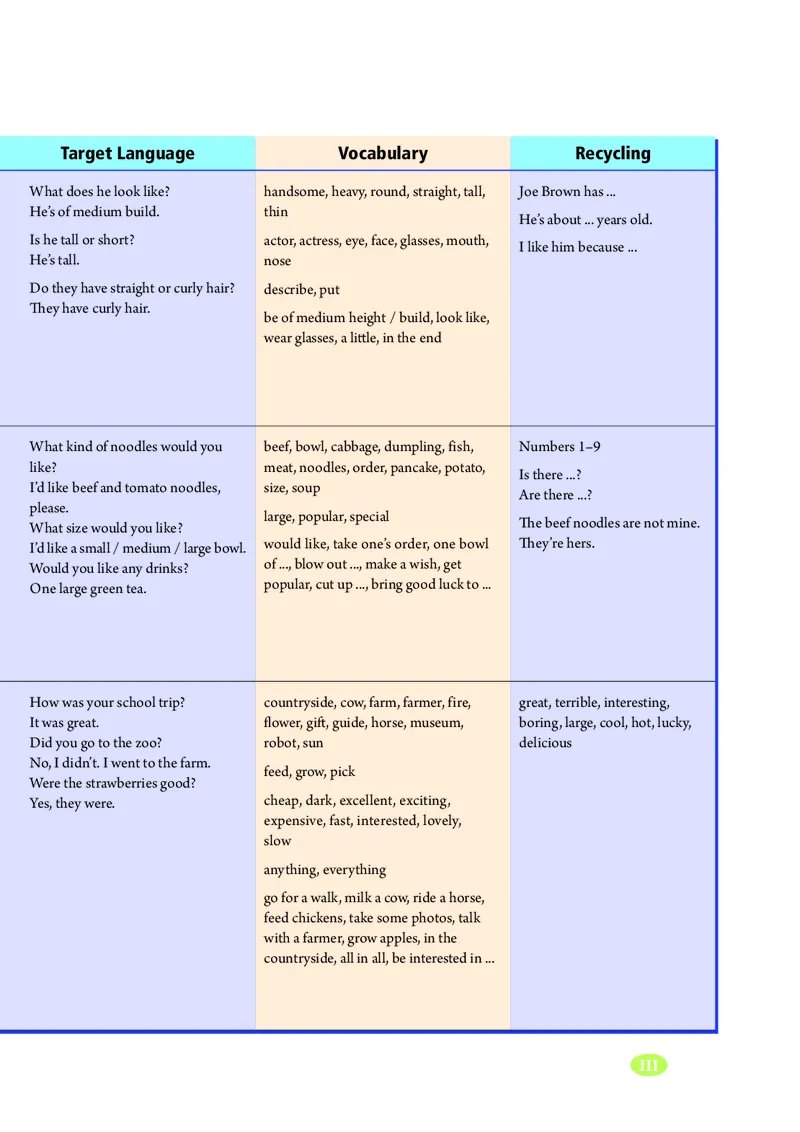
Units Topics Functions Structures Target Language Vocabulary Recycling
Physical Describe people’s What questions What does he look like? handsome, heavy, round, straight, tall, Joe Brown has ...
➊
appearance looks He’s of medium build. thin
Adjectives of description He’s about ... years old.
What does he
Is he tall or short? actor, actress, eye, face, glasses, mouth,
Alternative questions I like him because ...
look like?
He’s tall. nose
Page 1 Do they have straight or curly hair? describe, put
They have curly hair.
be of medium height / build, look like,
wear glasses, a little, in the end
Food Order food would like What kind of noodles would you beef, bowl, cabbage, dumpling, fish, Numbers 1–9
➋
like? meat, noodles, order, pancake, potato,
What questions Is there ...?
I’d like some I’d like beef and tomato noodles, size, soup
Are there ...?
some / any
noodles. please.
large, popular, special
The beef noodles are not mine.
What size would you like?
Page 9 I’d like a small / medium / large bowl. would like, take one’s order, one bowl They’re hers.
Would you like any drinks? of ..., blow out ..., make a wish, get
One large green tea. popular, cut up ..., bring good luck to ...
School trips Talk about past events Simple past tense (I) How was your school trip? countryside, cow, farm, farmer, fire, great, terrible, interesting,
➌
It was great. flower, gift, guide, horse, museum, boring, large, cool, hot, lucky,
How questions
How was your Did you go to the zoo? robot, sun delicious
Yes / No questions and short answers
school trip? No, I didn’t. I went to the farm.
feed, grow, pick
Adjectives of description Were the strawberries good?
Page 17 Yes, they were. cheap, dark, excellent, exciting,
expensive, fast, interested, lovely,
slow
anything, everything
go for a walk, milk a cow, ride a horse,
feed chickens, take some photos, talk
with a farmer, grow apples, in the
countryside, all in all, be interested in ...
IIUnits Topics Functions Structures Target Language Vocabulary Recycling
Physical Describe people’s What questions What does he look like? handsome, heavy, round, straight, tall, Joe Brown has ...
➊
appearance looks He’s of medium build. thin
Adjectives of description He’s about ... years old.
What does he
Is he tall or short? actor, actress, eye, face, glasses, mouth,
Alternative questions I like him because ...
look like?
He’s tall. nose
Page 1 Do they have straight or curly hair? describe, put
They have curly hair.
be of medium height / build, look like,
wear glasses, a little, in the end
Food Order food would like What kind of noodles would you beef, bowl, cabbage, dumpling, fish, Numbers 1–9
➋
like? meat, noodles, order, pancake, potato,
What questions Is there ...?
I’d like some I’d like beef and tomato noodles, size, soup
Are there ...?
some / any
noodles. please.
large, popular, special
The beef noodles are not mine.
What size would you like?
Page 9 I’d like a small / medium / large bowl. would like, take one’s order, one bowl They’re hers.
Would you like any drinks? of ..., blow out ..., make a wish, get
One large green tea. popular, cut up ..., bring good luck to ...
School trips Talk about past events Simple past tense (I) How was your school trip? countryside, cow, farm, farmer, fire, great, terrible, interesting,
➌
It was great. flower, gift, guide, horse, museum, boring, large, cool, hot, lucky,
How questions
How was your Did you go to the zoo? robot, sun delicious
Yes / No questions and short answers
school trip? No, I didn’t. I went to the farm.
feed, grow, pick
Adjectives of description Were the strawberries good?
Page 17 Yes, they were. cheap, dark, excellent, exciting,
expensive, fast, interested, lovely,
slow
anything, everything
go for a walk, milk a cow, ride a horse,
feed chickens, take some photos, talk
with a farmer, grow apples, in the
countryside, all in all, be interested in ...
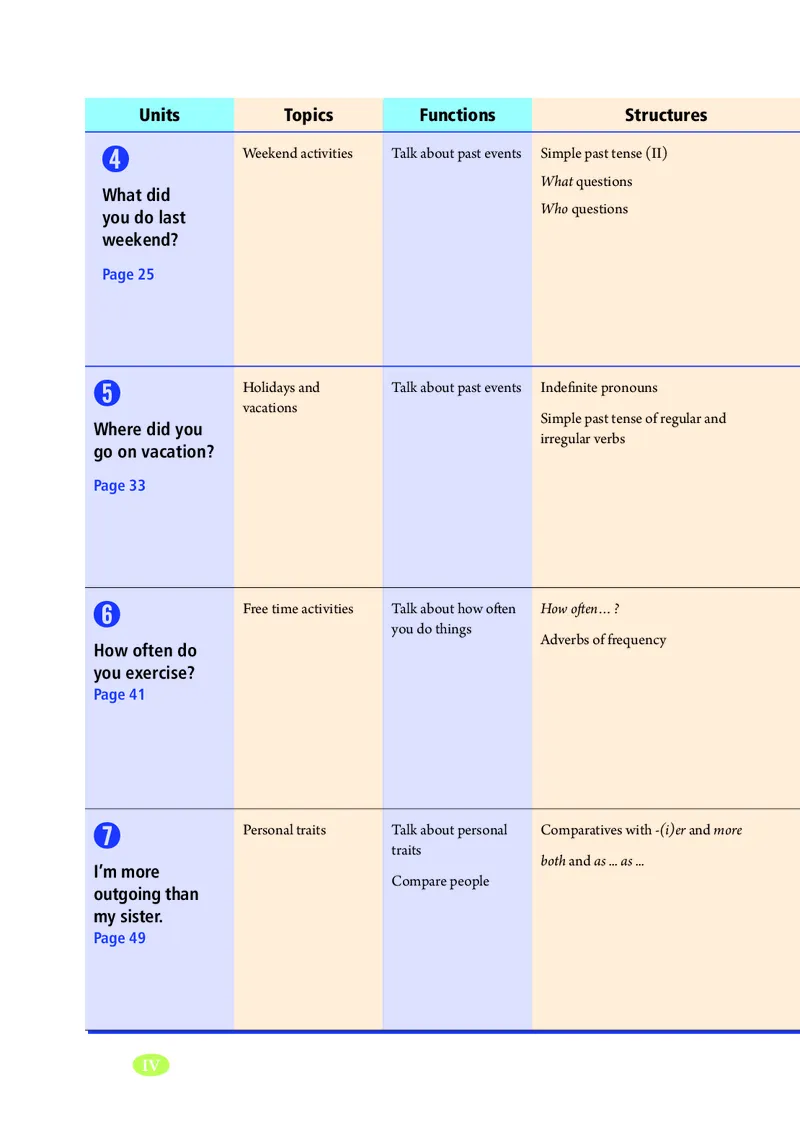
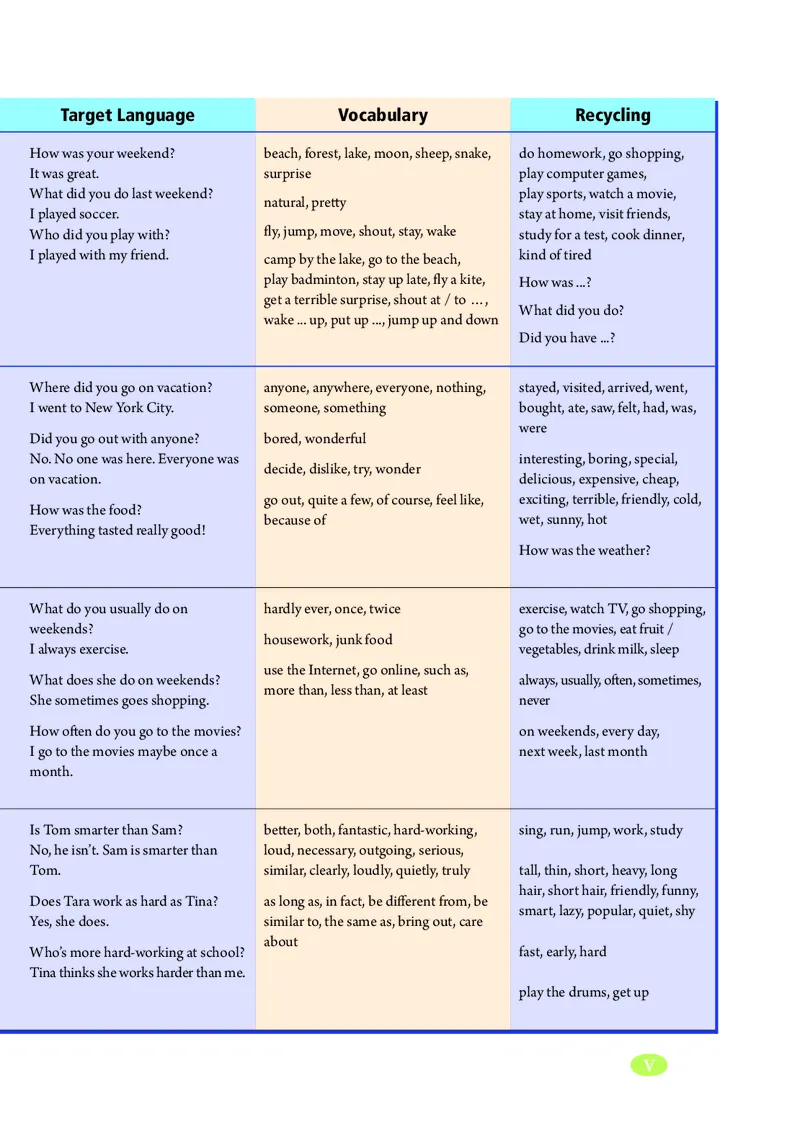
IIIUnits Topics Functions Structures Target Language Vocabulary Recycling
Weekend activities Talk about past events Simple past tense (II) How was your weekend? beach, forest, lake, moon, sheep, snake, do homework, go shopping,
➍
It was great. surprise play computer games,
What questions
What did What did you do last weekend? play sports, watch a movie,
natural, pretty
Who questions
you do last I played soccer. stay at home, visit friends,
weekend? Who did you play with? fly, jump, move, shout, stay, wake study for a test, cook dinner,
I played with my friend. camp by the lake, go to the beach, kind of tired
Page 25
play badminton, stay up late, fly a kite, How was ...?
get a terrible surprise, shout at / to …,
What did you do?
wake ... up, put up ..., jump up and down
Did you have ...?
Holidays and Talk about past events Indefinite pronouns Where did you go on vacation? anyone, anywhere, everyone, nothing, stayed, visited, arrived, went,
➎
vacations I went to New York City. someone, something bought, ate, saw, felt, had, was,
Simple past tense of regular and
Where did you were
irregular verbs Did you go out with anyone? bored, wonderful
go on vacation?
No. No one was here. Everyone was interesting, boring, special,
decide, dislike, try, wonder
on vacation. delicious, expensive, cheap,
Page 33
go out, quite a few, of course, feel like, exciting, terrible, friendly, cold,
How was the food?
because of wet, sunny, hot
Everything tasted really good!
How was the weather?
Free time activities Talk about how often How often…? What do you usually do on hardly ever, once, twice exercise, watch TV, go shopping,
➏
you do things weekends? go to the movies, eat fruit /
Adverbs of frequency housework, junk food
How often do I always exercise. vegetables, drink milk, sleep
you exercise? use the Internet, go online, such as,
What does she do on weekends? always, usually, often, sometimes,
Page 41 more than, less than, at least
She sometimes goes shopping. never
How often do you go to the movies? on weekends, every day,
I go to the movies maybe once a next week, last month
month.
Personal traits Talk about personal Comparatives with -(i)er and more Is Tom smarter than Sam? better, both, fantastic, hard-working, sing, run, jump, work, study
➐
traits No, he isn’t. Sam is smarter than loud, necessary, outgoing, serious,
both and as ... as ...
I’m more Tom. similar, clearly, loudly, quietly, truly tall, thin, short, heavy, long
Compare people
outgoing than hair, short hair, friendly, funny,
Does Tara work as hard as Tina? as long as, in fact, be different from, be
my sister. smart, lazy, popular, quiet, shy
Yes, she does. similar to, the same as, bring out, care
Page 49
about
Who’s more hard-working at school? fast, early, hard
Tina thinks she works harder than me.
play the drums, get up
IVUnits Topics Functions Structures Target Language Vocabulary Recycling
Weekend activities Talk about past events Simple past tense (II) How was your weekend? beach, forest, lake, moon, sheep, snake, do homework, go shopping,
➍
It was great. surprise play computer games,
What questions
What did What did you do last weekend? play sports, watch a movie,
natural, pretty
Who questions
you do last I played soccer. stay at home, visit friends,
weekend? Who did you play with? fly, jump, move, shout, stay, wake study for a test, cook dinner,
I played with my friend. camp by the lake, go to the beach, kind of tired
Page 25
play badminton, stay up late, fly a kite, How was ...?
get a terrible surprise, shout at / to …,
What did you do?
wake ... up, put up ..., jump up and down
Did you have ...?
Holidays and Talk about past events Indefinite pronouns Where did you go on vacation? anyone, anywhere, everyone, nothing, stayed, visited, arrived, went,
➎
vacations I went to New York City. someone, something bought, ate, saw, felt, had, was,
Simple past tense of regular and
Where did you were
irregular verbs Did you go out with anyone? bored, wonderful
go on vacation?
No. No one was here. Everyone was interesting, boring, special,
decide, dislike, try, wonder
on vacation. delicious, expensive, cheap,
Page 33
go out, quite a few, of course, feel like, exciting, terrible, friendly, cold,
How was the food?
because of wet, sunny, hot
Everything tasted really good!
How was the weather?
Free time activities Talk about how often How often…? What do you usually do on hardly ever, once, twice exercise, watch TV, go shopping,
➏
you do things weekends? go to the movies, eat fruit /
Adverbs of frequency housework, junk food
How often do I always exercise. vegetables, drink milk, sleep
you exercise? use the Internet, go online, such as,
What does she do on weekends? always, usually, often, sometimes,
Page 41 more than, less than, at least
She sometimes goes shopping. never
How often do you go to the movies? on weekends, every day,
I go to the movies maybe once a next week, last month
month.
Personal traits Talk about personal Comparatives with -(i)er and more Is Tom smarter than Sam? better, both, fantastic, hard-working, sing, run, jump, work, study
➐
traits No, he isn’t. Sam is smarter than loud, necessary, outgoing, serious,
both and as ... as ...
I’m more Tom. similar, clearly, loudly, quietly, truly tall, thin, short, heavy, long
Compare people
outgoing than hair, short hair, friendly, funny,
Does Tara work as hard as Tina? as long as, in fact, be different from, be
my sister. smart, lazy, popular, quiet, shy
Yes, she does. similar to, the same as, bring out, care
Page 49
about
Who’s more hard-working at school? fast, early, hard
Tina thinks she works harder than me.
play the drums, get up
VUnits Topics Functions Structures Target Language Vocabulary Recycling
Your town Discuss preferences Superlatives with -(i)est and most What’s the best movie theater to close, comfortable, fresh, poor, worse, new, big, cheap, expensive,
➑
go to? worst popular, exciting, interesting,
Make comparisons Irregular comparisons: good, better,
What’s the best Town Cinema. It’s the closest to creative, boring, funny, beautiful,
best; bad, worse, worst beautifully, carefully, cheaply,
movie theater? home. And you can buy tickets the good, bad
comfortably, seriously
most quickly there.
quickly, well, fast, quietly
Page 57 so far, have ... in common, all kinds of, be
Which is the worst clothes store in
up to, play a role, make up, for example
town?
Dream Clothes. It has the worst
service.
What do you think of 970 AM?
I think 970 AM is pretty bad.
Page 65 Additional Material
Page 66 Notes on the Text
Page 77 Tapescripts
Page 84 Pronunciation
Page 89 Grammar
Page 97 Words and Expressions in Each Unit
Page 106 Vocabulary Index
Page 114 Irregular Verbs
VIUnits Topics Functions Structures Target Language Vocabulary Recycling
Your town Discuss preferences Superlatives with -(i)est and most What’s the best movie theater to close, comfortable, fresh, poor, worse, new, big, cheap, expensive,
➑
go to? worst popular, exciting, interesting,
Make comparisons Irregular comparisons: good, better,
What’s the best Town Cinema. It’s the closest to creative, boring, funny, beautiful,
best; bad, worse, worst beautifully, carefully, cheaply,
movie theater? home. And you can buy tickets the good, bad
comfortably, seriously
most quickly there.
quickly, well, fast, quietly
Page 57 so far, have ... in common, all kinds of, be
Which is the worst clothes store in
up to, play a role, make up, for example
town?
Dream Clothes. It has the worst
service.
What do you think of 970 AM?
I think 970 AM is pretty bad.
Page 65 Additional Material
Page 66 Notes on the Text
Page 77 Tapescripts
Page 84 Pronunciation
Page 89 Grammar
Page 97 Words and Expressions in Each Unit
Page 106 Vocabulary Index
Page 114 Irregular Verbs
VIIU 1
NIT
What does he look like? UNIT 1
Section
A What does he look like?
Language Goal: Describe people’s looks
1a
Match the words
Is that your friend?
with the people in
No, it isn’t.
the picture. You
can use some What does he look like? Well, he’s really
Is he short or tall?
. And he has
letters more than
.
once.
h
e
1. short hair e
2. curly hair g
3. long hair
4. straight
f
hair
5. tall
b
a
6. short
7. medium
c
height
8. thin
9. heavy
10. medium d
build
1b Listen and fill in the blanks in the picture above. Can you find Amy’s
friend?
1c One of the people in 1a is your friend. Describe your friend. Your
partner will find him / her.
A: What does your friend look like?
B: She’s of medium height, and she has long straight hair.
1
Page PBUNIT 1
2a Listen and answer
1. Is David tall or short?
the questions.
2. Does Sally have long or short hair?
3. Is Peter short or tall?
2b Listen again. Fill in the chart.
David Sally Peter
is heavy
has
2c Student A looks at the chart in 2b.
Student B asks Student A questions A: What does he look like?
about one of the people and then B: He’s of medium build.
draws a picture of the person. A: Is he short?
B: Yes, he is.
A: Does he have long or short hair?
B: Short hair.
2d Role-play the conversation.
Mike: Hi, Tony. Are you going to the movie
tonight?
Tony: Yes. We’re meeting at seven, right?
Mike: Yeah, but I may be a little late. My
friend David is going, too. Just meet
him in front of the cinema first.
Tony: Oh, but I don’t know him. What
does he look like?
Mike: Well, he has brown hair and wears
glasses.
Tony: OK. Is he tall or short?
Mike: He isn’t tall or short. He’s of medium height.
Tony: OK, sure. See you later then.
2What does he look like? UNIT 1
Grammar
Focus
What does he look like? He’s really tall.
What does she look like? She has long straight hair.
What do they look like? They’re of medium build.
Do they have straight or curly hair? They have curly hair.
Is he tall or short? He isn’t tall or short. He’s of medium height.
3a Write these words in the correct box.
short hair heavy curly hair thin of medium build
tall straight hair short long hair of medium height
is
has
3b Circle the correct words to complete the conversation.
A: So what do / does your friend Clark look like?
B: Well, he is / has thin, and he have / has black hair.
A: Really? Is / Does he tall or short?
B: He is / isn’t tall or short. He is / has of medium height.
A: Does he has / have curly or straight hair?
B: He is / has straight hair. And he is / has really handsome.
3c Write answers to these questions about different people. Then tell your
partner about them.
1. What does your favorite actor or actress look like?
2. What does your favorite teacher look like?
This person is of
3d Describe someone in the class. Ask your medium height.
classmates to guess who you are describing. She has short hair.
3
Page PBUNIT 1
1a Match the words with the pictures.
Section
B
a b c d
1. d a big nose 3. a small mouth 5. a round face 7. black hair
2. blonde hair 4. glasses 6. big eyes 8. a long face
1b Make sentences about famous people. Fill in the blanks.
1. Jackie Chan has black hair. 3. wears glasses.
2. has a round face. 4. has blonde hair.
1c Listen and write Johnny Dean’s and Tina Brown’s jobs in the chart.
Johnny Dean Tina Brown
Job singer
Looks
like
1d Listen again. What do Johnny and Tina
look like? Complete the chart in 1c.
My favorite singer is
John Jackson. He’s tall
and thin. He has short
curly brown hair.
1e Describe what your favorite singer
or athlete looks like.
4What does he look like? UNIT 1
2a Complete the chart with words of the opposite meaning.
young
thin
tall
long
curly
big
2b Read the newspaper article. Which picture shows the real criminal?
1
An Interesting Job
Joe Brown has a very interesting job. He is a police
artist. Some people see crimes and then talk to Joe.
They tell him what the criminal looks like. Then Joe
draws a picture of the criminal, and the police put it in
newspapers and on television to find him.
2
He wants to draw a good picture of each criminal, but
this job is sometimes difficult. Many people don’t
always see things the same way so they may describe
the same person differently. Also, they don’t always
remember well. “The criminal is of medium build and
young. He has long straight black hair and big eyes,”
says one woman. Another woman says, “He is tall and
3
thin, and he has curly blond hair. He’s about thirty
years old.” A man says, “He is of medium height. He has
a long nose and small eyes. He wears a brown jacket.”
In the end, the real criminal is a short and heavy old
man, and he has short black hair!
4
5
Page PBUNIT 1
2c Read the article again and answer the questions.
1. What does Joe Brown do?
2. Is this job easy or difficult? Why?
2d Read the article again and write
what the words in bold refer to. 1. He =
2. it =
3. him =
4. this =
5. they =
6. He =
2e Describe the following people according to 2b.
He is of He is of .
and young. He has and .
He has . He wears .
He is and thin.
He has hair. He is short and .
He is He has hair.
years old.
6What does he look like? UNIT 1
3a Jack is Bill’s best friend . Fill in the blanks with the words in the box.
comes looks listening glasses straight shoes thin
My best friend is Jack. He is 13 years old. He
from America. Let me tell you what he
like. First of all, he is very tall and . He
has brown hair and he doesn’t wear
. He usually wears jeans, a T-shirt and
sports . I like him because he is really cool
and fun, and he is good at soccer. After school he
enjoys to music and going to the movies.
3b Complete the chart with Jack’s information.
Name: Nationality:
DESCRIBING
Age: Look:
A PERSON
Clothes: Hobbies:
3c Add more sentences for describing a person.
Age: He / She is 13. He / She is 13 years old. 13.
Look:
Hobbies:
Clothes:
7
Page PBUNIT 1
4 Write a passage about your best friend. These questions may help you.
What is your friend’s name? Where is he / she from?
What does he / she look like? What does he / she like to wear?
What does he / she like doing? Why do you like him / her?
Self Check
1 Circle the correct words to complete the sentences.
1. My teacher is / has short straight hair.
2. Her mother is / has tall and thin.
3. His friend is / has of medium build.
4. Lucy is / has a small mouth and big eyes.
5. Jackie wear / wears glasses.
2 Write more words in each box.
DESCRIBING PEOPLE
Height Build Hair Other features
tall thin long glasses
3 What do your parents look like? Describe them.
My dad is tall ...
8U 2
NIT
I’d like some noodles. UNIT 2
Section
A I’d like some noodles.
Language Goal: Order food
1a
c
Match the words a
d f
with the foods.
h
b
1. mutton g e
g
Special 1 Special 2 Special 3
2. beef
3. noodles I’m not sure yet. Are
What would there any vegetables
you like? in the beef noodles?
4. chicken
5. cabbage
Yes, there are
6. potatoes some tomatoes. What time do
you usually get
7. tomatoes up, Rick? I usually
get up at
OK, I’d like the
six thirty.
8. carrots beef noodles,
please.
1b Listen and check (✔) the noodles that the person orders.
Special 1 Special 2 Special 3
1c Practice the conversation in 1a with your partner. Then make your
own conversations.
9
Page PBUNIT 2
2a Listen and check (✔) the names of the foods you hear.
1. noodles
2. beef
3. mutton
4. chicken
5. tomatoes
6. cabbage
7. potatoes
8. vegetables
2b Listen again. Complete the sentences.
Boy: 1. I’d like a bowl of noodles.
(1)
2. I’d like , and noodles.
(2) (3) (4)
Girl: 1. I’d like a bowl.
(5)
2. I’d like and noodles, please.
(6) (7)
2c Ask and answer
A: I’d like a bowl of noodles.
questions with your
B: What kind of noodles would you like?
partner. Use the
A: I’d like chicken, potato and cabbage noodles.
information in 2a.
B: What size would you like?
A: I’d like a large bowl, please.
2d Role-play the conversation.
Waitress: Good afternoon. May I take your order?
Sally: Yes. Are there any vegetables in the beef soup?
Waitress: Yes. There are some tomatoes.
Sally: OK. We’d like one bowl of beef soup.
Waitress: Sure. What size would you like?
Sally: Large, please.
Tom: We’d also like gongbao chicken and some
mapo tofu with rice.
Waitress: OK. One large bowl of beef soup, one
gongbao chicken, and one mapo tofu with
rice.
Tom: Yes, that’s right.
10I’d like some noodles. UNIT 2
I’d = I would
Grammar
She’d = She would
Focus
What kind of noodles would you like? I’d like beef noodles, please.
What size would you like? I’d like a large bowl, please.
Would you like a large bowl? Yes, please.
No, there isn’t any. /
Is there any meat in the tomato and egg soup?
No, there’s no meat.
Countable and
Countable nouns Uncountable nouns
uncountable nouns
bowls, apples, carrots, beef, meat, milk, chicken, salad, ice-cream,
oranges, strawberries mutton, water cabbage
3a Complete the conversation below.
1. May I have your order? D A. What kind of noodles do you have?
2. What kind of noodles would you B. Oh, a medium bowl, please.
like? C. OK, I’d like the mutton noodles
3. We have beef, chicken, mutton, then.
cabbage, potato, tomato ... D. I’d like some noodles, please.
4. Yes, there are some carrots. E. What sizes do you have?
5. Sure. What size would you like? F. Are there any vegetables in the
6. We have large, medium and small mutton noodles?
bowls.
1. What kind of noodles would you like?
(kind)
3b Write questions and answers
using the words in brackets.
(chicken / beef / tomatoes)
2.
(size)
3c Work in small groups. Find
out who would like the food (medium)
below. Write their names on 3.
the cards above the food. (any / cabbage / beef noodles)
(no)
A: Anna, what would you like to eat?
B: I’d like beef noodles with carrots.
hamburger potato tomato and beef and
salad egg rice carrot noodles
11
Page PBUNIT 2
1a Match the words with the pictures.
Section
B 1. b meat 4. green tea 7. onions
2. dumplings 5. orange juice 8. fish
3. porridge 6. soup 9. pancakes
c g
e i
a
b h
d
f
I like dumplings,
1b Circle the things you like in 1a. Put an fish and orange
✘ next to the things you don’t like. Then juice.
tell your partner what you like and don’t
like. I don’t like
onions, green
tea or porridge.
1c Listen and complete the food order form.
ORDER FORM
❖
❖ ❖
❖ Address: 15 North Street ❖
❖ ❖
❖ ❖
❖ Telephone number: ❖
❖ ❖
❖ ❖
❖ Order: ❖
❖ ❖
❖ ❖
❖ Dishes: , fish, ❖
❖ ❖
❖ ❖
❖ Dumplings: 12 beef and ❖
❖ ❖
❖ ❖
❖ ❖ Soup: one ❖ ❖
❖ ❖
❖ ❖
❖ Drinks: one large and ❖
❖ ❖
❖ ❖
❖ small juices. ❖
1d Listen again. Check your answers in 1c.
12I’d like some noodles. UNIT 2
2a Discuss the questions with your partner.
1. What do you do or eat on your birthday?
2. What do people in other countries eat on their birthdays?
2b Read the article about food traditions.
Birthday Food Around the World
What would people like to eat on their
birthdays? The answer would be different
in different countries.
In many countries, people have birthday
cakes with candles. The number of candles
is the person’s age. The birthday person must make a wish and blow out the
candles. If he or she blows out all the candles in one go, the wish will come
true. In the UK, people sometimes put a candy in a birthday cake. The child
with the candy is lucky. In Brazil, people like to eat candies on their birthdays.
In Korea, people have cakes and a bowl of seaweed soup for a birthday. They
think seaweed soup is good for health.
In China, it is getting popular to have cake on one’s birthday. But many people
still eat very long noodles for their birthdays. They never cut up the noodles
because the long noodles are a symbol of long life. In some places, Chinese
people also eat eggs on their birthdays. They are a symbol of life and good
luck.
All of these birthday foods may be different, but the ideas are the same. They
bring good luck to the birthday person.
13
Page PBUNIT 2
2c Read the article again and circle T for true or F for false.
1. People in different countries eat different foods for their birthdays. T F
2. It is popular to have a cake for a birthday around the world. T F
3. In many countries, people have birthday cakes with candies. T F
4. In Brazil, people like birthday candies. T F
5. In Korea, people think having seaweed soup on their birthdays can
T F
bring them good luck.
6. In China, people eat not only birthday cakes but also birthday noodles. T F
2d Answer the questions according to the article.
1. How can a person make his or her birthday wish come true?
2. What do people in the UK sometimes put in a birthday cake?
3. Do Koreans think seaweed soup is good for health?
4. Why do people never cut up birthday noodles in China?
2e Complete the chart according to the article.
Countries Foods Special meanings
UK
China
Korea
14I’d like some noodles. UNIT 2
3a Fill in the blanks in the ad with the words in the box.
order bowl kinds strawberry specials
The Ice-Cream and Pancake House
Would you like to eat ice-cream or pancakes? At our restaurant,
we have some great . We have different of fruit
ice-cream, like , banana or orange. Would you like a big
for four yuan or a small one for just two yuan? You can
also our delicious pancakes for just five yuan.
3b Imagine you have a restaurant. Write
the foods and their prices. 1 2
1. Dumplings ¥8 7. 3 4
2. 8.
5 6
3. 9.
4. 10. 7 8
5. 11.
9 10
6. 12.
11 12
3c Write an ad for your restaurant. These
sentence structures may help you.
Welcome to … Restaurant. Would you like ...?
We have ... for ...
You can try our ...
... is very good / delicious.
I hope to see you at my restaurant soon!
15
Page PBUNIT 2
4 Work in pairs. Make a conversation with the help of the clues.
In a restaurant:
Waiter: Ask for the order Customer: Ask about what is in the food
Customer: Thank the waiter Waiter: Ask for the size of the order
Can I help you?
What would you like?
I’d like …
Self Check
1 Circle the word that doesn’t belong in each group.
1. apples carrots oranges strawberries
2. milk beef mutton chicken
3. porridge water green tea orange juice
4. bread cake candy burger
5. cabbage tomato potato pear
2 Complete the conversations with would you, Would, I’d, He’d or She’d.
Then read the conversations aloud.
1. A: What like, juice or water? B: Some water, please.
2. A: your brother like some tea? B: Yes. like green tea.
3. A: What Helen like? Tea? B: No. like juice.
4. A: you like some fruit? B: Yes, please.
5. A: What kind of fruit like? B: like some oranges.
3 Complete the sentences with the correct form of the there be
structure.
1. Customer: Excuse me, a fly (苍蝇) in my porridge.
Waiter: Don’t worry (别急), sir. That spider (蜘蛛) on your bread will
soon get him.
2. Customer: two flies in my fish soup.
Waiter: I know. But we are short of fish.
3. Customer: We ordered mutton noodles, but any
mutton in the noodles.
Waiter: Put on your glasses and you can see the mutton.
16U 3
NIT
How was your school trip? UNIT 3
Section
A How was your school trip?
Language Goal: Talk about past events
1a
Match the phrases c
a b
with the pictures.
1. went for a
walk e
e
2. milked a
f
d
cow
3. rode a horse
4. fed chickens
5. talked with a
farmer
6. took some Did you see Yes, I did.
any cows? I saw quite a lot.
photos
Did you ride a No, I didn’t.
horse? But I milked a cow.
1b Listen and circle the
three things Carol did
on her school trip in 1a.
1c Ask and answer questions about Carol’s school trip.
A: Did Carol take any photos?
B: Yes, she did.
17
Page PBUNIT 3
2a Listen and check (✔) the questions you hear.
What did the farmer say? Did you grow any apples?
What did you see? Do they grow apples?
Did you learn anything? Did you eat them?
Did you ask him any questions? Were they good?
2b Listen again. Circle T for true or F for false.
1. The farmer showed Carol around
the farm. T F
2. Carol learned a lot about farming. T F
3. The farmers grow strawberries from
December to June. T F
4. The farmers don’t grow apples. T F
5. Carol picked some strawberries
and took them home. T F
2c Ask and answer questions about
A: What did the farmer do?
Carol’s visit to the farm.
B: He showed Carol around the farm.
A: What did Carol do?
B: She picked some strawberries.
2d Role-play the conversation.
Peter: Hi, Eric. How was your trip last week?
Eric: It was excellent. I visited my grandparents in the countryside.
Peter: Oh, nice. What did you do?
Eric: I went fishing every day. And I fed the
chickens with my grandpa. It was
so much fun.
Peter: Sounds good. How was the weather
there?
Eric: It was great and the air was so clean. I
watched the stars at night. They were
so beautiful.
Peter: Lucky you.
18How was your school trip? UNIT 3
Grammar
Focus
How was your school trip? It was great!
Did you go to the zoo? No, I didn’t. I went to a farm.
Did you see any cows? Yes, I did. I saw quite a lot.
Did Carol ride a horse? No, she didn’t. But she milked a cow.
Were the strawberries good? Yes, they were. / No, they weren’t.
Regular verbs Irregular verbs
play → played do → did
3a Complete Jim’s letter on
visit → visited is → was
the left and Bill’s reply on
climb → climbed are → were
the right.
study → studied have → had
worry → worried eat → ate
Dear Bill,
stop → stopped buy → bought
How (is) your school trip
yesterday? (Do) you
Dear Jim,
(go) to the zoo?
(Do) you take any photos? My school trip (is) great!
(Do) you (see) We (have) so much fun!
any interesting animals? I We (go) to Green Park. We
(go) to the zoo last year (climb) the mountains there
and it (is) a lot of fun. and (see) a lot of flowers. We
(eat) our lunch under some
Jim
trees and (play) some games
after that. But at about two o’clock,
it (get) very cloudy and we
3b Make up a story. Each
(worry) it would rain.
student adds a sentence.
Luckily, it (do not), and the
sun (come) out again!
Last week I The
We went
visited my weather was fishing. Bill
aunt’s house. beautiful.
19
Page PBUNIT 3
1a Match the activities with the pictures.
Section
1. go to the zoo 4. climb a mountain
B
2. visit a museum 5. visit a fire station
3. ride a horse 6. go fishing
e
a
c
b
f
d
1. How was Jane’s trip?
1b Listen and answer the questions.
2. How was Tony’s trip?
1c Listen again. What did Jane and Tony do on their last school trip?
Check (✔) Tony or Jane.
went to the climbed a went to an saw some drew
countryside mountain art museum paintings pictures
Tony
Jane
I went That
to ... sounds ...
1d What was your last school trip like?
Discuss it with your partner.
20How was your school trip? UNIT 3
2a Do the following words describe good things or bad things? Put a ✔ for
good and an ✘ for bad. Leave a blank if they can mean both.
interesting difficult lovely slow
exciting boring cool hot
lucky large expensive terrible
delicious great cheap fast
2b Read Helen’s and Jim’s diary entries. Underline the positive adjectives
and circle the negative adjectives.
June 15th
I think today’s school trip was
terrible. We took the train to
the museum. It was so hot on
the slow train. The museum
was big and boring. Everything
was about robots and I’m not
interested in that. The rooms
were really dark and it was
June 15th
difficult to take photos, so
Today I went on a school trip. We
I didn’t take any. There were
visited the science museum and it was
also too many people and
really interesting. We got there so
I couldn’t really see or hear the
fast by train. We saw some farms and
guide. The things in the gift
villages along the way. At the museum,
shop were so expensive.
I learned a lot about robots. I didn’t
I didn’t like the trip at all.
know they could play chess with us.
It was so cool! Then the guide taught
us how to make a model robot. I took
a lot of great photos, too. After that,
I went to the gift shop and bought
some lovely gifts for my parents. They
weren’t expensive. All in all, it was an
exciting day.
21
Page PBUNIT 3
2c Complete the chart. How do Helen and Jim describe these things?
Helen Jim
the trip
the train
the museum
the gift shop and gifts
2d Complete the sentences about the diary entries above.
1. Helen and Jim t the train to the museum.
2. There were all kinds of r at the museum.
3. Helen p chess with the robots.
4. Helen b her parents some lovely gifts.
5. Jim didn’t b any gifts at all.
2e Use the phrases to retell the two diary entries.
Helen Jim
an interesting school trip a terrible school trip
saw some farms and villages so hot on the slow train
learned a lot not interested in it
played chess big, boring and dark
made a model robot didn’t take any photos
took a lot of photos couldn’t see or hear
went to the gift shop didn’t buy any gifts
bought lovely gifts so expensive
an exciting day didn’t like the trip
22How was your school trip? UNIT 3
3a Look at the pictures of Bob’s school trip. Complete his diary entry.
June 23rd
Yesterday my school visited the zoo. It was really . We
went there by bus. At the zoo, I saw a lot of and I
took some photos. My classmates and I also went to the
and bought some . It was a great day.
3b Linda is Bob’s classmate. Complete her diary entry.
June 23rd
My school went to the zoo yesterday. The trip was .
At the zoo, I but I didn’t like them. I also went to
with my classmates, but I didn’t buy anything because
. It was a boring day.
3c Look at the mind map and talk about your trip with your partner.
When did you
When Where Who
take a trip?
My ...
What How
trip
23
Page PBUNIT 3
4 Now write a diary entry for your
own school trip. Explain whether
you liked it or not and why.
Self Check
1 Write more verbs and their past forms in each group.
climb → climbed arrive → arrived study → studied stop → stopped get → got
2 Complete the conversations with the
have do swim go
correct forms of the verbs in the box. be see feed
1. A: I went to the countryside this 2. A: you a
nice weekend?
summer.
B: Really? How the trip? B: Yes, I did.
A: It great! A: you
anywhere?
B: What you
there? B: Yes, I to the
A: I the chickens and mountains. The air
in a river. so clean and I a lot
of flowers.
3 Complete the passage with the words in the box.
ate had were laughed invited started gave
Yesterday was my birthday. My mother had a party for me. She
my friends to my home. They me many beautiful gifts. The party
at half past six. There cold drinks and a delicious cake.
We , talked and . We a wonderful time.
24U 4
NIT
What did you do last weekend? UNIT 4
Section
A What did you do last weekend?
Language Goal: Talk about past events
1a
d
a
Match the
activities with the
pictures [a–f].
b
1. did my Sunday night
homework a What did you do Saturday e
last weekend, Lucy? c
2. went to the
Well, on Saturday
cinema
morning, I played
badminton.
3. went boating
Sunday
f
Saturday
4. camped by the
lake
5. went to the
beach
morning
6. played badminton
1b Listen and write the day, morning, afternoon or night below each
picture.
1c Role-play. Student A is Lucy. Student B asks Lucy about her weekend.
B: What did you do last weekend, Lucy?
A: Well, on Saturday morning, I played badminton.
25UNIT 4
2a Listen and underline the words you hear.
1. B I visited my (aunt / grandma).
2. I did my (homework / sports).
3. I studied for the (English / math)
test.
4. I went to a (farm / beach).
5. I fed some (sheep / cows).
2b Listen again. Write C for Carol, J for Jack or B for Becky next to the
statements in 2a.
2c Make conversations
Ms. Clark: Hi, Becky. What did you do
according to the information
last weekend?
you heard in 2a and 2b. Becky: I visited my grandma.
Ms. Clark: That’s nice! Who did you go with?
Becky: My parents.
Ms. Clark: What about you, Carol?
Where did you go?
Carol: I went to the …
2d Role-play the conversation.
Paul: Hi, Lisa. How was your weekend?
Lisa: Great, thanks.
Paul: What did you do?
Lisa: I worked as a guide at the Natural History Museum.
Paul: Really? How interesting!
Lisa: Yeah, it was fun. They have a
butterfly house with over 200 kinds
of butterflies! I told the visitors
about them and their living habits.
Did you have a good weekend?
Paul: Yeah, it was good, but I’m kind of
tired now. I stayed up late to
watch the soccer game.
26What did you do last weekend? UNIT 4
Grammar
Focus
What did you do last weekend? I did my homework. / We went boating.
Who visited her grandma? Becky did.
Where did she go last weekend? She went to a farm.
Who did she go with? She went with her classmates.
3a Fill in the blanks with who, what, when, where or how.
1. A: did you do last weekend?
B: I played badminton on Saturday.
A: Sounds fun! did you play with?
B: I played with my father. He’s really good!
2. A: was your weekend?
B: It was great! I had so much fun!
A: did you go?
B: The weather was beautiful, so I went to the beach with my parents.
3. A: did Jim lose?
B: He lost his keys. He often loses things.
A: That’s too bad. did he lose them?
B: I heard it was yesterday.
3b Complete the passage with the correct forms of the words in the box.
say be climb see run away
A family of mice were in the kitchen on Saturday morning when they
a big cat. Baby Mouse afraid and onto his father’s back.
Father Mouse shouted at the cat, “Woof, woof!” The cat quickly .
“Wow, Dad, you’re great!” Baby Mouse. “Well, son, that’s why it’s
important to learn a second language,” answered Father Mouse.
You went to
3c Think of two things you did the mountains!
last weekend. Draw pictures
of them. Your classmates
guess what you did.
27UNIT 4
1a Here are some things that Sally and Jim did
Section
yesterday. Match the activities with the pictures.
B
1. sang and played the guitar 4. went to the library
2. studied for a test 5. flew a kite
3. had dinner with friends 6. swam in a swimming pool
a b c d e f
j
1b Are these activities fun or not fun? Draw a happy face j or an unhappy
face l under each picture.
1c Listen. What did Sally and Jim do last weekend? Complete the chart.
Sally Jim
did her homework
Who went to
1d Make a conversation with a
the library?
partner. Talk about what Sally
and Jim did last weekend.
Sally did.
Did you do anything
1e Make a conversation. Ask
interesting last
what your partner did last weekend?
weekend.
Not really, but I
visited my sister.
28What did you do last weekend? UNIT 4
2a What kinds of animals are you afraid of? Why?
Animals Reasons
2b Read about Lisa’s weekend and answer the questions.
1. What was the special gift?
2. What woke the snake up?
A Weekend to Remember
My sister finished high school two
weeks ago. As a special gift, our
parents took us to India for a holiday.
We visited many interesting places
and told each other stories. But I was
and had a wonderful time. Last
so tired that I went to sleep early.
weekend was interesting but scary.
The next morning, my sister and I got
We went camping in a small village in
a terrible surprise. When we looked
India. First, we took a long bus ride to
out of our tent, we saw a big snake
a lake in the countryside. There we put
sleeping near the fire. I was so scared
up our tents and made a fire to keep us
that I couldn’t move. We shouted to
warm and cook food on. On the first
our parents to let them know about
night, we just sat under the big moon
the danger. My dad started to jump up
and down in their tent. This woke the
snake up and it moved into the forest
near the lake. My dad told me later
that snakes don’t have ears but can feel
things moving. He also told me it was
important not to go near a snake. This
was a very useful lesson for me.
29UNIT 4
2c What can you remember from the text? Circle T for true or F for false.
1. Lisa’s sister left school last weekend. T F
2. The trip from the city to the lake took a long time. T F
3. It was cloudy on their first night of camping. T F
4. Lisa and her sister didn’t know how to make the snake go away. T F
5. Lisa’s dad jumped up and down because he was scared, too. T F
6. Snakes don’t really hear things like people do. T F
2d Put the phrases in order according to the passage. Then use them to
retell the story.
snake went into the forest
put up our tents and cooked food
learned a useful lesson
saw a snake and shouted to parents for help
snakes can’t hear but can feel things moving
my dad jumped up and down in his tent
1 took a bus to a small village in India
told stories under the moon, then went to sleep
2e Write down three or more questions about Lisa’s weekend. Then ask
your partner.
Did Lisa have an
interesting weekend?
1.
2.
3.
4.
Yes, she did.
5.
30What did you do last weekend? UNIT 4
3a Look at the pictures and complete the passage.
Saturday
Sunday
I had a busy weekend. On Saturday morning, I cleaned my room. In the
afternoon, I . It was a little difficult. On Saturday night, I stayed
at home and cook dinner. On Sunday morning, I .
I read a book about history. Then in the afternoon, I with my
friends. On Sunday night, I . I saw an interesting talk show.
3b Use the following questions to do a survey of your group members’
weekend activities. Fill in the form and then report your findings to
your class.
What was the weather like? How did you feel?
Where did you go? What did you see or do?
When did you do that? Who did you do it with?
Names Activities Your opinions
3c Write a passage about your group members’ weekends.
31UNIT 4
4 Imagine you are a famous person. Write what you did last weekend.
Then talk to your partner about your weekend. Your partner tries to
guess who you are.
What did you do
Activities last weekend?
I wrote a new song.
I practiced my guitar.
I wrote a
new song.
Self Check
1 Complete the phrases.
out with friends fly a
for a walk milk a
apples camp the lake
photos study a test
2 Complete the conversation.
A: I had a school trip last week.
B: Really? (go)?
A: I visited the fire station.
B: (go with)?
A: I went with my classmates.
B: (do)?
A: We watched how firemen worked. What an interesting job they have!
B: (learn anything)?
A: Sure. We learned how to call the fire station and what to do when there is a fire.
3 Draw lines to make verb phrases. Then use the past verb forms
to make sentences that are true for you.
go for a math test
talk my mom
watch soccer
do my room
clean on the phone
play TV
help my homework
study shopping Carol and I went shopping last Saturday.
32U 5
NIT
Section
A Where did you go on vacation?
Language Goal:
Talk about past e
events
b d
c
a Where did you go
on vacation?
I went to the
mountains.
f
1
g
1a Match the activities with the pictures [a–g].
1. stayed at home f 5. went to the mountains
2. went to New York City 6. went to the beach
3. visited my uncle 7. visited museums
4. went to summer camp
1b Listen and number the people in the picture [1–5].
1. Tina 2. Xiang Hua 3. Sally 4. Bob 5. Tom
1c Make conversations about the people in the picture.
A: Where did Tina go on vacation?
B: She went to the mountains.
33
Page PBUNIT 5
2a Listen. Where did the people go on vacation? Complete the chart.
People Places
Grace
Kevin
Julie
2b Listen again. Check (✔) Yes, I did or No, I didn’t for each question.
Did you ... Yes, I did. No, I didn’t.
go with anyone? ✔
Grace go to Central Park?
buy anything special?
play volleyball?
Kevin swim?
meet anyone interesting?
do anything interesting?
Julie study for tests?
go out with anyone?
2c Make conversations between Grace, Kevin and Julie.
A: Grace, where did you go on vacation?
B: I went to New York City.
A: Oh, really? Did you go with anyone?
B: Yes, I went with my mother.
2d Role-play the conversation.
Rick: Hi, Helen. Long time no see.
Helen: Hi, Rick. Yes, I was on vacation last month.
Rick: Oh, did you go anywhere interesting?
Helen: Yes, I went to Guizhou with my family.
Rick: Wow! Did you see Huangguoshu
Waterfall?
Helen: Yes, I did. It was wonderful! We took quite
a few photos there. What about you? Did you do anything special last
month?
Rick: Not really. I just stayed at home most of the time to read and relax.
34Where did you go on vacation? UNIT 5
Grammar
Focus
Where did you go on vacation? I went to New York City.
Did you go out with anyone? No. No one was here. Everyone was on vacation.
Yes, I bought something for my father.
Did you buy anything special?
No, I bought nothing.
How was the food? Everything tasted really good!
Did everyone have a good time? Oh, yes. Everything was excellent.
3a Fill in the blanks with the words in the box and anyone
something
practice the conversation.
anything
Linda: Did you do fun on your vacation, Alice?
everything
Alice: Yes, I did. I went to Sanya.
nothing
Linda: How did you like it?
Alice: Well, it was my first time there, so was really interesting.
Linda: Did you go with ?
Alice: Yes, I did. I went with my sister.
Linda: Did you go shopping?
Alice: Of course! I bought for my parents, but for myself.
Linda: Why didn’t you buy for yourself?
Alice: I didn’t really see I liked.
anything everything nothing
3b Fill in the blanks in the e-mail message
everyone no one
with the words in the box.
Dear Bill,
How was your vacation? Did you do interesting? Did in the
family go with you? I went to a friend’s farm in the countryside with my
family. was great. We fed some hens and saw some baby pigs. They
were so cute! The only problem was that there was much to do in the
evening but read. Still seemed to be bored. Bye for now!
Mark
3c Ask your group questions about their last vacation. Then tell the class
your results.
Someone (write the
Did you ... Everyone No one
classmate’s name)
eat anything at a restaurant?
In our group,
read anything interesting?
everyone ate
visit anyone in your family?
something at a
buy anything? restaurant ...
keep a diary?
35UNIT 5
1a Match the words with the pictures below.
Section
1. f delicious 3. exciting 5. terrible
B
2. expensive 4. cheap 6. boring
b d f
e
a c
words words
1b Look at the words in 1a again.
Write words on the left. delicious terrible
Write words on the right.
1c Listen. Lisa is talking about her vacation. Answer the questions.
1. Where did Lisa go on vacation? She went to Hong Kong.
2. Did she do anything special there? What was it?
3. Did she buy anything for her best friend?
4. Did Lisa like her vacation?
1d Listen again. Fill in the blanks.
What did Lisa say about ...?
her vacation great the people
the fun park the food
the stores
1e Ask and answer questions about Lisa’s vacation. Begin your questions
with the following words.
Where did ... ? What did ... ? Did she ... ?
How was ... ? How were ... ?
36Where did you go on vacation? UNIT 5
2a Discuss the questions with your partner.
1. What do people usually do on vacation?
2. What activities do you find enjoyable?
2b Read Jane’s diary entries about her vacation and answer the questions.
Did Jane have a good time on Monday? What about on Tuesday?
Monday, July 15th
I arrived in Penang in Malaysia this morning with
my family. It was sunny and hot, so we decided to
go to the beach near our hotel. My sister and I tried
paragliding. I felt like I was a bird. It was so
exciting! For lunch, we had something very special
— Malaysian yellow noodles. They were delicious!
In the afternoon, we rode bicycles to Georgetown.
There are a lot of new buildings now, but many
of the old buildings are still there. In Weld Quay, a really old place in
Georgetown, we saw the houses of the Chinese traders from 100 years
ago. I wonder what life was like here in the past. I really enjoyed walking
around the town.
Tuesday, July 16th
What a difference a day makes! My father and I decided to go to
Penang Hill today. We wanted to walk up to the top, but then it started
raining a little so we decided to take the train. We waited over an hour
for the train because there were too many people. When we got to
the top, it was raining really hard. We didn’t have an umbrella so we
were wet and cold. It was terrible! And because of the bad weather, we
couldn’t see anything below. My father
didn’t bring enough money, so we only
had one bowl of rice and some fish.
The food tasted great because I was so
hungry!
37UNIT 5
2c Read Jane’s diary entries again. Fill in the chart.
Things Jane did or saw Did she like it? (Yes / No) Why or why not?
tried paragliding
They were delicious.
walked around Georgetown
went to Penang Hill
It tasted great because she
was hungry.
2d Complete the conversation about Jane’s trip to Penang using the
information in the diary entries.
Anna: Hi, Jane. Where did you go on vacation last week?
Jane: I to Penang in .
Anna: Who you go with?
Jane: I went with my .
Anna: What did you do?
Jane: The weather was hot and on Monday, so we went on
the beach. Then in the afternoon, we bicycles to Georgetown.
Anna: Sounds great!
Jane: Well, but the next day was not as good. My and I went to
Penang Hill, but the weather really bad and rainy. We
a long time for the train and we were and cold because we
forgot to bring an .
Anna: Oh, no!
Jane: And that’s not all! We also didn’t bring money, so we only had
one bowl of rice and some fish.
2e Imagine Jane went to Penang Hill again and had a great day. Fill in the
blanks in her diary entry with the correct forms of the verbs in brackets.
Thursday, July 18th
Today (be) a beautiful day. My father and I (go)
to Penang Hill again, but this time we (walk) to the top. We
(start) at 9:30 a.m. and (see) lots of special Malaysian
flowers along the way. About one hour later, we (stop) and
(drink) some tea. Then we (walk) for another two hours before we
(get) to the top. I (be) quite tired, but the city
(look) wonderful from the top of the hill!
38Where did you go on vacation? UNIT 5
3a Complete the diary entry about a trip to one of these places.
Use the words and phrases in the box to help you.
Tian’anmen the Palace Museum a Beijing hutong
hot and sunny tired
Beijing duck delicious
Wednesday, 20th
take some photos beautiful
Today the weather was .
buy something special interesting
I went to . It was
learn something important August
. We .
I liked this place because .
For dinner we had . It was .
In the evening, I felt really .
3b Answer the questions to make notes about a vacation you took.
1. Where did you go? 5. What food did you eat?
2. Did you go with anyone? 6. What did you like best?
3. How was the weather? 7. Did you dislike anything?
4. What did you do every day? 8. How did you feel about the trip?
3c Write a travel diary like Jane’s on page 37. Use your notes in 3b.
39UNIT 5
4 Imagine you are all foreigners on vacation in China. You meet each
other at the airport on your way home. Talk about what you did on
your vacation.
Hi, my Hi, Paul. I’m Anna.
name’s Paul. Where did you go on
vacation?
Oh, I went to Beijing.
I went to
Did you do anything special
Nanjing.
in Nanjing?
Self Check
1 Complete the conversations with the correct words in the box.
1. A: Did go on vacation with you last month?
B: Yes, my family went to the countryside with me.
anything
2. A: Did your family go to the beach with you last weekend?
everything
B: No. from my family went, but my friend went with me.
nothing
3. A: I didn’t bring back anything from Malaysia.
anyone
B: at all? Why not?
everyone
4. A: Did you buy in the shopping center?
no one
B: No, I didn’t. was very expensive.
5. A: How was the volleyball game yesterday?
B: Great! had a fun time!
2 Complete the passage with the correct forms of the verbs in brackets.
Last August, our class (do) something very special on
our school trip. We (go) to Mount Tai. We
(start) our trip at 12:00 at night. Everyone in our class
(take) a bag with some food and water. After three hours, someone
looked at the map and (find) out we (be,
not) anywhere near the top. My legs (be) so tired that I
wanted to stop. My classmates (tell) me to keep going,
so I (go) on. At 5:00 a.m., we got to the top! Everyone
(jump) up and down in excitement. Twenty minutes later,
the sun (start) to come up. It was so beautiful that we
(forget) about the last five hours!
40U 6
NIT
Section
A How often do you exercise?
c d
b
Language Goal:
Talk about how
e
a
often you do
things
What do you usually
do on weekends?
I often go to
the movies.
1a Look at the picture. Make a list of the weekend activities.
1. help with housework 4.
2. 5.
3.
1b Listen and write the activities next to the correct frequency words.
always (100%) exercise,
usually
often
sometimes
hardly ever
never (0%)
1c Practice the conversation in the
A: What do you do on weekends?
picture above. Then make your
B: I usually watch TV.
own conversations about what
A: Do you go shopping?
you do on weekends.
B: No, I never go shopping.
41
Page PBUNIT 6
2a Listen. Cheng Tao is talking about how often he does these activities.
Number the activities [1–5] in the order you hear them.
Activities How often
How often do you watch TV?
a. go to the movies every day
Twice a week. b. 1 watch TV once a week
c. shop twice a week
d. exercise three times a week
e. read once a month
twice a month
2b Listen again. Match the activities in 2a with how often Cheng Tao does
them.
2c How often do you do these activities? Fill in the chart and then make
conversations.
Activities How often
A: How often do you watch TV?
watch TV every day B: I watch TV every day.
use the Internet A: What’s your favorite program?
B: Animal World.
read English books
A: How often do you watch it?
go to the movies
B: Twice a week.
exercise
2d Role-play the conversation.
Jack: Hi, Claire, are you free next week?
Claire: Hmm ... next week is quite full for me, Jack.
Jack: Really? How come?
Claire: I have dance and piano lessons.
Jack: What kind of dance are you learning?
Claire: Oh, swing dance. It’s fun! I have class once a
week, every Monday.
Jack: How often do you have piano lessons?
Claire: Twice a week, on Wednesday and Friday.
Jack: Well, how about Tuesday?
Claire: Oh, I have to play tennis with my friends. But do you want to come?
Jack: Sure!
42How often do you exercise? UNIT 6
Grammar
Focus
What do you usually do on weekends? I always exercise.
What do they do on weekends? They often help with housework.
What does she do on weekends? She sometimes goes shopping.
How often do you go to the movies? I go to the movies maybe once a month.
How often does he watch TV? He hardly ever watches TV.
Do you go shopping? No, I never go shopping.
3a Complete the questions with do or does. Then match the questions and
answers.
1. How often he play soccer? a. Yes. She usually does.
2. you drink milk? b. Hardly ever. I don’t like them.
3. How often they stay up late? c. He plays at least twice a week.
4. Sue eat a healthy breakfast? d. No, they don’t. They’re too busy.
5. How often you eat apples? e. Never. They always go to bed early.
6. your parents play sports? f. Yes, I do. Every day.
3b Use the words given to write questions. Then ask and answer them with
a partner.
Questions My partner’s answers
1. ?
(how often / help with housework)
2. ?
(what / usually / do / weekends)
3. ?
(how often / best friend / exercise)
4. ?
(what / usually / do / after school)
3c What can you do to improve your English? Add more things to the chart.
Then ask your classmates the questions and find the best English student.
How often do you ... Names Frequency
read English books? Lin Ying twice a week
A: How often do you
read English books?
B: I read English books
about twice a week.
43UNIT 6
1a Match the words with the pictures.
Section
1. b junk food 3. fruit 5. sleep
B
2. milk 4. vegetables 6. coffee
a b c d e f
A: How often do you drink milk, Liu Fang?
1b Ask and answer questions.
B: I drink milk every day.
Use the words from 1a.
A: Do you like it?
B: No. But my mother wants me to drink
it. She says it’s good for my health.
1c Listen to an interview about two people’s daily habits. Circle your
answer to each question.
Does Tina have good habits? Yes. No. I don’t know.
Does Bill have good habits? Yes. No. I don’t know.
1d Listen again. Fill in the blanks in the survey.
Tina Bill
Questions Tina Bill
1. How often do you exercise? every day
2. How often do you eat fruit?
3. How many hours do you sleep every night?
4. How often do you drink milk?
5. How often do you eat junk food?
6. How often do you drink coffee?
1e Student A is the reporter. Student A: How often do you exercise?
B is Tina or Bill. Ask and answer B: I exercise every day.
questions. Then change roles. A: And how often do you ...?
44How often do you exercise? UNIT 6
2a Rank these activities according to how often you think your classmates
do them (1=most often, 6=least often).
watch TV go to the movies play computer games
exercise or play sports use the Internet go camping in the country
2b Read the article and complete the pie charts on the next page.
What Do No. 5 High School Students Do in Their Free Time?
Last month we asked our students about their free time activities. Our questions were
about exercise, use of the Internet and watching TV. Here are the results.
We found that only fifteen percent of our students exercise every day. Forty-five
percent exercise four to six times a week. Twenty percent exercise only one to three
times a week. And twenty percent do not exercise at all!
We all know that many students often go online, but we were surprised that ninety
percent of them use the Internet every day. The other ten percent use it at least three
or four times a week. Most students use it for fun and not for homework.
The answers to our questions about watching television were also interesting. Only two
percent of the students watch TV one to three times a week. Thirteen percent watch TV
four to six times a week. And eighty-five percent watch TV every day! Although many
students like to watch sports, game shows are the most popular.
It is good to relax by using the Internet or watching game shows, but we think the best
way to relax is through exercise. It is healthy for the mind and the body. Exercise such as
playing sports is fun, and you can spend time with your friends and family as you play
together. And remember, “old habits die hard”. So start exercising before it’s too late!
Are you healthy? What’s your
favorite exercise? Wow!
Oh, I’m very I like to play
healthy. basketball.
45UNIT 6
% % % %
every day 3–4 times 4–6 times 1–3 times
a week a week a week
% %
1–3 times no exercise
a week
% % %
4–6 times every day every day
a week
Exercise Use the Internet Watch TV
2c Read the article again and answer the questions.
1. How many percent of the students do not exercise at all?
2. How many percent of the students use the Internet every day?
3. How often do most students watch TV? What do they usually watch?
4. What does the writer think is the best way to relax? Why?
5. Do you think the students at No. 5 are healthy? Why or why not?
2d According to the article and the pie charts, write sentences with the
percentages using always, usually or sometimes.
1. 90%: Ninety percent of the students always use the Internet.
2. 85%:
3. 45%:
4. 10%:
5. 13%:
6. 2%:
2e Choose one of these free time activities or think of your own. Then ask
your classmates how often they do this activity and make a pie chart.
Show the pie chart to your class.
play computer games
How often do you ... ? Names of classmates
read books
1–3 times a week
go shopping
4–6 times a week
draw pictures
play sports every day
46How often do you exercise? UNIT 6
3a Look at the information in the chart and complete the report.
Days
Activities
a year
Exercise 365
Read books 365
Watch TV for over 2 hours 320
Drink juice 210
Eat hamburgers 95
Help with housework 20
Stay up late 15
Go to the dentist 0
Jane is a 16-year-old high school student in the United States. American
Teenager magazine asked her about her habits. Jane has a lot of good habits.
She always exercises and she reads books . Also, she
drinks juice and she stays up late. However, she has some bad
habits, too. She watches TV for more than two hours a day, and
she eats hamburgers. Her parents are not very happy because she
helps with housework and she goes to the dentist for
teeth cleaning. She says she is afraid!
3b Complete the chart with your own information. In the last column, use
expressions like always, every day, twice a week and never.
Activities How often?
Good habits
Bad habits
3c Write a report about your good and bad habits. Say how often you do
things. Use the report in 3a as an example.
47UNIT 6
4 Take the health quiz. Compare your results with your partner’s. Who’s
healthier?
1. How often do you eat breakfast?
a. Never. b. A few times a week. c. Almost every day.
2. How often do you eat fast food?
a. Never. b. A few times a week. c. Almost every day.
3. How often do you eat vegetables and fruit?
a. Never. b. A few times a week. c. Almost every day.
4. How often do you exercise?
a. A few times a year. b. A few times a month. c. A few times a week.
5. How many hours do you watch TV every week?
a. None. b. One to four. c. Five or more.
6. How many hours do you usually sleep at night?
a. Less than six. b. Six to seven. c. Eight or more.
9–12 points: You’re really healthy! Good for you — 1. a = 0, b = 1, c = 2
and your health! 2. a = 2, b = 1, c = 0
4–8 points: You’re smart about your health most 3. a = 0, b = 1, c = 2
of the time. 4. a = 0, b = 1, c = 2
0–3 points: You have to learn more about healthy 5. a = 2, b = 1, c = 0
6. a = 0, b = 1, c = 2
habits. Don’t worry — you can do it!
Self Check
1 Complete the chart with activities you do and don’t do. What
about your mother / father?
always usually often sometimes hardly ever never
I
My mother
or father
2 Write five sentences using the information above.
3 Fill in the blanks in the conversation.
A: What do Tom and Mike do on weekends?
B: They sometimes go to the museum.
A: do they go to the shopping center?
B: ever. Maybe about twice a month.
A: do they watch TV?
B: Mike never watches TV, but Tom watches TV day.
A: Oh, I’m just like Tom. I watch TV, too.
48U 7
NIT
Section
A I’m more outgoing than my sister.
Tara Tom
Language Goals:
Talk about
personal traits; Sam
Compare
people
Tina
Is that Sam?
Paul
No, that’s Tom. Sam has
longer hair than Tom. Peter
Both Sam and Tom can play
the drums, but Sam plays
them better than Tom.
1a Match each word with its opposite.
tall loudly
thin short hair
long hair heavy
quietly short
1b Listen and number the pairs of twins in the picture [1–3].
1c Practice the conversation in the picture above. Then make
conversations about the other twins.
A: That’s Tara, isn’t it?
B: No, it isn’t. It’s Tina. Tina is taller than Tara.
And she also sings more loudly than Tara.
49
Page PBUNIT 7
2a Listen. Are the words in the box used with -(i)er or more? Complete the
chart.
-er / -ier more
funny (run) fast
friendly (jump) high friendly outgoing
outgoing (work) hard
hard-working (get up) early
smart
lazy
2b Listen again. How are Tina and Tara different?
Fill in the boxes.
Tina ... Tara ...
is more outgoing than works as hard as
Tara. Tina.
Note:
2c Student A, look at the chart on
means Sam is taller than Tom.
the right. Student B, look at the
chart on page 65. Ask and answer Sam Tom
questions about Sam and Tom. smart
tall *** *
Is Tom smarter
run fast
than Sam?
get up early *** ***
thin
No, he isn’t.
funny *** *
Sam is smarter
than Tom. hard-working *** *
friendly
2d Role-play the conversation.
Julie: Did you like the singing competition yesterday,
Anna?
Anna: Oh, it was fantastic! Nelly sang so well!
Julie: Yes, but I think Lisa sang better than Nelly.
Anna: Oh, which one was Lisa?
Julie: The one with shorter hair. I think she sang more
clearly than Nelly.
Anna: Yes, but Nelly danced better than Lisa.
Julie: You can tell that Lisa really wanted to win,
though.
Anna: Well, everyone wants to win. But the most important
thing is to learn something new and have fun.
50I’m more outgoing than my sister. UNIT 7
Grammar
Focus
Is Tom smarter than Sam? No, he isn’t. Sam is smarter than Tom.
Is Tara more outgoing than Tina? No, she isn’t. Tina is more outgoing than Tara.
Are you as friendly as your sister? No, I’m not. I’m friendlier.
Does Tara work as hard as Tina? Yes, she does.
Who’s more hard-working at school? Tina thinks she works harder than me.
3a Use the words to write questions and answers.
1. Julie / tall / you
Q: Is Julie as tall as you?
A: No, she isn’t. She’s shorter than me.
2. Jack / run / fast / Sam
Q:
A: No, he doesn’t. He runs than Sam.
3. your cousin / outgoing / you
Q:
A: No, she isn’t. She’s than me.
4. Paul / funny / Carol
Q:
A: No, he isn’t. He’s than Carol.
3b Think of yourself two years ago. Write about how you are different now.
1. Are you taller? Yes, I am. I’m taller now than two years ago.
2. Are you funnier?
3. Are you more outgoing?
4. Do you study English harder?
5. Do you sing better?
3c Compare your parents. Check (✔) who is Mother Father
smarter, funnier, etc. in the chart. Then ask smart ✔
your partner about his / her parents. funny
work hard
A: Who is smarter, your mother or your father? outgoing
B: I think my mother is smarter than my father.
friendly
sing well
51UNIT 7
1a What kinds of things are important in a friend?
Section
Rank the things below [1–7] (1 is the most
important).
B
A good friend ...
a. has cool clothes.
b. is talented in music.
c. likes to do the same things as me.
d. is good at sports.
e. truly cares about me.
f. makes me laugh.
g. is a good listener.
1b Talk about what you think a good friend should be like.
A: I think a good friend makes me laugh.
B: For me, a good friend likes to do the same things as me.
C: Yes, and a good friend is talented in music, too.
D: That’s not very important for me ...
1c Listen. What do Molly and Mary like about their best friends? Fill in
the first column of the chart.
Like about The same as Different from
their best friends their best friends their best friends
Peter likes to do Molly studies
Molly the same things. harder.
They’re both tall. Lisa is quieter.
Mary
1d Listen again. How are Molly and Mary the same as and different from
their best friends? Complete the rest of the chart in 1c.
1e Talk about Molly and
A: Molly studies harder than her best friend.
Mary and their best
B: Well, Mary and her best friend are both tall.
friends.
52I’m more outgoing than my sister. UNIT 7
2a Write the comparative forms of the following adjectives. Then use them
to write five sentences about you and your friends.
popular funny quiet
hard-working serious friendly
outgoing smart shy
My friend David is more hard-working than me, but I am funnier than him.
2b Should friends be the same or different? Read about what these people
think. Underline the comparative words and phrases in the passages.
My mother told me
a good friend is like It’s not necessary to be
a mirror. I’m quieter the same. My best friend
and more serious Larry is quite different
than most kids. from me. He is taller and
That’s why I like more outgoing than me.
Huang Lei
reading books and We both like sports, but
Jeff Green I study harder in he plays tennis better, so he always wins.
class. My best friend Yuan Li is quiet However, Larry often helps to bring out the
too, so we enjoy studying together. best in me. So I’m getting better at tennis.
I’m shy so it’s not easy for me to make Larry is much less hard-working, though.
friends. But I think friends are like I always get better grades than he does, so
books — you don’t need a lot of them maybe I should help him more.
as long as they’re good.
I don’t really care if my friends are the same as
me or different. My favorite saying is, “A true
friend reaches for your hand and touches your
heart.” My best friend Carol is really kind and
very funny. In fact, she’s funnier than anyone
Mary Smith
I know. I broke my arm last year but she made
me laugh and feel better. We can talk about and share everything.
I know she cares about me because she’s always there to listen.
53UNIT 7
2c Are the following statements true or false?
1. Jeff is less serious than most kids.
2. Jeff and Yuan Li are both quiet.
3. Jeff thinks it is easy for him to make friends.
4. Huang Lei is taller than Larry.
5. Huang Lei isn’t as good at tennis as Larry.
6. Larry works harder than Huang Lei.
7. Mary thinks her friends should be the same as her.
8. Carol broke her arm last year and Mary made her feel better.
2d How do you and your friends compare with the people in the article?
Write five sentences.
I’m different from Jeff because I’m louder than the other kids in my class.
My best friend is similar to Larry because she’s less hard-working than me.
2e Which saying about friends is your favorite? Which friend do you think
about when you read this saying? Why? Tell your partner about it.
1. A good friend is like a mirror.
My favorite saying is ...
2. Friends are like books — you don’t need It makes me think about
my best friend. She ...
a lot of them as long as they’re good.
3. My best friend helps to bring out the
best in me.
4. A true friend reaches for your hand and
touches your heart.
54I’m more outgoing than my sister. UNIT 7
3a Wang Lingling and Liu Lili are best friends. Look at the chart below
and compare them.
Wang Lingling Liu Lili
tall tall
long straight hair short straight hair
likes reading likes sports
popular popular
outgoing outgoing
serious funny
hard-working smart
Wang Lingling’s best friend is Liu Lili. They are both tall, but ...
3b Make notes about two of your friends. One friend should be similar to
you; the other friend should be different.
A friend who is similar to me A friend who is different from me
Name: Name:
3c Write two paragraphs describing your friends.
55UNIT 7
4 Read the job ad. Then compare two of your classmates. Decide which
classmate is better for the job.
Student Helper Wanted!
The English Study Center needs a
A: So who do you think should
weekend student helper for primary
school students. get the job, Jenny or Jill?
You must: B: Well, Jenny is smarter. I think
be a middle school student she should get the job.
have good grades in English
A: Jenny is smarter, but I think
be good with children
Jill is more outgoing.
be outgoing
Call the English Study Center at
443-5667 for more information.
Self Check
1 Put the words in the correct columns in the chart.
hard-working run fast quiet serious jump high smart
What people are like What people can do
2 Fill in the blanks using the correct forms of the words in brackets.
1. My brother is (funny) than me. He makes people laugh a lot.
2. I’m outgoing, but my best friend is a lot (outgoing) than me.
3. My brother is as (serious) as my sister. They both like to study.
4. My cousin can run (fast) than me. She is taller than me, too.
5. Jim is (friendly) than Tom, so Tom has more friends than Jim.
3 Think of your best friend. Write down two ways in which
you are similar, and two ways in which you are different.
Use comparatives.
1.
2.
3.
4.
56U 8
NIT
Section
A What’s the best movie theater?
Language Goals:
Discuss
preferences;
Make
comparisons
1a How do you choose which movie theater to go to? Write the things in
the box under “Important” or “Not important”.
comfortable seats big screens best sound cheap
new movies close to home buy tickets quickly popular
Important Not important
1b Listen and match the statements with the movie theaters.
Qualities Movie theaters
It has the biggest screens.
It’s the most popular near here.
It’s the closest to home. Town Cinema
It has the shortest waiting time.
It has the best sound.
It has the most comfortable seats.
A: What’s the best movie theater?
1c Practice the conversation. Then talk B: Sun Cinema. It’s the cheapest.
about the movie theaters you know. A: But I think Moon Theater has
the most comfortable seats.
57
Page PBUNIT 8
2a Listen to a reporter interviewing a boy. Circle the boy’s answers.
Green City Survey
1. Which is the best clothes store?
a. Miller’s b. Blue Moon c. Dream Clothes
2. Which is the best radio station?
a. 970 AM b. 97.9 FM c. 107.9 FM
2b Listen again. Write the correct store or radio station next to each statement.
Clothes stores
Miller’s It’s the most expensive.
Blue Moon It has the best clothes.
It’s the worst store.
Dream Clothes
You can buy clothes the most cheaply there.
Radio stations
970 AM It has the worst music.
They play the most boring songs.
97.9 FM
The DJs choose songs the most carefully.
107.9 FM
It’s the most popular.
2c Student A, you are the reporter. Student B, you are the boy. Role-play
a conversation using the information in 2a and 2b.
A: Hello! I’m a reporter. Can I ask you some questions?
B: Sure.
A: What’s the best clothes store in town?
B: I think Miller’s is the best.
A: Why do you think so?
B: Well, Miller’s has ...
2d Role-play the conversation.
Greg: Hi, I’m Greg. I’m new in town.
Helen: Hi, I’m Helen. Welcome to the neighborhood! How do you like it so far?
Greg: It’s fantastic, but I still don’t really know my way around.
Helen: Well, the best supermarket is on Center Street. You can buy the freshest
food there.
Greg: Oh, great. Is there a cinema around here?
I love watching movies.
Helen: Yes, Sun Cinema is the newest one. You can
sit the most comfortably because they have
the biggest seats.
Greg: Thanks for telling me.
Helen: No problem.
58What’s the best movie theater? UNIT 8
Grammar
Focus
What’s the best movie theater to Town Cinema. It’s the closest to home. And you
go to? can buy tickets the most quickly there.
Which is the worst clothes store in Dream Clothes. It’s worse than Blue Moon.
town? It has the worst service.
I think 970 AM is pretty bad. It has the worst
What do you think of 970 AM?
music.
3a Fill in the blanks with the correct forms of the words in brackets.
1. We went to the (bad) restaurant in town last night.
The menu had only 10 dishes and the service was not good at all!
2. Blue Moon is (good), but Miller’s is (good)
in town.
3. The Big Screen is (expensive) than most cinemas, but
Cinema City is (expensive).
4. Movie City has the (bad) service, but we can sit the
(comfortably) there.
5. Johnny Depp acted the (good) in that movie. He’s much
(good) than other actors at finding the
(interesting) roles.
3b Think of three stores that sell similar things in your town and fill in the
chart. Then write six sentences using the information in the chart.
Service best: worst:
Quality best: worst:
Prices cheapest: most expensive:
3c Think of three restaurants for lunch near your home.
Fill in the chart. Then talk in your group
Danny’s is the best one
and choose the best one.
because it’s the closest.
Restaurants Danny’s
How much is a meal?
How far is it from your home? 10 minutes by bus
Is the service good?
Is the food good?
59UNIT 8
1a Write these words and
funniest most creative
Section
phrases next to their
quietest best
opposites in the chart.
B
most boring most creative
loudest
worst
most serious
1b Tell your partner about people you know. My cousin Li Jing
Use the words in 1a. is the funniest
person I know.
1c Listen to people talking about a school talent show.
Match the pictures with the performers.
a e
Eliza Vera
Steve Dennis
The Math Teachers
b c d
1d Listen again. What do the people say about the performers?
Fill in the chart with the adjectives you hear.
Names What people say
Eliza best,
Steve
Vera
Dennis
The Math Teachers
1e Look at the information in 1d and make a conversation.
A: Who was the best performer?
B: Eliza was the best performer.
60What’s the best movie theater? UNIT 8
2a Who is the most talented person you know? What can he / she do?
Tell your partner about this person.
A: I think ... is the most talented person.
B: What can he / she do?
A: He / She ...
2b Read the passage. Which three talent shows are mentioned?
Who’s Got Talent?
Everyone is good at something, but some people are truly talented. It’s
always interesting to watch other people show their talents. Talent shows
are getting more and more popular. First, there were shows like American
Idol and America’s Got Talent. Now, there are similar shows around the
world, such as China’s Got Talent.
All these shows have one thing in common:
They try to look for the best singers, the most
talented dancers, the most exciting magicians,
the funniest actors and so on. All kinds of
people join these shows. But who can play the
piano the best or sing the most beautifully?
That’s up to you to decide. When people watch
the show, they usually play a role in deciding
the winner. And the winner always gets a very
good prize.
However, not everybody enjoys watching these shows. Some think that
the lives of the performers are made up. For example, some people say they
are poor farmers, but in fact they are just actors. However, if you don’t take
these shows too seriously, they are fun to watch. And one great thing about
them is that they give people a way to make their dreams come true.
61UNIT 8
2c Read the passage again and answer the questions.
1. What do talent shows have in common?
2. Who decides the winner?
3. Why do some people not like these shows?
4. Why do some people like these shows?
5. What do you think of these shows?
2d Underline all the superlatives in the passage.
Then write sentences using at least four of them.
best singer: In my class, Tom is the best singer
because he can sing fast songs very well.
2e Who’s got talent in your class? Add more talents and write a classmate’s
name for each talent. Find out how many students in your group agree
with you.
Talents Classmates’ names How many students agree?
the best chess player
the most talented dancer
the most interesting writer
the fastest runner
62What’s the best movie theater? UNIT 8
3a Read the article about Greenwood Park. Fill in the blanks with the
correct superlative forms of the adjectives and adverbs in the box.
crowded creative good fast quietly
Greenwood Park is the best place to go to on weekends. I always finish
my breakfast on Saturdays because I want to get to Greenwood
Park before 10:00 a.m. to meet my friends. The park is place on
weekends because almost everyone goes there to see the street performers.
Some people think they are boring, but I
think they are people. However,
the place where you can enjoy your time
is at one of the small coffee shops
near the park. You can read or relax there.
There is something for everyone at
Greenwood Park.
3b Think about some of the best places / things in your town. Why are they
the best?
Best places / things in my town Why?
best middle Because it is the most beautiful
No. 1 Middle School
school school in my town.
3c Write about your town and the best places / things there.
63UNIT 8
4 Discuss the towns / cities in China with a partner. Tell the class which
town / city you think is the best.
Which is the best town / city? I think Qingdao is the best
city in China because it is the
... has the best ...
most beautiful. But I think
... is the best because ... Beijing is the most popular
city for visitors.
... is better than ..., but ... is the most ...
Self Check
1 Fill in the blanks with the superlative forms of the words in the box.
good cheap popular comfortably bad
1. Dumpling House is restaurant in the city. You can get a
big plate of dumplings for only five yuan.
2. Spring Park is place in the city on weekends. Many
families go there with their young children. Lots of old people like to take
walks there, too.
3. You can rest at Flower Hotel. Their rooms are clean and
big.
4. 109.9 FM plays music. The songs are always boring and
too loud.
5. No. 1 High School is school in this town. They have big
classrooms, fantastic teachers and an excellent sports center.
2 Read the information. Then correct the mistakes in the sentences
below.
A movie ticket at Town Cinema is $12.00. It is $10.50 at Screen City, and $10.00
at Movie World.
Screen City is always very crowded. Many people go to Movie World, too. But
you can always get a ticket at Town Cinema.
The seats at Movie World are very comfortable. The seats at Screen City are a
little hard. The Town Cinema seats are very uncomfortable.
1. Movie World is the most expensive.
2. Screen City has the cheapest tickets.
3. Town Cinema is more popular than Screen City.
4. Movie World is the most popular.
5. Town Cinema has the most comfortable seats.
64Additional Material
Additional Material
Unit 7, Section A, activity 2c
Note:
means Sam is smarter than Tom.
Sam Tom
smart *** *
Is Sam taller
tall
than Tom?
run fast * ***
get up early
thin * ***
funny
Yes, he is.
hard-working
friendly * ***
65Notes on the Text
Notes on the Text
Unit 1 What does he look like?
1. We’re meeting at seven, right? 我们七点见,对吗?
1) meet相当于汉语中的“集合;见面;碰头;聚集”。例如:
Let’s meet at the school gate tomorrow at eight. 让我们明天八点在校门口集合。(咱
们明天八点在校门口碰头。)
2) right表示“对吗;是吧”,用来对此前陈述内容进行确认或核实。全句为Is that
right? 口语中常用不完整的句子表达意见或想法。
2. And he’s really handsome. 而且他的确帅气。
handsome表示“帅;帅气”,多用于描述男性。例如:
a handsome boy 一个帅气的男孩
pretty表示“漂亮;靓丽”,多用于描述女性。例如:
a pretty little girl一个漂亮的小姑娘
a pretty face一张漂亮的脸蛋
3. She has blonde hair. 她长着一头金发。
blonde表示“金黄色的”,还可写作blond。这两个词一般用来描述头发的颜色,
blonde用来描述女性的头发,blond描述男性的头发,可用作形容词或名词。当用作名
词时,blonde表示“长着黄发的女性”。例如:
Who’s the beautiful blonde talking to Bob? 那个正与鲍勃交谈的金发美女是谁?
4. Many people don’t always see things the same way so they may describe
the same person differently. 人们并非总是以同样的方式看待事物,所以他们会将同一
个人描述得不一样。
1) same和different是一对反义词,前者表示“相同的;同样的”,后者表示“不同
的;有区别的”。
same作为形容词时往往用在名词之前,且之前往往有定冠词the。例如:
the same way相同的方法;同样的路子;同样的方式
the same person同样的人;同一个人
2) differently是different的副词形式,在句中修饰动词,表示“不同地;有区别地”。
3) people和person
people表示“人;人们”,为复数名词;person为单个的人,有复数形式。例如:
two persons 两个人
66Notes on the Text
He’s a very nice person. 他是一个非常不错的人。
There are a lot of people in the park on the weekend. 周末公园里有很多人。
5. Also, they don’t always remember well. 而且,他们并不总是记得牢靠。
当also用于句首时,其后往往有逗号与句子的其他部分隔开。这时,also用于修饰
整个句子,相当于汉语中的“同时;还;而且”。例如:
Mr. Feng’s class is interesting. Also, he makes it easy to understand. 冯老师的课很
有趣。同时,他还把课讲得简单易懂。
also亦常表示“也”,往往位于句中动词be之后、行为动词之前。例如:
My father can speak English. He can also speak French. 我爸爸会说英语,他也会讲
法语。
Jane’s brother is twelve. Her sister is also twelve. They are twins. 简的哥哥12岁,她
姐姐也12岁。他们是孪生兄妹。
Unit 2 I’d like some noodles.
1. A: What would you like? B: I’m not sure yet. A: 您需要什么?B: 我还没想好。
would like和want表示“要;想要”,但两者语气上差别较大。前者礼貌委婉、正式
规范,后者直接、非正式且随意。例如:
I’d like a cup of black tea with milk, please. 请给我来杯加奶的红茶。
I want some hot tea, Mom. 妈妈,我想喝些热茶。
What do you want to eat today, children? 孩子们,今天你们想吃些什么?
What would you like to order, sir? 先生,您想点些什么?
2. If he or she blows out all the candles in one go, the wish will come true. 如
果他(她)一口气把蜡烛全部吹灭的话,许的愿望便会成真。
1) in one go相当于汉语中的“同一次”,“一次性地”,其中的介词还可用at,即at
one go。例如:
You can’t do the work all in one go. 你不可能一次把工作都干完。
2) come true表示愿望、梦想等的“实现”或“成为现实”。例如:
Make a wish, and it can really come true. 许个愿,它一定会实现的。
Keep on working and your dream will come true. 不断干下去,你的梦想会实现的。
3. All of these birthday foods may be different, but ...( 虽然)所有这些生日食
品可能会有所不同,但是⋯⋯
1) food表示“食物”时,一般为不可数名词。
例如:baby food 婴儿食品;cat food 猫粮
当food用作可数名词时,表示“某类食品”。此处birthday foods表示“各种各样的
生日食品”。例如:
67Notes on the Text
Doctors always say eating fatty foods is an unhealthy habit. 大夫们总是会说吃各种
油腻食品是一个不健康的习惯。
2) 情态动词may表示“可能;也许”。例如:
He may come, or he may not. 他或许来,或许不来。
I may be late, so don’t wait for me. 我可能会迟到,所以别等我。
Unit 3 How was your school trip?
1. Did Carol take any photos? 卡罗尔拍照片了吗?
take与photo,picture等词搭配时,表示“拍摄;摄影”。表示“拍摄某物或人”,
则要在短语后面接介词“of”引入所拍摄的对象。例如:
Where’s your camera? Let me take a picture of that house. It’s so beautiful. 你的相
机在哪儿?让我给那栋房子照张像,它太漂亮了。
That girl likes to take photos of herself with her cell phone. 那个女孩喜欢用手机自拍。
2. It was so much fun. 那真是蛮好玩的(文中指钓鱼、喂鸡挺有意思的)。
fun表示“有趣的事情”,为不可数名词。例如:
Look, Peter. The children are having so much fun. 彼得,你瞧,孩子们玩得多么开心。
3. Lucky you. 你真幸运。
这是一句非正式口语,相当于You’re so lucky.
Lucky之后的人称还可改为me,him等。例如:
A: There was no power at school last night. It was so dark. 昨天晚上学校停电了,
漆黑一片。
B: Lucky me. I was not there. 我多幸运呀,不在那里。
4. All in all, it was an exciting day. 总之,这是令人兴奋的一天。
All in all相当于汉语中的“总的说来;总之;整体上说”,用来对所阐述的内容进行
概括性总结及归纳。例如:
All in all, I think you did a good job. 总的说来,我认为你干得很好。
5. I didn’t like the trip at all. 我一点都不喜欢这次行程。
not at all/not ... at all相当于“根本不;完全不”。例如:
I don’t like mutton at all. 我一点都不喜欢羊肉。
She’s not at all good at badminton. 她完全不擅长打羽毛球。
Unit 4 What did you do last weekend?
1. How interesting! 多么有趣啊!
这是个感叹句。感叹句结构是“How +形容词或副词+感叹号(!)”,表示“多
么⋯⋯!”。例如:
68Notes on the Text
Look at that bird. How beautiful! 瞧那只鸟,多么漂亮呀!
Some five hours ago we left Beijing on this train, but now we’re arriving in Shang-
hai! How fast! 差不多5个小时前我们才乘火车离开北京,可现在我们就要到上海了!多
快啊!
2. They have a butterfly house with over 200 kinds of butterflies! 它们(指博
物馆)有一个有200多种蝴蝶的蝴蝶馆!
butterfly house表示“蝴蝶馆”。
英语中house的含义与所处的语境密切相关。例如:a big house表示“一座大房子”。
但是,my house不仅表示“我的房子”,还可表示“我的家”。例如:
I hope you all can come over to my house this Sunday for coffee. 我希望这个礼拜天
你们全都能够来我家喝咖啡。
3. Father Mouse shouted at the cat, “Woof, woof!” 老鼠爸爸冲着猫大声吼叫:
“汪汪,汪汪!”
We shouted to our parents to let them know about the danger. 我们对父母大声
叫喊,想让他们知道我们的危险。
1) woof是一个象声词,表示狗的叫声。
2) shout at sb与shout to sb区别。shout at多指因生气或愤怒“冲某人大声吼叫,
嚷嚷”,shout to sb 一般是指“对某人大声叫喊”,目的是让别人听见。例如:
Could you stop shouting at the children?别对孩子们嚷嚷了,好吗?
There was so much noise that I had to shout to her. 太吵了,我不得不冲她大声叫喊。
4. Well, son, that’s why it’s important to learn a second language. 所以嘛,儿
子,这就是为什么学习外语重要啦。
... it was important not to go near a snake. ⋯⋯重要的是不要靠近蛇。
It is +形容词 + to do ... 是英语中一个重要的形容词句型,十分常见。能够这样用的
形容词除important外,我们学过的还有easy, difficult等,表示“做某事是重要、容易、
困难的”等等。例如:
It’s easy to run, but it’s not so easy to be the first. 跑是很容易的,但要当第一名却不
那么容易。
It’s difficult for me to study math. 对我来说,学习数学好难啊。
5. As a special gift, our parents took us to India for a holiday. 作为一份特殊的
礼物,我爸妈带着我们去印度度假。
1) 此处介词as表示“作为⋯⋯;当作⋯⋯”,其后可以接职业、用途、特点等。用
在句首时,这种短语的后面往往有逗号与语句的主体隔开。例如:
As a student, I must work hard. 作为一名学生,我必须努力学习。
2) 本句中动词take表示“带领”,take … to …则表示“带领某人去某处”。例如:
69Notes on the Text
On Sundays, the father would take his son to the park. 一到星期天,爸爸便会带他
的儿子去公园。
6. There we put up tents and made a fire to keep us warm and cook food on.
在那里我们架起帐篷,生火取暖并做饭。
1) 请注意本句中的这些相对固定的动宾短语表达法:put up tents 搭建帐篷;make a
fire 生火;点起篝火;keep us warm 使得我们暖和;cook food on the fire 在火上做饭
2) 本句的主体部分是we put up tents and made a fire,后续的to keep us warm and
cook food on 表达的是made a fire的目的。
7. On the first night, ... 在头一天夜里,⋯⋯
一般来讲,英语中表示一天中的时间分别采用at night(在夜里)、in the morning
(在上午)、in the evening(在下午)等,但表示“在某一天上午、下午或晚上等”的特
定时间,往往使用介词on。例如:
On the early morning of November 20th, we got a special postcard. 在11月20号一
大清早,我们收到了一张特殊的明信片。
8. But I was so tired that I went to sleep early. 但是我太累了,所以早早就睡着了。
I was so scared that I couldn’t move. 我是那么害怕,一动都不敢动。
英语中“so +形容词+ that句子”,表示“太⋯⋯以至于⋯⋯”。例如:
The game is so interesting that I don’t want to stop playing it. 这个游戏是如此有意
思,以至于我都不想停下来。
The soup was so delicious that he drank it up. 汤是那么好喝,于是他喝了个精光。
9. ... we saw a big snake sleeping near the fire. 我们看见一条大蛇正在篝火附近
睡觉。
My dad told me later that snakes ... can feel things moving. 后来我爸告诉我蛇
⋯⋯能够感到东西的震动。
英语中表示感官的动词,例如see, hear, feel等动词后可以接动词-ing短语,表示
“看见、听到、觉得某人或物在做⋯⋯(某事)”。例如:
I can hear the children singing in the classroom. 我能听见孩子们在教室里唱歌。
I looked out the window and saw some boys playing soccer in the playground. 我
往窗外望去,看见一些男孩子在操场踢球。
Unit 5 Where did you go on vacation?
1. Central Park 中央公园(美国纽约)
中央公园位于美国纽约中心的曼哈顿地区,是纽约最大的都市公园,四季皆有不同
的美丽景致,独享纽约“后花园”之美称。它不仅是纽约市民心目中的休闲胜地,也是
世界各地游客向往的著名公园。
70Notes on the Text
2. Did you buy anything special? 你买了什么特别的东西吗?
在英语中,anything, something, nothing和everything是用于指代事物的复合不定代
词,与之相对应的复合不定代词anyone, someone, no one和everyone (anybody, somebody,
nobody和everybody)用于指人。与形容词连用时,形容词必须置于复合不定代词之后,
语法上称作“后置”。例如:
I can see someone new in your group. 我看出你们小组中有新人。
There’s nothing interesting in the news today. 今天的新闻里没有什么有趣的内容。
3. We took quite a few photos there. 我们在那里拍了好多照片。
此句中quite a few是一个整体结构,表示“相当多”,修饰可数名词,请不要与a few
(少数几个)混淆。试体会、比较下面例句中a few和quite a few的区别:
There are only a few books on the table, but I still have quite a few in the bookcase. 虽
然桌子上只有几本书,但我的书柜里还是有很多书的。
4. Penang Hill(槟城山)和Weld Quay(海墘街)
槟城山俗名“升旗山”,位于马来西亚槟城岛(当地称“槟榔屿”),距离槟城岛中心
城区乔治市(Georgetown)约6公里,它的主峰高830米,是马来西亚一处重要的旅游
景区。登山游客可以选择搭乘缆车,或沿着缆车轨道旁的小径及梯级徒步而上,一路欣
赏隐藏在升旗山热带雨林内的奇花异草,并可俯览乔治市的壮丽景色。
海墘街实为槟城渡轮码头及其附近的一片地区,是槟城过去和现在的缩影。这里既
有历史遗迹、旧时房屋,也不乏现代新式建筑,是游客观赏槟城景致、体验槟城生活、
品尝马来特色美食的必到之处。
5. What a difference a day makes! 一天的差异是多么大呀!
这是一个感叹句。英语语法规定,强调名词时,句首用what。又如:
What a lovely day! 多么好的一天啊!
What nice people they are! 他们是多么好的人呀!
6. And because of the bad weather, we couldn’t see anything below. 并且因为
糟糕的天气,底下的东西我们什么都看不到。
because of和because均为“因为”的意思,两者区别在于前者是介词短语,后面可
接名词、代词或名词性短语,而后者是连词,后面接句子。试比较:
I can’t come to your party, Denny, because I’m going away this weekend. 丹尼,我参
加不了你的聚会啦,因为这个周末我外出不在。(because之后为句子)
We can’t play basketball outside today because of the rain. 因为这场雨,我们今天无
法在室外打篮球了。(because of之后为名词)
They are here all because of you! 他们来这儿全都是因为你呀!(because of 之后为代
词)
71Notes on the Text
Unit 6 How often do you exercise?
1. How come?为什么呢?(怎么会呢?)
这是英语口语中的一个习语,相当于汉语“为什么”、“怎么会”等意思,既可以独
立使用,也可在其后接句子,用来询问事情的缘由或状况。例如:
How come the sky is so blue today? 今天天怎么会这么蓝?
A: I didn’t even eat lunch today. 我今天甚至没有吃中饭。
B: Really? How come? 是吗?怎么会呢?
2. swing dance 摇摆舞
摇摆舞是爵士舞的一种,初现于20世纪早期的美国,其曲调动听活泼、节奏鲜明。听
到这种音乐,人们不禁会随着它的节奏和韵律摆动身体,故而得名。
3. The answers to our questions about watching television were also interesting.
对我们提出的有关看电视的问题的回答也颇有意思。
1) 此句的基本意思是The answers were also interesting,主语the answers为复数,故
使用were。
2) 请注意本句中answer和question两个名词后的介词搭配。表示“⋯⋯的答案”
时,answer后要用介词to,这是一种固定的搭配。又如:
There’s no easy answer to this problem. 这个问题没有简单的答案。
Her answer to your question is a big “NO”!她对你所提问题的回答就是一个大大的
“不”字!
名词question后则往往搭配介词about, 表示“有关⋯⋯的(问题)”。例如:
He asked us some questions about our daily habits. 他问了一些有关我们日常习惯的
问题。
Her questions about you were not so friendly. 她有关你的那些问题并不那么友善。
4. Although many students like to watch sports, game shows are the most
popular. 虽然许多学生喜欢观看体育节目,但游戏类节目却是最受欢迎的。
although是英语中的一个连词,意为“虽然;尽管”。在英语表达习惯中,当表示
“虽然⋯⋯,但是⋯⋯”这样的意思时,although是不和but在同一个句子中使用的。也
就是说,在同一个句子中,有although就没有but,反之亦然。例如:
Although the car is old, it still runs well. (= The car is old, but it still runs well. )尽管
这辆小车旧了,但是依然跑得不错。
I don’t want to go to bed, although it’s past midnight. (= It’s past midnight, but I
don’t want to go to bed. ) 虽然现在已过半夜12点了,但我却不想睡觉。
5. Old habits die hard. 旧习难改。
这是英语中的一句谚语,表示习惯一旦养成,并非朝夕即可改变,多用来描述人们一
时难以改变的固有观念及做法。又如:
72Notes on the Text
It’s the age of new technology, but my grandpa still goes everywhere with his old
radio. Old habits die hard, you see. 现在都已是新技术时代了,可我爷爷仍然到哪儿都带
着他的收音机。你瞧,老习惯可真难改呀。
6. So start exercising before it’s too late! 所以赶快锻炼起来,不要等到来不及了!
it’s too late的字面意思是“为时太晚;来不及了”,是英语的一个常用表达。例如:
Now you know you’re wrong, but it’s too late. 现在你知道你错了,但是已经太晚了。
此处it’s too late与before共同组成从句,表示“不要等到为时已晚;不要等到来不
及的时候;趁着还来得及”,这也是一种常见的用法。例如:
You should work harder before it’s too late to catch up. 你应当更加用功,别等到为时
过晚而赶不上了。(你现在用功还赶得上。)
Unit 7 I’m more outgoing than my sister.
1. That’s Tara, isn’t it? 那是塔拉,对吗?
此句是在That’s Tara.这一陈述之后添加了一个附着的简略疑问结构,用以进行确认。
在语法上,这种句式被称作“附加疑问句”。通常情况下,若陈述部分为肯定,便用否定
形式进行提问;若陈述部分为否定,便用肯定形式进行提问。又如:
There’s someone in the room, isn’t there? 房间里有人,是吧?
He didn’t say anything at the meeting, did he? 他在会上什么也没说,对吗?
We can’t say it this way, can we? 我们不能这样说,对不对?
2. Did you like the singing competition yesterday, Anna? 安娜,你喜欢昨天的
歌咏比赛吗?
英语和汉语表达习惯有很多不同,甚至会相互产生干扰。此处便是一个值得注意
的地方。询问或谈论是否喜欢过去的事情,英语要用过去时,这是因为所谈论的核心
着眼点在过去,而非现在。因此,上句不能说成:Do you like the singing competition
yesterday?又如:
I saw a movie last weekend. It was so exciting. 上周末我看了一部电影。它太刺激了。
(不能说It is so exciting. )
3. A good friend is a good listener. 好的朋友善于倾听。
listener的本意为“听者;听众”,但这只是它的字面意思。由于此处语境所谈的内
容为“什么是好朋友”,所以a good listener的深层含义是:作为一个好朋友应当乐于听
朋友倾诉。在学习英语的过程中,应多结合语境思考词语表达的意义。
4. That’s why I like reading books and I study harder in class. 这便是我喜欢看
书而且在班上学习更加努力的原因。
That’s why ... 可视为一个固定的句式,表示“这便是为什么⋯⋯”、“这就是⋯⋯的
原因”,why的后面一般接句子。又如:
73Notes on the Text
That’s why he was late this morning. 这就是他今天早上迟到的原因。
5. ... you don’t need a lot of them as long as they’re good.( 朋友)不在多而贵
在好。
此句话的字面意思是“只要朋友好,你并不需要许多”,实则表达了汉语“(朋友)不
在多而贵在好”这样的意思。这是本课语句表达深层含义的又一个例子。此句中long为副
词,与as ... as构成一个固定搭配as long as, 用来连接句子,表示“只要⋯⋯”。又如:
We can talk about this as long as you want to. 只要你想(谈),我们就可以谈谈这事。
It’s fine as long as you’re happy. 只要你高兴就好。
6. I don’t really care if my friends are the same as me or different. 我并不十分
在乎我的朋友跟我一样或与我不同。
此句中if不是“如果”的意思,而是“是否”的意思。另外,if之后所引导的句子是
主句I don’t really care的谓语动词care的宾语,故称作“宾语从句”。又如:
I don’t care if he likes it or not—I’m coming! 我不管他喜欢还是不喜欢——我会来
的!
Can you tell me if I’m right, Mr. Green? 格林先生,您能告诉我我是否正确吗?
7. A true friend reaches for your hand and touches your heart. 一个真正的朋
友是在需要时给你帮助,使你感动。
此句中的hand和heart超出了字面意思“手”和“心”,hand已引申为“帮助;援
助”,heart则为“情感;感受”之意。例如:
Can you give me a hand? 你能帮我一把吗?
The movie touched the hearts of all the people at the cinema.这部电影令所有在场的
观众动容。
此处可将reach for your hand(伸手帮你一把)和touch your heart( 打动你的心;令
你感动)作为整体来记忆并运用。
8. I know she cares about me because she’s always there to listen.我知道她关
心我,因为她随时都能够听我倾诉。
be there表示“在别人需要帮助时,时刻准备伸手相助”,也可译为“随叫随到;不
离⋯⋯左右”。此结构之后还可以接for somebody。例如:
My parents were always there for me when I was growing up. 在我成长的过程中,我
的父母总是随时给予我帮助。
She didn’t worry too much because she knew he would always be there for her. 她并
不是太担心,因为她知道他总是会随时施以援手的。
9. My best friend helps to bring out the best in me. 我最好的朋友(能够)帮
我激发出自己的所能。
bring out是一个习语,意思是“使显现;使表现出”。bring out the best/worst in
74Notes on the Text
someone意为“把某人最好(或最坏)的一面表现或显露出来”。又如:
In a basketball or soccer game, it’s important for the players to play together and
bring out the best in each other. 在篮球或足球比赛中,队员们密切协作,使大伙儿都发
挥到极致是很重要的。
Unit 8 What’s the best movie theater?
1. I’m new in town. 我新来此处。(我初来乍到。)
in town是一个短语,表示“在说话人所在或所指的城镇”的意思。作这一用法时,
town不与冠词连用。又如:
What’s the best clothes store in town? 这城里最好的服装店是哪家?
2. Who’s Got Talent? 谁是达人?
此句中who’s为who has之缩写。have got表示“具有;具备”之意,相当于have。
此句字面上的意思是“谁有才华?”例如:
Have you got time? I’ve got something important to tell you. 你现在有空吗?我有重
要的事要告诉你。
We’ve got a lot of work to do, you see, to make our town more beautiful. 你们瞧,我
们要把我们的城市变得更加美丽的话,是有很多工作要做的。
3. That’s up to you to decide. 那由你自己来决定。
在英语中,be up to somebody是一个习惯用语,用来表示“由某人做出抉择”,句
子的主语通常为it,有时也用this或that。例如:
You can join the club once or twice a week—it’s up to you. 你可以一周参加一次或两
次俱乐部的活动——这由你定。
How much should he pay? That’s up to him to decide! 他应该付多少钱?那完全由他
来决定。
4. When people watch the show, they usually play a role in deciding the
winner. 人们看这样的节目时,通常承担着评判优胜者的角色。
play a role是一种固定表达,意为“扮演某一角色;起到某种作用”。若要进一步引
出具体的内容,后面应用介词in,表示“在某事或某个方面起到作用或承担某种角色”。
例如:
John is playing the leading role in this year’s play. 今年的演出中约翰是主角。
Schools play the most important role in education. 学校在教育中起着最为重要的作用。
5. However, if you don’t take these shows too seriously, they are fun to
watch. 但是如果你不把这些节目太当回事,它们还是有看头的。
take在此处有consider(认为;觉得)的意思。take someone/something seriously
就相当于汉语“认真对待某人或某事;把某人或某事当真”的意思。又如:
75Notes on the Text
He was joking, but your sister took him seriously. 他是在开玩笑,但你姐姐却(把
他)当真了。
Sometimes teachers take students’ homework too seriously. 有时老师们把学生作业
看得太重。
6. There is something for everyone at Greenwood Park. 在绿木公园每个人都
可以找到适合自己的东西。
1) Greenwood Park 为公园名,既可意译为“绿木公园”,也可音译为“格林伍德公
园”。在此我们采用意译。
2) 在上面的句子中,不定代词something指的是人们在公园中可以根据自己的需求
或爱好找到各自喜欢的东西。该句还可译为:在绿木公园,每个人都会找到各自的所爱。
76Tapescripts
Tapescripts
Unit 1 What does he look like? hair.
Section A, 1b Laura: Is she tall or short?
Girl: Is that your friend? Bob: She’s of medium height.
Amy: No, it isn’t. Laura: Oh, Tina Brown?
Girl: What does he look like? Is he short or tall? Bob: Yeah. I think she’s really cool. She’s
Amy: Well, he’s really tall. And he has curly hair. very beautiful and a great actress.
Section A, 2a, 2b
Conversation 1 Unit 2 I’d like some noodles.
A: Is that your brother David? Section A, 1b
B: No, it isn’t. Waitress: What would you like?
A: What does David look like? Is he tall or short? Boy: I’m not sure yet. Are there any
B: He’s tall. He’s heavy. And he has curly hair. vegetables in the beef noodles?
Conversation 2 Waitress: Yes, there are some tomatoes.
A: Is that Sally? Boy: OK, I’d like the beef noodles,
B: No, it isn’t. please.
A: Does Sally have long or short hair? Section A, 2a, 2b
B: She has long straight hair. She’s of medium Waiter: What size would you like?
height. And she’s thin. Boy: I’d like a large bowl of noodles.
Conversation 3 Waiter: And what kind of noodles would
A: Is your friend Peter short or tall? you like?
B: He’s short. He’s of medium build. And he Boy: I’d like chicken, potato and cabbage
has short hair. noodles.
Section B, 1c, 1d Waiter: And how about you?
Laura: Don’t you love Johnny Dean, Bob? Girl: I’d like a medium bowl.
Bob: Johnny ...? Waiter: What kind would you like?
Laura: Dean. The singer. Girl: I’d like beef and tomato noodles,
Bob: I don’t know. What does he look like? please.
Laura: He’s really tall and really thin. And Section B, 1c, 1d
he has curly hair. And he has funny A: Hello, House of Dumplings!
glasses. Look, there he is. B: Hello! I want to order some food, please.
Bob: Oh yeah, I see him. A: Sure.
Laura: Here come the movie actors. B: I’d like chicken, fish and cabbage, please.
Bob: Oh, wow! A: Uh-huh.
Laura: Who’s your favorite actress? B: And twelve dumplings.
Bob: I like that woman with long blonde A: What kind of dumplings would you like?
77Tapescripts
B: Beef and carrot dumplings, please. Carol: We saw a lot of interesting things
A: OK. What else? and we learned a lot from him about
B: Umm ... I’d like some soup, too. farming.
A: OK. What kind of soup would you like? Bob: That’s great! Did you ask him any
B: Tomato soup. questions?
A: OK, one tomato soup then. Would you like Carol: Yes. I asked him if the farmers grew
any drinks? strawberries.
B: One large green tea and two small orange Bob: Do they?
juices. Carol: Yes, they do. They grow them from
A: OK. What’s your address, please? December to June.
B: 15 North Street. Bob: And apples? Do they grow apples?
A: And what’s your telephone number? Carol: Yes, they do. They pick the apples
B: 398-2845. around September.
A: 398-2845? Bob: Did you pick any strawberries?
B: Yup. Carol: Yes, we did. And we took some home,
A: Thank you. That’ll be 65 yuan. too!
Bob: Oh, wow! Were they good?
Unit 3 How was your school trip? Carol: They were delicious!
Section A, 1b Section B, 1b, 1c
Bob: Hi, Carol. How was your school trip Tony: How was your school trip, Jane?
yesterday? Jane: Oh, it was terrible.
Carol: It was great! Tony: Really? Where did you go?
Bob: Did you go to the zoo? Jane: Well, we went to the countryside and
Carol: No, I didn’t. I went to a farm. Look, climbed a mountain. But the weather
here are my photos. was so cold. It rained and rained all
Bob: Did you see any cows? day long.
Carol: Yes, I did. I saw quite a lot. Tony: Oh, that’s too bad.
Bob: Did you ride a horse? Jane: Ugh! How about your school trip,
Carol: No, I didn’t. But I milked a cow. Tony?
Bob: Did you feed any chickens? Tony: Well, it was raining here too, so we
Carol: Well, I saw some chickens but I didn’t didn’t go to the countryside.
feed them. Jane: So what did you do then?
Bob: What else did you do? Tony: We went to an art museum. It was
Carol: My friends and I went for a walk great. There were so many interesting
around the farm and talked with a things to see. I saw some really beauti-
farmer. ful paintings. Then we had lunch at
Section A, 2a, 2b the museum restaurant. The food was
Bob: So, Carol, was the farmer nice? really delicious! After that, we went to
Carol: Yes, he was very friendly, and he a special art room and drew pictures. It
showed us around the farm. was so much fun!
Bob: Really? What did you see?
78Tapescripts
Jane: Sounds like you had a great school was quite busy.
trip. Jim: Why?
Tony: Yes. We had a really good time! Sally: I had a lot of things to do.
Jim: Like what?
Unit 4 What did you do last Sally: Well, I did my homework and studied
weekend? for a test.
Section A, 1b Jim: You did? Not much fun, huh?
Bob: Hey, Lucy. Sally: Well, it wasn’t too bad. On Sunday, I
Lucy: Hi, Bob. went to the library. How about you?
Bob: How was your weekend? Did you go out?
Lucy: It was great. Jim: Well, I sang and played the guitar on
Bob: So, what did you do? Saturday morning. On Sunday afternoon,
Lucy: Well, on Saturday morning, I played I flew a kite in the park. And on Sunday
badminton. In the afternoon, I went to night, I had dinner with my friends.
the beach, and at night, I went to the Sally: Wow! You had a relaxing time!
cinema. Jim: Yeah, I had fun. But I didn’t do my
Bob: Cool. What about Sunday? homework, so school this morning
Lucy: In the morning, I camped by the lake wasn’t fun!
with my classmates. In the afternoon,
we went boating, and at night, I did my Unit 5 Where did you go on vacation?
homework. Section A, 1b
Section A, 2a, 2b Conversation 1
Teacher: So, did everyone have a good Xiang Hua: Hey, Tina. Where did you go on
weekend? vacation?
Students: Yeah, we did, Ms. Clark! Tina: I went to the mountains with my
Teacher: Good. What did you do last family.
weekend, Becky? Xiang Hua: Did everyone have a good time?
Becky: I visited my grandma, and I did my Tina: Oh, yes. Everything was excellent.
homework. Where did you go, Xiang Hua?
Teacher: Great. And how about you, Carol? Xiang Hua: I went to New York City.
Did you go out? Conversation 2
Carol: No, I stayed at home. I studied for Girl: What did you do on vacation, Sally?
the English test. Sally: Nothing. I just stayed at home.
Teacher: Wow, good for you. Jack, how Girl: And did you do anything interesting,
about you? Where did you go? Bob?
Jack: I went to a farm, and I fed some Bob: Yes. I visited my uncle. We went fishing,
cows. but we didn’t get any fish.
Teacher: Sounds like you had fun. Conversation 3
Section B, 1c Boy: Did you go anywhere on vacation, Tom?
Jim: Hey, Sally! I didn’t see you last weekend. Tom: I went to summer camp.
Sally: Yeah. I stayed at home on Saturday. I Boy: Did you go with anyone?
79Tapescripts
Tom: Yes. I went with my friends. Everyone special there?
had a great time. Lisa: Well, we went to a fun park. It was really
Section A, 2a, 2b exciting.
Conversation 1 Girl: Did you go shopping?
Boy: Where did you go on vacation, Grace? Lisa: Yeah, I did.
Grace: I went to New York City. Girl: How were the stores?
Boy: Oh, really? Did you go with anyone? Lisa: Oh, they were very expensive, but I did
Grace: Yes. I went with my mother. buy something for my best friend.
Boy: Did you go to Central Park? Girl: And how were the people? Were they
Grace: Yes, I did. It was really nice. friendly?
Boy: Did you buy anything special? Lisa: Yeah, they were really friendly. My
Grace: Yes. I bought something for my father. parents have some friends there, and we
Boy: Oh, really? What? had dinner at their house.
Grace: I bought him a hat. Girl: How was the food?
Conversation 2 Lisa: It was delicious. I loved their home
Girl: Where did you go on vacation, Kevin? cooking.
Kevin: I went to the beach. Girl: Did everyone have a good time?
Girl: Oh, that’s nice. Did you play volleyball? Lisa: Oh, yes, we did. Everything was excellent.
Kevin: No, I didn’t.
Girl: Well, did you swim? Unit 6 How often do you exercise?
Kevin: Yes, I did. The water was really warm. Section A, 1b
Girl: How was the food? Reporter: What do you usually do on
Kevin: Everything tasted really good! weekends?
Girl: Did you meet anyone interesting? Girl 1: I sometimes go shopping.
Kevin: Yes. I met some very interesting people. Boy 1: I never go shopping. I usually watch
Conversation 3 TV.
Boy: Where did you go on your vacation, Boy 2: I always exercise.
Julie? Girl 2: I often help with housework.
Julie: I stayed at home. Reporter: How about you?
Boy: Oh. So, did you do anything interesting? Girl 3: I hardly ever watch TV. I always
Julie: No, I didn’t. read.
Boy: Did you study for your tests? Reporter: Oh, why is that?
Julie: Yes, I did. Girl 3: Oh, I don’t know. I guess I just like
Boy: Did you go out with anyone? books.
Julie: No. No one was here. Everyone was on Section A, 2a, 2b
vacation. Reporter: So, Cheng Tao, how often do you
Section B, 1c, 1d watch TV?
Girl: Hi, Lisa. How was your vacation? Cheng Tao: Hmm ... about twice a week, I
Lisa: It was great! I went to Hong Kong with guess.
my family. Reporter: Uh-huh. And how often do you
Girl: Really? Wow! Did you do anything read?
80Tapescripts
Cheng Tao: Oh, I read every day at school! Unit 7 I’m more outgoing than my
Reporter: How often do you go to the sister.
movies? Section A, 1b
Cheng Tao: Uh ... let me see ... maybe once a Conversation 1
month? Boy 1: Is that Sam playing the guitar?
Reporter: How often do you exercise? Girl: No, that’s Tom. Sam has longer hair
Cheng Tao: Oh, I exercise about three times a than Tom.
week. Boy 2: Both Tom and Sam can play the drums,
Reporter: How often do you shop? but Sam plays them better than Tom.
Cheng Tao: Shop? I shop about ... about twice Conversation 2
a month. Boy: That’s Tara, isn’t it?
Section B, 1c, 1d Girl: No, it isn’t. It’s Tina. Tina is taller than
Interviewer: Hi, Tina and Bill. Let’s start with Tara. And she also sings more loudly
the first question. How often do than Tara.
you exercise? Conversation 3
Tina: Every day. Boy: Is that Paul?
Bill: Hardly ever. Girl: No, that’s Peter. Peter’s heavier than
Interviewer: How often do you eat vegetables Paul. And Paul’s shorter than Peter.
and fruit? Section A, 2a, 2b
Tina: I eat vegetables and fruit every day. Interviewer: Tina, do you think you are different
Bill: I sometimes eat vegetables. But I from your sister Tara?
never eat fruit. Tina: Oh, sure. We look similar but
Interviewer: OK. How many hours do you we’re very different.
sleep every night? Interviewer: Really? In what ways are you
Tina: Nine. different?
Bill: Me, too. Tina: Well, I’m more outgoing than
Interviewer: How often do you drink milk? Tara. I’m friendlier and funnier,
Bill: Never. I can’t stand milk. too. And I lover sports.
Tina: Oh, I love milk—I drink it every Tara: Yes, she can run faster and jump
day. higher than me.
Interviewer: How often do you eat junk food? Interviewer: Who’s more hard-working at
Bill: I eat it three or four times a week. school?
Tina: I guess I eat it two or three times a Tara: Tina thinks she works harder than
week. me, but I work as hard as Tina.
Interviewer: And how often do you drink But she’s smarter than me.
coffee? Tina: Not really. I think I’m lazier than
Bill: Oh, I drink coffee four times a day. Tara. She always gets up earlier
Tina: I never drink coffee. than me.
Interviewer: Well, thank you very much. Section B, 1c, 1d
Bill/Tina: You’re welcome. Interviewer: Who’s your best friend, Molly?
Molly: Peter.
81Tapescripts
Interviewer: Why do you like him? Conversation 2
Molly: Because he likes to do the same Ken: Hi, Julie.
things as I do. He’s popular, too, Julie: Hi, Ken. How are you?
and he’s good at sports. Ken: Good, thanks. Do you want to watch a
Interviewer: So, is he different from you in any movie?
way? Julie: Sure.
Molly: Well, yes. I like to study. I study Ken: Is there a good movie theater near here?
harder than Peter. He plays Julie: Yes, Screen City. It’s the most popoular
baseball better than me. one near here and it has the best sound.
Interviewer: OK, I see ... Ken: Sounds good. Let’s go.
Molly: Oh, and he speaks more loudly Conversation 3
than me. I’m a little quieter. But Barry: Hi, Jill. Do you want to see a movie?
I’d say we’re both pretty outgoing. Jill: Hi, Barry. Yes, a great idea.
Interviewer: How about you, Mary? Who’s Barry: Do you know a good movie theater?
your best friend? Jill: Yes, there’s one not far from here.
Mary: My best friend is Lisa. Barry: What’s it called?
Interviewer: What do you like about her? Jill: It’s called Movie World. It has the biggest
Mary: Well, she’s a good listener, and screens and the most comfortable seats.
that’s important to me. Section A, 2a, 2b
Interviewer: Is she a lot like you? Reporter: What’s the best clothes store in
Mary: Some people say we look similar. Green City?
We’re both tall, and we both Boy: Miller’s is the best. It has the best
have long, curly hair. But Lisa clothes and you can buy clothes the
is quieter than me. I’m always most cheaply there.
talking. She’s also smarter. I’m Reporter: What do you think about the other
more outgoing. stores?
Boy: Well, Blue Moon is in a fun part
Unit 8 What’s the best movie theater? of town, but it’s the most expensive.
Section A, 1b And Dream Clothes is worse than
Conversation 1 Blue Moon. It has the worst service
Jack: Hi, Anna. Do you want to go to the in town. It’s the worst store.
movies? Reporter: OK. What about radio stations?
Anna: Hi, Jack. Yes, let’s see a movie. Boy: 107.9 FM is the best. The DJs
Jack: What’s the best movie theater to go to? choose songs the most carefully.
Anna: Town Cinema. It’s the closest to home. They always play the most interesting
Jack: Yes, but what about the long waiting music.
time to get movie tickets? Reporter: What about the other radio stations?
Anna: Don’t worry. There are a lot of people Boy: Well, I think 970 AM is pretty bad. It
working there. You can buy tickets the has the worst music.
most quickly at Town Cinema. Reporter: I heard that 97.9 FM is the most
popular.
82Tapescripts
Boy: Yes, it is, but I think they play the most Girl 1: Yeah, I’d say she was the most creative
boring songs. act! I don’t know many people who
Section B, 1c, 1d can play the guitar upside down!
Girl 1: Wasn’t that a great talent show? Girl 2: Who did you think was the worst?
Girl 2: Yeah! Girl 1: Oh, Dennis! He was terrible! He
Girl 1: Who did you think was the best act? kept dropping the balls!
Girl 2: Oh, I thought Eliza was the best. Girl 2: I know!
She’s an excellent piano player. Girl 1: What did you think of the Math
Girl 1: Yeah, she’s great. And I thought Teachers?
Steve and his dog were the funniest. Girl 2: Well, they were the loudest for sure!
Girl 2: Me, too! I couldn’t stop laughing!
And how about Vera? Wasn’t she
creative?
83Pronunciation
Pronunciation
Unit 1 What does he look like?
1. Listen and read. Notice the sounds // and //.
1) Early to bed and early to rise makes a person healthy, wealthy and wise.
2) Where there is a will, there is a way.
3) There must be more to life than having everything.
2. Listen and read. Notice the stress.
hair ○ eyes
straight hair ○ ○ brown eyes
short straight hair ○ ○ ○ big brown eyes
He has short straight hair.
○ ○
○ ○ ○ She has big brown eyes.
Unit 2 I’d like some noodles.
1. Listen and read.
- - - - -
apple table little middle uncle
people terrible bottle noodle bicycle
purple vegetable gentleman candle circle
- - - -
lesson season often seven
person eleven
2. Listen and read. Notice the intonation.
1) A: May I take your order?
B: Yes. I’d like a small tomato and egg soup.
84Pronunciation
2) A: What would you like?
B: I’d like one gongbao chicken, a small egg soup and a medium beef noodles.
3) A: Would you like some coffee or tea?
B: Coffee, please.
4) Does she have long hair or short hair?
5) It’s hot in your country now, isn’t it?
Unit 3 How was your school trip?
1. Listen and read.
cooked stopped finished helped milked brushed
showed played learned climbed used studied
visited wanted needed painted tasted skated
2. Listen and read.
one syllable aren’t weren’t don’t can’t
two syllables isn’t wasn’t didn’t couldn’t haven’t hasn’t
3. Listen and read. Notice the change of sounds.
1) A: Would you like something to drink?
B: Yes. I’d like a glass of orange juice, please.
2) A: What did you do last weekend?
B: I went to the Natural History Museum and worked as a guide there.
3) A: Did you do anything interesting last weekend?
B: Not really, but I visited my sister.
4) A: Why can’t you come to the party?
B: I have to look after my sick mother.
85Pronunciation
Unit 4 What did you do last weekend?
1. Listen and read. Notice the change in the past forms.
begin → began blow → blew bring → brought ride → rode
drink → drank draw → drew think → thought drive → drove
give → gave grow → grew buy → bought write → wrote
swim → swam know → knew fight → fought
sing → sang fly → f lew teach → taught read → read
sit → sat put → put
come → came
2. Listen and read. Notice the stress and rhythm.
Grandpa
Grandpa’s hair is very white, Grandpa’s hand is thin and weak,
And Grandpa walks but slow. It has worked hard all his days;
He likes to sit in his easy chair, A strong right hand, and an honest hand,
While the children come and go. That has won all good men’s praise.
“Hush! Play quietly,” says Mamma, “Kiss it tenderly,” says Mamma,
“Let nobody trouble dear Grandpa.” “Let everyone honor Grandpa.”
Unit 5 Where did you go on vacation?
Listen and read. Notice the stress.
1. My sister and I tried paragliding. I felt like I was a bird. It was so exciting! For
lunch, we had something very special — Malaysian yellow noodles. They were
delicious!
2. We waited over an hour for the train because there were too many people.
When we got to the top, it was raining really hard. We didn’t have an umbrella
so we were wet and cold. It was terrible! And because of the bad weather, we
couldn’t see anything below. My father didn’t bring enough money, so we only
86Pronunciation
had one bowl of rice and some fish. The food tasted great because I was so
hungry!
Unit 6 How often do you exercise?
Listen and read. Notice the stress and rhythm.
There’s a sport just for you,
So what can you do?
Badminton or basketball?
How about swimming? Or just try them all!
You don’t have to compete —
Just stay healthy and fit!
Who cares if you’re not number one?
Just go out and have fun!
Exercise every week,
At least once or twice.
Twenty minutes a day?
Now that’s really nice!
Unit 7 I’m more outgoing than my sister.
Listen and read. Notice the stress.
1) My mother told me a good friend is like a mirror.
2) I think friends are like books — you don’t need a lot of them as long as
they’re good.
3) My best friend helps to bring out the best in me.
4) A true friend reaches for your hand and touches your heart.
5) A friend in need is a friend indeed.
87Pronunciation
Unit 8 What’s the best movie theater?
Listen and read. Notice the stress and rhythm.
She’s taller than her sister.
I’m quieter than most of the kids in my class.
My best friend Larry is more outgoing than me.
Does Sally study as hard as Mike?
He’s the youngest of the four of us.
Miller’s sells the cheapest jeans on that street.
Movie City is the most expensive cinema in town.
My brother John is the most popular student in his class.
88Grammar
Grammar
I. 冠词 (Articles)
冠词是一种虚词,常放在名词前面,帮助说明名词所指的人或事物的含义。冠词本身
不能单独使用,在句中一般不重读。冠词分不定冠词和定冠词两类。
1. 不定冠词 (Indefinite Articles)
a/an 是不定冠词,a 用在发音以辅音开头的单词之前,如 a book,a girl 等;an 则用
在发音以元音开头的单词之前,如 an hour,an English teacher 等。注意:不定冠词只用
于可数名词单数前。不定冠词的具体用法见下表:
用 法 例词或例句
China is a very interesting country.
指人或事物的某一种类。
It’s an action movie.
Is there a bank near here?
指某人或某物,但不具体说明何人或何物。 I found a small boy crying in the corner.
We work five days a week.
表示“一”这个数量,但数的概念没有one
He has a big nose and two small eyes.
强烈。
用于某些固定词组中。 a few, a little, a lot of, a moment ago
2. 定冠词 (Definite Article)
不论是单数名词还是复数名词,也不论是可数名词还是不可数名词,其前均可用定冠
词 the 。定冠词的主要用法见下表:
用 法 例词或例句
Show me the photo of your family.
特指某(些)人或某(些)事物。
The book on the desk is mine.
— How much are the red socks?
指双方都知道的人或事物。
— They’re eight dollars.
指上文提过的人或事物。 First, cut up a tomato. Put the tomato on the bread.
用在世界上独一无二的事物前。 The sun is bigger than the moon.
89Grammar
用 法 例词或例句
In the first photo, I’m playing basketball at school.
用在序数词和形容词最高级前。
What’s the best radio station?
用在由普通名词构成的专有名词前。 the Great Wall, the Children’s Palace
用在姓氏的复数形式前。 the Browns(布朗一家人)
用在乐器名称前。 Can you play the guitar?
in the morning/afternoon/evening, on the left/
用在一些习惯用语中。
right, the day before yesterday, all the same
3. 不用冠词的情况 (Zero Article)
英语中在不少场合下名词前面是不需要使用冠词的,有的语法书上把这种现象称做
“零冠词”。不用冠词的情况见下表:
用 法 例词或例句
China, Tian’anmen Square, milk, Miller’s Clothes
在专有名词和不可数名词前。
Store, Class 9
It’s her ruler.
名词前已有作定语的 this,that,my, How much are these trousers?
your,some,any,each,every 等代 This book is really interesting.
词。 Some boys are playing in the snow.
I think every home will have a robot.
She thinks talk shows are wonderful.
复数名词表示一类人或事物时。
I like elephants because they are cute.
Can you come to my party on Saturday?
在星期、月份、节日前。
A special day in the United States is Thanksgiving.
My science teacher is Mr. Chen.
在称呼语、头衔和职务等名称前。 — Don’t run in the hallways.
— Sorry, Ms. Clark.
在一日三餐前。 For lunch, she likes hamburgers, salad and oranges.
Can you play soccer?
在球类运动的名称前。
Do you play tennis?
at home/school, by train, go to school/bed, on time,
用在某些固定词组中。
at night/noon, after class/school, be late for school
90Grammar
II. 不定代词 (Indefinite Pronouns)
不指明代替任何特定名词或形容词的代词叫做不定代词。常见不定代词如下所示:
some 一些 nothing 无物 other(s) 另一个(些)
somebody 某人 all 全体;全部 another 另外一个;又一个
someone 某人 both 两个(都) much 很多
something 某事;某物 none 没人或物(指两个以上) many 很多
any 一些;任何 neither 没人或物(指两个当中) few 很少
anybody 任何人 either 任何一个(指两个当中) a few 一些;几个
anyone 任何人 each 每个 little 很少
anything 任何事物 every 每个 a little 一些
no 无 everybody 每人;大家;人人 one 一个(人或物)
nobody 无人 everyone 每人
no one 无人 everything 每一件事物;一切
不定代词的用法中有几点需要注意:
1. some 和any 既可修饰可数名词复数,也可修饰不可数名词。some 多用于肯定句,
any 则多用于否定句、疑问句和条件从句。例如:
A: Are there any apples in the fridge?
B: Yes, there are some./No, there aren’t any.
A: Is there any water in the bottle?
B: Yes, there is some water./No, there isn’t any water.
但是,在Would you like some tea?这类问句中则用some,而不用any,这是因为问
话者希望得到对方肯定的答复。
2. many,much,a lot of 均表示“很多”。但many 只修饰可数名词复数,much 只
修饰不可数名词,而a lot of 既可接可数名词复数,又可与不可数名词连用。
3. few 与a few 是一对反义词,修饰可数名词复数;little 与a little 也是一对反义词,
修饰不可数名词。few 和little 的意思是“很少;几乎没有”, 侧重“否定”的含义; a few
和a little 的意思是“有一些”,侧重“肯定”的含义。例如:
Don’t worry. There is a little time to go.
We took quite a few photos there.
Few people know what happened.
There is now little hope of success.
91Grammar
4. 由some,any,no,every 构成的复合不定代词作主语时,都作单数看待,其谓
语动词用单数第三人称形式。例如:
Something is wrong with my watch.
Well, everyone wants to win.
Nobody knows what the future will be like.
There is something for everyone at Greenwood Park.
5. 除no one 以外,其他复合不定代词都写成一个词。
6. 不定代词若有定语修饰,该定语要置于其后。例如:
Did anyone see something good at the cinema?
For lunch, we had something very special — Malaysian yellow noodles.
Do you have anything to say?
III. 动词 (Verbs)(III)
一般过去时(Simple Past Tense)
1. 一般过去时表示过去某个时间或某一段时间内发生的动作或存在的状态,常和表示
过去的时间状语连用,如yesterday,last night,in 1990,two days ago 等。例如:
He got up at 6:30 yesterday.
I visited my grandparents last week.
一般过去时也表示过去经常或反复发生的动作,常和often,always 等表示频度的时
间状语连用。例如:
He always went to work by bus last year.
2. 以动词be和work为例,一般过去时的肯定式、否定式、疑问式和简略答语构成
如下:
动词 肯定式 否定式
I/He/She was at home yesterday. I/He/She was not (wasn’t) at home yesterday.
be We/You/They were at home We/You/They were not (weren’t) at home
yesterday. yesterday.
I/You/He/She/We/They worked I/You/He/She/We/They did not (didn’t)
work
in a hospital last year. work in a hospital last year.
92Grammar
动词 疑问式和简略答语
Was I late yesterday? Were you late yesterday? Was he/she late
Yes, you were. Yes, I was. yesterday?
No, you were not No, I was not (wasn’t). Yes, he/she was.
(weren’t). No, he/she was not
(wasn’t).
be
Were we early yesterday? Were you early yesterday? Were they early yesterday?
Yes, we/you were. Yes, we were. Yes, they were.
No, we/you were not No, we were not No, they were not
(weren’t). (weren’t). (weren’t).
Did I work last week? Did you work last week? Did he/she work last
Yes, you did. Yes, I did. week?
No, you did not (didn’t). No, I did not (didn’t). Yes, he/she did.
No, he/she did not
(didn’t).
work
Did we work last week? Did you work last week? Did they work last week?
Yes, we/you did. Yes, we did. Yes, they did.
No, we/you did not No, we did not (didn’t). No, they did not (didn’t).
(didn’t).
3. 英语中动词过去式的构成分为规则与不规则两类。规则动词过去式的构成和发音如
下:
类别 构成方法 例词与读音 读音规则
look—looked //
一般情况 加-ed play—played //
start—started //
live—lived //
以e结尾的动词 加-d hope—hoped // 清辅音后面读
use—used // 作//;
浊辅音和元音后面
以重读闭音节
读//;
结尾的动词, 双写这个辅音 stop—stopped //
//和//后面读
末尾只有一个 字母,再加- plan—planned //
//。
辅音字母
study—studied //
以辅音字母加y 变y为i,再
carry—carried //
结尾的动词 加-ed
worry—worried //
很多动词的过去式是不规则的,可参见本书后面第114页的不规则动词表。
93Grammar
IV. 频度副词 (Adverbs of Frequency)
频度副词是用以回答how often (经常与否)这样问题的副词。常用的频度副词有:
always,almost always,usually,often,sometimes,hardly ever (seldom),never 等,它
们在频度上的差异可以这样表示:
always (100%) > almost always > usually > often > sometimes > hardly ever
(seldom) > never (0%)
频度副词通常放在动词前面,若句子里有情态动词、助动词或系动词 be,则放在这
类动词(第一个)的后面。例如:
It’s always interesting to watch other people show their talents.
Why do people usually make resolutions?
When we watch movies about the future, we sometimes see robots.
They hardly ever watch TV.
Fewer people will do such jobs in the future because they are boring, but robots will
never get bored.
V. 形容词和副词的比较级和最高级(Comparative and Superlative Forms of
Adjectives and Adverbs)
大多数形容词和副词有三个等级:1. 原级,即原形; 2. 比较级,表示“较⋯⋯”或
“更⋯⋯一些”; 3. 最高级,表示“最⋯⋯”。
1. 形容词和副词的比较级和最高级的构成
1) 规则变化
构成方法 原 级 比较级 最高级
high higher highest
tall taller tallest
一般在词尾加-er 或-est
short shorter shortest
部 slow slower slowest
单
分
以字母e结尾的词,在词尾 fine finer finest
音
双
节 加-r或 -st late later latest
音
词 重读闭音节词词尾只有一个 big bigger biggest
节
和
词 辅音字母时,先双写该辅音 thin thinner thinnest
字母,再加-er 或-est fat fatter fattest
以“辅音字母+y”结尾的 easy easier easiest
双音节词,先把“y”改为 funny funnier funniest
“i”,再加-er 或-est early earlier earliest
94Grammar
构成方法 原 级 比较级 最高级
部
多
分 beautiful more beautiful most beautiful
音
双 interesting more interesting most interesting
节 在词前加more 或most
音 comfortable more comfortable most comfortable
词
节
和 comfortably more comfortably most comfortably
词
2) 不规则变化
原 级 比较级 最高级
good/well better best
bad/badly worse worst
many/much more most
little less least
farther farthest
far
further furthest
2. 形容词和副词的比较级和最高级的用法
等级 用 法 例 句
表示两者(人或事物)的比较。在“比
比 I’m more outgoing than my sister.
较级 + than”的句型中,当than前后所
较 You know more about yourself than I (do).
使用的动词相同时,通常用助动词代替
级 He works much harder than me.
后面的动词。该动词或助动词可以省略。
表示三者或三者以上(人或事物)的比 Screen City is the best theater in town.
最 较,其中有一个在某一方面超过其他几 Who sings (the) most beautifully of the
高 个,后面可用of (in) 短语等来说明比较的 three?
级 范围。形容词最高级的前面一般要加定冠 My cousin Wenjing is the funniest person
词the,副词最高级前的the可以省去。 I know.
注:在形容词和副词的比较级前,可以用much,a little等修饰,如much better,a
little taller。
3. 表示两者在某一方面相同时,用“as + 形容词或副词原形 + as”的句型。例如:
I think science is as important as math.
Tom runs as fast as Jack.
表示一方在某一方面不及另一方时,用“not as/so + 形容词或副词原形 + as”的句
型。例如:
95Grammar
It is not as/so warm today as yesterday.
He did not come as/so early as Wang Lin.
VI. 句子的成分(Parts of a Sentence)
组成句子的各个部分叫做句子的成分,即:主语、谓语、表语、宾语、宾语补足语、
定语和状语。主语和谓语是句子的主体部分。
句子成分 意 义 例 句
表示句子所说的是“什么人”或“什么事
主语 Lucy is an American girl.
物”,一般由名词、代词或相当于名词的
The Subject She often goes to the movies.
词或短语等充当。
说明主语“做什么”、“是什么”或者“怎
We are both quiet.
谓语 么样”。谓语(谓语部分主要的词)用动
He has a toothache.
The Predicate 词。谓语和主语在“人称”和“数”两方
His parents teach math.
面必须一致。
Her mother is a bank clerk.
说明主语“是什么”或者“怎么样”,由
表语 Are you ready?
名词、形容词或相当于名词或形容词的词
The Predicative We were at home last night.
或短语等充当,和系动词一起构成谓语。
It tastes great.
Let me tell you what he is
表示动作、行为的对象,由名词、代词或
宾语 like.
相当于名词的词或短语等充当,和及物动
The Object He’s playing soccer.
词一起说明主语“做什么”。
Can I ask some questions?
I found the book very
宾语补足语 用来补足宾语意义,一般置于宾语之后,
interesting.
The Object 由名词、形容词、不定式、动名词、分
My mother wants me to
Complement 词、介词短语等充当。
drink it.
用来修饰名词或代词。作定语的除形容词 Peel three bananas.
定语
外,还有代词、数词、名词、介词短语或 What’s your name, please?
The Attribute
相当于形容词的词或短语等。 She’s a good basketball player.
用来修饰动词、形容词或副词,一般表示 I like it very much.
状语 行为发生的时间、地点、目的、方式、程 People are all working hard.
The Adverbial 度等意义,通常由副词、介词短语或相当 Hong Kong is not very cold
于副词的词或短语等充当。 in winter.
96Words and Expressions in Each Unit
Words and Expressions in Each Unit
(注:在本词表中,重点词汇用黑体标出。
在英式发音和美式发音有区别时,英式发音在前,美式发音在后。)
Unit 1 face // n. 脸 p.4
curly // adj. 卷曲的 p.1 eye // n. 眼睛 p.4
straight // adj. 直的 p.1 singer // n. 歌手 p.4
tall // adj. 高的 p.1 artist // n. 艺术家 p.5
medium // adj. 中等的 p.1 crime // n. 犯罪活动 p.5
height // n. 身高;高度 p.1 criminal // n. 罪犯 p.5
(be) of medium height 中等身高 p.1 put // v. 放 p.5
thin // adj. 瘦的 p.1 each // adj. & pron. 每个;各自 p.5
heavy // adj. 重的 p.1 way // n. 方式;路线 p.5
build // n. 身材 p.1 describe // v. 描述 p.5
(be) of medium build 中等身材 p.2 differently // adv. 不同地 p.5
tonight // adv. & n(. 在)今晚; another //
(在)今夜 p.2 adj. & pron. 另一;又一 p.5
little // adj. 小的 p.2 end // n. 结尾;尽头 p.5
a little 一点;少量 p.2 in the end 最后;终于 p.5
cinema // n. 电影院 p.2 real // adj. 真正的;真实的 p.5
glasses /z/, /z/ (pl.) jeans /z/ n. 牛仔裤 p.7
n. 眼镜 p.2
later // adv. 以后 p.2 Johnny //, //
handsome // adj. 英俊的 p.3 约翰尼(男名) p.4
actor // n. 演员 p.3 Dean // 迪安(姓) p.4
actress // n. 女演员 p.3 Tina // 蒂娜(女名) p.4
person // n. 人 p.3 Jackson // 杰克逊(姓) p.4
nose /z/ n. 鼻子 p.4
blonde //, // adj. Unit 2
(blond)( 头发)金黄色的 p.4 noodle // n. 面条 p.9
mouth // n. 嘴 p.4 mutton // n. 羊肉 p.9
round // adj. 圆形的 p.4 beef // n. 牛肉 p.9
97Words and Expressions in Each Unit
cabbage // n. 卷心菜;洋白菜 p.9 age // n. 年龄 p.13
potato // n. 土豆;马铃薯 p.9 make a wish 许愿 p.13
special // n. 特色菜;特价品 blow // v. 吹 p.13
adj. 特别的;特殊的 p.9 blow out 吹灭 p.13
would // modal v(. 表示意愿) if // conj. 如果 p.13
愿意 p.9 will // v. 将要;会 p.13
would like( 表示意愿)愿意;喜欢 p.9 the UK // (= the United
yet // adv(. 常用于否定句或 Kingdom //)
疑问句)还;仍然 p.9 n. 英国 p.13
large // adj. 大号的;大的 p.10 candy // n. 糖果 p.13
waitress // n. 女服务员; lucky // adj. 幸运的 p.13
女侍者 p.10 seaweed // n. 海藻;海草 p.13
order // n. & v.点菜; health // n. 健康;人的身体
命令 p.10 (或精神)状态 p.13
take one’s order 点菜 p.10 popular //, //
size /z/ n.大小;尺码 p.10 adj. 受欢迎的;普遍的 p.13
bowl // n. 碗 p.10 get popular 受欢迎;流行 p.13
one (large) bowl of ... cut up 切碎 p.13
一(大)碗⋯⋯ p.10 idea //, // n. 想法;主意 p.13
tofu // n. 豆腐 p.10 bring good luck to ... 给⋯⋯带来好运 p.13
meat // n(. 可食用的)肉 p.11 make …come true 使⋯⋯成为现实 p.14
dumpling // n. 饺子 p.12
porridge //, // Brazil /z/ n. 巴西 p.13
n. 粥;面糊 p.12 Korea // n. 朝鲜;韩国 p.13
onion // n. 洋葱 p.12
fish // n. 鱼;鱼肉 p.12 Unit 3
pancake // n. 烙饼;薄饼 p.12 milk // v. 挤奶 p.17
world // n. 世界 p.13 cow // n. 奶牛 p.17
around the world 世界各地 p.13 milk a cow 给奶牛挤奶 p.17
answer //, // horse // n. 马 p.17
n. 答案 v. 回答 p.13 ride a horse 骑马 p.17
different // adj. 不同的 p.13 feed // v. // 喂养;饲养 p.17
candle // n.蜡烛 p.13 feed chickens 喂鸡 p.17
98Words and Expressions in Each Unit
farmer // n. 农民;农场主 p.17 slow // adj. 缓慢的;迟缓的 p.21
else // adv. 其他的;别的 p.17 exciting // adj. 使人兴奋的;
quite // adv. 相当;完全 p.17 令人激动的 p.21
quite a lot (of ...) 许多 p.17 expensive // adj. 昂贵的 p.21
if // conj. 是否 p.18 cheap // adj. 廉价的;便宜的 p.21
anything // pron.(常用于 fast //, // adv. & adj.
否定句或疑问句)任何东西; 快地(的) p.21
任何事物 p.18 robot //, // n. 机器人 p.21
grow // v. // guide // n. 导游;向导 p.21
种植;生长;发育 p.18 gift // n. 礼物;赠品 p.21
o ... o 带领⋯⋯参观⋯⋯ p.18 all in all 总的说来 p.21
farm // everything //
n. 农场 v. 务农;种田 p.18 pron. 所有事物;一切 p.21
farming // n. 务农;农场经营 p.18 interested // adj. 感兴趣的 p.21
pick // v. 采;摘 p.18 be interested in 对⋯⋯感兴趣 p.21
excellent // adj. 极好的; dark // adj. 黑暗的;昏暗的 p.21
优秀的 p.18 hear //, // v.
countryside // n. 乡村; (heard //) 听到;听见 p.21
农村 p.18 not ... at all 一点也不 p.21
in the countryside 在乡下;在农村 p.18 anywhere //, //
clean // adj. 干净的 p.18 adv. 在任何地方 p.24
worry //, // laugh //, // v. 笑;发笑 n. 笑声 p.24
v. & n. 担心;担忧 p.19 invite // v. 邀请 p.24
yesterday // adv. 昨天 p.19 start // v. 开始;着手 p.24
flower // n. 花 p.19 give // v. 提供;给 p.24
get // v. 变得 p.19 wonderful //
luckily // adv. 幸运地;好运地 p.19 adj. 极好的;精彩的;绝妙的 p.24
sun // n. 太阳 p.19
museum /z/ n. 博物馆 p.20 Carol // 卡罗尔(女名) p.17
fire // n. 火;火灾 p.20
fire station 消防站 p.20 Unit 4
painting // n.油画;绘画 p.20 camp // v. 扎营;搭帐篷 p.25
lovely // adj. 可爱的 p.21 lake // n. 湖;湖泊 p.25
99Words and Expressions in Each Unit
beach // n. 海滩;沙滩 p.25 scared //, //
badminton // adj. 惊慌的;吓坏了的 p.29
n. 羽毛球运动 p.25 move // v. 移动 p.29
sheep // n. 羊;绵羊 p.26 shout to ... 对⋯⋯大声喊叫 p.29
as /z, z/ prep. & adv. 作为;当做 p.26 jump // v. 跳;跃 p.29
natural // adj. 自然的 p.26 up and down 上上下下;起伏 p.29
butterfly // n. 蝴蝶 p.26 wake // v. (woke //)
visitor /z/ n. 游客;访问者 p.26 弄醒;醒 p.29
tired // adj.疲倦的;疲劳的 p.26 wake ... up 把⋯⋯弄醒 p.29
stay // v. 停留;待 p.26 into // prep. 到⋯⋯里面;进入 p.29
stay up late 深夜不睡;熬夜 p.26 forest //, // n. 森林 p.29
away // adv. 离开;远离 p.27 ear //, // n. 耳朵 p.29
run away 跑开 p.27
mouse // n. (pl. mice //) Lucy // 露西(女名) p.25
老鼠;耗子 p.27
baby // adj. 幼小的 n. 婴儿 p.27 Unit 5
shout // v. 呼叫;喊叫 p.27 anyone // pron. 任何人 p.34
shout at ... 冲⋯⋯大声叫嚷 p.27 few // adj. & pron. 不多;很少 p.34
woof // interj(. 狗叫声)汪汪 p.27 quite a few 相当多;不少 p.34
language // n. 语言 p.27 most // adj., adv. & pron.
fly // v. (flew //)飞 p.28 最多;大多数 p.34
fly a kite 放风筝 p.28 something // pron. 某事;
high // adj. & adv. 高的(地) p.29 某物 p.35
high school 中学 nothing // pron. 没有什么;
ago // adv. 以前 p.29 没有一件东西 p.35
India // n. 印度 p.29 everyone // pron. 每人;
put up 搭起;举起 p.29 人人;所有人 p.35
tent // n. 帐篷 p.29 of course // 当然;自然 p.35
moon // n. 月亮 p.29 myself // pron. 我自己;
surprise /z/ n. 惊奇;惊讶 我本人 p.35
v. 使吃惊 p.29 yourself // pron.
get a surprise 吃惊 p.29 (pl. yourselves /z/)
snake // n. 蛇 p.29 你自己;您自己 p.35
100Words and Expressions in Each Unit
hen // n. 母鸡 p.35 Central Park 中央公园(美国纽约) p.34
pig // n. 猪 p.35 Huangguoshu Waterfall
seem // v. 好像;似乎;看来 p.35 //黄果树瀑布(贵州) p.34
bored // adj. 厌倦的;烦闷的 p.35 Hong Kong / /,
someone // pron. 某人 p.35 / / 香港(中华人民
diary // n. 日记;记事簿 p.35 共和国特别行政区) p.36
activity // n. 活动 p.37 Malaysia // 马来西亚 p.37
decide // v. 决定;选定 p.37 Malaysian // adj. 马来西
try // v. & n. 尝试;设法;努力 p.37 亚的 n. 马来西亚人 p.37
paragliding // Georgetown //
n. 滑翔伞运动 p.37 乔治市(马来西亚) p.37
feel like 给⋯⋯的感觉;感受到 p.37 Weld // Quay // 海
bird // n. 鸟 p.37 (槟城) p.37
bicycle // n. 自行车;脚踏车 p.37 Penang // Hill 槟城山
building // n. 建筑物;房子 p.37 (马来西亚) p.37
trader // n. 商人 p.37 Tian’anmen Square //,
wonder // v. 想知道;琢磨 p.37 // 天安门广场 p.39
difference // n. 差别;差异 p.37 the Palace // Museum 故宫 p.39
top //, // n. 顶部;表面 p.37
wait // v. & n. 等待;等候 p.37 Mark // 马克(男名) p.35
umbrella // n. 伞;雨伞 p.37
wet // adj. 湿的;潮湿的;下雨的 p.37 Unit 6
because of 因为 p.37 housework //
below // prep. & adv. n. 家务劳动;家务事 p.41
在⋯⋯下面;到⋯⋯下面 p.37 hardly // adv. 几乎不;
enough // adj. 足够的;充足的; 几乎没有 p.41
充分的 p.37 ever // adv. 在任何时候;
hungry // adj. 饥饿的 p.37 从来;曾经 p.41
as /z z/ adv. 像⋯⋯一样;如同 p.38 hardly ever 几乎从不 p.41
hill // n. 小山;小丘 p.38 once // adv. 一次;曾经 p.42
duck // n. 鸭 p.39 twice // adv. 两次;两倍 p.42
dislike // v. & n. 不喜爱(的 Internet //
事物);厌恶(的事物) p.39 n(. 国际)互联网;因特网 p.42
101Words and Expressions in Each Unit
program // die // v. 消失;灭亡;死亡 p.45
n. (=programme)节目 p.42 writer // n. 作者;作家 p.46
full // adj. 忙的;满的;充满的 p.42 dentist // n. 牙科医生 p.47
swing // n. 摆动;秋千 magazine /z/,
v(. 使)摆动;摇摆 p.42 /z/ n. 杂志;期刊 p.47
swing dance 摇摆舞 p.42 however // adv. 然而;
maybe // adv. 大概;或许; 不过 p.47
可能 p.43 than /; / prep. & conj.
least // adv. 最小;最少 (用以引出比较的第二部分)比 p.47
adj. & pron. 最小的;最少的 p.43 more than 多于 p.47
at least 至少;不少于;起码 p.43 almost // adv. 几乎;
junk // n. 无用的东西; 差不多 p.48
无价值的东西 p.44 none // pron. 没有一个;毫无 p.48
junk food 垃圾食品 p.44 less // adv. 较少;较小
coffee //, // n. 咖啡 p.44 adj. & pron. 较少的;更少的 p.48
result /z/ n. 结果;后果 p.45 less than 少于 p.48
percent // n. (=per cent) point // n. 得分;点 p.48
百分之⋯⋯ p.45
online //, // Claire //, // 克莱尔(女名) p.42
adj. 在线的;联网的 p.45 Sue // 休(女名) p.43
television // n. 电视节目;
电视机 p.45 American Teenager //
although // conj. 虽然; 《美国青少年》(文中为虚构的
尽管;即使 p.45 杂志名称) p.47
through // prep. 以;
凭借;穿过 p.45 Unit 7
mind // n. 头脑;心智 p.45 outgoing // adj. 爱交际的;
body //, // n. 身体 p.45 友好的;外向的 p.49
such // adj. & pron. 这样的; better // adj. & adv.
那样的;类似的 p.45 (good和well的比较级)
such as 例如;像⋯⋯这样 p.45 较好的(地);更好的(地) p.49
together // adv. 在一起; loudly // adv. 喧闹地;
共同 p.45 大声地;响亮地 p.49
102Words and Expressions in Each Unit
quietly // adv. 轻声地; bring out 使显现;使表现出 p.53
轻柔地;安静地 p.49 grade // n. 成绩等级;评分等级 p.53
hard-working // should /; / modal v. 应该;
adj. 工作努力的;辛勤的 p.50 应当;可以 p.53
competition //, the same as 和⋯⋯相同;
// n. 比赛;竞赛; 与⋯⋯一致 p.53
竞争 p.50 saying // n. 谚语;格言;警句 p.53
fantastic // reach // v. 伸手;到达;抵达 p.53
adj. 极好的;了不起的 p.50 hand // n. 手 p.53
which // pron. & adj. 哪一个; touch // v. 感动;触摸 p.53
哪一些 p.50 heart // n. 内心;心脏 p.53
clearly //, // adv. 清楚地; fact // n. 现实;事实 p.53
清晰地;明白地 p.50 in fact 确切地说;事实上;实际上 p.53
win // v. 获胜;赢;赢得 p.50 break // v(. broke //)
though // adv. 不过;可是;然而 (使)破;裂;碎;损坏 p.53
conj. 虽然;尽管;不过 p.50 arm // n. 手臂;上肢 p.53
talented // share //, // v. 分享;共享;
adj. 有才能的;有才干的 p.52 共用;分摊 p.53
truly // adv. 真正;确实 p.52 loud // adj. 响亮的;大声的 p.54
care //, // v. 在意;担忧; similar // adj. 相像的;
关心 p.52 类似的 p.54
care about 关心;在意 p.52 be similar to 与⋯⋯相像的、类似的 p.54
serious //, // primary //, //
adj. 严肃的;稳重的 p.53 adj. 最初的;最早的 p.56
mirror // n. 镜子 p.53 primary school 小学 p.56
kid // n. 小孩;年轻人 p.53 information //
as long as 只要;既然 p.53 n. 信息;消息 p.56
necessary //, //
adj. 必需的;必要的 p.53 Tara // 塔拉(女名) p.49
be different from 与⋯⋯不同; Sam // 萨姆(男名) p.49
与⋯⋯有差异 p.53 Nelly // 内莉(女名) p.50
both // adj. & pron. 两个; Larry // 拉里(男名) p.53
两个都 p.53
103Words and Expressions in Each Unit
Unit 8 pretty // adv. 相当;十分;很 p.59
theater //, // menu // n. 菜单 p.59
n. (=theatre) 戏院;剧场 p.57 act // v. 扮演(角色) p.59
comfortable // meal // n. 早(或午、晚)餐;
adj. 使人舒服的;舒适的 p.57 一餐所吃的食物 p.59
seat // n. 座位; creative //
坐处(如椅子等) p.57 adj. 有创造力的;创造性的 p.60
screen // n. 银幕;屏幕 p.57 performer //
close // adj(. 在空间、时间上) n. 表演者;演员 p.60
接近 p.57 talent // n. 天资;天赋 p.61
ticket // n. 票;入场券 p.57 common //, //
worst // adj. & adv. n.与⋯⋯相同 p.61
(bad和badly的最高级) have ... in common 有相同特征;
最差(的);最坏(的); (想法、兴趣等方面)相同 p.61
最糟(的) p.58 magician // n. 魔术师 p.61
cheaply // adv. 便宜地; all kinds of 各种类型的;各种各样的 p.61
低廉地 p.58 beautifully // adv. 美好地;
song //, // n. 歌;歌曲 p.58 漂亮地 p.61
DJ // n.( 电台、电视台、 be up to 是⋯⋯的职责;由⋯⋯决定 p.61
俱乐部的)音乐节目主持人 p.58 role // n. 作用;职能;角色 p.61
choose /z/ v.( chose /z/) play a role 发挥作用;有影响 p.61
选择;挑选 p.58 winner // n. 获胜者;
carefully //, // 优胜者 p.61
adv. 细致地;小心地;谨慎地 p.58 prize /z/ n. 奖;奖品;奖金 p.61
reporter // n. 记者 p.58 everybody //, //
so far 到目前为止;迄今为止 p.58 pron. 每人;人人;所有人 p.61
fresh // adj. 新鲜的;清新的 p.58 make up 编造(故事、谎言等) p.61
comfortably // example /z/, /z/
adv. 舒服地;舒适地 p.58 n. 实例;范例 p.61
worse // adj. & adv. for example 例如 p.61
(bad和badly的比较级)更差(的); poor /, /, //
更坏(的);更糟(的) p.59 adj. 贫穷的;清贫的 p.61
service // n. 接待;服务 p.59
104Words and Expressions in Each Unit
seriously //, //
adv. 严重地;严肃地;认真地 p.61
take ... seriously 认真对待⋯⋯ p.61
agree // v. 同意;赞成;应允 p.62
agree with 同意;赞成 p.62
crowded // adj. 人多的;
拥挤的;挤满的 p.63
Greg // 格雷格(男名) p.58
Depp // 德普(姓) p.59
Danny // 丹尼(男名) p.59
Eliza /z/ 伊丽莎(女名) p.60
Vera //, // 薇拉(女名) p.60
Dennis // 丹尼斯(男名) p.60
American Idol // 美国偶像
(文中为电视节目名称) p.61
America’s Got Talent 美国达人秀
(文中为电视节目名称) p.61
China’s Got Talent 中国达人秀
(文中为电视节目名称) p.61
105Vocabulary Index
Vocabulary Index
(注:在本词表中,重点词汇用黑体标出。
在英式发音和美式发音有区别时,英式发音在前,美式发音在后。)
A artist // n. 艺术家 p.5
a little 一点;少量 p.2 as /z, z/ prep. & adv. 作为;当做 p.26
act // v. 扮演(角色) p.59 as /z z/ adv. 像⋯⋯一样;如同 p.38
activity // n. 活动 p.37 as long as 只要;既然 p.53
actor // n. 演员 p.3 at least 至少;不少于;起码 p.43
actress // n. 女演员 p.3 away // adv. 离开;远离 p.27
age // n. 年龄 p.13
ago // adv. 以前 p.29 B
agree // v. 同意;赞成;应允 p.62 baby // adj. 幼小的 n. 婴儿 p.27
agree with 同意;赞成 p.62 badminton //
all in all 总的说来 p.21 n. 羽毛球运动 p.25
all kinds of 各种类型的;各种各样的 p.61 be different from 与⋯⋯不同;
almost // adv. 几乎; 与⋯⋯有差异 p.53
差不多 p.48 be interested in 对⋯⋯感兴趣 p.21
although // conj. 虽然;尽管; (be) of medium build 中等身材 p.2
即使 p.45 (be) of medium height 中等身高 p.1
another // be similar to 与⋯⋯相像的、类似的 p.54
adj. & pron. 另一;又一 p.5 be up to 是⋯⋯的职责;由⋯⋯决定 p.61
answer //, // beach // n. 海滩;沙滩 p.25
n. 答案 v. 回答 p.13 beautifully // adv. 美好地;
anything // pron.(常用于否 漂亮地 p.61
定句或疑问句)任何东西; because of 因为 p.37
任何事物 p.18 beef // n. 牛肉 p.9
anyone // pron. 任何人 p.34 below // prep. & adv.
anywhere //, // 在⋯⋯下面;到⋯⋯下面 p.37
adv. 在任何地方 p.24 better // adj. & adv.
arm // n. 手臂;上肢 p.53 (good和well的比较级)
around the world 世界各地 p.13 较好的(地);更好的(地) p.49
106Vocabulary Index
bicycle // n. 自行车;脚踏车 p.37 cinema // n. 电影院 p.2
bird // n. 鸟 p.37 clean // adj. 干净的 p.18
blonde //, // adj. clearly //, // adv. 清楚地;
(blond)( 头发)金黄色的 p.4 清晰地;明白地 p.50
blow // v. 吹 p.13 close // adj(. 在空间、时间上)
blow out 吹灭 p.13 接近 p.57
body //, // n. 身体 p.45 coffee //, // n. 咖啡 p.44
bored // adj. 厌倦的;烦闷的 p.35 comfortable //
both // adj. & pron. 两个; adj. 使人舒服的;舒适的 p.57
两个都 p.53 comfortably //
bowl // n. 碗 p.10 adv. 舒服地;舒适地 p.58
break // v(. broke //) common //, //
(使)破;裂;碎;损坏 p.53 n.与⋯⋯相同 p.61
bring good luck to ... 给⋯⋯带来好运 p.13 competition //,
bring out 使显现;使表现出 p.53 // n. 比赛;竞赛;
build // n. 身材 p.1 竞争 p.50
building // n. 建筑物;房子 p.37 countryside // n. 乡村;
butterfly // n. 蝴蝶 p.26 农村 p.18
cow // n. 奶牛 p.17
C creative //
cabbage // n. 卷心菜;洋白菜 p.9 adj. 有创造力的;创造性的 p.60
camp // v. 扎营;搭帐篷 p.25 crime // n. 犯罪活动 p.5
candle // n.蜡烛 p.13 criminal // n. 罪犯 p.5
candy // n. 糖果 p.13 crowded //
care //, // v. 在意;担忧; adj. 人多的;拥挤的;挤满的 p.63
关心 p.52 curly // adj. 卷曲的 p.1
care about 关心;在意 p.52 cut up 切碎 p.13
carefully //, //
adv. 细致地;小心地;谨慎地 p.58 D
cheap // adj. 廉价的;便宜的 p.21 dark // adj. 黑暗的;昏暗的 p.21
cheaply // adv. 便宜地;低廉地 p.58 decide // v. 决定;选定 p.37
choose /z/ v(. chose /z/) dentist // n. 牙科医生 p.47
选择;挑选 p.58 describe // v. 描述 p.5
107Vocabulary Index
diary // n. 日记;记事簿 p.35 expensive // adj. 昂贵的 p.21
die // v. 消失;灭亡;死亡 p.45 eye // n. 眼睛 p.4
difference // n. 差别;差异 p.37
different // adj. 不同的 p.13 F
differently // adv. 不同地 p.5 face // n. 脸 p.4
dislike // v. & n. 不喜爱(的 fact // n. 现实;事实 p.53
事物);厌恶(的事物) p.39 fantastic //
DJ // n(. 电台、电视台、 adj. 极好的;了不起的 p.50
俱乐部的)音乐节目主持人 p.58 farm // n. 农场 v. 务农;种田 p.18
duck // n. 鸭 p.39 farmer // n. 农民;农场主 p.17
dumpling // n. 饺子 p.12 farming // n. 务农;农场经营 p.18
fast //, // adv. & adj.
E 快地(的) p.21
each // adj. & pron. 每个;各自 p.5 feed // v. // 喂养;饲养 p.17
ear //, // n. 耳朵 p.29 feed chickens 喂鸡 p.17
else // adv. 其他的;别的 p.17 feel like 给⋯⋯的感觉;感受到 p.57
end // n. 结尾;尽头 p.5 few // adj. & pron. 不多;很少 p.34
enough // adj. 足够的;充足的; fire // n. 火;火灾 p.20
充分的 p.37 fire station 消防站 p.20
ever // adv. 在任何时候; fish // n. 鱼;鱼肉 p.12
从来;曾经 p.41 flower // n. 花 p.19
everybody //, // fly // v. (flew //)飞 p.28
pron. 每人;人人;所有人 p.61 fly a kite 放风筝 p.28
everyone // pron. 每人; forest //, // n. 森林 p.29
人人;所有人 p.35 for example 例如 p.61
everything // pron. 所有 fresh // adj. 新鲜的;清新的 p.58
事物;一切 p.21 full // adj. 忙的;满的;充满的 p.42
example /z/, /z/
n. 实例;范例 p.61 G
excellent // adj. 极好的; get // v. 变得 p.19
优秀的 p.18 get a surprise 吃惊 p.29
exciting // adj. 使人兴奋的; get popular 受欢迎;流行 p.13
令人激动的 p.21 gift // n. 礼物;赠品 p.21
108Vocabulary Index
give // v. 提供;给 p.24 however // adv. 然而;
glasses /z/, /z/ (pl.) 不过 p.47
n. 眼镜 p.2 hungry // adj. 饥饿的 p.37
grade // n. 成绩等级;
评分等级 p.53 I
grow // v. // idea //, // n. 想法;主意 p.13
种植;生长;发育 p.18 if // conj. 如果 p.13
guide // n. 导游;向导 p.21 if // conj. 是否 p.18
information //
H n. 信息;消息 p.56
hand // n. 手 p.53 Internet //
handsome // adj. 英俊的 p.3 n(. 国际)互联网;因特网 p.42
hardly // adv. 几乎不; in fact 确切地说;事实上;实际上 p.53
几乎没有 p.41 in the countryside 在乡下;在农村 p.18
hardly ever 几乎从不 p.41 in the end 最后;终于 p.5
hard-working // India // n. 印度 p.29
adj. 工作努力的;辛勤的 p.50 interested // adj. 感兴趣的 p.21
have ... in common 有相同特征; into // prep. 到⋯⋯里面;进入 p.29
(想法、兴趣等方面)相同 p.61 invite // v. 邀请 p.24
health // n. 健康;人的身体
(或精神)状态 p.13 J
hear //, //v. jeans /z/ n. 牛仔裤 p.7
(heard //) 听到;听见 p.21 jump // v. 跳;跃 p.29
heart // n. 内心;心脏 p.53 junk // n. 无用的东西;
heavy // adj. 重的 p.49 无价值的东西 p.44
height // n. 身高;高度 p.1 junk food 垃圾食品 p.44
hen // n. 母鸡 p.35
high // adj. & adv. 高的(地) p.29 K
high school 中学 kid // n. 小孩;年轻人 p.53
hill // n. 小山;小丘 p.38
horse // n. 马 p.17 L
housework // lake // n. 湖;湖泊 p.25
n. 家务劳动;家务事 p.41 language // n. 语言 p.27
109Vocabulary Index
large // adj. 大号的;大的 p.10 milk a cow 给奶牛挤奶 p.17
later // adv. 以后 p.2 mind // n. 头脑;心智 p.45
laugh //, // v. 笑;发笑 mirror // n. 镜子 p.53
n. 笑声 p.24 moon // n. 月亮 p.29
least // adv. 最小;最少 more than 多于 p.47
adj. & pron. 最小的;最少的 p.43 most // adj., adv. & pron.
less // adv. 较少;较小 最多;大多数 p.34
adj. & pron. 较少的;更少的 p.48 mouse // n. (pl. mice //)
less than 少于 p.48 老鼠;耗子 p.27
little // adj. 小的 p.2 mouth // n. 嘴 p.4
loud // adj. 响亮的;大声的 p.54 move // v. 移动 p.29
loudly // adv. 喧闹地; museum /z/ n. 博物馆 p.20
大声地;响亮地 p.49 mutton // n. 羊肉 p.9
lovely // adj. 可爱的 p.21 myself // pron. 我自己;
luckily // adv. 幸运地; 我本人 p.35
好运地 p.19
lucky // adj. 幸运的 p.13 N
natural // adj. 自然的 p.26
M necessary //, //
magazine /z/, /z/ adj. 必需的;必要的 p.53
n. 杂志;期刊 p.47 none // pron. 没有一个;毫无 p.48
magician // n. 魔术师 p.61 noodle // n. 面条 p.9
make up 编造(故事、谎言等) p.61 nose /z/ n. 鼻子 p.4
make a wish 许愿 p.13 not ... at all 一点也不 p.21
make …come true 使⋯⋯成为现实 p.14 nothing // pron. 没有什么;
maybe // adv. 大概;或许; 没有一件东西 p.35
可能 p.43
meal // n. 早(或午、晚)餐; O
一餐所吃的食物 p.59 of course // 当然;自然 p.35
meat // n(. 可食用的)肉 p.11 once // adv. 一次;曾经 p.42
medium // adj. 中等的 p.1 one (large) bowl of ...
menu // n. 菜单 p.59 一(大)碗⋯⋯ p.10
milk // v. 挤奶 p.17 onion // n. 洋葱 p.12
110Vocabulary Index
online //, // program //
adj. 在线的;联网的 p.45 n. (=programme)节目 p.42
order // n. & v.点菜; put // v. 放 p.5
命令 p.10 put up 搭起;举起 p.29
outgoing // adj. 爱交际的;
友好的;外向的 p.49 Q
quietly // adv. 轻声地;
P 轻柔地;安静地 p.49
painting // n.油画;绘画 p.20 quite // adv. 相当;完全 p.17
pancake // n. 烙饼;薄饼 p.12 quite a few 相当多;不少 p.34
paragliding // quite a lot (of ...) 许多 p.17
n. 滑翔伞运动 p.37
percent // n. (=per cent) R
百分之⋯⋯ p.45 reach // v. 伸手;到达;抵达 p.53
performer // real // adj. 真正的;真实的 p.5
n. 表演者;演员 p.60 reporter // n. 记者 p.58
person // n. 人 p.3 result /z/ n. 结果;后果 p.45
pick // v. 采;摘 p.18 ride a horse 骑马 p.17
pig // n. 猪 p.35 robot //, // n. 机器人 p.21
play a role 发挥作用;有影响 p.61 role // n. 作用;职能;角色 p.61
point // n. 得分;点 p.48 round // adj. 圆形的 p.4
poor /, /, // run away 跑开 p.27
adj. 贫穷的;清贫的 p.61
popular //, // S
adj. 受欢迎的;普遍的 p.13 saying // n. 谚语;格言;警句 p.53
porridge //, // scared //, // adj.
n. 粥;面糊 p.12 惊慌的;吓坏了的 p.29
potato // n. 土豆;马铃薯 p.9 screen // n. 银幕;屏幕 p.57
pretty // adv. 相当;十分;很 p.59 seat // n. 座位;坐处(如椅子等) p.57
primary //, // seaweed // n. 海藻;海草 p.13
adj. 最初的;最早的 p.56 seem // v. 好像;似乎;看来 p.35
primary school 小学 p.56 serious //, //
prize /z/ n. 奖;奖品;奖金 p.61 adj. 严肃的;稳重的 p.53
111Vocabulary Index
seriously //, // surprise /z/ n. 惊奇;惊讶
adv. 严重地;严肃地;认真地 p.61 v. 使吃惊 p.2
service // n. 接待;服务 p.59 swing // n. 摆动;秋千
share //, // v. 分享;共享; v(. 使)摆动;摇摆 p.42
共用;分摊 p.53 swing dance 摇摆舞 p.42
sheep // n. 羊;绵羊 p.26
should /; / modal v. 应该; T
应当;可以 p.53 take one’s order 点菜 p.10
shout // v. 呼叫;喊叫 p.27 take ... seriously 认真对待⋯⋯ p.61
shout at ... 冲⋯⋯大声叫嚷 p.27 talent // n. 天资;天赋 p.61
shout to ... 对⋯⋯大声喊叫 p.29 talented //
o ... o 带领⋯⋯参观⋯⋯ p.18 adj. 有才能的;有才干的 p.52
similar // adj. 相像的; tall // adj. 高的 p.1
类似的 p.54 television // n. 电视节目;
singer // n. 歌手 p.4 电视机 p.45
size /z/ n.大小;尺码 p.10 tent // n. 帐篷 p.29
slow // adj. 缓慢的;迟缓的 p.21 than /; / prep. & conj.
snake // n. 蛇 p.29 (用以引出比较的第二部分)比 p.47
so far 到目前为止;迄今为止 p.58 the same as 和⋯⋯相同;与⋯⋯一致 p.53
someone // pron. 某人 p.35 the UK // (= the United
something // pron. 某事; Kingdom //)
某物 p.35 n. 英国 p.13
song //, // n. 歌;歌曲 p.58 theater //, //
special // n. 特色菜;特价品 n. (=theatre) 戏院;剧场 p.57
adj. 特别的;特殊的 p.9 thin // adj. 瘦的 p.1
start // v. 开始;着手 p.24 though // adv. 不过;可是;然而
stay // v. 停留;待 p.26 conj. 虽然;尽管;不过 p.50
stay up late 深夜不睡;熬夜 p.26 through // prep. 以;凭借;穿过 p.45
straight // adj. 直的 p.1 ticket // n. 票;入场券 p.57
such // adj. & pron. 这样的; tired // adj.疲倦的;疲劳的 p.26
那样的;类似的 p.45 tofu // n. 豆腐 p.10
such as 例如;像⋯⋯这样 p.45 together // adv. 在一起;
sun // n. 太阳 p.19 共同 p.45
112Vocabulary Index
tonight // adv. & n(. 在)今晚; woof // interj(. 狗叫声)汪汪 p.27
(在)今夜 p.2 world // n. 世界 p.13
top //, // n. 顶部;表面 p.37 worry //, // v. & n.
touch // v. 感动;触摸 p.53 担心;担忧 p.19
trader // n. 商人 p.37 worse // adj. & adv.
try // v. & n. 尝试;设法;努力 p.37 (bad和badly的比较级)更差(的);
truly // adv. 真正;确实 p.52 更坏(的);更糟(的) p.59
twice // adv. 两次;两倍 p.42 worst // adj. & adv.
(bad和badly的最高级)最差
U (的);最坏(的);最糟(的) p.58
umbrella // n. 伞;雨伞 p.37 would // modal v(. 表示意愿)
up and down 上上下下;起伏 p.29 愿意 p.9
would like( 表示意愿)愿意;喜欢 p.9
V writer // n. 作者;作家 p.46
visitor /z/ n. 游客;访问者 p.26
Y
W yesterday // adv. 昨天 p.19
wait // v. & n. 等待;等候 p.37 yet // adv(. 常用于否定句或
waitress // n. 女服务员; 疑问句)还;仍然 p.9
女侍者 p.10 yourself // pron.
wake // v. (woke //) (pl. yourselves /z/)
弄醒;醒 p.29 你自己;您自己 p.35
wake ... up 把⋯⋯弄醒 p.29
way // n. 方式;路线 p.5
wet // adj. 湿的;潮湿的;下雨的 p.37
which // pron. & adj. 哪一个;
哪一些 p.50
will // v. 将要;会 p.13
win // v. 获胜;赢;赢得 p.50
winner // n. 获胜者;优胜者 p.61
wonder // v. 想知道;琢磨 p.37
wonderful // adj.
精彩的;绝妙的 p.24
113Irregular Verbs
Irregular Verbs
Verb Past tense Verb Past tense
be (am, is, are) was, were fly flew
bear bore forget forgot
beat beat get got
become became give gave
begin began go went
blow blew grow grew
break broke hang (悬挂) hung
bring brought have (has) had
build built hear heard
burn burnt / burned hide hid
buy bought hit hit
catch caught hold held
choose chose hurt hurt
come came keep kept
cost cost know knew
cut cut lay laid
dig dug lead led
do (does) did learn learnt / learned
draw drew leave left
dream dreamt / dreamed lend lent
drink drank let let
drive drove lie (躺) lay
eat ate light lit / lighted
fall fell lose lost
feed fed make made
feel felt mean meant
fight fought meet met
find found mistake mistook
114Irregular Verbs
Verb Past tense Verb Past tense
pay paid speak spoke
put put speed sped / speeded
read // read // spell spelt / spelled
ride rode spend spent
ring rang spread spread
rise rose stand stood
run ran steal stole
say said stick stuck
see saw swim swam
sell sold take took
send sent teach taught
set set tell told
shake shook think thought
shine shone throw threw
shut shut understand understood
sing sang wake woke
sit sat wear wore
sleep slept win won
smell smelt / smelled write wrote
115