责任编辑:钱 锋
王 希
封面设计:武 斌
王 琦
丽 子
绿色印刷产品
义务教育教科书(五·四学制) 英语 七年级 下册
定价:7.21元
价格批准文号:鲁发改价格核(2022)008502
举报电话:12358人民教育出版社
圣智学习出版公司 编著
山东教育出版社YIWU JIAOYU JIAOKESHU (WU-SI XUEZHI)
YINGYU
QI NIANJI XIA CE
义务教育教科书(五·四学制)
英语
七年级 下册
人民教育出版社
圣智学习出版公司 编著
山东教育出版社
*
山东出版传媒股份有限公司
山东教育出版社出版
(济南市市中区二环南路 2066 号 4 区 1 号)
山东新华书店集团有限公司发行
山东泰安新华印务有限责任公司印装
*
开本:787 毫米×1092 毫米 1/16
印张:7. 5 字数:120 千
定价:7. 21 元(上光)
ISBN 978 - 7 - 5328 - 8180 - 2
2014 年 1 月第 1 版 2020 年 1 月第 2 版 2022 年 1 月第 9 次印刷
著 作 权 所 有 · 请 勿 擅 用 本 书 制 作 各 类 出 版 物 · 违 者 必 究
山东出版传媒股份有限公司教材中心售后服务电话:(0531)82098188致同学
亲爱的同学:
你好!欢迎学习我们精心为你编写的这套英语教材,希望它能成为你初中阶段
英语学习的好帮手。
作为中学生的你,一定希望进一步提高你的英语运用能力——能阅读英语读
物,能看懂英语电影,能用英语跟外国人交流⋯⋯那么你需要怎样做呢?让我们给
你一些建议吧。
● 首先要有信心,相信自己一定能学好英语。其次还要有热情,积极参与语言
实践。教材中设计了各种各样的练习活动,目的就是帮助你培养英语表达能力。只
要你带着热情去练习、去实践,你就会感受到成功的喜悦。
● 要养成良好的英语学习习惯,多听、多说、多读、多写。听的时候除了捕
捉信息,还要善于模仿。如果语音语调不正确,就不能有效地表达思想和情感。要
大胆地说,不要怕犯错误。要养成爱读英文的习惯,因为阅读是获取信息的主要渠
道。写能够巩固和强化你的语言知识,所以你还要重视写。
● 你是否发现,英语是有规律可循的?语音与拼法之间是有联系的。看到新单
词时,如果知道哪些字母发什么音,你就会比较容易地读出这个单词。并且,听到
某个单词的发音你就能比较容易地拼写出这个单词。所以,学英语一定要善于发现
规律。教材中的拼读规则练习你可不要忽视啊。
● 词汇学习非常重要,没有词汇的积累就无法进行言语表达。学单词时,要知
道它的意义,观察它的拼写,看它由哪些字母组成,试着按规则拼读出来,更重要
的是要看它是怎样使用的。
● 学习语法规则能帮助你说出和写出正确的句子。除了听老师讲解和看课本附
录中的语法说明外,你还要尝试自己归纳语法规则。但是,只知道语法规则是远远
不够的,只有在听说读写中练习运用这些规则,才能真正掌握语法。
● 学习语言离不开学习文化。从教材中你可以看到,不同国家的人们有着不同
的生活方式和行为习惯,有着不同的文化成就和遗产。了解中外文化知识会开阔你
的视野,会提高你跟外国人交际的能力。
● 英语学习不仅仅限于课堂,也不仅仅限于教材。如果你能把电视、报刊、图
书、互联网都当做英语学习的渠道,你的英语世界将是多么丰富多彩啊!
● 学习英语是一项艰辛的劳动,是与无数困难作斗争的过程,这好比攀登险
峰,无坦途可循,失败和挫折常与成功伴行。这就要求你具有良好的心理素质,善
于自我调控、改善学法、自我激励、磨练意志、树立信心。这样,你一定会成功!
祝你在英语学习中不断取得进步!
编 者
2013年12月Contents
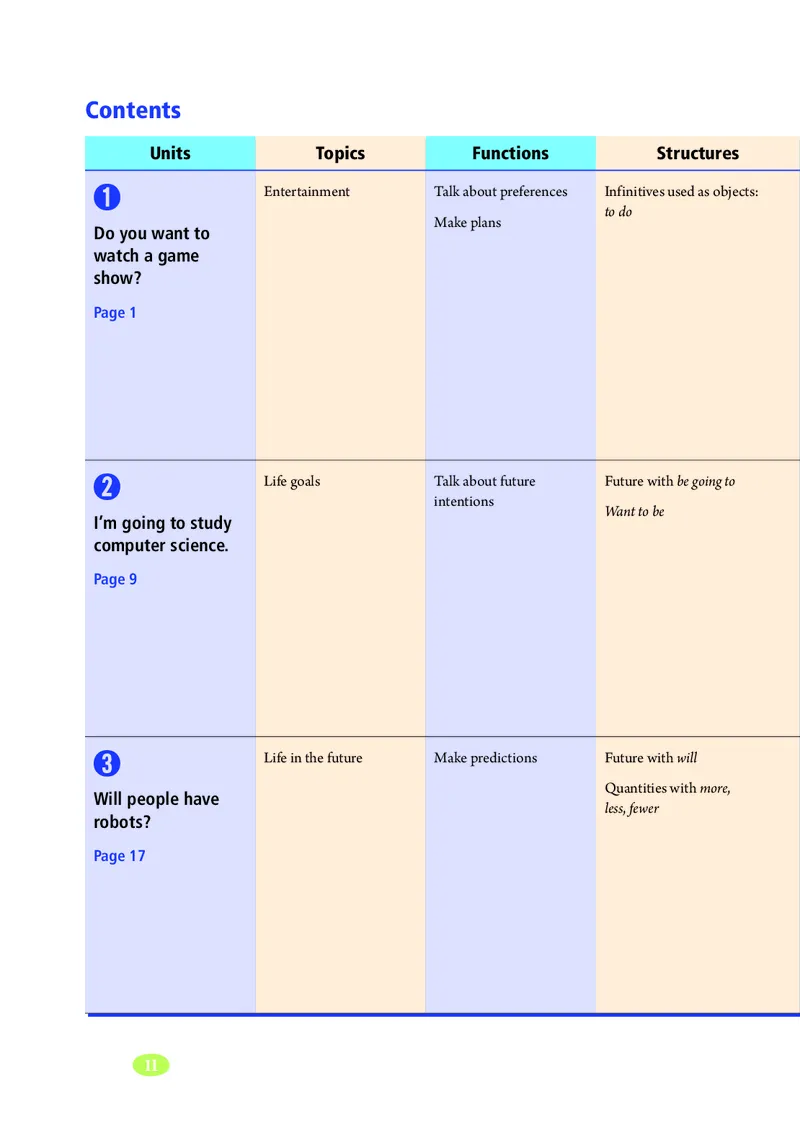
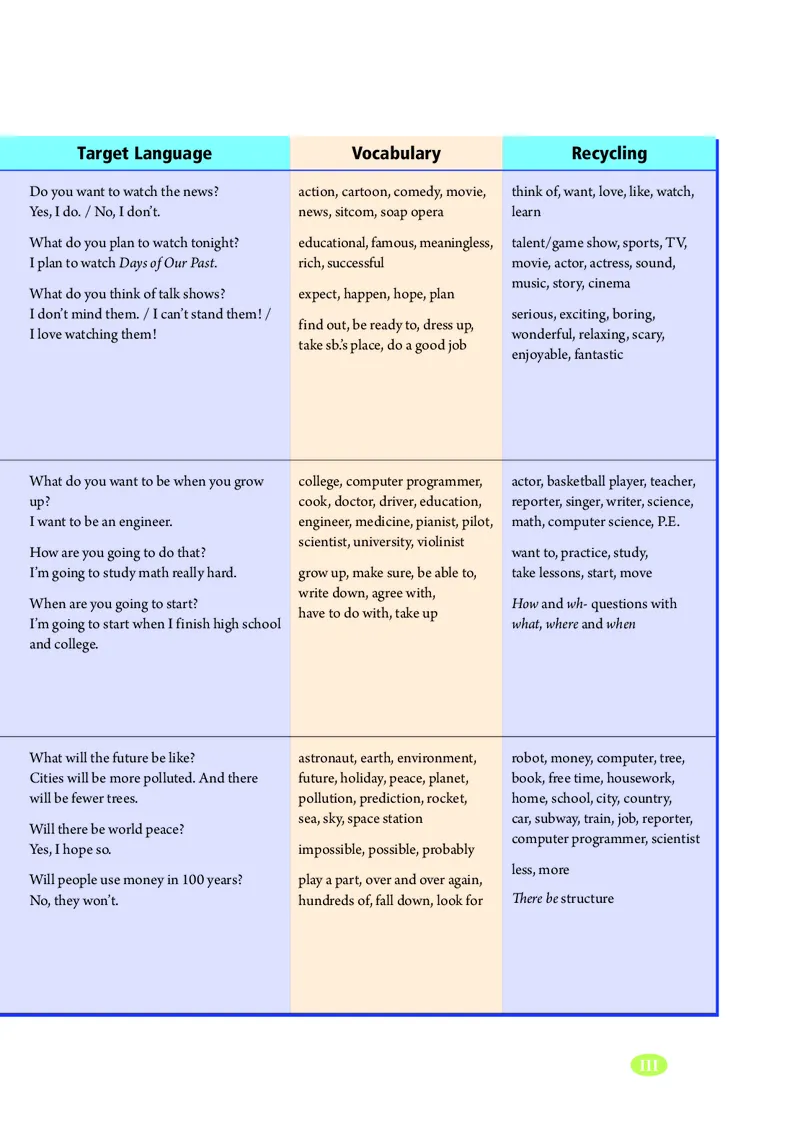
Units Topics Functions Structures Target Language Vocabulary Recycling
Entertainment Talk about preferences Infinitives used as objects: Do you want to watch the news? action, cartoon, comedy, movie, think of, want, love, like, watch,
➊
to do Yes, I do. / No, I don’t. news, sitcom, soap opera learn
Make plans
Do you want to
What do you plan to watch tonight? educational, famous, meaningless, talent/game show, sports, TV,
watch a game
I plan to watch Days of Our Past. rich, successful movie, actor, actress, sound,
show?
music, story, cinema
What do you think of talk shows? expect, happen, hope, plan
Page 1 I don’t mind them. / I can’t stand them! / serious, exciting, boring,
find out, be ready to, dress up,
I love watching them! wonderful, relaxing, scary,
take sb.’s place, do a good job
enjoyable, fantastic
Life goals Talk about future Future with be going to What do you want to be when you grow college, computer programmer, actor, basketball player, teacher,
➋
intentions up? cook, doctor, driver, education, reporter, singer, writer, science,
Want to be
I’m going to study I want to be an engineer. engineer, medicine, pianist, pilot, math, computer science, P.E.
computer science. scientist, university, violinist
How are you going to do that? want to, practice, study,
I’m going to study math really hard. grow up, make sure, be able to, take lessons, start, move
Page 9
write down, agree with,
When are you going to start? How and wh- questions with
have to do with, take up
I’m going to start when I finish high school what, where and when
and college.
Life in the future Make predictions Future with will What will the future be like? astronaut, earth, environment, robot, money, computer, tree,
➌
Cities will be more polluted. And there future, holiday, peace, planet, book, free time, housework,
Quantities with more,
Will people have will be fewer trees. pollution, prediction, rocket, home, school, city, country,
less, fewer
robots? sea, sky, space station car, subway, train, job, reporter,
Will there be world peace?
computer programmer, scientist
Yes, I hope so. impossible, possible, probably
Page 17
less, more
Will people use money in 100 years? play a part, over and over again,
No, they won’t. hundreds of, fall down, look for There be structure
IIUnits Topics Functions Structures Target Language Vocabulary Recycling
Entertainment Talk about preferences Infinitives used as objects: Do you want to watch the news? action, cartoon, comedy, movie, think of, want, love, like, watch,
➊
to do Yes, I do. / No, I don’t. news, sitcom, soap opera learn
Make plans
Do you want to
What do you plan to watch tonight? educational, famous, meaningless, talent/game show, sports, TV,
watch a game
I plan to watch Days of Our Past. rich, successful movie, actor, actress, sound,
show?
music, story, cinema
What do you think of talk shows? expect, happen, hope, plan
Page 1 I don’t mind them. / I can’t stand them! / serious, exciting, boring,
find out, be ready to, dress up,
I love watching them! wonderful, relaxing, scary,
take sb.’s place, do a good job
enjoyable, fantastic
Life goals Talk about future Future with be going to What do you want to be when you grow college, computer programmer, actor, basketball player, teacher,
➋
intentions up? cook, doctor, driver, education, reporter, singer, writer, science,
Want to be
I’m going to study I want to be an engineer. engineer, medicine, pianist, pilot, math, computer science, P.E.
computer science. scientist, university, violinist
How are you going to do that? want to, practice, study,
I’m going to study math really hard. grow up, make sure, be able to, take lessons, start, move
Page 9
write down, agree with,
When are you going to start? How and wh- questions with
have to do with, take up
I’m going to start when I finish high school what, where and when
and college.
Life in the future Make predictions Future with will What will the future be like? astronaut, earth, environment, robot, money, computer, tree,
➌
Cities will be more polluted. And there future, holiday, peace, planet, book, free time, housework,
Quantities with more,
Will people have will be fewer trees. pollution, prediction, rocket, home, school, city, country,
less, fewer
robots? sea, sky, space station car, subway, train, job, reporter,
Will there be world peace?
computer programmer, scientist
Yes, I hope so. impossible, possible, probably
Page 17
less, more
Will people use money in 100 years? play a part, over and over again,
No, they won’t. hundreds of, fall down, look for There be structure
IIIUnits Topics Functions Structures Target Language Vocabulary Recycling
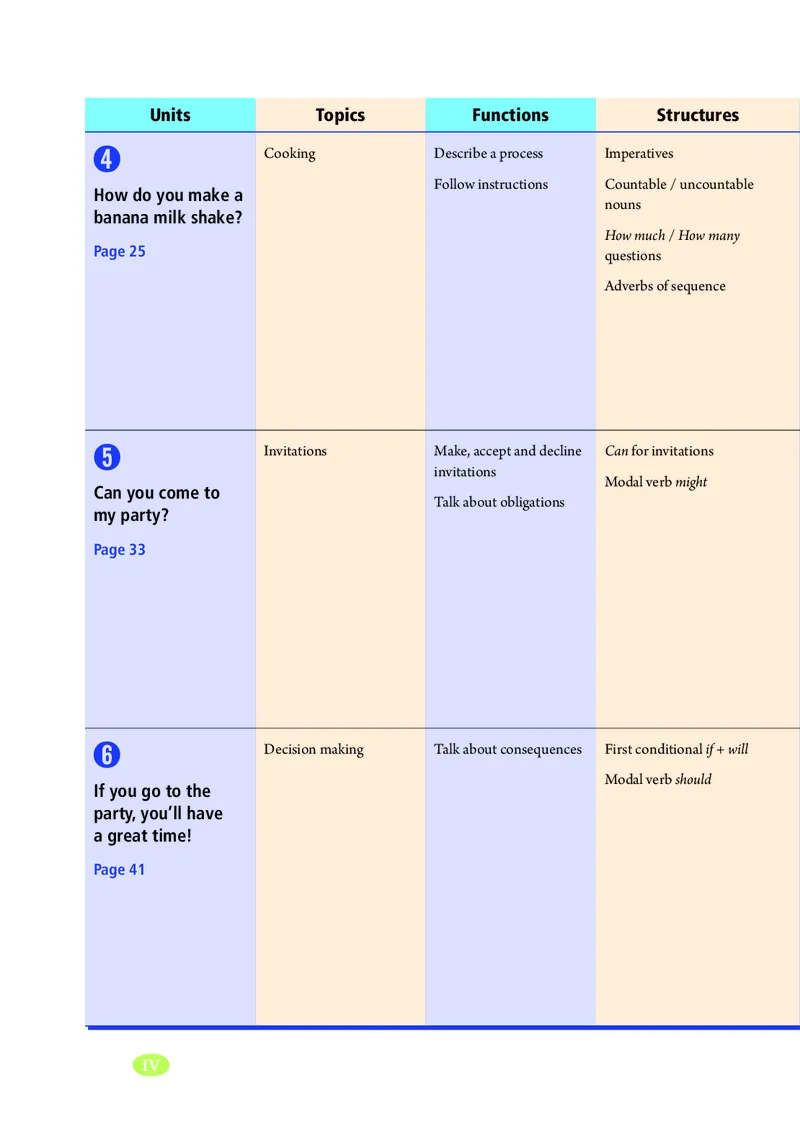
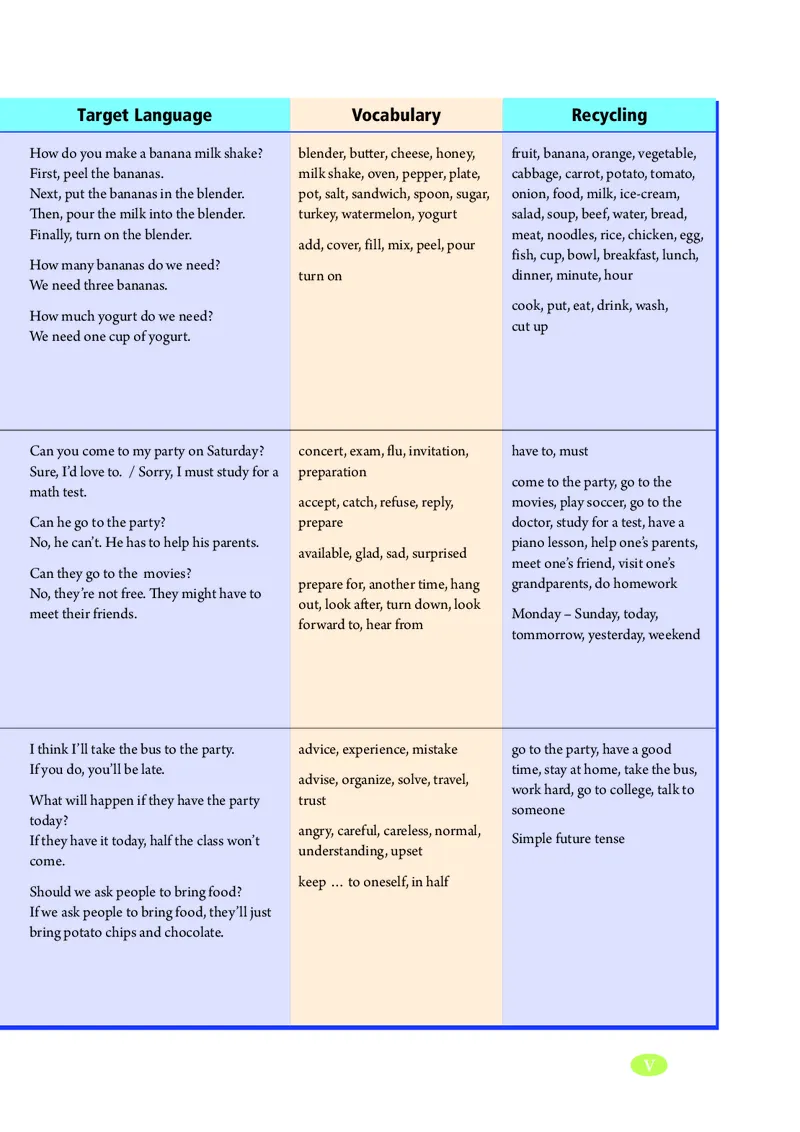
Cooking Describe a process Imperatives How do you make a banana milk shake? blender, butter, cheese, honey, fruit, banana, orange, vegetable,
➍
First, peel the bananas. milk shake, oven, pepper, plate, cabbage, carrot, potato, tomato,
Follow instructions Countable / uncountable
How do you make a Next, put the bananas in the blender. pot, salt, sandwich, spoon, sugar, onion, food, milk, ice-cream,
nouns
banana milk shake? Then, pour the milk into the blender. turkey, watermelon, yogurt salad, soup, beef, water, bread,
How much / How many Finally, turn on the blender. meat, noodles, rice, chicken, egg,
add, cover, fill, mix, peel, pour
Page 25 questions fish, cup, bowl, breakfast, lunch,
How many bananas do we need?
turn on dinner, minute, hour
Adverbs of sequence We need three bananas.
cook, put, eat, drink, wash,
How much yogurt do we need?
cut up
We need one cup of yogurt.
Invitations Make, accept and decline Can for invitations Can you come to my party on Saturday? concert, exam, flu, invitation, have to, must
➎
invitations Sure, I’d love to. / Sorry, I must study for a preparation
Modal verb might come to the party, go to the
Can you come to math test.
Talk about obligations accept, catch, refuse, reply, movies, play soccer, go to the
my party?
Can he go to the party? prepare doctor, study for a test, have a
No, he can’t. He has to help his parents. piano lesson, help one’s parents,
Page 33
available, glad, sad, surprised
meet one’s friend, visit one’s
Can they go to the movies?
prepare for, another time, hang grandparents, do homework
No, they’re not free. They might have to
out, look after, turn down, look
meet their friends. Monday – Sunday, today,
forward to, hear from
tommorrow, yesterday, weekend
Decision making Talk about consequences First conditional if + will I think I’ll take the bus to the party. advice, experience, mistake go to the party, have a good
➏
If you do, you’ll be late. time, stay at home, take the bus,
Modal verb should advise, organize, solve, travel,
If you go to the work hard, go to college, talk to
What will happen if they have the party trust
party, you’ll have someone
today?
a great time! angry, careful, careless, normal,
If they have it today, half the class won’t Simple future tense
understanding, upset
come.
Page 41
keep … to oneself, in half
Should we ask people to bring food?
If we ask people to bring food, they’ll just
bring potato chips and chocolate.
IVUnits Topics Functions Structures Target Language Vocabulary Recycling
Cooking Describe a process Imperatives How do you make a banana milk shake? blender, butter, cheese, honey, fruit, banana, orange, vegetable,
➍
First, peel the bananas. milk shake, oven, pepper, plate, cabbage, carrot, potato, tomato,
Follow instructions Countable / uncountable
How do you make a Next, put the bananas in the blender. pot, salt, sandwich, spoon, sugar, onion, food, milk, ice-cream,
nouns
banana milk shake? Then, pour the milk into the blender. turkey, watermelon, yogurt salad, soup, beef, water, bread,
How much / How many Finally, turn on the blender. meat, noodles, rice, chicken, egg,
add, cover, fill, mix, peel, pour
Page 25 questions fish, cup, bowl, breakfast, lunch,
How many bananas do we need?
turn on dinner, minute, hour
Adverbs of sequence We need three bananas.
cook, put, eat, drink, wash,
How much yogurt do we need?
cut up
We need one cup of yogurt.
Invitations Make, accept and decline Can for invitations Can you come to my party on Saturday? concert, exam, flu, invitation, have to, must
➎
invitations Sure, I’d love to. / Sorry, I must study for a preparation
Modal verb might come to the party, go to the
Can you come to math test.
Talk about obligations accept, catch, refuse, reply, movies, play soccer, go to the
my party?
Can he go to the party? prepare doctor, study for a test, have a
No, he can’t. He has to help his parents. piano lesson, help one’s parents,
Page 33
available, glad, sad, surprised
meet one’s friend, visit one’s
Can they go to the movies?
prepare for, another time, hang grandparents, do homework
No, they’re not free. They might have to
out, look after, turn down, look
meet their friends. Monday – Sunday, today,
forward to, hear from
tommorrow, yesterday, weekend
Decision making Talk about consequences First conditional if + will I think I’ll take the bus to the party. advice, experience, mistake go to the party, have a good
➏
If you do, you’ll be late. time, stay at home, take the bus,
Modal verb should advise, organize, solve, travel,
If you go to the work hard, go to college, talk to
What will happen if they have the party trust
party, you’ll have someone
today?
a great time! angry, careful, careless, normal,
If they have it today, half the class won’t Simple future tense
understanding, upset
come.
Page 41
keep … to oneself, in half
Should we ask people to bring food?
If we ask people to bring food, they’ll just
bring potato chips and chocolate.
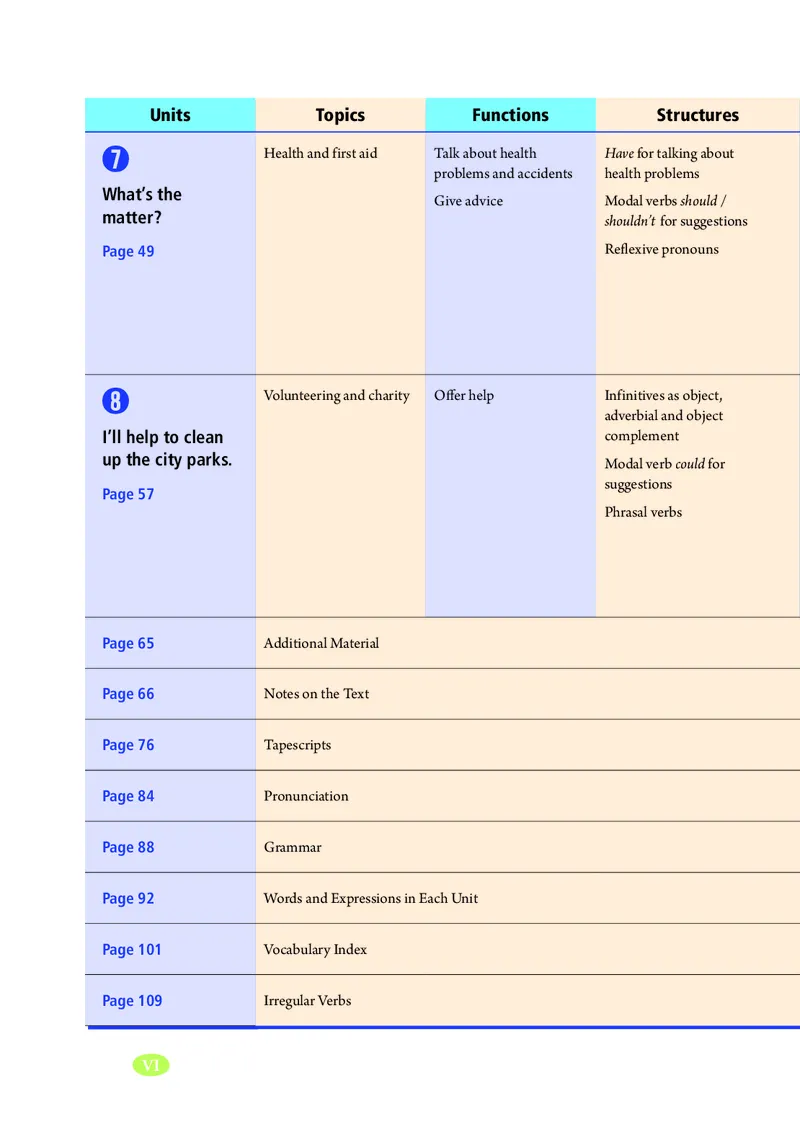
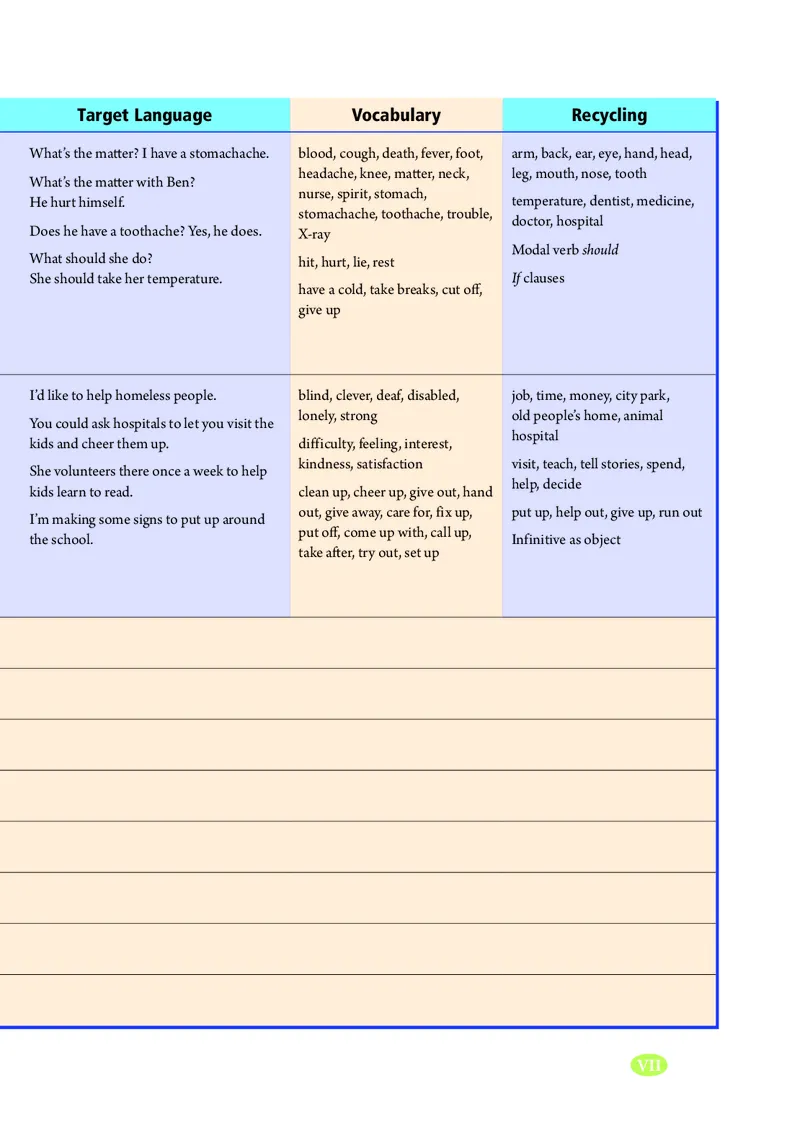
VUnits Topics Functions Structures Target Language Vocabulary Recycling
Health and first aid Talk about health Have for talking about What’s the matter? I have a stomachache. blood, cough, death, fever, foot, arm, back, ear, eye, hand, head,
➐
problems and accidents health problems headache, knee, matter, neck, leg, mouth, nose, tooth
What’s the matter with Ben?
What’s the nurse, spirit, stomach,
Give advice Modal verbs should / He hurt himself. temperature, dentist, medicine,
matter?
shouldn’t for suggestions
stomachache, toothache, trouble,
doctor, hospital
Does he have a toothache? Yes, he does. X-ray
Page 49 Reflexive pronouns Modal verb should
What should she do? hit, hurt, lie, rest
She should take her temperature. If clauses
have a cold, take breaks, cut off,
give up
Volunteering and charity Offer help Infinitives as object, I’d like to help homeless people. blind, clever, deaf, disabled, job, time, money, city park,
➑
adverbial and object lonely, strong old people’s home, animal
You could ask hospitals to let you visit the
I’ll help to clean complement hospital
kids and cheer them up. difficulty, feeling, interest,
up the city parks.
Modal verb could for kindness, satisfaction visit, teach, tell stories, spend,
She volunteers there once a week to help
suggestions help, decide
Page 57 kids learn to read. clean up, cheer up, give out, hand
Phrasal verbs out, give away, care for, fix up, put up, help out, give up, run out
I’m making some signs to put up around
put off, come up with, call up,
the school. Infinitive as object
take after, try out, set up
Page 65 Additional Material
Page 66 Notes on the Text
Page 76 Tapescripts
Page 84 Pronunciation
Page 88 Grammar
Page 92 Words and Expressions in Each Unit
Page 101 Vocabulary Index
Page 109 Irregular Verbs
VIUnits Topics Functions Structures Target Language Vocabulary Recycling
Health and first aid Talk about health Have for talking about What’s the matter? I have a stomachache. blood, cough, death, fever, foot, arm, back, ear, eye, hand, head,
➐
problems and accidents health problems headache, knee, matter, neck, leg, mouth, nose, tooth
What’s the matter with Ben?
What’s the nurse, spirit, stomach,
Give advice Modal verbs should / He hurt himself. temperature, dentist, medicine,
matter?
shouldn’t for suggestions
stomachache, toothache, trouble,
doctor, hospital
Does he have a toothache? Yes, he does. X-ray
Page 49 Reflexive pronouns Modal verb should
What should she do? hit, hurt, lie, rest
She should take her temperature. If clauses
have a cold, take breaks, cut off,
give up
Volunteering and charity Offer help Infinitives as object, I’d like to help homeless people. blind, clever, deaf, disabled, job, time, money, city park,
➑
adverbial and object lonely, strong old people’s home, animal
You could ask hospitals to let you visit the
I’ll help to clean complement hospital
kids and cheer them up. difficulty, feeling, interest,
up the city parks.
Modal verb could for kindness, satisfaction visit, teach, tell stories, spend,
She volunteers there once a week to help
suggestions help, decide
Page 57 kids learn to read. clean up, cheer up, give out, hand
Phrasal verbs out, give away, care for, fix up, put up, help out, give up, run out
I’m making some signs to put up around
put off, come up with, call up,
the school. Infinitive as object
take after, try out, set up
Page 65 Additional Material
Page 66 Notes on the Text
Page 76 Tapescripts
Page 84 Pronunciation
Page 88 Grammar
Page 92 Words and Expressions in Each Unit
Page 101 Vocabulary Index
Page 109 Irregular Verbs
VIIU 1
NIT
Section
A Do you want to watch a game show?
a d f
Language Goals: c
Talk about
preferences;
Make plans
b
e
g
What do you think I don’t mind
of talk shows? them.
1a Match the TV shows with the pictures [a–g].
1. talk show 4. sitcom 7. news
2. soap opera d 5. game show
3. sports show 6. talent show
1b Listen and number the shows [1–4] in the order you hear them.
talent show talk show soccer game news
1c Practice the conversation. Then make your own conversations.
love like A: What do you want to watch?
don’t mind don’t like B: What do you think of talk shows?
A: They’re OK. I don’t mind them.
can’t stand
B: Then let’s watch a talk show.
1UNIT 1
2a Listen to Lin Hui and Sally’s conversation. Number the TV shows [1–5]
in the order you hear them.
sitcoms news
game shows talk shows
soap operas
2b Listen again. Complete the sentences.
1. Sally likes to watch .
2. Lin Hui thinks she can learn from sitcoms.
3. Sally thinks are more educational than sitcoms.
4. Sally loves . She plans to watch Days of Our Past .
2c Ask and answer questions about the TV shows in 2a. Use information
that is true for you.
A: Do you plan to watch the news tonight?
B: Yes. I like watching the news. I watch it every night.
A Why?
B: Because I hope to find out what’s going on around the world.
2d Role-play the conversation.
Grace: What did you do in class today, Sarah?
Sarah: We had a discussion about TV shows. My
classmates like game shows and sports
shows.
Grace: Oh, I can’t stand them. I love soap operas.
I like to follow the story and see what
happens next.
Sarah: Well, I don’t mind soap operas. But my
favorite TV shows are the news and talk shows.
Grace: They’re boring!
Sarah: Well, they may not be very exciting, but you can expect to learn a lot
from them. I hope to be a TV reporter one day.
2Do you want to watch a game show? UNIT 1
Grammar
Focus
Do you want to watch the news? Yes, I do. / No, I don’t.
What do you plan to watch tonight? I plan to watch Days of Our Past.
What can you expect to learn from sitcoms? You can learn some great jokes.
Because I hope to find out what’s going
Why do you like watching the news?
on around the world.
I don’t mind them. / I can’t stand them! /
What do you think of talk shows?
I love watching them!
3a Make a conversation and then practice it with a partner.
A: What do you plan to watch on TV tonight?
B: I hope to , but I also want to
. How about you? Do you
a talk show or ?
A: Oh, I want to .
3b Answer these questions. Give answers that are true for you.
1. What do you think of game shows?
2. What comedy shows do you like to
watch?
3. Do you plan to watch a sports show
tonight?
4. What can you expect to learn from
the news?
3c Ask your classmates questions and write their names in the chart.
Find someone who ... Students’ names
Do you want to
wants to watch a movie
watch a movie?
hopes to watch a sitcom
expects to watch the news
Yes, I do.
plans to watch a sports show
never wants to watch a game show
3UNIT 1
1a What do you think of these TV shows and movies?
Section
Choose words from the box and write them under the
pictures. Each picture can have more than one word.
B
educational serious wonderful relaxing
meaningless enjoyable exciting boring
talk show soap opera sports show game show news
talent show comedy action movie cartoon scary movie
1b Listen and circle the description words you hear in the box in 1a.
1c Listen again. Write down the words John and Mary use to describe the
TV shows or movies.
Action movies Scary movies Game shows Sitcoms Talk shows
John exciting
Mary
1d Tell your partner what John and Mary like to watch and why. Then tell
your partner what you like to watch and why.
John wants to watch talk shows because
they’re enjoyable. I like to watch action
movies because they’re exciting.
4Do you want to watch a game show? UNIT 1
2a Discuss the following questions with a partner.
1. Do you like to watch cartoons?
2. What is your favorite cartoon?
3. Why do you like it?
2b Read the passage and complete the time line on the next page.
When people say “culture”, we
think of art and history. But one
very famous symbol in American
culture is a cartoon. We all know
and love the black mouse with
two large round ears — Mickey
Mouse. Over 80 years ago, he first
appeared in the cartoon Steamboat Willie. When this cartoon came
out in New York on November 18, 1928, it was the first cartoon
with sound and music. The man behind Mickey was Walt Disney. He
became very rich and successful. In the 1930s, he made 87 cartoons
with Mickey.
Some people might ask how this cartoon animal became so popular.
One of the main reasons is that Mickey was like a common man, but he
always tried to face any danger. In his early films, Mickey was unlucky
and had many problems such as losing his house or girlfriend, Minnie.
However, he was always ready to try his best. People went to the
cinema to see the “little man” win. Most of them wanted to be like
Mickey.
On November 18, 1978, Mickey became the first cartoon character
to have a star on the Hollywood Walk of Fame. Today’s cartoons are
usually not so simple as little Mickey Mouse, but everyone still knows
and loves him. Who has a pair of ears more famous than Mickey’s?
5UNIT 1
Steamboat Willie
came out in New York.
1930s November 18, 1978
2c Read the passage again and fill in the facts about Mickey.
What does he Who created What was his Who is his Why is he
look like? him? first cartoon? girlfriend? popular?
Mickey
Mouse
2d Read the passage again and discuss the questions with a partner.
1. What is Mickey Mouse a symbol of? What cartoon character is a symbol of
Chinese culture?
2. Do you think Walt Disney is a smart man? Why or why not? Do you want
to be like him?
3. Why did people want to be like Mickey? Do you want to be like Mickey?
Why or why not?
4. Can you think of another cartoon character that is as famous as Mickey?
Why is the character popular?
2e Underline the following phrases in the passage. Write your own
sentences or questions using the phrases.
think of
come out
one of the main reasons
such as
was ready to
try his best
6Do you want to watch a game show? UNIT 1
3a Fill in the blanks in the movie review. Use the words in the box to help you.
fantastic shows action want comes from played about like exciting plan
Mulan is an movie. It
an old Chinese story. The movie is a village girl, Mulan.
She dresses up like a boy and takes her father’s place to fight in the army.
I think the actress
Mulan’s role well. The other actors are also
and they did a good job
in the movie. I Mulan very
much. The movie her love
for her family, friends and country. If you
to watch a movie this
weekend and you to see
something enjoyable, choose Mulan!
3b Write notes for your own movie review.
The name of the movie:
The kind of movie:
What the movie is about:
What you think of the movie / stars:
3c Write your movie review using the notes in 3b.
7UNIT 1
4 What do you and your partner think of these TV shows or movies?
Write description words for each one.
Me My partner
What do you think soap operas
of soap operas?
talent shows
news
sports shows
I think they’re game shows
boring! talk shows
comedies
scary movies
action movies
cartoons
Self Check
1 Write questions and answers using the words in brackets.
1. A: (what / think of / soap operas)
B: (can’t stand)
2. A: (what show / want to watch / tonight)
B: (talent show)
3. A: (what / expect to learn / game show)
B: (interesting information)
4. A: (what / hope to watch / tomorrow)
B: (news)
5. A: (do / plan to watch / action movie)
B: (no / plan to watch / comedy)
2 Which of these statements do you agree with (4) or disagree
with (✗)? Give at least one reason.
1. I think game shows are meaningless. ( )
2. I can’t stand soap operas. ( )
3. I think sitcoms and talent shows are relaxing. ( )
4. I love talk shows. ( )
5. I think comedies are fantastic. ( )
8U 2
NIT
Section
A I’m going to study computer science.
Language Goal:
Talk about
What do you want to
future intentions be when you grow up? I want to be
a computer
How are you going programmer.
to do that?
I’m going to study
computer science.
1a Do you think these jobs are interesting? Rank them [1–12] (1 is most
interesting, 12 is least interesting).
computer programmer cook doctor
engineer teacher violinist
bus driver pilot pianist
basketball player scientist actor
1b Listen and fill in the blanks. Then match the items.
1. computer programmer a. take lessons
2. basketball player b. study science
3. engineer c. practice every day
4. actor d. study really hard
1c Practice the conversation A: What do you want to be when you grow up?
in the picture. Then make B: I want to be a basketball player.
conversations about the A: How are you going to do that?
other jobs in 1a. B: I’m going to practice basketball every day.
9UNIT 2
2a Listen. What is Cheng Han going to do? Check (✔) the correct boxes
in the picture.
2b Listen again. What are Cheng Han’s plans for the future? Complete the
chart.
What
Where
How
When
2c Ask and answer questions about Cheng Han’s plans.
A: What does Cheng Han want to be?
B: He wants to be ...
2d Role-play the conversation.
Andy: What are you reading, Ken?
Ken: The Old Man and the Sea by Hemingway.
Andy: Wow, now I know why you’re so good at
writing stories.
Ken: Yes, I want to be a writer.
Andy: Really? How are you going to become a
writer?
Ken: Well, I’m going to keep on writing stories,
of course. What do you want to be?
Andy: My parents want me to be a doctor, but I’m not sure about that.
Ken: Well, don’t worry. Not everyone knows what they want to be. Just make
sure you try your best. Then you can be anything you want!
Andy: Yes, you’re right.
10I’m going to study computer science. UNIT 2
Grammar
Focus
What do you want to be when you grow up? I want to be an engineer.
How are you going to do that? I’m going to study math really hard.
Where are you going to work? I’m going to move to Shanghai.
I’m going to start when I finish high
When are you going to start?
school and college.
3a Match what these people want to do with what they are going to do.
1. My friend wants to be an engineer. a. They’re going to practice every day.
2. My brother wants to be an actor. b. I’m going to buy a fast car.
3. I want to be a scientist. c. We’re going to take singing lessons.
4. My sister wants to be a school teacher. d. She’s going to study education.
5. Those boys want to be soccer players. e. She’s going to study math.
6. My friend and I want to be singers. f. I’m going to study science.
7. My cousin wants to be a cook. g. He’s going to go to a cooking school.
8. I want to be a race car driver. h. He’s going to take acting lessons.
3b Fill in the blanks. Then practice the conversation.
A: Kelly, what do you want to be you grow up?
B: I to be a doctor.
A: Wow! are you going to do that?
B: I’m to study medicine at a university.
A: Hmm ... sounds difficult. are you to study?
B: I’m going to in London.
A: are you going to start?
B: I’m going to next September.
A: What do you want to be when you grow up?
3c Complete the chart and
B: I want to be a reporter.
discuss it with your
A: How are you going to do that?
partner.
B: I’m going to write articles and send them to
magazines and newspapers.
What
Where
How
When
11UNIT 2
1a Match the pictures with the New Year’s resolutions.
Section
Number the pictures [1–5].
B
New Year’s Resolutions
Next year, I’m going to:
1 1. learn to play the piano
2. make the soccer team
3. get good grades
4. eat healthier food
5. get lots of exercise
1b What are you going to do next year? Tell your partner.
A: What are you going to do next year?
B: Well, I’m going to take guitar lessons. I really love music.
A: Sounds interesting. I’m going to learn another foreign language.
B: Are you? Great! But foreign languages are not for me.
1c Listen and circle the resolutions you hear in 1a.
1d Listen again. Write how the people are going to
make their resolutions work.
How are they going to do it?
Lucy She’s going to take piano lessons.
Kim
Mike
1e Make a list of other resolutions and how you are going to make them
work. Then discuss them with your group.
A: I want to be a teacher.
B: How are you going to do that?
A: Well, I’m going to study hard and get good grades.
B: Sounds like a good plan. I want to get a lot of exercise.
12I’m going to study computer science. UNIT 2
2a Discuss the questions with your partner.
1. Did you make any resolutions last year?
2. Were you able to keep them? Why or why not?
2b Read the passage and match each paragraph [1–3] with its main purpose
in the box. Underline the words and phrases that helped you decide.
To question the idea of making resolutions
1. Do you know what To give the meaning of resolution
a resolution is? It’s To discuss the different kinds of resolutions
a kind of promise.
Most of the time, we make promises to other people. (“Mom, I promise
I’m going to tidy my room when I get back from school.”) However,
promises you make to yourself are resolutions, and the most common
kind is New Year’s resolutions. When we make resolutions
at the beginning of the year, we hope that we are going to improve our
lives. Some people write down their resolutions and plans for the coming
year. This helps them to remember their resolutions. Others tell their
family and friends about their wishes and plans.
2. There are different kinds of resolutions. Some are about physical health.
For example, some people promise themselves they are going to start an
exercise program or eat less fast food. Many resolutions have to do with
self-improvement. Some people might say they are
going to take up a hobby like painting or taking photos, or learn to play
the guitar. Some resolutions have to do with
better planning, like making a weekly plan for
schoolwork.
3. Although there are differences, most resolutions
have one thing in common. People hardly
ever keep them! Sometimes
the resolutions may be too difficult to keep.
Sometimes people just forget about them.
For this reason, some people say the best
resolution is to have no resolutions! How
about you—will you make any next year?
13UNIT 2
2c Which paragraph in the passage do you think each sentence goes in?
Write the letters [A–D] in the correct places in the passage.
A. These are about making yourself a better person.
B. For example, a student may have to find more time to study.
C. There are good reasons for this.
D. The start of the year is often a time for making resolutions.
2d Answer the questions with short sentences.
1. What is a resolution?
2. When do people usually make resolutions?
3. Why do people usually make resolutions?
4. How can people remember their resolutions?
5. How many kinds of resolutions does the writer talk about?
6. Why do you think resolutions may be difficult to keep?
7. Do you think the best resolution is to have no resolutions? Why or why not?
2e Find these phrases in the passage. Then write your own sentences with
them.
have to do with
make promises
have ... in common
write down
for this reason
take up
14I’m going to study computer science. UNIT 2
3a Complete the first two paragraphs about resolutions with the words in
the box.
take listen make is help learn are
Resolutions promises to yourself. They may
to make you a better person and to make your life easier. I am going to
four resolutions.
The first resolution is about my own personal improvement. Next year, or
maybe sooner, I am going to up a new hobby. I think singing
a great activity so I am going to to sing. I think this
will also make my family happy because they love to to music
and sing together.
3b Write your resolutions under the following headings.
1. Ideas for improving my physical health
get more exercise,
2. Ideas for improving my relationships with my family and friends
3. Ideas for doing better at school
3c Use your notes to write three more paragraphs about your resolutions.
In each paragraph, write what you are going to do and why.
The second resolution is about improving my physical health.
The third resolution is about improving my relationships with my family
and friends.
The last resolution is about how to do better at school.
15UNIT 2
4 Imagine you work for your city. Think of a
plan to make it cleaner and greener.
1. We’re going to make the subway better.
Then people don’t have to drive to work.
2.
3.
4.
5.
Self Check
1 Match the jobs with 1. computer programmer medicine
the school subjects. 2. engineer computer science
3. doctor math
4. basketball player science
5. scientist P.E.
2 Fill in the blanks in the conversation.
A: What do you to be when you grow up?
B: I want a scientist.
A: Wow! That sounds cool. But it’s also difficult. are you
to do that?
B: After I finish high school, I’m to go to university.
A: are you to study?
B: In Hefei. I’m to study there for four years.
A: I think I want a teacher. I’m to teach in Wuhan.
3 Write about your plans.
Tomorrow, I’m going to .
Next week, .
Next month, .
Next year, .
16U 3
NIT
Section
A Will people have robots?
Do you think
there will be robots in
Yes, there will.
people’s homes?
Language Goal: I think every home
will have a robot.
Make predictions
Will kids go
to school? Kids won’t go
to school. They’ll
study at home on
computers.
1a How will the world be different 100 years from now? Read these
predictions. Check (✔) A for agree or D for disagree.
A D 1. People will have robots in their homes.
A D 2. People won’t use money. Everything will be free.
A D 3. Books will only be on computers, not on paper.
A D 4. Kids won’t go to school. They’ll study at home on computers.
A D 5. There will be only one country.
A D 6. People will live to be 200 years old.
1b Listen and circle the predictions you hear in 1a.
1c Ask and answer questions about the predictions in 1a.
A: Will people use money in 100 years?
B: No, they won’t. Everything will be free.
Will people live to be 200 years old?
A: Yes, they will.
17UNIT 3
2a Listen and circle the words you hear.
1. There will be (more / less / fewer) people.
2. There will be (more / less / fewer) free time.
3. There will be (more / less / fewer) cars.
4. There will be (more / less / fewer) pollution.
5. There will be (more / less / fewer) trees.
2b Listen again. Check (✔) the predictions you hear.
1. There will be fewer people.
✔ 2. There will be less free time.
3. People will use the subways less.
4. There will be more pollution.
5. Cities will be very big and crowded.
2c Make conversations about the predictions in 2a and 2b.
A: What’s your prediction about the future?
B: I think there will be more pollution.
A: Really? I don’t think so. But I think there will be fewer trees.
2d Role-play the conversation.
Nick: What are you reading, Jill?
Jill: It’s a book about the future.
Nick: Sounds cool. So what will the future be
like?
Jill: Well, cities will be more crowded and
polluted. There will be fewer trees and
the environment will be in great danger.
Nick: That sounds bad! Will we have to move
to other planets?
Jill: Maybe. But I want to live on the earth.
Nick: Me, too. Then what can we do?
Jill: We can use less water and plant more
trees. Everyone should play a part in saving the earth.
18Will people have robots? UNIT 3
Grammar
Focus
Cities will be more polluted. And there will
What will the future be like?
be fewer trees.
Will people use money in 100 years? No, they won’t. Everything will be free.
Will there be world peace? Yes, I hope so.
Kids will study at home on computers. They won’t go to school.
Countable nouns Uncountable nouns
’ll = will
There will be more people. There will be more pollution.
won’t = will not
There will be fewer trees. There will be less free time.
3a Fill in the blanks with more, less or fewer.
1. In the future, there will be fresh water because there will be
pollution in the sea.
2. In 100 years, there will be cars because there will be
people in the cities.
3. There will be jobs for people because robots will do the
same jobs as people.
4. I think there will be cities because people will build
buildings in the country.
5. In 50 years, people will have free time because there will be
things to do.
3b Complete the predictions with what you think will happen.
1. Kids study at school now. In 100 years,
2. I sometimes see blue skies in my city, but in the future
3. People now usually live to be about 70–80 years old, but in the future
4. Families usually spend time together on weekends, but maybe in 200 years
3c Draw a picture of what you think a city in the future will be like. Then
describe it to the class.
I think there will be
more tall buildings, and
there will be fewer
cars and more buses.
19UNIT 3
1a Write each word in the correct column below.
Section
astronaut house apartment train
B
rocket space station computer programmer
Jobs Transportation Places to live
1b Think of other words and write them in the chart in 1a.
1c Listen to Alexis and Joe. Number the pictures [1–3].
1d Listen again. Fill in the blanks with the correct verbs in the box.
1. I live in an apartment across the street from here.
2. I near here.
3. I a computer programmer.
am live work
4. We in a house in the country.
lived took
5. I the train to school.
will be will live will fly
6. I an astronaut.
7. I rockets to the moon.
8. I on a space station.
1e Student A is Alexis and Student B is Joe.
A: Where do you live?
Talk about Joe’s life now, 10 years ago and
B: I live in an apartment.
10 years from now.
20Will people have robots? UNIT 3
2a Tell your partner what you know about robots. What do they look like
and what can they do?
2b Read the article and match each paragraph with the question it discusses.
Paragraph 1 Will robots think like humans in the future?
Paragraph 2 What will robots be like in the future?
Paragraph 3 What can robots do today?
Paragraph 4 What are robots like in movies?
Do You Think You Will Have Your Own Robot?
1. When we watch movies about the future, we sometimes see robots.
They are usually like human servants. They help with the housework
and do jobs like working in dirty or dangerous places.
2. Today there are already robots working in factories. Some can help to
build cars, and they do simple jobs over and over again. Fewer people
will do such jobs in the future because they are boring, but robots
will never get bored.
3. Scientists are now trying to
make robots look like humans
and do the same things as
we do. Some robots in Japan
can walk and dance. They are
fun to watch. However, some
scientists believe that although
we can make robots move like
people,it will be difficult to make them really think like a human. For
example, scientist James White thinks that robots will never be able
to wake up and know where they are. But many scientists disagree
with Mr. White. They think that robots will even be able to talk like
humans in 25 to 50 years.
4. Some scientists believe that there will be more robots in the future.
However, they agree it may take hundreds of years. These new robots
will have many different shapes. Some will look like humans, and others
might look like animals. In India, for example, scientists made robots
that look like snakes. If buildings fall down with people inside, these
snake robots can help look for people under the buildings. This was not
possible 20 years ago, but computers and rockets also seemed impossible
100 years ago. We never know what will happen in the future!
21UNIT 3
2c Read the article again quickly. Complete the sentences about what
robots can do now.
1. Robots can build in factories.
2. They can do jobs many times and never get bored.
3. Some can and .
4. Some can help people under .
2d Fill in the blanks in this paragraph with words from the article.
Some robots are very human-like. They can walk and
like people. Some scientists think that in the
future they will robots more like humans. This
may not in the near future, but at some point,
robots will even be able to like people. However,
some scientists . James White believes that
robots will not be able to do the things as we can.
For example, he thinks that robots will be able
to wake up and know where they are. Which side do you
with?
2e What kinds of animals might robots look like in the future? What do
you think these robots will be able to do? Write your ideas and discuss
them with your partner.
I think some future robots might look like . They
will
22Will people have robots? UNIT 3
3a Read Jill’s answer to the question “What will your life be like in the
future?” Fill in the blanks with the words in the box.
meet work live look keep wear more less fewer take
In 20 years, I think I’ll be a newspaper reporter. I’ll in Shanghai, because
there will be jobs in that city. As a reporter, I think I will
lots of interesting people, so I’ll have more friends. I’ll have pets,
though, because I’ll have free time. And my apartment will be no good
for pets because it’ll be too small. So I’ll probably just
a bird. During the week, I’ll
smart clothes. On the weekend, I’ll less
smart but I’ll be more comfortable. In the future, people
will more so they’ll probably have fewer
vacations, but I think I’ll a holiday in Hong
Kong when possible. One day I’ll even go to Australia.
3b Complete the chart about your life 20 years from now. You can add
more items.
What will your ... be like?
job
home
free time activities
neighborhood
3c Write about your life 20 years from now. Use 3a and 3b to help you.
23UNIT 3
4 Discuss how you think a robot will help students with schoolwork in the
future. Write down your group’s ideas and draw a picture of your robot.
1. I think students won’t need
dictionaries because a robot will
tell them the meanings of words.
2.
3.
4.
5.
Self Check
1 Put the words in the correct columns in the chart.
job people pollution robot fresh water paper planet
car clean air city free time building money tree
more / fewer more / less
2 Fill in the blanks in the conversation.
Girl: Mom, what will the future like?
Mom: Well, no one knows what the future will be .
Girl: But I be beautiful like you? I be a pilot?
I want to fly up into the sky.
Mom: You’re already beautiful. And you should study hard. Then you
be a pilot.
Girl: OK, I must study harder then.
Mom: But you should also remember that will
both good and bad things in life.
Girl: Oh, but I’m not scared, Mom, because you help me!
24U 4
NIT
Section
A How do you make a banana milk shake?
the milk
the milk shake
into the blender
Language Goals:
Describe a
process;
Follow the bananas
the bananas
instructions
the bananas and
the blender
ice-cream in the blender
1a Write these words in the blanks in the picture above.
turn on cut up drink peel pour put
1b Listen and put the instructions in order.
Turn on the blender.
Cut up the bananas.
Drink the milk shake.
Pour the milk into the blender.
Put the bananas and ice-cream in the blender.
1 Peel three bananas.
1c Cover the instructions above. Tell your partner how to make a banana
milk shake.
A: How do you make a banana milk shake?
B: First, peel the bananas ...
25UNIT 4
2a Listen and complete the chart.
How many bananas We need three
do we need? bananas.
How much yogurt We need one cup
do we need? of yogurt.
yogurt
cup
honey
apples oranges spoon
bananas
watermelon
How many bananas,
How much yogurt,
2b Listen again. Write the ingredients under the correct amount in the chart.
one two three one cup two spoons
watermelon,
A: Let’s make fruit salad.
2c Ask and answer B: OK, good idea. How much yogurt do we need?
questions about A: One cup.
how to make fruit B: How many apples do we need?
salad. A: Let me think ... We need two apples.
B: OK, and how much ...
2d Role-play the conversation.
Anna: Sam, I want to make Russian soup for a
party on Saturday. Can you tell me how?
Sam: Sure. First, buy some beef, one cabbage,
four carrots, three potatoes, five tomatoes
and one onion. Then, cut up the vegetables.
Anna: What’s next?
Sam: Next, put the beef, carrots and potatoes into a pot and add some water.
After that, cook them for 30 minutes. Then, add the cabbage, tomatoes
and onion and cook for another 10 minutes.
Anna: OK, that’s it?
Sam: No, one more thing. Finally, don’t forget to add some salt.
26How do you make a banana milk shake? UNIT 4
Grammar
Focus
First, peel the bananas.
Next, put the bananas in the blender.
How do you make a banana milk shake?
Then, pour the milk into the blender.
Finally, turn on the blender.
Countable nouns Uncountable nouns
How many bananas do we need? How much yogurt do we need?
We need three bananas. We need one cup of yogurt.
3a Circle the correct word in each question.
1. How (much / many) bananas do we need?
2. How (much / many) sugar do we need?
3. How (much / many) bread do we need?
4. How (much / many) tomatoes do we need?
5. How (much / many) cheese do we need?
3b Complete the questions and answers. Then match them.
1. do you make popcorn?
2. corn do we need?
3. do we do next?
4. salt do we need?
5. Now can we eat it?
a. Half a cup.
b. , put the corn into the popcorn machine.
c. Yes, we can!
d. Next, on the machine. , add the salt.
e. Just one spoon.
3c Write how to do one of the following things. Then tell your partner how
to do it.
plant a tree
Do you know how to
plant a tree? make beef noodles
First, dig a wash clothes
hole. Then ...
take out a book from the library
27UNIT 4
1a Make a list of the things you like in a sandwich.
Section
B
bread
onion
butter
turkey
tomato
lettuce
In my sandwich, I like
A: Do you like lettuce in a sandwich?
1b Ask and answer questions
B: Yes, I do.
with a partner. Find out what
A: Do you like tomatoes?
he / she likes in a sandwich.
B: No, I don’t.
1c Look at the picture in 1a. Listen and circle the words you hear.
1d Listen again. Write the ingredients in the order you
hear them.
First Next Then Finally
butter
1e Tell your partner how to make your favorite sandwich.
A: First, put some butter on a piece of bread.
B: How much butter?
A: About one spoon.
28How do you make a banana milk shake? UNIT 4
2a What kind of traditional food do people eat on special holidays in China?
2b Read the article and number the pictures [1–5].
Thanksgiving in North America
In most countries, people usually eat traditional
food on special holidays. A special day in North
America is Thanksgiving. In the United States,
this festival is always on the fourth Thursday in
November, but in Canada it falls on the second
Monday in October. Thanksgiving is a time to
give thanks for food in the autumn and other
good things people enjoy in life. Families see
Thanksgiving as a time to get together and usually
celebrate it with a big family meal. Food such
as gravy, cornbread, mashed potatoes, and
pumpkin or apple pie are the most popular and
will usually be served at the meal. However, the
main dish of this meal is almost always turkey,
a large bird.
Making a turkey dinner
Here is one way to make turkey for a
Thanksgiving dinner.
First, mix together some bread pieces,
onions, salt and pepper.
Next, fill the turkey with this bread mix.
Then, put the turkey in a hot oven and
cook it for a few hours.
When it is ready, place the turkey on a large
plate and cover it with gravy.
Finally, cut the turkey into thin pieces and
eat the meat with vegetables like carrots
and potatoes.
29UNIT 4
2c Read the article again and answer the following questions.
1. Where do people celebrate Thanksgiving?
2. When do people celebrate it?
3. Why is Thanksgiving important?
4. How do people celebrate it?
5. What is the main dish of the Thanksgiving meal?
2d Here are the instructions for making a turkey dinner written in a
different way. Put them in order. Write First, Next, Then and Finally.
, serve it to your friends with some vegetables.
, put this into the bird.
, cook it at a very high temperature for a long time.
, put everything you need together in a large bowl.
2e What do you think is the most special day in China? Answer the
following questions.
1. When is this special day?
2. What are the reasons for this special day?
Do people give thanks for anything on this day?
Do people remember anything or anyone on this day?
3. How do most people celebrate this day?
4. Is there any traditional food?
What are the main dishes?
5. Can you make these dishes?
30How do you make a banana milk shake? UNIT 4
3a Read the recipe below and fill in the blanks with the words in the box.
cook next wash finally have enjoy first cut
Yunnan Rice Noodles
In Yunnan, many people eat rice noodles for
breakfast, and even for lunch and dinner. To make
this special food, you need to rice
noodles, chicken soup, chicken, lettuce and eggs. (Of course, you can also
have other things like fish and different vegetables.) ,
the lettuce and cut it up. , the
chicken into pieces. Then, make the chicken soup very hot, over 100°C.
Then, the eggs, meat and lettuce in
the pot of hot soup, one by one. , put
the rice noodles into the soup. Now, it’s time to
the rice noodles!
3b Think of a favorite food in your hometown. Make a list of ingredients.
3c Write a recipe for your favorite food. Use 3a and 3b to help you.
31UNIT 4
4 Make up a crazy recipe with your partner. Then tell another pair of
students how to make this crazy food. The other pair will draw it.
First, put some
yogurt on a piece of bread. Then cut
up one apple and an onion and put
them on the yogurt ...
Self Check
1 Number these instructions for making tomato and egg soup
in the correct order. Then complete the instructions with the
words in the box.
, mix everything together and serve it.
First
, cook for five minutes and add two eggs.
Next
Then
, cut up three tomatoes and put them into a pot.
Finally
, add some water, sugar and salt.
2 Write questions and answers using the words in brackets.
1. Q:
(how many / eggs / we / need / make / cake)
A:
(two)
2. Q:
(how much / milk / we / need)
A:
(three cups)
3. Q:
(we / have to / add / sugar or honey)
A:
(yes / can / add / two spoons / honey)
32U 5
NIT
Section
A Can you come to my party?
Jenny, can you come to my
party on Saturday afternoon?
Language Goals: How about you, Ted? Sure,
Can you come to my party? I’d love to.
Make, accept a
and decline
invitations;
Talk about
b
e
obligations
I’m sorry, I can’t.
I have to help my
parents.
Ted
c d
1a Match the phrases with the pictures [a-e].
1. prepare for an exam a 3. go to the doctor 5. have the flu
2. help my parents 4. meet my friend
1b Listen and write the names (Tim, Kay, Anna and Wilson) next to the
correct students in the picture.
1c You are the students in the picture. Student A, invite three students to
your party. Students B, C and D, give answers.
A: Can you come to my party on Saturday afternoon?
B: Sure, I’d love to.
C: Sorry, I can’t. I have to prepare for an exam.
D: I’m sorry, too. I must go to the doctor.
33UNIT 5
2a Listen and circle can or can’t.
1. Jeff (can / can’t ) go to the party.
2. Mary (can / can’t) go to the party.
3. May (can / can’t) go to the party.
4. Mei Ling (can / can’t) go to the party.
5. Paul (can / can’t) go to the party.
2b Listen again. Who can’t go to the party? Why? Complete the chart.
Names Reasons
2c Look at the reasons in the chart in 2b. Write some more. Then, Student A,
invite your partner to do something. Student B, say you can’t go and why.
A: Hey, Dave. Can you go to the movies
1. too much homework
on Saturday?
2. B: I’m sorry. I’m not available. I have too
3. much homework this weekend.
A: That’s too bad. Maybe another time.
4.
B: Sure, Joe. Thanks for asking.
2d Role-play the conversation.
Jeff: Hey, Nick, can you come to my house on
Saturday? My cousin Sam from Xi’an is
going to be here.
Nick: Oh, Sam! I remember we went bike riding
together last fall when he visited you.
Jeff: Yes, that’s right.
Nick: I’d love to come, but I’m afraid I can’t.
I have an exam on Monday so I must
prepare for it.
Jeff: That’s really too bad! Oh, but Sam isn’t leaving until next Wednesday. Can
you hang out with us on Monday night?
Nick: Sure! Catch you on Monday!
34Can you come to my party? UNIT 5
Grammar
Focus
Sure, I’d love to.
Can you come to my party on Saturday?
Sorry, I must study for a math test.
Sure. That sounds great.
Can you go to the movies tomorrow night?
I’m afraid not. I have the flu.
Can he go to the party? No, he can’t. He has to help his parents.
No, she’s not available. She must go to
Can she go to the baseball game?
the doctor.
No, they’re not free. They might have to
Can they go to the movies?
meet their friends.
3a Complete the answers 1. A: What are you going to do on Saturday?
B: I’m not sure. I might
with might and one
2. A: What are you planning to do after school?
of the phrases in the
B: I don’t know.
box.
3. A: When will you finish the science homework?
watch TV B:
on the weekend 4. A: Who are you going to the movies with?
my cousin B:
visit my grandparents 5. A: Are you free to come to my place on Saturday?
practice the violin
B:
3b Complete the sentences below. Use the words in brackets to help you.
1. Inviting: (can / play tennis)
Accepting:
2. Inviting: (would like to / go to the movies)
Refusing:
Reason: (might have to)
3. Inviting: (can / hang out with us tonight)
Refusing:
Reason: (must)
4. Inviting: (would like to / come to my birthday party)
Accepting:
3c Write down everything you have to
MON.
do next week. Choose a day and time
TUE.
to have a party. Then invite classmates
to your party. WED.
THUR.
A: Can you come to my party?
FRI.
B: When is it?
A: Next week, on Thursday night. SAT.
B: I’m sorry. I have to study for a math test. SUN.
35UNIT 5
1a Write the dates for this week on the calendar.
Section
Sunday Monday Tuesday Wednesday Thursday Friday Saturday
B
the the the the the the the
1b Write these words below the correct dates on the calendar in 1a.
today tomorrow yesterday the day before yesterday
the day after tomorrow weekday weekend
1c Ask and answer questions about the A: What’s today?
days in 1a. B: It’s Monday the 14th.
1d Listen. Can Vince play tennis with Andy? Circle Yes or No.
Yes No
Vince’s activities Days
b play soccer
go to the doctor a. today
study for a test b. tomorrow
have a piano lesson c. the day after tomorrow
look after his sister
1e Listen again. Match Vince’s activities with the days in 1d.
A: Hi, Vince. Can you play tennis with me?
1f Student A is Andy and
B: When?
Student B is Vince. Andy,
A: Today.
invite Vince to play tennis.
B: Sorry, I can’t. I ...
36Can you come to my party? UNIT 5
2a Make a list of the kinds of parties people have.
birthday party,
2b Read the messages quickly. Why did the people write them? Match the
reason with each message.
1. accept an invitation 2. make an invitation 3. turn down an invitation
Message
New Reply Forward Delete Print Move to
Hi David,
What a great idea! I really like Ms. Steen a lot. She helped me to improve my
English so much. I’m sad to see her go, and this party is the best way to say
“Thank you and goodbye.” I can help to buy some of the food and drinks. I
can also help to bring Ms. Steen to the party. I already have a great idea about
how to do that.
He Wei
Hi David,
Thanks so much for planning this. I’d love to come to the party, but I’m not
available. My family is taking a trip to Wuhan at the end of this month to visit
my aunt and uncle. However, I’d still be glad to help out with any of the party
preparations, like planning the games. Let me know if you need my help.
Jake
Dear classmates,
As I’m sure you know by now, our favorite teacher, Ms. Steen, is leaving
soon to go back to the US. We’re very sad that she’s leaving because she is a
fun teacher. To show how much we’re going to miss her, let’s have a surprise
party for her next Friday the 28th!
Can you come to the party? If so, can you help with any of these things?
Please tell me by this Friday.
1) Buy food and drinks.
2) Think of games to play.
3) Prepare things we need for the games (glue,
paper, pens, ...).
4) Bring Ms. Steen to the party without telling
her so that she can be surprised.
I look forward to hearing from you all.
David
37UNIT 5
2c Read the messages again and answer the questions.
1. What kind of party is it?
2. Who is the party for?
3. When is the party?
4. Who did David invite to the party?
5. What can people do at the party?
2d Complete the invitation with words and phrases from the messages on
page 37.
We are planning a housewarming at our new house this
Saturday. Can you ? Our house is at 2 London Road.
We are serving and from 7:30 p.m. Please
your friends and family. A
party is more with more
people! Please let us by
Wednesday you can come to
the party. Hope you can make it!
2e Imagine one of your favorite teachers is leaving. Plan a party for him /
her. Answer the questions with a partner.
1. Why is he / she one of your favorite teachers?
2. What do you want to say to him / her?
3. When is the best time to have the party?
4. Where can you have the party?
5. What kind of food will there be?
6. What kind of drinks would you like to serve?
7. Who will come to the party?
8. What activities will there be at the party?
9. How can you make the party a surprise for your teacher?
38Can you come to my party? UNIT 5
3a Read the invitation and answer the questions.
Dear Parents,
I would like to invite you to the opening of our new library
at No. 9 High School. The opening will be on the morning
of Wednesday, January 8th at 9:00. After this, you can enjoy
our school concert. Then lunch will be in the school hall at
12:00. I would also like to invite each parent to bring one
book as a gift for the new library. Please reply in writing to
this invitation by Friday, December 20th.
Larry Smith
Headmaster
1. Who is making the invitation?
2. What is the invitation for?
3. When will the event happen?
4. What will happen after this?
5. Do parents have to bring anything?
6. How should people reply to this invitation, and when?
3b Write an invitation to a party or any other event. Reply to your partner’s
invitation. If you turn down the invitation, give a good reason.
Use the following
Include the following information:
words and phrases:
kind of party or event
would like to
when and where it will be
will be
if guests should bring anything
after this
if guests should reply to the invitation
please
when and how guests should reply
reply
39UNIT 5
4 Student A, look at your ,
Student As Calendar
calendar on the right.
MONDAY FRIDAY
Student B, look at yours
Daytime: school Daytime: school
on page 65. Find a time
Evening: Susan’s party
when you can both go
shopping. TUESDAY SATURDAY
Daytime: school Morning: play tennis
A: Can you go shopping with me
Evening: study for math with Dad
next week? test Afternoon: do homework
B: Sure, I’d love to. When?
WEDNESDAY SUNDAY
A: Well, what are you going to do
Daytime: school Morning: visit
on Monday evening?
grandparents
B: I must study for the English
Evening: go to a concert
test. What about Tuesday THURSDAY
evening? Daytime: school
Evening: help parents
Self Check
1 Fill in the blanks in the conversation.
A: Hi, Peter. you come to my party the weekend?
B: Sure, love to.
A: How about , Jenny?
C: I’m afraid I . I to look after my little cousin.
A: you come, Jeff?
D: I be able to, but I’m not sure. let you know tomorrow.
2 You get these invitations but can’t go. Write a refusal and a
reason.
1. Invitation: “Can you come to my party on Saturday?”
Reply:
2. Invitation: “Let’s go to the movies tomorrow night.”
Reply:
3. Invitation: “Let’s go to the concert on the weekend.”
Reply:
4. Invitation: “Do you want to go shopping with me next week?”
Reply:
5. Invitation: “Can you play soccer with me after school today?”
Reply:
40U 6
NIT
Section
A If you go to the party, you’ll
have a great time!
Language Goal:
Talk about a c
consequences
If you go
I think I’ll to the party,
go to the party you’ll have a
with Karen and great time.
Anna.
b d
1a Match the statements with the pictures [a–d].
Statements Responses
1. I think I’ll wear jeans to the party. If you do, the teachers won’t .
2. I think I’ll stay at home. If you do, you’ll .
3. I think I’ll take the bus to the party. If you do, you’ll .
4. I think I’ll go to the party with Karen
If you do, you’ll .
and Anna.
1b Listen and complete the responses in 1a.
A: Are you going to the party tomorrow night?
1c Look at the pictures B: Yes, I am.
above and make A: Who will you go with?
conversations. B: I think I’ll go with Karen and Anna.
A: If you do, you’ll have a great time.
41UNIT 6
2a Listen and circle the correct answers to
complete the sentences.
1. The students are talking about when to have
(a class party / a class meeting / a birthday party).
2. They plan to have it on (Friday evening /
Saturday afternoon / Saturday evening).
2b Listen again. Choose the correct short answer in the box to answer each
question.
half the class won’t come some students will be bored make some food
students will leave early the party games
1. What will happen if they have the party today?
Half the class won’t come.
2. What will happen if they have the party tomorrow?
3. What will happen if they watch a video at the party?
4. What will Mark organize?
5. What will Nelly do?
2c Role-play a conversation between Nelly and Mark.
A: OK, when is a good time to have the party?
B: Let’s have it today.
A: Hmm. If we have it today, half the class won’t come.
2d Role-play the conversation.
Jeff: Hey, Ben. For the party next week, should we ask
people to bring food?
Ben: No, let’s order food from a restaurant. If we ask
people to bring food, they’ll just bring potato chips
and chocolate because they’ll be too lazy to cook.
Jeff: OK. For the games, do you think we should give
people some small gifts if they win?
Ben: I think that’s a great idea! If we do that, more people
will want to play the games.
Jeff: Yes, the games will be more exciting, too.
42If you go to the party, you’ll have a great time! UNIT 6
Grammar
Focus
I think I’ll take the bus to the party. If you do, you’ll be late.
I think I’ll stay at home. If you do, you’ll be sorry.
What will happen if they have the If they have it today, half the class won’t
party today? come.
If we ask people to bring food, they’ll just
Should we ask people to bring food?
bring potato chips and chocolate.
3a Fill in the blanks with the correct forms of the verbs in brackets.
Dear Su Mei,
I don’t (know) what to (do) about going to Mike’s birthday
party tomorrow night. My parents (think) I should study for my
English exam next week. If I (go) to the party, they (be)
upset. Mike (tell) us to wear nice clothes, but I don’t
(have) any. If I (wear) jeans, I
(look) the worst. Also, I’m not sure how to
(go) to the party. If I (walk), it
(take) me too long. If I (take) a taxi, it
(be) too expensive. Can you give me some
advice please?
Tina
3b Complete the sentences using your own ideas.
1. If I get up late tomorrow,
2. If I don’t finish my homework,
3. If I don’t get enough exercise,
4. I will not have enough time to study if
5. I will not make any friends if
3c Write a story with your group on a piece of paper. The first person
begins the story with “I think I will ...” The others add sentences with
“if”. Pass the paper around twice. Then read the story.
I think I will go to the movies tonight. If I go to the movies, I won’t finish
my homework. If I don’t finish my homework ...
43UNIT 6
1a Which of the things below are the most important
Section
to you? Circle three things.
B
be happy travel around the world
go to college make a lot of money
be famous get an education
Michael agent father mother
1b Listen. Look at the list in 1a. Write A before each thing the soccer agent
talks about and P before each thing Michael’s parents talk about.
1c Listen again. Complete the sentences.
1. If you join the Lions, c a. you’ll be famous.
2. If you become a Lion, b. I’ll never do it.
3. And if you work really hard, c. you’ll become a great soccer player.
4. If you become a soccer player, d. you’ll never go to college.
5. But if I don’t do this now, e. you’ll travel around the world.
A: What do you think I should do?
1d Student A is Michael. Student Can you give me some advice?
B is his friend. Student B, give B: I think you should go to college.
Student A advice. A: But if I go to college, I’ll never
become a great soccer player.
44If you go to the party, you’ll have a great time! UNIT 6
2a What kinds of things do you worry about? Who do you usually go to for
help?
2b Look at the statements and then read the passage quickly. Which statement
expresses the main idea of the passage?
a. If people have problems, they should
get advice from an expert. c. If people have problems, they should
keep them to themselves.
b. If people have problems, they should
talk to other people.
Students these days often have a lot of worries.
Sometimes they have problems with their
schoolwork, and sometimes with their
friends. What can they do about this?
Some people believe the worst thing is to
do nothing. Laura Mills, a teenager from
London, agrees. “Problems and worries are normal in life,” says Laura. “But
I think talking to someone helps a lot. Unless we talk to someone, we’ll
certainly feel worse.”
Laura once lost her wallet, and worried for days. She was afraid to tell her
parents about it. She even walked three miles to school each day because she
didn’t have any money. She just kept thinking, “If I tell my parents, they’ll be
angry!” In the end, she talked to her parents and they were really understanding.
Her dad said he sometimes made careless mistakes himself. They got her a
new wallet and asked her to be more careful. “I will always remember to share
my problems in the future!” Laura says.
Robert Hunt advises students about common problems. He feels the same
way as Laura. “It is best not to run away from our problems. We should always
try to solve them.” He thinks the first step is to find someone you trust to talk
to. This person doesn’t need to be an expert like himself. Students often forget
that their parents have more experience, and are always there to help them. In
English, we say that sharing a problem is like cutting it in half. So you’re halfway
to solving a problem just by talking to someone about it!
45UNIT 6
2c Read the passage again and answer the questions. Discuss your answers
with a partner.
1. What is the worst thing to do if you have a problem?
2. Why didn’t Laura want to tell her parents about her lost wallet?
3. What is the first thing you should do when you want to solve a problem?
4. Why can our parents give us good advice about our problems?
2d Fill in the blanks with the phrases in the box. discuss your problems
tell her parents
Students often have a lot of problems and worries. Laura unless you talk
run away from
Mills thinks the worst thing is .
talk to someone
She thinks you’ll feel worse if you don’t
share her problems
about your problems. Laura
to do nothing
remembers that she once lost her wallet and was afraid
to about it. Now she believes you cannot feel better
to someone. She says she will always
in the future. Robert Hunt agrees with Laura. He thinks you should not
your problems, but you should
try to solve them. If you cannot talk to an expert like
Robert, you can with your
parents because they have a lot of experience.
2e Ask three students the following questions. Take notes of their answers.
1. What problems do you have with schoolwork?
2. Who do you talk to about these problems and why?
3. Who else can you get advice from?
4. Do you always tell your parents about your problems? Why or why not?
5. Do you ever give advice to your friends about their problems? What advice
do you give?
46If you go to the party, you’ll have a great time! UNIT 6
3a Talk to someone you know. Find out his / her three biggest worries.
Try to think of some solutions to the problems and write them down.
Problems Possible solutions
3b Write about your friend’s first problem and the possible solutions. Use
the structures below to help you plan your writing.
My friend has a problem.
He / She
.
I think he / she should
.
If he / she ,
he / she will .
3c Now write your advice for your friend’s second and third problems.
Use the structures in 3b to help you.
My friend also has two other problems.
47UNIT 6
4 Your school is taking part in the project “We Can Help!” Add more
items to the poster. Then talk about what you will do if you take part in
the project.
We Can Help!
A: What will you do if you visit old people’s home visit
an old people’s home? school clean-up
B: If I do that, I’ll bring the old children’s hospital visit
people some flowers.
Self Check
1 Fill in the blanks with the words in the box.
meeting
1. If my family travels to a new country this summer, I’ll teenagers
send you a letter about my . video
2. Will you watch the with me if you’re free experience
this weekend?
3. If the stay out too late, their parents will worry about them.
4. I’ll go to the if it ends by 5:00 P.m.
2 Complete the conversation with the words in the box. Some
words are used more than once.
if
A: Hi, Sally. you to the party tomorrow?
are
B: I to, but I can’t.
will
fight A: Oh! But you don’t go to the party, you
want miss all the fun!
sorry
B: I know, but I got into a with my parents.
going
A: Hmm ... then you should just say to your parents.
B: I guess you’re right. I talk to them tonight.
3 Use your imagination! What will you do if ...
1. it rains all weekend?
2. there’s an English test tomorrow?
3. your cousin decides to come and visit from another town?
48U 7
NIT
What’s the matter? UNIT 7
Section
A What’s the matter?
I have a sore back.
g
Language Goals:
Talk about health What’s the 5 h
matter? What’s the 4
problems and
matter?
i
accidents; I have a
I have a cold.
stomachache.
Give advice
k j
d l
c m
e
3
1 2
f
a
b
1a Look at the picture. Write the correct letter [a–m] for each part of the body.
h arm back ear eye foot
hand head leg mouth
neck nose stomach tooth
1b Listen and look at the picture. Then number the names [1–5].
Nancy Sarah 1 David
Ben Judy
1c Look at the picture.
A: What’s the matter?
What are the students’
B: She talked too much yesterday and didn’t
problems? Make
drink enough water. She has a very sore
conversations.
throat now.
49
Page PBUNIT 7
2a Listen and number the pictures [1-5] in the order you hear them.
2b Listen again. Match the problems with the advice.
1. fever a. lie down and rest
2. stomachache b. drink some hot tea with honey
3. cough and sore throat c. see a dentist and get an X-ray
4. toothache d. take your temperature
5. cut myself e. put some medicine on it
A: What’s the matter?
2c Make conversations using the
B: My head feels very hot.
information in 2a and 2b.
A: Maybe you have a fever …
B: …
2d Role-play the conversation.
Mandy: Lisa, are you OK?
Lisa: I have a headache and I can’t move my neck. What should I do? Should
I take my temperature?
Mandy: No, it doesn’t sound like you have a fever. What did you do on the
weekend?
Lisa: I played computer games all weekend.
Mandy: That’s probably why. You need to take breaks away from the computer.
Lisa: Yeah, I think I sat in the same way for too long without moving.
Mandy: I think you should lie down and rest. If your head and neck still hurt
tomorrow, then go to a doctor.
Lisa: OK. Thanks, Mandy.
50What’s the matter? UNIT 7
Grammar
Focus
What’s the matter? I have a stomachache. You shouldn’t eat so
much next time.
What’s the matter with Ben? He hurt himself. He has a He should lie down and
sore back. rest.
Do you have a fever? Yes, I do. / No, I don’t. / I don’t know.
Does he have a toothache? Yes, he does. He should see a dentist
and get an X-ray.
What should she do? She should take her temperature.
Should I put some medicine on it? Yes, you should. / No, you shouldn’t.
3a Fill in the blanks and practice the conversations.
1. A: I hurt when I played basketball yesterday. What I do?
B: You see a doctor and get an X-ray.
2. A: the matter?
B: My sister and I sore throats. we go to school?
A: No, you .
3. A: Mike a fever?
B: No, he . He a stomachache.
A: He drink some hot tea.
3b Circle the best advice for these health problems. Then add your own
advice.
1. Jenny cut herself. She should (get an X-ray / put some medicine on the cut).
My advice: .
2. Kate has a toothache. She should (see a dentist / get some sleep).
My advice: .
3. Mary and Sue have colds. They shouldn’t (sleep / exercise).
My advice: .
4. Bob has a sore back. He should (lie down and rest / take his temperature).
My advice: .
3c One student mimes a problem. The
A: What’s the matter? Did you
other students in your group guess the
hurt yourself playing soccer?
problem and give advice.
B: No, I didn’t.
Name Problem Advice C: Did you fall down?
Liu Peng fall down go home and rest B: Yes, I did.
D: You should go home and get
some rest.
51
Page PBUNIT 7
1a When these accidents happen, what should you do?
Section
Put the actions in order.
B
Put a bandage on it.
Run it under water.
Put some medicine on it.
Clean your face.
Go to the hospital. Put your head back.
Get an X-ray. Put on a clean T-shirt.
Rest for a few days.
1b Listen to the school nurse. Check (4) the problems you hear.
Problems Treatments Problems Treatments
Someone felt sick. 4 b, c Someone had a nosebleed.
Someone cut his knee. Someone hurt his back.
Someone had a fever. Someone got hit on the head.
1c Listen again. Write the letter of each treatment next to the problems
you checked in the chart above.
a. put a bandage on it
b. took his temperature
c. told him to rest
d. put some medicine on it
e. took him to the hospital to get an X-ray
f. told her to put her head back
1d Role-play a conversation between A: Who came to your office today?
the nurse and the teacher. Use the B: First, a boy came in. He hurt
information in 1b and 1c. himself in P.E. class.
A: What happened?
B: …
52What’s the matter? UNIT 7
2a Accidents or problems can sometimes happen when we do sports. Write
the letter of each sport next to each accident or problem that can happen.
A = soccer B = mountain climbing C = swimming
fall down have problems breathing get hit by a ball
get sunburned cut ourselves hurt our back or arm
2b Read the passage and underline the words you don’t know. Then look
up the words in a dictionary and write down their meanings.
He Lost His Arm
But Is Still Climbing
Aron Ralston is an American man who is interested in mountain climbing. As
a mountain climber, Aron is used to taking risks. This is one of the exciting things
about doing dangerous sports. There were many times when Aron almost lost his life
because of accidents. On April 26, 2003, he found himself in a very dangerous
situation when climbing in Utah.
On that day, Aron’s arm was caught under a 2,000-kilo
rock that fell on him when he was climbing by himself
in the mountains. Because he could not free his arm, he
stayed there for five days and hoped that someone would
find him. But when his water ran out, he knew that he
would have to do something to save his own life. He was
not ready to die that day. So he used his knife to cut off half
his right arm. Then, with his left arm, he bandaged himself
so that he would not lose too much blood. After that, he
climbed down the mountain to find help.
After losing his arm, he wrote a book called Between a
Rock and a Hard Place. This means being in a difficult
situation that you cannot seem to get out of. In this
book, Aron tells of the importance of making good
decisions, and of being in control of one’s life. His
love for mountain climbing is so great that he kept on
climbing mountains even after this experience.
Do we have the same spirit as Aron? Let’s think about
it before we find ourselves “between a rock and a hard
place”, and before we have to make a decision that
could mean life or death.
53
Page PBUNIT 7
Words Meanings
2c Read the statements and circle True, False or Don’t Know.
1. Aron almost lost his life three times TRUE FALSE DON’T KNOW
because of climbing accidents.
2. Aron had a serious accident in April TRUE FALSE DON’T KNOW
2003.
3. Aron ran out of water after three days. TRUE FALSE DON’T KNOW
4. Aron wrote his book before his serious TRUE FALSE DON’T KNOW
accident.
5. Aron still goes mountain climbing. TRUE FALSE DON’T KNOW
2d Read the passage again and answer the questions.
1. Where did the accident happen on April 26, 2003?
2. Why couldn’t Aron move?
3. How did Aron free himself?
4. What did Aron do after the accident?
5. What does “between a rock and a hard place” mean?
2e Put the sentences in the correct order. Then use them to tell Aron’s
story to your partner. Try to add other details from the passage.
On April 26, 2003, he had a serious mountain climbing accident.
Aron loves mountain climbing and doesn’t mind taking risks.
Aron did not give up after the accident and keeps on climbing
mountains today.
He wrote a book about his experience.
Aron lost half his right arm from the 2003 accident.
54What’s the matter? UNIT 7
3a Look at the information in the
Problem Advice
chart and complete the
have a headache stay in bed
conversation.
cough drink lots of water
have a cold take this medicine
Doctor: Hello! What’s your name?
Helen: I’m Helen.
Doctor: What’s the matter, Helen?
Helen: I’m feeling very tired. I last night.
Doctor: Any other trouble?
Helen: I don’t feel like eating anything.
Doctor: Did you a lot yesterday?
Helen: Yes, I did. I coughed all day yesterday and then the whole night.
Doctor: Please open your mouth and say “Ah”.
Helen: Ah.
Doctor: I see. Don’t worry, Helen. It isn’t serious. You just .
Helen: What should I do?
Doctor: You should for one or two days and . Also,
three times a day. You’ll be OK soon.
3b Imagine you are the school nurse and a student just had an accident or a
health problem. Make notes about what he / she should and shouldn’t do.
Accident or health problem He / She should He / She shouldn’t
3c Write a conversation between the nurse and the student using the notes
in 3b. Use the questions and phrases below to help you.
What’s the matter? / What happened? / Are you OK?
No, I don’t feel well. / I feel … / I have a … / Should I …?
You should … / You shouldn’t …
fell down / got hit by … / cut myself / hurt my …
Nurse:
Student:
Nurse:
Student:
55
Page PBUNIT 7
4 Describe the problems they have and give some advice.
She has
She should
She shouldn’t
Self Check
Head:
Back:
1 Write different health
Throat:
problems next to the
Tooth:
body parts. Then write
Stomach:
more health problems
Other problems:
you know of.
2 Put these questions and answers in order to make a conversation.
I hurt myself playing soccer. I have a sore leg. What should I do?
I think you should see a doctor and get an X-ray. OK, thanks. I’ll do that now.
What’s the matter? Oh, that doesn’t sound good.
3 Write advice for these people.
1. Problem: Alan cut himself.
Advice:
2. Problem: Cindy has a headache.
Advice:
3. Problem: My cousins have bad colds.
Advice:
4. Problem: Jack hurt his back playing volleyball.
Advice:
56U 8
NIT
I’ll help to clean up the city parks. UNIT 8
Section
A I’ll help to clean up
the city parks.
Language Goal:
1a Look at the ways you could help people in the
Offer help picture. Then list other ways.
I hope to work
outside.
You could
help to clean up the
city parks.
Other ways you could help people
1b Listen and number the ways the boy and girl could help others.
The girl could visit the sick kids in the hospital to cheer them up.
The boy could give out food at the food bank.
The girl could volunteer in an after-school study program to teach kids.
The boy could help to clean up the city parks.
1c Practice the conversation in the picture above. Then make other
conversations using the information in 1b.
57UNIT 8
2a A group of students are planning a City Park Clean-Up Day. Listen and
check (4) the things they are going to do to tell people about it.
a c e
b d
2b Listen again. Fill in the blanks.
1. We need to a plan to tell people about the city
park clean-up.
2. Clean-Up Day is only two weeks from now. We can’t
making a plan.
3. We could signs.
4. Let’s make some notices, too. Then I’ll them after school.
5. We could each 10 students and ask them to come.
2c Make a conversation using the information in 2a and 2b.
A: We need to come up with a plan for the City Park Clean-Up Day.
B: Let’s have lunch first.
A: No, we need to start now. Clean-Up Day is only two weeks from now.
2d Role-play the conversation.
Helen: Hi, Tom. I’m making some plans to work in an old people’s home this
summer.
Tom: Really? I did that last summer!
Helen: Oh, what did they ask you to help out with?
Tom: Mmm … things like reading the newspaper to the old people, or just
talking to them. They told me stories about the past and how things
used to be.
Helen: That sounds interesting.
Tom: Yeah, a lot of old people are lonely. We should listen to them and care for
them.
Helen: You’re right. I mean, we’re all going to be old one day, too.
58I’ll help to clean up the city parks. UNIT 8
Grammar
Focus
I’d like to help homeless people. She decided to try out for a volunteer
after-school reading program.
You could ask hospitals to let you visit Mario believes it can help him to get his
the kids and cheer them up. future dream job.
She volunteers there once a week to help I’m making some signs to put up around
kids learn to read. the school.
3a Fill in the blanks with the phrasal verbs in the box.
1. I want to my plan to work in an animal hospital
put up until next summer. I’m too busy with my studies this year.
hand out 2. She hopes to at least five primary schools to ask if
call up they need volunteers for their after-school programs.
cheer up 3. Our class is trying to some ideas to
come up with sick children because they are often sad.
give out 4. We decided to signs around the school and
put off notices to tell students about the book sale. We
will the money from the sale to homeless people.
3b Fill in the blanks with the correct forms of the verbs in the box.
help move do make visit spend
Most people today are only worried about getting good jobs lots of
money. In their free time, they think about what for fun. However, few
people think about what they can do others. There are many people
who are less lucky than us. Volunteering our time to help these people is a good
way our free time. For example, we can make plans sick
children in the hospital or raise money for homeless people. Some people even stop
doing their jobs for a few months to a year to another country, like one
of the countries in Africa, and help people there.
3c Complete the sentences with your own ideas. Use infinitives.
1. I’d like to volunteer .
2. At 12:00 a.m., I called my friend .
3. I’m very busy but I could help .
4. Summer vacation is coming. I want .
5. I want to travel alone. My parents told me (not) .
59UNIT 8
1a Match the sentences with similar meanings.
Section
b 1. I’ve run out of it. a. I repaired it.
B
2. I take after my mother. b. I don’t have any more of it.
3. I fixed it up. c. I’m similar to her.
4. I gave it away. d. I didn’t keep it.
1b Match the phrasal verbs with the nouns. Then make sentences with the
phrases.
my bike I gave away my bike to a children’s home.
money
run out of
my father
take after
old clothes
fix
give away
1c Listen and number the pictures [1–4] in the correct order.
a b c d
1d Listen again. Circle T for true or F for false.
1. Jimmy fixes up broken bicycle parts, like wheels. T F
2. Jimmy sells bikes. T F
3. Jimmy takes after his mother. T F
4. Jimmy has run out of money. T F
1e Role-play a conversation between Jimmy
A: What do you do, Jimmy?
and the reporter. Use the information in
B: I fix up ...
1c and 1d.
60I’ll help to clean up the city parks. UNIT 8
2a How do you usually thank someone who helps you? Discuss this with a
partner.
2b Skim the letter and answer the questions.
1. Who wrote the letter to Miss Li? Why?
2. What did Miss Li do?
I’ll Send You a Photo of Lucky
Dear Miss Li,
I’d like to thank you for giving money to
Animal Helpers. I’m sure you know that this
group was set up to help disabled people like me.
You helped to make it possible for me to have
Lucky. Lucky makes a big difference to my life.
Let me tell you my story.
What would it be like to be blind or deaf? Or imagine you can’t walk or use your
hands easily. Most people would never think about this, but many people have
these difficulties. I can’t use my arms or legs well, so normal things like answering
the telephone, opening and closing doors, or carrying things are difficult for me.
Then one day last year, a friend of mine helped me out. She talked to Animal
Helpers about getting me a special trained dog. She also thought a dog might
cheer me up. I love animals and I was excited about the idea of having a dog.
After six months of training with a dog at Animal Helpers, I was able to bring him
home. My dog’s name is Lucky — a good name for him because I feel very lucky
to have him. You see, I’m only able to have a “dog-helper” because of your kindness!
Lucky is very clever and understands many English words. He can understand me
when I give him orders. For example, I say, “Lucky! Get my book,” and he does it
at once.
Lucky is a fantastic dog. I’ll send you a photo of him if you like, and I could
show you how he helps me. Thank you again for changing my life.
Best wishes,
Ben Smith
61UNIT 8
2c Look at the list of words below. Circle the part of speech of each word
and make your own sentences with these words.
1. group ( adj. / n. )
2. disabled ( adj. / adv. )
3. difference ( adv. / n. )
4. imagine ( v. / n. )
5. difficulties ( n. / adj. )
6. normal ( adv. / adj. )
7. training ( adv. / n. )
8. kindness ( n. / v. )
2d Use information in the letter to make true sentences by matching the
different parts.
SUBJECT VERB OBJECT
Miss Li can get unable to move well.
Ben Smith trains money to Animal Helpers.
Lucky sent animals like Lucky.
Animal Helpers is things for disabled people.
2e Read the letter again and answer the questions.
1. Why did Ben Smith write the letter?
2. What difficulties does Ben have?
3. How did Miss Li help Ben?
4. What can Lucky do to help Ben?
5. What other animals can we train to help people?
6. What can you do to help a person like Ben?
62I’ll help to clean up the city parks. UNIT 8
3a Read the article and fill in the blanks with the correct forms of the
words and phrases in the box.
love care for try out sit believe get come true
Mario Green and Mary Brown from Riverside High School give up several
hours each week to help others.
Mario animals and wants to be an animal doctor. He volunteers at
an animal hospital every Saturday morning. Mario it can help him
to get his future dream job. “It’s hard work,” he says, “but I want to learn more
about how animals. I get such a strong feeling of satisfaction when I
see the animals better and the look of joy on their owners’ faces.”
Mary is a book lover. Last year, she decided for a volunteer
after-school reading program. “The kids in the library, but you can
see in their eyes that they are going on a different journey with each new book.
Volunteering here is a dream for me. I can do what I love to do and
help others at the same time.”
3b Look at these kinds of volunteer work.
Working in an old people’s home
Can you add more? What would you
Helping kids in an after-school
like to do? Discuss it with a partner.
program
Being a guide at a museum
3c Write a letter or e-mail to the place
you want to volunteer at.
Which volunteer job do you want to do? I’d like to / I’m interested in / I want to volunteer as
What are your interests and hobbies? …
How can these help you to do the job? I’m good at / I’m strong in / In my free time, I like
Why do you want to do the volunteer to … so I think I’d be good at this job.
I want to help out as a volunteer in your old people’s
job?
home / school / museum / group because …
When are you free to do the job?
I’m free to help in / on …
Dear Sir or Madam,
Yours truly,
63UNIT 8
4 What kinds of volunteer work could these students do? Fill in the table
and then make conversations, asking for and giving advice.
Name Interest Volunteer work
Wang Hui football
Xiao Tang writing stories
Joy movies
Wei Dong music
A: I’d like to join the school volunteer project, but I’m not sure what I
can do.
B: What do you like to do?
A: I love to play football.
B: Well, you could help coach a football team for little kids.
Self Check
1 Fill in each blank with a possible verb to make a phrasal verb.
1. up 3. away 5. after
2. off 4. out of 6. up with
2 Fill in the blanks with the appropriate phrasal verbs or infinitives.
Last week, Jimmy, the Bike Boy of money old bikes.
He was unhappy, so everyone was trying him up. He
some signs asking for old bikes and all his friends on the phone
them about the problem. He even notices at the
supermarket. Then he told the teachers at school about his problem and
they a call-in center for parents. The ideas that he with
worked out fine. He now has 16 bikes up and to
children who don’t have bikes.
64Additional Material
Additional Material
Unit 5, Section B, activity 4
,
Student Bs Calendar
MONDAY FRIDAY
Daytime: school Daytime: school
Evening: study for English test Evening: look after cousin
TUESDAY SATURDAY
Daytime: school Afternoon: go to the dentist
Evening: do homework
WEDNESDAY SUNDAY
Daytime: school Morning: piano lesson
,
Evening: cousins birthday party Evening: help parents
THURSDAY
Daytime: school
Evening: go to a movie with Sally
65Notes on the Text
Notes on the Text
Unit 1 Do you want to watch a game show?
1. I love soap operas. 我爱看肥皂剧。
中文多将soap opera译作“肥皂剧”,这是西方广播及电视节目的一种形式,一般以
家庭问题为主要内容。
2. The man behind Mickey was Walt Disney. 米老鼠的幕后之人便是沃尔特·迪斯尼。
沃尔特·迪斯尼(1901—1966)是美国著名动画大师、企业家、导演及电影制片人,
他创建了举世闻名的“迪斯尼公司”,他笔下的米老鼠使他一举成名,他还制作出诸如
《白雪公主和七个小矮人》、《小鹿斑比》、《小飞侠》等大量优秀动画影片。影视事业成功
后,他又创建了可供人们尽情欢乐的“迪斯尼乐园”。
3. However, he was always ready to try his best. 然而,他总是准备好去尽其所能。
1)此句中的always表示一种长期的行为,和形容词ready连用,构成短语always
ready to do something,表示“总是准备好做某事;随时随地可以从事某事”。又如:
She was always ready to listen to my problems. 她总是随时能够倾听我的烦恼。
Don’t worry. I’m always ready to help you. Just ask, OK? 别担心,我随时可以帮你
的。只要说一声,好吧?
2)英语中try one’s best是一种固定表达方式,表示“尽力;竭尽全力”的意思。例如:
He didn’t try his best in the game, I’m afraid. 我恐怕他在比赛中没有竭尽全力。
4. 动画片Steamboat Willie(《威利号汽船》)
《威利号汽船》是美国一部著名的动画短片(1928年出品)。在这部电影中,迪斯尼
创作的著名卡通人物米老鼠(Mickey)首次正式与世界观众见面。在世界动画电影中,
《威利号汽船》有着特殊而重要的意义,被视为经典传奇。
5. ... Mickey became the first cartoon character to have a star on the Hollywood Walk
of Fame. ⋯⋯米老鼠成为在好莱坞星光大道上拥有一颗星星的第一个卡通形象。
1)此句中to have a star用作定语,修饰the first cartoon character。
2)好莱坞星光大道上镶有2 000多个带有名人姓名的星形奖章,以纪念他们对娱乐
业的贡献。
6. Today’s cartoons are usually not so simple as little Mickey Mouse, but everyone still
knows and loves him. 现在的卡通片通常不再像米老鼠那样简单,但大家依然知道并
喜爱米老鼠。
此句中not so ... as结构表示“不像⋯⋯那样⋯⋯;不如⋯⋯这么⋯⋯”。又如:
66Notes on the Text
It wasn’t so good as last time. 这次不如上次好。
It’s not so easy as you’d think. 这不像你想的那么容易。
Unit 2 I’m going to study computer science.
1. The Old Man and the Sea by Hemingway. 海明威的《老人与海》。
1)此处介词by为“由⋯⋯所著”之意。再如:a short story by Lu Xun(鲁迅的一
部短篇小说),the music by Mozart(莫扎特写的音乐),paintings by Van Gogh(梵高
的绘画)等。
2)Hemingway(1899—1961)中文译作“海明威”,是世界知名的美国现代作家,
曾于1954年获得诺贝尔文学奖。
3)《老人与海》是海明威著名的代表作之一,故事采用叙事文学形式,弘扬了人类
迎接挑战及勇敢面对失败的英雄主义气概,成为文学经典之作。
2. Then you can be anything you want! 那么你就能当上你想做的人了。
此句的基本意思是you can be anything,不定代词anything指代未来所从事的某一
职业,you want用来修饰anything。
3. Some resolutions have to do with better planning, ... 有些决定与合理的时间规划
相关,⋯⋯
1)此句中的planning为名词,表示“计划;规划”等意思,如city planning(城市
规划)等。英语中better planning 类似汉语中的“合理规划”,指通过制定计划来更加
充分地利用时间、空间、精力等。
2)have to do with这个结构表示“与⋯⋯相关;与⋯⋯有关联或有关系”。例如:
What does this problem have to do with what we’re learning today? 这道题跟我们
今天所学的内容有什么关系?
4. Sometimes the resolutions may be too difficult to keep. 有时这些决定可能会太
难而无法实现。
1)此处情态动词may表示推测,相当于汉语的“可能;或许;大概”之意。又如:
You may be right this time, but I’m not sure. 这一次你或许是对的,但我无法确定。
2)英语中too ... to ... 是一种固定结构,表示“太⋯⋯而不能够⋯⋯”。又如:
The kid is too young to play this game. 这孩子太小,不能玩这个游戏。
3)本句中的动词keep意为“履行(诺言等);遵守(惯例等)”,这是keep的常见
用法之一。类似的句子还有:
People hardly ever keep them!人们很少履行它们(指计划)。
在这一语义下,常见的表述还有keep a promise(信守诺言),keep one’s word(遵
守承诺;说话算数)等。如:
We always keep our word. 我们说话是算数的。
67Notes on the Text
Unit 3 Will people have robots?
1. Everyone should play a part in saving the earth. 每一个人都应当尽一份力来拯救
地球。
play a part in ...是一个固定结构,表示“参与⋯⋯;在⋯⋯中尽自己的一份力量”
的意思。例如:
She plays an active part in teaching these poor children. 她积极参加对这些贫穷孩
子的教学工作。
He didn’t play a part in making this decision. 他并没参与做出此决定。
2. Yes, I hope so. 对,我希望如此。
此句意为Yes, I hope there will be world peace. 句中的so为副词,代替了对话中上
文所说的内容,以使得语句简练。除hope之外,so还常与think(想),believe(相信),
guess(猜测)等搭配,在英语口语中非常普遍。例如:
A: Is he coming to see us? 他要来看我们吗?
B: I think so. 我想是的。
3. I sometimes see blue skies in my city, ... 我有时看得到(我的)城市里的蓝天,⋯⋯
在这个句子中,skies用作复数,表示天气或某地的天空看上去怎样。又如:
a land of blue skies and warm sunshine 一片有着蓝蓝的天空和温暖的阳光的土地
当只指“天空”时,sky通常用单数形式。例如:
There wasn’t a cloud in the sky. 天空中万里无云。
The sun rose higher in a clear blue sky. 太阳在晴朗的蓝天上升得更高了。
The sky turned dark just before the storm. 暴风雨来临前,天空变得漆黑了。
4. Today there are already robots working in factories. 现在已经有机器人在工厂里
干活了。
此句中working in factories的逻辑主语是robots,但是在这个there be句型中,谓
语动词已经有了are,所以work就不能再作本句的谓语动词,而应用-ing形式。这一点
在学习和使用there be句型时需要特别注意。
5. ... and they do simple jobs over and over again. ⋯⋯并且它们反复地干着简单的工作。
在此句中,over and over again是一个固定短语,意为“反复地;多次”,还可以说
over and over。例如:
They sang the song over and over. 他们反复地唱那首歌。
He called over and over again but nobody answered. 他多次打电话但没有人接。
6. Some robots are very human-like. 一些机器人十分像真人。
在human-like(形似真人的;真人一样的)一词中,-like为形容词后缀,用在名
词之后,与其构成一个完整的形容词,表示“形似⋯⋯的;像⋯⋯一样的;类似于⋯⋯
的”。又如:a bird-like building(一座像鸟一样的建筑物),a cabbage-like vegetable(一
68Notes on the Text
种形似卷心菜的蔬菜),the ball-like thing on the top of the building(楼顶上那个像球一
样的东西)。
Unit 4 How do you make a banana milk shake?
1. Then, add the cabbage, tomatoes and onion and cook for another 10 minutes. 然后
加入卷心菜、西红柿和洋葱,再煮上10分钟。
在此句中,another用于具体的数字之前,表示一种“追加”的功能,相当于汉语
“另一个;再追加一个”的意思。在这种用法中,another还可用more来表示,但结构略
有不同。例如:课本中的one more thing就相当于another thing(还有一事)。因此,本
句中another 10 minutes也可说为10 more minutes。又如:
He stayed with us for another five days.( =He stayed with us for five more days.)
他又跟我们一起多住了5天。
2. OK, that’s it? 好的,这就结束了?(好的,这就完了吗?)
That’s it. 是一个固定的口语表达方式,此处用以表示某事了结、停止、结束等。又如:
Well, that’s it, we’ve finished — we can go home now. 好了,就这样了,我们结
束——现在大家可以回家了。
A: That’s it, Mrs. Carter? 卡特太太,这就算完了?
B: Yes, that’s it. You’ve done a good job, Peter. Thank you. 对,就这样了。你干得不
错,彼得,谢谢你了。
3. Thanksgiving in North America 北美洲的感恩节
Thanksgiving也称作Thanksgiving Day,汉语译作“感恩节”。美国的感恩节是每
年11月的第四个礼拜四,在传统意义上是一个喜庆丰收、合家欢聚的重大节日。加拿大
也有感恩节,但时间是每年10月的第二个星期一。
4. In most countries, people usually eat traditional food on special holidays. 在大多数
国家,人们通常在特殊的节日里吃传统食物。
1)此处holiday表示“节日”,而非“假期”的意思,指国家法定的公众性“节日;
假日”。再如:
Christmas is the most important holiday in Western countries. 圣诞节是西方国家
最为重要的节日。
2)holiday也有“假期”之意。作这一用法时,多为英国英语,美国则用vacation一
词。例如:
Will you take a holiday next week?(=【美】Will you take a vacation next week?)下
周你休假吗?
The school holidays start tomorrow(. =【美】The school vacation starts tomorrow.)
学校明天开始放假。
69Notes on the Text
5. Families see Thanksgiving as a time to get together and usually celebrate it with a
big family meal. 人们认为感恩节是家庭团聚的时刻,而且通常会用一顿家庭大餐来
庆祝。
此句中see ... as的意思是“把……看作是”,其中see的意思是“以特定的方式考虑;
看待”。又如:
My brother sees the job as a challenge. 我哥哥把这份工作看作是一个挑战。
Unit 5 Can you come to my party?
1. I’m sorry. I’m not available. 真抱歉,我没有空。
此句中的available表示“有空;不忙;有时间交谈、聊天”,其后还可用to do引出
具体的事情。例如:
Are you available tomorrow morning? 明天早上你有空吗?
I’m afraid I’m not available to help with the school show on the 19th. 我怕是没空来
帮着准备学校19号的演出了。
2. Sam isn’t leaving until next Wednesday.萨姆要一直待到下周三才走。
在英语中,not ... until ... 是一个常见句型,表示“直到……才……”。在口语中,还
可使用till代替until,构成not ... till ... 结构。又如:
Don’t leave today’s work till tomorrow. 不要把今天的事留到明天去做。
I didn’t go to bed last night until past midnight. 昨晚我过了午夜12点才睡。
3. Catch you on Monday! 礼拜一见!
这是英语中道别的又一种说法,相当于See you on Monday! 类似的说法还有:
Catch/See you later!(回头见!)
4. Let’s have a surprise party for her next Friday the 28th! 我们在(本月)28号下周
五为她举办一场惊喜聚会吧!
surprise party是西方国家常见的一种聚会形式,是一种旨在给人带来惊喜的聚会。
聚会往往围绕一个或若干主题人物而举办,聚会的举办者事先会对主题人物保密,待其
来到聚会现场之后才意外发现大家在为自己举行派对,因而会十分惊讶和感激。还有一
种surprise party并没有所谓的主题人物,而是旨在娱乐,参与者在聚会当中不断遭遇各
种意外惊喜,欢乐不止。因此,surprise party可译作“惊喜聚会;意外派对”。
5. I look forward to hearing from you all. 我期盼着你们的答复。
look forward to是一个固定的结构,表示“期待;期盼”,其中to是介词,因此后面
若使用动词,要使用其-ing形式。又如:
I look forward to your reply. 我期待你的答复。
I’m really looking forward to seeing my little grandson again. 我好期待再次见到我
的小孙子。
70Notes on the Text
6. Hope you can make it! 希望你能参加(聚会)!
此句中的make it是一个独立的表述方式,表示通过努力或经历困难后取得成功、完
成某事,可译作“成功;胜利”,但有时也要视语境及上下文灵活选用合理的词语进行翻
译,此处便是如此。又如:
If we run, we should make it. 要是我们跑的话,应该不会迟到。
Though it was difficult, they still made it. 虽然艰难,但他们依然成功了。
7. Please reply in writing to this invitation by Friday, December 20th. 请于12月20日
星期五前以书面方式回复此邀请。
1) reply in writing表示“以书面的形式进行回复”。其中reply相当于answer,但
要比后者更加书面化且正式许多。此处介词in表示方式,相当于汉语“用⋯⋯方式(形
式)”的意思。
2) reply用作动词时,不直接跟宾语,须由介词to引入宾语的内容,构成reply to ...
结构。例如:
Did you reply to these letters? 你回复这些来信了吗?
3)在此句中,介词by意为“截止至⋯⋯;⋯⋯之前;到⋯⋯为止”。介词before也
有“⋯⋯之前”的意思,但区别在于before不包含其后的时间,而by则包括。试比较:
You should get your homework ready by Friday. Remember: Friday is the last day!
你应当最迟于星期五前把作业准备好。记住:周五是最后一天!
Can you come and meet me before Friday? I’ll be away early Friday morning. 你能
在礼拜五前来见我一面吗?我周五一大清早就走啦。
Unit 6 If you go to the party, you’ll have a great time!
1. Can you give me some advice please? 能请你给我一些建议吗?
advice相当于汉语“建议;忠告”的意思,是不可数名词,故不可添加复数词尾-s!
表示“一条建议;一则忠告”应说a piece of advice或a word of advice。例如:
Let me give you a friendly word of advice. Don’t wear jeans to the interview. 我给
你提条友善的建议吧:别穿牛仔裤去面试。
That’s really a good piece of advice. 那的确是一条不错的建议。
advise是动词,意为“提建议;给忠告”。例如本单元Section B课文中的这个句子:
Robert Hunt advises students about common problems. 罗伯特·亨特就一些常见
的问题给学生们提出建议,进行指导。
2. If people have problems, they should keep them to themselves. 如果人们有麻烦,他
们应当把这些烦恼留给自己。
此句中的动词keep意为“保留;保存”,其后的代词them指代problems。在本文
语境下,keep them to themselves意为“把问题(烦恼)埋在心底,不向他人倾诉”。
71Notes on the Text
在英语中,keep表示“保留;保存;留存”的用法十分普遍。又如:
Will you keep the keys for me while I’m away? 在我离开的这段时间里请你代为保管
钥匙好吗?
You can keep it if you like. 要是你喜欢的话,可以把它留下。
3. She just kept thinking, “If I tell my parents, ... ”她一直在想:“如果我告诉我父母的
话,⋯⋯”
在此句中,keep表示“(使⋯⋯)保持(某种状态或关系);一直⋯⋯”,后面接动
词时,该动词要用-ing的形式,形成keep doing ...结构。例如:
It kept raining for a week. 雨一直下了一个星期。
Just keep singing, and don’t stop. 接着唱,不要停下来。
4. They got her a new wallet and asked her to be more careful. 他们给她买了一个新钱
包,还让她再小心些。
在本句中,get意为“买”,相当于buy,但不如后者正式。再如:
Could you get me a ticket, please? 请给我买张票好吗?
I usually get vegetables from that supermarket. 我通常从那家超市买蔬菜。
I got this T-shirt for 50 yuan when it was on sale. 这件T恤衫是我在促销时花50块
钱买的。
5. In English, we say that sharing a problem is like cutting it in half. 在英语中,我们说
与人分担一个烦恼就像把麻烦分成两半。
1)动词share是“分享;分担;共同负担”的意思,如:share a room with someone
(与某人同住一个房间),share a book(合看一本书),share a taxi(同坐一辆出租车)等等。
2) cut ... in half的意思是“把⋯⋯切成两半;把⋯⋯一切为二”,其中cut意为“(用
剪刀)剪;(用刀)切”,in half/halves是一种固定的结构,此处的介词in表示状态。又
如:
Please cut the orange in half. 请把橙子一切两半。
Now, all the oranges are in halves. 现在所有的橙子都是半个、半个的。
6. So you’re halfway to solving a problem just by talking to someone about it! 因此,
你只要跟人聊聊这个问题,你就已经解决了问题的一半。
1) be halfway to ...表示“完成了或做了事情的一部分”,其中halfway后面的to是
介词。再如:
We’re still only halfway to finishing the job. 我们才仅仅完成工作的一部分。
2)句中的介词by在此表示方式,相当于汉语“通过(⋯⋯办法);(使)用(⋯⋯方
式)”的意思。又如:
We can practice and learn English by singing English songs. 我们可以通过唱英语歌
曲来学、练英语。
72Notes on the Text
A: How do you study for a test? 你是如何复习备考的?
B: Well, most of the time by going over the notes and reading the textbook. 这个
嘛,大多数时候,是通过复习笔记和看课本。
Unit 7 What’s the matter?
1. There were many times when Aron almost lost his life because of accidents. 有好
多次,阿伦差点因为意外丢掉性命。
此句含有一个由when引导的定语从句,when Aron almost lost his life because of
accidents修饰前面的名词times。再如:
I thought of the happy days when I stayed in Beijing. 我想起了待在北京的那些快乐
的日子。
He still remembers the time when you gave him this book as a gift. 他依然记得你把
这书当做礼物送给他的时候。
2. After losing his arm, he wrote a book called Between a Rock and a Hard Place. 失
去了手臂之后,他写了一本名为《生死两难》的书。
此处Between a Rock and a Hard Place是一本书的书名,可译作《生死两难》。实际
上,between a rock and a hard place本身就是英语的一个固定习语,表示在艰难或危险
的处境下“从两难中进行选择”,意为“左右两难;进退两难”。例如:
Who will you save when your mother and wife both fall into the water? For many
people, it’s between a rock and a hard place. 当你的母亲和妻子同时落水,你会救谁?对
许多人来说,这是一个两难的选择。
3. This means being in a difficult situation that you cannot seem to get out of. 它的意
思是“处于一个你似乎无法摆脱的困境之中”。
1) 此处mean表示“⋯⋯意思是;意为”,用来解释上句出现在书名中的习语的意
思。再如:
What do you mean?你的意思是什么?
此外,mean还可表示“意味着”的意思。如课文结尾的句子:
…before we have to make a decision that could mean life or death. 在我们不得不做
出可能意味着生死的决定之前⋯⋯
2)a difficult situation that you cannot seem to get out of和a decision that could
mean life or death 均包含定语从句。在前者中,从句that you cannot seem to get out of
修饰名词situation;在后者中,从句that could mean life or death 修饰名词decision。
73Notes on the Text
Unit 8 I’ll help to clean up the city parks.
1. They told me stories about the past and how things used to be. 他们给我讲过去的生
活经历,讲过去是什么样子的。
used to be在此表示过去一直存在但现在已经消失的某一特定的情形。作这一用法
时,used to 常与be, have, live, stay, like, love 等词连用,表示“曾;曾经”。例如:
She used to be a very close friend of mine.她曾是我十分贴心的一位朋友。
I used to live in that city for the first twenty years of my life. 我(一生)最初的20
年曾生活在那座城市。
used to 还可用来表示“过去常做某事,但现在不那样了”。例如:
He used to arrive late last year, but now he doesn’t.他去年常常迟到,但现在不了。
Did you use to sing when you took a shower? 你以前经常在洗澡时唱歌吗?
2. You helped to make it possible for me to have Lucky. 有了你的帮助,我才有可能拥
有“幸运儿”(狗名)。
此句中make it possible for someone to do something是一种固定结构,表示“使
得某人有可能做某事”在这个句型中,it仅是一个形式上的宾语,真正的宾语是to do
something。又如:
Mr. Green makes it possible for us to learn English easily and in an interesting way
in his class. 格林先生使我们能够在他的课堂上通过有趣的方式轻松地学习英语。
Computer technology makes it possible for many people to work at home. 电脑技
术使得许多人在家便可办公。
3. She talked to Animal Helpers about getting me a special trained dog. 她与“动物
帮手”组织联系,试图给我找一只经过特殊训练的狗。
此处Animal Helpers 大写首字母,为专有名词,指“动物帮手”这一组织。若小
写,an animal helper 则可指一只给人提供某种帮助的动物。例如:
In my life, I see different animals used as animal helpers. We have, for example, dog
helpers, monkey helpers, elephant helpers and so on. 在我一生中,见到过不同的动物用
作动物帮手。例如,我们有狗狗帮手、猴子帮手、大象帮手等等。
4. I get such a strong feeling of satisfaction when I see the the animals get better and
the look of joy on their owners’ faces. 当我看到动物们(病情)渐好,看到它们主人
脸上的喜悦表情时,我产生出那么一种极强的满足感来。
此句中get的两次用法意义各不相同。第一个get的意思是“产生;形成”,为及物动
词,常与feeling(感觉;情感),idea(想法;主意)等词语搭配使用。例如:
Do you get the feeling that we’re not welcome here? 你有这里不欢迎我们的感觉么?
How did you get such an idea? 你怎么会产生这样一个想法?
74Notes on the Text
第二个get是系动词,后接形容词,表示体质、情绪、天气等方面的改变,通常译作
“觉得;变为”。例如:
He got angry with me after that. 那之后他生起了我的气。
It’s getting hotter now. 现在天气变得热起来了。
5. Volunteering here is a dream come true for me. 在这里当志愿者对我来说是梦想
成真。
此句中a dream come true 表示“梦想成为现实;梦想成真”,是一种固定结构。再如:
I got the latest CD player as a birthday present yesterday. It was just a dream come
true! 昨天我收到了一份生日礼物,是那种最新的CD播放机,想是梦想成真了!
I’ve always wanted to visit New York, so going there on vacation next month will
be a dream come true for me. 我一直都想去纽约,所以下个月到那儿度假对我来说将是
梦想成真。
75Tapescripts
Tapescripts
Unit 1 Do you want to watch a game show? expect to learn much from soap
operas, but I have to say I love
Section A, 1b
watching them! I plan to watch Days
Mark: Hey, Jack, I plan to watch TV tonight.
Do you want to join me?
of Our Past tonight.
Section B, 1b, 1c
Jack: Sure. What do you want to watch?
John: What do you want to do today, Mary?
Mark: Well, what do you think of talk shows?
Mary: I want to watch a movie. Are there any
Jack: I don’t mind them, but sometimes they
can be a bit boring.
good movies showing right now?
John: Hmm, let me look in the newspaper ...
Mark: That’s true. Do you want to just watch
the news?
How about something exciting, like an
action movie or a scary movie?
Jack: I guess so. Maybe we can watch that
new talent show after the news. I
Mary: Oh no, I think those movies are so
usually can’t stand talent shows, but
meaningless.
that one is quite funny.
John: Well, most of the movies on right now
are action movies or scary movies.
Mark: OK, sure, but the soccer game starts at
5:00 p.m.
Mary: Oh, maybe we should stay at home
and watch TV then. I want to watch
Jack: Oh, yeah, I want to watch that game,
too.
something relaxing, like a game show
or a sitcom.
Section A, 2a, 2b
John: Hmm. I don’t really like those kinds
Sally: Hi, Lin Hui. What are you watching?
of TV shows. I think they’re boring. I
Lin Hui: Hey, Sally. I’m watching a really
like to watch talk shows. They’re more
funny sitcom.
enjoyable.
Sally: Oh, I don’t like sitcoms. What can
Mary: OK, I like talk shows, too. I think
you expect to learn from them? I like
they’re wonderful. I like to find out
to watch the news or talk shows.
what different people think about a
Lin Hui: Watching sitcoms is a great way
subject.
to relax! You can learn some great
John: OK, great. There’s a talk show at 4:00
jokes, too.
p.m. Let’s watch that one.
Sally: Well, I like shows that are more
educational. I think even game shows
are better than sitcoms. You can try to Unit 2 I’m going to study computer science.
guess the answers to the questions. Section A, 1b
Lin Hui: Then what do you think of soap Conversation 1
operas? Boy: Tina, what do you want to be when you
Sally: Oh, umm, well, I know you can’t grow up?
76Tapescripts
Tina: Hmm, I think I want to be a computer Section B, 1c, 1d
programmer. Kim: Did you make a New Year’s resolution
Boy: Wow! Sounds difficult. How are you this year, Lucy?
going to do that? Lucy: Yes, Kim, I did.
Tina: I’m going to study computer science. Kim: What are you going to do?
Conversation 2 Lucy: I’m going to learn to play the piano.
Girl: Larry, what do you want to be when Kim: Cool. How are you going to do that?
you grow up? Lucy: I’m going to take piano lessons. How
Larry: I love basketball, so I want to be a about you?
basketball player. Kim: Well, my New Year’s resolution is to get
Girl: How are you going to do that? good grades.
Larry: I’m going to practice basketball every Lucy: How are you going to do that?
day. Kim: I’m going to study hard and of course
Conversation 3 do my homework every day.
Boy: What do you want to be when you Lucy: That sounds good! How about you,
grow up? Mike? Did you make a resolution?
Girl: I want to be an engineer. Mike: I sure did. I’m going to make the soccer
Boy: I see ... but how are you going to do team.
that? Lucy: How are you going to do that?
Girl: I’m going to study math really hard. Mike: I’m going to practice really hard, and
Conversation 4 this summer, I’m going to go to a soccer
Tina: What do you want to be when you camp. I can play soccer every day there.
grow up?
Boy: I want to be an actor because I want a Unit 3 Will people have robots?
job that’s fun. Section A, 1b
Tina: Cool! How are you going to do that? Boy 1: Do you think people will have robots in
Boy: I’m going to take acting lessons. their homes in 100 years?
Section A, 2a, 2b Boy 2: Yes, I do. I saw a robot on TV, and it
Girl: What do you want to be when cleaned the kitchen.
you grow up, Cheng Han? Boy 1: Well, I don’t think people will use
Cheng Han: I want to be a teacher. money.
Girl: Are you going to move to Beijing? Boy 2: Do you think everything will be free?
Cheng Han: No, I’m going to move to Boy 1: Yeah, probably.
Shanghai. Boy 2: I think there will be only one country.
Girl: And how are you going to Boy 1: Only one country in the world? Will
become a teacher? there be world peace?
Cheng Han: Well, I’m going to learn how to Boy 2: I hope so.
teach children. Boy 1: I think kids won’t go to school. They’ll
Girl: When are you going to start? study at home on computers.
Cheng Han: I’m going to finish high school Boy 2: Oh, I disagree.
and college first. Boy 1: You do?
77Tapescripts
Boy 2: Yeah, there will always be schools. Alexis: So, did you live here in Highville 10
Section A, 2a, 2b years ago?
Ms. Steen: OK, now I want to hear everyone’s Joe: No, I lived with my parents in
predictions about the future. Greenville. We lived in a house in
Giri 1: Well, I think there will be more the country. I went to school here in
people. Highville, though.
Ms. Steen: More people? OK. What else? Alexis: Really? That’s pretty far from here.
Boy l: I think that there will be less free How did you get to school?
time. Joe: Oh, I took the train to school.
Ms.Steen: I hope not! Conversation 3
Girl 2: Well, I think there will be fewer Alexis: So, Joe, what do you think your life will
cars. be like in 10 years?
Ms. Steen: You do? Joe: Oh, I think I’ll be an astronaut.
Girl 2: Yes, people will use the subways Alexis: An astronaut? Are you kidding?
more. Joe: No, I’m serious. I’ll fly rockets to the
Ms. Steen: That’s a great idea. Let’s hear moon. Maybe I’ll also fly to other
another prediction. planets.
Boy 2: There will be less pollution. Alexis: Oh, and where will you live?
Ms. Steen: That will be good for the earth! Joe: I’ll live on a space station.
Girl 1: I think there will be fewer trees.
And cities will be really big and Unit 4 How do you make a banana milk
crowded because there will be a lot shake?
more people. Section A, 1b
Section B, 1c, 1d Boy 1: I’m hungry! Let’s make a banana milk
Conversation 1 shake.
Alexis: Hi, I’m Alexis. Boy 2: How do you make a banana milk
Joe: Nice to meet you, Alexis. I’m Joe. shake?
Alexis: Nice to meet you, Joe. Do you live here Boy 1: Well, first peel three bananas.
in Highville? Boy 2: Three bananas?
Joe: Yes, I do. I live in an apartment across Boy 1: Yes. Then cut up the bananas.
the street from here. Boy 2: OK, I’m finished.
Alexis: Oh, really? Boy 1: Now put the bananas and ice-cream in
Joe: Yes. I work near here, too. I’m a the blender. Then pour the milk into
computer programmer. the blender.
Alexis: A computer programmer? That sounds Boy 2: Is this enough milk?
interesting. Boy 1: I guess so. Next, turn on the blender.
Joe: Well, actually it’s kind of boring. I do Finally, pour the milk shake into a glass
the same thing every day. and drink it.
Conversation 2 Section A, 2a, 2b
Alexis: Hey, Joe, is that a picture of you? Girl 1: Let’s make fruit salad.
Joe: Yeah, that was me 10 years ago. Girl 2: OK. Do you have bananas?
78Tapescripts
Girl 1: Yes, I do. How many bananas do we Girl: Sounds delicious!
need? Boy: Finally, put another piece of bread on
Girl 2: We need three bananas. top.
Girl 1: That sounds about right. What else? Girl: Great!
Girl 2: Watermelon.
Girl 1: How many watermelons? Unit 5 Can you come to my party?
Girl 2: Oh, only one small watermelon. And Section A, 1b
we need some honey. Sun Ning: Hey, Ted. Can you come to my
Girl 1: How much honey do we need? party on Saturday afternoon?
Girl 2: Let’s see. Two spoons. Ted: I’m sorry, I can’t, Sun Ning. I have
Girl 1: Right. What else? to help my parents.
Girl 2: Apples. Sun Ning: Too bad. How about you, Jenny?
Girl 1: How many apples do we need? Can you come to my party?
Girl 2: Two should be enough. And yogurt. Jenny: I’d love to.
Girl 1: How much yogurt do we need? Sun Ning: Tim? What about you?
Girl 2: A cup. Now what else do we need? Oh, Tim: When is it?
do you have any oranges? Sun Ning: Saturday afternoon.
Girl 1: I think so. How many oranges do we Tim: Oh, no, I can’t. I have to prepare
need? for an exam.
Girl 2: Only one. This is going to taste great! Sun Ning: What about you, Wilson?
Section B, 1c, 1d Wilson: Sorry, I must go to the doctor.
Girl: How do you make a cheese sandwich? Sun Ning: Anna, can you come?
Boy: Well, first put some butter on a piece Anna: I can’t, Sun Ning. I might have to
of bread. meet my friend.
Girl: How much butter? Kay: I can’t either, Sun Ning. I have the
Boy: Oh, about one spoon. flu.
Girl: OK. What else? Sun Ning: That’s too bad, Kay. Oh, maybe
Boy: Next, cut up some tomatoes. next time. What a small party!
Girl: How many tomatoes? Section A, 2a, 2b
Boy: Well, maybe one is enough. Put the Conversation 1
tomato on the sandwich. Next, cut up Anna: Hi, Jeff! Can you come to my party on
an onion. Saturday?
Girl: Sounds good. What about the cheese? Jeff: I’m sorry, I’m not free. I might have to
Boy: Next, put some cheese on the meet my friend on Saturday.
sandwich. Conversation 2
Girl: How much cheese? Anna: Hello, Mary! Can you come to my
Boy: Not too much, but you can put more party on Saturday?
if you like. Mary: I’d love to. Do I need to bring anything?
Girl: OK. Is that all? Anna: No, I’ll buy all the food and drinks.
Boy: Not quite. Then, put some lettuce on Conversation 3
the cheese. Anna: May, can you come to my party
79Tapescripts
tomorrow? John: I think I’ll wear jeans to the party.
May: I’m afraid not. I have the flu. Peter: That’s not a good idea. If you do, the
Anna: Oh, that’s too bad. Well, drink lots of teachers won’t let you in.
hot water and get lots of sleep. John: Really?
Conversation 4 Peter: Yes.
Anna: Mei Ling, can you come to my John: Then I’ll wear my smart trousers.
party on Saturday? Peter: Good idea.
Mei Ling: Sorry, but I’m not available. I must Conversation 2
study for a math test. Mary: Hi, Sam. Will you go to the party?
Anna: OK. Good luck! Sam: No, I think I’ll stay at home.
Conversation 5 Mary: Oh, why? If you do, you’ll be sorry.
Anna: Hey, Paul. Can you come to my party Sam: Yes, I know. But my friends won’t go.
on Saturday? Mary: Well, I’ll go. You can come with me.
Paul: Sure. It sounds great. When will it Sam: OK.
start? Conversation 3
Anna: Around 6:00 p.m. See you then. Mark: Hey, Alice. Will you take a taxi to the
Paul: See you. party?
Section B, 1d, 1e Alice: Hi, Mark. No, I think I’ll take the bus
Andy: Hi, Vince? to the party.
Vince: Yeah, hi, Andy! Mark: The bus? If you do, you’ll be late.
Andy: Vince, can you play tennis with me? Alice: Yes, I know. But a taxi is expensive.
Vince: Uh,when? Mark: Well. We can take a taxi together.
Andy: Today. That’ll be cheaper.
Vince: Uh, no, sorry, I can’t. I have to go to the Alice: OK. That’s a great idea.
doctor and study for a test today. Conversation 4
Andy: How about tomorrow? Brenda: Hi, Alison. How are you?
Vince: Sorry, tomorrow I have to play soccer Alison: Good, thanks, Brenda. Will you go
and I have a piano lesson. to the party?
Andy: Oh. Well, what are you doing the day Brenda: Yes. What about you?
after tomorrow? Alison: Me, too. And I think l’ll go to the
Vince: I may have to look after my little sister. party with Karen and Anna.
Andy: Oh, I see. Brenda: That’s good. If you do, you’ll have a
Vince: I’m sorry, Andy. I’m really busy this great time.
week! Alison: Who will you go with?
Brenda: I don’t know.
Unit 6 If you go to the party, you’ll have Alison: You can come with us if you want.
a great time! Brenda: OK, thanks.
Section A, 1b Section A, 2a, 2b
Conversation 1 Nelly: Hi, Mark. I want to have a class party.
Peter: Hi, John. What will you wear to the Will you help me?
party? Mark: Sure, Nelly. I can help you. So when
80Tapescripts
shall we have the party? Father: Of course you want to be happy, but
Nelly: Let’s have it today after class. there are many other interesting jobs
Mark: No, today is too early. If we have it out there.
today, half the class won’t come. Michael: But it’s my dream to play soccer with
Nelly: OK, let’s have it tomorrow then. the Lions! This is really exciting!
Mark: Hmm ... There’s a test the day after Father: It is exciting. And I know you want
tomorrow. Students will leave early to to make a lot of money. But money
study for the test. Why not have it on isn’t everything, son.
the weekend? Michael: I know. But if I don’t do this now, I’ll
Nelly: OK, let’s have it on Saturday afternoon. never do it.
We can all meet and watch a video. Mother: But don’t you want to get an
Mark: No, I don’t think we should watch a education?
video. Some students will be bored.
Let’s play party games. Unit 7 What’s the matter?
Nelly: OK, good idea. Can you organize the Section A, 1b
party games? Conversation 1
Mark: Sure, I can do that. And can you make Nurse: You don’t look well. What’s the matter,
some food for us? Sarah?
Nelly: Yes, no problem. Sarah: I was playing with my friends at the
Section B, 1b, 1c park yesterday. Then it got windy, but I
Conversation 1 didn’t put on my jacket. Now I have a
Agent: The Lions are a great soccer team, cold.
you know! Conversation 2
Michael: Oh, I know. Nurse: What’s the matter, David? Are you
Agent: If you join the Lions, you’ll become OK?
a great soccer player. David: I ate too much junk food at my friend’s
Michael: I’m sure I will. Will I travel much? birthday party. So last night, I got
Agent: Sure! If you become a Lion, you’ll a stomachache. I almost couldn’t get
travel around the world. myself out of bed this morning.
Michael: Sounds great. Conversation 3
Agent: It is. And if you work really hard, Nurse: What’s the matter, Ben? Can you
you’ll be famous. move?
Michael: Well, I don’t know. Ben: Not really. I was playing soccer the
Conversation 2 other day and I hurt myself. It seemed
Father: You shouldn’t join the Lions right OK at first, but now I have a really
now. sore back.
Michael: Why not? Conversation 4
Mother: If you become a soccer player, you’ll Nurse: You look really tired. What’s the
never go to college. matter, Nancy?
Michael: But I really want to play soccer. I Nancy: I didn’t sleep very well last night. I
want a job I love. I want to be happy. have a toothache. It’s terrible! I can’t
81Tapescripts
really eat anything either. It hurts a lot. X-ray.
Conversation 5 Boy: But will it hurt?
Nurse: What’s the matter, Judy? Girl: No, and if you don’t go to the dentist
Judy: I’m sorry, but it’s very difficult for me now, it’ll hurt even more later!
to talk. Conversation 5
Nurse: Oh, dear. What’s the matter? Girl 1: Oh, no! What happened?
Judy: I talked too much yesterday and didn’t Girl 2: I was making dinner just now and I cut
drink enough water. I have a very sore myself by accident.
throat now. Girl 1: Oh, that looks serious. You should put
Section A, 2a, 2b some medicine on it. Here, let me help
Conversation 1 you.
Girl 1: You don’t look well. Your face looks a Girl 2: OK, thanks.
bit red. Section B, 1b, 1c
Girl 2: Yeah, and my head feels very hot. Teacher: Hello, Jenny! You look tired.
What should I do? Nurse: Well, today was a busy day in my
Girl 1: Maybe you have a fever. You should office. One boy hurt himself in P.E.
take your temperature. class.
Girl 2: Yes, you’re right. Teacher: What happened?
Conversation 2 Nurse: He was running under the hot sun
Girl 1: What’s the matter? and then he felt sick and fell down.
Girl 2: I didn’t take good care of myself. I didn’t Teacher: Yes, the weather is very hot today.
wear enough warm clothes yesterday. Nurse: He cut his knee, so I washed the cut
Now I have a cough and a sore throat. and put some medicine on it. Then I
Girl 1: You should drink some hot tea with put a bandage on it.
honey. Teacher: Was the cut serious?
Girl 2: That sounds like a good idea. Nurse: Not really, but I also took his
Conversation 3 temperature. Luckily he didn’t have a
Girl: You look terrible! What’s the matter? fever. I told him he should rest.
Boy: I think I ate too much at dinner last Teacher: What else happened?
night. It was an all-you-can-eat meal Nurse: One girl had a nosebleed. I told her
at the restaurant. But now I have a to put her head back to stop the
stomachache. blood. Oh, and another boy got hit
Girl: That’s too bad. You shouldn’t eat so on the head with a baseball bat.
much next time. Right now, you should Teacher: That sounds bad. I hope he’s OK …
lie down and rest. Nurse: I hope so, too. He was taken to the
Boy: I guess I should. hospital to get an X-ray.
Conversation 4
Girl: What’s wrong with your face?
Boy: It’s not my face. It’s my tooth. I have a
toothache.
Girl: You should see a dentist and get an
82Tapescripts
Unit 8 I’ll help to clean up the city Boy 2: That’s a good idea!
parks. Girl 2: Let’s make some notices, too. Then I’ll
hand them out after school.
Section A, 1b
Boy 1: OK. Great! And we could each call up
Conversation 1
10 students and ask them to come.
Boy 1: I hope to work outside.
Boy 2: Hey, we’re coming up with a lot of
Girl 1: You could help to clean up the city
parks.
good ideas, aren’t we?
Section B, 1c, 1d
Conversation 2
Man: This morning I’m talking with a very
Boy 2: I’d like to help homeless people.
wonderful young man, Jimmy the
Girl 1: You could give out food at the food
bank to help feed them.
Bike Boy. Good morning, Jimmy.
Jimmy: Good morning.
Conversation 3
Man: So, Jimmy, tell our listeners what you
Girl 2: I want to cheer up sick kids.
do.
Girl 1: You could ask hospitals to let you visit
the kids.
Jimmy: Well, I find or buy old bikes that
nobody wants. Then I fix up the bikes
Conversation 4
and give them away to kids who don’t
Girl 1: I’d like to help kids with their
schoolwork.
have enough money to buy their own
bikes.
Girl 2: You could volunteer in an after-school
study program to teach kids.
Man: That’s fantastic. What gave you the
idea?
Section A, 2a, 2b
Jimmy: I guess I take after my father. He loves
Boy 1: Now we need to come up with a plan
to tell people about the city park clean-
to help people. He always volunteers
up.
to help people in need.
Man: Wow! Your parents must be proud of
Girl 1: Yeah, but I’m hungry, Bob. Let’s have
lunch first.
you.
Jimmy: I guess so. But now I’ve run out of
Girl 2: No, we need to start now. Clean-Up
Day is only two weeks from now.
money, so I can’t buy any more old
bikes.
Boy 2: You’re right, Sally. We can’t put off
making a plan. As we talk, I’ll write
Man: Oh, that’s too bad.
down all our ideas. Then we can
Jimmy: Yeah. I need to come up with some
decide which ideas are best.
way of getting money or I’ll have to
Girl 1: Um … well … we could put up signs. stop.
83Pronunciation
Pronunciation
Unit 1 Do you want to watch a game show?
1. Listen and read. Notice the linking.
1. A: What do you think of the news on CCTV 9?
B: I like watching the English news. I watch it every night.
A: Why?
B: Because I hope to find out what’s going on around the world.
2. Some people might ask how this cartoon animal became so popular. One of the main
reasons is that Mickey was like a common man, but he always tried to face any danger.
2. Listen and read. Notice the linking.
1. Teacher: Maria, please point to America on the map.
Maria: This is it.
Teacher: Well done. Now class, who found America?
Class: Maria did.
2. A very drunk (醉酒的) man comes out of the bar and sees another very drunk man.
He looks up in the sky and says, “Is that the sun or the moon?” The other drunk man
answers, “I don’t know. I’m a stranger here myself.”
Unit 2 I’m going to study computer science.
Listen and read. Notice how the weak words are pronounced.
1. A: What do you want to be when you grow up?
B: I want to be a basketball player.
A: How are you going to do that?
B: I’m going to practice basketball every day.
2. Daughter: Can I play the piano now, mom?
Mom: Yes. But wash your hands first. They’re dirty.
Daughter: Oh, Mom. I’ll only play on the black keys (黑键).
84Pronunciation
3. Mary: John says I’m pretty. Andy says I’m ugly. What do you think, Peter?
Peter: I think you’re pretty ugly.
Unit 3 Will people have robots?
1. Listen and read. Notice the change in stress.
1. People will live to be 200 years old.
People won’t live to be 200 years old.
2. There will be robots in people’s homes.
There won’t be any robots in people’s homes.
3. You should use the subways more.
You shouldn’t use the subways more.
2. Listen and read.
1. In India, for example, scientists ma(de) robots that loo(k) li(ke) snakes. If buildings
fall down with people inside, these sna(ke) robots can hel(p) loo(k) for people
under the buildings.
2. One day, a man walked into a shop an(d) saw a cu(te) little dog. He ask(ed)
the boy besi(de) the dog, “Does your do(g) bite?” “No,” sai(d) the boy. The
man tri(ed) to pe(t) the dog an(d) the do(g) bi(t) him. “Ouch!” he shouted. “I
thought you said your do(g) does no(t) bite!” “He doesn’t,” answer(ed) the boy,
“bu(t) that’s no(t) my dog.”
Unit 4 How do you make a banana milk shake?
Listen and read. Notice the intonation and pauses between sense groups.
Anna: Sam,|I want to make Russian soup|for a party on Saturday.|Can you
tell me how?
Sam: Sure. | First,|buy some beef, one cabbage, four carrots, three pota-
toes, five tomatoes and one onion.| Then,|cut up the vegetables.
Anna: What’s next?
Sam: Next,|put the beef, carrots and potatoes into a pot|and add some water.
After that,|cook them for 30 minutes.| Then,|add the cabbage,
tomatoes and onion|and cook for another 10 minutes.
Anna: OK,|that’s it?
Sam: No, one more thing.| Finally,|don’t forget to add some salt.
85Pronunciation
Unit 5 Can you come to my party?
Listen and read. Notice the difference in stress and meaning of the same sentence.
1. I can go to the surprise party on Saturday. (not somebody else)
2. I can go to the surprise party on Saturday. (I am able to)
3. I can go to the surprise party on Saturday. (not do something else)
4. I can go to the surprise party on Saturday. (not somewhere else)
5. I can go to the surprise party on Saturday. (not on another day)
Unit 6 If you go to the party, you’ll have a great time!
1. Listen and read. Notice the linking, stress, intonation and pauses.
“It is best| not to run away from our problems.|We should always try to
solve them.”|He thinks|the first step|is to find someone we trust to
talk to.|This person doesn’t need to be an expert like him self.| Students
often forget|that their parents have more experience,|and are always there
to help them.|In English,|we say that sharing a problem|is like cutting
it in half. | So you’re halfway to solving a problem | just by talking to
someone about it!
2. Listen and read. Notice the stress.
1. If you run after two hares (野兔), you will catch neither.
2. If you give a man a fish, he eats for a day. If you teach a man to fish, he can always eat.
3. If we cannot get what we like, we have to like what we can get.
4. If money is not your servant, it will be your master.
Unit 7 What’s the matter?
Listen and read. Notice the stress.
1. A: Classes finish on the sixteenth.
B: No, I think they finish on the fifteenth.
2. A: The keys are on the desk.
B: No, they’re under the desk.
3. A: But we asked for two teas!
B: Well, I thought you wanted coffee.
4. A: But we asked for two teas!
B: Well, I thought you wanted one.
86Pronunciation
5. A: He can write well.
B: He can, but he doesn’t. He’s too lazy.
Unit 8 I’ll help to clean up the city parks.
Listen to the same rhyme four times. It is read with a different emotion (happiness,
surprise, sadness, anger) each time. Notice the intonation.
London Bridge is falling down,
Falling down, falling down.
London Bridge is falling down,
My fair lady.
87Grammar
Grammar
I. 动词 (Verbs)(IV)
1. 动词的种类 (Kinds of Verbs)
类 别 说 明 例 句
She has a new friend from Australia.
行为动词 表示动作或状态,在句中能独立作谓
He takes the train every day.
Action Verbs 语。
We leave for school at around seven.
连系动词 He is popular in school.
不能独立作谓语,必须与表语一起构
Linking Twins usually look the same.
成谓语。
Verbs Trees turn green in spring.
助动词 不能独立作谓语,只能和主要动词一 I don’t want to go for a drive. (否定)
Auxiliary 起构成谓语,表示否定、疑问、时态 We are playing basketball. (进行时态)
Verbs 或其他语法形式。 Do you like tomatoes? (疑问)
不能独立作谓语,只能和主要动词一 She can speak a little English.
情态动词
起构成谓语,表示说话人的语气和情 I think you should go to college.
Modal Verbs
态。情态动词没有人称和数的变化。 Can you come to my party?
2. 一般将来时(Simple Future Tense)
一般将来时由“助动词+动词原形”构成,表示将来某个时间要发生的动作或存在的
状态,也表示将来经常或反复发生的动作,常与表示将来的时间状语连用,如:tomorrow,
next week,next year,in the future等。例如:
We will come to see you next week.
In the future, there will be less fresh water.
Will people use money in 100 years?
How will the world be different in the future?
注: 1) 在口语中,will常缩略为’ll,will not常缩略为won’t /wnt/。
2) 在表示“带意愿色彩的将来”时,常用助动词will。例如:I will tell you all
about it.
3) 在疑问句中,主语为第一人称(I和we)时,常用助动词shall。例如:When
shall we have the party?
4) 在书面语中,主语为第一人称(I和we)时,也常用助动词shall。例如:I
88Grammar
shall write you a letter next month. 但在口语中,所有人称都可以用will。
5)“ be going to + 动词原形”也可以表示将要发生的动作或安排,或打算、计划、
决定要做的事。例如:
The Smiths are going to see a Peking opera this evening.
They’re going to play volleyball next week.
I’m going to study medicine at a university.
Where are you going to work?
3. 动词不定式 (Infinitive)
1) 动词不定式的基本形式是“to+动词原形”,有时可以不带to。动词不定式没有
人称和数的变化,在句子中不能作谓语。动词不定式仍保留动词的特点,即可以有自己的
宾语和状语。动词不定式同它的宾语或状语构成不定式短语。如:to read the newspaper,
to speak at the meeting 等。
句法作用 例 句
She wanted to become a teacher.
作宾语
He is learning to swim.
He went to the library to borrow some books.
作状语
I’m glad to see you.
She asked me to speak louder.
作宾语补足语
Could you ask the bus driver to wait for five minutes?
2) 动词不定式具有名词、形容词和副词的特征,因此在句中可以作主语、宾语、宾
语补足语、定语和状语等。
3) 动词不定式的否定形式由“not +动词不定式”构成。例如:
Tell him not to be late.
The policeman told the boys not to play in the street.
4) 动词不定式可以和what,which,how,where,when 等连用。例如:
Nobody told us what to do next.
I don’t know where to go.
He showed me how to use the new mobile phone.
The question is when to start.
5) 不带to 的情况
有一些动词后用作宾语补足语的不定式通常不带to。这种动词有两类:一类是感官动
词,如see,hear,watch,feel,notice 等。例如:
I saw the teacher get out.
89Grammar
I heard the birds sing.
另一类是使役动词,如let,make,have 等。如:
Let me go!
They made the children work 12 hours a day.
II. 反身代词(Reflexive Pronouns)
表示反射或强调的代词叫做反身代词。反身代词是由第一人称、第二人称形容词性
物主代词或第三人称人称代词宾格形式,词尾加self或selves 组成。反身代词可译为“本
人”、“本身”,为加强语气,也常译为“亲自”、“自己”。请见下表:
人 称
第一人称 第二人称 第三人称
数
himself
单 数 myself yourself herself
itself
复 数 ourselves yourselves themselves
反身代词的用法如下表:
句法作用 例 句
The child can dress himself. 这孩子能自己穿衣服了。
宾 语 Take good care of yourself. 好好照顾你自己。
But the driver didn’t think about himself. 但是司机并没有为自己着想。
主语或宾语的 Mrs Black herself is a lawyer. 布莱克太太本人就是一名律师。
同位语 You had better ask the driver himself. 你最好问司机本人。
That’s myself. 那就是我自己。
表 语
Mary is not quite herself recently. 玛丽近来感到不适。
III. 句子的类型 (Types of Sentences)
1. 句子按其结构可分为以下几种类型:
类 别 构 成 例 句
简单句 由一个主语(或并列主 I get up at six in the morning.
The Simple 语)和一个谓语(或并 My mother and I often go shopping.
Sentence 列谓语)构成的句子。 Some students walk or ride bikes to school.
90Grammar
类 别 构 成 例 句
She doesn’t like science, and she thinks it is
由并列连词(and,so,
并列句 boring.
but,or等)把两个或
The Compound Ed has a great sports collection, but he doesn’t
两个以上的简单句连在
Sentence play sports.
一起而构成的句子。
School starts at eight, so I get up at six thirty.
复合句 由一个主句和一个或一 What do you want to be when you grow up?
The Complex 个以上的从句构成的句 I think Screen City has the most comfortable
Sentence 子。 seats.
2. 简单句的五种基本句型(Five Kinds of Simple Sentences)
谓语部分 Predicate
宾语补足语
类 别 主语 谓语动词 表语 宾语 Object
Subject (S) Verb (V) Predicative (P) Object (O) Complement
(OC)
第1 种 exercise.
We
S+V (不及物动词)
第2 种 like
I bananas.
S+V+O (及物动词)
第3 种 are
They students.
S+V+P (系动词)
第4 种 me a pen.
gave
S+V+indirect She (间接 (直接
(及物动词)
O+direct O 宾语) 宾语)
第5 种 made
He the boy laugh.
S+V+O+OC (及物动词)
91Words and Expressions in Each Unit
Words and Expressions in Each Unit
(注:在本词表中,重点词汇用黑体标出。
在英式发音和美式发音有区别时,英式发音在前,美式发音在后。)
Unit 1 famous // adj. 著名的;
sitcom //, // 出名的 p.5
n. (=situation comedy) 情境喜剧 p.1 appear //, // v. 出现 p.5
news //, // n. 新闻节目; become // v(. became
新闻 p.1 //)开始变得;变成 p.5
soap // opera //, // rich // adj. 富有的 p.5
肥皂剧 p.1 successful // adj. 获得成
educational // 功的;有成就的;有成效的 p.5
adj. 教育的;有教育意义的 p.2 might // modal v. 可能;可以 p.5
plan // v. & n. 打算;计划 p.2 main // adj. 主要的;最重要的 p.5
hope // v. & n. 希望 p.2 reason // n. 原因;理由 p.5
find out 查明;弄清 p.2 common //, //
discussion // n. 讨论;商量 p.2 adj. 普通的;常见的 p.5
stand // v. 忍受;站立 p.2 film // n(. = movie)电影 p.5
happen // v. 发生;出现 p.2 unlucky // adj. 不幸的;
may // modal v. 也许;可能; 不吉利的 p.5
可以 p.2 lose // v.( lost //, //)
expect // v. 预料;期待 p.2 失去;丢失 p.5
joke // n. 笑话;玩笑 p.3 girlfriend /3/ n. 女朋友 p.5
comedy //, // ready // adj. 愿意的;准备好的 p.5
n. 喜剧;喜剧片 p.3 be ready to 愿意迅速做某事 p.5
meaningless // character // n. 人物;
adj. 毫无意义的;意思不明确的 p.4 角色 p.5
action // n. 行动 p.4 simple // adj. 简单的;易做的 p.5
action movie 动作影片 p.4 dress up 装扮;乔装打扮 p.7
cartoon // n. 动画片; take sb.’s place 代替;替换 p.7
卡通片 p.4 army // n. 陆军;陆军部队 p.7
culture // n. 文化;文明 p.5 do a good job 干得好 p.7
92Words and Expressions in Each Unit
Sarah //, // 萨拉(女名) p.2 education // n. 教育 p.11
Walt // Disney // medicine /, /
沃尔特·迪斯尼 p.5 n. 药;医学 p.11
Minnie // 明妮(女名) p.5 university /3/
n(. 综合性)大学;高等学府 p.11
Mickey Mouse / / 米老鼠 p.5 London // 伦敦 p.11
Steamboat Willie / / article // n. 文章;论文 p.11
迪士尼公司制作的全球第一部 send // v. 邮寄;发送 p.11
有声动画片《威利号汽船》 p.5 resolution // n. 决心;
Hollywood //, // 决定 p.12
好莱坞;美国电影业 p.5 team // n. 队;组 p.12
the Hollywood Walk of Fame // foreign //, //
好莱坞星光大道(美国) p.5 adj. 外国的 p.12
able // adj. 能够 p.13
Unit 2 be able to 能够做某事 p.13
grow up 长大;成熟;成长 p.9 question // v. 表示疑问;
computer programmer 怀疑;提问; 质询 p.13
// 计算机程序 meaning // n. 意义;意思 p.13
设计员;编程人员 p.9 discuss // v. 讨论;商量 p.13
cook // n. 厨师 v. 烹饪;煮 promise //, //
(烘烤、煎、炸等) p.9 n. 承诺;诺言
doctor //, // n. 医生 p.9 v. 许诺;承诺;答应 p.13
engineer //, // beginning // n. 开头;开端 p.13
n. 工程师 p.9 at the beginning of 在⋯⋯开始 p.13
violinist // n. 小提琴手 p.9 improve // v. 改进;改善 p.13
driver // n. 驾驶员;司机 p.9 write down 写下;记录下 p.13
pilot // n. 飞行员 p.9 physical // adj. 身体的;
pianist // n. 钢琴家 p.9 肉体的 p.13
scientist // n. 科学家 p.9 themselves /D/ pron.
be sure about 确信;对⋯⋯有把握 p.10 他(她、它)们自己 p.13
make sure 确保;查明 p.10 have to do with 关于;与⋯⋯有关系 p.13
college //, // self-improvement / /
n. 学院;大学;高等专科学校 p.11 n. 自我改进;自我提高 p.13
93Words and Expressions in Each Unit
take up ( 尤指为消遣)学着做; earth /3/ n. 地球;世界 p.18
开始做 p.13 plant //, // v. 种植
hobby //, // n. 业余爱好 p.13 n. 植物 p.18
weekly // adj. & adv. part // n. 参加;参与;部分 p.18
每周的(地) p.13 play a part 参与(某事) p.18
schoolwork /3/ peace // n. 和平 p.19
n. 学校作业;功课 p.13 sea // n. 海;海洋 p.19
own // adj. & pron. 自己的; sky // n. 天空 p.19
本人的 p.15 astronaut // n. 宇航员;
personal /3/ 航天员 p.20
adj. 个人的;私人的 p.15 apartment //
relationship // n. 关系; n. 公寓套房 p.20
联系 p.15 rocket //, // n. 火箭 p.20
space // n. 太空;空间 p.20
Andy // 安迪(男名) p.10 space station 太空站;宇宙空间站 p.20
Ken // 肯(男名) p.10 human // adj. 人的;
Hemingway // 人本性的 n. 人 p.21
海明威(姓) p.10 servant /3/ n. 仆人 p.21
Kelly // 凯莉(女名) p.11 dangerous //
adj. 有危险的;不安全的 p.21
The Old Man and the Sea《 老人与海》 already // adv. 已经;早已 p.21
(美国作家海明威的小说 ) p.10 factory /, / n. 工厂 p.21
over and over again 多次;反复地 p.21
Unit 3 believe //
paper // n. 纸;纸张 p.17 v. 相信;认为有可能 p.21
pollution // n. 污染;污染物 p.18 disagree // v. 不同意;
prediction // n. 预言; 持不同意见;有分歧 p.21
预测 p.18 even // adv. 甚至;连;愈加 p.21
future // n. 将来;未来 p.18 hundreds of 许多;大量 p.21
pollute // v. 污染 p.18 shape // n. 形状;外形 p.21
environment // fall // v(. fell //)倒塌;跌倒;
n. 环境 p.18 掉落 p.21
planet // n. 行星 p.18 fall down 突然倒下;跌倒;倒塌 p.21
94Words and Expressions in Each Unit
inside // adv. & prep. watermelon // n. 西瓜 p.26
在⋯⋯里面 p.21 spoon // n. 勺;调羹 p.26
look for 寻找;寻求 p.21 pot //, // n. 锅 p.26
possible //, // add // v. 增加;添加 p.26
adj. 可能存在或发生的;可能的 p.21 finally // adv. 最后;最终 p.26
impossible //, salt // n. 食盐 p.26
// adj. 不可能存在 sugar // n. 食糖 p.27
或发生的;不可能的 p.21 cheese // n. 干酪;奶酪 p.27
side // n.一方(的意见、态度、 popcorn //, //
立场) p.22 n. 爆米花 p.27
probably //, // corn // n. 玉米;谷物 p27
adv. 很可能;大概 p.23 machine // n. 机器;
during //, // 机械装置 p.27
prep. 在⋯⋯期间 p.23 dig // v. 掘(地);凿(洞);
holiday //, // 挖(土) p.27
n. 假期;假日 p.23 hole // n. 洞;孔;坑 p.27
word /3/ n. 单词;词 p.24 sandwich /, /
n. 夹心面包片;三明治 p.28
Nick // 尼克( 男名) p.18 butter // n. 黄油;奶油 p.28
James // 詹姆斯( 男名) p.21 turkey /3/ n. 火鸡 p.28
White // 怀特( 姓) p.21 lettuce // n. 莴苣;生菜 p.28
piece // n. 片;块;段 p.28
Unit 4 Thanksgiving //
shake // n. & v. 摇动;抖动 p.25 n. 感恩节 p.29
milk shake 奶昔 p.25 traditional // adj. 传统的;
blender // n. 食物搅拌器 p.25 惯例的 p.29
turn on 接通(电流、煤气、水等); autumn // n. 秋天;秋季 p.29
打开 p.25 celebrate // v. 庆祝;庆贺 p.29
peel // v. 剥皮;去皮 p.25 gravy // n. ( 调味)肉汁 p.29
pour // v. 倒出;倾倒 p.25 mashed potatoes 土豆泥 p.29
yogurt //, // pumpkin // n. 南瓜 p.29
n. (=yoghurt) 酸奶 p.26 pie // n. 果馅饼;肉馅饼 p.29
honey // n. 蜂蜜 p.26 serve /3/ v. 接待;服务;提供 p.30
95Words and Expressions in Each Unit
mix // v(. 使)混合;融合 p.29 look after 照料;照顾 p.36
pepper // n. 甜椒;柿子椒 p.29 invitation // n. 邀请;请柬 p.37
fill // v(. 使)充满;装满 p.29 turn down 拒绝 p.37
oven // n. 烤箱;烤炉 p.29 reply // v. 回答;答复 p.37
plate // n. 盘子;碟子 p.29 forward // v. 转寄;发送
cover // v. 遮盖;覆盖 adv. 向前;前进 p.37
n. 覆盖物;盖子 p.29 delete // v. 删除 p.37
temperature // print // v. 打印;印刷 p.37
n. 温度;气温;体温 p.30 sad // adj(. 令人)悲哀的;
(令人)难过的 p.37
Unit 5 goodbye // interj. & n. 再见 p.37
prepare //, // take a trip 去旅行 p.37
v. 使做好准备;把⋯⋯准备好 p.33 glad // adj. 高兴;愿意 p.37
prepare for 为⋯⋯做准备 p.33 preparation //
exam // n. (=examination) n. 准备;准备工作 p.37
考试 p.33 glue // n. 胶水 p.37
flu // n. 流行性感冒;流感 p.33 without /D/ prep. 没有;
available // adj. 有空的; 不(做某事) p.37
可获得的 p.34 surprised // adj. 惊奇的;
another time 其他时间;别的时间 p.34 感觉意外的 p.37
until // conj. & prep. 到⋯⋯时; look forward to 盼望;期待 p.37
直到⋯⋯为止 p.34 hear from 接到(某人的)信、电话等 p.37
hang // v. (hung //) 悬挂; housewarming //
垂下 p.34 n. 乔迁聚会 p.38
hang out 常去某处;泡在某处 p.34 opening // n. 开幕式;
catch // v. 及时赶上;接住; 落成典礼 p.39
抓住 p.34 concert //, //
accept // v. 接受 p.35 n. 音乐会;演奏会 p.39
refuse // v. 拒绝 p.35 headmaster //,
the day before yesterday 前天 p.36 //
the day after tomorrow 后天 p.36 n(. 尤指私立学校)校长 p.39
weekday // n. 工作日(星期 event // n. 大事;公开活动;
一至星期五的任何一天) p.36 比赛项目 p.39
96Words and Expressions in Each Unit
guest // n. 客人;宾客 p.39 certainly /3/ adv. 无疑;
calendar // n. 日历; 肯定;当然;行 p.45
日程表 p.40 wallet //, // n. 钱包 p.45
daytime // n. 白天;日间 p.40 mile // n. 英里 p.45
angry // adj. 发怒的;生气的 p.45
Ted // 特德(男名) p.33 understanding //
Vince // 文斯(男名) p.36 adj. 善解人意的;体谅人的 p.45
Steen // 斯蒂恩(姓) p.37 careless //, //
Jake // 杰克(男名) p.37 adj. 粗心的;不小心的 p.45
Susan // 苏珊(女名) p.40 mistake // n. 错误;失误 p.45
himself // pron. 他自己 p.45
Unit 6 careful //, // adj. 小心的;
meeting // n. 会议;集会; 细致的;精心的;慎重的 p.45
会面 p.42 advise // v. 劝告;建议 p.45
video // n. 录像带;录像 p.42 solve //, // v. 解决;解答 p.45
organize // v. step // n. 步;步骤 p.45
(= organise) 组织;筹备 p.42 trust // v. 相信;信任 p.45
potato chips // 炸土豆片; experience //,
炸薯条 p.42 // n. 经验;经历 p.45
chocolate //, // in half 分成两半 p.45
n. 巧克力 p.42 halfway / /, / /
upset // adj. 难过;失望;沮丧 p.43 adv. 在中途;到一半;
taxi // n. 出租汽车;的士 p.43 部分地做到或达到 p.45
advice // n. 劝告;建议 p.43
travel // v. & n. 旅行;游历 p.44 Karen /, /
agent // n. 代理人;经纪人 p.44 卡伦(女名) p.41
expert /3/ n. 专家 p.45 Ben // 本(男名) p.42
keep ... to oneself 保守秘密 p.45 Michael // 迈克尔(男名) p.44
teenager // Laura // 劳拉(女名) p.45
n.( 13~19岁的)青少年 p.45 Mills // 米尔斯(姓) p. 45
normal // adj. 正常的; Robert //, //
一般的 p.45 罗伯特(男名) p. 45
unless // conj. 除非;如果不 p.45 Hunt // 亨特(姓) p. 45
97Words and Expressions in Each Unit
knee // n. 膝;膝盖 p.52
Unit 7 nosebleed // n. 鼻出血 p.52
matter // n. 问题;事情 p.49 hit // v. (hit //)(用手或器具)
What’s the matter? 怎么了? 击;打 p.52
出什么事了? p.49 breathe /D/ v. 呼吸 p.53
sore // adj. 疼痛的;酸痛的 p.49 sunburned /3/
have a cold 感冒 p.49 adj. 晒伤的 p.53
stomachache // ourselves // pron.
n. 胃痛;腹痛 p.49 (we的反身代词)我们自己 p.53
have a stomachache 胃痛 p.49 climber // n. 登山者;
foot // n. 脚;足 p.49 攀登者 p.53
neck // n. 颈;脖子 p.49 be used to 习惯于⋯⋯;适应于⋯⋯ p.53
stomach // n. 胃;腹部 p.49 risk // n. & v. 危险;风险;
throat // n. 咽喉;喉咙 p.49 冒险 p.53
fever // n. 发烧 p.50 take risks (take a risk) 冒险 p.53
lie // v. (lay //)躺;平躺 p.50 accident // n.
lie down 躺下 p.50 (交通)事故;意外遭遇 p.53
rest // v. & n. 放松;休息 p.50 situation // n. 情况;状况 p.53
cough //, // v. & n. 咳嗽 p.50 kilo // (= kilogram)
X-ray / / n. X射线; X光 p.50 n. 千克;公斤 p.53
toothache // n. 牙痛 p.50 rock //, // n. 岩石 p.53
take one’s temperature 量体温 p.50 run out (of) 用尽;耗尽 p.53
headache // n. 头痛 p.50 knife //
have a fever 发烧 p.50 n. (pl. knives //) 刀 p.53
break // n. 间歇;休息 p.50 off //, // adv. & prep. 离开
take breaks (take a break) 休息 p.50 (某处);不工作;从⋯⋯去掉 p.53
hurt /3/ v. (hurt /3/) cut off 切除 p.53
(使)疼痛;受伤 p.50 blood // n. 血 p.53
herself /3/ pron. mean // v. (meant //)
(she的反身代词)她自己;自己 p.51 意思是;打算;意欲 p.53
bandage // n. 绷带 get out of 离开;从⋯⋯出来 p.53
v. 用绷带包扎 p.52 importance //
sick // adj. 生病的;有病的 p.52 n. 重要性;重要 p.53
98Words and Expressions in Each Unit
decision // n. 决定;抉择 p.53 call up 打电话给(某人);征召 p.58
control // n. & v. used to 曾经⋯⋯;过去⋯⋯ p.58
限制;约束;管理 p.53 lonely // adj. 孤独的;
be in control of 掌管;管理 p.53 寂寞的 p.58
spirit // n. 勇气;意志 p.53 care for 照顾;非常喜欢 p.58
death // n. 死;死亡 p.53 homeless // adj. 无家的 p.59
give up 放弃 p.54 raise // v. 募集;征集 p.59
trouble // n. 问题;苦恼 p.55 alone // adv. 独自;单独 p.59
nurse /3/ n. 护士 p.55 repair //, // v. 修理;
修补 p.60
Judy // 朱迪(女名) p.49 fix // v. 安装;使固定 p.60
Nancy // 南希(女名) p.49 fix up 修理;装饰 p.60
Mandy // 曼迪( 女名) p.50 give away 赠送;捐赠 p.60
Aron // Ralston// take after( 外貌或行为)像 p.60
阿伦·罗尔斯顿 p.53 broken // adj. 破损的;
残缺的 p.61
Utah // 尤他州(美国) p.53 wheel // n. 车轮;轮子 p.61
letter // n. 信;函 p.61
Unit 8 Miss // n. 女士;小姐 p.61
clean up 打扫(或清除)干净 p.57 set up 建起;设立 p.61
cheer //, // v. 欢呼;喝彩 p.57 disabled // adj. 丧失能
cheer up( 使)变得更高兴; 力的;有残疾的 p.61
振奋起来 p.57 make a difference 影响;有作用 p.61
give out 分发;散发 p.57 blind // adj. 瞎的;失明的 p.61
volunteer //, // deaf // adj. 聋的 p.61
v. 义务做;自愿做 n. 志愿者 p.57 imagine // v. 想象;设想 p.61
come up with 想出;提出 difficulty // n. 困难;难题 p.61
(主意、计划、回答等) p.58 open // v. 开;打开 p.61
put off 推迟 p.58 door // n. 门 p.61
sign // n. 标志;信号 p.58 carry // v. 拿;提;扛 p.61
notice // n. 公告牌;通告; train // v. 训练;培训 p.61
布告 p.58 excited // adj.
hand out 分发 p.58 激动的;兴奋的 p.61
99Words and Expressions in Each Unit
training // n. 训练;培训 p.61 journey /3/ n.
kindness // n. 仁慈;善良 p.61 ( 尤指长途)旅行;行程 p.63
clever // adj. interest // n. 兴趣;关注
聪明的;聪颖的 p.61 v. 使感兴趣;使关注 p.63
understand // v. sir /3/ n. 先生(用于正式信函中
(understood //) 对不知名的男性收信人的称呼时,
理解;领会 p.61 写为Sir) p.63
change // v. 变化;改变 p.61 madam // n. 夫人;女士
several // pron. (用于正式信函中对不知名的女性
几个;数个;一些 p.63 收件人的称呼时,写为Madam) p.63
strong // adj. 强壮的;强健的 p.63 project // n. 工程;项目 p.64
feeling // n. 感觉;感触 p.63 coach // v. & n. 教练 p.64
satisfaction //
n. 满足;满意 p.63 Jimmy // 吉米( 男名) p.60
joy // n. 高兴;愉快 p.63 Mario //, //
owner // n. 物主;主人 p.63 马里奥(男名) p.63
try out 参加……选拔;试用 p.63
100Vocabulary Index
Vocabulary Index
(注:在本词表中,重点词汇用黑体标出。
在英式发音和美式发音有区别时,英式发音在前,美式发音在后。)
A B
able // adj. 能够 p.13 bandage // n. 绷带
accept // v. 接受 p.35 v. 用绷带包扎 p.52
accident // n. be able to 能够做某事 p.13
(交通)事故;意外遭遇 p.53 be in control of 掌管;管理 p.53
action // n. 行动 p.4 be ready to 愿意迅速做某事 p.5
action movie 动作影片 p.4 be sure about 确信;对⋯⋯有把握 p.10
add // v. 增加;添加 p.26 be used to 习惯于⋯⋯;适应于⋯⋯ p.53
advice // n. 劝告;建议 p.43 become // v(. became
advise // v. 劝告;建议 p.45 //)开始变得;变成 p.5
agent // n. 代理人;经纪人 p.44 beginning // n. 开头;开端 p.13
alone // adv. 独自;单独 p.59 believe // v. 相信;认为有可能 p.21
already // adv. 已经;早已 p.21 blender // n. 食物搅拌器 p.25
angry // adj. 发怒的;生气的 p.45 blind // adj. 瞎的;失明的 p.61
another time 其他时间;别的时间 p.34 blood // n. 血 p.53
apartment // break // n. 间歇;休息 p.50
n. 公寓套房 p.20 breathe /D/ v. 呼吸 p.53
appear //, // v. 出现 p.5 broken // adj. 破损的;
army // n. 陆军;陆军部队 p.7 残缺的 p.61
article // n. 文章;论文 p.11 butter // n. 黄油;奶油 p.28
astronaut // n. 宇航员;
航天员 p.20 C
at the beginning of 在⋯⋯开始 p.13 calendar // n. 日历;
autumn // n. 秋天;秋季 p.29 日程表 p.40
available // adj. 有空的; call up 打电话给(某人);征召 p.58
可获得的 p.34 care for 照顾;非常喜欢 p.58
careful //, // adj. 小心的;
细致的;精心的;慎重的 p.45
101Vocabulary Index
careless //, // concert //, //
adj. 粗心的;不小心的 p.45 n. 音乐会;演奏会 p.39
carry // v. 拿;提;扛 p.61 control // n. & v.
cartoon // n. 动画片; 限制;约束;管理 p.53
卡通片 p.4 cook // n. 厨师 v. 烹饪;煮
catch // v. 及时赶上;接住; (烘烤、煎、炸等) p.9
抓住 p.34 corn // n. 玉米;谷物 p27
celebrate // v. 庆祝;庆贺 p.29 cough //, // v. & n. 咳嗽 p.50
certainly /3/ adv. 无疑; cover // v. 遮盖;覆盖
肯定;当然;行 p.45 n. 覆盖物;盖子 p.29
change // v. 变化;改变 p.61 culture // n. 文化;文明 p.5
character // n. 人物;角色 p.5 cut off 切除 p.53
cheer //, // v. 欢呼;喝彩 p.57
cheer up( 使)变得更高兴; D
振奋起来 p.57 dangerous //
cheese // n. 干酪;奶酪 p.27 adj. 有危险的;不安全的 p.21
clean up 打扫(或清除)干净 p.57 daytime // n. 白天;日间 p.40
clever // adj. deaf // adj. 聋的 p.61
聪明的;聪颖的 p.61 death // n. 死;死亡 p.53
climber // n. 登山者; decision // n. 决定;抉择 p.53
攀登者 p.53 delete // v. 删除 p.37
coach // v. & n. 教练 p.64 difficulty // n. 困难;难题 p.61
college //, // dig // v. 掘(地);凿(洞);
n. 学院;大学;高等专科学校 p.11 挖(土) p.27
comedy //, // disabled // adj. 丧失能
n. 喜剧;喜剧片 p.3 力的;有残疾的 p.61
common //, // disagree // v. 不同意;
adj. 普通的;常见的 p.5 持不同意见;有分歧 p.21
computer programmer discuss // v. 讨论;商量 p.13
// 计算机程序 discussion // n. 讨论;商量 p.2
设计员;编程人员 p.9 do a good job 干得好 p.7
come up with 想出;提出 doctor //, // n. 医生 p.9
(主意、计划、回答等) p.58 door // n. 门 p.61
102Vocabulary Index
dress up 装扮;乔装打扮 p.7 fever // n. 发烧 p.50
driver // n. 驾驶员;司机 p.9 fill // v(. 使)充满;装满 p.29
during //, // film // n(. = movie)电影 p.5
prep. 在⋯⋯期间 p.23 finally // adv. 最后;最终 p.26
find out 查明;弄清 p.2
E fix // v. 安装;使固定 p.60
earth /3/ n. 地球;世界 p.18 fix up 修理;装饰 p.60
education // n. 教育 p.11 flu // n. 流行性感冒;流感 p.33
educational // foot // n. 脚;足 p.49
adj. 教育的;有教育意义的 p.2 foreign //, // adj. 外国的 p.12
engineer //, // forward // v. 转寄;
n. 工程师 p.9 发送 adv. 向前;前进 p.37
environment // future // n. 将来;未来 p.18
n. 环境 p.18
even // adv. 甚至;连;愈加 p.21 G
event // n. 大事;公开活动; get out of 离开;从⋯⋯出来 p.53
比赛项目 p.39 girlfriend /3/ n. 女朋友 p.5
exam // n. (=examination) give away 赠送;捐赠 p.60
考试 p.33 give out 分发;散发 p.57
excited // adj. 激动的;兴奋的 p.61 give up 放弃 p.54
expect // v. 预料;期待 p.2 glad // adj. 高兴;愿意 p.37
experience //, glue // n. 胶水 p.37
// n. 经验;经历 p.45 goodbye // interj. & n. 再见 p.37
expert /3/ n. 专家 p.45 gravy // n. ( 调味)肉汁 p.29
grow up 长大;成熟;成长 p.9
F guest // n. 客人;宾客 p.39
factory /, / n. 工厂 p.21
fall // v(. fell //)倒塌;跌倒; H
掉落 p.21 halfway //, // adv. 在中
fall down 突然倒下;跌倒;倒塌 p.21 途;到一半;部分地做到或达到 p.45
famous // adj. 著名的; hand out 分发 p.58
出名的 p.5 hang // v. (hung //) 悬挂;
feeling // n. 感觉;感触 p.63 垂下 p.34
103Vocabulary Index
hang out 常去某处;泡在某处 p.34 importance // n.
happen // v. 发生;出现 p.2 重要性;重要 p.53
have a cold 感冒 p.49 impossible //,
have a fever 发烧 p.50 // adj. 不可能存在
have a stomachache 胃痛 p.49 或发生的;不可能的 p.21
have to do with 关于;与⋯⋯有关系 p.13 improve // v. 改进;改善 p.13
headache // n. 头痛 p.50 in half 分成两半 p.45
headmaster //, // inside // adv. & prep.
n(. 尤指私立学校)校长 p.39 在⋯⋯里面 p.21
hear from 接到(某人的)信、电话等 p.37 interest // n. 兴趣;关注
herself /3/ pron. v. 使感兴趣;使关注 p.63
(she的反身代词)她自己;自己 p.51 invitation // n. 邀请;请柬 p.37
himself // pron. 他自己 p.45
hit // v. (hit//)(用手或器具) J
击;打 p.52 joke // n. 笑话;玩笑 p.3
hobby //, // n. 业余爱好 p.13 journey /3/ n.
hole // n. 洞;孔;坑 p.27 ( 尤指长途)旅行;行程 p.63
holiday //, // joy // n. 高兴;愉快 p.63
n. 假期;假日 p.23
homeless // adj. 无家的 p.59 K
honey // n. 蜂蜜 p.26 keep ... to oneself 保守秘密 p.45
hope // v. & n. 希望 p.2 kilo // (= kilogram)
housewarming // n. 千克;公斤 p.53
n. 乔迁聚会 p.38 kindness // n. 仁慈;善良 p.61
human // adj. 人的; knee // n. 膝;膝盖 p.52
人本性的 n. 人 p.21 knife //
hundreds of 许多;大量 p.21 n. (pl. knives //) 刀 p.6
hurt /3/ v. (hurt /3/)
(使)疼痛;受伤 p.50 L
letter // n. 信;函 p.61
I lettuce // n. 莴苣;生菜 p.28
imagine // v. & n. lie // v. (lay //)躺;平躺 p.50
想象;设想 p.61 lie down 躺下 p.50
104Vocabulary Index
London // 伦敦 p.11 mix // v(. 使)混合;融合 p.29
lonely // adj. 孤独的;寂寞的 p.58
look after 照料;照顾 p.36 N
look for 寻找;寻求 p.21 neck // n. 颈;脖子 p.49
look forward to 盼望;期待 p.37 news //, // n. 新闻节目;新闻 p.1
lose // v(. lost //, //) normal // adj. 正常的;
失去;丢失 p.5 一般的 p.45
nosebleed // n. 鼻出血 p.52
M notice // n. 公告牌;通告;
machine // n. 机器;机械装置 p.27 布告 p.58
madam // n. 夫人;女士 nurse /3/ n. 护士 p.55
(用于正式信函中对不知名的女性
收件人的称呼时,写为Madam) p.63 O
main // adj. 主要的;最重要的 p.5 off //, // adv. & prep. 离开
make a difference 影响;有作用 p.61 (某处);不工作;从⋯⋯去掉 p.53
make sure 确保;查明 p.10 open // v. 开;打开 p.61
mashed potatoes 土豆泥 p.29 opening // n. 开幕式;
matter // n. 问题;事情 p.49 落成典礼 p.39
may // modal v. 也许;可能;可以 p.2 organize //
mean // v. (meant //) v. (= organise) 组织;筹备 p.42
意思是;打算;意欲 p.53 ourselves // pron.
meaning // n. 意义;意思 p.13 (we的反身代词)我们自己 p.53
meaningless // oven // n. 烤箱;烤炉 p.29
adj. 毫无意义的;意思不明确的 p.4 over and over again 多次;反复地 p.21
medicine /, / own // adj. & pron. 自己的;
n. 药;医学 p.11 本人的 p.15
meeting // n. 会议;集会; owner // n. 物主;主人 p.63
会面 p.42
might // modal v. 可能;可以 p.5 P
mile // n. 英里 p.45 paper // n. 纸;纸张 p.17
milk shake 奶昔 p.25 part // n. 参加;参与;部分 p.18
Miss // n. 女士;小姐 p.61 peace // n. 和平 p.19
mistake // n. 错误;失误 p.45 peel // v. 剥皮;去皮 p.25
105Vocabulary Index
pepper // n. 甜椒;柿子椒 p.29 adv. 很可能;大概 p.23
personal /3/ project // n. 工程;项目 p.64
adj. 个人的;私人的 p.15 promise //, //
physical // adj. 身体的; n. 承诺;诺言
肉体的 p.13 v. 许诺;承诺;答应 p.13
pianist // n. 钢琴家 p.9 pumpkin // n. 南瓜 p.29
pie // n. 果馅饼;肉馅饼 p.29 put off 推迟 p.58
piece // n. 片;块;段 p.28
pilot // n. 飞行员 p.9 Q
plan // v. & n. 打算;计划 p.2 question // v. 表示疑问;
planet // n. 行星 p.18 怀疑;提问; 质询 p.13
plant //, // v. 种植 n. 植物 p.18
plate // n. 盘子;碟子 p.29 R
play a part 参与(某事) p.18 raise // v. 募集;征集 p.59
pollute // v. 污染 p.18 ready // adj. 愿意的;准备好的 p.5
pollution // reason // n. 原因;理由 p.5
n. 污染;污染物 p.18 refuse // v. 拒绝 p.35
popcorn //, // relationship // n. 关系;
n. 爆米花 p.27 联系 p.15
possible //, // repair //, // v. 修理;修补 p.60
adj. 可能存在或发生的;可能的 p.21 reply // v. 回答;答复 p.37
pot //, // n. 锅 p.26 resolution // n. 决心;决定 p.44
potato chips // 炸土豆片; rest // v. & n. 放松;休息 p.50
炸薯条 p.42 rich // adj. 富有的 p.5
pour // v. 倒出;倾倒 p.25 risk // n. & v. 危险;风险;冒险 p.53
prediction // n. 预言;预测 p.18 rock //, // n. 岩石 p.53
preparation // rocket //, // n. 火箭 p.20
n. 准备;准备工作 p.37 run out (of) 用尽;耗尽 p.53
prepare //, //
v. 使做好准备;把⋯⋯准备好 p.33 S
prepare for 为⋯⋯做准备 p.33 sad // adj(. 令人)悲哀的;
print // v. 打印;印刷 p.37 (令人)难过的 p.37
probably //, // salt // n. 食盐 p.26
106Vocabulary Index
sandwich /, / sore // adj. 疼痛的;酸痛的 p.49
n. 夹心面包片;三明治 p.28 space // n. 太空;空间 p.20
satisfaction // n. space station 太空站;宇宙空间站 p.20
满足;满意 p.63 spirit // n. 勇气;意志 p.53
schoolwork /3/ spoon // n. 勺;调羹 p.26
n. 学校作业;功课 p.13 stand // v. 忍受;站立 p.2
scientist // n. 科学家 p.9 step // n. 步;步骤 p.45
sea // n. 海;海洋 p.19 stomach // n. 胃;腹部 p.49
self-improvement / / stomachache // n.
n. 自我改进;自我提高 p.13 胃痛;腹痛 p.49
send // v. 邮寄;发送 p.11 strong // adj. 强壮的;强健的 p.63
servant /3/ n. 仆人 p.21 successful // adj.
serve /3/ v. 接待;服务;提供 p.30 获得成功的;有成就的;有成效的 p.5
set up 建起;设立 p.61 sugar // n. 食糖 p.27
several // pron. 几个; sunburned /3/ adj. 晒伤的 p.53
数个;一些 p.63 surprised // adj.
shake // n. & v. 摇动;抖动 p.25 惊奇的;感觉意外的 p.37
shape // n. 形状;外形 p.21
sick // adj. 生病的;有病的 p.52 T
side // n.一方(的意见、态度、 take after( 外貌或行为)像 p.60
立场) p.22 take a trip 去旅行 p.37
sign // n. 标志;信号 p.59 take breaks (take a break) 休息 p.50
simple // adj. 简单的;易做的 p.5 take one’s temperature 量体温 p.50
sir /3/ n. 先生(用于正式信函中 take risks (take a risk) 冒险 p.53
对不知名的男性收信人的称呼时, take one’s place 代替;替换 p.7
写为Sir) p.63 take up ( 尤指为消遣)学着做;
sitcom //, // 开始做 p.13
n. (=situation comedy) 情境喜剧 p.1 taxi // n. 出租汽车;的士 p.43
situation // n. 情况;状况 p.53 team // n. 队;组 p.12
sky // n. 天空 p.19 teenager //
soap // opera //, // n(. 13~19岁的)青少年 p.45
肥皂剧 p.1 temperature // n.
solve //, // v. 解决;解答 p.45 温度;气温;体温 p.30
107Vocabulary Index
Thanksgiving // n. 感恩节 p.29 upset // adj. 难过;失望;沮丧 p.43
the day after tomorrow 后天 p.36 used to 曾经⋯⋯;过去⋯⋯ p.58
the day before yesterday 前天 p.36
themselves /D/ V
pron. 他(她、它)们自己 p.13 video // n. 录像带;录像 p.42
throat // n. 咽喉;喉咙 p.49 violinist // n. 小提琴手 p.9
toothache // n. 牙痛 p.50 volunteer //, //
traditional // adj. 传统的; v. 义务做;自愿做 n. 志愿者 p.57
惯例的 p.29 W
train // v. 训练;培训 p.61 wallet //, // n. 钱包 p.45
training // n. 训练;培训 p.61 watermelon //
travel // v. & n. 旅行;游历 p.44 n. 西瓜 p.26
trouble // n. 问题;苦恼 p.55 weekday // n. 工作日
trust // v. 相信;信任 p.45 (星期一至星期五的任何一天) p.36
try out 参加⋯⋯选拔;试用 p.63 weekly // adj. & adv.
turkey /3/ n. 火鸡 p.28 每周的(地) p.13
turn down 拒绝 p.37 What’s the matter? 怎么了?
turn on 接通(电流、煤气、水等); 出什么事了? p.49
打开 p.25 wheel // n. 车轮;轮子 p.61
without /D/ prep. 没有;
U 不(做某事) p.37
understand // v. word /3/ n. 单词;词 p.24
(understood //) write down 写下;记录下 p.13
理解;领会 p.61
understanding // X
adj. 善解人意的;体谅人的 p.45 X-ray / / n. X射线; X光 p.50
university /3/
n(. 综合性)大学;高等学府 p.11 Y
unless // conj. 除非;如果不 p.45 yogurt //, //
unlucky // adj. 不幸的; n. (=yoghurt) 酸奶 p.26
不吉利的 p.5
until // conj. & prep. 到⋯⋯时;
直到⋯⋯为止 p.34
108Irregular Verbs
Irregular Verbs
Verb Past tense Verb Past tense
be (am, is, are) was, were fly flew
bear bore forget forgot
beat beat get got
become became give gave
begin began go went
blow blew grow grew
break broke hang (悬挂) hung
bring brought have (has) had
build built hear heard
burn burnt / burned hide hid
buy bought hit hit
catch caught hold held
choose chose hurt hurt
come came keep kept
cost cost know knew
cut cut lay laid
dig dug lead led
do did learn learnt / learned
draw drew leave left
dream dreamt / dreamed lend lent
drink drank let let
drive drove lie (躺) lay
eat ate light lit / lighted
fall fell lose lost
feed fed make made
feel felt mean meant
fight fought meet met
find found mistake mistook
109Irregular Verbs
Verb Past tense Verb Past tense
pay paid speak spoke
put put speed sped / speeded
read // read // spell spelt / spelled
ride rode spend spent
ring rang spread spread
rise rose stand stood
run ran steal stole
say said stick stuck
see saw swim swam
sell sold take took
send sent teach taught
set set tell told
shake shook think thought
shine shone throw threw
shut shut understand understood
sing sang wake woke
sit sat wear wore
sleep slept win won
smell smelt / smelled write wrote
110