上海教育出版社上海教育出版社
(cid:4461)(cid:4097)(cid:2462)(cid:4579)(cid:2462)(cid:2644)(cid:3713)
(cid:3327)(cid:3150)(cid:2346) (cid:3593)(cid:1449)
(cid:3593)(cid:2139)(cid:2462)(cid:4579)(cid:1564)(cid:1266)(cid:3617)上海教育出版社
主 编: 张(cid:1598)(cid:1252)(cid:257)(cid:3710)运(cid:4183)
原 作 者: (cid:78)(cid:33)(cid:69)(cid:102)(cid:98)(cid:111)(cid:257)(cid:81)(cid:33)(cid:70)(cid:117)(cid:105)(cid:102)(cid:115)(cid:117)(cid:112)(cid:111)(cid:257)(cid:72)(cid:33)(cid:78)(cid:100)(cid:66)(cid:115)(cid:117)(cid:105)(cid:118)(cid:115)
编 者: (cid:2900)(cid:257)(cid:6480)(cid:257)(cid:4844)(cid:257)(cid:4767)(cid:257)(cid:4007)(cid:1619)(cid:1619) (cid:4844)(cid:257)(cid:3292)
(cid:33) 张(cid:257)(cid:1651)(cid:257)(cid:4376)(cid:257)(cid:4377)(cid:257)(cid:4551)(cid:2212)(cid:4742)
(cid:33) 牛津大学出版(cid:3617)(cid:41)中国(cid:42)有(cid:4172)公(cid:3764)英语教(cid:1420)(cid:1354)(cid:4224)(cid:4031)(cid:4597)(cid:2295)
(cid:33) 上(cid:2139)世(cid:2369)出版(cid:2083)(cid:1915)有(cid:4172)公(cid:3764)外语教(cid:4579)(cid:3950)书分公(cid:3764)英语教(cid:1420)(cid:1354)(cid:4224)(cid:4031)(cid:4597)(cid:2295)
责任编辑: (cid:2268)(cid:257)(cid:4360)(cid:257)(cid:4828)长天
©上(cid:2139)市中小学(cid:41)(cid:4541)(cid:1849)(cid:4596)(cid:42)(cid:2652)程(cid:1984)(cid:2027)(cid:4031)(cid:4597)(cid:2295)(cid:2181)牛津大学出版(cid:3617)(cid:51)(cid:49)(cid:50)(cid:51)
(cid:272)(cid:80)(cid:121)(cid:103)(cid:112)(cid:115)(cid:101)(cid:273)为牛津大学出版(cid:3617)的注册(cid:3590)标。
(cid:4036)(cid:2525)上(cid:2139)市中小学(cid:41)(cid:4541)(cid:1849)(cid:4596)(cid:42)(cid:2652)程(cid:1984)(cid:2027)(cid:4031)(cid:4597)(cid:2295)(cid:2181)牛津大学出版(cid:3617)(cid:41)中国(cid:42)有(cid:4172)公(cid:3764)书面(cid:4281)(cid:2647),不得
在任何地区以任何形式、任何(cid:3011)(cid:2491)、任何文(cid:4916)(cid:1867)印、(cid:1888)(cid:4806)或转(cid:4636)本书的文(cid:4916)、(cid:3950)片或音(cid:1660)。(cid:33)
(cid:2252)(cid:4499)(cid:2109)大师(cid:3636)来电来(cid:2151)(cid:4792)出教(cid:1420)的(cid:1462)(cid:1649)(cid:2181)不足,提出(cid:1296)(cid:2125)意(cid:2415)。电(cid:2246):(cid:49)(cid:51)(cid:50)(cid:46)(cid:55)(cid:53)(cid:52)(cid:50)(cid:58)(cid:51)(cid:53)(cid:50)。电子邮(cid:4178):
(cid:107)(cid:100)(cid:107)(cid:122)(cid:65)(cid:116)(cid:102)(cid:113)(cid:105)(cid:47)(cid:100)(cid:112)(cid:110)(cid:47)(cid:100)(cid:111)。通(cid:4320)地(cid:4791):上(cid:2139)市(cid:4518)(cid:1951)路(cid:50)(cid:51)(cid:52)(cid:2173)。邮(cid:4768)(cid:1354)(cid:2963):(cid:51)(cid:49)(cid:49)(cid:49)(cid:52)(cid:50)。
声明 按照《中(cid:2240)人(cid:3063)(cid:2060)(cid:2181)国(cid:4856)作(cid:3460)法》第(cid:1854)(cid:3654)(cid:4085)(cid:3913)有(cid:2098)(cid:2112)(cid:1768),我们(cid:4441)(cid:2513)量寻(cid:4724)(cid:4856)作(cid:3460)人(cid:4775)(cid:1970)报(cid:1552)。
(cid:4856)作(cid:3460)人如有(cid:2098)于(cid:4775)(cid:1970)报(cid:1552)事(cid:4435)(cid:2647)及时与出版(cid:3617)(cid:2804)系。
(cid:4461)(cid:4097)教(cid:4579)教(cid:2644)书
英 语
(cid:3327)年级(cid:33)上册
(cid:266)(cid:266)(cid:266)(cid:266)(cid:266)(cid:266)(cid:266)(cid:266)(cid:266)(cid:266)(cid:266)(cid:266)(cid:266)(cid:266)(cid:266)(cid:266)(cid:266)(cid:266)(cid:266)(cid:266)(cid:266)(cid:266)(cid:266)(cid:266)(cid:266)(cid:266)(cid:266)(cid:266)(cid:266)
上(cid:2139)世(cid:2369)出版(cid:2083)(cid:1915)有(cid:4172)公(cid:3764)
出版发行
上(cid:33)(cid:2139)(cid:33)教(cid:33)(cid:4579)(cid:33)出(cid:33)版(cid:33)(cid:3617)
(上(cid:2139)(cid:4518)(cid:1951)路(cid:50)(cid:51)(cid:52)(cid:2173)(cid:33)(cid:33)(cid:33)(cid:33)(cid:33)邮(cid:4768)(cid:1354)(cid:2963):(cid:51)(cid:49)(cid:49)(cid:49)(cid:52)(cid:50))
各地 (cid:2525)(cid:4200)(cid:33)(cid:33)上(cid:2139)中(cid:2240)印(cid:3736)有(cid:4172)公(cid:3764)印(cid:3736)
(cid:266)(cid:266)(cid:266)(cid:266)(cid:266)(cid:266)(cid:266)(cid:266)(cid:266)(cid:266)(cid:266)(cid:266)(cid:266)(cid:266)(cid:266)(cid:266)(cid:266)(cid:266)(cid:266)(cid:266)(cid:266)(cid:266)(cid:266)(cid:266)(cid:266)(cid:266)(cid:266)(cid:266)(cid:266)
开本(cid:33)(cid:56)(cid:57)(cid:56)(cid:289)(cid:50)(cid:49)(cid:58)(cid:51)(cid:33)(cid:33)(cid:33)(cid:50)(cid:459)(cid:50)(cid:55)(cid:33)(cid:33)(cid:33)印张(cid:33)(cid:57)(cid:47)(cid:54)
(cid:51)(cid:49)(cid:50)(cid:51)年(cid:56)(cid:4614)第(cid:50)版(cid:33)(cid:33)(cid:33)(cid:51)(cid:49)(cid:51)(cid:50)年(cid:56)(cid:4614)第(cid:50)(cid:54)(cid:1618)印(cid:3736)(cid:33)
(cid:74)(cid:84)(cid:67)(cid:79)(cid:33)(cid:58)(cid:56)(cid:57)(cid:46)(cid:56)(cid:46)(cid:54)(cid:53)(cid:53)(cid:53)(cid:46)(cid:53)(cid:50)(cid:58)(cid:54)(cid:46)(cid:56)(cid:459)(cid:72)(cid:260)(cid:52)(cid:51)(cid:57)(cid:54)
(cid:266)(cid:266)(cid:266)(cid:266)(cid:266)(cid:266)(cid:266)(cid:266)(cid:266)(cid:266)(cid:266)(cid:266)(cid:266)(cid:266)(cid:266)(cid:266)(cid:266)(cid:266)(cid:266)(cid:266)(cid:266)(cid:266)(cid:266)(cid:266)(cid:266)(cid:266)(cid:266)(cid:266)(cid:266)
(cid:1768)(cid:2383):(cid:57)(cid:47)(cid:54)(cid:49)(cid:33)(cid:4590)(另(cid:3238)音(cid:1660)(cid:2181)练习册)
辽宁省物价局价格审查批准文号:辽价发[2018]30号
全国物价举报电话:12315
此书如有印、装质量问题,请向出版社调换。联系电话:021-64377165上海教育出版社
写写写在在在前前前面面面
同学们,(cid:272)(cid:4224)在前面(cid:273),是想告(cid:3797)你们,作为(cid:1354)(cid:4224)(cid:4737),我们为你们初中阶
(cid:1806)的英语学习(cid:4890)(cid:1314)(cid:2837)(cid:4213)(cid:3658)(cid:3002):
首(cid:4150),我们想(cid:3182)力为你们(cid:1654)开一(cid:3586)(cid:1588)(cid:2237),一(cid:3586)能(cid:2626)(cid:2415)域外风(cid:2528)的(cid:1588)(cid:2237)。
在世界(cid:4441)然成(cid:2837)地球(cid:1641)的(cid:2499)天,(cid:4740)(cid:3586)(cid:1588)(cid:2237)将是你们(cid:3636)(cid:1642)、成长的(cid:2319)本条件(cid:4782)
一。通过(cid:3826),你们能(cid:2626)到不同国家、民(cid:4931)(cid:2217)重的(cid:2790)(cid:3663)和(cid:3636)动的当前;同时感
(cid:3700)到(cid:1588)外对(cid:4668)(cid:2525)(cid:2079)(cid:2747)又正在(cid:5842)起的东方文明的(cid:2696)(cid:3857)和向(cid:4011)。我们(cid:4113)(cid:4013)你们(cid:2487)
此(cid:1848)(cid:4651)(cid:4651)(cid:3636)成一(cid:4822)(cid:2683)广的学习情(cid:2249)(cid:266)(cid:266)在东西方文化中(cid:2343)(cid:3453)(cid:2523)(cid:2240),(cid:1919)(cid:1975)自己,
服(cid:4097)世界(cid:445)
(cid:2319)于(cid:4740)样一个(cid:3107)标,我们对(cid:272)(cid:3921) (Listening)(cid:273)(cid:272)说 (Speaking)(cid:273)(cid:272)(cid:1793)
(Reading)(cid:273)(cid:272)(cid:4224) (Writing)(cid:273)部分所(cid:4276)要的(cid:4636)(cid:3897)(cid:4948)(cid:2837)(cid:2639)(cid:2650)的(cid:6242)(cid:4299)。我们(cid:4299)(cid:2837)(cid:2513)
可能多的(cid:3897)(cid:1419):海报、故事、日记、博客,以开(cid:2711)你们的(cid:4357)界;我们(cid:4299)(cid:2837)(cid:2513)
可能多的题(cid:1420):(cid:3636)(cid:2308)的、文学的、自然的、情感的、民(cid:3789)的,以(cid:1654)开你们的
(cid:3691)野。在(cid:272)语法 (Grammar)(cid:273)部分,我们不(cid:3636)(cid:4504)地讲解语法(cid:2112)(cid:4662),(cid:1848)是通过
亲切的(cid:2308)动和(cid:4744)实的语(cid:2531)来引(cid:1694)你们自觉(cid:2115)(cid:3117)语(cid:4350)(cid:2112)(cid:4662)(cid:1386)运(cid:4521)于语(cid:4350)实(cid:2413)
中,以(cid:2870)会代(cid:3898)强记,以(cid:3636)动消(cid:1571)(cid:2667)燥。 同时,我们也(cid:4521)心(cid:3618)(cid:2362)(cid:2837)能有(cid:4858)
你们心(cid:2870)(cid:3627)会、(cid:2569)一(cid:1874)(cid:3545)的练习,(cid:1386)(cid:3682)时(cid:2036)(cid:4558)你们即学即(cid:4521)的(cid:272)学习(cid:1447)(cid:2940)
(Strategy)(cid:273)和(cid:272)小技(cid:3399) (Top tip)(cid:273)⋯⋯所有的一切都为(cid:2837)(cid:2328)起你们(cid:2040)多的学
习(cid:3492)情和兴趣,(cid:1386)感(cid:3700)到英语语(cid:4350)学习的(cid:4152)(cid:2308)、(cid:2796)(cid:3897)和(cid:3624)(cid:2650)。
(cid:4940)(cid:2219)想说,(cid:1254)在你们面前的(cid:4740)(cid:3883)(cid:2652)本是有(cid:272)(cid:3624)度(cid:273)的,是(cid:2525)得起(cid:272)(cid:3980)(cid:2594)(cid:273)的,
(cid:272)(cid:1409)(cid:1546)阅(cid:1793)(More practice)(cid:273)和(cid:272)(cid:2652)题(Project)(cid:273)是为同学们的(cid:3978)展学习(cid:4890)(cid:1314)的;
(cid:272)文化(cid:2457)(Culture corner)(cid:273)的外(cid:4349)是无(cid:4172)的,足以引(cid:2870)你们去自主(cid:3857)(cid:3821)语(cid:4350)文
化(cid:1309)(cid:2219)的(cid:3624)(cid:1511)(cid:2323)(cid:1743)。
(cid:4922)(cid:4782),我们(cid:3216)(cid:4013)你们(cid:2523)(cid:3627)(cid:1295)(cid:2978),(cid:3762)维(cid:2323)(cid:2335),(cid:4704)在英语语(cid:4350)学习(cid:4740)(cid:3586)通向
世界的(cid:1588)(cid:2237)前(cid:272) (cid:4013)(cid:273)。
(cid:4584)(cid:4865)你们学习愉快,学有成(cid:4211)(cid:445)
初中《英语》(cid:1354)(cid:4224)组
2012年1(cid:4614)上海教育出版社上海教育出版社
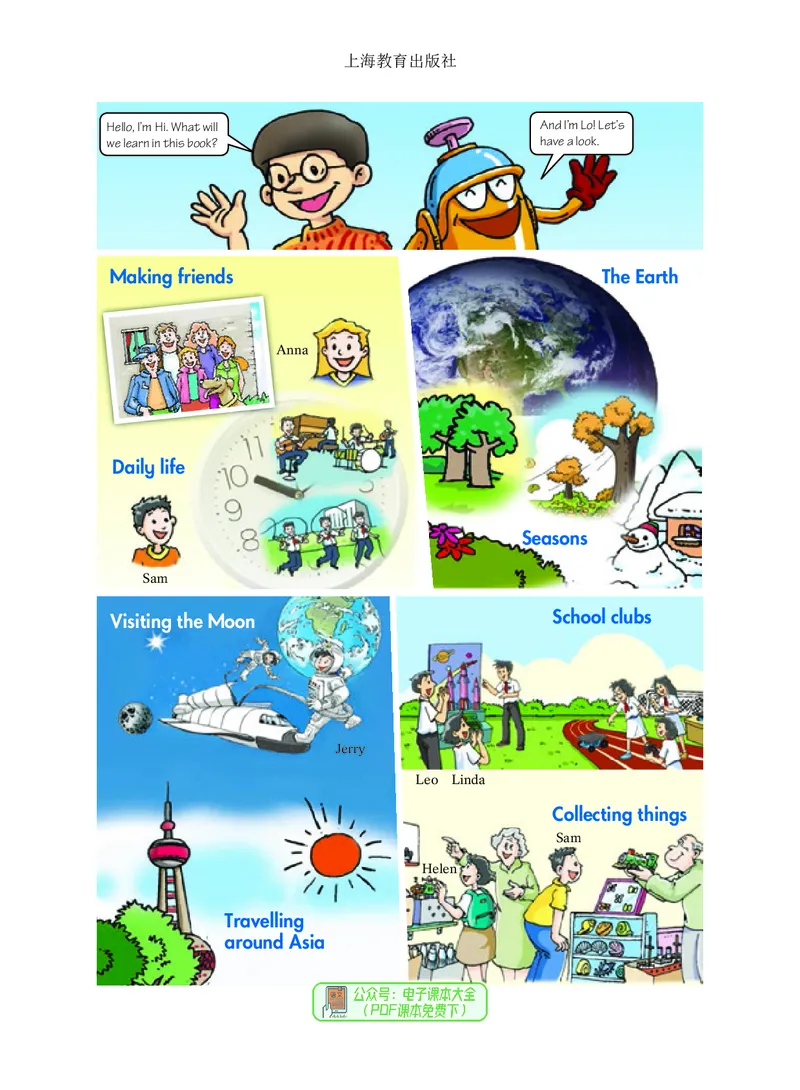
Hello, I’m Hi. What will And I’m Lo! Let’s
we learn in this book? have a look.
Making friends The Earth
Anna
Daily life
Seasons
Sam
School clubs
Visiting the Moon
Jerry
Leo Linda
Collecting things
Sam
Helen
Travelling
around Asia上海教育出版社
CCCCCCCCoooooooonnnnnnnntttttttteeeeeeeennnnnnnnttttttttssssssss
Speaking Culture corner
(cid:43)
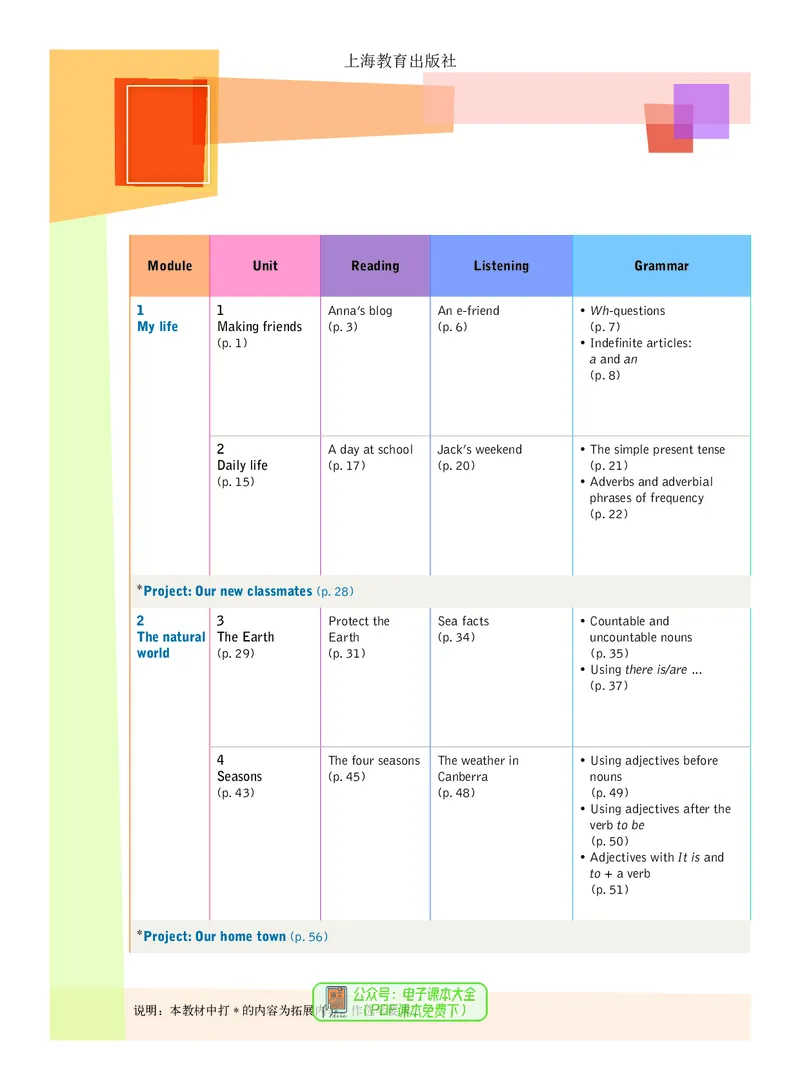
Module Unit Reading Listening Grammar Writing More practice Study skills and
Talk time Speak up Self-assessment
(cid:43)
1 1 Anna’s blog An e-friend • Wh-questions /i/, /I/, About myself An email An email from Using • (cid:34)ddresses in
My life Making friends (p. 3) (p. 6) (p. 7) /C/, /e/, (p. 10) (p. 11) Jason to Anna reference English
(p. 1) • (cid:42)ndefinite articles(cid:27) /p/, /b/ (p. 12) books (cid:9)(cid:18)(cid:10)(cid:27) (p. 14)
a and an (p. 10) (cid:34)lphabetical • (cid:52)elf(cid:14)assessment
(p. 8) order (p. 14)
(p. 13)
2 (cid:34) day at school (cid:43)ack(cid:8)s weekend • The simple present tense /s/, /z/, /Iz/ My classmate(cid:8)s Fang Fang’s The daily life of — • Dear Diary
Daily life (p. 17) (p. 20) (p. 21) (p. 24) daily schedule daily life Jason’s mother (p. 27)
(p. 15) • (cid:34)dverbs and adverbial (p. 24) (p. 25) (p. 26) • (cid:52)elf(cid:14)assessment
phrases of fre(cid:82)uency (p. 27)
(p. 22)
(cid:43)
Project: Our new classmates (p. 28)
2 3 Protect the (cid:52)ea facts • (cid:36)ountable and /V/, /A/, (cid:56)hat can we Protect the Air Parts of a • The story of the
The natural The Earth Earth (p. 34) uncountable nouns /B/, /O/, do to protect Earth (p. 40) book (cid:9)(cid:18)(cid:10)(cid:27) The ten suns
world (p. 29) (p. 31) (p. 35) /W/, /u/, the Earth? (p. 39) contents page (p. 42)
• (cid:54)sing there is/are ... /k/, /G/ (p. 38) (p. 41) • (cid:52)elf(cid:14)assessment
(p. 37) (p. 38) (p. 42)
4 The four seasons The weather in • (cid:54)sing adjectives before /eI/, /aI/, /OI/, (cid:56)hich season My favourite The weather in — • British (cid:52)ummer
Seasons (p. 45) (cid:36)anberra nouns /m/, /n/, /N/ do you like season (cid:36)hina Time (cid:9)B(cid:52)T(cid:10)
(p. 43) (p. 48) (p. 49) (p. 52) best? (p. 53) (p. 54) (p. 55)
• (cid:54)sing adjectives after the (p. 52) • (cid:52)elf(cid:14)assessment
verb to be (p. 55)
(p. 50)
• (cid:34)djectives with (cid:42)t is and
to (cid:12) a verb
(p. 51)
(cid:43)
Project: Our home town (p. 56)
说明:本教(cid:1420)中(cid:1654)(cid:454)的(cid:3134)容为(cid:3978)展(cid:3134)容,作(cid:4299)学要求。上海教育出版社
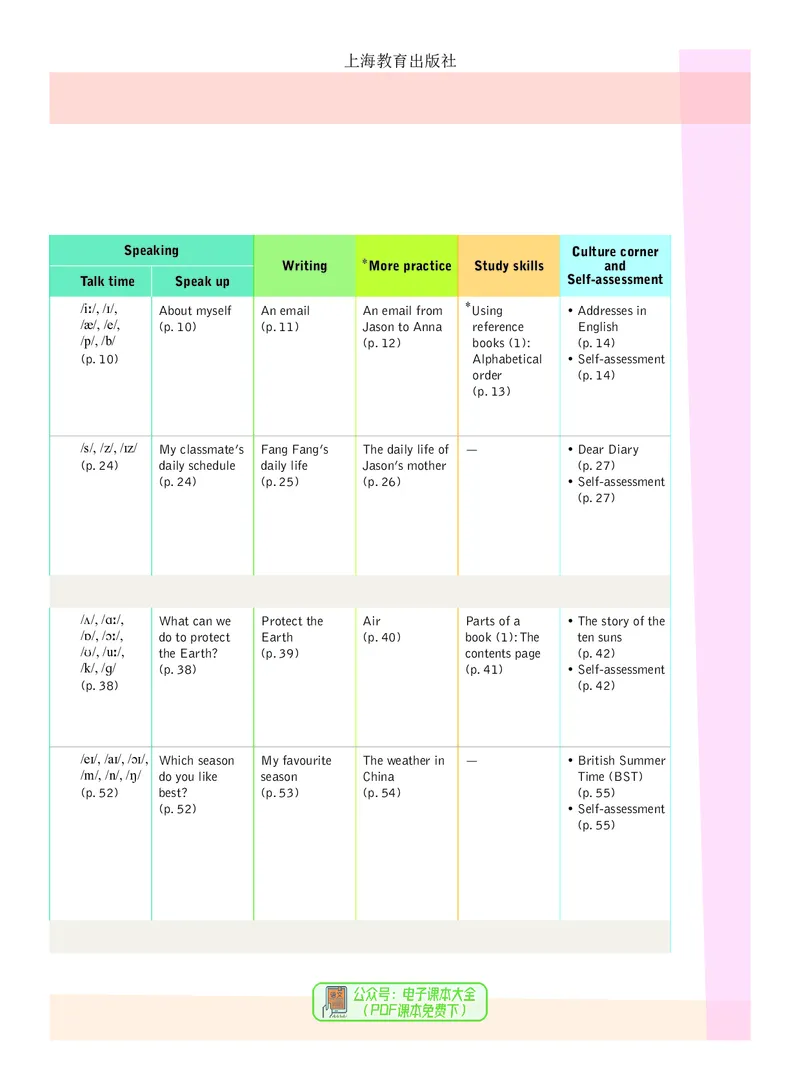
Speaking Culture corner
(cid:43)
Module Unit Reading Listening Grammar Writing More practice Study skills and
Talk time Speak up Self-assessment
(cid:43)
1 1 Anna’s blog An e-friend • Wh-questions /i/, /I/, About myself An email An email from Using • (cid:34)ddresses in
My life Making friends (p. 3) (p. 6) (p. 7) /C/, /e/, (p. 10) (p. 11) Jason to Anna reference English
(p. 1) • (cid:42)ndefinite articles(cid:27) /p/, /b/ (p. 12) books (cid:9)(cid:18)(cid:10)(cid:27) (p. 14)
a and an (p. 10) (cid:34)lphabetical • (cid:52)elf(cid:14)assessment
(p. 8) order (p. 14)
(p. 13)
2 (cid:34) day at school (cid:43)ack(cid:8)s weekend • The simple present tense /s/, /z/, /Iz/ My classmate(cid:8)s Fang Fang’s The daily life of — • Dear Diary
Daily life (p. 17) (p. 20) (p. 21) (p. 24) daily schedule daily life Jason’s mother (p. 27)
(p. 15) • (cid:34)dverbs and adverbial (p. 24) (p. 25) (p. 26) • (cid:52)elf(cid:14)assessment
phrases of fre(cid:82)uency (p. 27)
(p. 22)
(cid:43)
Project: Our new classmates (p. 28)
2 3 Protect the (cid:52)ea facts • (cid:36)ountable and /V/, /A/, (cid:56)hat can we Protect the Air Parts of a • The story of the
The natural The Earth Earth (p. 34) uncountable nouns /B/, /O/, do to protect Earth (p. 40) book (cid:9)(cid:18)(cid:10)(cid:27) The ten suns
world (p. 29) (p. 31) (p. 35) /W/, /u/, the Earth? (p. 39) contents page (p. 42)
• (cid:54)sing there is/are ... /k/, /G/ (p. 38) (p. 41) • (cid:52)elf(cid:14)assessment
(p. 37) (p. 38) (p. 42)
4 The four seasons The weather in • (cid:54)sing adjectives before /eI/, /aI/, /OI/, (cid:56)hich season My favourite The weather in — • British (cid:52)ummer
Seasons (p. 45) (cid:36)anberra nouns /m/, /n/, /N/ do you like season (cid:36)hina Time (cid:9)B(cid:52)T(cid:10)
(p. 43) (p. 48) (p. 49) (p. 52) best? (p. 53) (p. 54) (p. 55)
• (cid:54)sing adjectives after the (p. 52) • (cid:52)elf(cid:14)assessment
verb to be (p. 55)
(p. 50)
• (cid:34)djectives with (cid:42)t is and
to (cid:12) a verb
(p. 51)
(cid:43)
Project: Our home town (p. 56)上海教育出版社
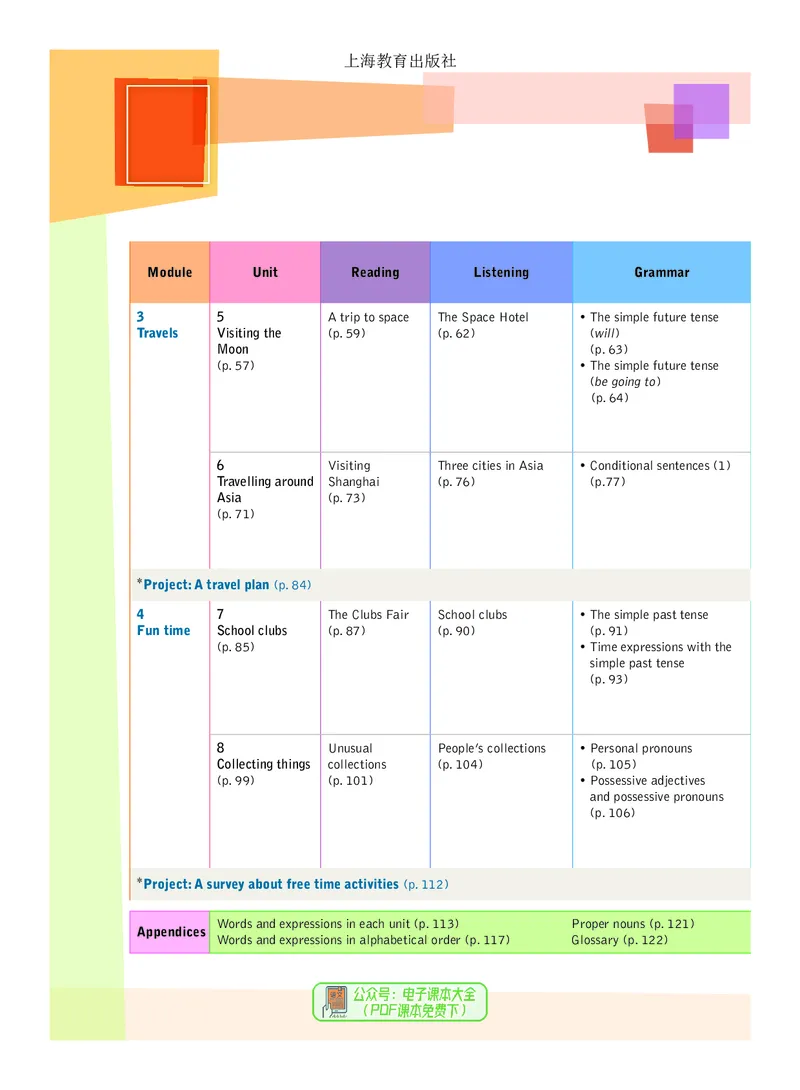
Speaking Culture corner
(cid:43)
Module Unit Reading Listening Grammar Writing More practice Study skills and
Talk time Speak up Self-assessment
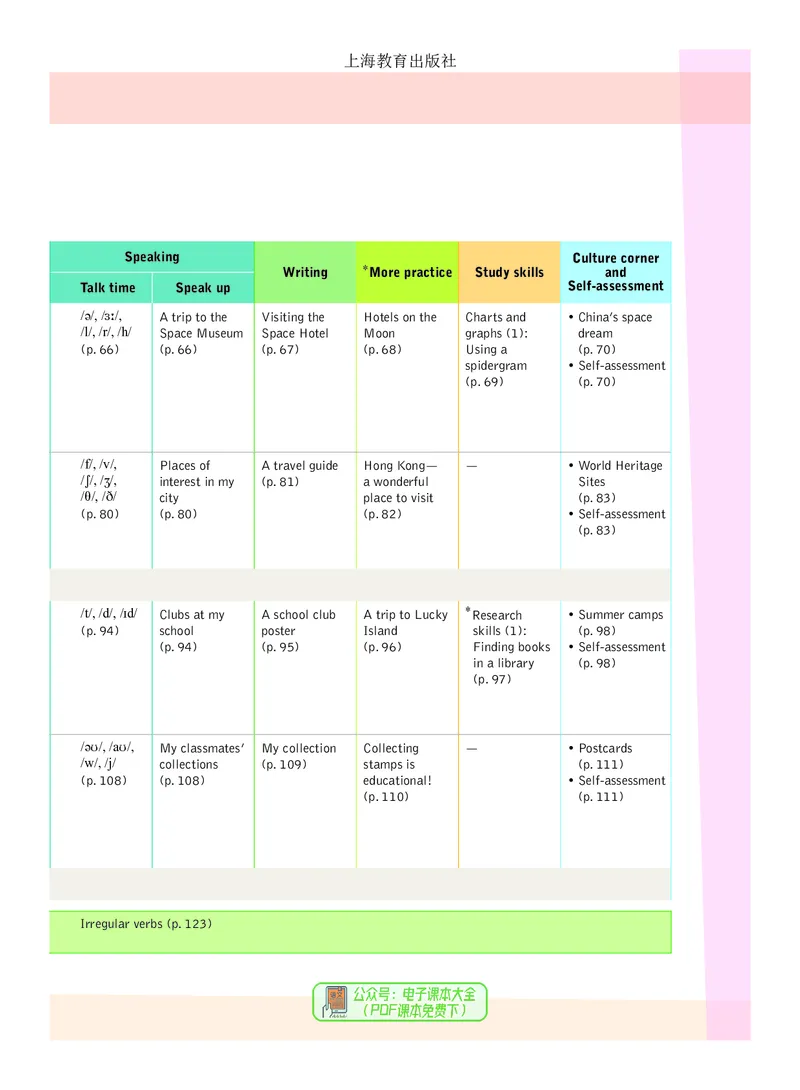
3 5 (cid:34) trip to space The (cid:52)pace (cid:41)otel • The simple future tense /R/, /F/, A trip to the Visiting the (cid:41)otels on the (cid:36)harts and • (cid:36)hina(cid:8)s space
Travels Visiting the (p. 59) (p. 62) (will) /l/, /r/, /h/ (cid:52)pace Museum (cid:52)pace (cid:41)otel Moon graphs (cid:9)(cid:18)(cid:10)(cid:27) dream
Moon (p. 63) (p. 66) (p. 66) (p. 67) (p. 68) Using a (p. 70)
(p. 57) • The simple future tense spidergram • (cid:52)elf(cid:14)assessment
(be going to) (p. 69) (p. 70)
(p. 64)
6 Visiting Three cities in (cid:34)sia • (cid:36)onditional sentences (cid:9)(cid:18)(cid:10) /f/, /v/, Places of (cid:34) travel guide (cid:41)ong (cid:44)ong(cid:137) — • (cid:56)orld (cid:41)eritage
Travelling around (cid:52)hanghai (p. 76) (p.77) /S/, /Z/, interest in my (p. 81) a wonderful (cid:52)ites
Asia (p. 73) /P/, /Q/ city place to visit (p. 83)
(p. 71) (p. 80) (p. 80) (p. 82) • (cid:52)elf(cid:14)assessment
(p. 83)
(cid:43)
Project: A travel plan (p. 84)
(cid:43)
4 7 The (cid:36)lubs (cid:39)air (cid:52)chool clubs • The simple past tense /t/, /d/, /Id/ (cid:36)lubs at my (cid:34) school club (cid:34) trip to (cid:45)ucky (cid:51)esearch • (cid:52)ummer camps
Fun time School clubs (p. 87) (p. 90) (p. 91) (p. 94) school poster (cid:42)sland skills (cid:9)(cid:18)(cid:10)(cid:27) (p. 98)
(p. 85) • Time e(cid:89)pressions with the (p. 94) (p. 95) (p. 96) Finding books • (cid:52)elf(cid:14)assessment
simple past tense in a library (p. 98)
(p. 93) (p. 97)
8 Unusual People(cid:8)s collections • Personal pronouns /RW/, /aW/, My classmates(cid:8) My collection (cid:36)ollecting — • Postcards
Collecting things collections (p. 104) (p. 105) /w/, /j/ collections (p. 109) stamps is (p. 111)
(p. 99) (p. 101) • Possessive adjectives (p. 108) (p. 108) educational(cid:2) • (cid:52)elf(cid:14)assessment
and possessive pronouns (p. 110) (p. 111)
(p. 106)
(cid:43)
Project: A survey about free time activities (p. 112)
(cid:56)ords and e(cid:89)pressions in each unit (cid:9)p. (cid:18)(cid:18)(cid:20)(cid:10) Proper nouns (p. 121) (cid:42)rregular verbs (cid:9)p. (cid:18)(cid:19)(cid:20)(cid:10)
Appendices
(cid:56)ords and e(cid:89)pressions in alphabetical order (cid:9)p. (cid:18)(cid:18)(cid:24)(cid:10) Glossary (p. 122)上海教育出版社
Speaking Culture corner
(cid:43)
Module Unit Reading Listening Grammar Writing More practice Study skills and
Talk time Speak up Self-assessment
3 5 (cid:34) trip to space The (cid:52)pace (cid:41)otel • The simple future tense /R/, /F/, A trip to the Visiting the (cid:41)otels on the (cid:36)harts and • (cid:36)hina(cid:8)s space
Travels Visiting the (p. 59) (p. 62) (will) /l/, /r/, /h/ (cid:52)pace Museum (cid:52)pace (cid:41)otel Moon graphs (cid:9)(cid:18)(cid:10)(cid:27) dream
Moon (p. 63) (p. 66) (p. 66) (p. 67) (p. 68) Using a (p. 70)
(p. 57) • The simple future tense spidergram • (cid:52)elf(cid:14)assessment
(be going to) (p. 69) (p. 70)
(p. 64)
6 Visiting Three cities in (cid:34)sia • (cid:36)onditional sentences (cid:9)(cid:18)(cid:10) /f/, /v/, Places of (cid:34) travel guide (cid:41)ong (cid:44)ong(cid:137) — • (cid:56)orld (cid:41)eritage
Travelling around (cid:52)hanghai (p. 76) (p.77) /S/, /Z/, interest in my (p. 81) a wonderful (cid:52)ites
Asia (p. 73) /P/, /Q/ city place to visit (p. 83)
(p. 71) (p. 80) (p. 80) (p. 82) • (cid:52)elf(cid:14)assessment
(p. 83)
(cid:43)
Project: A travel plan (p. 84)
(cid:43)
4 7 The (cid:36)lubs (cid:39)air (cid:52)chool clubs • The simple past tense /t/, /d/, /Id/ (cid:36)lubs at my (cid:34) school club (cid:34) trip to (cid:45)ucky (cid:51)esearch • (cid:52)ummer camps
Fun time School clubs (p. 87) (p. 90) (p. 91) (p. 94) school poster (cid:42)sland skills (cid:9)(cid:18)(cid:10)(cid:27) (p. 98)
(p. 85) • Time e(cid:89)pressions with the (p. 94) (p. 95) (p. 96) Finding books • (cid:52)elf(cid:14)assessment
simple past tense in a library (p. 98)
(p. 93) (p. 97)
8 Unusual People(cid:8)s collections • Personal pronouns /RW/, /aW/, My classmates(cid:8) My collection (cid:36)ollecting — • Postcards
Collecting things collections (p. 104) (p. 105) /w/, /j/ collections (p. 109) stamps is (p. 111)
(p. 99) (p. 101) • Possessive adjectives (p. 108) (p. 108) educational(cid:2) • (cid:52)elf(cid:14)assessment
and possessive pronouns (p. 110) (p. 111)
(p. 106)
(cid:43)
Project: A survey about free time activities (p. 112)
(cid:56)ords and e(cid:89)pressions in each unit (cid:9)p. (cid:18)(cid:18)(cid:20)(cid:10) Proper nouns (p. 121) (cid:42)rregular verbs (cid:9)p. (cid:18)(cid:19)(cid:20)(cid:10)
Appendices
(cid:56)ords and e(cid:89)pressions in alphabetical order (cid:9)p. (cid:18)(cid:18)(cid:24)(cid:10) Glossary (p. 122)上海教育出版社上海教育出版社
Module 1 My life
Unit
1
MMMMMMMMaaaaaaaakkkkkkkkiiiiiiiinnnnnnnngggggggg ffffffffrrrrrrrriiiiiiiieeeeeeeennnnnnnnddddddddssssssss
Getting ready
In this unit, you will learn about making friends with young people in other
countries.
Reading
• Read a German girl’s blog.
Listening
• Listen to a boy asking a girl about her e-friend.
Grammar
• Learn how to ask and answer Wh-questions.
• Learn when to use a or an before nouns.
Speaking
• Learn to say the /i/, /I/, /C/, /e/, /p/ and /b/ sounds.
• Tell some classmates about yourself.
Writing
• Complete an email to a new friend.
What does “e-friend”
mean, Hi?
It means
“electronic friend”.
Oh, like me!
1上海教育出版社
Module 1
Reading
A What do you know about …?
A1 Friends often write to each other about their hobbies. Can you match the hobbies
in the box with the pictures below?
listening to music playing basketball reading books
1 3
2
______________________
______________________
______________________
A2 Write down your hobbies. Then in groups, tell each other what your hobbies are.
My hobbies are ____________________ and ____________________.
B Before you read
Look at the pictures, the title and the sub-headings on page 3. Then tick (3) the
things that you may find in Anna’s blog.
1 her country 5 her favourite subjects
2 her age 6 her English teacher
3 her parents’ names 7 her dream
4 her brother and sister 8 her hobbies
2上海教育出版社
Unit 1
Hello everyone. Welcome to my blog.
About me
My name is Anna. I’m from Germany. I’m 11
yyyeeeaaarrrsss ooolllddd... III’’’mmm tttaaallllll aaannnddd ttthhhiiinnn... III hhhaaavvveee lllooonnnggg hhhaaaiiirrr...
5 I live with my family in a house
close to some mountains. My mum
is an Art teacher. My dad is a
doctor. I have an elder sister and an
elder brother.
10 About my school and my hobbies
Every day, I go to school by school bus. My favourite
subjects are Maths, Art and Science. I like my school
because the teachers are all very friendly. My dream is
to be an engineer.
15 I like many sports. I’m good at
swimming and playing basketball.
These are my favourite hobbies.
I want to make friends with young people from
all over the world! Email me, please!
3上海教育出版社
Module 1
C Vocabulary
C1 Here are some sentences from the blog on page 3. Do you know the meanings of
the words in italics? Circle the correct answers.
1 Hello everyone.
a all people b some people
2 I live with my family in a house close to some mountains.
a near b far away from
3 I like my school because the teachers are all very friendly.
a happy b nice and kind
4 These are my favourite hobbies.
a things I must do b things I like doing in my free time
5 I want to make friends with young people from all over the world!
a some countries in b every country in
C2 Complete the sentences with the words from the box.
all over close to friendly good at hobbies
We welcome young people from _(1)___________ the world. Please email
us your answers to these questions:
• W(cid:73)at are (cid:90)our (_2)___________?
• (cid:34)re (cid:90)ou _(3)___________ any sports?
• W(cid:73)at fi(cid:77)(cid:78)s(cid:16)(cid:78)usi(cid:68) (cid:69)o (cid:90)ou (cid:77)i(cid:76)e(cid:32)
• (cid:37)o (cid:90)ou (cid:77)ive _(4)___________ or far away from your school?
• (cid:34)re (cid:90)our tea(cid:68)(cid:73)ers (_5)___________?
• W(cid:73)at sub(cid:75)e(cid:68)ts (cid:69)o (cid:90)ou (cid:77)i(cid:76)e best(cid:32)
4上海教育出版社
Unit 1
D Comprehension
D1 Read the blog on page 3 and complete the card about Anna below.
(cid:69)ame(cid:49) (cid:56)nna
(cid:58)ountry(cid:49) (cid:62)ermany (cid:56)ge(cid:49) (_1)____________
What she looks like(cid:49) _(2)____________ and thin(cid:50) long hair
(cid:61)amily members(cid:49) father, (_3)____________ , _(4)____________________ and
_(5)____________________
(cid:61)avourite sub(cid:97)ects(cid:49) _(6)____________ , (_7)____________ and (cid:74)cience
(cid:63)obbies(cid:49) _(8)____________ and playing (_9)____________
(cid:59)ream(cid:49) to be an (_10_)___________
D2 F ind facts in the blog to support these statements about Anna. Write down the facts.
1 (cid:34)nna(cid:8)s s(cid:68)(cid:73)oo(cid:77) is far a(cid:88)a(cid:90) fro(cid:78) (cid:73)er (cid:73)ouse. (cid:9)(cid:38)ver(cid:90) (cid:69)a(cid:90)(cid:13) (cid:42) (cid:121)(cid:10)
Every day, I go to school by school bus.
2 (cid:34)nna (cid:77)i(cid:76)es (cid:69)ra(cid:88)in(cid:72). (cid:9)(cid:46)(cid:90) favourite sub(cid:75)e(cid:68)ts (cid:121)(cid:10)
3 (cid:34)nna en(cid:75)o(cid:90)s (cid:73)er s(cid:68)(cid:73)oo(cid:77) (cid:77)ife. (cid:9)(cid:42) (cid:77)i(cid:76)e (cid:121)(cid:10)
(cid:43)
D3 D o you want to become Anna’s e-friend? Why or why not? Follow the example.
I want to become Anna’s e-friend because I want to learn about Germany …
5上海教育出版社
Module 1
Listening
An e-friend
Jason(cid:407) is asking Mandy about her e-friend. Listen to their conversation and
complete the notes below. Write one word or figure in each blank.
When you listen to a conversation, you need to pay attention to the
Wh-questions. You should then listen carefully for the answers.
Mandy’s e(cid:36)friend
(cid:69)ame(cid:49) (cid:80)uki
(cid:58)ountry(cid:49) Japan
(cid:56)ge(cid:49) _(1)____________
What she looks like(cid:49) short, thin(cid:50) (_2)____________ hair
(cid:63)obby(cid:49) drawing (_3)____________
(cid:57)rothers and sisters(cid:49) one elder _(4)____________
(cid:63)ome(cid:49) a _(5)____________ flat in Tokyo
(cid:59)ream(cid:49) to be an (_6)____________ teacher
(cid:407)本(cid:3883)教(cid:1420)中,中国学(cid:3636)的英文名(cid:2504)供英语(cid:2652)(cid:3863)教学使(cid:4521)。
6上海教育出版社
Unit 1
Grammar
A Wh-questions
We use Wh-questions to ask for information about someone or something.
What is her name? (Anna.)
Where is she from? (Germany.)
Who are your friends? (Ben and Judy.)
How old are they? (Twelve and thirteen.)
When do you go to bed? (At nine o’clock.)
Why do you like your school? (Because the teachers are friendly.)
How do you go to school? (By bus.)
Which colour does she like, red or yellow? (Red.)
How many
does he have? (Five.)
e-friends
Work out the rule
• We (cid:68)an (cid:78)a(cid:76)e Wh-questions with Wh-words and the verb
to be (e.g. am, _______________ and _______________).
• We use _______________ or _______________ to make
Wh-questions with other verbs.
7上海教育出版社
Module 1
Jason gets an email from a new e-friend. Mandy is asking Jason some questions.
Complete Mandy’s questions below.
Jason: I got an email from a boy called Bruce.
Mandy: (_1)______W_h_e_r_e______ does he live?
Jason: He lives in Australia.
Mandy: (_2)________________ is he?
Jason: He’s 12.
Mandy: (_3)________________ does he go to school?
Jason: He goes to school by bus.
Mandy: (_4)________________ are his hobbies?
Jason: Swimming and playing football. He likes an English football team.
Mandy: T here are many English football
teams. (_5)________________ team
does he like?
Jason: Liverpool.
B Indefinite articles: a and an
We can use a or an like this:
a boy a teacher
a computer a unit
a football team a violin
an apple an ice cream
an egg an old book
an hour an umbrella
Work out the rule
• (cid:42)f a noun starts (cid:88)it(cid:73) a (cid:68)onsonant soun(cid:69)(cid:13) (cid:88)e use (cid:9)a/an) before it.
• (cid:42)f a noun starts (cid:88)it(cid:73) a vo(cid:88)e(cid:77) soun(cid:69)(cid:13) (cid:88)e use (cid:9)a/an) before it.
8上海教育出版社
Unit 1
B1 Some students are talking about their dreams. Complete the sentences below with
a or an.
1 2
(cid:46)(cid:90) (cid:69)rea(cid:78) is to be
(cid:46)(cid:90) (cid:69)rea(cid:78) is to be
_____ scientist.
_____ (cid:34)rt tea(cid:68)(cid:73)er.
3 4
I want to be _____
I want to be _____
actor in films.
engineer.
5 6
(cid:46)(cid:90) (cid:69)rea(cid:78) is to be
I want to be _____
_____ basketball star.
nurse.
B2 What do you want to be? In groups, discuss this with your classmates.
My dream is to be a(n) …/I want to be a(n) …
9上海教育出版社
Module 1
Speaking
A Talk time
/i/ /I/
/I/
/i/ /e/ Chinese he English it
/C/
/p/
/b/
teacher three live thin
/C/ /e/
can flat bread egg
man (cid:46)aths friendly many
/p/ /b/
help pen baby big
people ship bus hobby
A1 Listen carefully and circle the word you hear from each pair.
1 /liv/ /lIv/ 3 /mCn/ /men/ 5 /pIG/ /bIG/
2 /it/ /It/ 4 /bCd/ /bed/ 6 /pen/ /ben/
A2 Read these sentences. Pay attention to the letters in bold.
1 Three bees see three beans. 4 Ben let Ken eat eggs in his bed.
2 Little fish swim in the river. 5 Peter is painting a picture in the park.
3 Cat, cat, catch that fat rat! 6 (cid:34) baby took a bath in a big bowl.
B Speak up
In groups, tell your classmates about yourself.
About yourself
What is your name?
What are your hobbies?
About your family and home
Where do you live?
What does your father/mother do?
10上海教育出版社
Unit 1
Writing
An email
Bobby is writing an email to his new e-friend, Anna. Help him finish his email. Use
the pictures to help you.
Anna
Bobby
Dear Anna,
My name is Bobby. I’d like to be your
e-friend. I’m from the US. I’m short. I have
_(1_) ________________ hair.
I have a big family. My grandfather lives with
us. I have two (_2_) _________________________
and one _(3_) _________________________. We live
in a house near New York City.
My school is very big. It’s far from our house.
I take the (_4_) ________________ to school every
day with my brothers. I like my school. My
_(5_) ________________ is to be a computer
engineer.
My favourite sport is (_6_) ________________.
I like swimming too. My other hobbies are
watching _(7_) ________________ and reading
books. I don’t like (_8_) _________________ .
Best wishes,
Bobby
11上海教育出版社
Module 1
(cid:43)
More practice
Read the following email from Jason to Anna. Fill in the table with information
about Jason and yourself.
Anna
Jason
Dear Anna,
Hi! I saw your blog on the Internet and I’d like to be your e-friend. My
name is Jason. I’m 12 years old. I’m tall. I have short, black hair.
I live in a flat in Beijing with my parents. My dad is an engineer and my
mum is an English teacher.
My school is far away from our home. I go to school by bus. My favourite
subject is Maths. I like my school and I have lots of friends there.
I like flying kites in my free time. My favourite sports are volleyball and
football.
I hope to hear from you soon.
Best wishes,
Jason
Jason Me
Age
Hair
Favourite subject(s)
Favourite sports
Other hobby/hobbies
12上海教育出版社
Unit 1
Study skills
(cid:43)
Using reference books (1): Alphabetical order
Below are some reference books.
3
1
2
(cid:34) (cid:69)i(cid:68)tionar(cid:90) (cid:34)n en(cid:68)(cid:90)(cid:68)(cid:77)opae(cid:69)ia (cid:34) te(cid:77)ep(cid:73)one (cid:69)ire(cid:68)tor(cid:90)
In reference books, words and names are usually in alphabetical order,
i.e. from a to z.
A Put these words in alphabetical order.
blog subject draw family vegetable
B Put these words in alphabetical order. Then complete the rule.
sport student science Sunday swimming
If words have the same first letter, the ____________ letter decides the
alphabetical order.
C Put these words in alphabetical order. Then complete the rule.
strong still study start story
If words have the same first two letters, the ____________ letter decides
the alphabetical order.
13上海教育出版社
Module 1
Culture corner
Addresses in English
We write addresses in English like this:
117 High Street, Oxford OX1 4BZ, UK
or
117 High Street House number and street
Oxford Town or city
OX1 4BZ Postcode
UK Country
How do you write your address in Chinese and in English?
My address in Chinese My address in English
How well do you know this unit? Tick ✓ the boxes.
❶ I can read a blog to learn about a German girl.
❷ I can listen for specific information about an
e-friend.
❸ I know how to ask and answer Wh-questions.
❹ I know when to use a or an before nouns.
❺ I can say the /i/, /I/, /C/, /e/, /p/ and /b/ sounds
correctly.
❻ I can tell some classmates about myself.
❼ I can complete an email to a new friend.
❽ I can write addresses in English.
14上海教育出版社
Module 1 My life
Unit
2
DDDDDDDDaaaaaaaaiiiiiiiillllllllyyyyyyyy lllllllliiiiiiiiffffffffeeeeeeee
Getting ready
In this unit, you will learn about people’s daily lives.
Reading
• Read a student’s article about his daily life.
Listening
• Listen to a boy talking about his weekend.
Grammar
• Learn how to use the simple present tense.
• Learn how to use adverbs and adverbial phrases of frequency.
Speaking
• Learn to say the /s/, /z/ and /Iz/ sounds.
• Ask a classmate about his/her daily life.
Writing
• Complete an article about a girl’s daily life.
What do students
say most often in
school, Lo?
I don’t know, Hi.
That’s right, Lo.
15上海教育出版社
Module 1
Reading
A What do you know about …?
Look at these pictures and answer the questions about your daily life.
Which of these things do you …
a do every day?
b do once or twice a week?
c never do?
1 2 3
brush my teeth watch television play table tennis
4 5 6
ride a bicycle play the piano wash my clothes
B Before you read
B1 Look at the title of the article on page 17. Then circle the correct answers.
1 (Sam/Sam’s friend) wrote this article.
2 It is about Sam’s (school day/holiday).
B2 Read the first sentence of each paragraph in the article on page 17. Then answer
the questions below.
1 How does Sam go to school?
2 What subjects does Sam usually study in the morning?
3 How long is the school lunchtime?
16上海教育出版社
Unit 2
I am a junior high school student. I love going to school.
My school is close to my home, so I
always go to school on foot. Classes
start at 8 a.m., and I am seldom late.
5 My favourite subject is Geography.
I enjoy learning about different places
in the world.
In the morning, we usually study
Chinese, Maths and English. We have
10 our morning break at 9:50 a.m. When
the bell rings, I run to the playground
with my best friends Tom and Jack. We
often play games. Break ends at 10:10
a.m. How short it is!
15 Lunch is from 11:50 a.m. to 12:30
p.m. Afternoon classes end at 3:30
p.m. Then Tom, Jack and I take part
in the school band practice. We make
great music together.
20 I always have a good time at school.
17上海教育出版社
Module 1
C Vocabulary
C1 Here are some sentences from the article on page 17. Do you know the meanings
of the words in italics? Circle the correct answers.
1 Classes start at 8 a.m., and I am seldom late.
a often b not often
2 We have our morning break at 9:50 a.m.
a a short time between lessons b a short holiday
3 When the bell rings, I run to the playground with my best friends Tom
and Jack.
a makes a sound b is quiet
4 Afternoon classes end at 3:30 p.m.
a stop b begin
5 We make great music together.
a with each other b every day
C2 Sam and Mandy are talking about their daily lives on the Internet. Complete their
conversation with the words from the box.
break end on foot rings take part in usually
Sam: Is your school close to your home, Mandy?
Mandy: Yes, it is, so I go to school (_1)________________.
Sam: Do you have a lunch _(2)___________?
Mandy: Yes. We have one at 11:30 a.m.
Sam: When does the school day usually (_3)___________?
Mandy: At 3:30 p.m. Most students go home when the bell
_(4)___________, but some of us (_5)___________________
after-school activities. I enjoy playing basketball.
Sam: When do you _(6)___________ begin your homework?
Mandy: At about 5:30 p.m.
18上海教育出版社
Unit 2
D Comprehension
D1 Read the article on page 17 and circle the correct answers.
1 Sam is a _____ school student.
a primary b junior high c senior high
2 Sam’s favourite subject is _____.
a Maths b Geography c English
3 Sam often _____ during the morning break.
a plays with his best friends c reads books
b takes part in the school band practice
D2 Read the article again and answer the questions below in complete sentences.
1 Why does Sam go to school on foot?
_____________________________________________________________
2 Why does Sam like Geography best?
_____________________________________________________________
3 Who are Sam’s best friends?
_____________________________________________________________
4 What does Sam do after school?
_____________________________________________________________
(cid:43)
D3 Fill in the table below and then compare your school day with Sam’s. Follow the example.
Sam Me
Classes start at 8 a.m.
Morning break 9:50 a.m.–10:10 a.m.
Lunchtime 11:50 a.m.–12:30 p.m.
Classes end at 3:30 p.m.
Classes in Sam’s school start at 8 a.m. Classes in my school start at …
19上海教育出版社
Module 1
Listening
Jack’s weekend
Jack is talking about his weekend. Listen to him carefully and fill in the blanks. Use
the time expressions in the box to help you.
after lunch
between 8 and 9 in the evening
later in the afternoon
a b
When? in the morning When? _(1)_______________________
Where? in the library Where? in the _(2)_________ market
What? read books What? go (_3)___________________
c d
When? _(4)_____________________ When? _(6)______________________
Where? in a (_5)____________ room Where? in his _(7)_________________
What? play the guitar What? do his _(8)________________
20上海教育出版社
Unit 2
Grammar
A The simple present tense
We use the simple present tense to talk about regular actions.
I plays the guitar.
He
You play the guitar. does not play the guitar.
She
We do not play the guitar. goes to the park.
It
They does not go to the park.
I
he
you play the guitar?
Do play the guitar? Does she
we go to the park?
it
they
I
Yes, do. Yes, he does.
you
she
we
No, don’t. No, it doesn’t.
they
Work out the rule
• (cid:42)n state(cid:78)ents(cid:13) (cid:88)e a(cid:69)(cid:69) -s or ________ to verbs after he/she/it.
• (cid:42)n (cid:82)uestions(cid:13) (cid:88)e use ________ before I/you/we/they and ________
before he/she/it.
A1 Use the information in the article on page 17 to complete the conversation below.
S1: (_1)____D_o_e_s____ Sam ______g_o_____ (go) to school by bus?
S2: No, he (_2)___________. He (_3)___________ (go) to school on foot.
S1: ( _4)___________ Sam and his friends ____________ (play) games
during the morning break?
S2: Yes, they (_5)___________.
S1: What _(6)___________ Sam ____________ (do) after school?
S2: He _(7)___________ (take) part in the school band practice.
21上海教育出版社
Module 1
A2 In pairs, talk about the things in the box. Follow the example.
go to school by bus
study Chinese, Maths and English in the morning
take part in after-school activities
Do you go to
school by bus?
YYYeeesss,,, III dddooo...
Does Sam go to
school by bus?
No, he doesn’t.
He goes to
school on foot.
B Adverbs and adverbial phrases of frequency
We use adverbs and adverbial phrases of frequency to talk about how
often things happen.
Adverbs of frequency
always/usually/often
I go to school on foot.
sometimes/seldom/never
These adverbs mean:
always
usually
often
sometimes
seldom
never
22上海教育出版社
Unit 2
Adverbial phrases of frequency
every day.
I go to the English Club
twice a week.
On Saturdays,
I go to the park.
Once a month,
Work out the rule
• Adverbs of frequency come (before/after) the main verbs.
• Adverbial phrases of frequency often come (in the middle/at
the end) of a sentence. Sometimes they come at the beginning.
Mandy meets Sam on the Internet again. She is asking Sam some questions about
his life. Write Sam’s answers in complete sentences.
Mandy: How often do you watch television?
Sam: _(1)_I_ w_a_t_c_h_ _t_e_le_v_is_i_o_n_ e_v_e_r_y_ n_ig_h_t_.____________ (every night)
Mandy: How often do you eat out?
Sam: _(2)_______________________________________ (sometimes)
Mandy: How often do you play table tennis with your father?
Sam: _(3)_____________________________________ (once a week)
Mandy: How often do you win?
Sam: _(4)_________________________________________ (seldom)
Mandy: How often do you visit other cities?
Sam: (_5)__________________________________ (four times a year)
Mandy: How often do you play computer games?
Sam: _(6)____________________________________________ (never)
23上海教育出版社
Module 1
Speaking
///zzz///
A Talk time /Iz/
/s/
/s/// /z/ /Iz/
nice sing always zoo
books caps animals potatoes beaches boxes
hopes makes buys loves closes washes
Read these sentences. Pay attention to the letters in bold.
1 Susan sings songs in her seat.
2 Sam loves books about seasons and flowers.
3 Dear Santa, can you send me seven boxes of oranges?
4 The zoo closes at seven, so Sally cannot see the animals.
B Speak up
In pairs, take turns to ask and answer questions and complete your classmate’s
daily schedule below.
do morning exercises go to bed have lunch
go home have classes
__________’s daily life
Remember to
use when, what,
Time Activity how and usually
to ask your
_____ a.m. gets up
classmate about
his/her daily life.
_________ washes face, brushes teeth
_________ hhhaaasss bbbrrreeeaaakkkfffaaasssttt (((eee...ggg... aaa pppiiieeeccceee ooofff bbbrrreeeaaaddd,,, aaa ggglllaaassssss
of milk, an egg, _________________ )
_________ goes to school (on foot or by ___________ )
_________ _____________________________________
24上海教育出版社
Unit 2
Writing
Fang Fang’s daily life
Read Fang Fang’s daily schedule below and complete the article about her daily life.
play basketball with
6:30 a.m. get up 4–4:30 p.m.
friends (twice a week)
7 a.m. have breakfast 4:45 p.m. go home
7:30 a.m. go to school 6:30 p.m. have dinner
8:30 a.m.–
have classes 9 p.m. go to bed
4 p.m.
Fang Fang is a Grade 7 student. She
_(1)____g_e_t_s_ _u_p___ at 6:30 a.m. every day. Then she
washes her face and brushes her teeth. At 7 a.m.,
she _(2)_______________________. She often eats
some bread and drinks a glass of milk.
Fang Fang lives close to school, so she always
(_3)_______________________ on foot at 7:30 a.m. She
_(4)_______________________ from 8:30 a.m. to 4 p.m.
After school, she _(5)____________________________
________________________________________. She
_(6)______________________ at 4:45 p.m.
Fang Fang usually (_7)_____________ at 6:30 p.m.
She sometimes watches TV in the evening. She
always _(8)_________________________________.
25上海教育出版社
Module 1
(cid:43)
More practice
A Jason is talking about his mother’s daily life. Read what he says and then complete
his mother’s schedule below.
My mother is a junior high school teacher. She teaches
English.
My mother gets up at 6 o’clock every day and has breakfast
at 6:30 a.m. She always arrives at school at 7:25 a.m. She
usually has two lessons in the morning. In the afternoon, she
has one lesson. After school, she plays volleyball with her
students.
In the evening, she cooks dinner. After dinner, she prepares
her lessons. She sometimes helps me with my homework. She
usually goes to bed at 11 p.m.
My mother’s daily schedule
6 a.m. _(1)___________________
6:30 a.m. has breakfast
7:25 a.m. _(2)___________________
9–10:40 a.m. has two lessons
lunchtime
1–1:40 p.m. _(3)___________________
4–4:30 p.m. _(4)___________________ with some students
6 p.m. _(5)___________________
6:45 p.m. has dinner
7:30–10 p.m. (_6)___________________ and helps me with my
homework
11 p.m. goes to bed
B Interview your father or mother. Make a schedule like the one in A about his or her
daily life. Then tell your classmates about it.
26上海教育出版社
Unit 2
Culture corner
Dear Diary
Many people around the world keep a diary. They write in it every day.
In a diary, you can write about your daily life.
People often start by writing “Dear Diary”. They think of the diary as a
friend.
Do you keep a diary? Would you like to keep one? What things do/would you write
about?
How well do you know this unit? Tick ✓ the boxes.
❶ I can read an article about a student’s daily life.
❷ I can listen for specific information about a boy’s
weekend.
❸ I know how to use the simple present tense.
❹ I know how to use adverbs and adverbial phrases
of frequency.
❺ I can say the /s/, /z/ and /Iz/ sounds correctly.
❻ I can ask my classmate about his/her daily life.
❼ I can complete an article about a girl’s daily life.
❽ I know about keeping a diary.
27上海教育出版社
(cid:43)
PPPPPPPPrrrrrrrroooooooojjjjjjjjeeeeeeeecccccccctttttttt
Our new classmates
Do you want to know more about your new classmates? In this project, you
will help make a book called Our new classmates.
A Prepare a list of questions. Here is an example for you. Complete the questions
below.
Our new classmate: ____M_ar_y_ __
1 Where ________________________? 4 How _________________________?
I live at 8 Park Road. I usually go to school by bus.
2 How many people are there in 5 What _________________________?
your family?
My favourite subject is Maths.
There are three—my parents and
6 What _________________________?
me.
My favourite sport is basketball.
3 What _________________________
I play it once a week, on Sundays.
______________________________?
7 When ________________________?
My father is a teacher at a junior I often go to bed at 10 p.m.
high school. My mother is a nurse.
B In pairs, ask your classmate questions and make notes of the answers. If possible,
take a photo of your classmate.
C Use your notes to make an information card about your classmate. Remember to
stick his/her photo on it. Here is an example for you.
Name: ___M_a_r_y_ __
Home address: ___8__ P_a_r_k_ R__o_a_d____
Family members: __f_a_t_h_e_r_ (_t_e_a_ch_e_r_)_, m__o_t_h_e_r_ (n_u_r_s_e_)_,__
___M_a_r_y_ (_s_t_u_d_e_n_t)_________________
Go to school: __b_y_ b_u_s__
D Then, as a class, put all your cards together to make a book for everyone to read.
Design a book cover.
28
PB上海教育出版社
Module 2 The natural world
Unit
3
TTTTTTTThhhhhhhheeeeeeee EEEEEEEEaaaaaaaarrrrrrrrtttttttthhhhhhhh
Getting ready
In this unit, you will learn about the Earth.
Reading
• Read a poster about the Earth.
Listening
• Listen to a quiz about the sea.
Grammar
• Learn how to use countable and uncountable nouns.
• Learn how to use the pattern there is/are ….
Speaking
• Learn to say the /V/, /A/, /B/, /O/, /W/, /u/, /k/ and /G/ sounds.
• Talk about what we can do to protect the Earth.
Writing
• Complete a report on protecting the Earth.
About 70% of the
Earth is
covered by
Why do we call it the
water.
“Earth” then?
29上海教育出版社
Module 2
Reading
A What do you know about …?
A1 Look at the photos and write the correct words in the blanks.
1 2
stars
the Earth
the Moon
the Sun
__________________ __________________
3 4
__________________ __________________
A2 Look at the photo of the Earth in A1 again. In pairs, discuss the questions below.
1 What are the blue parts?
clouds
2 What are the green and brown parts?
land
3 What are the white parts?
sea
B Before you read
Look at the photos and the title of the poster on page 31. Then answer the
questions below.
1 What is the poster about?
2 What things are there on Earth?
30上海教育出版社
Unit 3
Protect The Earth
The Earth is a beautiful place.
There are forests and rivers,
mountains and fields. Some
places are very hot, and some
5 are very cold.
There are many different plants.
Some are large. Some are small. All
plants need light and water. There
are different animals on Earth too.
10 Some live on the land. Some fly in
the sky. Some live under the water.
There are also many people like
you and me on Earth. The Earth
provides us with air, water and
15 food. It is our home.
Today, there is a lot of pollution. We burn things
to make energy. This pollutes the air. We put our
rubbish into the sea and under the ground. This
pollutes the Earth and kills animals and plants.
20 We must stop doing these things. It is important for us to protect the
Earth for our future.
31上海教育出版社
Module 2
C Vocabulary
C1 Here are some sentences from the poster on page 31. Do you know the meanings
of the words in italics? Circle the correct answers.
1 The Earth provides us with air, water and food.
a gives b shows
2 We burn things to make energy.
a set … on fire b make … very strong
3 This pollutes the air.
a makes … clean b makes … dirty
4 This pollutes the Earth and kills animals and plants.
a cleans b makes … die
5 It is important for us to protect ttthhheee EEEaaarrrttthhh fffooorrr ooouuurrr fffuuutttuuurrreee...
a keep ... safe b change
C2 Complete the conversations with the words from the box.
burn pollute provide … with
important protect
1 Tom: The water from the factory is dirty.
Bob: Yes. We must not let it (_1)___________ the river. We must do
something to _(2)___________ the river.
Tom: Yes. It’s _(3)___________ for us to do something about this.
2 Jack: Forests are very important. Do you know why?
Joe: Of course. They (_4)___________ us ____________ a lot of things,
for example, wood and fruit.
Jack: You’re right. Many people still (_5)___________ wood to make
energy.
32上海教育出版社
Unit 3
D Comprehension
D1 Find sentences beginning with There is/are ... from the poster on page 31 to go
with these photos.
1 2
_______________________ _______________________
_______________________ _______________________
3 4
_______________________ _______________________
_______________________ _______________________
D2 R ead the poster again and answer the questions below in complete sentences.
1 What is the weather like in different places on Earth?
2 Where do animals live on Earth?
3 What does the Earth provide us with?
(cid:43)
D3 W hat else do you know about the Earth? Discuss this in groups.
There is/are ... Some ... Some ...
33上海教育出版社
Module 2
Listening
Sea facts
Listen to a quiz about the sea. Then circle the correct pictures.
When you listen for facts, you need to catch the important words.
Names, times and numbers are usually important. They can help you
find the correct answers to the questions.
1 a b
one quarter three quarters
2 a b
whale tiger
3 a b
5 kilometres 10 kilometres
333444上海教育出版社
Unit 3
Grammar
A Countable and uncountable nouns
In English, we can count some things, e.g. rivers and mountains. We
cannot count other things, e.g. water and air.
Countable nouns Uncountable nouns
one animal, two animals some rubbish
I have a world map at home.
All plants need light and water.
There is an article about the Earth.
This plant is beautiful. Air has no smell.
These animals are dangerous. Water is important.
Work out the rule
• (cid:9)(cid:36)ountab(cid:77)e(cid:16)(cid:54)n(cid:68)ountab(cid:77)e(cid:10) nouns (cid:68)an (cid:73)ave p(cid:77)ura(cid:77)s.
• We (cid:68)an use a or an before (countable/uncountable) nouns.
• (cid:54)n(cid:68)ountab(cid:77)e nouns on(cid:77)(cid:90) ta(cid:76)e (cid:9)sin(cid:72)u(cid:77)ar(cid:16)p(cid:77)ura(cid:77)(cid:10) verbs.
A1 Read the sentences below and decide whether the nouns in italics are countable or
uncountable. Write the words in the correct columns.
1 There is grass in a forest.
Countable Uncountable
2 Do not throw rubbish into the
forest
river.
3 The air is fresh in the mountains.
4 The flowers are beautiful. Let me
take a photo.
5 We should drink water every
day. Here is a glass for you.
35上海教育出版社
Module 2
A2 In pairs, ask and answer questions about each photo. Follow the example.
1 2 3
bottle/milk box/egg bowl/rice
4 5 6
glass/water bag/apple cup/coffee
S1: What’s this?
S2: It’s a bottle.
S1: What’s inside it?
000333666...000111___aaarrrtttwwwooorrrkkk::: TTTwwwooo 111222---yyyeeeaaarrr---
S2: Some milk.
ooolllddd ssstttuuudddeeennntttsss (((111 bbboooyyy,,, 111 gggiiirrrlll))),,, iiinnn
sssuuummmmmmeeerrr cccaaasssuuuaaalll wwweeeaaarrr,,, tttaaalllkkkiiinnnggg...
TTThhheee gggiiirrrlll iiisss hhhooollldddiiinnnggg aaa bbbooottttttllleee ooofff
S1: What are these?
mmmiiilllkkk aaannnddd tttwwwooo bbboooxxxeeesss ooofff eeeggggggsss... TTThhheee
S2: They’re boxes. bbboooyyy iiisss pppoooiiinnntttiiinnnggg aaattt ttthhheee fffooooooddd ttthhheee
gggiiirrrlll iiisss hhhooollldddiiinnnggg...
S1: What’s inside them?
S2: Some eggs.
36上海教育出版社
Unit 3
B Using there is/are …
We often use there is … or there are … to say that something exists
somewhere.
a beautiful world under the water.
There is
a lot of pollution on Earth.
Yes, there is.
Is there any water in the glass?
No, there isn’t.
There are different plants and animals on Earth.
Yes, there are.
Are there five apples in the bag?
No, there aren’t.
Work out the rule Things to remember
there is = there’s
• We use _____________
there is not = there isn’t
with a singular noun or an there are not = there aren’t
uncountable noun.
Note the difference below:
• We use _____________ There is a glass of water and three
with a plural noun. apples on the table.
There are three apples and a glass of
water on the table.
Jane is asking Danny about what they can do to help protect the sea. Complete
their conversation with there is (not), is there, there are or are there.
Jane: (_1)________________ pollution in the sea. What can we do to
help protect the sea?
Danny: _(2)________________ many things we can do. We can have a
beach clean-up day. You see, (_3)________________ always many
bottles on the beaches. They pollute the sea.
Jane: That’s a good idea! What else can we do?
Danny: We can ask people not to eat shark fin soup. (_4)_______________
a seafood restaurant near your home?
Jane: No, _(5)________________. (_6)________________ any other things
we can do to help?
37上海教育出版社
Module 2
Speaking
A Talk time
/V/ /A/
colour must after banana
other under card large
/A/
/V/ /B/ /O/
/O/
/B/ doctor on all August
/u/ want wash four horse
/W/
/W/ /u/
/k/ /G/ could full blue food
put wood pollute shoe
/k/ /G/
clever clock bag dog
cook keep good grass
A1 Listen carefully and circle the word you hear from each pair.
1 /bAn/ /bVn/ 3 /spBt/ /spOt/ 5 /pWl/ /pul/ 7 /bCk/ /bCG/
2 /hAt/ /hVt/ 4 /kBd/ /kOd/ 6 /fWl/ /ful/ 8 /klAs/ /GlAs/
A2 Read these sentences. Pay attention to the letters in bold.
1 I love my brother’s drum. 5 He took a look at the cook.
2 I asked my father for a banana. 6 Whose blue shoes are those?
3 I want to wash some socks. 7 The clever cat caught the chicken.
4 I saw four horses at the door! 8 A girl sat on the green grass with
her dog.
B Speak up
In pairs, talk about what we can do to protect the Earth. Follow the example.
S1: What can we do to protect the Earth?
S2: We must stop polluting the air.
S1: Are there any other things we can do?
S2: We can take our own shopping bags to the supermarket.
38上海教育出版社
Unit 3
Writing
Protect the Earth
A In pairs, look at the photos below and discuss the problems with your classmate.
What can we do to solve these problems?
2
people/catch a people/burn
1
lot of fish every things to
day/fewer and make energy/
fewer fish in the pollute the
sea each year air
3 people/throw
4 people/put
away a lot of
waste into
rubbish every
rivers and
day/pollute the
seas/pollute
land
the water
B Use the information in A to complete the report below.
PROTECT THE EARTH
What problems do we have?
• (cid:49)eop(cid:77)e ____________________________________________________.
There are __________________________________________________.
• (cid:49)eop(cid:77)e ____________________________________________________.
This _______________________________________________________.
• (cid:49)eop(cid:77)e ____________________________________________________.
This _______________________________________________________.
• (cid:49)eop(cid:77)e ____________________________________________________.
This _______________________________________________________.
What can we do to protect the Earth?
• We (cid:78)ust stop ______________________________________________.
• ___________________________________________________________
39上海教育出版社
Module 2
(cid:43)
More practice
A Read the poem about air and complete the sentences below.
Air
Air has no smell.
Air has no taste.
But when the wind blows,
You feel it on your face.
Look at a kite,
Or a plane in the air.
How do they stay there?
They ride on air.
How does a balloon
Rise in the air,
And lift people up?
It uses hot air.
We need air to breathe.
We need air to survive.
And when we breathe it,
It keeps us alive.
1 Air has no __________ and no __________. When the wind blows, you
feel the __________ on your face.
2 A kite or a plane ____________________ to stay in the sky.
3 A balloon uses _______________ to rise in the air and __________
people up.
4 “We need air to survive” means “Air __________ us __________”.
B Where does air pollution come from? In groups, discuss the question with your
classmates. Then report to the class. Follow the example.
Air pollution comes from traffic.
It also comes from factories.
40上海教育出版社
Unit 3
Study skills
Parts of a book (1): The contents page
You can always find the contents page at the beginning of a book. It
contains useful information. For example, part and/or chapter numbers,
names of chapters and page numbers.
Study the contents page of The Crying Sea on the right and complete the
sentences below.
1 There are ________ (how many?)
Contents
parts and ________ (how many?)
chapters in this book. Part 1 What can we find in the sea?
Chapter 1 Fish 2
2 In Part ________, Chapter Chapter 2 Coral 10
Chapter 3 Other sea creatures 18
________, we can find out about
Chapter 4 Seaweed 19
different types of fish.
Part 2 What can we get from the sea?
3 We can find out why the sea is Chapter 1 Seafood 23
Chapter 2 Oil 26
crying in Part ________.
Chapter 3 Salt 32
4 We can find information about Part 3 Why is the sea crying?
how to save the sea in Part Chapter 1 People are polluting the sea 35
Chapter 2 Animals are dying 44
________.
Chapter 3 No more oil 50
5 In Part ________, Chapter Part 4 Let’s save the sea!
________, we may find
information about where oil comes from.
6 Where can you find these photos in the book?
a b c
In Part ________, In Part ________, In Part ________,
Chapter ________. Chapter ________. Chapter ________.
41上海教育出版社
Module 2
Culture corner
The story of the ten suns
A long time ago, there were ten suns in the sky. The weather was
very hot. Plants could not grow. Animals could not live long. There
was a man. His
name was Houyi.
He shot nine suns
out of the sky. In
the end, only one
sun remained. The
weather got cooler.
Plants could grow.
People were happy.
Do you want to have one sun or ten suns in the sky? Give your reasons.
How well do you know this unit? Tick ✓ the boxes.
❶ I can read a poster to learn about the Earth.
❷ I can listen for facts about the sea.
❸ I can use countable and uncountable nouns
correctly.
❹ I can use sentences with there is/are … correctly.
❺ I can say the /V/, /A/, /B/, /O/, /W/, /u/, /k/ and /G/
sounds correctly.
❻ I can talk about how to protect the Earth.
❼ I can write a report on protecting the Earth.
❽ I understand the contents page of a book.
❾ I know the story of the ten suns.
42上海教育出版社
Module 2 The natural world
Unit
4
SSSSSSSSeeeeeeeeaaaaaaaassssssssoooooooonnnnnnnnssssssss
Get ting ready
In this unit, you will learn about the four seasons and the weather in different parts
of the world.
Reading
• Read an article about the four seasons.
Listening
• Listen to a girl talking about the weather in Canberra, Australia.
Grammar
• Learn how to use adjectives.
Speaking
• Learn to say the /eI/, /aI/, /OI/, /m/, /n/ and /N/ sounds.
• Talk about which season you like best.
Writing
• Write about your favourite season.
Which season do you
like best?
I like spring best.
I don’t like summer.
I love all four seasons. I never feel What about you?
hot or cold! 43上海教育出版社
Module 2
Reading
A What do you know about …?
A1 Here is a poem about the four seasons. Complete the poem with the words from
the box.
spring
Footprints
summer
In (_1)_______________ In (_3)_______________
autumn
Watch us go, By the sea,
Making footprints Sandy footprints winter
In the snow. Made by me.
In _(2)_______________ In _(4)_______________
My shoes are wet. Trees are brown.
See how deep I kick the leaves
The puddles get. All over town.
A2 Read the poem again. Then match the pictures below with the seasons. Write the
letters in the correct boxes.
a spring b summer c autumn d winter
1 2 3 4
B Before you read
Look at the pictures and the sub-headings of the article on page 45. Then answer
the questions below.
1 What is the weather like in spring?
2 What do people usually do in summer?
3 What do people like doing in autumn?
4 What do children like about winter?
44上海教育出版社
Unit 4
The four seasons
Spring
In spring, the weather starts to get warm.
The wind blows gently. It often rains.
Plants start to grow. Everything turns
5 green. It is exciting to take a trip
in spring.
Summer
The weather is hot in summer. The Sun
shines brightly. Many people like to go to
10 the beach and swim in the sea. It is nice
to eat ice cream in the hot weather.
Autumn
In autumn, everything changes. Leaves
turn brown, red or yellow and start
15 falling from the trees. It is nice to go on
a picnic at this time of year because the
weather is cool and dry.
Winter
Winter is often cold and snowy. Children
20 love winter because they love to play
in the snow. It is interesting to make
snowmen. People usually spend time with
their relatives during the Spring Festival.
45上海教育出版社
Module 2
C Vocabulary
C1 Look at the article on page 45 and find words that have similar meanings to the
phrases below.
1 all the things (line 4) __________________
2 sends out light (line 9) __________________
3 not wet (line 17) __________________
4 with a lot of snow (line 19) __________________
5 use time to do something (line 22) __________________
6 people in the same family (line 23) __________________
C2 Complete the article with the words from the box.
everything relatives snowy spend trip
(cid:78)inter is the best season. I have a long holiday at that time and I have a lot
of fun. I love _(1)___________ days because _(2)___________ becomes white. It is
e(cid:111)citing to make snowmen and _(3)___________ time playing in the snow with my
friends.
I like to visit my _(4)___________ during the Spring Festival in (cid:65)anuary or
February. (cid:78)e always have dinner together. Sometimes I go on a _(5)___________
with my parents during the winter holidays. (cid:78)e always have a good time.
Grouping words
Can you put the following adjectives into different groups?
brown cold cool dry exciting green hot
interesting nice red snowy warm wet yellow
For example, brown, green, red and yellow are all colours. What do the other
adjectives mean? It is helpful to learn words by remembering them in groups.
46上海教育出版社
Unit 4
D Comprehension
D1 Find sentences beginning with It is … from the article on page 45 to go with these
pictures.
1 2
3 4
D2 Read the article again. Complete the table below.
Weather Activities
Spring It starts to _(1)_______________. It is exciting to (_3)___________
It often _(2)_________________. __________________________.
Summer It is (_4)_________ and the Sun People like to _(6)____________
_(5)________________________. _____ and _(7)________________.
Autumn It is (_8)_____________________ It is nice to _(9)_______________
__________________________. __________________________.
Winter It is often (_10_)_______________ Children love to _(11_)_________
__________________________. __________________________.
(cid:43)
D3 What festivals do we have in each season? What do we usually do or eat at each
festival?
47上海教育出版社
Module 2
Listening
The weather in Canberra
A Listen to Kelly talking about the weather in Canberra, Australia and put the photos
below in the correct order. Write the numbers 1–4 in the boxes.
a b
c d
B Listen again and complete the table below.
Season Starts in Ends in Weather
Spring September _(1_) ______________ _(2_) ______________, rainy
Summer (_3_) ______________ February _(4_) ______________, hot
Autumn March (_5_) ______________ _(6_) ______________, dry
Winter (_7_) ______________ August very _(8_) ______________
48上海教育出版社
Unit 4
Grammar
A Using adjectives before nouns
We use an adjective before a noun to describe a thing or a person.
Things to remember
a bright star lovely children
Sometimes we form an adjective like
this:
a close relative an old umbrella
wind (n.) (cid:162) windy (adj.)
a funny snowman a warm coat rain (n.) (cid:162) rainy (adj.)
But note the spelling change with:
heavy rain a windy day
sun (n.) (cid:162) sunny (adj.)
fog (n.) (cid:162) foggy (adj.)
Work out the rule
Sometimes we can turn a ______________ into an ______________
by adding -y to the word.
Look at the pictures. Complete the sentences with the words from the box.
rainy snowy sunny windy
1 The Sun is shining brightly.
It is a _______________ day.
2 It is raining heavily.
It is a _______________ day.
3 The wind is blowing strongly.
It is a _______________ day.
4 It is snowing heavily.
It is a _______________ day.
49上海教育出版社
Module 2
B Using adjectives after the verb to be
We can also use adjectives like this:
Winter is cold. Sometimes
it is snowy. Winter clothes
are warm.
I’m hot. It will still be
sunny tomorrow.
Work out the rule
We can use adjectives (before/after) the verb ____________
(e.g. am, is and are).
In pairs, ask and answer questions about the weather. Follow the example.
cloudy cold hot snowy sunny warm windy
S1: What’s the weather like in Beijing in July?
S2: It’s hot and sunny.
1 2 3 4
Beijing Shanghai Hangzhou Harbin
July April January February
50上海教育出版社
Unit 4
C Adjectives with It is and to + a verb
We can use the adjectives below with It is and to followed by a verb.
dangerous It is nice to eat ice
exciting cream in the park.
good
hard
important
interesting
nice
Here are some pictures of different seasons. Write a caption for each picture by
using the words below it.
1 2
hard/walk/on muddy roads/spring exciting/play/on the beach/summer
It is h ar d to wa lk on m ud dy r oa ds in
sp rin g.
3 4
nice/take a trip/autumn interesting/play in the snow/winter
51上海教育出版社
Module 2
Speaking
A Talk time
/(cid:62)I/
/eI/ /aI/ /OI/
(cid:13)(cid:45)(cid:39)(cid:13)
/(cid:66)(cid:39)/ change may brightly dry boy enjoy
rain they like shine noise point
/m/ /N/
/n/
/m/ /n/ /N/
many moon cousin know exciting long
swim time listen never spring young
A1 Listen carefully and circle the word you hear from each pair.
1 /raIt/ /reIt/ 3 /nOIz/ /naIs/ 5 /kIn/ /kIN/
2 /baI/ /bOI/ 4 /mun/ /nun/ 6 /swIm/ /swIN/
A2 Read these sentences. Pay attention to the letters in bold.
1 Rain, rain, go away. Come again another day.
2 Nine white tigers like flying kites and riding bikes.
3 The boy enjoys playing with toys.
4 Mary will get married on Monday morning.
5 Naughty Nicky knocked on nine windows.
6 The king is singing a song.
B Speak up
In pairs, talk about which season you like best. Follow the example.
S1: Which season do you like best?
S2: I like summer best.
S1: Why?
S2: Because it’s exciting to play on the beach in
the sunny weather.
52上海教育出版社
Unit 4
Writing
My favourite season
A Mandy has written about her favourite season, winter.
My favourite season is winter.
Winter is very cold and sometimes snowy. It is interesting to make
snowmen in winter.
The Spring Festival is in winter and it is my favourite holiday.
I visit my grandparents and eat lots of nice food. It is
exciting to get red packets during the Spring Festival.
B Write a short passage about your favourite season. Follow the example in A.
warm/hot/cool/cold/wet/rainy/windy/cloudy/sunny/snowy
exciting/nice/interesting
plant trees/fly kites/go swimming/have a picnic
the Mid-Autumn Festival/the Dragon Boat Festival
My favourite season
My favourite season is ________________.
It is _____________ and sometimes ______________ (weather). It is _________
to ___________________________________________________________ (activity).
____________________ is in ____________________ (festival). I _______________
________________________________________________________________________.
It is ____________________________________________________________________
_______________________________________________________________ (activity).
53上海教育出版社
Module 2
(cid:43)
More practice
Read this article about the weather in China. Then complete the table below.
The weather in China
In the north of China, it is very cold and dry in
winter. There is sometimes heavy snow. Summer
is different. It is sometimes very hot during the
day, but it is often cool in the evening. Spring and
autumn are the nicest seasons.
The weather in the middle and east of China is quite different. It is hot in
summer and very cold and wet in winter.
In the south of China, winter is usually short and
cool. It sometimes rains. In summer, the weather is
often hot and wet.
The weather in the south-west of China is very special. It is comfortable to
live there because summer is cool and winter is warm.
The weather in China
Summer Winter
North of China
Middle and east of China
South of China
South-west of China
54上海教育出版社
Unit 4
Culture corner
British Summer Time (BST)
In some countries, they have summer time
and winter time. In the UK, for example,
their summer time starts on the last Sunday
in March. At 1 a.m. on that day, the clocks
in all public places in the UK are put
forward an hour, from 1 a.m. to 2 a.m. BST
always ends on the last Sunday in October.
Can you name one other country that has summer time like the UK? When does it
begin and end?
How well do you know this unit? Tick ✓ the boxes.
❶ I can read an article about the four seasons.
❷ I can put words into different groups.
❸ I can listen for specific information about the
weather in Canberra, Australia.
❹ I can use adjectives before nouns correctly.
❺ I can use adjectives after the verb to be correctly.
❻ I can use some adjectives with It is and to + a verb
correctly.
❼ I can say the /eI/, /aI/, /OI/, /m/, /n/ and /N/ sounds
correctly.
❽ I can talk about my favourite season.
❾ I can write about my favourite season.
(cid:30) I know about British Summer Time (BST).
55上海教育出版社
(cid:43)PPPPPPPPrrrrrrrroooooooojjjjjjjjeeeeeeeecccccccctttttttt
Our home town
How much do you know about your home town? In this project, you will do
some research and write a report.
A In groups, do some research according to the questions below.
• W(cid:73)ere is (cid:90)our (cid:73)o(cid:78)e to(cid:88)n(cid:32)
• W(cid:73)i(cid:68)(cid:73) provin(cid:68)e is (cid:90)our (cid:73)o(cid:78)e to(cid:88)n in(cid:32)
• (cid:42)s t(cid:73)ere an(cid:90) bi(cid:72) sea or river (cid:68)(cid:77)ose to or in (cid:90)our (cid:73)o(cid:78)e to(cid:88)n(cid:32)
• W(cid:73)en (cid:69)oes ea(cid:68)(cid:73) season start an(cid:69) en(cid:69)(cid:32)
• W(cid:73)at is t(cid:73)e (cid:88)eat(cid:73)er (cid:77)i(cid:76)e in ea(cid:68)(cid:73) season(cid:32)
What do people usually do in different seasons?
B Each group works together to write a report. You may draw pictures or add photos
to go with the report. Follow the example.
Home town: Shanghai
Big seas or rivers close to or in our home town:
the Huangpu River, Suzhou Creek, the Changjiang
River, the East China Sea
Seasonal features:
SSSppprrriiinnnggg uuusssuuuaaallllllyyy ssstttaaarrrtttsss iiinnn MMMaaarrrccchhh... TTThhheee wwweeeaaattthhheeerrr ssstttaaarrrtttsss
to get warm. The wind blows gently. It often rains. Plants start to grow.
People usually take trips during this time …
C As a class, decide which group’s report is the best.
56上海教育出版社
Module 3 Travels
Unit
5
VVVVVVVViiiiiiiissssssssiiiiiiiittttttttiiiiiiiinnnnnnnngggggggg tttttttthhhhhhhheeeeeeee MMMMMMMMoooooooooooooooonnnnnnnn
Getting ready
This unit will take you to the year 2053. You will learn about living in space and
staying at a space hotel.
Reading
• Read a student’s diary about a trip to space.
Listening
• Listen to a robot talking about the Space Hotel.
Grammar
• Learn how to use the simple future tense with will.
• Learn how to use the simple future tense with be going to.
Speaking
• Learn to say the /R/, /F/, /l/, /r/ and /h/ sounds.
• Plan a trip to the Space Museum.
Writing
• Write a plan for visiting the Space Hotel.
How far can you see
About 380,000
on a clear night?
kilometres.
Really? Yes. I can see the
Moon from the Earth.
57上海教育出版社
Module 3
Reading
A What do you know about …?
Would you like to travel into space? Look at the picture and write the correct words
in the boxes.
the Earth space spacesuit
the Moon spaceship star
1
2
3
4
5
6
B Before you read
Look at the photos, the title and the first paragraph of the diary on page 59. Then
circle the correct answers.
1 Where is Jerry going?
a To the Moon. b To a star.
2 How will Jerry travel?
a By spaceship. b By plane.
3 How may Jerry feel about the trip? (There can be more than one
answer.)
a Happy. b Excited. c Nervous. d Worried.
58上海教育出版社
Unit 5
by Jerry
10 October 2053
I’m so happy! Tomorrow I’ll be one of the first students to travel
into space. The spaceship will leave the Earth at 9 a.m. It’ll take us
to the Moon. I can’t wait!
The Moon is around 380,000 kilometres from the Earth, so it’ll
5
take us about four days to get there. There’s no gravity in space,
so we’ll all be able to float around in the spaceship. We’ll have to
tie ourselves to our beds so that we won’t float away in our sleep!
Without gravity, our bodies may get weak, so we’ll have to do
exercises every day.
10
When we arrive, I’m going to walk on the Moon. I’ll have to wear a
spacesuit to help me breathe because there’s no air on the Moon.
I’m going to take as many photos as I can, that is, if my camera
still works up there …
5599上海教育出版社
Module 3
C Vocabulary
C1 The words in italics are from the diary on page 59. Circle the correct answers to
complete these sentences.
1 If you leave a place, you _____ it.
a go to b go away from
2 If you have to do something, you _____ do it.
a can b must
3 If you tie something, you _____.
a hold two or more things together with a rope
b make something into a rope
4 When you breathe, you _____.
a keep yourself warm
b take air into and send it out of your body
C2 Complete the conversations with the words from the box.
able to breathe camera leaves tie
1 Andrew: I like your new _(1)____________, Jerry.
Jerry: Thanks. I love taking photos.
2 Amy: It’s too hot and there are too many people here. I can’t
_(2)____________. Can I open the window?
Kate: Of course, you can.
3 David: The plane _(3)____________ the airport at 3 p.m. We must
hurry.
Sally: Don’t worry. We have enough time.
4 Dora: Can you help me _(4)____________ the rope to the chair?
Bill: Certainly.
5 Tony: Will you be _(5)____________ come to my party tomorrow?
Paul: Sorry, I’m busy.
60上海教育出版社
Unit 5
Keeping a vocabulary notebook
You can keep a vocabulary notebook like this.
Vocabulary You can do these things
sleep Make a sentence with it. I never sleep late.
spacesuit Write the meaning in Chinese. 宇航服;航天服
Earth Draw or find a picture.
be able to Write the meaning in English. can
D Comprehension
D1 Read Jerry’s diary on page 59 and answer the questions below in complete
sentences.
1 When is Jerry going to travel into space?
_____________________________________________________________
2 Why will Jerry be able to float around in space?
_____________________________________________________________
3 What will Jerry wear on the Moon?
_____________________________________________________________
D2 Read Jerry’s diary and the sentences below. Circle T (True) or F (False). Find facts in
the diary to support your answers. Then write down the facts.
1 Jerry is the only student to travel into space. T / F
____________________________________________________
2 Jerry is very excited about the trip. T / F
____________________________________________________
3 Jerry will not be able to breathe on the Moon without a T / F
spacesuit.
____________________________________________________
(cid:43)
D3 Discuss and answer the questions below with your classmates.
1 What do you think Jerry will do on the Moon?
2 What do you think Jerry will bring back from the Moon?
61上海教育出版社
Module 3
Listening
The Space Hotel
Listen to a robot talking about the Space Hotel and complete the notes below.
Write one word or figure in each blank.
Cinema
Tomorrow: an exciting film about space.
Times: (_1)_____3_ _ _ _ _ p.m. and _(2)__________ p.m.
Moon Garden
Grows _(3)__________ for our restaurant.
Open from 2 p.m. to 5 p.m.
Shops
Buy great things such as (_4)__________ rocks and space postcards.
Open from _(5)__________ a.m. to 6 p.m.
Space Room
The best place to watch (_6)__________ and see the Earth.
Open all day.
Tomorrow: fly over _(7)__________ at 9 a.m.
Sports Room
Good exercise machines and (_8)__________ games for children.
Open from 10 a.m. to _(9)__________ p.m.
Star Restaurant
The best restaurant in space. Come for a big (_10_)_________.
Open from 7 a.m. to 11 p.m.
62上海教育出版社
Unit 5
Grammar
A The simple future tense (will)
We use will with a verb to talk about things that may happen in
the future.
I/You/We/They/ visit the Moon.
will (not)
He/She/It be happy to travel into space.
wear a spacesuit?
Will I/you/we/they/he/she/it
be hungry in space?
Yes, will.
I/you/we/they/he/she/it
No, will not.
Things to remember
we will = we’ll
we will not = we won’t
Work out the rule
• We use (cid:9)t(cid:73)e base for(cid:78)(cid:16)t(cid:73)e -ing form) of the verb after will.
• (cid:53)(cid:73)e base for(cid:78) of am, is and are is the verb (to do/to be).
63上海教育出版社
Module 3
Mr Green sees this advertisement. Complete his conversation with Mrs Green using
will (’ll) or will not (won’t) and the words in brackets.
Come and visit the Space Hotel.
Wonderful views of all of the Earth and the Moon.
Stay for two nights. Only ¥8,000 for a family of three!
Fly from the new space centre.
Call us on 677-9999 or visit our website today.
Mr Green: Let’s visit the Space Hotel for our next holiday!
Mrs Green: That’s a good idea. What (_1)_________w_i_ll_ w_e_ s_e_e_________
(we/see) from there?
Mr Green: _(2)_________________________ (We/see) all of the Earth.
Mrs Green: (_3)_________________________ (we/see) Mars?
Mr Green: No, (_4)_______________ (we/not), but (_5)_______________
(there/be) wonderful views of the Moon.
Mrs Green: How _(6)_________________________ (we/get) to the hotel?
Mr Green: (_7)_________________________ (We/fly) up to the hotel in a
spaceship.
Mrs Green: (_8)_________________________ (Tim/be) with us?
Mr Green: Oh, yes, let’s take him too. (_9)_________________________
(He/enjoy) it.
B The simple future tense (be going to)
We can use the pattern be + going to + a verb to talk about future plans.
I am (not)
walk on the Moon.
You/We/They are (not) going to
be back to the Earth next week.
He/She/It is (not)
64上海教育出版社
Unit 5
Am I
take photos on the Moon?
Are you/we/they going to
be back on Monday?
Is he/she/it
I am. I am
Yes, you/we/they are. No, you/we/they are not.
he/she/it is. he/she/it is
Work out the rule
• We use (cid:9)t(cid:73)e base for(cid:78)(cid:16)t(cid:73)e -ing form) of the verb after be going to.
• We use be going to to talk about things (that may happen/we plan
to do) in the future.
Mr Green wants to visit the Space Hotel. He is telling his son about his plan.
Complete the conversation using be (not) going to and the words in brackets.
Mr Green: Come here, Tim. (_1)_________________________ (I/tell)
you something exciting! _(2)_________________________
(We/have) a holiday in the Space Hotel!
Tim: Great! _(3)________________________ (we/drive) our car
there?
Mr Green: No, _(4)_________________________ (we/not drive) our
car there! (_5)_________________________ (We/travel) in a
spaceship!
Tim: Are the dogs going to come with us?
Mr Green: No. _(6)______________________ (They/stay) here.
Tim: _(7)_________________________ (Aunt Alice/be) here every
day to feed them?
Mr Green: Yes, (_8)_______________ (she/be).
65上海教育出版社
Module 3
Speaking
/R/ /F/
A Talk time
/r/
/l/
/h/
/R/ /F/
about camera gravity tomorrow bird early turn work
/l/ /r/ /h/
able float around return happy help
leave travel right wrong hope hotel
A1 Listen carefully and circle the word you hear from each pair.
1 /bIG/ /3bIGR(r)/ 3 /wOk/ /wFk/ 5 /lBN/ /rBN/
2 /bed/ /bFd/ 4 /raIt/ /laIt/ 6 /hRWp/ /rRWp/
A2 Read these sentences. Pay attention to the letters in bold.
1 Allen’s younger brother is not afraid when his mum is away.
2 The early bird gets the worm.
3 The policeman on your left is listening to a tall lady with long hair.
4 Rose writes Rory a letter about her red radio.
5 Happy Helen has long hair and a hat. She has her hand on her head.
B Speak up
You are going to visit the Space Museum. In pairs, look at the poster and plan your
trip.
A trip to the Space Museum
When are we going to meet?
Saturday, 12 October
How are we going to get there?
• Meet at the school gate at 9 a.m.
How long will it take to get
• Leave school at 9:15 a.m.
there?
• Bus to the Space Museum
When are we going to come
• Arrive at 9:45 a.m.
back?
• Return at 3:30 p.m.
66上海教育出版社
Unit 5
Writing
Visiting the Space Hotel
A Plan your first day at the Space Hotel. In pairs, complete the timetable. Use the
picture below and the notes on page 62 to help you.
Shops
Sports Room
Moon Garden
Cinema
Space Room Star Restaurant
Time Where to go and what to do
8 a.m. Have breakfast in the Star Restaurant
9 a.m. Watch _________________________________________
10 a.m. Visit ___________________________________________
_________ _______________________________________________
_________ _______________________________________________
B Write a plan for your first day at the Space Hotel. You can start like this:
We are going to have breakfast in the Star Restaurant at 8 a.m. At
9 a.m., we are going to _______________________________________
________________________________________________________
________________________________________________________
67上海教育出版社
Module 3
(cid:43)
More practice
A Read the online article about hotels on the Moon and complete the summary below.
Hotels on the Moon
Do you want to spend your holidays in hotels
on the Moon?
At the moment, there are no hotels on the Moon.
But all this will change. If we can solve some
problems, we will be able to build hotels there in
the future. The Moon is very cold, so the hotels
will have to be warm. They will also need a large
amount of air so that people there can breathe.
The hotels on the Moon will have rooms with big
windows so that you can see the Earth. You will
be able to swim in the hotel swimming pool and
see all the stars around you. But you should not
get too excited. A trip to the Moon will cost a lot
of money!
There will be hotels on the Moon in the future. They will have to be
_(1)_________ and need a lot of (_2)_________ in them. The rooms in the hotels
will have _(3)_________________. There will also be a (_4)__________________
for you to swim in, and you will be able to see (_5)_________ around you
while you are swimming. But do not get too (_6)__________ about taking a
trip to the Moon because it will _(7)______________________________!
B In pairs, talk about your dream hotel on the Moon and what you are going to do
there.
68上海教育出版社
Unit 5
Study skills
Charts and graphs (1): Using a spidergram
Spidergrams are very useful. They can help you organize
your ideas and plan your writing.
Example
Sub-topic
Main topic Sub-topic
Sub-topic Example
Example
When you make a spidergram, you start in the middle with the main
topic. Then think of the sub-topics and add some examples. Look at the
spidergram below.
Moon Garden
Space Room
Space postcards
Sightseeing
A trip to the
Space Hotel
Shopping
Eating Moon rocks
Star
Restaurant
Think of some places to visit in your city and make a spidergram. Follow the
example above.
69上海教育出版社
Module 3
Culture corner
China’s space dream
Thousands of years ago, there was a Chinese story about Chang’e flying
to the Moon.
During the Ming Dynasty, the Chinese made the first rocket.
OOOnnn 222444 AAAppprrriiilll 111999777000,,, CCChhhiiinnnaaa ssseeennnttt iiitttsss fffiiirrrsssttt sssaaattteeelllllliiittteee iiinnntttooo ssspppaaaccceee...
On 15 October 2003, Yang Liwei went
iiinnntttooo ssspppaaaccceee iiinnn ttthhheee SSSSSSShhhhhhheeeeeeennnnnnnzzzzzzzhhhhhhhooooooouuuuuuu VVVVVVV ssssssspppppppaaaaaaaccccccceeeeeeessssssshhhhhhhiiiiiiippppppp.......
What else do you know about China’s space dream?
How well do you know this unit? Tick ✓ the boxes.
❶ I can read a student’s diary about a trip to space.
❷ I know how to keep a vocabulary notebook.
❸ I can listen for specific information about the Space
Hotel.
❹ I can use the simple future tense with will correctly.
❺ I can use the simple future tense with be going to
correctly.
❻ I can say the /R/, /F/, /l/, /r/ and /h/ sounds correctly.
❼ I can plan a trip to the Space Museum.
❽ I can write a plan for visiting the Space Hotel.
❾ I can use a spidergram to plan my writing.
(cid:30) I know about China’s space dream.
70上海教育出版社
Module 3 Travels
Unit
6
TTTTTTTTrrrrrrrraaaaaaaavvvvvvvveeeeeeeelllllllllllllllliiiiiiiinnnnnnnngggggggg aaaaaaaarrrrrrrroooooooouuuuuuuunnnnnnnndddddddd AAAAAAAAssssssssiiiiiiiiaaaaaaaa
Getting ready
In this unit, you will learn about some large cities in China and other countries
in Asia.
Reading
• Read an article about Shanghai in a travel guide.
Listening
• Listen to a girl talking about three cities in Asia.
Grammar
• Learn how to use conditional sentences.
Speaking
• Learn to say the /f/, /v/, /S/, /Z/, /P/ and /Q/ sounds.
• Tell your classmate about some places of interest.
Writing
• Make a travel guide.
Do you want to visit
Hong Kong, Lo?
Yes, I do. My head was
made there.
71上海教育出版社
Module 3
Reading
A What do you know about …?
Look at the photos of some famous places in China. In pairs, discuss and answer
the questions.
a b
the Palace Museum the Bund
c d
West Lake Ocean Park
1 Do you know these places? Which cities are they in?
2 Which place do you like best? Why?
B Before you read
Look at the photos, the title and the sub-headings of the article on page 73. Then
circle the correct answers.
1 This article is about _____.
a life in Shanghai b places in Shanghai
2 _____ is a large public area with green grass.
a People’s Square b The Bund
3 _____ is where old Shanghai meets new Shanghai.
a The Bund b Yu Garden
4 Yu Garden is a _____ garden.
a traditional b modern
72上海教育出版社
Unit 6
Visiting Shanghai
Shanghai is one of the largest cities in the world. If you like
sightseeing, you will love it!
People’s Square
People’s Square is in the centre
5 of Shanghai. It is a large public
area with green grass, fountains
and birds. If you visit People’s
Square, you can also see famous
buildings around it, such as the
10 Shanghai Grand Theatre and the
SSShhhaaannnggghhhaaaiii MMMuuussseeeuuummm...
The Bund
The Bund is where old Shanghai
meets new Shanghai. If you walk
15 along the Bund, you will see many
old buildings. The Pudong New
Area, just across the Huangpu River,
has many modern buildings. At
night, these tall buildings light up
20 the sky in every direction.
Yu Garden
Yu Garden is a traditional garden. If you
enjoy history and natural beauty, you
will love this garden. There are many
25 beautiful buildings, bridges and ponds.
You can also buy different snacks just
outside the garden.
73上海教育出版社
Module 3
C Vocabulary
C1 The words in italics are from the article on page 73. Match the two halves of these
sentences to make them meaningful.
1 Sightseeing usually refers to … a trees, rivers, animals, birds, etc.
2 The centre is … b the middle of something.
3 A modern building is … c visiting interesting places.
4 Examples of traditional food are … d one built not long ago.
5 The natural world means … e dumplings and moon cakes.
C2 Complete the conversations with the words from the box.
bridges buildings lights up natural outside
1 Kate: What can you see (_1)___________ the window, Jill?
Jill: I can see the Moon. It _(2)________________ the sky.
2 Joe: Do you know anything about the Summer Palace?
Cathy: Of course. It’s a famous place in Beijing. There are many old
_(3)___________ there. There are also some beautiful
(_4)___________ on a big lake.
Joe: What about the Great Wall?
Cathy: It’s an important part of Chinese history. The mountains
there are very beautiful, so we can also enjoy the
(_5)___________ beauty.
Synonyms
What do you say if you like something? You can say, I like/love/enjoy …
For example, I like sightseeing. I love sightseeing. I enjoy sightseeing.
Here, like, love and enjoy are similar in meaning. We call them synonyms.
Big and large, small and little are synonyms too.
74上海教育出版社
Unit 6
D Comprehension
D1 Match the people with the places they would like to visit in Shanghai. Write the
letters in the correct boxes.
Where can I see
I like visiting
I want to try some
both old and
museums. Where
Shanghai snacks.
modern buildings
should I go?
in Shanghai?
a c
b
the Bund Yu Garden
People’s Square
D2 Your friend Tom is asking you some questions about travelling in Shanghai.
Complete your answers by using the information in the article on page 73.
Tom: Which places should I visit?
You: You should visit People’s Square. You should visit the Bund too.
You can see _(1)_______________________ along the Bund. You can
also see the Pudong New Area just across the Huangpu River. It
has many _(2)________________________.
Tom: It sounds great. Where else can I go?
You: You can also visit Yu Garden. It’s a (_3)__________________________.
You can see _(4)_________________________________ in the garden.
You can also buy (_5)_______________________ just outside the
garden.
(cid:43)
D3 Discuss and explain the following sentences in your own words.
1 The Bund is where old Shanghai meets new Shanghai.
2 If you enjoy history and natural beauty, you will love this garden.
75上海教育出版社
Module 3
Listening
Three cities in Asia
A Listen to Sarah talking about three cities in Asia. Where can you find these places/
things? Write the letters in the correct boxes.
a b c
Beijing
Tokyo
d e f
Bangkok
B Listen again and complete the information cards below. Write one word or figure in
each blank.
Beijing
• People in Beijing _(1)____________ eating dumplings.
• Tourists will find museums, palaces and
_(2)____________.
• Most tourists also visit (_3)____________
Bangkok
_____________ _____________.
• People in Bangkok love
eating _(7)____________.
Tokyo
• There are famous temples.
• People in Tokyo love eating
• Tourists can travel around
_(4)____________.
by _(8)____________.
• Tourists can see many (_5)____________
_____________ and large shops.
• Tourists usually _(6)____________
_____________ there.
76上海教育出版社
Unit 6
Grammar
Conditional sentences (1)
We use conditional sentences to talk about possible actions and the results
of these actions.
The if-clause talks about a possible action.
If you walk along the Bund, you will see many old buildings.
The main clause talks about the likely result.
We can also put the if-clause after the main clause.
Main clause
You will see many old buildings if you walk along the Bund.
If-clause
Things to remember
We can also use modal verbs such as can in the main clause.
If you go to Beijing, you can visit the Summer Palace.
Work out the rule
• (cid:53)(cid:73)e verb in t(cid:73)e if-clause is in (the simple present tense/the
simple future tense).
• (cid:53)(cid:73)e verb in t(cid:73)e main clause is in (the simple present tense/the
simple future tense).
77上海教育出版社
Module 3
A William’s mum is giving him advice about his problems. Match the half-sentences
from the boxes to complete her advice for him.
William’s problems
1 2
I sometimes bring the wrong I was away from school today. I
books to school. do not know what homework to
do.
3 4
I hate getting up. I always feel I do not know what this word
tired in the mornings. means.
Mum’s advice:
If you go to bed early,
If you call your friends,
If you check your timetable every
night, you will know which books to bring.
If you look it up in the dictionary, you will not feel tired in the mornings.
you will find out its meaning.
they will tell you what homework
to do.
1
2
3
4
78上海教育出版社
Unit 6
B Carol is giving advice to Henry. What is she saying? Use the pictures and the words
in brackets to help you.
1 2
_____If_ _yo_u_ _m_a_k_e_____ the wheels The seeds __w__ill_ g_r_o_w_ i_f _y_o_u_ p_la_n_t_ _
round, they ______w__il_l t_u_r_n______ _______t_h_e_m________ in the soil.
easily. (make/turn) (grow/plant)
3 4
______________________ another ______________________ your
wing, it ______________________. coat, you ____________________
(put on/fly) so cold. (put on/not feel)
5 6
The meat _____________________ You ______________________
___________________________ in ______________________ your
the fridge. (not go bad/put) glasses. (see clearly/wear)
79上海教育出版社
Module 3
Speaking
A Talk time
/f/ /v/
cough famous leave live
life photo view visit
/f/ /v/
/S/ /Z/
/Z/
/S/
Asia delicious garage pleasure
shop traditional television usually
/P/ /Q/
/P/ /Q/
birth Maths either other
thank think these they
A1 Listen carefully and circle the word you hear from each pair.
1 /laIf/ /laIv/ 3 /SWR(r)/ /3pleZR(r)/ 5 /bAP/ /beIQ/
2 /fju/ /vju/ 4 /3feISl/ /3juZuRl/ 6 /Pri/ /Qiz/
A2 Read these sentences. Pay attention to the letters in bold.
1 My friend is a football fan. 4 We watch television for pleasure.
2 Victor loves vegetables. 5 Theo Smith has three thin teeth.
3 Shirley is shopping at a shop. 6 They are my father and mother.
B Speak up
In pairs, talk about some places of interest in your city. S1 plans to visit your city.
S2 is a travel agent. Follow the example.
the Summer Palace
in the north-west of Beijing
see a lot of old buildings and temples
S1: Where can I go in Beijing? S1: What will I see if I go
S2: You can visit the Summer Palace. there?
S1: Where is it? S2: You will see a lot of old
buildings and temples.
S2: It’s in the north-west of Beijing.
80上海教育出版社
Unit 6
Writing
A travel guide
Places to visit in Shanghai
• People’s Square • Tourists will see the Shanghai Grand Theatre
and the Shanghai Museum.
• Yu Garden • Tourists can eat delicious food.
• Nanjing Road • Tourists can buy things in the large shops.
• Lujiazui • Tourists will find the Oriental Pearl Tower and
the Jinmao Tower.
A Complete this travel guide about Shanghai by using the notes above.
Travel Guide
Shopping
• If you go to __________________ , you ___________
_____________________________________________.
E ating • If you go to __________________ , you ___________
_____________________________________________.
• If you go to __________________ , you ___________
Sightseeing _____________________________________________.
• If you go to __________________ , you ___________
_____________________________________________.
B In groups, make a travel guide similar to the one in A. Write about some interesting
places to visit in your city. Include some photos in your travel guide.
81上海教育出版社
Module 3
(cid:43)
More practice
A Read this online article about Hong Kong and answer the questions below.
Hong Kong — a wonderful place to visit
If you like shopping, you will love Hong
Kong. There are some expensive shops and
also some cheap ones. There is something
for everyone in Hong Kong.
One of the most interesting places in Hong
Kong is Ocean Park. You can visit the
Lowland Gardens to see some animals, or
get a bird’s-eye view of the whole park
by riding in a cable car. At the Ocean
Theatre, you can watch a dolphin show.
Visitors from all over the world come
to Hong Kong every year and have a
wonderful time.
1 Why is Hong Kong a great place for shopping?
2 What can visitors see in the Lowland Gardens?
3 How can visitors get a bird’s-eye view of the whole park?
4 What can visitors watch at the Ocean Theatre?
B In groups, discuss what else you know about Hong Kong.
82上海教育出版社
Unit 6
Culture corner
World Heritage Sites
There are over 900 World Heritage Sites around
the world. They are natural or man-made
places. We protect these places because they are
very special and important to world culture.
China has the third most heritage sites in the
world after Italy and Spain. There are more
than 40 sites in China, for
example, the Great Wall
and West Lake. You can
find a list of the sites on
the Internet.
Do you know any other World Heritage Sites in China and around the world?
How well do you know this unit? Tick ✓ the boxes.
❶ I can read an article about Shanghai in a travel
guide.
❷ I learn about synonyms.
❸ I can listen for specific information about three
cities in Asia.
❹ I can use conditional sentences correctly.
❺ I can say the /f/, /v/, /S/, /Z/, /P/ and /Q/ sounds
correctly.
❻ I can tell my classmate about some places of
interest in my city.
❼ I can make a travel guide.
❽ I know about World Heritage Sites.
83上海教育出版社
(cid:43)
PPPPPPPPrrrrrrrroooooooojjjjjjjjeeeeeeeecccccccctttttttt
A travel plan
Do you like to travel? In this project, you are going to make a travel plan.
A In groups, think of a city you would like to visit. Then use the Internet or go to the
library to collect information about that city. Complete the notes below.
Places to visit in _________________ (city)
Places Reasons
_____________________________ _____________________________
_____________________________ _____________________________
_____________________________ _____________________________
B Use the notes from A to plan your activities in the city. Then complete the
timetables below.
Day 1
Time Where to go and what to do
8 a.m. __________________________
9 a.m. __________________________
10 a.m. __________________________ Day 2
_______ __________________________ Time
_______ __________________________ _ _ _ _ _ _ _ _ _ _ _ _ _ _ _ _ _ _ _ _ _ _ _ _ _ _ _ _ _ _ _ _ _ _ _ _ _ _ _ _ _ _ W _ _ _ _ _ _ _ _ _ _ h _ _ _ _ _ e _ _ _ _ _ r _ _ _ _ e _ _ _ _ _ _ _ t _ _ _ _ o _ _ _ _ _ _ _ _ _ g _ _ _ _ _ o _ _ _ _ _ _ _ a _ _ _ _ _ n _ _ _ _ _ _ d _ _ _ _ _ _ _ _ _ w _ _ _ _ _ _ _ _ h _ _ _ _ _ a _ _ _ _ _ t _ _ _ _ _ _ t _ _ _ _ o _ _ _ _ _ _ _ d _ _ _ _ _ _ o _ _ _ _ _ _
C Each group should write the notes and the timetables on a piece of paper. Find
some photos to put next to your work.
84上海教育出版社
Module 4 Fun time
Unit
7
SSSSSSSScccccccchhhhhhhhoooooooooooooooollllllll cccccccclllllllluuuuuuuubbbbbbbbssssssss
Getting ready
In this unit, you will learn about different clubs at Rosie Bridge School.
Reading
• Read an article about the Clubs Fair at Rosie Bridge School.
Listening
• Listen to two teachers talking about their clubs at Rosie Bridge
School.
Grammar
• Learn how to use the simple past tense.
Speaking
• Learn to say the /t/, /d/ and /Id/ sounds.
• Talk about the clubs at your school.
Writing
• Complete a poster for the Insect Club.
Which school club
do you attend?
The Robot Club.
Why?
Because I think I need a
new one. 85上海教育出版社
Module 4
Reading
A What do you know about …?
A1 Read this poster. Write the names of the clubs in the blanks.
Photography Club Robot Club Rocket Club Solar Power Club
Welcome all new students to
The Clubs Fair at Rosie Bridge School!
These are some of the clubs you can join.
111 2
The ____________________________ The ___________________________
3 4
The ____________________________ The _________________________
A2 What clubs do you have at your school? Make a list.
B Before you read
Look at the picture and the title of the article on page 87. Then answer the
questions below.
1 What is the article about: family life or school life?
2 How many clubs can you find in the article?
86上海教育出版社
Unit 7
Linda and Leo are new students at Rosie Bridge School. Last month,
they attended the Clubs Fair.
First, Linda and Leo learnt about the Rocket Club.
“Our club will teach you how to build rockets. Then you can launch
5 them into the sky,” a boy said. “Watch!”
He took a rocket and launched it. The rocket disappeared into the
sky. Linda and Leo were very surprised.
“Will it go all the way into space?” Linda asked.
“Of course it won’t,” a girl from another club shouted. “Our club is
10 better. Come and join the Solar Power Club.”
“What do you do?” asked Leo.
“We make wonderful machines. They only use solar power. Look!”
She took a toy car from the table and then used a remote control to
drive it all around the playground.
15 “It uses power from the Sun,” said Linda. “That’s amazing!”
Linda and Leo learnt about many clubs. After the fair, they felt very
excited.
“I want to join all the clubs,” said Linda.
“Me too!” said Leo.
87上海教育出版社
Module 4
C Vocabulary
C1 The words in italics are from the article on page 87. Circle the correct answers to
complete these sentences.
1 At a fair, people let you _____ things.
a take b look at or buy
2 When you attend a class, you _____ it.
a leave b go to have
3 When a mum teaches her child to make a cake, she _____.
a shows him/her how to do it b makes it for him/her
4 If something disappears, _____.
a everyone can see it b no one can see it
5 If something is amazing, it is very _____.
a good and surprising b bad and tiring
C2 Kelly is writing an email to Mandy. Complete her email with the words from the
box.
another attended disappeared surprised teach
Mandy
Kelly
Dear Mandy,
Thanks for the email. My dad and I (_1)______________ the town fair last
Friday. At the fair, my dad asked some farmers to (_2)______________
him how to grow vegetables. I played with some other children. Later, I
couldn’t find my favourite red jacket. It _(3)______________! I wanted to
buy _(4)______________ one. But a few minutes later, an old lady found it
and gave it back to me! I was very (_5)______________. People in small
towns are so nice! Do you have fairs like this in your country?
Best wishes,
Kelly
88上海教育出版社
Unit 7
D Comprehension
D1 Find sentences from the article on page 87 to go with these pictures.
1 2
____________________________ ____________________________
____________________________ ____________________________
3 4
____________________________ ____________________________
____________________________ ____________________________
D2 Leo phoned his friend Arthur to tell him about the Clubs Fair. Complete their
conversation below with the information from the article on page 87.
Leo: Hello, Arthur. It’s Leo. I had an exciting time at school yesterday!
Arthur: What happened? Tell me about it!
Leo: I went to _(1)_____________________.
Arthur: Wow! Which club did you learn about first?
Leo: _(2)___________________. They teach us how to (_3)_______________
and launch rockets.
Arthur: That’s interesting! Did you get to know any other clubs?
Leo: Yes. I learnt about the (_4)_____________________. They make
many wonderful things with _(5)____________________.
Arthur: That’s amazing! What did they show you?
Leo: A _(6)_____________________. A girl used a (_7)___________________
to drive it all around the playground.
Arthur: That’s wonderful.
(cid:43)
D3 Which club would you like to join? Discuss this with your classmates and give your
reasons.
89上海教育出版社
Module 4
Listening
School clubs
Listen to two teachers at Rosie Bridge School talking about their clubs.
Complete the notes below. Write one word or figure in each blank.
1
Club Photography Club
Teacher Miss Yang
Day Every (_1)___________
Place Room (_2)___________
Time From 3:30 p.m. to (_3)___________ p.m.
Activity Last week: took some (_4)___________
in a park
This week: watch a film
2
Club _(5)___________ Club
Teacher Mr Zhang
Day Every (_6)___________
Place In the (_7)___________
Time From (_8)___________ p.m. to 1:30 p.m.
Activity Last week: played a _(9)___________ with
students from another school
This week: watch a basketball match on TV
90上海教育出版社
Unit 7
Grammar
A The simple past tense
We use the simple past tense to talk about things that happened or did
not happen in the past.
attended the Clubs Fair.
I/You/We/They/He/She/It
did not attend the Clubs Fair.
We form the simple past tense like this:
Type of verb Simple past form Example
Most verbs +ed walk (cid:171) walked
Verbs ending in -e +d use (cid:171) used
Verbs ending in a y + ied carry (cid:171) carried
consonant letter +y
Some verbs ending Double the final plan (cid:171) planned
in a vowel letter + a consonant letter +ed stop (cid:171) stopped
consonant letter
Work out the rule
For most verbs, we add ____________ to form the simple past tense.
Things to remember
The simple past tense of some verbs does not follow any rules. For example,
be (cid:170) was/were give (cid:170) gave sleep (cid:170) slept
break (cid:170) broke go (cid:170) went take (cid:170) took
bring (cid:170) brought leave (cid:170) left think (cid:170) thought
feel (cid:170) felt make (cid:170) made wear (cid:170) wore
91上海教育出版社
Module 4
We ask and answer Yes/No questions in the simple past tense like this:
Did I/you/we/they/he/she/it join a school club?
Yes, did.
I/you/we/they/he/she/it
No, did not/didn’t.
Work out the rule
We use __________, i.e. the past form of do, to ask and answer
Yes/No questions in the simple past tense.
Last weekend, Leo went on a hiking trip. He is telling Linda about his trip. Complete
their conversation with the correct forms of the verbs in brackets.
Linda: What did you do during the weekend, Leo?
Leo: I (_1)_______________ (go) for a walk in the woods. It
_(2)_______________ (be) quite hot.
Linda: D id you _(3)_______________ (take) a cap?
Leo: Yes, I (_4)_______________ (do). I (_5)_______________ (take) my
sunglasses too. But, I (_6)_______________ (drop) them onto the
ground and _(7)_______________ (break) them!
Linda: O h, I’m sorry to hear that. What did you do next?
Leo: I (_8)_______________ (feel) tired, so I (_9)_______________ (sleep)
under a tree.
Linda: D id you _(10_)______________ (enjoy) your day out?
Leo: No, I (_11_)______________ (do)! I broke
my sunglasses and I (_12_)______________
(leave) my cap on a tree!
92上海教育出版社
Unit 7
B Time expressions with the simple past tense
We often use time expressions with the simple past tense.
yesterday.
They went to the Clubs Fair last month.
two weeks ago.
It is now 9 p.m. on 27 November. Leo is reading some sentences from his diary.
What is he thinking? Complete his thought bubbles by using the correct time
expressions.
1 I went to the Clubs Fair ___t_w_o____
27 September
_m_o_n_t_h_s_ a_g_o_____________________.
I went to the Clubs Fair.
27 October
2 I joined the Hiking Club _________
I joined the Hiking Club.
______________________________.
23 November
I went to see a film.
3 I went to see a film _____________
______________________________.
26 November
I had a picnic with my friends
on Lucky lsland.
4 I had a picnic with my friends on
Lucky Island __________________.
8 p.m., 27 November
I finished all mmyy homework.
5 I finished all my homework
______________________________.
93上海教育出版社
Module 4
Speaking
/d/
A Talk time /Id/
/t/
/t/ /d/ //IIdd/
beautiful rocket and disappear
September teach under wonderful
asked jumped called disappeared attended ended
laughed launched opened used shouted visited
A1 Listen carefully and circle the word you hear from each pair.
1 /bCd/ /bCt/ 3 /tu/ /du/ 5 /raIt/ /raId/
2 /dBl/ /tOl/ 4 /3endI(cid:65)/ /3entRd/ 6 /3dFti/ /3PFti/
A2 Read these sentences. Pay attention to the letters in bold.
1 We attended the Clubs Fair. 5 A girl from another club shouted.
2 We visited the Rocket Club. 6 She used a remote control to
3 A boy took a rocket and drive a toy car.
launched it. 7 After the fair, we felt very
4 The rocket disappeared into excited.
the sky. 8 We wanted to join all the clubs.
B Speak up
In pairs, talk about the clubs at your school. Follow the example.
S1: Which club did you go to last week?
S2: I went to the Computer Club.
S1: When did you meet?
S2: We met on Monday afternoon.
S1: Where did you meet?
S2: We met in Room 201.
S1: What did you do at the club?
S2: We learnt some computer skills.
S1: Did you like the club?
S2: Yes, I did. It was very interesting. (No, I didn’t. It was boring.)
94上海教育出版社
Unit 7
Writing
A school club poster
Linda joined the Insect Club at school. The teacher asks her to make a poster
to attract new members. Help her complete the poster with the expressions
from the box.
draw pictures/take photos of them listen to a talk about
learn a lot about look them up in the library
Rosie Bridge School
important
information
_______________________ a headline
Miss Green (Who is the teacher?)
Saturday afternoons (When do we meet?)
5 A girl from another club shouted. 2:00 p.m. to 3:30 p.m. (What time does it start and end?)
6 She used a remote control to • Listen to teachers give (What do we do?)
drive a toy car. talks about insects
• Go outside and find interesting insects
7 After the fair, we felt very
• Study the insects
excited.
8 We wanted to join all the clubs.
some
interesting
photos
ant butterfly bee
Recent club activities
_______________ (time), we went for a walk in the forest. We found
some _______________ (insect name). They were very beautiful.
We _______________________. Then we _________________________
____________________________________________________________
____________________________________________________________
__________________________________________________ (activities).
some more
Come and join our club!
information
95上海教育出版社
Module 4
(cid:43)
MMoorree pprraaccttiiccee
A Read Leo’s article about an adventure with the Hiking Club. Then put the pictures
below in the correct order. Write the numbers 1–6 in the boxes.
A trip to Lucky Island
Last Sunday, my friends and I went on an adventure with the
Hiking Club. The night before, I was so excited that I could not
sleep! I got up really early on Sunday morning. After breakfast,
I packed my lunch and left home quickly. I hurried to school and
met the other students and Mr Li, our trip leader. When we were all
there, we left for Lucky Island.
The boat ride to Lucky Island was really exciting! We saw a lot of
fish and colourful birds. When we got to Lucky Island, we went on
a long walk and saw some pretty flowers. After the hike, we were
very hungry! We sat on the beach and ate our lunch. After that,
we played games and took pictures. We really enjoyed ourselves.
Finally it was time to go home. I cannot wait for my next adventure
with Mr Li and the Hiking Club!
a b c
d e f
B Tell Leo’s story to a classmate with the help of the pictures in A.
96上海教育出版社
Unit 7
Study skills
(cid:43)
Research skills (1): Finding books in a library
We put books about each subject in alphabetical order according to the
writers’ family names.
A Can you help the librarian arrange these books on the shelf in the library? Write the
numbers in the boxes in the correct order.
1
Books in a library can be about many different subjects. We often
give each subject a number. Then we put books on the correct shelves
according to the subject numbers.
B Look at the numbers for different subjects and help the librarian arrange the
books.
Numbers Subjects Numbers Subjects
000–099 General Works 500–599 Natural Sciences and Mathematics
100–199 Philosophy and Psychology 600–699 Technology
200–299 Religion 700–799 The Arts
300–399 Social Sciences 800–899 Literature
400–499 Languages 900–999 History, Biography and Geography
Title Numbers
1 How to Play the Piano 700-799
2 Power Stations
3 Poems for Children
4 Italian for Beginners
5 How to Do Well in Maths
6 The People of Asia
97上海教育出版社
Module 4
Culture corner
Summer camps
Many children in the USA and Canada go to summer camps. Many
summer camps take place in the countryside. Young children usually
join day camps. They go back home after spending a few hours at camp.
Older children may spend a few nights away
from home. They can make new friends and
learn useful skills at camp.
There are also summer camps in China.
Some summer camps are for international
students. Many of them like to learn about
Chinese culture.
Would you like to go to a summer camp? Why or why not? What activities would
you like to do there?
How well do you know this unit? Tick ✓ the boxes.
❶ I can read an article about the Clubs Fair.
❷ I can listen for information about some school
clubs.
❸ I can use the simple past tense correctly.
❹ I can use time expressions with the simple past
tense correctly.
❺ I can say the /t/, /d/ and /Id/ sounds correctly.
❻ I can talk about the clubs at my school.
❼ I can complete a poster to introduce a school club.
❽ I know about summer camps.
98上海教育出版社
Module 4 Fun time
Unit
8
CCCooolllllleeeccctttiiinnnggg ttthhhiiinnngggsss
Getting ready
In this unit, you will learn about collecting things.
Reading
• Read a story about people who collect unusual things.
Listening
• Listen to an interview about people’s collections.
Grammar
• Learn how to use personal pronouns, possessive adjectives and
possessive pronouns.
Speaking
• Learn to say the /RW/, /aW/, /w/ and /j/ sounds.
• Interview your classmates about their collections.
Writing
• Write a short article about your collection.
Why are you so busy?
Because it’s Collecting Week.
99上海教育出版社
Module 4
Reading
A What do you know about …?
These people are talking about the things they collect. Complete their sentences
with the words from the box.
coins model planes phone cards stamps
This is my collection I’m a collector of
1 of ______________. 2 ______________.
3 4
Do you like my I love collecting
______________? ______________.
B Before you read
Look at the picture and the title of the story on page 101. Then make a list of the
things that the grandparents have collected.
________________________________________________________
________________________________________________________
________________________________________________________
100上海教育出版社
Unit 8
Unusual collections
Sam and Helen’s grandparents collect almost everything. There are
eight doorbells on their front door!
“This silver doorbell is my favourite,” said Helen. She pushed it
and soon Grandpa opened the door.
5 “Come in, my dear grandson and granddaughter!” he said.
“Who started collecting doorbells, Grandpa?” asked Sam.
“Your grandma,” he answered. “She loves doorbells.”
“What do you like collecting, Grandpa?” asked Helen.
“I like collecting newspapers.”
10 They went inside and saw newspapers everywhere.
“Hello children!” called Grandma. “Let’s have some tea.”
The children followed her into the living room and saw lots of toys
there. There was hardly any space for the children to sit down.
“Whose toys are these?” asked Helen.
15 “They’re ours,” said Grandma. “We both like collecting toys.”
“But remember,” said Grandpa, “we have a lot of free time! You
have your school work to do, so you shouldn’t spend too much time
collecting things!”
101上海教育出版社
Module 4
C Vocabulary
C1 Find words from the story on page 101 that have similar meanings to the words in
italics below.
1 My friend will come to visit me in a short time from
now. (line 4) _____________
2 There are tall buildings all over this area. (line 10) _____________
3 I walked behind my grandma to the kitchen. (line 12) _____________
4 I can almost not keep my eyes open. (line 13) _____________
5 What do you do when you are not busy? (line 16) _____________
C2 Sam and his friend Jack are talking about collecting things. Complete their
conversation with the words from the box.
everywhere follow free hardly inside
Sam: Do you collect anything?
Jack: Yes, I spend some of my (_1)___________ time collecting toy
cars.
Sam: How many toy cars do you have?
Jack: Thirty. You can see them almost (_2)___________ in my room.
There is _(3)___________ any space for more cars. I have a very
old one. I keep it safe (_4)___________ a box.
Sam: Can I see your cars now?
Jack: Yes. _(5)___________ me and I’ll
show you.
102上海教育出版社
Unit 8
Understanding personal pronouns
“This silver doorbell is my favourite,” said Helen. She pushed it and soon Grandpa
opened the door.
Do you know who “she” refers to? If you are not sure, read the sentence before
it again. “She” refers to Helen.
D Comprehension
D1 Who/What do the words in italics refer to? Read the story on page 101 and circle
the correct answers.
1 She pushed it and soon Grandpa opened the door. (lines 3–4)
a the silver doorbell b the door
2 They went inside and saw newspapers everywhere. (line 10)
a Sam and Helen b Grandpa and Grandma
3 They’re ours. (line 15)
a The newspapers b The toys
4 We have a lot of free time! (line 16)
a Grandpa and Grandma b Sam and Helen
D2 Helen is talking to her friend Sue. Help Helen answer the questions in complete
sentences.
1 Sue: Where did you and Sam go today?
Helen: ______________________________________________________
2 Sue: What do your grandparents do in their free time?
Helen: ______________________________________________________
3 Sue: What do they collect?
Helen: ______________________________________________________
(cid:43)
D3 What advice did Grandpa give Sam and Helen about collecting? Do you agree?
Give your reasons.
103上海教育出版社
Module 4
Listening
People’s collections
Listen to a TV reporter interviewing three
When you listen to people
people about students’ collections. Who says
talking, pay attention to the
the sentences below? Put a tick (3) in the words after but. They usually
correct boxes. introduce a different idea.
Sentences Alan Ivy A parent
1 Collecting computer games
✓
is a waste of time.
2 I collect car magazines.
3 My teacher told me it’s bad
for the environment.
4 I’m happy he’s interested in
something.
5 I collected shells from the
beach.
6 II rreeaallllyy lloovvee ccaarrss..
104上海教育出版社
Unit 8
Grammar
A Personal pronouns
We use personal pronouns to replace nouns that we have already talked
about. We have subject pronouns and object pronouns.
Subject pronoun I you he she it we you they
Object pronoun me you him her it us you them
Sam and Helen’s grandparents love collecting things. They have eight
doorbells on their front door.
Helen saw a silver doorbell. She pushed it.
This silver doorbell is beautiful. What do you think of it?
Work out the rule
• We use ___________ pronouns in front of verbs.
• We use ___________ pronouns after verbs or prepositions.
Mr Chen is speaking to his students. Complete the sentences by changing the
words in brackets into pronouns.
“(_1)___I_____ (Mr Chen) am happy to tell (_2)________ (the students) that
_(3)________ (everyone) will have an open day next week. Miss Smith will
organize the games. (_4)________ (Miss Smith) wants you to give (_5)________
(Miss Smith) some ideas for games. (_6)________ (The games)
will take place in the playground. Well, thank you
for listening to _(7)________ (Mr Chen). Now, Mr Wu
will give you more information. Please listen to
_(8)________ (Mr Wu) carefully.”
105上海教育出版社
Module 4
B Possessive adjectives and possessive pronouns
We use possessive adjectives and possessive pronouns to show that
something belongs to someone or something.
This is my phone card. It is mine.
These are our toys. They are ours.
We use a possessive adjective and a possessive pronoun like this:
Possessive Noun Possessive
adjective pronoun
my mine.
your yours.
This is our book. This book is ours.
their theirs.
his/her/its his/hers.
Work out the rule
We need to put a ________________
after a possessive adjective, but we
do not need to add anything after
a _____________________________. Things to remember
Its is different from it’s.
It’s a plant. Its leaves are green.
(It’s=It is)
106上海教育出版社
Unit 8
Sam’s family members are talking about their hobbies. Complete their sentences
with the correct possessive adjectives or possessive pronouns.
1 2
I like to use computers. He likes collecting stamps.
This is ____________ These stamp albums are
computer. ____________.
3 4
She likes animals. This is They love reading. These
____________ dog. books are ____________.
5 6
We love music. These are You like eating. These
____________ CDs. cakes are ____________.
107上海教育出版社
Module 4
Speaking
/RW/ /aW/
A Talk time
/j/
/w/
/RW/ /aaWW// //ww// /j/
alone follow brown cow watch way year yellow
no road found loud what when you young
A1 Listen carefully and circle the word you hear from each pair.
1 /nRW/ /naW/ 3 /hOs/ /haWs/ 5 /waI/ /haI/
2 /GBt/ /GRWt/ 4 /hR3lRW/ /3jelRW/ 6 /hIR(r)/ /jIR(r)/
A2 Read these sentences. Pay attention to the letters in bold.
1 A goat is going home by boat with Joe.
2 A brown cow is running around the town now.
3 Young Yoyo plays with a yellow yo-yo.
4 Wendy walks to school when the weather is warm.
B Speak up
You are going to interview three classmates about their collections. Follow the
example.
You: Hello, Harry. Do you collect anything?
Harry: Yes, I collect postcards.
You: That’s interesting. When did you start collecting them?
Harry: I started two years ago.
You: Which is your favourite postcard?
Harry: My favourite postcard is from the UK. It has
a picture of Big Ben on it.
You: I see. Thanks, Harry.
Harry: You’re welcome.
108上海教育出版社
Unit 8
Writing
My collection
A Harry has written about his collection of postcards.
I collect postcards. I started the collection two years ago.
Now I have over 100 different postcards. Some show famous places
of interest. Some show great works of art. My favourite postcard is
from the UK. It has a picture of Big Ben on it.
It is easy to get postcards. Friends send them
to each other for holidays or birthdays.
I like collecting postcards. They are beautiful
and teach me a lot about different places.
B Write a short article about your collection. Follow the example in A.
What do you collect?
When did you start?
How big is your collection?
How do you get them?
What do you get from your collection?
109上海教育出版社
Module 4
(cid:43)
More practice
A Read the article and answer the questions below.
Collecting stamps is educational!
Yesterday was Show and Tell Day at Daniel’s
school.
Daniel was the first student to speak. He showed
his classmates an old stamp.
“My father gave me this first stamp,” said
Daniel. “It has a picture of an old Chinese stone
bridge on it. This made me more interested
in Chinese culture. Soon I started to look for more stamps with interesting
pictures.”
“Now I have over 100 stamps,” said Daniel. “I learnt a lot about our
country and its great culture from the stamps! Collecting stamps is really
educational.”
“That was a great talk. Thank you, Daniel,” said the teacher.
1 What did Daniel show his classmates?
2 What made Daniel more interested in Chinese culture?
3 What did Daniel learn from the stamps?
4 What does Daniel think of collecting stamps?
B What do you think of collecting? In groups, tell your classmates about your
opinions.
110上海教育出版社
Unit 8
Culture corner
Postcards
We can learn a lot about a place, its history and culture from a postcard
and the stamp on it.
In 2005, some postcard collectors from different countries started a
project. First, they created a website. Then people from all over the
world could join and become members. The
members send each other postcards. As a result,
they make new friends and learn about the
cultures and history of different countries.
Do you have any postcards? In groups, introduce your favourite one to your
classmates.
How well do you know this unit? Tick ✓ the boxes.
❶ I can read a story about unusual collections.
❷ I understand what personal pronouns refer to.
❸ I can listen for opinions about collecting in an
interview.
❹ I can use personal pronouns correctly.
❺ I can use possessive adjectives and possessive
pronouns correctly.
❻ I can say the /RW/, /aW/, /w/ and /j/ sounds correctly.
❼ I can interview others about their collections.
❽ I can write a short article about my collection.
❾ I can learn about different cultures from postcards.
111上海教育出版社
(cid:43)PPPrrrooojjjeeecccttt
A survey about free time activities
How do students usually spend their free time? In this project, you will carry
out a survey to find out. Then you will write a report on it.
A In groups of four, add two more questions to the survey form below.
SURVEY
1 What do you usually do in your free time?
read
collect stamps
play football
listen to music
go swimming
Other activities: ____________________________________
2 Are you a member of any school clubs?
Yes No
(If “no”, why not? ___________________________________)
3 ____________________________________________________
4 ____________________________________________________
B Interview your classmates to find out their answers to the questions in the survey
form.
C Write a short report about the results of the survey. Follow the example.
We asked 40 students about their free time activities. Here are the results:
Fifteen students usually read in their free time. Ten students play football.
Five students collect stamps. Another 10 students listen to music.
Twenty-five students are members of school clubs. Fifteen students are not.
112上海教育出版社
Appendices
WWWooorrrdddsss aaannnddd eeexxxppprrreeessssssiiiooonnnsss iiinnn eeeaaaccchhh uuunnniiittt
Unit 1 article /3AtIkl/ n. 文章 p. 15
never /3nevR(r)/ adv. 从不 p. 16
German /3dZFmRn/ adj. 德国的 p. 1
table tennis /3teIbl 4tenIs/ n. 乒乓球运动 p. 16
*blog /blBG/ n. 博客 p. 1
ride /raId/ v. 骑;驾驶 p. 16
grammar /3GrCmR(r)/ n. 语法 p. 1
sound /saWnd/ n. 声音 p. 1
usually /3juZuRli/ adv. 通常地 p. 16
so /sRW/ conj. 因此;所以 p. 17
complete /kRm3plit/ v. 完成 p. 1
seldom /3seldRm/ adv. 不常;很少 p. 17
hobby /3hBbi/ n. 爱好 p. 2
Geography /dZi3BGrRfi/ n. 地理 p. 17
country /3kVntri/ n. 国家 p. 2
break /breIk/ n. 休息 p. 17
age /eIdZ/ n. 年龄 p. 2
bell /bel/ n. 钟;铃 p. 17
dream /drim/ n. 梦想 p. 2
ring /rIN/ v. (使)发出钟声,响起铃声 p. 17
everyone /3evriwVn/ pron. 人人;
end /end/ v. 结束;终止 p. 17
所有人 p. 3
band /bCnd/ n. 乐队 p. 17
Germany /3dZFmRni/ n. 德国 p. 3
practice /3prCktIs/ n. 练习 p. 17
mountain /3maWntRn/ n. 山;山脉 p. 3
together /tR3GeQR(r)/ adv. 在一起 p. 17
elder /3eldR(r)/ adj. 年长的 p. 3
friendly /3frendli/ adj. 友爱的;
market /3mAkIt/ n. 集市;市场 p. 20
友好的 p. 3
guitar /GI3tA(r)/ n. 吉他 p. 20
grade /GreId/ n. 年级 p. 25
engineer /4endZI3nIR(r)/ n. 工程师 p. 3
world /wFld/ n. 世界 p. 3
junior high school 初级中学 p. 17
Japan /dZR3pCn/ n. 日本 p. 6
on foot 步行 p. 17
flat /flCt/ n. 公寓 p. 6
take part in 参加 p. 17
yourself /jO3self/ pron. 你自己 p. 10
have a good time 过得愉快 p. 17
US /4ju 3es/ n. 美国 p. 11
go to bed 去睡觉 p. 24
get up 起床 p. 24
close to( 在空间、时间上)接近 p. 3
go to school 去上学 p. 3
Unit 3
(be) good at 擅长 p. 3
Earth /FP/ n. 地球 p. 29
make friends with 与……交朋友 p. 3
quiz /kwIz/ n. 知识竞赛;小测验 p. 29
all over 遍及 p. 3
pattern /3pCtn/ n. 模式;形式 p. 29
’d like to = would like to 愿意 p. 11
protect /prR3tekt/ v. 保护 p. 29
Unit 2 report /rI3pOt/ n. 报告 p. 29
daily /3deIli/ adj. 每日的;日常的 p. 15 part /pAt/ n. 部分 p. 30
说明:本词汇表音标根据《牛津高阶英汉双解词典》(第6版)标注。标*的单词只要求理解。
113上海教育出版社
land /lCnd/ n. 陆地 p. 30 shine /SaIn/ v. 照耀 p. 45
field /fild/ n. 田地;田野 p. 31 brightly /3braItli/ adv. 明亮地 p. 45
large /lAdZ/ adj. 大的 p. 31 picnic /3pIknIk/ n. 野餐 p. 45
provide /prR3vaId/ v. 提供 p. 31 dry /draI/ adj. 干旱的;干燥的 p. 45
pollution /pR3luSn/ n. 污染 p. 31 snowy /3snRWi/ adj. 下雪多的 p. 45
burn /bFn/ v. 燃烧 p. 31 spend /spend/ v. 花(时间);度过 p. 45
energy /3enRdZi/ n. 能量;能源 p. 31 relative /3relRtIv/ n. 亲戚;亲属 p. 45
pollute /pR3lut/ v. 污染 p. 31 during /3djWRrIN/ prep. 在……期间 p. 45
into /3IntR/ prep. 到……里面;进入 p. 31 grandparent /3GrCnpeRrRnt/ n. 祖父
ground /GraWnd/ n. 地面 p. 31 (母);外祖父(母) p. 53
kill /kIl/ v. 杀死 p. 31 *packet /3pCkIt/ n. 小包装纸袋 p. 53
must /mVst/ modal v. 必须 p. 31
important /Im3pOtnt/ adj. 重要的 p. 31 take a trip 去旅行 p. 45
fact /fCkt/ n. 事实 p. 34 go on a picnic 去野餐 p. 45
kilometre /3kIlRmitR(r)/ n. 公里;千米 p. 34 make snowmen 堆雪人 p. 45
own /RWn/ adj. 自己的 p. 38 fly kites 放风筝 p. 53
catch /kCtS/ v. 捕捉 p. 39 go swimming 去游泳 p. 53
few /fju/ adj. 不多;很少 p. 39 have a picnic 野餐 p. 53
away /R3weI/ adv. 去别处;朝另一个
Unit 5
方向 p. 39
problem /3prBblRm/ n. 问题;难题 p. 39 diary /3daIRri/ n. 日记;日记簿 p. 57
space /speIs/ n. 太空 p. 57
provide … with … 为……提供…… p. 31 spaceship /3speIsSIp/ n. 宇宙飞船 p. 58
put … into … 把……倒入…… p. 31 spacesuit /3speIssut/ n. 宇航服;
throw away 扔掉 p. 39 航天服 p. 58
nervous /3nFvRs/ adj. 紧张的 p. 58
Unit 4 leave /liv/ v. 离开 p. 59
Australia /B3streIliR/ n. 澳大利亚 p. 43 *gravity /3GrCvRti/ n. 重力;地球引力 p. 59
footprint /3fWtprInt/ n. 脚印;足迹 p. 44 able /3eIbl/ adj. 能;能够 p. 59
wet /wet/ adj. 湿的 p. 44 *float /flRWt/ v. 漂浮;浮动 p. 59
*puddle /3pVdl/ n. 水坑 p. 44 tie /taI/ v. 系;捆;绑 p. 59
kick /kIk/ v. 踢 p. 44 ourselves /4aWR3selvz/ pron. 我们自己 p. 59
town /taWn/ n. 镇 p. 44 without /wI3QaWt/ prep. 没有;缺乏 p. 59
blow /blRW/ v. 吹 p. 45 weak /wik/ adj. 虚弱的;无力的 p. 59
everything /3evriPIN/ pron. 所有事物; breathe /briQ/ v. 呼吸 p. 59
一切 p. 45 if /If/ conj. 如果 p. 59
trip /trIp/ n. 旅行 p. 45 camera /3kCmRrR/ n. 照相机 p. 59
114上海教育出版社
work /wFk/ v. 运转;运行 p. 59 outside /4aWt3saId/ prep. 在⋯⋯外面 p. 73
garden /3GAdn/ n. 花园 p. 62 dumpling /3dVmplIN/ n. 饺子;汤团 p. 76
rock /rBk/ n. 岩石 p. 62 *temple /3templ/ n. 庙;寺 p. 76
postcard /3pRWstkAd/ n. 明信片 p. 62
machine /mR3Sin/ n. 机器 p. 62 travel guide 旅游手册 p. 71
return /rI3tFn/ v. 返回 p. 66 place of interest 名胜 p. 71
in the centre of 在⋯⋯的中心 p. 73
more than 多于 p. 58 light up 点亮;照亮 p. 73
(be) able to 能够 p. 59 in the north-west of 在⋯⋯的西北部 p. 80
have to 不得不;必须 p. 59
Unit 7
so that 以便 p. 59
take photos 拍照 p. 59 fair /feR(r)/ n. 展览会;展销会 p. 85
as … as 像⋯⋯一样;如同 p. 59 *photography /fR3tBGrRfi/ n. 摄影 p. 86
that is 也就是说;即 p. 59 rocket /3rBkIt/ n. 火箭 p. 86
such as 例如 p. 62 *solar /3sRWlR(r)/ adj. 太阳的 p. 86
power /3paWR(r)/ n. 能;能量 p. 86
Unit 6 attend /R3tend/ v. 参加 p. 87
Asia /3eISR/ n. 亚洲 p. 71 teach /titS/ v. 教;讲授 p. 87
guide /GaId/ n. 手册;指南 p. 71 *launch /lOntS/ v. 发射 p. 87
area /3eRriR/ n. 地域;地区 p. 72 disappear /4dIsR3pIR(r)/ v. 消失;消散 p. 87
traditional /trR3dISRnl/ adj. 传统的 p. 72 surprised /sR3praIzd/ adj. 吃惊的;
modern /3mBdn/ adj. 现代的;近代的; 感到惊讶的 p. 87
现代化的 p. 72 another /R3nVQR(r)/ det. 又一;另一
sightseeing /3saItsiIN/ n. 观光;游览 p. 73 (事物或人) p. 87
centre /3sentR(r)/ n. 中心点;中心 p. 73 amazing /R3meIzIN/ adj. 令人大为惊
*fountain /3faWntRn/ n. 喷泉 p. 73 奇的 p. 87
building /3bIldIN/ n. 建筑 p. 73 skill /skIl/ n. 技术 p. 94
just /dZVst/ adv. 正好;恰好 p. 73 boring /3bOrIN/ adj. 令人厌倦(或厌烦)
across /R3krBs/ prep. 在⋯⋯对面; 的;乏味的 p. 94
在⋯⋯对过 p. 73 headline /3hedlaIn/ n. 大字标题 p. 95
light /laIt/ v. 照亮;使明亮 p. 73 information /4InfR3meISn/ n. 消息;
direction /dI3rekSn/ n. 方向 p. 73 资料 p. 95
natural /3nCtSrRl/ adj. 自然的;天然的 p. 73 ant /Cnt/ n. 蚂蚁 p. 95
beauty /3bjuti/ n. 美;美丽 p. 73 butterfly /3bVtRflaI/ n. 蝴蝶 p. 95
bridge /brIdZ/ n. 桥 p. 73 bee /bi/ n. 蜜蜂 p. 95
pond /pBnd/ n. 池塘 p. 73 recent /3risnt/ adj. 近来的;新近的 p. 95
*snack /snCk/ n. 小吃 p. 73
115上海教育出版社
learn about 得知;获悉 p. 87 follow /3fBlRW/ v. 跟随 p. 101
all the way 一路上;自始至终 p. 87 hardly /3hAdli/ adv. 几乎不;几乎
of course 当然 p. 87 没有 p. 101
remote control 遥控器 p. 87 space /speIs/ n. 空间 p. 101
look up( 在词典、参考书中或通过 free /fri/ adj. 空闲的 p. 101
电脑)查阅,查检 p. 95 should /SWd/ modal v. 应该 p. 101
sentence /3sentRns/ n. 句子 p. 104
Unit 8
magazine /4mCGR3zin/ n. 杂志 p. 104
unusual /Vn3juZuRl/ adj. 与众不同的; something /3sVmPIN/ pron. 某事;
不寻常的 p. 99 某物 p. 104
interview /3IntRvju/ n. & v. 采访 p. 99 really /3rIRli/ adv.( 强调观点等)
model /3mBdl/ n. 模型 p. 100 确实,的确 p. 104
stamp /stCmp/ n. 邮票 p. 100 anything /3eniPIN/ pron. 任何东西;
doorbell /3dObel/ n. 门铃 p. 101 任何事物 p. 108
front /frVnt/ adj. 前面的 p. 101 ago /R3GRW/ adv. 以前 p. 108
silver /3sIlvR(r)/ adj. 银色的;银白 UK /4ju 3keI/ n. 英国 p. 108
色的 p. 101 over /3RWvR(r)/ prep. 多于(某时间、
push /pWS/ v. 按;揿;摁 p. 101 数量、 花费等) p. 109
soon /sun/ adv. 不久 p. 101
grandson /3GrCnsVn/ n. 孙子;外孙 p. 101 living room 客厅;起居室 p. 101
granddaughter /3GrCndOtR(r)/ n. (be) bad for 对……有害的 p. 104
孙女;外孙女 p. 101 (be) interested in 对……感兴趣 p. 104
newspaper /3njuzpeIpR(r)/ n. 报纸 p. 101 work of art( 绘画、雕塑等)
inside /4In3saId/ adv. 向里面 p. 101 艺术作品 p. 109
everywhere /3evriweR(r)/ adv. 处处;
到处;各个地方 p. 101
116上海教育出版社
WWWooorrrdddsss aaannnddd eeexxxppprrreeessssssiiiooonnnsss iiinnn aaalllppphhhaaabbbeeetttiiicccaaalll ooorrrdddeeerrr
A break /breIk/ n. 休息 p. 17
able /3eIbl/ adj. 能;能够 p. 59
breathe /briQ/ v. 呼吸 p. 59
bridge /brIdZ/ n. 桥 p. 73
(be) able to 能够 p. 59
brightly /3braItli/ adv. 明亮地 p. 45
across /R3krBs/ prep. 在……对面;
building /3bIldIN/ n. 建筑 p. 73
在……对过 p. 73
age /eIdZ/ n. 年龄 p. 2
burn /bFn/ v. 燃烧 p. 31
butterfly /3bVtRflaI/ n. 蝴蝶 p. 95
ago /R3GRW/ adv. 以前 p. 108
all over 遍及 p. 3
C
all the way 一路上;自始至终 p. 87
camera /3kCmRrR/ n. 照相机 p. 59
amazing /R3meIzIN/ adj. 令人大为惊
catch /kCtS/ v. 捕捉 p. 39
奇的 p. 87
centre /3sentR(r)/ n. 中心点;中心 p. 73
another /R3nVQR(r)/ det. 又一;另
close to( 在空间、时间上)接近 p. 3
一(事物或人) p. 87
complete /kRm3plit/ v. 完成 p. 1
ant /Cnt/ n. 蚂蚁 p. 95
country /3kVntri/ n. 国家 p. 2
anything /3eniPIN/ pron. 任何东西;
任何事物 p. 108
D
area /3eRriR/ n. 地域;地区 p. 72
’d like to = would like to 愿意 p. 11
article /3AtIkl/ n. 文章 p. 15
daily /3deIli/ adj. 每日的;日常的 p. 15
as … as 像……一样;如同 p. 59
diary /3daIRri/ n. 日记;日记簿 p. 57
Asia /3eISR/ n. 亚洲 p. 71
direction /dI3rekSn/ n. 方向 p. 73
attend /R3tend/ v. 参加 p. 87
disappear /4dIsR3pIR(r)/ v. 消失;
Australia /B3streIliR/ n. 澳大利亚 p. 43
消散 p. 87
away /R3weI/ adv. 去别处;朝另
doorbell /3dObel/ n. 门铃 p. 101
一个方向 p. 39
dream /drim/ n. 梦想 p. 2
dry /draI/ adj. 干旱的;干燥的 p. 45
B
dumpling /3dVmplIN/ n. 饺子;汤团 p. 76
(be) bad for 对……有害的 p. 104
during /3djWRrIN/ prep. 在……期间 p. 45
band /bCnd/ n. 乐队 p. 17
beauty /3bjuti/ n. 美;美丽 p. 73
E
bee /bi/ n. 蜜蜂 p. 95
Earth /FP/ n. 地球 p. 29
bell /bel/ n. 钟;铃 p. 17
elder /3eldR(r)/ adj. 年长的 p. 3
*blog /blBG/ n. 博客 p. 1
end /end/ v. 结束;终止 p. 17
blow /blRW/ v. 吹 p. 45
energy /3enRdZi/ n. 能量;能源 p. 31
boring /3bOrIN/ adj. 令人厌倦(或厌
engineer /4endZI3nIR(r)/ n. 工程师 p. 3
烦)的;乏味的 p. 94
117上海教育出版社
everyone /3evriwVn/ pron. 人人; granddaughter /3GrCndOtR(r)/ n.
所有人 p. 3 孙女;外孙女 p. 101
everything /3evriPIN/ pron. 所有 grandparent /3GrCnpeRrRnt/ n. 祖父
事物;一切 p. 45 (母);外祖父(母) p. 53
everywhere /3evriweR(r)/ adv. 处处; grandson /3GrCnsVn/ n. 孙子;外孙 p. 101
到处;各个地方 p. 101 *gravity /3GrCvRti/ n. 重力;地球
引力 p. 59
F
ground /GraWnd/ n. 地面 p. 31
fact /fCkt/ n. 事实 p. 34 guide /GaId/ n. 手册;指南 p. 71
fair /feR(r)/ n. 展览会;展销会 p. 85 guitar /GI3tA(r)/ n. 吉他 p. 20
few /fju/ adj. 不多;很少 p. 39
field /fild/ n. 田地;田野 p. 31 H
flat /flCt/ n. 公寓 p. 6 hardly /3hAdli/ adv. 几乎不;几乎
*float /flRWt/ v. 漂浮;浮动 p. 59 没有 p. 101
fly kites 放风筝 p. 53 have a good time 过得愉快 p. 17
follow /3fBlRW/ v. 跟随 p. 101 have a picnic 野餐 p. 53
footprint /3fWtprInt/ n. 脚印;足迹 p. 44 have to 不得不;必须 p. 59
*fountain /3faWntRn/ n. 喷泉 p. 73 headline /3hedlaIn/ n. 大字标题 p. 95
free /fri/ adj. 空闲的 p. 101 hobby /3hBbi/ n. 爱好 p. 2
friendly /3frendli/ adj. 友爱的;
I
友好的 p. 3
front /frVnt/ adj. 前面的 p. 101 if /If/ conj. 如果 p. 59
important /Im3pOtnt/ adj. 重要的 p. 31
G
in the centre of 在⋯⋯的中心 p. 73
garden /3GAdn/ n. 花园 p. 62 in the north-west of 在⋯⋯的西
Geography /dZi3BGrRfi/ n. 地理 p. 17 北部 p. 80
German /3dZFmRn/ adj. 德国的 p. 1 information /4InfR3meISn/ n. 消息;
Germany /3dZFmRni/ n. 德国 p. 3 资料 p. 95
get up 起床 p. 24 inside /4In3saId/ adv. 向里面 p. 101
go on a picnic 去野餐 p. 45 (be) interested in 对⋯⋯感兴趣 p. 104
go swimming 去游泳 p. 53 interview /3IntRvju/ n. & v. 采访 p. 99
go to bed 去睡觉 p. 24 into /3IntR/ prep. 到⋯⋯里面;进入 p. 31
go to school 去上学 p. 3
J
(be) good at 擅长 p. 3
grade /GreId/ n. 年级 p. 25 Japan /dZR3pCn/ n. 日本 p. 6
grammar /3GrCmR(r)/ n. 语法 p. 1 junior high school 初级中学 p. 17
just /dZVst/ adv. 正好;恰好 p. 73
118上海教育出版社
K O
kick /kIk/ v. 踢 p. 44 of course 当然 p. 87
kill /kIl/ v. 杀死 p. 31 on foot 步行 p. 17
kilometre /3kIlRmitR(r)/ n. 公里; ourselves /4aWR3selvz/ pron. 我们自己 p. 59
千米 p. 34 outside /4aWt3saId/ prep. 在……外面 p. 73
over /3RWvR(r)/ prep. 多于(某时间、
L
数量、花费等) p. 109
land /lCnd/ n. 陆地 p. 30 own /RWn/ adj. 自己的 p. 38
large /lAdZ/ adj. 大的 p. 31
*launch /lOntS/ v. 发射 p. 87 P
learn about 得知;获悉 p. 87 *packet /3pCkIt/ n. 小包装纸袋 p. 53
leave /liv/ v. 离开 p. 59 part /pAt/ n. 部分 p. 30
light /laIt/ v. 照亮;使明亮 p. 73 pattern /3pCtn/ n. 模式;形式 p. 29
light up 点亮;照亮 p. 73 *photography /fR3tBGrRfi/ n. 摄影 p. 86
living room 客厅;起居室 p. 101 picnic /3pIknIk/ n. 野餐 p. 45
look up( 在词典、参考书中或通过 place of interest 名胜 p. 71
电脑)查阅,查检 p. 95 pollute /pR3lut/ v. 污染 p. 31
pollution /pR3luSn/ n. 污染 p. 31
M
pond /pBnd/ n. 池塘 p. 73
machine /mR3Sin/ n. 机器 p. 62 postcard /3pRWstkAd/ n. 明信片 p. 62
magazine /4mCGR3zin/ n. 杂志 p. 104 power /3paWR(r)/ n. 能;能量 p. 86
make friends with 与……交朋友 p. 3 practice /3prCktIs/ n. 练习 p. 17
make snowmen 堆雪人 p. 45 problem /3prBblRm/ n. 问题;难题 p. 39
market /3mAkIt/ n. 集市;市场 p. 20 protect /prR3tekt/ v. 保护 p. 29
model /3mBdl/ n. 模型 p. 100 provide /prR3vaId/ v. 提供 p. 31
modern /3mBdn/ adj. 现代的;近代 provide … with … 为……提供…… p. 31
的;现代化的 p. 72 *puddle /3pVdl/ n. 水坑 p. 44
more than 多于 p. 58 push /pWS/ v. 按;揿;摁 p. 101
mountain /3maWntRn/ n. 山;山脉 p. 3 put … into … 把……倒入…… p. 31
must /mVst/ modal v. 必须 p. 31
Q
N
quiz /kwIz/ n. 知识竞赛;小测验 p. 29
natural /3nCtSrRl/ adj. 自然的;
天然的 p. 73 R
nervous /3nFvRs/ adj. 紧张的 p. 58 really /3rIRli/ adv(. 强调观点等)
never /3nevR(r)/ adv. 从不 p. 16 确实,的确 p. 104
newspaper /3njuzpeIpR(r)/ n. 报纸 p. 101 recent /3risnt/ adj. 近来的;新近的 p. 95
119上海教育出版社
relative /3relRtIv/ n. 亲戚;亲属 p. 45 T
remote control 遥控器 p. 87
table tennis /3teIbl 4tenIs/ n. 乒乓球运动 p. 16
report /rI3pOt/ n. 报告 p. 29
take a trip 去旅行 p. 45
return /rI3tFn/ v. 返回 p. 66
take part in 参加 p. 17
ride /raId/ v. 骑;驾驶 p. 16
take photos 拍照 p. 59
ring /rIN/ v.( 使)发出钟声,响起
teach /titS/ v. 教;讲授 p. 87
铃声 p. 17
*temple /3templ/ n. 庙;寺 p. 76
rock /rBk/ n. 岩石 p. 62
that is 也就是说;即 p. 59
rocket /3rBkIt/ n. 火箭 p. 86
throw away 扔掉 p. 39
tie /taI/ v. 系;捆;绑 p. 59
S
together /tR3GeQR(r)/ adv. 在一起 p. 17
seldom /3seldRm/ adv. 不常;很少 p. 17
town /taWn/ n. 镇 p. 44
sentence /3sentRns/ n. 句子 p. 104
traditional /trR3dISRnl/ adj. 传统的 p. 72
shine /SaIn/ v. 照耀 p. 45
travel guide 旅游手册 p. 71
should /SWd/ modal v. 应该 p. 101
trip /trIp/ n. 旅行 p. 45
sightseeing /3saItsiIN/ n. 观光;游览 p. 73
silver /3sIlvR(r)/ adj. 银色的;银白 U
色的 p. 101
UK /4ju 3keI/ n. 英国 p. 108
skill /skIl/ n. 技术 p. 94
unusual /Vn3juZuRl/ adj. 与众不同的;
*snack /snCk/ n. 小吃 p. 73
不寻常的 p. 99
snowy /3snRWi/ adj. 下雪多的 p. 45
US /4ju 3es/ n. 美国 p. 11
so /sRW/ conj. 因此;所以 p. 17
usually /3juZuRli/ adv. 通常地 p. 16
so that 以便 p. 59
*solar /3sRWlR(r)/ adj. 太阳的 p. 86 W
something /3sVmPIN/ pron. 某事; weak /wik/ adj. 虚弱的;无力的 p. 59
某物 p. 104 wet /wet/ adj. 湿的 p. 44
soon /sun/ adv. 不久 p. 101 without /wI3QaWt/ prep. 没有;缺乏 p. 59
sound /saWnd/ n. 声音 p. 1 work /wFk/ v. 运转;运行 p. 59
space /speIs/ n. 太空 p. 57 work of art( 绘画、雕塑等)
n. 空间 p. 101 艺术作品 p. 109
spaceship /3speIsSIp/ n. 宇宙飞船 p. 58 world /wFld/ n. 世界 p. 3
spacesuit /3speIssut / n. 宇航服;
航天服 p. 58 Y
spend /spend/ v. 花(时间);度过 p. 45 yourself /jO3self/ pron. 你自己 p. 10
stamp /stCmp/ n. 邮票 p. 100
such as 例如 p. 62
surprised /sR3praIzd/ adj. 吃惊的;
感到惊讶的 p. 87
120上海教育出版社
PPPrrrooopppeeerrr nnnooouuunnnsss
Names of people Nanjing Road 南京路 p. 81
New York City /nju jOk 3sIti/
Alan /3ClRn/ 艾伦(男名) p. 104
纽约市 p. 11
Anna /3CnR/ 安娜(女名) p. 2
Ocean Park /3RWSn pAk/ 海洋公园 p. 72
Bobby /3bBbi/ 博比(男名) p. 11
Green /Grin/ 格林(姓) p. 95
Oriental Pearl Tower /4Ori3entl pFl
3taWR(r) / 东方明珠塔 p. 81
Harry /3hCri/ 哈利(男名) p. 108
Palace Museum /3pClRs mju3ziRm/
Helen /3helRn/ 海伦(女名) p. 101
故宫博物院 p. 72
Ivy /3aIvi/ 艾维(女名) p. 104
People’s Square /3piplz skweR(r)/
Jack /dZCk/ 杰克(男名) p. 17
人民广场 p. 72
Jason /3dZeIsn/ 贾森(男名) p. 6
Pudong New Area 浦东新区 p. 73
Jerry /3dZeri/ 杰里(男名) p. 58
Shanghai Grand Theatre /4SCN3haI
Kelly /3keli/ 凯莉( 女名) p. 48
grCnd 3PIRtR(r) / 上海大剧院 p. 73
Leo /3liRW/ 利奥(男名) p. 87
Shanghai Museum /4SCN3haI mju3ziRm/
Linda /3lIndR/ 琳达(女名) p. 87
上海博物馆 p. 73
Mandy /3mCndi/ 曼迪(女名) p. 6
Summer Palace /3sVmR(r) 3pClRs/
Sam /sCm/ 萨姆(男名) p. 16
颐和园 p. 80
Sarah /3seRrR/ 萨拉(女名) p. 76
the Bund /QR bVnd/ 外滩 p. 72
Tom /tBm/ 汤姆(男名) p. 17
Tokyo /3tRWkIRW/ 东京(日本首都) p. 6
Yuki /3juki/ 由纪(日本女名) p. 6
UK /4ju 3keI/ 英国 p. 108
Names of places US /4ju 3es/ 美国 p. 11
Asia /3eISR/ 亚洲 p. 71 West Lake /west leIk/ 西湖 p. 72
Australia /B3streIliR/ 澳大利亚 p. 43 Yu Garden 豫园 p. 72
Bangkok /bCN3kBk/ 曼谷(泰国首都) p. 76
Names of festivals
Big Ben /4bIG 3ben/ 大本钟 p. 108
the Dragon Boat Festival /QR 3drCGRn
Canberra /3kCnbRrR/ 堪培拉(澳大利
bRWt 3festIvl/ 端午节 p. 53
亚首都) p. 43
Germany /3dZFmRni/ 德国 p. 3
the Mid-Autumn Festival /QR mId 3OtRm
3festIvl/ 中秋节 p. 53
Huangpu River 黄浦江 p. 73
the Spring Festival /QR sprIN 3festIvl/
Japan /dZR3pCn/ 日本 p. 6
春节 p. 45
Jinmao Tower 金茂大厦 p. 81
121上海教育出版社
GGGlllooossssssaaarrryyy
adjective 形容词 p. 43 preposition 介词 p. 105
adverb of frequency 频度副词 p. 15 question 疑问句 p. 21
adverbial phrase of frequency 频度 simple past form 过去式 p. 91
副词短语 p. 15 singular 单数 p. 35
base form 原形 p. 63 statement 陈述句 p. 21
conditional sentence 条件句 p. 71 subject pronoun 人称代词主格 p. 105
consonant letter 辅音字母 p. 91 synonym 同义词;同义词组 p. 74
consonant sound 辅音 p. 8 the simple future tense 一般将来时 p. 57
countable noun 可数名词 p. 29 the simple past tense 一般过去时 p. 85
if-clause 条件状语从句 p. 77 the simple present tense 一般现
indefinite article 不定冠词 p. 8 在时 p. 15
main clause 主句 p. 77 the verb to be be动词 p. 7
main verb 实义动词 p. 23 time expression 时间短语 p. 93
modal verb 情态动词 p. 77 uncountable noun 不可数名词 p. 29
noun 名词 p. 1 verb 动词 p. 7
object pronoun 人称代词宾格 p. 105 vowel letter 元音字母 p. 91
personal pronoun 人称代词 p. 99 vowel sound 元音 p. 8
plural 复数 p. 35 Wh-question 特殊疑问句 p. 1
possessive adjective 形容词性物 Wh-word 疑问词 p. 7
主代词 p. 99 Yes/No question 一般疑问句 p. 92
possessive pronoun 名词性物主
代词 p. 99
122上海教育出版社
IIIrrrrrreeeggguuulllaaarrr vvveeerrrbbbsss
Base form Simple past Base form Simple past
be (am, is, are) was, were have had
become became hear heard
begin began keep kept
blow blew know knew
break broke learn learnt
bring brought leave left
build built let let
burn burnt light lit
buy bought lose lost
catch caught make made
come came meet met
cut cut put put
do did read read
draw drew ride rode
drink drank ring rang
drive drove rise rose
eat ate run ran
fall fell say said
feel felt see saw
find found send sent
fly flew shine shone
forget forgot sing sang
get got sit sat
give gave sleep slept
go went smell smelt
grow grew speak spoke
hang hung spend spent
123上海教育出版社
Base form Simple past Base form Simple past
stand stood think thought
stick stuck throw threw
swim swam wake woke
take took wear wore
teach taught write wrote
tell told
124上海教育出版社
(cid:3071)(cid:4231)
在教材编写的过程中,部分教师对此工作予以极大的帮助,特此感谢:
安凤岐 朱 成 娄炳坤 曹国玲
Tony Dale上海教育出版社上海教育出版社