义 务 教 育 教 科 书
义
务
教
育
教
科
书
七 年 级 上 册
英
语
七
年
级
上
册义 务 教 育 教 科 书
七 年 级 上 册
主 编:陈 琳 Simon Greenall( 英)
副 主 编: 鲁子问出 版 人:徐建忠
项目统筹:王 芳 Charlotte Liu(加)
项目策划:徐秀芝 申 蔷
项目负责:申 蔷 陈海燕 邢印姝
Mary-Jane Newton(德)
责任编辑:王 蕾 华宝宁 孙 慧
绘制设计:石 蕾 张春玲
英语 (新标准)
七年级上册 学生用书
主编: 陈 琳 Simon Greenall (英)
基础教育出版分社:
地 址:北京市西三环北路19号 外研社大厦 基础教育出版分社 (100089)
咨询电话:010-88819666 (编辑部)/88819688 (市场部)
传 真:010-88819422 (编辑部)/88819423 (市场部)
电子信箱:
beed@fltrp.com
购书电话:010-88819928/9929/9930 (邮购部)
购书传真:010-88819428 (邮购部)前 言
各位同学,你们好!欢迎大家学习本套英语教材!
2000年,外语教学与研究出版社与麦克米伦出版(中国)有限公司依据
国家《义务教育 英语课程标准(实验稿)》共同组织开发了本套教材;作为
我国第一套中小学“一条龙”英语教材,本套教材已出版使用十余年。2011
年,基于新颁布的国家《义务教育 英语课程标准(2011年版)》,我们对教
材进行了认真修订。
在修订后的初中教材中,我们为同学们保留了大家熟悉并喜爱的四个小
伙伴-中国学生大明和玲玲、英国学生Tony和美国学生Betty,还增加了其
他一些人物。他们会带领大家在一系列有趣的对话、故事、活动和歌曲中学
习英语。
在修订过程中,我们依照《义务教育 英语课程标准(2011年版)》对初中
阶段英语学习者提出的要求,从同学们英语学习的实际出发,补充设计了丰富
而科学的学习内容和活动。教材遵循初中生认知发展的规律,由日常生活中涉
及的语言开始,逐渐扩及安全与救护、通信、自然等话题。
修订后的教材仍以模块为基本构成单位。本册教材包括一个“预备
级”(Starter),目的是总结小学阶段教材中出现过的语言知识,以帮助同
学们有效地实现从小学到初中英语学习的过渡,另外还包括10个学习模块
(Module)和两个复习模块(Revision Module),每个学习模块的第一、二
单元主要为大家呈现新的语言内容;第三单元为练习与活动,用以巩固第一、
二单元所学的内容。
本套教材同时还配有对应的网络教材,可供同学们在线学习使用。
通过对本套教材的学习,希望同学们能够:
1)形成对英语学习的积极态度和强烈兴趣;
2)掌握基本的英语知识和听、说、读、写技能,提升英语语言的运用能力;
3)形成有效的英语学习策略;
4)增强对世界文化的了解,培养自己的跨文化交流意识。
希望同学们快乐学习,积极参与,大胆听说,认真读写,努力实践。相信
你们会在参与活动、完成任务的过程中体会到学习英语的乐趣,实现英语的灵
活运用和自由交际。Starter
Contents
Module 1 My teacher and my friends .......................S2
Unit 1 Good morning, Miss Zhou. ........................................S2
Unit 2 Good morning. I’m Chen Zhong. ..............................S4
Unit 3 This is my friend. .......................................................S6
Module 2 My English lesson .......................................S8
Unit 1 Open your book. .........................................................S8
Unit 2 What’s your number? ...............................................S10
Unit 3 I’m twelve. ...............................................................S12
Module 3 My English book .......................................S14
Unit 1 What’s this in English? ............................................S14
Unit 2 Can you help me, please? .........................................S16
Unit 3 What colour is it? .....................................................S18
Module 4 My everyday life .......................................S20
Unit 1 What day is it today? ................................................S20
Unit 2 What’s the weather like? ..........................................S22
Unit 3 What’s your favourite sport? ....................................S24
S1odu
l
M e
1
My teacher and my friends
Unit 1 Good morning, Miss Zhou.
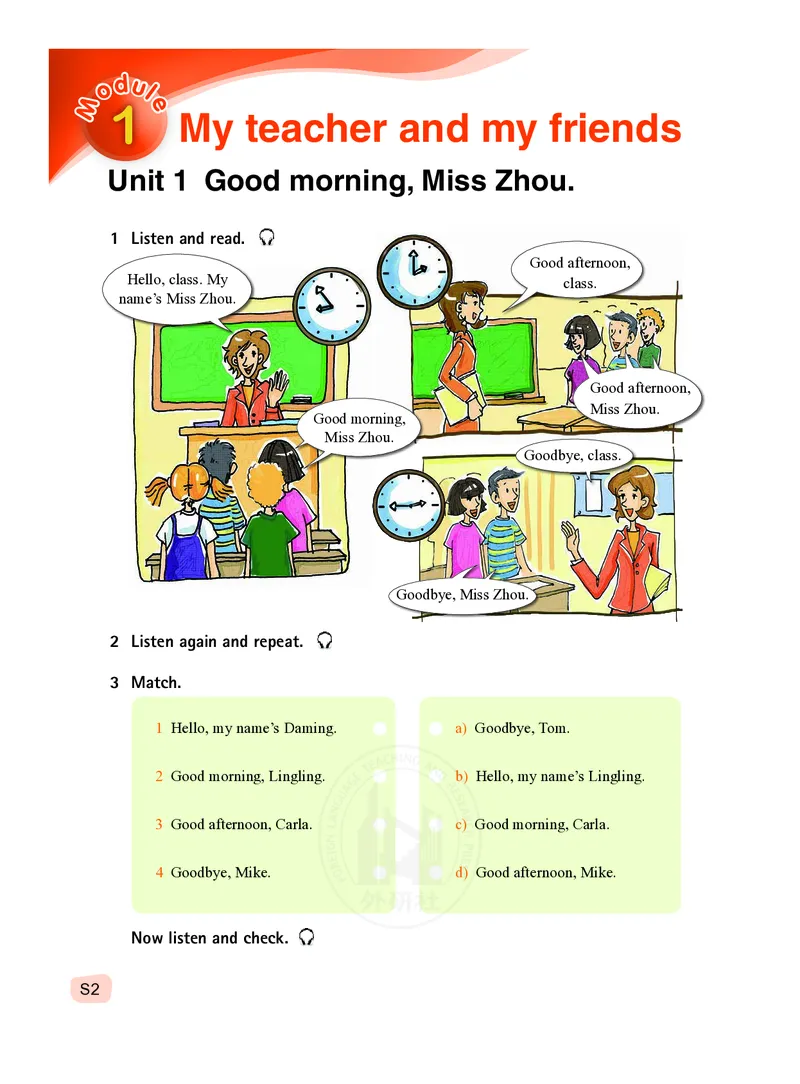
1 Listen and read.
Good afternoon,
Hello, class. My class.
name’s Miss Zhou.
Good afternoon,
Miss Zhou.
Good morning,
Miss Zhou.
Goodbye, class.
Goodbye, Miss Zhou.
2 Listen again and repeat.
3 Match.
1 Hello, my name’s Daming. a) Goodbye, Tom.
2 Good morning, Lingling. b) Hello, my name’s Lingling.
3 Good afternoon, Carla. c) Good morning, Carla.
4 Goodbye, Mike. d) Good afternoon, Mike.
Now listen and check.
S2Unit 1
4 Work in pairs. Say.
A: Hello, my name’s... A: Goodbye, ...
B: Good morning, ... B: ...
A: Good afternoon, ...
B: ...
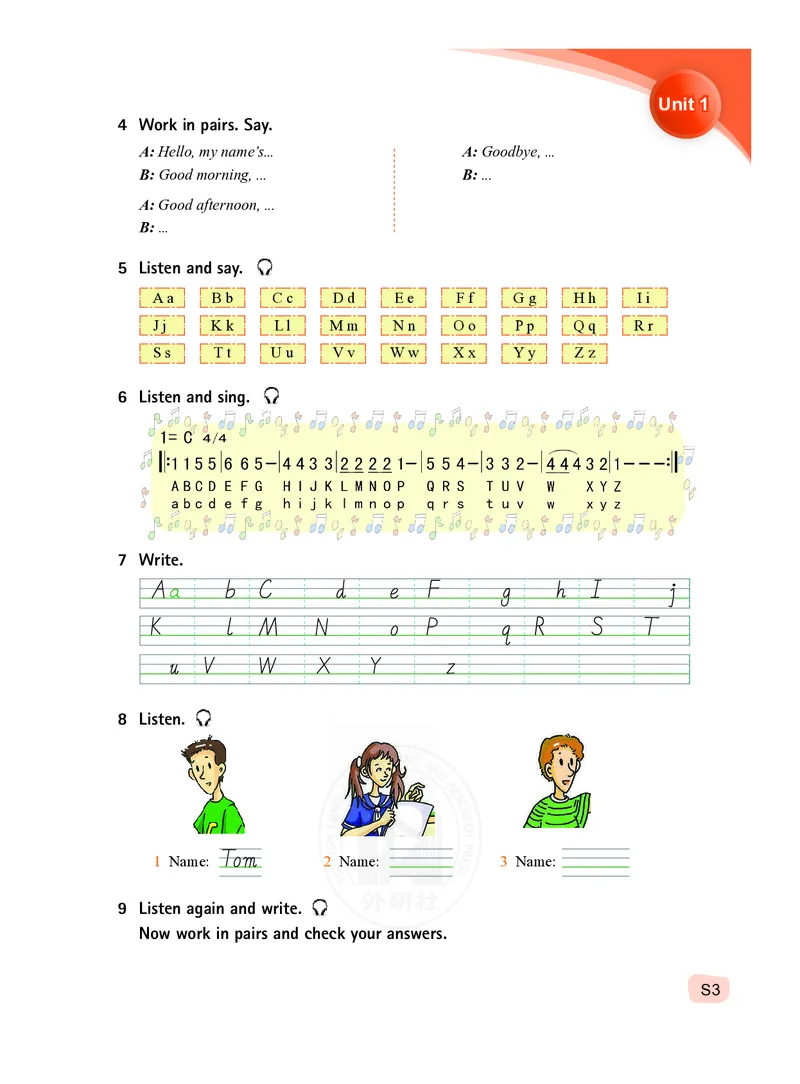
5 Listen and say.
A a B b C c D d E e F f G g H h I i
J j K k L l M m N n O o P p Q q R r
S s T t U u V v W w X x Y y Z z
6 Listen and sing.
7 Write.
8 Listen.
1 Name: 2 Name: 3 Name:
9 Listen again and write.
Now work in pairs and check your answers.
S3odu
l
M e
1
My teacher and my friends
Unit 2 Good morning. I’m Chen Zhong.
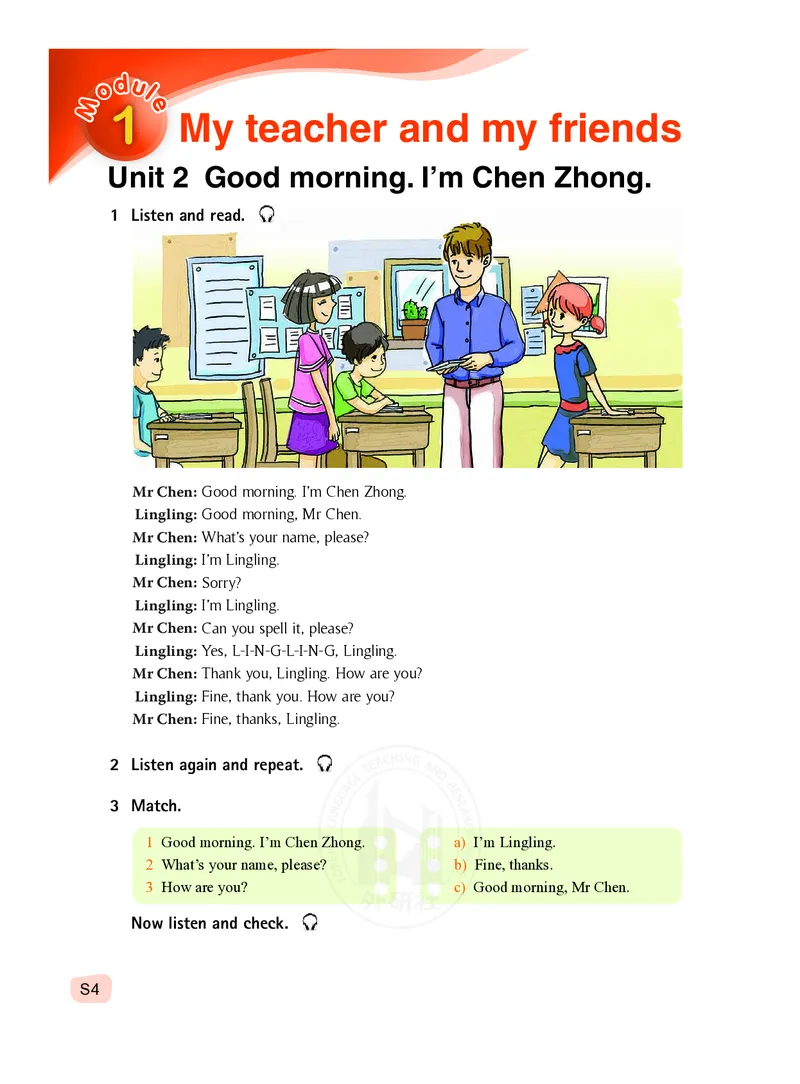
1 Listen and read.
Good morning. I’m Chen Zhong.
Mr Chen:
Good morning, Mr Chen.
Lingling:
What’s your name, please?
Mr Chen:
I’m Lingling.
Lingling:
Sorry?
Mr Chen:
I’m Lingling.
Lingling:
Can you spell it, please?
Mr Chen:
Yes, L-I-N-G-L-I-N-G, Lingling.
Lingling:
Thank you, Lingling. How are you?
Mr Chen:
Fine, thank you. How are you?
Lingling:
Fine, thanks, Lingling.
Mr Chen:
2 Listen again and repeat.
3 Match.
1 Good morning. I’m Chen Zhong. a) I’m Lingling.
2 What’s your name, please? b) Fine, thanks.
3 How are you? c) Good morning, Mr Chen.
Now listen and check.
S4Unit 2
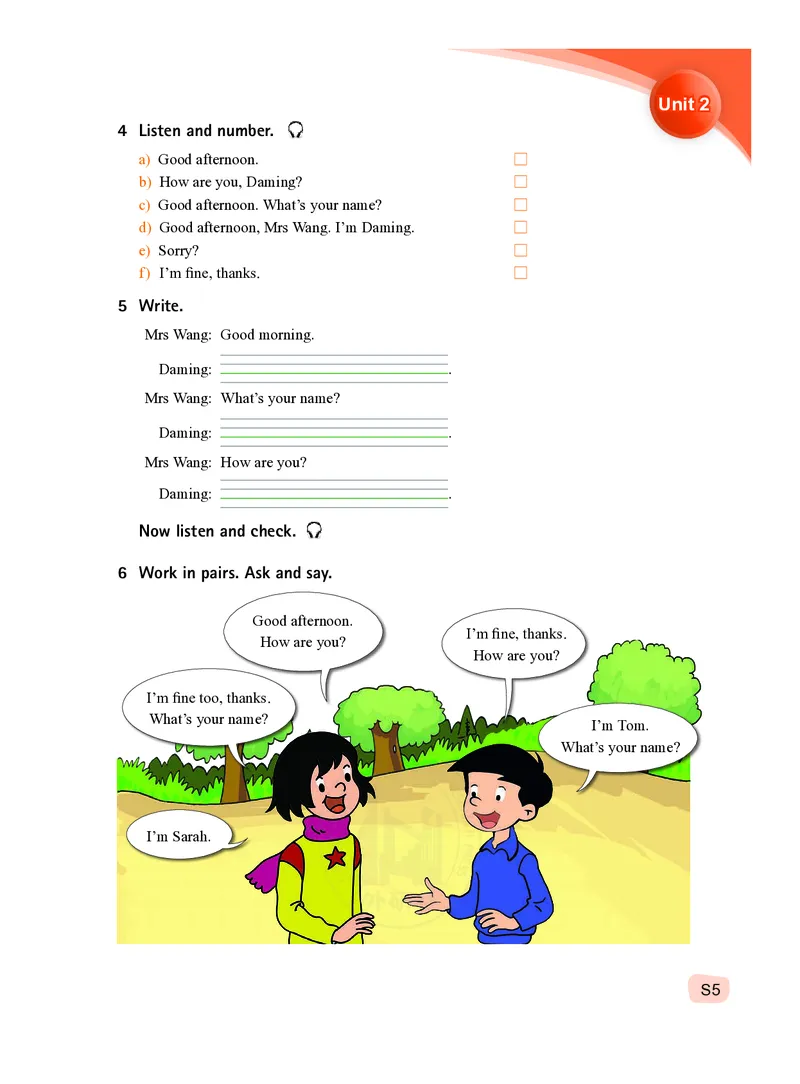
4 Listen and number.
a) Good afternoon. □
b) How are you, Daming? □
c) Good afternoon. What’s your name? □
d) Good afternoon, Mrs Wang. I’m Daming. □
e) Sorry? □
f) I’m fine, thanks. □
5 Write.
Mrs Wang: Good morning.
Daming: .
Mrs Wang: What’s your name?
Daming: .
Mrs Wang: How are you?
Daming: .
Now listen and check.
6 Work in pairs. Ask and say.
Good afternoon.
I’m fine, thanks.
How are you?
How are you?
I’m fine too, thanks.
What’s your name?
I’m Tom.
What’s your name?
I’m Sarah.
S5odu
l
M e
1
My teacher and my friends
Unit 3 This is my friend.
1 Listen and read.
This is Miss Zhou. She’s my
Lingling:
teacher. Hello, Miss Zhou.
Hello, Lingling.
Miss Zhou:
Miss Zhou, this is my friend,
Lingling:
Tony.
Hello, Tony.
Miss Zhou:
Hello, Miss Zhou.
Tony:
This is my friend. Her
Lingling:
name’s Betty.
Hello, Betty.
Tony:
This is my friend. His
Lingling:
name’s Tony.
Hello, Tony, nice to meet
Betty:
you.
It’s time to go now.
Lingling:
Goodbye, Tony.
Bye. See you tomorrow.
Tony:
2 Listen again and repeat.
3 Match.
1 This is my friend. a) His name’s Tony.
2 She is my friend. b) Goodbye.
3 Hello. c) Nice to meet you.
4 It’s time to go now. d) Her name’s Betty.
Now listen and check.
S6Unit 3
4 Listen and number.
a) Goodbye. See you tomorrow. □
b) Hello, Daming. This is my friend, Amy. □
c) It’s time to go now. Goodbye. □
d) Hello, Amy, nice to meet you. □
e) Hello, Daming, nice to meet you too. □
5 Listen again and say.
6 Work in groups. Say.
This is my friend.
… name’s…
Hello…, nice to
meet you.
7 Write.
1 This is my friend. name’s Tony.
2 This is my . Her Betty.
3 Nice to you.
4 It’s time to go now. .
5 Goodbye. See you .
Now listen and check.
S7odu
l
M e
2
My English lesson
Unit 1 Open your book.
1 Listen and read.
Good morning, class.
Good morning,
Miss Zhou.
Please sit down.
2 Listen and repeat.
1 2 3 4
Sit down. Open your book. Listen. Draw.
5 6 7
Put up your hand. Stand up. Close your book.
S8Unit 1
3 Listen again and do.
4 Match.
1 Put up... a) ... your book.
2 Open... b) ... down.
3 Stand... c) ... up.
4 Sit... d) ... your hand.
5 Write.
1 _ _ _ _ _ _ _ _ _ _ .
2 _ _ _ _ _ .
3 _ _ _ _ _ _ _ _ _ .
4 _ _ _ _ _ _ _ _ _ .
5 _ _ _ _ _ .
6 _ _ _ _ _ .
Now listen and check.
6 Work in pairs. Say and do.
Stand up. Open your book.
Yes.
Yes.
S9odu
l
M e
2
My English lesson
Unit 2 What’s your number?
1 Listen and read.
Hello. Are you a new
student here?
Yes, I am.
What class are
you in? I’m in Class 3,
Mr Chen’s class.
2 Listen and repeat.
1 2 3 4 5 6 7 8 9 10
one two three four five six seven eight nine ten
3 Listen and chant.
One, two, three, four, five,
Once I caught a fish alive.
Six, seven, eight, nine, ten,
Then I let it go again.
4 Listen and read.
Betty, what’s your telephone
Daming:
number?
It’s seven two six, eight one five.
Betty:
What’s your number, Tony?
Daming:
It’s seven nine one, four five six.
Tony:
My number is nine four two,
Daming:
three five one.
My new number is four nine six,
Lingling:
three eight two.
S10Unit 2
5 Listen and point.
a b
816 275 975 146
c d
359 412 384 926
6 Listen and write.
What’s your number?
1 Sam: ____________
2 Lisa: ____________
3 Kate: ____________
4 Mike: ____________
Now listen again and check.
7 Listen and write.
1 5 9
2 6 10
3 7
4 8
8 Listen and write.
Names Student numbers
Sam one three one, seven nine one, two
9 Work in pairs. Ask and answer.
What’s your number?
It’s 179 456.
What’s your number?
It’s 942 381.
S11odu
l
M e
2
My English lesson
Unit 3 I’m twelve.
1 Listen and read.
What’s your
name, please?
I’m Daming.
How old are you?
I’m twelve.
2 Listen and repeat.
11 12 13 14 15
eleven twelve thirteen fourteen fifteen
16 17 18 19 20
sixteen seventeen eighteen nineteen twenty
3 Match.
twelve
nineteen
seventeen
fifteen
thirteen
twenty eleven
fourteen
sixteen
eighteen
11 12 13 14 15 16 17 18 19 20
4 Listen and point.
1 11 + 4 = 15 2 12 + 6 = 18 3 14 + 6 = 20 4 17 + 2 = 19
S12Unit 3
5 Listen and write.
1 11 + ______ = ______ 4 3 + ______ = ______
2 ______ + 4 = ______ 5 ______ + 1 = ______
3 ______ + 2 = ______ 6 2 + ______ = ______
6 Listen and write.
1 5 9
2 6 10
3 7
4 8
7 Listen and match.
14 16
12 18
13
15
17
20
11
19
boys girls desks chairs books bags
8 Work in pairs. Ask and answer.
How many... are there? Numbers
boys 15
girls 18
desks 13
chairs 19
books 11
bags 16
S13odu
l
M e
3
My English book
Unit 1 What’s this in English?
1 Listen and read.
What’s this in English?
Miss Zhou:
It’s a book.
Lingling:
Write it on the blackboard, please.
Miss Zhou:
OK, B-O-O-K, book. It’s a book.
Lingling:
Thank you.
Miss Zhou:
What’s this in English, Daming?
Miss Zhou:
It’s a pen.
Daming:
A pen?
Miss Zhou:
No, sorry. It’s a pencil.
Daming:
How do you spell “pencil”?
Miss Zhou:
P-E-N-C-I-L.
Daming:
Yes, write it on the blackboard,
Miss Zhou:
please.
OK, P-E-N-C-I-L. It’s a pencil.
Daming:
2 Listen and point.
What’s this in English?
4 a
dog
3
a
5 a flower
c
a
t
It’s a dog.
2 a book
6 a pen
1 a
bird
7
a
pencil
Now point, ask and answer.
SS1144Unit 1
3 Listen and write.
1 4 7
2 5 8
3 6
4 Work in pairs. Ask and answer.
A: What’s this in English?
B: A pen?
A: No.
B: A pencil?
A: Yes, a pencil.
B: How do you spell “pencil”?
A: P-E-N-C-I-L, pencil.
5 Listen and write.
A: What’s ?
B: cat.
A: How spell “cat”?
B: , .
Now listen again and check.
S15odu
l
M e
3
My English book
Unit 2 Can you help me, please?
1 Listen and read.
Can you help me, please, Can you say that again,
Daming: Daming:
Lingling? please?
Yes, of course. Yes. It’s C-L-A-S-S-
Lingling: Miss Zhou:
How do you spell R-O-O-M.
Daming:
“classroom”? Thank you.
Daming:
I’m sorry. I don’t know. You’re welcome.
Lingling: Miss Zhou:
It’s C-L-A-S-S-R-O-O-M.
Miss Zhou:
2 Listen and point.
a b c
d e f
S16Unit 2
3 Read and match.
1 Can you help me, please? a) You’re welcome.
2 How do you spell “desk”? b) Yes, D-E-S-K.
3 Can you say that again, please? c) It’s D-E-S-K.
4 Thank you. d) Yes, of course.
Now listen and check.
4 Listen again and say.
5 Work in pairs. Ask and answer.
A: Can you help me, please? A: How do you spell it?
B: Yes, of course. B: ...
A: What’s this in English? A: Thank you.
B: It’s a... B: You’re welcome.
6 Write.
A: you help me, please?
B: Yes, .
A: How do spell “ ”?
B: It’s D-E-S-K.
A: say that again, please?
B: Yes, .
A: you.
B: You’re .
Now listen and check.
S17odu
l
M e
3
My English book
Unit 3 What colour is it?
1 Listen and point.
1 2 3 4
black white blue green
5 6 7 8
yellow red brown orange
What colour is it?
It’s black, B-L-A-C-K,
black.
2 Listen and repeat.
3 Look, read and match.
1 2 3
4 5 6
1 What colour is the pen? a) It’s red.
2 What colour is the cat? b) It’s yellow.
3 What colour is the pencil? c) It’s white.
4 What colour is the flower? d) It’s red, green and orange.
5 What colour is the dog? e) It’s blue.
6 What colour is the bird? f) It’s brown.
Now listen and check.
S18Unit 3
4 Listen again and say.
5 Work in pairs. Ask and answer.
A: What colour is the...?
B: It’s...
6 Write.
bag bird black blue book brown cat desk dog
flower green orange pen pencil red white yellow
In the classroom Animals and plants Colours
bag bird black
7 Look at the pictures in Activity 3 and write.
1 - What colour is the dog?
4 - What ?
- It’s .
- It’s yellow.
2 - What is the flower? 5 - the pen?
- It’s . - It’s .
3 - is the bird? 6 - the cat?
- It’s red, green and . - It’s .
Now listen and check.
S19odu
l
M e
4
My everyday life
Unit 1 What day is it today?
1 Listen and read.
Good morning, class.
Miss Zhou:
What day is it today?
It’s Monday.
Students:
Yes, it’s Monday. Write it
Miss Zhou:
in your book.
M-O-N-D-A-Y, Monday.
Students:
What day is it tomorrow?
Miss Zhou:
Tuesday.
Students:
Yes, tomorrow is Tuesday.
Miss Zhou:
2 Listen and repeat.
Sunday Monday Tuesday Wednesday Thursday Friday Saturday
1 2 3 4 5
6 7 8 9 10 11 12
13 14 15 16 17 18 19
20 21 22 23 24 25 26
27 28 29 30
Now point, ask and answer.
What day is it?
It’s…
3 Read and match.
1 Today is Wednesday. What day is it tomorrow? a) Sunday.
2 Today is Friday. What day is it tomorrow? b) Tuesday.
3 Today is Monday. What day is it tomorrow? c) Thursday.
4 Today is Saturday. What day is it tomorrow? d) Saturday.
Now listen and check.
S20Unit 1
4 Work in pairs. Ask and answer.
Today is… What
day is it tomorrow? It’s…
5 Listen and write.
1 5
2 6
3 7
4
6 Write.
1 What is it today? 4 , Monday, Tuesday.
5 It’s Wednesday today. Tomorrow
2 Today is Tuesday. Tomorrow is .
is .
3 Thursday, Friday, .
Now listen and check.
7 Work in pairs. Ask and answer.
A: What day is it today?
B: It’s…
A: What day is it tomorrow?
B: It’s…
A: My favourite day is… What day is your favourite day?
B: It’s…
…
S21odu
l
M e
4
My everyday life
Unit 2 What’s the weather like?
1 Listen and repeat.
1 spring 2 summer 3 autumn 4 winter
5 warm 6 hot 7 cool 8 cold
2 Listen and repeat.
1 It’s cool in autumn. 2 It’s hot in summer. 3 It’s cold in winter. 4 It’s warm in spring.
a b c d
Now match.
3 Listen and point.
1 - What’s the weather like in spring?
- It’s warm.
2 - What’s the weather like in winter?
1 2
- It’s cold.
3 4
3 - What’s the weather like in autumn?
- It’s cool.
4 - What’s the weather like in summer?
What’s the weather
- It’s hot.
like in summer?
It’s...
4 Listen again and say.
S22Unit 2
5 Listen and write.
1 - What’s the like in London in autumn?
- It’s cool.
2 - What’s the weather in New York in ?
- It’s cold.
3 - in Hong Kong in summer?
- It’s hot.
4 - in Beijing in spring?
- .
Now listen again and check.
6 Work in pairs. Ask and answer.
warm cool
hot cold
Harbin
Urumqi
Beijing
Xi’an
Lhasa Shanghai Guangzhou
Haikou
Guangzhou
What’s the
weather like in Haikou
Harbin in winter?
It’s cold.
SS2233odu
l
M e
4
My everyday life
Unit 3 What’s your favourite sport?
1 Listen and repeat.
1 basketball 2 football 3 swimming 4 table tennis
2 Listen and number.
a b c d
3 Listen and read.
What’s your favourite sport,
Tony:
Daming?
Football!
Daming:
It’s my favourite sport too!
Tony:
Let’s play football after school.
Daming:
OK. Good idea!
Tony:
What’s your favourite sport,
Betty:
Lingling?
Swimming.
Lingling:
I like swimming too.
Betty:
Let’s go swimming on
Lingling:
Wednesday.
OK.
Betty:
S24Unit 3
4 Read and number.
a) What’s your favourite sport?
b) Let’s play basketball after school.
c) OK. Good idea!
d) Basketball!
e) I like basketball too.
Now listen and check.
5 Write.
basketball football swimming table tennis
go play
swimming basketball
6 Work in pairs. Ask and answer.
What’s your
…
favourite sport?
Let’s… this
OK…
afternoon.
7 Listen and write.
A: What’s sport?
B: I like .
A: Let’s .
B: OK. .
Now listen again and check.
S25Scope and sequence
Skills (Listening/Speaking/Reading/ Around the
Module Theme Function Structure Task
Writing) world
1 My class- Listening and understanding familiar topics (self-introduction)
mates Talking about familiar topics (self-introduction); supplying Family Introducing
Personal Giving personal Present simple be; information on personal facts name and yourself to your
information information pronouns (I, he, she, my, his, Reading and finding specific information about people given name new friends
her, you, your, it, our)
Writing personal information with brief words and sentences,
P2
using the conjunction and correctly
2 My family Listening and understanding familiar topics (family
members)
Pronouns (this, that, these,
Talking Talking about familiar topics (family members)
Family and those); Writing about
about family Reading the passage aloud and finding specific information Families
relatives apostrophe (’) to show your family
members about people
possessive of nouns
P8 Writing personal information, using punctuation (full stops
and capital letters) correctly
3 My school
Listening and understanding familiar topics (school facilities)
How many…;
Talking about familiar topics (school facilities)
School Describing a there is/isn’t, there are/aren’t; Describing your
Reading the passage aloud and identifying places from School age
information school prepositions of place (in, on, school
descriptions
behind, next to, in front of, near)
Describing places, using prepositions correctly
P14
4 Healthy Listening and recognising the intonation of different sentence
Have/has got… (affirmative, patterns
food
negative, interrogative); Communicating briefly on familiar topics (food and drink) Making a poster
Talking about A Western
Food and drink some and any; with correct pronunciation and intonation about a healthy
healthy food breakfast
uncountable nouns, singular Reading and understanding simple passages, identifying breakfast
P20 and plural nouns healthy/unhealthy food and drink
Writing about healthy food, using the conjunction but correctly
5 My school Present simple with I, you, we,
they; Listening and recognising the links between sentences
day The school Talking about
School and Talking about affirmative and negative forms Talking about familiar topics (school lessons)
day in the your ideal school
school life routines of declarative sentences: Do/ Reading and understanding simple stories
UK day
P26
Don’t;
Writing and using the conjunction and then correctly
prepositions of time (at, in, on)
Revision module A
P32Skills (Listening/Speaking/Reading/ Around the
Module Theme Function Structure Task
Writing) world
1 My class- Listening and understanding familiar topics (self-introduction)
mates Talking about familiar topics (self-introduction); supplying Family Introducing
Personal Giving personal Present simple be; information on personal facts name and yourself to your
information information pronouns (I, he, she, my, his, Reading and finding specific information about people given name new friends
her, you, your, it, our)
Writing personal information with brief words and sentences,
using the conjunction and correctly
2 My family Listening and understanding familiar topics (family
members)
Pronouns (this, that, these,
Talking Talking about familiar topics (family members)
Family and those); Writing about
about family Reading the passage aloud and finding specific information Families
relatives apostrophe (’) to show your family
members about people
possessive of nouns
Writing personal information, using punctuation (full stops
and capital letters) correctly
3 My school
Listening and understanding familiar topics (school facilities)
How many…;
Talking about familiar topics (school facilities)
School Describing a there is/isn’t, there are/aren’t; Describing your
Reading the passage aloud and identifying places from School age
information school prepositions of place (in, on, school
descriptions
behind, next to, in front of, near)
Describing places, using prepositions correctly
4 Healthy Listening and recognising the intonation of different sentence
Have/has got… (affirmative, patterns
food
negative, interrogative); Communicating briefly on familiar topics (food and drink) Making a poster
Talking about A Western
Food and drink some and any; with correct pronunciation and intonation about a healthy
healthy food breakfast
uncountable nouns, singular Reading and understanding simple passages, identifying breakfast
and plural nouns healthy/unhealthy food and drink
Writing about healthy food, using the conjunction but correctly
5 My school Present simple with I, you, we,
they; Listening and recognising the links between sentences
day The school Talking about
School and Talking about affirmative and negative forms Talking about familiar topics (school lessons)
day in the your ideal school
school life routines of declarative sentences: Do/ Reading and understanding simple stories
UK day
Don’t;
Writing and using the conjunction and then correctly
prepositions of time (at, in, on)
Revision module ASkills (Listening/Speaking/Reading/ Around the
Module Theme Function Structure Task
Writing) world
6 A trip to the Present simple: the third Listening and finding specific information; recognising third
person verb ending -s
person singular (he, she, it); Making a poster
zoo
Describing Asking and answering questions about animals Camels;
Animals affirmative and negative of your favourite
animals Reading and finding specific information, using simple Kangaroos
forms of general questions: animal
P36 reference books
Does/Doesn’t
Writing and using simple posters to convey messages
7 Computers Listening and understanding serial directions and questions
in learning activities, and reacting accordingly; listening
and finding specific information (recognising parts of the
Using the Describing a Wh- questions in present The first Making a survey
computer; recognising question words)
Internet process simple computer about computers
Talking about familiar topics (computers)
P42 Reading the passage aloud and grasping the general idea
Writing sentences in answer to questions
8 Choosing Listening and understanding changes in meaning according to
the changes in intonation in sentences
presents Inviting and Adverbs of frequency Planning a
Personal Communicating briefly on familiar topics (birthday parties) Birthday
describing (always, often, usually, classmate’s
preference Reading and implementing brief written directions related to presents
birthday parties sometimes, never) birthday party
learning activities
P48
Composing simple paragraphs, using apostrophes correctly
9 People and Listening and understanding the things told by others with
given clues
places Describing
Daily routines Using clues to describe something briefly Making a radio
what is Present continuous Time zones
and culture Reading the passage aloud and understanding meaning from report
happening
P54 context
Writing a postcard
10 Spring Listening and recognising the intonation of different sentence
patterns
Festival
Talking about familiar topics (Spring Festival); using clues to Writing a letter
Festivals, Present continuous questions Christmas
Describing describe something briefly about Spring
holidays and and short answers; and Father
events Reading and understanding the passage and grasping the Festival to a
celebrations present simple Christmas
general idea foreign student
P60 Writing sentences with notes; writing a letter, using regular
punctuation correctly
Revision module B P66
Appendices Language notes............................................. P71 Vocabulary..................................................... P98
Guide to language use................................... P77 Pronunciation guide....................................... P108
Words and expressions.................................. P87 Songs.............................................................. P110
Proper names................................................. P97Skills (Listening/Speaking/Reading/ Around the
Module Theme Function Structure Task
Writing) world
6 A trip to the Present simple: the third Listening and finding specific information; recognising third
person verb ending -s
person singular (he, she, it); Making a poster
zoo
Describing Asking and answering questions about animals Camels;
Animals affirmative and negative of your favourite
animals Reading and finding specific information, using simple Kangaroos
forms of general questions: animal
reference books
Does/Doesn’t
Writing and using simple posters to convey messages
7 Computers Listening and understanding serial directions and questions
in learning activities, and reacting accordingly; listening
and finding specific information (recognising parts of the
Using the Describing a Wh- questions in present The first Making a survey
computer; recognising question words)
Internet process simple computer about computers
Talking about familiar topics (computers)
Reading the passage aloud and grasping the general idea
Writing sentences in answer to questions
8 Choosing Listening and understanding changes in meaning according to
the changes in intonation in sentences
presents Inviting and Adverbs of frequency Planning a
Personal Communicating briefly on familiar topics (birthday parties) Birthday
describing (always, often, usually, classmate’s
preference Reading and implementing brief written directions related to presents
birthday parties sometimes, never) birthday party
learning activities
Composing simple paragraphs, using apostrophes correctly
9 People and Listening and understanding the things told by others with
given clues
places Describing
Daily routines Using clues to describe something briefly Making a radio
what is Present continuous Time zones
and culture Reading the passage aloud and understanding meaning from report
happening
context
Writing a postcard
10 Spring Listening and recognising the intonation of different sentence
patterns
Festival
Talking about familiar topics (Spring Festival); using clues to Writing a letter
Festivals, Present continuous questions Christmas
Describing describe something briefly about Spring
holidays and and short answers; and Father
events Reading and understanding the passage and grasping the Festival to a
celebrations present simple Christmas
general idea foreign student
Writing sentences with notes; writing a letter, using regular
punctuation correctly
Revision module B
Appendices Language notes............................................. P71 Vocabulary..................................................... P98
Guide to language use................................... P77 Pronunciation guide....................................... P108
Words and expressions.................................. P87 Songs.............................................................. P110
Proper names................................................. P97odu
l
M 1 e My classmates
Module task: Introducing yourself to your new friends
Unit 1 Nice to meet you.
Listening and vocabulary
1 Listen and check (√) the number of speakers.
a) 1 b) 2 c) 3
2 Listen again and check (√) the words you hear.
class friend
hello name
teacher too
3 Listen and read.
Hello, my name is Li Fang. I’m your teacher and you’re my students.
Ms Li:
I’m Chinese. I’m from Wuhan. What’s your name?
My name is Wang Lingling.
Lingling:
Nice to meet you, Lingling. Where are you from?
Ms Li:
I’m from Beijing. I’m Chinese.
Lingling:
How old are you?
Ms Li:
I’m thirteen years old.
Lingling:
Good. Hello, what about you?
Ms Li:
Hello, Ms Li. My name is Li Daming and I’m from Beijing too. I’m
Daming:
twelve years old.
Thanks. Hello, are you from America?
Ms Li: Everyday English
No, I’m not. I’m from England. I’m Tony Smith.
Tony:
Hello!
Nice to meet you, Tony. Hi, are you English too?
Ms Li: Nice to meet you.
No, I’m not. I’m American and my name is
Betty: Thanks.
Betty King. Hi!
Tony and Betty are our friends.
Lingling:
Good. Welcome to Class 4 Grade 7!
Ms Li:
2Unit 1
Now check (√) the true sentences.
1 Ms Li is from Wuhan.
2 Lingling is twelve years old.
3 Daming is thirteen years old.
4 Tony is not in Class 4.
5 Betty is from America.
4 Work in pairs. Choose the correct answer.
1 - Is Daming from Beijing? - Yes, he is. / No, he isn’t.
2 - Is Lingling from Beijing? - Yes, she is. / No, she isn’t.
3 - Is Tony from America? - Yes, he is. / No, he isn’t.
4 - Is Betty English? - Yes, she is. / No, she isn’t.
5 - Are you from China? - Yes, I am. / No, I’m not.
5 Complete the passage with the correct form of the words from the box.
America Chinese England grade student
Betty, Tony, Daming and Lingling are (1) __________ in Class 4 (2) __________ 7.
Betty is from (3) __________ and Tony is from (4) __________. Daming and Lingling are
(5) __________.
Pronunciation and speaking
6 Listen and repeat.
7 Work in pairs. Ask and answer.
Learning to learn
When you introduce yourself, you
can say: My name is... I’m... I’m...
years old. I’m from...
3odu
l
M 1 e My classmates
Unit 2 I’m Wang Lingling and I’m thirteen years old.
Reading and vocabulary
1 Put the sentences in the correct order.
a) Nice to meet you too. Where are you from?
b) Hello, my name is… What’s your name?
c) I’m from... too.
d) Nice to meet you, … My name is…
e) I’m from...
Now work in pairs. Ask and answer.
2 Read the passage and check (√) the true sentences.
Hello, everyone. My name is Li Daming and my English name is
David. I’m twelve years old and I’m from Beijing. Beijing is the
capital of China. This is Lingling and her English name is Lucy.
She’s my friend. She’s from Beijing too.
Hello, I’m Wang Lingling and I’m thirteen years old.
Good to see you. Wang Hui is my friend, but he is
not in my class. His English name is Henry. He’s from
Shanghai. Shanghai is a very big city.
Hi, my name is Tony Smith. I’m from Cambridge. It’s a
small city in England. Tony is my first name and Smith
is my last name. I’m thirteen years old. It’s nice to meet
you all.
1 Henry is Daming’s English name. 4 Wang Hui is from Beijing.
2 Lingling’s English name is Linda. 5 Tony is twelve years old.
3 Daming is twelve years old. 6 Tony is from the capital of England.
Now correct the false sentences.
David is Daming’s English name.
4Unit 2
3 Underline the correct words.
Smith is Tony’s (1) first / last name, and Tony is his (2) first / last name. He’s from
Cambridge. In Tony’s class, Tony and Lingling are thirteen years old and (3) everyone /
Daming is (4) twelve / thirteen years old. Lingling is Daming’s (5) student / friend.
4 Read and complete the table.
What’s his/her name? Daming Tony
How old is he/she? 13
Where is he/she from? Shanghai
Writing
5 Look at the pictures and write sentences.
Tom, Zihan,
England, China,
English, Chinese,
fourteen, twelve,
Class 3 Class 1
1 His name is Tom. 1
2 He’s from England. 2
3 He’s English. 3
4 He’s fourteen years old. 4
5 He’s in Class 3. 5
6 Write sentences about yourself.
1 My name is...
2 I’m...
3
4
5
7 Join the sentences in Activity 6 with and.
My name is... and I’m...
5odu
l
M 1 e My classmates
Unit 3 Language in use
Language practice
I’m your teacher. My name is Li Daming.
Are you from America?
She’s my friend. Her English name is Lucy.
No, I’m not.
He’s from Shanghai. His English name is Henry.
1 Look at the pictures and introduce the three people to your class.
Sam, Emma, Xu Kexin,
twelve, thirteen, thirteen,
England, America, China,
Class 1 Class 4 Class 3
This is Sam.
He’s twelve.
He’s from England.
He’s in Class 1.
2 Look at the pictures in Activity 1 and complete the sentences.
1 This is _______. Sam _______ _______ years old and he _______
from _______. He _______ in Class 1.
2 This _______ Emma. Emma _______ _______ from England. She
_______ from America. She _______ thirteen years old and she is
_______ Class 4.
3 - _______ Xu Kexin from England?
- No, she _______. She _______ from _______.
4 - _______ Xu Kexin in Class 3?
- Yes, _______ _______.
3 Complete the conversation.
Jack: Hi, my name is Jack. What’s your name?
Lingling: Hi, Jack. (1) ________ Lingling. Where are you from?
Jack: I’m (2) ________ England. (3) _______ _______ _______ _______?
Lingling: I’m from China. (4) _______ _______ are you?
Jack: I’m thirteen. How old are you?
Lingling: I’m (5) _______ too. I’m in Class (6) _______ Grade 7. What about you?
Jack: I’m in Class 3. Nice to meet you.
Lingling: Nice to meet you too.
6Unit 3
4 Complete the table.
China
American English
Around the w rld
Family name and given name
In Chinese, the family name is first and the given name is last.
Family name (Last name) + Given name (First name)
In English, the given name is first and the family name is last.
Given name (First name) + Family name (Last name)
Chinese name English name
Yang Liwei Bill Gates
Family name Given name Family name Given name
Module task: Introducing yourself to your new friends
5 Work in pairs. Ask and answer questions about a friend.
A: What’s his/her name?
B: He’s/She’s...
A: Where’s he/she from?
B: He’s/She’s from...
A: How old is he/she?
B: He’s/She’s... years old.
6 Work in pairs. Introduce yourself. Ask and answer.
Hello, my name’s… I’m… years old. I’m from…
What’s your name? How old are you? Where are you from?
7odu
l
M 2 e My family
Module task: Writing about your family
Unit 1 Is this your mum?
Listening and vocabulary
1 Look at the picture. Talk about Tony’s family.
aunt brother cousin daughter family father grandfather
grandmother grandparent mother parent sister son uncle
This is a photo of Tony’s family. This is Tony’s...
grandmother
grandfather
grandmother grandfather
father
mother
aunt
uncle
uncle
sister Tony cousin cousin
2 Listen and check (√) in Activity 1 the people Tony mentions.
8Unit 1
3 Listen and read.
Is this your family?
Lingling:
Yes, it is.
Tony:
What a big family! Is this your sister?
Lingling:
Yes, it is. Her name is Linda.
Tony:
Are these your grandparents?
Lingling:
Yes, they are. My mum’s parents are on the left, and my dad’s parents
Tony:
are on the right.
I see. Who’s this?
Lingling:
That’s my dad.
Tony:
Is this your mum?
Lingling:
Yes. The woman next to her is my dad’s sister, my aunt Liz.
Tony:
Is this her husband?
Lingling:
Everyday English
No, that’s her brother, my uncle Paul.
Tony:
Who are the boy and the girl in front of Paul? on the left
Lingling:
Those are Paul’s son and daughter, my cousins, on the right
Tony:
next to
Mike and Helen.
Now choose the correct answer.
1 Linda is Tony’s sister / cousin. 3 Paul is Tony’s dad / uncle.
2 Liz is Tony’s mother / aunt. 4 Mike is Tony’s cousin / brother.
4 Underline the correct words.
Tony has a big family. In the photo his father’s parents are on the (1) left / right and his
mother’s parents are on the (2) left / right. Mike and Helen are Tony’s cousins and they’re
(3) in front of / next to Paul. Paul is Liz’s (4) husband / brother.
Pronunciation and speaking
5 Listen and repeat.
/h/ Helen her husband /b/ boy brother /p/ parent Paul
6 Work in pairs. Show each other your family photo. Ask and answer questions
about your family.
- Is this your dad? - Are these your grandparents?
- No, it isn’t. That’s my uncle. - Yes, they are. / No, they aren’t.
9odu
l
M 2 e My family
Unit 2 These are my parents.
Reading and vocabulary
1 Label the places in the pictures with the words and expressions from the box.
bus station hospital hotel police station school theatre
a b c
d e f
2 Label the people in Activity 1 with the words and expression from the box.
actor bus driver manager nurses policeman teacher
3 Read the passage and write the letters of the pictures in Activity 1.
1 These are Betty’s parents. ____ 4 This is Tony’s mother. ____
2 These are Lingling’s mother and 5 This is Daming’s father. ____
Daming’s mother. ____ 6 This is Lingling’s father. ____
3 This is Tony’s father. ____
10Unit 2
My name is Betty King. These My name is Li Daming.
are my parents. We’re These are my parents.
American. My father We’re Chinese. My father’s
is an actor, and my job is at a police station.
mother is the manager He is a policeman, and
of a theatre. my mother is a nurse.
My name is Tony Smith and My name is Wang Lingling.
I’m English. This is my I’m Chinese. My mother is
mother. She’s an English a nurse. She and Daming’s
teacher at a school. This mother are at the same
is my father. He’s a hotel hospital. My father is a
manager. bus driver in Beijing.
4 Complete the table.
Betty Daming Tony Lingling
Father actor theatre
Mother nurse
Writing Learning to learn
5 Look at this sentence. The full stop in English is different
from that in Chinese. Make notes of
My name is Tony Smith and I’m English.
the differences when you find them.
capital letter full stop
Now underline capital letters and full stops.
1 These American teachers are in China.
2 I’m Betty and I’m thirteen years old.
3 This is a photo of Ms Li.
6 Answer the questions. Write sentences.
1 What’s your father’s name? My father’s name is…
2 What’s your father’s job?
3 What’s your mother’s name?
4 What’s your mother’s job?
Now check capital letters and full stops.
11odu
l
M 2 e My family
Unit 3 Language in use
Language practice
Is this your family? Who’s this?
Yes, it is. That’s my dad.
Are these your grandparents? Those are Paul’s son and daughter.
Yes, they are. My dad’s parents are on the right.
1 Look at the pictures and talk about the families.
Lily’s family Jack’s family Li Ming’s family
Father: doctor Father: farm worker Father: actor
Mother: nurse Mother: teacher Mother: manager
Grandfather: farm worker Uncle: bus driver Aunt: nurse
Now write sentences about them.
This is Lily’s family. Her father is a doctor and her mother is a nurse. Her grandfather is
a farm worker.
2 Look at the picture and complete the
sentences with this, that, these or those.
1 ___________ are my sons, Tom and Alex.
___________ is our dog.
2 ___________ is my uncle. He’s a bus driver.
3 - Is ___________ man a doctor?
- Yes, he is.
4 - Are ___________ girls students?
- Yes, they are.
3 Write sentences.
His father is a hotel manager. (Tony) Tony’s father is a hotel manager.
1 Her parents are teachers. (Sarah) _______________________________
2 His parents are shop workers. (Wang Hui) _______________________________
3 His mother is a nurse. (Daming) _______________________________
4 Her father is a bus driver. (Lingling) _______________________________
12Unit 3
4 Match the words in Box A with the words in Box B.
he I it she they we you
A
B
her his its my your their our
5 Complete the passage with the correct form of the words from the box.
he her his my we our she their
Hello! My name is Amy. These are (1) _ friends. (2) _ names are Jack,
Lily and Mike. Jack is American. (3) _ father is a doctor. He is (4) _ family
doctor. Lily isn’t American. (5) _ family is Chinese. Mike isn’t Chinese. (6) _
is English. Mike’s mother is a teacher. (7) _ is our English teacher. (8) _ are
her students.
Around the w rld
Families
In America, many people have
grandparents from different
countries. For example, their
parents are American and they are
American, but their grandparents
are from Asia, Europe, or Africa.
Module task: Writing about your family
6 Draw your family tree. Work in pairs. Talk about each other’s family.
A: What’s your father’s name?
Grandmother Grandfather Grandmother Grandfather
B: My father’s name’s…
A: Is he…?
… Father Mother Aunt
7 Write about your family.
My father is a(n)… at… Me
13odu
l
M 3 e My school
Module task: Describing your school
Unit 1 There are thirty students in my class.
Listening and vocabulary
1 Look at the pictures and talk about them.
blackboard book classroom computer desk furniture map picture television wall
1 2 3
2 Listen and choose the correct picture in Activity 1.
20 twenty 30 thirty 40 forty 50 fifty 60 sixty 70 seventy 80 eighty 90 ninety
3 Listen and read.
Linda, what’s your classroom in England like? Is it big?
Daming:
Yes, it’s really big. There are thirty students in my class. How many
Linda:
students are there in your class in Beijing?
There are forty students, twenty girls and twenty boys. What’s in your
Daming:
classroom? Is there a lot of furniture?
Yes, there is.
Linda:
Are there computers on everyone’s desk?
Daming:
No, there aren’t. But there is a computer on the teacher’s desk.
Linda:
Oh, are there any pictures on the classroom walls?
Daming:
Yes, there are, at the front of the classroom.
Linda:
Everyday English
And is there a map of the world?
Daming:
Linda: No, there isn’t. There’s a map of England. It’s really big.
There’s a map of the world in our classroom, Is there a lot of...?
Daming:
Oh...
but there aren’t any pictures on our walls.
14Unit 1
Now complete the table.
Number
Class Pictures Type of map
of students
Linda’s class
Daming’s class
Pronunciation and speaking
4 Listen and repeat.
5 Listen and repeat the numbers.
6 Match the words with the numbers.
seventy thirty forty-six fifty sixty twenty-one eighty ninety forty twenty
21 70 60 46 90 80 50 20 30 40
7 Work in pairs. Write about your classroom. Use numbers.
How many...? Numbers How many...? Numbers
desks blackboards
televisions teacher’s desks
students pictures
girls computers
boys maps
8 Work in pairs. Talk about your ideal classroom.
basketballs, cats, desks,
A: How many... are there in your classroom?
flowers, telephones, trees...
B: There are...
A: Is there a...?
B: Yes, there is. / No, there isn’t.
A: Are there...?
B: Yes, there are. / No, there aren’t.
15odu
l
M 3 e My school
Unit 2 The library is on the left of the playground.
Reading and vocabulary
1 Label the pictures with the words and expressions from the box.
building dining hall gate library office playground science lab sports hall
1 2 3 4
dining hall
5 6 7 8
2 Read Betty’s words, and write her classmates’ names on their desks.
behind between in front of on the right
In the classroom, Daming’s on
my right. Gao Yan’s in front of Daming
and between Zhao Feng and Li Min.
Lingling is behind Zhao Feng.
16Unit 2
3 Read the passage and label the map of the school.
This is a map of our school. There are
six buildings in our school: a library, an
office building, a classroom building, a
dining hall, a sports hall and a science
building. In the middle of the school is
a big playground. The library is on the
left of the playground near the school
gate. There are many books, maps and
computers in it. Behind the library, on
the left, are the school offices. Between
this building and the dining hall is the
classroom building with twenty-four
classrooms. On the right of the classroom
building is the dining hall. In front of
the dining hall is the sports hall and the
building in front of that is for science.
There are six science labs and five computer rooms in the science building.
4 Answer the questions.
1 How many buildings are there in the school?
2 What’s on the right of the library?
3 What’s in the library?
4 How many classrooms are there in the classroom building?
5 Where are the computer rooms and science labs?
Writing
5 Look at the sentences.
The library is in front of the office building. It’s in front of the office building.
- Is the science building behind the library? - No, it isn’t.
- Are the science labs and computer rooms in the same building? - Yes, they are.
Now answer the questions. Use short forms.
1 - Where’s the playground? - ________ in the middle of the school.
2 - Where are the science labs? - ________ in the science building.
3 - Is the library behind the sports hall? - No, ________.
6 Answer the questions about your school in Activity 5.
- Where’s the playground?
- It’s behind the sports hall.
Now write answers to the questions.
The playground is behind the sports hall.
17odu
l
M 3 e My school
Unit 3 Language in use
Language practice
There are thirty students in my class. No, there isn’t.
Are there computers on everyone’s desk? How many students are there in your class?
No, there aren’t. The library is on the left of the playground.
Is there a map of the world?
1 Work in pairs. Ask and answer the questions about your school.
1 How many classrooms are there in your school?
2 Is there a library in your school?
3 Are there any science labs?
4 How many students are there in your class?
5 How many are boys and how many are girls?
6 Are there any computers in your classroom?
7 Is there a blackboard in your classroom?
8 Where is the teacher’s desk?
2 Look at the picture and answer the questions.
1 Where is the office building?
2 Where is the dining hall?
3 Where is the playground?
Dining hall
4 Where is the sports hall? Playground Library
5 Where is the science building?
Science building
Now complete the passage.
Classroom building
This is a map of our school.
(1) the gate is the
Sports hall Office building
office building and behind this is Gate
the (2) . (3) the classroom building is the library. The science
building is (4) the dining hall and the (5) . And behind the dining
hall, the playground and the library there are (6) .
18Unit 3
3 Complete the word map with the words and expressions from the box.
blackboard classroom office
Learning to learn
science building sports hall
Remember! Write words
book you learn in a word map,
like the one on the left.
computer
library
desk
school
dining hall
Around the w rld
School age
In most countries around the world,
children must go to school when they
are 5 or 6 years old. Children in the UK
go to primary school at 5, and go to
secondary school at 11. They can’t leave
school before they are 16 years old.
Module task: Describing your school
4 Draw a map of your school.
5 Decide what to describe with the help of the words from the box.
book classroom computer desk library office playground
6 Write about your school.
This is our school. On the left of... This is our library. It’s in front of... There are...
19odu
l
M 4 e Healthy food
Module task: Making a poster about a healthy breakfast
Unit 1 We’ve got lots of apples.
Listening and vocabulary
1 Work in pairs. Look at the pictures and talk about them.
food drink
h
a
i
b g
1 2 3
j
c
k
d l
m
e
n
f
o
4
2 Label the food in the pictures with the words from the box.
candy fruit meat vegetables
3 Label the food and drink in the pictures with the words from the box.
apple beans beef carrot chicken chocolate coffee
cola juice milk orange potato tea tomato water
4 Listen and check (√) the food and drink Betty and her mother have got.
apples juice
beans milk
Learning to learn
beef oranges
carrots potatoes Remember! Write words
you learn in groups.
chicken tea
fruit: apple orange
coffee tomatoes
meat: beef chicken fish
cola water
20Unit 1
5 Listen and read.
Tony, let’s go shopping for food and drink. Now, we haven’t got any
Tony’s dad:
meat. Let’s get some chicken.
OK. Have we got any chocolate?
Tony:
Yes, we have. Too much chocolate isn’t good for you. Let’s get some fruit.
Tony’s dad:
What kind of fruit? Apples?
Tony:
No, we’ve got lots of apples. We haven’t got any oranges, so let’s get some.
Tony’s dad:
OK. How about some orange juice?
Tony:
Yes, good idea! And coffee. Let’s get some for your mum. She hasn’t
Tony’s dad:
got any coffee.
Everyday English
All right, some coffee for Mum, and some
Tony:
cola for me. I haven’t got any cola. Let’s go shopping for...
No cola! Cola is bad for you! How about How about...
Tony’s dad:
some tea? Good idea!
Oh, too bad!
Tony:
Now complete the table.
Things Tony’s family has got at home Things Tony’s family hasn’t got at home
Food
Drink
6 Talk about Tony’s shopping.
- Has he got any chicken?
- No, he hasn’t.
Pronunciation and speaking
7 Listen and repeat.
/s/ drinks /t/ tea tomato water
/z/ apples potatoes vegetables /d/ bad food idea
8 Listen and choose /s/ or /z/.
1 apples 2 beans 3 drinks 4 potatoes
9 Work in pairs. Make a shopping list.
Student A: Make a list of things you need.
Student B: Make a list of things you’ve got.
Now ask and answer.
- Have we got any…?
- Yes, we have. We’ve got some… / No, we haven’t.
21odu
l
M 4 e Healthy food
Unit 2 Is your food and drink healthy?
Reading and vocabulary
1 Think of six words for food and drink. Make three lists.
favourite healthy delicious
Favourite food and drink: Healthy food and drink: Delicious food and drink:
oranges… carrots… …
2 Label the pictures with the words and expression from the box.
bread candies cola fish hamburger ice cream noodles rice sugar
Now match the words from the box with the pictures.
2 3
1
drink eat 4
5
9
8 6
7
3 Read the passage and complete the table.
Healthy food and drink for children
Is your food and drink healthy? A lot of ice cream, hamburgers and cola is not
healthy. Meat is healthy but too much meat is not good for children. Cola and candy
are very sweet, and too much sugar is bad for you.
Eat the right food and be healthy. Carrots, eggs and sweet potatoes are good for
your eyes. Milk, cheese and fish are good for your teeth. A bit tired? Have lots of
delicious chicken soup!
It is important to remember: eat well, stay healthy, and don’t get fat!
● Eat noodles or rice, not hamburgers.
● Have a good breakfast every morning.
● Drink juice, water, tea and milk, not cola.
● Eat lots of fruit and vegetables.
22Unit 2
Healthy food and drink Unhealthy food and drink
4 Complete the passage with the correct form of the words and expression
from the box.
delicious fat important lots of meal remember stay sweet tooth (pl. teeth)
A healthy breakfast is (1) _ in the morning and it’s my favourite (2) _.
There are (3) _ fruit and vegetables for lunch at school, but there isn’t any cola
or candy. Candy and cola are (4) _ food and drink and they’re bad for your
(5) . At home, my grandma’s dinners are (6) _ and we aren’t
(7) . (8) _! Eat well, and (9) _ healthy.
5 Choose food from Units 1 and 2 for your meals.
breakfast lunch dinner
Now work in pairs. Talk about your answers.
1 What’s your favourite food and drink?
2 Is it healthy food and drink?
Writing
6 Look at the sentences.
Meat and fish are healthy food.
Too much meat isn’t healthy.
Meat and fish are healthy food but too much meat isn’t healthy.
Now join the sentences with but.
1 Juice is a healthy drink. Cola isn’t a healthy drink.
2 Noodles are healthy food. Hamburgers aren’t healthy food.
3 Meat, vegetables and fruit are healthy food. Cola, ice cream and hamburgers aren’t
healthy food and drink.
4 Chocolate is delicious. Too much chocolate isn’t good for you.
7 Complete the sentence about yourself.
… and… are healthy food but… and… are my favourite food.
23odu
l
M 4 e Healthy food
Unit 3 Language in use
Language practice
We’ve got lots of apples. Yes, we have.
We haven’t got any meat. Let’s get some chicken.
She hasn’t got any coffee. We haven’t got any oranges.
Have we got any chocolate?
1 Work in pairs. Look at the picture and talk about the food in the fridge.
- Have we got any…?
- Yes, we have. / No, we haven’t.
Now write about the food in the fridge.
We’ve got some meat.
We haven’t got any fish.
1 _______________ vegetables.
2 _______________ oranges.
3 _______________ apples.
4 _______________ eggs.
5 _______________ bananas.
6 _______________ orange juice.
7 _______________ milk.
2 Look at the picture and talk about it.
apple hamburger orange potato tomato fish meat rice milk
apples hamburgers oranges potatoes tomatoes juice chicken water
He has got some/a(n)…
He hasn’t got any…
She has got some/a(n)…
She hasn’t got any…
They have got some/a(n)…
They haven’t got any…
24Unit 3
3 Complete the word map.
meat
vegetables
healthy
drink
fruit healthy
food
food drink
favourite favourite
food drink
4 Complete the sentences with the correct form of the words from the box.
bit delicious important remember stay
1 __________ to buy some fruit. 4 Orange juice is __________.
2 It’s __________ to eat healthy food. Let’s buy some.
3 Eat well and __________ healthy. 5 I am a __________ tired.
Around the w rld
A Western breakfast
In the West, for breakfast, people
usually eat bread and eggs and
drink coffee or tea, milk and fruit
juice.
Module task: Making a poster about a healthy breakfast
5 Work in groups of four or five. Make a poster about a healthy breakfast.
● Make a list of questions about a healthy breakfast.
● Talk to students from another group about a healthy breakfast.
● Make a poster about your healthy breakfast.
6 Present your poster to the class.
7 Choose the best poster.
25odu
l
M 5 e My school day
Module task: Talking about your ideal school day
Unit 1 I love history.
Listening and vocabulary
1 Look at the pictures. Listen and repeat the time.
half past o’clock past to
What’s the time?
1 It’s twelve o’clock. 2 It’s twenty past one. 3 It’s half past six. 4 It’s twenty to eleven.
2 Match the pictures with the words from the box.
art Chinese English geography history IT maths PE
1 2 3 4
5 6 7 8
3 Listen and read.
Betty, what are our lessons on Monday?
Tony:
We have Chinese at eight o’clock and science at five to nine. At twenty past ten
Betty:
we have IT. Then we have maths. Do you like maths, Tony?
Yes, I do, but it’s difficult! I like the lessons on Monday afternoon: English and
Tony:
art. What lessons do we have on Friday?
We have English, Chinese, PE and geography.
Betty:
And in the afternoon? Do we have maths?
Tony:
No, we don’t. We have art and history, but we don’t have maths. I love history
Betty:
and I’m good at it. It’s my favourite subject because it’s very interesting.
My favourite subject is Chinese. I can talk with my Chinese friends.
Tony:
26Unit 1
Now check (√) the true sentences.
1 Lessons begin at eight.
Everyday English
2 They have four lessons in the morning.
3 Maths is difficult for Betty.
We have... at eight o’clock.
4 They have art on Monday.
And in the afternoon?
5 History is interesting for Betty.
6 Tony’s favourite lesson is art.
4 Complete the passage with the correct form of the words from the box.
because difficult favourite interesting lesson subject
History is Betty’s (1) ____________ subject. She likes it (2) ____________ it’s very
(3) ____________. Tony’s favourite (4) ____________ is Chinese. There are Chinese,
science, IT and maths (5) ____________ on Monday morning, but for Tony, maths is
(6) ____________.
Pronunciation and speaking
5 Listen and repeat.
6 Answer the questions about yourself.
7 Work in pairs. Talk about your lessons.
What time is
?
When is art
Chinese at eight o’clock.
I have
at half past eleven.
We/They have English
in the morning.
I don’t have history
in the afternoon.
We/They don’t have
maths on Monday.
I/They/We like science
.
I/They/We don’t like
A: What time is your art lesson?
B: I have art at...
A: Do you like art?
B: Yes, I do, but... What about you?
...
27odu
l
M 5 e My school day
Unit 2 We start work at nine o’clock.
Reading and vocabulary
1 Read the passage and put the pictures in order.
a
My school day
Hi! I’m Alex Greenall. I’m thirteen and I go to
Park School in Oxford, England. I go to school
b on weekdays, but not on Saturday and Sunday.
This is my school day. I get up at half past seven
in the morning, and then have breakfast.
My school is next to my house. I go to school
at half past eight and see my friends. We start
c
work at nine o’clock. We have three lessons in
the morning. My favourite subject is art.
At eleven o’clock, we have a break in the
playground and I talk to my friends. They go to
the playground and play football, but I don’t like
d
football.
We have lunch in the dining hall at half past
twelve. I like school lunch! We have meat and
rice with vegetables, or hamburgers. I drink juice
e or water.
We start lessons in the afternoon at half past
one. We have two lessons in the afternoon. Then
we go home at half past three.
In the evening, I watch TV and have dinner
f
with my family. I do my homework and go to
bed at ten o’clock.
28Unit 2
2 Match the times with the pictures in Activity 1.
7:30 am 10:00 pm 11: 00 am 12:30 pm 3:30 pm 9:00 am
3 Underline the correct expressions.
1 I get up / start work at half past seven.
2 We have a break / have lunch at half past twelve.
3 I go home / watch TV in the evening.
4 I do my homework / see my friends in the evening.
5 I go home / go to sleep at ten o’clock.
Writing
4 Write about yourself. Use the expressions in Activity 3 to help you.
I get up at…
5 Work in pairs. Talk about your school day.
I get up at half past seven.
We start work at nine o’clock.
We have lunch at half past twelve.
6 Look at the sentences.
I get up at seven o’clock. I go to school at eight o’clock.
I get up at seven o’clock, and then go to school at eight o’clock.
Now join the sentences with and then.
1 In the morning, we get up. We go to school.
2 In the afternoon, we have lessons. We play football in the playground.
3 In the evening, I have dinner. I do my homework.
4 In the evening, I do my homework. I go to bed.
29odu
l
M 5 e My school day
Unit 3 Language in use
Language practice
We have Chinese at eight o’clock.
We don’t have maths.
Do you like maths?
Yes, I do.
In the evening, I watch TV and have dinner with my family.
1 Talk about your activities in a week.
I don’t go to school on Sunday. I go to the park on Sunday.
2 Match the words in Column A with the words and expressions in Column B.
A B
a) dinner Learning to learn
1 have b) your homework
We often use have, do and
c) to school
2 do go in English. Make notes
d) a break
of all the expressions you
e) an English lesson hear or see: have breakfast,
3 go
f) to bed do exercise, go swimming.
g) home
Now talk about your school day.
I go to school at half past seven in the morning.
3 Complete the passage with the expressions from the box.
do homework get up go to school have a break
have breakfast have lunch start work
On Friday I have a busy day. I (1) at half past six in the morning. Then I wash
my hands and face, and (2) at seven. At half past seven, I (3) ,
and (4) at eight. There are four lessons in the morning. At twenty to ten, we
(5) for twenty minutes. We go to the playground and I talk with my friends.
We (6) in the school dining hall. In the afternoon, we have two lessons and
go home at half past three. I don’t (7) on Friday evening. I do it on Saturday.
30Unit 3
4 Complete the sentences with at, in or on.
1 We go to school ______ the morning. 4 I get up ______ seven o’clock.
2 We don’t go to school ______ Sunday. 5 We go home ______ the afternoon.
3 We don’t have a science lesson 6 We have dinner ______ half past six.
______ Wednesday.
5 Complete the sentences with the words from the box.
because break homework interesting subject
1 We have maths after _______ today. 4 I like it _______ it’s interesting.
2 I like maths. It’s my favourite _______. 5 I do my maths _______ first after
3 Our maths teacher is very good and school every day.
she makes it _______.
Around the w rld
The school day in the UK
In the UK, children have five lessons
in the day and finish school at half
past three in the afternoon. After
school they go swimming, play
football, have music lessons and
play with their friends. They also do
homework like you!
Module task: Talking about your ideal school day
6 Look through Module 5 and find expressions to say what you do and enjoy
every day.
go to school play football ...
Now complete the table with information about your ideal school day.
8:00 am go to school
10:00 am …
12:00 pm
…
7 Work in pairs. Talk about your ideal school day.
31R
evision module A
Grammar and speaking
1 Complete the conversations with the correct form of the words from the box.
he her his I it my she that their they this those we you your
1 - Is _______ the English class? 4 - Are _______ Ms Chen?
- Yes, _______ is. And I am _______ - No, _______’m not. _______ is in
teacher. _______ office.
2 - What are ______ on the desk? 5 - Is _______ John’s book?
- _______ are carrots. - No, _______ book is here.
3 - Do you know Mr and Mrs Brown? 6 - Mum, have _______ got any milk?
- Yes, _______ son is in my class. - Yes, we have.
_______ is _______ friend.
2 Complete the conversation with there is, there isn’t, there are, there aren’t,
is there or are there.
A: This is my school. It’s really big - (1) _________ 32 classrooms in the building in
front of you.
B: (2) _________ any science labs?
A: No, (3) ________ any science labs in this building. (4) _________ classrooms and
offices in this building. But (5) ________ three science labs in the building behind it.
B: (6) _________ a television in your classroom?
A: No, (7) _________. But (8) _________ a television in the library.
Now work in pairs and act it out.
3 Complete the passage with the correct form of the words and expressions
from the box.
behind between in front of next to on the left on the right
I’m Daming. This is my family photo. This
is me, (1) __________ my grandma and my
grandpa. (2) __________ me are my mum and
dad. My uncle is (3) __________ of my father.
He is my father’s brother. My father’s sister
is (4) __________ my mum, (5) __________.
See the dog (6) __________ me? His name is
Dodo. We all love him.
Now work in pairs. Talk about Daming’s
family photo.
32on m
i
si o
d
v u
e A l
R e
4 Underline the correct words.
(1) On / In Saturday I get up (2) at / in eight o’clock. I (3) don’t / not go to school and I
(4) don’t / not have music lessons or homework. My family and I (5) do / have a healthy
breakfast. Then (6) you / we go swimming or play football. (7) On / In the afternoon I (8)
watch / start TV or play with my friends.
5 Complete the conversation with some and any.
Tony: Mum, I want to make apple juice. Have we got ________ apples?
Mum: No, we haven’t, but we have got ________ oranges.
Tony: Thank you, Mum. Now I can make orange juice. And have we got _______ milk?
Mum: Yes, we’ve got ________ in the kitchen. What for?
Tony: I can make afternoon tea for you, Mum.
Mum: Oh, thank you.
Now make your own conversation with some and any.
Vocabulary
6 Look at the family tree. Complete the sentences.
Mr Brown Mrs Brown
Mary Sam Jessica Kevin
Sarah
Bob Jill Grace
1 Mr and Mrs Brown have got a 5 Jessica and Kevin are Sarah’s ________.
________ and a ________. 6 Bob is Grace’s brother and Sarah’s
2 Mary is Sarah’s ________. ________.
3 Bob’s ________ is Kevin. 7 Jill has got a ________, Bob.
4 ________ is Mary’s husband and 8 Mr Brown is Jill’s _ and her
Jessica’s brother. ________ is Mrs Brown.
7 Circle the word that does not belong in each group, and say why.
1 carrot potato juice tomato 3 banana orange rice apple
2 cola noodles juice milk 4 fish beef candy chicken
8 Work in pairs. Match the jobs with the workplaces.
actor doctor farmer manager nurse policeman teacher
farm hospital hotel police station school theatre
33R
evision module A
Listening
9 Listen and complete the table for Betty.
7:00
go to school
8:00
have a break
12:30
go home
do sports
10 Listen and chant. Notice the rhythm.
Three fat sausages
Three fat sausages cooking in a pan, One fat sausage cooking in a pan,
Two go pop and one goes bang. It goes pop and it goes bang.
Two fat sausages cooking in a pan, No fat sausages cooking in a pan,
One goes pop and one goes bang. None go pop and none go bang!
Reading
11 Read the passage. Match the favourite days with the people.
My favourite day of the week is My favourite day is Wednesday. I
Saturday. I get up at nine o’clock on don’t have maths, and I don’t have
Saturday and I don’t do any homework. maths homework. I have Chinese. It’s
I don’t eat lunch at school. I have lunch my favourite lesson. I do sports every
at home with Mum and Dad and I see Wednesday afternoon.
my friends in the evening. -Tony
-Betty
Sunday is my favourite day of the
My favourite day of the week is
week. On Sunday morning I go to
Tuesday. We don’t have lessons in the
my grandparents’ home. There is a
afternoon. I go to the library and read
lot of my favourite food and I see my
my favourite books. I read stories to
cousins. I do sports with my friends
our old friend Mrs Li. Tuesday is her
in the afternoon.
favourite day too. In the evening, I
-Daming
watch television.
-Lingling
34on m
i
si o
d
v u
e A l
R e
Betty Tony Lingling Daming
Sunday Tuesday Saturday Wednesday
12 Check (√) the true sentences.
1 There is no homework for Betty on Saturday. 4 Mrs Li’s favourite day is Tuesday.
2 Betty’s family have lunch at school. 5 Daming’s grandparents live with him.
3 Maths is Tony’s favourite lesson. 6 Daming has got cousins.
Writing
13 Read the letter by Daming and correct the mistakes. Notice capital letters,
full stops and question marks.
Dear Jack,
Hello my name’s Daming and I live in Beijing. beijing is a big city in China my mother is a
nurse. Tony and Lingling are my friends. We’re in Ms Li’s class. There are 40 students in
our class My favourite subject is art. I don’t like maths. For lunch i eat healthy food. I
eat fruit and vegetables. I don’t drink cola.
Where are you from What’s your favourite subject? What do you like to eat?
Love from,
Daming
14 Complete the sentences with and or but.
My name’s Betty and I live in Beijing.
I’m American but I don’t live in America.
1 I like healthy food _____ I don’t like carrots.
2 Tony is English _____ he is thirteen years old.
3 Betty likes history _____ she likes science too.
4 I’ve got two brothers _____ I haven’t got any sisters.
5 My mum’s a doctor _____ my dad’s a hotel manager.
15 Complete the information about yourself.
Name City
Class Favourite lesson
Grade Favourite day
School Favourite food
Now write a paragraph.
My name is…
35odu
l
A trip to the zoo
M 6 e
Module task: Making a poster of your favourite animal
Unit 1 Does it eat meat?
Listening and vocabulary
1 Look at the picture. What can you see?
bear elephant giraffe lion monkey panda tiger zebra zoo
2 Listen and check (√) the words you hear in Activity 1.
Now work in pairs and say what you can see.
- There are three giraffes.
- Yes, and there are some zebras.
3 Listen and read.
Welcome to Beijing Zoo. The zoo has many kinds of animals, such as bears,
Guide:
zebras, giraffes and pandas. They come from many different countries and
they eat different food. Here are the lions.
Do lions eat meat?
Tony:
Yes, they do. They eat other animals. They’re dangerous!
Guide:
Ugh! And what about bears? Do they eat meat?
Lingling:
Yes, they do, but they also eat plants.
Guide:
Look at this elephant. It’s very tall. Does it eat meat?
Tony:
No, it doesn’t. It eats plants.
Guide:
Do pandas eat plants?
Lingling:
Sure. They love bamboo.
Guide:
Are there pandas here? They’re my favourite animals. They’re cute. Shall we
Lingling:
go and see them?
Yes, let’s go. Can you see Lingling?
Guide:
She’s in front of you!
Tony:
Everyday English
No, Lingling the panda!
Guide:
Which is Lingling the panda?
Lingling: Sure.
Guide:
She’s the black and white animal over there.
Shall we go and...?
Look! There she is!
That’s very funny.
That’s very funny. Her name is Lingling too!
Lingling:
Is there a panda called Tony...?
Tony:
36Unit 1
Now complete the table.
Animals Things they eat
Lions
Bears
Elephants
Pandas
4 Underline the correct words.
There are (1) other / many animals from different (2) country / countries in Beijing
Zoo, (3) such / which as bears, giraffes and pandas. The lions are (4) funny / dangerous
because they eat meat. The bears eat meat too, but also (5) plants / leaves. Elephants are
(6) different / cute. They’re (7) tall / white and eat (8) plants / meat. Pandas are black and
white and eat (9) bamboo / other animals. The (10) panda’s / guide’s name is Lingling.
Pronunciation and speaking
5 Listen and repeat.
6 Listen and choose /s/ or /z/.
7 Work in pairs. Ask and answer questions about the animals in Activity 3.
8 Work in pairs. Ask and answer.
...
37odu
l
M 6 e A trip to the zoo
Unit 2 The tiger lives in Asia.
Reading and vocabulary
1 Find these places on the map.
Africa America Asia Europe
Europe
Asia North
America
Africa
South
America
Oceania
2 Look at the map again and write four sentences. Use the words from the box.
bear elephant giraffe lion monkey panda tiger zebra
There are tigers in Asia.
There are elephants in...
3 Read the passage and complete the table.
Elephants Pandas Zebras Tigers Monkeys
Home
Food
38Unit 2
Animals
The elephant lives in Africa and in Asia. This elephant
lives in Africa. It eats plants and a little fruit, but it
doesn’t eat meat. It likes water.
There are only about 1,800 pandas in China and about 200 of them
live in zoos. The panda eats about 30 kilos of bamboo a day as well as
other plants. This black and white animal is the favourite of people all
over the world.
The zebra is an African animal. Like the panda, it’s black and white. It
eats leaves as well as grass, but the zebra doesn’t eat bamboo.
The tiger lives in Asia. It’s a very large animal and usually lives
alone. It likes water and is good at swimming. It’s strong and catches
many kinds of animals for food.
Monkeys live in Africa, Asia and America. There
are about 200 kinds of monkeys. Monkeys eat
meat, leaves, fruit and even eggs!
4 Complete the sentences with the correct form of the words and expression
from the box.
African a little grass kilo only world
1 The elephant eats ________ fruit.
2 The panda eats about 30 ________ of bamboo a day.
3 The zebra eats leaves and ________ but not bamboo.
4 There are ________ about 1,800 pandas in China.
5 Monkeys live in many countries all over the ________ but not in Europe.
6 You can find elephants in Africa and Asia, but zebras are only ________ animals.
Writing
Learning to learn
5 Read the introduction about a zoo and
In English, we use capital
correct the mistakes. Notice capital letters.
letters with the first word of a
sentence. We also use capital
The zoo has many animals. the animals come from
many different countries. The panda lives in china letters with the names of
and it eats bamboo. There are elephants from africa countries, towns, places etc.
and Asia. The tiger comes from asia. It eats meat.
39odu
l
M 6 e A trip to the zoo
Unit 3 Language in use
Language practice
It doesn’t eat meat. Does it eat meat?
The tiger lives in Asia. No, it doesn’t. It eats plants.
1 Work in pairs. Look at the pictures. Ask and answer.
Name: Meimei Name: Kingba
From: Yunnan, China From: Asia
Favourite food: fruit Favourite food: meat
- Does Meimei the elephant come from Yunnan, China?
- Yes, it does.
2 Complete the sentences with does or doesn’t.
1 - ______ this panda come from China? 4 - ______ this monkey live in
- Yes, it ______. Africa?
2 - ______ this panda eat fish? - No, it ______.
- No, it ______. 5 The zebra _____ like meat.
3 - ______ this monkey like fruit?
- Yes, it ______.
3 Complete the passage with the correct form of the words in brackets.
My favourite animals (1) ______ (be) zebras. Look at this one. It (2) ______ (be) cute.
It (3) ______ (be) black and white like the panda. But it (4) ______ (do not) come from
Asia. It (5) ______ (come) from Africa. It (6) ______ (eat) grass.
40Unit 3
4 Complete the word map.
giraffe
Asia
The world
of animals
Europe America
Around the w rld
Kangaroos
The kangaroo is an
Australian animal.
It eats grass and
leaves, but it doesn’t
eat meat. It carries
Camels its babies in a pocket
on the front of its
The camel lives in the deserts of
Africa and Asia and eats grass. body. With its strong
Some people think it carries tail and back legs,
water in the humps on its back, the kangaroo jumps
but it’s not true. In fact, it’s fat. across the grassland.
Module task: Making a poster of your favourite animal
5 Work in groups. Find out about an animal.
● Talk about your favourite animal. I t ’ s big/small/tall, black and white/…
● Choose one animal to write about. It comes from Asia/Africa/…
● Find out about the animal. It eats meat/grass/bamboo/…
6 Make a poster about your group’s animal.
● Draw it or find a photo.
● Write some information about it.
7 Present your poster to the class.
41odu
l
M 7 e Computers
Module task: Making a survey about computers
Unit 1 How do I write my homework on the computer?
Listening and vocabulary
1 Listen and number the words
as you hear them.
1
keyboard
mouse
screen
2
3
2 Label the parts of the computer.
3 Complete the sentences with the word and expression from the box.
1 First, ________ the screen to the computer.
connect turn on 2 Next, ________ the keyboard and the mouse to the computer.
3 Finally, ________ the computer.
4 Listen and read.
How do I write my homework on the computer? Can I learn?
Lingling:
Sure! First, open a new document. Click the mouse on “new document”.
Betty:
What’s the mouse? Is this it?
Lingling:
Yes.
Betty:
Where do I click on “new document”?
Lingling:
On the left of the screen... there!
Betty:
OK, what’s next?
Lingling:
Next, you write your homework in the new document. Use the keyboard.
Betty:
What do I do next? How do I save the document?
Lingling:
You click “save”, and write a name for it.
Betty:
Where do I write the name?
Lingling:
Write it in the box. OK, then click “save” again.
Betty:
Lingling: OK. Finally, how do I print my document? Everyday English
Click “print” and “OK”.
Betty:
Is this it?
Lingling:
What about some paper?
What’s next?
Oh yes, of course! You put the paper in
Betty: Of course!
there first!
42Unit 1
Now number the instructions as you hear them.
a) Write your homework. d) Save the document.
b) Print your document. e) Put some paper in.
c) Open a new document.
5 Answer the questions. Learning to learn
1 How do you open a new document?
Remember to use words like first,
2 Where do you write your homework? next and finally when you talk about
3 How do you save the document? a sequence of activities. Notice
where the comma goes.
4 Where do you write its name?
5 How do you print the document?
6 Complete the sentences with the correct form of the words from the box.
finally learn paper print save
1 I want to ________ how to print a document.
2 ________ your document and write a name for it.
3 Put some ________ in there to print your document.
4 Click “________” and “OK”.
5 ________, go and get your document.
7 Find the words from the box in the conversation. Write the words they go with.
open print save use write
open a new document
1 use __________________ 3 save ________________
2 write ________________ 4 print ________________
Pronunciation and speaking
8 Listen and repeat.
9 Work in pairs. Ask and answer questions about computers.
43odu
l
M 7 e Computers
Unit 2 When do you use a computer?
Reading and vocabulary
1 Read the passage and match the questions with the people who answer
them.
1 Who can use the computer on Sundays?
2 Who shares a computer with his father?
3 Who has a friend in Australia?
There is a computer in my home, and my father
and I share it. My father is a manager of a
company, so he often talks to his customers on
the computer. He also goes on the Internet to
check the times of trains, make travel plans, and
buy tickets. I listen to music or watch movies on
it every Friday night.
-Zhang Lei
There is no computer in my home. I can
only use it at school. On the Internet, I
search for information, do my homework
and check my email. I have a friend in
Australia. I can see her and talk to her on
the Internet.
-Alice
We have a computer at home. My parents don’t
use it. I can use it on Sundays. I send email
to my friends and play computer games. But
sometimes I play a lot of games and my mother
doesn’t like it.
-Mike
44Unit 2
2 Check (√) the true sentences.
1 Zhang Lei’s father uses the computer every Friday night.
2 Alice checks email at home.
3 Mike likes playing computer games.
4 Mike and his parents use their home computer.
3 Match the words and expressions in Column A with those in Column B.
A B
buy a company
check a computer
go on customers
make email
play games
share information
talk to the Internet
search for movies
watch tickets
work for travel plans
4 Complete the passage with the correct form of the words from the box.
check customer information Internet movie plan search send share ticket
You can use your computer to do lots of things on the (1) _. You can
(2) _ for (3) _ about things to do. Are you (4) _ an evening
at the cinema? What time does your (5) _ start? You can (6) _ on the
Internet. What about shopping? Many (7) _ buy books, clothes and many other
things on the Internet. And do you want to visit friends or family? Many people buy train
(8) _ on the Internet. You can also (9) _ email or speak to friends. But
remember to (10) _ the computer with your parents!
Writing
5 Answer the questions.
1 Does your father/mother use a computer?
2 What do you do on a computer?
3 When do you use a computer?
4 Do you play computer games? What games do you play?
Now write sentences about your answers.
I have a computer at home.
45odu
l
M 7 e Computers
Unit 3 Language in use
Language practice
How do I write my homework on the computer?
What do I do next?
Where do I write the name?
1 Match the questions with the answers.
1 Where do you save your homework? a) I write to my friends.
2 When do you use a computer?
b) I save my homework in a document.
3 How many emails do you write every
c) I use my computer after school.
week?
4 Who do you write to? d) I write three or four emails.
Now work in pairs. Ask and answer the questions.
2 Complete the conversations.
- Where do your grandparents live?
- They live in Australia.
1 - ___________________ save my document?
- Click “save” and “OK”.
2 - ___________________ with his computer?
- He sends email.
3 - ___________________ her computer?
- She uses her computer every Sunday.
4 - ___________________ emails to?
- I write emails to my friends.
5 - ___________________ every day?
- They send ten emails every day.
3 Complete the sentences with the correct form of the words in brackets.
1 Tony ________ (not see) his uncle, but he ________ (send) email.
2 We ________ (use) the Internet on our computer, but we ________ (not play) games.
3 Daming ________ (not use) a computer to do his homework, but he uses it to ________ (play)
music.
4 She ________ (make) travel plans on the Internet, but she ________ (not buy) tickets.
5 We ________ (not have) a computer at home, but we ________ (use) the computer at
school.
46Unit 3
4 Complete the sentences with the correct form of the words from the box.
check like plan talk use
1 Tom ________ his email every Saturday.
2 I have a computer, but I don’t ________ it.
3 Come to my office. Let’s ________ for our holiday.
4 My mother doesn’t ________ computer games.
5 I can ________ to my friends on the Internet.
Around the w rld
The first computer
My name is ENIAC. I am the first
computer in the world. I was born
in 1946 in America. I’m very big,
about one and a half times the size of
a classroom. I’m very heavy-about
30,000 kilos!
Module task: Making a survey about computers
5 Work in groups of three. Write questions about students and computers.
Questions Name 1 Name 2 …
Do you have a computer at home?
Do you use a computer for your homework?
6 Work with the whole class. Ask and answer questions in Activity 5, and make notes.
7 Work in your group. Make a survey about students and computers. Use the
notes you made in Activity 6 to help you.
Seven students have a computer at home. Five students use a computer for their
homework…
47odu
l
M 8 e Choosing presents
Module task: Planning a classmate’s birthday party
Unit 1 I always like birthday parties.
Listening and vocabulary
1 Work in pairs. Look at the picture
and talk about it.
2 Listen and number the words
as you hear them.
birthday
card
party
present
3 Listen and read.
Hi, would you like to come to my birthday party?
Daming:
Yes, I’d love to. When is it?
Betty:
This Saturday, at my house.
Daming:
OK! I always like birthday parties.
Tony:
Great!
Lingling:
What do you usually do at a Chinese birthday party?
Betty:
At the birthday dinner, we eat noodles. And we eat birthday cake too. But
Daming:
my mother never makes a birthday cake. She usually buys a special one
and I cut it at the party.
And we sometimes give birthday cards.
Lingling:
Do you usually sing Happy Birthday?
Tony:
Everyday English
Yes, we always sing Happy Birthday.
Daming:
Tony:
Do you sing it in Chinese or in English?
Would you like to come to my
Daming:
We sing it in Chinese and English.
birthday party?
Betty:
Do you get birthday presents in China?
It’s a secret.
Sometimes. Daming always gets birthday
Lingling:
presents!
So what would you like for your birthday, Daming?
Tony:
It’s a secret. Ha ha...
Daming:
48Unit 1
Now check (√) the true sentences.
1 It’s Daming’s birthday party on Saturday.
2 Tony never likes birthday parties.
3 Daming’s mother sometimes makes a birthday cake.
4 Daming’s family always sings Happy Birthday.
5 Daming never has birthday presents.
4 Underline the correct words.
At my birthday party, my mother usually buys a (1) special / secret birthday cake. My
friends sing Happy Birthday, and then I (2) cut / make it. My friends usually give me cards
and (3) cakes / presents. I always love birthday parties!
5 Complete the sentences with the words from the box.
always never sometimes usually
1 Tony ________ likes birthday parties.
2 We ________ eat noodles at the birthday dinner.
3 Daming’s mother ________ makes a birthday cake.
4 Lingling ________ gives birthday cards.
Pronunciation and speaking
6 Listen and repeat.
7 Work in pairs. Ask and answer.
A: What do you often/usually/always/… do on your birthday?
B: I often/usually/always/... on my birthday.
A: What do you often/usually/always/… do on Teachers’ Day?
B: I often/usually/always/… on Teachers’ Day.
49odu
l
M 8 e Choosing presents
Unit 2 She often goes to concerts.
Reading and vocabulary
1 Look at the pictures. Choose your birthday present.
a box of chocolates a CD a cinema ticket a concert ticket
a football a magazine a scarf a silk dress a T-shirt
1 2 3 4
5 6 7 8 9
2 Read the passage and match the people with what they like doing.
Choosing birthday presents
Daming’s grandparents like to stay healthy, also likes films and often goes to the
so every day they get some exercise in a cinema, but she never watches sport.
park near their home. They sometimes Tony’s sister likes music. She
wear T-shirts. likes going to concerts but it’s often
Daming’s mother likes chocolate, but expensive. She buys CDs of her favourite
she doesn’t often buy any because it isn’t songs.
very healthy. She likes going shopping Lingling’s aunt and uncle like football,
and always buys expensive clothes. She but they don’t go to football matches.
has got 11 silk scarves, 20 dresses and a They usually watch football on television
lot of shoes. She spends a lot of money. at weekends. They always like watching
Betty’s cousin likes reading and she AC Milan, but they sometimes watch
reads lots of books and magazines. She Manchester United.
50Unit 2
Daming’s grandparents going to concerts
Daming’s mother going shopping
Betty’s cousin staying healthy
Tony’s sister watching films
Lingling’s aunt and uncle watching football matches
Now choose presents from the pictures in Activity 1 for them.
1 Daming’s grandparents: _________ Learning to learn
2 Daming’s mother: _________
In English we often use two
3 Betty’s cousin: _________ words for one idea or thing:
4 Tony’s sister: _________ cinema ticket, concert ticket,
football match, tennis match.
5 Lingling’s aunt and uncle: _________
When you write them down,
make sure you group them
3 Complete the passage with the correct form
like this.
of the words from the box.
choose concert expensive match money silk spend weekend
Daming’s mother (1) _____________ a lot of (2) _____________ on clothes. She buys
(3) _____________ scarves, dresses and (4) _____________ shoes. Tony’s sister likes
music and she often goes to (5) _____________. Lingling’s aunt and uncle like watching
football on television at (6) _____________, but never go to football (7) _____________.
Which birthday presents do you (8) _____________ for them?
Writing
4 Look at these sentences.
1 Daming’s grandparents sometimes wear T-shirts.
2 Betty’s cousin likes to go to the cinema.
3 Tony’s sister often buys CDs of her favourite songs.
4 Lingling’s aunt and uncle don’t go to football matches. They watch TV.
5 Daming’s mother doesn’t buy chocolate.
Now underline apostrophes (‘).
5 Look at Activity 1 and choose birthday presents for your family and friends.
6 Write a passage about choosing birthday presents for your family and friends.
My mother likes... She always goes to... I usually buy her...
Make sure you use apostrophes (‘) correctly.
51odu
l
M 8 e Choosing presents
Unit 3 Language in use
Language practice
Daming always gets birthday presents!
She often goes to the cinema.
What do you usually do at a Chinese birthday party?
We sometimes give birthday cards.
My mother never makes a birthday cake.
1 Work in pairs. Ask and answer questions about Grandpa.
Activity Watch Go to the Read Listen to
Play football Go shopping
People TV cinema books music
Grandpa always sometimes never usually often sometimes
You
- Does Grandpa always watch TV?
- Yes, he does.
2 Complete the table in Activity 1 about yourself.
Now work in pairs. Ask and answer.
3 Rewrite the sentences with the words in brackets.
1 I go to the cinema. (often) ___________________________
2 He plays football on Saturday. (usually) ___________________________
3 She gets up at 7:00 am. (always) ___________________________
4 They eat chocolate at home. (never) ___________________________
4 Complete the sentences with Would you like or Let’s.
Would you like to go to the playground and play football?
1 __________ to go to the football match?
2 __________ go to a taijiquan class.
3 __________ stay at home.
4 __________ to go to the cinema? It’s Jackie Chan.
5 __________ to watch TV?
6 __________ play basketball.
52Unit 3
5 Read the emails and check (√) the true sentences.
Dear all, Hi Mike, It’s great to hear from
you Mike, but I’m afraid
My birthday party is at Thanks. I’d like to come.
I can’t come. I always
four o’clock on Saturday See you then.
watch my little sister
evening at my house.
Jane play football on Saturday
Would you like to come?
afternoon.
Mike Jack
1 Mike’s birthday party begins at 4:00 pm.
2 Jane doesn’t want to go to the party.
3 Jack has got a little sister.
4 Jack always does his homework on Saturday afternoon.
Around the w rld
Birthday presents
In the UK and the US, people often give candy
to children as birthday presents. They also give
toys or clothes. The children always open their
presents immediately.
Module task: Planning a classmate’s birthday party
6 Work in pairs. Ask and answer questions about each other’s birthday party.
When is your birthday?
Do you always have a birthday party?
What do you usually do at your birthday party?
7 Plan a birthday party for your partner.
● Choose the time and place. ● Choose the food. ● Choose what to do.
8 Work with the whole class. Describe your plans for your partner’s birthday party.
● Don’t say who your partner is. ● Ask the class to guess who your partner is.
53odu
l
M 9 e People and places
Module task: Making a radio report
Unit 1 We’re enjoying the school trip a lot.
Listening and vocabulary
1 Work in pairs. Look at the pictures and talk about them.
buy postcards call lie in the sun shop stand in line
take photos wait for the bus walk on the Great Wall
a
d
b
c
2 Listen and number the pictures.
3 Listen and read.
Hi, Mum!
Betty:
Hello, Betty! Where are you now?
Mum:
I’m standing on the Great Wall of China and talking to you.
Betty:
Really? That’s great.
Mum:
We’re on a school trip.
Betty:
What about the others? Are they with you?
Mum:
Well, right now Tony is eating a delicious ice cream. Wang Hui is taking lots
Betty:
of photos. Lingling is buying a few presents and postcards. They’re on sale at
the shop. Daming is having lunch and lying in the sun.
I’d like a postcard too, but please take some photos
Mum: Everyday English
of the Great Wall and send them to me by email.
Really?
OK. We’re enjoying the school trip a lot. Anyway,
Betty:
That’s great.
it’s time to go back to school now. Bye, Mum!
Anyway, ...
Bye, Betty!
Mum:
54Unit 1
Now complete the table.
People Things he/she is doing
Betty
Tony
Wang Hui
Lingling
Daming
4 Underline the correct words.
The children are on a school (1) trip / holiday to the Great Wall. They’re walking on
it, taking photos and buying (2) a few / a lot of presents, ice creams and postcards on
(3) sale / line at the shop. They (4) are enjoying / aren’t enjoying the trip a lot.
5 Work in pairs. Say what people are doing in the conversation.
- Betty is talking to her mother.
- ...
Pronunciation and speaking
6 Listen and repeat.
7 Listen and repeat.
8 Work in pairs. Say what the people are doing at the moment.
55odu
l
M 9 e People and places
Unit 2 They’re waiting for buses or trains.
Reading and vocabulary
1 Match the words and expressions from the box with the pictures and say
what the people are doing.
bus coffee drive get off hot dog leave restaurant sleep train
5
1
3
4
2
2 Read the news report and match the paragraphs with the pictures in
Activity 1.
At this moment, in different places of the and some are going home from work.
world, people are doing different things. D In Los Angeles, it’s nine o’clock in the
A In London, it’s five o’clock in the morning. People aren’t sleeping. They’re
afternoon and people are leaving work and working. Children are starting their
are going home. They’re waiting for buses lessons.
or trains. Some people are driving home. E In New York, it’s twelve o’clock. People
Some are getting off buses or trains. aren’t working. They’re having lunch. They
Some are having afternoon tea at home or are eating hamburgers or hot dogs and
having a drink. drinking coffee or cola. Some people are
B In Moscow, it’s eight o’clock in the seeing friends, calling home or shopping.
evening, so people aren’t having afternoon
tea. They are having dinner at home or in
London
Moscow
restaurants. Some are going to the theatre Beijing New York
Los Angeles
or watching a film. Some are watching
television or playing games at home.
In Beijing, it’s one o’clock at night, so
C
people aren’t having dinner. Most people
are sleeping. Some people are still working
56Unit 2
3 Choose the correct answer.
1 In London, a) people aren’t leaving work. b) people are going home.
2 In Moscow, a) people aren’t going to the theatre. b) people are having dinner.
3 In Beijing, a) people are watching a film. b) people are sleeping.
4 In Los Angeles, a) people are working. b) people are getting up.
5 In New York, a) people are getting up. b) people are having lunch.
4 Complete the passage with the correct form of the words from the box.
moment most restaurant still thing
All over the world, people are doing different (1) ___________. At the (2) ___________,
it’s five o’clock in London and people are going home from work. People in Moscow are
having dinner at home or in (3) ___________. In Beijing, (4) ___________ people are
sleeping, but some are (5) ___________ working.
Writing
5 Find out what time it is now in London, Moscow, New York and Los Angeles.
Write sentences about what people are doing or aren’t doing. Join sentences
with and or so.
In London, it’s… and people are leaving… In Beijing, it’s…, so people aren’t…
6 Read the postcard and check (√) the true sentences.
Dear Betty,
Hi from Los Angeles!
Thank you for your postcard from the Great Wall. Please send a card
to Grandma. I’m visiting my friends in Hollywood at the moment Betty King
and I’m enjoying the sun! We’re in front of a cinema in Hollywood No.19 Xisanhuan
and I’m writing this postcard to you. We’re looking at the homes of Beilu
the movie stars. I’m taking lots of photos. See you next week! Beijing (100089)
P. R. China
Love,
Mum
1 This is a postcard from Betty’s mum.
2 Betty’s mum is visiting her friends in Hollywood.
3 Betty is enjoying the movie.
4 Betty’s mum is taking a lot of photos.
7 Write Betty’s postcard to her grandma from the Great Wall.
● Start like this: Dear Grandma, ● Say what she’s enjoying.
● Say what she’s doing now. ● Finish like this: Love, Betty
57odu
l
M 9 e People and places
Unit 3 Language in use
Language practice
I’m standing on the Great Wall of
China and talking to you.
Tony is eating a delicious ice cream.
They’re working.
People aren’t having dinner.
1 Look at the picture. Say what they are doing.
Tony is calling a friend.
2 Complete the conversation between Tony and his dad with the correct form
of the words in brackets.
Tony: Hi, Dad!
Dad: Hi, Tony. What are you doing now?
Tony: We (1) __ (visit) the Forbidden City. Lingling and Betty
(2) __ (write) postcards.
Dad: What is Daming doing?
Tony: He (3) __ (take) photos. There are lots of people here. They
(4) __ (enjoy) the sun. Some people (5) __ (look)
at the buildings and some (6) __ (look) at maps.
Dad: Are you having a good time?
Tony: Yes, we (7) __ (have) a great time, Dad! See you next Monday.
3 Write about the pictures.
1 2 3
Some boys are playing Some old people ______ He ____________ TV.
football. They aren’t ______ taijiquan. They He ____________ on a
playing basketball. ____________ yangge. computer.
58Unit 3
4 Work in pairs. Mime an action for your partner to guess. Use
the expressions to help you.
driving a car playing basketball taking photos
getting up running for a bus watching TV
going to sleep studying history writing postcards
lying in the sun
Learning to learn
A: You’re running for a bus!
When you revise your vocabulary,
B: No!
choose words which are useful for you,
A: You’re playing basketball!
and write them in sentences.
B: Yes!
postcard: On holiday I usually send four
or five postcards to my friends.
Around the w rld
Time zones
In the US, from New York to Hawaii, there are several time zones. It’s midday in
New York, and people are having lunch. It’s 9:00 am in Los Angeles, and children are
starting school. In Hawaii, it’s 7:00 am, and most people are getting up.
Module task: Making a radio report
5 Work in groups of three or four. Plan a radio report.
● Talk about news you would like to report.
● List the activities you would like to report.
● Make notes about the news.
● Write what you are going to say.
6 Show your report to the whole class.
7 Choose the best report.
59odu
l
M 10e Spring Festival
Module task: Writing a letter about Spring Festival to a foreign student
Unit 1 Are you getting ready for Spring Festival?
Listening and vocabulary
a b
1 Match the pictures with the expressions.
1 making lanterns
2 learning a dragon dance
3 cleaning the house
4 sweeping the floor
5 cooking the meal c d
2 Listen and number the pictures.
cook dance sweep
3 Listen and read.
Hi, Lingling. This is Tony speaking. What’s happening? Are you getting
Tony:
ready for Spring Festival?
Yes, we are. We’re quite busy now.
Lingling:
What are you doing at the moment?
Tony:
I’m making big red lanterns.
Lingling:
I like them. They are very beautiful. Is your father helping you?
Tony:
No, he isn’t. He’s still at work.
Lingling:
What’s your mother doing?
Tony:
She’s cleaning the house and putting things away.
Lingling:
She’s working so hard!
Tony:
Yes. My aunt is sweeping the floor, and my grandma is cooking the meal
Lingling:
in the kitchen.
Everyday English
What are Daming and Betty doing?
Tony:
Lingling:
They’re learning a dragon dance
This is Tony speaking.
with my grandpa.
What’s happening?
Tony:
Can I join them?
Hurry up!
Of course. Hurry up!
Lingling:
60Unit 1
Now choose the correct answer.
1 Are they getting ready for Spring Festival? Yes, they are. / No, they aren’t.
2 Are Daming and Betty making lanterns? Yes, they are. / No, they aren’t.
Unit 1 Are you getting ready for Spring Festival?
3 Is Lingling’s mother sweeping the floor? Yes, she is. / No, she isn’t.
4 Is Lingling’s aunt cooking the meal? Yes, she is. / No, she isn’t.
5 Is Lingling’s grandma cooking the meal? Yes, she is. / No, she isn’t.
6 Is Lingling’s father working? Yes, he is. / No, he isn’t.
4 Answer the questions.
1 What is Lingling doing? 4 What is Lingling’s grandma doing?
2 Who is working? 5 What are Daming and Betty doing?
3 What is Lingling’s aunt doing?
5 Complete the passage with the correct form of the words and expression
from the box.
dragon happen hard hurry join
lantern put things away quite ready
What’s (1) ___________ at Lingling’s home? They’re getting (2) ___________ for Spring
Festival. Her mother and her aunt are working very (3) ___________ , cleaning and
(4) ___________. Lingling is also (5) ___________ busy. She’s making red
(6) ___________. Daming and Betty are learning a (7) ___________ dance so Tony
(8) ___________ to Lingling’s home and (9) ___________ them.
Pronunciation and speaking
6 Listen and repeat.
/r/ ready very
/l/ lantern learn Lingling
/j/ yes you your
/w/ what work
7 Work in pairs. Ask and answer about what people in the pictures are doing.
- Is the girl making lanterns?
- Yes, she is. / No, she isn’t.
61odu
l
M 10e Spring Festival
Unit 2 My mother’s cleaning our house
and sweeping away bad luck.
Reading and vocabulary
1 Work in pairs. Look at the pictures and talk about what’s happening.
1 2 3
- What’s Li Shan’s mother doing?
- She’s cleaning the house.
2 Read the passage and match the paragraphs with the pictures in Activity 1.
I’m Li Shan from China. Spring B Oh, I love this photo. We are
Festival is very important in my celebrating Spring Festival with a
country. Like Christmas, it happens traditional family dinner on the
every year, but not on the same day. evening before Spring Festival.
It usually comes in February, but There’s so much delicious food. I am
sometimes it comes in January. I’ve eating jiaozi - a kind of dumpling.
got some photos of it. Have a look at After the dinner, we usually watch a
them! special programme on TV.
A Here’s the first one! It’s a few days C In this photo, my parents and I
before Spring Festival. My mother’s are visiting my uncles and aunts. We
cleaning our house and sweeping are wearing new sweaters and coats.
away bad luck. Look at the food on I always get a hongbao. It means
the table! We always buy a lot of food lucky money.
before the festival.
62Unit 2
3 Complete the passage with the correct form of the words and expression
from the box.
celebrate dumpling few luck mean
programme sweep away traditional
We (1) ____________ Spring Festival in January or February. A (2) ____________ days before
Spring Festival we clean our homes and (3) ____________ all the bad (4) ____________.
On the evening before Spring Festival we have a big family dinner. We eat lots of
(5) ____________ food, such as jiaozi - a kind of (6) _____________. We usually watch
a special (7) ___________ on television, and parents usually give their children a hongbao. It
(8) ___________ lucky money.
Writing
4 Look at the notes about Christmas in Britain. Match the notes with the headings.
● Getting ready ● Presents ● Traditional things on Christmas Day
a) go shopping for presents
b) have a traditional family dinner Learning to learn
2 Read the passage and match the paragraphs with the pictures in Activity 1.
c) open presents on Christmas Day
When you write new words,
d) put the presents next to the Christmas tree
write them under headings, in
e) get lots of food ready
groups or in a word map. Use
f) sing Christmas songs
pictures and drawings.
g) say Merry Christmas to family and friends
h) have a Christmas tree
5 Write sentences with the notes in Activity 4.
Join two notes and write one sentence with and.
go shopping for presents; get lots of food ready
They go shopping for presents and they get lots of food ready.
You can leave out the second they.
They go shopping for presents and get lots of food ready.
6 Choose one of the headings in Activity 4 and write about Christmas in Britain.
● Getting ready
People go shopping for presents and get lots of food ready.
63odu
l
M 10e Spring Festival
Unit 3 Language in use
Language practice
Are you getting ready for Spring Festival?
1
What’s your mother doing?
She’s cleaning the house.
I’m eating jiaozi.
1 Work in pairs.
Student A: Choose a picture. Say what the people are doing. 2
Student B: Guess which picture Student A is describing.
A: They are watching TV.
B: Is it Picture 4?
A: Yes, it is. / No, it isn’t.
3
5 4
2 Write questions and short answers.
Lingling’s mother / learning a lion dance?
- Is Lingling’s mother learning a lion dance?
- No, she isn’t.
1 Lingling’s mother / cleaning the house?
2 Lingling’s father / making lanterns?
3 Lingling’s aunt / cooking the meal?
4 Lingling’s grandma / sweeping the floor?
5 Daming and Betty / learning a lion dance?
6 Lingling’s family / getting ready for Spring Festival?
3 Write questions and answers about the pictures in Activity 1.
- What’s the boy doing?
- He is using a computer.
64Unit 3
4 Complete the passage with the correct form of the words and
expression in brackets.
At the moment, we (1) __________ (get ready) for Spring Festival. We (2) __________
(clean) the house and we (3) __________ (sweep) the floor. My mother (4) __________
(cook) a meal. My father doesn’t (5) ________ (work) today. We always (6) __________
(buy) new clothes for Spring Festival. We always (7) __________ (get) presents from
our family and friends. Spring Festival finishes at Lantern Festival, and we often
(8) __________ (eat) yuanxiao on that day.
5 Work in pairs. Find four things that you both do at Spring Festival and
report to the class.
Around the w rld
Christmas and Father Christmas
Christmas is the most important festival in most
Western countries. Children usually like Christmas a
lot because of Father Christmas, Santa Claus. He is
a fat man with a long white beard and he wears a red
suit. He visits people on Christmas Eve and Christmas
Day, and gives presents to children, so they love him
very much.
Module task: Writing a letter about Spring Festival to a foreign student
6 Work in pairs. Ask and answer questions about what you and your family are
doing for Spring Festival at the moment.
- What are you and your family doing for Spring Festival at the moment?
- My mother is cooking.
7 Write notes about your Spring Festival. Use the headings to help you.
● Getting ready ● Food ● Presents ● Traditions
8 Write a letter to a friend saying:
● what you’re doing for Spring Festival at the moment.
● what you usually do.
Use your notes in Activities 6 and 7.
Dear…
Here in China it’s Spring Festival and we’re getting ready.
My mother is…
Usually we... and we...
Tell me about a festival in your country.
Love from,
_ (your name)
65R
evision module B
Grammar and speaking
1 Complete the sentences with the correct form of the words in brackets.
The zebra doesn’t eat (not eat) meat.
1 Bears _________ (like) fish. 5 This monkey _________ (be) from China.
2 This bear _________ (not like) leaves. 6 Giraffes _________ (eat) the leaves of the
3 Tigers _________ (not eat) grass. trees.
4 Monkeys _________ (live) in Asia, 7 The zebra and elephant _________ (not
Africa and America. live) in America.
2 Complete the sentences with the words in brackets.
Betty sends me a card on my birthday. (always)
Betty always sends me a card on my birthday.
1 Daming gets music from the Internet. (never)
2 Tony meets his friends on Saturday morning. (often)
3 Betty and Lingling do their homework on Sunday. (always)
4 Lingling visits her grandma at the weekend. (often)
5 Betty watches television in the morning. (never)
3 Complete the questions with the correct form of the verb be.
1 ____ your father cooking the meal? 5 ____ people in New York having lunch
2 ____ your mother cleaning the house? now?
3 ____ your grandma sweeping the floor? 6 ____ your cousin going to bed now?
4 ____ people in Moscow going to work 7 ____ you doing your homework?
now?
Now answer the questions.
4 Look at the pictures. Ask and answer questions about them.
1 2 3 4
A: Are they dancing?
B: No, they aren’t.
A: What are they doing?
B: They are drinking.
66on m
i
si o
d
v u
e B l
R e
5 Complete the passage with the correct form of the words in brackets.
It’s Tony’s birthday. He usually (1) (have) a party and he (2) (have) a
party now. His mother always (3) (make) a birthday cake. It (4) (be)
a chocolate cake - his favourite. All Tony’s friends (5) (be) at the party. They
(6) (give) him presents and he (7) (open) them. They usually
(8) (give) him CDs or books. They usually (9) (eat) healthy food
but they (10) (not eat) healthy food at the party! They (11) (eat)
candy and (12) (drink) cola. Tony (13) (enjoy) his birthday party.
6 Complete the conversation with at, in, on or to.
A: Would you like to come to my house (1) ______ Sunday?
B: Yes? What time?
A: Can you make it (2) ______ eight o’clock?
B: Good. Who is coming too?
A: Zhang Hua and Li Ming.
B: Let’s listen (3) ______ music (4) ______ the morning and play basketball (5) ______
the afternoon.
A: OK. Would you like to go to the cinema (6) ______ the evening?
B: Great.
Vocabulary and speaking
7 Complete the puzzle.
3 4
5
2
1
6
a _____ of pencils concert ______ birthday ______
1
7
2
3
4
5
6
7
67R
evision module B
8 Complete the sentences with the words from the box.
buy do eat give save sweep use
1 I always _______ a birthday card to my mum.
2 I help my mum to _______ the floor.
3 Do you often _______ your homework at school?
4 What do you _______ a computer to do?
5 Can you help me to _______ my document?
6 We are making dinner. Would you like to _______ with us?
7 Do your parents often _______ tickets on the Internet?
9 Work in pairs. Ask and answer.
1 What’s your favourite animal?
2 What’s your favourite food?
3 What can you do on a computer?
4 What’s your favourite school subject?
5 What’s your favourite place to go?
6 When’s your birthday?
7 When do you usually do sports?
8 When do you watch TV?
Listening
10 Listen and check (√) the things they’re buying.
a) a Christmas tree
b) colour paper
c) candy
d) juice
e) cola
Now listen again and match the people with what they like doing.
Betty getting the food ready
Lingling singing songs
Daming dancing
68on m
i
si o
d
v u
e B l
R e
11 Listen and sing.
Reading
12 Read the email from Tony’s friend, John. Check (√) the true sentences.
Dear Tony,
I go to a new school in Cambridge now. I like it very much. I’m making a lot
of new friends.
I’m studying new subjects, like science. It’s very interesting. We’re using
computers and learning how to use the Internet. We write emails to people in
different countries. I’m learning how people live in different countries. It’s great!
We do PE on Wednesday in the afternoon. Sometimes we stay in the sports
hall to do sports and I like that too. I play football after school on Mondays. I
like playing football a lot.
I’m enjoying my new school!
Write and tell me what you’re doing in your school in China!
John
1 John’s school is in China. 3 John often plays football.
2 John is making new friends. 4 John isn’t enjoying his new school.
13 Read the email in Activity 12 again and find out why John is enjoying his
new school.
John is enjoying his new school in Cambridge because…
69R
evision module B
Writing and speaking
14 Complete the letter. Notice apostrophes (‘).
Dear Tom,
I’ve got a new computer! (1) ______ really good. I listen to music and watch
movies but I don’t use it for emails. (2) ______ got a new game, and I play it
with my brother. He (3) ______ send email but he uses the Internet and talks
to friends. What’s your favourite computer game?
Love from,
Martin
15 Complete the sentences with and or but.
A tiger likes meat, but it doesn’t eat vegetables.
1 Some people think tigers live in Africa _____ they don’t.
2 Some bears live in cold countries, _____ some bears live in hot countries.
3 The panda likes to eat bamboo, _____ it eats other plants too.
4 Zebras live in Africa _____ they eat grass and leaves.
16 Work in pairs. Have a conversation inviting your friends to a party.
● Time: Saturday evening
● Place: your home
● Friends to come: from middle school and primary school
● Activities: dance, sing, listen to music, play games, watch a football match
17 Write an invitation letter to invite your friends to celebrate New Year’s Day.
You may include:
● go to a concert
● have a party
● play games
● eat nice food
70G uide to language use
Module 1 动词be说明身份、年龄、状态等
如果有人问你的年龄、身份或者现在的身体状况,你会怎么说呢?你可以说:
I am twelve years old. 我12岁了。
I am a student. 我是学生。
I am very well. 我身体很好。
这几句谈论的都是现在的状态,可以用be的一般现在时。注意系动词be的形式随主语的
不同而有所变化。变化形式为:
I am
He/She/It is
They/We/You are
如果要询问对方或他人现在的状态,就要使用疑问句。那么be的一般现在时的疑问、否
定形式是怎样的呢?请同学们看以下几个句子:
Are you from America? 你是美国人吗?
Yes, I am. 是的,我是。
Is he Chinese? 他是中国人吗?
No, he isn’t. 不,他不是。
Are they in Class 1? 他们是一班的吗?
No, they aren’t. They are not in Class 1. They are in Class 2. 不, 他们不是一班的。他们
是二班的。
从以上的句子可以看出, be的一般现在时否定句式的构成是在be后直接加not( 可以缩
写),其一般疑问句式是把be提至句首。其变化形式可以归纳如下:
肯定 否定 疑问
I I am Chinese. I am not Chinese. Am I Chinese?
He/She/It He/She is an English He/She is not (isn’t) an Is he/she an English boy/
boy/girl. English boy/girl. girl?
It is cheap. It is not (isn’t) cheap. Is it cheap?
They/We/You They are our friends. They are not (aren’t) our Are they our friends?
We are from America. friends. Are we from America?
You are a good boy. We are not (aren’t) from Are you a good boy?
America.
You are not (aren’t) a
good boy.
77缩写形式:isn’t = is not aren’t = are not
注意:am not一般不缩写。
一般说来,在一般现在时的表达中,be可以用于以下几种情况:
1) be + 形容词
I am very happy. 我很幸福。
He is very kind. 他人非常好。
The fruit is very fresh. 这水果很新鲜。
2) be + 名词
Mr Wang is our English teacher. 王先生是我们的英语老师。
They are our friends. 他们是我们的朋友。
He is a very clever boy. 他是个非常聪明的男孩。
3) be + 介词短语
The book is on the desk. 书在桌子上。
She is at home. 她现在在家。
Are they from America? 他们是美国人吗?
4) be + 副词
Class is over. 下课了。
We are off now. Thanks for the meal!我们要走了。谢谢款待!
He is away to the office.他走了,去办公室了。
Module 2 this, these, that, those的用法
我们把this, these, that, those这四个词称为“指示代词”,用来指示或标识人或事物。其中,
this和that为单数指示代词,these和those为复数指示代词。例如:
This is my mother. 这是我的妈妈。
That’s my dad. 那是我的爸爸。
These are my parents. 这是我的父母。
Those are Paul’s son and daughter. 那是保罗的儿子和女儿。
通常,我们谈论离自己近的人或物时用this/these,离自己远的人或物时用that/those。
例如:
This girl is Mary. 这个女孩是玛丽。
That boy is in Class 5. 那个男孩在五班。
I like these books, but I don’t like those books. 我喜欢这些书,但是我不喜欢那些书。
78Module 3 there be 句型的用法
如果要表达“……地方有……”该用什么句型呢?一般应采用there be句型。
试看下面的例子:
There is an apple on the desk. 桌子上有个苹果。
There are many students on the playground. 操场上有很多学生。
There is still some water in the cup. 杯子里还有一些水。
从以上句子可以看出,there be句型的结构一般为“there is/are + 某物/人 + 地点”,表示某
地方有某物,也可以表示某地方有某人。
如果要表达某地没有某物或某人,或者询问什么地方是否有某物或某人时,就要用到there
be句型的否定和疑问形式。在there be句型中,从句法结构上讲there为主语,所以其疑问形
式是将be提至there之前,构成is there/are there的句式,而否定形式仍是在be后面加not。
肯定 否定 疑问 回答
There is a computer on There isn’t a computer Is there a computer on Yes, there is.
the desk. on the desk. the desk? No, there isn’t.
There is some food on There isn’t any food on Is there any food on the Yes, there is.
the table. the table. table? No, there isn’t.
There are some students There aren’t any Are there any students Yes, there are.
on the playground. students on the on the playground? No, there aren’t.
playground.
可以看出,there be句型的变化形式与第一模块中be的变化形式相似,只是要注意系动词
be的形式变化一般视其后面名词的单复数而定。
注意:there is/are用于表示现在某个地方有某物或某人时,所表示的物或人都是泛指,而
非特指。
There is some water in the bottle. 瓶子里有水。
There are many students in the classroom. 教室里有很多学生。
Module 4 have got 的用法
上一模块我们学习的是“某地方有某物或某人”,如果要表示“某人有某物”,该如何表
达呢?
一般可以用have got的表达形式。例如:
I have got a brother and a sister. 我有一个哥哥/弟弟和一个姐姐/妹妹。
I have got a lovely cat. 我有一只可爱的猫。
79I have got a lot of friends. 我有很多朋友。
如果表达“他,她”有,则要用has got,而“我们,你(们),他们”等与“我”一样,用
have got。例如:
He has got two sisters. 他有两个姐姐/妹妹。
She has got a very nice bike. 她有一辆很棒的自行车。
They have got many friends. 他们有很多朋友。
We have got a computer. 我们有一台电脑。
如果要表达“没有”,则要用have not (haven’t) got, has not (hasn’t) got,要问“有没有”则
要把have/has提至句首,变成疑问句。例如:
Have you got a cat? 你(们)有猫吗?
Has he got a brother?他有哥哥/弟弟吗?
Have they got any fruit? 他们有水果吗?
下面我们一起来总结一下have/has got的变化形式。
肯定 否定 疑问 回答
I have got a dog. I have not (haven’t) Have you got a dog? Yes, I have.
got a dog. No, I haven’t.
He/She has got a lot He/She has not Has he/she got many Yes, he/she has.
of friends. (hasn’t) got many friends? No, he/she hasn’t.
friends.
We have got a We have not (haven’t) Have we got a Yes, we have.
computer room. got a computer room. computer room? No, we haven’t.
They have got a new They have not Have they got a new Yes, they have.
English teacher. (haven’t) got a new English teacher? No, they haven’t.
English teacher.
You have got a You have not Have you got a Yes, I have.
brother. (haven’t) got a brother? No, I haven’t.
brother.
have not 可以缩写为 haven’t,has not可以缩写为hasn’t。
在使用have/has got时要注意:have got表示“有”,指的是“某人有”,注意与上一模块
中there be的区别。there be句型表示某个地方有某物或某人,表示的是“存在”,而have
got表示的是“所有”。试比较:
{ I have got a new book. 我有一本新书。
There is a new book on the desk. 桌子上放着一本新书。
80{ We have got a computer room. 我们有间计算机房。
There is a computer room next to our classroom. 我们教室的隔壁是计算机房。
{ She has got a lot of friends. 她有很多朋友。
There are a lot of friends in the meeting room. 会议室里有很多朋友。
have got 和there be有时表达的意思有些相近,但句型和侧重点还是不同。例如:
We haven’t got any meat in the fridge. 我们冰箱里没肉了。
There isn’t any meat in the fridge. 冰箱里没有肉了。
两句都表示冰箱里没有肉,但是第一句强调“我们没有肉了”,冰箱是次要的;而第二句
则强调“冰箱里没有肉了”,至于其他地方有没有,就无从知晓了。因此,使用时要注意
表达的侧重点。
some, any 的用法
在there be和have got句型的肯定、否定和疑问形式中,我们注意到有时用some,有时
用any。那么some 和any是如何区别使用的呢?首先来看以下几个例子:
There is some milk in the cup. 杯子里有一些牛奶。
There are some students in the classroom. 教室里有一些学生。
I have got some nice stamps. 我有一些很好的邮票。
We haven’t got any English classmates. 我们没有任何英国同学。
Have you got any brothers? 你有兄弟吗?
Has he got any fruit? 他有水果吗?
Is there any good news today? 今天有什么好消息吗?
从以上的句子可以看出,some用于肯定句中,any用于疑问和否定句中。some和any既
可以用于可数名词之前,也可以用于不可数名词之前。再看下面的例子:
I like rice. 我喜欢吃米饭。
在这里rice表示的是一类的概念,不是特指哪一些米饭,所以不用some。而在下面的句
子中,rice表示具体的碗里的米饭,自然是有一定的量,所以要用some。
There is some rice in the bowl. 碗里有一些米饭。
注意:some用在可数名词之前时,可数名词要用复数形式。
下面我们一起来回顾一下可数名词的复数形式变化:
条件 变化形式 例词
一般情况下 加 -s shops, desks, bags
以s, x, ch, sh结尾 加 -es buses, boxes, watches, brushes
以辅音字母 + y结尾 去掉y,加 -ies babies, cities, stories
以o结尾 加 -es或者 -s tomatoes, heroes, radios,
photos, zoos, pianos
以f/fe结尾 (多数)将f/fe变成ves life—lives, knife—knives
81同时,还应注意一些不规则变化,如:man—men,woman—women,foot—feet,tooth—
teeth,child—children等。
有些单词单复数同形,如:fish, deer, sheep, Chinese, Japanese等。
Module 5 行为动词的一般现在时(1)
请看下面几个与同学们的日常生活相关的句子:
We go to school every day. 我们每天去上学。
We clean our classroom after class. 下课后我们打扫教室。
Sometimes we play football on the playground. 有时我们在操场上踢足球。
这几个句子所谈论的都是平时经常发生的事情。表达这种经常性或习惯性的动作,就要
使用一般现在时。例如:
I do my homework in the evening. 我在晚上做作业。
We have lunch at school. 我们在学校吃午饭。
如果表示的是现在的状态,也可以用一般现在时。例如:
I know him very well. 我和他很熟。
I like English very much. 我非常喜欢英语。
第一人称和第二人称的一般现在时其谓语动词没有形式的变化,否定形式一般是在谓语
动词前加don’t。例如:
We go to school from Monday to Friday. We do not (don’t) go to school at the weekend.
我们周一到周五上学,周末不上学。
I don’t go to school on Sunday. I go to the park on Sunday. 我周日不去学校,去公园。
一般现在时形式列表如下:
肯定形式 否定形式
I live far away from school. I do not (don’t) live far away from school.
We go to the park on Sunday. We do not (don’t) go to the park on Sunday.
You sing very well. You do not (don’t) sing very well.
They come to China every year. They do not (don’t) come to China every year.
表达日常行为时会用到时间,要注意英语和汉语表达时间的不同方式,试比较:
at half past six (6:30) 在六点半
at ten past five (5:10) 在五点十分
at twenty to seven (6:40) 在六点四十分
注意:如果是半小时以内的时间,一般用“几点过几分”的表达方式,即... past...,如5:25
可以表达为twenty-five past five。如果超过了半小时,则多用“还差几分不到几点”的表
达方式,即... to...,如5:45就可以表达为a quarter to six.
82Module 6 行为动词的一般现在时(2)
请看下面的句子:
He does not speak Chinese. 他不说汉语。
She doesn’t speak English.她不说英语。
It doesn’t eat meat. 它不吃肉。
从以上各例可以看出,单数第三人称行为动词一般现在时的否定形式是在行为动词前加
doesn’t(does not)。这时,要注意单数第三人称否定形式中谓语动词要还原为原形。试比
较其肯定与否定形式中行为动词形式的变化:
肯定:He gets up very early. 他起床很早。
否定: He doesn’t get up very early. 他起床不是很早。
如果要问某人是否经常做某事,我们要采用下列表达方式:
Does he play the piano every day? 他每天都练钢琴吗?
No, he doesn’t. 不,他不是。
Does she go to school by bike? 她骑自行车上学吗?
Yes, she does. 是的,她是。
Does it eat meat?它吃肉吗?
No, it doesn’t.不,它不吃。
从以上的例子可以看出,单数第三人称行为动词一般现在时的疑问形式是在句首加助动
词does,后面的谓语动词用动词原形。试比较:
肯定: He gets up very early. 他起床很早。
疑问: Does he get up very early?他起床很早吗?
行为动词一般现在时的各种句式变化总结如下:
肯定 否定 疑问 回答
He speaks good He does not (doesn’t) Does he speak good Yes, he does.
English. speak good English. English? No, he doesn’t.
She lives in the city. She does not (doesn’t) Does she live in the Yes, she does.
live in the city. city? No, she doesn’t.
The panda comes The panda does not Does the panda come Yes, it does.
from China. (doesn’t) come from from China? No, it doesn’t.
China.
83Module 7 行为动词的一般现在时(3)
通过上一模块的学习,我们了解了如何询问某人是否经常做某事。那么,如果询问如何
做某事、在什么地方做某事等应如何表达呢?首先请看以下例句:
How do I write my homework on the computer? 我如何在电脑上写作业?
Where do I write the name? 我在什么地方写名字?
When do you use a computer? 你什么时候使用电脑?
从上面的句子我们可以看出,在询问时间、地点或方式等时,把表示时间、地点或方式
的疑问词置于句首,后面句子的结构顺序与一般疑问句式的一致。再如:
How many emails do you send to your friends every week? 你每个星期给朋友发多少封电
子邮件?
When do they have lunch? 他们什么时候吃午饭?
Where does he do his homework? 他在哪里做作业?
How many postcards do you send every year? 你每年寄多少张明信片?
对于特殊疑问句,需要注意两点:一是句子的语序与一般疑问句是一致的;二是要根据
所提问的内容选择疑问词,疑问词总是放在句首。
Module 8 行为动词的一般现在时(4)
首先请同学们观察以下一般现在时的例句:
We sometimes give birthday cards. 有时我们也送生日卡片。
My mother never makes a birthday cake. 我妈妈从来不做生日蛋糕。
Do you usually sing Happy Birthday? 你(们)一般都唱《生日歌》吗?
从以上句子可以看出,表示经常性或习惯性的行为时常使用频度副词。常用的频度副词
有:always (总是),usually (通常),often (经常),sometimes (有时),seldom (很少),
never (从不)。
频度副词一般放在行为动词的前面,助动词的后面。例如:
I often get up at five past six. 我经常六点五分起床。
He usually plays basketball on Saturday morning. 他通常周六上午打篮球。
We always play football in the afternoon. 我们总是下午踢足球。
I will never go there. 我再也不去那儿了。
Module 9 现在进行时(1)
如果要表达现在正在做的事情该用什么句式呢?动词有没有什么变化?首先让我们来看
几个例子:
Tony is eating a delicious ice cream. 托尼正在吃一个美味的冰激凌。
84Daming is having lunch. 大明正在吃午饭。
Some people are going to the theatre. 有些人正在去剧院。
从以上例子可以看出,现在进行时主要表现在谓语动词的形式上,一般采用be + 动词-ing
的形式。其中be的变化与第一模块学过的be的人称变化规律一样,动词-ing形式的变
化规律如下表所示:
规则 示例
一般情况下,动词后直接加-ing working, buying, visiting, talking, saying
以字母e结尾的动词,去掉e,然后加 -ing taking, having, leaving, driving, writing,
making
以辅音字母+元音字母 + 辅音字母的重读 stopping, shopping, sitting, getting
闭音节结尾的动词,如果末尾只有一个辅
音字母,双写这个辅音字母,然后加-ing
特殊变化 lie—lying
既然在谓语部分用了be,结合前面的例句我们不难看出,现在进行时的否定和疑问形式
构成与我们学过的be的相关句式构成是一样的,如下表所示:
肯定 否定 疑问
I am writing a letter. I am not writing a letter. Am I writing a letter?
He/She is listening to the He/She is not (isn’t) listening Is he/she listening to the
music. to the music. music?
We are enjoying our trip. We are not (aren’t) enjoying Are we enjoying our trip?
our trip.
They are talking to each other. They are not (aren’t) talking to Are they talking to each other?
each other.
Module 10 现在进行时(2)
如果要询问对方是否在做某事,或是问对方在做什么,我们要采用现在进行时的疑问句
形式。根据现在进行时的构成特点,其一般疑问句采用如下表达方式:
Is she doing her homework? 她在做作业吗?
Are you listening to the music? 你(们)在听音乐吗?
Are they playing computer games? 他们在玩电脑游戏吗?
85其回答方式也与含有动词be的疑问句式的回答一样,如下表所示:
疑问 回答
Yes, she is.
Is she cleaning the house?
No, she isn’t.
Yes, I am/we are.
Are you getting ready for Spring Festival?
No, I’m not/we aren’t.
Yes, they are.
Are they sweeping the f loor?
No, they aren’t.
Yes, they are.
Are the boys making lanterns?
No, they aren’t.
如果要问对方在做什么,我们可以这样说:
What are you doing?你(们)在做什么?
问其他人在做什么:
What are they doing?他们在做什么?
What is he doing? 他在做什么?
在本册中,我们学习了两种时态:一般现在时和现在进行时。两者都是表达现在的
行为或状态,但表达的意思不同,试比较:
1) 一般现在时表示现在的状态。
He likes jiaozi. 他喜欢饺子。
They have a lot of friends. 他们有很多朋友。
2) 一般现在时表示习惯性或经常性的行为,而现在进行时表示正在进行的行为:
{ He cleans his room every day. 他每天都打扫房间。
He is cleaning his room now. 他在打扫房间。
{ We play football every day after school. 每天放学后我们都踢足球。
We are playing football. 我们在踢足球。
{ They often come to China for a visit. 他们经常来中国观光。
They are visiting China. 他们正在中国观光。
86Starter
W ords and expressions
Module 1 * fine /fa!n/ adj. 很好的,不错的 (S4)
thanks /8*9ks/ int. 谢谢 (S4)
* hello /h2'l2%/ int. 你好,喂 (S2)
Mrs /'m!s!z/ n. 夫人,太太 (S5)
* class /kl4ːs/ n. 同学;班级 (S2)
* too /tuː/ adv. 也,还 (S5)
* my /ma!/ pron. 我的 (S2)
* this /6!s/ pron. 这,这个(指较近的
* name /ne!m/ n. 名字 (S2)
人或事物) (S6)
* is /!z;z/ v. 是(动词be的第三人称
* she /1iː;1!/ pron. 她 (S6)
单数现在式) (S2)
* teacher /'tiːt12/ n. 老师 (S6)
* Miss /m!s/ n. 小姐(对未婚女性
* friend /frend/ n. 朋友 (S6)
的称呼);老师 (S2)
* her /h^ː;h2/ pron. 她的 (S6)
* good /g%d/ adj. 好的 (S2) * his /h!z;!z/ pron. 他的 (S6)
* morning /'m0ːn!9/ n. 早晨,上午 (S2) * nice /na!s/ adj. 美好的,令人愉快的 (S6)
good morning 早上好 (S2)
* to /tuː;t%;t2/ ( 与原形动词一起
* afternoon /;4ːft2'nuːn/ n. 下午 (S2) 构成动词不定式) (S6)
good afternoon 下午好 (S2)
* meet /miːt/ v. 遇见,结识 (S6)
* goodbye /;g%d'ba!/ int. 再见 (S2) * time /ta!m/ n. 时间 (S6)
* I /a!/ pron. 我 (S4) * go /g2%/ v. 走;去 (S6)
* am /*m;2m/ v. 是(动词be的 * now /na%/ adv. 现在,目前 (S6)
第一人称单数现在式) (S4) * bye /ba!/ int. 再见 (S6)
I’m = I am 我是 (S4) * see /siː/ v. 看见 (S6)
* Mr /'m!st2/ n. 先生 (S4) * tomorrow /t2'm=r2%/ n. 明天 (S6)
* what /w=t/ pron. 什么 (S4)
* your /j0ː;j2/ pron. 你的,你们的 (S4) Module 2
* please /pliːz/ int. 请 (S4)
* sit /s!t/ v. 坐 (S8)
* sorry /'s=ri/ adj. 对不起的,抱歉的 (S4)
* down /da%n/ adv. 向下地
* can / k*n;k2n/ v. aux. 能,能够 (S4)
prep. 向下 (S8)
* you /juː;j%;j2/ pron. 你,你们 (S4)
sit down 坐下 (S8)
spell /spel/ v. 拼写 (S4) * open /'2%p2n/ v. ( 打)开 (S8)
* it /!t/ pron. 它 (S4) * book /b%k/ n. 书 (S8)
* yes /jes/ adv. 是,是的 (S4) * listen /'l!sn/ v. 听,倾听 (S8)
* thank /8*9k/ v. 谢谢 (S4) * draw /dr0ː/ v. 绘画,画 (S8)
* how /ha%/ adv. 怎样,如何 (S4) * put /p%t/ v. 放;置 (S8)
* are /4ː;2/ v. 是(动词be的复数 * up /7p/ adv. 向上地
和第二人称单数现在式) (S4) prep. 朝上;向上 (S8)
注:黑体的单词要求掌握;加*的单词表示复习强化;白体的单词只要求理解。
87Starter
* hand /h*nd/ n. 手 (S8) Module 3
* stand /st*nd/ v. 站立 (S8)
stand up 起立 (S8) * in /!n/ prep. 使用(某种语言) (S14)
* close /kl2%z/ v. 合上;关闭 (S8) * English /'!9gl!1/ n. 英语
* new /njuː/ adj. 新的 (S10) adj. 来自英格兰的 (S14)
student /'stjuːdnt/ n. 学生 (S10) in English 用英语 (S14)
* here /h!2/ adv. 这里,在这里 (S10) * a /e!;2/ art. 一(个,件……) (S14)
* in /!n/ prep. 在……里面 (S10) * write /ra!t/ v. 写 (S14)
one /w7n/ num. 一 (S10) * on /=n/ prep. 在……上 (S14)
two /tuː/ num. 二 (S10) * the /6iː;62;6i/ art. ( 指已经谈到或
three /8riː/ num. 三 (S10) 正在谈到的事物) (S14)
four /f0ː/ num. 四 (S10) * blackboard /'bl*k;b0ːd/ n. 黑板 (S14)
five /fa!v/ num. 五 (S10) OK /;2%'ke!/ int. 行,好(用于表示
six /s!ks/ num. 六 (S10) 同意、赞成或理解) (S14)
seven /'sevn/ num. 七 (S10) * pen /pen/ n. 笔,钢笔 (S14)
eight /e!t/ num. 八 (S10) * no /n2%/ adv. 不,不是;没有(用
nine /na!n/ num. 九 (S10) 于表示否定的回答) (S14)
ten /ten/ num. 十 (S10) * pencil /'pensl/ n. 铅笔 (S14)
telephone /'tel!;f2%n/ n. 电话 (S10) * do /duː/ v. aux. ( 用于构成疑问句
number /'n7mb2/ n. 号码 (S10) 和否定句) (S14)
* old /2%ld/ adj. ……年龄的, * bird /b^ːd/ n. 鸟 (S14)
……岁的 (S12) * cat /k*t/ n. 猫 (S14)
how old 多大,几岁 (S12) * dog /d=g/ n. 狗 (S14)
twelve /twelv/ num. 十二 (S12) * flower /'fla%2/ n. 花 (S14)
eleven /!'levn/ num. 十一 (S12) * help /help/ v. 帮助 (S16)
thirteen /;8^ː'tiːn/ num. 十三 (S12) * me /miː/ pron. ( 宾格)我 (S16)
fourteen /;f0ː'tiːn/ num. 十四 (S12) * of /=v; 2v/ prep. ……的 (S16)
fifteen /;f!f'tiːn/ num. 十五 (S12) course /k0ːs/ adv. 当然 (S16)
sixteen /;s!ks'tiːn/ num. 十六 (S12) of course 是的,当然 (S16)
seventeen /;sevn'tiːn/ num. 十七 (S12) classroom /'kl4ːs;ruːm/ n. 教室 (S16)
eighteen /;e!'tiːn/ num. 十八 (S12) * know /n2%/ v. 知道,懂得 (S16)
nineteen /;na!n'tiːn/ num. 十九 (S12) * say /se!/ v. 说;讲 (S16)
twenty /'twenti/ num. 二十 (S12) * that /6*t/ pron. 那,那个(指较远
* boy /b0!/ n. 男孩 (S13) 的人或事物) (S16)
* girl /g^ːl/ n. 女孩 (S13) * again /2'gen/ adv. 再(次),
* desk /desk/ n. 桌子 (S13) 又(一次) (S16)
* chair /t1e2/ n. 椅子 (S13) * welcome /'welk2m/
* bag /b*g/ n. 包,书包 (S13) adj. 受欢迎的
int. 欢迎(迎接某人到某地
时的用语) (S16)
88W ords and expressions
Module 1 Module 2
* Chinese /'t1a!'niːz/ n. 中国人;汉语 * aunt /4ːnt/ n. 姨母;伯母;婶母; 舅母;
adj. 中国的,中国人的(2) 姑母 (8)
* from /fr=m;fr2m/ prep. 从……来, * brother /'br762/ n. 兄弟 (8)
来自 (2) * cousin /'k7zn/ n. 堂兄弟;表兄弟;
* where /we2/ adv. 在哪里,去哪里 (2) 堂姐妹;表姐妹 (8)
* year /j!2/ n. 年龄;年 (2) daughter /'d0ːt2/ n. 女儿 (8)
* about /2'ba%t/ prep. 关于 (2)
* family /'f*mli/ n. 家,家庭 (8)
What about…? ……怎么样? (2)
* father /'f4ː62/ n. 父亲,爸爸 (8)
* Ms /m!z;m2z/ n. 女士 (2)
* grandfather /'gr*n;f4ː62/ n. ( 外)祖父 (8)
America /2'mer!k2/ 美国;美洲 (2)
* grandmother /'gr*n;m762/ n.
* not /n=t/ adv. 不,不是,没有 (2)
(外)祖母 (8)
England /'!9gl2nd/ 英格兰 (2)
* hi /ha!/ int. 嘿,喂 (2) grandparent /'gr*n;pe2r2nt/ n.
(外)祖父;(外)祖母 (8)
American /2'mer!k2n/
n. 美国人;美洲人 * mother /'m762/ n. 母亲,妈妈 (8)
adj. 美国的;美国人的;美洲的 (2) * parent /'pe2r2nt/ n. 母亲;父亲 (8)
* our /a%2/ pron. 我们的 (2) * sister /'s!st2/ n. 姐;妹 (8)
grade /gre!d/ n. 年级 (2) son /s7n/ n. 儿子 (8)
* he /hiː;hi/ pron. 他 (3) * uncle /'79kl/ n. 叔叔;伯伯;舅舅;
* China /'t1a!n2/ 中国 (3) 姑父;姨父 (8)
everyone /'evriw7n/ pron. 大家;每人 (4) * photo (= photograph) /'f2%t2%/;
capital /'k*p!tl/ n. 首都;省会 (4) /'f2%t2;gr4ːf/ n. 照片,相片 (8)
* but /b7t/ conj. 但是,然而 (4) * these /6iːz/ pron. 这些 (9)
* very /'veri/ adv. 很,非常 (4) * they /6e!/ pron. 他们,她们,它们 (9)
* big /b!g/ adj. 大的 (4) * mum /m7m/ n. 妈妈 (9)
* city /'s!ti/ n. 城市 (4)
* left /left/ n. 左边,左侧
* small /sm0ːl/ adj. 小的 (4)
adj. 左边的,左侧的 (9)
first /f^ːst/ adj. 第一(位)的,首要的
on the left 在左边,在左侧 (9)
adv. 先;首先 (4)
* dad /d*d/ n. 爸爸 (9)
first name 名字 (4)
* right /ra!t/ n. 右边,右侧
last /l4ːst/ adj. 最后的,最末的
adv. 最后,最末 (4) adj. 右边的,右侧的 (9)
last name 姓 (4) on the right 在右边,在右侧 (9)
* all /0ːl/ pron. 每个,全体 (4) * who /huː/ pron. 谁 (9)
注:黑体的单词要求掌握;加*的单词表示复习强化;白体的单词只要求理解。
90* woman (pl. women) /'w%m2n/;/'w!m!n/ * picture /'p!kt12/ n. 图片;照片 (14)
n. 成年女子;妇女 (9) television (= TV) /'tel!;v!3n/;/;tiː 'viː/
* next /nekst/ adj. 紧挨着,紧靠着 n. 电视;电视机 (14)
adv. 紧接下来地,下一步 (9) wall /w0ːl/ n. 墙 (14)
next to 在……旁边,紧挨着 (9) thirty /'8^ːti/ num. 三十 (14)
husband /'h7zb2nd/ n. 丈夫 (9) forty /'f0ːti/ num. 四十 (14)
front /fr7nt/ n. 前面;正面 (9) fifty /'f!fti/ num. 五十 (14)
in front of 在……的前面 (9) sixty /'s!ksti/ num. 六十 (14)
* those /62%z/ pron. 那些 (9) seventy /'sevnti/ num. 七十 (14)
* bus /b7s/ n. 公共汽车 (10) eighty /'e!ti/ num. 八十 (14)
station /'ste!1n/ n. 站;车站 (10) ninety /'na!nti/ num. 九十 (14)
* hospital /'h=sp!tl/ n. 医院 (10) really /'r!2li/ adv. 真正地;非常,很 (14)
hotel /h2%'tel/ n. 饭店;宾馆 (10) * many /'meni/ adj. 许多,很多 (14)
* police /p2'liːs/ n. 警察 (10) how many 多少 (14)
theatre (Am E theater) /'8!2t2/ n. 剧院 (10) * there /6e2/ pron(. 用于引导句子的主语) (14)
actor /'*kt2/ n. ( 男)演员 (10) lot /l=t/ n. 大量;许多 (14)
* driver /'dra!v2/ n. 司机,驾驶员 (10) a lot of 大量;许多 (14)
manager /'m*n!d32/ n. 经理 (10) oh /2%/ int. 唉,噢 (14)
* nurse /n^ːs/ n. 护士 (10) * any /'eni/ adj. 任何一个;一些
policeman (pl. policemen) /p2'liːsm2n/; pron. 任何一个;一些 (14)
/p2'liːsm2n/ n. 男警察 (10) world /w^ːld/ n. 世界 (14)
* we /wiː/ pron. 我们 (11) * tree /triː/ n. 树(木) (15)
* an /*n;2n/ art. 一(个,件……) (11) building /'b!ld!9/ n. 建筑物 (16)
job /d3=b/ n. 工作 (11) hall /h0ːl/ n. 大厅;会堂 (16)
* at /*t;2t/ prep. 在……;在……里 (11) dining hall 饭厅,饭堂 (16)
same /se!m/ adj. 相同的,同一的 (11) gate /ge!t/ n. 大门 (16)
* doctor /'d=kt2/ n. 医生 (12) * library /'la!br2ri/ n. 图书馆 (16)
* farm /f4ːm/ n. 农场 (12) office /'=f!s/ n. 办公室 (16)
* worker /'w^ːk2/ n. 工人 (12) * playground /'ple!;gra%nd/ n. 操场 (16)
* man (pl. men) /m*n/;/men/ n. 男人 (12)
* science /'sa!2ns/ n. 科学;科学课 (16)
* shop /1=p/ n. 商店 (12)
lab (= laboratory) /l*b/;/l2'b=r2t2ri/
* its /!ts/ pron. 它的 (13)
n. 实验室 (16)
* their /6e2/ pron. 他们的,她们的,
* behind /b!'ha!nd/ prep. 在……后面 (16)
它们的 (13)
* between /b!'twiːn/ prep. 在……之间 (16)
middle /'m!dl/ n. 中间;中央 (17)
Module 3
* near /n!2/ prep. 靠近;接近 (17)
* computer /k2m'pjuːt2/ n. 计算机; * with /w!6/ prep. 与……在一起;和;
电脑 (14) 具有(品质、特征) (17)
furniture /'f^ːn!t12/ n. 家具(总称) (14) * for /f0ː;f2/ prep. 为,为了 (17)
* map /m*p/ n. 地图 (14) * room /ruːm/ n. 房间;室;屋子 (17)
91Module 4 * bad /b*d/ adj. 坏的;不好的 (21)
* healthy /'hel8i/ adj. 健康的 (22)
* food /fuːd/ n. 食物,食品 (20)
delicious /d!'l!12s/ adj. 美味的 (22)
* drink /dr!9k/ n. 饮料
* bread /bred/ n. 面包 (22)
v. 喝 (20)
* fish /f!1/ n. 鱼肉;鱼 (22)
* candy /'k*ndi/ n. 糖果 (20)
hamburger /'h*m;b^ːg2/ n. 汉堡包 (22)
* fruit /fruːt/ n. 水果 (20)
* ice cream /;a!s 'kriːm/ n. 冰激凌 (22)
meat /miːt/ n. 肉 (20)
* noodle /'nuːdl/ n. 面条 (22)
* vegetable /'ved3t2bl/ n. 蔬菜 (20)
* rice /ra!s/ n. 米;米饭 (22)
* apple /'*pl/ n. 苹果 (20)
sugar /'1%g2/ n. 糖 (22)
bean /biːn/ n. 豆 (20)
* eat /iːt/ v. 吃 (22)
beef /biːf/ n. 牛肉 (20)
* child (pl. children) /t1a!ld/; /'t1!ldr2n/
carrot /'k*r2t/ n. 胡萝卜 (20)
n. ( 14岁以下的)小孩,儿童 (22)
* chicken /'t1!k!n/ n. 鸡肉 (20)
be good for 对……有帮助的 (22)
chocolate /'t1=kl2t/ n. 巧克力 (20)
sweet /swiːt/ adj. 甜的 (22)
coffee /'k=fi/ n. 咖啡 (20)
be bad for 对……有害的 (22)
cola /'k2%l2/ n. 可乐 (20)
* right /ra!t/ adj. 正确的,对的 (22)
* juice /d3uːs/ n. 果汁 (20)
* egg /eg/ n. 蛋;鸡蛋 (22)
* milk /m!lk/ n. 牛奶 (20)
* potato /p2'te!t2%/ n. 马铃薯,土豆 (20) * eye /a!/ n. 眼睛 (22)
* tea /tiː/ n. 茶 (20) cheese /t1iːz/ n. 奶酪 (22)
* tomato /t2'm4ːt2%/ n. 西红柿,番茄 (20) tooth (pl. teeth) /tuː8/; /tiː8/ n. 牙齿 (22)
* water /'w0ːt2/ n. 水 (20) bit /b!t/ n. 一点儿;少许 (22)
* shop /1=p/ v. 逛商店;购物 (21) a bit 稍微;有点儿 (22)
go shopping 去买东西,去购物 (21) * tired /'ta!2d/ adj. 劳累的 (22)
* have /h*v;h2v/ v. aux.(助动词) * soup /suːp/ n. 汤 (22)
v. 有;吃,喝 (21) important /!m'p0ːtnt/ adj. 重要的 (22)
* get /get/ v. 得到 (21) remember /r!'memb2/ v. 记住;想起 (22)
have got 有;拥有 (21) * well /wel/ adv. 好地 (22)
* some /s7m/ adj. 若干,一些;少量的 stay /ste!/ v. 保持;停留 (22)
pron. 一些,某些 (21) fat /f*t/ adj. 肥胖的 (22)
* much /m7t1/ adj. 许多的,大量的 (21) get fat 发胖 (22)
too much 太多 (21) * or /0ː/ conj. 或者 (22)
* kind /ka!nd/ n. 种类 (21) * breakfast /'brekf2st/ n. 早饭 (22)
lots of 大量;许多 (21) * every /'evri/ adj. 每个,每一 (22)
so /s2%/ conj. 因此;所以 (21) * lunch /l7nt1/ n. 午饭 (23)
How about...?( 征求意见)……好吗? * home /h2%m/ n. 家;家庭 (23)
……行吗? (21) * dinner /'d!n2/ n. 晚饭;正餐 (23)
* has /h*z;h2z/( have的第三人称 * banana /b2'n4ːn2/ n. 香蕉 (24)
单数现在式) (21) * buy /ba!/ v. 买 (25)
92Module 5 homework /'h2%m;w^ːk/ n. 家庭作业 (28)
* bed /bed/ n. 床 (28)
* half /h4ːf/ n. 一半 (26)
go to bed 上床睡觉 (28)
past /p4ːst/ prep. 晚于,过(几点) (26) * sleep /sliːp/ n. 睡觉
o’clock /2'kl=k/ adv. ……点钟 (26) v. 睡觉 (29)
* to /tuː;t%;t2/ prep.( 距整点时间)
go to sleep 开始睡觉;入睡 (29)
差…… (26)
* park /p4ːk/ n. 公园 (30)
* art /4ːt/ n. 美术;艺术 (26) * busy /'b!zi/ adj. 忙的;繁忙的 (30)
geography /d3iː'=gr2fi/ n. 地理 (26) * wash /w=1/ v. 洗;洗涤 (30)
history /'h!st2ri/ n. 历史 (26) * face /fe!s/ n. 脸 (30)
IT /;a!'tiː/ n. 信息技术 (26) * minute /'m!n!t/ n. 分钟 (30)
* maths (Am E math) /m*8s/ n. 数学 (26)
Revision module A
* PE (= physical education) /;piː'iː/;
/;f!z!kl edj%'ke!1n/ n. 体育;体育课(26) * grandma /'gr*n;m4ː/ n. ( 外)祖母 (32)
* lesson /'lesn/ n. ( 一节)课 (26) * grandpa /'gr*n;p4ː/ n. ( 外)祖父 (32)
* then /6en/ adv. 接着,然后 (26) * him /h!m/ pron. ( 宾格)他 (32)
* like /la!k/ v. 喜欢;喜爱 (26) * want /w=nt/ v. 想要;需要 (33)
* difficult /'d!f!klt/ adj. 困难的,难懂的 (26) * make /me!k/ v. 做,制作 (33)
* love /l7v/ v. 爱;热爱 * kitchen /'k!t12n/ n. 厨房 (33)
n. 喜爱;关爱 (26) * farmer /'f4ːm2/ n. 农民 (33)
* subject /'s7bd3!kt/ n. 科目 (26) * week /wiːk/ n. 星期 (34)
because /b!'k=z/ conj. 因为 (26) * read /riːd/ v. 阅读;看懂 (34)
* interesting /'!ntr2st!9/ adj. 有趣的 (26) * story /'st0ːri/ n. 故事 (34)
* talk /t0ːk/ v. 谈论,说话 (26) * live /l!v/ v. 生活;住 (35)
* begin /b!'g!n/ v. 开始 (27)
Module 6
* when /wen/ adv. 什么时候,何时 (27)
go to school 上学 (28) * bear /be2/ n. 熊 (36)
weekday /'wiːkde!/ n. 工作日 (28) * elephant /'el!f2nt/ n. 大象 (36)
get up 起床 (28) giraffe /d32'r4ːf/ n. 长颈鹿 (36)
have breakfast 吃早餐 (28) lion /'la!2n/ n. 狮子 (36)
* house /ha%s/ n. 房子;住宅 (28) * monkey /'m79ki/ n. 猴子 (36)
start /st4ːt/ v. 开始 (28) * panda /'p*nd2/ n. 熊猫 (36)
* work /w^ːk/ n. 学习;工作 * tiger /'ta!g2/ n. 老虎 (36)
v. 学习;工作 (28) zebra /'zebr2/ n. 斑马 (36)
break /bre!k/ n. ( 课间)休息 (28) * zoo /zuː/ n. 动物园 (36)
have lunch 吃午餐 (28) guide /ga!d/ n. 导游 (36)
go home 回家 (28) * animal /'*n!ml/ n. 动物 (36)
* evening /'iːvn!9/ n. 晚上 (28) such /s7t1/ adj. 这样的;如此的 (36)
* watch /w=t1/ v. 看,观看 (28) as /*z;2z/ prep. 像……一样 (36)
have dinner 吃饭;吃晚餐 (28) such as 比如 (36)
* do /duː/ v. 做;干 (28) * come /k7m/ v. 来 (36)
93come from 来自 (36) large /l4ːd3/ adj. 大的,巨大的 (39)
different /'d!fr2nt/ adj. 不同的 (36) usually /'juː3%2li/ adv. 通常 (39)
country /'k7ntri/ n. 国家 (36) alone /2'l2%n/ adv. 独自地 (39)
other /'762/ adj. 其他的 (36) be good at 擅长 (39)
dangerous /'de!nd32r2s/ adj. 危险的 (36) * strong /str=9/ adj. 强壮的;强大的;
ugh /7g/ int. 啊,哎呀 (36) 强烈的 (39)
* also /'0ːls2%/ adv. 也;而且 (36) catch /k*t1/ v. 抓住;接住 (39)
* plant /pl4ːnt/ n. 植物 (36) many kinds of 许多种类 (39)
* look /l%k/ v. 看,瞧 (36) even /'iːvn/ adv. 甚至 (39)
look at 看 (36)
Module 7
* tall /t0ːl/ adj. 高的 (36)
sure /1%2/ adv. 的确,当然 (36) keyboard /'kiː;b0ːd/ n. 键盘 (42)
bamboo /;b*m'buː/ n. 竹子 (36) mouse (pl. mice) /ma%s/;/ma!s/ n.
cute /kjuːt/ adj. 可爱的 (36) 鼠标;老鼠 (42)
shall /1*l;1el/ v. aux. ……好吗? screen /skriːn/ n. 屏幕 (42)
要不要……? (36) connect /k2'nekt/ v. 连接 (42)
* them /6em;62m/ pron. ( 宾格)他们, * turn /t^ːn/ v. 转动 (42)
她们,它们 (36) turn on 打开 (42)
which /w!t1/ pron. 哪一个 (36) learn /l^ːn/ v. 学;学习 (42)
over /'2%v2/ prep. 在……的上方 (36) document /'d=kj%m2nt/ n. 文件 (42)
* there /6e2/ adv. 在那里,往那里 (36) click /kl!k/ v. 点击 (42)
* use /juːz/ v. 使用 (42)
over there 在那边,在那里 (36)
save /se!v/ v. 保存;储存 (42)
funny /'f7ni/ adj. 有趣的 (36)
* box /b=ks/ n. ( 计算机屏幕上的)框;
* call /k0ːl/ v. 把……叫做;称呼……为(36)
盒子 (42)
Africa /'*fr!k2/ 非洲 (38)
finally /'fa!n2li/ adv. 最后 (42)
Asia /'e!12/ 亚洲 (38)
print /pr!nt/ v. 打印 (42)
Europe /'j%2r2p/ 欧洲 (38)
paper /'pe!p2/ n. 纸 (42)
* little /'l!tl/ adj. 极少量的 (39)
share /1e2/ v. 共用;分享 (44)
a little 少量 (39)
Australia /='stre!li2/ 澳大利亚 (44)
only /'2%nli/ adv. 仅仅;只 (39) company /'k7mp2ni/ n. 公司;剧团 (44)
* about /2'ba%t/ adv. 大约,大致 (39) * often /'=fn/ adv. 经常 (44)
kilo (= kilogram) /'kiːl2%/;/'k!l2;gr*m/ customer /'k7st2m2/ n. 顾客 (44)
n. 千克;公斤 (39) Internet /'!nt2;net/ n. 因特网 (44)
as well as 并且,还 (39) check /t1ek/ v. 检查;查看 (44)
* people /'piːpl/ n. 人,人们 (39) * train /tre!n/ n. 火车 (44)
all over the world 全世界 (39) * travel /'tr*vl/ n. 旅行 (44)
African /'*fr!k2n/ adj. 非洲的 plan /pl*n/ n. 计划
n. 非洲人 (39) v. 计划;打算 (44)
leaf (pl. leaves) /liːf/;/liːvz/ n. 叶子 (39) ticket /'t!k!t/ n. 票 (44)
* grass /gr4ːs/ n. 草 (39) * music /'mjuːz!k/ n. 音乐 (44)
94movie /'muːvi/ n. 电影 (44) * wear /we2/ v. 穿;戴 (50)
* night /na!t/ n. 夜晚 (44) expensive /!k'spens!v/ adj. 昂贵的 (50)
search /s^ːt1/ v. 搜寻;搜索;查找 (44) * shoe /1uː/ n. 鞋,鞋子 (50)
search for 搜寻;查找 (44) spend /spend/ v. 花(钱);花费 (50)
information /;!nf2'me!1n/ n. 信息 (44) money /'m7ni/ n. 钱,金钱 (50)
* email /'iːme!l/ n. 电子邮件 (44) * film /f!lm/ n. 电影 (50)
send /send/ v. 发送 (44) * song /s=9/ n. 歌曲 (50)
* game /ge!m/ n. 游戏 (44) match /m*t1/ n. ( 尤指体育方面的)
* sometimes /'s7mta!mz/ adv. 有时候; 比赛,竞赛 (50)
不时 (44) weekend /;wiːk'end/ n. 周末 (50)
* cinema /'s!n2m2/ n. 电影院 (45) at weekends 在周末 (50)
* clothes /kl2%6z/ n. 衣服(总称) (45) * dear /d!2/ adj. ( 用于信开头某人的
* visit /'v!z!t/ v. 探望;参观 (45) 名字前)亲爱的 (53)
* holiday /'h=l!de!/ n. 假日;节日 (47) * hear /h!2/ v. 听见 (53)
Module 8 hear from 收到……的来信 (53)
* afraid /2'fre!d/ adj. 担心的;害怕的 (53)
* card /k4ːd/ n. 卡片 (48) I’m afraid [ 口]恐怕(用于礼貌地
* party /'p4ːti/ n. 晚会;聚会 (48)
拒绝) (53)
present /'preznt/ n. 礼物 (48)
can’t = cannot 不能 (53)
would /w%d/ v. aux. 肯,会;愿意 (48)
* always /'0ːlwe!z/ adv. 总是;一直 (48) Module 9
* great /gre!t/ adj. 太好了;巨大的;
postcard /'p2%st;k4ːd/ n. 明信片 (54)
超乎寻常的 (48)
* call /k0ːl/ v. ( 给……)打电话 (54)
* cake /ke!k/ n. 蛋糕 (48)
lie /la!/ v. 躺;平躺 (54)
never /'nev2/ adv. 从不 (48)
* sun /s7n/ n. 太阳 (54)
special /'spe1l/ adj. 特别的,特殊的 (48)
line /la!n/ n. 行,排,列 (54)
cut /k7t/ v. 切;剪 (48)
* take /te!k/ v. 拿,取;花费(时间) (54)
* give /g!v/ v. 给,送 (48)
take photos 拍照 (54)
* sing /s!9/ v. 唱,唱歌 (48)
* happy /'h*pi/ adj. 高兴的;幸福的 (48) * wait /we!t/ v. 等待,等候 (54)
secret /'siːkr2t/ n. 秘密 (48) wait for 等待,等候 (54)
ha ha /h4ː 'h4ː/ 哈哈(表笑声) (48) * walk /w0ːk/ v. 行走;步行 (54)
CD /;siː 'diː/ n. 激光唱片;光盘 (50) trip /tr!p/ n. 旅行 (54)
concert /'k=ns2t/ n. 音乐会 (50) few /fjuː/ adj. 一些;几个;很少(的)(54)
magazine /;m*g2'ziːn/ n. 杂志 (50) a few 一些;几个 (54)
scarf /sk4ːf/ n. 围巾 (50) sale /se!l/ n. 卖;出售 (54)
silk /s!lk/ n. 丝绸 (50) on sale 正在出售 (54)
* dress /dres/ n. 连衣裙;礼服 (50) enjoy /!n'd30!/ v. 享受……的乐趣;
T-shirt /'tiː ;1^ːt/ n. T恤衫 (50) 喜爱 (54)
choose /t1uːz/ v. 选择;挑选 (50) anyway /'eni;we!/ adv. 尽管如此;
* exercise /'eks2;sa!z/ n. 锻炼;练习 (50) 无论如何 (54)
95* back /b*k/ adv. 向后;回到;返回 (54) festival /'fest!vl/ n. 节日 (60)
go back 回去 (54) quite /kwa!t/ adv. 十分;相当 (60)
drive /dra!v/ v. 驾驶;驾车 (56) at the moment 此刻,目前 (60)
off /=f/ prep. 下(飞机、火车、 beautiful /'bjuːt2fl/ adj. 漂亮的,
公共汽车等) (56) 美丽的 (60)
get off 下(飞机、火车、 at work 在工作 (60)
公共汽车等) (56) away /2'we!/ adv. 在安全的地方;
hot dog 热狗(一种中间夹香肠的 在通常存放的地方 (60)
三明治) (56) put away 收起;收拾好 (60)
leave /liːv/ v. 离开 (56) hard /h4ːd/ adv. 努力地
restaurant /'rest2r=nt/ n. 饭店;餐馆 (56) adj. 艰难的;困难的 (60)
moment /'m2%m2nt/ n. ( 某事发生的) join /d30!n/ v. 参加;加入 (60)
时刻,时候 (56) hurry /'h7ri/ v. 赶快;匆忙 (60)
* place /ple!s/ n. 地点 (56) hurry up 赶快 (60)
thing /8!9/ n. 事情;东西 (56) Christmas /'kr!sm2s/ n. 圣诞节 (62)
most /m2%st/ adj. 大部分(的); February /'febru2ri/ n. 二月 (62)
大多数(的) (56) January /'d3*nju2ri/ n. 一月 (62)
still /st!l/ adv. 仍然,依旧 (56) * before /b!'f0ː/ prep. 在……之前 (62)
* star /st4ː/ n. 明星;星;星状物 (57) sweep away 扫去 (62)
* run /r7n/ v. 跑,奔跑 (59) luck /l7k/ n. 运气 (62)
* study /'st7di/ v. 学习;研究 (59) * table /'te!bl/ n. 桌子 (62)
celebrate /'sel2;bre!t/ v. 庆祝 (62)
Module 10
traditional /tr2'd!1n2l/ adj. 传统的 (62)
lantern /'l*nt2n/ n. 灯笼 (60) dumpling /'d7mpl!9/ n. 饺子;团子 (62)
dragon /'dr*g2n/ n. 龙 (60) programme (Am E program) /'pr2%gr*m/
* dance /d4ːns/ n. 舞蹈 n. ( 电视)节目 (62)
v. 跳舞 (60) * sweater /'swet2/ n. 厚运动衫;毛线衣 (62)
* clean /kliːn/ v. 打扫 * coat /k2%t/ n. 外套 (62)
adj. 清洁的;干净的 (60) mean /miːn/ v. 意思是;意味着 (62)
sweep /swiːp/ v. 打扫;清扫 (60) lucky /'l7ki/ adj. 幸运的 (62)
* floor /fl0ː/ n. 地板 (60) merry /'meri/ adj. 愉快的,高兴的 (63)
* cook /k%k/ v. 烹调;煮;烧 (60) Merry Christmas 圣诞快乐 (63)
meal /miːl/ n. 一餐;一顿饭 (60) * tell /tel/ v. 讲;告诉 (65)
* speak /spiːk/ v. 说话,讲话 (60)
Revision module B
happen /'h*p2n/ v. 发生 (60)
ready /'redi/ adj. 有准备的;准备好的 (60) * think /8!9k/ v. 想,认为 (70)
get ready for 为……做好准备 (60)
96P roper names
Names of people Sarah /'se2r2/ 萨拉(女名) (S5)
Smith /sm!8/ 史密斯(姓) (2)
Alex /'*l!ks/ 亚历克斯(男名) (12)
Tom /t=m/ 汤姆(男名) (S2)
Alice /'*l!s/ 艾丽斯(女名) (44)
Tony /'t2%ni/ 托尼(男名) (S6)
Amy /'e!mi/ 埃米(女名) (S7)
Betty /'beti/ 贝蒂(女名) (S6) Names of places
Bob /b=b/ 鲍勃(男名) (33)
Beijing Zoo 北京动物园 (36)
Brown /bra%n/ 布朗(姓) (32)
Cambridge /'ke!mbr!d3/ 剑桥 (4)
Carla /'k4ːl2/ 卡拉(女名) (S2)
Forbidden City /f2'b!d2n 's!ti/ 故宫 (58)
David /'de!v!d/ 戴维(男名) (4)
Great Wall 长城 (54)
Emma /'em2/ 埃玛(女名) (6)
Hollywood /'h=l!w%d/ 好莱坞 (57)
Grace /gre!s/ 格雷丝(女名) (33)
Hong Kong /;h=9 'k=9/ 香港 (S23)
Greenall /'griːn0ːl/ 格里诺尔(姓) (28)
Los Angeles /l=s '*nd32l2s/ 洛杉矶 (56)
Helen /'hel2n/ 海伦(女名) (9)
Moscow /'m=sk2%/ 莫斯科 (56)
Henry /'henri/ 亨利(男名) (4)
Jack /d3*k/ 杰克(男名) (6)
New York /;njuː 'j0ːk/ 纽约 (S23)
Jane /d3e!n/ 简(女名) (53)
North America /;n0ː8 2'mer!k2/ 北美洲 (38)
Oceania /;2%1!'e!n!2/ 大洋洲 (38)
Jessica /'d3es!k2/ 杰茜卡(女名) (33)
Oxford /'=ksf2d/ 牛津 (28)
Jill /d3!l/ 吉尔(女名) (33)
Park School 帕克学校 (28)
John /d3=n/ 约翰(男名) (32)
South America /;sa%8 2'mer!k2/ 南美洲 (38)
Kate /ke!t/ 凯特(女名) (S11)
Kevin /'kev!n/ 凯文(男名) (33)
Others
King /k!9/ 金(姓) (2)
Lily /'l!li/ 莉莉(女名) (12) AC Milan /m!'l*n/ AC米兰队 (50)
Linda /'l!nd2/ 琳达 ( 女名) (4) Christmas Day 圣诞节 (63)
Lisa /'liːs2/ 莉萨(女名) (S11) Lantern Festival /'l*nt2n 'fest!vl/ 灯节
Liz /l!z/ 莉兹(女名) (9) (元宵节) (65)
Lucy /'luːsi/ 露西(女名) (4) Manchester United /'m*nt1!st2 juː'na!t!d/
Martin /'m4ːt!n/ 马丁(男名) (70) 曼彻斯特联队 (50)
Mary /'me2ri/ 玛丽(女名) (33) New Year 新年 (65)
Mike /ma!k/ 迈克(男名) (S2) Spring Festival 春节 (60)
Paul /p0ːl/ 保罗(男名) (9) Teachers’ Day 教师节 (49)
Sam /s*m/ 萨姆(男名) (S11)
97V ocabulary
A pron. 任何一个;一些 (14)
anyway /'eni;we!/ adv. 尽管如此;
* a /e!;2/ art. 一(个,件……) (S14)
无论如何 (54)
* about /2'ba%t/ prep. 关于 (2)
* apple /'*pl/ n. 苹果 (20)
adv. 大约,大致 (39)
* are /4ː;2/ v. 是(动词be的复数
What about…? ……怎么样? (2)
和第二人称单数现在式) (S4)
actor /'*kt2/ n. ( 男)演员 (10)
* art /4ːt/ n. 美术;艺术 (26)
* afraid /2'fre!d/ adj. 担心的;害怕的 (53)
as /*z;2z/ prep. 像……一样 (36)
I’m afraid [ 口]恐怕(用于礼貌地
as well as 并且,还 (39)
拒绝) (53)
Asia /'e!12/ 亚洲 (38)
Africa /'*fr!k2/ 非洲 (38)
* at /*t;2t/ prep. 在……;在……里 (11)
African /'*fr!k2n/ adj. 非洲的
* aunt /4ːnt/ n. 姨母;伯母;婶母;
n. 非洲人 (39)
舅母;姑母 (8)
* after /'4ːft2/ prep. 在……后 (S24)
Australia /='stre!li2/ 澳大利亚 (44)
* afternoon /;4ːft2'nuːn/ n. 下午 (S2)
* autumn /'0ːt2m/ n. 秋天 (S22)
good afternoon 下午好 (S2)
away /2'we!/ adv. 在安全的地方;
* again /2'gen/ adv. 再(次),
在通常存放的地方 (60)
又(一次) (S16)
* all /0ːl/ pron. 每个,全体 (4)
B
alone /2'l2%n/ adv. 独自地 (39)
* also /'0ːls2%/ adv. 也;而且 (36) * back /b*k/ adv. 向后;回到;返回 (54)
* always /'0ːlwe!z/ adv. 总是;一直 (48) go back 回去 (54)
* am /*m;2m/ v. 是(动词be的 * bad /b*d/ adj. 坏的;不好的 (21)
第一人称单数现在式) (S4) be bad for 对……有害的 (22)
I’m = I am 我是 (S4) * bag /b*g/ n. 包,书包 (S13)
America /2'mer!k2/ 美国;美洲 (2) bamboo /;b*m'buː/ n. 竹子 (36)
American /2'mer!k2n/ * banana /b2'n4ːn2/ n. 香蕉 (24)
n. 美国人;美洲人 * basketball /'b4ːsk!t;b0ːl/ n. 篮球 (S24)
adj. 美国的;美国人的;美洲的 (2) bean /biːn/ n. 豆 (20)
* an /*n;2n/ art. 一(个,件……) (11) * bear /be2/ n. 熊 (36)
* and /*nd;2nd/ conj. 和,与 (S18) beautiful /'bjuːt2fl/ adj. 漂亮的,
* animal /'*n!ml/ n. 动物 (36) 美丽的 (60)
* any /'eni/ adj. 任何一个;一些 because /b!'k=z/ conj. 因为 (26)
注:黑体的单词要求掌握;加*的单词表示复习强化;白体的单词只要求理解。
98* bed /bed/ n. 床 (28) * card /k4ːd/ n. 卡片 (48)
go to bed 上床睡觉 (28) carrot /'k*r2t/ n. 胡萝卜 (20)
beef /biːf/ n. 牛肉 (20) * cat /k*t/ n. 猫 (S14)
* before /b!'f0ː/ prep. 在……之前 (62) catch /k*t1/ v. 抓住;接住 (39)
* begin /b!'g!n/ v. 开始 (27) CD /;siː 'diː/ n. 激光唱片;光盘 (50)
* behind /b!'ha!nd/ prep. 在……后面 (16) celebrate /'sel2;bre!t/ v. 庆祝 (62)
* between /b!'twiːn/ prep. 在……之间 (16) * chair /t1e2/ n. 椅子 (S13)
* big /b!g/ adj. 大的 (4) check /t1ek/ v. 检查;查看 (44)
* bird /b^ːd/ n. 鸟 (S14) cheese /t1iːz/ n. 奶酪 (22)
* birthday /'b^ː8de!/ n. 生日 (S21) * chicken /'t1!k!n/ n. 鸡肉 (20)
bit /b!t/ n. 一点儿;少许 (22) * child (pl. children) /'t1a!ld/; /'t1!ldr2n/
a bit 稍微;有点儿 (22) n. ( 14岁以下的)小孩,儿童 (22)
* black /bl*k/ adj. 黑色的 (S18) * China /'t1a!n2/ 中国 (3)
* blackboard /'bl*k;b0ːd/ n. 黑板 (S14) * Chinese /;t1a!'niːz/ n. 中国人;汉语
* blue /bluː/ adj. 蓝色的 (S18) adj. 中国的,中国人的 (2)
* book /b%k/ n. 书 (S8) chocolate /'t1=kl2t/ n. 巧克力 (20)
* box /b=ks/ n. ( 计算机屏幕上的)框; choose /t1uːz/ v. 选择;挑选 (50)
盒子 (42) Christmas /'kr!sm2s/ n. 圣诞节 (62)
* boy /b0!/ n. 男孩 (S13) * cinema /'s!n2m2/ n. 电影院 (45)
* bread /bred/ n. 面包 (22) * city /'s!ti/ n. 城市 (4)
break /bre!k/ n. ( 课间)休息 (28) * class /kl4ːs/ n. 同学;班级 (S2)
* breakfast /'brekf2st/ n. 早饭 (22) classroom /'kl4ːs;ruːm/ n. 教室 (S16)
have breakfast 吃早餐 (28) * clean /kliːn/ v. 打扫
* brother /'br762/ n. 兄弟 (8) adj. 清洁的;干净的 (60)
* brown /bra%n/ adj. 棕色的 (S18) click /kl!k/ v. 点击 (42)
building /'b!ld!9/ n. 建筑物 (16) * close /kl2%z/ v. 合上;关闭 (S8)
* bus /b7s/ n. 公共汽车 (10) * clothes /kl2%6z/ n. 衣服(总称) (45)
* busy /'b!zi/ adj. 忙的;繁忙的 (30) * coat /k2%t/ n. 外套 (62)
* but /b7t/ conj. 但是,然而 (4) coffee /'k=fi/ n. 咖啡 (20)
* buy /ba!/ v. 买 (25) cola /'k2%l2/ n. 可乐 (20)
* bye /ba!/ int. 再见 (S6) * cold /k2%ld/ adj. 冷的 (S22)
* colour (Am E color) /'k7l2/ n. 颜色 (S18)
C
* come /k7m/ v. 来 (36)
* cake /ke!k/ n. 蛋糕 (48) come from 来自 (36)
* call /k0ːl/ v. 把……叫做;称呼……为(36) company /'k7mp2ni/ n. 公司;剧团 (44)
( 给……)打电话 (54) * computer /k2m'pjuːt2/ n. 计算机;电脑 (14)
* can / k*n;k2n/ v. aux. 能,能够 (S4) concert /'k=ns2t/ n. 音乐会 (50)
* candy /'k*ndi/ n. 糖果 (20) connect /k2'nekt/ v. 连接 (42)
can’t = cannot 不能 (53) * cook /k%k/ v. 烹调;煮;烧 (60)
capital /'k*p!tl/ n. 首都;省会 (4) * cool /kuːl/ adj. 凉快的 (S22)
99country /'k7ntri/ n. 国家 (36) E
course /k0ːs/ adv. 当然 (S16)
of course 是的,当然 (S16) * eat /iːt/ v. 吃 (22)
* cousin /'k7zn/ n. 堂兄弟;表兄弟; * egg /eg/ n. 蛋;鸡蛋 (22)
堂姐妹;表姐妹 (8) eight /e!t/ num. 八 (S10)
customer /'k7st2m2/ n. 顾客 (44) eighteen /;e!'tiːn/ num. 十八 (S12)
cut /k7t/ v. 切;剪 (48) eighty /'e!ti/ num. 八十 (14)
cute /kjuːt/ adj. 可爱的 (36) * elephant /'el!f2nt/ n. 大象 (36)
eleven /!'levn/ num. 十一 (S12)
D * email /'iːme!l/ n. 电子邮件 (44)
England /'!9gl2nd/ 英格兰 (2)
* dad /d*d/ n. 爸爸 (9)
* English /'!9gl!1/ n. 英语
* dance /d4ːns/ n. 舞蹈
adj. 来自英格兰的 (S14)
v. 跳舞 (60)
enjoy /!n'd30!/ v. 享受……的乐趣;
dangerous /'de!nd32r2s/ adj. 危险的 (36)
喜爱 (54)
daughter /'d0ːt2/ n. 女儿 (8)
Europe /'j%2r2p/ 欧洲 (38)
* day /de!/ n. 一天 (S20)
even /'iːvn/ adv. 甚至 (39)
* dear /d!2/ adj. ( 用于信开头某人的
* evening /'iːvn!9/ n. 晚上 (28)
名字前)亲爱的 (53)
* every /'evri/ adj. 每个,每一 (22)
delicious /d!'l!12s/ adj. 美味的 (22)
everyone /'evriw7n/ pron. 大家;每人 (4)
* desk /desk/ n. 桌子 (S13)
* exercise /'eks2;sa!z/ n. 锻炼;练习 (50)
different /'d!fr2nt/ adj. 不同的 (36)
expensive /!k'spens!v/ adj. 昂贵的 (50)
* difficult /'d!f!klt/ adj. 困难的,难懂的 (26)
* eye /a!/ n. 眼睛 (22)
* dinner /'d!n2/ n. 晚饭;正餐 (23)
have dinner 吃饭;吃晚餐 (28)
F
* do /duː/ v. aux. ( 用于构成疑问句
和否定句) (S14) * face /fe!s/ n. 脸 (30)
v. 做;干 (28) * family /'f*mli/ n. 家,家庭 (8)
* doctor /'d=kt2/ n. 医生 (12) * farm /f4ːm/ n. 农场 (12)
document /'d=kj%m2nt/ n. 文件 (42) * farmer /'f4ːm2/ n. 农民 (33)
* dog /d=g/ n. 狗 (S14) fat /f*t/ adj. 肥胖的 (22)
* down /da%n/ adv. 向下地 get fat 发胖 (22)
prep. 向下 (S8) * father /'f4ː62/ n. 父亲,爸爸 (8)
dragon /'dr*g2n/ n. 龙 (60) * favourite (Am E favorite) /'fe!v2r2t/
* draw /dr0ː/ v. 绘画,画 (S8) adj. 最喜爱的 (S21)
* dress /dres/ n. 连衣裙;礼服 (50) February /'febru2ri/ n. 二月 (62)
* drink /dr!9k/ n. 饮料 festival /'fest!vl/ n. 节日 (62)
v. 喝 (20) few /fjuː/ adj. 一些;几个;很少(的)(54)
drive /dra!v/ v. 驾驶;驾车 (56) a few 一些;几个 (54)
* driver /'dra!v2/ n. 司机,驾驶员 (10) fifteen /;f!f'tiːn/ num. 十五 (S12)
dumpling /'d7mpl!9/ n. 饺子;团子 (62) fifty /'f!fti/ num. 五十 (14)
100history /'h!st2ri/ n. 历史 (26) * juice /d3uːs/ n. 果汁 (20)
* holiday /'h=l!de!/ n. 假日;节日 (47)
* home /h2%m/ n. 家;家庭 (23) K
go home 回家 (28)
keyboard /'kiː;b0ːd/ n. 键盘 (42)
homework /'h2%m;w^ːk/ n. 家庭作业 (28)
kilo (= kilogram) /'kiːl2%/;/'k!l2;gr*m/
* hospital /'h=sp!tl/ n. 医院 (10)
n. 千克;公斤 (39)
* hot /h=t/ adj. 热的 (S22)
* kind /ka!nd/ n. 种类 (21)
hot dog 热狗(一种中间夹香肠的
many kinds of 许多种类 (39)
三明治) (56)
hotel /h2%'tel/ n. 饭店;宾馆 (10) * kitchen /'k!t12n/ n. 厨房 (33)
* house /ha%s/ n. 房子;住宅 (28) * know /n2%/ v. 知道,懂得 (S16)
* how /ha%/ adv. 怎样,如何 (S4)
L
How about...? ( 征求意见)……好吗?
……行吗? (21) lab (= laboratory) /l*b/;/l2'b=r2t2ri/
hurry /'h7ri/ v. 赶快;匆忙 (60) n. 实验室 (16)
hurry up 赶快 (60) lantern /'l*nt2n/ n. 灯笼 (60)
husband /'h7zb2nd/ n. 丈夫 (9) large /l4ːd3/ adj. 大的,巨大的 (39)
last /l4ːst/ adj. 最后的,最末的
I
adv. 最后,最末 (4)
* I /a!/ pron. 我 (S4) last name 姓 (4)
* ice cream /;a!s 'kriːm/ n. 冰激凌 (22) leaf (pl. leaves) /liːf/;/liːvz/ n. 叶子 (39)
* idea /a!'d!2/ n. 想法,主意 (S24) learn /l^ːn/ v. 学;学习 (42)
important /!m'p0ːtnt/ adj. 重要的 (22) leave /liːv/ v. 离开 (56)
* in /!n/ prep. 在……里面 (S10) * left /left/ n. 左边,左侧
使用(某种语言) (S14) adj. 左边的,左侧的 (9)
in English 用英语 (S14) on the left 在左边,在左侧 (9)
information /;!nf2'me!1n/ n. 信息 (44) * lesson /'lesn/ n. ( 一节)课 (26)
* interesting /'!ntr2st!9/ adj. 有趣的 (26) * let /let/ v. 让,使 (S24)
Internet /'!nt2;net/ n. 因特网 (44) let’s = let us 让我们 (S24)
* is /!z;z/ v. 是(动词be的第三人称 * library /'la!br2ri/ n. 图书馆 (16)
单数现在式) (S2)
lie /la!/ v. 躺;平躺 (54)
* it /!t/ pron. 它 (S4) * like /la!k/ prep. 如同,像 (S22)
IT /;a!'tiː/ n. 信息技术 (26) v. 喜欢;喜爱 (26)
* its /!ts/ pron. 它的 (13) line /la!n/ n. 行,排,列 (54)
lion /'la!2n/ n. 狮子 (36)
J
* listen /'l!sn/ v. 听,倾听 (S8)
January /'d3*nju2ri/ n. 一月 (62) * little /'l!tl/ adj. 极少量的 (39)
job /d3=b/ n. 工作 (11) a little 少量 (39)
join /d30!n/ v. 参加;加入 (60) * live /l!v/ v. 生活;住 (35)
102London /'l7nd2n/ 伦敦 (S23) money /'m7ni/ n. 钱,金钱 (50)
* look /l%k/ v. 看,瞧 (36) * monkey /'m79ki/ n. 猴子 (36)
look at 看 (36) * morning /'m0ːn!9/ n. 早晨,上午 (S2)
lot /l=t/ n. 大量;许多 (14) good morning 早上好 (S2)
a lot of 大量;许多 (14) most /m2%st/ adj. 大部分(的);
lots of 大量;许多 (21) 大多数(的) (56)
* love /l7v/ v. 爱;热爱 * mother /'m762/ n. 母亲,妈妈 (8)
n. 喜爱;关爱 (26) mouse (pl. mice) /ma%s/;/ma!s/ n.
luck /l7k/ n. 运气 (62) 鼠标;老鼠 (42)
lucky /'l7ki/ adj. 幸运的 (62) movie /'muːvi/ n. 电影 (44)
* lunch /l7nt1/ n. 午饭 (23) * Mr /'m!st2/ n. 先生 (S4)
have lunch 吃午餐 (28) * Mrs /'m!s!z/ n. 夫人,太太 (S5)
* Ms /m!z;m2z/ n. 女士 (2)
M
* much /m7t1/ adj. 许多的,大量的 (21)
magazine /;m*g2'ziːn/ n. 杂志 (50) too much 太多 (21)
* make /me!k/ v. 做,制作 (33) * mum /m7m/ n. 妈妈 (9)
* man (pl. men) /m*n/;/men/ n. 男人 (12) * music /'mjuːz!k/ n. 音乐 (44)
manager /'m*n!d32/ n. 经理 (10) * my /ma!/ pron. 我的 (S2)
* many /'meni/ adj. 许多,很多 (14)
how many 多少 (14) N
* map /m*p/ n. 地图 (14)
* name /ne!m/ n. 名字 (S2)
match /m*t1/ n. ( 尤指体育方面的)
* near /n!2/ prep. 靠近;接近 (17)
比赛,竞赛 (50)
never /'nev2/ adv. 从不 (48)
* maths (Am E math) /m*8s/ n. 数学 (26)
* me /miː/ pron. ( 宾格)我 (S16) * new /njuː/ adj. 新的 (S10)
meal /miːl/ n. 一餐;一顿饭 (60) * next /nekst/ adj. 紧挨着,紧靠着
mean /miːn/ v. 意思是;意味着 (62) adv. 紧接下来地,下一步 (9)
meat /miːt/ n. 肉 (20) next to 在……旁边,紧挨着 (9)
* meet /miːt/ v. 遇见,结识 (S6) * nice /na!s/ adj. 美好的,令人愉快的 (S6)
merry /'meri/ adj. 愉快的,高兴的 (63) * night /na!t/ n. 夜晚 (44)
Merry Christmas 圣诞快乐 (63) nine /na!n/ num. 九 (S10)
middle /'m!dl/ n. 中间;中央 (17) nineteen /;na!n'tiːn/ num. 十九 (S12)
* milk /m!lk/ n. 牛奶 (20) ninety /'na!nti/ num. 九十 (14)
* minute /'m!n!t/ n. 分钟 (30) * no /n2%/ adv. 不,不是;没有(用于
* Miss /m!s/ n. 小姐(对未婚女性 表示否定的回答) (S14)
的称呼);老师 (S2) * noodle /'nuːdl/ n. 面条 (22)
moment /'m2%m2nt/ n. ( 某事发生的) * not /n=t/ adv. 不,不是,没有 (2)
时刻,时候 (56) * now /na%/ adv. 现在,目前 (S6)
at the moment 此刻,目前 (60) number /'n7mb2/ n. 号码 (S10)
Monday /'m7nde!/ n. 星期一 (S20) * nurse /n^ːs/ n. 护士 (10)
103O * photo (= photograph) /'f2%t2%/;
/'f2%t2;gr4ːf/ n. 照片,相片 (8)
o’clock /2'kl=k/ adv. ……点钟 (26) * picture /'p!kt12/ n. 图片;照片 (14)
* of /=v; 2v/ prep. ……的 (S16) * place /ple!s/ n. 地点 (56)
off /=f/ prep. 下(飞机、火车、 plan /pl*n/ n. 计划
公共汽车等) (56) v. 计划;打算 (44)
get off 下(飞机、火车、 * plant /pl4ːnt/ n. 植物 (36)
公共汽车等) (56) * play /ple!/ v. 参加(体育运动或
office /'=f!s/ n. 办公室 (16) 球赛);玩耍 (S24)
* often /'=fn/ adv. 经常 (44) * playground /'ple!;gra%nd/ n. 操场 (16)
oh /2%/ int. 唉,噢 (14) * please /pliːz/ int. 请 (S4)
OK /;2%'ke!/ int. 行,好(用于表示 * police /p2'liːs/ n. 警察 (10)
同意、赞成或理解) (S14) policeman (pl. policemen) /p2'liːsm2n/;
* old /2%ld/ adj. ……年龄的, /p2'liːsm2n/ n. 男警察 (10)
……岁的 (S12) postcard /'p2%st;k4ːd/ n. 明信片 (54)
how old 多大,几岁 (S12) * potato /p2'te!t2%/ n. 马铃薯,土豆 (20)
* on /=n/ prep. 在……上 (S14) present /'preznt/ n. 礼物 (48)
one /w7n/ num. 一 (S10) print /pr!nt/ v. 打印 (42)
only /'2%nli/ adv. 仅仅;只 (39) programme (Am E program)
* open /'2%p2n/ v. ( 打)开 (S8) /'pr2%gr*m/ n. ( 电视)节目 (62)
* or /0ː/ conj. 或者 (22) * put /p%t/ v. 放;置 (S8)
* orange /'=r!nd3/ adj. 橘黄色的 put away 收起;收拾好 (60)
n. 柑橘;橙 (S18)
Q
other /'762/ adj. 其他的 (36)
* our /a%2/ pron. 我们的 (2) quite /kwa!t/ adv. 十分;相当 (60)
over /'2%v2/ prep. 在……的上方 (36)
over there 在那边,在那里 (36) R
P * read /riːd/ v. 阅读;看懂 (34)
ready /'redi/ adj. 有准备的;准备好的 (60)
* panda /'p*nd2/ n. 熊猫 (36) get ready for 为……做好准备 (60)
paper /'pe!p2/ n. 纸 (42) really /'r!2li/ adv. 真正地;非常,很 (14)
* parent /'pe2r2nt/ n. 母亲;父亲 (8) * red /red/ adj. 红色的 (S18)
* park /p4ːk/ n. 公园 (30) remember /r!'memb2/ v. 记住;想起 (22)
* party /'p4ːti/ n. 晚会;聚会 (48) restaurant /'rest2r=nt/ n. 饭店;餐馆 (56)
past /p4ːst/ prep. 晚于,过(几点) (26) * rice /ra!s/ n. 米;米饭 (22)
* PE (= physical education) /;piː'iː/; * right /ra!t/ n. 右边,右侧
/;f!z!kl edj%'ke!1n/ n. 体育;体育课(26) adj. 右边的,右侧的 (9)
* pen /pen/ n. 笔,钢笔 (S14) 正确的,对的 (22)
* pencil /'pensl/ n. 铅笔 (S14) on the right 在右边,在右侧 (9)
* people /'piːpl/ n. 人,人们 (39) * room /ruːm/ n. 房间;室;屋子 (17)
104* run /r7n/ v. 跑,奔跑 (59) go to sleep 开始睡觉;入睡 (29)
* small /sm0ːl/ adj. 小的 (4)
S so /s2%/ conj. 因此;所以 (21)
sale /se!l/ n. 卖;出售 (54) * some /s7m/ adj. 若干,一些;少量的
on sale 正在出售 (54) pron. 一些,某些 (21)
same /se!m/ adj. 相同的,同一的 (11) * sometimes /'s7mta!mz/ adv. 有时候;
不时 (44)
Saturday /'s*t2de!/ n. 星期六 (S20)
save /se!v/ v. 保存;储存 (42) son /s7n/ n. 儿子 (8)
* say /se!/ v. 说;讲 (S16) * song /s=9/ n. 歌曲 (50)
scarf /sk4ːf/ n. 围巾 (50) * sorry /'s=ri/ adj. 对不起的,抱歉的 (S4)
* school /skuːl/ n. 学校 (S24) * soup /suːp/ n. 汤 (22)
go to school 上学 (28) * speak /spiːk/ v. 说话,讲话 (60)
* science /'sa!2ns/ n. 科学;科学课 (16) special /'spe1l/ adj. 特别的,特殊的 (48)
screen /skriːn/ n. 屏幕 (42) spell /spel/ v. 拼写 (S4)
search /s^ːt1/ v. 搜寻;搜索;查找 (44) spend /spend/ v. 花(钱);花费 (50)
search for 搜寻;查找 (44) * sport /sp0ːt/ n. 运动 (S24)
secret /'siːkr2t/ n. 秘密 (48) * spring /spr!9/ n. 春天 (S22)
* see /siː/ v. 看见 (S6) * stand /st*nd/ v. 站立 (S8)
stand up 起立 (S8)
send /send/ v. 发送 (44)
seven /'sevn/ num. 七 (S10) * star /st4ː/ n. 明星;星;星状物 (57)
seventeen /;sevn'tiːn/ num. 十七 (S12) start /st4ːt/ v. 开始 (28)
seventy /'sevnti/ num. 七十 (14) station /'ste!1n/ n. 站;车站 (10)
shall /1*l;1el/ v. aux. ……好吗? stay /ste!/ v. 保持;停留 (22)
要不要……? (36) still /st!l/ adv. 仍然,依旧 (56)
share /1e2/ v. 共用;分享 (44) * story /'st0ːri/ n. 故事 (34)
* she /1iː;1!/ pron. 她 (S6) * strong /str=9/ adj. 强壮的;强大的;
* shoe /1uː/ n. 鞋,鞋子 (50) 强烈的 (39)
* shop /1=p/ n. 商店 (12) student /'stjuːdnt/ n. 学生 (S10)
v. 逛商店;购物 (21) * study /'st7di/ v. 学习;研究 (59)
go shopping 去买东西,去购物 (21) * subject /'s7bd3!kt/ n. 科目 (26)
silk /s!lk/ n. 丝绸 (50) such /s7t1/ adj. 这样的;如此的 (36)
* sing /s!9/ v. 唱,唱歌 (48) such as 比如 (36)
* sister /'s!st2/ n. 姐;妹 (8) sugar /'1%g2/ n. 糖 (22)
* sit /s!t/ v. 坐 (S8) * summer /'s7m2/ n. 夏天 (S22)
sit down 坐下 (S8) * sun /s7n/ n. 太阳 (54)
six /s!ks/ num. 六 (S10) Sunday /'s7nde!/ n. 星期天 (S20)
sixteen /;s!ks'tiːn/ num. 十六 (S12) sure /1%2/ adv. 的确,当然 (36)
sixty /'s!ksti/ num. 六十 (14) * sweater /'swet2/ n. 厚运动衫;毛线衣 (62)
* sleep /sliːp/ n. 睡觉 sweep /swiːp/ v. 打扫;清扫 (60)
v. 睡觉 (29) sweep away 扫去 (62)
105P ronunciation guide
( I )
Consonants Vowels
Symbol Keyword Symbol Keyword
p pen ! bit
b back e desk
t ten
* cat
d day
= dog
k keyboard
short 7 but
g get
% put
f fat
2 about
v visit
i happy
8 thing
u actual
6 then
s soup iː bean
z zoo 4ː father
1 shop long 0ː four
3 usually uː pool
h hot
^ː bird
t1 chair
e! make
d3 job
a! lie
m some
0! boy
n sun
2% home
9 spring
diphthongs
a% now
w war
!2 idea
l let
r red
e2 chair
j year %2 sure
108( II )
/iː/ green he me meet /k/ back chick kilo kind
/i/ busy country family happy /g/ bag egg girl green
/!/ big live sit trip /f/ Africa family father friend
/e/ desk let pen red /v/ five have very visit
/*/ at bag cat lab
/8/ thank thing think thirty
/2/ about America teacher mother
/6/ brother mother that then
/^ː/ bird girl shirt thirty
/s/ sale see send sit
/7/ luck much mum sun
/z/ eggs is labs these
/4ː/ card farm park start
/1/ fish shall she wash
/=/ box dog hot job
/3/ usually
/0ː/ forty important morning sport
/h/ home house how hurry
/%/ book cook football good
/r/ read red rice run
/uː/ cool food room tooth
/t1/ chair check search such
/e!/ cake date game name
/d3/ January job join juice
/a!/ fine like nice time
/tr/ travel train tree trip
/0!/ boy enjoy join
/dr/ draw drink drive driver
/2%/ close home open those
/ts/ gets lots meets parents
/a%/ brown down how now
/dz/ cards sends weekends words
/!2/ dear hear near year
/m/ home make meat time
/e2/ chair share their where
/n/ can name now run
/%2/ sure usually
/p/ help map pen put /9/ coming eating standing talking
/b/ bean bear bit bus /l/ call leave luck wall
/t/ cut let tall tea /w/ what when where which
/d/ dad desk good hand /j/ year yes you your
109S ongs
110A
111112后 记
既名为“后记”,一般应该是本教材使用完毕后才看到的吧。
那么,同学们,你们喜欢这套教材吗?大明、玲玲以及他们的朋友们
是否让你们喜爱上了英语,并且掌握了初步运用英语的能力呢?如果回答
是肯定的,那就太好啦!希望你们在以后的英语学习中继续大胆地开口说
英语——课上说、课下说;继续积极地参与各项语言活动。一句话,你们
要尽量主动使用英语来表达意思和做事情,这样才能把英语学好。
可敬的老师们,感谢你们的辛勤劳动,以及你们为国家英语课程改革
付出的努力和做出的贡献。在修订本套教材的过程中,我们也充分考虑了
英语课程改革以及一线教学的需求。修订后的教材更加突出了英语课程工
具性和人文性的统一,优化了各册的结构设计和内容安排,以使教学脉络
更加清晰、梯度更加合理。
为了在最大程度上保证教材与课程标准的契合,便于一线教学使用,
所有参与本套教材编写的人员均付出了艰辛的努力。在此我想特别感谢我
的编写团队,没有他们的努力与付出,就没有本教材的问世。
本册教材的主要编写人员如下:
Jill Florent (英) Deborah Friedland (英) Simon Greenall (英)
杜明环 王笃勤 黄雪祥 王 瑾 王 路 朱丽萍
你们的
二〇一二年春日义 务 教 育 教 科 书
义
务
教
育
教
科
书
七 年 级 上 册
英
语
七
年
级
上
册