义 务 教 育 教 科 书
五·四学制
英 语
七 年 级 上 册义 务 教 育 教 科 书
五·四学制
英 语
七 年 级 上 册
主 编
程晓堂
编 者
王玉青 王晓春 朱启勇
李姿姿 宋 蕾 郭 颖
(按照姓氏笔画排序)致同学
各位同学,你们好!欢迎学习本套教材!
本套教材共7册。六至八年级分为上、下两册,九年级为全一册。六至八
年级各册由 5个学习单元、1个复习单元及附录组成,其中六年级上册第一个
学习单元(Welcome to junior high)为小初衔接单元。九年级包括 6个学习单
元、2个复习单元及附录。
每个学习单元由以下板块构成:背景激活(Start it!)、词汇准备(Get
ready)、阅读与新知(Read to learn)、听说提升(Listen up)、语言运用
(Language in action 1 & 2)、交际互动(Speak out)、写作实践(Write now)、
文化广角(About our world)/ 综合实践(Project)、单元回顾(Wrap up)、策
略拓展(Learn to learn)。复习单元通过形式多样、语境丰富的词汇、语法和
综合运用活动,帮助同学们巩固本册教材的核心语言知识,强化语用实践,
提升综合素养。教材的附录包括 Notes on the texts、Words and expressions等
板块。
本套教材提供了大量真实、地道且价值导向正确的语篇,使同学们在学习
英语的同时,亦能充分了解社会发展新变化、科学技术进步新成果、社会主义
建设新成就。为帮助大家循序渐进地学习各种语言知识和技能,深入探究主题
意义,教材中提供了形式丰富多样的学习活动,并从完成活动所需要的语言知
识、学习策略及百科知识入手,搭建有效支架,为同学们在真实生活中运用语
言做好充足的准备。本套教材非常重视跨文化意识的培养,通过学习及比较中
外文化,大家能够深入探索不同国家优秀文化的内涵,了解文化异同,发展跨
文化沟通与交流的能力,同时加深对中华文化的理解和认同,树立国际视野,
坚定文化自信。
英语学习需要长期的努力。同学们要保持学习的积极性,树立能学好英语
的信心,大胆说、勤练习、不怕错。希望大家通过本套教材的学习,发展语言
能力、文化意识、思维品质和学习能力等核心素养,为今后继续学习英语和走
向更广阔的世界打下坚实的基础。Scope and sequence
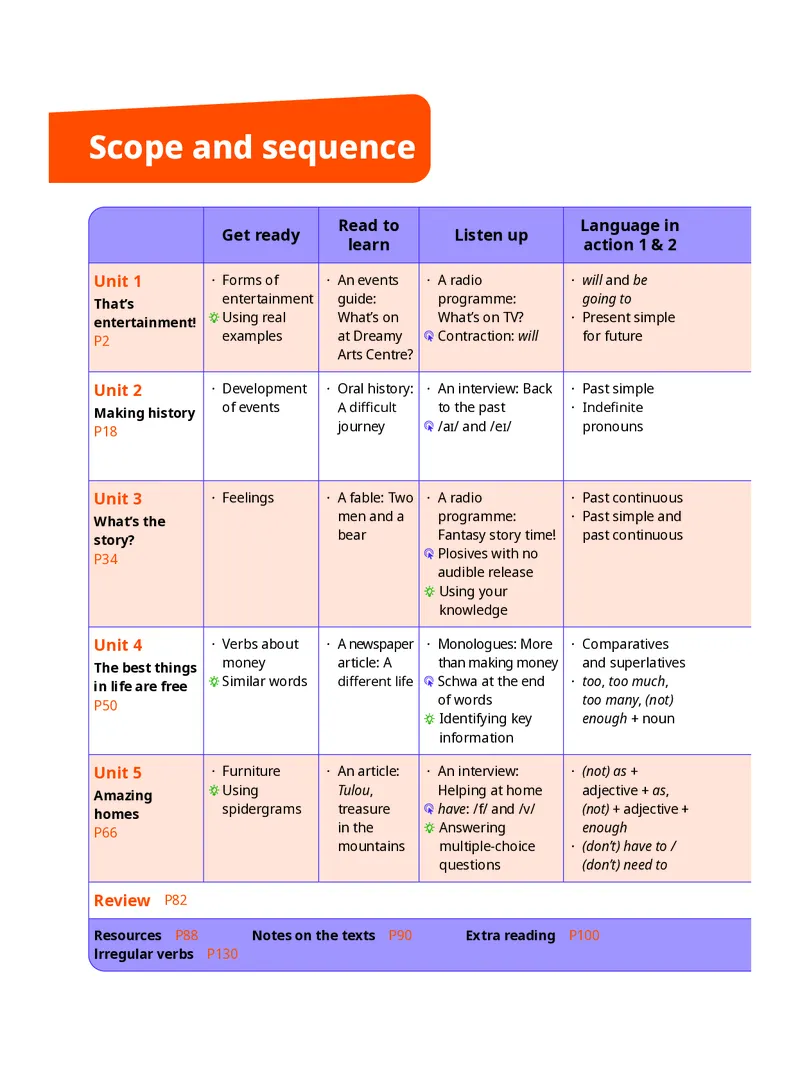
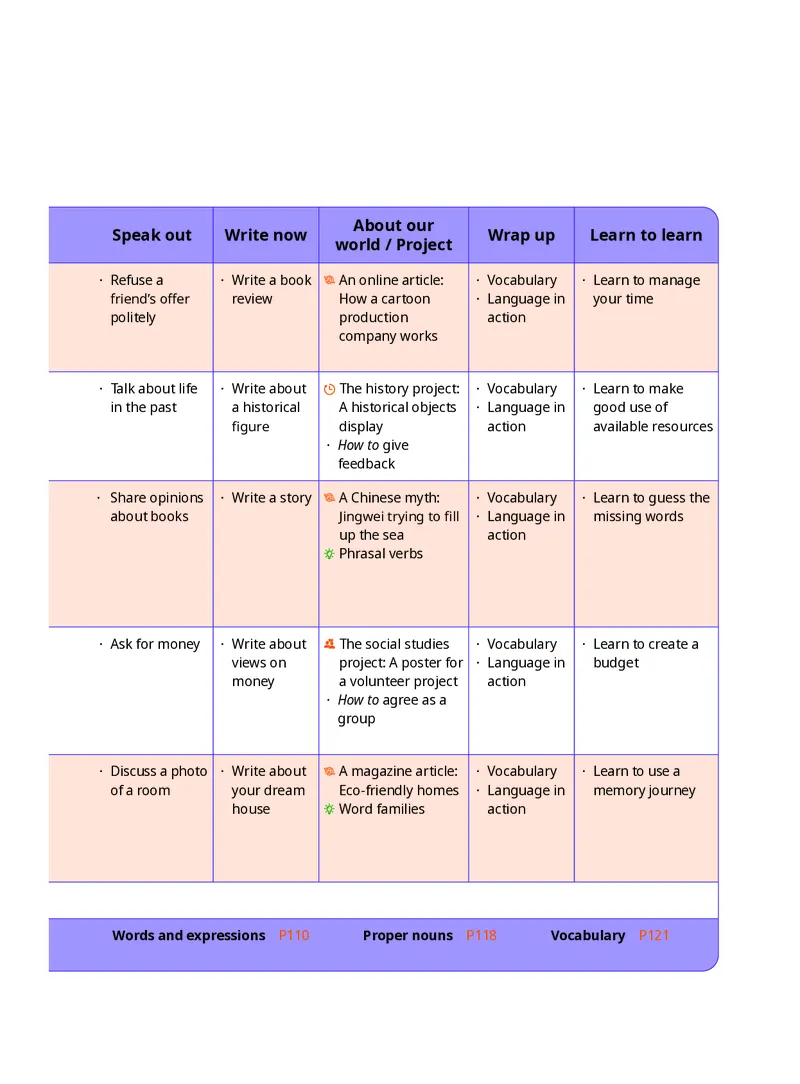
Read to Language in About our
Get ready Listen up Speak out Write now Wrap up Learn to learn
learn action 1 & 2 world / Project
Unit 1 · Forms of · An events · A radio · will and be · Refuse a · Write a book An online article: · Vocabulary · Learn to manage
entertainment guide: programme: going to friend’s offer review How a cartoon · Language in your time
That’s
Using real What’s on What’s on TV? · Present simple politely production action
entertainment!
examples at Dreamy Contraction: will for future company works
P2
Arts Centre?
Unit 2 · Development · Oral history: · An interview: Back · Past simple · Talk about life · Write about The history project: · Vocabulary · Learn to make
of events A difficult to the past · Indefinite in the past a historical A historical objects · Language in good use of
Making history
journey /aI/ and /eI/ pronouns figure display action available resources
P18
· How to give
feedback
Unit 3 · Feelings · A fable: Two · A radio · Past continuous · Share opinions · Write a story A Chinese myth: · Vocabulary · Learn to guess the
men and a programme: · Past simple and about books Jingwei trying to fill · Language in missing words
What’s the
bear Fantasy story time! past continuous up the sea action
story?
Plosives with no Phrasal verbs
P34
audible release
Using your
knowledge
Unit 4 · Verbs about · A newspaper · Monologues: More · Comparatives · Ask for money · Write about The social studies · Vocabulary · Learn to create a
money article: A than making money and superlatives views on project: A poster for · Language in budget
The best things
Similar words different life Schwa at the end · too, too much, money a volunteer project action
in life are free
of words too many, (not) · How to agree as a
P50
Identifying key enough + noun group
information
Unit 5 · Furniture · An article: · An interview: · (not) as + · Discuss a photo · Write about A magazine article: · Vocabulary · Learn to use a
Using Tulou, Helping at home adjective + as, of a room your dream Eco-friendly homes · Language in memory journey
Amazing
spidergrams treasure have: /f/ and /v/ (not) + adjective + house Word families action
homes
in the Answering enough
P66
mountains multiple-choice · (don’t) have to /
questions (don’t) need to
Review P82
Resources P88 Notes on the texts P90 Extra reading P100 Words and expressions P110 Proper nouns P118 Vocabulary P121
lrregular verbs P130Read to Language in About our
Get ready Listen up Speak out Write now Wrap up Learn to learn
learn action 1 & 2 world / Project
Unit 1 · Forms of · An events · A radio · will and be · Refuse a · Write a book An online article: · Vocabulary · Learn to manage
entertainment guide: programme: going to friend’s offer review How a cartoon · Language in your time
That’s
Using real What’s on What’s on TV? · Present simple politely production action
entertainment!
examples at Dreamy Contraction: will for future company works
P2
Arts Centre?
Unit 2 · Development · Oral history: · An interview: Back · Past simple · Talk about life · Write about The history project: · Vocabulary · Learn to make
of events A difficult to the past · Indefinite in the past a historical A historical objects · Language in good use of
Making history
journey /aI/ and /eI/ pronouns figure display action available resources
P18
· How to give
feedback
Unit 3 · Feelings · A fable: Two · A radio · Past continuous · Share opinions · Write a story A Chinese myth: · Vocabulary · Learn to guess the
men and a programme: · Past simple and about books Jingwei trying to fill · Language in missing words
What’s the
bear Fantasy story time! past continuous up the sea action
story?
Plosives with no Phrasal verbs
P34
audible release
Using your
knowledge
Unit 4 · Verbs about · A newspaper · Monologues: More · Comparatives · Ask for money · Write about The social studies · Vocabulary · Learn to create a
money article: A than making money and superlatives views on project: A poster for · Language in budget
The best things
Similar words different life Schwa at the end · too, too much, money a volunteer project action
in life are free
of words too many, (not) · How to agree as a
P50
Identifying key enough + noun group
information
Unit 5 · Furniture · An article: · An interview: · (not) as + · Discuss a photo · Write about A magazine article: · Vocabulary · Learn to use a
Using Tulou, Helping at home adjective + as, of a room your dream Eco-friendly homes · Language in memory journey
Amazing
spidergrams treasure have: /f/ and /v/ (not) + adjective + house Word families action
homes
in the Answering enough
P66
mountains multiple-choice · (don’t) have to /
questions (don’t) need to
Review P82
Resources P88 Notes on the texts P90 Extra reading P100 Words and expressions P110 Proper nouns P118 Vocabulary P121
lrregular verbs P130Learning outcomes
In this unit, let’s explore
entertainment. After completing
That’s
1 the unit, you will be able to:
· use some new words or
entertainment! expressions to talk about forms
of entertainment.
· use will, be going to and the
present simple for future.
· make polite refusals.
· write a book review.
· give examples of entertainment
around the world.
Start it!
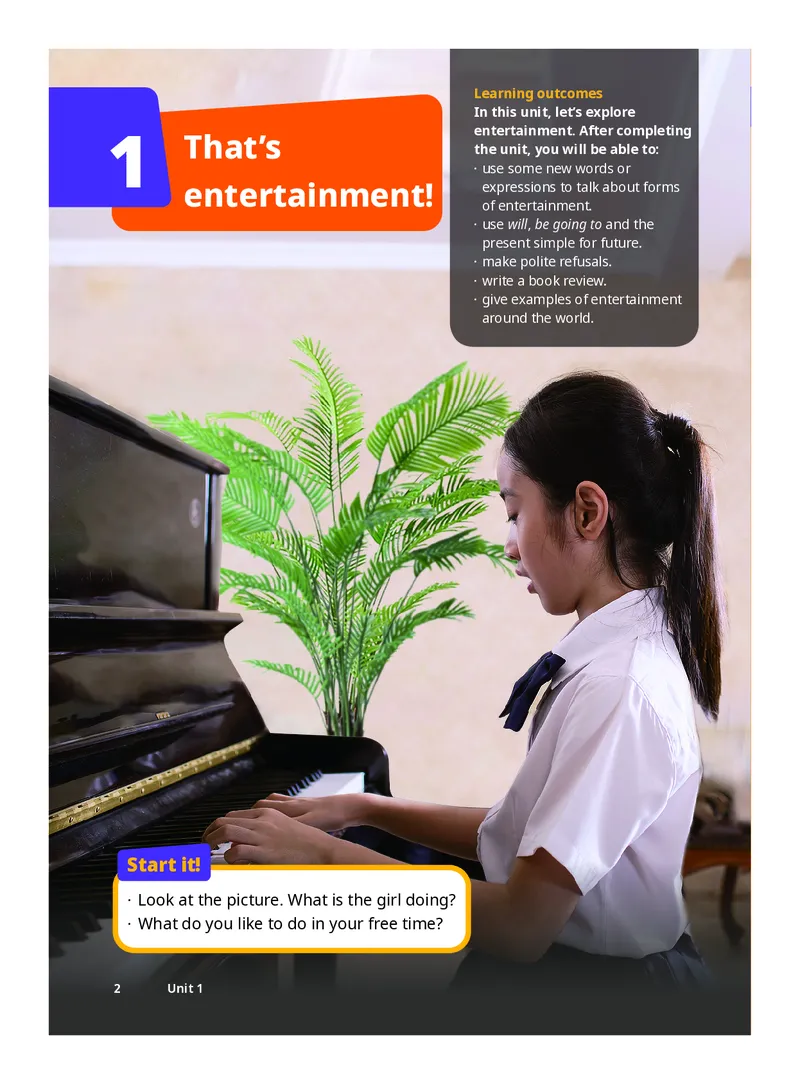
· Look at the picture. What is the girl doing?
· What do you like to do in your free time?
2 Unit 1 That’s entertainment!a b
Get ready
Forms of entertainment
c
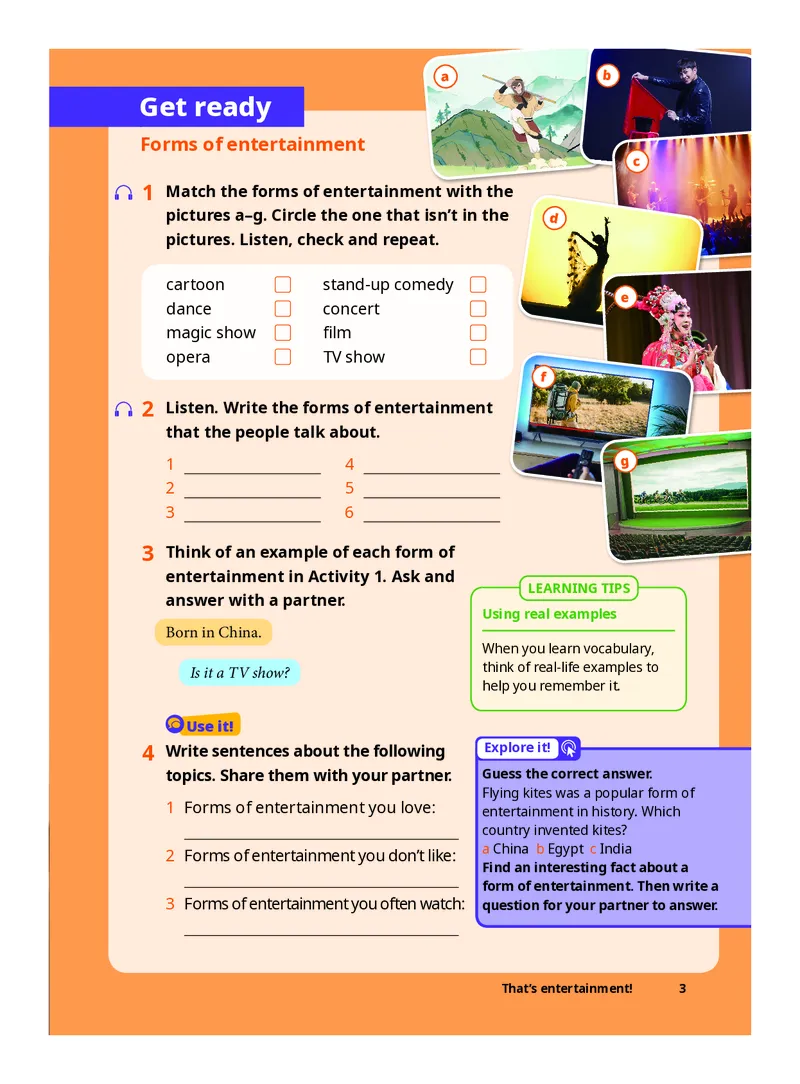
1 Match the forms of entertainment with the
pictures a–g. Circle the one that isn’t in the d
pictures. Listen, check and repeat.
cartoon stand-up comedy
e
dance concert
magic show film
opera TV show
f
2 Listen. Write the forms of entertainment
that the people talk about.
1 4 g
2 5
3 6
3 Think of an example of each form of
entertainment in Activity 1. Ask and
LEARNING TIPS
answer with a partner.
Using real examples
Born in China.
When you learn vocabulary,
Is it a TV show? think of real-life examples to
help you remember it.
Use it!
4 Write sentences about the following Explore it!
topics. Share them with your partner. Guess the correct answer.
Flying kites was a popular form of
1 Forms of entertainment you love:
entertainment in history. Which
country invented kites?
a China b Egypt c India
2 Forms of entertainment you don’t like:
Find an interesting fact about a
form of entertainment. Then write a
3 Forms of entertainment you often watch: question for your partner to answer.
That’s entertainment! 3Read to learn
What's on at
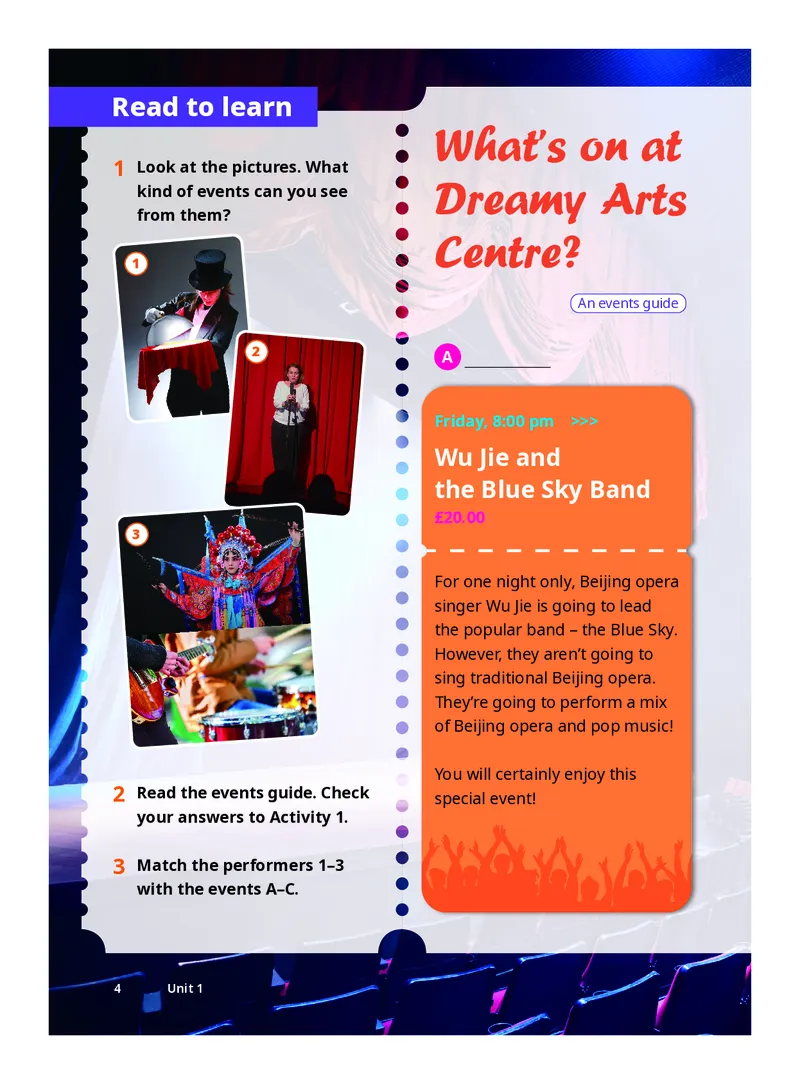
1 Look at the pictures. What
Dreamy Arts
kind of events can you see
from them?
Centre?
1
An events guide
2
A
Friday, 8:00 pm >>>
Wu Jie and
the Blue Sky Band
£20.00
3
For one night only, Beijing opera
singer Wu Jie is going to lead
the popular band – the Blue Sky.
However, they aren’t going to
sing traditional Beijing opera.
They’re going to perform a mix
of Beijing opera and pop music!
You will certainly enjoy this
2 Read the events guide. Check
special event!
your answers to Activity 1.
3 Match the performers 1–3
with the events A–C.
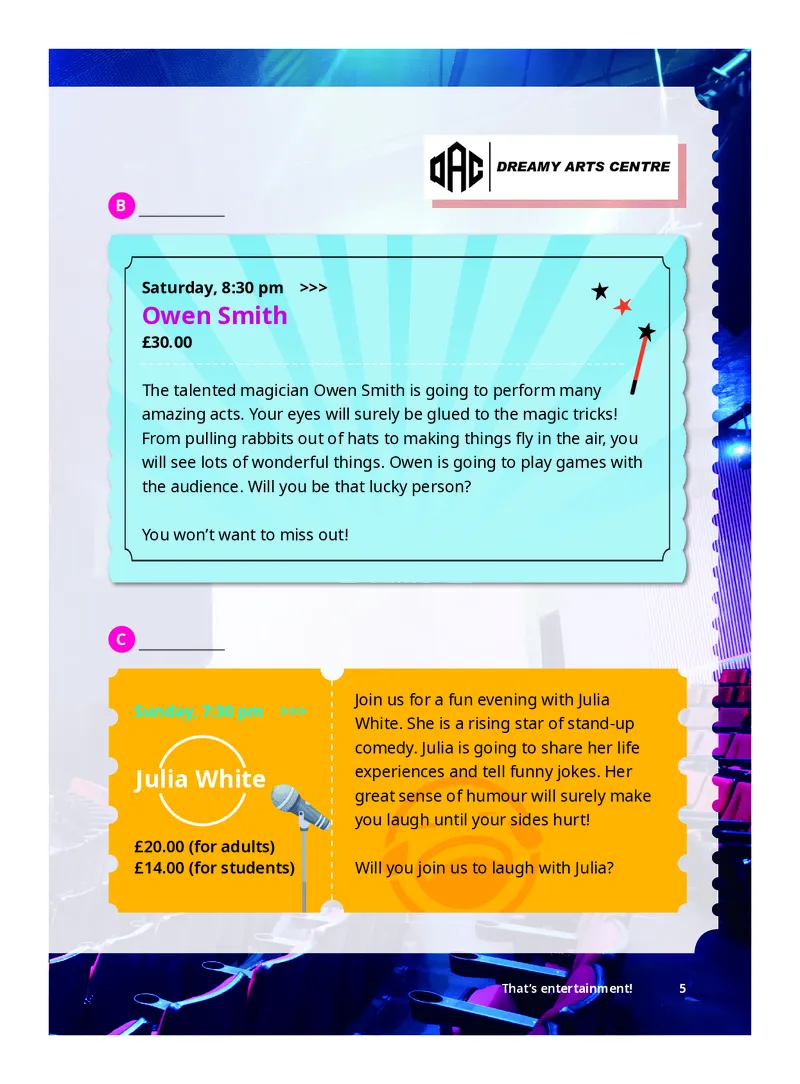
4 Unit 1 That’s entertainment!DREAMY ARTS CENTRE
B
Saturday, 8:30 pm >>>
Owen Smith
£30.00
The talented magician Owen Smith is going to perform many
amazing acts. Your eyes will surely be glued to the magic tricks!
From pulling rabbits out of hats to making things fly in the air, you
will see lots of wonderful things. Owen is going to play games with
the audience. Will you be that lucky person?
You won’t want to miss out!
C
Join us for a fun evening with Julia
Sunday, 7:30 pm >>>
White. She is a rising star of stand-up
comedy. Julia is going to share her life
experiences and tell funny jokes. Her
Julia White
great sense of humour will surely make
you laugh until your sides hurt!
£20.00 (for adults)
£14.00 (for students) Will you join us to laugh with Julia?
That’s entertainment! 5Language in action 1
4 Read the events guide
again. Complete the table will and be going to
with the information about
the events. 1 Complete the examples in the
table below with the correct
Event Event Event
form of will or be going to. Use
A B C
the events guide on pages 4–5
When
to help you.
Who
What to will / be going to
see / do
1 you be that lucky
Ticket
person?
price
Beijing opera singer Wu Jie
2 lead the popular
5 Match the events A–C with
band – the Blue Sky.
the following information.
They 3 sing traditional
1 It has more than one
Beijing opera.
performer. You 4 want to miss out!
2 The performer can make
things fly.
3 It’s cheaper for students. Get it right!
4 It’s great for pop music We can use will for predictions
lovers. and be going to for intentions. For
example:
5 The audience will laugh a
It will certainly be a great evening!
lot.
Bunny is going to dance at the party.
6 The audience can play
games with the performer.
Voice it!
6 What do you think of the
events in the events guide?
Why do you think so? Give
your reasons.
6 Unit 1 That’s entertainment!2 Decide if these sentences about the events guide are predictions
or intentions. Then complete the sentences with the words in
brackets. Use the correct form of will or be going to.
1 Wu Jie (lead) the Blue Sky to perform a mix of Beijing
opera and pop music.
2 Owen Smith (perform) many amazing acts.
3 The magic show (surprise) the audience for sure.
4 Julia White (tell) funny jokes.
5 Julia’s show (not start) until half past seven.
3 Complete the events guide with the words in the box. Use the
correct form of will or be going to.
learn perform have be show start share join
Eastbridge Film Festival
Saturday, 21 June
9:00 am–11:00 am: Sci-Fi Fantasy
We 1 some of the greatest sci-fi films. From space travel to
future world, you 2 a fantastic journey!
3:00 pm–4:00 pm: Film Music Concert
Ten young musicians 3 some of the most well-known songs
from popular films. An opera singer 4 them. Who 5 it
? Come and find out!
5:00 pm–6:00 pm: Talk – Lights, Camera, Action!
Our speakers 6 their experiences in film-making. You 7 a lot
about the film industry. You 8 the chance to ask questions, too.
Use it!
4 Work in pairs. Talk about your intentions and predictions for the
weekend.
I’m going to have a film night with my family this Saturday. I think it’ll be fun.
What films are you going to see?
That’s entertainment! 7Listen up
3 Listen again and write T (true)
What’s on TV?
or F (false).
A radio programme
1 The next show is on Sunday.
1 Discuss the questions with a
2 The next show will explore
partner.
the four seasons in ancient
1 What kind of cultural TV Chinese poetry.
shows do you know? Give 3 People will feel the beautiful
some examples. natural world from the
2 What do you think of these poems.
TV shows? 4 A famous poet is going to talk
about English poetry.
2 Listen and tick. What is the 5 The interview starts at 8:00 pm
radio programme mainly tomorrow.
about?
Voice it!
A discussion about a TV
4 Find information about a cultural
show.
TV show you like. Make notes.
A preview of a TV show.
Then tell your partner about it.
An interview with a famous
poet. Name of the TV show:
Time for the next show:
What it is going to show:
How the audience will feel:
Pronunciation
Contraction: will
1 Listen and repeat.
1. I will I’ll 4. She will She’ll
2. You will You’ll 5. We will We’ll
3. He will He’ll 6. They will They’ll
2 Listen and circle the words you hear.
1. I will pass / I’ll pass the exam. 4. We will study / We’ll study together.
2. You will like / You’ll like this film. 5. I will go / I’ll go to university.
3. They will play / They’ll play basketball.
8 Unit 1 That’s entertainment!Language in action 2
Present simple for future
1 Complete the examples in 3 Make sentences with the
the table below. Use the radio words and expressions in
programme to help you. brackets. Use the present
Listen and check. simple for future.
The next show 1 on TV 1 12:30 pm–2:00 pm: the
this Saturday. African Music Workshop
The show 2 at 8:00 pm. (begin)
The interview 3 at 2:00 pm. The African Music Workshop
Tomorrow we 4 a famous begins at 12:30 pm.
poet on our radio programme. 2 3:00 pm–4:00 pm: the
Chinese folk dance show
(last)
Get it right!
We use the present simple for future
to talk about scheduled events. For
example: 3 7:30 pm: the Film Club (not
The train arrives at 8:12 pm.
open)
2 Correct the sentences about
the information mentioned
4 10:00 am, at the School Arts
in the radio programme.
Centre: a talk about Chinese
1 The quiz show is on cartoons (take place)
Saturday afternoon.
The quiz show is on Saturday
evening.
2 The quiz show begins at 2
o’clock.
3 There’s an interview with a
poet tomorrow morning.
That’s entertainment! 9Use it!
4 Complete the text with the 5 Write sentences using the
words and expression in the present simple for future. Then
box. Use the present simple write two more sentences
for future. using your own ideas.
1 The opera / start / at 7:30 pm
last be hold begin
2 What time / the comedy
take place end
show / begin / today
Flamenco has a long history.
3 The party / not start / at
Every year the Spanish city
lunchtime
of Jerez puts on a festival
of flamenco. This year’s
4 The kung fu film / begin / at
festival 1 on 23
8 o’clock / last / two hours
February and 2 on 9
March. It 3 about two
5
weeks. Flamenco fans from
different countries will come 6
here to have a great time!
6 Find a scheduled event.
Every day during this Make notes. Then introduce
year’s festival, there 4 it to a partner.
performances of flamenco.
What the event is:
The beautiful Villamarta
Theatre 5 some
Start & end dates:
performances.
However, most of
What to see:
the performances
6 in the small
flamenco clubs all
The Beijing International Film
around Jerez. It
Festival this year begins on
will surely be an
22 April …
exciting event!
10 Unit 1 That’s entertainment!Refuse a friend’s offer
Speak out
politely
1 Listen to the conversation. Why can’t Li Fan join Xu Feng?
2 Complete the conversation with the help of the
Useful language box. Listen and check.
Useful language
How about …? But thanks for asking.
Sorry, I’m afraid I can’t. That’s no good, either.
XU FENG Hey, Li Fan. I’m going to too. 2
play video games this XU FENG I understand. But we can
afternoon. Would you just play for one or two
like to play with me? hours.
LI FAN 1 LI FAN 3
XU FENG Why not? XU FENG Never mind. Maybe next
LI FAN Well, I decided to reduce time.
my screen time. My head LI FAN Or maybe we can do
often aches after playing. something else together.
And my eyes feel sore. 4 going on a bike ride?
Sometimes I feel angry, XU FENG That sounds good!
3 Look at the Everyday English box. Find and underline the expressions
in the conversation.
Everyday English
I understand. Never mind. That sounds good!
4 Work in pairs. Practise the conversation.
5 Work in pairs. Think of an activity to do and reasons why one of
you can’t do it. Make a conversation.
Would you like to play chess with me?
I’d love to, but …
That’s entertainment! 11Write now
Write a book review
1 Read the book review. What is the book mainly about?
Journey to the West –
A fantastic book
A book review
1 Journey to the West is a classic Chinese novel.
It tells the journey of Xuanzang and his three
companions. Along their way to the west,
they face all kinds of challenges.
2 The writing is very imaginative. I was
impressed by the action and magic. But the
highlight of the book is the character Monkey
King. He is very clever and powerful. He can
fly and change shapes. But he is also very
playful and naughty.
3 All in all, this is a great book. I’m going to
share it with more Chinese literature fans.
And if you love action and magic, this book
won’t disappoint you!
12 Unit 1 That’s entertainment!2 Match the summaries a–c
with the paragraphs 1–3. Write your own book review.
a A summary of your opinion
PLAN
b A general description of
6 Think about a book you have
the book
read. Make notes about the
c Details about the story,
information you need for
characters, and what you
each paragraph. Use the
like or don’t like
information in Activity 2 to
help you.
3 Read the book review again
and answer the questions.
WRITE
1 What does the author
7 Write your book review.
think of the book?
Remember to include three
2 Which character is the
paragraphs and use the
highlight of the book?
correct verb tenses and
3 What can this character do?
expressions from the Useful
4 Who will like this book?
language box.
4 In a book review, it’s a good
CHECK
idea to use lots of adjectives.
8 Do you …?
Find and underline all the
· include three paragraphs
adjectives in the book
· say what you like or don’t like
review. Discuss with a
· summarise your opinions at
partner what they describe.
the end
5 Find and underline the
Useful language expressions
in the book review.
Useful language
All in all, …
I was impressed by …
But the highlight of the book is …
And if you love …, this book won’t
disappoint you!
That’s entertainment! 13ABOUT
OUR
1 Look at the pictures. What kind
WORLD of film can you see? Read the
article and check your answer.
An online article
A cartoon production company usually produces cartoon films. The films
are exciting and imaginative. It can take many years and thousands of
hours to produce one film. How do they do it?
1
First, someone comes up
2
with an idea for a film, and Next, teams of artists
writers develop the story. create a storyboard.
They think about the They draw each scene
characters. For example, beautifully on paper with
they consider what the a pencil or on a computer.
characters are like, what Thousands of drawings
they look like, what kind are needed for just a few
of clothes they wear, and minutes of a film. Imagine
so on. that!
14 Unit 1 That’s entertainment!2 Read the article again. Put the steps in the correct order.
Artists prepare the storyboard. Actors record the dialogues.
The production team give life Artists add colour.
to the characters. Writers develop a story.
3 Read the article again. Answer
the questions.
1 How long can it take to
produce a cartoon film?
2 What should writers think
about to develop a story?
3 What do artists do to create
the storyboard?
4 How do the production team
3
After that, the artists add
give life to the characters?
colour to the characters,
and they draw the
Voice it!
background for each frame.
4 Discuss the questions.
1 The workers in a cartoon
production company usually
4 have a lot of patience. Why
The production team give
do they need patience?
life to the characters.
2 Are you a patient person or
They use software to
not? Without patience, what
create movements for the
kind of problems may come
characters.
along?
5
Next, actors record the
dialogues, and the director
checks the recordings with
the pictures. Finally, it’s
time to record the sound
effects, background noises
and music for the film.
That’s entertainment! 15WRAP
UP
2 Sara and Jim (not
watch) the magic show. I’m
sure they (regret)!
3 A: What you
Vocabulary
(do) this evening?
1 Correct the underlined B: I (see) a show at City
words in the sentences. Hall.
4 A: Mark (come)
1 My little sister loves opera
to the party?
performances. Her favourite
B: I ’m not sure. But Linda
is ballet Swan Lake.
(join) us. She just said yes.
2 There’s a cartoon in town
this Sunday afternoon. I
3 Complete the text. Use the verbs
can’t wait to see the rock
in the box with the correct form
stars!
of will, be going to or the present
3 The stand-up comedy was
simple for future.
amazing. A scarf turned into
a white bird!
play be stay perform last
4 We’re going to see the new
TV show at the cinema
There’s a music festival tomorrow.
tomorrow evening.
It 1 four hours. Some
of my favourite bands and
Language in action
singers 2 . All my friends
2 Decide if the sentences are 3 there. We’re all excited!
predictions or intentions. However, my little brother fell ill
Then complete each sentence this morning, and my parents were
with the words in brackets. both busy. After thinking carefully,
Use the correct form of will or I decided not to go to the festival.
be going to. Instead, I 4 at home, taking
care of my brother. It’s a difficult
1 Wu Fei (take part in)
decision, but my family always
the School Talent Show
comes first! After all, I’m sure my
tomorrow. But she
favourite bands 5 at the
(not sing) Beijing opera.
music festival next year!
16 Unit 1 That’s entertainment!LEARN
Learn to manage your time
TO
LEARN
It’s important to manage your time to
achieve success in both your academic
and personal life.
1 Study the chart of Tim’s daily 2 Use the sample chart as a guide
activities on Saturday and to create your own 24-hour
answer the questions. time management chart.
1 What percentage of the day Make sure:
does Tim spend on studying? · you include most of your daily
And on entertainment? activities
2 Is he getting enough sleep? · you convert the number of
3 What changes do you think hours for each activity into a
Tim can make to his day? percentage of the day
· the total percentage adds up
Tim’s day
to 100%.
Sleeping Studying
25% 15% 3 Compare your chart with your
Entertainment
partner’s. Discuss your time
25%
management habits.
Others
10%
You spend 40 per cent of the day
studying. That’s a lot!
Sports
5% Well, I don’t get enough sleep …
Meeting up
Modelling Doing with friends
5% housework 5% 10%
Self-assessment
I can name some forms of entertainment in English.
I can use will and be going to to talk about predictions and
intentions, and use the present simple to talk about scheduled
events in the future.
I can make polite refusals in an appropriate way.
I can write a book review.
I can give examples of entertainment around the world.
That’s entertainment! 17Learning outcomes
In this unit, let’s explore history. After
completing the unit, you will be able to:
Making
2 · use some new words and expressions to
describe the development of events.
history · use the past simple and indefinite
pronouns.
· ask and answer questions about past
experiences.
· write an article about a historical figure.
· talk about some important past events
and their influence.
Start it!
Look at the picture. What do you know about this object?
18 Unit 2Get ready
1 The Roman Empire
Development of events influenced other
countries with its
1 Read the historical facts 1–6. Then buildings and language –
match the words and expressions Latin.
in bold with the definitions a–f.
2 It grew into a rich and
powerful city during the
a to start happening
next few hundred years.
b t o have an effect on or change
the way someone or something
3 The Western Roman
develops, behaves or thinks
Empire ended in the 5th
c t o develop over time and become
century CE.
a particular kind of thing
d t o cause something to happen 4 Fighting took place all
e t o stop happening or finish over the Roman areas.
f to happen
5 It led to the founding of
the Roman Empire.
2 Put the historical facts in Activity 1 in
the correct order. Listen and check. 6 Ancient Rome began in
753 BCE.
Use it!
3 Complete the quiz about past events with the words and expressions
in bold in Activity 1. Discuss your answers with your partner.
Did you know …?
1 World War II the formation of the United Nations
because countries wanted peace.
2 In 776 BCE, the first ancient Olympics in ancient Greece.
However, it in 394 CE because a Roman ruler didn’t like it.
3 More than 5,000 years ago, the Liangzhu Culture from
several small groups. But over time, it an important culture.
4 The Nile River provided food and land for farming to ancient
Egypt. It the development of the kingdom greatly.
Making history 19Read to learn
A Difficult
1 Read the information
Journey
below and answer the
questions.
Oral history
Long March Facts
Began: 1934
Ended: 1936
The longest journey
travelled by the Central
Red Army: 12,500 km
1 How long did the Long
March last?
2 How long was the longest
journey travelled by the
Central Red Army in the
Long March? At the start of May 1935,
3 What else do you know my comrades and I began
about the Long March? the Long March. We first
climbed high mountains. The
2 Skim the passage and mountains were covered with
discuss the question. What snow. We were short of food
does “we” refer to? and warm clothing, so our
progress was slow. The thin
3 Read the passage. Check air was also a problem.
your answer to Activity 2.
20 Unit 2It wasn’t easy for the young and
healthy Red Army soldiers to
climb. For the sick and wounded, each other out of the marsh. But
it was even more difficult. still, many soldiers fell into the
marsh and lost their lives.
After the mountains, we arrived
in northwestern Sichuan Province. With the help of my comrades,
Then the hardest part of the I was lucky to complete the
journey began: crossing the great mission. Losses, however, were
grasslands. The grasslands were high. Of the twelve soldiers in my
very wet. This led to one soldier, team, eight didn’t make it through
then another falling deep into the to the end. They were laid to rest
marsh. Then another and another. in the snowy mountains and the
We learnt to use sticks to pull great grasslands.
Making history 21Language in action 1
4 Read the sentences and
write T (true) or F (false). Past simple
1 The narrator climbed
1 Complete the examples in
mountains first.
the tables below. Use the
2 The thin air in the
oral history on pages 20–21
mountains was difficult
to help you.
for the sick and wounded
soldiers only.
be (was / wasn’t, were / weren’t)
3 Climbing the mountains
was the hardest part of We 1 short of food and
the Long March.
warm clothing.
4 The soldiers pulled each
other out of the marsh by It 2 easy for the young
using sticks. and healthy Red Army soldiers
5 Eight soldiers in the narrator’s to climb.
team lost their lives.
I 3 lucky to complete the
mission.
5 Draw a mind map about
the journey. Use the What 4 the grasslands like?
information to help you. They 5 very wet.
· the first part
· the second part
Other verbs
· problems
· result Eight soldiers 6 it through
to the end.
Voice it!
6 Discuss the questions.
What 7 the soldiers do
first?
1 What is the spirit of the
They first 8 high mountains.
Long March?
2 What can you learn from 9 the narrator finish the
the spirit? journey?
Yes, he 10 . But eight soldiers
in his team 11 the journey.
22 Unit 22 Complete the answers to the questions. Use the past simple.
1 Did the soldiers begin the Long March in 1936?
, they . They the Long March in 1935.
2 Why was their progress slow?
It slow because they short of food and warm clothing.
3 Were the grasslands easy to cross?
, they . They difficult to cross.
4 How did the soldiers pull each other from the marsh?
They sticks.
3 Complete the text with the past simple form of the verbs in
brackets.
On 24 June 1893, Fridtjof Nansen 1 (set off) from
Oslo, Norway, on a ship with 12 other men. He
2 (want) to be the first person to reach the North
Pole. At first, everything 3 (go) well. However,
by September the weather 4 (be not) good.
After moving slowly for more than a year, Nansen
and another man 5 (leave) the ship to cross the
ice on dogsleds. But they 6 (meet) with many
difficulties and couldn’t continue. They 7 (build)
a small home and 8 (stay) there for more
than eight months. Finally, a British explorer met them. Nansen
9 (not reach) the North Pole, but his unusual experience 10
(influence) many future explorers.
Use it!
4 Work in pairs. Ask and answer questions about the Long March or
Fridtjof Nansen’s journey. Use the ideas in the box or your own ideas.
When did Fridtjof Nansen leave?
the date the weather
the challenges the result
He left on 24 June 1893.
Making history 23Listen up
3 Listen again and correct the
sentences.
Back to the past
1 Alex travelled alone.
An interview
2 Alex’s trip ended in Xi’an.
1 Look at the pictures. What do
3 Alex saw gold coins from
you know about these places?
ancient Egypt.
4 Alex visited five caves in the
Mogao Caves.
Voice it!
Mogao Caves
4 Work in pairs. Find more
information about the Silk Road.
Then continue the interview.
Did you go anywhere else along the
Silk Road?
Yes. We also visited Lanzhou.
Xi’an
Pronunciation
/aI/ and /eI/
1 Listen and repeat.
/aI/ right time
/eI/ amazing place eight
2 Put the words in the correct place.
Danxia Rainbow Hills
afraid cave light wait
fly ride play may
2 Listen to an interview with
Alex. Order the places he
/aI/ /eI/
went in Activity 1.
24 Unit 2Language in action 2
Indefinite pronouns
1 Complete the examples in the table below. Use the interview to
help you. Listen and check.
People Things Places
someone (somebody) something 2
everyone (everybody) everything 3
no one (nobody) 1 nowhere
anyone (anybody) anything 4
Tell me 5 about your trip along the Silk Road!
Did you go 6 else?
I think 7 should go there.
2 Complete the conversations about the interview. Use the
indefinite pronouns in Activity 1.
1 A: Did Alex travel along the Silk Road with ?
B: Yes. He went with his cousin.
2 A: What did Alex think of Xi’an?
B: He loved it. He thought there was amazing.
3 A: Did Alex see interesting in Xi’an?
B: Yes, he did. He saw gold coins from the Eastern Roman Empire.
4 A: Alex visited in Gansu Province. Where did he go?
B: He went to the Danxia Rainbow Hills and the Mogao Caves.
Making history 25Use it!
3 Complete the text with the 4 Put the words in the correct
words in the box. order to make questions. Ask
and answer with your partner.
everybody something
1 visit / is / anywhere / there /
anything everything
along the ancient Silk Road /
someone
want to / you / ?
2 in your history class / learn / you /
anything / did / interesting / ?
I’m having a great time in 3 your city’s history / about / does /
Beijing! Yesterday, I visited you / anyone / tell / ?
the Palace Museum, and I
experienced 1
really special: the Chinese
5 Write sentences about the
painting Along the River During
following topics. Share them
the Qingming Festival. It
with your partner.
shows the life in Bianjing, the
1 Everyone in my family:
capital of the Northern Song
Dynasty. In the museum,
2 showed me a 2 Everywhere in my school:
digital copy of this painting.
3 in the copy is 3 Something I really want to do:
about 20 times larger than
4 Someone I know:
the original painting. Visitors
can step inside the painting
and experience the 12th- Everyone in my family likes
century life in China. I never Sichuan food. Your turn!
saw 4 like it
Everyone in my family is energetic;
before. It’s amazing! I think
5 should have an we do sport every day.
experience like this!
26 Unit 2Talk about life
Speak out
in the past
1 Listen to the conversation. Where did
Carla’s grandpa live 50 years ago?
2 Complete the conversation with the
help of the Useful language box. Listen
and check.
Useful language
What was a typical day like for you? Did you have any time for …?
But it was also simpler / cheaper / more successful.
Life back then was very different / interesting / easy.
CARLA Where did you live 50 GRANDPA Well, I got up early to feed
years ago, Grandpa? the sheep. After school, I
GRANDPA I lived in Wales. helped out on the farm.
1 CARLA 3 fun?
CARLA How so? GRANDPA Yes. I went hiking with
GRANDPA Well, there wasn’t a TV friends. Wales has beautiful
or a computer in the mountains, you know.
house. We didn’t even CARLA It sounds like life was
have a toilet indoors. harder back then.
CARLA Sounds hard! 2 GRANDPA Yes, it was. 4
3 Look at the Everyday English 4 Work in pairs. Practise the
box. Find and underline conversation.
the expressions in the
conversation. 5 Ask your family about their
lives in the past. Share them
Everyday English
with your class.
How so? Sounds hard! you know
My grandpa lived in a small village
many years ago. Life was very hard.
Making history 27Write now
Write about a historical figure
1 Look at the pictures. Who do you think the person is? Do you
know anything about him? Read the article and check your ideas.
A Great Man
An article
1 Charles Darwin was an English naturalist and
biologist. He was interested in everything
about natural science, such as rocks, plants
and animals. To find out more, he left
England for a scientific research voyage.
2 In 1831, Darwin began his voyage. During the
journey, he studied different kinds of living things. Then he
noticed something interesting: some animals were very similar
to each other. But why? For the next few years, Darwin worked
hard to find out the reason. Later, he concluded the idea: those
animals came from a common ancestor.
3 Darwin’s findings led to his famous
book On the Origin of
Species. It showed a brand-
new idea: living things can
change over time, and new
forms of life come from pre-
existing ones. As a result,
people’s understanding of life
changed greatly.
28 Unit 22 Choose the correct answers.
Write your own article about a
1 In Paragraph 1, I learn
historical figure.
about . In Paragraph 2,
I learn about .
PLAN
a. the things Charles
5 Choose a historical figure.
Darwin did
Do some research on the
b. the general information
person. Make notes about
about Charles Darwin
the information you need for
2 Paragraph tells me
each paragraph. Use Activity 2
about how Charles Darwin
to help you.
influenced people.
a. 1 b. 2 c. 3
WRITE
3 Read the article again and 6 Write your article. Remember
write T (true) or F (false). to include three paragraphs
and use the past simple,
1 Charles Darwin lost
indefinite pronouns and
interest in natural science,
words and expressions from
so he left England.
the Useful language box.
2 Darwin mainly studied rocks
during the journey.
CHECK
3 He wrote On the Origin of
Species in 1831.
7 Do you ...?
4 Darwin thought living · use the past simple to talk
things can change over about the past
time. · include three paragraphs in
your article
4 Look at the Useful language
· explain what the person did
box. Find and underline the
words and expressions in
the article.
Useful language
then later
during the journey
for the next few years
as a result
Making history 29THE
HISTORY
3 What information is important for
PROJECT learning about historical objects?
2 Read the texts. Then read the
sentences and write T (tree),
M (mirror) or L (lamp).
A historical objects
display 1 It has nine birds on it.
2 It’s black, but you can see things
1 Discuss the questions.
in it.
1 What do you know about the
3 Its owner might be rich.
objects in the pictures?
4 It had different uses.
2 Where can you see these
5 Its real purpose is unknown.
objects?
Treasures Around the World
BRONZE SACRED TREE
1600 BCE to 1046 BCE, China
This bronze tree was found in Sanxingdui Ruins in
Sichuan Province. The tree is almost 4 metres tall.
It looks like a great tree, rising from a three-sided
mountain. It has three levels on the trunk, and each
level has three branches. The branches point to different
directions, and each one has a bird standing on it.
Nobody knows exactly the real purpose of the tree.
OBSIDIAN MIRROR
Around 6200 BCE, Türkiye
This is one of the oldest mirrors in the world. It was
found in an old city in southeastern Türkiye. The mirror is
made from a special black stone called obsidian. It shows
the well-developed skills of ancient people. In ancient times, people used
mirrors to look at themselves, start fires and for other purposes.
30 Unit 2BRONZE LAMP
Create your own historical objects
Around 79
display.
CE, Italy
PLAN
This oil
3 Work in groups. Choose
lamp was
three historical objects. Then
found in
complete the steps below.
the city of Pompeii. It is in the
shape of a foot. Bronze objects · Decide on the object that each
were expensive to make, so this student will research.
lamp probably belonged to a · Research your object and
rich family. write a short text to use in the
display.
Pompeii was an ancient Roman · Find a photo or draw a picture
city. In 79 CE, the volcano of your object.
Mount Vesuvius erupted, and · Read each other’s texts and
ash covered the whole city. Lots give feedback.
of things were buried. One of · Make any changes or
them was this lamp. improvements.
· Work in your group and make
your display.
How to give feedback
PRESENT
Put the tips in the correct
4 Put your display on your classroom
order.
walls. Remember to follow the
Point out things that need tips in the How to box and include
improvement and make correct facts, photos or pictures,
suggestions. and an attractive design.
Say what you like about the
work. CHECK
Read the piece of work. 5 Look at your classmates’
Think about any areas displays. Do they explain the
that need improvement historical objects well? Give
(the language, facts, feedback to other groups on
organisation, design and their displays.
pictures, etc).
Making history 31Language in action
WRAP
UP
2 Complete the sentences with
the past simple form of the
verbs in brackets.
Vocabulary 1 The boys (take) a map of
the old town with them.
1 Complete the sentences with
2 We (enjoy) listening to
the correct form of the words
the poems about the buried
and expressions in the box.
treasures.
3 The kids (read) the story
about the Long March carefully.
4 Simon (write) diaries
take place end grow into
about his journey in Egypt.
influence begin lead to
5 My grandparents’ early life
(be) very difficult.
1 The ancient Silk Road
in Chang’an (Xi’an), China.
3 Circle the correct words.
2 Different forms of trade
along the route.
There was 1 something /
3 Trade cultural everything amazing to see in the
exchanges among countries. museum! But I knew 2 nothing /
something about their history.
4 Therefore, small villages
Luckily, I got a guidebook
big towns.
from the museum. Inside was
3 everything / nothing I wanted
5 Later, sea transport
to know. The volunteers were
became more popular, so
helpful, too. 4 Everybody /
communication along the
Nobody listened to them
ancient Silk Road almost
carefully. I spent four hours in
for a long time.
the museum. Then I was very
6 However, the ancient
hungry. However, there was
Silk Road the 5 everywhere / nowhere open
languages and cultures of in town to eat. 6 Everywhere /
many countries.
Somewhere was closed!
32 Unit 2LEARN
Learn to make good use
TO
LEARN
of available resources
Being able to find, identify and use resources
is important to effective learning.
1 Circle the answers that are 2 Read the text on page 88.
true for you. Discuss them Discuss the questions with a
with your partner. partner.
1 How did Mia get an overview
When I decide to study a of the topic?
topic, I usually … 2 Why did she focus on
a rely on the textbooks in websites with “.gov”, “.edu”
class. or “.org” domains?
b ask my teachers or 3 What other resources did
classmates for help. Mia use?
c search for information Resources p88
on the internet.
3 Imagine you are going to do a
d check out books on the
project on the Tang Dynasty.
topic in the library.
How would you find the
information you need? Discuss
it with a partner.
How about watching a documentary?
Good idea! We can also check out
books on …
Self-assessment
I can use different words and expressions to describe the
development of events.
I can use the past simple to talk about the past.
I can use indefinite pronouns to refer to people or things
generally.
I can ask and answer about past experiences in an appropriate
way.
I can write an article about a historical figure.
I can talk about some important past events and their influence.
Making history 33Learning outcomes
Get ready
In this unit, let’s explore stories. After
completing the unit, you will be able to:
What’s
3 · use some new words to describe feelings.
· use the past simple and past continuous.
the story? · ask for and give opinions.
· write a story.
· tell some classic stories from China and abroad.
Start it!
· Look at the picture. What is the girl doing?
· Does she enjoy the activity?
34 Unit 3 What’s the story?a
Get ready
b
Feelings
1 Circle the adjectives to describe
the people in the pictures a–e.
Listen, check and repeat.
angry / sad
excited
/ tired
2 Complete the sentences with the c
adjectives in Activity 1.
1 Sam is of sleeping alone
in the dark after reading the
story about a dangerous snake.
2 At the beginning of the story,
Bruno didn’t have many friends.
surprised / worried
He was .
d
3 The mother was about
her sick child.
4 The company is going to produce
a film based on my favourite
e
book. I’m really !
5 I’m . This book isn’t very
interesting.
lonely
/ nervous
6 He felt before the
meeting with his boss and
stayed awake half the night.
bored / afraid
Use it!
3 Choose an adjective in Activity 1.
Explore it!
Describe a time when you feel
like that. Guess the correct answer.
Hamlet is a .
I was angry with my brother once. He
a poem b novel c play
forced his opinion about my project Find another interesting fact
about stories. Write a question
down my throat!
for your partner to answer.
What’s the story? 35Read to learn
1 Read the introduction and
discuss the questions.
Two Men and
Aesop’s fables a Bear
Aesop was a writer
A fable
from ancient Greece.
He wrote a lot of short
Two men were travelling
stories called fables.
through a forest. The first
The main characters
in the fables are often man was feeling worried
animals, but they act about meeting a bear. The
like humans. The fables second man laughed and
usually teach readers
said, “I’m not afraid of
lessons or morals.
bears! I fought off bears in
the past.” They continued
1 What is special about fables? on their journey.
2 Why do you think Aesop’s
fables are still important They were walking together.
today?
Suddenly, a huge bear
jumped out of the trees.
2 Look at the title and the
The second man quickly
picture. What do you think
the fable is about?
3 Read the fable. Check your
answer to the question in
Activity 2.
36 Unit 3 What’s the story?climbed up a tree. The first man was left on the ground. He
was feeling very nervous.
The bear was coming closer and closer. Then the first man
remembered something about the animal’s behaviour: bears
don’t touch dead things. He quickly fell to the ground and
played dead. The bear came right up to him, and the first man
was holding his breath. The bear just touched his head with
its nose, and then it walked away!
The man in the tree was surprised. He climbed down
and asked, “Was the bear saying anything to you?”
His friend was very angry and replied, “Yes, it was.
The bear was giving me some very good advice!”
“What’s the advice?” asked the second man.
“A true friend never leaves you alone in
danger!” said the first man.
What’s the story? 37Language in action 1
4 Read the fable again.
Answer the questions. Past continuous
1 How did the two men feel
1 Complete the examples in the
about bears at the start of
tables below. Use the fable
the fable?
on pages 36–37 to help you.
2 What did the second man
do when they came across
was / wasn’t
a bear?
3 What did the first man do? The first man 1 holding
4 What happened to the his breath.
first man at last?
The first man 2 feeling
5 Retell the fable. Use the happy. He was very angry.
thinking map to organise
3 the bear saying
your ideas.
anything to you?
Two men were Yes, it 4 .
travelling together ...
were / weren’t
Before When After
They 5 walking together.
they they the
saw the met the bear They 6 hiding in the tree
bear bear left together.
7 they travelling through
Voice it! a forest?
6 Discuss the questions. Yes, they 8 .
1 What is the moral of the
fable?
2 In your opinion, what
makes a true friendship?
3 What other fables do you
know?
38 Unit 3 What’s the story?Use it!
2 Complete the sentences with 4 Think of true sentences about
was / were or wasn’t / weren’t. things you were doing at the
following times. Use the activities
1 The second man
in the box or your own ideas.
travelling alone. He
Then compare your sentences
travelling with his friend.
with your partner’s.
2 Before the bear jumped out,
the men climbing up a · at … o’clock yesterday
tree. They walking. morning / afternoon / evening
3 The first man played dead · at … o’clock last Monday /
because the bear Tuesday
coming closer and closer. · this time two days / months /
4 A: the man in the tree years ago
feeling surprised? · this time last week / month / year
B: Yes, he .
chat to friends read a book
3 Complete the story with the do my homework cook sleep
past continuous form of the have breakfast / lunch / dinner
verbs in brackets. play basketball / football
A group of animals 1 (talk) walk home / to school
about their abilities. One of them
asked a hare, “Can you run fast?” The
At 8 o’clock yesterday
hare nodded and said proudly, “Yes!”
morning, I was having
Then a tortoise offered to race him.
breakfast. What about you?
At first, the hare 2 (run) very fast
and the tortoise 3 (move) very slowly. I wasn’t having breakfast.
The hare was soon near the finishing line. I was cleaning my teeth.
The other animals 4 (not watch), so he
stopped for a rest. He soon fell asleep. But
5 (be) the tortoise 6 (take) a
break, too? No, he wasn’t! He continued
to walk. The hare woke up too late.
All the other animals 7 (shout)
loudly – the tortoise won the race!
What’s the story? 39Listen up
3 Listen again. Put the events
in the correct order.
Alice saw a White Rabbit.
story time!
The Rabbit jumped down
A radio programme a hole.
Alice ran after the Rabbit.
1 Discuss the questions.
Alice was tired and bored.
1 What fantasy stories do you Alice fell down a hole.
know? Give examples.
2 What are some typical Voice it!
features of fantasy stories? 4 Work in pairs. Take turns to
tell the story.
LEARNING TIPS Alice was feeling tired and bored.
Using your knowledge
She saw a White Rabbit. It
Before you listen, think about what
dressed like a gentleman …
you already know about the topic and
the words you might hear.
2 Look at the picture. Think
about the story and words
you might hear. Listen and
check your answers.
Pronunciation
Plosives with no audible release
1 Listen and repeat. 2 Circle the plosives with no
1. September audible release. Listen, check and repeat.
2. blackboard 1. She was thinking about what she could do.
3. started to 2. She slept badly.
4. jumped down 3. They collected stamps.
5. a big dog 4. Science fiction is in fact the mother of invention.
40 Unit 3 What’s the story?Language in action 2
Past simple and past continuous
1 Complete the examples in the table below. Use the radio
programme to help you. Listen and check.
She was thinking about what to do when a White Rabbit with pink
eyes 1 past.
While she 2 across the field, the Rabbit suddenly jumped
down a big hole.
Get it right!
We can use when / while + past continuous for a longer action in progress.
We use when + past simple for a shorter action that interrupts a longer one.
past simple
past continuous
2 Complete the sentences with the past simple or past continuous
form of the verbs in brackets.
1 While Alice (consider) what to do, she (see) a
White Rabbit.
2 The White Rabbit (check) its watch when Alice
(notice) it.
3 Alice (run) across the field when the Rabbit
(jump) down a hole.
What’s the story? 41Use it!
Speak out
3 Complete the text with the 4 Complete the conversations
words in the box. Use the past with the past continuous. Then
simple or past continuous. change the answers so they are
true for you.
tell row come publish
1 A: Were you playing football at
hear feel send ask
8:00 pm last night?
B: ✓ Yes, I was.
2 A: What were you doing at
It is said that Lewis Carroll
7:00 am this morning?
1
a boat with three
B: (run in the park)
young girls when he
2
3 A: Were you listening to music
up with the idea for Alice’s
when your parents arrived
Adventures in Wonderland.
home?
The girls were the daughters
B: ✗ (do homework)
of his good friend Henry
4 A: What was your dad doing when
Liddell.
you left home this morning?
B: (wash the dishes)
During the journey, Carroll
3
the girls a fantasy 5 Work in pairs. Take turns to say a
story. The main character’s sentence to continue and finish
name was Alice. It’s the the story below. Use the past
same name as one of the simple and past continuous.
girls in the boat. Alice Liddell
4
very excited when
I was walking to school this morning
she
5
that. She
when I saw an old man with silver hair.
6
Carroll to write the
Many people were waiting for the bus,
story down for her. Two
but they didn't see the old man …
years later, Carroll
7
Alice Liddell the story. In
1865, he
8
Alice’s
Adventures in Wonderland.
42 Unit 3 What’s the story?Speak out Share opinions about books
1 Listen to the conversation. What books do they
talk about? What are their opinions?
2 Complete the conversation with the help of the
Useful language box. Listen and check.
Useful language
What do you think of …? I’m not really into …
Do you like it? I think it’s really touching / sad / scary.
LAURA Hey, David! Did you read The Hobbit by J.R.R. Tolkien.
Charlotte’s Web? LAURA
3
DAVID No, I didn’t.
1
DAVID Yes! It’s so exciting and
those kinds of stories. imaginative.
LAURA Well,
2
LAURA
4
the characters?
Charlotte is wise and kind. DAVID They’re amazing,
Her friendship with the pig especially Bilbo Baggins.
Wilbur is truly heartwarming. He shows me the power
DAVID Maybe I’ll check it out. of courage.
LAURA Did you read any great books? LAURA That sounds like a great
DAVID Yep! I just finished reading read. I’ll give it a go.
3 Look at the Everyday English 4 Work in pairs. Practise the
box. Find and underline the conversation.
expressions in the
conversation. 5 Work in pairs. Talk about the
books you’ve read.
Everyday English
I really like The Happy Prince.
Maybe I’ll check it out. Yep!
I’ll give it a go. Me too. The prince is both
handsome and kind-hearted …
What’s the story? 43Write now
Write a story
1 Look at the title and the picture. What do you think the story is
about? Read the story and check your answer.
A happy mistake
By Li Ying A story
I came to this school two months ago. But I still remember clearly
my first day.
While I was walking to the school, a boy on a bike greeted me,
“Good morning, Ling!” Did I know him?
I was thinking about this when a girl suddenly called from a
passing bus, “Hi, Ling!” Who was she?
At the school gate, a girl said, “Hey, Ling! How was
your summer?” It was very strange!
Just then, a girl to my right turned and replied to
her. She looked just like me!
We looked at each other in surprise, and then we
laughed together.
Ling is my best friend now. What a happy mistake!
44 Unit 3 What’s the story?2 Put the events in the Write your own story.
correct order.
PLAN
Two more strangers
5 Think about a time when
mistook her for
something interesting, funny
someone else.
or surprising happened to
Li Ying was walking to
you. Make notes about these
the school.
things.
Li Ying got a new friend.
A boy greeted her with 1 What was happening before
a wrong name. the main events started:
Li Ying realised the
reason why they made What happened first:
the mistake.
2 The main events of the story:
3 Read the story again.
Answer the questions.
3 What happened in the end:
1 When the strangers
called Li Ying “Ling”, how
did she feel? WRITE
2 Why did the strangers 6 Write your story. Remember
make the mistake? to use the past simple and
3 What did Li Ying think of past continuous, sequencing
the mistake? words and the vocabulary
from this unit.
4 Look at the Useful
language box. Find and
CHECK
underline the sequencing
7 Do you …?
words in the story.
· use the words from the
Useful language Useful language box or other
sequencing words
two months ago
· explain the main events
just then now
· explain what happened in
the end
What’s the story? 45ABOUT
OUR
WORLD 1 Look at the picture. What do
you think the myth is about?
Read the myth and check
your answer.
Jingwei
trying to fill up the sea
A Chinese myth
Long ago, there was a girl
named Nüwa. She was the
daughter of Emperor Yan.
She loved playing in the
Eastern Sea. One day, while “Jingwei! Jingwei!” It was
Nüwa was playing in the sea, how Jingwei got her name.
a lightning storm suddenly
lit up the sky, followed by Jingwei hated the sea for
loud thunder. The waves taking her life. She was so
grew very big and strong, angry that she decided to fill
and soon, they took her up the sea. She carried plants
away with them. As a result, and stones from the Western
Nüwa’s spirit turned into a Mountains to the Eastern Sea.
bird. The bird flew above Day after day, Jingwei worked
the sea, calling out sadly, tirelessly, never resting.
46 Unit 3 What’s the story?Voice it!
2 Read the myth again. Answer 3 Work in pairs. Discuss the
the questions. questions.
1 How did Jingwei get her name? 1 What can you learn from Jingwei?
2 How did she feel after the sea 2 What do you think of Jingwei’s
took her life? idea of filling up the sea?
3 What did she try to do? 3 Would you do the same thing if
4 What did the Eastern Sea think you were Jingwei?
of Jingwei’s action? How did
Jingwei react? LEARNING TIPS
Phrasal verbs
A phrasal verb combines a verb with an
adverb or a preposition. A phrasal verb
has a new meaning, which is different to
the verb on its own.
One day, while Jingwei was For example: carry (verb) + on (preposition)
= carry on (to keep doing something)
carrying a stone, the Eastern Sea
put her down. It said, “Silly little
4 Find phrasal verbs in the myth
bird, you’re trying to fill me up,
showing the meanings below.
aren’t you? What a crazy idea!”
1 to shout something
Jingwei replied, “I’m not afraid!
2 to become something
I’ll fill you up no matter what!
3 to say something bad to someone
Even if it takes me thousands of
and make them feel silly or
years, I won’t stop!”
unimportant
4 to stop making an effort
And so, Jingwei continued with
5 Think of your own sentences with
her plan to fill up the Eastern
the phrasal verbs in Activity 4. Say
Sea. Again and again, she flew
your sentences but don’t say the
between the mountains and the
phrasal verbs. Ask your partner to
sea. No matter what the sea said
guess the phrasal verbs.
to her, Jingwei never gave up.
Water … ice when the
weather is cold.
Is it “turns into”?
What’s the story? 473 Lydia / work / at 10:00 pm
WRAP
UP
last night.
4 Ollie and Brad / cook / an
hour ago.
Vocabulary
5 Liu Tao / clean the windows /
1 Circle the correct words. when / his brother / call.
1 Elsa felt afraid / angry when
the lights went off.
3 Complete the text with the past
2 I can’t believe I won the first
simple or past continuous form
prize! I’m really excited /
of the verbs in brackets.
nervous.
3 Call a friend when you feel
tired / lonely and want to talk. Bai Yang
1
(study)
4 Sam is worried / surprised at high school when she
2
because his dad isn’t feeling (write) her first novel.
well.
5 I’m never bored / excited. She
3
(post) her book
There’s always something to do. online. She
4
(feel)
6 The kids were very worried / surprised when she
5
sad to hear about Miss Green’s (find) that lots of young people
death. They couldn’t help
6
(read) her story. Two
crying. years later, it had millions of
reads on the website and it
Language in action
7
(win) a prize in a
competition.
2 Join the words and expressions
to make sentences. Use the When Bai Yang 8 (leave)
past continuous. school, she 9 (go)
to university. She
10
1 you / wear / jeans / yesterday
(complete) two more books
morning?
while she
11
(do) a
physics course. Months ago, a
2 what / they / do / last
TV company
12
(make)
Saturday at 7:00 pm?
her first novel into a film.
48 Unit 3 What’s the story?LEARN
Learn to guess the
TO
LEARN
missing words
You can help your partner learn vocabulary by writing
sentences with missing words for them to guess.
1 Read the following sentences.
surprised tired worried
Can you guess what the
afraid nervous sad angry
missing words are? Discuss
them with a partner.
1 I was because
my football team were winning.
2 The boy felt when
the teacher talked about 3 Show your sentences to your
something he wasn't interested in. partner. Ask him or her to
guess the missing words.
Is it an adjective?
4 Discuss the questions with
your partner.
Yes, I think so. Maybe it’s “worried”.
1 What kind of method can you
No. I think it’s “happy”.
use to guess the missing words?
2 Why is it a good idea to learn
2 Choose three words from the
words in sentences?
box as missing words. Write
We can look at the words before
three sentences like the
or after the missing words.
sentences in Activity 1.
Yes. We can also …
Self-assessment
I can use different adjectives to describe feelings.
I can understand the difference between the past simple and
past continuous, and use them to talk about the past.
I can ask for and give opinions in an appropriate way.
I can write a story.
I can tell some classic stories from China and abroad.
What’s the story? 49Learning outcomes
In this unit, let’s explore the role money
plays in human life. After completing
The best
4 the unit, you will be able to:
· use some verbs to talk about money
things in life matters.
· use comparatives and superlatives, too,
too much, too many and (not) enough +
are free
noun.
· make and respond to a request.
· write an opinion essay about views on
money.
· talk about your attitude towards money.
Start it!
· Look at the picture. How are the boys feeling?
· What makes you feel the same way?
50 Unit 4 The best things in life are freeGet ready
Verbs about money 2 Listen and write the correct
verb from Activity 1 for each
1 What do the verbs in bold situation. Sometimes there is
mean? Match the sentences more than one possible answer.
1–6 with the pictures a–f.
1 4
1 Don’t worry. I can pay for 2 5
you, too. 3 6
2 Don’t spend your money on
LEARNING TIPS
more video games. Save it
for something you need.
Similar words
3 Friendships don’t cost money. Many words have similar meanings. Think of
They’re free! ways to help you understand the differences.
For example:
4 I want to earn money, so
You lend money to someone. (It’s yours.)
I wash cars for my
You borrow money from someone. (It isn’t yours.)
neighbours.
5 I don’t use this bike
3 Complete the sentences with
anymore. I can sell it for
the similar words in each pair.
some pocket money.
6 A: Could you lend me 1 You (pay / cost) for things
some money? you buy. The things you buy
B: How much do you want (pay / cost) you some
to borrow? money.
2 People (spend / save)
a d
money to buy things in the
future. They (spend / save)
money in a shop or online.
b e Explore it!
Guess the correct answer.
There are languages on China’s
banknotes.
a four b five c six
Find another interesting fact about
c
f
money. Write a question for your partner.
The best things in life are free 51Read to learn
A
1 Look at the pictures. What
do you think the man did?
different
2 Read the headline of the
newspaper article. What
life
do you think the article is
mainly about? Choose from
the summaries below. A newspaper article
a A man spent three years
changing his poor life.
Can you imagine living for
b A man lived without
a day without money?
money for three years.
Mark Boyle, from Ireland,
3 Read the article and check did that for three years.
your answer to Activity 2.
Mark had a good job, and he earned
enough money. One day, a friend
challenged him to live without
52 Unit 4 The best things in life are freemoney. Mark decided to give it a try. He sold his home, and he went to
live in a caravan on a farm.
The first few months were the worst. Without money, even the simplest
things were difficult. Mark couldn’t buy food or travel easily. He found
wasted food and wild food, and he grew his own food. He cooked
outside, and he enjoyed the natural world. He walked and rode his bike
everywhere, so he was healthier and fitter than he was before.
After three years without money, Mark returned to a life with money. So,
which kind of life did he enjoy more? Mark chose the life without money.
He was happier and he felt more alive than before. More importantly, he
learnt a valuable lesson from the
experience: Happiness didn’t
come from money. It came
from the relationships with
the people, plants and animals
around him. As a result, he was
richer than ever!
The best things in life are free 534 Read the article again and 5 Draw a mind map about
answer the questions. Mark’s life without money.
Use Activity 4 to help you.
1 Where did Mark live after he
sold his own home?
Voice it!
2 Which things were difficult
6 Discuss the questions.
for Mark at first?
3 How did Mark overcome the 1 Why was Mark “richer than ever”?
difficulties? 2 Would you like to experience
4 How did Mark feel after three life without money for some
years without money? time? Give your reasons.
Language in action 1
Comparatives and superlatives
1 Complete the examples in the table below. Use the newspaper
article on pages 52–53 to help you.
Adjectives /
Comparatives Superlatives
Adverbs
1
rich richest
One-syllable words;
2
two-syllable words end fit fittest
in –y 3
healthy healthiest
4
alive most alive
Two-syllable words or
more; adverbs end in –ly importantly 5 most importantly
6
bad worse
Irregular
7
much most
Get it right!
We can use than after comparatives. For example: Going by train is always cheaper than by car.
We normally use the before a superlative. For example: This hotel is the cheapest in town.
54 Unit 4 The best things in life are freeUse it!
2 Complete the sentences with 4 Choose a topic from the box or
the comparative or superlative use your own. Discuss it with a
form of the words in brackets. partner. Use comparatives and
superlatives.
1 Without money, even the
(simple) things were
pay in cash / pay by mobile phone
difficult for Mark.
shopping in a market / shopping in
2 Mark enjoyed his life without
money (much) than life
a shopping centre / shopping online
with money.
3 Mark thought relationships with
Paying by mobile phone is more
others were (important)
convenient than paying in cash, but ...
than money.
3 Complete the text with the comparative or superlative form of
the words in brackets.
Thanks to the power of technology,
people can now send New Year
3
greetings (easily) and at a
4
(low) cost than ever before.
Designing an e-card is probably
5
one of (creative) ways to
say “Happy New Year!” It costs
6
(little) money than buying
a paper card, too.
,,
Also, people can experience New
7
Year traditions around China
(conveniently) than before. For
The Chinese New Year is one of example, they can watch free live
1
(important) holidays in shows of dragon dances or rice
China. However, it doesn’t have to cake making at home. That’s
2 8
be (expensive)! (cheap) than travelling.
The best things in life are free 55Listen up
Monologues
1 Discuss the questions with 3 Listen again. Write A (Amy),
a partner. D (Dandan) or N (Nick).
1 What kinds of jobs mainly Who …?
help and care for others? a studies and works
2 What do you think is the b isn’t working now
most important part of a job? c sometimes doesn’t have lunch
d learns some life-saving skills
LEARNING TIPS
e sells second-hand things
Identifying key information f enjoys making people feel
happier
When you are matching people with
information, check key words before
you listen. This helps you to focus on Voice it!
the information you need. 4 Work in pairs. Take turns to be
an interviewer and one of the
2 Listen and match the speakers speakers above. Use the ideas
with their jobs. There is one below to do an interview.
extra job.
Job:
Amy Dandan Nick Main duty:
How long you work per day:
How you think of the job:
a lifeguard c volunteer
Pronunciation
Schwa at the end of words
1 Listen and repeat.
/ / owner better
2 Listen and repeat the sentences.
b nurse d vet 1. My sister’s a firefighter.
2. My mother looks happier today.
3. Life is better when you’re healthier.
56 Unit 4 The best things in life are freeLanguage in action 2
too, too much, too many, (not) enough + noun
1 Complete the examples in the table. Use the monologues to help
you. Listen and check.
1
too + adjective The job is too .
too much + uncountable Sometimes, I’ve got too much
2
noun .
3
too many + plural countable There are too many
noun in the hospital.
I don’t even have enough
(not) enough + noun
4
for lunch.
2 Read the sentences about the people in the monologues. Circle
the correct words.
1 Amy thinks she has got too much / too many / enough time to do
helpful things.
2 Amy thinks people have got too much / too many / enough clothes.
3 Dandan can’t have lunch sometimes because she is too / too much /
too many busy.
4 Nick has enough / too much / too many time to study.
The best things in life are free 573 Complete the text with the Use it!
expressions in the box. 4 Underline and correct one
mistake in each sentence.
Do you agree with the opinions?
enough exercise too small
1 In my opinion, actors earn too
too many people too busy
many money.
enough time too naughty
2 I think students are much
too much time enough space
young to do a caring job.
3 A lot of people spend enough
Many dog owners in my town are
time on screens. They should
1
to walk their dogs. So, last
donate some of their time to
year I became a volunteer dog
community service.
walker. I chose this job because
4 Some volunteers haven’t
I love dogs. However, my home
got too many skills for
2
is to keep a dog. Also, I
their work. They should
3
didn’t get before, so dog
receive training.
walking is a great way to keep fit.
Sometimes the dog owners didn’t 5 Imagine a day doing your dream
4
have to feed or wash the job. Make notes. Then compare
dogs, and I helped them. your notes with your partner’s.
What the job is:
The best thing: I can spend time
with dogs, and it doesn’t take up
The best thing:
5
.
The worst thing:
6
The worst thing: There are
outdoors on Saturdays, and there
7
isn’t for the dogs to play.
8
Also, some dogs are just !
My dream job is to be a firefighter. I
can help people and learn many useful
skills. But I may spend too much time
on training. I may not have enough
time to be with my family.
58 Unit 4 The best things in life are freeSpeak out Ask for money
1 Listen to the conversation. Why does Lily
need some more money?
2 Complete the conversation with the help of
the Useful language box. Listen and check.
Useful language
I don’t think you should ... You really should try to ...
Would you mind …? Could you lend / give / buy me …?
Can I sell / borrow / save …?
MUM Here’s your pocket money, Lily.
1
LILY Thanks! giving me ten more?
MUM Why?
LILY I want to buy a bag. But I haven’t got enough money.
2
MUM You’ve got too many bags! buy more.
3
LILY But there’s a really cute one. ten dollars?
Please! I’ll return the money next month.
MUM Sorry, I can’t. You’ve spent too much on things you don’t really need.
4
LILY What can I do? my skateboard for money?
5
MUM You just bought it weeks ago! save money.
LILY OK, I’ll try.
3 Look at the Everyday English 4 Work in pairs. Practise the
box. Find and underline conversation.
the expressions in the
conversation. 5 Work in pairs. Act out a
conversation about making a
Everyday English
request. You may use the notes
Why? Please! below or use your own ideas.
Sorry, I can’t. OK, I’ll try.
I want to borrow your earphones because …
Sorry, I can’t lend my earphones …
The best things in life are free 59Write now
Write about views on money
1 Read David’s essay. Does he agree with the statement?
Money can’t buy happiness.
Do you agree?
An opinion essay
By David Newman
1 It’s said that we can buy anything with money. But
in my opinion, it’s not really true.
2 First of all, when we are too concerned
about money, we won’t spend
enough time on things we truly
enjoy. We won’t feel relaxed, too.
As a result, we may become too
stressed.
3 Also, many things that bring us happiness are free,
such as spending time with our loved ones.
4 To sum up, money can’t buy happiness. I believe that
we should care more about those truly important
things.
60 Unit 4 The best things in life are free2 Match the summaries a– d Write your own opinion essay
with the paragraphs 1–4. about views on money.
a The first reason for your
PLAN
opinion
5 Choose one of the two
b A summary of your
topics. Make notes about the
opinion
information you need for each
c An introduction to the
paragraph. Use Activity 2 to
topic and your opinion
help you.
d A second reason for your
opinion · Save money, and money will
save you.
3 Read the essay again and
· Never spend your money
answer the questions.
before you have earned it.
1 In David’s opinion, how
WRITE
might people feel if they
6 Write your opinion essay.
are too concerned about
Remember to include
money?
four paragraphs, and use
2 What example of happy
comparatives and superlatives,
things does David give?
too, too much, too many, (not)
3 According to David, what
enough + noun and expressions
should people pay more
from the Useful language box.
attention to?
4 Look at the Useful language CHECK
box. Find and underline the 7 Do you …?
expressions in the essay.
· have four paragraphs
· give reasons for your opinion
Useful language
· summarise your opinion
in my opinion ... at the end
first of all ...
to sum up ...
I believe that ...
The best things in life are free 61THE
SOCIAL
1 What is the purpose of the poster?
STUDIES Read and check your answer.
PROJECT a To encourage more people to
use a local park.
b To ask for more volunteers to
clean the park.
A poster for a
c To tell people about a
volunteer project
charity event.
Could you be a volunteer with us?
Have you got enough time to help us? All ages are welcome.
Don’t give us your money – give us your time!
YOUR COMMUNITY NEEDS YOU!
WHAT? Help us to make the park a cleaner
space for the whole community.
WHERE? People’s Park
WHO? We have a team of five volunteers, but
there’s too much work for us. We need more
volunteers.
WHEN? 10:00 am WHY? It helps your community! There
every Saturday. Meet aren’t enough people using the park. We
at the park café. want more people to use it.
WHAT ARE THE BENEFITS? We need
only an hour of your time once a week.
You can get fitter and have fun. It’s one
of the best ways to make new friends and
make a difference! TOGETHER WE
CAN MAKE OUR
PARK BETTER!
62 Unit 4 The best things in life are free2 Read the poster again. Make your own poster for a
Under which heading can volunteer project.
you find the information?
PLAN
1 the place for the activity
3 Work in groups. Complete the
Where?
steps below.
2 the type of the activity
∙ Choose an idea for a volunteer
3 the people organising the project. Use the ideas below or
activity your own ideas.
4 the reasons why it is a — Teach older people how to
useful thing to do use the latest technology.
5 the time and place to meet — Help at an afterschool or
local sports club for younger
6 why volunteers enjoy the students.
activity — Work in an animal house
shelter.
How to agree as a group ∙ Think of expressions to
encourage people to become
Put the tips in the best order. volunteers.
∙ Prepare your poster.
Ask other people for their opinions.
∙ Add photos.
Make a decision as a group. Check
that everyone agrees.
PRESENT
Introduce the decision you need
4 Display your poster on your
to make.
classroom wall. Remember to
Give your own opinion politely.
include useful information for
Interrupt politely if you want to
volunteers and photos, and
comment.
follow the tips in the How to box.
Sum up all the opinions.
CHECK
5 Look at your classmates’
posters. Would you like to
work on their projects? Vote
for the best poster.
The best things in life are free 63Language in action
WRAP
UP
2 Complete the sentences with
the comparative or superlative
form of the words in brackets.
Vocabulary 1 Some animals can run
(fast) than humans.
1 Complete the conversations
2 I was late for school today.
with the correct form of the
I should get up (early)
verbs in the box.
tomorrow.
3 What kind of books do you
borrow save pay lend
like (well)?
earn sell cost spend
4 In my opinion, New York is
(expensive) city to live in.
1 A: Can you me £2 for
5 Is a hippo (dangerous)
a cup of coffee?
than a lion?
B: Don’t worry. I can
for yours. 3 Complete the text with too,
2 A: Those people hats too many, too much, (not)
at the market. enough and the comparative or
B: Yes, but they don’t superlative form of the words in
much money. brackets. Use than if necessary.
3 A: I want to buy this handbag.
1
It £50. My friend Holly is (funny)
2
B: You’ve got too many and (happy) person I know!
handbags. Why don’t you She always makes me laugh.
the money for the
Holly likes collecting sports
future?
3
shoes. She hasn’t got space
4 A: How much money did you
in her room, because she has
on the meal?
4
got shoes! I think she has
B: £14. Now I have no
5
spent money on that.
money for the bus. Could
I £2 from you?
Holly wants to be a diver. She is
6
(brave) me. In my
7
opinion, that job is
(dangerous)!
64 Unit 4 The best things in life are freeLEARN
Learn to create a budget
TO
LEARN
A budget is a plan of how you
will spend money. It helps you
manage your money effectively.
1 Read the text. Fill in the table to work out how much Chris saves
each week. What do you think of his budgeting?
Chris receives pocket money from his parents, about £12 a week. He
has also got a part-time job at the weekend and earns £20 a week.
Chris spends £7 a week on drinks and snacks, and £9 on transport.
Chris also likes to go out with friends and will spend £20 a week on the
cinema or dining.
Pocket money Part-time job Total income
Drinks and snacks Transport
Total spending
Going out with friends
Total savings
2 Create your own budget for next week.
You may follow the tips below:
∙ Calculate how much money you’ll get each week. This could be
pocket money, part-time job earnings, etc.
∙ List must-pay costs and optional spending.
∙ Review your budget. Can you cut back on anything unnecessary?
3 Compare your budget with your partner’s. Make improvements
to your budget.
Self-assessment
I can name as many verbs about money in English as possible.
I can use comparatives and superlatives to make comparisons.
I can use too, too much, too many and (not) enough + noun to
describe the degree, quantity or sufficiency of something.
I can make and respond to requests in an appropriate way.
I can write an opinion essay about views on money.
I can talk about my attitude towards money.
The best things in life are free 65Learning outcomes
In this unit, let’s explore amazing homes.
After completing the unit, you will be
Amazing
5 able to:
· use some new words and expressions to
homes talk about furniture.
· use (not) as + adjective + as, (not) + adjective
+ enough and (don’t) have to / (don’t) need to.
· discuss a photo.
· write a description of your dream house.
· give examples of amazing homes around
the world.
Start it!
Look at the picture. What do you think of their home?
66 Unit 5 Amazing homesGet ready
LEARNING TIPS
Furniture
Using spidergrams
1 Match the words in the box with
Recording words in different ways will
the furniture items a–g in the help you remember them. One way is
to create spidergrams.
pictures. Listen, check and repeat.
armchair bookcase
3 Complete the spidergram
carpet wardrobe
using the words in Activities
cupboard mirror
1 and 2 and your own ideas.
shelf
Other places
Rooms
a
Home
Things on walls
Others
Other things Furniture
to sit or
to store things lie on
b
c
Use it!
4 Work in pairs. Take turns to
describe the furniture in a room
d e
in your home. Ask your partner
to listen and draw the room.
f
My bedroom has a wardrobe, a shelf
g
and a blue carpet on the floor …
2 Listen and circle the words in
Explore it!
Activity 1. Then match the following
Guess the correct answer.
rooms with the speakers 1–4.
Which of the following is a traditional
There is one extra room.
category of Chinese furniture?
a Hunan category b Suzhou category
bedroom bathroom
c Sichuan category
kitchen living room
Find an interesting fact about furniture.
study Write a question for your partner.
Amazing homes 67Read to learn
1 Look at the pictures.
Tulou,
Discuss the questions.
1 What is unusual about Treasure
these houses?
2 Would you like to live in in the
them? Give your reasons.
Mountains
An article
In the mountains of Fujian
Province, there are many large,
round or square houses. They
sit among fields and bamboo
forests, and look as strange as the
buildings in sci-fi movies.
These houses are called tulou.
They belong to the Hakka,
2 Read the article. Tick the
correct answer.
Why did the Hakka build the
tulou?
They wanted to make
their home unique.
They wanted to live a safe
and peaceful life.
They wanted to keep
the traditional house of
northern China.
68 Unit 5 Amazing homesmigrants from northern China. first floor is for food storage, and
Throughout history, the Hakka the upper floors are bedrooms.
moved south to find a better Wooden furniture with traditional
life. However, the southern Chinese designs is common, such
areas were not safe enough for as chairs, beds and wardrobes.
these newcomers. To protect
themselves, the Hakka built the A tulou is as busy as a small city.
tulou. One building can house up to 800
people! Most of them are relatives.
A tulou is like a big castle. Each They share a building as their
building has one entrance. The home, and also their traditions
walls are high enough to protect and way of life.
people against attacks. The
windows are above the first floor, In 2008, Fujian tulou was added
so outsiders can’t see in. to the World Heritage List. Today,
the houses are open to visitors,
There are kitchens and dining but some people still live in them.
rooms on the ground floor. The
Amazing homes 69Language in action 1
3 Read the article again.
Write T (true) or F (false). (not) as + adjective + as,
(not) + adjective + enough
1 A tulou has several
entrances.
1 Complete the examples in the
2 There are no windows on the
table below with (not) as ...
ground floor of a tulou.
as or (not) ... enough and the
3 A tulou has kitchens on the
adjectives in brackets. Use
first floor, and dining rooms
the article on pages 68–69 to
and bedrooms on the upper
help you.
floors.
4 The people in a tulou
They look
1
(strange)
usually belong to the
the buildings in sci-fi movies.
same family.
5 Now the tulou is not home A tulou is 2 (busy) a
to the Hakka any more. small city.
4 Introduce the tulou to a The southern areas were
partner. Use the thinking
3
(safe) for these
map to organise your ideas. newcomers.
The walls are
4
(high)
Purposes Features of
to protect people against
design
attacks.
The tulou
Get it right!
Structure Cultural and We never put adjectives after
and uses historical enough. For example:
I’m not tall enough. NOT I’m not
significance
enough tall.
Voice it!
5 Discuss the questions.
1 Why is the tulou “treasure
in the mountains”?
2 Do you know any other
amazing homes? Describe
them.
70 Unit 5 Amazing homes2 Circle the correct words.
1 A tulou is as big as / not as big as a castle.
2 The windows of a tulou are high enough / not high enough to keep
outsiders away.
3 A tulou is large enough / not large enough to house 800 people.
3 Complete the second sentence so that it has the same meaning as the
first. Use (not) as ... as or (not) ... enough and the adjectives in brackets.
1 We can’t put a sofa in this 3 I’m short, so I can’t reach the top
small room. shelf.
This room (large) I’m (tall) to reach the top
for a sofa. shelf.
2 My room is tidier than my 4 That car is really expensive. Its cost
sister’s room. is the same as that of a house.
My sister’s room That car is (expensive) a
(tidy) my room. house.
4 Complete the text using (not) as ... as or (not) ... enough and the
adjectives in brackets.
Kids’ toys aren’t cheap these days, but not many toys
are
1
(expensive) Astolat Dollhouse Castle.
It’s a special doll’s house. It’s
2
(tall) a small
Christmas tree and
3
(heavy) a horse. The
castle took the artists 13 years to build. It’s a work of
art, and it’s
4
(perfect) to be in a museum.
The furniture in the castle is
5
(small) to fit in your hand,
and it’s
6
(beautiful) the furniture in a real palace. The tiny
sofas and beds are
7
(soft) the real things. The books on the
shelves aren’t
8
(large) to read, but they have real pages.
Use it!
5 Work in pairs. Write sentences about houses or furniture with
(not) as ... as or (not) ... enough. Take turns to say your sentences.
I've got a bookcase. It's big enough to hold hundreds of books.
Amazing homes 71Listen up Helping at home
An interview
1 Discuss the questions. 4 When Kelvin does housework,
he often …
1 How often do you help with
a. listens to music.
housework?
b. watches TV.
2 What housework do you
c. sings songs.
usually do?
2 Listen and tick. Which Voice it!
speaker doesn’t do much 4 Ask and answer the
housework? questions with a partner.
Cindy Kelvin 1 How do you help at home?
2 Do you like doing housework?
LEARNING TIPS Why or why not?
Answering multiple-choice questions 3 How do you think you could
help out more at home?
Before you listen, read the questions
and options carefully. Pay attention I clear the table, and I do the washing-up.
to the key words in them.
I like doing housework. It’s a good way
of getting exercise! How about you?
3 Listen again and circle the
correct answers. I quite like it. But I need to spend
more time doing housework …
1 In the kitchen, Cindy …
a. cooks.
b. washes dishes. Pronunciation
c. clears the table.
have: /f/ and /v/
2 Kelvin does housework …
1 Listen and circle the option you hear:
a. every morning. /f/ or /v/.
1. I have to clear the table. /f/ or /v/
b. at the weekend.
2. Do you have to wash dishes? /f/ or /v/
c. during schooldays.
3. We’ve got a dishwasher. /f/ or /v/
3 Kelvin doesn’t help … 4. I don’t have to help on schooldays. /f/ or /v/
a. make the bed. 2 Listen and repeat the sentences.
1. I have to do the gardening this weekend.
b. tidy up the bathroom.
2. My brothers have got a really big wardrobe.
c. prepare dinner.
3. We don’t have to go to school on Monday.
4. We’ve got a bookcase in the living room.
72 Unit 5 Amazing homesLanguage in action 2
(don’t) have to / (don’t) need to
1 Complete the examples in the table below. Use the interview to
help you. Listen and check.
(don’t) have to (don’t) need to
I
1
help on schooldays. Maybe I
4
help out more …
2
you wash dishes? What do you
5
do?
3
, I . I
6
make the bed.
2 Write the answers to the questions about the interview.
1 Does Cindy have to cook?
2 What does Cindy have to do after dinner?
3 What does Cindy need to do more of?
4 Does Kelvin have to help at home every day?
3 Join the words and expressions to make sentences. Use the correct
form of (don’t) need to.
1 Sam / clean the window / before going out.
2 we / set the knives and forks / before dinner?
3 you / not work in the garden / tomorrow.
4 I / not tidy up / the laundry basket / after doing the laundry.
Amazing homes 73Use it!
4 Complete the text with the 5 Read the questions and give
correct form of (don't) have to your own answers.
and the verbs in brackets.
1 Do you have to tidy up your
bedroom on schooldays?
1
you (help)
2 What do you have to do to
at home?
2
you
keep your home clean and tidy?
(tidy) your bedroom or clear
the table? Thirteen-year-old
3 What do you need to do to
Martha Pinter and her little
make your room look better?
brother, Ben,
3
(do)
more than most children. They
4 Do you have to sweep the
live on a farm in Australia, and
floor every day?
all the family
4
(share)
the work. Martha
5
(get up) early to milk the cows. 6 Think of four questions to ask
She also
6
(look after) your partner using have to
the sheep. Ben
7
and need to. Ask and answer
(feed) the hens before with your partner.
breakfast. However, they
8
(catch) the bus to
school every day. There isn’t a
school nearby, so
they
9
(have) all their Do you need to set the chopsticks
lessons at before a meal?
home.
Yes, I do. Do you have to wash
the dishes after a meal?
Yes, I do. And my brother has to clear
the table. Sometimes we work together.
74 Unit 5 Amazing homesDiscuss a photo of
Speak out
a room
1 Listen to the conversation. What do the
speakers both dislike about the room?
2 Complete the conversation with the help of
the Useful language box. Listen and check.
Useful language
at the top / bottom on the left / right
in the background What’s that …?
LIU KE Hey, Nina. Look at this LIU KE It’s a clock. What do you
photo – it’s Larry’s bedroom think of the colour of the
in his new house. walls?
NINA Oh! It looks big enough for NINA Hmm. I’m not really sure.
two people. Does he have LIU KE Really? I think it’s eye-
to share it? catching! But I don’t think
LIU KE No, it’s all his. Actually, much of those curtains.
it isn’t as big as it looks. NINA Nor do I. And what’s that
There’s a large mirror
3
? Is it a carpet?
1
. That’s why LIU KE Yes. It looks thick and soft!
it looks bigger. I also love those pictures
NINA Oh yes, I see.
2 4
.
thing on the wall? NINA Me too. They look great.
3 Look at the Everyday English 4 Work in pairs. Practise the
box. Find and underline conversation.
the expressions in the
conversation. 5 Find a photo of a room. Compare
your photo with your partner’s
Everyday English
and have a discussion.
I think it’s eye-catching!
The study looks awesome!
I’m not really sure.
Nor do I. Me too. Yes. It’s big!
Amazing homes 75Write now
Write about your dream house
1 Look at the picture. What do you think of the house? Discuss it
with a partner.
MMyy
ddrreeaamm
hhoouussee
A description
1 I’d like to tell you about my dream house. It’s near
the beach on a beautiful island. It has to be far away
from factories and busy streets. It also has to be near
the sea because I love swimming.
2 The house has got big windows. It has also got a
fantastic view. There’s a lovely garden, too. It’s large
enough for people to play football in it.
3 But the really special thing about my house is the
technology. It has a robot. It’s as helpful as a real
person. It cooks meals for me. It helps me with the
housework as well.
Lydia Reed (13), Newcastle
76 Unit 5 Amazing homes2 Read Lydia’s description of Write your own description of
her dream house. Match your dream house.
the headings a–c with the
paragraphs 1–3. PLAN
5 Imagine your dream house
a What has the house got?
and make notes about the
b Where is the house?
information you need for each
c What is the special thing
paragraph. Use Activity 2 to
about the house?
help you.
3 Read the description again.
Answer the questions. WRITE
6 Write your description.
1 Why does Lydia want the
Remember to include
house to be near the sea?
three paragraphs and use
2 What might Lydia enjoy
adjectives with (not) as ... as,
from the house?
(not) ... enough and (don’t)
3 What is the garden like?
have to, (don’t) need to and
4 What is special about
words and expression from
Lydia’s house?
the Useful language box.
4 Find and underline the
CHECK
Useful language words
7 Do you ...?
and expression in the
· have three paragraphs
description.
· describe what the house
has got
Useful language
· explain why it is your dream
also too as well house
Amazing homes 77ABOUT
OUR
1 Look at the pictures. Why is
WORLD each house built in this way?
Read the magazine article
and check your answer.
Eco-friendly
b Vertical Forest
homes
This vertical forest isn’t a real
A magazine article
forest. On the walls of two high
Everyone’s home is comfortable. But
buildings, there are many plants.
some homes are not only comfortable,
It’s like a forest in the heart
they’re eco-friendly, too!
of the city. The designer built
this “forest” to give a home to
a Nearly Zero-Energy House
people, plants and animals –
and to reduce pollution. The
This is one of the first nearly zero-
big balconies hold large plants.
energy houses in China. Its owner
They let sunlight in and
wanted his home to be close enough
create a pleasant
to nature, so he built the house in a
temperature inside
village. The house gets most of its
the rooms. They
energy from natural sources like
also make the
the sun. The doors and windows
air cleaner
are made of special glass. They
and fresher.
make the rooms bright and create a
suitable temperature. The design of
Italy
the house makes it comfortable and
convenient. It uses little energy. With c Holmberg House
energy from the sun, even charging
This house is in the centre of the
a phone is free!
capital city. It has three gardens
on the ground floor. Together,
they create a green space for the
house.
China
78 Unit 5 Amazing homesVoice it!
2 Read the magazine article 3 Discuss the questions.
again. Match the sentences
1 Which house do you like best?
with the houses. Some may
Give your reasons.
have more than one answer.
2 Can you think of some ways
1 The house has plenty of to make your home more eco-
plants on the wall. friendly? What are they?
2 The house uses energy from
LEARNING TIPS
the sun.
Word families
3 The house isn’t close to
nature, but it creates a
Many nouns have a related adjective.
natural space for people and We usually form the related adjective
or noun by adding extra letters. We
animals.
sometimes need to change other letters.
4 The house uses glass to
make the room temperature
4 Complete the table. Use the
comfortable.
extra letters in the box.
5 The house is covered with
many water pipes.
-ful -ty -ous -able -ly -al
Noun Adjective
The highlight of the house is help 1
its “skin”. It consists of many 2
safe
water pipes. They carry hot
nature
3
and cold water from the house’s
comfort
4
water containers and move
the water around the building. danger
5
This controls the temperature
friend
6
inside the house.
The pipes also 5 Work in pairs. Ask each other to
support plant say sentences with the words in
growth and Activity 4.
create spaces for Tell me a sentence with the adjective of help.
animals to live.
Sam found a helpful book for
Argentina
his project.
Amazing homes 79Language in action
WRAP
UP
2 Complete the sentences with
the correct form of (don’t) need
to so that they make sense.
Vocabulary 1 You make the bed
after getting up.
1 Circle the correct words.
2 Sam add sugar to
1 The shelves / armchairs in my the drink. It’s sweet enough!
room are full of books. 3 We wash our hands
2 There’s a lovely soft carpet / before meals.
mirror on the floor. 4 She never does housework
3 We need a cupboard / at home. She really
wardrobe to store the cups help out more.
and plates.
4 Katy never leaves home 3 Complete the conversation.
without looking at herself in Use the words in brackets
the mirror / bookcase. with (not) as … as, (not) …
enough or the correct form of
(don’t) have to.
RENA My new house isn’t
1
(nice) the old one.
MIKE Really? But the garden’s amazing. It’s
2
(large) to play
football!
RENA Yeah, it’s quite big.
MIKE So why aren’t you
3
(happy) you were in the old house?
RENA Because I miss my friends from the old neighbourhood.
MIKE But you
4
(leave) them behind. You can still stay in
touch through the phone.
RENA You’re right.
MIKE
5
you still (take) the bus to school?
RENA No. My new house is
6
(close) for me to walk. My sister
and I are pleased because we
7
(get up) as early as
before.
80 Unit 5 Amazing homesLEARN
Learn to use a
TO
LEARN
memory journey
A memory journey connects
images with words. It can help
you remember lists of vocabulary.
1 Imagine you are going to use 2 Read the memory journey
a memory journey to learn on page 89. Which steps in
the words in the box. Put the Activity 1 does it show?
following steps in the best
Resources p89
order.
3 Use rooms and objects in
awesome beautiful strange your house or school to
famous traditional warm make a memory journey for
the words in the box.
I magine walking around
your house, looking at comfortable colourful friendly
those pieces of furniture. helpful nervous strong
T hink of an image of each
word you need to learn
4 Work in groups. Describe
and connect it with one of
your memory journey to
the pieces of furniture. Be
your partner’s. Then discuss
creative!
who has the most creative
C hoose six pieces of furniture.
description.
T hink of your house.
Self-assessment
I can name as many different kinds of furniture in English as
possible.
I can use (not) as + adjective + as to make comparisons, and use
(not) + adjective + enough to describe sufficiency.
I can use (don’t) have to / (don’t) need to to describe obligation or
necessity.
I can discuss a photo in an appropriate way.
I can write a description of my dream house.
I can give examples of amazing homes around the world.
Amazing homes 812 Complete the sentences with the
Review correct form of the words and
expressions in the box.
begin take place influence
grow into lead to end
Vocabulary
1 From 1861 to 1865, a big
1 Circle the correct words. fight between the
Northern and Southern states of
the United States. It is known as
the American Civil War.
2 The building of the Great Wall
of China in the 7th
century BCE and continued for
1 Now concert / cartoon centuries.
designers usually use 3 Shenzhen used to be a small
computers to create village. Later, it a
pictures. They don’t draw modern city.
by hand. 4 World War I in 1918.
2 The second season of my But it didn’t stop new problems
favourite film / TV show from happening afterwards.
starts at 7:00 pm every day. 5 Today, the teachings of Confucius
3 We always laugh out still Chinese society
loud during Ken’s stand- greatly, including social
up comedy / magic show relationships, moral values and
because it’s really funny. education.
4 There’s going to be 6 Early humans’ use of fire
a(n) dance / opera show improvements in their lives,
tonight. We’re going to such as cooking, warmth and
perform hip hop. protection from dangerous
animals.
82 Review3 Correct underlined words in the sentences.
1 Mrs Gee couldn’t find her son. She was surprised.
2 I had a busy day today. I feel really afraid.
3 Tim got bored with me because I lost his bike key.
4 Don’t be sad about the exam tomorrow. You can do it!
5 The kids were very nervous about the trip. They couldn’t wait to
go.
4 Complete the text messages 5 Look at the pictures and
with verbs about money. complete the words about
furniture.
1 a c h r
2 s f
Hey, can I 1 £15 from you?
3 c p
4 w o
Why?
5 c b d
6 m
I want to study French. The 7 b c
course 2 £55. But I
haven’t got enough money. 1 2
Sorry, I can’t 3 you the
money. I need to 4 for
3
my phone bill.
4
I see. Maybe I can 5
my earphones.
5
6
Why not do a part-time job
and 6 some money?
7
I’ll think about that. Thanks!
83Language in action
6 Complete the conversation 7 Write questions and answers
with the correct form of will, in the past simple.
be going to or the present
1 you / swim in the sea?
simple for future and the
(✗, read a book on the beach)
verbs in brackets.
Answer:
A: 1 you (be) 2 you all / go to the Palace
at home after school? Museum? (✓)
B: No, I 2 (meet) my
dad at the music shop. Answer:
I 3 (ask) him to 3 Thomas / take lots of photos
buy me a guitar in the of the Great Wall? (✓)
shop.
A: Well, but do you play the Answer:
guitar? 4 Susie / be happy? (✗, bored)
B: No, I don’t, but I’m sure I
4 (learn) fast! It Answer:
can’t be that difficult.
8 Put the words in the correct
A: OK. By the way, 5
order to make sentences.
you (watch) the
magic show tomorrow? 1 phone / everywhere / her /
B: Yeah. What time 6 She / for / looked / .
it (start)?
A: It 7 (start) at 2 about / tonight / Nobody /
7:00 pm. The show 8 me / the concert / told / .
(last) for two hours.
B: Great! See you then. 3 50 years / built / the house /
Someone / ago / .
4 do / help / Is / anything / I /
there / can / to / ?
84 Review9 Complete the text with the past simple or past continuous
form of the verbs in the box.
not look not see play give
stand press take wait walk
CCaauugghhtt oonn ccaammeerraa!!
I 1 for a friend in the park. I 2 under a tree – that’s
why the woman 3 me. She 4 quickly across the
park to a man. He 5 football with his son. The man’s backpack
was on the ground. And the woman 6 it when he 7
in her direction. At that moment, I 8 the button of my camera
quickly. And I 9 the photo to the police later.
10 Complete the interview with too, too much, too many, (not) enough
and the comparative or superlative form of the words in brackets.
FRAN Can I ask you some questions, please?
NIGEL Sure. I hope you haven’t got 1 difficult questions for me.
FRAN No, don’t worry! The first question is the 2 (easy) – do
you still work?
NIGEL No. I used to be a firefighter, but I’m retired now.
FRAN What do you do every day?
NIGEL I usually play tennis. I’ve got 3 energy to sit around all
day!
FRAN That’s why you’re 4 (fit) than my grandparents!
NIGEL Well, I enjoy being active, or I might get 5 bored. I like
playing sports and travelling. But I enjoy volunteering
6 (well). I’m a volunteer at an outdoor activity centre.
FRAN That’s great! In my opinion, 7 retired people share their
skills.
NIGEL Very true. I think they should support their communities 8
(much). Next question?
85Put it together
11 Rewrite the sentences with (not) as … as or (not) … enough and
the adjectives in brackets.
1 Your wardrobe is the same size as mine. (big)
My wardrobe .
2 Sam is more nervous than Jack. (relaxed)
Sam .
3 Nicky is too young to understand that film. (old)
Nicky .
4 I don’t need a bigger desk than this one. (big)
This desk .
5 The weather this year is worse than last year. (good)
The weather this year .
12 Complete the sentences and dialogues. Use the correct form of
the expressions in brackets.
1 We do all the washing-up. We’ve got a dishwasher. (have
to)
2 You put the cups on the top shelf, not on the dinner
table. (need to)
3 They buy a new TV. Their old one broke. (have to)
4 A: I hand in the project before Friday?
B: , you . The deadline is next Monday. (have to)
5 A: the children wear jackets?
B: , they . The hall is warm enough. (need to)
6 A: Maisie help in the garden?
B: , she . Her dad does everything. (need to)
86 ReviewPut it together
13 Listen to the conversation. Complete the table.
What Kelvin did He watched a(n) 1 .
It told the story of some Roman 2
What it was about
along the ancient Silk Road.
The performers were 3 , but
they were as 4 as experienced
performers.
How Kelvin felt
The best part: 5
He was 6 about the mixture of
different styles.
Date: Sunday, 7
Information Time: 8
about the next Ticket price:
performance —First-class seat: 9 £
—Second-class seat: 10 £
14 Summarise the conversation and tell your partner about it. Use
the information in Activity 13 to help you.
8877Resources
Unit
2
Mia’s teacher gave her a project on ancient Greece.
Mia decided to check out some books on the topic. She
looked through many books in the library. Finally, she
found a book about the ancient Greek world. It gave an
overview of the people, places, buildings and culture.
Next, Mia did an online search on “ancient Greece”. She
found lots of websites with information on the topic.
She focused on websites with “.gov”, “.edu” or “.org”
domains. Finally, she visited the official website of the
British Museum. She read the information about some
of the objects. Then she took a VR tour to take a closer
look at the objects on display.
In addition, Mia’s history teacher suggested looking
for primary sources, like letters, speeches and other
documents from the time. Mia found some ancient
Greek poems. The sources gave her basic ideas of some
major events in history.
88Unit
5
First, I walk through
the front door and into
the living room. My sister
and brother are having
an awesome game on the
carpet. Then I go into the
kitchen. I see cupboards
with a traditional design.
After that, I go up to
my bedroom. There’s a
beautiful shell on one of
the shelves. Next …
Resources 89Notes on
the texts
1 What’s on at Dreamy Arts Centre?
1
译文:理想艺术中心在上演什么节目?
标题中的on是形容词,表示节目正在上演。
2 For one night only, Beijing opera singer Wu Jie is going to lead
the popular band – the Blue Sky.
译文:京剧演唱者吴杰将在人气乐队Blue Sky中担任主唱,仅此
一晚。
在这句话中,for one night only是时间状语,表示该活动的上演
时间“仅此一晚”。将时间状语放在句子开头通常是为了起强调
作用。
3 From pulling rabbits out of hats to making things fly in the air,
you will see lots of wonderful things.
译文:从把兔子从帽子里变出来,再到让东西在空中飞,你会看
到许多精彩的表演。
这句话用了介词短语from … to …来表示表演的内容丰富多样,
from和to后面需跟名词或动名词。该短语还可以用来表示时间、
地点等范围。
4 You won’t want to miss out!
译文:你不会想要错过的!
1) 这句话强调这个活动非常值得参加或体验。通常用于邀请或
宣传,旨在吸引人们前来参与。
2) miss out的意思是“错失机会”。如果要表达“错失……的机
会”,通常会在短语后面加上on和具体内容,如miss out on
90the fun。例如:
I’m going to the concert tonight. I don’t want to miss out on the fun!
我今晚要去音乐会。我可不想错过音乐会带来的乐趣!
5 Join us for a fun evening with Julia White. She is a rising star of
stand-up comedy.
译文:加入我们,与Julia White这位单口喜剧界冉冉升起的新星
共度一个欢乐的夜晚吧。
rising的意思是“上升的,兴起的”。a rising star 用来表达某人是
某个领域“冉冉升起的新星”。例如:
He is a rising star in the cinema. 他是电影界冉冉升起的新星。
6 Her great sense of humour will surely make you laugh until your
sides hurt!
译文:她极具幽默感,一定会让你笑得肚子疼!
1) laugh until your sides hurt是一个习语,表示“笑得肚子疼”。这
个表达形象地描述了觉得有趣而大笑的情景。
2) 在这个句子中,until的意思是“直到……”,它可以连接两个
动作或状态,这里表示“笑”这个动作一直持续到“肚子疼”
这个状态的出现。
1 We first climbed high mountains.
2
译文:我们先是翻越了高山。
雪山行军是中国工农红军长征途中最艰苦的行军之一。红军翻越
的雪山,海拔大都在 4,000米以上,空气稀薄,人迹罕至,天气
变幻无常。其中,夹金山是中央红军翻越的第一座大雪山,被载
入中国革命史。
Notes on the texts 912 The mountains were covered with snow.
译文:这些山都被雪覆盖。
短语be covered with表示某物的表面被另一物部分或完全覆盖。
例如:
How much of the earth’s surface is covered with water?地球表面有
多少被水覆盖?
3 We were short of food and warm clothing, so our progress was slow.
译文:我们缺乏食物和保暖的衣物,因此我们的行进速度很慢。
短语be short of的意思是“不足,短缺”,of后接缺乏的具体事物。
例如:
The campers were short of sleeping bags, so they had to change their
plan. 露营者缺少睡袋,因此不得不改变计划。
4 For the sick and wounded, it was even more difficult.
译文:对于病号和伤员来说,爬雪山就更加困难了。
1) 根据上文可推断,it指“爬雪山”。
2) the sick and wounded的意思是“病号和伤员”。在英语中,有
些形容词前面可以加the来表示某一类人,如the young,表
示“年轻人”。
5 Then the hardest part of the journey began: crossing the great
grasslands.
译文:接着,行军中最艰难的部分开始了:穿过广袤的草地。
红军走过的草地主要指四川西北地区的高原湿地,为泥质沼泽。
这里鸟兽绝迹,人烟荒芜,没有道路,人和骡马在草地上行走,
须脚踏草丛根部,沿草甸前进。过草地有三怕:一怕没踩着草甸
陷进泥沼;二怕下雨;三怕过河。
926 This led to one soldier, then another falling deep into the marsh.
Then another and another.
译文:这导致一名又一名战士深陷沼泽。随后不断有人陷落。
1) 句子开头的 this指代上文的“The grasslands were very wet.”,
即草地湿滑导致战士接二连三地陷入沼泽。
2) 句子中的one soldier, then another …用于表示一名又一名战士
不幸陷入沼泽。
3)“ Then another and another.”此句省略了谓语动词followed。
7 Of the twelve soldiers in my team, eight didn’t make it through to
the end.
译文:我的队伍里有十二名战士,有八名没能坚持到最后。
1) 句子开头的of the twelve soldiers in my team用来限定主语
eight (soldiers) 所在的范围,表示他们是口述者队伍里十二名
战士中的八名。
2) 短语make it through表示“(艰难地)到达,抵达”。例如:
The parents have finally made it through to the children.
父母终于来到了孩子们身边。
8 They were laid to rest in the snowy mountains and the great grasslands.
译文:他们长眠于雪山和广袤的草地上。
lay sb to rest是一个习语,意思是“安葬某人”。这个习语通常表
达一种庄重、尊敬的语气。在本文中,这句话表达了口述者希望
长征途中英勇牺牲的同志们能得到安息。
Notes on the texts 931 The second man laughed and said, “I’m not afraid of bears! I
3
fought off bears in the past.”
译文:第二个人笑着说:“我不怕熊!我曾击退过熊。”
短语fight off意为“击退”。这个短语既可以用来表示击退某个
具体对象,如击退敌人,也可以用来表示竭力摆脱疾病或负面情
绪。例如:
Jenny is fighting off a cold. Jenny正在和感冒作斗争。
2 The bear was coming closer and closer.
译文:熊越来越近。
句中的 closer是close的比较级。closer and closer意为“越来越
近”,营造出熊逐渐靠近的紧张氛围。“比较级+ and + 比较级”
是一种常见的英语修辞手法,表示“越来越……”,用来描述程
度逐渐增加,如better and better,表示“越来越好”。
3 Then the first man remembered something about the animal’s
behaviour: bears don’t touch dead things.
译文:然后,第一个人想起了关于这种动物的一种行为:熊不
碰死物。
本故事源自《伊索寓言》,关于熊不碰死物的说法也是基于《伊
索寓言》的故事本身。在现实中,如果在野外不慎遇到熊,确实
要保持冷静,在条件允许的情况下尽量缓步后退撤离,此时慌忙
逃跑反而会引发熊的攻击。
4 He quickly fell to the ground and played dead.
译文:他迅速倒在地上装死。
在句中,play意为“假装”,是一个连系动词,不能单独作谓语
使用,其后需要跟表语来描述主语的状况。
945 The bear came right up to him, and the first man was holding his breath.
译文:熊走到了第一个人跟前,他屏住了呼吸。
短语come up意为“走上前,靠过来”。例如:
He came up to me at a party and introduced himself. 在聚会上,他
走到我跟前,并自我介绍。
6 His friend was very angry and replied, “Yes, it was. The bear was
giving me some very good advice!”
译文:他的朋友非常生气地说:“是的。那只熊给了我一些非常
好的忠告!”
短语give sb some advice 意为“给某人一些建议”。短语后面可
以加 on 或 about 和具体内容,表示提供某方面的建议。例如:
The teacher gave me some very good advice on learning English. 老
师给了我一些学英语的很好的建议。
7 A true friend never leaves you alone in danger!
译文:真正的朋友永远不会让你独处危险之中!
短语leave sb alone在句中表示“丢下某人不管”。该短语还可以
表示“不打扰某人,不去烦某人”。例如:
“Leave me alone!” he cried“. 别烦我!”他喊道。
1 Can you imagine living for a day without money? Mark Boyle,
4
from Ireland, did that for three years.
译文:想象一下,你能过一天没有钱的生活吗?来自爱尔兰的
Mark Boyle曾这样生活了三年。
句中的that指代上文中的 living ... without money,did that for
three years表示Mark Boyle过了三年没有钱的生活。
Notes on the texts 952 One day, a friend challenged him to live without money.
译文:一天,一位朋友向他发起挑战,让他过没有钱的生活。
在句中,challenge作为动词使用,表示“向……挑战;邀请……
比赛”。
3 Mark decided to give it a try.
译文:Mark决定试一试。
give it a try 是一个习语,表示“尝试,试一试”。类似含义的表
达还有give it a go,have a try等。
4 Without money, even the simplest things were difficult.
译文:没有钱,即使是最简单的事情也变得很难。
句中的without money表示条件,放在句首表示强调,下文讲的
是在没有钱的情况下所发生的事情。
5 He found wasted food and wild food, and he grew his own food.
译文:他吃的东西,有别人不要的,也有野生的,还有自己
种的。
wild food表示野生可食用的野果、菌菇和野菜等。要注意的是,
我们在野外看到的果实、菌菇和植物等并不都可食用,有些可能
有毒,误食甚至会导致生命危险。
6 More importantly, he learnt a valuable lesson from the
experience: Happiness didn’t come from money. It came from the
relationships with the people, plants and animals around him.
译文:更重要的是,他从这段经历中学到了宝贵的一课:幸福并
非来自金钱。它来自与周围的人、植物和动物所建立的关系。
这是Mark Boyle经过三年没有钱的生活后所领悟的道理,也是
全文传递的核心价值观,即幸福不是由金钱决定的。
967 As a result, he was richer than ever!
译文:因此,他比以往任何时候都更加富有!
as a result 是一个短语,用于表达因果关系,表示某个行为或情
况导致了特定的结果或后果。它常用于连接两个句子,说明前面
发生的事情造成了后面的结果。例如:
He worked hard for the competition. As a result, he won the first
place. 他为了比赛努力用功。最后他得了第一名。
1 Tulou, Treasure in the Mountains
5
译文:土楼,山间的宝藏
此处的土楼(tulou)指的是福建客家土楼,是客家人聚族而居的
传统大型住宅。2008年,福建土楼被联合国教科文组织作为世
界文化遗产列入《世界遗产名录》。
2 They sit among fields and bamboo forests, and look as strange as
the buildings in sci-fi movies.
译文:它们(这些建筑)坐落于田野和竹林之间,看起来像科幻
电影中的建筑一样奇特。
sit在此处表示“位于,坐落在(某位置)”,后面常加介词 on、
in等。例如:
The little school sits on a hillside. 这所小学校坐落在一个小山坡上。
The library sits in a large square. 图书馆位于一个大广场上。
3 They belong to the Hakka, migrants from northern China.
译文: 它们(这些建筑)属于客家人——从中国北方迁移过来的
移民。
1) 句中的migrants from northern China是一个名词短语,作 the
Hakka的同位语,说明了the Hakka的额外信息。这种结构可
以使句子避免冗长和重复。
Notes on the texts 972) the Hakka表示客家,是汉族的支系。客家这一称谓源于东晋
南北朝时期的给客制度及唐宋时期的客户制度。客家先民是
中原人,在历史上曾因战乱等原因经历了多次迁徙,大批过
江南下至赣、闽以及粤东、粤北等地。客家人多居于山区,
在聚居区保持自己的生活习俗传统。客家文化有“古汉文化
活化石”之誉。
3) 短语belong to 意为“属于(某人)”。例如:
This book belongs to Sam. 这本书是Sam的。
Who does this pen belong to? 这支钢笔是谁的?
4 Throughout history, the Hakka moved south to find a better life.
译文:客家人在历史上持续南迁以寻找更好的生活。
throughout 在此处表示“在整个期间,自始至终”。例如:
She wore her favourite dress throughout the party. 她在聚会上一直
都穿着她最喜爱的连衣裙。
Throughout his life, he worked hard to help others. 他一生都在努力
工作以帮助他人。
5 One building can house up to 800 people!
译文:一栋建筑可容纳多达800人!
1) house在此处作动词,表示“存放,容纳”。例如:
This building will house families in need. 这座大楼将为有需求
的家庭提供住处。
2) up to 在此处表示“(数量或数目)多达……”。例如:
The lecture hall seats up to 200 students. 这个演讲厅最多可容纳
200名学生。
The tree can grow up to 6 feet tall. 这棵树可以长到6英尺高。
6 In 2008, Fujian tulou was added to the World Heritage List.
译文:在2008年,福建土楼被列入《世界遗产名录》。
1) add sth to sth表示“把……添加到……”。例如:
98Do you want to add your name to the list? 你想把你的名字加到
名单里吗?
You can add more sugar to the tea to make it sweeter. 你可以往茶
里加更多的糖来让它更甜。
2)《 世界遗产名录》(the World Heritage List)由隶属于联合国教
科文组织的世界遗产委员会建立。该名录列出了对全人类具
有重要文化或自然价值的地点,旨在识别、保护和保存那些
对全人类具有重大文化和自然价值的遗产。
Notes on the texts 99Extra reading
Unit Chinese heroine’s inspirational story
1
told in musical
Many Chinese people know about Jiang Jie. The heroine’s
real name was Jiang Zhuyun. She was born in 1920 in
Sichuan Province. At 19, Jiang joined the Communist Party
of China. She was arrested in 1948 and imprisoned in
Chongqing. A year later, she was killed.
Jiang’s story became a Chinese opera in 1964. It was called
Jiang Jie. The opera showed Jiang’s brave fight before the
founding of the People’s Republic of China. It was a huge
success.
In 2022, Jiang’s story was turned into a musical, and
its name was also Jiang Jie. The first show took place at
the China National Opera House in Beijing. The musical
received warm feedback from the audience.
The musical tells the story of Jiang Jie’s last days. It keeps
the classic image of Jiang, with hair down to her shoulders
and in a blue qipao. But it also adds some new elements.
Take the songs as an example. The musical includes 30
songs in different styles, such as pop, rock and classical music.
One of the most famous songs from the Chinese opera
Jiang Jie, “Hong Mei Zan”, was made into a new version.
100The production team also included more parts of Jiang’s life
in the musical. According to the director, the team wanted to
present not only Jiang’s heroic spirit, but also her love for life.
So the musical shows Jiang’s friendship with other imprisoned
Communists, as well as her love for her husband and her son.
The actor of Jiang Jie found the musical very challenging.
Everything, from the stage set to the songs, gave audience a
new “Jiang Jie”. It was a great chance to share Jiang’s story with
young people.
Discuss the questions.
1 What’s the musical about?
2 How is the musical different from the opera version?
3 Do you think traditional stories should be made into new
art forms? Explain your reasons.
Extra reading 101Unit Nelson Mandela – born to change a
2
nation
Nelson Mandela was born in 1918 in South Africa. He lived
in a small village. As a boy, he looked after cows on a farm.
Later, he went to university to become a lawyer. He was the
first black man in South Africa to open a law company.
At that time, black people did not have the right to vote for
their leaders. There was a rule made by white people from
Europe. It separated people by their skin colour and treated
white people better. For example, most black people could
not live or work in cities.
Mandela worked hard to help all black and white people.
He wanted them to have equal rights, especially the right
to vote.
At first, Mandela and others tried to work with the white
government. However, the peaceful movement did not
work well. In 1960, police killed about 69 of his people.
After this, Mandela decided to fight back.
In 1962, Mandela was put in prison for fighting against
unfair laws, and he had to spend 27 years there. Someone
offered him freedom, but to get freedom, he must give
up his fight. Mandela said “no”. He did not want to be free
until his people were free. At the same time, people around
the world started to know about him and support him. In
1990, Mandela was finally let out of prison. Then he worked
102hard to bring all South Africans together. In 1994, he became
the first president of a South African government with white
and black members. He was willing to forgive and include his
former enemies in his government. He was president for five
years, and later, he helped with charity work. He died in 2013 at
the age of 95.
Mandela changed the lives of millions of people. He was a hero.
Discuss the questions.
1 What did Mandela fight for?
2 Why didn’t Mandela leave prison?
3 Do you know any other person like Mandela? Describe
the person in class.
Extra reading 103Unit A fable
3
Mark Twain
Once, an artist painted a small and beautiful picture. He
placed it in front of a mirror. This made the picture look
more beautiful.
The animals in the forest heard of this from a smart
housecat. They all wanted to know more about it.
“What does a picture look like?” asked the animals.
“It’s an amazing and magical thing,” the cat explained. “And
it’s so beautiful!”
Then the cow asked, “What is a mirror?”
“It is a hole in the wall,” said the cat. “You look in it, and
there you see the picture. Its beauty makes your head
turns round and round with a feeling of excitement.”
While the animals were talking excitedly, the donkey
expressed a doubt, “When you need lots of big words to
describe the beauty of something, it’s time to doubt it.”
His words began to influence the animals, and the cat felt
angry and left. Then the donkey said, “I’m going to look in
the hole myself and come back to report my finding.”
But the donkey stood between the picture and the mirror,
so he couldn’t see the picture. He returned home and said,
104“The cat lied. There was nothing in that hole but a donkey.”
The other animals were surprised. Each wanted to check for
themselves. So the elephant, the king of the animals, sent
them one by one.
First, the bear went. He found nothing in the hole but a bear.
Then the cow, the tiger, and the lion … Each of them found
nothing but themselves in the hole.
At last, the elephant went and found out for himself. When he
returned, he was very angry.
“You’re all liars!” he said. “There was nothing in the hole but an
elephant!”
Discuss the questions.
1 What did the donkey think of the cat’s description of the
picture and the mirror?
2 Why didn’t the animals see the picture in the mirror?
3 What is the moral of the fable?
Extra reading 105Unit Auntie Wu’s music of joy at the hospital
4
Every Thursday morning, an elderly lady known as Auntie
Wu, plays beautiful piano music at the Guangzhou Panyu
Central Hospital. She plays to help hospital visitors feel less
worried.
Her name is Wu Pinxian. She started to play the piano as a
student. In 2023, she retired. At that time, the hospital was
looking for volunteers to play the piano. Wu was happy to
lend a hand.
Wu’s music worked well: Many patients and their relatives
sang along with her piano, and some of them even became
fans. Children started to take interest. So, Wu found a
music book for primary schools and learnt to play children’s
songs. She even taught children to play the piano.
Wu plays for one and a half hours each time, with just a
short break. During the rest, she prepares for the next
songs. Wu has poor eyesight, so she can’t see normal
musical scores or the keyboard clearly. She has to rewrite
all the scores with bigger notes, and learn them by heart.
When it became cold, the hospital was worried about Wu’s
health and stopped her piano performance for a short
while. But when the weather turned warm again, Wu
started playing as soon as she could.
106Wu loves her job. It brings back memories of her childhood. It
also helps others, and makes her life meaningful. This is like
hitting many targets with one shot.
In her diary, Wu wrote, “I think playing the piano gives patients
joy and comfort for their bodies and their minds. We should try
to do good things, and I will do my best.”
Discuss the questions.
1 What do people at the hospital think of Auntie Wu’s
performance?
2 Why does Auntie Wu use handwritten music scores?
3 What can you learn from Auntie Wu?
Extra reading 107Unit Snow houses
5
The Inuit live in the Arctic regions. These areas are not
warm enough to farm. In the past, the Inuit travelled a
lot to find food. They needed places to live on the way. In
summer, they usually lived in tents. During winter, they
built houses with snow. These snow houses became their
traditional winter homes.
The snow for building these houses has to be dry and hard.
It needs to keep the houses strong all through the winter.
Sometimes, heat from lights, people and dogs inside the
houses can make them very warm. Then the walls start to
become water. To solve this problem, the Inuit put pieces of
fresh snow on the wet places.
The Inuit don’t use glass to make the windows in snow
houses. Instead, they use ice. There is no fire in a snow
house, and the heat mainly comes from people’s bodies.
But it is warm enough to make the house comfortable. This
is because snow is a good insulator. It keeps the cold air
out and the warm air in.
A snow house does not usually have traditional furniture.
But there is a raised ledge. It is like a seat or a bed. The
Inuit put warm skins over it. They sit on this during the day,
and sleep on it at night.
108The Inuit spend the whole winter in their houses. When the
warm weather comes, the snow walls start to become water. This
makes the inside wet, and people catch colds easily. Therefore,
the Inuit move from their snow houses to tents.
Discuss the questions.
1 What are the windows of snow houses made of?
2 What makes snow houses warm and comfortable?
3 What are the advantages and disadvantages of snow
houses?
Extra reading 109WWoorrddss aanndd
eexxpprreessssiioonnss talented /ˈtæləntɪd/ adj. 有天赋的,
有才能的 (5)
magician /məˈdʒɪʃən/ n. 魔术师,
变戏法的人 (5)
glue /ɡluː/ v. 粘贴 (5)
UNIT 1
be glued to sth 盯着某物看 (5)
trick /trɪk/ n. 戏法,把戏 (5)
entertainment /ˌentəˈteɪnmənt/
magic trick 魔术 (5)
n. 娱乐节目;娱乐活动 (2)
form /fɔːm/ n. 类型,种类 (3) pull /pʊl/ v. 拉;扯;拖 (5)
cartoon /kɑːˈtuːn/ n. 卡通(片), audience /ˈɔːdiəns/ n. 观众 (5)
动画片 (3) lucky /ˈlʌki/ adj. 运气好的,
幸运的 (5)
stand-up /ˈstændʌp/ adj. 单人表演的
rising /ˈraɪzɪŋ/ adj. 上升的,兴起的
(3)
(5)
comedy /ˈkɒmədi/ n. 喜剧 (3)
stand-up comedy 单口喜剧 (3) sense /sens/ n. 理解力;判断力 (5)
concert /ˈkɒnsət/ n. 音乐会; humour /ˈhjuːmə/ n. 幽默感;
幽默的话 (5)
演唱会 (3)
sense of humour 幽默感 (5)
magic /ˈmædʒɪk/
n. 魔术,戏法 (3) price /praɪs/ n. 价格;价钱 (6)
adj. 魔术的 (5) sci-fi /ˌsaɪ ˈfaɪ/ n. ( science fiction)
科幻小说 (7)
opera /ˈɒpərə/ n. 歌剧 (3)
dreamy /ˈdriːmi/ adj. 理想的, fantasy /ˈfæntəsi/ n. 幻想作品 (7)
极好的 (4)
action /ˈækʃən/ n. 开拍 (7)
band /bænd/ n. 乐队 (4) film-making /ˈfɪlmˌmeɪkɪŋ/ n. 电影
制作 (7)
lead /liːd/ v. 率领,带领 (4)
however /haʊˈevə/ adv. 然而, industry /ˈɪndəstri/ n. 行业 (7)
不过 (4)
cultural /ˈkʌltʃərəl/ adj. 文化的;
文化上的 (8)
pop /pɒp/ n. 流行音乐,流行乐曲 (4)
certainly /ˈsɜːtnli/ adv. 无疑,确定 (4)
注:加粗词汇为义务教育英语课程标准三级词汇
110discussion /dɪˈskʌʃən/ n. 讨论, review /rɪˈvjuː/ n. 评论 (12)
谈论 (8) book review 书评 (12)
preview /ˈpriːvjuː/ n. 预告(片) (8) classic /ˈklæsɪk/ adj. 经典的 (12)
poet /ˈpəʊɪt/ n. 诗人 (8) novel /ˈnɒvəl/ n.( 长篇)小说 (12)
poetry /ˈpəʊətri/ n. 诗,诗歌 (8) companion /kəmˈpænjən/ n. 同伴 (12)
university /ˌjuːnəˈvɜːsəti/ n. 大学 (8) imaginative /ɪˈmædʒənətɪv/
folk /fəʊk/ adj. 民间的 (9) adj. 富有想象力的 (12)
folk dance 民间舞蹈 (9) impress /ɪmˈpres/ v. 使留下深刻印象
hold /həʊld/ v. 召开,举行 (10) (12)
flamenco /fləˈmeŋkəʊ/ n. 弗拉门 highlight /ˈhaɪlaɪt/ n. 最突出(或精
柯舞 (10) 彩)的部分 (12)
Spanish /ˈspænɪʃ/ adj. 西班牙的; character /ˈkærəktə/ n. 人物,角色
西班牙人的 (10) (12)
international /ˌɪntəˈnæʃənəl/ king /kɪŋ/ n. 国王 (12)
adj. 国际的 (10) powerful /ˈpaʊəfəl/ adj. 强壮的,
refuse /rɪˈfjuːz/ v. 不接受,拒绝 (11) 强健的 (12)
politely /pəˈlaɪtli/ adv. 有礼貌地, shape /ʃeɪp/ n. 形状,外形 (12)
客气地 (11) playful /ˈpleɪfəl/ adj. 活泼的,
afraid /əˈfreɪd/ adj. 害怕的 (11) 爱玩的 (12)
I’m afraid 恐怕,很遗憾 (11) naughty /ˈnɔːti/ adj. 淘气的,顽皮的
either /ˈaɪðə/ adv. ( 用于否定句)也 (12)
(11) literature /ˈlɪtərətʃə/ n. 文学;
reduce /rɪˈdjuːs/ v. 减少;降低 (11) 文学作品 (12)
screen /skriːn/ n. 屏幕,荧光屏 (11) disappoint /ˌdɪsəˈpɔɪnt/ v. ( 使)失望
ache /eɪk/ v. 作痛 (11) (12)
sore /sɔː/ adj. 疼痛的;酸痛的 (11) production /prəˈdʌkʃən/ n. 制作,
understand /ˌʌndəˈstænd/ v. 懂得, 出品 (14)
理解,明白 (11) company /ˈkʌmpəni/ n. 公司 (14)
chess /tʃes/ n. 国际象棋 (11) produce /prəˈdjuːs/ v. 创作;制作 (14)
Words and expressions 111someone /ˈsʌmwʌn/ pron. 某人, rich /rɪtʃ/ adj. 有钱的,富有的 (19)
有人 (14) century /ˈsentʃəri/ n. 世纪 (19)
develop /dɪˈveləp/ v. 详细阐述 (14) fighting /ˈfaɪtɪŋ/ n. 战斗 (19)
consider /kənˈsɪdə/ v. 考虑,细想 founding /ˈfaʊndɪŋ/ n. 创建 (19)
(14) BCE /ˌbiː siː ˈiː/ 公元前 (19)
artist /ˈɑːtɪst/ n. 画家 (14) war /wɔː/ n. 战争 (19)
storyboard /ˈstɔːriˌbɔːd/ n. 故事板 formation /fɔːˈmeɪʃən/ n. 形成 (19)
(电影剧情梗概组图) (14)
several /ˈsevərəl/ deter. 几个,一些 (19)
scene /siːn/ n. 场景,场面 (14) land /lænd/ n. 土地 (19)
background /ˈbækɡraʊnd/ n. 背景, kingdom /ˈkɪŋdəm/ n. 王国 (19)
后景 (15)
greatly /ˈɡreɪtli/ adv. 极其,非常 (19)
frame /freɪm/ n. 画面,画格 (15)
army /ˈɑːmi/ n. 陆军部队 (20)
software /ˈsɒftweə/ n. 软件 (15)
oral /ˈɔːrəl/ adj. 口头的,口述的 (20)
record /rɪˈkɔːd/ v. 录制;录(音)
comrade /ˈkɒmreɪd/ n. 战友 (20)
(15)
cover /ˈkʌvə/ v. 盖,覆盖 (20)
dialogue /ˈdaɪəlɒɡ/ n. 对话,对白 (15)
clothing /ˈkləʊðɪŋ/ n. 衣服 (20)
director /dəˈrektə/ n. 导演 (15)
progress /ˈprəʊɡres/ n. 缓慢行进 (20)
recording /rɪˈkɔːdɪŋ/ n. 录制品 (15)
soldier /ˈsəʊldʒə/ n. 士兵,军人 (21)
effect /ɪˈfekt/ n. 效果 (15)
sick /sɪk/ adj. 生病的 (21)
sound effects 音响效果 (15)
wounded /ˈwuːndɪd/ adj. 受伤的,
noise /nɔɪz/ n. 嘈杂声;喧闹声 (15)
负伤的 (21)
northwestern /ˌnɔːθˈwestən/
UNIT 2
adj. 西北部的 (21)
development /dɪˈveləpmənt/ n. 发展 cross /krɒs/ v. 横渡 (21)
(19) wet /wet/ adj. 湿的 (21)
behave /bɪˈheɪv/ v. 表现 (19) fall /fɔːl/ v. 摔倒,跌倒 (21)
particular /pəˈtɪkjələ/ adj. 特别的, marsh /mɑːʃ/ n. 沼泽,湿地 (21)
不寻常的 (19) stick /stɪk/ n. 棍,条 (21)
cause /kɔːz/ v. 导致,引起, still /stɪl/ adv. 虽然如此 (21)
使发生 (19) complete /kəmˈpliːt/ v. 完成 (21)
Roman /ˈrəʊmən/ adj. 古罗马的 (19) mission /ˈmɪʃən/ n. 任务,使命 (21)
Latin /ˈlætɪn/ n. 拉丁语 (19) loss /lɒs/ n. 死亡,去世 (21)
112lay /leɪ/ v. 安放 (21) energetic /ˌenəˈdʒetɪk/ adj. 精力
lay sb to rest 安葬某人 (21) 充沛的,充满活力的 (26)
narrator /nəˈreɪtə/ n. 叙述者 (22) typical /ˈtɪpɪkəl/ adj. 平常的 (27)
spirit /ˈspɪrɪt/ n. 精神 (22) successful /səkˈsesfəl/ adj. 成功的
dogsled /ˈdɒɡsled/ n. 狗拉雪橇 (23) (27)
difficulty /ˈdɪfɪkəlti/ n. 困难 (23) village /ˈvɪlɪdʒ/ n. 乡村,村庄 (27)
continue /kənˈtɪnjuː/ v. 继续 (23) figure /ˈfɪɡə/ n. 人物 (28)
British /ˈbrɪtɪʃ/ adj. 英国的 (23) naturalist /ˈnætʃərəlɪst/ n. 博物学家
cave /keɪv/ n. 洞穴 (24) (28)
rainbow /ˈreɪnbəʊ/ n. 彩虹 (24) biologist /baɪˈɒlədʒɪst/ n. 生物学家
anywhere /ˈeniweə/ adv. 任何地方 (28)
(24) interested /ˈɪntrɪstɪd/ adj. 感兴趣的
silk /sɪlk/ n. 丝绸 (24) (28)
somebody /ˈsʌmbɒdi/ pron. 某人 (25) scientific /ˌsaɪənˈtɪfɪk/ adj. 科学的 (28)
everybody /ˈevribɒdi/ pron. 每个人 research /rɪˈsɜːtʃ/ n. 研究,探索 (28)
(25) voyage /ˈvɔɪ-ɪdʒ/ n. 航行 (28)
anybody /ˈeniˌbɒdi/ pron. 任何人 (25) notice /ˈnəʊtɪs/ v. 注意到 (28)
nowhere /ˈnəʊweə/ adv. 什么地方 similar /ˈsɪmələ/ adj. 相似的 (28)
都不 (25) conclude /kənˈkluːd/ v. 作出……
eastern /ˈiːstən/ adj. 东部的 (25) 结论,推断出 (28)
capital /ˈkæpətl/ n. 首都 (26) common /ˈkɒmən/ adj. 共同的 (28)
northern /ˈnɔːðən/ adj. 北部的 (26) ancestor /ˈænsəstə/ n. 祖先 (28)
digital /ˈdɪdʒətl/ adj. 数字的, finding /ˈfaɪndɪŋ/ n. 结果,结论 (28)
数码的 (26) brand-new /ˌbrænd ˈnjuː/ adj. 全新的 (28)
copy /ˈkɒpi/ n. 复制件;副本 (26) pre-existing /ˌpriːɪɡˈzɪstɪŋ/
large /lɑːdʒ/ adj. 巨大的;大的 (26) adj. 先于……存在的 (28)
original /əˈrɪdʒɪnəl/ adj. 原作的, display /dɪˈspleɪ/ n. 展览 (30)
真迹的 (26) unknown /ˌʌnˈnəʊn/ adj. 不知道的,
visitor /ˈvɪzɪtə/ n. 参观者 (26) 未知的 (30)
step /step/ v. 跨步,迈步 (26) level /ˈlevəl/ n. 层 (30)
everywhere /ˈevriweə/ adv. 在各个 trunk /trʌŋk/ n. 树干 (30)
地方;处处 (26) branch /brɑːntʃ/ n. 树枝 (30)
exactly /ɪɡˈzæktli/ adv. 确切地 (30)
Words and expressions 113obsidian /əbˈsɪdiən/ n. 黑曜岩 (30) dead /ded/ adj. 死的 (37)
mirror /ˈmɪrə/ n. 镜子 (30) play dead 装死 (37)
stone /stəʊn/ n. 石头,岩石 (30) breath /breθ/ n. 呼出(或吸入)
well-developed /ˌwel dɪˈveləpt/ adj. 的气 (37)
完善的 (30) hold one’s breath 屏住呼吸 (37)
themselves /ðəmˈselvz/ pron. 他们 reply /rɪˈplaɪ/ v. 回答,答复 (37)
(或她们、它们)自己 (30) advice /ədˈvaɪs/ n. 建议;忠告 (37)
lamp /læmp/ n. 灯 (31) danger /ˈdeɪndʒə/ n. 危险 (37)
erupt /ɪˈrʌpt/ v. 爆发,喷发 (31) come across sb / sth 偶遇某人或
某物 (38)
UNIT 3 friendship /ˈfrendʃɪp/ n. 友谊,
朋友关系 (38)
feeling /ˈfiːlɪŋ/ n. 感情,情感 (35) ability /əˈbɪləti/ n. 能力 (39)
surprised /səˈpraɪzd/ adj. 吃惊的, hare /heə/ n. 野兔 (39)
惊奇的 (35) nod /nɒd/ v. 点头 (39)
lonely /ˈləʊnli/ adj. 孤单的,寂寞的 proudly /ˈpraʊdli/ adv. 自豪地,
(35) 骄傲地 (39)
nervous /ˈnɜːvəs/ adj. 焦虑不安的 (35) tortoise /ˈtɔːtəs/ n. 陆龟 (39)
meeting /ˈmiːtɪŋ/ n. 会议,集会 (35) line /laɪn/ n. 分界线 (39)
boss /bɒs/ n. 老板,上司 (35) finishing line 终点线 (39)
awake /əˈweɪk/ adj. 醒着的 (35) asleep /əˈsliːp/ adj. 睡着的 (39)
force /fɔːs/ v. 强制,迫使 (35) fall asleep 入睡 (39)
throat /θrəʊt/ n. 喉咙 (35) loudly /ˈlaʊdli/ adv. 大声地 (39)
force sth down sb’s throat 强迫 hole /həʊl/ n. 洞 (40)
某人接受自己的意见 (35) gentleman /ˈdʒentlmən/ n. 绅士 (40)
fable /ˈfeɪbəl/ n. 寓言 (36) stamp /stæmp/ n. 邮票 (40)
human /ˈhjuːmən/ n. 人 (36) fiction /ˈfɪkʃən/ n. 小说 (40)
title /ˈtaɪtl/ n.题目;标题 (36) while /waɪl/ conj. 当……时,
fight /faɪt/ v(. 与……)打斗 (36) 在……时 (41)
fight off 击退 (36) across /əˈkrɒs/ prep. 穿过,越过 (41)
suddenly /ˈsʌdnli/ adv. 突然 (36) row /rəʊ/ v. 划(船) (42)
behaviour /bɪˈheɪvjə/ n. 行为, publish /ˈpʌblɪʃ/ v. 发表 (42)
举止 (37)
114wonderland /ˈwʌndəlænd/ n. 仙境,
UNIT 4
奇境 (42)
silver /ˈsɪlvə/ adj. 银白色的 (42)
verb /vɜːb/ n. 动词 (51)
scary /ˈskeəri/ adj. 可怕的 (43)
earn /ɜːn/ v. 挣得 (51)
wise /waɪz/ adj. 英明的,有智慧的
earn money 挣钱 (51)
(43)
neighbour /ˈneɪbə/ n. 邻居 (51)
truly /ˈtruːli/ adv. 确实地 (43)
anymore /ˌeniˈmɔː/ adv. 不再 (51)
heartwarming /ˈhɑːtˌwɔːmɪŋ/ adj. 令
not anymore 不再 (51)
人欣喜的,暖人心房的 (43)
pocket /ˈpɒkɪt/ n. 衣袋,口袋 (51)
especially /ɪˈspeʃəli/ adv. 尤其 (43)
pocket money 零花钱 (51)
power /ˈpaʊə/ n. 力量 (43)
lend /lend/ v. 借给,借出 (51)
courage /ˈkʌrɪdʒ/ n. 勇气,胆量 (43)
borrow /ˈbɒrəʊ/ v. 借,借用 (51)
prince /prɪns/ n. 王子 (43)
banknote /ˈbæŋknəʊt/ n. 钞票,纸币
handsome /ˈhænsəm/ adj. 英俊的 (43)
(51)
kind-hearted /ˌkaɪnd ˈhɑːtɪd/ adj.
newspaper /ˈnjuːsˌpeɪpə/ n. 报纸 (52)
好心的,仁慈的 (43)
enough /ɪˈnʌf/ deter. 足够的 (52)
mistake /məˈsteɪk/ n.错误 (44)
caravan /ˈkærəvæn/ n. 旅行拖车 (53)
greet /ɡriːt/ v. 招呼,问候 (44)
wasted /ˈweɪstɪd/ adj. 被浪费的 (53)
gate /ɡeɪt/ n.大门 (44)
return /rɪˈtɜːn/ v.返回 (53)
strange /streɪndʒ/ adj.奇怪的 (44)
alive /əˈlaɪv/ adj. 充满活力的 (53)
myth /mɪθ/ n. 神话 (46)
valuable /ˈvæljuəbəl/ adj. 宝贵的,
emperor /ˈempərə/ n. 皇帝 (46)
有用的 (53)
lightning /ˈlaɪtnɪŋ/ n. 闪电 (46)
relationship /rɪˈleɪʃənʃɪp/ n. 联系,
storm /stɔːm/ n. 暴风雨 (46)
关联 (53)
loud /laʊd/ adj. 大声的 (46)
ever /ˈevə/ adv. 在任何时候 (53)
thunder /ˈθʌndə/ n. 雷声 (46)
overcome /ˌəʊvəˈkʌm/ v. 克服
wave /weɪv/ n. 海浪,波涛 (46)
(困难) (54)
above /əˈbʌv/ prep. 在(……)上方
adjective /ˈædʒəktɪv/ n. 形容词 (54)
(46)
low /ləʊ/ adj. 少的,低的 (55)
tirelessly /ˈtaɪələsli/ adv. 不知疲倦地
e-card /ˈiː kɑːd/ n. 电子贺卡 (55)
(46)
creative /kriˈeɪtɪv/ adj. 有创造力的 (55)
silly /ˈsɪli/ adj. 傻的 (47)
conveniently /kənˈviːniəntli/
adv. 方便地 (55)
Words and expressions 115cash /kæʃ/ n. 现金 (55)
UNIT 5
market /ˈmɑːkɪt/ n. 集市 (55)
monologue /ˈmɒnəlɒɡ/ n. 长篇独白
furniture /ˈfɜːnɪtʃə/ n. 家具 (67)
(56)
armchair /ˈɑːmtʃeə/ n. 扶手椅 (67)
lifeguard /ˈlaɪfɡɑːd/ n. 救生员 (56)
bookcase /ˈbʊk-keɪs/ n. 书架,书柜
volunteer /ˌvɒlənˈtɪə/ n. 志愿者,
(67)
义务工作者 (56)
carpet /ˈkɑːpɪt/ n. 地毯 (67)
vet /vet/ n. 兽医 (56)
wardrobe /ˈwɔːdrəʊb/ n. 衣柜,
second-hand /ˌsekənd ˈhænd/
衣橱 (67)
adj. 用过的,二手的 (56)
cupboard /ˈkʌbəd/ n. 碗柜;橱柜
duty /ˈdjuːti/ n. 职责,义务 (56)
(67)
per /pɜː/ prep. 每 (56)
shelf /ʃelf/ n. 架子 (67)
firefighter /ˈfaɪəˌfaɪtə/ n. 消防员 (56)
bathroom /ˈbɑːθrʊm/ n. 浴室,
donate /dəʊˈneɪt/ v. 捐赠,捐献 (58)
卫生间 (67)
community /kəˈmjuːnəti/ n. 社区 (58)
store /stɔː/ v. 贮藏,贮存 (67)
service /ˈsɜːvɪs/ n. 服务 (58)
category /ˈkætəɡəri/ 类别,种类 (67)
receive /rɪˈsiːv/ v. 得到,收到 (58)
unique /juːˈniːk/ adj. 独一无二的,
dollar /ˈdɒlə/ n. 元,圆 (59)
独特的 (68)
skateboard /ˈskeɪtbɔːd/ n.滑板 (59)
among /əˈmʌŋ/ prep. 在……当中,
earphone /ˈɪəfəʊn/ n. 耳机,耳塞
为……所围绕 (68)
(59)
movie /ˈmuːvi/ n. 电影 (68)
view /vjuː/ n. 观点,意见,想法 (60)
migrant /ˈmaɪɡrənt/ n. 移民,移居者
essay /ˈeseɪ/ n. 短文,论说文 (60)
(69)
concerned /kənˈsɜːnd/ adj. 关切的,
throughout /θruːˈaʊt/ prep.在整个期
关心的 (60)
间,自始至终 (69)
relaxed /rɪˈlækst/ adj. 放松的 (60)
south /saʊθ/ n.南方 (69)
stressed /strest/ adj. 焦虑的,紧张
protect /prəˈtekt/ v. 保护;防护 (69)
的,无法放松的 (60)
castle /ˈkɑːsəl/ n. 城堡 (69)
poster /ˈpəʊstə/ n. 海报 (62)
entrance /ˈentrəns/ n.入口 (69)
encourage /ɪnˈkʌrɪdʒ/ v. 鼓励,激励
against /əˈɡenst/ prep. 防,抗 (69)
(62)
attack /əˈtæk/ n. 袭击,攻击 (69)
charity /ˈtʃærəti/ n. 慈善事业 (62)
outsider /aʊtˈsaɪdə/ n.外来者 (69)
charity event 慈善活动 (62)
storage /ˈstɔːrɪdʒ/ n. 贮存,贮藏 (69)
116relative /ˈrelətɪv/ n. 家人;亲戚 (69) thick /θɪk/ adj. 厚的 (75)
structure /ˈstrʌktʃə/ n. 结构,构造 (70) awesome /ˈɔːsəm/ adj. 令人赞叹的 (75)
significance /sɪɡˈnɪfɪkəns/ n. 重要性, factory /ˈfæktəri/ n. 工厂 (76)
意义 (70) eco-friendly /ˈiːkəʊ ˌfrendli/ adj. 生态
sofa /ˈsəʊfə/ n. 长沙发 (71) 友好的,环保的 (78)
tiny /ˈtaɪni/ adj. 极小的 (71) near-zero /nɪə ˈzɪərəʊ/ adj.接近零的
page /peɪdʒ/ n. 页,面 (71) (78)
housework /ˈhaʊswɜːk/ n. 家务 energy /ˈenədʒi/ n. 能源 (78)
(劳动) (72) near-zero energy 近零能耗 (78)
clear /klɪə/ v. 清除;清理 (72) source /sɔːs/ n. 来源 (78)
washing-up /ˌwɒʃɪŋ ˈʌp/ n. 洗餐具 (72) bright /braɪt/ adj. 明亮的;光线充
dishwasher /ˈdɪʃˌwɒʃə/ n. 洗碗机 (72) 足的 (78)
gardening /ˈɡɑːdnɪŋ/ n. 园艺活 (72) charge /tʃɑːdʒ/ v(. 使)充电 (78)
knife /naɪf/ n. 刀 (73) vertical /ˈvɜːtɪkəl/ adj. 垂直的;
fork /fɔːk/ n. 餐叉,叉子 (73) 直立的 (78)
laundry /ˈlɔːndri/ n. 待洗的衣物 (73) pollution /pəˈluːʃən/ n. 污染 (78)
basket /ˈbɑːskɪt/ n. 篮子 (73) balcony /ˈbælkəni/ n. 阳台 (78)
hen /hen/ n. 母鸡 (74) sunlight /ˈsʌnlaɪt/ n. 阳光,日光 (78)
nearby /nɪəˈbaɪ/ adv. 在附近 (74) pleasant /ˈplezənt/ adj. 令人愉快的,
chopstick /ˈtʃɒp-stɪk/ n. 筷子 (74) 舒适的 (78)
bottom /ˈbɒtəm/ n. 底部;下端 (75) consist of sth 由……构成,由……
at the bottom 在下面 (75) 组成 (79)
actually /ˈæktʃuəli/ adv. 实际上 (75) pipe /paɪp/ n. 管子,管道 (79)
eye-catching /ˈaɪ ˌkætʃɪŋ/ adj. 惹人 container /kənˈteɪnə/ n. 容器 (79)
注意的,抢眼的 (75) control /kənˈtrəʊl/ v. 控制 (79)
curtain /ˈkɜːtn/ n. 窗帘 (75) support /səˈpɔːt/ v. 支撑 (79)
nor /nɔː/ adv. 也不 (75)
Words and expressions 117Proper
nouns J.R.R. Tolkien /ˈtɒlkiːn/ J. R. R.
托尔金 (43)
Bilbo Baggins /ˈbɪlbəʊ ˈbæɡɪnz/
比尔博·巴金斯 (43)
NAMES
Mark Boyle /mɑːk bɔɪl/ 马克·博
伊尔 (52)
Owen Smith /ˈəʊɪn smɪθ/
David Newman /ˈdeɪvɪd ˈnjuːmən/
欧文·史密斯 (5)
大卫·纽曼 (60)
Julia White /ˈdʒuliə waɪt/ 朱莉娅·
Cindy /ˈsɪndi/ 辛迪 (72)
怀特 (5)
Kelvin /ˈkelvɪn/ 凯文 (72)
Fridtjof Nansen /ˈfrɪdʒɒf ˈnænsən/
Martha Pinter /ˈmɑːθə ˈpɪntə/
弗里乔夫·南森 (23)
玛莎·平特 (74)
Carla /ˈkɑːlə/ 卡拉 (27)
Larry /ˈlæri/ 拉里 (75)
Charles Darwin /tʃɑːlz ˈdɑːwɪn/
Lydia Reed /ˈlɪdiə riːd/
查尔斯·达尔文 (28)
莉迪娅·里德 (76)
Bruno /ˈbruːnəʊ/ 布鲁诺 (35)
Alice /ˈælɪs/ 爱丽丝 (40)
PLACES
Lewis Carrol /ˈluːɪs ˈkærəl/
刘易斯·卡罗尔 (42) Egypt /ˈiːdʒɪpt/ 埃及 (3)
Henri Liddell /ˈhenrɪ ˈlɪdəl/ Jerez /həˈrez/ 赫雷斯 (10)
亨利·里德尔 (42) Greece /ɡriːs/ 希腊 (19)
Alice Liddell /ˈælɪs ˈlɪdəl/ the Nile River /ðə naɪl ˈrɪvə/ 尼罗河
爱丽丝·里德尔 (42) (19)
David /ˈdeɪvɪd/ 戴维 (43) Oslo /ˈɒzləʊ/ 奥斯陆 (23)
Charlotte /ˈʃɑːlət/ 夏洛 (43) Norway /ˈnɔːweɪ/ 挪威 (23)
Wilbur /ˈwɪlbə/ 威尔伯 (43) the North Pole /ðə nɔːθ pəʊl/ 北极 (23)
118Wales /weɪlz/ 威尔士 (27) the United Nations /ðə juːˈnaɪtɪd ˈneɪʃnz/
Türkiye /ˈtɜːkije/ 土耳其 (30) 联合国 (19)
Mount Vesuvius /maʊnt vɪˈsuːviəs/ ancient Greece /ˈeɪnʃənt ɡriːs/ 古希腊
维苏威火山 (31) (19)
Ireland /ˈaɪələnd/ 爱尔兰 (52) Liangzhu Culture /ˈkʌltʃə/ 良渚文化
Newcastle /ˈnjuːˌkɑːsəl/ 纽卡斯尔 (76) (19)
Argentina /ˌɑːdʒənˈtiːnə/ n. 阿根廷 the Long March /ðə lɒŋ mɑːtʃ/ 长征
(79) (20)
Central Red Army / ˈsentrəl red ˈɑːmi/
OTHERS 中央红军 (20)
Mogao Caves /keɪvz/ 莫高窟 (24)
Beijing opera /ˈɒpərə/ 京剧 (4) Danxia Rainbow Hills /ˈreɪnbəʊ hɪlz/
Villamarta Theatre /ˈvɪjæ ˈmɑːtæ ˈθɪətə/ 七彩丹霞山 (24)
维拉玛塔剧院 (10) the Silk Road /ðə sɪlk rəʊd/ 丝绸之路
Journey to the West /ˈdʒɜːni tuː ðə west/ (24)
《西游记》 (12) Eastern Roman Empire
Monkey King /ˈmʌŋki kɪŋ/ 美猴王 /ˈiːstən ˈrəʊmən ˈempaɪə/
(12) 东罗马帝国 (25)
the Roman Empire /ðə ˈrəʊmən ˈempaɪə/ the Palace Museum /ðə ˈpæləs mjuˈziːəm/
罗马帝国 (19) 故宫博物院 (26)
the Western Roman Empire Along the River During the Qingming
/ðə ˈwestən ˈrəʊmən ˈempaɪə/ Festival /əˈlɒŋ ðə ˈrɪvə ˈdjʊərɪŋ ðə
西罗马帝国 (19) qing ming ˈfestəvəl/《 清明上河
Rome /rəʊm/ n. 罗马 (19) 图》 (26)
World War II /wɜːld wɔː tuː/ 第二次世 Northern Song Dynasty
界大战 (19) /ˈnɔːðən song ˈdaɪnəsti/ 北宋 (26)
Proper nouns 119On the Origin of Species Charlotte’s Web /ˈʃɑːləts web/
/ɒn ðə ˈɒrɪdʒɪn əv ˈspiːʃiːz/ 《夏洛的网》 (43)
《物种起源》 (28) The Hobbit /ðə ˈhɒbɪt/ 《 霍比特人》
Bronze Sacred Tree /brɒnz ˈseɪkrɪd triː/ (43)
青铜神树 (30) The Happy Prince /ðə ˈhæpi prɪns/
Sanxingdui Ruins /ˈruːɪnz/ 三星堆 《快乐王子》 (43)
遗址 (30) the Hakka /ðə ˈhækə/ n. 客家人 (68)
Obsidian Mirror /əbˈsɪdiən ˈmɪrə/ the World Heritage List
黑曜石之镜 (30) /ðə wɜːld ˈherɪtɪdʒ lɪst/
Hamlet /ˈhæmlɪt/ 《 哈姆雷特》 (35) 世界遗产名录 (69)
Aesop’s Fables /ˈiːsɒps ˈfeɪbəlz/ the Astolat Dollhouse Castle
《伊索寓言》 (36) /ðə ˈæstɒˌlæt ˈdɒlhaʊs ˈkɑːsəl/
Alice’s Adventures in Wonderland 亚斯多兰特玩具城堡 (71)
/ˈælɪsɪz ədˈventʃəz ɪn ˈwʌndəlænd/
《爱丽丝梦游仙境》 (42)
120Vocabulary
attack /əˈtæk/ n. 袭击,攻击 (69)
at the bottom 在下面 (75)
audience /ˈɔːdiəns/ n. 观众 (5)
awake /əˈweɪk/ adj. 醒着的 (35)
awesome /ˈɔːsəm/ adj. 令人赞叹的 (75)
A
B
ability /əˈbɪləti/ n. 能力 (39)
above /əˈbʌv/ prep. 在(……)上方
background /ˈbækɡraʊnd/ n. 背景,
(46)
后景 (15)
ache /eɪk/ v. 作痛 (11)
balcony /ˈbælkəni/ n. 阳台 (78)
across /əˈkrɒs/ prep. 穿过,越过 (41)
band /bænd/ n. 乐队 (4)
action /ˈækʃən/ n. 开拍 (7)
banknote /ˈbæŋknəʊt/ n. 钞票,纸币
actually /ˈæktʃuəli/ adv. 实际上 (75)
(51)
adjective /ˈædʒəktɪv/ n. 形容词 (54)
basket /ˈbɑːskɪt/ n. 篮子 (73)
advice /ədˈvaɪs/ n. 建议;忠告 (37)
bathroom /ˈbɑːθrʊm/ n. 浴室,
afraid /əˈfreɪd/ adj. 害怕的 (11)
卫生间 (67)
against /əˈɡenst/ prep. 防,抗 (69)
BCE /ˌbiː siː ˈiː/ 公元前 (19)
alive /əˈlaɪv/ adj. 充满活力的 (53)
be glued to sth 盯着某物看 (5)
among /əˈmʌŋ/ prep. 在……当中, behave /bɪˈheɪv/ v. 表现 (19)
为……所围绕 (68)
behaviour /bɪˈheɪvjə/ n. 行为,
ancestor /ˈænsəstə/ n. 祖先 (28) 举止 (37)
anybody /ˈeniˌbɒdi/ pron. 任何人 (25) biologist /baɪˈɒlədʒɪst/ n. 生物学家
anymore /ˌeniˈmɔː/ adv. 不再 (51) (28)
anywhere /ˈeniweə/ adv. 任何地方 bookcase /ˈbʊk-keɪs/ n. 书架,书柜
(24) (67)
armchair /ˈɑːmtʃeə/ n. 扶手椅 (67) book review 书评 (12)
army /ˈɑːmi/ n. 陆军部队 (20) borrow /ˈbɒrəʊ/ v. 借,借用 (51)
artist /ˈɑːtɪst/ n. 画家 (14) boss /bɒs/ n. 老板,上司 (35)
asleep /əˈsliːp/ adj. 睡着的 (39) bottom /ˈbɒtəm/ n. 底部;下端 (75)
Vocabulary 121branch /brɑːntʃ/ n. 树枝 (30) come across sb / sth 偶遇某人或
brand-new /ˌbrænd ˈnjuː/ adj. 全新的 (28) 某物 (38)
breath /breθ/ n. 呼出(或吸入) comedy /ˈkɒmədi/ n. 喜剧 (3)
的气 (37) common /ˈkɒmən/ adj. 共同的 (28)
bright /braɪt/ adj. 明亮的;光线充 community /kəˈmjuːnəti/ n. 社区 (58)
足的 (78) companion /kəmˈpænjən/ n. 同伴 (12)
British /ˈbrɪtɪʃ/ adj. 英国的 (23) company /ˈkʌmpəni/ n. 公司 (14)
complete /kəmˈpliːt/ v. 完成 (21)
comrade /ˈkɒmreɪd/ n. 战友 (20)
C
concerned /kənˈsɜːnd/ adj. 关切的,
关心的 (60)
capital /ˈkæpətl/ n. 首都 (26)
concert /ˈkɒnsət/ n. 音乐会;
caravan /ˈkærəvæn/ n. 旅行拖车 (53)
演唱会 (3)
carpet /ˈkɑːpɪt/ n. 地毯 (67)
conclude /kənˈkluːd/ v. 作出……
cartoon /kɑːˈtuːn/ n. 卡通(片),
结论,推断出 (28)
动画片 (3)
consider /kənˈsɪdə/ v. 考虑,细想
cash /kæʃ/ n. 现金 (55)
(14)
castle /ˈkɑːsəl/ n. 城堡 (69)
consist of sth 由……构成,由……
category /ˈkætəɡəri/ 类别,种类 (67)
组成 (79)
cause /kɔːz/ v. 导致,引起,
container /kənˈteɪnə/ n. 容器 (79)
使发生 (19)
continue /kənˈtɪnjuː/ v. 继续 (23)
cave /keɪv/ n. 洞穴 (24)
control /kənˈtrəʊl/ v. 控制 (79)
century /ˈsentʃəri/ n. 世纪 (19)
conveniently /kənˈviːniəntli/
certainly /ˈsɜːtnli/ adv. 无疑,确定 (4)
adv. 方便地 (55)
character /ˈkærəktə/ n. 人物,角色 copy /ˈkɒpi/ n. 复制件;副本 (26)
(12)
courage /ˈkʌrɪdʒ/ n. 勇气,胆量 (43)
charge /tʃɑːdʒ/ v(. 使)充电 (78) cover /ˈkʌvə/ v. 盖,覆盖 (20)
charity /ˈtʃærəti/ n. 慈善事业 (62) creative /kriˈeɪtɪv/ adj. 有创造力的 (55)
charity event 慈善活动 (62) cross /krɒs/ v. 横渡 (21)
chess /tʃes/ n. 国际象棋 (11) cultural /ˈkʌltʃərəl/ adj. 文化的;
chopstick /ˈtʃɒp-stɪk/ n. 筷子 (74) 文化上的 (8)
classic /ˈklæsɪk/ adj. 经典的 (12) cupboard /ˈkʌbəd/ n. 碗柜;橱柜
clear /klɪə/ v. 清除;清理 (72) (67)
clothing /ˈkləʊðɪŋ/ n. 衣服 (20) curtain /ˈkɜːtn/ n. 窗帘 (75)
122eco-friendly /ˈiːkəʊ ˌfrendli/ adj. 生态
D
友好的,环保的 (78)
effect /ɪˈfekt/ n. 效果 (15)
danger /ˈdeɪndʒə/ n. 危险 (37)
either /ˈaɪðə/ adv. ( 用于否定句)也
dead /ded/ adj. 死的 (37)
(11)
develop /dɪˈveləp/ v. 详细阐述 (14)
emperor /ˈempərə/ n. 皇帝 (46)
development /dɪˈveləpmənt/ n. 发展
encourage /ɪnˈkʌrɪdʒ/ v. 鼓励,激励
(19)
(62)
dialogue /ˈdaɪəlɒɡ/ n. 对话,对白 (15)
energetic /ˌenəˈdʒetɪk/ adj. 精力
difficulty /ˈdɪfɪkəlti/ n. 困难 (23)
充沛的,充满活力的 (26)
digital /ˈdɪdʒətl/ adj. 数字的,
energy /ˈenədʒi/ n. 能源 (78)
数码的 (26)
enough /ɪˈnʌf/ deter. 足够的 (52)
director /dəˈrektə/ n. 导演 (15)
entertainment /ˌentəˈteɪnmənt/
disappoint /ˌdɪsəˈpɔɪnt/ v. ( 使)失望
n. 娱乐节目;娱乐活动 (2)
(12)
entrance /ˈentrəns/ n.入口 (69)
discussion /dɪˈskʌʃən/ n. 讨论,
erupt /ɪˈrʌpt/ v. 爆发,喷发 (31)
谈论 (8)
especially /ɪˈspeʃəli/ adv. 尤其 (43)
dishwasher /ˈdɪʃˌwɒʃə/ n. 洗碗机 (72)
essay /ˈeseɪ/ n. 短文,论说文 (60)
display /dɪˈspleɪ/ n. 展览 (30)
ever /ˈevə/ adv. 在任何时候 (53)
dogsled /ˈdɒɡsled/ n. 狗拉雪橇 (23)
everybody /ˈevribɒdi/ pron. 每个人
dollar /ˈdɒlə/ n. 元,圆 (59)
(25)
donate /dəʊˈneɪt/ v. 捐赠,捐献 (58)
everywhere /ˈevriweə/ adv. 在各个
dreamy /ˈdriːmi/ adj. 理想的,
地方;处处 (26)
极好的 (4)
exactly /ɪɡˈzæktli/ adv. 确切地 (30)
duty /ˈdjuːti/ n. 职责,义务 (56)
eye-catching /ˈaɪ ˌkætʃɪŋ/ adj. 惹人
注意的,抢眼的 (75)
E
F
earn /ɜːn/ v. 挣得 (51)
earn money 挣钱 (51)
fable /ˈfeɪbəl/ n. 寓言 (36)
earphone /ˈɪəfəʊn/ n. 耳机,耳塞
factory /ˈfæktəri/ n. 工厂 (76)
(59)
fall /fɔːl/ v. 摔倒,跌倒 (21)
eastern /ˈiːstən/ adj. 东部的 (25)
fall asleep 入睡 (39)
e-card /ˈiː kɑːd/ n. 电子贺卡 (55)
Vocabulary 123fantasy /ˈfæntəsi/ n. 幻想作品 (7) gate /ɡeɪt/ n.大门 (44)
feeling /ˈfiːlɪŋ/ n. 感情,情感 (35) gentleman /ˈdʒentlmən/ n. 绅士 (40)
fiction /ˈfɪkʃən/ n. 小说 (40) glue /ɡluː/ v. 粘贴 (5)
fight /faɪt/ v(. 与……)打斗 (36) greatly /ˈɡreɪtli/ adv. 极其,非常 (19)
fight off 击退 (36) greet /ɡriːt/ v. 招呼,问候 (44)
fighting /ˈfaɪtɪŋ/ n. 战斗 (19)
figure /ˈfɪɡə/ n. 人物 (28) H
film-making /ˈfɪlmˌmeɪkɪŋ/ n. 电影
制作 (7)
handsome /ˈhænsəm/ adj. 英俊的 (43)
hare /heə/ n. 野兔 (39)
finding /ˈfaɪndɪŋ/ n. 结果,结论 (28)
heartwarming /ˈhɑːtˌwɔːmɪŋ/ adj. 令人
finishing line 终点线 (39)
欣喜的,暖人心房的 (43)
firefighter /ˈfaɪəˌfaɪtə/ n. 消防员 (56)
hen /hen/ n. 母鸡 (74)
flamenco /fləˈmeŋkəʊ/ n. 弗拉门
highlight /ˈhaɪlaɪt/ n. 最突出(或精
柯舞 (10)
彩)的部分 (12)
folk /fəʊk/ adj. 民间的 (9)
hold /həʊld/ v. 召开,举行 (10)
folk dance 民间舞蹈 (9)
hold one’s breath 屏住呼吸 (37)
force /fɔːs/ v. 强制,迫使 (35)
hole /həʊl/ n. 洞 (40)
force sth down sb’s throat 强迫
housework /ˈhaʊswɜːk/ n. 家务
某人接受自己的意见 (35)
(劳动) (72)
fork /fɔːk/ n. 餐叉,叉子 (73)
however /haʊˈevə/ adv. 然而,
form /fɔːm/ n. 类型,种类 (3) 不过 (4)
formation /fɔːˈmeɪʃən/ n. 形成 (19)
human /ˈhjuːmən/ n. 人 (36)
founding /ˈfaʊndɪŋ/ n. 创建 (19) humour /ˈhjuːmə/ n. 幽默感;
frame /freɪm/ n. 画面,画格 (15) 幽默的话 (5)
friendship /ˈfrendʃɪp/ n. 友谊,
朋友关系 (38)
I
furniture /ˈfɜːnɪtʃə/ n. 家具 (67)
I’m afraid 恐怕,很遗憾 (11)
G imaginative /ɪˈmædʒənətɪv/
adj. 富有想象力的 (12)
gardening /ˈɡɑːdnɪŋ/ n. 园艺活 (72) impress /ɪmˈpres/ v. 使留下深刻印象
(12)
124industry /ˈɪndəstri/ n. 行业 (7) loss /lɒs/ n. 死亡,去世 (21)
interested /ˈɪntrɪstɪd/ adj. 感兴趣的 loud /laʊd/ adj. 大声的 (46)
(28) loudly /ˈlaʊdli/ adv. 大声地 (39)
international /ˌɪntəˈnæʃənəl/ low /ləʊ/ adj. 少的,低的 (55)
adj. 国际的 (10) lucky /ˈlʌki/ adj. 运气好的,
幸运的 (5)
K
M
kind-hearted /ˌkaɪnd ˈhɑːtɪd/ adj.
好心的,仁慈的 (43)
magic /ˈmædʒɪk/
king /kɪŋ/ n. 国王 (12) n. 魔术,戏法 (3)
kingdom /ˈkɪŋdəm/ n. 王国 (19)
adj. 魔术的 (5)
knife /naɪf/ n. 刀 (73)
magician /məˈdʒɪʃən/ n. 魔术师,
变戏法的人 (5)
L
magic trick 魔术 (5)
market /ˈmɑːkɪt/ n. 集市 (55)
lamp /læmp/ n. 灯 (31)
marsh /mɑːʃ/ n. 沼泽,湿地 (21)
land /lænd/ n. 土地 (19)
meeting /ˈmiːtɪŋ/ n. 会议,集会 (35)
large /lɑːdʒ/ adj. 巨大的;大的 (26)
migrant /ˈmaɪɡrənt/ n. 移民,移居者
Latin /ˈlætɪn/ n. 拉丁语 (19)
(69)
laundry /ˈlɔːndri/ n. 待洗的衣物 (73)
mirror /ˈmɪrə/ n. 镜子 (30)
lay /leɪ/ v. 安放 (21)
lay sb to rest 安葬某人 (21)
mission /ˈmɪʃən/ n. 任务,使命 (21)
lead /liːd/ v. 率领,带领 (4) mistake /məˈsteɪk/ n.错误 (44)
lend /lend/ v. 借给,借出 (51) monologue /ˈmɒnəlɒɡ/ n. 长篇独白
level /ˈlevəl/ n. 层 (30) (56)
lifeguard /ˈlaɪfɡɑːd/ n. 救生员 (56) movie /ˈmuːvi/ n. 电影 (68)
lightning /ˈlaɪtnɪŋ/ n. 闪电 (46) myth /mɪθ/ n. 神话 (46)
line /laɪn/ n. 分界线 (39)
literature /ˈlɪtərətʃə/ n. 文学; N
文学作品 (12)
lonely /ˈləʊnli/ adj. 孤单的,寂寞的 narrator /nəˈreɪtə/ n. 叙述者 (22)
(35)
Vocabulary 125naturalist /ˈnætʃərəlɪst/ n. 博物学家
P
(28)
naughty /ˈnɔːti/ adj. 淘气的,顽皮的
page /peɪdʒ/ n. 页,面 (71)
(12)
particular /pəˈtɪkjələ/ adj. 特别的,
nearby /nɪəˈbaɪ/ adv. 在附近 (74)
不寻常的 (19)
near-zero /nɪə ˈzɪərəʊ/ adj.接近零的
per /pɜː/ prep. 每 (56)
(78)
pipe /paɪp/ n. 管子,管道 (79)
near-zero energy 近零能耗 (78)
play dead 装死 (37)
neighbour /ˈneɪbə/ n. 邻居 (51)
playful /ˈpleɪfəl/ adj. 活泼的,
nervous /ˈnɜːvəs/ adj. 焦虑不安的 (35)
爱玩的 (12)
newspaper /ˈnjuːsˌpeɪpə/ n. 报纸 (52)
pleasant /ˈplezənt/ adj. 令人愉快的,
nod /nɒd/ v. 点头 (39)
舒适的 (78)
noise /nɔɪz/ n. 嘈杂声;喧闹声 (15)
pocket /ˈpɒkɪt/ n. 衣袋,口袋 (51)
nor /nɔː/ adv. 也不 (75)
pocket money 零花钱 (51)
northern /ˈnɔːðən/ adj. 北部的 (26)
poet /ˈpəʊɪt/ n. 诗人 (8)
northwestern /ˌnɔːθˈwestən/
poetry /ˈpəʊətri/ n. 诗,诗歌 (8)
adj. 西北部的 (21)
not anymore 不再 (51) politely /pəˈlaɪtli/ adv. 有礼貌地,
客气地 (11)
notice /ˈnəʊtɪs/ v. 注意到 (28)
novel /ˈnɒvəl/ n.( 长篇)小说 (12)
pollution /pəˈluːʃən/ n. 污染 (78)
nowhere /ˈnəʊweə/ adv. 什么地方 pop /pɒp/ n. 流行音乐,流行乐曲 (4)
都不 (25) poster /ˈpəʊstə/ n. 海报 (62)
power /ˈpaʊə/ n. 力量 (43)
powerful /ˈpaʊəfəl/ adj. 强壮的,
O
强健的 (12)
obsidian /əbˈsɪdiən/ n. 黑曜岩 (30) pre-existing /ˌpriːɪɡˈzɪstɪŋ/
opera /ˈɒpərə/ n. 歌剧 (3) adj. 先于……存在的 (28)
oral /ˈɔːrəl/ adj. 口头的,口述的 (20) preview /ˈpriːvjuː/ n. 预告(片) (8)
original /əˈrɪdʒɪnəl/ adj. 原作的, price /praɪs/ n. 价格;价钱 (6)
真迹的 (26) prince /prɪns/ n. 王子 (43)
outsider /aʊtˈsaɪdə/ n.外来者 (69) produce /prəˈdjuːs/ v. 创作;制作 (14)
overcome /ˌəʊvəˈkʌm/ v. 克服 production /prəˈdʌkʃən/ n. 制作,
(困难) (54) 出品 (14)
126progress /ˈprəʊɡres/ n. 缓慢行进 (20) scene /siːn/ n. 场景,场面 (14)
protect /prəˈtekt/ v. 保护;防护 (69) scientific /ˌsaɪənˈtɪfɪk/ adj. 科学的 (28)
proudly /ˈpraʊdli/ adv. 自豪地, sci-fi /ˌsaɪ ˈfaɪ/ n. ( science fiction)
骄傲地 (39) 科幻小说 (7)
publish /ˈpʌblɪʃ/ v. 发表 (42) screen /skriːn/ n. 屏幕,荧光屏 (11)
pull /pʊl/ v. 拉;扯;拖 (5) second-hand /ˌsekənd ˈhænd/
adj. 用过的,二手的 (56)
R sense /sens/ n. 理解力;判断力 (5)
sense of humour 幽默感 (5)
rainbow /ˈreɪnbəʊ/ n. 彩虹 (24) service /ˈsɜːvɪs/ n. 服务 (58)
receive /rɪˈsiːv/ v. 得到,收到 (58) several /ˈsevərəl/ deter. 几个,一些 (19)
record /rɪˈkɔːd/ v. 录制;录(音) shape /ʃeɪp/ n. 形状,外形 (12)
(15) shelf /ʃelf/ n. 架子 (67)
recording /rɪˈkɔːdɪŋ/ n. 录制品 (15) sick /sɪk/ adj. 生病的 (21)
reduce /rɪˈdjuːs/ v. 减少;降低 (11) significance /sɪɡˈnɪfɪkəns/ n. 重要性,
refuse /rɪˈfjuːz/ v. 不接受,拒绝 (11) 意义 (70)
relationship /rɪˈleɪʃənʃɪp/ n. 联系, silk /sɪlk/ n. 丝绸 (24)
关联 (53) silly /ˈsɪli/ adj. 傻的 (47)
relative /ˈrelətɪv/ n. 家人;亲戚 (69) silver /ˈsɪlvə/ adj. 银白色的 (42)
relaxed /rɪˈlækst/ adj. 放松的 (60) similar /ˈsɪmələ/ adj. 相似的 (28)
reply /rɪˈplaɪ/ v. 回答,答复 (37) skateboard /ˈskeɪtbɔːd/ n.滑板 (59)
research /rɪˈsɜːtʃ/ n. 研究,探索 (28) sofa /ˈsəʊfə/ n. 长沙发 (71)
return /rɪˈtɜːn/ v.返回 (53) software /ˈsɒftweə/ n. 软件 (15)
review /rɪˈvjuː/ n. 评论 (12) soldier /ˈsəʊldʒə/ n. 士兵,军人 (21)
rich /rɪtʃ/ adj. 有钱的,富有的 (19) somebody /ˈsʌmbɒdi/ pron. 某人 (25)
rising /ˈraɪzɪŋ/ adj. 上升的,兴起的 someone /ˈsʌmwʌn/ pron. 某人,
(5) 有人 (14)
Roman /ˈrəʊmən/ adj. 古罗马的 (19) sore /sɔː/ adj. 疼痛的;酸痛的 (11)
row /rəʊ/ v. 划(船) (42) sound effects 音响效果 (15)
source /sɔːs/ n. 来源 (78)
S south /saʊθ/ n.南方 (69)
Spanish /ˈspænɪʃ/ adj. 西班牙的;
scary /ˈskeəri/ adj. 可怕的 (43) 西班牙人的 (10)
Vocabulary 127spirit /ˈspɪrɪt/ n. 精神 (22) throat /θrəʊt/ n. 喉咙 (35)
stamp /stæmp/ n. 邮票 (40) throughout /θruːˈaʊt/ prep. 在整个期
stand-up /ˈstændʌp/ adj. 单人表演的 间,自始至终 (69)
(3) thunder /ˈθʌndə/ n. 雷声 (46)
stand-up comedy 单口喜剧 (3) tiny /ˈtaɪni/ adj. 极小的 (71)
step /step/ v. 跨步,迈步 (26) tirelessly /ˈtaɪələsli/ adv. 不知疲倦地
stick /stɪk/ n. 棍,条 (21) (46)
still /stɪl/ adv. 虽然如此 (21) title /ˈtaɪtl/ n. 题目;标题 (36)
stone /stəʊn/ n. 石头,岩石 (30) tortoise /ˈtɔːtəs/ n. 陆龟 (39)
storage /ˈstɔːrɪdʒ/ n. 贮存,贮藏 (69) trick /trɪk/ n. 戏法,把戏 (5)
store /stɔː/ v. 贮藏,贮存 (67) truly /ˈtruːli/ adv. 确实地 (43)
storm /stɔːm/ n. 暴风雨 (46) trunk /trʌŋk/ n. 树干 (30)
storyboard /ˈstɔːriˌbɔːd/ n. 故事板 typical /ˈtɪpɪkəl/ adj. 平常的 (27)
(电影剧情梗概组图) (14)
strange /streɪndʒ/ adj.奇怪的 (44) U
stressed /strest/ adj. 焦虑的,紧张
的,无法放松的 (60) understand /ˌʌndəˈstænd/ v. 懂得,
structure /ˈstrʌktʃə/ n. 结构,构造 (70) 理解,明白 (11)
successful /səkˈsesfəl/ adj. 成功的 unique /juːˈniːk/ adj. 独一无二的,
(27) 独特的 (68)
suddenly /ˈsʌdnli/ adv. 突然 (36) university /ˌjuːnəˈvɜːsəti/ n. 大学 (8)
sunlight /ˈsʌnlaɪt/ n. 阳光,日光 (78) unknown /ˌʌnˈnəʊn/ adj. 不知道的,
support /səˈpɔːt/ v. 支撑 (79) 未知的 (30)
surprised /səˈpraɪzd/ adj. 吃惊的,
惊奇的 (35) V
T valuable /ˈvæljuəbəl/ adj. 宝贵的,
有用的 (53)
talented /ˈtæləntɪd/ adj. 有天赋的, verb /vɜːb/ n. 动词 (51)
有才能的 (5) vertical /ˈvɜːtɪkəl/ adj. 垂直的;
themselves /ðəmˈselvz/ pron. 他们 直立的 (78)
(或她们、它们)自己 (30) vet /vet/ n. 兽医 (56)
thick /θɪk/ adj. 厚的 (75) view /vjuː/ n. 观点,意见,想法 (60)
128village /ˈvɪlɪdʒ/ n. 乡村,村庄 (27) wave /weɪv/ n. 海浪,波涛 (46)
visitor /ˈvɪzɪtə/ n. 参观者 (26) well-developed /ˌwel dɪˈveləpt/ adj.
volunteer /ˌvɒlənˈtɪə/ n. 志愿者, 完善的 (30)
义务工作者 (56) wet /wet/ adj. 湿的 (21)
voyage /ˈvɔɪ-ɪdʒ/ n. 航行 (28) while /waɪl/ conj. 当……时,
在……时 (41)
W wise /waɪz/ adj. 英明的,有智慧的
(43)
war /wɔː/ n. 战争 (19) wonderland /ˈwʌndəlænd/ n. 仙境,
wardrobe /ˈwɔːdrəʊb/ n. 衣柜, 奇境 (42)
衣橱 (67) wounded /ˈwuːndɪd/ adj. 受伤的,
washing-up /ˌwɒʃɪŋ ˈʌp/ n. 洗餐具 (72) 负伤的 (21)
wasted /ˈweɪstɪd/ adj. 被浪费的 (53)
Vocabulary 129Irregular
verbs
Infinitive Past tense Infinitive Past tense
am / is was /wəz; wɒz/ come came /keɪm/
are were /wə; wɜː/ cost cost /kɒst/
awake awoke /əˈwəʊk/ cut cut /kʌt/
bear bore /bɔː/ deal dealt /delt/
beat beat /biːt/ dig dug /dʌg/
become became /bɪˈkeɪm/ do did /dɪd/
begin began /bɪˈgæn/ draw drew /druː/
dreamt /dremt/,
bleed bled /bled/ dream
dreamed
blow blew /bluː/ drink drank /dræŋk/
break broke /brəʊk/ drive drove /drəʊv/
bring brought /brɔːt/ eat ate /et; eɪt/
build built /bɪlt/ fall fell /fel/
burnt /bɜːnt/,
burn feed fed /fed/
burned
buy bought /bɔːt/ feel felt /felt/
can could /kəd; kʊd/ fight fought /fɔːt/
catch caught /kɔːt/ find found /faʊnd/
choose chose /tʃəʊz/ fly flew /fluː/
130Infinitive Past tense Infinitive Past tense
forget forgot /fəˈgɒt/ lend lent /lent/
freeze froze /frəʊz/ let let /let/
get got /gɒt/ lie (躺) lay /leɪ/
give gave /geɪv/ light lit /lɪt/, lighted
go went /went/ lose lost /lɒst/
grow grew /gruː/ make made /meɪd/
hang ( 悬挂 ) hung /hʌŋ/ may might /maɪt/
have / has had /həd; hæd/ mean meant /ment/
hear heard /hɜːd/ meet met /met/
hide hid /hɪd/ mistake mistook /məˈstʊk/
hit hit /hɪt/ must had to
hold held /held/ pay paid /peɪd/
hurt hurt /hɜːt/ put put /pʊt/
keep kept /kept/ read read /red/
know knew /njuː/ ride rode /rəʊd/
lay laid /leɪd/ ring rang /ræŋ/
lead led /led/ rise rose /rəʊz/
learnt /lɜːnt/,
learn run ran /ræn/
learned
leave left /left/ say said /sed/
Irregular verbs 131Infinitive Past tense Infinitive Past tense
see saw /sɔː/ sell sold /səʊld/
send sent /sent/ stand stood /stʊd/
set set /set/ steal stole /stəʊl/
shake shook /ʃʊk/ stick stuck /stʌk/
shall should /ʃəd; ʃʊd/ sweep swept /swept/
shine shone /ʃɒn/ swim swam /swæm/
shoot shot /ʃɒt/ take took /tʊk/
show showed teach taught /tɔːt/
shut shut /ʃʌt/ tell told /təʊld/
sing sang /sæŋ/ think thought /θɔːt/
sit sat /sæt/ throw threw /θruː/
understood
sleep slept /slept/ understand
/ˌʌndəˈstʊd/
smelt /smelt/,
smell wake woke /wəʊk/
smelled
speak spoke /spəʊk/ wear wore /wɔː/
spelt /spelt/,
spell will would /wʊd/
spelled
spend spent /spent/ win won /wʌn/
spread spread /spred/ write wrote /rəʊt/
132后 记
本套初中英语教科书由程晓堂教授担任主编,全国优秀教育教学专家、教
研员和一线教师担任编者,由教育科学出版社和外语教学与研究出版社联合
出版。
本套教材的编写得到了广大教研员和一线教师的无私帮助。他们提供的宝
贵意见和建议使教材内容和设计更加科学合理,更加贴合一线教学需求。
众多专家学者、社会各界人士及组织的支持保证了教材语言真实地道、内
容丰富鲜活。本册第二单元“综合实践”部分第三张配图由 Garry Todd提供。
第五单元“语言运用”部分活动4的配图由Creative Commons Attribution提
供;“文化广角”部分课文的第一张配图及文字由任军先生提供与授权。在此,
我们一并表示诚挚的谢意。
我们真诚地欢迎广大师生和社会各界人士在使用过程中提出宝贵意见,帮
助我们共同打造培根铸魂、启智增慧的精品教材。
电 话:010-64989543 4008987008
电子邮箱:beed@fltrp.com
教育科学出版社
外语教学与研究出版社