八年级 上册义务教育教科书
八年级 上册
主 编:孙有中
副 主 编:夏谷鸣
分册主编:郑鸿颖
编 者: 王雨芳 文 伟 兰 虹 张秀红
张艳玲 陈春晖 祝和军 薛蕾蕾
(按照姓氏笔画排序)前前 言言
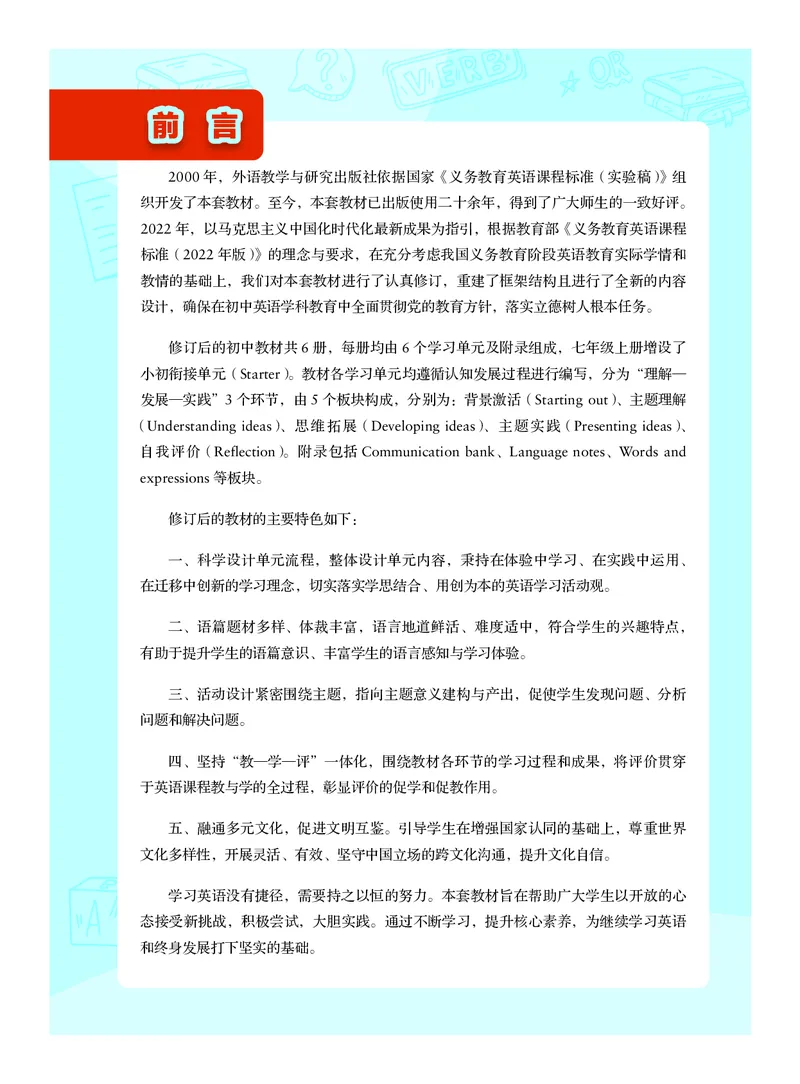
2000年,外语教学与研究出版社依据国家《义务教育英语课程标准(实验稿)》组
织开发了本套教材。至今,本套教材已出版使用二十余年,得到了广大师生的一致好评。
2022年,以马克思主义中国化时代化最新成果为指引,根据教育部《义务教育英语课程
标准(2022年版)》的理念与要求,在充分考虑我国义务教育阶段英语教育实际学情和
教情的基础上,我们对本套教材进行了认真修订,重建了框架结构且进行了全新的内容
设计,确保在初中英语学科教育中全面贯彻党的教育方针,落实立德树人根本任务。
修订后的初中教材共6册,每册均由6个学习单元及附录组成,七年级上册增设了
小初衔接单元(Starter)。教材各学习单元均遵循认知发展过程进行编写,分为“理解—
发展—实践”3个环节,由5个板块构成,分别为:背景激活(Starting out)、主题理解
(Understanding ideas)、思维拓展(Developing ideas)、主题实践(Presenting ideas)、
自我评价(Reflection)。附录包括Communication bank、Language notes、Words and
expressions等板块。
修订后的教材的主要特色如下:
一、科学设计单元流程,整体设计单元内容,秉持在体验中学习、在实践中运用、
在迁移中创新的学习理念,切实落实学思结合、用创为本的英语学习活动观。
二、语篇题材多样、体裁丰富,语言地道鲜活、难度适中,符合学生的兴趣特点,
有助于提升学生的语篇意识、丰富学生的语言感知与学习体验。
三、活动设计紧密围绕主题,指向主题意义建构与产出,促使学生发现问题、分析
问题和解决问题。
四、坚持“教—学—评”一体化,围绕教材各环节的学习过程和成果,将评价贯穿
于英语课程教与学的全过程,彰显评价的促学和促教作用。
五、融通多元文化,促进文明互鉴。引导学生在增强国家认同的基础上,尊重世界
文化多样性,开展灵活、有效、坚守中国立场的跨文化沟通,提升文化自信。
学习英语没有捷径,需要持之以恒的努力。本套教材旨在帮助广大学生以开放的心
态接受新挑战,积极尝试,大胆实践。通过不断学习,提升核心素养,为继续学习英语
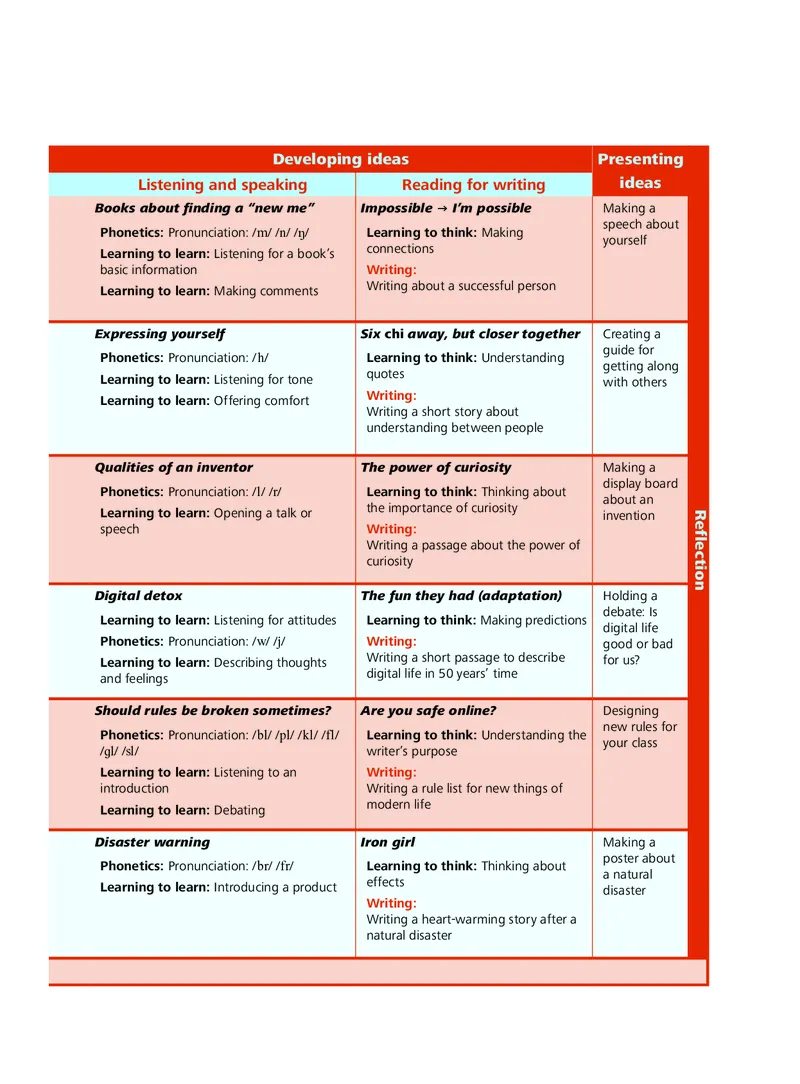
和终身发展打下坚实的基础。SSccooppee aanndd sseeqquueennccee
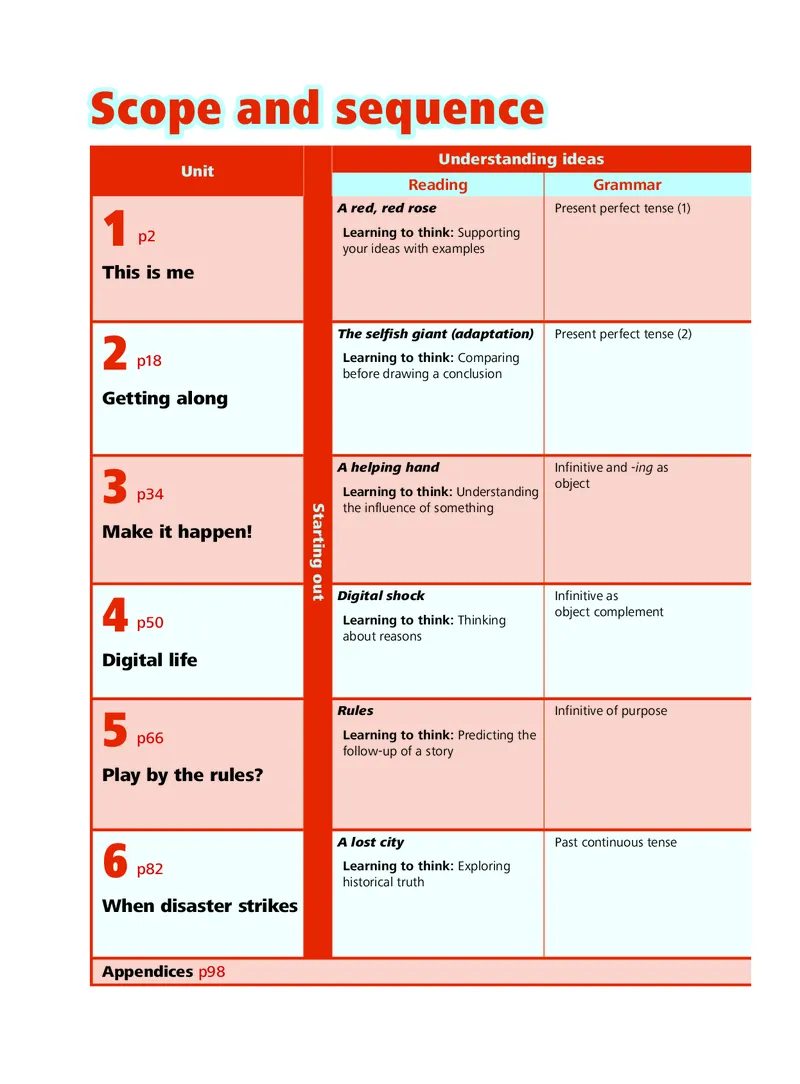
Understanding ideas Developing ideas Presenting
Unit
Reading Grammar Listening and speaking Reading for writing ideas
1 A red, red rose Present perfect tense (1) Books about finding a “new me” Impossible → I’m possible Making a
speech about
p2 Learning to think: Supporting Phonetics: Pronunciation: / m / / n / / ŋ / Learning to think: Making yourself
your ideas with examples connections
Learning to learn: Listening for a book’s
This is me basic information Writing:
Writing about a successful person
Learning to learn: Making comments
2 The selfish giant (adaptation) Present perfect tense (2) Expressing yourself Six chi away, but closer together Creating a
guide for
p18 Learning to think: Comparing Phonetics: Pronunciation: / / Learning to think: Understanding
h getting along
before drawing a conclusion quotes
Learning to learn: Listening for tone with others
Getting along Writing:
Learning to learn: Offering comfort
Writing a short story about
understanding between people
3 A helping hand Infinitive and -ing as Qualities of an inventor The power of curiosity Making a
object display board
p34 Learning to think: Understanding Phonetics: Pronunciation: / / / / Learning to think: Thinking about
l r about an
the influence of something the importance of curiosity
Learning to learn: Opening a talk or invention
Make it happen! speech Writing:
Writing a passage about the power of
curiosity
4 Digital shock Infinitive as Digital detox The fun they had (adaptation) Holding a
object complement debate: Is
p50 Learning to think: Thinking Learning to learn: Listening for attitudes Learning to think: Making predictions
digital life
about reasons
Phonetics: Pronunciation: / w / / j / Writing: good or bad
Digital life Learning to learn: Describing thoughts Writing a short passage to describe for us?
digital life in 50 years’ time
and feelings
5 Rules Infinitive of purpose Should rules be broken sometimes? Are you safe online? Designing
new rules for
p66 Learning to think: Predicting the Phonetics: Pronunciation: / / / / / / / / Learning to think: Understanding the
bl pl kl fl your class
follow-up of a story / / / / writer’s purpose
ɡl sl
Play by the rules? Learning to learn: Listening to an Writing:
introduction Writing a rule list for new things of
modern life
Learning to learn: Debating
6 A lost city Past continuous tense Disaster warning Iron girl Making a
poster about
p82 Learning to think: Exploring Phonetics: Pronunciation: / / / / Learning to think: Thinking about
br fr a natural
historical truth effects
Learning to learn: Introducing a product disaster
When disaster strikes Writing:
Writing a heart-warming story after a
natural disaster
Appendices p98
Starting
outUnderstanding ideas Developing ideas Presenting
Unit
Reading Grammar Listening and speaking Reading for writing ideas
1 A red, red rose Present perfect tense (1) Books about finding a “new me” Impossible → I’m possible Making a
speech about
p2 Learning to think: Supporting Phonetics: Pronunciation: / m / / n / / ŋ / Learning to think: Making yourself
your ideas with examples connections
Learning to learn: Listening for a book’s
This is me basic information Writing:
Writing about a successful person
Learning to learn: Making comments
2 The selfish giant (adaptation) Present perfect tense (2) Expressing yourself Six chi away, but closer together Creating a
guide for
p18 Learning to think: Comparing Phonetics: Pronunciation: / / Learning to think: Understanding
h getting along
before drawing a conclusion quotes
Learning to learn: Listening for tone with others
Getting along Writing:
Learning to learn: Offering comfort
Writing a short story about
understanding between people
3 A helping hand Infinitive and -ing as Qualities of an inventor The power of curiosity Making a
object display board
p34 Learning to think: Understanding Phonetics: Pronunciation: / / / / Learning to think: Thinking about
l r about an
the influence of something the importance of curiosity
Learning to learn: Opening a talk or invention
Make it happen! speech Writing:
Writing a passage about the power of
curiosity
4 Digital shock Infinitive as Digital detox The fun they had (adaptation) Holding a
object complement debate: Is
p50 Learning to think: Thinking Learning to learn: Listening for attitudes Learning to think: Making predictions
digital life
about reasons
Phonetics: Pronunciation: / w / / j / Writing: good or bad
Digital life Learning to learn: Describing thoughts Writing a short passage to describe for us?
digital life in 50 years’ time
and feelings
5 Rules Infinitive of purpose Should rules be broken sometimes? Are you safe online? Designing
new rules for
p66 Learning to think: Predicting the Phonetics: Pronunciation: / / / / / / / / Learning to think: Understanding the
bl pl kl fl your class
follow-up of a story / / / / writer’s purpose
ɡl sl
Play by the rules? Learning to learn: Listening to an Writing:
introduction Writing a rule list for new things of
modern life
Learning to learn: Debating
6 A lost city Past continuous tense Disaster warning Iron girl Making a
poster about
p82 Learning to think: Exploring Phonetics: Pronunciation: / / / / Learning to think: Thinking about
br fr a natural
historical truth effects
Learning to learn: Introducing a product disaster
When disaster strikes Writing:
Writing a heart-warming story after a
natural disaster
Appendices p98
ReflectionUnit
1
TThhiiss iiss mmee
We may think we know ourselves better than anyone else. But is that true? In this unit,
let’s explore the idea of self. What do you think of your looks? How much do you know
about yourself? Do you want to challenge yourself? By the end of this unit, you will make
a speech about yourself.
After completing the unit, you will be able to:
use words and expressions in the unit to talk about yourself.
use the present perfect tense to talk about experiences of accepting yourself.
describe yourself and your values.
2 UNIT 1What does the picture show?
Starting out
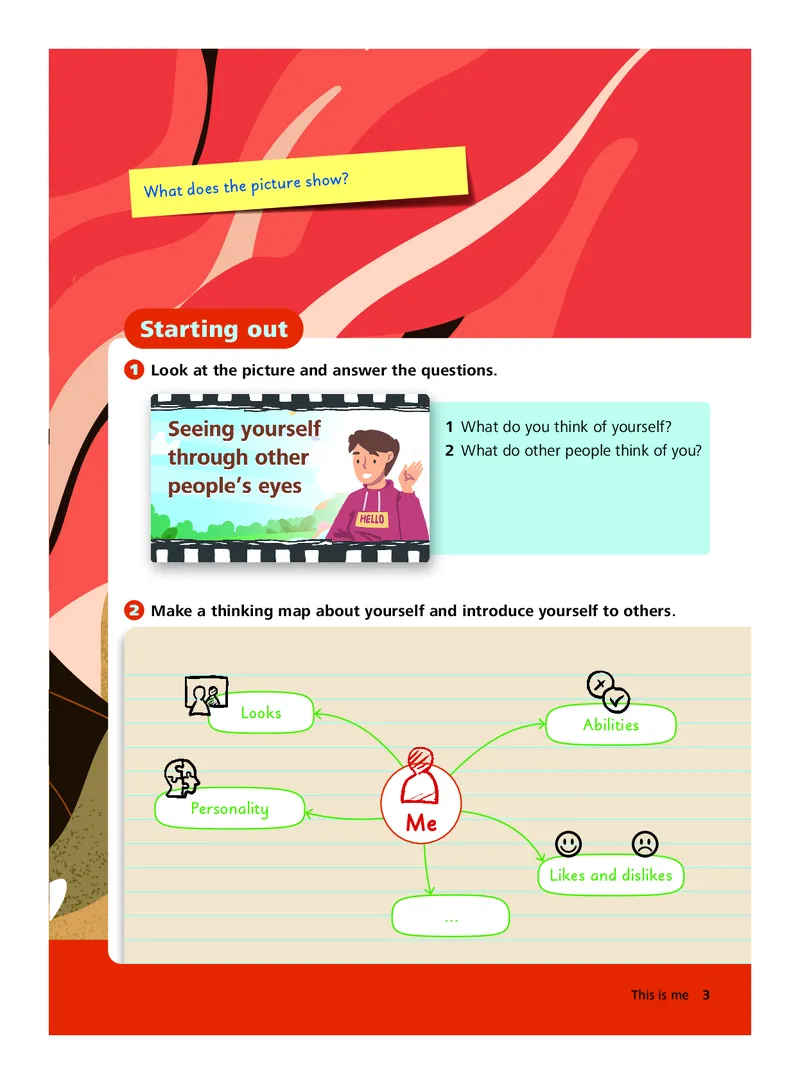
1 Look at the picture and answer the questions.
1 What do you think of yourself?
2 What do other people think of you?
2 Make a thinking map about yourself and introduce yourself to others.
Looks
Abilities
Personality
MMee
Likes and dislikes
…
This is me 3Understanding ideas
A
red, r
e d r o se
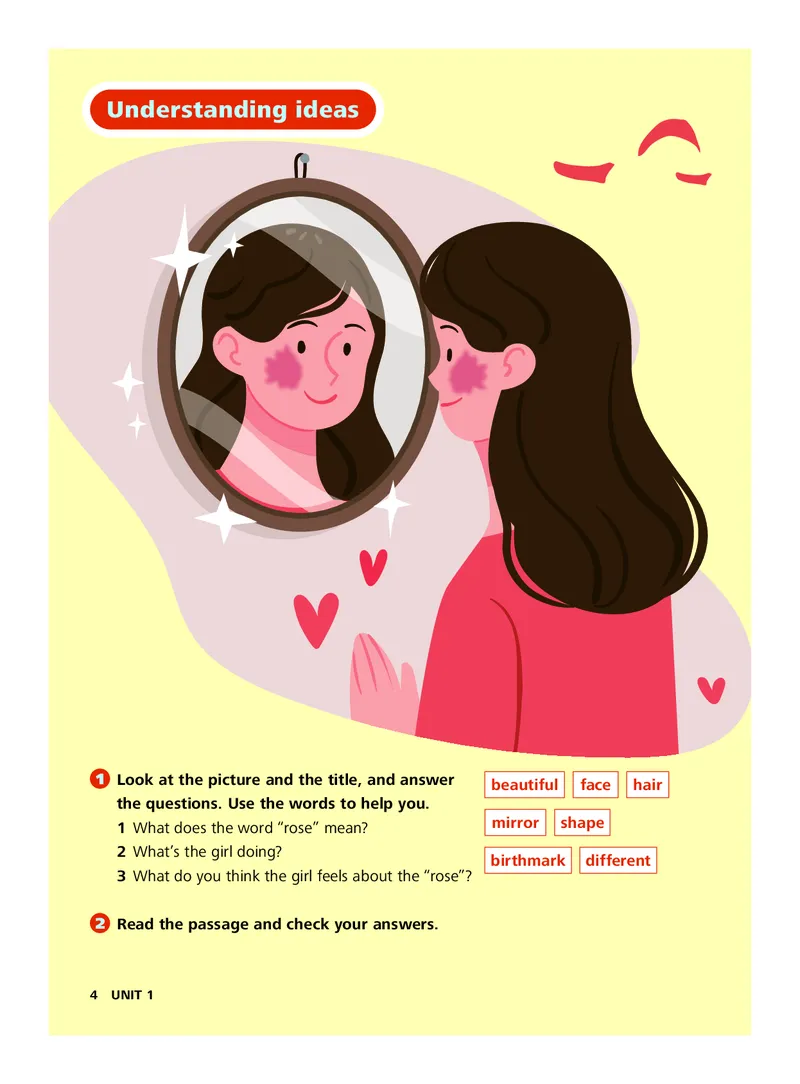
1 Look at the picture and the title, and answer
beautiful face hair
the questions. Use the words to help you.
mirror shape
1 What does the word “rose” mean?
2 What’s the girl doing?
birthmark different
3 What do you think the girl feels about the “rose”?
2 Read the passage and check your answers.
4 UNIT 1A
red, r
e d r o se
1 I suppose everyone has something they don’t like about
themselves. For me, it was the birthmark on my face. It was bright
red, the colour of a strawberry.
2 Sometimes, I felt people secretly looking at my face. But when
I turned my head, they looked away. On crowded buses and
trains, it felt just like a disaster. With so many people around me,
my birthmark burnt red hot. Therefore, I always kept my hair long
to cover it until that day.
3 It was a cloudy morning. A new student named Maddie arrived
in our class. She sat right beside me. Instead of looking away,
Maddie studied my face. This made me so nervous. Clouds came
through the window and filled my heart. Suddenly, she said
something I would never forget.
4 “Sally, right?” she said. “You have a red rose on your face. How
beautiful!”
5 I looked up and met her smiling eyes. Although I only replied
“thank you”, it turned sunny in my heart. When I got home,
I rushed to the bathroom and looked in the mirror. For the first
time, I could look at my birthmark without quickly turning away.
The shape of it was truly like a flower. The next day, to my
surprise, Maddie painted a red rose on her own face!
6 I haven’t told Maddie the whole story yet. Anyway, she has
changed me. I have already learnt that I am what I am. Everyone
has something special and different – that is what’s interesting.
This is me 53 Choose the best summary of the passage.
a Accept your differences. They make you special.
b Share your differences only with your closest friends.
c When you change your differences, you change your life.
4 Complete the notes with the words and expressions from the passage.
Beginning
• Sally hated the 1 on her face.
• She felt people 2 looking at her face.
• She always tried 3 it with her hair.
Middle
• To Maddie, it looked like a(n) 4 .
• Sally was surprised, and it 5 in her heart.
• The next day, Maddie 6 on her own face.
End
• Sally has changed her
opinion. Now she thinks
everyone is special and
7 in their own way.
Think and share
1 What does Sally think of her birthmark now?
2 Do you think people should worry about their looks? Why or why not?
Learning to think for question 2 You can use examples of successful
people and their sayings to support your idea. The results of scientific studies can
also help you make wise decisions.
6 UNIT 1Grammar rules⇢ p125
5 Read the sentences from the reading passage and summarise the
grammar rules.
(a) I haven’t told Maddie the whole story yet.
(b) I have already learnt that I am what I am.
Now find one more sentence with these structures in the reading passage.
6 Write sentences with the present perfect tense.
1 I / just / cut my long hair
2 She / never / worry about / her looks
3 I / just / paint a beautiful flower / on my face
4 Chris / always / wear / glasses
5 Jessica / already / change her opinion / on her looks
7 Complete the passage using the present perfect tense.
I 1 (always, be) the tallest student in my class. And I 2
(always, sit) in the last row at school. People always look at me in
surprise. “You must be good at basketball,” my classmates 3
(always, say). In fact, I’m not good at basketball at all. But being tall is not
always bad. It makes me easy to recognise, and I can help other people
get things down. Over time, I 4 (learn) to accept my height. I’m
proud of myself.
This is me 78 Work in pairs. Discuss the experience of accepting your looks. Use
the words and expressions from the reading passage and the Useful
expressions to help you.
Example
ExpEriENcE of accEptiNg yoursElf
Which part of your looks are How did you feel about it
you not happy with? before?
Why did you change your view How do you feel about it now?
of it?
What can you learn from this experience?
Useful expressions
• I was not happy with my… • For example, …
• … is a good way to… • I have already…
• What do you think of… now? • Why not…?
8 UNIT 1Developing ideas
Do you know any books of this kind?
The Adventures
of
by C. Collodi DID YOU
KNOW?
Many works of literature have described characters in search of their values. Some good
examples are The Wonderful Wizard of Oz, The Blue Bird and The Adventures of Pinocchio.
1 Listen to the radio programme and
Phonetics in use
choose the best summary of the book.
Pronunciation:
a A story about a girl trying to get back home.
/ / from must Woodman
m
b A story of friendship among unusual people.
/ / land want
n
c A story about a girl finding her missing friends. / / along
ŋ
d A story about a girl moving to a new city.
Practise more⇢ p99
This is me 92 Listen again and complete the
notes about the book. The Wonderful
Wizard
of
Oz
What kind of book is it?
It’s a 1 book.
Who are the main characters?
Dorothy, her dog Toto, the Great Wizard
Oz, the Scarecrow, the Tin Woodman
and the Cowardly Lion.
by
L. Frank Baum
What happens in the story?
A strong 2 takes Dorothy and
Toto away from home. They arrive in the magic Land of Oz. To get
back home, Dorothy must find 3 from the Great Wizard
Oz. Along the way she 4 the Scarecrow, the Tin Woodman
and the Cowardly Lion. They all need help from the wizard. The
Scarecrow wants a brain, the Woodman wants a 5 , and
the Lion wants 6 . So they go together. Lots of exciting
things happen…
Learning to learn
Listening for a book’s basic information To get the basic
information of a book, listen for the book’s name, writer, type,
characters, setting, plot and message. It’s helpful to take notes.
10 UNIT 13 Listen to the conversation and complete the comments.
Emma I really 1 the exciting story of Dorothy and her friends. But the
most interesting part is, each of them wants a thing from the wizard.
But in the end, they find it in 2 . For example, the Scarecrow
thinks he is not 3 , but in fact he can always find a way out.
He comes up with an idea to make a boat to 4 a river. He is
clever! He just doesn’t know. Anyway, it’s a great book about finding
our own values.
Ethan We already have the qualities, and we just need to 5 them.
Teacher We just need to 6 about ourselves and try.
Learning to learn
Listen again. Then Making comments To comment on books or films,
talk about how the we usually focus on the most interesting thing to us.
It can be the main idea or the main character. We can
students comment on
also give examples to support our comments.
the book.
4 Work in pairs. Introduce and comment on another book about finding a
“new me”.
A book about finding a What books do you know
A
“new me” about finding a “new me”?
• basic information
… is one such book.
B
• your favourite quote
Can you tell me more about it?
• your favourite character A
• the most unforgettable
Sure. It tells the story of…
B
event / interesting part
• the main idea / message
• …
Useful expressions⇢ p101
Talk about what you have learnt about exploring yourself in this section.
This is me 11Reading for writing
1 Look at the picture and answer the questions.
fight one’s fear try
Use the words and expressions to help you.
succeed doubt
1 Do you know the Chinese athlete?
2 What words would you use to describe him? stick to hold back
Impossible
1 “Nothing is impossible; the word itself says ‘I’m possible’.”
Audrey Hepburn, the British actress and star of the silver
screen, said this. However, doubts and fears often hold us back.
How can we face them and succeed?
2 The runner Su Bingtian gives an excellent answer to this
question. The young man began his sporting life in 2006. At
that time, no one from Asia had ever run the 100 m race in less
than 10 seconds. Su trained hard and quickly became one of the
fastest runners in Asia. In 2011, he ran the race in 10.16 seconds.
3 However, Su wasn’t satisfied. To run in under 10 seconds, in
2014, he changed his starting leg. This was a very risky decision.
12 UNIT 12 Read the story and check your answers.
I’m possible
He had to start from zero. At first, he was slower than before.
Also, he was 25 years old. At such an age, many runners choose
to stop running. People doubted his decision. However, Su fought
his fears and became a sporting hero.
4 In 2015, he clocked 9.99 seconds and made history. In 2021, he
finished in 9.83 seconds at the Tokyo Olympics. He also became
the first Chinese athlete to run in the Olympic 100 m final.
5 Su Bingtian has told youngsters, “Never let your age hold you
back. Have a try and try harder. I believe you can write your
own story.” Nothing is impossible as long as you try and stick
to it. Everyone can be a Su-perman!
This is me 133 Complete the timeline with the words and expressions from the passage.
2006 2011
He 1 his sporting He ran the 100 m race in
life. At that time, no one from Asia 3 .
had ever run the 100 m race in less
than 2 .
He changed his starting leg. He had to start 4 .
2014
However, Su 5 and became a sporting hero.
2015
He clocked 9.99 seconds and
6 .
He finished in 9.83 seconds and
became the first 7
to run in the Olympic 100 m final.
2021
4 Answer the questions.
Think and share
1 What do you think the title
1 What can you learn from Su Bingtian?
means?
2 What can you do to challenge yourself?
2 What do Su Bingtian’s words
in Paragraph 5 mean? Learning to think for question 1 To learn
3 What does the writer mean from successful people, you can study their
by “Everyone can be a experiences and think about the reasons behind
their success.
Su-perman!”?
14 UNIT 15 Write about a successful person.
1
Step
Search for information about a successful person and plan your passage
with the chart.
What challenges did the person face (doubts or fears)?
What did the person do to overcome the challenges?
What did the person achieve?
What are your comments about this person?
2
Step
Write about the person with the help of the chart.
3
Step
Check. Did you: ☐ cover all the information in Step 1?
☐ use the words and expressions from the reading passage?
☐ give your opinion about the person’s efforts and success?
4
Step
Share your passage with the class.
This is me 15Presenting ideas
Make a speech about yourself.
1
Step
Look at the thinking map in Starting out and think: has your idea about yourself
changed? Consider the following things:
• looks • likes and dislikes • personality • abilities
2
Step
Organise your ideas with the help of the following outline and prepare your
speech. You can use the language tips in the outline or find useful expressions
or sentences from this unit.
Introduction Stating the purpose or main idea of your speech
– My understanding of myself has changed…
– I’d like to share with you my true self.
Body
Describing your looks, likes and dislikes, Explaining reasons for possible changes
personality, abilities, etc – One reason for… is…
– I have got…
– I’ve learnt to accept…
– I used to…, but now I can…
– I like… about myself.
– I’ve… for the first time.
Conclusion Ending your description with comments about yourself
– I have learnt that I am what I am.
– I have discovered…
– Understanding myself means…
16 UNIT 13
Step
Practise and give your speech to the class.
4
Step
Vote on the best three speeches.
Reflection
1 After completing this unit, I understand more about the idea of self.
How to become a “better me”
Accept myself. Explore . Challenge .
2 To express my understanding, I can…
☐ use words and expressions in the unit to talk about myself:
☐ use the present perfect tense to talk about experiences of accepting myself.
☐ describe myself and my values.
*1 = excellent, 2 = good, 3 = not yet
3 I still need to improve:
This is me 17Unit
2
GGeettttiinngg aalloonngg
No one is an island. In this unit, let’s explore the secret of good relationships. How do
people get along with each other? What do you think is the most important thing when
making friends? By the end of this unit, you will create a guide for getting along with
others.
After completing the unit, you will be able to:
use words and expressions in the unit to talk about relationships.
use the present perfect tense to tell stories of sharing.
share your thoughts on how to get along with others.
18 UNIT 2What do you think this picture shows?
Starting out
1 Read the quotes and answer the questions.
Do not do to others what you do not want others to do to you.
Confucius
己所不欲,勿施于人。
孔子
Not everyone thinks the way you think, knows the things
you know, believes the things you believe, nor acts the
way you would act. Remember this and you will go a long
way in getting along with people.
Arthur Forman
We need people, we need the cooperation of others.
There is very little we can do alone.
Earl Nightingale
1 What are the quotes about?
2 Which quote do you agree with most? Why?
2 Look at the picture and answer the questions.
1 Do you have any problems in
getting along with others?
2 Can you share one with the class?
Getting along 19Understanding ideas
The
Self ish
Giant
by Oscar Wilde
1 Look at the title and the picture. Then predict what the
passage is about. Use the words to help you.
garden selfish play children angry spring
2 Read the passage. What does the Giant do to his garden?
20 UNIT 21 Every afternoon, the children play in the Giant’s garden. It is a large
garden with soft, green grass. Here and there, over the grass, stand
beautiful flowers, like stars.
2 The Giant has been away for a long time. One day, he comes back and
sees the children in his garden. “What are you doing here?” he shouts in
a very angry voice.
3 The children run away. The Giant closes the gate and builds a high wall
around the garden. Since then, he hasn’t seen a child there.
4 Then spring comes. But in the Giant’s garden, it is still winter. There are
no birds or flowers. “I cannot understand why spring has not come since
last year,” says the Giant. “I hope the weather changes soon.”
5 But spring never comes, nor summer. Autumn gives golden fruit to
every other garden. But it gives none to the Giant’s garden.
6 One morning, the Giant suddenly hears birds singing. “I haven’t heard
that beautiful birdsong for a while. I believe spring has come at last.”
The Giant jumps out of bed and looks outside.
7 The Giant sees a hole in the wall. Also, there is a little child in every
tree. And the trees are so glad that they have covered themselves with
flowers. The birds fly about and sing with joy. “How selfish I’ve been!”
he says. “Now I know why spring wouldn’t come here.”
8 He knocks down the wall. The children look
afraid. “Fear not, little ones,” the Giant
says. “It’s your garden now.”
Adaptation from “The Selfish Giant”
by Oscar Wilde
Getting along 21Think and share
3 Choose the message of the 1 Why doesn’t spring come to the
passage. Giant’s garden?
a Never make friends with selfish 2 Why do you think the Giant changes
people. his mind?
b Anger leads to unhappiness. 3 Do you know a story with a similar
c Shared joy is a double joy. message, either from a book or from
your own life? Share it with the class.
4 Complete the reading chart with
Learning to think for question 3
the words and expressions from
It’s important to compare different stories
the passage. before forming your understanding.
Climax
One morning, the Giant hears birds singing. He jumps out of
bed and 5 . The children have returned, and the
garden is lively again. He thinks he has been 6 .
Rising action
The Giant finds the children in his garden.
He shouts at them in a very 3
voice. The children run away. Since then,
4 has not come to his garden.
Ending
The Giant 7 the wall
Beginning and tells 8 the garden
The Giant has a large 1 is theirs.
and the children 2 in it
every afternoon.
22 UNIT 2Grammar rules⇢ p128
5 Read the sentences from the reading passage and summarise the
grammar rules.
(a) The Giant has been away for a long time.
(b) Since then, he hasn’t seen a child there.
Now find more sentences with these structures in the reading passage.
6 Complete the sentences with for or since.
1 We have been friends Grade 3.
2 They have been together three years.
3 last year, we’ve shared a lot of happy moments.
7 Complete the news article with for, since or the correct form of the
words in brackets.
Free ice creams, Most people hope to receive birthday gifts.
priceless gifts But Jimmy Teng, or “Uncle Jimmy”, does
things differently.
The 74-year-old man has sold ice creams
1 the past 17 years in Singapore.
Every year, on 22 March – his birthday – he 2 (offer) free ice
creams. He has done this 3 his 70th birthday.
This year, Uncle Jimmy plans to give away 800 ice creams. “People
4 (be) quite stressed recently and I want to help,” he said. “Sharing
has made me feel happy 5 the past four years.”
He 6 (enjoy) talking with his customers. Many of them have
become his friends 7 they first met. Some students helped him
set up social media pages. He has made many friends online 8
then.
Getting along 238 Work in pairs. Discuss your experience of sharing. Use the words and
expressions from the reading passage and the Useful expressions to
help you.
Example
When did it happen?
What happened?
How did you feel about it?
What have you learnt from it?
Useful expressions
• I have shared… with… for / since… • One day, …
• Sharing really brings… • How does sharing make you feel?
• Sharing has allowed / shown / taught me… • It makes me feel…
24 UNIT 2Developing ideas
What kind of fear does the girl on the right
in the picture have?
DID YOU
KNOW?
Many people have some kind of fear. Examples include
a fear of heights and a fear of attending social events.
It is often difficult for people to talk about their fears
with others. This sometimes influences their personal
relationships.
1 Listen to the conversation and choose the
Phonetics in use
main idea.
Pronunciation:
a Three friends are researching the highest roller
/ / hear who whom
h
coaster in the city.
Practise more⇢ p99
b Three friends are discussing going on a roller
coaster at the weekend.
c Three friends are trying to find out the bravest one
among them.
Getting along 252 Listen again. Complete the students’ thoughts about the roller coaster
and choose the correct feelings.
The new park is open. The Cloud Coaster
sounds 1 !
☐ ☐
It has the 2 roller coaster
in our city, and it can make you
feel like you’re 3 the
Linda
clouds! Let’s buy our tickets now.
I guess I’m just 4 …
☐ ☐
5 , I’ll come.
☐ ☐
Tom
Learning to learn
Paul
Listening for tone The tone of a speaker’s voice can
tell us how they feel. For example, when someone says
“fine” with a cheerful tone, it means they are happy.
However, an uncertain tone might show doubt.
26 UNIT 23 Listen to the conversation and complete the notes.
Paul’s worries Ms Thomson’s suggestions
My friends were so excited about riding • You should tell your friends that
the roller coaster. I didn’t want to make you’re afraid of 2 .
them 1 . • They’ll understand you.
• You can’t always hide your 3
to please others.
What if they never 4 me again? • You can still do 5 together.
• Just say 6“ ” and explain why.
• True friends will respect your feelings.
Learning to learn
Offering comfort When someone is unhappy, it’s
important to comfort them. It shows that you understand Listen again. Then
how they feel. Helpful expressions include I’m sorry to hear
talk about how the
that, That sounds difficult and I see.
teacher offers comfort.
4 Work in pairs. Choose a situation and act out a conversation.
Situation 1 I’m busy with I have a problem with my
A
my homework but my best friends.
friend keeps texting me!
It sounds… Why not try…?
B
I am afraid of…
Situation 2 I really want to join the A
dance club, but all my friends want me
Don’t worry. You’ll be fine.
B
to join the skating club with them.
Situation…
Useful expressions⇢ p101
Talk about what you have learnt about expressing your thoughts in this
section.
Getting along 27Reading for writing
1 Look at the picture and answer 1 Narrow lanes are very common in
the questions. Use the words China. They are usually about two
and expressions to help you. metres wide, or six chi in traditional
1 What can you see in the picture? Chinese units. Most of them are
2 What do you think the story is nothing special. But Liuchixiang
about? (Six-chi Lane) in Tongcheng, Anhui, is
perhaps the most famous one.
reach agreement
argue over dividing line
2 Its story started back in the Qing
neighbour give up kindness Dynasty. Two local families,
the Zhangs and the Wus, argued
2 Read the story and check over the dividing line between
your answers. their houses. They couldn’t reach
agreement. The Zhang family was
angry. Their relative, Zhang Ying, had
a position high up in the government.
They wrote him a letter, asking for
advice. When his reply came, they
opened it to find a poem inside.
Six chi away,
28 UNIT 2不 长 让 一
A letter from far away just for a wall 见 城 他 纸
Is not right or good at all. 当 万 三 书
Three chi to your neighbour as a gift 年 里 尺 来
Is nothing as time continues to drift. 秦 今 又 只
始 犹 何 为
皇 在 妨 墙
3 After reading it, the Zhang family felt
。 , 。 ,
ashamed. They stepped back three chi for
their neighbour. This act deeply moved the
Wu family. In return, they decided to do the
same thing. They gave up another three chi.
And so came the six-chi-wide lane between
the two houses.
4 Hundreds of years have passed since then,
and the lane is still there. The people of
Tongcheng still keep the poem in mind.
Whenever they walk down the lane, they
remember how kindness encourages more
kindness.
but closer together
Getting along 29Think and share
3 Answer the questions 1 What do you think the title means?
about the story. 2 Why does the writer use the poem in this story?
3 What have you learnt from the story?
Six chi away,
Learning to think for question 2 Writers may use
but closer together other people’s words to make their ideas stronger and
more believable. Understanding them helps us know the
theme better.
Introduction
1 Where is Liuchixiang in the story?
2 What’s special about it?
The problem
3 What did the two families argue about?
4 Who did the Zhang family ask for advice?
The solution
5 What suggestion did the Zhang family receive?
6 What did the Zhang family do then?
7 How did the Wu family behave?
The influence
8 What do the people of Tongcheng remember as they walk down the lane?
4 Answer the questions.
1 How do you understand “as a gift” and “as time continues to drift” in the poem?
2 What rhymes can you find in the poem?
3 What’s the effect of these rhymes?
30 UNIT 25 Write a short story about understanding between people.
1
Step
Organise your ideas by answering the following questions.
1 When did 2 Where did 3 Who were
the story happen? the story happen? in the story?
4 What problem did they face?
5 How did they solve the problem?
6 What does the story teach us about relationships?
2
Step
Write about your story with the help of the chart.
3
Step
Check. Did you: ☐ include people, a setting and events?
☐ use the words and expressions from the reading passage?
☐ give your opinion about the importance of understanding
others?
4
Step
Share your story with the class.
Getting along 31Presenting ideas
Create a guide for getting along with others.
1
Step
Work in groups, and list common problems in getting along with others. Think
about possible solutions. Then take a group vote to decide on one problem to
focus on.
2
Step
Create a guide with the help of the outline below. You can use the language tips
in the outline or find useful expressions or sentences from this unit.
Introduction Stating the importance of getting along with others
– Getting along with others is important because…
– You will always live / study / work with others, so…
Body
Describing one common problem Explaining solutions to the problem
– A common problem is… – The most important thing is…
– Sometimes you may argue over… – When having an argument
– Perhaps you can’t reach agreement about…, we need to…
on… – If you disagree about…, you
– I can’t understand why… should…
– … has been… for a long time. – We could choose to step back
and…
Conclusion Mentioning how good relationships can change your life
– Better relationships will help you…
– It’s good to see how kindness encourages more kindness.
32 UNIT 23
Step
Practise and present your guide to the class.
4
Step
Vote on the best three guides and the best three presentations.
Reflection
1 After completing this unit, I understand more about getting along with
others.
Secrets of good relationships
Share with others. Express . Understand .
2 To express my understanding, I can…
☐ use words and expressions in the unit to talk about relationships:
☐ use the present perfect tense to tell stories of sharing.
☐ share my thoughts on how to get along with others.
*1 = excellent, 2 = good, 3 = not yet
3 I still need to improve:
Getting along 33Unit
3
MMaakkee iitt hhaappppeenn!!
What does the picture mean to you?
Great inventions could change our lives. In this unit, let’s explore inventions. Where do
smart ideas come from? What qualities do inventors have? What drives people to invent?
By the end of this unit, you will make a display board about an invention.
After completing the unit, you will be able to:
use words and expressions in the unit to talk about inventions.
use the infinitive and -ing as object to talk about ideas for inventions.
explain the importance of inventions.
34 UNIT 3Starting out
1 Look at the picture and answer the questions.
1 What do you know about the
differences between the lives of
ancient people and ours?
2 What caused these differences?
2 Look at the pictures and answer the questions.
1 What are these inventions?
2 How have they changed our lives?
Make it happen! 35Understanding ideas
1 Look at the word cloud and predict what the passage is about.
artificial arm
design
invent
improve
helping hand
2 Read the passage and check your answer.
1 Easton LaChappelle, a 14-year-old student, stood beside his work
at a science fair. It was a robotic arm. He built it out of plastic
blocks and fishing line.
2 “Hello,” said a girl with an artificial arm, as she shook hands with
Easton’s work.
3 This was the first time Easton met Jenny, a girl with a special
condition. She was born without an arm. Her artificial arm was
just a simple hook, but it cost $80,000. What’s worse, children like
her grow quickly and need new arms all the time.
36 UNIT 34 “It blew me away! I built my arm for only $300,” thought Easton.
“I must lend a hand to people like her.”
5 After the fair, Easton’s room became a lab. He stayed there all day.
He always tried to improve his work. For his 16th birthday, Easton
got a 3-D printer. And with it, he invented an artificial arm. It was
able to move with brain signals of the user. But it wasn’t good
enough yet: the arm weighed 3.6 kilograms. It was too heavy for
a child.
6 Easton kept working on it. He enjoyed fixing problems one after
another. And finally he hit on success at age 23. His design only
weighed 0.5 kilograms and cost around $500!
7 Easton’s invention has helped many children. He didn’t want to
make money from it. He decided to post his design online… for
free! People can download the design and make an artificial arm
with their own 3-D printers!
8 What a helping hand!
Make it happen! 373 Order the following events in the passage.
Easton made a robotic arm with plastic blocks and fishing line.
Easton allowed people to use his design for free.
Easton and Jenny met at a science fair.
Easton made an artificial arm with a 3-D printer.
4 Complete the chart with the words and expressions from the passage.
How did Easton come up with the idea?
Where: At a(n) 1
Who: Jenny, a girl born 2
Problem to solve: Jenny’s artificial arm cost $80,000.
But children like her 3 , so they always need
new arms.
What are Easton’s inventions?
Age 14: A robotic arm. It was made from plastic blocks
and 4 .
Age 16: An artificial arm. It could 5 with brain
signals, but weighed 3.6 kilograms.
Age 23: Another artificial arm. It 6 just 0.5
kilograms and 7 around $500.
What did Easton do with his invention?
Think and share
1 How would Jenny’s life change with Easton’s
invention?
He decided to post his
2 What can you learn from Easton?
8 online for
free. People could make Learning to think for question 1 To understand
an artificial arm with the influence of something, you can compare the
their own 3-D printers. situation before and after the use of it.
38 UNIT 3Grammar rules⇢ p129
5 Read the sentences from the reading passage and summarise the
grammar rules.
(a) He always tried to improve his work.
(b) He enjoyed fixing problems one after another.
Now find more sentences with these structures in the reading passage.
6 Complete the paragraph with the correct form of the words in brackets.
Lily’s grandfather had Parkinson’s disease, and he
kept 1 (knock) his drinks over. Lily decided
2 (design) a new cup to help him. She
invented a cup with three legs. It can stand well on
the table and Grandpa enjoyed 3 (use) it!
7 Complete the news report with the correct form of the words in the box.
apply have do make
Boy designs 17-year-old Shantanu Gangwar noticed
a problem. Blind students at school had
smart stick
a hard time moving around. They wished
for the blind 1 a smart machine to warn them
about the objects in their way, so Shantanu
decided 2 something to help.
He invented a smart walking stick. It can sense objects nearby and
shake to warn the user.
Shantanu won an award and received many congratulations for his
invention. However, he wanted 3 it even better. He also
hoped 4 it to real life after finishing high school. “We can
produce a lot of these sticks and help more blind people,” he said.
Make it happen! 398 Work in pairs. Think of a problem and come up with an idea for an
invention. Then write an advertisement for it. Use the words and expressions
from the reading passage and the Useful expressions to help you.
What everyday problem do How does the problem trouble
you face? you?
How does the invention work? What invention could solve
the problem? (Be creative! You
can be as imaginative as you
want.)
Write
Introducing the
new !
The solves the problem of .
It works by .
Get one for
yourself now!
Useful expressions
• … was just a(n)…, but it cost… • I’m going to invent a(n)…
• What’s worse, … • It will be able to…
• I must lend a hand to…
40 UNIT 3Developing ideas
Who is this man?
DID YOU
KNOW?
Not every invention is created on purpose. Sometimes it’s completely by accident! For
example, in 1928, Dr Alexander Fleming forgot to clean his lab before going on a holiday.
Later, he discovered penicillin from an uncleaned Petri dish. It’s now one of the most used
medicines in the world!
1 Listen to the news programme. What is its main purpose?
a To encourage young people to become
Phonetics in use
inventors.
b To introduce some different invention Pronunciation:
exhibitions. / l / learn let
/ / remember Mary
c To invite people to come and see an r
invention exhibition. Practise more ⇢ p99
d To explain the history of some inventors
and inventions.
Make it happen! 412 Listen again and complete the advertisement.
Coming up:
Unexpected
Inventions
Exhibition!
Learn about great inventions and their 1
D
o n’t miss o u
t!
Place Tickets
City Museum Adults £30
Time 3 £15
1 May – 2 , 9 am – 5 pm Children under 12 4
Special event
A talk by Mary Brown. You can learn all about the 5 of
a successful inventor. It starts at 6 am on 1 May.
42 UNIT 33 Listen to the talk and complete the chart.
Qualities
1 widely. Never stop 4 . Some 6 .
Invention examples
Spencer Silver invented The Wright Brothers learnt A boy left a glass of
a type of 2 . But from 5 and never 7 outside with a
it was too weak. Later, lost hope. stick in it. The next day,
Arthur Fry found it perfect he found it was frozen.
for sticking notes to He tasted it and invented
3 . This invention the ice lolly.
was the Post-it note.
Learning to learn
Listen again. Then Opening a talk or speech A good start can
talk about how the quickly catch the listeners’ attention. We can start by
addressing the listeners directly, asking an interesting
speaker opens the talk.
question, telling a story or sharing a famous saying.
4 Work in pairs. Act out a conversation about an invention and its inventor.
Turn to Page 102. Turn to Page 103.
A B
Talk about what you have learnt about the qualities of an inventor in this
section.
Make it happen! 43Reading for writing
1 Look at the pictures and answer the questions.
Use the words and expressions to help you.
1 Who invented them?
2 How would you describe the inventors?
curious new discoveries do research
brave pioneer scientist discover
2 Read the passage and check your answers.
1 Albert Einstein once said, “I have no special talents. I am only
passionately curious.” The greatest inventions in history would be
impossible without curiosity.
2 Curiosity can bring new discoveries. Benjamin Franklin is a great
example. He was drawn to electricity and had a deep curiosity
about its nature. He did lots of research to try to understand it.
For example, he flew a kite during a storm. His curiosity led him
to invent the lightning rod. This invention protects buildings from
lightning.
3 Curiosity can also make people brave. Just look at Wan Hu,
the Ming Dynasty pioneer of space
exploration. He was so curious about
space that he invented a “flying chair”!
He lost his life while testing this invention.
44 UNIT 3The power of
curiosity
Despite the failure, his curiosity gave future explorers ideas. People
learnt from his example, and created safer ways to explore space.
4 But curiosity is more than just taking risks. It also drives people
towards certain goals. Zhang Heng, a Chinese scientist and
inventor, was curious about the world: how did everything in
the world move? He spent years studying the sky and the earth.
Finally, he drew China’s first star map, and invented the first
earthquake detector. His curiosity continues to influence scientists
today.
5 As Jacques Cousteau said, “What is a scientist after all? It is
a curious man looking through a keyhole, the keyhole of nature,
trying to know what’s going on.” Curiosity is the key. It opens one
door after another for us to discover a new world.
Make it happen! 453 Complete the chart with the words and expressions from the passage.
What were they curious about?
Benjamin Franklin Wan Hu Zhang Heng
He was curious about the He was a curious As a(n) 6 , he was
1 of electricity. 4 of space curious about the world.
He did a lot of 2 . exploration. He invented He spent years studying
He once flew a kite during a “flying chair”, and he 7 . He drew
a(n) 3 . He tested the invention by China’s first 8
invented the lightning rod. himself. But unluckily he and invented the first
5 . earthquake detector.
4 Answer the questions.
1 What words of famous people does the writer use in the passage? What are
their effects?
2 What door can the key of curiosity open?
3 What other examples can you use to describe curiosity?
Think and share
1 Do you think inventors could work without curiosity? Why or why not?
2 What are you most curious about?
Learning to think for question 1 You can consider these questions: What famous
inventors do you know? What role does curiosity play in creating their inventions?
46 UNIT 35 Write a passage about the power of curiosity.
1
Step
Look at the opinions on curiosity below. Choose one to write about.
• Curiosity can bring new discoveries.
• Curiosity can make people brave.
• Curiosity can drive people towards certain goals.
2
Step
Think of other examples to prove the opinion and organise your idea with
the thinking map.
Example(s):
My idea:
3
Step
Write your passage.
4
Step
Check. Did you: ☐ use enough examples to support your idea?
☐ use the words and expressions from the reading passage?
☐ give your opinion about the power of curiosity?
5
Step
Share your passage with the class.
Make it happen! 47Presenting ideas
Make a display board about an invention.
1
Step
Work in groups. Search for information about great inventions. They can
be inventions from history or modern times. Talk about their inventors and
importance. Take a group vote to decide on one invention.
• name of the invention • the inventor • its importance
2
Step
Prepare your display board and use the following outline to organise your
ideas. You can use the language tips in the outline or find useful expressions or
sentences from this unit.
Invention name
Problem About the inventor Materials
– People wanted – …, a(n)… scientist / – … made it out of…
something… inventor, was curious – Using…, … invented
– People had a about… the…
hard time… They – He / She spent years
wished… studying… How it works
– Finally he / she… – It is able to work
Solution with…
– The answer was to… – Once it senses…,
– … decided to invent it starts…
a(n)… It was able
to…
Remember!
Don’t forget to include some pictures
on your display board.
48 UNIT 33
Step
Practise and present your display board to the class.
4
Step
Vote on the best three display boards and the best three presentations.
Reflection
1 After completing this unit, I understand more about great inventions.
What leads to inventions?
Inventions come from Inventions come from Inventions come from
problems to be solved. . .
2 To express my understanding, I can…
☐ use words and expressions in the unit to talk about inventions:
☐ use the infinitive and -ing as object to talk about ideas for inventions.
☐ explain the importance of inventions.
*1 = excellent, 2 = good, 3 = not yet
3 I still need to improve:
Make it happen! 49Unit
4
DDiiggiittaall lliiffee
Today, we cannot live without technology. In this unit, let’s explore digital life. How has
digital technology made life easier? How can we use digital devices wisely? What will digital
life be like in the future? By the end of this unit, you will hold a debate on digital life.
After completing the unit, you will be able to:
use words and expressions in the unit to talk about digital life.
use the infinitive as object complement to talk about digital experiences.
describe the future of digital technology.
50 UNIT 4What do you think the picture shows?
Starting out
1 Look at the picture and answer the questions.
1 What facts do you know about
the digital world?
2 Which fact interests you most?
2 Look at the picture and answer the questions.
1 What digital technologies have you used?
2 How digital is your life?
Digital life 51Understanding ideas
1 Look at the pictures on the right
and talk about how much you
know about them. Use the words
and expressions to help you.
shared bike smartphone
app digital payment
technology convenient
2 Read the passage. What problems did the writer come across?
Digital shock
1 I’ve studied in China for a year and now it’s the Christmas holiday.
I’ve been back in the UK for three days, but it feels like a century!
It’s amazing to see my family. Also, I really love Christmas and
the delicious food. However, I’ve had some digital problems
here.
2 Today, I wanted to get some vegetables and meat from a shop.
I decided to ride a shared bike to get there. But it took forever to
find a bike! I finally found an old one. But that 20-minute ride cost
me an arm and a leg – 4.8 pounds!
£4.80
52 UNIT 43 In the shop, I quickly got everything I needed.
I wanted to pay with my smartphone. I asked
the shopkeeper to show the QR code, but she didn’t
understand! Next, I tried to use my digital wallet,
but the shop’s payment system didn’t work. The
shopkeeper told me to use cash. As I always make
digital payments in China, I never carry my wallet.
I had to go home to get some cash.
Digital shock
4 When I got home, I was so tired that I gave up on cooking. I ordered my
favourite dishes through an app instead, but the delivery was really slow.
When my dishes finally arrived 90 minutes later, they were stone-cold! I had
to heat them one by one in the oven. I felt tired and hungry.
5 Except for today, I’ve had a great holiday. However,
I’m looking forward to going back to China.
The technology there lets me live a more
convenient life!
Digital life 533 Choose another suitable title for the passage.
a Shared bikes for you and me
b Shopping online in the UK
c A day of digital problems
d Problems with food delivery apps
4 Complete the diagram with the words and expressions from the passage.
The writer’s digital shock
in the UK
1 It 2 to find one.
The 20-minute ride cost me 3 .
4 There wasn’t a QR code in the shop.
The shop’s 5 didn’t work.
I had to go home to get some 6 .
Food delivery I ordered food through a(n) 7 .
The delivery was very 8 .
The food was stone-cold.
Think and share
1 Why does the writer say that technology makes life more convenient in China?
2 Why do you think digital technology is so popular in China?
Learning to think for question 2 There are a lot of reasons behind the wide use of
digital technology. You can think about technology development and government plans.
54 UNIT 4Grammar rules⇢ p130
5 Read the sentences from the reading passage and summarise the
grammar rules.
(a) I asked the shopkeeper to show the QR code, but she didn’t understand!
(b) The technology there lets me live a more convenient life!
Now find one more sentence with these structures in the reading passage.
6 Read and circle the correct words.
1 Mobile payment allows us to use / using our smartphones to pay for things
easily.
2 Shared bikes have made us get / getting around cities more conveniently.
3 Social media let us connecting / connect with others and share our thoughts.
4 Online education helps us learning / learn new things anytime, anywhere.
7 Complete the post with the correct form of the words in the box.
stay paint check explore live
Digital technology has helped us 1 a wonderful life! I love
checking out cool pictures and posts on social media. They allow me
2 in touch with my friends and share happy moments. I’ve
also learnt a great deal via online learning apps! For example, I took
some interesting courses on traditional Chinese painting on an app.
They taught me 3 bamboo step by step. The app
even let me 4 my daily progress. Such apps
also encouraged me 5 other fun activities.
But you have to be careful and not get too
caught up in it. After all, the offline
world is also exciting, right?
Digital life 558 Work in pairs. Talk about how digital technology has made life easier.
Use the words and expressions from the reading passage and the Useful
expressions to help you.
Example
no need to
bring wallet
payment
DDiiggiittaall
pay quickly
tteecchhnnoollooggyy
Useful expressions
• It has made me live a(n)… life. • One advantage of apps / the internet /
• Nowadays, instead of…, you can simply… social media is…
• Technology saves me time because… • What effect has… had on your life?
56 UNIT 4Developing ideas
What are they doing?
DID YOU
KNOW?
Young people today are born in a new era. They have grown up with the internet, apps
and smartphones. Digital technology is already part of their everyday life. These people are
called “digital natives” or the “screen generation”.
1 Listen to the conversation
Learning to learn
and answer the questions.
Listening for attitudes To listen
1 How does Timmy’s mum feel
for a person’s attitude, you should pay
about Timmy using his phone?
attention to their tone of voice. Do they
2 How does Timmy feel about his
sound happy or angry? They may also use
mum trying to take his phone words like What? or No! to show surprise
away? or disagreement.
Digital life 572 Listen again and complete the conversation.
Ouch! Mum, I’ve got a really bad 1 in my neck!
Timmy
Well, you’ve been glued to your 2 for hours.
Mum
But I’m doing important things – 3 and learning…
Timmy
And chatting and playing games, too?
Mum
Yes, but not that much…
Timmy
Timmy, pass me your phone. I think it needs
to charge for a few 4 .
Mum
But I’m in the middle of a… book.
Timmy
A book or a game? Hmm. Perhaps I should
send you to 5 house. You can stay
Mum
away from your phone for a few days.
What? Mum, no! You can’t!
Timmy
Phonetics in use
Pronunciation:
/ / well what
w
/ / you your yes
j
Practise more ⇢ p99
58 UNIT 43 Listen to the conversation and complete the table.
How was your time
It was great. I went 1 with Grandpa.
at Grandpa’s?
At first, I felt quite bored, but then I started to
Did you enjoy it?
2 it. I also loved Grandpa’s 3 .
What happened
We caught a 4 and cooked it on the campfire.
next?
Did you miss your Yes, but only for the first day. After that, I had too much
phone? 5 to think about it.
There are lots of 6 things to do in the real
What did you learn? world. Smartphones are useful, but we shouldn’t let
them take up all our time.
Listen again. Then
Learning to learn
talk about how Timmy
Describing thoughts and feelings We can show
and his mother describe
our thoughts and feelings directly, using expressions
their thoughts and
like In my opinion…, I believe that…, I think… and
feelings. I feel… We can also share stories or experiences to
show our feelings and thoughts.
4 Work in pairs. Talk about how to use digital devices wisely.
Digital devices
What digital devices do you use?
A
• basic information
I use…
• functions B
• advantages Do you enjoy them?
A
• disadvantages
Yes. In my opinion…
B
• ways to use them
Do you think we should always use them?
A
Yes, because… / No, because…
B
Useful expressions⇢ p104
Talk about what you have learnt about using digital devices wisely in
this section.
Digital life 59Reading for writing
1 Look at the two pictures and compare the two schools. Use the words to
help you.
book screen teacher
classroom people
machine
2 Read the passage. Who teaches Margie?
TThhee ff uunn
tt
hheeyy hhaadd
1 In her diary, on 17 May 2157, Margie wrote:
“Today, Tommy found a real book!”
2 It was a very old book. They turned the old,
yellow pages. It was strange to read the words. They stood still on
the pages, instead of moving across a screen.
3 “What a waste!” said Tommy. “When you finish the book, you just
throw it away, I guess. Our television screen must have a million
books on it! I wouldn’t throw it away.”
4 Margie asked, “What’s the book about?”
5 “School.”
6 “Why would anyone write about school?”
7 “Because it’s an old kind of school, from hundreds of years ago. They
had a teacher, but it was a person. There was a special building, and
all the kids and teachers went there.”
60 UNIT 48 Margie wanted to read about those funny schools. But her mother
called, “Margie! School!”
9 Margie’s classroom was right next to her bedroom. Her teacher was
a machine. It was on and waiting for her. The screen was lit up. The
machine said: “Today’s lesson is on maths. Please put
yesterday’s homework in the opening.”
10 Margie did so sadly. She was thinking about the
old schools. All the kids from the neighbourhood
came, and laughed and shouted in the playground.
They sat together in the classroom, and went home
together after school.
11 And the teachers were people…
12 Margie was thinking about how the students must
have loved school in the old days. She was thinking
about the fun they had.
Adaptation from “The Fun
They Had” by Isaac Asimov
Digital life 613 Complete the table.
AAbboouutt tthhee rreeaall bbooookk AAbboouutt tthhee sscchhooooll
• Who found the real book? • Why did the writer of the book
write about school?
• What was the book like?
• What was Margie’s school like?
• What did Margie and Tommy
think of the book? • What were Margie’s thoughts
about the old schools?
• What was the book about?
4 Answer the questions.
1 How might Margie feel when she saw a “real book”?
2 Were the children familiar with “real books”? How can you tell?
Think and share
1 Do you want to go to a school like Margie’s? Why or why not?
2 What do you think schools will be like in 50 years?
Learning to think for question 2 To make smart predictions about future schools,
you need to consider the development of technology and social changes.
62 UNIT 45 Write a short passage to describe digital life in 50 years’ time.
1
Step
Organise your ideas with the chart below.
Opening
In general, will life be more digital in 50 years’ time?
Body
How digital will… be?
Ending
Will this change be good or bad for people in the future?
2
Step
Write your passage with the help of the chart.
3
Step
Check. Did you: ☐ describe some parts of digital life in the future?
☐ use the words and expressions from the reading
passage?
☐ give your opinion about digital life in the future?
4
Step
Share your passage with the class.
Digital life 63Presenting ideas
Hold a debate: Is digital life good or bad for us?
1
Step
Work in groups and choose your side. Search for more ideas about digital life
and think of its advantages and disadvantages. Consider the following aspects:
• communication • learning • music & movies
• safety • health • news
2
Step
Organise your ideas with the help of the following outline and prepare for the
debate. You can use the language tips in the outline or find useful expressions
or sentences from this unit.
Opening Stating your side
– We believe that… – In our opinion, …
Several rounds
Arguments for / against digital life Supporting arguments with examples or
– Digital technology lets people live personal experiences
– For example, …
a more convenient life.
– … is a good example of this.
– … is really useful, but we shouldn’t
let it take up all our time. Explaining your disagreement with the other
– … allows us to… team
– I’m afraid I have to disagree.
– It has made life easier / harder by…
– Team A / B has said… But in fact, …
Conclusion Summarising the main points of your team
– There is no doubt that… – It’s clear that we should /
– As we have discussed, … shouldn’t…
64 UNIT 43
Step
Practise and hold the debate in class.
4
Step
Vote in class on the best team. Consider the following:
• listening carefully • not interrupting
• using kind words • speaking clearly
Reflection
1 After completing this unit, I understand more about digital life.
Digital technology and us
We should use it We need to
It makes life easy.
. about future digital life.
2 To express my understanding, I can…
☐ use words and expressions in the unit to talk about digital life:
☐ use the infinitive as object complement to talk about digital experiences.
☐ describe the future of digital technology.
*1 = excellent, 2 = good, 3 = not yet
3 I still need to improve:
Digital life 65Unit
PPllaayy bbyy
5
tthhee rruulleess??
Everywhere we go, there are rules. In this unit, let’s explore different types of rules. Why
are rules important? How do rules change over time? By the end of this unit, you will design
new rules for your class.
After completing the unit, you will be able to:
use words and expressions in the unit to talk about rules.
use the infinitive of purpose to tell stories about following rules.
describe the importance of rules.
66 UNIT 5What can you see in the
picture?
Starting out
1 Look at the picture and answer the questions.
1 What kinds of rules do you need
to follow in daily life?
2 Can you give an example?
2 Read the quotes and answer the questions.
Nothing can be done without norms or standards.
Mencius
不以规矩,不能成方圆。
孟子
Good order is the foundation of all things.
Edmund Burke
1 What do these quotes mean?
2 Which one do you agree with more? Why?
Play by the rules? 67Understanding ideas
1 Look at the picture and answer the questions.
rule train noise quiet
Use the words and expressions to help you.
smelly play loud music
1 What rules are the people breaking?
2 What other rules should we follow on the train? kick one’s seat look after
2 Read the passage and find out how the passengers on a train broke rules.
s
R u l e
1 After a busy day at work, I got on the train to go home. I went to
a quiet area in order to read. I sat down and took out my book.
2 Suddenly, a girl opposite me started playing loud music on her
phone. What a shock! I almost jumped up in surprise.
68 UNIT 53 A minute later, the man next to me took out several packets of
food. It was like he was on a picnic. People have to eat, of course,
but the food was so smelly! It was like sitting next to a mountain
of blue cheese.
4 I covered my ears in order to block the noise coming from Rock
Girl. I covered my nose so as to reduce the smell coming from
Mr Smelly Food.
5 Then a boy behind me started to kick my seat. My anger grew.
My face turned as red as a tomato! I asked him to stop. However,
his mother replied, “Come on, he’s just a kid.”
6 I turned around so as to see the other passengers’ faces. They
also seemed unhappy, but no one did anything. Will they think me
a fool if I do something? I looked at the signs on the wall. They
read “Please be quiet”, “No smelly food” and “Please look after
your children”. Everyone knows the rules, I thought. They aren’t
just on the wall but also in our minds and hearts. And rules are
there for us to follow!
7 Suddenly, I felt brave. I took a deep breath, stood up and cleared
my throat…
Play by the rules? 693 Choose another suitable title for the passage.
a Not my responsibility!
b Stand up to bad behaviour
c Make your own rules
4 Complete the table with the words and expressions from the passage.
Setting: The writer got on the train, sat down, and took out his book. Then…
What happened How the writer felt The actions the writer took
A girl opposite him started It was such a shock. He He covered his ears
1 on her phone. felt surprised. in order to block the
2 .
A man next to him took It was like 4 next He covered his nose so as
out several packets of to a mountain of blue to reduce the smell.
food. The food was so cheese.
3 !
A boy behind him started His 6 grew and He asked the boy to stop,
to 5 . his face turned as red as but it didn‘t work.
a tomato.
He looked at the He thought rules are there He took a deep breath,
7 on the wall. for people to 8 stood up and cleared his
and he felt brave suddenly. throat…
Think and share
1 What do you think will happen next in the story?
2 Have you ever seen people break some rules? What did you do?
Learning to think for question 1 To guess what happens next in a story, use the
information you know. You can think about characters’ actions and thoughts. You can also
consider causes and effects within the story.
70 UNIT 5Grammar rules⇢ p131
5 Read the sentences from the reading passage and summarise the
grammar rules.
(a) I got on the train to go home.
(b) I went to a quiet area in order to read.
(c) I covered my nose so as to reduce the smell coming from Mr Smelly
Food.
Now find more sentences with these structures in the reading passage.
6 Rewrite the sentences with to, in order to or so as to.
1 People wear seat belts in cars. People want to stay safe on the road.
2 Sally arrived at the train station before 6:00 am. She needed to catch the
earliest train.
3 I listened carefully in maths class. I hope to improve my grades.
7 Complete the letter to Story Aunt using the notes in brackets and the
grammar you have learnt.
Dear Story Aunt,
1 (I’m writing, share a touching story). Yesterday, 2 (I left
my flat, go to work). However, I found my favourite flowerpot broken.
3 (I picked up the pieces, clean up the mess). Then I saw a note.
It was from a boy. He said he broke the flowerpot while playing basketball.
4 (he wrote the note, say sorry to me). He also left his phone number
with some money. His honesty made me respect him. Telling the truth isn’t
always easy. However, he followed the rules in his heart.
I’m 5 (sharing my story, spread some happiness). In the story, we can
see the kindness in small things.
Best wishes,
Ms Yu, from Wenzhou
Play by the rules? 7188 Work in pairs. Share a story of following rules. Use the words and
expressions from the reading passage and the Useful expressions to help
you.
Example
AA ssttoorryy aabboouutt rruulleess
• When did the story happen?
• Where did the story happen?
• What did you do?
• What have you learnt?
Useful expressions
• Last…, I… • I tried to…
• Please… • This rule is useful because…
• I love doing… in order to… • From this experience, I have learnt that…
• People have to…
72 UNIT 5Developing ideas
What
message does the picture want to show?
Yes
No
DID YOU
KNOW?
“To be, or not to be: that is the question.” This is a famous line from Shakespeare’s play
Hamlet. People often use this sentence to describe difficult decisions.
1 Listen to the radio programme and choose
Phonetics in use
the topic.
Pronunciation:
a Is it ever OK to break rules?
/ / Blake blind
bl
b Does society need more rules?
/ / explore planet
pl
c Should traffic laws be changed? / / clear clock
kl
d Why do we need rules? / / flew flag
fl
/g / glad glass
l
/ / slow slide
sl
Practise more ⇢ p100
Play by the rules? 732 Listen again and complete the notes.
Clear View
Today’s topic:
Should 1 be broken sometimes?
A story:
• Alex was a 2 .
• One day, he had a very 3 passenger. Alex 4 very
fast to the hospital at once. He didn’t 5 at red lights. He
even flew through one.
Guests:
Zhang Xinyan: Tom Blake:
a lawyer a university 6
Learning to learn
Listening to an introduction A programme’s introduction
helps people decide whether to listen or not. It usually includes the
programme’s and the host’s names. It may include the subject and
some key information about the guests.
74 UNIT 53 Listen to the debate and complete the arguments.
Of course, we should not break rules. But in some very
special situations, breaking rules can 1 . Just
like this taxi driver.
People should not break rules. We have rules for a
2 . The taxi driver could cause an accident.
He might 3 someone.
In some urgent situations, it might be okay to break
certain rules without causing 4 .
Rules are 5 us and for society. 6
them can have very bad effects.
Listen again. Then
Learning to learn
talk about how Tom
Debating When taking part in a debate, start by
and Xinyan debate.
stating your arguments. Then use examples or personal
experiences to support your arguments. Finally,
summarise your main points using short, clear sentences.
4 Work in groups and carry on the debate. Use the following table to help
you prepare.
In my opinion, I believe that…
A
Is your team for or against the topic?
I can’t agree with you because…
B
Argument 1: Example:
I understand your point, but…
A
Argument 2: Example: In conclusion, for one
B
thing, …; for another, …
Argument 3: Example:
Useful expressions⇢ p104
Talk about what you have learnt about special cases in following rules
in this section.
Play by the rules? 75Reading for writing
1 Look at the pictures and answer the questions. Use the words and
expressions to help you.
1 What behaviour does each picture show?
2 Are these behaviours safe?
p m a in s gm s in w g20 o 10 r 11 d 11 :
I’m just joining a new
group chat to make
some new friends.
I’ S m tr e g e o t i n n g o w to . t W he h o P e w a a ce n f t u s l t C o a c f o é m o e n a Y l a o t n e g s ? 18 n 6 p u S m h 5 u o 5 b r n e e … e ! r s M o i t s o D m y n m o e b e o t y u e v i o o m n e e t k t u r e t w h W e n m w w ? e o e e r e w a e f t h n e o . n t a k r v e , e a ch
online stranger the internet risk stay safe message
post personal information chat
2 Read the guide and check your answers.
Online guide ▶ Internet safety
Are you safe
online?
Think 20 years back when chatting face to face with loved ones far away
was a dream. Nowadays, the internet has made it a piece of cake! There
are so many netizens, that is, citizens on the internet! We can get in
touch with anyone with just one click. But the internet has also brought
new risks. Here are the basic rules you need to know to stay safe online.
76 UNIT 51Keep personal information private.
Avoid posting personal information online. This
includes your full name, phone number, address, ID or
passport number. Sometimes you may have to post this
information. However, limit who sees it. Only people
you know should see your information.
2Be password smart!
To protect your online accounts, it’s important to
use a “strong and long” password. Don’t use words that
are easy to guess, like your birthday. Change it often
and don’t be careless.
3
Be aware of strangers.
Never meet online strangers in real life. They
may cheat you. Only spend time online with trusted
friends.
4Be careful with your posts.
Who reads our social media posts? We never
know. Think carefully before posting something online.
Words sometimes hurt people and you can make
enemies. Remember that behaving badly online has
costs.
5Ask for help.
People sometimes say bad things to other people
online. This is cyberbullying. If you find yourself in hot
water, don’t answer any bad messages. Instead, turn to
your parents, teachers or other trusted adults for help.
You don’t have to face your problems alone!
Play by the rules? 773 Complete the notes with the words and expressions from the guide.
Online safety rules
Nowadays, the internet has brought 1 . So we need to follow some
basic rules to stay safe online.
Points What we should do
2 • Don’t let unfamiliar people know your full name, phone number,
information 3 , ID or passport number online.
• Only people you know should see your information.
Password • Have a(n) 4 password (avoid using your birthday).
• 5 it often.
People • Never meet 6 in real life.
online • Only 7 online with trusted friends.
Posts • Think 8 before posting something online.
• Remember that behaving badly online has costs.
Cyberbullying • Don’t 9 any bad messages.
• Turn to your parents, teachers or other trusted adults for
10 .
4 Answer the questions.
1 What does the writer mean by the expression “in hot water”?
2 Why does the writer choose to use this expression instead of a more direct one?
Think and share
1 Why does the writer mention a situation from the past at the beginning?
2 Why do people need to make new rules?
3 Can you think of other important rules for online safety?
Learning to think for question 1 Find words about comparing situations in the
passage. This will help you understand the writer’s purpose more effectively.
78 UNIT 55 Write a rule list for new things of modern life.
1
Step
Decide what new things you want to write rules for.
Online shopping Using AI
New things of modern life
?
Using smartphones
2
Step
Do some research and take notes based on the following questions.
1 What are the new things?
2 Why is it important to have rules for these new things?
3 What rules are there for the new things?
3
Step
Write the rule list using the information above.
4
Step
Check. Did you: ☐ include all the points in Step 2?
☐ use the words and expressions from the reading passage?
☐ give your reasons why we should follow these rules?
5
Step
Share your list with the class.
Play by the rules? 79Presenting ideas
Design new rules for your class.
1
Step
Work in groups. Choose an area of school life you think could be better and
consider the following questions.
• classroom teamwork • breaktime behaviour • in-class behaviour
1 What are the problems?
2 What rules could solve the problems?
2
Step
Design a rule board to present your rules to the class. Organise your ideas with
the help of the following outline. You can use the language tips in the outline or
find useful expressions or sentences from this unit.
Rules What it’s about Why it’s important
Rule 1 – The rule is “Please be…”. – It brings… to us.
– The aim of this rule is to… – We think this rule will help
to…
– That way, … can…
Rule 2 – The rule is “No…”. – Here are the basic rules for
– This rule is about… you to know in order to…
– It tries to stop…
– With this rule, there won’t
be…
Rule 3 – The rule is “Please do / – To…, it’s important to…
don’t…”. – At the moment… For that
– The school can use this rule reason, …
to… – There will be fewer / less…
80 UNIT 53
Step
Practise and present your rule board to the class.
4
Step
Vote on the best three rule boards and the best three presentations.
Reflection
1 After completing this unit, I understand more about the importance of
rules.
All about rules
We should follow rules. Rules can be . Rules over time.
2 To express my understanding, I can…
☐ use words and expressions in the unit to talk about rules:
☐ use the infinitive of purpose to tell stories about following rules.
☐ describe the importance of rules.
*1 = excellent, 2 = good, 3 = not yet
3 I still need to improve:
Play by the rules? 81Unit
WWhheenn ddiissaasstteerr
6
ssttrriikkeess
We often hear about natural disasters in the news. In this unit, let’s explore natural
disasters. What may happen in a natural disaster? How do disaster warnings help? How
can people get back to their lives after disasters? By the end of this unit, you will make
a poster about a natural disaster.
After completing the unit, you will be able to:
use words and expressions in the unit to talk about natural disasters.
use the past continuous tense to tell stories about natural disasters.
describe ways of saving lives.
82 UNIT 6What can you see in the
picture?
Starting out
1 Look at the pictures and answer the questions.
1 Do you know the stories in the pictures?
2 Which natural disasters could they relate to?
2 Look at the picture and answer the questions.
1 What kind of natural disasters do
you know?
2 How has people’s understanding
of natural disasters changed?
When disaster strikes 83Understanding ideas
1 Look at the two pictures and answer the questions. Use the words and
expressions to help you.
1 What can you see in the pictures?
2 How might people feel in the first picture?
3 What do you think happened to the city in the second picture?
shake earth dark cloud spread turn into smoke hope fear
2 Read the record of Pliny the Younger and find out how he survived the
eruption of Mount Vesuvius.
84 UNIT 6AAA lllooosssttt ccciiitttyyy
1 My mother and I were staying in a town near Pompeii. The earth shook
those days. That night, I was sleeping when the ground shook very hard.
My mother rushed into my room to wake me up. We had to stay outside
for the night. My mother was so scared. She didn’t shut her eyes for even
one second. By six o’clock the next morning, many buildings were still
shaking. We decided to leave the town.
2 The road was crowded. We were at a place out of town. Just then,
shocking things happened. Our coach couldn’t go straight ahead.
It began to move from side to side. The sea moved back suddenly,
and many sea animals were left on the sand.
3 We noticed a very dark cloud over Mount Vesuvius. Soon, the cloud
moved down and covered the sea. My mother asked me to continue
without her, but I refused to leave her behind. We moved on while
the cloud was spreading over the land like a flood. It turned day into
night. The air was thick with smoke and ash began to fall in heavy
showers. All around us, women were calling, children were crying and
men were shouting. People were trying to find their families in the dark.
4 Thankfully, after a while, the daylight returned! Everything was
covered in ash, like the snow in winter. After a night of living between
hope and fear, we had no thoughts of things to come.
Pliny the Younger
When disaster strikes 85Think and share
3 Choose the best summary of the
passage. 1 What do you think of Pliny the
a Pliny the Younger and his mother Younger?
saw Mount Vesuvius erupt and got 2 What else do you know about the
away from it. disaster in Pompeii?
b Pliny the Younger had no thoughts
Learning to think for question 2
of things to come after the volcano
Historical records, studies of experts and
erupted. visiting historical places can help you learn
c People have lived near Mount more about a historical disaster.
Vesuvius for thousands of years.
4 Complete the timeline with the words from the passage.
The earthquake Pliny the Younger was sleeping when the ground
1 very hard. He and his mother decided to leave the town.
Getting away They were at a place out of town. Just then, 2
things happened. Their coach moved from side to side. The sea moved
back and there were many sea animals left on the sand.
The volcanic eruption There was a dark cloud over Mount Vesuvius.
It came down and covered the sea. Then the cloud spread over the land like
a(n) 3 . The air was thick with 4 and ash began to fall.
People’s reactions Women were calling, children were 5 and men
were 6 . They were trying to find their families.
The results After a night of living between 7 and 8 , they
had no thoughts of things to come.
86 UNIT 6Grammar rules⇢ p132
5 Read the sentences from the reading passage and summarise the
grammar rules.
(a) That night, I was sleeping when the ground shook very hard.
(b) We moved on while the cloud was spreading over the land like a flood.
Now find more sentences with these structures in the reading passage.
6 Complete the sentences with the correct form of the verbs in brackets.
1 People (sleep) when the volcano erupted.
2 While they (walk) along the river, a great storm broke out.
3 While the hurricane (blow) heavily, airlines could not fly in the area.
4 The fire (spread) quickly and (cover) the building when
I heard a voice.
7 Complete the passage with the correct form of the verbs in brackets.
At first, it was just another normal weekday. I 1 (wait) at
the railway station when I 2 (hear) a notice: there was a heavy
rainstorm, so all train services were stopped.
While others 3 (call) their families or searching for news reports,
I got more and more worried. I had a long journey to make. As time
went by, people 4 (become) louder and angrier. Just then, a
lovely piece of music 5 (start).
The music of “Me and My Motherland” 6 (stop) all the noise.
Many travellers 7 (sing) along with the music. One woman
started to cry while she 8 (listen). That wonderful music was
from a student orchestra. It lifted our spirits and gave us hope.
When disaster strikes 878 Tell a story about a natural disaster. Use the words and expressions
from the reading passage and the Useful expressions to help you.
Example
What was the disaster?
When did it happen?
Where did it happen?
Who was there?
How did it develop?
What did people do?
How did people feel?
What happened after
the disaster?
Useful expressions
• It was a terrible… • The cause of… was…
• A(n)… happened in… • … people lost their lives.
• The buildings / roads / trees / animals • … people were influenced and… homes
were… were broken.
• People were…
88 UNIT 6Developing ideas
What do you know about disaster
warnings?
DID YOU
KNOW?
China is one of many countries with disaster warning systems. The government can warn
people with text messages, TV programmes and online notices. In communities, loud alarms
go off. Warning times for storms in China have been increased to 42 minutes, with more
than 90% being correct.
1 Listen to the radio and choose how
Phonetics in use
Tilly Smith saved lives.
Pronunciation:
a She ran to the hotel and stayed under the
/ / bravely
br
table.
/ / friend
fr
b She sensed the danger and warned others.
Practise more ⇢ p100
c She helped a 10-year-old girl at school.
d She helped her classmates leave the coast.
When disaster strikes 892 Listen again and correct the mistakes in the host’s notes. Cross out the
mistakes and write the correct words.
1 It’s been many years since a tsunami happened in Italy.
2 Tilly Smith was 12 years old.
3 Tilly saw the water going away from the beach.
4 Tilly learnt about tsunamis at school two months earlier.
5 Tilly warned people on the beach and they all ran to a park.
6 That school lesson saved about 1,000 lives.
90 UNIT 63 Listen to the conversation and fill in the chart about the app.
SAFETY NET
• It shows you a 1 .
Area
• You can 2 your area.
• It will warn you about the upcoming disasters.
Warning
• It can also tell you how 3 it might be.
• It tells you:
Advice
– the 4 place to go.
– ways to 5 yourself from danger.
Other information • It can give warnings about 18 disasters, like 6 ,
wildfires, tsunamis and 7 .
• The warning time for earthquakes is very short.
Learning to learn
Listen again.
Introducing a product To introduce a product, state its
Then talk about
name and main function, eg giving disaster warnings. Say how it
how the app is
operates, using an example if possible. Finally, give other details,
such as its cost, look and drawbacks. introduced.
4 Work in groups. Choose a piece of life-saving technology and introduce it.
Do more research if necessary.
What are these?
Drones A
• take photos and They’re… They’re
B
videos to show the made of…
effects of disasters
How do they help in
• provide useful information to A
disasters?
emergency services
They can…
• find survivors and quickly send B
medicine and food
Useful expressions⇢ p104
Talk about what you have learnt about disaster warnings in this section.
When disaster strikes 91Reading for writing
1 Look at the pictures and answer the questions. Use the words and
expressions to help you.
1 What is the sculpture built for?
2 What do you think of the young woman?
3 What may have happened to her?
confident earthquake disaster come out of support encourage
survivor look forward brave courage break one’s dream
2 Read the passage and check your answers.
II rr oonn
gg ii rrll
1 During the 2021 Shanghai Fashion Week, a young, slim and
confident woman with an iron leg drew everyone’s attention.
Her name was Niu Yu. She lost her right leg in the 2008 Wenchuan
earthquake. She was only 11 years old then.
2 Niu Yu used to be in the school sports team. She loved running.
But the disaster broke her dream. She had to live with an artificial
leg. It wasn’t comfortable, and her leg often bled. People’s curious
eyes made her even more uncomfortable. She always tried to hide
her leg under jeans or dresses.
92 UNIT 63 With the support of her family and friends,
Niu Yu slowly came out of the shadows.
In 2018, right before her 21st birthday,
she decided to stop hiding her leg. To her
surprise, she received lots of encouraging
words. She also finished a half marathon in
about 4 hours. She completed the hard
10-year journey of finding herself again.
4 Now Niu Yu shares her story on social
media. She listens to disaster survivors and
encourages them to look forward. In 2023,
she carried the torch at the FISU World
University Games. “It is a great honour for
me,” she said. “But it is also a good chance
to show people the power of being brave.”
5 A disaster can bring wounds and pain. But we should always face
them with courage. As the writer Nora Ephron once said: “Above
all, be the heroine of your life, not the victim.”
When disaster strikes 933 Complete the chart about Think and share
Niu Yu’s story using the words
1 What might be the reason for
and expressions from the passage.
Niu Yu to stop hiding her leg?
2 What do you think is important for
The disaster
the survivors of natural disasters to
get back to their lives?
• A(n) 1 happened
in Wenchuan in 2008. Learning to think for question 2
A natural disaster can change a person’s life
• Niu Yu, an 11-year-old girl,
in many ways. It’s important to consider all
lost her right leg.
the effects before giving your help.
Recovery
• Niu Yu had to live with an artificial leg. It was not 2 .
• With the support of her family and friends, she slowly 3
the shadows.
• In 2018, she stopped hiding her leg and got lots of 4 . She also
finished a half marathon.
Now
• Niu Yu listens to disaster survivors and 5 them to look forward.
• She carried the torch at the FISU World University Games in 2023.
• She showed the power of being 6 and facing wounds and pain
with 7 .
4 Answer the questions.
1 What does the title mean?
2 What does the expression “came out of the shadows” mean?
3 What is the meaning of Nora Ephron’s words?
94 UNIT 65 Write a heart-warming story after a natural disaster.
1
Step
Plan your story with the help of the questions.
A heart-warming story
The disaster
1 What was the natural disaster?
2 When and where did it happen?
3 Who went through the disaster?
Recovery
4 How did the person come out of the shadows of the disaster?
5 What were some touching moments?
6 How is the person’s life now?
2
Step
Write the story.
3
Step
Check. Did you: ☐ include the structure in Step 1?
☐ use the words and expressions from the reading passage?
☐ give your opinion about getting back to oneself after a
disaster?
4
Step
Share your story with the class.
When disaster strikes 95Presenting ideas
Make a poster about a natural disaster.
1
Step
Work in groups. Search for information about different kinds of natural disasters.
Then take a group vote to decide on one for your poster.
2
Step
Use the outline below to organise your ideas and make your poster. You can use
the language tips in the outline or find useful expressions or sentences from this
unit.
Poster title
What is it? How should people behave
– … is a serious natural disaster. during the disaster?
– It’s often caused by… – It’s important to…
– You should / shouldn’t… and…
What effects did it have on – For help / information, you can…
people? – … is a safe place to go.
– … can cause a lot of problems.
– For example, … How can people get back to their
– People were trying to… lives after the disaster?
– … people were hurt and… homes – … encourage… to look forward.
were broken. – … time for a family reunion.
– With the support of family and
How can people get ready for it? friends, …
– We can learn some knowledge – We should always face… with
about… courage.
– There is a new technology that…
– The system works by…
– Technology provides…
96 UNIT 63
Step
Practise and present your poster to the class.
4
Step
Vote on the best three posters and the best three presentations.
Reflection
1 After completing this unit, I understand more about natural disasters.
In the face of natural disasters
Natural disasters greatly Technology helps with We need to face disasters
affect people's lives. . with .
2 To express my understanding, I can…
☐ use words and expressions in the unit to talk about natural disasters:
☐ use the past continuous tense to tell stories about natural disasters.
☐ describe ways of saving lives.
*1 = excellent, 2 = good, 3 = not yet
3 I still need to improve:
When disaster strikes 97AAppppeennddiicceess
Phonetics in use
Communication bank
Language notes
Guide to the language use
Words and expressions
Proper nouns
Names, Places, Others
Vocabulary
Pronunciation guide
Irregular verbsPhonetics in use
Unit 1
Listen and repeat.
/ / am become may name
m
/ / an dance kind inside
n
/ / sing evening long young
ŋ
Unit 2
Listen and circle the correct words.
1 hat / at
2 how / wow
3 hand / and
4 has / as
Now listen again and repeat.
Unit 3
Listen and repeat.
/ / look leave light live
l
/ / right ready very rain
r
Unit 4
Listen and repeat.
/ / wait welcome we with
w
/ / yet year yesterday young
j
Phonetics in use 99Phonetics in use
Unit 5
Listen and repeat.
/ / blue blood blow block
bl
/ / please plan play place
pl
/ / class close clean climb
kl
/ / fly floor flat flower
fl
/ / glove glue
ɡl
/ / sleep slim asleep
sl
Unit 6
Listen and repeat.
/ / break brave bring brother
br
/ / free front afraid freeze
fr
100Communication bank
Unit 1
Useful expressions
• The main idea of the book is… • … is very interesting / surprising.
• It’s a great book about… • We should learn…
• My favourite character / event is… • It’s important to…
• I like the quote…
Unit 2
Useful expressions
• I don’t know what to do. • I’ve been there.
• I feel troubled. • You could try…
• That sounds difficult. • You’ll be fine.
Communication bank 101CCoommmmuunniiccaattiioonn bbaannkk
Unit 3
4 Work in pairs. Act out a conversation about an invention and its inventor.
A Student A
You have just heard about the invention of bubble wrap. You want to
know more about it. Ask Student B questions about it.
You know the following information:
Name of the invention: bubble wrap
Time: 1957
Inventor: Alfred Fielding and Marc Chavannes
Have you heard of…?
A
Yes, it is a(n)…
B
Can you tell me more about…?
A
Sure, it was invented by…
B
Useful expressions
• … is a great invention. Do you know the story behind it?
• Tell me about…
• What did it take for… to come up with…?
102Unit 3
4 Work in pairs. Act out a conversation about an invention and its inventor.
B Student B
Student A wants to know about the invention of bubble wrap and its
inventor. He / She will ask you some questions. Answer the questions
with the following information:
Name of the invention: bubble wrap
Time: 1957
Inventor: Alfred Fielding and Marc Chavannes
Invention story: Bubble wrap was first invented as a type of wallpaper.
However, the product failed. But the inventors didn’t give up. They started
thinking of other uses and found more than 400! Several years later,
when they decided to use it as packaging material, they found success.
With bubble wrap, a computer company could ship computers safely.
Then, a lot of other businesses also started using bubble wrap.
Have you heard of…?
A
Yes, it is a(n)…
B
Can you tell me more about…?
A
Sure, it was invented by…
B
Useful expressions
• The inventors have got great qualities.
• First, they were…
• Next, they never…
• Finally, they…
Communication bank 103Communication bank
Unit 4
Useful expressions
• I think that we should all… • We need to spend less time / money /
• I sometimes feel that… resources on…
• One tip involves… • My advice is to… because…
Unit 5
Useful expressions
• I believe that… because… • I’d like to explain why…
• It’s clear that… • For example / instance, …
• One reason for this is… • To summarise / sum up, …
• I have to disagree because…
Unit 6
Useful expressions
• The new products are… • As an example, imagine that…
• The purpose of… is to… • They save lives by…
• They work by… • One drawback is that…
104Language notes
Unit 1
1. On crowded buses and trains, it felt just like a disaster.
在拥挤的公交车和火车上,那感觉就像一场灾难。
句中feel like…意为“感觉像……,有……感觉”。例如:
It feels like summer even though it’s only April. 虽然现在只是
四月,但感觉已经像夏天了。
I feel like I’m on top of the world. 我觉得开心极了。
2. With so many people around me, my birthmark burnt
red hot.
周围人很多,我感觉自己的胎记火辣辣的。
(1) with so many people around me解释了她觉得胎记发烫的
原因。英文中with + n.构成介词短语,可以表原因、方式
等。例如:
With the support from her family, she felt relaxed. 有了家
人的支持,她放松了许多。(表原因)
With a smile, she gives me a flower. 她笑着给了我一朵花。
(表方式)
(2) 句中burn意为“(脸因窘迫或生气而)发烫”。例如:
I felt my face burning when I was talking to him. 我跟他
说话的时候感觉自己的脸烧得发烫。
3. She sat right beside me.
她就坐在我旁边。
句中right是副词,意为“正好(在某个位置或地方)”。例如:
He lives right next door. 他就住在隔壁。
4. Instead of looking away, Maddie studied my face.
Maddie没有挪开视线,反而仔细地看着我的脸。
instead of…意为“代替……;而不是……”,后面常接名词或
动名词。例如:
Language notes 105Language notes
Instead of playing games, he chose to study. 他选择去学习,
而不是玩游戏。
I’ll have a cup of tea instead of milk. 我不要牛奶,来杯茶吧。
5. Clouds came through the window and filled my heart.
乌云穿过窗户,涌进了我的心里。
… it turned sunny in my heart.
……我的内心又变得阳光明媚起来。
这两句话都使用了象征的手法,第一句中的clouds象征“我”内
心的紧张与不安,第二句中的sunny则象征“我”内心又出现的
希望和光明。从内心布满乌云到阳光明媚,文章生动地描写了
“我”从自我否定到自我认同的转变和成长。
6. “Nothing is impossible; the word itself says ‘I’m
possible’.” Audrey Hepburn, the British actress and star
of the silver screen, said this.
“没有什么事情是不可能的,即使‘不可能’这个词本身,都可以
说成是‘不,可能’。”英国女演员、电影明星Audrey Hepburn说。
奥黛丽·赫本(Audrey Hepburn)是二十世纪最具影响力的影
星之一,代表作有《罗马假日》《蒂凡尼的早餐》等。她在这句
话中将impossible拆成“I’m + possible”,其含义也由否定的
“不可能”变成了肯定的“我是 + 可能的”,是个巧妙的文字游
戏。在中文语义下,将“不可能”拆解为“不,可能”,也可以达
到同样的文字效果,这也体现了语言文字的艺术。
7. However, doubts and fears often hold us back.
然而,疑虑和恐惧常常会阻止我们前进。
hold… back在此处意为“阻碍……发展”。例如:
Don’t let fear hold you back from your dreams. 不要让恐惧阻
碍你实现自己的梦想。
1068. The runner Su Bingtian gives an excellent answer to
this question.
短跑运动员苏炳添对这个问题给出了精彩的回答。
苏炳添,中国男子短跑运动员,男子60米、100米亚洲纪录保
持者。在东京奥运会男子100米半决赛中,苏炳添跑出9.83秒,
以半决赛第一的成绩进入决赛并打破亚洲纪录,成为中国首位
进入奥运男子百米决赛的运动员。
9. In 2015, he clocked 9.99 seconds and made history.
2015年,他以9.99秒的成绩创造了历史。
句中clock是动词,意为“用时为(某时间);以……速度行驶;
达到(某速度)”,经常用于描述运动员的成绩或者驾驶车辆所用
的时间。例如:
the first car to clock 100 kilometres an hour 第一辆时速为
100千米的汽车
She clocked a new world record in the women’s marathon.
她在女子马拉松比赛中创下了新的世界纪录。
10. Nothing is impossible as long as you try and stick to it.
只要你尝试并坚持下去,没有什么是不可能的。
(1) as long as意为“只要”。例如:
As long as you study hard, you can pass the exam. 只要
你努力学习,你就能通过考试。
(2) stick to意为“遵守,信守;坚持”。例如:
He decided to stick to his first plan. 他决定坚持他的第一
个计划。
Language notes 107Language notes
Unit 2
1. The Selfish Giant
《自私的巨人》
《自私的巨人》是奥斯卡·王尔德(Oscar Wilde)的一篇童话。
2. Here and there, over the grass, stand beautiful flowers,
like stars.
草地上到处都是漂亮的花朵,像星星一样散落其中。
(1) 英语中为了强调句子的某个成分或者保持句子的平衡,有时
会把状语和谓语全部放在主语前面。例如:
Under the tree sat an old man. 一位老人坐在树下。
On the bed lies a child. 床上躺着一个孩子。
(2) here and there意为“到处,各处;零散地”。例如:
She left her toys here and there. 她把玩具丢得四处都是。
3. “I cannot understand why spring has not come since
last year,” says the Giant. “I hope the weather changes
soon.”
“我不明白为什么去年以来,春天就不来了。”巨人说“,希望天气
能尽快变好。”
hope意为“希望,期望,指望”。例如:
I hope everything is okay. 我希望一切顺利。
hope后面也可以接动词不定式。例如:
Amy hopes to be a teacher. Amy希望成为一名教师。
4. But spring never comes, nor summer.
但是春天没有来,夏天也没有来。
nor用于否定陈述后添加另一个否定陈述,意为“也不”。nor
summer是省略句,完整的结构应该是nor does summer come。
1085. I haven’t heard that beautiful birdsong for a while.
我已经有段时间没听过如此美妙的鸟鸣了。
句中that作副词用,用于强调后面形容词beautiful的程度,意
为“那么”。例如:
She didn’t think the test would be that difficult. 她没想到这个
测试会那么难。
6. And the trees are so glad that they have covered
themselves with flowers.
树木们开心得浑身都开满了花。
so… that…意为“如此……以至于……”。例如:
He was so tired that he fell asleep very quickly. 他累得马上就
睡着了。
She sang so well that everyone knew her name. 她唱歌非常
好听,家喻户晓。
7. The birds fly about and sing with joy.
鸟儿们四处飞翔,欢快地歌唱。
fly about意为“四处飞翔”,其中about意为“到处”。例如:
The kids run about in the park. 孩子们在公园里到处奔跑。
8. “Fear not, little ones,” the Giant says. “It’s your garden
now.”
“别怕,小家伙们。”巨人说“,这现在是你们的花园了。”
句中fear not相当于现代英语中的“Don’t be afraid.”或“Do not
fear.”,构成祈使句。这种“实义动词 + not”的句型常出现在一
些固定的,尤其是较古老的表达方式中。除fear之外,能直接与
not连用的还有其他动词,如be,worry,doubt等。例如:
Be not afraid, I am with you. 别害怕,我和你在一起。
Worry not about the future, live in the present. 别为将来担
心,活在当下。
Doubt not, for you have the strength within you. 别怀疑,因
为你有内在的力量。
Language notes 109Language notes
9. They are usually about two metres wide, or six chi in
traditional Chinese units.
它们通常约两米宽,或者用中国传统的计量单位来说是六尺宽。
“尺”和“米”都是长度单位。在中国计量单位中,1米等于3尺。
10. Two local families, the Zhangs and the Wus, argued
over the dividing line between their houses. They
couldn’t reach agreement.
当地的两户人家,张家和吴家,因为两家的分界线起了争执。他
们无法达成一致。
(1) the Zhangs and the Wus对名词短语two local families
进行具体解释说明。例如:
My friend, John, loves football. 我的朋友John喜欢踢足球。
(2) argue over意为“就……争论”,其中over意为“与……有
关,关于”。例如:
They always argue over who should pay the bill. 他们总
是争论谁应该付账。
(3) reach agreement意为“达成一致”。例如:
The two countries haven’t reached agreement on this
point. 两国尚未在这一点上达成一致。
11. A letter from far away just for a wall
Is not right or good at all.
Three chi to your neighbour as a gift
Is nothing as time continues to drift.
一纸书来只为墙,让他三尺又何妨。
长城万里今犹在,不见当年秦始皇。
这首诗的韵脚是AABB。第一行末尾wall与第二行末尾all押韵,
第三行末尾gift和第四行末尾drift押韵。这样的结构能够增强诗
歌的节奏、音乐性和美感。这首诗体现了中华民族宽以待人,
谦逊礼让的优良传统。
11012. In return, they decided to do the same thing.
作为回报,他们决定做同样的事情。
in return意为“作为报酬;作为回报”。例如:
I helped her move, and in return, she cooked me dinner.
我帮她搬家,作为回报,她给我做了晚餐。
13. And so came the six-chi-wide lane between the two
houses.
于是,两家之间便形成了一条六尺宽的小巷。
这句话主语比较长,为防止句子头重脚轻,谓语came提到了主
语the six-chi-wide lane between the two houses前面。英文
中有些句子没有宾语,且主语较长,可以把状语提前,而把主
语放到谓语后面。例如:
On the table stood two glasses and an empty bottle. 桌上有
两个玻璃杯和一个空瓶子。
After the party came a fireworks display in the garden. 聚会
后花园里放起了烟花。
14. The people of Tongcheng still keep the poem in mind.
桐城人民的心中仍牢记着这首诗。
keep… in mind意为“把……放在心里,把……记在心上”。
例如:
Keep in mind to lock the door when you leave. 离开时记得
锁门。
He always keeps her advice in mind. 他总是牢记她的忠告。
Language notes 111Language notes
Unit 3
1. He built it out of plastic blocks and fishing line.
他是用塑料积木和钓鱼线制作的。
句中out of意为“由……(制成),用……(做成)”。例如:
a toy boat carved out of wood 一只木头雕成的玩具小船
The necklace is made out of gold. 这条项链是黄金制成的。
2. What’s worse, children like her grow quickly and need
new arms all the time.
更糟糕的是,像她这样的孩子长得快,经常需要更换新的假肢。
what’s worse意为“更糟糕的是”,用来引出一个更加糟糕或严
重的情况,通常用来加重语气,强调比较。例如:
I forgot my wallet at home, and what’s worse, my phone is
out of power. 我把钱包忘在家里了,更糟糕的是,我的手机没
电了。
It’s raining, and what’s worse, I left my umbrella at home.
天下起了雨,更糟糕的是,我把伞忘在家里了。
3. “It blew me away! I built my arm for only $300,”
thought Easton.
“这让我大吃一惊!我只花了300美元就造出了假肢。” Easton
心想。
blow sb away意为“使某人大为惊讶”。例如:
The film was so good that it just blew me away. 电影太棒了,
简直让我震惊。
4. What a helping hand!
多么好的“援手”!
(1) 本句是感叹句句型:What a(n) (+ 形容词) + 单数名词!
例如:
What a nice dress! 多漂亮的连衣裙啊!
What a surprise! 真是没料到的事!
112(2) a helping hand意为“援手,帮助”。
本句使用了双关的修辞手法。从字面意义上看,a helping
hand意味着“提供援助或帮助的手”,指代Easton发明的
机械手臂。从深层次的意义上来说,a helping hand也是对
Easton及其发明的赞美。他的发明为他人提供了关键的支
持和帮助,同时他本人也是一个无私奉献、助人为乐的人。
5. Benjamin Franklin is a great example. He was drawn to
electricity and had a deep curiosity about its nature.
Benjamin Franklin是一个很好的例子。他对电很着迷,对它的性
质有着深深的好奇。
本杰明·富兰克林(Benjamin Franklin)是美国的一位杰出科学
家。他很早就对电表现出浓厚的兴趣,进行了很多科学研究,
发明了避雷针,在研究大气电方面做出贡献。
6. Just look at Wan Hu, the Ming Dynasty pioneer of
space exploration.
看看万户,他是中国明朝时期的太空探索先驱。
据传说,万户本名陶成道,因在历次战事中屡立奇功,被朱元
璋封赏“万户”,从此得名。他是人类史上第一个想到利用火箭
升空的人,被称为“世界航天第一人”。20世纪70年代,国际天
文学联合会把月球上的一座环形山命名为“Wan Hoo”,以此纪
念这位世界航天先驱者。
7. He was so curious about space that he invented a “flying
chair”!
他对太空非常好奇,甚至发明了一把“飞椅”!
be curious about意为“对……感到好奇”。例如:
He was curious about how she would do. 他很好奇她会怎
么做。
Children are naturally curious about the world around them.
孩子们天生对周围的世界充满好奇心。
Language notes 113Language notes
8. Despite the failure, his curiosity gave future explorers
ideas.
尽管失败了,但他的好奇心为后来的探索者提供了灵感。
despite意为“尽管,虽然”,用来表示某些行动和情况尽管有不
利的条件也继续进行。
9. Zhang Heng, a Chinese scientist and inventor, was
curious about the world…
中国科学家和发明家张衡对世界充满了好奇心……
张衡(78—139)是东汉科学家、文学家和发明家。他创制了
世界上最早测定地震方位的候风地动仪。此外,他还制造了指
南车、自动记里鼓车和能飞行数里的木鸟。
10. As Jacques Cousteau said, “What is a scientist after all?
It is a curious man looking through a keyhole, the
keyhole of nature, trying to know what’s going on.”
就像Jacques Cousteau说过的:“究竟什么是科学家?科学家就是
一个好奇的人,试图通过大自然的钥匙孔,去探寻事物的真相。”
(1) keyhole意为“锁眼,钥匙孔”,此处比喻科学家探索未知的
方法。正如我们透过门上的钥匙孔可以看到门后的部分世
界,科学家也是通过对细节的研究,逐步探索和理解更广阔
的未知世界。这是一种形象生动的比喻,旨在强调科学家对
未知的好奇心和探索精神。
(2) 雅克·库斯托(Jacques Cousteau)是法国知名的海洋探险
家。他和同伴一起发明了现代潜水设备 —水中呼吸器
(Aqua-Lung)。他还制作了纪录片《寂静的世界》,是环保
运动的先驱。
114Unit 4
1. But it took forever to find a bike!
但我花了好久才找到一辆自行车!
it takes (sb)… to do sth意为“(某人)做某事花费了……(时间、
金钱或努力等)”,这个结构中的it真正指代的内容是后面的to
do sth。例如:
It takes me 20 minutes to get to work every day. 我每天上班
需要花20分钟。
It took me £50 to fill up my car with petrol. 我花了50英镑给
我的车加满汽油。
It takes a lot of patience to teach young children. 教育幼儿需
要很多耐心。
2. But that 20-minute ride cost me an arm and a leg – 4.8
pounds!
但这20分钟的行程花了我一大笔钱--4.8镑!
(1) cost sb sth意为“花费某人……”,常用来表示花费钱、时
间、精力等。例如:
The trip cost him all his savings. 这次旅行花掉了他所有的
积蓄。
(2) an arm and a leg是个英语习语,意为“(价格)昂贵”。cost
sb an arm and a leg意为“代价高昂,价格非常高”。句子
中破折号后则补充说明了an arm and a leg的具体所指。
3. As I always make digital payments in China, I never
carry my wallet.
由于我在中国总是用电子支付,所以我从不带钱包。
句中as意为“因为,由于”,引导状语从句,说明了I never carry
my wallet的原因。例如:
As it was raining, we decided to stay indoors. 因为下雨,我们
决定待在室内。
Language notes 115Language notes
4. When I got home, I was so tired that I gave up on
cooking.
到家时,我非常疲倦,因此放弃了做饭的想法。
give up on…意为“对……不抱希望”。例如:
She has given up on visiting the museum today. 她已经放弃了
今天去博物馆参观的打算。
He almost gave up on his dream of becoming an actor. 他几
乎放弃了成为演员的梦想。
5. When my dishes finally arrived 90 minutes later, they
were stone-cold!
我点的食物终于在90分钟后送达,那时它们已经凉透了!
句中stone-cold意为“冰冷的,完全凉的”。例如:
The soup was stone-cold by the time I got home. 我到家的时
候,汤已经冰凉了。
The coffee was stone-cold after hours on the table. 咖啡在桌
子上放了几个小时后,已经完全凉了。
6. Except for today, I’ve had a great holiday.
除了今天之外,我的假期都很愉快。
except for…意为“除……之外”。例如:
He hasn’t eaten a thing except for an apple. 除了一个苹果,
他什么都没吃。
The room was silent except for the TV. 房间里只有电视的声音。
7. In her diary, on 17 May 2157, Margie wrote: “Today,
Tommy found a real book!”
在2157年5月17日那天的日记中,Margie写道:“今天,Tommy发
现了一本真正的书!”
句首的In her diary, on 17 May 2157为状语,修饰谓语动词
wrote。此句通过In her diary强调记录载体,再以on 17 May
2157明确时间,营造纸质书籍在未来世界的陌生化效果。
1168. It was strange to read the words.
阅读这些文字的时候,让人有一种奇怪的感觉。
it’s strange to do sth这一句型意为“做……感觉很奇怪”,其
中it指代的真正内容是to do sth。例如:
It’s strange to think that we were once strangers. 想到我们曾
经是陌生人,感觉很奇怪。
It’s strange to be back in Paris after so many years. 这么多年
后回到巴黎,感觉真奇怪。
9. They stood still on the pages, instead of moving across
a screen.
它们并没有在屏幕上移动,而是在纸上一动不动。
句中的still作形容词用,意为“静止的,不动的”。例如:
I can see the still water of the lake. 我能看到平静的湖水。
Keep still while I take your photo. 别动,我给你拍照。
We stood still and watched the dog come closer. 我们伫立在
原地,望着那条狗渐行渐近。
10. “Why would anyone write about school?”
“为什么会有人写关于学校的事情?”
Margie wanted to read about those funny schools.
Margie想要读关于那些有趣的学校的事情。
句中两个about用法一致,表示动作的主题或范围。write
about意为“关于……(话题)进行写作”,read about表示“阅
读关于……(主题)的内容”。例如:
He wrote a lot about sports. 他写了很多关于体育的(文章)。
We read about the culture of France in our class. 我们在课上
阅读了关于法国文化的内容。
Language notes 117Language notes
11. The screen was lit up.
屏幕亮着。
light up意为“照亮……”或“变得明亮”,也可以形容人“( 脸
上或眼中)流露出喜悦(兴奋)”。例如:
The flames lit up the evening sky. 火光照亮了夜空。
At night the building lights up. 到了晚上,这幢建筑灯火通明。
His face lit up with pleasure. 他高兴得满面春风。
12. The machine said: “Today’s lesson is on maths…”
机器说道:“今天的课程是关于数学……”
句中的on意为“关于……,有关……”。例如:
Do you have any books on India? 你有关于印度的书吗?
I need to write a report on art history this week. 这周我需要
写一篇关于艺术史的报告。
13. Margie was thinking about how the students must
have loved school in the old days.
Margie在想,过去学生们一定非常喜欢学校。
in the old days意为“很久以前,当年”。例如:
In the old days, people wrote letters to each other. 过去人们
互相写信。
118Unit 5
1. I went to a quiet area in order to read.
为了读书,我去了一节安静的车厢。
in order to do sth 意为“为了做某事”。例如:
Samuel trained every day in order to improve his performance.
Samuel为了提高成绩每天训练。
In order to understand how the human body works, you
need to have some knowledge of biology. 想了解人体是如何
运行的,你需要掌握一些生物知识。
2. I covered my nose so as to reduce the smell coming
from Mr Smelly Food.
我捂住鼻子,以减少来自“难闻食物先生”的气味。
so as to do sth意为“为了做某事,以便做某事”。例如:
Please speak clearly so as to be understood by everyone in
the room. 请说清楚些,以便在场的所有人都能听懂。
We went along silently on tiptoe so as not to disturb anyone.
我们踮着脚悄无声息地走,免得打扰别人。
3. I asked him to stop. However, his mother replied, “Come
on, he’s just a kid.”
我要求他停下来,但他的母亲回答说:“别这样,他只是个孩子。”
(1) ask sb to do sth意为“请求、要求某人做某事”。例如:
He asked his colleague to keep the secret. 他要求同事保
守秘密。
The teacher asked the students to be quiet. 老师要求学生
保持安静。
(2) come on常用于口语,在此处意为“别逗了,算了吧,得了
吧”。例如:
Oh come on, don’t be silly! 哦,得了吧,别犯傻了!
Language notes 119Language notes
4. … “Please look after your children”.
……“请照看好您的孩子”。
look after意为“照顾,照料”。例如:
Susan looked after us very well. She’s an excellent cook.
Susan把我们照顾得很好,她是个很出色的厨师。
You could tell that the horse had been well looked after. 看得
出这匹马被照料得很好。
5. And rules are there for us to follow!
规则存在就是为了让我们去遵守的!
follow a rule意为“服从规定,遵守规则”。例如:
In this school, we expect all students to follow the rules
regarding uniform and behaviour. 在这所学校,我们期望所有
学生遵守关于服装和行为的规定。
Please follow the rules of the library and keep the noise level
down. 请遵守图书馆规则,并保持安静。
6. Suddenly, I felt brave. I took a deep breath, stood up
and cleared my throat…
突然间,我感到(我变得)勇敢起来。我深吸一口气,站了起
来,清了清嗓子……
take a breath意为“吸一口气”。例如:
Before giving a speech, it’s helpful to take a deep breath to
calm your nerves. 在演讲之前,深呼吸可以帮助你镇静下来。
When faced with a challenging situation, taking a deep
breath can help you think more clearly. 当遇到具有挑战性的
情况时,深呼吸可以帮助你更清晰地思考。
7. Think 20 years back when chatting face to face with
loved ones far away was a dream.
想想20年前,与遥远的亲人面对面交谈还是一个梦想。
(1) face to face意为“面对面地”。例如:
stand face to face 面对面地站着
120(2) loved ones通常指最亲近的家人或好友。
8. We can get in touch with anyone with just one click.
我们只要点击一下,就能与世界上的任何人取得联系。
get in touch意为“取得联系”。例如:
Thanks to social media, I can easily get in touch with my
friends. 多亏了社交媒体,我可以轻松地与朋友取得联系。
Despite being far away from my family, I make sure to get in
touch with them through regular phone calls and video
chats. 尽管和家人相距遥远,我还是会通过定期打电话和视频
聊天与他们联系。
9. Avoid posting personal information online.
避免在网上发布个人信息。
avoid doing sth意为“避免做某事”。例如:
Please avoid posting private photos on social media. 请不要
在社交媒体上发布私人照片。
Avoid swimming alone in deep water. 避免独自在深水中游泳。
10. Remember that behaving badly online has costs.
记住,网上的不良行为是有代价的。
behave badly意为“行为不当,不礼貌”,相反的说法是behave
well。例如:
He tends to behave badly when he’s under stress. 他一有压力
就会表现得很糟糕。
It’s important to behave well in class and show respect to
your teachers. 在课堂上表现好和尊重老师是非常重要的。
Language notes 121Language notes
Unit 6
1. My mother and I were staying in a town near Pompeii.
我和我的母亲在庞贝城附近的一个小镇上住着。
庞贝(Pompeii)是意大利南部地区的一座古城。公元79年维苏
威火山爆发,火山灰掩埋了庞贝古城。庞贝古城是人类历史上保
存最完好的灾难遗址之一,被评为世界十大古墓稀世珍宝之一。
2. It began to move from side to side.
它开始左右摇晃。
from side to side意为“从一边到另一边”, move from side to
side在文中指“左右摇晃”。例如:
The whole ship was moving from side to side in the storm.
整艘船在暴风雨中左右摇晃。
Mark shook his head from side to side. Mark摇了摇头。
3. We noticed a very dark cloud over Mount Vesuvius.
我们注意到维苏威火山上方有一片非常黑的云。
维苏威火山(Vesuvius)位于意大利南部,是世界著名的火山之
一。它在历史上多次喷发,公元79年的大规模喷发是最著名的
一次,摧毁了当时的庞贝城。
4. My mother asked me to continue without her, but
I refused to leave her behind.
母亲让我别管她,继续走,但我拒绝把她丢下。
(1) refuse to do意为“拒绝做”。例如:
He refused to answer the question. 他拒绝回答那个问题。
(2) leave sb / sth behind意为“留下某人(物),忘记带走某人
(物)”。例如:
He left the children behind with their mother. 他把孩子们
留给了他们的母亲。
Did anyone leave a cup behind last night? 昨晚有哪位忘
记拿杯子了吗?
1225. The air was thick with smoke and ash began to fall in
heavy showers.
空气中弥漫着浓浓的烟雾,火山灰开始纷纷扬扬地落下来。
be thick with…意为“充满了……”,但根据语境的不同,可以
有不同的理解。例如:
The walls were thick with ivy. 墙上爬满了常春藤。
The room was thick with tension. 房间里弥漫着紧张的气氛。
6. With the support of her family and friends, Niu Yu
slowly came out of the shadows.
在家人和朋友的支持下,牛钰慢慢从阴影中走了出来。
come out of在此处指从困境、黑暗或消极状态中解脱出来,
重新恢复积极的状态。例如:
After facing many challenges, she finally came out of her
difficulties and started smiling again. 在经历了许多挑战后,
她终于从困难中走了出来,重拾微笑。
It took years of hard work for Tom to come out of the
hardships. Tom辛苦打拼多年才走出困境。
7. She completed the hard 10-year journey of finding
herself again.
历经十年的艰难旅程,她重新找回了自我。
find oneself在此处意为“发现自我”。例如:
After years of soul searching, he finally found himself and his
true passion for art. 经过多年的心灵探索,他终于找到自我,
并发现了自己对艺术真正的热爱。
Travelling alone for the first time helped her to find herself
and gain a sense of independence. 第一次独自旅行帮助她找
到了自我,并获得了独立感。
Language notes 123Language notes
8. But we should always face them with courage.
但我们应该时刻勇敢面对。
在这里,face作为动词,意为“正视,面对,接受”。例如:
She decided to face her fears and meet the challenge. 她决
定面对自己的恐惧,迎接挑战。
The workers have gained the courage to face an uncertain
future. 工人们获得了勇气去面对不确定的未来。
9. As the writer Nora Ephron once said: “Above all, be
the heroine of your life, not the victim.”
正如作家Nora Ephron曾经说过:“最重要的是,做你人生的主人
公,而不是受害者。”
(1) 诺拉·艾芙隆(Nora Ephron),美国作家、编剧、导演、制
作人。
(2) 此处above all意为“最重要的是”。例如:
Jane is hard-working, cheerful, and above all honest.
Jane工作努力,性格开朗,最重要的是,她为人诚实。
Above all, this answer is correct. 最重要的是,这个答案是
正确的。
124Guide to the language use
Unit 1
现在完成时(1)
首先请看下面的句子:
(1) I have seen the film. I do not want to see it again. 这部电影我已经看
过了,不想再看了。
(2) I have entered lots of competitions. 我参加过很多比赛。
(3) Have you ever won any prizes before? 你以前得过奖吗?
(4) My aunt has travelled all over the world. 我姑姑已经周游了世界。
(5) Many people have agreed to help us. 许多人都同意帮助我们。
以上句子的谓语有一个共同的特点,就是由“have / has + 动词的过去分词”构成,
我们把这种时态称为“现在完成时”。现在完成时表示在以前某个时间已经发生的
行为或曾经做过的事情对目前有某种影响,如(1)表示看过电影了,对电影比较熟
悉,不想再看了;还可以表示到目前为止已经完成的事情,如(4)。
我们可以从上面的例句中推知现在完成时的各种句型,具体请看下表:
人称 肯定句 否定句 疑问句及回答
– Have you seen the
questionnaire in this
I have seen the I have not (haven’t)
newspaper?
questionnaire in this seen the questionnaire
– Yes, I have. /
newspaper. in this newspaper.
No, I have not
第一人称 (haven’t).
– Have you travelled
We have not (haven’t) around the world?
We have travelled
travelled around the – Yes, we have. /
around the world.
world. No, we have not
(haven’t).
Guide to the language use 125Guide to the language use
续表
人称 肯定句 否定句 疑问句及回答
– Have you been to
England?
You have been to You have not (haven’t)
第二人称 – Yes, I / we have. /
England. been to England.
No, I / we have not
(haven’t).
– Has he / she been to
He / She has not Los Angeles?
He / She has been to
(hasn’t) been to Los – Yes, he / she has. /
Los Angeles.
Angeles. No, he / she has not
(hasn’t).
第三人称
– Have they given
They have not concerts all over the
They have given
(haven’t) given world?
concerts all over the
concerts all over the – Yes, they have. /
world.
world. No, they have not
(haven’t).
现在完成时中除第三人称单数形式用“has / has not (hasn’t) + 动词的过去
分词”以外,其他人称都用“have / have not (haven’t) + 动词的过去分词”
形式。大部分动词过去分词的变化方式是规则的,但是有一部分动词的变
化是不规则的,同学们需要记住它们的不规则变化形式。例如:
be – was / were – been find – found – found
do – did – done have – had – had
eat – ate – eaten make – made – made
go – went – gone let – let – let
see – saw – seen put – put – put
现在完成时常与just,already或yet等副词连用。例如:
I have just heard the news. 我刚听到消息。
Astronauts have already been to the moon. 宇航员已经去过月球了。
We have just started to explore other planets. 我们才刚刚开始探索其
他行星。
126可以看出,just用来表示“刚刚”,already用来表示“已经”,两者都用于肯定句中,
一般是置于have / has之后。在否定句中则可以用yet,表示“还未”,有“以后可
能会”的含义。例如:
The scientists have not heard from it yet. 科学家还没有收到它发出的信息。
Man has not discovered any life in space yet. 人类尚未在太空中发现任何
生命。
另外,在使用现在完成时的时候,要注意它与一般过去时的区别。现在完成时在
表达经历时只表示该事件是在现在之前的某一个时间里发生的,重点在于已完成
动作对现在的影响。而一般过去时则表示在过去某一具体时间发生的事情。例如:
I have just been to London. I went there last month. 我刚去过伦敦,上个
月去的。
I have already finished my homework. I finished it an hour ago. 我已经完
成家庭作业了,一小时前完成的。
在没有明确的过去时间状语时,如何判断该用现在完成时还是一般过去时呢?判
断的标准是看该行为是否对现在有影响,也就是说该句所强调的是什么。试看以
下对话:
A: W here have you put my book? I can’t find it. 你把我的书放哪儿去了?
我找不到。
B: I put it on your desk yesterday. 我昨天放在你桌上了。
该对话中,当A问对方把自己的书放在何处时,A强调的是现在找不到了,因此
用现在完成时。但是B回答时只是说明当时放的位置,所以用一般过去时。再看
下面的对话:
A: W ould you like to go and see the film with me tonight? 你今晚想和我
去看电影吗?
B: Sorry, I have seen it already. 不好意思,我已经看过那部电影了。
对话中的现在完成时表示对结果的强调:电影看过了,所以不想再看了。
Guide to the language use 127Guide to the language use
Unit 2
现在完成时(2)
要表达某一行为或状态从过去某时间一直持续到现在,我们也可以借助现
在完成时。例如:
I have had the dog for three months now. 这条狗我现在已经养了三
个月了。
We have played football for a year now. 我们现在已经踢了一年的足
球了。
I have been like this since Friday. 从周五开始我就一直这样。
I have not done much exercise since I got my computer last year. 自
从去年有了电脑,我就没怎么锻炼了。
从以上例句可以看出,在表示行为或状态从过去一直持续到现在时,通常要
与表示一段时间的时间状语连用,这类状语通常由for或since引导。需要注
意的是,for后接一段时间,如for a long time,for five years等;而since后
多接时间点,如since August 2023,since yesterday,since two o’clock等。
在对现在完成时的时间状语进行提问时,我们常用how long。例如:
How long have you had the dog? 这条狗你养了多久了?
How long have you played football? 你踢足球踢了多长时间了?
How long have you been like this? 你这个样子有多久了?
注意,在表示某一行为或状态持续多长时间时,根据终止时间的不同,需
要使用不同的时态。例如:
I stayed in the hotel for a week last summer. 去年夏天我在这家酒店
住了一周。
I have stayed in the hotel for a week now. 迄今我已在这家酒店住了
一周了。
I will stay in the hotel for a week next month. 下个月我要在这家酒店
住一周时间。
同样表示“在某一酒店住一周”的概念,第一句讲述的是去年夏天的事情,
故用一般过去时;第二句表示到现在为止已经住了一周,故用现在完成时;
第三句讲述的是下个月的事情,故用一般将来时。
128注意,在现在完成时的句子中,表示持续的动作或状态时,动词通常与表示时间
段的时间状语连用;而表示动作已经完成时,动词不能与表示时间段的时间状语
连用。试比较:
Tom has been here for two hours. Tom已经来了两小时了。
Tom has just come. Tom刚到。
除表示持续至今的行为或状态外,现在完成时还表示到目前为止量的累积。例如:
I have learnt 20 English songs. 我已经学会了20首英文歌曲。
I have collected 300 stamps. 我已经收集了300枚邮票。
Unit 3
动词不定式和动名词作宾语
当我们要表示“想做某事、需要做某事或决定做某事”时,就会出现两个动词连用
的情况,这时应如何表达呢?同学们自然会想到want to do sth,need to do sth
和decide to do sth等表达方式。行为动词后的动词都采用了“to + 动词原形”的
结构。我们把这种结构称为动词不定式。动词不定式没有人称和数的变化,在句
中不能作谓语。那么动词不定式有什么样的语法功能呢?首先,它可以在句中充
当宾语成分。例如:
I wanted to see the Beijing opera, so Li Ling offered to take me there.
我想看京剧,所以李玲就提出带我去看。
We only planned to watch for an hour. 我们原先只打算看一个小时。
I hope to understand more next time. 我希望下次能懂得多一些。
可以看出,以上句子里的动词want,offer,plan,hope后都连接了to do的不定
式结构,这类动词属于及物动词,动词不定式置于谓语动词之后作宾语,表明想
要、提出、计划或希望要做(或发生)的事。
在英语中,并不是所有的动词都可以用不定式作宾语。有一些动词只能用动名词
作宾语。例如:
She enjoys learning about different cultures and traditions from around
the world. 她喜欢了解世界各地不同的文化和传统。
Guide to the language use 129Guide to the language use
He practises playing the guitar for two hours every day. 他每天练习
两个小时吉他。
在具体使用中同学们要注意记忆,因为动词不同,对其后动词形式的要求
也不同。
常见的后面接不定式作宾语的动词有:plan,decide,want,hope,offer,
learn等。
常见的后面接动名词作宾语的动词有:enjoy,practise,finish,avoid,
keep,mind等。
需要注意的是,还有一些动词,既可以用不定式又可以用动名词作宾语,
但表达的意义可能不同。试比较:
I remember seeing her. 我记得见过她。
You must remember to lock the door before leaving the house. 出门
之前一定要记得锁门。
Unit 4
动词不定式作宾语补足语
在上一个单元,我们学习了动词不定式作宾语的功能,那么,动词不定式
的语法功能还有哪些呢?首先请看下面的句子:
(1) She asked her roommate to turn down the music. 她请室友把音
乐关小一些。
(2) The World Wide Fund for Nature (WWF) chose the panda to be
its symbol. 世界自然基金会选择了大熊猫(形象)作为其标志。
通过以上句子,我们可以发现动词不定式的另外一种语法功能:在“动词 +
宾语 + 动词不定式”的结构中充当宾语的补足语。
以上例句中的动词不定式都作宾语补足语,是对宾语的补充说明。例如句
子 (1) 中her roommate作ask的宾语,to turn down the music作宾语her
roommate的补足语。可以用于“动词 + 宾语 + 动词不定式”这一结构的动
词有很多,常见的有:want,tell,ask,invite,help,allow,choose等。
需要注意的是:
1301. 以上动词后接不定式作宾语补足语时,若要表达否定的意思,要在to do前加
not,构成not to do的形式。例如:
Mr Han told us not to make too much noise. 韩先生告诉我们不要弄出太大
声音。
Jackie told me not to touch anything. Jackie告诉我不要碰任何东西。
2. 有些动词后接不定式作宾语补足语时,要将to省略,常见的这类动词有:
make,let,have,hear,feel,see等。例如:
I’ll have Tony show you around the school. 我会让Tony带你参观校园。
His words made everyone laugh. 他的话让大家哄堂大笑。
但是请看这样一句话:Many wild animals don’t have a safe place to live. 这里
的不定式是作宾语补足语吗?它和以上例句有何不同呢?请同学们思考。
注意:动词help后面可以跟不带to的不定式,也可以跟带to的不定式。
Unit 5
动词不定式作目的状语
除了作宾语补足语之外,动词不定式还可以在句中作目的状语,表示行为动作的
目的。例如:
(1) The WWF is working hard to save all the animals. 世界自然基金会正在
努力挽救所有的动物。
(2) She practises every day to improve her singing skills. 她每天都在练习,
以提高自己的歌唱技巧。
以上例句中,动词不定式都作目的状语,表示“做某事是为了什么”。例如句子(2)
中,to improve her singing skills就是目的状语,表示practises every day的目的。
在作目的状语时,不定式既可以放在句首,也可以放在句尾。例如:
Dylan trained hard to improve his basketball skills. Dylan刻苦训练以提高自
己的篮球技术。
也可以说:To improve his basketball skills, Dylan trained hard.
除了直接使用to do sth之外,我们还可以使用in order to do sth和so as to do
sth来表示行为动作的目的。例如:
Guide to the language use 131Guide to the language use
He’s saving money in order to buy a new computer. 为了买一台新电
脑,他正在攒钱。
Linda started work early so as to finish it by five. Linda很早就开始工
作,以便在五点前完成。
除了作目的状语之外,根据表达的需要,动词不定式还可以作原因状语和
结果状语等。
Unit 6
过去进行时
我们该如何表达“昨天晚上8点我在看电视”或“当时我在操场上打篮球”这
样的意思呢?根据时间,我们可以判断这些是发生在过去的事情,是否可
以用一般过去时来表达呢?首先,请看例句:
–What were you doing at 7 am yesterday? 昨天早上7点你在做什么?
–I was having breakfast. 我在吃早餐。
一般来说,要表示过去某个时刻或时段正在进行的动作,我们常使用过去
进行时。常和过去进行时连用的时间状语有:then,at this / that time,
yesterday,at… last night等。
过去进行时除了表示“过去某时刻/时段在做某事”之外,还常常出现在讲
故事的语境中,请看下面的句子:
Alice was sitting with her sister by the river. Alice正和姐姐坐在河边。
They were having a tea party in the garden. 他们正在花园里举行茶会。
过去进行时句子中的谓语部分由“was / were + 动词现在分词”构成,与现
在进行时结构相似,只是现在进行时中的am / is / are变成了was / were。
由此同学们可以推断,过去进行时的句式变化也与现在进行时的一样。请
看下表:
132肯定 否定 一般疑问句及其回答 特殊疑问句
– Were you reading
I was not (wasn’t) a book at that
I was reading a What were you
reading a book at time?
book at that time. doing at that time?
that time. –Y es, I was. / No, I
was not (wasn’t).
– Were you having
We were not a party at nine
We were having a What were you
(weren’t) having a last night?
party at nine last doing at nine last
party at nine last –Y es, we were. /
night. night?
night. No, we were not
(weren’t).
– Were you sleeping
then?
You were not
You were –Y es, I was / we What were you
(weren’t) sleeping
sleeping then. were. / No, I was doing then?
then.
not (wasn’t) / we
were not (weren’t).
– Was he / she
sitting with
He / She was He / She was not
his / her sister by What was he / she
sitting with (wasn’t) sitting
the river? doing with his / her
his / her sister by with his / her
–Y es, he / she was. sister by the river?
the river. sister by the river.
/ No, he / she was
not (wasn’t).
– Were they playing
They were not basketball at 4 pm
They were playing What were they
(weren’t) playing yesterday?
basketball at 4 pm doing at 4 pm
basketball at 4 pm –Y es, they were. /
yesterday. yesterday?
yesterday. No, they were not
(weren’t).
Guide to the language use 133Guide to the language use
那么,如何区别并准确使用过去进行时和一般过去时呢?试比较:
Laura was reading a novel at eight o’clock last night. 昨晚8点Laura
在看小说。
Laura read a novel last night. 昨晚Laura看了一本小说。
通过以上两个例句可以看出:这两种时态虽然都表示过去发生的事情,但是
过去进行时强调过去某一时刻或时段正在进行或持续的动作;一般过去时表
示过去的时间里所发生的动作,所表示的动作往往已经完成。
通过前面的例句,我们知道过去进行时常和at that time,at… last night,
at… yesterday等时间状语连用。其实,过去进行时还可以用于含有when,
while和as的复合句中。请看例句:
(1) Henry was working in a restaurant when a snake suddenly
appeared. Henry正在餐馆里工作,一条蛇突然钻了出来。
(2) While people were waiting for the traffic lights, a car suddenly
appeared round the corner. 就在人们等待红绿灯的时候,一辆汽
车突然从拐角处驶出。
(3) As the doctors were checking him, the pain got worse. 医生给他
做检查时,疼痛加剧了。
下面,让我们来分析过去进行时用于含有when和while的复合句中的几种
情况。
1. when所引导的时间状语既可以指时间点,也可以指时间段;while所引
导的时间状语只指时间段。因此,在when引导的时间状语从句中,动
词可以是终止性动词,也可以是延续性动词;而在while引导的时间状
语从句中,动词必须是延续性动词。例如:
They arrived while we were having dinner. 我们吃饭的时候他们
到了。
这句话还可以写成:They arrived when we were having dinner.
2. 由when引导的时间状语从句,如果主句用过去进行时、从句用一般过
去时,则表示一个动作正在进行的时候另一个动作(突然)发生了,强
调后一动作发生的突然性。请看例句:
We were talking when the teacher came in. 我们正在讲话,老师
(突然)进来了。
该句也可以用while表达,但与用when表达有细微的区别,请注意体会:
134While we were talking, the teacher came in. 我们正在讲话的时候,老
师进来了。(只表明老师进来的事实,不强调突然性)
3. 当主句和从句的动作都是延续的或同时发生的,两句都用过去进行时的时候,
多用while引导。例如:
They were singing while we were dancing. 他们在唱歌,我们在跳舞。
Guide to the language use 135Words and expressions
literature / / n. 文学;文学作品 9
ˈlɪət rətʃə
Unit 1
character / / n.( 书、剧本、
ˈkærəktə
suppose / / v. 想,认为 5 电影等中的)人物,角色 10
səˈpəʊz
birthmark/ / n. 胎记,胎痣 5 wizard / / n. 男巫 10
ˈbɜːθmɑːk ˈwɪzəd
bright / /adj. 鲜艳的 5 brain / / n. 脑,大脑 10
braɪt breɪn
strawberry / /n. 草莓 5 value / / n. 价值观 11
ˈstrɔːbəri ˈvæljuː
crowded / / adj. 挤满人(物)的;拥挤的 5 quality / / n. 素质;品德,品性 11
ˈkraʊdɪd ˈkwɒləti
disaster / / n. 灾难,不幸 5 impossible / / adj. 不可能发生的;
dɪˈzɑːstə ɪmˈpɒsəbəl
therefore / / adv. 因此,由此,所以 5 办不到的 12
ˈðeəfɔː
cover / /v. 遮盖 5 nothing / / pron. 没有任何东西;没有事 12
ˈkʌvə ˈnʌθɪŋ
instead / / adv. 代替;而不是 5 British / / adj. 英国的;英国人的 12
ɪnˈsted ˈbrɪtɪʃ
instead of 代替……;而不是…… 5 actress / /n. 女演员 12
ˈæktrɪs
although / / conj. 虽然,尽管 5 silver / /adj. 银制的,银质的 12
ɔːlˈðəʊ ˈsɪlvə
bathroom / /n. 浴室,卫生间 5 the silver screen 电影业 12
ˈbɑːθrʊm
quickly / /adv. 很快,马上 5 doubt / / n . 不确定,怀疑 12
ˈkwɪkli daʊt
truly / / adv. 真实地,确实地 5 v. 怀疑,不相信,不信任 13
ˈtruːli
paint / / v. (用颜料)画,绘 5 fear / / n. 害怕,恐惧;担忧 12
peɪnt fɪə
yet / /adv. 还,尚 5 succeed / / v. 成功,达成 12
jet səkˈsiːd
anyway / / adv. 总之 5 excellent / / adj. 卓越的;极好的 12
ˈeniweɪ ˈeksələnt
already / /adv. 已经 5 second / / n. 秒 12
ɔːlˈredi ˈsekənd
difference / / n. 差别,差异 6 satisfied / / adj. 满意的,满足的 12
ˈdɪfərəns ˈsætəsfaɪd
hate / / v. 讨厌,不喜欢 6 risky / / adj. 有危险的,有风险的 12
heɪt ˈrɪski
successful / /adj. 有成就的, zero / / num. 零 13
səkˈsesfəl ˈzɪərəʊ
出人头地的 6 Olympics / / n. 奥林匹克运动会,
əˈlɪmpɪks
scientific / /adj. 科学(上)的 6 奥运会 13
ˌsaɪənˈtɪfɪk
wise / / adj. 明智的,明断的 6 athlete / / n. 运动员;田径运动员 13
waɪz ˈæθliːt
perfect / /adj. 完成时的 7 stick / / v. 粘,贴 13
ˈpɜːfɪkt stɪk
row / / n. 一排,一行 7 stick to 坚持 13
rəʊ
height / / n. 身高;高,高度 7 superman / /n. 超人 13
haɪt ˈsuːpəmæn
注:加粗词汇为义务教育英语课程标准三级词汇。
136Unit 2
ticket / / n. 票,入场券 26
ˈtɪkɪt
shout / / v. 大声说,喊叫,呼喊 21 true / / adj. 真正的 27
ʃaʊt truː
gate / /n. 大门 21 respect / / v. 尊重,顾及 27
ɡeɪt rɪˈspekt
build / / v. 建造,盖;造 21 narrow / / adj. 狭窄的 28
bɪld ˈnærəʊ
since / / prep. 自从……以来,自从…… lane/ / n. ……巷(常用于路名中) 28
sɪns leɪn
之后 21 unit / / n.( 计量用的)单位 28
ˈjuːnɪt
nor / / conj. 也不 21 perhaps / / adv. 可能,大概,也许 28
nɔː pəˈhæps
hole / / n. 洞,孔 21 argue / / v. 争论,争吵 28
həʊl ˈɑːɡjuː
glad / /adj. 高兴的,开心的 21 divide / / v.( 把……)分开 28
ɡlæd dəˈvaɪd
knock / / v. 敲门(窗) 21 dividing line 分界线,界限 28
nɒk
knock down 摧毁,拆毁 21 reach / / v. 实现,达成 28
riːtʃ
afraid / / adj. 害怕的,恐惧的 21 agreement / / n.( 意见的)一致,相合 28
əˈfreɪd əˈɡriːmənt
message / /n.( 电影、书籍、讲话等的) relative / / n. 家人;亲戚 28
ˈmesɪdʒ ˈrelətɪv
要旨,主题思想,寓意 22 government / /n. 政府 28
ˈɡʌvəmənt
double / / adj. 双倍的,两倍的 22 poem / / n. 诗;韵文 28
ˈdʌbəl ˈpəʊɪm
understanding / /n. 理解 22 inside / / adv. 在(容器或其他封闭的
ˌʌndəˈstændɪŋ ɪnˈsaɪd
return / / v. 返回,回来,回去 22 空间)里面 28
rɪˈtɜːn
lively / / adj. 充满活力的,生气勃勃的 22 neighbour / / n. 邻居,邻人 29
ˈlaɪvli ˈneɪbə
theirs / / pron. 他们的,她们的 22 act / /n. 行为,行动,动作,举动 29
ðeəz ækt
grade / / n. 年级 23 pass / / v. 过去,流逝 29
ɡreɪd pɑːs
article / / n.( 报刊的)文章 23 whenever / /conj. 每当 29
ˈɑːtɪkəl wenˈevə
priceless / / adj. 极其贵重的;无价的 23
ˈpraɪsləs
offer / / v. 提供,给予 23
ˈɒfə
Unit 3
plan / / v. 计划 23
plæn
quite / /adv. 很;较为 23 fair / / n. 展览会 36
kwaɪt feə
stressed / /adj. 焦虑的,紧张的, block / / n. 一块(指木头、石头等有直
strest blɒk
无法放松的 23 边的硬物) 36
recently / / adv. 最近,近来,不久前 23 artificial/ / adj. 人造的,人工的 36
ˈriːsəntli ˌɑːtɪˈfɪʃəl
online / / adv. 从网上,在网上 23 condition / /n. 长期疾病 36
ˈɒnlaɪn kənˈdɪʃən
allow / / v. 使有可能;允许,容许,准许 24 cost / / v. 价格为,需支付(某一数量的钱) 36
əˈlaʊ kɒst
Words and expressions 137Words and expressions
lend v. 借给,借出 37 lightning rod 避雷针 44
/lend/
lend (sb) a hand 帮助(某人)做事; pioneer / / n. 先驱,先锋,创始人 44
ˌpaɪəˈnɪə
(给某人)搭把手 37 exploration / / n. 探索;探险;
ˌekspləˈreɪʃən
3-D / / adj. 三维的,立体的 37 勘探;勘查 44
ˌθriː ˈdiː
printer / / n. 打印机 37 test / / v. 试验,检验 44
ˈprɪntə test
invent / /v. 发明,创造 37 despite/ / prep. 尽管,虽然 45
ɪnˈvent dɪˈspaɪt
weigh / / v. 重,重量是…… 37 failure / / n. 失败 45
weɪ ˈfeɪljə
kilogram / / n. 千克,公斤 37 future / / adj. 将来的,未来的 45
ˈkɪləɡræm ˈfjuːtʃə
fix / / v. 解决(问题) 37 explorer / /n. 探险者;勘察者 45
fɪks ɪkˈsplɔːrə
invention / / n. 发明(物) 37 risk / / n. 冒险举动 45
ɪnˈvenʃən rɪsk
download / / v. 下载 37 drive / /v. 促使 45
ˌdaʊnˈləʊd draɪv
apply / / v. 应用,运用 39 earthquake / /n. 地震 45
əˈplaɪ ˈɜːθkweɪk
blind / /adj. 盲的,失明的 39 keyhole / / n. 锁眼,钥匙孔 45
blaɪnd ˈkiːhəʊl
machine / / n. 机器 39
məˈʃiːn
warn / / v. 警告,告诫;提醒 39
wɔːn
Unit 4
object / /n. 物体 39
ˈɒbdʒɪkt
sense / /v. 检测并记录 39 digital / /adj. 数字的,数码的 52
sens ˈdɪdʒətl
congratulations / / n. 祝贺 century / /n. 世纪 52
kənˌɡrætʃəˈleɪʃənz ˈsentʃəri
的话 39 forever / / n. 极长的一段时间 52
fərˈevə
advertisement / / n. 广告;启事 40 smartphone / / n. 智能手机 53
ədˈvɜːtəsmənt ˈsmɑːtfəʊn
everyday / / adj. 日常的;平常的; wallet / / n. 钱包 53
ˈevrideɪ ˈwɒlɪt
每天的 40 payment / / n. 支付,付款 53
ˈpeɪmənt
trouble / / v. 使忧虑,使苦恼 40 cash / / n. 现款,现金 53
ˈtrʌbəl kæʃ
creative / /adj. 有创造力的 40 app / / n. 应用程序,应用软件 53
kriˈeɪtɪv æp
imaginative / / adj. 富有想象力 oven / / n. 烤箱,烤炉 53
ɪˈmædʒənətɪv ˈʌvən
的;创新的 40 except / / prep. 除……之外 53
ɪkˈsept
inventor / /n. 发明者,发明家 41 convenient / / adj. 方便的,便利的 53
ɪnˈventə kənˈviːniənt
widely / / adv. 广泛地;普遍地 43 development / / n. 进步,发展 54
ˈwaɪdli dɪˈveləpmənt
curiosity / / n. 好奇心 45 mobile / / adj. 非固定的,移动式的 55
ˌkjʊəriˈɒsəti ˈməʊbaɪl
talent / / n. 天资,天赋,才能 44 anywhere / / adv. 任何地方,无论
ˈtælənt ˈeniweə
electricity / / n. 电 44 何处,随便哪里 55
ɪˌlekˈtrɪsəti
lightning / / n. 闪电 44 a great deal 充裕,丰富 55
ˈlaɪtnɪŋ
138via / / prep. 通过 55 sign / / n. 标记;指示牌,标牌 69
ˈvaɪə saɪn
progress / / n. 进步;进展 55 throat / / n. 喉咙,咽喉 69
ˈprəʊɡres θrəʊt
offline / / adj. 未联网的,不在线的 55 clear your throat( 尤指说话前或为
ˌɒfˈlaɪn
nowadays / /adv. 现今,现时 56 引人注意而)清清嗓子 69
ˈnaʊədeɪz
simply / / adv. 只是,只要 56 responsibility / / n. 责任 70
ˈsɪmpli rɪˌspɒnsəˈbɪləti
save / /v. 节省,节约 56 cause / / n. 原因,起因 70
seɪv kɔːz
advantage / / n. 好处,优点 56 belt / /n. 腰带,皮带 71
ədˈvɑːntɪdʒ belt
effect / /n. 效应;影响;结果 56 seat belt 安全带 71
ɪˈfekt
glue / / v. 胶合,黏合,粘贴 58 station / / n. 车站 71
ɡluː ˈsteɪʃən
be glued to sth 盯着某物看 58 flowerpot / / n. 花盆 71
ˈflaʊəpɒt
strange / /adj. 奇怪的,不寻常的; pick up 捡起 71
streɪndʒ
不可思议的 60 mess / /n. 脏乱;凌乱 71
mes
throw / / v. 投,扔,抛,掷 60 honesty / / n. 诚实,正直;坦诚 71
θrəʊ ˈɒnəsti
guess / /v. 猜,猜测 60 spread / / v. 传播 71
ɡes spred
anyone / / pron. 有人,任何人 60 law / / n. 法则,法令 73
ˈeniwʌn lɔː
bedroom / / n. 卧室 61 lawyer / / n. 律师 74
ˈbedrʊm ˈlɔːjə
homework / /n. 家庭作业,功课 61 urgent / / adj. 紧急的,急迫的 75
ˈhəʊmwɜːk ˈɜːdʒənt
citizen / /n. 公民;市民,城镇居民 76
ˈsɪtɪzən
click / /n. 点击(鼠标) 76
klɪk
Unit 5
basic / /adj. 基础的,基本的,根本的 76
ˈbeɪsɪk
opposite / / prep. 在……的对面 68 personal / /adj. 个人的,私人的 77
ˈɒpəzət ˈpɜːsənəl
packet / /n. 小包,小盒,小袋 69 private / / adj. 个人的,秘密的 77
ˈpækɪt ˈpraɪvət
picnic / /n. 野餐 69 avoid / /v. 避免 77
ˈpɪknɪk əˈvɔɪd
smelly / / adj. 有臭味的 69 address / /n. 地址 77
ˈsmeli əˈdres
cheese / / n. 干酪,奶酪 69 passport / /n. 护照 77
tʃiːz ˈpɑːspɔːt
noise / / n. 噪声;嘈杂声 69 limit / /v. 限制,限定 77
nɔɪz ˈlɪmɪt
reduce / / v. 减少;缩小;降低 69 careless / /adj. 不小心的,粗心的,
rɪˈdjuːs ˈkeələs
kick / /v. 踢 69 疏忽的 77
kɪk
seat / / n. 座,座位 69 aware / / adj. 注意到的,察觉到的 77
siːt əˈweə
passenger / / n. 乘客,旅客 69 cheat / /v. 欺诈,欺骗 77
ˈpæsɪndʒə tʃiːt
anything / / pron. 任何事物都(没有) 69 trust / /v. 信任,信赖,相信 77
ˈeniθɪŋ trʌst
fool / /n. 蠢人,傻子,笨蛋 69 enemy / /n. 敌人 77
fuːl ˈenəmi
Words and expressions 139Words and expressions
behave / /v. 表现 77 rainstorm / / n. 暴风雨 87
bɪˈheɪv ˈreɪnstɔːm
cyberbullying / / n. 网络霸凌(欺凌) 77 service / / n.( 车、船等的)交通服务,
ˈsaɪbəˌbʊliɪŋ ˈsɜːvɪs
班次 87
search / / v. 寻找,搜索,搜寻 87
sɜːtʃ
Unit 6
motherland / / n. 祖国 87
ˈmʌðəlænd
lost / / adj. 不复存在的;不再拥有的 85 terrible / /adj. 剧烈的;厉害的;
lɒst ˈterəbəl
ground / /n. 地,地面 85 非常严重的 88
ɡraʊnd
scared / / adj. 害怕的,恐惧的 85 danger / /n. 危险 89
skeəd ˈdeɪndʒə
shut / /v.( 使)关(合)上,(使)关闭 85 tsunami / / n. 海啸 90
ʃʌt tsʊˈnɑːmi
shocking / / adj. 惊人的,骇人的, warning / / n. 警告,警示 91
ˈʃɒkɪŋ ˈwɔːnɪŋ
令人难以置信的 85 iron/ / adj. 极坚强的
ˈaɪən
coach / / n. 公共马车,四轮大马车 85 n. 铁 92
kəʊtʃ
straight / /adv. 笔直地,成直线地 85 fashion / / n. 时装业 92
streɪt ˈfæʃən
sand / /n. 沙滩 85 slim / /adj. 苗条的,修长的 92
sænd slɪm
flood / / n. 洪水,水灾 85 bleed / / v. 流血,出血 92
flʌd bliːd
thick / / adj. 浓密的;混浊的 85 uncomfortable / / adj. 不舒服的 92
θɪk ʌnˈkʌmftəbəl
smoke / / n.( 燃烧产生的)烟 85 jeans / / n. 牛仔裤 92
sməʊk dʒiːnz
shower / / n. 一大批,一阵 85 encouraging / /adj. 令人鼓舞的,
ˈʃaʊə ɪnˈkʌrədʒɪŋ
historical / / adj.( 有关)历史的 86 振奋人心的 93
hɪˈstɒrɪkəl
expert / /n. 专家 86 herself / / pron. 她自己 93
ˈekspɜːt həˈself
timeline / /n. 时间表 86 university / / n. 大学 93
ˈtaɪmlaɪn ˌjuːnəˈvɜːsəti
reaction / /n. 反应 86 honour / /n. 荣幸,光荣 93
riˈækʃən ˈɒnə
airline / / n. 航空公司 87 wound / /n. 伤痛,伤害 93
ˈeəlaɪn wuːnd
weekday / / n. 工作日 87 heroine / / n. 女主角,女主人公 93
ˈwiːkdeɪ ˈherəʊɪn
railway / / n. 铁路,铁道 87
ˈreɪlweɪ
140Proper nouns
Names
Maddie / / 马蒂 5
ˈmædi
Sally / / 萨莉 5
ˈsæli
Chris / / 克里斯 7
krɪs
Jessica / / 杰茜卡 7
ˈdʒesɪkə
Pinocchio / / 匹诺曹 9
pɪˈnəʊkiəʊ
Ethan / / 伊桑 11
ˈiːθən
Audrey Hepburn / / 奥黛丽·赫本 12
ˌɔːdri ˈhepbɜːn
Jimmy / / 吉米 23
ˈdʒɪmi
Linda / / 琳达 26
ˈlɪndə
Tom / / 汤姆 26
tɒm
Paul / / 保罗 26
pɔːl
Thomson / / 汤姆森 27
ˈtɒmsən
Easton LaChappelle / / 伊斯顿·拉沙佩勒 36
ˌiːstən lɑːʃæˈpel
Jenny / / 珍妮 36
ˈdʒeni
Lily / / 莉莉 39
ˈlɪli
Alexander Fleming / / 亚历山大·弗莱明 41
ˌælɪɡzɑːndə ˈflemɪŋ
Spencer Silver / / 斯宾塞·西尔弗 43
ˌspensə ˈsɪlvə
Arthur Fry / / 亚瑟·弗莱 43
ˌɑːθə ˈfraɪ
Wright / / 莱特 43
raɪt
Albert Einstein / / 阿尔伯特·爱因斯坦 44
ˌælbət ˈaɪnstaɪn
Benjamin Franklin / / 本杰明·富兰克林 44
ˌbendʒəmɪn ˈfræŋklɪn
Jacques Cousteau / / 雅克·库斯托 45
ˌʒɑːk kuːˈstəʊ
Timmy / / 蒂米 57
ˈtɪmi
Margie / / 玛吉 60
ˈmɑːdʒi
Tommy / / 汤米 60
ˈtɒmi
Isaac Asimov / / 艾萨克·阿西莫夫 61
ˌaɪzək ˈæzɪmɒf
Shakespeare / / 莎士比亚 73
ˈʃeɪkspɪə
Blake / / 布莱克 74
bleɪk
Proper nouns 141PPrrooppeerr nnoouunnss
Alex / / 亚历克斯 74
ˈælɪks
Pliny / / the Younger 小普林尼 85
ˈplɪni
Tilly Smith / / 蒂莉·史密斯 89
ˌtɪli ˈsmɪθ
Nora Ephron / /诺拉·艾芙隆 93
ˌnɔːrə ˈefrɒn
Places
Asia / /亚洲 12
ˈeɪʃə
Tokyo / / 东京 13
ˈtəʊkiəʊ
Singapore / / 新加坡 23
ˌsɪŋəˈpɔː
Pompeii / / 庞贝古城 85
pɒmˈpeɪ-i
Mount Vesuvius / / 维苏威火山 85
vəˈsuːviəs
Italy / / 意大利 90
ˈɪtəli
Others
Wonderful / / Wizard of Oz 《 绿野仙踪》 9
ˈwʌndəfəl
Scarecrow / / 稻草人(《绿野仙踪》中的人物) 10
ˈskeəkrəʊ
Tin Woodman / / 铁皮人;锡樵夫(《绿野仙踪》中的人物) 10
tɪn ˈwʊdmən
Cowardly / / Lion 胆小狮(《绿野仙踪》中的人物) 10
ˈkaʊədli
Six-chi Lane 六尺巷 28
Qing Dynasty / / 清朝 28
ˈdɪnəsti
Parkinson’s / / disease 帕金森(氏)病,震颤(性)麻痹 39
ˈpɑːkənsənz
Petri dish / / 皮式培养皿 41
ˈpiːtri dɪʃ
Post-it note 报事贴 43
QR code / / 二维码 53
kəʊd
Hamlet / /《 哈姆雷特》 73
ˈhæmlɪt
FISU World University Games 世界大学生运动会 93
142Vocabulary
bedroom / / n. 卧室 61
ˈbedrʊm
A
be glued to sth 盯着某物看 58
act / /n. 行为,行动,动作,举动 29 behave / /v. 表现 77
ækt bɪˈheɪv
actress / /n. 女演员 12 belt / /n. 腰带,皮带 71
ˈæktrɪs belt
address / /n. 地址 77 birthmark/ / n. 胎记,胎痣 5
əˈdres ˈbɜːθmɑːk
advantage / / n. 好处,优点 56 bleed / / v. 流血,出血 92
ədˈvɑːntɪdʒ bliːd
advertisement / / n. 广告;启事 40 blind / /adj. 盲的,失明的 39
ədˈvɜːtəsmənt blaɪnd
afraid / / adj. 害怕的,恐惧的 21 block / / n. 一块(指木头、石头等有直
əˈfreɪd blɒk
a great deal 充裕,丰富 55 边的硬物) 36
agreement / / n.( 意见的)一致,相合 28 brain / / n. 脑,大脑 10
əˈɡriːmənt breɪn
airline / / n. 航空公司 87 bright / /adj. 鲜艳的 5
ˈeəlaɪn braɪt
allow / / v. 使有可能;允许,容许,准许 24 British / / adj. 英国的;英国人的 12
əˈlaʊ ˈbrɪtɪʃ
already / /adv. 已经 5 build / / v. 建造,盖;造 21
ɔːlˈredi bɪld
although / / conj. 虽然,尽管 5
ɔːlˈðəʊ
anyone / / pron. 有人,任何人 60
ˈeniwʌn
C
anything / / pron. 任何事物都(没有) 69
ˈeniθɪŋ
anyway / / adv. 总之 5 careless / /adj. 不小心的,粗心的,
ˈeniweɪ ˈkeələs
anywhere / / adv. 任何地方,无论 疏忽的 77
ˈeniweə
何处,随便哪里 55 cash / / n. 现款,现金 53
kæʃ
app / / n. 应用程序,应用软件 53 cause / / n. 原因,起因 70
æp kɔːz
apply / / v. 应用,运用 39 century / /n. 世纪 52
əˈplaɪ ˈsentʃəri
argue / / v. 争论,争吵 28 character / / n.( 书、剧本、
ˈɑːɡjuː ˈkærəktə
article / / n.( 报刊的)文章 23 电影等中的)人物,角色 10
ˈɑːtɪkəl
artificial/ / adj. 人造的,人工的 36 cheat / /v. 欺诈,欺骗 77
ˌɑːtɪˈfɪʃəl tʃiːt
athlete / / n. 运动员;田径运动员 13 cheese / / n. 干酪,奶酪 69
ˈæθliːt tʃiːz
avoid / /v. 避免 77 citizen / /n. 公民;市民,城镇居民 76
əˈvɔɪd ˈsɪtɪzən
aware / / adj. 注意到的,察觉到的 77 clear your throat( 尤指说话前或为
əˈweə
引人注意而)清清嗓子 69
click / /n. 点击(鼠标) 76
klɪk
B
coach / / n. 公共马车,四轮大马车 85
kəʊtʃ
basic / /adj. 基础的,基本的,根本的 76 condition / /n. 长期疾病 36
ˈbeɪsɪk kənˈdɪʃən
bathroom / /n. 浴室,卫生间 5
ˈbɑːθrʊm
Vocabulary 143Vocabulary
congratulations / / n. 祝贺 enemy / /n. 敌人 77
kənˌɡrætʃəˈleɪʃənz ˈenəmi
的话 39 everyday / / adj. 日常的;平常的;
ˈevrideɪ
convenient / / adj. 方便的,便利的 53 每天的 40
kənˈviːniənt
cost / / v. 价格为,需支付(某一数量的钱) 36 excellent / / adj. 卓越的;极好的 12
kɒst ˈeksələnt
cover / /v. 遮盖 5 except / / prep. 除……之外 53
ˈkʌvə ɪkˈsept
creative / /adj. 有创造力的 40 expert / /n. 专家 86
kriˈeɪtɪv ˈekspɜːt
crowded / / adj. 挤满人(物)的;拥挤的 5 exploration / / n. 探索;探险;
ˈkraʊdɪd ˌekspləˈreɪʃən
curiosity / / n. 好奇心 45 勘探;勘查 44
ˌkjʊəriˈɒsəti
cyberbullying / / n. 网络霸凌(欺凌) 77 explorer / /n. 探险者;勘察者 45
ˈsaɪbəˌbʊliɪŋ ɪkˈsplɔːrə
D F
danger / /n. 危险 89 failure / / n. 失败 45
ˈdeɪndʒə ˈfeɪljə
despite/ / prep. 尽管,虽然 45 fair / / n. 展览会 36
dɪˈspaɪt feə
development / / n. 进步,发展 54 fashion / / n. 时装业 92
dɪˈveləpmənt ˈfæʃən
difference / / n. 差别,差异 6 fear / / n. 害怕,恐惧;担忧 12
ˈdɪfərəns fɪə
digital / /adj. 数字的,数码的 52 fix / / v. 解决(问题) 37
ˈdɪdʒətl fɪks
disaster / / n. 灾难,不幸 5 flood / / n. 洪水,水灾 85
dɪˈzɑːstə flʌd
divide / / v.( 把……)分开 28 flowerpot / / n. 花盆 71
dəˈvaɪd ˈflaʊəpɒt
dividing line 分界线,界限 28 fool / /n. 蠢人,傻子,笨蛋 69
fuːl
double / / adj. 双倍的,两倍的 22 forever / / n. 极长的一段时间 52
ˈdʌbəl fərˈevə
doubt / / n . 不确定,怀疑 12 future / / adj. 将来的,未来的 45
daʊt ˈfjuːtʃə
v. 怀疑,不相信,不信任 13
download / / v. 下载 37
ˌdaʊnˈləʊd
G
drive / /v. 促使 45
draɪv
gate / /n. 大门 21
ɡeɪt
glad / /adj. 高兴的,开心的 21
ɡlæd
E
glue / / v. 胶合,黏合,粘贴 58
ɡluː
earthquake / /n. 地震 45 government / /n. 政府 28
ˈɜːθkweɪk ˈɡʌvəmənt
effect / /n. 效应;影响;结果 56 grade / / n. 年级 23
ɪˈfekt ɡreɪd
electricity / / n. 电 44 ground / /n. 地,地面 85
ɪˌlekˈtrɪsəti ɡraʊnd
encouraging / /adj. 令人鼓舞的, guess / /v. 猜,猜测 60
ɪnˈkʌrədʒɪŋ ɡes
振奋人心的 93
144H K
hate / / v. 讨厌,不喜欢 6 keyhole / / n. 锁眼,钥匙孔 45
heɪt ˈkiːhəʊl
height / / n. 身高;高,高度 7 kick / /v. 踢 69
haɪt kɪk
heroine / / n. 女主角,女主人公 93 kilogram / / n. 千克,公斤 37
ˈherəʊɪn ˈkɪləɡræm
herself / / pron. 她自己 93 knock / / v. 敲门(窗) 21
həˈself nɒk
historical / / adj.( 有关)历史的 86 knock down 摧毁,拆毁 21
hɪˈstɒrɪkəl
hole / / n. 洞,孔 21
həʊl
homework / /n. 家庭作业,功课 61
ˈhəʊmwɜːk
L
honesty / / n. 诚实,正直;坦诚 71
ˈɒnəsti
honour / /n. 荣幸,光荣 93 lane/ / n. ……巷(常用于路名中) 28
ˈɒnə leɪn
law / / n. 法则,法令 73
lɔː
lawyer / / n. 律师 74
ˈlɔːjə
I
lend v. 借给,借出 37
/lend/
imaginative / / adj. 富有想象力 lend (sb) a hand 帮助(某人)做事;
ɪˈmædʒənətɪv
的;创新的 40 (给某人)搭把手 37
impossible / / adj. 不可能发生的; lightning / / n. 闪电 44
ɪmˈpɒsəbəl ˈlaɪtnɪŋ
办不到的 12 lightning rod 避雷针 44
inside / / adv. 在(容器或其他封闭的 limit / /v. 限制,限定 77
ɪnˈsaɪd ˈlɪmɪt
空间)里面 28 literature / / n. 文学;文学作品 9
ˈlɪət rətʃə
instead / / adv. 代替;而不是 5 lively / / adj. 充满活力的,生气勃勃的 22
ɪnˈsted ˈlaɪvli
instead of 代替……;而不是…… 5 lost / / adj. 不复存在的;不再拥有的 85
lɒst
invent / /v. 发明,创造 37
ɪnˈvent
invention / / n. 发明(物) 37
ɪnˈvenʃən
M
inventor / /n. 发明者,发明家 41
ɪnˈventə
iron/ / adj. 极坚强的 machine / / n. 机器 39
ˈaɪən məˈʃiːn
n. 铁 92 mess / /n. 脏乱;凌乱 71
mes
message / /n.( 电影、书籍、讲话等的)
ˈmesɪdʒ
要旨,主题思想,寓意 22
J
mobile / / adj. 非固定的,移动式的 55
ˈməʊbaɪl
jeans / / n. 牛仔裤 92 motherland / / n. 祖国 87
dʒiːnz ˈmʌðəlænd
Vocabulary 145Vocabulary
pick up 捡起 71
N
picnic / /n. 野餐 69
ˈpɪknɪk
narrow / / adj. 狭窄的 28 pioneer / / n. 先驱,先锋,创始人 44
ˈnærəʊ ˌpaɪəˈnɪə
neighbour / / n. 邻居,邻人 29 plan / / v. 计划 23
ˈneɪbə plæn
noise / / n. 噪声;嘈杂声 69 poem / / n. 诗;韵文 28
nɔɪz ˈpəʊɪm
nor / / conj. 也不 21 priceless / / adj. 极其贵重的;无价的 23
nɔː ˈpraɪsləs
nothing / / pron. 没有任何东西;没有事 12 printer / / n. 打印机 37
ˈnʌθɪŋ ˈprɪntə
nowadays / /adv. 现今,现时 56 private / / adj. 个人的,秘密的 77
ˈnaʊədeɪz ˈpraɪvət
progress / / n. 进步;进展 55
ˈprəʊɡres
O
Q
object / /n. 物体 39
ˈɒbdʒɪkt
offer / / v. 提供,给予 23 quality / / n. 素质;品德,品性 11
ˈɒfə ˈkwɒləti
offline / / adj. 未联网的,不在线的 55 quickly / /adv. 很快,马上 5
ˌɒfˈlaɪn ˈkwɪkli
Olympics / / n. 奥林匹克运动会, quite / /adv. 很;较为 23
əˈlɪmpɪks kwaɪt
奥运会 13
online / / adv. 从网上,在网上 23
ˈɒnlaɪn
R
opposite / / prep. 在……的对面 68
ˈɒpəzət
oven / / n. 烤箱,烤炉 53 railway / / n. 铁路,铁道 87
ˈʌvən ˈreɪlweɪ
rainstorm / / n. 暴风雨 87
ˈreɪnstɔːm
reach / / v. 实现,达成 28
riːtʃ
P
reaction / /n. 反应 86
riˈækʃən
packet / /n. 小包,小盒,小袋 69 recently / / adv. 最近,近来,不久前 23
ˈpækɪt ˈriːsəntli
paint / / v. (用颜料)画,绘 5 reduce / / v. 减少;缩小;降低 69
peɪnt rɪˈdjuːs
pass / / v. 过去,流逝 29 relative / / n. 家人;亲戚 28
pɑːs ˈrelətɪv
passenger / / n. 乘客,旅客 69 respect / / v. 尊重,顾及 27
ˈpæsɪndʒə rɪˈspekt
passport / /n. 护照 77 responsibility / / n. 责任 70
ˈpɑːspɔːt rɪˌspɒnsəˈbɪləti
payment / / n. 支付,付款 53 return / / v. 返回,回来,回去 22
ˈpeɪmənt rɪˈtɜːn
perfect / /adj. 完成时的 7 risk / / n. 冒险举动 45
ˈpɜːfɪkt rɪsk
perhaps / / adv. 可能,大概,也许 28 risky / / adj. 有危险的,有风险的 12
pəˈhæps ˈrɪski
personal / /adj. 个人的,私人的 77 row / / n. 一排,一行 7
ˈpɜːsənəl rəʊ
146straight / /adv. 笔直地,成直线地 85
streɪt
S
strange / /adj. 奇怪的,不寻常的;
streɪndʒ
sand / /n. 沙滩 85 不可思议的 60
sænd
satisfied / / adj. 满意的,满足的 12 strawberry / /n. 草莓 5
ˈsætəsfaɪd ˈstrɔːbəri
save / /v. 节省,节约 56 stressed / /adj. 焦虑的,紧张的,
seɪv strest
scared / / adj. 害怕的,恐惧的 85 无法放松的 23
skeəd
scientific / /adj. 科学(上)的 6 succeed / / v. 成功,达成 12
ˌsaɪənˈtɪfɪk səkˈsiːd
search / / v. 寻找,搜索,搜寻 87 successful / /adj. 有成就的,
sɜːtʃ səkˈsesfəl
seat / / n. 座,座位 69 出人头地的 6
siːt
seat belt 安全带 71 superman / /n. 超人 13
ˈsuːpəmæn
second / / n. 秒 12 suppose / / v. 想,认为 5
ˈsekənd səˈpəʊz
sense / /v. 检测并记录 39
sens
service / / n.( 车、船等的)交通服务,
ˈsɜːvɪs
T
班次 87
shocking / / adj. 惊人的,骇人的, talent / / n. 天资,天赋,才能 44
ˈʃɒkɪŋ ˈtælənt
令人难以置信的 85 terrible / /adj. 剧烈的;厉害的;
ˈterəbəl
shout / / v. 大声说,喊叫,呼喊 21 非常严重的 88
ʃaʊt
shower / / n. 一大批,一阵 85 test / / v. 试验,检验 44
ˈʃaʊə test
shut / /v.( 使)关(合)上,(使)关闭 85 theirs / / pron. 他们的,她们的 22
ʃʌt ðeəz
sign / / n. 标记;指示牌,标牌 69 therefore / / adv. 因此,由此,所以 5
saɪn ˈðeəfɔː
silver / /adj. 银制的,银质的 12 the silver screen 电影业 12
ˈsɪlvə
simply / / adv. 只是,只要 56 thick / / adj. 浓密的;混浊的 85
ˈsɪmpli θɪk
since / / prep. 自从……以来,自从…… 3-D / / adj. 三维的,立体的 37
sɪns ˌθriː ˈdiː
之后 21 throat / / n. 喉咙,咽喉 69
θrəʊt
slim / /adj. 苗条的,修长的 92 throw / / v. 投,扔,抛,掷 60
slɪm θrəʊ
smartphone / / n. 智能手机 53 ticket / / n. 票,入场券 26
ˈsmɑːtfəʊn ˈtɪkɪt
smelly / / adj. 有臭味的 69 timeline / /n. 时间表 86
ˈsmeli ˈtaɪmlaɪn
smoke / / n.( 燃烧产生的)烟 85 trouble / / v. 使忧虑,使苦恼 40
sməʊk ˈtrʌbəl
spread / / v. 传播 71 true / / adj. 真正的 27
spred truː
station / / n. 车站 71 truly / / adv. 真实地,确实地 5
ˈsteɪʃən ˈtruːli
stick / / v. 粘,贴 13 trust / /v. 信任,信赖,相信 77
stɪk trʌst
stick to 坚持 13 tsunami / / n. 海啸 90
tsʊˈnɑːmi
Vocabulary 147Vocabulary
warning / / n. 警告,警示 91
ˈwɔːnɪŋ
U
weekday / / n. 工作日 87
ˈwiːkdeɪ
uncomfortable / / adj. 不舒服的 92 weigh / / v. 重,重量是…… 37
ʌnˈkʌmftəbəl weɪ
understanding / /n. 理解 22 whenever / /conj. 每当 29
ˌʌndəˈstændɪŋ wenˈevə
unit / / n.( 计量用的)单位 28 widely / / adv. 广泛地;普遍地 43
ˈjuːnɪt ˈwaɪdli
university / / n. 大学 93 wise / / adj. 明智的,明断的 6
ˌjuːnəˈvɜːsəti waɪz
urgent / / adj. 紧急的,急迫的 75 wizard / / n. 男巫 10
ˈɜːdʒənt ˈwɪzəd
wound / /n. 伤痛,伤害 93
wuːnd
V
Y
value / / n. 价值观 11
ˈvæljuː
via / / prep. 通过 55 yet / /adv. 还,尚 5
ˈvaɪə jet
W Z
wallet / / n. 钱包 53 zero / / num. 零 13
ˈwɒlɪt ˈzɪərəʊ
warn / / v. 警告,告诫;提醒 39
wɔːn
148Pronunciation guide
( I )
Consonants Vowels
Symbol Keyword Symbol Keyword
pen bit
p ɪ
b back e desk
ten
t cat
æ
day
d dog
ɒ
keyboard
k short but
ʌ
get
ɡ
put
ʊ
fat
f
about
ə
visit
v
happy
thing i
θ
actual
then u
ð
soup iː
bean
s
zoo father
z ɑː
∫ shop long four
ɔː
ʒ usually uː pool
hot
h bird
ɜː
∫ chair
t make
eɪ
job
dʒ lie
aɪ
some
m
boy
ɔɪ
sun
n
home
əʊ
ŋ spring diphthongs
now
war aʊ
w
idea
let ɪə
l
chair
red eə
r
year tour
j ʊə
Pronunciation guide 149Pronunciation guide
( II )
green he me meet
/iː/
busy country family happy
/i/
big live sit trip
/ɪ/
desk let pen red
/e/
at bag cat lab
/æ/
about across teacher mother
/ə/
bird girl shirt thirty
/ɜː/
luck much mum sun
/ʌ/
card farm park start
/ɑ:/
box dog hot job
/ɒ/
forty important morning sport
/ɔː/
book cook football good
/ʊ/
actually situation
/u/
cool food room tooth
/uː/
cake date game name
/eɪ/
fine like nice time
/aɪ/
boy enjoy join
/ɔɪ/
close home open those
/əʊ/
brown down how now
/aʊ/
dear hear near year
/ɪə/
chair share their where
/eə/
tour tourist
/ʊə/
help map pen put
/p/
bean bear bit bus
/b/
cut let tall tea
/t/
dad desk good hand
/d/
150back chick kilo kind
/k/
bag egg girl green
/ɡ/
leaf family father friend
/f/
five have very visit
/v/
thank thing think thirty
/θ/
brother mother that then
/ð/
sale see send sit
/s/
eggs is labs these
/z/
∫ fish shall she wash
/ /
usually
/ʒ/
home house how hurry
/h/
read red rice run
/r/
∫ chair check search such
/t /
January job join juice
/dʒ/
home make meat time
/m/
can name now run
/n/
coming eating standing talking
/ŋ/
call leave luck wall
/l/
what when where which
/w/
year yes you your
/j/
Pronunciation guide 151Irregular verbs
Infinitive Past tense Past participle
am / is was / / been / /
wəz; wɒz biːn; bɪn
are were / / been
wə; wɜː
awake awoke / / awoken / /
əˈwəʊk əˈwəʊkən
bear bore / / born / /, borne
bɔː bɔːn
beat beat / / beaten / /
biːt ˈbiːtn
become became / / become
bɪˈkeɪm
begin began / / begun / /
bɪˈɡæn bɪˈɡʌn
bleed bled / / bled
bled
blow blew / / blown / /
bluː bləʊn
break broke / / broken / /
brəʊk ˈbrəʊkən
bring brought / / brought
brɔːt
build built / / built
bɪlt
burn burnt / /, burned burnt, burned
bɜːnt
buy bought / / bought
bɔːt
can could / / —
kəd; kʊd
catch caught / / caught
kɔːt
choose chose / / chosen / /
tʃəʊz ˈtʃəuzən
come came / / come
keɪm
cost cost / / cost
kɒst
cut cut / / cut
kʌt
deal dealt / / dealt
delt
dig dug / / dug
dʌɡ
do did / / done / /
dɪd dʌn
draw drew / / drawn / /
druː drɔːn
152Infinitive Past tense Past participle
dream dreamt / /, dreamed dreamt, dreamed
dremt
drink drank / / drunk / /
dræŋk drʌŋk
drive drove / / driven / /
drəuv ˈdrɪvən
eat ate / / eaten / /
et; eɪt ˈiːtn
fall fell / / fallen / /
fel ˈfɔːlən
feed fed / / fed
fed
feel felt / / felt
felt
fight fought / / fought
fɔːt
find found / / found
faʊnd
fly flew / / flown / /
fluː fləʊn
forget forgot / / forgotten / /
fəˈɡɒt fəˈɡɒtn
freeze froze / / frozen / /
frəʊz frəʊzən
get got / / got, gotten / /
ɡɒt ˈɡɒtn
give gave / / given / /
ɡeɪv ˈɡɪvən
go went / / gone / /
went ɡɒn
grow grew / / grown / /
ɡruː ɡrəʊn
hang ( 悬挂 ) hung / / hung
hʌŋ
have / has had / / had
həd; hæd
hear heard / / heard
hɜːd
hide hid / / hidden / /
hɪd ˈhɪdn
hit hit / / hit
hit
hold held / / held
held
hurt hurt / / hurt
hɜːt
keep kept / / kept
kept
Irregular verbs 153Irregular verbs
Infinitive Past tense Past participle
know knew / / known / /
njuː nəʊn
lay laid / / laid
leɪd
lead led / / led
led
learn learnt / /, learned learnt, learned
lɜːnt
leave left / / left
left
lend lent / / lent
lent
let let / / let
let
lie ( 躺 ) lay / / lain / /
leɪ leɪn
light lit / /, lighted lit, lighted
lɪt
lose lost / / lost
lɒst
make made / / made
meɪd
may might / / —
maɪt
mean meant / / meant
ment
meet met / / met
met
mistake mistook / / mistaken / /
məˈstʊk məˈsteɪkən
must had to —
pay paid / / paid
peɪd
put put / / put
pʊt
read / / read / / read / /
riːd red red
ride rode / / ridden / /
rəʊd ˈrɪdn
ring rang / / rung / /
ræŋ rʌŋ
rise rose / / risen / /
rəʊz ˈrɪzən
run ran / / run / /
ræn rʌn
say said / / said
sed
154Infinitive Past tense Past participle
see saw / / seen / /
sɔː siːn
sell sold / / sold
səʊld
send sent / / sent
sent
set set / / set
set
shake shook / / shaken / /
ʃʊk ˈʃeɪkən
shall should / / —
ʃəd; ʃʊd
shine shone / / shone
ʃɒn
shoot shot / / shot
ʃɒt
show showed shown / /
ʃəʊn
shut shut / / shut
ʃʌt
sing sang / / sung / /
sæŋ sʌŋ
sit sat / / sat
sæt
sleep slept / / slept
slept
smell smelt / / , smelled smelt, smelled
smelt
speak spoke / / spoken / /
spəʊk ˈspəʊkən
speed sped / / , speeded sped, speeded
sped
spell spelt / / , spelled spelt, spelled
spelt
spend spent / / spent
spent
spread spread / / spread
spred
stand stood / / stood
stʊd
steal stole / / stolen / /
stəʊl ˈstəʊlən
stick stuck / / stuck
stʌk
sweep swept / / swept
swept
swim swam / / swum / /
swæm swʌm
Irregular verbs 155Irregular verbs
Infinitive Past tense Past participle
take took / / taken / /
tʊk ˈteɪkən
teach taught / / taught
tɔːt
tell told / / told
təʊld
think thought / / thought
θɔːt
throw threw / / thrown / /
θruː θrəʊn
understand understood / / understood
ˌʌndəˈstʊd
wake woke / / woken / /
wəʊk ˈwəʊkən
wear wore / / worn / /
wɔː wɔːn
will would / / —
wʊd
win won / / won
wʌn
write wrote / / written / /
rəʊt ˈrɪtn
156后后 记记
在建设教育强国、推进义务教育优质均衡发展的时代背景下,外语教学与研究
出版社一直致力于用心打造培根铸魂、启智增慧的精品教材,以最高的标准和最严
格的要求推进教材编修工作。
在本套教材的修订过程中,为积极落实党的教育方针,发展学生核心素养,编
者团队、编辑团队和设计团队付出了巨大的努力。经过他们的系统规划和反复打
磨,修订后的教材呈现出全新的面貌。在此,我们向整个团队表示由衷的感谢,他
们的专业投入和辛勤付出是教材品质的坚实保障。
此次修订也得到了广大教研员和一线教师的持续关心和热情帮助。他们全面、
细致的意见和建议使教材的内容安排和版面设计更加科学合理,更加贴合一线教学
需求。我们向各位可敬的教研员和老师致以诚挚的谢意。
此次修订还得到了众多专家学者、社会各界人士及组织的大力支持。本册第六
单元Developing ideas板块文章的部分配图由牛钰女士授权使用。他们的无私帮助
保证了教材的语言真实地道、内容鲜活多样。在此,我们一并向他们表示真诚的
感谢。
教材是学生学习与教师教学的重要内容和手段,是落实学科课程标准的重要介
质。时代在前进,教材的建设也将持续发展。我们热切期待本套教材能得到业内专
家持续指正,在未来的实践中亦将广泛征求使用者的意见,使之更加完善,适应我
国初中英语教育的不断发展,为学生英语学习和终身发展打下良好基础,为培养学
生适应未来发展的正确价值观、必备品格和关键能力,引导学生明确人生发展方
向,成长为德智体美劳全面发展的社会主义建设者和接班人做出应有的贡献。
我们的联系方式是:
电 话:400 898 7008
电子邮箱:beed@fltrp.com
外语教学与研究出版社