Unit 1知识梳理
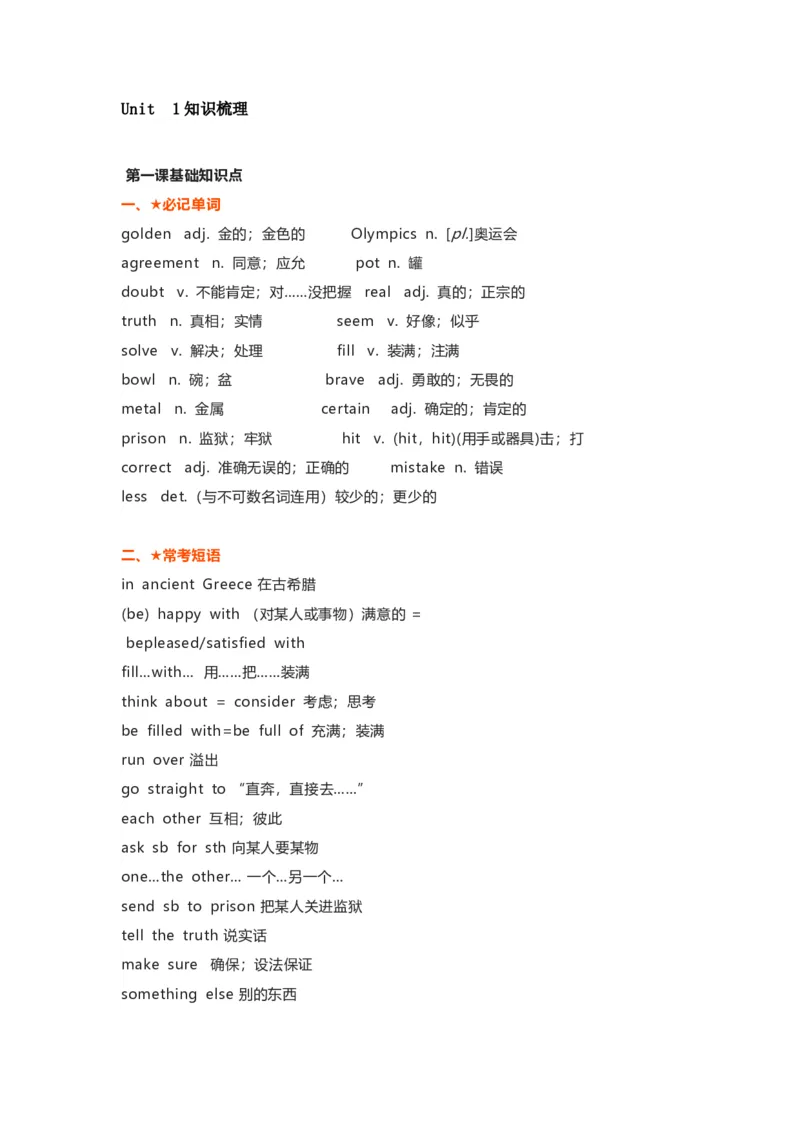
第一课基础知识点
一、★必记单词
golden adj. 金的;金色的 Olympics n. [pl.]奥运会
agreement n. 同意;应允 pot n. 罐
doubt v. 不能肯定;对……没把握 real adj. 真的;正宗的
truth n. 真相;实情 seem v. 好像;似乎
solve v. 解决;处理 fill v. 装满;注满
bowl n. 碗;盆 brave adj. 勇敢的;无畏的
metal n. 金属 certain adj. 确定的;肯定的
prison n. 监狱;牢狱 hit v. (hit,hit)(用手或器具)击;打
correct adj. 准确无误的;正确的 mistake n. 错误
less det.(与不可数名词连用)较少的;更少的
二、★常考短语
in ancient Greece 在古希腊
(be) happy with (对某人或事物)满意的 =
bepleased/satisfied with
fill…with… 用……把……装满
think about = consider 考虑;思考
be filled with=be full of 充满;装满
run over 溢出
go straight to “直奔,直接去……”
each other 互相;彼此
ask sb for sth 向某人要某物
one…the other… 一个…另一个…
send sb to prison 把某人关进监狱
tell the truth 说实话
make sure 确保;设法保证
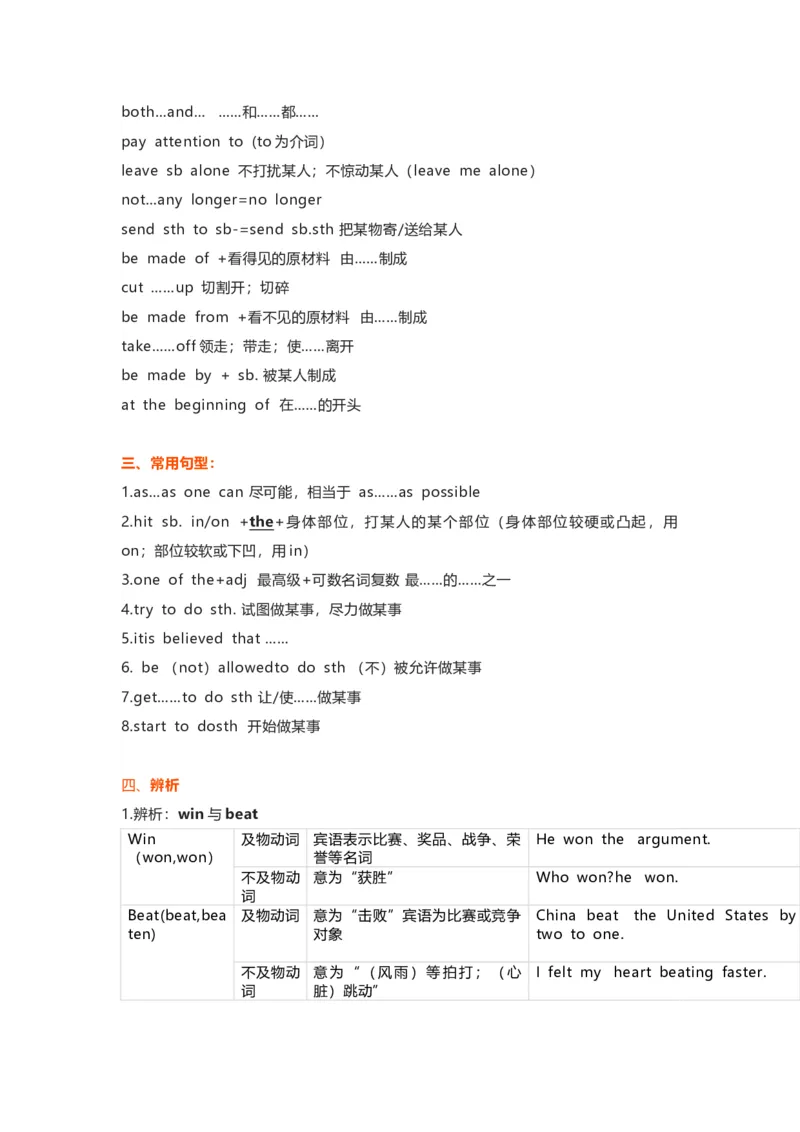
something else 别的东西both…and… ……和……都……
pay attention to (to为介词)
leave sb alone 不打扰某人;不惊动某人(leave me alone)
not…any longer=no longer
send sth to sb-=send sb.sth 把某物寄/送给某人
be made of +看得见的原材料 由……制成
cut ……up 切割开;切碎
be made from +看不见的原材料 由……制成
take……off领走;带走;使……离开
be made by + sb. 被某人制成
at the beginning of 在……的开头
三、常用句型:
1.as…as one can 尽可能,相当于 as……as possible
2.hit sb. in/on +the +身体部位,打某人的某个部位(身体部位较硬或凸起,用
on;部位较软或下凹,用in)
3.one of the+adj 最高级+可数名词复数 最……的……之一
4.try to do sth. 试图做某事,尽力做某事
5.itis believed that ……
6. be (not)allowedto do sth (不)被允许做某事
7.get……to do sth 让/使……做某事
8.start to dosth 开始做某事
四、辨析
1.辨析:win与beat
Win 及物动词 宾语表示比赛、奖品、战争、荣 He won the argument.
(won,won) 誉等名词
不及物动 意为“获胜” Who won?he won.
词
Beat(beat,bea 及物动词 意为“击败”宾语为比赛或竞争 China beat the United States by
ten) 对象 two to one.
不及物动 意为“(风雨)等拍打;(心 I felt my heart beating faster.
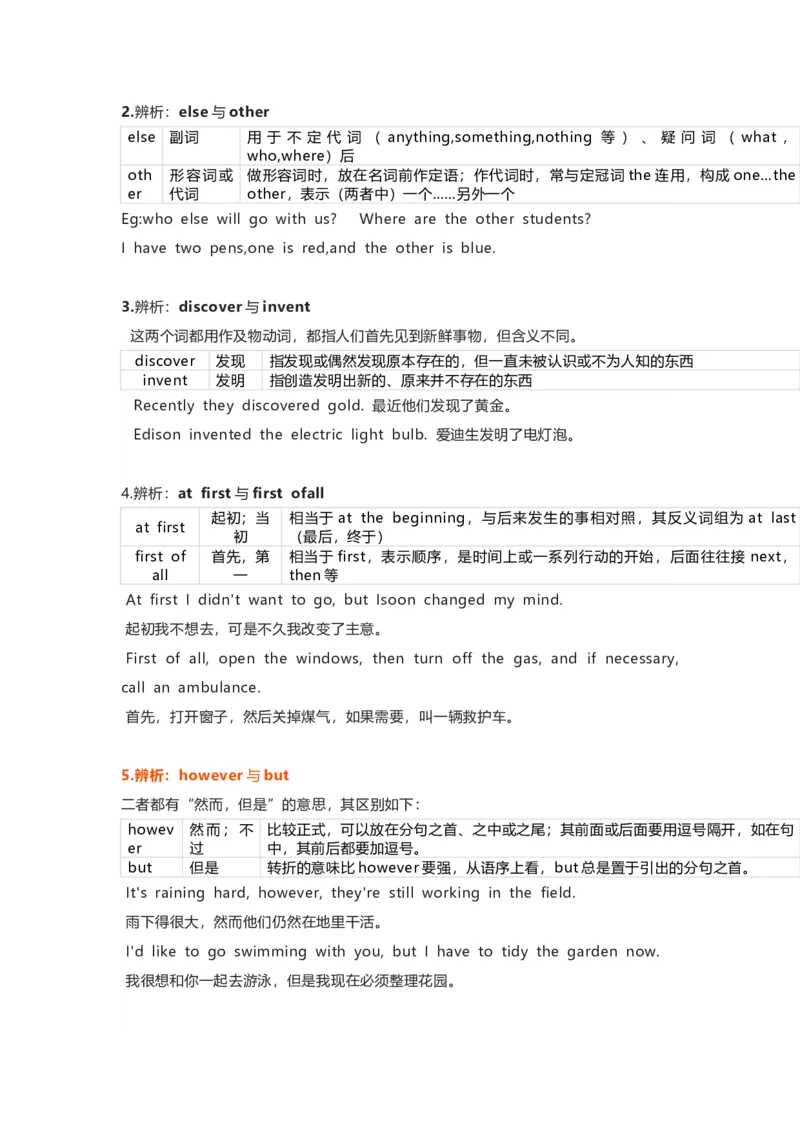
词 脏)跳动”2.辨析:else与other
else 副词 用 于 不 定 代 词 ( anything,something,nothing 等 ) 、 疑 问 词 ( what ,
who,where)后
oth 形容词或 做形容词时,放在名词前作定语;作代词时,常与定冠词the连用,构成one…the
er 代词 other,表示(两者中)一个……另外一个
Eg:who else will go with us? Where are the other students?
I have two pens,one is red,and the other is blue.
3.辨析:discover与invent
这两个词都用作及物动词,都指人们首先见到新鲜事物,但含义不同。
discover 发现 指发现或偶然发现原本存在的,但一直未被认识或不为人知的东西
invent 发明 指创造发明出新的、原来并不存在的东西
Recently they discovered gold. 最近他们发现了黄金。
Edison invented the electric light bulb. 爱迪生发明了电灯泡。
4.辨析:at first与first ofall
起初;当 相当于 at the beginning,与后来发生的事相对照,其反义词组为 at last
at first
初 (最后,终于)
first of 首先,第 相当于 first,表示顺序,是时间上或一系列行动的开始,后面往往接 next,
all 一 then等
At first I didn't want to go, but Isoon changed my mind.
起初我不想去,可是不久我改变了主意。
First of all, open the windows, then turn off the gas, and if necessary,
call an ambulance.
首先,打开窗子,然后关掉煤气,如果需要,叫一辆救护车。
5.辨析:however与but
二者都有“然而,但是”的意思,其区别如下:
howev 然而;不 比较正式,可以放在分句之首、之中或之尾;其前面或后面要用逗号隔开,如在句
er 过 中,其前后都要加逗号。
but 但是 转折的意味比however要强,从语序上看,but总是置于引出的分句之首。
It's raining hard, however, they're still working in the field.
雨下得很大,然而他们仍然在地里干活。
I'd like to go swimming with you, but I have to tidy the garden now.
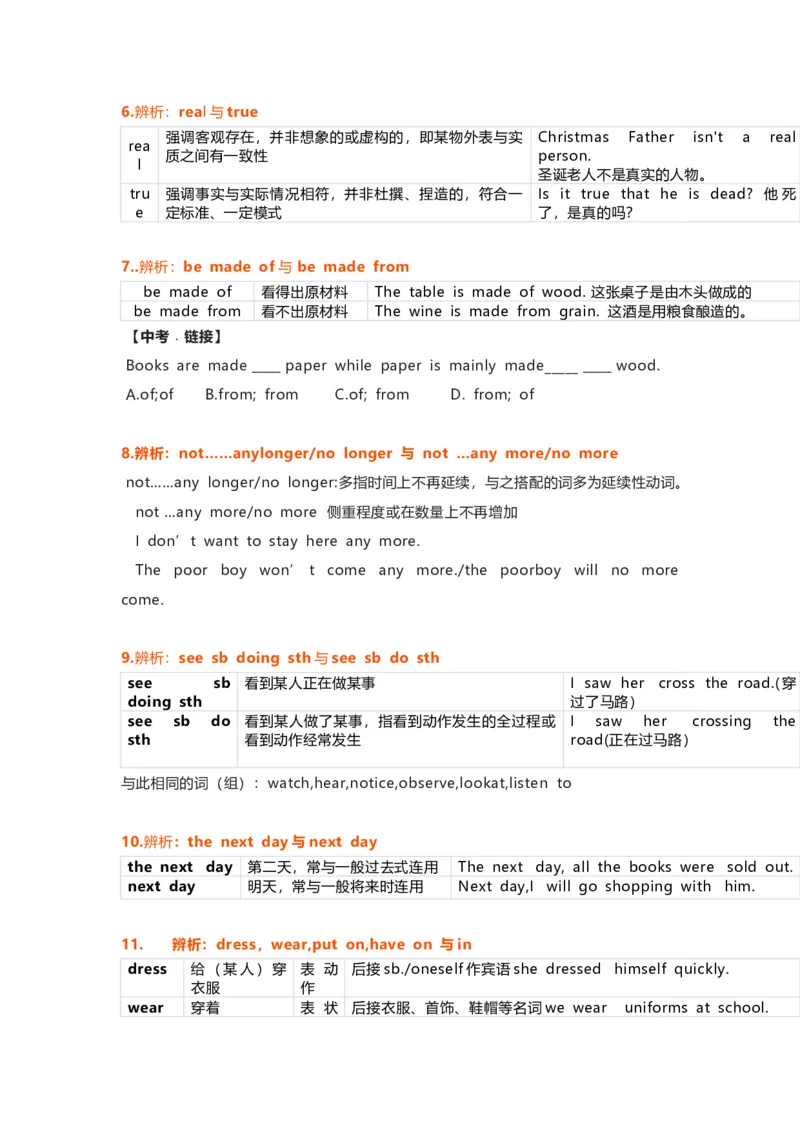
我很想和你一起去游泳,但是我现在必须整理花园。6.辨析:real与true
强调客观存在,并非想象的或虚构的,即某物外表与实 Christmas Father isn't a real
rea
质之间有一致性 person.
l
圣诞老人不是真实的人物。
tru 强调事实与实际情况相符,并非杜撰、捏造的,符合一 Is it true that he is dead? 他死
e 定标准、一定模式 了,是真的吗?
7..辨析:be made of与 be made from
be made of 看得出原材料 The table is made of wood. 这张桌子是由木头做成的
be made from 看不出原材料 The wine is made from grain. 这酒是用粮食酿造的。
【中考﹒链接】
Books are made paper while paper is mainly made_____ wood.
A.of;of B.from; from C.of; from D. from; of
8.辨析:not……anylonger/no longer 与 not …any more/no more
not……any longer/no longer:多指时间上不再延续,与之搭配的词多为延续性动词。
not …any more/no more 侧重程度或在数量上不再增加
I don’t want to stay here any more.
The poor boy won’ t come any more./the poorboy will no more
come.
9.辨析:see sb doing sth与see sb do sth
see sb 看到某人正在做某事 I saw her cross the road.(穿
doing sth 过了马路)
see sb do 看到某人做了某事,指看到动作发生的全过程或 I saw her crossing the
sth 看到动作经常发生 road(正在过马路)
与此相同的词(组):watch,hear,notice,observe,lookat,listen to
10.辨析:the next day与next day
the next day 第二天,常与一般过去式连用 The next day, all the books were sold out.
next day 明天,常与一般将来时连用 Next day,I will go shopping with him.
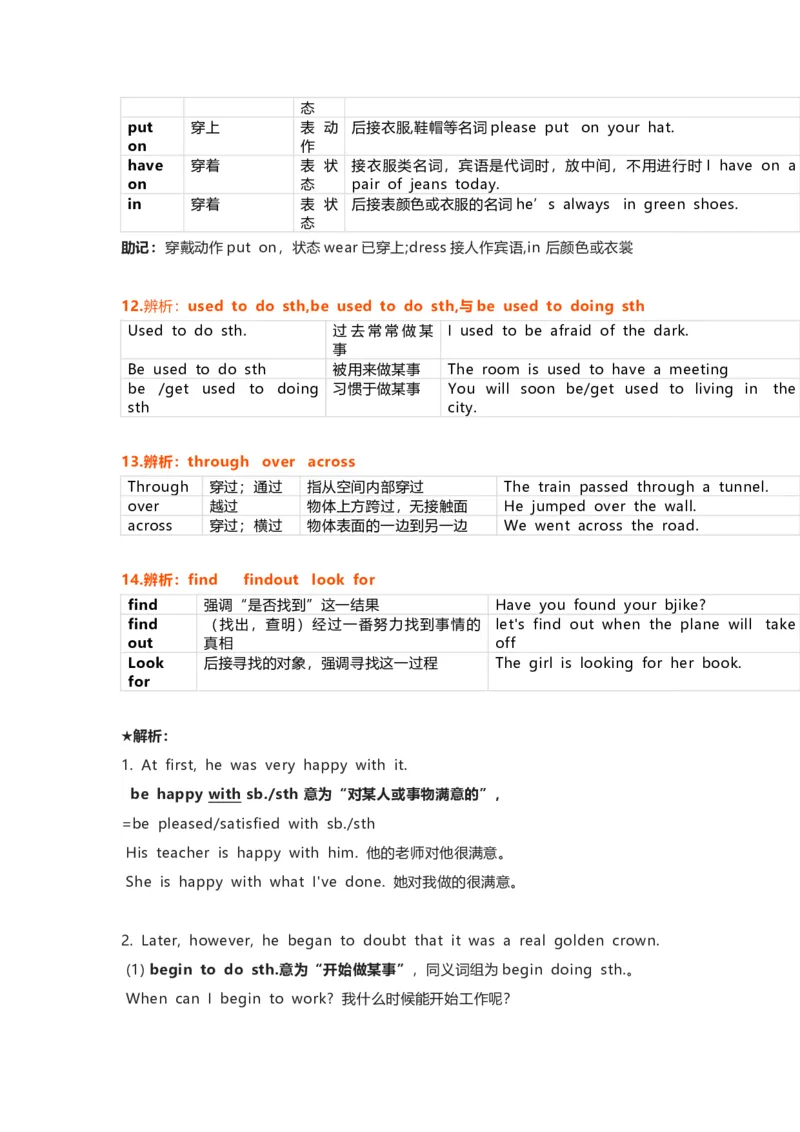
11. 辨析:dress,wear,put on,have on 与in
dress 给(某人)穿 表 动 后接sb./oneself作宾语she dressed himself quickly.
衣服 作
wear 穿着 表 状 后接衣服、首饰、鞋帽等名词we wear uniforms at school.态
put 穿上 表 动 后接衣服,鞋帽等名词please put on your hat.
on 作
have 穿着 表 状 接衣服类名词,宾语是代词时,放中间,不用进行时 I have on a
on 态 pair of jeans today.
in 穿着 表 状 后接表颜色或衣服的名词he’s always in green shoes.
态
助记:穿戴动作put on,状态wear已穿上;dress接人作宾语,in 后颜色或衣裳
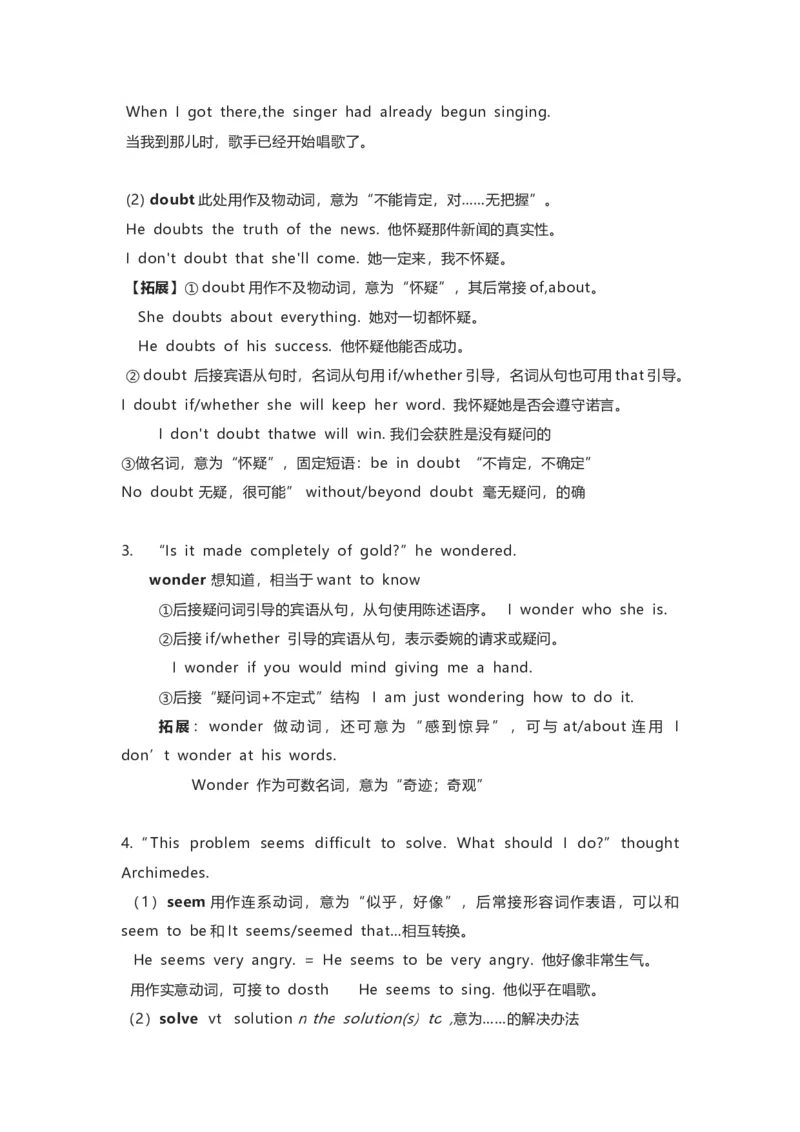
12.辨析:used to do sth,be used to do sth,与be used to doing sth
Used to do sth. 过去常常做某 I used to be afraid of the dark.
事
Be used to do sth 被用来做某事 The room is used to have a meeting
be /get used to doing 习惯于做某事 You will soon be/get used to living in the
sth city.
13.辨析:through over across
Through 穿过;通过 指从空间内部穿过 The train passed through a tunnel.
over 越过 物体上方跨过,无接触面 He jumped over the wall.
across 穿过;横过 物体表面的一边到另一边 We went across the road.
14.辨析:find findout look for
find 强调“是否找到”这一结果 Have you found your bjike?
find (找出,查明)经过一番努力找到事情的 let's find out when the plane will take
out 真相 off
Look 后接寻找的对象,强调寻找这一过程 The girl is looking for her book.
for
★解析:
1. At first, he was very happy with it.
be happy with sb./sth 意为“对某人或事物满意的”,
=be pleased/satisfied with sb./sth
His teacher is happy with him. 他的老师对他很满意。
She is happy with what I've done. 她对我做的很满意。
2. Later, however, he began to doubt that it was a real golden crown.
(1) begin to do sth.意为“开始做某事”,同义词组为begin doing sth.。
When can I begin to work? 我什么时候能开始工作呢?When I got there,the singer had already begun singing.
当我到那儿时,歌手已经开始唱歌了。
(2) doubt此处用作及物动词,意为“不能肯定,对……无把握”。
He doubts the truth of the news. 他怀疑那件新闻的真实性。
I don't doubt that she'll come. 她一定来,我不怀疑。
【拓展】①doubt用作不及物动词,意为“怀疑”,其后常接of,about。
She doubts about everything. 她对一切都怀疑。
He doubts of his success. 他怀疑他能否成功。
②doubt 后接宾语从句时,名词从句用if/whether引导,名词从句也可用that引导。
I doubt if/whether she will keep her word. 我怀疑她是否会遵守诺言。
I don't doubt thatwe will win. 我们会获胜是没有疑问的
③做名词,意为“怀疑”,固定短语:be in doubt “不肯定,不确定”
No doubt 无疑,很可能” without/beyond doubt 毫无疑问,的确
3. “Is it made completely of gold?”he wondered.
wonder 想知道,相当于want to know
①后接疑问词引导的宾语从句,从句使用陈述语序。 I wonder who she is.
②后接if/whether 引导的宾语从句,表示委婉的请求或疑问。
I wonder if you would mind giving me a hand.
③后接“疑问词+不定式”结构 I am just wondering how to do it.
拓展:wonder 做动词,还可意为“感到惊异”,可与 at/about 连用 I
don’t wonder at his words.
Wonder 作为可数名词,意为“奇迹;奇观”
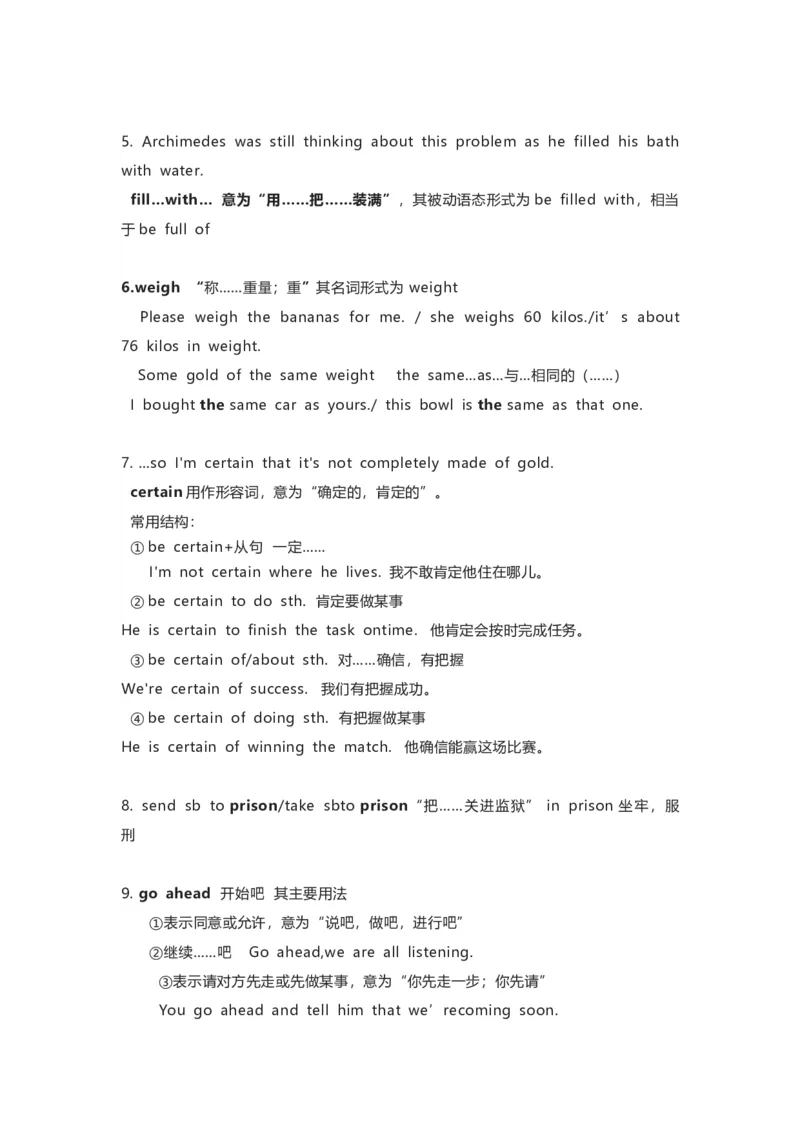
4.“This problem seems difficult to solve. What should I do?”thought
Archimedes.
(1)seem 用作连系动词,意为“似乎,好像”,后常接形容词作表语,可以和
seem to be和It seems/seemed that…相互转换。
He seems very angry. = He seems to be very angry. 他好像非常生气。
用作实意动词,可接to dosth He seems to sing. 他似乎在唱歌。
(2)solve vt solution n the solution(s) to ,意为……的解决办法5. Archimedes was still thinking about this problem as he filled his bath
with water.
fill…with… 意为“用……把……装满”,其被动语态形式为be filled with,相当
于be full of
6.weigh “称……重量;重”其名词形式为 weight
Please weigh the bananas for me. / she weighs 60 kilos./it’s about
76 kilos in weight.
Some gold of the same weight the same…as…与…相同的(……)
I bought the same car as yours./ this bowl is the same as that one.
7. …so I'm certain that it's not completely made of gold.
certain用作形容词,意为“确定的,肯定的”。
常用结构:
①be certain+从句 一定……
I'm not certain where he lives. 我不敢肯定他住在哪儿。
②be certain to do sth. 肯定要做某事
He is certain to finish the task ontime. 他肯定会按时完成任务。
③be certain of/about sth. 对……确信,有把握
We're certain of success. 我们有把握成功。
④be certain of doing sth. 有把握做某事
He is certain of winning the match. 他确信能赢这场比赛。
8. send sb to prison/take sbto prison“把……关进监狱” in prison 坐牢,服
刑
9. go ahead 开始吧 其主要用法
①表示同意或允许,意为“说吧,做吧,进行吧”
②继续……吧 Go ahead,we are all listening.
③表示请对方先走或先做某事,意为“你先走一步;你先请”
You go ahead and tell him that we’recoming soon.10. What'swrong with it?
What's wrong (with sb./sth)?是用来询问“某人发生了什么事情或某物出了什
么
毛病/故障”等最常用的句型之一。其同义句型为:What's the matte/trouble
with...?
What's wrong with you? 你怎么了(出什么事了)?
11. That's why I'm angry.
That's why... 意为“那就是……的原因”,why引导的是表语从句,用陈述语序。
表语从句是在句中作表语的从句,常位于连系动词be,look等的后面。
The alarm clock didn't gooff. That's why he was late for school
12. be allowed to do sth 被允许做某事
allow sb to do sth 允许某人做某事 allow doing sth 允许做某事
He allows smoking here.他允许在这里抽烟 our teacher allowed us to
go out for a walk.
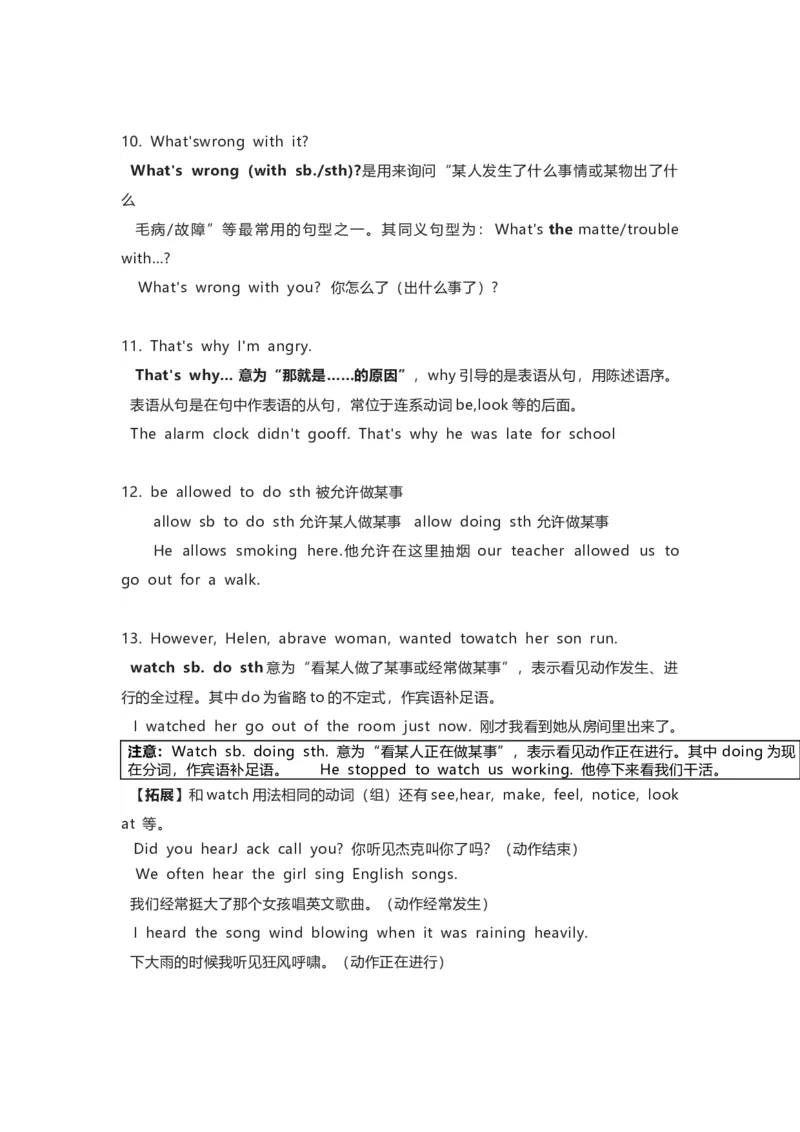
13. However, Helen, abrave woman, wanted towatch her son run.
watch sb. do sth意为“看某人做了某事或经常做某事”,表示看见动作发生、进
行的全过程。其中do为省略to的不定式,作宾语补足语。
I watched her go out of the room just now. 刚才我看到她从房间里出来了。
注意:Watch sb. doing sth. 意为“看某人正在做某事”,表示看见动作正在进行。其中 doing为现
在分词,作宾语补足语。 He stopped to watch us working. 他停下来看我们干活。
【拓展】和watch用法相同的动词(组)还有see,hear, make, feel, notice, look
at 等。
Did you hearJ ack call you? 你听见杰克叫你了吗?(动作结束)
We often hear the girl sing English songs.
我们经常挺大了那个女孩唱英文歌曲。(动作经常发生)
I heard the song wind blowing when it was raining heavily.
下大雨的时候我听见狂风呼啸。(动作正在进行)14. When you have written something, you should check your work to
make sure the
spelling, grammar and punctuation are all correct.
(1) make sure意为“确保,设法保证”,后可接宾语从句或 of短语。同义短语:
be sure/be certain
Make sure that they know nothing about our plan. 绝对不能让他们知道我
们的计划。
They scored another goal and make sure of victory. 他们又进了一个球,这
就赢定了。
(2) correct 此处用作形容词(=right),意为“正确的”,其副词为correctly(正确地)。
【拓展】correct 用作动词,意为“改正;纠正” correct the mistakes 改正错
误
16. …write what kind of mistake it is…
mistake 用作可数名词,意为“错误”,常用短语:make a mistake /mistakes
犯错;
by mistake 错误 地 You've made several grammatical mistakes in the
composition.
I got on the wrong bus by mistake. 我搭错了公共汽车。
【拓展】mistake(mistook,mistaken)还可用作动词,意为“弄错,搞错”。
常用短语:mistake… for … “把…误认为…”
She didn't speak very clearly, so I mistook what she said.
她说话不是很清楚,所以我误解了她的意思。
He is often mistaken for a famous actor. / we often mistake him for
a famous actor.
他常常被误认为是个名演员。
17. However, no one could find as cale large enough.
①enough此处用作副词,意为“足够地”,修饰形容词或副词时,要放在其后。
He runs quickly enough. 他跑得足够快。 It's warm enough in the room.
屋子里够暖和了。②adv/adj+enough+(for+名词/代词+)todo sth.,意为“…足够…做某事”。
可与“so…that+肯定句”进行同义句转换。
The box is light enough for the boy to carry. 这个箱子足够轻,这个男
孩能搬动。
③“not+adj/adv+enoughto so sth”不够……不能做某事,可与“too…to
do sth” 进 行 同 义 句 转 换 the boy is not old enough to look after
himself=the boy is too young to look after himself.
18. be taken off 是take…off 的被动语态,take…off 意为“领走;带走;使…离
开”
15. go down 的主要用法 ①(船等)下沉,沉没 their ship went down during
an accident.
②(日,月)落下 the sun has gone down.
③沿着…走 just go straight down that street.
19. own vt 拥有 adj.自己的 my own pen owner 物主 the owner of ……的
主人
20. It’s believed that ……人们相信
It is said that …… 据说…… it is reported that…… 据报道
It is known that ……众所周知…… it is supposed /thought that ……人们
认为
第二课 语法:反意疑问句及句子的类型
一、反意疑问句:
1、含义:反意疑问句又叫特殊疑问句,它是在陈述句之后附加一个简短的问句,对
陈述句所叙述的事实提出疑问或征求意见。
2、构成:由两部分构成,前一部分是一个陈述句,后一部分是一个简略的疑问句。
遵循“前肯后否,前否后肯”的原则。前后两部分在人称、数、时态等方面必须保持一
致。附加疑问部分通常由两个词组成,第一个词是be动词、情态动词、或助动词,若
是否定式,通常用上述词与not的缩略形式;第二个词是指代陈述部分主语的人称代
词主格。
3.答语:遵循一个原则,不管问题的提法如何,只要事实是肯定的,就用“yes,肯定
回答”;只要事实是否定的,就用“No,否定回答”。但在前否后肯的反意疑问句中,
其答语与汉语翻译不同,Yes 要翻译成“不”,No 要翻译成“是”。You will never forget him, will you? Yes,I will. 不,我会
No,No I won’t. 是的,我不会
4.特殊用法:反意疑问句的特殊用法
( 1)陈述部分为I am...时,疑问部分用aren’t.
例:I am late, aren’t I? I am a teacher, aren’t I ?
(2)当陈述部分的主语是 everyone, someone, anyone, no one, nobody 等
不定代词时,疑问部分的主语可用he,也可用they.
例:No one wants to do it, doesn’t he / don’t they?
(3)当陈述部分主语是 something, everything, anything, nothing 等表示物
的不定代词时,附加疑问部分的主语要用 it. 例:Everything will be allright,
won’t it?
Something must be done to end the strike mustn’tit
(4)当陈述部分带有 seldom, hardly, never, few, little, nothing, nobody
等否定词时,疑问部分宜用肯定式.例:She seldom goes to school late, does
she?
(5)当陈述部分中有否定前缀或后缀的否定词时,疑问部分仍用否定式.
例 : She dislikes her boyfriend, doesn’ t she? She is careless in
writing, isn’t she?
(6)当陈述部分是一个祈使句时,不管是肯定还是否定,附加疑问部分一般用 will
you。当陈述部分以Let’s...开头,疑问部分用 shall we?但以“Let us…”开
头的,附加疑问部分常用 will you? Let’s have acup of Chinese tea, shall
we?
Let us go to the supermarket, will you?
在肯定的祈使句后,还可以用won’t you.
(7) 当陈述部分的主语是指示代词this,that或these,those时,附加疑问部分的
主语分别用it或they。This is your book,isn’t it?(8)当陈述部分是带有宾语从句的主从结构,疑问部分的助动词和主语应与主句的主
谓要一致,但当句中部分是I think.../I suppose…/Ibelieve...等结构时,
疑问部分助动词主语则与that从句中的主、谓保持一致.
例:They said that I was right, didn’t they?
I don’t think you have done it, have you?
(9)当陈述部分的主语是动词不定式或动名词时,附加疑问词部分的主语是it
To work hard is important, isn’t it?
(10)陈述部分为there be 结构时,附加疑问部分中仍用there
There’s something wrong, isn’t there?
(11)当陈述部分带有used to, 附加疑问部分既可用usedn’t 或didn’t的相应
形式.
例:He usedn’t smoke, used he? He didn’t use to smoke, did
he?
(12)当陈述部分是 had better,疑问部分应用 had/hadn’t ;若陈述部分为
would like…和would rather…, 附加疑问部分应用wouldn’t ?
例:You’d better take a bus to go there, hadn’t you?
You’d like some tea, wouldn’t you?
(13)当陈述部分是感叹句,附加疑问部分则用否定式,且主语和感叹句主语要一致.
例:What a lovely day, isn’tit? What a good man, isn’t he?
(14)有关have①当陈述部分的谓语是have/has表示“有”时,附加疑问部分既可
用have/has的相应形式,也可用do/does的相应形式.
例:She has two sister,hasn’t /doesn’t she?
②当陈述部分的谓语has/has表示经历、遭受、得到、吃等其他含义时,疑问部分只
用do/does的适当形式.例:He often has breakfast at seven, doesn’t he?
③当陈述部分的谓语动词包括have to/had to时,疑问部分通常用do/ does的不
同形式.例:She has to stay at home to look after her baby, doesn’t
she?(15)当陈述部分的谓语动词含有can, may, shall, will would,ought, be, do等
助动词时,疑问部分用相同的助动词.
例:You can be there by 10 o’clock, can’t you?
You ought to follow her advice, oughtn’t/shouldn’t you?
(16)must 的反义疑问句:陈述部分有 must 的疑问句,疑问部
分根据实际情况而定。
A.must 表示“应该”,其疑问部分用 mustn't(不应该),如:
You must work hard next term, mustn't you ? 下学期你应该努力学习,对吗?
B.must 表示“必须”,其疑问部分用 needn't(不必),如:
They must finish the work today, needn’t they? 他们今天必须要完成这项
工作,是吗?
C.陈述部分含情态动词 mustn't,表示禁止时,疑问部分就可以用 must 或 may,
如:
You mustn’t stop your car here, must you? (may you?)你不能把车停在这
地方,知道吗?
D.must 表示推测 ,其疑问部分必须与must 后面的主要动词相呼应。如:
①对现在动作或存在的情况的推测 :
You must know the answer to the exercise, don't you? 你一定知道这项练
习的答案,是不是?That must be your bed, isn't it? 那一定是你的床,是吗?
②对过去发生的动作或存在的情况的推测:句中陈述部分没有表示过去的时间状语,
这时疑问部分中的动词就用现在完成时。(haven’t/ hasn’t+主语)
You must have told her about it, haven’t you? 你一定把这事告诉她了,是
吗?
(17)当陈述部分为I wish...时,疑问部分则用may I ?
I wishto go to Hefei to see you one day, may I ? I wish to use your
pen, may I ?
18)当陈述部分含有状语从句时,附加疑问部分的主语、谓语应与主句的主、谓语一
致.WhenI got to school, the classes had already begun, hadn’tthey?
When the teacher speaks, we have to keep quiet, don’t we?
总结:1. 在反意疑问句,前面的陈述句如果是 _______的,反意疑问句就要用 ______形
式;
前面的陈述句如果是 ______的,反意疑问句就要用______形式; 。
2. 对于反意疑问句的回答,如果问句的前部分是肯定的,那么回答中的yes,和no的意
思就和汉语相同;如果问句的前部分是否定的,那么回答中的yes,和no的意思就和汉
语相反。
二.句子类型
英语中句子类型可分为:陈述句、疑问句、祈使句、感叹句四种
陈述句:说明一个事实或者陈述说话人的看法。陈述句分为肯定陈述句和否定陈述
句。
疑问句:
① 一般疑问句:以连系动词be、情态动词或助动词开头,通常用Yes或no进行回答。
② 特殊疑问句:特殊疑问句以疑问词(组)who, what, which, how, how long
等开头,不能用yes或no回答。
③ 选择疑问句:提出两个(或多个)选项,两(多个)部分之间由or连接。
④ 反意疑问句:提出疑问或看法,询问对方是否赞同。
祈使句:表示请求、命令、叮嘱、号召等,谓语动词为动词原形。否定句多在句首
加don’t.
注意:祈使句主语通常省略,但如果特别强调对方或表达某种情绪时可以有主语或加
称呼
感叹句:表示喜怒哀乐等情绪
1.what 引导的感叹句
(1)what a/an+单数可数名词 what a pity!
(2) what a/an +adj+单数可数名词(+主语+谓语)what a beautiful park it
is!
(3)what+adj+不可数名词/复数可数名词(+主语+谓语)what good news it
is!
2.how 引导的感叹句
How+adj/adv(+主语+谓语+其他) how well she dances!Unit 2知识梳理
课文短语总结
a long time ago 很久以前 my favourite game 我最喜欢的游戏a wise
old man 一位睿智的老人 in the palace 在宫殿里challenge sb 挑战某人
promise to do sth 承诺做某事win a prize 赢得奖赏 win the
game 赢得比赛would like sth 想要某东西 would like to do sth 想要做
某事one grain of rice 一粒米 the square of the chessboard 棋盘的方
格instead of doing sth 代替做某事 reply to sb 回复某人order sb to do
sth 命令某人做某事 collect a bag of rice 收集一袋儿米realize the
problem 意识到这个问题 have enough rice 有足够的米the invention of written
numbers 数字的发明 use different ways 使用不同的方法count things 数东西
的数量 in this way 通过这种方法make marks on sth 在某东西上做记
号 help sb do sth 帮某人做某事count from one to ten 从一数到十
the amount of food 事物的数量be made from 有…制成 develop
into tools 发展成工具show different numbers 显示不同的数字 lead to sth
导致;通向
重点词汇讲解和辨析
1.one day 有一天;某一天One day, Liz will finally get married with her Mr.
Right. 将来总有一天,利兹最终会和她的白马王子结婚的。 one day VS. some dayone
day可表示过去的某一天戒是将来的某一天;但some day只能表示将来的某一天。例:例:
In fact, Eason had his thirtieth birthday one day/some day in 2012. I think
my dream will come true one day/some day. One day, the old man was very ill.
有一天,那位老人病得很严重。
2.challenge v. 向(某人)挑战challenge sb. 向某人挑战 例:Do you want to
challenge me? 你想向我挑戓吗?l challenge…to… 在某斱面向某人挑戓例:Joey
challenged Sunny to a competition of counting 1 to 10. 乔伊向桑尼挑戓一场从1到
10的数数比赛。
3.promise v. 承诺;许诺 用法:promise作动词,后可接双宾语或动词不定式作
宾语promise sb sth 答应某人某事promise sth to sb 答应某事对某人promise to dosth答应做某事 例:Ivy’s father promised her a dress. = Ivy’s father
promised to buy a dress for her. 艾薇的爸爸承诺了为她买条裙子。 promise作名
词时,表示“诺言;保证” make a promise 许下诺言keep a promise 遵守诺言
break a promise 违背诺言例:Ivy’s father made a promise to buy a dress for
her.
4. would like 想要;愿意l would like + 名词 Would you like a cup of coffee?
你想要来杯咖啡吗?l would like to do 例:I would like to have a cup of
coffee. 我想要喝杯咖啡。l would like sb. to do例:I would like you to have a
cup of coffee with me. 我想要你跟我一起去喝杯咖啡。
5.rest n. 休息 Let’s have a rest. 让我们休息一下。 v. 休息 例:We will
rest for half an hour. 我们将休息半小时。n. 剩余部分 例:This morning Daisy
ate some bread and kept the rest for tomorrow. 今天早上黛西吃了一些面包,并且把
剩下的留到明天吃。
6. instead adv. 代替;顶替 adv. 而 Amanda’s boyfriend asked why she
couldn't just forget about dieting and eat normally instead. 阿曼达的丈夫问阿
曼达为什么就不能忘掉节食而正常吃饭。 instead of doing They raised prices and
cut production, instead of cutting costs. 他们提高了价格,减少了产量,而没有削
减成本。
7. enough 足够的;充足的 enough既可修饰可数名词,又可修饰不可数名词,但要遵
循“名前形副后”的原则,即enough要放在名词前,形容词和副词后面。例:enough
money 足够的钱 rich enough 足够地富有 fast enough 足够地快 8. talk 与介词的
搭配talk to 与…交谈 talk with 与…交谈;聊天 talk about 谈论…
9. adviceadvice n. 建议(不可数名词) a piece of advice 一则建议advise v. 建议;
作动词时,后可接名词、代词戒doing作宾语,也可用亍advise sb. (not) to do sth.,
表示“建议某人(不)做某事”例:Liz advised Eason to stop drinking so much.利兹
建议伊森不要喝那举多酒。
10. agree with sb. 同意某人 agree to do 同意做某事--- Do you agree
with me, Annabella? --- Sorry. I am afraid that I can’t agree to do
that. --- 你同意我的看法。--- 很抱歉。恐怕我不能同意这样做。
11. not…any more 不再not...any longer (= no longer) 表示时间戒距离上的不再,
常与延续性动词连用,强调“时间不再延长”。(现在,过去,将来都可用)He no
longer lives here.not ... any more (= no more) 表示距离上的不再,常与非延续性动
词连用,指今后“再也不......”,表示不再重复发生以前的动作或存在的状态,强调终止。
(将来和过去都可用)I shall go there no more.
12. way的相关短语辨析in this way 用这种斱法;这样例:Only in this way can
Amanda beat Ivy. 只有这样,阿曼达才能打败艾薇。in the way 挡道 例:There is a
dog in the way. 那有只狗挡道。on the way 在路上例:Daisy lost money on the way
to school. 黛西在上学的路上把钱丢了。by the way 顺便说一下;顺便问一下例:By
the way, how old are you, Annabella? 顺便问一下,安娜贝拉,你多大了?off the
way 偏离正轨;脱离轨道例:The train drove off the way suddenly. 火车突然偏离轨
道行驶。
13. so that 为的是;以便so that在该处引导目的状语从句,从句中常有can, could,
may, might等情态动词。相当于in order that。Jimson saved money for one year so
that/in order that he could travel to Africa.吉姆森存了一年的钱,以便可以去非洲旅游。
14. the amount of 与 the number of 区别the amount of 修饰不可数名词例:The
amount of milk is 250ml. 牛奶的量是250毫升。the number of 修饰可数名词例:The
number of students in our class is 20. 我们班学生的数量是20。
15. from then on “从那时起” , 用于完成时和过去时I have never met her from
then on.He lived here from then on.from now on “从今以后”, 常用于现在时和将来
时,一般不能用与过去时。I’ll take the place of Miss Liang from now on.
16.number n.数字 Choose a number between ten and one
hundred. v. 给...编号 Number the pages from one to
ten.【辨析】常考短语:a number of & the number ofa number of “若
干”或“许多”, a small/large number of少量;大量 There are a number of
ants on the ground.The number of “...的数量”, The number of the
apples is 40.
注意:虽然两个短语后面都接复数名词,但是a number of.. 作主语时,谓语动词
要用复数 e.g. A number of students are playing.the number of... 作主语时,
谓语动词要用单数 e.g. The number of the students is 50.
17.check v. 检查,核实 Please check your answers after finish doing
homework.实用短语:check in :在旅馆登记住宿;报到;签到例:Have you checked in
at the hotel yet?你在旅馆登记住宿了吗?例:The friends we had invited did not
check in until Saturday.我们邀请的朋友直到星期六才到达。 check out 结帐离
开例:Guests must check out before noon, or they will be charged for the day.客
人必须在中午前结帐离开,否则将付全日费用。
18. wise adj.充满智慧的 a wise old man 一位博学多识的老先
生 wisdom n. 才能,智慧 近义词:clever/ bright/ intelligent句型:
It is wise of sb. to do sth. 你做了..., 真是太明智了。(wise形容人品,of
sb.) eg: It is wise of you to accept my advice. 你接受了我的建议,真是太明
智了。拓展句型:It is important for you to take care of yourself. (important
形容事情本身, for sb.)
语法:数词
【教材典句】
1. There are 35 students in my class ---18 boys and 17 girls.
2. Alan is the second.
3. Is it seventy-two plus twenty-seven?
句1 和句3 中含有基数词,句2中含有序数词。
【语法全解】
英语中的数词分为两大类:基数词和序数词
1.基数词
基数词是表示数目多少的词,其主要用法有:
(1) 用于名词前表示数量的多少。
I have three pens.(2) 表示时间
It’s eleven o’clock now/
(3) 表示年龄
My mother is thirty-eight years old.
(4) 表示价格
The bike is two hundred and thirty- five yuan.
【拓展】
①. 英语中没有表示万,或千的专有名词,要表示万或千等数字,借助 thousand 或
million 来表达。读数字时,and 常用于百位数与紧跟的数之间
256:two hundred and fifty- six
助记:基数词的读法
数字拼读有标准,自右向坐三逗分
一逗 thousand(千), 二逗 million(百万) 三逗 billion(十亿)
自左向右分逗读,每逗百后and 连。
②.表达确定的几百、几千、几百万等,用数词加上hundred , thousand 或million,
例如:three hundred 三百
six thousand 六千
nine million 九百万
③ 如果要表达不确定的几百、几千。几百万等,要先把 hundred , thousand 或
million,变为复数,再加of.
例如:
hundreds of students 数百个学生
thousands of people 数千个人
2. 序数词
是表示顺序先后的词,其主要用法有:
(1)表顺序
January is the first month of the year.(2) 表第几次
This is my second time to visit Nanjing.
(3) 表示日期
Today is the fifth of March.
【拓展】
(1)序数词主要用作定语,通常在前面加定冠词the. 但当序数词前有形容词性物主代
词或名词所有格修饰时,不用定冠词the。
Mr Lin lives on the fifth floor.
Simon is his third child.
(2)如果序数词前出现不定冠词,a 或 an 表示“再,又”。
You’ll have to do it a second time.
(4) 表示编号时, 可用序数词+名词或名词+基数词。
Let’s study the fifth lesson.= let’s study lesson five.