新人教八年级英语上册单元同步知识点与语法精讲精练
Unit 7 When Tomorrow Comes
Section A What are your predictions about the future ?
一.重点词汇梳理
1. /prɪ'dɪkʃn/n. 预测;预言 2. /'autə(r)/adj. 外围的;外表的
3. /w3:s/adj.(bad的比较级)更差的;更坏的;更糟的adv.(badly的比较级)更糟;更坏
4. /'saɪ faɪ/n.(=science fiction)科幻小说(或影片等) 5. /'tɪkɪt/n. 票;券
6. /'pɒzətɪv/adj. 乐观的;积极的;良好的
7. /'træfɪk/n. 交通;运输 v. (非法)进行交 易;做买卖
8. /tek'nɒlədʒi/n.科技;工艺
9. /'vidiəu/n. 视频;录像系统v. 录视频; 给…….录像
10. n./'trænspɔ:t/ 交通运输系统;旅行方 式 v./træen'spɔ:t/ 运输;运送
11 . /'sɪstəm/n. 系统 12. /ɪ'fiʃnt/adj. 高效的;有功效的
13. /,edʒu'keɪʃn/n. 教育 14 . /leŋθ/n.时长;长度
15. /'topɪk/n. 话题;题目;标题 16. /'pa:tnə(r)/n.搭档;同伴
17. /ʃəl;ʃæl/modal v.(should /ʃud/) 将;将要 18. /pa:s/v. 及格;通过 n. 及格;通行证
19. /'wɪnə(r)/n. 优胜者;成功者 20. /kjuə(r)/n. 药物;疗法 v. 治愈;治好
21 /'kænsə(r)/n. 癌症 22. /'kɒnsət/n. 音乐会;演奏会
23. /kæʃ/n. 现金;金钱 v. 兑 现 24. /'wɒlit/n.钱包;皮夹
二.重点词汇变形
1.prediction(n.)预测;语言→ (v.)预测
2.worse(adj.)更糟的→ 最糟糕的(最高级)→ 原级 (adj.) 差的;坏的→
(adv.)坏地;差地
3.positive(adj.)乐观的;积极的→ (adv.) 乐观地 → 反: (adj.) 消极的;负面的
4.efficient(adj.)效率高的;有功效的→ (adv.)高效率地 → (n.)效率
5.education(n.)教育 → (n.) 教育家 → (adj.) 有教育意义的 → (v.) 教育
6.length(n.)时长;长度→ (adj.)长的;很久的
1新人教八年级英语上册单元同步知识点与语法精讲精练
7.winner(n.)优胜者;成功者→ (v.)赢得;获胜
三.重点短语通关
1. 对未来作出预测 2. 为未来做准备
3. 实现 4. 同意某人/某事
5. 在外太空 6. 接替;接管;接收
7. 出现;出版;发行 8. 邀请某人做某事
9. 气候变化 10. 在将来
11. 找到做某事的方法 12 . 把地球变成更好的
13. 一部激动人心的科幻电影 14. 使保持我的眼睛睁开
15. 怎么了,什么事 16. 交通系统
17. 听起来不错 19. 交通意外
20. 对...持乐观态度
四.课文重点知识及语法梳理
Section A课文重现
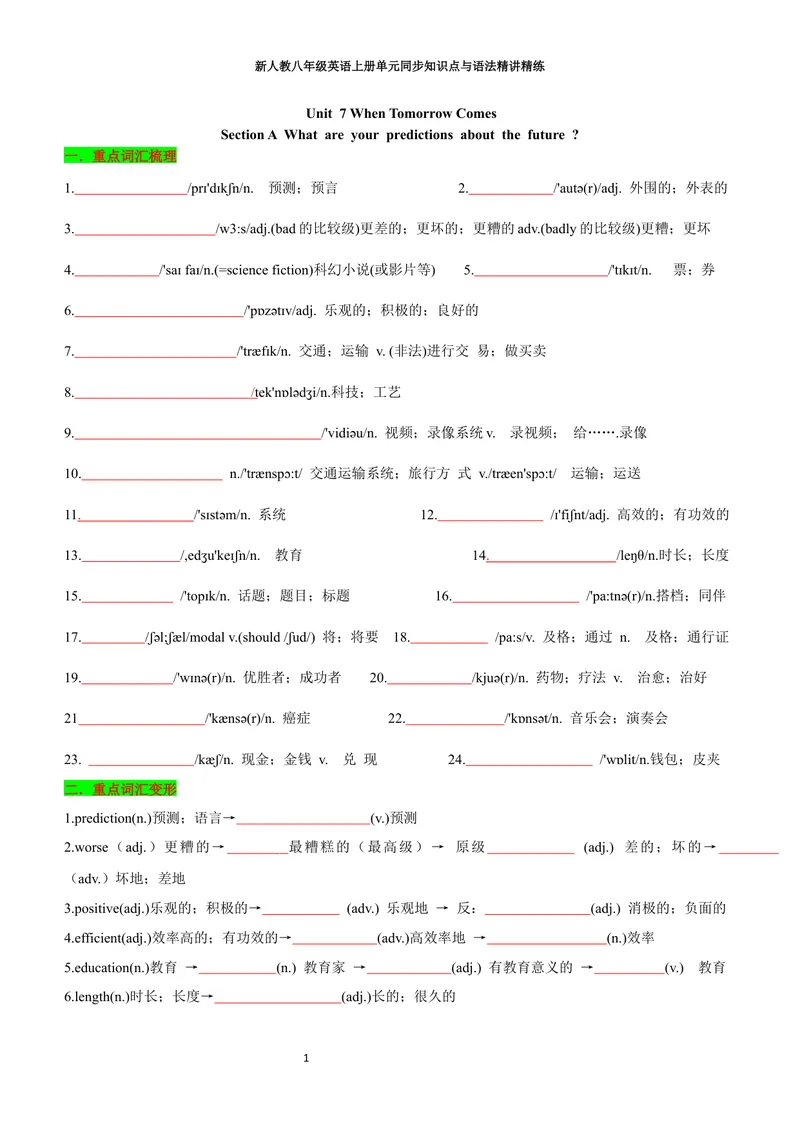
Helen:Hi,Jennifer. What's up?
Jennifer: Oh, hi, Helen. I'm watching a video about future predictions.
Helen: So, what will the future be like?
Jennifer: Well, there will be more people in cities , but the transport system will
be more efficient. It means that there will be fewer traffic accidents.
Helen: Sounds great! Any other predictions?
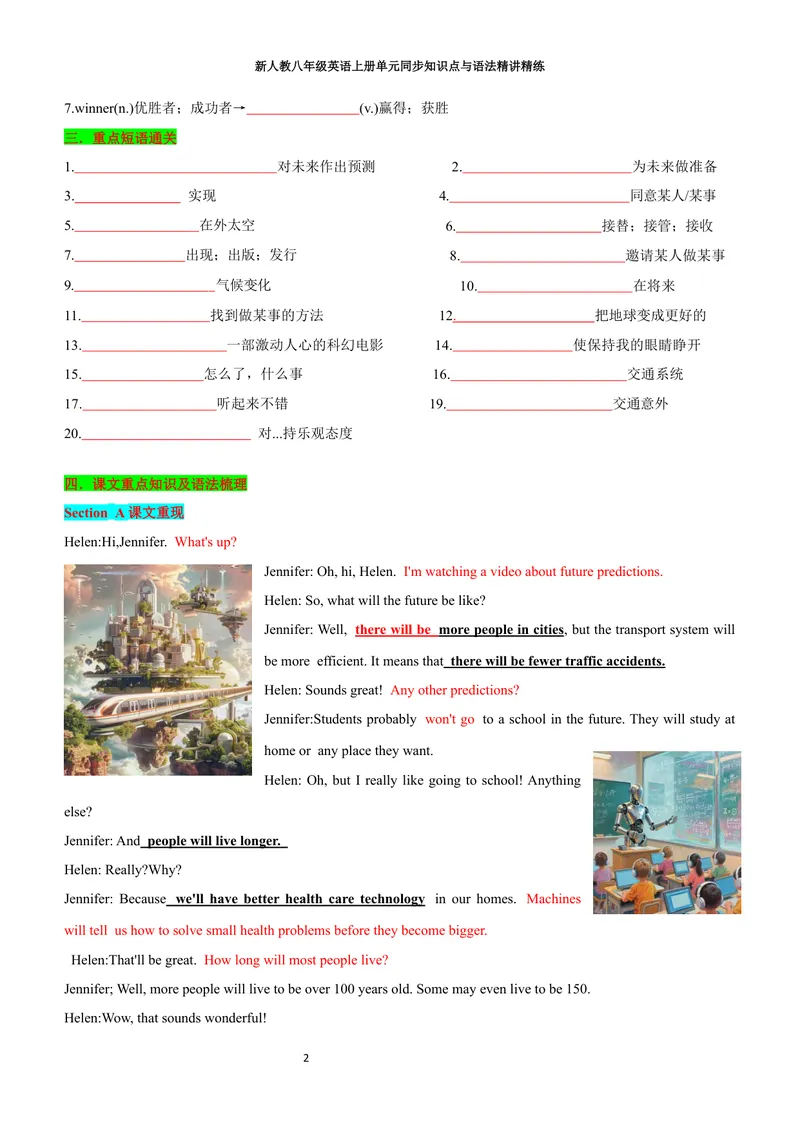
Jennifer:Students probably won't go to a school in the future. They will study at
home or any place they want.
Helen: Oh, but I really like going to school! Anything
else?
Jennifer: And people will live longer.
Helen: Really?Why?
Jennifer: Because we'll have better health care technology in our homes. Machines
will tell us how to solve small health problems before they become bigger.
Helen:That'll be great. How long will most people live?
Jennifer; Well, more people will live to be over 100 years old. Some may even live to be 150.
Helen:Wow, that sounds wonderful!
2新人教八年级英语上册单元同步知识点与语法精讲精练
【考点1.】Which of the predictions do you think will come true in 100 years ?你认为在100年以后以
下哪一个预期将会实现?
【用法详解】“in+时间段”表示“ ”;常用于一般将来时。对“in+时间段”的提问,使用
意为“还要多久”。 三天后 两周后
100年后
Eg:I think there will be more pollution in 50 years.我认为50年后会有更多的污染。
Eg: How soon will you finish your homework?你多久能完成作业?
---in an hour 一个小时以后
相关拓展:“for+时间段”表示“ ”。常用于现在完成时。对“for+时间段”的提问,使用
意为“多久”。
Eg: My brother danced for 2 hours yesterday.我弟弟昨天练舞了两个小时。
Eg: How long has Sean exercised on Sunday.肖恩周天锻炼了多久?
---for two hours.两个小时。
牛
刀小试
( )1. will you go to school? ---in a week.
A. How long B. How soon C. How often D. How far
( )2. will you stay in Beijing? ---For about a week.
A. How long B. How soon C. How often D. How many
( )3. can we expect to hear from you again?---In a couple of days.
A. How long B. How soon C. How often D. How fast
( )4.-- _is it from your home to the school?---About ten minutes' walk.
A. How long B. How soon C. How often D. How far
( )5. does the train leave for Shanghai?---In half an hour.
A.How long B. How soon C. How often D. How many times
【考点2.】AI and robots will take over boring work.所有的机器人将接替无聊的工作。
【用法详解】take over意为“接替;接管;接收”
Eg:Miss Li took over our class when we entered grade 3.三年级后李老师接管了我们班。
相关搭配: 接替某人
Eg:He took over the basketball match from me .他接替我继续篮球比赛。
牛
刀小试
3新人教八年级英语上册单元同步知识点与语法精讲精练
( )1.The new worker will the project next week.
A.take over B. take off C. take up D.take away
( ) 2.He_ _ __ _ his brother's duties during the vacation.
A. took down B. took after C. took over D.take out
【考点3.】A new sci-fi film is coming out .一部新的科幻电影正在热映。
【用法详解】①come out意为“ ”。
Eg:His new movie will come out next week.他的新电影下周上映。
②come out意为“ ”。
Eg:The stars came out as the sky darkened.天空变暗后,星星出现 。
③come out意为“ ”。
Eg:The truth came out in the news yesterday.昨天新闻曝光了事件的真相。
④come out意为“ .”。
Eg:Everything came out well in the end.最终一切都很顺利。
⑤come out意为“ ”
Eg:Jasmines will come out in Summer .茉莉会在夏天盛开。
牛
刀小试
( )1.Spring is coming,the flowers will
A. come on B. come out C. come over D.come up
( )2.The film acted by WangYiBo was last year.
B. came on B. come out C. come om D.came out
【考点4.】So what will the future be like? 所以未来将会是什么样的?
【用法详解】①like作介词,译为“像,类似”。Be like问“内在”,用于描述内在特质(性格、行为等) 。
对性格,品质进行提问 某人是什么样的人?
Eg:What is she like?她是什么样的人?
---She is quiet她很文静
②:look like问“外在”仅指视觉可见的外貌特征。
对外貌进行提问 某人长什么样?
Eg:What does he look like?他长得什么样?
---He has two big eyes.他有两个大眼睛.
③.作为动词,译为"喜欢"。询问某人喜欢什么? 某人喜欢什么?
Eg:What does he like?他喜欢什么?----- He likes camping with all things.他喜欢搬家露营.
4新人教八年级英语上册单元同步知识点与语法精讲精练
牛
刀小试
( )1. - What does your brother look like? ------ .
A. He likes football B. He is tall and thin C.He is kind D. He is at home
( )2. -Can you tell me -- ---He’s active and energetic.
A. What does he like B.What he likes C. What he is like. D. What is he like
( )3.-What does your new friend look like? ------ _ .
A.He is from Australia B. He is tall and of medium build
C. He is very nice to others D. He has a pair of blue shoes
【考点5.】It means that there will be fewer traffic accidents. 这就意味着交通事故会更少。
【用法详解】fewer意为“更少的”。是few的比较级形式。修饰可数名词。
Eg:There will be fewer mistakes if you more careful.如果你更认真的话就会犯更少的错。
相关拓展:①less意为“更少的”。是little的比较级形式。修饰不可数名词。
Eg:More and more people go out by bike to make less pollution .越来越多多的人骑车
出行来减少污染。
②辨析 little, a little, few, a few
a few 意为“有一些;有几个",表示肯定的意义。修饰可数名词。
few 意为“没有,几乎没有",表示否定的意义。修饰可数名词。
a little 意为“有一点,有一些”,表示肯定的意义。修饰不可数名词。
little 意为“几乎没有”,表示否定的概念。修饰不可数名词。
牛
刀小试
( )1.To make mistakes,I think you should be careful with your homework.
A. Less, much more B.fewer ,much more C. less,many much D.fewer ,many more
( )2. There were _ rainy days this month than last month.
A. Less B.fewer C. little D.few
( )3. It took me than an hour to complete my homework.
A. Less B.fewer C. little D.few
( )4. My little sister has__less money in her piggy bank than I do.
A. more B.fewer C. less D.few
( )5. The swimming pool has water than it did last week.
A. Less B.fewer C. more D.few
5新人教八年级英语上册单元同步知识点与语法精讲精练
【考点6.】Machines will tell us how to solve small health problems before they become bigger。机器会
在小的健康问题变大之前告诉人们如何解决。
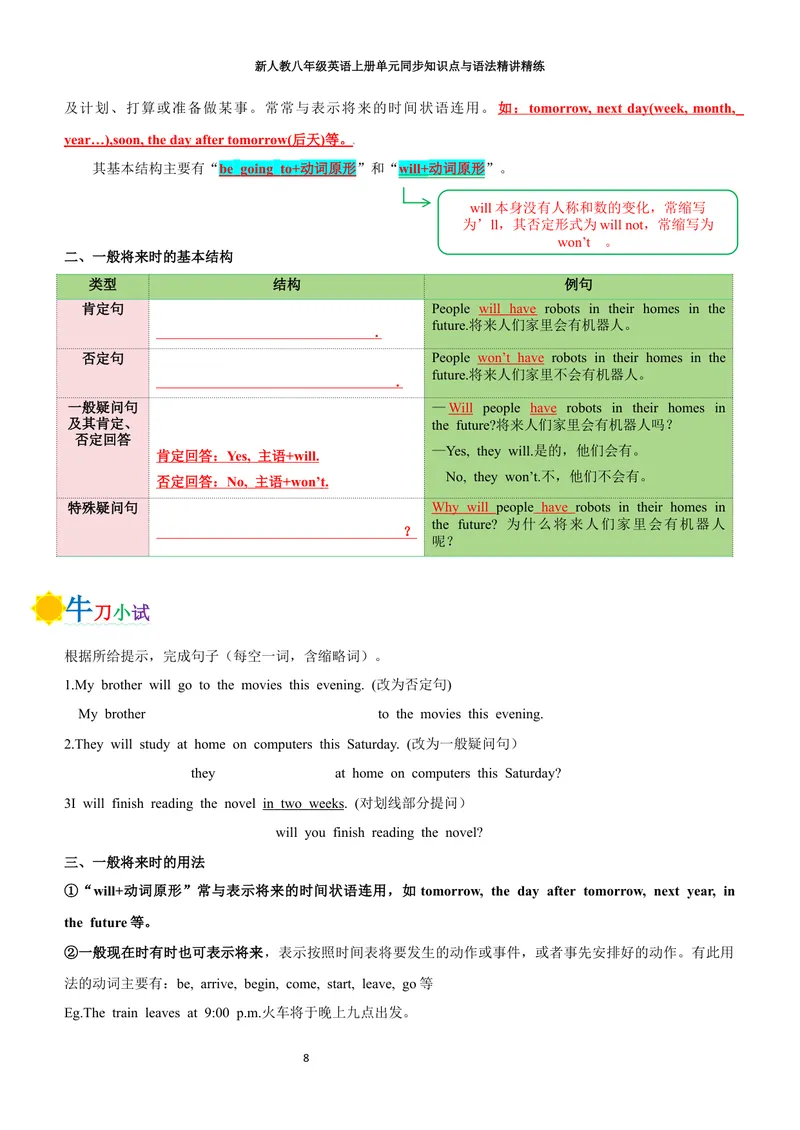
【用法详解】tell 作动词,意为“告诉;讲述”,
相关搭配: 告诉某人做(不做)某事
Eg:My teacher told us not to eat in class.我的老师告诉我们不要在课堂上吃东西。
告诉某人某事
Eg: Please, tell me the truth.求你,把真相告诉我。
tell sb.+ 宾语从句告诉某人....
Eg: She tells me(that) She will be our new English teacher.她告诉我她将会是我们的
新英语老师。
tell sb+特殊疑问词+to do告诉某人...
Eg: He told me how to get there.昨天他告诉我怎么去哪儿?
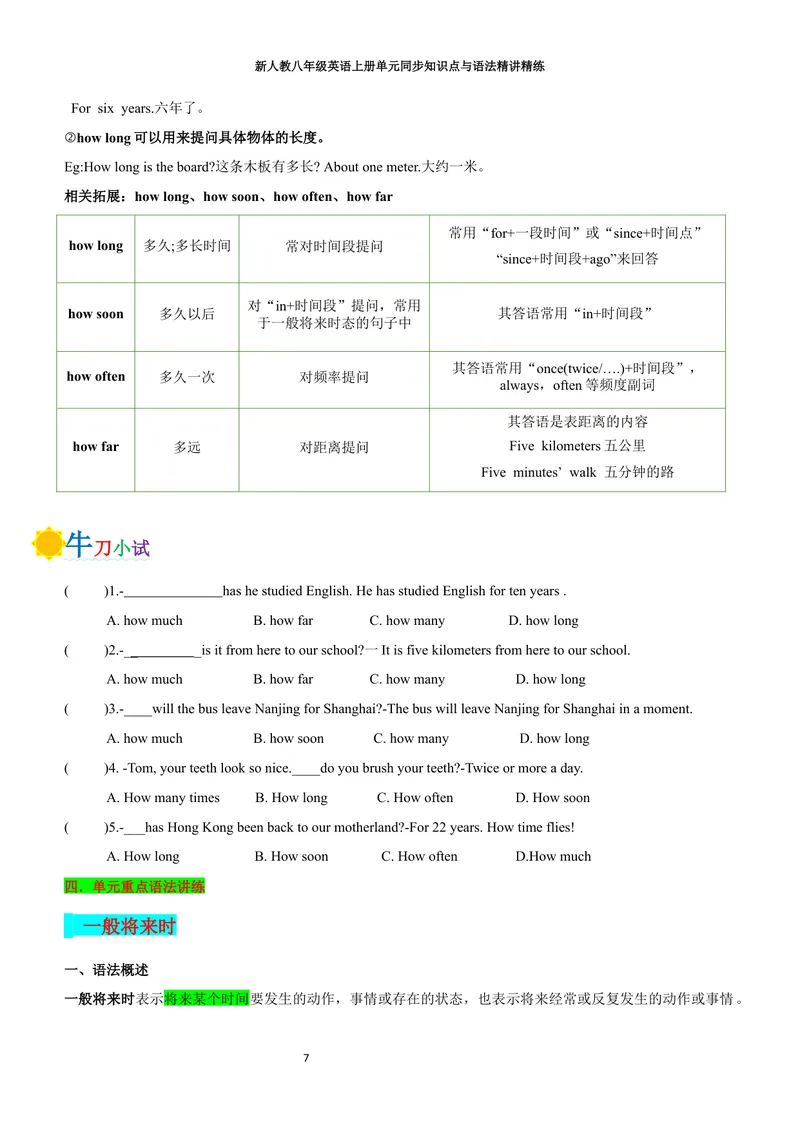
相关拓展: 讲故事 说实话 郑重声明 说谎;撒谎
牛
刀小试
( )1.Can you_ me the way to the bakery?
A.say B.speak C.talk D.tell
( )2.Sugar likes to jokes when she meets us.
A.speak B.say C.tell D.talk
( )3.Tiny can English very well.
A.speak B.say C.tell D.talk
( )4.We should hello to our friends and teachers when
we meet them.
A.say B.speak C.talk D.tell
( )5.My brother told me playing basketball more
can keep fit.
A. practise B. to practise C. practising D. practise
【考点7.】How long will most people live ?人们将会活多久?
【用法详解】①how long指多长时间,主要用来对一段时间(如three days, four weeks 等)提问,常用“for+时
间段”或“since+时间点”回答。
Eg:How long have you known him?你认识他有多久了?
6新人教八年级英语上册单元同步知识点与语法精讲精练
For six years.六年了。
②how long可以用来提问具体物体的长度。
Eg:How long is the board?这条木板有多长? About one meter.大约一米。
相关拓展:how long、how soon、how often、how far
常用“for+一段时间”或“since+时间点”
how long 多久;多长时间 常对时间段提问
“since+时间段+ago”来回答
对“in+时间段”提问,常用
how soon 多久以后 其答语常用“in+时间段”
于一般将来时态的句子中
其答语常用“once(twice/….)+时间段”,
how often 多久一次 对频率提问
always,often等频度副词
其答语是表距离的内容
how far 多远 对距离提问 Five kilometers五公里
Five minutes’ walk 五分钟的路
牛
刀小试
( )1.- has he studied English. He has studied English for ten years .
A. how much B. how far C. how many D. how long
( )2.-_ _ _is it from here to our school?一It is five kilometers from here to our school.
A. how much B. how far C. how many D. how long
( )3.-____will the bus leave Nanjing for Shanghai?-The bus will leave Nanjing for Shanghai in a moment.
A. how much B. how soon C. how many D. how long
( )4. -Tom, your teeth look so nice.____do you brush your teeth?-Twice or more a day.
A. How many times B. How long C. How often D. How soon
( )5.-___has Hong Kong been back to our motherland?-For 22 years. How time flies!
A. How long B. How soon C. How often D.How much
四.单元重点语法讲练
一般将来时
一、语法概述
一般将来时表示将来某个时间要发生的动作,事情或存在的状态,也表示将来经常或反复发生的动作或事情。
7新人教八年级英语上册单元同步知识点与语法精讲精练
及计划、打算或准备做某事。常常与表示将来的时间状语连用。 如: tomorrow, next day(week, month ,
year…),soon, the day after tomorrow( 后天 ) 等。
其基本结构主要有“ be going to+ 动词原形 ”和“ will+ 动词原形 ”。
will本身没有人称和数的变化,常缩写
为’ll,其否定形式为will not,常缩写为
won ’ t 。
二、一般将来时的基本结构
类型 结构 例句
肯定句 People will have robots in their homes in the
future.将来人们家里会有机器人。
.
否定句 People won ’ t have robots in their homes in the
future.将来人们家里不会有机器人。
.
一般疑问句 —Will people have robots in their homes in
及其肯定、 the future?将来人们家里会有机器人吗?
否定回答
—Yes, they will.是的,他们会有。
肯定回答: Yes , 主语 +will .
No, they won’t.不,他们不会有。
否定回答: No , 主语 +won ’ t .
特殊疑问句 Why will people hav e robots in their homes in
the future? 为什么将来人们家里会有机器人
?
呢?
牛
刀小试
根据所给提示,完成句子(每空一词,含缩略词)。
1.My brother will go to the movies this evening. (改为否定句)
My brother to the movies this evening.
2.They will study at home on computers this Saturday. (改为一般疑问句)
they at home on computers this Saturday?
3I will finish reading the novel in two weeks . (对划线部分提问)
will you finish reading the novel?
三、一般将来时的用法
①“will+动词原形”常与表示将来的时间状语连用,如 tomorrow, the day after tomorrow, next year, in
the future等。
②一般现在时有时也可表示将来,表示按照时间表将要发生的动作或事件,或者事先安排好的动作。有此用
法的动词主要有:be, arrive, begin, come, start, leave, go等
Eg.The train leaves at 9:00 p.m.火车将于晚上九点出发。
8新人教八年级英语上册单元同步知识点与语法精讲精练
③表示位置移动的动词,如go, leave, start, come, arrive, reach等,可用现在进行时表示按计划或安排将要
发生的动作。
Eg.My father is coming to see me. 我父亲就要来看我了。
相关拓展:there be句型的一般将来时结构
there be句型的一般将来时结构有两种,即:
句型 There will be + 主语 + 其他. There is/are going to be + 主语 + 其他
否定句 There w on ’ t be + 主语 + 其他. There is n ’ t /are n ’ t going to be + 主语 + 其
他
一般疑问句 Will there be + 主语 + 其他? Is/Are there going to be + 主语 + 其他?
肯定回答 Yes, there will. Yes, there is/are.
否定回答 No, there won’t. No, there isn’t/aren’t.
注意:there be句型和have不可共存。
牛
刀小试
( B )1.There a football match in our school tomorrow.
A. will have B. will be C. is D.is going to have
( A )4.There a food festival in our school next weekend.
A. is going to be B. are going to be C. is going to have D.are going to
have
四、“be going to+动词原形”与“will+动词原形”的区别
1.be going to含有“计划;准备”的意思,而will则没有这个意思。
Eg.He is going to act a sci-fi film .他打算演一部科幻电影。
2.在含有条件状语从句的复合句中,主句一般不用be going to,而多用will。
Eg.If you have problems, I’ll stay with you and help you.如果你有困难,我会和你在一起并且帮助你。
3.“be going to+动词原形”表示根据目前迹象推断将要发生的事情;“will+动词原形”表示客观上将来势必
发生的事情。
Eg.Look at the dark clouds! It’s going to rain! 看那些乌云!就要下雨
了!
He will be twenty-eight years old next year. 明年他就28岁了。
牛
刀小试
( )1.—The coffee’s finished!—Oh, sorry! I ________to the shop to get some.
9新人教八年级英语上册单元同步知识点与语法精讲精练
A. am going B. was going C. went D. have gone
( )2.John________ us when he is free.
A. joins B. join C. will join D. joined
( )3.—What are you expecting to do when the flu stops spreading?
—I ________ the world and enjoy different food.
A. go around B. have been on a tour of C. will travel around
( )4.—I to Hainan on vacation with my parents this coming summer holiday.—That's great!
A. go B. went C. will go D. have gone
( )5.—Is Helen here?—Not yet, but she______________ in half hour.
A.arrives B. will arrive C. arrived D. has arrived
( )6.—I wonder if you ________ us for the English party tomorrow.—If I ________ free, I will go with you.
A.will join, am B.will join, will be C.join, am
( )7. There ________ a concert in our school hall next week.
A.is B.was C.will be D.will have
( )8. —Is Helen here?—No, she isn’t here, She ________ in half an hour.
A.arrives B.arrived C.will arrive D.has arrived
( )9. —Has your father come back yet?—No. He ________ come back ________ this Sunday.
A.doesn’t; until B.won’t; after C.doesn’t; after D.won’t; until
( )10. We have no more vegetables in the fridge. I _____and buy some.
A.go B.went C.will go D.was going
用所给单词的适当形式填空
1.My mother (be) back in two days.
2.There (be) heavy snow tomorrow.
3.He (take) the train to school yesterday.
4.The builders many buildings (build) in our city last year.
5.We can do the work with (little) money and (few) people than they can.
6.They ( not have ) any classes next week.
7.Betty (write) to her parents tomorrow.
8.Look at those clouds. It (rain).
9.He ( read ) an English book now.
10.Look! Many girls (dance) over there.
10新人教八年级英语上册单元同步知识点与语法精讲精练
课
堂测试
一、单项选择
( ) 1.—Is Jack here?—Not yet, but he _________ in half an hour.
A.arrives B.will arrive C.arrived D.has arrived
( ) 2.—Can I see the headmaster now?
—I’m afraid you can’t. He ________ a meeting. He ________ back in 10 minutes. You can wait for
him in his office.
A.will have; will come B.will have; comes C.is having; will come D.is having; comes
( ) 3.My father ________ us a speech in our school next week.
A.give B.gave C.was giving D.will give
( ) 4.— Do you think ________ an art show next week?— Yes, I think so.
A.there have B.there will have C.there will be D.there is going to have
( ) 5.—Is Jim still angry ________ you?—No. We made peace ________ each other yesterday.
A.at; with B.with; at C.with; with D.about; with
( ) 6.I want to know if Mary ________ to the party tomorrow.
A.go B.went C.will go D.goes
( ) 7.—The air is very fresh in our city. There is less _______ than before.
—Yes. The government has taken action to protect the environment.
A.wood B.pollution C.noise D.water
( ) 8.—Who ______ folk songs at the concert? —Sorry, but I am going tomorrow. I like folk
music.
A.sings B.sangC.will sing D.sings
( ) 9.---What will the future ________?---Cities will be more ________.
A.like; pollute B.be like; polluted C.like; pollution D.be like; pollution
( ) 10.We will try our best to do the work with_________ money and _______ people.
A.few; little B.a few; a little C.less; fewer D.fewer; less
二、用括号内所给词的适当形式填空
1.This book is really (education).Students can learn a lot from it.
2..She (pass)all the tests and became the (win)of the competition.
11新人教八年级英语上册单元同步知识点与语法精讲精练
3.The young professor Gui Haichao got the chance to go into (out)space through hard training.
4.I spent one night's time making some (video)about the story to take part in the “Tell
China's Stories”competition.
5. (future)say robots will be a large part of life.
三、从方框中选择合适的单词并用其适当形式填空
traffic long positive technology shall
1.The
of the report must be at least 5 minutes.
2.Training your mind to think is a good way to live happily.
3.Luckily,we're in the age of AI .Everything can be smart.
4. we buy some colourful stars and flowers to decorate the house,Mum?
5.There is so much on the road today that I am late for school.
四、完型填空
There are many kinds of pollution around us, 1 air pollution, soil pollution, noise pollution and light
pollution. They are bad 2 our health in many ways.
Burning gas, oil and coal creates air pollution. It can cause sore eyes and breathing problems.
In our life, litter(废弃物)is everywhere. It 3 our environment dirty. People put lots of rubbish in the land.
Pilots use too many chemicals in the fields. They do harm to the soil. So soil pollution is becoming more and more
4 .
Noise pollution can make people deaf. For example, people may lose their hearing if they work in a 5
place for a long time. 6 noise can cause high blood pressure (血压)as well.
7 for a long time in strong light may cause some other problems. It makes people feel 8 and the
eyes can be very uncomfortable.
With 9 pollution, our planet will become greener and our health 10 better. Let's be greener people.
( )1.A.such as B.for example C.as well as D.because of
( ) 2.A.to B.in C.for D.of
( ) 3.A.makes B.helps C.gives D.lets
( ) 4.A.serious B.important C.clear D.dangerous
( )5.A.Noise B.noisy C.quiet D.quietly
( )6.A.Much too B.Many too C.Too much D.Too many
12新人教八年级英语上册单元同步知识点与语法精讲精练
( )7.A.Working B.Work C.Worked D.Works
( )8.A.comfortable B.possible C.terrible D.ugly
( )9.A.little B.less C.few D.fewer
( )10.A.will be B.would be C.was D.is
五、阅读单选
A
As time goes by, everything in our life improves. Do you want to know about what our homes will be like in the
future? Here are some predictions(预测):
Want to take a shower when you get home? You’ll be able to let your smart (智能)water heater(热水器)start
heating up when you’re on your way home.
Did I turn off the oven? Did I close the window? Everyone may have a moment like that. But in the future, your
home will check these for you.
In your home of the future, all of your devices (设备) can work together to make your life more comfortable.
When you turn on the lights in the morning, your windows will open at the same time. The lights will slowly turn off
by themselves after the sun appears.
Your home may have dangers. The hackers(黑客)could open your door and bring a loss(损失)at your home
through your phone or other devices. Your home will tell you about it, but you can’t arrive in time. So people will have
to be careful of their personal information.
( )1.What can we do on our way home in the future?
A.Take a shower. B.Keep working.
C.Let the water heater work. D.Have a look at our smart home devices.
( )2.What will our life be like in the future in smart homes?
A.More boring. B.Very busy.
C.Very Safe. D.More comfortable.
( )3.Who will let you know if someone breaks into your home in the future?
A.Your home. B.Your neighbor.
C.Your phone. D.Your friend.
( )4.How many kinds of predictions are mentioned(提到)in the passage?
A.Two. B.Three. C.Four. D.Five.
( )5.What’s the best title of the passage?
A.Some Beautiful Houses B.Homes of the Future
13新人教八年级英语上册单元同步知识点与语法精讲精练
C.A Better World D.Some Famous Predictions
B
Do you want to know what our life will be like in the future? Let’s have a look. You may get a surprise.
You will go to the kitchen when you are hungry. You will give orders to the kitchen robot. The robot will cook the
food for you in a few minutes. Then it will bring it to you.
In the kitchen you will find a special food machine. The food machine will tell you what your body needs. It will
help you eat healthily. The food machine will be connected with(连接) the kitchen robot. The robot can get messages
from the food machine.
After having a meal, you can go to your home office. You will work at home and you don’t need to go out to
work any more.
You will have a special information screen. You can get any information on the screen. When you receive a
message from a friend in America, your information screen will be turned on automatically(自动地).Your friend’s face
appears on the screen. Then you can talk to your friend easily.
( )51.What is the second paragraph (段) about?
A.It’s about healthy food. B.It’s about the kitchen robot.
C.It’s about a nice kitchen. D.It’s about a robot which can do homework.
( )52.According to(根据) the passage, ______will tell you what your body needs.
A.the kitchen robot B.the food machine
C.the information screen D.the computer
( )53.What does the underlined word “receive” mean in Chinese?
A.丢失 B.复制 C.接收 D.保存
( )54.You can see your friend’s face_______.
A.on the wall B.on the screen
C.on the Internet D.on TV
( )55.What’s the best title for the passage?
A.Our life in the future B.A food machine
C.A special information screen D.A kitchen robot
四、阅读回答问题
We will see a new kind of little car called "E-car" in the street in the future. The car is as small as a bike, but it
can carry two people in it. Everybody can drive it easily, just like riding a bike. Even children and old people can drive
14新人教八年级英语上册单元同步知识点与语法精讲精练
it to school or parks.
If everyone drives such a car in the future, the air will be fresher. There will be more space for all the cars in
cities, and there will also be more places for people to walk in the street.
The little car can't go very fast (it can go only 65 kilometers an hour), so driving will be safer. It will be
convenient for people to go around the city, and it'll be also useful for a long trip.
People won't have to spend much money on E-cars. They are so cheap that almost all people can afford to buy.
And this kind of cars can save lots of gas. They can go 450 kilometers with only a little gas.
41.Is an E-car as big as a bike?
42.What will the air be like if everyone drives such a car in the future?
43.Why are people safer when they drive the E-car?
44.How many people can the little car carry?
45.What’s the topic sentence of the fourth paragraph?
15