新人教八年级英语上册单元同步知识点与语法精讲精练
Unit 2 Home sweet home
Section B How do you feel at home?
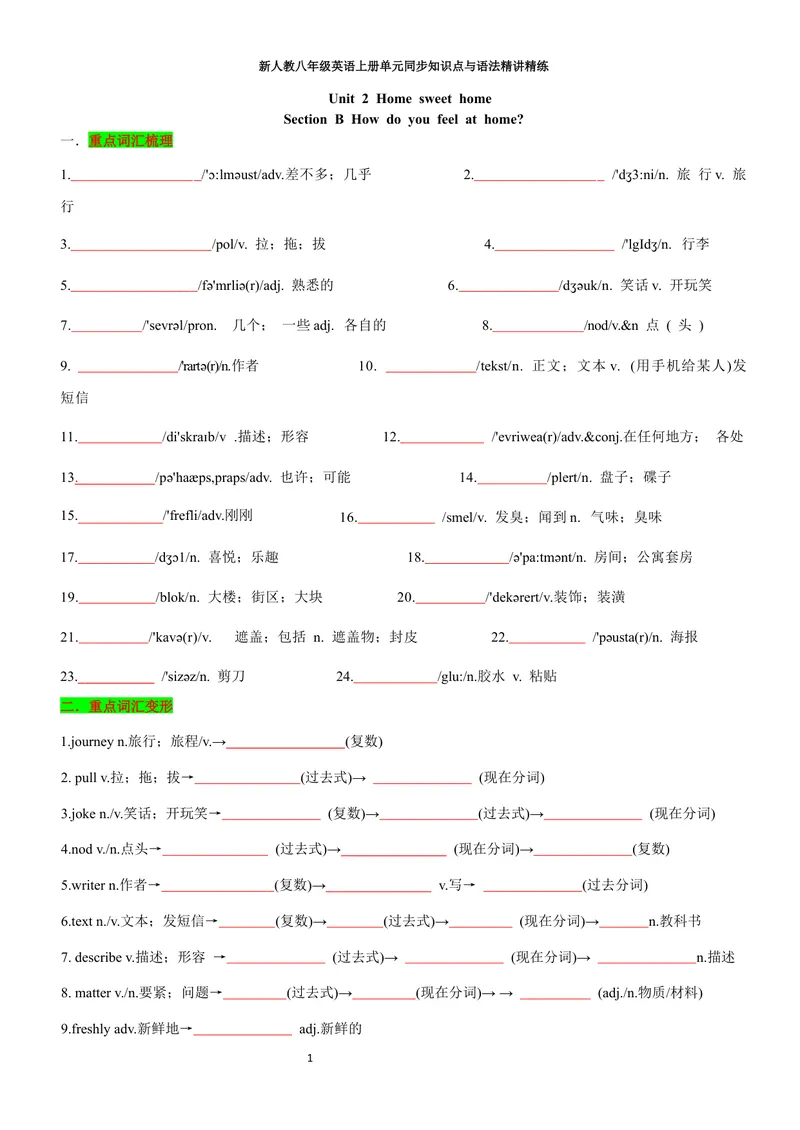
一.重点词汇梳理
1. /'ɔ:lməust/adv.差不多;几乎 2. /'dʒ3:ni/n. 旅 行v. 旅
行
3. /pol/v. 拉;拖;拔 4. /'lgIdʒ/n. 行李
5. /fə'mrliə(r)/adj. 熟悉的 6. /dʒəuk/n. 笑话v. 开玩笑
7. /'sevrəl/pron. 几个; 一些adj. 各自的 8. /nod/v.&n 点 ( 头 )
9. /'rartə(r)/n.作者 10. /tekst/n. 正文;文本v. (用手机给某人)发
短信
11. /di'skraɪb/v .描述;形容 12. /'evriwea(r)/adv.&conj.在任何地方; 各处
13 . /pə'haæps,praps/adv. 也许;可能 14. /plert/n. 盘子;碟子
15. /'frefli/adv.刚刚 16. /smel/v. 发臭;闻到n. 气味;臭味
17. /dʒɔ1/n. 喜悦;乐趣 18. /ə'pa:tmənt/n. 房间;公寓套房
19. /blok/n. 大楼;街区;大块 20. /'dekərert/v.装饰;装潢
21. /'kavə(r)/v. 遮盖;包括 n. 遮盖物;封皮 22. /'pəusta(r)/n. 海报
23. /'sizəz/n. 剪刀 24. /glu:/n.胶水 v. 粘贴
二.重点词汇变形
1.journey n.旅行;旅程/v.→ (复数)
2. pull v.拉;拖;拔→ (过去式)→ (现在分词)
3.joke n./v.笑话;开玩笑→ (复数)→ (过去式)→ (现在分词)
4.nod v./n.点头→ (过去式)→ (现在分词)→ (复数)
5.writer n.作者→ (复数)→ v.写→ (过去分词)
6.text n./v.文本;发短信→ (复数)→ (过去式)→ (现在分词)→ n.教科书
7. describe v.描述;形容 → (过去式)→ (现在分词)→ n.描述
8. matter v./n.要紧;问题→ (过去式)→ (现在分词)→ → (adj./n.物质/材料)
9.freshly adv.新鲜地→ adj.新鲜的
1新人教八年级英语上册单元同步知识点与语法精讲精练
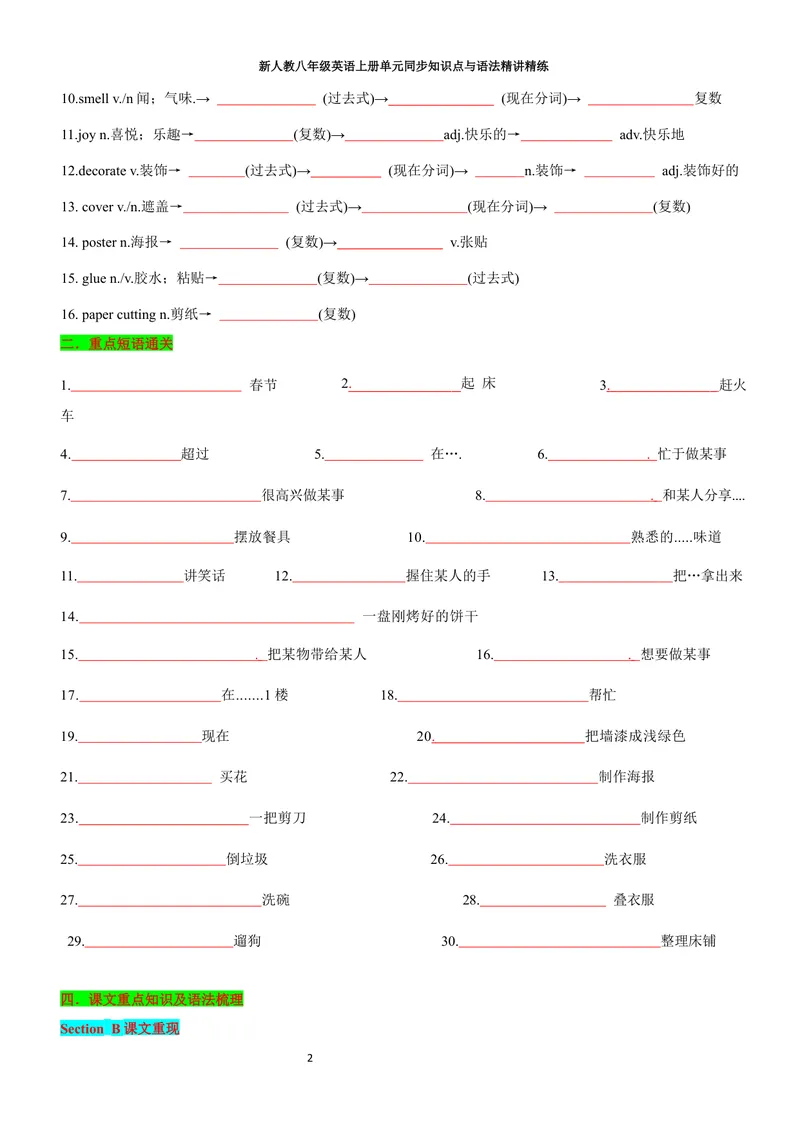
10.smell v./n闻;气味.→ (过去式)→ (现在分词)→ 复数
11.joy n.喜悦;乐趣→ (复数)→ adj.快乐的→ adv.快乐地
12.decorate v.装饰→ (过去式)→ (现在分词)→ n.装饰→ adj.装饰好的
13. cover v./n.遮盖→ (过去式)→ (现在分词)→ (复数)
14. poster n.海报→ (复数)→ v.张贴
15. glue n./v.胶水;粘贴→ (复数)→ (过去式)
16. paper cutting n.剪纸→ (复数)
二.重点短语通关
1. 春节 2 . 起 床 3 . 赶火
车
4. 超过 5. 在…. 6. . 忙于做某事
7. 很高兴做某事 8. . 和某人分享....
9. 摆放餐具 10. 熟悉的.....味道
11. 讲笑话 12. 握住某人的手 13. 把…拿出来
14. 一盘刚烤好的饼干
15. . 把某物带给某人 16. . 想要做某事
17. 在.......1楼 18. 帮忙
19. 现在 20 . 把墙漆成浅绿色
21. 买花 22. 制作海报
23. 一把剪刀 24. 制作剪纸
25. 倒垃圾 26. 洗衣服
27. 洗碗 28. 叠衣服
29. 遛狗 30. 整理床铺
四.课文重点知识及语法梳理
Section B课文重现
2新人教八年级英语上册单元同步知识点与语法精讲精练
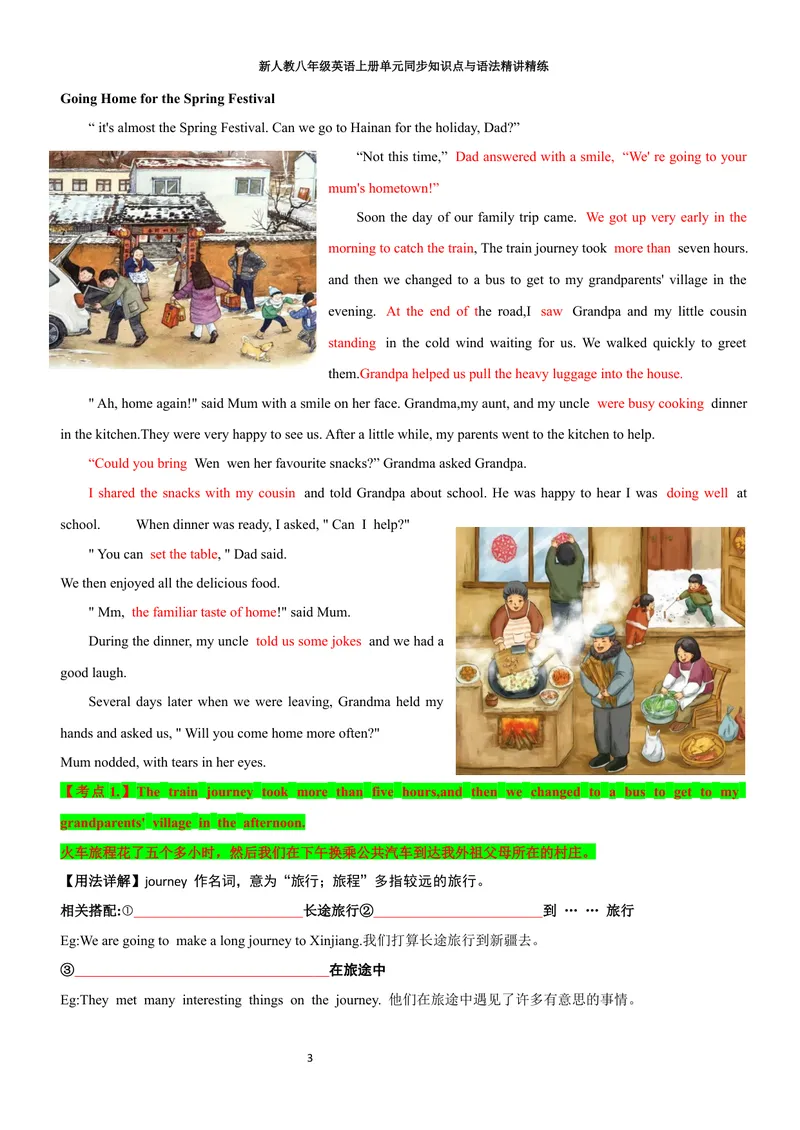
Going Home for the Spring Festival
“ it's almost the Spring Festival. Can we go to Hainan for the holiday, Dad?”
“Not this time,” Dad answered with a smile, “We' re going to your
mum's hometown!”
Soon the day of our family trip came. We got up very early in the
morning to catch the train, The train journey took more than seven hours.
and then we changed to a bus to get to my grandparents' village in the
evening. At the end of the road,I saw Grandpa and my little cousin
standing in the cold wind waiting for us. We walked quickly to greet
them.Grandpa helped us pull the heavy luggage into the house.
" Ah, home again!" said Mum with a smile on her face. Grandma,my aunt, and my uncle were busy cooking dinner
in the kitchen.They were very happy to see us. After a little while, my parents went to the kitchen to help.
“Could you bring Wen wen her favourite snacks?” Grandma asked Grandpa.
I shared the snacks with my cousin and told Grandpa about school. He was happy to hear I was doing well at
school. When dinner was ready, I asked, " Can I help?"
" You can set the table, " Dad said.
We then enjoyed all the delicious food.
" Mm, the familiar taste of home!" said Mum.
During the dinner, my uncle told us some jokes and we had a
good laugh.
Several days later when we were leaving, Grandma held my
hands and asked us, " Will you come home more often?"
Mum nodded, with tears in her eyes.
【考点 1.】The train journey took more than five hours,and then we changed to a bus to get to my
grandparents' village in the afternoon.
火车旅程花了五个多小时,然后我们在下午换乘公共汽车到达我外祖父母所在的村庄。
【用法详解】journey 作名词,意为“旅行;旅程”多指较远的旅行。
相关搭配:① 长途旅行② 到 … … 旅行
Eg:We are going to make a long journey to Xinjiang.我们打算长途旅行到新疆去。
③ 在旅途中
Eg:They met many interesting things on the journey. 他们在旅途中遇见了许多有意思的事情。
3新人教八年级英语上册单元同步知识点与语法精讲精练
牛
刀小试
( )1.They journeyed the mountains.
A. in B.with C.to D.on
2. 旅程很长,但我们最后还是到达了。(翻译)
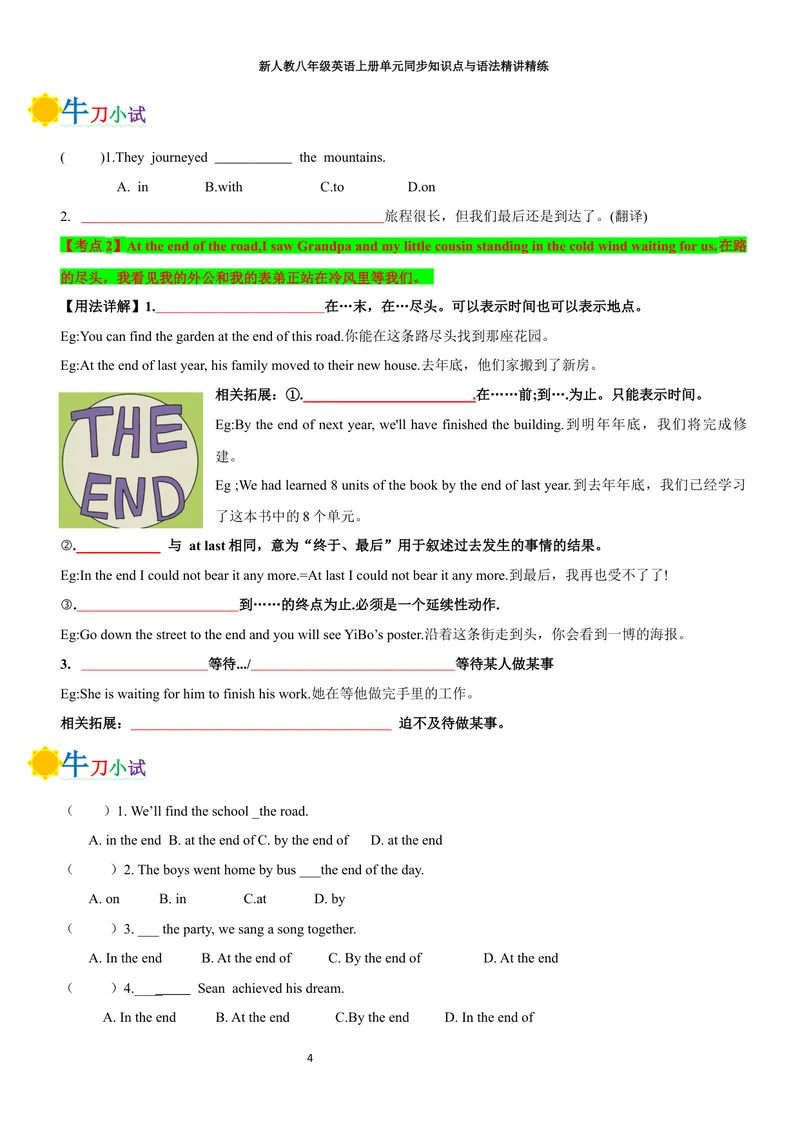
【考点2】At the end of the road,I saw Grandpa and my little cousin standing in the cold wind waiting for us.在路
的尽头,我看见我的外公和我的表弟正站在冷风里等我们。
【用法详解】1. 在…末,在…尽头。可以表示时间也可以表示地点。
Eg:You can find the garden at the end of this road.你能在这条路尽头找到那座花园。
Eg:At the end of last year, his family moved to their new house.去年底,他们家搬到了新房。
相关拓展:①. .在……前;到….为止。只能表示时间。
Eg:By the end of next year, we'll have finished the building.到明年年底,我们将完成修
建。
Eg ;We had learned 8 units of the book by the end of last year.到去年年底,我们已经学习
了这本书中的8个单元。
②. 与 at last相同,意为“终于、最后”用于叙述过去发生的事情的结果。
Eg:In the end I could not bear it any more.=At last I could not bear it any more.到最后,我再也受不了了!
③. 到……的终点为止.必须是一个延续性动作.
Eg:Go down the street to the end and you will see YiBo’s poster.沿着这条街走到头,你会看到一博的海报。
3. 等待.../ 等待某人做某事
Eg:She is waiting for him to finish his work.她在等他做完手里的工作。
相关拓展: 迫不及待做某事。
牛
刀小试
( )1. We’ll find the school _the road.
A. in the end B. at the end ofC. by the end of D. at the end
( )2. The boys went home by bus ___the end of the day.
A. on B. in C.at D. by
( )3. ___ the party, we sang a song together.
A. In the end B. At the end of C. By the end of D. At the end
( )4.___ _ Sean achieved his dream.
A. In the end B. At the end C.By the end D. In the end of
4新人教八年级英语上册单元同步知识点与语法精讲精练
( )5. _______ the end of the holiday I had spent all my money.
A. By B.On C. In D.At
【考点3】Grandma,my aunt,and my uncle were busy cooking dinner in the kitchen.我的外婆,姨妈和舅舅
正忙着在厨房里做饭。
【用法详解】busy作形容词,意为“忙碌的;无暇的”,在句中常置于系动词之后作表语或名词之前作定语。
Eg;Sorry, the subscriber you dialed is busy now. Please redial later!
对不起,您所拨打的电话正在通话中。请稍后再拨!
相关搭配;① .忙于某事
Eg;My uncle is busy with his work.我叔叔正忙于他的工作。
② .忙于做某事
Eg;I am busy doing my homework.我正忙着做作业。
牛
刀小试
( )1.-Why were you angry with your daughter?
-She was busy and taking selfies(自拍)when I was talking to her.
A. texting B. to text C. text D. texted
( )2.She is busy for the exam
A. prepare B. preparing C.to prepare D.prepared
( )3.He is busy his concert.
A. in B. to C. with D. for
【考点4】I shared the snacks with my cousin and told Grandpa about school。我跟我的表弟分享零食,
跟我的外公聊我的学校生活。
【用法详解】①share sth with sb把......与.....分享。
Eg:He shared his lunch with me.他把午餐分给我。
拓展:② = 共享单车
共享电动车 共享经济
牛
刀小试
1. Would you________________(分享你的笔记) with me?
( )2. He refused to_______his secrets _________anyone.
A. share; to B.share;with C.share; for
【考点5】Mm,the familiar taste of home!” said Mum.“嗯,熟悉的家的味道!”妈妈说。
5新人教八年级英语上册单元同步知识点与语法精讲精练
【用法详解】familiar作形容词,意为“熟悉的”,定语或表语。
相关搭配: 意为“对某人/ 某物熟悉”。
Eg:He is familiar with the new teacher. 他对这位新老师很熟悉。
【考点6】During the dinner,my uncle told us some jokes and we had a good laugh.吃饭时,我舅舅给我
们讲了一 些笑话,我们笑得很开心。
【用法详解】1.joke 作不及物动词,意为“说笑话;开玩 笑”;joke 也可作名词,意为“笑话;玩 笑”。
Eg:He likes joking,but he doesn't do well in telling jokes.他喜欢开玩笑,但是他不擅长讲笑话。
相关搭配:① 开某人的玩笑
Eg: Everyone may play a joke on others on April Fool's Day.在愚人节所有人都可能开别人的玩笑。
② 拿某事开玩笑
Eg:It's an important question.Don't make a joke of it.
这是一个重要的问题。不要拿它开玩笑。
③ 讲笑话
Eg:He told a funny joke.他讲了个有趣的笑话。
2.laugh n嘲笑; v嘲笑
相关搭配:① 嘲笑某人 Eg:Don't laugh at others.不要嘲笑他人。
② 开怀大笑 Eg:We had a good laugh.我们笑得很开心。
牛
刀小试
1. .别拿他的错误开玩笑。(翻译)
( )2.She loves_______jokes to make people laugh.
A.saying B.telling C.speaking
( )3.His joke made everyone_____.
A.laugh B.to laugh C.laughing
4.It's rude to (嘲笑) people's mistakes.
【考点6】In the text,what words are used to describe people's feelings?在文章里面哪些词被用来描述人的
情感?
【用法详解】1. 被用来做某事。
Eg.This machine is used to cut paper.这台机器被用来剪纸。
相关拓展:① 过去常常做某事
Eg.She used to play the piano every day.她过去每天都会弹钢琴。
② 现在习惯于做某事
6新人教八年级英语上册单元同步知识点与语法精讲精练
Eg. He is getting used to waking up early.他现在习惯早起。
2.describe 作动词,意为“描述:形容”其名词形式为description。
① 向某人描述某物/某人
Eg. Can you describe the OOTD of yourself today?你能描述一下你今天的穿
搭吗?
② .将.....描述为.....
Eg.He described the boy as a cool guy.他将那个男孩描述为酷盖。
牛
刀小试
( )1.There a lot of red-crowned cranes(丹顶鹤) in this area.
A.was used to B.was used to be C.used to D.used to be
( )2. She used to with her parents, but now she is used to at school.
A. live; living B.live; live C.living; living D.living; live
( )3. He used to in a small village, but now he has been used to in the big city.
A.live; living B.live; live C.living;living D.living;live
4. My cousin is used to (study) with his new friends in Australia.
5. My mother is used to (get) up early to cook breakfast for us.
6. These rules is used to (protect) the students.
【考点7】1.No matter how long I'm away,home is always glad to see me again.无论我离开多久,再次见到我家
人还是一样会很开心。
2.wherever l go,Finally 1 go, To my home, sweet home.无论我去到哪里,最后都会回到我温暖的家。
【用法详解】no matter+疑问词和疑问词+ever都可以意为“无论...不管.....”引导让步状语从句时,二者可以互
换,其句意搭配如下:
① = 无论什么
Eg.No matter what he wants, his parents will buy it for him .无论他想要什么,他的父母都会给他买。
② = 无论谁
Eg.No matter who you are, you must obey the rules.无论你是谁,都应该遵守规则。
③ = 无论何时
Eg.No matter when you come you are welcomed.无论你们什么时候来,都受欢迎。
④ = 无论哪里
Eg.No matter where you go, I will go with you .无论你去哪里,我都会和你一起去。
7新人教八年级英语上册单元同步知识点与语法精讲精练
⑤ = 无论怎样式
Eg. No matter how bad you feel, keep trying.不管你感觉多么糟糕,继续努力。
牛
刀小试
1. .无论多么艰难,我都会尝试。(翻译)
2. .无论发生什么,保持冷静。
3. .无论你走到哪里,我都会找到你。
( )4..______difficult the task is, don't give up.
A.No matter how B.No matter what C.No matter where
【考点8】could you help choose some photos to hang on the walls?你可以帮忙选一些照片挂着在墙上吗?
【用法详解】choose作动词,意为“选择;抉择”。
相关搭配:① 选择做某事
Eg.More and more people choose to go to work on foot. 越来越多的人选择步行去上班。
② 给某人挑选某物
Eg.Let's choose a special present for him.咱们给他选一件特别的礼物吧。
相关拓展:
①choose的名词形式是 表示“选择;抉择”,过去式 ,过去分词
.
② 做选择;
③ 除了做.....别无选择。
( )-I'm afraid we have no______but to take a taxi.
A.decision B.reason C.choice D.chance
( )2.He chose a car his brother’s Birthday .
A.to B.for C.with D.into
( )3.He chose basketball with his classmates instead of doing homework.
A.play B.to play C.playing D.plays
课
堂测试
一、单选题
( )1.If you want to be in good ________, you should eat ________ food.
A.healthy; healthy B.health; health C.healthy; health D.health; healthy
8新人教八年级英语上册单元同步知识点与语法精讲精练
( )2._______ of the children likes the movie because it’s too boring.
A.None B.Each C.All D.Some
( )3.—What's your hobby, Diana?
—Well, I have many hobbies, ________ dancing, singing and playing water sports.
A.used to B.because of C.such as D.instead of
( )4.My English teacher wants us __________ a diary in English every day.
A.to keep B.keeping C.kept D.keep
( )5.It’s dangerous________ with the wild animal.
A.for us to play B.of us playing
C.for us playing D.of us to play
( )6.They were all tired, but ______________ of them stopped working.
A.any B.none C.neither D.no
( )7.You can eat ________ you like. Help yourself.
A.whatever B.whenever C.however D.wherever
( )8.I could ________ hear what you said just now. Could you please say that again?
A.sometimes B.always C.hardly D.clearly
( )9.—How many hours do they relax every day?
—_____.
A.Twice a day B.Two C.Second D.Twice
( )10.—_____ does your brother use the Internet?—Once a week.
A.How often B.Why C.Where D.How long
( )11.Tony is a ___________boy, but he speaks in such a low voice in class that we can ___________hear him.
A.weak; almost B.strong; hardly C.weak; hardly D.strong; almost
( )12._____ riding shared bikes is an environmentally friendly ways to travel, many of the bikes are thrown
everywhere.
A.As B.Although C.Because
( )13.Parents are always there for you ________ difficulties you meet.
A.whatever B.whenever C.however
( )14.______ he is ill, ______ he still goes to school.
A.Although;but B./;/ C.Although; / D.But;although
二、完型填空
9新人教八年级英语上册单元同步知识点与语法精讲精练
David Smith,12,usually gets up at about 7:40 am. He goes to bed 11 and only gets about seven
hours of sleep each night. 12 waking up in the morning isn't easy for him.“I often feel 13 in class,”
David says.
Children from 5 to 12 years old 14 at least ten hours of sleep each night.But scientists say that a lot of
children don't get 15 sleep.Even some of them sleep 16 than eight hours every day.
What is keeping children 17 at night?We made a survey in David's school.We collected the answers of all
the students 18 this question.The answers show that the big stealer(偷窃者)is the 19 .68% of the students
in this school said they went online before 20 .Most boys and girls said they used the 21 to chat(交
谈)with friends.
Scientists say if a person has a good sleep,he or she will 22 well next day.If students sleep well at night,
23 will do better in math and writing tests.
It's 24 too late to change your sleeping habits.Go to bed early and keep doing that for a week.Then see
25 you feel.You will find you become different.
( )11.A.early B.soon C.again D.late
( )12.A.Because B.If C.So D.When
( )13.A.excited B.happy C.lucky D.tired
( )14.A.do B.decide C.need D.seem
( )15.A.popular B.healthy C.wonderful D.enough
( )16.A.more B.less C.best D.good
( )17.A.getting up B.cutting up C.waking up D.staying up
( )18.A.of B.with C.to D.by
( )19.A.computer B.dictionary C.magazine D.television
( )20.A.going home B.going to school C.going shopping D.going to bed
( )21.A.email B.telephone C.bicycle D.Internet
( )22.A.dance B.learn C.sing D.jump
( )23.A.we B.he C.she D.they
( )24.A.always B.never C.often D.ever
( )25.A.what B.when C.how D.where
三、阅读单选
Overweight(超重) is one of the biggest health problems now. Being overweight affects more than how you
look. Too much fat can kill you. What’s worse, overweight children turn into overweight adults(成人). If you’re obese
now, you probably will grow into an obese adult. But here’s good news. You can fight overweight.
10新人教八年级英语上册单元同步知识点与语法精讲精练
Change your eating habits
You are what you eat. Kids like snacks. Did you list any healthy snacks? One study of eating habits showed that soft
drinks are the first in the snack list. Next, kids choose salty snacks, like chips. What’s more, the list is full of junk food
from No. 3 to No. 11. Finally, No. 12, kids picked a healthy snack — fruit. So, think about your snack choice again.
Get outside to exercise
Jim, a player on his school football team. had a weight problem not long time ago. He could never get anyone to
play with him. So his father and he started playing football for a few minutes every night. Ten minutes turned into an
hour or more. In just a few years, the heavy kid became athletic, fit and healthy.
More TV means more fat
Nearly every American kid watches TV for 2 hours and 56 minutes every day that adds up to 44 days a year of
sitting. More TV(or more Internet surfing, or more computer games) means more fat.
Eat an apple a day, walk around the house, play with your family … Do it today, and do it more tomorrow. It will
help you a lot.
( )26.According to the passage, kids put ________ at the end of the snack list in one study of eating habits.
A.chips B.ice cream C.fruit D.soft drinks
( )27.What does the underlined word “obese” mean in Chinese?
A.苗条的 B.虚胖的 C.健康的 D.聪明的
( )28.What can we do to fight overweight according to the passage?
①Try to get up early.
②Try to take more exercise.
③Try not to sit in front of TV or computer for too long.
④Try to eat more healthy food.
A.②③④ B.①②③ C.①③④ D.①②④
四、阅读判断
Dick is seven years old and begins to go to school this autumn. He studies and listens to his teachers. He is polite (有
礼貌) and has a few friends. They all like him.
It’s Saturday today. Dick, his sister Kate and his mother stay at home. His mother is doing some housework and he’s
watching TV and the girl is doing her homework. At ten his father comes back with a bag of apples. The boy likes them
very much, and wants to eat some. His mother gives him four apples and says, “Go to wash them in the kitchen(厨
房)”
Dick washes the apples and gives them to his mother. The woman says, “Which apple do you want, Dick?”
“The biggest one, Mummy.”
11新人教八年级英语上册单元同步知识点与语法精讲精练
“What?” says Dick’s mother, “You should be polite and pick the little one.”
“Should I tell a lie(撒谎)just to be polite, Mummy?”
根据短文内容判断判断下列句子的正(T)误(F).
( )41. Dick is in Grade Two.
( )42. His mother is not at home today.
( )43. His father gets home with a bag of apples.
( )44. Kate washes the apples.
( )45. Dick wants the biggest apple.
五、情景交际
第一节:选项补全对话,从所给选择中选择恰当的一项完成对话
A: Hello, Jim. 46 .
B: Oh, yes, I like it very much.
A: Well. 47 .
A. Yes, I would,
B: Twice a week.
B. How often do you play basketball?
A: Who do you play basketball with? C. Yes, I’d like to,
D. How long do you play basketball every time?
B: I play it with my friends.
E. Do you like playing basketball?
A: 48 .
F. No, I wouldn’t,
B: For about an hour.
G. When do you usually play basketball?
A: 49 .
B: On Tuesday and Friday afternoon.
A: Do you like watching basketball match?
B: Yes, very much.
A: Tomorrow is Sunday. Would you like to go and watch a basketball match with me?
B: 50 , but I have to do my homework on Sunday.
六、用括号中所给词的适当形式填空
68. He brushes his teeth (two) a day.
69. My (eat)habits are pretty good.
70. There are many _____ ____ (different)between the two books.
71. My mom wants me ___ ________ (drink)milk every day.
72. What about (play) football now?
73. This movie is very (interest)
74. I (hard) ever see him now.
75. _ __ _ (Have) breakfast helps you keep fit.
12新人教八年级英语上册单元同步知识点与语法精讲精练
七、句型转换
81. Can you take care of my little dog? (改为同义句)
Can you my little dog?
82. They often play basketball on Saturdays and Sundays. (改为同义句)
They often play basketball ____ __ _ .
83. Mary often has a cup of tea after dinner.(否定句)
Mary a cup of tea after dinner.
84. I will have classes tomorrow morning. (否定句)
I classes tomorrow morning.
85. Jenny is in Class 2. Brian is in Class 2, too. (改为同义句)
Jenny and Brian are in __ class.
86. May I have another question? (改为同义句)
May I have question?
87. We should sleep for over nine hours every day. (对划线部分提问)
__ ___ _ should you sleep?
88. My father often reads newspapers after supper. (对划线部分提问)
your father often do after supper?
89. He watches TV three times a week. (对划线部分提问)
does he watch TV?
90. Hu Wen usually eats fruit and vegetables for breakfast. (对划线部分提问)
_____ ___ _ Hu Wen usually have for breakfast?
八、书面表达
寒假就要到了,你打算如何过一个有意义的长假呢? 第一中学的学生李明打算参加英语冬令营,在开营仪
式上他要向大家介绍自己。假设你是李明,请根据表格内容,用英语写一篇发言稿介绍自己。
Family 一家三口。总是帮父母做家务,认为很有必要。
(1)喜欢交友。好朋友Robert比我外向,学习更加努力。
我们无话不谈并且互相分享。
Hobby
(2)喜欢旅行。每年都出去一次,去年秋天和家人一起去
了丽江。
Future plan ……
13新人教八年级英语上册单元同步知识点与语法精讲精练
1. 发言稿必须包括表格所提供的全部信息,可适当增加细节;2. 文中不能出现真实姓名、校名等相关信息;
3. 词数:80-100;4. 首句仅供选择使用,不计入总词数。
Hello, I'm Li Ming from No.1 Middle School.
14