新人教八年级英语上册单元同步知识点与语法精讲精练
Unit 8 Let’s Communicate !
Section A How do we communicate ?
一.重点词汇梳理
1. /kəmju:nɪ'keɪʃn/n.表达;交流 2. /saɪn/n.手势;迹象;标志 v. 签 ( 名 ) ; 签
字
3. /'spi:kə(r)n.说话者;发言者 4. /rɪ'hɜːsl/v. 排练;排演
5. /'ləukl/adj. 当地的;地方的 n. 当地人;本地人 6 . /prə'fesə(r)/n. 教
授
7. /spi:tʃ/n.演说;发言 8. /'a:gju:/v. 争论;争吵
9. /prɪ'fɜː(r)/v. 较喜欢 10. /kla:m/adj.镇静的;沉着的 v. 使平静; 使镇静
11. /ik'spreʃn/n. 表达方式;表达 12. /tʃa:ns/n. 机会;可能性 adj.意外的;偶然
的
13. /'mi:tɪŋ/n. 会面;会议 14. /'dɪfɪkəlti/n. 困难;难处
15. /laɪn/n. 字行;便条;线 16. /'di:teɪl/n.细节;详情
17. /,ri:'ju:nɪən/n. 团聚;重逢;聚会 18. /'sɪəriəsli/adv. 严肃地;认真地
19. /'trenɪŋ/n. 训练;培训
二.重点词汇变形
1.communication(n.)表达;交流→ (v.) 交流;沟通
2.sign(n.&v.)手势;标志;签字→ (n.)信号;指示灯 (v.) 显示;表明
3.speaker(n.)说话者;发言者→ (v.) 说 → (adj.)口语的
4.rehearsal(n.)排练;演练→ (v.)排 练
5.speech(n.)演说;演讲→ (adj.)(气得)说不出话的
6.argue(v.)争论;争吵→ (n.) 争论;争吵
7.prefer(v.)较喜欢→ (n.)喜好;偏好
8.expression(n.)表达方式;表达→ (v.) 表达
1新人教八年级英语上册单元同步知识点与语法精讲精练
9.meeting(n.)会面;会议→ (v.) 遇 见
10.difficulty(n.)困难;难题→ (adj.) 困难的
11.reunion(n.)团聚;重聚;聚会→ (n.) 联盟
12.seriously(adv.)严肃地;认真地→ (adj.) 严肃的;严重的;认真的→ (n.)严重;认真;
严肃
13.training(n.)训练;培训→ (v.) 培训;训练(n.) 火车
三.重点短语通关
1. 找到做某事的方法 2. 面对面交谈
3. 发送短信 4. 打视频电话
5. 发送电子邮件 6. 使用手语
7. 打电话 8. 按时,准时
9. 接某人 10. 带某人参观
11. 尝试所有美味的当地食物 12. 和某人玩游戏
13. 把某人吵醒 14. 寻求某物
15. 休息 16. 为……而感
谢
17. 使事情变更糟糕 18. (和某人)言归于好
19. 做某事最好的方式 20. 亲自;亲
身
21. 保持冷静 22. 打电话
23. 去慢跑 24. 需要做某事
25. 有困难做某事 26. 写下;记下
27. 给某人写信
四.课文重点知识及语法梳理
Section A课文重现
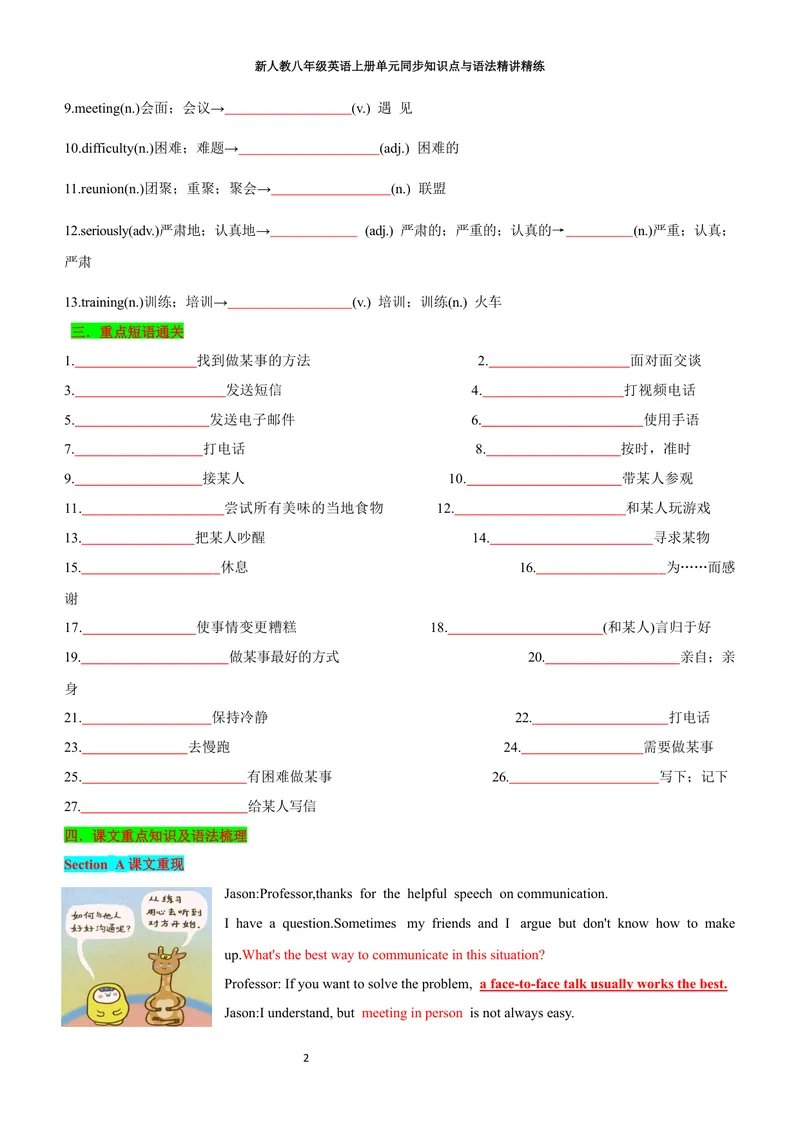
Jason:Professor,thanks for the helpful speech on communication.
I have a question.Sometimes my friends and I argue but don't know how to make
up.What's the best way to communicate in this situation?
Professor: If you want to solve the problem, a face-to-face talk usually works the best.
Jason:I understand, but meeting in person is not always easy.
2新人教八年级英语上册单元同步知识点与语法精讲精练
Professor: If you can't meet, just call your friend. Some of you may prefer texting, but it takes longer and can
make things worse if you're not careful with your words.
Jason:But what if we argue more over the phone?
Professor: If you stay calm and say sorry, it will help. If it is still hard to talk, take
a break.Meet when you're both ready.
Jason:I'll call and try to meet. Because friendship is important. Thanks for the
advice!
Professor: You're welcome.
【考点1.】When will the man pick Jim up?这个男人是什么时候接到汤姆的?
【用法详解】pick up是动副短语,后跟名词时,名词置于动副之间或副词之后;后跟代词时,代词只能置于
动副之间。 意为“(开车)接载,搭载(接)某人”。
Eg: I'll pick you up at the airport.我会去机场接你。
相关拓展:①pick up意为“ ”。
Eg: Please pick up the book on the floor.请把地上的书捡起来。
②pick up意为“ ”。
Eg: Can you pick up the phone when you are at home?你在家时能接电话吗?
③pick up意为“ ”。可以指学习知识、技能等。
Eg:He picked up some Korean while he chanted with his brother. 他和他弟弟聊天时学会了一点韩语。
④pick up意为“ ”。
Eg:The economy is starting to pick up.经济开始好转。
⑤pick up意为“ ”。
Eg:They are trying to pick up information.他们正在努力收集情报。
牛
刀小试
( )1.Shall we go to the airport to _your sister?
- I don't think it's necessary. She will come here by taxi.
A. see off B. pick up C. look after D.come across
( )2.The bus stopped and some passengers.
A.picked up B.picked out C. picked on D.picked at
( )3.Don’t throw the toys here and there ,Please quickly .
A.pick them up B.pick it up C.pick up them D.pick up it
3新人教八年级英语上册单元同步知识点与语法精讲精练
3.We'll go to the farm to some apples.(采摘)
【考点2.】 If you come to my city,I’ll show you around.如果你来到我的城市,我将带你到处走走。
【用法详解】1.这是一个含有if引导的条件状语从句的复合句,if意为“如果”,在if引导的条件状语从句
中,从句常用 ,而主句则用 。(语法部分详细讲解)
Eg:If it is fine tomorrow,we'll go to the park.如果明天天气好,我们将去公园。
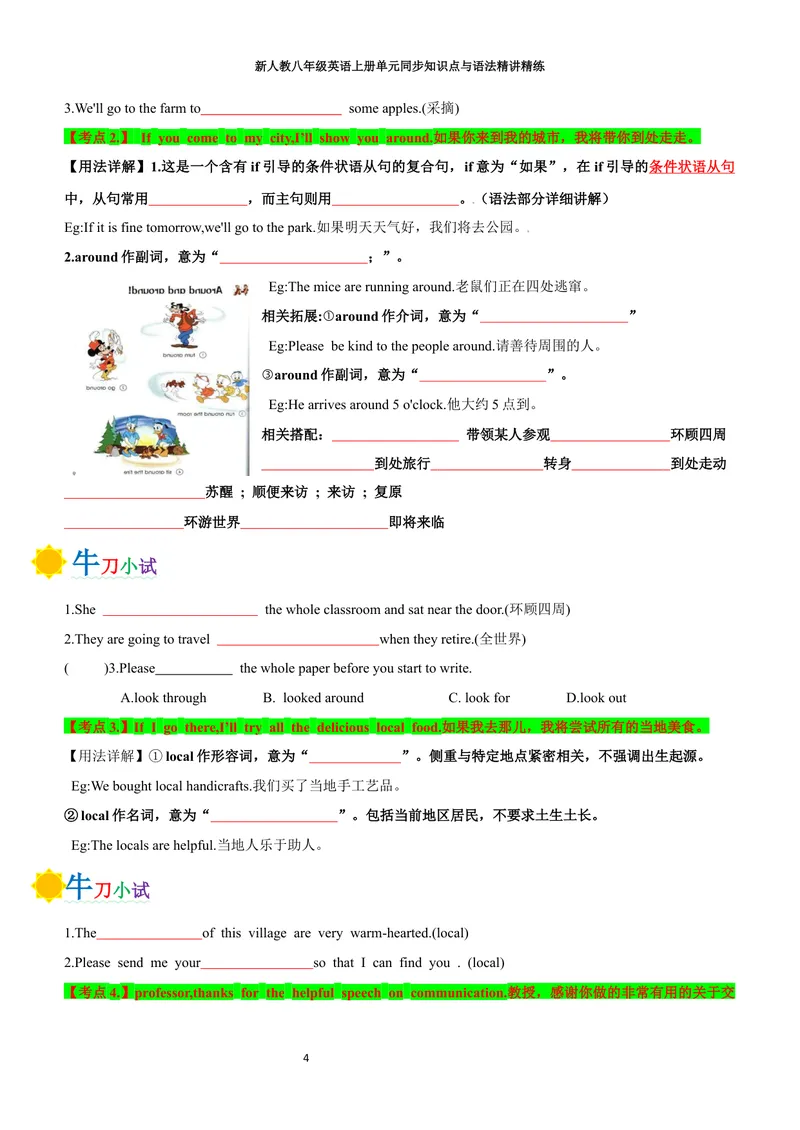
2.around作副词,意为“ ;”。
Eg:The mice are running around.老鼠们正在四处逃窜。
相关拓展:①around作介词,意为“ ”
Eg:Please be kind to the people around.请善待周围的人。
③around作副词,意为“ ”。
Eg:He arrives around 5 o'clock.他大约5点到。
相关搭配: 带领某人参观 环顾四周
到处旅行 转身 到处走动
苏醒 ; 顺便来访 ; 来访 ; 复原
环游世界 即将来临
牛
刀小试
1.She the whole classroom and sat near the door.(环顾四周)
2.They are going to travel when they retire.(全世界)
( )3.Please the whole paper before you start to write.
A.look through B. looked around C. look for D.look out
【考点3.】If I go there,I’ll try all the delicious local food.如果我去那儿,我将尝试所有的当地美食。
【用法详解】①local作形容词,意为“ ”。侧重与特定地点紧密相关,不强调出生起源。
Eg:We bought local handicrafts.我们买了当地手工艺品。
②local作名词,意为“ ”。包括当前地区居民,不要求土生土长。
Eg:The locals are helpful.当地人乐于助人。
牛
刀小试
1.The of this village are very warm-hearted.(local)
2.Please send me your so that I can find you . (local)
【考点4.】professor,thanks for the helpful speech on communication.教授,感谢你做的非常有用的关于交
4新人教八年级英语上册单元同步知识点与语法精讲精练
流的演讲。
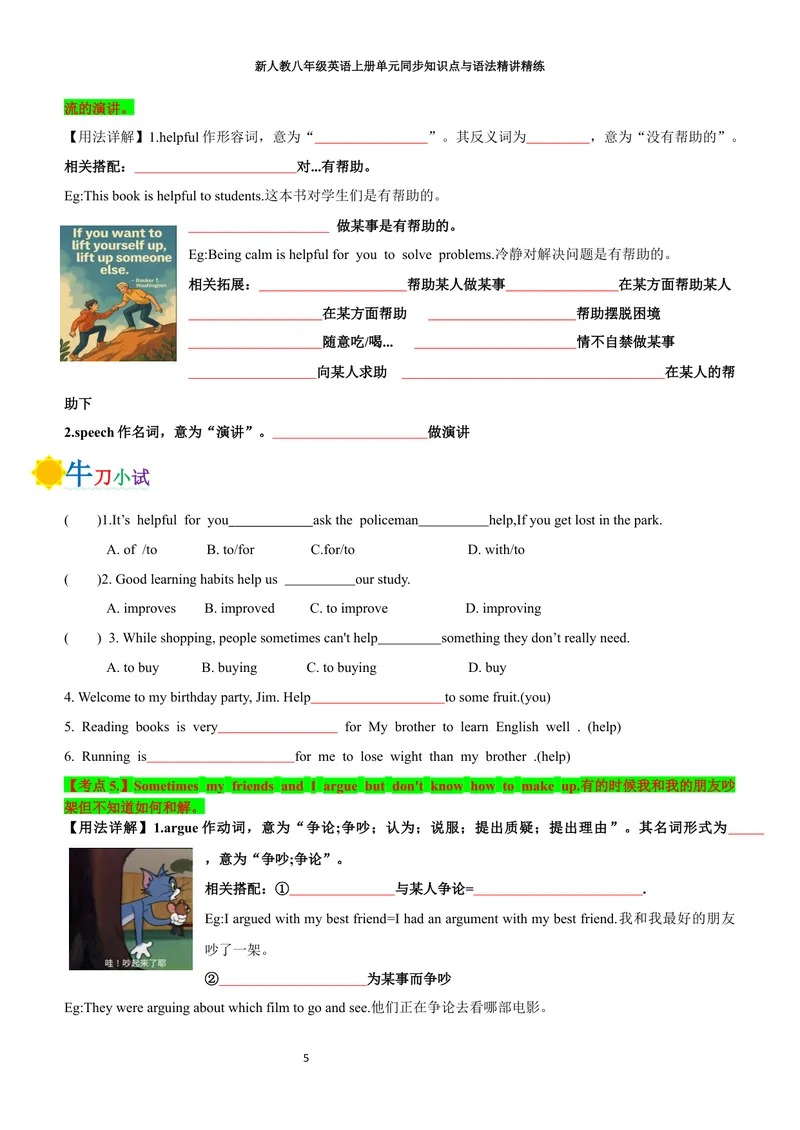
【用法详解】1.helpful作形容词,意为“ ”。其反义词为 ,意为“没有帮助的”。
相关搭配: 对...有帮助。
Eg:This book is helpful to students.这本书对学生们是有帮助的。
做某事是有帮助的。
Eg:Being calm is helpful for you to solve problems.冷静对解决问题是有帮助的。
相关拓展: 帮助某人做某事 在某方面帮助某人
在某方面帮助 帮助摆脱困境
随意吃/喝... 情不自禁做某事
向某人求助 在某人的帮
助下
2.speech作名词,意为“演讲”。 做演讲
牛
刀小试
( )1.It’s helpful for you ask the policeman help,If you get lost in the park.
A. of /to B. to/for C.for/to D. with/to
( )2. Good learning habits help us our study.
A. improves B. improved C. to improve D. improving
( ) 3. While shopping, people sometimes can't help something they don’t really need.
A. to buy B. buying C. to buying D. buy
4. Welcome to my birthday party, Jim. Help to some fruit.(you)
5. Reading books is very for My brother to learn English well . (help)
6. Running is for me to lose wight than my brother .(help)
【考点5.】Sometimes my friends and I argue but don't know how to make up.有的时候我和我的朋友吵
架但不知道如何和解。
【用法详解】1.argue作动词,意为“争论;争吵;认为;说服;提出质疑;提出理由”。其名词形式为
,意为“争吵;争论”。
相关搭配:① 与某人争论= .
Eg:I argued with my best friend=I had an argument with my best friend.我和我最好的朋友
吵了一架。
② 为某事而争吵
Eg:They were arguing about which film to go and see.他们正在争论去看哪部电影。
5新人教八年级英语上册单元同步知识点与语法精讲精练
③ 为某事与某人争辩
They're always arguing with each other about money.他们总是为了钱争吵。
2.make up作动词短语,是一个多义短语,具有不同的意思,取决于具体语境。在此句中意为“ ”
指重新恢复关系,尤其是当发生争执或不愉快时。
Eg: After their argument, they decided to make up and move on.争吵之后,他们决定和解
并继续前行。
相关拓展:①Make up意为“ ”(故事、借口等)。
Eg:She made up a story about why she was late.她编了个故事来解释自己迟到的原因。
②Make up意为“ 。”
Eg: I’ll make up for the missed meeting by working extra hours.我会通过加班来弥补错过的会议。
③Make up意为“ ”。
Eg: The team is made up of five people.这个团队由五个人组成。
④Make up意为“ ”。
Eg: She spent an hour making up before going out.她出门前花了一个小时化妆。
牛
刀小试
( )1.They argued their boss about the schedule.
A. to B.with C.about D. for
( )2.He had an argument his wife their son.
A. to; with B.with ;about C.about;with D. for;to
3.They had an about what to eat this morning.(argue)
4.Nobody likes her because she always lies.(编造)
5.It took her an hour before meeting him this morning.(化妆)
【考点6.】What’s the best way to communicate in this situation?这种情况最好的沟通方式是什么?
【用法详解】1.communicate作动词,意为“交流;沟通”。
相关搭配: 与……交流。
Eg: I like to communicate with my family.我喜欢和我的家人沟通。
相关拓展: 作名词,意为“交流;沟通”。 与...交流。
Eg:Smiling is the best ways to start a communication.展开一次交流最好的方式是微笑。
2. 作某事做好的方法。
Eg:The best way to solve the difficulties is face it.解决困难最好的方法就是面对他。
6新人教八年级英语上册单元同步知识点与语法精讲精练
牛
刀小试
1.WeChat's popularity grows quickly because it's convenient for people to (交流)with each
other.
2.I think the best way with an old friend is give him a phone call first.(和解)
( )3.My teacher always encourage me to communicate other students.
B. to B.with C.about D. for
【考点7.】If you want to solve the problem, a face-to-face talk usually works the best.如果你想解决问题,一
次面对面的交谈是效果最好的。
【用法详解】1.work在此句中作动词,意为“ ( 计划,方法 ) 产生预期效果 ; 发挥作用 ”。
Eg: The medicine the doctor gave me worked.医生给我的药起作用了。
相关拓展:①work作名词,意为“ ”。是 名词。
Eg: I have a lot of work to do .我有很多工作要做。
PS:job 作名词,意为“ ”,指具体的职业或零工,是 名
词。
Eg: He was so happy for getting that job.得到那份工作他非常高兴。
②work作名词,意为“ ”。是 名词。
Eg:The museum has many famous works of art.博物馆里有许多艺术著作。
③work作动词,意为“ ”。
Eg:She once worked as a chef.她曾经当过厨师。
④work作动词,意为“ ”。
Eg:He is teaching his brother how to work the game player.他正在教他哥如何使用游戏机。
2.face-to-face意为“面对面;当面”。可作定语修饰名词,也可作副词短语修饰动词。
Eg:We need a face-to-face talking.我们需要一次面对面谈话。
Eg: Why don't you talk face-to-face?为什么不面对面交谈呢?
相关拓展: 手拉手地 肩并肩地 真心诚意地
逐步地 一天天地
牛
刀小试
( )1.The room is in a mess.We have to do a lot of to make it clean.
A.jobs B.work C.works D.job
7新人教八年级英语上册单元同步知识点与语法精讲精练
( )2.He was a lucky dog because he got a good_ after graduating from university.
A.task B.job C.work D.worker
( )3.Lu Xun's_ are famous all over the world. Many people like reading them.
A.work B.works C.jobs D.job
4.Many of in this factory are from village.(work)
5.This math problem is too difficult for me.(算出)
【考点8.】I understand,but meeting in person is not always easy.我理解,但亲自见面并不总是容易的。
【用法详解】in person意为“亲自;亲身”,通常在句中作状语。
Eg: The boy made a cake in person for his brother .这个男孩亲自给他哥哥做了一个蛋糕。
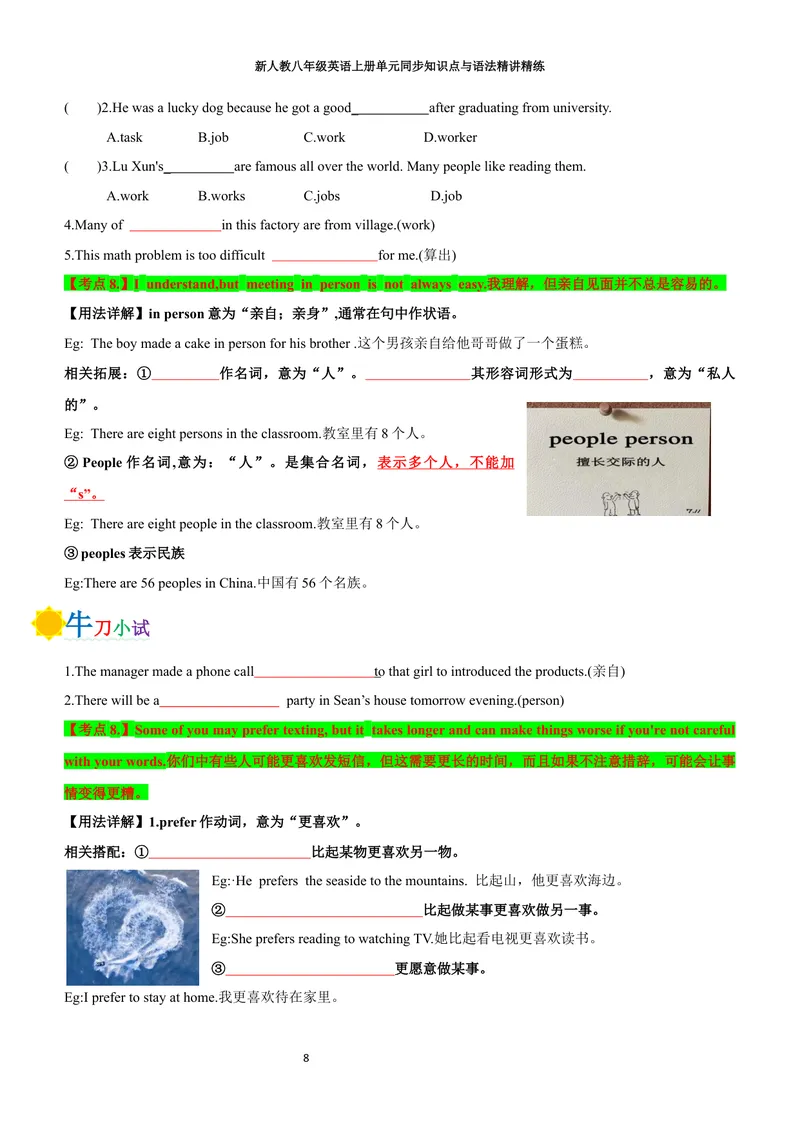
相关拓展:① 作名词,意为“人”。 其形容词形式为 ,意为“私人
的”。
Eg: There are eight persons in the classroom.教室里有8个人。
② People 作名词,意为:“人”。是集合名词,表示多个人,不能加
“ s ” 。
Eg: There are eight people in the classroom.教室里有8个人。
③peoples表示民族
Eg:There are 56 peoples in China.中国有56个名族。
牛
刀小试
1.The manager made a phone call to that girl to introduced the products.(亲自)
2.There will be a party in Sean’s house tomorrow evening.(person)
【考点8.】Some of you may prefer texting, but it takes longer and can make things worse if you're not careful
with your words.你们中有些人可能更喜欢发短信,但这需要更长的时间,而且如果不注意措辞,可能会让事
情变得更糟。
【用法详解】1.prefer作动词,意为“更喜欢”。
相关搭配:① 比起某物更喜欢另一物。
Eg:·He prefers the seaside to the mountains. 比起山,他更喜欢海边。
② 比起做某事更喜欢做另一事。
Eg:She prefers reading to watching TV.她比起看电视更喜欢读书。
③ 更愿意做某事。
Eg:I prefer to stay at home.我更喜欢待在家里。
8新人教八年级英语上册单元同步知识点与语法精讲精练
③ 宁可做某事而不愿做某事。
Eg:He prefers to read rather than watch television.他宁可读书而不愿意看电视。
2. 表示”小心/当心/认真对待某事”。
Eg:please be careful with your homework.请认真对待你的作业。
相关拓展:① 表示“小心做某事,当心做某事”。
Eg: Be careful to cross the street when the traffic is heavy.当车流大时,过街时要小心。
② 表示“小心不要做某事”。
Eg:Be careful not to touch anything .当心不要碰到任何东西。
③ 为副词表示“小心地,认真地,当心地"。
Eg:Please listen to me carefully.请认真听我说。
牛
刀小试
( )1.He prefers more time with his family.
A. spends B.spent C.to spend D.will spend
( )2.She prefers to eat outside rather than at home.
A.cook B.cooking C.to cook D.cooks
( )3.l prefer in the country rather than in the city.
A. living; live B. live; living C. living: living D. to live: live
( )4.l prefer in the country to in the city.
A. living; live B. live; living C.living: living D. to live: live
5.We should listen to the teacher in class. (careful)
【考点9.】Thanks for the advice !谢谢你的建议。
【用法详解】advice是不可数名词,意为“建议”。表达一条建议用 其的动词形式为
意为“建议;提议”。
相关搭配: 建议某人做某事。
Eg:Who can give me some advice ?谁能给我一些建议?
Eg:I advised you to lose weight.我建议你减肥。
相关拓展:① suggestion 意为“建议”,是可数名词。表达一条建议用
.其动词形式为 ,意为“建议;提议”。
相关搭配: 建议做某事。
Eg:Here are some suggestions for you.这是给你的一些建议。
Eg:She suggested going there by bike .她建议我们骑自行车去那里。
9新人教八年级英语上册单元同步知识点与语法精讲精练
牛
刀小试
( )1.Mr.Wu______David______a new tape recorder yesterday.
A.advised;bought B.advised;to buy C.suggested;to buy D.suggested;to buying
( )2.My teacher suggests____________to the tape every day.
A.listen B.listening C.listens D.to listen
( )3.What a good________ you've given me! Thanks a lot.
A.suggestion B.information C.advice D.advise
10. If the old man has difficulties in hearing,you can write things down for him.
【考点 】 如果老人听力
不好,你可以帮他把事情写下来。
【用法详解】difficulty作名词,意为“难题”。当difficulty表示具体的难事时,为可数名词。当 difficulty
表示抽象的困难时,为不可数名词。
Eg:We are confident that we can overcome these difficulties. 我们有信心我们能克服这
些困难。
相关搭配: 做某事有困难。
Eg:He had great difficulty in finding a good job. 他找份好工作有困难。
相关拓展: 做某事有问题。
做某事有麻烦。
牛
刀小试
( )1.last term,I had some difficulties my English.
A.studies B.studying C.to study D.study
( )1.It is difficult for me this math problem.
B.to solve B.to solve C.to solve D.to solve
3.There are some in swimming learning for the fresh man.(difficult)
四.单元重点语法讲练
if引导的条件状语从句
一、语法概述
条件状语从句通常由连词if引导,意为“ ”,表示在某种条件下,很可能会发生某种
事情或不发生某种事情。
1.if条件状语从句的位置
在 if 引导的条件状语从句中,if 条件句位置比较灵活,可放在主句前面也可放在主句后面。若放在主句前,
10新人教八年级英语上册单元同步知识点与语法精讲精练
从句后面要用逗号和主句隔开。
Eg:If he doesn't feel tired,he will visit the museum.
=He will visit the museum if he doesn't feel tired.如果他不感觉累,他就去参观博物馆。
2.if条件状语从句的时态搭配
(1)当 ,if 引导的条件状语 。------------主将从现
Eg:If it rains tomorrow,I won't climb the hills.如果明天下雨,我就不爬山。
(2)当主句中含有 can , may , must 等情态动词 时,if 引导的条件状语从句要用 。
Eg:We can win the basketball game if he joins us.如果他加入我们,我们就能赢这场篮球赛。
(3) 当主句是祈使句时,if 引导的条件状语从句要用 。
Eg:Help your mom with the housework if you finish your homework early.如果你完成作业早,就帮你妈妈做家务。
3.与其他句式之间的转换
含if引导的条件状语从句的复合句可与其他句型进行转换。
(1)与“ 祈使句 +and/or+ 陈述句 ”进行互换。and表示 ,or表示“ ”。
Eg:If you get up early,you'll get there on time.= Get up early,and you'll get there on time.=Get up early,or you
won't get there on time.早点起床,你就会准时到那里。
(2)借助介词without 或with 来转换条件状语从句。
Eg:If there is no water,fish will die.=Fish will die without water.如果没有水,鱼就会死。
Eg:If you help me,I'll finish the work soon.=With your help,I'll finish the work soon.如果你帮助我,我就会快
点完成工作。
(3)if … not引导的条件状语从句,可以借助连词unless 来改写。
Eg:You will be late if you don't go there by bus.=You will be late unless you go there by bus.如果你不乘公共汽车你
就会迟到。
注意: unless引导条件状语从句,表示“除非、如果不”,相当于if not。如果主句为一般将来时、主句为祈
使句或者含有情态动词时, unless 引导的条件状语从句用一般现在时表示将来。
Eg:Unless your work hard, you won't get good grades.除非你努力,否则将不能取得好成绩。
Eg:You will miss the early bus unless you hurry up.你将错过早班车,除非你快点。
牛
刀小试
( )1.—Tina wants to know if you ________ to the park with us tomorrow.
—I’d love to. But if it ________, I may go to the library instead.
A.go; will rain B.go; rains C.will go; rains D.will go; will rain
11新人教八年级英语上册单元同步知识点与语法精讲精练
( )2.We won’t believe it ________ we see it with our own eyes.
A.because B.unless C.if D.after
( )3.Your parents won’t let you go out alone ________ they are sure you’re safe.
A.since B.if C.unless
( )4.Jason will go to visit his grandparents _________ he finishes his work this weekend.
A.unless B.though C.if
( )5.— I’m afraid that we can’t ________ the math problem ________ the teacher helps us.
— That’s true. It’s too difficult.
A.work on; if B.work on; unless C.work out; if D.work out; unless
( )6.You can’t make progress in math learning ________ you work harder.
A.if B.after C.unless D.because
( )7.If it ________ sunny, we ________ camping this weekend.
A.get; will go B.gets; will go C.gets; go D.will get; go
( )8.If it doesn’t rain tomorrow, we ________ a picnic.
A.will have B.had C.have had D.was having
( )9._____________you smile at others, they will smile back.
A.If B.So C.Or D.Though
( )10.Cooking is an interesting lesson and we can make different dishes ________ we like.
A.if B.after C.though D.so
课
堂测试
一、单项选择
( )1.To avoid making mistakes, please read the questions ___ ____ before you answer them.
A. careful B. careless C. carefully D. carelessly
( )2.---Could we go to watch the football game together?
---No, you have two tickets.
A. if B. unless C. because D. so
( )3.—Why didn’t you go to play basketball yesterday?
—There was something wrong with my leg. The doctor advised me __ ____ sports.
A.don’t play B.to play C.not to play D.to not play
( )4.Mr. David always gives me some useful ____ ___. He is as well as a friend to me.
A.advice B.suggestion C.opinion D.choice
12新人教八年级英语上册单元同步知识点与语法精讲精练
( )5.Mark’s father told him to be ___ ____ and not to make _________ mistakes any more.
A.careful; careless B.carefully; careful C.careful; careful D.carefully; careless
( )6.--- What are you going to do after you leave school?
--- I will ___ _ ____ a lot of money and travel _________ the world.
A. buy; over B. make; around C. buy; in D. get; to
( )7. He if you ________ him tomorrow.
A.will come; will invite B.will come; invite C.comes; will invite D.comes; invite
( )8.—I’ll go for a picnic if it tomorrow. Will you go with me?
—Yes, of course.
A.doesn’t rain B.isn’t raining C.won’t rain D.didn’t rain
( )9.—Mom, I want to watch the program I Am a Singer IV now.
—You can watch it ___ ___ you finish your homework.
A.if B.unless C.but D.so that
( )10.If Bob away from the junk food, he will be in good health.
A.stay B.will stay C.stays D.stayed
二、 根据句意和汉语提示写出所缺的单词
1.Please (签字)your name on the first page of the book,Mr Zhang.
2.When I visit a new place,I always love to taste the (当地的)food.
3.—Who is the (发言者)? —Mr Lin,a famous writer.
4.The (关系)between my brother and me is pretty good.
5.There are some different forms of (交流)in our life.
三 、用括号内所给词的适当形式填空
6.A pilot needs lots of special (train)to fly a plane.
7.This painting is an (express)of his love for nature.
8.Face-to-face (communicate)helps us understand each other better.
9.Although travelling on the mountain road in winter was much than usual,we were brave enough to
overcome those and complete the journey.(difficult)
10. The gave an exciting .It encouraged everyone to practice English every day.
(speak)
四、 用括号中所给中文的英文适当形式填空(短语翻译)。
1. As we grow older,we'll we have two hands:one for helping ourselves;the other for helping others.(发
现)
13新人教八年级英语上册单元同步知识点与语法精讲精练
2.It's natural for parents to their children even when their children grow up.(担心)
3.Don't me,John.Just do what I tell you.(争吵)
4.Joe's grandfather was ill and his father looked after him .(亲自)
5.With the AI technology developing, Nobody knows what tomorrow.(发生)
五、完型填空
Now lots of parents will buy everything that their children want to have. If they go on with the habit their
children won't know the money 1 from hard work.
Some parents like 2 birthday parties for their children. 3 they keep on doing this, their children
will think it 4 for them to enjoy birthday parties every year. Year after year, 5 they will forget their
parents' birthdays and only remember 6 own. It is against traditional habits.
Many parents don't let their children do housework.They think children have only one 7 to do. They
should study hard and be good 8 their lessons. If parents go on doing this, the children will only learn to open
their mouths to be fed and stretch out their arms to be dressed. When the children grow up, they won't be able to
9 anything, and they won't even find a job. Parents should teach the children 10 to do housework because
it can help them start good habits of working by themselves.
( )1.A.comes B.borrows C.takes D.makes
( )2.A.having B.joining C.watching D.sending
( )3.A.ThoughB.If C.Unless D.So
( )4.A.surprising B.bad C.impossible D.necessary
( )5.A.really B.maybe C.or D.luckily
( )6.A.their B.his C.her D.your
( )7.A.Homework B.thing C.chance D.work
( )8.A.in B.with C.at D.to
( )9.A.do B.see C.hear D.copy
( )10.A.When B.how C.Where D.which
六、阅读单选
A
Dear Merry,
These days, I have problems with my study. In school I can’t listen to teachers carefully because I always
feel tired and sleepy. I don’t spend time with friends after class either, because I think it’s a waste(浪费) of time.
I even miss writing some answers in the test.
At home, I can’t get my homework done every night. My parents don’t let me stay up. So I have to get up
14新人教八年级英语上册单元同步知识点与语法精讲精练
early the next morning to finish it. Lately, I even get a bad headache.
How can I solve these problems?
Yours,
Liu Ya
Dear Liu Ya,
When you have problems listening to teachers carefully in class, you can ask your teachers or deskmates to
remind you often. Then spending time talking about many different things with friends can make you happy. It’s
not a waste of time.
As for homework, when it’s hard to get it finished, one thing you can try is setting goals for yourself. Ask
your parents to help you. You must take a break if you don’t feel well. You might be surprised but a short rest
can help you get more done! Lastly, if you don’t worry and have enough sleep, your headache will leave you.
Yours,
Merry
( )26.Liu Ya wrote the letter to Merry in order to________.
A.ask for help B.express worries C.share her experienceD.share her happiness
( )27.Liu Ya doesn’t want to stay with friends after class because________.
A.she needs to sleep B.she thinks it’s a waste of time
C.she has problems with her classmates D.she is afraid of talking with others
( )28.Merry thinks________.
A.taking a rest is necessary B.being with parents is helpful
C.setting goals by parents is important D.listening to music is necessary
( )29.According to the underlined part, what might Liu Ya’s teacher say to remind(提醒) her?
A.Sleep for a minute. B.Listen carefully.
C.Stop talking. D.Well done.
( )30.From Liu Ya’s letter, we can find that she is too________.
A.happy B.careless C.nervous D.excited
B
During my travels through the mountains of Greece I was only ever scared once, it was dusk and as I walked. I
came across six large wolves that were feeding on the body of a dead animal. I had heard many stories about wolves as
a child and it was this animal that I feared more than any other. The wolves before me were huge, at least 6 feet long
and covered with thick grey fur.
As I went near, the wolves left the blood-covered snow that surrounded the body and started walking towards me,
one after another. They stopped about 20 meters from me and stared. The lead wolf raised his head into the air and
took in a deep breath, as if he was smelling me. The animals looked both beautiful and frightening, but I knew I
15新人教八年级英语上册单元同步知识点与语法精讲精练
couldn't show them my fear. As I drew nearer, the lead wolf raised his head once more but this time let out a long, loud
cry. The awful cry rang out across the silent valley. I had never heard a more frightening sound. I was almost certain it
was a sign to be death.
Every moment I expected to see the pack of wolves’ dash at me. I knew my only hope was to pretend I had no
fear. I walked past the line of wolves, like a general moving among his soldiers. They cried out loud again. But when
they saw that their cry did not cause me to change my direction or make me run they feared to come after me, so they
let me pass and returned to the dead animal.
If I had turned back or tried to run away when they marched out to meet me, I am certain the whole pack would
have attacked me in a moment. But my show of false courage intimidated them and kept them back.
( )31.Why didn't the wolves attack the man?
A.They were no longer hungry when they saw him.
B.The man was already known to the wolves.
C.They were too far away to catch the man.
D.The man showed no fear as he passed by.
( )32.The underlined word 'intimidated' means .
A.encouraged B.scared C.doubted D.hurt
( )33.What is the author's purpose in writing this story?
A.To show that mountains can be dangerous places.
B.To discuss the habits of mountain wolves.
C.To stress the need for courage when in danger.
D.To make people aware of the danger of wolves.
( )34.Which of these is right according to the passage?
A.The wolves were friendly to the writer.
B.The writer knew wolves were dangerous in childhood.
C.The lead wolf asked the other wolves to stand in line.
D.The writer wasn't afraid of the wolves at all.
( )35.The best title of the passage could be .
A.In Face of Fear B.My Trip to Greece
C.My Mountain Travels D.A Man without Fear
七、阅读回答问题
Everyone worries. But how do you deal with your worries? Whether your worries are big or small, you can take
16新人教八年级英语上册单元同步知识点与语法精讲精练
these three steps to deal with your worries:
1. Try to find out what you’re worried about
Sometimes, you will know what you’re worried about. Other times, you might not. Try to find it out first; if you
can’t, you can ask for help.
2. Think of ways to make it better
There is always something you can do to help you feel less worried. Sitting there worrying is no fun and it won’t
solve your problem.
Grades at school are often top worries for kids. If you’re worried about grades, ask yourself these questions:
★ Why are grades important? What do grades mean to me?
★ How do I get ready for class? Do I go over my notes even when there isn’t a test?
★ Do I have a good place to do my homework?
★ Have I tried different ways of studying?
If your worry is about a fight you had with a friend, you might write down all the things you could do —write a
note to him or her, invite him or her to a basketball game, say sorry to him or her, etc. Once you have a list of things
you could do, you can choose the one that gets your friend back.
3. Ask for help
When you’re worried, it can help to find someone to talk to. You can ask your parents, friends or teachers for
help.
41.How many steps of dealing with your worries are mentioned(涉及) in the passage?
.
42.What will you do if you don’t know what you’re worried about?
.
43.What will you do if you have a fight with your friend?
.
44.What are often a top worry for kids?
.
45.Who can you ask for help when you’re worried?
.
八、选词填空
从方框中选择适当的单词,并用其正确形式填空,使短文完整、通顺(每词限用一次)。
bad, carefully, someone, say, probably, solve, happy, truth, if, time
17新人教八年级英语上册单元同步知识点与语法精讲精练
Helping people is the right thing and will make us more popular with others.However,we can't say“yes”every
16 . other people ask for help.Sometimes we 17. don't have enough time.Sometimes we don't have the
ability to help.In this case,we must know how to say“no”to others.
In fact,it's difficult for us 18. “no”because we don't want to make others angry or sad.We often worry that
saying“no”is bad for our relationship with others.As a result,we have to spend much time 19. problems for
people who ask for help.But if we are not able to do them well,it will make our relationship even 20.
So,how should we say“no”?Here are some ways we can try.First,if someone needs our help,listen to him/her 21.
.The point is to let the person know that we are glad to help. Then we should tell the 22. .Just tell the person
why we can't help.But we must be kind and tell the reasons clearly,Most people are understanding.We don't need to
feel sorry about saying “no”.What's more, 23. we finally decide to refuse him/her,we can also try to find 24.
else to help him/her.In this way,he/she may get some comfort.
In short,we cannot make everyone 25. all the time.After all,saying“no”is a part of our life.
18