新人教八年级英语上册单元同步知识点与语法精讲精练
Unit1HappyHoliday
SectionAwhatmakesagreatholiday?
一.重点词汇梳理
1. ancient /'eɪnfont/adj.古代的;古老的 2.camp /kamp/n. 度假营;营地 v. 露营;宿营
3.landscape /'lændskerp/n. 风景;景色 4. strange /strerndʒ/adj. 奇怪的;陌生的
5.vacation /va'kerʃn/n. 假期;度假 6.fantastic /fæen'tæestik/adj. 极好的;了不起的
7. town /taun/n.镇;商业区 8.breath /breθ/n. 呼吸的空气; 一口气
10. especially /i'speʃəli/adv.尤其;特别 11. steamed /sti:md/chickensoup 汽锅鸡
12. anywhere /'eniwea(r)/adv.&pron. 在任何地方;随便什么地方
13. nothing /'nAθr/n.没有什么东西;没有事pron.没有任何东西;没有事
15. scenery /'si:nəri/n. 风景;景色 16. silk /silk/n.丝绸;(蚕)丝
17. scarf /ska:f/n.围巾;披巾 19. hotel /həu'tel/n.旅馆;旅社
20.comfortable /'kʌmftabl/adj.使人舒服的;舒适的
21. ready /'redi/adj.准备好的;现成的adv. 已做完; 已完成
23. somewhere /'sʌmweə(r)/adv. 在某处;到某处pron.某处;某个地方
24. sky /skar/n.天;天空 25. bored /bɔ:d/adj.厌倦的;烦闷的
27. towards /ta'wɔ:dz,two:dz/(toward)prep. 向;朝
28. rainbow /'rembəu/n.虹;彩虹
29. square /skweə(r)/n.广场;正方形adj. 正方形的; 平方的
30. during /'djuərin/prep.在……期间 31. victory /'viktəri/n.胜利;成功
32. Russian /'raJn/adj.俄罗斯的;俄罗斯人的 n.俄 罗斯人;俄语
33. fight /fart/n.战斗;搏斗;斗争v.(fought/f:t/)打 仗;打架
34. against /ə'genst/prep.反对;与……相反;紧靠
1新人教八年级英语上册单元同步知识点与语法精讲精练
36. guide /gard/n.导游;指南;手册v.给某人领路; 指导
37. artwork /'a:tws:k/n.艺术作品;插图 39. tear /'tiə(r)/n.眼泪;泪水
二.重点词汇变形
1. camp 露营(n./v.)→ camper(n.) 露营者
2. strange 奇怪的(adj.)→ strangely (adv.) 奇怪地→ stranger (n.)陌生人
3. breath 呼吸 (n.)→breathe (v.) 呼吸→breathless(adj.)
4. especially 尤其;特别地 (adv.)→ especial (adj.) 特别的;特殊的;格外的
5. comfortable 舒服的(adj.)→comfortably(adv.) 舒适地→ comfort (v.) 安慰
6. bored 无聊的(修饰人) (adj.)→ boring (adj.)无聊的(修饰物)
7. victory 胜利;成功(n.)→ victories (复数形式)
8. Russian俄国人;俄国的(n./adj.)→ Russia (n.)俄罗斯
9. fight 打架;奋斗(n./v.)→ fighter (n.)战士
10. artwork 艺术品 (n.)→ artist (n.) 艺术家→ art (n.) 艺术
11. peace 和平(n.)→peaceful(adj.) 和平的;平静的→peacefully(adv.) 安详地;平静地
12. easily 容易地(adv.)→easy(adj.) 容易的;简单的→uneasy(adj.) 不容易的
13. forget 忘记 t(v.)→forgettable(adj.) 容易忘记的;健忘的 →forgetful(adj.) 健忘的;好忘事的
→forgetfulness(n.) 健忘;遗忘
三.重点短语通关
1.take lessons 上课 2.ancientbuildings 古建筑
3.go to the mountains 去爬山 4.gotoasummercamp 去参加夏令营
5.go back to 返回 6.gotoastrawberryfestival 去参加草莓节
7.go on holiday/vacation 去度假 8.see the sunrise 看日出
9.stayin... 待 在 ... 10.takesb'sbreathaway 令人惊叹;令人叹绝
11.take photos 拍照片 12.steamed chicken soup 汽锅鸡
13.stay athome 待在家里 14.haveawonderfulexperience 一次美好的体验
2新人教八年级英语上册单元同步知识点与语法精讲精练
15.nothingbut只有;只是 16.doublerainbow 双彩虹
17.during WorldWarⅡ 在二战期间 18.walkthrough.... 走过....
四.课文重点知识及语法梳理
SectionA课文重现
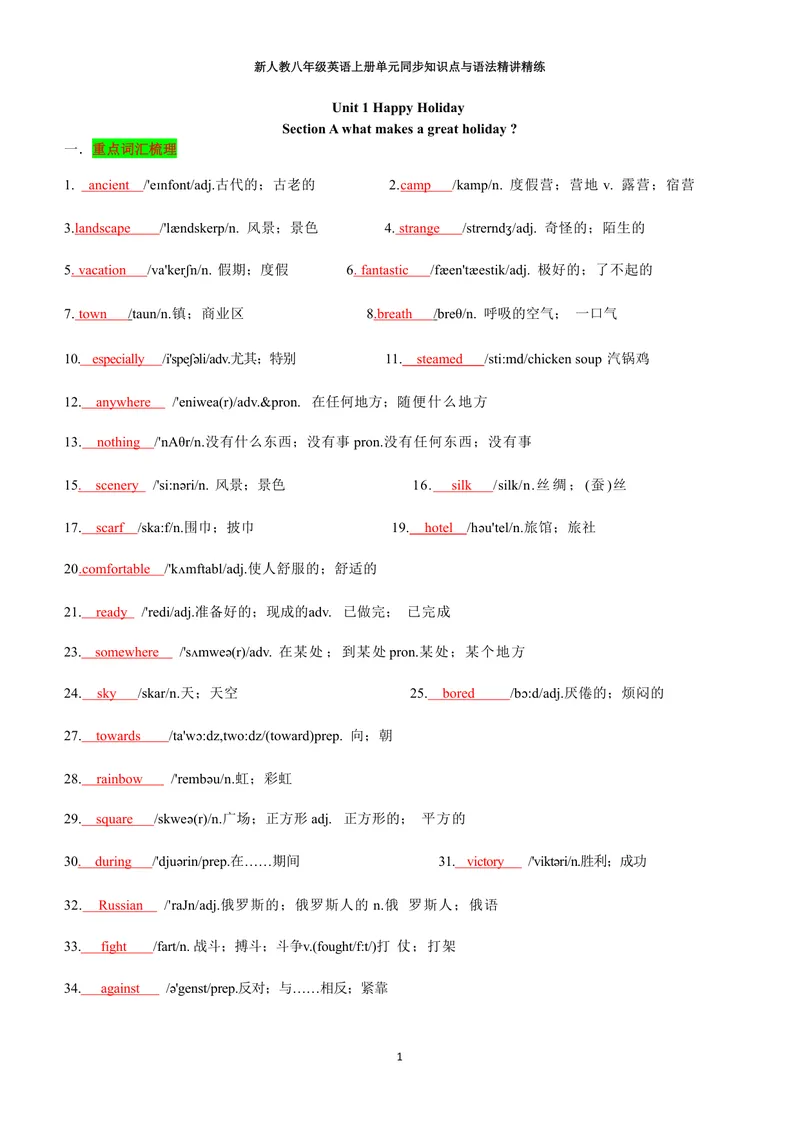
Adam:Hi,Peter.Howareyou?
Peter:Hi,Adam.I'mfine,thanks.
Adam:Howwasyourholiday?
Peter:Itwasfantastic.
Adam:Didyougoanywhereinteresting?
Peter:Yes,IwenttoYunnanwithmyfamily.
Adam:Wow!Thatsoundsgreat.DidyougotoLijiang?
Peter:Yes,westayedintheoldtownforafewdays,andweenjoyeditverymuch.
Adam:DidyouvisitYulongMountain?_Everyonesaysit'sbeautiful.
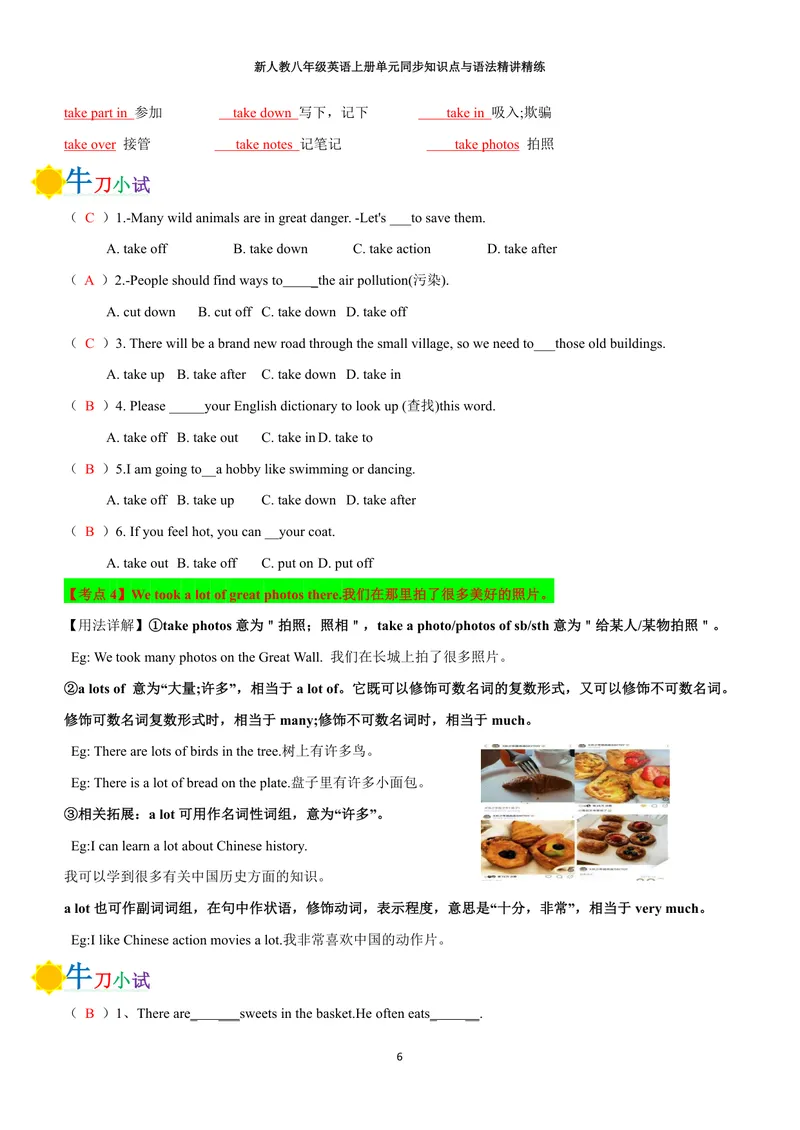
Peter:Itis!Itjusttookmybreathaway.Wetookalotofgreatphotosthere.
Adam:Didyoueatanythingspecial?
Peter:Yes,wedid!Everythingtastedgood,especiallythesteamedchickensoup.Whataboutyou?
_SomeonesaidyouwenttoBeijing.__
Adam: No, notthis holiday. I did nothing special.I just stayed at home to read, play games, and relax, but it was still
fun.
【考点1.】Didyougoanywhereinteresting?你去了任何有趣的地方吗?
【用法详解】①这是一个一般疑问句,询问的是发生在过去的事情。由助动词提问,回答也用助动词did。一
般过去时的一般疑问句的句子结构是"Did+ 主语+ 动词原形+其他?"。其肯定回答是:Yes, 主格代词+did;
否定回答是:No, 主格代词+didn’t.。
Eg:DidyouvisitYuLongMountain?---Yes.Idid./NoIdidn’t你去玉龙雪山了吗?--是的,去了。/不,没有去。
②anywhere意为“在任何地方;随便哪个地方”,是复合不定代词。用于否定、疑问句和条件句中。
Eg:Ican'tfindmykeysanywhere.我到处都找不到钥匙。
Idon’twanttogoanywherebecauseofthebadweather.我不想去任何地方因为天气不好。
③anywhere在肯定句中表示“随便哪个地方”(强调“无限制选择”)。
Eg:Youcansitanywhereyoulike.你可以随便坐。
Youcanexploreanywhereunknown.你可以去探索任何未知的新境。
④anywhereinteresting意为“有趣的地方”,当形容词修饰复合不定代词时,形容词需后置。
3新人教八年级英语上册单元同步知识点与语法精讲精练
Eg:anywherebeautiful 美丽的地方 anywherecool 凉快的地方 anywheredangerous 危险的地方
⑤拓展:everywhere每个地方;到处,nowhere无处,somewhere 某个地方。
Eg:Wecangosomewherequitetochantwitheachother.我们可以去一个安静的地方聊聊天。
There'snowheretohide.无处可藏。
Shelookedeverywherebutcouldn’tfindhermissingearring.她到处看了也没有用找到她丢失的耳环。
牛
刀小试
( B )1.Didyougo lastsummerholiday?-Yes.IwenttoShanghaiDisney,
A.somewherespecial B.anywherespecial
C.specialsomewhere D.specialanywhere
( D )2.Haveyouseenmymobilephone,Sam?Ican’tfindit .
A.everywhere B.somewhere C.nowhere D.anywhere
( B )3.--Isthere____tobuycoffeehere?-Yes,theCotticoffeeshopisthere.
A.somewhere B.anywhere C.nowhere D.everywhere
( B )4.—Didyou lastweek?
.—Yes,IwenttoDalianwithmyparents.
A.gosomewhereinteresting B.goanywhereinteresting
C.gointerestinganywhere D.gotoanywhereinteresting
【考点2】 westayedintheoldtownforafewdays.我们在古城待了几天。
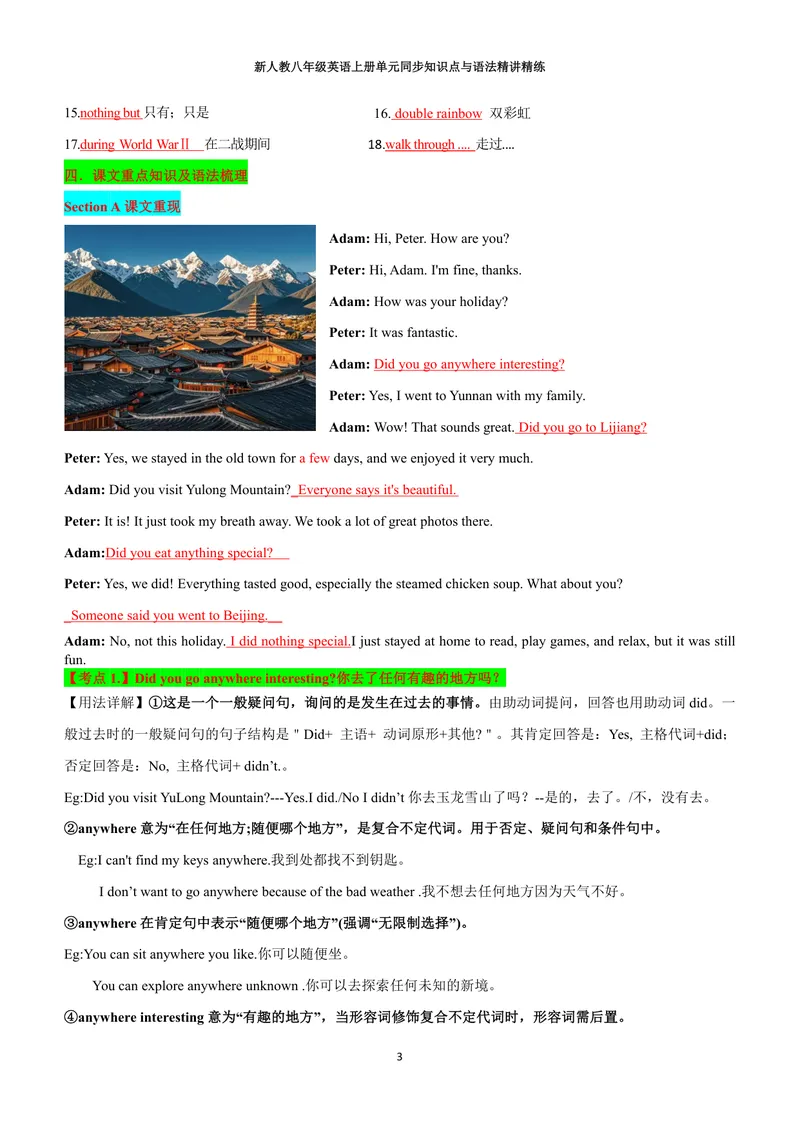
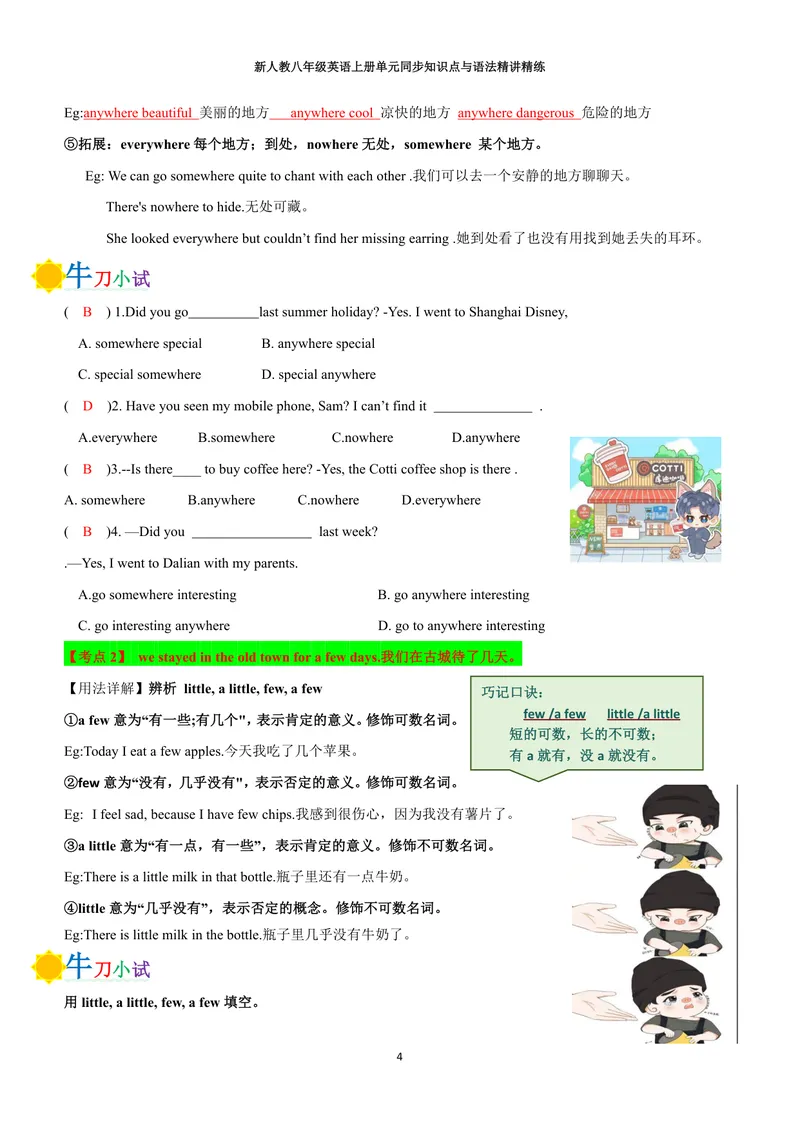
【用法详解】辨析 little,alittle,few,afew 巧记口诀:
few/afew little/alittle
①afew意为“有一些;有几个",表示肯定的意义。修饰可数名词。
短的可数,长的不可数;
Eg:TodayIeatafewapples.今天我吃了几个苹果。
有a就有,没a就没有。
②few意为“没有,几乎没有",表示否定的意义。修饰可数名词。
Eg: Ifeelsad,becauseIhavefewchips.我感到很伤心,因为我没有薯片了。
③alittle意为“有一点,有一些”,表示肯定的意义。修饰不可数名词。
Eg:Thereisalittlemilkinthatbottle.瓶子里还有一点牛奶。
④little意为“几乎没有”,表示否定的概念。修饰不可数名词。
Eg:Thereislittlemilkinthebottle.瓶子里几乎没有牛奶了。
牛
刀小试
用little,alittle,few,afew填空。
4新人教八年级英语上册单元同步知识点与语法精讲精练
1.Ihavealittlewaterleft.There'senoughtoshare.
2.Ihaveafewgoodfriends.I'mnotlonely,
3.Hehaslittleeducation.Hecan'treadorwriteatall,andhecanhardlycount.
4.Therearefewpeopleshereallytrusts.It'sabitsad.
5.We'vegotalittletimeattheweekend.Wouldyouliketomeet?
6.Juliegaveusafewapplesfromhergarden.Shallwesharethem?
7.Shehaslittleself-confidence.Shehasalotoftroubletalkingtonewpeople.
8.TherearefewwomenpoliticiansintheUK.Manypeoplethinkthereshouldbemore.
9.It'sagreatpity,butthehospitalhaslittlemedicine.Theycan'thelpmanypeople.
10.I'vegotafewcakestogiveaway.Wouldyoulikeone?
11.There'salittlemilkleftinthefridge.Itshouldbeenoughforourcoffee.
12.Fewchildrenfromthisschoolgoontouniversity,unfortunately.
13.DoyouneedinformationonEnglishgrammar?Ihaveafewbooksonthetopicifyouwouldliketoborrowthem.
14.She'slucky.Shehasfewproblems.
15.Londonhaslittlesunshineinthewinter.That'swhysomanyBritishpeoplegoonholidaytosunnyplaces!
【考点3】Itjusttookmybreathaway.它几乎要让我不能呼吸。
【用法详解】①breath在句中作名词,意为“呼吸”。其动词形式为breathe意为“呼吸,吸气”。
相关搭配:holdone'sbreath屏住呼吸:屏息静气outofbreath气喘吁吁takeadeepbreath深呼吸
②took是take的过去式,其过去分词为taken 。
takeaway意为“带走;拿走;减去”。
相关用法: 1)take表示拿走某物。Eg:Hetooktheumbrella.他带走了那把伞。
2)take表示接受某物或某事。Eg:Iwilltakeyouradvice.我会接受你的建议。
3)take表示乘坐某种交通工具。
Eg:Hetakesthebustotheworkeveryday.他每天都坐公交车去上班。
4)take表示花费时间或精力。Eg:IttakestimetolearnEnglish.学习英语需要时间。
5)take表示上某个课程。Eg:ItakeanEnglishclass.我上英语课。
③take相关短语
takeoff 脱下衣服;飞机起飞 takeaway 拿走,带走 takeafter 像
takeup 开始从事;占据;培养 takecare 小心,当心 takecareof照看,照顾 takeplace 发生
taketheplaceof代替 takeout 拿出,取出 takepridein以...自豪/骄傲
5新人教八年级英语上册单元同步知识点与语法精讲精练
takepartin 参加 takedown 写下,记下 takein 吸入;欺骗
takeover 接管 takenotes 记笔记 takephotos 拍照
牛
刀小试
( C )1.-Manywildanimalsareingreatdanger.-Let's___tosavethem.
A.takeoff B.takedown C.takeaction D.takeafter
( A )2.-Peopleshouldfindwaysto _theairpollution(污染).
A.cutdown B.cutoff C.takedown D.takeoff
( C )3.Therewillbeabrandnewroadthroughthesmallvillage,soweneedto___thoseoldbuildings.
A.takeup B.takeafter C.takedown D.takein
( B )4.Please_____yourEnglishdictionarytolookup(查找)thisword.
A.takeoff B.takeout C.takeinD.taketo
( B )5.Iamgoingto__ahobbylikeswimmingordancing.
A.takeoff B.takeup C.takedown D.takeafter
( B )6.Ifyoufeelhot,youcan__yourcoat.
A.takeout B.takeoff C.puton D.putoff
【考点4】Wetookalotofgreatphotosthere.我们在那里拍了很多美好的照片。
【用法详解】①takephotos意为"拍照;照相",takeaphoto/photosofsb/sth意为"给某人/某物拍照"。
Eg:WetookmanyphotosontheGreatWall. 我们在长城上拍了很多照片。
②alotsof 意为“大量;许多”,相当于alotof。它既可以修饰可数名词的复数形式,又可以修饰不可数名词。
修饰可数名词复数形式时,相当于many;修饰不可数名词时,相当于much。
Eg:Therearelotsofbirdsinthetree.树上有许多鸟。
Eg:Thereisalotofbreadontheplate.盘子里有许多小面包。
③相关拓展:alot可用作名词性词组,意为“许多”。
Eg:IcanlearnalotaboutChinesehistory.
我可以学到很多有关中国历史方面的知识。
alot也可作副词词组,在句中作状语,修饰动词,表示程度,意思是“十分,非常”,相当于verymuch。
Eg:IlikeChineseactionmoviesalot.我非常喜欢中国的动作片。
牛
刀小试
( B )1、Thereare_ ___sweetsinthebasket.Heofteneats_ __.
6新人教八年级英语上册单元同步知识点与语法精讲精练
A.alotof,alotoff B.alotof,alot
C.lotsof,alotof D.lotsof,lotsof
( C )2、-I'mafraidthere'snotimeforbreakfast.
-Nohurry.There'sstill timebeforethefirstlessonbegins.
A.alot B.lotof C.lotsof D.alots
( A )3、Tomknowsabout China.HebegantoliveinChinain2000.
A. alot B.lotsof C.alotof D./
【考点5】Didyoueatanythingspecial?你吃了任何特别的东西吗?
Everythingtastedgood,especiallythesteamedchickensoup所有事物尝起来都非常棒,尤其是汽锅鸡。
【用法详解】①anything不定代词,意为“某事;某件东西”,主要用于疑问句或否定句中。
Eg: Doyouwantanythingfromme? 你想从我这里要些什么吗?
Ican’twantanythingaboutit. 对此我没什么可说的。
注意:anything表示“任何事,任何东西”时,用于肯定句中。
Eg: Youcanaskmeanythingyouwanttoknow. 你可以问我你想知道的任何事情。
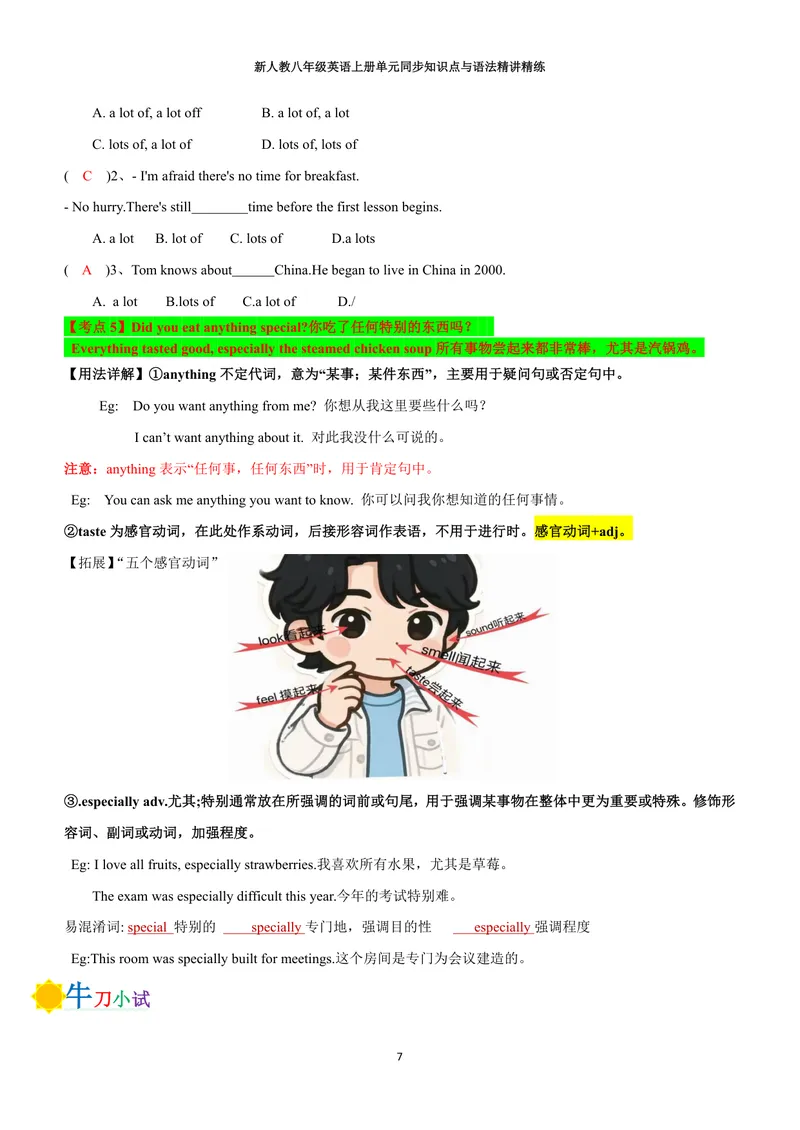
②taste为感官动词,在此处作系动词,后接形容词作表语,不用于进行时。感官动词+adj。
【拓展】“五个感官动词”
③.especiallyadv.尤其;特别通常放在所强调的词前或句尾,用于强调某事物在整体中更为重要或特殊。修饰形
容词、副词或动词,加强程度。
Eg:Iloveallfruits,especiallystrawberries.我喜欢所有水果,尤其是草莓。
Theexamwasespeciallydifficultthisyear.今年的考试特别难。
易混淆词:special 特别的 specially专门地,强调目的性 especially强调程度
Eg:Thisroomwasspeciallybuiltformeetings.这个房间是专门为会议建造的。
牛
刀小试
7新人教八年级英语上册单元同步知识点与语法精讲精练
( D )1.Whenourteacherheardofthenew,hewastooangrytosay___________.
A.everything B.nothing C.something D.anything
( A )1.—Howaboutthefruitsalad?
—Yummy!Ittastevery .Bytheway,whomadeit?
A.good B.bad C.well D.badly
( B )3.Ienjoyoutdooractivities,______hiking.
A.specially B.especially C.generally
4.Thismovieis__especially____(特别)popularamongteenagers.
【考点6】 Ididnothingspecial我没有做什么特别的事。
【用法详解】nothing为代词,意为“没有任何东西;没 常见 有事”,它可以在句子中作主语、宾语或表语。
Eg:Nothingisimpossibleifyouput your heartintoit.只要你用心去做,没有什么是不可能的。
Ithasnothingtodowithyou. 这与你无关。
相关拓展:辨析nothing、none 与 noone 的用法区别
①nothing只指事物,不指人;回答what引导的问句,表示“没有事;没有任何东西”;其 作主语时,谓语动词
用第三人称单数形式。
Eg:—Whatdidyoudoonyoursummervacation? 你在暑假做了什么?
—Nothingspecial.Ijuststayathome .没什么特别的,我只是待在家里。
②none既可以指人,也可以指物。回答howmany/much引导的询问数量的问句,表示 “没有一个;毫无”;
可单独使用,也可与of连用;noneof后接 复数名词或代词作主语时,谓语动词用单复数形式均可。
Eg:Iwilltakenoneofyouradvice.我将不采纳你的建议。
③noone只能指人,不能指物;回答who引导的问句,表示“没人”;通常单独使用,不与of连用;其作主语时,
谓语动词用第三人称单数形式。
Eg:Nooneisperfectintheworld. 世界上没有人是完美的。
牛
刀小试
( B )1.Mom,canIhave____________toeat?I’mhungry.
—Sorry,there’s____________inthefridge.ButIthinkwecangooutfordinnernow.
A.nothing;nothing B.something;nothing C.anything;somethingD.something;something
2.Thereis nothing interestinginthethismovie,Idon’tlikeit。
【考点7】Everyonewasreadytofindsomewheretogo.每个人都准备好 找要去的地方。
【用法详解】ready 意为“准备好的;现成的” 。相关搭配:①bereadytodosth 准备好做某事;愿意做某事
②bereadyforsth 为某事做好准备
8新人教八年级英语上册单元同步知识点与语法精讲精练
Eg:Heisreadytoleavethiscity. 他准备好离开这座城市了。
Eg:He'sreadytohelp.他准备好帮忙了。
牛
刀小试
( A )1.-Areyou______thetrip?-Yes,I'vepackedeverything.
A.readyfor B.readyto C.readywith
( B )2.Theywereready somewheretogo.
A.find B.tofind C.finging D.finds
【考点7】IwassoboredthatIdecidedtofind___something____toread.我是如此的无聊,以至于决定找东西读。
【用法详解】①bored形容词,意为“厌烦的:厌倦的",其主语为人。boring形容词,意为“令人感到无聊的;
令人感到厌烦的",其主语多为物或做定语。
Eg:Thisboringbookmadehimfeelbored.这本无趣的书让他感觉无聊。
②so...that...意为“如此...以致于”。so+形容词/副词+that+结果状语从句,强调原因的程度导致某种结果,表示
因果关系。
Eg:Heissohard-workingthathecanwinthefirstplace.
他如此努力,以致于赢得了第一名。
Eg:ShespeakssofastthatIcan'tunderstandher.
她说得如此快,以致我听不懂。
③such...that...: 如此...以致...such+(a/an)+形容词+名词(强调名词)
Eg:Theyaresuchkindpeople.他们是如此善良的人。
Eg:TSheissuchagoodsingerthateveryoneapplauds.她唱得那么好,每个人都为之鼓掌。
牛
刀小试
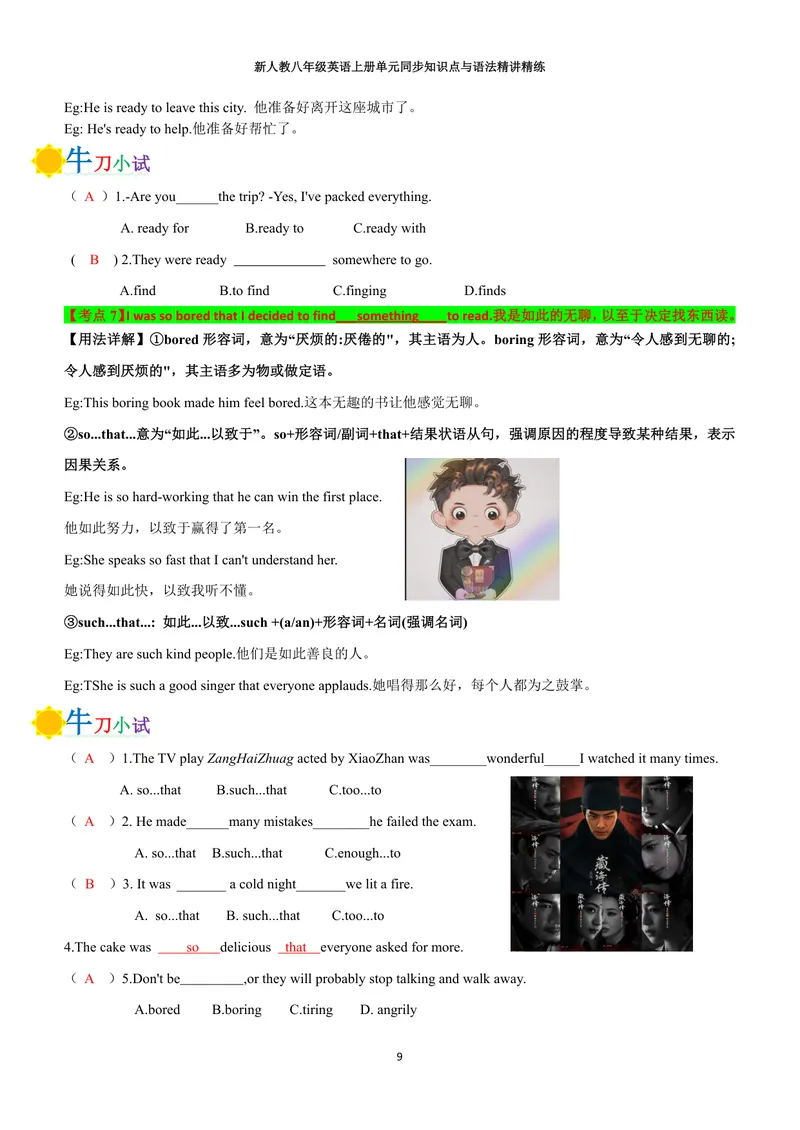
( A )1.TheTVplayZangHaiZhuagactedbyXiaoZhanwas________wonderful_____Iwatcheditmanytimes.
A.so...that B.such...that C.too...to
( A )2.Hemade______manymistakes________hefailedtheexam.
A.so...that B.such...that C.enough...to
( B )3.Itwas _______acoldnight_______welitafire.
A. so...that B.such...that C.too...to
4.Thecakewas so delicious that everyoneaskedformore.
( A )5.Don'tbe ,ortheywillprobablystoptalkingandwalkaway.
A.bored B.boring C.tiring D.angrily
9新人教八年级英语上册单元同步知识点与语法精讲精练
四.单元重点语法讲练
1.复合不定代词语法概述
复合不定代词是由some,any,no,every加上-body,-one,-thing构成的不定代词。
2.复合不定代词的类别
some-类 any-类 no-类 every-类
-body somebody某人;有人 anybody任何人 nobody没有人 everybody每人;所有人
-one someone某人;有人 anyone任何人 noone没有人 everyone每人;所有人
-thing something某事;某物 anything任何事物 nothing没有什么 everything每件事;一切
-where somewhere某地 anywhere任何地方 everywhere每地
3.复合不定代词用法及考点
①.复合不定代词的数
复合不定代词通常被看成是单数。当它们充当句子的主语时,其后的谓语动词用第三人称单数形式。
Eg:Everybodyisacutebystander. 每个人都是可爱的旁观者。
Eg:Everythingislovely.万物可爱。
②.some- 类和 any-类复合不定代词的用法区别
some- 类的复合不定代词常用于肯定句及以would,could开头的一般疑问句中。
Eg:Someonewantstomakefriendswithyou. 有人想和你交朋友。
Eg:wouldyoulikesomethingtoeat?你想吃点东西吗?
any-类的复合不定代词常用于否定句、疑问句或条件句中。
Eg:Hedoesn'twanttodoanythingexceptthumpinghim.
除了揍他一顿,他不想做任何事情。
③. 复合不定代词的定语
形容词修饰复合不定代词时,要位于其后。
Eg:Lastweekend,IwentsomewherebeautifulandeatsomethingdeliciouswithmybestfriendSean.
上周末我和我最好的朋友Sean一起去了一些美丽的地方吃了些美味的东西。
复合不定代词与动词不定式连用时,不定式作后置定语。
Eg:Couldyoubuymesomethingtodrink?可以给我买些喝的吗?
牛
刀小试
( C )1.—Whatareyoudoinghere?
10新人教八年级英语上册单元同步知识点与语法精讲精练
—Idon’tlikethisskirt.I’mtryingtofind________towear.
A.elseanything B.Everything C.somethingelse D.newsomething
( B )2.Ialwaysbelievethatthereisn't difficultifwesetourmindtodoit.
A.something B.anything C.everything D.nothing
( A )3.Mypurseislost.Ilookedforit________,butIcouldn’tfindit.
A.everywhere B.anywhere C.somewhere D.where
( A )4.—What'syourdreamjob?—Iwanttowork________.
A.somewherebeautifulB.beautifulsomewhereC.beautifulanywhereD.anywherebeautiful
( A )5.—Didyoudo________interestinglastsummervacation?
—Yes,I________toPenanginMalaysiawithmyfamily.
A.anything;wentB.something;went C.anything;go D.something;go
( A )6.—Helen,didyoudo lastweekend?
—Yes,Ivisitedmygrandparentsinthecountryside.
A.anythingspecial B.somethingspecial C.specialanything D.specialsomething
( B )7.—Isthere elseintheclassroom?
—It’sempty(空的). islisteningtoaspeechintheschoolhall.
A.anyone;Anyone B.anyone;Everyone C.everyone;Anyone D.everyone;Everyone
( A )8.Couldyoustayalittlelonger?Ihave moretotellyouabouttheplanfortomorrow.
A.something B.everything C.anything D.nothing
9.Didyousee anyone (someone)onthehillthismorning?
10.Thegirldoesn’tliketoplaywith_anything__(something).Sheonlywantstoreadbooks.
课
堂测试
一、单项选择
( B )1.一Whatdidyoursisterdolastsummer?
一 She_______myauntandstayedtherefortwoweeks.
A.visit B.visited C.visits D.willvisit
( C )2.—Wouldyoulike________anything?
11新人教八年级英语上册单元同步知识点与语法精讲精练
—No,Idon'tfeellike________anything.
A.eating,eating B.eating,toeat C.toeat,eating D.toeat,toeat
( C )3.Thiswatchis_______,butIdon’thave_______.
A.enoughbeautiful;moneyenough B.beautifullyenough;moneyenough
C.beautifulenough;enoughmoney D.enoughbeautiful;enoughmoney
( B )4.—Howdidyoufeelaboutthetrip?—______.
A.Bytrain B.I'mverytired
C.Itwasgreat D.Theweatherwasfine
( C )5.I'llbuy______formyson,but______formyself.
A.nothing;nothing B.anything;nothing
C.something;nothing D.something;something
( D )6._____seemsdifficult________whobrokethewindow.
A.This;tofindout B.It;tofindout
C.That;findingout D.It;findingout
( A )7.Hewaswaiting_______thebusstop_________about2hours.
A.for:for B.for:at C.at;for D.for;in
( C )8.Mr.Blackisadisabledman,sohecan’tlookafter________well.
A.myself B.yourself C.himself D.herself
( A )9.Therehasneverbeensuchabeautifulvillage_________intheworld.
A.anywhere B.everywhere C.somewhere D.nowhere
( A )10.FishingwithDadwasso_______forlittleSamthathealmostfellasleep.
A.excited B.exciting C.bored D.boring
二、完型填空
AFrenchmanwenttovisitNewYork.Hedidn'tknowEnglish.Whenhe 11 NewYork,he 12
abustoahotel.
ItwasSunday.TheFrenchmanwentout 13 awalk.Whenhewent 14 thestreet,hesuddenly
15 hiswayback.Onthewallnearthecornerofthestreet,hesawsomeEnglishwords.He 16 themdown
inhisnotebook.“NowIknowthenameofthisstreet,”hesaidto 17 .“It'llbeeasyformeto 18 the
hotel.”Hewalkedforalongtimeinthecity.Thenhefelttiredandwantedtogoback.Hetookthenotebookoutofhis
pocketand 19 thenameofthestreettoayoungman. 20 hedidnotknowwhattheFrenchman
12新人教八年级英语上册单元同步知识点与语法精讲精练
wanted.Hestoppedanoldman,buttheoldmandidnotunderstandhim, 21 .
ThentheFrenchmansaw 22 youngwoman.Theyoungwomanknew 23 French.Whenshe
24 thewordsinhisnotebook,she 25 ,forintheFrenchman'snotebook,therewereonlythreewords
“OneWayStreet”.
( B )11.A.reachedat B.gotto C.arrivedat D.gotin
( B )12.A.Had B.took C.sat D.caught
( B )13.A.To B.for C.of D.with
( A )14.A.along B.away C.off D.over
( A )15.A.thoughtof B.thinkof C.thinksof D.isthinkingof
( C )16.A.Writes B.write C.wrote D.written
( D )17.A.him B.her C.he D.himself
( C )18.A.Back B.comeback C.comebackto D.backto
( B )19.A.Read B.showed C.took D.gave
( A )20.A.But B.And C.Or D.Because
( A )21.A.either B.too C.also D.neither
( A )22.A.a B.an C.the D./
( D )23.A.few B.afew C.many D.some
( A )24.A.Read B.see C.looked D.found
( B )25.A.cried B.laughed(笑) C.shouted D.said
三、阅读理解
A
Ayoungboywasplayinghappilyinfrontofhishousewhenanoldwisemanturnedup.Theoldmantook
himtoalargerockandaskedtheboytopushagainstitwithallhisstrength.(力量)
Thentheboydidthisaftertheschoolday.Buteverynightwhentheboyreturnedhome,hewasfeeling
down—becausehecouldn’tmoveitalittlethoughhewasalreadysoreandwornout.
Aneighborsawthisandsaidtohim,“Youhavebeenpushingagainsttherockforalongtime,butithasn’tmoved.
So,thetaskisimpossibleandyouareafailure.”Thesewordscutlikeaknifeintotheboy’sheart.
Thentheneighboradded,“whydoyoukeepdoingthis?Justhaveatryandthatisenough.”
Theboydidn’tsayanything,butwenttofindtheoldman.
“Sir,”theboysaid,“Ihavetriedhard,puttingallmystrengthtodowhatyouhaveasked.However,afterallthis
13新人教八年级英语上册单元同步知识点与语法精讲精练
time,Ihaven’tevenmovedtherockabit.What’swrongwithme?WhyamIfailing?”“myboy,Itoldyoutopush
againsttherockwithallyourstrength.NeverdidIaskyoutomoveit.Remember:yourtaskwastopush.Lookat
yourself—yourarmsarestrong;yourbackisshinyandbrown;yourhandsarecallused(使生茧)fromconstantpressure.
Yourabilitiesnowsurpasswhatyouusedtohave.Itistruethatyouhaven’tmovedtherock.Butyourtaskwastopush
andtoexerciseyourfaith.Youhavedoneagoodjob.”
( D )26.Whatdidtheoldmanasktheboytodo?
A.Todomoreexercisetobuildstrength. B.Tomovetherockaway.
C.Tofindouthowstronghewas. D.Totryhisbesttopushtherock.
( C )27.Accordingtotheneighbor’swords,wecanknowthat______.
A.hethoughttheoldmantreatedtheboybadly.
B.hewastouchedbytheboyanddecidedtohelphim.
C.hethoughttheboywassillyandhecouldn’tfinishhistask.
D.hebelievednoonecouldmovetherock.
( A )28.Theword“surpass”probablymeans“________”inChinese.
A.超过 B.低估 C.损失 D.消耗
( D )29.Whatcanweinferfromthepassage?
A.Theboyknewhistaskclearlyandtriedhardtodoastold.
B.Theboyneverfelttiredandupsetthoughhefailedmanytimes.
C.Alltheneighborsthoughttheboywastotallyaloser.
D.Theoldmanexpectedtotrainaboytobestronger.
( B )30.Thebestthetitleofthepassagecouldbe“_______”.
A.AHardPush B.Don’tLoseFaith C.JustDothetask D.WhyAmIFailing
B
The westerners have more vacation days than us. Some people like to stay at home during their vacation. They
work in the garden, visit their friends, read books or watch television. Many families take their lunch to a park or
somewherefarfrom thecity.Theyliketo eatundersome trees ornearanicelake.If theylivenearthesea,theyoften
gototheseaside.Theretheycanfish,swimorenjoythesun.
Thewesterners liketravelling. They think travelling andoutdooractivities are the parts of their lives.Theywork
hardtosavemoney,buttheirmainpurpose(目的)istotravel.
Most western students often make use of their vacation to camp. There are thousands of camp interesting
14新人教八年级英语上册单元同步知识点与语法精讲精练
bases( 基 地 ) in western countries. They can swim, go fishing, attend lectures, and take part in many other
recreational(娱乐性的)activitiesthere.Itcanhelpthemwrestfromthesecretsofnature,train(训练)theirviability(生
存能力),andteachthemhowtobeself-reliant(自立).
( C )31.Somewesternersliketo______athomeduringtheirvacation.
A.cleantheirrooms B.cooktheirmeals
C.workinthegardenandwatchTV D.gofishing
( A )32.Manyfamiliesoftentaketheirlunchoutandhaveit______.
A.undersometrees B.nearthecity
C.nearthesea D.intherestaurants
( B )33.______isveryimportantforthewesterners.
A.Workinghard B.Travelling C.Savingmoney D.Goingcamping
( A )34.Whatdoestheunderlinedphrase“wrestfrom”meanhere?
A.取得 B.保守 C.认识 D.探索
( A )35.Thepassagemainlytellsus______.
A.howthewesternersspendtheirvacation
B.thewesternershavemorevacationdaysthanus
C.differentviewsonvacationbetweenthewesternersandtheeasterners
D.teachthewesternstudentshowtobeself-reliant
C
Eating in space is different from eating on the earth.The food that astronauts carry with them does notlook like
thefoodyoueat.Somefoodiscarriedinclosedbags.Itiscookedandfrozenbeforetheastronautsgetit.Allthewater
isremoved(分离开)fromthefood.Inthespaceship,theastronautputsthewaterback.He“shoots”hotorcoldwater
intothefoodbagwith aspecialgun.He eats thefoodthatcome in bite sizes.The astronautsputs awholepiecein his
mouthatonce.Therecanbenocrumbs(碎屑).Crumbswouldfloataroundthespaceshipandgetintheway.Meatand
cakeoftencomeinbitesizedpieces.
Astronauts cannot drink water from open cups.The water would float in drops in the air.The water is put in the
specialgun.Theastronautshootsthewaterintohismouth.
( C )36.Astronautsput________thattheycarrywiththeminclosebag.
A.theclothes B.someflowers C.thefood D.somestones
( C )37.Thepassagedoesn'tsaythis,butfromwhatwehaveread,wecantellthat_______.
15新人教八年级英语上册单元同步知识点与语法精讲精练
A.astronautscannoteatanythinginspaceship
B.astronautscannotdrinkwaterinspaceship
C.astronautscannotdrinkwaterintheusualwayinaspaceship
D.astronautsmustlearnmanynewanddifferentthings
( C )38.Inthespaceship,astronautsputthewater______.
A.inabottle B.insomebags C.back D.front
( A )39.—Howdotheastronautsdrinkthewater?—________.
A.Theyshootthewaterintotheirmouthwithaspecialgun
B.Theydrinkthewaterwithausualcup
C.Theydrinkthewaterfromanopencup
D.Theyoftendrinkthewaterwiththeirhands
( C )40.Themainideaofthepassageisthat_________.
A.astronautseatlessfoodinspacethanontheearth
B.astronautsgethungrierandthirstierinspacethanontheearth
C.eatinganddrinkinginspaceisdifferentfromthatontheearth
D.thereisnoenoughfoodandwaterforastronauts
四、语法填空(10小题,每小题1分,共10分)
阅读下面短文,在空白处填入一个适当的词,或填入括号中所给单词的正确形式。
Students these days often have a lot of 41.worries (worry). Sometimes they have problems with their
schoolwork, andsometimes with their friends.What cantheydo aboutthis? Some peoplebelieve the 42worst.(bad)
thing is to do nothing. Laura Mills, 43 a. teenager from London, agrees. “Problems are normal in life,” says
Laura.“ButIthinktalkingtosomeonehelpsalot.Unlesswetalktosomeone,we'llcertainlyfeelworse.”
Lauraoncelostherwalletandshe44 was.(be)afraidtotellherparentsaboutit.Sheworriedfordaysanddidn't
know45how. tosolvetheproblem.Sheevenwalkedthreemilestoschooleachdaybecauseshedidn'thave
46.any(some)money.Shejustkeptthinking,“47 If. Itellmyparents,they'llbeangry!”48.Finally(final),she
talkedtoherparentsandtheywerereally49.understanding(understand).Theygotheranewwalletandaskedherto
bemorecareful.“Iwillalwaysremembertosharemyproblemsinthefuture!”Laurasays.Herdadsaidhesometimes
madecarelessmistakes50.himself(him).
五、阅读回答问题(10小题,每小题1分,共10分)
My grandfather never watchedTV.He thought that people spent too much time watching it. Some of his friends
16新人教八年级英语上册单元同步知识点与语法精讲精练
oftentalkedaboutsportsshows,themovies andplays. Mygrandfathersaidtohimself,“Theyneverreadanybooksor
gooutintheevening.”Sohedidn’tbuyaTV.
Twoyearsagomygrandfatherwas60yearsold.Hestoppedworkinginthehospital.MyfatherboughthimaTV.
Hebegantowatchallthenews.Heknowsmuchmoreaboutthenews.Heknowsmuchmoreabouttheworld.Andhe
reads more books, too. Now, my grandfather will get very angry if you trouble him when he is watching TV. I can’t
understandthatonecanchangehisideawhenheis60.
根据短文内容,回答问题。
51.Didthewriter’sgrandfatherwatchTVbeforehestoppedworking?
No,hedidn’t
52.Whendidthewriter’sgrandfatherstopworkinginthehospital?
___________Twoyearsago
53.Howoldisthewriter’sgrandfathernow?
Heis62now .
54.Whoboughtthewriter’sgrandfatheraTV?
Thewriter’sfatherboughthimaTV .
55.Howwillthewriter’sgrandfatherfeelifyoutroublehimwhenheiswatchingTV?
Hewillgetveryangry
17