文档文本内容
仁爱版初中英语七年级下册
Unit 6 Topic 3 重点知识点梳理
重点短语:
1. outdoor activity 课外活动
2. easy and interesting 容易又有
趣 3.difficult and boring 又难又
乏味
4. be friendly to sb.=be kind to sb.
对某人友好
5.between…and… 在……之间…
6.learn(…)from… 向…学习…/从… 中学…
7. learn about the past了解过去
8. learn about了解
9. learn by oneself 自学
7. from …to … 从……到……
8. in the morning /afternoon / evening
在早上/下午/晚上
9. on Monday在星期一
10. on Monday morning 在星期一的早
上 11.tell sb.about sth告诉某人关于某
事
重点句型:
1.--What day is it today?
--It' s Sunday.(在英语国家每周的第一天是星期天不是星期一)
12.--What class are they having?
--They are having a music class.
3.--What time does the class begin?
--At ten o' clock.
4.--What do you think of math?/ How do you like math ?
你认为数学怎么样?
--It' s difficult and boring.
5.--Why (为什么)do you like English ?
--Because (因为) it' s easy and interesting.
7.--What subject(学科)do you like best ?
--I like history best.
8. At school, my teachers and classmates are very friendly to me.
9. I study Chinese, English, politics, geography and some other subjects.
(other 泛指其他的,别的+名词复数.another 泛指又一个、再一个、另一个
+名词单数.the other 两者中的另一个)
10. English is my favorite subject.
11. I also like P.E and music.
l like P.E and music,too.(也)
12. Can you tell me something about it?
重点语法:
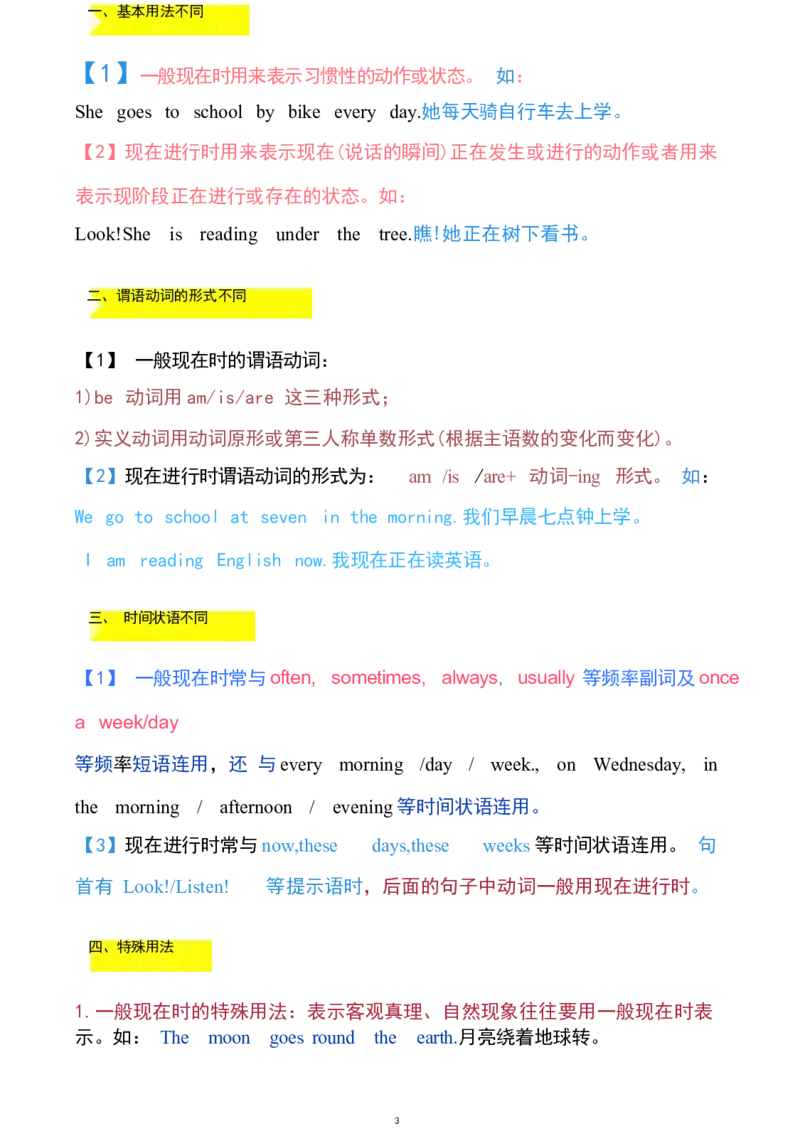
一般现在时和现在进行时的区别
一般现在时和现在进行时是前一阶段所学的两种重要时态,它们的不同之处
有以下几点:
2一、基本用法不同
【1】
一般现在时用来表示习惯性的动作或状态。 如:
She goes to school by bike every day.她每天骑自行车去上学。
【2】现在进行时用来表示现在(说话的瞬间)正在发生或进行的动作或者用来
表示现阶段正在进行或存在的状态。如:
Look!She is reading under the tree.瞧!她正在树下看书。
二、谓语动词的形式不同
【1】 一般现在时的谓语动词:
1)be 动词用am/is/are 这三种形式;
2)实义动词用动词原形或第三人称单数形式(根据主语数的变化而变化)。
【2】现在进行时谓语动词的形式为: am /is /are+ 动词-ing 形式。 如:
We go to school at seven in the morning.我们早晨七点钟上学。
I am reading English now.我现在正在读英语。
三、 时间状语不同
【1】 一般现在时常与often, sometimes, always, usually 等频率副词及once
a week/day
等频率短语连用,还 与every morning /day / week., on Wednesday, in
the morning / afternoon / evening等时间状语连用。
【3】现在进行时常与now,these days,these weeks 等时间状语连用。 句
首有 Look!/Listen! 等提示语时,后面的句子中动词一般用现在进行时。
四、特殊用法
1.一般现在时的特殊用法:表示客观真理、自然现象往往要用一般现在时表
示。如: The moon goes round the earth.月亮绕着地球转。
32.现在进行时的特殊用法:现在进行时与always 连用时,往往含有赞扬、
厌恶、责备等感情色彩。如:
He is always working hard.他总是非常努力地工作。 (表示赞扬)
3.come,go, begin, start, leave 等动词常用现在进行时表示将要发生的动
作。如:
I'm coming.我就来。
【练习】
选择题:
( )1.Who over there now?
A. singing B. are sing C. is singing D. sing
( )2.It' s eight o' clock. The students an English class.
A. have B. having C. is having D.are having
( )3. Listen! The baby in the next room.
A. crying B.cried C. is crying D.cries
( )4.Look! The twins new sweaters.
A. are wearing B. wearing C. are wear D. is wearing
( )5.Don' t talk here.Grandparents
A. is sleeping B. are sleeping C. sleeping D.sleep
( ) 6.Tom is a worker.He in a factory. His sisters in a
hospital.
A.work/ work B.works/ work C.work/works
4( )7.Who English best in your class?
A. speak B.speaks C. speaking
8.Mrs Read the windows every day.
A. is cleaning B. clean C. cleans
( )9.We music and often to music.
A. like/ listen B.likes/ listens C. like/ are listening
( ) 10.She up at six in the morning.
A. get B. gets C. getting
( ) 11.On Sunday he sometimes his clothes and sometimes
some shopping.
A.wash/ do B. is washing/ is doing C.washes/ does
( ) 12. The twins usually milk and bread for breakfast, but Jim
some coffee for it.
A.have/ have B.have/ has C. has/ have
keys:
1-5 CDCAB 6-10 BBCAB
11-12 CB