人教版(新标准)初中英语知识点精析
七年级下册 UNIT 9
What does he look like? 他长什么样?
重点
● 描述性形容词
● 询问及描述人物外貌特征的句型
难点
● 选择疑问句
● 形容词的用法和多个形容词的排列顺序
语法
● 询问及描述人的外貌
● 描述性形容词
● 选择疑问句
Section A
重点单词
straight直 的 tall高 的
height 身高;高度 thin瘦的
heavy 重 的 tonight (在)今晚;(在今夜)
little小 的 may 也许;可能;可以
cinema 电影院 glasses 眼 镜
later 以后 handsome 英俊的
1actor 演员 actress 女演员
person 人
重点短语
(be)of medium height 中等身高
look like 看起来像
a little 一点;少量
wear glasses 戴眼镜
重点句型
1. What does he look like? 他长什么样?
2.She's of medium height, and she has long straight hair.
她中等身高,而且留着长长的直发。
3.Yeah,but I may be a little late.对,但是我可能晚一点儿。
4. This person is of medium height.这个人中等身高。
Section B
重点单词
nose 鼻子
mouth 嘴
round 圆形的
face 脸
eye 眼睛
singer 歌手
artist 艺术家
put 放
each 每个;各自
way 方式;路线
describe 描述
differently 不同地
another 另一;又一
end 结尾;尽头
real 真正的;真实的
2重点短语
in the end 最 后
first of all首先短语
重点句型
1. They tell him what the criminal looks like.他们告诉他罪犯长什么样。
2. He wants to draw a good picture of each criminal
… 他想画好每个罪犯的肖像……
3.Many people don't always see things the same way so they many describe
the same person differently.
许多人并非总是以同样的方式看待事物,所以他们可能会将同一个人描述得不一样。
4. In the end, the real criminal is a short and heavy old man, and he has short
black hair! 最后,真正的罪犯是一个又矮又胖的老年人,而且他留着黑色的短发。
Section A 知识点精析
1. What does he look like? 他长什么样?
要点精析
What do/does sb. look like? 意为“某人长什么样?”,用来询问某人的外貌特征。
例:-What does Jack look like? 杰克长什么样?
-He is short and heavy.他又矮又胖。
知识拓展
“What is sb. like?”意为“某人是怎样的人?”,既可以用来询问人的外貌,也可
以用来询问人的性格、品质等内在特征。
例:-What is your father like? 你爸爸是怎样的一个人?
-He is tall and handsome, and he's very kind.他又高又帅,而且还很善良。
链接中考
3(山东济南中考)- does your new friend look like?
-He is tall with short blond hair and big blue eyes.
A.How B. Who C. What D. Where
解析:句意:“你的新朋友长什么样?”“他个头挺高,留着金色短发,有着蓝色的
大 眼睛。”“What do/does sb. look like?”为固定句型,意为“某人长什么样?”,
what 作 look like 的宾语。 A、D 两项为疑问副词,不能作 look like 的宾语;
who 与答语
不符。 选 C。
2. tall 高的
要点精析
tall 形容词,意为“高的”,既可以指人的身高,也可以表示物体高大。
例:Yao Ming is very tall.姚明很高。
There are many tall trees in the forest.森林里有很多高的树。
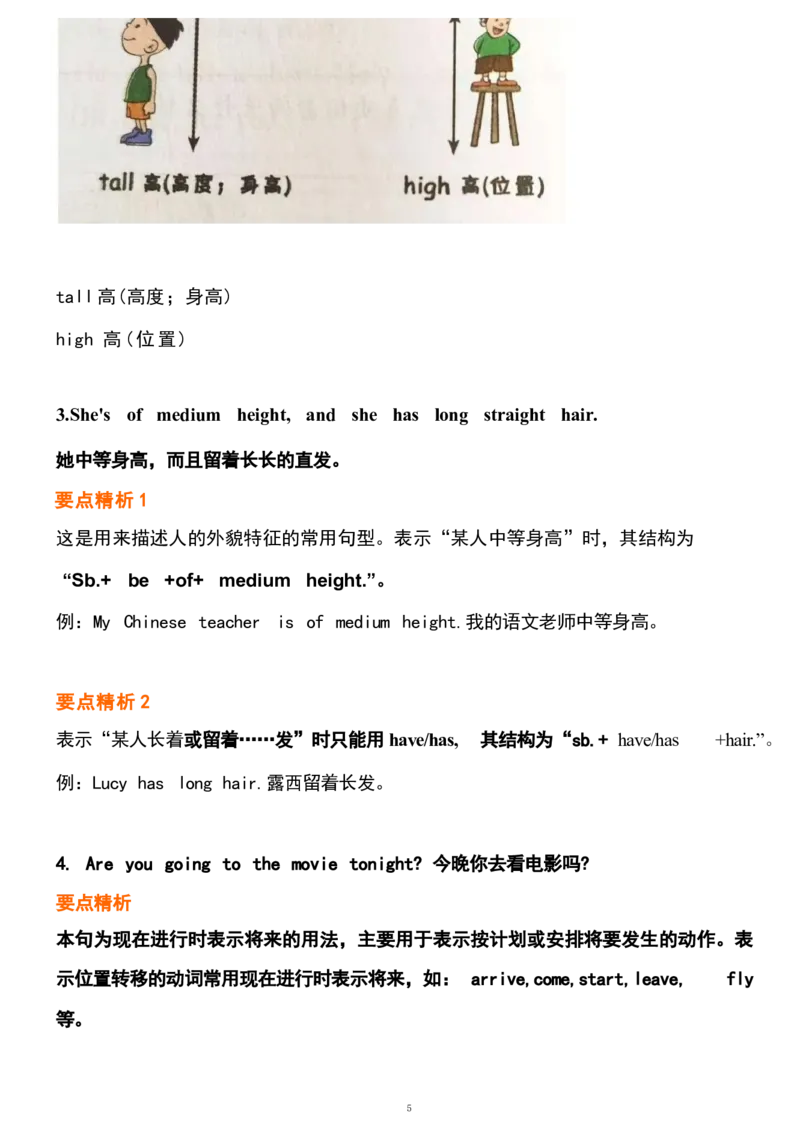
辨析 tall 与 high
指从底到顶很高,常指人、动物、树木、建筑物等很高。
tall
指人的身高时只用 tall,反义词为 short
high 指从地面到最高点很高,多指山高,也指空间的位置或程度上高,指海
拔高度时只用 high,反义词为 low
【助记】
tall 与 high 的区别:
4tall高(高度;身高)
high 高(位置)
3.She's of medium height, and she has long straight hair.
她中等身高,而且留着长长的直发。
要点精析 1
这是用来描述人的外貌特征的常用句型。表示“某人中等身高”时,其结构为
“Sb.+ be +of+ medium height.”。
例:My Chinese teacher is of medium height.我的语文老师中等身高。
要点精析 2
表示“某人长着或留着……发”时只能用have/has, 其结构为“sb.+ have/has +hair.”。
例:Lucy has long hair.露西留着长发。
4. Are you going to the movie tonight? 今晚你去看电影吗?
要点精析
本句为现在进行时表示将来的用法,主要用于表示按计划或安排将要发生的动作。表
示位置转移的动词常用现在进行时表示将来,如: arrive,come,start,leave, fly
等。
5【助记】
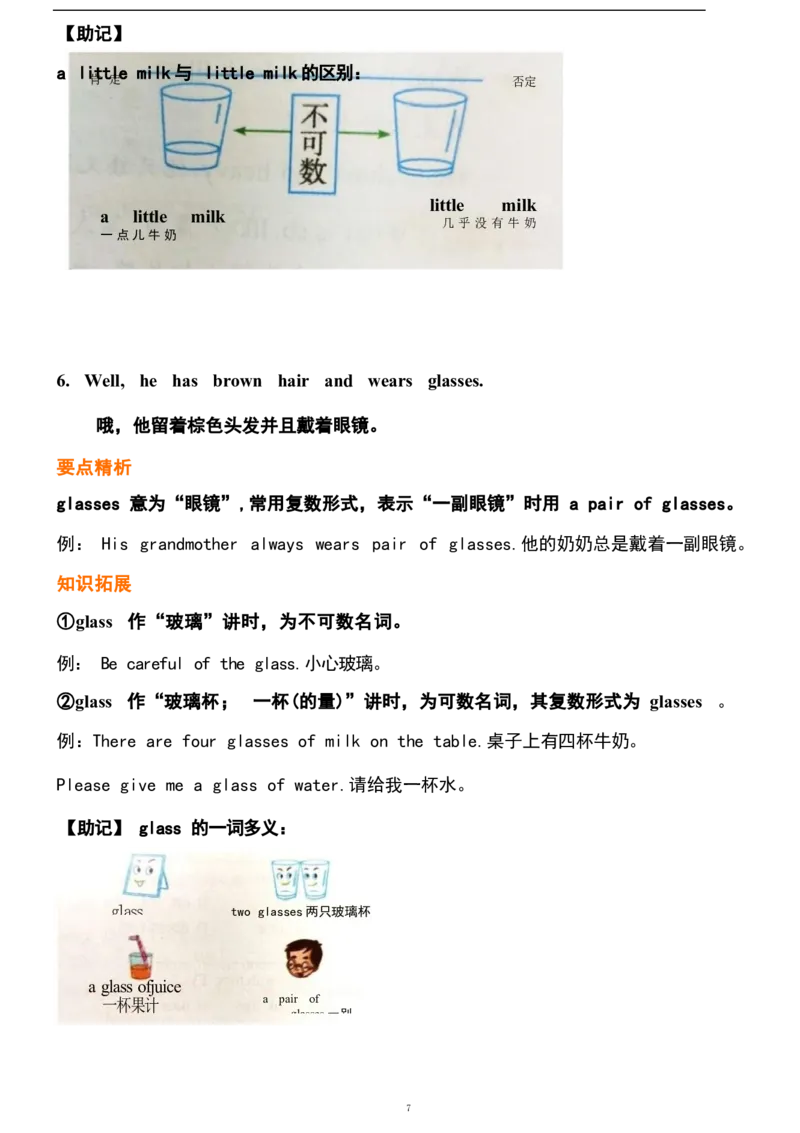
a little milk与 little milk的区别:
肯 定 否定
little milk
a little milk
几 乎 没 有 牛 奶
一点儿牛奶
6. Well, he has brown hair and wears glasses.
哦,他留着棕色头发并且戴着眼镜。
要点精析
glasses 意为“眼镜”,常用复数形式,表示“一副眼镜”时用 a pair of glasses。
例: His grandmother always wears pair of glasses.他的奶奶总是戴着一副眼镜。
知识拓展
①glass 作“玻璃”讲时,为不可数名词。
例: Be careful of the glass.小心玻璃。
②glass 作“玻璃杯; 一杯(的量)”讲时,为可数名词,其复数形式为 glasses 。
例:There are four glasses of milk on the table.桌子上有四杯牛奶。
Please give me a glass of water.请给我一杯水。
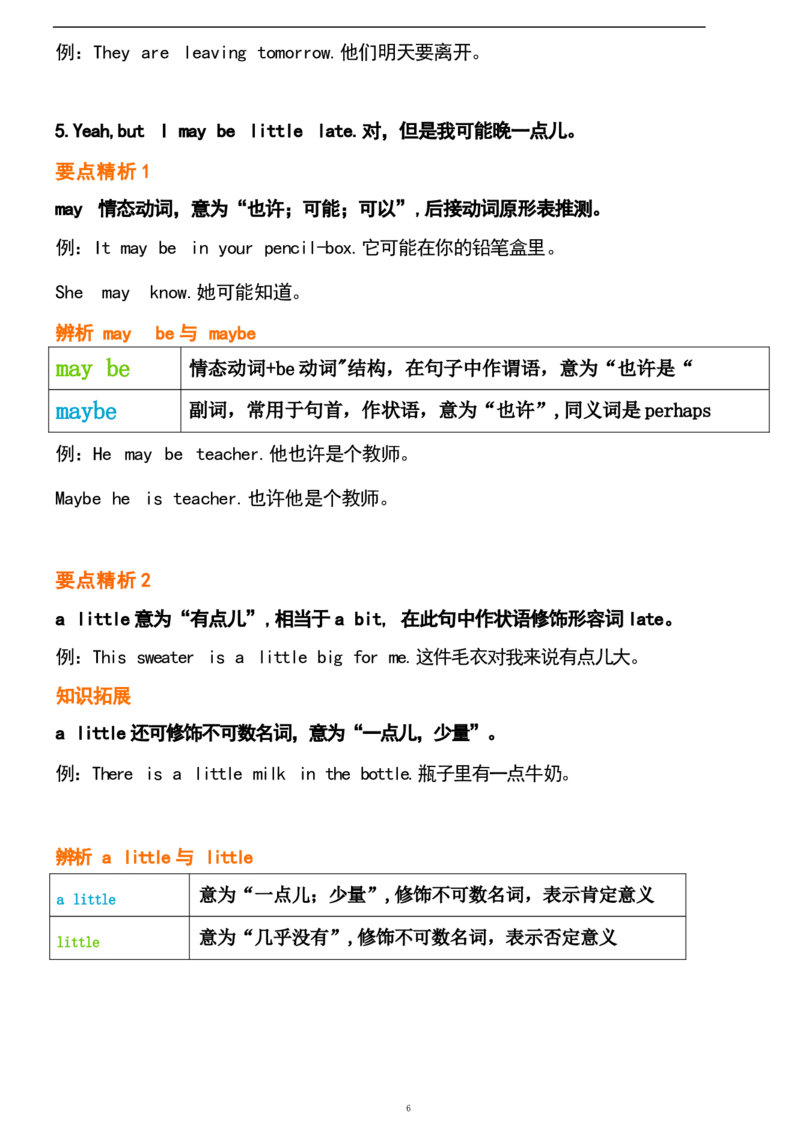
【助记】 glass 的一词多义:
glass two glasses两只玻璃杯
a glass ofjuice
一杯果计 a pair of
glasses 一别
7例:They are leaving tomorrow.他们明天要离开。
5.Yeah,but I may be little late.对,但是我可能晚一点儿。
要点精析 1
may 情态动词,意为“也许;可能;可以”,后接动词原形表推测。
例:It may be in your pencil-box.它可能在你的铅笔盒里。
She may know.她可能知道。
辨析 may be 与 maybe
may be 情态动词+be 动词"结构,在句子中作谓语,意为“也许是“
maybe 副词,常用于句首,作状语,意为“也许”,同义词是 perhaps
例:He may be teacher.他也许是个教师。
Maybe he is teacher.也许他是个教师。
要点精析 2
a little 意为“有点儿”,相当于 a bit, 在此句中作状语修饰形容词 late。
例:This sweater is a little big for me.这件毛衣对我来说有点儿大。
知识拓展
a little 还可修饰不可数名词,意为“一点儿,少量”。
例:There is a little milk in the bottle.瓶子里有一点牛奶。
辨析 a little 与 little
意为“一点儿;少量”,修饰不可数名词,表示肯定意义
a little
意为“几乎没有”,修饰不可数名词,表示否定意义
little
6链接中考
(湖北黄石中考) that pair of a little cheaper?
A. Is; glass B. Are; glass C.Is; glasses D. Are; glasses
解析:句意:那副眼镜比较便宜一点儿吗? “眼镜”应为 glasses, 排除 A、B 两项;
又因本句的主语为 that pair, 谓语动词应用单数形式,故选 C。
7.And he is really handsome。 而且他的确很帅气。
要点精析
handsome 形容词,意为“英俊的”,多用于形容男子英俊潇洒。
例:l like Li Yifeng. He is a handsome actor.我喜欢李易峰。他是一位帅气的男演员。
辨析:handsome, beautiful 与 pretty
一般用来形容男性,意为“英俊的,潇洒的”
handsome
用来形容女性貌美动人,意为“漂亮的”。可用来描述女性、
beautiful
孩子或事物
pretty 用来形容女性、孩子或事物,侧重从主观上评述某人或某物
指娇小的可爱的,语气比 beautiful弱,意为“漂亮的”
例:The young man is very handsome.这个年轻人非常英俊。
Mary is a beautiful girl.玛丽是一个漂亮的女孩儿。
It's beautiful dress.它是一条漂亮的连衣裙。
She is not really beautiful, but she looks pretty when she smiles.
她其实长得并不美,但她笑起来很好看。
8.What does your favorite actor or actress look like?
你最喜欢的男演员或女演员长什么样?
要点精析
8actor 名词,意为“(男)演员”;“女演员”为 actress。
actor 是由动词 act 加后缀-or 构成的。
在英语构词法中, 动词加后-or 通常变为名词,表示动作的执行者。
类似的单词有 visitor “参观者”, inventor “发明家”等。
知识拓展
①在英语构词法中,还有动词加后缀-er 变为名词的,也表示动作的执行者。类似的单
词有 teacher “教师”, reader “读者”,worker “工人”, singer “歌手”等。
②在英语构词法中,还有名词、动词和形容词加后缀-ist 变为名词的,表示“从事……
的专家”。类似的单词有 artist “艺术家” scientist “科学家”, specialist “专
家”
等。
9.This person is of medium height.这个人中等身高。
要点精析
person 可数名词,意为“人”;其复数形式为 persons, 意为“人们”。
例: He is just the person we need for the job.
他正是我们所需要的适合这份工作的人。
知识拓展
person 的形容词形式为 personal; 意为“私人的;个人的”。
例:This novel is written from personal experience.
这部小说是根据个人亲身经历写成的。
辨析: person 与 people
person 意为“人”时,着重指个人。作可数名词,常指有个性的、特定的人
people 意为“人们”时,着重指全体,作集合名词,表示复数概念
例:What is she like as a person? 她的人品怎么样?
There are many people at the party.聚会上有许多人。
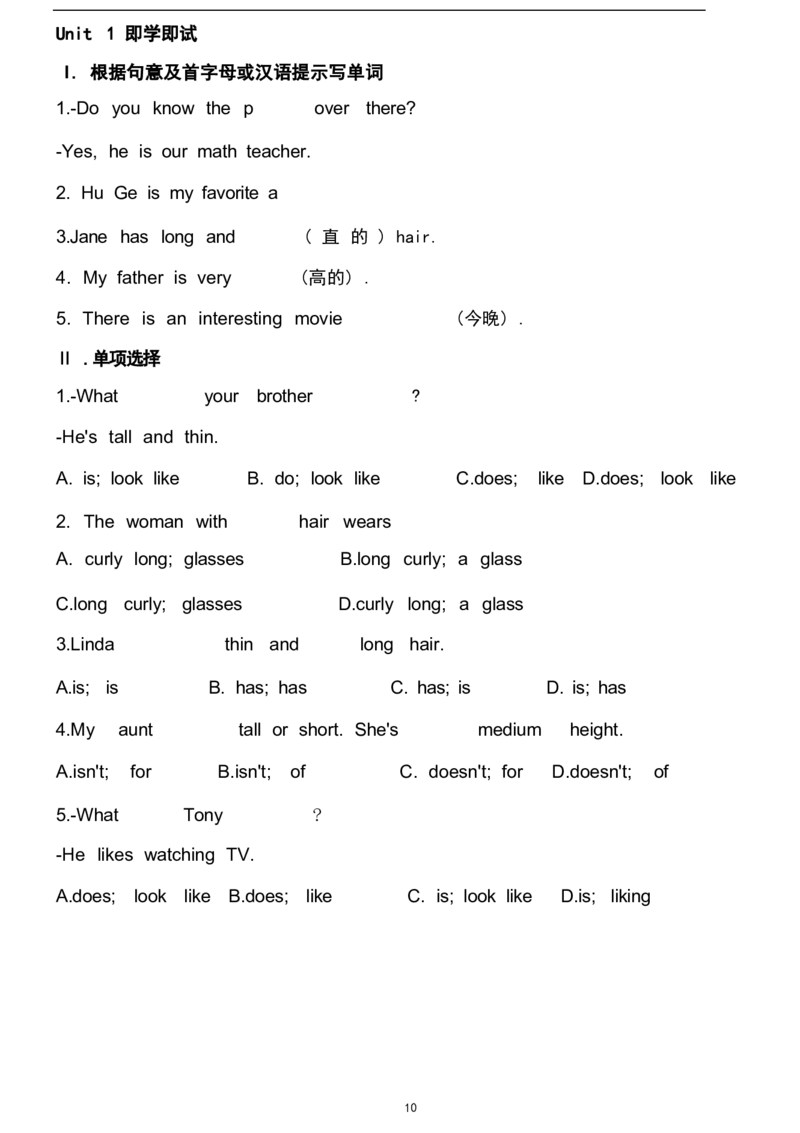
9Unit 1 即学即试
I. 根据句意及首字母或汉语提示写单词
1.-Do you know the p over there?
-Yes, he is our math teacher.
2. Hu Ge is my favorite a
3.Jane has long and ( 直 的 ) hair.
4. My father is very (高的) .
5. There is an interesting movie (今晚) .
Ⅱ .单项选择
1.-What your brother ?
-He's tall and thin.
A. is; look like B. do; look like C.does; like D.does; look like
2. The woman with hair wears
A. curly long; glasses B.long curly; a glass
C.long curly; glasses D.curly long; a glass
3.Linda thin and long hair.
A.is; is B. has; has C. has; is D. is; has
4.My aunt tall or short. She's medium height.
A.isn't; for B.isn't; of C. doesn't; for D.doesn't; of
5.-What Tony ?
-He likes watching TV.
A.does; look like B.does; like C. is; look like D.is; liking
10Section B 知识点精析
1.
They tell him what the criminal looks like. 他们告诉他罪犯长什么样。
要点精析 1
本句是含有what 引导的宾语从句的主从复合句。宾语从句的语序为陈述语序。
例:Can you tell me when the meeting will start?
你能告诉我会议什么时候开始吗?
链接中考
(湖南长沙中考)-Does anybody want to share on Father's Day?
-Guess what? I'll write a poem for my dad.
A. when will you shop B.what you will do C. where you will go
解析:根据宾语从句应用陈述语序可排除 A 项;根据答语中的“我要给爸爸写首诗”
可知,上句询问是否有人愿意分享父亲节那天想做的事。故选 B。
要点精析 2
criminal 可数名词,意为“罪犯”。
例:The police caught a dangerous criminal.警察抓住了一个危险的罪犯。
知识拓展
①criminal 用作形容词,意为“犯罪的,犯法的”。
例:He usually deals with serious criminal cases.他通常处理重大刑事案件。
② crime 名词,意为“犯罪活动;不法行为”。
例:The crime rate is increasing.犯罪率正在上升。
2. Then Joe draws a picture of the criminal, and the police put it in
newspapers and on television to find him.
然后,乔画出罪犯的肖像,警察把它放在报纸和电视上来寻找他。
11要点精析 1
put 此处为及物动词,意为“放”。
例:Don't put the cup on the table.不要把杯子放在桌子上。
知识拓展
关于 put 的搭配:
①put on 穿上(衣服)
例:Put on your coat.It's very cold outside.穿上你的外套。外面很冷。
②put up 张贴;搭建;举起
例:Please put up the picture on the wall.请把这张画贴在墙上。
③put away 把……收起来;放好
例:Mike, put away your clothes.迈克,把你的衣服收好。
④put out 扑灭
例:Let's put out the fire together.让我们一起灭火。
链接中考
(山东潍坊中考) The photos that won first prize in the competition will be
on the website.
A. put away B. put off C. put up D. put on
解析: put away 意为“把……收起来”; put off 意为“推迟”; put up 意为“张
贴; 公布”; put on 意为“穿上;上演”。由句意“比赛中获得一等奖的照片将会
在网站上
公布”可知选 C。
要点精析 2
it 是人称代词,意为“它”,用来指代单个事物或不可数事物。
例:I have pen. It's black.
我有一支钢笔。它是黑色的。 (it 指代前一句话中的 pen)
12There is some water in the cup.You can drink it.
杯子里有一些水。你可以喝。 (it 指代前一句话中的 water)
3. He wants to draw a good picture of each criminal …
他想画好每个罪犯的肖像……
要点精析
each 此处作形容词,意为“每个”,修饰可数名词单数。
例:There are many trees on each side of the river.河流两岸有许多树。
知识拓展
①each 还可用作代词,意为“每个;各个”,可单独作主语,也可后接 “of+ 复数名
词 /代词”作主语,其谓语动词用单数形式。若用作同位语,须放在主语的后面,谓
语动
词用复数形式。
例:Each of us has a new book.我们每个人都有一本新书。
②each other 互相
例:They speak English to each other.他们彼此说英语。
辨析:each 与 every
指两个或两个以上的人或物中的“每个”强调个体;作代词时,可作主语或
each
宾语,其后可以跟介词 of
every 指三个或三个以上的人或物中的“每个”,强调全体,不能单独使用
4. M
any people don't always see things the same way so they may descr ibe
the same person differently.
许多人并非总是以同样的方式看待事物,所以他们可能会将同一个人描述得不一样。
要点精析 1
13not always 表示部分否定,意为“不总是”。当句子中有 all,every, both,
always 等词时,否定词 not 无论用在主语中,还是谓语部分中,都表示部分否定。若
要表示完全否定,则要用 no,none,nobody,nothing,neither,never 等词。
例:He doesn't always get up early.他并非总是早起。
She is never late.她从不迟到。
要点精析 2
same 形容词,意为“相同的;同样的”,通常与定冠词 the 连用。
例:Those two books are the same.那两本书是一样的。
知识拓展
the same(…)as… 意为“和……一样(...)”。
例:My bag is the same as yours.我的书包和你的(书包)是一样的。
My bag is the same color as yours.
我的书包的颜色和你的书包(的颜色)是一样的。
要点精析 3
way 此处用作可数名词,意为“方式;方法”,常与介词 in 连用。
例:Our English teacher has new ways of teaching.我们英语老师有教学的新方法。
The little cat catches fish in this way.那只小猫用这种方法捉鱼。
5.Another woman says… 另一个妇女说……
要点精析
another 可作形容词或代词,意为“另一;又一”。
例:We need another computer.我们还需要另一台电脑。
【注意】
14① another 泛指不确定数目中的“另一个”,其后常接可数名词单数。
② “another+ 基数词+可数名词复数”意为“另外的 …… ;再有几个 ……”相当于“基
数词+ more+ 可数名词复数”。
例:We need another two hours. (= We need two more hours.)
我们还需要两个小时。
链接中考
(四川宜宾中考)-Would you like to have apples?
-No, thank you. I've had enough.
A.other two B. another two C. more two D. two others
解析:句意:“你想再要两个苹果吗?”“不用了,谢谢你。我已经吃饱了。”表示“再
有几个……”时可用 “another+ 基数词+可数名词复数”或“基数词+more+ 可数名
词
复数”,故选 B。
6. In the end, the real criminal is a short and heavy old man, and he has
short black hair!
最后,真正的罪犯是一个又矮又胖的老年人,而且他留着黑色的短发!
要点精析 1
end 此处作名词,意为“结尾;尽头”。 in the end意为“最后;终于”,是介词短语,
作状语,相当于at last或 finally, 其反义短语为 at first。
例:We walked to the end of the road.我们走到了路的尽头。
He studied hard and in the end he passed the exam.
他努力学习,最后他通过了考试。
知识拓展
at the end of意为“在……的尽头/结尾”。
15例:The bookstore is at the end of this street.书店在这条街的尽头。
My uncle will come here at the end of January.
我的叔叔将会在一月底来这里。
要点精析 2
real形容词,意为“真正的;真实的”。
例:He is the real manager.他是真正的经理。
辨析 real与 true
really 指客观存在的、非想象的,其副词形式为
指与客观事实相一致的,非杜撰、捏造的,其副词形式为truly
true
例:Is this real gold? 这是真金吗?
Do you really want to go? 你真的想去吗?
Some foreign students will come to our school. It's true.
一些外国学生将来我们学校。这是真的。
I will tell you a true story about a real man.我将会给你们讲一个真人真事。
7.First all,he is very tall and handsome. 首先他非常高而且很帅。
要点精析
first of all 意为“首先”,表示次序,下文往往有next,then 等。
例:First of all, let me introduce myself to you.首先,让我向你们做一下自我介绍。
First of all, let me ask you something.首先,让我问你一件事。
知识拓展
at first意为“当初;起初”,相当于at the beginning。
例:I didn't like the job much at first.起初我并不是很喜欢这份工作。
16Unit 2 即学即试
I. 用所给词的适当形式填空
1.Xu Beihong is a great (art).
2.The two (person)are shopping in the supermarket.
3. She's a wonderful (sing).
4. Alan and his cousin are (go)to the movie at 7:00 p.m.
5. Boys and girls may behave (different).
Ⅱ .根据汉语意思完成句子
1.张一 山长得确实很英俊。
Zhang Yishan is .
2.你最喜欢的女演员长什么样?
your favorite look like?
3.我最好的朋友留着长的黑色直发。
My best friend has hair.
4.你认识手里拿书的那个人吗?
Do you know the a book in his hand?
5.学生们可能在操场上。
on the playground.
The students人教版(新标准)初中英语即学即试参考答案与解析
七年级下册 UNIT 9
What does he look like? 他长什么样?
Section A 即学即试
I.
1.person 2.actor 3.straight 4.tall 5.tonight
Ⅱ .
1.D“What do/does sb. look like?”意为“某人长什么样?”,用来询问某人的外
貌特征。
2.C 形容头发的顺序是:长短一曲直一颜色; glass 意为“眼镜”时,为可数名词,用
复数形式。
3.D 表示“某人高矮胖瘦”用 sb.+be+ 形容词;表示“某人留着……头发”用 sb.+
have/has+ … hair。
4.B tall 和 short 为形容词,其前应用系动词; of medium height 意为“中等身高”。
5.B 由答语“他喜欢看电视。”可知,问句应该是询问“托尼喜欢什么?”。
Section B 即学即试
I.
1.artist 2.persons 3.singer 4.going 5.differently
Ⅱ.
1. really handsome 2. What does, actress 3.long straight black
4. person with 5. may be人教版(新标准)初中英语知识点归纳
七年级下册 UNIT 9
What does he look like? 他长什么样?
单词归纳
eye 眼睛
curly卷曲的
singer歌 手
straight直的
artist艺术家
tall高的
crime 犯罪活动
medium 中等的
criminal罪 犯 put 放
thin瘦的
each 每个;各自
heavy 重的
way 方式;路线
little小 的
describe 描述
cinema 电影
differently 不同地
院 glasses
another 另一 ;又一
眼镜
end 结尾;尽头
later 以 后
real真正的;真实的
handsome 英俊
jeans 牛仔裤
的
height 身高;高度
actor演员
may 也许;可能;可以
actress女演员
tonight (在)今晚;(在)今夜
person 人
blonde( blond) (头发)金黄色
nose 鼻子
face 脸
mouth 嘴
短语归纳
short hair短 发
long hair 长
19curly hair 卷发 big eyes 大眼睛
straight hair 直发 long face 长脸
little-一点;少量
in the end 最后
look like 看起来像 wear glasses 戴眼镜
big nose 大鼻子
first of all 首先 (
small mouth 小嘴巴 be)of medium height 中等身高
round face 圆脸 the same way 同样的方式
black hair 黑发 blonde hair 金黄色的头发
用法归纳
1. What do/does sb.look like? 某人长什么
样? 2.Sb.+be+of+medium height.某人中等
身高。 3.Sb.+have/has+..hair.某人留着…发。
4. want to do sth.想要做某事
5.tell sb.to do sth.告诉某人做某事