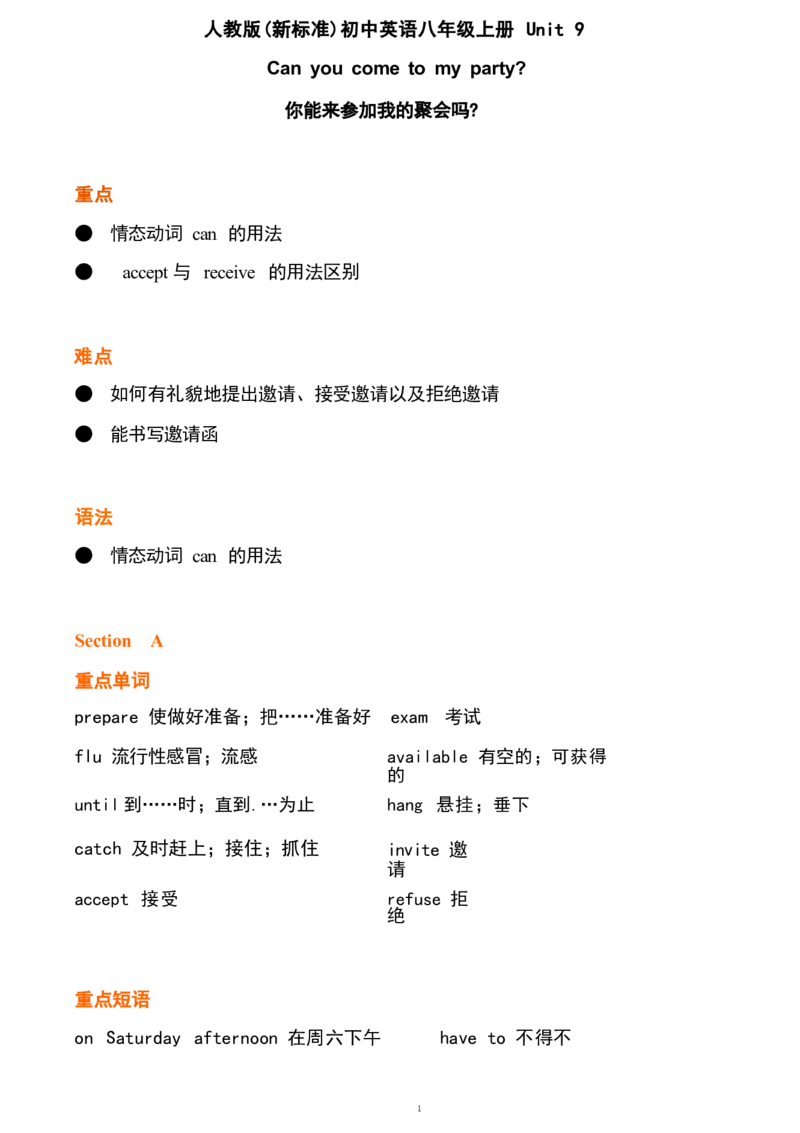
人教版(新标准)初中英语八年级上册 Unit 9
Can you come to my party?
你能来参加我的聚会吗?
重点
● 情态动词 can 的用法
● accept 与 receive 的用法区别
难点
● 如何有礼貌地提出邀请、接受邀请以及拒绝邀请
● 能书写邀请函
语法
● 情态动词 can 的用法
Section A
重点单词
prepare 使做好准备;把……准备好 exam 考试
flu 流行性感冒;流感 available 有空的;可获得
的
until到……时;直到.…为止 hang 悬挂;垂下
catch 及时赶上;接住;抓住 invite 邀
请
accept 接受 refuse 拒
绝
重点短语
on Saturday afternoon 在周六下午 have to 不得不
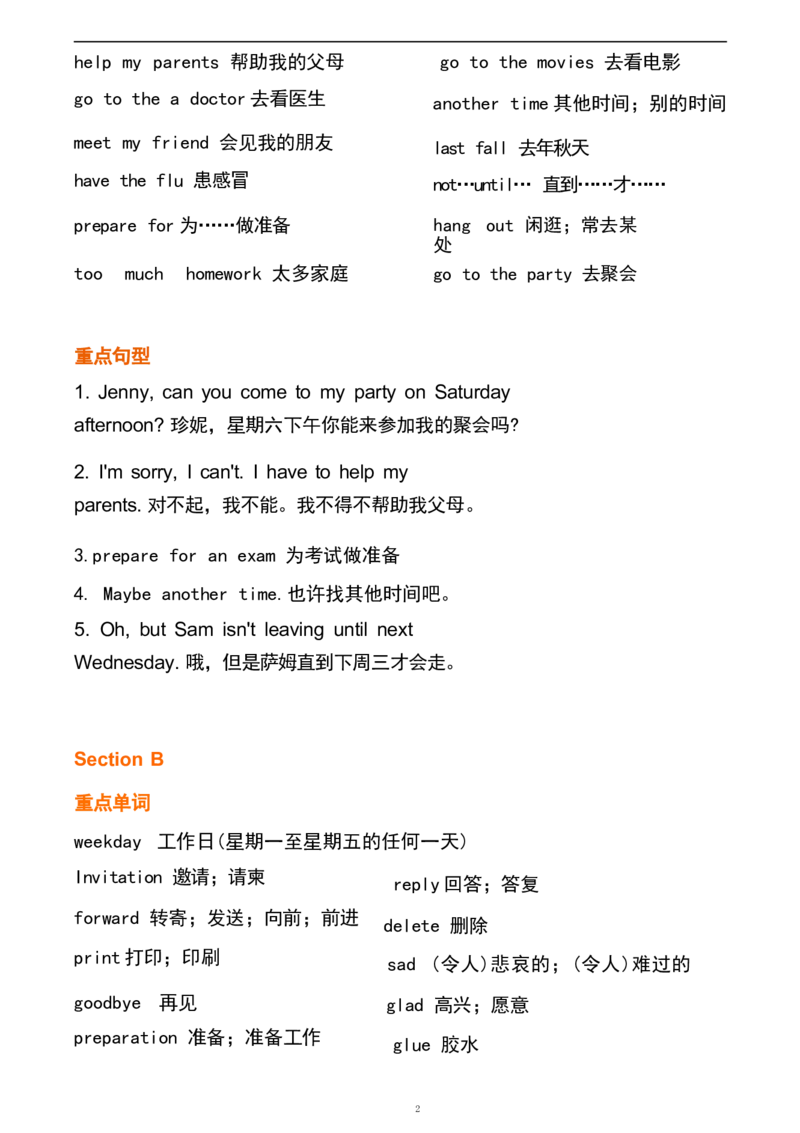
1help my parents 帮助我的父母 go to the movies 去看电影
go to the a doctor 去看医生
another time 其他时间;别的时间
meet my friend 会见我的朋友
last fall 去年秋天
have the flu 患感冒
not…until… 直到……才……
prepare for 为……做准备 hang out 闲逛;常去某
处
too much homework 太多家庭 go to the party 去聚会
重点句型
1. Jenny, can you come to my party on Saturday
afternoon? 珍妮,星期六下午你能来参加我的聚会吗?
2. I'm sorry, I can't. I have to help my
parents. 对不起,我不能。我不得不帮助我父母。
3.prepare for an exam 为考试做准备
4. Maybe another time.也许找其他时间吧。
5. Oh, but Sam isn't leaving until next
Wednesday. 哦,但是萨姆直到下周三才会走。
Section B
重点单词
weekday 工作日(星期一至星期五的任何一天)
Invitation 邀请;请柬
reply 回答;答复
forward 转寄;发送;向前;前进
delete 删除
print 打印;印刷
sad (令人)悲哀的;(令人)难过的
goodbye 再见 glad 高兴;愿意
preparation 准备;准备工作
glue 胶水
2without 没有;不(做某事) surprised 惊奇的;感觉意外的
opening 开幕式;落成典礼 concert 音乐会;演奏会
event 大事;公开活动;比赛项目 guest 客人;宾客
calendar 日历;日程表 daytime 白天;日间
重点短语
the day before yesterday 前天
accept an invitation 接受邀请
the day after tomorrow 后天 turn down 拒绝
study for a test 为考试学习
take a trip 去旅行
have a piano lesson 上钢琴课
at the end of this month 这个月末
look after 照看;照顾
look forward to 盼望;期待
help out (帮助………)分担工作、解决难题
hear from 接到(某人的)信、电话等
the opening of. …… 的开幕式/落成典礼
reply in writing 书面回复 go to the concert 去听音乐
会
go shopping 去购物 on the weekend 在周末
visit grandparents 拜访(外)祖父母 after school 放学后
重点句型
1.-What's today? 今天是什么日子?
-It's Monday the14th.今天是 14 号,星期一。
2. She helped me to improve my English so much.
她帮助我把英语(成绩)提高了那么多。
3. I'm sad to see her go, and this party is the best way to say "Thank you and
goodbye." 她要离开我很难过,这个聚会是向她说“谢谢和再见”的最好方式。
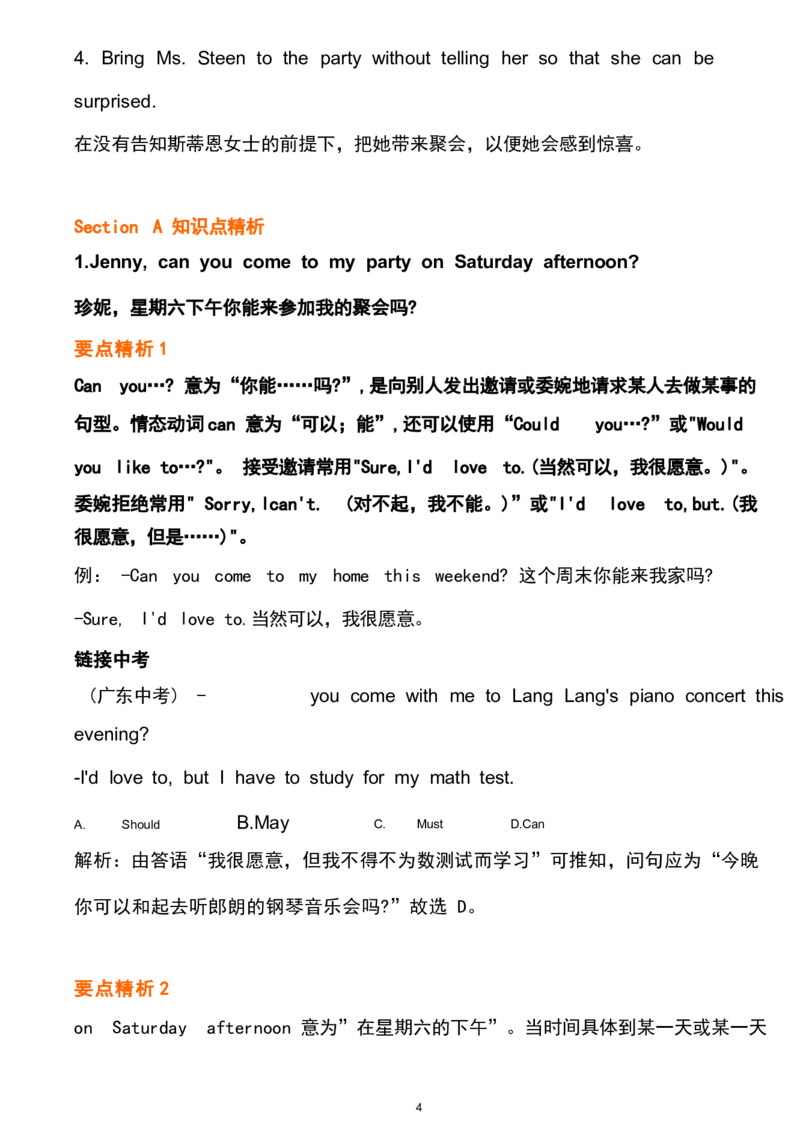
34. Bring Ms. Steen to the party without telling her so that she can be
surprised.
在没有告知斯蒂恩女士的前提下,把她带来聚会,以便她会感到惊喜。
Section A 知识点精析
1.Jenny, can you come to my party on Saturday afternoon?
珍妮,星期六下午你能来参加我的聚会吗?
要点精析 1
Can you…? 意为“你能……吗?”,是向别人发出邀请或委婉地请求某人去做某事的
句型。情态动词can 意为“可以;能”,还可以使用“Could you…?”或"Would
you like to…?"。 接受邀请常用"Sure,I'd love to.(当然可以,我很愿意。)"。
委婉拒绝常用" Sorry,lcan't. (对不起,我不能。)”或"I'd love to,but.(我
很愿意,但是……)"。
例: -Can you come to my home this weekend? 这个周末你能来我家吗?
-Sure, I'd love to.当然可以,我很愿意。
链接中考
(广东中考) - you come with me to Lang Lang's piano concert this
evening?
-I'd love to, but I have to study for my math test.
B.May
A. Should C. Must D.Can
解析:由答语“我很愿意,但我不得不为数测试而学习”可推知,问句应为“今晚
你可以和起去听郎朗的钢琴音乐会吗?”故选 D。
要点精析 2
on Saturday afternoon 意为”在星期六的下午”。当时间具体到某一天或某一天
4的上午、下午或晚上等时,要用介词 on。
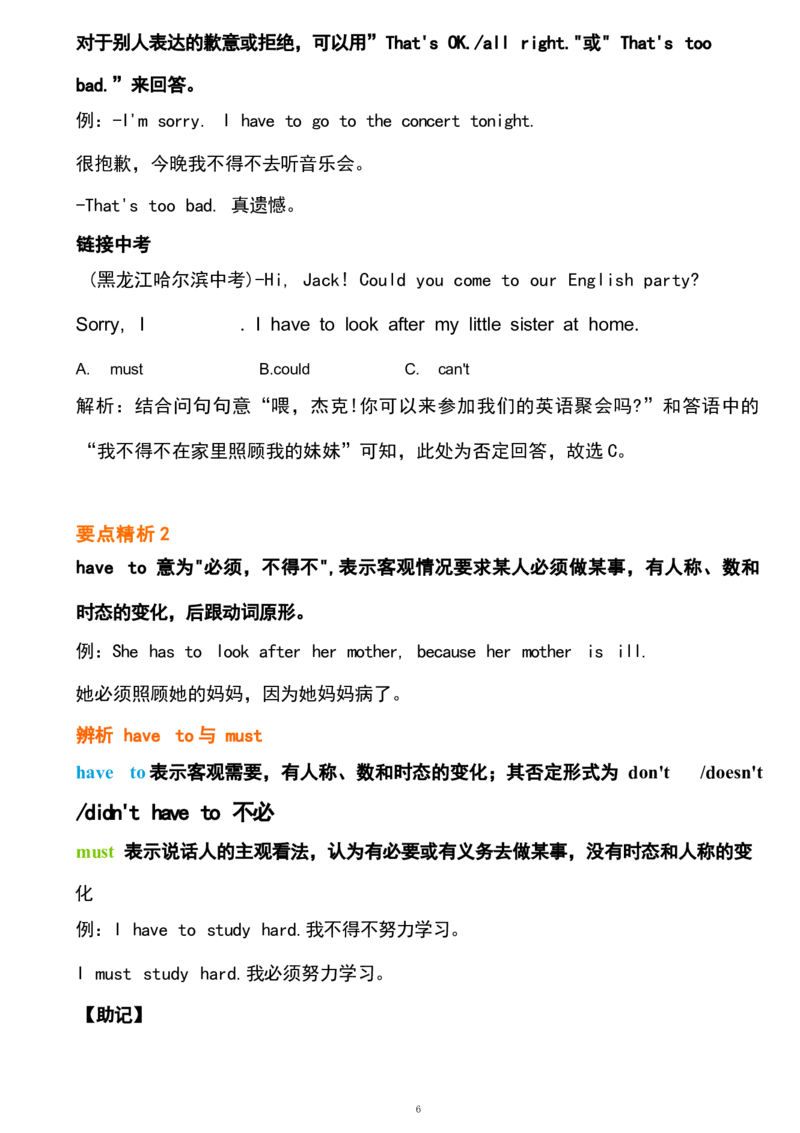
例:on the morning of May 1st 在五月一 日上午
on Monday evening 在星期一晚上
链接中考
(黑龙江哈尔滨中考)-Our class will have a party the evening of June 30th.
Would you like to come?
-Yes, I'd love to, but I'm going to visit my grandparents in Dalian.
A.in B. on C. at
解析: in 表示一段时间,用于月、季节、年、世纪前或泛指一天的上午、下年、
晚 上;on 用子星期几、具体的某一天或某一天的上年、下年晚上或节日前; at 用
于具 体的时刻前。根据句中时间 the evening of June30th 可知,此处具体某一
天的晚 上,故选 B, 句意:“我们班将在 6 月 30 日晚上举办聚会。你愿意来参加
吗?”“是
的,我愿意,但我要去大连看望我的祖父母。"。选 B。
2. I'm sorry, I can't. I have to help my parent.
对不起,我不能。我不得不帮助我父母。
要点精析 1
I'm sorry, I can't.意为”对不起,我不能”,这是委婉地拒绝别人的邀请、请求或
建议的用语。在英语中,要拒绝别人时, 一般先要表达歉意,再说明理由,这是一
种礼貌而委婉的拒绝方法。"I'm sorry/sorry. I can't. I have to…”或 "I'd
love
to,but… " 常被用来委婉地拒绝别人的邀请。
例: -Can you go fishing with me this afternoon?
今天下午你能和我一起去钓鱼吗?
-Sorry, I can't. I have to wash the car.对不起,我不能。我得洗车。
【注意】
5对于别人表达的歉意或拒绝,可以用”That's OK./all right."或" That's too
bad.”来回答。
例:-I'm sorry. I have to go to the concert tonight.
很抱歉,今晚我不得不去听音乐会。
-That's too bad. 真遗憾。
链接中考
(黑龙江哈尔滨中考)-Hi, Jack! Could you come to our English party?
Sorry, I . I have to look after my little sister at home.
A. must B.could C. can't
解析:结合问句句意“喂,杰克!你可以来参加我们的英语聚会吗?”和答语中的
“我不得不在家里照顾我的妹妹”可知,此处为否定回答,故选C。
要点精析 2
have to 意为"必须,不得不",表示客观情况要求某人必须做某事,有人称、数和
时态的变化,后跟动词原形。
例:She has to look after her mother, because her mother is ill.
她必须照顾她的妈妈,因为她妈妈病了。
辨析 have to与 must
have to表示客观需要,有人称、数和时态的变化;其否定形式为 don't /doesn't
/didn't have to 不必
must 表示说话人的主观看法,认为有必要或有义务去做某事,没有时态和人称的变
化
例:I have to study hard.我不得不努力学习。
I must study hard.我必须努力学习。
【助记】
6have to 不得不
must 必须
3. prepare for an exam 为考试做准备
要点精析
prepare 此处用作不及物动词,意为“做准备”,也可用作及物动词,意为“使做好
准备;把……预备好”,其名词形式为 preparation, 意为“准备;准备工作”。常
用短语 prepare for意为“为……做准备”。
例:I can't go to the movies with you because I have to prepare for an exam.
我不能和你一起去看电影,因为我不得不为考试做准备。
Mum is preparing the traditional dinner and we are preparing for the New
Year.妈妈在准备传统晚宴,我们在为新年做准备。
知识拓展
①prepare to do sth.意为“准备做某事 ”。
例:Taking out a piece paper, he prepared to write to his parents.
他拿出一张纸,准备给父母写信。
② prepare sb.for sth.意为“使某人为某事做准备 ”。
例:We must prepare her for the bad news.
我们必须使地为这个坏消息做好准备。
4. Maybe another time.也许找其他时间吧。
要点精析
another 可用于修饰或指代单数可数名词,主要有两个用法: 一是表示“另外一个”,
即暗指除这个之外的另外一个,具有不确指性。另一个用法是表示“增加的;额外
的",暗指在原有基础上另增加一个。
7例:You'd better try and find another job.你最好设法另找一份工作。
辨析 another, other, others 与 the others
another 既可作形容词,也可作代词,可用于三个或更多的人或物,泛指同类事物
中的三者或三者以上的”另个",可修饰或代替单数可数名词
other 可作形容词或代词,作形容词时,意思是“别的,其他的”,泛指“其他的(人
或物)"
others 是 other 的复数形式,泛指”另外几个;其余的",在句中可作主语或宾语
the others 意为”其他东西;其余的人",特指某一范围内的“其他的(人或物)",
是 the other 的复数形式
例:Could I have another glass of milk? 我可以再喝一杯牛奶吗?
Miss Li and three other teachers are there.李老师和其他三位老师在那里。
I have two books. One is about math and the other is about politics.
我有两本书。 一本是关于数学的,另一本是关于政治的。
The students of Class Four are cleaning the classroom. Some are carrying
water; others are sweeping the floor.
四班的学生们在打扫教室。 一些人在提水,另一些人在扫地。
Some students are on the playground. Where are the others?
一些学生在操场上。其他的学生在哪里?
链接中考
(江苏州中考)-Could we see. each other at 9 o'clock tomorrow morning?
-Sorry, let's make it time.
A. other's B. the other C.another D. other
解析:根据答语句意“对不起,让我们另定时间吧”可知选 C。
5.Oh, but Sam isn't leaving until next Wednesday.
8哦,但是萨姆直到下周三才会走。
要点精析
not…until… 意为“直到才 ……”,句子/主句中的谓语动词常用非延续性动词,表示
until所表示的时间到了、该动作才发生。此处 until用作介词,意为“到 …… 时;
直到 ……为止", until 也可作连词,相当于 till。
例:The noise of the street didn't stop until midnight.
街上的噪音直到午夜才停止。
辨析 not…until..与 until
not …until … 表示“直到 ……才 ……”,句子/主句中的谓语动词常用瞬间性动词
until 表示动作、状态的持续,强调“直到 ……为止”,句子/主句中的谓语动词常用
延续性动词
例:They didn't talk until the director came.直到导演来了,他们才交谈。
He lived with his parents until he got married. 他跟父母住在一起, 一直到他结
婚。
链接中考
( 新 疆 乌 鲁 木 齐 中 考 )Some people won't realize the importance of
their
friendship they lose it.
A.after B. when C. until D.as
解析: not…until… 意为"直到 …… 才 …… ",主句谓语动词所表示的动作直到 until
所表示的时间才发生。故选 C。
6.Inviting 邀请。
要点精析
invite 为及物动词,意为“邀请"。其常见用法有: invite sb.to+地点名词,表示“邀
请某人去某地", invite sb.to do sth.表示“邀请某人做某事"。
9例:My pen friend invites me to his hometown.
我的笔友邀请我去他的家乡。
Yesterday Jeff invited me to play tennis.昨天杰夫邀请我去打网球。
【助记】
invite (动词,“邀请”)变 e 为 a+tion (名词后缀)
→ invitation (名词,邀请;请柬)
7.Accepting 接受
要点精析
accept 为动词,意为“接受”。其反义词为 refuse。
例:I accepted his invitation.我接受了他的邀请。
辨析 accept 与 receive
accept 意为“接受”指主观上愿意接受
receive 意为”收到”指客观上收到或拿到,但主观上不一定会接受
例:I received his gift yesterday, but I wouldn't like to accept it.
昨天我收到了他的礼物,但是我不想接受它。
【助记】
accept (主观上)接受
receive (客观上)收到
即学即试
I 英汉互译
1. 为……做准备
2 another time
3. 常去某处;闲逛
104. 去看医生
5. not until
Ⅱ 根据汉语提示完成句子
1. I'm not (有空的)because I have too much homework to do on Sundays.
2. Anna (患流感) so she didn't go to school today.
3. They (不得不) go home on foot yesterday.
4. She (收到) a small gift last week and (接受) it happily.
5. All of us have to (为……学习) the English test.
Section B 知识点精析
1. weekday 工作日
要点精析
weekday 为可数名词,意为“工作日”,指星期一到星期五的任何一天。常用短语 on
weekdays 意为“在工作日”。
例:Don't drink on weekdays.在工作日不要喝酒。
辨析 weekday 与 weekend
weekday 工作日指星期一到星期五的任何一天
weekend 周末指星期六和星期天
例:I only work on weekdays, not on weekends.我只在工作日工作,周末不工作。
2.-What's today? 今天是什么日子?
-It's Monday the 14.今天是 14 号,星期一。
要点精析
What's today? 用来提问今天是几号、星期几。回答时通常用星期几和日期,也可
11用节日。
例:-What's today? 今天是什么日子?
-It's Mother's Day.今天是母亲节。
知识拓展
①What's the date today? 意为“今天是几月几日?",用具体日期回答。
例:-What's the date today? 今天是几月几日?
-It's September 10th.九月十日。
②What day is it today? 意为“今天是星期几?”,用星期几回答。
例:-What day is it today? 今天是星期几?
-It's Monday. 星期一。
3. Reply 回复
要点精析
reply 可用作不及物动词,意为“回答,答复", reply to(sb./sh.) 表示“对 ……
的答复"。
例:He failed to reply to my question.他没能回答我的问题。
知识拓展
① reply 还可以用作及物动词,意为“回答,回答说”。
例:He replied that he knew nothing about the accident.
他回答说关于那起事故他什么都不知道。
②reply 还可用作名词,意为“回答,答复”,后面跟介词 to。
例:Silence is the best reply to his words.沉默是对他的话的最好答复。
辨析 reply 与 answer
reply 作及物动词时,后接 that 从句或直接引语;作不及物动词时,后跟介词 to
后才能接名词或代词作宾语
12answer 可作及物或不及物动词,还可表示接听(电话)或对门铃等声响做出
反应等,但 reply 不能这样用
例:He never replied to any of my letters.他从来没给我回过信。
Please answer my question.请回答我的问题。
4. She helped me to Improve my English so much.
她帮助我把英语(成绩)提高了那么多。
要点精析
so much 意为"如此多",可修饰动词,作状语。 so much 也可修饰不可数名词。
例:Her parents love her so much.她的父母如此爱她。
There was so much noise outside.外面嘈杂声很多。
辨析 so much 与 so many
so much 如此多后接不可数名词
so many 如此多后接可数名词复数
例:so much money 这么多钱
so many friends 这么多朋友
5. I'm sad to see her go, and this party is the best ay to say" Thank you
and goodbye."她要离开我很难过,这个聚会是向她说“谢谢和再见”的最好方式。
要点精析 1
sad 形容词,意为“(令人)悲哀的:(令人)难过的”。其比较级为 sadder, 最高
级为 saddest。
例:I'm sad to hear the bad news.听到这个坏消息,我很难过。
要点精析 2
13see sb.do sth.表示“看到某人做某事”。
例:I often see the boy play soccer in the park.
我经常看到那个男孩儿在公园里踢足球。
辨析 see sb.do sth.与 see sb.doing sth .
see sb.do sth. 意为“看到某人做某事”,表示看到做某事的全过程
see sb.doing sth. 意为“看到某人正在做某事”,表示看到某人在做某事的片段,
强调正在发生的动作
例:l often see him draw a picture.我经常看见他画画。
I saw her cleaning the classroom.我看到她正在打扫教室。
6. Bring Ms. Steen to the party without telling her so that she can be
surprised. 在没有告知斯蒂恩女士的前提下,把她带来聚会,以便她会感到惊喜。
要点精析 1
without 介词,意为“没有;不(做某事)”,其后可跟动词-ing 形式、人称代词宾
格或名词,用来表示伴随或假设的情况。 without doing sth.“没有做某事”。
without 的反义词为 with, 意为“具有;带有”。
例:He left the room angrily without (saying)a word.
他一句话也没有说就气冲冲地离开了房间。
链接中考
(山西中考) The "teacher-free exam" means that students take their exams
teachers. Students must be more honest.
A. without B.against C. through
解析:由后句句意“学生们必须更加诚实”推知前面的考试指的是学生在无老师监
考的情况下进行考试。故选 A。
知识拓展
14without 可以和 if…not…句式进行同义句转换。
例:You can't buy things without money.
= You can't buy things if you don't have money.
没钱你就买不了东西。
要点精析 2
so that 此处意为“以便;为的是”,用于引导目的状语从句, that 引导的从句常与
may, can, could 等连用。
例:I work hard every day so that I can catch up with Tom.
我每天努力学习,以便能赶上汤姆。
知识拓展
so that 与 in order to 同义,只是前者跟句子,后者跟动词原形。
例:I took a bus so that I could get to school on time.
= I took a bus in order to get to school on time.
我乘了一辆公共汽车,以便可以按时到校。
链接中考
(山东威海中考) I looked through my test paper again and again I wouldn't
make any mistakes.
A. so B. because C. so that
解析: so that 意为"为的是;以便”时,引导目的状语从句。根据空格前的“我浏
览了我的试卷一遍又一遍”可推知,“为的是我不犯任何错误”,故选 C。
要点精析 3
surprised 为形容词,意为“惊奇的;感到意外的”。常用短语 be surprised to do
sth 意为“对做某事感到意外”。
15例:I was surprised to see him there.在那里见到他我感到很意外。
辨析 surprised 与 surprising
surprised 形容词“感到意外的”, 主语常为人
surprising 形容词“令人惊讶的”,主语通常是物
例:We are surprised to learn that she is sixty years old.
得知她六十岁了,我们都感到意外。
The news was surprising.这则消息令人吃惊。
即学即试
I 单项选择
1.-I can't stop smoking, Doctor.
-For your health, I'm afraid you
A. may B. can C. have to D.need
2. He has a cold today, so he stay at home.
A. have to B. has C. has to D. have
3.You come late tomorrow. The plane waits for nobody.
A. can't B.needn't C.must D. can
4.-Could I use your computer?
-
A.Yes. I can B. Yes, you can C. Sorry, you can't D No, I can't
5.- I try on those shoes?
.They are just on show.
A. Could; Yes, you can B. Can; Sorry, you couldn't
C. Could; Sorry, you can't D. Can: Yes, you could
16Ⅱ 根据汉语意思完成句子
1. 谢谢您帮助我。
Thank you for
2“今天是什么日子?”
"14 号,星期一 。"
- ?
-It's Monday the 14th.
3. 咱们去旅行吧!
-Let's !
4. 我打算明天邀请我的朋友来我家吃晚饭。
I plan to my friends to my home for dinner tomorrow.
5.后天我不能陪你去看牙医。
can't go to the dentist with you参考答案与解
Section A
即学即试
I
1. prepare for 2.其他时间;别的时间 3.hang out
4.go to the/a doctor 5.直到……才……
Ⅱ
1.available 2. had the flu 3. had to
4. received, accepted 5. study for
Section B
即学即试
I
1.C 2.C 3.A 4.C 5.C
Ⅱ
1.helping me/your help
2. What's today
3. take a trip
4. invite, to come
day