人教版(新标准)初中英语知识点精析
九年级全一册UNIT 12
Life is full of the unexpected.生活充满了意外。
重点
● by the time 引导的时间状语从句
● 能够运用过去完成时谈论日常生活中的意外事件
难点
● 过去完成时
语法
● 过去完成时
Section A
重点单词
unexpected adj.出乎意料的;始料不及的
backpack n.背包;旅行包
oversleep v. (overslept,overslept) 睡过头;睡得太久
block n.街区
worker n.工作者;工人
above prep.在 ……上面; adv.在上面
burn v. (burnt, burnt; burned,burned) 着火;燃烧
alive adj.活着;有生气的
airport n .机场
till prep.& conj.到;直到
1west adv.向西;朝西; adj. 向西的;西部的; n. 西;西方
cream.奶油;乳脂
pie n.果馅饼;果馅派
bean n.豆;豆荚
market n.市场;集市
重点短语
by the time… 在……以前
give…a lift 捎……一程
in line with 与……成一排
show up 赶到;露面
by the end of 在(某时间点)以前
重点句型
1. Why were you late for class today, Kevin? 凯文,你今天上课为什么迟到了?
2. My alarm clock didn't go off!我的闹钟没有响!
3. Luckily, Carl's dad saw me on the street and gave me a lift in his
car. 幸运的是,卡尔的爸爸在街上看见了我并开车捎了我一程。
4. Life Is Full of the Unexpected.生活充满了意外。
5. I was about to go up when I decided to get a coffee
first. 我正要上楼,这时我决定先去买一杯咖啡。
6.As I was waiting in line with other office workers, I heard a loud sound.
当我正和其他办公室工作人员排队等候时,我听到了一声巨响。
7.We stared in disbelief at the black smoke rising above the burning
building.
我难以置信地盯着燃烧的大楼上升起的黑烟。
2Section B
重点单词
fool n.蠢人;傻瓜; v. 愚弄
discovery n.发现;发觉
lady n.女士;女子
cancel v.取消;终止
officer n.军官;官员
believable adj.可相信的;可信任的
disappear v.消失;不见
重点短语
costume party 化装舞会
sell out 卖光
重点句型
1. April Fool's Day is celebration that takes place in different
countries around the world.愚人节是一个在世界各地不同国家都庆祝的活动。
2. It happens on April 1st every year and is day when many people play
all kinds of tricks and jokes on each other. 它是在每年的 4 月 1 日,在这一
天许多
人互相搞各种各样的恶作剧和开各种各样的玩笑。
3.One April Fool's Day, reporter in England announced that there would
be no more spaghetti because the spaghetti farmers in Italy had
stopped
growing spaghetti.
有一年愚人节, 一位英国记者宣布将不再有意大利面条了,因为在意大利种植意大
利面的农民已经停止种植意大利面了。
4.Many people ran to their local supermarkets to buy as much spaghetti as
they could.许多人跑去当地的超市买尽可能多的意大利面条。
5. Welles made it sound so real that hundreds of people believed the story,
3and fear spread across the whole country.
3韦尔斯使它听起来如此真实以至于数以百计的人都相信这个故事,并且举国上
下一片恐慌。
Section A
1. By the time I got up, my brother had already gotten in the shower.
当我起床时,我的哥哥已经在洗淋浴了。
要点精析 1
本句是含有时间状语从句的复合句。主句使用了过去完成时,表示在过去某一时间
或动作之前已经发生或完成了的动作,其构成为“助动词 had+ 动词的过去分词”,
had 无人称和数的变化。
例:When got there, he had finished his work.
当我到达那儿时,他已经完成了工作。
要点精析 2
by the time意为“在……以前;到……时候”,引导时间状语从句。若从句用一般
过去时,主句常用过去完成时。
例:By the time we arrived, the meeting had been over.
我们到达时,会议已经结束了。
By the time you called me, I had left the school.
你给我打电话时,我已经离开学校了。
小贴士
若 by the time 后的从句表示将来发生的事情,则从句用一般现在时,主句常用将
来完成时。
链接中考
(新疆乌鲁木齐中考) The meeting by the time I got there yesterday.
4A. was on B. has been on C. had begun D.has begun
解析: by the time 意为“在……以前”,引导时间状语从句,从句使用了一般
过去时,故主句应用过去完成时。 选 C。
2. l overslept.我睡过头了。
要点精析
oversleep 动词,意为“睡过头;睡得太久”。其过去式和过去分词均为 overslept。
over-是前缀,表示“太,过于”。
例:He overslept yesterday and was late for school.他昨天睡过头了,上学迟到
了。
【助记】
over- (前缀)+ sleep(n. 睡觉) → oversleep(v. 睡过头;睡得太久)
知识拓展
前缀 over-可表示“太;过于;在外;额外……”。
例: overage 超龄的 oversized 过大的
overwork 过度劳累 overcoat 长大衣
3. When I got home, I realized I had left my keys in the backpack.
当我到家时,我意识到我把钥匙忘在了背包里。
要点精析
leave(left,left) 在此为及物动词,意为“遗忘;留下”。
常用结构: leave+ 宾语+地点状语,意为“把某物忘在某处(地)”。
例:I often leave my keys in the car.我经常把钥匙忘在车里。
Jim often leaves his glasses at school.吉姆经常把眼镜忘在学校。
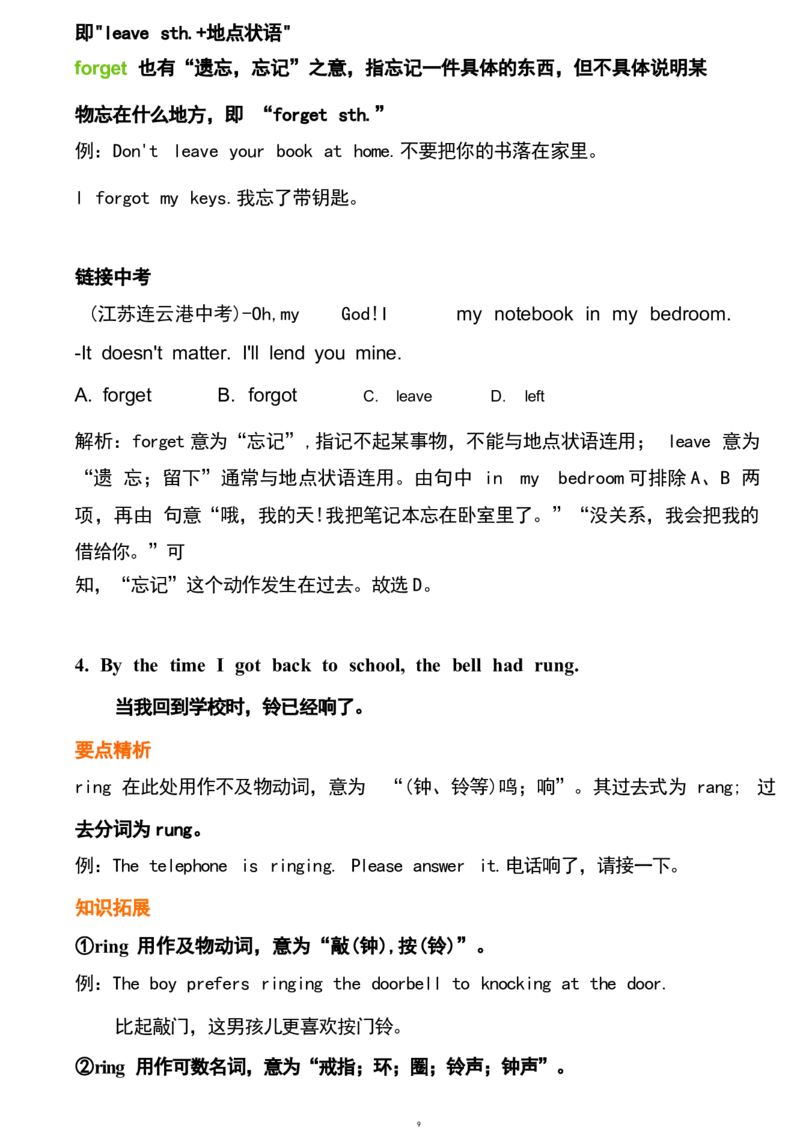
辨析: leave 与 forget
leave 作”遗忘;留下”讲时,通常要与地点状语连用,表示将某物遗忘在某个地方,
5即"leave sth.+地点状语"
forget 也有“遗忘,忘记”之意,指忘记一件具体的东西,但不具体说明某
物忘在什么地方,即 “forget sth.”
例:Don't leave your book at home.不要把你的书落在家里。
l forgot my keys.我忘了带钥匙。
链接中考
(江苏连云港中考)-Oh,my God!I my notebook in my bedroom.
-It doesn't matter. I'll lend you mine.
A. forget B. forgot C. leave D. left
解析:forget 意为“忘记”,指记不起某事物,不能与地点状语连用; leave 意为
“遗 忘;留下”通常与地点状语连用。由句中 in my bedroom 可排除 A、B 两
项,再由 句意“哦,我的天!我把笔记本忘在卧室里了。”“没关系,我会把我的
借给你。”可
知,“忘记”这个动作发生在过去。故选 D。
4. By the time I got back to school, the bell had rung.
当我回到学校时,铃已经响了。
要点精析
ring 在此处用作不及物动词,意为 “(钟、铃等)鸣;响”。其过去式为 rang; 过
去分词为 rung。
例:The telephone is ringing. Please answer it.电话响了,请接一下。
知识拓展
①ring 用作及物动词,意为“敲(钟),按(铃)”。
例:The boy prefers ringing the doorbell to knocking at the door.
比起敲门,这男孩儿更喜欢按门铃。
②ring 用作可数名词,意为“戒指;环;圈;铃声;钟声”。
9例:She wore diamond ring.她戴着一枚钻戒。
There was ring at the door.门铃响了。
5. Why were you late for class today,Kevin? 凯文,你今天上课为什么迟到
了?
要点精析
be late for 意为“迟到”,其中 late 为形容词,意为“迟的;晚的”。
例:Don't be late for the meeting next time.下次开会别迟到了。
知识拓展
late 还可用作副词,意为“迟;晚”。
例:l got up late this morning.今天早上我起床晚了。
小贴士
lately 用作副词,意为“最近;近来”。 later 用作副词时,意为“后来;以后”;用
作形容词时,意为“后来的;以后的”。
链接中考
(四川成都中考) Don 't' be late class. We must be on time.
A. for B.to C.in
解析: be late for 为固定短语,意为“迟到”,故选 A。
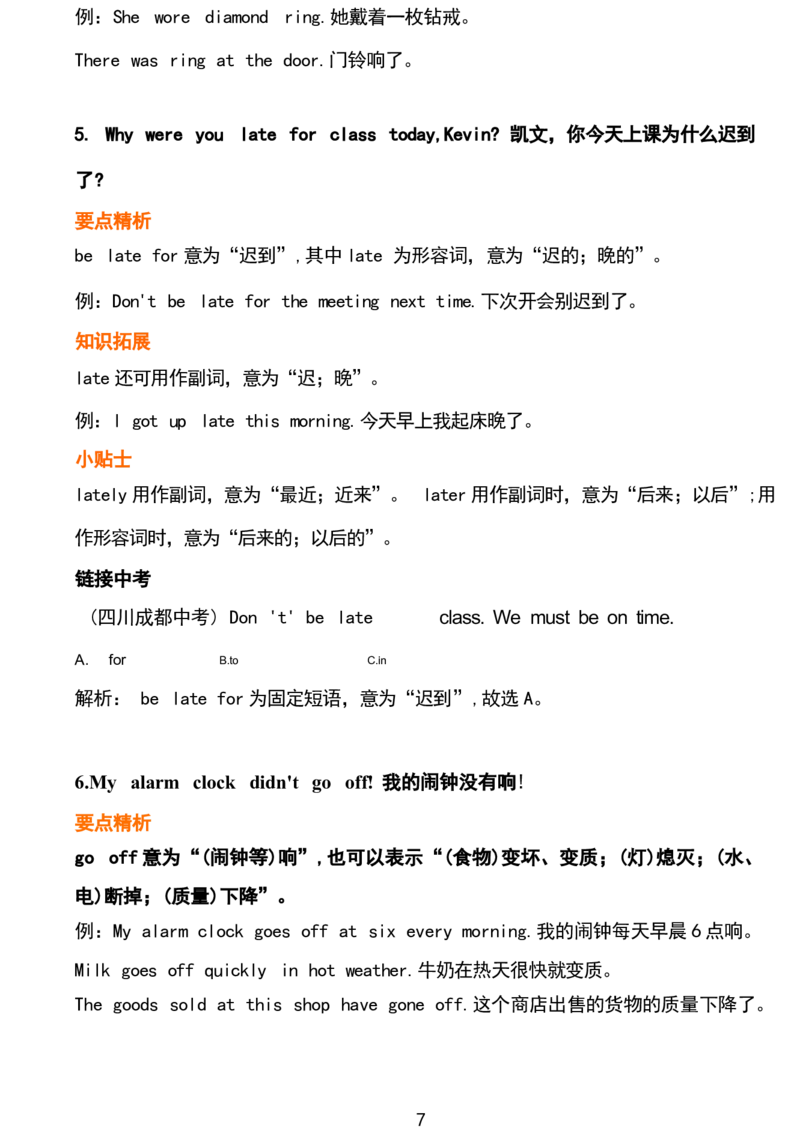
6.My alarm clock didn't go off! 我的闹钟没有响!
要点精析
go off 意为“(闹钟等)响”,也可以表示“(食物)变坏、变质;(灯)熄灭;(水、
电)断掉;(质量)下降”。
例:My alarm clock goes off at six every morning.我的闹钟每天早晨 6 点响。
Milk goes off quickly in hot weather.牛奶在热天很快就变质。
The goods sold at this shop have gone off.这个商店出售的货物的质量下降了。
7【go 的习惯搭配】
go back 返回
go by 经过
go out 出去
go around 四处走动
go home 回家
go away 走开,离开
go shopping 去购物
go on 继续
7. So just quickly put on some clothes and rushed out of the door.
所以我只好迅速穿上几件衣服,冲出门外。
要点精析 1
put on 意为“穿上;戴上”,用于穿衣服、穿鞋、戴帽子等,强调动作。
例:It's cold outside.Please put on your warm clothes.
外面很冷,请穿上暖和的衣服。
小贴士
put on 为“动词+副词”型短语,宾语是代词时,要放在两词中间。
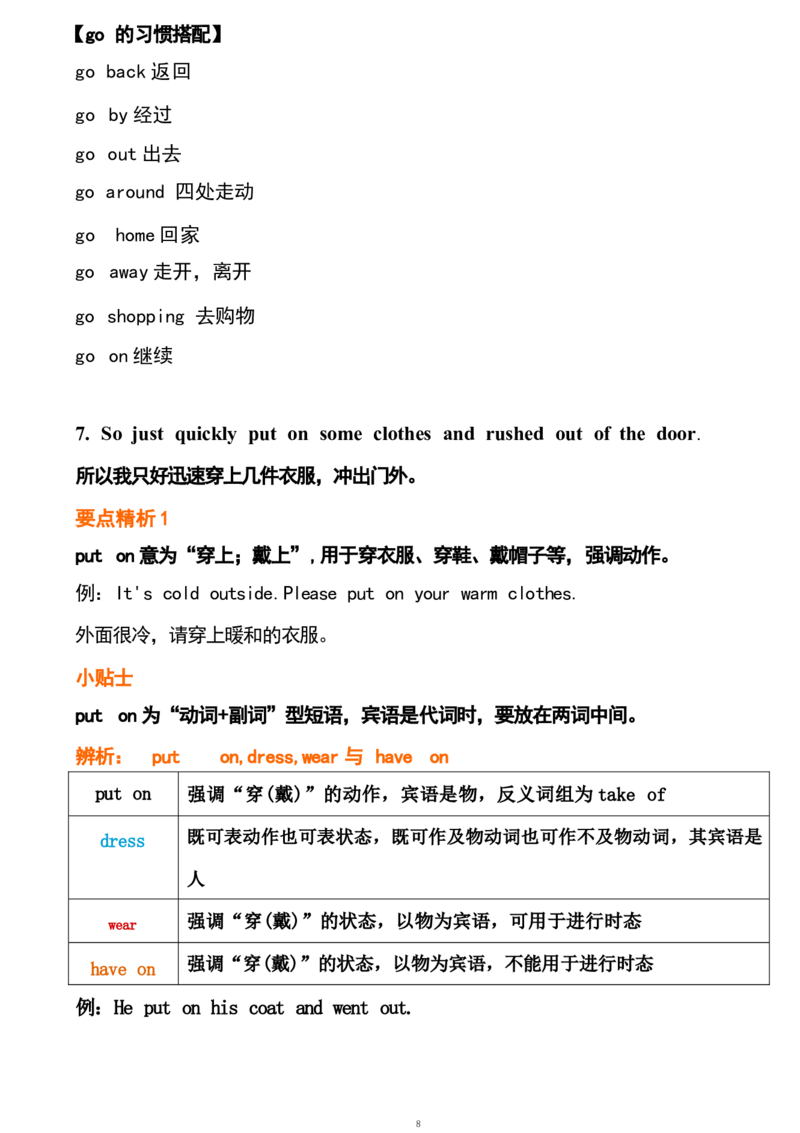
辨析: put on,dress,wear 与 have on
put on 强调“穿(戴)”的动作,宾语是物,反义词组为 take of
dress 既可表动作也可表状态,既可作及物动词也可作不及物动词,其宾语是
人
强调“穿(戴)”的状态,以物为宾语,可用于进行时态
wear
强调“穿(戴)”的状态,以物为宾语,不能用于进行时态
have on
例:He put on his coat and went out.
8他穿上外套就出去了。
She
dressed the children in their best clothes.
她给孩子们穿上了最漂亮的衣服。
He was wearing sunglasses. 他戴着太阳镜。
She always has a skirt on.她总是穿着一条短裙。
链接中考
(云南昆明中考)-Waiter,I ordered beef noodles, but I can't see any beef in
the noodles!
your glasses and you can see the beef
B. Put up
A.Put off C. Put on D. Put into
解析: put off 意为“推迟”; put up 意为“举起;搭起;张贴”; put on 意为
“穿 上;戴上"; put into 意为“放入”。根据上文句意“服务员,我点的是牛
肉面,但 是我在面条里没有看到任何牛肉!”可知下文句意为“戴上眼镜,你会看
到牛肉”。
故选 C。
要点精析 2
rush out of 意为“冲出…… ;奔出……”。
例:She caught up her hat and rushed out of the door.她抓起帽子就冲出门去
了。
知识拓展
①rush 用作动词,意为“冲;奔”。常用短语 rush to do sth., 意为“赶紧做某事;
抢着做某事”。
例:He's always rushing to finish first.他总是赶着第一个完成。
②rush 还可用作名词,意为“匆忙;忙碌;争购”。常用短语: rush hour (上下班
时的)交通高峰期; in rush 匆忙地。
98.Luckily, Carl's dad saw me on the street and gave me a lift in his
car.
幸运的是,卡尔的爸爸在街上看见了我并开车捎了我一程。
要点精析 1
luckily副词,意为“幸运地”,常位于句首,也可位于句中或句尾。其名词是 luck
(运气),形容词是 lucky (幸运的),反义词是 unluckily (不幸地)。
例:The fire last night destroyed many buildings. Luckily, no one was killed.
昨晚的大火毁坏了许多建筑物。幸运的是,没有一个人死亡。
My uncle lost his ID card yesterday morning. Luckily, a school boy found it
and sent it back to him in the afternoon.
昨天上午我叔叔把身份证丢了。幸运的是,下午一名学生找到后把它送还给了他。
链接中考
(浙江温州中考) I fell off the bike on my way to school. , wasn't hurt.
A. Luckily B.Suddenly C.Politely D. Recently
解析:luckily 意为“幸运地”;suddenly 意为“突然”;politely 意为“礼貌地”;
recently 意为“近来”。由第一句句意“我在上学的路上从自行车上掉了下来”和空格
后 wasn't
hurt (我没有受伤)可知“我”很“幸运”。故选A。
要点精析 2
give sb.a lift 意为“捎某人一程”,也可说成 give sb.a ride。
例:My relative gave me a lift back to Qingdao.我的亲戚捎我回到了青岛。
Would you please give me lift? 你可以捎我一程吗?
9. How did the writer end up missing both events?
作者最后怎样错过了这两件事?
10要点精析 1
end up 意为“结束,告终”,后面常接名词、代词或动词-ing 形式,表示“最
终成为;最终处于”。其后加介词 with 构成短语 end up with 中,表示“以……结
束/告终”,此时 up 可以省略。
例:If he keeps drinking so much, he'll end up ill.
如果他继续喝这么多酒,总有一天会生病的。
I ended up doing all the work myself.结果所有的工作都是我一个人干了。
The party ended up with a song.晚会以一首歌曲结束。
知识拓展
end up as… 最后成为……
end up like… 最后像……一样
例:He worked very hard and ended up as a famous scientist.
他非常努力,最终成了一位著名的科学家。
Try to keep healthy. I don't want you to end up like that.
努力保持健康。我不想你最后落得那样的情况。
要点精析 2
miss 作及物动词,意为“错过;未赶上”。后接名词、代词或动词-ing 形式。 miss
doing sth.意为“错过做某事”。
例:We missed the bus.我们没赶上公共汽车。
I missed taking part in the sports meeting.我错过参加那次运动会了。
10.Life ls Full of the Unexpected.生活充满了意外。
要点精析 1
be full of 意为“充满;满是……”。其中 full 为形容词,意为“满的”。
例:The bottle is full of water.瓶子里装满了水。
11辨析: be full of 与 be filled with
be full of意为“充满;满是……”,侧重于状态
be filled with 意为“充满;装满”,是 fill …with … 被动语态形式
例:The room is full of people.房间里挤满了人。
The bottle is filled with sand.瓶子里装满了沙子。
要点精析 2
unexpected 形容词,意为“出乎意料的;始料不及的”,其反义词为 expected,
意为“预期的;预料的”。句中 the unexpected 为 “the+ 形容词”结构,在句中
起名词的作用,意为“出乎意料的事;始料不及的事”。
例:What an unexpected pleasure! 真是个意外的惊喜!
He met with unexpected difficulties.他遇到了意想不到的困难。
Sometimes the unexpected happen to you.
有时候意外的事情会发生在你身上。
【助记】
expect(v. 期待;预期) → expected(adj. 预期的) →unexpected(adj. 出乎意料
的 )
知识拓展
expect 动词,意为“预料;预期”。常用短语有:
expect to do sth.预期做某事
expect sb. to do sth.预期某人做某事
11.I was about to go up when I decided to get a coffee first.
我正要上楼,这时我决定先去买一杯咖啡。
要点精析 1
be about to do sth.意为“即将做某事”,表示即将发生的动作,在时间上指最近
12的将来, 一般不与具体的时间状语连用,但可与 when 连用。
例: I was just about to ask you the same thing.我正要问你同一件事。
I was about to go out when it began to rain.我正要出门时天下起了雨。
要点精析 2
go up意为“上升;提高;向上去”。
例:Prices have gone up again.物价又上涨了。
要点精析 3
decide 及物动词,意为“决定;下决心”,常用结构有: decide sth.“决定某事”;
decide +to do sth. “决定做某事”; decide +that 从句“决定……”。
例:I can't decide anything at the moment.此刻我不能做出任何决定。
He decided to learn medicine.他决定学医。
I decided that I would tell you about it.我决定要告诉你那件事。
辨析: decide 与 make up one's mind
de cide 做出一定的选择,强调经过考虑或商议
make up one's mind 下定决心,与迟疑、动摇、困惑相对
例:He decided to go on Friday.他决定星期五走。
She made up her mind to study hard.她下定决心要努力学习。
12. As I was waiting in line with other office workers, I heard a loud
sound.
当我正和其他办公室工作人员排队等候时,我听到了一声巨响。
要点精析
wait in line意为“排队等候”,其后接人时,要加介词with, 相当于 stand in line,
其反义词组为 cut in line, 意为“插队”。
13例:The boy is waiting in line with his classmate.
这个男孩儿正和他的同班同学一起排队等候。
The teacher asked me to stand in line with other students.
老师让我和其他同学站成一排。
13. We stared in disbelief at the black smoke rising above the burning
building.我难以置信地盯着燃烧的大楼上升起的黑烟。
要点精析 1
stare 在此处作不及物动词,意为“盯着看;凝视”。
stare at 意为“凝视”,为固定短语。
例:What are you staring at? 你在看什么?
I stared at the paper in front of me.我盯着面前的那张纸。
要点精析 2
disbelief 不可数名词,意为“不相信;怀疑”,常用短语 in disbelief,意为“怀
疑地;难以置信地”通常在句中作状语。
例:We stared at her in disbelief.我们疑惑地盯着她。
He listened in disbelief to that surprising story.
他满腹怀疑地听着那个令人惊奇的故事。
要点精析 3
above 在此处为介词,意为“在……上面”。
例:The plane flew above the clouds.
飞机在云层上方飞行。
辨析: above,on 与 over
14“在……上面”,表示两者不接触,也不垂直,与 below(在……
above
下面)相对
“在 ……上面”,指两者表面接触,与 beneath(在 ……下面)
on
相
对
“在……正上方”,表示两者垂直,但不接触,也可指“笼罩/覆盖
over
在上面",与 under(在 … 正下方)相对
above over
on
beneath
under
below
例:There is a plane above the tree.树上方有一架飞机。
There is a box on the table.桌上有个盒子。
There is bridge over the river.河上有座桥。
链接中考
(江苏无锡中考) Ice is not often seen here in winter as the temperature
normally stays zero.
A. up B. down C. above D. below
解析:句意:这儿冬天很少看到冰,因为气温通常在零度以上。 above zero在零度
以上; below zero零度以下。故选 C。
要点精析 4
burning 此处是现在分词形式的形容词,意为“着火的;燃烧的”,在句中作定语,
15修饰后面的名词 building。 而过去分词形式的形容词 burned 意为“燃烧过
的;烧完的”。
例:You'd better keep the fire burning in the evening.晚上你最好让炉火继续燃
烧。
知识拓展
burn 可用作及物动词,也可用作不及物动词,意为“着火;燃烧”,其过去式和过
去分词的不规则变化形式均为 burnt, 规则变化形式均为 burned。
例:Paper burns easily.纸很容易燃烧。
The girl burnt her letter.那个女孩儿烧了她的信。
14.I felt lucky to be alive.我感到很幸运我还活着。
要点精析
alive形容词,意为“活着;有生气的”。通常用在连系动词be 等之后作表语,有
时也用在名词之后作后置定语,但不能用在名词之前作前置定语。
辨析:alive, live, living 与 lively
意为“活着;有生气的”,侧重生与死之间的界线,可以作后置定语
alive
和表语,不能作前置定语。多修饰人,也可修饰物
意为“活生生的”,通常只作前置定语,且一般用来修饰物
live
living 意为“活着的“,强调尚在人间、健在,作前置定语或表语。多修饰
物,也可修饰人
lively 意为“生动的;活泼的”,通常用来描述人及其行为或活动,可以作
定语或表语
例:His grandparents are still alive.他的(外)祖父母都还健在。
This is live fish.这是一条活鱼。
All living things need water.一切生物都需要水。
16She was very lively at the party.她在聚会上非常活跃。
15.". What bad luck!" I thought to myself.”…… 真倒霉!”我心里想。
要点精析 1
本句为what 引导的感叹句,后面省略了Ihad, 其 中what 修饰不可数名词luck。
由 what 引导的感叹句的结构为: What(+a/an)+ 形容词+名词(+主语+谓语)!
例:What hot day (it is)! (这是)多么热的一天呀!
What bad weather (it is)!(这是)多糟糕的天气呀!
知识拓展
how 也可引导感叹句,修饰形容词或副词(被强调部分)。这类句子的结构为: How+
形容词/副词(+主语+谓语)!或 How+ 主语+谓语!
例:How happy they look! 他们看起来多高兴啊!
How well she sings! 她唱得多好呀!
How hard they are working now! 他们现在干得多起劲呀!
How time flies! 时光飞逝!
小贴士
what 引导的感叹句可以与 how 引导的感叹句进行同义句转换。
例:What an interesting book it is!=How interesting the book is!
多么有趣的书呀!
链接中考
(湖南长沙中考) Jane Zhang is going to hold a concert here in July.
-Really? exciting news!
A.How B. What an C. What
解析:由题干中的“!”和选项可知,此处是一个感叹句。英语中感叹句有两种: 一
是 由what 引导的对名词进行的感叹,其结构为 “What(+a/an)+ 形容词+名词(+
17主语+谓语)!”;二是由 how 引导的对形容词或副词进行的感叹,其结构为
“How+ 形容词/副词(+主语+谓语)!”。此处是对不可数名词 news 进行的感
叹,所以用 what 引导的感叹句,且不加冠词。故选 C。
要点精析 2
think to oneself意为“心里想;暗自想”。
例:“Who is the captain?”I thought to myself. “谁是队长?”我心里想。
知识拓展
含 think 的其他常见短语:
think about思考
think over认真考虑
think of 想出;想起;关心
16. The other planes were full so I had to wait till the next day.
其他的飞机都满了,因此我必须等到第二天。
要点精析 1
句中 so 引导的是一个结果状语从句。可以和 because 互相替换,但so 和 because
不能同时用在一个句子中。
例:It was raining outside, so the children had to stay at home.=The children
had to stay at home because it was raining outside.
外面下着雨,所以孩子们不得不待在家里。
要点精析 2
till 在此处用作介词, 意为“直到……为止;到……时”,后接单词或短语。 till 也可
用作连词,后接时间状语从句, 一般可与 until 互换。具体用法如下:
①用于肯定句时,(主)句中的谓语动词用延续性或状态动词,表示该动作或状态一
18直延续到till/until所表示的时间为止。
例:I shall stay here till/until twelve o'clock.我将待在这里一直到 12 点。
②用于否定句时,(主)句中的谓语动词一般是非延续性动词,表示该动作直到
till/util所表示的时间才发生,构成not… till/until“直到……才……”。
例:He didn't arrive till/until the game had begun.直到比赛开始他才到。
小贴士
若主句为一般将来时, till/until 引导的从句用一般现在时代替一般将来时。
例:The students won't come into the classroom till/until the teachers finish
their work.直到老师们完成工作,学生们才走进教室。
③句首通常只用 until, 不 用till。
例:Until then, I knew nothing at all about it.在那之前,我对此事一无所知。
④某些固定词组或谚语中通常只用till。
例:from morning till night从早到晚
He has to work hard from morning till night.他必须从早到晚努力工作。
17.My bad luck had unexpectedly turned into a good thing.
我的坏运气出乎意料地变成了一件好事。
要点精析
unexpectedly 副词,意为“出乎意料地”。其形容词为 unexpected, 意为“想不
到的,意外的,突然的”。
例:The plane was unexpectedly delayed.飞机意外地延误了。
18.My mother finished making the apple pie.我妈妈做好了苹果馅饼。
要点精析
finish在此处作及物动词,意为“结束;完成”,其后跟名词或动词-ing 形式作宾语。
finish doing sth.意为“做完某事”。
19例:He has already finished his work.他已经完成了他的工作。
I didn't go to bed until lfinished doing my homework.
我直到完成我的家庭作业才上床睡觉。
19. By the time l arrived at the party, everyone else had already shown up.
当我到达聚会时,其他所有人都已经赶到了。
要点精析
show up 意为“赶到;露面”。
例:My best friend didn't show up on my birthday.
我最好的朋友在我生日那天没有来。
知识拓展
①show sb.around 意为“带领某人参观”。
例:The guide showed us around the Summer Palace.导游带领我们参观了颐和
园。 ② on show 意为“展览;展出”。
例:The beautiful pictures are on show in the museum.
这些美丽的画正在博物馆展出。
③show sb.sth.= show sth.to sb. 意为“给某人看某物”。
例:Can you show me your photos?
=Can you show your photos to me? 你可以让我看一下你的照片吗?
20. Before she got a chance to say goodbye, he had gone into the
building. 在她找到机会道别之前,他已经走进了大楼。
要点精析
get a chance to do sth.意为“得到机会做某事”,其中 chance 为可数名词,意
为 “机会;机遇”。
例:He got a good chance to learn from the workers.
20他获得了一个向工人们学习的好机会。
知识拓展
①chance 意为“可能性”时,既可以作可数名词,又可以作不可数名词,其中 have
chance of doing sth.表示“有做某事的可能性”。
例:He has a chance of winning the match.他有赢得比赛的可能性。
②chance 意为“偶然;碰巧”时,为不可数名词,其中 by chance 意为“碰巧;
偶然”。
21.By the end of the school day, … … 到的学校生活结束时……
要点精析
by the end of 意为“到……时为止,在……之前;到……结束时”。其后若接表示
将来的时间,句子常用将来完成时;若接表示过去的时间,句子常用过去完成时。
例:By the end of next month, I will have finished reading this book.
到下个月末,我将已读完这本书。
By the end of last month, I had planted thousands of trees.
到上个月末,我已经种了数千棵树了。
知识拓展
①at the end of 表示“在……的末尾;在……的尽头”,后可接时间和地点名词。
例:We're going to have a trip at the end of this month.
在这个月末,我们打算去旅行。
②in the end 意为“最后;最终”,相当于 at last/finally。
例:In the end, he worked out the difficult problem.
最后,他算出了那道难题。
Section A 即学即试
I. 单项选择
211. the time I got to the bus stop, the bus had already left.
A.On B. In C.By D. With
2.-Show me your homework, Dave.
-Sorry, Mrs.Brown. I've it at home.
A.missed B.forgotten C. lost D.left
3. We're waiting for him, but he hasn't yet.
A. show up B. shown up C. show around D. showed around
4. A big supermarket will be built the road next year.
A. by the end of B.at the end of C.in the end of D. in the end
5.-What's this?
-Oh, my God! It's a gift for James. I forgot it this afternoon.
A. to post B. posting C.post D. posts
6.We walked it got dark.
A.if B. where C. till D. what
7.Jack the 8: 30 train and he had to wait for the next one.
A. missed B.lost C. caught D. took
8.I saw the moon move the roof.
A.on B. above C. below D. over
9.Harry has decided an online shop after graduating from school.
A.open B.to open C. opened D.opening
10.I was about to bed the bell rang.
A. go; when B. to go; then C. to go; when D.go; then
Ⅱ .根据句意及首字母提示完成句子
1.Ir the door bell, but nobody answered the door.
2. We are going to take the plane to New York. Now we are on the way to the
22a ·
3. I thought the old man was dead. I was sur- prised to find that he was
still
a
4. The sun rises in the east and sets in the w
5. The mountain is about 5,548 meters a sea level.
Ⅲ .用括号内所给词的适当形式填空
1.1 (oversleep) this morning, so I was late for class again.
2. Look at the (burn)house. It was on fire. Let's call the fire police
at once.
3. By the time I got to the train station, the train (leave).
4. My father kept (work) although he didn't feel well. I asked him
to have a rest, but he said no.
5. They talked loudly and (wake) up the baby.
Section B 知识点精析
1.fool 愚弄;傻瓜
要点精析
①fool 用作可数名词,意为“蠢人;傻瓜”,复数形式为
fools。
常用短语: make
fool of. 意为“取笑……,捉弄……”。
例:I felt such a fool when I realized my mistake.
当我意识到自己的错误时,我才感觉自己真是一个傻瓜。
Are you trying to make fool of me? 你想愚弄我吗?
②fool 用作动词,意为“愚弄,欺哄”。
例:Don't be fooled by the salesman.不要被这个推销员欺骗了。
23知识拓展
fool 的形容词为 foolish, 意为“愚蠢的,荒谬的”。
例:I was foolish enough to believe what he said.
我太愚蠢了,竟然相信他说的话。
辨析: foolish,silly 与 stupid
foolish “蠢”,着重指缺乏智慧或判断力
s
illy “傻”,着重指头脑简单、不懂事,有单纯糊涂的意味
stupid “笨”,着重指生理迟钝,反应迟钝
例:She was foolish enough to trust him.她蠢到竟然相信他。
I feel silly in this dress.穿这件衣服让我显得呆头呆脑。
How could you be so stupid? 你怎么这么笨?
2. costume 服装;装束
要点精析
costume 名词,意为“服装;装束”。指特定场合穿的衣服,如化装舞会时穿的服
装、表演戏剧时穿的戏服或某一时代或某地特有的装束。
例:He went to the party in giant chicken costume.
他是打扮成一只大鸡去参加聚会的。
辨析: costume, cloth, clothing 与 dress
名词,意为“服装;装束”。当指”戏装,化装服时,是可数名词
costume
clothes 是最常用词,统指身上的各种服装,包括上衣、裤子、内衣等,是复数
名词,可与 many,few 等词连用,但不能直接与数词连用,“ 一套
衣
服”要说a suit of clothes
clothing 是物质名词,是服装的总称,除衣裤外还包括帽子、鞋袜等,没有复数
形式,“一件衣服”要说an article of clothing
24范围较小,作可数名词时,指一件女服、连衣裙;作不可数名词时,指
dress
某种特殊衣服,尤指在社交场合穿的衣服
例:The girl designed costumes for a famous singer.
这个女孩儿为一位有名的歌手设计服装。
The clothes in this shop are very beautiful.这家商店的衣服非常漂亮。
We have to put on warm clothing in winter.冬天我们不得不穿上暖和的衣服。
She wears a beautiful evening dress.她穿着一件漂亮的晚礼服。
3.embarrassed 窘迫的;害羞的
要点精析
embarrassed 形容词,意为“窘迫的;害羞的”。
例:She felt embarrassed to be seen in odd socks.
她穿着不成对的袜子,让人看见后她感到很尴尬。
知识拓展
embarrass 及物动词,意为“使困窘;使局促不安”。
例:He didn't want to embarrass her by asking questions.
他不想因提出问题而使她难堪。
辨析: embarrassed 与 embarrassing
embarrassed 常用于修饰人,通常作表语
embarrassing 常用于修饰事物,作定语或表语
例 :I feel embarrassed by his embarrassing words.
我被他令人尴尬的话弄得很窘迫。
4.get dressed 穿衣服
25要点精析
get dressed 意为“穿衣服”。dress 后不能跟衣服类的词作宾语,若跟衣服,
须用介词 in, 即 get dressed in+衣服/表示颜色的词。
例:Hurry up and get dressed.快点儿穿上衣服。
The bride was dressed in white.新娘身穿白色礼服。
辨析: get dressed 与 be dressed(in)
get dressed 表示“穿“的动作
be dressed(in) 表示“穿”的状态
例:She's getting dressed.她正在穿衣服。
She's dressed in red.她穿着红色衣服。
get dressed 穿衣服表示“穿”的动作
be dressed(in) 穿着( ……衣服)表示“穿”的状态
5. stay up 熬夜
要点精析
stay up 意为“熬夜”。
例:He often stays up to play computer games.他经常熬夜玩电脑游戏。
Do you often stay up? 你经常熬夜吗?
知识拓展
①stay up all night —夜不睡
例:We stayed up all night, talking about school days.
我们谈论学校生活, 一夜未睡。
② stay up late 熬夜到很晚
例:I stayed up late last night to finish my paper.
为了完成论文,昨晚我熬夜到很晚。
26链接中考
(江苏南京中考)-What's wrong with you, Eric? You look tired.
-| to prepare for the final exam last night.
A. picked up B. woke up C. stayed up D.put up
解析:句意:“埃里克,你怎么了?你看起来很疲惫。”“我昨晚熬夜准备期末考试
了。” stay up “熬夜”,符合题意。 pick up “捡起;开车接(某人)";wake up
“醒来;
叫醒"; put up “建造;张贴”。选C。
6.Last Friday night, my friend invited me to his birthday party.
上个星期五晚上,我的朋友邀请我参加他的生日聚会……
要点精析
invite在此处作及物动词,意为“邀请”。过去式和过去分词均为 invited, 现在分
词为 inviting。 常用短语: “invite sb.to+地点”意为“邀请某人到某地”;
invite
sb.to do sth.意为“邀请某人做某事”。
例:We invited all our relatives to the wedding.我们邀请了所有的亲戚参加婚礼。
I invited Jenny to my house.我邀请詹妮到我家。
We invited them to dance.我们邀请他们跳舞。
知识拓展
invite 的名词形式为 invitation, 意为“邀请”时作不可数名词,意为“请柬”时
为可数名词,其复数形式为invitations。
例:a letter of invitation一封邀请信
Did you get an invitation to the party? 你收到参加聚会的请柬了吗?
7. April Fool's Day is a celebration that takes place in different countries
around the world.
愚人节是一个在世界各地不同国家都庆祝的活动。
27要点精析
take place 意为“发生;进行”。
例:When will the meeting take place? 会议将什么时候举行?
辨析: take place 与 happen
take place 一般指非偶然事件的发生,即事件的发生一定有某种原因或经过事先的
安排。没有被动语态
happen 指未经筹划而偶然发生,多指发生不好的事情。没有被动语态
例:The wedding will take place in May.婚礼将在五月举行。
The traffic accident happened at around 8 p.m.
那起交通事故发生在晚上 8 点左右。
8. It happens on April 1st every year and is a day when many people play
all kinds of tricks and jokes on each other.
它是在每年的 4 月 1 日,在这一天许多人互相搞各种各样的恶作剧和开各种各样的
玩笑。
要点精析 1
all kinds of 意为“各种各样的”。其中 kind 为可数名词,意为“种类”。
例:There are all kinds of food in the fridge.冰箱里有各种各样的食物。
知识拓展
①kind of 有“有点儿,稍微”的意思,后跟形容词或副词的原级,相当于 a little,
a bit, a little bit。
例:The panda is kind of cute.那只熊猫有点儿可爱。
②kind 还可以作形容词,意为“仁慈的,友爱的“。 ”That's very kind of you.”
在口语中作为对别人提供帮助的感谢语,意思是“你太好了”。
例:She is kind to everyone.她对每一个人都很友善。
28要点精析 2
play tricks/jokes on sb.意为“戏弄某人;开某人的玩笑”,也可以说play
trick/ joke on sb.。
例:He always likes to play tricks/jokes on others.他总是喜欢捉弄别人。
Don't play tricks/jokes on your teachers.不要戏弄老师。
9. One April Fool's Day, a reporter in England announced that
there would be no more spaghetti because the spaghetti farmers in
Italy had stopped growing spaghetti.有一年愚人节, 一位英国记者宣布将不
再有意大利
面条了,因为在意大利种植意大利面的农民已经停止种植意大利面了。
要点精析 1
announce 在此处作及物动词,意为“发表,宣布”,侧重“通告”人们所关心或感
兴趣的事情,尤指新闻之类的消息。
例:He suddenly announced that he was leav. ing.他突然宣布他将离开。
辨析: announce 与 declare
announce 泛指宣布某一消息或事情,预示着……的到来
declare 一般指在正式场合宣布官方的立场或态度等
例:Everyone was silent as he announced the list.
他宣布这个名单时大家都很安静。
The US declared war on England in1812.1812年美国向英国宣战。
要点精析 2
no more 意为“不再”。常位于句中,放在be 动词、情态动词或助动词之后,实义
动词之前。同义短语: not… any more。
例:He no more lives here.=He doesn't live here any more.他不再住在这儿了。
29要点精析 3
stop 动词,意为“停止”。其过去式、过去分词是 stopped, 现在分词是
stopping。stop 后跟名词、动词-ing 形式或动词不定式。
例:They stopped doing their homework.他们停止了做家庭作业。
辨析: stop doing sth.与 stop to do sth.
stop doing sth. 意为“停止做某事”,指停止正在做的事情
stop to do sth. 意为“停下来去做某事”,指停止原来做的事情去做另一件事
例:It stopped raining.雨已经停了。
I feel very tired now. Let's stop to have a rest!
现在我感到非常累了。让我们停下来休息一下吧!
链接中考
(黑龙江齐齐哈尔中考)-I'm sorry,Mr.Li.I my English homework at
home.-Don't forget it to school tomorrow.
A. left; to bring B. forgot; to take C.lost; to bring
解析:“leave sth.+地点.”表示“把某物忘在某处”,“forget to do sth.”表示
“忘 记做某事”。句意:“对不起,李老师,我把英语作业忘在家里了。”“不要忘
了明天
把它带到学校来。”故选 A。
10. Many people ran to their local supermarkets to buy as much
spaghetti as they could.许多人跑去当地的超市买尽可能多的意大利面条。
要点精析
“as much+不可数名词+ as one can/could“意为 “尽可能多……”,相当于 “as
much+ 不可数名词+as possible”。
例:We should take as much money as we can
= We should take as much money as possible.我们应该尽可能多带些钱。
3011.By the time people realized that the story was a hoax, all of the
spaghetti across the country had been sold out.
当人们意识到这个故事是一个骗局时,全国所有的意大利面条都已经被卖光了。
要点精析
sell out 意为“卖完,卖光”,只是“动词+副词”型短语,人称代词作宾语时,只
能放在两词之间。此处 be sold out 意为“被卖光”。
例:Those cakes sold out fast.那些蛋糕很快就销售一空。
All the tickets had been sold out when we got to the cinema.
当我们到达电影院时,所有的票都已卖完。
知识拓展
①sell 作动词,意为“售卖;销售”。过去式、过去分词为 sold, 现在分词为 selling
常用短语 sell sb.sth.=sell sth.to sb.意为“把某物卖给某人”。
例:He sold me a book.=He sold a book to me.他卖给了我一本书。
My uncle sells at the market.我叔叔在那个市场做买卖。
②sell 作动词,表示销售情况时,主动形式表被动意义。
例:These goods sell well.这些商品卖得很好。
【助记】
sell 售卖 buy 购买
12. In another famous trick a TV show in England reported the discovery
of special water.
另一个著名的恶作剧是,英国一个电视节目报道发现了一种特别的水。
要点精析
discovery 名词,意为“发现;发觉”。既可作可数名词,也可作不可数名词。
discovery 的复数形式为 discoveries。
例:The new discovery caused a shock.这项新的发现引起了震惊。
31The discovery of something needs plenty of efforts of scientists.
某些事物的发现需要科学家的大量努力。
知识拓展
discover 动词,意为“发现;发觉” 。
例:I discovered that my students were so creative.
我发现我的学生是如此的具有创造力。
辨析: discover 与 invent
disc over 较为正式,指第一次发现原本就存在只是过去不曾被人知晓的事情
in vent 指创造出原来不存在的东西
例:Columbus discovered America in 1492.哥伦布在 1492 年发现了美洲。
Watt invented the steam engine.瓦特发明了蒸汽机。
【助记】
discover 发现 invent 发明
13. The lady was so happy because she really wanted to get married.
这位女士很高兴,因为她真的很想结婚。
要点精析
get married 意为“结婚”,表示结婚的动作,不能和表示一段时间的状语连用。
marry 动词意为“结婚”。
例:Lucy and Peter got married last week.露西和彼得上周结婚了。
She married a policeman last month.她上个月嫁给了一名警察。
知识拓展
marry 的其他用法:
①marry 在多数情况下是及物动词,需要直接接宾语,即 marry sb., 意为“和某
人结婚;娶某人;嫁给某人”。
例:He is going to marry Jane.他将娶简。
32②marry 可作不及物动词,意为“结婚”。
例:She wouldn't marry again.她不会再结婚了。
③be married(ts.) (不能用with sb.) 表示已婚的状态,可以和表示一段时间的
状语连用。
例:She has been married to him for five years.她已经嫁给他5年了。
链接中考
(四川雅安中考) He for ten years.
A. has been married B. married C. got married D. has married
解析:由时间状语 for ten years可知,句子应用现在完成时, B、C 和 D 三项都表
示结婚的动作,不能和时间段连用,故选 A。
14. The TV star lost his girlfriend and his show was canceled.
那个电视明星失去了他的女朋友,而且他的节目也被取消了。
要点精析
cancel 此处用作及物动词,意为“取消终止”。主语可以是人,也可以是抽象的事物,
后接名词或代词作宾语,可用于被动结构。
例:Can I cancel this ticket? 我可以取消这张票吗?
The football match was canceled because of the storm.
足球比赛因为暴风雨被取消了。
小贴士
cancel 的过去式和过去分词均为canceled 或 cancelled, 现在分词为 canceling
或 cancelling。
15. Welles made it sound so real that hundreds of people believed the
story, and fear spread across the whole country.
韦尔斯使它听起来如此真实以至于数以百计的人都相信这个故事,并且举国上下一
33片恐慌。
要点精析
hundreds of 表示“数百;成百上干的”,这时 hundred 后面加 s, 且有介词 of,
但不能与数词连用。
例:There are hundreds of people at the meeting.有几百人参加了会议。
16. Which of these stories is the most believable?
这些故事中哪一个是最可信的?
要点精析
believable 形容词,意为“可相信的,可信任的”。其比较级为 more believable,
最高级为 most believable。
例:These ideas are more believable than others.这些观点比另一些更可信。
知识拓展
unbelievable 形容词,意为“不可信的“。
例:What he said is unbelievable.他所说的不可信。
17.By the time people found out the story was not true, all the spaghetti
in the supermarkets had disappeared.
当人们发现这个故事不是真的的时候,超市里所有的意大利面条已经没有了。
要点精析
disappear 为不及物动词,意为“消失;不见”。 一般指具体、有形的东西、事物突
然或逐渐地不见,强调“看不见了”“不再存在了”的结果。
例:The thieves disappeared in the dark.小偷们消失在黑暗中。
Suddenly my dog disappeared.突然我的狗不见了。
知识拓展
①dis- 为否定前缀,主要加在名词、形容词和动词之前。含否定前缀 dis- 的词还有:
34dislike不喜欢 dishonest 不诚实的 disagree 不同意 disorder 无序;混乱
② appear 为动词,意为“出现;露面”。还可意为“出版”,相当于 come out。
例:A smile appeared on her face.一丝微笑出现在她的脸上。
Her book appeared in 2017.她的书在 2017 年出版了。
18.By the time police officers told the country that the story was a hoax,
many people had run away from their homes.
当警官告诉全国的人们这个故事是一个骗局时,许多人已经逃离了他们的家园。
要点精析
run away from意为“从……逃脱;回避;逃避”;run away意为“逃跑;逃脱”。
例:It's best not to run away from your problems.最好不要逃避你的问题。
The teenager ran away after being punished.那个青少年受到惩罚之后就逃跑
了。
【习惯搭配】
in the long/short run从长期/短期看 run across偶然碰见
run after追赶;追捕;跟踪
run for竞选
run into撞上;遇到
run out of用尽;用完
Section B即学即试
I. 单项选择
1. Catherine got married a policeman twenty years
ago. A. with B. for C.to D. of
2. When he arrived at the airport, Jones found that fans were
waiting for him there.
35A. hundred B. hundreds C. hundred of D.hundreds of
3. Students began to laugh at the crazy .
A.discovery B.discover C. discovers D. discovered
4. If you're not free, I'm afraid we have to the party
tonight. A. cancel B.announce lC. hold
D.stop
5. Lucy is shy. She would not invite her classmates dancing with
her. A. practice B. practices C. practicing D. to practice
6.-Tony is still in bed. He may miss the school bus.
-Last night he late to write the report of his survey.
A. stayed up B. woke up C. got up D. held up
7. When turned around, he in the forest.
A. has appeared B.appeared C. disappeared D.had disappeared
8.We've all the CDs and they well.
A.sell out; are sold B.sold out; are sold
C.sell out; sell D. sold out; sell
9.- ?
-I couldn't find my sister.
A.What else B. What other things
C. What happened D. What matter
10.-Tom, you ever your key?
-Not yet.
A.did; find B.do; found C. have; found D. has; found
Ⅱ .根据句意及首字母提示完成句子
1.Don't be f by his lies.
2. The football match has to be c because of bad weather. We all feel
36disappointed.
3. The girl felt e and her face turned red.
4. The snow d soon after the sun rose.
5. The old I has two daughters and three grandsons. She is
very happy.
Ⅲ.用括号内所给词的适当形式填空
1. He dreamed of being a police (office).
2.The (discover) of oil in this area is exciting.
3. His daughter got marry last month.
4.Many people like movies with a happy (end).
5.Mark is an honest boy. I think his words are (believe).即学即试参考答案与解析
Section A
I.1.C 句意:当我到公共汽车停靠站时,公共汽车已经开走了。 by the time意为
“到……时为止,在……以前”,是固定短语。
2.D 指“遗忘”时, leave 后常接地点状语,而 forget 不具体说明地点,由空格后
的地点状语 at home可知选 D。
3.B 根据hasn't和 yet 可判断子用现在完成时,故可排除A、C 两 项 ;show up意
为“露面"; show around短语不正确, show sb.around意为“带领某人参观”。
句意为“我们在等他,但是他还没有出现”。 show 的过去分词有两个, showed 和
shown。
4.B by the end of 意为“在……结来之前”;at the end of 意为“在……的末尾;
在…… 的尽头”;in the end of 短语有误; in the end 意为“最后”。由句意
“明年在这条
路的尽头要建一个大超市”可知选 B。
5.A forget to do sth.意为“忘记要做某事”,指事情还没有做; forget doing
sth. 意为“忘记做过某事”指事情已经做了。句意:“这是什么?”“噢,我的天
哪!这 是给詹姆斯的礼物。今天下午我忘了寄走它。”由此可知 post (寄)这一动
作并未发
生,应使用forget to do sth., 故选A。
6.C 根据选项和题干可知句意为“我们一直走到天黑”。表示“直到……为止”用
till/until都可。故选C。
7.Amiss 意为“错过;遗漏”; lose 意为“丢失”; catch 意为“赶上;抓住”;
take 意为“拿走”。根据后半句句意“他不得不等待下一辆”说明“他错过了
8:30 的火
车"。故选 A。
8.B句意为“我看到月亮在屋顶上方移动”。“月亮”与“屋顶”不垂直,不接触,故
用 above。
389.B decide to do sth.为固定用法,意为“决定做某事”,故选 B。 句意:哈利已
经决定从学校毕业后开一家网店。“
3810.C be about to do sth.when… 表示“正要做某事时”,浏览各选项可知
C
项正确。句意为“我正要上床睡觉时,门铃响了”。
Ⅱ
rang 2. airport 3. alive 4. west 5. above
.1.
overslept 2. Burning 3. had left 4.working 5. Woke
Ⅲ.1
.
Section B 即学即试
I.1.Cget married to sb.意为“嫁给某人;与某人结婚”,为固定短语,故选
C。 2.D hundred 前有具体数字修饰时,表示确切数目; hundred 前无具体数字
修饰时, 常用 hundreds, 且与 of 连用,此时表示概数。该题空格前无具体数
字,故选 D。
句意:当李敏到达机场时,他发现数百名粉丝正在那里等着他。
3.A 根据形容词 crazy 可知其后接名词;浏览各选项可知 discovery 是名词;
discover 是动词原形; discovers 是动词的第三人称单数形式; discovered 是
动词
的过去式。故选 A。
4.A 句意为“如果你没有空,恐怕我们今晚必须取消这次宴会了"。 cancel 意为
“取 消”; announce 意为“宣布”; hold 意为“举行”; stop 意为“停止”。
A 项符合句
意,故选 A。
5.D invite sb.to do sth.意为“邀请某人做某事”故选 D。
6.A stay up”熬夜";wake up“醒来”; get up”起床”; hold up “举起;支
撑"。 由上面两句“托尼还在床上睡觉。他也许会错过校车。”可知下句句意为
“昨晚他熬
夜到很晚写调查报告”,故选 A。
7.D 根据从句发生的时间是过去可知主句的动作是过去的过去,用过去完成时。故
选 D。 句意为“当我转过身时,他已消失在森林中”。
398.D 句意为“我们已经卖完了所有的唱片,它们很好卖”。 “have+ 过去分词”是
现 在完成时的构成形式,排除 A、C 两项;表示销售情况时, sell 的主动形式表
示被动
意义,排除 B 项。
9.C 根据答语“我找不到我妹妹了。”可知问句询问“怎么了?”,而 A、B 两项意为
39“其他什么事?”不符合语境; D 项表述错误。故选 C。
10.C 根据答语 Not yet.可知问句的时态用现在完成时;主语 you 是第二人称,
用助动词 have。 故选 C。 句意:“汤姆,你找到你的钥匙了吗?”“还没。”
Ⅱ .1.fooled 2. cancel(I)ed 3.embarrassed 4.disappeared 5.lady
Ⅲ .1 .officer 2. Discovery 3. Married 4.ending 5. Believable