人教版(新标准)初中英语知识点精析
七年级下册 UNIT 2
What time do you go to school? 你几点去上学?
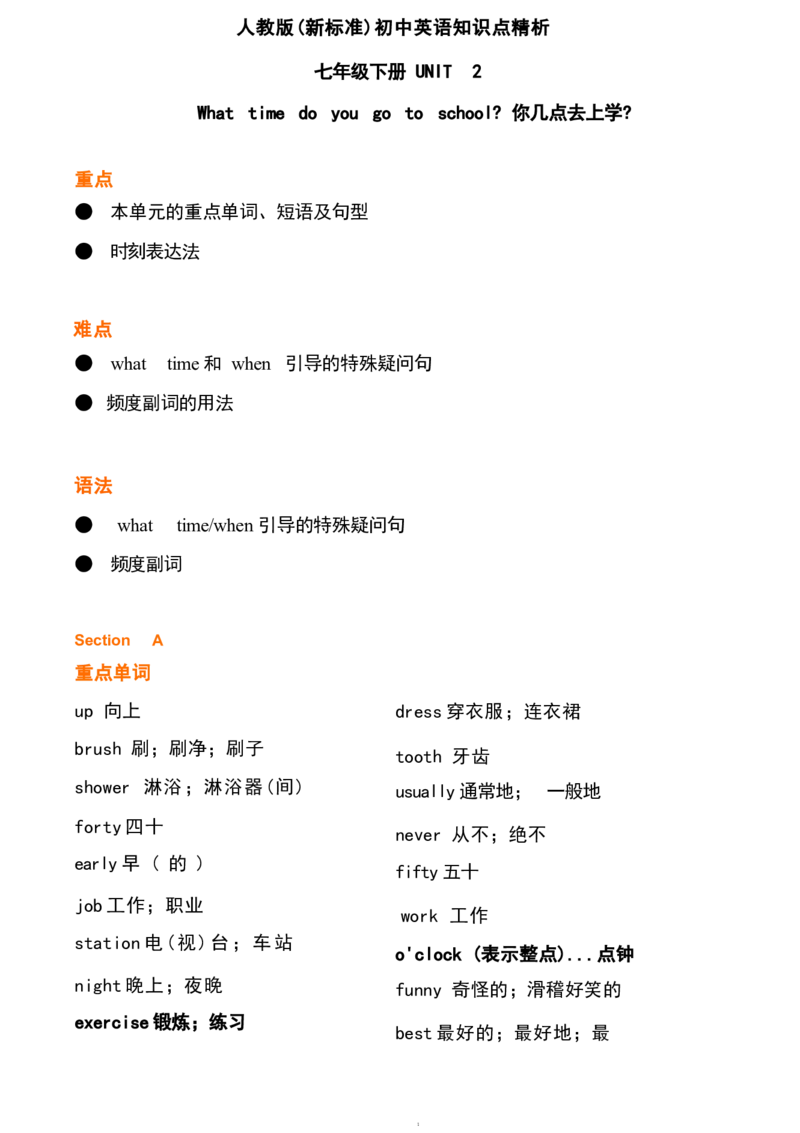
重点
● 本单元的重点单词、短语及句型
● 时刻表达法
难点
● what time 和 when 引导的特殊疑问句
● 频度副词的用法
语法
● what time/when 引导的特殊疑问句
● 频度副词
Section A
重点单词
up 向上 dress穿衣服;连衣裙
brush 刷;刷净;刷子
tooth 牙齿
shower 淋浴;淋浴器(间)
usually 通常地; 一般地
forty四十
never 从不;绝不
early早 ( 的 )
fifty 五十
job工作;职业
work 工作
station电(视)台;车站
o'clock (表示整点)...点钟
night晚上;夜晚 funny 奇怪的;滑稽好笑的
exercise 锻炼;练习
best最好的;最好地;最
1group 组;群
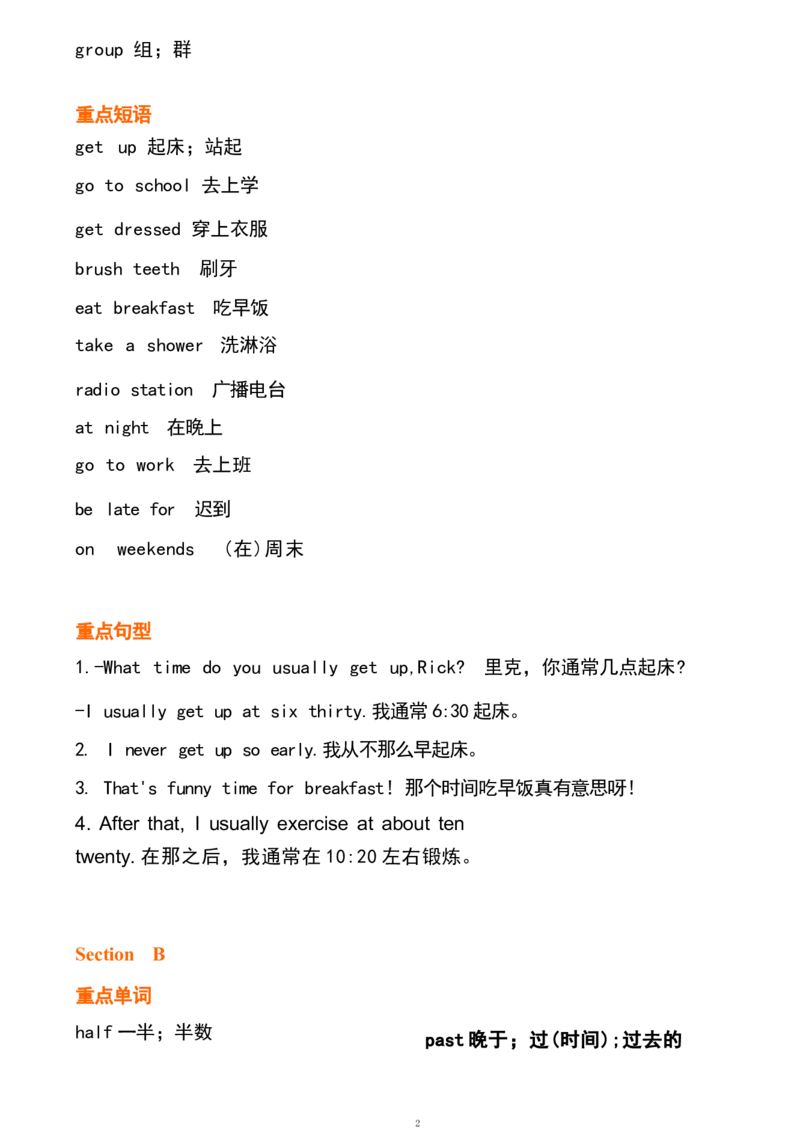
重点短语
get up 起床;站起
go to school 去上学
get dressed 穿上衣服
brush teeth 刷牙
eat breakfast 吃早饭
take a shower 洗淋浴
radio station 广播电台
at night 在晚上
go to work 去上班
be late for 迟到
on weekends (在)周末
重点句型
1.-What time do you usually get up,Rick? 里克,你通常几点起床?
-I usually get up at six thirty.我通常 6:30 起床。
2. I never get up so early.我从不那么早起床。
3. That's funny time for breakfast! 那个时间吃早饭真有意思呀!
4. After that, I usually exercise at about ten
twenty. 在那之后,我通常在 10:20 左右锻炼。
Section B
重点单词
half 一半;半数
past 晚于;过(时间);过去的
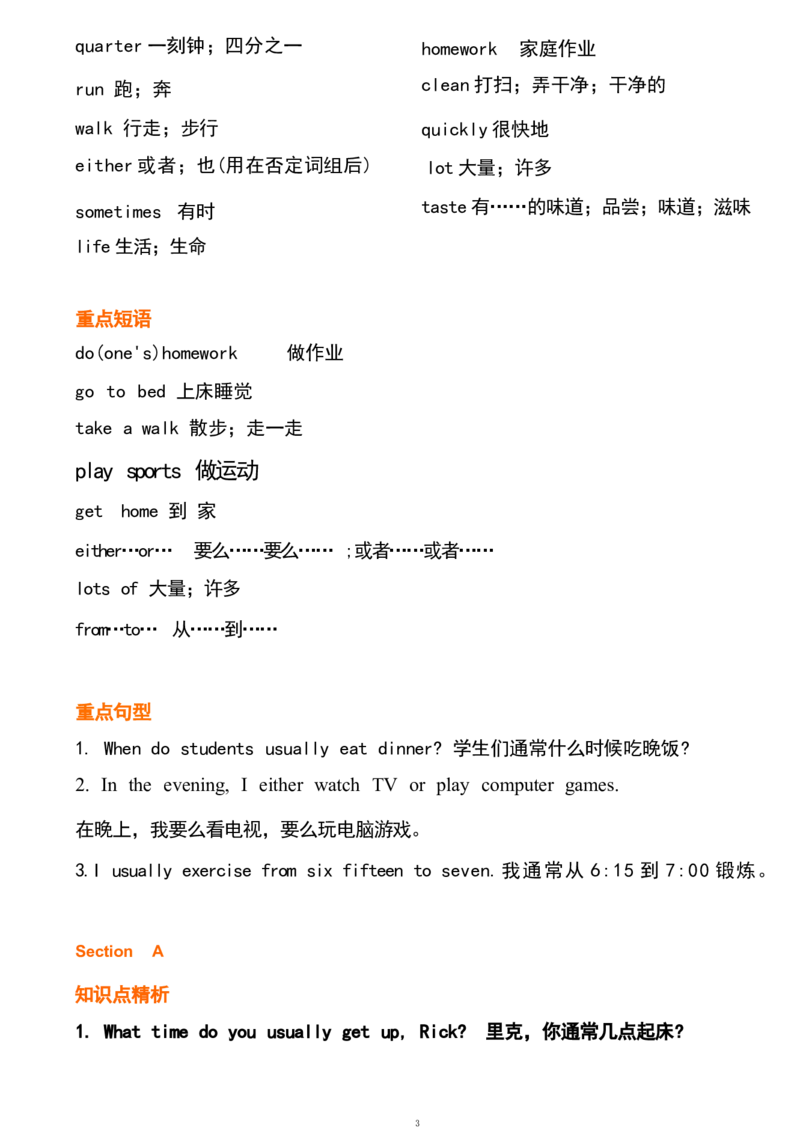
2quarter 一刻钟;四分之一 homework 家庭作业
clean 打扫;弄干净;干净的
run 跑;奔
walk 行走;步行 quickly 很快地
either 或者;也(用在否定词组后) lot 大量;许多
taste 有……的味道;品尝;味道;滋味
sometimes 有时
life 生活;生命
重点短语
do(one's)homework 做作业
go to bed 上床睡觉
take a walk 散步;走一走
play sports 做运动
get home 到 家
either…or… 要么……要么…… ;或者……或者……
lots of 大量;许多
from…to… 从……到……
重点句型
1. When do students usually eat dinner? 学生们通常什么时候吃晚饭?
2. In the evening, I either watch TV or play computer games.
在晚上,我要么看电视,要么玩电脑游戏。
3.I usually exercise from six fifteen to seven.我通常从 6:15 到 7:00 锻炼。
Section A
知识点精析
1. What time do you usually get up, Rick? 里克,你通常几点起床?
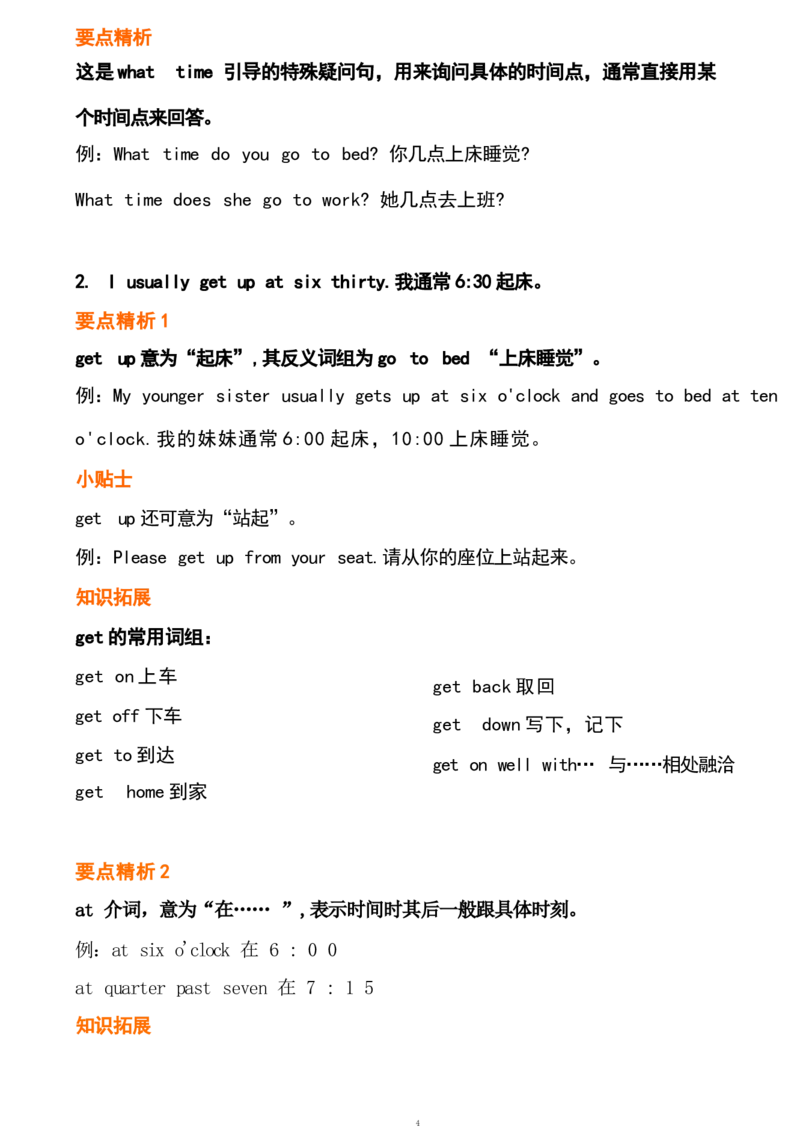
3要点精析
这是 what time 引导的特殊疑问句,用来询问具体的时间点,通常直接用某
个时间点来回答。
例:What time do you go to bed? 你几点上床睡觉?
What time does she go to work? 她几点去上班?
2. I usually get up at six thirty.我通常 6:30 起床。
要点精析 1
get up 意为“起床”,其反义词组为 go to bed “上床睡觉”。
例:My younger sister usually gets up at six o'clock and goes to bed at ten
o'clock.我的妹妹通常 6:00 起床,10:00 上床睡觉。
小贴士
get up 还可意为“站起”。
例:Please get up from your seat.请从你的座位上站起来。
知识拓展
get 的常用词组:
get on 上车
get back 取回
get off 下车
get down 写下,记下
get to 到达
get on well with… 与……相处融洽
get home 到家
要点精析 2
at 介词,意为“在…… ”,表示时间时其后一般跟具体时刻。
例:at six o'clock 在 6 : 0 0
at quarter past seven 在 7 : 1 5
知识拓展
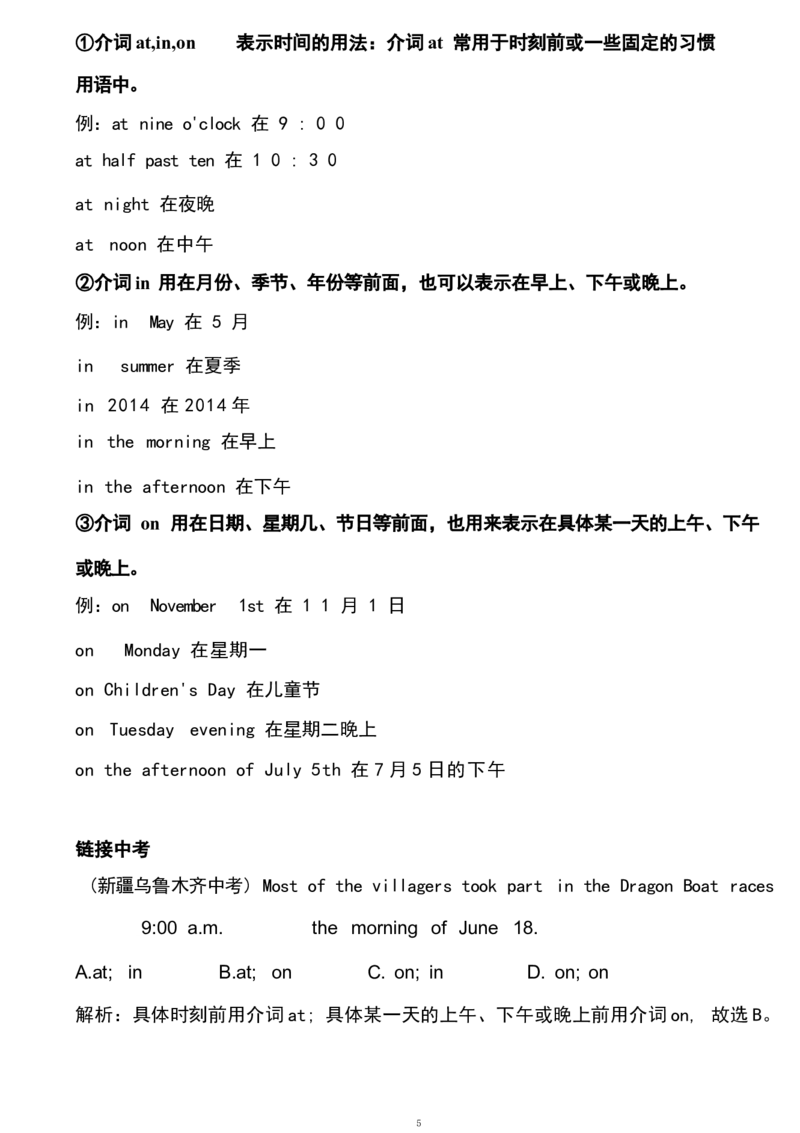
4①介词at,in,on 表示时间的用法:介词at 常用于时刻前或一些固定的习惯
用语中。
例:at nine o'clock 在 9 : 0 0
at half past ten 在 1 0 : 3 0
at night 在夜晚
at noon 在中午
②介词in 用在月份、季节、年份等前面,也可以表示在早上、下午或晚上。
例:in May 在 5 月
in summer 在夏季
in 2014 在 2014 年
in the morning 在早上
in the afternoon 在下午
③介词 on 用在日期、星期几、节日等前面,也用来表示在具体某一天的上午、下午
或晚上。
例:on November 1st 在 1 1 月 1 日
on Monday 在星期一
on Children's Day 在儿童节
on Tuesday evening 在星期二晚上
on the afternoon of July 5th 在 7 月 5 日的下午
链接中考
(新疆乌鲁木齐中考) Most of the villagers took part in the Dragon Boat races
9:00 a.m. the morning of June 18.
A.at; in B.at; on C. on; in D. on; on
解析:具体时刻前用介词 at; 具体某一天的上午、下午或晚上前用介词 on, 故选 B。
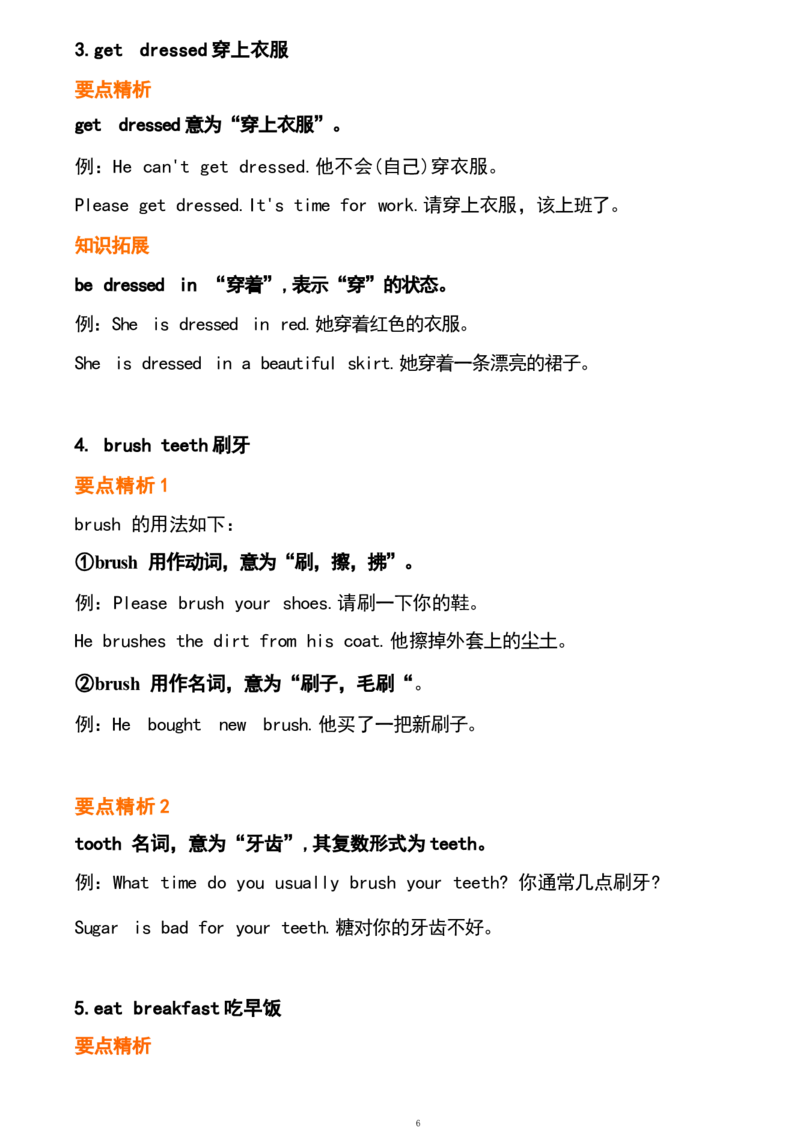
53.get dressed 穿上衣服
要点精析
get dressed 意为“穿上衣服”。
例:He can't get dressed.他不会(自己)穿衣服。
Please get dressed.It's time for work.请穿上衣服,该上班了。
知识拓展
be dressed in “穿着”,表示“穿”的状态。
例:She is dressed in red.她穿着红色的衣服。
She is dressed in a beautiful skirt.她穿着一条漂亮的裙子。
4. brush teeth 刷牙
要点精析 1
brush 的用法如下:
①brush 用作动词,意为“刷,擦,拂”。
例:Please brush your shoes.请刷一下你的鞋。
He brushes the dirt from his coat.他擦掉外套上的尘土。
②brush 用作名词,意为“刷子,毛刷“。
例:He bought new brush.他买了一把新刷子。
要点精析 2
tooth 名词,意为“牙齿”,其复数形式为 teeth。
例:What time do you usually brush your teeth? 你通常几点刷牙?
Sugar is bad for your teeth.糖对你的牙齿不好。
5.eat breakfast 吃早饭
要点精析
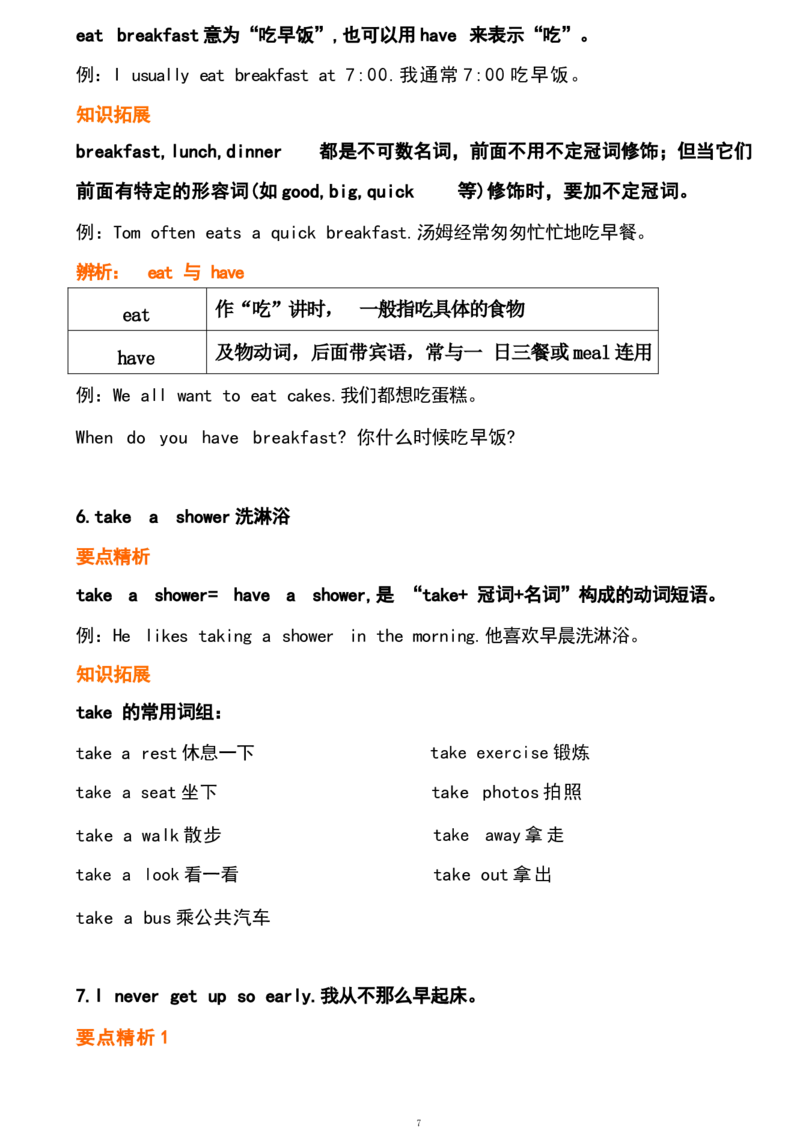
6eat breakfast 意为“吃早饭”,也可以用have 来表示“吃”。
例:I usually eat breakfast at 7:00.我通常 7:00 吃早饭。
知识拓展
breakfast,lunch,dinner 都是不可数名词,前面不用不定冠词修饰;但当它们
前面有特定的形容词(如 good,big,quick 等)修饰时,要加不定冠词。
例:Tom often eats a quick breakfast.汤姆经常匆匆忙忙地吃早餐。
辨析: eat 与 have
作“吃”讲时, 一般指吃具体的食物
eat
及物动词,后面带宾语,常与一 日三餐或 meal 连用
have
例:We all want to eat cakes.我们都想吃蛋糕。
When do you have breakfast? 你什么时候吃早饭?
6.take a shower洗淋浴
要点精析
take a shower= have a shower,是 “take+ 冠词+名词”构成的动词短语。
例:He likes taking a shower in the morning.他喜欢早晨洗淋浴。
知识拓展
take 的常用词组:
take a rest休息一下 take exercise锻炼
take a seat坐下 take photos拍照
take a walk散步 take away拿走
take a look看一看 take out拿出
take a bus乘公共汽车
7.I never get up so early.我从不那么早起床。
要点精析 1
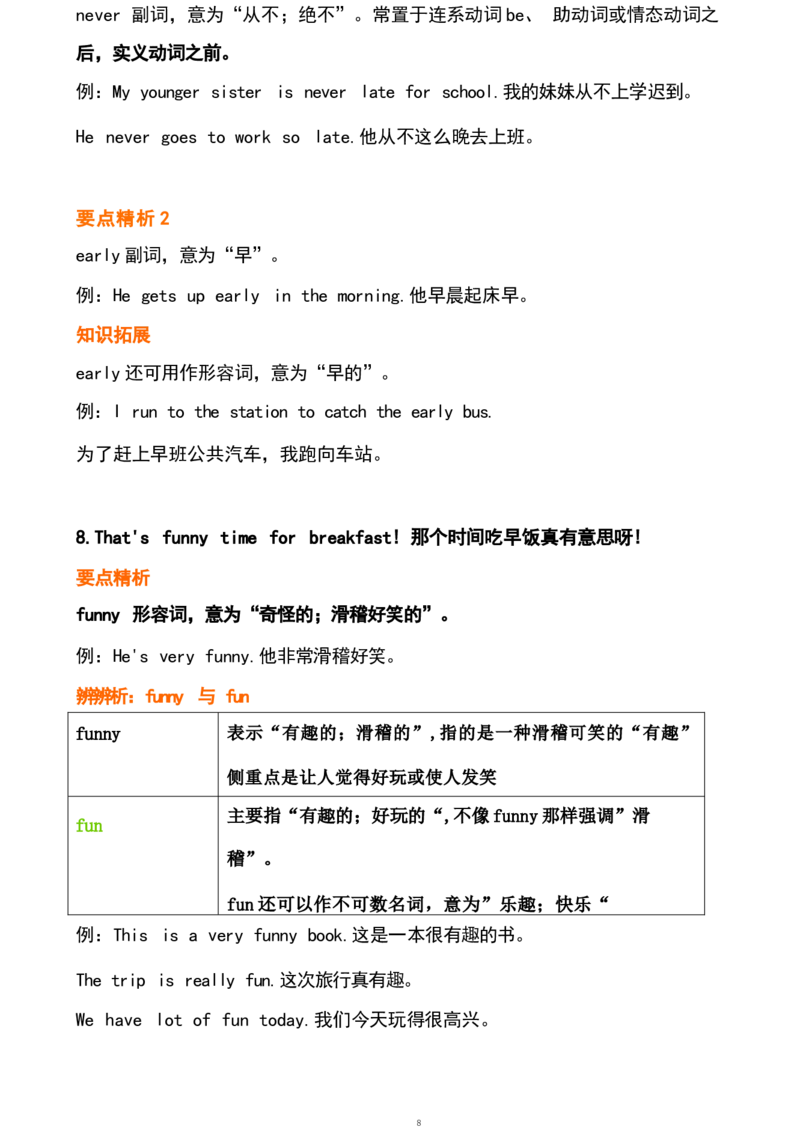
7never 副词,意为“从不;绝不”。常置于连系动词be、 助动词或情态动词之
后,实义动词之前。
例:My younger sister is never late for school.我的妹妹从不上学迟到。
He never goes to work so late.他从不这么晚去上班。
要点精析 2
early副词,意为“早”。
例:He gets up early in the morning.他早晨起床早。
知识拓展
early 还可用作形容词,意为“早的”。
例:I run to the station to catch the early bus.
为了赶上早班公共汽车,我跑向车站。
8.That's funny time for breakfast! 那个时间吃早饭真有意思呀!
要点精析
funny 形容词,意为“奇怪的;滑稽好笑的”。
例:He's very funny.他非常滑稽好笑。
辨辨析:funny 与 fun
funny 表示“有趣的;滑稽的”,指的是一种滑稽可笑的“有趣”
侧重点是让人觉得好玩或使人发笑
主要指“有趣的;好玩的“,不像funny那样强调”滑
fun
稽”。
fun还可以作不可数名词,意为”乐趣;快乐“
例:This is a very funny book.这是一本很有趣的书。
The trip is really fun.这次旅行真有趣。
We have lot of fun today.我们今天玩得很高兴。
89. After that, I usually exercise at about ten twenty.
在那之后,我通常在 10:20 左右锻炼。
要点精析
exercise 此处用作动词,意为“锻炼”。
例:My grandma exercises every day.我奶奶每天锻炼。
知识拓展
exercise 还可作名词,意为“锻炼;训练活动;练习;习题”。
例:take/get exercise 运动;锻炼
do morning exercises 做早操
do eye exercises 做眼保健操
We should take exercise every day.我们应该每天锻炼。
We often do exercises in English classes.我们经常在英语课上做习题。
即学即试
I. 单项选择
1. I always get up early school days and go to bed late n
ight. A.on; on B.at; at C.at; on D. on; at
2. Some workers in that factory have to work n
ight. A. on B. for C. with D.at
3. did you visit the Science
Museum? -Three months ago.
A. When B. Where C. What D. Which
4. does your father go to work in the morning?
-At six o'clock.
A. Why B. What C. Where D. What time
5. We usually go to school on foot.
9A./ B. the C. a .an
Ⅱ .根据汉语意思完成句子
1.我每天早上 7:00 起床。
I at seven o'clock in the morning every day.
2. “你的工作是什么?”“我是一名教师。”
- ?
-I'm a teacher.
3.我的爸爸每天 8:00 去上班。
My father e ight o'clock every day.
4.不要忘记刷牙。
Don't forget to .
5.去穿上衣服,吉姆! Go and ,Jim!
Section B
知识点精析
1. half past six in the morning 早上 6:30
要点精析
past 此处用作介词,意为“晚于;过 …… (时间)”。
例:I get up at ten past six every day.我每天 6:10 起床。
知识拓展
英语钟点时刻的表达方式:
方法 用法 举例
整点法 时间刚好是整点,可用“整点时间 at seven
(o'clock)
+o'clock”来表示,o'clock 可省略
在 7:00
10顺读法
顺读法是直接读出数字,先说整点后说分 at eight ten 在8:10
钟,都用读基数词。表示“几点零几分” at eight o five在
时,可在时与分之间加个 o,读字母 o 的
8:
音 05
逆读法 分钟少于 20 分钟的,用“分钟数 at five past eight
+past+ 在 8:05
钟点数“表示
分钟正好 30 分钟(半小时)的,用 at half past ten
“half 在 10:30
past+钟点数”表示
分钟超过半小时的,用(60-分钟数)+to+ at twenty to nine
下一个钟点数”表示 在 8:40
2.a quarter past three in the afternoon 下午 3:15
要点精析
quarter 名词,意为“一刻钟;四分之一“。
例:Please wait for quarter.请等一刻钟。
There are four of us, so we cut the orange into quarters and each eats a
piece.
我们有四个人,因此我们把橙子切成四份,每人吃一份。
【助记】
a quarter to twelve 11:45
a quarter 四分之一
113. When do students usually eat dinner? 学生们通常什么时候吃晚饭?
要点精析
when 作疑问副词,引导特殊疑问句,意为“什么时候,何时”。
例:-When is your birthday,John? 约翰,你的生日是什么时候?
-My birthday is February 6th.我的生日是 2 月 6 日。
When do you usually get home? 你通常什么时候到家?
4. do my homework 做我的家庭作业
要点精析
do one's homework意为“做某人的家庭作业”。 do 作动词,意为“做;干”,指
做具体的工作,强调动作、行为,其后的宾语常常是 work,homework,exercise
等,其中 one's 代表形容词性物主代词,在句中根据前面的主语选用相应的物主代
词。
例:He wants to help his younger sister do her homework.
他想帮助他的妹妹做家庭作业。
He doesn't do his homework on Sunday.他在星期天不做家庭作业。
5. take a walk散步
要点精析 1
take a walk意为“散步”,与 have a walk/go for a walk同义。
take 常和名词连用,意为“做……事情”,表示与该名词意义相关的动作。
例:Let's take a walk. 咱们去散步吧。
I want to take rest.我想休息一下。
要点精析 2
walk 可数名词,意为“步行,行走”。
12例: How about going out for walk? 出去散步怎么样?
She usually takes a walk after supper.她通常在晚饭后散步。
知识拓展
walk 作动词,意为“步行,行走”。
例:He walks to school every day.他每天步行去上学。
6.eat quickly 吃得快
要点精析
quickly 副词,意为“很快地”,一般指思维、动作反应快且用时少。其形容词形式
为 quick, 意为“快的”。
例:He runs very quickly.他跑得非常快。
Come here quickly.快点儿到这里来。
7.After school, I sometimes play basketball for half an hour.
放学后,我有时打半个小时的篮球。
要点精析
sometimes 副词,意为“有时”,相当于 at times。
例:I sometimes play computer games.我有时玩电脑游戏。
辨析: sometimes, some times, sometime 与 some time
有时 频度副词,表示动作发生的频率,用 how often
sometimes
提问
几次/倍 time 此处为可数名词,意为“倍;次”,用 how
some
many times 提 问
times
某个时间 副词,用来指过去或将来某个不确定的时间,用
sometime
when 提问
13some time 一段时间 用来表示一
例:They sometimes play basketball after school.
放学后,他们有时打篮球。
Some of the students have visited the Great Wall some times.
有些学生已经参观长城几次了。
This tree is some times taller than that one.这棵树比那棵树高好几倍。
We will visit Beijing sometime next month. 下个月某个时间我们将参观北京。
He has waited at the school gate for some time.他已经在校门口等了一段时间
了。【助记】
分开为“一段” (some time),
相连是“某时” (sometime)。
分开 s 是“倍、次” (some times),
相连 s 是“有时”(sometimes)。
8. In the evening, I either watch TV or play computer games.
在晚上,我要么看电视,要么玩电脑游戏。
要点精析
either …or … “要么 ……要么 …… ;或者 ……或者 …… ;不是 ……就是 ……”,连
接句
子中并列的词、短语,甚至句子。
例:You can eat either apples or oranges.你可以吃苹果或者橙子。
He is either in the classroom or in the library.
他不是在教室里就是在图书馆里。
知识拓展
either…or… 连接两个名词或代词作主语时,谓语动词应与最近的一个作主语的名词
或代词在人称和数上保持一致,这就是我们常说的“就近原则”。
例:Either you or l am going there tomorrow.明天要么你去那里,要么我去那里。
14链接中考
(内蒙古呼和浩特中考) Lucy you can't go to the party.One
of you has to stay at home to look after your grandma.
A.Neither; nor B.Either; or C. Not only; but also D.Both; and
解析:考查代词辨析。句意:要么 Lucy 要么你不能去参加晚会。你们当中有一个
人 必须留在家里照顾奶奶。根据句意可知,空格处表示“要么……要么……”,表示
两者 当中的一个。故 B 项正确。A 项意为“既不……也不……”;C 项意为“不但……而
且……”;
D 项意为“两者都……”,都与语境不符。
9.She knows it's not good for her, but it tastes good!
她知道这对她身体不好,但它尝起来好吃!
要点精析
taste此处用作连系动词,意为“有……的味道”,后面跟形容词。
例:This tomato tastes sweet.这个西红柿尝起来是甜的。
This drink tastes like orange juice.这种饮料尝起来像橙汁。
知识拓展
①taste 用作实义动词,意为“尝;品尝”。
例: Can you taste it? 你能品尝一下它吗?
②taste 用作名词,意为“味道;滋味” 。
例:This orange has a sweet taste.这个橘子有甜味。
③类似的表示感觉的连系动词还有look (看起来), sound (听起来好像), smell
(有 ……气味), feel (感觉,觉得)。
链接中考
(海南中考)-Would you like some Wenchang Chicken? It delicious.
-Yes, please. It's my favorite.
15A. sounds B.tastes C. feels
解析: sound 意为“听起来好像”; taste意为“尝起来”; feel意为“摸起来;
感觉”。主语 it代指上句中的 Wenchang Chicken,形容词 delicious (美味的)作
表语,“鸡肉‘尝起来美味”符合逻辑。故选B。
10.I usually exercise from six fifteen to seven.
我通常从 6:15 到 7:00 锻炼。
要点精析
from…to. 意为“从……到……”。
例:Mary usually runs from half past six to seven.
玛丽通常从 6:30 到 7:00 跑步。
These girls are from ten to fifteen. 这些 女孩儿是 10 到 15 岁。
It's long way from Beijing to Guangzhou.从北京到广州是很长一段路。
11.I have very healthy life.我过着非常健康的生活。
要点精析 1
healthy 形容词,意为“健康的”。
例:We should eat healthy food.我们应该吃健康的食物。
The old man looks very healthy.这位老人看起来很健康。
【助记】
health (n.健康)+-y→healthy(adj. 健康的)
变y 为 i再加-ly →healthily (adv.健康地)
要点精析 2
life名词,意为“生活;生命”。
例:He is living a very happy life.他过着很幸福的生活。
16The operation saved her life.手术挽救了她的生命。
即学即试
I 用适当的介词填空
1. Tony gets up seven o'clock.
2. My brother always eats hamburgers lunch.
3. Mary always takes a shower the morning.
4. Eating ice-cream after dinner is not good
US. 5.What do you usually do Sundays?
Ⅱ .根据汉语意思完成句子
1.我经常在周末打扫我的房间。
I often on weekends.
2. 我奶奶有大量时间看报纸。
My grandma has time to read newspapers.
3. 这些苹果尝起来不好吃,我不喜欢它们。
These apples I don't like them.
4. 玛丽从周一到周五没有时间玩。
Mary doesn't have time to play Monday F riday.
5.我妹妹高兴时,不是唱歌就是跳舞。
When my younger sister is happy, she sings dances.即学即试参考答案与解析
Section A
I1.D on school days “""在上学日”和 at night “在晚上”都是固定搭配,故选
D。
2.D 句意:那家工厂里的一些工人不得不在夜里工作。 at night 为固定短语,意为
“在夜晚”。故选 D。
3.A 考查疑问词的用法。由答语 “Three months ago.(三个月前)”可知,问句是
对时间进行提问。故选 A。
4.D 由答语可知问句是对时间进行提问,故选 D。
5.A go to school 意为“去上学”,是固定搭配。故选 A。
Ⅱ1. get up 2. What's your job/What are you 3. goes to work
4. brush your teeth 5.get dressed
Section B
I1.at 2.for 3.in 4.for 5.On
Ⅱ 1. clean my room 2.lots of 3.taste bad 4.from, to 5.either, or