人教版(新标准)初中英语知识点精析
七年级下册 UNIT 10
I'd like some noodles.我想要一些面条儿。
重点
● would like 的用法
● if引导条件状语从句的用法
难 点
● fish 的用法
● some 与 any 的用法
语法
● would like 用法
● 可数名词与不可数名词
● some 与 any 的用法
Section A
重点单词
noodle (常用复数形式)面条儿 beef 牛 肉
potato 土豆;马铃薯 special特色菜;特价品;特别的;特殊
的
would (表示意愿)愿意 yet (常用于否定句或疑问句)还;仍然
large 大号的;大的 order 点菜;命令
size大小;尺码 bowl 碗
meat (可食用的)肉
1重点短语
would like (表示意愿)愿意;喜欢
take one's order点菜
one(large)bowl of… (大)碗 ……
重点句型
1. What would you like? 您想要什么?
2. Are there any vegetables in the beef noodles? 牛肉面里有蔬菜吗?
3. May I take your order? 可以点菜了吗?
4.What size would you like? 你们想要多大碗的?
Section B
重点单词
dumpling 饺子 fish鱼;鱼肉
pancake 烙饼;薄饼 world 世界
answer 答案;回答 different不同的
cake 蛋糕 candle 蜡烛
age 年龄
blow 吹
if如果 will将要;会
the UK英国 candy 糖果
lucky 幸运的 popular 受欢迎的;普遍的
idea 想法;主意
重点短语
make a wish许愿
blow out吹灭
get popular受欢迎;流行
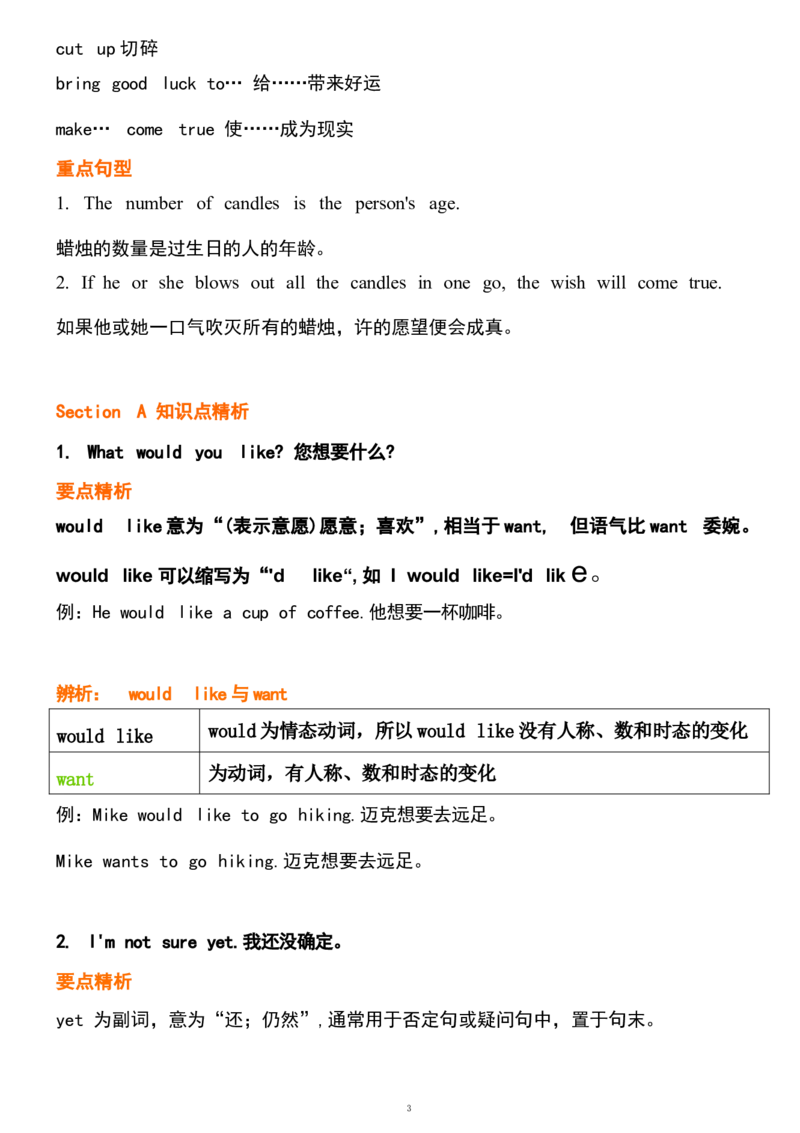
2cut up切碎
bring good luck to… 给……带来好运
make… come true 使……成为现实
重点句型
1. The number of candles is the person's age.
蜡烛的数量是过生日的人的年龄。
2. If he or she blows out all the candles in one go, the wish will come true.
如果他或她一口气吹灭所有的蜡烛,许的愿望便会成真。
Section A 知识点精析
1. What would you like? 您想要什么?
要点精析
would like意为“(表示意愿)愿意;喜欢”,相当于 want, 但语气比 want 委婉。
e。
would like 可以缩写为“'d like“, 如 I would like=I'd lik
例:He would like a cup of coffee.他想要一杯咖啡。
辨析: would like与want
would 为情态动词,所以 would like 没有人称、数和时态的变化
would like
为动词,有人称、数和时态的变化
want
例:Mike would like to go hiking.迈克想要去远足。
Mike wants to go hiking.迈克想要去远足。
2. I'm not sure yet.我还没确定。
要点精析
yet 为副词,意为“还;仍然”,通常用于否定句或疑问句中,置于句末。
3例:He hasn't answered yet.他还没有回答。
Is everything ready yet? 一切都准备好了吗?
【注意】
肯定句中常用 still 表示“还,仍然”,用 already 表示“已经”,强调某动作已经发
生或某种情况已经开始存在。
例:He is still at home now.他现在还在家里。
I have already had lunch.我已经吃过午饭了。
知识拓展
yet 用作并列连词时,意为“然而;可是”。
例:He studied hard, yet he failed.他学习努力,可是考试仍没有通过。
3.Are there any vegetables in the beef noodles? 牛肉面里有蔬菜吗?
要点精析 1
there be 结构的一般现在时的一般疑问句的构成为 “Is/Are there+某物+某地?”,
句中的be(is/are) 和后面所紧跟的名词在数上保持一致;回答用“Yes,there is/are.”
或 "No,there isn't/aren't."。
例:-Is there any meat in the tomato and egg soup? 西红柿鸡蛋汤里有肉吗?
-No,there isn't.不,没有。
知识拓展
there be句型的否定式和含有be 动词的其他句型一样,在 be 动词后加上 not 或 no
即可。注意 not 和 no 的不同: not 是副词, no 为限定词, “not a/an/any+名
词”
相当于 “no+ 名词”。
例:There is not any meat in the tomato and egg soup.
= There is no meat in the tomato and egg soup.西红柿鸡蛋汤里没有肉。
4要点精析 2
beef 为不可数名词,意为“牛肉”。此处 beef 作名词 noodles 的定语。当一
个名词在另一个名词前充当定语时,起修饰作用的名词通常用其单数形式。
例:There are two apple trees in front of my house.我的房前有两棵苹果树。
【注意】
man 和 woman 作定语修饰另一个名词时,要与所修饰名词的单复数形式保持一致。
例:Two men workers are working there.两名男工人正在那儿工作。
There are 50 women teachers in our school.我们学校有 50 名女教师。
链接中考
(贵州遵义中考) All the in our school enjoyed themselves on March 8th
because it was their own holiday.
A. men teachers B. women teachers C. woman teacher
解析:句意:在 3 月 8 日我们学校所有的女教师过得很开心,因为那是她们自己的节
日。此处 teachers 为复数形式,woman 修饰复数名词时应变为 women。 选 B。
4.potatoes 土 豆
要点精析
potato 为可数名词,意为“土豆;马铃薯”,其复数形式为 potatoes。
例:-Do you like eating potatoes? 你喜欢吃土豆吗?
-Yes, I like eating potatoes very much.是的,我非常喜欢吃土豆。
【注意】
以字母“o”结尾的名词变为复数时,有的加-s; 有的加-es。 其 中 tomato (西红柿),
potato (土豆)和 hero (英雄)3 个单词必须加 es 构成复数。
【助记】
以字母 “o”结尾,变复数时加 es 的单词英雄 (hero) 在土豆 (potato) 地里吃西红柿 (tomato)。
5. Special 1 1 号特价品
要点精析
special 名词,意为“特色菜;特价品”。
例:Special 1 is my favorite. 1 号特色菜是我最喜欢的。
We have some great specials.我们有一些不错的特价品。
知识拓展
①special 可用作形容词,意为“特别的;特殊的”。 specially 是其副词形式,意为“特
别地”。
例:It's a special day today.今天是一个特别的日子。
Is there anything special in today's newspaper?
今天报纸上有什么特别的内容吗?
②与 special 相关的短语:
例:special train 专列 special hospital 专科医院 special education特殊教育
6.What kind of noodles would you like? 你想要哪种面条儿?
要点精析 1
What kind of. would you like? 是口语中经常用到的句型,用来询问某人想要什
么样的/哪哪种物品。 what kind of 意为“什么样的,哪哪种”。
例:What kind of movies would you like? 你喜欢什么样的电影?
What kind of birthday presents would you like? 你想要什么样的生日礼物?
要点精析 2
kind 为可数名词,意为“种,种类”。常用短语有 a kind of (一种),all kinds of (各
6种各样的), different kinds of (不同种类的)。
例:There is a kind of sheep in the zoo.动物园里有一种羊。
There are all kinds of food in the fridge.冰箱里有各种各样的食物。
知识拓展
①kind 形容词,意为“仁慈的,友爱的”。
例:He is kind to everyone.他对每一个人都很友善。
②That's very kind of you.意为“你太好了”在口语中作为对别人提供帮助的感谢语。
③kind of 有“有点儿,稍微”的意思,后跟形容词或副词,当于 a little,a bit,a little
bit。
例:The elephant is kind of cute.这头大象有点儿可爱。
链接中考
(湖北黄冈中考)-Do you know that there are many different animals in the zoo?
-Yes, I do. And I also know that some of them are scaring.
A.kinds of; kind of B.kinds of; kinds of C.kind of; kinds of D.kind of; kind of
解析: different kinds of意为“不同种类的”; kind of后接形容词或副词,意为
“有
点儿,稍微”。选A。
7.May I take your order? 可以点菜了吗?
要点精析
本句为餐馆里服务员询问顾客是否点菜的常用语。 order 此处作名词,意为“点菜,
订购”。 order 也可作动词,意为“点菜;预订”。
例:I want to give the bookshop an order for this book.我想向书店订购这本书。
Would you like to order some bread? 你想要点一些面包吗?
The man ordered a table for six at the restaurant.
这位先生在餐馆里订了一张六人位的桌子。
7知识拓展
①order 作动词,还意为“命令,嘱咐”。其常用结构为 order sb.to do sth.
“命令某人做某事”。
例:The doctor ordered him to stay there.医生嘱咐他留在那里。
②order 可作不可数名词,意为“秩序,顺序”。
例:He found everything in the house in good order.
他发现屋子里一切都秩序井然。
③order 可构成 in order to. 或 in order that … 意为“为了……”。
例:He gets up early in order to catch the early bus.
= gets up early in order that he can catch the early bus.
他早起床是为了赶上早班公共汽车。
8.What size would you like? 你们想要多大碗的?
要点精析
what size 意为“多大型号的;多大尺码的”。 size 名词,意为“大小;尺码”。
例:What size is the room? 这个房间多大?
-What size shoes do you take? 你穿几号的鞋?
-I take shoes in size eight.我穿 8 号的鞋。
链接中考
(甘肃兰州中考)- bowl of mutton soup would you like?
-A big bowl, please.
A. What size B.What big C. How much D. How size
解析:句意:“你想要多大碗的羊肉汤?”“请来大碗的。”由答语可知所选选项意为
“多 大的”,可用 size 或 big 修饰,排除 C。size 为名词,其前应该用疑问代词
what; big
为形容词,其前应该用疑问副词 how。 故只有 A 项符合。选 A。
89.We'd also like gongbao chicken and some mapo tofu with rice.
我们也想要宫保鸡丁和一些带有米饭的麻婆豆腐。
要点精析
with 介词,意为“带有;和……在一起;使用”。
例:I want to buy a house with a garden.我想买一幢带有一个花园的房子。
Jack often goes shopping with his sister.杰克经常和他姐姐一起去购物。
He is writing a letter with a pen.他正在用钢笔写信。
链接中考
(江苏连云港中考)-I'm thirsty. I'd like a glass of orange juice. What about you,
Dad?
-I prefer a cup of coffee nothing in it.
A. with B. without C.for
D.to
解析:考查介词辨析。句意:“我很渴。我想喝一杯橙汁。你呢,爸爸?”“我更想喝
一杯什么也不加的咖啡。”with 意为“具有,有”,根据 nothing 可知用with。 故 选A。Section A 即学即试
I 根据句意及首字母或汉语提示写单词
1.I often have n for breakfast.
2.I'd like aI bowl of noodles.
3.P chips are very popular food in America and England.
4.-Can help you, sir?
-Yes, please. I want two kilos of (牛肉) .
5.-Is there anything ( 特 别 的 ) in today's newspaper?
-No, there isn't.
Ⅱ .用所给词的适当形式填空
1.In China, people like to have (mutton) in winter.
2. A man doctor is talking to two (woman)nurses.
3.Lily is a smart girl and she always (answer)her teacher's questions in
class.
4.-What do you want, Allen?
( (chicken).
-I want some
(bowl) of egg soup.
5.They would like twoSection B 知识点精析
1.fish 鱼;鱼肉
要点精析
①fish 意为“鱼”,是可数名词,单复数同形; fish 也可加-es 指不同种类的鱼。
例:I have three fish at home.我家里有三条鱼。
There are many fishes in the sea.大海里有很多种鱼。
【助记】
three fish 三条鱼(种类相同) three fishes 三条鱼(种类不同)
②fish 意为“鱼肉”,是不可数名词。
例:I had fish for dinner.晚餐我吃的鱼肉。
③fish 意为“钓鱼”,是动词。短语 go fishing 意为“去钓鱼”。
例:Let's go fishing this weekend.让我们这个周末去钓鱼吧。
2. Birthday Food Around the World 世界各地的生日食物
要点精析
around the world 意为“世界各地”,相当于 all over the world,此处为介词短语,
作后置定语。
例:We have friends around the world.我们的朋友遍布世界各地。
【注意】
world 为独一无二的事物,其前通常要加定冠词 the 或物主代词。
113. The answer would be different in different countries.
在不同的国家将会有不同的答案。
要点精析 1
answer 此处作可数名词,意为“答案,回答,答复”,后面常接介词to, 表示“……
的答案”。
例:I don't know the answer to this question.我不知道这个问题的答案。
Did you have an answer to your letter yesterday? 昨天你收到回信了吗?
知识拓展
①answer 可作及物动词,意为“回答,答复,应答”。
例:The boy can't answer this question.那个男孩儿回答不出这个问题。
Please answer the telephone.请接电话。
②answer 还可作不及物动词,意为“回答”。
例:He answered with smile.他微笑着作答。
要点精析 2
different 形容词,意为“不同的”。本句中第一个 different 在句中作表语,第二
个 different 在句中作定语,表示“与……不同”其后一般接介词 from, 相当于“not
the
same as …”。
例:My pen is different from yours. (=My pen is not the same as yours.)
我的钢笔与你的(钢笔)不同。
【助记】
different(adj. 不同的)+-ly→ differently(adv.不同地)
different(adj.不同的)去 t+-ce→-difference(n. 不同点,区别)
链接中考
(吉林中考) Lucy and are twins but we're different each other in many ways.
12D.from
A.f B. C.
解析:句意:露西和我是双胞胎,但是我们在很多方面都不一样。be different
from “和 …… 不同”,为固定搭配,符合题意。选 D。
4. The number of candles is the person's age. 蜡烛的数量是过生日的人的年龄。
要 点 精 析 1
the number… of意为“ …… 的数量”。
例 :The number of the teachers in our school is twenty.
我们学校老师的数量是 20。
【助记】
the number of… 后跟复数名词作主语时,谓语动词用单数形式。
知识拓展
A number of… 意为“许多 … … ”,后跟复数名词作主语时,谓语动词用复数形式。
例: There are a number of butterflies in the valley.山谷中有许多蝴蝶。
链接中考
(湖南益阳中考)The number of people in the city about seven million
now.
A.are B. has C.is
解析:考查主谓一致。句意:现在这个城市人口的数量大约是七百万。 the number
of 表示“ …… 的数量”,跟复数名词作主语时,中心词是 number, 谓语动词要用单
数形
式 。 选C。
要点精析 2
age 可数名词,意为“年龄”。
例: What's the age of the tree? 这棵树的树龄是多少?
13知识拓展
at the age of.意为“在……岁时”。
例:He started school at the age of six.他 6 岁开始上学。
5.The birthday person must make a wish and blow out the candles.
过生日的人必须许个愿望并吹灭蜡烛。
要点精析 1
wish 此处作可数名词,意为“心愿,愿望,祝愿”; make a wish 意为“许愿”。
例:My wish is to become a doctor.我的愿望是当一名医生。
Best wishes to you for the New Year! 给你新年最好的祝愿!
It's easy to make a wish, but it is difficult to make it come true.
许下愿望容易,要使愿望成真却很难。
要点精析 2
blow 此处作不及物动词,意为“吹”。 blow out 意为“吹灭”。
例:The wind is blowing hard.风正猛烈地吹。
The wind blew out the candles.风吹灭了蜡烛。
知识拓展
blow out 中的 out 为副词,后接名词作宾语时,宾语可以紧跟其后,也可置于 blow
与 out 之间,但接代词作宾语时,代词必须放在 blow 与 out 之间。
例:The candles are on the birthday cake. We will blow them out.
蜡烛在生日蛋糕上。我们将把它们吹灭。
【助记】
动副短语要留心,代词只能置中心。
146.If he or she blows out all the candles in one go, the wish will come
true.
如果他或她一口气吹灭所有的蜡烛,许的愿望便会成真。
要点精析
本句为含有 if 引导的条件状口语从句的主从复合句。在此主从复合句中,主句用一般
将来时, if 引导的条件状语从句用一般现在时表示将来,即“主将从现”。
例:lf it rains tomorrow, we will not go to the zoo.
如果明天下雨,我们将不去动物园。
What will you do if you find panda in danger?
你如果发现一只熊猫处于危险之中,你将做什么?
If you study hard, you'll catch up with others.你如果努力学习,你会赶上其他人。
【注意】
在含有 if 引导的条件状语从句的主从复合句中, if 从句位置灵活,可直接放在主句后
面,也可放在句首;若 if 从句放在句首,从句后面要加逗号,和主句隔开。
【助记】
if 条件句不一般,几个要点记心间:
条件句,放在前,逗号要放句中间。
条件句,表可能,主句多用将来时。
链接中考
(广东中考) If Nancy the exam, she will go to Australia for English study.
A. pass B.passed C. passes D. will pass
解析:这是一个含有 if 引导的条件状语从句的主从复合句,在此主从复合句中,主句
用一般将来时, if 引导的条件状语从句用一般现在时表示将来。故选 C。
7.In China, it is getting popular to have cake on your birthday.
15在中国,生日时吃蛋糕正变得越来越流行。
要点精析
popular 形容词,意为“受欢迎的;普遍的”。
例:This movie is very popular.这部电影非常受欢迎。
知识拓展
be popular with sb.受某人欢迎
例:Jay Chou is very popular with young people.周杰伦很受年轻人的欢迎。
8.How can a person make his or her birthday wish come true?
一个人怎样使他或她的生日愿望实现?
要点精析
make 为使役动词,意为“使;让;叫”,其后接不带to 的动词不定式作宾补,即make
sb b.do sth. “让某人做某事” 。
例:Don't make him sleep late.不要让他睡过头。
知识拓展
“make sb./sth.+形容词”表示“使某人/某物处于某种状态”
例:llike reading books because they can make me happy.
我喜欢读书,因为书籍能使我快乐。Section B 即学即试
I. 单项选择
1. We will go for a picnic if it tomorrow.
A. doesn't rain lB.wasn't rainy C. won't rain D.wasn't raining
2.The noodles delicious but the soup terrible.
A.is; is B.is; are C. are; are D. are; is
3.L like basketball, but now I'd like tennis.
A. to play: playing B.playing; playing C.playing; to play D.to playing; to playing
4.-Would you like green tea black tea?
-No, thanks. I don't like green tea black tea.
A.and; and B.or; or C. or; and D.and; or
5.- ?
-Yes, I'd like some coffee.
A. What can you do B. How are you
C. May you help me D. Can I help you
Ⅱ .根据汉语提示完成句子
1 I'd like ten (牛肉馅饺子)
2. I hope my dream (能实现) soon.
3. ( …… 的数量) the students in our school is about 1,200.
4. (祝你好运) all the
time! 5.May I take your ( 点 菜 ) ?人教版(新标准)初中英语重点知识归纳
七年级下册 UNIT 10
I'd like some noodles.我想要一些面条儿。
单词归纳
if如果 fish鱼:鱼肉
mutton 羊肉 pancake 烙饼:薄饼
age 年龄
world 世界
cake 蛋糕 will 将要;会
the UK英国 different不同的
candle 蜡烛 large大号的:大的
blow 吹 idea 想法;主意
candy 糖果 porridge 粥;面糊
lucky幸运的 cabbage 卷心菜;洋白菜
order 点菜:命令 answer 答案;回答
size大小:尺码 would (表示意愿)愿意
bowl 碗 popular 受欢迎的;普遍的
meat (可食用的)肉 potato 土豆;马铃薯
dumpling 饺子 noodle (常用复数形式)面条儿
beef 牛肉 special 特色菜;特价品;特别的;特殊的
onion 洋葱 yet (常用于否定句或疑问句)还;仍然
短语归纳
would like (表示意愿)愿意:喜欢
take one's order点菜
18beef soup 牛肉汤
cut up 切碎
what size 什么尺寸
what kind 什么种类
be short of 缺少:缺乏
green tea 绿茶
around the world 世界各地
orange juice 橙汁
the number of……… 的数量
birthday cake 生日蛋糕
blow out 吹灭
make a wish 许愿
come true 实现
in one go 一 口气
one(large)bowl of… 一 (大)碗 ……
get popular 受欢迎:流行
different kinds of 不同种类的
bring good luck to… 给……带来好运
a small/medium/large bowl 一份小/中/大碗的
用法归纳
1. would like sth.想要某物 2. would like to do sth.想要做某事
3.May l …? 我可以……吗? 4. ls/Are there any…? 有一些……
吗?
5.the number of+可数名词复数 ……的数量
6.be popular with sb.受某人欢迎 7.make sb.do sth.让某人做某事
19人教版(新标准)初中英语即学即试参考答案与解析
七年级下册 UNIT 10
I'd like some noodles.我想要一些面条儿。
Section A
即学即试
I.
1.noodles 2.large 3.Potato 4.beef 5.special
Ⅱ .
1. mutton 2. women 3.answers 4.chicken 5.bowls
Section B
即学即试
I.
1.A 考查动词的时态。句意:如果明天不下雨,我们将去野餐。 if “如果”,引导条件
状 语从句。在含有 if 引导的条件状语从句的主从复合句中,主句用一般将来时,从
句要
用一般现在时表将来。故选 A。
2.D 考查主谓一致。 noodles 为可数名词复数, be 动词用 are;soup 为不可数名词,
be 动词用 is。故选 D。
3.C 考查固定搭配。like 后跟 doing 或 to do,would like后跟to do。 故选C。
4.B 考查连词析。句意:“你想要绿茶还是红茶?”“不,谢谢。我不喜欢绿茶和红茶”
or表示“或者”,用于选择, or 还可以用在否定中,连接两个并列的成分。故选B。
5.D 考查情景交际。 Can Ihelp you? 意为“要我忙吗?”用于征询意见。
Ⅱ.1. beef dumplings 2. can come true 3. The number of
4.Good luck to you 5.order