人教版(新标准)初中英语知识点精析
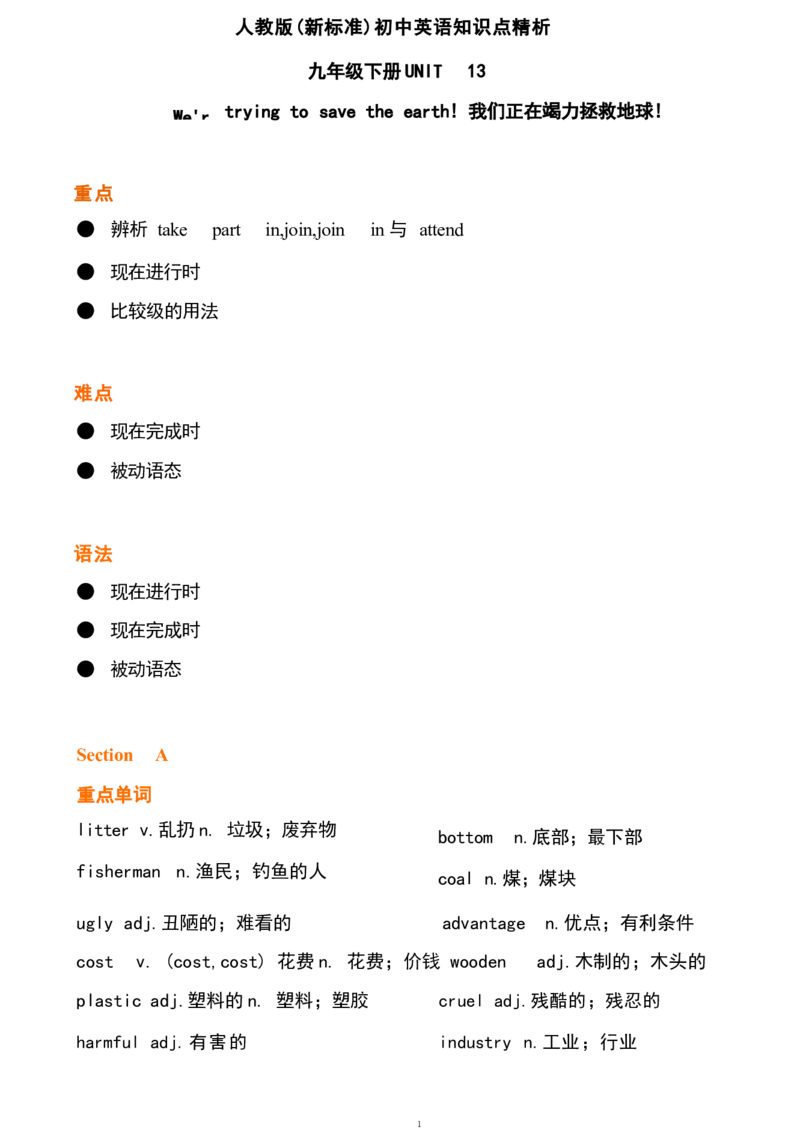
九年级下册UNIT 13
trying to save the earth! 我们正在竭力拯救地球!
We'r
重点
● 辨析 take part in,join,join in 与 attend
● 现在进行时
● 比较级的用法
难点
● 现在完成时
● 被动语态
语法
● 现在进行时
● 现在完成时
● 被动语态
Section A
重点单词
litter v.乱扔 n. 垃圾;废弃物
bottom n.底部;最下部
fisherman n.渔民;钓鱼的人
coal n.煤;煤块
ugly adj.丑陋的;难看的 advantage n.优点;有利条件
cost v. (cost,cost) 花费 n. 花费;价钱 wooden adj.木制的;木头的
plastic adj.塑料的 n. 塑料;塑胶 cruel adj.残酷的;残忍的
harmful adj.有害的 industry n.工业;行业
1scientific adj.科学上的;科学的
law n.法律;法规
afford v.承担得起(后果);买得起
重点短语
be harmful to 对……有害
at the top of 在……顶部或顶端
the food chain 食物链
take part in 参 加
turn off 关掉
pay for 付费;付出代价
take action 采取行动
重点句型
1. But it used to be so clean! 但它过去是那么干净!
2. Yes, but people are throwing litter into the
river. 是的,但人们正把垃圾扔进河里。
3. This is turning beautiful places into ugly
ones. 这将把美丽的地方变成丑陋的地方。
4.Jason and Susan, what are your ideas for solving these problems?
贾森和苏珊,对于解决这些问题,你们的想法是什么?
5.Well, to cut down air pollution we should take the bus or subway instead
of driving.嗯,为了减少空气污染,我们应该乘公共汽车或地铁,而不是开车。
6. It's good for health and it doesn't cost
anything! 它有利于健康,并且它不花费任何东西!
7. Also, I never take wooden chopsticks or plastic forks when I buy
takeaway food. 而且我买外卖食物时,从不拿木筷或塑料叉子。
28.When people catch sharks, they cut off their fins and throw the
shark
back into the ocean.
当人们捕捉鲨鱼时,他们割掉它们的鱼鳍,然后将鲨鱼扔回到海洋。
9. This is not only cruel, but also harmful to the environment.
这不但残忍,而且对环境有害。
Section B
重点单词
recycle v.回收利用;再利用
gate n.大门
bottle n.瓶子 president n.负责人;主席;总统
work n.(音乐、艺术)作品
metal n.金属
重点短语
throw away 扔掉;抛弃
put sth. to good use 好好利用某物
pull…down 拆下;摧毁
upside down 上下颠倒;倒转
bring back 恢复;使想起;归还
重点句型
1.taking your own bags when shopping 购物时自带包
2. Do you often throw away things you don't need anymore?
你经常扔掉你不再需要的东西吗?
3. You have probably never heard of Amy Hayes, but she is a most
unusual woman. 你可能从未听说过埃米 ·海斯,但她是一个很不寻常的女性。
4. She lives in a house in the UK that she built herself out of rubbish.
3她住在英国的一所她自己用废弃物建造而成的房子里。
5. The top of the house is an old boat turned upside
down. 房顶是一艘被倒转过来的旧船。
6. And the gate in front of her house is made of rocks and old glass
bottles. 房前的大门是由石头和旧玻璃瓶做成的。
7.Amy recently won prize from the Help Save Our Planet Society.
最近埃米获得了“帮助拯救我们的星球协会”颁发的一个奖项。
8.He is known for using iron and other materials from old cars to make
beautiful art pieces.
他因使用来自旧车上的铁和其他材料来制作美丽的艺术品而出名。
Section A 知识点精析
1. noise pollution 噪音污染
要点精析
noise 此处作名词,意为“噪音”。
例:Don't make any noise.Please be quiet.不要制造任何噪音,请安静。
知识拓展
noisily 副词,意为“喧嚣地,吵闹地”。
例:The children are playing noisily upstairs.孩子们正在楼上吵闹地玩耍。
2. There were no more fish for fishermen to catch.
不再有鱼让渔民去捕。
要点精析 1
fish名词,此处意为“鱼”。
【注意】
①fish 表示同一种类的鱼时,其单复数同形:
4例:a fish一条鱼, two fish两条鱼。
②表示不同种类的鱼时,复数加-es:
例:These are three fishes.这是三种鱼。
③作“鱼肉”讲时,为不可数名词:
例:a piece of fish一块鱼肉。
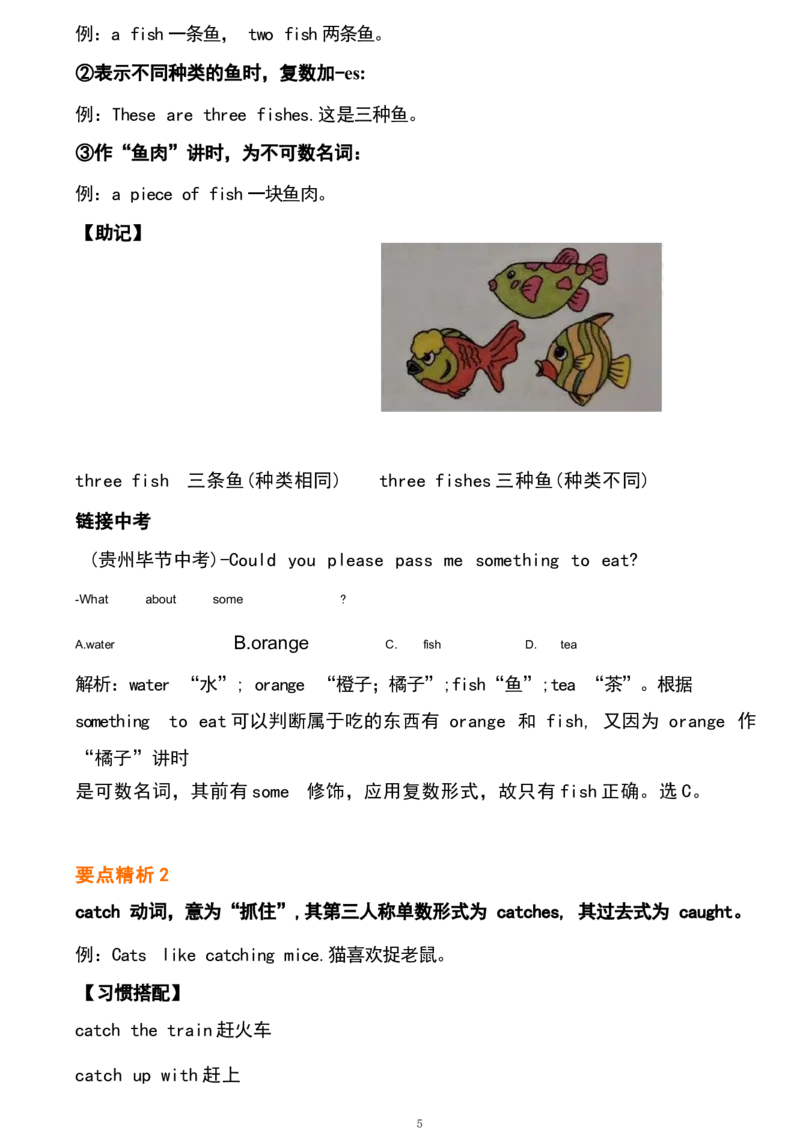
【助记】
three fish 三条鱼(种类相同) three fishes三种鱼(种类不同)
链接中考
(贵州毕节中考)-Could you please pass me something to eat?
-What about some ?
B.orange
A.water C. fish D. tea
解析:water “水”; orange “橙子;橘子”;fish“鱼”;tea “茶”。根据
something to eat可以判断属于吃的东西有 orange 和 fish, 又因为 orange 作
“橘子”讲时
是可数名词,其前有 some 修饰,应用复数形式,故只有 fish正确。选 C。
要点精析 2
catch 动词,意为“抓住”,其第三人称单数形式为 catches, 其过去式为 caught。
例:Cats like catching mice.猫喜欢捉老鼠。
【习惯搭配】
catch the train赶火车
catch up with赶上
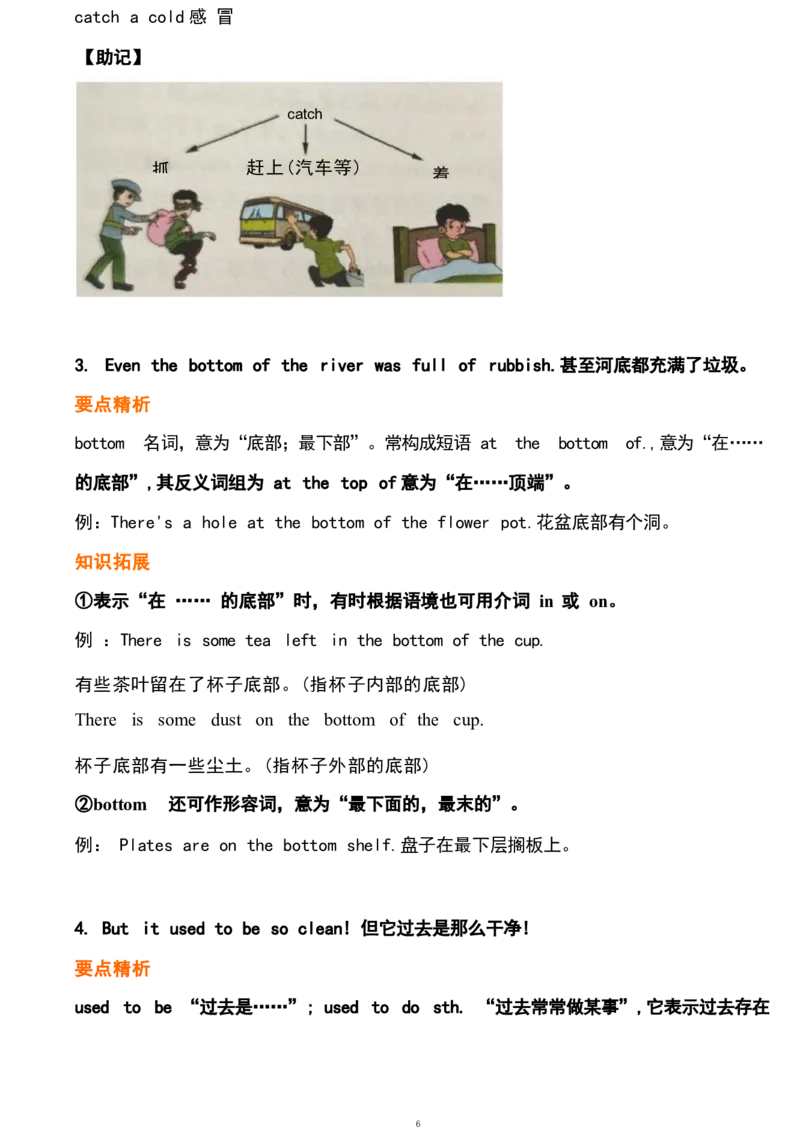
5catch a cold感 冒
【助记】
catch
抓 赶上(汽车等)
着
3. Even the bottom of the river was full of rubbish.甚至河底都充满了垃圾。
要点精析
bottom 名词,意为“底部;最下部”。常构成短语 at the bottom of.,意为“在……
的底部”,其反义词组为 at the top of意为“在……顶端”。
例:There's a hole at the bottom of the flower pot.花盆底部有个洞。
知识拓展
①表示“在 …… 的底部”时,有时根据语境也可用介词 in 或 on。
例 :There is some tea left in the bottom of the cup.
有些茶叶留在了杯子底部。(指杯子内部的底部)
There is some dust on the bottom of the cup.
杯子底部有一些尘土。(指杯子外部的底部)
②bottom 还可作形容词,意为“最下面的,最末的”。
例: Plates are on the bottom shelf.盘子在最下层搁板上。
4. But it used to be so clean! 但它过去是那么干净!
要点精析
used to be “过去是……”; used to do sth. “过去常常做某事”,它表示过去存在
6某种状态或者过去经常性、习惯性的动作,并意味着这种状态或动作目前已不
存在。
例:He used to be an English teacher.他过去是一名英语老师。
He used to swim in the river when he was a child.
他是一个小孩子的时候,常常在这条河里游泳。
知识拓展
①used to 的否定形式是didn't use to 或 usedn't to。
例:She didn't use to/usedn't to like dancing.她过去不喜欢跳舞。
②used to … 句子变为一般疑问句时,可以用 Did sb.use to.? 或 Used sb.to … ?
例:-Did you use to/Used you to play the piano? 你过去经常弹钢琴吗?
-Yes,I did/used to.是的,我经常弹。
-No,I didn't(use to).不,我不经常弹。
③反意疑问句的陈述部分有 used to 时,附加疑问部分可以用 didn't 或 usedn't 。
例:-Tom used to get up early, didn't/ usedn't he? 汤姆过去常常早起,不是吗?
-Yes, he did/used to.是的,他过去是这样。
-No,he didn't/usedn't to.不是,他过去不是这样的。
辨析 used to do sth.,be/get used to(doing) sth.与 be used to do sth
“过去常常做某事”,表示过去经常性、习惯性的
used to do sth.
动作或存在的状态
be/get used to (doing) sth. “习惯于(做)某事”,to为介词
“被用来做某事”,是use sth. to do sth.的被
be used to do sth.
动
形式
例:Mr.White used to live in China,so he is used to eating Chinese dishes.
怀特先生过去住在中国,所以他习惯吃中国菜。
Cloth is used to make clothes. 布被用来做衣服。
75. Yes, but people are throwing litter into the river.
是的,但人们正把垃圾扔进河里。
要点精析
litter作不可数名词,意为“垃圾;废弃物”。
例:You can't drop litter in the garden.你不能在花园里扔垃圾。
辨析 litter, garbage, rubbish 与 waste
指四处乱丢的东西和杂物
litter
garbage 专指厨房中的残羹剩饭等必须清除的垃圾
指残骸、废物等普通垃圾,特意集中起来以便清除
rubbish
指任何被丢弃的东西
waste
例:Please don't drop litter.请不要乱扔垃圾。
Don't forget to take out the garbage after dinner.晚饭后不要忘记把垃圾带出
去。
You'd better not throw the rubbish on the ground.你最好不要把垃圾扔在地上。
Waste is also becoming more and more hazardous.
废弃物的危害也变得越来越大。
6. Everyone in this town should play part in cleaning it up!
这个镇上的每个人都应该参与清理它!
要点精析
play part 意为“参与;在……方面起作用”,后接名词、代词或动词-ing 形式。
例:Education can play a part in it.教育可以在其中起作用。
知识拓展
play an active part in(doing)sth.积极参与(做)某事
play an important part in(doing)sth.在(做)某事中发挥重要作用
8例:I want to play an active part in school activities. 我想积极参加学校活
动。
Public transportation plays an important part in our daily life.
公共交通在我们的日常生活中发挥着重要作用。
7.This is turning beautiful places into ugly ones.
这将把美丽的地方变成丑陋的地方。
要点精析
turn… into… 为固定短语,意为“把……变成……”。
例:I can turn the liquid into the gas.我能把液体变成气体。
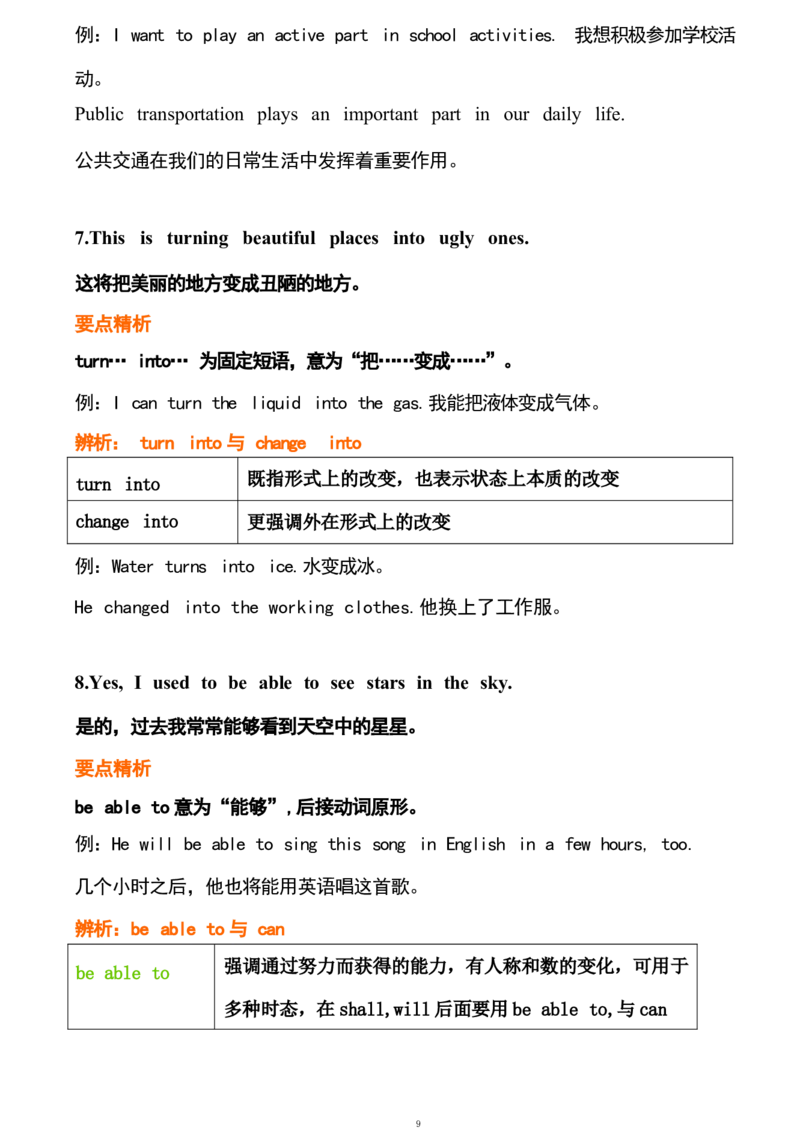
辨析: turn into 与 change into
既指形式上的改变,也表示状态上本质的改变
turn into
change into 更强调外在形式上的改变
例:Water turns into ice.水变成冰。
He changed into the working clothes.他换上了工作服。
8.Yes, I used to be able to see stars in the sky.
是的,过去我常常能够看到天空中的星星。
要点精析
be able to 意为“能够”,后接动词原形。
例:He will be able to sing this song in English in a few hours, too.
几个小时之后,他也将能用英语唱这首歌。
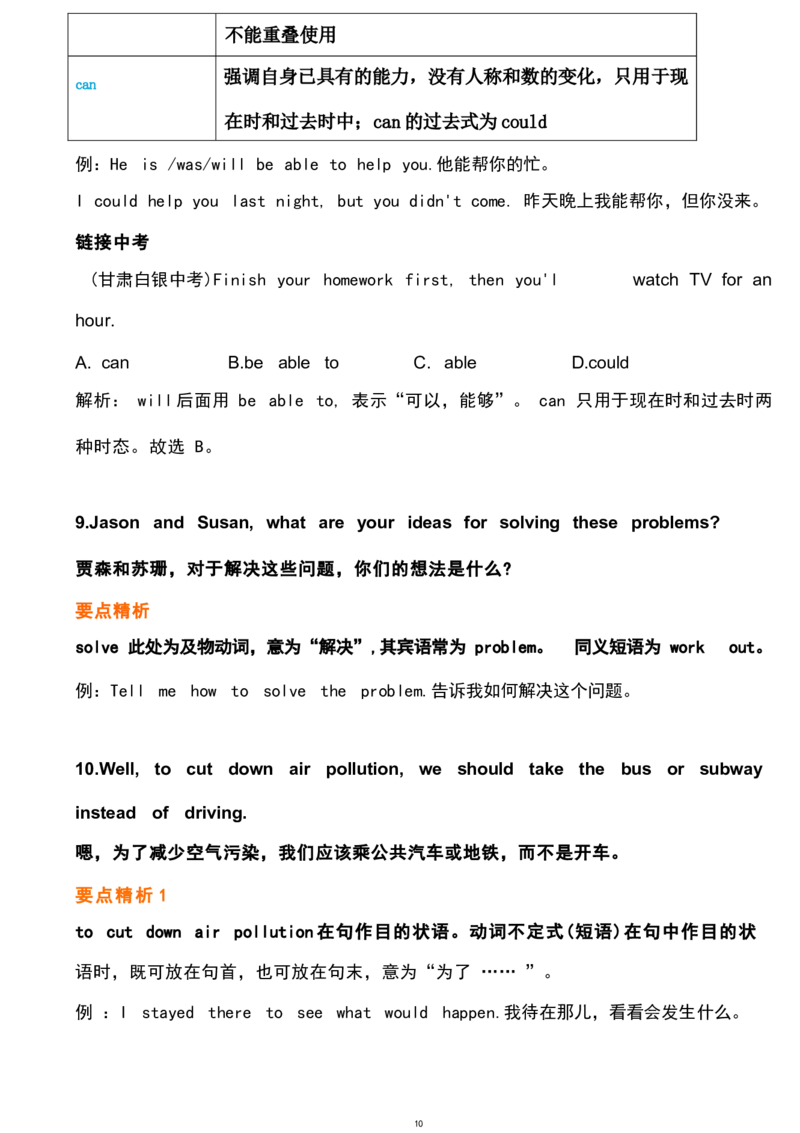
辨析:be able to 与 can
强调通过努力而获得的能力,有人称和数的变化,可用于
be able to
多种时态,在shall,will后面要用 be able to,与can
9不能重叠使用
强调自身已具有的能力,没有人称和数的变化,只用于现
can
在时和过去时中;can的过去式为could
例:He is /was/will be able to help you.他能帮你的忙。
I could help you last night, but you didn't come. 昨天晚上我能帮你,但你没来。
链接中考
(甘肃白银中考)Finish your homework first, then you'l watch TV for an
hour.
A. can B.be able to C. able D.could
解析: will后面用 be able to, 表示“可以,能够”。 can 只用于现在时和过去时两
种时态。故选 B。
9.Jason and Susan, what are your ideas for solving these problems?
贾森和苏珊,对于解决这些问题,你们的想法是什么?
要点精析
solve 此处为及物动词,意为“解决”,其宾语常为 problem。 同义短语为 work out。
例:Tell me how to solve the problem.告诉我如何解决这个问题。
10.Well, to cut down air pollution, we should take the bus or subway
instead of driving.
嗯,为了减少空气污染,我们应该乘公共汽车或地铁,而不是开车。
要点精析 1
to cut down air pollution在句作目的状语。动词不定式(短语)在句中作目的状
语时,既可放在句首,也可放在句末,意为“为了 …… ”。
例 :I stayed there to see what would happen.我待在那儿,看看会发生什么。
10要点精析 2
instead of 介词短语,意为“代替,而不是”。
例:She went to school instead of staying at home.她没有待在家里而是去上学
了。
辨析 instead of 与 instead
ins tead of 介词短语,后接名词、代词或动词-ing 形式等作宾语,否定 of 后的内
容
instead 副词,意为“代替;相反”,常位于句首或句末作状语,肯定 instead 所在
句的内容
例:They will go on a vacation by plane instead of by train.
他们将乘飞机去度假,而不是坐火车。
He didn't play basketball yesterday. He went swimming instead.
他昨天没打篮球,而是去游泳了。
11.There are other advantages of bike riding.
骑自行车有其他优点。
要点精析
advantage 可数名词,意为“优点;有利条件”。其反义词为 disadvantage, 意
为“劣势,不利条件”。
例:What is the advantage of using nuclear power? 使用核能的优点是什么?
知识拓展
与 advantage 与有关的短语:
take advantage of 利用
be of advantage to 对……有利
have advantage over 优于,胜过
1112. It's good for health and it doesn't cost anything!
它有利于健康,并且它不花费任何东西!
要点精析
be good for 意为“对……有益”,反义词组为 be bad for, 意为“对……有害”。
例:Enough sleep is good for our health.充足的睡眠对我们的健康有好处。
Weather like this is bad for business.像这样的天气不利于做买卖。
辨析: be good for, be good at 与 be good to
be good for “对 ……有益”,后接表示人或事物的名词
be good at 擅长,善于”,后接名词、代词或动名词
be good to “对 ……好(和善、慈爱)”,后常接表示人或人格化的名词
例:Reading in the morning is good for your English study.
晨读对你的英语学习有好处。
My father and mother are both good at swimming.
我的父亲和母亲都擅长游泳。
All my teachers are good to me in my new school.
在新学校所有的老师对我都很好。
13. Mmm, I think simple things like bringing a bag to go shopping can
help.嗯,我认为像自带包去购物这些简单的事情能够有所帮助。
要点精析
go shopping 意为“购物,买东西”,同义短语为 do some shopping。
例:lusually go shopping on weekends.我通常在周末去购物。
知识拓展
“go+ 动词-ing 形式“表示“去做某事”,常用于表达从事某一体育运动或休闲活动。
例:go skateboarding 去滑滑板
12go bike riding 去骑自行车
go camping 去野营
go surfing 去冲浪
go climbing 去爬山
go skating 去滑冰
go hiking 去远足
go sightseeing 去观光
go fishing 钓鱼
go swimming 去游泳
14.Also, I never take wooden chopsticks or plastic forks when I buy
takeaway food. 而且我买外卖食物时,从不拿木筷或塑料叉子。
要点精析
wooden 是由名词 wood 加 en 构成的形容词,意为“木头的;木制的”。
例:There are some wooden benches at this restaurant.
在这家餐馆里有一些木凳。
There are thirty wooden desks in our classroom.
我们的教室里有 30 张木制课桌。
知识拓展
①wooden 作形容词,还可意为“呆板的;(动作)僵硬的”。
例:The actor playing the father was too wooden.饰演父亲的演员太呆板了。
②wood 作不可数名词时,意为“木材;木头”。作可数名词时,意为“森林”。
例:Wood can be made into paper.木材可用来造纸。
They walked through the woods.他们走过森林。
【助记】
13wood 木材 woods 森林
15.And remember to throw rubbish in the bins and keep public places
clean and beautiful for everyone.
并且记住把垃圾扔进垃圾箱,为大家保持公共场所的干净和美丽。
要点精析 1
remember 动词,意为“记得;记住”。
例:Do you remember his room number? 你记得他的房间号码吗?
辨析 remember to do sth.与 remember doing sth.
remember to do sth. 记得要做某事(事情还未做)
remember doing sth. 记得做过某事(事情已经做过)
例:Remember to bring your basketball to school.记得把你的篮球带到学校来。
He remembers closing the window.他记得关上窗户了。
要点精析 2
keep 此处用作及物动词,构成 “keep sb./sth.+形容词”结构,意为“使某人/某
物保持某种状态”。
例:Please keep the door open.请保持门开着。
16.So together, our actions can make a difference and lead to better
future! 因此,齐心协力,我们的行动就能起作用,就会创造一个更加美好的未来!
14要点精析 1
make difference 意为“起作用;有影响”。其后可接介词 to,构成短语 make
difference to, 表示对某人或某事物有影响。
例:A kind smile can make a big difference.一个善意的微笑会产生很大的影响。
知识拓展
有关 make 的常用短语:
make the bed 铺床
make a mistake 犯错误
make tea 沏茶
make a living 谋生
make trouble 惹麻烦
make noise 制造噪音
make money 赚钱
make sure 务必
make a visit 拜访
make a telephone call 打电话
make a decision 做决定
要点精析 2
lead to 为固定短语,意为“引起(结果等)”。
例:Eating too much salt can lead to health problems.吃太多盐会引起健康问题。
知识拓展
①lead sb.to do sth. 意为“致使某人做某事”。
例:What led you to think so? 什么使你这样想呢?
②lead sb.to some place 意为“带领某人去某地”。
例:The road leads you to the station.这条路指引你去往车站。
17.Many have heard of shark fin soup. 许多人听说过鱼翅羹。
要点精析
hear of 意为“听说”,相当于 hear about。
例:I heard of the car accident yesterday.昨天我听说了这起车祸。
15I have never heard of such a strange thing.我从末听说过如此奇怪的事情。
知识拓展
hear from 意为“收到……的来信”。
例:I heard from her last week.我上周收到了她的来信。
18. But do you realize that you're killing a whole shark each time you
enjoy bowl of shark fin soup?
但是你意识到每当你享受一碗鱼翅羹时,你正在杀死一整条鲨鱼了吗?
要点精析 1
whole 此处作形容词,意为“全部的,所有的”,其结构为“限定词+whole+ 名词”。
例:He worked the whole night.他工作了整整一个晚上。
辨析: whole 与 all
whole 放在冠词、指示代词、物主代词等之后。在单数可数名词前一般用
whole,但在物质名词前则不用 whole;在时间名词(如 day,week,
month,year 等)以及季节名词(spring,summer,autumn,
winter)之前,all 与 whole 两者都可用(注意冠词的位置)
all 放在冠词、指示代词、物主代词等之前。在复数名词和不可数名词之前
一般用 all,而不用 whole;在表地点的专有名词之前, 一般用 all
而
不 用 whole, 但 可 用 the whole of
例:the whole family/all the family 全家
The whole building is burning.整座楼都在燃烧。
All my friends are poor.我所有的朋友都贫穷。
[误] the whole food
[正] all the food 所有的食物
[误] the whole wine
16[正] all the wine 所有的酒
all China/the whole of China 全中国
all(the)spring/the whole spring 整个春天
要点精析 2
each time 意为“每次”,名词性短语,引导时间状语从句,相当于 every time 类
似的还有 the first time the minute,the moment 等。
例:Each time meet him, he tries to tell me something new.
每次我遇到他,他都尽力告诉我一些新鲜事情。
19. When people catch sharks, they cut off their fins and throw the shark
back into the ocean.
当人们捕捉鲨鱼时,他们割掉它们的鱼鳍,然后将鲨鱼扔回到海洋。
要点精析
cut off 动词短语,此处意为“切掉,割掉”。
例:One of his fingers was cut off in an accident.
他的一根手指在一次事故中被切掉了。
知识拓展
cut 的相关短语:
cut down 减少;砍倒
cut up 切开;切碎
cut in 打断,插嘴;超车抢道
20. This is not only cruel, but also harmful to the environment.
这不但残忍,而且对环境有害。
要点精析 1
17not only… but also… 意为“不但……而且……”,连接两个并列的句子或句
子成分,强调 but also 之后的内容,其中also 可以省略。
例:That old man is not only rich but also helpful.
那位老人不但富有,而且乐善好施。
The teacher praised not only Millie, but also you.
老师不但表扬了米莉,还表扬了你。
要点精析 2
harmful 形容词,意为“有害的;不利的”。常构成固定搭配 be harmful to sb./sth.,
意为 “对某人/某物有害”,相当于do harm to 或 be bad for。
例:Smoking is harmful to our health.
=Smoking does harm to our health.
=Smoking is bad for our health.
吸烟对我们的健康有害。
21. Without fin, a shark can no longer swim and slowly dies.
没有了鱼鳍,鲨鱼不能再游泳,并慢慢死去。
要点精析 1
本句中的 without fin作条件状语,可变为if引导的条件状语从句if there isn't a
fin.。
要点精析 2
die 此处为不及物动词,意为“死,死亡”,其过去式和过去分词皆为died, 现在分
词为 dying, 形容词为 dead/dying。
例:The old man died of cancer yesterday.昨天那位老人死于癌症。
小贴士
18die 是短暂性动词,不能与表示一段时间的 “for 短语”连用, 如“他死了三
天”不能说“He has died for three days.",而应说“He has been dead
for
three days.”或 "He died three days ago."。
知识拓展
die 的名词形式为 death, 意为“死亡,去世”等。
例:Car accidents caused a lot of death.车祸造成了很多死亡。
22. Sharks are at the top of the food chain in the ocean's ecosystem.
在海洋生态系统中,鲨鱼处于食物链的顶端。
要点精析
at the top of意为“在……顶部或顶端”。强调某一点。反义短语 at the bottom
of 意为“在……的底部”。
例:At the top of the mountain, we saw the beautiful sunrise.
在山顶上,我们看到了美丽的日出。
【助记】
top 顶部
middle 中部
bottom 底部
知识拓展
on the top of 意为“在……的顶部或顶端”,强调的是面。
例:Please put these books on the top of the desk.请把这些书放在桌子上面。
19y
23. Many believe that sharks can never be endangered because the
are the strongest in their food chain.
许多人认为鲨鱼不可能濒危,因为它们在它们所在的食物链中是最强者。
要点精析 1
can 表推测时,常用于否定句或疑问句中, can't 意为“一定不;不可能”。
例:It can't be true.它不可能是真的。
What can he be doing? 他可能在做什么呢?
要点精析 2
endangered 形容词,意为“濒危的;濒临灭绝的”。
例:Pandas are an endangered species.熊猫是一种濒临灭绝的物种。
辨析 endangered,danger,dangerous 与 in danger
endangered 形容词,“濒危的;濒临灭绝的”
danger 不可数名词,危险,威胁”,后接 of (doing)sth.
dangerous 形容词,“危险的”
in danger 介词短语,“在危险中”
例:Scientists think that the animal is endangered by pollution.
科学家认为污染导致这种动物濒临灭绝。
Is there any danger of fire? 有发生火灾的危险吗?
It's dangerous for children to swim in the river.
对孩子们来说在河里游泳是危险的。
Her life is in danger.她有生命危险。
24. But in fact, around 70 million sharks are caught and traded in this
industry every year.
20但实际上,在这个行业中每年大约七干万的鲨鱼被捕捉和交易。
要点精析
million 意为“百万”,其用法与 hundred “百”,thousand “千”,billion “十亿”
相同, 具体如下:
①与具体数字连用时,用单数形式。
例:five million五百万 four hundred四百
②当表示不确定的数目时,要用复数形式,且后接介词of, 然后才接名词 hundreds
of“数以百计的;成百上千的”;thousands of“数以干计的;成千上万的”
millions
of “数百万的”。
例:Thousands of people were lying on the beach.数以千计的人正躺在海滩上。
方法技巧
hundred thousand 和 million 等词的用法
模糊数字两有(有-s, 有 of),
具体数字两无(无-s, 无 of)
妙语诠释: hundred,thousand 和 million等词,当前面有具体数字修饰时,用单
数形式,且不与 of 连用;当表示不确切的数目时,则用复数形式,且后与 of 连用。
t
25. The numbers of some kinds of sharks have fallen by over 90 percen
in the last 20 to 30 years.
在过去的二十至三十年里, 一些种类的鲨鱼的数量已经下降了百分之九十多。
要点精析 1
本句中, “the numbers of+可数名词复数”为主语,其中 numbers 为 number
的复数形式,表示不同种类的鲨鱼的数量,故谓语动词用复数形式。
例:The numbers of different kinds of training schools are more and more.
不同种类的培训学校的数量越来越多。
知识拓展
21"the number of+可数名词复数”作主语时,谓语动词用单数形式; “a
number+ 可数名词复数”作主语时,谓语动词用复数形式。
例:The number of the books is 200.这些书的数量是200。
A number of students are planting trees on the hill.许多学生正在小山上植树。
要点精析 2
by 介词,在此句中表示变化的程度, fall by…表示“下降了……”。
例:The price of the mobile phone fell by 200 yuan.
这款手机的价格下降了 200 元。
知识拓展
介词 to 也可以表示变化的程度fall to.表示“下降到……”。
例:The price of the mobile phone fell to 200 yuan.这款手机的价格下降到200
元。
要点精析 3
over 介词,意为“多于;超过”,相当于 more than。
例:Over 70 percent of the earth is covered by water.
地球 70%以上被水覆盖着。
He spent over two hours finishing his homework.
他花费了两个多小时完成家庭作业。
要点精析 4
90 percent 意为“百分之九十”。“数词+ percent “意为“百分之多少”,percent
没有复数形式,它所修饰的名词作主语时,要根据被修饰的名词来判断谓语动词的
单复数形式。
例:Ten percent of the apples are bad.这些苹果中的 10%是坏的。
22Thirty percent of time has passed.百分之三十的时间过去了。
26. They have even asked governments to develop laws to stop the sale
of shark fins.他们甚至要求政府完善法律来阻止鱼翅的销售。
要点精析
sale 名词,意为“卖,出售,销售”,动词是 sell。
例:There is no sale for that kind of radio.没有卖那种收音机的了。
【助记】
FOR SALE 出售 ONSALE 廉售
sale goods 甩卖品
clearance sale 清仓大甩卖
27.So far, no scientific studies have shown that shark fins are good for
health, so why eat them?
到目前为止,没有科学研究表明鱼翅对健康有益,所以为什么吃它们呢?
要点精析 1
so far 意为“到目前为止”,常用于现在完成时,与 up to now,until now 同义。
例:How many English songs have you learned so far?
到目前为止,你学会了多少首英文歌曲?
要点精析 2
scientific 形容词,意为“科学上的;科学的”。
例:They made the school a place for scientific experiments.
他们把学校变成了科学实验的场所。
知识拓展
①science 名词,意为“自然科学”。
23例:He develops an interest in science.他养成了对科学的兴趣。
②scientist 名词,意为“科学家”。
例:My favorite scientist is Thomas Edison.我最喜欢的科学家是托马斯 ·爱迪生。
28. Two environmental groups against “finning”.
反对“猎翅”的两个环境组织。
要点精析
against 介词,意为“反对;对着;违反”等。 be against 意为“反对……”,反义
词组为 be for, 意为“支持……”。
例:He spoke against the new law.他发言反对新法律。
I am all for giving people more freedom.我完全赞成给予民众更多的自由。
知识拓展
against 还可意为“靠着;顶着;撞”。
例:She stood with her back against the door.她背靠门站着。
He hit his head against the window.他的头撞到了窗户上。
29. Have you ever taken part in an environmental project?
你曾经参加过环境工程吗?
要点精析
take part in 意为“参加”,多指参加一些集会性活动,如会议、劳动等。
例:Would you like to take part in our party? 你愿意参加我们的聚会吗?
辨析: take part in,join, join in 与 attend
take part in 常指参加某一活动,着重说明句子主语参加该项活动
并在活动中发挥作用
join 常指加入某一组织或团体,并成为其中一员。后接表
24示组织或团体的名词,如 the club,the Party等
join in 多指参加小规模的活动,如游戏、球赛等。join in sth.
意为“参加某事”
意为“出席参加”,为正式用语,通常用于指参加会议、
attend
典礼、婚礼、葬礼等
例:All the students in our class took part in the sports meeting.
我们班所有的学生都参加了运动会。
My brother will join the army.我哥哥将要参军。
Can join in the game? 我可以加入这个游戏吗?
Only 18 people attended the meeting.只有 18 个人出席了这次会议。
知识拓展
take an active part in积极参加
例:I always take an active part in class discussions.我总是积极参与课堂讨论。
30.Yes, we can't afford to wait any longer to take action.
是的,我们再也等不起了,应该(立马)采取行动!
要点精析 1
afford 及物动词,意为“承担得起(后果)”。
例:We cannot afford any more delays.我们不能再有任何耽搁了。
知识拓展
①afford 常与 can,could,be able to 等连用,且多用于否定句中。
②afford 后跟名词、代词或动词不定式作宾语,但不能跟动词-ing 形式。
③afford 通常不用于被动语态。
④afford to do sth.负担得起做某事
例:We can't afford to go abroad this summer. 今年夏天我们负担不起去国外。
25要点精析 2
take action 动词短语,意为“采取行动”。常用结构 take action to do sth.
意为 “采取行动做某事”。
例:The government must take action now to protect the environment.
政府现在必须采取行动保护环境。
知识拓展
有关 take 的常见短语:
take place 发生
take a shower 淋浴
take turns 轮流
take a walk 散步
take exercise 运动
take notes 记笔记
take care 当心
take the medicine 吃药
take care of 照料
take a message 带个口信
take it easy 别紧张
take a break/rest 休息一下
take a bus/train/taxi 乘公共汽车/火车/出租车
31.Many forget that saving the earth begins with small things.
许多人忘记了拯救地球是从小事开始的。
要点精析 1
save 动词,此处意为“拯救”。
例:We should save the earth by doing some small things.
我们应该通过做一些小事来拯救地球。
知识拓展
save 作动词时意思较为广泛,常见的有:
① “节约,节省”。
例:We should save the water.我们应该节约水。
② “积攒,储蓄”。
26例:He wants to save some money to buy a car.他想攒一些钱去买一辆小
汽车。
③ “保留,保存”。
例:Save and close the document.保存并关闭文档。
【助记】
要点精析 2
begin with 意为“以……开始”,有时可用“begin…with…”结构。同义词组是 start
with, 反义词组是 end(up)with “以 ……结束”。
例:Lesson 5 begins with a song.第 5 课以一首歌开始。
32. For example, you can/could/should save electricity by turning off the
lights when you leave room.
例如,你可以/应该通过离开房间时关掉电灯来节约电。
要点精析 1
by 介词,此处意为“通过,靠”,表示方法、手段,其后可接名词、代词或动词-ing
形式。
例:Mr.Green makes a living by teaching.格林先生以教书为生。
27知识拓展
①by+ 交通工具 (by 后不加冠词),意为“乘/驾/坐……”。
例:I went to Tianjin by plane.我乘飞机去了天津。
②by+ 时间,意为“到……时(为止);在……以前”。
例:Jane must be in bed by ten o'clock.简必须在十点之前上床睡觉。
③by+ 地点,意为“在……旁边”。
例:They live by the sea.他们住在海边。
要点精析 2
turn off 意为“关掉(电器、自来水、煤气等)”。
例:Don't forget to turn off the tap.别忘了关水龙头。
【助记】
turn on 打开
turn off 关掉
turnup 调大;调高
turn down 调小;调低
小贴士
以上四个短语都是“动词+副词”型短语。当它们的宾语是代词时,要放在 turn 和
on/off/up/down 之间。
33. All these small things would add up and become big things that
may/might improve the environment.
所有这些小事将加起来,变成可能改善环境的大事。
要点精析
add up 意为“加起来;把……加起来”。
例:Please add up all the money.请把全部的钱加起来。
28知识拓展
add up to 意为“总数是;总计为”,后跟合计的数目。
例:These numbers add up to exactly 100.这些数字的总数恰好是 100。
Section A 即学即试
I. 单项选择
1.Please the tap when you brush your teeth.
A. take down B. turn up C. take away D. turn off
2. Miss Taylor never wastes money on anything too expensive, even
though she can to. She has donated much of the money she
saved to
charities.
A.allow B. remind C. afford D. spend
3. We should protect the animals danger.
A.on B.in C. of D.at
4. His sister a speech contest yesterday.
A.joins B.takes part in C.joined D. took part in
5.I want to be a when I grow up, because I am interested in
and llike working on studies.
A. scientist; science; scientific B. science; scientist; scientific
C. scientific; science; scientist D.scientist; scientific; science
6. Twenty percent of the mountain by white snow.
A.covered B. is covered C. are covered D.cover with
7.-Whose T-shirt is this?
-|t be John's. It's much too small for him.
A. might B. can't C. needn't D. could
298.Spending too much time online people's health.
29B. is harmful to C. does harmful to D.does harm
A. is harm to
9.His careless driving the accident.
B. leading to C.led to D. was led to
A. lead to
Ⅱ .根据句意及汉语提示完成句子
1.Don't ( 乱 扔 ) the ground with paper.Please keep the classroom
clean.
2. Please put some ( 煤 ) on the fire.
3. They announced that their new product had many ( 优 点 ) .
4. These spoons are made of ( 塑 料 ) .
5. Remember to carry a (可重复使用) shopping bag with you!
Ⅲ .用括号内所给词的适当形式填空
1. I bought the book yesterday. It (cost)me 10 yuan.
2. We should take part in (protect) the environment.
3. He is poor and can't afford (buy)a new car.
4. There (use) to be dinosaurs on the earth.
5. If the numbers of sharks drop too low, it (bring)danger to all
the ocean life.
Section B知识点精析
1. Recycling paper is really easy.回收利用纸张很容易。
要点精析
recycle 动词,意为“回收利用;再利用“。
例 :We recycled all the bottles.我们把所有的瓶子都回收利用了。
小贴士
30recycle是由前 re (又;再;重)加 cycle (循环;使循环)构成的。类似的
词还有: rewrite (重写),retell (复述),reuse (再使用), remarry (再
婚), rebuild (重建)等。
知识拓展
recycle 的过去式为recycled, 常作定语,与所修饰的名词在逻辑上存在动宾关系。
2. taking your own bags when shopping购物时自带包
要点精析
when shopping 意为“购物时”,连词 when 引导时间状语从句时,可以换成以
when 引导的介词短语或分词短语 when doing sth.,意为“做某事时”。
例:When you do the work, you must be careful.
= When doing the work, you must be careful.工作时你必须当心。
3. Do you often throw away things you don't need anymore?
你经常扔掉你不再需要的东西吗?
要点精析 1
本句是复合句, you don't need anymore 作定语,修饰 things。
要点精析 2
throw away意为“扔掉;丢弃”,相当于 throw out。
例:Throw away the old newspapers, please.请把这些旧报纸丢掉。
小贴士
throw away 是“动词+副词”型短语。名词作其宾语时,放在 away 之前或之后
均可;代词作其宾语时,须放在 throw 和 away 之间。
知识拓展
away 作副词时,常见短语有:
31keep away 远离 stay away 不在家,外出
go away 离去,出去
take away 拿走,带走
run away 逃走,离开
put away 收起来
4. Have you ever thought about how these things can actually be put to
good use? 你曾经考虑过这些东西实际上可以怎样被好好利用吗?
要点精析
put sth. to good use 意为“好好利用某物”,相当于 make good use of sth.。
本句用了该短语的被动形式,即 sth.be put to good use。
例:We can put these books to good use.我们可以好好利用这些书。
These glasses can be put to good use.这些玻璃杯可以被好好利用。
知识拓展
与 put 有关的短语:
①put off 意为“推迟”,后接名词、代词或动词 ing 形式。
例:We'll put off holding the sports meeting because of rain.
由于下雨,我们将推迟举办运动会。
② put away 意为“收拾起来”。
例:The little girl put the bowl away after she finished her dinner.
吃完晚饭后,小女孩儿把碗收拾起来。
③put up 意为“张贴、举起、建立”。
例:A new school was put up last year.去年新建了一所学校。
④put on 意为“穿上” 。
例:What dress shall l put on for the party? 我应该穿什么衣服去参加聚会呢?
⑤put out 意为“扑灭;熄灭”。
例:The firemen soon put out the fire.消防员很快把火扑灭了。
325. You have probably never heard of Amy Hayes, but she is a most
unusual woman.你可能从未听说过埃米 ·海斯,但她是一个很不寻常的女性。
要点精析 1
probably 副词,意为“也许大概,可能”常用作状语,可位于句首,也可位于句中,
即实义动词之前,助动词、情态动词或连系动词之后。
例:She probably told her mother the truth.她可能把真相告诉了她的母亲。
知识拓展
probably 常用于句中, maybe 相当于 perhaps, 常用于句首。另外probably 比
may be和 perhaps 表达的可能性大。
例:She will probably come next week.她很可能下周来。
Maybe/Perhaps you are right.或许你是对的。
要点精析 2
a most unusual woman意为“一个很不寻常的女性”。 “a+most+adj.+n.” 是
一个固定结构,意为“一个很/非常……的……”。此处 most 不表示最高级含义。
例:This is most useful tool.这是一件非常有用的工具。
She is most beautiful girl.她是一个非常漂亮的女孩儿。
6. She lives in a house in the UK that she built herself out of rubbish.
她住在英国的一所她自己用废弃物建造而成的房子里。
要点精析 1
本句是含有定语从句的主从复合句。 that she built herself out of rubbish 作先
行词 house 的定语。 out of rubbish “用垃圾”。
要点精析 2
herself 为 she 的反身代词,意为“她自己”。
33例:I hope he'll enjoy himself.我希望他玩得高兴。
【习惯搭配】
by herself 独自地
for herself 为她自己
知识拓展
①反身代词的构成:
第一、第二人称的反身代词由其形容词性物主代词加上-self 或-selves 构成;第三人
称的反身代词由其宾格代词加上-self 或-selves 构成。
人称数 单数 复数
第一人称 myself
ourselves
第二人称 yourself yourselves
第三人称
himself themselves
herself
itself
②常见的反身代词短语:
enjoy oneself 玩得开心
by oneself 靠自己
for oneself 为自己
kill oneself 自杀
dress oneself 自己穿衣
introduce oneself 自我介绍
teach oneself= learn… by oneself 自 学
leave sb. by oneself 把某人单独留下
look after oneself= take care of oneself 照顾自己
Help yourself! 请随便吃吧!/请自己去取吧!
347.The windows and doors come from old buildings around her
town that were pulled down.门窗来自她的城镇周围被拆掉的旧建筑。
要点精析 1
were pulled down 一般过去时的被动语态,其结构为 “was/were+ 及物动词的过
去分词”。
例:Thousands of trees were planted by them last year.去年他们种植了数万棵
树。
要点精析 2
pull down 意为“拆毁,拆掉”。
例:The workers are pulling down the old building.工人们正在拆除那栋旧楼。
小贴士
pull down 是“动词+副词”型短语。名词作其宾语时,放在 down 之前或之后均
可;代词作其宾语时,只能放在 pull 和 down 之间。
辨析 pull down 与 take down
pull down 指把某物毁坏
指把某物拆下,还可以安上去,没有毁坏
take down
例:You can pull down the old house.你们可以拆除这所旧房子。
Remember to take down our tent before leaving.记住离开前拆下我们的帐篷。
8. The top of the house is an old boat turned upside down.
房顶是一艘被倒转过来的旧船。
要点精析 1
turned upside down 是过去分词短语,在句中作后置定语修饰名词 boat。 英语
中短语和从句作定语时, 一般置于名词或代词之后,作后置定语。
35例:He looked at the streets full of cars.他看着满是车辆的街道。
There is something that I have to tell you.有点儿事我必须告诉你。
要点精析 2
upside down意为“上下颠倒;倒转”,既可作副词,也可作形容词。
例:The toy car is lying on the floor upside down.
那辆玩具小汽车正底朝天地躺在地板上。
The painting is upside down.这幅画上下颠倒了。
9. And the gate in front of her house is made of rocks and old glass
bottles.
房前的大门是由石头和旧玻璃瓶做成的。
要点精析 1
in front of意为“在……前面”。
例:There is a tree in front of the house.房子前面有一棵树。
辨析 in front of 与 in the front of
‘在 ……前面”,指一个物体在另一个物体外部的前面
in front of
‘在 ……前部(前端)”,指在某一物体内部的前面
in the front of
例:There is a dog in front of the car.小汽车前有一只狗。
There is a young man in the front of the car.小汽车前部有一个年轻人。
链接中考
(广东中考)-Why are you standing, Alice?
-I can't see the blackboard clearly. Two tall boys are sitting me.
A. behind B. next to C. between D.in front of
解析:behind 意为“在……后面”;next to意为“在……旁边”;between 意为“在……
36中间”;in front of 意为“在……前面”。根据句意“艾丽斯,你为什么站着?
“ “我不能看清楚黑板。两个高个子男孩儿正坐在我前面。”可知, D 项
正确。
选 D。
要点精析 2
be made of 为固定短语,意为“……制成”。
例:This salad is made of apples and strawberries.
这种沙拉是由苹果和草莓做的。
辨析 be made of, be made from, be made in 与 be made up of
“由 ……制成”,从制成品中能看出原材料
be made of
由制成,从制成品中看不出原材料
be made from
‘某物产于某地”,强调生产地点
be made in
be made up of “由 ……组成”,一般由多个部分构成
例:The chair is made of wood.椅子是由木头做的。
Paper is made from wood.纸由木头制成。
These trains are made in Zhuzhou.这些火车是在株洲生产的。
Our class is made up of 20 boys and 25 girls.
我们班是由 20 名男孩儿和 25 名女孩儿组成的。
【助记】
37链接中考
(湖北黄冈中考)-Do you believe that paper is made wood?
-Yes, I do. And you can see that books are made . paper.
A.from; from B.from; of C. of; from D.of; of
解析: be made from 和 be made of 均表示“由……制成”,但是前者看不出原
材 料,后者能够看出原材料。句意:“你相信纸是由木头制成的吗?”“是的,我相
信。
并且你能看到书是由纸制成的。”由句意可知选B。
知识拓展
①be made into … 意为“被制成……”。
例:This piece of wood will be made into a small bench.
这块木头将被制成一个小长凳。
②be made by. 意为“由……制造”,后接动作的执行者。
例:The machine is made by the workers in the factory.
这台机器是由工厂里的工人们制造的。
10.Amy recently won a prize from the Help Save Our Planet Society.
最近埃米获得了“帮助拯救我们的星球协会”颁发的一个奖项。
要点精析
win 此处用作及物动词,意为“赢得;在…… 中获胜”,其后的宾语为比赛的项目、
奖品或战争等; win 还可用作不及物动词,意为“赢;获胜”。
例:She won the second prize.她获得了第二名。
Vincent is sure to win.文森特一定会获胜。
辨析:win 与 beat
“赢得;获胜”,用作及物动词时,其宾语为比赛的项目、奖品或
win
38战争等
“打赢;战胜”,用于比赛时,其宾语为所战胜的对手
beat
例:We won the football game.我们赢了足球赛。
Li Ming beat all the runners in the 100-meter race.
李明在百米赛跑中战胜了所有的对手。
【助记】
win the match 赢得比赛
beat sb. (in the match) (在比赛中)赢得某人
11.Amy is an inspiration to us all.埃米对我们大家来说是一个鼓舞人心的人。
要点精析 1
inspiration 名词,意为“鼓舞人心的人(或事物)”,还可意为“灵感”。
例:He was a great inspiration to us youth.
他对我们年轻人来说是一个伟大的鼓舞人心的人。
Many poets and artists have drawn their inspiration from nature.
许多诗人和艺术家从大自然中获得他们的灵感。
要点精析 2
us all 意为“我们大家”,us 为人称代词宾格,作 to 的宾语, all 则是 us 的同位语。
例:Happy New Year to you all! 祝你们大家新年快乐!
12. Amy isn't the only one who is good at recycling.
埃米并不是唯一擅长循环利用的人。
要点精析 1
who 此处引导定语从句,其先行词为 the only one 在定语从句中,若先行词为人,
39且引导词在从句中作主语,那么定语从句的引导词用 who; 若引导词在从句
中作宾语,则引导词用 who 和 whom 皆可。
例:The student who is answering the question is Victor.
正在回答问题的那名学生是维克托。
Do you know Mr.Yang who/whom they like very much?
你认识他们非常喜欢的杨先生吗?
要点精析 2
be good at 意为“擅长;在……方面做得好”。
例:Andy is good at math.安迪擅长数学。
I'm good at singing.我擅长唱歌。
知识拓展
be good at 通常可以与 do well in 互换,但是 do well in 还可以表示某一次在某
方面做得好。
例:She did well in yesterday's swimming competition.
她在昨天的游泳比赛中表现很好。
13. … she has also set up a website to sell them online.
……她也建立了一个网站,在网上销售她的包。
要点精析
set up 动词短语,此处意为“建立;设立;创立(公司、机构等)”。
例:They decided to set up a new company.他们决定创办一家新公司。
小贴士
set up 是“动词+副词”型短语,其宾语是代词时,要放在 set 和 up 之间。
辨析 set up 与 build
set up 主要用于创建组织、机构、公司、学校等
40build 指具体建造、制作某物
例:He has set up a firm of his own.他自己开了一家公司。
The house was built in the early 19th century.这所房子建于 19 世纪初期。
14.He is known for using iron and other materials from old cars to make
beautiful art pieces.
他因使用来自旧车上的铁和其他材料来制作美丽的艺术品而出名。
要点精析
be known for 意为“以……闻名;因……而出名”,相当于 be famous for。
例:Switzerland is known/famous for watches.瑞士以手表闻名。
Hangzhou is known/famous for the West Lake.杭州因西湖而出名。
辨析 known for,be known as 与 be known to
意为“因……而出名”,相当于 be famous for
be known for
意为“以 …… 出名”
be known as
意为”为 ……所熟知”
be known to
例:Einstein was known for his theory of relativity.
爱因斯坦以他的相对论而出名。
Einstein was known as a great scientist.爱因斯坦以一位伟大的科学家著称。
He is known to us all.我们都熟悉他。
15. The more popular works can even be seen in art shops around the
city.
在全城的艺术品商店里甚至能看到更受欢迎的作品。
要点精析
work 此处作可数名词,意为“(音乐、艺术)作品”。
41include plays and poems.他的作品包括戏剧和诗歌。
例:His
works some piano works.她创作了一些钢琴曲。
She created
知识拓展
work 不可数名词,意为“工作;职业”
动词,意为“工作;劳动”。
例:He has too much work to do.他有太多的工作要做。
They worked at a small restaurant two years ago.两年前他们在一家小餐馆上
班。
16.Not only can the art bring happiness to others, but it also shows that
even cold, hard iron can be brought back to life with a little creativity.
艺术不仅能给别人带来快乐,而且它也表明,只用一点儿创意,即便是冰冷、坚硬
的铁也能恢复活力。
要点精析
bring back此处意为“恢复”。
例:We are pleased that Mr.Liu has decided to bring back the after-class
basketball game.我们很高兴,刘老师已经决定恢复课后篮球赛了。
知识拓展
bring back 还可意为“使想起;归还”。
例:Your article brings back many happy memories.
你的文章唤起了许多美好的回忆。
Please bring back the library books before Friday.
请在周五之前归还图书馆的书。
小贴士
bring back是“动词+副词”型短语,名词作其宾语时,放在 back 之前或之后均
可;代词作其宾语时,只能放在 bring 和 back 之间。
42例:I have brought it back.我已经把它拿回来了。
17.Which parts need to be improved? 哪些部分需要被改善?
要点精析
need 此处作实义动词,意为“需要”,后面接名词、代词、动词-ing 形式或带 to
的动词不定式作宾语。 need 后面接动词-ing 形式时,动词-ing 形式表被动意义,
此时主语常为物。 其用法如下:
①当 need 用作实义动词时,如果主语与 need 后面的动词存在主动关系,用“need
to do sth.”结构。
例:We need to take bus.我们需要乘公共汽车。
②如果主语与need 后面的动词存在被动关系,用"need doing sth.” 或 “need to
be done “结构。
例:The trees need watering.=The trees need to be watered.
这些树需要浇水了。
知识拓展
need 作情态动词时,意为“需要”,常用于疑问句和否定句中,无人称和数的变化,
后接动词原形。用于疑问句时,肯定回答常用 must 或 have to, 否定回答常用
needn't。
例:-Need you help him study? 你需要帮助他学习吗?
-Yes, I must./Yes, I have to.是的,我必须帮助他。
-No, needn't.不,不需要。
18. The air pollution is getting worse and worse.空气污染变得越来越糟。
要点精析
worse and worse 意为“越来越糟”,其结构为“比较级+and+ 比较级”或“more
and more+原级(多音节或部分双音节词)”,意为“越来越……
43例:He is getting taller
taller.他变得越来越高。
and
more beautiful.这些花越来越漂亮。
The flowers are more and
知识拓展
比较级的常用句型:
①“甲+be+ 形容词比较级+than+ 乙”或“甲+实义动词+副词比较级+than+ 乙”,
意为“甲比乙……”。
例:Amy is taller than Anne.埃米比安妮高。
I got up earlier than my brother this morning.今天早晨我比我哥哥起床早。
② “甲+be+ 倍数+形容词比较级+than+ 乙”或“甲+实义动词+倍数+副词比较级
+than+ 乙”意为“甲比乙……几倍”。
例:This room is three times bigger than that one.
这个房间比那个房间大三倍。
She runs three times faster than her sister.她跑的速度比她姐姐快三倍。
③“甲+be+the+ 形容词比较级+ of the two+其他”意为“甲是两者中较……的”。
例:Look at the two boys. My brother is the taller of the two.
看那两个男孩儿。我哥哥是两个当中较高的。
④ “the+ 比较级, the+ 比较级”意为“越……,越……”。
例:The busier my father was, the happier he felt.我父亲越忙,他感到越快乐。
⑤ “疑问词+be+ 形容词比较级,甲 or 乙?”意为“甲和乙哪一个更 ……?”
例:Which is bigger, the earth or the moon? 哪一个更大,地球还是月球?
⑥“疑问词+实义动词+副词比较级,甲 or 乙?“意为“哪一个更……,甲还是乙? ”。
Who draws better, Carol or Kelly? 谁画得更好,卡萝尔还是凯丽?
Section B 即学即试
I. 单项选择
1.-The relation between the two countries gets . A war seems to
44break out soon.
-I hope they will make peace with each other.
A. worse and worse B. better and better
C. more and more worse D. more and more better
2. English is my favorite subject, and I am good it.
A. for B. to C. at D.
of
3.-Do you know the girl is talking with our teacher?
-Oh, she is my sister.
A. who B. whose C. whom D. where
4. His uncle is making study of Jinyong's
A. work B. the work C. work D. works
5. Don't put the box
A. up and down B.upside down C.downside up D.down and up
6.We have some organizations to help the poor students in the
western areas of China.
A. taken up B. put up C. picked up D.set up
7. The city government has decided to t hese buildings to make
room for the new highway.
A. take down B. pull down C. cut down D.lie down
8.It's not right food.
A.throw away B. throw down C. to throw away D. to throw down
9. They made a box o ld pieces of wood.
A.up of B. from C. into D. out of
10. The money will to help disable people like
me. A. put it to good use B. put to good
use
45C. be put it to good use D. be put to good use
45Ⅱ .根据句意及汉语提示完成句子
1.You should put the waste paper in a bag. It can be (回收利
用 ) .
2.Our school (大门) faces to the south, and you can't miss it.
3. There are some empty (瓶子) in the corner of the room.
4. The knife is made of (金属) .
5. Do you like Mo Yan's (作品)?
Ⅲ .用方框内所给词的适当形式填空
bring back, build, hear of, pull down, sell
1. The house is too old to live in. It will
2. The bridge was in the 19th century, so it was old.
3. The artist can the picture to life with a little creativity.
4. They've the story and they are
moved. 5.The woman often pens to
us.即学即试参考答案与解析
Section A
即学即试
I.1.D 句意:刷牙时请关闭水龙头。 turn off “关掉”,符合题意。 take down “取
下来”; turn up “调高”; take away “拿走”。
2.C 由第二句可推知,泰勒小姐买得起但不买,故afford“买得起”,符合题意。allow”
允许”; remind “提醒”; spend “花费”。
3.B 句意:我们应该保护濒危动物。 in danger “处于危险中”,为固定短语。
4.D 根据时间状语 yesterday 可判断时态用一般过去时,故排除 A、B 两项。句
意 为“他妹妹昨天参加了一场演讲比赛”。 take part in 常指参加某一活动;
join 常指
加入某一组织或团体。故选 D。
5.A 第一空格前是不定冠词 a, 说明空格处应用名词,因为 scientific 是形容词,
排 除 C; 第二空格前是介词 in, 故空格处用名词,排除 D。 句意:我长大了想
当一名
科学家,因为我对自然科学感兴趣并且我喜欢从事科学研究。故选 A。
6.B 句意:这座山(表面)的 20%被白雪覆盖着。 be covered by意为“被……
覆 盖”,为固定短语; twenty percent of the mountain中 mountain 是单数形
式,
所以谓语动词用单数形式。故选 B。
7.B might”可能”;can't “不可能,不能”,可表示否定推测; needn't “不必”;
could “可能"。由问句句意“这是谁的 T 恤衫?”和答语后句句意“对他而言
这太 小了”可知,答语前句句意为“它不可能是约翰的”。此处表示否定推测,故用
can't。
故选 B。
8.B 句意:花费太多的时间上网对人们的健康有害。 be harmful to= do harm to
意为“对……有害”;浏览各选项可知B 项正确。
9.C 由题干可知,句中缺少谓语,故排除 B 句意为“他的粗心驾驶导致了这次事故”。
47不表示被动,排除 D;A 项应为 leads to, 故排除。故选 C。
Ⅱ.1.litter 2.coal 3.advantages/merits 4. plastic 5.reusable
473. to buy 4. used 5. will bring
.1
Ⅲ . cost 2. protecting
Section B
即学即试
1.A and 连接两个比较级,意为“越来越…… "。由空格后一句句意“一场战争看
似 很快要爆发”可推知,前句句意为“这两个国家之间的关系变得越来越差”。
bad 的
比较级为 worse, 故选 A。
2.C be good for 意为“对……有好处”; be good to 意为“对……好”; be good
at 意为“擅长……”。由前半句句意“英语是我最喜爱的科目”可知此处应填介词
at。 3.A 问句为含有定语从句的主从复合句。 who 关系代词,指人,在从句中作
主语或 宾语;whose 关系代词,在定语从句中作定语,修饰名词; whom 关系代词,
指人, 在从句中作宾语; where 关系副词,在从句中作地点状语。句中的先行词
为表示人
的名词 girl,且在从句中作主语,故选 A。
4.D 句意为“他叔叔正在研究金庸的作品”。work 意为“作品”时,是可数名词。
故选 D。
5.B 句意为“不要把盒子放颠倒了”。 upside down “上下颠倒”,符合句意。 up and
down 意为“上上下下”。
6.D 句意:我们已经建立了一些组织来帮助中国西部地区的贫困学生。 take up
“占 据”; put up “建造;张贴;举起”;pick up “捡起”; set up “建立;
创立”,符
合题意。故选 D。
7.B take down 意为“拆下”,指物体还可以复原;pull down 意为“拆除;摧毁”,
指把物体毁坏; cut down 意为“砍倒”; lie down 意为“躺下"。句意为“市
政府
已经决定拆毁这些建筑物,为新的高速路腾空间"。故选 B。
8.Cthrow away 意为“扔掉;抛弃”; throw down 意为“扔下”。句意为“扔掉食
48物是不对的”。 it在句中是形式主语,真正的主语是动词不定式短语。故选C。
9.DA、B 两项与make 连用时,常用被动结构,本句是主动结构,故排除; make into
48意为“把……制成……”; make out of…意为“用……做…… "。根据句意“他们
用旧木材做了一个箱子”可知, D 项符合题意。
10.D 主语“钱”和“好好利用”之间是被动关系,故用被动语态,排除A、B 两项;
put sth.to good use 的被动形式为: sth. be put to good use。故选 D。
Ⅱ.1.recycled 2. gate 3. bottles 4. metal 5.works
Ⅲ.1. be pulled down 2. built .3. bring back 4. heard of 5.Sells人教版(新标准)初中英语重点归纳
九年级下册Unit 13
单词归纳
bottom 底部;最下部
coal 煤; 煤;煤块
fisherman 渔民;钓鱼的人
takeaway 外卖食物
advantage 优点;有利条件
law 法律;法规
industry 工业;行业
gate 大门
transportation 运输业交通运输
bottle 瓶子
president 负责人;主席;总统
work (音乐、艺术)作品
inspiration 灵感鼓舞人心的人(或事物)
metal 金属
creativity 创造力;独创性
afford 承担得起(后果);买得起
recycle 回收利用;再利用
ugly 丑陋的;难看的
wooden 木制的;木头的
cruel 残酷的;残忍的
harmful 有害的
scientific 科学上的;科学的
50