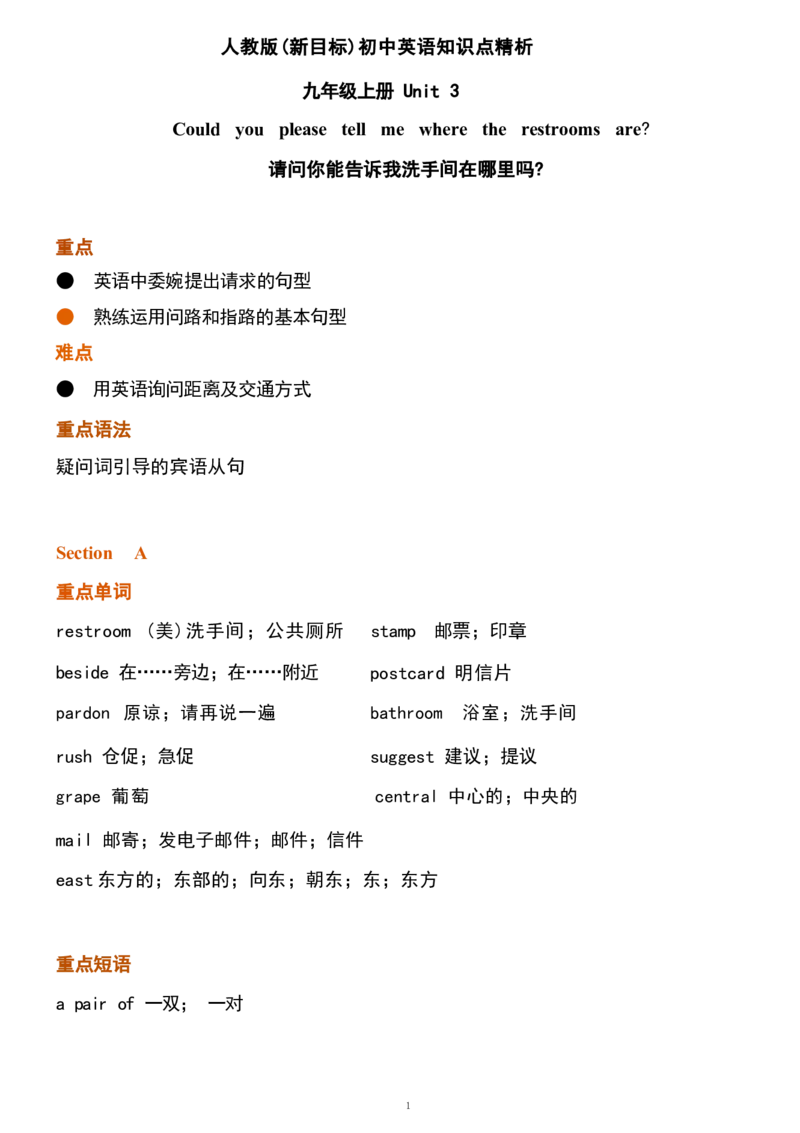
人教版(新目标)初中英语知识点精析
九年级上册 Unit 3
Could you please tell me where the restrooms are?
请问你能告诉我洗手间在哪里吗?
重点
● 英语中委婉提出请求的句型
● 熟练运用问路和指路的基本句型
难点
● 用英语询问距离及交通方式
重点语法
疑问词引导的宾语从句
Section A
重点单词
restroom (美)洗手间;公共厕所 stamp 邮票;印章
beside 在……旁边;在……附近 postcard 明信片
pardon 原谅;请再说一遍 bathroom 浴室;洗手间
rush 仓促;急促 suggest 建议;提议
grape 葡萄 central 中心的;中央的
mail 邮寄;发电子邮件;邮件;信件
east东方的;东部的;向东;朝东;东;东方
重点短语
a pair of 一双; 一对
1excuse me 劳驾;请原谅
pass by 路过;经过短语
turn right 向右转
pardon me 抱歉,对不起;什么,请再说一遍
重点句型
1. Excuse me, could you please tell me how to get to the
bookstore? 打扰一下,你能告诉我如何到书店吗?
2. Do you know when the bookstore closes
today? 你知道今天书店什么时候关门吗
3.Pardon? 什么?
4. You want to rest?你想要休息吗?
Section B
重点单词
convenient 便利的;方便的
corner 拐角;角落
politely 礼貌地;客气地
request 要求;请求
direction 方向;方位
correct 正确的;恰当的
polite 有礼貌的;客气的
direct 直接的;直率的
speaker 讲的人;发言者
whom 谁;什么人
impolite 不礼貌的;粗鲁的
address 住址;地址;通讯处
underground 地下的;地铁
course 课程;学科
重点短语
tell sb.sth.告诉某人某事
2next to 紧挨着
on the corner of 在……的角落/拐角处
lead into 导入;引入
on time 准时;按时
look forward to doing sth. 盼望做某事
重点句型
1. When you visit a foreign country, it is important to know how to ask for
help politely. 当你游览外国时,懂得如何礼貌地请求帮助是重要的。
2. That is because it is a very direct question.那是因为它是一个很直接的问题。
Section A 知识点精析
1. get a pair of shoes 买一双鞋
要点精析
● a pair of 用来表示“一双, 一对”等概念。
● a pair of 虽然后接可数名词复数,但当 “a pair of+名词复数”作主语时,句子
的 谓语动词通常用单数形式;
● 当 “two/ three pairs of+名词复数”作主语时,句子的谓语动词用复数形式;即
谓语动词的形式与 pair 的数保持一致。
例 :That pair of shoes looks good.那双鞋看起来很好看。
Those pairs of trousers are mine.那些裤子是我的。
【助记】
a pair of 一 对 一 双 gloves 手套 shoes 鞋子 socks 袜子
trousers裤子 glasses 眼镜 scissors 刀
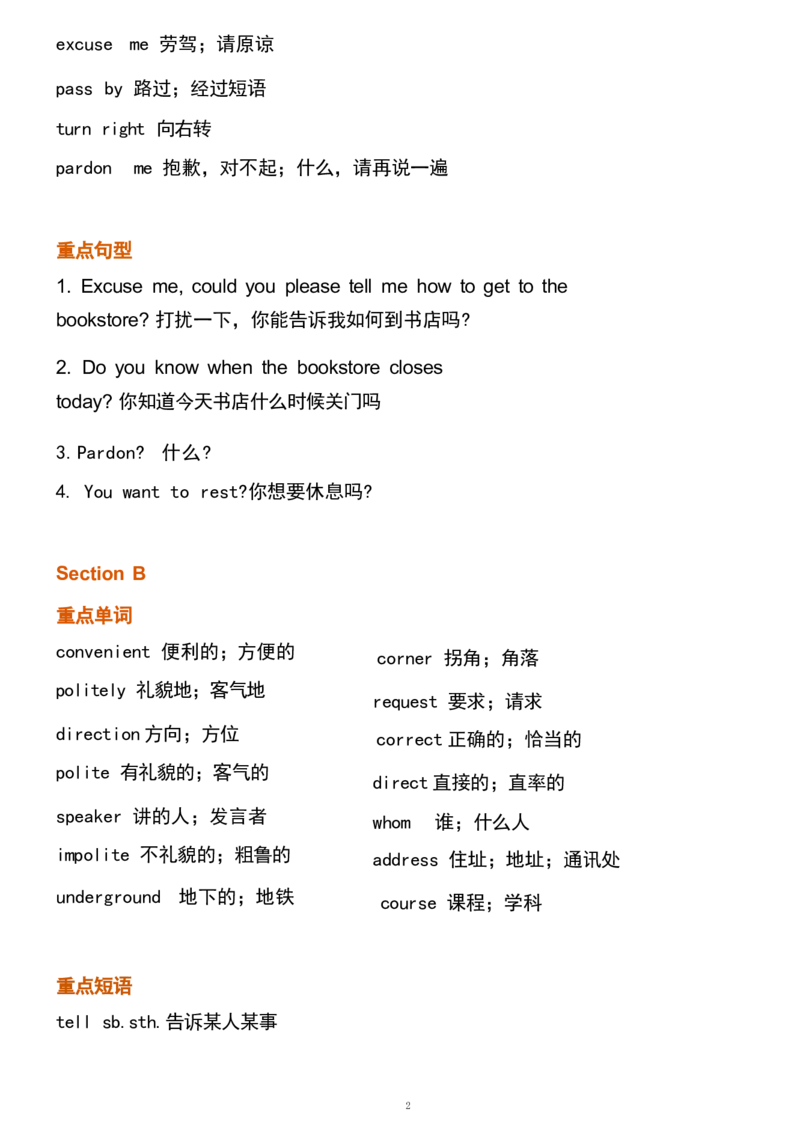
32. Excuse me, could you please tell me how to get to the bookstore?
打扰一下,你能告诉我如何到书店吗?
要点精析 1
本句是问路或问处所的常用句型,此处 excuse me 用以礼貌地引起他人的注意,也
表示尊重对方。
例 :Excuse me, could you tell me how to get to No. 2 Middle School?
打扰一下,你能告诉我怎样到第二中学吗?
知识拓展
常见问路的句型有:
①Where is the.?
Where is the station? 车站在哪儿?
② How can I get to.?
How can I get to the station?我怎样才能到达车站?
③Is there a/an.near /around here?
Is there a station near here?这附近有车站吗?
④ Which is the way to.?
Which is the way to the station?哪条路是去车站的?
⑤Can you tell me the way to … ?
Can you tell me the way to the station? 你能告诉我去车站的路吗?
要点精析 2
● Could you please … ? 意为“请你 ……好吗?”这是表示有礼貌地提出请求的交
际用语。
● please 后接动词原形。
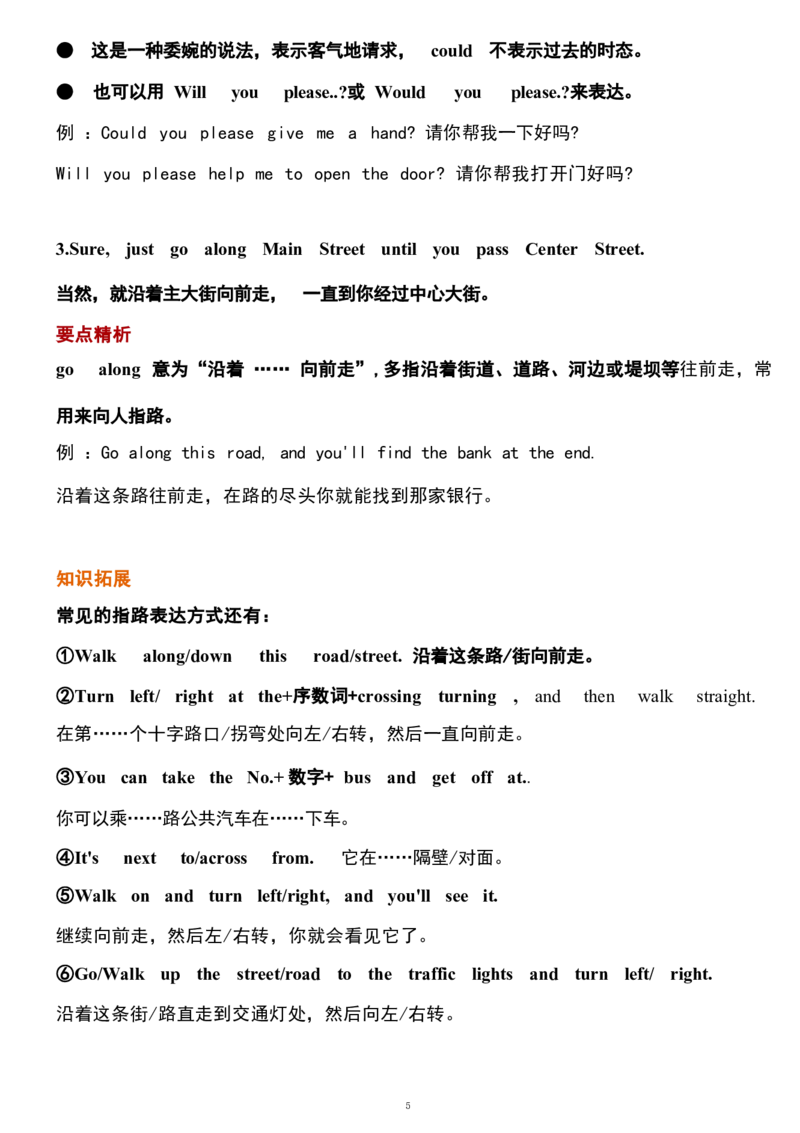
4● 这是一种委婉的说法,表示客气地请求, could 不表示过去的时态。
● 也可以用 Will you please..?或 Would you please.?来表达。
例 :Could you please give me a hand? 请你帮我一下好吗?
Will you please help me to open the door? 请你帮我打开门好吗?
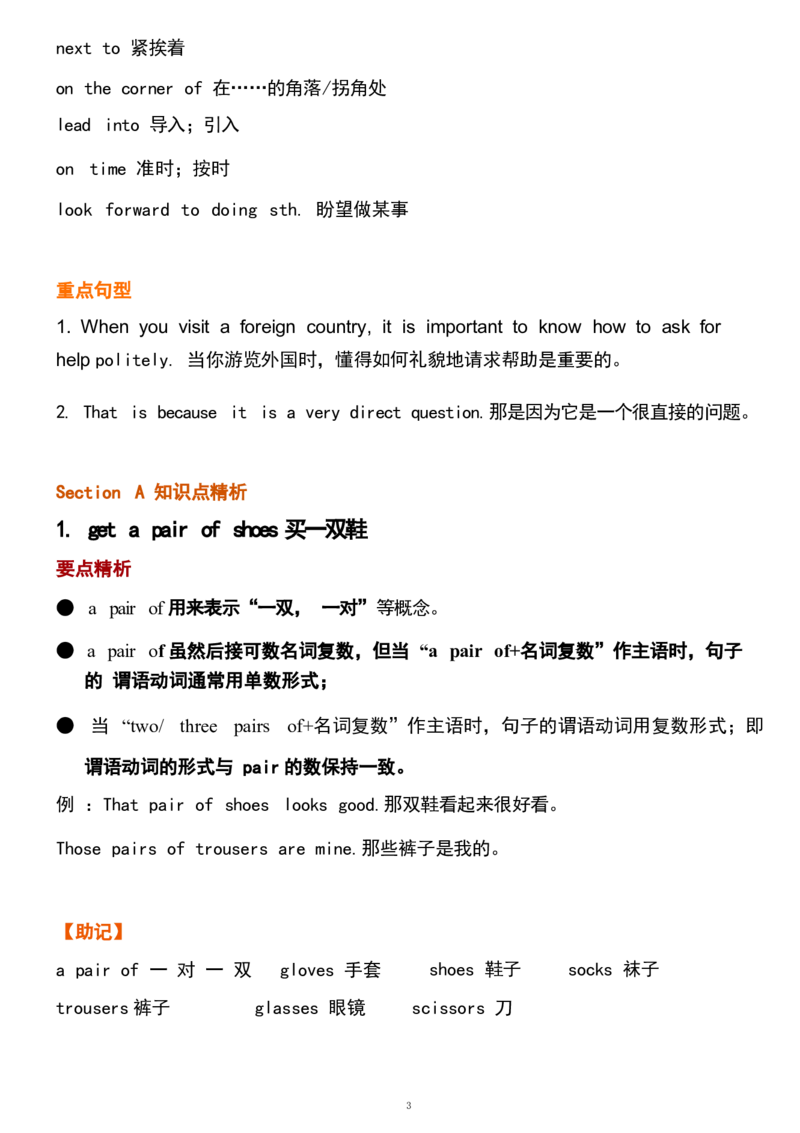
3.Sure, just go along Main Street until you pass Center Street.
当然,就沿着主大街向前走, 一直到你经过中心大街。
要点精析
go along 意为“沿着 …… 向前走”,多指沿着街道、道路、河边或堤坝等往前走,常
用来向人指路。
例 :Go along this road, and you'll find the bank at the end.
沿着这条路往前走,在路的尽头你就能找到那家银行。
知识拓展
常见的指路表达方式还有:
①Walk along/down this road/street. 沿着这条路/街向前走。
②Turn left/ right at the+序数词+crossing turning , and then walk straight.
在第……个十字路口/拐弯处向左/右转,然后一直向前走。
③You can take the No.+ 数字+ bus and get off at..
你可以乘……路公共汽车在……下车。
④It's next to/across from. 它在……隔壁/对面。
⑤Walk on and turn left/right, and you'll see it.
继续向前走,然后左/右转,你就会看见它了。
⑥Go/Walk up the street/road to the traffic lights and turn left/ right.
沿着这条街/路直走到交通灯处,然后向左/右转。
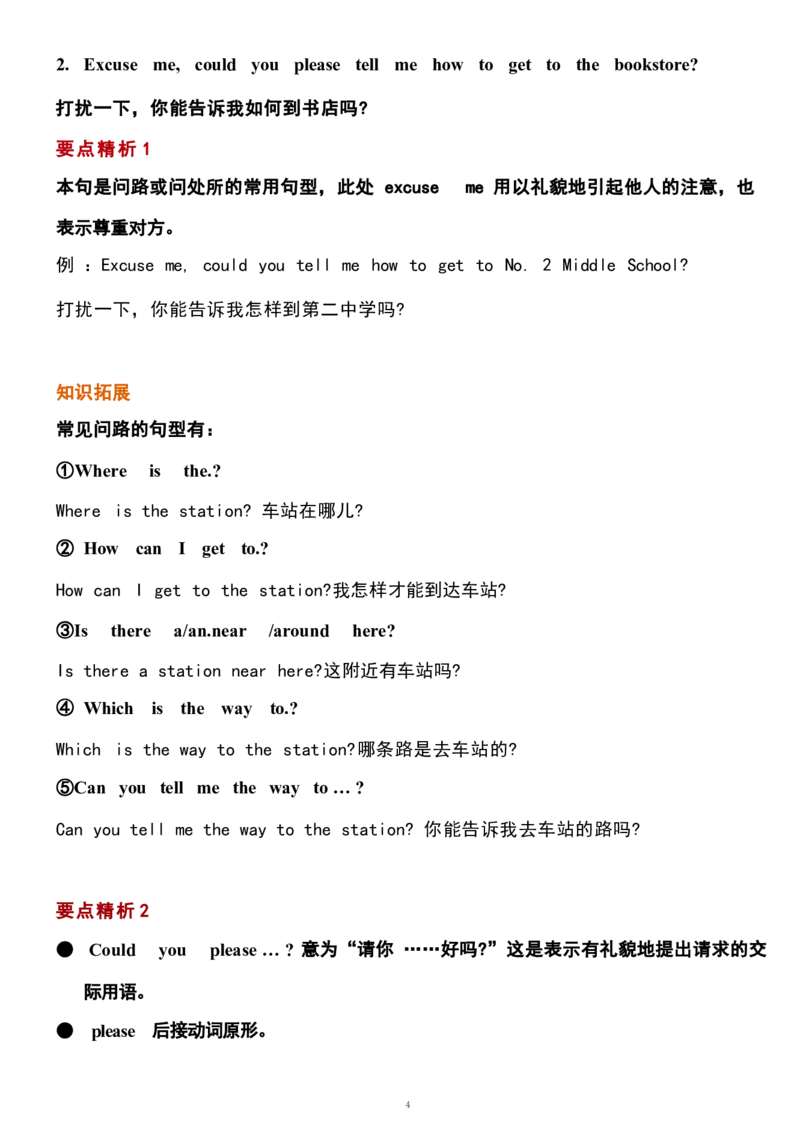
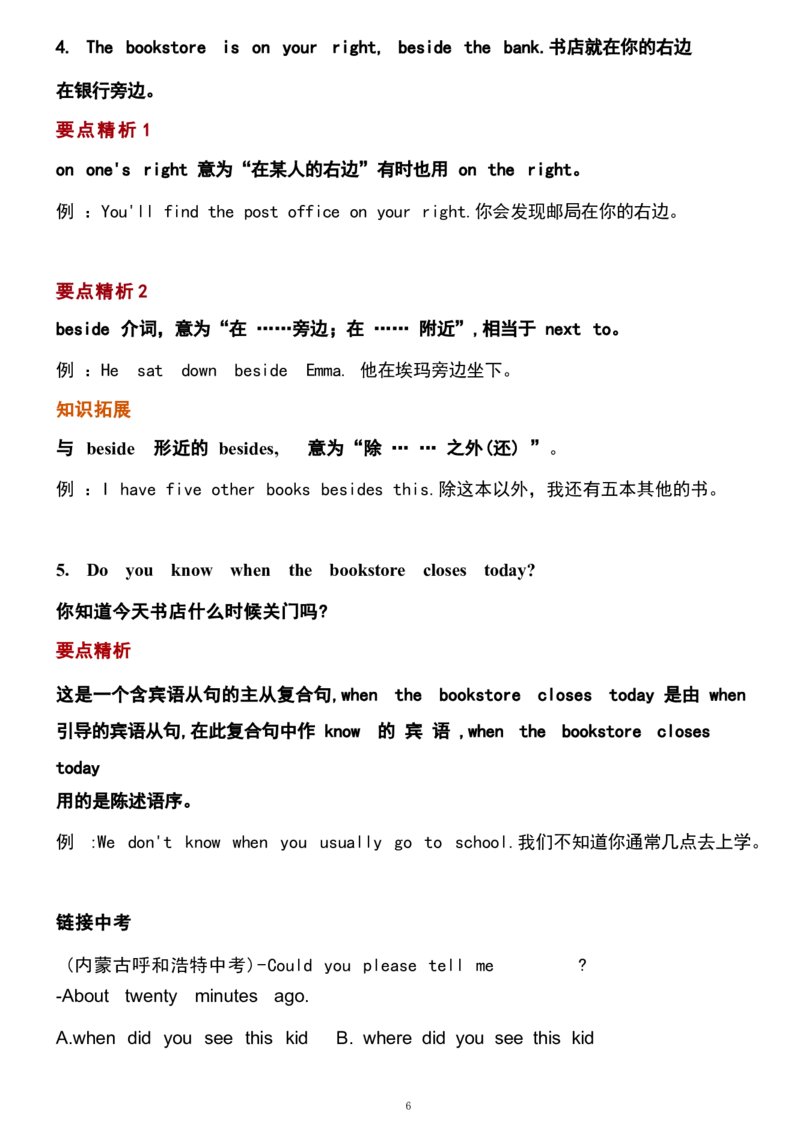
54. The bookstore is on your right, beside the bank.书店就在你的右边
在银行旁边。
要点精析 1
on one's right 意为“在某人的右边”有时也用 on the right。
例 :You'll find the post office on your right.你会发现邮局在你的右边。
要点精析 2
beside 介词,意为“在 ……旁边;在 …… 附近”,相当于 next to。
例 :He sat down beside Emma. 他在埃玛旁边坐下。
知识拓展
与 beside 形近的 besides, 意为“除 … … 之外(还) ”。
例 :I have five other books besides this.除这本以外,我还有五本其他的书。
5. Do you know when the bookstore closes today?
你知道今天书店什么时候关门吗?
要点精析
这是一个含宾语从句的主从复合句,when the bookstore closes today 是由 when
引导的宾语从句,在此复合句中作 know 的 宾 语 ,when the bookstore closes
today
用的是陈述语序。
例 :We don't know when you usually go to school.我们不知道你通常几点去上学。
链接中考
(内蒙古呼和浩特中考)-Could you please tell me ?
-About twenty minutes ago.
A.when did you see this kid B. where did you see this kid
6C. when you saw this kid D. where you saw this kid
解析:由答语“大约二十分钟以前”可知上句是用 when 引导的宾语从句,宾
语从句要用陈述语序,故选 C。
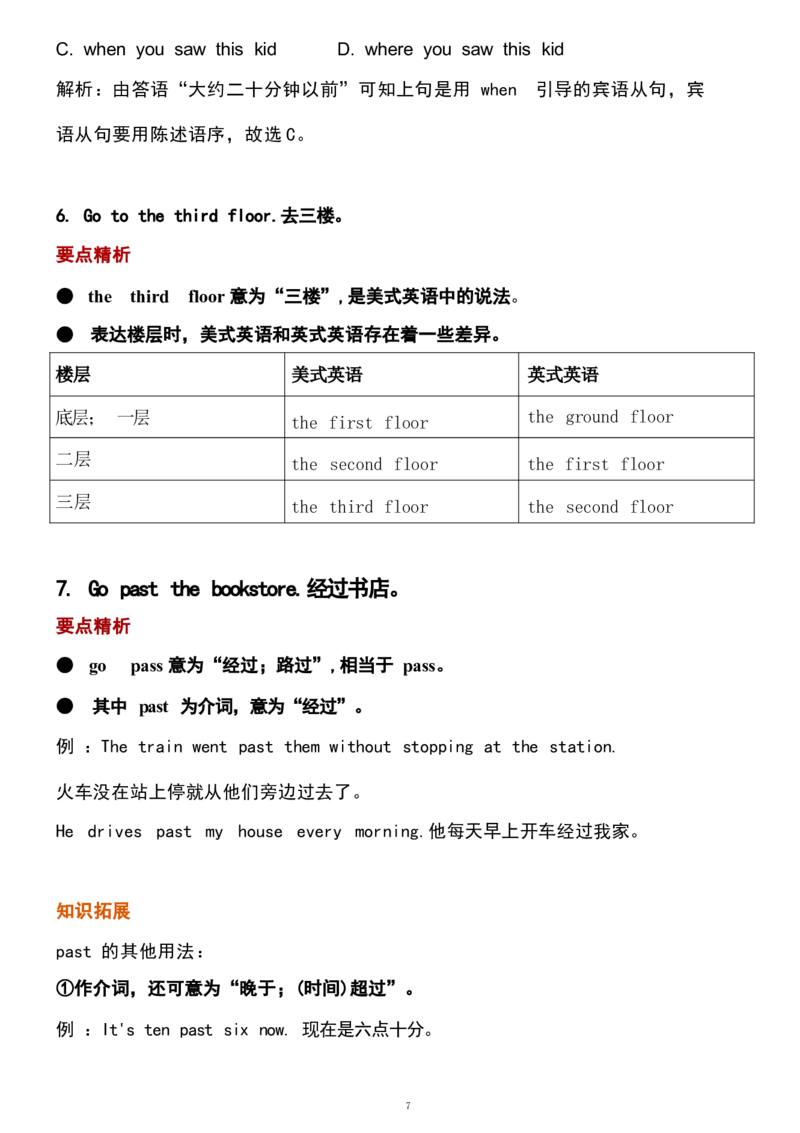
6. Go to the third floor.去三楼。
要点精析
● the third floor 意为“三楼”,是美式英语中的说法。
● 表达楼层时,美式英语和英式英语存在着一些差异。
楼层 美式英语 英式英语
底层; 一层 the ground floor
the first floor
二层
the second floor the first floor
三层
the third floor the second floor
7. Go past the bookstore.经过书店。
要点精析
● go pass 意为“经过;路过”,相当于 pass。
● 其中 past 为介词,意为“经过”。
例 :The train went past them without stopping at the station.
火车没在站上停就从他们旁边过去了。
He drives past my house every morning.他每天早上开车经过我家。
知识拓展
past 的其他用法:
①作介词,还可意为“晚于;(时间)超过”。
例 :It's ten past six now. 现在是六点十分。
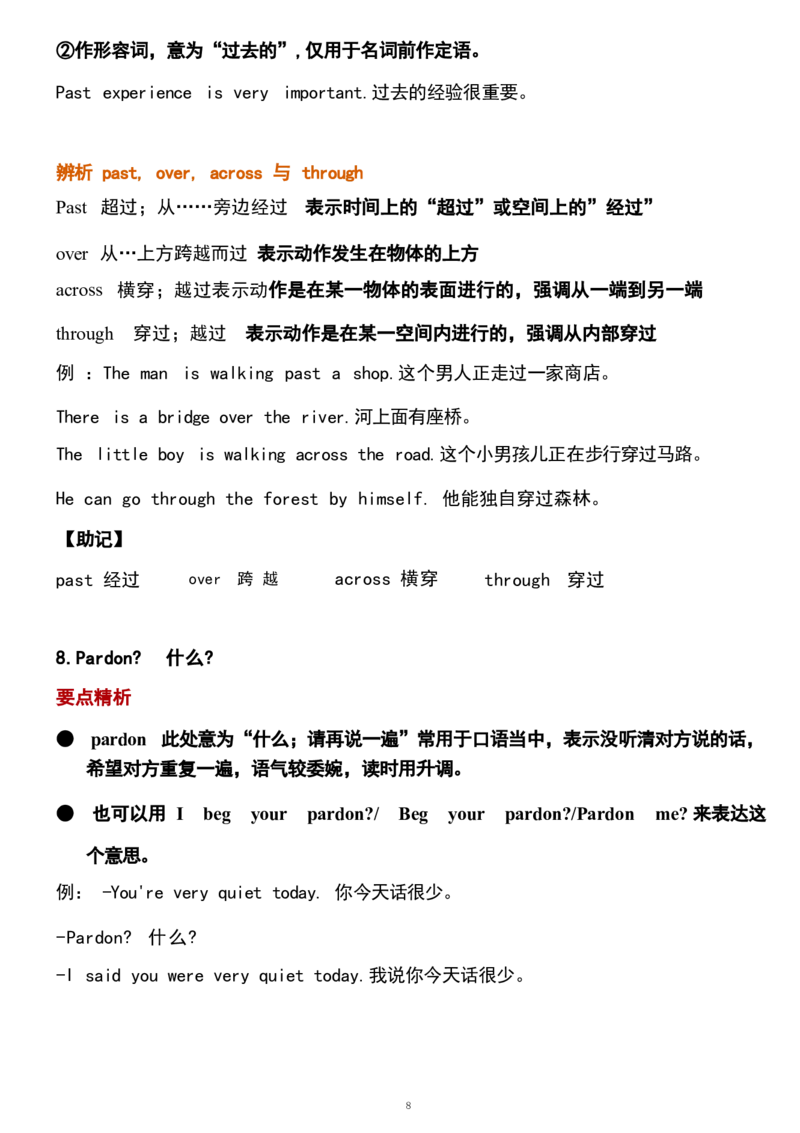
7②作形容词,意为“过去的”,仅用于名词前作定语。
Past experience is very important.过去的经验很重要。
辨析 past, over, across 与 through
Past 超过;从……旁边经过 表示时间上的“超过”或空间上的”经过”
over 从…上方跨越而过 表示动作发生在物体的上方
across 横穿;越过表示动作是在某一物体的表面进行的,强调从一端到另一端
through 穿过;越过 表示动作是在某一空间内进行的,强调从内部穿过
例 :The man is walking past a shop.这个男人正走过一家商店。
There is a bridge over the river.河上面有座桥。
The little boy is walking across the road.这个小男孩儿正在步行穿过马路。
He can go through the forest by himself. 他能独自穿过森林。
【助记】
past 经过 over 跨 越 across 横穿 through 穿过
8.Pardon? 什么?
要点精析
● pardon 此处意为“什么;请再说一遍”常用于口语当中,表示没听清对方说的话,
希望对方重复一遍,语气较委婉,读时用升调。
● 也可以用 I beg your pardon?/ Beg your pardon?/Pardon me? 来表达这
个意思。
例: -You're very quiet today. 你今天话很少。
-Pardon? 什么?
-I said you were very quiet today.我说你今天话很少。
89. You want to rest?你想要休息吗?
要点精析
此句是一种一般疑问句的口语表达方式,即以陈述的形式靠结尾用问号和突出升调来
表示提问,其正常语序的句子为"Do you want to rest?"
例 :So, you're still a nurse? 那么,你还是一名护士吗?
10.But we haven't even started yet! 可是我们甚至还没开始(玩)呢 !
要点精析
● yet 副词,意为“还;仍然”,用来谈论尚未发生但可能发生的事。
● 常用于否定句或疑问句,通常位于句末。
例 :He hasn't done his homework yet. 他还没完成他的家庭作业。
Has John arrived yet?约翰到了吗?
知识拓展
● yet 意为“已经”时,句中的谓语动词在英式英语中常用现在完成时,而在美式英
语中常用一般过去时。
● 肯定句中要用 already; 在否定句中表示“还”只能用 yet, 不能用already 或 still。
例 :Have you read the story yet? ( 英 式 英 语 ) =Did you read the story yet? (
美
式英语) 你读过那个故事了吗?
链接中考
(四川攀枝花中考)-Hi,Lily!Why don't you go swimming with them?
-Because I my homework yet.
A. didn't finish B. won't finish C. haven't finished D. don't finish
解析;句意:"嗨,莉莉!你为什么不和他们一起去游泳?""因为我还没有完成家庭
9作业。”根据答语中的 yet 可知,句子要用现在完成时。故选 C。
11.Sorry, maybe people in China don't often use the word "restroom"
when they speak English.
对不起,也许中国人讲英语时并不常用" restroom 这个词。
要点精析
maybe 副词,意为”也许,可能"。
例 :Maybe she'll come this afternoon.她可能今天下午来。
辨析 maybe 与 may be
● Maybe 副词,意为”也许,可能”,作状语,相当于 perhaps, 常位于句首
● May be 在 may be 中 ,may 是情态动词,be 是动词原形,两者构成完整的谓语,
与主语构成系表结构,意为”也许是,可能是”
例 :Maybe you put the letter in your pocket.也许你把信放在你的口袋里了。
-I can't find my watch.我找不到我的手表了。
-It may be in your pocket. 它可能在你的口袋里。
12.You don't need to rush!你不必着急!
要点精析 1
● need 在这里作实意之动词,意为“需要”。
● 作实意动词时, need 有人称和数的变化,后面可接名词、讲代词、动名词及带to
的动词不定式,可用于肯定句、疑问句或否定句中。
例 :She needs help.她需要帮助。
I don't need to see the doctor.我不需要看医生。
10辨析 need to do 与 need doing
need to do 当句子的主语是人时,用 need to do 表示“某人需要做某事”
need doing 当句子的主语是物时,用 need doing 表示“某物需要怎样处理”
例 :I need to have a rest.我需要休息一下。
My mobile phone needs repairing.我的手机需要修了。
知识拓展
①need 还可以作情态动词,这时无人称和数的变化,后接动词原形,多用于否定句或
疑问句中。
例 :You needn't worry. 你不必担心。
②由 need 引导的一般疑问句,肯定回答常用 must 或 have to; 否定回答常用
needn't。
-Need I answer the question? 我需要回答那个问题吗?
-Yes, you must./Yes, you have to.是的,你必须回答。/是的,你得回答。
-Need I water the flowers? 我需要浇花吗?
-No, you needn't.不,你不必。
要点精析 2
● rush 此处作动词,意为“仓促;急促”。
● rush to do sth. 意为”赶紧做某事;抢着做某事"。
例:People rushed to buy shares in the company yesterday.
昨天人们争着抢购公司的股票。
知识拓展
rush 还可作名词,意为"匆忙;高峰"。常用于短语 in a rush"匆忙地"。
11I can't stop—— I'm in a rush. 我不能停下来——我忙着呢。
13. I suggest Water City Restaurant in Water Word.
我建议(去)水世界的水城餐馆。
要点精析
suggest 作动词,意为“建议;提议”。主要用法有:
(1)suggest sth. (to sb.)(向某人)建议某事
例 :He suggested a picnic yesterday.昨天他提议去野餐。
(2)suggest doing sth.建议做某事
He suggested going there on foot. 他建议步行去那里。
(3)suggest+that 引导的宾语从句,意为“建议……”这时宾语从句要用虚拟语气,
谓语动词用“(should+) 动词原形”。
He suggests that we (should) do it at once. 他建议我们立刻做这件事。
知识拓展
①suggest 作动词,还可以作“显示,间接表明,暗示”讲。后接名词、代词或从句
作宾语,接从句时,从句不用虚拟语气。
例 :Her look suggested that she had known the news.
她的表情表明她已经知道了那个消息。
②suggest 的名词形式是 suggestion, 意为“建议;提议”。
May I make a suggestion? 我可以提个建议吗?
12即学即试
根据句意及首字母提示完成单词
1. Excuse me, how can I get to the r
2. My hobby is collecting s
3. We n say "toilet" or "washroom".
4.Is you obey the rules.
5. In autumn, we eat lots of g
根据汉语意思完成句子
1. 你知道书店今天什么时候关门吗?
Do you know the bookstore today?
2. 我妈妈给我买了一双新鞋。
My mother bought me new shoes.
3. 我们没有必要急着走,时间还早。
We to rush. It is still early.
4. 超市在花店和书店之间。
The supermarket is the flower store the bookstore.
5. 沿着主大街向前走,直到你经过中心大街。
Main Street until you pass Center Street.
Section B 知识点精析
1..the clerk tells him to go to Green land…… 这个职员告诉他去绿土地(餐馆)。
要点精析
tell sb.to do sth. 意为“告诉某人做某事”,其否定结构为 tell sb.not to do sth.,
意为“告诉某人不要做某事”。
13例 :She tells me to do this job. 她告诉我做这份工作。
知识拓展
tell sb.sth.= tell sth. to sb.意为"告诉某人某事"。
例 :She tells me a thing.=She tells a thing to me.她告诉我一件事。
2. When you visit a foreign country, it is important to know how to ask for
help politely.
当你游览外国时,懂得如何礼貌地请求帮助是重要的。
要点精析 1
此句是包含 when 引导的时间状语从句的主从复合句,从句用于表示主句动作发生的
特定时间。
例 :The days get longer when spring comes.=When spring comes, the days get
longer, 春天到来时,白天变长了。
知识拓展
● 当时间状语从句用一般现在时时,主句通常用一般将来时。
● 但如果主句表示的是客观真理或不可改变的现象时,主句仍然用一般现在时。
例 :We will go to the park for a picnic together when my father comes back.当
我父亲回来时,我们就一起去公园野餐。
链接中考
(重庆中考)-When shall we begin our meeting?
-We'l begin it when Helen .
A. comes B. came C. will come D. come
解析:句意:“我们什么时候开给我们的会议?""海伦回来时我们就开始。”答语包含
14when 引导的时间状语从句,主句使用一般将来时,从句要用一般现在时。 选
。
A
要点精析 2
politely 副词,意为“礼貌地;客气地”。
例 :She speaks to everyone politely. 她对每个人说话都很有礼貌。
【助记】
polite(adj.有礼貌的) + ly →politely(adv.礼貌地)
反义词
impolite(adj. 无 礼 的 ) +ly → impolitely (adv.无礼地)
3 . These are similar requests for direction. 这些均是关于问路的类似请求。
要点精析 1
● request 可数名词,意为“要求;请求”
● 当其后接表示请求的具体内容时,常与介词 for 搭配。
例 :Mr. Smith refused their request for a meeting.
史密斯先生拒绝了他们会面的要求。
知识拓展
①make a request(for sth.) 要求/请求(某事物)
They decided to make a request for inter-national aid.他们决定请求国际帮助。
②request 还可作及物动词,意为“要求;请求 ”。
常用于搭配 request sth.from sb.“向某人请求/要求某事物”,request sb. to do
sth. “请求/要求某人做某事”。
例 :They tried to request help from the society. 他们试图向社会寻求帮助。
15The English teacher requests us to hand in our homework on time.
英语老师要求我们按时交作业。
要点精析 2
● direction 名词,意为“方向;方位”。
● 在此处指“(对行路方向的)指引”,这一用法时它常用复数形式,常与 give,ask
for 等动词(短语)及介词 to 搭配。
例 :Let's stop and ask for directions.咱们停下来问问路吧。
4 . That is because it is a very direct question. 那是因为它是一个很直接的问题。
要点精析 1
that is because…意为“那是因为 ……”,其中 because 引导的句子作表语,是表语
从句,说明原因。
例 :He has heart disease. That is because he has been smoking too much.
他有心脏病,那是因为他一直抽烟太多。
要点精析 2
direct 此处用作形容词,意为“直接的,直率的”,其反义词为 indirect, 意为“间接
的”;副词为 directly, 意为“直接地”。
例 :You'll have to get used to his direct manner.
你可得慢慢习惯他这种直接的方式。
知识拓展
direct 还可用作及物动词,意为"指导,导演;指路"。
例 :He directed the building of the new bridge.他指导修建了这座新桥。
165. The
expressions they use might depend on
whom they are
speaking
to or how well they know each other.
他们使用的表达方式可能取决于他们和谁说话或他们对彼此的熟悉程度。
要点精析 1
● they use 是省略了关系代词 that 或 which 的定语从句,修饰先行词 the
expressions, 表示“他们使用的表达方式”。
● 定语从句要放在它所修饰的词的后面。
例 :The people who called yesterday want to buy the house.
昨天打来电话的人想买这座房子。
要点精析 2
whom they are speaking to or how well they know each other 是由 whom 和
how 引导的宾语从句,作 on 的宾语,宾语从句用陈述语序。
例 :He didn't tell me when we would meet and where we would eat.
他没有告诉我我们将何时见面及在哪里吃饭。
6.Sometimes we even need to spend time leading into a request.有时候,我
们甚至需要花时间来导入一个请求。
要点精析
spend 动词,意为“花费(金钱、时间等)”,主语是人。
例 :I spent two hours (in) reading the novel. 我花了两个小时读这篇小说。
辨析 spend,pay, take 与 cost
(1)spend 常用结构:spend.(in)doing sth.(花费 ……做某事)或 spend.on
sth.(在某事/某物上花费 ……)
17(2)pay 意为“付费”,主语是人,常用于 Sb.pay(s)/ paid some money
for sth. (某人为某物花费一些钱)句型中
(3)take 意为“花费”,常用于 It takes /took sb. … to do sth(做某事花费某人 … …
)
句型中
(4)cost 意为“花费”,主语是物,常用于 Sth.cost(s)sb. some money ( 某 物
花费某人一些钱)句型中
例 :We spent one year (in) building the bridge.我们花费了一年建这座桥。
I paid 100 dollars for the bike.我花一百美元买了这辆自行车。
It took me two hours to do my homework.
做家庭作业花了我两个小时的时间。
This bike cost me 100 dollars. 这辆自行车花了我 100 美元。
链接中考
(山东临沂中考) Thanks to the robots, the human reporters do not have to
spend a lot of time numbers and in formation.
A. processing B. to process C. processed D. process
解析:根据句意“幸亏有机器人,人类记者就不必花费大量的时间来处理数字和信息
了"可知,表示"某人花费时间做某事”用 spend+ 时间+ (in)doing sth.,故 选 A。
7. thank the person for helping you. 感谢这个人帮助你。
要点精析
● thank sb,for(doing)sh.意为“因(做)某事而感谢某人”,其中 for 为介词,
后跟名词、代词或动词-ing 形式作宾语。
● thank you for(doing)sth. 相当于 thanks for(doing)sth.。
例 :Thank the boy for his advice.谢谢那个男孩儿给的建议。
18Thank you for(=Thanks for) teaching us so well. 谢谢你把我们教得如此好
知识拓展
thanks to sb./sth. 表示“多亏;因为;由于”的意思。
例 :Thanks to Mr. Zhang. He made great progress in English.
多了张老师,他的英语取得了很大的进步。
Thanks to your program, we got to know each other.
因为你们的节目,我们方能相互认识。
8.I'd like to know about…我想知道有关……
要点精析
wo uld like 意为“想,想要”,与 want 同义,但在语气上比 want 更委婉,would like
的用法主要有:
(1)would like sth.想要某物
例 :I'd like some apples.我想要一些苹果。
(2)would like to do sth.想要做某事
He'd like to go to the supermarket. 他想去超市。
(3)would like sb.to do sth.想要某人做某事
She'd like me to go shopping with her. 她想要我和她一起去购物。
知识拓展
①would like 无人称和数的变化, 一般疑问句把 would 提到主语之前。
②Would you like …? 问句的肯定回答多用 Yes, please./Yes, I'd/We'd
like/love
to./Certainly./Yes ,thank you.等;否定回答常用 No,thanks./No,thank
you.
等。
19例: -Would you like some tea? 你想要喝茶吗?
-Yes,thank you. 是的,谢谢。
-Would you like to stay here with us? 你想和我们一起待在这儿吗?
-Yes,I'd love to.是的,我想。
9.I'm looking forward to your reply.我期待着你的回复。
要点精析 1
look forward to 意为“盼望;期待”,其中to 是介词,其后可接名词、代词或动词
-ing 形式。
例 :I'm looking forward to receiving your letter.我盼望着收到你的来信。
链接中考
(湖北荆门中考)-Hell Mom. Long time no see!
Hello! Mary. Are you busy these days? I am looking forward your phone.
A. to answer B. answering .to wrig D.answer
解析:句意:"您好!妈妈。好久不见!”"你好!玛丽。这些日子很忙吗?我一直期待
着你的电话。" look forward to doing sth.,是固定用法,故选C。
要点精析 2
reply 既可以用作名词,也可以用作动词,意为“回答”,与 answer 同义。
辨析 reply 与 answer
● reply 比 answer 正式,既可指口头或书面作答,也可指用动作或手势作答,常
用 于正式场合或书面语中,指经过慎重考虑做出的答复
● answer 可指口头或书面作答,也可指用行动回答, 口语中用的多,有时可与 reply
通用
20例 :I sent in my application, and the school replied immediately.
我把申请书交上去了,学校方面立即给了答复。
I don't know what to reply.我不知道该回答什么。
Who can answer the question? 谁能回答这个问题?
Please answer the telephone. 请接一下电话。
知识拓展
在表示回答问题时, answer 后直接跟 question; reply 后要加介词 to。
即学即试
根据句意及首字母提示完成单词
1. We went to the park together. The scene was very f
2.I live just by the market, and it's very c to go
shopping.
3. That c is laboring for a promotion.
4. You should deal with him more p
5. Just a minute. Let me stick down his a and telephone number.
单项填空
1.-When will he come?
-When ,I'll let you know.
A. does he come B.he comes C. will he come D. he will come
2. (山东青岛中考)-How much is the ticket to the Central Park?
-A one-way ticket $40, and you can another $20 for a round trip.
A. costs; pay B. cost; spend C.pay; spend D. spends; pay
3. (山东滨州中考)-Hi, Bruce. Here is a letter for you.
-Thanks. I wonder
21A. who the letter was from
B. who was from the letter
C who was the letter from
D who from the letter was
4. (山东滩坊中考) The woman asked the policeman where
A. the post office is
B.was the post office
C. is the post office
D. the post office was
5. (山东烟台中考)-Tom, would you like to train our football team?
A. Sure, I'd like to B.You're welcome C.It's my pleasure D. Not at all参考答案:
Section A
即学即试
I
1.restroom 2.Stamps 3. normally 4. suggest 5.
grapes
Ⅱ
1.when, closes
2. a pair of
3. don't need
4. between, and 5. Go along
Section B
即学即试
I
1.fascinating 2. convenient 3.clerk 4. politely
5. address
Ⅱ
1.B 由主句 I'll let you know 用一般将来时可知,时间状语从句要用一般现在时且用陈
述语序,故选 B。
2.A cost 花费”,物作主语; spend “花费”人作主语; pay for “付款”,人作主
语。所以选 A。
3.A 在主从复合句中,宾语从句的语序要用陈述语序。短语 be from 意为“来自”。答
语句意为"多谢。我想知道这封信是谁发来的"。所以选 A。
4.D 宾语从句用陈述语序, B、C 两项语序不对,故排除;主句用一般过去时,从句受
主句限制,要用过去的某种时态,排除 A, 所以选 D。
5.A 回答 Would you like to do…?问句时,肯定回答用 Yes/Sure, I'd like to,故
选 A。
23