人教版(新标准)初中英语知识点精析
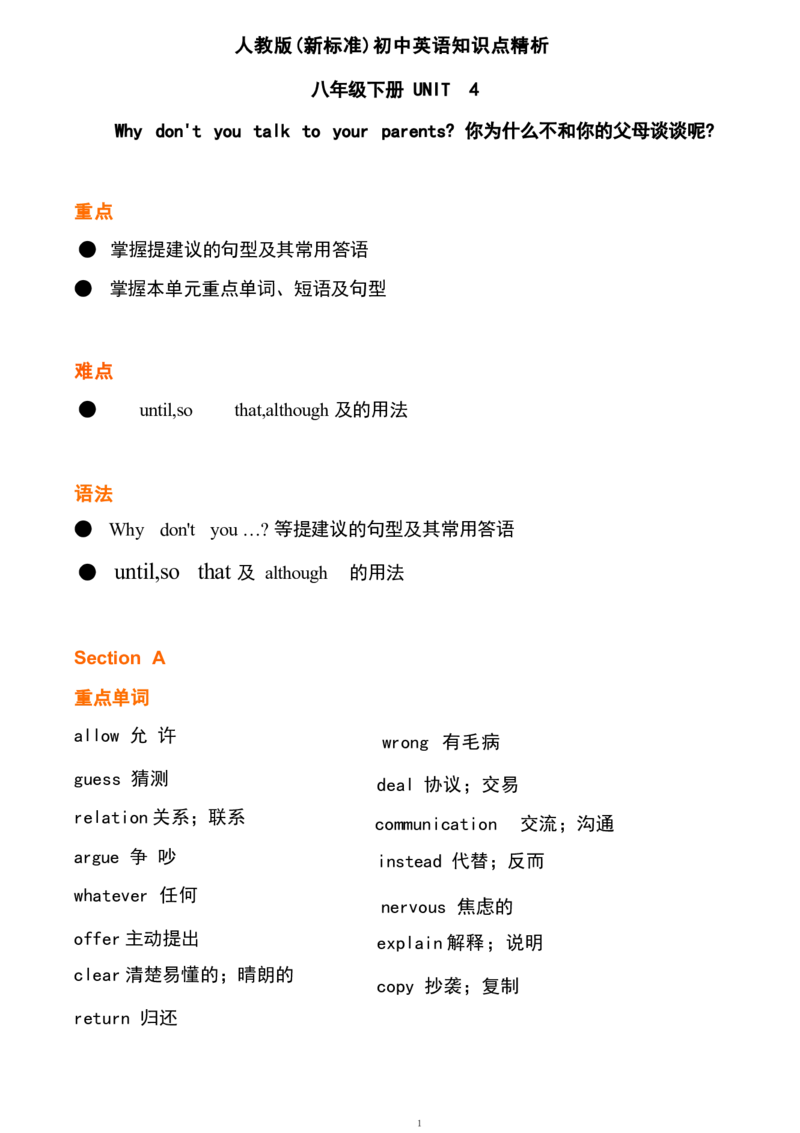
八年级下册 UNIT 4
Why don't you talk to your parents? 你为什么不和你的父母谈谈呢?
重点
● 掌握提建议的句型及其常用答语
● 掌握本单元重点单词、短语及句型
难点
● until,so that,although 及的用法
语法
● Why don't you …? 等提建议的句型及其常用答语
● until,so that 及 although 的用法
Section A
重点单词
allow 允 许
wrong 有毛病
guess 猜测
deal 协议;交易
relation 关系;联系
communication 交流;沟通
argue 争 吵
instead 代替;反而
whatever 任何
nervous 焦虑的
offer主动提出
explain解释;说明
clear清楚易懂的;晴朗的
copy 抄袭;复制
return 归还
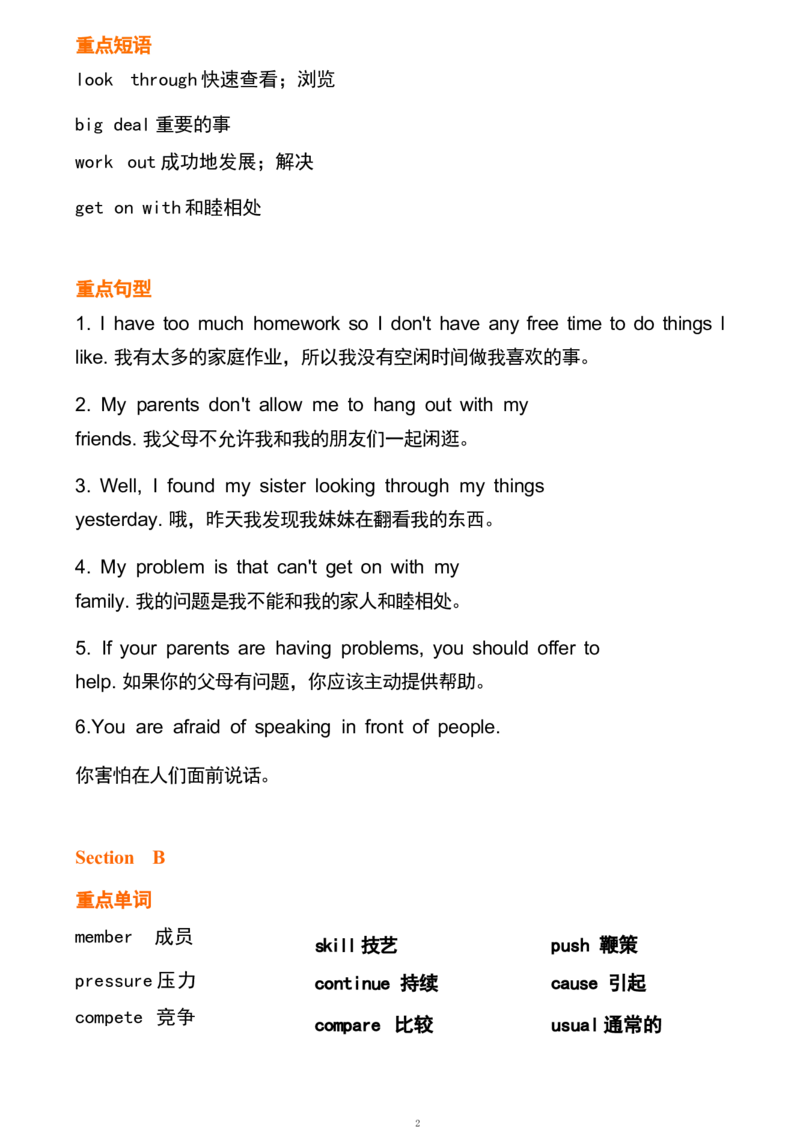
1重点短语
look through 快速查看;浏览
big deal 重要的事
work out 成功地发展;解决
get on with 和睦相处
重点句型
1. I have too much homework so I don't have any free time to do things l
like. 我有太多的家庭作业,所以我没有空闲时间做我喜欢的事。
2. My parents don't allow me to hang out with my
friends. 我父母不允许我和我的朋友们一起闲逛。
3. Well, I found my sister looking through my things
yesterday. 哦,昨天我发现我妹妹在翻看我的东西。
4. My problem is that can't get on with my
family. 我的问题是我不能和我的家人和睦相处。
5. If your parents are having problems, you should offer to
help. 如果你的父母有问题,你应该主动提供帮助。
6.You are afraid of speaking in front of people.
你害怕在人们面前说话。
Section B
重点单词
member 成员
skill 技艺 push 鞭策
pressure 压力 continue 持续 cause 引起
compete 竞争
compare 比较 usual 通常的
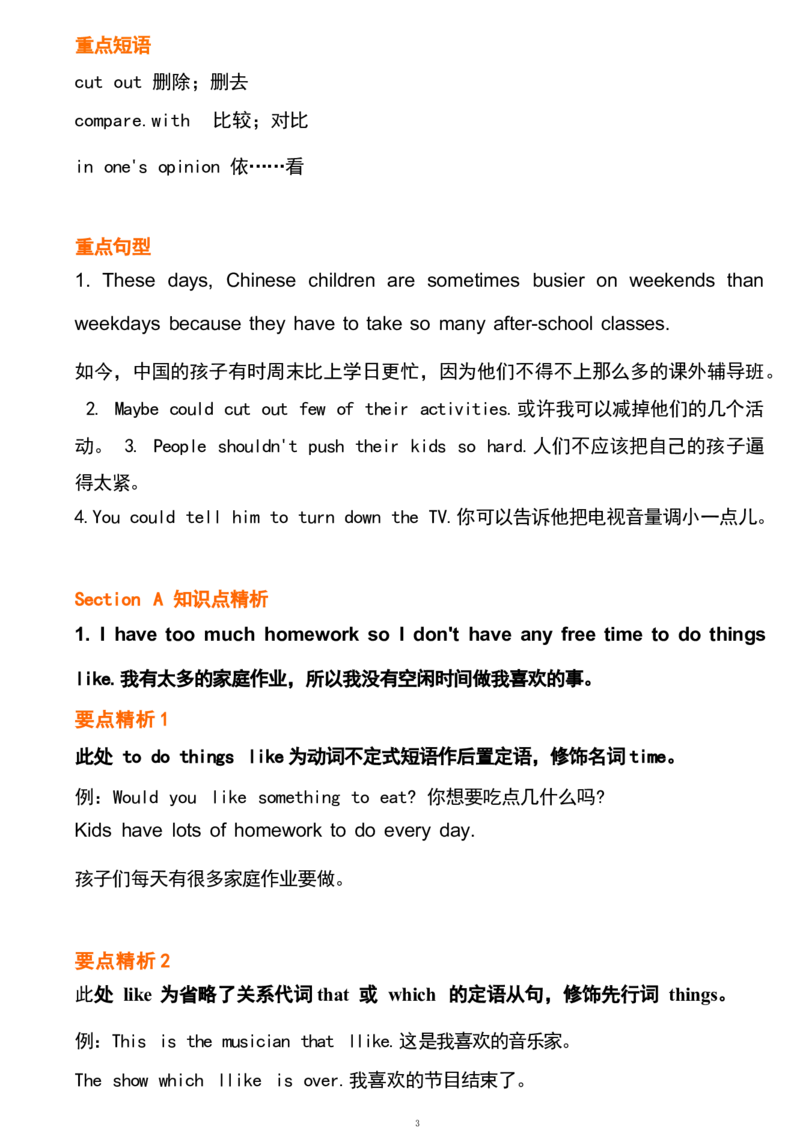
2重点短语
cut out 删除;删去
compare.with 比较;对比
in one's opinion 依……看
重点句型
1. These days, Chinese children are sometimes busier on weekends than
weekdays because they have to take so many after-school classes.
如今,中国的孩子有时周末比上学日更忙,因为他们不得不上那么多的课外辅导班。
2. Maybe could cut out few of their activities.或许我可以减掉他们的几个活
动。 3. People shouldn't push their kids so hard.人们不应该把自己的孩子逼
得太紧。
4.You could tell him to turn down the TV.你可以告诉他把电视音量调小一点儿。
Section A 知识点精析
1. I have too much homework so I don't have any free time to do things
like.我有太多的家庭作业,所以我没有空闲时间做我喜欢的事。
要点精析 1
此处 to do things like 为动词不定式短语作后置定语,修饰名词 time。
例:Would you like something to eat? 你想要吃点几什么吗?
Kids have lots of homework to do every day.
孩子们每天有很多家庭作业要做。
要点精析 2
此处 like 为省略了关系代词 that 或 which 的定语从句,修饰先行词 things。
例:This is the musician that llike.这是我喜欢的音乐家。
The show which llike is over.我喜欢的节目结束了。
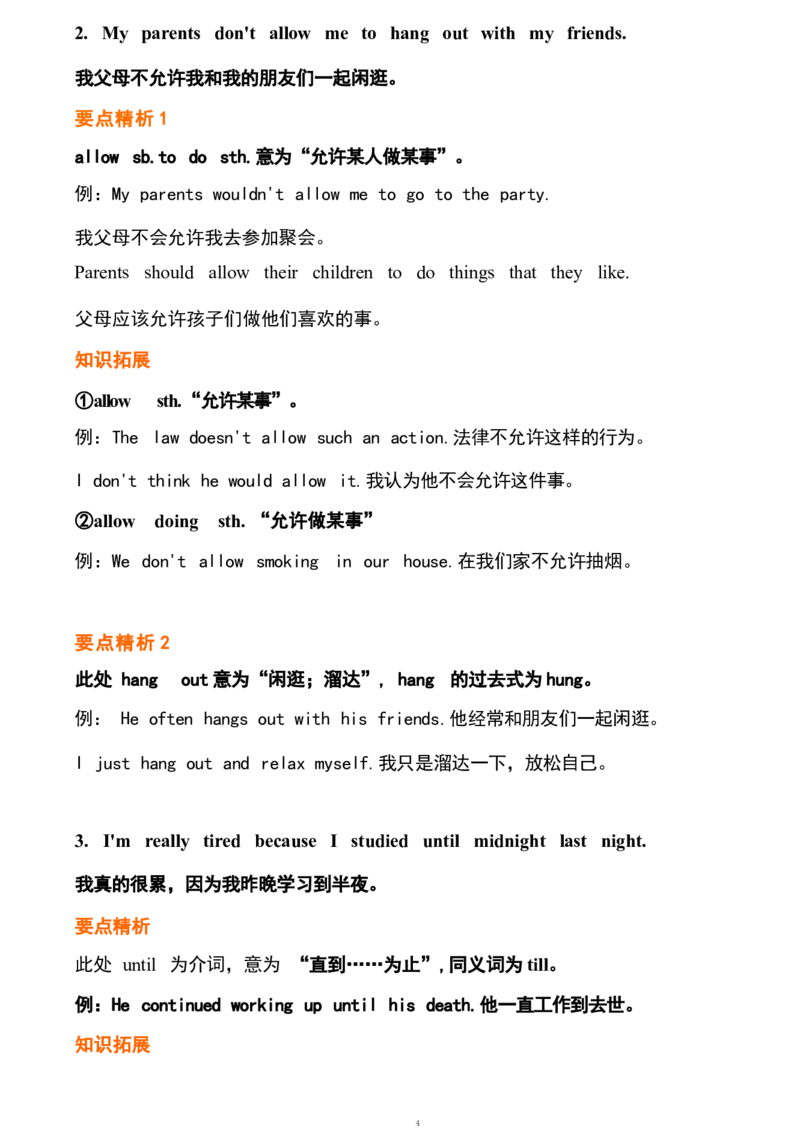
32. My parents don't allow me to hang out with my friends.
我父母不允许我和我的朋友们一起闲逛。
要点精析 1
allow sb.to do sth.意为“允许某人做某事”。
例:My parents wouldn't allow me to go to the party.
我父母不会允许我去参加聚会。
Parents should allow their children to do things that they like.
父母应该允许孩子们做他们喜欢的事。
知识拓展
①allow sth.“允许某事”。
例:The law doesn't allow such an action.法律不允许这样的行为。
I don't think he would allow it.我认为他不会允许这件事。
②allow doing sth. “允许做某事”
例:We don't allow smoking in our house.在我们家不允许抽烟。
要点精析 2
此处 hang out 意为“闲逛;溜达”, hang 的过去式为hung。
例: He often hangs out with his friends.他经常和朋友们一起闲逛。
I just hang out and relax myself.我只是溜达一下,放松自己。
3. I'm really tired because I studied until midnight last night.
我真的很累,因为我昨晚学习到半夜。
要点精析
此处 until 为介词,意为 “直到……为止”,同义词为till。
例:He continued working up until his death.他一直工作到去世。
知识拓展
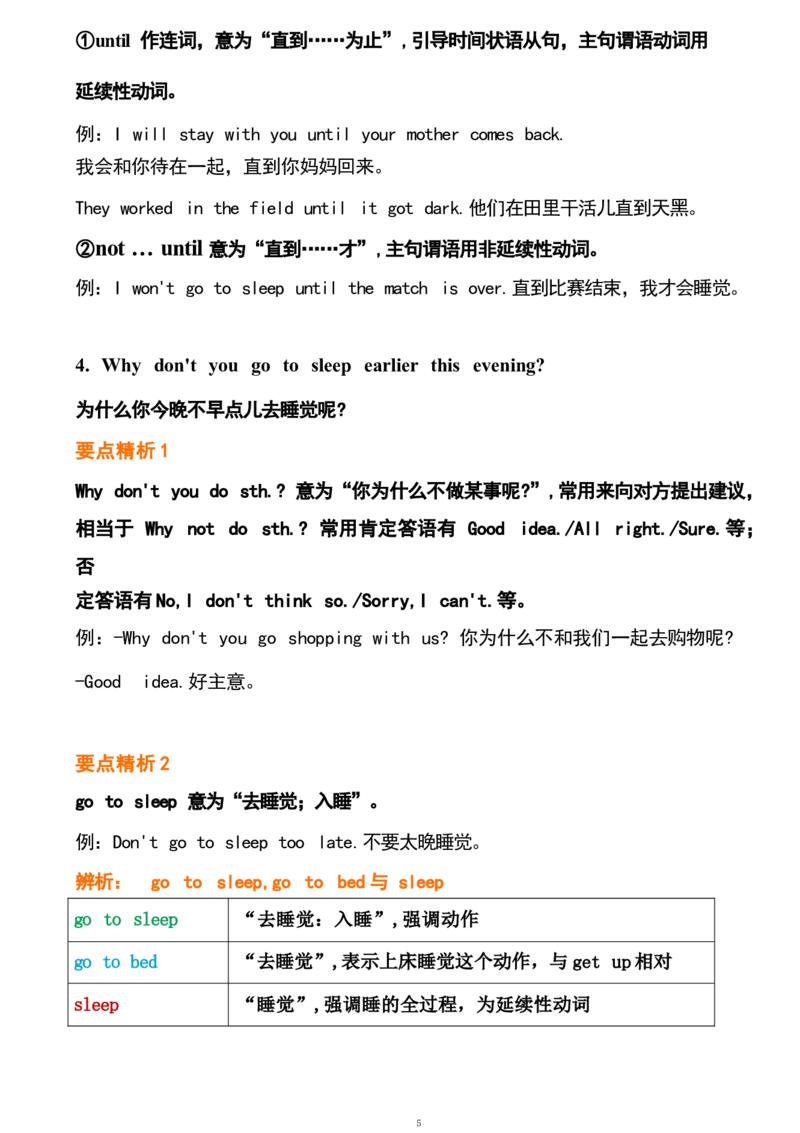
4①until 作连词,意为“直到……为止”,引导时间状语从句,主句谓语动词用
延续性动词。
例:I will stay with you until your mother comes back.
我会和你待在一起,直到你妈妈回来。
They worked in the field until it got dark.他们在田里干活儿直到天黑。
②not … until 意为“直到……才”,主句谓语用非延续性动词。
例:I won't go to sleep until the match is over.直到比赛结束,我才会睡觉。
4. Why don't you go to sleep earlier this evening?
为什么你今晚不早点儿去睡觉呢?
要点精析 1
Why don't you do sth.? 意为“你为什么不做某事呢?”,常用来向对方提出建议,
相当于 Why not do sth.? 常用肯定答语有 Good idea./All right./Sure.等;
否
定答语有 No,I don't think so./Sorry,I can't.等。
例:-Why don't you go shopping with us? 你为什么不和我们一起去购物呢?
-Good idea.好主意。
要点精析 2
go to sleep 意为“去睡觉;入睡”。
例:Don't go to sleep too late.不要太晚睡觉。
辨析: go to sleep,go to bed 与 sleep
go to sleep “去睡觉:入睡”,强调动作
go to bed “去睡觉”,表示上床睡觉这个动作,与 get up相对
sleep “睡觉”,强调睡的全过程,为延续性动词
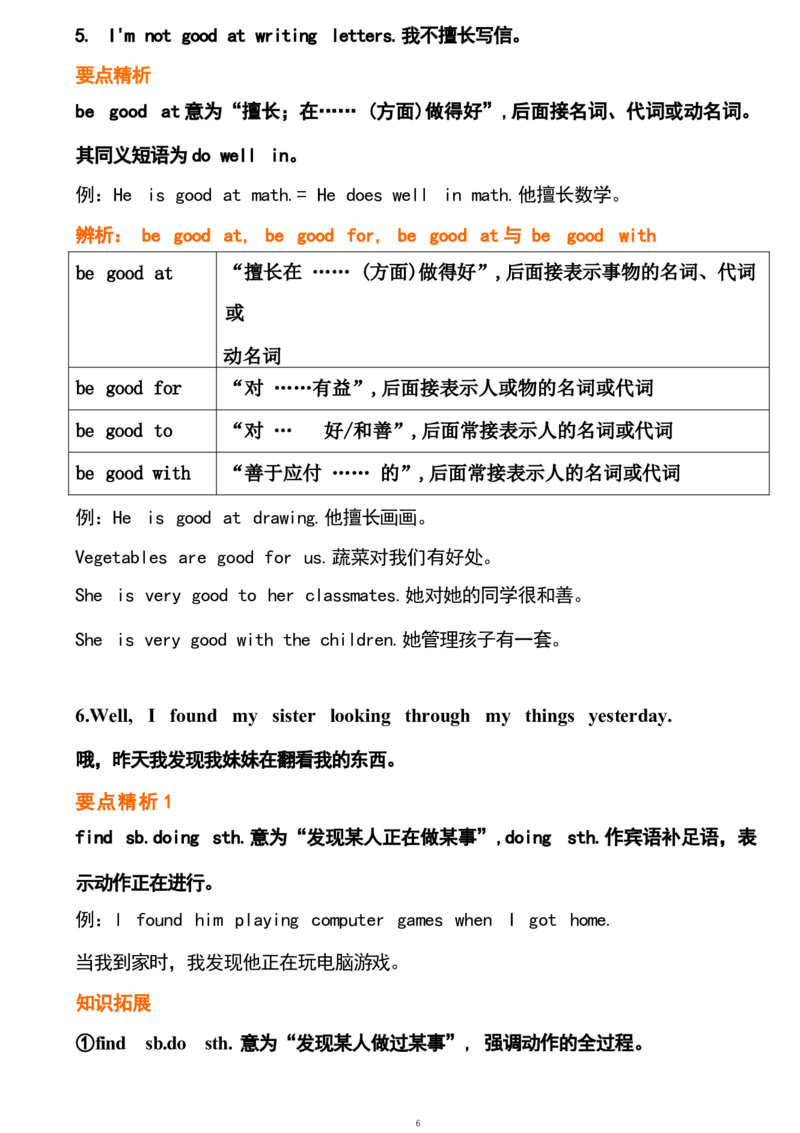
55. I'm not good at writing letters.我不擅长写信。
要点精析
be good at 意为“擅长;在…… (方面)做得好”,后面接名词、代词或动名词。
其同义短语为 do well in。
例:He is good at math.= He does well in math.他擅长数学。
辨析: be good at, be good for, be good at 与 be good with
be good at “擅长在 …… (方面)做得好”,后面接表示事物的名词、代词
或
动名词
be good for “对 ……有益”,后面接表示人或物的名词或代词
be good to “对 … 好/和善”,后面常接表示人的名词或代词
be good with “善于应付 …… 的”,后面常接表示人的名词或代词
例:He is good at drawing.他擅长画画。
Vegetables are good for us.蔬菜对我们有好处。
She is very good to her classmates.她对她的同学很和善。
She is very good with the children.她管理孩子有一套。
6.Well, I found my sister looking through my things yesterday.
哦,昨天我发现我妹妹在翻看我的东西。
要点精析 1
find sb.doing sth.意为“发现某人正在做某事”,doing sth.作宾语补足语,表
示动作正在进行。
例:l found him playing computer games when I got home.
当我到家时,我发现他正在玩电脑游戏。
知识拓展
①find sb.do sth. 意为“发现某人做过某事”, 强调动作的全过程。
6②有类似用法的动词还有: notice,hear,see 等。
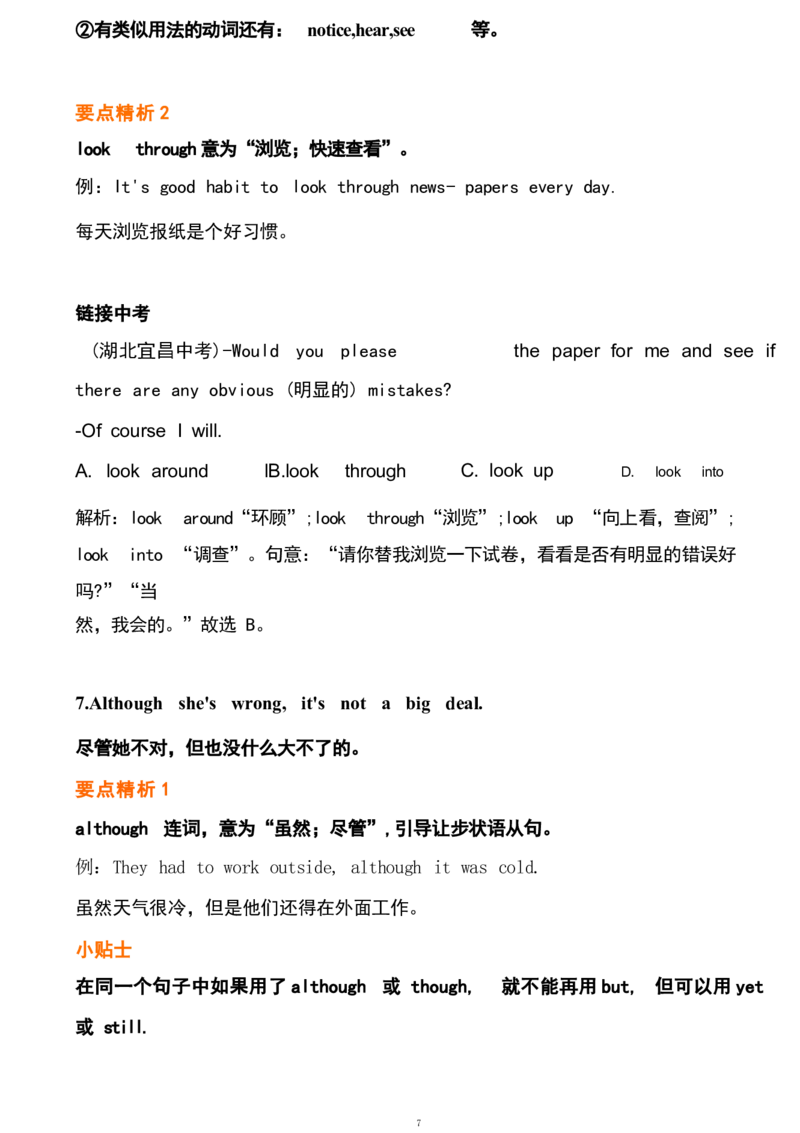
要点精析 2
look through意为“浏览;快速查看”。
例:It's good habit to look through news- papers every day.
每天浏览报纸是个好习惯。
链接中考
(湖北宜昌中考)-Would you please the paper for me and see if
there are any obvious (明显的) mistakes?
-Of course I will.
A. look around lB.look through C. look up D. look into
解析:look around“环顾”;look through“浏览”;look up “向上看,查阅”;
look into “调查”。句意:“请你替我浏览一下试卷,看看是否有明显的错误好
吗?”“当
然,我会的。”故选 B。
7.Although she's wrong, it's not a big deal.
尽管她不对,但也没什么大不了的。
要点精析 1
although 连词,意为“虽然;尽管”,引导让步状语从句。
例:They had to work outside, although it was cold.
虽然天气很冷,但是他们还得在外面工作。
小贴士
在同一个句子中如果用了 although 或 though, 就不能再用 but, 但可以用 yet
或 still.
7链接中考
(海南中考) the girl is only six years old, she knows more than
300 ancient Chinese poems.
A.If B.Unless C. Although
解析: if 意为“如果,是否”; unless 意为“除非,如果不”;although 意为“虽
然, 尽管”。结合句意“这个女孩儿仅仅 6 岁,她知道 300 多首中国古诗”可知,
应用
although 引导让步状语从句。选 C。
要点精析 2
lt's not a big deal意为“没什么大不了;不是什么大事”,常用于口语中。a big deal
是固定搭配,意为“重要的事”。
例:Change the meeting time. It's not big deal.
改一下会议时间吧。这没什么大不了的。
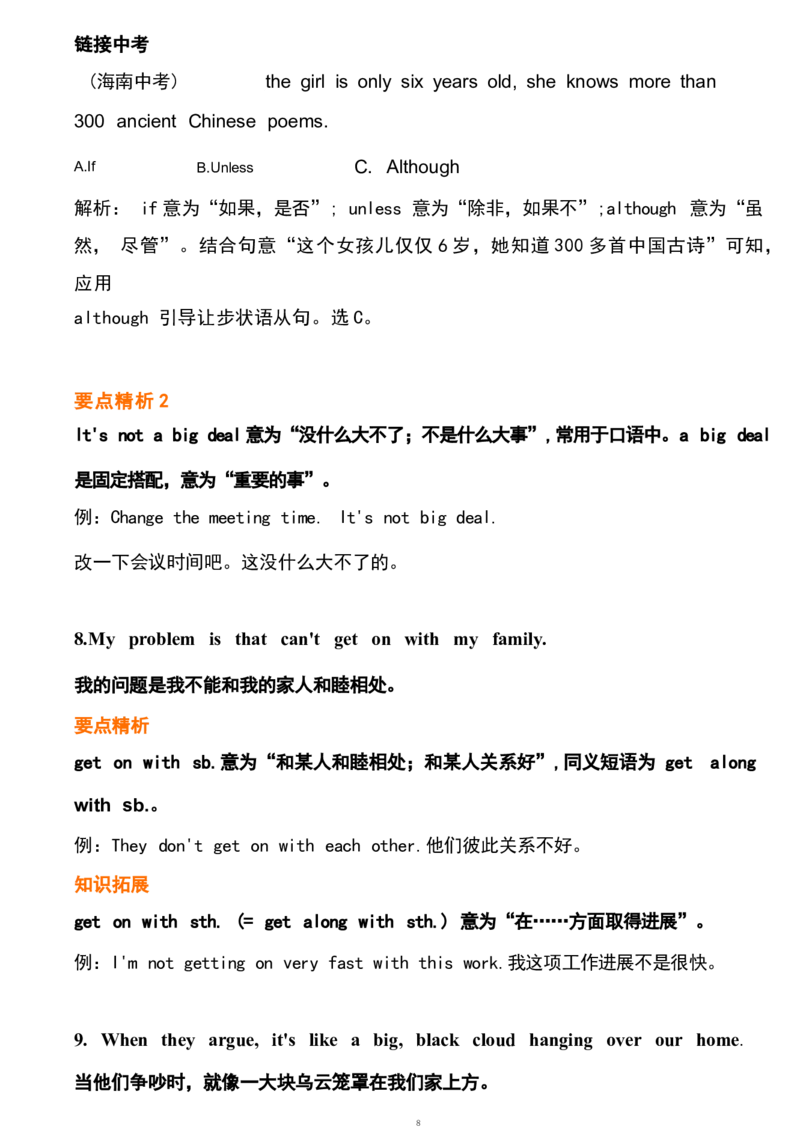
8.My problem is that can't get on with my family.
我的问题是我不能和我的家人和睦相处。
要点精析
get on with sb.意为“和某人和睦相处;和某人关系好”,同义短语为 get along
with sb.。
例:They don't get on with each other.他们彼此关系不好。
知识拓展
get on with sth. (= get along with sth.) 意为“在……方面取得进展”。
例:I'm not getting on very fast with this work.我这项工作进展不是很快。
9. When they argue, it's like a big, black cloud hanging over our home.
当他们争吵时,就像一大块乌云笼罩在我们家上方。
8要点精析
argue 此处用作不及物动词,意为“争吵;争论”。名词形式为 argument,
意为 “争论”。固定短语: argue with sb.” 与某人争论”; argue about sth. “就
某事争论”。
例:The boy argued with his mother about his homework.
那个男孩儿因为家庭作业与他妈妈争吵起来。
Don't argue about this matter any more.不要再为这件事争论了。
10.Instead he watches whatever he wants until late at night.
相反,他看他想看的任何节目直到深夜。
要点精析
instead 作副词,意为“代替;反而;却”,修饰整个句子作状语。
例:Jack was ill, so l went instead.杰克病了,因此换了我去。
链接中考
(江苏徐州中考) We've got no coffee.Let's have tea
A.either B. however C. yet D. instead
解析: either “也”,用于否定句; however “然而”,表转折关系; yet “还,
尚”, 常用于现在完成时的疑问句或否定中;instead “代替”。句意:我们没有咖
啡。咱们
喝茶代替吧。选 D。
11. If your parents are having problems, you should offer to help.
如果你的父母有问题,你应该主动提供帮助。
要点精析
offer意为“主动提出;自愿给予;提供”。 offer to do sth.意为“主动提出做某事”。
例:She offered to teach me French.她主动提出教我法语。
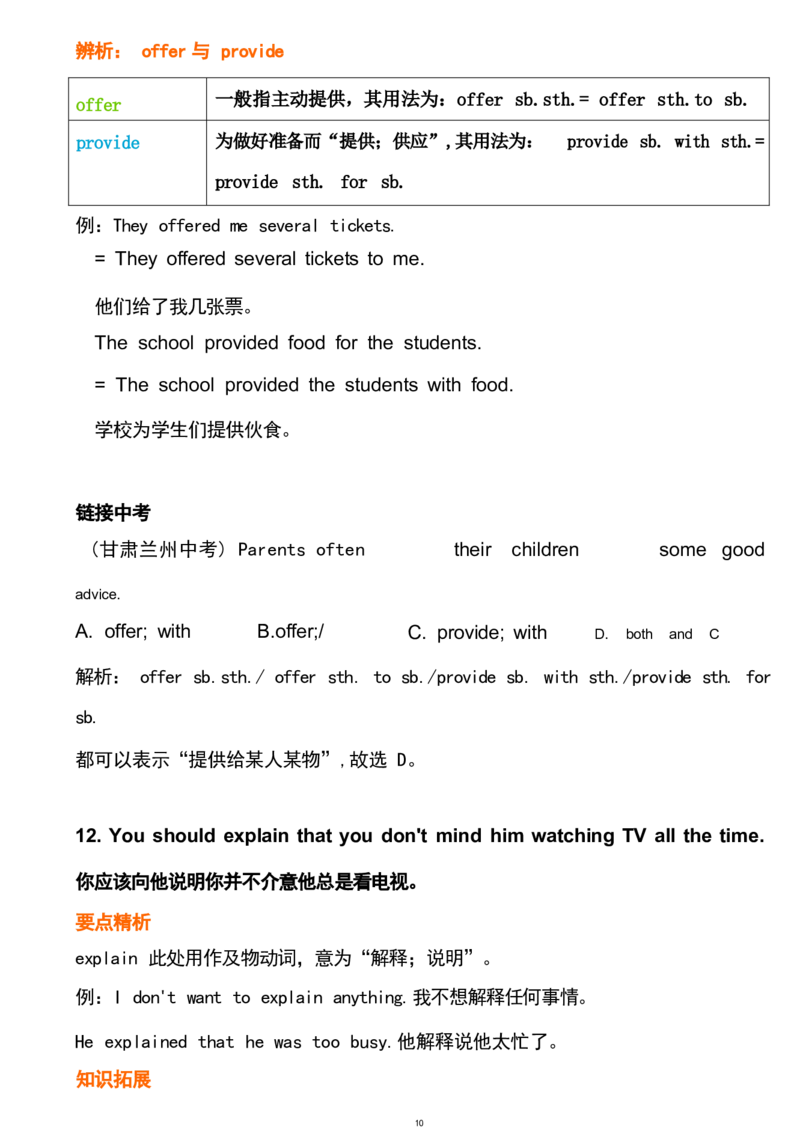
9辨析: offer 与 provide
一般指主动提供,其用法为:offer sb.sth.= offer sth.to sb.
offer
provide 为做好准备而“提供;供应”,其用法为: provide sb. with sth.=
provide sth. for sb.
例:They offered me several tickets.
= They offered several tickets to me.
他们给了我几张票。
The school provided food for the students.
= The school provided the students with food.
学校为学生们提供伙食。
链接中考
(甘肃兰州中考) Parents often their children some good
advice.
A. offer; with B.offer;/ C. provide; with
D. both and C
解析: offer sb.sth./ offer sth. to sb./provide sb. with sth./provide sth. for
sb.
都可以表示“提供给某人某物”,故选 D。
12. You should explain that you don't mind him watching TV all the time.
你应该向他说明你并不介意他总是看电视。
要点精析
explain 此处用作及物动词,意为“解释;说明”。
例:I don't want to explain anything.我不想解释任何事情。
He explained that he was too busy.他解释说他太忙了。
知识拓展
10explain sth.to sb.向某人解释某事/物,没有explain sb.sth.这一结构!
例:Please explain this rule to me.请给我解释一下这条规则。
13.My cousin borrows my things without returning them.
我表弟借我的东西不还。
要点精析
return 动词,意为“归还”,相当于give… back。return sth. to sb.“把某物还
给某人”。
例:I'm going to return this book to the library.我要去把这本书还给图书馆。
Please return my money to me as soon as possible.请尽快把钱还给我。
14.You left your homework at home.你把家庭作业忘在家里了。
要点精析
此处 leave(left,left)
用作及物动词,意为“遗留;未拿或未带”,在汉语中常
说 “忘记”。
例:lleft my bag on
bus.我把包忘在公共汽车上了。
the
辨析:leave 与
forget
“遗留;落下”,指把某物忘在某地,其后接地点状语
leave
forget “忘记”,指由于记忆上的忽略而忘记了某人或某事,后面不可接地点状
语
例:She left her keys in the room.她把钥匙忘在房间里了。
I forgot her address.我忘了她的地址。
【歌诀巧记】
忘记某物真特殊,后有地状用 leave。
(地状表示地点状语)
11链接中考
(湖北襄阳中考)-Show me your homework, Dave?
-Sorry.Mrs.Brown.I've it at home.
A.missed B.forgotten C. lost D. left
解析: miss “想念“;forget “忘记”; lose “丢失”; leave “忘在…… (地
方)”。forget 的用法是:forget to do sth.忘记做某事, forget doing sth.忘记
做过某事; leave 作“忘记”讲时多指“把某物忘在某地”。句意:“给我看看你
的家庭作业好吗,戴
夫?”“对不起,布朗老师,我把家庭作业忘在家里了。”结合语境可知选D。
15.You are afraid of speaking in front of people.你害怕在人们面前说话。
要点精析
afraid形容词,意为“害怕的”。
例:Don't be afraid.不要怕。
知识拓展
afraid 的用法:
be afraid of sb./sth. 害怕某人或某物
be afraid of doing sth. ‘害怕做某事”,侧重主语“担心、害怕”某事发生
‘不敢或害怕做某事”,侧重主语“不敢做某事“
be afraid to do sth.
be afraid +that从句 “恐怕 …… ”,多用于客气地提出个人意见或看
法
例:She is afraid of going out alone at night.她害怕晚上独自出去。
I'm afraid it's going to rain.恐怕要下雨了。
Section A 即学即试
根据汉语意思完成下列句子
1.她昨晚没睡够。
12She didn't have last night.
2.我一有时间,就会打电话给你。
As soon as I have time, I will you
3.浏览报纸有帮助吗?
ls it helpful to the newspapers?
4.他们决定把它归还原主。
They decided to it to its owner.
5.他通过使用计算机解决了这个问题。
He the problem by using a computer.
Section B 知识点精析
n
1. These days, Chinese children are sometimes busier on weekends tha
weekdays because they have to take so many after-school classes.
如今,中国的孩子有时周末比上学日更忙,因为他们不得不上那么多的课外辅导班。
要点精析
sometimes 副词,意为“有时;不时”。
例:He sometimes goes shopping on the weekend.他有时周末去购物。
知识拓展
“几次;几倍”,time意为“次;倍”,是可数名词
some times
“一段时间”,time意为“时间”,是不可数名词
some time
“某个时候”,它可指过去的“某个时候”,也可指将来的“某个时
sometime
候 ”
【歌诀巧记】
分开是“一段”(some time),
合起来是“某时”(sometime);
13分加 s 是“倍次”( some times),
合加 s 是“有时”(sometimes)。
2. Maybe I could cut out few of their activities ….
或许我可以减掉他们的几个活动……
要点精析
cut out意为“删除;删去”,为“动词副词”型短语,代词作其宾语时须放在两个
词之间;名词作其宾语时,既可放在cut 与 out 之间,也可放在cut 后面。
例:You'd better cut out that sentence.你最好把那个句子删掉。
Let's cut out the unimportant details.我们把不重要的细节删掉吧。
知识拓展
cut out还可意为“切下;剪下”。
例:I cut an article out of a newspaper.我从报纸上剪下了一篇文章。
3. They have quick dinner, and then it's time for homework.
他们快速吃完晚饭,接着又到了做家庭作业的时间了。
要点精析
It's time for sth.为固定句型,意为“该做某事了;到做某事的时候了”,相当于 It's
time to do sth.。
例:It's time for lunch. (=It's time to have lunch.) 该吃午饭了。
小贴士
It is time for sb.to do sth.到某人做某事的时候了。
例:It is time for you to do your homework, Mark.马克,你该做家庭作业了。
4. In some families, competition starts very young and continues until
the kids get older …
14在一些家庭中,竞争在孩子很小的时候就开始了,并持续到他们长大……
要点精析
continue 此处用作不及物动词,意为“持续;继续存在”,相当于 go on。
例:The rain continued all day.雨连续下了一整天。
The earthquake continued for two minutes.地震持续了两分钟。
知识拓展
continue 还可用作及物动词,后面常接名词、动名词或动词不定式。
例:Let's continue our meeting.让我们继续开会。
He continued writing until he died.他坚持写作,直到去世。
They continued to meet daily.他们继续每天见面。
链接中考
(辽宁大连中考) Dr.Bethune working in spite of cutting his hand
during an operation.
A.stopped B. continued C.forgot D.enjoyed
解析: stop doing sth.“停止做某事”; continue doing sth.“继续做某事”;
forget doing sth.“忘记做过某事”;enjoy doing sth.“喜欢做某事”。句意:尽
管白求恩
大夫在做手术时划伤了手,但他继续工作。故选 B。
5.And they are always comparing them with other children.
并且她们总是把他们与其他的孩子做比较。
要点精析 1
be always doing sth.意为“总是/一直做某事”,表示再三的、多次的重复行为,
常带有厌恶、赞扬等感情色彩,不表示某时刻正在发生的动作。
例:The little girl is always crying.这个小女孩儿总是哭。
He is always trying out some new ideas.他总是在试验一些新的想法。
15要点精析 2
compare 此处用作及物动词,意为“比较;对比”。
例:Compare these sentences.比较这些句子。
We compared this picture with that one.我们把这幅画和那幅画做了一下比较。
辨析: compare…with… 与 compare…to…
compare…with. “把 ……与 …… 比较”,常用于两个同类事物之间的具体比
较,
着重区别
compare…to… “把 …… 比作 ……,常用于两个不同性质的事物的抽象比较
6. People shouldn't push their kids so hard.
人们不应该把自己的孩子逼得太紧。
要点精析
此处 push 用作及物动词,意为“鞭策;督促”。
例:Don't push him so hard.别逼他太紧。
He pushed me to get everything ready.他催促我把一切准备好。
知识拓展
push 还意为“推动;移动;按”,可作及物动词,也可作不及物动词。
例:I pushed the car, but it didn't move.我推了推汽车,但它不动。
辨析: push 与 pull
push “推”,指施加给某人或某物一个向前或向后的力,反义词为 pull
pull “拉;拖”,指用手把某物用力地向自己的方向拉并使其移动
【助记】
推 push
拉 pull
7. Does Cathy Taylor think it's important for kids to join after-school
16activities? 凯 ·泰勒认为孩子们参加课外活动是重要的吗?
要点精析
此处join 用作及物动词,意为“加入;参与”。
例:He joined the chess club last month.
他上个月加入了国际象棋俱乐部。
辨析:join,join in 与 take part in
join “参加;加入”,普通用词,指加入党派、团体、人群或游戏活动等,
成为其中一员
join in join sb.in意为“和某人一起做 ……“
join in+某活动,表示“参加某活动”,相当于 take part in
take part in “参加”,侧重参加群众性、集体性的活动并在其中起积极作用
8.You could tell him to turn down the TV.
你可以告诉他把电视音量调小一点儿。
要点精析
turn down意为“调低;关小”,是“动词+副词”型短语。
例:The baby is sleeping. Turn down the radio.
这个婴儿在睡觉。把收音机音量调小一点儿。
知识拓展
turn on打开
turn off关上
turn up (音量)调大
turn out证明是,结果是
例:Can you turn the TV up? 你能把电视机的音量开大些吗?
Please turn the television off before you go to bed.睡觉前请关上电视。
17It turned out that she was a friend of my sister.她原来是我姐姐的朋友。
链接中考
(四川乐山中考) -Would you be so kind as to your music? I am
preparing for tomorrow's speech.
-Sure. Sorry to disturb you.
A. turn down B. turn up C. turn on
解析: turn down “调小(音量); turn up “调大(音量)”; turn on “打开”。由
“我正在为明天的演讲做准备”可知,空格处所在句表示请求对方调小音量,故选A。
Section B 即学即试
单项选择
1.My handwriting can not be compared my father's.
A.of B. with C. on D. for
2. Although we are tired, we work.
A. continues B. continue to C. continuing D.continued
3.It's time breakfast, Tom.
A. have B. has D. having
C. to have
4. I will wait I hear from you.
A. until B. since C. while D. because
5.-The boy can speak both English and Japanese he is only ten.
-Wow, what a clever boy!
A.if B. because C. although D. until
18人教版(新标准)初中英语知识点归纳
八年级下册 UNIT 4
Why don't you talk to your parents? 你为什么不和你的父母谈谈呢?
单词归纳
allow 允许 opinion 看法
wrong 有毛病 quick 快的
guess 猜测 continue 继续
deal 交易 compare 比较
relation 关系 development 发展
communication 交流 cause 造成
argue 争吵 usual 通常的
elder 年纪较长的
cloud 云
instead 代替 clear 晴朗的
whatever 任何,每一
copy 抄袭
nervous 焦虑的 member 成员
offer 主动提出 skill 技巧
proper 正确的 typical 典型的
secondly 第二 football 美式)橄榄球
communicate 交流 crazy 不理智的 push 鞭策
explain 解释 too many 太多
return 归还 on the phone 在电话中
anymore 再也(不) have fight 吵架
pressure 压力 work out 成功地发展;解决
compete 竞争
19短语归纳
too many 太多 feel lonely 感到孤独
on the phone 在电话中 communicate with sb.与某人交流
work out 成功地发展;解决
not… anymore 不再…
have fight 吵架
do chores 做家务
look through 浏览;快速查看
cut out 删除;删去 afew 几个
big deal 重要的事
compare.with 比较;对比
thanks for 因……而感谢 in one's' opinion 依……看
get on with 和睦相处;关系良好
turn down 关小
用法归纳
1.refuse to do 拒绝做
2. offer to do 主动提出做
3.mind sb.doing sth. 介意某人做某事
4.allow sb.to do sth. 允许某人做某事
5. Why don't' you do…? 你为什么不做…?
6.find sb.doing sth.发现某人正在做某事
到了该做某事的时间了。
7.It 's' time for sth.
8.Its+adj.+ to do sth. 做某事是……的。即学即试参考答案与解析
Section A
1.enough sleep 2.call, up 3.look through 4.return
5. worked out
Section B
1.B 句意:我的书法不能同我父亲的相比。 compare…with… 意为”把……与……比
较”
2.B 此题应用一般现在时, continue to do sth.表示“继续做某事”。
3.C It's time to do sth.“到做某事的时间了",为固定结构,故选
C。
4.A 句意:我将一直等到你来信。 until意为“直到……”,符合句意。
5.Cif 如果; because 因为; although 尽管,虽然; until 直到。由上句句意
“这 个男孩儿会说英语和日语,尽管他只有 10 岁”可知应用 although 引导让步
状语从句。