人教版(新标准)初中英语知识点精析
七年级下册 UNIT 11
How was your school trip? 你的学校旅行怎么样?
重点
● 一般过去时的用法
● 复合不定代词的用法
难点
● 动词过去式的构成方法
语法
(I)
● 一般过去时
Section A
重点单词
milk挤奶
cow 奶牛
horse 马 feed 喂养;饲养
farmer 农民;农场主
quite相当;完全
anything 任何东西;任何事物
grow 种植;生长;发育
farm 农场;务农;种田
pick采;摘
excellent极好的;优秀的 countryside 乡村;农村
yesterday 昨天
flower 花
worry 担心;担忧
luckily 幸运地;好运地
sun 太阳
1重点短语
milk a cow给奶牛挤奶
quite a lot(of.) 许多
ride a horse骑马
in the countryside在乡下;在农村
feed chickens喂鸡
重点句型
1.-Did you see any cows? 你看到一些奶牛了吗?
-Yes,I did.I saw quite a lot.是的,我看到了。我看到了相当多(的奶牛)。
2. The farmer showed Carol around the
farm. 这位农民带领卡萝尔参观了农场。
3. Carol picked some strawberries and took them
home. 卡萝尔摘了一些草莓并把它们带回了家。
Section B
重点单词
museum 博物馆 fire火;火灾
painting油画;绘画 exciting使人兴奋的;令人激动的
lovely可爱的
expensive 昂贵的
cheap 廉价的;便宜的
slow 缓慢的;迟缓的
fast快地(的)
robot 机器人
guide 导游;向导
gift礼物;赠品
everything 所有事物; 一切
interested感兴趣的
dark 黑暗的;昏暗的
hear 听到;听见
重点短语
fire station 消防站
all in all 总的说来
2be interested in 对……感兴趣
重点句型
1. Today I went on a school trip.今天我参加学校旅行了。
2. Then the guide taught us how to make a model robot.
然后,导游教我们怎样制作一个机器人模型。
3.All in all it was an exciting day.总之,这是令人兴奋的一天。
4.I didn't like the trip at all. 我一点儿都不喜欢这次旅行。
Section A知识点精析
1. milked a cow 给奶牛挤奶
要点精析
milk 此处作及物动词,意为“给……挤奶”;还可作不及物动词,意为“挤奶,出奶”。
例:I helped my father to milk the cow.我帮助我的父亲给奶牛挤奶。
This cow milks very well.这头奶牛出奶很好。
知识拓展
milk 还可用作不可数名词,意为”牛奶”。
例:Would you like some milk? 你想喝些牛吗?
【助记】
milk n.牛奶 v.挤奶
2. fed chickens 喂鸡
要点精析
fed 为 feed 的过去式, feed 此处作及物动词,意为“喂养;饲养”,其后常接表示动
物名称的词作宾语。
例:Don't forget to feed your pet dog.别忘了喂你的宠物狗。
3知识拓展
关 于feed 的搭配:
feed sth. to sb./sth.把某物喂给某人/某物
例:She fed milk to the baby.=She fed the baby on/ with milk.
她用牛奶喂这个婴儿。
Pandas feed on bamboo.熊猫以竹子为食。
链接中考
(湖北武汉中考)-Ilike reading.
-Great! It can your mind.
A. read B. lose C. feed D. feel
解析:句意:“我喜欢阅读。”“太好了!它可以充实你的大脑。”feed “喂养;灌输;
使满足”,符合题意。 read “读”; lose “丢失”; feel “摸起来,感到”,均与题意
不
符,故选 C。
3.-Did you see any cows? 你看到一些奶牛了吗?
-Yes,I did.I saw quite a lot.是的,我看到了。我看到了相当多(的奶牛)。
要点精析 1
此问句是一般过去时的一般疑问句,用于询问过去发生的动作或事情;其中 did 是 do
的过去式,在此作助动词,疑问句中用了助动词 did 时,句中的谓语动词应用动词原
形其句型结构是“Did+ 主语+动词原形+其他成分?”。其肯定答语为 ”Yes, 主 语 +d
id.”;
否定答语为 “No, 主 语 +didn't.”。
例:-Did you do your homework yesterday? 昨天你做你的家庭作业了吗?
-Yes,I did./No,I didn't.是的,我做了。/没有,我没做。
要点精析 2
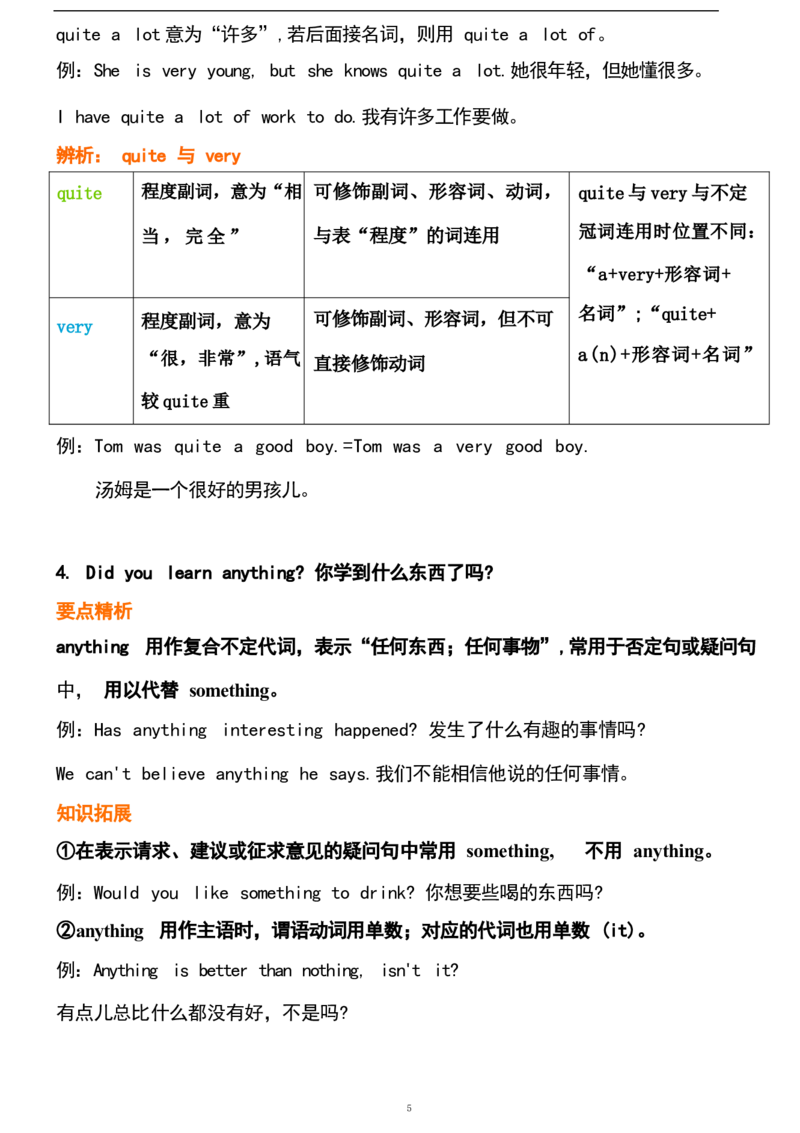
4quite a lot 意为“许多”,若后面接名词,则用 quite a lot of。
例:She is very young, but she knows quite a lot.她很年轻,但她懂很多。
I have quite a lot of work to do.我有许多工作要做。
辨析: quite 与 very
quite 程度副词,意为“相 可修饰副词、形容词、动词, quite与very 与不定
冠词连用时位置不同:
当 , 完 全 ” 与表“程度”的词连用
“a+very+形容词+
名词”;“quite+
程度副词,意为 可修饰副词、形容词,但不可
very
a(n)+形容词+名词”
“很,非常”,语气
直接修饰动词
较 quite重
例:Tom was quite a good boy.=Tom was a very good boy.
汤姆是一个很好的男孩儿。
4. Did you learn anything? 你学到什么东西了吗?
要点精析
anything 用作复合不定代词,表示“任何东西;任何事物”,常用于否定句或疑问句
中, 用以代替 something。
例:Has anything interesting happened? 发生了什么有趣的事情吗?
We can't believe anything he says.我们不能相信他说的任何事情。
知识拓展
①在表示请求、建议或征求意见的疑问句中常用 something, 不用 anything。
例:Would you like something to drink? 你想要些喝的东西吗?
②anything 用作主语时,谓语动词用单数;对应的代词也用单数 (it)。
例:Anything is better than nothing, isn't it?
有点儿总比什么都没有好,不是吗?
5③形容词修饰复合不定代词 anything,something 等时,形容词要后置。
例:Did you hear anything interesting there? 你在那儿听到什么有趣的事情了吗?
5. Did you grow any apples? 你种植一些苹果了吗?
要点精析
grow 此处用作及物动词,意为“种植;栽培”,其后可直接接名词或代词作宾语。
例:We grow flowers and vegetables in our garden.我们在花园里种植鲜花和蔬菜。
知识拓展
①grow 可作不及物动词,意为“生长;发育”。
例:In spring, everything begins to grow.春天万物复苏。
How quickly the baby is growing! 这个婴儿长得多么快啊!
②grow 可作连系动词,有“逐渐变得”之意,强调变化过程。
例:It's growing dark.天渐渐(变)黑了。
③grow up 意为“长大;成长”。
例:What do you want to be when you grow up? 你长大后想做什么?
6. The farmer showed Carol around the farm.
这位农民带领卡萝尔参观了农场。
要点精析
show sb.around, 意为“带领某人参观……”。
例:Uncle Wang showed us around his farm.王叔叔领我们参观了他的农场。
知识拓展
show 用作及物动词的主要用法:
①意为“给……看;出示;显示”,常用结构为 show sb.sth.或 show sth. to sb.。
e.
例:Please show me that coat.=Please show that coat to m
6请把那件外套拿给我看看。
You have a new pen; please show it to me.你有一支新钢笔,请给我看看。
②意为“(向人)说明;表明;指示;放映;展出”等。
例:Your homework shows that you are very careful.
从你的家庭作业上可以看出你很认真。
Show me the way,please.请给我指路。
7.Carol learned lot about farming.卡萝尔了解了很多农事。
要点精析 1
learn… about… 意为“学习/知道/了解……”。
例:I'd like to learn something about Yao Ming.我想要了解一些关于姚明的事情。
I'd like to learn more about computers.我想要学习更多关于电脑的知识。
知识拓展
learn about 意为“了解/知道/获悉”相当于 know about。
例:How did you learn/know about the meeting?
有关会议的情况你是怎么知道的?
链接中考
(江西中考)Anna is goinq on tour of Xi'an, and she wants to Chinese
history.
A. dream of B.learn about C. look through D. pass on
解析: dream of“梦到;梦想; learn about “了解"; look through “浏览”;
pass on “传递”。由前一分句句意“安娜打算到西安旅行”可知,后一分句句意为
“她想要了
解中国的历史”,故选 B。
要点精析 2
7farming 名词,意为“农事;耕作”。其动词形式为 farm, 意为“务农;种田
例:It is still too cold for farming.天气还是太冷,不适合农耕。
He is farming there.他正在那儿千农活。
知识拓展
farm 还可作名词,意为“农场”; farmer 名词,意为“农民;农场主”。
例:The farmer is farming on a farm.这位农民正在一个农场活儿。
【助记】
farmer n.农民
farm n.农场
farming n.农事
8.Carol picked some strawberries and took them home.
卡萝尔摘了一些草莓并把它们带回了家。
要点精析 1
pick 此处作及物动词,意为“采摘”。
例:The children are picking tomatoes in the garden.
孩子们正在园子里摘西红柿。
知识拓展
pick up 意为“拾起;捡起”。 pick up 是“动词+副词”型短语,代词作宾语时必须
放在 pick 与 up 之间。
例:Please pick up that book.请把那本书捡起来。
My pen is under your chair.Can you pick it up for me?
我的笔在你的椅子底下,你能帮我把它捡起来吗?
8链接中考
(河北中考) Can you help me the pen? It's under your chair.
C. pick up D. put up
A. ask for B. look for
解析: ask for 意为“请求,要求”; look for 意为“寻找”"; pick up 意为“拾起;
捡 起”; put up 意为“举起;张贴”。根据下句句意“它在你的椅子下面”可知前一
句是
请求对方帮忙把钢笔“捡起来”,故选 C。
要点精析 2
take 动词,意为“拿;带;拿走;带走”,其反义词为 bring。
例:It's going to rain.Please take an umbrella with you.要下雨了,请随身带把伞。
Please take me away.请把我带走。
知识拓展
“take+ 人/物+to+ 地点”意为“把某人/某物带到某地”。
例:Please take my book to school.请把我的书带去学校。
9. It was so much fun.那真是挺好玩的。
要点精析 1
so much意为“如此多;这么多”,一般用于修饰不可数名词或动词。
例:There was so much noise in the classroom.教室里太吵了。
You talked so much.你说得太多了。
知识拓展
so many “这么多;如此多”,常用来修饰可数名词复数。
例:He had so many friends in the city.在这个城市里,他有这么多的朋友。
要点精析 2
9fun 此处作不可数名词,意为“乐趣;开心;有趣的人或事”,其前常用 great,
much,a lot of 等修饰,用来加强语气。
例:I decided to learn Spanish, just for fun.我决定学习西班牙语,只是为了消遣。
Skating is great fun.滑冰是件很有趣的事情。
10.…we worried it would rain.…… 我们担心会下雨。
要点精析
worried 为 worry 的过去式, worry 此处作及物动词,意为“担心;担忧”,后面常
接宾语从句。worry 还可用作不及物动词,意为“忧虑,担心”,后接宾语时,常加 about。
worry about 意为“担心”。
例:I worry that I won't get into college.我担心自己进不了大学。
Don't worry. We have plenty of time.不必担心。我们有很多时间。
知识拓展
worried 形容词,意为“担心的;担忧的”。常用短语: be worried about意为“担
心”。
例:She is always worried about her son.她总是担心她的儿子。
链接中考
(上海中考) You really don't have to worry your weight.You look just right.
A. for
B. from C. with D. about
解析:句意:你真的不必担心你的体重。你看起来正合适。 worry about “担心”,为
固定搭配,故选 D。
11. Luckily, it didn't, and the sun came out again!
幸运的是,没有下雨,并且太阳又出来了!
要点精析 1
10luckily 副词,意为“幸运地;好运地”,在句中作状语, 一般置于句首。
例:Luckily, the police came in time and saved the children.
幸运的是,警察及时赶到救了那些孩子。
【助记】
luck(n. 运 气 ) +y→ lucky(adj. 幸运的)变 y 为 i,+- ly→ luckily(adv. 幸运地)
链接中考
(山东济南中考) My uncle lost his ID card yesterday morning. ,a
schoolboy found it and sent it back to him in the afternoon.
A. Loudly B.Clearly C.Nearly D.Luckily
解析:句意:昨天上午我的叔叔丢了他的身份证。幸运的是, 一名男学生捡到了它,
并在下午的时候送还给了他。 luckily “幸运的是”,符合题意。 loudly “大声
地”;
clearly “清晰地”;nearly “几乎”,均不符合题意。选 D。
要点精析 2
come out 意为“出来”,其中 out 为副词。
例:The sun is coming out.太阳就要出来了。
知识拓展
come out 的其他含义:
① (花)开放
例:The flowers begin to come out.花儿开始开放。
②出版;发表
例:His first book came out in 2003.他的第一本书于 2003 年出版了。
③透露,传出
例:The truth came out at last.终于真相大白了。
11Section A 即学即试
I.根据句意及首字母提示写单词
1. The boy is m a cow over there.
2. The farmer enjoys riding his white h on weekends.
3. Lucy helped her grandmother f chickens yesterday.
4. She is an e girl in her school.
5.Don't p flowers at
school.
Ⅱ .按要求完成下列各题
1. Bob watched TV at home last night. (改为一般疑问
句) Bob TV at home last night?
2. Lucy did her homework yesterday. (改为否定
句) Lucy her homework yesterday.
3.Our school trip was great.(对画线部分提问)
your school trip?
4.Grace read English this morning. (对画线部分提问)
Grace this morning?
5. Mike rides a bike to school every day.( 用yesterday 改写句子)
Mike a bike to school .Section B 知识点精析
1. visit fire station参观消防站
要点精析
fire此处为名词作定语。当 fire 作物质名词“火”讲时为不可数名词,而作“炉火,
火灾”讲时则是可数名词。
例:Don't play with fire, because it's very dangerous.不要玩火,因为它很危险。
There was a big fire in the next street l night.昨晚邻街上有一场大火。
知识拓展
①be on fire 着火
例:The factory was on fire yesterday.昨天那家工厂着火了。
② make fire生火
例:Let's make fire.让我们生火吧。
2. expensive昂贵的
要点精析
expensive 形容词,意为“昂贵的”。
例:This is an expensive hat.这是一顶昂贵的帽子。
【注意】
说价格高或低要用形容词 high 或 low, 而不能用expensive 或 cheap; 一般商品
作主语时才用 expensive 或 cheap。
例:The price of this bag is high.这个包的价格很高。
This bag is very expensive.这个包很贵。
【助记】
13¥100
价
expensive←— 昂贵的 →high 物品
格
cheap ←— 便宣的 →low
3. Today went on a school trip.今天我参加学校旅行了。
要点精析
go on a school trip意为“参加学校旅行”,是“go on a/an+名词”结构,意为“进
行…… “。
例:We went on school trip last week.上周我们参加了学校旅行。
知识拓展
go on picnic去野餐
go on vacation去度假
4. Then the guide taught us how to make a model robot.
然后,导游教我们怎样制作一个机器人模型。
要点精析 1
taught 为 teach 的过去式, teach 此处作及物动词,后接“疑问词+动词不定式”。
例: Let me teach you how to use the computer.让我教你怎样使用电脑。
My mother often teaches me how to cook food.我的妈妈经常教我怎样做饭。
知识拓展
teach oneself 意为“自学”,相当于 learn by oneself。
例: She teaches herself English.=She learns English by herself.她自学英语。
14要点精析 2
how to make model robot 为“疑问词+动词不定式”结构。 在此结构中,疑问词
包括疑问代词what,which,who, whose和疑问副词when,where,how,why。
这些疑问词和动词不定式一起构成了动词不定式短语。这种结构在句子中可作主语、
宾语、表语等。
例:I don't know how to spell the word.我不知道怎样拼写这个单词。
I know where to find the boy.我知道在哪里能找到这个男孩儿。
链接中考
(江苏扬州中考)-Mr Wu has recommended many books. Have you decided
first?
-Yes. The Little Prince.
A. how to read B. which to read C. when to read D. where to read
解析:根据答语“是的,《小王子》”可知,问句是问“你决定先看哪一本了吗?”。故
选 B。
5.After that, I went to the gift shop and bought some lovely gifts for my
parents. 后来,我去了礼品店并为我的父母买了一些可爱的礼物。
要点精析
lovely 形容词,意为“可爱的,美丽的”。
例:What lovely girl! 多么可爱的一个女孩儿啊!
We can see lovely views here.在这里我们能看到美丽的景色。
知识拓展
英语中有一些和 lovely 一样以-ly 结尾的词是形容词,而不是副词。
例:friendly 友好的 lively 生动的,活跃的 lonely 孤单的,寂寞的
15链接中考
(广西百色中考) Those toys for children look and sell .
A. good; lovely B.lovely; good C.well;lovely D.lovely; well
解析:句意为“那些儿童玩具看起来可爱而且卖得好"。 look 为连系动词,意为“看起
来”,后接形容词 lovely 作表语; sell为不及物动词,后接副词well 作状语。故选D。
6.All in all, it was an exciting day.总之,这是令人兴奋的一天。
要点精析
all in all意为“总的说来;总之;整体上说”,常用于句首,用来对所阐述的内容进行
概括性总结及归纳。
例:All in all, it is a great success.总的说来,它非常成功。
辨析: all in all, in all与 at all
意为“总的说来”,常用于句首
a n a
意为“总共,合计”,既可放在句首,也可放在句末
in all
意为“根本,常用于否定句中; not…at all意为“根
at all
本不;完全不”
例:All in all, we had a good time.总的说来,我们过得愉快。
There are thirty students in all.共有30名学生。
He doesn't like apples at all.他根本不喜欢苹果。
7. Everything was about robots and I'm no interested in that.
一切都是关于机器人的,我对那方面不感兴趣。
要点精析 1
everything 为复合不定代词,意为“所有事物; 一切”。
16例:Many parents try to do everything for their children.
许多父母努力为他们的孩子做所有的事情。
Money is very important, but it can't buy everything.
钱很重要,但是它不能买到所有东西。
【注意】
①everything 作主语时,谓语动词用单数形式。
例:Everything is cheap here.这里的一切都很便宜。
②everything, anything 等复合不定代词被形容词修饰时,形容词应置于这些复合
不定代词的后面。
链接中考
(浙江杭州中考) You look worried! Is all right?
A.everything B. something C. anything D.nothing
解析:句意:你看上去很焦虑!一切都好吗?everything “所有事物; 一切”,符合
题 意。 Something “某事;某物”;anything “某事;某物;任何事情”;nothing
“没
有一件东西;没有什么"。选 A。
要点精析 2
interested 形容词,意为“感兴趣的”。 be interested in 意为“对……感兴趣”; be
interested in doing sth.意为“对做某事感兴趣”。
例:I'm very interested in history.我对历史很感兴趣。
Are you interested in dancing? 你对跳舞感兴趣吗?
辨析 interested 与 interesting
interested 意为“感兴趣的”,常用于修饰或描述人
interesting 意为“有趣的,令人感兴趣的”,常用来修饰或描述物
例:He is interested in the interesting book.他对那本有趣的书感兴趣。
17链接中考
(贵州铜仁中考) The story is and all of us are in it.
A.interest; interesting B.interesting; interest
C. interested; interesting D.interesting; interested
解析:形容词 interesting 通常修饰事物;形容词 interested 通常修饰人。 story
为 表示物的名词,用 interesting 修饰; be interested in… “对 ……感兴趣”,
为固定搭
配。故选 D。
8.The rooms were really dark and it was difficult to take photos.
房间真的很暗并且拍照很难……
要点精析
dark 此处用作形容词,意为“黑暗的;昏暗的”;其反义词为 bright, 意为“明亮的,
光线充足的”。
例:It was dark outside and I couldn't see much.外面很黑,我看不清。
知识拓展
①dark 作形容词,还可意为“(颜色)深的”;其反义词为 light, 意为“(颜色)浅的”。
例:l like dark blue.我喜欢深蓝色。
②dark 作名词,意为“黑暗,暗处”。
例:She could see nothing in the dark.她在黑暗中什么也看不见。
Are the children afraid of the dark? 孩子们怕黑吗?
9. There were also too many people and I couldn't really see or hear the
guide. 里面也有太多的人,我真的看不见导游,也听不清导游的解说。
要点精析
hear 此处作及物动词,意为“听到;听见”,其过去式为 heard。
18例:I heard strange noise in the middle of the night.
半夜里我听到一种奇怪的声音。
链接中考
(山东济南中考) Excuse me.I didn't you clearly. Would you say it again?
A. hear B. call C. see D. find
解析: hear “听见”; call “打电话”; see “看见"; find “找到”。句意:劳驾,
我听 不清楚你(说的话),你可以再说一遍吗?由下文 “say it again”可知前句为
“听不清
楚”,强调听的结果用 hear。 故 选 A。
10.I didn't like the trip at all.我一点儿都不喜欢这次旅行。
要点精析
not…at all意为“根本不;完全不”。
例:I don't like eating meat at all.我一点儿都不喜欢吃肉。
知识拓展
not at all用来回答感谢,意为“不用谢;不客气”,是一种比较正式的用法。
例:-Thank you very much.多谢你了。
-Not at all.不用谢。
链接中考
(浙江宁波中考)-Would you mind turning down the music?
-
A. Not at all B. Never mind C.Yes, I will D.No, I don't mind
解析:句意:“你介意把音乐关小点儿吗?”“一点儿也不介意。”Not at all.“ 一点儿
也不”,符合题意。 Never mind. “没关系"; Yes,Iwill. “是的,我会"; No,Idon't
mind. 是汉语式英语。
19Section B 即学即试
I 单项选择
1.Guess what! I saw Alice just now!I s he was in Paris.
A.am thinking B. thinking C. thought D. think
2. Many students are interested basketball.
A.in B.to C. on D.at
3.-It seems that Peter has nothing to do at the moment.
-Let's give him to read.
A.anything B.something C.everything D. nothing
4.| carefully, but I can't anything.
A.listen; hear B.hear; listen C.listen; listen D. hear; hear
5. The house is too for me to buy.
A. expensive B. cheap C.lovely D.exciting
Ⅱ .根据汉语意思完成句子
1.昨天下午他们在公园里拍了许多照片。
They in the park yesterday afternoon.
2. 她是一个可爱的女孩儿。
She is a .
3.这个男孩儿对数学感兴趣。
The boy math.
4.这位老人走得很慢。
The old man walked .
5. 夏天,我经常在夜里看星星。
I often watch stars in summer.
20人教版(新标准)初中英语知归纳
七年级下册 UNIT 11
your school trip? 你的学校旅行怎么样?
How
单词归纳
milk 挤奶 museum 博物馆
interested 感兴趣的
cow 奶牛
painting 油画;绘画
horse 马
robot 机器人
feed 喂养;饲养
lovely 可爱的
sun 太阳
expensive 昂贵的
quite 相当;完全
fire 火;火灾 cheap 廉价的;便宜的
slow 缓慢的;迟缓的
fast 快地(的)
farm 农场;务农;种田 grow 种植;生长;发育
hear 听到;听见
pick 采;摘
guide 导游;向导
gift 礼物;赠品
excellent 极好的;优秀的
countryside 乡村;农
everything 所有事物; 一切
村
anything 任何东西;任何事物
yesterday 作天
dark 黑暗的;昏暗的
flower 花
exciting 使人兴奋的;令人激动的
worry 担心;担忧
luckily 幸运地;好运
地
短板归纳
go for a walk 去散步
ride a horse 骑马
milk a cow 给奶牛挤奶
go fishing 去钓鱼
21talk with… 与……谈话 lt night 在夜晚
take photos 拍照 show…around 带领……参观
quite a lot(of…)许多 fire station 消防站
come out 出来 go on a school trip 参加学校旅行
learn about 了解 along the way 沿途
from…to… 从………到 grow strawberries 种植草莓
after that 之后 in the countryside 在乡下;在农村
pick strawberries 摘草莓
take a/ the train 乘火车
all in allf 总的说来
be interested in 对.…感兴趣
feed chickens 喂鸡 not…at all 根本不;完全不
用法归纳
1.How be…? …… 怎么样?
2.too many+可数名词复数太多
3.sound+ 形容词 听起来
4.buy sth. for sb.= buy sb.sth. 为某人买某物
5.lt's+形容词+ to do sth.做 某事是……的。
6.teach sb.how to do sth. 教某人怎样做某事
7.How do/does+主语+ feel about..? 对……感觉如何?
8.quite a/an+形容词+可数名词单数
= a very+形容词+可数名词单数
相当/非常……
22人教版(新标准)初中英语即学即试参考答案与解析
七年级下册 UNIT 11
How was your school trip? 你的学校旅行怎么样?
Section A
I.
1. milking 2. horse 3.feed 4.excellent 5. pick
Ⅱ .
1 Did, watch 2. didn't do 3. How was 4. What did, do 5. rode,
yesterday Section B
I.
1.C 考查动词的时态。由句意可知应该是在谈话前认为艾丽斯在巴黎,因此用一般过
去时。
2.A 考查固定搭配。 be interested in“对 ……感兴趣”。
3.B 考查复合 something 不定代词。“一些东西”,常用于肯定句中。
4.A 考查同义词辨析。句意:我仔细地听,但我什么都听不到。 listen 强调“听”这一
动作; hear 强调“听见”这一结果。
5.A 考查形容词辨析。too…to… “太 ……而不能……”。expensive “昂贵的”;
cheap “便宜的”; lovely“可爱的”; exciting “兴奋的”。根据常识可知,买不
起房子应该
是太贵了,故选 A。
Ⅱ .
1.took many photos 2.lovely girl 3.is interested in 4.slowly 5.at night