人教版(新标准)初中英语知识点精析
七年级下册 UNIT 5
Why do you like pandas? 你为什么喜欢熊猫?
重点
● 提建议的句型
● forget 的用法
难点
● why 引导的特殊疑问句
● 形容词的用法
语法
● why 引导的特殊疑问句;形容词的用法
Section A
重点单词
panda 熊猫
zoo 动物园
tiger 老 虎 elephant 大象
lion 狮子
giraffe长颈鹿
animal 动物 cute 可爱的;机灵的
lazy 懒散的;懒惰的
smart 聪明的
beautiful美丽的;美好的
kind 种类
Australia澳大利亚
south 南方的;南,南方
Africa非洲 pet 宠物
leg 腿
cat猫
1sleep 睡觉
重点短语
kind of 稍微;有点儿
South Africa 南非
black and white 黑白相间
重点句型
1. Let's see the pandas first.咱们先看熊猫吧。
2. They're my favorite animals.它们是我最喜欢的动物。
3. Where are they from? 它们来自哪里?
4. She sleeps all day… 她整天睡觉……
Section B
重点单词
friendly 友好的 shy 羞怯的;腼腆的
save 救;救助 flag 旗;旗帜
forget 忘记;遗忘 place 地点;位置
water 水 danger 危险
cut 砍;切 down (坐、躺、倒)下;向下;沿着
tree 树 kill 杀死;弄死
over 超过,多于;在……上方
重点短语
get lost 迷路
be in(great) danger 处于(极大)危险之中
2lose one's home 失去某人的家园
cut down 砍倒
(be)made of 由……制成的
重点句型
1. The elephant is one of Thailand's symbols. 大象是泰国的象征之一。
2. They can also remember places with food and
water. 它们也能记住有食物和水的地方。
3. Isn't she beautiful? 难道她不美丽吗?
Section A 知识点精析
1. Let's see the pandas first. 咱们先看熊猫吧。
要点精析 1
本句是提建议的句型。 let's 后接动词原形,其结构为 Let's do sth., 意为“让我们
做某事吧;咱们做某事吧”,表示说话人的建议。常用的肯定应答语有 “Ok./AlI
right./Good idea” 等。否定应答语可”Sorry,I … ”。
例:-Let's go for a walk after supper.咱们晚饭后去散步吧。
-Good idea.好主意。/Sorry,I have some important things to do.
对不起,我有些重要的事情要做。
知识拓展
提出建议的句型还有:
①Shall we+动词原形?意为“我们做……好吗?”。
例:Shall we meet at the gate? 我们在大门口见面好吗?
②Why don't you+动词原形?=Why not+动词原形?意为“为什么不做某事
呢?”。 例 :Why don't you /Why not ask Lily? 为什么不问一下莉莉呢?
③What/How about doing sth.? 意为“做某事怎么样?”。
3例:What/How about going for a walk? 去散步怎么样?
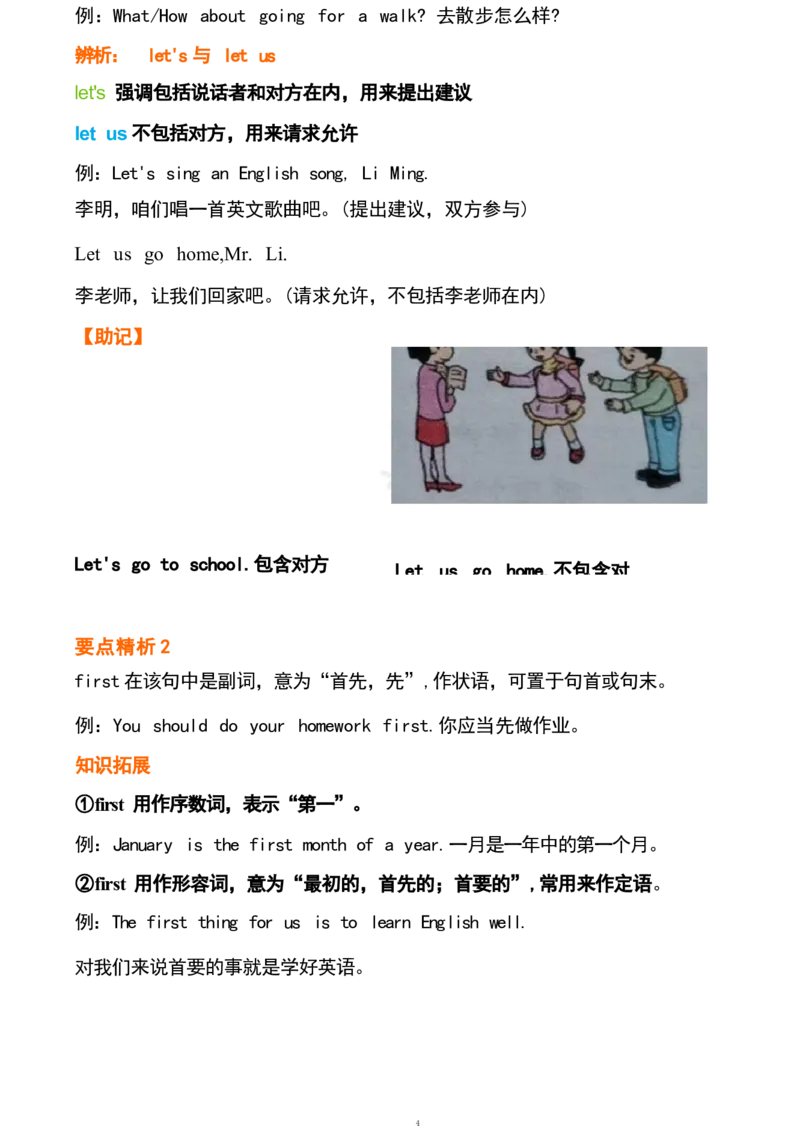
辨析: let's 与 let us
let's 强调包括说话者和对方在内,用来提出建议
let us 不包括对方,用来请求允许
例:Let's sing an English song, Li Ming.
李明,咱们唱一首英文歌曲吧。(提出建议,双方参与)
Let us go home,Mr. Li.
李老师,让我们回家吧。(请求允许,不包括李老师在内)
【助记】
Let's go to school.包含对方
Let us go home.不包含对
要点精析 2
first 在该句中是副词,意为“首先,先”,作状语,可置于句首或句末。
例:You should do your homework first.你应当先做作业。
知识拓展
①first 用作序数词,表示“第一”。
例:January is the first month of a year.一月是一年中的第一个月。
②first 用作形容词,意为“最初的,首先的;首要的”,常用来作定语。
例:The first thing for us is to learn English well.
对我们来说首要的事就是学好英语。
42. They're my favorite animals.它们是我最喜欢的动物。
要点精析
favorite 形容词,意为“最喜爱的,特别喜爱的”,可与 like…best 互换。
What's one's favorite.?=What. does/do sb.like best?
例:What is your favorite sport?= What sport do you like best?
你最喜欢什么运动?
知识拓展
①favorite 还可用作名词,意为“最喜欢的人或事物”,既可以指人,也可以指物。
例:Which one is your favorite? 你最喜欢哪一个?
②favorite 还可写作 favourite 。 美式英语多用 favorite, 英式英语多用
favourite。
3. Where are they from? 它们来自哪里?
要点精析 1
此句是 where 引导的特殊疑问句,即 “Where +be+主语+from?” 句型,回答
时,介词 from 后常跟表示国家、城市等的地点名词。
Where+ be+主语+ from?
①主语是人,“某人来自哪里?”
例:-Where is the girl from? 这个女孩儿来自哪里?
-She is from Shandong.她来自山东。
②主语是物,“某物产自哪里?”
例:-Where are these watches from? 这些手表产自哪里?
-They are from Japan.它们产自日本。
要点精析 2
be from 意为“从……来;来自…… ”,其中 be 是系动词,有人称和数的变化。同
5义短语为 come from。
例:They are from France.他们来自法国。
辨辨析:be from与 come from
be 系动词,句式的变化是由 be 来完成的,而且 be 有人称和数的
be from
变
化
come 实义动词,句式的变化须借助助动词 do/does/did 来完成
come from
且谓语动词 come 受主语的影响
例:I am from Beijing.我来自北京。
He isn't from England.他不是来自英格兰。
ls he from England? 他来自英格兰吗?
Li Ming comes from Shandong.李明来自山东。
They don't come from China.他们不是来自中国。
Do they come from China? 他们来自中国吗?
4.He can walk on two legs.他会用两条腿走路。
要点精析
walk on… 意为“用某种方式行走”,其中 on 有“由……支撑着”的含义。
例:Peter can walk on two hands.彼得会用两只手行走
5. Why don't you like the cat? 你为什么不喜欢那只猫?
要点精析
Why don't you…? 意为“你为什么不……呢?”,用于向对方询问原因,其后接动
词原形。
例:Why don't' you want to go out? 你为什么不想出去?
知识拓展
Why don't you…? 还可用于向对方提出建议,相当于 “Why not…?”, 其后接动
6词原形。
例:Why don't you go to bed
now?= Why not go to bed now?
你为什么不现在上床睡觉呢?
链接中考
(四川达州中考) Why not an English club to practice E
nglish? A.to join; to speak B.join; speaking C.join; to speak D.to join;
speaking 解析:句意:你为什么不加入一个英语俱乐部来练习说英语? Why not
后接动词原
形, practice后跟动词时用动词-ing 形式。选B。
6.She sleeps all day… 她整天睡觉……
要点精析
sleep 此处用作不及物动词,意为“睡觉”,强调睡眠的持续状态。也可作不可数名
词,意为“睡觉;睡眠”。常用短语: go to sleep “睡着,入睡”。
例:He sleeps on his back.他仰卧着睡觉。
Go to sleep— it's late.去睡吧,不早了。
辨辨析:sleep 与 go to bed
sleep 指睡觉、睡着的全过程,强调睡眠的持续状态
指“上床睡觉”,强调上床睡觉这一动作,但不一定睡着,与 get up"
go to bed
起床”相对
例:I sleep eight hours day.我一天睡8个小时。
It's time to go to bed.该上床睡觉了。
知识拓展
feel sleepy感到困倦 →go to bed上床睡觉 →fall asleep/go to sleep 入睡 →be
asleep/sleeping 睡着了 →wake up醒来 →be awake醒着的
【助记】
7sleep(v.睡觉) → asleep(adj.睡着的)
↓反义词 反义词14
wake(v. 睡 醒 ) →awake(adj. 醒着的)
7.But I like tigers a lot.但我非常喜欢老虎。
要点精析
a lot意为“很;非常”,作状语,常用来修饰形容词、副词或动词。
例:llike Zhang Huimei's songs a lot.我很喜欢张惠妹的歌。
It rains lot this week.这周下了很多雨。
知识拓展
a lot 还可修饰形容词或副词的比较级,表示程度。
例:She is feeling lot better.她感觉好多了。
辨析: a lot与 a lot of
可修饰动词,作状语,位于其后;
a lot
也可修饰形容词或副词的比较级,位于其前
修饰复数名词或不可数名词,同义词组为lots of
a lot of
例:l like her a lot.我非常喜欢她。
I have lot of friends.我有许多朋友。
8.Yes, you're right! 是的,你说对了!
要点精析
you're right意为“你答对了;你说得对”。
例:-lt's not easy.这不容易。
-Yeah,you're right.是的,你说得对。
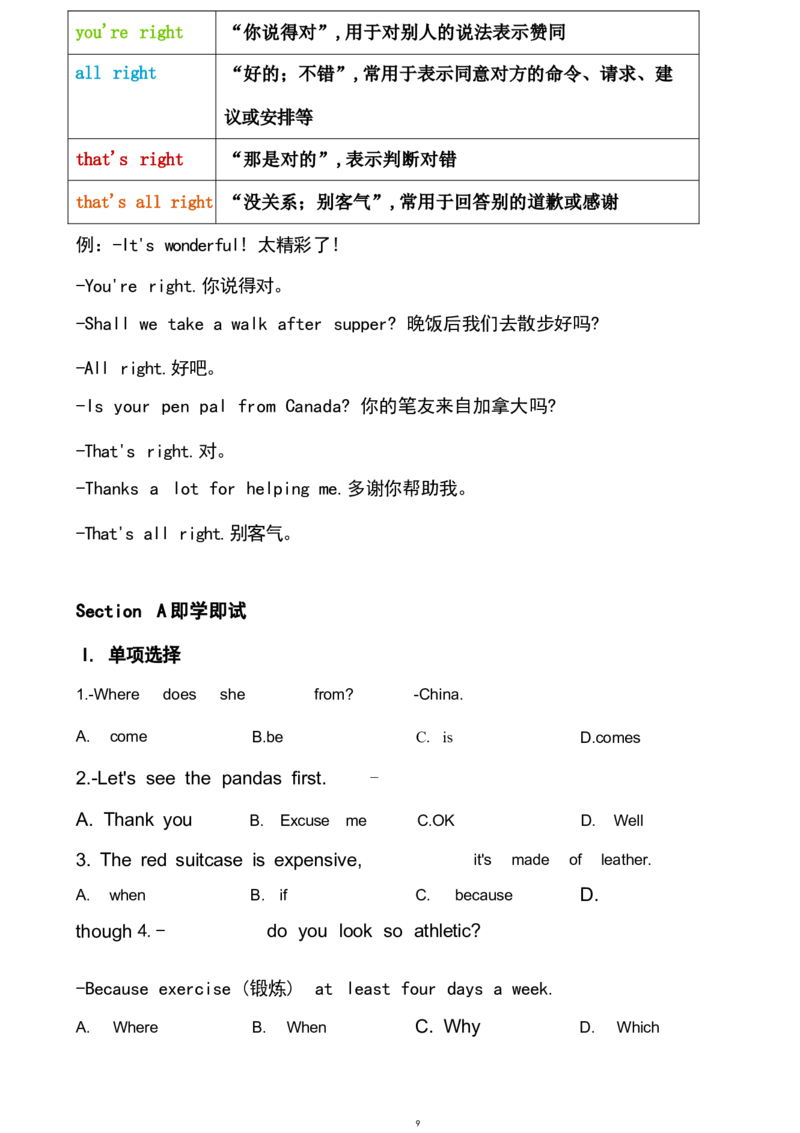
辨析: you're right,all right, that's right与 that's all right
8you're right “你说得对”,用于对别人的说法表示赞同
all right “好的;不错”,常用于表示同意对方的命令、请求、建
议或安排等
that's right “那是对的”,表示判断对错
that's all right “没关系;别客气”,常用于回答别的道歉或感谢
例:-It's wonderful! 太精彩了!
-You're right.你说得对。
-Shall we take a walk after supper? 晚饭后我们去散步好吗?
-All right.好吧。
-Is your pen pal from Canada? 你的笔友来自加拿大吗?
-That's right.对。
-Thanks a lot for helping me.多谢你帮助我。
-That's all right.别客气。
Section A即学即试
I. 单项选择
1.-Where does she from? -China.
A. come B.be C. is D.comes
2.-Let's see the pandas first. -
A. Thank you B. Excuse me C.OK D. Well
3. The red suitcase is expensive, it's made of leather.
A. when B. if C. because D.
though 4.- do you look so athletic?
-Because exercise (锻炼) at least four days a week.
A. Where B. When C. Why D. Which
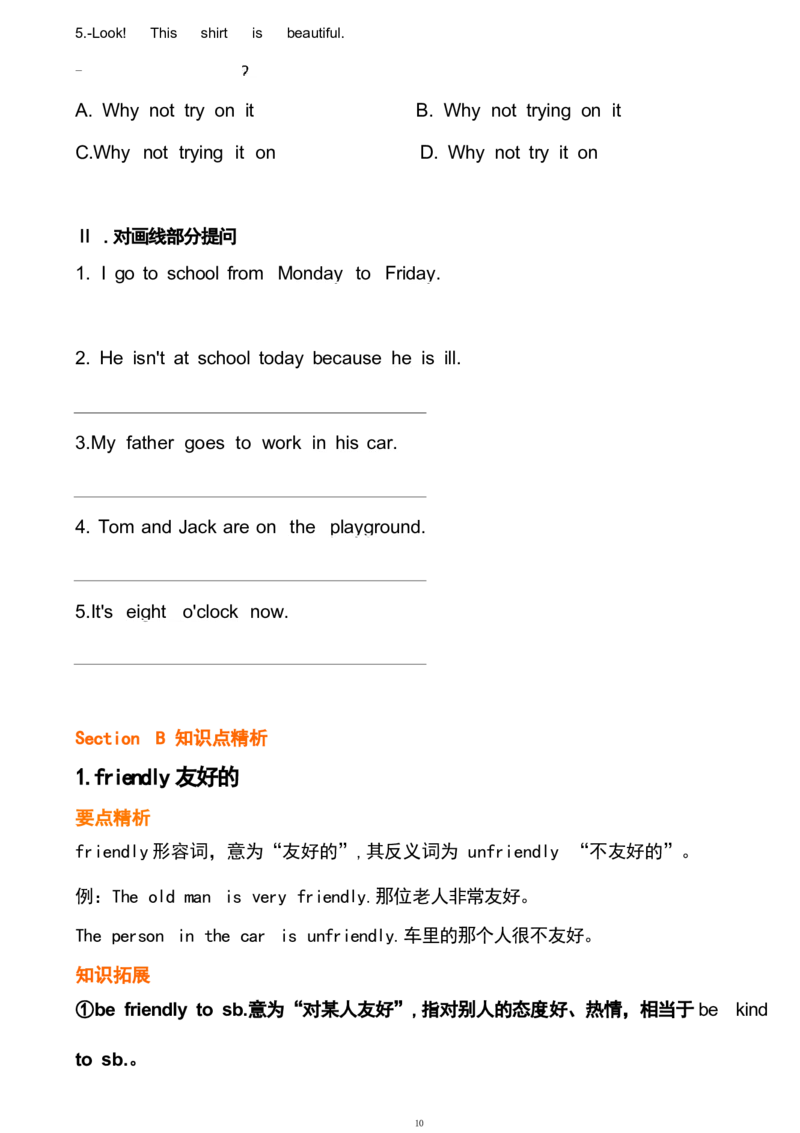
95.-Look! This shirt is beautiful.
-
A. Why not try on it B. Why not trying on it
C.Why not trying it on D. Why not try it on
Ⅱ .对画线部分提问
1. I go to school from Monday to Friday .
2. He isn't at school today becaus e he is il l.
3.My father goes to work in his car .
4. Tom and Jack are on the playground .
5.It's eigh t o'clock now.
Section B 知识点精析
1.friendly 友好的
要点精析
friendly形容词,意为“友好的”,其反义词为 unfriendly “不友好的”。
例:The old man is very friendly.那位老人非常友好。
The person in the car is unfriendly.车里的那个人很不友好。
知识拓展
①be friendly to sb.意为“对某人友好”,指对别人的态度好、热情,相当于be kind
to sb.。
10例:My friends are all friendly to me.我的朋友们都对我很友好。
②be friendly with sb.意为“和某人关系好”或“与某人要好”。
例:The children here are friendly with each other.
这里的孩子们相互之间关系很好。
【助记】
friend(n. 朋友) →friendly(adj.友好的)
un- (否定前缀)+ friendly→ (adj.不友好的)unfriendly
链接中考
(湖北襄阳中考)-How are you getting along with your new classmates?
-Very well. They are all me.
A. afraid of B.friendly to C.angry with D.sorry for
解析:be afraid of… “害怕“;be friendly to“对 ……友好”; be angry with“生
…… 的气”; be sorry for… “为 ……感到抱歉”。句意:“你和你的新同学相处
得怎么样?”
“很好,他们都对我很友好。”结合句意可知选B。
2.small 小的
要点精析
small 形容词,意为“小的”,常在句中作表语或定语。
例:The koala is very small.那只树袋熊非常小。
She lives in a small house.她住在一所小房子里。
辨析:small,little 与 young
指物体在形状、外形上小
small
带有一定的感情色彩,有“小而可爱”之意
little
young 指在年龄上小,意为“年轻的“
11例:It is small house.那是一座小房子。
My cousin is little boy.我的表弟是个小男孩儿。
As young man, he is very polite to the old people.
作为一个年轻人,他对老人很有礼貌。
3. We are students from Thailand, and we want to save the elephants.
我们是来自泰国的学生,我们想拯救大象。
要点精析
save 此处用作及物动词,意为“救,救助”,后接名词或代词作宾语。
save one's life 意为“挽救某人的生命”。
例:She saved the boy's life.她救了那个男孩儿的生命。
知识拓展
①save 作动词,还可意为“储蓄,积攒”。
例: He works late every night to save money.为了攒钱,他每晚都工作到很晚。
②save 作动词,还可意为“节省,节约”。
例:Please save water.请节约用水。
【助记】
save 的一词多义:
save a child from drowning
ave money存钱 save water节约水
救一个漏水的孩子
4. The elephant is one of Thailand's symbols.大象是泰国的象征之一。
12要点精析 1
one of后接名词复数或代词宾格形式,意为“……之一”,作主语时,谓语动
词用单数形式。
例:One of my friends is teacher.我的一个朋友是老师。
One of them is good at math.他们当中的一个擅长数学。
知识拓展
“one of+the+形容词最高级+名词复数”表示“最……的……之一”。
例:Lost in Thailand is one of the most interesting films.
《泰囧》是最有趣的电影之一。
要点精析 2
symbol 名词,意为“象征”。 the symbol of… 意为“……的象征”。
例:The dove is the symbol of peace.鸽子是和平的象征。
5. People say that "an elephant never forgets".人们说“大象从不会忘事”。
要点精析
forget 此处用作不及物动词,意为“忘记;遗忘”。
例:Don't forget to bring your homework next time.
下次别忘了带你的家庭作业来。
辨析:forget to do sth.与 forget doing sth.
forget to do sth. 意为“忘记去做某事”, 某事还未做
forget doing sth. 意为“忘记做过某事”, 某事已做
例:Mary often forgets to bring her pen.玛丽经常忘记带她的钢笔。
He forgets turning the light off.他忘记他已经关灯了。
知识拓展
forget 可表示“忘记带某物”,当表示“把某物忘在某处”时应用 leave。
13例:I often forget my key.我经常忘记我的钥匙。
I often leave my key in my office.我经常把钥匙忘在办公室里。
【助记】
forget 真特殊,后有地状用 leave 。 (说明:地状指地点状语。)
链接中考
(四川乐山中考)-What's this?
-Oh, my God! It's a gift for James. I forgot it this afternoon.
A. to post B. posting C. post
解析:forget to do sth.意为“忘记要做某事”,指事情还没有做; forget doing
sth. 意为“忘记做过某事”,指事情已经做了。句意:“这是什么?”“哦,我的天
哪!这 是给詹姆斯的礼物。今天下午我忘了寄走它。”由此可知 post (寄)这一动
作并未发
生,应使用 forget to do sth.表示。选A。
6.Elephants can walk for a long time and never get lost.
大象能长时间行走且从不迷路。
要点精析
get lost 意为“迷路”,相当于lose one's way。
例:The girl got lost.=The girl lost her way.这个女孩儿迷路了。
知识拓展
lose 动词,意为“丢失”; lost 形容词,意为“丢失的”。
7. They can also remember places with food and water.
它们也能记住有食物和水的地方。
要点精析
water 此处用作不可数名词,意为“水”。
14例:There is no water in the cup.杯子里没有水。
We must drink enough water every day.我们必须每天喝足够的水。
知识拓展
water 作及物动词时,意为“浇水”。
例:My mother waters the plants every day.我妈妈每天都给这些植物浇水。
【助记】
water 的一词多义:
8.But elephants are in great danger.但是大象处于极大的危险之中。
要点精析
danger 此处用作不可数名词,意为“危险”。
例:They saved him from danger.他们使他脱离了危险。
知识拓展
1
be in danger 处于危险中
例:be out of danger脱离危险
Many people in that country are in danger.那个国家的许多人正处于危险中。
The wounded soldier is out of danger now.
那个受伤的士兵现在脱离危险了。
②dangerous 形容词,意为“危险的”。
例:It's dangerous to play football on the street.在街上踢足球是危险的。
9. People cut down many trees so elephants are losing their homes.
15人们大量砍伐树木,因此大象正在失去它们的家园。
要点精析
cut 动词,意为“砍;切”。
例:Mom is cutting the birthday cake for us.妈妈正在为我们切生日蛋糕。
I cut them all a piece of birthday cake.我给他们每个人都切了一块生日蛋糕。
知识拓展
cut 的常见短语:
cut in 插话
cut off 剪掉,砍掉
cut down 砍倒
cut up 切碎
例:They are cutting down trees.他们正在伐木。
Can you help me cut up the carrots? 你能帮我把这些胡萝卜切碎吗?
10. We must save the trees and not buy things made of ivory.
我们必须拯救树木,拒绝购买象牙制品。
要点精析
made of 意为“由……制成的”。过去分词短语 made of ivory 作后置定语,修饰
其前的名词 things。
例:I like things made of wood.我喜欢木制的东西。
I love the sweater made of wool.我喜欢这件由羊毛制成的毛衣。
意为“由……制成的”,一般指从制成品中能够看出原
be made of
材料,发生的是物理变化
意为“由……制成的“,一般指从制成品中看不出原
be made from
材料,发生的是化学变化
16be made in 为“制造于 …… “,后跟地点名词,表示某物的产地
辨析:be made of,be made from与 be made in
例:The kite is made of paper.这只风筝是用纸做的。
This kind of wine is made from grapes.这种酒是由葡萄制成的。
These computers are made in Guangzhou.这些电脑的产地是广州。
11.Isn't she beautiful? 难道她不美丽吗?
要点精析
这是一个否定疑问句,常用来表示反问、责备,或表示说话人的看法或惊异的情绪,
意为 “难道 …… 不 …… 吗?”,其结构是“系动词 be/ 助动词/情态动词的否定形
式+
主语+其他?”。
例:Aren't you Chinese? 难道你不是中国人吗?
Can't you play basketball? 难道你不会打篮球吗?
Shouldn't you pay for this book? 难道你不该为这本书付款吗?
知识拓展
回答否定疑问句时,如果是肯定回答,用 Yes 开头;如果是否定回答,用 No 开头。
但是翻译成汉语时Yes 意为“不”, No 意为“是的”。
例:-Doesn't he have a sister? 难道他没有姐妹吗?
-Yes,he does.不,他有。/No,he doesn't.是的,他没有。
-Isn't the lion from Africa? 难道那只狮子不是来自非洲吗?
-Yes,it is.不,它是。/No,it isn't. 是的,它不是。
【助记】
巧记否定疑问句的答语
回答否定疑问句,答案含义是依据。
肯定事实用 yes, 否定情况 no 来替。
1712.She is twelve years old.她 12 岁了。
要点精析
“be+ 数词+year(s)old” 常用来表示年龄,意为”……岁”。
例:My father is forty-five years old.我父亲 45 岁了。
My mother is forty years old.我母亲 40 岁了。
知识拓展
①就年龄提问时用 how old。
例:-How old are you? 你多大了?
-I'm thirteen years old.我 13 岁了。
②如果是问几个月大的小孩儿,回答时要用 month(s) old.
例:-How old is the baby? 那个婴儿多大了?
-He is four months old.他 4 个月大了。
辨析:数词+year(s)old 与数词-year-old
数词+year(s)old 在句中作表语
数词-year-old 在句中作前置定语
例:His daughter is three years old.他女儿三岁了。
He has a three-year-old daughter.他有一个三岁的女儿。
Section B 即学即试
I.选词填空
lazy beautiful smart friendly shy
1.Ilike dogs. They are
2. Tom is a boy. He never washes his
clothes. 3.John is very .He is good at math.
4. Mary is a girl. She's afraid to talk to her classmates.
5. Look! There are many flowers in the garden.
18Ⅱ .单项选择
1.-Can't you ride a bike?
- . I have to walk to school.
A. Yes, I can't B. No, I can C. Yes, I can D.No, I can't
2. More and more boys like playing basketball in our
school. A. a B.an C. the D./
3.-What do you think of your English teacher?
-I love her.She is really .She always has smile (微笑) on her face
A.sad B.funny C.friendly D.serious (严肃的)
4.Lily is a girl. She is very lovely.
A. six-years-old B.six years old C.six year old D.six-year-old
5.When you leave, please don't forget the door.
A. close B. closing C. to close D. closes人教版(新标准)初中英语知识点归纳
七年级下册 UNIT 5
Why do you like pandas? 你为什么喜欢熊猫?
单词归纳
panda 熊 cat 猫
zoo 动物园 sleep 睡觉
tiger 老虎 friendly 友好的
elephant 大象 shy 羞怯的;腼腆的
lion 狮子 save; 救助
giraffe 长颈鹿 flag 旗;旗帜
animal 动物 forget 忘记;遗忘
water danger 危险 place 地点;位置
tree 树 cute 可爱的;机灵的
kind 种类 lazy 懒散的;懒惰的
smart 聪明的 south 南方的;南,南方
kill 杀死;弄死 beautiful 美丽的;美好的
cut 砍;切 Australia 澳大利亚
Africa 非洲 over 超过,多于;在……上方
pet 宠物 down (坐、躺、倒)下;向下;沿着
leg 腿
短语归纳
kind of 稍微,有点儿 get lost迷 路
all day整 天
be/ come from 来自
cut down 砍 倒
South Africa南非
20a symbol of 一个……的象征 for a long time 很长时间
walk on two legs 用两条腿走 kill…for… 为而杀死……
things made of ivory 象牙制品
lose one's homes 失去某人的家园
be in( great) danger 处于(极大)危险之中
places with food and water 有食物和水的地方
用法归纳
1.-Wh…? 为什么……?
-Because…, 因为…
2.let sb.do sth. 让某人做某事
3.want to do sth. 想要做某事
4.one of+名词复数 ……之一
5.forget to do sth. 忘记要做某事
6.forget doing sth. 忘记做过某事
7.help sb. (to) do sth. 帮助某人做某事
8.be friendly to sb. 对某人友好
9.Where+be+ 主语+from? 来自哪里?
10.What animals do/does+主语+like? 喜欢什么动物?
11.否定疑问句:Isn't she.,? 难道她不……吗?
12. 数词+year(s)old …… 岁即学即试参考答案与解析
Section A
即学即试
I.1.A come from/be from “来自”。由空格前的dos 如应选A。
2.C Let's… 用来提建议,其常见回答为: All right./That's a good idea…等。故选
C 项。
3.C 句意:那个红色手提箱很贵,因为它是皮革制成的。 because 意为“因为”,符
合题意。
4.C 句意:“你为什么看起来如此健壮?”“因为我每周至少有四天在锻炼。”根据答
语 用 because 来回答可知,应用疑问副词 why 来询问原因。故选 C 项。
5.D 根据语境判断下句是提建议,"Why not do sth.?”意为“为什么不傲某事呢?
try on的宾语为代词时,必须放在 try 与 on 之间,故选 D 项。
Ⅱ.1. When do you go to school?
2. Why isn't he at school today?
3. How does your father go to work?
4. Where are Tom and Jack?
5. What time /When is it now?
Section B
即学即试
I.1.friendly 2.lazy 3.smart 4.shy 5.beautiful
Ⅱ .1.D 由“我不得不步行上学。”可知应作否定回答。
2.D play与球类名词连用时,球类名词前不用任何冠词。
3.C 由答语“她脸上总带着微笑”可知,应选 C 项。
4.D 由句子结构可知空格处在句中作定语,数词-year-old 可在句中作定语。故选
D。 5.Cforget 后可以接动词不定式,也可以接 v- ing 形式,排除 A、D; 根据句
意“当
你离开时,请不要忘记去关门”可知事情没做,故选 C。
22