人教版(新标准)初中英语八年级上册 Unit 5
Do you want to watch a game show?
你想看游戏类节目吗?
重点
● 动词不定式作宾语
● 本单元重点单词、重点短语及重点句型
重点
● 运用动词不定式谈论个人的打算、喜好和对某事物的看法及意见
语法
● 动词不定式作宾语
Section A
重点单词
news 新闻节目;新闻 mind 介意;对(某事)烦恼
stand 忍受;站立 educational 教育的;有教育意义的
plan 打算;计划 hope 希望
discussion 讨论;商量 happen 发生;出现
expect 预料;期待 joke 笑话;玩笑
重点短语
think of 认为 learn from从……获得;向……学习
talk show 访谈节目
find out 查明;弄清
game show 游戏类节目 go on 发生
soap opera 肥皂剧
watch a movie 看电影
1重点句型
1.I don't mind them.我不介意它们。
2. Then let's watch a talk show. 那么让我们看访谈节目吧。
3. Because I hope to find out what's going on around the
world. 因为我希望弄清全世界在发生什么事。
4. Oh,I can't stand them.噢,我不能忍受它们。
5. I like to follow the story and see what happens
next. 我喜欢跟着故事情节看接下来发生的事。
6.Well, they may not be very exciting, but you can expect to learn a lot from
them.
哦,它们可能不是很令人兴奋,但你可以期望从它们中学到很多。
Section B
重点单词
meaningless 毫无意义的;意思不明确的 action 行动
cartoon 动画片;卡通片 culture 文化;文明
famous 著名的;出名的 appear 出现
become 开始变得点变成 rich 富有的
successful获得成功的;有成就的 might 可能;可以
main 主要的;最重要的 reason 原因;理由
common 普通的;常见的 film 电影
unlucky 不幸的;不吉利的 lose 失去;丢失
ready 愿意的;准备好的 simple 简单的;易做的
army 陆军;陆军部队
2重点短语
action movie 动作影片
a symbol of.……的象征
one of..……之 一
as famous as 与....一样有名
such as 例如;像……这样
dress up 装扮;乔装打扮
try one's best 尽力;竭尽全力
take sb.'s place 代替;替换
a pair of 一双; 一对
do a good job 做得好
look like 看起来像
something enjoyable 令人愉快的东西
be ready to 准备好(做某事);愿意(做某事)
重点句型
1. We all know and love the black mouse with two large round ears — Mickey
Mouse.
我们都知道并喜爱有着两只大圆耳朵的黑色老鼠——米老鼠。
2. Over 80 years ago, he first appeared in the cartoon Steamboat
Willie. 80 多年前,他首次在卡通片《威利号汽船)中出现。
3. When this cartoon came out in New York on November 18, 1928, it was
the first cartoon with sound and music.
当这部卡通片于 1928 年 11 月 18 日在纽约发行时,它是第一部有声音和音乐的卡通
片。
4. He became very rich and successful.他变得非常富有,而且很成功。
5. However, he was always ready to try his best. 然而,他总是准备好去尽其所能。
6.She dresses up like a boy and takes her father's place to fight in the army.
她装扮成一个男孩子并替父从军打仗。
3Section A 知识点精析
1.I don't mind them.我不介意它们。
要点精析
mind 的常见用法如下:
①mind 此处作及物动词,意为“介意;对(某事)烦恼”,通常用于疑问句、否定句
或条件句中,后面可接名词、代词、动名词或从句。
例:Would you mind making some room for the patient?
你介意给这位病人让点儿地方吗?
Do you mind if I call you later? 你介意我晚点儿给你打电话吗?
②mind 作动词,还意为“当心;注意”。
例: Mind the step!小心台阶!
Now mind! You must hurry home.现在注意啦!你们必须赶快回家。
③mind 作名词,意为“头脑;想法;记性”。
例:An idea has just come into my mind.我刚才想到一个主意。
Out of sight, out of mind.眼不见,心不烦。
【注意】
● 对 Would you mind(my)doing sth.
● 句型进行回答时,表示“不介意”常用 Not at all./Certainly not./ of
course not.等 ;
● 表示“介意”习惯用 I'm sorry, but …。
知识拓展
有关 mind 的常见搭配:
change one's mind 改变主意
make up one's mind 下决心,做决定
4keep… in mind 记住……
never mind 不要紧,没关系
链接中考
(山东烟台中考)-Would you mind not noise? Alice is sleeping.
Sorry, I didn't know.I she was awake.
A. make; think B. making; thought C. making; think D.make; thought
解析:句意:"你介意不要发出噪音吗?艾丽斯正在睡觉。”"抱歉,我不知道。我以
为 她醒着呢。"mind" 介意”,后接动词时用动名词形式作宾语,由此排除 A 和 D;
根
据答语最后一句“我以为她醒着呢”,可知应用 think 的过去式 thought, 排除 C。
故选 B。
2.news 新闻节目
要点精析
● news 为不可数名词,意为“新闻节目;新闻;消息” ,它虽然以-s 结尾,但不是
名词复数形式。
● 若要表达“一则消息/一条新闻”应用 a piece of news,news 在句中作主语时,
其后的谓语动词用单数形式。
例:The news makes the children excited.这则消息令孩子们很兴奋。
In the room we collect the latest news and prepare the weather report.
在这个房间里我们收集最新的新闻,准备天气预报。
【注意】
某些学科名词和以-s 结尾的不可数名词,虽然形式上是复数形式,但实际上是单数如
maths (数学),physics (物理学),politics (政治)等。
53. Then let's watch a talk show.那么让我们看访谈节目吧。
要点精析 1
● let 为使役动词,意为“允许;让” ,常用于 let sb.do sth.句型,意为“让某人
做某事”。
● let's do sth.意为“让我们做某事吧”。
例:Let me help you with the housework. 让我帮助你做家务吧。
Let's go to school!我们去上学吧!
要点精析 2
watch 作及物动词,意为"观看;注视"。
例:He is watching TV. 他正在看电视。
辨析 watch, see, read 与 look
watch “观看;注视”,常用于看电视、看戏、看比赛及各种表演等
see “看见;看到”,强调“看”"的结果,为及物动词,后跟名词或代词作宾语
read “阅读;读”,常用于读书、看报、看杂志等
look “看;瞧”,强调“看”的动作,为不及物动词,后接宾语必须与介词 at 连用
例:Look! The boy is watching the football game. His father is seeing a film and
his mother is reading a newspaper.
看!这个男孩儿在看足球赛。他的爸在看电影,他的妈妈在看报纸。
方法技巧·
“看”的不同用法
看场电影多用 see, 读书看报多用 read。
电视、戏剧和比赛,凡是表演用 watch。
look 过程细观察,还要等 see 来出结果。
64. Because I hope to find out what's going om around the world.
因为我希望弄清全世界在发生什么事。
要点精析 1
● hope 此处用作动词,意为“希望”。
● 常用于两种结构: hope to do sth.意为“希望做某事”;hope+that
从句意为
"希望 …… "。
例:I hope to see your father as soon as possible.我希望尽快见到你父亲。
We hope that you have a good time.我们希望你过得愉快。
辨析 hope 与 wish
hope “希望”,表示可以实现或能达成的希望
wish “希望;愿望”,常指难以实现或不能实现的愿望
例:I hope to see you next week.我希望下周见到你。
I wish I could have a plane.我多么希望我能有一架飞机。
【助记】
hope 后不能用动词不定式作宾补,而 wish 可以。
hope sb.to do sth.(错误)
wish sb.to do sth.( 正 确 )
hope/wish to
例 :I hope/wish to play basketball. 我希望打篮球。
I wish Lily to play basketball.我希望莉莉打篮球。
要点精析 2
find out 意为“查明;弄清”。
例:please find out when Mrs. Green will go to Beijing.
7请查明格林夫人去北京的时间。
辨析 find out 与 find
find out “查明;弄清;指出”,指经过调查、询问、研究后搞清楚、弄明白,后面常
跟宾语从句
find “找到;发现”,通常强调寻找的结果
例:Go and find out when the plane will take off.去查一下飞机什么时候起飞。
I found my socks under the bed. 我在床下找到了我的子。
5. Oh, I can't stand them.噢,我不能忍受它们。
要点精析
stand 此处意为“忍受,忍耐” ,常用于否定句或疑问句中。
例:I can't stand smoking in the house.我受不了房屋里有人抽烟。
I cannot stand that man; he talks too much.我不能忍受那个男人,他说得太多。
知识拓展
stand 也可表示“站,站立”。
例:The two men stood up and shook hands. 那两个男人站起来,握了握手。
They are standing under the tree. 他们正站在树下。
【助记】
stand 的一词多义
站 立 忍 受 ( 恶 劣 条 件 )
6.I like to follow the story and see what happens next.
我喜欢跟着故事情节看接下来发生的事。
要点精析
● happen 不及物动词,意为“发生;出现”。
8● 一般指偶然发生,其主语常为事,而不能是人。常用于下列结构:
①sth.+ happen(s)/happened+地点/时间“某地/某时发生了某事”。
例:The moving story happened in 2013.这个感人的故事发生在2013年。
②sth.+ happen(s)/ happened+to sb.”某人出了某事(常指不好的事)”。
例:A car accident happened to her this morning.今天上午她出了车祸。
③sb.+ happen(s)/happened to do sth. “某人碰巧做某事”。
例:I happened to meet a friend in the street yesterday.
昨天我在街上碰巧通到了一个朋友。
④It happens/ happened that.” 碰巧/恰巧发生某事”。
例:It happened that Brian and Peter were at home that day.
碰巧那天布恩和彼得在家里。
辨析 happen 与 take place
happen 意为“发生;碰巧”,一般用于偶然或突发性事件
take place 意为“发生;举行,举办”,一般指非偶然性事件的“发生”,即这种事件
的发生一定有某种原因或事先的安排
例:A traffic accident happened to him. 一场交通事故发生在他身上。
The meeting will take place next Friday.会议将在下周五举行。
7. Well, they may not be very exciting, but you can expect to learn a lot
from them. 哦,它们可能不是很令人兴奋,但你可以期望从它们中学到很多(知识)。
要点精析 1
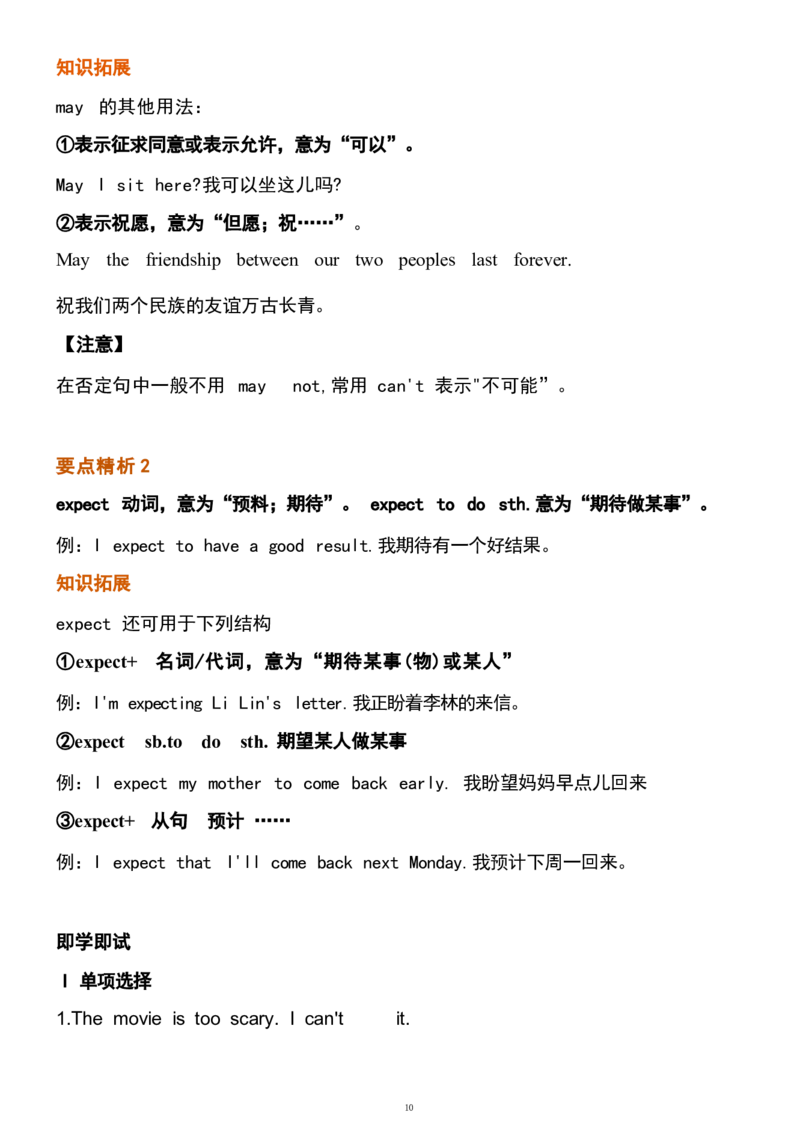
may 情态动词,表示推测,意为“能,或许”。
例:It may rain this evening. You'd better take an umbrella.
今晚可能会下雨,你最好带上一把雨伞。
9知识拓展
may 的其他用法:
①表示征求同意或表示允许,意为“可以”。
May I sit here?我可以坐这儿吗?
②表示祝愿,意为“但愿;祝……”。
May the friendship between our two peoples last forever.
祝我们两个民族的友谊万古长青。
【注意】
在否定句中一般不用 may not,常用 can't 表示"不可能”。
要点精析 2
expect 动词,意为“预料;期待”。 expect to do sth.意为“期待做某事”。
例:I expect to have a good result.我期待有一个好结果。
知识拓展
expect 还可用于下列结构
①expect+ 名词/代词,意为“期待某事(物)或某人”
例:I'm expecting Li Lin's letter.我正盼着李林的来信。
②expect sb.to do sth. 期望某人做某事
例:I expect my mother to come back early. 我盼望妈妈早点儿回来
③expect+ 从句 预计 ……
例:I expect that I'll come back next Monday.我预计下周一回来。
即学即试
I 单项选择
1.The movie is too scary. I can't it.
10A. stand B. see C. have D. play
2.-Do you think Brazil will beat Japan in the next match?
-Yes, they have better players, so I them to win.
A. hope B. except C. expect D. prefer
3. Yesterday Lucy told us such good that we were all amazed at it. A.
news B. ideas C. suggestion D.answer
4.- I borrow your history book
-Sure. Here you are.
A. Must B. May C. Need D. Will
5.-Jack, could you help me when the plane will take off on the Internet?
-I'm sorry, my computer doesn't work.
A. get out B. look out C. take out D.find out
Ⅱ 根据汉语意思完成句子
1. 我的爸爸不喜欢肥皂剧。
My father like
2. 这个小男孩儿不能忍受西餐。
The little boy Western food.
3. 你认为这件毛衣怎么样?
do you this sweater?
4.我们不介意酷热的天气
We the hot weather.
5.我们打电话时她刚巧不在家。
She be out when we called
11Section B 知识点精析
1.relaxing 令人轻松的
要点精析
relaxing 形容词,意为“令人轻松的”。
例:Have a relaxing weekend! 祝你度过一个轻松的周末!
辨析 relaxing 与 relaxed
relaxing “轻松的,令人放松的”,常用于描述事物
relaxed “放松的” ,常用于描述人
例:Tom looks very relaxed after a relaxing vacation.
在过了一个轻松的假期之后,汤姆看上去很放松。(
链接中考
(湖北黄冈中考模拟)I'm very tired these days because of studying for physics.
-Why not music? It can make you .
A. listen to; relaxing B. to listen to; to relax
C.listening to; relax D. listen to; relax
解析:句意:“由于学习物理,这些天我非常累。””为什么不听听音乐呢?它会使
你 放松。”why not 后面接动词原形,排除 B、C 两项;又因 make 后接省略 to
的动词
不定式作宾语补足语。故选 D>
2. But one very famous symbol in American culture is a cartoon.
但在美国文化中, 一个非常著名的象征是一部卡通片。
要点精析
● famous 形容词,意为“著名的;出名的;众所周知的”,与 well-known 同义。
12● be famous for 意为“因为 ……而出名”。
例: France is famous/well-known for its fine food and wine.
法国以其美食和葡萄酒而闻名。
辨析 be famous for, be famous as 与 be famous to
be famous for “因为 ……而出名”,后接出名的原因,与 be known for 同义
be famous as “作为 ……而闻名”,后接表示职位、名称等的词,与 be known as
同义
be famous to“为 ……所熟知”,后接人
例:This place is famous for its cotton.这个地方因棉花而出名。
He is famous as a great actor. 他作为一名伟大的演员而出名。
This singer is famous to lots of old people.这位歌手为许多老人所熟知。
链接中考
(海南中考)-Hainan its blue sky and fresh air.
-So it is. That's why more and more visitors spend their holidays here A. is weak
in B. is famous for C. is used to
解析: be weakin.意为"在 … … 差";be famous for.意为"以 . . … 著名";be
used
to(do), 意为“习惯于 …… "。由答语后句句意“那就是越来越多的游客在这儿度假
的原因。可知,空格所在句句意为“海南以蓝天和新鲜的空气而著名”。故选 B。
3. We all know and love the black mouse with two large round ears—
Mickey Mouse.
我们都知道并喜爱有若两只大圆耳朵的黑色老鼠一一米老鼠。
要点精析 1
13with 介词,此处意为“带有,具有”。
例:He's a tall kid with short hair.他是一个留着短发的高个子小孩儿。
知识拓展
with 的其他用法:
① “用;以;借”,表示使用工具、手段等。
例:Cut it with a knife.用刀把它切开。
② “和 ……在一起” ,表示伴随。
例: Can you go to a movie with me? 你能和我一起去看电影吗?
③ “与 ……对立:反对”。
例:I had an argument with my boss.我跟老板吵了一架。
④ “关于,对于”,表示一种关系或适用范围。
例:Are you pleased with the result? 你对结果满意吗?
⑤ “随着,与……同时”。
例:With these words. he left the room.说完这些话,他离开了房间。
链接中考
(河北中考) You see, Kevin is writing his left hand.
A. at B.as C. for D. with
解析:句意:你看,凯文正在用他的左手写字。介词 with 此处意为“用”,故选 D。
要点精析 2
● 句中的 two large round 用来修饰名词 ears, 在句中作定语。
● 多个形容词同时修饰名词时,顺序为“限定词→数量词→一般描绘性的→表示大小
形状的→表示长幼、新旧的→表示色彩的→表示国籍、地区、出处的→表示物质、
材料的→表示用途、类别的→被修饰的名词。”
例:This is a big old house.这是一个大的旧房子。
14链接中考
(四川自贡中考模拟) They have got such a table.
A. round wooden brown
B. round brown wooden
C. brown round wooden
解析:根据多个形容词同时修名词的顺序可知,选 B。
4. Over 80 years ago, he first appeared in the cartoon Steamboat Willie. 80
多年前,他首次在卡通片《威利号汽船》中出现。
要点精析
appear 动词,意为“出现;露面”。
例: Does the sun appear on the horizon at six?太阳在 6 点露出地平线吗?
My friends didn't appear until seven o'clock.我的朋友们直到 7 点才出现。
小贴士
appear 意为“出现”时,为不及物动词,常用副词或介词短语修饰; appear 意为“显
得;看来;好像”时,为系动词,后跟名词、形容词、动词不定式或 that 从句作表语。
【助记】
dis- (否定前缀)+ appear (出现,露面)
反义词disappear ( 消 失 )
appear+ ance
名词 appearance (出现,露面)
反义词 disappearance ( 消 失 )
6. When this cartoon came out in New York on November 18, 1928, it was
the first cartoon with sound and music.
157. 当这部卡通片于 1928 年 11 月 18 日在纽约发行时,它是第一部有声音和
音乐的卡通片。
要点精析
come out 此处意为“发行;出版”。
例: His new albums came out and sold out at once.
他的新专辑发行后立刻销售一空。
My first book came out in 2013.我的第一本书于 2013 年出版了。
知识拓展
come out 的其他含义
①come out 意为“出来,出现”。
The sun Is coming out. 太阳出来了。
② come out 意为“开花;盛开”。
Some flowers begin to come out.一些花开始开放了。
③come out 意为”被获知;为人所知”。
The truth has come out at last.终于真相大白了。
6.He became very rich and successful.他变得非常富有,而且很成功。
要点精析 1
become 连系动词,意为”开始变得;变成” ,后接名词或形容词作表语。
例:Maple leaves become red in autumn. 枫叶在秋天变红。
Later, he became one of the best actors.后来,他成了最优秀的演员之一。
辨析 become,get,grow,go 与 turn
become 多用于书面语,意为“开始变得;变成”,表示由一种状态向另一种状态的转
16变,强调状态的变化,其后可接名词或形容词
get 用作连系动词时,意为“变得;变成”相当于 become,
后接形容词作表
语,表示“逐渐变得”的结果
grow 表示渐渐成为新的状态,即“渐渐地变为”,此时相当于 get, 后接形容词或动
词不定式
turn 表示“变化”时, 一般指进入不好的状态,意为”(使)变成,成为;转变”,表
示和从前完全不同
例:Our country is becoming stronger and stronger.我们的国家变得越来越强大。
It is getting colder and colder.天气变得越来越冷。
The skies grew dark and it began to rain. 天渐渐黑了,又下起雨来。
The milk has gone sour.这牛奶馊了。
He decided to turn professional. 他决定转为职业人员。
要点精析 2
rich形容词,意为“富有的”,其反义词为 poor, 意为“贫穷的”。
例:She is one of the richest women in the city. 她是这个城市最富有的女人之一。
知识拓展
①the rich 相当于 the rich people, 意为“富人;有钱人”,表示某类人,谓语动
词用复数形式。
例:The rich are not always happy.富人并不总是幸福的。
②be rich in …意为“盛产 ……”。
例:This country is rich in oil. 这个国家盛产石油。
要点精析 3
successful 形容词,意为“获得成功的;有成就的”。
17例: He is a successful man.他是一个成功的人。
知识拓展
success 用作不可数名词时,意为“成功” ;用作可数名词时,意为“成功的人或事”
其反义词为 failure。
例:Failure is the mother of success.失败乃成功之母。
链接中考
(山东东营中考) Overseas experience may help make our life .So why not
try to study abroad?
A.usual B.useful C. successful D.traditional
解析:句意:海外经历可能会帮助使我们的生活更成功。因此为什么不努力去国外
学 习 呢 ? usual" 平 常 的 " ; useful" 有 用 的 " ; successful"成 功
的 " ;
traditional “传统的”。根据句意可知选C。
7. However. he was always ready to try his best.
然而,他总是准备好去尽其所能。
要点精析 1
be ready to do sth,意为“准备好做某事;愿意做某事”。
例:Right, we're ready to go. 对,我们准备好了,可以走了。
In our class, Tom is ready to help other people.在我们班里,汤姆乐于帮助他人。
要点精析 2
try one's best 意为“尽力;竭尽全力”与 do one's best 同义, try/do one's best
to do sth.意为“尽力做某事”。
例:Children are trying their best to learn English.
18孩子们正尽他们最大努力学习英语。
8. She dresses up like a boy and takes her father's place to fight in the army.
她装扮成一个男孩子并替父从军打仗。
要点精析 1
dress up意为“装扮;乔装打扮”。 dress 动词,意为“给……穿衣服”。
例:The boys were all dressed up as pirates.这些男孩儿都装扮成了海盗。
辨析 dress, put on, wear, in 与 have on
dress 宾语通常是人,意思是“给……穿衣服”,dress oneself"某人自己穿衣服"
get dressed" 穿衣服"
put on “穿上,戴上”,强调穿、戴的动作,后接衣服、鞋帽等
wear “穿着;戴着”,表示状态,宾语可以是衣帽,也可以是饰物、奖章等
in 介词,后接表示衣服或颜色的词,着重于服装的款式或颜色,它所构成的短语只能
作表语或定语
have on 意思是“穿着,戴着“
例:My son is now able to dress himself.我儿子现在会自己穿衣服了。
Put on your heavy winter coat if you are going out.
如果你要出去,穿上你的厚冬衣。
You'd better wear blue or black pants with brown shoes.
你最好穿蓝色或黑色裤子配棕色鞋子。
This is a picture of a young man in a black coat.
这是一张穿着黑色外套的年轻人的照片。
I'll have on black pants and a gray shirt tomorrow.
明天我会穿一条黑色的长裤和一件灰色的衬衫。
19要点精析 2
take one's place 意为”代替:替换”与 take the place of sb.同义。
例:I took your place to see the film.我代替你去看电影。
【注意】
take place 意为“发生,进行” ,尤指根据安排或计划的发生。
9...and you want to see something enjoyable choose Mulan !
……而且你想看令人愉快的东西,就选择《花木兰》吧!
要点精析 1
something enjoyable 意为“令人倫快的东西”,something 是不定代词,形容词
修饰不定代词时应后置。
例:There's something interesting in the newspaper.报纸上有有趣的东西。
链接中考
(吉林长春中考) I bought for my mother on Mother's Day this year.
A. special anything B.anything special
C. special something D. something special
解析: something 通常用于肯定句, anything 通常用于疑问句和否定句,本句是
肯 定句,所以用不定代词 something; 形容词修饰不定代词时,放在不定代词之
后。
something special意为“特别的东西”,故选 D。
要点精析 2
enjoyable 形容词,意为“令人愉快的;使人快乐的”。
例:What an enjoyable concert it is 多么令人愉快的音乐会啊!
【助记】
20enjoy (动词,喜欢;享受)+-able ( 后 缀 )
→enjoyable (形容词,令人偷快的;使人快乐的)
知识拓展
有些动词或名词加后缀-able, 可构成形容词,如:drinkable (可以饮用的); valuab le
(有价值的);reasonable (有道理的);comfortable (舒服的 )。
即学即试
I 根据句意及汉语提示完成单词
1. Hu Ge is a (著名的) actor. He acted many good roles.
2.I think the old people don't like ( 动 作 )movies.
3.- Can you tell me the ( 原 因 )why he was late for work?
-Of course. Let me tell you.
4 -We can't find her here and there She may be ( 丢 失 ) .We should ask
for
help.
5.The boy thinks he is (不幸的), so he looks very sad.
Ⅱ 单项选择
1. do you think of this fashion show?
A. How B. When C. Where D. What
2.-Why were you so excited just now?
-Because a rainbow in the sky. It's so beautiful.
A. appeared B. ran C.fell D. played
3.It's cold outside. Please put on
A. warm something B.anything warm
C. warm anything D. something warm
214-I hear you've got a new iphone 7. I have a look?
-Yes, certainly
A.May
B.Do C.Shall D. Should
5. Wang Lin is trying English because she plans to England.
A.learn; to go B. to learn; going C.learn; going D. to learn; to go人教版(新标准)初中英语八年级上册 Unit 5
Do you want to watch a game show?
你想看游戏类节目吗?
答案与解析
Section A
即学即试
I
1.A 2.C 3.A 4.B 5.D
Ⅱ
1.doesn't, soap operas
2. can't stand
3.What, think of
4. don't mind
5. happened to
Section B
即学即试
I
1.famous 2.action 3. reason 4. lost 5. unlucky
Ⅱ
1.D 2.A 3.D 4.A 5.D