人教版(新目标)初中英语知识点精析
八年级上册 Unit 2
How often do you exercise? 你多久锻炼一次?
重点
● 掌握频度副词的用法
● 熟悉本单元的重点单词和重点短语
难点
● 能恰当使用频度副词及短语
重点语法
频度副词
Section A
重点单词
housework 家务劳动:家务事
program 节目
hardly 几乎不;几乎没有 full 忙的;满的;充满的
ever 在任何时候;从来;曾经 swing 摆动;秋干;(使)摆动;摇摆
once 一次;曾经 maybe 大概;或许;可能
twice两次;两倍
least 最小;最少:最小的;最少的
Internet(国际)互联网;因特网
重点短语
on weekends 在周末
help with housework 帮助做家务
hardly ever 几乎从不
once a week 每周一次
1use the Internet 使用因特网
have dance and piano lessons 上舞蹈课和钢琴课
swing dance 摇摆舞
stay up 熬夜
at least 至少;不少于;起码
重点句型
1. What do you usually do on weekends?你周末通常做什么?
2.- How often do you watch TV?你多久看一次电视?
-Twice a week.一周两次。
3. I go to the movies maybe once a month.我大概每月去看一次电影。
4. He hardly ever watches TV.他几乎从不看电视。
5. How often do they stay up late?他们多久熬一次夜?
6.He plays at least twice a week.他每周至少踢两次(足球)。
Section B
重点单词
coffee 咖啡 health 健康;人的身体(或精神)状
态
result 结果;后果 percent 百分之……
online 在线(的);联网(的) television 电视节目;电视机
although 虽然;尽管;即使 through 以;凭借;穿过
mind 头脑;心智 body 身体
such 这样的;那样的;类似的 together 在一起;共同
die 消失;灭亡;死亡 writer 作者;作家
dentist 牙科医生 magazine 杂志;期刊
2however 然而;不过 than (用以引出比较的第二部分)比
almost 几乎;差不多 none 没有一个;毫无
less 较少;较小;较少的;更少的
point 得分;点;指;指向
重点短语
junk food 垃圾食品
be good for 对……有好处
go camping 去野营
in one's free time 在某人的业余时间
such as 例如;像……这样
more than 多于
less than 少于
重点句型
1.She says it's good for my health.她说它(牛奶)对我的健康有好处。
2. We found that only fifteen percent of our students exercise every
day. 我们发现只有 15%的学生每天锻炼。
3. The answers to our questions about watching television were
also interesting.对我们提出的关于看电视的问题的回答也很有意思。
4. Although many students like to watch sports, game shows are the
most popular.虽然许多学生喜欢看体育节目,但是游戏类节目是最受欢迎的。
5. It is good to relax by using the Internet or watching game shows, but
we think the best way to relax is through exercise.
通过上网或看游戏类节目来放松很好,但是我们认为最好的放松方式是通过锻炼。
3Section A 知识点精析
1. What do you usually do on weekends? 你周末通常做什么?。
要点精析
● on weekends 意为“在周末”,泛指每个周末,
● 而 on the weekend 表示“在周末,在这个周末”,是特指某个周末。
例 :I have piano lessons on weekends. 我周末上钢琴课。(泛指周末)
I will go shopping on the weekend.这个周末我要去购物。(特指本周末)
【注意】
● 表示“在周末”时, 英式英语中用 at :at
weekends/ the
● 美式英语中用 on : on weekends/on the at
2. help with housework 帮助做家务。
要点精析 1
help with sth.意为“帮助做某事”。
例 :she often helps me with my English. 她经常帮助我学英语。
知识拓展
与 help 相关的其他常见搭配:
help sb. (to)do sth. 帮助某人做某事
help oneself(to sth.)随便吃/喝(某物);款待
can't/ couldn't help doing sth. 情不自禁做某事
要点精析 2
● housework 不可数名词,意为"家务劳动;家务活"。
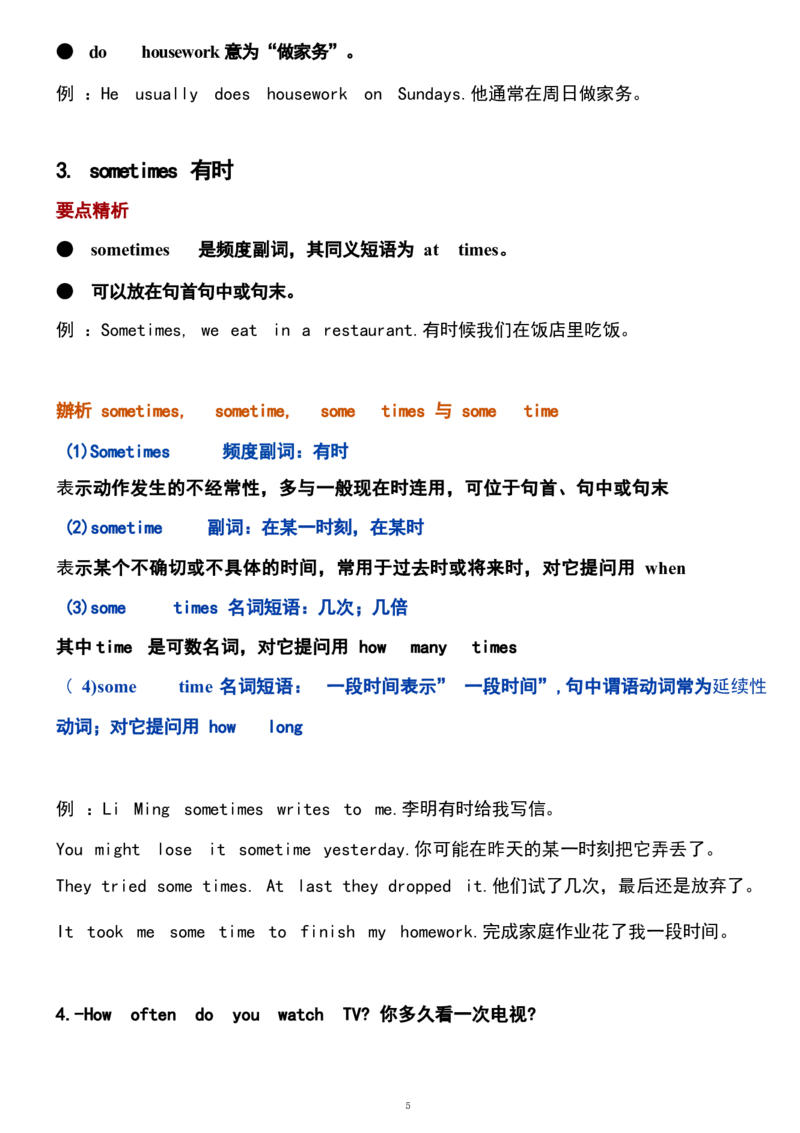
4● do housework 意为“做家务”。
例 :He usually does housework on Sundays.他通常在周日做家务。
3. sometimes 有时
要点精析
● sometimes 是频度副词,其同义短语为 at times。
● 可以放在句首句中或句末。
例 :Sometimes, we eat in a restaurant.有时候我们在饭店里吃饭。
辦析 sometimes, sometime, some times 与 some time
(1)Sometimes 频度副词:有时
表示动作发生的不经常性,多与一般现在时连用,可位于句首、句中或句末
(2)sometime 副词:在某一时刻,在某时
表示某个不确切或不具体的时间,常用于过去时或将来时,对它提问用 when
(3)some times 名词短语:几次;几倍
其中 time 是可数名词,对它提问用 how many times
( 4)some time 名词短语: 一段时间表示” 一段时间”,句中谓语动词常为延续性
动词;对它提问用 how long
例 :Li Ming sometimes writes to me.李明有时给我写信。
You might lose it sometime yesterday.你可能在昨天的某一时刻把它弄丢了。
They tried some times. At last they dropped it.他们试了几次,最后还是放弃了。
It took me some time to finish my homework.完成家庭作业花了我一段时间。
4.-How often do you watch TV? 你多久看一次电视?
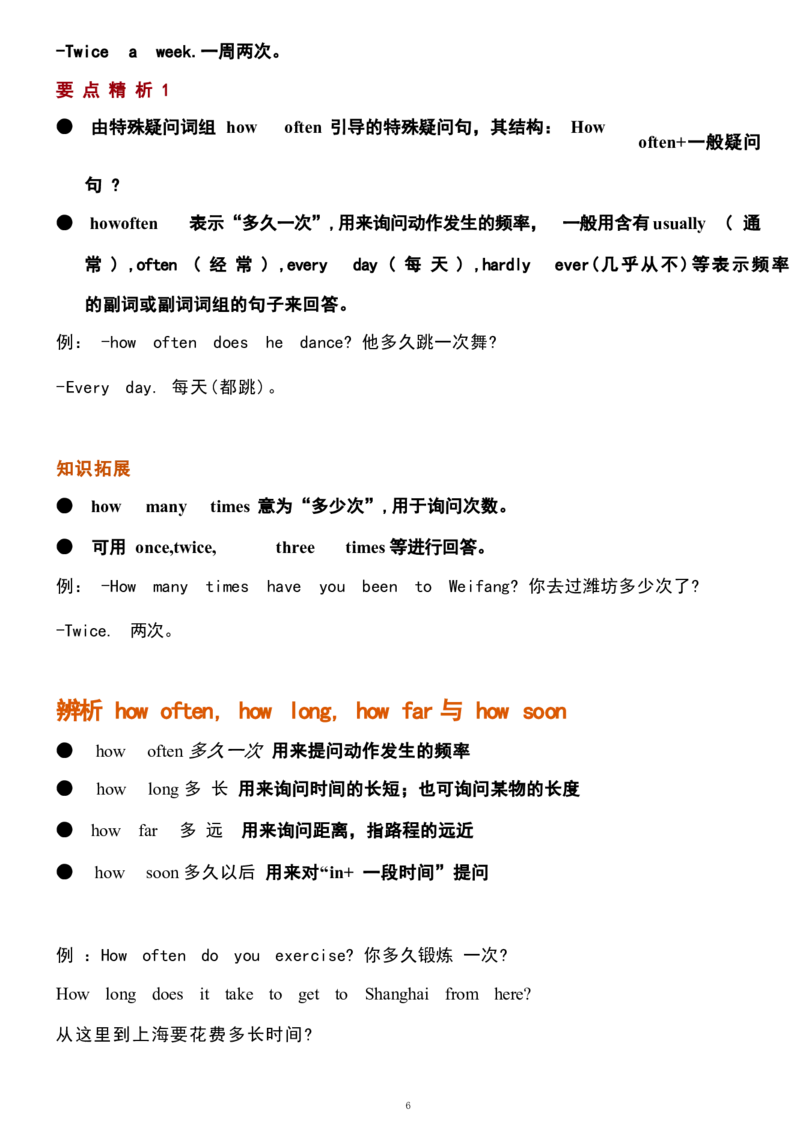
5-Twice a week.一周两次。
要 点 精 析 1
● 由特殊疑问词组 how often 引导的特殊疑问句,其结构: How
often+一般疑问
句 ?
● howoften 表示“多久一次”,用来询问动作发生的频率, 一般用含有usually ( 通
常 ) ,often ( 经 常 ) ,every day ( 每 天 ) ,hardly ever(几乎从不)等表示频率
的副词或副词词组的句子来回答。
例: -how often does he dance? 他多久跳一次舞?
-Every day. 每天(都跳)。
知识拓展
● how many times 意为“多少次”,用于询问次数。
● 可用 once,twice, three times 等进行回答。
例: -How many times have you been to Weifang? 你去过潍坊多少次了?
-Twice. 两次。
辨析 how often, how long, how far 与 how soon
● how often 多久一次 用来提问动作发生的频率
● how long 多 长 用来询问时间的长短;也可询问某物的长度
● how far 多 远 用来询问距离,指路程的远近
● how soon 多久以后 用来对“in+ 一段时间”提问
例 :How often do you exercise? 你多久锻炼 一次?
How long does it take to get to Shanghai from here?
从这里到上海要花费多长时间?
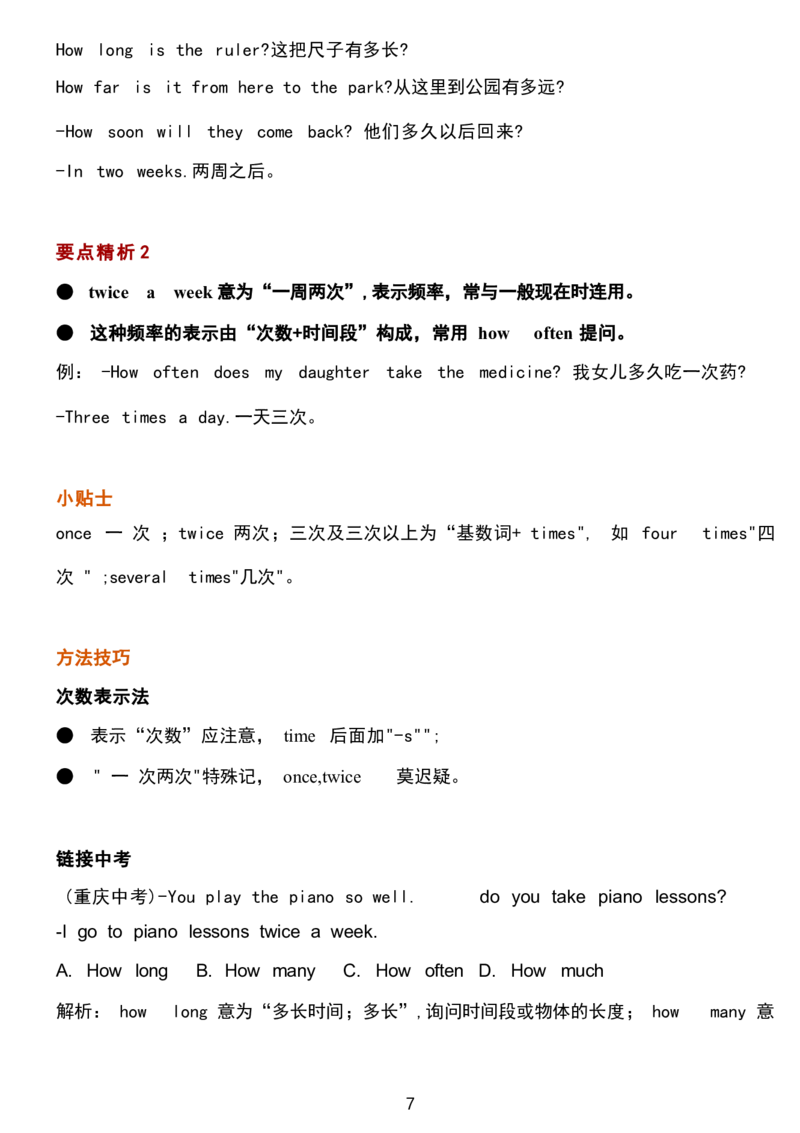
6How long is the ruler?这把尺子有多长?
How far is it from here to the park?从这里到公园有多远?
-How soon will they come back? 他们多久以后回来?
-In two weeks.两周之后。
要点精析 2
● twice a week 意为“一周两次”,表示频率,常与一般现在时连用。
● 这种频率的表示由“次数+时间段”构成,常用 how often 提问。
例: -How often does my daughter take the medicine? 我女儿多久吃一次药?
-Three times a day.一天三次。
小贴士
once 一 次 ;twice 两次;三次及三次以上为“基数词+ times", 如 four times"四
次 " ;several times"几次"。
方法技巧
次数表示法
● 表示“次数”应注意, time 后面加"-s"";
● " 一 次两次"特殊记, once,twice 莫迟疑。
链接中考
(重庆中考)-You play the piano so well. do you take piano lessons?
-I go to piano lessons twice a week.
A. How long B. How many C. How often D. How much
解析: how long 意为“多长时间;多长”,询问时间段或物体的长度; how many 意
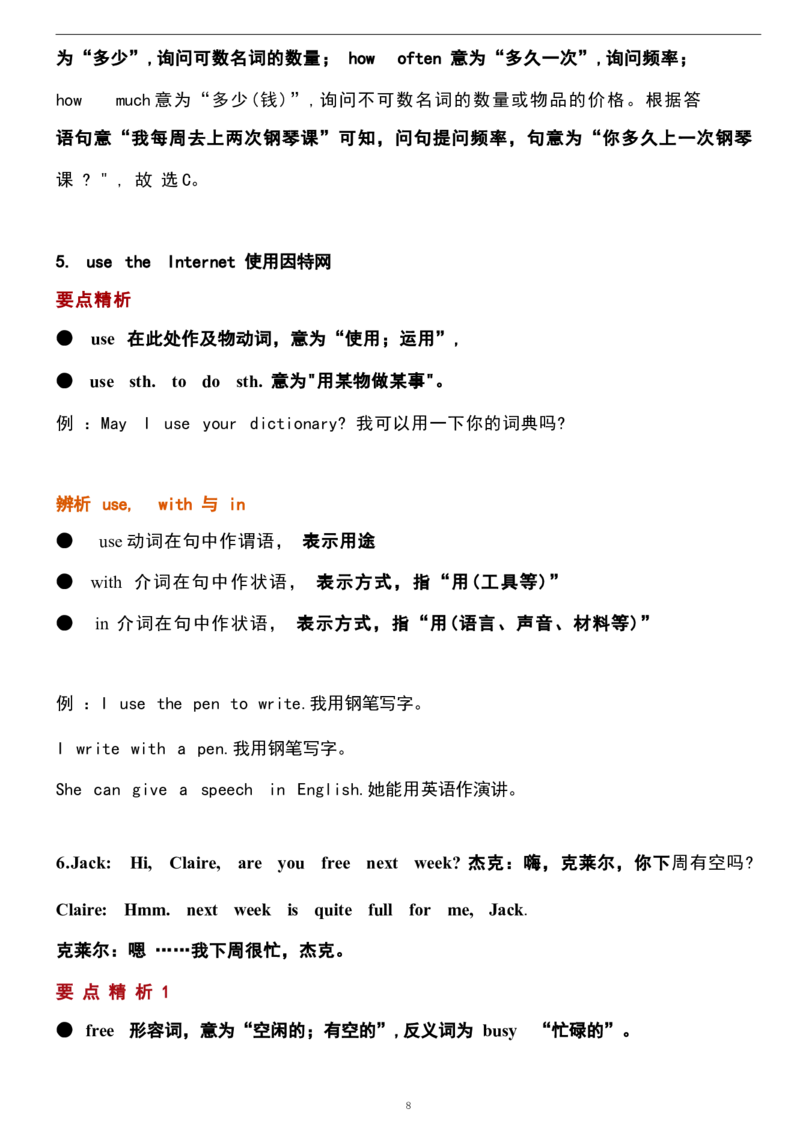
7为“多少”,询问可数名词的数量; how often 意为“多久一次”,询问频率;
how much意为“多少(钱)”,询问不可数名词的数量或物品的价格。根据答
语句意“我每周去上两次钢琴课”可知,问句提问频率,句意为“你多久上一次钢琴
课 ? " , 故 选C。
5. use the Internet 使用因特网
要点精析
● use 在此处作及物动词,意为“使用;运用”,
● use sth. to do sth. 意为"用某物做某事"。
例 :May I use your dictionary? 我可以用一下你的词典吗?
辨析 use, with 与 in
● use 动词在句中作谓语, 表示用途
● with 介词在句中作状语, 表示方式,指“用(工具等)”
● in 介词在句中作状语, 表示方式,指“用(语言、声音、材料等)”
例 :I use the pen to write.我用钢笔写字。
I write with a pen.我用钢笔写字。
She can give a speech in English.她能用英语作演讲。
6.Jack: Hi, Claire, are you free next week? 杰克:嗨,克莱尔,你下周有空吗?
Claire: Hmm. next week is quite full for me, Jack.
克莱尔:嗯 ……我下周很忙,杰克。
要 点 精 析 1
● free 形容词,意为“空闲的;有空的”,反义词为 busy “忙碌的”。
8● be free 意为“有空;闲着”。
例 :I'll be free tomorrow.我明天有空。
知识拓展
● free 还 可 表 示 "免费的,自由的 "。
● 常 用 短 语 :be free to do sth."自由地做某事"。
例 :I've got three free tickets for tonight's film. 我有三张今晚的免费电影。
You're free to go or to stay. 想走就走,想留就留。
链接中考
( 江 苏 连 云 港 中 考 ) Mr Black used to be busy. But now he's retired and
,SO
he has plenty of time to exercise.
A. hard B. calm C. free D.nervous
解 析 :hard" 困难的;硬的";calm" 平静的;冷静的";free" 空闲的;自由的;
免 费的";nervous" 紧张的"。由"布莱克先生过去很忙”和"因此他有大量的时间
去锻
炼”可知,空格所在句句意为“但是他现在退休了,有空了”,故答案应为 C
要 点 精 析 2
full形容词,在此处意为“忙的”。
例 :He was too full to find time for hobbies.
他太忙了,以至于没有发展业余爱好的时间。
知识拓展
①full 作形容词,还可表示“满的,充满的”。常用短语为 be full of,相当于 be filled
with, 意为"充满 … … "。
9例 :Hotels are often full at this time of year.
在一年中的这个时候,旅馆经常爆满。
②full 作形容词,还可表示”饱的”。其反义词是 hungry, 意为“饥饿的”。
I can't eat any more.I am quite full.我不能再吃了,我相当饱了。
7.How come?为什么?
要点精析
● How come? 是英语口语中的常用语,相当于“为什么?/怎么会呢?”。
● 可以单独使用,也可以在其后接句子,用来询问事情的缘由。
例: -I didn't even eat lunch today. 我今天甚至没有吃午饭。
-Really? How come?是吗?为什么?
How come Tom didn't come to the party? 汤姆怎么没来参加聚会呢?
辨析 how come 与 why
● how come 和 why 意思相近, 都可表示”为什么”
● how come引导的句子的语序为陈述语序
● why引导的特殊疑问句的语序为疑问语序
例 :How come you don't like eating sandwiches? 你为什么不喜欢吃三明治?
Why don't you like eating sandwiches? 你为什么不喜欢吃三明治 7
8. Well, how about Tuesday?哦,那么周二呢?
要点精析
● "How about … ? 相 当 于 "What about … " 是英语口语中一个常用的客套句型,
● 用来向对方征求意见或询问情况,意为“ ……怎么样?”,其后可接名词、代词或动
词的-ing 形式。
10例 :I'm ready.
about you? 我准备好了,你呢?
How
rest? 休息一会儿怎么样?
How about having a
9. I go to the movies maybe once a month.我大概每月去看一次电影。
要点精析
maybe 副词,意为“大概;或许;可能”常位于句首,表示可能性。
例 :Maybe he knows the way to the museum.或许他知道去博物馆的路。
辨析 maybe 与 may be
● maybe 副词,作状语,意为“或许;大概;可能”,相当于 perhaps
● may be 属于“情态动词+动词原形“结构,作谓语,意为“可能是;也许是”
例 :Maybe she is right.或许她是对的。
She may be right.她也许是对的。
10.He hardly ever watches TV.他几乎从不看电视。
要点精析
● hardly ever= almost never
● 意为“几乎从不”,表示频率。
● 其中 hardly 用作副词,意为“几乎不,几乎没有”。
例 :She hardly ever eats anything. 她几乎什么都没吃。
My legs were so weak that I could hardly stand.
我的腿如此虚弱以至于我几乎不能站立。
知识拓展
①hardly 常位于实意动词之前,连系动词、助动词或情态动词之后,本身具有否定意
11味,不可再用否定词。
例 :I could hardly hear the speaker.我几乎听不到演讲者的声音。
②句子中有 hardly 时,其反意疑问句的疑问部分应该用肯定形式。
He can hardly understand it, can he? 他几乎听不懂,是吗?
【注意】
不要将 hardly 误认为是 hard 的副词形式, hard 可用作形容词或副词。
例 :He worked very hard. But it's hard to push the hard stone to the top of the
mountain. 虽然他很努力,但是很难把那块坚硬的石头推到山顶上。
辨析 hardly 与 hard
● hardly 副词,意为 “几乎不“
● hard 作副词,意为 “努力地”;作形容词,意为"硬的;困难的"
例 :He hardly works. 他几平不工作。
He works hard.他努力工作。
Th here were some very hard questions on the exam paper.
试卷中有些很难的问题。
链接中考
(山东青岛中考)-How's Susan?
-Oh,I see her because she lives abroad.
A. always B. often C. almost D. hardly
解析: always 意为“总是”;often 意 为 " 经 常 " ;almost 意为"几乎"; hardly
意 为“几乎不"。由从句句意“因为她在国外居住"可推知,主句句意为“我几手见
不到
她 " 故 选 D.
1212.How often do they stay up late?他们多久熬一次夜?
要点精析
stay up late 意为“熬夜;睡得很晚”
例 :It is not a good habit to stay up late. 熬夜不是一个好习惯。
小贴士
stay up 常与 late, long 或 all night搭配,使语意更加丰富。
例 :He stayed up all night to write his story. 他熬了一整夜写他的小说。
【助记】
stay up late 熬夜到很晚
链接中考
(山东泰安中考)-Don't too late; you will feel tired in class.
-I won't, Mum.
A. call up B. wake up C. stay up D. get up
解析: call up意为“打电话”;wake up意为“唤醒;醒来”; stay up 意为“熬
夜”
get up 意为"起床"。由 you will feel tired in class (在课堂上你会感到疲惫)可知,
此处应为“不要熬夜到太晚”,故选 C。
12. He plays at least twice a week.他每周至少踢两次(足球)。
要点精析
● atleast 意为"至少;不少于;起码”,其中 least 用作副词,意为“最小;最少"。
● at least 的反义短语为 at most, 意为“最多”。
例 :It will take me at least two hours to finish my homework.
13完成家庭作业至少要花费我两个小时。
知识拓展
“at+ 名词”构成的常用短语:
at least 至 少 ;at last 最后,终于; at first 起初,起先; at most 最 多 ;at once
立刻,
马上; at present 现在,目前;at times 有时
即学即试
根据句意及首字母提示完成单词
1.-Would you like some cakes and bread?
-No thanks. I'm f
2.M you shouldn't do like that. It is not good for you.
3. Do you often help your mother do h
4.-Let's search ( 搜 索 ) the word on the I
-That's a good idea.
5.Ih ever see him now. What about you?
根据汉语意思完成句子
1."你多久去一次香港?""一个月一次。"
- do you to Hong Kong?
a month.
-
2."周末李芳通常做什么?""她通常看电影。"
does Li Fang usually do .
-She usually watches the movies.
3. 她从不锻炼身体,因此她变得越来越胖。
14She takes , so she is getting fatter and fatter.
4. 周坤最喜欢看电影(寒战》,因此他看了两次。
Zhou Kun liked the movie Cold War best, so he watched it .
5."我可以帮助你。你需要多少钱?""至少一万元吧。"
-I can help you. How much money do you need?
ten thousand yuan.
Section B 知识点精析
1 . She says it's good for my health. 她说它(牛奶)对我的健康有好处。
要点精析 1
● begoodfor 意为“对……有好处”,for 为介词,后接名词,代词成动名词
● 其反义短语为 be bad for 意为“对……有害”。
例 :Taking more exercise is good for your health.多锻炼对你的健康有好处。
辨析 be good for, be good at, be good with 与 be good to
● be good for 意为”对……有益“
● be good at意为“擅长……”,后接名词、代词或动名词
● be good with 意 为 “善于应付 ”
● be good to 意为“对……友好“
例 :Eating vegetables is good for your health. 吃蔬菜对你的健康有益。
I'm good at (playing) basketball. 我擅长(打)篮球。
He is good with children.他管理孩子有一套。
He is good to me. 他对我很友好。
15要点精析 2
● health 是不可数名词,意为“健康,健康状况”
● 常用于 be in good/poor/bad health 结构中,表示“健康状况好/不好/差”。
例 :smoking can seriously damage your health.吸烟会严重损害健康。
知识拓展
● health 的形容词形式是 healthy, 意为“健康的”;
● healthy 的反义词是 unhealthy, 意为“不健康的”
● 其副词形式是 healthily, 意为“健康地”。
● be/keep in good health=keep/stay healthy,意为“保持健康”。
2. Last month we asked our students about their free time activities.
上个月,我们询问了学生们关于他们的业余活动的情况。
要点精析
ask sb.about sth.意为“问某人关于某事的情况”。
例 :I ask my teacher about today's homework.
我向老师询问关于今天家庭作业的情况。
Mary asked me something about my birthday party.
玛丽问我关于我生日聚会的事。
知识拓展
①Ask sb.(not)to do sth, 为”要求某人(不要)做某事”
My mother asked me to clean the room.我妈妈要求我打扫房间。
②ask for “要求;请求”,其宾语是物; ask sb.for sth. 意为“向某人要某物”
You can as ask for help from the policeman. 你可以向警察求助。
16You can ask your teacher for help.你可以向老师求助。
链接中考
(山东聊城中考) Jackie asked me anything.
A. not touch B. not touched C. not touching D.not to touch
解 析 :ask sb.not to do sth. 为固定结构,意为"要求某人不要做某事"。句意为
”Jackie 要求我不要碰任何东西”。选 D。
3. Here are the results.这是(调查)结果。
要点精析
这是以 here 开头的倒装句,其主语是 the results,here为表示地点的副词。
例 :Here is your gift.这是你的礼物。
知识拓展
● here/there/no/e 等副词置于句首,谓语动词是连系动词 be 或 come,g o
等不及物动词,且主语是名词时,其后的主语和谓语颠倒位置,构成倒装结构,这
种倒装句的真正主语是后面的名词;
● 如果主语是代词,句子主谓不倒装。
例 :Here is a letter for you.这是给你的一封信。
Here comes the bus.公共汽车来了。
4. We found that only fifteen percent of our students exercise every day.
我们发现只有 15%的学生每天锻炼。
要点精析 1
find 意为“找到;发现:碰上”,可指无意识或经过寻找后发现。有如下用法
17例 :You'll find the answers at the back of the book.你将在书后找到答案。
②后接 that 从句。
I find that it pays to be honest.我发现为人诚实有益。
③可以带双宾语,双宾语交换位置时用介词 for。
Please find me my key.=Please find my key for me.请帮我找到我的钥匙。
④find+ 宾语+宾补,意为“发现某物 ……”这一结构中的宾语补足语可以由现在分词、
过去分词、名词、形容词、副词、介词短语以及动词不定式等来充当。
What activity do you find enjoyable? 你发现什么活动有趣?(形容词作宾补)
要点精析 2
● 本句中的 percent 是名词,意为“百分之……”。
● 英语中的百分数表达为“基数词+ percent”,percent 无复数形式。
例 :About 50 percent of the pupils are girls. 大约百分之五十的小学生是女孩儿。
知识拓展
①分数的构成:分子用基数词,分母用序数词;分子大于 1,分母加-s。
如: two thirds 2/3, twenty-four twenty-fifths 24/25。
② “百分数+of+ 名词”作主语时,谓语动词的单复数形式要由 of 后面的名词来决定。
percent of+可数名词的复数谓语动词用复数形式
percent of+不可数名词 谓语动词用单数
5. And twenty percent do not exercise at all! 并且 20%的学生根本不锻炼!
要点精析
not.at all 意为"一点儿也不;根本不"。
18例 :I don't know about it at all.那件事我一点儿也不知道。
He didn't do his homework at all yesterday. 他昨天根本没做家庭作业。
知识拓展
Not at all在口语中用来回答别人的谢意或歉意,意为"不用谢:不客气;没关系"。
例: -Thank you very much.非常感谢你。
-Not at all.不客气(不用谢)。
-I'm sorry I'm late.对不起,我迟到了。
-Oh, not at all.哦,没关系。
6. The answers to our questions about watching television were also
interesting. 对我们提出的关于看电视的问题的回答也很有意思。
要点精析 1
● the answers to.questions 为固定搭配,意为“……问题的答案/回答”。
● to 在此为介词,意为"指向;对于;针对"。
类似的短语还有: the key to the door 门的钥匙;
the solution to the problem 这个问题的解决办法。
例 :Can you find out the answers to the questions?你能找出这些问题的答案吗?
要点精析 2
interesting 意为”有趣的"。
This book is very interesting.这本书很有趣。
辨析 interesting 与 interested
● interesting 令人感兴趣的,有趣的可用作表语和定语,常修饰事物
19● interested 感兴趣的常用于 be/ become interested in 结构中,主语常
是 人
例 :This film is very interesting, so I'm interested in it.
这部电影很有趣,因此我对它很感兴趣。
7. Although many students like to watch sports game shows are the most
popular. 虽然许多学生喜欢看体育节目,但是游戏类节目是最受欢迎的。
要点精析
although 连词,意为“虽然;尽管”,引导让步状语从句。
例 :Although my grandpa is old, he looks very strong and healthy.
虽然我的爷爷老了,但他看上去很健壮。
Although it rained, the boys still played outside.= It rained, but the boys still
played outside.尽管天下雨了,但是那些男孩儿仍在外面玩耍。
【注意】
Although/ though不能与 but 在同一个句子中使用。
链接中考
(辽宁沈阳中考) Simon has done well in his studies he still works
really hard.
A. Although B. Because C.Unless D.When
解析: although 意为“虽然,尽管”,引导让步状语从句; because 意为“因为”,
引导原因状语从句; unless 意为“除非”,引导条件状语从句;when 意为"当 ……
时", 引导时间状语从句。根据句意"西蒙在学习上表现很好,他仍然很努力地学
习"可知,
A 项符合语境。选 A。
208.It is good to relax by using the Internet or watching game shows,
but we think the best way to relax is through exercise.
通过上网或看游戏类节目来放松很好,但是我们认为最好的放松方式是通过锻炼。
要点精析 1
句型"It+be+adj.+to do … " 中 it 为形式主语,真正的主语是 to do 因为主语太长,
为避免头重脚轻,要把它放在后面。
例 :It is important to drink enough water every day.每天喝足够的水很重要。
知识拓展
①It+be+adj.(+or sb.)+动词不定式+其他.
这类句型常用形容词 easy , difficult., hard, important, possible 等作表语,有时
候为了强调动词不定式动作的执行者,常在动词不定式前加 for sb.。
例 :It's necessary for the young to master two foreign languages.
年轻人掌握两门外语是有必要的。
②It+be+adj.+of sb.+动词不定式+其他.
这类句型常用表示人的品质,性格特征的形容词,如: kind,nice, stupid, clever,
foolish, polite , impolite , silly, selfish, considerate 等。
例 :It's very kind of you to help me with the work.=You are kind to help me with
the work.你帮助我做这项工作真是太好了。
方法技巧
it 用法口诀
● 人称、指示和价值,天气、时间和距离,全用 it 来表示。
● 不定式、动名词、 that 从句,经常充当主和宾,it 大胆来代替,真正主和宾需后置。
21● it 作用真不小,还可用于强调句,强调句子某一成分,构成 It's..that … 句型。
链接中考
(江苏南京中考)根据句意,用所给单词的适当形式填空。
It's easy for local people (choose ) various goods in Sunny side
Shopping Mall.
解析:考查"It's+形容词+ for sb.to do sth." 句式,其中 it 为形式主语,不定式作
真正的主语。 to choose。
要点精析 2
through 介词,意为“以,凭借”。
例 :She got the position through her elder brother.她通过她哥哥获得那个职位。
知识拓展
through 作介词,还有“穿过;贯穿”之意。
例 :The river runs through our village.这条河穿过我们的村子。
辨析 through, over 与 across
● through表示从某个空间内部“穿过;横过”
● over 表示从某物的上方“越过”
● across 表示从某物的表面"横过;穿过"
例 :She walked through the forest alone.她独自一个人穿过森林。
A plane flew over the house.一架飞机飞过了房子。
He walked across the road carefully.他小心地穿过马路。
229. Exercise such as playing sports is fun, and you can spend time
with your friends and family as you play together. 比如进行体育活动这
样的锻炼是有趣的,而且当你和你的朋友及家人一起锻炼的时候,你可以和他们共度
时光。
要点精析
such as 意为”例如”,为固定短语。
Cartoon characters such as Mickey Mouse and Snoopy are still popular.
例如米老鼠、史努比等卡通人物仍然流行。
辨析 such as 与 for example
● suchas 一般用来列举同类人或事物中的几个,放在被列举的事物与前面的名词之
间 ,as 后不加逗号
● for example用来举例说明某种情况, 一般只以同类事物中的一个为例;作为插入
语,用逗号隔开,可置于句首、句中或句末
例 :We have been to many places such as Shanghai, Beijing, Hangzhou.
我们去过很多地方,比如上海、北京、杭州。
For example, ball games have spread around the world.
例如,球类运动已经在全世界传播开了。
Noise, for example, is a kind of pollution.例如,噪音是一种污染。
10.Jane is a 16-year-old high school student in the United States.
简是一名 16 岁的美国中学生。
要点精析
16- year-old 是“基数词+名词+形容词”构成的复合形容词,意为“16 岁的”。
例 :Linda is a 10-year-old girl.琳达是一个 10岁的女孩儿。
23小贴士
由“基数词+名词+形容词”构成的复合形容词,中间用连字符连接,其中的名
词必频用单数,在句中常作定语。
链接中考
(江苏连云港中考)-Yan Jiashuo, a girl, has won the prize of International
Master of Memory.
-Wow, she's great, isn't she?
A. ten-year-old B. ten-years-old C. ten year old D. ten years old
解析:结合选项可知第一句句意为“闫家硕,个十岁的女孩儿,获得了”世界记忆大
师”的称号"。 girl 为名词,前面应用形容词修饰;"数词+连字符+名词单数+连字符
+
形容词”构成复合形容词,故选 A。
10. However, she has some bad habits, too.
然而,她也有一些坏习惯。
要点精析 1
however 副词,在句子中使用的时候通常用逗号与句子的其他部分隔开。
例 :We all tried our best; however, we lost the game.
我们都已尽了最大努力,但是我们还是输了比赛。
辨析 however 与 but
● however"然而;可是"作副词
● 不能直接连接两个分句,必须另起一句,用逗号隔开,表示一种补充关系
● but “但是”,作连词
● 可连接前后两个分句,表示一种转折关系
例 :It began to rain. However, we went out to look for the boy.
24天开始下雨了,不过我们还是出去寻找那个男孩儿了。
It is a sunny morning, but very cold. 这是一个晴朗的早晨,但是很冷。
要点精析 2
too 副词,意为“也”。
例 :Can I come too?我也来行吗?
辨析 too,also 与 either
● too 一般用于肯定句句末,意为”也"
● also 用于肯定句句中,常位于连系动词、助动词成情态动词之后,实意动词之前,
意为“也”
● either一般用于否定句句末,意为“也(不)”
例 :Jim likes red.Ilike red, too.吉姆喜欢红色,我也喜欢红色。
They also agree with me.他们也同意我的意见。
If he doesn't go, I won't either. 如果他不去,我也不去。
方法技巧
too, also 与 either
● too 在 句 末 ,also 在句中,都用来表肯定。
● 如果表否定,我们要把 either 用。
12.She usually watches TV for more than two hours a day.
她通常每天看两个多小时的电视。
要点精析
more than 意为"超过",more than 的同义词为 over, 反义词组为 less than。
25例 :I lived in Oingdao for more than/over ten years.我在青岛住了10多
年。
He sleeps less than seven hours every night.
他每晚睡眠不足 7 个小时。
13.None. 一点儿也不看。
要点精析
● none 代词,意为“没有一个;毫无”,既可指人,也可指物。
● 一般用来回答 how many 或 how much 开头的问句。
例: -How many girls are there in the classroom?教室里有多少个女孩儿?
-None. 一个也没有。
辨析 none 与 no one
None
①既可指人,也可指物。
②可单独使用,也可和 of 连用,后跟不可数名词或可数名词复数。
③ none of 与不可数名词连用作主语时,谓语动词用单数;与可数名词复数连用作主
语时,谓语动词用单、复数均可。
④用来回答以 how many 或 how much 开头的问句
no one
①只能指人,不能指物。
②一般单独使用,不和 of 连用。
③作主语 no one 时,谓语动词用单数。
④用来回答以 who 开头的问句
26例 :None of us went to the zoo.我们没有人去动物园。
No one wants to leave. 没有人想离开。
即学即试
单项选择
1.Can you speak a little louder?I can hear you.
A. hard B. really C. hardly D. clearly
2. I think twenty percent of the students his new songs.
A. likes listening to B. like to listen
C. likes to listen D.like listening to
3.It isn't warm today, the sun is shining.
A. or B. and C. because D.although
4 -Did you use to read books in bed?
-No, I didn't. That's for my eyes.
A. good B. bad C. helpful Dl. happy
5.-How many hours do you play computer games every week?
- My mother doesn't allow me to do that at all.
A. Both B.Either C.All D. None
根据汉语提示完成句子
1.I use the Internet ( 一 周三次) .
2. I often my mother ( 帮 助 … 做 ) housework.
3. ( 多 喝 水 )is good for us.
4. (多少个小时)do you sleep at night?
5. It is a bad habit ( 熬 夜 到 很 晚 ) .
27参考答案
Section A
即学即试
I
1.full 2. Maybe 3. housework 4. Internet 5. hardly
Ⅱ
1.How often, go; Once
2. What, on weekends
3. never, exercise
4. watching, twice
5. At least
Section B
即学即试
I
1.C2.D 3.D4.B 5.D
Ⅱ
1.three times a week
2. help, with
3. Drinking more water
4. How many hours
5. to stay up late