人教版(新标准)初中英语知识点精析
七年级下册 UNIT 12
What did you do last weekend? 上个周末你做什么了?
重点
● 本单元的重点单词、短语及句型感叹句的用法
难点
● shout to sb.与 shout at sb 的辨析
● 一般过去时(Ⅱ)
语法
● 一般过去时(Ⅱ)
Section A
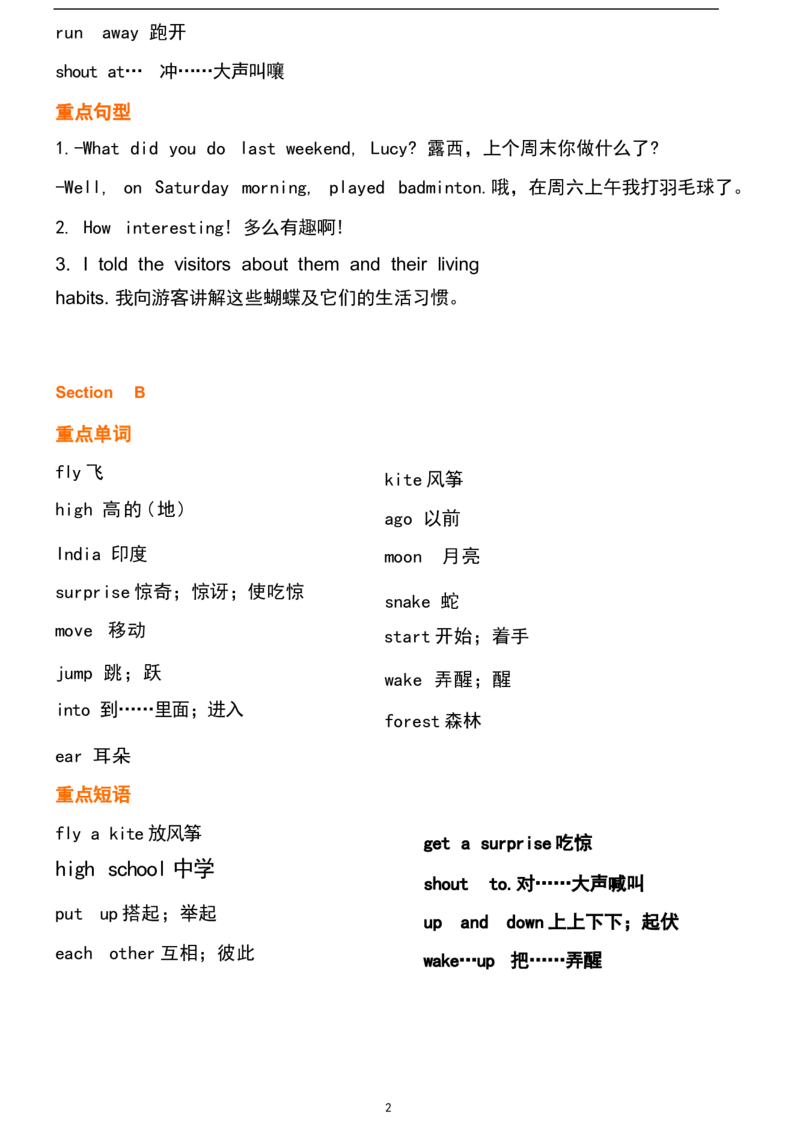
重点单词
camp 扎营;搭帐篷 lake 湖;湖泊
sheep 羊;绵羊
beach 海滩;沙滩
as 作为;当作 natural自然的
visitor 游客;访问者 tired疲倦的;疲劳
的
stay停留;待 away 离开;远离
mouse 老鼠;耗子 baby 幼小的;婴儿
shout 呼叫;喊叫 language 语言
重点短语
stay up late 深夜不睡;熬夜
1run away 跑开
shout at… 冲……大声叫嚷
重点句型
1.-What did you do last weekend, Lucy? 露西,上个周末你做什么了?
-Well, on Saturday morning, played badminton.哦,在周六上午我打羽毛球了。
2. How interesting! 多么有趣啊!
3. I told the visitors about them and their living
habits. 我向游客讲解这些蝴蝶及它们的生活习惯。
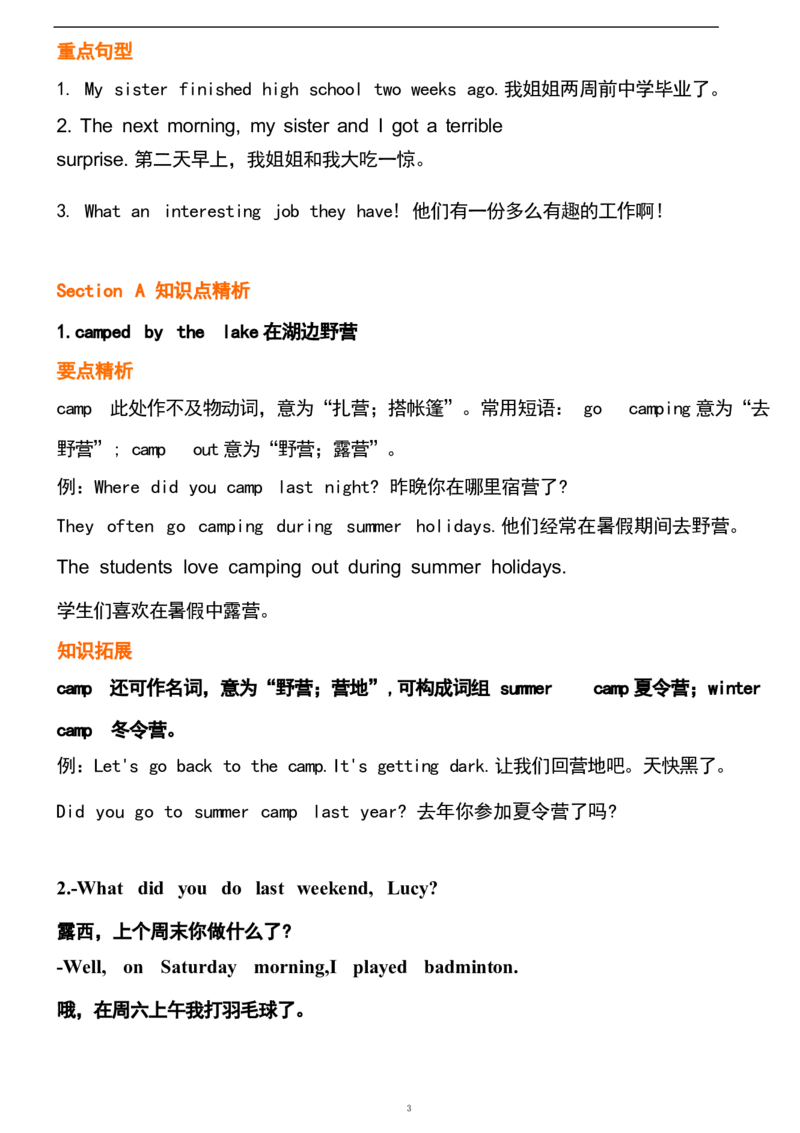
Section B
重点单词
fly飞
kite风筝
high 高的(地)
ago 以前
India 印度 moon 月亮
surprise惊奇;惊讶;使吃惊
snake 蛇
move 移动
start开始;着手
jump 跳;跃
wake 弄醒;醒
into 到……里面;进入
forest森林
ear 耳朵
重点短语
fly a kite放风筝
get a surprise吃惊
high school 中学
shout to.对……大声喊叫
put up搭起;举起
up and down上上下下;起伏
each other互相;彼此
wake…up 把……弄醒
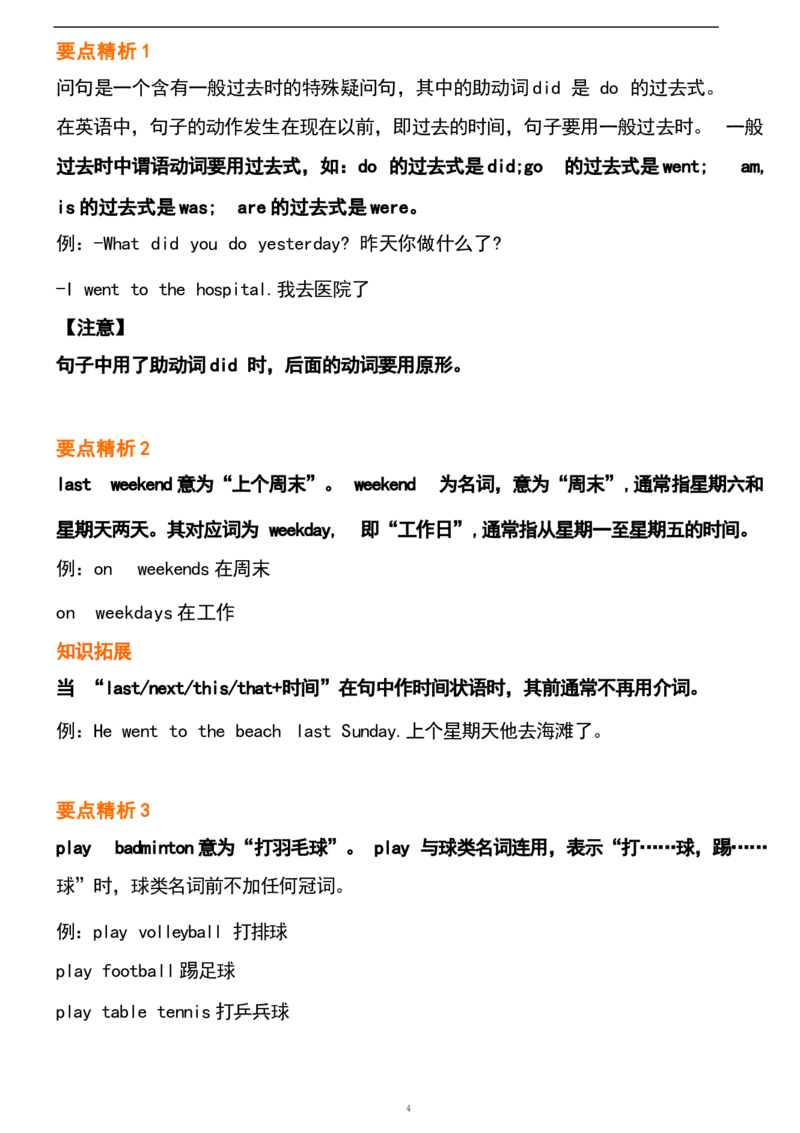
2重点句型
1. My sister finished high school two weeks ago.我姐姐两周前中学毕业了。
2. The next morning, my sister and I got a terrible
surprise. 第二天早上,我姐姐和我大吃一惊。
3. What an interesting job they have! 他们有一份多么有趣的工作啊!
Section A 知识点精析
1.camped by the lake 在湖边野营
要点精析
camp 此处作不及物动词,意为“扎营;搭帐篷”。常用短语: go camping 意为“去
野营”; camp out 意为“野营;露营”。
例:Where did you camp last night? 昨晚你在哪里宿营了?
They often go camping during summer holidays.他们经常在暑假期间去野营。
The students love camping out during summer holidays.
学生们喜欢在暑假中露营。
知识拓展
camp 还可作名词,意为“野营;营地”,可构成词组 summer camp 夏令营;winter
camp 冬令营。
例:Let's go back to the camp.It's getting dark.让我们回营地吧。天快黑了。
Did you go to summer camp last year? 去年你参加夏令营了吗?
2.-What did you do last weekend, Lucy?
露西,上个周末你做什么了?
-Well, on Saturday morning,I played badminton.
哦,在周六上午我打羽毛球了。
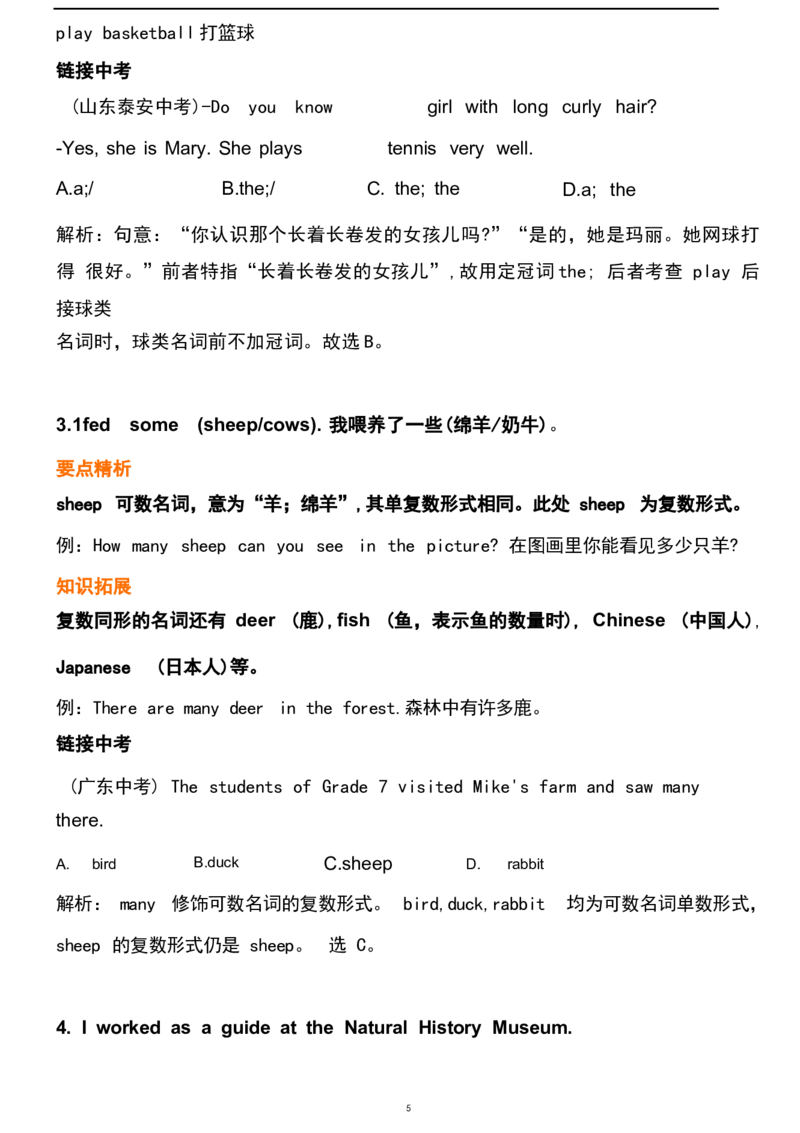
3要点精析 1
问句是一个含有一般过去时的特殊疑问句,其中的助动词 did 是 do 的过去式。
在英语中,句子的动作发生在现在以前,即过去的时间,句子要用一般过去时。 一般
过去时中谓语动词要用过去式,如:do 的过去式是 did;go 的过去式是 went; am,
is 的过去式是 was; are 的过去式是 were。
例:-What did you do yesterday? 昨天你做什么了?
-I went to the hospital.我去医院了
【注意】
句子中用了助动词 did 时,后面的动词要用原形。
要点精析 2
last weekend 意为“上个周末”。 weekend 为名词,意为“周末”,通常指星期六和
星期天两天。其对应词为 weekday, 即“工作日”,通常指从星期一至星期五的时间。
例:on weekends 在周末
on weekdays 在工作
知识拓展
当 “last/next/this/that+时间”在句中作时间状语时,其前通常不再用介词。
例:He went to the beach last Sunday.上个星期天他去海滩了。
要点精析 3
play badminton 意为“打羽毛球”。 play 与球类名词连用,表示“打……球,踢……
球”时,球类名词前不加任何冠词。
例:play volleyball 打排球
play football 踢足球
play table tennis 打乒兵球
4play basketball打篮球
链接中考
(山东泰安中考)-Do you know girl with long curly hair?
-Yes, she is Mary. She plays tennis very well.
A.a;/ B.the;/ C. the; the D.a; the
解析:句意:“你认识那个长着长卷发的女孩儿吗?”“是的,她是玛丽。她网球打
得 很好。”前者特指“长着长卷发的女孩儿”,故用定冠词 the; 后者考查 play 后
接球类
名词时,球类名词前不加冠词。故选 B。
3.1fed some (sheep/cows). 我喂养了一些(绵羊/奶牛)。
要点精析
sheep 可数名词,意为“羊;绵羊”,其单复数形式相同。此处 sheep 为复数形式。
例:How many sheep can you see in the picture? 在图画里你能看见多少只羊?
知识拓展
复数同形的名词还有 deer (鹿),fish (鱼,表示鱼的数量时), Chinese (中国人),
Japanese (日本人)等。
例:There are many deer in the forest.森林中有许多鹿。
链接中考
(广东中考) The students of Grade 7 visited Mike's farm and saw many
there.
A. bird B.duck C.sheep D. rabbit
解析: many 修饰可数名词的复数形式。 bird,duck,rabbit 均为可数名词单数形式,
sheep 的复数形式仍是 sheep。 选 C。
4. I worked as a guide at the Natural History Museum.
5我在自然历史博物馆当导游了。
要点精析
as 此处用作介词,意为“作为;当作”,其后可以接表示职业、用途等的名词、用在句
首时,这种短语的后面往往用号与句子的主体隔开。
例:As a student, you should study hard.作为一名学生,你应该努力学习。
知识拓展
as 还可以用作连词,其用法有:
① “当 ……时候”引导时间状语从句。
例:We sing as we go home.我们回家的时候唱着歌。
② “因为,由于”,引导原因状语从句。
例:We all believe him as he is an honest boy.
我们都相信他,因为他是一个诚实的男孩儿。”
③ “照 ……方式”、引导方式状语从句。
例:Please do as your teacher says.请按你老师说的去做。
链接中考
(山西中考) a teacher,John thinks that his main duty is to help the
students to become better learners.
A.As
B.By C. About
解析:句意:作为一名老师,约翰认为他的主要职责是帮助学生成为更好的学习者。
as 意为“作为”。故选A。
5.How interesting! 多么有趣啊!
要点精析
本句为 how 引导的感叹句,后面省略了 it was。 其 中 how 修饰形容词或副词(被强
6调部分)。如果 how 修饰形容词,则句中的谓语动词用连系动词;如果how 修
饰副词,则句中的谓语动词用实义动词。这类句子的结构形式是 How +adj 、/adv、
(+主语+谓语)!
例:How happy they look! 他们看起来多高兴啊!
How well she sings! 她唱得多好呀!
How hard they are working now! 他们现在干得多起劲呀!
链接中考
(青海中考)
wonderful the sitcom is! We all like it.
A.What B.How C. What a
解析:分析题干可知,空格所在句为一个感叹句,且被感叹的中心词 wonderful 为
形 容词,应用 how 引导感叹句,故选 B。 句意:这部情景喜剧是多么精彩呀!我
们都喜
欢它。选 B。
6.I told the visitors about them and their living habits.
我向游客讲解这些蝴蝶及它们的生活习惯。
要点精析
living habits意为“生活习惯/习性”。
例:We should have good living habits.我们应该有良好的生活习惯。
知识拓展
①living 作形容词,意为“活着的”。
例:They didn't find any living things on the moon.
他们在月球上没有发现任何有生命的东西。
Is the fish still living? 这条鱼还活着吗?
② living 作名词,意为“生计,生存之道”。 make a living 意为“谋生”。
例:He made a living by writing.他靠写作谋生。
77.Yeah, it was good, but I'm kind of tired now.
是的,挺好的,但是我现在有点儿累。
要点精析
tired 形容词,意为“疲倦的;疲劳的”。
例:You look so tired.你看起来很累。
He felt very tired after playing football.他踢完足球后感觉很累。
知识拓展
be/ get tired 意为“对……厌烦”。
例:She got tired of watching TV all day.她对整天看电视感到厌烦了。
辨析:tired 与 tiring
意为“感到疲倦的;疲劳的”,一般用来修饰人
tired
tiring 意为“令人劳累的;令人疲劳的”,一般用来修饰事物
例:It was a tiring day and she felt very tired.这是累人的一天,她感觉很累。
链接中考
(山东德州中考)Linda felt very after the long way, so she stopped to have
a rest.
A. surprised B.shy
C. tired D. excited
解析:句意:走了很长的路后,琳达感到很累,因此她就停下来休息一下。tired “劳
累的”;surprised”惊讶的”; shy “害羞的”; excited “兴奋的”。结合句意可知选 C。
8.I stayed up late to watch the soccer game. 我熬夜看足球比赛了。
要点精析 1
stay 动词,意为“停留;待”。
例:I have to stay at home this weekend.我这个周末必须待在家里。
8要点精析 2
stay up late意为“深夜不睡;熬夜”。
例:I stayed up late until three o'clock in the morning.我熬夜一直到凌晨三点。
链接中考
(江苏南京中考)-What's wrong with you, Eric? You look tired.
-| to prepare for the final exam last night.
A. picked up B.woke up C. stayed up D. put up
解析:句意:“埃里克,你怎么了?你看起来很疲惫。”“我昨晚熬夜准备期末考试
了。” stay up “熬夜”; pick up “捡起;开车接(某人)"; wake up “醒来”;
put up “搭
起;举起"。结合句意可知选 C。
Section A 即学即试
I. 单项选择
1.Mr.Jackson keeps lots of on his farm.
A.sheep B.chicken C. goose D. pandas
2.-How was your weekend?
-Pretty good.I my grandparents.
A. visited C. am visiting D. visits
B. visit
3.-Did she go to the Central Park?
·
A.Yes, she does B. No, she did C.Yes, she did D.Yes, she do
4.1 you yesterday afternoon, but you at home.
A.call; aren't B.am calling; aren't C.called; were D.called; weren't
5. Don't too late. You will take a test tomorrow.
A. come up B. stay up C. put up D.cut up
9Ⅱ .根据汉语意思完成句子
1. 这个周末咱们去公园划船吧。
Let's in the park this weekend.
2.上周日我和我的朋友们去海滩了。
| with my friends last Sunday.
3.我正在为数学考试而学习。
I'm the math test.
4.他们度过了一个愉快的周末吗?
Did they ?
5.莉莉昨天晚上熬夜到很晚,所以今天很累。
Lily very late last night, so she is very today.
Section B 知识点精析
1. flew a kite放风筝
要点精析
flew 为 fly的过去式。此处作及物动词 fly的过去式,意为“放飞”。
例:My father helped me to fly the model plane.我父亲帮助我放飞飞机模型。
知识拓展
fly
① 还可作不及物动词:
a.意为“飞,飞行”。
例:I want to fly like bird.我想象鸟一样飞。
b 意为“飞逝”。
例:How time flies! 时间过得真快啊!
②fly 还可作可数名词,意为“苍蝇”。
例:There are two flies in the soup.汤里有两只苍蝇。
102. My sister finished high school two weeks ago.我姐姐两周前中学毕业
了。
要点精析 1
finish动词,意为“完成;结束”。
例:My English class finishes at three o'clock.我的英语课3点结束。
I will finish reading the book this afternoon.我今天下午将看完那本书。
【注意】
finish后通常接名词、代词或动词的-ing 形式作宾语,不能接动词不定式。
链接中考
(四川雅安中考)-Can you finish these books before 10 o'clock?
-Yes, I can.
A. to read B. read C. reads D. reading
解析:句意:“10 点之前你能读完这些书吗?”“是的,我能。"finish doing sth.“做
完某事”为固定搭配,故选 D。
要点精析 2
ago 副词,意为“……以前”。
例:I met her two days ago.我两天前碰见她了。
辨析: ago 与 before
“时间段+ago”表示从现在算起的若干时间以前,常用于一般过去时。
ago
ago不能单独使用,只能用作副词
可用作介词,后接时间点,表示“在某具体时间之前”;也可单独使用,
before
用作副词
11例:I met uncle Li two days ago.
我在两天前遇到了李叔叔。(以现在为基准)
I hope you can get here before five o'clock.
我希望你能五点之前到这儿。(某具体时间之前)
k
3 . There we put up our tents and made a fire to keep us warm and coo
food on.在那里我们搭起帐篷,生火取暖并做饭。
要点精析 1
put up 此处意为“搭起”,还可意为“举起;张贴;建造”。put 的过去式仍为 put,
本句中的 put 即为过去式。
例:Please put up your hand if you have any question.如果你有任何问题请举手。
You'd better put up notice here.你最好在这里贴一张通知。
They put up many buildings last year.他们去年盖了许多大楼。
要点精析 2
make fire意为“生火”。句中made 是 make 的过去式。
例:He went back home and made fire.他回到家里,生起了火。
要点精析 3
keep us warm 意为“使我们暖和”。 “keep+ 宾语+宾语补足语”意为“使 ……保
持 某种状态(位置或动作等)”,其中宾语补足语通常由形容词、副词、介词短语或
现在
分词等充当。
例:We should keep our classroom clean and tidy.我们应保持教室干净整洁。
You'd better keep the children away from the fire.你最好让孩子们离火远一点儿。
The bad weather keeps us inside the house.坏天气使我们不能出门。
12Don't keep me waiting for long.别让我等太久。
知识拓展
keep 的其他用法:
①keep 作及物动词,意为“保存”,后接时间段时,可代替 borrow。
例:How long can I keep the book? 我可以借这本书多长时间?
②keep 作及物动词,意为“遵守”,与 follow 同义。
例:Everyone must keep the rules.大家必须遵守规则。
③keep 还可作连系动词,后接形容词等作表语。
例:You must look after yourself and keep healthy.
你必须照顾好自己,保持身体健康。
链接中考
(江苏扬州中考) We can make a fire the room warm so that you can chat
for a while.
A. to keep B.keeping C. keep D. kept
解析:句意:我们可以生火来保持房间暖和,以便你们可以聊一会儿。此处为动词不
定式短语作目的状语,故选 A。
4. The next morning, my sister and got a terrible surprise.
第二天早上,我姐姐和我大吃一惊。
要点精析
surprise 此处用作可数名词,意为“惊奇;惊讶”。 get a surprise 意为“吃惊”。
例:I got a surprise when I met her again.当我再次见到她时我很吃惊。
知识拓展
(1) 关于 surprise 的其他搭配:
①in surprise 吃惊地,惊讶地
13例:She looked at me in surprise.她吃惊地看着我。
②to ones' surprise 令某人惊讶的是
例:To our surprise, the old man is still learning English.
令我们惊奇的是,这位老人还在学习英语。
(2) surprise 作动词时,意为“使吃惊”。
例:Her questions surprised me.她的问题使我很吃惊。
(3) surprising 形容词,意为“令人惊讶的”,常用来修饰或描述事物; surprised
形容词,意为“感到惊讶的”,常用来修饰或描述人。
例:We are surprised at the surprising story.我们对这个惊人的故事感到惊讶。
链接中考
(山东潍坊中考)We looked at each other surprise when we heard a bird
singing "Happy birthday to you".
C.by
A.in B.to D.at
解析:句意:我们听见一只鸟在唱“祝你生日快乐”时,我们都很惊讶地相互看了看
对方。 in surprise 意为“惊讶地”,是固定短语。选 A。
5. I was so scared that couldn't move.我太害怕了,以至于不敢动。
要点精析 1
so…that… 意为“如此……以至于……”,so 是副词,常常用来修饰形容词或副词, that
引导结果状语从句。
例:He is so young that he can't look after himself.
他还这么小,以至于他不能照顾自己.
The boy ran so fast that I couldn't catch up him.
这个男孩儿跑得如此快,以至于我不能赶上他。
链接中考
14(黑龙江绥化中考) The soccer match was exciting that everyone
was cheering and jumping.
.
A very B.SO C. too
解析:句意:这场足球赛是如此令人兴奋,以至于每个人都在欢呼跳跃。 so.that…为
固定搭配,意为“如此……以至于……”。选B。
要点精析 2
scared 形容词,意为“惊慌的;吓坏了的”,多用来修饰或描述人,其近义词为 afraid。
例:Are you scared? 你害怕吗?
She is scared to ride horse.她害怕骑马。
知识拓展
be scared of sth.害怕某物
be scared to do sth.害怕做某事
例:I'm scared of dogs.我害怕狗。
I'm scared to play with dogs.我害怕和狗玩。
辨析: scared,scare 与scary
形容词惊慌的;吓坏了的
scared
动词使害怕,使恐惧
scare
scary 形容词恐怖的,吓人的
例:I felt scared because of the big dog. 因为这只大狗,我感到害怕。
The terrible movie scared me.这部可怕的电影让我恐惧。
The movie is really scary.这部电影真恐怖。
15要点精析 3
move 此处作不及物动词,意为“移动”,后接地点名词作宾语时,需加介词to, 表示
“搬到……”。
例:Don't move, or you'll' be in danger! 不要动,否则你会有危险!
My family moved to Beijing two years ago.两年前我的家人搬到了北京。
知识拓展
move 还可用作及物动词,意为“移动;搬动”。
例:Move the chair to the room, please.请把椅子移到房间里。
6.We shouted to our parents to let them know about the danger.
我们向我们的父母大声呼喊,想让他们知道危险所在。
要点精析 1
shout to sb.意为“对某人大声喊叫”。
例:We shouted to the driver, but she didn't hear us.
我们向司机大声喊,但她没听见。
辨析: shout to sb与 shout at sb.
shout to sb. 一般指因距离过远而不得不大声叫喊让别人听见,无感情因素
shout at sb.多指因为生气、愤怒或其他原因等而对某人大喊大叫
例:It's too noisy here.You should shout to him.
这儿太吵了,你应该大点儿声喊他。
Don't shout at me.别对我大吼大叫。
【助记】
shout to sb.向某人喊话
shout at sb.冲某人喊叫
16要点精析 2
let sb.do sth.意为“让某人做某事”,其中 let 为使役动词,其后需接省略 to 的动
词 不定式作宾语补足语。其否定式可表示为 let sb.not do sth.或 don'tlet sb.do
sth.
意为“不让某人做某事”。
例:Let him come here at once.让他立刻到这儿来。
Let him not come in.别让他进来。
7.My dad started to jump up and down in their tent.
我爸开始在他们的帐篷内上下跳动。
要点精析 1
start 此处作及物动词,意为“开始”,与 begin 同义。start to do sth. (= start doing
sth.) 意为“开始做某事”。
例:She usually starts her work at nine.她通常在 9 点开始工作。
The child started to cry/crying.那个孩子开始哭了。
He often starts doing his homework after supper.他经常在晚饭后开始做作业。
要点精析 2
up and down 意为“上上下下;起伏”。
例:They jumped up and down in the room.他们在房间里又蹦又跳。
He uses a lift to go up and down.他用电梯上上下下。
8. This woke the snake up and it moved into the forest near the lake.
这弄醒了那条蛇,并且它爬进了湖附近的森林里。
要点精析
此处 woke 是 wake 的过去式。 wake 此处作及物动词,意为“弄醒”,常与副词 up
17连用, wake…up 意为“把……弄醒”,后接名词作宾语时,可以放在wake 与
up 中间,也可以放在 up 后面;后接代词作宾语时,应将代词放在 wake 与 up 中间。
例:Please wake up Lucy at six o'clock.请在6点钟叫醒露西。
The noise woke me up.那噪音把我吵醒了。
Lily is sleeping. Don't wake her up.莉莉在睡觉。别弄醒她。
知识拓展
wake 还可用作不及物动词,意为“醒,醒来”。
例:I always wake early in summer.我夏天总是醒得早。
链接中考
(广东河源中考) ,Tom! It's time to get up and go to school.
A. Wake up B. Make up C.Grow up D. Look up
解析:句意:醒醒,汤姆!是时候起床上学了。wake up “醒来”; make up “编造;
弥补”; grow up “长大”; look up “查阅;向上看”。结合句意可知选A。
9. What an interesting job they have! 他们有一份多么有趣的工作啊!
要点精析
此句是一个由what 引导的感叹句。 what 引导的感叹句有下列三种形式:
①What+a/an+ 形容词+可数名词单数(+主语+谓语)!
例:What useful book(itis)! (它是)一本多么有用的书啊!
What a beautiful garden (it is)! (它是)一个多么漂亮的花园啊!
②What+ 形容词+可数名词复数(+主语+谓语)!
例:What beautiful mountains (they are)! (它们是)多么美丽的山啊!
What interesting books (they are)! (它们是)多么有趣的书啊!
③hat+ 形容词+不可数名词(+主语+谓语)!
例:What fine weather(it is)! (那是)多好的天气啊!
18【注意】
what 引导的感叹句与 how 引导的感叹句有时可以转换,转换后意义不变,但句中部
分单词及单词顺序要有所变化。
例:What a beautiful girl she is!=How beautiful the girl is!
多漂亮的一个女孩儿啊!
【助记】
感叹句助记口诀
感叹句,并不难, what,how 放句前;
强调名词用 what, 其 余 用 how 很简单。
链接中考
(江苏苏州中考 ) a beautiful car! I've never seen it before.
A.What B. Which C. How D. Whether
解析:句意:多么漂亮的车啊!我以前从没见过它。感叹句的中心词为可数名词单数
car, 故 用 “What+a/an+ 形容词+可数名词单数(+其他)!”结构,相当于 “How+
形容词+a/an+ 可数名词单数(+其他)!”结构。选 A。
Section B 即学即试
I.按要求完成下列各题
1. Zack listened to pop music yesterday.(改为否定
句) 7ack to pop music
yesterday.
2. She sa w a n interestin g movi e yesterday. (对画线部分提
问) she yesterday?
3. Last weekend, she got up very late.(对画线部分提
问) she up very late?
4. Cindy went shopping with he r mothe r yesterday. (对画线部分提问)
19Cindy go shopping with yesterday?
5. She ate some noodles for lunch yesterday.(改为一般疑问句)
she noodles for lunch yesterday?
Ⅱ .根据汉语意思完成句子
1.第二天早上我们生火做饭。
,we made fire to cook a meal.
2.今天的报纸上有什么有趣的事吗?
Is there in today's newspaper?
3.上周我和露西放风筝了。
with Lucy last week.
4.如果你知道答案,请举起你的手。
If you know the answer, please your hand.
5.我爸爸吃惊地看着我,不说一句话。
My father looked at me without a word.人教版(新标准)初中英语即学即试参考答案
七年级下册 UNIT 12
What did you do last weekend? 上个周末你做什么了?
Section A
即学即试
I.
1.A lots of 可以修饰可数名词的复数,也可以修饰不可数名词, sheep 单复数同形;
chicken 的复数为 chickens; goose 的复数为 geese。 文中提到在农场养动物,
故可
排除 panda 熊猫。故选 A。
2.A 由问句的时态为一般过去时可知, visit 这一动作发生在过去,故选 A。
3.C 问句是 did 引导的一般过去时的般疑问句,因此其肯定回答为 Yes,she did, 否
定回答为 No,she didn't.。故选 C。
4.D 由时间状语 yesterday afternoon 可知,谓语动词用过去式。由 but 可知前后表
转折,故后句应该是“不在家”。故选 D。
5.B come up 走上前来; stay up 熬夜; put up 张贴,悬挂; cut up 切碎。句意:别
熬夜到太晚。你明天还要参加考试。结合句意可知选 B。
Ⅱ .
1. go boating 3. studying for
2. went to the beach
4. have a good/great weekend 5. stayed up, tired
Section B
即学即试
I.1. didn't listen 2.What did, do 3. When did, get 4. Whom did 5. Did, eat any
Ⅱ.1. The next morning 2. anything interesting 3. flew a kite
4. put up 5.in surprise
21