人教版(新标准)初中英语知识点精析
七年级下册 UNIT 6
I'm watching TV.我正在看电视。
重点
● other, the other, others 与 the others 的辨析
● wish 与 hope 的辨析
难点
● 现在进行时 (I)
语法
● 现在进行时 (I)
Section A
重点单词
newspaper 报纸 use 使用;运用
soup 汤 wash 洗
movie 电影 just 只是;恰好
house 房子 drink 喝;饮料
tea 茶;茶叶 tomorrow 在明天;明天;未来
重点短语
read a newspaper看报纸
talk on the phone 通过电话交谈
make soup 做汤
1wash the dishes 洗餐具
go to the movies 去电影院
eat out 出去吃饭
drink tea 喝茶
重点句型
1. I'm watching TV.我正在看电视。
2. Do you want to go to the movies? 你想去电影院
吗? 3.This is Jenny.我是珍妮。
4. I'd love to.我很乐意。
Section B
重点单词
pool 游泳池;水池 shop 购物;商店
supermarket 超市 man 男人;人
race 竞赛 study 学习;研究
state 州 American 美国的;美洲的;美国人;美洲
人
any 任何的;任一的;任何,任一 other 另外的;其他的;另外的人(或物)
young 幼小的;年轻的 child 儿童 (pl.children)
miss 怀念;思念;错过 wish 希望
delicious 可口的;美味的 still 还;仍然
重点短语
host family 寄宿家庭
in China 在中国
Dragon Boat Festival 端午节
2living room 客厅
重点句型
1. Is the man swimming in river? 那位男士正在河里游泳吗?
2. But there isn't a Dragon Boat Festival in the, so it's like any other night
for Zhu Hui and his host family.
但是在美国没有端午节,因此今晚对于朱辉和他的寄宿家庭来说就像其他任何一个
晚上一样。
3. Zhu Hui misses his family and wishes to have his mom's delicious zongzi.
朱辉思念他的家人,并希望吃他妈妈(做)的美味粽子。
Section A 知识点精析
1. I'm watching TV.我正在看电视。
要点精析 1
这是现在进行时的陈述句形式, 其结构为“主语+be(not)+ 现在分词+其他.”。
例:She is swimming in the river. 她正在河里游泳。
They are not using computer.他们没在使用电脑。
要点精析 2
watch 动词,意为“看,观看”,常用于“看电视、看录像、看戏、看比赛”等。
watch 还可用作名词,意为“手表”。
例:I often watch matches on TV. 我经常在电视上看比赛。
I have a nice watch.我有一块好看的手表。
2.cleaning 打扫卫生
要点精析
3clean 此处用作动词,意为“打扫”。
例:I spent all day cooking and cleaning. 我花费了一整天做饭和打扫卫生。
He is cleaning his room.他正在打扫他的房间。
知识拓展
①clean 作形容词,意为“干净的”,在句中可作定语、表语或宾语补足语。
例:The classroom is very clean today. 今天教室很干净。
We must keep our classroom clean. 我们必须保持我们的教室干净。
②cleaning 作名词,意为“打扫,清理”,常构成短语 do some/the cleaning,
意为“打扫卫生”。
例:Tom helps his grandfather do some/the cleaning every Sunday.
汤姆每周日都帮他的(外)祖父打扫卫生。
③cleaner 名词,意为“清洁工人”。
例:His uncle is a cleaner. 他的叔叔是一名清洁工人。
3. reading newspaper 看报纸
要点精析
newspaper 可数名词,意为“报纸”。
例:I like reading newspapers after breakfast. 我喜欢早饭后看报纸。
【助记】
news(n. 新闻)+ paper(n. 纸) → newspaper(n. 报纸)
4. talking on the phone 通过电话交谈
要点精析 1
on the phone意为“通过电话”,其中on 为介词,意为“通过;以……的方式”。
例:Laura is listening to the news on the radio.劳拉正在通过收音机听新闻。
4要点精析 2
phone 此处用作名词,相当于 telephone, 意为“电话”,与 phone 有关的
短语有:
make phone 打电话;
answer the phone 接电话;
phone number 电话号码;
phone book 电话簿。
例:I have to make a phone call. 我必须打个电话。
知识拓展
phone 还可用作动词,意为“打电话”。 phone sb.意为“给某人打电话”。
例:I phone my mother every day.我每天给我妈妈打电话。
5. using the computer 使用电脑
要点精析 1
use 动词,意为“使用”。
use to do sth."用……做某事"。
例:I use pen to write. 我用钢笔写字。
We use knife to cut apples.我们用刀子切苹果。
知识拓展
useful 形容词,意为“有用的”。
例:The book is useful to me.这本书对我有用。
6. Do you want to go to the movies? 你想去电影院吗?
要点精析 1
go to the movies 意为“去电影院”。其中 movie 是名词,意为“电影”,与 film
同义。表示“去电影院”,英式英语中常用 go to the cinema。
5例:He goes to the movies once a month.他每月去一次电影院。
要点精析 2
go 不及物动词,意为“去,前往”,当其后接活动性名词时,表示“去做某事”。
例:go to the meeting 去开会
go to the talk 去听报告
go to the party 去参加聚会
go to the match 去看比赛
知识拓展
go 后常加动词的-ing 形式,表示“去进行某一活动”,一般表示休闲或是娱乐性的
活动。
例:go
shopping 去购物 go boating 去划船
go
swimming 去游泳 go dancing 去跳舞
7.This is Jenny.我是珍妮。
要点精析
这是打电话的常用语,相当于"This is Jenny speaking."。在英语习惯中,打电话
时, 一般用 this 表示“我”,用 that 表示“对方",而不用“I”或 “you”。
知识拓展
“打电话”常用语小结:
Who's that (speaking)? 你是谁?
Who's speaking? 谁在讲话?
May/Could I speak to…? 我可以和……通话吗?
Is that. (speaking)? 你是……吗?
This is. (speaking).我是……
Hold on, please.请等一会儿。
6Hold on for moment/minute. 请稍等。
链接中考
(山西中考)- ?
-Sorry. There is no one named Gary. You must have the wrong number.
A. Can I help you B. What's the matter C. Is that Gary speaking
解析:由答语“对不起,没有叫加里的人。你一定是拨错号码了。”可知,这是一个
打电话的场景。 Is that Gary speaking? 是一句电话用语,意为“请问你是加里
吗?”,
符合题意。
8.I'd love to.我很乐意。
要点精析
I'd love to.相当于 I'd like to.其中'd 是 would 的缩写形式。 I'd love/like to…
经常用于有礼貌地接受他人的邀请。
例:-Would you like to play football with me? 你想和我一起踢足球吗?
-Yes, I'd love/like to.是的,我愿意。
知识拓展
当婉言拒绝他人的邀请时,多用 I'd love to, but...或 Sorry, I'm afraid I can't
because… 等。
例:-Would you like to go shopping with me? 你愿意和我一起去购物吗?
-I'd love to, but I'm too busy.我愿意,但是我太忙了。
链接中考
(四川攀枝花中考)-Would you like to go to the movie with me this weekend?
-
A. Thank you B. No, I don't C. Sure, I'd love to D. That's all right
7解析:A 项用于对别人的帮助或赞美表示感谢; B 项回答 Do you.? 问句;
C 项用于接受别人的邀请; D 项用于回答别人的感谢。根据问句句意“这个
周末
你想和我一起去看电影吗?"可知,表示邀请。故 C 项符合语境。选 C。
Section A 即学即试
I.用所给词的适当形式填空
1.Listen! Your father is (play)the guitar.
2.Let's (go) to see our PE. teacher this afternoon.
3. Who's the boy (wait) for?
4.Look! Ben's uncle is (clean)his bike.
5.What she (do)now?
Ⅱ .根据汉语意思完成句子
1.报纸上有一条关于一只狗的新闻。
There is a piece of news about a dog
2.妈妈正在和我的老师打电话谈论我的学习情况。
Mom is talking with my teacher about my study
.
3 咱们这周末去电影院吧!
l et's this weekend!
4.我们用电脑玩游戏。
We computers games.
5.我妈妈正在厨房里做汤。
My mother in the kitchen.
Section B 知识点精析
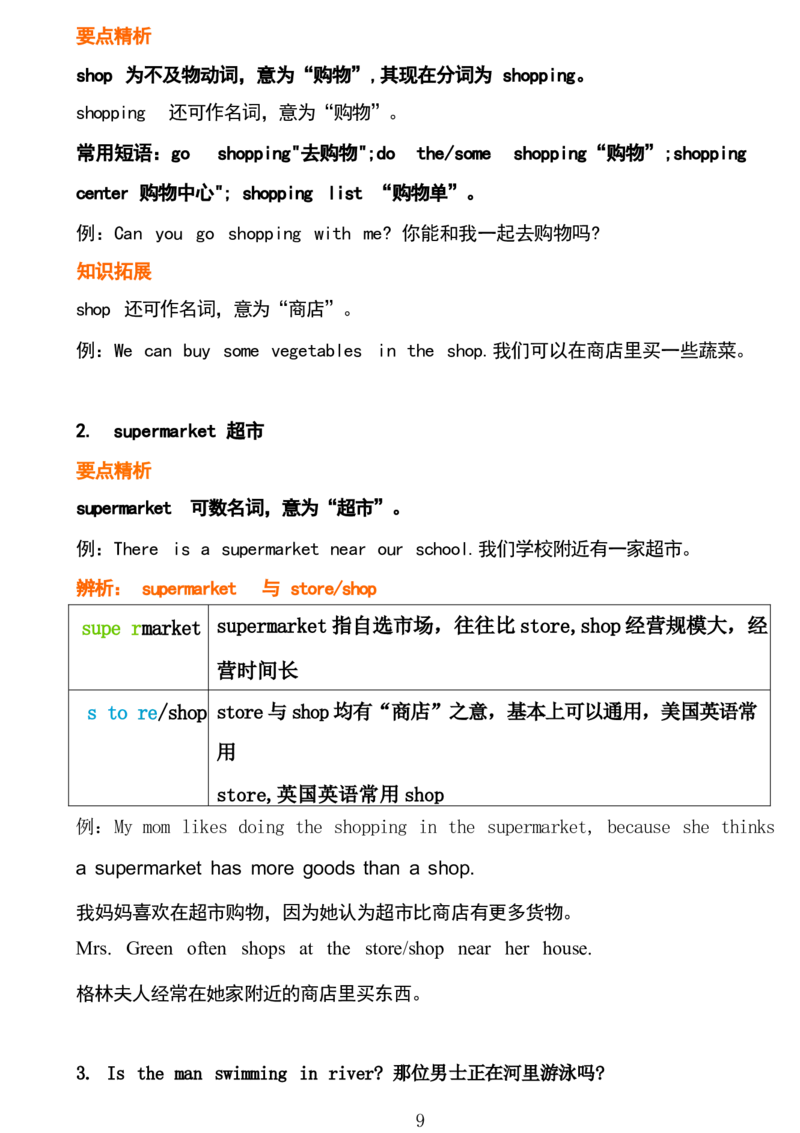
1.shopping 购物
8要点精析
shop 为不及物动词,意为“购物”,其现在分词为 shopping。
shopping 还可作名词,意为“购物”。
常用短语:go shopping"去购物";do the/some shopping“购物”;shopping
center 购物中心"; shopping list “购物单”。
例:Can you go shopping with me? 你能和我一起去购物吗?
知识拓展
shop 还可作名词,意为“商店”。
例:We can buy some vegetables in the shop.我们可以在商店里买一些蔬菜。
2. supermarket 超市
要点精析
supermarket 可数名词,意为“超市”。
例:There is a supermarket near our school.我们学校附近有一家超市。
辨析: supermarket 与 store/shop
supe rmarket supermarket 指自选市场,往往比 store,shop 经营规模大,经
营时间长
s to re/shop store 与 shop 均有“商店”之意,基本上可以通用,美国英语常
用
store,英国英语常用 shop
例:My mom likes doing the shopping in the supermarket, because she thinks
a supermarket has more goods than a shop.
我妈妈喜欢在超市购物,因为她认为超市比商店有更多货物。
Mrs. Green often shops at the store/shop near her house.
格林夫人经常在她家附近的商店里买东西。
3. Is the man swimming in river? 那位男士正在河里游泳吗?
9要点精析
man 名词,意为“男人;人;人类”。
例: l m talking to man.我正在和一位男士交谈。
All men should follow the rules.所有的人都应该遵守规定。
【注意】
man 作“人类”讲时,前面不用冠词。
知识拓展
①man 作定语修饰可数名词复数时, man 也要用其复数形式men。
例:There are two men doctors here.这儿有两名男医生。
②woman 名词,意为“女人”,其复数形式为 women, 作定语修饰可数名词复数
时, woman 与 man 用法相同,都要用其复数形式。
4. He's now studying in the United States.他现在正在美国学习。
要点精析 1
study 动词,意为“学习;研究”。
例:We must study hard.我们必须努力学习.
I'm studying art. 我正在学习美术。
要点精析 2
the United States(=the United States of America) 意为“美国;美利坚合众
国”,其缩写形式为 the US或 the USA。
例:When will you visit the United States? 你将在什么时候游览美国?
I'll get to the United States at 7 o'clock.我将在7点到达美国。
小贴士
the United Kingdom 意为“英国;联合王国”,其缩写形式为 the UK。
105. But there isn't a Dragon Boat Festival in the US, so it's like any
other night for Zhu Hui and his host family.
但是在美国没有端午节,因此今晚对于朱辉和他的寄宿家庭来说就像其他任何一个
晚上一样。
要点精析 1
any other 意为“其他任何一个”。
例:John runs faster than any other student in his class.
约翰比他班上的其他任何一个学生都跑得快。
【注意】
any other 指在同一范围内除了某人或某物以外的其他任何人或物,其后一般跟可
数名词单数。
要点精析 2
any 此处用作形容词,意为“任何的;任一的”; any 还可用作代词,意为“任何;
任一"。
例:You can come any day.你哪天来都行。
I can't give you any. 我什么也不能给你。
辨析: any 与 some
any 常用于疑问句或否定句中,既可以修饰可数名词,也可以修饰不可数名词
常用于肯定句中,既可以修饰可数名词,也可以修饰不可数名词
ome
s
例:Are there any students in the class room? 教室里有学生吗?
Is there any tea? 有茶吗?
There are some flowers in the garden. 花园里有一些花。
There is some milk in the cup.杯子里有一些牛奶。
【注意】
当问句是表示请求、建议或预期得到肯定的答复时,要用 some, 不用 any。
11例:Would you like some water? 你想喝些水吗? (表示预期得到肯定的答
复)
要点精析 3
other 此处用作形容词,意为“另外的;其他的”。
例:Do you see other students? 你看见其他学生了吗?
辨析:other, the other, others与 the others
常用来修饰可数名词复数;只有在其他词的辅助下才能修饰可数名词单
other
数
the ot her 表示已知的两个(或两部分)人或事物中,特指的“另一个”或“另一
些 ", 其 后 可 跟 名 词 单 数 或 复 数 , 也 可 与 one 搭 配 构 成
one...the
other…结构,意为"一个……另一个……"
othe rs 相当于“other+可数名词复数,泛指“部分”含义,用于已知的一些
人或物中,除去某些后余下的人或物中的一部分。常与 some搭配构
成 some others.结构,意为“一些 ……另一些 …… ”
相当于 the other+可数名词复数",指一定范围内除去一个或一部分
the ot hers
后,“余下的人或物的全部”
例:I'll come back some other day.某一天我还会再来的。
I have two books. One is about English, and the other is about history.
我有两本书, 一本是关于英语的,另一本是关于历史的。
The students of Class Four are cleaning the classroom. Some are carrying
water, others are sweeping the floor.
四班的学生们在打扫教室。 一些人在打水,另一些人在扫地。
Some of you are in the classroom. Where are the others?
你们中一些人在教室里。其他的人在哪里?
12【助记】
one
the other four
the other
o
some othe
one ( the
6.The mother is reading a story to her young children.
母亲正在给她幼小的孩子们读故事。
要点精析
children 是 child 的复数形式,意为“孩子们”。
例: The children are playing football.孩子们正在踢足球。
知识拓展
children 是不规则的名词复数形式,作主语时,谓语动词用复数。 children 的名词
所有格是在词尾直接加"s"。
例: We have a great time on Children's Day. 在儿童节我们玩得很开心。
7. Zhu Hui misses his family and wishes to have his mom's delicious
zongzi. 朱辉思念他的家人,并希望吃他妈妈(做)的美味粽子。
要 点 精 析 1
miss 此处作及物动词,意为“怀念;思念”,其第三人称单数形式为 misses。
例: I miss my mother very much. 我非常想念我的母亲。
知识拓展
① miss 作及物动词,还可意为“没赶上;错过”。
例 :He arrived too late and missed the train.他到得太晚,没赶上火车。
13I missed the chance to go to college.我错过了上大学的机会。
②miss 首字母大写即 Miss, 意为“小姐,老师”。通常用于未婚女性的姓氏
前。
例:Miss Wang is our English teacher.王老师是我们的英语老师。
要点精析 2
wish 此处用作及物动词,意为“希望”。
例: I wish to visit Guiyang.我希望游览贵阳。
辨 析 :wish 与 hope
wish 后面可接不定式或“宾语+不定式,其意义相当于"想要,希望”(= would
like 或 want)。wish 接 that 从句时一般表示某种强烈而又难以实现
的 “愿望"; wish 可表示良好的“祝愿”,后面接宾语+宾补(形容词
或名
词)",而 hope 不能这样用
用作动词时,后面可接不定式或 that 从句,但不能接 sb. to do sth.。
hope
hope 表示的是可以实现的“希望”。在简略句中,如果要表示希望某事
不会发生时,应说"l hope not.", 而不说"I don't hope so."
例: I wish could fly like bird.
希望我能像鸟一样飞翔。(从句中的 could 表示其动作不可能实现,不能用 can)
I wish you success. 我祝你成功。
Jenny hoped to give her a good education.珍妮希望给她良好的教育。
8.Oh, he's studying for test.噢,他正在为考试而学习。
要点精析
test 可数名词,意为“测验,检测,检查”。
例:We'll have an English test this afternoon.今天下午我们将有一次英语测验。
The teacher told me to have an eye test.老师告诉我去进行视力检查。
14关注微信公众号“初中英语人教版”,免费同步辅导,免费海量资源
have test 进行考试
pass test 考试及格
fail test 考试不及格
Section B 即学即试
I.根据句意及汉语提示写单词
1. There are three (男人) in the shop.
2. He's (学习) in Australia.
3. My (东道主) family is very friendly.
4. She (希望) to go to America.
5. The food here is very (美味的) .I like it very much.
Ⅱ .用所给词的适当形式填空
1.My brother (study) in a middle school.
2. Mary (miss)her parents very much.
3. Tom wishes (buy) a new iPad.
4. There are two (child) in the family.
5.-Jack, let's go (shop)this
afternoon.
-Good idea!人教版(新标准)初中英知识归纳
七年级下册 UNIT 6
I'm watching TV.我正在看电视。
单词归纳
newspaper 报纸 house 房子 host 主人;东道主
use 使用;运用 shop 购物;商店 study 学习;研究
soup 汤 still 还;仍然 wish 希望
wash 洗 pool 游泳池;水池 child 儿童
(pl.children)
movie 电影 race 竞赛 dragon 龙
just 只是;恰好 man 男人;人 miss 怀念;思念;错过
drink 喝;饮料 supermarket 超市 delicious 可口的;美味
的
tea 茶;茶叶 state 州 young 幼小的;年轻的
any 任何的;任一的;任何;任一
American 美国的;美洲的;美国人;美洲人
tomorrow 在明天;明天;未来
other 另外的;其他的;另外的人(或物)
短语归纳
eat out 出去吃饭
wash the dishes 洗餐具
read newspaper 看报纸
make dinner 做晚饭
talk on the phone 通过电话交谈
drink tea 喝茶
listen to 听
swim in pool 在游泳池里游泳
use the computer 使用电脑
live with sb.in..和某人一起住在.
make soup 做汤
make zongzi 包粽子
go to the movies 去电影院
the night before 前一天夜里
16picture of. .一张……的照片
Dragon Boat Festival 端午
watch….on TV 在电视上看.... talk show 脱口
秀
read story to sb. 给某人读故事 living room 客
厅
用法归纳
1.What+be+ 主语+ doing?.… 正在做什么?
-主语+be+ doing sth……正在做某事。
2.I'd love/like to do sth. 我愿意做某事。
3.any other+可数名词单数 其他任何一个
4. wish to do sth.希望做某事
5. study for/an…..test 为….考试而学习
6.Here+be+ 名词.这是 …即学即试参考答案与解析
Section A
即学即试
I.1.playing 2.go 3.waiting 4.cleaning 5.is,doing
Ⅱ.1.in the newspaper 2. on the phone 3.go to the movies/cinema
4. use, to play 5.is making soup
Section B
即学即试
I.1.men 2.studying 3.host 4. wishes 5. delicious
Ⅱ. 1. studies 2. misses 3. to buy 4. children 5. Shopping