八年级上 Unit1
重点短语:
1.一个诚实的男孩 an honest boy
2.一个八年级的学生 a Grade 8 student
3.一次写作比赛 a writing competition
4.一则……的广告 an advertisement for
5.保密 keep secrets
6.使我开心 make me happy
7.分享我的快乐 share my joy
8.遇到麻烦 be in trouble
9.和我一样苗条 as slim as me
10.一个我最好的朋友 one of my best friends
11.对……慷慨 be generous to
12.乐意做某事 be willing/ ready to do
13.给需要的人让座 give seats to people inneed
14.环游世界 travel around the world
15.使他看起来聪明 make him look smart
16.感到无聊 feel bored
17.讲滑稽的笑话 tell funny jokes
18.走过课桌 walk past the desk
19.撞翻我的书 knock over my books
20.想起我的好朋友 think of my good friends
21.看一则广告 read an advertisement
22.一位忠实的朋友 an honest friend
23.及肩的头发 shoulder-length hair
24.做大量的电脑工作 do much computer work
25.投票赞成某人 vote for sb.
26.帮助有需要的人 help people in need
27.课外活动 after-school activities
28.尽力帮助他们 try to help them
29.一名社会工作者 a social worker
30.未来计划 future plans
31.看起来爱好运动 look sporty
32.搬迁到北京 move to Beijng
33.过来 come over
34.想念我的老同学 miss my old classmates
35.与……交朋友 make friends with
36.给我一些忠告 give my some advice37.住在隔壁 live next door
38.邀请某人做某事 invite sb to do
39.她微笑的眼睛 her smiling eyes
40.面带微笑 wear a smile on one’s face
41.再来一些饮料 some more drinks
42.一些喝的 something to drink
43.任何时间 at any time
44.在将来 in the future
45.对……很了解 know sth. very well
46.一个人坐着 sit alone
47.认识某人 get to know sb.
48.不如 not as… as
49.在做某事上有困难 have problems doing sth.
50.在某事上有困难 have problems with sth.
51.适合某事 be suitable for
52.和某人分享某物 share sth with sb
53.对某人友好 be friendly to sb
54.十年前 ten years ago
55.解出数学题 solve the maths problem
56.写信给某人 write to sb
57.说某人的坏话 say a bad word about sb
58.相信他说的话 believe what he said/ hiswords
59.倾听人们的难题 listen to people’s problems
60.帮助人们解决难题 help people solve theirproblems
61.因为……而出名 be famous for
62.作为……而出名 be famous as
63.个像艾伦那样的朋友 have a friend like Alan
64.在午餐期间 during lunch time
65.同意做某事 agree to do
66.同意某人的意见 agree with sb
67.在左边的那个男孩 the boy on the left
68.跑步最快的人 the fastest runner
69.A和B都 both A and B
重点句型:
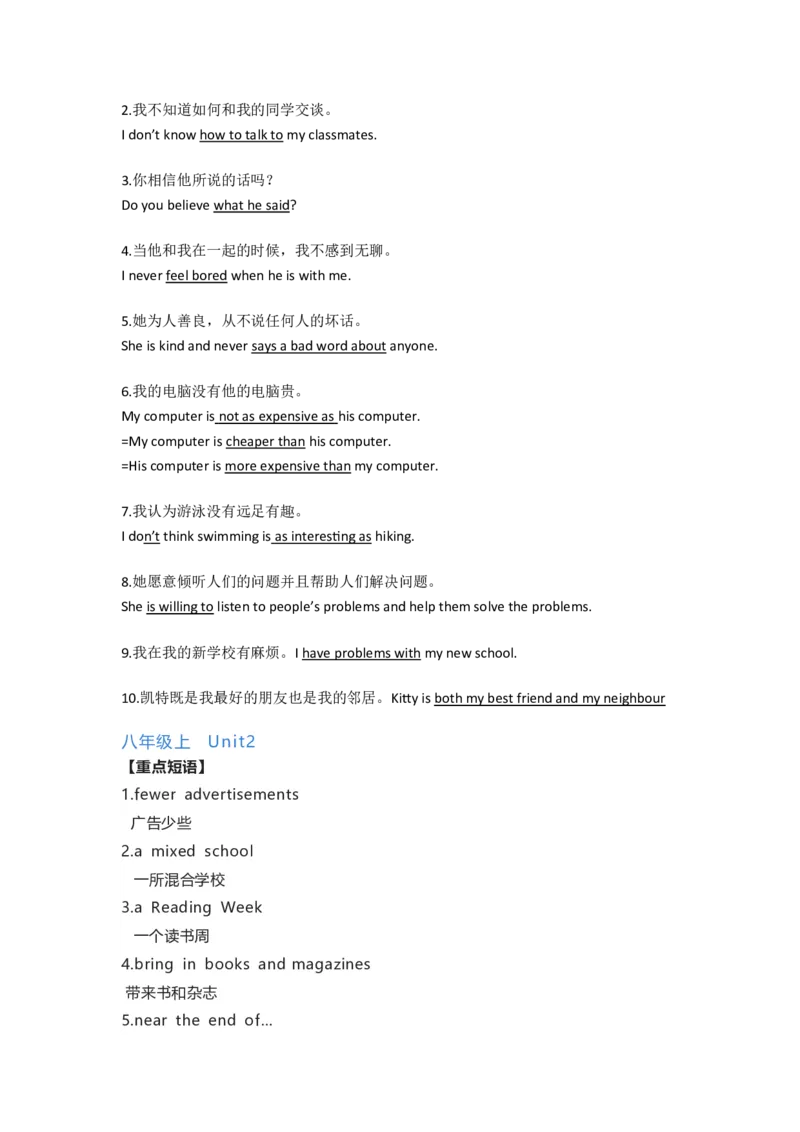
1.冰箱里没有别的东西。
There is nothing else in the fridge.2.我不知道如何和我的同学交谈。
I don’t know how to talk to my classmates.
3.你相信他所说的话吗?
Do you believe what he said?
4.当他和我在一起的时候,我不感到无聊。
I never feel bored when he is with me.
5.她为人善良,从不说任何人的坏话。
She is kind and never says a bad word about anyone.
6.我的电脑没有他的电脑贵。
My computer is not as expensive as his computer.
=My computer is cheaper than his computer.
=His computer is more expensive than my computer.
7.我认为游泳没有远足有趣。
I don’t think swimming is as interesting as hiking.
8.她愿意倾听人们的问题并且帮助人们解决问题。
She is willing to listen to people’s problems and help them solve the problems.
9.我在我的新学校有麻烦。I have problems with my new school.
10.凯特既是我最好的朋友也是我的邻居。Kitty is both my best friend and my neighbour
八年级上 Unit2
【重点短语】
1.fewer advertisements
广告少些
2.a mixed school
一所混合学校
3.a Reading Week
一个读书周
4.bring in books and magazines
带来书和杂志
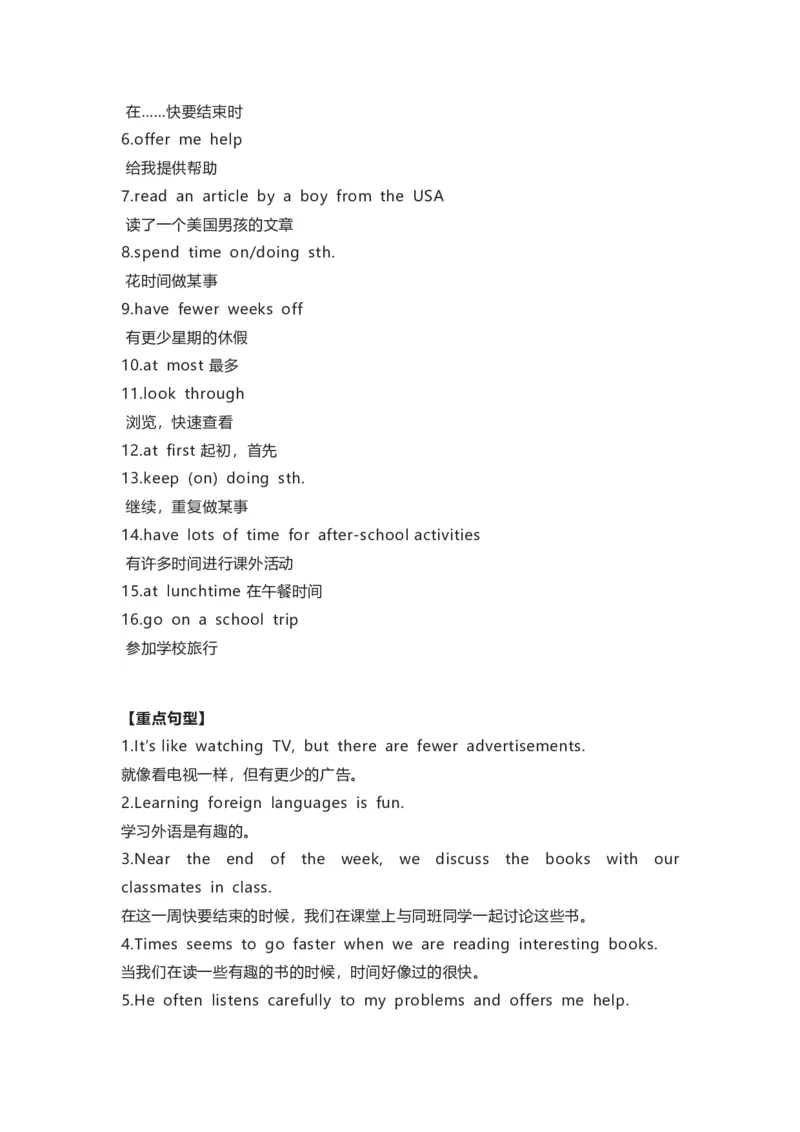
5.near the end of…在……快要结束时
6.offer me help
给我提供帮助
7.read an article by a boy from the USA
读了一个美国男孩的文章
8.spend time on/doing sth.
花时间做某事
9.have fewer weeks off
有更少星期的休假
10.at most 最多
11.look through
浏览,快速查看
12.at first 起初,首先
13.keep (on) doing sth.
继续,重复做某事
14.have lots of time for after-school activities
有许多时间进行课外活动
15.at lunchtime 在午餐时间
16.go on a school trip
参加学校旅行
【重点句型】
1.It’s like watching TV, but there are fewer advertisements.
就像看电视一样,但有更少的广告。
2.Learning foreign languages is fun.
学习外语是有趣的。
3.Near the end of the week, we discuss the books with our
classmates in class.
在这一周快要结束的时候,我们在课堂上与同班同学一起讨论这些书。
4.Times seems to go faster when we are reading interesting books.
当我们在读一些有趣的书的时候,时间好像过的很快。
5.He often listens carefully to my problems and offers me help.他经常认真地听我的问题,并给我提供帮助。
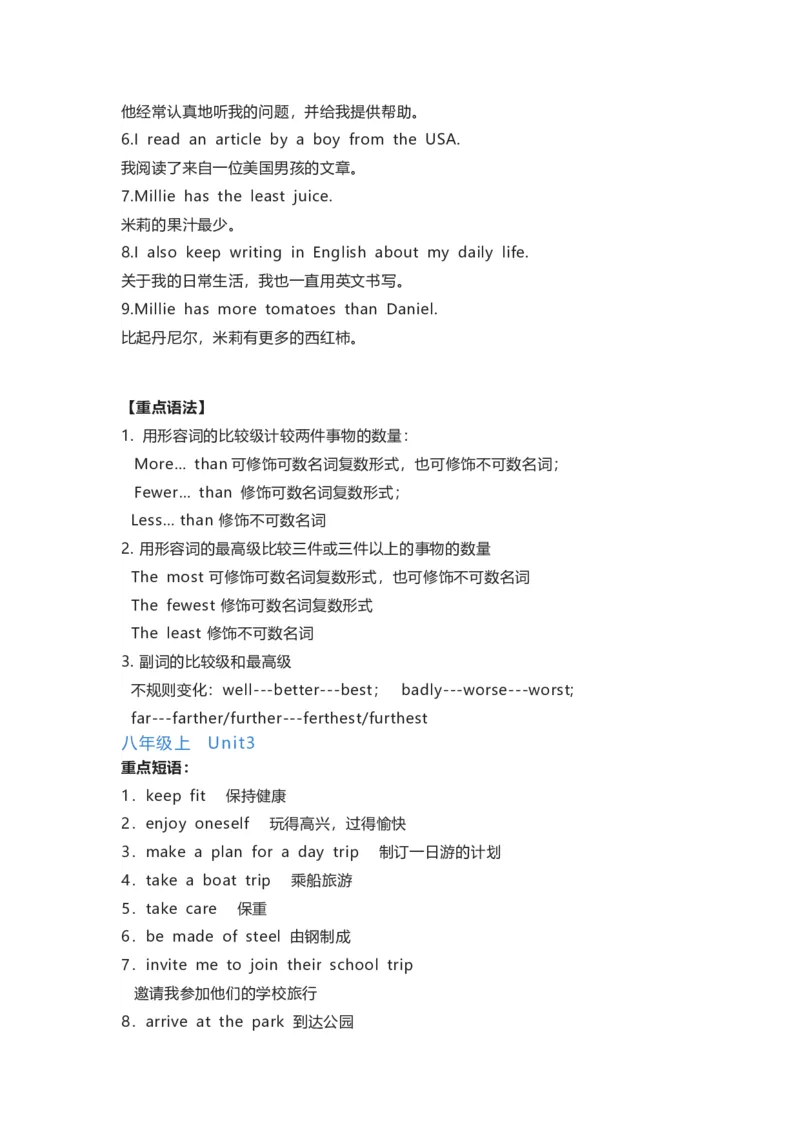
6.I read an article by a boy from the USA.
我阅读了来自一位美国男孩的文章。
7.Millie has the least juice.
米莉的果汁最少。
8.I also keep writing in English about my daily life.
关于我的日常生活,我也一直用英文书写。
9.Millie has more tomatoes than Daniel.
比起丹尼尔,米莉有更多的西红柿。
【重点语法】
1. 用形容词的比较级计较两件事物的数量:
More… than可修饰可数名词复数形式,也可修饰不可数名词;
Fewer… than 修饰可数名词复数形式;
Less… than 修饰不可数名词
2. 用形容词的最高级比较三件或三件以上的事物的数量
The most 可修饰可数名词复数形式,也可修饰不可数名词
The fewest 修饰可数名词复数形式
The least 修饰不可数名词
3. 副词的比较级和最高级
不规则变化:well---better---best; badly---worse---worst;
far---farther/further---ferthest/furthest
八年级上 Unit3
重点短语:
1.keep fit 保持健康
2.enjoy oneself 玩得高兴,过得愉快
3.make a plan for a day trip 制订一日游的计划
4.take a boat trip 乘船旅游
5.take care 保重
6.be made of steel 由钢制成
7.invite me to join their school trip
邀请我参加他们的学校旅行
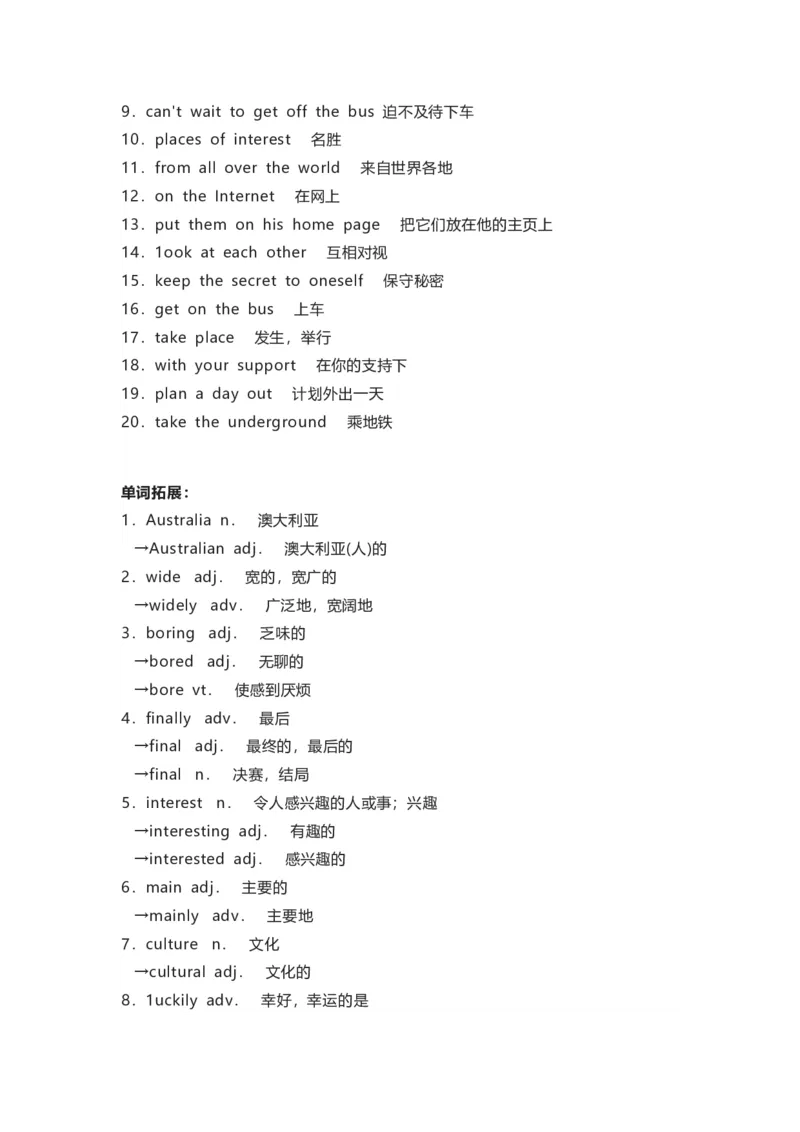
8.arrive at the park 到达公园9.can't wait to get off the bus 迫不及待下车
10.places of interest 名胜
11.from all over the world 来自世界各地
12.on the Internet 在网上
13.put them on his home page 把它们放在他的主页上
14.1ook at each other 互相对视
15.keep the secret to oneself 保守秘密
16.get on the bus 上车
17.take place 发生,举行
18.with your support 在你的支持下
19.plan a day out 计划外出一天
20.take the underground 乘地铁
单词拓展:
1.Australia n. 澳大利亚
→Australian adj. 澳大利亚(人)的
2.wide adj. 宽的,宽广的
→widely adv. 广泛地,宽阔地
3.boring adj. 乏味的
→bored adj. 无聊的
→bore vt. 使感到厌烦
4.finally adv. 最后
→final adj. 最终的,最后的
→final n. 决赛,结局
5.interest n. 令人感兴趣的人或事;兴趣
→interesting adj. 有趣的
→interested adj. 感兴趣的
6.main adj. 主要的
→mainly adv. 主要地
7.culture n. 文化
→cultural adj. 文化的
8.1uckily adv. 幸好,幸运的是→lucky adj. 幸运的
→unlucky adj. 不幸的
→luck n. 运气
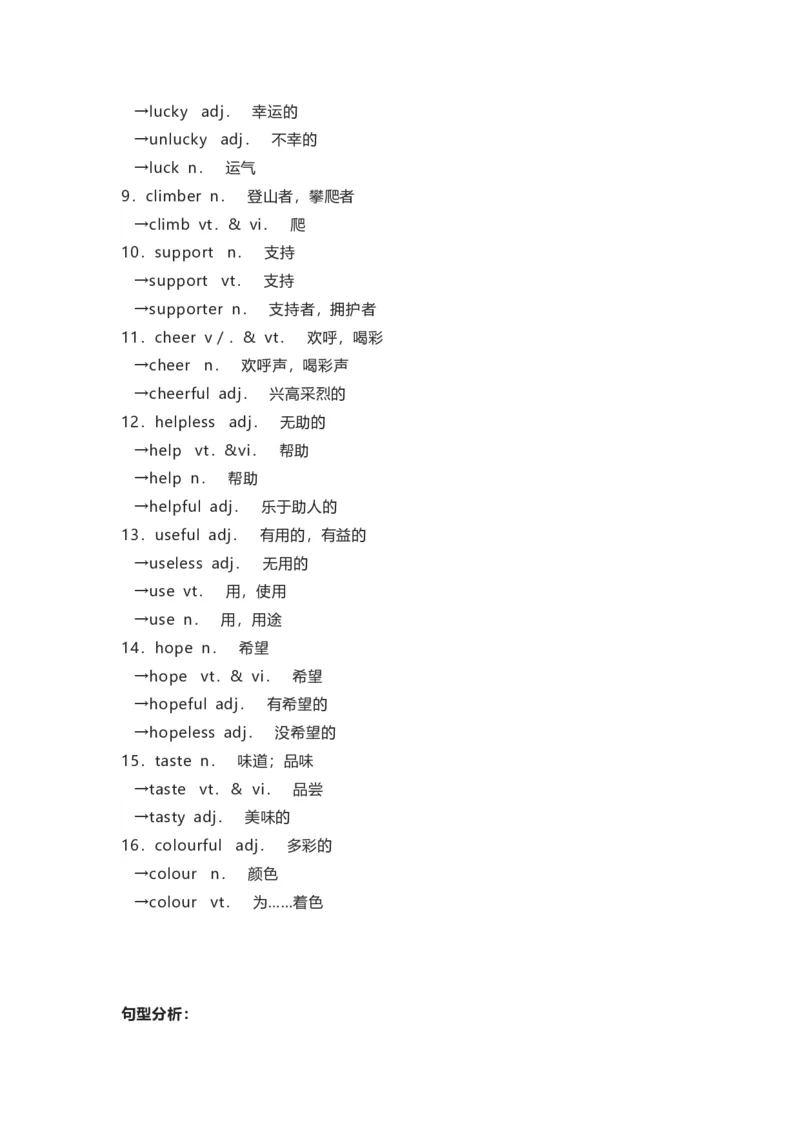
9.climber n. 登山者,攀爬者
→climb vt.& vi. 爬
10.support n. 支持
→support vt. 支持
→supporter n. 支持者,拥护者
11.cheer v/.& vt. 欢呼,喝彩
→cheer n. 欢呼声,喝彩声
→cheerful adj. 兴高采烈的
12.helpless adj. 无助的
→help vt.&vi. 帮助
→help n. 帮助
→helpful adj. 乐于助人的
13.useful adj. 有用的,有益的
→useless adj. 无用的
→use vt. 用,使用
→use n. 用,用途
14.hope n. 希望
→hope vt.& vi. 希望
→hopeful adj. 有希望的
→hopeless adj. 没希望的
15.taste n. 味道;品味
→taste vt.& vi. 品尝
→tasty adj. 美味的
16.colourful adj. 多彩的
→colour n. 颜色
→colour vt. 为……着色
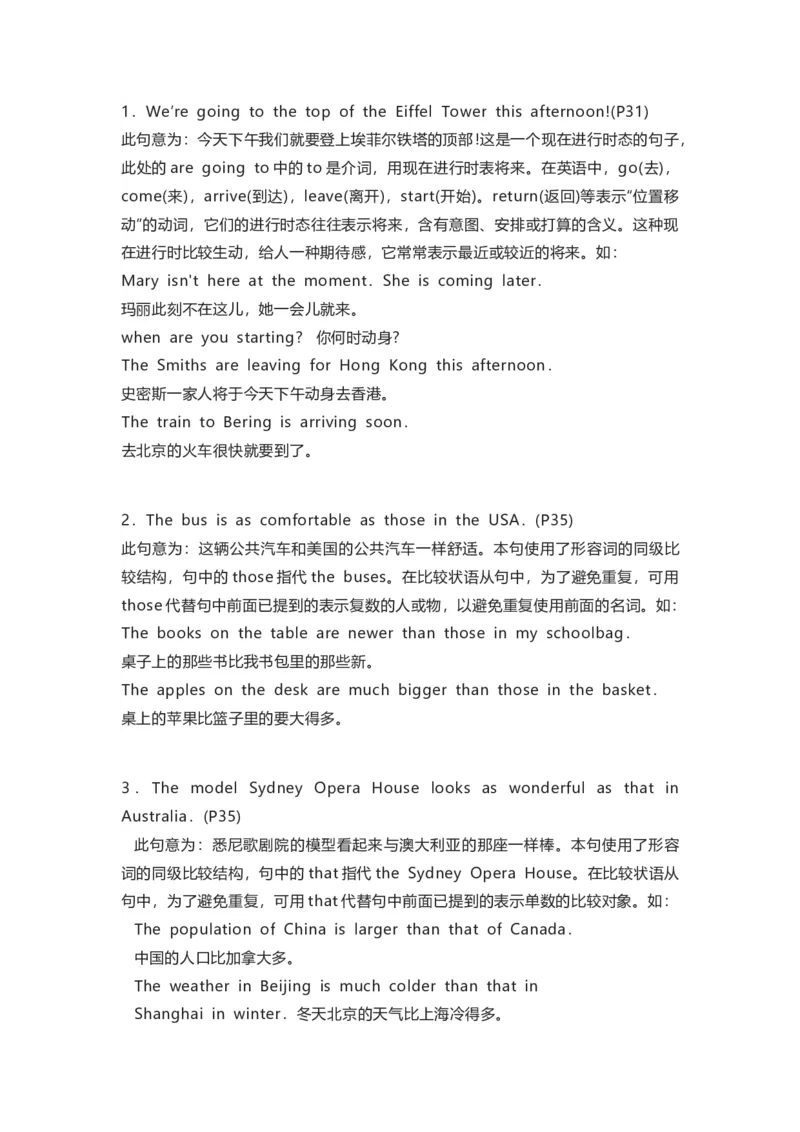
句型分析:1.We’re going to the top of the Eiffel Tower this afternoon!(P31)
此句意为:今天下午我们就要登上埃菲尔铁塔的顶部!这是一个现在进行时态的句子,
此处的are going to中的to是介词,用现在进行时表将来。在英语中,go(去),
come(来),arrive(到达),leave(离开),start(开始)。return(返回)等表示“位置移
动”的动词,它们的进行时态往往表示将来,含有意图、安排或打算的含义。这种现
在进行时比较生动,给人一种期待感,它常常表示最近或较近的将来。如:
Mary isn't here at the moment.She is coming later.
玛丽此刻不在这儿,她一会儿就来。
when are you starting? 你何时动身?
The Smiths are leaving for Hong Kong this afternoon.
史密斯一家人将于今天下午动身去香港。
The train to Bering is arriving soon.
去北京的火车很快就要到了。
2.The bus is as comfortable as those in the USA.(P35)
此句意为:这辆公共汽车和美国的公共汽车一样舒适。本句使用了形容词的同级比
较结构,句中的those指代the buses。在比较状语从句中,为了避免重复,可用
those代替句中前面已提到的表示复数的人或物,以避免重复使用前面的名词。如:
The books on the table are newer than those in my schoolbag.
桌子上的那些书比我书包里的那些新。
The apples on the desk are much bigger than those in the basket.
桌上的苹果比篮子里的要大得多。
3.The model Sydney Opera House looks as wonderful as that in
Australia.(P35)
此句意为:悉尼歌剧院的模型看起来与澳大利亚的那座一样棒。本句使用了形容
词的同级比较结构,句中的that指代the Sydney Opera House。在比较状语从
句中,为了避免重复,可用that代替句中前面已提到的表示单数的比较对象。如:
The population of China is larger than that of Canada.
中国的人口比加拿大多。
The weather in Beijing is much colder than that in
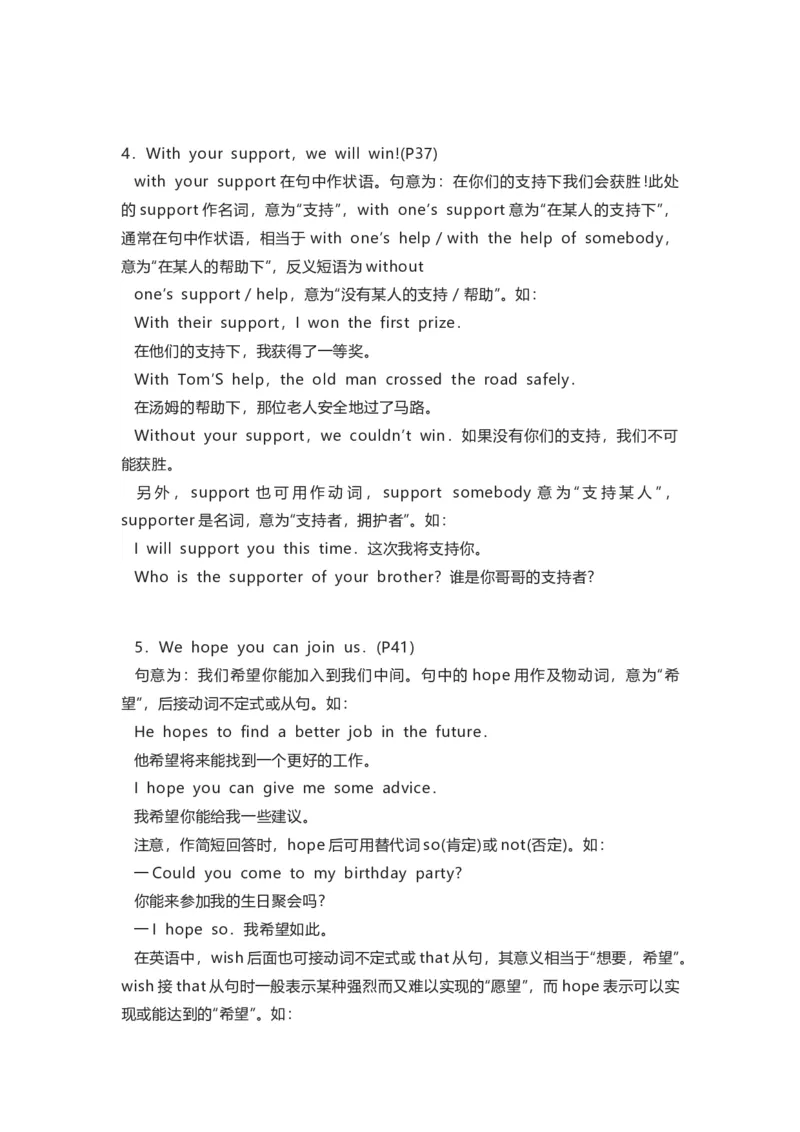
Shanghai in winter.冬天北京的天气比上海冷得多。4.With your support,we will win!(P37)
with your support在句中作状语。句意为:在你们的支持下我们会获胜!此处
的support作名词,意为“支持”,with one’s support意为“在某人的支持下”,
通常在句中作状语,相当于 with one’s help/with the help of somebody,
意为“在某人的帮助下”,反义短语为without
one’s support/help,意为“没有某人的支持/帮助”。如:
With their support,I won the first prize.
在他们的支持下,我获得了一等奖。
With Tom’S help,the old man crossed the road safely.
在汤姆的帮助下,那位老人安全地过了马路。
Without your support,we couldn’t win.如果没有你们的支持,我们不可
能获胜。
另外,support 也可用作动词,support somebody 意为“支持某人”,
supporter是名词,意为“支持者,拥护者”。如:
I will support you this time.这次我将支持你。
Who is the supporter of your brother? 谁是你哥哥的支持者?
5.We hope you can join us.(P41)
句意为:我们希望你能加入到我们中间。句中的 hope 用作及物动词,意为“希
望”,后接动词不定式或从句。如:
He hopes to find a better job in the future.
他希望将来能找到一个更好的工作。
I hope you can give me some advice.
我希望你能给我一些建议。
注意,作简短回答时,hope后可用替代词so(肯定)或not(否定)。如:
一Could you come to my birthday party?
你能来参加我的生日聚会吗?
一I hope so.我希望如此。
在英语中,wish后面也可接动词不定式或that从句,其意义相当于“想要,希望”。
wish接that从句时一般表示某种强烈而又难以实现的“愿望”,而hope表示可以实
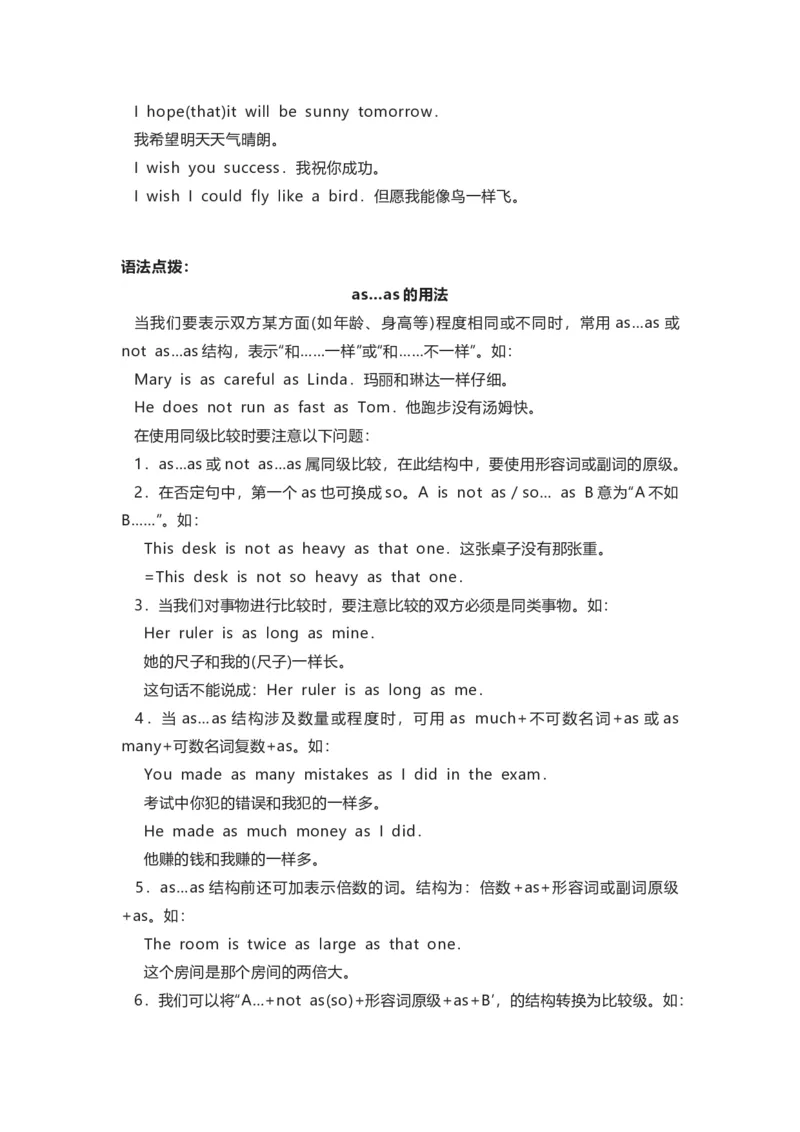
现或能达到的“希望”。如:I hope(that)it will be sunny tomorrow.
我希望明天天气晴朗。
I wish you success.我祝你成功。
I wish I could fly like a bird.但愿我能像鸟一样飞。
语法点拨:
as…as的用法
当我们要表示双方某方面(如年龄、身高等)程度相同或不同时,常用 as…as 或
not as…as结构,表示“和……一样”或“和……不一样”。如:
Mary is as careful as Linda.玛丽和琳达一样仔细。
He does not run as fast as Tom.他跑步没有汤姆快。
在使用同级比较时要注意以下问题:
1.as…as或not as…as属同级比较,在此结构中,要使用形容词或副词的原级。
2.在否定句中,第一个as也可换成so。A is not as/so… as B意为“A不如
B……”。如:
This desk is not as heavy as that one.这张桌子没有那张重。
=This desk is not so heavy as that one.
3.当我们对事物进行比较时,要注意比较的双方必须是同类事物。如:
Her ruler is as long as mine.
她的尺子和我的(尺子)一样长。
这句话不能说成:Her ruler is as long as me.
4.当 as…as 结构涉及数量或程度时,可用 as much+不可数名词+as 或 as
many+可数名词复数+as。如:
You made as many mistakes as I did in the exam.
考试中你犯的错误和我犯的一样多。
He made as much money as I did.
他赚的钱和我赚的一样多。
5.as…as 结构前还可加表示倍数的词。结构为:倍数+as+形容词或副词原级
+as。如:
The room is twice as large as that one.
这个房间是那个房间的两倍大。
6.我们可以将“A…+not as(so)+形容词原级+as+B’,的结构转换为比较级。如:Tom is not as tall as Mike.汤姆没有迈克高。
=Mike is taller than Tom.迈克比汤姆高。
=Tom is shorter than Mike.汤姆比迈克矮。
反身代词
反身代词是代词大家庭中的小成员,但其作用却非常独特。下面让我们一起走
进反身代词的世界,共同探讨反身代词的用法。
反身代词的含义及构成:
所谓反身代词,是指人们用来反指自己的代词。英语中的反身代词共有8个,它们
有人称和数的变化。
反身代词的构成有极强的规律性:第一、第二人称的反身代词由形容词性的物主代
词加一 self或一selves构成;第三人称的反身代词由人称代词的宾格加一 self或
一selves构成。
反身代词的用法:
反身代词与它所指代的一名词或代词形成互指关系,在句中常用作宾语、表语或同
位语。
1.反身代词可以用作一些动词(短语)或介词的宾语,此时,句子的主语和宾语必须
同一个人或物。如:
We must look after ourselves and keep fit.
我们必须照顾好自己,保持身体健康。
She often buys herself nice clothes.
她经常为自己买漂亮的衣服。
Don’t think too much of yourself!别过多地为自己考虑!
2.反身代词在句中还可以用作主语或宾语的同位语,用来加强语气,表示“亲自、
本人、本身”等意思。但反身代词在句中不能单独作主语。如:
I don’t need any help.I can do it myself.我不需要帮助,我自己能做。
(主语的同位语)这句话不可表示成 I don’t need any help,myself can do
it.If you want to know more,you may ask Miss White herself.
如果你想了解更多情况,你可以问一问怀特小姐本人。(宾语的同位语)
3.反身代词在句中还可以用作连系动词的表语。如:
The little boy in the photo was himself.
照片中的那个小男孩就是他自己。
反身代词构成的固定表达:
反身代词可以与一些介词、动词搭配,构成一些十分有用的固定短语。如:
by oneself意为“独自,凭自己”,相当于 alone; enjoy oneself意为“玩得高
兴,过得愉快”,相当于have fun或have a good time;
help oneself to…意为“随便吃或喝点……,随便用……";
keep…to oneself意为“不将某事说出去”;
say to oneself意为“自言自语”。
八年级上 Unit4
【重点短语】
序号 Chinese English
1 写一个有关….的报告 write a report on
2 走出家门 go outside home
3 第一次 for the first time
4 成长为….. grow into
5 在刚开始 at the very beginning
6 一直到 up to
7 吃竹笋和叶子 eat bamboo shoots and leaves
8 在野外生存下来 survive in the wild
9 在将来 in the future
10 为皮毛/乐趣杀死它 kill it for its fur/ kill for fun
11 砍伐树木和森林 cut down trees and forests
12 无处容身 have nowhere to live
13 取走 take away
14 鼓励某人做…. encourage sb to do…..
15 采取下列行动 take the following actions
16 沿着另一条路跑 run the other way17 穿够热带雨林 walk through a rainforest
18 保护野生动物 protect wild animals
19 动物的饲养 feeding of the animals
20 攻击人 attack people
21 从水中逮鱼 catch fish from the water
22 踩到….上 step on …..
23 像一家人一样生活 live as a family
24 群居 live in family groups
25 用它们的骨头制药 make medicine from their bones
26 有好的视力、听力、嗅觉 have good eyesight, hearing, smell
27 失去生存空间 loss of living areas
28 用兽皮制成的衣服 clothes made of animal fur
29 穿上身上看上去很可爱 look lovely on…..
30 丧生 lose one’s life
31 继续建路 continue to build roads
32 有合适的住所(家) have suitable homes
33 开出新农田 make new farmland
34 赚很多钱 make a lot of money
35 训练动物 train animals
36 美丽的黑白花动物 beautiful black and white animals
37 每次 at a time
38 变得越来越小 get smaller and smaller
39 不断抢占土地 keep taking the land
40 为了帮助做点事 do sth to help
41 直立行走 walk upright
42 走来走去 move around
43 在白天 in the daytime
44 看海豚表演 see a dolphin show
45 感到害怕 feel frightened
46 处在危险中 be in danger
47 让自然保护区更大 make reserves bigger
48 把小熊猫单独留下 leave baby giant pandas on their own
49 两个整天 two whole days
50 别的什么人 someone else
【重点句型】
1.Sadly, it is very difficult for giant pandas to survive in the wild.令人悲哀的是,大熊猫要在野外生存下来非常困难。
2.At four months, she weighed about 10 kilograms and she started to go
outside her home for the first time.
四个月大时,她的体重大约为10公斤。她开始第一次走出家门。
3.At the very beginning, baby giant pandas spend a lot of drinking their mums’
milk for up to14 hours a day.
最初,小熊猫花费很多时间喝它们母亲的奶时间达14小时。
4.Mothers often leave baby pandas for two whole days on their own.
母熊猫常常把小熊猫独自留下两个整天。
5.We can take the following actions to protect giant pandas.
我们可采取下列行动保护大熊猫。
6.The clothes look lovely on me.
它们穿在我身上很好看。
7.Their number is getting smaller and smaller because their living areas are
becoming farmlands.
由于它们的生活区正在变成农田,它们的数目正在变得越来越少。
8.If farmers keep taking the land, giant pandas will have nowhere to live.
如果农民们一直抢占农田,大熊猫将无处容身。
9.Encourage farmers to leave the giant panda reserves.
鼓励农民们离开大熊猫保护区。
10.If we continue to build roads, they won’t have suitable homes.
如果我们继续建路,它们将不会有适合居住的家。
11.If I don’t buy them, someone else will buy them.
就算我不买她们,别的什么人也会买。
12.They are in danger because people like their fur and make medicine from
their bones.它们处于危险中是因为人们喜爱它们的毛皮并用它们的骨头制药。
13.Live as a family unit baby tigers are 2-3 years old.
像一家人一样生活在一起直到小老虎2-3岁。
14.If elephants are thirsty, they walk till they find a river.
如果大象口渴的话,它们一直走到能找到河流为止。
15.If people find baby pandas alone, they will often take them away.
如果人们发现独自的小熊猫,他们常常会把它们带走。
16.If hunters catch agiant panda, they will kill it for its fur.
如果猎人们捉到大熊猫,他们将杀掉它以获取毛皮。
17.We called her XiWang.
我们把她叫做“希望”。
18.When Xi Wang was 20months old, she had to look after herself because
her mother had another baby.
当希望20个月时,它不得不自己照应自己,因为它的母亲又生了一个婴儿。
八年级上 Unit5
1单词拓展1.die vi. 死
→dead adj. 死的 →death n. 死,死亡2.mean vt. 意思是,
意味着 →meaning n. 意思 →meaningful adj. 有意义
的 →meaningless adj. 无意义的3.born adj. 出生的 →birth
n. 出生4.beginning n. 开始,起初 →begin vt.&vi. 开
始5.sadly adv. 令人遗憾地;伤心地 →sad adj. 伤心的,难过
的 →sadness n. 伤心,悲伤6.mainly adv. 主要地,大部
分 →main adj. 主要的7.danger n. 危险 →dangerous
adj. 危险的8.action n. 行动;行为 →act vt.&
vi. 行动,表演 →active adj. 积极的,活跃的 →actively
adv. 积极地,活跃地9.closed adj. 关闭的 →close vt.&
vi. 关,关闭 →close adj. 紧密的,亲密的 →closely adv. 紧
密地10.lost adj. 迷路的,迷失的 →lose vt. 遗失,失去11.
hunter n. 猎人 →hunt vt.& vi. 打猎,猎杀12.living
n. 生存,生计 →living adj. 活的,现存的 →live vi. 居住,
生活13.illness n. 疾病 →ill adj. 生病的14.slowly
adv. 缓慢地 →slow adj. 缓慢的2重点短语1.live in the wild 生活在野外
2.have/take pity on wild animals 同情野生动物3.at four months old 在
四个月大时4.weigh over 35 kilograms 重达35公斤多5.for the first time 第一
次6.in the beginning 一开始7.learn to look after oneself 学会照顾自己8.
live on a special kind of bamboo 以一种特殊的竹子为生9.as a result 因此10.
in danger 处境危险11.take action right away 马上采取行动12.build more
panda reserves 建造更多的熊猫自然保护区13.make laws to protect
pandas 制定法律保护大熊猫14.at birth 出生时,诞生时15.work out easy
Maths problems 算出简单的数学问题16.with the help of their mouth and
ears 借助于它们的嘴巴和耳朵17.get lost 迷路18.be dangerous to
humans 对人类有危险19.lose their lives 丧失他们的生命20.in the
daytime 在白天
3重点句型
1.So could you please not eat them?(P56)
句意:所以请你不要吃掉它们好吗?Could you please…?意为“请你……好吗?”,
其中Could不表示过去,只表示比 can更有礼貌的请求,属非正式请求,语气较委
婉;please之后要接动词原形,其否定形式是在 please之后加not,即Could you
please not…?其肯定回答常用 Sure./Certainly./of course,I'd love to.其
否定回答常用Sorry.…如:
一Could you please teach me how to swim? 请你教我如何游泳好吗?
一Certainly.当然可以。
一Could you please open the window? 请你打开窗户好吗?
一Sorry, I can’t open it because the windows are locked on the train.
对不起,我打不开,因为火车上的窗户都锁上了。
Could you please not talk loudly in class?
请你不要在课堂上大声说话好吗?
2.As a result, pandas may not have a place to live in or food to eat(P58)
句意为:因此,大熊猫可能无处生存,无以为食。此处的动词不定式 to live和to
eat在句中作后置定语,分别修饰名词 a place和food。当动词不定式或动词不定
式短语作定语时,要放在被修饰词之后。如: He was the last one to come.他是
最后一个来的。
Do you have anything to talk about?你有什么要谈的吗?
另外,句中的 as a result 意为“因此”,单独使用。后面一般用逗号隔开,作为一
个最终结果,不能连接两个句子。as a result of...意为“由于……”,后面接名
词或名词性短语。如:
He worked hard at his study.As a result,he passed the exam easily.
他在学业上很努力,因此,他顺利地通过了考试。
He was late as a result of the heavy snow.由于大雪他迟到了。3.The horse is standing with its eyes closed.(P61)
句意:马闭着眼睛站着。这句话用了 with的复合结构在句中作伴随状语。该结构
的形式为:with+sb./sth.+形容词。另外,这句话中的closed是形容词,意为
“关闭的”.其反义词为open,意为“开着的”。如:
He likes sleeping with the windows closed.他喜欢关着窗户睡觉。
She went out with the door open yesterday. 她昨天出去时门开着。
4.Yes,but sometimes they forget where to find the food. (P62)
句意:是的,但有时它们会忘记到哪里去找食物。这句话的主语是 they,谓语是
forget,宾语是whereto find the food。这里的宾语用的是“疑问词+动词不定式”结
构,该结构可以与宾语从句进行互相转换,即由简单句变成主从复合句。如:
I don’t know what to do.我不知道做什么。
Can you tell me how to get there?:Can you tell me how I can get there?你能
告诉我怎样到那儿吗?
5.Otherwise,there may be no bears left in the world. (P67)
句意:否则世界上可能不会有熊了。此句话用了句式 “there be…left”相当于
have…left,表示“剩下某物”,left是leave的过去分词,此处为形容词,修饰名词
或不定代词时常后置。如:There’s nothing left in the fridge.冰箱里什么东西也
没有了。
The farmers had almost nothing left in the field after the rainstorm.
暴风雨过后农民田里的庄稼几乎什么都没有剩下。
4语法点拨
情态动词may的用法
当我们要表达“某人可能做某事”或“将来某事可能会发生”时,就可以用情态动词
may。如:
You may be right.你可能是对的。
He is away on business.He may not come to the party this evening.他出差了,
可能不会来参加今晚的聚会。
1.may是情态动词,无人称和数的变化,在句中不能单独作谓语,必须与其后的
动词原形一起充当句子的谓语。如:
Mary may know the answer to the question.
玛丽可能知道这个问题的答案。2.may表示“可能”时,通常只用于肯定句和否定句中,相当于 possibly,perhaps
或maybe。如:
They may go to the Great Wan next week. 他们可能下周去长城。
He may not be at home tonight.今晚他可能不在家。
3.may还可以用在疑问句中表示“请求”或用在肯定句中
表示许可。如:
May I come in? 我可以进来吗?
You may go to the cinema this evening. 你今晚可以去看电影。
4.在回答may表示请求的一般疑问句时,肯定回答用 Yes,主语+can/certainly
/of course.,否定回答用No,主语+mustn’t/can’t.如:
May I use your bike?我可以用一下你的自行车吗?
一Yes.of course.Here you are.当然可以,给你。
一MayI play computer games now? 我现在可以玩电脑游戏吗?
一No.you can’t.You must finish your homework first.不,不可以。你必须
先完成家庭作业。
动词不定式作宾语
1.概念
当句子中已经有谓语动词,而我们又要表达不止一个动作的概念时,其余的动词
可以用非谓语形式表达。动词不定式是动词的一种非谓语形式,其基本形式是
“to+动词原形”,否定形式是“not to+动词原形”。如:
He wants to play football after class.他想课后踢足球。
The teacher told me not to be late again.老师叫我不要再迟到。
2.用法
(1)动词不定式没有人称和数的变化,不受主语的人称和谓语动词时态变化的影响。
在句中不能单独作谓语,但仍然保留动词的特点。它可以有自己的宾语和状语,不
定式及其宾语或状语构成不定式短语。如:
We must try to do well in every subject.我们必须尽力学好每一门学科。
My mother told me not to play football in the street.妈妈让我不要在街上踢足
球。
(2)动词不定式作主语动词不定式可作句子的主语,作主语时有时用 it作形式主语,将动词不定式放在
谓语之后。如要说明动词不定式的动作是谁做的,可在不定式前加一个介词 for构
成的短语。如:
To learn aforeign language is not easy.=It’s not easy to learn a foreign
language.
学习一门外语并不容易。
It’s important for us to learn English well.我们学好英语很重要。
(3)动词不定式作宾语
动词不定式在句中常作谓语动词的宾语,这一类谓语动词常见的有:如:
I decided to visit my grandparents this weekend.我决定这个周末去看望爷爷奶
奶。
有时动词不定式可以和疑问词一起充当谓语动词的宾语。如:
He doesn’t know what to do next.他不知道下一步该做什么。
八年级上 Unit6
【重点短语】
1. take part in 参加1. provide ... for 为……提供
2. all year round 一年到头
3. for a short stay 为了短暂的停留
4. in order to 为了,以便
5. lead to 导致
6. less and less 越来越少
7. keep doing sth. 保持(做某事)
8. once a year 一年一次
9. invite ... to 邀请……去
10. write down 记下,写下
11. take photos 照相
12. advise sb. to do sth. 劝说某人做某事
13. different kinds of 多种多样的
14. not only ... but also 不仅……而且
15. all over the world 全世界
16. take ... with 随身带着 ……
17. bird show 鸟展
18. application form 申请表19. date of birth 出生日期
20. free time 空闲时间
【重点句型】
1. Many birds live in Zhalong all year round, while some go there only for a short
stay.
许多鸟长年生活在扎龙,而有些鸟只是去那儿作短暂的停留。
2. Most birds are active in the daytime, so you can easily watch them there.
大部分的鸟白天活跃,因此你可以轻而易举地在那里观察它们。
3. Some people want to make the wetlands smaller in order to have more space
for farms and buildings.
有些人想减少湿地面积,以便为农场和房屋挪出更大的地方。
4. Take a notebook with you in order to write down what you see.
随身带上一本笔记本,以便记下你看见的东西。
5. We should protect the wetlands not only because they are home to many
plants, birds and animals, but also because they are important to the health of
people all over the world.
我们应该保护湿地,不仅因为湿地是许多植物、鸟类和动物的栖息地,而且因为湿地对
全世界人民的健康很重要。
6. Usually it takes hours to watch the birds.
通常观鸟要花几小时。
7. I am very interested in learning about different kinds of plants, birds and
animals.
我对了解各种植物、鸟类和动物很有兴趣。
8. I will be very happy if I can become a member of the Birdwatching Society.
如果我能成为观鸟协会的一员,我将十分高兴。【重点语法】
1. 动词不定式作目的状语
动词不定式可用来表示某一动作或状态的目的。
[例题1]
I often go to Beijing ________ (visit) the Great Wall at weekends.
答案:to visit
[例题2]
We must do everything we can ________ the Earth clean.
A. keep B. to keeping C. kept D. to keep
答案:D
为使表达更清楚或对目的加以强调,还可以在动词前面用in order to。
*注:由in order to引导的目的状语,既可以置于句尾,也可以置于句首。
[例题1]
I got up early this morning in order ________ (catch) the early bus.
答案:to catch
[例题2]
In order ________ (pass) the exam, he studied hard.
答案:to pass
2. 动词不定式作宾语补足语
动词不定式可以用来说明宾语的情况,此时动词不定式在句中作宾语补足语。动词不定
式作宾语补足语,有带to和不带to两种形式。具体分类见表2:表2:动词不定式作宾语补足语的动词分类表
[例题1]
We invited Mr Wu ________ (give) us a talk about goldfish.
答案:to give
[例题2]
I often hear someone ________ (sing) next door.
答案:sing
[例题3]
Let them ________ (think) over the plan carefully.
答案:think
[例题4]
I often help my classmates ________ (clean) the classroom.
答案:clean/to clean
八年级上 Unit7
【重点短语】
1. go swimming 去游泳
2. be full of 充满
3. forget to do sth. 忘了做某事
4. forget doing sth. 忘记做过某事
5. far away 很远(处)
6. hide from 躲避
7. once again 再一次
8. rhyme with 与……押韵
9. most of ……中的大多数
10. be busy doing sth. 忙于做某事
11. fly a kite 放风筝
12. in the sky 在空中
13. make breakfast 做早饭
14. wake up 醒来
15. catch a cold 得感冒
16. have a high fever 发高烧
17. take to 带给18. late afternoon 下午晚些时候
19. stay with 与……待在一起
20. cover ... with 给……盖上
21. have to 不得不
重点句型:
1. I bet you'll look cool and feel cool with nothing on!
我敢说什么都不穿,你会看起来很酷(凉快),感觉也很酷(凉快)!
2. It’s the best time to play football outside.
(秋季)是在外踢足球的最好的时候。
3. Winter days are full of snow, when trees and flowers forget to grow, and the
birds fly far away to find a warm and sunny day.
冬天满是雪,这时树和花都忘记了生长,鸟儿飞向远方去寻找温暖、明媚的天堂。
4. The days of spring are windy and bright. What a perfect time to fly a kite!
春天风和日丽,正是放风筝的好时节!
5. The wind will be stronger and the temperature will drop below zero, to -10℃.
风力增强,气温将降至零度以下,达到零下10度。
6. It will be a beautiful, hot day again today, with temperatures in the thirties.
今天又是一个美丽而又炎热的日子,气温达到了三十几度。
7. This is Aunt Jane speaking.
我是简阿姨。
8. We throw snowballs at each other, screaming and laughing.
我们向对方扔雪球,叫着、笑着。
【重点语法】
英语的五种基本句型:①连系动词
连系动词主要是指be动词、感官动词(look、sound、feel、smell、taste)和表
示“变、变成”的动词(become、get、grow、turn)。通常结构为:S +V + P(主
+系+表)。
②行为动词
行为动词可分为及物动词和不及物动词。有四种基本句型:
1) S + V(主+谓),谓语动词是不及物动词
2) S + V + O(主+谓+宾),谓语动词是及物动词
3) S + V + IO + DO(主+谓+间宾+直宾),谓语动词是及物动词;这个结构也可
以用to/for转换为S + V + DO + IO。
*注:能与to搭配的动词有:bring、feed、give、hand、lend、offer、pass、
pay、post、read、sell、send、show、take、teach、tell、write等。
能与for搭配的动词有:bring、build、buy、cook、find、get、leave、make、
order、pick、save等。
4) S + V + DO + OC(主+谓+直宾+宾补),谓语动词是及物动词
[例题]
判断下列句子属于哪种句型。
( )1. I like French fries.
( )2. My father often tells me stories.
( )3. I saw him singing the song.
( )4. He runs every day.
( )5. The food tastes delicious.
答案:CDEBA
八年级上 Unit8
【重点短语】
1. natural disaster 自然灾害2. start to do sth开始做某事
3. thousands of 成千上万的
4. wash away 冲走
5. car accident 汽车事故
6. fall from 从……掉下
7. hear about 听说
8. catch fire 着火
9. in fear 惊恐地
10. in all directions 四面八方
11. come down 坍塌
12. say to oneself 自言自语
13. find one’s way out 找到出路
14. not ... at all 一点也不
15. break down 出故障
16. as soon as possible 尽快
17. on fire 着火
18. protect/keep ... from 保护……免受
19. traffic rules 交通规则
20. traffic accidents 交通事故
21. share ... with 与……分享……
22. fall over 跌倒
【重点句型】
1. I was sleeping when it started to rain.
天开始下雨时,我正在睡觉。
2. Who will mop up the water if I go home without you?
要是我不带你回家,谁把水拖干净呢?
3. There was a heavy storm with thunder and lightning.
有一场伴有雷鸣和闪电的暴风雨。
4. I tired my best to run out too, but I could not.
我也尽我最大的努力往外跑,但是我跑不出去。5. Outside, people were running in all directions while pieces of glass and
bricks were falling down.
外面,人们正在向四面八方跑的时候,玻璃碎片和砖块正在掉落。
6. A moment of fear went through my mind, but I told myself to calm
down since I was still alive.
我的脑中掠过一阵恐惧,但我告诉自己要冷静,因为我还活着。
7. Sandy, I saw you and your parents standing on the side of the road.
桑迪,我看见你和你父母站在马路边。
8. What should we do if our building is on fire?
如果我们的房子着火了,我们该怎么办?
9. People were trying to clear the snow from the streets.
人们在努力清除街上的积雪。
10. My parents could not get home that night because of the heavy snow, so
Millie asked me togo to her home.
那晚由于大雪,我父母无法回家,于是米莉让我去她家。
【重点语法】
1. 动词的过去进行时
过去进行时用来表示过去某一时刻正在进行的动作或过去某一阶段一直在进行的动作。
肯定结构是由“was/were +现在分词”构成;否定结构是由“was/were + not +现在分
词”构成。
[例题1]
— ________ the doctor ________ (watch) TV at that time?
— No, he ________ (search) for some useful information on the Internet.
答案:Was; watching; was searching
[例题2]
Jim ________ (not play) football in the playground at four yesterday afternoon.
答案:wasn't playing
*注:有些动词通常不用于进行时,如表1所示:表1:通常不用进行时的四类动词
2. when、while、as、when、while、as均可用作连词,引导时间状语从句。区别
用法如下:
1) 指一段时间时,when、while和as都可用;指一点时间时,只能用when或as;
2) when引导的从句的谓语动作可以在主句谓语动作之前、之后或同时发生;while和
as引导的从句的谓语动作必须是和主句谓语动作同时发生;
3) 当主、从句动作同时发生且从句动作为延续性动词时,when、while和as都可使
用;
4) 强调两个动作同时进行,常用“过去进行时+ while +过去进行时”结构;
5) 强调某个动作发生的时候,另一个动作正在进行,常用“一般过去时+ while +过去
进行时”结构;
6) 强调某个动作发生的时候,另一个动作突然发生,常用“过去进行时+ when +一般
过去时”结构;
7) as有“随着……”,“一边……,一边……”之意。
[例题]
根据句意,选用when、while或as填空,使句子完整、通顺(有的空答案不唯一)。
1. We were watching TV ________ she came in.
2. ________ the day went on, the weather got worse.
3. The singer waved to us ________ she was singing the song.
4. My mother was cooking ________ my father was watching TV at this time
yesterday.
5. ________ Jim was sleeping, the telephone rang.
6. The little girls sang ________ they played.
答案:
1. when2. As
3. while/when/as
4. while/when/as
5. While/When/As
6. as