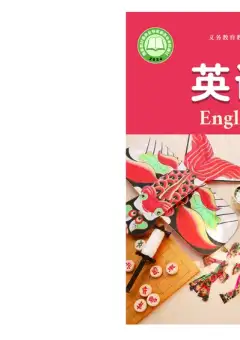
义务教育教科书
英语
八年级下册
English
八年级下册
义务教育教科书
英语
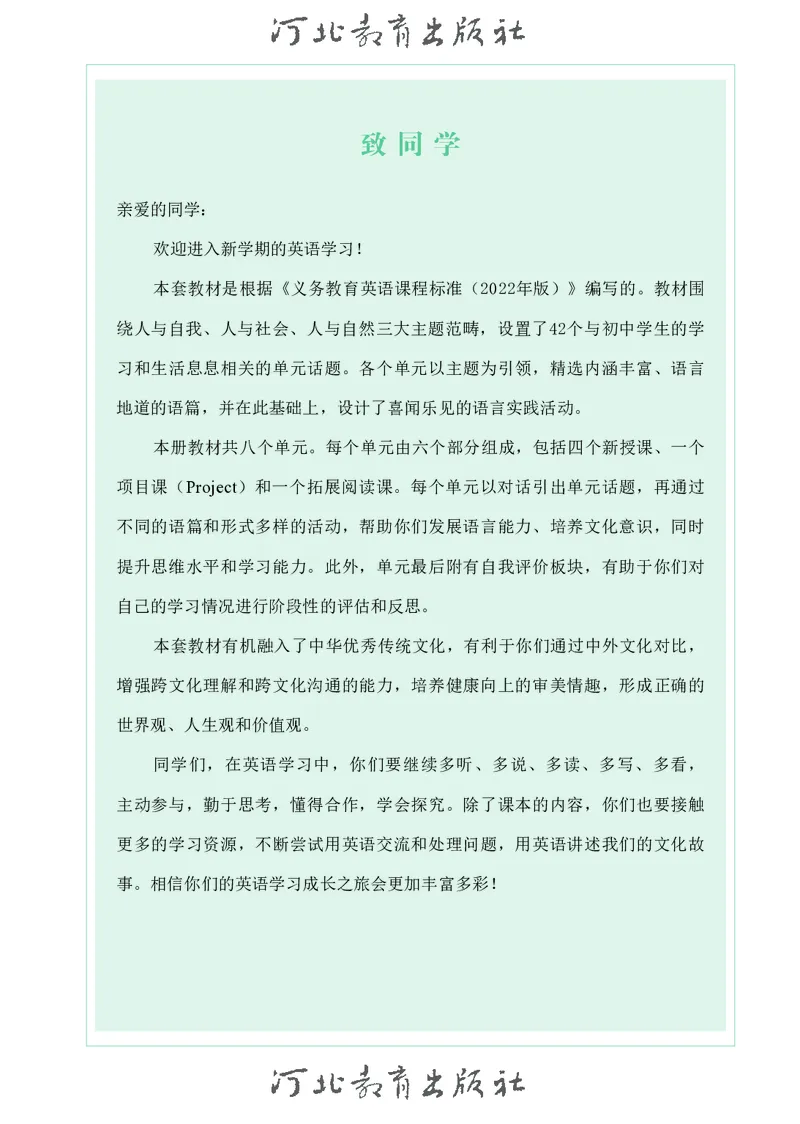
致 同 学
亲爱的同学:
欢迎进入新学期的英语学习!
本套教材是根据《义务教育英语课程标准(2022年版)》编写的。教材围
绕人与自我、人与社会、人与自然三大主题范畴,设置了42个与初中学生的学
习和生活息息相关的单元话题。各个单元以主题为引领,精选内涵丰富、语言
地道的语篇,并在此基础上,设计了喜闻乐见的语言实践活动。
本册教材共八个单元。每个单元由六个部分组成,包括四个新授课、一个
项目课(Project)和一个拓展阅读课。每个单元以对话引出单元话题,再通过
不同的语篇和形式多样的活动,帮助你们发展语言能力、培养文化意识,同时
提升思维水平和学习能力。此外,单元最后附有自我评价板块,有助于你们对
自己的学习情况进行阶段性的评估和反思。
本套教材有机融入了中华优秀传统文化,有利于你们通过中外文化对比,
增强跨文化理解和跨文化沟通的能力,培养健康向上的审美情趣,形成正确的
世界观、人生观和价值观。
同学们,在英语学习中,你们要继续多听、多说、多读、多写、多看,
主动参与,勤于思考,懂得合作,学会探究。除了课本的内容,你们也要接触
更多的学习资源,不断尝试用英语交流和处理问题,用英语讲述我们的文化故
事。相信你们的英语学习成长之旅会更加丰富多彩!
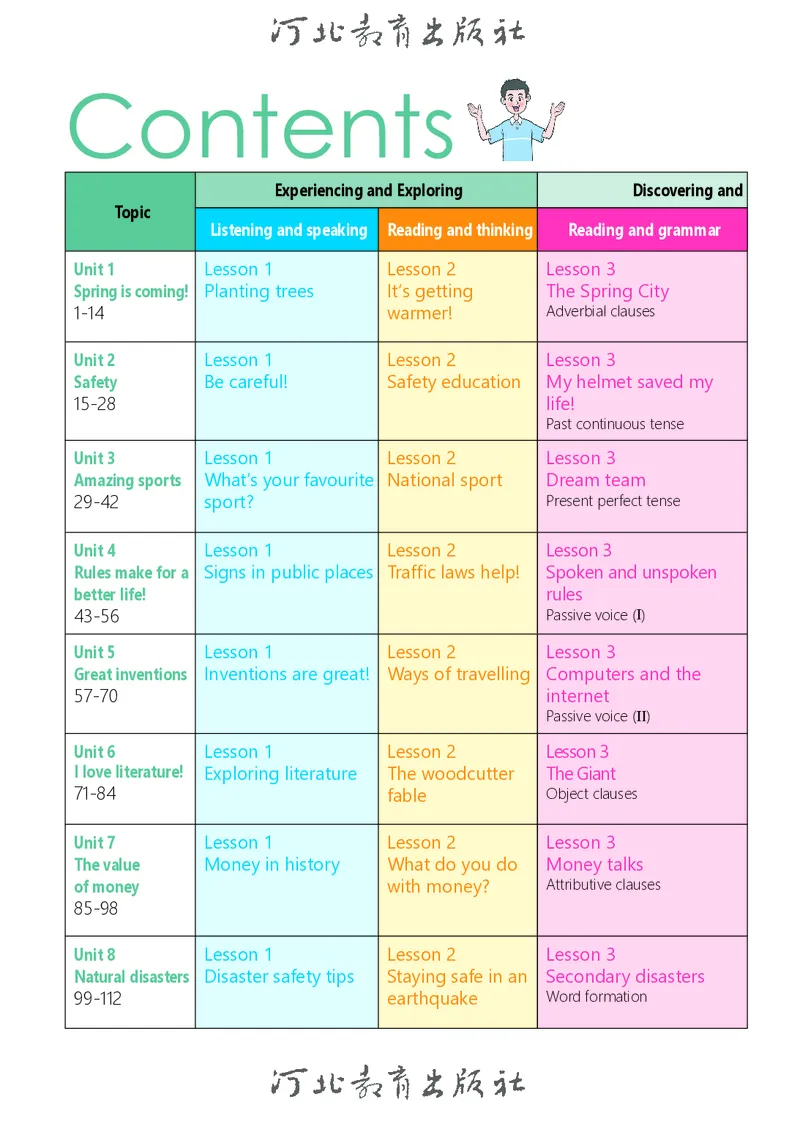
Topic
Experiencing and Exploring
Discovering and
Listening and speaking
Reading and thinking
Reading and grammar
Unit 1
Spring is coming!
1-14
Lesson 1
Planting trees
Lesson 2
It’s getting
warmer!
Lesson 3
The Spring City
Adverbial clauses
Unit 2
Safety
15-28
Lesson 1
Be careful!
Lesson 2
Safety education
Lesson 3
My helmet saved my
life!
Past continuous tense
Unit 3
Amazing sports
29-42
Lesson 1
What’s your favourite
sport?
Lesson 2
National sport
Lesson 3
Dream team
Present perfect tense
Unit 4
Rules make for a
better life!
43-56
Lesson 1
Signs in public places
Lesson 2
Traffic laws help!
Lesson 3
Spoken and unspoken
rules
Passive voice (Ⅰ)
Unit 5
Great inventions
57-70
Lesson 1
Inventions are great!
Lesson 2
Ways of travelling
Lesson 3
Computers and the
internet
Passive voice (Ⅱ)
Unit 6
I love literature!
71-84
Lesson 1
Exploring literature
Lesson 2
The woodcutter
fable
Lesson 3
The Giant
Object clauses
Unit 7
The value
of money
85-98
Lesson 1
Money in history
Lesson 2
What do you do
with money?
Lesson 3
Money talks
Attributive clauses
Unit 8
Natural disasters
99-112
Lesson 1
Disaster safety tips
Lesson 2
Staying safe in an
earthquake
Lesson 3
Secondary disasters
Word formation
Contents
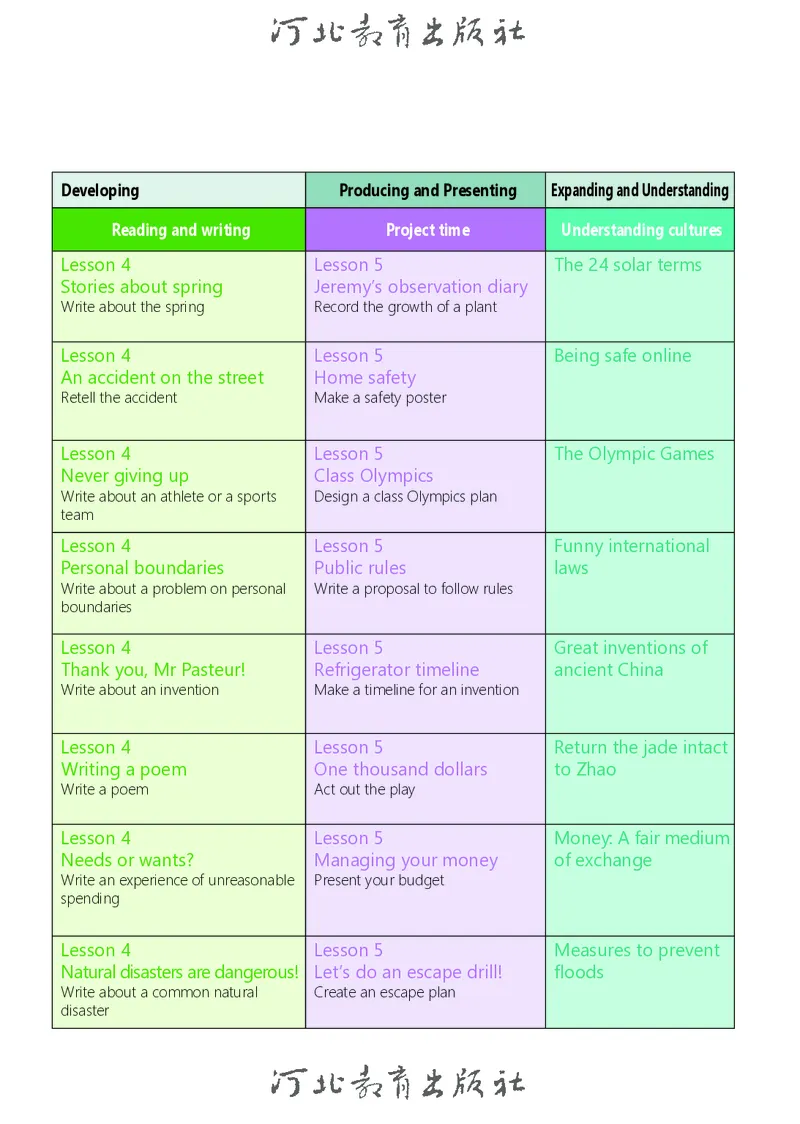
Developing
Producing and Presenting
Expanding and Understanding
Reading and writing
Project time
Understanding cultures
Lesson 4
Stories about spring
Write about the spring
Lesson 5
Jeremy’s observation diary
Record the growth of a plant
The 24 solar terms
Lesson 4
An accident on the street
Retell the accident
Lesson 5
Home safety
Make a safety poster
Being safe online
Lesson 4
Never giving up
Write about an athlete or a sports
team
Lesson 5
Class Olympics
Design a class Olympics plan
The Olympic Games
Lesson 4
Personal boundaries
Write about a problem on personal
boundaries
Lesson 5
Public rules
Write a proposal to follow rules
Funny international
laws
Lesson 4
Thank you, Mr Pasteur!
Write about an invention
Lesson 5
Refrigerator timeline
Make a timeline for an invention
Great inventions of
ancient China
Lesson 4
Writing a poem
Write a poem
Lesson 5
One thousand dollars
Act out the play
Return the jade intact
to Zhao
Lesson 4
Needs or wants?
Write an experience of unreasonable
spending
Lesson 5
Managing your money
Present your budget
Money: A fair medium
of exchange
Lesson 4
Natural disasters are dangerous!
Write about a common natural
disaster
Lesson 5
Let’s do an escape drill!
Create an escape plan
Measures to prevent
floods
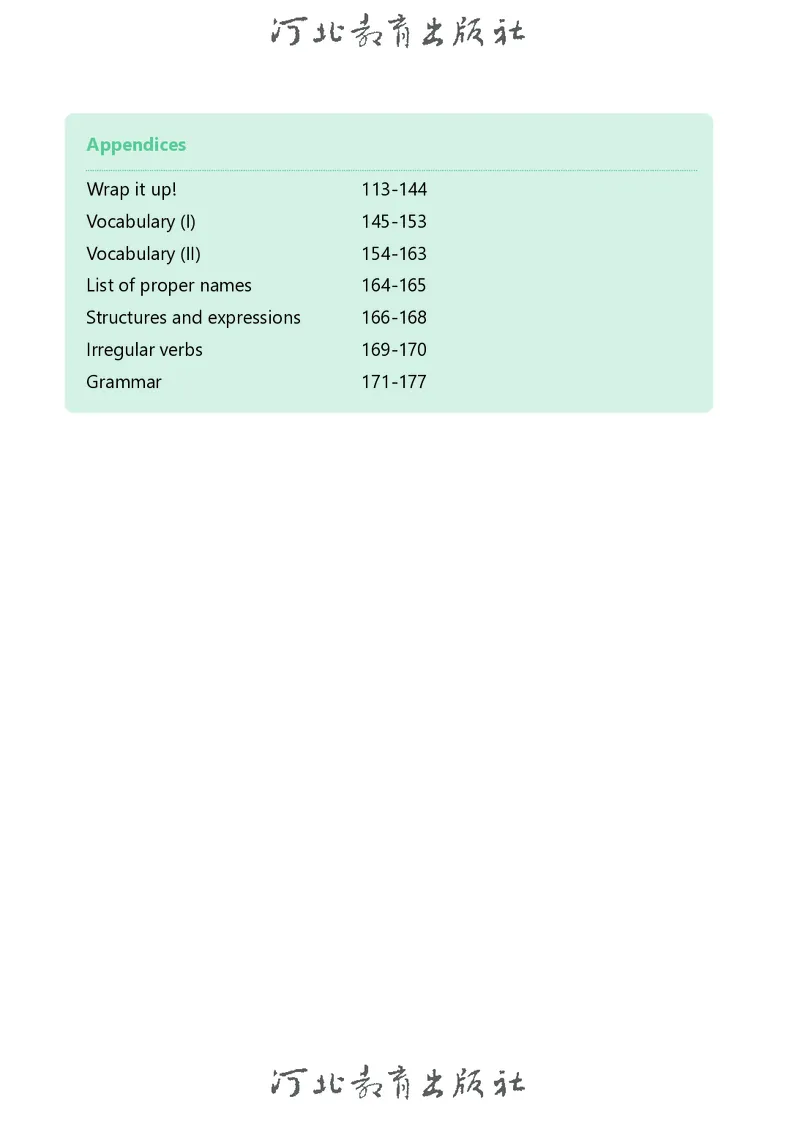
Appendices
Wrap it up!
113-144
Vocabulary (I)
145-153
Vocabulary (II)
154-163
List of proper names
164-165
Structures and expressions
166-168
Irregular verbs
169-170
Grammar
171-177
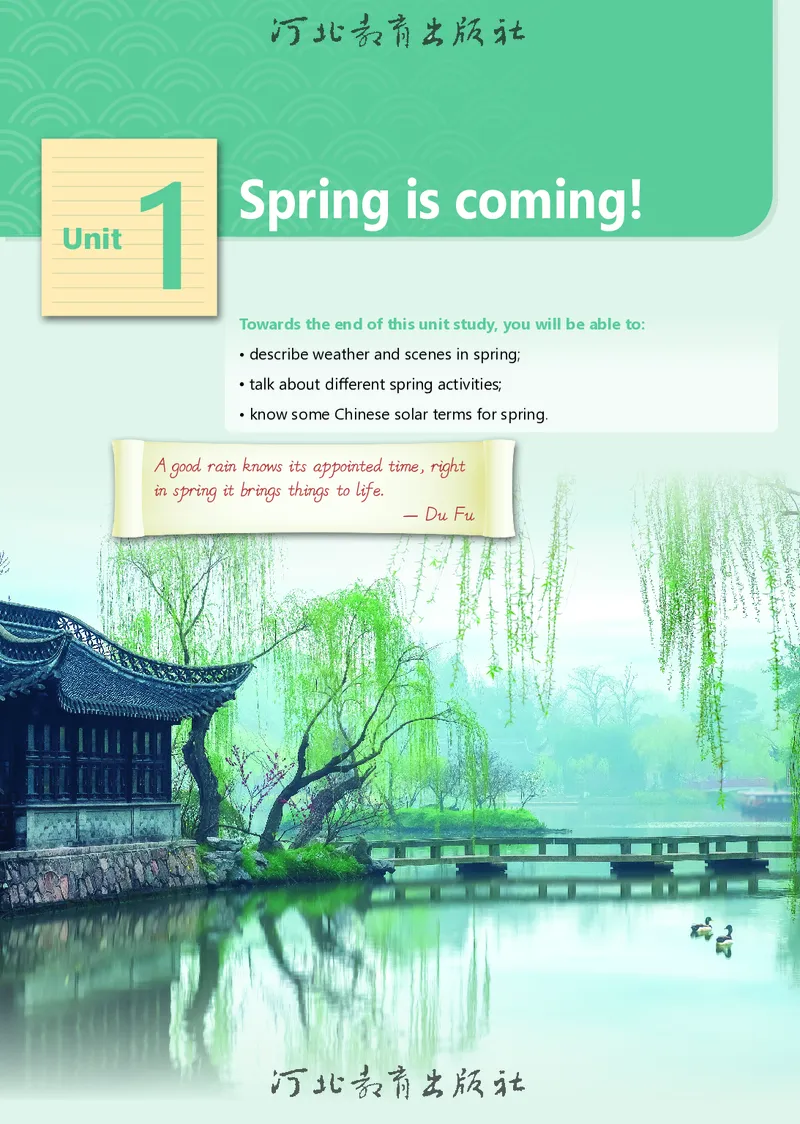
Spring is coming!
1
Unit
Towards the end of this unit study, you will be able to:
• describe weather and scenes in spring;
• talk about different spring activities;
• know some Chinese solar terms for spring.
A good rain knows its appointed time, right
in spring it brings things to life.
— Du Fu
1 Listen to the song. Put the pictures in order.
2 Listen to the conversation and tick the items mentioned.
Ms Liu: Good morning, everyone!
Who is on weather duty today?
Wang Mei: It’s me! Today is Monday,
March 1. The temperature will reach
15°C by noon and drop to 2°C at
night. Overall, it will be a warm, cloudy
day.
Ms Liu: Well done, Wang Mei. The
days are getting longer, and spring is
coming. We have a school project on
March 12. Can you guess what it is?
Li Ming: Is it tree planting?
1 Planting trees
Ms Liu: Good guess. Do you know
how to plant trees?
Li Ming: Yes. I learned to plant trees
when I visited my uncle last spring. It
was so much fun.
Ms Liu: Could you tell us the steps for
planting trees?
Li Ming: Sure. First, dig a large hole.
Then, place the seedling inside the
hole, and cover its roots with soil.
Finally, press down on the soil. Oh,
don’t forget to water the seedling.
Ms Liu: Excellent, Li Ming. Why do
people plant trees? Do you have any
ideas?
Song Hua: Trees help protect the soil
from rainfall.
Li Lin: Trees prevent dust from spreading.
Ms Liu: Good points. I believe you will
have a great time with this project.
2
3 Listen to the conversation again and answer the questions.
4 Listen to the introduction to the Great Green Wall and fill in the blanks.
5 Work in pairs. What are the basic steps for planting a tree? What are the
benefits of planting trees? Talk with your partner.
steps to plant trees
weather
a way to learn about nature
school project
different kinds of trees
reasons for planting trees
A What’s the weather like today?
B Why does Li Ming think the project is about planting trees?
C Why do people plant trees?
UNIT 1
The Great Green Wall was built across northern China. What is the Great Green
Wall? It is made up of strips of
planted by humans. Each year, dust
storms blow away a large amount of soil. The situation is becoming increasingly
serious. The Gobi Desert is swallowing about
square kilometres of
grassland every year. The Great Green Wall project started in
. By
planting more trees, people are preventing the
from expanding and
the forest coverage in northern China is increasing. By the year
, the
Great Green Wall will be over 4 million square kilometres.
3
1 Read the questions and give your answers.
2 Read the email and complete the table.
A Do you like spring? Why?
B What’s the weather like in spring?
Dear Jenny,
Today is March 6. Jingzhe falls on
this day this year.
Do you know what Jingzhe is? It’s
one of China’s 24 solar terms, and
it means “awakening of insects”.
The spring thunder wakes insects
up from their sleep. Then nature
begins to come back to life.
Spring is in the air. This morning, the
temperature was 10°C in my city. It
reached 15°C this afternoon. It was
quite warm. I don’t need my heavy
winter coat or boots now! On my
way to school, I saw some winter
jasmine blossoming. People believe
the blossom of this flower announces
the coming of spring, so we call it the
“welcoming-spring flower”.
I like spring. It is the best season
for going out. We are going to be
more active, like insects! We will
form a band. There is going to be a
basketball game next week. My class
is also planning a field trip. We will
plant trees. I can’t wait!
What’s the weather like in Canada?
What type of classic spring activities do
you do?
Wang Mei
2 It’s getting warmer!
4
3 Read and complete the conversation.
4 Work in pairs. Talk about the changes in spring and the
outdoor activities you do during spring.
A. But it’s still cold and snowy in my city.
B. It means “awakening of insects”.
C. Today I saw some winter jasmine.
D. We’re going on a field trip.
Li Ming: Hi, Danny. Today is Jingzhe. Spring is in the air.
Danny: What does Jingzhe mean?
Li Ming:
Everything begins to come back to life.
Danny: Sounds interesting! What’s the weather like in your city?
Li Ming: The temperature reached 15°C today. I took off my
heavy winter coat.
Danny: Spring has arrived in Canada, too!
Li Ming: It’s a bit different here.
We call it the
“welcoming-spring flower”.
Danny: Oh, it announces the coming of spring! Are you going
to be active, like those awakened insects?
Li Ming: Haha!
Danny: That’s great! It’s nice to go outside and enjoy nature.
Spring is coming!
Solar term
Jingzhe falls on
this year. It means “awakening of
insects”. Then nature begins to
.
Weather
The temperature was
in the morning and reached
in the afternoon. It was quite warm.
Activity
We will form a
, have a
, and plan a
.
UNIT 1
5
1 Read the questions and give your answers.
2 Read the passage and answer the questions.
A What do you like most about spring?
B What do you know about the “spring city”?
When we talk about spring, we think of
a season of warm weather and fresh air.
We also think of new life, green plants,
and budding trees all around us. Spring
is short in many places around the world.
But in my hometown, it feels like spring
nearly all year round.
The weather here is neither too hot nor
too cold. The average temperature in
winter is 15°C. In summer, the average
temperature is 24°C. While the sun
is shining, the temperature remains
pleasant. The city gets about 2,250 hours
of sunshine and about 1,000 millimetres
of rain every year. Because the weather
is spring-like, you can find hundreds of
beautiful flowers and trees all year.
3 The Spring City
There are many famous scenic spots
in my hometown. The Stone Forest
is a must-see for tourists from home
and abroad. There are many special
rocks that look like tall stone trees.
The Dianchi Lake is the biggest in
Yunnan Province. You can enjoy the
beauty of the area and go boating or
take a walk by the water.
Can you guess the name of my
hometown? Yes, it’s Kunming —
the Spring City. Welcome to my
hometown. When you visit, you will
feel our warmth and friendliness, just
like spring!
6
A They didn’t go to the beach today (because/but) it was raining.
B Wang Mei called me (while/because) I was writing an email.
C People eat pears (so/when) Jingzhe comes.
D A heavy rain fell (because/while) they were asleep.
4 Read and complete the conversation.
Susan: I’m from Australia. In my hometown, spring is warm and wet. It begins in
November.
Rita: I’m from India.
Li Jin: I come from Yunnan, China.
The average spring temperature
is 20°C.
Tom: I live in France. Spring begins in March and ends in May.
Dong Chao: I’m from Heilongjiang, China.
A. The temperature is between 4°C and 15°C.
B. We celebrate Holi when spring comes.
C. Because the average temperature is 5°C, spring is very cold.
D. The weather in my hometown is neither too hot nor too cold.
A What do the rocks look like in the Stone Forest?
B Why is Kunming called the Spring City?
3 Read and pay attention to the parts in yellow. Then circle the correct words.
An adverbial clause is a type of dependent clause that functions as an
adverb in a sentence. We use when and while to show time, and because to
show a reason.
● When we talk about spring, we think of a season of warm weather and fresh air.
● While the sun is shining, the temperature remains pleasant.
● Because the weather is spring-like, you can find hundreds of beautiful flowers
and trees all year.
UNIT 1
7
Groundhog Day is on February 2. On
that day, a small animal called groundhog
comes out of its hole in the ground.
Culture
Tips
1 Read the questions and give your answers.
2 Read the email and answer the questions.
A What special days do you like in spring?
B When can you see flowers bloom in your city?
Dear Wang Mei,
It isn’t snowing today, but there is still snow on the grass. In Edmonton, the
spring weather is a little wild. It can be cold and snowy or warm and sunny.
The temperature can be as low as -15°C, but it can also reach 15°C. We
probably won’t see any flowers until May or June!
After school today, we had so much fun playing outside. We played “snow”
soccer, but we had to wear jackets, jeans, and boots to stay warm. When
it gets warmer, we can play in our shorts and T-shirts. I like spring because
there are lots of activities to do, like cycling, having picnics, and hiking.
I like the Chinese name for winter jasmine. It’s interesting. Here, we have
Groundhog Day on February 2 for the coming of spring. Do you know what
happens on that day?
Another fun part of spring is going to the sugar bush, a big tree farm in the
countryside. We make maple syrup. We eat lots of tasty breakfast foods —
all with maple syrup on them! I love spring activities.
Talk to you soon!
Jenny
4 Stories about spring
8
3 Read the email again and complete the mind map.
4 What activities do you like to do in spring? Tick your answers and write the
reasons.
have picnics
fly kites
go boating
enjoy the flowers
go for bike rides Other: _______________
A Jenny says the weather in spring is a little wild. What does she mean?
B Where does maple syrup come from?
5 Write an email about spring in your city to a friend in another city.
UNIT 1
Activities
Reasons
Spring
Weather
Activities
Special Day
_____________ Day
_____________ changes from
-15°C to _____________.
cold and _____________
or _____________ and
sunny
play _____________
cycle, have picnics, and
_____________
_____________
maple syrup
The following questions may help you:
A What is the weather like in your city during spring?
B What do you usually do during spring? Why?
C Is there any special custom to welcome spring in your hometown?
9
1 Read Jeremy’s observation diary and label the plant.
In the life skills class last week, we
learned about agriculture and plant
biology. The teacher gave us some
seeds so we could obser ve the
growing process of a plant. I picked
some pea seeds and planted them in
a small pot. I watered them every day.
Let’s see how they grow.
Here are some of my observations on
the peas’ growth:
5 Jeremy’s observation diary
Date: March 3
Weather conditions:
sunny, temperature
around 18°C
Observations:
The pea seeds grew into buds.
They look like the English
letter “Y”. My peas are growing
quickly!
Date: April 3
Weather conditions:
rainy, temperature
around 22°C
Observations:
The pea flowers are in full
bloom. Some are pink and some
are purple. When the pea plants
grow taller, I will give them a
stake to climb on.
Date: March 30
Weather conditions:
cloudy, temperature
around 19°C
Observations:
Now, there are long, thin stems
and some leaves. At the top of
the stems are little flower buds!
I put the pot in the yard. There,
they can get some sunshine.
10
I know the flowers will fade and become
pea pods. Growing a plant is not easy
because it takes a lot of work. Farmers
grow millions of plants every year to
feed us. That is an amazing thing!
2 Talk with your partner about your planting experience.
3 Work in groups. Select a plant and grow it together. Write an observation
diary to record its growth.
4 Two weeks later, show your plant to the class and present your observation
diary. Don’t forget to share the experience of growing this plant.
● Did you ever grow a plant?
● How did you take care of it?
● What did you learn about the process of planting?
Name of the plant:
Date:
Weather conditions:
Observations:
Picture of the plant
UNIT 1
root
celery
sugarcane
carrot
onion
sunflower
potato
tomato
lettuce
watermelon
peanut
eggplant
cabbage
corn
11
1 Read the passage and answer the questions.
The 24 solar terms reflect the wisdom of
our ancestors. They help us understand
how nature changes throughout the
year. Our ancestors observed nature and
created the Chinese lunar calendar to
guide farming and daily life. There are
several solar terms for spring. They tell
us about the coming of this beautiful
season.
Start of Spring
It usually falls around February 3 to 5
and marks the beginning of spring. The
weather starts to get warmer. We see
new plants grow and animals become
active after a long winter.
Rain Water
It arrives around February 18 to 20. It
reminds us of the increase in rainfall as
the weather gets warmer.
Jingzhe
It usually takes place around March
5 to 7. Jingzhe tells us that insects
are coming out of hibernation. We
might hear more birds singing and see
butterflies and bees buzzing around.
Spring Equinox
It comes around March 20 or 21, when
the length of the day is nearly equal to
that of the night.
Qingming
It usually falls around April 4 to 6, when
the temperature begins to rise and
rainfall increases. Qingming is a time
when people honour their ancestors. It’s
also a time to enjoy outdoor activities
and the beauty of spring.
Grain Rain
It occurs around April 19 to 21. Farmers
sow seeds during this time, and the
rain nourishes the soil to make sure the
farmers have a good harvest in the future.
These solar terms teach us how to
follow the seasons and make the best
of them. They show us the relationship
between humans and nature and call
upon us to respect the world around us.
The 24 solar terms
12
2 Read the passage again and complete the table.
3 Do you know other solar terms? Share one or two with your classmates.
4 How much do you know about the 24 solar terms? Write down the names.
5 Do you know how other countries celebrate natural cycles and seasonal
changes? Search the internet and share your ideas with your partner.
Solar term
Chinese name
Date
Meaning
Start of Spring
立 春
Rain Water
Jingzhe
Insects are coming
out of hibernation.
Spring Equinox
Qingming
around April 4 to 6
Grain Rain
● It falls/occurs/takes place around...
● It tells us/It means...
● People... during this time.
A
is the coldest time of the year.
B
is the shortest day of the year, bringing with it the longest night.
C
is a time for remembering and honouring ancestors, as well as
enjoying the beauty of nature.
D
represents the hottest day of summer.
A What are the 24 solar terms for?
B What’s the difference between Rain Water and Grain Rain?
UNIT 1
Qingming Great Heat Great Cold Winter Solstice
13
● I can describe weather and scenes in spring:
• It can be cold and snowy or warm and sunny.
• Spring is short in many places around the world.
● I can talk about different spring activities:
• I learned to plant trees when I visited my uncle last spring.
• It is the best season for going out. We are going to...
● I can use adverbial clauses for a description:
• While the sun is shining, the temperature remains pleasant.
• Because the weather is spring-like, you can find hundreds of
beautiful flowers and trees all year.
● I can talk about Chinese solar terms:
• These solar terms teach us how to follow the seasons and make
the best of them.
● Improvement needed:
Self-check
Time
Fun
Hills, loud with new water,
Running swiftly under ice
As clear as glass.
Flowers, tiny, brave and
Bright in the old snow.
Trees, smelling fresh with life.
Leaves opening slowly
Under the pale blue sky.
The sun, warm and golden,
Softly kissing the earth.
Enjoyment
14
Safety
2
Unit
Towards the end of this unit study, you will be able to:
• talk about safety in different cases;
• know some safety tips in daily life;
• describe an accident using the past continuous tense.
Precaution is better than cure.
— Edward Coke
1 Look at the picture on this page and answer the questions.
A What is Danny doing?
B What could happen to Danny?
The students are decorating the
art classroom.
Danny: Look at this yellow star,
Brian and Jenny! Isn’t it beautiful?
I’m going to hang it from the
ceiling over the desk.
Brian: Here is the tape. I’ll get the
ladder for you.
Danny: I don’t need a ladder. I
think I’m tall enough.
Danny can’t reach the ceiling, so
he climbs onto Mr Green’s chair.
Danny: Almost… Almost…
Aaaaaaahhhh!
2 Listen to the conversation and answer the questions.
Danny falls.
Mr Green: What was that noise?!
He sees Danny lying on the floor.
Mr Green: Danny, are you okay? Are you
hurt?
Danny: Hmm… My tail is a little sore, but it’s
not serious.
Then, they hear Brian cry for help, but his
voice is very weak.
Mr Green: Brian? Where are you?
Brian: Help me, sir! I’m under Danny!
Danny: Oh no! I’m really sorry! Are you
okay, Brian?
Brian: No, I’m the opposite of okay. I tried
to catch you, but you landed on top of
me. My arm hurts.
Jenny: Should I call an ambulance?
Brian: No, that’s not necessary. I don’t
think my arm is broken.
Mr Green: Jenny, please call Brian’s mother.
Let her know we are taking Brian to the
hospital. He should get an X-ray, just in case.
1 Be careful!
16
5 Work in pairs. How can we keep safe in the classroom? Talk with your partner.
Li Ming writes an email to Brian.
A Li Ming broke his leg at the age of seven.
( )
B Li Ming tried to climb a ladder, but fell down.
( )
C Li Ming’s mother caught him and saved him.
( )
D It took Li Ming about 90 days to recover.
( )
A: What classroom safety tips do you know?
B: It is dangerous to climb onto a desk.
…
A What are the students doing?
B What does Danny climb onto?
C Who is Jenny going to call?
D What lesson do you think Danny learned from this accident?
3 Listen to the conversation again and fill in the blanks.
4 Listen to the passage and write true (T) or false (F).
UNIT 2
Danny was going to
a star from the ceiling. He
thought he was tall
and didn’t need a ladder.
Beginning
Danny’s tail was a little
. Brian’s arm hurt, but
he thought it was not
to call an ambulance.
Mr Green took Brian to the
.
End
Danny fell off the chair. Brian tried to
Danny,
but Danny
on top of him.
Middle
An accident in the art classroom
17
1 Read the questions and give your answers.
2 Read the diary and write true (T) or false (F).
Dear Diary,
Today is School Safety Education Day. Our school organised activities to teach
us about safety.
The first part was fire safety. What should people do in case of a fire
emergency? A firefighter gave us a talk and showed us videos. He said that
in case of a fire, we should stay calm, find the nearest exit to go outside, and
never use lifts.
We even had a fire drill! As soon as the fire alarm rang, all the students took
action. We covered our mouths and noses with wet towels. We walked down
the stairs calmly and in order. Our teachers guided us outside.
After the drill, the firefighter taught us how to put out a fire with water or with
a fire extinguisher. We did it!
Later, we learned some first aid skills, like CPR and other basic
life support training. We talked about online safety practices
and where to find help in any emergency. We discussed
how to stay safe in a big crowd, and what to do to avoid
drowning.
The safety education activities helped us understand how to
stay safe and make good choices in different situations.
Best,
Li Ming
A What safety-related knowledge do you have?
B Do you have any first aid skills? What are they?
2 Safety education
18
● First aid: Be prepared to help someone by learning basic life support techniques
like CPR.
● Fire safety: If there is a fire,
, find the nearest exit, and never use lifts.
● Online safety: Don’t share personal information and find help
emergency.
●
in a big crowd: Don’t stay in crowded places. If an accident
happens, get away from the crowd
.
● Avoid drowning: Never swim alone in the river and always follow the
instructions of lifeguards.
3 Read the diary again and tick the items mentioned.
4 Complete the safety tips with the expressions.
A What did the students learn on School Safety Education Day?
fire safety
first aid skills
online safety
B What steps are included in a fire drill?
rushing to the lift
finding the nearest exit
covering mouths and noses with wet towels
C What can we use to put out a fire?
water
clothes
fire extinguisher
in case of stay calm in order stay safe
5 If you live on a high floor and there is a fire at home, what should you do?
Discuss with your classmates.
UNIT 2
A People can use lifts during a fire.
( )
B During the fire drill, the students covered their mouths with their hands. ( )
C CPR was taught during the safety education training.
( )
19
1 Read the questions and give your answers.
2 Read the passage and write true (T) or false (F).
A Do you wear a helmet when you ride a bicycle? Why?
B How do you understand the sentence “You can never be too careful”?
It was a beautiful
afternoon. I was riding
my bicycle by the
river, thinking about
yesterday’s baseball
game. I guess I rode
over a hole in the
road. All of a sudden,
WHAM! I went down hard on my right side. It
really hurt!
My head hit the ground. I lay there for a
few minutes. I tried to get up, but I couldn’t!
“There’s something wrong with me,” I thought.
I felt so terrible that I lay down again. Then I
saw blood on my shoe. My hand and leg were
bleeding. There was an ugly cut on my knee. I
was in a lot of pain.
As I lay there, I took off my helmet. There was
A The author was riding her bicycle when she fell.
( )
B The author hurt her foot and knee.
( )
C A truck driver helped her and drove her home.
( )
3 My helmet saved my life!
a sharp rock sticking out of it.
It was pretty scary to look at.
Thank goodness I wore my
helmet! I shouted for help. A
driver stopped his truck and
came to help me. He put my
bike in the back of his truck and
drove me to the hospital.
When my mother got to the
hospital, she gave me a big hug
and kiss. “You were wearing
your helmet this time. How
lucky you were!” she said. She
knew I was careless and did not
always wear my helmet.
But I’ll never be careless again...
My bicycle helmet saved my
life!
20
3 Read the sentences and pay attention to the parts in yellow. Then fill in the
blanks with the correct forms of the verbs.
We use the past continuous tense to talk about actions that were in progress
at a certain time or over a period in the past. The structure: was/were+v-ing
A He was running (run) and suddenly felt a pain in his knee.
B They
(play) volleyball at ten o’clock yesterday morning.
C I
(chat) with my friend at that time.
D The basketball hit me while I
(watch) a bird.
4 Read and complete the conversation. Think about who took Mary Sheep’s baby.
Mary Sheep can’t find her baby. Monkey is helping her look for the baby in the forest.
● I was riding my bicycle by the river.
● My hand and leg were bleeding.
UNIT 2
I
(clean) my house at that time. Yesterday was my
birthday. Lots of friends came to my home. Most of them left at 9:30.
But Tiger and Fox stayed late and helped me.
I was at Panda’s home with Tiger. We
(help) Panda
while we were talking. At about 10:00, I left the party. On my way
home, I met Wolf and we went for a walk together.
What were you doing between 9:30 and 10:00 last night?
Well, we had a birthday party for Panda last night. I
(talk)
to Fox at that time. We were also helping Panda clean the room.
Let me think. I went to Panda’s party at 7:00 and I left at 9:30.
Between 9:30 and 10:00, I
(take) a walk with Fox.
21
1 Read the questions and give your answers.
2 Read the news and put the sentences in order.
A What do you need to do when you cross the street?
B What should you do when you see someone badly hurt in an accident?
NORTH TOWN, Alberta. Thirteen-year-old Ann
Brown was hit by a car outside North Town Primary
School at 15 Park Road. The accident happened at
about 7:30 a.m. She and her brother, James, were
on their way to an early basketball practice.
“We were in a hurry,” James told the reporter. “We didn’t want to be late for
practice. Ann’s basketball rolled onto the street. She raced to get it.”
Mrs Andrews, a chemistry teacher from Green Wood School, was walking
several steps behind the two students. She saw it happen. “I don’t know whose
fault it was,” Mrs Andrews said. “The girl didn’t see the car. And the street was
icy — the car couldn’t stop in time. It was terrible.”
Mrs Andrews said, “I shouted to the girl. I wanted to stop her from running
after the ball, but she didn’t hear me.” After the accident, the car stopped, and
the driver, Bill Morin, jumped out. He called an ambulance.
Mr Morin knows first aid. He did not move Ann. He stopped traffic on the road
until the ambulance came. Then the ambulance took both students to the
hospital. Both kids were in shock.
4 An accident on the street
An accident on the street
Northern News, December 7 Girl, 13, Hit by Car
22
3 Read the news again and complete the mind map.
4 Suppose you are Ann. Briefly explain the accident to the class.
One week later, Ann returned to school after recovering in the hospital. She shared
her experience.
That day, I was walking on the street with my brother.
( ) The driver, Bill Morin, called an ambulance.
( ) Ann dropped her basketball and raced to get it on the street.
( ) Ann and James were on their way to an early basketball practice.
( ) Mrs Andrews shouted to the girl to stop her, but she didn’t hear.
( ) The ambulance took both students to the hospital.
( ) Mr Morin stopped traffic on the road until the ambulance came.
( ) Ann was hit by a car because the car couldn’t stop in time on the icy street.
5 What can you learn from the accident? Talk with your partner.
An accident
UNIT 2
When
Where
Who
How
Ann has a broken leg and a bad shoulder wound. She is recovering in the
hospital. Doctors say she can expect to return to school in about a week.
23
1 Read the passage and complete the table.
5 Home safety
Many serious accidents happen in people’s homes. The kitchen and the bathroom
are the two most dangerous places in the house.
Can people prevent certain accidents? Yes. Many accidents happen because of
people’s carelessness. So be careful!
Safety tips in the kitchen
● Be careful with fire and boiling water when you cook.
● Have fire blankets, fire extinguishers, smoke alarms,
and flashlights near the kitchen.
● Always turn off the oven or stove after use. In case
of a gas leak, do not use a cell phone or any electric
item. Immediately turn off the stove and quickly open
a window. Move to a safe area to inform emergency
services and the gas company.
Safety tips in the bathroom
● Never use electricity in the shower or bathtub. It can
shock you!
● Be sure to keep the bathroom floor dry after you
take a shower or bath. It’s easy to slip and fall on a wet
floor.
● Turn on the cold water first when taking a bath.
Then adjust the hot water to ensure a safe water
temperature. Hot water can burn you.
Home safety focuses on preventing accidents and
reacting well to dangers in order to protect the safety of the family.
Some things catch fire
easily. Don’t put them
near the stove!
Accidents happen
suddenly. Never leave
small children alone in
a bathtub.
24
2 Work in pairs. What should you do to stay safe at home? Tick the correct
choices and give more tips for home safety.
3 What should you do or not do to stay safe in different situations? Discuss with
your partner.
4 Make a safety poster with your group members.
5 Present your poster to the class.
Keep paper and cloth away from the stove.
Set a timer to remind you when food is ready.
Open the window when there is a gas leak.
Throw water over a pan that catches fire.
Put metal items in a microwave.
More home safety tips:
Choose a location. It can
be, for example, on a bus,
in a fitness centre, or in a
lab. What kind of dangers
could occur there?
● on the way to school
● in the classroom
● on the playground
● in the lift
Safety tips in the kitchen
Safety tips in the bathroom
Dos
Don’ts
Dos
Don’ts
UNIT 2
Search for more safety
information online and
share it with the group. How
can you protect yourself
from those dangers?
Write down the
safety tips and
make your poster
look nice.
A
B
C
25
1 Read the passage and write true (T) or false (F).
Technology can be good or bad. That’s why
learning to be safe online is so important!
Personal information
Most of us have our names and photos on
social media. But without the right privacy
settings, they can be used by dangerous
people. Everything you post or send
online could be taken and used against
your will. And once it’s online, it’s nearly
impossible to get rid of it completely!
Also be careful of what others send you.
If you click a link or open an attachment,
it can be something dangerous for your
computer, like a virus.
Misinformation
The internet era makes gathering information
easy. But you must consider the source
of the information you are reading. Who
published it, a stranger or an expert in
the field? What website is it on, a blog
or a government resource? Does it offer
Being safe online
different views? Is it meant to inform
you, or simply get a quick reaction?
Cyberbullying
You probably know that cyberbullying
is bullying, but online. Sending
hurtful messages, spreading lies
about someone, sharing their private
photos... these are easy to do, but
they have a huge impact on the
victim. The best way to deal with
cyberbullying is to ignore, block, and
delete. Telling a trusted adult is also
important, especially if someone is
threatening you.
Be careful with your information.
Think critically about everything
you see online. Be kind to others.
These important lessons will help
you and others stay safe with
today’s technology.
26
2 Read the passage again and tick the tips on how to be safe online.
3 Read and complete the conversation.
4 Work in groups. Talk about what you do in your daily life to be safe online.
Never give out private information online.
Be careful with your information.
Trust any information you read.
Be careful of what others send you.
Consider the source of the information you are reading.
Send hurtful messages and share others’ private photos.
Bob: The internet era makes gathering
information easy.
Tim: Exactly. But it also brings some
problems.
Bob: I agree.
Tim: Of course. Some people use the
internet to harm others.
Bob: That’s true. Someone tried to
cyberbully me.
A Once your private information is online, you can get rid of it completely
and easily.�
( )
B We should be careful when we want to click a link or open an attachment.�
( )
C We must consider the source of the information we are reading.�
( )
A. I never give out private information online.
B. How did you deal with that?
C. We should think critically about everything online.
D. Do you think learning to be safe online is important?
Tim: Really?
Bob: I ignored and deleted the hurtful
information. Then I blocked the person
and told my father about it.
Tim: What do you do to be safe online
now?
Bob:
Tim: Technology can be good or bad.
It’s important to be safe online!
UNIT 2
27
● I can talk about safety in different cases:
• If there is a fire, we should stay calm/go outside/...
• Thank goodness I wore my helmet!
● I know and can share some safety tips in daily life:
• Do not use/Never use... • Be sure to...
• Be careful of what others send you.
• You must consider the source of the information you are reading.
● I can describe an accident using the past continuous tense:
• Mrs Andrews, a chemistry teacher from Green Wood School, was
walking several steps behind the two students.
● Improvement needed:
Self-check
Time
Fun
Please take care!
Be careful when you
ZOOM down the waterslide,
CLIMB up the mountainside,
RACE on a bike ride.
To take an ambulance is not a happy ride.
Have fun, but please take care!
Be careful when you
GO at the green light,
TURN your bike left or right,
JUMP from too high a height.
So don’t be careless when you
go to ride your bike.
Have fun, but please take care!
28
Amazing sports
3
Unit
Towards the end of this unit study, you will be able to:
• talk about sports and games;
• understand the importance of courage, spirit, and teamwork;
• describe an athlete or a sports team you like;
• use the present perfect tense to describe sports.
A sound mind is in a sound body.
— Roman proverb
1 Loot at the pictures and write the names of the sports.
Li Ming and Song Hua are talking about
sports on the playground.
Li Ming: What’s your favourite sport, Song
Hua?
Song Hua: Hmm... I like basketball, but I
think swimming is my favourite. I feel free
when I’m in the water. I started learning to
swim at the age of five, and I still go to the
pool every Saturday evening.
2 Listen to the conversation and complete the table.
1 What’s your favourite sport?
Li Ming: That sounds fun! What are
some benefits of swimming?
Song Hua: Swimming helps me
stay in shape and reduces my
stress. After swimming, I always feel
refreshed. How about you, Li Ming?
What’s your favourite sport?
Li Ming: For me, it’s ping-pong. It
improves my hand-eye coordination.
I practice it at the sports centre
on weekends, and I have made
some friends there. We all love
ping-pong and have a lot of fun
together.
Song Hua: Sports help us improve
our physical abilities, learn new
skills, overcome challenges, and
build confidence.
Li Ming: Well said! Look! There is a
basketball game going on. Let’s go
and cheer them on!
30
5 Work in groups. Interview your classmates about their favourite sports.
A: What’s your favourite sport?
B: My favourite sport is…
A: Why do you like it?/What are some of its benefits?
...
A Basketball is Song Hua’s favourite sport.
( )
B Ping-pong improves Li Ming’s hand-eye coordination.
( )
C Li Ming has made some friends through playing ping-pong.
( )
D Sports can help us build confidence and overcome challenges.
( )
E Song Hua and Li Ming are going to play in the basketball game.
( )
Name
Favourite sport
When they play
Benefits
Song Hua
Li Ming
Jenny
Wang Mei
Li Lin
Jack
Brian
badminton
3 Listen to the conversation again and write true (T) or false (F).
4 Listen to the passage and match the people with their favourite sports.
UNIT 3
basketball
skiing
jogging
cycling
31
1 Read the questions and give your answers.
2 Read the passage and answer the questions.
Ping-pong, also known as table tennis,
holds a special place in Chinese people’s
hearts. It shows our love for sports and
the spirit of never giving up. It inspires
young athletes and brings joy and a
feeling of community to every player.
Ping-pong has deep historical roots in
China. The game became popular in the
early 20th century. Now, people of all ages
play this sport in gyms, parks, community
centres, and even at home.
Ping-pong is a fast-paced sport. It can
improve our overall physical fitness.
Ping-pong uses both the left and right sides
A Is ping-pong a popular sport in your neighbourhood?
B What do you know about ping-pong?
2 National sport
of the brain. So it can also improve
our memory and problem-solving
skills.
Since ping-pong entered the
Olympics in 1988, the Chinese
ping-pong team has won many
gold medals. The team has also
had many great victories in major
ping-pong events, such as the
World Championship and the
World Cup. The achievements of
Chinese players on the global stage
have inspired many people.
Ping-pong has already become
an important part of
our culture. The game
serves as exercise and
as a way for people to
connect with others.
Don’t wait! Go play
ping-pong with your
friends.
32
Hello, I’m Wang Yu. My favourite sport is ping-pong. It
in my heart. Playing ping-pong
helps me
. The quick movements
keep me active. But there is more to the sport than
just enjoyment. Athletes never
,
no matter how challenging a game is. It inspires me to
hold on when I face difficulties.
3 Read the passage again and complete the mind map.
4 Complete the passage with the correct forms of the phrases.
A What can we get from playing ping-pong?
B How does ping-pong improve our memory?
C When did ping-pong become an Olympic sport?
give up hold a special place stay healthy
UNIT 3
5 Play a game. Act out a sport without saying any
words and ask your partner to guess what it is.
National sport
development
achievements of
Chinese players
play in different places now
in the early 20th century
improve overall
improve our memory
and problem-solving skills
benefits
won many gold medals in
the Olympics
in major ping-pong events
33
1 Read the questions and give your answers.
2 Read the passage and answer the questions.
A Which sports team do you like best? Why?
B What is the most important part of a team?
At the 1992 Olympics, the US basketball
team won the gold medal. People called
it the dream team. Nowadays a dream
team refers to the greatest team in its
field. There have been many dream
teams throughout the history of sports.
Canada’s dream team plays on ice —
it’s the country’s ice hockey team. For
Brazil, it might be the men’s volleyball
or soccer team.
What is China’s dream team? Many
people would think of the diving team.
China also has dream teams in ping-pong
3 Dream team
and weightlifting. Time after time,
these teams have won gold medals for
China.
However, there is more to a dream
team than winning gold medals. A
dream team has not only the best
players and the best coach, but also
the best team spirit. All of the players
must work hard and cooperate with
one another. By working together, they
show their courage and their drive.
They never give up. That’s what makes
a dream team!
The spirit of a dream
team influences lots
of people everywhere,
not only in their home
nation. People admire
and feel proud of their
dream teams.
34
3 Read the sentences and pay attention to the parts in yellow. Then fill in the
blanks with the correct forms of the verbs.
We use the present perfect tense to talk about an action in the past with a
result now. We can also use it when we talk about an action lasting from the
past time till now.
● There have been many dream teams throughout the history of sports.
● Time after time, these teams have won gold medals for China.
A What is the dream team of the US?
B Is the diving team China’s only dream team?
C What makes a dream team?
UNIT 3
A We are pleased the players have solved (solve) the problems after a month’s
hard work.
B He
(be) a basketball player since 2021.
C Mr Brown
(serve) as a doctor for that team for many years and
now he is ready to retire.
D The words of her coach
(influence) her on her way to success.
4 Read and complete the passage.
In the last few years, we
(make) much progress in the areas of
technology and innovation. Groups of scientists and inventors
(use) their different skills and determination to make the world a better place. Their
discoveries
(contribute) to the progress of artificial intelligence.
Working as a dream team, they keep pushing the limits of what’s possible.
35
1 What qualities do you think the Chinese women’s volleyball team has? Talk
with your partner.
2 Read the passage and answer the questions.
I’m a huge fan of the Chinese women’s
volleyball team. I have watched nearly
all of their games and have often found
myself cheering or shedding tears
with the players during these matches.
Throughout the years, I have seen this
team win many championships and
bring glory and pride to our nation.
What makes the Chinese women’s
volleyball team special? It’s their
determination, teamwork, and spirit.
No matter how tough things get, they
never give up. When a player misses
a shot, the teammates don’t blame
her. Instead, they come together and
offer words of encouragement. They
support each other and create a
positive and exciting atmosphere on
the court. Whether they win or lose,
they stay united as a team. The coach,
Lang Ping, once said, “Volleyball is not
just a job; it is our whole life.” And the
team members truly live by that.
4 Never giving up
The team’s spirit has had a strong
influence on me. When I come
across a difficulty or challenge,
their never-give-up spirit always
motivates me to keep trying. The
team has taught me to do my best
in everything. I have also learned
the value of teamwork from them.
Working with others and supporting
each other can lead to amazing
achievements.
36
3 Read the passage again. Write the main idea of each paragraph and choose
the correct supporting sentences.
4 Write about an athlete or a sports team you like.
The following questions may help you:
A When and how did you learn about him/her/it?
B What prizes or awards has he/she/it won?
C What outstanding qualities do you think he/she/it has?
D How has he/she/it influenced you?
A I have also learned the value of teamwork from them.
B No matter how tough things get, they never give up.
C When I come across a difficulty or challenge, their never-give-up spirit always
motivates me to keep trying.
D I have watched nearly all of their games.
E Whether they win or lose, they stay united as a team.
F I have often found myself cheering or shedding tears with the players.
Paragraph
Main idea
Supporting sentence
1
2
3
A How do the teammates support one another on the court?
B What important lessons has the author learned from this team?
UNIT 3
37
1 Read the email and answer the questions.
A What were the five events Jenny’s class Olympics had?
B Did Kim win first place in both jump rope and long jump?
Dear Wang Mei,
We had our own class Olympics this week!
Our class had five different events — jump
rope, long jump, sit-ups, push-ups, and
“ping-pong pass”. Everyone competed in
each event.
The events were fun! Kim won first place in the jump rope event. She
jumped 178 times in one minute without stopping. Lisa won second place
in the long jump. She jumped very far, but Kim jumped farther.
My favourite event was “ping-pong pass”. Each student had to balance a
ping-pong ball with chopsticks and move it from one basket to another
without dropping it. We used a stopwatch to see who was the fastest.
Guess what! I can use chopsticks very well. Tom did his best, but his
ping-pong ball kept falling off his chopsticks.
What were the results? I won the race! David was only two seconds slower
than me. It’s really enjoyable to do sports with friends! I like class Olympics.
What about you?
Jenny
5 Class Olympics
38
2 Read the table. Circle the first place of each event and discuss with your partner.
3 Work in groups. Design a class Olympics plan and discuss it.
4 Vote for some popular events. Hold your class Olympics. Make a table to record
the results for your group members.
Class Olympics
jump rope
long jump
sit-ups
(girls)
push-ups
(boys)
ping-pong
pass
Jenny
176/min
1.87 m
49/min
—
23 sec
Lisa
176/min
1.97 m
45/min
—
31 sec
Kim
178/min
2.01 m
45/min
—
30 sec
David
175/min
1.93 m
—
40/min
25 sec
Tom
170/min
1.95 m
—
35/min
40 sec
Class Olympics
Name
Event
● What events would you like to include?
● What are the rules?
● What do you need to prepare?
...
A: Who won third place in “ping-pong pass”?
B: Kim.
A: Who did the most push-ups in a minute?
B: David.
UNIT 3
39
1 Read the passage and write true (T) or false (F).
The Olympic Games were an ancient
athletic festival in Greece. Among the
games held throughout Greece, the
Olympic Games were the most famous.
They were held every four years.
The modern Olympic Games became
popular in the late 19th century. In 1892,
at a meeting in Paris, Pierre de Coubertin
put forward the idea of holding Olympic
Games again. In 1894, the International
Olympic Committee (IOC) was founded.
The modern Olympic Games include
the Summer Olympics and the Winter
Olympics. The first modern Olympic
Games were held in Athens, Greece, in
The Olympic Games
1896, while the first Winter Olympics
were held in Chamonix, France,
in 1924. Since 1994, the Olympic
Games have alternated between a
summer and a winter edition every
two years.
In 2008, Beijing became the first
Chinese city to host the Games. Do
you remember the slogan “One
World, One Dream”? The song “You
and Me” touched many people’s
hearts. In 2022, Beijing hosted the
Winter Olympic Games. It became
the first city in the world to host
both the Summer and the Winter
Olympic Games.
The Olympic flag has a white
background with five interlaced
rings in blue, yellow, black, green,
and red. These rings symbolise the
unity of the continents. The motto
of the Olympic Games is “Faster,
Higher, Stronger — Together”.
40
2 Read the passage again and answer the questions.
3 Since 1984, each host city of the Olympic Games has invented a slogan to
show its Olympic spirit and express the common wishes of all the people in
the world. Search the internet for more information and complete the table.
4 In the history of the Olympic Games, one goal has always been the same — to
do your best and to compete fairly. How do you understand these words?
Share your ideas with your classmates.
A Which city was the first to hold the modern Olympic Games?
B What do the five interlaced rings of the Olympic flag symbolise?
A The Olympic Games originated in Greece.
( )
B Beijing was the first city to host both the Summer and the Winter Olympic
Games in the world.
( )
UNIT 3
Year
2008
2012
2016
2021
2024
Host city
Slogan
Inspire a
generation
A new world
United by
emotion
Tokyo
Beijing
41
● I can talk about sports and games:
• I like basketball, but I think swimming is my favourite.
• The Olympic Games were an ancient athletic festival in Greece.
● I know about the importance of courage, spirit, and teamwork:
• No matter how tough things get, they never give up.
• Whether they win or lose, they stay united as a team.
● I can describe an athlete or a sports team I like:
• What makes the Chinese women’s volleyball team special? It’s
their determination, teamwork, and spirit.
• They support each other and create a positive and exciting
atmosphere on the court.
● I can use the present perfect tense to describe sports:
• Time after time, these teams have won gold medals for China.
● Improvement needed:
Self-check
Thousands of snowflakes
Competing for openness
Thousands of you and me
Gather into a family
Time
Fun
Snowflakes, snowflakes
Open to the light
All around, all around
Shining all the same
Snowflakes
42
Rules make for a better life!
4
Unit
Towards the end of this unit study, you will be able to:
• talk about public rules;
• know some basic traffic laws;
• understand the importance of personal space.
Nothing can be accomplished without
norms or standards.
— Chinese proverb
Brian: Hey look, there’s a sign on the
wall. It says, “No cameras or mobile
phones!”
Danny: Why do they have this sign at
the entrance of the cinema?
Jenny: Well, it’s likely to prevent people
from taking pictures or recording the
movies.
Brian: Ah, that makes sense. It’s important
to respect the copyright laws that
protect the movie industry. That’s also
why you can’t download some movies
online!
A Why are there signs in public places?
B What do the signs in your school say?
1 Read the questions and give your answers.
2 Listen to the conversation and complete the table.
1 Signs in public places
Jenny: Have you noticed any other
signs in public places?
Danny: Yes, I remember seeing a
sign in the library. It said, “Silence is
golden.”
Brian: I’ve seen that one too. It reminds
us to be quiet.
Danny: And what about in parks?
Have you seen any signs?
Jenny: Yes, I saw one at a national
park that said, “Leave nothing but
footprints.”
Brian: It encourages people to keep
the park clean and not leave any
rubbish behind.
Jenny: Signs in public places play
an important role in promoting
social rules and working for the
common good.
Danny: Agreed. Let’s always follow
the rules and be good citizens.
Now, let’s go enjoy the movie!
44
Public place
Public sign
Purpose
cinema
No cameras or
!
to respect the copyright
that protect the movie industry
is golden.
to remind people to be
Leave
but
footprints.
to encourage people to
the park clean and not leave any
behind
Jenny and Lucy are talking about the signs in their school.
A There is a sign near the entrance that says, “Dream big, work hard.”
( )
B The sign “Eat healthy, stay strong” promotes the importance of healthy
eating.
( )
C The sign “Creativity has no limits” is in the science lab.
( )
D The signs in the school help guide students’ behaviour.
( )
E Both Jenny and Lucy have a positive attitude towards these school signs. ( )
3 Listen to the dialogue and write true (T) or false (F).
UNIT 4
4 Look at the signs and discuss with your partner.
The following questions may help you:
A What do these public signs mean?
B Where can we see these signs?
C What other signs have you noticed in public places?
45
1 Do you know these traffic
signs? What do they mean?
2 Read the passage and write true (T) or false (F).
Traffic laws are used to regulate the
behaviour of drivers, pedestrians, and
cyclists. Here are some key points
about traffic laws.
Drivers must follow
traffic laws on the
street. As a driver,
you must therefore
pay attention to
traffic lights and
other signals on the
road. When you are
planning to change lanes or make a
turn, use your car’s turn signals. Every
driver and passenger in the car must
wear a seat belt. It will protect you
and others in case of sudden stops
or accidents.
A Traffic laws regulate how people should behave on the street.
( )
B Seat belts can protect us in case of sudden stops or accidents.
( )
C Cyclists should always keep to the right side.
( )
As a pedestrian, you should walk on the
zebra crossings when crossing the street.
You are only allowed to go when there
is a green light and you must stop at red
lights. When you’re crossing the road,
don’t check your phone.
When you are cycling on the road, keep
to the right or left according to traffic
laws. Always wear a helmet when you
ride an e-bike. If you fall or get hit, the
helmet will protect your head. When
making a turn or a stop, use suitable
hand signals to let others know what
you are going to do.
These laws help keep you safe and
prevent accidents.
2 Traffic laws help!
46
Today, I volunteered for traffic duty. Under the guidance of the police, I stood at
the intersection to begin my work. Most people follow traffic rules.
.
However, I saw a boy texting while he was crossing the road. “That’s dangerous.
”, I said. The boy looked up from his phone in surprise. Then he
realised he was wrong and said sorry.
. Today I was tired but felt
fulfilled. I want to tell everyone:
.
3 Read the passage again and complete the table.
4 Read and complete the story.
A. You should not check your phone when crossing the road
B. Later, I persuaded a man to wear a helmet while riding his e-bike
C. Pedestrians and cyclists stop beyond the stop line at a red light
D. Following traffic laws keeps us safe
Road users
What to do
Drivers
and other signals
when changing lanes or
making a turn
for their own safety
Pedestrians
when crossing the street
go at a green light and
when crossing the road
Cyclists
keep to the right or left according to traffic laws
when riding an e-bike
when making a turn or a stop
5 Work in pairs. Talk about the questions with your partner.
A What should we do when we ride or walk on the street?
B If you see someone who isn’t following traffic rules, what will you do?
UNIT 4
47
1 What are spoken and unspoken rules? Talk with your partner.
2 Read the passage and discuss the statements listed below. Are they spoken or
unspoken rules?
Spoken rules are said or written
somewhere. You might find spoken
rules in school, public buildings, at
home, or on the road.
Think of school rules. Are you
allowed to run around and yell in
the hallways? Are you allowed to
cheat on tests? No! Think of rules
in a public place, like a library or
a park. Can you talk loudly in a
library? No! At home, your parents
might have clear rules like “no
throwing basketballs in the house”.
A Don’t climb on a park statue.
B Hold the door open for others.
C Cover your mouth when you cough. D Don’t make a lot of noise late at night.
And on the road, you are required to
follow traffic rules. That keeps you and
others safe.
Unspoken rules are mostly to do with
respecting others. This type of rule
is different between countries and
cultures!
You should recognise and follow the
rules in your own country. When
you plan to visit another country,
you should find out the differences
to avoid being disrespectful. For
example, in some western countries,
people don’t stand too close during
a conversation. But in many other
countries, closeness is considered
normal. In some places, keeping more
distance is seen as rude. All these
ways are acceptable. It depends on
where in the world you are!
3 Spoken and unspoken rules
48
1 Do you accept these actions? What do you think of them? Talk with your partner.
2 Read the passage and write true (T) or false (F).
“Stop it!” says Jenny, stepping away
from Danny. “I have asked you to stop
pulling my hair three times already!”
“I’m just playing,” laughs Danny.
Just then, Mr Dino walks over. He
asks Jenny if everything is okay. Jenny
shakes her head and looks away, hiding
her hair under her hood. “Danny, your
friend is setting a boundary. You need
to respect it!” warns Mr Dino.
“A what?” says Danny.
“A boundary,” says Mr Dino. He goes
on to explain, “A boundary is a rule
we set for ourselves. It helps us feel
safe and respected. Do you remember
when Uncle Dino wanted to give you a
hug, but you didn’t want one? You told
him, ‘Not this time.’ You set a personal
boundary. Jenny is doing the same
thing.”
Mr Dino adds, “Listening to others’
4 Personal boundaries
A Your friend takes your things without asking.
B Your friends share your personal stories without consent.
C Your parents read your diary or notes without your permission.
boundaries shows respect and makes
them feel they can trust you. Boundaries
teach you to notice when someone
might be dangerous.” Danny nods and
says, “I get it.” Then, he turns to Jenny,
“I was not paying attention to your
feelings. I am so sorry for what I did!”
“That’s okay, Danny,” smiles Jenny. “Just
keep working on it!”
50
3 Read the passage again and retell the story to your partner.
4 Here are some rules for personal boundaries. Match the terms on the left with
the rules on the right. Write other aspects if you know any.
A Jenny became annoyed at Danny’s behaviour of pulling her hair. ( )
B Later, Danny understood the concept of a personal boundary.
( )
C Personal boundaries are rules others set for you.
( )
5 Write about a problem related to personal boundaries that you or someone
else experienced.
The following questions may help you:
A When did it happen?
B Where did it happen?
your personal space
your personal
belongings
your time
your feelings
Other:
Danny pulled
Jenny’s hair three
times. Jenny...
Don’t let others’ emotions ruin your day.
Don’t get too close or touch people without
permission.
Feel free to say no when someone asks to
borrow your things.
Balance your schedule and don’t let others
take up too much of your time.
C What were the cause, process, and
result of this matter?
D What have you learned from it?
UNIT 4
Cause
Mr Dino explained what
boundaries were, and...
Process
Danny learned the
importance of
boundaries, and he...
Result
51
1 Read the passage and answer the questions.
5 Public rules
Following public rules and regulations
is an important part of living in a
society. What happens when people
don’t follow public rules? Here are
some cases.
Case 1: Cutting in line
Cutting in line is often considered
an annoying behaviour that creates
a sense of impatience. It can lead to
arguments and even fights.
or on the internet, spreading false or
negative information is disrespectful to
others or even illegal. This behaviour
can damage someone’s reputation. We
should never spread rumours. It only
causes trouble.
Case 3: Littering
Littering is a very bad behaviour. When
people litter, not only the environment
but also the health and safety of
others are affected. It is everyone’s
responsibility to protect the planet.
Don’t be the one to make a mess!
Following public rules protects the
people and the world around us. It’s
important for us to understand and
follow the rules of our society.
Case 2: Spreading rumours
Have you ever met someone who
spreads rumours? Whether in person
52
2 What will you do if you see someone cutting in line? Discuss with your partner
and give some advice.
3 Work in groups. Write a proposal for students to follow public rules in your school.
4 Present your work to the class. Vote for the most popular suggestion letters
and post them in the school.
A: Will you tell him/her not to do it? Why?
B: Yes, because...
A: How will you stop him/her?
B: I will say...
A How does spreading rumours affect others?
B Why is littering considered a bad behaviour?
C Do you think it is important to follow public rules? Why?
Useful expressions
• Could/Would you please...?
• It’s impolite/rude to...
• Thanks./Many thanks./Thanks for...
UNIT 4
Dear classmates,
Civilization is the name card of a city. It is everyone’s
responsibility to obey the laws and rules.
We hope that:
Let’s follow the public rules and make our society
better!
53
1 Read the passage and answer the questions.
You may want to remember these
strange laws next time you’re travelling
to avoid fines!
Don’t eat on church steps in Italy.
Be careful where you enjoy a relaxing
lunch or drink in Italy. It’s an offense
in Florence to eat or drink on church
steps or within a church yard. The
same law applies to eating near public
buildings or institutions. Find other
places to avoid the fine.
Watch your camera in Kazakhstan.
Want to take a picture of your family in
the airport before you board the plane?
In Kazakhstan, it’s against the law.
Photographing in and around airports
is not allowed, and taking pictures of
military and official buildings is not
allowed either.
Feed the pigeons and you’ll break
the law in San Francisco.
You’re not allowed to feed pigeons
on the streets of San Francisco. The
Funny international laws
city doesn’t like the birds because
they spread diseases and damage
properties. If you’re seen giving food
to San Francisco’s pigeons, you could
be punished with a fine.
Pack a breathalyzer in France.
In France, drivers must carry a small
breathalyzer in their vehicle. If you’re
caught without one in your car, you
may be fined. So next time you are
in France, don’t forget to have a
breathalyzer in the car with you.
54
2 Read the passage again and fill in the table.
3 There are many “funny” laws in the world. Search the internet and write true (T)
or false (F).
Country/City
Funny laws
A Can we eat lunch in front of a museum in Florence? Why?
B Can a camera be used in and around airports in Kazakhstan?
C Why is feeding pigeons not allowed in San Francisco?
D Why do you think drivers without a breathalyzer in the car may be fined in
France?
A It’s legal to take selfies with Buddha in Sri Lanka.
( )
B It’s illegal to dance in the dark after midnight in Japan.
( )
C It’s illegal to fly a kite in Victoria, Australia.
( )
D It’s illegal to climb a tree in Toronto, Canada.
( )
E You are not allowed to build a sandcastle in Spain.
( )
F You are not allowed to drive a dirty car in Russia.
( )
G You are not allowed to flush the toilet after 6 p.m. in an apartment building in
Switzerland.
( )
H It’s illegal to import, sell, or possess chewing gum, even for dental purposes, in
Singapore.
( )
UNIT 4
55
● I can talk about public rules:
• There’s a sign on the wall. It says, “No cameras or mobile phones!”
• I’ve seen that one too. It reminds us to be quiet.
● I know some basic traffic laws:
• As a pedestrian, you should walk on the zebra crossings when
crossing the street.
• Always wear a helmet when you ride an e-bike.
● I understand the importance of personal space:
• Listening to others’ boundaries shows respect and makes them
feel they can trust you.
• Boundaries teach you to notice when someone might be
dangerous.
● I can use the passive voice to describe spoken and unspoken rules:
• Spoken rules are said or written somewhere.
• In many other countries, closeness is considered normal.
● Improvement needed:
Self-check
Safety rules
When you step out of your house
Whether on your bike or as you walk
Time
Fun
Keep your eyes open and ears too
That’s the first thing you must do
Stay absolutely alert all through
That is the golden safety rule
That is the golden safety rule
56
Great inventions
5
Unit
Towards the end of this unit study, you will be able to:
• talk about different kinds of inventions;
• know some inventions that promote social progress;
• introduce one of your favourite inventions.
If you can improve yourself in a day, do so each
day, forever building on improvement.
— The Book of Rites
1 Which invention do you think is the most important? Tick or write down your
answers.
2 Listen to the conversation and circle the pictures of the inventions mentioned.
paper
steam engine
internet
bike
plane
printing press
computer
car
phone
light bulb
Other:
1 Inventions are great!
Ms Liu: Today, let’s talk about inventions
and their roles in shaping our world.
Which invention do you think is the
most important?
Li Ming: I believe the invention of
paper has greatly influenced the
development of human civilization.
Song Hua: How about the telephone?
It helps people communicate with each
other easily and quickly.
Wang Mei: The light bulb is also an
important invention. It lights up the
world.
Li Lin: I think washing machines are a
helpful invention, and both electric and
gas-powered cars are cool.
Ms Liu: Those are all great examples!
Can you think of any other inventions?
Wang Mei: Computers are ver y
important. People can do so many
things with a computer.
Li Ming: And don’t forget about the
internet! It connects people around the
world and provides us with information,
knowledge, and entertainment.
58
flying car
robot
computer
telephone
Li Ming
● The invention of paper has greatly
the development
of human civilization.
● The internet
people around the world and provides
us with information, knowledge, and entertainment.
Song Hua
● The telephone helps people
with each other easily
and quickly.
Wang Mei
● The light bulb
the world.
● People can do so
with a computer.
Li Lin
●
are a helpful invention.
● Both
and gas-powered cars are cool.
5 Work in pairs. Talk about inventions with your partner.
A: Which invention do you think is the most important?
B: I think electricity is very important.
A: That’s true! Electricity is everywhere, and it powers so many things.
...
3 Listen to the conversation again and fill in the blanks.
4 Listen to the dialogue and number the inventions you hear in order.
UNIT 5
Ms Liu: Absolutely! Computers and
the internet have changed our lives.
Now, if you could invent something,
what would it be?
Song Hua: I would invent a time
machine to travel to different periods
in history.
Li Lin: That sounds fascinating! I would
invent a robot to do chores for me.
Ms Liu: Inventions come from imagination
and creativity. Keep dreaming and
coming up with new ideas!
59
1 Read the questions and give your answers.
2 Read the passage and match each part with its main idea.
Long ago, many people did not travel
far from home. In fact, in the early
days, a person might live their whole
life in one village.
The first important invention in land
travel was the wheel. And then came
the wagon. Humans began to have
the power to move and carry things
across long distances.
The next was the train. After the train
came the invention of cars, buses, trucks,
and other means of transportation.
Humans and goods were able to travel
farther than ever before.
Boats and ships provided another
important way of travelling. The
invention of the compass helped people
A What ways of travelling in history do you know?
B Which invention in travel do you think is the most important?
2 Ways of travelling
explore more places. And canal systems
made fast waterway transportation
possible.
Modern means of transportation, such
as high-speed trains and airplanes,
help people travel faster and farther.
Eco-friendly electric cars are common and
self-driving cars are in development.
People can even travel to space in
spaceships. Who knows what the
future holds?
The development of transportation
has made travelling much easier and
faster. Every invention is a symbol of
human creativity. Let’s enjoy these
developments and work for more
great things in the future.
60
When I was young, most of the people used bicycles to
travel.
Then came buses.
I was excited the first time I took a
bus. It was fast and could take me out of the village.
Then I travelled to our capital city by train!
In the
early 1990s, it took me half a day to go to Beijing by train
from Shijiazhuang. But now the high-speed trains only take
about one hour.
3 Read and complete the passage.
A. The train allowed more people to travel farther than ever before.
B. They didn’t travel far from home.
C. They help people travel faster and farther.
D. People could move across long distances.
4 What transportation do you think will appear in the future? Share your ideas
with your partner.
UNIT 5
key inventions of modern
transportation
situation of travel in the past
road and water transportation
development
The development of transportation
changes people’s lives.
Part 1
Paragraph 1
Part 2
Paragraphs 2, 3, 4
Part 3
Paragraph 5
Part 4
Paragraph 6
61
1 What do you like to do on the computer? Tick and talk with your partner.
2 Read the conversation and answer the questions.
Jenny wants to do her homework on
the computer. But her mum is using it.
Jenny: Mum, is it okay if I use the
computer now?
Mum: Okay. I just finished my work,
so it’s all yours. Jenny, you’re so lucky
to have a computer.
Jenny: Yes, I am. As it’s connected to
the internet, it has made study and
research much easier.
Mum: This technology helps students
a lot with their homework. But when
I was a student, computers were not
widely used. And the internet was not
as convenient as it is now. I couldn’t
imagine having such a convenient tool
for getting the job done.
Take an online course.
Chat with friends.
Send or receive emails.
Do homework search. Other:
A What does Jenny want to do on the computer?
B How did Jenny’s mum do homework when she was a student?
Jenny: Mum, how was homework done
in those days?
Mum: Well, everything was written by
hand on paper. When I didn’t know how
to spell a word, I had to look it up in a
printed dictionary. When I needed to do
any research, I had to go to the library.
Jenny: But now with the internet we can
simply search for everything online. And
there’s always new technology, like AI.
Mum: Yes, and you can easily find
definitions and examples for any
word. The internet and the computer
are amazing inventions with many
applications.
Jenny: I agree with you on that, Mum.
3 Computers and the internet
62
3 Read the sentences, pay attention to the parts in yellow and complete the
passage.
When we use the passive voice to say a past thing, we use was/were+v-ed.
Yesterday, I found an old book. It was on the top of the shelf. It
(cover)
by some newspapers. The book
(write) by a famous writer. I opened
the book and soon I
(attract) by a photo in it. It was a photo of my
grandfather. Now, many photos
(take) on mobile phones. Looking at
the old photo, I
(bring) back to the time I spent with my grandfather
during my childhood.
● But when I was a student, computers were not widely used.
● Everything was written by hand on paper.
4 Read and complete the conversation.
Mr Green: What do you think of the
internet?
Jenny:
Danny: I agree with you. Some of the
advantages are indeed wonderful.
Mr Green: You’re right. The internet is
used everywhere.
Jenny: I like to find information about
sports and technology.
A. How does it help you?
B. It’s important for us to tell the good from the bad.
C. I think the world was changed by the internet.
D. The internet is a bridge between us.
UNIT 5
Danny: I like chatting with my
friends online.
Brian: I like doing research for
my homework. There is so much
information.
Mr Green: Exactly, the internet
helps us a lot, but it also has many
disadvantages...
63
1 Read the questions and give your answers.
2 Read the passage and answer the questions.
A Do you drink milk every day? Why?
B Do you know how the milk we drink is processed?
While pouring a glass of milk, Jeremy
notices something written on the package.
Jeremy: Hey, Mum! I just noticed a big
word on the carton. PASTEURIZED. What
does it mean?
Mum: Well, if something is pasteurized, it
means that it has gone through a process
of heating to a certain temperature.
Jeremy: Why do we heat milk?
Mum: Raw milk has dangerous bacteria
and germs. We must heat milk to 72
degrees Celsius for 15 seconds to kill them.
Jeremy: How did people discover that?
Mum: Many years ago, people
sometimes got sick when they
drank milk. Some of them even
died because of the bad bacteria.
Jeremy: Wow! Who created this
heating process? A dairy farmer or
a scientist?
Mum: It was Louis Pasteur, a French
microbiologist. He invented the
process around 1864.
Jeremy: That’s a long time ago!
Mum: (She nods and adds.) Mr
Pasteur was one of the greatest
scientists. His work saved millions
of lives around the world. He
was famous for his work on
germs.
Jeremy: (He raises his glass
of milk in the air.) Well, here’s
a toast to you, Mr Pasteur.
Thank you for making the
world much safer.
4 Thank you, Mr Pasteur!
64
3 Read the passage again and complete the paragraph with the correct forms of
the words.
4 Work in pairs. Discuss the following questions and take notes.
5 Write a passage to introduce an invention.
Pasteurization is a process that keeps milk safe from harmful bacteria by heating it.
In the past, people sometimes
sick or even died after drinking milk. To
this problem, Pasteur
the process of pasteurization around
1864. He
the milk to 72 degrees Celsius and kept it at that temperature
for 15 seconds. Harmful bacteria and germs in the milk
, and the milk
became safer to drink.
A According to the passage, what does the word “PASTEURIZED” mean?
B How did people know their milk needed to be heated?
C How did Louis Pasteur’s work make the world safer?
invent get solve heat kill
UNIT 5
Useful expressions
• It was invented by…
• It was invented in…
• It has made a great difference
in my life/our lives.
What’s your favourite
invention?
Who invented it?
How did it change our
lives?
65
1 Read the timeline and tick the inventor of the first refrigerator.
Ancient times: Ancient China,
Greece, and Rome used ice
or snow to preserve food by
freezing or chilling it.
1748: William Cullen did an
experiment on artificial
refrigeration.
1805: Oliver Evans designed
the first refrigeration machine.
1913: Fred W. Wolf invented
the first home electric
refrigerator.
1920s: Refrigerators became
popular in some countries.
1980s: Water dispensers
were added.
1600s: Icehouses were used
to preserve food all year
round.
1890s: Iceboxes became popular.
They were smaller icehouses
meant for home use.
1918: Mass production of home
refrigerators began.
1940s: Freezer compartments
were added.
1996: Refrigerators became
more energy-saving.
William Cullen
Oliver Evans
Fred W. Wolf
1900
2000
1800
1700
1600
5 Refrigerator timeline
66
2 Read the timeline again and circle the correct answers.
A When did refrigerators become popular in some countries?
a. In the 1920s.
b. In the 1800s.
c. In the 1980s.
B What was true about using refrigerators in the 1990s?
a. A refrigerator was considered a luxury item.
b. The running cost of a refrigerator is so high that no one could afford one.
c. Energy-efficient refrigerators had become the new normal.
3 Work in groups. Make a timeline together for an invention.
4 Use the timeline to introduce the invention to your class.
UNIT 5
A
Discuss and
choose an
invention.
● Search the internet, check out books from the
library, or visit a museum related to your topic.
● Choose an invention and share the information
you have gathered.
● Make a list of events about that invention.
● Draw your timeline.
● Choose a start and end point.
● Put the most important dates on the timeline.
Create a
framework.
B
● Add details and important information about
each event.
● Write clearly and concisely.
● Add pictures.
Fill in your
timeline.
C
67
1 Read the passage and answer the questions.
We all know the most significant inventions of ancient China — paper-making,
printing, gunpowder, and the compass. However, Chinese people also made
many other fascinating inventions.
Great inventions of ancient China
Have you used the abacus? It was invented
in China over 2,500 years ago. It became the
primary tool used by merchants and bankers to
calculate.
Tofu originated in China. It is a good source of
protein. Tofu is rich in minerals that are important
for building strong bones and reducing the risk
of some diseases. It has been an important part
of Chinese cuisine for over 2,000 years and is
now enjoyed worldwide.
Tea making is another invention from China. It is
said that Shennong, an ancient Chinese emperor,
discovered tea when a tea leaf accidentally fell
into a pot of boiling water. Today, tea is popular
all over the world.
The origins of porcelain can be traced back
to the Han Dynasty in China. Porcelain quickly
spread throughout China and reached other
parts of the world.
68
2 Read the passage again and fill in the blanks.
3 There are many great inventions and innovations around the globe. Complete
the table and talk with your partner.
A Who discovered tea according to the passage?
B There is another name for porcelain. What is it?
A Abacus has a history dating back about
years. It once was the primary
used by merchants and bankers to calculate.
B Tofu is a good
of protein and is
in minerals that are
important for people’s health.
C Tea was discovered by Shennong, an ancient Chinese emperor, when a tea leaf
fell into a pot of boiling water.
D The origins of porcelain can be traced back to
and then became one
of China’s most famous exports.
E Silk is made from the cocoons of
and the Silk Road was named after
this valuable product.
Country
Inventions
Influences
The Chinese inventions witnessed the brilliance of ancient Chinese scientists,
inventors, and thinkers. Although hundreds of years have passed, these inventions
continue to inspire and shape modern science and technology.
UNIT 5
Silk is another important Chinese invention. It is
made from the cocoons of silkworms. The Silk
Road was named after this valuable product.
69
● I can talk about different kinds of inventions:
• I believe the invention of paper has greatly influenced the
development of human civilization.
• Modern means of transportation, such as high-speed trains and
airplanes, help people travel faster and farther.
● I know about inventions that drive social progress:
• The development of transportation has made travelling much
easier and faster.
• As it’s connected to the internet, it has made study and research
much easier.
● I can introduce my favourite invention:
• Every invention is a symbol of human creativity.
• It was invented in…
● I can talk about great inventions of ancient China:
• We all know the most significant inventions of ancient China —
paper-making, printing, gunpowder, and the compass.
● Improvement needed:
Self-check
Inventions and discoveries
Have changed the modern world.
Developing technologies
Have changed the modern world.
I will turn on the light,
Thanks to electricity.
I will turn on the light,
Thanks to electricity.
Time
Fun
Thanks to electricity
70
I love literature!
6
Unit
Towards the end of this unit study, you will be able to:
• talk about different types of literature;
• talk about fables and their morals;
• try writing simple poems.
Poetry is when an emotion has found its thought
and the thought has found words.
—Robert Frost
1 What type of literature do you like to read? Tick or write down your answers.
2 Listen to the conversation and answer the questions.
Li Ming and Jenny are chatting online.
Jenny: Hey, Li Ming. We’re learning about different types of literature in our
English class this week. So far, we have read fables and fairy tales.
Li Ming: Oh, fables! I really enjoy them. They’re short but meaningful.
Jenny: Exactly. I think fables are rich in
morals. One of my favourites is “The
Fox and the Grapes”. Have you heard
of it?
Li Ming: Yes! It’s a good one. I also like
science fiction. Have you ever read
the novel Twenty Thousand Leagues
Under the Sea? I’m about a quarter of
the way through it.
Jenny: Yes, I love it. Jules Verne takes us
on an exciting underwater adventure
full of discoveries. Yesterday, I just
finished reading ”The Gift of the Magi“
by O. Henry.
Li Ming: Ah, I am familiar with that short story too. In my Chinese class, we’re
reading ancient Chinese poems by great poets like Li Bai and Du Fu. They wrote
hundreds of amazing poems.
Jenny: That sounds fascinating! I remember Brian is interested in writing poems.
Perhaps you could talk to him about it sometime.
fable
play
poetry
short story
novel
Other:
1 Exploring literature
72
4 Interview your classmates about literature and fill in the table.
A: What type of literature do you like to read?
B: I like to read novels/fables/poems...
Li Ming and Jack are talking about books.
A Where does the dialogue take place?
In a restaurant.
In a school.
In a bookstore.
B What’s the main idea of the book Heart? It tells a story about
.
a boy’s life
a girl’s life
Jack himself
C What kind of books does Li Ming like? He likes
.
fairy tales
science fiction
adventure stories
A What types of literature has Jenny learned about in her English class?
B Why does Li Ming enjoy fables?
C What type of literature is “The Gift of the Magi” by O. Henry?
Name
Type of
literature
Favourite
work
The reason you
like it
3 Listen to the dialogue and tick the correct answers.
UNIT 6
Li Ming: Really? I hope he enjoys Chinese poems and finds inspiration in them.
Jenny: I bet he does! Literature has so much to offer, and it can open new worlds
for us. Let’s continue learning and exploring its wonders together!
73
1 Do you like reading fables? What fables have you read? What have you
learned from them? Talk about them with your partner.
2 Read the fable and write true (T) or false (F).
Long ago, there was a kind and
honest woodcutter.
One day, when he was cutting wood
beside a lake, he lost his axe in the
water. The water was deep, and he
could not get his axe back. He had
only one axe, and he needed it to
make a living. He sat down and began
to cry. As he cried, a fairy appeared.
She asked the man what was wrong.
She listened to the woodcutter and felt
sorry for him. But what could she do
to help? Suddenly, she came up with a
great idea. The fairy jumped into the
lake and brought back a golden axe.
“ls this the axe you lost?” asked the
good fairy. The man looked at the
golden axe and shook his head. He
told the fairy it wasn’t his. The fairy
A The woodcutter lost his axe on his way to the lake.
( )
B The fairy jumped into the lake four times to look for the axe.
( )
C The moral of this fable is to be honest.
( )
jumped into the water again and brought
back a silver axe. Once again, the man
said that it wasn’t his.
The fairy went down a third time and
returned with the woodcutter ’s old
axe. “That’s the right one!” said the
woodcutter.
The fair y was so happy with the
woodcutter’s honesty that she gave him
the other two axes as a present.
Honesty truly is the best policy.
2 The woodcutter fable
74
One day, a woodcutter lost his only axe. He needed it to
. A
fairy saw the crying woodcutter and
an idea. She jumped into
the water to look for the axe. The fairy brought back a golden axe and then
a silver one, but the woodcutter
. Not until the fairy found his
old axe did the woodcutter nod. The fairy
the woodcutter’s
honesty and gave him the other two axes as a gift.
This story continues to be a timeless lesson for us, teaching us the importance
of honesty.
The fairy brought a golden axe and the woodcutter shook his head.
A fairy appeared and wanted to help the woodcutter.
The fairy gave him the other two axes.
The woodcutter lost his axe and began to cry.
The fairy brought a silver axe and the woodcutter said it was not his.
The fairy returned with an old axe and the woodcutter said it was the right one.
3 Read the fable again and put the sentences in order. Then retell the story.
4 Read and complete the passage with the correct forms of the phrases.
come up with make a living shake one’s head be happy with
5 Match the titles with the keywords. Choose one of the stories and retell it.
UNIT 6
race, laugh at, catch up, have a rest
“The Farmer and the Snake”
frozen snake, pick it up, kill, regret
“The Hare and the Tortoise”
lose a horse, fall, good thing, bad thing
“The Old Man Lost His Horse”
75
1 Look at the picture on this page. Predict what the story is about.
2 Read the story and tick the reason why spring came late to the Giant’s garden.
Once upon a time, there was a big,
beautiful garden in front of a large,
empty house. Its grass was soft and
green. Its trees were filled with singing
birds. Every afternoon after school,
children would play in the garden.
They ran in the grass and climbed the
trees. They loved listening to the birds
singing. They felt that they were in a
wonderland.
One day, the children were playing in
the garden when a giant appeared.
“What are you doing here?” The
giant got mad and yelled in a deep
voice. “This is my garden! You must
3 The Giant
leave immediately!” The children were
frightened and ran away.
The next day, the giant built a high wall
around his garden and put up a notice:
DO NOT ENTER! The poor children
dared not come again. The giant was
always in his house, watching.
Summer turned to fall and fall turned
to winter. When spring came, the giant
noticed that flowers blossomed and
birds began to sing across the land. But
in his garden, it was still winter. The green
grass was covered with snow and the
cold winds kept the birds away. “I don’t
understand why spring is so late coming
to my garden this year,” said the giant.
He felt sad when he looked through the
window at his frozen, white garden.
One morning when the giant was lying
awake in his bed, he heard lovely music
coming through the window. He thought
it must be the king’s musicians passing
by. “Perhaps spring has come at last,” he
said when he jumped out of bed and
looked outside.
76
3 Read the sentences and pay attention to the parts in yellow. Then match the
parts on the left with those on the right.
4 Read and fill in the blanks with that, why, or what.
5 Work in pairs and talk about what would happen next in the story. You can
also read the rest of the story on page 135.
An object clause functions as the direct object of a verb or the object of a
preposition within a sentence. It provides information about what the subject
of the main clause is doing or experiencing.
● They felt that they were in a wonderland.
● I don’t understand why spring is so late coming to my garden this year.
One day, the giant saw
some children were playing in the
garden. He shouted at them angrily.
The children didn’t know
the giant drove them out. They felt
frightened and ran away quickly.
Spring came and flowers blossomed.
The giant didn’t understand
Because it was cold this winter.
Because the giant was selfish.
Because the children picked all the flowers.
that my father should have an operation.
why he looked sad that day.
what gift was inside.
The doctor insists
The kid opened the box to see
I asked Tom
UNIT 6
his garden was still covered with snow.
He didn’t know
he should do.
He felt sad.
One morning, he heard some lovely
music. He thought
it must be
the king’s musicians. So he jumped out
of bed to see
was happening.
77
1 Read the questions and give your answers.
2 Read Brian’s diary and answer the questions.
A Do you like poems? Why or why not?
B What’s your favourite poem?
Dear Diary,
This week in class, we learned to write
stories and poems. We read different
kinds of poems, fables, and fairy tales. I
think poems are more interesting than
stories because they use creative forms
and a small number of words to express
strong feelings. During our class, we
read a beautiful Chinese poem called
“Thoughts on a Tranquil Night” by the
poet Li Bai. This poem is about missing
home and it painted clear pictures in
my mind. Here’s the poem:
Before my bed a pool of light —
Can it be hoar frost on the ground?
Looking up, I find the moon bright;
Bowing, in homesickness I’m drowned.
After learning about this special poem,
my teacher encouraged us to try
writing our own poems. At first, I tried
to write about my favourite spot by the
lake, but it was challenging. Instead, I
wrote a poem about the months. Here
it is:
In April, come he will,
In May, sing all day,
In June, change his tune,
In July, prepare to fly,
In August, go he must!
Writing poems can be challenging, and
you should weigh your words, but it’s
also lots of fun. I enjoy expressing my
thoughts and feelings through words. I
can’t wait to learn more about poetry
in our next class!
Brian
4 Writing a poem
78
3 Match the words that have a rhyming relationship. An example is given.
4 Complete this poem. You can use the words from Activity 3.
5 Create your own poem. Share it with your classmates.
I once saw a very
(big/small)
,
It was
(wear/eat) a
(big/small)
(colour)
.
I jumped really high, and then I said quietly,
Don’t you think you look funny
?
A What did Brian learn in his class this week?
B What does the poem “Thoughts on a Tranquil Night” express?
C Does Brian like writing poems?
shoe
three
socks
pear
coat
blouse
hat
cat
goat
that
kangaroo
tree
fox
air
box
bear
zoo
free
boat
mouse
house
Cat
I once saw a very small cat,
It was wearing a big yellow hat.
I jumped really high, and then I said quietly,
Don’t you think you look funny in that?
UNIT 6
79
1 Read the play and give each scene a title.
Narrator: A young man’s uncle leaves
him one thousand dollars in his will.
What will the young man do with it?
Scene 1
In Tolman’s office, Mr Tolman, a lawyer,
has just finished reading Gillian’s
uncle’s will.
Tolman: Well, there you are. Your
uncle wrote his will two months before
he died, and now I’ve read it to you.
What do you think?
Gillian: (Laughing) It’s not going to be
easy to spend a thousand dollars.
Tolman: After spending this cash, you
must tell me in writing how you spent
it. Will you do that?
Gillian: Yes, I’ll do it.
Tolman: (Giving Gillian a packet) Here’s
the money, one thousand dollars.
Narrator: Gillian knows that the uncle’s
caretaker, Miss Hayden, got just ten
dollars. Compared to that, a thousand
is a lot. How should Gillian spend his
money? He asks several friends, but
doesn’t find the answer. Finally, he
decides to return to his uncle’s house.
Scene 2
In the living room, Miss Hayden is sitting
at a table, writing letters. She looks up
when Gillian comes in.
Gillian: I’ve just come from Tolman’s. He
found a mistake in the will.
Miss Hayden: He did?
Gillian: My dear old uncle left you a
thousand dollars, not ten. Tolman asked
me to bring it to you. Here it is. (He puts
the packet of money on the table.)
Miss Hayden: (Excited) Oh my! Wow!
Gillian: (Smiling) Can I write a note?
Miss Hayden: Of course. (She gives
him a pen and some paper, and leaves.
Gillian writes a short note, and then
reads it.)
Gillian: “Paid to the best and dearest
woman in the world, one thousand
dollars. I hope she will be happy forever.”
5 One thousand dollars
80
2 Choose sentences to complete Scene 3 — Secrets in the will.
3 Discuss the questions with your group members and give the play a surprising
ending.
4 Work in groups. Act out the play in class.
● Why did Gillian tear the note into pieces?
● Who will get the fifty thousand dollars?
● Why did Gillian’s uncle plan this?
● What is the moral of this play?
A. I lost the thousand dollars betting on a horse race.
B. if you have used the money to do good for others
C. I’ve got a note to tell you what I did with the money.
D. Then the fifty thousand dollars must be paid to Miss Hayden.
UNIT 6
Mr Tolman is sitting behind his desk
when Gillian comes into his office.
Gillian:
(He puts the note on
Mr Tolman’s desk.)
Tolman: Mr Gillian, there was
something else in your uncle’s will.
I was told I couldn’t see it until you
told me in writing how you spent the
thousand dollars.
Gillian: Please do.
Tolman: Your uncle wrote that you
get another fifty thousand dollars
. But if you have spent it
carelessly or given it away to the
wrong people…
Gillian: (Laughing) As I usually do!
Tolman:
Now, I will read
your note and find out...
Gillian quickly takes the note from the
desk, then tears the note into pieces
and puts it in his pocket.
Gillian: (Smiling) It’s all right.
There’s no need to read it.
Goodbye, Mr Tolman.
Gillian leaves the office, happily
singing a song.
81
1 Read the passage and answer the questions.
During the Warring States Period, the
King of Zhao got an invaluable piece of
jade, He Shi Bi. When the King of Qin
heard of this, he offered Zhao fifteen
cities for the smooth, bright jade. The
King of Zhao feared he might get
nothing in return. Yet if he refused, Qin
might attack Zhao. Lin Xiangru, who was
brave and intelligent, was sent to Qin
with the jade.
The King of Qin was pleased when he
saw the jade, but he did not mention
the cities at all. Lin said, “Your Majesty,
there is a tiny flaw on the jade. Could I
show it to you?” The king handed the
jade back to Lin. As soon as Lin got
the jade, he stepped back to the pillars
in the palace, shouting, “You have no
intention of giving us those cities, so
I’ve taken back the jade. If you use
force against me, I’ll smash my head
This story is from Shi ji (Records of the Historian), which was written by
Sima Qian. Shi ji is the first book to present Chinese history in a series of
biographies. It is considered one of the greatest works in Chinese literature.
Return the jade intact to Zhao
and the jade against this pillar.”
To save the jade, the King of Qin
apologized, and then showed Lin
the cities on the map. But Lin did not
believe he would turn them over. He
ordered one of his men to secretly
take the jade back to Zhao. He himself
would stay to face the King of Qin.
Although the King of Qin was furious,
he had no better choice but to set Lin
free. Lin Xiangru and the jade returned
to Zhao safely.
Culture
Tips
82
2 Read the passage again and complete the notes. Then retell the story with the
help of the notes.
3 Discuss the following questions with your partner.
4 Work in groups. Do you know any other stories from Shi ji? Talk about them
in your group.
A Which state did Lin Xiangru come from?
B What does the word “invaluable” mean in Paragraph 1?
C How did Lin get the King of Qin to hand the jade back to him?
D Why did Lin order his man to secretly take the jade back to Zhao even after the
King of Qin showed him the cities on the map?
Introduction: It is a story of a well-known expression. The story took place
during
Main characters:
Beginning: The King of Zhao
Lin Xiangru
Main body: The King of Qin
Lin Xiangru
The end: Lin Xiangru was set free. He
safely.
A What do you think of the King of Qin?
B What can you learn from Lin Xiangru?
UNIT 6
83
● I can talk about different types of literature:
• fables, fairy tales, poems...
● I can tell fables and their morals, and write about simple poems:
• Once upon a time, there was...
• Honesty truly is the best policy.
• I enjoy expressing my thoughts and feelings through words.
● I can tell Chinese idiom stories:
• Lin Xiangru and the jade returned to Zhao safely.
● Improvement needed:
Self-check
Let’s write a poem. Let us try.
What do we see when we look up high?
White clouds and a clear blue sky,
One little bird that’s flying by.
Is a poem like a song?
Can it be short? Can it be long?
Yes, a poem is like a song.
It can be short. It can be long.
Time
Fun
Writing a poem can be fun.
Share your poem with everyone.
Fish and dish, cat and bat,
Wish and swish, mat and hat,
Sad and bad, cat and flat,
These words rhyme — how about that?
Writing a poem can be fun.
Share your poem with everyone.
Let’s write a poem
84
The value of money
7
Unit
Towards the end of this unit study, you will be able to:
• understand the value of money;
• adopt a healthy attitude towards money;
• know how to manage and spend money wisely;
• express your opinions on money using attributive clauses.
Don’t think money does everything or you are
going to end up doing everything for money.
— Voltaire
1 What forms of currency do you know? Talk with your partner.
Wang Mei is at Li Lin’s house. Li Lin’s
grandpa takes a box out of his bedroom.
Wang Mei: Thank you for showing me
your collection, Grandpa Li!
Grandpa: You’re welcome! Let’s start
with these stamps. This one shows that
ancient Chinese people used shells as
a form of money. Think of the Chinese
character “ 贩”.
Li Lin: Oh! It has a “shell” in it.
Grandpa: These stamps show different
types of ancient Chinese currency.
Some ancient money was in the
shape of a knife or spade. In 221 BCE,
● shells ● stones ● gold coins ● silver coins ● copper coins
● paper money ● digital currency Other:
2 Listen to the conversation and answer the questions.
1 Money in history
Qinshihuang introduced round coins
with a square hole in the centre. Later
on, round coins became the main
type of money.
Wang Mei: That’s cool! They look
really old.
Grandpa: They are indeed very old!
Li Lin: What about paper money?
Grandpa: Paper money has a long
history in China. It was first used
during the Song Dynasty and made
trading much easier.
Wang Mei: Nowadays, we seldom
use paper money. We use digital
currency more and more.
Grandpa: That’s right! By learning
history, we can understand how
things change. Visiting a history
museum is a great way to learn more
about ancient Chinese currency.
Wang Mei: I agree! Li Lin, let’s plan a
museum visit soon.
86
4 Work in groups. Discuss the following questions.
A What do you think currency will be like in the future?
B Do you prefer paper money or digital currency?
Pingping and his grandpa are talking about collections.
A Grandpa collects coins from many countries. �
( )
B People in the past only used round coins with a square hole. �
( )
C Grandpa believes that traditional forms of money will always be valued. � ( )
D Pingping thinks it’s important to remember our past and traditions. �
( )
E Learning from the past helps us understand our culture. �
( )
A What does the “shell” in the Chinese character “ 贩” show?
B When was paper money first used in China?
C What are some of the modern methods of payment?
3 Listen to the dialogue and write true (T) or false (F).
UNIT 7
87
1 How do you use your pocket money? Tick and talk with your partner.
2 Read the passage and answer the questions.
What do you do with your money?
Everyone makes their own choices.
Here’s a great example of what to do
with money.
Ma Xu realised another dream at age
86 by donating 10 million yuan to her
hometown, Mulan County. The money
came from her research and patent
transfers.
Ma was born in a doctor’s family in
Mulan County. She joined the PLA as
a doctor in 1947. After many years of
hard learning and training, she became
Save it.
Buy gifts for friends and family.
Spend it on travelling.
Spend it on books.
Spend it on food.
Donate it to charity.
2 What do you do with money?
China’s first female paratrooper in
1961. Ma and her husband put their
hearts into research. They have gotten
two invention patents and published
more than 100 papers. Ma has also
developed many traditional Chinese
medical prescriptions.
Now, they live a very simple life in a
small house in Wuhan. They still use
the same hard bed from the 1970s and
their sofas are over 50 years old. They
usually wear their military uniforms. Ma
misses her hometown very much. In
2018, they decided to donate all their
savings to Mulan County.
Ma believes that better education can
change lives. She is happy to help
teenagers in her hometown with her
savings. True happiness can be found
not in material things, but in the ability to
make a difference in the lives of others.
88
Ma Xu _________________ a doctor’s family. She joined the PLA as a doctor and then
became China’s first female paratrooper after years of hard training. She and her
husband _________________ scientific research and lived a very simple life. In 2018,
she donated 10 million yuan to her hometown, which _________________ her research
and patent transfers. The money was used to improve teenagers’ education. She
has set a great example of what we can do with money. One can find happiness in
_________________ in others’ lives.
Name: Ma Xu Birth place:
In 1947: She joined
.
In 1961: She became
.
Research achievements: She and her husband have gotten
and
more than 100 papers. Ma has also
many traditional Chinese medical prescriptions.
In 2018: She and her husband decided to
all their savings,
10 million yuan, to Mulan County.
3 Read the passage again and complete the notes.
4 Complete the passage with the correct forms of the phrases.
A How did Ma Xu get all the money she donated?
B What are Ma and her husband’s great achievements?
C Where does true happiness lie according to Ma?
make a difference come from be born in put one’s heart into
A What do you think of Ma Xu?
B If you were from Mulan County, what would you say to Ma Xu?
5 Work in pairs. Discuss the following questions with your partner.
UNIT 7
89
1 Do you think money is important? Why?
2 Read the conversation and write true (T) or false (F).
Ms Liu: Can anyone tell me what
money is and why we use it?
Li Ming: Money is something we use
to buy things.
Wang Mei: It’s also something we get
through work.
Ms Liu: That’s right! Money is a
medium of exchange. It means we
can trade it for goods and services.
Just imagine how difficult life would
be without money. Do you think
money is important?
Li Lin: Yes, it helps us buy the things
we need, like food and clothes.
Without money, it would be hard to
afford those things.
Wang Mei: Exactly. Money also helps
us achieve our goals, like going to
college or travelling.
Song Hua: And it allows us to help
others and make a positive difference
in the world.
Ms Liu: I agree with everyone. However,
there are many things that are even
more valuable than money. Can you
give me some examples?
Li Lin: Good health, happiness, and
love.
Wang Mei: Family and knowledge.
Li Ming: Peace and friendship.
Ms Liu: Excellent. While money is
important, it cannot buy everything.
Use money wisely and responsibly.
Always be grateful for what you have
and share what you can.
A Life would be difficult without money.
( )
B Money can be used to help others and make a positive difference. ( )
C Money should be used wisely and responsibly.
( )
3 Money talks
90
3 Read the sentences and pay attention to the parts in yellow. Then combine the
two sentences.
4 Read and complete the passage.
An attributive clause describes the noun before it. We use that/which to refer
to things or people. Sometimes we can use either in the same sentence.
A There are many things. These things are even more valuable than money.
There are many things that are even more valuable than money.
B The book is interesting. I bought the book yesterday on the internet.
C The coin is old. It was made in the Qin Dynasty.
D The pen is on the desk. You want it.
● Money is something (that) we use to buy things.
● There are many things that are even more valuable than money.
What is money? Money is a medium of exchange that has value. It’s a special
tool
. If you want to buy a toy, you give some money in exchange
for the toy. We can use different forms of money, like coins, bills, or even
digital money
. Money is important because it helps us buy
things. But there are some things
, such as health, family, and
friendship.
A. that are more important than money
B. that makes trade easier
C. that is on our phones or computers
UNIT 7
91
1 Read the questions and give your answers.
2 Read the passage and answer the questions.
A Do you often buy things you don’t really need?
B What’s your reason for buying things?
Emma was excited when she heard
about a big sale at a store near her
home. Everything was 20% off, and
she wanted to go shopping with her
mum, Mrs Carson.
Mrs Carson asked Emma what she
wanted to buy, but Emma wasn’t sure
yet. She saw a pretty cotton dress, a
nice blouse, and some cool shoes.
However, her mum reminded her that
she already had enough clothes.
“You already have so many blouses,
Emma. I don’t think you need any
more,” Mrs Carson said.
Disappointed, Emma thought for a
moment and said, “They used to be very
expensive, but now they’re cheap...”
Mrs Carson smiled and explained, “It’s
not just about the price, Emma. We
should spend money wisely. Before
buying something, we should consider
our needs and wants.”
Curious to learn more, Emma asked, “What
do you mean by needs and wants, Mum?”
Patiently, Mrs Carson explained, “Needs
are things that we must have, like food,
clothes, and a safe home. Wants, on the
other hand, are things that we desire but
can live without. It’s important to make
smart choices with our money.”
Emma started to realise how important
it was to manage money wisely. By
understanding the difference between
needs and wants, she knew that she could
make better decisions about money.
4 Needs or wants?
92
A What news made Emma excited?
B What is the difference between needs and wants?
C What did Emma learn from the conversation with her mum?
3 How do you think these behaviours should be classified? Tick your answers.
4 How can we make smart choices with our money? Match these tips. One
choice is extra.
( ) When you see something you want, wait for a day or two before making the
decision to buy it.
( ) Decide how much money you can use for things you don’t really need.
( ) This helps you stay focused and prevents you from getting tempted by things
you don’t really need.
A. Plan how much you can spend.
B. Make a savings plan.
C. Make a shopping list.
D. Think before you buy.
5 Write about an experience of unreasonable spending from you or someone
you know.
The following questions may help you:
A What is the unreasonable spending?
B Why do you think this spending happened?
C What did you learn from this experience?
UNIT 7
needs
wants
Amy bought a thick coat to fight the cold winter.
needs
wants
Bob bought new shoes though he had four pairs.
needs
wants
Claire filled the car’s tank because the gas was running
out.
needs
wants
Emily bought a new dress of the required style for the
performance.
93
1 Read the story and talk about its main idea.
Mary and her cousins would go every
month for a big family meal at their
grandparents’ house. Their grandfather
often gave them a few coins, saying,
“You can buy yourself something.”
None of them saved their money. They
spent it all! The grandparents, aunts,
uncles, and parents thought this was
not good — the children would never
learn to manage their pocket money.
So they decided to have a test. They
wanted to see what the children
could get with the coins within a year.
Tom, the smallest kid, spent all his
money on sweets.
Jim was strong-willed. He wanted to
win the test. He saved every cent.
He was the clear winner.
Then there was Mary. She loved
the violin, but the family couldn’t pay
for her violin lessons. So Mary went to
her neighbour, a violinist. Mary offered
him all the coins, asking the violinist to
teach her how to play. It wasn’t much
money, but seeing Mary’s excitement,
the violinist agreed. He taught her
happily for months. Later, the two played
together in the park. They were very
successful, and Mary was able to buy
her own violin. Years later, Mary became
a very famous violinist.
2 Read the story again and fill in the table.
5 Managing your money
Name
How to use the coins
94
3 Work in groups of three. How do you manage your money? Discuss and
complete your budget table.
Step 1: How much do you spend a
week to live a normal life? In your
group, discuss and write down the
amount of money you three spent last
week as your group’s average budget.
Your average budget: ____________
Step 2: Now make a new budget of
your group by referring to the number
above, and see how much you can
possibly save.
Your budget table
Item
Day 1
Day 2
Day 3
Day 4
Day 5
Day 6
Day 7
Breakfast
Lunch
Dinner
Activities
Other
Savings
Total
Total:
Savings total:
4 Present the budget table to the class and give reasons why you planned this
way. What do you want to do with the savings?
UNIT 7
● Write down how much you would
spend on food, activities, and other
things;
● You must eat three meals a day;
● Whatever is left over can go to
your savings;
● Your budget should be reasonable.
Here are some requirements:
95
1 Read the passage and fill in the blanks.
From ancient times when a cow could be traded for a horse, to the 21st century
when that same horse might easily be bought with a bank card, humans have
always needed a way to buy and sell things at an agreed price.
A system, like trading a cow for a horse, is called a barter system. It worked well
for a long time. However, things became more complicated as the population rose.
The daily life in such a world required a standard unit to measure the value of one
thing against another. The era of money soon followed. And it has been with us
ever since. Chinese people were the first to move from the bartering era to the
money era. They began to trade shells for the products they wanted as early as 3,000
years ago.
Hundreds of years later, the Chinese began to
use copper and bronze to replace the shells.
According to research, the world’s first paper
money, jiaozi, appeared in Chengdu in 1023.
In ancient Europe, around the 6th or 5th century
BCE, money coins came into use. Unlike the
Chinese, Europeans used precious metals such
as gold and silver for their coins. Around the
17th century, paper money started to become
more popular in Europe, because it was much
easier to carry around and store.
This system worked until the early 19th century when the Bank of England introduced
“gold-backed” paper money. If someone had this paper money, they could
exchange it for a certain amount of gold or silver in the bank. This made people
feel more secure because the paper money was connected to something valuable.
Money: A fair medium of exchange
96
A What historical changes has money experienced?
B What was the driving force behind such changes?
C What do you think is the future of money?
2 Read the passage again and discuss the questions.
3 Match the name of the currency with its picture. What other forms of money
do you know?
Bartering era: trading a cow for
a horse
About
years ago, the
Chinese began to trade shells for
products.
Hundreds of years later, the
Chinese began to use copper and
bronze to
the shells.
In
, China introduced
paper money called jiaozi.
Europeans used
or
for their coins.
Around
, paper money
became popular in Europe because it
was easy to carry around and store.
In the early 19th century,
“
” paper money was
born.
UNIT 7
Euro
American dollar
Rouble
RMB
Canadian dollar
97
● I know the value of money:
• Money is a medium of exchange. It means we can trade it for
goods and services.
• While money is important, it cannot buy everything. Use money
wisely and responsibly.
● I adopt a healthy attitude towards money:
• Needs are things that we must have.
• Wants, on the other hand, are things that we desire but can live
without.
● I understand how to spend and manage money wisely:
• It’s important to make smart choices with our money.
● I can give my opinions using attributive clauses:
• Money is something we use to buy things.
• There are many things that are even more valuable than money.
● Improvement needed:
Self-check
Money doesn’t grow on trees!
One, two, three, four, five, let’s count the coins I’ve saved tonight!
Six, seven, eight, nine, ten, can’t wait to save some more again!
One, two, three, four, five, let’s count the coins we’ve saved tonight!
Can’t wait to save some more again!
How did you get so much? I made sure not to spend too much!
Money doesn’t grow on trees. So we need to spend it carefully!
Time
Fun
98
Natural disasters
8
Unit
Towards the end of this unit study, you will be able to:
• talk about different types of natural disasters;
• understand the impact of natural disasters;
• know how to keep safe in case of natural disasters.
We cannot stop natural disasters but we
can arm ourselves with knowledge.
— Petra Nemcova
1 Do you know these natural disasters? Match the pictures with the words.
A flood
B typhoon
C volcanic eruption
D earthquake
E drought
F wildfire
2 Listen to the conversation and complete the table.
1 Disaster safety tips
Mr Green: Class, what do you know
about natural disasters like earthquakes,
typhoons, floods, and wildfires?
Jenny: They are very powerful and
dangerous.
Mr Green: That’s right. When it comes
to earthquakes, what should people do
to stay safe?
Brian: If an earthquake happens, we
should stay calm and quickly find shelter
to protect ourselves from falling objects.
Mr Green: Great advice! And what
about typhoons? How can we prepare
for them?
Peter: For typhoons, we should stay
indoors, away from windows. We should
shut all windows and doors.
Mr Green: Good points. Now, let’s talk
about floods. What actions should we
take during a flood?
Tom: We should go to higher ground.
Never try to walk or drive through
floodwaters. They can be dangerous.
Mr Green: Absolutely. Finally, let’s
100
4 Work in pairs. Make up a conversation about a natural disaster you experienced
or heard about.
A: What natural disaster have you
ever experienced or heard about?
B: Well, I once experienced a typhoon
in my hometown.
A: Really? What did you do to stay
safe?
...
Ms Liu is talking about natural disasters with the class.
A Typhoons are huge storms with strong winds and heavy rain.
( )
B Floods may be the result of typhoons.
( )
C Dry weather won’t cause wildfires.
( )
Natural disasters
Safety tips
Earthquake
Typhoon
Flood
Wildfire
3 Listen to the dialogue and write true (T) or false (F).
UNIT 8
discuss wildfires. They can be started
by humans or lightning. What should
we do if we see a wildfire?
Mary: If there is a wildfire nearby, we
should follow what authorities advise
and leave if necessary. We should
avoid breathing in the smoke. It can hurt
our throats and lungs.
Mr Green: Those are great tips for
staying safe during natural disasters.
It’s important to be prepared and know
how to protect ourselves.
101
1 Read the questions and give your answers.
2 Read the passage and underline what you should do if you are in a car or near
the sea in an earthquake.
Earthquakes can occur anytime, so
it is important to be prepared and
know how to protect yourself. What
should you do if one happens? Stay
calm as the earth begins to shake.
If you are inside when the earthquake
starts, get under a table or a bed.
You need to have something strong
around you to protect you from
falling objects. Do not stand near
walls or windows. Stay out of the
kitchen. Also, never get into a lift
during an earthquake.
A What do you think happened in
the pictures?
B What can you do to stay safe in
this situation?
If you are outside, get to an open area
as fast as you can. Stay away from
buildings and trees. If you are in a
vehicle, pull over to a place far from
trees or tall buildings and stay inside.
If you are close to the sea, try to get
as far away from the water as possible.
Earthquakes can cause huge and
dangerous waves that appear suddenly.
When the earthquake is over, there is
still plenty of danger. If you see a fire,
quickly move outdoors to an open area.
Keep an eye out for things that can fall
on you. Only make necessary phone
calls. Too many calls will bring down the
phone system.
Staying calm can improve your chances
of survival in an earthquake. It is not
easy, but it can save your life.
2
Staying safe in an earthquake
102
Learning
Tips
An earthquake is a sudden shaking of the ground. It happens because there
is movement in the earth’s crust.
Staying safe in an earthquake
Inside
Outside
After the earthquake
• _______________ a
table or a bed.
• _______________ near
walls or windows.
• _______________ the
kitchen.
• Never _______________
a lift.
•
an open area
as fast as you can.
•
from buildings
and trees.
•
to a safe place
if you are in a vehicle.
•
from the water
if you are close to the sea.
•
to an
open area if you see a
fire.
•
for things
that can fall on you.
• Only make
phone calls.
3 Read the passage again and complete the table.
4 Complete the conversation with the phrases.
keep an eye out for bring down stay away from
Anne: What should we do if we are
indoors in an earthquake?
Sam: Quickly move to a safe place in
the room such as under a strong desk or
table.
Anne: What are the tips for outdoor safety?
Sam: Move to an open area. ___________
buildings, power lines, and trees.
5 What will you do if there is an earthquake while you’re at school? Talk with
your partner.
UNIT 8
Anne: Is it safe when the earthquake
is over?
Sam: Not exactly. We should ___________
other possible dangers.
Anne: Can we use phones in such
situations?
Sam: Only make necessary phone
calls. Too many calls will the
phone system.
103
1 Read the questions and give your answers.
2 Read the passage and put the sentences in order.
A What’s a secondary disaster? Give an example.
B How do we get the word “secondary” from “second”?
3 Secondary disasters
Disasters are terrible. Sometimes, secondary disasters are even more
dangerous because they create more damages. Secondary disasters include
landslides, fires, floods, and so on. Here is a serious example.
On March 11, 2011, the largest earthquake ever recorded in Japan caused
great destruction. Tsunami waves hit the coastal area less than half an hour
later. These waves damaged the Fukushima Daiichi nuclear power plant. In the
following days, explosions occurred at the plant. More than 150,000 people
had to leave the area. Lots of radioactivity got into the ocean and came down
from the atmosphere.
The earthquake highlighted an important problem — disasters often cause
a chain reaction, leading to more problems. If people do not deal with them
properly, this will lead to greater disasters.
It is everyone’s responsibility to take action to reduce disasters or secondary
disasters.
104
104
3 Read the sentences and pay attention to the parts in yellow.
Compound words are formed when two or more words are combined. For
example, land + slide = landslide, earth + quake = earthquake.
Derivatives are created by adding affixes (prefixes or suffixes) to existing
words. For example, second + -ary = secondary, harm + -ful = harmful.
● Secondary disasters include landslides, fires, floods, and so on.
● The earthquake highlighted an important problem.
A Radioactivity got into the ocean and atmosphere.
B Explosions occurred at the plant.
C The largest earthquake in Japan caused serious destruction.
D Tsunami waves hit the coastal area.
4 Read the sentences and fill in the blanks.
UNIT 8
A The second book in the series served as a secondary source of
information for my research project. (second)
B I feel very
to have escaped the earthquake, and
,
all of my family members were safe, too. (luck)
C Their rich imagination and
have inspired the
of
new products. (create)
D Jimmy likes to use that toothbrush with cute cartoons to brush his
teeth.
E The
bravely fights against the fire to protect the people.
F The land, including rocks and soil, slides down from the mountain
and forms a
.
Circle more compound words in Activity 2.
105
1 How dangerous can natural disasters be? Discuss in groups.
2 Read the passage and complete the table.
Typhoons are strong storms with powerful winds. They usually occur in the
Western North Pacific. Typhoons form when warm water from the ocean meets
certain wind patterns. Typhoons can bring heavy rain and help cool down
hot summers. However, they can be very
dangerous and cause a lot of damage.
During a typhoon, wind speeds can reach up
to 252 kilometres per hour or even higher.
This can make trees fall, damage buildings,
and cause floods.
Floods are large amounts of water covering an area. They happen when there’s
too much rain or when rivers overflow. Floods can hurt a lot of people and
destroy farms, buildings, and roads. In China, one of the biggest floods was the
1998 Changjiang River flood. The PLA troops fought against this terrible flood
and protected millions of people. They successfully kept major cities like Wuhan
safe.
4
Natural disasters are dangerous!
106
3 What should you do when a natural disaster happens? Think and match the
terms with the tips.
4 Write a passage about a common natural disaster.
Drought
Clear dry leaves and report any smoke immediately.
Typhoon
Save water and use it wisely.
Wildfire
Stay indoors and secure anything that could be blown away.
Flood
Bend down, find a cover, and hold on to protect yourself.
Earthquake
Move to higher ground and never play or swim in these waters.
The following questions may help you:
A What is this natural disaster? B What causes it?
C What are its dangers? D How should you respond if it happens nearby?
Natural disaster
Explanation
Cause
Damage
Typhoon
Flood
Wildfire
human activity,
lightning, etc.
UNIT 8
Wildfires are big, out-of-control fires. They happen
in natural places like forests and grasslands.
They can badly hurt animals, plants, and the
environment. They are also dangerous to people
living nearby. In 2023, Canada experienced many
big forest fires, affecting an area of over 60,000
square kilometres.
107
1 Read the passage and answer the questions.
On June 1, 2013, an earthquake
struck Ya’an, Sichuan Province. When
the building began to shake, a
teacher at Fengcun School shouted
to his students, “Earthquake! Run!”
He opened the door at the same
time. All the students bent down,
covered their heads with their
hands, and quickly left the building
from the front door in order. Amazingly, they all made it safely within just seven
seconds, without any injuries.
From this incident, we can learn much about how to respond in times of danger.
a Overcome your fears and act quickly. The moment you feel the disaster
coming, you should act without thinking twice.
b Work with others. Teamwork increases survival chances. In times of disaster,
the best survival strategy for people is usually to follow the group.
c Do escape drills. Disasters can happen at any time. Practice often so you
don’t have to stop to think during a real emergency.
Remember: survival = calm + will to survive + knowledge of escape
5 Let’s do an escape drill!
A How did the people at Fengcun School respond when the earthquake struck?
B What are some important factors for people to consider during times of
danger?
108
2 What do you know about these disasters? Search the internet and complete
the table.
3 Work in groups. Talk about the disasters in Activity 2 and give some suggestions.
4 Choose a disaster listed in Activity 2. Discuss and create an escape plan with
your group members.
5 Present your escape plan to the class. Choose the best plan for each situation
and conduct an escape drill.
● Mark the doors and windows in your classroom.
● Mark the classrooms, offices, and stairways in your school.
● Think about the direction of escape and
design an escape route.
● Write down the main points of escape.
● Mark a safe location for your classmates
and teachers to meet up after you
escape the classroom.
A: What is the warning sign before...?
B: ...
A: Where/When does it often happen?
B: ... often happens in...
A: What should we do if...
B: First, we should...
Earthquake
Typhoon
Flood
Warning
unusual animal behaviour
Possible place
in the coastal areas
Possible time
May to September
June to
August
Useful expressions
• bend down/cover your head/leave quickly
• stay indoors/climb to higher ground
• find floating objects/shout for help...
UNIT 8
office
room 1
room 3
room 2
room 4
playground
office
room 1
room 2
room 3
playground
room 4
109
1 Read the passage and complete the table.
Measures to prevent floods
Floods are common natural disasters.
They can cause serious damage to
homes and crops, and pose a threat
to human lives. Many countries take
all kinds of measures to prevent floods
based on their specific conditions.
The Three Gorges Dam plays a crucial
role in preventing floods in China. This
dam is located on the Changjiang
River and helps control the flow of
water during heavy rains. The dam
acts as a barrier to hold back excess
water and releases it slowly and safely.
This makes sure that the areas nearby
are protected from the floods. By
controlling the water levels, the dam
keeps people safe.
The Thames Barrier is an important
flood defense system in the UK. It
is located on the River Thames with
huge gates that can be raised during
high tides to protect London from
flooding. The barrier has successfully
prevented many floods since its
completion in 1982, safeguarding the
city and its people.
110
2 Search the internet and find more famous projects to prevent floods around
the world.
3 Do you know how ancient Chinese people prevented floods? Talk about it.
Country
Project
Location
Effects
China
the UK
the Netherlands
UNIT 8
The storm surge barrier in the Netherlands is an
important defense against coastal flooding. This
barrier is known as the Delta Project or Delta
Works. It is located in the southwestern part of
the country in the province of Zeeland. It aims to
protect the low-lying regions of the Netherlands
from flooding and to control the flow of water
from the North Sea.
111
● I can talk about different types of natural disasters:
• earthquakes, typhoons, floods, wildfires...
● I can learn about the impact of natural disasters:
• They can badly hurt animals, plants, and the environment.
• Disasters are terrible. Sometimes, secondary disasters are even
more dangerous.
● I can describe a common natural disaster:
• Wildfires are big, out-of-control fires.
• In 2023, Canada experienced many big forest fires...
● I can understand how to keep safe in case of natural disasters:
• Overcome your fears and act quickly.
• Work with others. Teamwork increases survival chances.
● Improvement needed:
Self-check
Stay calm
Don’t use the lift; take the stairs;
Do not panic and be prepared.
Earthquake, stay calm,
Take cover, don’t jump off.
Run outdoors to open ground,
Go quick, don’t look around.
If you’re trapped, stay calm,
Keep your strength, don’t make a sound.
If you’re bleeding, press down hard,
Treat your wound with a cotton wrap.
When you hear people, you can shout!
Keep in mind help will come.
Cover your mouth, nose, and head,
Hide your body under a desk.
Don’t use the lift; take the stairs;
Do not panic and be prepared.
Keep in mind help will be here!
Time
Fun
112
Wrap it up!
UNIT 1 Spring is coming!
Listening and speaking
1 Listen to the conversation and choose the correct pictures.
1 What’s the weather like now?
A.
B.
C.
2 What will the boy do if it is rainy tomorrow?
A.
B.
C.
2 Listen to the dialogue and answer the questions.
1 What is Steven going to do this Saturday?
2 Who will go together with Steven?
3 What time will they meet at the park gate?
3 What season do you like best? Talk about it with your partner.
You can refer to the ideas below.
• It is too hot/cold/windy/snowy.
• The weather is just right.
• It gets warmer/colder.
• The sun rises early/late.
• The sun sets at about 6:00 p.m.
• The days get longer/shorter.
Weather
Sunrise/Sunset
113
Building your vocabulary
4 Fill in the blanks with the correct forms of the words or phrases.
1 Don’t worry. We have
time to get ready for the spring outing.
2 In early spring, the weather is
too cold
too hot.
3 This spring, our school organised lots of
to enrich our lives.
4 I do
put away my coat
the weather is warm.
5 The
temperature of this city is 20℃. It is very pleasant.
Grammar in use
5 Choose the proper words and fill in the blanks.
1 I will think of you
I wear this red jacket.
2
I was reading, my phone rang.
3 I couldn’t get to sleep
there was thunder and lightning.
4 Li Ming will visit his grandparents
he finishes the training course.
5 He walked slowly
there was something wrong with his leg.
when while because
neither... nor activity plenty of average not... until
• Flowers blossom and trees turn green.
• There are many fresh fruits and
vegetables.
• It is cold and there is snow and ice
everywhere.
• I love swimming in the sea.
• I can go boating with my parents.
• We go skiing during the winter
holiday.
Scenes
Activities
114
Putting it all together
6 Read and complete the conversation.
Tom:
Mary: Yes. In March, it is often rainy and windy. It is always wet and warm in
April and May.
Tom: It’s very hot in summer, isn’t it?
Mary: Yes. In June, July and August, the sun shines brightly every day. Everything
grows very quickly.
Tom:
Mary: It’s always cool in September and October. It’s often cold in November
and it rains sometimes.
Tom:
Mary: It’s very cold in winter. It’s the coldest season of the year.
Tom:
Mary: I like winter best because I can go skating. It’s a lot of fun.
7 Read the passage and answer the questions.
Festivals in spring
The Spring Festival
The Spring Festival, the Chinese New Year, falls on the first day of the first
lunar month, and ends on the fifteenth day. There are all kinds of cultural
activities during this festival, like firework shows and dragon and lion dances. It
is a time for families to get together. No matter where they are, people come
A. Which season do you like best then?
B. Is the weather wet here in spring?
C. What about the weather in autumn?
D. How about winter?
115
home to celebrate the festival with their families.
Maslenitsa
Maslenitsa is about the new birth of nature. Pancakes are an important part
of the celebration because they are round, yellow and hot, just like the sun.
The festival lasts for a week. There are special activities. It is perhaps the most
cheerful holiday in Russia.
The Festival of Colours
Every year, Indian people celebrate this festival to greet the coming of
spring. During the celebration, people pray, dance and share special food.
They throw bright, colourful powders at friends and strangers. Hugs and smiles
are also a part of the celebration. Everyone has fun.
1 How long does the Spring Festival last in China?
2 What are some cultural activities during the Spring Festival?
3 Why are pancakes an important part of the celebration of Maslenitsa in
Russia?
4 Who celebrates the Festival of Colours?
8 Talk about the following questions with your partner. Then write down the
answers.
1 What season do you enjoy most?
2 What do you like about it? Why?
3 What do you like to do in different seasons?
116
Listening and speaking
1 Listen to the passage and tick the correct answers.
1 When did the accident happen?
At about 6:30 a.m.
At about 6:00 p.m.
At about 7:30 p.m.
2 Where did the accident happen?
In Zhongshan Park.
On Zhongshan Road.
Near Zhongshan Park.
3 How many people were hurt in the accident?
Four.
Five.
Six.
2 What would you say if the following things happened? Talk with your partner.
1 Someone is climbing up high.
2 Your friend often plays computer games all night.
3 There is heavy traffic, and a little boy runs into the street to get his ball back.
4 The floor is wet, and someone is walking by.
5 A man is smoking in the non-smoking area.
Building your vocabulary
3 Choose the correct answers.
1 Peter is very
so he often makes mistakes.
A. serious
B. careless
C. nice
D. humorous
2 Excuse me, could you please
your cigarette?
A. put on
B. put off
C. put out
D. put up
3 — How is life in your hometown now?
— People are living a much better life than I
.
A. expected
B. planned
C. discovered
D. noticed
UNIT 2 Safety
117
4 All of
sudden, we heard a loud noise when we were watching TV.
A. a
B. an
C. the
D. /
5 — We must do something to save wild animals.
— You are right. We should make more rules to
wild animals
being killed.
A. prevent; of
B. protect; from
C. catch; for D. stop; for
4 Complete the passage with the correct forms of the words.
Protecting yourself is very important. We should take
(safe)
seriously and try to stay away from danger. There are many things that you
should be
(care) of.
Boys and girls, here are some tips to protect
(you). First, if you are
alone on your way home, try not to talk with
(strange). Second, you
can call 120 for help in any situation. If you have a car accident, you should call
120
(quick). Third, never ignore the doorbell. Sometimes bad people
(ring) doorbells to check if anyone is at home. Fourth, keep the door
locked. Many people think it’s the
(good) way to protect themselves.
(remember) the information above and enjoy a safe life.
Grammar in use
5 Choose the proper words to complete the sentences using the past continuous tense.
1 They
the classroom when I saw them.
2 When I left, he
a map of the world.
3 He
on the street when he heard someone calling for help.
4 While I
my homework, I heard a loud noise in the kitchen.
5 Some students
trees and others
them.
6 I
a football match, so I didn’t hear my phone ring.
draw clean walk watch plant do water
118
6 Fill in the blanks with the correct forms of the words.
1 Just as I
(leave) the house, it began to rain.
2 I
(play) football at this time yesterday.
3 The little girl
(cry) when the policeman came.
4 Lynn
(watch) TV while her mum was cooking.
5 They
(work) on their school project from 7:00 to 9:00 last night.
Putting it all together
7 Read the passage and choose a title for each paragraph.
How to stay safe at night
Sometimes bad things can and do happen at night. Fortunately there are
some actions you can take to reduce your risks.
Act confident. Make appropriate eye contact with people in your surroundings.
Walk with purpose and be polite and helpful, but do not put yourself in danger.
For example, if someone in a car asks for directions, by all means help them from
a safe distance. But do not go to the car window.
Pay attention to the people around you. Avoid constantly texting or talking on
your phone while in public, especially at night.
Brightly coloured reflective clothing and lights help lessen the chance of car
accidents. Wearing dark clothes at night can make you practically invisible.
A. Be aware of your surroundings.
B. Do not act like a victim.
C. Wear brightly coloured or reflective clothing.
119
8 Read the passage and choose the correct answers.
Put on your seat belt when you’re in
a car. Why? Think about this example:
You put an egg on a skateboard and
give it a push. If the skateboard hits a
stone, it will stop. But the egg won’t. It
will fly through the air, hit the ground
and break.
What will happen if you tie the egg to the skateboard? When the skateboard
hits a stone, the egg won’t go flying. It will stay safely on the skateboard.
Air bags are also very important for car safety. Sometimes a seat belt isn’t
enough. If the car is going really fast and runs into something, seat belts could
even hurt people who wear them. Most cars have air bags in front of and next
to the seats. When a car hits something, its air bags will come out quickly in
less than one second to keep the people inside safe.
1 The passage mainly tells us
.
A. how seat belts and air bags protect us
B. how air bags improve car safety
C. why we should put on seat belts
2 The writer gives the example of the egg to
.
A. tell us that eggs are easy to break
B. show how to wear a seat belt
C. show the importance of wearing a seat belt
3 Air bags are necessary because
.
A. they are made of plastic
B. they can help us keep safe
C. they can keep cars running steadily
120
Listening and speaking
1 Listen to the conversation and answer the questions.
1 When did the ancient Olympics begin?
2 Where were the ancient Olympics held?
3 When did the modern Olympics begin?
4 Where were the 2008 Olympic Games held?
2 Listen to the passage and fill in the blanks.
The Olympic Games are both new and old. The
Olympics started
in 776 BCE. They
for more than a thousand years.
could
not compete in the ancient Olympics. Then a Frenchman started the modern
Olympic Games in 1896. He believed the games would promote
and
to people all over the world. Now the Olympics are held every two
years, alternating between
and
.
3 Make up a dialogue with your partner.
The following questions may help you:
Do you play any sports? What sports do you like to watch? What sports are
you good at? How often do you exercise? Are you a member of a sports team?
Example:
UNIT 3 Amazing sports
A: I see you are a regular runner. Have you taken part in any competitions?
B: Yes. Our school held a sports meet last week. I took part in the 800-metre race.
A: What was the result?
B: I was the champion. I practice running every day. Which sports do you
like best?
121
Building your vocabulary
4 Fill in the blanks with the words in this unit.
1 Skipping is a good exercise. R
are cheap and light enough to carry
everywhere.
2 There are several b
to swimming, such as staying in shape and
reducing stress.
3 China won 38 g
medals in the 2012 London Olympic Games.
4 I admire this a
. She showed great courage in the face of difficulties.
5 Complete the passage with the proper words.
One day, the animals were holding a sports meet in the forest. There was a
100-metre
between a tortoise and a hare. At first, the hare was very
happy because he thought he could run
than the tortoise. During the
race, he stopped to rest a few times. The tortoise didn’t
up though
he knew he couldn’t run as fast as the hare. He did his
to catch up
with the hare. He ran and ran. In the end, the tortoise
! All the animals
jumped up and down to cheer for the tortoise!
Grammar in use
6 Rewrite the sentences using the present perfect tense.
1 The sports team arrived here about a week ago.
The sports team
here for about a week.
A: I like playing basketball, but I’m not that good.
B: Practicing more will help you improve both your basketball skills and
your health.
A: You are right. We can practice together!
122
2 The football player came to China last month and he is still here.
The football player
in China for a month.
3 He joined the diving team in 2020.
He
on the diving team since 2020.
4 Her pet dog died of an illness last year.
Her pet dog
for a year because of an illness.
7 Complete the conversation using the present perfect tense.
Mother: John, comb your hair, please.
John: Mum,
.
Mother: John, wash your hands, please.
John: Mum,
.
Mother: John, study for English test, please.
John: Mum,
.
Mother: John, listen to the English tape, please.
John: Mum,
.
Putting it all together
8 Read the passage and complete the following tasks.
The 2022 Beijing Winter Olympics
On February 4, the 2022 Beijing Winter Olympics
opened at the Bird’s Nest. China promised to hold
the Olympics in an environmentally friendly way.
The Olympic mascot, Bing Dwen Dwen, is
everyone’s favourite. This cute panda holds a red
John, clean your teeth, please.
Mum, I have already cleaned them.
123
heart in its left palm. It symbolizes a warm welcome to friends from all over the
world. The 2022 Olympic motto is “Together for a Shared Future”. It means that
we invite the world to join hands and work together for a better tomorrow. We
share this Olympic spirit with all athletes and spectators.
Beijing is the first city to hold both the Summer and the Winter Olympics. The
success of the Games showed the world what China can accomplish.
1 Answer the questions.
A. When and where did the 2022 Winter Olympics open?
B. What does the 2022 Olympic motto mean?
C. Were the 2022 Winter Olympics successful? Why?
2 Complete the mind map and introduce the Olympics in your own words.
Time:
Place:
Motto:
Mascot:
the 2022
Winter Olympics
124
Listening and speaking
1 Listen to the conversation and put the sentences in order.
Mike will wait his turn next time.
Tom saw Mike cutting in line just now.
They argue with each other.
Tom told Mike it was against the rules.
2 Listen to the passage and fill in the blanks.
Please turn off your cell phones or
them to silent mode during the
movie.
No
during the movie, as it can disturb others around you.
Please remain seated during the movie, and avoid
or placing your
feet on the seats in front of you.
No outside
or
are allowed in the theatre. We offer a
variety of snacks and drinks at the counter.
Please put your
in the bins after the movie.
Finally, please be respectful of your fellow moviegoers and the theatre staff.
3 Discuss the following questions with your partner.
1 Imagine you and your classmates are in a desert. What public rules should
be there to make everybody work together?
Example rules:
Everyone must contribute to gathering food and water each day.
2 Share your rules with the class and discuss the similarities and differences.
UNIT 4 Rules make for a better life!
125
Building your vocabulary
4 Complete the passage with the correct forms of the words.
After school, my classmates and I got on a bus. It was so crowded that I
couldn’t find an
seat. Later, I
an old man get on the bus.
He couldn’t find a seat either, so he had to stand next to me. Suddenly, a young
stood up and gave his seat to the old man. I was happy to see that.
I think we should give a seat to those who need help on
transport. It is
an unspoken
. And I truly
that if everyone does these good
deeds, our world will be a much better place.
5 Think and write down what you should do or shouldn’t do in the following places.
I should
in the library.
I shouldn’t
in the park.
I should
after class.
I shouldn’t
in the art room.
I should
on the street.
I shouldn’t
at the shopping centre.
Grammar in use
6 Read the conversation and complete it with the correct forms of the words.
Hi, Jack. Are there any rules in your family?
Of course. My parents don’t allow me to use my cell phone on weekdays.
I
(allow) to use it on weekends.
It’s the same with me. My sister and I
(not allow) to stay up late
watching TV.
believe notice passenger public empty rule
126
It’s hard, but I think it’s good for our eyes. Besides, I
(ask) to
clean my bedroom every day.
Wow! That’s great. It’s our duty to keep the house tidy.
Putting it all together
7 Read the conversation and write true (T) or false (F).
Tim: There are many signs around us, such as public transit service signs,
safety signs and danger signs.
Lucy: Exactly. I noticed a sign at the swimming pool that says “No Running”.
Tim: Signs of this kind help ensure everyone’s safety.
Lucy: I see signs on the street that say “Keep the Environment Clean”
and “Dispose of Trash Properly”. They remind us to take care of our
surroundings.
Tim: Such signs help regulate people’s behaviour, just like “Keep off the Grass”
“No Climbing” and “No Pets” signs.
Lucy: Did you see the “Don’t Feed the Wildlife” sign in the park?
Tim: Yes. Many people like to feed birds and squirrels, which may do more
harm than good to the animals.
Lucy: Public signs are important in our lives.
Tim: True. Those signs not only remind us of our public duty but also help
make the world a better place.
1 Seven signs are mentioned in the conversation.�
( )
2 Running is allowed near the swimming pool.�
( )
3 We may harm the birds in the park if we feed them.�
( )
4 Tim and Lucy have a negative attitude towards these signs.�
( )
127
8 Read the passage and complete the following tasks.
Welcome to the Terracotta Warriors.
The Terracotta Warriors were discovered in
1974. They are located about 1.5 kilometres
east of Emperor Qinshihuang’s mausoleum in
Lintong, Xi’an.
Here are the rules for visiting the Terracotta Warriors:
• Visitors are expected to keep silent when inside the main mausoleum.
• Carrying any type of flammable item inside is strictly prohibited (禁止).
• The flash must be off when taking photos.
• Lockers are available at the entrance gate for visitors to store their
belongings before entering.
• Wheelchairs are provided for disabled individuals at the office.
1 Tick the correct answers.
A. What is false about the Terracotta Warriors?
They were discovered in 1974.
They are located in Lintong, Xi’an.
Flash photography is permitted there.
You can store your belongings near the gate.
B. What is the best title for the passage?
When to visit the Terracotta Warriors
Location of the Terracotta Warriors
History of the Terracotta Warriors
Rules for visiting the Terracotta Warriors
2 Answer the questions.
A. How many rules are mentioned in the passage?
B. What other rules should we obey when we visit the Terracotta Warriors? (at
least 2 suggestions)
128
Listening and speaking
1 Listen to the passage and fill in the blanks.
The Qinghai-Xizang Railway is 1,956 kilometres long. It is the first railway to
connect Xizang with other parts of China.
The railway starts in Xining and ends in Lhasa. It travels across remote areas,
climbs snowy mountains, and runs over frozen ground. It is known as a “
”
because it is built at a higher altitude than any other train tracks in the world and
is the longest railway on such a high plateau. The construction of the railway took
many years to complete. The first section, from Xining to Golmud, began in 1958
and was completed in
. The Golmud-Lhasa section started in 2001. It
opened in July
, marking the completion of the railway.
Ecological protection measures were taken during and after the construction
of the railway. As a result, it was built as a “
” and has not caused any
environmental pollution.
Now, more travellers can visit Xizang. People in Xizang have more chances to
travel, too. The train also transports goods from Xizang to other regions, such as
yak
and butter
. The railway brings the people in Xizang a
happier and more prosperous life.
2 Work in groups. Talk about some inventions you know. Then fill in the table.
Invention Who invented it? When was it invented?
How does it work?
UNIT 5 Great inventions
129
Building your vocabulary
3 Complete the sentences with the correct forms of the words.
1 Before the washing machine
(invent), people often spent lots of
time washing clothes.
2 Natural gas can
(use) to heat homes, make electricity, and
(power) cars.
3 My mother
(provide) a good dinner for our guests yesterday.
4 Many machines with moving parts have
(wheel).
4 Complete the passage with the proper words.
The umbrella is a very common object in
life. It keeps the rain and
the sun off people. Most umbrellas can be folded up so they are
to
carry.
However, the umbrella has not always been as common as it is today. In the
past, it was a
of a person’s importance. Some African countries still use
them in this way. Someone carries an umbrella and walks behind an important
person. In the
of the Industrial Revolution, using umbrellas became
popular in England as protection against the rain, since the weather there was
often rainy and umbrellas were very practical tools.
In today’s
, almost everyone uses the umbrella. I think it is one of the
most useful inventions.
Grammar in use
5 Use the words and phrases to make sentences in the passive voice.
Example: classroom/sweep/yesterday/the
The classroom was swept yesterday.
convenient era society modern symbol
130
1 the welcome party/hold/yesterday
2 paper/invent/about 2,000 years ago
3 the problems/discuss/in a meeting/last week
4 these plants/grow/in my hometown/in the past
Putting it all together
6 Read and complete the conversation.
Mike: Hi, Judy. What did you do this morning?
Judy: Hi, Mike. I read an article about the invention of paper money.
Mike: Paper money?
Judy: In the 11th century in China. And the money was called jiaozi.
Mike: What an interesting name!
Judy: From the book I learned that Sweden issued the first European banknotes
in 1661.
Mike: Really? It’s much later than China. Chinese people are great!
Judy: Yes.
Mike: Like what?
Judy: Paper, silk, chopsticks and so on.
Mike: Wow! There are many inventions in China.
Judy: I also think so.
A. Many things were invented by Chinese people.
B. When and where was it first used?
C. They have greatly changed our life.
D. Then when was it issued in Europe?
131
7 Read the passage and answer the questions.
The BeiDou Navigation Satellite System
(BDS) started its full-scale work on July
31, 2020. As the world’s fourth navigation
satellite system, the BDS was independently
constructed and operated by China.
BeiDou means “Big Dipper”. In ancient
times, people looked up at the Big Dipper for
direction when they got lost. Today, the BDS
helps keep us safe and makes life convenient. It provides all-time, all-weather
and high-accuracy positioning, navigation and timing services to global users.
China applies the principle that “the BDS is developed by China, and
dedicated to the world” to actively share BDS achievements. The related
products, technologies, and services have been applied in more than half of
the countries around the world.
As the BDS joins hands with other navigation satellite systems, China
will continue working with all other countries, regions, and international
organizations to promote global satellite navigation development and make
the BDS better serve the world and benefit humanity.
1 What’s the principle China applies for the BDS achievements?
2 What else do you know about the BDS?
8 What inventions do you want to have? Write a passage about it.
The following questions may help you:
• What is the name of the invention?
• What does the invention look like?
• What problem do you want to work out with the invention?
• What’s special about the invention?
132
Listening and speaking
1 Listen to the passage and choose the correct answers.
1 What is the author’s favourite thing in life?
A. Music.
B. Movies.
C. Books.
2 How has literature changed the author’s life?
A. It has opened him to the world.
B. It has made him different from others.
C. It has helped him make new friends.
3 What does the author think of Indian literature?
A. He finds it boring.
B. It helps him learn about India.
C. It helps him improve his English.
4 Why does the author want to read more books from other countries?
A. He wants to learn about their cultures.
B. He wants to influence their people.
C. He wants to change the image of the countries.
Building your vocabulary
2 Complete the sentences with the proper words.
1 His
is his greatest work to the
of Spain.
2 Are you
with the writer O. Henry?
UNIT 6 I love literature!
quarter mad honest rich literature
familiar novel dollars
133
3 Gillian’s uncle left him one thousand
, not ten.
4 To be
, it was one of the most interesting movies I’ve ever watched.
5 Read widely and you’ll be
in knowledge.
6 I’ve just read a
of the story.
7 The giant got
because the children were playing in his garden.
Grammar in use
3 Fill in the blanks with the correct forms of the words.
1 Who can tell me what he
(say) at the meeting yesterday?
2 My aunt forgot where she first
(meet) John.
3 He didn’t tell me where he
(live).
4 — Do you know when he
(come) here?
— Next year.
5 I can’t understand what this phrase
(mean).
6 I don’t know when we
(start) tomorrow.
4 Join the two parts together.
Example:
I can understand. What does she mean?
I can understand what she means.
1 I want to find out. Where is the village?
2 I wonder. Which book is he reading?
3 I don’t know. What is he talking about?
4 I can’t remember. When did we take this photo?
134
Putting it all together
5 Read the story and complete the following tasks.
The giant saw a most wonderful sight. Birds were flying about and singing,
and flowers were peeking up through the green grass. The trees were waving
their arms softly in the warm wind. Children were running about and sitting in
the branches of the trees. It was a lovely scene.
Then the giant saw that more children were crawling through a hole in the
wall. The giant’s heart melted. “How selfish I have been!” he said. “Now I know
why spring would not come here!” The giant made a decision and went out to
his garden. “I will knock down the wall!” he said to himself.
When the children saw the giant, they were so scared that they all ran away,
and the garden turned to winter
again. But one little boy did not run
because he did not see the giant
coming. He was trying to reach
up to the spreading branches of a
tree. The giant took him gently in
his hand, and put him up into the
tree. At once the tree broke out in
blossom. The birds came and sang
in it. The little boy stretched out his
arms, put them around the giant’s
neck and kissed him.
When the other children saw the giant was no longer wicked, they came
running back. Along with them came the spring. “It is your garden now, little
children,” said the giant as he took his great axe and knocked down the wall.
Ever since then, the giant’s garden has been a children’s playground.
135
1 Put the events in order.
The giant’s heart melted.
The giant wanted to knock down the wall.
The giant saw the most wonderful sight.
The giant put the boy gently up into the tree.
The children ran back to the garden.
2 Write true (T) or false (F).
A. The children came into the garden through a door.�
( )
B. The giant drove the children out of the garden.�
( )
C. The boy didn’t run because he was not afraid of the giant.�
( )
D. At the end of the story, spring came back to the giant’s garden.�
( )
3 What can we learn from the story?
6 Make up a short story with the help of the following questions.
1 When and where does the story take place?
When:
Where:
2 Who are the characters in the story? How old are they? What do they do?
Who:
How old:
What:
3 What’s your favourite scene in the story?
4 What happens at the end of the story?
Your story: ____________________________________________________________________
_______________________________________________________________________________
_______________________________________________________________________________
_______________________________________________________________________________
136
Listening and speaking
1 Listen to the conversation and write true (T) or false (F).
1 Each basketball player needs to pay $50 for the trip.
( )
2 Jenny and Brian decide to work together to have a bake sale.
( )
3 Jenny will bake some cookies for people.
( )
4 Brian decides to sell two cookies for a dollar.
( )
2 Listen to the conversation again and answer the questions.
1 Why do they want to raise money?
2 When will they have a bake sale?
3 How many cookies do they need to sell to pay for one player?
Building your vocabulary
3 Fill in the blanks with the proper words.
1 The p
of the camera is low, because many digital products are
on sale.
2 The
(blouse) made in Suzhou are popular all over the world.
3 Babies are c
about everything around them.
4 Your school u
reminds me of my school years.
5 Recent advances in m
science mean that this illness can now be
cured.
UNIT 7 The value of money
137
4 Complete the conversation with the proper words.
Li Ming: I think we should
our pocket money wisely. We can map
out a plan for how much we should spend during a month.
Jenny: I will ask my parents to open a bank account for me. I can get some
interest and
my goal of saving money then.
Wang Mei: Money is indeed important. It
allows us to
a lot of things.
However, we can’t buy everything, such
as love and
.
Li Ming: Good point! We should keep in
mind that making money is not easy.
And giving back to society can bring us
satisfaction.
Grammar in use
5 Rewrite the sentences following the example.
1 Money is something. We use it to buy things.
Money is something that we use to buy things.
2 These are all wonderful things. Money cannot buy them.
3 Needs are things. We must have them.
4 Wants are things. We desire but can live without them.
6 Complete the sentences using that or which.
1 Money is something
we earn by doing jobs or tasks.
peace afford achieve manage
138
2 The train
has just left is for Shenzhen.
3 He’s the man
I met at the meeting.
4 I can’t forget the teachers and the university
I visited two years ago.
Putting it all together
7 Cloze test.
Bruce shook his money box again. Nothing!
He carefully counted the coins that lay on the
bed. All that he had was $24.52. The
1
which he wanted was at least $90. How on earth
was he going to get the rest of the
2
?
He knew that his friends all had bicycles. It is
hard to hang out with people when you are the
only one
3
a bicycle. He thought about
4
he could do. He couldn’t get money
from his parents, because he knew they had no
extra money.
There was only one way to get money, and that was to earn it. He would
have to find a job. He decided to ask Mr Clay for
5
. “Well, you can
start right here,” said Mr Clay. “You see, my windows need cleaning and my car
needs washing.”
That was the beginning of Bruce’s part-time job. For the next three
6
he worked every day after finishing his homework. He took dogs for walks and
cleaned rooms.
The day finally came when Bruce
7
his money and found that he
had $94.32. He wasted no time and went down to the shop to
8
the
bicycle he wanted. He rode home proudly, looking forward to
9
his
new bicycle to his friends. Bruce liked his bicycle very much because he had
139
bought it with his own money. At last, his dream came true, and his parents
were
10
of him.
1 A. car
B. bicycle
C. window
D. box
2 A. money
B. help
C. food
D. advice
3 A. with
B. without
C. behind
D. above
4 A. why
B. how
C. what
D. when
5 A. food
B. advice
C. water
D. bike
6 A. months
B. minutes
C. seconds
D. days
7 A. lent
B. lost
C. counted
D. borrowed
8 A. choose
B. sell
C. drive
D. see
9 A. borrowing
B. showing
C. asking
D. finding
10 A. famous
B. strict
C. proud
D. sad
8 Write a short passage about money, and then share it with your friends.
The following questions may help you:
• What’s your attitude towards money?
• How can you spend money in a proper way?
_______________________________________________________________________________
_______________________________________________________________________________
_______________________________________________________________________________
_______________________________________________________________________________
_______________________________________________________________________________
_______________________________________________________________________________
140
Listening and speaking
1 Listen to the passage and tick the author’s opinions.
Stay calm and find higher ground to avoid flooding.
Stay informed about the situation from everyone.
Go to damaged areas to take out your valuable objects.
Clean and disinfect your home to prevent health risks.
2 Listen to the passage again and fill in the blanks.
1 The heavy rain kept pouring, and the rivers
.
2 After the flood, we
and downed power lines.
3 Of course, we also
and report any incidents.
Building your vocabulary
3 Complete the conversation with the correct forms of the phrases.
Jane: You remember the 2015 Nepal earthquake, right?
Mike: Yeah, it was a terrifying experience. It
the ground
shaking. I was at home and everything was falling around me. I couldn’t
believe what was happening.
Jane: I was at school when it happened. Our teachers led us away from
any buildings. We had to
them in case they were
by the earthquake.
Mike: It was heartbreaking to know that many people lost their homes and loved ones.
UNIT 8 Natural disasters
bring down stay away from provide us with
play a key role in start with
141
Jane: That’s right. What happened afterwards was terrible. Fortunately, people
all over the world
great help and
rebuilding our homes.
Mike: Definitely. It was a life-changing event that taught us the importance of
unity in the face of such natural disasters.
Grammar in use
4 Fill in the blanks with the correct forms of the words.
In recent years, huge forest fires
(take) place in many parts of the
world, causing serious damage. One such event was the Australian wildfire that
started in late 2019 and continued into early 2020. The fire
(affect)
large areas of land, destroying homes, wildlife, and plants. The impact on
biodiversity
(be) immense, with a large number of animal species
losing their habitats and facing the risk of extinction. The fire also
(result)
in air pollution, affecting the health of nearby communities.
5 Match the words to make compound words and write them under the pictures.
wild
rain
earth
land
slide
fire
quake
fall
142
6 Fill in the blanks with the correct forms of the words.
1 Natural disasters are more
(power) than you can imagine.
2 Here are some
(help) tips for staying safe.
3 We should get away from any
(danger) objects outside.
4
(second) disasters create more risks.
5 It is
(possible) to live without air.
Putting it all together
7 Read the passage and choose the proper answers.
After experiencing a serious natural
disaster when I was young, I realised that
many losses during such event could be
avoided. That was why I wanted to be a
volunteer in the community. I wanted to
do something useful to help the public
understand the importance of disaster
prevention and reduction, in order to
minimize the impact of future disasters.
Recently, my role as a volunteer was to help organise and host a booth at
an event. We had prepared various materials, including booklets, posters,
and flyers. We also held activities that helped visitors to learn about first aid
techniques and other disaster-related topics.
Many visitors were surprised to learn about the dangers they might face and
how to prepare for them. Some even shared their own experiences with natural
disasters and how they hoped that the public would be better prepared.
As a volunteer, I was proud to see the impact our efforts had on the
community. Overall, the experience was both educational and satisfying. It
reminded me of the important role each of us plays in protecting ourselves
143
and our communities from natural disasters. Through education, preparation,
and cooperation, we can reduce the impact of disasters and build stronger
communities.
1 What’s the author’s reason for volunteering?
A. She wanted to thank those who helped her when she was young.
B. She wanted to raise public awareness about disaster prevention
and reduction.
C. She wanted to maximize the impact of such disasters.
2 As a volunteer, what did the author do?
①She helped organise and host a booth at an event.
②She helped prepare various materials.
③She shared her own experiences with natural disasters.
④She helped hold activities about first aid techniques and other disaster-related
topics.
A. ①②③
B. ①③④
C. ①②④
3 Which description is correct?
A. It is impossible to avoid losses from natural disasters.
B. Visitors learned about the dangers they might face and how to prepare
for them.
C. The author wanted to help educate the public about the causes of disasters.
4 What can we learn from the passage?
A. The visitors were willing to learn how to prepare for natural disasters.
B. Only the government plays an important role in protecting people and
their communities from natural disasters.
C. Natural disasters are so strong that we can’t reduce their impact.
144
Unit 1
duty /'djuːti/ n. 执勤;责任;义务
(2)
reach /riːtʃ/ v. 达到;到达;实现
(2)
hole /həʊl/ n. 坑;洞;孔
(2)
seedling /'siːdlɪŋ/ n. 树苗;秧苗,幼苗
(2)
root /ruːt/ n. 根;根源
(2)
press /pres/ v. 压,按;催促
n. 报刊;出版社;印刷
(2)
excellent /'eksələnt/ adj. 太好了;杰出的(2)
prevent /prɪ'vent/ v. 防止;阻止
(2)
dust /dʌst/ n. 沙土;尘土;灰尘
(2)
spread /spred/ v. 扩散;传播;展开
(2)
solar /'səʊlə(r)/ adj. 太阳的;日光的
(4)
awaken /ə'weɪkən/ v. (使)醒来;唤起(4)
thunder /'θʌndə(r)/ n. 雷;雷声
(4)
nature /'neɪtʃə(r)/ n. 大自然;本性
(4)
blossom /'blɒsəm/ v. 开花
n. 花朵,花簇
(4)
announce /ə'naʊns/ v. 宣布,宣告
(4)
band /bænd/ n. 乐队
(4)
classic /'klæsɪk/ adj. 传统的;典型的
(4)
budding /'bʌdɪŋ/ adj. 开始发展的
(6)
neither /'naɪðə(r)/ adv. 也不
det. & pron. 两者都不(6)
nor /nɔː(r)/ adv. & conj. 也不
(6)
shine /ʃaɪn/ v. 照耀;发光
(6)
remain /rɪ'meɪn/ v. 仍然是;保持不变
(6)
pleasant /'pleznt/ adj. 宜人的;愉快的
(6)
sunshine /'sʌnʃaɪn/ n. 阳光;欢乐
(6)
millimetre /'mɪlimiːtə(r)/ n. 毫米
(6)
hundred /'hʌndrəd/ num. 一百
(6)
scenic /'siːnɪk/ adj. 风景优美的
(6)
spot /spɒt/ n. 地点;场所
(6)
tourist /'tʊərɪst/ n. 游客;观光者
(6)
abroad /ə'brɔːd/ adv. 在国外;到国外
(6)
rock /rɒk/ n. 岩石;礁石
v. 摇动;使摇晃
(6)
warmth /wɔːmθ/ n. 热情;温暖;暖和
(6)
low /ləʊ/ adj. 低的;矮的
(8)
soccer /'sɒkə(r)/ n. 足球运动
(8)
jacket /'dʒækɪt/ n. 夹克衫;短上衣
(8)
jeans /dʒiːnz/ n. 牛仔裤
(8)
cycling /'saɪklɪŋ/ n. 骑自行车运动
(8)
hike /haɪk/ v. & n. 远足;徒步旅行
(8)
groundhog /'ɡraʊndhɒɡ/ n. 土拨鼠
(8)
sugar /'ʃʊɡə(r)/ n. 糖;食糖
(8)
bush /bʊʃ/ n. 灌木;丛林,荒野
(8)
maple /'meɪpl/ n. 槭树;枫树
(8)
syrup /'sɪrəp/ n. 糖浆;糖水
(8)
biology /baɪ'ɒlədʒi/ n. 生物学;生理
(10)
yard /jɑːd/ n. 院子;园圃;场地
(10)
purple /'pɜːpl/ adj. 紫色的
n. 紫色
(10)
stake /steɪk/ n. 桩;篱笆桩
(10)
several /'sevrəl/ pron. 几个;数个
(12)
Vocabulary ( Ⅰ )
【注】本词表中的黑体词为要求掌握的词汇。
145
146
147
148
149
150
151
152
153
Vocabulary ( ⅠⅠ )
【注】本词表中的黑体词为要求掌握的词汇。
154
155
156
157
158
159
160
161
162
163
List of proper names
Unit 1
Great Green Wall 绿色长城
(3)
Gobi Desert 戈壁沙漠(中国内蒙古北部
和蒙古南部)
(3)
Susan 苏珊
(7)
Rita 丽塔
(7)
India 印度
(7)
Jeremy 杰里米
(10)
Start of Spring 立春
(12)
Rain Water 雨水
(12)
Spring Equinox 春分
(12)
Grain Rain 谷雨
(12)
Great Heat 大暑
(13)
Great Cold 大寒
(13)
Winter Solstice 冬至
(13)
Unit 2
Edward Coke 爱德华·柯克
(15)
Alberta 阿尔伯塔(加拿大西部省份) (22)
Ann Brown 安·布朗
(22)
James 詹姆斯
(22)
Andrews 安德鲁斯
(22)
Bill Morin 比尔·莫林
(22)
Unit 3
World Championship 世界锦标赛
(32)
World Cup 世界杯
(32)
Pierre de Coubertin 皮埃尔·顾拜旦
(40)
International Olympic Committee (IOC)
国际奥委会
(40)
Summer Olympics 夏季奥运会
(40)
Winter Olympics 冬季奥运会
(40)
Athens 雅典(希腊首都)
(40)
Chamonix 沙莫尼(法国小镇)
(40)
Unit 4
Florence 佛罗伦萨(意大利城市)
(54)
Kazakhstan 哈萨克斯坦
(54)
San Francisco 旧金山(美国城市)
(54)
Sri Lanka 斯里兰卡
(55)
Japan 日本
(55)
Victoria 维多利亚(澳大利亚东南部的
州)
(55)
Toronto 多伦多(加拿大城市)
(55)
Switzerland 瑞士
(55)
Singapore 新加坡
(55)
Unit 5
The Book of Rites《礼记》
(57)
Louis Pasteur 路易斯·巴斯德(法国微生
物学家)
(64)
Rome 罗马(意大利首都)
(66)
William Cullen 威廉·卡伦
(66)
Oliver Evans 奥利弗·埃文斯
(66)
Fred W. Wolf 弗雷德·W. 沃尔夫
(66)
Unit 6
Robert Frost 罗伯特·弗罗斯特
(美国诗人、作家)
(71)
“The Fox and the Grapes”《狐狸和葡萄》
(出自《伊索寓言》)
(72)
164
Twenty Thousand Leagues Under the Sea
《海底两万里》(长篇小说,
作者儒勒·凡尔纳)
(72)
Jules Verne 儒勒·凡尔纳(法国作家,被
誉为“现代科幻小说之父”)
(72)
“The Gift of the Magi”《麦琪的礼物》
(短篇小说,作者欧·亨利)
(72)
O. Henry 欧·亨利(作家,被誉为“美
国现代短篇小说之父”)
(72)
“The Farmer and the Snake”《农夫与蛇》
(出自《伊索寓言》)
(75)
“The Old Man Lost His Horse”《塞翁失
马》(出自《淮南子·人间训》,作
者刘安)
(75)
“The Hare and the Tortoise”《龟兔赛跑》
(出自《伊索寓言》)
(75)
“Thoughts on a Tranquil Night”《静夜思》
(诗歌,作者李白)
(78)
“One Thousand Dollars”《一千美金》
(短篇小说,作者欧·亨利)
(80)
Tolman 托尔曼
(80)
Gillian 吉利恩
(80)
Hayden 海登
(80)
the Warring States Period 战国时期
(475-221 BCE,中国历史时期) (82)
Unit 7
Voltaire 伏尔泰(法国启蒙思想家、文学
家)
(85)
Carson 卡森
(92)
Emily 艾米丽
(93)
Unit 8
Petra Nemcova 佩特拉·内姆科娃
(99)
Fukushima Daiichi 福岛第一核电站
(日本)
(104)
Three Gorges Dam 三峡大坝(中国)(110)
Thames Barrier 泰晤士河水闸(英国)
(110)
River Thames 泰晤士河(英国)
(110)
Netherlands 荷兰
(111)
165
Structures and expressions
Unit 1
press down
按压
(2)
protect... from
保护……以免
(2)
prevent... from doing sth.
阻止……做某事
(2)
good points
好主意,好点子
(2)
solar term
节气
(4)
wake... up
叫醒;唤醒
(4)
come back to life
复苏
(4)
in the air
可感觉到;在传播中
(4)
welcoming-spring flower
迎春花
(4)
a field trip
野外考察,实地考察
(4)
I can’t wait!
我等不及了!
(4)
feel like sth.
感觉像是……
(6)
neither... nor...
既不……也不……
(6)
hundreds of
许多;大量
(6)
scenic spot
景点
(6)
home and abroad
国内外
(6)
go boating
去划船
(6)
take a walk
散步
(6)
not... until...
直到……才……
(8)
Unit 2
I’m the opposite of okay.
我一点也不好。
(16)
(just) in case (...)
以防万一
(16)
in case of
如果;假设
(18)
as soon as
一……就……
(18)
in order
有秩序地
(18)
put out a fire
灭火
(18)
first aid
急救
(18)
in emergency
在紧急情况下
(18)
all of a sudden
突然
(20)
in pain
感到疼痛
(20)
stick out of
从……伸出来
(20)
thank goodness
谢天谢地
(20)
in a hurry
匆忙地
(22)
be late for
迟到
(22)
in shock
处于震惊中
(22)
166
Unit 3
at the age of
在……岁时
(30)
cheer sb. on
为(某人)加油
(30)
hold a place
占据位置
(32)
serve as
充当
(32)
time after time
屡次
(34)
cooperate with
与……合作
(34)
shed tears
哭;流泪
(36)
no matter how...
无论怎样……
(36)
whether... or...
无论……还是……
(36)
have an influence on
对……有影响
(36)
come across
偶然遇见
(36)
Unit 4
at the entrance of
在……的入口
(44)
make sense
有道理;说得通
(44)
Silence is golden.
沉默是金。
(44)
remind sb. to do sth.
提醒某人做某事
(44)
make a turn
转弯
(46)
cheat on tests
考试作弊
(48)
depend on
取决于
(48)
step away from
离开
(50)
shake one’s head
摇头
(50)
look away
移开视线
(50)
set a boundary
立规矩
(50)
work on
努力改进
(50)
Unit 5
light up
照亮
(58)
in fact
实际上
(60)
be connected to
与……相连
(62)
go through
经历
(64)
get sick
生病
(64)
a toast to sb.
敬某人,和某人干杯
(64)
Unit 6
so far
到目前为止;迄今为止
(72)
be rich in
富含……
(72)
hear of
听说
(72)
make a living
谋生
(74)
167
feel sorry for sb.
同情、怜悯某人
(74)
once again
又一次,再一次
(74)
once upon a time
很久以前
(76)
be filled with
充满
(76)
get mad
生气
(76)
in a deep voice
用低沉的声音
(76)
run away
突然离开;逃离
(76)
put up
张贴
(76)
turn to
变成
(76)
be covered with
覆盖着……
(76)
keep... away
不让接近;使离开
(76)
at last
终于;最终
(76)
at first
起初
(78)
Unit 7
start with
从……开始
(86)
in the shape of
……形状的
(86)
later on
后来
(86)
trade... for
相互交换;以物易物
(90)
be grateful for
因为……而感激
(90)
Unit 8
when it comes to (doing) sth.
当涉及某事(或做某事)时
(100)
pull over
靠边停车
(102)
plenty of
大量的;充足的
(102)
keep an eye out (for sb./sth.)
密切注意
(102)
bring down
使崩溃
(102)
less than
少于
(104)
half an hour
半小时
(104)
deal with
解决;处理
(104)
take action
采取行动
(104)
cool down
变凉;冷却
(106)
reach up to
高达
(106)
large amounts of
大量的
(106)
fight against
与……作斗争
(106)
168
Irregular verbs
awake
awoke
awoken
be
was/were
been
bear
bore
born/borne
beat
beat
beaten
become
became
become
begin
began
begun
bleed
bled
bled
blow
blew
blown
break
broke
broken
bring
brought
brought
build
built
built
burn
burnt/burned
burnt/burned
buy
bought
bought
can
could
—
catch
caught
caught
choose
chose
chosen
come
came
come
cost
cost
cost
cut
cut
cut
deal
dealt
dealt
dig
dug
dug
do
did
done
draw
drew
drawn
dream
dreamt/dreamed dreamt/dreamed
drink
drank
drunk
drive
drove
driven
eat
ate
eaten
fall
fell
fallen
feed
fed
fed
feel
felt
felt
fight
fought
fought
find
found
found
fly
flew
flown
forget
forgot
forgotten
freeze
froze
frozen
get
got
got/gotten
give
gave
given
go
went
gone
grow
grew
grown
hang
hung/hanged
hung/hanged
have
had
had
hear
heard
heard
hide
hid
hidden
hit
hit
hit
hold
held
held
hurt
hurt
hurt
keep
kept
kept
know
knew
known
lay
laid
laid
lead
led
led
learn
learnt/learned
learnt/learned
leave
left
left
lend
lent
lent
let
let
let
lie
lay/lied
lain/lied
light
lit/lighted
lit/lighted
lose
lost
lost
make
made
made
may
might
—
mean
meant
meant
meet
met
met
mistake
mistook
mistaken
must
must
—
pay
paid
paid
169
put
put
put
read
read
read
ride
rode
ridden
ring
rang
rung
rise
rose
risen
run
ran
run
say
said
said
see
saw
seen
sell
sold
sold
send
sent
sent
set
set
set
shake
shook
shaken
shall
should
—
shine
shone
shone
shoot
shot
shot
show
showed
shown
shut
shut
shut
sing
sang
sung
sit
sat
sat
sleep
slept
slept
smell
smelt/smelled
smelt/smelled
speak
spoke
spoken
speed
sped/speeded
sped/speeded
spell
spelt/spelled
spelt/spelled
spend
spent
spent
spread
spread
spread
stand
stood
stood
steal
stole
stolen
stick
stuck
stuck
sweep
swept
swept
swim
swam
swum
take
took
taken
teach
taught
taught
tell
told
told
think
thought
thought
throw
threw
thrown
understand understood
understood
wake
woke
woken
wear
wore
worn
will
would
—
win
won
won
write
wrote
written
170
Grammar
状语从句(Adverbial clauses)
在复合句中,用作状语的从句叫作状语从句。状语从句根据它表达的意思可分为时间、原
因、条件、比较、结果、目的和让步等类型。本册聚焦时间状语从句和原因状语从句。
1.when的用法
when引导的时间状语从句的动作既可以和主句的动作同时发生,又可以在主句的动作之前
或之后发生。它的谓语动词既可以用延续性动词,也可用非延续性动词。例如:
I learned to plant trees when I visited my uncle last spring.(与主句动作同时)
When the pea plants grow taller, I will give them a stake to climb on.(在主句动作之前)
He had just finished his paper when the bell rang.(在主句动词之后)
2.while的用法
while引导的时间状语从句的动作可以和主句动作同时发生,也可以是在从句动作期间发
生主句动作。它的谓语要用延续性动词或状态动词。例如:
We are helping Panda while we are talking.(主、从句动作同时)
His father called while he was out.(从句状态期间发生主句动作)
My mother comes in while I’m doing my homework.(从句动作期间发生主句动作)
3.as的用法
as引导的时间状语从句的动作表示可以和主句动作同时发生,翻译成“一边……一
边……”,也可以是二者“一前一后”紧接发生,还可以表示“随着”的含义。例如:
The students took notes as they listened.(主、从句动作同时)
She breaks the cup just as she is running away.(主句动作紧接从句动作)
As we talked on, he got more and more excited.(随着)
4.because的用法
如果从句表示的是主句行为的原因,就构成原因状语从句。原因状语从句由表示原因的连
词引导,常用的是because。例如:
He failed the exam because he was too careless.(主句在前)
Because the weather is spring-like, you can find hundreds of beautiful flowers and trees all year.
(主句在后)
注意:
(1)表示主、从句动作同时发生时,as从句通常用一般现在时或一般过去时;while从
句可以用一般现在时或一般过去时,也可以用现在进行时或过去进行时。
(2)如果从句动作和主句动作同时发生,并且从句谓语为延续性动词时,when、
while、as 可以互换使用。例如:
171
When/While/As she is making a phone call, I’m writing a letter.
While/When/As I was walking down the street, I noticed a police car in front of the bank.
(3)主、从句动作都发生在将来时,when从句谓语通常用一般现在时。例如:
When you visit the city, you will feel our warmth and friendliness, just like spring!
(4)如果when、while引导的从句的主语与主句主语相同,而从句的谓语又有助动词be
时,从句中的主语和be可以省略,但as从句一般不这样用。例如:
I feel free when (I am) in the water.
Pedestrians should walk on the zebra crossings when (they are) crossing the street.
When/While (he was) reading, he fell asleep.
While pouring a glass of milk, Jeremy notices something written on the package.
过去进行时(Past continuous tense)
过去进行时态一般表示在过去某一时刻或某一段时间内正在进行的动作。动作的时间可以
用介词短语、副词或从句来表示,也可由上下语境暗示。
1.过去进行时的构成
过去进行时的构成是“was/were + v-ing”。过去进行时常与表示过去的时间状语连用(当
上下文有时间暗示时,也可以省去时间状语)。例如:
I was riding my bicycle by the river around noon.
My hand and leg were bleeding.
2.过去进行时的用法
(1)表示在过去某个时间点正在进行的动作。例如:
What were you doing between 9:30 and 10:00 last night?
The children were playing in the garden when a giant appeared.
(2)表示过去某一时段正在进行的动作。例如:
During that time, I was playing tennis a lot.
They didn’t go to the beach today because it was raining.
现在完成时(Present perfect tense)
1.现在完成时的构成是“have/has + 动词的过去分词”。例如:
The incredible team has won many championships over the years.
2.现在完成时的意义和基本用法
(1)表示动作发生在过去某时,现在已经完成,并对现在的情况产生影响或结果,这
种用法可以不用时间状语,也可以与表示不确定过去时间的already、just、yet、recently、
before等,表示频度的often、three times、ever、never 等,以及表示包括现在时间的now、
just、today、so far、this morning、this month、this year等状语连用。也可以表示重复的动
作。例如:
172
Ping-pong has already become an important part of our culture.
I have painted six new pictures this week.
Time after time, these teams have won gold medals for China.
(2)表示动作或状态在过去某时开始,持续到现在,可能继续下去,也可能刚结束。一
般要用“since + 时间点”、“for + 时间段”、always、now、so far、in the past/last few years、
all day等时间状语。例如:
She has taught in the school for ten years.
So far, we have read some fables and fairy tales.
They have known each other since they were children.
My friend has always wanted to go to Beijing with me.
3.现在完成时的句式
肯定句:I have already read the book. 否定句:I haven’t read the book yet.
一般疑问句及其回答:
— Have you read the book?
— Yes, I have./Yes, already.
— No, I haven’t./No, I have not./No, not yet.
— Has Tom read the book?
— Yes, he has.
— No, he hasn’t./No, he has not.
特殊疑问句:
What have you done this week?
What has Tom done this week?
注意:
“have/has been to”与“have/has gone to”的区别:have/has been to的意思是“曾经到过
某地,现在不在那儿”;have/has gone to的意思是“去某处了,现在不在这儿”。例如:
They have been to Lanzhou. 他们到过兰州。(现在已不在兰州)
They have gone to Lanzhou. 他们到兰州去了。(现在不在这里)
被动语态(Passive voice)
语态是表示主语和动词之间关系的动词形式。英语动词有主动语态和被动语态两种。主动
语态表示主语是施动者;被动语态表示主语是受动者。被动语态由“助动词be + 及物动词的过
去分词”构成(be有人称和数的变化)。例如:
People use traffic laws to regulate the behaviour of drivers, pedestrians, and cyclists.(主动语态)
Traffic laws are used to regulate the behaviour of drivers, pedestrians, and cyclists.(被动语态)
被动语态强调动作的承受者,其执行者有时不必提及,如要提及,用“by + 动作执行者”
短语。例如:
These dry places are called deserts.
A girl was hit by a car at 15 Park Road.
Were these words written last week?
1.一般现在时的被动语态的构成是“be (am/is/are) + 及物动词过去分词”。助动词be
173
随人称、数的变化而改变。例如:
Cameras and mobile phones are not allowed. Keeping more distance is seen as rude.
Closeness is considered normal.
Spoken rules are said or written somewhere.
2.一般过去时的被动语态的构成是“was/were +及物动词的过去分词”。例如:
But when I was a student, computers were not widely used.
注意:
(1)不及物动词及词组,如happen、rise、die、run out、take place、come out、come
true、belong to等无被动语态。例如:
Our Chinese dream will come true.
(2)某些可以用well、easily等修饰的不及物动词,如sell、wash、clean、ride、write等,
和某些系动词,如 look、sound、smell、taste、feel等,往往用主动形式表示被动意义。例如:
This kind of car sells well.
This cloth washes easily.
The song sounds good.
The food tastes sweet.
(3)在主动语态中,感官动词或使役动词的宾语补足语使用不带to的动词不定式,但
变为被动语态时,须加上to。例如:
He made me read the text three times. →I was made to read the text three times.
I heard her sing. →She was heard to sing.
(4)接双宾语的动词变为被动语态,直接宾语(物)作被动语态的主语时,动词后面
要用介词,这个介词是由与其搭配的动词决定的。例如:
He gave me a book. →A book was given to me (by him).
He bought me a book. →A book was bought for me (by him).
(5)一些短语动词用于被动语态时,短语动词应当看作一个整体,而不能丢掉其中的
介词或副词。例如:
We can’t laugh at him. →He can’t be laughed at by us.
宾语从句(Object clauses)
在复合句中作宾语的句子叫作宾语从句。宾语从句分为三类:动词后的宾语从句、介词后
的宾语从句和形容词后的宾语从句。
1.动词后的宾语从句
常用的连接代词有that、what、who、which、whose等。例如:
Jingzhe tells us that insects are coming out of hibernation. Do you know what Jingzhe is?
We used a stopwatch to see who was the fastest.
I don’t know whose fault it was.
常跟连接代词that引导宾语从句的动词有agree、believe、decide、hear、hope、imagine、
174
know、notice、say、see、think、wish等。在口语和非正式文体中,连接代词that可以省略。
例如:
I knew (that) growing a plant is not easy because it takes a lot of work.
Ms Liu believes (that) most people want to be honest.
动词后常用的连接副词有how、when、where、why等。例如:
Do you know when we can plant trees?
I don’t understand why spring is so late coming to my garden this year.
注意:
宾语从句中,主句的谓语动词是现在时或将来时,从句的谓语动词按句子意思可以用任
何时态;主句的谓语动词是过去时态,从句的谓语动词多用过去时态,若从句表示的是客观
真理或永久性情况,通常用现在时态。例如:
I know he did not tell you the truth.
Scientists said the earth travels around the sun.
2.形容词后的宾语从句
常用的形容词有sure、glad、sorry、happy、afraid等。例如:
I’m afraid I can’t afford it.
This makes sure that the areas nearby are protected from the floods.
3.介词后的宾语从句
that引导的从句不可直接作介词的宾语,但疑问词引导的从句却可以。例如:
I’m surprised at what he said.
I walked over to where she sat.
Are you sorry for what you’ve done?
They are thinking about whether they admit students into the club.
定语从句(Attributive clauses)
在复合句中作定语的从句叫定语从句。被定语从句所修饰的词叫先行词,通常位于定语从
句之前。引导定语从句的词是关系代词和关系副词。本册先学习关系代词that和which。一般情况
下,that既可以指人又可以指物;which指物。它们可以在从句中作主语、表语或宾语。例如:
She is the woman that sells vegetables.
Food that/which is polluted causes illness.
She is not the girl (that) she was.
This is the storybook (that/which) my father bought yesterday.
1.先行词指物时,在下列情况下,只能用that引导定语从句,不能用which。
(1)当先行词是all、little、much、none、everything、anything、nothing等不定代词时。
175
例如:
Is there anything that you don’t understand?
(2)当先行词前面有the only、the very、the last等修饰时。例如:
This is the only book that I can find.
(3)当序数词或形容词最高级修饰先行词时。例如:
This is the best book that I have ever read.
(4)当主句是以特殊疑问词which开头的特殊疑问句时。例如:
Which is the hotel that you like best?
(5)当先行词既有人又有物时。例如:
Let’s talk about the people and the things that we can remember.
2.先行词指物时,只能用which引导定语从句的三种情况。
(1)在介词之后。例如:
It was a crisis for which she was totally unprepared.
(2)在非限制性定语从句中。例如:
Heavy rainfall and large rivers in China often cause flooding, which can be quite dangerous.
(3)that、those作主语时。例如:
Those which are on the desk are English books.
构词法(Word formation):
合成和派生(Composition and derivation)
了解英语单词的构成规律,对我们记忆、使用单词都有帮助。合成法和派生法(加前缀、
后缀)是很重要的两个英语构词方法。
1.合成词由两个或两个以上的词合并而成,又称为复合词。常见的合成方式如下表:
合成方式
类别
构成方法
例词
复合名词
名词+ 名词
形容词+ 名词
副词+ 名词
名词+ 动词
coastline basketball
highlight blackboard
outdoor outside
landslide earthquake
复合代词
代词宾格或物主代词 + self (selves)
some (any, no) + one (body, thing)
myself yourself himself herself
ourselves themselves
something somebody someone
anything anybody anyone
nothing nobody
176
2. 派生词是指在一个单词的前面或后面加一个词缀而形成的新词。常见的前缀、后缀
如下表:
前缀
前缀
构成方法
例词
un-
加在某些形容词前,构
成其反义词
happy adj.(幸福的)— unhappy adj.(不幸福的)
important adj.(重要的)— unimportant adj.(不重要的)
dis-
加在某些动词、形容词
或名词前,构成其反义
词
appear v.(出现)— disappear v.(消失)
honest adj.(诚实的)— dishonest adj.(不诚实的)
order n.(秩序)— disorder n.(紊乱)
en-
加在某些名词或形容词
前构成及物动词
courage n. (勇气) — encourage v.(鼓励)
large adj. (大的) — enlarge v.(扩大)
rich adj. (丰富的) — enrich v.(使丰富)
后缀
后缀
构成方法
例词
-ment
-ing
-er
-or
-ion
-tion
加在某些动词后,构成名词
develop v.(发展)— development n.(发展)
meet v.(遇见)— meeting n.(会议)
teach v.(教授)— teacher n.(教师)
act v.(表演)— actor n.(演员)
discuss v.(讨论)— discussion n.(讨论)
explain v.(解释)— explanation n.(解释)
-al
-ful
-y
-ly
加在某些名词后,构成形容词
coast n.(海岸)— coastal adj.(沿海的)
harm n.(伤害)— harmful adj.(有害的)
wind n.(风)— windy adj.(有风的)
friend n.(朋友)— friendly adj.(友好的)
-less
加在某些名词后,构成词义相反
的形容词
care n.(谨慎)— careless adj.(粗心的)
home n.(家)— homeless adj.(无家可归的)
-ness
加在某些形容词后,构成名词
dark adj.(黑暗的)— darkness n.(黑暗)
happy adj.(幸福的)— happiness n.(幸福)
-ly
加在某些形容词后,构成副词
busy adj. (忙的)— busily adv.(忙地)
clear adj. (清楚的)— clearly adv.(清楚地)
177
后 记
本套教材凝聚了英语教育专家、教研人员以及一线教师的集体智慧,他们
的专业素养和辛勤努力,确保了教材内容符合《义务教育英语课程标准(2022年
版)》要求,并便于一线教学使用。在此特别感谢何让琴、李婧、叶海萍、曾
韬、屠毓露、任晓霞、魏勇军、杨秀敏、王骥腾、田洁、吕彦金等对本套教材的
编写工作所作出的贡献。
在本套教材编写过程中,我们通过多种渠道与教材选用作品(包括照片、
画作等)的作者进行联系,并得到了他们的大力支持。对此,我们表示衷心的
感谢!
我们诚挚地希望广大教师、学生及家长在使用本套教材过程中提出宝贵意
见和建议。让我们携起手来,为推动基础外语教育和人才培养作出积极贡献!
联系电话:0311-88643531
电子邮箱:learningenglish@hbep.com
河北教育出版社
冀发改价调[2022]1365 号
冀发改价审[2026]002085
全国价格举报电话:12315
定价:10.90元