文档文本内容
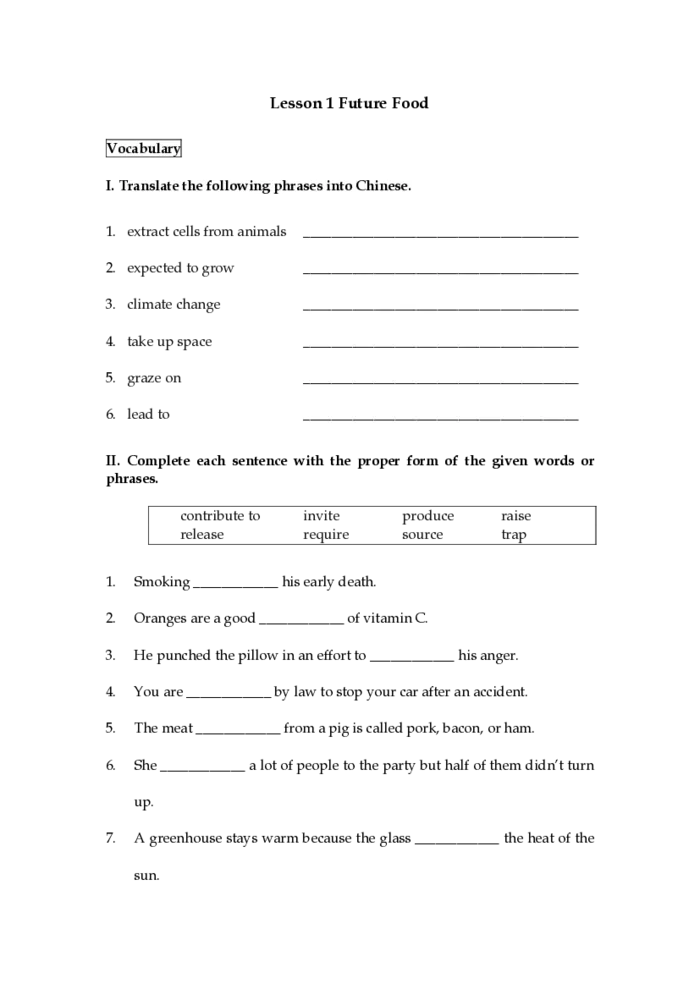
Lesson 1 Future Food

Vocabulary

I. Translate the following phrases into Chinese.

1. extract cells from animals
_______________________________________
2. expected to grow


_______________________________________
3. climate change


_______________________________________
4. take up space


_______________________________________
5. graze on


_______________________________________
6. lead to


_______________________________________

II. Complete each sentence with the proper form of the given words or
phrases.

contribute to

invite

produce

raise
release


require

source

trap

1.
Smoking ____________ his early death.
2.
Oranges are a good ____________ of vitamin C.
3.
He punched the pillow in an effort to ____________ his anger.
4.
You are ____________ by law to stop your car after an accident.
5.
The meat ____________ from a pig is called pork, bacon, or ham.
6.
She ____________ a lot of people to the party but half of them didn’t turn
up.
7.
A greenhouse stays warm because the glass ____________ the heat of the
sun.
8.
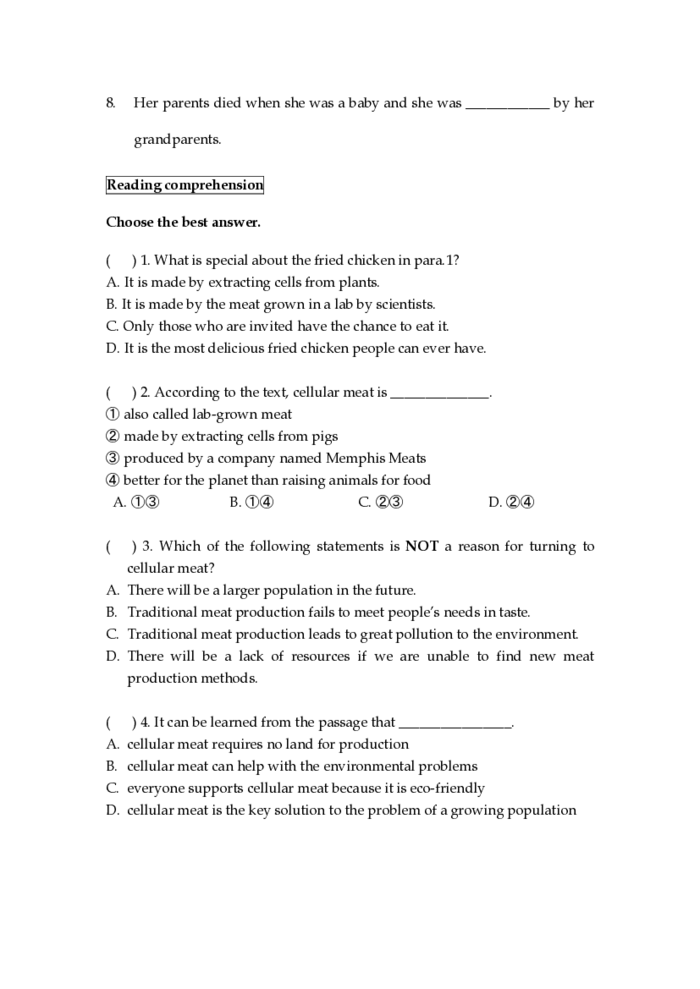
Her parents died when she was a baby and she was ____________ by her
grandparents.

Reading comprehension

Choose the best answer.

(   ) 1. What is special about the fried chicken in para.1?
A. It is made by extracting cells from plants.
B. It is made by the meat grown in a lab by scientists.
C. Only those who are invited have the chance to eat it.
D. It is the most delicious fried chicken people can ever have.

(   ) 2. According to the text, cellular meat is ______________.
① also called lab-grown meat
② made by extracting cells from pigs
③ produced by a company named Memphis Meats
④ better for the planet than raising animals for food
A. ①③          B. ①④            C. ②③            D. ②④

(   ) 3. Which of the following statements is NOT a reason for turning to
cellular meat?
A. There will be a larger population in the future.
B. Traditional meat production fails to meet people’s needs in taste.
C. Traditional meat production leads to great pollution to the environment.
D. There will be a lack of resources if we are unable to find new meat
production methods.

(   ) 4. It can be learned from the passage that ________________.
A. cellular meat requires no land for production
B. cellular meat can help with the environmental problems
C. everyone supports cellular meat because it is eco-friendly
D. cellular meat is the key solution to the problem of a growing population
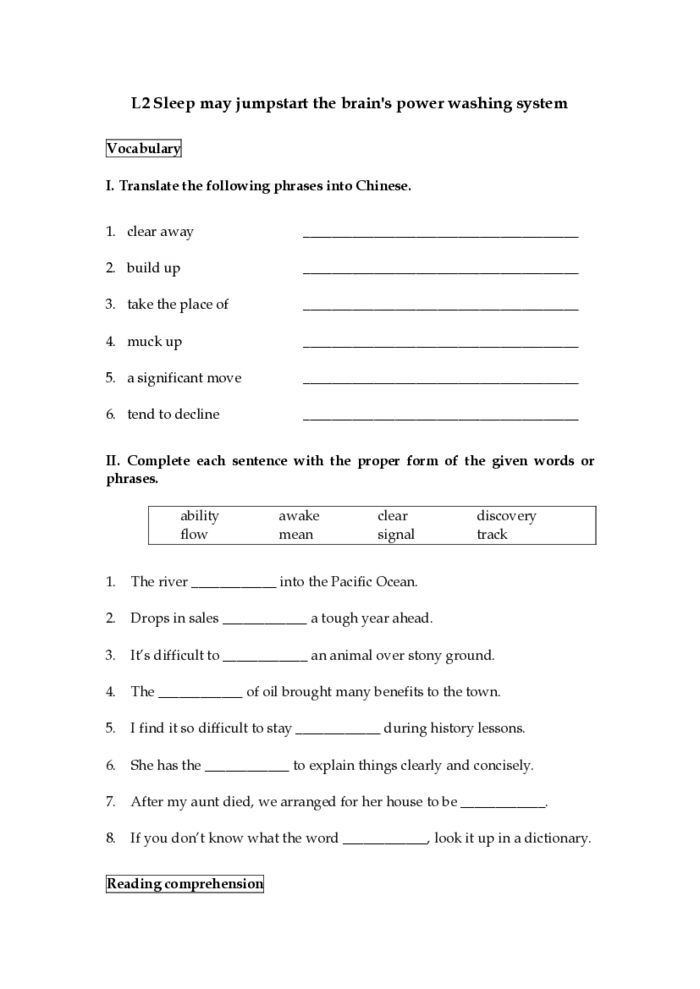
L2 Sleep may jumpstart the brain's power washing system

Vocabulary

I. Translate the following phrases into Chinese.

1. clear away


_______________________________________
2. build up


_______________________________________
3. take the place of


_______________________________________
4. muck up


_______________________________________
5. a significant move

_______________________________________
6. tend to decline


_______________________________________

II. Complete each sentence with the proper form of the given words or
phrases.

ability

awake

clear


discovery
flow


mean


signal

track

1. The river ____________ into the Pacific Ocean.
2. Drops in sales ____________ a tough year ahead.
3. It’s difficult to ____________ an animal over stony ground.
4. The ____________ of oil brought many benefits to the town.
5. I find it so difficult to stay ____________ during history lessons.
6. She has the ____________ to explain things clearly and concisely.
7. After my aunt died, we arranged for her house to be ____________.
8. If you don’t know what the word ____________, look it up in a dictionary.

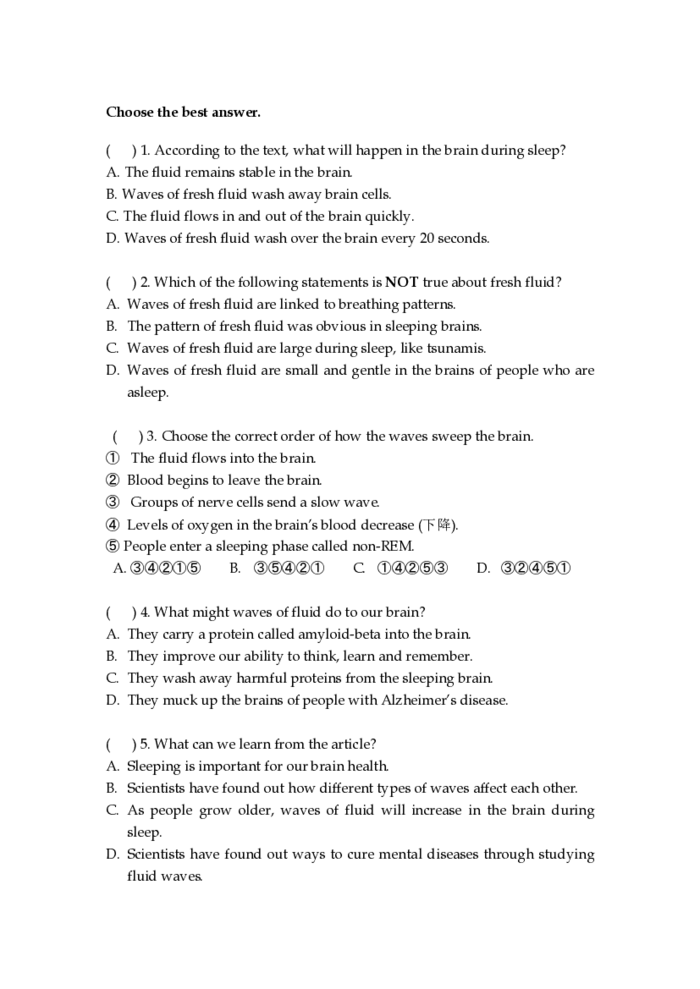
Reading comprehension

Choose the best answer.

(   ) 1. According to the text, what will happen in the brain during sleep?
A. The fluid remains stable in the brain.
B. Waves of fresh fluid wash away brain cells.
C. The fluid flows in and out of the brain quickly.
D. Waves of fresh fluid wash over the brain every 20 seconds.

(   ) 2. Which of the following statements is NOT true about fresh fluid?
A. Waves of fresh fluid are linked to breathing patterns.
B. The pattern of fresh fluid was obvious in sleeping brains.
C. Waves of fresh fluid are large during sleep, like tsunamis.
D. Waves of fresh fluid are small and gentle in the brains of people who are
asleep.

 (   ) 3. Choose the correct order of how the waves sweep the brain.
① The fluid flows into the brain.
② Blood begins to leave the brain.
③ Groups of nerve cells send a slow wave.
④ Levels of oxygen in the brain’s blood decrease (下降).
⑤ People enter a sleeping phase called non-REM.
A. ③④②①⑤   B. ③⑤④②①
C. ①④②⑤③
D. ③②④⑤①

(   ) 4. What might waves of fluid do to our brain?
A. They carry a protein called amyloid-beta into the brain.
B. They improve our ability to think, learn and remember.
C. They wash away harmful proteins from the sleeping brain.
D. They muck up the brains of people with Alzheimer’s disease.

(   ) 5. What can we learn from the article?
A. Sleeping is important for our brain health.
B. Scientists have found out how different types of waves affect each other.
C. As people grow older, waves of fluid will increase in the brain during
sleep.
D. Scientists have found out ways to cure mental diseases through studying
fluid waves.
Lesson 3 How far your sneeze can actually travel

Vocabulary

I. Translate the following phrases into Chinese.

1. a series of


_______________________________________
2. teem with


_______________________________________
3. hold your breath


_______________________________________
4. show up


_______________________________________
5. symptoms of the flu

_______________________________________
6. take a sick day


_______________________________________

II. Complete each sentence with the proper form of the given words or
phrases.

clearly

distance

harmful


range
rise


surface

thanks to


worth

1. The balloon ____________ gently into the air.
2. He bought a dollar’s ____________ of stamps.
3. The ship was out of ____________ of our guns.
4. ____________ Sandy, I found this great apartment.
5. The house is only a very short ____________ from the sea.
6. I think this report ____________ shows why we have to act now.
7. It’s important to protect your skin from the ____________ effects of the
sun.
8. Don’t put anything wet on a polished ____________, or it will leave a
mark.

Reading comprehension

Choose the best answer.

(   ) 1. Which of the following statements is NOT true according to the
passage?
A. Your lungs contain around 500ml of fluid.
B. You will not affect your coworker next desk if you sneeze.
C. The droplets from sneezes travel as fast as a car does on a highway.
D. The amount of the fluid you spray into the air when you sneeze can fill a
typical water bottle.

(   ) 2. Why does the author mention “a speeding ticket”?
A. To distract readers with another topic.
B. To stress the speed of cars on a highway.
C. To warn readers that they will be punished if they sneeze.
D. To let readers understand the speed of the droplets with a familiar topic
in daily life.

(   ) 3. What does the author imply with the sentence “That’s about 5 desk
lengths!”
A. To mention the length of a normal desk.
B. To emphasize the negative impact of sneezes.
C. To count the number of desks in a typical office.
D. To let readers know that 5 desks combined are usually 8 meters long.

(   ) 4. What does “suspended” mean in the passage?
A. rose
B. stopped
C. sneezed
D. floated in the air

(   ) 5. Which of the following statements is TRUE according to the passage?
A. Steel surfaces are free of pathogens anytime.
B. It’s safe to hold steel handrails in a subway station during flu season.
C. Even if there are viruses on steel surfaces, they will die in a short period
of time.
D. It’s recommended that you wash your hands if you have pressed steel
buttons in an elevator.
Lesson 4 What are vaccines, how do they work and why are
people sceptical

Vocabulary

I. Translate the following phrases into Chinese.

1. tens of millions of


_______________________________________
2. preventable illnesses

_______________________________________
3. carry out an experiment
_______________________________________
4. result in


_______________________________________
5. in turn


_______________________________________
6. break down


_______________________________________

II. Complete each sentence with the proper form of the given words or
phrases.

catch


harm


healthy

introduce
link


receive

reduce

spread

1. He ____________ a cold on holiday.
2. I ____________ a phone call from your mother.
3. My weight ____________ when I stop eating sugar.
4. Missing a meal once in a while won’t do you any ____________.
5. There is a direct ____________ between smoking and lung cancer.
6. A good diet and plenty of exercise will help you to keep your body
____________.
7. The survey found a wide ____________ of opinion over the proposed new
building.
8. Apple has sold many millions of iPods since the product was
____________ in 2001.

Reading comprehension

Choose the best answer.

(   ) 1. Which of the following statements is NOT true about “vaccine
hesitancy”?
A. It means a growing number of people refuse to use vaccination.
B. The WHO is worried that the trend may do harm to global health.
C. It means people who don’t use vaccination have a higher risk of dying.
D. This trend has been listed as one of the 10 threats to global health in 2019.

(   ) 2. Which of the following statements is TRUE about the discovery of
vaccination?
A. The earliest form of vaccination was discovered by the British.
B. Jenner conducted an experiment in 1798 to test the vaccination.
C. The boy developed no symptoms after being inserted pus from a cowpox
wound.
D. Jenner got the idea of vaccination from milkmaids who didn’t contract the
deadly smallpox after catching mild cowpox.

(   ) 3. According to the text, vaccines have successfully ____________.
① saved 2.6m people from measles every year
② reduced the damage done by many diseases
③ reduced measles deaths by 60% between 2000 and 2017
④ prevented at least 10 million deaths between 2010 and 2015
A. ①③          B. ②③            C. ②④            D. ③④

(   ) 4. According to the text, avoiding vaccination will ____________.
A. lower the risk of autism
B. prevent the spread of disease
C. produce herd immunity which protects people
D. increase the spread of diseases to a wider population

(   ) 5. What can we learn from the article?
A. Vaccines can prevent us from all kinds of diseases.
B. The harm a disease can do should never be neglected (忽视).
C. Vaccines have received wide recognition around the world.
D. Only countries with good healthcare systems have vaccines.