文档文本内容
话题:人与自然(科学技术)
体裁:说明文
词数:302
FK Grade Level: 9.6

Farming on the Rise
How do you grow salad in Dubai? Indoors
Visitors to the Dubai Expo 2020, which opens in October, will be
expecting great things, including gastronomic delights. But Dubai,
being a desert country, imports most of its food. Running up lots of food
miles is hardly in line with sustainability, one of the Expo’s themes. Yet
the salads and herbs used by the caterers will not have travelled far.
5
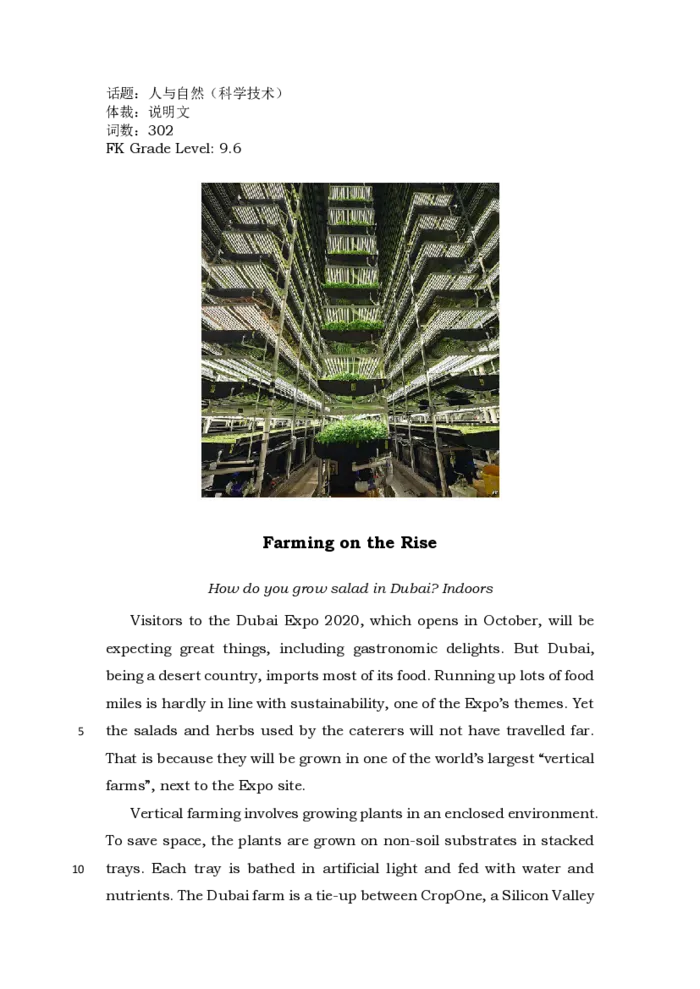
That is because they will be grown in one of the world’s largest “vertical
farms”, next to the Expo site.
Vertical farming involves growing plants in an enclosed environment.
To save space, the plants are grown on non-soil substrates in stacked
trays. Each tray is bathed in artificial light and fed with water and
10
nutrients. The Dubai farm is a tie-up between CropOne, a Silicon Valley
company, and Emirates Flight Catering. Besides supplying the Expo, it
will grow 2,700kg of leafy greens a day for the inflight catering services
at Dubai’s airport. The farm will use 99% less water than growing crops
outdoors.
15
Advances in technology, especially in tuning light-emitting diodes
(LEDs) to the colours that encourage plants to grow best, are making
such operations more viable, and for a broader range of produce,
including some fruit and vegetables. In 2020 Intelligent Growth
Solutions, based near Dundee, Scotland, will start delivering an LED
20
system for vertical farming that, it says, cuts energy costs in half.
Most vertical farms will be built in or near cities to supply local
markets directly. Plenty, another American firm, has opened a highly
automated farm near San Francisco to supply more than 100 grocery
stores. Other farms will be smaller. Marks & Spencer, a British retailer,
25
is installing vertical-farming units made by Infarm, a German firm, to
grow fresh herbs directly in its supermarket aisles.