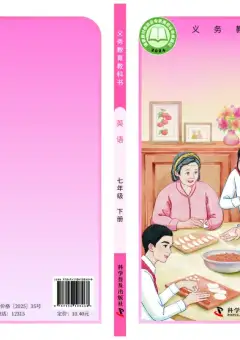
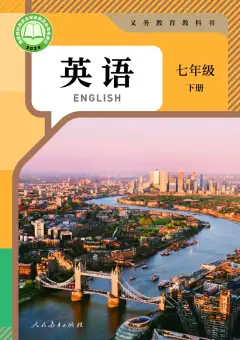
七年级下册
English
英语
义务教育教科书
英语
七年级下册
义务教育教科书
English
致 同 学
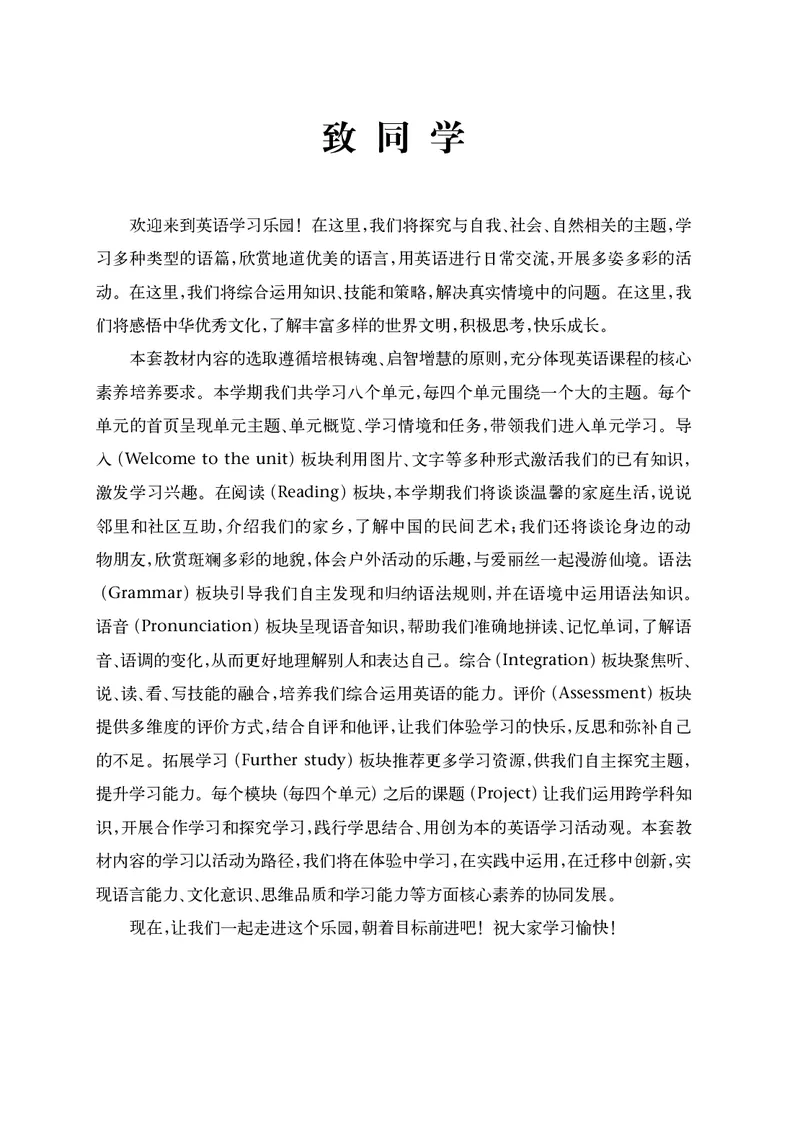
欢迎来到英语学习乐园!在这里,我们将探究与自我、社会、自然相关的主题,学
习多种类型的语篇,欣赏地道优美的语言,用英语进行日常交流,开展多姿多彩的活
动。在这里,我们将综合运用知识、技能和策略,解决真实情境中的问题。在这里,我
们将感悟中华优秀文化,了解丰富多样的世界文明,积极思考,快乐成长。
本套教材内容的选取遵循培根铸魂、启智增慧的原则,充分体现英语课程的核心
素养培养要求。本学期我们共学习八个单元,每四个单元围绕一个大的主题。每个
单元的首页呈现单元主题、单元概览、学习情境和任务,带领我们进入单元学习。导
入(Welcome to the unit)板块利用图片、文字等多种形式激活我们的已有知识,
激发学习兴趣。在阅读(Reading)板块,本学期我们将谈谈温馨的家庭生活,说说
邻里和社区互助,介绍我们的家乡,了解中国的民间艺术;我们还将谈论身边的动
物朋友,欣赏斑斓多彩的地貌,体会户外活动的乐趣,与爱丽丝一起漫游仙境。语法
(Grammar)板块引导我们自主发现和归纳语法规则,并在语境中运用语法知识。
语音(Pronunciation)板块呈现语音知识,帮助我们准确地拼读、记忆单词,了解语
音、语调的变化,从而更好地理解别人和表达自己。综合(Integration)板块聚焦听、
说、读、看、写技能的融合,培养我们综合运用英语的能力。评价(Assessment)板块
提供多维度的评价方式,结合自评和他评,让我们体验学习的快乐,反思和弥补自己
的不足。拓展学习(Further study)板块推荐更多学习资源,供我们自主探究主题,
提升学习能力。每个模块(每四个单元)之后的课题(Project)让我们运用跨学科知
识,开展合作学习和探究学习,践行学思结合、用创为本的英语学习活动观。本套教
材内容的学习以活动为路径,我们将在体验中学习,在实践中运用,在迁移中创新,实
现语言能力、文化意识、思维品质和学习能力等方面核心素养的协同发展。
现在,让我们一起走进这个乐园,朝着目标前进吧!祝大家学习愉快!
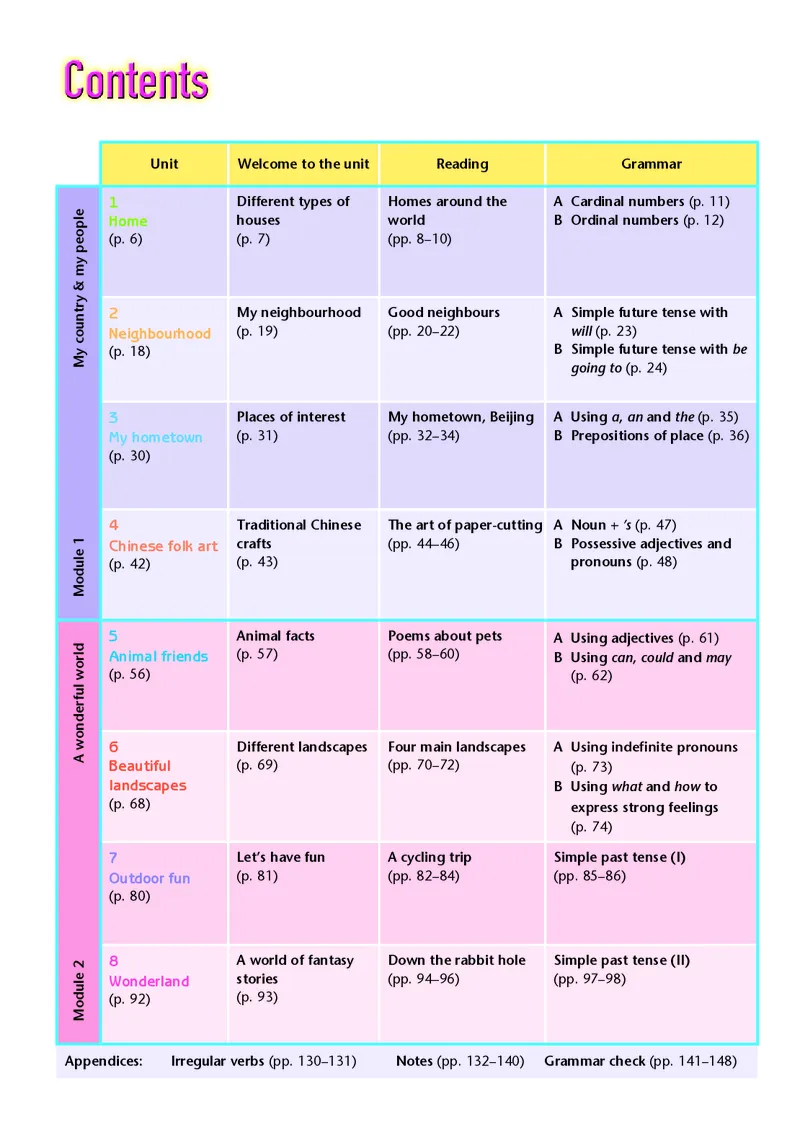
Unit
Welcome to the unit
Reading
Grammar
Module 1�
My country & my people
1
Home
(p. 6)
Different types of
houses
(p. 7)
Homes around the
world
(pp. 8–10)
A Cardinal numbers (p. 11)
B Ordinal numbers (p. 12)
2
Neighbourhood
(p. 18)
My neighbourhood
(p. 19)
Good neighbours
(pp. 20–22)
A Simple future tense with
will (p. 23)
B Simple future tense with be
going to (p. 24)
3
My hometown
(p. 30)
Places of interest
(p. 31)
My hometown, Beijing
(pp. 32–34)
A Using a, an and the (p. 35)
B Prepositions of place (p. 36)
4
Chinese folk art
(p. 42)
Traditional Chinese
crafts
(p. 43)
The art of paper-cutting
(pp. 44–46)
A Noun + ’s (p. 47)
B Possessive adjectives and
pronouns (p. 48)
Module 2�
A wonderful world
5
Animal friends
(p. 56)
Animal facts
(p. 57)
Poems about pets
(pp. 58–60)
A Using adjectives (p. 61)
B Using can, could and may
(p. 62)
6
Beautiful
landscapes
(p. 68)
Different landscapes
(p. 69)
Four main landscapes
(pp. 70–72)
A Using indefinite pronouns
(p. 73)
B Using what and how to
express strong feelings
(p. 74)
7
Outdoor fun
(p. 80)
Let’s have fun
(p. 81)
A cycling trip
(pp. 82–84)
Simple past tense (I)
(pp. 85–86)
8
Wonderland
(p. 92)
A world of fantasy
stories
(p. 93)
Down the rabbit hole
(pp. 94–96)
Simple past tense (II)
(pp. 97–98)
Appendices: Irregular verbs (pp. 130–131) Notes (pp. 132–140) Grammar check (pp. 141–148)
Pronunciation
Integration
Assessment
Further study
Workbook
Project
Syllables in words
(p. 13)
Sweet home
(pp. 14–16)
(p. 17)
(p. 17)
(pp. 106–108)
Project 1�
A travel guide to my hometown (pp. 54–55)
Linking sounds
(p. 25)
Helping each other
(pp. 26–28)
(p. 29)
(p. 29)
(pp. 109–111)
Stress in a word
(p. 37)
Different
hometowns, same
feelings
(pp. 38–40)
(p. 41)
(p. 41)
(pp. 112–114)
Stress in sentences
(p. 49)
Learn and love folk
art
(pp. 50–52)
(p. 53)
(p. 53)
(pp. 115–117)
Poetry and rhyme
(p. 63)
Amazing animals
(pp. 64–66)
(p. 67)
(p. 67)
(pp. 118–120)
Project 2�
A school newspaper about nature (pp. 104–105)
Intonation
(p. 75)
Landscapes of China
(pp. 76–78)
(p. 79)
(p. 79)
(pp. 121–123)
The -ed ending
(p. 87)
The great outdoors
(pp. 88–90)
(p. 91)
(p. 91)
(pp. 124–126)
Sense groups
(p. 99)
Fantastic fantasy
(pp. 100–102)
(p. 103)
(p. 103)
(pp. 127–129)
Wordlists (pp. 149–161) Proper nouns (pp. 162–163)
In this unit,
we will
2
3
4
learn about different kinds of home life;
describe our dream home;
better understand how different families show love.
read about homes around the world;
1
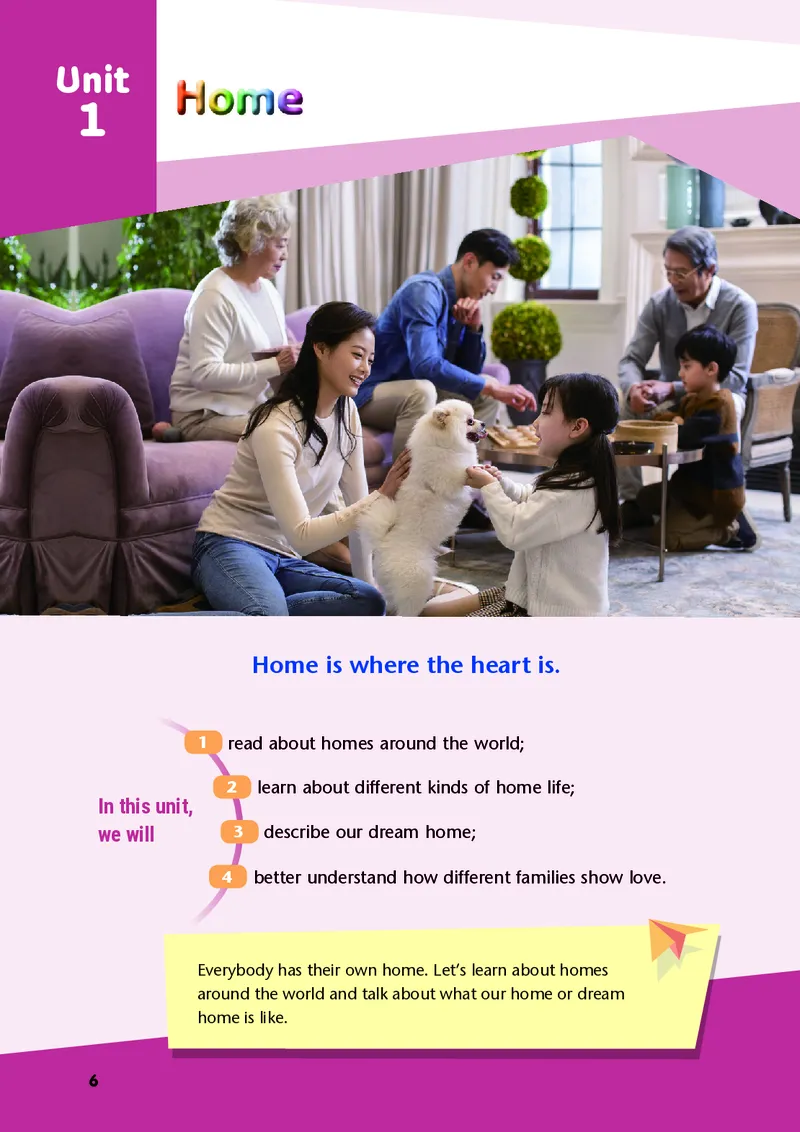
Unit
1
Home is where the heart is.
Everybody has their own home. Let’s learn about homes
around the world and talk about what our home or dream
home is like.
6
B Simon is talking online with his foreign friend, Will, about different types of houses.
Work in pairs and talk about your home. Use the conversation below as a model.
Simon: What type of house do you live in, Will?
Will:
I live in a town house in the west of London.
Simon: What’s your favourite place at home?
Will:
I like the study best. There are hundreds of books in the study. It’s
relaxing to read books there. What about you?
Simon: I live in a flat in a tall building. I like my bedroom the most. It’s a room
of my own. I can put up my favourite pictures on the wall.
Will:
That’s nice.
C What other types of houses do you know? Share one with your classmates.
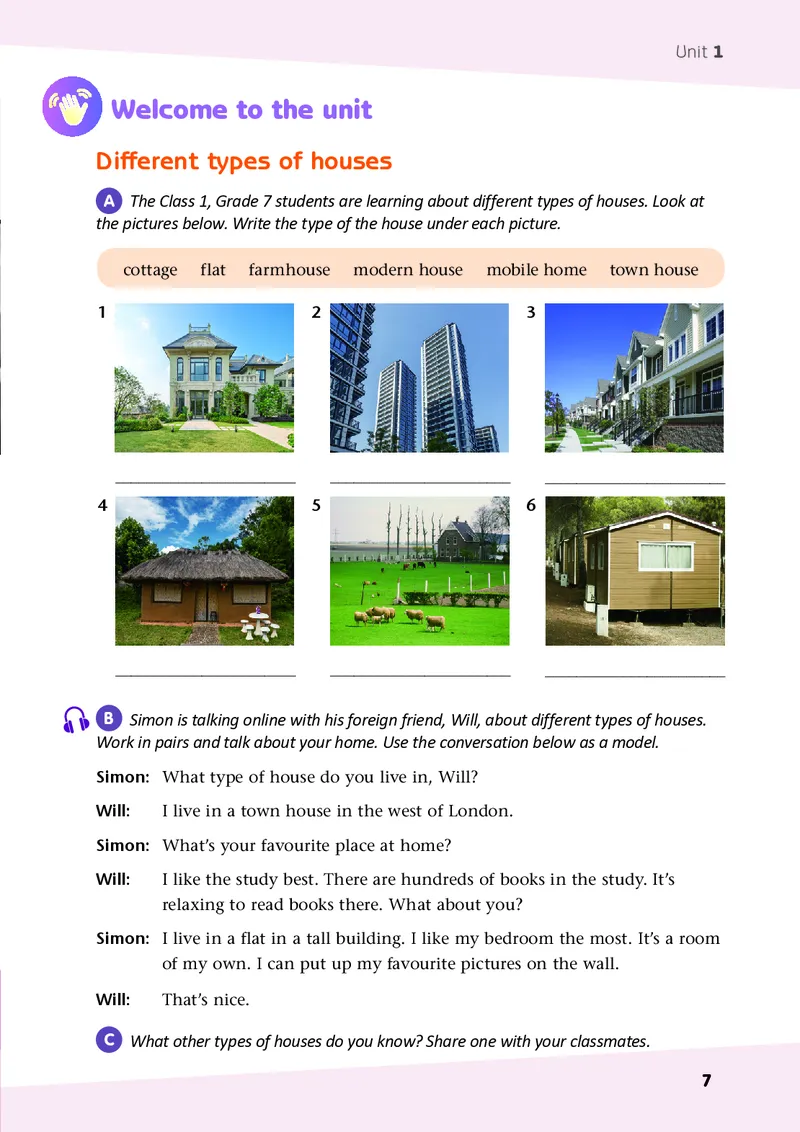
Different types of houses
A The Class 1, Grade 7 students are learning about different types of houses. Look at
the pictures below. Write the type of the house under each picture.
cottage flat farmhouse modern house mobile home town house
_______________________
_______________________
_______________________
_______________________
_______________________
_______________________
Welcome to the unit
4
5
6
1
2
3
7
Unit 1
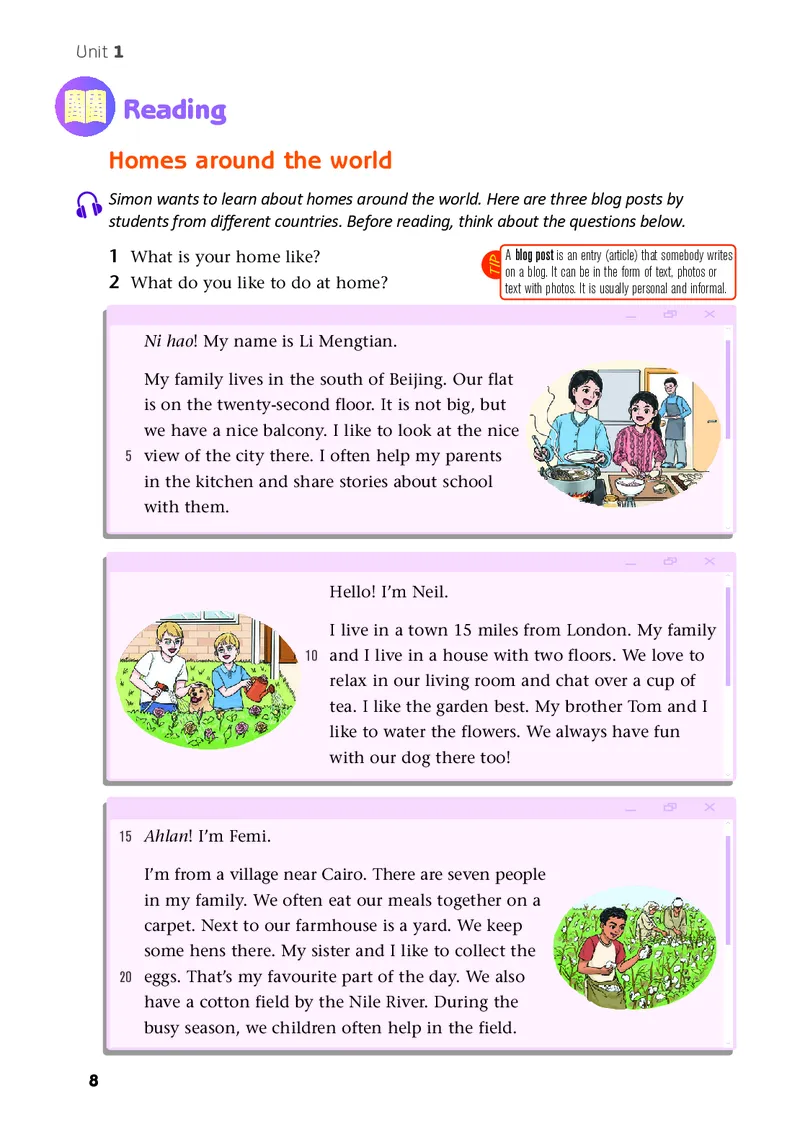
Homes around the world
Simon wants to learn about homes around the world. Here are three blog posts by
students from different countries. Before reading, think about the questions below.
1 What is your home like?
2 What do you like to do at home?
Ni hao! My name is Li Mengtian.
My family lives in the south of Beijing. Our flat
is on the twenty-second floor. It is not big, but
we have a nice balcony. I like to look at the nice
view of the city there. I often help my parents
in the kitchen and share stories about school
with them.
Hello! I’m Neil.
I live in a town 15 miles from London. My family
and I live in a house with two floors. We love to
relax in our living room and chat over a cup of
tea. I like the garden best. My brother Tom and I
like to water the flowers. We always have fun
with our dog there too!
5
10
15
20
Reading
A blog post is an entry (article) that somebody writes
on a blog. It can be in the form of text, photos or
text with photos. It is usually personal and informal.
TIP
Ahlan! I’m Femi.
I’m from a village near Cairo. There are seven people
in my family. We often eat our meals together on a
carpet. Next to our farmhouse is a yard. We keep
some hens there. My sister and I like to collect the
eggs. That’s my favourite part of the day. We also
have a cotton field by the Nile River. During the
busy season, we children often help in the field.
8
Unit 1
1 Li Mengtian often tells her parents about her school day.�
____________
2 Neil has a very big family.�
____________
3 Femi’s family grows cotton near the Nile River. �
____________
4 Both Neil and Femi have a pet. �
____________
5 There are more people in Li Mengtian’s family than in
Neil’s and Femi’s. �
____________
6 The three students live in different types of homes, but
they all enjoy their lives.�
____________
A Complete the chart below with the information in the blog posts.
B Read the blog posts again. Write a T if a sentence is true or an F if it is false. Then
correct the false one(s).
Homes around the world
Place
Type of
home
Favourite
thing
Li Mengtian’s home
In the south of
Beijing
(1) _______________
(2) _______________
Neil’s home
(3) _______________
(4) _______________
Having fun in the
garden
Femi’s home
(5) _______________
A farmhouse
(6) _______________
9
Unit 1
D Think about the questions below. Share your answers with your classmates.
1 Would you like to live in a small family or a big one? Why?
2 How do you usually help your parents at home?
3 Can we change the title “Homes around the world” into “Houses around the
world”? Why or why not?
collect eggs
view
next to
relax
have fun
in the south of
village
yard
C Simon found some pictures in the students’ blog posts. Complete his notes with the
correct forms of the words and phrases in the box below.
Femi lives in a farmhouse in a ______________.
His family keep some hens in the
______________. Femi and his sister are
______________ there. Their parents are busy
in the vegetable field.
It’s the weekend again, the perfect time to
have a BBQ in the garden and ______________.
Neil is helping his parents with the food.
______________ them, Tom is playing with
their dog. The family are ______________!
This is Li Mengtian at her home
______________ Beijing. She is enjoying the
night ______________ on the balcony with
her parents. The night looks bright and
colourful with fireworks.
1
2
3
10
Unit 1
A Cardinal numbers
We use cardinal numbers almost every day. Look at the numbers below.
0
1
2
3
4
5
6
7
8
9
10
zero
one
two
three
four
five
six
seven
eight
nine
ten
11
12
13
14
15
16
17
18
19
eleven twelve thirteen fourteen fifteen sixteen seventeen eighteen nineteen
Read the text below and pay attention to the use of cardinal numbers.
A2 Talk with your partner about your home and family, using cardinal numbers.
We can use cardinal numbers to talk about distance, house
numbers, areas, ______________, years, the number of people and
things, etc.
1 We live in Room 806, Building 15, City Garden.
2 Our flat is 98 square metres in area.
3 Our phone number is 010-1212 1212.
4 My sister Annie is nine years old, and she is in Grade 4.
5 Mum usually gets up at 6:45 in the morning.
6 My computer costs 4,550 yuan.
Turn to pages
141–142 for
more about
cardinal
and ordinal
numbers.
TIP
Try to read the big numbers below.
4,056 = four thousand and fifty-six
23,813 = twenty-three thousand, eight hundred and thirteen
567,110 = five hundred and sixty-seven thousand, one hundred and ten
6,425,000 = six million, four hundred and twenty-five thousand
We often use
a comma
or a space
to separate
a big number
into groups
of three from
right to left.
TIP
Neil’s home is about 15 miles from London. It is at 28 Rose Street. It has
an area of 160 square metres. His phone number is 0207 000 1111.
Neil loves taking pictures. He has about 1,000 pictures on his phone.
They are very beautiful!
Grammar
A1 Simon is writing about his home and family. Read the sentences below and pay
attention to the numbers in his writing.
11
Unit 1
1st =
6th =
12th = twelfth
22nd =
2nd = second
7th =
14th =
30th =
3rd = third
8th =
19th =
40th = fortieth
4th = fourth
9th = ninth
20th = twentieth
90th =
5th = fifth
10th =
21st = twenty-first
100th =
B2 Simon wants to tell his friends about the three bloggers. Complete his sentences with
the correct ordinal numbers.
B Ordinal numbers
Read the sentences below about Li Mengtian and pay attention to the use of ordinal
numbers.
B1 Simon is doing a test on ordinal numbers. Look at the numbers below and write the
numbers out in words.
B3 Write a short text about your family life, using both cardinal numbers and ordinal
numbers.
We use ordinal numbers to talk about the order of things and
events. We use them to talk about grades, dates, ______________,
positions, etc.
1 Li Mengtian lives in a building with 22 floors. Her home is on the top floor,
the ______________ floor. Her family always eat yuanxiao on the Lantern
Festival—the ______________ day of the first month in the Chinese lunar
calendar.
2 Neil is a Grade 7 student. He is in the ______________ grade. He is usually the
______________ to get up in his family because he likes jogging in the
morning. His mum is the second one, right after Neil.
3 Femi’s birthday is in March, the ______________ month of the year. Today is
his ______________ birthday. He is 13 years old now.
• We form most ordinal
numbers by adding -th to
the cardinal numbers.
• If a cardinal number ends
in -y, we first change -y
into -ie and then add -th
to form its ordinal number.
TIP
Li Mengtian lives on the twenty-second floor.
Her birthday is on the twentieth of February.
She is in the seventh grade.
She is always the first in her class to get to school.
12
Unit 1
Syllables in words
Words can be divided into syllables. A word may have one, two or more syllables.
A syllable usually contains a vowel sound with or without consonants.
B Listen to the singular and plural forms of the words below. Tick () the box if you hear
an extra syllable in the plural form.
C Listen to the following poem. Pay attention to the syllables in the words.
1 like
______________
3 balcony
______________
5 number
______________
7 beautiful
______________
2 comfortable
______________
4 village
______________
6 second
______________
8 sometimes
______________
My home does not have much space,
But it is a wonderful place.
I can play with my beautiful cat,
Put on her head a lovely hat,
And chat with Mum and Dad,
Feeling comfortable and glad.
1 flower, flowers
3 floor, floors
5 house, houses
7 kitchen, kitchens
2 light, lights
4 price, prices
6 restaurant, restaurants
8 parent, parents
A Listen to these words. Write down the number of syllables in each word in the blanks.
Words with one syllable
fun
home
flat
Words with two syllables
en•joy
cit•y
win•dow
Words with three or more syllables
fam•i•ly
won•der•ful
fa•vour•ite
Sometimes when we add -(e)s to a word,
the word will have an extra syllable.
place, plac•es
box, box•es
Pronunciation
13
Unit 1
Sweet home
A Simon is working on a project about homes around China, and he has found some
information. Read it and answer the questions below.
1 Where can you see a bamboo house?
2 What do you like about each kind of house above? Why?
B Simon is listening to three students introduce their homes. Listen with him and
complete the notes below.
• By the seaside in the east of China
• Made of stone and seagrass
• Can hold up in the strong wind
• Warm in winter and cool in summer
• In a mountain area of the south-west of China
• Made of bamboo
• Two or more floors
• No walls on the ground floor
• On the grasslands of the north of China
• Like a big tent
• Made of wood and other materials
• Easy to build and move
Li Yan
Lives in a cool house made of stone and seagrass
Sometimes goes fishing with (1) ______________ at the weekend
(2) ______________ now and then
Yu Tao
Has a lovely bamboo house
Lives on the (3) ______________ to keep dry
Sometimes (4) ______________ in bamboo
Hu Lan
Lives in a home like a big tent
Has (5) ______________ and 80 cows
Likes to ride a (6) ______________
Integration
14
Unit 1
C Amy and Sandy are talking about where they would like to live. Work in pairs and
talk about the topic. Use the conversation below as a model.
Amy:
China is very large and people in different areas enjoy different lives.
Where would you like to live, Sandy?
Sandy: I’d like to live on the grasslands.
Amy:
Why?
Sandy: Because life there is free and relaxing, and it’s interesting to move with
the seasons. What about you, Amy?
Amy:
I’d like to live in a seaside town. The beach is a great place to relax and
have fun!
1 Where would you like to live?
In the town/city centre
By the seaside
In the mountains
On the grasslands
Other �_____________________________________
2 What kind of home would you like to live in?
House
How many floors are there in the house?�
______________
Flat
Which floor do you live on?�
______________
Other�___________________________________________________________________
What does it look like?
_________________________________________________________________________
3 What do you want to have in your home?
Balcony
Garden
Own bedroom
Bathroom
Study
Other(s)� ________________________________________________________________
4 Who do you want to live with?
Parents
Grandparents
Sisters and brothers
Other(s) ________
5 What do you like to do with your family in your dream home?
�
_________________________________________________________________________
D The Class 1, Grade 7 students are writing about their dream homes for the school
newsletter.
D1 Complete the questionnaire below with your own information.
15
Unit 1
D2 Read Millie’s article about her dream home.
D3 Write an article about your dream home based on your answers in Part D1. Use
Millie’s article as a model.
My dream home is a house with two floors, away from
the city centre.
It has a nice garden with lots of flowers and trees. I can
smell the flowers and hear the birds sing. On the first
floor, there is a balcony. I love to sit there at night and
look at the stars in the sky.
The house is big, so my grandparents can live with us
and we can take good care of them. At the weekend, we
often have a big dinner. After that, I enjoy playing
Chinese chess with Grandpa. Sometimes I help Mum and
Dad with some cleaning.
This is my dream home. I love it!
My dream home
Beginning: place
& type of home
Main body:
favourite things/
activities
Ending: feelings
My dream home is a(n) … away from/
in the centre of/near …
On the ground/first floor, we have …
There is/are … in it.
I can …
I love to …
… live(s) with me/us.
At the weekend, I/we often …
I enjoy …
Sometimes I help …
Useful expressions
16
Unit 1
There are many famous poems and sayings about homes. Think of one and
share it with your classmates.
Assessment
Further study
What I can do
Me
Partner
1 I know more about homes around the world.
2 I can use cardinal and ordinal numbers correctly.
3 I can talk and write about my dream home with
the new words in this unit.
4 I can count the number of syllables in words and
remember words with the help of syllables.
5 I have some ideas about what makes a good
home.
I am good at �
.
I need to spend more time on �
.
My action plan: �
* Assess your learning of new words and grammar by doing the exercises on page 106.
Result:
Weak
Good
Wonderful
East or west, home is best.
A good home is made, not bought.
Home is the starting place of love, hope and dreams.
17
Unit 1
In this unit,
we will
1
2
3
4
learn how to care for our community;
describe what we can do to help the community;
better understand what makes a friendly community.
read about helping neighbours;
Unit
2
Close neighbours are better than distant relatives.
The Class 1, Grade 7 students are talking about their
neighbourhood. Let’s share what our neighbourhood is like
and how we can make our community better.
18
My neighbourhood
A Listen to Simon talking about his neighbours. Write the correct job and workplace under
each person with the words in the box below. Then match each person with the right picture.
B Amy and Simon are talking about their neighbourhoods. Work in pairs and talk
about your neighbourhoods. Use the conversation below as a model.
Amy:
What’s your neighbourhood like?
Simon: It’s nice. There’s a school, a hospital and a big supermarket. I
also have some lovely neighbours. What about you?
Amy:
I also like my neighbourhood. My neighbours are very kind.
They’re always ready to help others.
Simon: How do they help?
Amy:
Well, Mr Zhang lives next door. He’s a lawyer. He helps us learn about
laws at the community centre from time to time.
Simon: That’s great!
C What are your neighbours like? Talk to your classmates about one or two of them.
cook
doctor
police officer
teacher
hospital
police station
restaurant
school
Mrs Huang
Job: ______________
Place: ______________
Mr Li
Job:
______________
Place: ______________
Ms Zhang
Job:
______________
Place: ______________
Mr Chen
Job:
______________
Place: ______________
3
4
1
2
Welcome to the unit
“What’s ...
like?” is a
common
way to ask
for opinions.
TIP
19
Unit 2
Good neighbours
Amy wants to learn more about Simon’s community. Here is their conversation. Before
reading, think about the questions below.
1 What activities do you have in your community?
2 How can you help your community?
5
10
15
20
25
Amy:
Hi, Simon. What are your neighbours like?
Simon: They’re kind and helpful. Some of them
are volunteers. They often meet at the
community centre and share their skills.
They help us with all kinds of problems.
Amy:
That’s nice! When do they usually meet?
Simon: They have a “helping hands” meeting at
the weekend.
Amy:
Are you going to ask for help this weekend?
Simon: Yes. There’s something wrong with my
laptop. I’m going to ask a computer
engineer to check it. My sister Annie’s
bicycle is broken, so she’s going to have
someone repair it.
Amy:
Can anyone there help kids with their
homework?
Simon: Yes. Some college students are willing to
help.
Amy:
Great! Do the old people get any help
as well?
Simon: Yes. The volunteers often visit the old
people and do some shopping for them.
This weekend, they’ll help the old people
tidy their flats.
Amy:
That’s wonderful! You’re lucky to live in
such a nice neighbourhood, Simon.
Reading
20
Unit 2
A Complete the chart about the volunteers in Simon’s neighbourhood.
B Read the conversation again. Write a T if a sentence is true or an F if it is false. Then
correct the false one(s).
1 Volunteers share their skills and help people in the
community with different problems.�
__________
2 Usually the volunteers have a meeting during the week.�
__________
3 Simon wants to ask someone to fix his bicycle this weekend.�
__________
4 One of the volunteers is a computer engineer.�
__________
5 College students help the children do sport at the
community centre.�
__________
6 Volunteers also help the old people. �
__________
Volunteers in Simon’s
neighbourhood
What they will do at the weekend
What they are like
When and where they meet
• check (3) ______________
• repair things like (4) ______________
• help kids with their homework
• visit and help the old people
do (5) ______________ for them
help (6) ______________ their flats
• kind
• (1) ______________
• at the (2) ______________
at the weekend
21
Unit 2
college
community
engineer
neighbour
repair
tidy
volunteer
willing to
C Simon’s community centre needs more volunteers to help. Complete the centre’s
notice with the correct forms of the words and phrase in the box below.
D Think about the questions below. Share your answers with your classmates.
1 What kind of volunteer work can you do in your neighbourhood?
2 What do you like best about your neighbourhood?
3 What do you think makes a good neighbourhood?
We need you!
Do you have any free time? Are you (1) ______________ help others? Why
not be a(n) (2) ______________ at our community centre? There are many
ways to help!
Planning parties
The people here are all very nice. A tea party or a day out together will be
great for (3) ______________ to know more about each other. Join us and we
can plan these activities together!
Helping hands
Are you a computer (4) ______________? Do you know how to fix a laptop?
Or can you (5) ______________ things like a broken bike? Or are you a(n)
(6) ______________ student? Do you want to help kids with their homework?
Or would you like to help the old people (7) ______________ their flats? We
need volunteers like these. Join us and give back to our community.
Let’s clean up
We are very lucky to live in such a lovely neighbourhood. Let’s keep it
looking nice. Can you join us to clean up the park in our (8) ______________
this Saturday morning?
Please email us to be a part of our team. We are happy to have you with us
any time.
22
Unit 2
A Simple future tense with will
Read the conversation below and pay attention to the use of will.
Amy: Mum, I’ll go to the Children’s Centre after lunch.
Mum: OK. But it’ll rain this afternoon.
Amy: Don’t worry, Mum. I’ll take an umbrella with me.
We ask and answer questions using the simple future tense with will like this:
Will it rain this afternoon?
Yes, it will.
No, it won’t.
Will you take an umbrella with you?
Yes, I will.
No, I won’t.
A1 Simon and his sister Annie are talking about the “Let’s clean up” day. Complete their
conversation with the simple future tense of the verbs in brackets, using will.
Simon: Hi, Annie. This Saturday is the “Let’s clean up” day. Our neighbours
(1) ______________ (work) in the community park to make it look nice.
Annie: Really? (2) ______________ you ______________ (join) them?
Simon: Yes.
Annie: What will you do?
Simon: First, we’ll pick up the rubbish in the park.
Then we (3) ______________ (clean) the benches
and chairs. Also, we (4) ______________ (water)
the flowers.
Annie:
(5) ______________ you ______________ (work) if it
rains?
Simon: No, we (6) ______________. (7) ______________ you
__________________ (come) and help us?
Annie: OK, yes. I (8) ______________ (go) with you.
A2 Talk with your partner about a community activity, using the simple future tense with
will.
We use will when we talk about:
• things that are sure to happen in the future;
• predictions about ______________ (future, past) events;
• plans that we are making now.
Grammar
I’ll = I will/shall
I won’t = I will not
I shan’t = I shall not
TIP
We sometimes
use shall with I or
we to talk about
the future. But this
usage is becoming
old-fashioned.
TIP
23
Unit 2
Simon: Hi, Amy. What are you going to do this afternoon?
Amy:
I’m going to volunteer at the Children’s Centre.
Simon: Cool! But why are you in a hurry?
Amy:
I’m going to be late.
Simon: Oh, don’t worry. Look! The bus is coming!
B1 Simon is telling his mum about the “Get to know you” activity. Complete their
conversation with the correct forms of be going to and the verbs in brackets.
Am
I
going to
help
tomorrow?
Are
you/we/they
Is
he/she/it
Yes,
I
am.
you/we/they
are.
he/she/it
is.
No,
I
am not.
you/we/they
are not.
he/she/it
is not.
B Simple future tense with be going to
Read the conversation below and pay attention to the use of be going to.
We often use
some time
expressions
when we talk
about the future:
this afternoon
tonight
tomorrow
the day after
tomorrow
this Sunday
next Tuesday
next week
TIP
When we use be going to
without a time expression,
we are talking about the
near future.
TIP
are not = aren’t
is not = isn’t
TIP
B2 Talk with your partner about what you want to do for your community, using the
simple future tense with will and be going to.
Mum:
Simon, this month’s “Get to know you” activity is next
Saturday. (1) ______________ you ______________ (join) us?
Simon: Oh. I’m not sure. What (2) ______________ you
______________ (do) this time?
Mum: We (3) ______________ (have) a day out at Sunshine Park.
Simon: That sounds nice. I’ll come.
Mum: I (4) ______________ (take) some fruit and drinks.
Simon: Are you going to take anything else?
Mum:
I (5) ______________ (buy) some cakes and bread from the
supermarket too.
Simon: Good idea! I (6) ______________ (invite) my friend Bill.
He’s an exchange student from the UK. He can share his
stories with us.
Mum:
Great!
We ask and answer questions with be going to like this:
We use be going to when we talk about:
• things we decide to do;
• things that will probably happen.
24
Unit 2
Linking sounds
We often link sounds together when we speak English. There are four different
ways of linking sounds together.
1 We usually link a consonant sound with a vowel sound.
an apple
stand up
in an hour
2 When the first word ends in -r or -re and the next word begins with a vowel
sound, we can join them together with a /r/ sound between them.
for us
there are
here is
3 When two consonant sounds of two words meet, we sometimes do not need
to pronounce the first consonant sound.
best time
sit down
a big cake
4 When the first word ends with a vowel sound and the next word begins with a
vowel sound, we can join them as if there were a /j/ or /w/ sound between them.
we enjoy
go out
the other
A Listen carefully. See how you can link the following words together. Then practise
saying them.
1 kind and caring
2 an umbrella
3 pick up
4 find out
5 volunteer at
6 litter and mess
7 here are
8 there is
9 help people
10 kind doctors
11 best day
12 quiet town
13 the area
14 go in
15 two oranges
16 three exercises
B Read the poem below. How do you link the sounds together when you read aloud?
Then listen and check.
My neighbour is caring and kind.
She always says hello.
She talks to me when I’m sad.
Then I don’t feel so alone.
My neighbour
My neighbour is caring and kind.
She helps anyone in need.
She makes soup for the old.
She’s a true friend indeed.
Pronunciation
25
Unit 2
Helping each other
A Simon is looking at the noticeboard of his community centre. Read the notices and
answer the questions below.
B Two of Simon’s neighbours are asking for help at the community centre. Listen and
complete the volunteer’s notes below.
Who
Mr Li
Mrs Chen
Problem
His (1) ____________ won’t start.
She can’t (4) ____________.
Place
The (2) ____________ Club
The (5) ____________
Time
(3) ____________ p.m. tomorrow
(6) ____________ in the morning
Integration
1 Which club can help you if you have a problem with your phone?
2 What other kinds of help can a community centre offer?
Do you have a fever or a sore
throat? Are you having trouble
sleeping? Do not worry. There are
good doctors and nurses here.
They will make you feel better!
Health Centre
Dear all,
We are going to have a “helping hands” meeting at the
community centre on the afternoon of 5 March.
Do you have any problems? Please look at the information
below. It may help you!
City Garden Community Centre
Do you have a problem with
your washing machine? Is
there anything wrong with
your fridge? Our engineers
are here to help you deal
with these problems!
Fix-it Club
Fix-it Club
Are you wondering what to wear to a party? Are you worrying
about how to design your home? We have some artists to help.
All our group members know a lot about styles and colours.
They will be able to give you some ideas!
Art & Design Group
When reading notices, pay
attention to headings, bold
text or bullet points.
TIP
NOTICES
26
Unit 2
C Simon and Annie are talking about what they are going to do for a community book
club meeting. Work in pairs and talk about how you can help at community events. Use
the conversation below as a model.
Simon: Will you go to the community centre tomorrow, Annie?
Annie: Yes, I will. I’m going to help at the book club meeting.
Simon: Great! I’ll volunteer to help too.
Annie: What are you going to do?
Simon: I’m going to take photos of the
event, and I’ll post them on the
book club’s website.
Annie: Sounds great!
D Mr Wu asked the Class 1, Grade 7 students to give a speech about what they can do
for their communities.
D1 Look at Simon’s mind map of what he can do for his community.
Sell them to raise
money for plants
in the community
garden
Collect and share
Old books
Share them in the
community centre
Give them to kids in
need
Old clothes
Old toys
27
Unit 2
D2 Read Simon’s speech script about what he can do for his community.
D3 Write a speech script about what you can do for your community. Make a mind map
like the one in Part D1. Use Simon’s writing as a model.
Hello, everyone!
Today, I’d like to share with you my idea for helping our
community. I want to organize an activity—“Collect and
share”. Let’s collect old things from the neighbourhood and give
them a new life.
First, we can give away some of our old books. We’re going to
share them in our community centre. Second, we’re going to
collect old toys. We’ll clean them and then give them to children
in need. Last, we’re going to ask for some old clothes. We’ll sell
them to raise money for plants in our community garden.
I hope you like my idea. Let’s work together to make our
community a better place!
Purpose
Details
Greetings
A call to action
I’d like to share with you my idea for …
I’m going to organize …
I want/plan/would like to …
I’ll help …
We’ll raise money for …
First/Second/Last, …
I hope you like my idea.
Useful expressions
28
Unit 2
Overseas, there are unique Chinese neighbourhoods.
They are often called “Chinatown”. Usually, there
are some Chinese-style buildings and great Chinese
restaurants in the area. Do some research about
Chinatowns around the world. Choose one and
share it with your classmates.
Assessment
Further study
What I can do
Me
Partner
1 I know different ways to help my community.
2 I can use will and be going to to talk about events
in the future correctly.
3 I can talk and write about how to help my
community with the new words in this unit.
4 I can link the sounds correctly when I speak
English.
5 I have some ideas about what makes a friendly
community.
I am good at �
.
I need to spend more time on �
.
My action plan: �
* Assess your learning of new words and grammar by doing the exercises on page 109.
Result:
Weak
Good
Wonderful
29
Unit 2
In this unit,
we will
1
2
3
4
learn about a foreign student’s hometown;
describe our hometown;
better understand what makes our hometown special.
read about famous places of interest in Beijing;
Unit
3
No matter how far you may fly, never forget
where you come from.
The Class 1, Grade 7 students are showing some exchange
students around Beijing. Let’s learn how to introduce our
hometown.
30
Places of interest
A A group of exchange students from the UK want to learn about places of interest in
Beijing. Listen to the introductions and complete the notes below.
B Daniel and Amy are going to show the exchange students around Beijing. Work in
pairs and talk about what places you could take the students to. Use the conversation
below as a model.
Daniel: What places shall we take the students from the UK to?
Amy:
How about the Great Wall?
Daniel: I agree. It’s a symbol of China and attracts people from all over the world.
Amy:
Yes. What else?
Daniel: We can take them to the Olympic Park. There they can visit famous
buildings and learn about Olympic culture. At night, it’s very beautiful
with colourful lights.
Amy:
Great idea! I’m sure they’ll have a great time here.
C If exchange students come to your hometown, which places of interest would you
like to show them? Why?
1
2
3
4
The Great Wall
• Over (1) ____________ kilometres long with a
history of more than 2,000 years
• One of the wonders of the world
The Summer Palace
• A traditional Chinese garden
• A place to enjoy many (3) ____________
The National Museum of China
• More than (4) ____________ million objects
• Works of art from the past and present
Welcome to the unit
The Olympic Park
• One of the places for the 2008 Olympic Games
• Some (2) ____________ modern buildings
31
Unit 3
Welcome to Beijing, the capital of China! Let me show you
around my hometown.
In the centre of Beijing is the Palace Museum. It was once
the palace of some emperors in ancient China. With
wonderful buildings and art treasures inside, it’s well worth
a visit.
Next to the Palace Museum is Tian’anmen Square. Many
visitors like to come early in the morning to watch the
raising of the national flag.
If you want to know more about traditional Beijing life,
why not visit a siheyuan? It’s a group of four traditional
Chinese houses in a square. There’s a house on each side
and a courtyard in the middle. There are hutong between
the siheyuan. You can get a taste of the past by walking
through the hutong.
Feeling hungry? Try some delicious Beijing duck. You’ll love
it! At night, remember to enjoy Beijing opera at one of the
local theatres. It’s wonderful. Don’t miss it!
5
10
15
My hometown, Beijing
The exchange students want to learn more about places of interest in Beijing. Daniel has
found a vlog about Beijing to share with them. Here is the script. Before reading, think
about the questions below.
1 What traditional things can you see in Beijing?
2 How can you find out more about places of interest in Beijing?
Reading
Features of a good vlog:
• personal style
• informal language
• short and interesting
TIP
32
Unit 3
Enjoy Beijing
(5) ____________
What to see and do
in Beijing
A Complete the chart with the information in the script.
B Read the script again and circle the correct words.
Visit a siheyuan and
know more about
(3) ____________
Watch the raising of
the (2) ____________ at
Tian’anmen Square
See wonderful buildings
and (1) ____________ at
the Palace Museum
Try some Beijing
(4) ____________
1 The Palace Museum is in the centre/north of Beijing.
2 The Palace Museum has many ancient/modern buildings.
3 Many people like to visit Tian’anmen Square late at night/early
in the morning.
4 The four houses in a siheyuan make a square/circle.
5 You can enjoy Beijing opera at the local theatres/cinemas.
33
Unit 3
A day in Beijing
Beijing is an amazing city with many places of interest. It (1) ______________
visiting. Here is a plan for a great day!
5:30 a.m.
Go to Tian’anmen Square and see the (2) ______________ of the
national flag.
9 a.m.
Visit a siheyuan and hutong to (3) ______________ traditional
Beijing life.
10:30 a.m. Visit the Palace Museum—the home of the (4) ______________ of
the past. You can learn about China’s art (5) ______________ there.
6 p.m.
Eat a delicious dinner of Beijing duck at a(n) (6) ______________
restaurant.
7:30 p.m.
Visit the Liyuan Theatre and watch Beijing opera—a very
colourful (7) ______________ art form.
There are so many things to see and do. Don’t (8) ______________ the fun.
C Daniel found a travel plan for a day trip to Beijing. Complete the travel plan with the
correct forms of the words and phrases in the box below.
emperor
raising
treasure
be well worth
ancient
miss
local
get a taste of
D Think about the questions below. Share your answers with your classmates.
1 What place in Beijing do you want to visit? Why?
2 What is your favourite place in your hometown? Why?
3 What local food in your hometown do you think a visitor should try?
Give one example and introduce it.
34
Unit 3
A Using a, an and the
Read the text below. Pay attention to the use of a, an and the.
Beijing is the capital of China. Tian’anmen Square is a square in the centre of the
city. In the square, there are always people from all over the country. There is also
the Summer Palace, an amazing traditional Chinese garden. Kunming Lake, a big
lake in it, is very famous.
We use a or an when we mention a person/thing for the first time.
We use the:
• when we talk about a specific person/thing;
• when we mention a person/thing for the second time;
• before some proper nouns;
• when there is only one of something.
A1 Daniel is reading a short text about Beijing National Stadium. Read the text below
and fill in the blanks with a, an, the or /.
Look at this wonderful building. It is the
National Stadium, also called (1) ____________
Bird’s Nest. It is (2) ____________ modern stadium
in Beijing. It dates from (3) ____________ 2008
and is (4) ____________ important building in
(5) ____________ city. It is big enough for 91,000
people and is now (6) ____________ popular place
for sports and music events.
A2 The Water Cube is another place of interest in Beijing. Talk with your partner about
it, using a, an and the. The words below may help you.
Grammar
• amazing building
• 2008 Olympic Games
• open to visitors
• great place
• Enjoy swimming and other sports
35
Unit 3
B Prepositions of place
The exchange students are now in Beihai Park. Look at the picture below and read its
description. Pay attention to the use of prepositions of place.
B1 Daniel is showing the exchange students a picture of a siheyuan. Complete his
description with the correct prepositions of place.
Prepositions
of place:
above
at
behind
below
beside
between
in
in front of
inside
next to
on
outside
over
under
TIP
B2 Take a picture of a place in your hometown. Write a short text about the place, using
a, an, the and prepositions of place.
We are now in Beihai Park. Here is a small
shop. There are some flowers in front of
the shop. Behind the shop, there is a big
tree.
A boy is coming. He is standing outside
the shop. The shopkeeper inside the shop
is smiling at him.
The shop sells food and drinks. On the left,
there are some drinks below the snacks.
On the right, there is some bread and
sandwiches above the drinks.
Beside the boy, there is a bench. You can
see a ball under it. Next to the bench is
a big tree. The tree leaves over the bench
are waving in the wind.
Look at the house in a siheyuan.
There are two lanterns just (1) ____________
the roof. (2) ____________ the house, there
are two trees. An old man is standing
(3) ____________ a tree. There is a bird cage
(4) ____________ his head. A bird is singing
(5) ____________ the cage. (6) ____________
the old man lies a dog.
36
Unit 3
Stress in a word
When we say words with more than one syllable, we stress one of the syllables.
The stressed syllable sounds stronger. The stress can be on the beginning, middle
or last syllable of a word.
1 Stressing the beginning syllable
pres•ent
fa•vour•ite
em•per•or
2 Stressing the middle syllable
mu•se•um
tra•di•tion
de•li•cious
3 Stressing the last syllable
be•tween
to•day
en•gi•neer
A Listen and underline the stressed syllable of each word.
1 cap•i•tal
2 won•der
3 na•tion•al
4 won•der•ful
5 to•geth•er
6 vol•un•teer
7 col•lect
8 hun•gry
9 treas•ure
B Work in pairs. Take turns to read the words in Part A aloud. The stressed syllable of
each word should sound stronger than the other syllable(s).
C Read the poem below aloud. Pay attention to the word stress. Then listen and check.
Kunming Lake, in the Summer Palace,
Is really a wonderful sight.
Sunshine dances on its water.
It’s shimmering in the light.
Kunming Lake, in the Summer Palace,
Is beautiful, rain or shine.
Take a boat out on the water.
Enjoy the sight of traditional design.
Kunming Lake, in the Summer Palace,
Is beautiful at winter sunset.
Covered in a sheet of ice,
It’s a place you will never forget.
Pronunciation
37
Unit 3
Different hometowns, same feelings
A Daniel is planning activities for the exchange students in Beijing. Read his plan and
answer the questions below.
Day
Place
Activity
1
Tian’anmen Square
walk around the square and watch the raising of
the national flag
The Palace Museum
See the beautiful buildings and art treasures
2
Siheyuan and hutong
take a city walk
Beihai Park
walk around the park and row a boat
Lao She Teahouse
try some traditional Chinese tea and enjoy
Beijing opera
3
798 Art Zone
enjoy the museums and works of art,
and meet local artists
4
The Summer Palace
visit the garden and enjoy beautiful views
5
The Great Wall
climb part of this famous wall
1 The exchange students want to enjoy some lake views. Where can they go?
2 Which of these places do you think is the most interesting? Why?
B Daniel and the exchange students are visiting the Palace Museum. Listen to the tour
guide and complete the table below.
Hall
What it is like
Taihe Hall
• about (1) ______________ high
• a golden (2) ______________ in the large hall
Zhonghe Hall
• a building in the shape of a (3) ______________
• (4) ______________ on four sides
Baohe Hall
• a yellow roof with (5) ______________ on it
• beautiful (6) ______________ outside
Integration
When listening
about a place, it
is important to
listen carefully for
the names of its
parts, its location,
etc.
TIP
38
Unit 3
C Ben, one of the exchange students, is telling Daniel about his hometown Brighton, in
the south of the UK. Work in pairs and talk about things to see and do in your hometown.
Use the conversation below as a model.
Daniel: What places of interest are there in Brighton?
Ben:
Hmm … I recommend the Brighton i360 tower. It’s 162 metres tall. You
can go up and see some amazing views of the city and the sea.
Daniel: Sounds great! What’s your favourite place in Brighton?
Ben:
I love going to the beach. It’s full of stones. It’s nice to walk along the
beach and take in the sea air. I also like to sit on the stones and watch
the sea. The view at sunset is fantastic too.
D Mr Wu asked the exchange students to introduce their hometown to the Class 1,
Grade 7 students.
D1 Ben is working on an outline of his article. Read his outline. Then complete the table
below with the information about your hometown.
Ben’s hometown
My hometown
Where it is
In the south of the UK;
About an hour from London (by train)
Place(s) to visit
Brighton Fishing Museum: learn about
the traditional way of life
Thing(s) to do
Go for a walk by the sea;
Enjoy the amazing sunset
Special food(s)
Fish and chips
39
Unit 3
D3 Write an article about your hometown based on the information in Part D1. Use
Ben’s article as a model.
D2 Read Ben’s article about his hometown.
Beautiful Brighton
My hometown Brighton is a beautiful seaside city in the south
of the UK. It takes about an hour by train to get to Brighton
from London.
When you visit Brighton, go for a walk by the sea. The
view along the beach is wonderful. You can also try some
traditional British food like fish and chips. They are delicious!
Then go to Brighton Fishing Museum to see old boats and
tools, and learn about the local people’s traditional way of life.
At the end of your day, do not miss the amazing sunset.
When the sun is setting, everything seems to be golden.
You will have a great time in Brighton and remember this trip
for a long time.
Beginning: basic
information
Main body: hot/
bright spots
Ending: feelings
Title
My hometown is …
It is a small/medium-sized/large village/town/city.
It is in the north/east/south/west of …
It is near/next to …
When you visit …
Here, you can see …
You can also try some …
Do not miss …
I hope you will enjoy …
Useful expressions
40
Unit 3
Assessment
Further study
What I can do
Me
Partner
1 I know more about places of interest in Beijing.
2 I can use a, an, the and prepositions of place
correctly.
3 I can talk and write about my hometown with the
new words in this unit.
4 I can stress the right syllable in a word.
5 I have some ideas about what makes my
hometown special.
I am good at �
.
I need to spend more time on �
.
My action plan: �
* Assess your learning of new words and grammar by doing the exercises on page 112.
Result:
Weak
Good
Wonderful
Thoughts on a Tranquil Night
By Li Bai
Before my bed a pool of light;
Oh, can it be frost on the ground?
Looking up, I find the moon bright;
Bowing, in homesickness I’m drowned.
(Translated by Xu Yuanchong)
There are many famous poems about missing home. Find one and share it with
your classmates.
41
Unit 3
In this unit,
we will
1
2
3
4
learn about Chinese folk art;
introduce a Chinese handicraft;
better understand traditional Chinese art and its value.
read about traditional Chinese paper-cutting;
What belongs to the nation is a gift to the world.
It is the Folk Art Week at Sunshine Middle School. Let’s
explore traditional Chinese crafts and talk about the folk art
in our hometown.
Unit
4
42
Traditional Chinese crafts
A Sandy is learning about traditional Chinese crafts. Listen to the introductions with her
and complete the fact files below.
B Sandy is talking to Millie about traditional Chinese crafts. Work in pairs and talk
about the traditional Chinese crafts you like. Use the conversation below as a model.
Sandy: What traditional crafts do you like, Millie?
Millie: I love Chinese lanterns.
Sandy: Why?
Millie: They look so pretty at night, with all the different colours.
Sandy: Yes, you’re right. I love looking at the many types of lanterns during the
Lantern Festival.
Millie: Me too. My grandma has a beautiful old lantern. It’s made of silk. I’ll
show it to you when you come to my home next time.
Sandy: Yes, please!
C What other traditional Chinese crafts can you think of?
Welcome to the unit
We can search
on the internet for
more information
about traditional
Chinese crafts.
TIP
Chinese lanterns
• Often made of wood, bamboo,
silk or paper
• An important part of traditional
Chinese __________
zisha teapots
• Made from a type of __________
• Make the tea taste good
woodcarving
• Takes hours or even days to
carve a scene
• Often has scenes from
__________
china
• Traditional colours: usually
__________
• Made from clay
3
4
1
2
43
Unit 4
The art of paper-cutting
Sandy wants to learn about the art of paper-cutting. She found a feature article about
a master of paper-cutting. Here is the article. Before reading, think about the questions
below.
1 What do you know about Chinese paper-cutting?
2 Would you like to try paper-cutting? Why or why not?
Paper-cutting—an art full of life
Zhao Yue’s hands move quickly. She is working on a picture of
bamboo. “I love paper-cutting,” she says. “You don’t need much
to start working—just a pair of scissors or a knife and some
paper. Anyone can try it,” she adds.
After years of practice, Zhao Yue is now a great master of paper-
cutting. Her works on the walls in her home are beautiful. They
are in the shape of flowers, birds, fish and landscapes.
“Paper-cuts are not just beautiful. We use them to express our
wishes. At the Spring Festival, we put them up on windows
and doors for good luck,” says Zhao Yue. “And at weddings, we
put up ‘double happiness’ in the new couple’s home for good
wishes.”
Zhao Yue makes the last cut. She hands me the bamboo picture,
smiling, “This is called zhubaoping’an. It means ‘I wish you a
safe and healthy life’.” The bamboo
seems to be alive, and the leaves
look like they are dancing. I feel the
warmth and life of this traditional
folk art.
5
10
15
Reading
In a feature
article, it is
common to
use the
present
tense to
make the
description
more vivid.
TIP
44
Unit 4
1 Zhao Yue thinks that ______________.
a it takes years to learn paper-cutting
b you need special tools to do paper-cutting
c anyone can try paper-cutting
2 Zhao Yue’s paper-cuts are ______________.
a usually in the shape of an animal
b in different shapes
c usually for festivals
3 At the Spring Festival, we put up paper-cuts to ______________.
a bring us good luck
b bring happiness to new couples
c give best wishes to children
4 When the writer gets the bamboo picture, she ______________.
a feels safe and healthy
b begins to learn how to do paper-cutting
c feels the warmth and life of paper-cutting
B Read the article again and choose the correct answer.
A Match the paragraphs with the main ideas.
1 Para. 1 ______________
a
Zhao Yue, a great master of paper-cutting
2 Para. 2 ______________
b
An example of paper-cuts and its meaning
3 Para. 3 ______________
c
Zhao Yue’s ideas about paper-cutting
4 Para. 4 ______________
d
The use of paper-cuts
45
Unit 4
Li Ke, 13
I love paper-cutting! I do paper-cutting when I want
to (1) ______________ my good wishes to my friends
and family. I usually use a pair of (2) ______________
or a knife. I have over 150 (3) ______________. I feel
happy when I practise this art form.
C Here are personal stories from some students who like paper-cutting. Complete their
sentences with the correct forms of the words and phrase in the box below.
couple
express
landscape
paper-cut
put up
alive
scissors
practice
D Think about the questions below. Share your answers with your classmates.
1 When and where do you often see paper-cuts in your life?
2 Which do you like better, paper-cuts of animals and plants, or the ones with
Chinese characters? Why?
3 Some young people like paper-cutting. Why do you think it is popular with
young people?
Liu Hua, 14
I live in Guilin, and it is beautiful here. I like making
pictures of (6) ______________ with hills and trees. I like
to (7) ______________ my paper-cuts on my bedroom
wall. I also enjoy making traditional paper-cuts. It is my
cousin’s wedding day next Sunday. I am making a “double
happiness” paper-cut for the happy (8) ______________.
Hu Wenjun, 15
Paper-cutting is a very old art form, but it is still
popular today. In fact, many people of my age love
it. I like making paper-cuts of animals and plants.
Now I can only make easy ones. But I want to make
the picture come (4) ______________, so I need more
(5) ______________.
46
Unit 4
A Noun + ’s
Read the text below and pay attention to the use of ’s.
• We usually add ______________ (’, ’s) to a singular noun.
• We usually add ______________ (’, ’s) to a plural noun ending in -s.
• We usually add ______________ (’, ’s) to a plural noun that does not
end in -s.
A1 Sandy and Millie are chatting at Millie’s home. Complete their conversation using the
words in brackets. Remember to add ’s or ’ where necessary.
Sandy: Millie, these teapots are very nice. Are they zisha teapots?
Millie: Yes. They’re (1) ______________ (my parents).
Sandy: That one looks like (2) ______________ (my grandpa) teapot.
Millie: Look at these paper-cuts. They’re (3) ______________ (my mum). She’s
very good at paper-cutting. This is my brother (4) ______________ (Andy)
paper-cut. He’s still learning.
Sandy: It takes time to become good at paper-cutting. Do you have any other
works of art?
Millie: Look at this silk lantern. It’s (5) ______________ (my grandma).
Sandy: It’s so special! I love folk art. There’s a new folk art museum near
(6) ______________ (my aunt) house. Shall we go together?
Millie: OK.
A2 Talk with your partner about handicrafts at your home, using “noun + ’s”.
People often use paper-cuts to celebrate special events like weddings. For example,
Zhao Yue’s “double happiness” paper-cuts hang on the windows and walls of her
cousin’s home. People often put up this kind of paper-cut in a new couple’s home
to bring them happiness and good wishes.
We usually add ’s or ’ to a noun to express the idea of belonging:
Singular noun
It is
Simon’s
lantern.
That is
my dad’s
picture.
This is
the child’s
kite.
Plural noun
These are my parents’
pictures.
Those are
the children’s
kites.
We often use ’s with names. When a
name ends in -s, we can add ’s or ’.
James’s picture Dickens’ novels
TIP
Grammar
We can use “noun + ’s” without a
following noun, if the meaning is clear.
—Whose book is that?
—Daniel’s.
TIP
47
Unit 4
B Possessive adjectives and pronouns
Read the sentences below and pay attention to the use of possessive adjectives and
pronouns.
• We use possessive adjectives ______________ (before, after) nouns.
• We ______________ (use, don’t use) nouns after possessive pronouns.
B1 The students are preparing presents for the exchange students. Look at the pictures
and complete the conversation with the correct possessive adjectives and pronouns, or
the possessive forms of the nouns in brackets.
Mr Wu: Let me have a look. Are those postcards (1) ______________, Daniel?
Daniel: No, they’re not (2) ______________. They’re (3) ______________ (Millie). The
cap is (4) ______________ too.
Millie:
The key ring is (5) ______________ (Daniel). Kitty and Amy made the
Chinese knots.
Kitty & Amy: Yes, these Chinese knots are (6) ______________.
Mr Wu: Oh, I see. What about Simon? Which presents are (7) ______________?
Daniel: The T-shirt and the cup are (8) ______________ (Simon).
Mr Wu: The cup is very nice. I like its design. It’s nice of you to prepare so many
presents.
B2 Write at least five sentences about the handicrafts you and your friends have, using
possessive adjectives and pronouns, and “noun + ’s”.
We use possessive adjectives and pronouns to express the idea of belonging.
There are different possessive adjectives and pronouns for each pronoun.
Possessive adjective
Possessive pronoun
I
love
my
picture.
It is
mine.
You
your
yours.
We
our
ours.
They
their
theirs.
He
loves
his
his.
She
her
hers.
It
its
I want my classmates to tell me about their favourite traditional crafts.
A friend of mine is teaching me how to do paper-cutting.
Millie does woodcarving with her father. His work is amazing. Hers is also good.
We are making lanterns to decorate our classroom.
48
Unit 4
Stress in sentences
When we speak English, we often stress important words, e.g. nouns, main
verbs, adjectives and adverbs. We do not usually stress less important words, e.g.
articles, prepositions, pronouns or conjunctions.
A Listen to the following conversation. Pay attention to the stressed words.
Sandy: Where are you going, Millie?
Millie: I’m going to the supermarket.
Sandy: What are you going to buy?
Millie: My scissors are broken. I’m going to buy a new pair.
Sandy: I need some pens. Can I go with you?
Millie: Of course.
B Read the sentences aloud. Stress different words in each sentence according to the
meanings given below it.
1 I want to buy some paper at the craft shop.
a I am talking about a craft shop, not another kind of shop.
b I am talking about some paper, not something else.
c I am talking about what I want to do, not what I do not want to do.
2 Sandy paints pictures on Saturday afternoons.
a I am talking about Sandy, not somebody else.
b I am talking about painting pictures, not another activity.
c I am talking about Saturday afternoons, not other afternoons.
Zhao Yue smiles when she finishes a beautiful picture of bamboo.
(Zhao Yue smiles. It’s not somebody else.)
Zhao Yue smiles when she finishes a beautiful picture of bamboo.
(She does not look sad.)
Zhao Yue smiles when she finishes a beautiful picture of bamboo.
(The picture is beautiful, not ugly.)
Zhao Yue smiles when she finishes a beautiful picture of bamboo.
(It is a picture of bamboo, not any other thing.)
However, the words are not equally important. We can stress some of these words
to show that they are more important information.
Zhao Yue is working on a picture of bamboo. It means “I wish you a safe and
healthy life”.
Pronunciation
49
Unit 4
Learn and love folk art
A Sandy and her friends are visiting a Chinese folk art museum. They are seeing a
Huishan clay art exhibition. Read what the tour guide says. Then answer the questions
below.
B Sandy and her friends are looking at Chinese kites in the museum. The tour guide
is telling them about the kites. Listen to what the tour guide says and complete the
notes below.
1 What are Huishan clay figures made from?
2 Which type of Huishan clay figure do you like better? Why?
Huishan clay figures from Wuxi are made from a kind
of black clay. They have strong local colour.
There are two types of Huishan clay figures. Look at
those on your left. They are made in moulds, in the
shape of cute kids and animals. They have simple
shapes and bright colours, and express wishes for good
luck and a happy life. The figures on your right are
made by hand. They usually show popular scenes from
traditional operas.
Now you can have a close look at them and enjoy
their beauty!
Integration
All about kites
• Materials for making kites
* Wood, bamboo, (1) ______________ and silk
• Shapes of kites
* Early kites often looked like (2) ______________.
* �Modern kites come in many cool shapes, such as
(3) ______________, planes and famous people from history.
• Flying kites
* It is a very popular outdoor activity today.
* Sunny, windy days in spring are good for flying kites.
* �There is a (4) ______________ in Weifang every April.
50
Unit 4
C Mr Wu is asking his students how much they know about Chinese folk art. Work in
pairs and talk about the topic. Use the conversation below as a model.
Mr Wu: How much do you know about Chinese folk
art?
Millie:
Chinese folk art comes from working people.
It shows things about ordinary people’s lives,
and it’s usually made from everyday materials.
Sandy: I think it’s creative to make wonderful pieces of art. Sometimes the
craftspeople make their art without designing beforehand. That’s
amazing!
Daniel: I respect the spirit of the craftspeople. A good work of art usually takes a
long time to make. It must take a lot of hard work and practice.
D Sunshine Middle School is having its Folk Art Week. Mr Wu asked each student in
Class 1, Grade 7 to introduce a Chinese handicraft.
D1 Think of a Chinese handicraft you like or one from your hometown and complete the
notes below. You can also add your own ideas.
Name of the handicraft
________________________________
Basic information about the handicraft
• What do people use it for? ________________________________
• Where does it come from? ________________________________
• How long is its history?
________________________________
Something special about the handicraft
__________________________________________________________________
Cultural value of the handicraft
__________________________________________________________________
Other ideas
__________________________________________________________________
51
Unit 4
D2 Read Sandy’s article about the Huizhou inkstick.
D3 Write an article about a Chinese handicraft based on the information in Part D1. Use
Sandy’s article as a model.
Huizhou inkstick
The Huizhou inkstick is among the best of its kind. It gets its
name from the old Huizhou area, largely in today’s Anhui
Province. The Huizhou inkstick has a history of over 1,000 years
and was very popular with ancient Chinese writers and painters.
The Huizhou inkstick uses pine wood as its main material. It is
very difficult to make. Usually the making of such an inkstick
takes over a year. The Huizhou inkstick is beautiful, and some
people say the inkstick itself is a work of art.
The Huizhou inkstick is famous
for its great quality and design.
As a fine example of traditional
Chinese folk art, the Huizhou
inkstick is an important part of
Chinese culture.
… is a/an …
People like it because …
… has a history of …
It gets its name from …
… is easy/difficult to make./It takes a long time to make.
Some people say … is a work of art.
… is famous for …
… is an important part of Chinese culture.
Useful expressions
Basic information
What is special
about it
Title
The cultural
value of it
When writing about
a form of folk
art, we can give
some background
information first.
TIP
52
Unit 4
Many forms of traditional folk art in China have a history of thousands of years.
They show the creativity and wisdom of Chinese people. Heritage on Fingertips
is a documentary series about Chinese folk art. The series covers jade carving,
the Suzhou embroidery, zisha teapots, the She inkstone, etc. Watch it to find
out more about Chinese folk art. Share your findings and thoughts with your
classmates.
Assessment
Further study
What I can do
Me
Partner
1 I know more about Chinese folk art.
2 I can use “noun + ’s” and possessive adjectives
and pronouns to express the idea of belonging
correctly.
3 I can talk and write about Chinese handicrafts
with the new words in this unit.
4 I can stress important words in sentences when
speaking.
5 I can better understand the craftspeople’s spirit
and feel proud of our folk art.
I am good at �
.
I need to spend more time on �
.
My action plan: �
* Assess your learning of new words and grammar by doing the exercises on page 115.
Result:
Weak
Good
Wonderful
53
Unit 4
A travel guide to my hometown
Some of the exchange students want to visit your hometown. Prepare a guide to
your hometown for them.
A Plan
1 Work in groups. Think about things to be included in the guide. Use the table
below to help you.
General information
What is the name of your hometown and where is it?
What do people in your hometown do for a living?
Are there any famous historical figures/stories in your hometown?
When is the best time of year to visit?
Places to stay
Where are the nice hotels?
What is special about each hotel?
Places to visit
What are the interesting places to visit and where are they?
What can visitors see or do there?
How can people get there? How long does it take?
Food to enjoy
Is there any special food in your hometown? If yes, where can people try it?
Local folk art
Are there any kinds of folk art in your hometown? If yes, what are they?
2 Draw a map. Mark the places to visit and hotels on the map.
3 Draw pictures or take photos of the places in your hometown.
Project 1
54
B Make
1 Write about your hometown. Remember to check your writing.
2 Design your guide and make your pages look good.
3 Suggest some plans for the exchange students.
4 Print out your guide to your hometown.
C Share
1 Talk to your classmates about your hometown.
2 Read others’ guides and take notes. Tell them what you like best about each
guide.
Day 1
Day 2
Day 3
There is something for everyone
at Sunshine Market!
Visit Sunshine Market
Opening hours
9 a.m. to 8 p.m.
Eat out and enjoy the great
food in Sunshine Town!
55
In this unit,
we will
1
2
3
4
learn how amazing animals are;
describe an animal friend;
better understand the importance of animals in our lives.
read poems about two different animals;
Animals make our lives better.
It is the Pet Week at Sunshine Middle School. Let’s learn
about different kinds of pets and share some stories about
our animal friends.
Unit
5
56
B Millie and Simon are talking about animal facts. Work in pairs and talk about the
animal facts you know. Use the conversation below as a model.
Millie:
What facts about animals do you know, Simon?
Simon: I know butterflies taste with their feet.
Millie:
That’s interesting! Do you know that some snails can sleep for up to
three years?
Simon: Really? That’s amazing! What else do you know?
Millie:
I know an ant can lift a thing 50 times its own weight.
Simon: Wow! I’d like to be that strong. Then I can carry over 2,500 kilograms!
Millie:
Ha! I’ll have to call you “Strong Simon” then.
C What other fun facts about animals do you know?
Animal facts
A Millie found some fun facts about animals. Help her match the facts with the right
animals.
butterfly
bat
ant
bee
3
4
1
2
Welcome to the unit
Words like “really”, “wow”
and “ha” show that the
speaker is surprised, excited
or interested.
TIP
a They have four wings. They taste things with their feet.
b They find their way by listening. They are awake at night and can eat up to
1,200 insects in an hour.
c They can lift things 50 times their own weight. They take in air through the
holes on both sides of their body.
d All workers are girls. Each of them makes less than one gram of honey in its
life.
57
Unit 5
Poems about pets
Millie is reading two poems about animals. Here are the poems. Before reading, think
about the questions below.
1 What animals do people keep as pets in your neighbourhood?
2 What do these animals often do?
My dog
My dog is the cleverest animal of all.
He doesn’t just run after a ball.
He can do wonderful tricks,
And loves to collect sticks.
He never bites,
And doesn’t like fights.
He can sit and he can stay,
He loves to eat and he loves to play.
My dog is my very best friend,
And I’ll look after him till the end.
My cat
My cat has soft fur,
And loves to purr.
She can jump really high,
Way up into the sky.
She has a pair of blue eyes,
And likes to run after butterflies.
Sometimes she climbs a tall tree,
But never forgets to come back to me.
When I’m lonely, she’s always there.
She can’t talk, but does care.
When I need a friend or feel sad,
She is always by my side.
5
10
15
20
Reading
When reading a poem, we need
to pay attention to the tone,
rhyme, rhythm and structure as
they play a role in shaping the
overall meaning.
TIP
58
Unit 5
A Some of the words in the poems rhyme. Help Millie complete the sentences below.
1 The dog likes to run after a ball.�
______________
2 The dog likes fights.�
______________
3 The cat is not good at jumping.�
______________
4 The cat climbs tall trees a lot.�
______________
5 The cat is like a friend to her owner.�
______________
6 Both of the writers love their pets very much.�
______________
1 All rhymes with ______________.
2 Tricks rhymes with ______________.
3 Bites rhymes with ______________.
4 Stay rhymes with ______________.
5 Friend rhymes with ______________.
6 Fur rhymes with ______________.
7 High rhymes with ______________.
8 Eyes rhymes with ______________.
9 Tree rhymes with ______________.
10 There rhymes with ______________.
B Read the poems again. Write a T if a sentence is true or an F if it is false. Then correct
the false one(s).
59
Unit 5
bite
fur
look after
forget
stay
lonely
run after
trick
Polly is my parrot. She is usually friendly. She says “Hello” when you come
into the room and says “Goodbye” when you leave. But be careful when
you play with her—she sometimes (1) ______________. Polly is very clever
and can learn to sing simple songs.
She does some (2) ______________ to
make me laugh when I am sad. I like
to (3) ______________ her. And I never
(4) ______________ to play with her
when I have time!
C Millie is reading some blog posts about pets. Complete the blog posts with the
correct forms of the words and phrases in the box below.
D Think about the questions below. Share your answers with your classmates.
1 Why do you think many people like to keep pets?
2 What animal would you like to have as a pet? Why?
3 What things should you think about before getting a pet?
This is Charlie, my pet rabbit. He has beautiful white (5) ______________ and
long ears. He is very quiet and seldom
makes any sound. He doesn’t like to
(6) ______________ at home alone, so
I often take him out for a walk. And
he likes to (7) ______________ me in
the open air. With my pet rabbit, I
never feel (8) ______________.
60
Unit 5
A Using adjectives
Read the sentences below about animals. Pay attention to the use of adjectives.
We use adjectives to describe people or things.
• We can put an adjective _____________ (before, after) a noun.
• We can put an adjective _____________ (before, after) a linking verb.
We can use
adjectives after the
verbs below.
be
become feel
get
grow
keep
look seem smell
sound taste
turn
TIP
Rabbits have long ears.
Rabbits’ ears are long.
The orange cat looks cute.
The cute cat is orange.
brown clever happy hungry special tired
I have a (1) ______________ mouse.
She likes to play with me. When
she gets (2) ______________, she
sleeps in the corner of her cage.
She makes a soft sound when she
is (3) ______________.
A1 Here are two passages about pets. Complete the passages with the words in the box.
A2 Here are some pictures. Make sentences about them, using adjectives.
My grandma has a pet pig. He is a
(4) ______________ friend of mine.
He is very (5) ______________ and
knows his name. He runs over
to see me when I call him. He is
(6) ______________ all the time.
1
2
3
4
Grammar
61
Unit 5
B Using can, could and may
Read the conversations below and pay attention to the use of can, could and may.
We use can or could to talk about ability. We use can to talk about
present ability and use could to talk about ability in the past.
Examples: conversations 1 and ______________
We use can, could or may to ask for or give permission.
Examples: conversations 2 and ______________
B1 Millie is talking to Mr Wu about pets. Complete their conversation with can, could or
may. Add not if necessary.
Millie:
Mr Wu, do you have any pets?
Mr Wu: Yes, I do. I have a cat called Fuzzy.
Millie:
Oh, that’s nice. (1) ______________ she do any tricks?
Mr Wu: No, she (2) ______________ do any tricks, but she (3) ______________ run
after a ball.
Millie:
That’s cute. My aunt has a dog. When he was young, he (4) ______________
jump really high, but he (5) ______________ now because he’s a little old.
Mr Wu: Dogs are great pets too.
Millie:
Yes, they are. (6) ______________ I write about my aunt’s dog for my
homework?
Mr Wu: Yes, you may.
B2 Talk with your partner about the animals you know, using can, could and may.
1 —Can your parrot talk?
—No, she cannot talk, but she can do tricks.
2 —Could I play with your dog?
—Yes, you can. He’s very friendly.
3 —May I feed your goldfish?
—Sorry, I’m afraid you can’t.
4 —Can your cat jump high?
—No, she can’t. But when she was young, she could jump really high.
Could sounds
more polite
than can. May
is formal.
TIP
62
Unit 5
I have a cute cat.
She likes to sleep in a hat.
She loves sitting in the sun.
But she doesn’t like to run.
Poetry and rhyme
Poetry often contains rhyming words. Words that rhyme usually end with the
same sound and are at the end of the lines.
1 cat
hat
4 bark
wake
7 sun
won
10 shop hope
2 ball
call
5 dog
good
8 class
grass
11 jump drum
3 parrot carrot
6 stick
kick
9 stay
say
12 cute
pet
B Complete the poem with rhyming words in the box below. Then practise reading the
poem and pay attention to the same rhyming sounds at the end of the lines.
around much sound trouble touch
My goldfish is a wonderful pet.
She doesn’t need a bed.
We don’t have to feed her (1) ______________.
She doesn’t need a gentle (2) ______________.
She doesn’t make a (3) ______________,
Just swims all (4) ______________.
She isn’t any (5) ______________,
Just bubbles,
Bubbles,
Bubbles.
A Read the pairs of words. Tick () the pairs that rhyme and cross () the pairs that do
not rhyme.
Pronunciation
63
Unit 5
Amazing animals
A Suzy is afraid of some animals. Mr Wu wants to help her. He is telling her some
interesting things about animals. Listen to their conversation and complete the notes
below.
Giraffes
They have only (1) ______________ bones in their long neck!
They can sleep (2) ______________.
Snakes
Most snakes are (3) ______________.
They sleep (4) ______________ in winter.
Tip for all animals
Just leave them (5) ______________.
B Suzy found an article about how humans get design ideas from some animals. Read
the article and answer the questions below.
Animals and design
Humans have a lot to thank animals for. For example, we get design
ideas from animals to help us make new things.
Radar allows ships to “see” things around
them and travel safely. The idea comes
from bats. Bats make sounds, and then
listen for the echo. This echo tells the bats
about things around them.
Then there are planes. Humans
looked at birds and studied their
wings. Then they had the idea of
planes. Planes have a pair of big
wings, just like birds.
1 What can radar help ships do?
2 What other things did people make by studying animals?
Integration
64
Unit 5
C The Class 1, Grade 7 students are talking about the relationship between people and
animals. Work in pairs and talk about the topic. Use the conversation below as a model.
Mr Wu: Do you think it’s good for us to be friends with animals?
Daniel: Yes. Lots of animals are very friendly. They cheer us up when we feel
sad.
Suzy:
I agree. And I think people can also learn from animals. For example,
ants are hard-working, and they often work as a team.
Millie: True. Also, some animals can be very useful, like dogs. They’re smart
and can even help people save lives.
Mr Wu: That’s correct. Animals and humans have a special relationship, and we
should respect and care for them.
D Mr Wu asked the Class 1, Grade 7 students to give a presentation about an animal
friend for the Pet Week.
D1 Suzy is making a fact file about an animal friend. Read it below.
1 What is it?
3 What does it eat?
4 What does it do?
5 What’s special about it?
• A guinea pig
• Grass and vegetables
• Runs around the house
• Plays with toys
• Quiet and friendly
• Runs after me and helps me relax
2 What does it look like?
• Short, white and brown fur
• Big head and short legs
• Small round body
• Quite cute
65
Unit 5
D2 Read Suzy’s article about her animal friend.
D3 Write an article about an animal friend. Make a fact file like the one in Part D1. Use
Suzy’s article as a model.
Teddy: my amazing animal friend
I have a pet guinea pig named Teddy. He is white and
brown and has short fur. With a big head, short legs and a
small round body, he looks quite cute.
Teddy eats grass and vegetables every day. He enjoys
running around the house and playing with his toys.
Teddy is quiet and friendly. He seldom makes loud noises,
and he is always happy to see me. When I come home
from school, he runs after me, and that makes me feel
happy. If I am down, Teddy will stay next to me and help
me relax. He always makes me feel better.
We have so much fun together. I think he is the best pet in
the world.
I think … is amazing.
With …, he/she looks quite …
He/She is quiet/friendly/…
He/She enjoys/doesn’t enjoy …
He/She can …
When I …, he/she …
I love … because …
I think … is special/amazing because …
Useful expressions
Beginning: name and
looks
Ending: feelings
Main body: what it likes
to do and what’s special
about it
Title
66
Unit 5
Black Beauty is a novel by Anna Sewell. A horse named Black
Beauty tells the story of his life. He is a strong and handsome
horse and has many owners. He talks about the good times
and the bad times, and how he learns to trust and love
humans. It is a story about friendship, loyalty and kindness.
Read the book and share your thoughts with your classmates.
Assessment
Further study
What I can do
Me
Partner
1 I know more about animal friends around us.
2 I can use adjectives and can, could and may
correctly.
3 I can talk and write about what makes an animal
amazing with the new words in this unit.
4 I understand what rhyme is.
5 I understand more about the relationship
between humans and animals.
I am good at �
.
I need to spend more time on �
.
My action plan: �
* Assess your learning of new words and grammar by doing the exercises on page 118.
Result:
Weak
Good
Wonderful
67
Unit 5
In this unit,
we will
1
2
3
4
learn about different landscapes;
describe a special landscape;
better understand the beauty of our earth.
read an article about the earth’s beautiful landscapes;
The beauty of the natural world lies in landscapes.
The Geography Club members at Sunshine Middle School
are studying amazing things about nature. Let’s discover
different landscapes and learn to describe them.
Unit
6
68
B Daniel and his little cousin Jenny are talking about landscapes. Work in pairs and
discuss what you know about landscapes. Use the conversation below as a model.
Jenny:
Do you know any famous rivers, Daniel?
Daniel: Yes. I know the Yangtze River.
Jenny:
Can you tell me something about it?
Daniel: Well, it’s about 6,300 kilometres long, and it runs through different
landscapes.
Jenny:
Wow! What a long river!
Daniel: Yes. It rises in the mountains of Qinghai Province and runs all the way
to the East China Sea.
C Which landscapes in Part A do you know in China? Talk with your partner about at
least two examples for each landscape.
Different landscapes
A Daniel is a member of the Geography Club. He is learning about the natural world
with the club members. Listen to the introductions to some landscapes with them and
complete the notes below.
1
Oceans cover about
______________ of the
earth’s surface.
2
Deserts are often hot
during the day but cold
______________.
3
Forests help make the
air ______________.
4
Mountains are high,
and they are usually
covered with rocks and
______________.
5
Rivers carry water
from high ground
down to lakes or the
______________.
6
Plains are open and
flat. They cover over
______________ of the
world’s land area.
Welcome to the unit
69
Unit 6
Four main landscapes
Daniel is reading an article about landscapes in a geography magazine. Here is the article.
Before reading, think about the questions below.
1 What landscapes on earth do you know about?
2 What do you think the earth would say if it could talk?
Hello from different landscapes
I am a river. I have two faces. I give life: my
water is fresh water, so everybody can drink it
and use it for farming and washing. But I am
also very powerful. When I flood, I sometimes
destroy homes and lives. Nothing can get in
my way.
I am a desert. My body is mostly made of sand
and I seldom see rain. I am very hot during the
day and very cold at night. Nobody wants to live
in such difficult conditions, but a few plants and
animals can survive. How amazing!
I am the ocean. I am huge. I cover more than
two-thirds of the earth’s surface, so people call
the earth the “Blue Planet”. What a beautiful
name! I am home to hundreds of thousands of
living things.
I am a forest. I am full of trees, and I produce
oxygen for humans and animals to breathe.
I wear different colours in different seasons,
usually green in summer and golden brown in
autumn.
5
10
15
20
Reading
Personification is to give human
qualities to non-human things
like objects, animals and ideas.
It helps make the writing more
vivid and interesting. It also
helps draw readers’ attention.
TIP
70
Unit 6
A Complete the notes below with the information in the article.
B Read the article again and answer the questions below.
1 Why is the water from rivers so useful to people?
____________________________________________________________________
2 Why does the river say it has “two faces”?
____________________________________________________________________
3 What are the living conditions like in the desert?
____________________________________________________________________
4 Why do people call the earth the “Blue Planet”?
____________________________________________________________________
5 What colours do forests usually wear in summer and autumn?
____________________________________________________________________
Rivers
• They (1) ________________________.
• They sometimes (2) ______________
________________________________.
Deserts
• Deserts are mostly made of
(3) ____________.
• (4) ____________________________ can
survive in the difficult conditions.
Oceans
• They cover more than (5) ________
________________________________.
• They are home to (6) ____________
________________________________.
Forests
• They are full of trees and produce
(7) _______________________________.
• They wear (8) _____________________
in different seasons.
Four main
landscapes
71
Unit 6
C Some members of the Geography Club are writing about places they want to visit.
Complete their articles with the correct forms of the words and phrase in the box below.
D Think about the questions below. Share your answers with your classmates.
1 Which of the four landscapes in the article would you like to visit most? Why?
2 What can we get from knowing more about different landscapes on earth?
3 How can we get along well with nature?
Simon
I really want to go to the Sahara Desert. I know
it is hot there and the living (1) ______________
are difficult, but I think the (2) ______________
is quite special. It is a great place to see some
wonderful night views.
conditions
flood
breathe
ocean
survive
landscape
be home to
fresh
Amy
I can’t wait to visit the Changbai Mountains in
Jilin Province, China. I want to (3) ______________
in the fresh air. It is a very beautiful place and
(4) ______________ many plants and animals.
In winter, the snow covers the trees and the
mountains look like a(n) (5) ______________ of
white.
Sandy
I would like to go to the Tree River in northern
Canada. There is nothing to do there but
relax. The river is very clean and it has
(6) ______________ water. A special type of fish
called Arctic char can (7) ______________ here
in the very cold waters. The river seldom
(8) ______________, so it is very safe to go there.
72
Unit 6
A Using indefinite pronouns
Read the table below and pay attention to the use of indefinite pronouns.
We use indefinite pronouns to refer to people and things when we
do not know or do not need to mention who or what we are talking
about. We use pronouns ending in -body or -one for ______________,
and pronouns ending in -thing for ______________.
When we are
offering something
or when we expect
the answer to be
“yes”, we can
use somebody/
someone/something
in questions.
e.g. Would you
like something to
drink?
TIP
somebody/someone/
something
Look! There’s somebody/someone on the
mountain!
There seems to be something in the river.
anybody/anyone/
anything
I can’t see anybody/anyone/anything up the
mountain.
Does anybody/anyone want to visit the desert?
Can you see anything in the river?
everybody/everyone/
everything
Is everybody/everyone going to the forest?
Everything is ready for our trip to the forest.
nobody/no one/
nothing
There is nobody/no one up the mountain.
There is nothing in the river.
A1 Mr Wu is asking the students to describe a picture. Look at the picture and complete
the sentences with the correct indefinite pronouns.
Millie:
Look! There’s (1) ______________ sitting by the campfire. There isn’t
(2) ______________ else with him. He may be lonely.
Sandy: Yes. (3) ______________ is camping with him. He’s alone. Not
(4) ______________ likes camping, but the man seems to enjoy it.
Simon: I can see a fire, but the man isn’t cooking
(5) ______________. It looks like there’s
(6) ______________ to eat.
Daniel: There’s (7) ______________ inside his tent:
it looks like a light. The tent looks warm.
I think he has got (8) ______________ ready
for a good night’s sleep.
A2 Find a picture of a landscape with people in it and talk with your partner about it,
using indefinite pronouns.
Grammar
73
Unit 6
B Using what and how to express strong feelings
Read the conversation below about Huanglong in Sichuan and pay attention to the use of
what and how.
Sandy: Look at this photo of Huanglong. What a
beautiful view!
Daniel: Yes. How amazing!
To make a sentence to express strong feelings:
• we use a(n) ______________ (noun phrase, adjective) after what;
• we use a(n) ______________ (noun phrase, adjective) after how.
B1 Mr Wu is talking to Daniel about the Songhua River. Complete their conversation
with what and how.
Mr Wu: The Songhua River runs through Heilongjiang and Jilin and it’s about
2,300 kilometres long.
Daniel: Wow! (1) ______________ a long river!
Mr Wu: The land along the Songhua River is very good for growing corn. There
are many large farms there.
Daniel:
(2) ______________ useful! The farmers must love the river.
Mr Wu: Yes. The landscape along the river is very beautiful.
Daniel:
(3) ______________ wonderful! What’s the best way to see the Songhua River?
Mr Wu: Just take a boat trip, and you can enjoy the nice views along the river.
Daniel:
(4) ______________ interesting! I love learning about new places.
Mr Wu: I’ll ask each student to talk about their favourite landscape next week.
Daniel:
(5) ______________ a good idea! That will be really fun!
B2 Find a picture of a landscape without people in it and talk about it with your
classmates, using what and how to express your feelings about it.
We use what and how in sentences to express strong feelings about someone or
something. We make these sentences like this:
What
a high mountain
(it is)!
How
high
(the mountain is)!
beautiful forests
(they are)!
beautiful
(the forests are)!
wonderful
landscapes
(the earth has)!
wonderful
(the earth’s
landscapes are)!
a huge ocean
(it is)!
huge
(the ocean is)!
74
Unit 6
Intonation
Intonation describes the falls and rises of the voice in speech. There are two main
types of intonation in English: falling intonation and rising intonation.
When we speak, our tone falls at the end of a statement.
1 There are some plants in the desert.
2 The mountains are very tall.
When we ask a yes-no question, our tone rises at the end of the question.
1 Is the forest far away?
2 Are there any rivers in the forest?
When we ask a wh-question, our tone usually falls at the end of the question.
1 What animals live in the ocean?
2 How can we go across the river?
We make our tone rise at the end of a phrase or a sentence to show surprise.
Amy:
I visited the Tianshan Mountains during this summer holiday.
Daniel: You visited the Tianshan Mountains? They’re so far away.
In alternative questions with or, our tone rises on the first part of the question
and falls on the second part.
Is it a hill or a mountain?
A Read the conversation below. Put a falling arrow (
) or a rising arrow (
) at
the end of each sentence. Then practise it with your partner.
Sandy: Hi, Millie. Tomorrow is Sunday. Would you like to go for a walk?
Millie: Yes, I’d like to. The weather is perfect for walking at this time of year.
Where do you want to go?
Sandy: Let’s go to Sunshine Forest Park.
Millie: Sunshine Forest Park? I love it there. The air is really fresh with many
trees and flowers around.
Sandy: Yes. And we can ride a bike through the forests.
Millie: Great! When shall we meet? Is 10 in the morning OK?
Sandy: Yes, that’s good. See you then.
Pronunciation
75
Unit 6
Landscapes of China
A Daniel is reading an article about interesting landscapes in China. Read part of the
article and answer the questions below.
Danxia landform
In Zhangye, Gansu Province, you can see beautiful
red hills. The name of this landscape is the Danxia
landform. It is a natural wonder and a treat for
your eyes.
1 What does the Danxia landform in Zhangye look like?
2 What makes the Yadan landform?
B Daniel is listening to a radio ad about visiting Yunnan Province. Listen to the ad and
complete Daniel’s notes.
Place
What’s special
Stone Forest
• tall stone towers in cool shapes
• a great place to take (1) ______________
Xishuangbanna
Rainforest
• waterfalls, (2) ______________, monkeys and different
types of bamboo
• A good place for a rest
Yulong Snow
Mountain
• looks like a Chinese dragon
• (3) ______________ on the top all year round
• special (4) ______________
Lugu Lake
• high up in the (5) ______________
• quiet and beautiful
• a place for people to go for a (6) ______________
Yadan landform
The Yadan landform in North-west China is very
unusual. This landform is made of sandstone
in strange shapes. It takes millions of years for
these shapes to form. It is a great example of
the power of wind and time.
Integration
76
Unit 6
C Daniel and Millie are talking about interesting landscapes they want to see. Work in
pairs and talk about the topic. Use the conversation below as a model.
Daniel: Where would you like to visit this
year, Millie?
Millie:
I want to go to Red Beach in
Liaoning Province. It looks like a
sea of red plants.
Daniel: How amazing!
Millie:
What about you?
Daniel: I’m very interested in Mount Huangshan. My uncle went there last
month. He saw a fantastic sea of clouds!
Millie:
Wow, what a lucky man! You can only see that amazing view about 50
days a year.
D Mr Wu asked each student to write an article about a beautiful or an interesting
landscape in China.
D1 Daniel is making a table about a landscape. Read the table and complete it with the
information about the landscape you choose.
Daniel
Me
What it is
Mount Huangshan
Where it is
In the south of Anhui
Province
What it is famous for
Pine trees and rocks in
strange shapes; a sea of
clouds; hot springs
What you can do there
Get to the top to see an
amazing view; enjoy the
view at sunrise or sunset
77
Unit 6
D3 Write an article about a beautiful or an interesting landscape in China based on the
information in Part D1. Use Daniel’s article as a model.
Mount Huangshan, more than beautiful
Mount Huangshan is in the south of Anhui Province in East
China. It is only about 1,900 metres high, but it is one of
the most amazing mountains in China.
Mount Huangshan is famous for its pine trees and rocks
in strange shapes, a wonderful sea of clouds, and relaxing
hot springs. In winter, snow covers the mountain and it
becomes a white wonderland.
There are several ways to enjoy the beauty of Mount
Huangshan. You can walk up paths and steps to the top or
take a cable car. From the top,
you can enjoy an amazing
view. Many people like to stay
overnight on the mountain to
watch the sunrise or sunset. It
is a fantastic view.
D2 Read Daniel’s article about an interesting landscape.
… is in the south/north/east/west of …
It is one of the best-known/most amazing …
… is an amazing place.
It is famous for …
In winter/spring/…, …
From the top/foot of the mountain, you can …
People like to stay overnight/go to …
Useful expressions
Give general information
such as the name of the
place and where it is.
Explain what you can do
or see in the place.
Describe some special
or interesting things
about the place.
Use a short, catchy title.
78
Unit 6
Planet Earth is a great documentary series about the wonders of our planet. Each
episode looks at a different place on earth and the animals as well as plants there.
It is an amazing journey and shows the beauty of our world. Watch the series and
find out more about different places on earth. Share your favourite places with
your classmates.
Assessment
Further study
What I can do
Me
Partner
1 I know more facts about the earth’s landscapes.
2 I can use indefinite pronouns to talk about people
and things and use what and how to express
strong feelings correctly.
3 I can talk and write about landscapes with the
new words in this unit.
4 I can use intonation correctly when I talk and
read.
5 I have some ideas about the beauty of our
amazing planet.
I am good at �
.
I need to spend more time on �
.
My action plan: �
* Assess your learning of new words and grammar by doing the exercises on page 121.
Result:
Weak
Good
Wonderful
79
Unit 6
The outdoors creates happy and healthy people.
In this unit,
we will
1
2
3
4
learn about different kinds of outdoor activities;
describe an outdoor experience;
find out how to stay safe during an outdoor activity.
read a diary entry about a fun outdoor activity;
Outdoor activities help us get close to nature and relax. Let’s
talk about what we like to do outdoors and learn about the
joy and benefits of these activities.
Unit
7
80
B Amy and Simon are talking about what outdoor activities they would like to try. Work
in pairs and talk about the topic. Use the conversation below as a model.
Amy:
What outdoor activity would you like to try, Simon?
Simon: I want to go horse riding.
Amy:
Why?
Simon: I think horse riding is cool. I really want to learn how to do it. What
about you?
Amy:
I’d like to try skiing!
Simon: What’s fun about skiing?
Amy:
It’s really exciting. Also, it would be wonderful to be in the mountains,
with all that snow.
C What other outdoor activities do you know about?
Let’s have fun
A The Class 1, Grade 7 students are talking about outdoor activities. Choose the right
activity for each student below.
In my free time, I want to go around our town on my own. I may try
(4) ______________.
I don't want to spend my pocket money on sport. I have to save my money
to take an online computer class. I might try (3) ______________.
I want to take a break from city life and be close to nature. I'll try
(1) ______________.
I need to work on my balance to become a better dancer. Maybe I can
try (2) ______________.
jogging camping cycling horse riding skating
Welcome to the unit
81
Unit 7
A cycling trip
Simon went on a cycling trip. He wrote about it in his diary. Here is the diary entry. Before
reading, think about the questions below.
1 Would you like to go on a cycling trip? Why or why not?
2 How would you prepare for a cycling trip?
Sunday, 28 May Sunny
Yesterday I went on a cycling trip with my friends. It was an
amazing experience!
After breakfast, we set off for a little village. We followed the map on
my phone, but it did not give enough details about the countryside.
We got lost! None of us knew the right way. I was a little worried,
but luckily, a driver stopped and told us which way to go.
We cycled for another hour and then arrived at the village. We were
all excited. The village is in a beautiful and quiet area. After lunch,
we walked around and saw all kinds of interesting flowers and
plants. I used an app to find out more about them. We took some
great photos. It was really enjoyable!
On our way back, Sandy’s bike had a problem. Daniel took out
his tools. We all helped repair Sandy’s bike. We were a little tired,
but we were proud of our
teamwork.
It was a great day! We had
a lot of fun and learnt
about nature. I can’t wait
to do it again.
5
10
15
20
Reading
When reading about an
experience, pay attention
to words or phrases that
connect ideas through time,
such as before, after, while,
at first, soon, later and when.
TIP
82
Unit 7
1 Simon went on a cycling trip with ______________.
a his friends
b his family
c his neighbours
2 On the way to the village, Simon and his friends ______________.
a saw many flowers
b got lost
c had a picnic
3 Simon used ______________ to learn about the flowers and plants.
a a book
b a phone
c a laptop
4 Sandy’s bike had a problem. ______________ helped repair it.
a Daniel
b Simon
c They all
5 Simon thought the cycling trip was ______________.
a amazing
b boring
c surprising
B Read the diary entry again and choose the correct answer.
A Put the sentences in the correct order. Write the numbers 1–6 in the boxes.
a
Sandy’s bike had a problem.
b
We fixed Sandy’s bike.
c
We arrived at the village.
d
We got lost.
e
We took photos.
f
A driver showed us the way.
83
Unit 7
I went horse riding last weekend with
my cousin John. We (1) ______________
early in the morning. My horse was
very kind. We (2) ______________ a
path through a big forest. However,
we got (3) ______________. I used the
map on my phone for help and then
found the way. I (4) ______________ myself for dealing with the problem
on my own.
C Simon found two diary entries online about outdoor fun at the weekend. Complete
the diary entries with the correct forms of the words and phrases in the box below.
arrive
set off
follow
experience
lost
worried
be proud of
countryside
D Think about the questions below. Share your answers with your classmates.
1 What do you think of Simon’s cycling trip? Why?
2 What outdoor activities would you like to do with your friends?
3 What do you think people can get from outdoor activities?
I went hiking in the (5) ______________
with my best friend, Jake, last month.
The first part of the walk was easy,
but soon we had to walk up some
hills. At noon, it began to rain. Jake
was a little (6) ______________. Luckily
the rain stopped half an hour later.
It was very late when we (7) ______________ home. It was my first hiking
(8) ______________. I will never forget it.
84
Unit 7
Simple past tense (I)
Read the short text below and pay attention to the use of verbs in bold.
past
Last term, Millie began to
learn roller skating.
Millie went roller skating
last week.
We form the simple past tense like this:
Most verbs
+ ed
walk ‹ walked
Verbs ending in -e
+ d
love ‹ loved
Verbs ending in a
consonant + y
– y + ied
try ‹ tried
Short verbs ending in a
vowel + a consonant
double the
consonant + ed
stop ‹ stopped
We form the simple past tense of irregular verbs differently. We do not
add -ed.
present
We often use these
time expressions
when we talk about
the past.
ago
just now
yesterday
the day before
yesterday
yesterday morning/
afternoon/evening
last night/week/
month/year
TIP
Verbs ending
in a vowel + y
form the simple
past tense by
adding -ed.
stay → stayed
TIP
Turn to pages
130–131 for
more irregular
verbs.
TIP
We use the simple past tense to talk about things that
______________ (are happening now, happened in the past).
Grammar
Last term, I tried roller skating for the first time. At first, I could not
even stand up on my skates. My skating teacher is really nice. He
helped me practise, and little by little, I found it very enjoyable. Now
I'm not so afraid of skating. I'm going to have my skating lesson at
the weekend. I can't wait.
85
Unit 7
A Amy is writing about her family’s camping trip last weekend. Complete her sentences
below, using the simple past tense.
1 My family ______________ (plan) a camping trip with my aunt’s family last
week.
2 Dad ______________ (buy) a new tent online.
3 Mum ______________ (shop) for all kinds of food in the supermarket.
4 I ______________ (prepare) some games.
5 Last Saturday, we ______________ (leave) early in the morning.
6 We ______________ (meet) my aunt’s family on the way.
7 They ______________ (take) their pet dog with them.
8 It ______________ (be) a great experience, and all of us ______________ (have)
lots of fun.
Last weekend, I went camping with my family. We (1) ______________ (stay) at a
campsite near a lake. The view in that area (2) ______________ (be) beautiful.
We (3) ______________ (sleep) in a tent at night. Shirley and I (4) ______________
(be) a little afraid of the dark at first. Dad (5) ______________ (tell) some
interesting stories about his childhood. And I was much more relaxed. Then
I (6) ______________ (go) to sleep to the sound of nature.
C Amy is writing about her camping trip last weekend. Complete her writing with the
simple past tense of the verbs in brackets.
D Write a short text about one of your outdoor activities, using the simple past tense.
B Amy is telling Simon about her family’s camping trip. Complete their conversation
with the simple past tense of the verbs in brackets.
Amy:
I went camping for the first time last weekend. We (1) ______________
(walk) around the lake, and we also (2) ______________ (go) fishing in the
lake. We (3) ______________ (have) so much fun.
Simon: That’s cool.
Amy:
Yes. We (4) ______________ (have) a picnic
on the grass. The food (5) ______________
(be) delicious!
Simon: It sounds wonderful!
Amy:
I (6) ______________ (enjoy) the camping
trip because of the fresh air and peace
and quiet in the countryside.
Simon: How lovely! I can’t wait to do it too.
86
Unit 7
The -ed ending
Many verbs in the simple past tense end in the letters -ed. There are three
different ways of pronouncing this ending: /t/, /d/ and /Id/.
A How do you pronounce the endings of the words below? Listen carefully and write /t/,
/d/ or /Id/ in the blanks.
/t/
looked
jumped
stopped
watched
/d/
answered
opened
tried
played
/Id/
started
ended
needed
hated
1 listened�____________
4 liked�
____________
7 smiled� ____________
10 hoped� ____________
2 visited�
____________
5 chatted� ____________
8 showed� ____________
11 missed�
____________
3 shopped� ____________
6 picked�
____________
9 walked�
____________
12 turned�
____________
Last weekend, I climbed a mountain with my classmates. We also
invited our form teacher to go with us. At about 8 o’clock, we arrived
at the foot of the mountain. Then we started climbing. We walked
along paths and steps up to the top. When we reached the halfway
point up the mountain, we were very tired. We stopped for a short
while and then went on. It took us about three hours to get to the top.
The view from the top was fantastic! I was very tired when I came back
home, but it was worth it.
B Read the text below and try to pronounce the -ed endings of verbs in the simple past
tense. Then listen and check if you are right.
Pronunciation
87
Unit 7
The great outdoors
A Simon is reading an ad about camping. Read it and answer the questions below.
First-time campers
Time: (1) ______________
Place: A campsite about (2) ______________ minutes by car from home
Things they took:
books
food
medicine
phones
tents
sleeping bags
water
walking shoes
warm clothes
Weather: (3) ______________ during the day; (4) ______________ at night
Safety tips: check the weather before going camping; (5) ______________
campfires before leaving
B Simon is listening to a radio interview with two young campers. Listen to the
interview and help Simon complete his notes.
Sleep under the stars
Do you ever feel like you can’t focus on your work? Or do you feel a little
down sometimes? Well, why not take a break and go camping? The fresh
air and camping activities can be good for your body and mind.
Camping is such a great activity: put up a tent, roll out your sleeping bag
and then fall asleep under the stars. It will give you a chance to take a
break from your busy life. You don’t need to worry about anything. Just
relax and enjoy nature.
Come and join us! Camping will help you keep fit and make you happy!
1 Why do people like camping?
2 Would you like to go camping? Why or why not?
Integration
A catchy title is short
and simple, but it is
clear and to the point.
TIP
88
Unit 7
C Simon is asking Mr Wu for some advice before going birdwatching. Work in pairs
and ask for advice on an outdoor activity. Use the conversation below as a model.
Simon: What should we take with us when we go birdwatching, Mr Wu?
Mr Wu: Remember to take binoculars. They’ll help you see the birds more
clearly.
Simon: OK. Do you have any other useful tips?
Mr Wu: You’d better wear comfortable shoes and take some water. People usually
go birdwatching for hours. You may walk a long way and get thirsty.
Simon: All right. Anything else?
Mr Wu: Don’t stay out after it gets dark.
Simon: OK. Thanks, Mr Wu.
Mr Wu: No problem. Have a safe and enjoyable trip.
D Mr Wu asked the Class 1, Grade 7 students to write about their outdoor experiences.
D1 Simon is making an outline for his writing. Read it and complete the table with the
information about one of your outdoor experiences.
Outdoor fun
Simon
Me
When
yesterday
Where
in the local forest
Who
me, my friends and my uncle
What
went on a hiking trip
• first part—easy
• second part—difficult
How
a little tiring, but enjoyable;
a chance to be close to nature
We often use
“Remember to ...” and
“You’d better ...” to
give advice to others.
TIP
89
Unit 7
D3 Write a diary entry about an outdoor activity based on the information in Part D1.
Use Simon’s writing as a model.
D2 Read Simon’s diary entry about a hiking trip.
Sunday, 4 June Sunny
Yesterday I went on a hiking trip with my friends and
my uncle. We took a bus to the local forest early in the
morning and started walking before it got too hot.
The first part of the walk was easy. We walked along a
small river. The sky was blue. It was very relaxing and I
took lots of photos with my camera.
However, things became difficult because the path was
very narrow. We had to support each other. We were
excited when we saw the path roll out in front of us.
The trip was a little tiring, but I really enjoyed it. It was a
great chance to be close to nature.
Last summer/weekend/week, ...
I went camping/cycling/hiking/horse riding/jogging/roller skating/
skiing/...
We went by/took …
The first/second/last/… part of the …
We saw/enjoyed …
However/Unluckily, things became difficult because/when …
It was a great chance to …
Useful expressions
Say what you think of the
experience.
Describe parts of the
activity. You may include
the problems you met
and what you did about
them.
Say when and where the
outdoor activity happened,
and who was there.
Give the day, date and
weather to show it’s a
diary entry.
90
Unit 7
Skiing is a popular winter sport and fun
outdoor activity. Did you know that skiing
is one of the world’s oldest sports? It has a
history of thousands of years. There are two
main types of skiing: downhill skiing and
cross-country skiing. Find out more about
this activity on the internet and share with
your classmates.
Assessment
Further study
What I can do
Me
Partner
1 I know more about different outdoor activities.
2 I can use the simple past tense correctly.
3 I can talk and write about an outdoor activity with
the new words in this unit.
4 I can pronounce the different -ed endings of verbs
in the simple past tense.
5 I know more about the benefits of outdoor
activities.
I am good at �
.
I need to spend more time on �
.
My action plan: �
* Assess your learning of new words and grammar by doing the exercises on page 124.
Result:
Weak
Good
Wonderful
91
Unit 7
Unit
8
In this unit,
we will
1
2
3
4
learn about fantasy stories;
describe our favourite fantasy book and continue the
story of Alice;
better understand why fantasy stories are popular.
read part of Alice in Wonderland;
A good fantasy story is a way into real life.
Fantasy stories are full of imagination and can open up a
new world. Let’s go and explore this wonderland.
92
A world of fantasy stories
A Sandy is listening to an introduction to four interesting fantasy stories. Help her
match each main character with the correct plot.
a Lives in a fun place called Neverland and has
adventures with his friends
b Travels from China to ancient India with his master
and two partners and has many adventures
c Uses a magic paintbrush to help poor people
d Catches a magical goldfish and it can make wishes
come true
1 Ma Liang
2 The fisherman
3 Peter Pan
4 The Monkey
King
B Sandy and Simon are talking about fantasy stories. Work in pairs and discuss what
fantasy stories you know or like. Use the conversation below as a model.
Simon: Hey Sandy, do you know the book The
Classic of Mountains and Seas?
Sandy: Yes. It’s a collection of ancient Chinese
fantasy stories.
Simon: That’s right. There are some stories about
dragons, gods and other magical characters.
Sandy: But I only know some of the stories. Do you
have the book?
Simon: Yes. I can lend it to you. You’ll really enjoy
the stories.
Sandy: Thanks, Simon. I can’t wait to read it.
C What other fantasy stories do you know? Share one with your classmates.
Journey to the West
“Ma Liang and the
Magic Paintbrush”
“The Fisherman
and the Goldfish”
Peter Pan
Welcome to the unit
Journey to the West
The Fisherman
and the Goldfish
Ma Liang and the
Magic Paintbrush
93
Unit 8
Down the rabbit hole
Sandy is reading Alice in Wonderland. Here is part of the story. Before reading, think
about the questions below.
1 What do you know about Alice in Wonderland?
2 What do you think Alice might see in Wonderland?
Down the rabbit hole
One sunny day, Alice and her sister sat by a river.
Then Alice heard a sound. She looked up and saw
a white rabbit in a coat passing by.
“Oh dear! I’ll be late!” said the rabbit. It took a
watch out of its pocket and looked at the time.
How amazing! Alice stood up and ran across the field after
the rabbit. The rabbit jumped down a big hole. Alice did not
want to let the rabbit get away, so she jumped down the hole
too.
Down, down, down. Alice fell for a long time, and then she
hit the ground. She found herself alone in a long, low hall.
There were doors all around, but they were all locked. Alice
saw a small key on a table, but it did not fit any of the locks.
Then Alice noticed a small door and put
the key into the lock. The door opened!
She could see a lovely garden on the other
side. Alice tried to go through the door,
but she was too big.
5
10
15
Reading
When reading a fantasy story,
we may notice strange creatures,
magic and exciting places. We
can use our imagination as we
follow the characters on their
adventure.
TIP
94
Unit 8
B Read the story again. Write a T if a sentence is true or an F if it is false. Then correct
the false one(s).
1 Alice was playing with a rabbit.
_____________
2 The rabbit asked Alice the time.
_____________
3 The rabbit jumped down the hole first.
_____________
4 It took Alice a long time before she hit the ground. _____________
5 Alice talked to the rabbit in the hole.
_____________
A Put the sentences in the correct order. Write the numbers 1–8 in the boxes.
a
Alice ran across the field after the rabbit.
b
The rabbit took out a watch and checked the time.
c
Alice sat by a river with her sister.
d
Alice opened a small door with the key.
e
Alice could see no one in the hall.
f
Alice found a small key on a table.
g
Alice jumped down the hole after the rabbit.
h
Alice saw a white rabbit passing by.
95
Unit 8
fall
pass by
hole
run across
hit
pocket
locked
go through
Simon: What’s the story about?
Sandy: It’s about a girl named Alice. One day, she sat by a river with her sister.
Then she heard a sound and noticed a white rabbit (1) ______________.
Simon: That sounds interesting. What did the rabbit do?
Sandy: It took a watch out of its (2) ______________ and
looked at the time.
Simon: What happened next?
Sandy: The rabbit (3) ______________ a field. Alice ran after
it. Then the rabbit and Alice both jumped into a
(4) ______________.
Simon: What happened after that?
Sandy: Alice (5) ______________ a long way down. Then
she (6) ______________ the ground. She found
herself alone in a long, low hall. There were lots
of doors, but they were all (7) ______________.
Then she found a key to a small door. She opened
that door with it.
Simon: Did she (8) ______________ the door?
Sandy: No, she couldn’t. It was too small.
D Think about the questions below. Share your answers with your classmates.
1 What would you do if you saw a talking rabbit?
2 How do you think Alice can go through the door?
3 What kind of person do you think Alice is? Give your reasons.
C Simon is asking Sandy about the story Alice in Wonderland. Complete their
conversation with the correct forms of the words and phrases in the box below.
96
Unit 8
Simple past tense (II)
Read the conversation between Simon and Sandy. Pay attention to the use of the simple
past tense.
To form a yes-no question in the simple past tense:
• we put did ______________ (before, after) the subject;
• the verb is a ______________ (to-infinitive, bare infinitive).
did not = didn’t
was not = wasn’t
were not = weren’t
TIP
We use the simple past tense to make positive and negative sentences like this:
I/You/We/They/He/She/It
saw
a rabbit.
did not see
I/He/She/It
was
in the forest
yesterday.
You/We/They
were
I/He/She/It
was not
in the forest
yesterday.
You/We/They
were not
We use the simple past tense to ask and answer questions like this:
Did
I/you/we/they/
he/she/it
see
a rabbit?
Yes,
I/you/we/they/
he/she/it
did.
No,
did not.
Was
I/he/she/it
in the forest
yesterday?
Were
you/we/they
Yes,
I/he/she/it
was.
No,
I/he/she/it
was not.
you/we/they
were.
you/we/they
were not.
Simon: Did you watch TV last night, Sandy?
Sandy: No, I didn’t. Why?
Simon: There was a great TV series on, Journey to the West.
Sandy: Did you enjoy it?
Simon: Yes, I did. It was wonderful!
Grammar
97
Unit 8
1920 1964 �
1990
Went to
the US
published Charlie and
the Chocolate Factory
joined the
Royal Air Force
1916 1939 1942
�
died
was born
in the UK
A Mr Wu is telling Simon about the writer of Charlie and the Chocolate Factory.
Complete their conversation with the correct forms of the verbs in brackets.
Mr Wu: Simon, did you know that Roald Dahl wrote Charlie and the Chocolate
Factory?
Simon:
No, I (1) ______________. (2) ______________ he ______________ (work) in a
chocolate factory?
Mr Wu: No, he (3) ______________. When he was young, a chocolate company
(4) ______________ (ask) the children at his school to try some new
chocolate.
Simon:
(5) ______________ that ______________ (give) him the idea for the book?
Mr Wu: Yes.
B Simon is talking to Sandy about Roald Dahl. Complete their conversation with the
correct forms of the verbs in brackets.
Simon: Sandy, Mr Wu just told me something about Roald Dahl, the writer of
Charlie and the Chocolate Factory.
Sandy:
(1) ______________ you ______________ (learn) anything interesting about
him?
Simon: Yes, I (2) ______________. I (3) ______________ (find) out how he got the idea
for Charlie and the Chocolate Factory.
Sandy: How? (4) ______________ (be) his dad a chocolate worker?
Simon: No, he (5) ______________. When Roald Dahl (6) ______________ (be) a boy,
a chocolate company (7) ______________ (visit) his school.
Sandy:
(8) ______________ the students ______________ (learn) how to make
chocolate?
Simon: No, they (9) ______________. They (10) ______________ (taste) the chocolate
and (11) ______________ (say) if they (12) ______________ (like) it or not.
Sandy: Oh, that sounds like fun!
C Talk with your partner about the life of Roald Dahl using the simple past tense. Use
the timeline below to help you.
lost his sister
and father
98
Unit 8
Sense groups
When we read a sentence, we often pause in the middle. Usually, these pauses are
made according to the grammatical structure of the sentence.
Grammatically, a sentence is made up of several parts and each has its own
meaning. These parts are called sense groups.
A sense group can be a word, a phrase (noun phrase, verb phrase and
prepositional phrase, etc.) or a clause. We often use the slash sign (/) to separate
different sense groups in a sentence.
1 Journey to the West is one of my favourites.
2 I like the Monkey King best. He is very clever.
3 This book makes me want to try new things.
4 I also want to travel and have exciting experiences in the future.
5 I enjoy reading fantasy books because I find them really exciting.
A Read the sentences below and mark pauses (/) where you think they are necessary.
Listen and check your answers.
B Read the following text aloud. Add pauses (/) in the right places. Listen and check.
I/like reading/after I finish my homework.
After school,/my friends and I/went to different clubs.
Pronunciation
I tried an audiobook last weekend. I played the
book on my phone. I listened for over two
hours and did not want to stop. I enjoyed it
because the story is really exciting. Also, I could
do other things at the same time. I tidied my
bedroom while I listened.
99
Unit 8
Fantastic fantasy
A Sandy is reading an article about fantasy stories. Read the article and answer the
questions below.
A guide to fantasy
What is fantasy?
In a fantasy book, the story isn’t set in the real world. It often takes place
in another world and at a different time. Good fantasy stories take us on
exciting adventures in worlds full of magic. They let us travel to new lands
and meet fantastic characters.
Why is fantasy so popular?
Fantasy stories allow us to enjoy an imagined world and take a break from
our everyday lives. While we are reading the stories, we forget our worries
and relax.
B Sandy is listening to a recommendation of Five Children and It. Listen to it and
complete Sandy’s notes.
1 What are the features of fantasy stories?
2 What fantasy stories have you read? Did you enjoy them? Why or why not?
Integration
Name: Five Children and It
Writer: E. Nesbit, a (1) ______________ writer
Plot:
• Five children find a sand fairy near their (2) ______________.
• The fairy gives the children (3) ______________ each day.
• The children’s first wish is to be very (4) ______________. Their nurse
doesn’t know who they are when they get home and doesn’t let them get
into the house.
• They wish for wings. They fly around happily but forget about the time and
can’t get down from a roof.
What we can learn:
• We should be (5) ______________ what we wish for. Something may seem
like a good idea at first but can bring about big problems later.
100
Unit 8
C Sandy and Simon are talking about the stories they like in The Classic of Mountains
and Seas. Work in pairs and talk about your favourite fantasy stories. Use the
conversation below as a model.
Simon: Which fantasy story from The Classic of Mountains and Seas do you like
best, Sandy?
Sandy: I really like “Kuafu Running after the Sun”.
Simon: I like that one as well.
Sandy: Kuafu wants to catch the sun. He runs after it for a long time and finally
dies because he’s so thirsty.
Simon: But then his walking stick becomes a peach forest. It’s fantastic.
Sandy: I think so. What’s your favourite story?
Simon: I like “Jingwei Filling the Sea”. She works so hard and never gives up in
the face of difficult tasks.
Sandy: Yes. That story teaches us a good lesson for life: never give up on our
goals.
D Mr Wu asked the Class 1, Grade 7 students to write about what may happen to Alice
next.
D1 Answer the questions below with your own ideas.
What happened to Alice next?
1 What did Alice see?
_____________________________________________________________________
2 Where did she want to go?
_____________________________________________________________________
3 What was the problem?
_____________________________________________________________________
4 How could she deal with the problem?
_____________________________________________________________________
5 How did she feel?
_____________________________________________________________________
6 Did she see the white rabbit again?
_____________________________________________________________________
101
Unit 8
D3 What is your story? Write the next part of the story based on your answers to the
questions in Part D1. You can use the story above as a model.
D2 Mr Wu showed the students what happened to Alice next. Read the story.
Alice did not know what to do. Then she went back to
the table and saw a little bottle on it. A note on the bottle
said “DRINK ME”.
Alice opened the bottle and drank a little. It tasted sweet
and Alice liked it very much. She drank some more. Then
she felt a little ill. Suddenly, her body became smaller and
smaller.
Soon Alice was small enough to go through the door, so
she decided to enter the garden. When she walked towards
the door, she found that she did not have the key.
Alice had to go back to the table, but
she was too small to reach the key.
She tried to climb up, but failed.
Then she saw a piece of cake in a
box under the table. A note on the
box said “Eat me”.
Include some kind of
problem that the character
needs to deal with.
Use the simple past tense
to describe the main
events.
Describe what Alice could
see/hear/feel/taste.
Alice realized …
Alice could see/hear/smell …
Alice felt …
Suddenly/Soon/Then/Next/Sadly, …
Alice wanted to …
Alice decided to …
She tried to …, but …
Useful expressions
When writing a story, remember to include the five main
points of an event—when, where, who, what and how. Create
an exciting plot to make your story more interesting.
TIP
102
Unit 8
A poor boy wins a tour of a very magical and strange
chocolate factory. Based on Roald Dahl’s classic fantasy,
the film Charlie and the Chocolate Factory (2005) was a
great success. Watch the film and find out what you can
learn from the story.
Assessment
Further study
What I can do
Me
Partner
1 I know more about different fantasy stories.
2 I can use the simple past tense correctly.
3 I can talk about and continue a fantasy story with
the new words in this unit.
4 I can understand and identify a sense group.
5 I can better understand what fantasy is and why
people like to read it.
I am good at �
.
I need to spend more time on �
.
My action plan: �
* Assess your learning of new words and grammar by doing the exercises on page 127.
Result:
Weak
Good
Wonderful
103
Unit 8
A school newspaper about nature
This week your school newspaper is about nature. You and your classmates are
responsible for making it.
A Plan
1 Work in groups. Brainstorm some interesting topics about nature. Choose one
thing to write about. Use the list below to help you.
2 Discuss with your group and use the library and internet to learn more about
your topic.
3 Find some pictures on the internet to make your article more interesting.
B Make
1 Write your articles
• In your groups, plan each article. How many paragraphs are there? What is
each paragraph about?
• Make sure each article has an interesting title.
• Keep your article interesting and easy to read.
• Share your article with others in your group and check the grammar,
spelling and punctuation.
• Make your article look good by adding pictures.
• Imagine you are a landscape. Describe yourself to humans in a letter.
• Do you want to live in a forest or a desert? Why?
• List some fun facts about animals.
• Write a poem about an animal.
• Introduce an interesting book about nature.
• What big news about nature is there?
Project 2
104
CAMPING IS LIFE
Top 10 animal facts—believe it or not!
1 Horses sleep standing up.
2 Butterflies taste with their feet.
3 The shortest snake is only about 10 cm long.
4 Starfish have no brains or blood.
5 Polar bears’ skin is black.
6 Giraffes have seven bones in their neck.
7 The heart of a shrimp is in its head.
8 A snail can sleep for three years.
9 A cow can produce nearly 200,000 glasses of milk
in a lifetime.
10 Elephants cannot jump.
Sunshine Middle School
Newspaper
20 June
Nature is not
a place to visit.
It is home.
Scientists discovered
a new type of ICE
C Share
1 Share your newspaper with your class.
2 Discuss what you like about others’ newspapers.
2 Design and decorate your newspaper
• Put the name of the newspaper at the top.
• Add the date to the newspaper.
• Decide where to put the articles and pictures.
• Use background colours to make your newspaper more attractive.
105
A Home tour
A1 David is at his friend Benny’s house. Benny is showing him around. Complete what
Benny is saying with the correct forms of the words and phrases in the box.
A2 Nora, David and Sandy are talking about their dream homes. Complete the sentences
with the correct forms of the numbers.
My dream home only has (8) ___________ ∂ floor. I hate stairs!
The house has (9) ___________ ∫ bright and beautiful bedrooms.
It also has a big space outside for my (10) ___________ ∑ dogs.
In my dream home, there are (5) ___________ ∏ floors. I have a
big bedroom on the (6) ___________ ∏ floor with lots of windows.
My parents' bedroom is on the (7) ___________ ∑ floor. A
modern kitchen and a living room are on the first floor. My house
has a lift! I can go up and down easily.
My dream home is in the mountains. There are (1) ___________ ∑
big trees and (2) ___________ π comfortable chairs in the yard.
(3) ___________ ∏ chairs are for my parents and me. The
(4) ___________ π chair is for our cat! We can sit on the chairs
and enjoy the view!
Unit 1
bamboo smell ground floor centre relax next to
This is my house. It’s near the (1) ______________ of town. The bedrooms
are on the first floor. Our living room is on the (2) ______________. I sit in
the living room a lot to (3) ______________. The room is (4) ______________
the kitchen. From here, I can (5) ______________ my mum’s cooking. There’s
a big window in the kitchen. I can look out of the window at the yard. We
have some (6) ______________ plants out there.
Workbook
106
David
Sandy
Nora
B2 Work in pairs and talk about your favourite place at home. You can use the pictures
and expressions below to help you.
B Favourite place at home
B1 David is asking his friends what place they like best in their homes. Listen to their
conversations and complete the table below.
Do you have a favourite place at home?
My favourite place is ...
There are many ...
I spend a lot of time there.
Sometimes I … in my garden/study/living room/…
It’s a good place for me to relax/have fun/read/…
Sounds great!
107
Unit 1
Student
Favourite place
Activity
Cathy
balcony
(1) ______________
Joe
(2) ______________
plays with his brother
Mary
garden
(3) ______________
Nora
(4) ______________
(5) ______________
3
4
1
2
C A place of heart
C1 David found two poems about home. Read with him and choose the main idea of
each poem from the sentences in the box below. Write the correct letters in the blanks.
C2 What do you think about the poems above? What does “home” mean to you? Write
a passage about your ideas.
_______________________________________________________________________________
_______________________________________________________________________________
_______________________________________________________________________________
_______________________________________________________________________________
_______________________________________________________________________________
_______________________________________________________________________________
_______________________________________________________________________________
a Parents are the most important part of any home.
b Our hearts make our homes.
c “Home” is about family and feelings.
d We cannot have a home without strong walls and doors.
At home, I am free to feel happy or sad.
There, I share feelings with Mum and Dad.
We enjoy happy times every day.
At home, my heart will forever stay.
Home is where the heart is, it’s said,
A place where I can rest my head.
The walls and doors are just the start,
A place where I can rest my heart.
______________
______________
108
Unit 1
Poem 1
Poem 2
A Have fun with neighbours
A1 David is writing about his neighbours. Complete his sentences with the correct words.
The first letter of each word is given.
A2 David is talking to Nora about his plans for the weekend. Complete their conversation
with the correct forms of the verbs in brackets.
David: I’m excited about the weekend.
Nora:
Why? What (1) ______________ you ______________ (do)?
David: My parents and I (2) ______________ (have) a picnic this weekend!
Nora:
That (3) ______________ (sound) nice.
David: I can’t wait. Our neighbours (4) ______________ (come) too!
Nora:
Where (5) ______________ the picnic ______________ (be)?
David: In the park near my home. It (6) ______________ (have) a nice picnic
area. My parents and I (7) ______________ (make) sandwiches. I hope the
weather (8) ______________ (be) good.
Nora:
What about activities?
David: We (9) ______________ (play) some ball games.
Nora:
Cool!
David: My dad (10) ______________ (take) some pictures of our picnic. I can show
them to you next week!
Nora:
Perfect! Have fun!
Unit 2
109
Lots of nice people live in my building. My (1) n______________ are great!
Lin Sen is a (2) c______________ student. He studies computer science. He
often helps (3) r______________ people’s computers.
Pan Wei has a (4) r______________ near our building. He cares a lot about
our (5) c______________. Every weekend, he brings a free lunch to an old
man in our building. Sometimes, I (6) v______________ to help him bring
the food.
There is also the Fan family. They live next door to us. Our two families
often have fun together.
B2 What are your neighbours like? Introduce some of them to your partner. Use the
examples below to help you.
B Great neighbours
B1 David is introducing some of his neighbours. Listen to him and complete the table
below.
My neighbours are really friendly. Miss
Wang lives in my building. She works with
computers. She helps old people learn how
to use the internet. This makes their lives
easier. She also teaches me computer skills.
Neighbour
Address
Job
What he/she can do
Mr Chen
Flat 3, Floor 10,
Building 15
(1) ____________
Help people (2) ____________
their TVs, fridges and washing
machines
Mr Wei
Flat 2, Floor
(3) ____________,
Building 26
(4) ____________
Help the community centre
(5) ____________
Mrs Wei
Dancer
Help people prepare
(6) ____________ for community
shows
Miss Li
Flat
(7) ____________,
Floor 15,
Building 31
Cook
Teach people to
(8) ____________ at the
community centre
Mr Jiang has a small garden, and he
grows vegetables and flowers in it. He often
shares them with us. I like helping him look
after the plants. It's a great way to spend
time in the open air.
110
Unit 2
C Fun for all ages
C1 David is looking at a notice from the community centre. Read it with him and answer
the questions below.
C2 David is interested in some of the activities in C1. Help him write an email to his
British friend, Emily, about the activities.
1 Where will the activities take place?
_____________________________________________________________________________
2 What activities will there be on 4 March?
_____________________________________________________________________________
3 Which activity needs people from different buildings to take part in?
_____________________________________________________________________________
4 What will the talks be about on 25 March?
_____________________________________________________________________________
Hi Emily,
The community centre in my neighbourhood is planning some fun
activities this month. ___________________________________________________
________________________________________________________________________
________________________________________________________________________
Best wishes,
David
Dear all,
We are going to hold some fun activities on Saturdays this month at our
community centre. Below is our plan.
• Keeping fit: 4 March
A number of sports activities like ping-pong, basketball and running races
• Happy family: 11 March
Exciting shows of family groups, including singing and dancing
• Holding together: 18 March
Tug of war matches between teams from different buildings
• Wonderland: 25 March
Interesting talks about books, films, etc.
Come and join us! We are looking forward to seeing you then!
111
Unit 2
A City guide
A1 Nora is talking to Ted, an exchange student from the UK. Complete what they are
saying with the correct forms of the words and phrases in the box.
A2 Nora shows a picture of the street. Complete the description of the picture below,
using a, an or the and the correct prepositions or prepositional phrases of place.
This is a nice city street. There are many
different shops on (1) _____________ street.
(2) _____________ flower shop is at the end
of the street. There are many beautiful
flowers (3) _____________ the flower shop.
The umbrella shop is next to the flower
shop. Martin is standing (4) _____________ the umbrella shop. He is looking
at (5) _____________ umbrellas in the shop window.
There is also a bread shop. A bus stop is (6) _____________ the bread shop.
Janet and Kelly are waiting at the bus stop. Kelly is standing beside
Janet and a tree. (7) _____________ tree is big and green. A dark cloud is
(8) _____________ them. The rain is coming soon.
Unit 3
ancient
fantastic
local
place of interest
kilometre
past
square
work of art
Ted:
Are there any nice places in Sunshine Town, Nora?
Nora: Yes. We have lots of (1) _____________. For example, our town
(2) _____________ is very beautiful. It’s about one (3) _____________ from
here. You can walk there.
Ted:
Cool!
Nora: There’s also a museum. It has many (4) _____________. You can learn a lot
about the town’s (5) _____________ there.
Ted:
That sounds (6) _____________. I love to learn about (7) _____________ things!
Nora: Me too.
Ted:
Thanks, Nora. You know the best (8) _____________ places!
Bread
Umbrellas
Flowers
112
B A day out
B1 Ted, the exchange student from the UK, is having a video call with his friend Helen
back home. Listen to them and fill in the blanks with the correct words.
B2 What do you want to do most in Beijing? Talk with your partner. Use the example
below to help you.
What Ted likes to do in Beijing
• Visit the (1) ______________ in Nanluoguxiang
Learn about the (2) ______________ of local people
See the homes of some (3) ______________ from the past
• Have some delicious (4) ______________
• Watch (5) ______________
see the (6) ______________
enjoy traditional Chinese music
A: What place would you like to visit in Beijing?
B: I want to visit Nanluoguxiang.
A: Why is that?
B: It’s famous for its different hutong and
siheyuan. I can find many things about
the traditional culture of Beijing there.
And I can learn about the history of
Beijing.
A: For sure. That’s a great place to visit.
B: What about you? What do you want to do most in Beijing?
A: I’m most interested in watching a Beijing opera show. Beijing opera has such
amazing music and dance.
B: Yes, it’s a wonderful traditional art form.
113
Unit 3
C Future city
C1 Sunshine Middle School is holding a Future City Show. Millie and Daniel are
introducing their future cities. Read what they say and answer the questions below.
C2 What does your future city look like? What is it like to live in it? Write a passage
about it.
_______________________________________________________________________________
_______________________________________________________________________________
_______________________________________________________________________________
_______________________________________________________________________________
_______________________________________________________________________________
1 How do people in “Sky City” travel?
____________________________________________________________________________
2 Why is life comfortable in “Sky City”?
____________________________________________________________________________
3 Why do people have more time to spend with friends and family in “Nova”?
____________________________________________________________________________
4 Whose future city do you like better, Millie’s or Daniel’s? Why?
____________________________________________________________________________
Daniel
Millie
114
Unit 3
ÒSky CityÓ is my future city. It's a modern city with buildings over
60 floors tall. People use small planes to get around. There's
no traffic on the ground, and it's easy to travel around the city.
People live in modern smart houses. This helps make life easy
and comfortable.
Welcome to ÒNovaÓ, my future city. Here everything is smart. In
restaurants and shops, robots help people. They're fast and they
seldom have problems. People don't have to work much because
computers and robots can do most of the work. People can spend
more time learning new skills and enjoying time with friends and family.
A Gifts from China
A1 A gift shop owner is introducing her shop. Complete her introduction with the correct
words. The first letter of each word is given.
A2 David and Ted are in a gift shop. Complete their conversation with the correct
possessive adjectives and pronouns, and with the correct possessives of the nouns
in brackets.
Ted:
This is a wonderful shop.
David: Yes, this (1) ______________ (shop) gifts are beautiful. What are you looking
for here, Ted?
Ted:
Gifts for (2) ______________ family because I’m leaving China soon. First, I
need something for my mum.
David: What about a cup? (3) ______________ (Nora) mother loves cups. Does
(4) ______________ mother like cups too?
Ted:
Yes.
David: What’s (5) ______________ favourite colour? (6) ______________ is blue. I
really love blue.
Ted:
(7) ______________ is red. Let’s get a red cup for her! I also need something
for my cousin. He loves art.
David: My cousin loves art too! (8) ______________ cousins are the same in that
way! Does (9) ______________ cousin have many works of art?
Ted:
Yes, but (10) ______________ works of art are mostly British. He doesn’t
have any Chinese art. Maybe I’ll get him a paper-cut!
Unit 4
Welcome to my gift shop! Here, you can see many different kinds of
traditional Chinese crafts.
Look at these beautiful pieces of woodcarving. Many people buy them.
They can (1) a______________ so much beauty to your home. I also sell
traditional Chinese paintings. These paintings (2) e______________ many
feelings. Each painting (3) m______________ something different. I have
lots of paper-cuts too. They’re lovely. Paper-cutting artists do amazing
things with (4) s______________. They cut out different shapes from paper.
They’re very (5) c______________!
There’s so much wonderful (6) f______________ art in our country—and in
my shop!
115
B2 Look at the Chinese New Year painting below. Talk about the painting and what it
means. Use the expressions below to help you.
B Chinese New Year paintings
B1 David is listening to a speech about Chinese New Year paintings. Listen to the speech
and complete the notes below.
Chinese New Year paintings
Basic facts
• The art is more than (1) ______________ years old.
• People put them on (2) ______________ before the Chinese New
Year’s Eve.
• The paintings are usually bright and (3) ______________.
• They often have subjects like (4) ______________, animals and
happy families.
Meaning
• People think they help bring happiness and (5) ______________.
This Chinese New Year painting shows …
… is cute/lively/beautiful.
… has/have (a) special meaning(s).
… help(s) show/express/create …
When we look at it, we …
116
Unit 4
C More Chinese folk art
C1 David is reading an article about the art of sugar painting. Read it with him. Write a
T if a sentence is true or an F if it is false. Then correct the false one(s).
C2 There are many more types of Chinese folk art. Look at the pictures below and write
a passage about one type of Chinese folk art.
_______________________________________________________________________________
_______________________________________________________________________________
_______________________________________________________________________________
1 Sugar painting goes back to the Ming Dynasty.�
____________
2 Sugar paintings are made from sugar and water.�
____________
3 An artist uses a brush to make a sugar painting.�
____________
4 People can eat hot sugar paintings.�
____________
5 Animals are kids’ favourite pictures.�
____________
6 Sugar painting is still popular today.�
____________
Chinese knot
dough figure
tiger-head shoes
silk flower
What are you looking for? A delicious street snack or a beautiful piece
of art? A sugar painting gives you both at once! This traditional folk
art goes back to the Ming Dynasty.
How does an artist make a sugar painting? First, the artist mixes sugar
with water and heats it up. Then, he or she uses a spoon to pour the
hot sugar onto a cold flat surface and creates a picture. Next, the
artist puts the painting on a stick. When the sugar cools down, you
can eat it!
Today, you can still find sugar
painters on the streets. Kids like
this kind of snack very much,
and animals are their favourite
pictures. It is a popular snack and
a beautiful type of art!
117
Unit 4
A Animals around us
A1 Some students are talking about farm animals. Complete what they are saying with
the correct forms of the words in the box.
A2 David and Nora both have pets. Their pets are introducing themselves. Complete
their introductions with can, could or may. Add not if necessary.
Hi! I'm Bella. I'm David's pet dog. I'm a great pet. I
(1) ______________ do lots of tricks. I can sit down and roll over,
but I (2) ______________ stand on a ball. (3) ______________
you stand on a ball? I also have a lot of energy. I love to jump on
people. (4) ______________ I jump on you? Please!
My name is Jojo. I live with Nora. I'm an old cat. A few years
ago, I (5) ______________ run after mice and jump very high.
These days, I (6) ______________ do that any more. I'm a little
unfriendly sometimes. But most of the time, I'm very sweet.
(7) ______________ I sit on your legs?
Unit 5
I love sheep. They're smart and friendly. They seldom make loud
(1) ______________. They sometimes look shy. Maybe they just like to
be (2) ______________.
Horses are very (3) ______________ animals. They can help
(4) ______________ with many important things. They're also our good
friends and make us feel less (5) ______________.
Cows are friendly. Do you know they only sleep for about four hours a
day? They are (6) ______________ most of the day!
Millie
Daniel
Sandy
118
useful alone awake noise human lonely
B2 The animals in the pictures below are saying why they can be good pets. Work in
pairs and talk about which animal you would like as a pet.
B My pet friend
B1 Nora is listening to a podcast about a girl and her rabbit, Snowdrop. Listen to it with
her and complete the table below.
Time
Activities
Every morning
Katie gives Snowdrop (1) ______________.
After school
Katie (2) ______________ Snowdrop.
On sunny days
Katie lets Snowdrop (3) ______________ the garden.
Snowdrop likes to eat grass and sit (4) ______________.
On (5) ______________
days
Katie takes Snowdrop inside, and they stay together as
Katie (6) ______________.
I'm friendly and smart. I can play with you.
I'm beautiful. It doesn't take much to take care of me.
I can live for a long time. I move slowly and make you
feel relaxed.
I'm cute and kind. I have soft white fur.
I'm fun to be with. I can learn to talk and do tricks.
119
Unit 5
C Pet horse
C1 Nora is reading a story about a girl and her horse. Read it with her and match the
main ideas with the correct paragraphs.
C2 Imagine you are a horse. Fill in the table below. Then, write a passage about yourself
and your life with your human friend or family.
I’m Jenny. I live on a farm with my family. My father keeps many lovely
animals. I like to spend time with them all. But my favourite animal is our
horse Wendy. I love her so much.
Wendy is more than just an animal to me. She is my best friend. During
holidays, I spend every day with her. I brush her tail as I talk to her. She
likes carrots. When I bring her carrots, she runs over to me and makes
happy sounds. When I need to check on our sheep, Wendy is always
happy to give me a ride on her back.
I’m going to school next week, and I’ll miss her. It’s hard for me to be
away from her. But when I come home, Wendy will be there for me.
What’s your name?
How old are you?
What do you usually do with your
human friend/family?
How do you and your human friend/
family show love to each other?
What do you think of your life with
your human friend/family?
Paragraph
Main idea
Para. 1 ______________
a Jenny will miss Wendy when she’s at school.
Para. 2 ______________
b Jenny loves animals.
Para. 3 ______________
c Jenny and Wendy do lots of things together.
120
Unit 5
A Magic lands
A1 Nora is reading an article about landscapes in Sichuan Province. Complete part of
the article with the correct words. The first letter of each word is given.
A2 David and Nora are talking about some pictures of Jiuzhaigou. Complete their
conversation with the correct forms of the words and phrase in the box below.
Unit 6
Sichuan Province is full of beautiful places. It has some of the most beautiful
places on our (1) p______________. There are fantastic (2) l______________ like
mountains, lakes, rivers and more!
In Jiuzhaigou, there are large areas of (3) f______________ with lots of colourful
trees. They (4) c______________ so much land. Many beautiful green lakes lie
between the forests. Here, you can (5) b______________ in fresh air!
Mount Emei is a (6) h______________ mountain and is over 3,000 metres high.
The views from the top are amazing! Up there, you can look straight into
the (7) c______________. It is also a great place to watch the (8) s______________
in the morning.
121
David: There are many amazing landscapes in Jiuzhaigou. (1) ______________
looks beautiful there.
Nora:
Yes. Look at the first picture. (2) ______________ beautiful the lake is!
David: (3) ______________ is sitting by the lake. She probably loves the view.
Nora:
The second picture shows a forest. Do you see (4) ______________ in the
forest?
David: No, there’s (5) ______________ there. I don’t see any people. I only see
beautiful trees.
Nora:
Is there (6) ______________ in the trees?
David: Yes, there’s (7) ______________ in the
tree on the far left. It’s a bird.
Nora:
Lovely! Now … the third picture is
my favourite. (8) ______________ a
great mountain landscape! There’s
(9) ______________ like the mountains!
David: The mountains are beautiful. There’s a landscape for (10) ______________ in
Jiuzhaigou!
someone
something
anyone
anything
everyone
everything
no one
nothing
what
how
B Big rivers
B1 David is listening to an introduction to the Nile. Listen to it with him. Write a T if a
sentence is true or an F if it is false. Then correct the false one(s).
B2 Read the facts below about the Yellow River. Work in pairs and talk about the river.
122
Unit 6
1 The Nile is over 6,600 kilometres long. �
____________
2 The Nile runs from north to south.�
____________
3 The land near the Nile is bad for farming.�
____________
4 People grow bananas and coffee near the Nile.�
____________
5 People cannot get fresh water from the Nile.�
____________
The Yellow River
• The river is over 5,400 km long. It is the second longest river in China.
• It begins in the mountains of Qinghai and ends in the Bohai Sea.
• It runs through many landscapes, like mountains, deserts and forests.
• It provides good farmland.
• It provides water for drinking and farming.
C Deserts
C1 David is reading a magazine article about deserts. Read it with him and match the
deserts with their features.
C2 Read the table below about Mingsha Mountain, a Chinese desert. Then write an
article about the desert.
Four kinds of deserts
All deserts are dry places. However, not all deserts are the same.
Hot-and-dry deserts are hot and dry all year round. A good example is the
Sahara Desert in Africa.
Cold winter deserts have hot summers and cold winters. These deserts are
often near mountains. The Gobi Desert is a cold winter desert.
Coastal deserts are near the ocean, for example, the Atacama Desert in
Chile. Although these deserts are by the ocean, they are still very dry.
Cold deserts have very low temperatures. Antarctica is one such desert. In
winter, temperatures there can fall to about – 80 °C.
Mingsha Mountain
Place
Dunhuang, China
Climate
Hot summers, cold winters
Landscape
• Large sand mountains
• Sand here seems to sing.
Attraction
Crescent Spring
• It has the shape of a new moon.
• The water in the lake is always clean and green.
1 The Sahara Desert
____________ a very low temperatures
2 The Gobi Desert
____________ b near the ocean, but very dry
3 The Atacama Desert ____________ c hot summers and cold winters
4 Antarctica
____________ d hot and dry all year round
123
Unit 6
A Lovers of the outdoors
A1 David and Nora are talking about outdoor activities. Complete their conversation
with the correct forms of the words and phrases in the box.
A2 David went cycling with his friend Ricky last weekend. He wrote about it in his diary.
Complete part of his diary entry with the correct forms of the verbs in brackets.
Saturday, 27 May Sunny
I went on a long cycling trip with Ricky today. We (1) ______________ (meet)
at City Bridge at nine in the morning. Then we (2) ______________ (ride) from
there along a long path next to the river. It was exciting!
We got to Green Village at noon and (3) ______________ (stop) for lunch.
We (4) ______________ (not bring) enough water with us, so after lunch, we
(5) ______________ (buy) some water for the rest of the trip. At about 1 p.m.,
we (6) ______________ (leave) Green Village and followed the path across the
fields. We (7) ______________ (not meet) anyone but saw many different kinds
of plants and birds. Ricky (8) ______________ (take) lots of photos. We had so
much fun!
Unit 7
arrive chance hiking enjoyable be proud of set off
David: Do you like outdoor activities, Nora?
Nora:
Yes, I do. I love being outside. In summer, my family often go camping in
the forest. It’s a good (1) ______________ for us to relax in nature. When we
(2) ______________ in the forest, we all feel the peace and quiet.
David: Sounds great. I enjoy being in the forest too.
Nora:
What outdoor activities do you like?
David: I love (3) ______________. I usually take a holiday to the mountains in
summer with my dad. We often (4) ______________ on long walks up the
mountains in the morning.
Nora:
I think it’s difficult to walk up the mountains.
David: Oh yes! But when I get to the top of the mountain, I (5) ______________
myself! It’s a(n) (6) ______________ experience!
124
B2 Imagine you had a weekend trip at the beach. Look at the pictures below and talk
about them. Use the expressions below to help you.
B Outdoor trip
B1 David is asking Nora about her weekend trip. Listen to their conversation and
complete the notes below.
Nora’s family weekend trip
Saturday
• They (1) ______________ in the morning.
• They (2) ______________ on the lake in the afternoon. They saw
many (3) ______________ around the lake.
Sunday
• They (4) ______________ in the park in the morning. They
enjoyed the (5) ______________.
• In the afternoon, Nora (6) ______________ with other children,
and her parents played badminton.
125
Unit 7
Last Saturday, I went to the beach with ...
The beach is a great place for a day of outdoor activities!
… swam for hours in the afternoon.
… sat on the beach and enjoyed the beautiful view.
… played beach volleyball for hours.
We had a picnic together and watched the sunset.
I really had a good time.
What a perfect weekend trip!
C2 David had a camping trip with his family during the summer holiday. Read the notes
below and help him write an email to his friend Bill about the trip.
C Summer camps
C1 David is reading an article about summer camps. Read the article with him and
answer the questions below.
Summer camps are popular all over the world. The camps are usually
in the countryside, often near forests, lakes, rivers or mountains. The
campers sleep outside in tents or in special houses made of wood.
With lots of outdoor activities, summer camps can help people stay fit
and healthy. You can go horse riding or row a boat. You can go jogging,
cycling or climbing. After a day of exciting activities, campers eat a nice
meal together. In the evening, they get together to sing songs and tell
stories, usually around a campfire.
Campers learn about nature and useful skills too, like how to work well
with others. A summer camp is a great place to spend time with your
friends and make lots of new ones too!
So, why not go to a camp this summer?
My camping trip
What:
a camping trip
Where:
by a lake
Who:
All my family
Activities: put up our tents near the lake;
talked with other families
from different places; played
games; flew kites with new friends
1 Where do campers sleep?
_____________________________________________________________________________
2 What activities can campers do in the evening?
_____________________________________________________________________________
3 Why is going to a summer camp a good idea?
_____________________________________________________________________________
126
Unit 7
A Books of fantasy
A1 Nora read a book called The Wonderful Adventures of Nils and wrote a summary.
Help her complete the summary with the correct forms of the words in the box.
A2 Nora is doing a quiz on The Wonderful Adventures of Nils. Help her fill in the blanks
with the simple past tense of the verbs in brackets.
Q: Where did Nils live?
A: He (1) ______________ (live) on a farm in Sweden.
Q: Was Nils always nice?
A: No. He (2) ______________ (be) often bad to the animals on his family’s farm.
Q: What (3) ______________ (happen) to Nils one day?
A: He (4) ______________ (become) very small.
Q: Did he travel around the world?
A: No, he (5) ______________. He (6) ______________ (travel) around Sweden.
Q: Who did he go with?
A: He (7) ______________ (go) with a big bird.
Q: Did Nils talk to animals?
A: Yes, he (8) ______________. He (9) ______________ (talk) to several animals.
Q: What did Nils learn during his travels?
A: He (10) ______________ (learn) to be nice to people and animals.
Unit 8
127
imagine
character
magical
finally
decide
born
happen
suddenly
The Wonderful Adventures of Nils is a Swedish story. Nils is the main
(1) ______________.
Nils is a young boy, and he was (2) ______________ on a farm. He is not nice
to the animals. He can’t (3) ______________ they have feelings. One day, Nils
meets a(n) (4) ______________ little man. This man turns Nils into a small
person and (5) ______________, Nils can talk to animals!
Nils climbs up on the back of a goose and travels around Sweden. He visits
many parts of the country and meets many animals. He (6) ______________
to try to be kind to them. Do you want to know what’s going to
(7) ______________ later? Will Nils (8) ______________ get big again? Read the
story and find out!
B2 The pictures below are about “The Lion and the Mouse”, a story from Aesop’s Fables.
Work in pairs and talk about the story and its lesson.
B Simple stories with deep meanings
B1 Nora is listening to a programme about Aesop’s Fables. Listen with her and choose
the correct answers for the questions below.
1 How many stories make up Aesop’s Fables?
a 50.
b Between 50 and 100.
c Between 100 and 200.
d More than 200.
2 Where do the stories mainly come from?
a Ancient Rome.
b Ancient Greece.
c Ancient Egypt.
d Ancient India.
3 Who are the main characters in most of the stories?
a Animals.
b Ancient people.
c Children.
d Teachers.
4 What can readers learn from the stories?
a About different animals.
b About ancient countries.
c Life lessons.
d Simple languages.
128
Unit 8
3
4
1
2
C Charlie and the Chocolate Factory
C1 Nora is reading the summary of Charlie and the Chocolate Factory. Read with her
and answer the questions below.
C2 What will happen to Charlie? Will he run the factory well? Continue the story from
C1. Use the notes below to help you.
Charlie is a young boy. His family is very poor. Charlie loves chocolate, but
he can only have it on his birthday.
One day he wins a chance to visit a chocolate factory with some other
children. The factory is a very special place. The workers are very small.
They are always singing. In the factory, there is a river made of delicious
chocolate, and some of the sweets are magical. Strange things happen
to the other children at the chocolate factory. One of them falls into the
chocolate river, and another is turned into a piece of fruit.
The owner of the factory is called Willy Wonka. He wants someone new to
take over the factory. In the end, Willy Wonka gives the factory to Charlie
because he is a good and honest boy.
1 How can you tell that Charlie’s family is poor?
_____________________________________________________________________________
2 What do the workers at the factory look like?
_____________________________________________________________________________
3 What is the river in the factory made of?
_____________________________________________________________________________
4 What happens to other children in the chocolate factory? Give an example.
_____________________________________________________________________________
5 Why does Willy Wonka give the factory to Charlie?
_____________________________________________________________________________
Charlie and his family live in the chocolate factory.
Charlie and the workers make many magic chocolates.
The chocolates can sing and dance.
The chocolates can make children happy.
129
Unit 8
130
Irregular verbs
Irregular verbs
Base form
Simple past
Past participle
awake
awoke
awoken
be (am, is, are) was/were
been
bear
bore
borne/born
beat
beat
beaten
become
became
become
begin
began
begun
bleed
bled
bled
blow
blew
blown
break
broke
broken
bring
brought
brought
build
built
built
burn
burnt
burnt
burned
burned
buy
bought
bought
catch
caught
caught
choose
chose
chosen
come
came
come
cost
cost
cost
cut
cut
cut
deal
dealt
dealt
dig
dug
dug
do
did
done
draw
drew
drawn
dream
dreamt
dreamt
dreamed
dreamed
drink
drank
drunk
drive
drove
driven
eat
ate
eaten
Base form
Simple past
Past participle
fall
fell
fallen
feed
fed
fed
feel
felt
felt
fight
fought
fought
find
found
found
fly
flew
flown
forget
forgot
forgotten
freeze
froze
frozen
get
got
got/gotten
give
gave
given
go
went
gone
grow
grew
grown
hang (悬挂)
hung
hung
have
had
had
hear
heard
heard
hide
hid
hidden
hit
hit
hit
hold
held
held
hurt
hurt
hurt
keep
kept
kept
know
knew
known
lay
laid
laid
lead
led
led
learn
learnt
learnt
learned
learned
leave
left
left
lend
lent
lent
let
let
let
131
Irregular verbs
Base form
Simple past
Past participle
lie (躺)
lay
lain
light
lit
lit
lighted
lighted
lose
lost
lost
make
made
made
mean
meant
meant
meet
met
met
mistake
mistook
mistaken
pay
paid
paid
put
put
put
read /riːd/
read /red/
read /red/
ride
rode
ridden
ring
rang
rung
rise
rose
risen
run
ran
run
say
said
said
see
saw
seen
sell
sold
sold
send
sent
sent
set
set
set
shake
shook
shaken
shine
shone
shone
shoot
shot
shot
show
showed
shown
shut
shut
shut
sing
sang
sung
Base form
Simple past
Past participle
sit
sat
sat
sleep
slept
slept
smell
smelt
smelt
smelled
smelled
speak
spoke
spoken
speed
sped
sped
speeded
speeded
spell
spelt
spelt
spelled
spelled
spend
spent
spent
spread
spread
spread
stand
stood
stood
steal
stole
stolen
stick
stuck
stuck
sweep
swept
swept
swim
swam
swum
take
took
taken
teach
taught
taught
tell
told
told
think
thought
thought
throw
threw
thrown
understand
understood
understood
wake
woke
woken
wear
wore
worn
win
won
won
write
wrote
written
132
Notes
Unit 1
1
I live in a town 15 miles from London. (page 8, line 9)
我住在离伦敦15 英里远的一个城镇。
句中的mile 意思是“英里”,1 英里约等于1.6 千米。“基数词+ 长度单位+ from + 某
个地点”表示“离某地有……远”。如:
The Summer Palace is about 15 kilometres from the downtown area of Beijing.
颐和园距离北京市中心大约15 千米。
2
We love to relax in our living room and chat over a cup of tea. (page 8, lines 10–12)
我们喜欢在客厅休息,边喝茶边聊天。
句中的over 意思是“在……期间”。如:
We will talk about the problem over lunch. 我们将边吃午饭边讨论这个问题。
3
Next to our farmhouse is a yard. (page 8, line 18)
我们的农舍旁边是一个院子。
本句是倒装句,next to 引导的介词短语置于句首时,句子常倒装。句中next to 的意思
是“紧邻,在……近旁”。如:
I stood right next to him, but he did not notice me.
我就站在他旁边,但是他没有注意到我。
4
We also have a cotton field by the Nile River. (page 8, lines 20–21)
我们在尼罗河边还有一块棉花地。
尼罗河是世界上最长的河流,位于非洲东北部,干支流流经卢旺达、肯尼亚、埃及等多个
国家。尼罗河下游谷地和三角洲是世界古文明发祥地之一。
5
She is always the first in her class to get to school. (page 12, Part B)
她总是班上第一个到学校的。
句中的the first to do sth 表示“第一个做某事的人”。“the + 序数词 + to do sth”表
示“第……个做某事的人”。如:
He is the second to sign up for the course. 他是第二个报名参加该课程的人。
6
Where would you like to live, Sandy? (page 15, Part C)
桑迪,你想在哪里居住呢?
短语would like 意思是“想要,愿意”。常见的搭配是would like to do sth。如:
I would like to go swimming with you at weekends. 我想周末跟你一起去游泳。
此外,would like 还可以用于礼貌地询问某人是否想要某物或做某事。如:
Would you like a glass of juice? 要来杯果汁吗?
Would you like to go shopping with me? 要不要跟我一起去购物?
Notes
133
Notes
Unit 2
1
Close neighbours are better than distant relatives. (page 18)
远亲不如近邻。
2
There’s something wrong with my laptop. (page 20, lines 10–11)
我的笔记本电脑出故障了。
句型there is something wrong with 相当于something is wrong with,意思是“……
不正常”。若想表达“……没问题”,可以用there is nothing wrong with。如:
There is something wrong with my camera. 我的相机出了故障。
= Something is wrong with my camera.
There is nothing wrong with this idea. 这个想法没有问题。
3
Do the old people get any help as well? (page 20, lines 19–20)
老人也会得到帮助吗?
短语as well 意思是“也,还,除……之外”。如:
Simon will go to the library tomorrow as well. 西蒙明天也将去图书馆。
4
The volunteers often visit the old people and do some shopping for them. (page
20, lines 21–22)
志愿者经常去探望老人,并为他们采购些物品。
短语do some shopping 意思是“买东西,购物”。短语结构“do + some/the + verb-
ing”常用来泛指做某类事情。类似的短语还有:
do some/the cleaning 打扫卫生 do some/the reading 读书
5
Our engineers are here to help you deal with these problems! (page 26, Part A)
我们的工程师会在这里帮助你们处理这些问题!
短语deal with 的意思是“解决,处理,应付”。如:
He is good at dealing with this kind of problem. 他善于处理这类问题。
6
Are you wondering what to wear to a party? Are you worrying about how to
design your home? (page 26, Part A)
你在考虑该穿什么去参加聚会吗?你在为怎样设计你的家而烦恼吗?
句中what to wear to a party 和how to design your home 是“疑问词+ 动词不定式”
结构,充当wonder 和worry about 的宾语。该结构中的疑问词还可用when、where、
which 等。如:
I don’t know what to do next. 我不知道下一步做什么。
He can’t decide which to buy. 他无法决定买哪一个。
7
First, we can give away some of our old books. (page 28, Part D2)
首先,我们可以捐赠一些我们的旧书。
短语give away 意思是“赠送” 。如:
He gave away most of his money to this school.
他把他的大部分钱捐赠给了这所学校。
8
We’ll sell them to raise money for plants in our community garden. (page 28,
Part D2)
134
Notes
我们将出售它们(旧衣服)来为我们社区花园里的植物筹集资金。
句中to raise money for 是动词不定式充当目的状语,说明sell them 的目的。
Unit 3
1
In the centre of Beijing is the Palace Museum. (page 32, line 3)
故宫博物院坐落在北京市中心。
本句是倒装句,主语是the Palace Museum。正常的语序是“The Palace Museum is
in the centre of Beijing.”。
2
With wonderful buildings and art treasures inside, it’s well worth a visit.
(page 32, lines 4–6)
(故宫)里面有绝妙的建筑和艺术珍品,非常值得一游。
(1) 句中“with + 名词+ 副词”结构充当状语,主语it 指代the Palace Museum。
(2) 句中的worth 意思是“值得,有价值”。常见用法有be worth sth、be worth doing
sth。如:
Some villages in the area are worth a visit. 这个地区的一些村庄值得去看一看。
= Some villages in the area are worth visiting.
3
Many visitors like to come early in the morning to watch the raising of the
national flag. (page 32, lines 7–9)
许多游客喜欢一大早来观看升国旗。
句中有两个动词不定式,第一个动词不定式是充当like 的宾语,第二个动词不定式是充
当目的状语。
4
It’s a group of four traditional Chinese houses in a square. There’s a house on
each side and a courtyard in the middle. (page 32, lines 11–13)
它(四合院)呈正方形,由四座中国传统房屋围合而成。每边各有一座房屋,中间有一个
庭院。
四合院是一种中国传统的院落式住宅。其格局为四面建有堂屋、住房、厨房等,将庭院围
在中间。一般门窗开向院子,对外不开窗。
5
You can get a taste of the past by walking through the hutong. (page 32, lines 14–15)
你们可以在胡同里漫步,感受昔日的风情。
短语get a taste of 意思是“体验,感受”。如:
Students can get a taste of the country life during the holidays.
学生们可以在假期体验乡村生活。
6
At night, remember to enjoy Beijing opera at one of the local theatres.
(page 32, lines 17–18)
晚上,记得去一家当地剧院欣赏京剧。
句中的remember 意思是“记得”,remember to do sth 表示“记住做某事”。如:
Remember to tell me as soon as you arrive home. 记住一到家就告诉我。
此外,remember doing sth 表示“记得做过某事”。如:
135
Notes
I remember turning off the lights before I left the classroom.
我记得我在离开教室前关了灯。
7
Don’t miss it! (page 32, line 18)
千万别错过!
句中的miss 意思是“错过”。如:
I missed lunch and I’m very hungry now. 我没吃午饭,现在很饿。
此外,miss 还可以表示“未赶上;想念”的意思。如:
miss a bus/train/plane 没赶上公交车/ 火车/ 飞机
miss their parents 想念他们的父母
8
I recommend the Brighton i360 tower. (page 39, Part C)
我推荐布赖顿i360 观光塔。
句中的recommend 意思是“推荐”。如:
Our Chinese teacher recommends this classic novel to us.
我们的语文老师向我们推荐这本经典小说。
此外,recommend 还有“建议”的意思,常见用法是recommend doing sth、
recommend sb to do sth。如:
The doctor recommends doing regular exercise. 医生建议经常锻炼。
9
It takes about an hour by train to get to Brighton from London. (page 40, Part D2)
从伦敦坐火车到布赖顿大约需要一个小时。
句型it takes (sb) some time to do sth 的意思是“做某事花费(某人)……时间”。如:
It usually takes her an hour to do the housework. 她通常需要花一小时做家务。
Unit 4
1
She is working on a picture of bamboo. (page 44, lines 1–2)
她正在制作一幅竹子剪纸。
短语work on 意思是“从事,致力于”。如:
He spent two years working on a children’s book.
他花了两年时间致力于撰写一本儿童读物。
2
“And at weddings, we put up ‘double happiness’ in the new couple’s home for
good wishes.” (page 44, lines 10–12)
“在婚庆期间,我们在新人的家里张贴‘双喜’剪纸,以表达美好的祝愿。”
短语put up 意思是“张贴,挂起”。如:
People also put up red paper-cuts at home during the Spring Festival in China.
在中国,春节期间人们也会在家中张贴红色剪纸。
此外,put up 还有“建造,搭建”的意思。如:
The workers are putting up a new building.
工人们正在建造一座新房子。
3
She hands me the bamboo picture, smiling, ... (page 44, lines 13–14)
她微笑着把竹子剪纸递给我,……
136
Notes
句中smiling 是动词-ing 形式充当伴随状语, 说明主语的状态。
4
It’s nice of you to prepare so many presents. (page 48, Part B1)
你们准备这么多礼物,真是太好了。
句型“it’s/it is + 形容词+ of sb to do sth”表示“某人做某事真……”。如:
It is kind of you to help me carry the heavy box. 你能帮我搬这个重箱子,真是太好了。
5
Huishan clay figures from Wuxi are made from a kind of black clay. They have
strong local colour. (page 50, Part A)
来自无锡的惠山泥人由一种黑色黏土制成。它们有鲜明的地方特色。
惠山泥人是一种起源于无锡惠山的民间泥塑艺术。2006 年,惠山泥人入选中国第一批
国家级非物质文化遗产名录。惠山泥人的人物生动传神,线条流畅,色彩鲜艳,构思巧妙,
代表品种有“大阿福”等。
6
The figures on your right are made by hand. (page 50, Part A)
你们右边的塑像是手工制作的。
短语by hand 意思是“手工”。如:
All his toys are made by hand. 他所有的玩具都是手工制作的。
7
It is very difficult to make. (page 52, Part D2)
它(徽墨)很难制作。
句中的it 指徽墨,在语义上是make 的宾语。
注意:另有常见句型“it is + 形容词+ to do sth”表示“做某事是……”,其中it 充当形
式主语,真正的主语是后面的动词不定式部分。如:
It is necessary to learn about the Long March.
了解长征是很有必要的。
Unit 5
1
They are awake at night and can eat up to 1,200 insects in an hour.
(page 57, Part A)
它们晚上是醒着的,而且一小时之内能吃掉多达1 200 只昆虫。
(1) 句中的awake 意思是“醒着的”,不用于名词前面。如:
It is late at night. He is still awake. 已是深夜。他还醒着。
(2) 短语up to 意思是“达到(某数量、程度等),至多有”。如:
The museum can hold up to 8,000 people. 这个博物馆最多可容纳8 000 人。
2
She can jump really high,
Way up into the sky. (page 58, lines 15–16)
她能跳得很高,
直冲云霄。
(1) 英文诗歌每行开头单词首字母通常大写,行末可押韵或不押韵。
(2) 句中的way 用作副词,意思是“很远,大量”。如:
The other runners are way behind. 其他跑步者远远落在后面。
137
Notes
3
Sometimes she climbs a tall tree,
But never forgets to come back to me. (page 58, lines 19–20)
有时她爬到高高的树上,
但从不忘记回到我身旁。
短语forget to do sth 意思是“忘记做某事”。如:
I forgot to buy a birthday present for my friend.
我忘记给我的朋友买生日礼物了。
4
When I need a friend or feel sad,
She is always by my side. (page 58, lines 23–24)
当我需要朋友或感到悲伤,
她总陪在我身旁。
短语by sb’s side 意思是“在某人身边”,at sb’s side 也有类似的意思。如:
When he was ill, his wife was by his side.
他生病时,他的妻子陪在他身边。
5
He is (6) happy all the time. (page 61, Part A1)
他总是很开心。
短语all the time 意思是“经常,总是”,相当于副词always。如:
She practises playing the piano all the time. 她经常练习弹钢琴。
6
Radar allows ships to “see” things around them and travel safely. (page 64, Part B)
雷达使船只能够“看到”周围的东西,得以安全地航行。
短语allow sb to do sth 意思是“使某人有可能做某事”,该短语还可以表示“允许某人
做某事”。如:
He won’t allow his children to stay out late. 他不会允许他的孩子们在外待到很晚。
Unit 6
1
What a long river! (page 69, Part B)
好长的一条河流啊!
本句是由what 引导的感叹句,此处主语和谓语省略。由what 引导的感叹句句型结构
为“what (+ a/an) + 形容词+ 名词(+ 主语+ 谓语)”。如:
What a good idea it is! 这是个多么好的主意啊!
2
It rises in the mountains of Qinghai Province and runs all the way to the East
China Sea. (page 69, Part B)
它(长江)发源于青海省内的山脉,一直蜿蜒至东海。
(1) 长江是中国第一大河,全长约6 300 千米。长江发源于青藏高原唐古拉山脉各拉丹
冬峰,流经青海、四川、西藏、云南、重庆、湖北、湖南、江西、安徽、江苏等地,最后在上
海注入东海。
(2) 句中的rise 用作动词,意思是“起源,发源”。如:
The River Thames rises in the hills. 泰晤士河发源于丘陵。
此外,rise 还有“上升”的意思。如:
138
Notes
The sea level begins to rise. 海平面开始上升。
3
I am home to hundreds of thousands of living things. (page 70, lines 15–16)
我(海洋)是无数生物的家园。
(1) 短语be home to ... 意思是“是……的所在地,是……的家园”。如:
The rainforest is home to many animals and plants.
热带雨林是许多动物和植物的家园。
(2) 句中hundreds of thousands of 意思是“数十万,无数”。英语中类似的数字表达
方式还有hundreds/thousands/millions of、tens of thousands of,它们都可以
用来泛指数量之多。
4
I really want to go to the Sahara Desert. (page 72, Part C)
我真的想去撒哈拉沙漠。
撒哈拉沙漠位于非洲大陆北部,是世界上最大的沙漠。撒哈拉沙漠地面主要是砾漠、岩
漠和沙漠,也有很多绿洲。
5
I can’t wait to visit the Changbai Mountains in Jilin Province, China. (page 72, Part C)
我迫不及待地想游览中国吉林省的长白山。
短语can’t wait 意思是“迫不及待”,后面可接动词不定式或“介词for + 宾语”。如:
The scientist can’t wait to get back to China.
这位科学家迫不及待地要回到中国。
The children can’t wait for their New Year presents.
孩子们等不及想要新年礼物。
6
There is nothing to do there but relax. (page 72, Part C)
在那儿除了放松没有其他事可做。
句型there is nothing to do but ... 意思是“除了……没事可做”。注意:but 后面接动
词原形。如:
There is nothing to do but read in the evening.
晚上除了读书没事可做。
Unit 7
1
In my free time, I want to go around our town on my own. (page 81, Part A)
我想有空的时候自己在镇上到处转转。
短语on one’s own 意思是“独自,单独”,等同于alone。如:
He likes living in the countryside on his own.
他喜欢一个人住在乡村。
此外,on one’s own 还有“独立地”的意思。如:
You can’t expect him to complete the task on his own.
你不能指望他独立完成任务。
2
After breakfast, we set off for a little village. (page 82, line 4)
早饭后,我们出发去小村庄。
139
Notes
短语set off 意思是“出发,动身”,若后接目的地,需要加上介词for。如:
What time will we set off for Shanghai tomorrow?
我们明天什么时候出发去上海?
3
We were a little tired, but we were proud of our teamwork. (page 82, lines 14–16)
我们有点累,但为我们的团队合作感到自豪。
短语be proud of ... 意思是“为……感到自豪”。如:
You should be proud of yourself. 你应该为自己感到骄傲。
4
Do you ever feel like you can’t focus on your work? (page 88, Part A)
你是否感到过无法专注于你的工作?
句中的focus 意思是“集中”,常见搭配有focus on sth、focus sth on sth。如:
We need to focus our attention on this matter.
我们需要将注意力集中在这个问题上。
5
Or do you feel a little down sometimes? (page 88, Part A)
或者你有时会感到有点闷闷不乐吗?
句中的down 用作形容词,意思是“悲哀,情绪低落”。如:
Cheer up! Don’t feel down. 振作起来!不要闷闷不乐。
6
What should we take with us when we go birdwatching, Mr Wu? (page 89, Part C)
吴老师,我们去观鸟时应该带什么?
观鸟是以野生鸟类为观察对象的休闲活动。人们通常在自然环境中利用望远镜等设备,
在不影响野生鸟类正常生活的前提下观察它们。
Unit 8
1
Down the rabbit hole (page 94)
《掉进兔子洞》
本文改编自英国作家刘易斯·卡罗尔(1832—1898)于1865 年出版的儿童文学作品《爱
丽丝漫游奇境记》。
2
Down, down, down. Alice fell for a long time, and then she hit the ground.
(page 94, lines 10–11)
掉啊,掉啊,掉啊。爱丽丝向下掉了很长时间,然后才落地。
句中连用三个down 是强调爱丽丝过了很长时间才着地,说明洞很深。
3
She found herself alone in a long, low hall. (page 94, line 11)
她发现自己一个人在一个又长又矮的厅里。
短语find oneself ... 意思是“发觉自己(处于某种意外的状态)”。如:
He woke up and found himself in a hospital bed.
他醒来发觉自己躺在医院的床上。
4
Alice ran after it. (page 96, Part C)
爱丽丝追它(兔子)。
短语run after 意思是“追逐,追赶”。如:
140
Notes
He ran after the boy. 他追赶那个男孩。
5
Simon, did you know that Roald Dahl wrote Charlie and the Chocolate Factory?
(page 98, Part A)
西蒙,你知道罗尔德·达尔写了《查理和巧克力工厂》吗?
罗尔德·达尔(1916—1990)是英国儿童文学作家。他的代表作主要有《查理和巧克力
工厂》《詹姆斯与大仙桃》《了不起的狐狸爸爸》等。
6
Alice had to go back to the table, but she was too small to reach the key.
(page 102, Part D2)
爱丽丝不得不回到桌子那儿,但是她太小了,够不着那把钥匙。
(1) 短语too ... to ... 意思是“太……而不能……”。如:
The boy is too young to go to school. 这男孩太小,还不能上学。
(2) 句中的reach 意思是“够得着”。如:
He couldn’t reach the book on the top of the shelf.
他够不到架子顶部那本书。
此外,reach 还有“到达”的意思,相当于get to。如:
They reached the hotel and had a meeting last night.
昨晚他们到达酒店并开了个会。
7
She tried to climb up, but failed. (page 102, Part D2)
她试图爬上去,但是没成功。
句中的fail 意思是“失败”。若想表达“做某事失败了”,要用fail to do sth。如:
The little girl failed to climb up to the top of the hill. 这个小女孩没能爬到山顶。
此外,fail 还有“不及格”的意思。如:
She failed the exam. 她考试不及格。
141
Grammar check
Unit 1
基数词
我们通常用基数词来谈论数量的多少。下面是基数词的构成:
◆ 20 以下的基数词
0 = zero
7 = seven
14 = fourteen
1 = one
8 = eight
15 = fifteen
2 = two
9 = nine
16 = sixteen
3 = three
10 = ten
17 = seventeen
4 = four
11 = eleven
18 = eighteen
5 = five
12 = twelve
19 = nineteen
6 = six
13 = thirteen
注意:13—19 这几个数均以teen 结尾。
◆ 20 及以上的基数词(举例)
20 = twenty
21 = twenty-one
30 = thirty
22 = twenty-two
40 = forty
23 = twenty-three
50 = fifty
24 = twenty-four
60 = sixty
25 = twenty-five
70 = seventy
26 = twenty-six
80 = eighty
27 = twenty-seven
90 = ninety
28 = twenty-eight
100 = hundred
29 = twenty-nine
注意: 1. 20 以上100 以内的整十数,均以ty 结尾;20 以上的非整十数,书写时要在十
位和个位之间加连字符。
2. 13 的重音放在第二个音节上,30 的重音在第一个音节上。
◆ 百位数 (百 = hundred)
234 two hundred and thirty-four
注意:百位和十位之间要用and,and 轻读。
◆ 千位数 (千 = thousand)
2,345 two thousand, three hundred and forty-five
注意:在非正式文体中,2,300 也可以写作twenty-three hundred。
◆ 万以上的较大数字
23,456 twenty-three thousand, four hundred and fifty-six
Grammar check
142
Grammar check
234,567 two hundred and thirty-four thousand, five hundred and sixty-seven
注意: 在用阿拉伯数字记录较大数目时,通常用逗号或空格将大数目分隔,从个位开始,
三个一组。
序数词
我们通常用序数词来谈论日期、楼层、名次等。如:
China’s National Day is on the first of October. 中国的国庆节是在十月一日。
I live on the eleventh floor. 我住在第十一层。
注意:〈英式〉the eleventh floor =〈美式〉the twelfth floor
Sandy always comes first in the race. 桑迪总是在赛跑中夺冠。
下面是序数词的构成:
1st = first
10th = tenth
19th = nineteenth
2nd = second
11th = eleventh
20th = twentieth
3rd = third
12th = twelfth
30th = thirtieth
4th = fourth
13th = thirteenth
40th = fortieth
5th = fifth
14th = fourteenth
50th = fiftieth
6th = sixth
15th = fifteenth
60th = sixtieth
7th = seventh
16th = sixteenth
70th = seventieth
8th = eighth
17th = seventeenth
80th = eightieth
9th = ninth
18th = eighteenth
90th = ninetieth
注意: 1. 一般的序数词的构成是在基数词词尾加上th,而first、second、third 较特殊。
2. 以ve 结尾的基数词,ve 要变为f,再加th。如:
five →fifth twelve →twelfth
3. 以ty 结尾的基数词,y 要变为ie,再加th。如:
twenty →twentieth thirty →thirtieth
4. 表示20 以上非整十数的基数词,将其个位上的基数词变为序数词。如:
fifty-five →fifty-fifth
two hundred and sixty-one →two hundred and sixty-first
5. 序数词也可以用缩写形式。如:
fourth →4th twenty-third →23rd
Unit 2
一般将来时 (will)
我们可以用will 来谈论即将发生的事情。
◆ 表示说话人知道或认为将会发生某事。如:
Her grandmother will be ninety next week. 她奶奶下周就九十岁了。
143
Grammar check
I will arrive early for the meeting tomorrow. 明天的会议我会早到的。
◆ 表示说话人说话时的计划。如:
—It’s cold here. 这儿冷。
—OK. I will close the window. 好吧。我把窗关上。
I will have the salad, please. 请给我来点沙拉吧。
◆ 否定句是在will 后面加上not,一般疑问句是直接把will 提前至句首。如:
I will not go there. 我不去那里了。
—Will they go there with me? 他们会和我一起去那里吗?
—Yes, they will. / No, they won’t. 是的,他们会的。/ 不,他们不会。
注意: I will 的缩写形式是I’ll,I will not 的缩写形式是I won’t。肯定回答中不用缩略
形式。
◆ 当主语是第一人称的时候,我们也可用shall 来谈论即将发生的事情,但这种用法已越来
越少见。shall 也可在疑问句中同I、we 连用,表示征求意见或建议。如:
Shall I go to the Great Wall with you? 我能和你一起去长城吗?
Shall we go to the Great Wall? 我们去长城,好不好?
一般将来时 (be going to)
我们也可以用be going to 来谈论即将发生的事情。
◆ 表示说话人所做的决定。如:
I am going to phone my cousin tonight. 我今晚要给表妹打电话。
What are you going to do this Sunday? 这个周日你打算做什么?
◆ 表示很有可能即将发生的事情。如:
The bag is not very strong. It is going to break. 这个袋子不太结实。它快要破了。
注意: 谈论将来的句子中常有一些时间状语,如: tonight、tomorrow、the day after
tomorrow、next Tuesday、next week、this Friday、this afternoon。
Unit 3
冠词a/an/the
冠词分为不定冠词和定冠词。不定冠词a/an 常用来泛指某人或某物,定冠词the 常用
来指特定的某人或某物。
◆ 我们在第一次提到某人或某物时,如果是可数名词单数,常在其前加不定冠词a/an。如:
Look! Here is a cat. 看!这里有只猫。
There is an apple tree over there. 那边有一棵苹果树。
注意: 冠词 a 用于以辅音音素开头的可数名词单数前,冠词 an 用于以元音音素开头的
可数名词单数前,元音音素不等同于元音字母。
◆ 我们在谈到之前提过的某人或某物,或特指某人或某物时,常在其前加定冠词the。如:
I have a pen. The pen is a present from Ben. 我有支钢笔。这支钢笔是本送我的礼物。
Can I open the window? 我可以把这扇窗户打开吗?
◆ 一些专有名词前要加定冠词the。如:
We will visit the National Stadium. 我们将参观国家体育场。
144
Grammar check
The Yellow River is called the “Mother River” by Chinese people.
黄河被中国人称为“母亲河”。
◆ 当名词表示的物体是或被认为是独一无二时,要在名词前加the。如:
I want to travel around the world. 我想周游世界。
注意: 一般在球类、棋牌类名词前不加冠词,在乐器名称前加定冠词。如:
play football 踢足球 play volleyball 打排球 play chess 下国际象棋
play the piano 弹钢琴 play the violin 拉小提琴 play the erhu 拉二胡
方位介词
我们常用方位介词来表示人或物的位置。如:
There are some footballs under the desk. 在桌子下面有几只足球。
There is a boy in front of the shop. 在商店前面有个男孩。
◆ 常用的方位介词如下:
方位介词
含义
注意
at
在……处
指在某一点,常用于较小的地点
in
在……处
相对于at,常用于较大的地点
on
在……上
指在某一平面上
above
在……上方
表示“高于某物”
below
在……下方
表示“低于某物”
over
在……上方
指在垂直正上方
under
在……下方
指在垂直正下方
in front of
在……前面
指在某物外部的前面,注意与in the front of 的区别,
后者指在某物内部的前面
behind
在……后面
指在某物的后面
inside
在……里面
outside
在……外面
beside
在……旁边
next to
在……旁边
相当于beside
between
在……中间
between通常表示在两者之间,among表示“在三者(或
以上)之间”
Unit 4
名词所有格
我们常用名词所有格来表示人或物的所有关系。
◆ 单数名词的所有格形式是在其后加’s。如:
145
Grammar check
the woman’s daughter 这位妇女的女儿
◆ 姓名的所有格形式是在其后加上’s。如:
Tom’s sister 汤姆的姐姐 Charles’s/Charles’ pen 查尔斯的钢笔
◆ 以s 结尾的复数名词的所有格形式是在其后加上撇号“’”。如:
the twins’ parents 双胞胎的父母 the students’ hometown 学生们的家乡
◆ 不以s 结尾的不规则变化的名词复数,其所有格形式是在后面加’s 。如:
Children’s Day 儿童节 the People’s Republic of China 中华人民共和国
形容词性物主代词和名词性物主代词
我们常用形容词性物主代词和名词性物主代词来表示人或物的所有关系。如:
This is my book. 这是我的书。
These are our books. 这些是我们的书。
This book is mine. 这本书是我的。
These books are ours. 这些书是我们的。
注意: 1. 形容词性物主代词后一般带有名词。
2. 名词性物主代词相当于“形容词性物主代词 + 名词”。
◆ 形容词性物主代词和名词性物主代词归纳如下:
单数
复数
第一人称
第二人称
第三人称
第一人称
第二人称
第三人称
形容词性
物主代词
my
your
his
her
its
our
your
their
名词性
物主代词
mine
yours
his
hers
ours
yours
theirs
注意:it 没有名词性物主代词形式。
Unit 5
形容词
我们常用形容词来描述人或物。
◆ 形容词可以放在名词前充当定语。如:
He has short hair and long legs. 他头发很短,腿很长。
It has two big ears. 它有两只大耳朵。
◆ 形容词也可以放在连系动词后充当表语。如:
He is very happy today. 今天他很开心。
Beijing opera is famous all over the world now. 如今,京剧在全世界都很有名。
注意: 除be 动词外,连系动词还有become、feel、get、look、seem、smell、sound、
taste、turn 等。这些词后面常接形容词充当表语。如:
She felt a little ill. 她觉得有点不舒服。
Leaves turn brown in autumn. 秋天树叶变黄。
146
Grammar check
情态动词can/could/may
我们可以用情态动词can/could 来表示能力。
◆ 情态动词can 表示现在的能力,could 表示过去的能力。如:
He can speak good English. 他英语讲得很好。
Sandy cannot dance. 桑迪不会跳舞。
The old man could swim across the river when he was young.
这位老人年轻时能够游过这条河。
注意: 我们也可以用be able to 来表示能力,be 动词的形式根据句子所用时态而变化。
我们也可以用情态动词can/could/may 来表示请求或给予许可。
◆ 在请求或给予许可时,can I/we 最为口语化,could I/we 表示一种委婉的语气,比can
I/we 更有礼貌。may I/we 则较正式。如:
Can I use your pen? 我可以用一下你的钢笔吗?
Could we picnic here? 我们可以在这儿野餐吗?
May I ask you some questions? 我可以问您几个问题吗?
Unit 6
不定代词
我们常用不定代词指代某个不特定的人或物。
◆ 不定代词somebody/someone/something 常用于肯定句。疑问句中,如果希望得到
对方肯定的回答,也会用含有some- 的不定代词。somebody/someone 表示“某人”,
something 表示“某物”。如:
There is somebody/someone at the door. 门口有个人。
Would you like something to drink? 你想喝点儿什么吗?
◆ 不定代词anybody/anyone/anything 常用于否定句或疑问句。anybody/anyone 表
示“任何人”,anything 表示“任何事”。如:
I didn’t see anybody/anyone. 我谁也没看到。
Did you see anything there? 你在那儿看到什么东西了吗?
◆ no- 有否定含义,no one 表示“没有人”,nobody 等同于not anyone,nothing 等同于
not anything。如:
No one would like to go there. 没有人愿意去那里。
I saw nobody there. 我在那儿谁也没看到。
There is nothing in the box. 盒子里什么都没有。
◆ 不定代词everybody/everyone/everything 可以用于各种句式中。everybody/
everyone 的意思是“每个人,人人”,everything 的意思是“每件事,一切”。如:
Is everybody/everyone here? 大家都在吗?
Everything is ready. 一切都准备好了。
注意:不定代词everybody/everyone/everything 一般都被视作单数,谓语动词用单数。
147
Grammar check
what/how 引导的感叹句
我们常用感叹句来表达高兴、愤怒、伤心等情感。感叹句通常由what 或how 来引导。
◆ what(+ 不定冠词)+ 形容词 + 名词 + 主语 + 谓语。如:
What a nice boy he is! 他是一个多好的男孩啊!
What nice boys they are! 他们是多么好的男孩啊!
What an exciting film it is! 这是一部多么令人兴奋的电影啊!
What exciting films they are! 它们是多么令人兴奋的电影啊!
What nice weather it is! 天气多好啊!
注意: 1. 当名词为可数名词复数或不可数名词时,不能加不定冠词。
2. 在口语中常常省略后面的“主语 + 谓语”,比如,
“What a nice boy he is!”可
以直接表达为“What a nice boy!”。
◆ how + 形容词 + 缩略的陈述句(陈述句中的主语是名词或代词)。如:
How funny he looks! 他看上去真滑稽!
How exciting the film is! 这部影片真激动人心!
注意: 在口语中常常省略后面缩略的陈述句,比如,
“How exciting the film is!”可以直
接表达为“How exciting!”。
Unit 7
一般过去时 (Ⅰ)
我们用一般过去时来谈论在过去发生的动作或存在的状态。如:
Yesterday Tom asked me a funny question. 昨天汤姆问了我一个好笑的问题。
He was a teacher three years ago. 三年前他是一名老师。
◆ 在使用一般过去时的句子中,常带有明显的表示过去时间的状语,如just now、
yesterday、yesterday morning/afternoon/evening、last night/week/month/year、
two days/a week/three years ago、in 2008/2022。
I made the bed just now. 我刚刚把床铺好。
Marco Polo began his travels to Asia in 1271.
1271 年,马可·波罗开始了他的亚洲之行。
◆ 规则动词的过去式变化如下:
变化规则
举例
大部分动词后面直接加ed
ask →asked
以e 结尾的动词,直接加d
arrive →arrived
以辅音字母加y 结尾的动词,去掉y,再加ied
study →studied
以辅音字母结尾的重读闭音节动词,双写最后一个辅音字母,
再加ed
shop →shopped
148
Grammar check
◆ 不规则动词的过去式变化如下:
变化
举例
保持不变
set →set
cut →cut
元音有变化
come →came
draw →drew
辅音有变化
lend →lent
build →built
元音、辅音均有变化
catch →caught buy →bought
特殊变化
am/is →was
are →were
Unit 8
一般过去时 (Ⅱ)
一般过去时的否定句式和疑问句式如下:
◆ 由行为动词构成的一般过去时的否定形式是在行为动词前添加助动词did 后再加not,
缩写形式是didn’t,其后的动词为原形。如:
He did not go there yesterday. 他昨天没有去那里。
I did not help him with his English last week. 上周我没有帮助他学英语。
◆ 由be 动词构成的一般过去时的否定形式是在was/were 后面直接加not。如:
I was not here one hour ago. 一个小时前我不在这里。
They were not happy just now. 刚才他们并不开心。
◆ 由行为动词构成的一般过去时改为疑问句,在句首添加助动词did,其后的动词为原形。
回答用“Yes, 主语 + did.”或“No, 主语 + didn’t.”。如:
—Did you visit the classical gardens of Suzhou yesterday? 昨天你去参观苏州园林了吗?
—Yes, I did. / No, I didn’t. 是的,我去了。/不,我没去。
◆ 由be 动词构成的一般过去时改为疑问句,直接将was/were 提前至句首,回答用“Yes,
主语 + was/were.”或“No, 主语 + wasn’t/weren’t.”。如:
—Was your daughter happy yesterday? 昨天你女儿开心吗?
—Yes, she was. 是的,她很开心。
—Were they here last night? 他们昨晚在这里吗?
—No, they weren’t. 不,他们不在这里。
149
149
Wordlist
Unit 1
* cottage /ˈkɒtɪdʒ/ n. (尤指)村舍,小别墅
(7)
* farmhouse /ˈfɑːmhaʊs/ n. 农场住宅,农舍
(7)
mobile /ˈməʊbaɪl/ adj. 可移动的
(7)
* mobile home n. 活动住房
(7)
town /taʊn/ n. 镇,市镇
(7)
* town house n. 联排式住宅
(7)
west /west/ n., adj. & adv. 西部;西方的;向西 (7)
hundred /ˈhʌndrəd/ num. 许多,大量;一百
(7)
study /ˈstʌdi/ n. 书房
(7)
* relaxing /rɪˈlæksɪŋ/ adj. 令人放松的,轻松的 (7)
bedroom /ˈbedruːm/ n. 卧室
(7)
own /əʊn/ adj. & pron. 自己的,本人的
(7)
south /saʊθ/ n., adj. & adv. 南部;南方的;向南 (8)
* balcony /ˈbælkəni/ n. 阳台
(8)
view /vjuː/ n. 风景;看法
(8)
mile /maɪl/ n. 英里
(8)
relax /rɪˈlæks/ vi. 放松,休息
(8)
living room n. 客厅,起居室
(8)
* ahlan /ˈɑːhəlæn/ 你好(阿拉伯语问候语)
(8)
village /ˈvɪlɪdʒ/ n. 村庄,村镇
(8)
* carpet /ˈkɑːpɪt/ n. 地毯
(8)
next to prep. 紧邻,在…近旁
(8)
yard /jɑːd/ n. 院子
(8)
hen /hen/ n. 母鸡
(8)
collect /kəˈlekt/ vt. 收集,采集
(8)
firework /ˈfaɪəwɜːk/ n. 烟火,烟花
(10)
* BBQ abbr. (= barbecue /ˈbɑːbɪkjuː/) 户外
烧烤;烤架
(10)
zero /ˈzɪərəʊ/ num. 零
(11)
square /skweə(r)/ adj. 平方
(11)
metre /ˈmiːtə(r)/ n. (AmE meter) 米
(11)
square metre n. 平方米
(11)
number /ˈnʌmbə(r)/ n. 号码;数字;数量
(11)
million /ˈmɪljən/ num. 一百万
(11)
calendar /ˈkælɪndə(r)/ n. 历法;日历
(12)
* lunar /ˈluːnə(r)/ calendar n. 农历,阴历 (12)
* seaside /ˈsiːsaɪd/ n. 海边,海滨
(14)
east /iːst/ n., adj. & adv. 东部;东方的;向东 (14)
stone /stəʊn/ n. 石头;石块
(14)
* seagrass /ˈsiːɡrɑːs/ n. 海草
(14)
hold /həʊld/ vi. 承受住,坚持住
(14)
hold up 支撑得住 �
(14)
wind /wɪnd/ n. 风,气流
(14)
south-west /ˌsaʊθ ˈwest/ n., adj. & adv. 西南
方;西南方的;向西南方
(14)
bamboo /ˌbæmˈbuː/ n. 竹,竹子
(14)
ground /ɡraʊnd/ floor n. 底层,一楼
(14)
* grassland /ˈɡrɑːslænd/ n. 草原,草地,草场
(14)
north /nɔːθ/ n., adj. & adv. 北部;北方的;向北 (14)
tent /tent/ n. 帐篷
(14)
wood /wʊd/ n. 木,木头
(14)
build /bɪld/ vi. & vt. 建筑,建造
(14)
fishing /ˈfɪʃɪŋ/ n. 钓鱼,捕鱼业( 或活动)
(14)
dry /draɪ/ adj. 干燥的,干的
(14)
ride /raɪd/ �vt. & vi. 骑;驾驶;搭乘
(14)
centre /ˈsentə(r)/ n. (AmE center)(市镇的)
中心区;中心
(15)
bathroom /ˈbɑːθruːm/ n. 浴室;〈美〉卫生间 (15)
smell /smel/ �vt. 闻,嗅(气味)
(16)
sky /skaɪ/ n. 天空
(16)
Unit 2
* neighbourhood /ˈneɪbəhʊd/ n. (AmE
neighborhood) 街区;邻近的地方
(18)
officer /ˈɒfɪsə(r)/ n. 高级职员,官员
(19)
police officer n. 警察,警员
(19)
station /ˈsteɪʃn/ n. 站,所,局
(19)
police station n. 警察局,派出所
(19)
restaurant /ˈrestrɒnt/ n. 餐厅,餐馆
(19)
neighbour /ˈneɪbə(r)/ n. (AmE neighbor) 邻居 (19)
lawyer /ˈlɔɪə(r)/ n. 律师
(19)
law /lɔː/ n. 法律,法规;规则
(19)
community /kəˈmjuːnəti/ n. 社区
(19)
注:本表不收录有关指示语、语法讲解、语音板块和课题(Project) 中的生词和短语。括号中所标数
字为该词条在本教科书中首次出现时的页码。带* 号的单词只要求会读、听得懂,不要求拼写。
Wordlist (by unit)
150
150
Wordlist
from time to time 偶尔,不时
(19)
volunteer /ˌvɒlənˈtɪə(r)/ n. 志愿者
(20)
laptop /ˈlæptɒp/ n. 笔记本电脑
(20)
engineer /ˌendʒɪˈnɪə(r)/ n. 工程师
(20)
check /tʃek/ vt. & n. 检查,核查
(20)
* broken /ˈbrəʊkən/ adj. 出了毛病的,破损的 (20)
someone /ˈsʌmwʌn/ pron. (= somebody) 某人 (20)
repair /rɪˈpeə(r)/ vt. & n. 修理
(20)
anyone /ˈeniwʌn/ pron. (= anybody) 任何人 (20)
college /ˈkɒlɪdʒ/ n. 学院;〈美〉大学
(20)
* willing /ˈwɪlɪŋ/ adj. 愿意,乐意
(20)
be willing to do sth 乐意做某事
(20)
tidy /ˈtaɪdi/ vt. & vi. 使整洁,整理
(20)
such /sʌtʃ/ det. & pron. 如此;这样的
(20)
any time /ˈeni taɪm/ adv. 在任何时候
(22)
pick up 捡起,拾起
(23)
rubbish /ˈrʌbɪʃ/ n. 垃圾,废弃物
(23)
* bench /bentʃ/ n. 长椅
(23)
if /ɪf/ conj. 如果
(23)
volunteer /ˌvɒlənˈtɪə(r)/ vi. & vt. 自愿做,
义务做,无偿做
(24)
in a hurry 匆忙
(24)
anything /ˈeniθɪŋ/ pron. 任何事物
(24)
invite /ɪnˈvaɪt/ vt. 邀请
(24)
* exchange /ɪksˈtʃeɪndʒ/ n. 交流
(24)
* exchange student n. 交换生
(24)
notice /ˈnəʊtɪs/ n. 通知
(26)
information /ˌɪnfəˈmeɪʃn/ n. 信息,消息
(26)
below /bɪˈləʊ/ �adv. 在(或到)下面
prep. 在(或到)…下面
(26)
fever /ˈfiːvə(r)/ n. 发烧;狂热
(26)
sore /sɔː(r)/ adj. (发炎)疼痛的,酸痛的
(26)
throat /θrəʊt/ n. 咽喉,喉咙
(26)
trouble /ˈtrʌbl/ n. 问题,困难;麻烦
(26)
machine /məˈʃiːn/ n. 机器,机械装置
(26)
washing machine n. 洗衣机
(26)
fridge /frɪdʒ/ n. (= refrigerator /rɪˈfrɪdʒəreɪtə(r)/)
冰箱
(26)
deal /diːl/ with 处理,应付
(26)
wonder /ˈwʌndə(r)/ vt. & vi. 琢磨,想知道
(26)
able /ˈeɪbl/ adj. 能够
(26)
post /pəʊst/ vt. 发布;邮寄
(27)
raise /reɪz/ vt. 筹募
(27)
organize /ˈɔːɡənaɪz/ vt. (= organise) 组织;安排 (28)
give away 赠送;分发
(28)
Unit 3
kilometre /kɪˈlɒmɪtə(r)/ n. (AmE kilometer) 千米 (31)
wonder /ˈwʌndə(r)/ n. 奇迹,奇观;惊奇
(31)
Olympic /əˈlɪmpɪk/ adj. 奥林匹克运动会的 (31)
object /ˈɒbdʒɪkt/ n. 物品,东西
(31)
past /pɑːst/ n. 过去
(31)
present /ˈpreznt/ n. 现在
(31)
shall /ʃəl/ modal v. (表示提出或征求意见);
将要,将会
(31)
* attract /əˈtrækt/ vt. 招引;吸引
(31)
capital /ˈkæpɪtl/ n. 首都,首府
(32)
show sb around 领某人参观
(32)
once /wʌns/ adv. 曾经
(32)
palace /ˈpæləs/ n. 宫殿
(32)
emperor /ˈempərə(r)/ n. 皇帝
(32)
ancient /ˈeɪnʃənt/ adj. 古代的
(32)
treasure /ˈtreʒə(r)/ n. 珍宝,珍品;财富
(32)
worth /wɜːθ/ adj. 值得,有价值;值…钱
(32)
be well worth 很值得
(32)
visitor /ˈvɪzɪtə(r)/ n. 游客,来访者
(32)
* raising /ˈreɪzɪŋ/ n. 升高;增加
(32)
national /ˈnæʃnəl/ adj. 国家的
(32)
flag /flæɡ/ n. 旗
(32)
square /skweə(r)/ n. 正方形;广场
(32)
side /saɪd/ n. 一侧,一边
(32)
* courtyard /ˈkɔːtjɑːd/ n. 庭院,天井
(32)
taste /teɪst/ n. 体验,尝试;味道
(32)
opera /ˈɒprə/ n. 歌剧
(32)
local /ˈləʊkl/ adj. 当地的,地方的
(32)
theatre /ˈθɪətə(r)/ n. (AmE theater) 戏院,剧场 (32)
interest /ˈɪntrəst/ n. 吸引力,趣味;兴趣
(34)
place of interest n. 名胜
(34)
form /fɔːm/ n. 类型,种类;形式
(34)
* stadium /ˈsteɪdiəm/ n. 体育场,运动场
(35)
date from 追溯到,始于
(35)
* shopkeeper /ˈʃɒpkiːpə(r)/ n. 店主
(36)
smile /smaɪl/ �vi. 微笑
vt. 微笑着说
n. 微笑,笑容
(36)
151
151
Wordlist
sandwich /ˈsænwɪtʃ; ˈsænwɪdʒ/ n. 三明治
(36)
above /əˈbʌv/ �prep. 在(或向)…上面
adv. 在(或向)上面
(36)
leaf /liːf/ n. (pl. leaves) 叶子
(36)
wave /weɪv/ vi. 飘动,摇晃
(36)
* roof /ruːf/ n. 屋顶
(36)
* cage /keɪdʒ/ n. 笼子
(36)
lie /laɪ/ vi. 躺,平卧;位于
(36)
row /rəʊ/ vt. & vi. 划( 船)
(38)
high /haɪ/ �adj. 有某高度的;高的
adv. 高
(38)
* golden /ˈɡəʊldən/ adj. 金色的;美好的
(38)
shape /ʃeɪp/ n. 形状
(38)
recommend /ˌrekəˈmend/ vt. 推荐;建议
(39)
tower /ˈtaʊə(r)/ n. 塔
(39)
along /əˈlɒŋ/ prep. 沿着
(39)
* sunset /ˈsʌnset/ n. 日落,傍晚
(39)
fantastic /fænˈtæstɪk/ adj. 极好的,了不起的 (39)
* fish and chips n. 炸鱼薯条
(39)
British /ˈbrɪtɪʃ/ adj. 英国(人)的
(40)
tool /tuːl/ n. 工具
(40)
end /end/ n. 终止,结尾;尽头
(40)
set /set/ vi. 落(下)
(40)
everything /ˈevriθɪŋ/ pron. 一切,每件事
(40)
seem /siːm/ linking v. 似乎,看起来
(40)
Unit 4
folk /fəʊk/ adj. 传统民间的,民俗的
(42)
* china /ˈtʃaɪnə/ n. 瓷器
(43)
* clay /kleɪ/ n. 黏土,陶土
(43)
teapot /ˈtiːpɒt/ n. 茶壶
(43)
taste /teɪst/ linking v. 有…味道
(43)
* woodcarving /ˈwʊdkɑːvɪŋ/ n. 木雕,木雕品 (43)
even /ˈiːvn/ adv. 甚至,即使
(43)
* carve /kɑːv/ vt. & vi. 雕刻
(43)
* scene /siːn/ n. 场面;现场;(戏剧等的)场
(43)
* craft /krɑːft/ n. 手艺,工艺
(43)
quickly /ˈkwɪkli/ adv. 迅速地
(44)
scissors /ˈsɪzəz/ n. [pl.] 剪刀
(44)
knife /naɪf/ n. (pl. knives) 刀
(44)
add /æd/ vt. 补充说;添加
(44)
practice /ˈpræktɪs/ n. 练习,训练
(44)
landscape /ˈlændskeɪp/ n. 景色;风景画
(44)
paper-cut /ˈpeɪpə kʌt/ n. 剪纸(作品)
(44)
express /ɪkˈspres/ vt. 表达,表示
(44)
happiness /ˈhæpinəs/ n. 幸福,快乐
(44)
couple /ˈkʌpl/ n. 夫妇
(44)
hand /hænd/ vt. 交,递,给
(44)
mean /miːn/ vt. 表示…的意思;意味着
(44)
alive /əˈlaɪv/ adj. 活着;有活力
(44)
* warmth /wɔːmθ/ n. 温暖
(44)
still /stɪl/ adv. 还是,仍然
(46)
mine /maɪn/ pron. 我的
(48)
hers /hɜːz/ pron. 她的
(48)
yours /jɔːz/ pron. 你的,您的,你们的
(48)
ours /ˈaʊəz/ pron. 我们的
(48)
theirs /ðeəz/ pron. 他们(她们,它们)的
(48)
his /hɪz/ pron. 他的
(48)
postcard /ˈpəʊstkɑːd/ n. 明信片
(48)
* Chinese knot /nɒt/ n. 中国结
(48)
* figure /ˈfɪɡə(r)/ n. (人或动物的)雕像,塑像 (50)
* mould /məʊld/ n. 模具
(50)
simple /ˈsɪmpl/ adj. 简单的;简朴的
(50)
outdoor /ˈaʊtdɔː(r)/ adj. 室外的,户外的
(50)
* ordinary /ˈɔːdnri/ adj. 普通的,平常的
(51)
everyday /ˈevrideɪ/ adj. 日常的,每天的
(51)
creative /kriˈeɪtɪv/ adj. 有创造力的;创造性的 (51)
* craftsperson /ˈkrɑːftspɜːsn/ n. (pl. craftspeople)
工匠,手艺人
(51)
respect /rɪˈspekt/ vt. 尊敬,尊重
(51)
spirit /ˈspɪrɪt/ n. 精神
(51)
* handicraft /ˈhændikrɑːft/ n. 手工艺品;手工艺 (51)
basic /ˈbeɪsɪk/ adj. 基本的;初级的
(51)
cultural /ˈkʌltʃərəl/ adj. 文化的
(51)
value /ˈvæljuː/ n. 价值
(51)
* inkstick /ˈɪŋkstɪk/ n. 墨(条)
(52)
among /əˈmʌŋ/ prep. 在…中,…之一
(52)
* largely /ˈlɑːdʒli/ adv. 主要地,在很大程度上 (52)
painter /ˈpeɪntə(r)/ n. 画家
(52)
* pine /paɪn/ n. 松木;松树
(52)
main /meɪn/ adj. 主要的,最重要的
(52)
itself /ɪtˈself/ pron. 它本身
(52)
quality /ˈkwɒləti/ n. 品质,质量;人品,素质 (52)
152
152
Wordlist
Unit 5
bat /bæt/ n. 蝙蝠
(57)
butterfly /ˈbʌtəflaɪ/ n. 蝴蝶
(57)
ant /ænt/ n. 蚂蚁
(57)
wing /wɪŋ/ n. 翅膀,翼
(57)
taste /teɪst/ vt. 尝,品;吃,喝
(57)
awake /əˈweɪk/ adj. 醒着
(57)
up to 达到(某数量、程度等),至多有
(57)
insect /ˈɪnsekt/ n. 昆虫
(57)
lift /lɪft/ vt. 举起
(57)
* times /taɪmz/ n. [pl.] 倍
(57)
weight /weɪt/ n. 重量
(57)
hole /həʊl/ n. 孔,洞
(57)
worker /ˈwɜːkə(r)/ n. 工蜂;工人
(57)
* gram /ɡræm/ n. 克
(57)
honey /ˈhʌni/ n. 蜂蜜
(57)
* snail /sneɪl/ n. 蜗牛
(57)
* trick /trɪk/ n. 把戏
(58)
stick /stɪk/ n. 枝条
(58)
* bite /baɪt/ vi. & vt. 咬
(58)
fight /faɪt/ n. 打架
(58)
look after 照料
(58)
* fur /fɜː(r)/ n. (动物的)软毛;毛皮
(58)
* purr /pɜː(r)/ vi. (猫)发出呼噜声
(58)
forget /fəˈɡet/ vt. & vi. 忘记做;遗忘
(58)
lonely /ˈləʊnli/ adj. 孤独的
(58)
* parrot /ˈpærət/ n. 鹦鹉
(60)
sound /saʊnd/ n. 声音
(60)
alone /əˈləʊn/ adv. & adj. 独自;单独
(60)
corner /ˈkɔːnə(r)/ n. 角落,墙角;街角
(61)
touch /tʌtʃ/ vt. 触摸,碰
(62)
* goldfish /ˈɡəʊldfɪʃ/ n. (pl. goldfish, goldfishes)
金鱼
(62)
afraid /əˈfreɪd/ adj. 担心;害怕,恐惧
(62)
giraffe /dʒəˈrɑːf/ n. 长颈鹿
(64)
* bone /bəʊn/ n. 骨头
(64)
neck /nek/ n. 颈,脖子
(64)
snake /sneɪk/ n. 蛇
(64)
* tip /tɪp/ n. 实用的提示
(64)
human /ˈhjuːmən/ n. 人
(64)
* radar /ˈreɪdɑː(r)/ n. 雷达
(64)
allow /əˈlaʊ/ vt. 使可能;允许
(64)
safely /ˈseɪfli/ adv. 安全地
(64)
* echo /ˈekəʊ/ n. 回声
(64)
cheer /tʃɪə(r)/ vt. 鼓舞
vt. & vi. 欢呼,加油
(65)
cheer (sb) up (使)变得高兴,振奋起来 (65)
hard-working /ˌhɑːd ˈwɜːkɪŋ/ adj. 辛勤的
(65)
useful /ˈjuːsfl/ adj. 有用的
(65)
save /seɪv/ vt. 拯救,救助
(65)
correct /kəˈrekt/ adj. 正确的
(65)
relationship /rɪˈleɪʃnʃɪp/ n. 关系
(65)
care for 照料
(65)
* guinea /ˈɡɪni/ pig n. 天竺鼠
(65)
round /raʊnd/ adj. 圆形的
(65)
name /neɪm/ vt. 命名
(66)
loud /laʊd/ adj. 大声的
(66)
noise /nɔɪz/ n. 声音,噪声
(66)
down /daʊn/ adj. 沮丧,情绪低落
(66)
Unit 6
ocean /ˈəʊʃn/ n. 海洋
(69)
cover /ˈkʌvə(r)/ vt. 占(一片面积);覆盖;遮盖 (69)
surface /ˈsɜːfɪs/ n. 地面;表面
(69)
desert /ˈdezət/ n. 沙漠,荒漠
(69)
forest /ˈfɒrɪst/ n. 森林
(69)
rock /rɒk/ n. 岩石
(69)
ground /ɡraʊnd/ n. 地面
(69)
* plain /pleɪn/ n. 平原
(69)
flat /flæt/ adj. 平坦的,平的
(69)
land /lænd/ n. 陆地;土地
(69)
rise /raɪz/ �vi. 发源;上升,提高
n. 上升;增强;提高
(69)
fresh /freʃ/ adj. 淡的,无盐的;新鲜的
(70)
* farming /ˈfɑːmɪŋ/ n. 耕种,务农
(70)
powerful /ˈpaʊəfl/ adj. 力量大的;有影响力的 (70)
flood /flʌd/ �vi. (河水等)泛滥,淹没
n. 洪水
(70)
* destroy /dɪˈstrɔɪ/ vt. 破坏,摧毁
(70)
nothing /ˈnʌθɪŋ/ pron. 没有什么
(70)
mostly /ˈməʊstli/ adv. 主要地,通常
(70)
sand /sænd/ n. 沙,沙子
(70)
nobody /ˈnəʊbədi/ pron. 没有人
(70)
conditions /kənˈdɪʃnz/ n. [pl.] 环境,条件
(70)
153
153
Wordlist
a few 有些,几个
(70)
survive /səˈvaɪv/ vi. 生存,存活
(70)
huge /hjuːdʒ/ adj. 巨大的
(70)
planet /ˈplænɪt/ n. 行星
(70)
produce /prəˈdjuːs/ vt. 生产
(70)
* oxygen /ˈɒksɪdʒən/ n. 氧,氧气
(70)
* breathe /briːð/ vt. & vi. 呼吸
(70)
northern /ˈnɔːðən/ adj. 北方的,北部的
(72)
* Arctic char /ˌɑːktɪk ˈtʃɑː(r)/ n. 北极红点鲑
(72)
* campfire /ˈkæmpfaɪə(r)/ n. 篝火,营火
(73)
camp /kæmp/ vi. 露营
(73)
camping /ˈkæmpɪŋ/ n. 露营(活动)
(73)
corn /kɔːn/ n. 谷物;〈美〉玉米
(74)
treat /triːt/ n. 乐事,款待
(76)
* landform /ˈlændfɔːm/ n. 地貌,地形
(76)
north-west /ˌnɔːθ ˈwest/ adj., n. & adv. 西北方
的;西北部;向西北
(76)
* unusual /ʌnˈjuːʒuəl/ adj. 不寻常的
(76)
* sandstone /ˈsændstəʊn/ n. 砂岩
(76)
strange /streɪndʒ/ adj. 奇怪的;陌生的
(76)
form /fɔːm/ vi. & vt. (使)出现,产生
(76)
power /ˈpaʊə(r)/ n. 力量;电力供应
(76)
* rainforest /ˈreɪnfɒrɪst/ n. (热带)雨林
(76)
* waterfall /ˈwɔːtəfɔːl/ n. 瀑布
(76)
cloud /klaʊd/ n. 云,云彩
(77)
* sunrise /ˈsʌnraɪz/ n. 日出
(77)
* wonderland /ˈwʌndəlænd/ n. 非常奇妙的
地方;(童话中的)仙境,奇境
(78)
several /ˈsevrəl/ det. & pron. 几个,一些
(78)
* path /pɑːθ/ n. 小路,小径
(78)
step /step/ n. 台阶,梯级;脚步声;步骤
(78)
* cable /ˈkeɪbl/ car n. 缆车
(78)
* overnight /ˌəʊvəˈnaɪt/ adv. 在晚上;一夜之间 (78)
Unit 7
* cycling /ˈsaɪklɪŋ/ n. 骑自行车运动(或活动) (81)
horse riding n. 骑马
(81)
skating /ˈskeɪtɪŋ/ n. 滑冰,溜冰
(81)
break /breɪk/ n. 间断,暂停;休息
(81)
take a break 休息一会儿
(81)
balance /ˈbæləns/ n. 平衡能力;平衡
(81)
might /maɪt/ modal v. 可能
(81)
on one’s own 独自;独立地
(81)
skiing /ˈskiːɪŋ/ n. 滑雪(运动)
(81)
would /wʊd/ modal v. 将会,就会
(81)
experience /ɪkˈspɪəriəns/ n. ( 一次) 经历;经验 (82)
set off 出发
(82)
follow /ˈfɒləʊ/ �vt. 遵循
vt. & vi. 跟随
(82)
* detail /ˈdiːteɪl/ n. 具体情况;细节
(82)
countryside /ˈkʌntrisaɪd/ n. 农村,乡村
(82)
lost /lɒst/ adj. 迷路的;丢失的
(82)
none /nʌn/ pron. 没有一个
(82)
worried /ˈwʌrid/ adj. 担心的,发愁的
(82)
luckily /ˈlʌkɪli/ adv. 幸好,幸运地
(82)
* cycle /ˈsaɪkl/ vi. 骑自行车
(82)
arrive /əˈraɪv/ vi. 到达
(82)
app /æp/ n. (= application /ˌæplɪˈkeɪʃn/)
应用软件
(82)
find out 查明,弄清(情况)
(82)
* enjoyable /ɪnˈdʒɔɪəbl/ adj. 令人愉快的
(82)
proud /praʊd/ adj. 自豪的
(82)
be proud of 为…感到骄傲
(82)
hiking /ˈhaɪkɪŋ/ n. 远足,徒步旅行
(84)
noon /nuːn/ n. 正午,中午
(84)
later /ˈleɪtə(r)/ adv. 后来,随后
(84)
at first 起初
(85)
skate /skeɪt/ n. (旱)冰鞋
(85)
little by little 缓慢地,逐渐地
(85)
picnic /ˈpɪknɪk/ n. 野餐
(86)
because of /bɪˈkɒz əv/ prep. 因为
(86)
* campsite /ˈkæmpsaɪt/ n. 野营地
(86)
* childhood /ˈtʃaɪldhʊd/ n. 童年,幼年
(86)
* relaxed /rɪˈlækst/ adj. 放松的,冷静的
(86)
while /waɪl/ n. 一段时间,一会儿
(87)
ever /ˈevə(r)/ adv. 在任何时候;曾经
(88)
focus /ˈfəʊkəs/ �vi. & vt. 集中(注意力、精力等于)
vt. 聚焦(于)
(88)
mind /maɪnd/ n. 头脑;思考能力;聪明人
(88)
* roll /rəʊl/ out 展开
(88)
* sleeping bag n. 睡袋
(88)
fall /fɔːl/ vi. 进入(某状态);落下,掉落;倒下 (88)
asleep /əˈsliːp/ adj. 睡着
(88)
chance /tʃɑːns/ n. 机会;可能性
(88)
* first-time /ˈfɜːst taɪm/ adj. 首次的,第一次的 (88)
154
154
Wordlist
* camper /ˈkæmpə(r)/ n. 露营者
(88)
medicine /ˈmedsn/ n. 药物;医学
(88)
safety /ˈseɪfti/ n. 安全,平安;安全处所
(88)
* birdwatching /ˈbɜːdwɒtʃɪŋ/ n. 观鸟
(89)
* binoculars /bɪˈnɒkjələz/ n. [pl.] 双筒望远镜 (89)
clearly /ˈklɪəli/ adv. 清楚地;明显地;明白地 (89)
had better 应该,最好
(89)
thirsty /ˈθɜːsti/ adj. 口渴的
(89)
no problem 没什么,不客气;没问题
(89)
camera /ˈkæmrə/ n. 照相机
(90)
narrow /ˈnærəʊ/ adj. 狭窄的
(90)
support /səˈpɔːt/ vt. & n. 帮助;支持;支撑
(90)
Unit 8
* fisherman /ˈfɪʃəmən/ n. (pl. fishermen)
渔民,钓鱼爱好者
(93)
* adventure /ədˈventʃə(r)/ n. 历险,奇遇
(93)
partner /ˈpɑːtnə(r)/ n. 搭档
(93)
magic /ˈmædʒɪk/ �adj. 有魔力的;神奇的
(93)
* paintbrush /ˈpeɪntbrʌʃ/ n. 画笔
(93)
poor /pɔː(r); pʊə(r)/ adj. 贫穷的
(93)
* magical /ˈmædʒɪkl/ adj. 有魔力的;奇妙的
(93)
collection /kəˈlekʃn/ n. 作品集;收集物
(93)
* fantasy /ˈfæntəsi/ n. 奇幻小说;幻想,想象
(93)
god /ɡɒd/ n. 神
(93)
character /ˈkærəktə(r)/ n. 人物,角色
(93)
lend /lend/ vt. 借给,借出
(93)
pass /pɑːs/ vi. & vt. 通过;结束;传递
(94)
pass by 经过,通过
(94)
hit /hɪt/ vt. & vi. 碰撞;击,打;打击
(94)
herself /hɜːˈself/ pron. 她自己
(94)
low /ləʊ/ adj. 低的
(94)
* locked /lɒkt/ adj. 锁住的
(94)
fit /fɪt/ vt. & vi. 适合
(94)
lock /lɒk/ n. 锁
(94)
notice /ˈnəʊtɪs/ vt. & vi. 注意到
vt. 留意
(94)
happen /ˈhæpən/ vi. 发生,出现
(96)
* series /ˈsɪəriːz/ n. (pl. series) 连续剧;(书、
文章等的)系列;一系列
(97)
factory /ˈfæktri/ n. 工厂,制造厂
(98)
company /ˈkʌmpəni/ n. 公司
(98)
just /dʒʌst/ adv. 刚才,方才
(98)
if /ɪf/ conj. 是否
(98)
be born /bɔːn/ 出生;出现
(98)
lose /luːz/ vt. 失去,丧失
(98)
publish /ˈpʌblɪʃ/ �vt. 出版
vt. & vi. 发表(作品)
(98)
die /daɪ/ vi. 死,死亡;消失
(98)
guide /ɡaɪd/ n. 指南;导游
(100)
set /set/ vt. 为…设置背景于;创立
(100)
real /ˈriːəl/ adj. 真实的,实际存在的
(100)
magic /ˈmædʒɪk/ n. 魔法;魔术;魔力
(100)
* imagined /ɪˈmædʒɪnd/ adj. 想象的
(100)
while /waɪl/ conj. 在…期间,与…同时
(100)
* plot /plɒt/ n. 故事情节
(100)
* fairy /ˈfeəri/ n. 小精灵,仙子
(100)
nurse /nɜːs/ n. 保姆;护士
(100)
happily /ˈhæpɪli/ adv. 高兴地
(100)
finally /ˈfaɪnəli/ adv. 最终
(101)
* walking stick n. 手杖,拐棍
(101)
* peach /piːtʃ/ n. 桃,桃子
(101)
fill /fɪl/ vt. & vi. (使)充满,填满
(101)
give up 放弃
(101)
in the face of 面对(困难等)
(101)
task /tɑːsk/ n. 任务,工作
(101)
goal /ɡəʊl/ n. 目标
(101)
note /nəʊt/ n. 便条;笔记;音符
(102)
suddenly /ˈsʌdənli/ adv. 突然
(102)
decide /dɪˈsaɪd/ vt. & vi. 决定
(102)
enter /ˈentə(r)/ vt. & vi. 进入
(102)
towards /təˈwɔːdz/ prep. (AmE toward) 向,朝 (102)
too ... to 太…而不能
(102)
reach /riːtʃ/ vt. 够得着;抵达;实现;达到
(102)
fail /feɪl/ vi. & vt. 失败,未能( 做到);不及格 (102)
155
155
Wordlist
A
a few 有些,几个
(70)
able /ˈeɪbl/ adj. 能够
(26)
above /əˈbʌv/ �prep. 在(或向)…上面
adv. 在(或向)上面
(36)
add /æd/ vt. 补充说;添加
(44)
* adventure /ədˈventʃə(r)/ n. 历险,奇遇
(93)
afraid /əˈfreɪd/ adj. 担心;害怕,恐惧
(62)
* ahlan /ˈɑːhəlæn/ 你好(阿拉伯语问候语)
(8)
alive /əˈlaɪv/ adj. 活着;有活力
(44)
allow /əˈlaʊ/ vt. 使可能;允许
(64)
alone /əˈləʊn/ adv. & adj. 独自;单独
(60)
along /əˈlɒŋ/ prep. 沿着
(39)
among /əˈmʌŋ/ prep. 在…中,…之一
(52)
ancient /ˈeɪnʃənt/ adj. 古代的
(32)
ant /ænt/ n. 蚂蚁
(57)
any time /ˈeni taɪm/ adv. 在任何时候
(22)
anyone /ˈeniwʌn/ pron. (= anybody) 任何人 (20)
anything /ˈeniθɪŋ/ pron. 任何事物
(24)
app /æp/ n. (= application /ˌæplɪˈkeɪʃn/)
应用软件
(82)
* Arctic char /ˌɑːktɪk ˈtʃɑː(r)/ n. 北极红点鲑
(72)
arrive /əˈraɪv/ vi. 到达
(82)
asleep /əˈsliːp/ adj. 睡着
(88)
at first 起初
(85)
* attract /əˈtrækt/ vt. 招引;吸引
(31)
awake /əˈweɪk/ adj. 醒着
(57)
B
balance /ˈbæləns/ n. 平衡能力;平衡
(81)
* balcony /ˈbælkəni/ n. 阳台
(8)
bamboo /ˌbæmˈbuː/ n. 竹,竹子
(14)
basic /ˈbeɪsɪk/ adj. 基本的;初级的
(51)
bat /bæt/ n. 蝙蝠
(57)
bathroom /ˈbɑːθruːm/ n. 浴室;〈美〉卫生间 (15)
* BBQ abbr. (= barbecue /ˈbɑːbɪkjuː/) 户外
烧烤;烤架
(10)
be born /bɔːn/ 出生;出现
(98)
because of /bɪˈkɒz əv/ prep. 因为
(86)
bedroom /ˈbedruːm/ n. 卧室
(7)
below /bɪˈləʊ/ �adv. 在(或到)下面
prep. 在(或到)…下面
(26)
* bench /bentʃ/ n. 长椅
(23)
* binoculars /bɪˈnɒkjələz/ n. [pl.] 双筒望远镜 (89)
* birdwatching /ˈbɜːdwɒtʃɪŋ/ n. 观鸟
(89)
* bite /baɪt/ vi. & vt. 咬
(58)
* bone /bəʊn/ n. 骨头
(64)
break /breɪk/ n. 间断,暂停;休息
(81)
take a break 休息一会儿
(81)
* breathe /briːð/ vt. & vi. 呼吸
(70)
British /ˈbrɪtɪʃ/ adj. 英国(人)的
(40)
* broken /ˈbrəʊkən/ adj. 出了毛病的,破损的 (20)
build /bɪld/ vi. & vt. 建筑,建造
(14)
butterfly /ˈbʌtəflaɪ/ n. 蝴蝶
(57)
C
* cable /ˈkeɪbl/ car n. 缆车
(78)
* cage /keɪdʒ/ n. 笼子
(36)
calendar /ˈkælɪndə(r)/ n. 历法;日历
(12)
* lunar /ˈluːnə(r)/ calendar n. 农历,阴历 (12)
camera /ˈkæmrə/ n. 照相机
(90)
camp /kæmp/ vi. 露营
(73)
* camper /ˈkæmpə(r)/ n. 露营者
(88)
* campfire /ˈkæmpfaɪə(r)/ n. 篝火,营火
(73)
camping /ˈkæmpɪŋ/ n. 露营(活动)
(73)
* campsite /ˈkæmpsaɪt/ n. 野营地
(86)
capital /ˈkæpɪtl/ n. 首都,首府
(32)
care for 照料
(65)
* carpet /ˈkɑːpɪt/ n. 地毯
(8)
* carve /kɑːv/ vt. & vi. 雕刻
(43)
centre /ˈsentə(r)/ n. (AmE center)(市镇的)
注:本表不收录有关指示语、语法讲解、语音板块和课题(Project) 中的生词和短语。括号中所标数
字为该词条在本教科书中首次出现时的页码。带* 号的单词只要求会读、听得懂,不要求拼写。
Wordlist (in alphabetical order)
156
156
Wordlist
中心区;中心
(15)
chance /tʃɑːns/ n. 机会;可能性
(88)
character /ˈkærəktə(r)/ n. 人物,角色
(93)
check /tʃek/ vt. & n. 检查,核查
(20)
cheer /tʃɪə(r)/ vt. 鼓舞
vt. & vi. 欢呼,加油
(65)
cheer (sb) up (使)变得高兴,振奋起来 (65)
* childhood /ˈtʃaɪldhʊd/ n. 童年,幼年
(86)
* china /ˈtʃaɪnə/ n. 瓷器
(43)
* Chinese knot /nɒt/ n. 中国结
(48)
* clay /kleɪ/ n. 黏土,陶土
(43)
clearly /ˈklɪəli/ adv. 清楚地;明显地;明白地 (89)
cloud /klaʊd/ n. 云,云彩
(77)
collect /kəˈlekt/ vt. 收集,采集
(8)
collection /kəˈlekʃn/ n. 作品集;收集物
(93)
college /ˈkɒlɪdʒ/ n. 学院;〈美〉大学
(20)
community /kəˈmjuːnəti/ n. 社区
(19)
company /ˈkʌmpəni/ n. 公司
(98)
conditions /kənˈdɪʃnz/ n. [pl.] 环境,条件
(70)
corn /kɔːn/ n. 谷物;〈美〉玉米
(74)
corner /ˈkɔːnə(r)/ n. 角落,墙角;街角
(61)
correct /kəˈrekt/ adj. 正确的
(65)
* cottage /ˈkɒtɪdʒ/ n. (尤指)村舍,小别墅
(7)
countryside /ˈkʌntrisaɪd/ n. 农村,乡村
(82)
couple /ˈkʌpl/ n. 夫妇
(44)
* courtyard /ˈkɔːtjɑːd/ n. 庭院,天井
(32)
cover /ˈkʌvə(r)/ vt. 占(一片面积);覆盖;遮盖 (69)
* craft /krɑːft/ n. 手艺,工艺
(43)
* craftsperson /ˈkrɑːftspɜːsn/ n. (pl. craftspeople)
工匠,手艺人
(51)
creative /kriˈeɪtɪv/ adj. 有创造力的;创造性的 (51)
cultural /ˈkʌltʃərəl/ adj. 文化的
(51)
* cycle /ˈsaɪkl/ vi. 骑自行车
(82)
* cycling /ˈsaɪklɪŋ/ n. 骑自行车运动(或活动) (81)
D
date from 追溯到,始于
(35)
deal /diːl/ with 处理,应付
(26)
decide /dɪˈsaɪd/ vt. & vi. 决定
(102)
desert /ˈdezət/ n. 沙漠,荒漠
(69)
* destroy /dɪˈstrɔɪ/ vt. 破坏,摧毁
(70)
* detail /ˈdiːteɪl/ n. 具体情况;细节
(82)
die /daɪ/ vi. 死,死亡;消失
(98)
down /daʊn/ adj. 沮丧,情绪低落
(66)
dry /draɪ/ adj. 干燥的,干的
(14)
E
east /iːst/ n., adj. & adv. 东部;东方的;向东 (14)
* echo /ˈekəʊ/ n. 回声
(64)
emperor /ˈempərə(r)/ n. 皇帝
(32)
end /end/ n. 终止,结尾;尽头
(40)
engineer /ˌendʒɪˈnɪə(r)/ n. 工程师
(20)
* enjoyable /ɪnˈdʒɔɪəbl/ adj. 令人愉快的
(82)
enter /ˈentə(r)/ vt. & vi. 进入
(102)
even /ˈiːvn/ adv. 甚至,即使
(43)
ever /ˈevə(r)/ adv. 在任何时候;曾经
(88)
everyday /ˈevrideɪ/ adj. 日常的,每天的
(51)
everything /ˈevriθɪŋ/ pron. 一切,每件事
(40)
* exchange /ɪksˈtʃeɪndʒ/ n. 交流
(24)
* exchange student n. 交换生
(24)
experience /ɪkˈspɪəriəns/ n. ( 一次) 经历;经验 (82)
express /ɪkˈspres/ vt. 表达,表示
(44)
F
factory /ˈfæktri/ n. 工厂,制造厂
(98)
fail /feɪl/ vi. & vt. 失败,未能( 做到);不及格 (102)
* fairy /ˈfeəri/ n. 小精灵,仙子
(100)
fall /fɔːl/ vi. 进入(某状态);落下,掉落;倒下 (88)
fantastic /fænˈtæstɪk/ adj. 极好的,了不起的 (39)
* fantasy /ˈfæntəsi/ n. 奇幻小说;幻想,想象
(93)
* farmhouse /ˈfɑːmhaʊs/ n. 农场住宅,农舍
(7)
* farming /ˈfɑːmɪŋ/ n. 耕种,务农
(70)
fever /ˈfiːvə(r)/ n. 发烧;狂热
(26)
fight /faɪt/ n. 打架
(58)
* figure /ˈfɪɡə(r)/ n. (人或动物的)雕像,塑像 (50)
fill /fɪl/ vt. & vi. (使)充满,填满
(101)
finally /ˈfaɪnəli/ adv. 最终
(101)
find out 查明,弄清(情况)
(82)
firework /ˈfaɪəwɜːk/ n. 烟火,烟花
(10)
* first-time /ˈfɜːst taɪm/ adj. 首次的,第一次的 (88)
* fish and chips n. 炸鱼薯条
(39)
157
157
Wordlist
* fisherman /ˈfɪʃəmən/ n. (pl. fishermen)
渔民,钓鱼爱好者
(93)
fishing /ˈfɪʃɪŋ/ n. 钓鱼,捕鱼业( 或活动)
(14)
fit /fɪt/ vt. & vi. 适合
(94)
flag /flæɡ/ n. 旗
(32)
flat /flæt/ adj. 平坦的,平的
(69)
flood /flʌd/ �vi. (河水等)泛滥,淹没
n. 洪水
(70)
focus /ˈfəʊkəs/ �vi. & vt. 集中(注意力、精力等于)
vt. 聚焦(于)
(88)
folk /fəʊk/ adj. 传统民间的,民俗的
(42)
follow /ˈfɒləʊ/ �vt. 遵循
vt. & vi. 跟随
(82)
forest /ˈfɒrɪst/ n. 森林
(69)
forget /fəˈɡet/ vt. & vi. 忘记做;遗忘
(58)
form /fɔːm/ n. 类型,种类;形式
(34)
vi. & vt. (使)出现,产生
(76)
fresh /freʃ/ adj. 淡的,无盐的;新鲜的
(70)
fridge /frɪdʒ/ n. (= refrigerator /rɪˈfrɪdʒəreɪtə(r)/)
冰箱
(26)
from time to time 偶尔,不时
(19)
* fur /fɜː(r)/ n. (动物的)软毛;毛皮
(58)
G
giraffe /dʒəˈrɑːf/ n. 长颈鹿
(64)
give away 赠送;分发
(28)
give up 放弃
(101)
goal /ɡəʊl/ n. 目标
(101)
god /ɡɒd/ n. 神
(93)
* golden /ˈɡəʊldən/ adj. 金色的;美好的
(38)
* goldfish /ˈɡəʊldfɪʃ/ n. (pl. goldfish, goldfishes)
金鱼
(62)
* gram /ɡræm/ n. 克
(57)
* grassland /ˈɡrɑːslænd/ n. 草原,草地,草场
(14)
ground /ɡraʊnd/ n. 地面
(69)
ground /ɡraʊnd/ floor n. 底层,一楼
(14)
guide /ɡaɪd/ n. 指南;导游
(100)
* guinea /ˈɡɪni/ pig n. 天竺鼠
(65)
H
had better 应该,最好
(89)
hand /hænd/ vt. 交,递,给
(44)
* handicraft /ˈhændikrɑːft/ n. 手工艺品;手工艺 (51)
happen /ˈhæpən/ vi. 发生,出现
(96)
happily /ˈhæpɪli/ adv. 高兴地
(100)
happiness /ˈhæpinəs/ n. 幸福,快乐
(44)
hard-working /ˌhɑːd ˈwɜːkɪŋ/ adj. 辛勤的
(65)
hen /hen/ n. 母鸡
(8)
hers /hɜːz/ pron. 她的
(48)
herself /hɜːˈself/ pron. 她自己
(94)
high /haɪ/ �adj. 有某高度的;高的
adv. 高
(38)
hiking /ˈhaɪkɪŋ/ n. 远足,徒步旅行
(84)
his /hɪz/ pron. 他的
(48)
hit /hɪt/ vt. & vi. 碰撞;击,打;打击
(94)
hold /həʊld/ vi. 承受住,坚持住
(14)
hold up 支撑得住 �
(14)
hole /həʊl/ n. 孔,洞
(57)
honey /ˈhʌni/ n. 蜂蜜
(57)
horse riding n. 骑马
(81)
huge /hjuːdʒ/ adj. 巨大的
(70)
human /ˈhjuːmən/ n. 人
(64)
hundred /ˈhʌndrəd/ num. 许多,大量;一百
(7)
I
if /ɪf/ conj. 如果
(23)
是否
(98)
* imagined /ɪˈmædʒɪnd/ adj. 想象的
(100)
in a hurry 匆忙
(24)
in the face of 面对(困难等)
(101)
information /ˌɪnfəˈmeɪʃn/ n. 信息,消息
(26)
* inkstick /ˈɪŋkstɪk/ n. 墨(条)
(52)
insect /ˈɪnsekt/ n. 昆虫
(57)
interest /ˈɪntrəst/ n. 吸引力,趣味;兴趣
(34)
place of interest n. 名胜
(34)
invite /ɪnˈvaɪt/ vt. 邀请
(24)
itself /ɪtˈself/ pron. 它本身
(52)
158
158
Wordlist
J
just /dʒʌst/ adv. 刚才,方才
(98)
K
kilometre /kɪˈlɒmɪtə(r)/ n. (AmE kilometer) 千米 (31)
knife /naɪf/ n. (pl. knives) 刀
(44)
L
land /lænd/ n. 陆地;土地
(69)
* landform /ˈlændfɔːm/ n. 地貌,地形
(76)
landscape /ˈlændskeɪp/ n. 景色;风景画
(44)
laptop /ˈlæptɒp/ n. 笔记本电脑
(20)
* largely /ˈlɑːdʒli/ adv. 主要地,在很大程度上 (52)
later /ˈleɪtə(r)/ adv. 后来,随后
(84)
law /lɔː/ n. 法律,法规;规则
(19)
lawyer /ˈlɔɪə(r)/ n. 律师
(19)
leaf /liːf/ n. (pl. leaves) 叶子
(36)
lend /lend/ vt. 借给,借出
(93)
lie /laɪ/ vi. 躺,平卧;位于
(36)
lift /lɪft/ vt. 举起
(57)
little by little 缓慢地,逐渐地
(85)
living room n. 客厅,起居室
(8)
local /ˈləʊkl/ adj. 当地的,地方的
(32)
lock /lɒk/ n. 锁
(94)
* locked /lɒkt/ adj. 锁住的
(94)
lonely /ˈləʊnli/ adj. 孤独的
(58)
look after 照料
(58)
lose /luːz/ vt. 失去,丧失
(98)
lost /lɒst/ adj. 迷路的;丢失的
(82)
loud /laʊd/ adj. 大声的
(66)
low /ləʊ/ adj. 低的
(94)
luckily /ˈlʌkɪli/ adv. 幸好,幸运地
(82)
M
machine /məˈʃiːn/ n. 机器,机械装置
(26)
washing machine n. 洗衣机
(26)
* magic /ˈmædʒɪk/ �adj. 有魔力的;神奇的
(93)
n. 魔法;魔术;魔力
(100)
magical /ˈmædʒɪkl/ adj. 有魔力的;奇妙的
(93)
main /meɪn/ adj. 主要的,最重要的
(52)
mean /miːn/ vt. 表示…的意思;意味着
(44)
medicine /ˈmedsn/ n. 药物;医学
(88)
metre /ˈmiːtə(r)/ n. (AmE meter) 米
(11)
square metre n. 平方米
(11)
might /maɪt/ modal v. 可能
(81)
mile /maɪl/ n. 英里
(8)
million /ˈmɪljən/ num. 一百万
(11)
mind /maɪnd/ n. 头脑;思考能力;聪明人
(88)
mine /maɪn/ pron. 我的
(48)
mobile /ˈməʊbaɪl/ adj. 可移动的
(7)
* mobile home n. 活动住房
(7)
mostly /ˈməʊstli/ adv. 主要地,通常
(70)
* mould /məʊld/ n. 模具
(50)
N
name /neɪm/ vt. 命名
(66)
narrow /ˈnærəʊ/ adj. 狭窄的
(90)
national /ˈnæʃnəl/ adj. 国家的
(32)
neck /nek/ n. 颈,脖子
(64)
neighbour /ˈneɪbə(r)/ n. (AmE neighbor) 邻居 (19)
* neighbourhood /ˈneɪbəhʊd/ n. (AmE
neighborhood) 街区;邻近的地方
(18)
next to prep. 紧邻,在…近旁
(8)
no problem 没什么,不客气;没问题
(89)
nobody /ˈnəʊbədi/ pron. 没有人
(70)
noise /nɔɪz/ n. 声音,噪声
(66)
none /nʌn/ pron. 没有一个
(82)
noon /nuːn/ n. 正午,中午
(84)
north /nɔːθ/ n., adj. & adv. 北部;北方的;向北 (14)
northern /ˈnɔːðən/ adj. 北方的,北部的
(72)
north-west /ˌnɔːθ ˈwest/ adj., n. & adv. 西北方
的;西北部;向西北
(76)
note /nəʊt/ n. 便条;笔记;音符
(102)
nothing /ˈnʌθɪŋ/ pron. 没有什么
(70)
notice /ˈnəʊtɪs/ n. 通知
(26)
vt. & vi. 注意到
vt. 留意
(94)
number /ˈnʌmbə(r)/ n. 号码;数字;数量
(11)
nurse /nɜːs/ n. 保姆;护士
(100)
159
159
Wordlist
O
object /ˈɒbdʒɪkt/ n. 物品,东西
(31)
ocean /ˈəʊʃn/ n. 海洋
(69)
officer /ˈɒfɪsə(r)/ n. 高级职员,官员
(19)
police officer n. 警察,警员
(19)
Olympic /əˈlɪmpɪk/ adj. 奥林匹克运动会的 (31)
on one’s own 独自;独立地
(81)
once /wʌns/ adv. 曾经
(32)
opera /ˈɒprə/ n. 歌剧
(32)
* ordinary /ˈɔːdnri/ adj. 普通的,平常的
(51)
organize /ˈɔːɡənaɪz/ vt. (= organise) 组织;安排 (28)
ours /ˈaʊəz/ pron. 我们的
(48)
outdoor /ˈaʊtdɔː(r)/ adj. 室外的,户外的
(50)
* overnight /ˌəʊvəˈnaɪt/ adv. 在晚上;一夜之间 (78)
own /əʊn/ adj. & pron. 自己的,本人的
(7)
* oxygen /ˈɒksɪdʒən/ n. 氧,氧气
(70)
P
* paintbrush /ˈpeɪntbrʌʃ/ n. 画笔
(93)
painter /ˈpeɪntə(r)/ n. 画家
(52)
palace /ˈpæləs/ n. 宫殿
(32)
paper-cut /ˈpeɪpə kʌt/ n. 剪纸(作品)
(44)
* parrot /ˈpærət/ n. 鹦鹉
(60)
partner /ˈpɑːtnə(r)/ n. 搭档
(93)
pass /pɑːs/ vi. & vt. 通过;结束;传递
(94)
pass by 经过,通过
(94)
past /pɑːst/ n. 过去
(31)
* path /pɑːθ/ n. 小路,小径
(78)
* peach /piːtʃ/ n. 桃,桃子
(101)
pick up 捡起,拾起
(23)
picnic /ˈpɪknɪk/ n. 野餐
(86)
* pine /paɪn/ n. 松木;松树
(52)
* plain /pleɪn/ n. 平原
(69)
planet /ˈplænɪt/ n. 行星
(70)
* plot /plɒt/ n. 故事情节
(100)
poor /pɔː(r); pʊə(r)/ adj. 贫穷的
(93)
post /pəʊst/ vt. 发布;邮寄
(27)
postcard /ˈpəʊstkɑːd/ n. 明信片
(48)
power /ˈpaʊə(r)/ n. 力量;电力供应
(76)
powerful /ˈpaʊəfl/ adj. 力量大的;有影响力的 (70)
practice /ˈpræktɪs/ n. 练习,训练
(44)
present /ˈpreznt/ n. 现在
(31)
produce /prəˈdjuːs/ vt. 生产
(70)
proud /praʊd/ adj. 自豪的
(82)
be proud of 为…感到骄傲
(82)
publish /ˈpʌblɪʃ/ �vt. 出版
vt. & vi. 发表(作品)
(98)
* purr /pɜː(r)/ vi. (猫)发出呼噜声
(58)
Q
quality /ˈkwɒləti/ n. 品质,质量;人品,素质 (52)
quickly /ˈkwɪkli/ adv. 迅速地
(44)
R
* radar /ˈreɪdɑː(r)/ n. 雷达
(64)
* rainforest /ˈreɪnfɒrɪst/ n. (热带)雨林
(76)
raise /reɪz/ vt. 筹募
(27)
* raising /ˈreɪzɪŋ/ n. 升高;增加
(32)
reach /riːtʃ/ vt. 够得着;抵达;实现;达到
(102)
real /ˈriːəl/ adj. 真实的,实际存在的
(100)
recommend /ˌrekəˈmend/ vt. 推荐;建议
(39)
relationship /rɪˈleɪʃnʃɪp/ n. 关系
(65)
relax /rɪˈlæks/ vi. 放松,休息
(8)
* relaxed /rɪˈlækst/ adj. 放松的,冷静的
(86)
* relaxing /rɪˈlæksɪŋ/ adj. 令人放松的,轻松的 (7)
repair /rɪˈpeə(r)/ vt. & n. 修理
(20)
respect /rɪˈspekt/ vt. 尊敬,尊重
(51)
restaurant /ˈrestrɒnt/ n. 餐厅,餐馆
(19)
ride /raɪd/ �vt. & vi. 骑;驾驶;搭乘
(14)
rise /raɪz/ �vi. 发源;上升,提高
n. 上升;增强;提高
(69)
rock /rɒk/ n. 岩石
(69)
* roll /rəʊl/ out 展开
(88)
* roof /ruːf/ n. 屋顶
(36)
round /raʊnd/ adj. 圆形的
(65)
row /rəʊ/ vt. & vi. 划( 船)
(38)
rubbish /ˈrʌbɪʃ/ n. 垃圾,废弃物
(23)
160
160
Wordlist
S
safely /ˈseɪfli/ adv. 安全地
(64)
safety /ˈseɪfti/ n. 安全,平安;安全处所
(88)
sand /sænd/ n. 沙,沙子
(70)
* sandstone /ˈsændstəʊn/ n. 砂岩
(76)
sandwich /ˈsænwɪtʃ; ˈsænwɪdʒ/ n. 三明治
(36)
save /seɪv/ vt. 拯救,救助
(65)
* scene /siːn/ n. 场面;现场;(戏剧等的)场
(43)
scissors /ˈsɪzəz/ n. [pl.] 剪刀
(44)
* seagrass /ˈsiːɡrɑːs/ n. 海草
(14)
* seaside /ˈsiːsaɪd/ n. 海边,海滨
(14)
seem /siːm/ linking v. 似乎,看起来
(40)
* series /ˈsɪəriːz/ n. (pl. series) 连续剧;(书、
文章等的)系列;一系列
(97)
set /set/ vi. 落(下)
(40)
vt. 为…设置背景于;创立
(100)
set off 出发
(82)
several /ˈsevrəl/ det. & pron. 几个,一些
(78)
shall /ʃəl/ modal v. (表示提出或征求意见);
将要,将会
(31)
shape /ʃeɪp/ n. 形状
(38)
* shopkeeper /ˈʃɒpkiːpə(r)/ n. 店主
(36)
show sb around 领某人参观
(32)
side /saɪd/ n. 一侧,一边
(32)
simple /ˈsɪmpl/ adj. 简单的;简朴的
(50)
skate /skeɪt/ n. (旱)冰鞋
(85)
skating /ˈskeɪtɪŋ/ n. 滑冰,溜冰
(81)
skiing /ˈskiːɪŋ/ n. 滑雪(运动)
(81)
sky /skaɪ/ n. 天空
(16)
* sleeping bag n. 睡袋
(88)
smell /smel/ �vt. 闻,嗅(气味)
(16)
smile /smaɪl/ �vi. 微笑
vt. 微笑着说
n. 微笑,笑容
(36)
* snail /sneɪl/ n. 蜗牛
(57)
snake /sneɪk/ n. 蛇
(64)
someone /ˈsʌmwʌn/ pron. (= somebody) 某人 (20)
sore /sɔː(r)/ adj. (发炎)疼痛的,酸痛的
(26)
sound /saʊnd/ n. 声音
(60)
south /saʊθ/ n., adj. & adv. 南部;南方的;向南 (8)
south-west /ˌsaʊθ ˈwest/ n., adj. & adv. 西南
方;西南方的;向西南方
(14)
spirit /ˈspɪrɪt/ n. 精神
(51)
square /skweə(r)/ adj. 平方
(11)
n. 正方形;广场
(32)
* stadium /ˈsteɪdiəm/ n. 体育场,运动场
(35)
station /ˈsteɪʃn/ n. 站,所,局
(19)
police station n. 警察局,派出所
(19)
step /step/ n. 台阶,梯级;脚步声;步骤
(78)
stick /stɪk/ n. 枝条
(58)
still /stɪl/ adv. 还是,仍然
(46)
stone /stəʊn/ n. 石头;石块
(14)
strange /streɪndʒ/ adj. 奇怪的;陌生的
(76)
study /ˈstʌdi/ n. 书房
(7)
such /sʌtʃ/ det. & pron. 如此;这样的
(20)
suddenly /ˈsʌdənli/ adv. 突然
(102)
* sunrise /ˈsʌnraɪz/ n. 日出
(77)
* sunset /ˈsʌnset/ n. 日落,傍晚
(39)
support /səˈpɔːt/ vt. & n. 帮助;支持;支撑
(90)
surface /ˈsɜːfɪs/ n. 地面;表面
(69)
survive /səˈvaɪv/ vi. 生存,存活
(70)
T
task /tɑːsk/ n. 任务,工作
(101)
taste /teɪst/ n. 体验,尝试;味道
(32)
linking v. 有…味道
(43)
vt. 尝,品;吃,喝
(57)
teapot /ˈtiːpɒt/ n. 茶壶
(43)
tent /tent/ n. 帐篷
(14)
theatre /ˈθɪətə(r)/ n. (AmE theater) 戏院,剧场 (32)
theirs /ðeəz/ pron. 他们(她们,它们)的
(48)
thirsty /ˈθɜːsti/ adj. 口渴的
(89)
throat /θrəʊt/ n. 咽喉,喉咙
(26)
tidy /ˈtaɪdi/ vt. & vi. 使整洁,整理
(20)
* times /taɪmz/ n. [pl.] 倍
(57)
* tip /tɪp/ n. 实用的提示
(64)
too ... to 太…而不能
(102)
tool /tuːl/ n. 工具
(40)
touch /tʌtʃ/ vt. 触摸,碰
(62)
towards /təˈwɔːdz/ prep. (AmE toward) 向,朝 (102)
tower /ˈtaʊə(r)/ n. 塔
(39)
town /taʊn/ n. 镇,市镇
(7)
161
161
Wordlist
* town house n. 联排式住宅
(7)
treasure /ˈtreʒə(r)/ n. 珍宝,珍品;财富
(32)
treat /triːt/ n. 乐事,款待
(76)
* trick /trɪk/ n. 把戏
(58)
trouble /ˈtrʌbl/ n. 问题,困难;麻烦
(26)
U
* unusual /ʌnˈjuːʒuəl/ adj. 不寻常的
(76)
up to 达到(某数量、程度等),至多有
(57)
useful /ˈjuːsfl/ adj. 有用的
(65)
V
value /ˈvæljuː/ n. 价值
(51)
view /vjuː/ n. 风景;看法
(8)
village /ˈvɪlɪdʒ/ n. 村庄,村镇
(8)
visitor /ˈvɪzɪtə(r)/ n. 游客,来访者
(32)
volunteer /ˌvɒlənˈtɪə(r)/ n. 志愿者
(20)
vi. & vt. 自愿做,
义务做,无偿做
(24)
W
* walking stick n. 手杖,拐棍
(101)
* warmth /wɔːmθ/ n. 温暖
(44)
* waterfall /ˈwɔːtəfɔːl/ n. 瀑布
(76)
wave /weɪv/ vi. 飘动,摇晃
(36)
weight /weɪt/ n. 重量
(57)
west /west/ n., adj. & adv. 西部;西方的;向西 (7)
while /waɪl/ n. 一段时间,一会儿
(87)
�conj. 在…期间,与…同时
(100)
* willing /ˈwɪlɪŋ/ adj. 愿意,乐意
(20)
be willing to do sth 乐意做某事
(20)
wind /wɪnd/ n. 风,气流
(14)
wing /wɪŋ/ n. 翅膀,翼
(57)
wonder /ˈwʌndə(r)/ vt. & vi. 琢磨,想知道
(26)
n. 奇迹,奇观;惊奇
(31)
wonderland /ˈwʌndəlænd/ n. 非常奇妙的
地方;(童话中的)仙境,奇境
(78)
wood /wʊd/ n. 木,木头
(14)
* woodcarving /ˈwʊdkɑːvɪŋ/ n. 木雕,木雕品 (43)
worker /ˈwɜːkə(r)/ n. 工蜂;工人
(57)
worried /ˈwʌrid/ adj. 担心的,发愁的
(82)
worth /wɜːθ/ adj. 值得,有价值;值…钱
(32)
be well worth 很值得
(32)
would /wʊd/ modal v. 将会,就会
(81)
Y
yard /jɑːd/ n. 院子
(8)
yours /jɔːz/ pron. 你的,您的,你们的
(48)
Z
zero /ˈzɪərəʊ/ num. 零
(11)
162
162
Proper nouns
注:本表收录各单元中出现的人名、国名、地名、节日名称等专有名词。本表按页码排序。
Proper nouns
London /ˈlʌndən/
(英国)伦敦
(7)
Neil /niːl/
尼尔(男子名)
(8)
Femi /ˈfemi/
费米(男子名)
(8)
Cairo /ˈkaɪrəʊ/
(埃及)开罗
(8)
the Nile /naɪl/ River
(非洲)尼罗河
(8)
Chinatown /ˈtʃaɪnətaʊn/
唐人街
(29)
the Great Wall
(中国)长城
(31)
the Olympic /əˈlɪmpɪk/ Park
(北京)奥林匹克公园
(31)
the Summer Palace /ˈpæləs/
(北京)颐和园
(31)
the National Museum of China
(北京)中国国家博物馆
(31)
the Palace Museum
(北京)故宫博物院
(32)
Tian’anmen Square /skweə(r)/
(北京)天安门广场
(32)
Beijing opera /ˈɒprə/
京剧
(32)
the Liyuan Theatre
(北京)梨园剧场
(34)
Kunming Lake
(颐和园)昆明湖
(35)
the National Stadium /ˈsteɪdiəm/
(北京)国家体育场(也称“鸟巢”)
(35)
(= Bird’s Nest /nest/)
the Water Cube /kjuːb/
(北京)水立方
(35)
Beihai Park
(北京)北海公园
(36)
Lao She Teahouse /ˈtiːhaʊs/
(北京)老舍茶馆
(38)
798 Art Zone /zəʊn/
(北京)798 艺术区
(38)
Ben /ben/
本(男子名)
(39)
Brighton /ˈbraɪtn/
(英国城镇)布赖顿
(39)
the Brighton i360 tower
(英国)布赖顿i360 观光塔
(39)
Brighton Fishing Museum
(英国)布赖顿渔业博物馆
(39)
Heritage /ˈherɪtɪdʒ/ on Fingertips /ˈfɪŋɡətɪps/
《指尖上的传承》(纪录片名)
(53)
Polly /ˈpɒli/
波莉(文中宠物鹦鹉名)
(60)
Charlie /ˈtʃɑːli/
查理(文中宠物兔名)
(60)
Fuzzy /ˈfʌzi/
富齐(文中宠物猫名)
(62)
Suzy /ˈsuːzi/
苏茜(女子名)
(64)
Teddy /ˈtedi/
泰迪(文中宠物天竺鼠名)
(66)
Black Beauty
《黑骏马》(小说名)
(67)
Anna Sewell /ˌænə ˈsuːəl/
安娜·塞维尔(英国作家)
(67)
the Yangtze /ˈjɑŋtsi/ River
(中国)长江
(69)
the East China Sea
(中国)东海
(69)
the Sahara Desert /səˌhɑːrə ˈdezət/
(非洲)撒哈拉沙漠
(72)
the Changbai Mountains
(中国)长白山
(72)
163
163
Proper nouns
the Tree River
(加拿大)树河
(72)
Canada /ˈkænədə/
加拿大
(72)
the Songhua River
(中国)松花江
(74)
Stone Forest
(云南)石林
(76)
Xishuangbanna Rainforest
(云南)西双版纳雨林
(76)
Yulong Snow Mountain
(云南)玉龙雪山
(76)
Lugu Lake
(云南)泸沽湖
(76)
Red Beach
(辽宁)红海滩
(77)
Mount Huangshan
(安徽)黄山
(77)
Planet Earth
《地球脉动》(纪录片名)
(79)
Alice /ˈælɪs/ in Wonderland /ˈwʌndəlænd/
《爱丽丝漫游奇境记》(小说名)
(92)
Ma Liang
马良(《神笔马良》中的人物)
(93)
Peter Pan /ˌpiːtə ˈpæn/
彼得·潘(《彼得·潘》中的人物)
(93)
the Monkey King /kɪŋ/
美猴王(即孙悟空,
《西游记》中的人物)
(93)
Neverland /ˈnevəlænd/
永无岛(《彼得·潘》中的地名)
(93)
India /ˈɪndiə/
印度
(93)
Journey /ˈdʒɜːni/ to the West
《西游记》(小说名)
(93)
Peter Pan
《彼得·潘》(小说名)
(93)
“Ma Liang and the Magic Paintbrush”
《神笔马良》 (故事名)
(93)
“The Fisherman and the Goldfish”
《渔夫和金鱼的故事》 (故事名)
(93)
The Classic /ˈklæsɪk/ of Mountains and Seas 《山海经》(古籍名)
(93)
Charlie and the Chocolate Factory /ˈfæktri/
《查理和巧克力工厂》(小说名)
(98)
Roald Dahl /ˌrəʊəld ˈdɑːl/
罗尔德·达尔(英国作家)
(98)
the Royal /ˈrɔɪəl/ Air Force /fɔːs/
英国皇家空军
(98)
Five Children and It
《五个孩子和沙精》(小说名)
(100)
E. Nesbit /ˌiː ˈnezbɪt/
E. 内斯比特(英国作家)
(100)
“Kuafu Running after the Sun”
《夸父追日》(神话故事名)
(101)
“Jingwei Filling the Sea”
《精卫填海》(神话故事名)
(101)
后 记
本套教科书依据《义务教育英语课程标准(2022 年版)》编写,聚焦中国学
生核心素养发展,落实立德树人根本任务。
本套教科书凝聚了众多教育专家、学科专家、教研人员以及一线教师的集体智
慧。各地教研部门和学校在试教试用中提供了大力支持,广大一线优秀教师在教科
书审读过程中提出了宝贵建议,很多同仁和社会各界朋友对教科书的编写和出版给
予了关心与帮助,在此一并表示衷心的感谢。
特别鸣谢:孙赫男、张群、史贵菊、戴菊杰、熊钰、丁婧等同志参与了本册教
科书的编写与审读工作,为全书内容的完善作出了贡献。
我们真诚地希望广大教师、学生及家长对本套教科书提出宝贵意见,我们将及
时修订、更新,不断提高教科书质量。
教材邮箱:jiaocai@yilin.com
教材热线:025—83658349, 83672889
通信地址: 江苏省南京市鼓楼区湖南路 1 号 A 楼
译林出版社《义务教育教科书·英语》编写组
210009
《义务教育教科书·英语》编写组
审批号: 苏费核(2024
定价:
年) 号 举报电话: 12315