主题语境:人与自然
主题群:环境环保
语篇类型:说明文
来源:kids.nationalgeographic.com
Word count:181
Flesch-Kincaid Grade Level:6.9

Earth Day
Check out more Earth Day ideas to help save the planet any time of year.

Turn Off The Lights
Does that lamp really need to be on while the sun is out? Electricity
doesn’t just happen—it has to be produced from things around us. A lot of
times it comes from fossil fuels (such as coal, oil, or natural gas) that
5
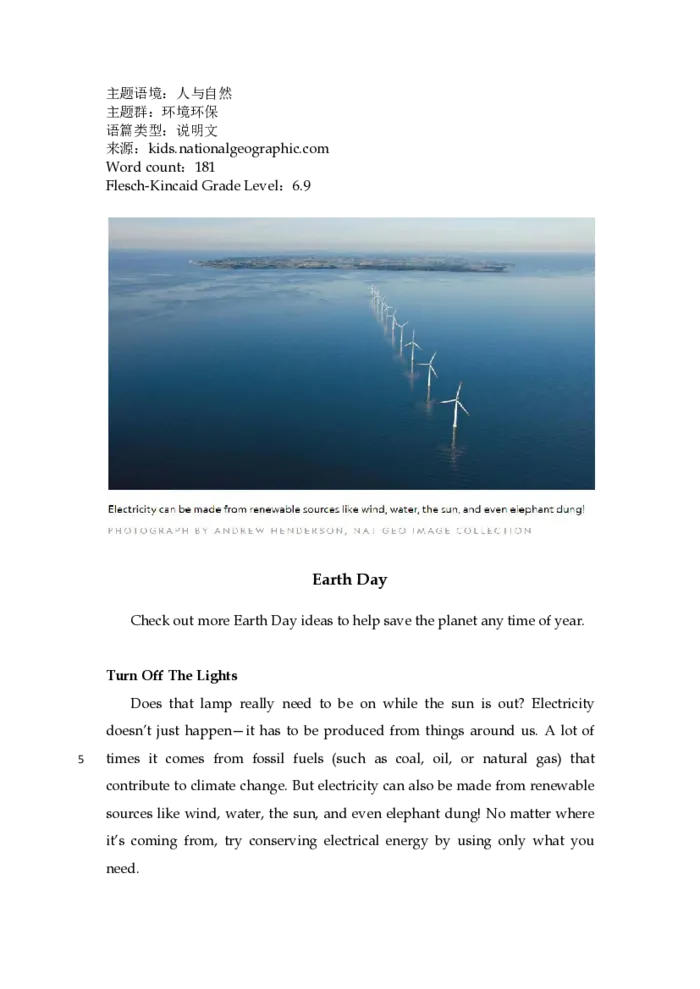
contribute to climate change. But electricity can also be made from renewable
sources like wind, water, the sun, and even elephant dung! No matter where
it’s coming from, try conserving electrical energy by using only what you
need.

Limit Your Water Usage
10
It might seem like it’s everywhere, but clean, drinkable water is a limited
resource. In fact less than one percent of the water on Earth can be used by
humans. (The rest is either too salty or too difficult to access.) Turning off the
faucet when you brush your teeth can conserve up to eight gallons of water a
day. To help save even more water, challenge yourself to take a shorter
15
shower (but still get clean!).
主题语境:人与自然
主题群:环境环保
语篇类型:说明文
来源:kids.nationalgeographic.com
Word count:235
Flesch-Kincaid Grade Level:5.9

Create a compost
Make your own composting bin at home.
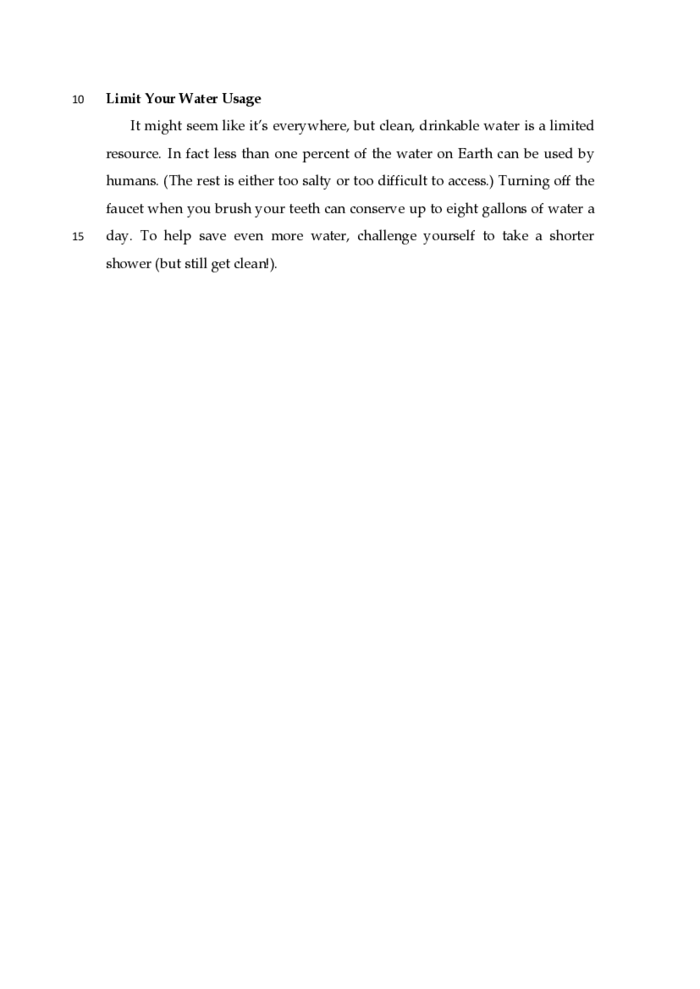
Don’t let those food scraps slide into your trash can! Food composting
lowers your carbon footprint by reducing methane emissions from landfills.
Plus, you’ll create a special fertilizer that will help your garden grow. Here’s
how to create your own composting bin at home.

Talk To Your Family
5
Composting is a family affair! You’ll want everyone on board to make it
all run smoothly.

Buy A Bin
To keep smells (and critters) away, you’ll want to invest in a composting
bin (a trash-can-size bucket with a lid) from a hardware store.
10

Gather Your Greens (And Browns)
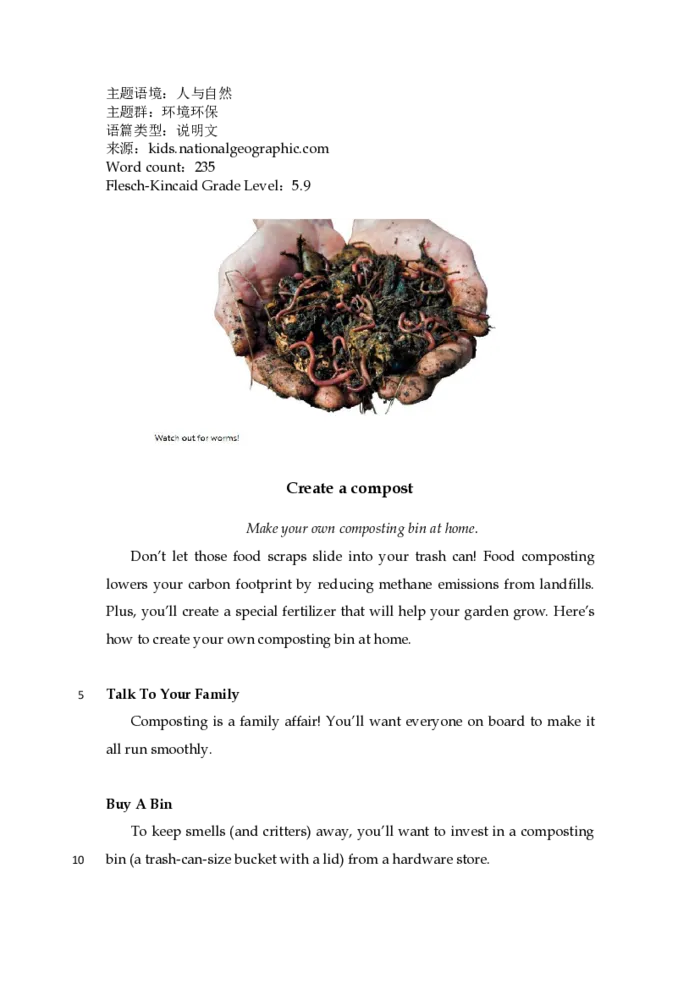
To create the right reaction in your bin, you need a mix of greens (food
waste, grass clippings) and browns (yard waste, newspapers). First, get
together your browns, chopping or shredding the larger pieces.

Layer It
15
Add the browns to your bin, then put the greens on top. Keep the
contents damp by lightly watering them with a hose or watering can.

Keep Turning
As you add stuff to your bin, be sure to have an equal amount of browns
and greens, alternating between the layers. Turn or mix your bin every time
20
you add more waste.

Time Is Right
Depending on what’s inside your bin and how often you turn the contents
over, you’ll likely have compost within a few months. You’ll know it’s ready
when it’s dark brown and crumbly and smells like soil—not rotting
25
vegetables.


主题语境:人与自然
主题群:环境保护
语篇类型:说明文
来源:Scientific American, 20200227
Word count:841
Flesch-Kincaid Grade Level:12.4

Delivery from Local Store Is Greenest Shopping Method—Most
of the Time
Researchers also calculated the carbon footprints for online and in-person
shopping
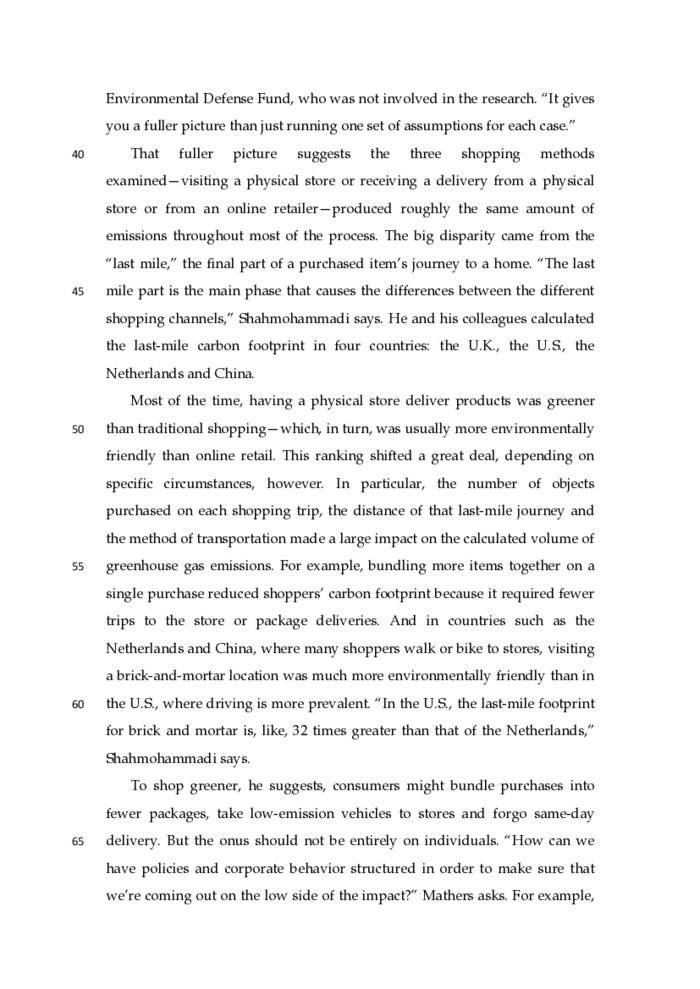
For people who want to reduce their carbon footprints, shopping can
present a dilemma. Is it greener to visit a physical store, to have that store
deliver an order or to place one with an online-only retailer? The answer
depends on several factors. In a new attempt to compare the greenhouse gas
emissions associated with each shopping method, researchers have quantified
5
how often one option ends up being better for the environment than another.
In most cases, delivery from a local store wins out—but this result can vary.
“We used a probabilistic approach—actually, that was one of the novelties
of our work,” says study co-author Sadegh Shahmohammadi, an
environmental scientist at Radboud University in the Netherlands. “Previous
10
studies showed contradicting results [as to] whether online is better or offline
is better. We wanted to improve the reliability of those models and see what is
exactly going on.”
Whether they are purchased via Amazon or a local mom-and-pop
business, consumer goods often go on a long journey to reach buyers’ hands.
15
Most items must travel from the factory to the manufacturer’s warehouse to a
distribution center or physical store—and each leg of the trip requires
greenhouse gas-emitting transportation. “We have modeled [this process]
from the moment the products leave the factory up until they arrive to the
consumer’s home,” says Shahmohammadi, who is also now at the
20
Netherlands Organization for Applied Scientific Research (TNO). In order to
keep that model as streamlined as possible, the researchers focused on
so-called fast-moving consumer goods, a category that includes food, cleaning
supplies and personal-care products (but not clothing or electronics). They left
out refrigerated food, because cooling methods contribute to greenhouse gas
25
emissions as well.
The model incorporated various factors, including the number of
products purchased, packaging, storage and greenhouse gas emissions for
various types of transportation. In some previous studies, researchers had
developed models that used an average value for each of these parameters. In
30
the new paper, Shahmohammadi says, he and his colleagues entered a range
instead of a single number. “We have probability distributions for all those
input variables,” he explains. The scientists’ result, published this week in
Environmental Science & Technology, showed a span of potential emissions
for each shopping method.
35
“Their analysis is the range of those outputs, and that’s great,” says Jason
Mathers, director of vehicles and freight strategy at the advocacy nonprofit
Environmental Defense Fund, who was not involved in the research. “It gives
you a fuller picture than just running one set of assumptions for each case.”
That
fuller
picture
suggests
the
three
shopping
methods
40
examined—visiting a physical store or receiving a delivery from a physical
store or from an online retailer—produced roughly the same amount of
emissions throughout most of the process. The big disparity came from the
“last mile,” the final part of a purchased item’s journey to a home. “The last
mile part is the main phase that causes the differences between the different
45
shopping channels,” Shahmohammadi says. He and his colleagues calculated
the last-mile carbon footprint in four countries: the U.K., the U.S., the
Netherlands and China.
Most of the time, having a physical store deliver products was greener
than traditional shopping—which, in turn, was usually more environmentally
50
friendly than online retail. This ranking shifted a great deal, depending on
specific circumstances, however. In particular, the number of objects
purchased on each shopping trip, the distance of that last-mile journey and
the method of transportation made a large impact on the calculated volume of
greenhouse gas emissions. For example, bundling more items together on a
55
single purchase reduced shoppers’ carbon footprint because it required fewer
trips to the store or package deliveries. And in countries such as the
Netherlands and China, where many shoppers walk or bike to stores, visiting
a brick-and-mortar location was much more environmentally friendly than in
the U.S., where driving is more prevalent. “In the U.S., the last-mile footprint
60
for brick and mortar is, like, 32 times greater than that of the Netherlands,”
Shahmohammadi says.
To shop greener, he suggests, consumers might bundle purchases into
fewer packages, take low-emission vehicles to stores and forgo same-day
delivery. But the onus should not be entirely on individuals. “How can we
65
have policies and corporate behavior structured in order to make sure that
we’re coming out on the low side of the impact?” Mathers asks. For example,
Shahmohammadi notes that companies switching to lower-emission
conveyances would make a big difference. “We actually modeled that
replacing delivery vans with electric cargo [vehicles] could reduce the
70
last-mile transport footprint by 42 percent and the total footprint by 26
percent in the U.K.”
The question is not whether online or in-person shopping is more
environmentally friendly. “It’s really complex when you try to tease out
which is better,” Mathers says. “And ultimately, it’s somewhat irrelevant. We,
75
as modern consumers, are buying through all these channels. And what we
need to be focused on is: How do we make each one of them as low-polluting
as it can be?”
主题语境:人与自然
主题群:动物与植物
语篇类型:新闻报道
来源:New York Times, 20200403
Word count:552
Flesch-Kincaid Grade Level:9.1

The Bronx Zoo Is Also Empty, but the Animals Don’t Mind
If a sea lion claps at the Bronx Zoo, and no one is around to hear it, does it
make a sound?
There is plenty of time to ponder koans these days at the animal park,
where the coronavirus pandemic has left the sea lions, and the rest of its
roughly 6,000 creatures, without an audience. In this busy season at the zoo,
5
when people typically pack in — children atop their parents’ shoulders — to
see the sea lions eat, there is no one standing at the pool railing.
Or walking the pathways of Astor Court, with its Beaux-Arts buildings.
Or sitting at the picnic tables. Or riding Wild Asia, the seasonal monorail that
tours the habitats of red pandas, elephants and rhinos.
10
Still, the life of the zoo goes on, as the sea lions perform their routines, no
doubt encouraged by the fish they swallow in a single gulp.
“The animals are blissfully unaware of what the rest of us have been
going through,” said Jim Breheny, the director of the Bronx Zoo. “What I
wouldn’t give for that innocence.”
15
Unlike Broadway theaters or museums, zoos cannot go dark. Chinchillas
need checkups. Penguin chicks might require help after they hatch. Captive
tigers, alligators and grizzly bears probably shouldn’t be left to their own
devices.
“The animals that we care for rely on us for everything,” said Mr. Breheny,
20
whose first job at age 14 was staffing the zoo’s camel rides.
So since it closed to the public on March 16, the Bronx Zoo has been
tending to animals while keeping its human employees as socially distant as
possible. Roughly 300 workers of its 700-plus staff were deemed “essential” to
care for animals and maintain the zoo’s operations. They are split in half into
25
two teams, which report on alternating weeks.
A spokeswoman for District Council 37, a union that represents zoo
employees, said there had been no reports of layoffs or furloughs.
Workers who still report find themselves following the routines they
always have: spreading hay out so the American bison can graze; offering fish
30
to Magellanic penguins eagerly snapping their beaks; and releasing the lions
to laze around on exhibit. Others, including maintenance workers, electricians
and plumbers, keep the sprawling campus operating.
Mr. Breheny said the zoo’s mission right now is to keep the animals on a
consistent routine. But its emptiness has not gone unnoticed, he added, by
35
some primates.
Last month, he took a moment to stop at one of the viewing spots for the
baboon reserve, a two-acre space amid the 265-acre zoo designed to simulate
the Ethiopian highlands. He said a group of geladas, monkeys with a crown
of coffee-colored hair and upper lips that often flip up, moved toward him.
40
He was likely the first human observer they had seen in a while, and they
stared curiously at him through the glass.
“They seemed to not understand why people aren’t here right now,” he
said.
The goats and alpacas in the children’s seasonal zoo are particularly
45
accustomed to interacting with visitors, said Patrick Thomas, the zoo’s
associate director, in an email. Now the only people those animals see are
employees.
“I don’t think our animals’ behavior has changed all that much,” he said,
“but I do think that they’re aware that things are not the same.”
50
主题语境:人与自然
主题群:植物与动物
语篇类型:说明文
来源:thoughtco.com, 20190703
Word count:434
Flesch-Kincaid Grade Level:15.7

Animals Most Endangered by Global Warming
No matter your position on the issue—whether global warming is
aggravated by the burning of fossil fuels (the position of the vast majority of
the world’s scientists) or an unavoidable environmental trend that’s
completely unaffected by human behavior, the fact is that our world is
gradually, and inexorably, heating up. We can’t even begin to imagine the
5
effect rising global temperatures will have on human civilization, but we can
see for ourselves, right now, how it impacts some of our favorite animals.

The Emperor Penguin
Hollywood’s favorite flightless bird—witness March of the Penguins and
Happy Feet—the emperor penguin is nowhere near as joyful and carefree as
10
depicted in the movies. The fact is that this Antarctic-dwelling penguin is
unusually susceptible to climate change, and populations can be decimated
by even slight warming trends. If global warming continues at its current pace,
experts warn that the emperor penguin could lose nine-tenths of its
population by the year 2100—and from there it would be just a slippery slide
15
into total extinction.

The Orange Clownfish
Here’s where global warming gets real: can it really be that Nemo the
clownfish is on the verge of extinction? Well, the sad fact is that coral reefs are
especially susceptible to rising ocean temperatures and acidification, and the
sea anemones that sprout from these reefs make ideal homes for clownfish,
shielding them from predators. As coral reefs bleach and decay, anemones
dwindle in number, and so do the populations of orange clownfish.

The Koala Bear
The koala bear, itself, isn’t any more vulnerable to rising global
temperatures than any of the other marsupials of Australia, such as kangaroos
20
and wombats. The problem is that koalas subsist almost exclusively on the
leaves of the eucalyptus tree, and this tree is extremely sensitive to
temperature change and drought: the 100 or so species of eucalyptus grow
very slowly, and they disperse their seeds within a very narrow range,
making it difficult for them to extend their habitat and avoid disaster. And as
25
the eucalyptus tree goes, so goes the koala.

The Polar Bear
Last but not least, we come to the poster animal for global warming: the
handsome, charismatic, but extremely dangerous polar bear. The polar bear
spends most of its time on the ice floes of the Arctic Ocean, hunting for seals
30
and penguins, and as these platforms diminish in number and move farther
apart the polar bear’s daily routine becomes increasingly precarious. By some
estimates, the world’s polar bear population will plunge by two-thirds by the
year 2050 if nothing is done to arrest global warming trends.