第二期初中英语外刊阅读
精讲直播课
主题:社会历史
2020 年3-4 月
话题:人与社会(假日与节日)
体裁:说明文
来源:National Geographic Kids
词数:431
FK Grade Level: 8.2
St. Patrick’s Day
Check out surprising fact about this holiday (Why DO we wear green, anyway?)
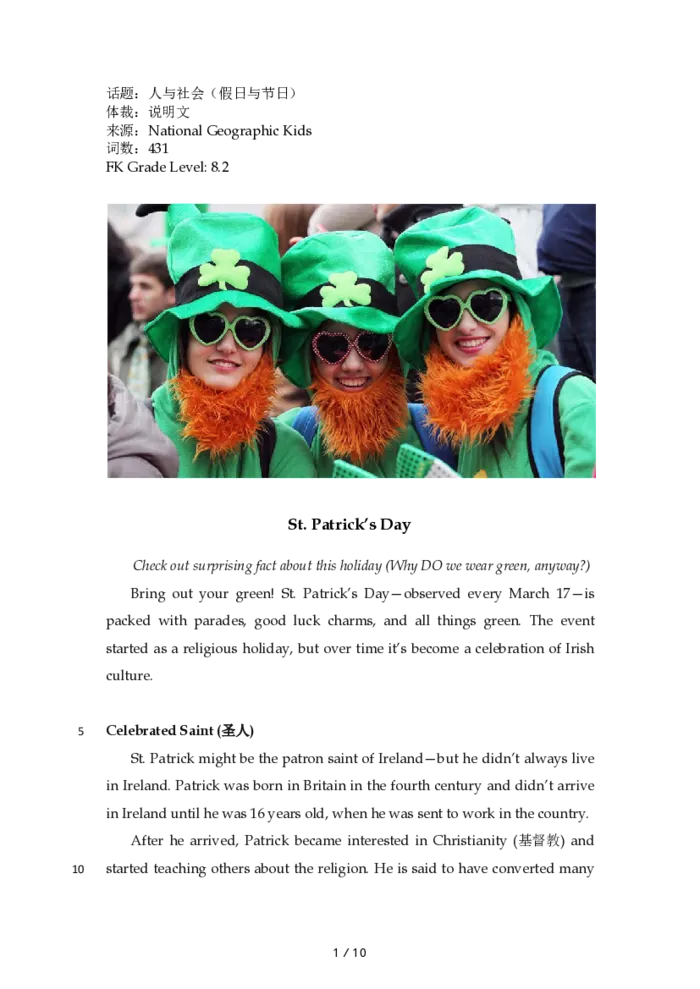
Bring out your green! St. Patrick’s Day—observed every March 17—is
packed with parades, good luck charms, and all things green. The event
started as a religious holiday, but over time it’s become a celebration of Irish
culture.
Celebrated Saint (圣人)
5
St. Patrick might be the patron saint of Ireland—but he didn’t always live
in Ireland. Patrick was born in Britain in the fourth century and didn’t arrive
in Ireland until he was 16 years old, when he was sent to work in the country.
After he arrived, Patrick became interested in Christianity (基督教) and
started teaching others about the religion. He is said to have converted many
10
1/10
of the country’s residents to Christians (基督徒), and now St. Patrick’s Day is
celebrated on the day Patrick supposedly died.

Going Green
The fact that Ireland is an island—as well as green with leafy trees and
grassy hills—means that the nation is sometimes called the Emerald Isle. But
15
the color that people originally associated with St. Patrick was blue! (Some
ancient Irish flags even sport this color.) Green was finally introduced to St.
Patrick’s Day festivities in the 18th century, when the shamrock (三叶草)
(which is, of course, green) became a national symbol. Because of the
shamrock’s popularity and Ireland’s landscape, the color stuck to the holiday.
20
Green is also the color that mythical fairies called leprechauns (矮精灵)
like to dress in—today, at least. But tales about leprechauns date back to
before green was in: The fairies were first described as wearing red.

Today’s Traditions
Leprechauns are actually one reason you’re supposed to wear green on St.
25
Patrick’s Day—or risk getting pinched! The tradition is tied to folklore that
says wearing green makes you invisible to leprechauns, which like to pinch
anyone they can see. Some people also think sporting the color will bring
good luck, and others wear it to honor their Irish ancestry. No wonder green
decorations can be seen all over—the Chicago River in Illinois is even dyed
30
green each year to celebrate the holiday.
Another tradition includes many Irish-American people in the United
States eating corned beef and cabbage on St. Patrick’s Day. People also gather
to watch parades of traditional Irish dancers and musicians as they march
through city streets. However you celebrate, here’s hoping it’s a lucky day!
35
2/10
话题:人与社会(工作与就业)
体裁:议论文
来源:CNBC, 20200217
词数:446
FK Grade Level: 9.2

Millions of Americans could lose their jobs in a coronavirus
recession.
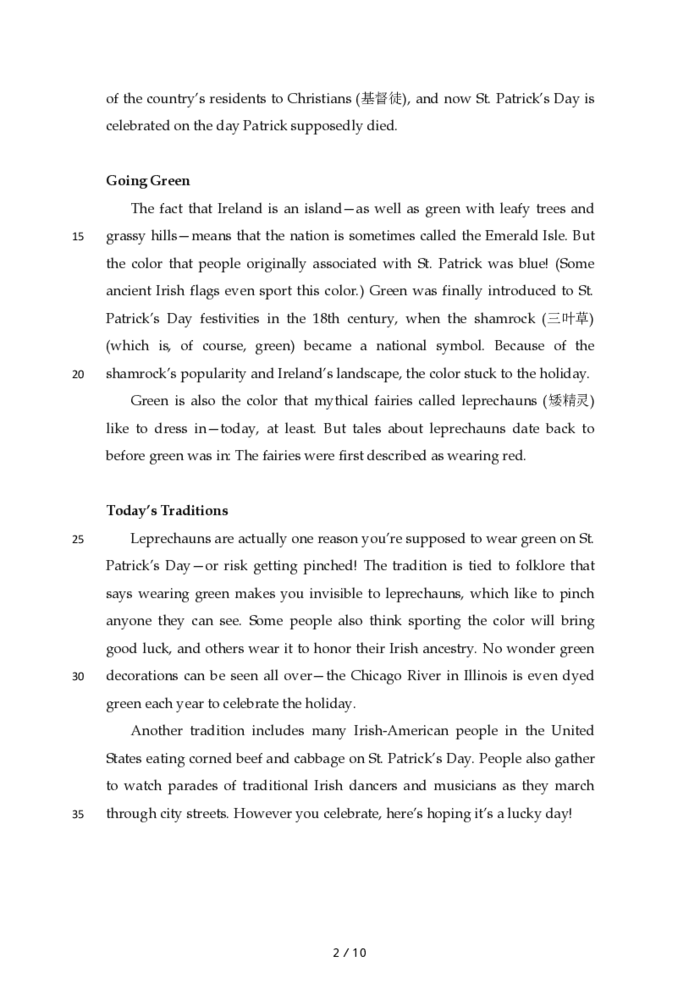
The odds of slipping into a recession are increasingly likely as the global
coronavirus outbreak puts acute stress on the U.S. economy. That could be
bad news for American workers, who may lose jobs by the millions in a
downturn.
Economic cracks are beginning to emerge. Small-business owners are
5
starting to report supply chain problems and lost sales. The travel industry is
reeling. Big oil and gas companies are slashing spending and cutting
dividends amid a plunge in crude prices. Consumer spending has fallen as
Americans pull back from their daily routines.
The coronavirus fallout has been so dramatic that many economists think
10
the U.S. is headed for a recession. Some economists believe the recession has
already begun.
Some reports have emerged that layoffs have already begun in businesses
3/10
across the country.

Financial backstop lacking
15
Many workers don’t have an adequate financial backstop in layoff
situations, experts said.
Half of U.S. adults expected to be living paycheck to paycheck this year
and 53% did not have an emergency fund that covers at least three months of
expenses, according to a financial planning survey conducted prior to the
20
coronavirus outbreak by First National Bank of Omaha in Nebraska.

3.5 million jobs
The typical post-World War II recession has led the unemployment rate to
increase about 2 to 2.5 percentage points, according to David Wilcox, a senior
fellow at the Peterson Institute for International Economics.
25
An economic downturn due to the coronavirus would put an abrupt end
to the longest-running expansion in U.S. history. If it were like an average
recession, it would translate to a roughly 6% unemployment rate (given
today’s 3.5% rate, which is near 50-year lows).
That would mean about 3.5 million lost jobs, Wilcox said.
30
During the country’s last recession — the Great Recession, the worst
downturn since the Great Depression — about 8 million Americans lost their
jobs.
Job loss during recessions doesn’t all come via layoffs, Wilcox said.
And rather than reducing the size of their workforce, businesses could
35
instead cut employees’ hours and overtime pay. That approach could still
strain workers’ finances but wouldn’t leave them jobless.

Uneven impact
Recessions don’t impact Americans uniformly — workers in certain
industries, such as hospitality, restaurants and food services, which tend to
40
4/10
employ many younger workers under 40, are more likely than others to be
laid off in the event of recession, according to Carter Price, a senior
mathematician at the Rand Corp.
Minorities and Americans with less education also tend to lose their jobs
with greater frequency during recessions, Wilcox said.
45
“The economic cost, the burden of a recession, is very unequally
distributed,” he said.
5/10
话题:人与社会(名人)
体裁:记叙文
来源:Nasa, 20200224
词数:494
FK Grade Level: 7.4

Who Was Katherine Johnson?
 What Was Katherine Johnson’s Early Life Like?
Johnson was born with a love for mathematics. She started college when
she was 15 and graduated with very high grades and degrees in mathematics
and French when she was 18. When Johnson graduated from college, the
United States was still segregated. During this time, “segregation” meant that
5
different races were separated from each other in many places and activities.
African Americans were rarely able to have jobs in mathematics and science.
It was also very unusual for women of any race to have degrees in
mathematics. At that time, the only professional job available to Johnson after
6/10
graduation was teaching. She taught school for a number of years but stopped
10
when she married and had children.
What Did She Do for NASA?
   Johnson began working for NACA in 1953, which later became NASA. As
Johnson worked on math problems with the other female computers, she
would ask questions. She didn’t want to just do the work—she wanted to
15
know the “hows” and the “whys,” and then the “why nots.” By asking
questions, Johnson began to stand out.
Women were not allowed to attend meetings with the male engineers and
scientists. Johnson wanted to go to these meetings to learn more about the
projects, so she went. She became known for her training in geometry and
20
began to work with teams made up of men. Eventually, she was recognized as
a leader, and the men increasingly relied on her to have the answers they
needed.
In 1958, NACA officially became NASA. Shortly thereafter, Johnson
became part of the space team. She began calculating the flight path for the
25
rocket to put the first American in space in 1961. The engineers knew when
and where they wanted Shepard’s space capsule to land, but the tricky part
was to calculate when and where the rocket would have to launch. Johnson
figured it out! And in February 1962, her calculations helped put the first
American into orbit around Earth.
30
In September 1962, President John F. Kennedy charged the country to
send a man to the Moon. The math calculations for sending a man to the
Moon were similar to those for putting a man into orbit. But this time,
a lot more calculations were involved. This mission would include a crew of
three astronauts launching from Earth to the Moon; two astronauts landing
35
on the Moon; and then all three returning successfully back to Earth.
Johnson worked with the NASA team to figure out where and when the
rocket needed to be launched to put it on the right path to land on the Moon.
7/10
Once again, Johnson’s calculations were instrumental in NASA’s success.
With the information she provided, astronauts walked on the Moon for the
40
first time on July 20, 1969.  They returned safely to Earth on July 24, 1969. All
of this happened, in part, because of Johnson and her love of mathematics.
8/10
话题:人与社会(社会交往)
体裁:议论文
来源:psychologytoday.com, 20200324
词数:432
FK Grade Level: 9.3
Stop Body Shaming During the Outbreak
A pandemic is not a reason to be unkind to your body or the bodies of others.
With people around the world hunkering down at home, memes
referencing “the Covid-19” as a variant of the “the Freshman 15” are making
the rounds. Social media comments about bingeing on comfort food seem to
pop up roughly as often as guidance on how to wash one’s hands
appropriately.
5
Here are three very good reasons to think carefully before you post about
weight and body image-related topics.
First, let’s talk about fat-shaming. When you make comments suggesting
that gaining weight is one of the worst things that could happen to you
during this outbreak, you’re sending a clear message to everyone whose body
10
is bigger than yours – and it’s not a nice message. You’re using the bodies of
people heavier than you as a punchline.
9/10
People of all body shapes and sizes are suffering right now. Researchers
have generated piles of evidence that weight-related shaming and teasing is
linked with increased negative health outcomes. Although you may not
15
realize it, when you speak negatively about your own body size or about
gaining weight, you may be shaming others who see your posts. If you post
about how awful it would be if you gained 20 pounds during a quarantine,
what might that communicate to the person who weighs 20 pounds (or more)
more than you do?
20
Here’s a second reason to think twice before posting weight and
eating-related jokes and memes. Many who struggle with eating disorder
symptoms are having an especially hard time right now. Food scarcity
(whether actual or imagined) can trigger eating disordered thoughts and
behaviors. Extreme stress can also provoke binge eating.
25
Finally, please remember that disparaging comments about your own
body can hurt you – even if it feels like you’re just poking fun at yourself.
Engaging in negative body talk tends to make people feel worse about their
own bodies. If you’re struggling with body image concerns during this
difficult time, try some positive distraction instead of disparaging your body.
30
Take a moment to write an encouraging text or email to someone you care
about. Look at a picture of a cute animal. Research how you can support
vulnerable members of your community and find one way to help.
Remember that times of stress can re-open old psychological wounds –
both yours and others. Using social media to connect with others can be a
35
lifeline in times like these. Use your social media feeds to spread hope, cheer,
or useful information instead of body shaming.
10/10