主题语境:人与社会
主题群:名人
语篇类型:书评
来源:nytimes.com, 20161128
Word count: 1057
Flesch-Kincaid Grade Level: 11
Lexile Range: 1210L - 1400L

‘Born a Crime,’ Trevor Noah’s Raw Account of Life Under
Apartheid
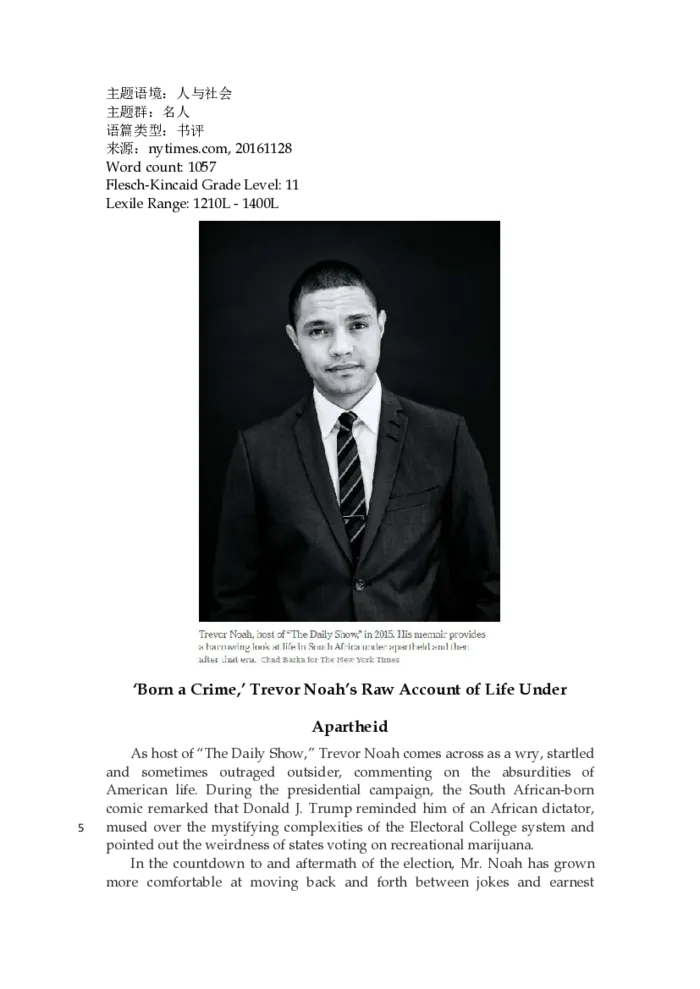
As host of “The Daily Show,” Trevor Noah comes across as a wry, startled
and sometimes outraged outsider, commenting on the absurdities of
American life. During the presidential campaign, the South African-born
comic remarked that Donald J. Trump reminded him of an African dictator,
mused over the mystifying complexities of the Electoral College system and
5
pointed out the weirdness of states voting on recreational marijuana.
In the countdown to and aftermath of the election, Mr. Noah has grown
more comfortable at moving back and forth between jokes and earnest
insights, between humor and serious asides — the way he’s done in his
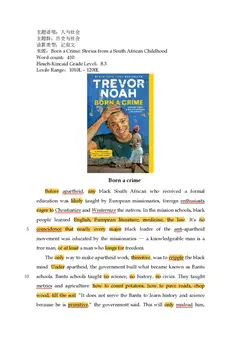
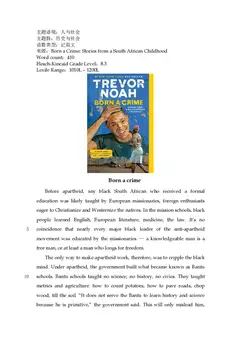
stand-up act, and now, in his compelling new memoir, “Born a Crime: Stories
10
From a South African Childhood.”
By turns alarming, sad and funny, his book provides a harrowing look,
through the prism of Mr. Noah’s family, at life in South Africa under
apartheid and the country’s lurching entry into a post-apartheid era in the
1990s. Some stories will be familiar to fans who have followed the author’s
15
stand-up act. But his accounts here are less the polished anecdotes of a
comedian underscoring the absurdities of life under apartheid, than raw,
deeply personal reminiscences about being “half-white, half-black” in a
country where his birth “violated any number of laws, statutes and
regulations.”
20
The son of a Xhosa mother and a Swiss-German father, Mr. Noah recalls
that “the only time I could be with my father was indoors”: “If we left the
house, he’d have to walk across the street from us.” It was dangerous, as a
light-skinned child, to be seen with his mother as well: “She would hold my
hand or carry me, but if the police showed up she would have to drop me and
25
pretend I wasn’t hers.”
He spent much of his time at home: “I didn’t have any friends. I didn’t
know any kids besides my cousins. I wasn’t a lonely kid — I was good at
being alone. I’d read books, play with the toy that I had, make up imaginary
worlds. I lived inside my head. To this day you can leave me alone for hours
30
and I’m perfectly happy entertaining myself. I have to remember to be with
people.”
Language, he discovered early on, was a way to camouflage his difference.
His mother knew Xhosa, Zulu, German, Afrikaans, Sotho and used her
knowledge “to cross boundaries, handle situations, navigate the world.” She
35
made sure that English was the first language her son spoke because “if
you’re black in South Africa, speaking English is the one thing that can give
you a leg up.”
“English is the language of money,” Mr. Noah goes on. “English
comprehension is equated with intelligence. If you’re looking for a job,
40
English is the difference between getting the job or staying unemployed.”
A gifted mimic, Trevor learned to become “a chameleon,” using language
to gain acceptance in school and on the streets. “If you spoke to me in Zulu, I
replied to you in Zulu,” he writes. “If you spoke to me in Tswana, I replied to
you in Tswana. Maybe I didn’t look like you, but if I spoke like you, I was
45
you.”
Mr. Noah offers a series of sharp-edged snapshots of life in the township
of Soweto, where his maternal grandmother lived, and where, he recalls, “99.9
percent” of the residents were black, and his light skin made him a
neighborhood curiosity. He remembers: “The township was in a constant
50
state of insurrection; someone was always marching or protesting somewhere
and had to be suppressed. Playing in my grandmother’s house, I’d hear
gunshots, screams, tear gas being fired into crowds.”
To save money, Mr. Noah recalls, his mother perfected the art of coasting
their old, rusty Volkswagen downhill “between work and school, between
55
school and home,” and enlisting her son’s help in pushing the car when the
gas ran out. One month, he says, money was so short that they were forced to
subsist on bowls of wild spinach, cooked with mopane worms, “the cheapest
thing that only the poorest of poor people eat.”
By high school, Mr. Noah writes, he had become an enterprising
60
businessman, copying and selling pirated CDs; he and his business partners
would soon segue into the D.J. business, throwing raucous dance parties in
Alexandra, “a tiny, dense pocket of a shantytown,” known as Gomorrah
because it had “the wildest parties and the worst crimes.”
After Mr. Noah’s father moved to Cape Town, his mother married an auto
65
mechanic, whose English name, Abel, recalled the good brother in the Bible,
but whose Tsonga name, Ngisaveni, says Mr. Noah, meant “Be afraid.” Those
names would turn out to be a harbinger of his stepfather’s dual personality —
charming and eager to be liked on the surface, but, as Mr. Noah recalls, highly
controlling, and capable of violence.
70
In the end, “Born a Crime” is not just an unnerving account of growing up
in South Africa under apartheid, but a love letter to the author’s remarkable
mother, who grew up in a hut with 14 cousins, and determined that her son
would not grow up paying what she called “the black tax” — black families
having to “spend all of their time trying to fix the problems of the past,” using
75
their skills and education to bring their relatives “back up to zero,” because
“the generations who came before you have been pillaged.”
It’s the story of a fiercely religious woman, who attributes her miraculous
survival from a gunshot wound to the head (inflicted by Abel) to her faith; a
woman who took her son to three churches on Sunday (as well as a prayer
80
meeting on Tuesday, Bible study on Wednesday and youth church on
Thursday), even when there were dangerous riots in the streets and few dared
to venture out of their homes.
The names chosen for Xhosa children traditionally have meanings, Mr.
Noah observes: His mother’s name, Patricia Nombuyiselo Noah, means “She
85
Who Gives Back”; his cousin’s name, Mlungisi, means “The Fixer.” His
mother, Mr. Noah writes, deliberately gave him a name, Trevor, with “no
meaning whatsoever in South Africa, no precedent in my family.”
“It’s not even a biblical name,” he writes. “It’s just a name. My mother
wanted her child beholden to no fate. She wanted me to be free to go
90
anywhere, do anything, be anyone.”