文档文本内容
主题语境:人与自然
主题群:宇宙探索
语篇类型:新闻报道
来源:lsc.org (Library Science Center), May 8, 2020
Word count:273
Flesch-Kincaid Grade Level:12.2
Lexile Range:1210L - 1400L

A newly discovered black hole is the closest one to Earth we’ve
found yet
Major black hole news! Earlier this week, scientists announced the
discovery of the closest black hole to Earth that we've found yet!
Until now, the nearest known black hole was A0620, an object 3,000 light
years away in the constellation of Monoceros the Unicorn.
However, just this week, the European Southern Observatory announced
5
the discovery of a black hole in HR 6819, a star system more than three times
closer. This black hole is only 1,000 light years away, in the faint constellation
of Telescopium. This newly-discovered black hole is part of a system that
contains two companion stars.
While most black holes in our galaxy have been found by the violent
10
X-ray bursts caused as matter is pulled towards the black hole, the
newly-discovered black hole is a “silent” black hole, its existence found by the
motion of the nearer of the two companion stars around the black hole.
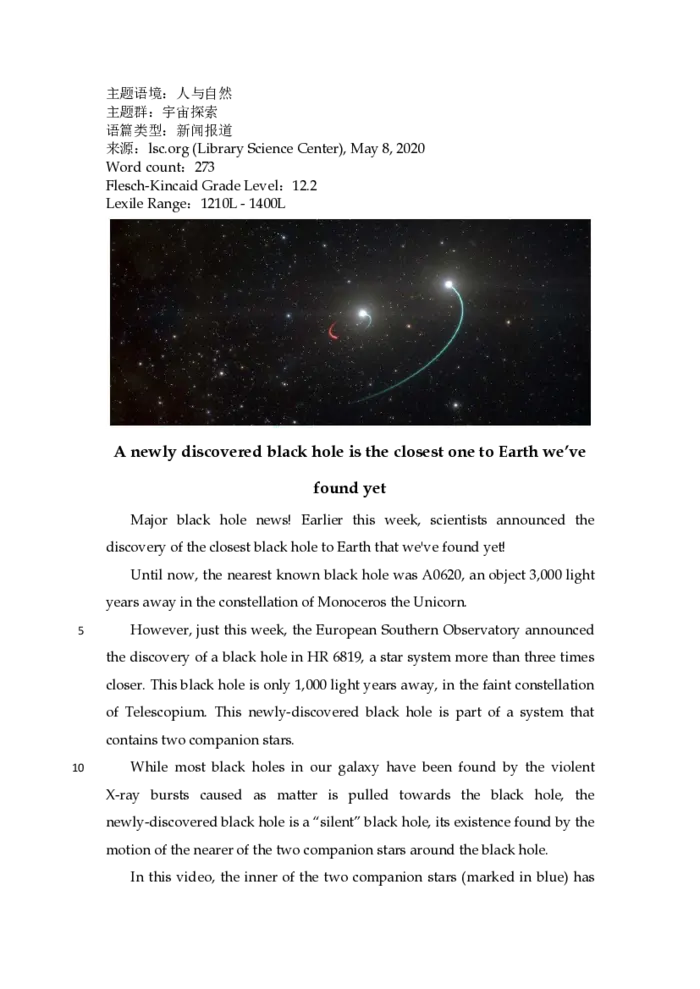
In this video, the inner of the two companion stars (marked in blue) has
an orbit so shaped by its unseen black hole companion that it proved the
15
existence of that black hole.
Also unique to this discovery: under dark skies, the two companion stars
are visible to the unaided eye, another “first” in the exploration of black holes.
The faint constellation of Telescopium, where the black hole is located, is
below Sagittarius and is visible, under dark skies, from locations south of 33
20
degrees N latitude (roughly the latitude of San Diego).
The black hole’s system is called HR6819. The discovery was made by a
team of ESO astronomers using the MPG/ESO 2.2 meter telescope at ESO’s
LA Silla Observatory in Chile.