文档文本内容
话题:人与自然(卫生与健康)
体裁:记叙文
词数:402
FK Grade Level: 6.2
Fighting Food Ads
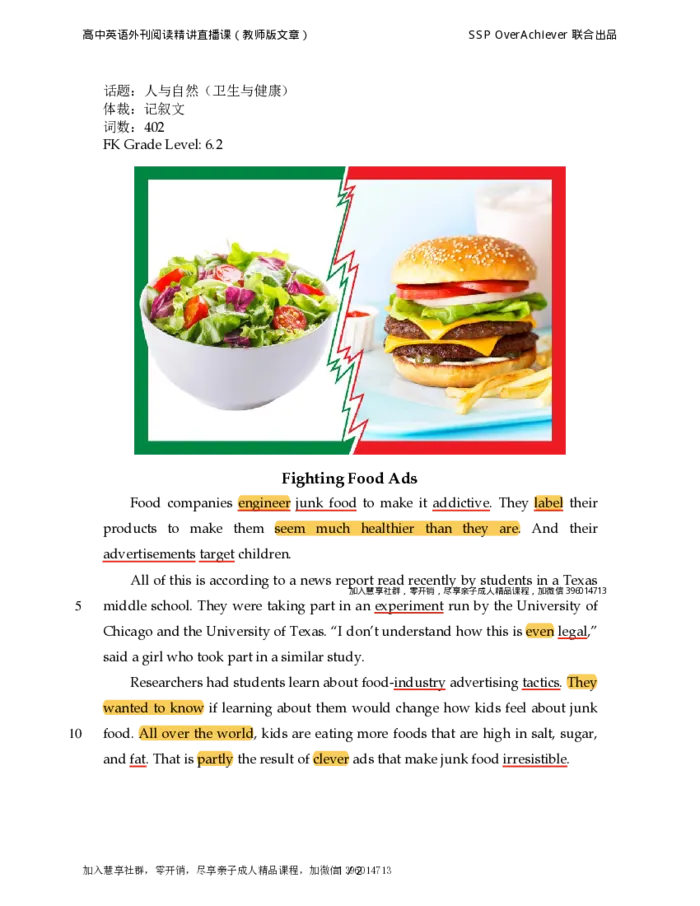
Food companies engineer junk food to make it addictive. They label their
products to make them seem much healthier than they are. And their
advertisements target children.
All of this is according to a news report read recently by students in a Texas
middle school. They were taking part in an experiment run by the University of
5
Chicago and the University of Texas. “I don’t understand how this is even legal,”
said a girl who took part in a similar study.
Researchers had students learn about food-industry advertising tactics. They
wanted to know if learning about them would change how kids feel about junk
food. All over the world, kids are eating more foods that are high in salt, sugar,
10
and fat. That is partly the result of clever ads that make junk food irresistible.
高中英语外刊阅读精讲直播课(教师版文章)
SSP OverAchiever 联合出品
1/2
加入慧享社群,零开销,尽享亲子成人精品课程,加微信 396014713
加入慧享社群,零开销,尽享亲子成人精品课程,加微信 396014713
Christopher J. Bryan led the study. He says that when kids question the
motives behind junk-food ads, they feel like they’re fighting injustice. “The
reward is knowing you’re doing the right thing,” Bryan told TIME for Kids.
Message Matters
15
Junk food has been linked to health problems such as heart disease, obesity,
and diabetes. But in 2017, food companies spent nearly $9 billion on TV ads
selling unhealthy fare.
Companies use varying tactics. An ad with cartoon characters may make
cereal seem fun to eat. A professional athlete enjoying a sugary drink may make
20
it look cool. Advertisers know that if kids want a product, they’ll bug their
parents to buy it. “You want the pester factor,” says Marion Nestle, a professor of
public health at New York University. Even parents don’t notice the power of
ads, she says: “By the time you’re an adult, you’re used to junk-food advertising.
You just don’t see it.”
25
In the Texas study, Bryan had students view ads on an iPad. Their job was to
write or draw on the screen, to make each ad’s message true. For example, a
McDonald’s ad showed a Big Mac and the words “The thing you want when you
order salad.” To the end of the sentence, a student added “should be salad.”
The results of Bryan’s Texas study were published in April. They showed
30
that three months after analyzing ads, students were still choosing healthier
snacks: milk instead of sugary juices, fruit over cookies. “Kids are becoming
conscious of themselves as agents in the world,” Bryan says. “They see a chance
to make the world a better place.”
高中英语外刊阅读精讲直播课(教师版文章)
SSP OverAchiever 联合出品
2/2
加入慧享社群,零开销,尽享亲子成人精品课程,加微信 396014713