第 05 讲 Unit3 Smart Learning
Section A How do we learn?
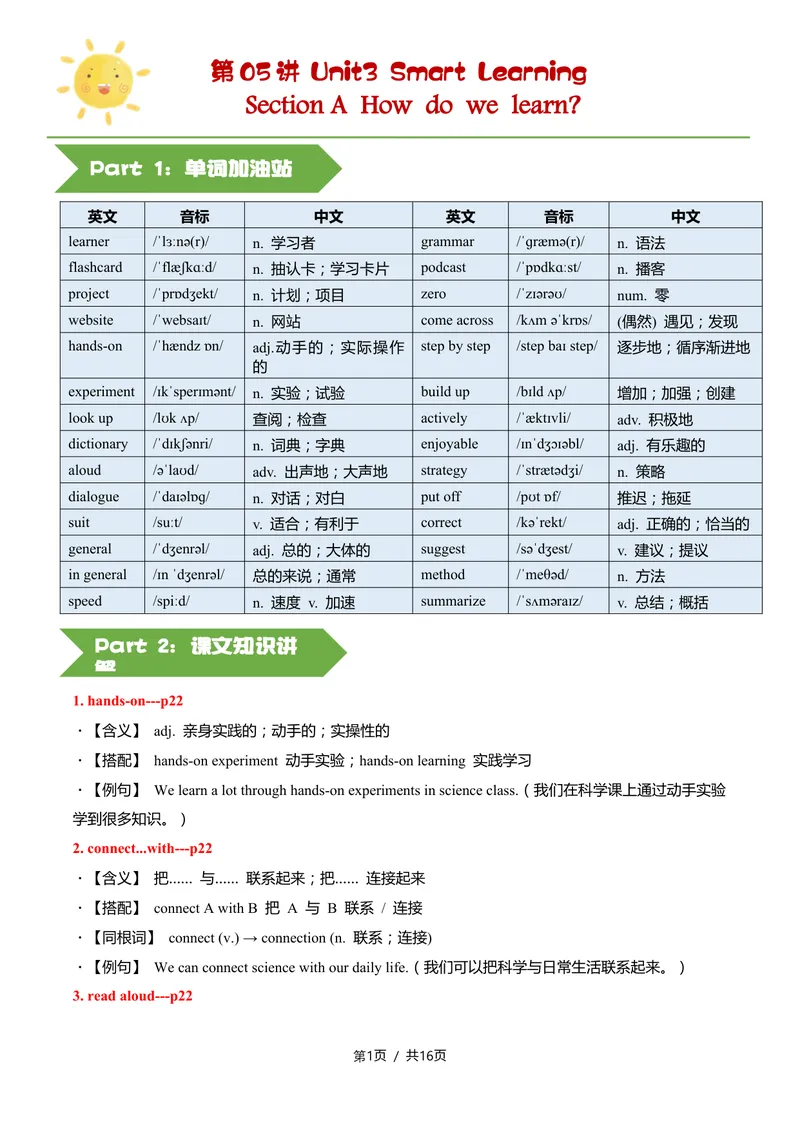
Part 1:单词加油站
英文 音标 中文 英文 音标 中文
learner /ˈlɜːnə(r)/ n. 学习者 grammar /ˈɡræmə(r)/ n. 语法
flashcard /ˈflæʃkɑːd/ n. 抽认卡;学习卡片 podcast /ˈpɒdkɑːst/ n. 播客
project /ˈprɒdʒekt/ n. 计划;项目 zero /ˈzɪərəʊ/ num. 零
website /ˈwebsaɪt/ n. 网站 come across /kʌm əˈkrɒs/ (偶然) 遇见;发现
hands-on /ˈhændz ɒn/ adj.动手的;实际操作 step by step /step baɪ step/ 逐步地;循序渐进地
的
experiment /ɪkˈsperɪmənt/ n. 实验;试验 build up /bɪld ʌp/ 增加;加强;创建
look up /lʊk ʌp/ 查阅;检查 actively /ˈæktɪvli/ adv. 积极地
dictionary /ˈdɪkʃənri/ n. 词典;字典 enjoyable /ɪnˈdʒɔɪəbl/ adj. 有乐趣的
aloud /əˈlaʊd/ adv. 出声地;大声地 strategy /ˈstrætədʒi/ n. 策略
dialogue /ˈdaɪəlɒɡ/ n. 对话;对白 put off /pʊt ɒf/ 推迟;拖延
suit /suːt/ v. 适合;有利于 correct /kəˈrekt/ adj. 正确的;恰当的
general /ˈdʒenrəl/ adj. 总的;大体的 suggest /səˈdʒest/ v. 建议;提议
in general /ɪn ˈdʒenrəl/ 总的来说;通常 method /ˈmeθəd/ n. 方法
speed /spiːd/ n. 速度 v. 加速 summarize /ˈsʌməraɪz/ v. 总结;概括
Part 2:课文知识讲
解
1. hands-on---p22
・【含义】 adj. 亲身实践的;动手的;实操性的
・【搭配】 hands-on experiment 动手实验;hands-on learning 实践学习
・【例句】 We learn a lot through hands-on experiments in science class.(我们在科学课上通过动手实验
学到很多知识。)
2. connect...with---p22
・【含义】 把…… 与…… 联系起来;把…… 连接起来
・【搭配】 connect A with B 把 A 与 B 联系 / 连接
・【同根词】 connect (v.) → connection (n. 联系;连接)
・【例句】 We can connect science with our daily life.(我们可以把科学与日常生活联系起来。)
3. read aloud---p22
第1 / 16
页 共 页・【含义】 大声朗读;诵读
・【搭配】 read aloud the text 朗读课文
・【例句】 The teacher asks us to read aloud every morning.(老师要求我们每天大声朗读。)
3a
Ella: Hi, this is Ella's podcast. Today's guest is Binbin. He's going to give us some ideas for
learning English.
Binbin: Hi, Ella. Thanks for having me! For learning English, I think first you need to become an
active learner.
Ella: What do you mean by that?
Binbin: Well, because I want to speak English well, I practise English all the time.
Ella: Oh, you must spend a lot of time studying!
Binbin: Well, it doesn't mean you have to study all the time. You need to spend time using the
language. For example, I speak English with friends. I repeat the dialogues from the films I like. I
read English books, and sometimes I write my diary in English.
Ella: Wow! I guess you really enjoy learning.
Binbin: Yes, it's true! But you see, I started out at zero and came across problems. I mean you just
have to take things step by step. Start simple and build up.
Ella: That's so true.
4. podcast
【含义】 n. 播客(一种可下载的音频节目);v. 制作 / 收听播客
【搭配】 listen to a podcast 收听播客;make a podcast 制作播客
【例句】 She improves her English by listening to English podcasts all the time.(她一直通过听英语播客
提升英语水平。)
5. all the time
【含义】 一直;始终;总是
【搭配】 work hard all the time 一直努力;help others all the time 总是帮助别人
【拓展】 近义词组:always、constantly;常用于一般现在时
【例句】 He practices speaking English all the time to make progress.(他一直练习英语口语以取得进
步。)
6. start out
【含义】 开始;起初是;着手进行
【搭配】 start out as 起初是……;start out on a journey 启程;start out to do sth 着手做某事
【例句】 She started out as a teacher and later became a writer.(她起初是一名教师,后来成为了作
家。)
7. come across
【含义】 偶然遇到;偶然发现;给人…… 印象
【搭配】 come across a friend 偶遇朋友;come across a book 偶然发现一本书
第2 / 16
页 共 页【例句】 I came across an interesting podcast about science yesterday.(我昨天偶然发现了一个有趣的科
学播客。)
8. step by step
【含义】 逐步地;一步步地
【搭配】 learn step by step 循序渐进地学习
【拓展】 同义表达:gradually、little by little;常用于修饰动词
【例句】 We should learn a foreign language step by step instead of being in a hurry.(我们应该循序渐进
地学习外语,而不是急于求成。)
9. build up
【含义】 逐步建立;积累;增强(体质、信心等)
【搭配】 build up confidence 建立信心;build up knowledge 积累知识;build up strength 增强体力
【例句】 Listening to podcasts helps build up your listening skills over time.(长期听播客有助于逐步提
升听力技能。)
10. true
【含义】 adj. 真实的;正确的;忠诚的;n. 真理;真实情况
【搭配】 true story 真实的故事;be true to oneself 忠于自己;come true 实现(梦想等)
【同根词】 true (adj.) → truth (n. 真理;真相) → truly (adv. 真实地;真正地)
【例句】 His dream of becoming a scientist finally came true.(他成为科学家的梦想最终实现了。)
11. base on---p24
【含义】 以…… 为基础;基于
【搭配】 同义词组:be based on;base a decision on facts 以事实为依据做决定
【同根词】 base (v./n.) → basic (adj. 基本的) → basis (n. 基础)
【例句】 This podcast is based on real scientific discoveries.(这个播客基于真实的科学发现制作。)
12. put off---p24
【含义】 推迟;延期;拖延
【搭配】 put off a meeting 推迟会议;put off doing sth 拖延做某事
【拓展】 反义词组:put forward(提出;提前)
【例句】 Don’t put off listening to the podcast—It’s really educational.(别推迟听这个播客,它真的很有
教育意义。)
13. actively---p24
【含义】 adv. 积极地;主动地;活跃地
第3 / 16
页 共 页【搭配】 participate actively 积极参与;think actively 主动思考;study actively 主动学习
【同根词】 active (adj. 积极的;活跃的) → actively (adv.) → activity (n. 活动)
【例句】 We should actively take part in hands-on experiments in class.(我们应该积极参与课堂上的动
手实验。)
【即学即用】
一、短语互译
英译汉
1.hands-on experiment → __________ 4.build up → __________
2.come across → __________ 5.put off → __________
3.step by step → __________ 6.read aloud → __________
汉译英
1.查阅;检查 → __________ 4.把…… 与…… 联系起来 → __________
2.积极参与 → __________ 5.推迟→ __________
3.总的来说 → __________ 6.实现(梦想) → __________
答案
英译汉:1. 动手实验 2. 偶然遇到;发现 3. 逐步地;循序渐进地 4. 增加;逐步建立 5. 推迟;拖延
6. 大声朗读
汉译英:1. look up 2. participate actively 3. in general 4. connect...with 5. listen to a podcast 6. come
true
二、词汇变形
1.base(v. 以…… 为基础)→ __________(adj. 基本的)
2.active(adj. 积极的)→ __________(adv. 积极地)
3.true(adj. 真实的)→ __________(n. 真理;真相)
4.suggest(v. 建议)→ __________(n. 建议)
5.correct(adj. 正确的)→ __________(n. 改正)
6.enjoy(v. 享受)→ __________(adj. 有乐趣的)
7.learn(v. 学习)→ __________(n. 学习者)
8.summarize(v. 总结)→ __________(n. 总结)
9.connect(v. 连接)→ __________(n. 联系)
答案
1.basic 2. actively 3. truth 4. suggestion 5. correction 6. enjoyable 7. learner 8. summary 9. connection
三、语法填空
1.Binbin __________(practise)English all the time to speak it well.
第4 / 16
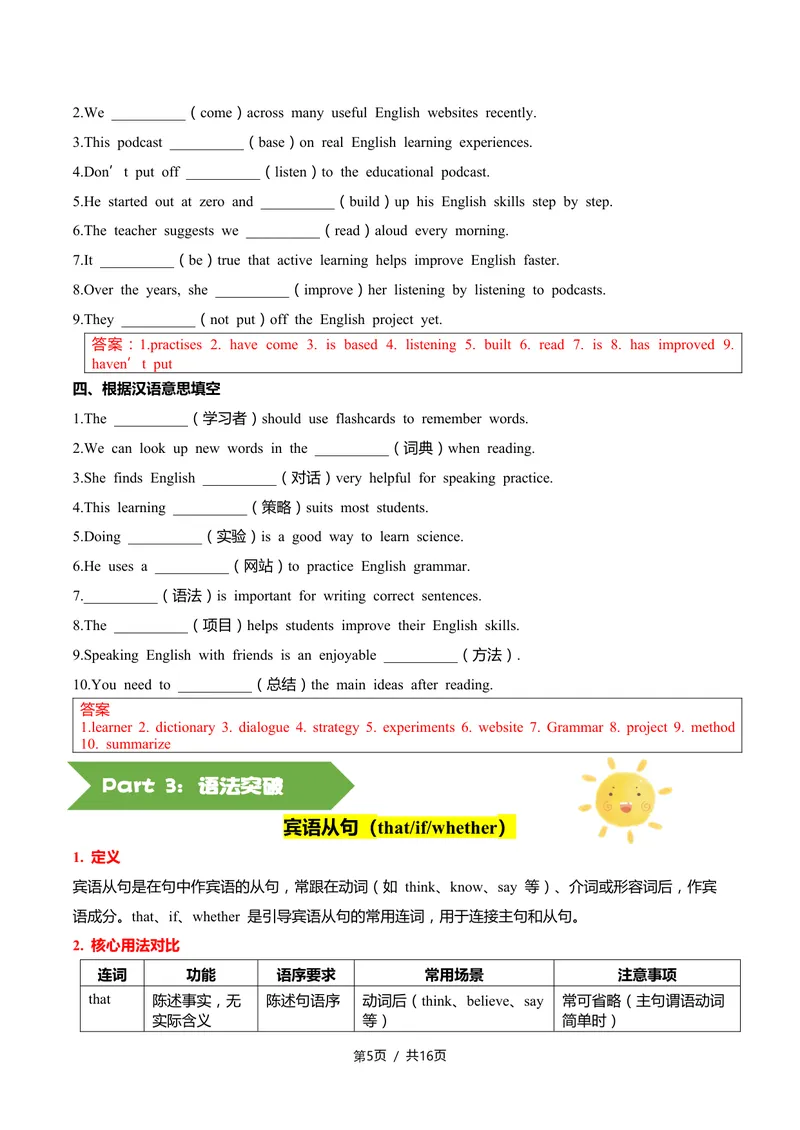
页 共 页2.We __________(come)across many useful English websites recently.
3.This podcast __________(base)on real English learning experiences.
4.Don’t put off __________(listen)to the educational podcast.
5.He started out at zero and __________(build)up his English skills step by step.
6.The teacher suggests we __________(read)aloud every morning.
7.It __________(be)true that active learning helps improve English faster.
8.Over the years, she __________(improve)her listening by listening to podcasts.
9.They __________(not put)off the English project yet.
答案:1.practises 2. have come 3. is based 4. listening 5. built 6. read 7. is 8. has improved 9.
haven’t put
四、根据汉语意思填空
1.The __________(学习者)should use flashcards to remember words.
2.We can look up new words in the __________(词典)when reading.
3.She finds English __________(对话)very helpful for speaking practice.
4.This learning __________(策略)suits most students.
5.Doing __________(实验)is a good way to learn science.
6.He uses a __________(网站)to practice English grammar.
7.__________(语法)is important for writing correct sentences.
8.The __________(项目)helps students improve their English skills.
9.Speaking English with friends is an enjoyable __________(方法).
10.You need to __________(总结)the main ideas after reading.
答案
1.learner 2. dictionary 3. dialogue 4. strategy 5. experiments 6. website 7. Grammar 8. project 9. method
10. summarize
Part 3:语法突破
宾语从句(that/if/whether)
1. 定义
宾语从句是在句中作宾语的从句,常跟在动词(如 think、know、say 等)、介词或形容词后,作宾
语成分。that、if、whether 是引导宾语从句的常用连词,用于连接主句和从句。
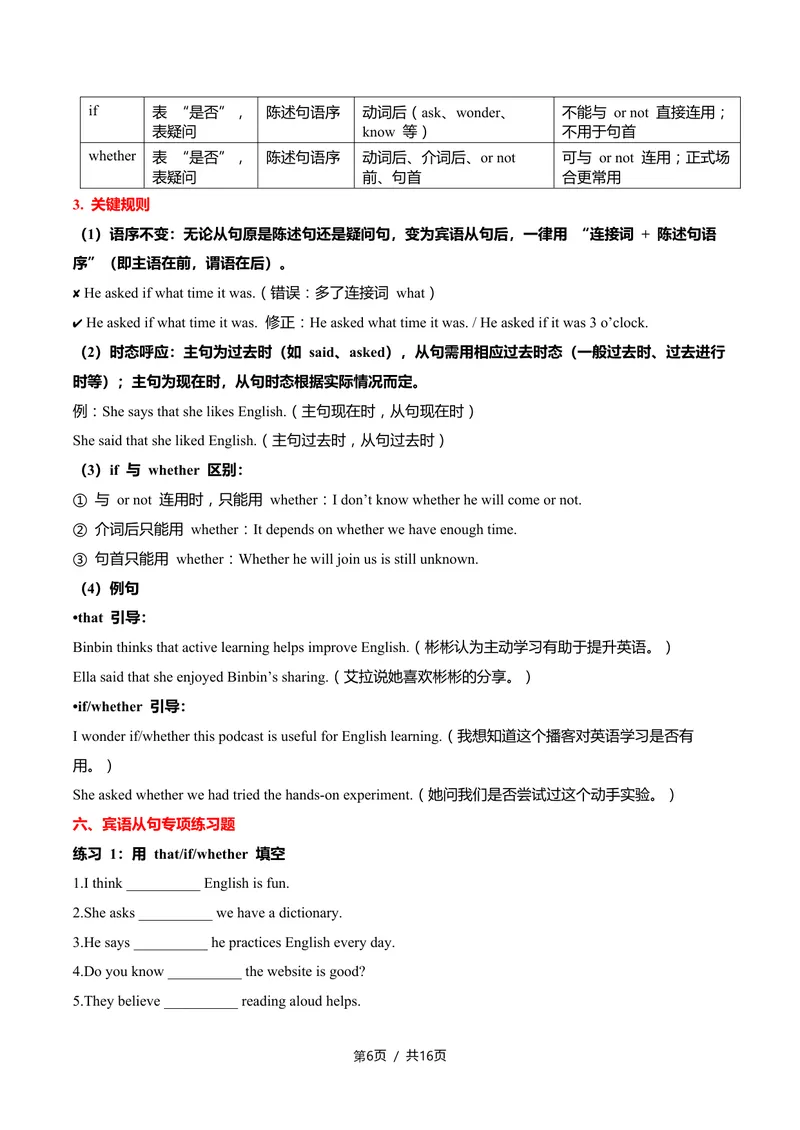
2. 核心用法对比
连词 功能 语序要求 常用场景 注意事项
that 陈述事实,无 陈述句语序 动词后(think、believe、say 常可省略(主句谓语动词
实际含义 等) 简单时)
第5 / 16
页 共 页if 表 “是否”, 陈述句语序 动词后(ask、wonder、 不能与 or not 直接连用;
表疑问 know 等) 不用于句首
whether 表 “是否”, 陈述句语序 动词后、介词后、or not 可与 or not 连用;正式场
表疑问 前、句首 合更常用
3. 关键规则
(1)语序不变:无论从句原是陈述句还是疑问句,变为宾语从句后,一律用 “连接词 + 陈述句语
序”(即主语在前,谓语在后)。
✘ He asked if what time it was.(错误:多了连接词 what)
✔ He asked if what time it was. 修正:He asked what time it was. / He asked if it was 3 o’clock.
(2)时态呼应:主句为过去时(如 said、asked),从句需用相应过去时态(一般过去时、过去进行
时等);主句为现在时,从句时态根据实际情况而定。
例:She says that she likes English.(主句现在时,从句现在时)
She said that she liked English.(主句过去时,从句过去时)
(3)if 与 whether 区别:
① 与 or not 连用时,只能用 whether:I don’t know whether he will come or not.
② 介词后只能用 whether:It depends on whether we have enough time.
③ 句首只能用 whether:Whether he will join us is still unknown.
(4)例句
•that 引导:
Binbin thinks that active learning helps improve English.(彬彬认为主动学习有助于提升英语。)
Ella said that she enjoyed Binbin’s sharing.(艾拉说她喜欢彬彬的分享。)
•if/whether 引导:
I wonder if/whether this podcast is useful for English learning.(我想知道这个播客对英语学习是否有
用。)
She asked whether we had tried the hands-on experiment.(她问我们是否尝试过这个动手实验。)
六、宾语从句专项练习题
练习 1:用 that/if/whether 填空
1.I think __________ English is fun.
2.She asks __________ we have a dictionary.
3.He says __________ he practices English every day.
4.Do you know __________ the website is good?
5.They believe __________ reading aloud helps.
第6 / 16
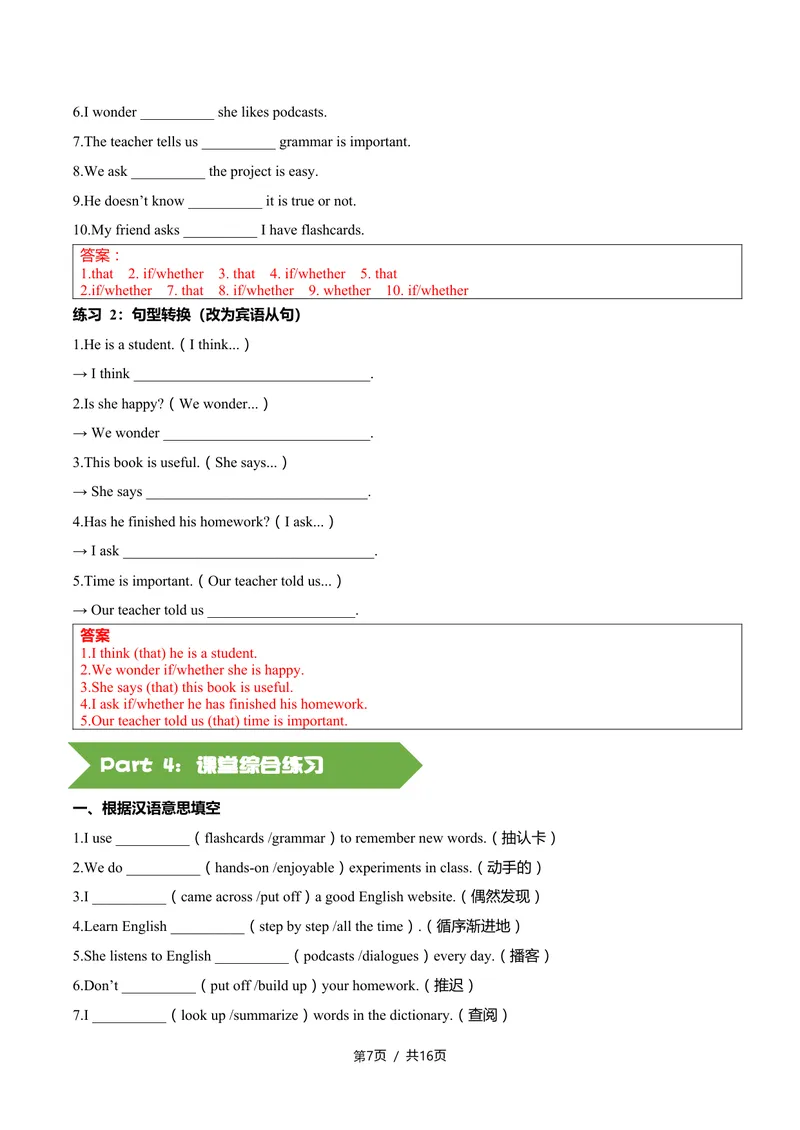
页 共 页6.I wonder __________ she likes podcasts.
7.The teacher tells us __________ grammar is important.
8.We ask __________ the project is easy.
9.He doesn’t know __________ it is true or not.
10.My friend asks __________ I have flashcards.
答案:
1.that 2. if/whether 3. that 4. if/whether 5. that
2.if/whether 7. that 8. if/whether 9. whether 10. if/whether
练习 2:句型转换(改为宾语从句)
1.He is a student.(I think...)
→ I think ________________________________.
2.Is she happy?(We wonder...)
→ We wonder ____________________________.
3.This book is useful.(She says...)
→ She says ______________________________.
4.Has he finished his homework?(I ask...)
→ I ask __________________________________.
5.Time is important.(Our teacher told us...)
→ Our teacher told us ____________________.
答案
1.I think (that) he is a student.
2.We wonder if/whether she is happy.
3.She says (that) this book is useful.
4.I ask if/whether he has finished his homework.
5.Our teacher told us (that) time is important.
Part 4:课堂综合练习
一、根据汉语意思填空
1.I use __________(flashcards /grammar)to remember new words.(抽认卡)
2.We do __________(hands-on /enjoyable)experiments in class.(动手的)
3.I __________(came across /put off)a good English website.(偶然发现)
4.Learn English __________(step by step /all the time).(循序渐进地)
5.She listens to English __________(podcasts /dialogues)every day.(播客)
6.Don’t __________(put off /build up)your homework.(推迟)
7.I __________(look up /summarize)words in the dictionary.(查阅)
第7 / 16
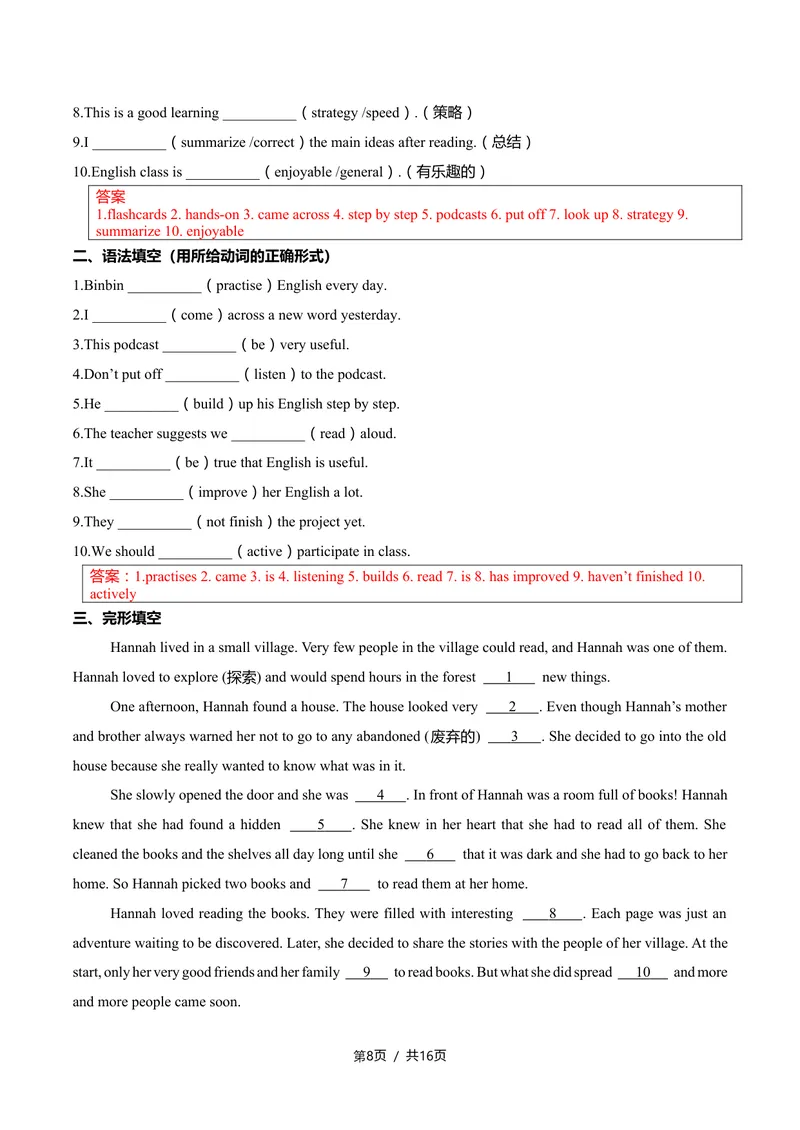
页 共 页8.This is a good learning __________(strategy /speed).(策略)
9.I __________(summarize /correct)the main ideas after reading.(总结)
10.English class is __________(enjoyable /general).(有乐趣的)
答案
1.flashcards 2. hands-on 3. came across 4. step by step 5. podcasts 6. put off 7. look up 8. strategy 9.
summarize 10. enjoyable
二、语法填空(用所给动词的正确形式)
1.Binbin __________(practise)English every day.
2.I __________(come)across a new word yesterday.
3.This podcast __________(be)very useful.
4.Don’t put off __________(listen)to the podcast.
5.He __________(build)up his English step by step.
6.The teacher suggests we __________(read)aloud.
7.It __________(be)true that English is useful.
8.She __________(improve)her English a lot.
9.They __________(not finish)the project yet.
10.We should __________(active)participate in class.
答案:1.practises 2. came 3. is 4. listening 5. builds 6. read 7. is 8. has improved 9. haven’t finished 10.
actively
三、完形填空
Hannah lived in a small village. Very few people in the village could read, and Hannah was one of them.
Hannah loved to explore (探索) and would spend hours in the forest 1 new things.
One afternoon, Hannah found a house. The house looked very 2 . Even though Hannah’s mother
and brother always warned her not to go to any abandoned (废弃的) 3 . She decided to go into the old
house because she really wanted to know what was in it.
She slowly opened the door and she was 4 . In front of Hannah was a room full of books! Hannah
knew that she had found a hidden 5 . She knew in her heart that she had to read all of them. She
cleaned the books and the shelves all day long until she 6 that it was dark and she had to go back to her
home. So Hannah picked two books and 7 to read them at her home.
Hannah loved reading the books. They were filled with interesting 8 . Each page was just an
adventure waiting to be discovered. Later, she decided to share the stories with the people of her village. At the
start, only her very good friends and her family 9 to read books. But what she did spread 10 and more
and more people came soon.
第8 / 16
页 共 页Hannah continued her journey throughout her life. She became interested in reading. She became a hope
for everyone. Now people know that even in the dustiest corner there can be a hidden treasure.
1.A.looking at B.looking for C.looking up
2.A.expensive B.big C.old
3.A.parks B.schools C.places
4.A.surprised B.worried C.scared
5.A.treasure B.hope C.chance
6.A.forgot B.found C.wondered
7.A.regretted B.agreed C.decided
8.A.stories B.pages C.words
9.A.escaped B.came C.refused
10.A.quietly B.slowly C.quickly
【答案】
1.B 2.C 3.C 4.A 5.A 6.B 7.C 8.A 9.B 10.C
【导语】本文主要讲述了天生喜爱阅读的汉娜在废弃房子里发现满室书籍,她不仅自己阅读,还将故
事分享给村民,成为大家心中希望象征的故事。
1.句意:汉娜喜欢探索,会花几个小时在树林里寻找新事物。
looking at看;looking for寻找;looking up查阅。根据“Hannah loved to explore … new things”可知,
喜欢探索,所以会在树林里寻找新事物。故选B。
2.句意:这所房子看起来非常古老。
expensive昂贵的;big大的;old古老的。根据下文“She decided to go into the old house”可知,房子是
古老的。故选C。
3.句意:尽管汉娜的母亲和兄弟总是警告她不要去任何废弃的地方。
parks公园;schools学校;places地方。根据“abandoned”可知,应该是废弃的地方。故选C。
4.句意:她慢慢地打开门,她感到很惊讶。
surprised感到惊讶的;worried担心的;scared惊恐的。根据“In front of Hannah was a room full of
books!”可知,汉娜感到很惊讶。故选A。
5.句意:汉娜知道她找到了一个隐藏的宝藏。
treasure宝藏;hope希望;chance机会。根据“She knew in her heart that she had to read all of them.”及
“Hannah loved reading the books.”可知,一所装满书的房子对喜欢读书的汉娜来说是宝藏。故选A。
第9 / 16
页 共 页6.句意:她整天都在打扫书本和书架,直到她发现天黑了,她必须回家。
forgot忘记;found发现;wondered想知道。根据“it was dark and she had to go back home”可知,是发
现天黑了。故选B。
7.句意:所以汉娜挑了两本书,决定在家里读它们。
regretted后悔;agreed同意;decided决定。根据“to read them at her home”可知,此处是汉娜的决
定。故选C。
8.句意:它们充满了有趣的故事。
stories故事;pages页数;words话语。根据“she decided to share the stories with the people of her
village.”可知,书里面是故事。故选A。
9.句意:起初,只有她的好朋友和家人来读书。
escaped逃跑;came来;refused拒绝。根据“and more and more people came soon”可知,此处指起初
只有她的好朋友和家人来读书。故选B。
10.句意:但是她所做的事情迅速传播开来,越来越多的人来了。
quietly安静地;slowly慢慢地;quickly迅速地。根据“more and more people came soon”可知,她所做
的事情迅速传播开来。故选C。
四、语法填空
Among all the books I’ve read this year, Wonder by R. J. Palacio is my favorite. It tells the story of
Auggie, a boy with a facial difference who starts school 1 the first time at 10. At first, many
classmates 2 (avoid) him because of his appearance. But as they got 3 (know) Auggie,
they found he’s smart, funny, and kind—just like any other kid.
What I love most about this book is its warm message: “Be kind, for everyone is fighting a hard battle.”
It makes me think about how we judge people too 4 (quick) without knowing their stories. Auggie’s
courage to face difficulties also touches my heart. Even when others laugh at him, he never stops believing in
5 .
The book also has great characters. Auggie’s sister, Via, is understanding and has 6 great
influence on him. His best friend Jack shows that true friendship isn’t about looks. Every chapter (章) 7
(tell) a different character’s view, which helps readers see the same event from many sides.
After finishing Wonder, I started treating people around me 8 (nice) than before. I often ask
myself: “Would I be kind to Auggie if we met? ” This book isn’t just for kids, and adults can learn a lot from it,
too.
9 you’re looking for a book that will make you laugh, cry, and think. Wonder is the one. It
第10 / 16
页 共 页reminds us that kindness and 10 (encourage) are powerful, and they can change the world little by
little. I certainly introduce it to all my friends.
【答案】
1.for 2.avoided 3.to know 4.quickly 5.himself 6.a 7.tells 8.more
nicely 9.If 10.encouragement
【导语】本文介绍了作者今年最喜欢的书《奇迹男孩》,讲述了面部有差异的男孩奥吉10岁第一次
上学的故事,起初同学因他的外貌回避他,后来发现他聪明、有趣且善良。
1.句意:它讲述了奥吉的故事,一个面部有差异的男孩10岁时第一次开始上学。根据“the first
time”可知,for the first time“第一次”,是固定短语。故填for。
2.句意:起初,许多同学因为他的外貌而回避他。根据“At first”可知,此处用一般过去时,avoid的
过去式是avoided,故填avoided。
3.句意:但当他们开始了解奥吉时,他们发现他聪明、有趣且善良——就像其他任何孩子一样。根
据“got”可知,get to know“开始了解”,是固定短语。故填to know。
4.句意:它让我思考我们是如何在不了解他人故事的情况下过快地评判他们的。根据“It makes me
think about how we judge people too”可知,修饰动词judge用副词,quick的副词形式是quickly,故填
quickly。
5.句意:即使别人嘲笑他,他也从未停止相信自己。根据“he never stops believing in”可知,这里表
示从未停止相信自己。believe in oneself“相信自己”,奥吉是男孩,反身代词用himself,故填
himself。
6.句意:奥吉的姐姐维亚很善解人意,对他有很大的影响。根据“great influence on him.”可知,have
a great influence on“对……有很大影响”,是固定短语。故填a。
7.句意:每一章都讲述了不同角色的观点,这有助于读者从多个方面看待同一事件。主语Every
chapter是第三人称单数,本段时态为一般现在时,谓语动词需用三单形式,tell的第三人称单数形式
是tells,故填tells。
8.句意:读完《奇迹男孩》后,我开始比以前更友善地对待周围的人。根据“I started treating people
around me…than before”可知,此处应用副词修饰动词treating,than是比较级的标志,应用nicely的比
较级more nicely。故填more nicely。
9.句意:如果你正在寻找一本能让你笑、让你哭、让你思考的书,《奇迹男孩》就是一本。根据
“you’re looking for a book that will make you laugh, cry, and think. Wonder is the one.”可知,这里表示如
果正在寻找书,《奇迹男孩》符合。需用if引导条件状语从句。句首首字母大写,故填If。
第11 / 16
页 共 页10.句意:它提醒我们,善良和鼓励是强大的,它们可以一点一点地改变世界。根据“It reminds us
that kindness and”可知,and连接并列成分,kindness是名词,encourage的名词形式是
encouragement“鼓励”。故填encouragement。
五、任务型读写
Tom lived on Maple Street, where most neighbors kept to themselves. One rainy Saturday, he noticed an
old wooden box outside Mrs. Hale’s house. It had “Free Books—Take One, Leave One” painted on the side.
Curious (好奇的), Tom opened it and found a dog storybook. He’d always loved dogs, so he took it, leaving his
old science book in return.
As weeks passed, Tom checked the box every weekend. He swapped (交换) adventure novels for poetry
books and even left a small note that read “This made me laugh!” in a funny storybook. One afternoon, he saw
Mrs. Hale standing by the box. “I started this library 10 years ago,” she said. “After my husband died, I felt
lonely. But sharing books has brought people together.”
That day, Tom met Mia, who had left a drawing of a cat in a book. They talked about their favorite stories
and decided to fix the box—its paint was peeling (脱落), and the door was sticking. They repainted it blue and
added a small shelf. Soon, more neighbors stopped by. Mr. Lee left gardening books, and Ms. Carter brought
children’s tales.
The little library wasn’t just about books anymore. It became a place where neighbors chatted, shared
smiles, and started to feel like a family. Tom realized kindness doesn’t need to be big. Sometimes, a small box
of books can turn a quiet street into a warm community.
根据短文内容,回答下列问题。
1.What did Tom find outside Mrs. Hale’s house on a rainy Saturday?
2.What did Tom do when he took the dog storybook from the box?
3.Why did Mrs. Hale start the “Free Books—Take One, Leave One” library?
4.What did Tom and Mia do to improve the library box?
5.What did Tom learn from the little library?
第12 / 16
页 共 页【答案】1.An old wooden box outside. 2.He left his old science book in return. 3.Because she
felt lonely after her husband died and wanted to bring people together by sharing books. 4.They
repainted it blue and added a small shelf. 5.He realized kindness doesn’t need to be big. Sometimes, a
small box of books can turn a quiet street into a warm community.
【导语】本文讲述了Tom所在的枫树街邻居原本互不往来,Hale夫人设立的“取一留一”旧木箱图
书箱,让Tom及其他邻居通过交换书籍逐渐交流互动,最终这个小图书箱让安静的街道变成温暖社区
的故事。
1.根据“One rainy Saturday, he noticed an old wooden box outside Mrs. Hale’s house. It had ‘Free Books
—Take One, Leave One’ painted on the side.”可知,Tom在下雨的周六在Hale夫人家外发现了一个侧面
写着“免费书籍——取一留一”的旧木箱。故填An old wooden box outside.
2.根据“He’d always loved dogs, so he took it, leaving his old science book in return.”可知,Tom拿走狗
狗故事书时,留下了他的旧科学书作为交换。故填He left his old science book in return.
3.根据“After my husband died, I felt lonely. But sharing books has brought people together.”可知,Hale
夫人在丈夫去世后感到孤独,她希望通过分享书籍让人们凝聚在一起,因此设立了这个图书箱。故填
Because she felt lonely after her husband died and wanted to bring people together by sharing books.
4.根据“They repainted it blue and added a small shelf.”可知,Tom和Mia把图书箱重新漆成了蓝色,
并添加了一个小架子来改进它。故填They repainted it blue and added a small shelf.
5.根据“Tom realized kindness doesn’t need to be big. Sometimes, a small box of books can turn a quiet
street into a warm community.”可知,Tom从这个小图书箱中明白,善意不必宏大,有时一个装着书的
小箱子就能把安静的街道变成温暖的社区。故填He realized kindness doesn’t need to be big. Sometimes,
a small box of books can turn a quiet street into a warm community.
六、短文还原
Reading is a lifelong journey. Put yourself into a world of books and get lost in another world, but where do
you start? 1
· Ask a librarian.
The best people to throw your questions to are librarians! 2 If you tell a librarian what you’ve
read before and what you liked or disliked about it, they will suggest some possible books for you to try.
· Make a change.
Changing into a new style of book is not easy. You may get used to reading history books, or you just take
an interest in science fiction. What about the books about culture? 3 Give a new style a chance and
you may enter a whole new world of reading.
第13 / 16
页 共 页· Read reviews.
Book reviews can help you decide if a book is for you. There are usually short reviews on the covers of
books. 4 Some websites provide book suggestions from writers, parents, and teachers. Some people’s
opinions about the books are very interesting. Their ideas may help you make the right pick. 5
Reading something comfortable might be your first choice. But why not read something more complicated
(复杂的)? It is a good way of pushing yourself to improve your reading skills.
A.Challenge yourself.
B.They are cool book brains.
C.You'll never know until you try.
D.You can also read reviews online.
E.Let me tell you how to write book reviews.
F.Here are some suggestions for picking a great book.
【答案】1.F 2.B 3.C 4.D 5.A
【导语】本文是一篇说明文,主要介绍了如何挑选一本好书的建议,包括向图书管理员咨询、尝试新
的阅读风格、阅读书评以及挑战自己阅读更复杂的书籍。
1.根据上文“Reading is a lifelong journey. Put yourself into a world of books and get lost in another world,
but where do you start?”可知,阅读是一生的旅程,将自己置身于书的世界,迷失在另一个世界,但是
从哪里开始呢?此处应提出一些关于如何挑选书籍的建议。F选项“以下是一些挑选好书的建议”符
合语境,故选F。
2.根据上文“The best people to throw your questions to are librarians!”可知,图书管理员是回答你问题
的最佳人选,此处应进一步说明图书管理员的特点。B选项“他们是酷酷的书脑”符合语境,说明图
书管理员对书籍有深入的了解,故选B。
3.根据上文“What about the books about culture?”可知,此处提出尝试阅读关于文化的书籍的建议,
并鼓励读者尝试。C选项“直到你尝试了,你才会知道”符合语境,鼓励读者尝试新的阅读风格,故
选C。
4.根据上文“There are usually short reviews on the covers of books.”以及下文“Some websites provide
book suggestions from writers, parents and teachers.”可知,此处应介绍另一种获取书评的方式,即在线
阅读书评。D选项“你也可以在线阅读书评”符合语境,故选D。
5.根据下文“Reading something comfortable might be your first choice. But why not read something more
complicated (复杂的)? It is a good way of pushing yourself to improve your reading skills.”可知,阅读舒适
第14 / 16
页 共 页的内容可能是你的首选,但为什么不尝试阅读更复杂的内容呢?这是提升自己阅读能力的好方法。此
处应提出挑战自己阅读更复杂书籍的建议。A选项“挑战自己”符合语境,故选A。
七、阅读理解
When you are learning a language, listening, speaking and writing are important, but reading can also be
very helpful. When you read, not only can you learn some new words, but also you can learn how to use them.
When you read, it gives you a good example for writing. But how can you do it better? Here is some good
reading advice.
Try to increase the number of your new words. If there are four or five new words on a page, don’t use a
dictionary. Instead, try to guess their meanings as you read and write them down in your own vocabulary book.
Try to look them up in the dictionary and remember them later.
Try to read for a short time once a day. Fifteen minutes or half an hour every day is better than two hours
every Sunday. For example, you can read before you go to bed, or after you get up or at lunchtime. If you
continue doing that, you will also improve your writing.
Try to read at the right level (水平). Read something that you can understand. If it is too hard for you, it
cannot attract you. If it’s too easy, it wastes your time. It’s good for you to read books just right for you.
Read something that interests you. Choose a newspaper, a book or a magazine about a subject you like.
It is easy enough for you to understand. There is something interesting in it.
Try to understand the theme. When you finish reading a book, you need to think about the characters and
what the book tries to express. You’d better search for the comments (评论) on the internet, so as to understand
the book better.
1.What’s the right way to deal with a few new words when reading?
A.Don’t read them now.
B.Read the words a lot of times.
C.Use your dictionary at once.
D.Guess their meanings and write them down.
2.How often should we read according to the passage?
A.Once a week for two hours.
B.Once a month for four hours.
C.Once a day for a short period.
D.Only when we’re studying for a test.
3.What should you do to better understand a book?
第15 / 16
页 共 页A.Look for another book online.
B.Think about the characters and the theme.
C.Forget about it and move on to the next book.
D.Discuss it with friends without reading reviews.
4.What’s the theme of the passage?
A.Sports. B.Art. C.Learning. D.Technology.
5.What would be the best structure of this passage?
A.① / ②③④⑤⑥ B.①②③ / ④⑤⑥
C.①②③④⑤ / ⑥ D.①② / ③④⑤⑥
【答案】1.D 2.C 3.B 4.C 5.A
【导语】本文是一篇说明文,介绍了阅读对于学习语言的重要性,并给出了一些有效的阅读建议,包
括如何处理新单词、阅读频率、阅读材料的难度选择、阅读兴趣以及理解主题等方面。
1.文章第二段提到“If there are four or five new words on a page, don’t use a dictionary. Instead, try to
guess their meanings as you read and write them down in your own vocabulary book.”,说明在阅读时遇到
少量新单词的正确方法是猜测其意思并记录下来。
2.文章第三段“Try to read for a short time once a day. Fifteen minutes or half an hour every day is better
than two hours every Sunday.”,说明应该每天阅读一段时间,而不是一周一次或一月一次。
3.文章最后一段提到“When you finish reading a book, you need to think about the characters and what
the book tries to express.”,说明为了更好地理解一本书,应该思考书中的人物和主题。
4.文章主要围绕如何通过阅读来学习语言展开,给出了多个阅读建议,因此主题是关于学习的。
5.文章第一段总体介绍阅读对于学习语言的重要性,并引出下文给出的阅读建议;第二至六段分别
介绍了具体的阅读建议。因此,文章的结构是总分结构,即第一段为总述,第二至六段为分述。
第16 / 16
页 共 页