第 07 讲 Unit4 Our Memory
Section A What do we remember?
Part 1:单词加油站
英文 音标 中文 英文 音标 中文
position /pəˈzɪʃn/ n. 位置;地方 happen to /ˈhæpən tu/ 发生于;使遭遇
sadness /ˈsædnəs/ n. 悲伤 keep (...) in mind 记在心中;记住
run out (of sth) 用完;耗尽 case /keɪs/ n. 情况;事实
react /riˈækt/ v. 作出反应;回应 in sb's case /ɪn sb's keɪs/ 就某人的情况而言
mix up /mɪks ʌp/ 混淆;弄乱 ticket /ˈtɪkɪt/ n. 入场券;票
put sth to good use 有效使用某物 opera /ˈɒprə/ n. 歌剧;歌剧团
chain /tʃeɪn/ n. 链条 wallet /ˈwɒlɪt/ n. 钱包
stable /ˈsteɪbl/ adj. 稳定的;稳固的 picnic /ˈpɪknɪk/ n. 野餐
lecture /ˈlektʃə(r)/ n. 讲座;讲课 pardon /ˈpɑːdn/ v. 原谅
retell /ˌriːˈtel/ v. 复述 airport /ˈeəpɔːt/ n. 机场
memorize /ˈmeməraɪz/ v. 记住;记忆 gunshot /ˈɡʌnʃɒt/ n. 枪声
tick /tɪk/ v. 打钩 n. 对号 grown-up /ˈɡrəʊn ʌp/ adj. 成年的
grandson /ˈɡrænsʌn/ n. 孙子;外孙 recall /rɪˈkɔːl/ v. 回忆起;回想起
go through /ɡəʊ θruː/ 经历;仔细察看 grapevine /ˈɡreɪpvaɪn/ n. 葡萄藤
Part 2:课文知识讲
解
1. memory---p31
【含义】 n. 记忆;记忆力;回忆
【搭配】 good memory 好记性;bad memory 记性差;sweet memory 美好回忆;in memory of 纪念
have a good memory记忆力好;记性好improve your memory提升记忆力;改善记性
【同根词】 memorize (v. 记忆;记住) → memorable (adj. 难忘的)
【例句】She has a good memory and can remember new words quickly.(她记忆力好,能快速记住新单
词。)
2. position---p32
【含义】 n. 位置;职位;立场;v. 放置;定位
【搭配】 take a position 占据位置;in a good position 处于有利地位
【例句】 She found a comfortable position to read the book.(她找了个舒服的姿势看书。)
3. sadness---p32
第1 / 17
页 共 页【含义】 n. 悲伤;难过
【搭配】 feel sadness 感到悲伤;hide sadness 隐藏悲伤;full of sadness 充满悲伤
【同根词】 sad (adj. 悲伤的) → sadly (adv. 悲伤地)
【例句】 The story in the book filled her with sadness.(书中的故事让她充满了悲伤。)
4. react---p32
【含义】 v. 反应;作出回应
【搭配】 react to sth. 对…… 作出反应;react quickly 快速反应;react with 与…… 反应(化学)
【同根词】 reaction (n. 反应;回应) → reactive (adj. 反应性的)
【例句】 How did he react when he read the interesting news?(他读到这条有趣的消息时反应如何?)
5.run out of---p33
【含义】 用完;耗尽;缺乏
【搭配】 run out of time 时间用完;run out of money 钱花光;run out of paper 纸用完
【拓展】 主语为人,强调 “主动耗尽”;run out 主语为物(如 Time runs out. 时间流逝。)
【例句】 We ran out of time to finish reading the book.(我们没时间读完这本书了。)
6. put sth. to good use---p32
【含义】 充分利用某物;好好利用某物
【搭配】 put time to good use 充分利用时间;put books to good use 好好利用书籍
【例句】 She puts her reading skills to good use in English class.(她在英语课上充分发挥了阅读能
力。)
7. stable---p33
【含义】 adj. 稳定的;稳固的;安定的;
【搭配】 stable life 稳定的生活;stable job 稳定的工作;stable position 稳固的位置
【同根词】 stability (n. 稳定;稳固) → stabilize (v. 使稳定)
【例句】 Reading helps her keep a stable mood when she is busy.(忙碌时,阅读能帮助她保持稳定的情
绪。)
8. retell---p33
【含义】 v. 复述;重述(故事、事件等)
【搭配】 retell a story 复述故事;retell an experience 重述经历;retell in English 用英语复述
【同根词】 tell (v. 告诉;讲述) → retelling (n. 复述)
【拓展】 “re-”【含义】 表示 “再;又;重新;回”,加在动词前,构成新的动词,表重复或还原
动
第2 / 17
页 共 页【同根词拓展】tell(v. 告诉;讲述)→ retell(v. 复述;重述)
write(v. 写)→ rewrite(v. 重写;改写); turn(v. 转动)→ return(v. 返回;归还)
read(v. 阅读)→ reread(v. 重读;再读); call(v. 呼叫;称呼)→ recall(v./n. 回忆;召
回)
【例句】 The teacher asked him to retell the story he read yesterday.(老师让他复述昨天读的故事。)
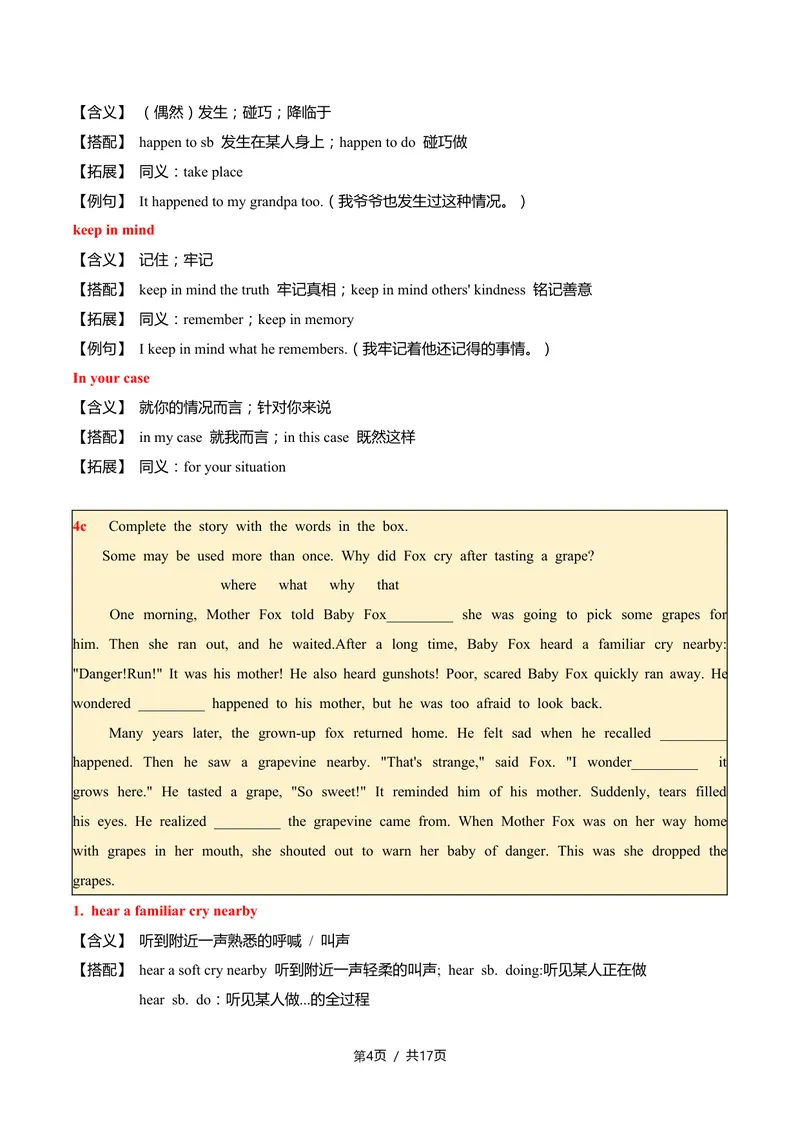
3a
Chen Jie: Why do you look worried, Rick?
Rick: Yesterday I visited my grandma,but she kept calling
me Johnny.
Chen Jie: Who's Johnny?
Rick: My dad!
Chen Jie: Oh, dear!
Rick: And then she told me not to eat the cookies because
she was saving them for her grandson.
ChenJie: Who's that?
Rick: Me!
Chen Jie: Well, that's not a good sign.
Rick:No. My parents are taking her to hospital tomorrow.
Chen Jie: Good. Follow what the doctor says. She may need special care.
Rick: Yeah. I just feel so sad. I don't understand what she's going through.
Chen Jie: Well, you know how some people's memory gets worse as they get older. It happened to
my grandpa too.
Rick: Oh, no. What happened?
Chen Jie: We used to fly kites in the park. But now he forgets how to reach the park. So, I walk
him there every weekend.
Rick: That's sweet!
Chen Jie: Thanks. Instead of what he forgets, I keep in mind what he remembers. In your case, your
grandma still remembers that you love cookies!
Rick: You're right! Thanks, Chen Jie!
9. go through
【含义】 v. 经历;经受;翻阅
【搭配】 go through difficulties 经历困难;go through pain 承受痛苦
【拓展】 同义:experience
【例句】 I don't understand what she's going through.(我不明白她正在经历什么。)
get worse
【含义】 变坏;变差;恶化
【搭配】 memory get worse 记忆力变差;weather get worse 天气变坏
【拓展】 反义词:get better(变好)
【例句】 Some people's memory gets worse as they get older.(有些人年纪大了,记忆力会变差。)
happen to
第3 / 17
页 共 页【含义】 (偶然)发生;碰巧;降临于
【搭配】 happen to sb 发生在某人身上;happen to do 碰巧做
【拓展】 同义:take place
【例句】 It happened to my grandpa too.(我爷爷也发生过这种情况。)
keep in mind
【含义】 记住;牢记
【搭配】 keep in mind the truth 牢记真相;keep in mind others' kindness 铭记善意
【拓展】 同义:remember;keep in memory
【例句】 I keep in mind what he remembers.(我牢记着他还记得的事情。)
In your case
【含义】 就你的情况而言;针对你来说
【搭配】 in my case 就我而言;in this case 既然这样
【拓展】 同义:for your situation
4c Complete the story with the words in the box.
Some may be used more than once. Why did Fox cry after tasting a grape?
where what why that
One morning, Mother Fox told Baby Fox_________ she was going to pick some grapes for
him. Then she ran out, and he waited.After a long time, Baby Fox heard a familiar cry nearby:
"Danger!Run!" It was his mother! He also heard gunshots! Poor, scared Baby Fox quickly ran away. He
wondered _________ happened to his mother, but he was too afraid to look back.
Many years later, the grown-up fox returned home. He felt sad when he recalled _________
happened. Then he saw a grapevine nearby. "That's strange," said Fox. "I wonder_________ it
grows here." He tasted a grape, "So sweet!" It reminded him of his mother. Suddenly, tears filled
his eyes. He realized _________ the grapevine came from. When Mother Fox was on her way home
with grapes in her mouth, she shouted out to warn her baby of danger. This was she dropped the
grapes.
1. hear a familiar cry nearby
【含义】 听到附近一声熟悉的呼喊 / 叫声
【搭配】 hear a soft cry nearby 听到附近一声轻柔的叫声; hear sb. doing:听见某人正在做
hear sb. do:听见某人做...的全过程
第4 / 17
页 共 页【例句】 She heard a familiar cry nearby and realized her friend was calling her.(她听到附近一声熟悉的
呼喊,意识到是朋友在叫她。)
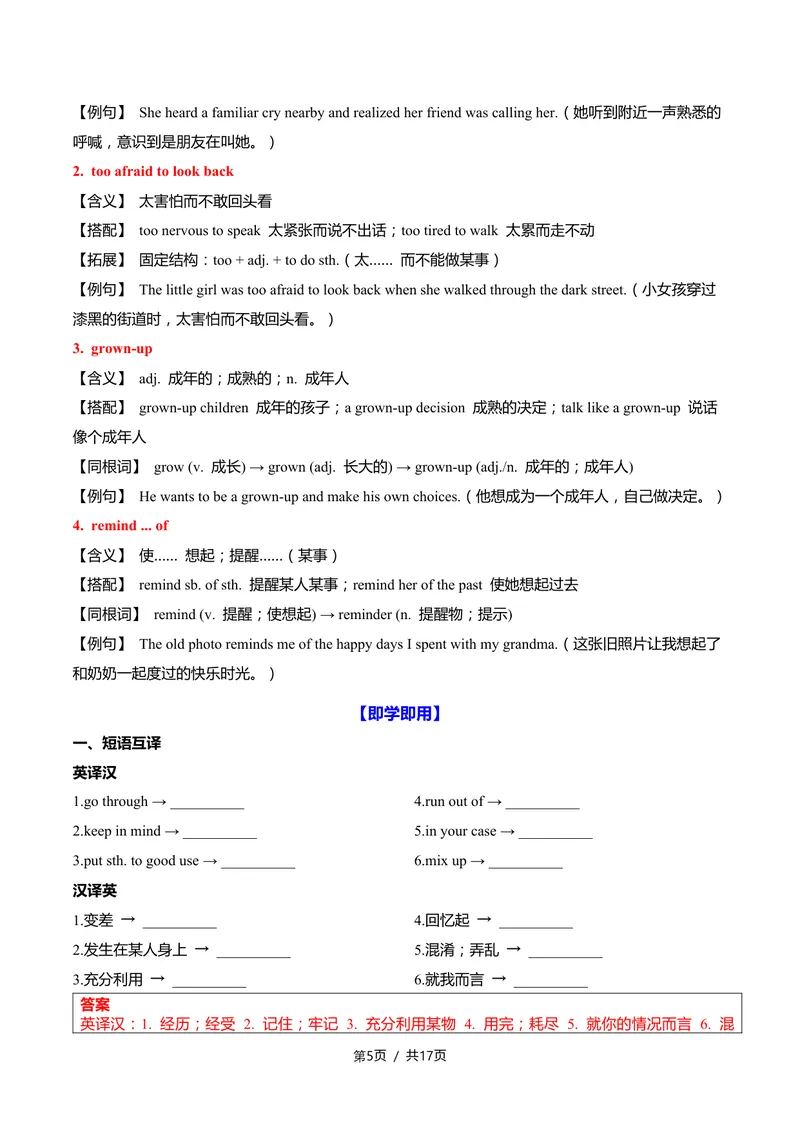
2. too afraid to look back
【含义】 太害怕而不敢回头看
【搭配】 too nervous to speak 太紧张而说不出话;too tired to walk 太累而走不动
【拓展】 固定结构:too + adj. + to do sth.(太…… 而不能做某事)
【例句】 The little girl was too afraid to look back when she walked through the dark street.(小女孩穿过
漆黑的街道时,太害怕而不敢回头看。)
3. grown-up
【含义】 adj. 成年的;成熟的;n. 成年人
【搭配】 grown-up children 成年的孩子;a grown-up decision 成熟的决定;talk like a grown-up 说话
像个成年人
【同根词】 grow (v. 成长) → grown (adj. 长大的) → grown-up (adj./n. 成年的;成年人)
【例句】 He wants to be a grown-up and make his own choices.(他想成为一个成年人,自己做决定。)
4. remind ... of
【含义】 使…… 想起;提醒……(某事)
【搭配】 remind sb. of sth. 提醒某人某事;remind her of the past 使她想起过去
【同根词】 remind (v. 提醒;使想起) → reminder (n. 提醒物;提示)
【例句】 The old photo reminds me of the happy days I spent with my grandma.(这张旧照片让我想起了
和奶奶一起度过的快乐时光。)
【即学即用】
一、短语互译
英译汉
1.go through → __________ 4.run out of → __________
2.keep in mind → __________ 5.in your case → __________
3.put sth. to good use → __________ 6.mix up → __________
汉译英
1.变差 → __________ 4.回忆起 → __________
2.发生在某人身上 → __________ 5.混淆;弄乱 → __________
3.充分利用 → __________ 6.就我而言 → __________
答案
英译汉:1. 经历;经受 2. 记住;牢记 3. 充分利用某物 4. 用完;耗尽 5. 就你的情况而言 6. 混
第5 / 17
页 共 页淆;弄乱
汉译英:1.get worse 2.happen to sb. 3.put to good use 4.recall 5.mix up 6.in my case
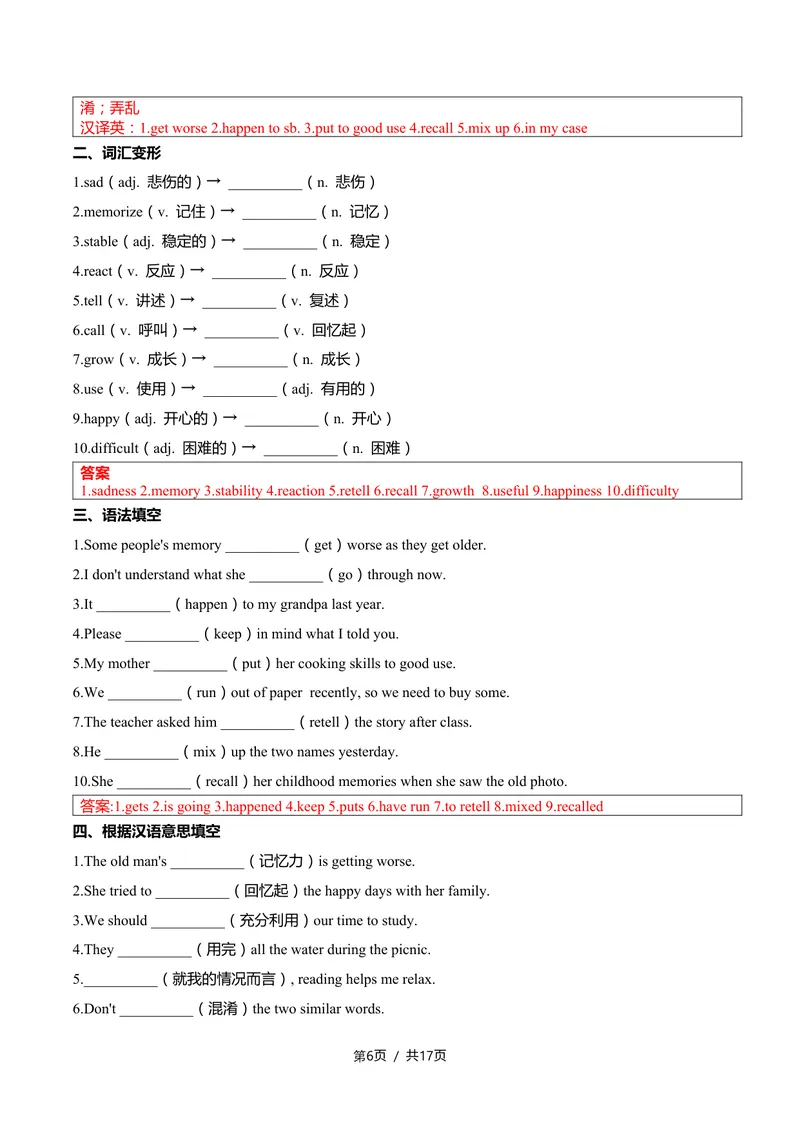
二、词汇变形
1.sad(adj. 悲伤的)→ __________(n. 悲伤)
2.memorize(v. 记住)→ __________(n. 记忆)
3.stable(adj. 稳定的)→ __________(n. 稳定)
4.react(v. 反应)→ __________(n. 反应)
5.tell(v. 讲述)→ __________(v. 复述)
6.call(v. 呼叫)→ __________(v. 回忆起)
7.grow(v. 成长)→ __________(n. 成长)
8.use(v. 使用)→ __________(adj. 有用的)
9.happy(adj. 开心的)→ __________(n. 开心)
10.difficult(adj. 困难的)→ __________(n. 困难)
答案
1.sadness 2.memory 3.stability 4.reaction 5.retell 6.recall 7.growth 8.useful 9.happiness 10.difficulty
三、语法填空
1.Some people's memory __________(get)worse as they get older.
2.I don't understand what she __________(go)through now.
3.It __________(happen)to my grandpa last year.
4.Please __________(keep)in mind what I told you.
5.My mother __________(put)her cooking skills to good use.
6.We __________(run)out of paper recently, so we need to buy some.
7.The teacher asked him __________(retell)the story after class.
8.He __________(mix)up the two names yesterday.
10.She __________(recall)her childhood memories when she saw the old photo.
答案:1.gets 2.is going 3.happened 4.keep 5.puts 6.have run 7.to retell 8.mixed 9.recalled
四、根据汉语意思填空
1.The old man's __________(记忆力)is getting worse.
2.She tried to __________(回忆起)the happy days with her family.
3.We should __________(充分利用)our time to study.
4.They __________(用完)all the water during the picnic.
5.__________(就我的情况而言), reading helps me relax.
6.Don't __________(混淆)the two similar words.
第6 / 17
页 共 页7.The little boy felt deep __________(悲伤)when his pet left.
8.He found a __________(稳定的)job in the city.
9.How did she __________(反应)to the good news?
10.My __________(孙子)likes eating cookies very much.
答案
1.memory 2.recall 3.put to good use 4.ran out of 5.In my case 6.mix up 7.sadness 8.stable 9.react 10.grandson
Part 3:语法突破
宾语从句-2 疑问词
一、核心概念
1. 什么是 “疑问词引导的宾语从句”?
当宾语从句由 what/who/why/how/when/where 等疑问词引导时,从句用于表达 “询问某事、某个情
况或某个方式”,作主句的宾语。
核心特点:从句必须用 陈述句语序(疑问词 + 主语 + 谓语),不能用疑问语序。
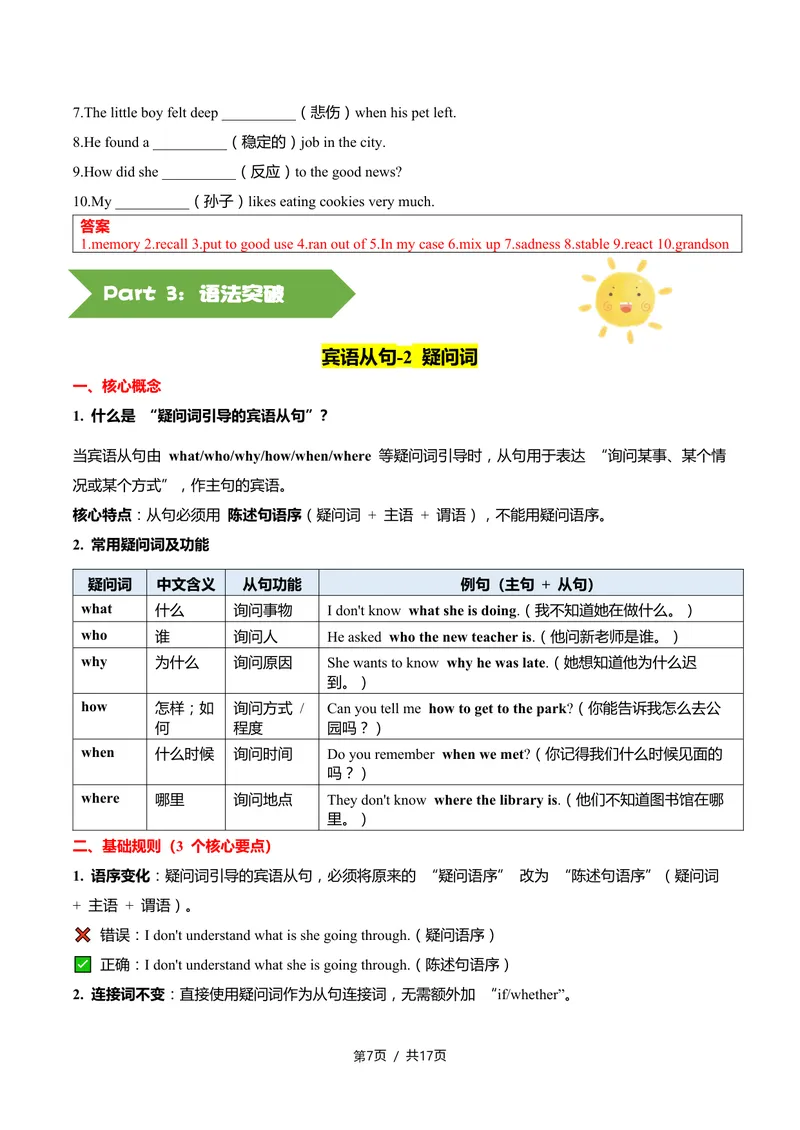
2. 常用疑问词及功能
疑问词 中文含义 从句功能 例句(主句 + 从句)
what 什么 询问事物 I don't know what she is doing.(我不知道她在做什么。)
who 谁 询问人 He asked who the new teacher is.(他问新老师是谁。)
why 为什么 询问原因 She wants to know why he was late.(她想知道他为什么迟
到。)
how 怎样;如 询问方式 / Can you tell me how to get to the park?(你能告诉我怎么去公
何 程度 园吗?)
when 什么时候 询问时间 Do you remember when we met?(你记得我们什么时候见面的
吗?)
where 哪里 询问地点 They don't know where the library is.(他们不知道图书馆在哪
里。)
二、基础规则(3 个核心要点)
1. 语序变化:疑问词引导的宾语从句,必须将原来的 “疑问语序” 改为 “陈述句语序”(疑问词
+ 主语 + 谓语)。
❌ 错误:I don't understand what is she going through.(疑问语序)
✅ 正确:I don't understand what she is going through.(陈述句语序)
2. 连接词不变:直接使用疑问词作为从句连接词,无需额外加 “if/whether”。
第7 / 17
页 共 页3. 时态一致:主句为过去时(如 asked, didn't know),从句需用相应过去时态;主句为现在时(如
know, want),从句时态根据实际情况而定。
例:He asked where she lived.(主句过去时 → 从句过去时)
例:I know where she lives.(主句现在时 → 从句现在时)
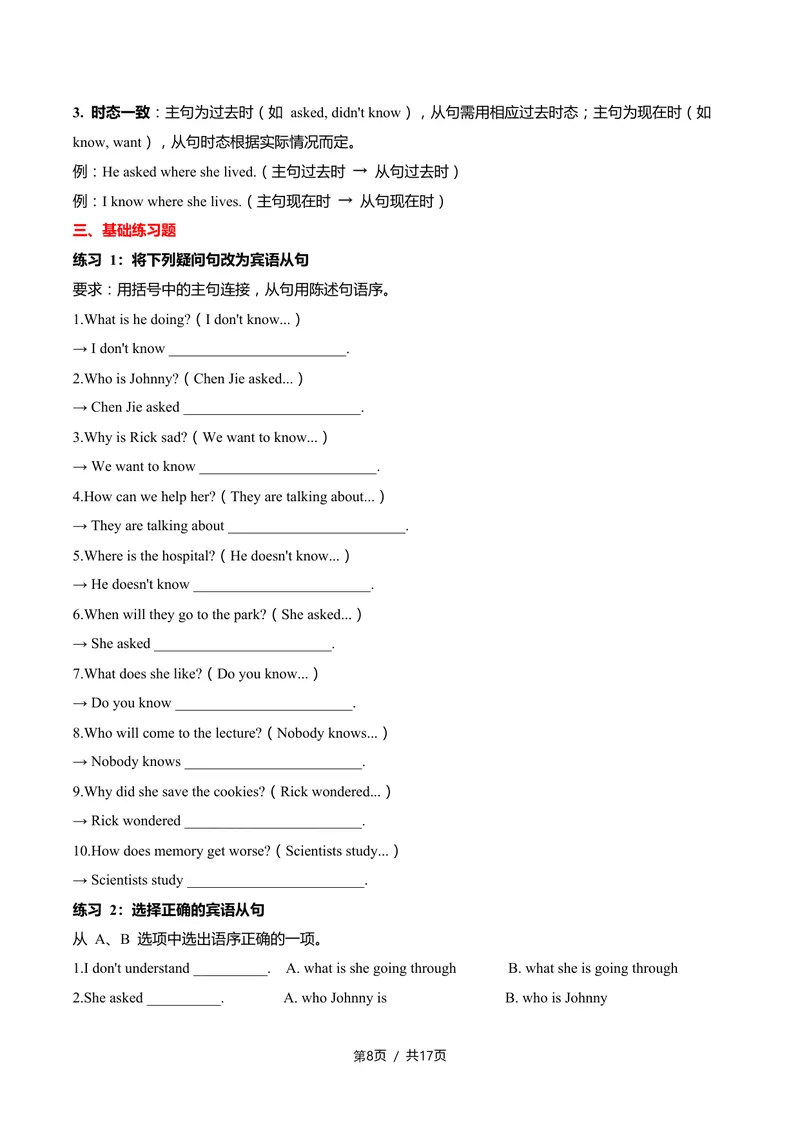
三、基础练习题
练习 1:将下列疑问句改为宾语从句
要求:用括号中的主句连接,从句用陈述句语序。
1.What is he doing?(I don't know...)
→ I don't know ________________________.
2.Who is Johnny?(Chen Jie asked...)
→ Chen Jie asked ________________________.
3.Why is Rick sad?(We want to know...)
→ We want to know ________________________.
4.How can we help her?(They are talking about...)
→ They are talking about ________________________.
5.Where is the hospital?(He doesn't know...)
→ He doesn't know ________________________.
6.When will they go to the park?(She asked...)
→ She asked ________________________.
7.What does she like?(Do you know...)
→ Do you know ________________________.
8.Who will come to the lecture?(Nobody knows...)
→ Nobody knows ________________________.
9.Why did she save the cookies?(Rick wondered...)
→ Rick wondered ________________________.
10.How does memory get worse?(Scientists study...)
→ Scientists study ________________________.
练习 2:选择正确的宾语从句
从 A、B 选项中选出语序正确的一项。
1.I don't understand __________. A. what is she going through B. what she is going through
2.She asked __________. A. who Johnny is B. who is Johnny
第8 / 17
页 共 页3.Do you know __________? A. where the airport is B. where is the airport
4.He told me __________. A. why he was late B. why was he late
5.We want to learn __________. A. how we can improve memory B. how can we improve memory
答案
练习 1:句型转换答案
1.I don't know what he is doing.
2.Chen Jie asked who Johnny is.
3.We want to know why Rick is sad.
4.They are talking about how we can help her.
5.He doesn't know where the hospital is.
6.She asked when they would go to the park.
7.Do you know what she likes?
8.Nobody knows who will come to the lecture.
9.Rick wondered why she saved the cookies.
10.Scientists study how memory gets worse.
练习 2:选择题答案
1.B 2.A 3.A 4.A 5.A
Part 4:课堂综合练习
一、根据汉语意思填空
1.This story filled her with __________(sadness /happiness).(悲伤)
2.We need to __________(use /put)our skills to good use.(充分利用)
3.His memory is __________(getting worse /getting better).(变差)
4.It __________(happened to /took place)my friend.(发生在)
5.Please __________(keep in mind /forget)this important date.(记住)
6.Don't __________(mix up /separate)the tickets.(混淆)
7.She has a good __________(memory /position).(记忆力)
8.__________(In your case / On the way), you should see a doctor.(就你的情况而言)
9.They __________(ran out of /saved)money last month.(用完)
10.He can __________(retell /write)the story clearly.(复述)
答案
1.sadness 2.put 3.getting worse 4.happened to 5.keep in mind 6.mix up 7.memory 8.In your case 9.ran out of
10.retell
二、语法填空
1.Over the past years, his memory __________(get)worse and worse.
2.My grandma __________(not recognize)me when I visited her last week.
3.She __________(walk)her grandpa to the park every weekend.
4.We __________(not run)out of time yet, so we can slow down.
第9 / 17
页 共 页5.The teacher told us __________(keep)in mind the key points.
6.It __________(happen)to many old people as they grow older.
7.He __________(try)to recall the old man's name now.
8.They __________(put)their knowledge to good use in the project.
9.Last year, she __________(learn)how to retell stories in English.
10.If you __________(mix)up the positions, you will get lost.
答案
1.has got 2.didn't recognize 3.walks 4.haven't run 5.to keep 6.happens 7.is trying 8.put 9. learned 10.mix
三、完形填空
Jack is a grade nine student. He used to be very healthy, but recently he has been feeling unwell. He often
feels tired and has a 1 . He doesn’t know what’s wrong with him.
Last week, he went to see a doctor. The doctor asked him about his daily life. Jack said he often stayed
up late to 2 his homework. He hardly ever exercised and always ate 3 food like hamburgers
and chips.
The doctor told him that his bad habits were 4 for his health. He advised Jack to go to bed 5
every night, at least 8 hours of sleep. He also told Jack to 6 more exercise, such as running or playing
football. And he suggested that Jack should eat more 7 food, like fruits and vegetables.
Jack followed the doctor’s advice. After two weeks, he felt much 8 . He realized that health is the
most important thing. Now he exercises 9 a week and eats healthy food every day. He no longer stays
up late and always gets enough 1 0 .
1.A.headache B.smile C.hope
2.A.finish B.start C.forget
3.A.healthy B.junk C.delicious
4.A.good B.bad C.important
5.A.late B.early C.slowly
6.A.take B.make C.do
7.A.unhealthy B.expensive C.healthy
8.A.worse B.better C.sadder
9.A.twice B.never C.hardly
10.A.sleep B.food C.water
【答案】
1.A 2.A 3.B 4.B 5.B 6.C 7.C 8.B 9.A 10.A
第10 / 17
页 共 页【导语】本文是一篇记叙文。文章主要讲述杰克过去身体很健康,但最近身体不适,去看医生后得知
是坏习惯导致的,医生给了他一些建议,杰克听从建议后身体好转,意识到健康最重要,养成了良好
生活习惯。
1.句意:他经常感到疲倦,还头疼。
headache头疼;smile微笑;hope希望。根据前文“He often feels tired”可知,此处描述身体不舒服的
症状,结合选项,头疼符合语境。故选A。
2.句意:杰克说他经常熬夜完成作业。
finish完成;start开始;forget忘记。根据“he often stayed up late to...his homework”可知,熬夜是为了
完成作业。故选A。
3.句意:他几乎从不锻炼,总是吃像汉堡和薯条这样的垃圾食品。
healthy健康的;junk垃圾的;delicious美味的。根据“like hamburgers and chips”可知,汉堡和薯条属
于垃圾食品,junk food“垃圾食品”。故选B。
4.句意:医生告诉他,他的坏习惯对他的健康有害。
good好的;bad坏的;important重要的。根据“his bad habits”可知,坏习惯对健康有害,be bad
for“对……有害”。故选B。
5.句意:他建议杰克每天晚上早点睡觉,至少睡8个小时。
late晚地;early早地;slowly慢地。根据“at least 8 hours of sleep”可知,要保证至少8小时睡眠,所
以应该早点睡觉,early符合语境。故选B。
6.句意:他还告诉杰克要多做运动,比如跑步或踢足球。
take拿走;make制作;do做。根据“more exercise”可知,此处表达做运动,do exercise“做运动”,
固定短语。故选C。
7.句意:他还建议杰克应该多吃健康食品,比如水果和蔬菜。
unhealthy不健康的;expensive昂贵的;healthy健康的。根据“like fruits and vegetables”可知,水果和
蔬菜是健康食品,healthy符合语境。故选C。
8.句意:两周后,他感觉好多了。
worse更糟糕的;better更好的;sadder更悲伤的。根据前文医生给杰克建议,以及“Jack followed the
doctor’s advice.”可知,杰克听从医生建议后身体应该变好了,much修饰比较级,better符合语境。故
选B。
9.句意:现在他每周锻炼两次,每天吃健康的食物。
twice两次;never从不;hardly几乎不。根据“Now he exercises...a week”可知,此处表示锻炼的频
率,结合选项,twice a week“每周两次”符合语境。故选A。
第11 / 17
页 共 页10.句意:他不再熬夜,总是得到足够的睡眠。
sleep睡眠;food食物;water水。根据前文“He no longer stays up late”可知,不再熬夜就能得到足够
睡眠,sleep符合语境。故选A。
四、语法填空
阅读下面短文,在各题空白处填入括号内单词的正确形式。
Have you ever heard the word “neophobia” (恐新症)? It comes from Greek (希腊语). Neo means “new”,
and phobia means “fear”. So food neophobia is the fear of 1 (try) new food. It may sound strange,
but it 2 (be) very common in young children. About half of kids between two and six years old go
through this.
Why does it happen? Long ago, avoiding unknown food 3 (help) children stay safe. Bitter
plants could be poisonous (有毒的), so children learned to keep away from 4 (they). Today, this habit
is not really needed, but many kids still have it. They often say “no” before even tasting the food. They look at
the food, smell it, and quickly choose not 5 (eat) it. The good news is that food neophobia usually
goes away as children get older. Parents can help, too. Studies show that kids may need to see the same food
eight 6 (time) before they accept it. Making meals fun and 7 (color) also helps. But forcing
children to eat can make the fear even 8 (strong) than before, which will make the situation worse.
As children grow up, they 9 (have) a wider menu one day. But if food neophobia stays into
adulthood, doctors will advise these people to try new foods 10 (slow), step by step. Generally
speaking, it’s healthier to have a wider choice of food.
【答案】
1.trying 2.is 3.helped 4.them 5.to eat 6.times 7.colorful 8.
stronger 9.will have 10.slowly
【导语】本文介绍了“恐新症”的含义、儿童中常见的食物恐新现象,其成因、应对方法以及它通常
会随年龄消退的特点。
1.句意:所以食物恐新症就是害怕尝试新食物。根据“of”可知,介词后接动名词,try的动名词形式
是trying。故填trying。
2.句意:这听起来可能很奇怪,但在幼儿中非常常见。根据上下文可知,句子用一般现在时,主语it
是单数,be动词用is。故填is。
3.句意:很久以前,避免未知的食物帮助孩子们保持安全。根据“Long ago”可知,句子用一般过去
时,help的过去式是helped。故填helped。
第12 / 17
页 共 页4.句意:苦味的植物可能有毒,所以孩子们学会了远离它们。根据“keep away from”可知,介词后
接人称代词宾格,they的宾格形式是them。故填them。
5.句意:他们看着食物,闻了闻,然后迅速选择不吃它。根据“choose”可知,此处是固定搭配
choose (not) to do sth,用动词不定式形式to eat。故填to eat。
6.句意:研究表明,孩子们可能需要看到同一种食物八次才会接受它。根据“eight”可知,其后接可
数名词复数,time的复数形式是times。故填times。
7.句意:让用餐变得有趣又多彩也有帮助。根据“fun and”可知,此处用形容词作宾语补足语,color
的形容词形式是colorful。故填colorful。
8.句意:但强迫孩子吃东西会让恐惧比以前更强烈,这会让情况变得更糟。根据“even”和“than
before”可知,此处用形容词比较级,strong的比较级是stronger。故填stronger。
9.句意:随着孩子长大,有一天他们会有更丰富的菜单。根据“one day”可知,句子用一般将来时,
结构为will+动词原形。故填will have。
10.句意:但如果食物恐新症持续到成年,医生会建议这些人慢慢尝试新食物,一步一步来。根据
“try new foods”可知,此处用副词修饰动词,slow的副词形式是slowly。故填slowly。
五、任务型读写
You may know about “junk food” like French fries. But do you know about “junk sleep”?
A British survey shows that there are many electronic products in teenagers’ bedrooms. They are
influencing teenagers’ sleep badly.
The survey was done among 1,000 British kids from 12 to 16. It is found that 50% of them got just 4 to
7 hours’ sleep every day. But doctors say they need 8 to 9 hours.
Almost 25% of the kids said they often fell asleep while they were watching TV, listening to music or
using other electronic products.
“The results are very worrying,” said Dr. Chris, a British professor, “We call it ‘junk sleep’. It means you
don’t get enough sleep and the quality of the sleep is low, too.” The survey found that quite a few of the kids
felt tired each day because of the junk sleep, especially girls between 13 and 16. Nearly all the teenagers have
a phone, music player or TV in their bedrooms. And lots of them even have all the three.
Dr. Chris suggested that parents should help their children keep away from electronic products, and that
teenagers should spend less time on phones.
根据上面短文的内容回答问题(每小题答案不超过6个单词)。
1.What are influencing teenagers’ sleep badly?
第13 / 17
页 共 页2.How many kids get only 4 to 7 hours’ sleep a day?
3.What did Dr. Chris think of the results of the survey?
4.Who should help the children keep away from electronic products?
5.How will you deal with “junk sleep”?
【答案】1.Many electrical products./Many electrical products in teenagers bedrooms. 2.500./500
students. 3.Worrying./He was worried./The results were very worrying. 4.Parents. 5.By
going to bed early./By spending less time on phones./By using mobile phones less.
【导语】本文主要讨论了青少年所面临的“垃圾睡眠”问题,包括影响青少年睡眠的因素、“垃圾睡
眠”的表现、对青少年的影响以及应对“垃圾睡眠”的建议。
1.根据第二段“A British survey shows that there are many electronic products in teenagers’ bedrooms.
They are influencing teenagers’ sleep badly.”可知,青少年卧室里的许多电子产品严重影响着他们的睡
眠。故填Many electrical products./Many electrical products in teenagers bedrooms.
2.根据第三段“The survey was done among 1,000 British kids from 12 to 16. It is found that 50% of them
got just 4 to 7 hours’ sleep every day.”可知,调查是在1000名12到16岁的英国孩子中进行的,其中
50%的孩子每天只睡4到7个小时,也就是500个孩子。故填500./500 students.
3.根据第五段“‘The results are very worrying,’ said Dr. Chris, a British professor”可知,英国教授克里
斯博士认为调查结果非常令人担忧。故填Worrying./He was worried./The results were very worrying.
4.根据最后一段“Dr. Chris suggested that parents should help their children keep away from electronic
products”可知,克里斯博士建议父母应该帮助孩子远离电子产品。故填Parents.
5.这是一个开放性问题,答案因人而异。但可以根据文章内容和常识来回答。故填By going to bed
early./By spending less time on phones./By using mobile phones less.
六、短文还原
Five Tips to Improve Your Memory
Most of us know that our brains become smaller in size as we get older,but did you know that diet and
lifestyle have an effect on how well our brains work?
A study shows that eating lots of fruit, vegetables and proteins(蛋白质)improves memory. 1
第14 / 17
页 共 页Eating oily fish or dark chocolate (with over 70%cocoa) and taking Vitamin D3 can also help make your
memory stronger.
2 A 2011 study showed that regular exercise actually increased brain size. Another study found
that exercise improved memory in some older people; surprisingly it found that one single training period had
the same effect on memory as a regular, long exercise period!
One study found that eight weeks of short, daily meditation(冥想)improved memory. Other ways to relax
can also improve our short-term memory. Try taking 5-10 minutes of your day to meditate or listen to music. 3
Experts say that age reduces our ability to learn,but sleep can help. 4 A 2019 study found that
students learned things better before and after a short sleep!
5 Try to memorize information like phone numbers and addresses rather than putting the
information in your phone. You could also learn a language or do brain training like crosswords (填字游戏).
A.Or even just take a shower!
B.The role of exercise is really important, too.
C.Use your phone to help you memorize things.
D.To keep your brain in good condition, you need to use it.
E.For your brain to work well, 7-9 hours of sleep is necessary.
F.Try to avoid (避免) sugary foods such as cakes and milk chocolate.
【答案】1.F 2.B 3.A 4.E 5.D
【导语】本文介绍了5个提升记忆力的方法,涵盖饮食、运动、放松、睡眠及大脑训练等方面。
1.第2段开头说明“多吃水果、蔬菜、蛋白质能提升记忆力,吃富含油脂的鱼类或(可可含量超过
70% 的)黑巧克力、补充维生素D3也能增强记忆力”,选项F“Try to avoid sugary foods such as cakes
and milk chocolate”衔接这一内容,补充饮食方面的注意事项。
2.第3段阐述“2011年研究显示规律运动能增加大脑尺寸,另一项研究发现单次训练对记忆力的效
果和长期规律运动相当”,选项B“The role of exercise is really important, too”衔接这一内容,点明运动
的重要性。
3.第4段提到“每天冥想8周能提升记忆力,其他放松方式也能改善短期记忆”,选项A“Or even
just take a shower!”衔接这一内容,补充放松的具体方式。
4.第5段开头指出“年龄会降低学习能力,但睡眠有帮助”,选项E“For your brain to work well, 7-9
hours of sleep is necessary”衔接这一内容,说明优质睡眠的时长要求。
5.第6段建议“尝试记忆电话号码等信息而非依赖手机,也可以学语言或做填字游戏”,选项D“To
第15 / 17
页 共 页keep your brain in good condition, you need to use it”衔接这一内容,点明“使用大脑”的核心逻辑。
七、阅读理解
Has a person ever held a door open for you warmly? How do you feel after playing with friends? What’s
your favourite family memory? These questions all focus on connecting with people. “Let’s Connect” is the
theme of this year’s Children’s Mental Health Week, which aims to improve mental health by building healthy
social connections.
Humans naturally seek connections with family, friends or community members. Healthy bonds (关系)
bring energy and support-we all need others to celebrate joys and share worries with. They also boost physical
health and help people live longer; research shows loneliness can slowly damage health. The key to connections
isn’t the number of relationships, but their quality.
How to build connections? Julia Clements, the event organizer, says there are many ways: in-person or
online with friends, parents or teachers. Connections aren’t limited to humans—some feel close to pets or nature.
She suggests using actions and words: being kind, listening to others and trying new experiences work well.
Everyone may feel lonely and avoid talking sometimes. Remember connections change-some grow
stronger, others fade (变淡). Clements advises sharing feelings with trusted people or safe organizations like
Childline (儿童热线). They can help form new connections or fix strained (紧张的) relationships.
根据语篇内容,选择最佳选项。
1.What is the theme of this year’s Children’s Mental Health Week?
A.Stay Happy. B.Let’s Connect. C.Fight Loneliness.
2.Which one is NOT an advantage of healthy social connections?
A.Bringing people energy and support.
B.Helping people share joys and worries.
C.Making people become rich quickly.
3.What does “boost” in Paragraph 2 probably mean?
A.Harm. B.Improve. C.Change.
4.What does Julia Clements advise to build connections?
A.Only connect with people in person.
B.Keep away from pets and nature.
C.Be kind and listen to others actively.
5.What is the best title for the passage?
A.Let’s Connect for Better Mental Health.
第16 / 17
页 共 页B.Ways to Avoid Loneliness.
C.Healthy Bonds with Family and Friends.
【答案】1.B 2.C 3.B 4.C 5.A
【导语】本文是一篇说明文,主要围绕今年儿童心理健康周的主题“Let’s Connect”展开,探讨了健康
社交关系的重要性、建立联系的方法以及应对孤独感的建议。
1.细节理解题。根据“‘Let’s Connect’ is the theme of this year’s Children’s Mental Health Week”可知,
今年儿童心理健康周的主题是“Let’s Connect”。故选B。
2.细节理解题。根据“Healthy bonds (关系) bring energy and support-we all need others to celebrate joys
and share worries with. They also boost physical health and help people live longer”可知,未提及让人快速
致富。故选C。
3.词句猜测题。根据“They also boost physical health and help people live longer; research shows
loneliness can slowly damage health.”可知,它们还能促进身体健康,帮助人们活得更久,“boost”与
“improve”含义相近。故选B。
4.细节理解题。根据“She suggests using actions and words: being kind, listening to others and trying new
experiences work well.”可知,Julia Clements建议通过友善和倾听等方式建立联系。故选C。
5.最佳标题题。全文围绕“Let’s Connect”主题,强调通过建立联系改善心理健康,A项符合。故选
A。
第17 / 17
页 共 页